October 13th 2001-2015

Thinking about events I had photographed on October 13th I found rather a lot over the years – so here are links to some of them from 2001-2015.
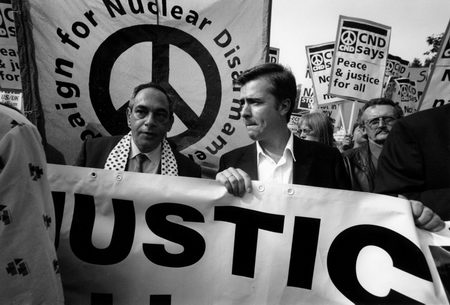
There are just a few black and white pictures from the October 2001 Stop The War March in London. Back in 2001 I was still working on film, and although I had taken pictures in both black and white and colour I only had a black and white scanner.
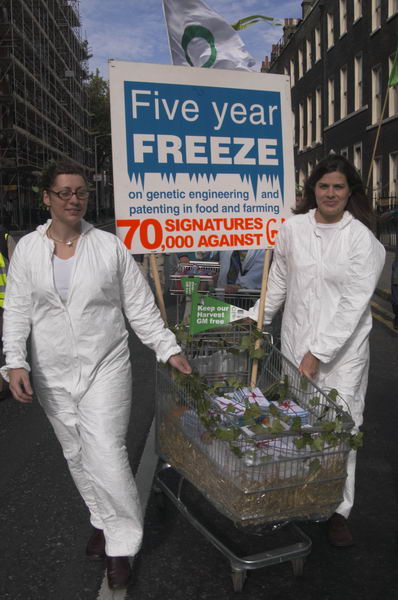

By 2003 I was working with a digital camera, a Nikon D100, and on the 13th October I joined another thousand or so people from around the country to say ‘No to GMO’. Most of the work being done on genetic modification was aimed at increasing the profits of companies and at locking farmers into using patented seeds which had to be purchased from them and which required expensive chemical inputs and would penalise or even lead to prosecutions of those who continued with traditional methods, particularly organic farmers, and severely reduce bio-diversity. The protesters were largely concerned about the possible risks of genetic modifications that were not being subjected to thorough long-term testing. The government seemed simply to be preparing to give way to commercial pressures.

The protesters went first to the National Farmers Union, then to Downing Street (or rather outside the gates to Downing Street) then on past the Houses of Parliament to the Department for Environment, Food and Rural Affairs (DEFRA) in Smith Square. The digital pictures I was making then seem rather dark and muted and processing software then was still rather poor.
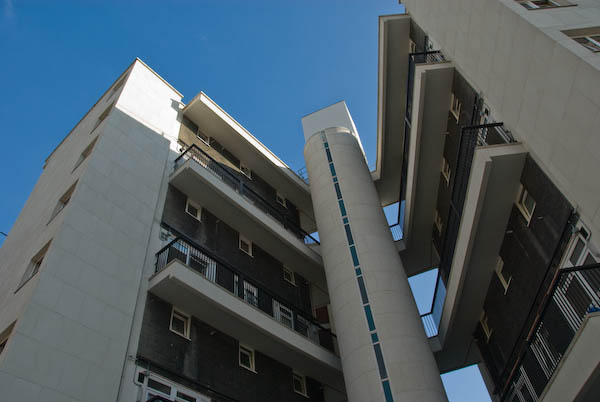

It was 2007 before I photographed anything at all relevant on 13 October again, and this time I was on a walk about The Romance of Bethnal Green, a book by Cathy Ross, which had included a number of my pictures from the 1980s.
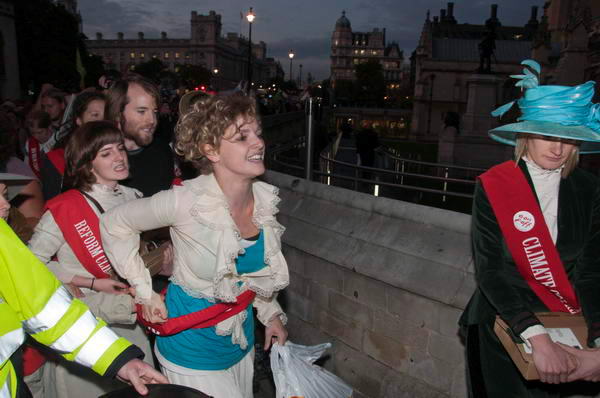
In 2008 came ‘Climate Rush – Deeds Not Words’:


Exactly 100 years ago, more than 40 women were arrested in the ‘Suffragete Rush’ as they attempted to enter The Houses of Parliament. To mark this centenary, women concerned with the lack of political action to tackle climate change organised and led a rally in Parliament Square, calling for “men and women alike” to stand together and support three key demands:

  No airport expansion.
  No new coal-fired power stations.
  The creation of policy in line with the most recent climate science and research.

Those attending were asked to wear white, and many dressed in ways that reflected the styles of a century ago, and wore red sashes with the words ‘Reform Climate Policy’, ‘No New Coal’ ‘Climate Code Red’ and ‘No Airport Expansion’, with campaigners against a second runway at Stansted having their own ‘Suffrajets’ design. We were also offered fairy buns with ‘Deeds Not Words’ and ‘Climate Bill Now’
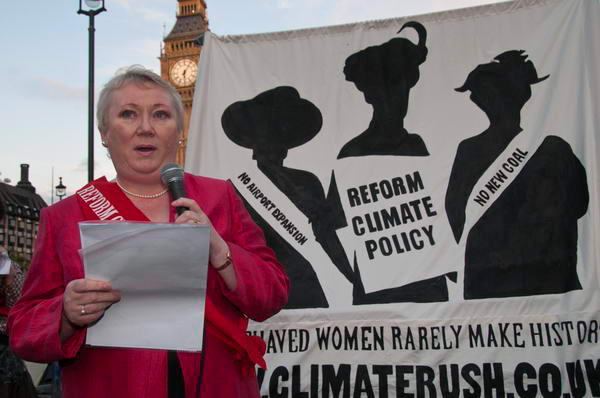
It was a protest that brought together some fairly diverse groups, including the Women’s Institute and the Green Party as well as Climate Rush, who, led by Tamsin Omond tried to storm their way in to the Houses of Parliament like their Suffragette predecessors, but were stopped by police. She was later arrested, not for this action but for breach of her bail conditions from the ‘Plane Stupid’ roof-top protest at the Houses of Parliament 8 months earlier.
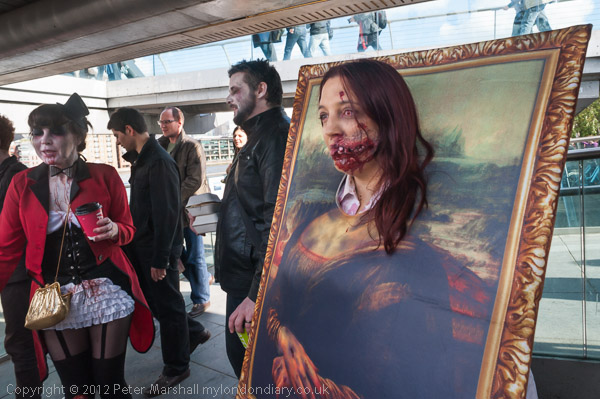

On 13th October 2012, Zombies invaded London in a charity event, to “raise the dead and some dough in aid of St. Mungo’s“, a charity which reaches out to rough sleepers and helps them off the streets.
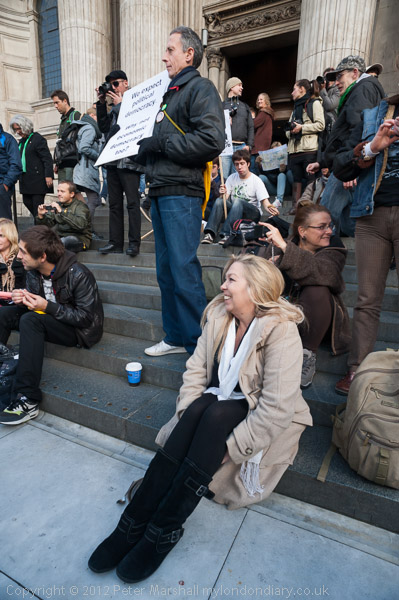
I went on from there to the steps of St Pauls, where on the first anniversary of their attempt to occupy the Stock Exchange, Occupy London joined a worldwide day of protest, #GlobalNoise, by the Occupy movement, to target the “political and financial elites who are held responsible for destroying our communities and the planet, resonating the ongoing wave of anti-austerity protests in Europe and around the world. At the same time #GlobalNoise is a symbol of hope and unity, building on a wide variety of struggles for global justice and solidarity, assuring that together we will create another world.

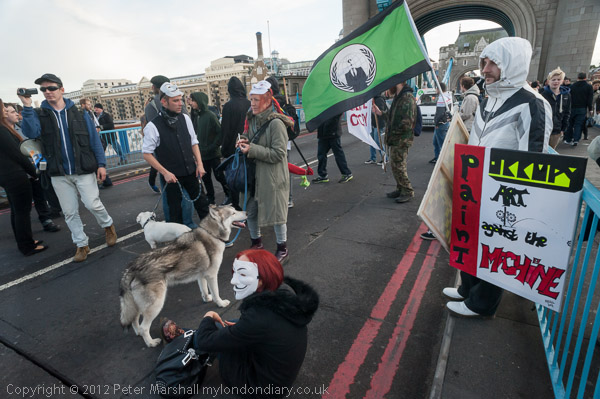
From a rally at St Paul’s they went on to sit down at a few places around the City, before crossing London Bridge heading for an undisclosed location to occupy for the weekend. Some wanted to occupy the ‘Scoop’ next to City Hall, but others felt it wasn’t suitable. A group went on to block Tower Bridge, but then returned to join others at Scoop.
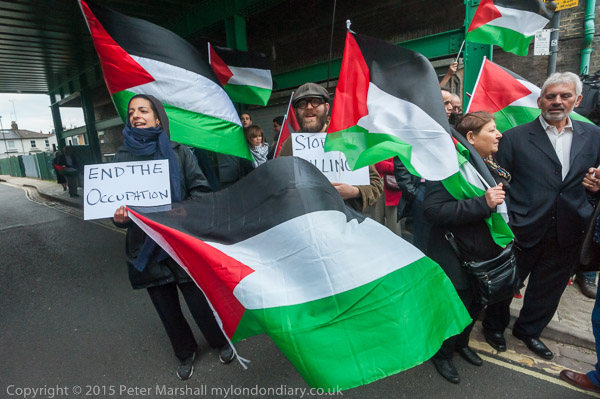
In 2015 the Zionist Federation organised a protest outside the Palestinian Authority UK Mission against the stabbings of Jews in Israel. Jewish and other groups supporting Palestinian resistance to occupation and Israeli terror came along to protest against all violence against both Jews and Palestinians in Israel and for an end to the Israeli occupation of Palestine.
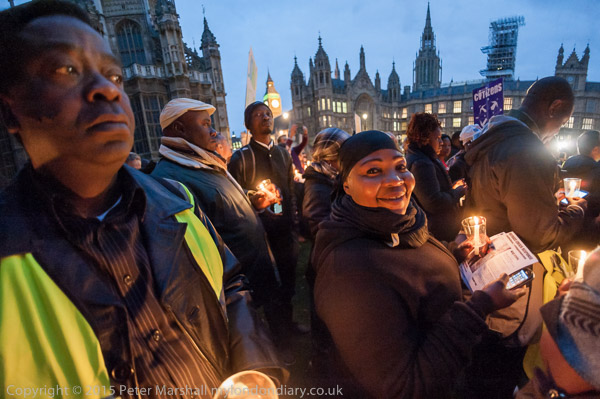

I left while the two protests were continuing to shout at each other to join the candlelit vigil at Parliament by Citizens UK calling for 1000 Syrian refugees to be resettled in the UK before Christmas and 10,000 a year for the next 5 years. Six children froze to death in the camps last year and many in the UK have offered homes and support.

Around Lots Road

For various reasons the pictures in my albums online are not always in the order that they are taken, but it often makes more sense to write about them in the same order as I walked around taking them – which I can normally see from the contact sheets I made at the time. Usually too these contact sheets identify at least the rough locations of the images, though I often have to resort to maps and sometimes Google Streetview to find the precise spot. Chelsea hasn’t changed radically since I took these pictures but in some other areas this can be impossible. How I wish we had GPS on cameras back in 1986 – and I’m surprised so few cameras incorporate it now.

Westfield Park, Tetcott Rd, Lots Rd Power Station, Chelsea, Kensington & Chelsea, 1988 88-5j-16-positive_2400
Westfield Park, Tetcott Rd, Lots Rd Power Station, Chelsea, Kensington & Chelsea, 1988 88-5j-16

Most people know Lots Road because of the power station of the same name which was built to power the District Railway (now the District Line.) Completed in 1905, it enabled the line, most of which in central London is underground, to convert from steam to electric traction, which must have made it very much more pleasant to use.

Lots Rd, Chelsea,  Kensington & Chelsea, 1988  88-5k-62-positive_2400
Lots Rd, Chelsea, Kensington & Chelsea, 1988 88-5k-62

The power station, which has Chelsea Creek on one side and Lots Road on the other finally closed in 2002 and the area on both sides of the creek was developed as Chelsea Waterfront. The development only began in 2013, delayed both by having to get planning permission from both Kensington & Chelsea and Hammersmith and Fulham and then by the financial crash and was finally due to be completed in 2021. The power station should by now be “193 highest quality luxury loft-style apartments together with high-class restaurants, bar, cafes, boutique shops and a health & fitness club.”

Lots Rd, Chelsea,  Kensington & Chelsea, 1988 88-5k-63-positive_2400
Lots Rd, Chelsea, Kensington & Chelsea, 1988 88-5k-63

As the pictures show, I wandered a little around the area before returning east along Cremorne Road and Cheyne Walk to Battersea Bridge where I took a bus back to Clapham Junction.

Tadema Rd, Chelsea,  Kensington & Chelsea, 1988  88-5k-64-positive_2400
Tadema Rd, Chelsea, Kensington & Chelsea, 1988 88-5k-64

Tadema Road runs north from Lots Road and I doubt if I walked far up it. It’s hard now to see where this Cafe could have been.

Cremorne Rd, Chelsea,  Kensington & Chelsea, 1988 88-5k-66-positive_2400
Cremorne Rd, Chelsea, Kensington & Chelsea, 1988 88-5k-66

I had wandered perhaps up Tadema Road to Cremorne Road some way west from its junction with Lots Road to get to Cornwall Mansions at left of this picture, which is looking east past the junction with Edith Grove with a small part of the World’s End Estate towering in the right half of the picture.

Ornamental gate, Cremorne Gardens, Chelsea,  Kensington & Chelsea, 1988 88-5k-52-positive_2400
Ornamental gate, Cremorne Gardens, Chelsea, Kensington & Chelsea, 1988 88-5k-52

I walked back east on Cremorne Road to the junction with Lots Road and back down on to the riverside Cremorne Gardens. A house was built here around 1750 and later became home to the 1st Viscount Cremorne, an Irish peer from County Monaghan who gave it his name – which came from the Irish for ‘Mountains of Morne’. Charles Random De Berenger, Baron De Beaufain, (actually a fraud called Charles Random) bought the house and grounds here in 1831, turning into a sports club and adding some popular attractions including balloon ascents. The business failed in 1843 and was reopened in 1845 by James Ellis as the Cremorne Pleasure Gardens, with entertainment including concerts, fireworks, balloon ascents and galas. It closed in 1875, losing its licence with accusations that it was a “nursery of every kind of vice”. Much of the gardens were then built over then and later in the 20th century by the 1960s Cremorne Estate. A small riverside garden was re-established and opened in 1981, and the gate which had originally been at the King’s Road end of the Cremorne gardens was re-erected here, having spent the interim at Watney’s Brewery.

Chelsea Wharf, River Thames, Chelsea,  Kensington & Chelsea, 1988 88-5k-53-positive_2400
Chelsea Wharf, River Thames, Chelsea, Kensington & Chelsea, 1988 88-5k-53

I think this view was taken looking upriver from one of the two landing stages at Cremorne Gardens.

Houseboats, River Thames, Chelsea Embankment, Chelsea, Kensington & Chelsea, 1988  88-5k-55-positive_2400
Houseboats, River Thames, Chelsea Embankment, Chelsea, Kensington & Chelsea, 1988 88-5k-55

I think this view is from Old Ferry Wharf, which is actually on Cheyne Walk. The bridge is Battersea Bridge.

Houseboats, River Thames, Chelsea Embankment, Chelsea, Kensington & Chelsea, 1988  88-5k-42-positive_2400
Houseboats, River Thames, Chelsea Embankment, Chelsea, Kensington & Chelsea, 1988 88-5k-42-positive_2400

Another view from a little further east.

Cheyne Walk, Chelsea,  Kensington & Chelsea, 1988 88-5k-56-positive_2400
Cheyne Walk, Chelsea, Kensington & Chelsea, 1988 88-5k-56-positive_2400

These houses at left are on the corner with Blantyre St. The blue plaque at No 120 marks where Sylvia Pankhurst (1882-160) lived as an impoverished art student from 1906-09.

Whistler's House, Cheyne Walk, Chelsea, Kensington & Chelsea, 1988 88-5k-31-positive_2400
Whistler’s House, Cheyne Walk, Chelsea, Kensington & Chelsea, 1988 88-5k-31

James Abbott McNeill Whistler’s house at 98 Cheyne Walk. Some of his best-known pictures show the Thames at Cremorne Gardens. The house next door to the right, hardly visible from the road, was the home of both Sir Marc Isambard Brunel and his son  Isambard Kingdom Brunel.

Click on any image to see a larger version in the album 1988 London Photos, from where you can browse the whole album.


11 October 2008

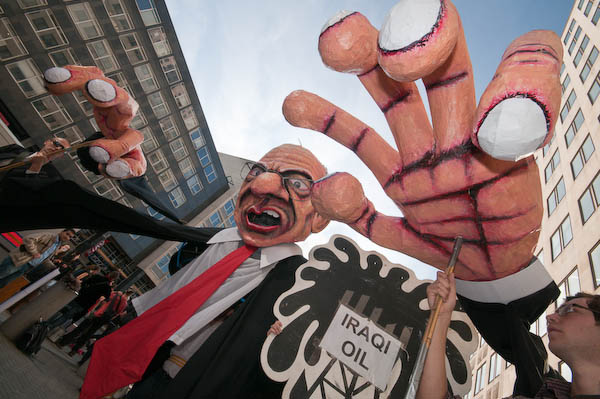
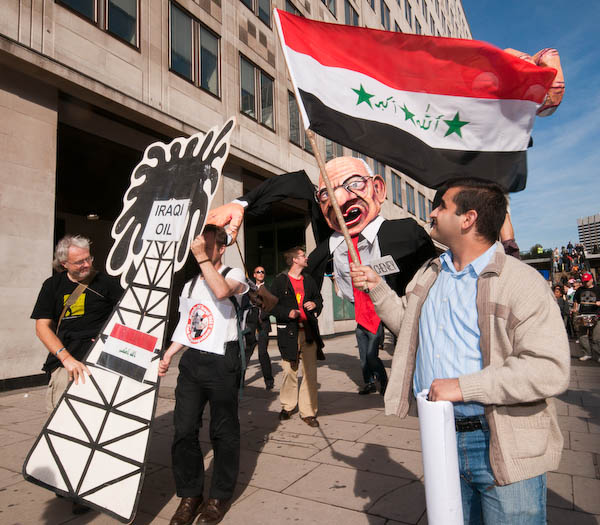
It was the start of the final 100 days of the Bush adminstration and the ‘Hands off Iraqi Oil’ coalition whose members included Corporate Watch, Iraq Occupation Focus, Jubilee Iraq, PLATFORM, Voices UK, and War on Want and was supported by the Stop the War Coalition and others had come to Shell’s UK headquarters at Waterloo to protest against plans by Britain and the USA for Iraq to hand over most of the country’s oil reserves to foreign companies, particularly Shell and BP.

Iraq had nationalised its oil by 1972, and it provided 95% of its government income. Many had seen the invasion of Iraq by the US and UK (along with Australia and Poland) as largely driven by the desire to gain control of Iraq’s huge oil reserves and the US had engaged consultants to help it write a new oil law which it got the Iraqi cabinet to approive in 2007 which would give foreign oil companies – including Shell and BP, long-term contracts within a safe legal framework. But large-scale popular opposition meant the Iraqi parliament failed to approve the new law. But in June 2008, the Iraqi Oil Ministry went ahead with short-term no-bid contracts to the major foreign oil companies – including Exxon Mobil, BP, Shell, Total and Chevron and later these and other contracts were made more favourable to the oil companies.

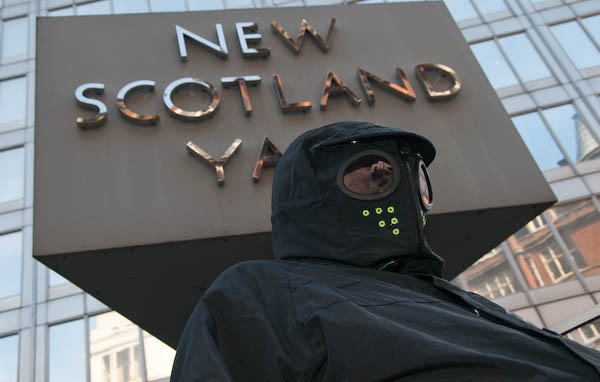
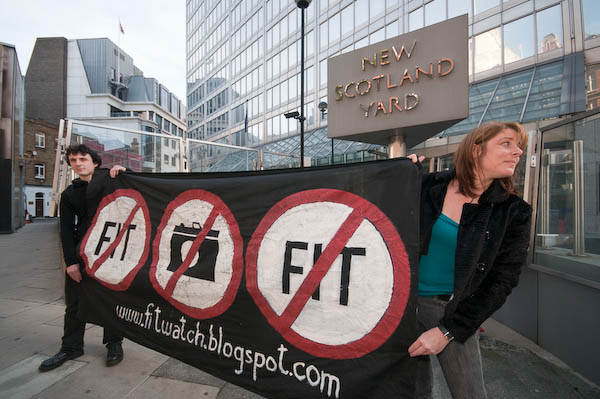
After the protest at Shell’s offices the protesters marched to protest outside the BP HQ in St James’s Square and then to the US Embassy, and I left to cover the London Freedom not fear 2008 event outside New Scotland Yard. Similar protests were taking place in over 20 countries to demonstrate against excessive surveillance by governments and businesses, organised by a broad movement of campaigners and organizations.

The London event highlighted the restrictions of the right to demonstrate under the Labour government’s The Serious Organized Crime and Police Act 2005, (SOCPA),, the intimidatory use of photography by police Forward Intelligence squads (FIT), the proposed introduction of ID cards, the increasing centralisation of personal data held by government, including the DNA database held by police, the incredible growth in surveillance cameras, ‘terrorist’ legislation and other measures which have affected our individual freedom and human rights.

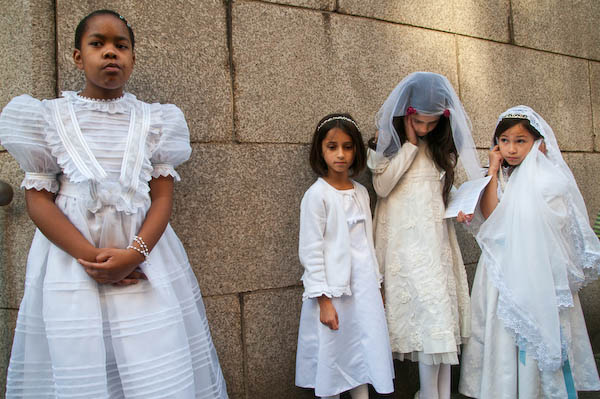
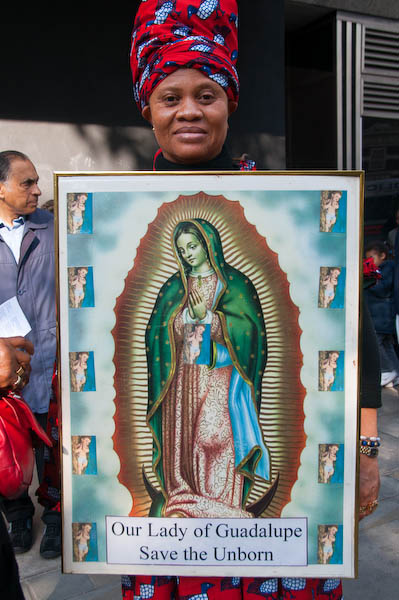
For something completely different I walked a quarter of a mile down Victoria Street to Westminster Cathedral where people were assembling for the Rosary Crusade of Reparation, one of the larger walks of public witness by Catholics in London.

This tradition began in Austria in 1947 with the roasary campaign begun by a priest praying for his country to be freed from the communist occupiers. The first annual parade with the statue of Our Lady of Fatima took place in 1948 in Vienna on the feast of the Name of Mary, Sept 12, which had been established by Pope Innocent XI in 1683 when Turkish invaders surrounding Vienna were defeated by Christian armies who had prayed to the Blessed Virgin.

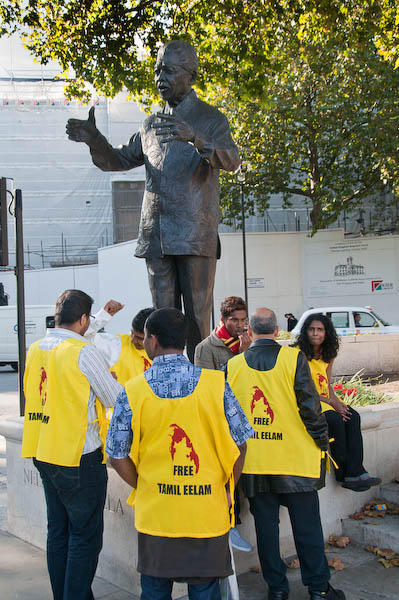
As the procession to a service at Brompton Oratory began I walked back up Victoria St to Parliament Square, where a number of other small protests were in evidence. All over the centre of London there were people giving out leaflets about the growing problems faced by Tamils in Sri Lanka, where they allege a program of ethnic cleansing is being carried out by the government. International media are banned from the Tamil areas of the country and NGOs have been ordered out of some areas, so there are few reports of the war. Worse was to come and in 2009 in the final stages of the war conservative estimates are that 70,000 civilians were killed in the the Mullivaikkal massacre.

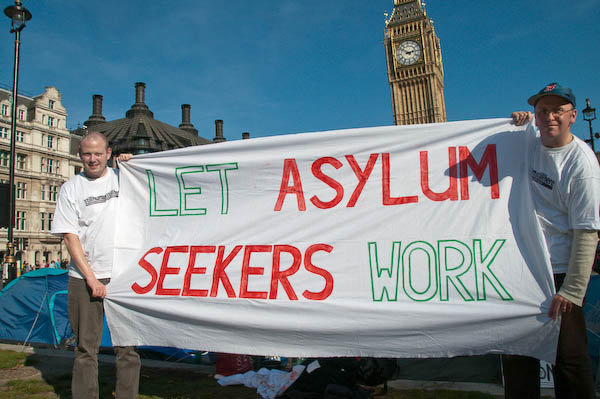
Others in the square were protesting against the UK’s scandalous treatment of asylum seekers and calling for the asylum detention centres to be closed down.

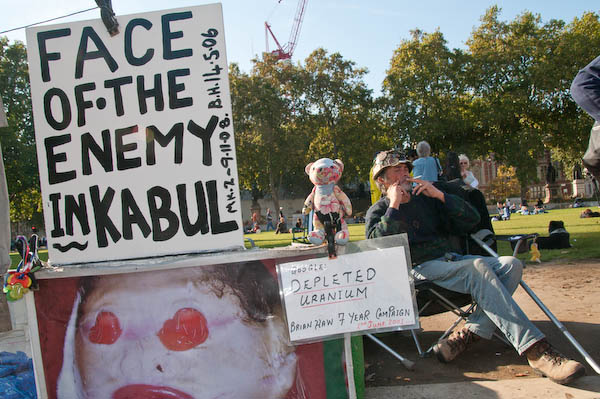
Brian Haw was still there, and I wrote:

Facing Parliament, Brian Haw‘s peace protest continues – he has been there for almost 2700 days – over 7 years – and it will soon be his 60th birthday. Brian says that now the police seem to have largely abandoned attempts to get rid of him legally there have been a number of odd attacks against him and others in the square – which the police have ignored. I took some time talking to a man who smelt of alcohol, was talking nonsense and acting unpredictably – and who then went and started to insult Brian. One of the other demonstrators stood between him and Brian who was filming him. I put down my bag as I took photographs in case I needed to step in and help, but fortunately he eventually moved away.

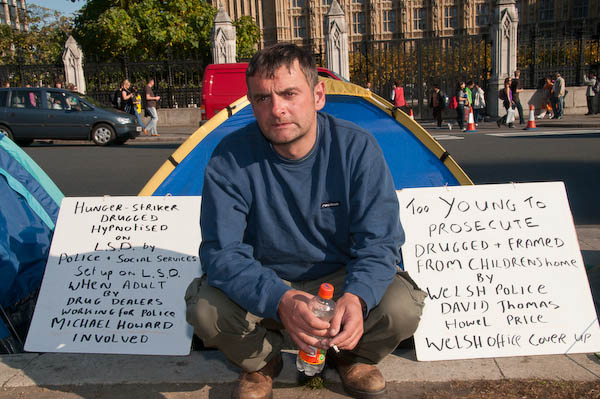
There were others protesting in Parliament Square, including one man who asked me to take his picture. He told me his name was Danny and that he had been there on hunger strike for two weeks, protesting over his failure to get his case investigated. He claimed to have been abused by police and social services following an incident in which as a seven year old child in Llanelli he was implicated in the death of a baby brother. I was unable to find any more information about his case.

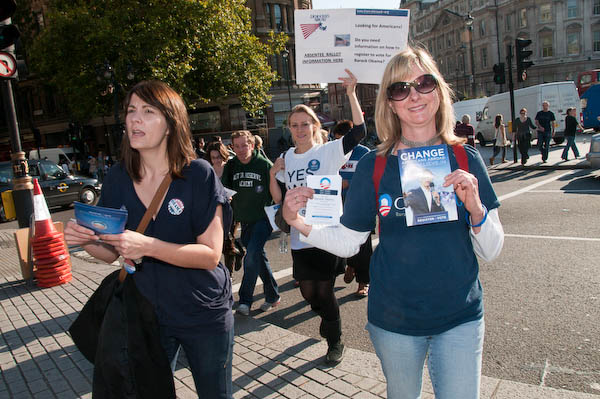
Finally I saw a group of people walking past holding leafelts with the the word CHANGE on them and rushed after them to find they were Obama supporters hoping to persuade Americans they met to register and vote in the election. It was time for me to go home.

Parliament Square
Rosary Crusade of Reparation
Freedom not Fear 2008
Bush & Cheney’s Iraq Oil Grab


A Busy 10th October – 2014

Solidarity for Care UK Strikers

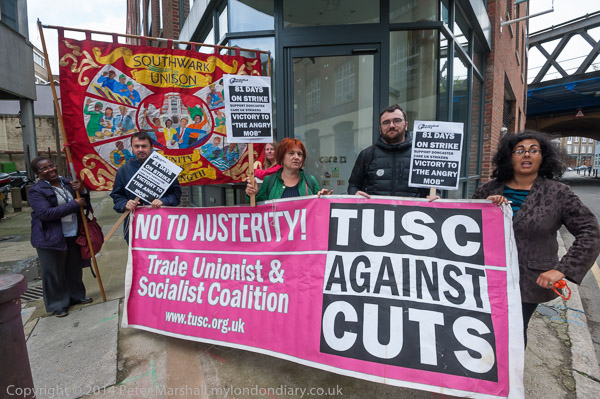
NSSN, TUSC and Southwark Unison protested at the Care UK offices in Southwark during the nation-wide day of solidarity with Doncaster Care UK workers who had been on strike for 81 days after huge cuts in pay and services by a private equity company taking over a part of the NHS, part of the continuing largely hidden privatisation of our NHS.

This protest was one of many around the country outside offices of Care UK and Bridgepoint, the private equity firm that owns Care UK, as well as at shops including branches of Fat Face and Pret a Manger also owned by Bridgepoint. As I wrote:

Their strike is not just about their own cuts in wages, but a stand against the principles involved and the whole idea of a values-based health service. The workers at Care UK are no longer able to proudly address the needs of those with learning disorders in their own community, but are simply required to meet minimum needs at the lowest possible cost – and the greatest profit to Bridgepoint and the company to which they will be sold on once the private equity company has slimmed services and pay to the bone.

Solidarity for Care UK Strikers

Free Ghoncheh Ghavami – SOAS action

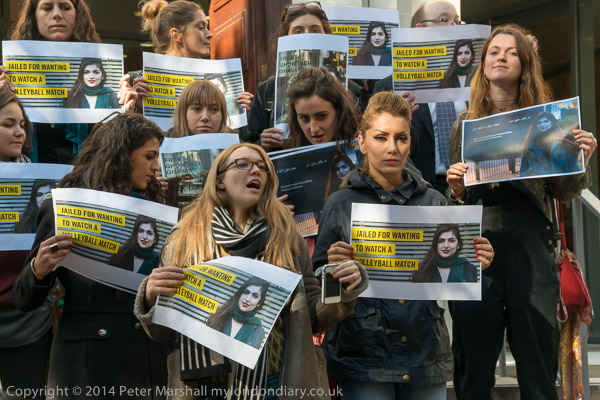
Protesters at outside SOAS called for the release of former SOAS Law student Ghoncheh Ghavami, held in prison for 104 days and on hunger strike for 10 days after being detained in Iran with other women after she went to watch a volleyball match. Among those who spoke at the protest was Ghavami’s brother.

According to Wikipedia, “Ghavami was released on bail on 23 November 2014. She was sentenced to a one-year jail term and a two-year travel ban.”

Free Ghoncheh Ghavami – SOAS action

City Panoramas

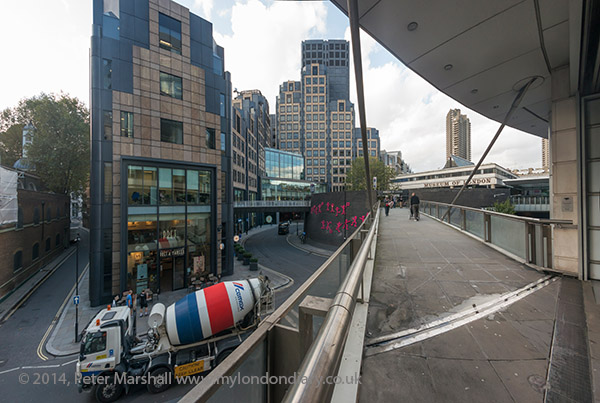
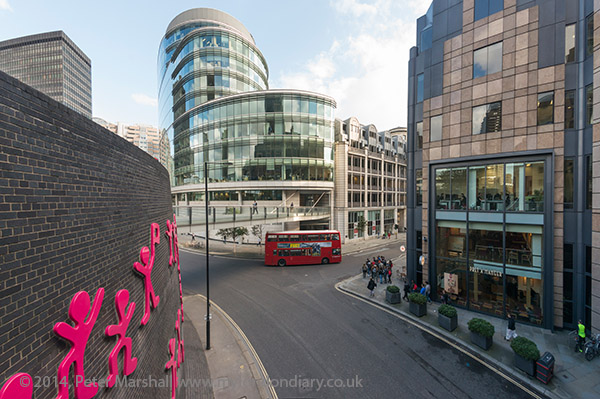
I had a little time to spare between events and took a short walk in the City, including along one of the remaining areas of ‘highwalk’ at the southwest of the Barbican site, part of the post-war plan to segregate pedestrians from traffic.

The Museum of London had decorated the wall at left with characters related to an exhibition about Sherlock Holmes.

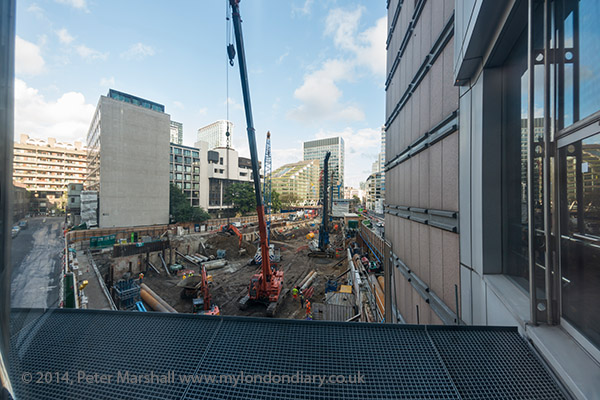
This large building site was on what used to be St Alphage Highwalk. The ambitious post-war plans to separate pedestrians from traffic in the City were never really practical on a large scale and large sections such as this have been demolished, although there are still some highwalks including throughout the large Barbican estate.

City Panoramas

Palestine protest at Hewlett Packard

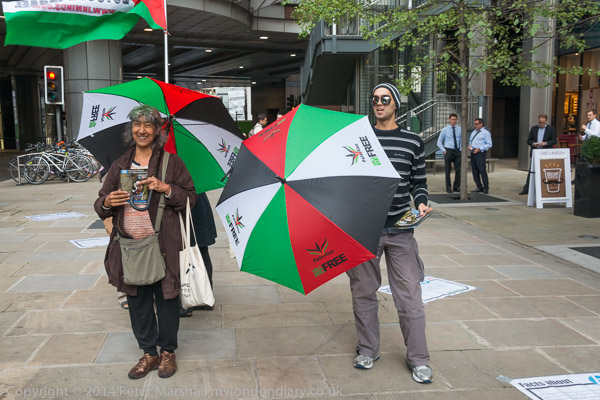
The Palestinian Prisoners Campaign continued their campaign against Hewlett-Packard, which boasts of ‘a massive presence’ in Israel and are the IT backbone for the Israeli war machine with a picket outside their London offices in Wood St in the City.

Palestine protest at Hewlett Packard

Solidarity with the Umbrella Revolution

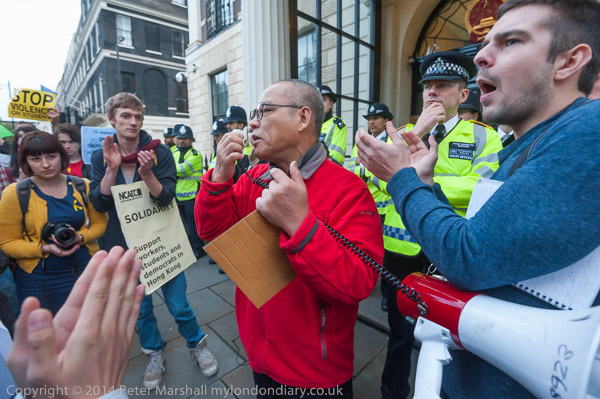
The National Campaign Against Fees and Cuts organised a protest at the Chinese Embassy in solidarity with the ‘umbrella revolution’ of the students and workers of Hong Kong in their fight for democracy. Many of the protesters carried umbrellas and others had small yellow paper umbrellas as well as their posters and placards.

Solidarity with the Umbrella Revolution


October 8th 2006

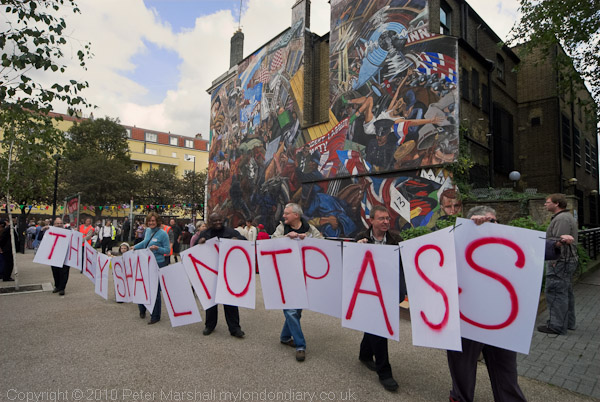
Back in October 2006, October 8th saw the celebration of the 70th Anniversary of the Battle of Cable St. The battle took place on Sunday 4th October 1936, but the celebrations now take place on the nearest Sunday – which was the 8th. You can see my pictures of the 85th anniversary this year on Facebook.

Some of those taking part dressed in clothes of the 1930s and others carried the letters
T H E Y S H A L L N O T P A S S
though it wasn’t easy to photograph the whole message with them all facing the right way.

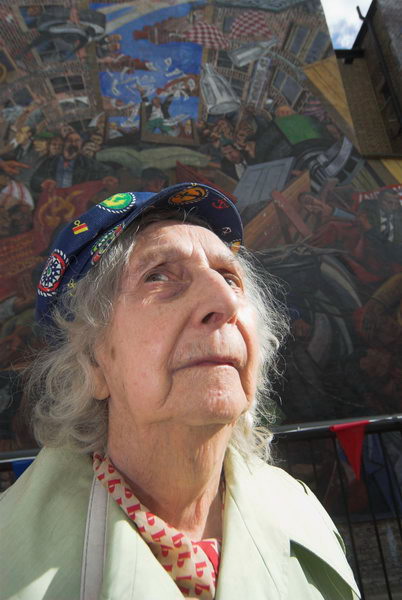
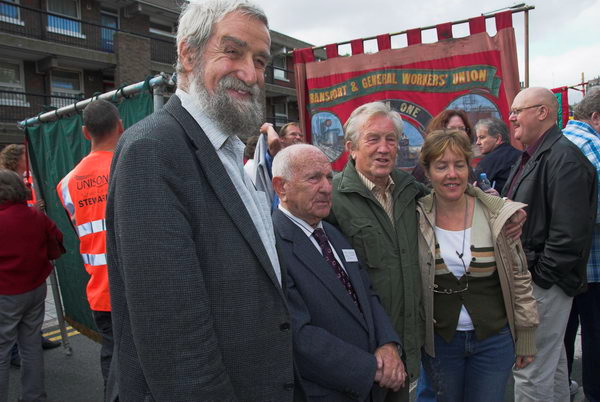
Several who took part in the event had been there and played a part in the events in 1936, including Beattie Orwell and Max Levitas (in the group below next to Dan Jones, one of the organisers of the event.)

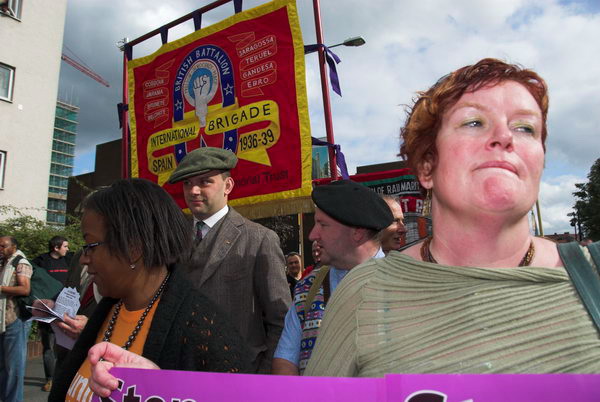
There were many reminders too that many who fought the fascists on the streets of London (though most of the actual fighting on that day was with the police) went on to join the International Brigades to fight the fascists in the Spanish Civil War, with banners and a flamenco dancer – and there was more music too, including by a Bangladeshi group and a klezmer band.

More on My London Diary Cable St 70th Anniversary


October 7th 2017

This image has an empty alt attribute; its file name is 20171007-d086.jpg

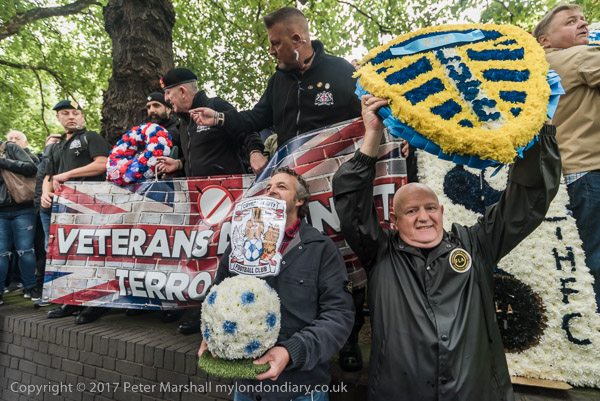
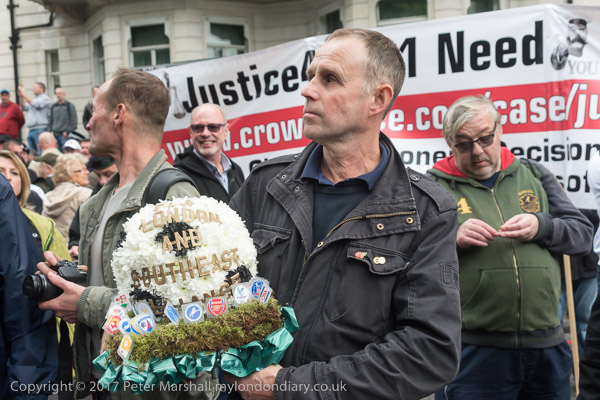
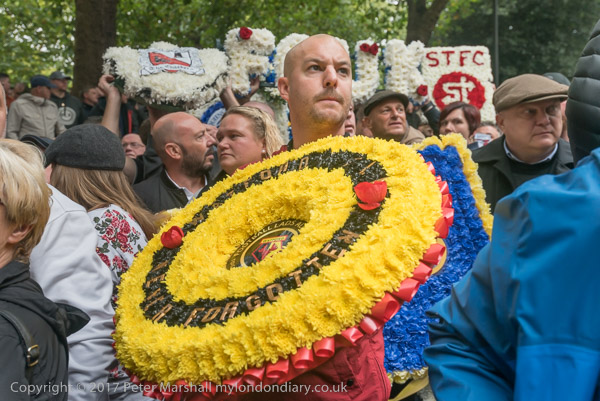
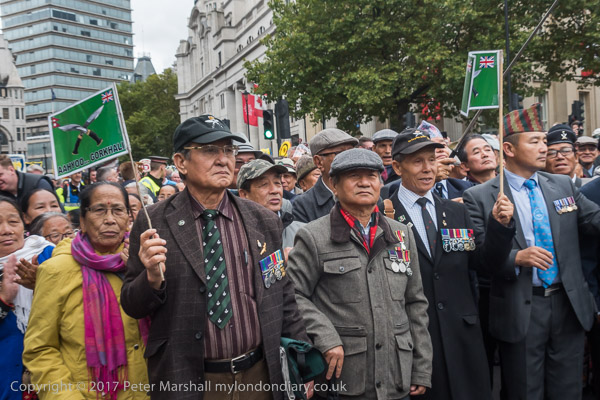
On 7th October 2017 I started the day at a silent vigil for Elephants and Rhinos in Parliament Square before going on the the main event, the Football Lads Alliance and Veterans Against Terrorism rally and march. They were protesting against the recent terror attacks in the UK and Europe, remembering the victims and calling on government to take decisive action against the extremist threat, including locking up all terrorist suspects and deporting those of foreign origin.

This image has an empty alt attribute; its file name is 20171007-d584.jpg

I had some slight hopes that the FLA would turn out not just to be another extreme right organisation like the EDL and the organisers had emphasised that they were opposed to all extremism and racism, but the speeches at the rally in Park Lane and the response from the crowd soon made their position clear, with demands for many thousands of British Muslims to be locked up as extremists. And as I wrote “there was a huge outcry when the name of Diane Abbott was mentioned, with a loud shout from behind me that she should be raped. It was hard to avoid the impression that it was a meeting to stir up Islamophobia, and there seemed to be a total lack of sympathy with refugees fleeing their countries to seek asylum here.”

This image has an empty alt attribute; its file name is 20171007-d155.jpg

Although most of the supporters were happy to be photographed with their wreaths there were a few times when I was greeted with abuse and threats and moved quickly away from some groups.

This image has an empty alt attribute; its file name is 20171007-d727.jpg

More people joined the march as it moved up Picadilly and by the time it reached Trafalgar Square what had been billed as a silent march had become very noisy. There it was joined by a couple of hundred Gurkhas, many wearing medals, who marched at the front for a short distance before being overtaken by some of the organisers and fans.

This image has an empty alt attribute; its file name is 20171007-d368.jpg

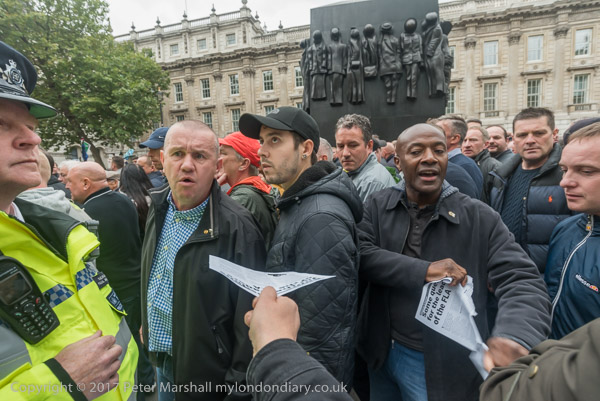
On Whitehall a group from Stand Up to Racism had gathered to stand as the march went past, handing out a flier ‘Some questions for the leaders of the FLA‘, which asked them to take steps to ensure their movement was not taken over by racists. The called on the marchers to stand together with the slogan ‘No to racism & Islamophobia, Football for All’.

This image has an empty alt attribute; its file name is 20171007-d435.jpg


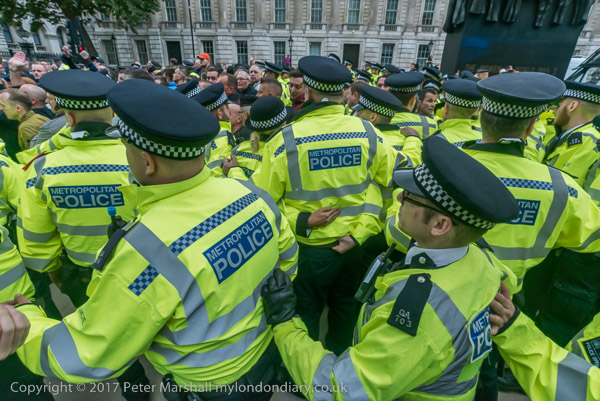
Many of the marchers took exception to this, shouting insults and threats, with some taking the leaflets and tearing them up, though there were some who seemed to take an interest and read it. Police formed a line to protect those handing out leaflets – making both handing the leaflets and taking photographs difficult, but preventing us being assaulted – and eventually forced the marchers who had stopped in a block against Stand Up to Racism to move away. Relatively few of the marchers seemed to make it to the final rally and wreath-laying on Westminster Bridge, with pubs in the area getting crowded and others hanging around in groups in Parliament Square.

Stand Up To Racism and the FLA
Football Lads Alliance March
Football Lads Alliance Rally
Silent Vigil for Elephants and Rhinos


FlickrFacebookMy London DiaryHull PhotosLea ValleyParis

London’s Industrial HeritageLondon Photos

All photographs on this page are copyright © Peter Marshall. Contact me to buy prints or licence to reproduce.


Nine years ago: 6 Oct 2012

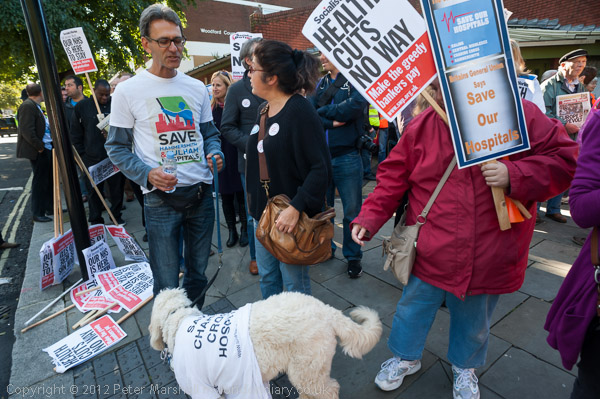
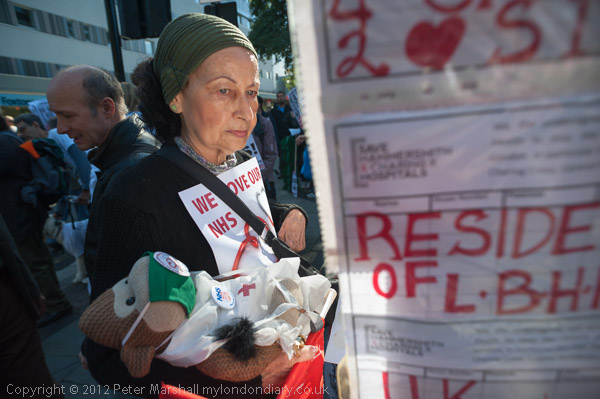
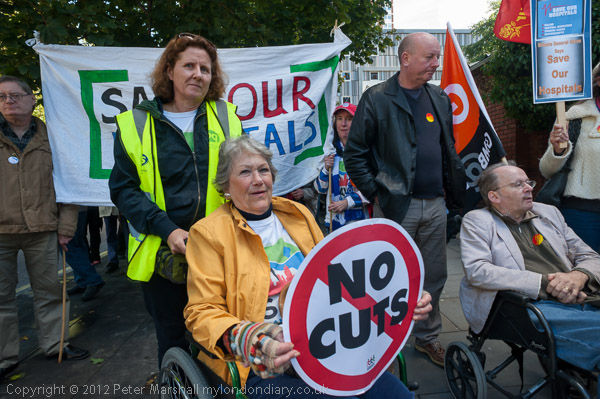
Proposals to close Accident and Emergency services at four of the nine hospitals in North West London provoked fury among local residents and opposition from local councils as they would mean slow journeys over heavily congested roads for those living in much of northwest London. The proposals seemed to be motivated simply by cost savings with no regard to the consequences.

This protest was one of a number that I photographed, particularly about the closure of A&E and some other services at both Charing Cross Hospital (which is in Hammersmith) and Ealing Hospital. The previous month I had photographed a http://mylondondiary.co.uk/2012/09/sep.htm#hospitals large march from Southall Park to Ealing Hospital against the closure plan and there was another march to Central Middlesex Hospital taking place that same day.

These large and widespread protests and legal actions taken by the protesters were almost certainly a major factor behind the decision in March 2019 by then Health Secretary Matt Hancock to finally scrap the plans for what was the biggest hospital closure programme in the history of the NHS. The campaigners welcomed the decision but said it should have come much earlier rather than after seven years of the Dept of Health supporting the plans, which would have involved demolishing Charing Cross Hospital and selling off most the site.

I photographed as people gathered for the march in Shepherds Bush but had to leave as the march was setting off for Hammersmith and a rally in Fulham to go to Westminster.

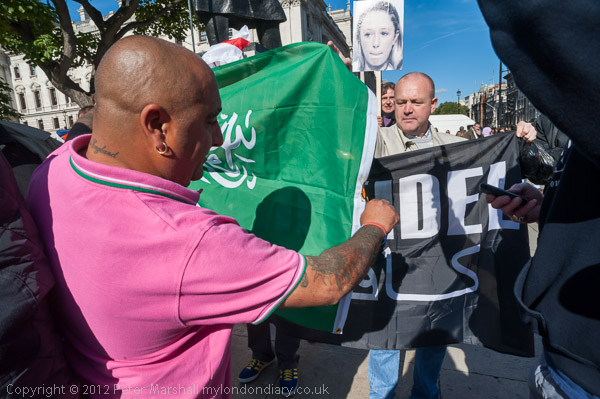
Britain First, a far-right anti-Muslim movement (it describes itself as “a modern, responsible patriotic political movement”) was protesting at Downing St against what they described as ‘Britain’s secret shame – Muslim Grooming’ and were joined on their protest by members of other extremist groups including the English Defence League. After protesting for around an hour at Downing St they marched the short distance to Parliament Square where they tried to burn an Islamic flag. It proved to be rather fire-resistant.

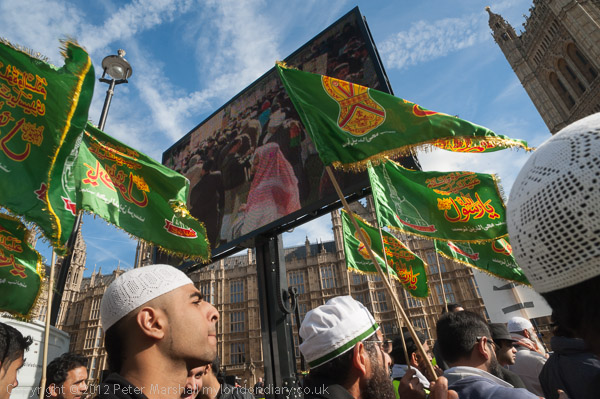
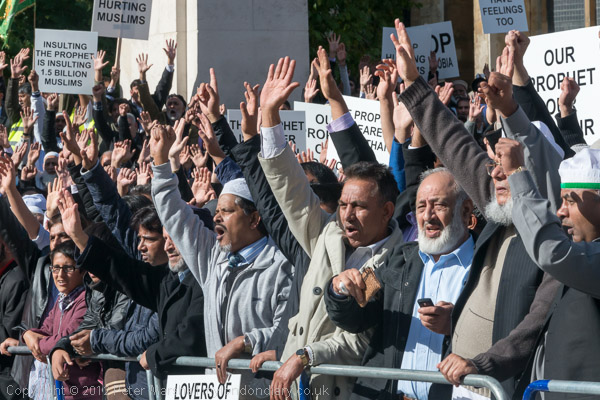
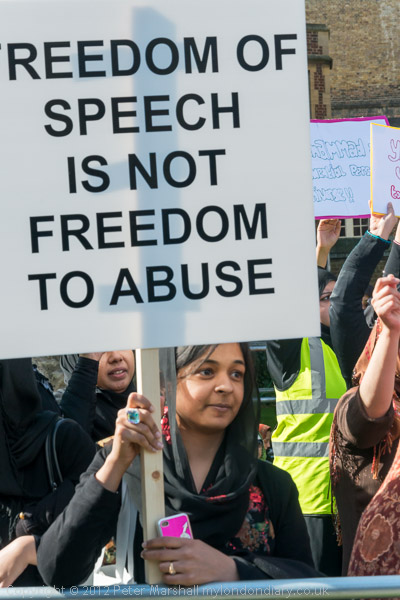
A few yards away, thousand of Muslims packed Old Palace Yard opposite the Houses of Parliament in a peaceful protest against an Anti-Muslim film made in the USA. They called for laws to protect religious figures.

The film, Innocence of Muslims, a crude video made by https://en.wikipedia.org/wiki/Nakoula_Basseley_Nakoula Egyptian-born American writer Mark Basseley Youssef had already prompted violent anti-American protests in various Muslim countries. Youssef was then in jail in Los Angeles for violations of a probation order which, among other things included making false statements regarding his role in the film, and his use of the alias “Sam Bacile”. He had a previous conviction for in 1997 for intent to manufacture methamphetamine and was under probation following release in June 2011 from being jailed in 2010 for his part in a bank fraud.

Youssef, under his alias Bacile, falsely claimed that the anti-Islamic film had been funded by $5 million from 100 Jewish donors and that he was an Israeli Jew. An Egyptian court tried him and others in absentia and sentenced them to death for defaming Islam in November 2012. He was released from prison in 2013 to serve the remainder of his sentence in a halfway house in Californinia followed by 4 years of probabation.

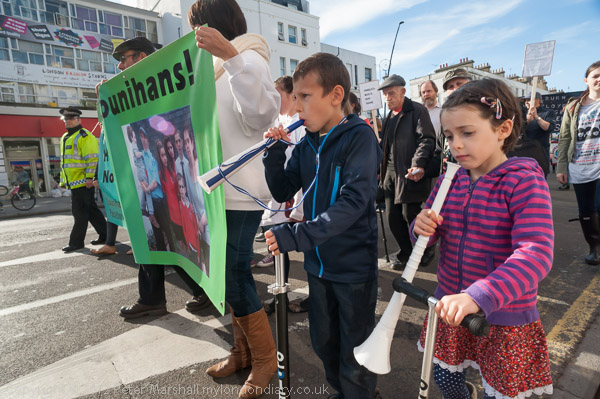
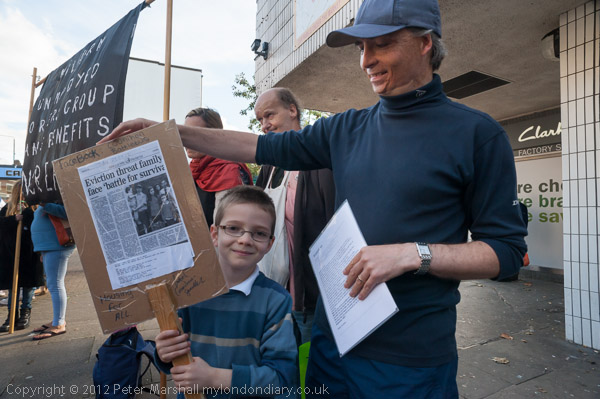
Finally I travelled to Kilburn for a march and rally demanding Brent council rehouse the Counihan family from South Kilburn. Two years earlier, Anthony Counihan, a London bus driver inherited a few acres of poor land in Galway on the death of his father. Rented out, it brings an income of £18 a week.

He reported this to Brent Council, who responded with an eviction order and a demand for repayment of £70,000 of housing benefit, later telling him he should move back with his family to Ireland where he was born – while continuing to drive a bus from Cricklewood Depot. His wife Isabel and five children were all born in Brent.

The case was complicated by the fact that the family had moved out of a council property to go back to Ireland for a year to look after his sick father, and had signed away their lease as the council had not told them they could sublet for the year, and by their treatment by the council after their return, when they were unable to find accomodation they could afford on a bus-drivers salary. Brent decided they had made themselves “intentionally homeless” and were refusing their statutory duty to rehouse the family.

More on all at:
Rehouse the Counihans
Muslims against Anti-Muslim Film
Britain First – Muslim Grooming
Save Our Hospitals – Shepherds Bush


Legal Aid & Illegal Confinement

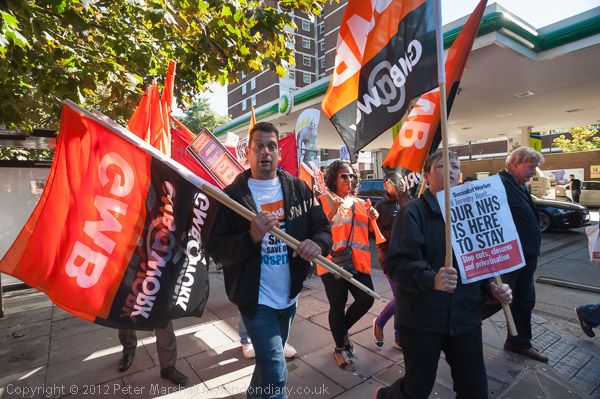
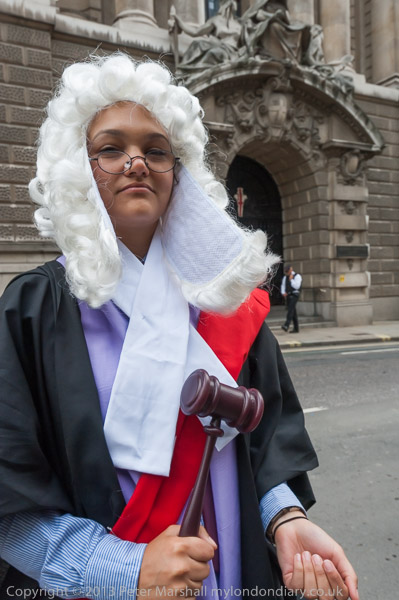
Eight years ago on Saturday October 5th 2013 I turned up outside the Old Bailey to cover a protest against the governments proposals to demolish a vital part of our justice system, Legal Aid. The proposals will mean that justice becomes largely only available to the very rich, with one law for the rich and another for the poor.

Of course our system of law in the UK is one which has as its base the protection of the wealthy and the establishment and in particular the rights of property owners, dating back to the ideas of private ownership of land introudced and used for its appropropriation by our Norman conquerers, but legal aid has provided a small and important gesture towards equality. The rich and powerful can still use the law to protect their interests, with injunctions and threats of libel and other actions. They can still call upon the police to protect their property and rely on our secret services to work for their interests.

Lee Jasper

The protest came after the government had been consulting on the changes to the legal aid system which proposed making it more restrictive and also cutting the fees to solicitors and barristers. Our combative in nature system of law is complex, time-consuming and allows those who can pay large fees to prolong litigation and have a better chance of success, with costs in some cases being in £millions. It’s a system that favours not the establishment of truth, but those who can employ the most persuasive liars.

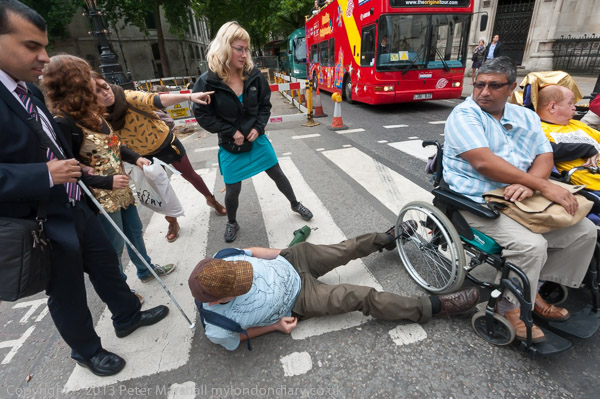
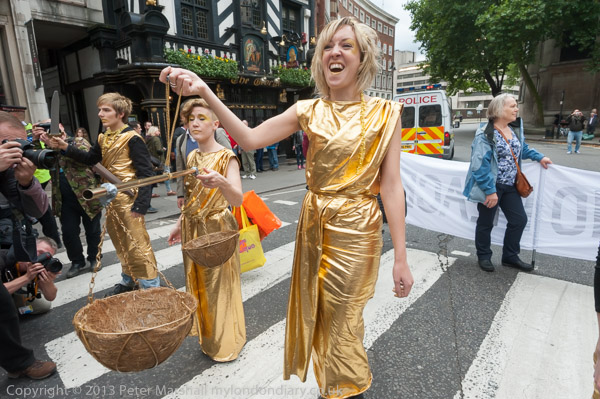
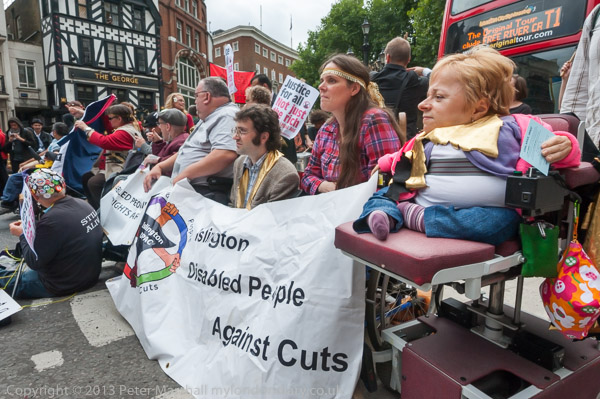
From the Old Bailey the march made its way to the Royal Courts of Justice in the Strand, where I rushed ahead to find DPAC (Disabled Activists Agains Cuts) already making their way onto the pedestrian crossing to block the road. “They stopped on it and began to padlock together to form a block. The far half of the crossing was blocked by a line of figures dressed in gold, one holding the (plastic) Sword of Justice, and another her Scales.”

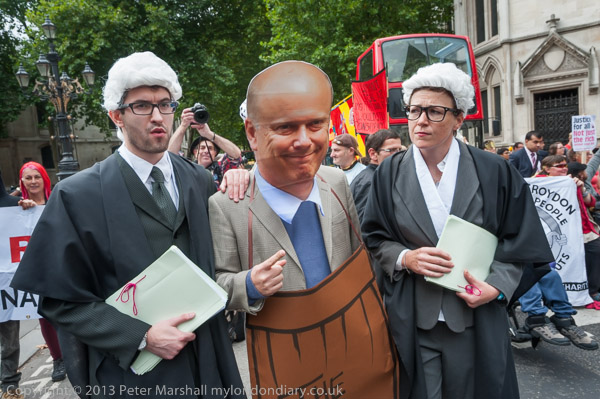
Police came and asked them politely to move but they didn’t respond. The marchers arrived for a noisy protest and then a mock trial of Justice Secretary Chris Grayling. A number of witnesses were called, some giving testimony of how without Legal Aid they would have been unable to fight their cases, and others reading written testimony from others, and then there was more chanting and drumming as well as poetry and some legal advice before the inevitable guilty verdict.

Police had been getting more impatient and insistent about the protesters leaving the road. They don’t like to arrest people in wheelchairs, partly because it looks bad in the photographs and videos, partly because of the difficulty of providing suitable transport, but also because like the rest of us (except possibly Tory ministers) they have a human sympathy with the disabled. “The DPAC activists in wheelchairs who were still blocking the road consulted with each other and decided it was time to leave, and that they would have a final five minutes of protest and then all leave together.”

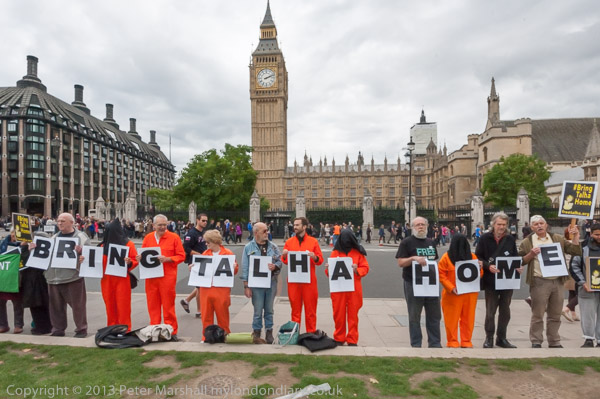
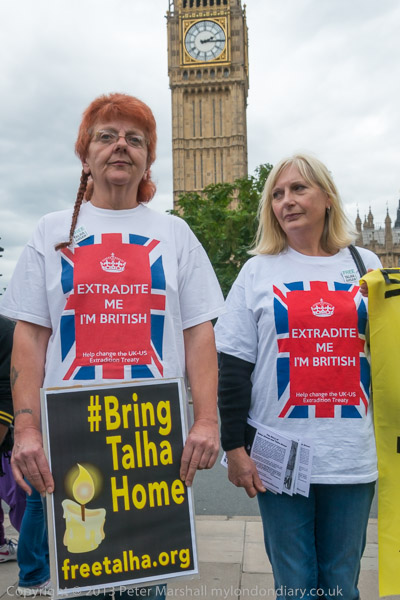
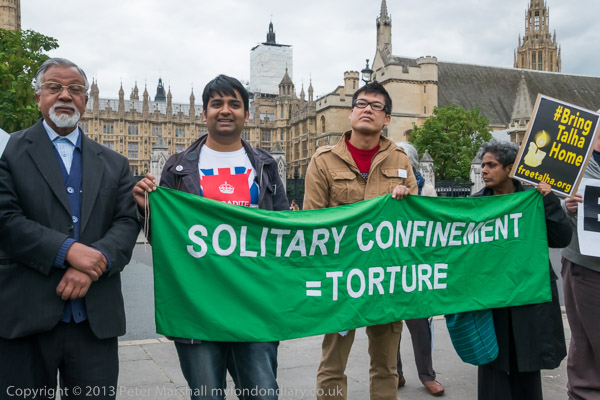
I left for Parliament Square where a peaceful vigil was marking a year since British poet Talha Ahsan was extradited to the US. Those taking part, including his brother Hamsa and other family members said that his long-term solitary confinement comes under the UN definition of torture and call for him to be returned home and unjust US-UK extradition laws repealed.

As I wrote:
“Talha Ahsan, an award-winning British Muslim poet and translator has been detained for over seven years without trial and was extradited to the USA on 5th October 2012 with his co-defendant Babar Ahmad. Although he was diagnosed with Asperger’s syndrome, the Home Secretary Theresa May refused to prevent his extradition, unlike that of Gary McKinnon, raising suspicions that this relected an anti-Muslim predjudice.”

Talha is a UK citizen and his supporters say that he should have been tried in the UK. Eventually in the US he accepted a plea bargain and pleaded guilty to one of the several charges and was sentenced. The time he had already served meant he was then free and was returned to the UK. His six years before extradition in detention without trial or charge here remains among the longest in British legal history.

More at:

Bring Talha Ahsan Home
UK Uncut Road Block for Legal Aid

Another Chelsea Walk – 1988

Church Of The Ñazarene, Grant Rd, Battersea, Wandsworth, 1988 88-5j-54-positive_2400
Church Of The Ñazarene, Grant Rd, Battersea, Wandsworth, 1988 88-5j-54

I returned for another walk in Chelsea, taking the train to Clapham Junction and taking a few pictures on my short walk to the bus stop of the Church Of The Ñazarene close to the north entrance to the station on Grant Road. The church, a twelve-sided building by Green Lloyd Adams was built in 1970 on the edge of the Winstanley Estate, developed by Battersea Council in the 1960s. The lettering on the ramp ‘JESUS SAID I AM THE WAY’ is designed for maximum size rather than typographical nicety.

Currently extensive building work is being carried out to considerably extend the church, though its future may be threatened if Crossrail 2 goes ahead. Of the two pictures I made I preferred a view across the small area with seats to a cleaner architectural view also included in the album.

Falcon Rd, Battersea, Wandsworth, 1988 88-5j-55-positive_2400
Falcon Rd, Battersea, Wandsworth, 1988 88-5j-55

On the bus I took advantage of an unusually clean front window on the upper deck to take a photograph of Falcon Road with the Queen Victoria pub. Also apparently known as ‘Spikey Hedghog’ the pub which had been there since the 1860s closed permanently in 1999 and was demolished to build the 8 flats of St Luke’s Court.
The picture also includes a falcon – both image and text on the side of a lorry. Elsewhere you can read a short post Falcon Road – a Memory of Battersea by someone who grew up living in the pub which gives an idea what the area was like, probably in the 1950s.

Beaufort St, Chelsea, Kensington & Chelsea, 1988 88-5j-45-positive_2400
Beaufort St, Chelsea, Kensington & Chelsea, 1988 88-5j-45

I got off the bus in Beaufort St in Chelsea and photographed this doorway there before walking along Cheyne Walk. Although the door is on Beaufort St, this is Belle Vue Lodge with the address 91 Cheyne Walk. It gets a lengthy mention in the Survey of London, first published in 1913 which suggests it dates from before 1771. It states that in 1829 it was occupied by “Luke Thomas Flood, who was a great benefactor to the parish. He was evidently a friend of the historian, for he addressed some lines to him, which conclude with the halting line ‘Sweet Chelsea shall ever live in thee.’ Flood Street was named after him, and his benefactions are celebrated at the parish church by a service on January 13th,—’Flood’s Day.'”

Houseboats, River Thames, Chelsea Embankment, Chelsea, Kensington & Chelsea, 1988 88-5j-32-positive_2400
Houseboats, River Thames, Chelsea Embankment, Chelsea, Kensington & Chelsea, 1988 88-5j-32

I walked across Cheyne Walk to make a photograph over the roofs of houseboats at the moorings, looking towards Chelsea Harbour and at left the Rank Hovis flour mills at Battersea and the Battersea Rail bridge. Then I think only used by goods trains this now carries frequent services of the London Overground as well as Thameslink trains.

Cheyne Walk, Chelsea, Kensington & Chelsea, 1988 88-5j-33-positive_2400
Cheyne Walk, Chelsea, Kensington & Chelsea, 1988 88-5j-33

I took a picture of houses in Cheyne Row. That at left is No 104 with two blue plaques, for the artist Walter Greaves (1846-1930) and Anglo-French ‘Poet, essayist and historian’ Hilaire Belloc (1870-1953) whose poem Jim (who ran away from his Nurse and was eaten by a Lion) ends with the famous lines:
‘And always keep ahold of nurse
For fear of finding something worse.’

No 104 doesn’t get a mention in the Survey of London, but No 100 at right of the picture is part of Lindsey House which it suggests was “rebuilt much in its present external form by the third Earl of Lindsey in 1674” but then divided into separate houses as 95-100 around 1775. It gets a very long entry.

Beaufort St, Chelsea, Kensington & Chelsea, 1988 88-5j-22-positive_2400
Beaufort St, Chelsea, Kensington & Chelsea, 1988 88-5j-22

I walked back up Beaufort St, passing a long row of frontages with identical garden ornaments which I think is Beaufort Mansions, though the gardens now have hedges. I think these mansion flats probably date from around 1890.

Shop window, Kings Rd, Chelsea, Kensington & Chelsea, 1988 88-5j-23-positive_2400
Shop window, Kings Rd, Chelsea, Kensington & Chelsea, 1988 88-5j-23

I was on my way to take a few more photographs on the King’s Road, including a several shop interiors. I think the name of the shop is on the wall at left, part hidden, Pineapple.

More pictures from this walk in a later post.

Click on any of the images above to go to a larger version in my album 1988 London Photos from where you can browse other images in the album.

Dovehouse Green, Chelsea Square & Upper Cheyne Row 1988

Millars Obelisk, Dovehouse Green, Chelsea, Kensington & Chelsea, 1988  88-5i-54-positive_2400
Millars Obelisk, Dovehouse Green, Chelsea, Kensington & Chelsea, 1988 88-5i-54

Dovehouse Green was the name given to the King’s Road Burial Ground on the corner of Dovehouse St and King’s Road when it was improved by the Chelsea Society and Kensington & Chelsea council to celebrate the the Queen’s Silver Jubilee and the Golden Jubilee of the society in 1977. The area was given to the parish by Sir Hans Sloane in 1727 and opened as a burial ground in 1736. Chelsea soon outgrew this small area and a new burial ground was opened on the east side of Sydney St in 1812 and there were no more interments here other than in existing family tombs.

The Millar Obelisk which became the centrepiece of this small public park was erected in the old burial ground in 1751, by the wealthy leading bookseller and publisher Andrew Millar to mark the family burial place. Buried close to it were three of his children who died before it was erected and Millar himself who died in 1768 and his wife who outlived him by 20 years. You can read more at Millar’s obelisk, a post by Baldwin Hamey on London Details.

The park has been refurbished a couple of times since I made this picture, but its basic layout remains. On the other side of Dovehouse St is Chelsea Fire Station with its tower. If Crossrail 2 is ever built this may be the site of a station on it. Dovehouse street got its name around 1880, having previously been called Arthur St; I think the name was probably ‘borrowed’ from an early Dovehouse Close some distance away on the other side of King’s Rd. Just to the north of the burial ground was the workhouse for St Luke’s Parish, Chelsea, demolished in the 1970s.

Chelsea Square, Chelsea, Kensington & Chelsea, 1988  88-5i-42-positive_2400
Chelsea Square, Chelsea, Kensington & Chelsea, 1988 88-5i-42

Chelsea Square is a couple of hundred metres to the northwest of Dovehouse Green, though a little further to walk. It was developed as Trafalgar Square in 1810, five years after the battle, with houses around a garden designed to encourage wealthier people to move to Chelsea, then something of a slum. The area came to the Cadogan estate when the lease ran out in 1928 and they redeveloped the area replacing the existing houses from 1931 and building on around a quarter of the garden. New houses were according to the Victoria County History, “designed in early Georgian style by Darcy Braddell and Humphrey Deane, and built of pinkish stock brick, with bright red brick dressings and green-glazed tiles.” and “neo-Regency villas in white stucco… designed by Oliver Hill and built in 1930 and 1934.”

Chelsea Square, Chelsea, Kensington & Chelsea, 1988  88-5i-55-positive_2400
Chelsea Square, Chelsea, Kensington & Chelsea, 1988 88-5i-55

Presumably to avoid confusion with the rather better known Trafalgar Square in Westminster it was renamed Chelsea Square in 1938. Many other duplicated London street names were also replace at the time.

Church of Our Most Holy Redeemer and St Thomas More, Cheyne Row, Chelsea, Kensington & Chelsea, 1988  88-5i-61-positive_2400
Church of Our Most Holy Redeemer and St Thomas More, Cheyne Row, Chelsea, Kensington & Chelsea, 1988 88-5i-61

Designed by Edward Goodie, this Grade II listed Roman Catholic church opened in 1895. It gained the dedication to St Thomas More after he was made a saint in 1935. Damaged by bombing in 1940, it was repaired after the war. Much internal work was carried out in the 1970s.

The Studio,  Upper Cheyne Row, Lawrence St, Chelsea, Kensington & Chelsea, 1988  88-5i-62-positive_2400
The Studios, Upper Cheyne Row, Lawrence St, Chelsea, Kensington & Chelsea, 1988 88-5i-62

Upper Cheyne Row is sometimes referred to as Millionaires’ Row, though that would now apply to most London streets. One house here was recently on the market for £22m. The sign ‘The Studios’ on No 27 has now gone.

Chelsea Pottery, plaque, Lawrence St, Chelsea, Kensington & Chelsea, 1988 88-5i-63-positive_2400
Chelsea Pottery, plaque, Lawrence St, Chelsea, Kensington & Chelsea, 1988 88-5i-63

The LCC square blue plaque which can just be seen on 16 Lawrence St has the message ‘CHELSEA CHINA WAS MANUFACTURED IN A HOUSE AT THE NORTH END OF LAWRENCE STREET 1745-1784
TOBIAS SMOLLETT NOVELIST ALSO LIVE IN PART OF THE HOUSE 1750 TO 1762′. You can read more about Lawrence St from the article on ‘A London inheritance’ Lawrence Street And Chelsea China.


Click on any of the images above to go to a larger version in my album 1988 London Photos from where you can browse other images in the album.