Workers, May Day March & Police Party 2006

Workers, May Day March & Police Party: May 1st is of course May Day, International Workers’ Day, and I will be at Clerkenwell for the annual May Day march in London, and perhaps some other events to celebrate the day. For Catholics it is also dedicated to Saint Joseph the Worker, the husband of Mary, the mother of Jesus and approopriately in 2006 my day started outside Westminster Cathedral with the launch of the London Citizens Workers’ Association. Here is what I posted back on May Day in 2006 – with the usual corrections and links to more pictures on My London Diary.


London Citizens Workers’ Association – Westminster Cathedral

Workers, May Day March & Police Party

May 1st saw the launch of the London Citizens Workers’ Association, a new organisation to support low-wage and migrant workers across London, backed by faith organisations, trade unions and social justice organisations. May 1 is the feast of St Joseph the Worker and the event began with a procession into the cathedral and a ‘Mass For Workers’, but I didn’t bother to get up in time for that.

Workers, May Day March & Police Party

After the mass was a ‘Living Wage rally’ outside the cathedral, with speakers including Cardinal Cormac Murphy O’Connor (then leader of the Catholic Church in England & Wales), Sir Iqbal Sacranie (Secretary General, Muslim Council of Britain), and Jack Dromey (General Secretary of the TGWU) along with representatives of other unions and faiths, and of the new association.

Workers, May Day March & Police Party

The association aims to fight a campaign for a living wage for low paid workers as well as training them to organise and campaign and providing free advice on rights at work and legal support. Workers in low paid jobs often also lack decent working conditions and there was in 2006 little trade union representation*. It will also provide english classes.

Workers, May Day March & Police Party

Several large employers who have already taken steps to improve conditions were awarded ‘Living Wage Employers awards’ at the rally, but I didn’t wait around for this.
more pictures

[* Since 2006 we have seen the rise of several grass roots trade unions taking a strong stance for the rights of low paid workers, particularly migrant workers, including the United Voices of the World and the Independent Workers’ Union of Great Britain.]


London May Day March – Clerkenwell

Workers, May Day March & Police Party

Around half of London’s tube network seemed to be down for planned engineering works, and getting around was a bit like playing Mornington Crescent to some very special rules. But the Victoria Line and Thameslink got me to Farringdon well before the start of the annual May Day parade.

This seemed larger than in previous years, with a few more trade unions there, with particularly strong support from the RMT, but many others also took part, including my own – the NUJ (and there were many of us members covering the event as well.)

As usual, the most colourful aspect of the march was provided by the various Turkish communist parties, with strong youth wings. MKLP (and its KGO youth), the DHKC, the TIKB, the TKP/ML and probably more. There were some powerful reminders of the repression in Turkey in the portraits of some of those who have died in terrorist actions or death fasts.

Movements in a number of other countries were also represented, including Iraq, Iran Greece and Sri Lanka as well as the Kurds. Also taking part was the African Liberation Support Campaign Network.

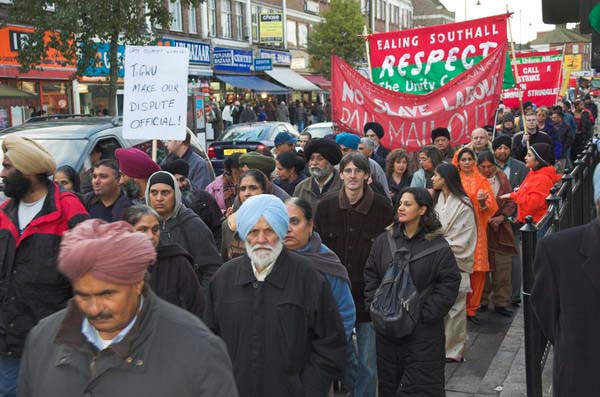
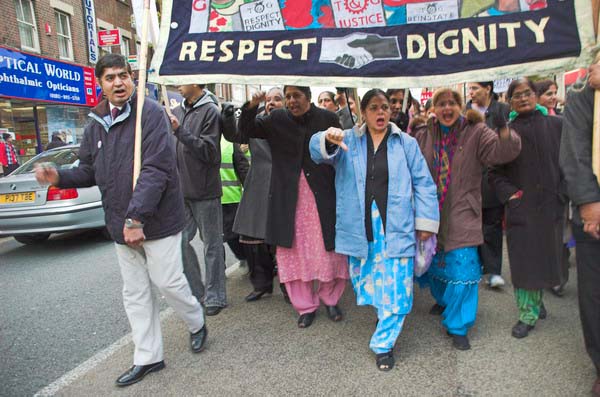
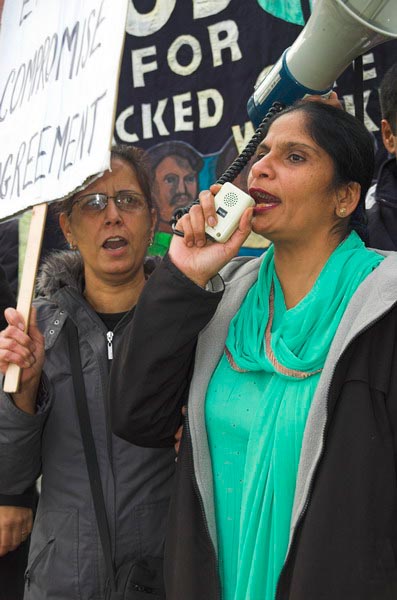
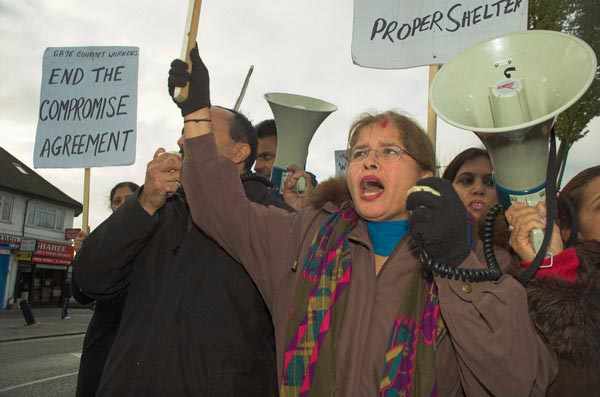
Gate Gourmet strikers marching behind their banner chanted “Tony Woodley – out out!” denouncing the attempts of the TGWU to force them to sign the compromise agreement which waives their rights to further work or legal redress. Others demanded that Remploy factories be kept open. There were protests over the Dexion and Samuel Jones pension outrages, and other causes.

More or less bringing up the rear of the march were around 500-1000 in the Autonomous Bloc, an anti-capitalist grouping marching against ‘precarity’, the working environment of late capitalism.

Increasingly there is a polarisation of the employment market in our service-based economies, characterised at one end by poor conditions, lack of job security, temporary employment, use of migrant labour at one extreme, and at the other by increasing encroachment of work into the private lives of more highly paid employees, making them into company property in exchange for their security.

In contrast to the relatively low-profile police presence for the rest of the event, this bloc was flanked on both sides by a line of uniformed police. Many of the marchers in this section wore scarves covering the lower half of their faces, and some carried anarchist flags. Leading the block were a number of bicycles, and a pedal powered sound system.

The march continued on its way to Trafalgar Square, where people stood around mainly looking pretty bored. I didn’t catch much of the speeches but if what I heard was typical I could understand why.

more pictures


Autonomous Bloc in Trafalgar Square

When the Autonomous Bloc arrived at the square, the police barred their entry on the grounds of public order and seized the sound system. More than half those marching left at this point, with the police making little attempt to stop individuals who wandered into the square.

The rest of the bloc stayed on the road, with a few short speeches over a loud hailer, then moved up the side of the square towards the national gallery, where there was another short meeting. This was interrupted by the news that the police tactical support group was on its way, and they soon surrounded the relatively small group who had decided to stay.

I walked through the police line at this point, and they seemed to be making little attempt to stop anyone leaving, or at least didn’t detain them for more than a few minutes.

Pictures from the autonomous bloc on the main march here, but there are more pictures from Trafalgar Square here.


Space Hijackers Police Victory Party – Bank

While the marchers were walking to Trafalgar Square, I took what was left of the tube to Bank and the ‘Police Victory Party‘ organised on their behalf by the Space Hijackers.

There I watched Tony Blair and some rather more attractive than usual police (and with pink fluffy hand-cuffs) being watched by some other police. A couple of the latter walked away when asked if they would mind being photographed, but some others seemed to be rather amused by the proceedings.

Of course, the police (both lots) were taking lots of pictures of the events too, and I can imagine some of them causing amusement at section house parties.

There was a ‘pin the blame on the anarchist’ game, a pinata (ta for the mini Mars bar) and some dancing before I had to rush off to make the gig at Trafalgar Square. Where the politics were perhaps less serious.

more pictures


FlickrFacebookMy London DiaryHull PhotosLea ValleyParis
London’s Industrial HeritageLondon Photos

All photographs on this page are copyright © Peter Marshall.
Contact me to buy prints or licence to reproduce.
Muslims, Our Railways & Little Venice – 2005

Muslims, Our Railways & Little Venice: Twenty years ago I published this post on My London Dairy about my day taking pictures, but it isn’t easy to find. So here it is again with the usual minor corrections and a few pictures, with links to the others already on-line.


Muslims United Against Oppression – Marble Arch

Muslims, Our Railways & Little Venice - 2005
Mozzam Begg reads his poem. War on Terror = War on Islam

Saturday 30th April 2005 was a busy day. I started at Marble Arch where a number of Muslim organisations were showing their unity in protesting against the anti-terrorism laws and the way the ‘war on terror‘ was used to detain prisoners at Guantanamo Bay and Bellmarsh, to carry out increased stop and searches on Muslims in the UK, and threaten them with extradition, and to label the liberation struggles in Palestine, Kashmir, Iraq and Chechnya as terrorism.

Muslims, Our Railways & Little Venice - 2005

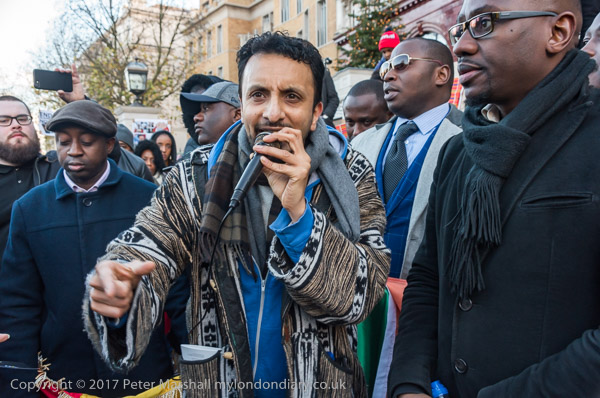
The ‘Muslims United Against Oppression’ march and rally was organised by ‘Stop Political Terror’, the ‘Islamic Human Rights Commission’, ‘Hizb ut-Tahrir Britain’, ‘Cage Prisoners’, the ‘Islamic Party Of Britain’, ‘Muslim Directory’ and other organisations, and representatives of many of these spoke at Marble Arch. There were also two former Guantanamo detainees who spoke, Martin Mubanga and Mozzam Begg, who read a moving poem.

Muslims, Our Railways & Little Venice - 2005
Ashfaq Ahmad

Ashfaq Ahmad spoke about the detention of his son, Babar Ahmad, who was born and brought up in south London. On December 2nd 2003, anti-terrorist police broke into his house in the early hours, and assaulted him brutally in front of his wife before taking him away. Six days later he was released without charge. He had over 50 injuries to his body, two potentially life-threatening, but despite this the Crown Prosecution Service decided there was insufficient evidence to prosecute any of the officers involved.

Muslims, Our Railways & Little Venice - 2005

Babar Ahmad was again arrested on 5th August 2004 following an extradition request by the US government. In 2005 he was still in prison awaiting a final verdict on whether he will be sent to the USA, although a fair trial there seems unlikely.* The allegations against him appear to be that he emailed a US sailor on two dates (one was Babar’s wedding day, the other in the middle of his honeymoon on a remote island without internet access), that he had a brochure from the Empire State Building (true, his father had got it on a visit there in 1973) and that he had travelled on a false passport, despite the fact that his real one has the appropriate entry and exit stamps.

Unfortunately our extradition agreement with the USA apparently does not allow Britain to refuse requests on the grounds of evidence.

Having failed to treat Babar with any justice in this country following his arrest – almost certainly a case of mistaken identity that too many would lose face over to readily admit – it now looks as if we will hand him over to our American allies for further mistreatment.

Around 5000 Muslims made there way from Marble Arch and along the Edgeware Road towards Paddington Green Police Station for a further rally.

more pictures

* Babar Ahmed spent 8 years in a UK prison before eventually being sent the the USA for trial. Although there was huge pressure to try him in the UK the CPS decided there was “insufficient evidence to prosecute” him. In 2009 he was awarded £60,000 compensation for the “serious gratuitous prolonged unjustified violence” and “religious abuse” during his arrest; the four officers who were accused of this and dozens of other assaults on black and Asian men were tried but acquitted in 2011. After his extradition in 2012 he spent two years in solitary confinement in pre-trial detention in a Supermax prison. Eventually he came to a plea bargain which led to his release in July 2015.


RMT march to Renationalise the Railways – Bloomsbury

I made my way to the Charing Cross Road to meet the RMT march against rail privatisation, a two-week, 14-city national mobile demonstration from Glasgow to London to make the case for re-nationalising the rail network.

As someone who travels frequently by rail, I’m fully convinced of the need for some action. On my line to London, services are less frequent and less reliable and slower than when I moved here thirty years ago. The latest trick has been to write yet more ‘spare minutes’ into the timetables so that more trains will arrive on time. Journeys that a few years ago took 28 minutes are now timetabled for 34 minutes. [Now in 2025 this has increased to 37 minutes.]

There certainly seem to be a great problem over signalling on the lines, with trains that should have a clear run on green with miles of clear track in front of them continually finding amber or double amber and occasionally red. Either systems are not working or there are not the signallers to work them.

The whole fare structure is also a nonsense, far too complex for anyone to understand. None of the enquiry services ever seem to be able to tell you anything other than standard fares (if that) and journeys covering more than one operator are a nightmare. Try several online systems and you are likely to get several different answers as to fares and availability. As a first move back to a sensible system why not set up a national fare structure, with train operators paid for running trains from a central body?

It was a good-natured demonstration making a real point, but unfortunately not one any likely government wants to hear.

more images


Canalways Calvacade – Litttle Venice

Finally I went off to Little Venice, where the Inland Waterways Association was having a three day Canalway Cavalcade celebrating the bicentenary of the Battle of Trafalgar. In 1805, canals were growing as the main form of inland transport, and it was the year two of the major civil engineering structures of our canals, the Pontcysyllte Aqueduct and the Blisworth Tunnel were completed.

I’m not a great canal person, though I often cycle along the towpaths. But the first time I ever drove a narrowboat, I found myself in charge of 70 feet of steel hull through the dark narrow length of Blisworth, and later the same year also took the marginally overwide craft across Pontcysyllte, where there was considerable resistance to its movement through the narrow channel. Getting through some of the locks on the way there and back was harder, and we learnt some less conventional locking techniques, opening the upper gates for the water to force the marginally over-wide hull through, scraping its sides past the brickwork.

However I’d not come to see the boats, even though the navy were taking part, with one of our smaller ships, a crew of three and commander from the Royal Naval Reserve.

more pictures


London Isn’t Venice, Yet! – Mutiny Arts, Little Venice

Mutiny Arts from Brixton were to perform an ecological drama, London Isn’t Venice, Yet!, warning of the dangers of global warming and rising sea levels.

The sea level is rising fast

The play went down well with the audience in the Sheldon Square ampitheatre, part of a new office development in Paddington.

More pictures


FlickrFacebookMy London DiaryHull PhotosLea ValleyParis
London’s Industrial HeritageLondon Photos

All photographs on this page are copyright © Peter Marshall.
Contact me to buy prints or licence to reproduce.

Class War Election Manifesto Launch at Buckingham Palace – 2015

Class War Election Manifesto Launch at Buckingham Palace: On Wednesday 29th April 2015 I went with Class War to Buckingham Palace for the launch of their manifesto for the 2015 General Election.

Class War Election Manifesto Launch at Buckingham Palace - 2015

Although as good anarchists Class War are not in favour of our flawed electoral system they had decided the election campaign would be a good opportunity to generate some interest in working class attitudes and issues, get some publicity – and have a little fun.

Class War Election Manifesto Launch at Buckingham Palace - 2015
Ian Bone of Class War arrives at Buckingham Palace for the manifesto launch

So they had registered as a political party and invited their friends to stand for seats. There were quite a few volunteers but finding the funding for the deposits they knew they would lose and getting the required number of nominations in the constituencies whittled the numbers down in the end to seven candidates for the roughly 650 seats.

Class War Election Manifesto Launch at Buckingham Palace - 2015
Class War’s Westminster candidate Adam Clifford is greeted on arrival

Three of these were in the Greater London Area and I was able to cover all three in the constituencies where they were standing, John Bigger in South Croydon, Lisa McKenzie in Chingford, and on this occasion Adam Clifford who was standing in Westminster.

Class War Election Manifesto Launch at Buckingham Palace - 2015
and shows off his lace-fringed knickers.

The campaign that attracted most media attention was that of Lisa McKenzie because was standing against former leader of the Tory party and Secretary of State for Work and Pensions Iain Duncan Smith.

Class War supporters pose in front of the palace gates with their Lucy Parsons banner

Adam Clifford was standing in Westminster and there were 31 of his potential voters registered in Buckingham Palace so he had come to the gates of the Palace to demand his democratic right as a candidate to canvass their votes, but was not allowed to enter.

Adam Clifford speaks in front of the gates

But the event was also the launch of the Class War Party’s campaign, with a simple five point manifesto which had largely been drawn up as I walked with them from the White Hart to one of their many ‘Poor Doors’ protests at One Commercial Street – all of 110 metres away. It was simple and to the point.

  • Double Dole,
  • Double Pension,
  • Double Other Benefits,
  • 50% Mansion Tax,
  • Abolish the Monarchy,
  • Abolish all Public Schools

As well as myself, BBC News were there to record the manifesto launch, though I don’t know if it ever made the airwaves.

However the electorate was not ready for the radical proposals of Class War and at the election their seven candidates recorded only a total of 526 votes.

Ian Bone speaks

But since one of the key anarchist policies has long been ‘Don’t Vote – It only encourages them‘ they could claim that the 97,870 spoilt votes and the roughly 35% of registered voters who didn’t bother actually put those who shared their views in a majority. Though most of us might see it as a near victory – the Conservatives actually got slighly more votes than this – for apathy rather than anarchy.

And Class War decides its time to leave before the police become too interested.

More pictures at Buck Palace Class War Manifesto Launch.


FlickrFacebookMy London DiaryHull PhotosLea ValleyParis
London’s Industrial HeritageLondon Photos

All photographs on this page are copyright © Peter Marshall.
Contact me to buy prints or licence to reproduce.

Save the Bees – 2013

Save the Bees: On Friday 26th April I joined several hundred beekeepers and environmentalists outside Parliament, “many in bee veils and with flowers and fruit that rely on bee pollination to urge DEFRA’s Owen Paterson to back a ban on bee-killing neonicotinoid pesticides in Monday’s EU vote.”

Save the Bees - 2013

These systemic pesticides are absorbed by plants and taken to their leaves and flowers including nectar and pollen. They kill insects by attacking their central nervous systems but there are also serious sub-lethal effects which for bees, including “difficulty navigating, learning, and foraging, suppressed immune response, lower sperm viability, shortened lifespans of queens, and reduced numbers of new queens produced.”

Save the Bees - 2013

They disrupt to complex systems by which bees are able to communicate with each other about good sources of nectar, to fly to these and to return to the hive – and our worker bees can simply get lost.

Save the Bees - 2013

As well as being absorbed by the commercial crops on which they are sprayed, these water-soluble insectides run off into ditches, streams and rivers and are then absorbed by plants growing in the wild.

These are not the only threats to our bee population, also endangered by climate change, habitat loss, invasive bees and other species, parasites and diseases spread in intensive commercial bee farming.

Save the Bees - 2013

As well as bees, these pesticides also are a threat to all other pollinating insects. Around a third of food supplies around the world depend on plants being pollinated. They also effect birds, especially seed-eating birds as their major use is in seed coatings, but also by killing insects which birds rely on for food.

Neonicotinoids have also been found widely in our bodies – “in children, adults and neonates” but although large doses have been found to impair cognitive ability and memory in laboratory rats there is as yet no evidence that they are having any effect on us.

Katherine Hamnett and Dame Vivienne Westwood take the ‘Save the Bees’ petition to Downing St

In April 2013 the EU voted to restrict their use across the EU for two years – though despite this protest Britain was one of eight states to vote against this. In 2018 the EU passed a total ban on the three main compounds, despite continuing strong opposition from the manufacturers and some farmers. There has been a general ban on their use in the UK since 2017, but until 2025 sugar beet farmers were given “emergency authorisations” for their use. Ending this was a Labour election pledge and it was confirmed by a government press release in December 2024.

More pictures at March of the Beekeepers.


FlickrFacebookMy London DiaryHull PhotosLea ValleyParis
London’s Industrial HeritageLondon Photos

All photographs on this page are copyright © Peter Marshall.
Contact me to buy prints or licence to reproduce.

Diamonds, Peace & St George – 2016

Diamonds, Peace & St George: St George’s Day, 23rd April, celebrates the death of this Cappadocian Greek soldier in the Roman Army martyred on this day in AD 303 for refusing to recant his Christian faith. We know little about his life, but can be sure that he never killed a dragon.

As I commented back in 2005, “St George keeps busy as a patron saint of Canada, Catalonia, Georgia, Germany, Greece, Lithuania, Malta, Palestine and Portugal, as well as a number of cities including Moscow and Venice, a whole raft of trades including farmers and soldiers, as well as herpes and syphilis. It’s perhaps surprising he still has time for England, although until recently you would hardly have noticed it in any case.

It is also at least 23 other national days around the world, a few of which are related to the birth of Shakespeare who was most probably born on April 23, 1564. But I won’t be celebrating National Talk Like Shakespeare Day, World Table Tennis Day, National Cherry Cheesecake Day or any of the rest, though I suppose there is just an outside chance I might dabble with German Beer Day (though I’m more partial to British Bitter, increasingly a rare species, which has its day on June 15th.)

My day began with two protests against the selling of blood diamonds from Sierra Leone at leading London stores, before I went to Trafalgar Square to briefly visit the unimpressive St George’s Day event there. I ate my sandwiches in the Peace Garden at the Imperial War Museum before going to a St George’s Day procession in Southwark from St George’s Cathedral to the church of St George the Martyr, and finally went to a pub in Southwark with a couple of friends where I met and photographed two St Georges.


Sierra Leone Blood Diamonds at Selfridges – Oxford St

Diamonds, Peace & St George - 2016
Octea mine diamonds in Sierra Leone, Tiffany sell them in Selfridges and children in Kono die

People from the Kono district of Sierra Leone protested at Selfridges on Oxford St as part of a global demonstration against the financial partnership of Tiffany & Co with Octea, the largest diamond mining company in Sierra Leone. They say people in Kono suffer and die because of Octea’s diamond mining.

Octea, wholly owned by Israeli billionaire, Benny Steinmetz is operated by former mercenaries and has been allowed to operate without a licence and tax free. The protesters say it’s operation defies all national and international legal norms and ethics.

Sierra Leone Blood Diamonds at Selfridges

Sierra Leone Blood Diamonds at Tiffanys – Sloane Square

Diamonds, Peace & St George - 2016

From Selfridges the group went on to Tiffanys. Police told them they could not protest on the wide pavement there but must go across to protest in a pen set aside for them in the square opposite.

After some argument they did so, although there seemed to be no reason other than lessening the impact of the protest for the police to move them. Why UK police should take the side of Tiffany and support illegal diamond mining by Octea that defies all national and international legal norms and ethics is hard to understand.

Sierra Leone Blood Diamonds at Tiffany


St Georges Day in Trafalgar Square

Diamonds, Peace & St George - 2016

St George was there and you could have your picture taken with a dragon and the square was filled with long tables where you could sit and eat food from the many stalls set up around the edges of the square.

Diamonds, Peace & St George - 2016

Everyone got handed little St George’s flags, but there seemed to be little going on and little real atmosphere. Perhaps things might have picked up later in the day, but I didn’t feel like returning.

St Georges Day in London


Peace Garden

Diamonds, Peace & St George - 2016

Instead I ate my sandwiches in the Samten Kyil (Garden of Contemplation) in Geraldine Mary Harmsworth Park commissioned by Tibet Foundation, designed by sculptor Hamish Horsley and opened by the Dalai Lama in 1999. A few yards from the Imperial War Museum it was conveniently just across the road from where my next event was to start.

Peace Garden at War Museum


St George in Southwark Procession – St George’s Cathedral to St George the Martyr

A procession for St George’s Day, led by St George, a Roman Emperor, the Mayor of Southwark and others and with a dragon at its rear made its way from the St George’s RC Cathedral to the Church of England St George the Martyr in Borough High Street. It was a part of ‘A Quest for Community’ with the aim of ‘Taming the dragon of difference’ and was followed by a play outside St George the Martyr telling the true story of St George, a Roman solider from Palestine who chose death rather than give up his Christian faith.

From right to left: St George, Emperor Diocletian, the priestess or haruspex and the emperor’s daughter

I’d not been inside this building before and we had an interesting tour of the building before the procession. Designed by Augustus Pugin it was gutted by incendiary bombing in 1942, left it with only walls and one chapel standing but was rebuilt to the same plan, finishing in 1958.

The route was an interesting one and along streets I had previously photographed – and went past the blue plaque where photographer Bert Hardy was born – and I was able to tell the Mayor something about one of Southwark’s more famous.

We arrived rather late at St George the Martyr and I had to leave shortly after the beginning of a play about St George being performed there by local children – possibly something of a relief.

St George in Southwark Procession


St Georges in the Kings Arms – Newcomen Street

Two of my photographer friends had been going to come to the St George procession, but had apparently been unable to find St George’s Cathedral. Instead we had arranged to meet afterwards at the King’s Arms, a traditional British pub just off Borough High Street.

Among those drinking there were not one but two St George’s and I photographed both of them, one with his fortunately rather friendly dragon.

Pictures at the bottom of the My London Diary page St Georges Day in London.


FlickrFacebookMy London DiaryHull PhotosLea ValleyParis
London’s Industrial HeritageLondon Photos

All photographs on this page are copyright © Peter Marshall.
Contact me to buy prints or licence to reproduce.


Trade Justice Mass Action 2007

Trade Justice Mass Action. Thursday 19th April 2007 saw a mass action by the Trade Justice Movement in London which was a part of a wider global day of action by campaigners across Europe as well as in Africa, the Caribbean and the Pacific – the ‘APC’ countries.

Trade Justice Mass Action 2007

The protest was particularly about the agreements between the APC countries and the EU, and the unfair trade deals (economic partnership agreements or EPAs) that the EU was negotiating. The African, Caribbean and Pacific Group of States organisation was founded in 1975 and the 71 countries then involved came to an trade agreement with the European Economic Community (EEC) in Lomé, Togo, the Lomé Convention.

Trade Justice Mass Action 2007

This “provided for most ACP agricultural and mineral exports to enter the EEC free of duty. Preferential access based on a quota system was agreed for products, such as sugar and beef, in competition with EEC agriculture” from the 71 countries in the ACP and it also provided funds for aid and investment.

Trade Justice Mass Action 2007

The Lomé Convention was twice updated but in 1995 the United States complained to the World Trade Organisation that it was unfair to them and the WTO Dispute Settlement Body ruled in their favour. Many argue that the WTO prioritizes the interests of wealthy nations and multinational companies and undermines national sovereignty, and hinders efforts to address global issues like poverty and climate change.

Trade Justice Mass Action 2007

Negotiations between the European Union and the 78 ACP countries held in Coutonou, Benin in 2000 led to a new agreement, the Cotonou Agreement, signed by all except Cuba, which came into force in 2003 – and was later revised in 2005 and 2010.

According to Wikipedia, “The Cotonou Agreement is aimed at the reduction and eventual eradication of poverty while contributing to sustainable development and to the gradual integration of ACP countries into the world economy. The revised Cotonou Agreement is also concerned with the fight against impunity and promotion of criminal justice through the International Criminal Court.”

At the Spanish Embassy

The ACP, now renamed the Organisation of African, Caribbean and Pacific States, came to a new agreement, the Samoa Agreement, to replace this which entered into force provisionally in January 2024 but has proved more controversial, particularly because of its support for gender equality.

At the Spanish Embassy

The Mass Action in 2007 was organised by the Trade Justice Movement, which included 78 UK-based organisations including aid organisations such as Action Aid, Cafod, Christian Aid, Oxfam, Tearfund, War On Want and the World Development Movement, trade unions, churches, fair trade groups and more.

At the Austrian Embassy

It began with a rally in Belgrave Square, a square containing many empbassies. The rally was outside the German (and Austrian) embassies, with speakers from a number of the groups including Frances O’Grady from the Trade Union Congress, Tony Juniper of Friends of the Earth and speakers from some APC countries.

Setting off for the Department of Trade and Industry

At the end of the rally groups left to deliver a letter and a large key to every EU country’s embassy with a letter and a key, demanding that the EU stops negotiating unfair trade deals (economic partnership agreements or EPAs) with developing countries. One group went to the Department of Trade and Industry to deliver to the UK. I could not go with all the groups going to all 27 locations to deliver these, but did manage to take photographs of the groups outside the Finnish, Spanish and Austrian embassies.


FlickrFacebookMy London DiaryHull PhotosLea ValleyParis
London’s Industrial HeritageLondon Photos

All photographs on this page are copyright © Peter Marshall.
Contact me to buy prints or licence to reproduce.
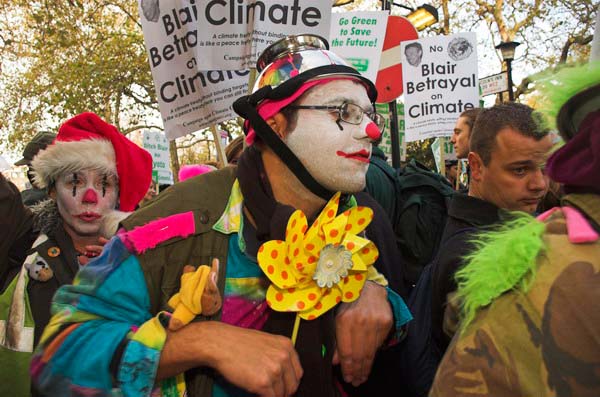

Armenians, Football, Tweed, TTIP, KFC, BP, NHS – 2015

Armenians, Football, Tweed, TTIP, KFC, BP, NHS: Ten years ago on Saturday 18th April 2015 London was busy with protests and I rushed around covering seven events, though the last four at Shepherds Bush were all part of the Day of Dissent rally against TTIP, related to the problems which would be caused with a trade deal with the USA – and all threats now relevant to the current talks between our government and the Trump administration.


Centenary of Armenian Genocide

Armenians, Football, Tweed, TTIP, KFC, BP, NHS - 2015
A woman paints an Armenian flag on a man’s cheek

I met hundreds of Armenians close to Hyde Park corner on Piccadilly as they prepared for their annual march in protest against the Armenian Genocide. This year, 2015 marked the centenary of the start of the killing of 1.5m Armenians by Turkey between 1915 and 1923.

Armenians, Football, Tweed, TTIP, KFC, BP, NHS - 2015

Turkey still refuse to accept the mass killings as genocide and the UK has not recognised the Armenian genocide. Armenians demannd that both countries should recognise this historic event and that it should be taught in the national curriculum.

Armenians, Football, Tweed, TTIP, KFC, BP, NHS - 2015

Some carried placards with pictures of Hrant Dink who is described as ‘The 1,500,001st Victim of The Armenian Genocide‘. Editor of the Istanbul Turkish-Armenian newspaper Agos, he was prosecuted under Article 301 of the Turkish Penal Code which makes it a crime to publicly denigrate the Turkish government, republic or nation. After having received many death threats he was assassinated by a 17 year old Turkish Nationalist in January 2007.

Armenians, Football, Tweed, TTIP, KFC, BP, NHS - 2015

I left the protest shortly before the march began, hoping to see them later at Downing Street but had left Westminster before they arrived.

More pictures: Centenary of Armenian Genocide


Football Action Network Manifesto

I went to Westminster to find the Football Action Network who were taking copies of their manifesto to the Labour, Tory and Lib-Dem offices, and finally caught up with them on the steps of the Lib-Dem offices.

Their demands include a Football Reform Bill, a living wage for all staff, fair ticket prices, safe standing, and reforms to clubs & FA.

Football Action Network Manifesto


Tweed Cycle Ride

I briefly left the football fans as the Tweed Cycle Ride stopped on the road opposite and rushed to take pictures as it went into Parliament Square. The vintage-themed ride, “a jaunty bike ride around London in our sartorial best“, stops for tea and a picnic and ends with “a bit of a jolly knees-up” and raises funds for the London Cycling Campaign.

Tweed Cycle Ride


Stop TTIP Rally – Shepherds Bush

Shepherds Bush was the venue chosen for the Day of Dissent rally against TTIP, the Transatlantic Trade and Investment Partnership, a proposed trade treaty between the European Union (then still including Britain) and the United States which would have given excessive power to corporations, enabling them to override national laws.

The event began with a rally on Shepherds Bush Green with speakers including Dame Vivienne Westwood, John Hilary of War on Want along with many others.

But much of the time was spent in a number of group discussions and it wasn’t an easy event to make interesting pictures. What was really clear was the threat that the TTIP treaty being negotiated by governments and corporations poses to democracy and all public services, that it would be a threat to public health and the NHS and would prevent changes made to combat climate change.

Campaigners then left to carry out the three separate actions I then photographed.

Stop TTIP rally


KFC protest over TTIP – Shepherds Bush

Protesters in white coats formed a line outside KFC at Shepherds Bush dipping rubber chickens in buckets of chlorine and acid, illustrating that TTIP would force the UK to accept unsafe agricultural and food practices (including GMO crops) allowed in the USA.

Chickens need chlorine washing because of lower farm hygiene standards and US meat contains much higher levels of hormones and other chemicals than here.

KFC protest over TTIP


BP die-in against Climate Change

On the other side of Shepherds Bush Green protesters calling for a fossil fuel free future staged a die-in at BP Shepherds Bush against TTIP, which would force countries to use dirty fuels including coal, tar oil and arctic oil and seriously delay cutting carbon emissions and the move to renewable energy.

After some speeches about the protest the protesters got up from the garage forecourt and walked away.

More at BP die-in against Climate Change.


Westfield ‘Save our NHS’ protest

Protesters walked in to the Westfield Centre to protest outside the Virgin media shop over the danger that TTIP poses to our NHS. Virgin Healthcare, (in 2021 rebranded as HCRG Care Group) had already taken over providing large parts of the simpler services provided by the NHS, replacing the easily run parts of our National Health service, and taking money out of the system.

NHS campaigner Gay Lee introduces the protest and the short piece of street theatre

Campaigners urged that the NHS should be excluded from TTIP, but governments and business insist it should not be. Now in 2025 we are again worried that any US-UK trade agreement made by the Starmer Labour government may open up our health service to much greater privatisation by the giant US health companies.

George Barda offers his garland of dollars to ‘Richard Branson’

Many UK government members have significant financial interests in private healthcare companies, and coulld have expected rich profits if TTIP is agreed as it will force the NHS to contract out its services to them.

A pensioner in a wig acts as a judge

After Trump became president he stopped the TTIP talks so he could pursue a trade war with the EU. One of the few things we can thank him for.

I had been worried that security staff might try to stop photographers working as like most shopping centres, Westfield does not generally allow photography. Police and security watched the protest closely but did not generally try to stop it or photographers working.

The protesters were considering further protests, but I had been on my feet too long and left for home.

More on My London Diary at Westfield ‘Save our NHS’ protest.


FlickrFacebookMy London DiaryHull PhotosLea ValleyParis
London’s Industrial HeritageLondon Photos

All photographs on this page are copyright © Peter Marshall.
Contact me to buy prints or licence to reproduce.


Smiley Culture & Orange Order – 2011

Smiley Culture & Orange Order: On Saturday 16th April I photographed two very different marches in London. The first was by several thousand people, mostly black, in protest over the death of reggae star Smiley Culture during a police drugs raid on his home and later I took pictures of the annual parade in Westminster by the City of London District Loyal Orange Lodge.


Who Killed Smiley Culture?

Smiley Culture & Orange Order - 2011

On 15th March 2011 police raided the South Croydon home of reggae star Smiley Culture at around 7am, apparently in relation to a drugs charge on which he was due to appear in court shortly. An hour and a half after their arrival, he is alleged to have been allowed to go into his kitchen alone to make a cup of tea, and to have killed himself with a single stab to the heart.

Smiley Culture & Orange Order - 2011

As many commented, it seemed a most unlikely story. Surely police would “not have allowed a man they had arrested to go alone into his own kitchen, where apart from the possibility of escape they would also know there would be dangerous weapons. And killing oneself with a single stab wound to the heart is not an easy task. His family and friends are sure there was no reason why he should have wanted to commit suicide.”

Smiley Culture & Orange Order - 2011

In April 2011 the case was being investigated by the Independent Police Complaints Commission and their report went to the coroner. At the inquest in 2013 the jury were unable to reach a unanimous verdict but the coroner accepted a majority verdict that the death had been suicide, while criticising the police for their lack of care and the IPCC for faults in their investigation.

Smiley Culture & Orange Order - 2011

Wikipedia reports that at the request of the coroner the IPCC report “was neither made public nor made available to Emmanuel’s family” and questions remain about the actual circumstances of his death and of the IPCC’s statement “that there was neither criminal conduct by officers, nor individual failings by officers that might amount to misconduct.

As I pointed out in my post, “Deaths in police custody are unfortunately not rare, and according to Inquest, in the twenty one years since 1990 there have been a total of 930, with 247 of these in the Met area.

I went on to say that few of these cases get “more than a short paragraph in the local press” unless as in this case they involve celebrities or take place in public with witnesses and often videos of the event; “most of them take place in the secrecy of the police station or other premises with police officers as the only witnesses.

Among those taking part in this march were families whose sons and brothers also died while in police custody, and in my post on My London Diary I mentioned some of these. The march took place on the “anniversary of the death of David Oluwale, killed in the first known incident of racist policing in 1969; his death remains the only case in British history that police officers have been found guilty of criminal offences leading to the death of a suspect, although they were found guilty only of assaults, the judge ordering the charge of manslaughter to be dropped.”

The death of Smiley Culture was one of several cases identified as a contributing factor to the riots later in the year after the police shooting of Mark Duggan by a study led by the LSE and The Guardian.

In February 2025 a blue plaque was unveiled outside Smiley Culture’s home from 1976-1980 on the Wandsworth Road, close to where this march began, celebrating his contributions to music and culture.

More about the march and rally and many more pictures on My London Diary at Who Killed Smiley Culture?.


Orange Parade in London

The City of London District Loyal Orange Lodge (L.O.L.) led their annual parade through London with lodges and bands from around the country taking part.

Founded in 1796 to uphold the Protestant religion, the Orange Order was was revived in the early twentieth century to oppose Home Rule for Ireland, and still plays a powerful role in Northern Ireland politics and government, embedded in Unionist politics.

Parades in Northern Ireland are still controversial and seen by many Catholics as deliberately provocative, while many Orangemen regard the Parades Commission, set up to regulate these events as discriminating against them. But here in London they have little political significance and are a colourful celebration of the Irish Protestant tradition.

From Millbank the parade marched around Parliament Sqaure and then on to the Cenotaph where wreaths were laid in memory of the fallen and former comrades by the City of London Lodge, two lodges from Glasgow and the Maine Flute Band from Ballymena.

I left them opposite Downing Street where some had gone in to deliver a letter to the Prime Minister before the parade moved on to its end at statue of the Duke of York in Waterloo Place.

More at Orange Parade in London.


FlickrFacebookMy London DiaryHull PhotosLea ValleyParis
London’s Industrial HeritageLondon Photos

All photographs on this page are copyright © Peter Marshall.
Contact me to buy prints or licence to reproduce.
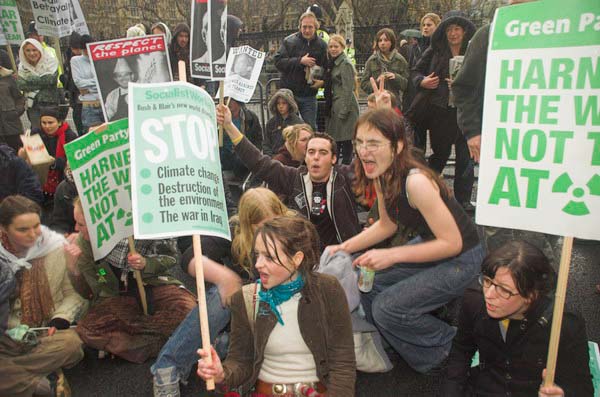

Trade Justice Not Free Trade Overnight Vigil – 2005

Trade Justice Not Free Trade Overnight Vigil – 2005: Twenty years ago on the night of 15th April 2005 and the following morning I was one of around 25,000 people protesting in Westminster for Trade Justice rather than Free Trade. The week of action was a part of the Make Poverty History campaign and it was a long cold night for me.

Trade Justice Not Free Trade Overnight Vigil - 2005
Mass Vigil on Whitehall, 4-4.30 am

Trump has put world trade very much into the headlines in recent weeks with his assault on free trade, raising tariffs to silly levels and creating chaos in international trading systems that were largely set up to favour the United States and to a lesser extent the industrial west through organisations including the World Trade Organization (WTO), the International Monetary Fund (IMF) and the World Bank (WB) at the cost of the poorer countries of the world.

Trade Justice Not Free Trade Overnight Vigil - 2005
Don’t Chicken out on Trade Justice

The Trade Justice Movement calls for policies “designed to deliver a sustainable economic system that tackles poverty and protects the environment.” It calls on the UK Government to:

“Ensure trade rules allow governments, particularly in poor countries, to choose the best solutions to end poverty and protect the environment;
Prevent trade rules that allow big businesses to profit at the expense of people and the environment;
Ensure decisions about trade rules are made transparently and democratically.”

Trade Justice Not Free Trade Overnight Vigil - 2005
Trade justice, not free trade placards held high as the procession passed the Houses of Parliament. The time, according to Big Ben, 6.40 am.

Free Trade which simply relies on market forces ignores human rights, environmental considerations and democratic decision-making and leads to exploitation, environmental degradation and inequality – we need a more just system.

Trade Justice Not Free Trade Overnight Vigil - 2005
Opposite Downing St in Whitehall at 11pm

Here with some of the pictures (and the usual minor corrections) is what I wrote about the overnight vigil in which a surprisingly large number of people – probably around 25,000 took part, overwhelming the expectations of the organisers.


Wake Up to Trade Justice – Westminster

15-16 April, 2005

The UK climax of the global Week of Action on Trade Justice was an overnight vigil in Westminster on Friday-Saturday 15-16th April. Along with many thousands of others I travelled to the opening event at Westminster Abbey, only to find it was already full. Fortunately we were able to hear the relay sitting in the seats marked ‘Members of Parliament’ in St Margaret’s Church next to the abbey, but there were many more people in Parliament Square and around the area.

At 11pm we moved off into whitehall, where it soon became obvious there were far too many to fit behind the crush barriers and we took over the road, leaving just a single lane for northbound traffic. People lit their candles and made a fair bit of noise, before leaving either for home or to try to attend one of the various events that had been organised through the night. I went to the Vue cinema in Leicester Square to see a preview of ‘The Fever’ starring Vanessa Redgrave (she had talked earlier in Westminster Abbey.)

When that finished I’d hoped to do something else, but all the venues were full, with long queues, so I went for a walk by the Thames. The organisers had expected a couple of thousand people, hoped and planned for five thousand but altogether estimate that some twentyfive thousand turned up for all or part of the event.

From 4am to 4.30am we crushed into Whitehall again for a mass vigil opposite Downing St. Millions of people around the world suffer from unjust trade, and this was chosen as the time when the largest number of them are awake. I was rather less so, but still managed to blow my whistle and take a few pictures, though I messed things up rather more than usual.

I’d dressed up in warm clothes (the forecast had told me 4 degrees at 6 am), but even so, sitting on a bench in Parliament Square after this was a mistake. I fell asleep and was woken up shivering at around half-past five by a smell of burning. Someone sleeping on the ground nearby had set some of their clothing on fire with their candle. Fortunately it was quickly extinguished, with a bottle of Lucozade serving as a fire extinguisher.

Soon after the dawn procession began to assemble and I managed to drag myself up to photograph it.

People were remarkably wide-awake and cheerful as the ten thousand or so who had stayed the night over made a short walk through Westminster as the sun rose over the buildings. By half past seven it was all over, and I walked back to Waterloo Station taking a few more pictures in the morning light.

Many more pictures on My London Diary.


FlickrFacebookMy London DiaryHull PhotosLea ValleyParis
London’s Industrial HeritageLondon Photos

All photographs on this page are copyright © Peter Marshall.
Contact me to buy prints or licence to reproduce.
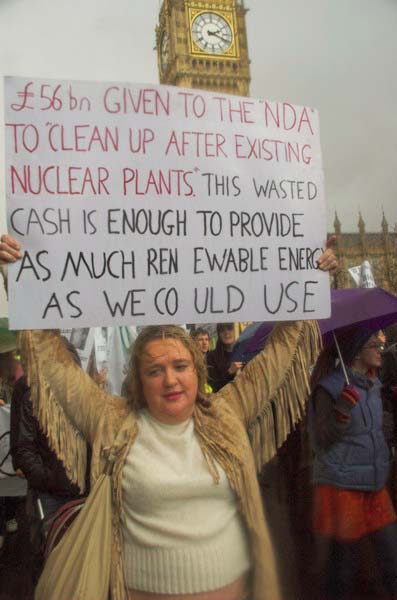

Who Wants to Evict a Millionaire? 2015

Who Wants to Evict a Millionaire? On Saturday 13th April UK Uncut led a protest against the benefit cuts and new taxes being brought in that will most severely impact many of the poorest and particularly the disabled in our society with a lively peaceful protest against Tory Peer Lord Freud, one of the millionaire architects of the bedroom tax.

Who Wants to Evict a Millionaire? 2015
Tories Against the (Bedroom) Tax protester on the Northern Line as UK Uncut travel to Archway

David Freud, a grandson of Sigmund, had made a fortune as a merchant banker before retiring in 2006 when he was asked by New Labour’s Prime Minister Tony Blair to review the UK’s welfare-to-work system. His 2008 report ‘Reducing dependency, increasing opportunity: options for the future of welfare‘ included making use of private companies to help lone parents and people on Incapacity Benefit back into work and for a single working-age benefit payment to replace the whole range of those currently being paid.

Who Wants to Evict a Millionaire? 2015
Green Party leader Natalie Bennett had come to take part in the protest

Many in the Labour Party found his ideas unpalatable, and Gordon Brown refused as prime minister to cut welfare spending. Freud then switched to supporting the Conservatives and in 2009 was made a life peer and became a Tory shadow minister. After the 2010 election Freud became Parliamentary Under Secretary of State for Welfare Reform at the Department for Work and Pensions.

Who Wants to Evict a Millionaire? 2015

Iain Duncan Smith had become Secretary of State for Work and Pensions and took up Freud’s ideas, working on the introduction of Universal Credit, introducing a new Work Programme under which claimants could be sanctioned, losing benefits for up to three years if they were judged to be failing to cooperate and making real terms cuts in benefits.

Who Wants to Evict a Millionaire? 2015
The ‘UK Uncut Removals’ van – ‘Millionaire eviction specialists’ – arrived just as we turned off Hillway into Langbourne Ave

Damaging to many as these policies were in principle, they were made much harsher by the sheer incompetence Duncan Smith imposed on the Department of Work and Pensions and his failure to realise or empathise with the very different lives of poorer people. For him or Freud a delay of five weeks in receiving payments would be no problem – their resources would seem them over and they could easily borrow from family or friends – or even banks.

But those on benefits had no resources to fall back on. If payments were delayed or they were sanctioned they would have no money to buy food, heat their homes, pay rent.

Some facts about benefits and the problems caused by cuts

Famously in April 2103 after a claimant had told the BBC he had £53 per week after paying housing costs, Duncan Smith replied that he could live on £53 per week. And in 2015 he “was criticised after the DWP admitted publishing fake testimonies of claimants enjoying their benefits cuts. Later the same month, publication of statistics showed 2,380 people died in a 3-year period shortly after a work capability assessment declared them fit for work.”

The Removal men had come with boxes

It was the policies of Freud and Duncan Smith that led to the huge increase in the need for food banks. In 2010-11 the Trussell Trust distributed 61,000 food parcels. By 2022-3 that annual figure was “close to 3 million, almost a fiftyfold increase.

But the police were not letting them get on with the job

The protest was particularly directed against the ‘Bedroom Tax’, which penalised tenants in public housing by reducing their Housing Benefit if they were judged to have more rooms than they needed. It was meant to reduce the costs to and encourage council tenants to move to smaller accommodation – but as this was seldom available its result was simply to impoverish them. And it hit some groups particularly the disabled hardest, as they might have to move away from properties that had been suitable and adapted to their needs.
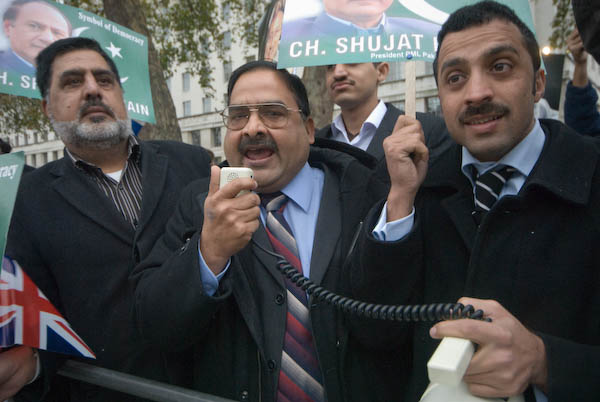
But there were also other measures, including a benefits cap which was being brought in across the country in stages to put a strict limit on the amounts that people may receive. It seemed inevitable that this would lead to many thousands being evicted, particularly in high rent areas such as London, as well as a cut in legal aid and council tax benefits and an end to disability living allowances.

Those benefits which remain will rise by less than inflation – a cut in real terms. And these cuts were taking place at the same time as the 50p tax rate was being abolished, saving the UK’s 13,000 millionaires around £100,000 each.

I went with the largest group of the protesters, who met at King’s Cross to travel to an undisclosed location, which turned out to be the Highgate home of Tory Peer Lord Freud.

Owen Jones

Outside his home there were a number of performances and speeches which you can read more about at the link below to My London Diary. And the protesters gave a huge cheer when it was announced that disabled activists from DPAC (Disabled Persons Against Cuts) had visited the home of Ian Duncan Smith and also delivered an eviction notice there.

More about the protest and many more pictures on My London Diary at Who wants to evict a Millionaire?


FlickrFacebookMy London DiaryHull PhotosLea ValleyParis
London’s Industrial HeritageLondon Photos

All photographs on this page are copyright © Peter Marshall.
Contact me to buy prints or licence to reproduce.