Veils, Ahava, Justice, Rentokill & A Walk

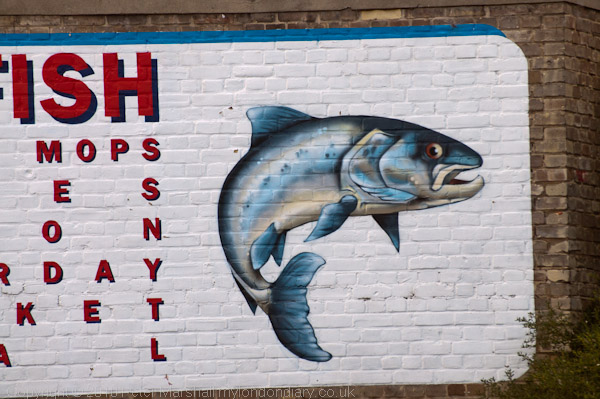
Veils, Ahava, Justice, Rentokill & A Walk - Fish on Regent's Canal
A fish on the Regent’s Canal

On Saturday 25th September 2010 I made a few pictures while travelling around London to photograph some rather varied protests and then took a walk mainly beside the Regent’s Canal in Shoreditch and Haggerston before going home.
Veils, Ahava, Justice, Rentokill & A Walk

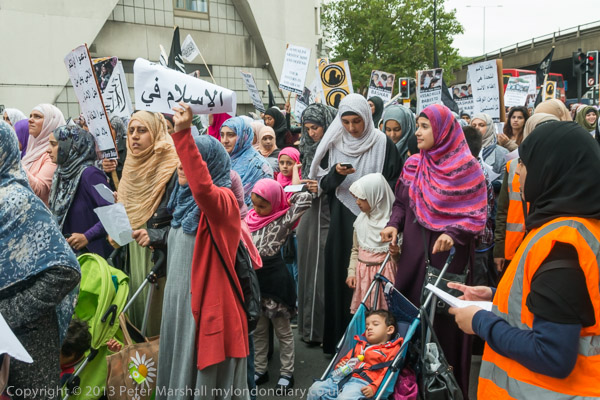
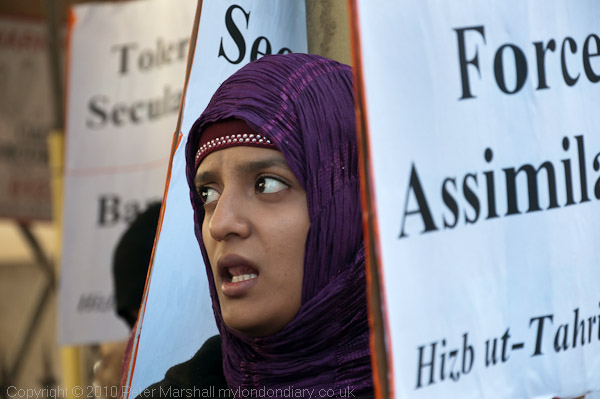
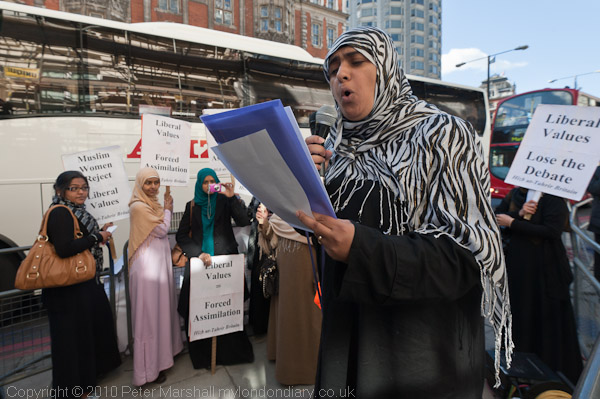
My day in London began with a bus ride from Clapham Junction to Knightsbridge, where around 80 Muslim women from Hizb ut-Tahrir Britain had come with a letter to the French Ambassador protesting the French parliament decision to ban face veils.
Veils, Ahava, Justice, Rentokill & A Walk

Although the ban prohibits all face coverings, it is mainly aimed at Muslim women who wear the niqab or burkha. Both were then uncommon in France outside of Paris and some Mediterranean coast cities and some estimate they were only worn by around 2000 of France’s 2-3 million Muslim women, most of whom, like the great majority of women at the protest wear headscarves rather than face coverings.
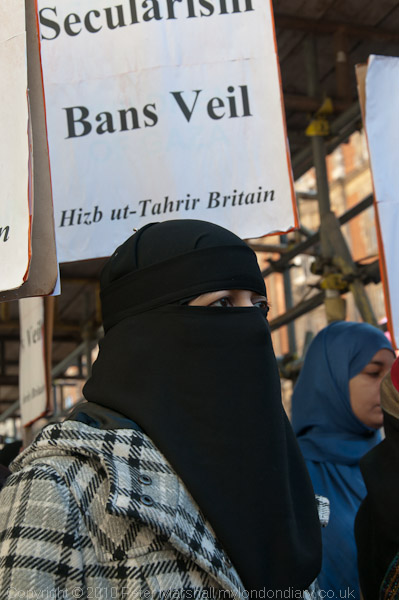
Judging from the slogans, placards and speeches this was more a protest against ‘liberal values’ and “the objectification and sexualisation of women’s bodies in pornography, lap-dancing clubs, advertising, and the entertainment industry, all permitted under the premise of freedom of expression and driven by the pursuit of profit in Western societies.”
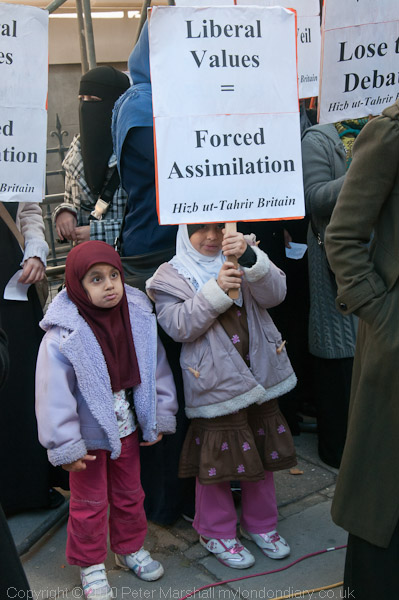
The French ban seems an unfortunate restriction of the rights of women to decide how they wish to dress, but is also a measure to oppose the power of clerics and others to limit the freedom of women by forcing them to wear face coverings, which seems to to be fully in line with the French tradition of liberty. And being a liberal and secular society doesn’t necessarily mean giving free rein to the exploitation of women or others for profit. We can oppose these without wanting to impose the kind of restrictions on others that groups such as Hizb Ut Tahrir advocate.
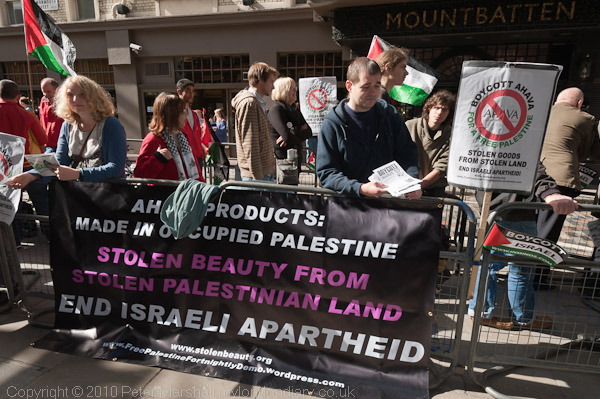
From Kensington I went on to Covent Garden where Pro-Palestinian demonstrators were holding another of their fortnightly demonstrations outside the Covent Garden Ahava shop which sells products manufactured in an illegal Israeli settlements on occupied Palestinian land.
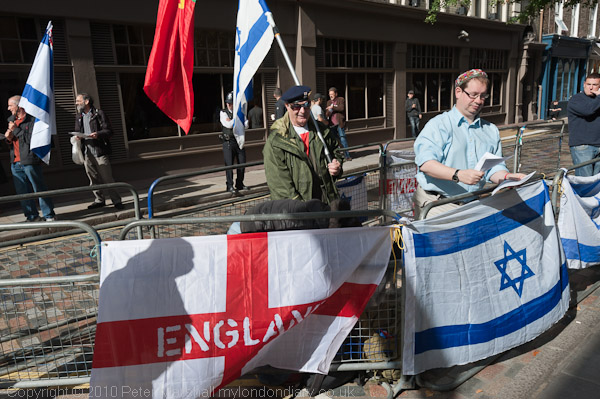
As on previous occasions their protest was met by a smaller counter-demonstration by supporters of the right-wing English Defence League (EDL) and Zionists. At previous protests there had been some attacks by the EDL on the protesters, but while I was present they were content with shouting.
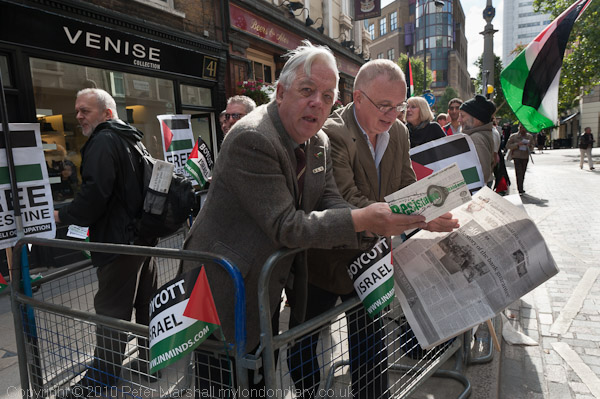
The Ahava protests are part of an international ‘Stolen Beauty’ campaign organised by ‘Code Pink’, a women-initiated grass-roots peace and social justice movement which began when American women came together to oppose the invasion of Iraq. They say that Ahava “has openly flouted tax requirements by exploiting the EU-Israel trade agreement and violates UK DEFRA guidelines in respect of proper labelling.”
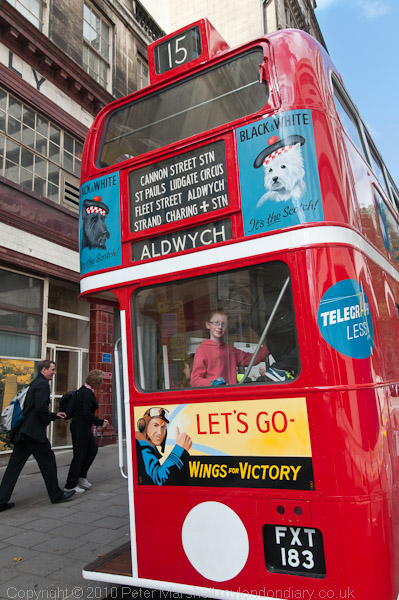
I walked down to the Embankment, pausing to photograph a rather fine Routemaster bus with vintage advertising, and a few boats taking part in the ‘Great River Race’. In Temple Place I met protesters from ‘Families Fighting For Justice’, members of families of murder victims, who were calling for tougher sentences for murder – with life sentences meaning life imprisonment.
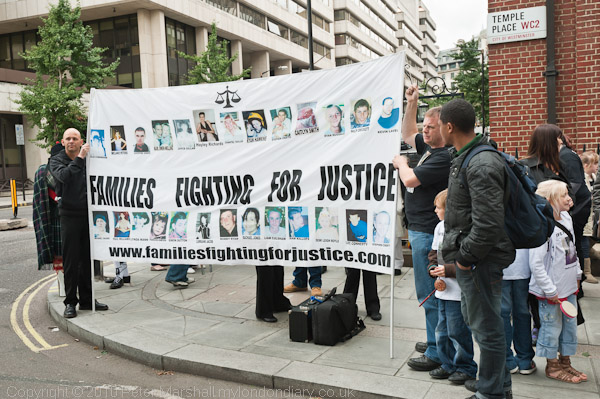
Some of the stories I heard from them were truly heartbreaking and showed why many ordinary people have lost faith in our justice system. Although I don’t feel that their ‘Life 4 A Life’ campaign would actually do much if anything to solve the problem, clearly some action is called for, both in improving child protection by our social services and also in how we regulate behaviour on our streets. Part of this is better policing, but increased spending on youth services and community support is vital. Instead we got years of austerity cutting these and other essential services.
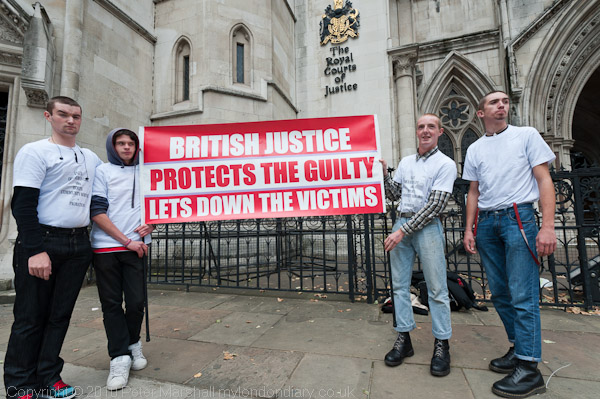
I left the march as it headed off towards a rally in Waterloo Place; it was smaller than expected and police insisted they march on the pavement rather than taking to the road, which reduced its impact.
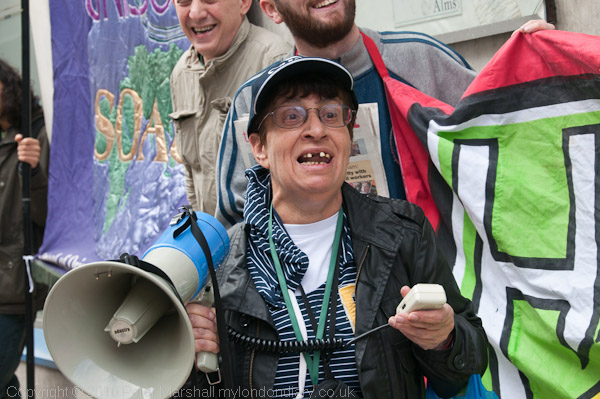
I was on my way to Old Street where the RMT and other unions were holding a short demonstration outside the Initial Rentokil Offices in Brunwick Place as the start of a campaign against the company’s union-busting activities towards its cleaning staff.
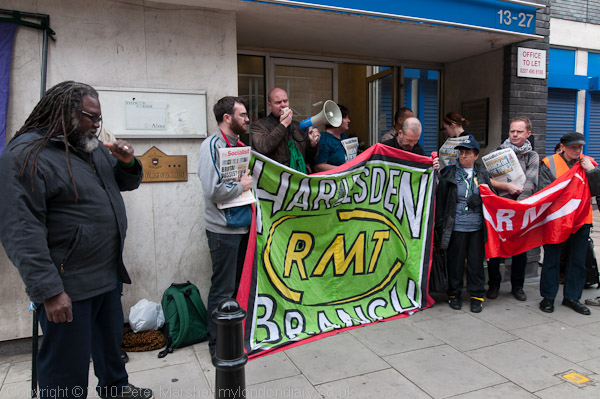
The RMT say Initial Rentokil intimidates and bullies its members and deliberately employs workers whose immigration status is doubtful so that they can pay minimum wages and provide sub-standard working conditions, often requiring them to work without proper safety equipment or precautions. They allege that workers who question their rights or attempt to organise have been reported to the immigration authorities who have then raided the workplace. The protest was also supported by members of Unite and Unison.
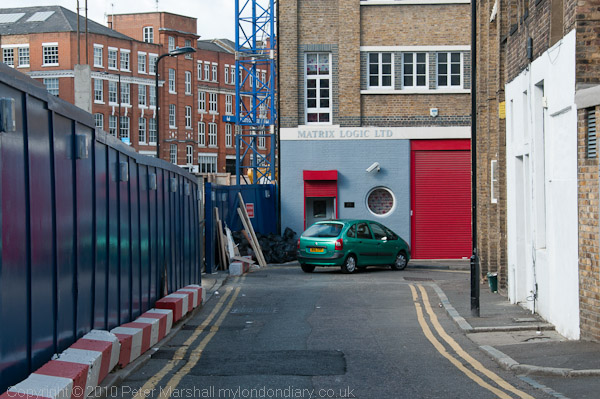
It was still before 3pm when the rally ended and I decided to take a walk before going home. I walked roughly north to the Regent’s Canal.
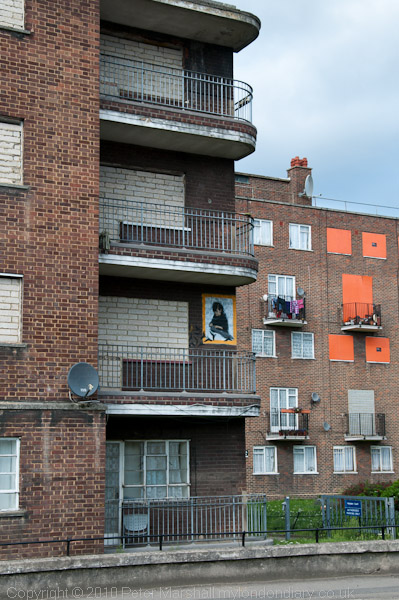
On the Haggerston Estate I found flats bricked up as people have been moved out to redevelop the estate. They are said to be moving back when new social housing is built – along with some at market prices.
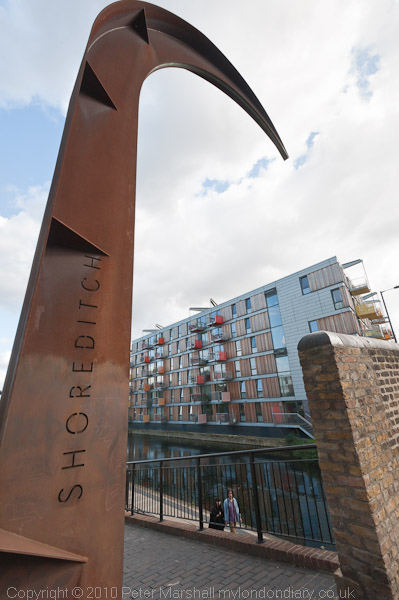
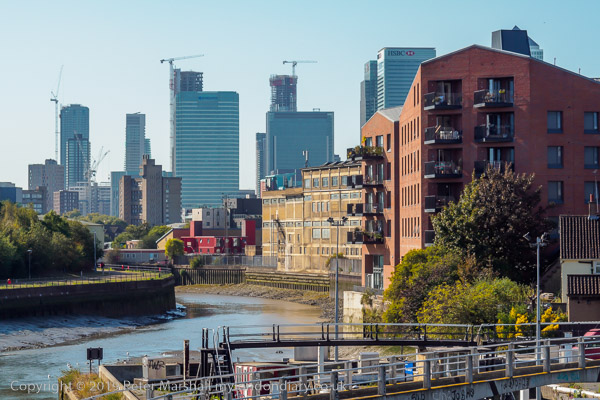
Shoreditch and Haggerston were both very much up and coming areas, with some expensive flats beside the canal.
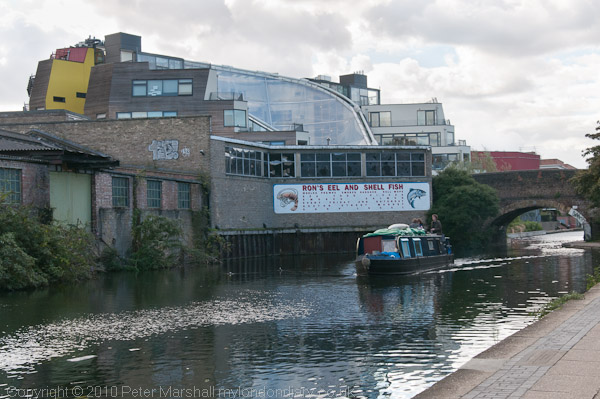
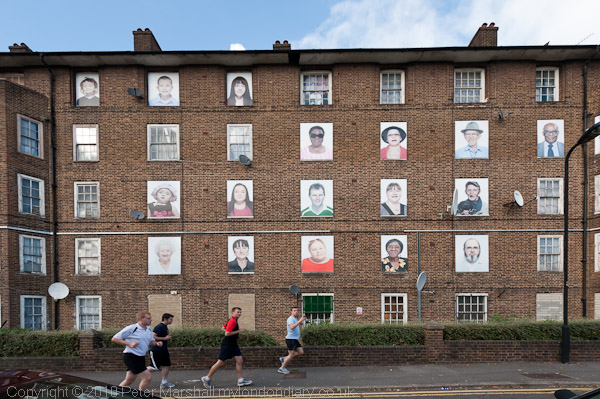
One of the reasons to walk this way was to see a large art work on the long block of flats by the canal, ‘I am Here’, one of London’s largest art installations., with giant portraits of the residents.
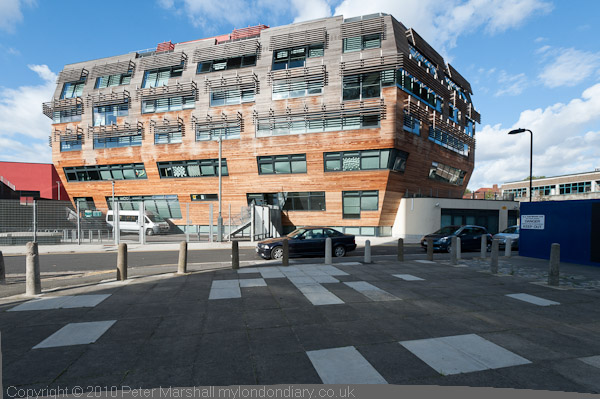
But I was also keen to photograph other buildings in the area, including the Bridge Academy.
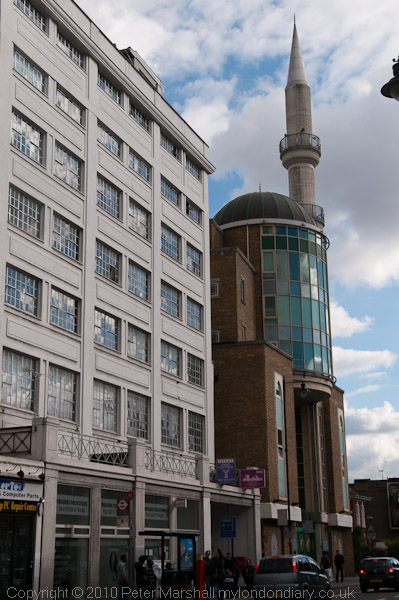
And, on Kinsgsland Road, the Suleymaniye Mosque.
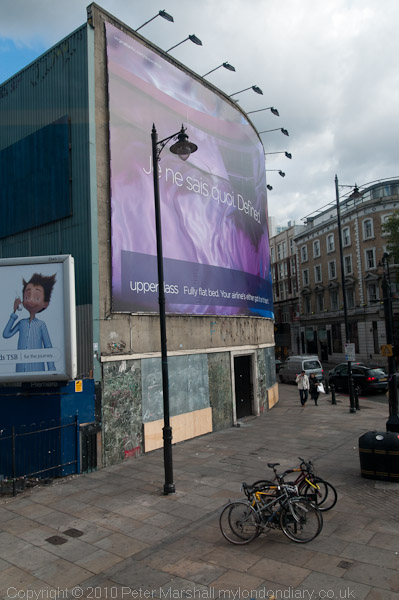
Even when finally I got on the 243 bus I was still taking pictures, including a rather sad view of the former Foundry, a lively venue where I had been to a great photo show not long before, now boarded up and covered with a giant advertising hoarding,
More pictures from my walk and the protests on My London Diary:

Hizb ut-Tahrir Protest French Veil Ban
Protest Against Illegal Israeli Goods
Families of Murder Victims Call For Justice
Protest over Initial Rentokil Union Busting
Walking Around London
Class War Occupy Rich Door – Aldgate

Class War Occupy Rich Door - Aldgate

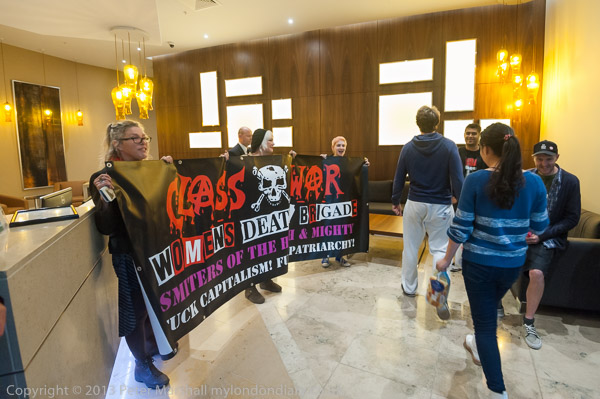
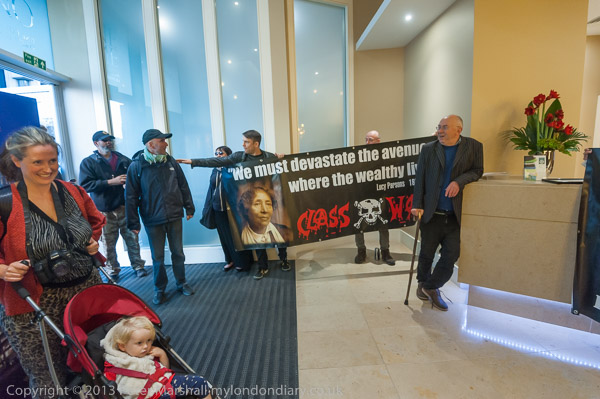
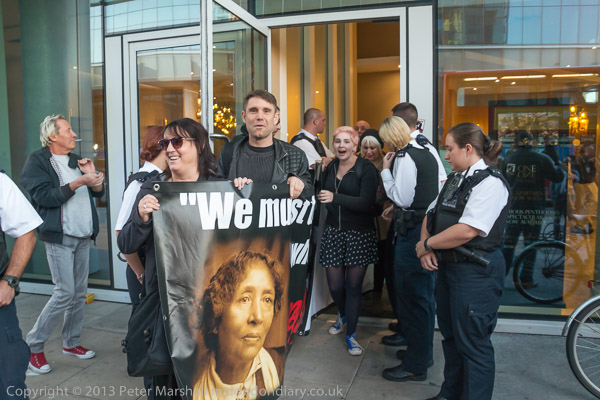
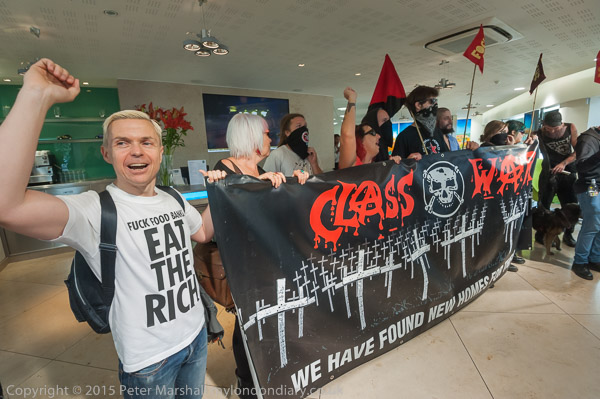
Wednesday 24th September 2014 saw one of the more interesting protests in the long-running series by Class War at the tower block of One Commercial Street which has a plush foyer with a 24hr concierge for the residents of the expensive private flats in the block on Aldgate High St, but social housing tenants in the same block are denied entry here and have to use a small door into an empty passage from an alley at the side of the building.

Class War Occupy Rich Door - Aldgate
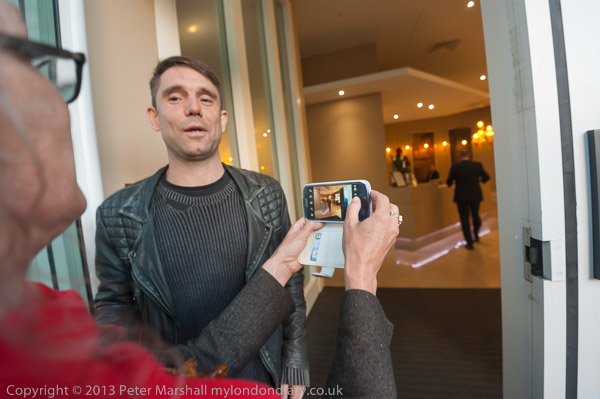
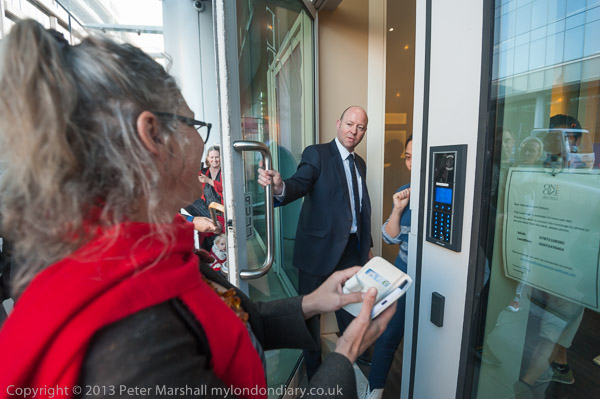
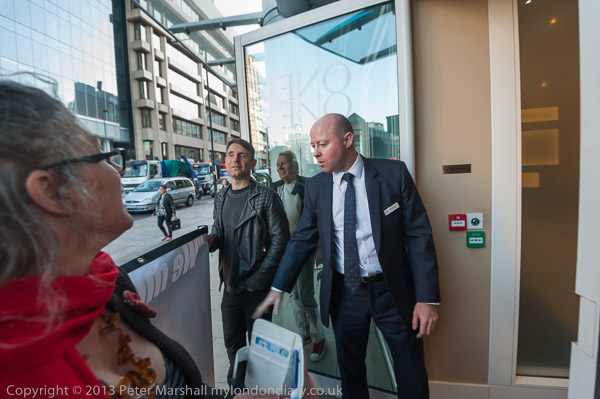
The building manager opens the door to let a resident leave

Developers of new housing in London are generally required to provide a small proportion of social housing in their schemes, though they often find legal ways to reduce or even eliminate this, either by building separate social housing blocks or paying others to do so, or simply by pleading (often misleadingly) they cannot make high enough profits.
Class War Occupy Rich Door - Aldgate
and finds the door is held open

Boris Johnson when London Mayor said he would discourage the use of separate entrances for social housing tenants and Sadiq Khan made clear that there should be a “tenure blind” approach with affordable homes and private homes having entrances that were not distinguishable by quality, type, or location with the goal of “social equality and dignity“.
He makes the mistake of walking away

But despite these words, new developments continue to feature separate doors in what activists describe as “social apartheid”. And in July 2014, Class War began a series of weekly pickets outside the ‘Rich Door’ in a campaign to publicise and hopefully end the practice.

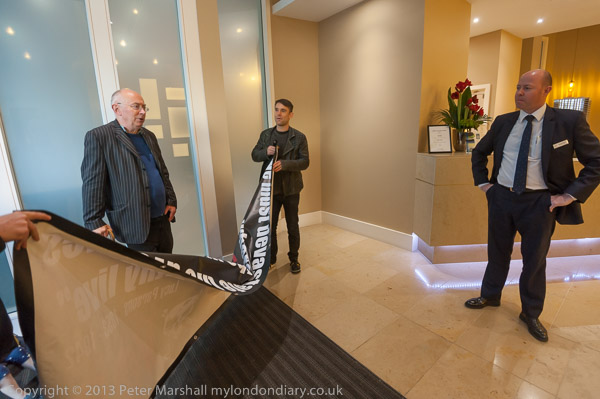
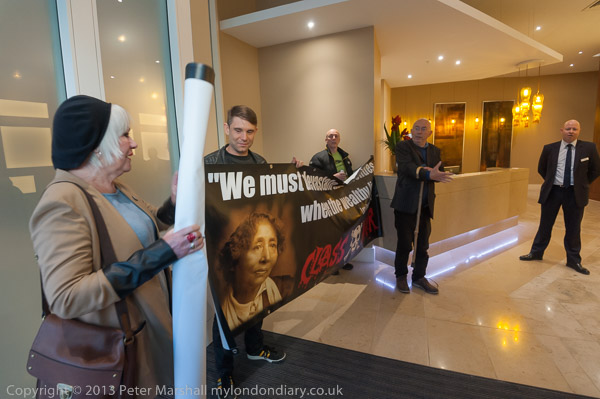
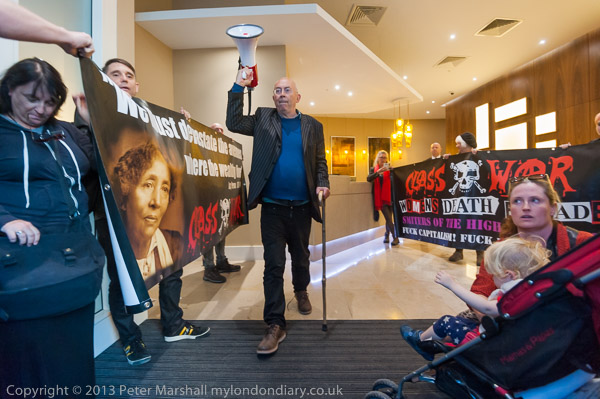
and Class War walk in with a banner

Over the following months I followed their campaign, photographing around 30 of their protests, missing only two when I was out of London. As well as putting pictures on My London Diary and elsewhere on the web I also in 2015 published a ‘zine’ ‘Class War – Rich Door, Poor Door‘ (ISBN 978-1-909363-14-4) packed with pictures from the pickets(still available.)
Jane Nicholl enters with the Class War Women’s Death Brigade Banner rolled up

The protests certainly added to the debate about the practice and exposed some of the lies of the developers, but I think there are still separate and very different doors for rich and poor at this and many other of London’s new developments. The protests may also have speeded the decision of the developer Redrow to sell the building to new owners Hondo Enterprises. There were also some minor victories, with the alley getting cleaned up and new lighting installed.

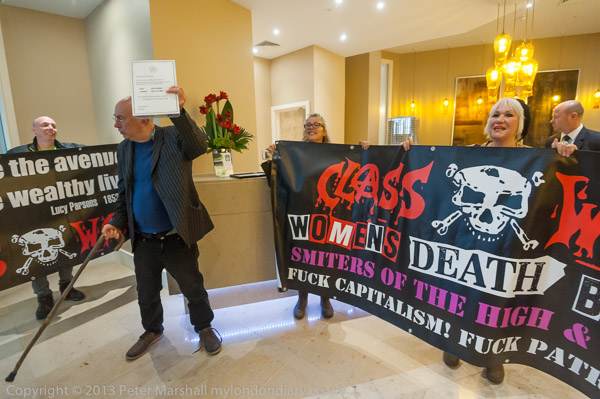
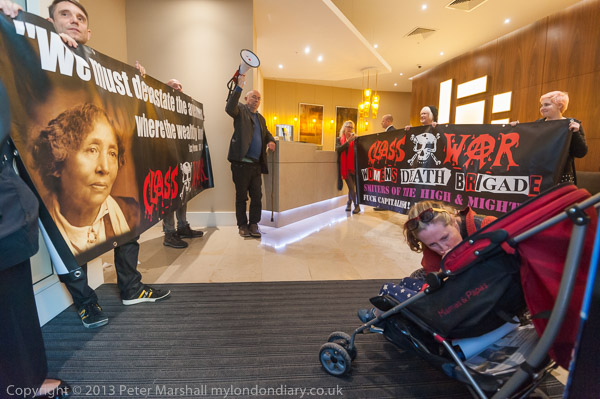
Ian Bone holds up a framed notice from the reception desk as he speaks

Since then the building, which in 2014 was nominated for the ‘Carbuncle Cup’, has changed its name to ‘The Relay Building’ and there has been considerable remodelling of the ‘rich door’ which now has the separate name of the Crawford Building. The flats served by the ‘poor door’ are called the Houblon Appartments. Despite claims by Redrow that the two groups of flats were internally quite separate I was taken from the rich part and out of the poor door by one of the residents who told me she often took her dog out for a walk that way.

Residents walk in to the flats past the protesters

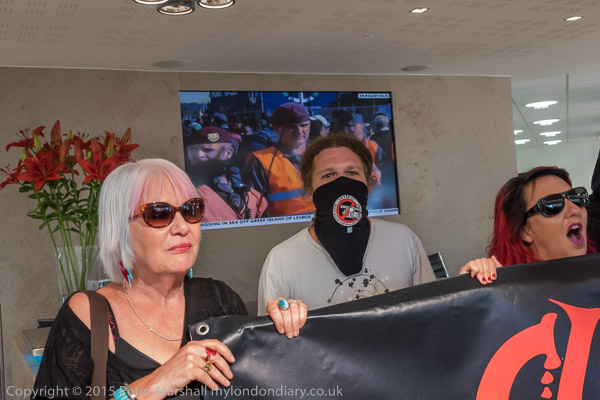
There were no police in evidence as Class War arrived on 24th September and began their picket. When the building manager opened the door to let a resident out protesters held the door open and the manager was unable to close it. He made the mistake of walking away, and several people then walked in with a Class War banner. Others from Class War followed them and made themselves at home in the large foyer.

Ian Bone stands next to the desk with its vase of flowers

Ian Bone picked up Redrow’s Gold Award certificate from the concierge desk and began talking about it and the separate doors to the building, and about the notice describing the concierge service, comparing this foyer to the bare entrance to the social housing flats, and others too spoke.

I turned after hearing a crash and saw the flowers had gone

Ian was waving his walking stick around as I took pictures and I was turned away from him when I heard a crash, and I’d sensed a movement out of the corner of my eye. I turned around and saw that the vase of flowers which had been at the corner of the desk was no longer there. I couldn’t be sure whether Ian had knocked them off deliberately or by accident, though I thought the latter unlikely.

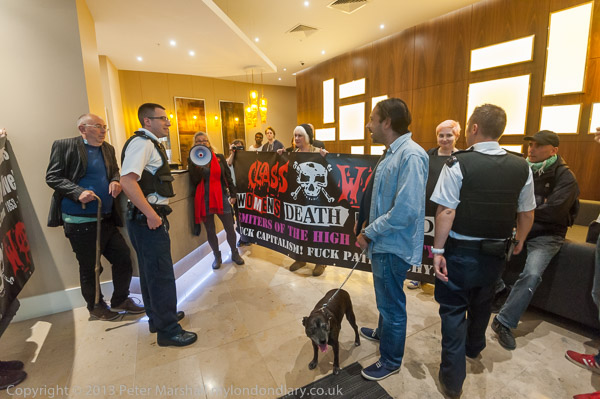
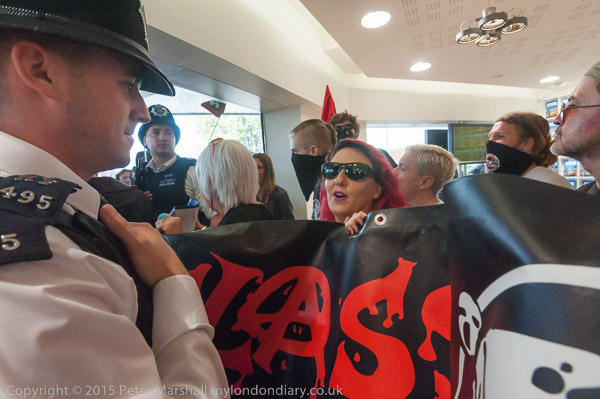
Two officers came, and one went to talk to the building manager

Eventually the police arrived and walked in talking with the protesters and the building manager and asking the protesters to leave. I went out when the building manager requested the protesters to go outside and joined the others who had stayed protesting and watching from outside. More police came and eventually those inside came out and the protest continued there, with several more speeches including a former local resident who was complaining he could no longer live in the area as it had become too expensive.

Class War come out of the Rich Door

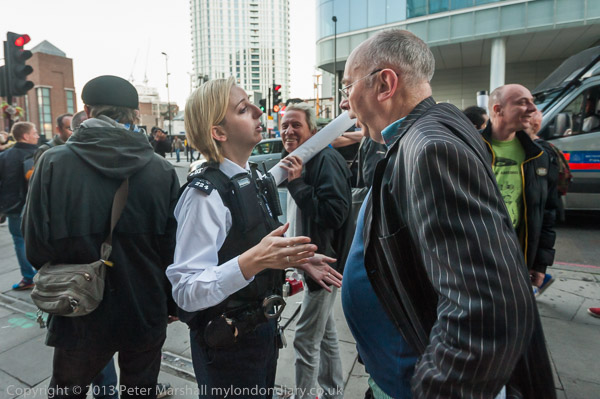
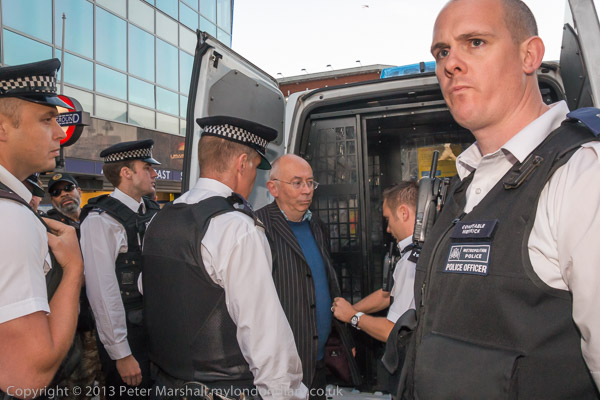
After continuing their protest outside for a while, Class War decided it was time to leave and rolled up their banners and began to move away. A woman police officer then stood in Ian Bone’s way and stopped him leaving. More officers came to surround him and he was led away to a waiting police van which then drove away.

A police officer stops Ian Bone as he was leaving

The following week Class War were back again at the Rich Door and I learnt that Ian Bone had been told by police that his breaking the vase had been recorded on CCTV and had then agreed to pay £70 in compensation. No charges had been brought, probably because Redrow wanted to avoid publicity. But Class War had brought with them two very tacky looking vases with flowers to try to give to the building manager.

Ian Bone is briefly searched before being put in the van and driven away

More at Class War Occupy Rich Door


Council Housing Crisis & Cinema Strike

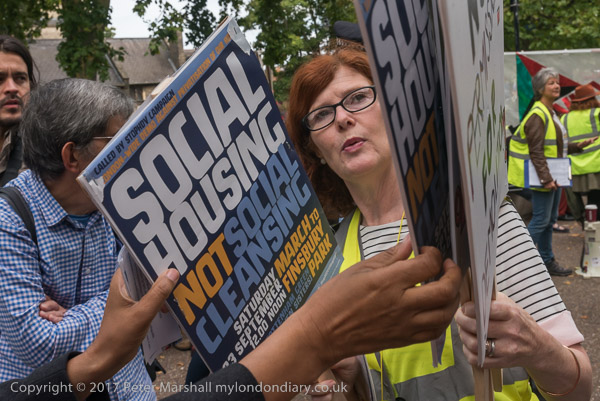
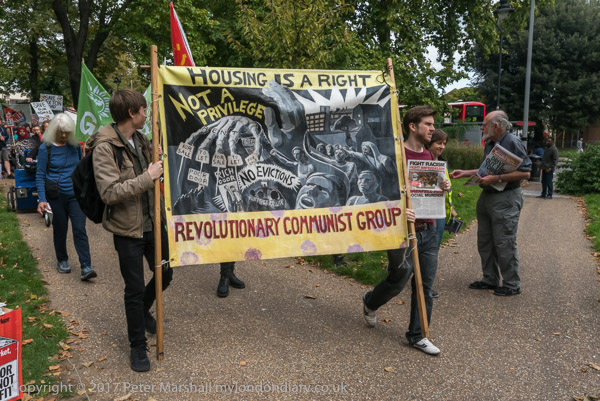
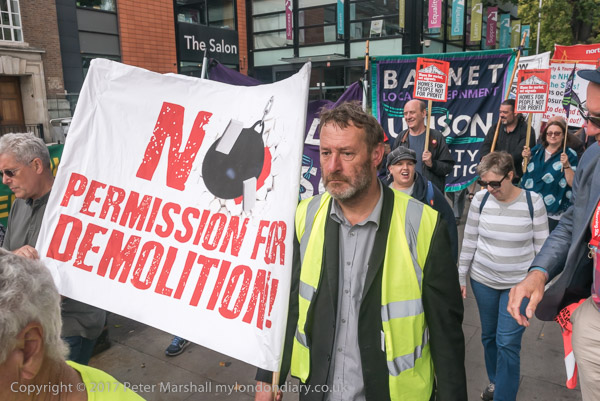
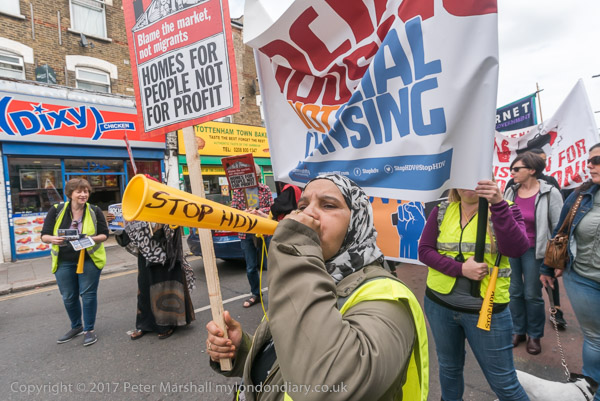
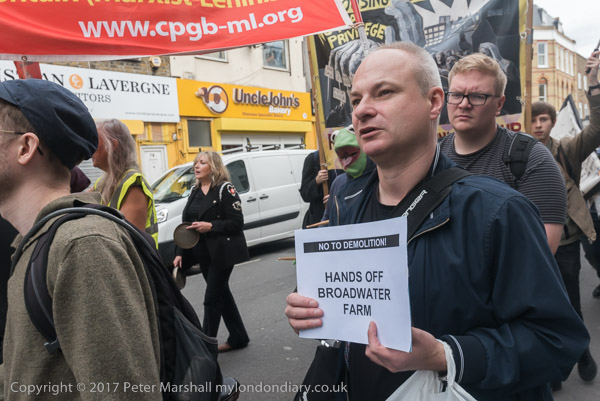
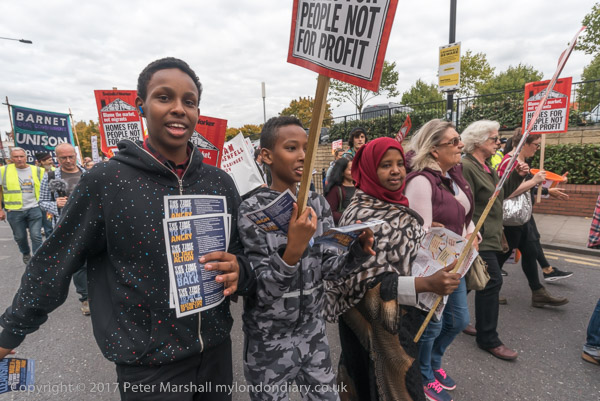
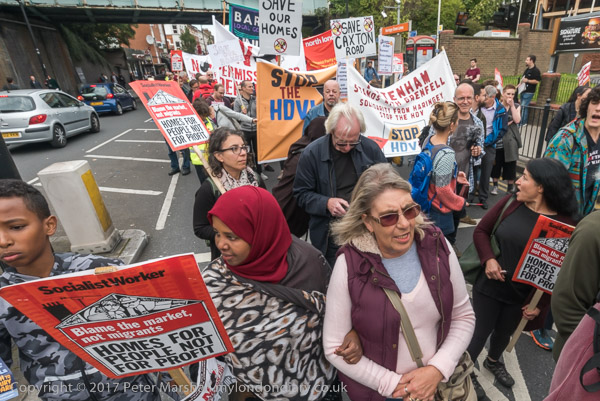
Five years ago on Saturday 23rd September 2017 I photographed a lively march in North London against council plans for a huge giveaway of council housing to developers before rushing down to Brixton in South London where low paid workers at the Ritzy cinema had been on strike for a year.

Haringey against council housing sell-off

Council Housing Crisis & Cinema Strike

When Labour came to power in 1997, Tony Blair made his first speech as prime minister in the centre of London’s Aylesbury Estate, declaring that “the poorest people in our country have been forgotten by government” and promising that housing would be at the centre of his government’s programme.
Council Housing Crisis & Cinema Strike

But their policy of estate regeneration has proved a disaster, leading to the demolition of social housing and its replacement by housing for the rich and overseas investors, along with small amounts of highly unaffordable ‘affordable housing’ and a largely token amount of homes at social rents.

Council Housing Crisis & Cinema Strike

As an article in the Financial Times by Anna Minton in January 2022 pointed out, Labour’s continuing support for Thatcher’s ‘Right-to-Buy’ and for ‘buy-to-let mortgages’ together with the pegging of housing benefit to market levels encouraged an enormous growth of buy to let properties from previously council flats and houses. In 2019 a Greater London Authority report found that 42 per cent of homes sold under Right to Buy were now privately let, with average rents in London of £1752 in the private sector compared to social rents of £421 a month.

As Minton also points out, under New Labour there were only 7,870 new council homes built during their 13 years in office, a miniscule number compared to Thatcher’s period as Conservative prime ministers when the lowest annual number was 17,710 homes.

Under New Labour the average was 562 per year compared to 41,343 under Thatcher – though numbers dropped steeply during her tenure. Housing Associations have provided some social housing, but have become increasingly more commercial in their operations.

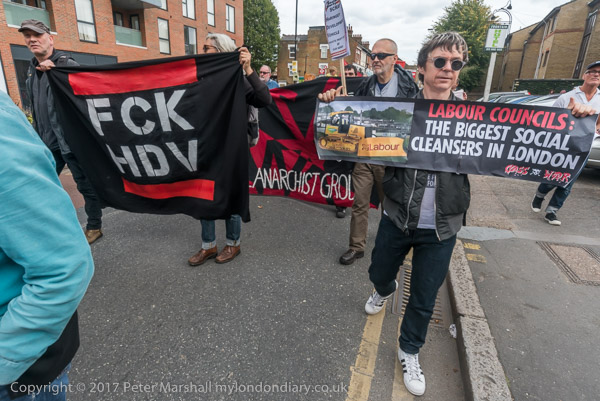
Labour’s housing policies were disastrous and largely continue, with Labour councils in London continuing to collude with developers to demolish council-owned homes. A prime example of this was the proposed ‘Haringey Development Vehicle’, HDV, under which Haringey Council was making a huge transfer of council housing to Australian multinational Lendlease.

The protest in Haringey was a lively one involving many local residents as well as other housing activists from across London. The council’s deal would have led to the destruction of many of the council’s estates over a 15 year period, and led to a revolt at local elections which replaced many of those backing the scheme by more left-wing Labour members supported by Momentum.

Under new management, the council has produced an updated version of its redevelopment plans, although some activists see these as still representing a give-away to developers. But there does seem a greater emphasis on collaboration with the local community over redevelopment schemes and on providing a greater element of social housing.

Local government is still subject to restrictions imposed by national policies, and in particular policies that encourage rising house prices, rents and subsidise private landlords, while still making it hard for councils to build new council properties.

I left the march close to its end at Finsbury Park to catch the tube down to Brixton.

Haringey against council housing sell-off


One year of Ritzy strike – Brixton

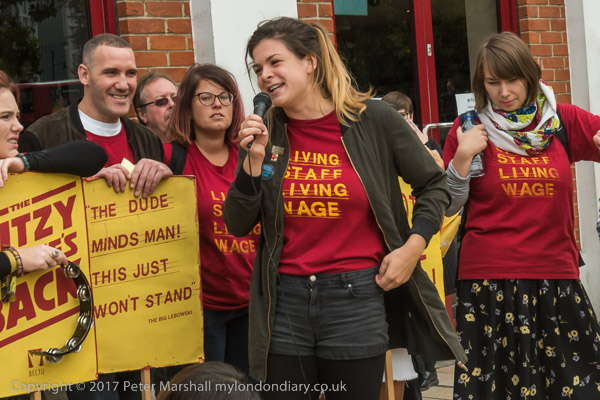
Strikers at the Ritzy Cinema in Brixton were celebrating a year of strike action with a rally supported by other trade unionists, including the United Voices of the World and the IWGB and other union branches.

The BECTU strikers were demanding the London Living Wage, sick pay, maternity and paternity pay and for managers, supervisors, chefs and technical staff to be properly valued for their work. The also demand that four sacked union reps are reinstated.

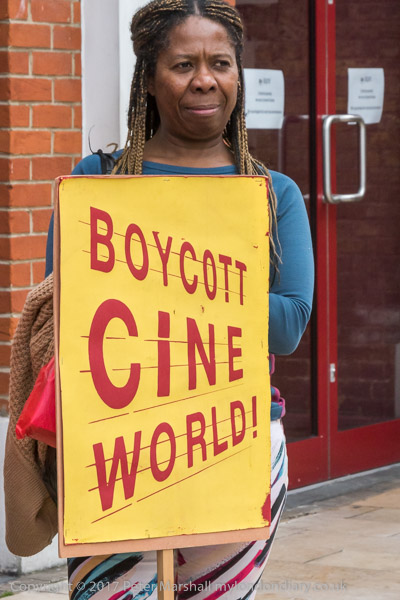
BECTU had been in dispute with the Ritzy since 2014, and had called for a boycott of the cinema, which was only finally called off in 2019. The Ritzy is one of a network of cinemas operated by Picturehouse Cinemas Ltd and owned by Cineworld, the world’s second largest cinema chain, based in London and operating in 10 countries including the USA.

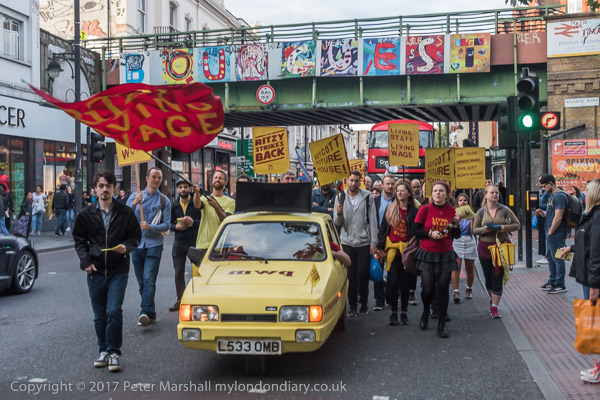
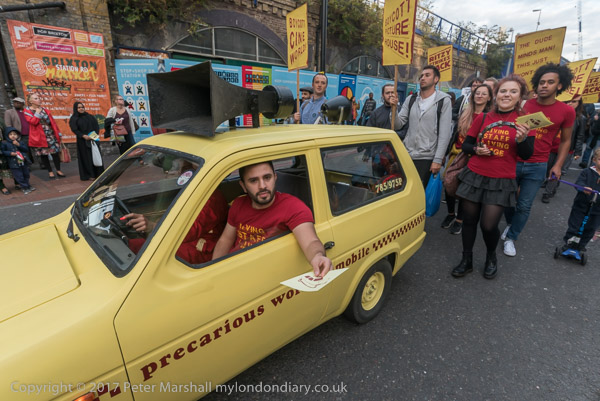
The Ritzy was closed for the rally, After a number of speeches there was a surprise with the arrival to cheers of a newly acquired ‘Precarious Workers Mobile’ bright yellow Reliant Robin, equipped with a powerful amplifier and loudspeaker. After more speeches this led the protesters in a slow march around central Brixton.

One year of Ritzy strike


Druids, Paddington & Women March For Syria

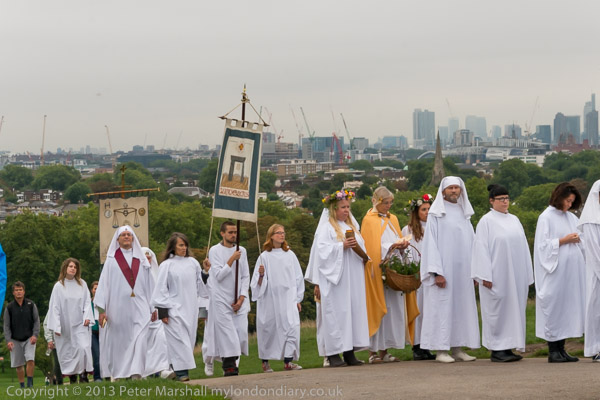
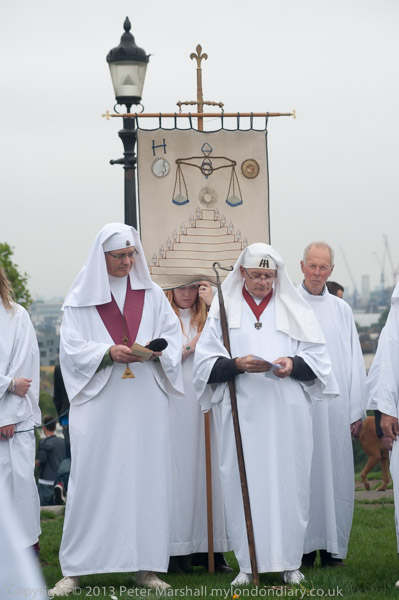
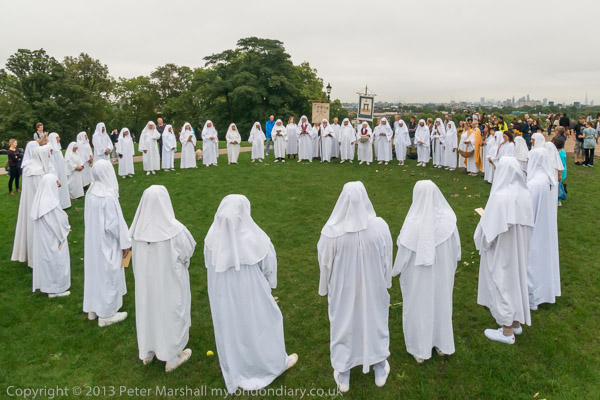
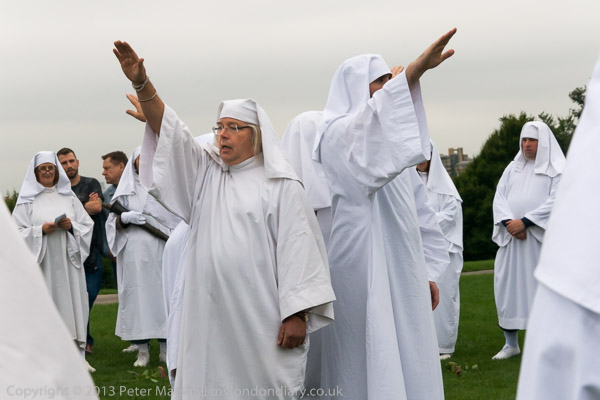
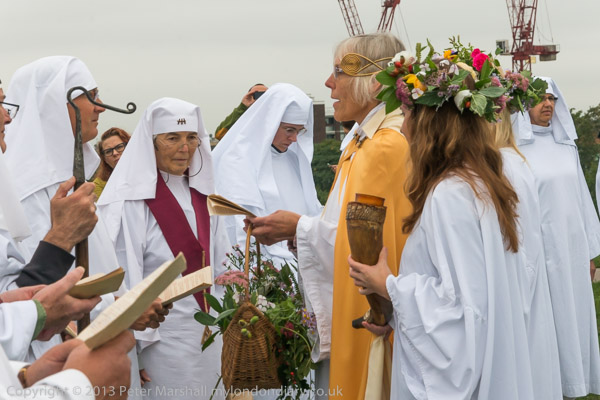
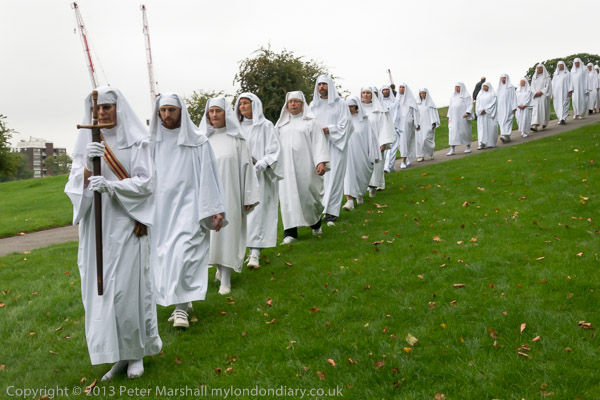
On Sunday 22nd September 2013 Druids carried out their annual Autumn Equinox (Alban Elued) ceremony on Primrose Hill at noon and later in the day women from the radical fundamentalist Islamist organisation Hizb ut-Tahrir Britain marched from Paddington Green in protest against the chemical attacks and massacres of women and children by the Assad regime in Syria. Between the two events I spent some time taking pictures around the Paddington Arm of the Grand Union Canal.


Druids Celebrate Autumn Equinox – Primrose Hill

Every year for a little over 100 years the Druid Order have celebrated the Autumn Equinox on Primrose Hill, a site of historical significance in the history of Druidism and the re-invention of a Druidic tradition. Here on the Autumn Equinox in 1716 John Toland made a call for a meeting of Druids a year and a day later at the Apple Tree Tavern in Covent Garden, and on Midsummer’s day 1792 Iolo Morganwg (1747-1826) held the first meeting of the Gorsedd of the Bards of the Isle of Britain, the precursor of the modern Eisteddfod.

Morganwg was the bardic name of Edward Williams and his work “was a prime force behind the cultural revival that saw the birth of modern Wales” according to the University of Wales Centre for Advanced Welsh and Celtic Studies whose web site describes him as “a profoundly complicated character: a struggling provincial poet in London, a manipulator and victim of the world of literary patronage, a radical, a medievalist, a forger of pasts, an opium eater and a forceful and opinionated critic.”

Most of the Druidic traditions we now have come from forged manuscripts he produced in particular the “Gorsedd Beirdd Ynys Prydain” (“The Gorsedd of Bards of the Isles of Britain”.) It was only in the twentieth century that the extent of his imaginative forgeries became clear. But although his work came almost entirely from his own extremely fertile imagination it had a dramatic effect in creating a new view of the Welsh nation.

The Druid Order made its first recorded appearance at the Summer Solstice at Stonehenge in 2021, though its founder, the remarkable George Watson MacGregor Reid, a trade union and Labour party activist with a great interest in oriental mysticism was probably there 3 years earlier. In 2014 he returned for the Solstice describing himself as a High Priest and “the direct successor of the Chief Druids who have been” and dressed in a very similar manner to that still adopted by The Druid Order.

I’ve photographed the Equinox ceremonies of the Druid Order, Spring at Tower Hill and Autumn on Primrose Hill on several occasions and have been impressed by the solemnity and spirituality of those taking part. Whatever its origins, it is a movement which respects the Earth and is peace loving and free-thinking with the apparent aim of developing themselves through being rather than through intellectual learning.

My account on My London Diary gives quite a detailed description of the event both in pictures and text so I won’t repeat that here.

Druids Celebrate Autumn Equinox


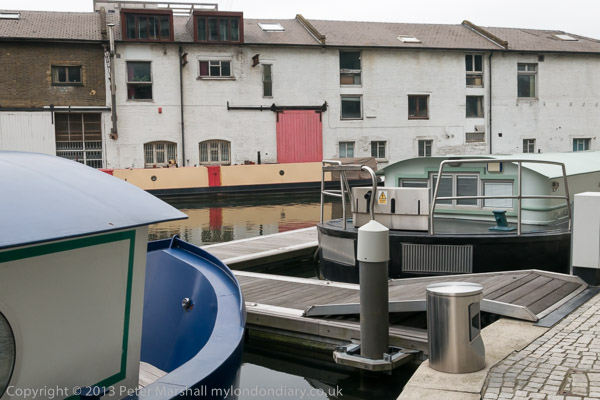
Paddington Basin – Paddington

The main line of the Grand Union Canal enters the River Thames at Brentford, from where it was possible for goods to travel along the river to London, but a direct canal route was obviously desirable and only two years after the Act of Parliament for the main route to Brentford was passed a further Act to allow the construction of a canal joining the this to a canal basin at Paddington, then on the western edge of London. This opened in 1801.

Unusually there are no locks on the 22km of the Paddington Arm – and you can travel a total of around 43 lock-free miles along the pound made up by it the Grand Union and Regents canal.

The area around the final length of the Paddington Arm from Little Venice to Paddington Basin has been the site of huge redevelopments in the past thirty or so years. A few older canalside buildings remain. Much of the land and paths open to the public in the area are on private land.

Paddington Basin


Hizb ut-Tahrir Women March for Syria – Paddington Green

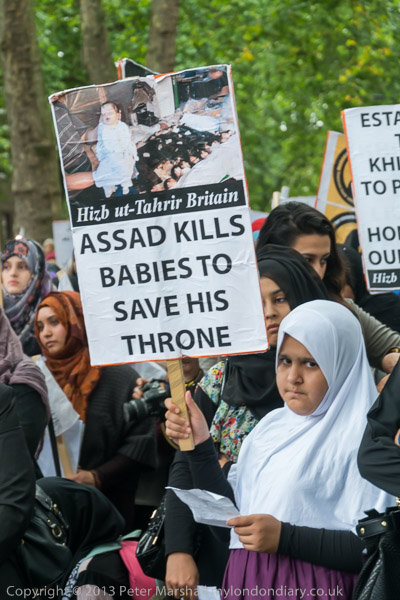
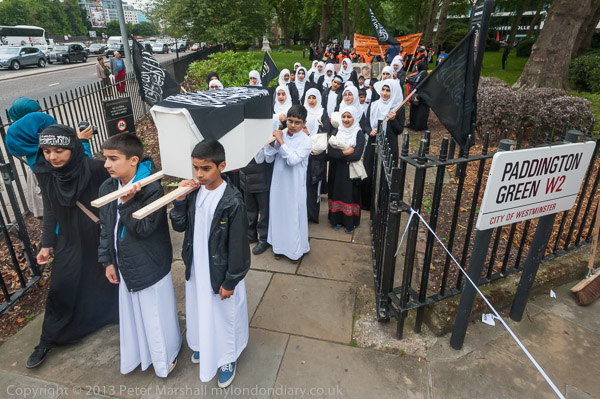
Over a thousand woman gathered on Paddington Green for a march to the Syrian Embassy to show solidarity with women and children in Syria and to condemn the chemical attacks and massacres being carried out by the Assad regime.

Hizb ut-Tahrir oppose Western military intervention in Syria but call for the replacement of the current corrupt rulers in Islamic states by a Khilifah (caliphate), a state that will truly implement Islamic values and end the corruption and oppression of the current states. They call for Muslims to rise up and get rid of corruption, and in particular of “the criminal regime of the butcher Bashar Al Assad” in Syria, and for “Muslim armies to mobilise and replace the rule of the dictator with the rule of Allah.

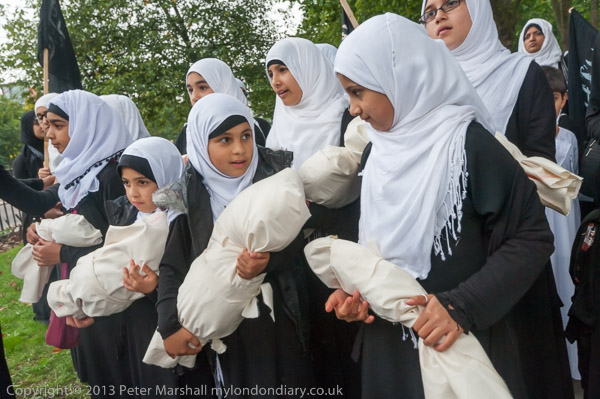
At the front of the march children carried a small coffin and other children and women carried bundles representing dead children. There were a few young boys taking part, but I saw few men – just one small group with a banner and a heavy public address system – and the event was clearly led by the women, almost all of whom were wearing headscarves, with very few in niqabs or burqas which covered the whole face.

At most other Hizb ut-Tahrir protests I’ve photographed there have been clearly separate groups of men and women, and I’ve sometimes had problems with male stewards for photographing the women, though not from the women themselves. At this event most seemed keen to be photographed to help get their message across. I left the march which was going to the Syrian Embassy in Belgrave Square at Edgware Road.

Hizb ut-Tahrir Women March for Syria


Duck Race, Climate, Zimbabwe & Clean Air

Saturday 21st September 2019 was an even more varied day than usual for me in London. I began by travelling to Bow Creek for a duck race, moved to Trafalgar Square for a climate protest, then visted the weekly Zimbabwe vigil before going to Catford for a march against air pollution.


Bromley-by-Bow to Star Lane & Cody Dock Duck Race

Duck Race, Climate, Zimbabwe & Clean Air

It was a fine day and still warm for the time of year as I walked from Bromley-by-Bow District Line the short distance to Tweletrees Crescent and Bow Creek.

I’d decided to come to see the Duck Race along Bow Creek being organised by the people at Cody Dock, but had arrived early to give myself time to revisit the gas works memorial site nearby.

Duck Race, Climate, Zimbabwe & Clean Air

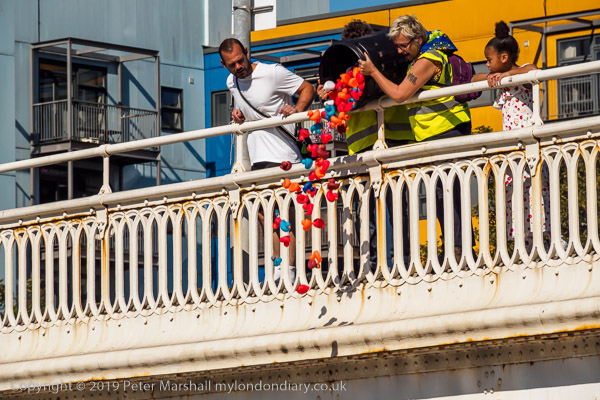
Bow Creek is the tidal section of London’s second river, the River Lea, and the duck race was a part of the ‘Lighting Up the Lea’ festival for ‘Totally Thames 2019’. It was meant to start at 11.00 but this was delayed as the people in canoes who were to shepherd the ducks were a few minutes late in arriving.

Duck Race, Climate, Zimbabwe & Clean Air

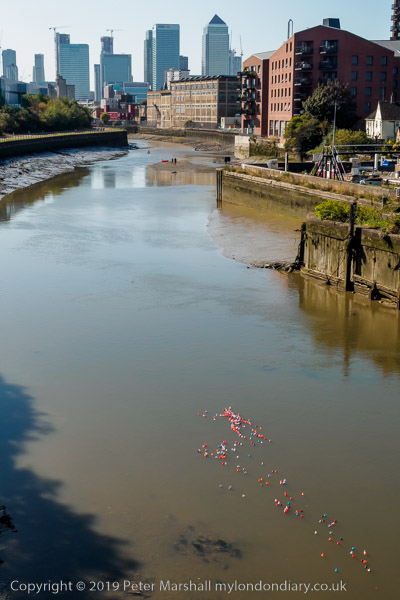
It was close to low tide, and there was little water in the creek when the ducks were dropped from the bridge, and a westerly breeze soon blew the ducks onto the mud on the east side of the creek.

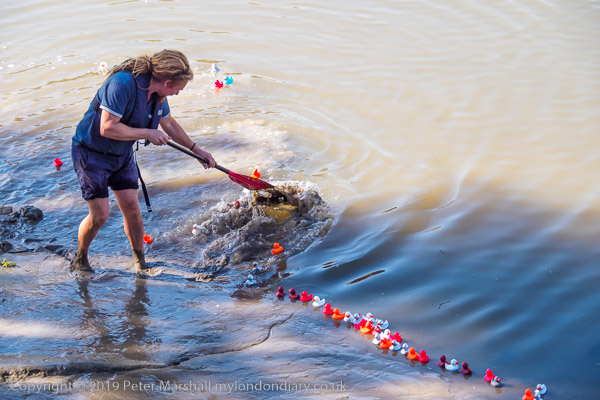
Cody Dock’s Simon Myers had beached his kayak on the gravel bank a hundred yards or so downstream and strode through the shallow stream and mud to rescue the ducks and through them back into the middle of the stream. But the breeze soon returned them to the mud and he had to get them again.

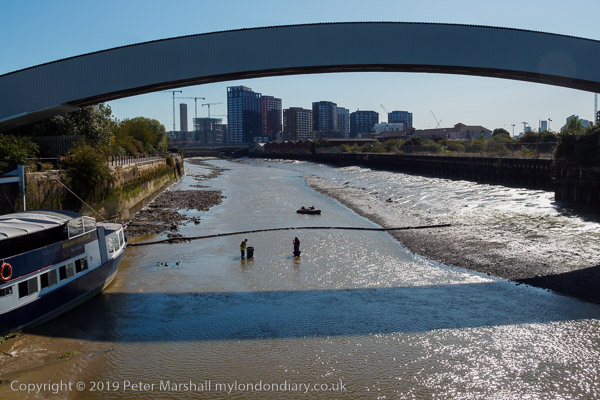
I decided I had to move on to complete my walk and get back to central London for my next event and walked on towards Cody Dock, past several small groups of people waiting to see their ducks. At Cody Dock there were a small line of catchers waiting hopefully in the stream, but they were in for a rather long wait.

I’d hoped to be able to continue my walk by the riverside to Canning Town, but this further section of the Bow Creek path has yet to be opened, and after taking a few pictures at Cody Dock I made my way to Star Lane DLR station.

Cody Dock Duck Race
Bromley-by-Bow to Star Lane


XR Youth International – Trafalgar Square

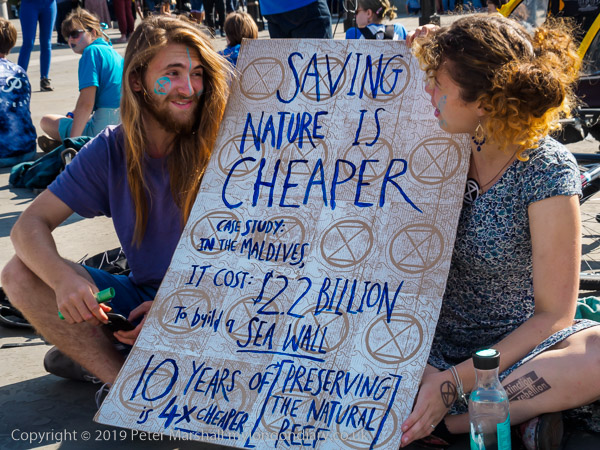
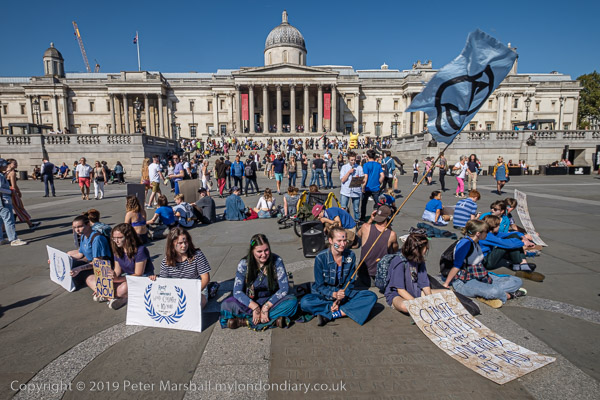
Members of Extinction Rebellion Youth International came to Trafalgar Square and held a brief protest for the UN Climate conference.

This was a rather more low-key event than I had expected and the group was ignored by heritage wardens as they sat in a circle in the centre of the square with posters while one member at the centre read the letter they are sending to the UN calling for real urgent action to avert the impending climate catastrophe.

XR Youth International


Zimbabwe protests continue – Strand

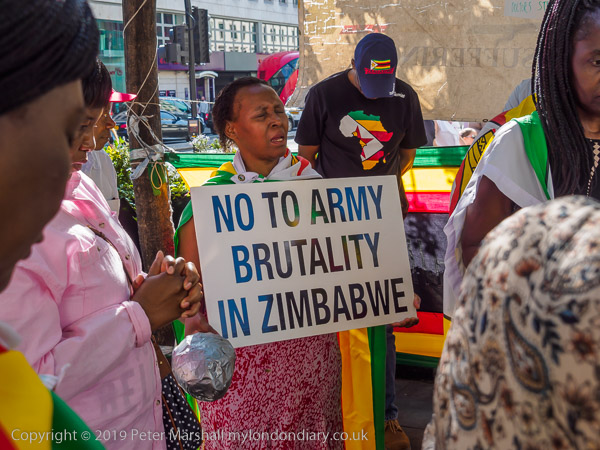
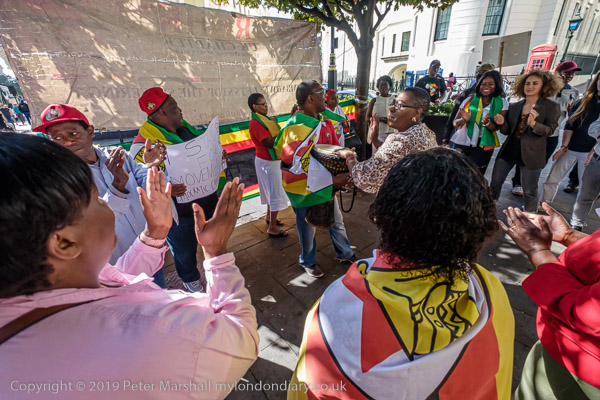
The weekly Zimbabwe Vigil every Saturday at the side of the embassy at 429 Strand began on 12th October 2002. I’ve joined it and photographed occasionally over the years, but mainly for special occasions. It’s hard to say something new about an event which happens every week.

Mugabe had been forced to resign in 2017 died earlier in the month and had died two weeks before my visit, but the vigils continue and little has changed in Zimbabwe. His successor Emmerson Mnangagwa was Mugabe’s right-hand man for 40 years, and is accused of the genocide of over 20,000 Ndebeles in the 1980s. Although he promised reform he has delivered state terrorism and protesters have been killed, beaten, tortured and raped by the security forces.

Zimbabwe protests continue


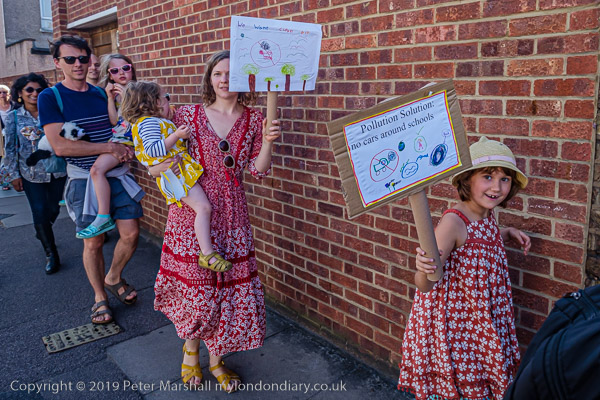
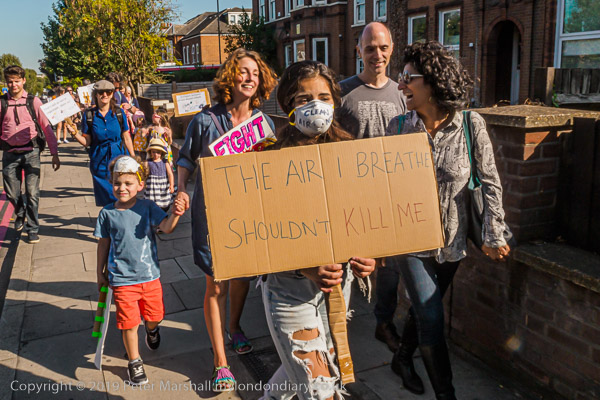
Clean Air for Catford Children

The South Circular Road brings large volumes of traffic through Catford, often pumping out fumes at standstill during peak hours. Particles from brakes, tyres and the road add significantly to the pollution – and won’t be reduced as we switch towards electric cars.

Although a major traffic route, the South Circular has always been more an idea than a planned route, going along many fairly narrow roads lined with houses which were never designed for the traffic. Fortunately major schemes which would have laid waste large areas of highly populated parts of South London have never come to fruition – the obvious environmental devastation of roads like the Westway having put paid to urban motorway schemes.

The answer has to be policies at both national and local level which reduce vehicle use and promote greener alternative transport including walking and cycling as well as public transport use. But although Lewisham Council are not responsible for the South Circular Road, remedial actions such as planting screens of trees and hedges can reduce local pollution levels, particularly the levels of harmful particulates.

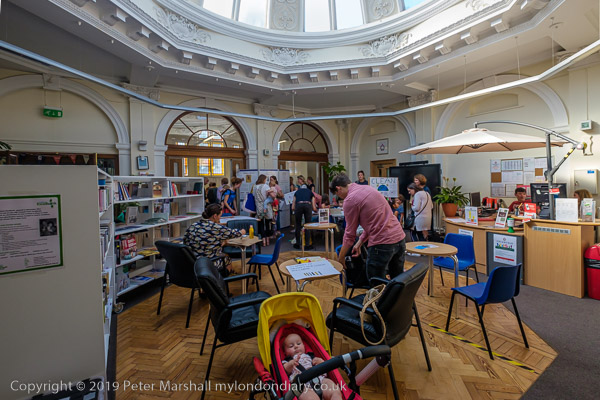
I met local residents at the Corbett Library on Torridon Road in Catford, built with funding from Andrew Carnegie in 1907. It is now a Community Library run by volunteers and is on the Corbett Estate, 3,000 houses around Hither Green developed by Glasgow-born Archibald Corbett from 1896 to 1911.

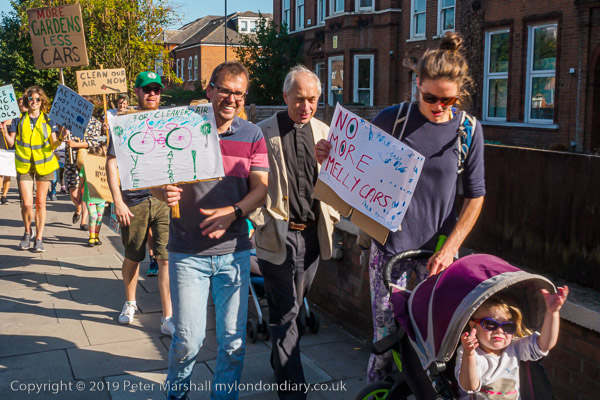
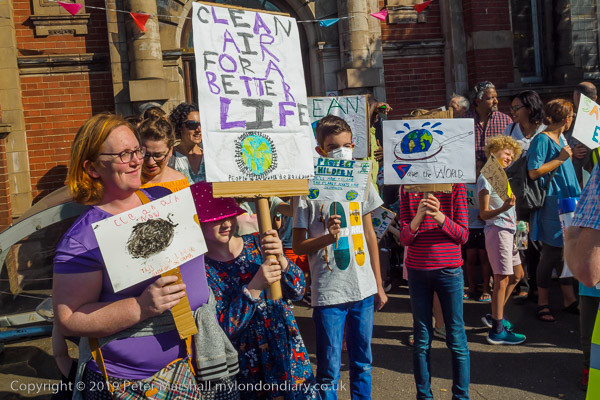
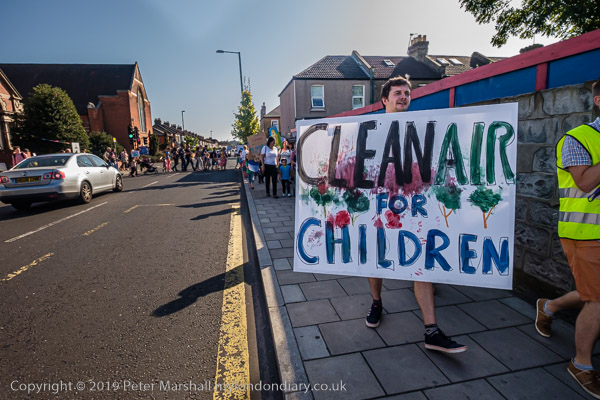
They were busy finishing placards and posters for the march, which soon set off, marching up on the pavement to the South Circular at Brownhill Road, on their way to a rally at the council offices in Lewisham. Traffic on the South Circular made it a little difficult for me to take photographs as it was seldom possible to stand on the road. I left them before the rally to travel home.

Ella Adoo-Kissi-Debrah, a nine-year-old girl who lived near the South Circular Road in Lewisham died from asthma in 2013. Following a 2020 inquest ruling she was the first first person in the UK to have air pollution listed as the cause of her death on her death certificate.

Clean Air for Catford Children


Global Climate Strike & Puma Boycott

Global Climate Strike & Puma Boycott

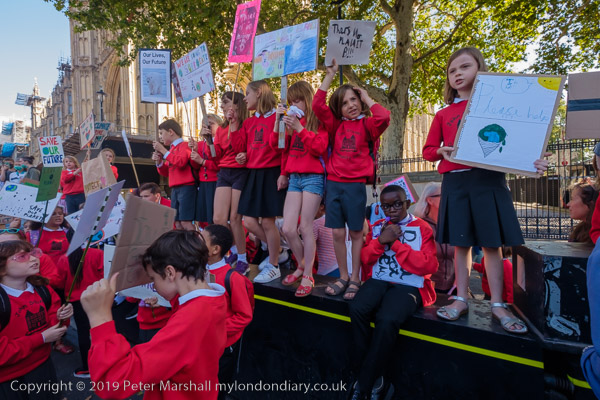
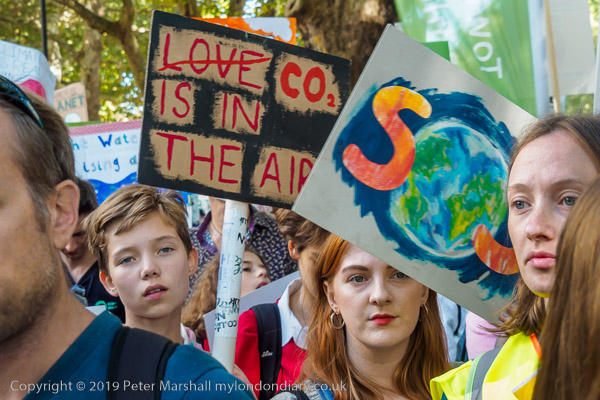
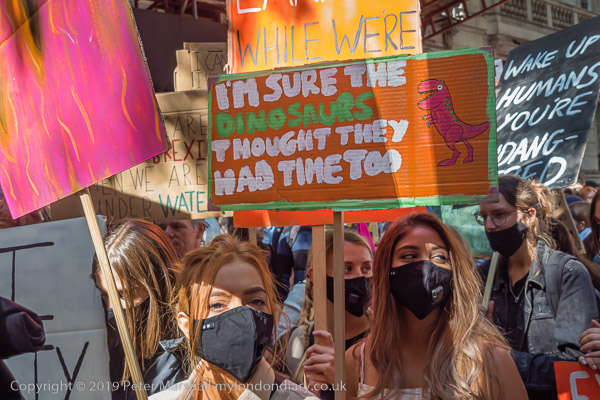
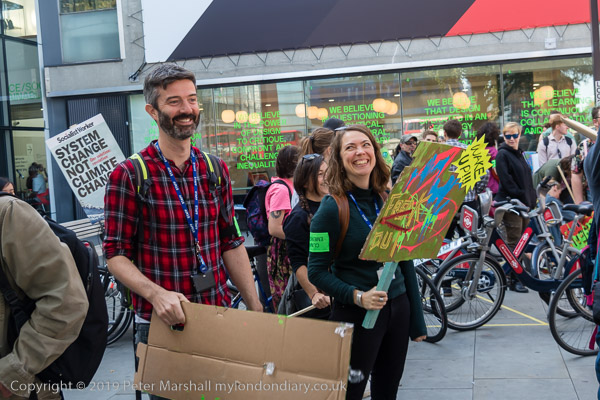
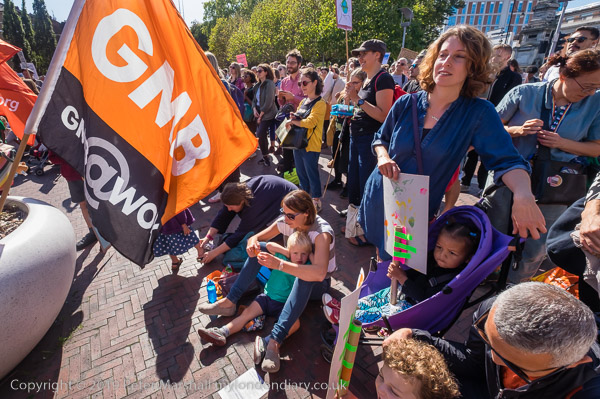
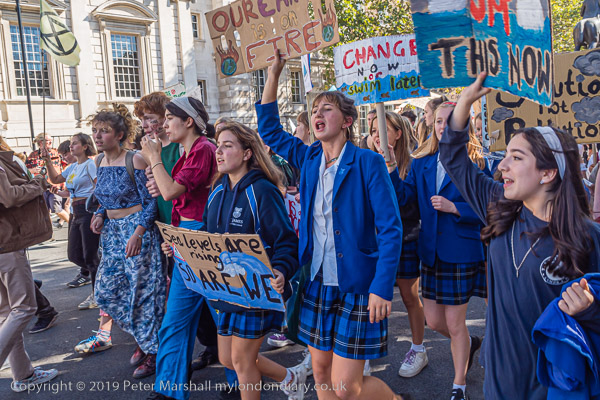
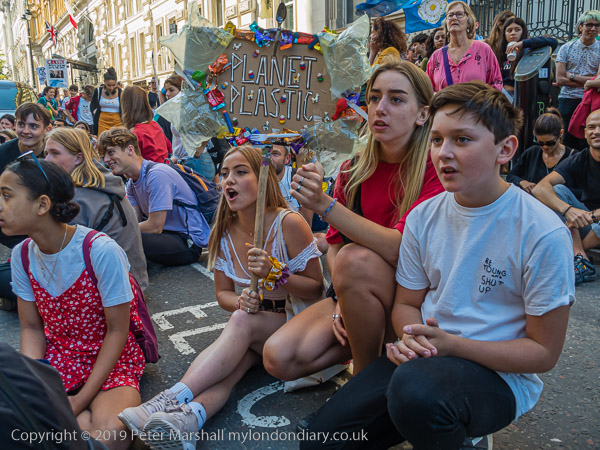
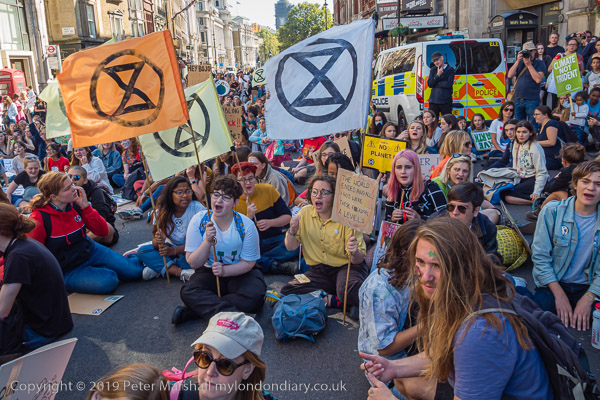
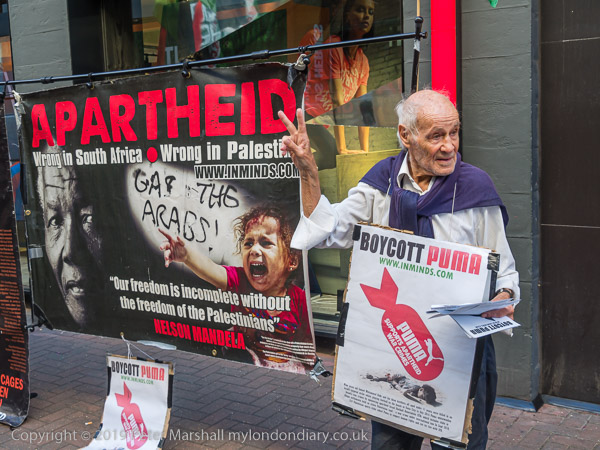
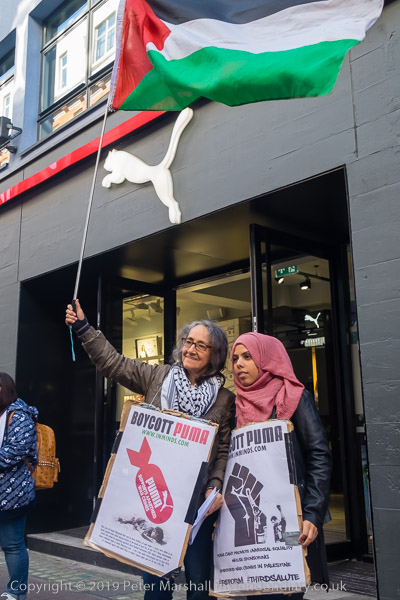
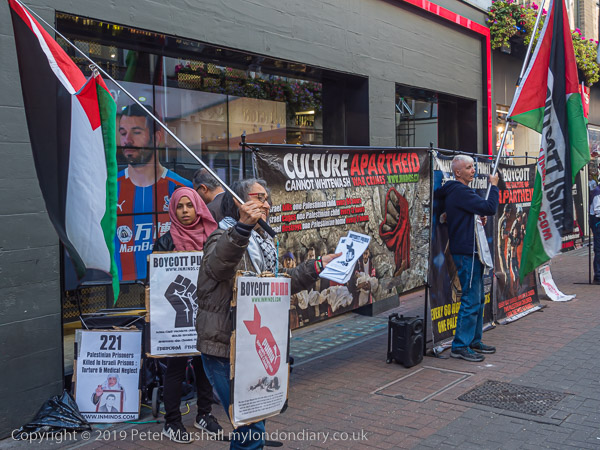
I spend most of my time on Friday 20th September covering the Earth Day Global Climate Strike inspired by Greta Thunberg which brought huge numbers of schoolchildren along with teachers, parents and other older supporters to a rally filling Millbank. Others were starting later from various parts of London to join in and I made short visits to both the Elephant and Castle and Windrush Square in Brixton to photograph them there, returning to Whitehall to photograph a large crowd who were continuing the protests there. Finally I went to Carnaby Street where the Islamic human rights group Inminds were protest outside the Puma store calling for a boycott of Puma products.


Global Climate Strike Rally – Millbank, London

Global Climate Strike & Puma Boycott

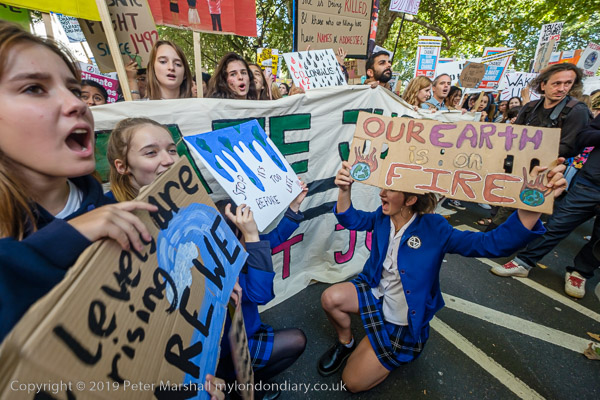
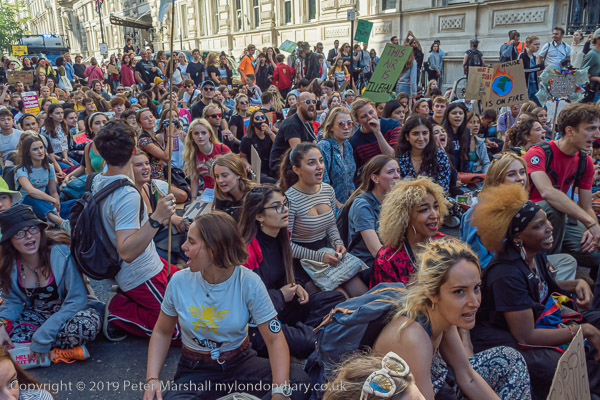
I began taking pictures of people going to the rally when I entered Parliament Square. Many schools had brought large groups of pupils to take part in the protest, and had obviously spent some time preparing hand-painted placards and banners. Greta Thunberg’s example has led to a great awareness among many young people of the existential threat posed by global warming, as too have the television programmes by the ageing David Attenborough, and they showed themselves to be convinced of the need for urgent action.

Global Climate Strike & Puma Boycott

Unfortunately politicians and companies – particularly those with interests in fossil fuels – have been rather less convinced, and although we have seen plenty of words and promises, real actions have so far failed to come anywhere close to meeting the desperate need. Our new UK government under Liz Truss has started by going backwards on the issue, issuing licences for fracking, and almost certainly in the first few days following the Queen’s funeral will be bringing forward other measures which will make climate disaster even more inevitable.

Crowds got so packed that I had to give up trying to walk up Millbank to the lorry on which the speakers, bands and others were to perform both live and on large screens, and I had to divert through the side streets to approach it from behind.

I spent some time photographing those at the front of the protest, then decided to move back through the crowd taking pictures. It was slow going both because I stopped to take pictures, but also because I needed to keep asking people to let me squeeze past them, but eventually I got back to Old Palace Yard and Parliament Square where movement was now easy, though there were still groups of protesters.

Global Climate Strike Rally


Elephant & Brixton Global Climate Strike

I took the tube from Westminster Station, changing at Embankment to the Bakerloo Line which took me to the Elephant and Castle. Outside the University of the Arts was a poster display and people were gathering to march to join the protests. I photographed a small march setting off to join with workers at Southwark Council’s offices in Tooley St, but left them after a few hundred yards to go back to the Northern Line, changing at Stockwell to get to Brixton.

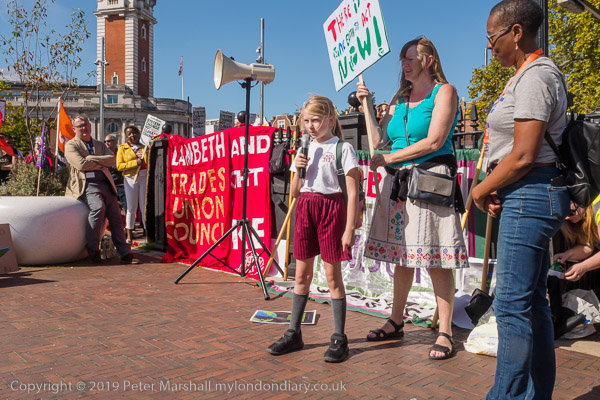
Teachers and parents had come with children from Lambeth schools for a rally in Brixton Square which was still in progress as I arrived.

There was an impressive speech from a young protester and support from a local MP before the rally ended and many of those present got ready to take the tube to join in the protest outside Parliament.

Elephant & Brixton Global Climate Strike


Global Climate Strike Protest continues – Whitehall

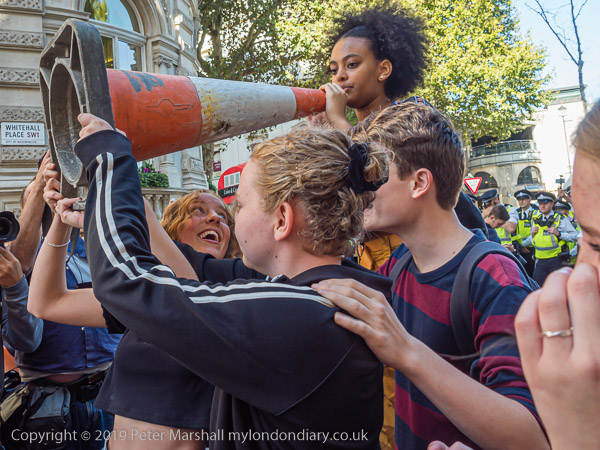
I hurried to the tube ahead of the children and arrived in Westminster where people were sitting on the road and blocking Whitehall, with police trying to persuade them to move.

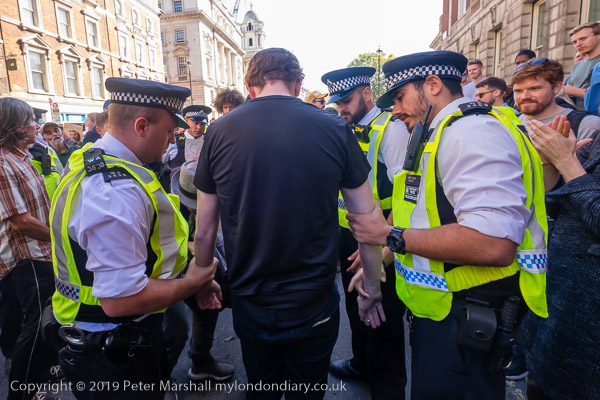
I saw one man being arrested and led away towards a waiting police van, and the road was almost cleared when a large crowd of school students came from Parliament Square to march up Whitehall blocking it again.

Police tried to stop them and they turned down Horseguards Ave, then up Whitehall Court and into Whitehall Place where they were finally stopped at the junction with Northumberland Avenue and sat down on the road.

There were a few sort speeches and a lot of chanting slogans as police attempted to get them to move. I couldn’t understand why the police were bothering as they were on a road that has very little traffic and were causing no problem in sitting there.

Eventually they did decide to do as the police said and got up and moved – back to sit down and block Whitehall again. Eventually they stood up and began to march towards Parliament Square, nicely in time for me to cover a different protest in Carnaby Street.

Global Climate Strike Protest continues


Carnaby St Puma Boycott

Whenever tourists come up to me in London and ask me (as sometimes happens) the way to Carnaby Street I’m always tempted to say “You just go back 50 years“, but I’m actually more helpful. But it always surprises me that this rather ordinary street of mainly small shops still attracts tourists so long after it was the touted as the epi-centre of ‘Swinging London’. It still puts on something of an effort, but I find it rather sad. Somehow not the same if you are not wearing flares.

Puma is the third largest sportswear manufacturer in the world, coming from a company founded in Bavaria in 1924 by two brothers. Both brothers were members of the Nazi party during the war and after bitter arguments split up in 1948 to form Adidas and Puma, two companies engaged in bitter rivalry. Adidas is now the second largest sports manufacturer in the world.

The Israel Football Association began life in 1928 as the Palestine Football Association, changing its name following the foundation of the state of Israel in 1948. It only represents Israeli clubs and there is a separate Palestinian Football Association covering the West Bank. But the IFA includes six clubs based in illegal Israeli settlements in the West Bank.

Adidas sponsored the IFA until 2018, when under pressure from Palestinian sports clubs and the international BDS movement they ended their sponsorship. Rivals Puma then took it up, becoming their only international sponsorship and over 200 Palestinian athletes and sports clubs have called for a Puma boycott.

Inminds Islamic human rights group organises protests in London at companies and events which support the Israeli regime and call for the release of Palestinian prisoners. At a previous protest outside Puma the protesters were violently attacked by some members of a small group of Zionists, but there was no sign of any counter-protest while I was present.

Carnaby St Puma Boycott


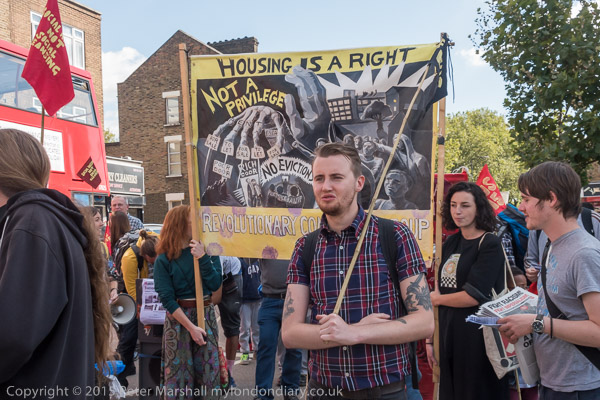
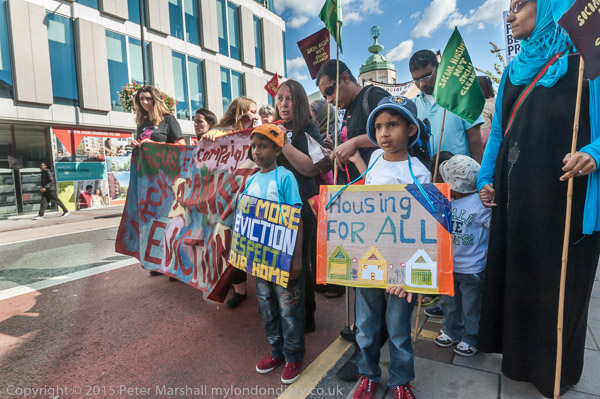
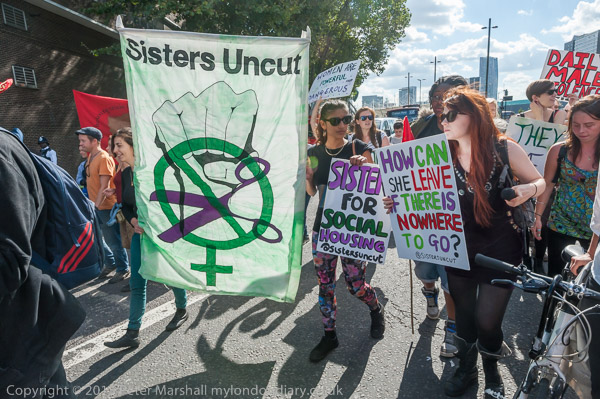
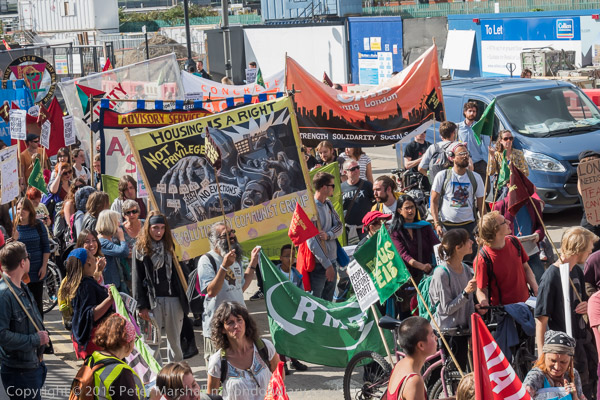
Housing For All – Focus E15

Housing For All - Focus E15

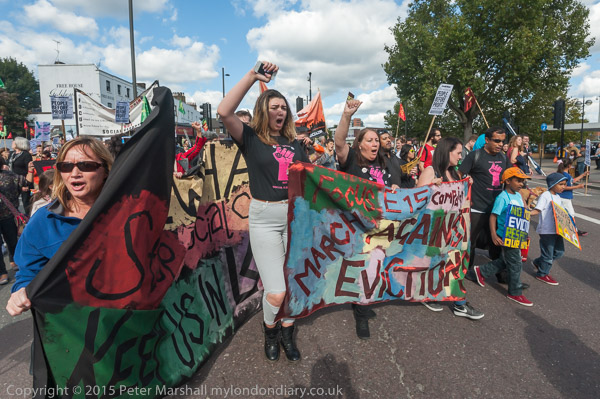
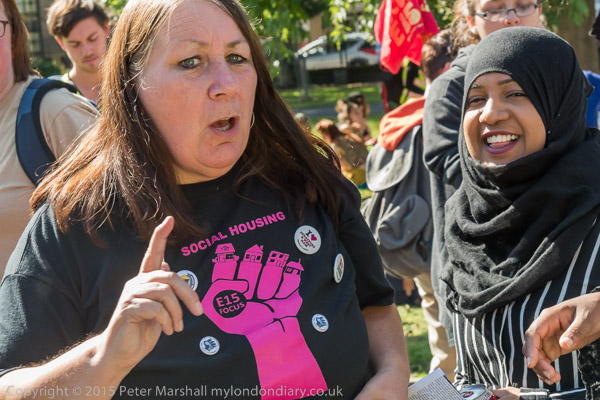
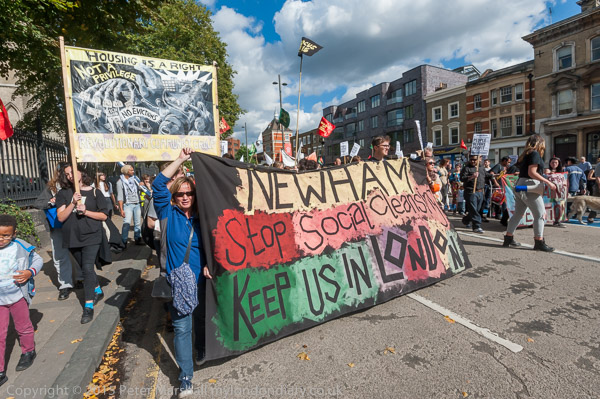
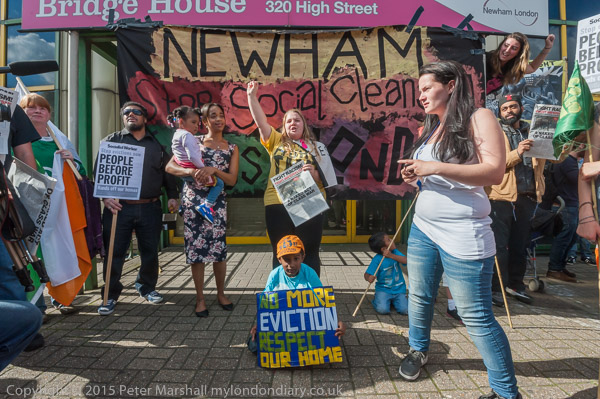
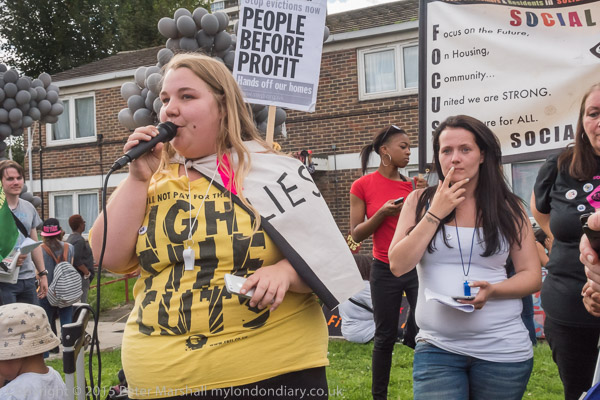
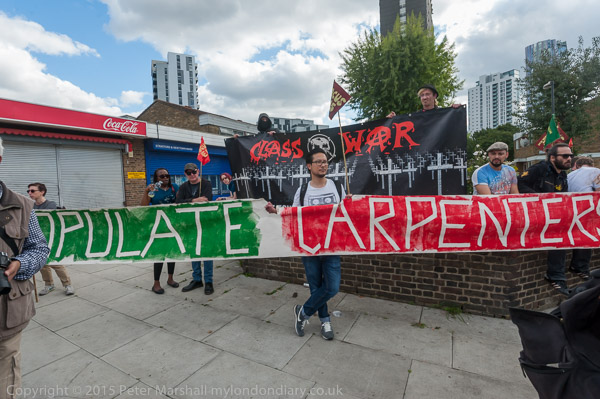
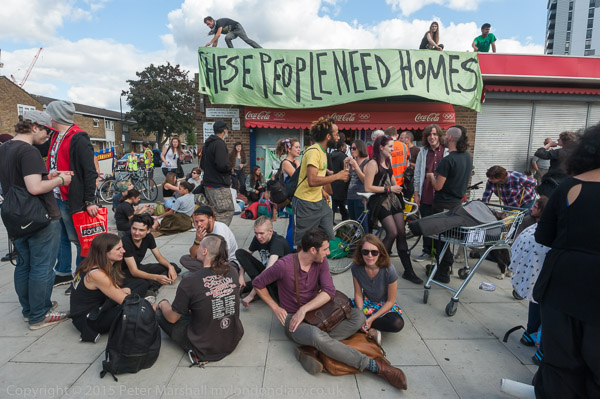
On Saturday 19th September 2015, two years after the start of the Focus E14 and a year since their successful occupation of empty flats on Stratford’s Carpenters Estate gained national headlines about both their own treatment by Newham Council and the problems faced by others around the country in finding homes, Focus E15 organised a march, rally and party.

Housing For All - Focus E15

In a ‘long read’ published in The Guardian at the end of June 2022, Oliver Wainwright writes about the particular problems that Newham and the other ‘Olympic boroughs’ are facing and how these have been worsened since the Olympics came to the area. His ‘A massive betrayal’: how London’s Olympic legacy was sold out details how the many promises made before and after London’s winning bid have failed to materialise.

Housing For All - Focus E15

As Wainwright states, in the area “there are almost 75,000 households on the waiting list for council housing, many living in desperate poverty. Thousands of former residents have also been rehoused outside the area since the Olympics took place.

Wainwright quotes the former directory of the agency which bought up land for the Olympic site and evicted local businesses as saying “There is no pretence any more that the legacy is trying to get a positive outcome for East Enders .. It is driven by a total market ideology, dressed up in some good aspirational talk, with a few baubles thrown out to keep local people happy, while mostly catering for the rich. It is a massive failure at every level

Although Wainwright points out the naivety of London Mayor Ken Livingstone in his ruthless support for the bid – which he saw as the only way to get the billions needed to develop the area – he makes clear who the real villain was, Livingstone’s successor Boris Johnson.

Many pointed out the problems over the years the bid was being made, and locals and others actively campaigned against the Olympic bid, over the removal of many successful businesses from the area, the demolition of a fine cooperative housing estate, the removal of allotments and the cycle circui, the loss of green space. People warned that the Olympic priorities would result in a development very different to that serving the needs of the area. And it has.

I’m pleased to have recorded at least some of that opposition in My London Diary over the years. I’d come to know the area over a number of visits since the 1980s and knew some of those involved in the protests which I photographed throughout the period, as well as continuing my photographic documentation of the area, much of which was published in my 2010 book ‘Before the Olympics‘, where I wrote ‘Stratford Marsh was one of the areas I found most interesting from the start; then a curious mixture of wilderness and industry … What was once an exciting and varied area with a great range of wildlife is now sterilized and under concrete.

The 2008 financial crisis meant the government had to pick up many of the bills, and large parts became publicly owned. Wainwright points out that the sale of the athlete’s village for around half what it cost to build meant a £275m loss to the taxpayer, who had funded the social aspects including a “school and health facilities, while the private sector kept the more profitable parts of the scheme – the shopping mall, the offices and the luxury flats.”

Newham’s Mayor until 2018, Robin Wales, encouraged the development of high-priced flats as attracting a wealthier demographic to the borough, and at the same time presided over a policy of ‘displacement and relocation of low-income households, as far afield as Stoke-on-Trent’. The Focus E15 mothers he tried to disperse away from London named it clearly – ‘Social Cleansing’.

The huge redevelopment in the area since 2012 has resulted in only 110 genuinely affordable homes. Newham currently has over 27000 applicants on the Housing Register and some 4500 families in temporary accommodation. Newham began emptying one notable large estate in central Stratford, the 1967 Carpenters estate of 710 homes in 2004 and by 2012 more than half of the homes were empty. The residents had wanted the estate refurbished, but Newham hoped to sell it off. When protests led to UCL withdrawing plans for a new campus, they looked for a developer, but those plans were dropped in 2018 and a new start made.

Bridge House – LB Newham’s Housing Office

There is much more in Wainwright’s article than I’ve mentioned, along with some of my own thoughts here, particularly about the huge failures of Boris Johnson and the failure to provide the kind of overall planning that could have occurred had the area been developed as a new town with the legacy corporation reinvesting “profits back into the future of the place, as happened in the postwar New Towns and places like Milton Keynes.” But instead it has been a commercial operation and one that has turned into a financial disaster for the taxpayer, rich pickings for developers and a social and environmental mess.

Wainwright describes the outcome in his final paragraph as “a nice park dotted with impressive sports venues and high-end homes, with some cultural attractions on the way.” I have to disagree, particularly about the park. It’s a park that is still scarred by the Olympics with large arid areas which I think will leave much of it forever beyond redemption, though there are some nicer parts. But I can only echo his next sentence: “But the poorest and most vulnerable, in what remain London’s most deprived boroughs, have lost out.

The Focus E15 march began with a rally in Stratford Park. It was supported by people from a huge list of organisations I list on My London Diary. They they then marched around Stratford town centre, past the bus station, the station and the Theatre then back down the Broadway, stopping briefly outside Foxtons, where Class War staged a brief protest inside the estate agents offices.

They then moved on to the LB Newham’s Housing Office at Bridge House for another protest. Finally the marched on to the Carpenters Estate to hold a rally in front of the flats they had occupied for two weeks in 2014. Their occupation had led to these flats being re-occupied along with a few other of the roughly 400 empty properties on the estate.

If you’ve not yet read ‘A massive betrayal’: how London’s Olympic legacy was sold out please do. You can read more of what I wrote back in 2015 and see many more pictures on My London Diary:
Focus E15: Rally before March
Focus E15: ‘March Against Evictions’
Class War Occupy Stratford Foxtons
Focus E15: Anniversary of Carpenters Occupation


Heygate, Shops, English Martyrs & St John the Evangelist

This continues my posts on my walk in Walworth on 8th January 1989. The previous post was Wansey St, Larcom St, Peabody & Heygate

Junior School, Heygate Estate, walkway, Rodney Rd, Elephant & Castle, Southwark, 1989 89-1b-53

A bridge from the Heygate Estate took mothers and children across the busy Rodney Road to Victory Place and the entrance here to the Primary School. It was demolished around 2011, and I think the ‘GIRLS & INFANTS’ entrance has gone but a similar ‘BOYS’ entrance remains.

English Martyrs Parish Hall, Rodney St, Wadding St, Walworth, Southwark, 1989 89-1b-55
English Martyrs Parish Hall, Rodney Road, Wadding St, Walworth, Southwark, 1989 89-1b-55

This building was just off Rodney St; its modern replacement is on the corner of Rodney St with Wadding St and Stead St.

Many Irish Roman Catholics had move into the area and in 1890 the Catholic Bishop of Southwark set up the Walworth Mission with a combined school and chapel just off Flint St and a Presbytery in Rodney Road with apermanent church next-door to this completed in 1903.

Shops, Balfour St, Henshaw St, Walworth, Southwark, 1989 898-1b-56

I walked north up Balfour St to the junction with Henshaw St. These buildings are all still there, but like so many small shops have been converted into residential use. Much of the area behind me when I took this picture has since been redeveloped.

There are adverts on the shop windows for Lyons Cakes, Tizer the Appetizer, Brooke Bond Tea, New Zealand Butter, Players No 6, Ty-Phoo Tea and Crown Cup Instant Coffee, but thhe curtains and boarding show the shop had already closed down.

St John the Evangelist, Walworth, Charleston St, Southwark, 1989 89-1b-45

I walked back, probably along Victory Place, to Rodney Road and then down Larcom Street, making my way to Charleston St, taking a photograph (not on-line) along this from its Brandon Street end looking towards the church before walking down to take more pictures around the church.

The Anglican Church of St John the Evangelist was built here when the estate was being developed in 1859-60. District Surveyor Henry Jarvis was architect for this gothic church in Kentish Ragstone, and its vestry was added in 1912 by Greenaway and Newberry. Both were Grade II listed in 1998, nine years after I made this picture.

There are two alleys on each side of the church, that on the left in this picture leading to Walcorde Ave and on at the right in the picture below to Larcom St.

St John the Evangelist, Walworth, Charleston St, Southwark, 1989 89-1b-46

This picture is looking down the alley leading to Larcom St and the building at right is St Johns Vicarage at 18 Larcom St.

St John's Walworth, Primary School, Larcom St, Walworth, Southwark 1989 89-1b-33
St John’s Walworth, Primary School, Larcom St, Walworth, Southwark 1989 89-1b-33

The school buildings just to the west of the church date from around 1866. Falling rolls led to the closure of the school in August 2021.

To be continued. The first post on this walk is Elephant, Faraday, Spurgeon & Walworth Road.


Elephant, Faraday, Spurgeon & Walworth Road

On Sunday January 8th 1989 I returned to South London for my first photographic walk of the year beginning at the Elephant & Castle.

Faraday Memorial, Elephant & Castle, Southwark, 1989 89-1a-46-Edit
Faraday Memorial, Elephant & Castle, Southwark, 1989 89-1a-46

This building commemorates Michael Faraday (1791-1867), the English chemist and physicist celebrated for his ground-breaking research into electricity and magnetism who was born a short distance away on 22 September 1791. He invented the electric motor, transformer and generator.

The architect was Rodney Gordon (1933 – 2008) and this was his first job in the London County Council Architects department which was completed in 1961. Inside is the sub-station which converts the power for the Northern and Bakerloo lines, both of which have stations nearby.

When I took this photograph, it was at the centre of a large roundabout, with subways taking pedestrians across to the shopping centre descending at its side. The subways have now been replace by routes at ground level and the road layout changed, making this more easily accessible. But now the whole area is being redeveloped, and England’s first purpose-built shopping centre has been demolished.

Metropolitan Tabernacle, Stairs to Shopping Centre, Newington Butts, Elephant & Castle, Southwark, 1989 89-1a-35-Edit
Metropolitan Tabernacle, Stairs to Shopping Centre, Newington Butts, Elephant & Castle, Southwark, 1989 89-1a-34

Baptists began meeting in Kennington in 1650, when Baptist meetings were still illegal, but moved to a chapel near Tower Bridge in 1688 when they were allowed. It thrived over the years moving to larger chapels and becoming the largest Baptist congregation in England. Under the ministry of Charles Haddon Spurgeon which began in 1853 numbers became so large the services had to be moved to hired halls. The church bought a site on Newington Butts, both because of its prominent location and because it was thought to be the site of the burning of the Southwark Martyrs. The church with seating for 6,000, architect William Willmer Pocock was completed in 1861.

The shopping centre where I was standing was built as one of the first US-style indoor shopping malls in Europe with more than a hundred shops on three levels. Still popular with many, particularly for its market stalls, the centre closed in 2020 in the face of considerable opposition from locals and has been demolished.

Walworth Rd, Southwark, 1989 89-1a-23

Immediately to the south of the Elephant at the start of Walworth Rd, just past the railway bridge you can see at extreme right is this fine row of late-Victorian buildings, still there, although I think all have changed hands and there have been some subtle changes to the frontages as well as new shopfronts, and doubtless rather more change behind some of the facades. But it remains an impressive start to the road, while the other side has been depressing for many years.

Beyond Hampton Street at the end of the row, everything is new and perhaps one of London’s dullest new blocks, while viewing from a different angle across the road the scene is dominated by the 43 storey 487ft Strata Tower, completed in 2010 and decorated at its top by three wind turbines which were such a feature of its advertisement as a ‘green building’ but cause too much noise and vibration to actually be used. Appropriately for their location they are a real ‘white elephant’, and a potent example of ‘greenwashing’. The building was awarded the 2010 Carbuncle Cup for bad architecture as one of the “ugliest buildings in the United Kingdom completed in the last 12 months”.

R R Boast, Walworth Rd, Southwark, 1989 89-1a-24

One of the buildings in the row at 86 had formerly been home to R R Boast, Electrical Contractors and Engineers and Heating Specialists, with two other company names in much smaller letters on the left. A liquidator was appointed for the company in 1975 and the premises were I think still boarded up, though posters on the windows advertised keep fit and dance classes I think these were held elsewhere. Fly-posting across the lower frontage seemed very neatly done.

The building now has an extra floor as The Castle Hotel.

Walworth Rd, Walworth, Southwark, 1989 89-1a-25

Murrays Solicitors at 94-96 Walworth Rd is now a dentists at ground floor level but I think otherwise looks much the same, though it has lost its street nameplate.

Walworth Rd, Southwark, 1989 89-1a-11

At right of this picture you can just make out the top of the Hampton St side of 96 Walworth Rd, and this yard with its heap of tyres was on Steedman Street, just a few yards from its junction with Walworth Rd.

Former Southwark Town Hall, Walworth Rd, Southwark, 1989 89-1a-12

The Italianate Grade II listed Newington Vestry Hall by Henry Jarvis at the left opened in 1865, with a library added to the south east in 1892 and the two buildings joined the following year. In 1900 it became Southwark Town Hall for the Metropolitan Borough of Southwark and was further extended. But in 1965 the larger London Borough of Southwark borough moved its town hall elsewhere and renamed this building Walworth Town Hall.

In 2006 the Cuming Museum moved in, but the building was badly damaged in a fire in 2013. It is currently being restored to provide a space for educational activities, studio spaces and creative workshops.

My walk will continue in a later post. As usual you can see larger versions of any of the pictures by clicking on them which will take you to the picture in one of my Flickr albums.


Apocalypse, Cold Blow Lane, Millwall & Surrey Canal

The previous post on this walk is Evelina, Sassoon, Queens Road, Montpelier and Mazawattee. The pictures here come from the final film on my walk on 18th December 1988. I only finished the film and developed in it January 1989 so they appear in my Flickr album for 1989.

Mural, Sanford Walk, New Cross, Lewisham, 1988 89-1a-61

‘Riders of the Apocalypse’ was painted by Brian Barnes on the end property of Sanford Housing Co-operative in 1983. Student Co-operative Dwellings (SCD) was founded in 1968 by John Hands and colleagues and campaigned for five years lobbying parliament and looking for land until the government and Lewisham Council agreed to allow them the build Sanford Co-operative Dwellings. This was the first purpose-designed co-op scheme for the young and mobile, and was completed in October 1974.

Cold Blow Lane, New Cross, Lewisham, 1988 89-1a-63

Cold Blow Lane in the 19th century led to Cold Blow Farm, now long gone. In the 1850s the Croydon Railway built several tracks over it, and one of these went on the bridge whose two piers can be seen in this picture though the bridge has gone. Railway tracks still go over the lane, and I took this picture close to the exit of the long tunnel that goes under them. At the end of the lane is Mercury Way, and Cold Blow Lane turns at 90 degrees to go south.

Straight ahead, under another railway line, was ‘The Den’, then the home of Millwall Football Club, and I think the top of a stand is just visible in the picture. On the wall at left, among other graffiti is the message ‘Home of the Lions’

Surrey Canal Road, New Cross, South Bermondsey, Lewisham, 1988 89-1a-51

I think I made this and the next picture from a footpath just to the north of the Surrey Canal Road. The contact sheet gives a grid reference 356781 and this may show part of the area which is now Millwall’s ground in Senegal Fields.

Surrey Canal Road, New Cross, South Bermondsey, Lewisham, 1988 89-1a-52-Edit
Surrey Canal Road, New Cross, South Bermondsey, Lewisham, 1988 89-1a-52

You can still see this long range of buildings on Stockholm Road, just south of The Den. and parallel with Surrey Canal Road, occupied by a range of commercial companies. I imagine they date from when the Surrey Canal bed was filled in and the road bulit by Lewisham Council in the early 1980s.

Footpath, Senegal Rd, New Cross, South Bermondsey, Lewisham, 1988 89-1a-54-Edit
Footpath, Senegal Rd, New Cross, South Bermondsey, Lewisham, 1988 89-1a-54

Since 1993, the Millwall football ground has been on Senegal Fields. The footpath now runs next to the new Millwall Stadium and then under the railway lines which have some very impressive Victorian brickwork.

These are most of the lines out of London Bridge Station which begin to diverge in this area. You can see all three bridges in this picture. This was a very run-down area and the abandoned parts of a moped at right seemed an appropriate way to express this.

Hill, Bridgehouse Meadows, New Cross, Lewisham, 1988 89-1a-56-Edit

I turned around here and walked back south across the Surrey Canal Road and to Bridgehouse Meadows.

This was the site of the former New Cross Stadium opened as an athletics stadium in the early 1900s but from the 1930s used for greyhound racing and speedway before its closure in 1969. For some years Millwall FC whose old ground was next to it used it for training. The stadium was demolished in 1975 and there were ambitious plans for it be part of the site of a new ground for the club – but these fell through and the new stadium was eventually built further north.

Factory, from Bridgehouse Meadows, New Cross, Lewisham, 1988  89-1a-42-Edit
Factory, from Bridgehouse Meadows, New Cross, Lewisham, 1988 89-1a-42

This factory has been demolished and new housing built in its place. I think this site was also part of the over-ambitious plans for expansion by Millwall who wanted to take over a huge area.

Path, Bridgehouse Meadows, New Cross, Lewisham, 1988  89-1a-43-Edit
Path, Bridgehouse Meadows, New Cross, Lewisham, 1988 89-1a-43

The path through the meadows crosses the Surrey Canal Road on a bridge you can see in the distance, no longer present. Both sides of the park area now have new housing.

Ilderton Rd, New Cross, Southwark, 1989 89-1a-44-Edit
Ilderton Rd, South Bermondsey, Southwark, 1989 89-1a-44

This is part of a site for travellers on Ilderton Rd and this house is still there, though there were no Christmas window decorations when I last walked past – but that was on a housing protest march in March 2017, where we stopped briefly at the Bermondsey Travellers Site. Behind is the railway line from South Bermondsey Station next door to the site where my walk ended.

This was the last picture from my walk on December 18th and completed a series of walks around this part of South-East London. My walks in 1989 began around the Elephant.