Olympics, Illegal Policing & Cody Dock – 2012

Olympics, Illegal Policing & Cody Dock: On Saturday 21st July 2012 I went to Stratford, first to photograph the Olympic flame being carried along the High Street, then to join a tour of the Carpenter’s Estate led by CARP (Carpenters Estate Against Regeneration.)

What should have been a straightforward visit was help up by police at the BBC’s request for around an hour without any legal reason before we were able to enter Lund Point, a tower block overlooking the Olympic area. This made me late for the Open Day at Cody Dock, where I arrived as most people were leaving.

You can read more detailed accounts of the events on My London Dairy, with many more pictures – links below.


Olympic Flame at Stratford Six Days Early

Stratford High St

Olympics, Illegal Policing & Cody Dock - 2012

The Olympic flame visited Stratford briefly but avoided the Olympic site where it was not due until the following Friday. I was surprised at how few came out to watch it.
Olympics, Illegal Policing & Cody Dock - 2012

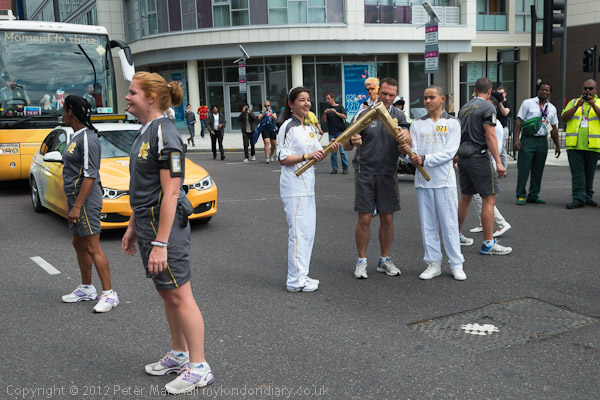
The torch itself generated a little more interest. I’ve no idea who 070 was carrying it, and she handed it over to 071 at the junction with Warton Rd, which leads into the Olympic site a couple of hundred yards away.
Olympics, Illegal Policing & Cody Dock - 2012

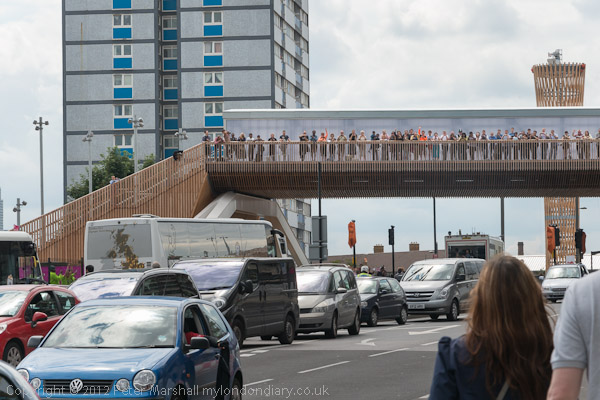
An organised party of people visiting the Olympic site watched from the temporary bridge taking the Greenway over the High Street – with a big wooden torch behind them.

More pictures


Newham’s Shame – Carpenters Estate Tour

Olympics, Illegal Policing & Cody Dock - 2012
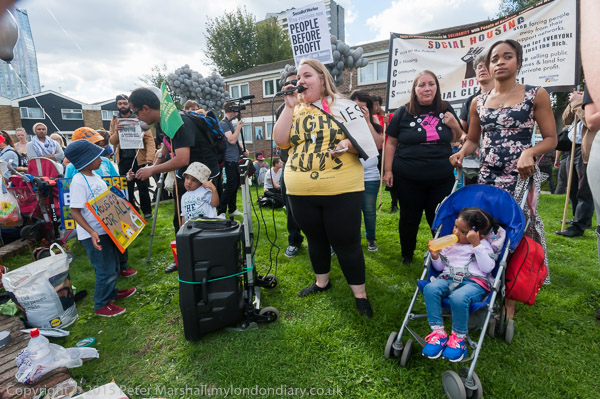
The tour of the Carpenters estate met outside Stratford Station – Placards showing Mayor Sir Robin Wales as ‘The Sheriff of Newham Robin the Poor’

The Carpenters Estate, close to Stratford Station, was one of the better council developments of the 1960s, with a large area of two-story terraced housing, some maisonettes and three 22 storey point blocks as well as some existing small industrial premises. It included shops, a pub and a school, and later a community and health centre and remained a very popular estate.

The tour sets off

But Newham Council saw the estate as simply as an opportunity to sell and make money and as a part of Mayor Robin Wales’ plans to make Stratford ‘London’s Third City’, even if this meant getting rid of many of the people who currently live there. The council began moving people out around 2004, leaving properties in good condition empty in a borough with London’s largest housing problem. In 2012 they were still hoping to sell it to University College for a new campus.
Olympics, Illegal Policing & Cody Dock - 2012
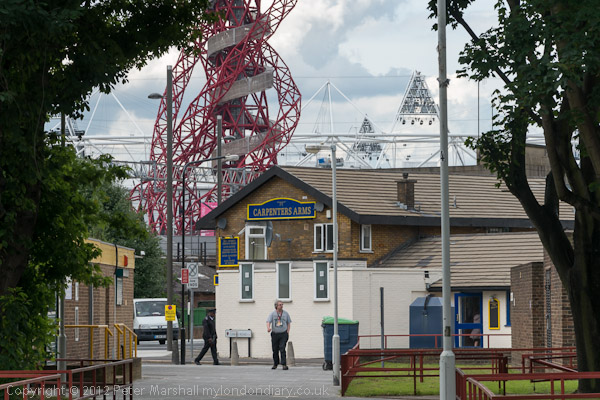
The Olympic site is really very close

In 2011 the council decided to fix the elections to the Carpenters Tenant Management Organisation (TMO). They barred freeholders on the estate from standing for the new board of management and ‘lost’ five out of the six leaseholder nominations. At the AGM the TMO officials employed security guards to refuse entry to all freeholders who had been invited to attend.
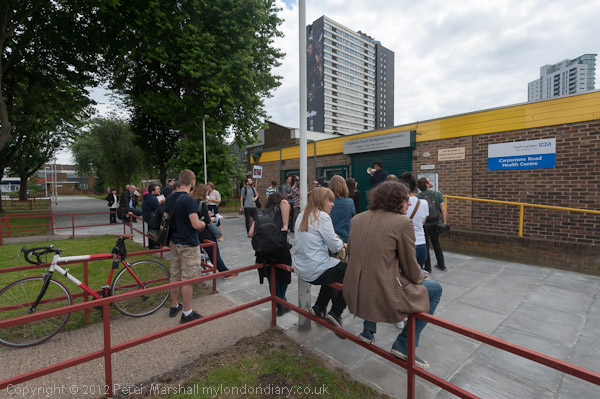
Olympics, Illegal Policing & Cody Dock - 2012
Joe Alexander of CARP speaks about how the council takeover to the TMP led to residents settting up CARP

The TMO was supposed to stand up for residents and to fight against the low valuations being made by the council for compulsory purchase of properties on the estate, but was now essentially a tool of the council. This led to residents setting up Carpenters Against Regeneration Plans (CARP) to challenge what they say are unconstitutional decisions made by the TMO and to get it to fulfil its duties to all residents of the estate, and to fight for the future of the residents and for a sustainable community.

Olympics, Illegal Policing & Cody Dock - 2012
A long-term resident who has lived on the estate for many years and intends to stay

The tour began at Stratford Station and we were taken on a long walk around the estate, with several CARP members speaking at various points.
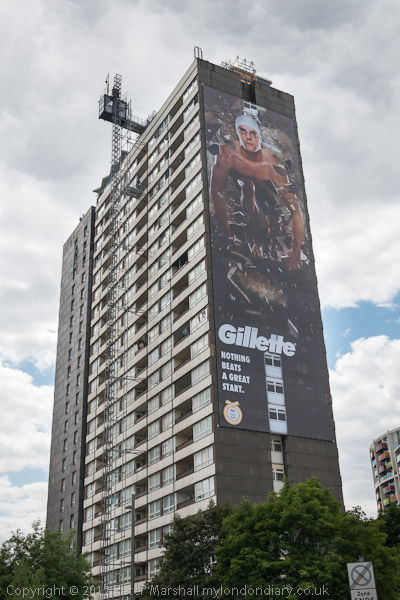
Lund Point. Some residents were upset not to have been consulted about the advertising on their blocks

When we tried to visit two flats we had been invited to see in Lund Point we were stopped, first by BBC security and later by police, who stopped us from entering for around an hour and a half, but finally had to allow us to go in since we had an invitation from the residents of the two flats – more below.
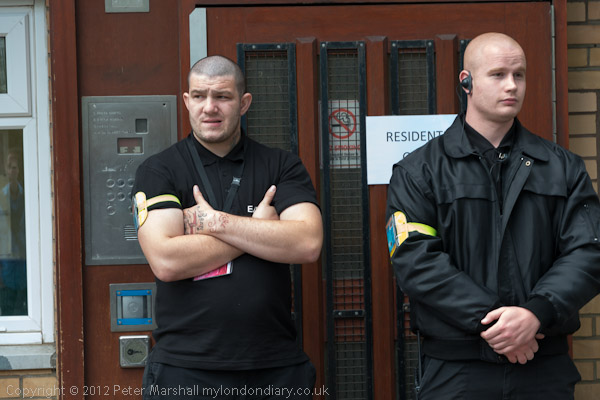
BBC employed security men bar our way into Lund Point – but are told we will be back later

We continued to go around the estate and talk with some of the nearby businesses which are closing as people move out and redevelopment is taking place along the High Street, as well as briefly visiting James Reilly Point, where the BBC had wanted to set up their coverage, but determined action by one of the residents there had caused them to change their plans. Then we returned to Lund Point.

More information and pictures at Newham’s Shame – Carpenters Estate.


Police Deny Olympic Residents Access to Homes

Lund Point, Stratford
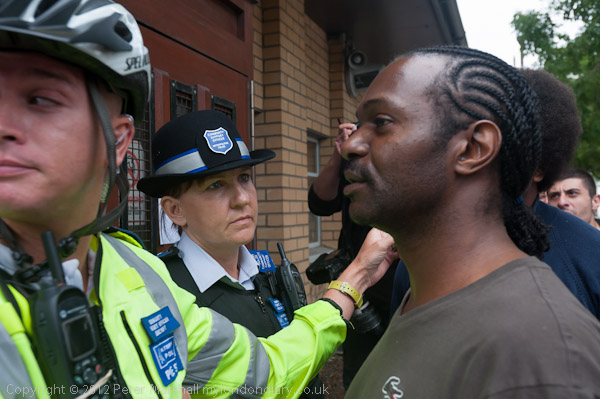
Following a request from BBC Security, police denied residents access to their tower block home close to the Olympic site in Stratford for well over an hour, before having to acknowledge they had no power to do so.

Some of those on the tour were opposed to UCL’s proposed grab of the estate

Colin, a resident in Lund Point on the Carpenters Estate in Stratford had invited a group viewing the estate in a tour organised by CARP (Carpenters Estate Against Regeneration) to come to his flat to see the high standard of accomodation in the 1966 tower block and the views across the estate. We tried to enter the building at 1.15pm but were blocked by BBC Security.
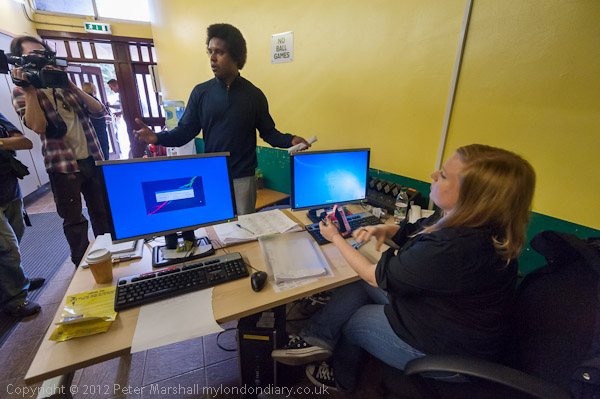
We are shown the BBC is occupying the lift lobby as well as the floors they have part rented and there are health and safety hazards for residents, particularly their children

When we returned 55 minutes later, there were a group of five PCSOs and a police officer assisting the security men in blocking our entrance. Again the resident and the group were refused entry but the police officer present refused to discuss why. She called for reinforcements; first one more officer and then two police vans arrived. Eventually I think a more senior officer decided that they were acting unlawfully and we were allowed to enter just before 3pm.
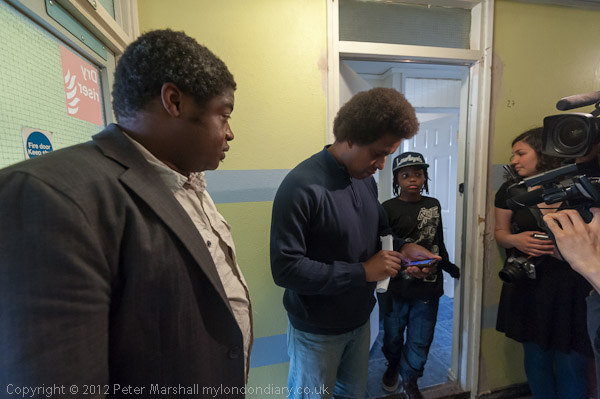
We take it in turns to go in and see the flat, which is in excellent repair (although the council say these flats are too expensive to refurbish, if UCL takes over the site it may reuse them as student residencies.)

Inside there was further resistance from BBC security and it soon became obvious why the BBC were reluctant to allow me and other members of the press on the tour to enter. Although this was still a residential building with around 30 flats still occupied, the interior appeared to be a health and safety nightmare, with cables, desks in lobby areas and so on.
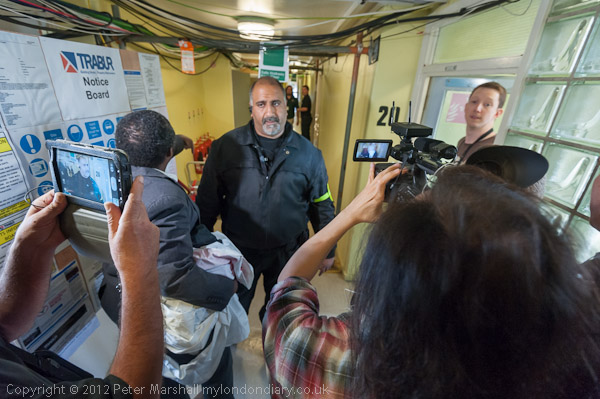
On the 20th floor we move out of the lift but are stopped on the corridor by security

After visiting the first flat, we tried to visit another resident who owns a flat on the 20th floor of the block, and again police and security at first told us this was impossible. But we pressed on; we were blocked as we exited the lift, but when Warren confirmed he had invited us were eventually allowed through.
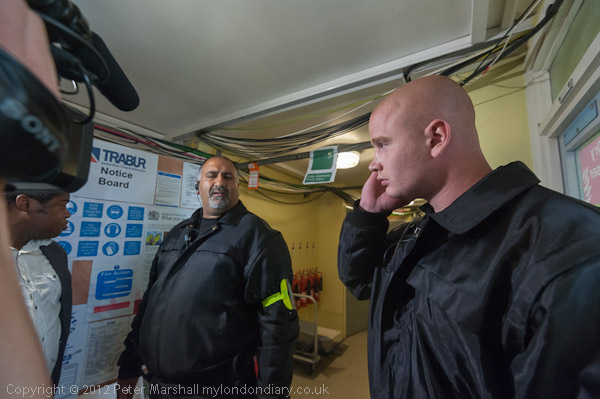
This is a residential area where people still live, despite the cables and poles
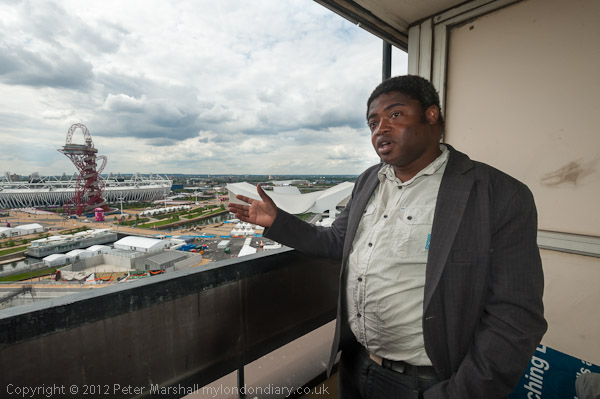
Tawanda Nyabango talks about the estate and the Olympic site next door from the 20th floor of Lund Point

More at Police Deny Olympic Residents Access


Olympic Views

Lund Point, Stratford
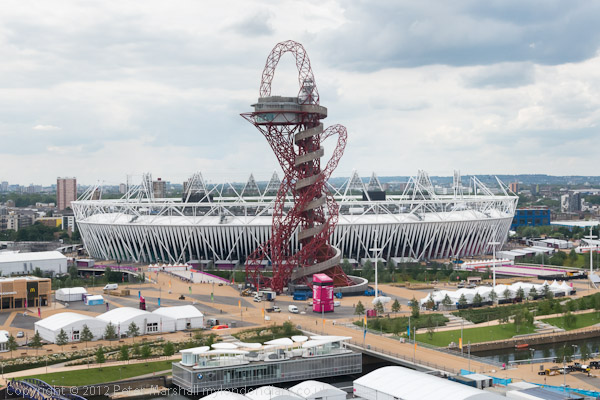
Although the BBC has taken over most of the top 5 floors of Lund Point on the Carpenters Estate next to the Olympic park as studios for its coverage of London 2012, there are still some flats occupied by owner occupiers in the block. On a tour with residents group CARP (Carpenters Against Regeneration Plans) I was invited to visit a flat on the 20th floor of this 22 storey block.
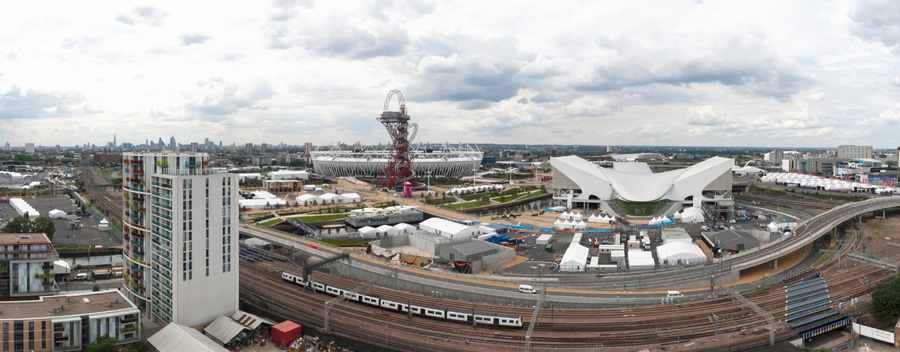
I had a very limited time to work but managed to make a couple of panoramas as the single images while I was there.

More, including some different ways of representing the panoramic view on My London Diary: Olympic Views


Cody Dock Open Day

South Crescent, Canning Town
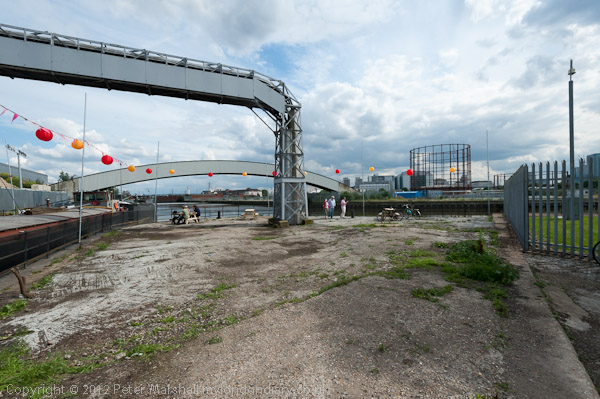
The hold-up by security and police made me too late for the Open Day at Cody Dock but I did manage to take a few pictures. You can see more in my post on My London Diary in April 2012 when I wrote Cody Dock in April and wrote Gasworks Dock Revived, which tells something of the history of the dock and the efforts being made to develop it into a real community resource, as well as filling a vital link in the footpath along the bank of Bow Creek from Bow Locks eventually to the Thames (there is still another gap beyond Cody Dock.

A few more pictures: Cody Dock Open Day


FlickrFacebookMy London DiaryHull PhotosLea ValleyParis
London’s Industrial HeritageLondon Photos

All photographs on this page are copyright © Peter Marshall.
Contact me to buy prints or licence to reproduce.
Housing For All – Focus E15

Housing For All - Focus E15

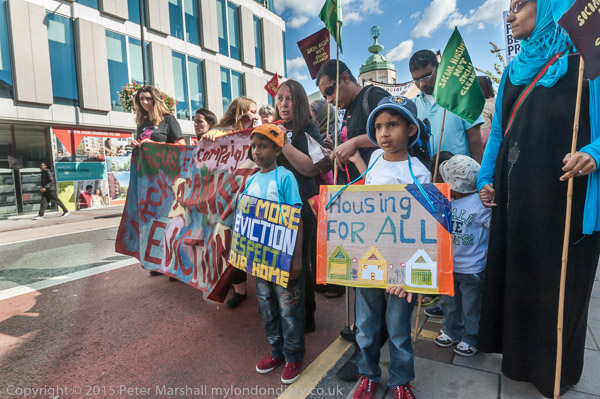
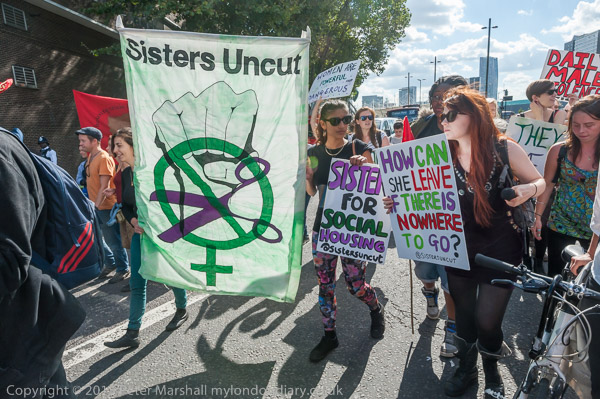
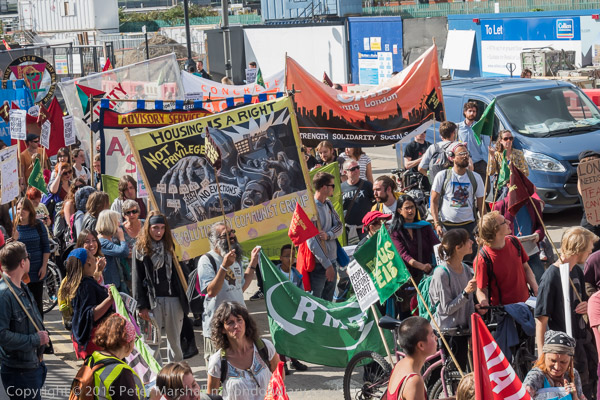
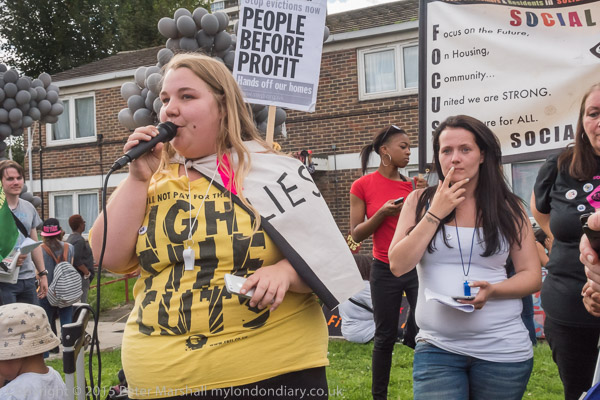
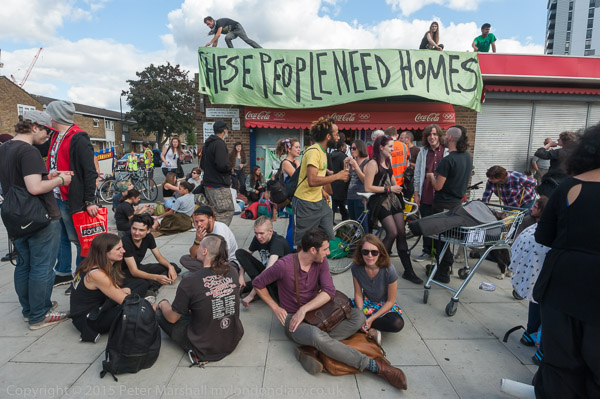
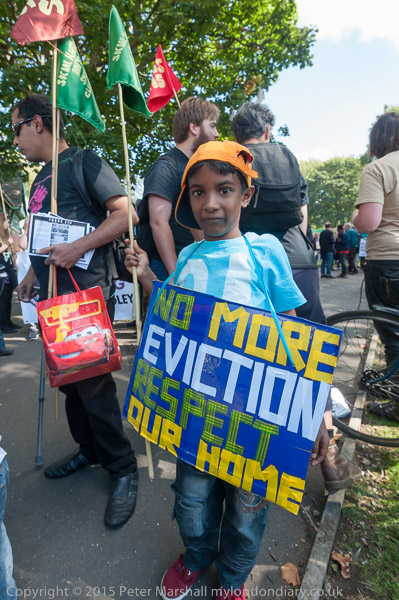
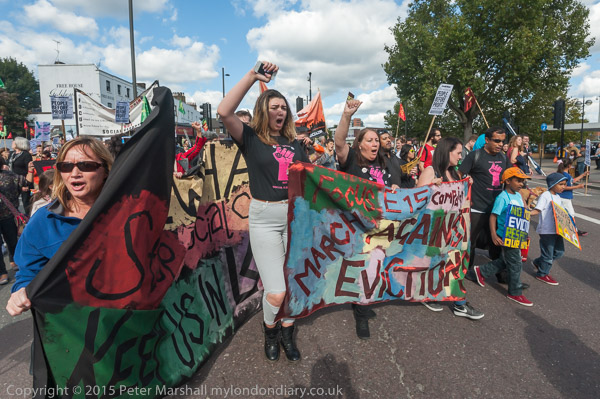
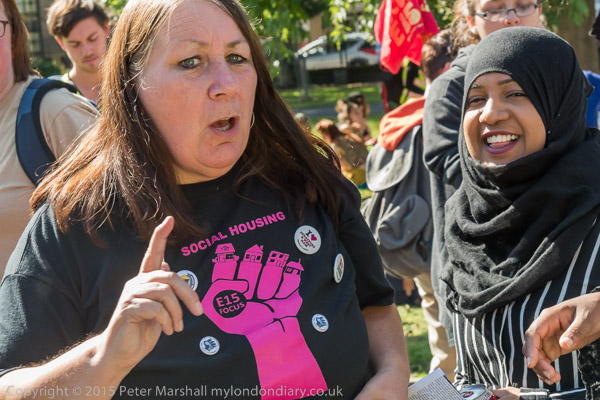
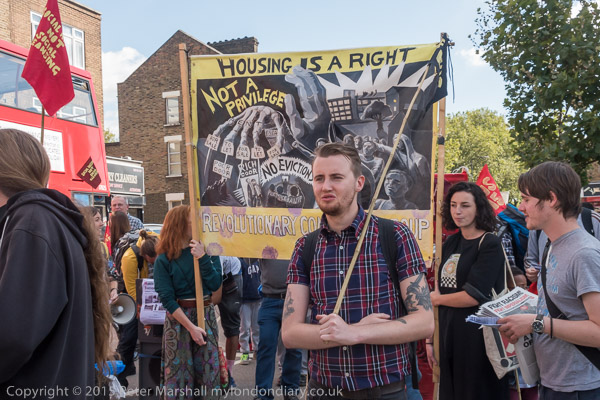
On Saturday 19th September 2015, two years after the start of the Focus E14 and a year since their successful occupation of empty flats on Stratford’s Carpenters Estate gained national headlines about both their own treatment by Newham Council and the problems faced by others around the country in finding homes, Focus E15 organised a march, rally and party.

Housing For All - Focus E15

In a ‘long read’ published in The Guardian at the end of June 2022, Oliver Wainwright writes about the particular problems that Newham and the other ‘Olympic boroughs’ are facing and how these have been worsened since the Olympics came to the area. His ‘A massive betrayal’: how London’s Olympic legacy was sold out details how the many promises made before and after London’s winning bid have failed to materialise.

Housing For All - Focus E15

As Wainwright states, in the area “there are almost 75,000 households on the waiting list for council housing, many living in desperate poverty. Thousands of former residents have also been rehoused outside the area since the Olympics took place.

Wainwright quotes the former directory of the agency which bought up land for the Olympic site and evicted local businesses as saying “There is no pretence any more that the legacy is trying to get a positive outcome for East Enders .. It is driven by a total market ideology, dressed up in some good aspirational talk, with a few baubles thrown out to keep local people happy, while mostly catering for the rich. It is a massive failure at every level

Although Wainwright points out the naivety of London Mayor Ken Livingstone in his ruthless support for the bid – which he saw as the only way to get the billions needed to develop the area – he makes clear who the real villain was, Livingstone’s successor Boris Johnson.

Many pointed out the problems over the years the bid was being made, and locals and others actively campaigned against the Olympic bid, over the removal of many successful businesses from the area, the demolition of a fine cooperative housing estate, the removal of allotments and the cycle circui, the loss of green space. People warned that the Olympic priorities would result in a development very different to that serving the needs of the area. And it has.

I’m pleased to have recorded at least some of that opposition in My London Diary over the years. I’d come to know the area over a number of visits since the 1980s and knew some of those involved in the protests which I photographed throughout the period, as well as continuing my photographic documentation of the area, much of which was published in my 2010 book ‘Before the Olympics‘, where I wrote ‘Stratford Marsh was one of the areas I found most interesting from the start; then a curious mixture of wilderness and industry … What was once an exciting and varied area with a great range of wildlife is now sterilized and under concrete.

The 2008 financial crisis meant the government had to pick up many of the bills, and large parts became publicly owned. Wainwright points out that the sale of the athlete’s village for around half what it cost to build meant a £275m loss to the taxpayer, who had funded the social aspects including a “school and health facilities, while the private sector kept the more profitable parts of the scheme – the shopping mall, the offices and the luxury flats.”

Newham’s Mayor until 2018, Robin Wales, encouraged the development of high-priced flats as attracting a wealthier demographic to the borough, and at the same time presided over a policy of ‘displacement and relocation of low-income households, as far afield as Stoke-on-Trent’. The Focus E15 mothers he tried to disperse away from London named it clearly – ‘Social Cleansing’.

The huge redevelopment in the area since 2012 has resulted in only 110 genuinely affordable homes. Newham currently has over 27000 applicants on the Housing Register and some 4500 families in temporary accommodation. Newham began emptying one notable large estate in central Stratford, the 1967 Carpenters estate of 710 homes in 2004 and by 2012 more than half of the homes were empty. The residents had wanted the estate refurbished, but Newham hoped to sell it off. When protests led to UCL withdrawing plans for a new campus, they looked for a developer, but those plans were dropped in 2018 and a new start made.

Bridge House – LB Newham’s Housing Office

There is much more in Wainwright’s article than I’ve mentioned, along with some of my own thoughts here, particularly about the huge failures of Boris Johnson and the failure to provide the kind of overall planning that could have occurred had the area been developed as a new town with the legacy corporation reinvesting “profits back into the future of the place, as happened in the postwar New Towns and places like Milton Keynes.” But instead it has been a commercial operation and one that has turned into a financial disaster for the taxpayer, rich pickings for developers and a social and environmental mess.

Wainwright describes the outcome in his final paragraph as “a nice park dotted with impressive sports venues and high-end homes, with some cultural attractions on the way.” I have to disagree, particularly about the park. It’s a park that is still scarred by the Olympics with large arid areas which I think will leave much of it forever beyond redemption, though there are some nicer parts. But I can only echo his next sentence: “But the poorest and most vulnerable, in what remain London’s most deprived boroughs, have lost out.

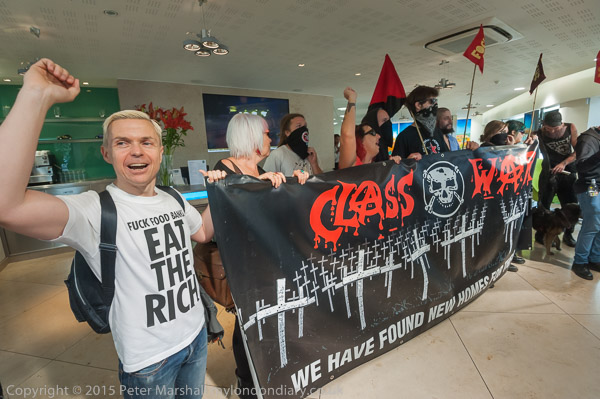
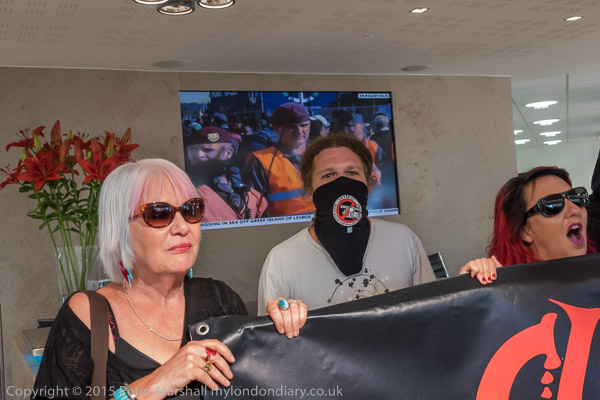
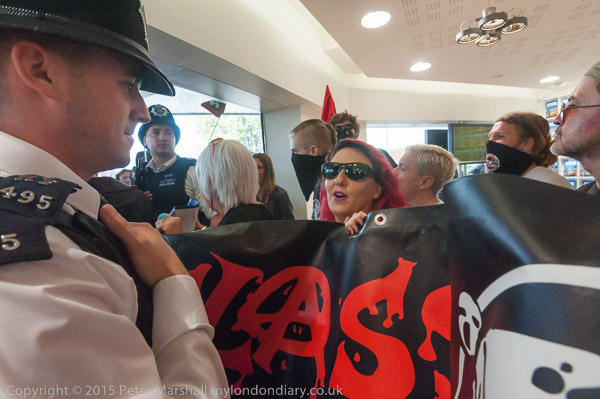
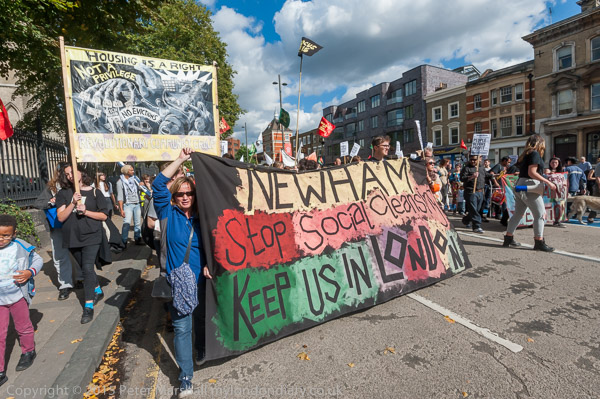
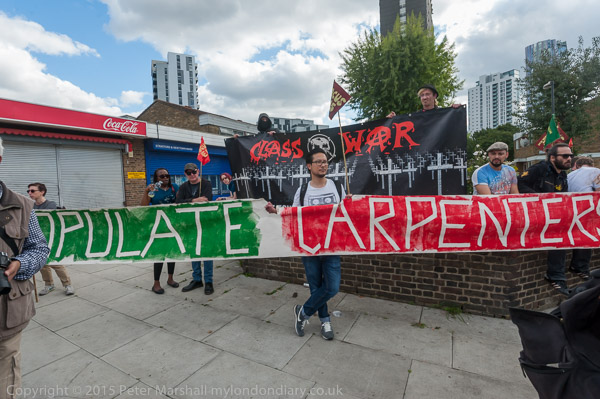
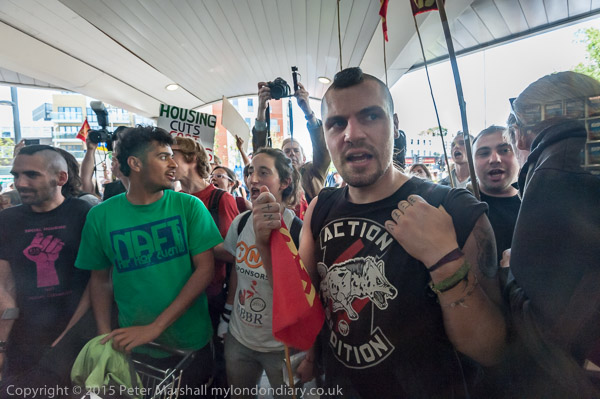
The Focus E15 march began with a rally in Stratford Park. It was supported by people from a huge list of organisations I list on My London Diary. They they then marched around Stratford town centre, past the bus station, the station and the Theatre then back down the Broadway, stopping briefly outside Foxtons, where Class War staged a brief protest inside the estate agents offices.

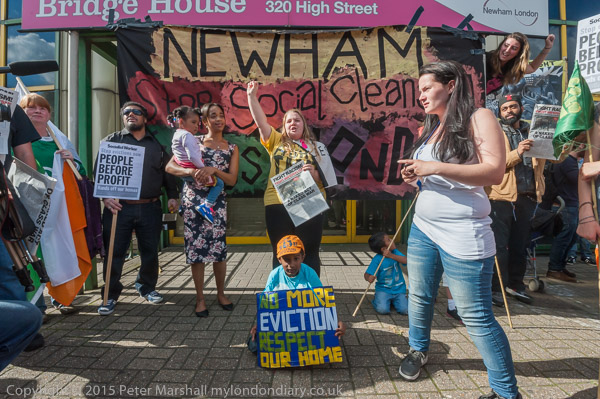
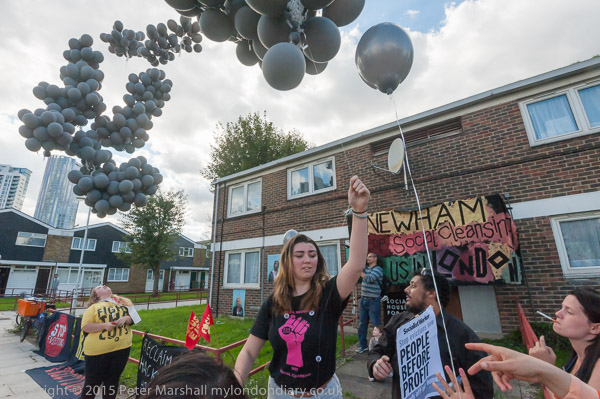
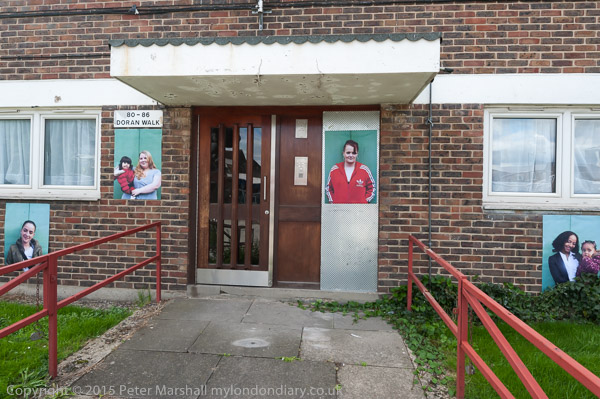
They then moved on to the LB Newham’s Housing Office at Bridge House for another protest. Finally the marched on to the Carpenters Estate to hold a rally in front of the flats they had occupied for two weeks in 2014. Their occupation had led to these flats being re-occupied along with a few other of the roughly 400 empty properties on the estate.

If you’ve not yet read ‘A massive betrayal’: how London’s Olympic legacy was sold out please do. You can read more of what I wrote back in 2015 and see many more pictures on My London Diary:
Focus E15: Rally before March
Focus E15: ‘March Against Evictions’
Class War Occupy Stratford Foxtons
Focus E15: Anniversary of Carpenters Occupation


Housing in Crisis – Newham 2015

Six years ago I posted about a march through Stratford on Saturday 19th September against social cleansing in Newham, where the council has been rehousing people in private rented properties outside the borough, sometimes as far away as Wales or Liverpool. The directly elected Mayor of this almost monolithically Labour borough until 2018, Robin Wales, made clear his views that if people couldn’t afford to live in London they shouldn’t expect to live there, and council policies appear to reflect this. But Newham – and London generally – needs large numbers of relatively low paid workers – and Covid has helped us appreciate their contribution. Many, even those in jobs well above the London Living Wage, can’t afford market rents and certainly not to buy homes.

Local people, many of whom have lived in the area for years and have developed connections in the area – friends, families, schools etc – who for any reason become homeless want to be rehoused close to these people and services and demand that local resources be used to house local people.

Newham currently in 2021 has 27,000 people on its housing waiting list and 7,000 children in temporary accommodation. Until very recently the few social homes that were available were allocated using a system that gave priority to those in work and the new system will instead focus on health, need and overcrowding.

But the real problem that there is simply not enough social housing remains, and this is more the fault of national government policies over the years, under both Tory and New Labour. The most obvious and and damaging was of course Thatcher’s ‘right to buy’ which has drastically reduced to number of social housing homes, and in particular removed many of the more desirable properties, but councils have also been largely prevented by successive governments from building new and much needed social housing, as well as being starved of the cash needed to properly maintain existing properties and estates.

Many existing council estates were transferred to housing associations, which increasingly seem to be catering for those able to afford the very high ‘market’ rents in London. Councils too, thanks to New Labour housing policies have been demolishing council estates and developing the sites together with private developers to produce mainly homes for sale at high market prices, with often a great reduction in the number of social housing homes available.

Newham has seen a huge amount of building housing in recent years, both on the former Olympic site and elsewhere, with more tower blocks every time I visit the area, but almost all are high rent properties suited to young professionals, mainly working outside the borough, residencies for wealthier students, or expenive investment properties – usually bought with no intention of being lived in but simply to benefit from the increases in London property prices.

In 2013, Newham announced it was going to close a hostel for young single mothers who would then be dispersed in rented flats across England. The women decided to fight and the Focus E15 campaign began. Backed by members of the Revolutionary Communist Group and others who supported them in direct actions that often gained media coverage their fight succeeded and they became well-known nationally and developed into a much wider campaign for proper housing, particularly supporting others in the area with housing problems. As well as holding a street stall in the centre of Stratford every Saturday they accompanied people to the housing offices, gathered to prevent evictions and more.

The march in 2015, two years after the start of their campaign attracted the support of over 40 other organisations, mainly small local groups from around London and the South-East also fighting housing problems. Fortunately not all of them had speakers at the rally before the march but there were quite a few before it moved off from Stratford Park to march around the Town Centre.

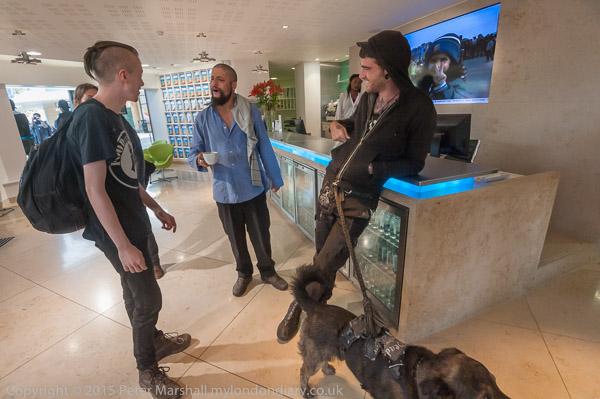
As the ‘Housing for All’ march passed Foxton’s estate agency in the centre of Stratford, Class War rushed inside with their ‘New Homes for the Rich’ banner and staged a brief occupation while most of the marchers supported them from outside. They caused no damage and left after a few minutes for the march to continue.

There was another brief halt outside LB Newham’s Housing Office at Bridge House, which was closed. The marchers held banners and posed for photographs and Focus E15 spoke briefly about how their interventions here have prevented homless people from being sent to unsuitable private rented accomodation hundreds of miles away, getting them re-housed in London.

The march ended in the square on the Carpenters Estate in front of the block of four flats which Focus E15 occupied for four weeks as a protest a year earlier. This had made the national news and had ended with the council promising to bring some homes back into occupation – though a year later only 28 of around the 400 empty homes had been re-let. There were a few more speeches and then a party began.


All photographs on this and my other sites, unless otherwise stated, are taken by and copyright of Peter Marshall, and are available for reproduction or can be bought as prints.