Don’t Deport London Met Students – 2012

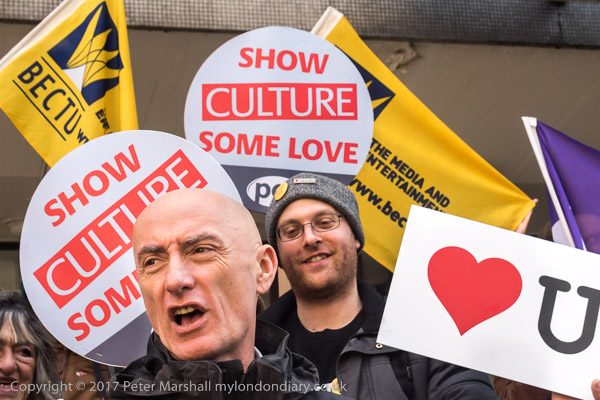
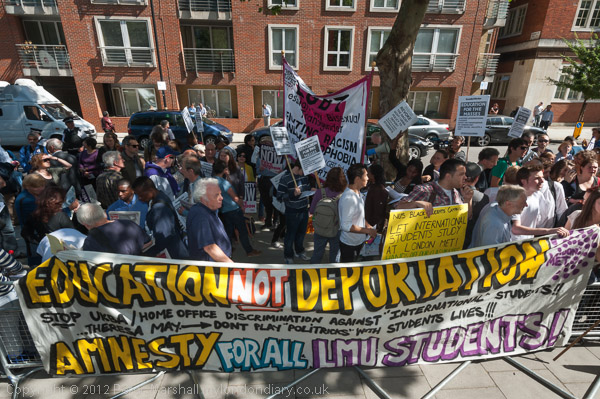
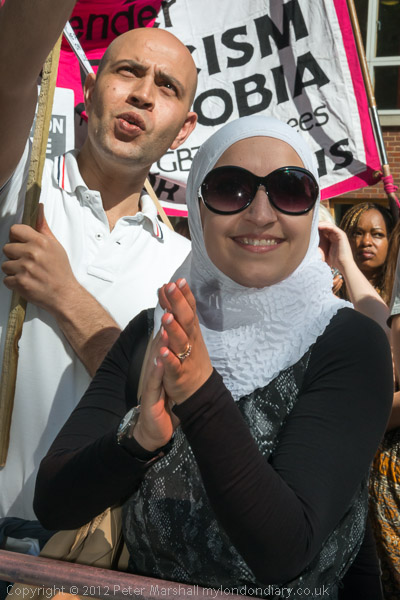
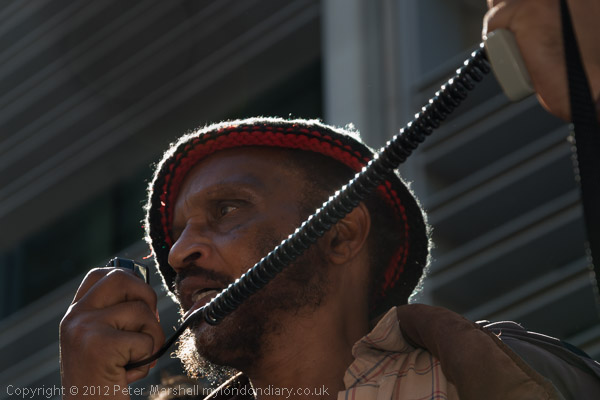
A protest at the Home Office on Wednesday 5th September 2012 called for international students at London Met University to be allowed to complete their studies and not face deportation after having invested heavily in getting a degree in the UK. Some then marched to Downing St.
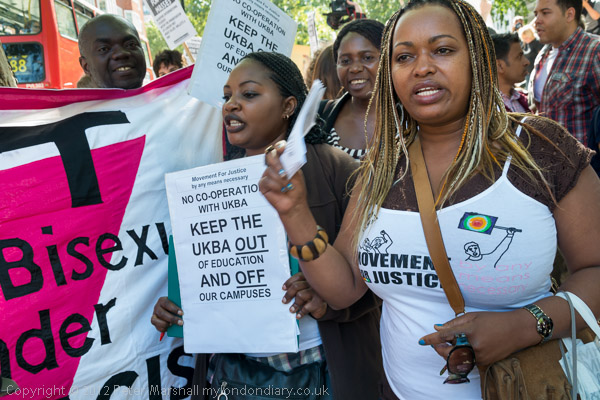
The decision to revoke London Met University’s licence to sponsor non-EU students taken on 29 August 2012 taken by the UK Border Agency was an example of petty-minded racism by the Home Office at its worst. It was made after a limited investigation had found that some students studying there had no leave to remain in the UK.
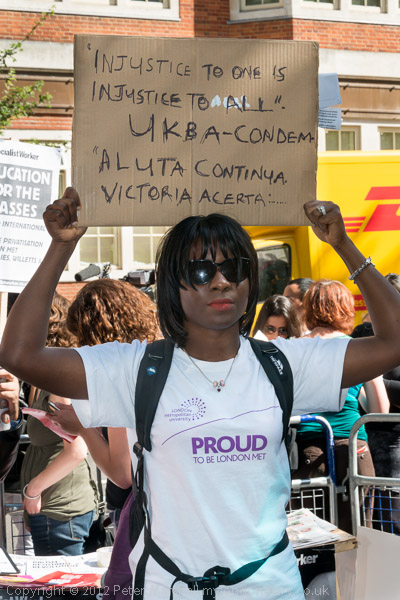
It was a totally disproportionate reaction to the findings, which should have been dealt with on an individual basis and with discussions over the procedures in place at the university tightening them where necessary. But Home Secretary Theresa May had declared a ‘hostile environment’ three months earlier and this was something to show the public that she meant business.
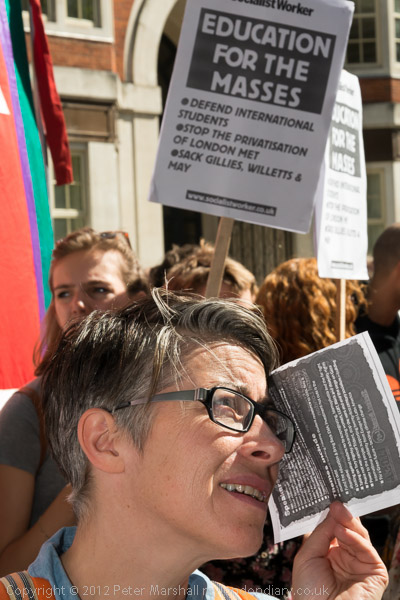
It was a decision which caused unnecessary disruption and costs to the majority of international students who were legitimately pursuing their studies at the university and which seriously damaged the UK’s reputation as a country for students to come from abroad to study.
The licence was reinstated the following April, following further discussions and inspections at London Met, though they were only allowed to admit new students from abroad on a limited scale for the next 12 months. The actions taken by the Home Office could clearly have been taken without penalising students who were studying on courses at the university, and served to emphasise the callous disregard of the revocation.
Universities Minister David Willis had clearly also been embarrassed by the Home Office decision, setting up a task force to provide a clearing house for the displaced London Met students, and two weeks after the revocation the government launched a £2 million fund to “help legitimate students to meet additional costs they may incur by moving to another institution to finish their studies. These include: covering the cost of any fee for a repeat visa application and discretionary payments to cover, for example, lost deposits on accommodation due to having to move somewhere else to study.”
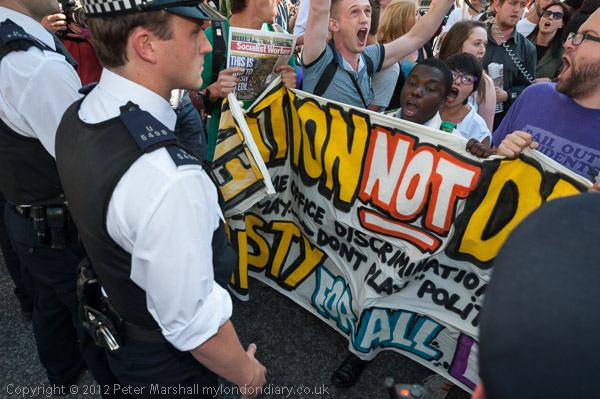
I’m not sure how adequately this fund recompensed students for their extra costs, but clearly they were subjected to considerable disruption in their studies and also in their personal lives, breaking the many relationships they will have had with fellow students and tutors, and being transferred onto courses with different approaches and areas of study. Even courses with the same titles will have significant differences and students may well find they were repeating some studies already made while missing out on others.
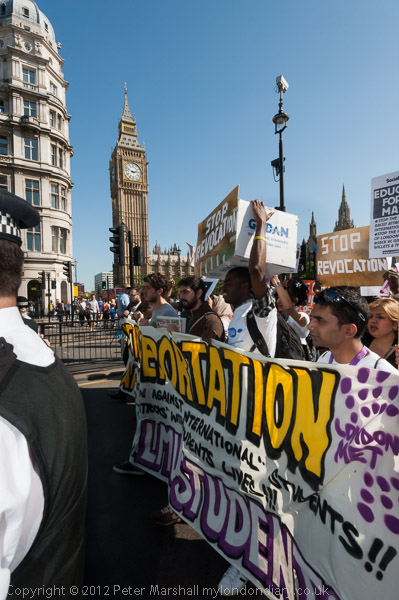
Students march to Downing St

The UK Border Agency had long been criticised for its actions and poor service, with an increasing number of complaints to the Parliamentary Ombudsman over asylum, residence status and immigration issue – and in 2009-10 all but 3% were decided in favour of the complainants. In 2013 a report by the Home Affairs Select Committee was so damning about its incompetence that Home Secretary Theresa May was forced to abolish it, replacing the agency by three new organisations, UK Visas and Immigration, Immigration Enforcement and Border Force.
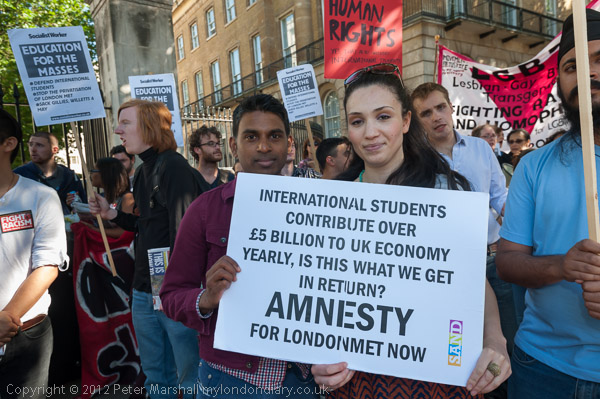
You can read more about the protest and see more pictures on My London Diary:
Don’t Deport London Met Students
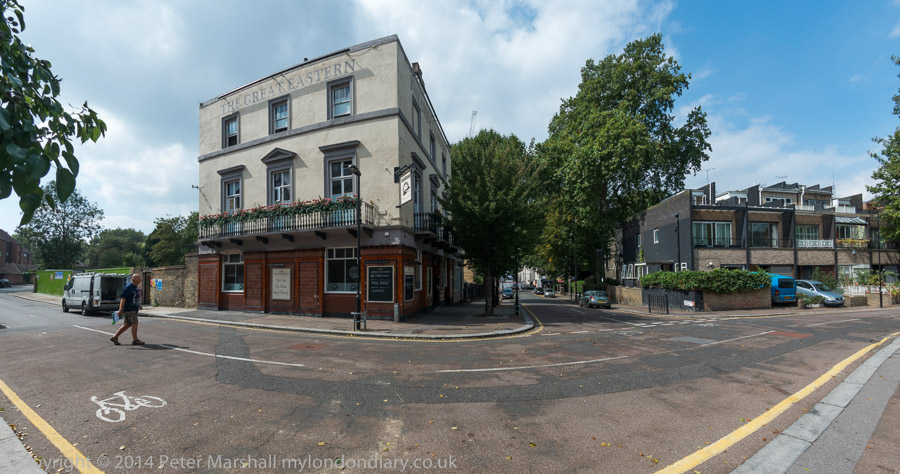
Isle of Dogs and Class War

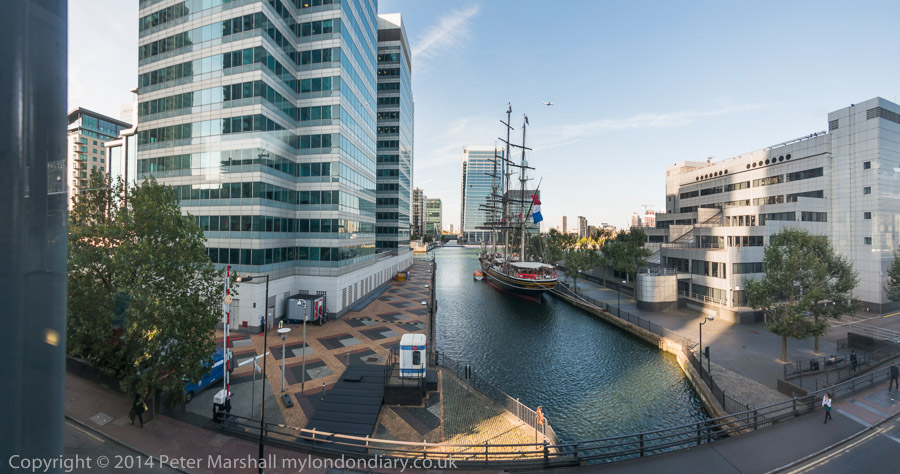
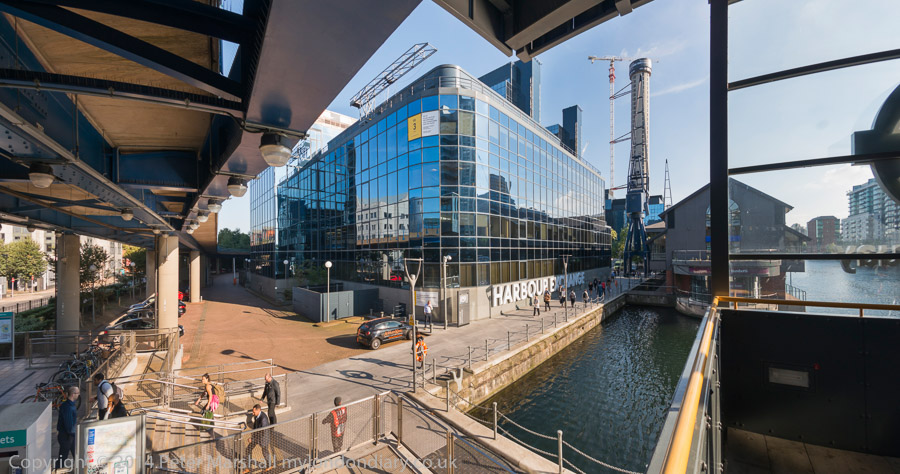
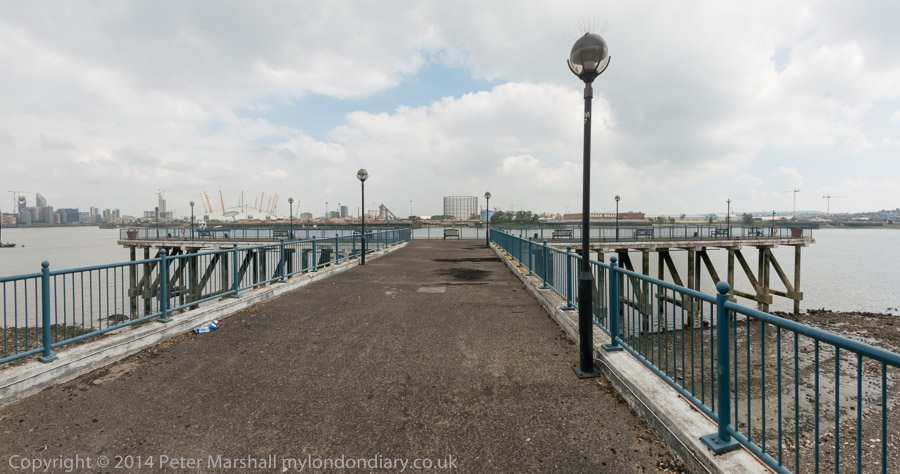
Isle of Dogs and Class War: The weather was fine on Wednesday September 3rd 2014, with some nice clouds which made it a good day for some more panoramic photographs, and I went up earlier in the day to continue my pictures around the Isle of Dogs before covering an evening protest by Class War in Aldgate.

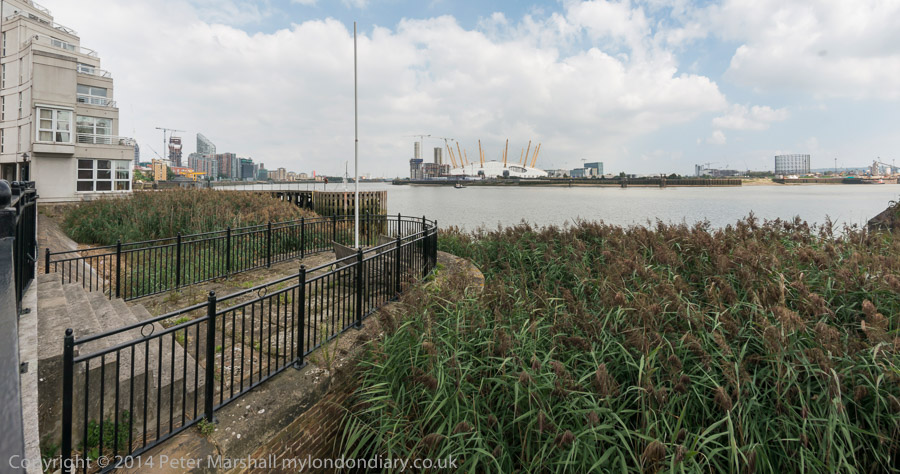
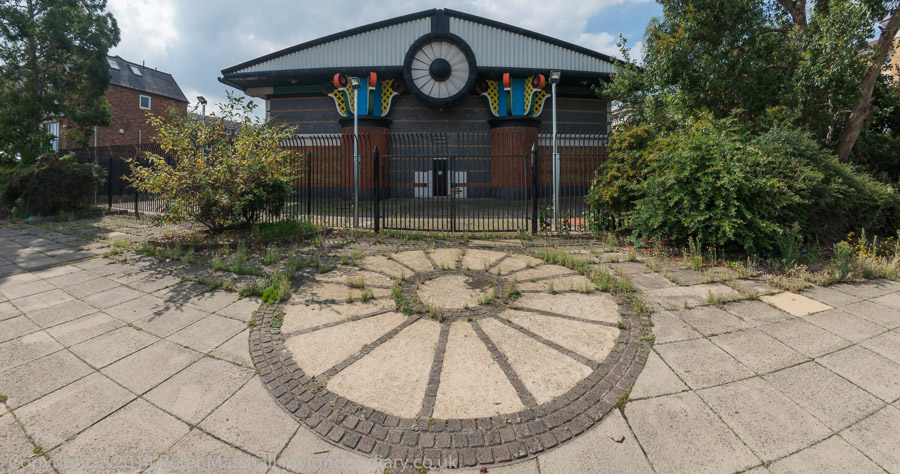
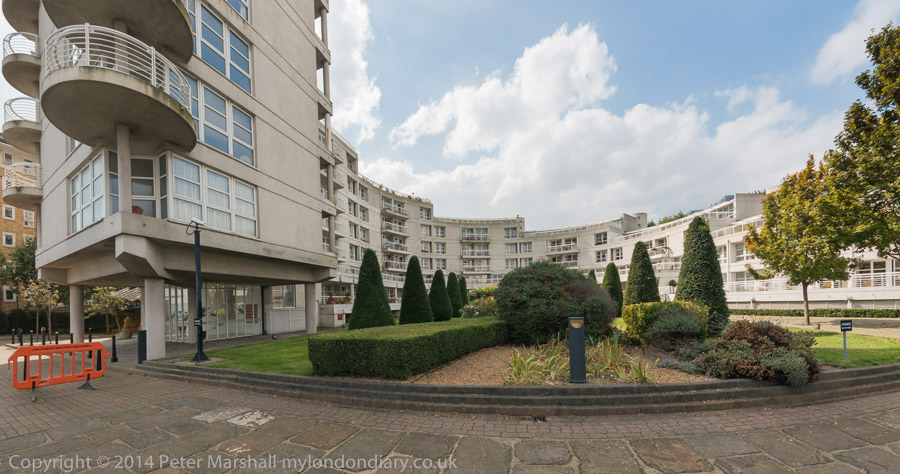
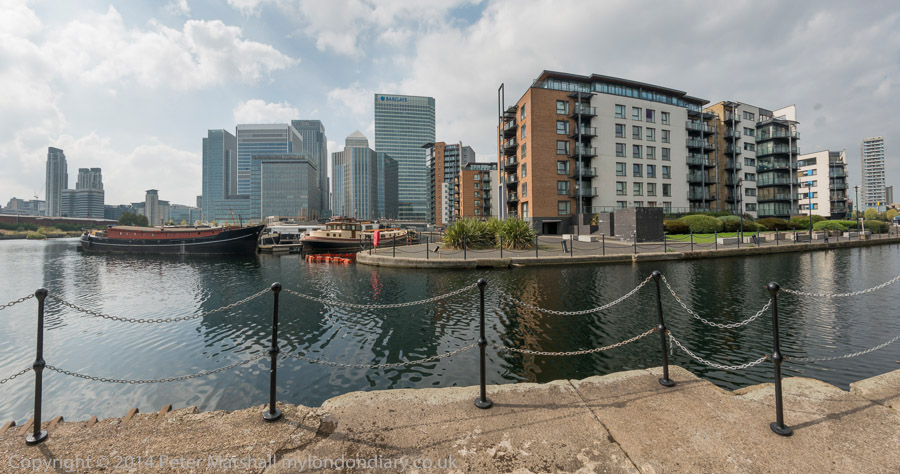
Isle of Dogs – Island Gardens to South Quay

Back in the 1980s I set out to photographed extensively in London’s docklands, part of a wider project on the de-industrialisation of the city, partly a response to changes in technology and globalisation, but greatly accelerated by the Thatcher government which saw great opportunities for their supporters profiting by a switch from manufacturing to service industries.

The government policies perhaps made some sense at the time – and certainly made some large profits for the friends and supporters of the Tories, but in many ways we are paying for them now, particularly for their ‘selling off the family silver’ by privatising utilities and other publicly owned activities.

In the docks the main changes were due to containerisation and other efficient ways of handling cargo. Much larger vessels came into service and the long journey up the River Thames to London’s Docks was difficult or impossible, as well as adding significantly to turn-around times. Only Tilbury, miles closer to the sea remained viable.

The changes to Docklands could have been managed for the benefit of the existing populations to the area, with development being carefully planned and managed locally. Instead we got the London Docklands Development Corporation which overrode local interests to benefit those of corporations but did produced a more rapid development than would otherwise have taken place. But it was a huge give-away to private developers, resulting in dramatic changes, and one that the area will continue to suffer from for generations.

Many of my pictures from the 1980s in colour as well as black and white are now available on Flickr in a https://www.flickr.com/photos/petermarshall/albums number of albums and there are also a number of books available on Blurb (in print and as PDF) with the Isle of Dogs being included in City to Blackwall ISBN: 978-1-909363-09-0 which has a working preview.

My walk in 2014 began at Island Gardens DLR station, where I had finished a previous walk, and I continued along the riverside path to the Blackwall Entrance, across to Poplar Dock and Blackwall Basin, down Prestons Rd and Manchester Road to East Ferry Road, and then up and around a little on my way to South Quay Station.

In 2014 I was mainly making digital panoramic photographs, with a horizontal angle of view of around 145 degrees – much greater than can be achieved with a normal rectilinear perspective. These pictures use a projection which keeps vertical edges straight and also gives a straight horizon line (so long as the camera is kept level) but other lines and objects away from the centre of the image curve. Similar projections were used by artists such as Canaletto. These images here have a aspect ratio of 1.9 to 1.

There are two posts on My London Diary with many more panoramas and a few ‘normal’ views from this walk:
Isle of Dogs
Isle of Dogs Panoramas


Class War ‘Poor Doors’ picket Week 6 – Aldgate

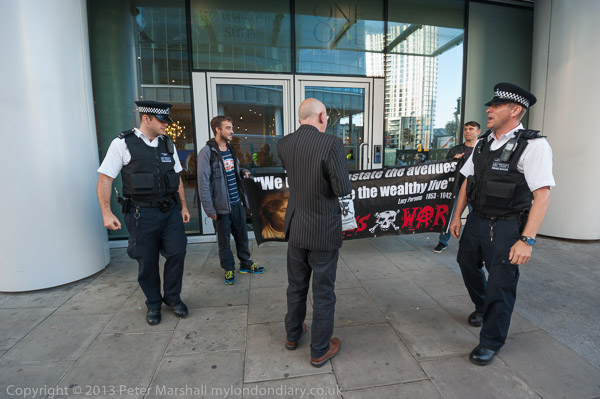
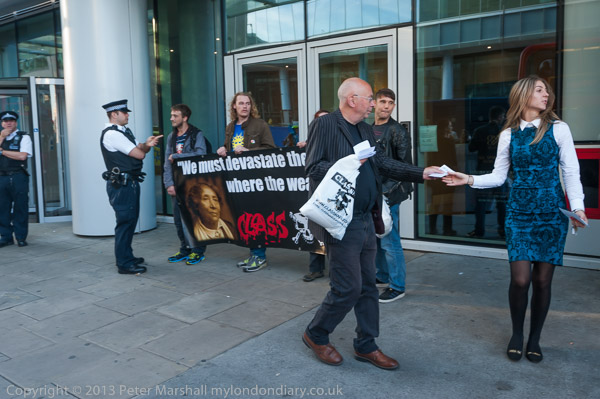
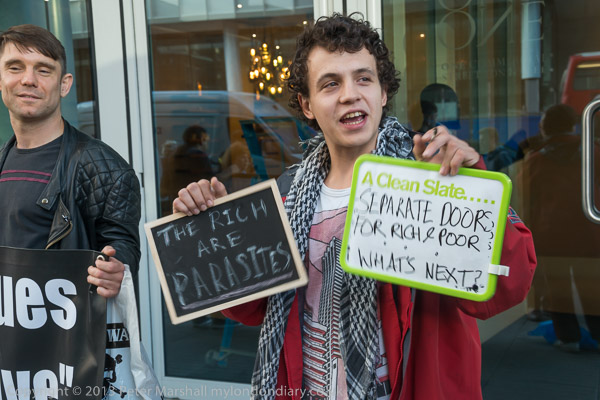
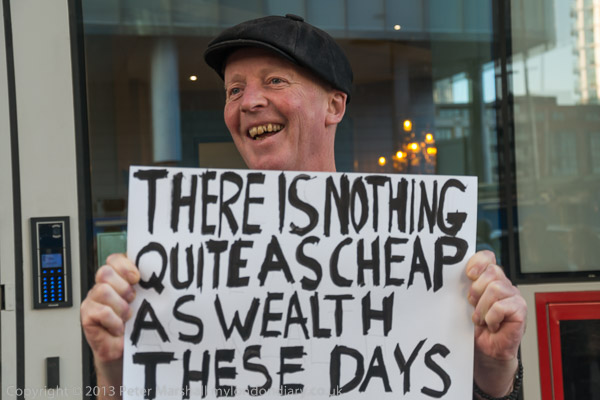
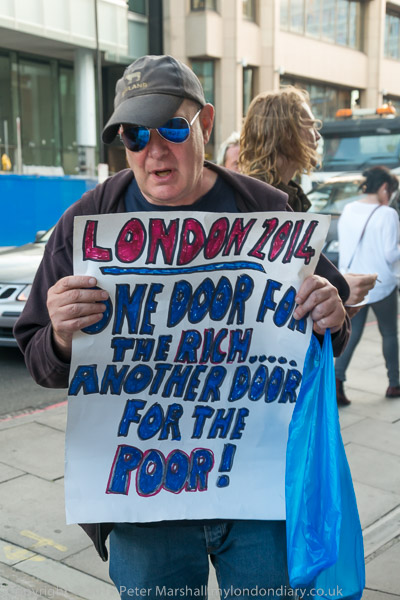
I got back a few minutes early to where Class War were to stage their sixth weekly protest against the separate doors for the wealthy residents and social housing tenants in the block ‘One Commerical St’. The entrance for the rich is on Whitechapel High St next to Aldgate East station while the poor door is down an alley on the west side of the building.
Unlike in previous weeks there were police already there and waiting for the protesters, a sign that the police were taking a firmer stance against the protests here. Almost certainly they were responding to pressure from the owners of the building, and their activities against the protesters were to heighten further in later weeks.

When the protesters arrived, officers immediately came and talked to them, making it clear that they were not to block the doorway for people entering or leaving the building.

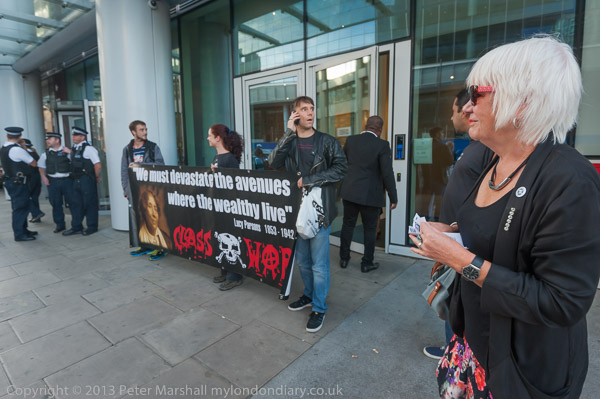
More police arrived, outnumbering the small group of little more than a dozen protesters who had come to hand out leaflets to people on the street outside. Many passing expressed surprise that this kind of segregation of rich and poor was allowed to happen in London and showed support for the protest.

It was perhaps the smallest of the series of thirty or so ‘Poor Doors’ protests outside this building. There were quite a few arguments with police officers but no arrests on this occasion.
More pictures at Class War ‘Poor Doors’ picket Week 6.


Disabled Protest at BBC in London

Disabled Protest at BBC in London
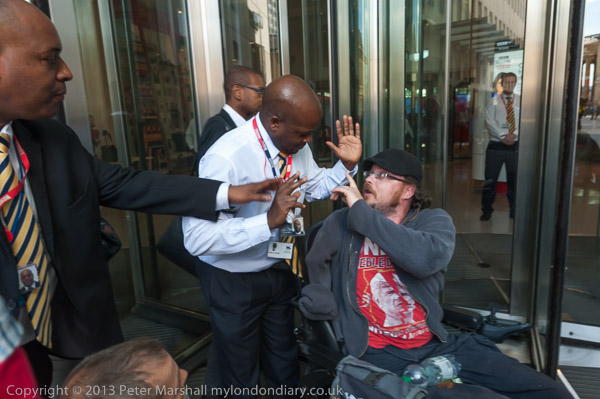
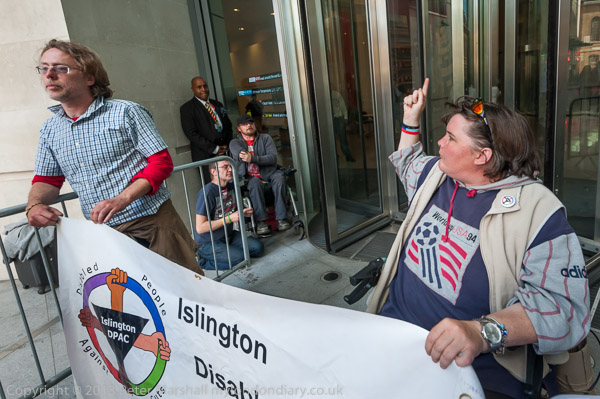
“Hands OFf” protester Andy Greene tells BBC secuirty

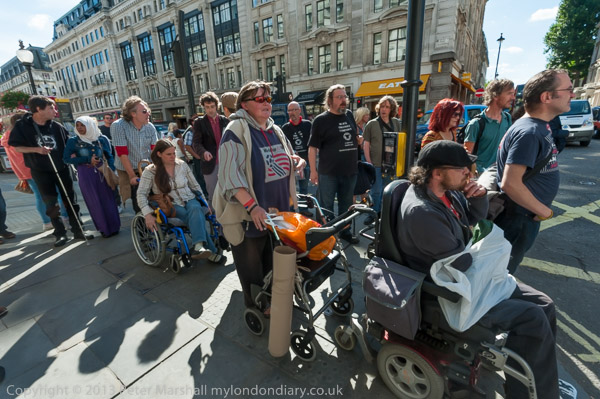
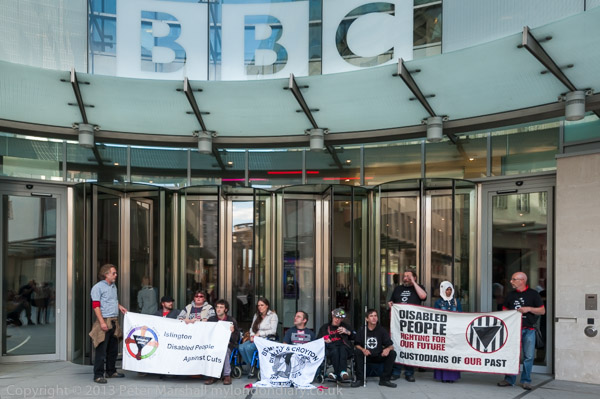
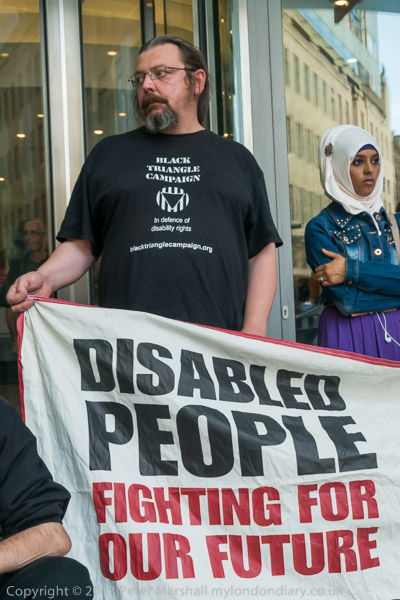
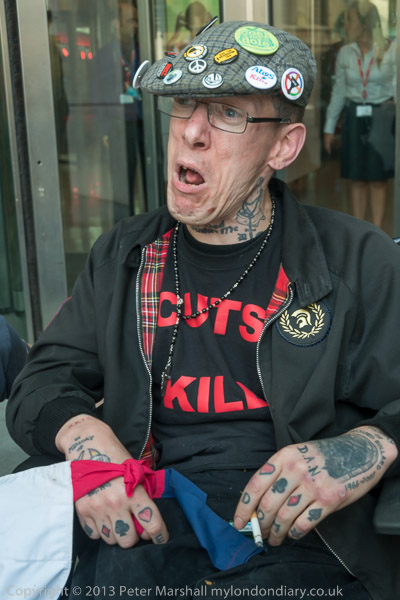
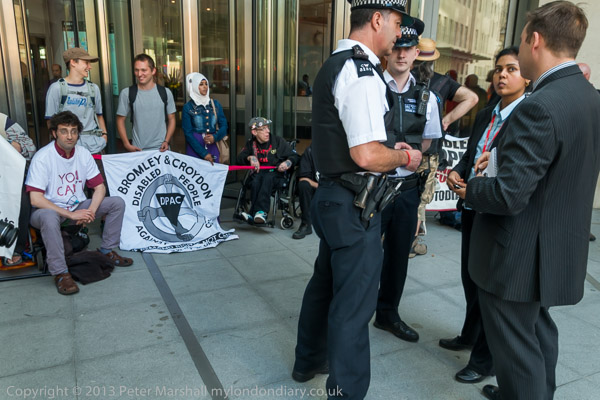
Disabled Protest at BBC in London: On Monday 2nd September 2013 I went with disablement protesters, some in wheelchairs, who were protesting at Broadcasting House in London at the BBC’s failure to report truthfully the effects of government cuts, particularly on the disabled. They blocked the main BBC entrance for an hour, with some locking themselves to the doors.

Disabled Protest at BBC in London
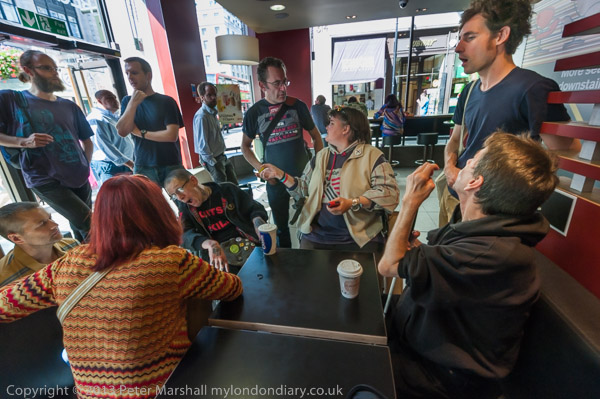
DPAC activists meet in McDonalds near the BBC

The BBC eventually called the police, who arrived not long before the protest was to end, and when they told the police this, the police stood back and watched until they did pack up and leave. Of course the protest was only a minor inconvenience to the BBC as there are alternative entrances which people were able to use.

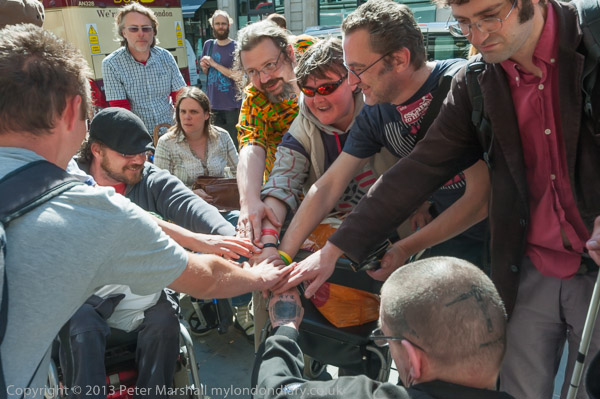
They join hands before going to the BBC

At one point a BBC TV cameraman turned up who had been asked to film the protesters. I joked with them that perhaps he would be able to sell his footage to ITV news as it was most unlikely that it would be shown by the BBC. And I was correct in that there was no mention of the protest at all on BBC news programmes. Perhaps a few years later the footage might appear in some feature about disabled people.

The protesters took turns in speaking out about the failure of the BBC to report the real hardship caused by ATOS assessments and the withdrawal of benefits, benefit cuts and caps and the bedroom tax. All were fed up with the BBC repeating the lies and half-truths of government and asked why the real problems and numerous deaths from the austerity programme and the protests over these were not being properly reported.
Outside the main BBC entrance

The situation was critical for many poor and disabled people, with over 500,000 having to resort to food banks set up by churches and charities to fend off starvation. The protesters chanted ‘BBC, Tell the Truth’ and requested someone from the BBC to come and discuss the issue with them – but no one would.

They made clear they were not asking for special treatment for the disabled, but for full, accurate and impartial reporting – something the BBC once had a reputation for, but sadly no more.

They were joined by chance by activist comedian Mark Thomas who had been inside the BBC when they arrived. Some had recently met him during his ‘Mass Miracle’ performance outs Atos’s Edinburgh office which had been a part of the previous months Edinburgh fringe. He was persuaded to speak briefly and gave his support to the protest, praising the protesters for coming to make their views known to the BBC.

I have mixed feelings about the BBC which still does produce some fine programmes but also I think has failed in many ways. Although they are supposedly independent they are very much an establishment mouthpiece and they very much work from the point of view of the wealthier parts of our class-ridden society.

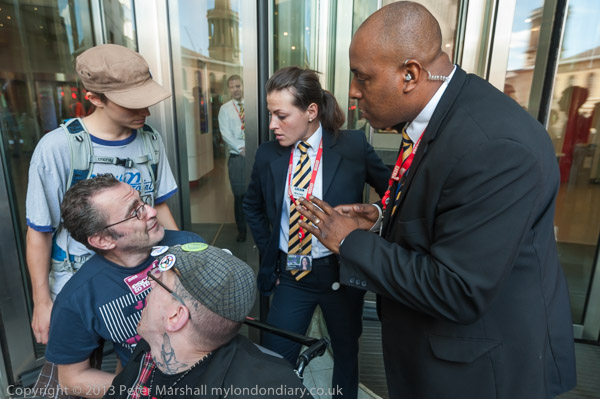
BBC Security failed to persuade them to move

Journalist Emily Maitlis has recently spoken out about the ‘Tory cronyism at the heart of the BBC’ and their misguided approach to impartiality which led, for example, to climate deniers being given equal prominence to the huge body of scientific evidence over the extreme dangers of climate change.

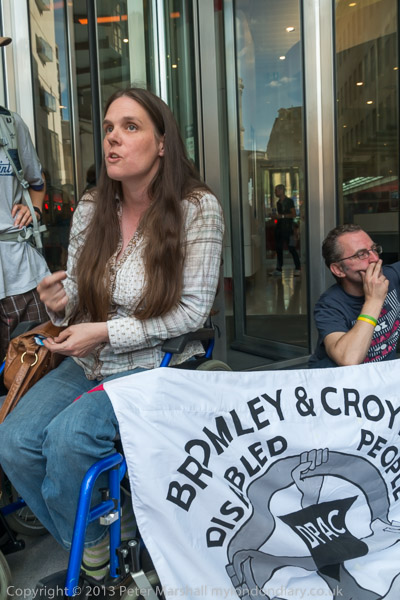
Protesters took turns to speak about the effect of the cuts

Maitlis is clearly an accomplished journalist and presenter with a long and successful career. But she was in a very well paid post at the BBC, is married to an investment manager and lives and works in a very different world to the great majority of the British people. At least she was one of relatively few in such positions who was educated at a state school (though certainly not a bog-standard one) before going to Cambridge.

Eventually police arrived – and protesters told them they would leave shortly

But for years it has been clear that we can not rely on the BBC for a comprehensive view of events in the UK and around the world. If you want to be well-informed about what is happening and why you need to look and listen to other sources – including the BBC’s own World Service, and other UK and foreign news services (which often have a very different bias), as well as alternative UK media such as Double Down News, Novara Media and The Canary.

But the BBC has increasingly come under threats from governments who control its purse-strings – if at a slight distance. I don’t pay a licence fee because I don’t view TV but do listen to BBC radio for an hour or two most days, though usually with half and ear while doing other things. The BBC is still much better in many ways than the commercial alternatives and in a different league to those in some other countries – such as the USA.

More pictures at DPAC at BBC – Tell The Truth.


DPAC End Week of Protest Against Atos

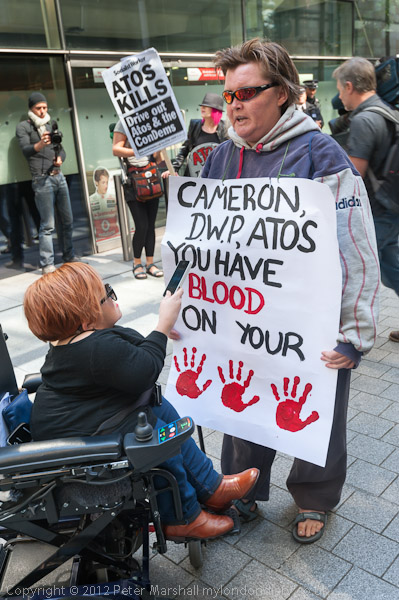
DPAC End Week of Protest Against Atos: In August 2012 Disabled People Against the Cuts and UK Uncut organised the week of action as a protest against the sick spectacle of Atos, the company who pressures its staff to unfairly declare disabled people ‘fit for work’ so as to increase its profits and meet government targets, bathing in the glory of sponsoring the Paralympic games. The week ended with two protests on Friday 31st August.


Closing Atos Ceremony – Triton Square

Protests earlier in the week had included a spoof Paralympic opening ceremony next to Tower Bridge, then decorated with a giant paralympic symbol hanging from its upper level, a vigil at Westminster and a memorial service outside the Atos head office to remember the people who have lost their lives at the hands of Atos Healthcare. There had been protests too in other cities – with 40 protesters as corpses in the road stopping traffic, and at the actual Paralympic opening many of the contestants covered up the Atos name on their lanyards as a protest against their involvement as sponsors.

Among those protesting earlier in the week was Tara Flood, a former Paralympian who represented GB at three Paralympic games and whose gold-medal winning time at the 1992 Barcelona games remains a world record. She reflected the feeling of many disabled people when she stated: “It is a shocking irony that Atos is a main sponsor of London 2012 whilst destroying disabled people’s lives on behalf of the government.”

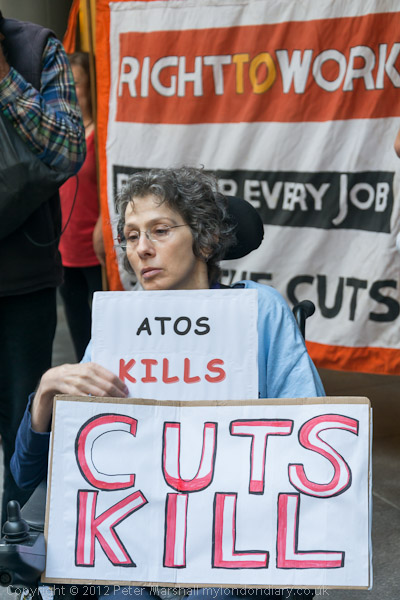
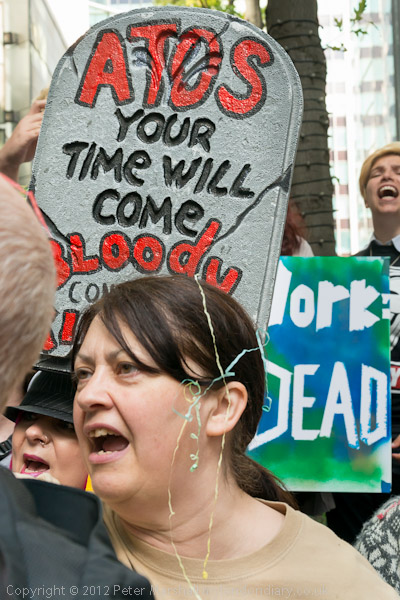
Over 500 came to Atos’s offices in Triton Square for a peaceful protest at the end of the week on Friday 31st August 2012. It had a festival atmosphere, with music and dancing, poppers, brightly coloured plastic water pistols and some fancy dress along the the usual banners and placards, but there was no mistaking the anger against Atos, evident in the slogans on the placards and chants of ‘Atos Kills!’

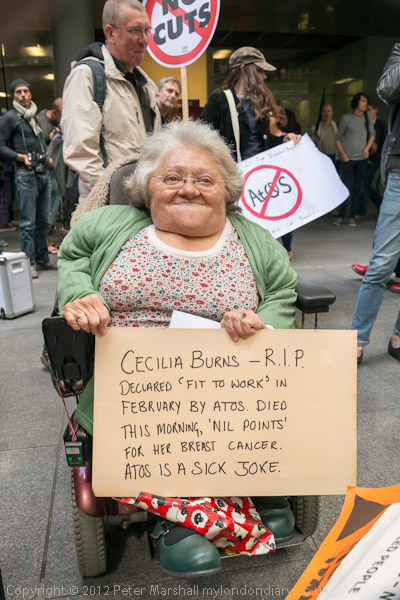
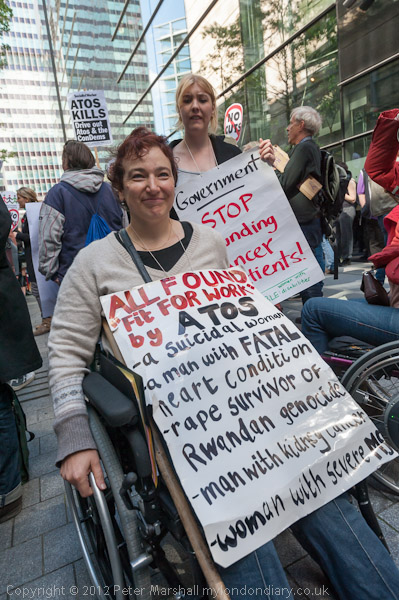
The target-driven computer-based work capability assessments delivered by Atos cause extreme hardship and misery to many disabled – and death to some. Last year 1,100 claimants died after Atos tests placed them on compulsory work-related activity to gain benefits, and others found ‘fit for work’ and so left without income have committed or attempted suicide.

Among conditions that Atos tests have found to have no bearing on fitness for work have been fatal heart conditions, terminal breast and kidney cancer and severe MS.

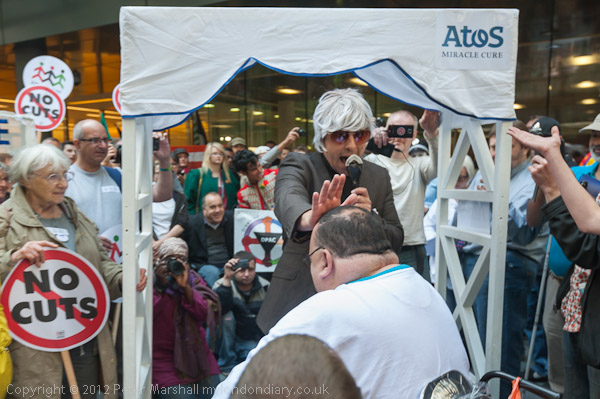
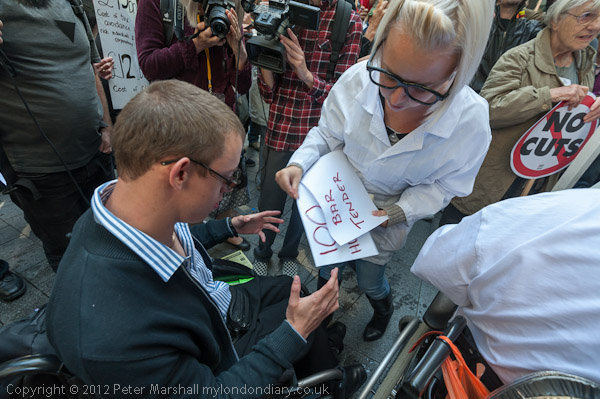
In one long street theatre performance disabled people who truly wanted to be freed of their disabilities were urged by ‘Atos’s own Reverend’ to come forward and go through the ‘Atos Miracle Cure’ archway, and several, mainly in wheelchairs, did so. Nothing seemed to happen to them, and they were disappointed, even after the ‘Rev’ had blessed them and patted them on the head, but then an ‘Atos doctor’ in a white coat came to assess them, and lo! she gave them each a certificate that they were now fit to work, and, even more miraculous, a job. But it was all a con!

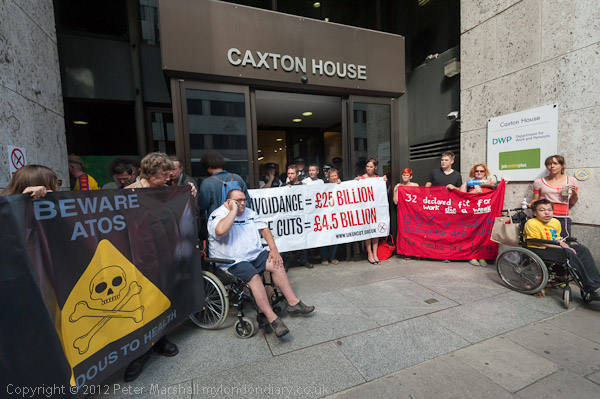
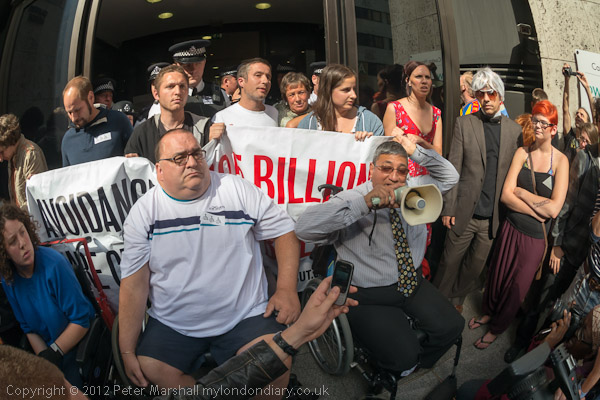
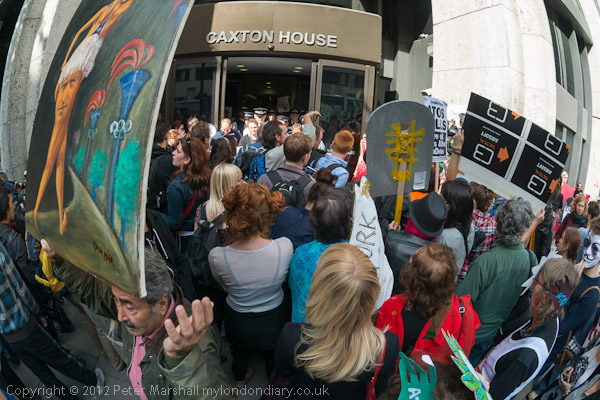
By the time the ceremony ended I had left and was making my way to the Department of Work and Pensions offices, Caxton House, in Westminster, having been tipped off that disabled activists had entered and occupied them.

More at Closing Atos Ceremony.


DPAC Occupy Dept of Work & Pensions – Westminster

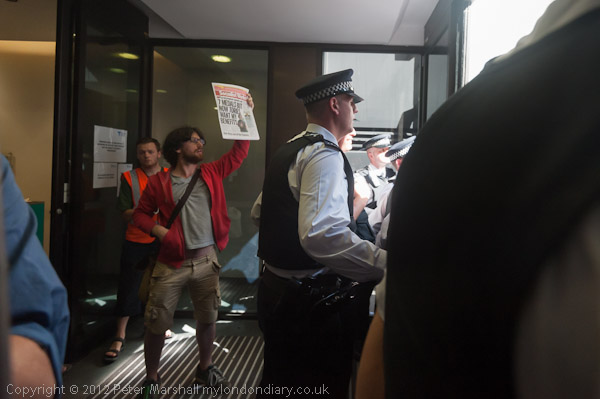
Traffic was heavy in London – I should have taken the tube. By the time I arrived there were around 20 or so protesters outside with banners in front of the entrance. Behind them were a block of around a dozen police in several rows in the fairly narrow outer lobby, and behind them I could see more police and a few protesters.

Shortly after me more arrived from the event outside the Atos offices, including quite a few in wheelchairs and formed a fairly large crowd, spilling out into the street.

Adam Lotun and spoke briefly about the reasons for the week of actions against Atos and announcing the struggle would continue and as a part of that he would be standing in the Corby by-election.

A few late arrivals tried to push past the police to join those already in the building, but as well as police there were people in wheelchairs and the media in their way and they had little chance of success. The situation became rather confused, but soon police reinforcements arrived and pushed the crowd back a few yards away from the doorway.


Racist Thugs Not Welcome 2014

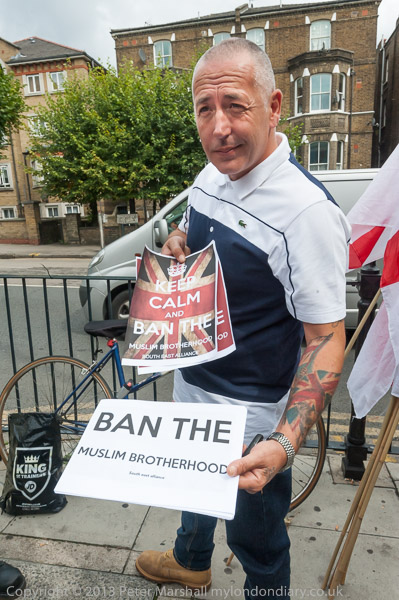
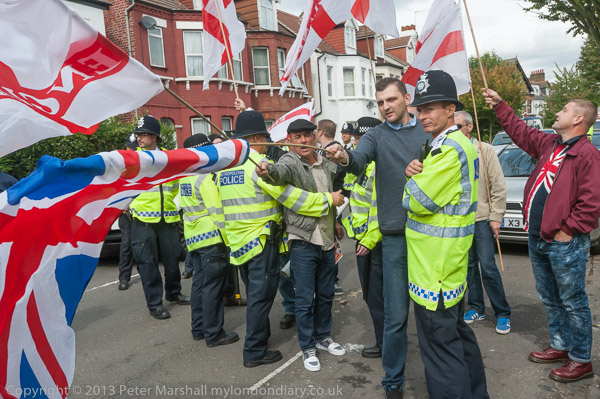
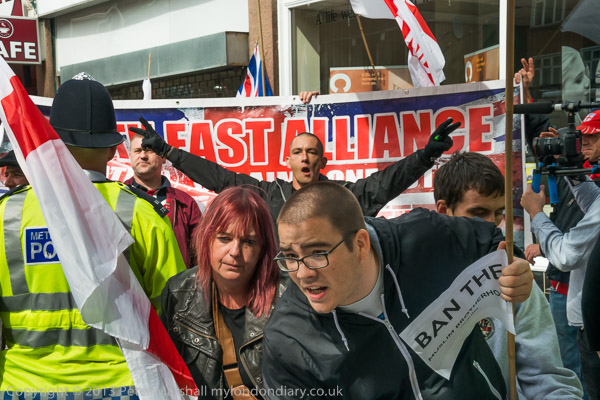
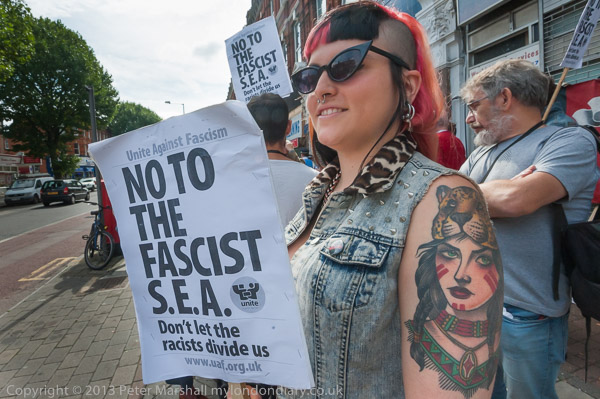
On 30th August 2014 I went to Kilburn and Cricklewood, where the far-right South East Alliance had annnounced they would protest at some empty offices they claimed were used as a recruiting centre by the Muslim Brotherhood.

The Muslim Brotherhood (MB) is a Sunni Islamist religious, political, and social movement largely based in Egypt whose candidate Mohamed Morsi was became the first to be elected as Egypt’s president in 2012, but was deposed by the military after massive popular protests a year later. The MB was then declared a terrorist group and Morsi was tried and sentenced to death. He was retried after that trial was overturned and died during his second trial, possibly due to being denied medical care.

A few other countries also declared the MB a terrorist group, but it had few members in the UK, though some of its supporters set up a ‘global information centre’ here in 1999 which I think operated from this small first floor ‘World Media Offices’ in Cricklewood. In 2014 Prime Minister David Cameron set up an investigation into its alleged terrorist activities, and the office closed down, moving its activities to Austria. The investigation reported that the MB had not been linked to terrorist related activity against the UK and had condemned the activities of Al-Qaeda in the UK.

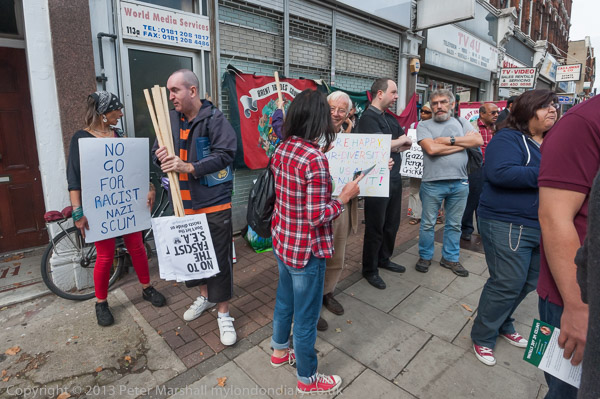
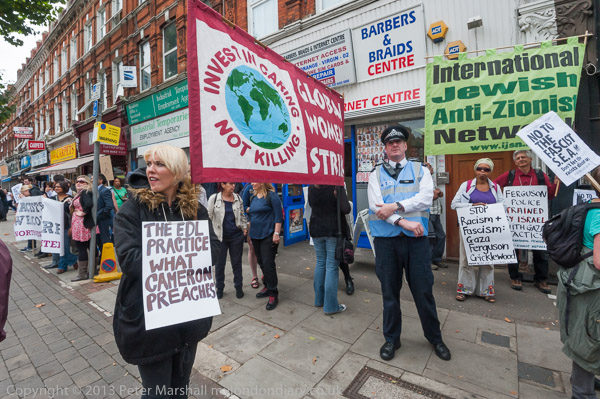
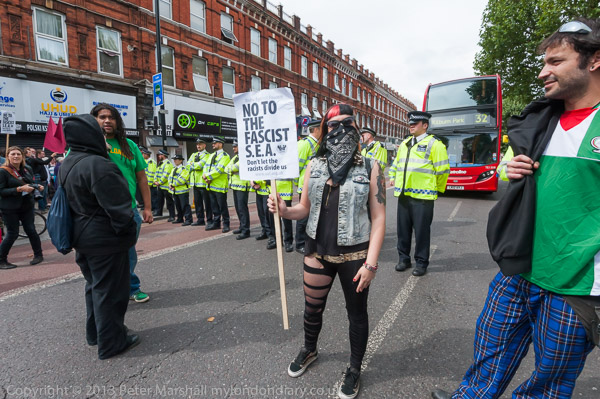
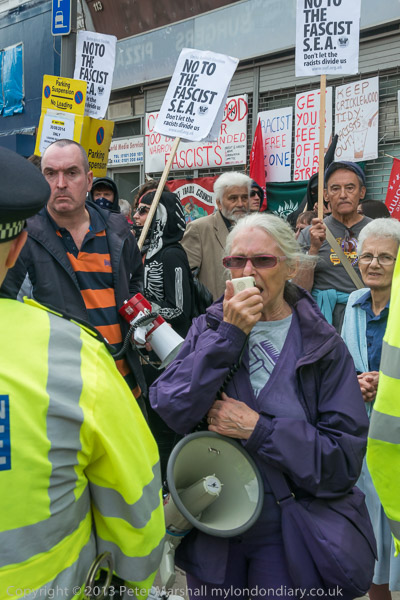
My bus to Cricklewood took me along the route of the march planned by the South East Alliance (S.E.A.) from Kilburn Underground Station, and I saw a number of police vans and motorbikes waiting for the event to start. There were a group of around 50 people and quite a few banners for groups in North West London United ready to oppose the S.E.A. march and tell them that fascists and racists were not welcome. I made a few pictures before taking the bus back to Kilburn station.

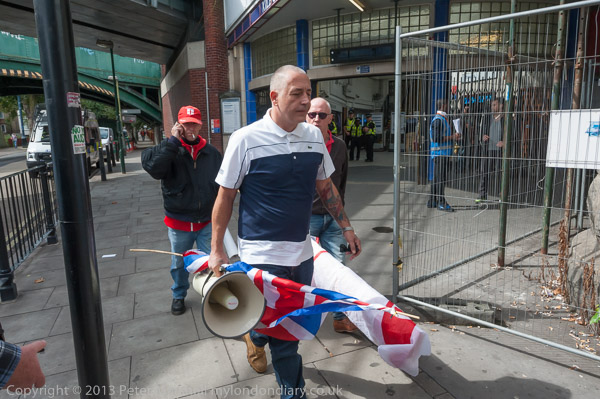
The station had been closed in anticipation of trouble there, but there are two stations on other lines a short walk away. Eventually 4 people arrived with a megaphone and flags, including Paul Pitt, leader of the S. E. A. and former Essex organiser for the English Defence League, who apparently expelled him two years earlier which led to him forming the S. E. A.

It was a rather embarassing situation with so few people present, and Pitt recognised me from previous exteme-right events I had photographed – which had led to threats against me in person and on-line. Although my photographs tried to show these events objectively, that was perhaps the problem so far as they were concerned. But there were plenty of police around.

Eventually the march set off, with the three men leading it and a woman walking more slowly with the aid of a stick completing the group some yards behind.

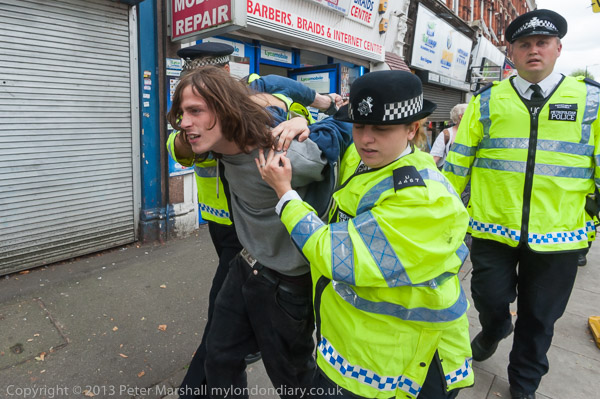
At Cricklewood the anti-fascists were waiting, with a line of police across the road to keep the two groups apart. Police were also surrounding and protecting a handful of S. E. A. supporters who had come directly to the end of the protest, and there were a few scuffles and arrests as anti-fascists tried to reach them.

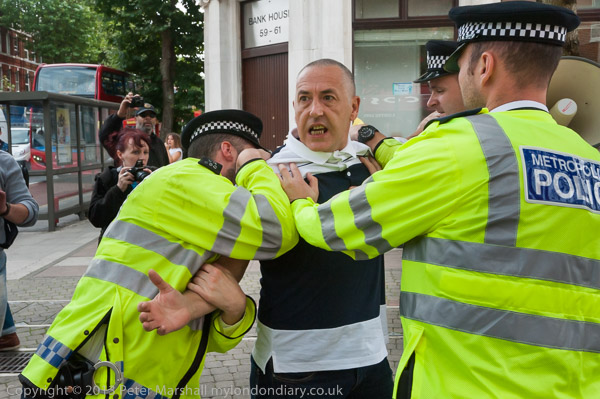
Police stopped Paul Pitts small group of marchers and held them on a corner a short distance away. For a while it seemed he was being arrested, but then more officers arrived and he was told his protest would be facilitated.

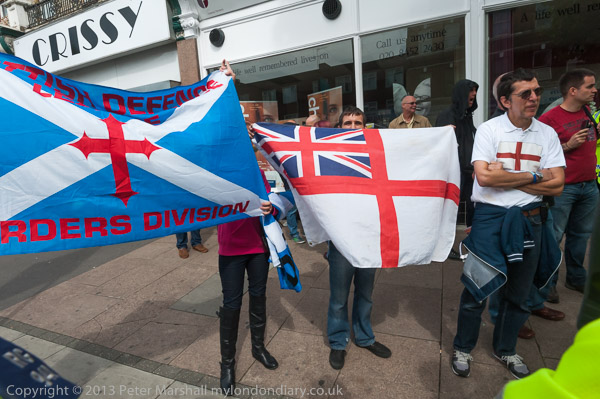
I returned to the other small S. E. A. group surrounded by police. While some of them were busy photographing police and myself and other photographers and trying to stop us taking pictures others were holding up banners and posters and demanding we photograph them.

In front of the former office the anti-fascist protesters were continuing with speeches and shouting against the S. E. A. and I saw police make at least one more arrest, though it was unclear why. I think they may have objected at some of the language used.

Then I saw some flags approaching along a side road, still several hundred yards away and rushed down to meet them. Another group of S. E. A. supporters was arriving, perhaps bringing the total number to around 50. Police arrived there just before me and stopped them.

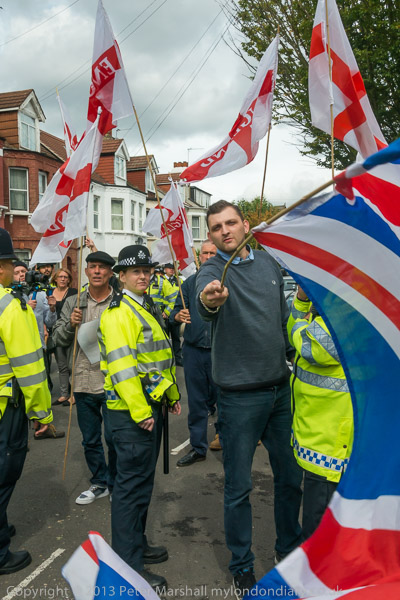
As I took photographs these protesters at first began to hold flags in front of my lens then used the long canes holding the flags as weapons, trying to poke the photographers in their eyes. Eventually police escorted them to join the other S.E.A. protesters where they continued to try to attack photographers with their flag sticks.

Police eventually did react to the violent attacks with flags – by forcing photographers to move further away. By this time I was fed up with being insulted and attacked – and in any case people on both sides were drifting away and nothing much more seemed likely to happen. The road had now been reopened and I saw a bus coming and made for the nearest stop to make my way home.

More at South East Alliance ‘Racist Thugs Not Welcome’.


Thousands March for Animal Rights – London.

Thousands March for Animal Rights

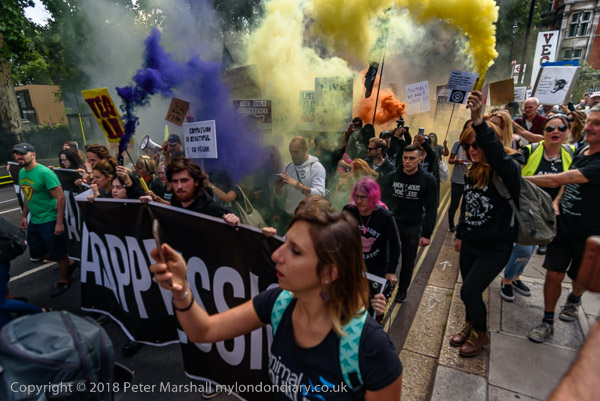
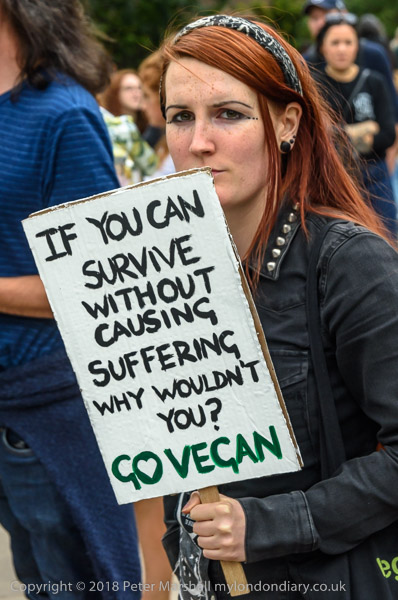
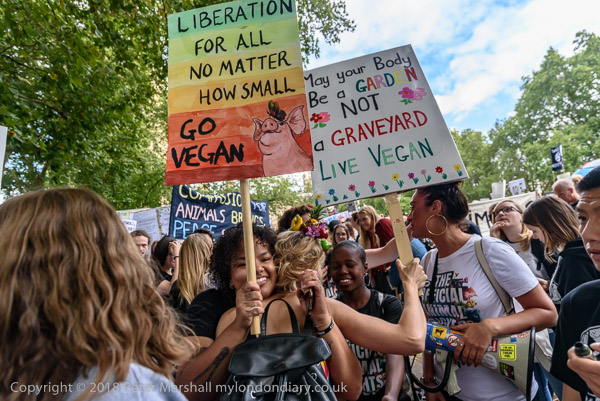
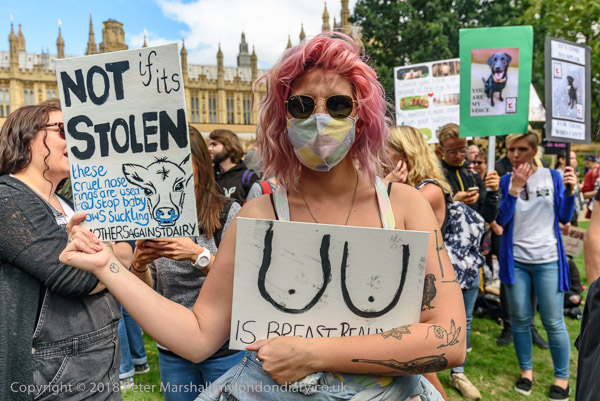
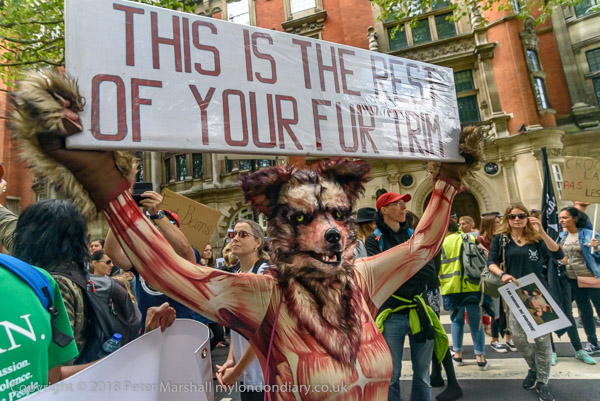
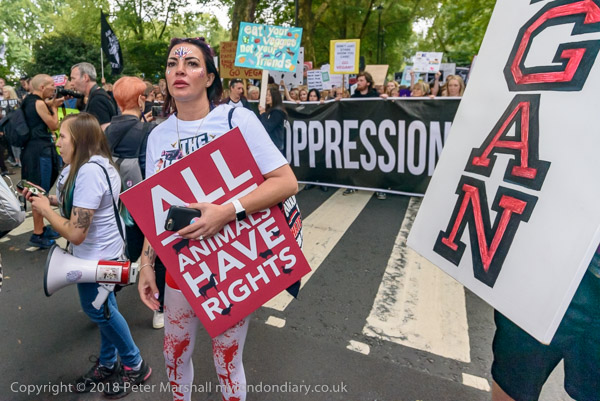
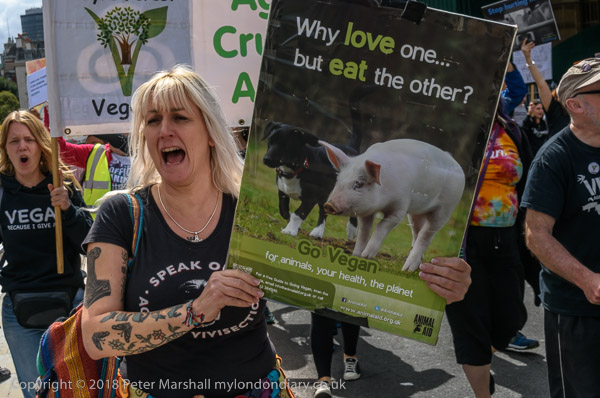
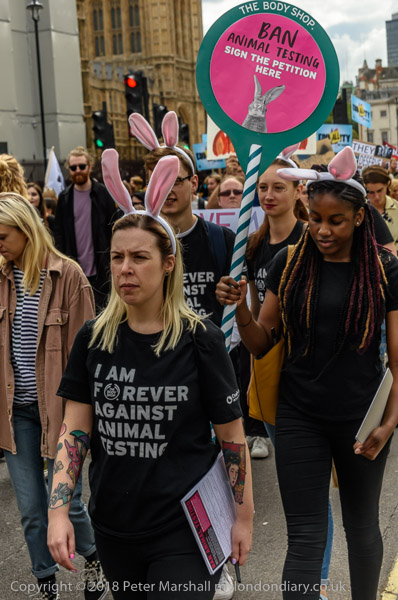
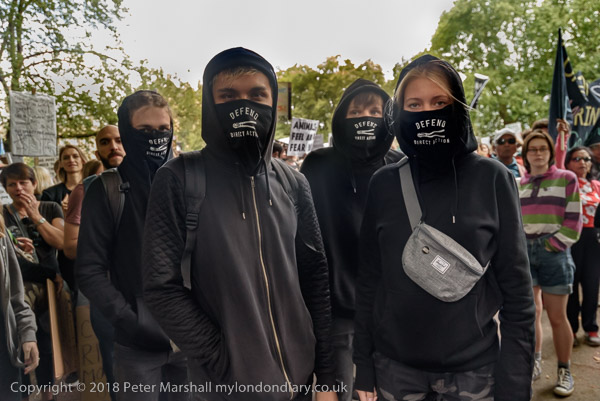
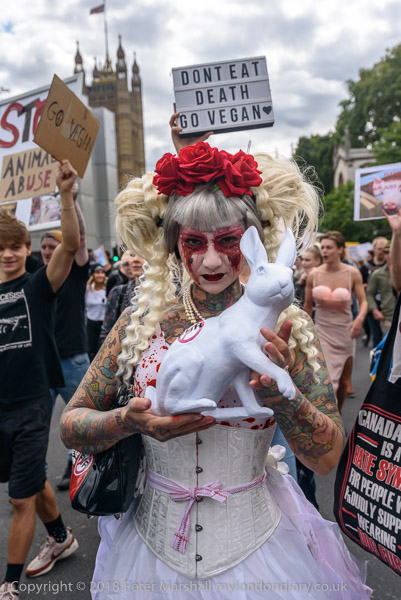
Thousands March for Animal Rights – thousands of vegans marched through London from Westminster to Hyde Park on Saturday 25th August 2018 in the Official Animal Rights March founded by animal rights organisation Surge, calling for an end to animal oppression and urging everyone to stop eating animals and using dairy products.

Vegans say that animal lives matter as much as ours and call for an end to speciesism, and the misuse of animals for food, clothing and sport. There does however seem to be rather less concern about aspects such as the breeding of dogs and other animals as pets. And while horse racing attracts some attention, the last protest that I photographed against that most cruel of all races, the Grand National, attracted only a handful of protesters compared to the thousands on this march.

Specieism – the idea that animal lives matter as much as human lives – isn’t something I can agree with. I firmly believe there is something special about the human species which has come about through evolution and in particular the development of language. While other species can communicate with each other and some develop very intricate systems of cooperation and civilisation, humanity has developed these to a very different level.

It’s that level indeed that makes veganism possible. The lion needs to hunt and eat, killing other species cruelly in order to survive. Nature truly is famously ‘red in tooth and claw’ at virtually every level, and predation is a vital aspect of all ecosystems.

Of course I’m against cruel treatment of animals, whether it is in farming practices, the transport of live animals, fur farming etc. I’ve never eaten foie gras and will never do so, but I still happily consume cows milk knowing that cows have been bred that now produce many times the amount their young offspring need and would experience considerable pain if not milked. And I’ll happily pay the extra for free range eggs while opposing the terrible treatment of chickens kept in horrifically overcrowded chicken houses. Modern farming practises have generally prioritised cutting costs over being kind to animals and while injections and vetinary treatment may have cut disease it has been in the interests of productivity rather than a more overall view of animal welfare.

There are good environmental reasons for eating less meat, though less so for grass-fed livestock and also for reducing the scale of consumption of diary products. It’s welcome that some people decide not to eat these things, but a wholesale adoption of veganism would be highly damaging to ecosystems around the world and change the nature of our countryside. Just imagine a farmyard without animals – and think seriously about the future of soil without farmyard manure.

Those fluffy animals on the posters at many vegan protests are not wild animals but domesticated animals, which only exist as they do because they have been bred to live with humans and to provide us with food. I would be sad to see them disappear, but there would be no reason for there to be any cows, sheep, geese, pigs, chickens etc in our farms and fields if we ceased to eat them (though I wouldn’t miss turkeys at all.) And certainly I’d not want to see more petting zoos. But I would like to see more truly wild animals in our countryside – including wild ponies rather than horses being kept and ridden for pleasure. And keeping animals as pets does seem to me to be abuse of a kind too – and sometimes by kindness.

There are animals that I happily kill, such as the slugs that eat my vegetable crops and the ticks that hop a ride to suck my blood. Others that I’d support the culling of – including deer and the grey squirrels that are destroying young oak trees and other young vegetation (and we are slowly finding that plants have feelings too) though I can see no justification for the killing of badgers. Then there are smaller animals that I kill accidentally by walking along paths or through forests.

I’m an insulin user, and it has kept me alive and reasonably healthy for around the last 20 years. Reasearch on insulin began in the 1880s, though it was only in the 1920s that the first human patients were injected with it. That research was only possible through experiments using animals, mainly dogs. Until 1982 when the first biosynthetic human insulin became available all commercial production of insulin depended the use of cattle and pigs. Much more recently a plant source has been found. Using animals in medical research in this and many other cases has saved millions of lives but of course it should be subject to proper controls and certainly not used for trivial and routine tests.

In the past I have marched with animal rights activists, supporting many of their protests against animal cruelty. And my diet now contains far less meat than it once did. But it would be good to see more of those who come out to march for animal rights also coming out to march for human rights. still suffering much abuse here and elsewhere around the world. We are a species too and even though we now don’t eat each other, people are being killed, tortured, sexually assaulted, imprisoned without trial, sentenced for their political views variously abused and denied their human rights and the necessities of life.

More at Thousands March for Animal Rights.

Families Separated, Gaza, Ghouta and Sri Lanka

Families Separated, Gaza, Ghouta and Sri Lanka – On Saturday 23rd August 2014 I photographed four protests in Westminster, one against an aspect of our racist immigration policies, the second against the UK selling arms to Israel which have been used in attacks on Gaza (along with a counter demonstration), the anniversary of chemical attacks by the Syrian regime and a protest calling for UK support against the continuing genocide of the Tamil nation.


Divided Families protest over cruelty – Downing St

Families Separated, Gaza, Ghouta and Sri Lanka

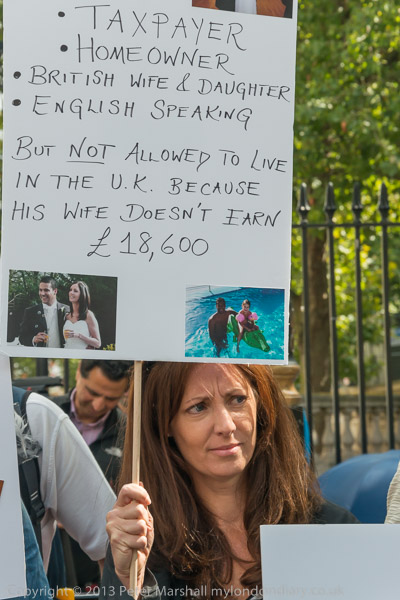
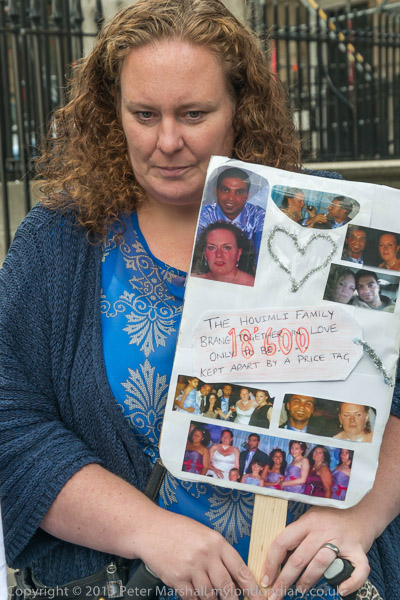
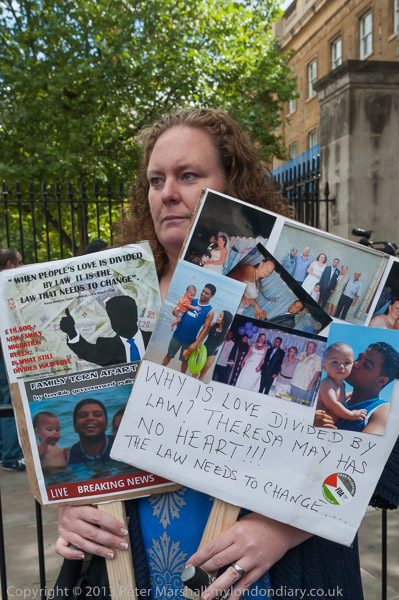
The cruel and unfair immigration rules set up by the Home Office under Theresa May mean that anyone earning less than £18,600 was unable to bring a non-EU spouse into the country (Brexit means that similar rules now apply to most EU countries.)

Families Separated, Gaza, Ghouta and Sri Lanka

This income requirement discriminates against women, the retired and disabled young and many minority ethnic people who have on average lower incomes than the general population. For couples with children, the income limit is even higher, and to secure visas for a spouse and two children you would need an income of £24,800.

Families Separated, Gaza, Ghouta and Sri Lanka

Fees for applications are also expensive – from £1048 to £1538 per person and applicants may also need to pay a healthcare premium of from £1560 to £3120 for adults and around three-quarters of this for each child. For applications made in the UK there is an extra £800 if you want a faster decision. And applicants also need to supply a great deal of documentation.

The policy, which also includes tougher English Language tests, a proof of greater attachment to the UK than of any other country and extending the probationary period from two to five years, is in direct contradiction of the Universal Declaration on Human Rights which states:

‘No one shall be subjected to arbitrary interference with his privacy, family, home or correspondence, nor to attacks upon his honour and reputation. Everyone has the right to the protection of the law against such interference or attacks.’

Universal Declaration on Human Rights

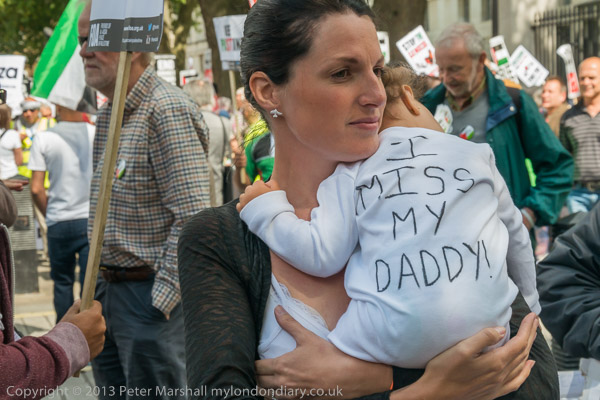
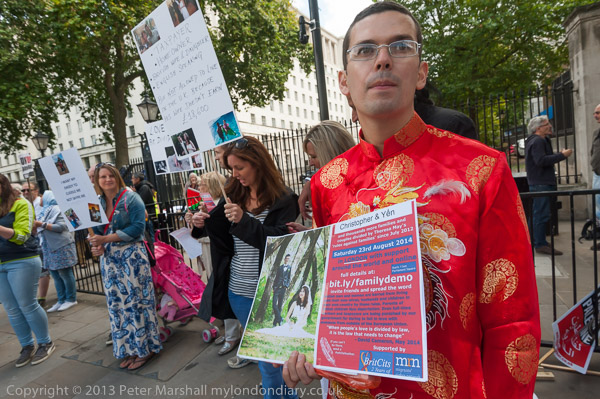
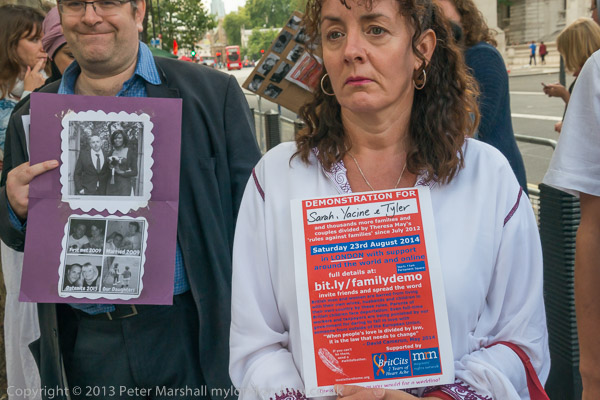
People at the protests included many whose families were divided as they were unable to meet the income levels, as well as a number of parents and friends of divided families.

Many carried placards with images of the divided families, along with captions such as ‘I WANT MY DADDY TO CUDDLE ME NOT SKYPE ME’. I felt deeply for those caught by what seem to be vindictive, unnecessary and totally insupportable polices. It was impossible not to agree with the placards with messages such as ‘WHY IS LOVE DIVIDED BY LAW? THERESA MAY HAS NO HEART!!! THE LAW NEEDS TO CHANGE….’

Divided Families protest over cruelty


Gaza Protest – Stop Arming Israel – Downing St

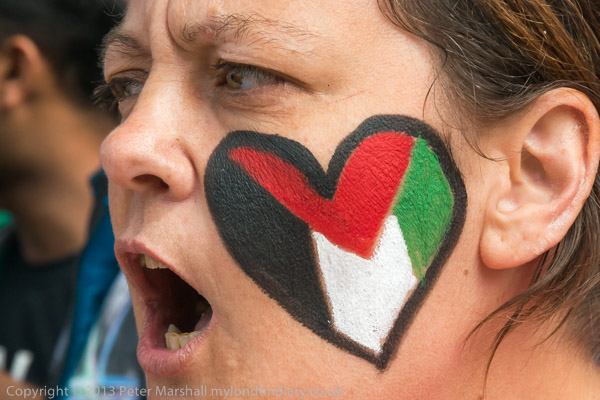
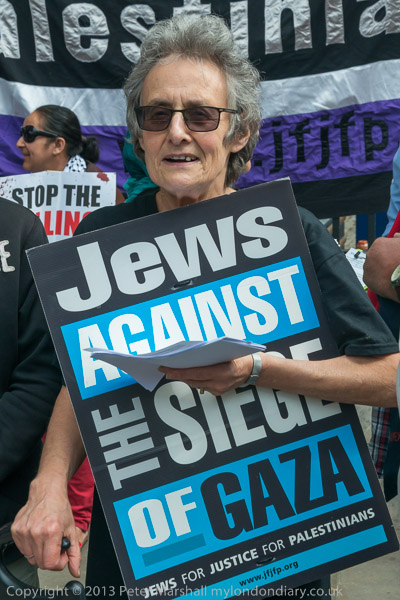
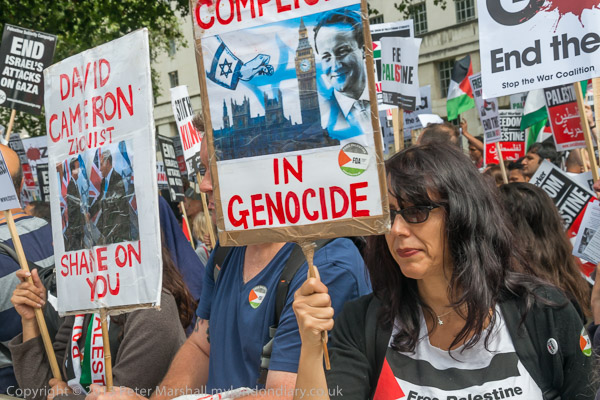
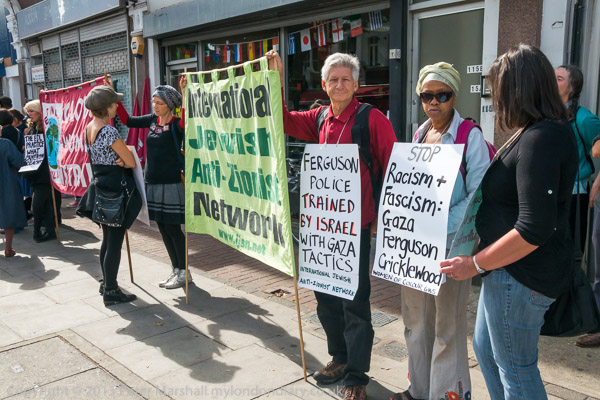
A large rally at Downing St called on the UK to stop selling arms to Israel, and for an end to Israeli war crimes. Among the protesters were many Jews from various Jewish groups, including the ultra-orthodox Neturei Karta who had walked down from north London to support the protest.

Israel had carried out air strikes on Gaza in July 2014 following a number of incidents including the shooting by the IDF of two Palestinian teenagers and the kidnapping and killing of three Israeli teenagers in the West Bank. There were other incidents including house demolitions and the kidnapping and killing of a Palestinian youth. Hamas replied to air strikes with rocket fire on Israel.
The Israeli invasion of Gaza began in earnest on 20th July and the ground war was still continuing though on a lesser scale when this protest took place, with a ceasefire being agreed and coming into effect on 26th August.

There are more details about the invasion in the Wikipedia Timeline, which states “2,256 Palestinians and 85 Israelis died, while 17,125 Palestinians, and 2,639 Israelis suffered injuries.”

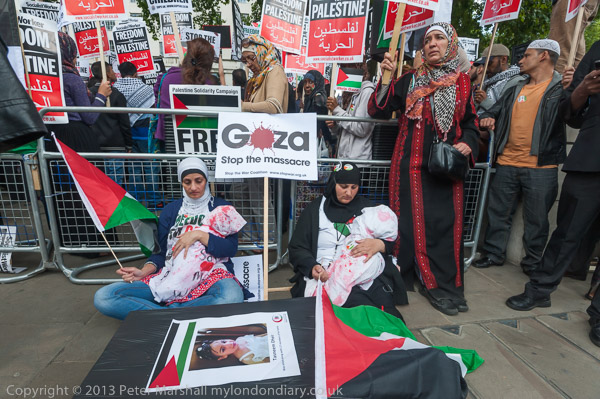
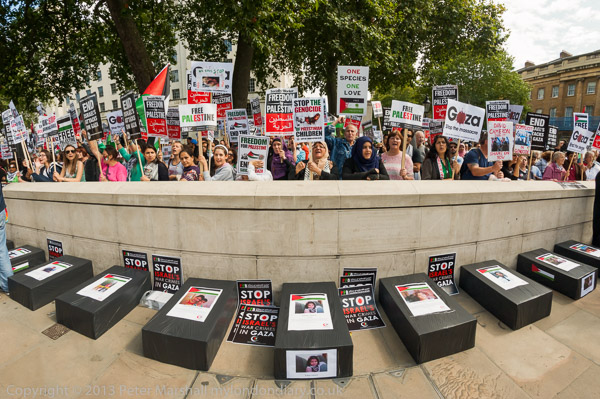
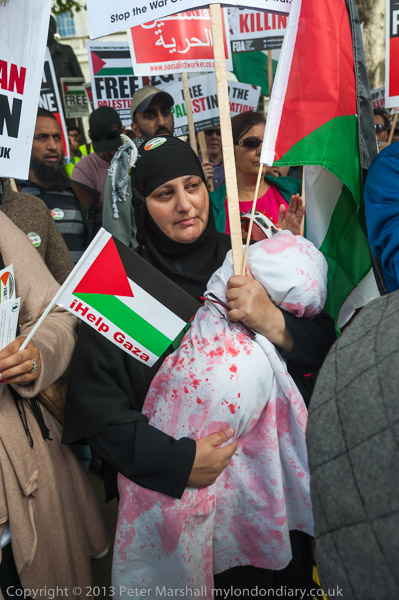
At the protest there was a row of black boxes representing coffins and the names of children killed, and some people carried ‘bloodstained’ bundles representing dead children

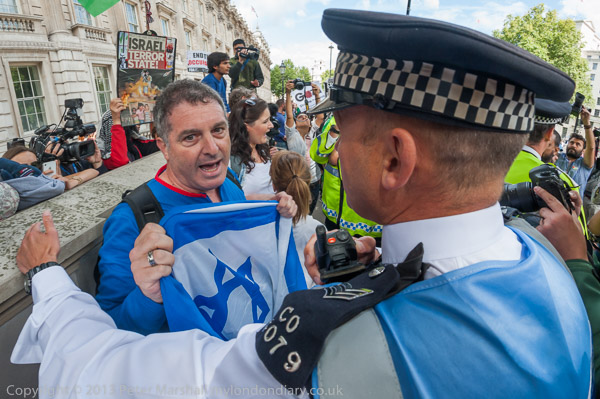
Three people came to wave Israeli flags across the road and were led away for safety by police.

Earlier one of the Palestinian protesters had tried to seize one of the flags and was dragged away by police. At the end of the rally opposite Downing St some of the protesters marched around London and I went with them as far as Trafalgar Square where I had another event to cover.

More pictures: Gaza Protest – Stop Arming Israel


Syria Chemical Massacre Anniversary – Trafalgar Square

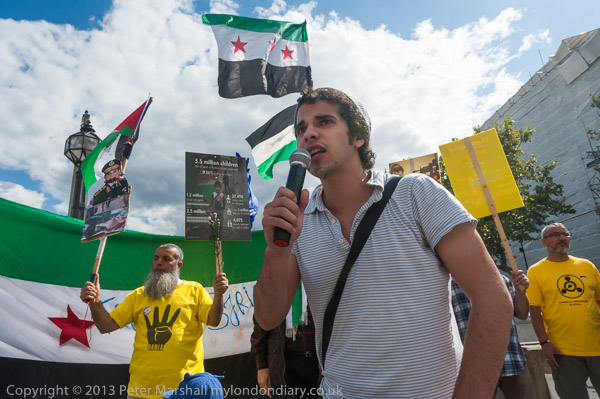
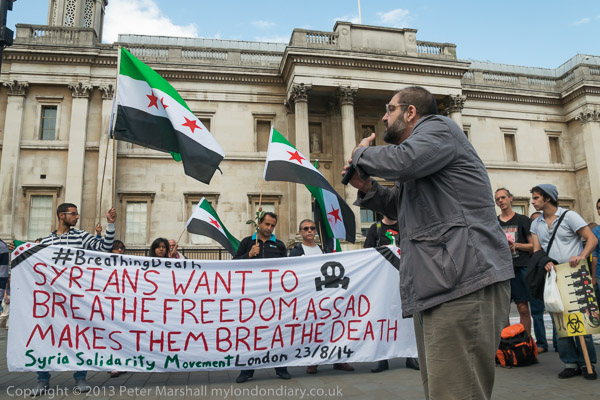
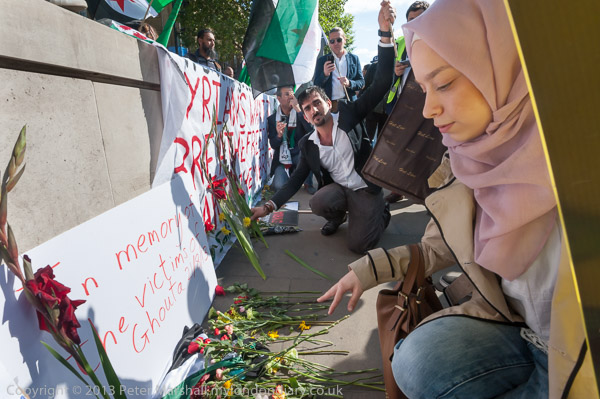
A rally marked a year after the Ghouta massacre of 21/08/2013 when Assad regime forces outraged the world by using Sarin gas, killing 1,477 residents including over 400 children in this Damascus suburb. The world failed to act against Assad.
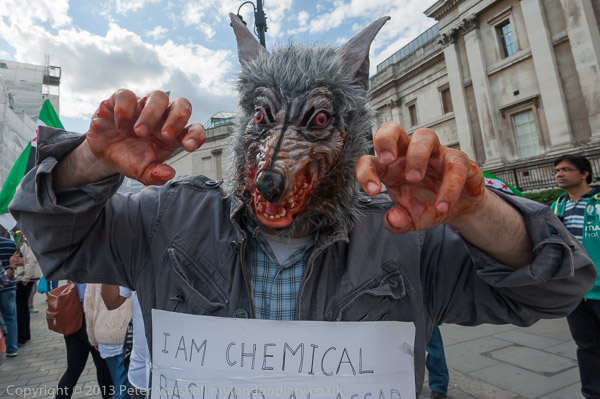
One man was wearing wolf head with bloody hands and placard ‘I AM CHEMICAL BASHAR AL ASSAD AND ONE YEAR ON I AM STILL GASSING SYRIAN CHILDREN. THANK YOU FOR UN VETO’

After an hour-long rally in Trafalgar Square the protesters, who were mainly Syrians, marched along the pavements to Richmond Terrace, opposite Downing St, where they laid flowers in memory of the dead.
More pictures: Syria Chemical Massacre Anniversary


Tamils protest Sri Lankan rapes & killing – Downing St

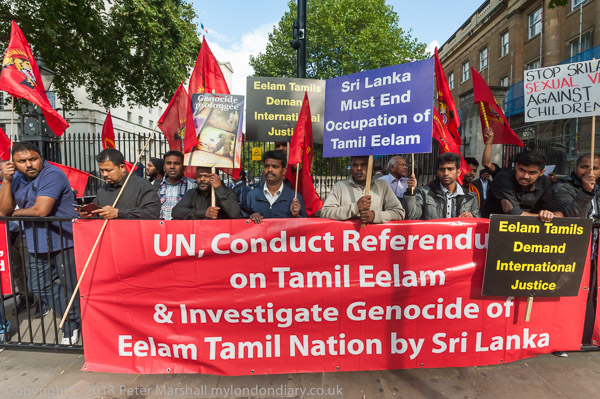
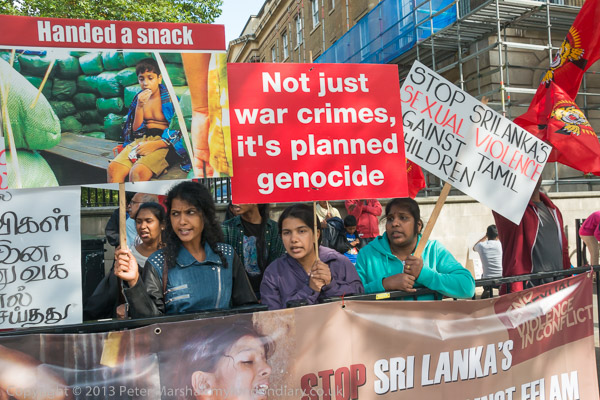
Also present when I returned to Downing St were Tamils protesting over the continuing genocide of the Tamil nation, calling for a UN investigation and referendum on Tamil Eelam.

Placards called for an end to the use of rape to destroy their nation and sexual violence against children.

More pictures: Tamils protest Sri Lankan rapes & killing


Music, Spoken Word and Protest

Music, Spoken Word and Protest
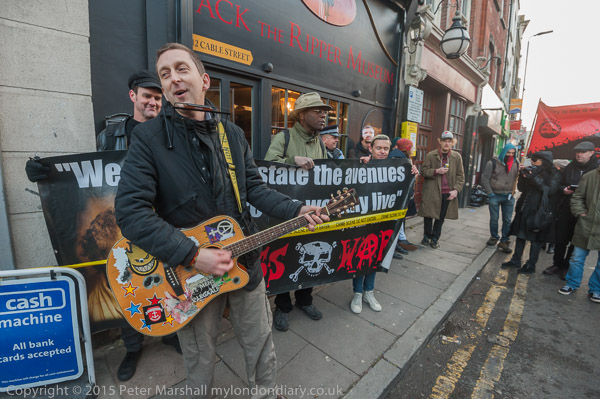
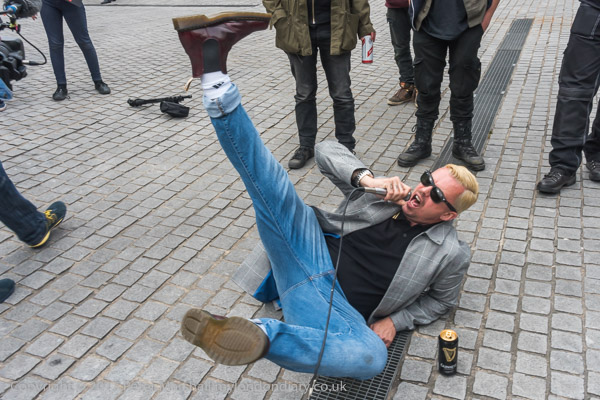
Cosmo sings at the Jack The Ripper protest, 2015

Music, Spoken Word and Protest. A week or two ago I received a Facebook invitation suggesting I listen to a monthly radio show on Riverside Radio, the Colin Crilly Takeover, a monthly show with hosts Andy Bungay and Colin Crilly. In this edition they were to “be playing SONGS with a political/social angle, and discussing the issues raised.”

Music, Spoken Word and Protest
Adam Clifford performs at Class War newspaper launch, White Cub, Bermondsey, 2017

Colin Crilly is someone I’ve often met and photographed on protests in London and who has on occasion asked me to be interviewed for the show, but I’ve never done so. Radio isn’t really an ideal medium for photography.

Music, Spoken Word and Protest
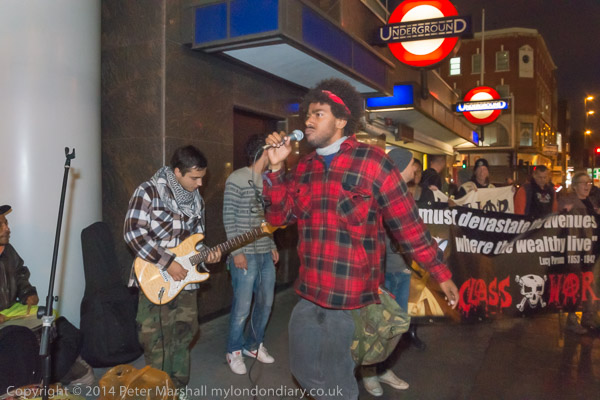
Different Moods play at Poor Doors protest, 2014

Riverside Radio is a local station covering a wide area of southwast London, mainly the boroughs of Wandsworth, Richmond and Merton but available to everyone on the web. I didn’t log on to the live show live as it airs for two hours from 11pm on a Saturday night, a time when I’m usually exhausted and only ready to fall asleep. Or if I’ve had a particularly busy day covering events I might still be editing the work.

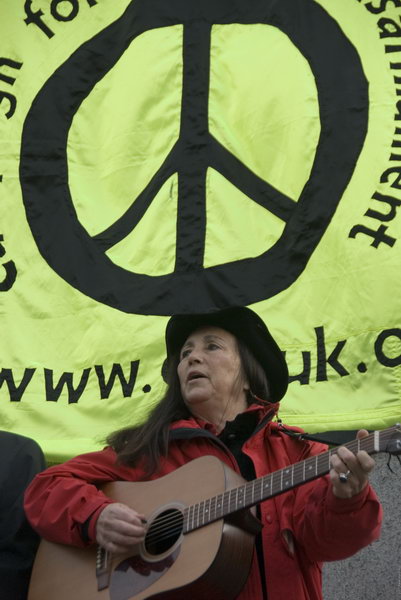
Julie Felix at CND protest, 2007

But a few days later, Colin sent me a link to a recording of the show on MixCloud and I began to listen to it. I’ve not managed to hear the whole two hours and I found MixCloud a frustrating experience as, perhaps because I haven’t subscribed, I couldn’t skip forward and when I took a rest it reverted to the start of the track. Since radio doesn’t come with pictures (except in the mind) I’ve added some of my own to this post.

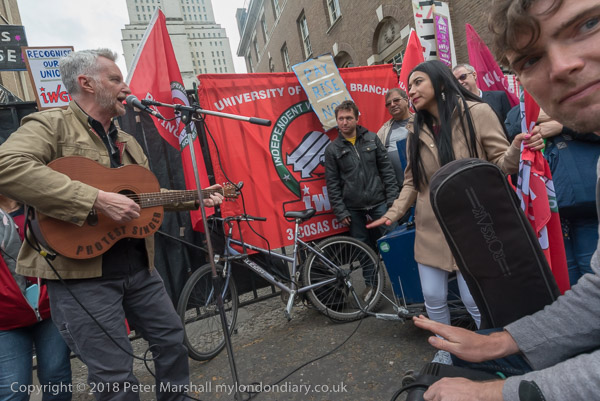
Billy Bragg supports IWGB strikers 2018

It was good to hear a track by Anne Feeney, the late great US folk musician, singer-activist and lawyer who died in 2021. Her ‘Have You Been To Jail For Justice?’ and her lines “A rotten law stays on the books til folks like us defy it, The law’s supposed to serve us, and so are the police, And when the system fails, it’s up to us to speak our piece …” are very relevant now. It led to some interesting discussion by Colin and Andy, but perhaps it could have been related rather more to the approaches of groups such as Extinction Rebellion and Insulate Britain in the UK.

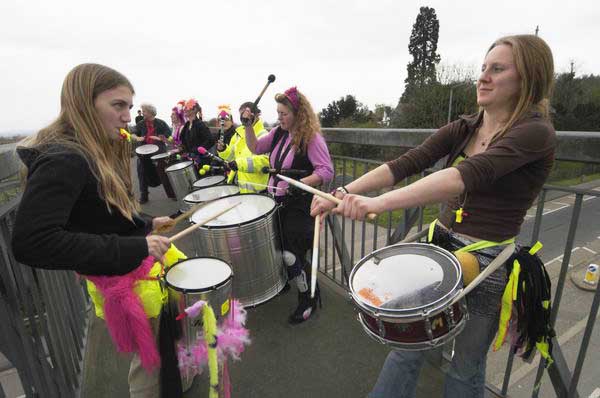
Sheffield Samba Band on march to Aldermaston, 2004

Next up was Paul Hardcastle’s ’19’, about the Vietnam War, but released in 1985, which apparently made a huge impression on a then-young Colin. It really was a ground-breaking release in several ways, but like the interview with John Lennon which followed – and preceded his ‘The Fool On the Hill’, did give the show seem rather an academic and historical approach to the subject.

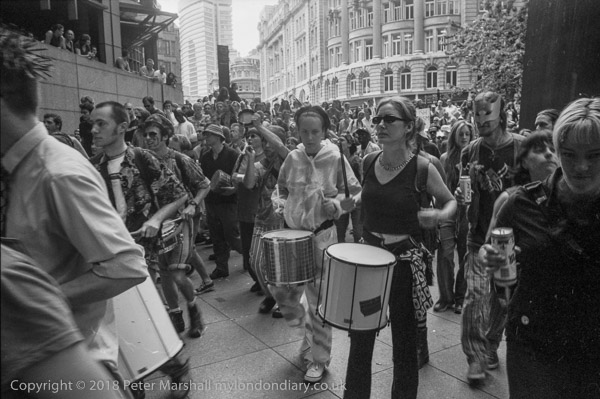
Samba band, Carnival Against Capitalism, 1999

I didn’t get much further in listening – and I think these were the only songs in the first hour of the show, though I might have fallen asleep a bit – there was a lot of long discussion. George Michael on BBC Hard Talk in 2002 came into it. It’s perhaps a shame that there wasn’t a playlist on the MixCloud page.

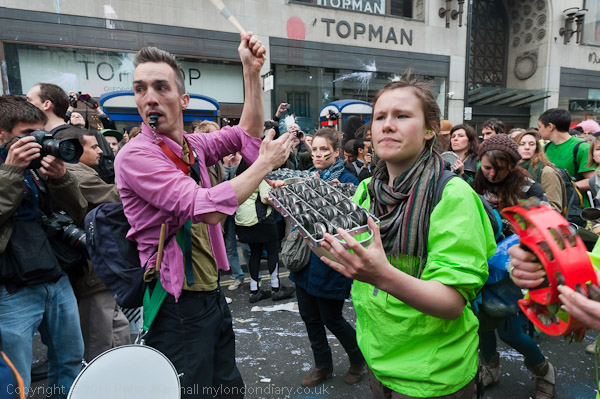
Samba – UK Uncut, 2011

Among the hashtags there was #london and I didn’t think I’d heard much about London or protests there in the part of the show I heard. Nor did I get to hear the promised Wood Guthrie, whose songs I used to play and sing badly from a much dog-eared paperbook in my youth, though fortunately seldom in public.

But many of the protests I’ve attended over the years have included performances by singers as well as spoken word performers, and of course the sound of almost all marches in recent years has been the samba band. How or if the recent act designed to prevent effective protest alters this remains to be seen.

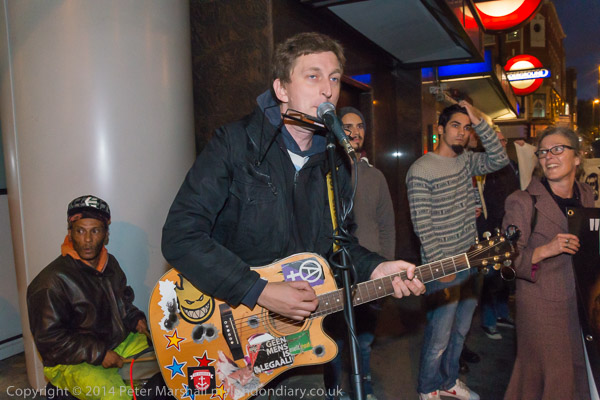
Cosmo at Poor Doors protest, 2014

I’ll just mention a few of those I’ve been impressed by – and have photographed in London. On his web site is this description of Cosmo, based in Wales as well as a number of music videos featuring him and his friends.

Cosmo is “a one-man folk-punk phenomenon.” (Miniature Music Press). Over the course of 14 albums and 30 years of touring, he has established himself as a formidable voice on the UK and international underground.

He has appeared at Glastonbury, the Edinburgh Fringe and other major UK festivals, as well as touring across the UK, Europe, North and South America and the Middle East. In that time, he has shared stages with Billy Bragg, Frank Turner, Grace Petrie, John Cooper Clarke, Mark Thomas and more. Cosmo has won awards at the Edinburgh fringe and Hay fringe festivals.

An activist as well as a musician, Cosmo has also performed at countless picket lines, protest camps, rallies and demos, as well as being involved with community organising.

https://www.cosmoguitar.com/about/

I’ve photographed Cosmo several times, particularly at protests with Class War and always been impressed by the lift he gives to protesters.

Grim Chip (left) outside the TUC, 2017

Quite a few rappers and poets have also performed at events I’ve photographed. Poetry on the Picket Line does exactly what the name suggest. Poets in the group, including hip Hamer, Janine Booth, Nadia Drews, Joe Solo, Tim Watts, Tim Kiely, Owen Collins, Repeat Beat Poet, Mark Coverdale, Lantern Carrier and Michael Breen, reading their work in the spirit of solidarity
on picket lines and at rallies.

Potent Whisper performs ‘Estate Of War’ at Class War’s Newspaper Launch at the White Cube 2017

Georgie, a London based rapper and spoken word artist performs as Potent Whisper. Dog Section Press published his ‘The Rhyming Guide to Grenfell Britain‘ including the text of nine full-length pieces, I think all of which I’d heard him deliver at various demonstrations as well as in videos, including The Rhyming Guide to NHS Privatisation, Estate of War and Grenfell Britain. The book is worth getting if you can find a copy. An article by him in the New Internationalist includes a link to his ‘You’ll Never Edit Grenfell‘ and you can view more on his YouTube channel.


Hindu Festival and Heathrow Protest 2007

Back in 2007, My London Diary’s text was still firmly stuck in lower case – an affectation perhaps reflecting my admiration for the work of ee cummings, whose works, though not completely free of capitals used rather less than the normal quota, but I did it more to speed up my use of the keyboard. I’ve corrected at least most of the capitalisation in the following account I wrote back then about the events I photographed on Sunday 19th August 2007. When I set out I hadn’t intended to go to Heathrow – their restrictive media policy had put me off, but a police search changed my mind.


Janam Ashtami Shobha Yaatra – Shri Krishna’s Birthday, Shree Ram Mandir, Southall

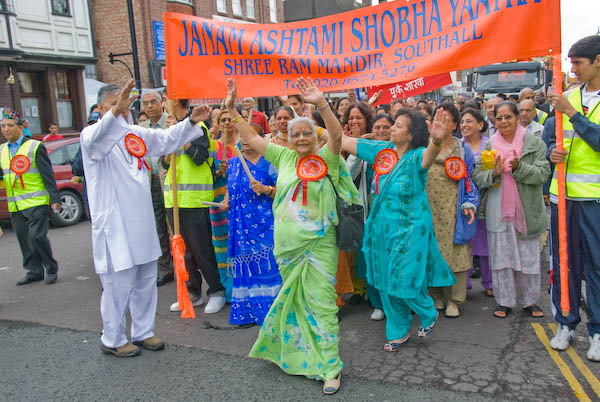
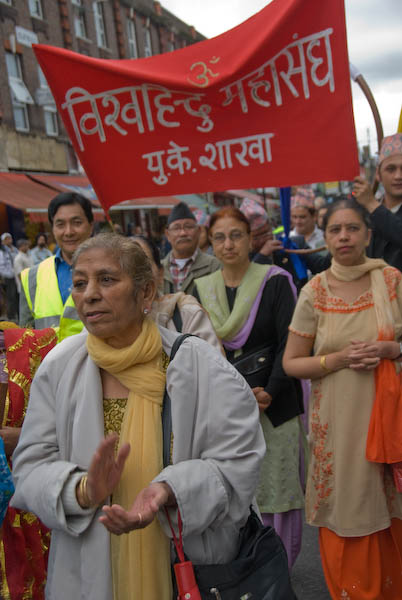
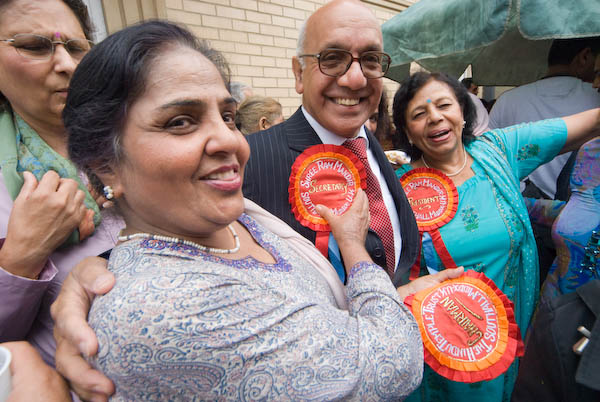
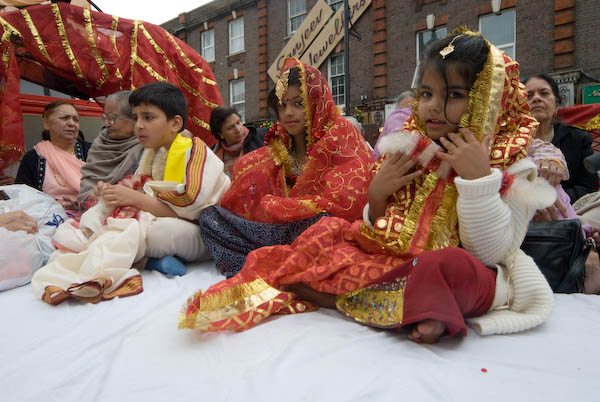
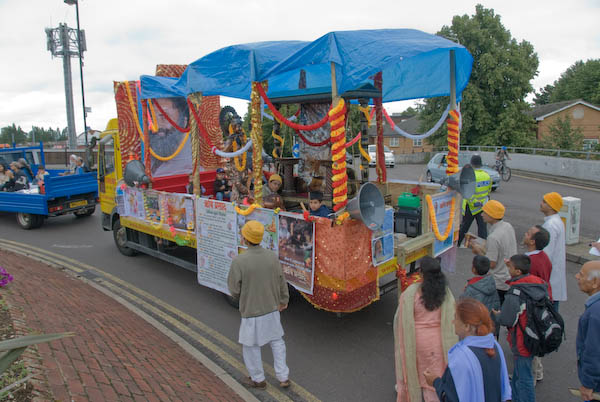
On Sunday 19th August 2007 I cycled through the light rain to the Shree Ram Mandir (Temple Of Lord Rama) in King Street, Southall, which was apparently the first Hindu temple established in Britain, although recently rebuilt. They were holding their Janam Ashtami Shobha Yaatra, a procession in honour of the birth anniversary of Krishna which in 2007 was on September 4th.

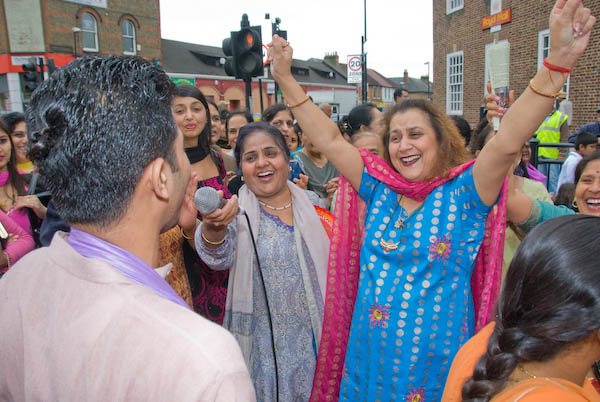
I have to admit to finding the Hindu religion confusing, but processions such as this are lively and colourful events even if their full appreciation may require a rather different mindset to mine.

it is easy to share the feelings of celebration and of community, and to feel the welcome given by so many. I also met for the first time the newly elected MP for Ealing Southall who held the seat for labour in last month’s by-election, Virendra Sharma, taking part in the procession; many were eager to pose for their picture with him.

Many more pictures on My London Diary


Heathrow Climate Camp Protestors – Bath Road, Sipson Sun 19 Aug 2007

I took a route back from Southall along the north side of Heathrow, close to the climate camp. On my way to Southall, along the Great South West Road which runs along the south-east of the airport, I’d been stopped and searched by police at Hatton Cross. Its a power that police are using more and more – on average around 11,000 a month in London now, and one that makes me feel uneasy. We now seem to be in a kind of police state I’ve certainly never voted for and don’t wish to live in.

I won’t appear in the Met’s figures, despite being searched in London, as the two officers concerned had been drafted in from Surrey for the day. They were polite and we had a pleasant enough conversation, but to me it still seems an unreasonable intrusion – and I think they only did it because they were bored. Under section 44 of the Terrorism Act 2000, the police can search anyone in an area designated as likely to be the subject of a terrorist attack – such as airports. They don’t need to have any grounds to suspect you, being there is enough.

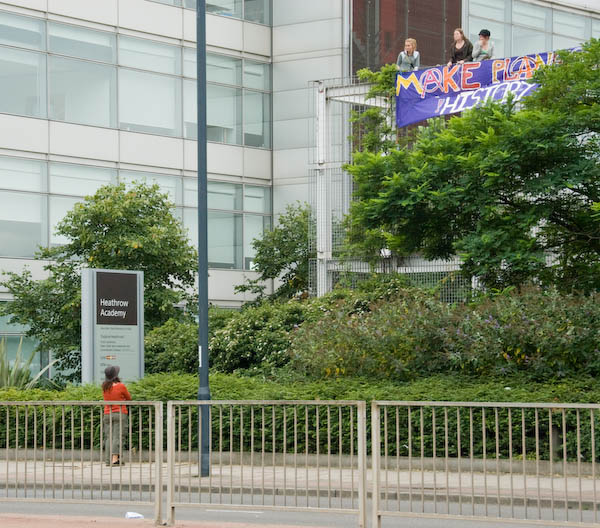
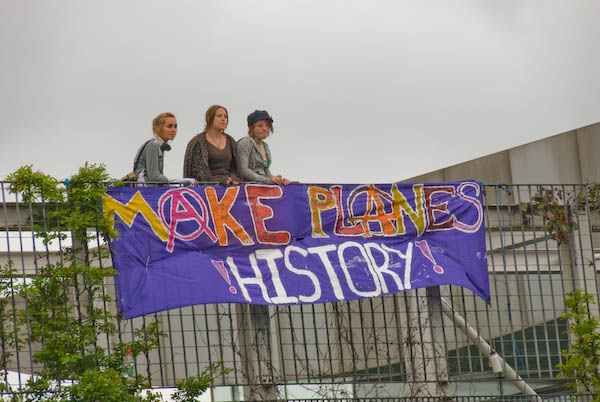
Cycling back along the pavement by the bath road (a shared path) there were rather more police around, but they were too busy with more likely targets to stop me. As I came along the road I found myself riding along with a woman who was obviously hurrying to get somewhere. We both stopped at the same point, opposite where three activists had scaled the side of a small building with a banner reading “MAKE PLANES HISTORY”.

She jumped over the fence between the two carriageways to approach the protesters, while I stayed on the opposite side from where I had a better view. Later she came back to talk to the TV crew beside me and was talking to one of the protesters – obviously she was proud of her daughter’s action.

And she had every right to be proud. we need action over Heathrow, action to prevent the takeover of even more land for the third runway. I’ve long opposed the expansion of Heathrow – and was on the local march against the third runway. Now there shouldn’t even be a possibility of further expansion, but the government must look at ways of running down the activities at Heathrow, or it will be failing not just west London but the world.

Further along the road I found protesters gathering around the British airports authority offices, which were ringed by police. Nothing much seemed to be happening and the media were there in force, so I left the guys to it. I’d previously been upset by the restrictive media policy adopted by the climate camp, which had the effect of preventing sensible photographic coverage of the event. So I was rather less interested than I might otherwise have been in putting myself out to take pictures.

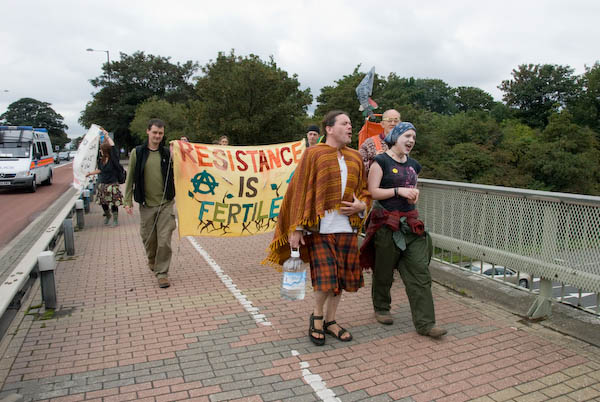
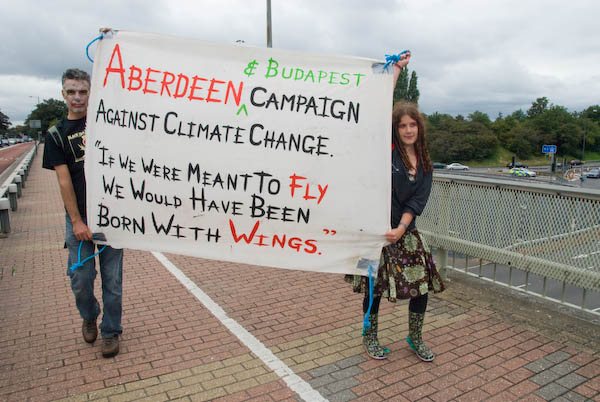
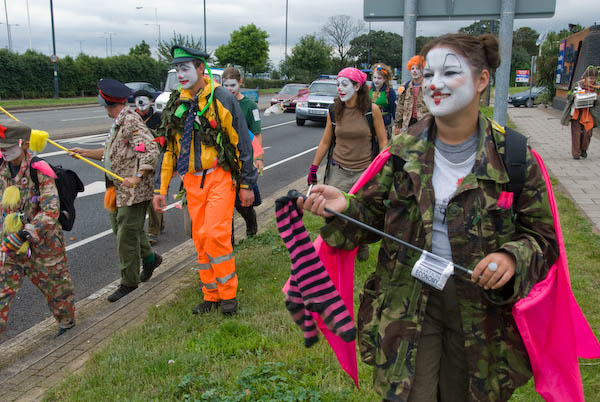
Along the road I met a few groups of demonstrators and did take a few pictures of them, including some on the bridge over the road into the airport, and a couple of the clown army being harassed by a police photo team, but my heart still wasn’t really in it.

The British airways offices had seemed to me a likely place for a confrontation – and obviously the police had thought so too, as teams of black clad figures paced up and down spoiling for a fight, watched over by the guys in uniform and a group of suits. At the top of the mound in front of the offices were a couple of officers on horses.

It was like some painting of the field lining up before a medieval battle, and I wish I’d stopped to take a picture, but they were so obviously looking for trouble I decided I didn’t want the aggravation that this would most likely have caused. For once you will just have to imagine it!

more pictures

London Solidarity with Marikana Miners

London Solidarity with Marikana Miners
South Africa House, 16th August 2014

London Solidarity with Marikana Miners Today, 16th August 2022, from 5pm people will be outside South Africa House to remember the massacre ten years ago of 34 striking miners at Lonmin’s Marikana platinum mine, a massacre deliberately planned by South African police working for London mining company Lonmin, whose directors at the time included Cyril Ramaphosa, now President of South Africa.

London Solidarity with Marikana Miners
Outside Lonmin offices, London, 18th August 2012

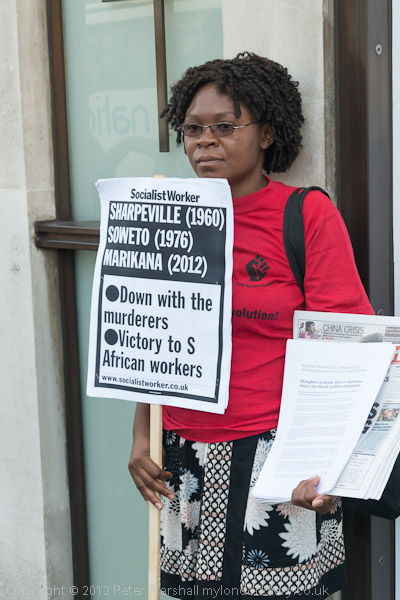
It was an attack that brought back memories of the Sharpeville massacre of 1960 and the 1976 Soweto Uprising, things we had perhaps thought no longer possible after the overthrow of the white apartheid regime. South Africa may have got rid of its crude system of racial injustice but it was a demonstration that there are still huge differences and exploitation based on wealth and privilege – and of the lengths that those who benefit most from these are willing to go to maintain their position. A naked expression of class war.

London Solidarity with Marikana Miners
South Africa House, 18th August 2012

As usual, Wikipedia gives a detailed account of what took place, although some details are unknown or contested, and my account here largely relies on it. The massacre “was the culmination of a series of violent encounters between the SAPS, Lonmin security, and members of the National Union of Mineworkers (NUM) on one side; and strikers on the other.” Various clashes in the five days before it had led to a number of strikers being injured and ten deaths, of “six mine workers, two Lonmin security guards, and two SAPS members.

South Africa House, 16th August 2017

It was not a single massacre on 16th August; police opened fire with their assault rifles on two groups of miners around 500 metres apart, killing seventeen at each of these places. Police say they first tried to control the strikers with water cannons, rubber bullets, stun grenades and tear gas. The miners were largely armed with spears, knives and sticks, but six guns were later found at the site, including one taken from a police officer killed earlier in the week.

South Africa House, 16th August 2018

Police accounts as in this country are seldom reliable, usually decorated or invented to justify and defend their actions. But there were more independent observers. A Reuters photographer present does confirm that he saw one of the strikers firing a pistol before the police opened fire. The noted South African journalist Greg Marinovich who investigated the scene closely found that some of the miners killed were shot at close range or crushed by police vehicles, but most were targeted and killed from around 300 metres, concluding “It is becoming clear to this reporter that heavily armed police hunted down and killed the miners in cold blood.” Other reports say police shot and killed miners who had their hands up in surrender.

South Africa House, 16th August 2019

270 miners were arrested and charged with ‘public violence’ which was later changed to murder, using the doctrine of “common purpose”. Most of those arrested complained that they were beaten in custody. Eventually after great public outcry the charges were dropped and most of those arrested released.

South Africa House, 16th August 2014

A commission was set up into the massacre, though many feel it made its inquiries after the authorities had time to cover up and falsify evidence. And although it made recommendations none has been implemented and no prosecutions have followed. You can watch a recent long interview with Rehad Desai, derector of the documentary film ‘Miners Shot Down‘ (Trailer here) from a few days ago on YouTube, Marikana Massacre | A decade later, still no justice.

South Africa House, 16th August 2014

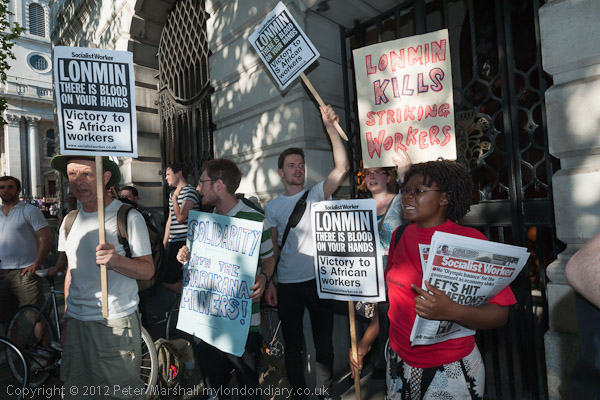
The first protest in London took place two days later on 18th August 2012, when a small group of people marched from the Lonmin offices at Hyde Park Corner to South Africa House in Trafalgar Square.

Lonmin HQ, London, 16th August 2017

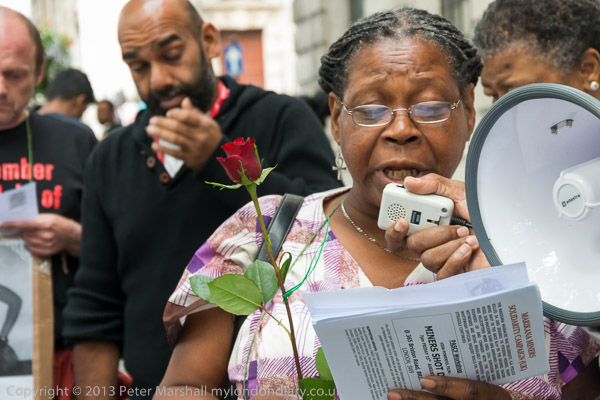
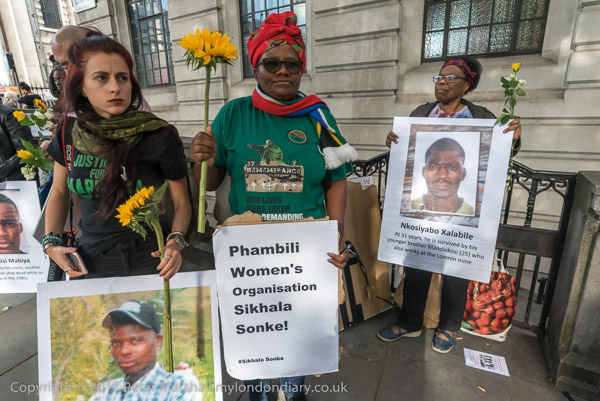
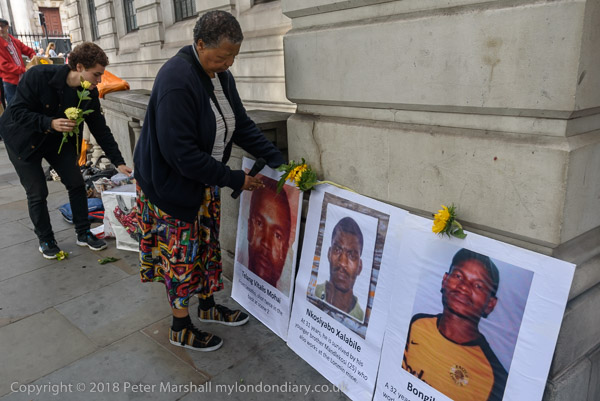
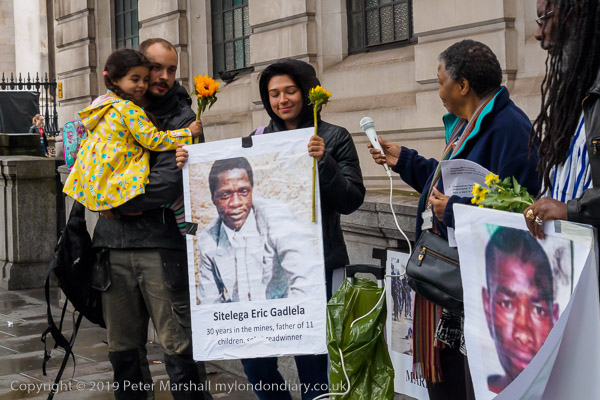
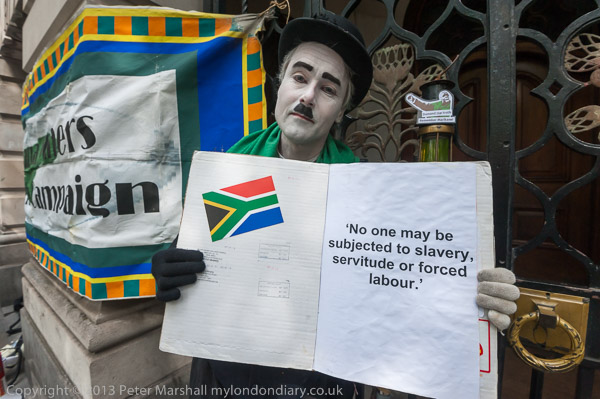
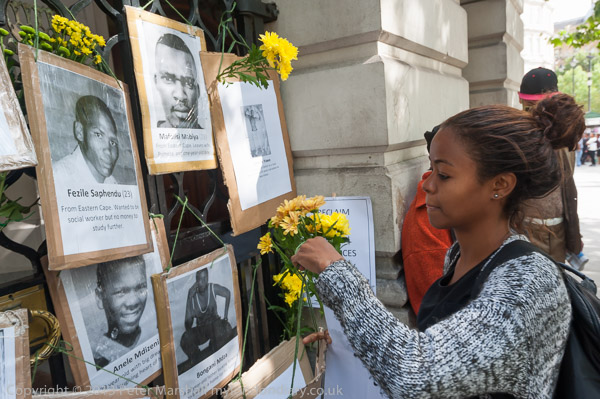
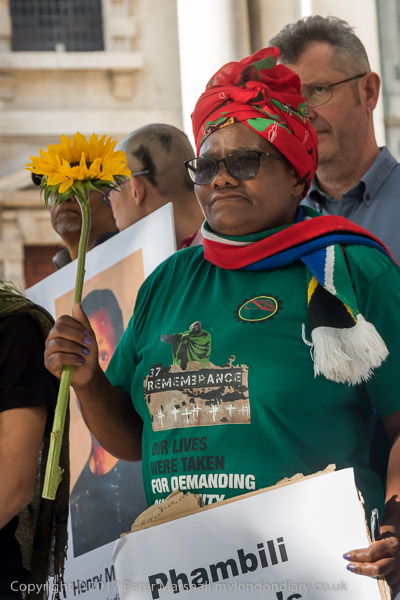
There have been protests each year on or close to the anniversary, with vigils outside South Africa House, where security have often come to harass those holding the events. But after the offices there have closed for the day and the security are off-duty people put flowers and pictures of the murdered miners on the gates and walls.

South Africa House, 16th August 2017

And there are speeches and songs and a silence. Some years those taking part have included guests from the Marikana women’s organisation Sikhala Sonke (We Cry Together), including Primrose Nokulunga Sonti who have joined those from various African and UK organisation members at the vigil.