DPAC at BBC – Tell The Truth! 2013

Broadcasting House

DPAC at BBC - Tell The Truth! 2013
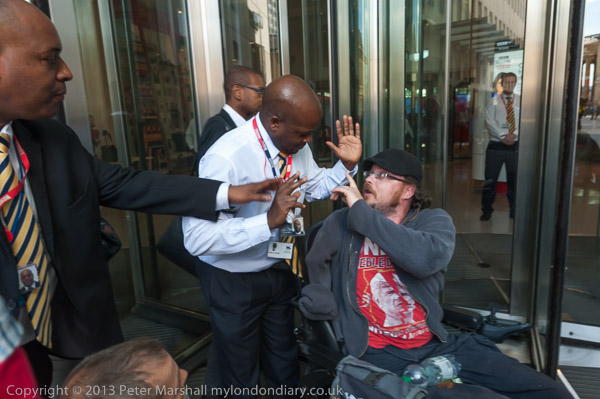
BBC security try to get a protester to move – but he refuses

DPAC at BBC – Tell The Truth! Although the BBC has some excellent reporters and produces some great programmes, particularly on Radio 4 and in its World Service, in its coverage of the UK it too often acts as a government mouthpiece. In particular few if any protests get reported, and I would be fairly sure that this one on Monday 2nd September 2013 at Broadcasting House got no mention in the day’s news.
DPAC at BBC - Tell The Truth! 2013
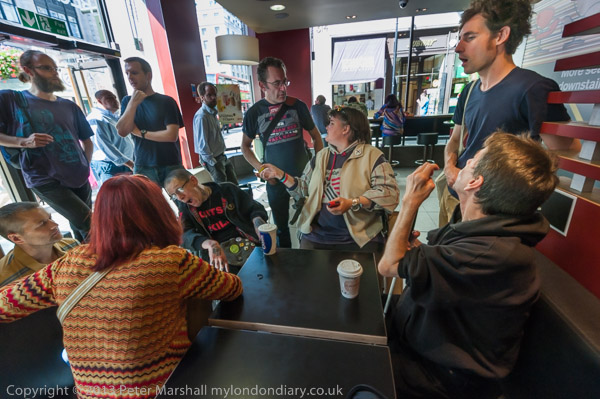
Activists meet up in a McDonalds not far from the BBC

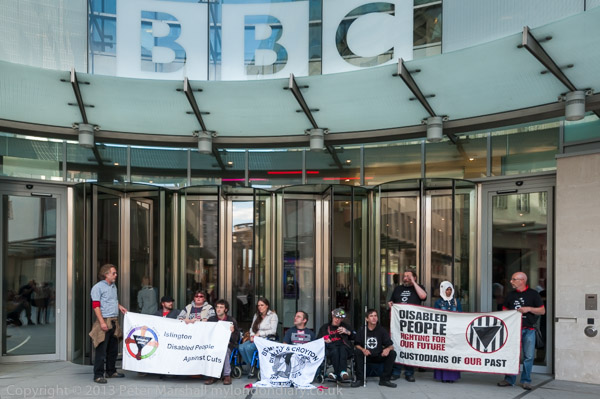
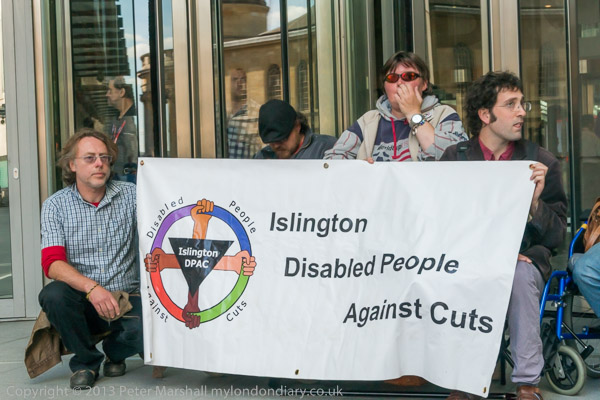
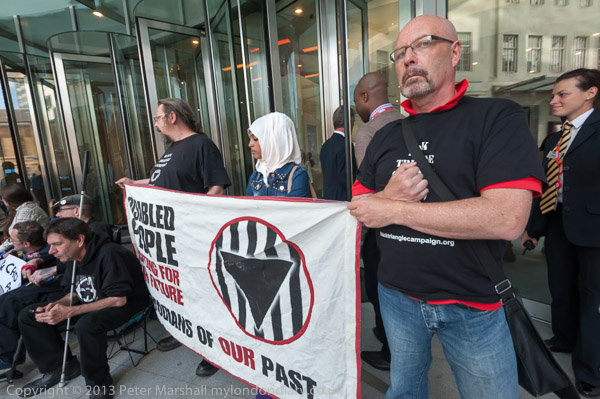
Disabled People Against Cuts (DPAC) and the Scottish Black Triangle campaign came to protest at the failure by the BBX to report truthfully the effects of government cuts – particularly hard on the disabled – blocking the main BBC entrance to Broadcasting House for an hour.
DPAC at BBC - Tell The Truth! 2013
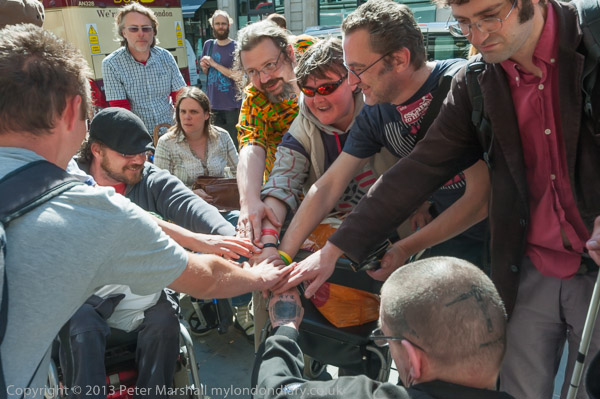
Outside they joined hands before setting out on the protest

The BBC of course relies on the government to award the licence fee settlement and it also appoints the members of the trust which is responsible for its running. And many appointments of senior staff – from the Director General down are essentially made by the government, so it is perhaps unsurprising that the BBC as a whole fails to offer any radical perspective on UK affairs.
DPAC at BBC - Tell The Truth! 2013
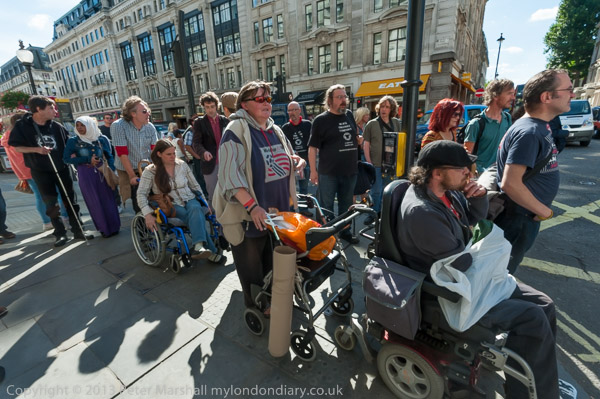
They make their way along the street to the BBC

When the Tories came back into power – at first with the help of the Liberal Democrats to whom they threw a few minor carrots (including the 2011 rigged referendum on proportional representation) they instituted an austerity programme that in particular targeted the disabled.
DPAC at BBC - Tell The Truth! 2013
The protesters set up quickly across the entrance

They clearly thought that supporting the disabled was a waste of money and that they would be an easy target to reduce benefits. DPAC and others had shown them they were wrong, with a series of direct action protests – which the BBC largely failed to report, although some were covered by foreign media.
Disabled people had several advantages which aided their protests. Firstly they enjoyed a great deal of public support which meant in particular that police (who often also sympathised with their case) had to handle them with much more consideration and care than non-disabled protesters, particularly when the press were present. Batoning people in wheelchairs would not be good for the public image – and I never saw it happen.
And secondly they presented practical problems for the police, particularly in making arrests of protesters in wheelchairs or on mobility scooters. Police cars and vans are not generally equipped to handle these safely. I can only remember one protest where the police had hired a suitable vehicle – and it only accommodated a single wheelchair.
DPAC invited me to photograph this protest and I met them in a nearby cafe to discuss final plans before making their way with legal observers and a few photographers unnoticed to the main entrance of the BBC building.
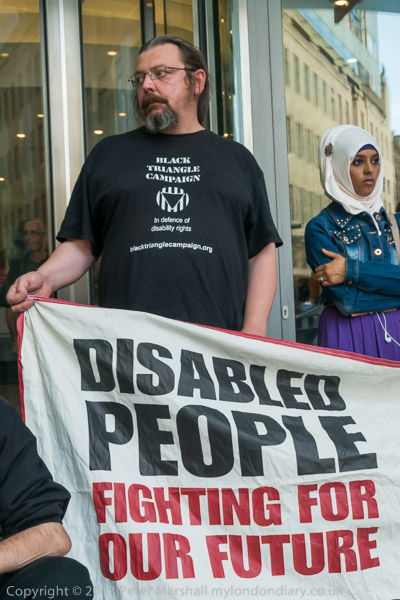
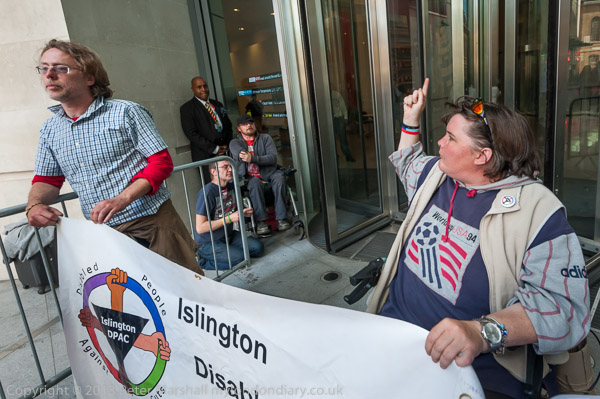
Here they spread across the doors and brought out their banners. BBC security failed to stop them but did manage to keep one door at the end free so people could still enter and leave the building.
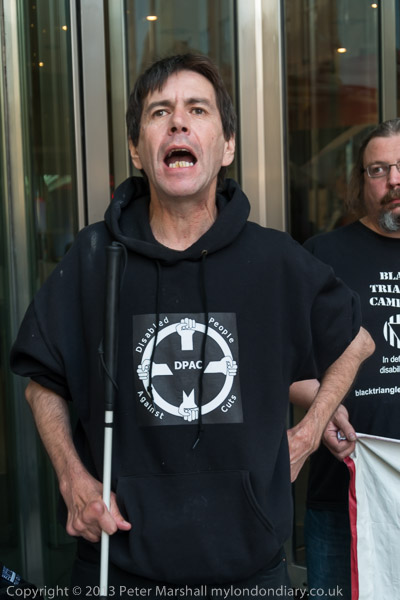
Many of the protesters spoke about why they were there, calling on the BBC to do its job and report properly on the effects of the cuts on the disabled

A number of the protesters then spoke in turn about the failure of the BBC to report the real hardship caused by ATOS assessments and the withdrawal of benefits, benefit cuts and caps and the bedroom tax. They were all fed up with the BBC repeating the lies and half-truths of government and asked why the real problems and numerous deaths from the austerity programme and the protests over these were not being properly reported.
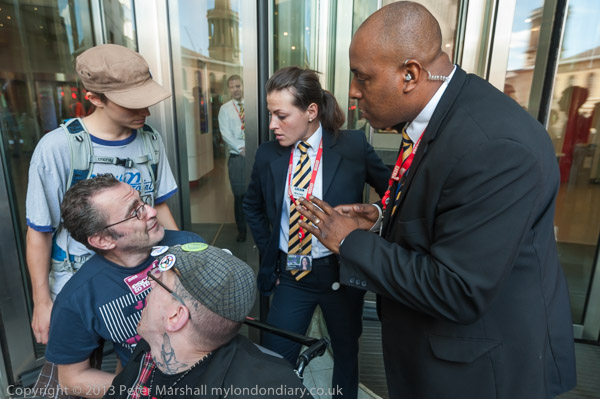
BBC security try to move the protesters but after some argument they backed off

The situation was dire for many poor and disabled people, with over 500,000 having to resort to food banks set up by churches and charities to fend off starvation.
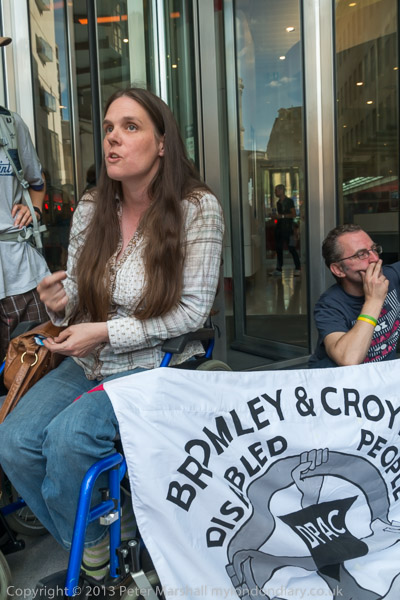
The protesters chanted ‘BBC, Tell the Truth’ and called for someone from the BBC to come and discuss the issue with them – but no one came. They made clear they were not asking for special treatment for the disabled but for the BBC to live up to the reputation it once had for impartial reporting.
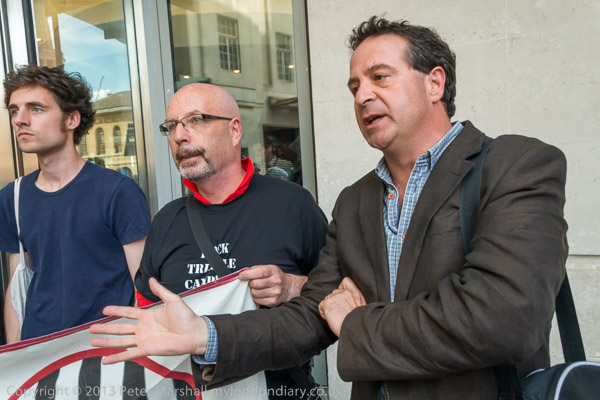
Mark Thomas congratulated the protesters and expressed his support for their attempt to get the BBC to report in an unbiased manner

They were joined for some minutes by activist comedian Mark Thomas who had been at a meeting inside the BBC. He recognised some of the protesters, talked with them and gave a short speech in support.
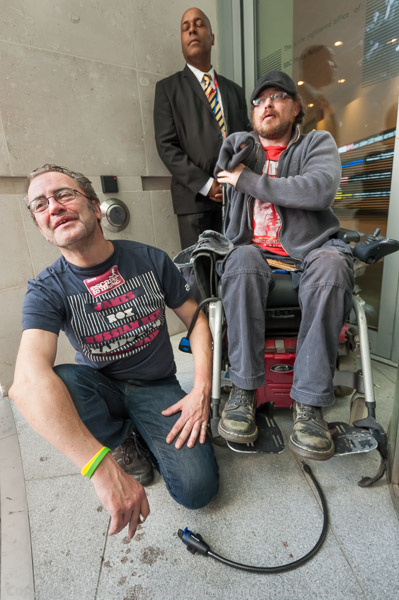
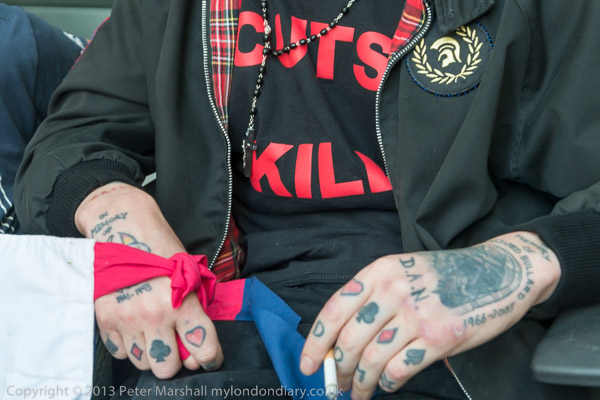
Shortly after two of the protesters in wheelchairs moved to lock themselves in front of the remaining open door closing it for the remainder of the protest. BBC security then called the police and two cars arrived.
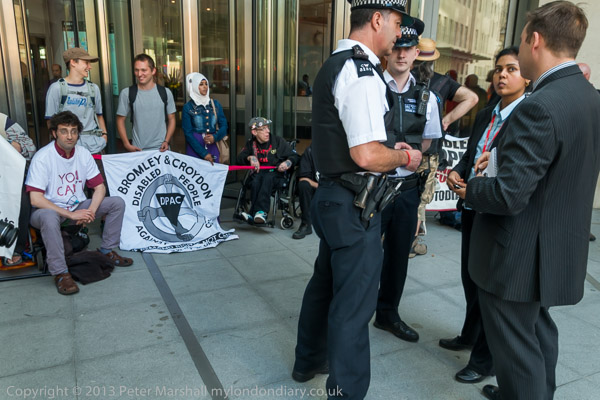
Police talked with security and then came and talked to the protesters. The told the police it was a one hour protest and they would then leave peacefully. Police stayed and watched until the end of the hour when the protesters got up and left.

Before they did so, a BBC cameraman arrived having been asked to film the protest – not for news but for possible use in the future. “I joked with him he might try and sell the footage to Sky or some other broadcaster who were rather more likely to use it.”

Many more pictures on My London Diary at DPAC at BBC – Tell The Truth.


Flickr – Facebook – My London Diary – Hull Photos – Lea Valley – Paris
London’s Industrial Heritage – London Photos

All photographs on this page are copyright © Peter Marshall.
Contact me to buy prints or licence to reproduce.

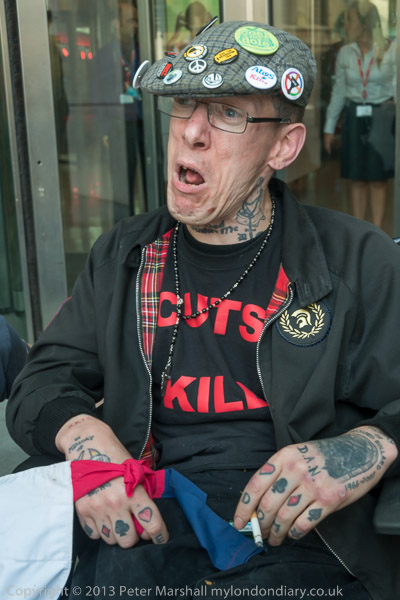
Disabled Protest at BBC in London

Disabled Protest at BBC in London
“Hands OFf” protester Andy Greene tells BBC secuirty

Disabled Protest at BBC in London: On Monday 2nd September 2013 I went with disablement protesters, some in wheelchairs, who were protesting at Broadcasting House in London at the BBC’s failure to report truthfully the effects of government cuts, particularly on the disabled. They blocked the main BBC entrance for an hour, with some locking themselves to the doors.

Disabled Protest at BBC in London
DPAC activists meet in McDonalds near the BBC

The BBC eventually called the police, who arrived not long before the protest was to end, and when they told the police this, the police stood back and watched until they did pack up and leave. Of course the protest was only a minor inconvenience to the BBC as there are alternative entrances which people were able to use.

They join hands before going to the BBC

At one point a BBC TV cameraman turned up who had been asked to film the protesters. I joked with them that perhaps he would be able to sell his footage to ITV news as it was most unlikely that it would be shown by the BBC. And I was correct in that there was no mention of the protest at all on BBC news programmes. Perhaps a few years later the footage might appear in some feature about disabled people.

The protesters took turns in speaking out about the failure of the BBC to report the real hardship caused by ATOS assessments and the withdrawal of benefits, benefit cuts and caps and the bedroom tax. All were fed up with the BBC repeating the lies and half-truths of government and asked why the real problems and numerous deaths from the austerity programme and the protests over these were not being properly reported.

Outside the main BBC entrance

The situation was critical for many poor and disabled people, with over 500,000 having to resort to food banks set up by churches and charities to fend off starvation. The protesters chanted ‘BBC, Tell the Truth’ and requested someone from the BBC to come and discuss the issue with them – but no one would.

They made clear they were not asking for special treatment for the disabled, but for full, accurate and impartial reporting – something the BBC once had a reputation for, but sadly no more.

They were joined by chance by activist comedian Mark Thomas who had been inside the BBC when they arrived. Some had recently met him during his ‘Mass Miracle’ performance outs Atos’s Edinburgh office which had been a part of the previous months Edinburgh fringe. He was persuaded to speak briefly and gave his support to the protest, praising the protesters for coming to make their views known to the BBC.

I have mixed feelings about the BBC which still does produce some fine programmes but also I think has failed in many ways. Although they are supposedly independent they are very much an establishment mouthpiece and they very much work from the point of view of the wealthier parts of our class-ridden society.

BBC Security failed to persuade them to move

Journalist Emily Maitlis has recently spoken out about the ‘Tory cronyism at the heart of the BBC’ and their misguided approach to impartiality which led, for example, to climate deniers being given equal prominence to the huge body of scientific evidence over the extreme dangers of climate change.

Protesters took turns to speak about the effect of the cuts

Maitlis is clearly an accomplished journalist and presenter with a long and successful career. But she was in a very well paid post at the BBC, is married to an investment manager and lives and works in a very different world to the great majority of the British people. At least she was one of relatively few in such positions who was educated at a state school (though certainly not a bog-standard one) before going to Cambridge.

Eventually police arrived – and protesters told them they would leave shortly

But for years it has been clear that we can not rely on the BBC for a comprehensive view of events in the UK and around the world. If you want to be well-informed about what is happening and why you need to look and listen to other sources – including the BBC’s own World Service, and other UK and foreign news services (which often have a very different bias), as well as alternative UK media such as Double Down News, Novara Media and The Canary.

But the BBC has increasingly come under threats from governments who control its purse-strings – if at a slight distance. I don’t pay a licence fee because I don’t view TV but do listen to BBC radio for an hour or two most days, though usually with half and ear while doing other things. The BBC is still much better in many ways than the commercial alternatives and in a different league to those in some other countries – such as the USA.

More pictures at DPAC at BBC – Tell The Truth.