DPAC at BBC – Tell The Truth! 2013

Broadcasting House

DPAC at BBC - Tell The Truth! 2013
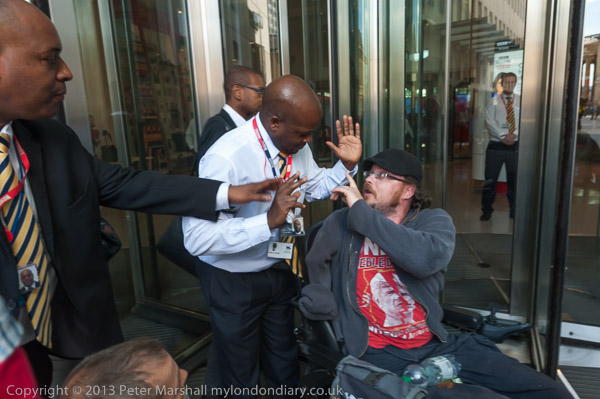
BBC security try to get a protester to move – but he refuses

DPAC at BBC – Tell The Truth! Although the BBC has some excellent reporters and produces some great programmes, particularly on Radio 4 and in its World Service, in its coverage of the UK it too often acts as a government mouthpiece. In particular few if any protests get reported, and I would be fairly sure that this one on Monday 2nd September 2013 at Broadcasting House got no mention in the day’s news.
DPAC at BBC - Tell The Truth! 2013
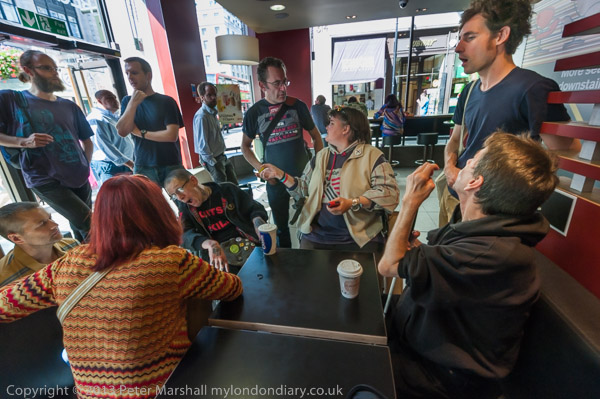
Activists meet up in a McDonalds not far from the BBC

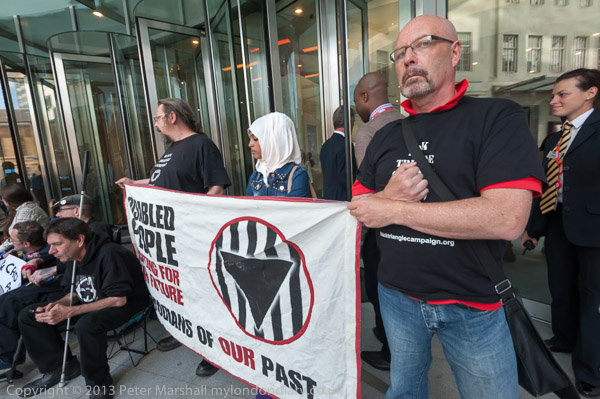
Disabled People Against Cuts (DPAC) and the Scottish Black Triangle campaign came to protest at the failure by the BBX to report truthfully the effects of government cuts – particularly hard on the disabled – blocking the main BBC entrance to Broadcasting House for an hour.
DPAC at BBC - Tell The Truth! 2013
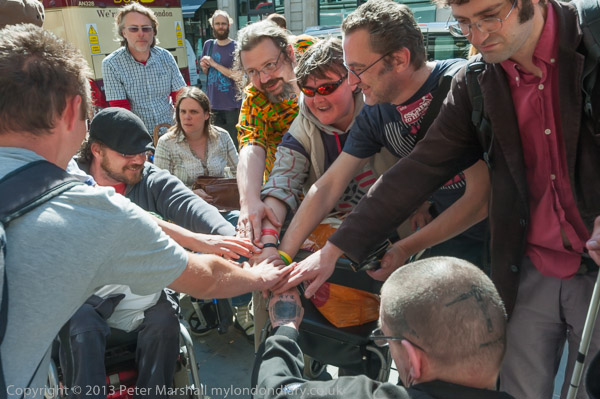
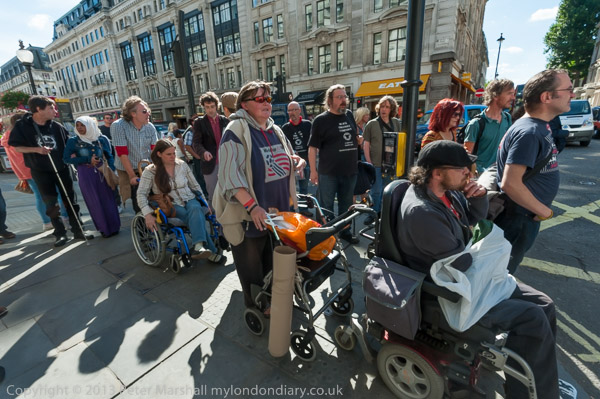
Outside they joined hands before setting out on the protest

The BBC of course relies on the government to award the licence fee settlement and it also appoints the members of the trust which is responsible for its running. And many appointments of senior staff – from the Director General down are essentially made by the government, so it is perhaps unsurprising that the BBC as a whole fails to offer any radical perspective on UK affairs.
DPAC at BBC - Tell The Truth! 2013
They make their way along the street to the BBC

When the Tories came back into power – at first with the help of the Liberal Democrats to whom they threw a few minor carrots (including the 2011 rigged referendum on proportional representation) they instituted an austerity programme that in particular targeted the disabled.
DPAC at BBC - Tell The Truth! 2013
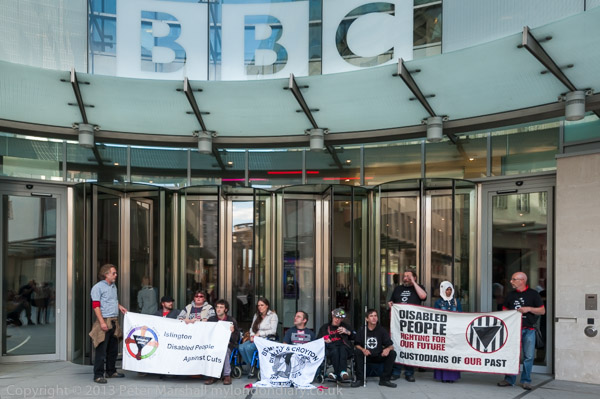
The protesters set up quickly across the entrance

They clearly thought that supporting the disabled was a waste of money and that they would be an easy target to reduce benefits. DPAC and others had shown them they were wrong, with a series of direct action protests – which the BBC largely failed to report, although some were covered by foreign media.
Disabled people had several advantages which aided their protests. Firstly they enjoyed a great deal of public support which meant in particular that police (who often also sympathised with their case) had to handle them with much more consideration and care than non-disabled protesters, particularly when the press were present. Batoning people in wheelchairs would not be good for the public image – and I never saw it happen.
And secondly they presented practical problems for the police, particularly in making arrests of protesters in wheelchairs or on mobility scooters. Police cars and vans are not generally equipped to handle these safely. I can only remember one protest where the police had hired a suitable vehicle – and it only accommodated a single wheelchair.
DPAC invited me to photograph this protest and I met them in a nearby cafe to discuss final plans before making their way with legal observers and a few photographers unnoticed to the main entrance of the BBC building.
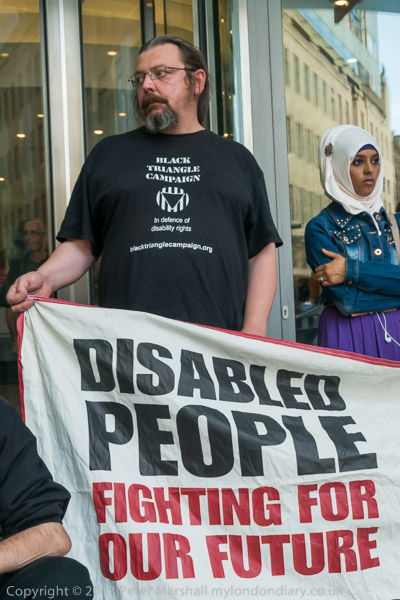
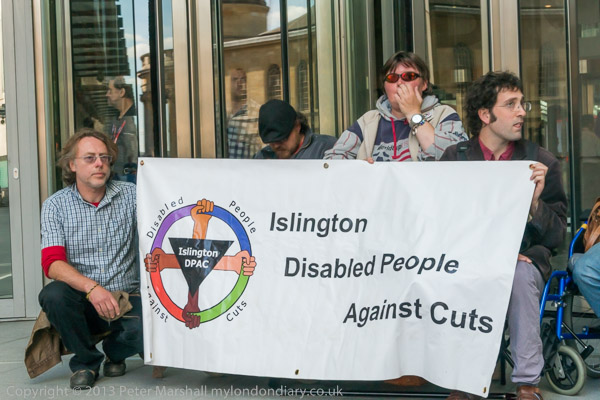
Here they spread across the doors and brought out their banners. BBC security failed to stop them but did manage to keep one door at the end free so people could still enter and leave the building.
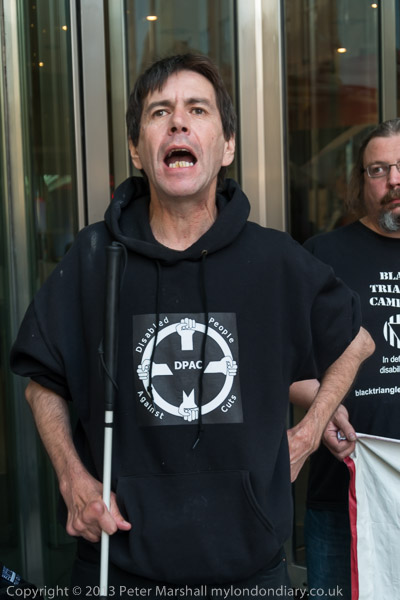
Many of the protesters spoke about why they were there, calling on the BBC to do its job and report properly on the effects of the cuts on the disabled

A number of the protesters then spoke in turn about the failure of the BBC to report the real hardship caused by ATOS assessments and the withdrawal of benefits, benefit cuts and caps and the bedroom tax. They were all fed up with the BBC repeating the lies and half-truths of government and asked why the real problems and numerous deaths from the austerity programme and the protests over these were not being properly reported.
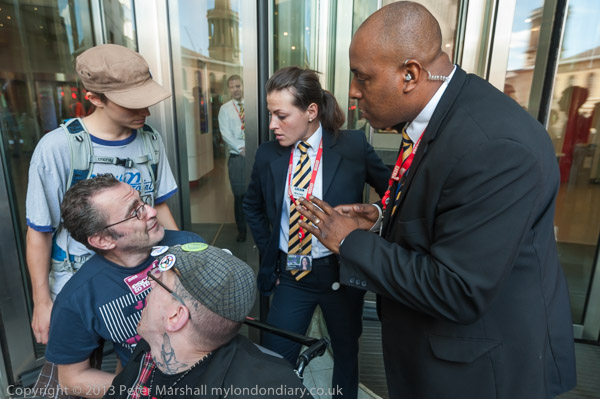
BBC security try to move the protesters but after some argument they backed off

The situation was dire for many poor and disabled people, with over 500,000 having to resort to food banks set up by churches and charities to fend off starvation.
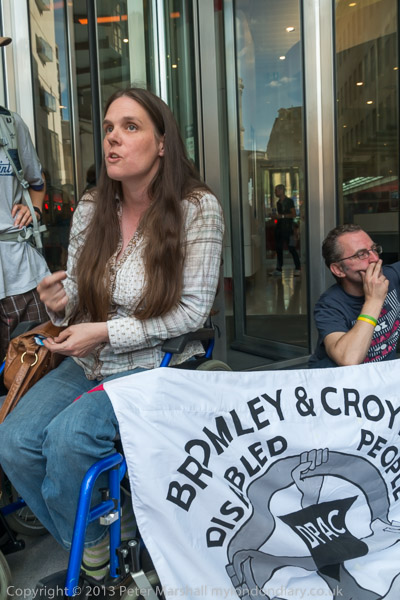
The protesters chanted ‘BBC, Tell the Truth’ and called for someone from the BBC to come and discuss the issue with them – but no one came. They made clear they were not asking for special treatment for the disabled but for the BBC to live up to the reputation it once had for impartial reporting.
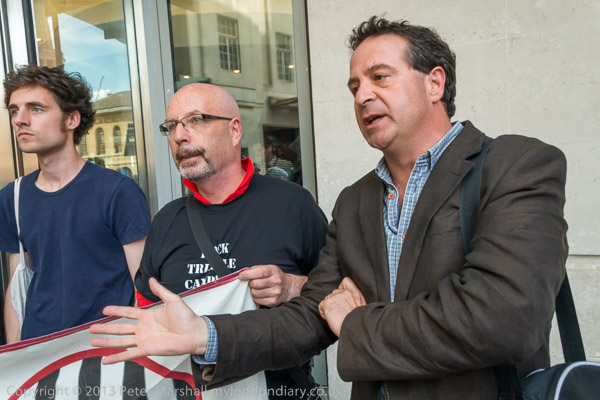
Mark Thomas congratulated the protesters and expressed his support for their attempt to get the BBC to report in an unbiased manner

They were joined for some minutes by activist comedian Mark Thomas who had been at a meeting inside the BBC. He recognised some of the protesters, talked with them and gave a short speech in support.
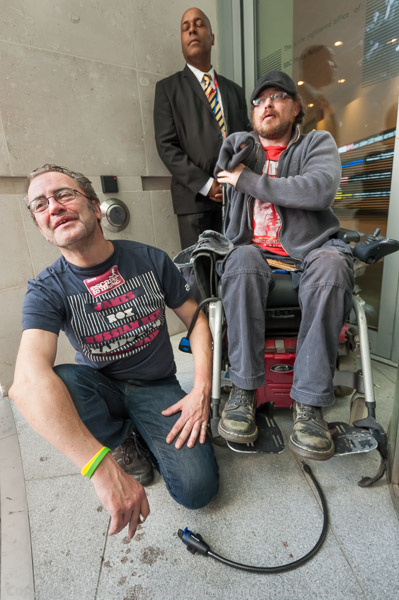
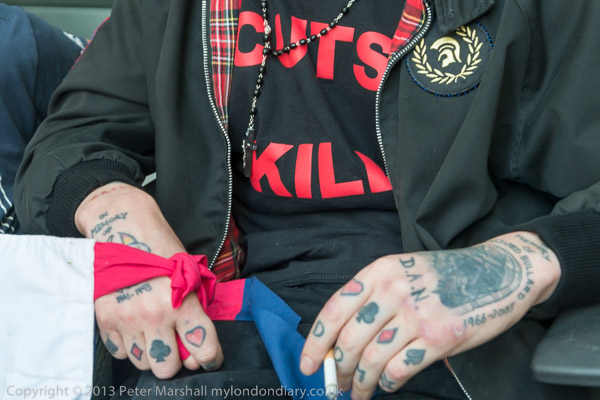
Shortly after two of the protesters in wheelchairs moved to lock themselves in front of the remaining open door closing it for the remainder of the protest. BBC security then called the police and two cars arrived.
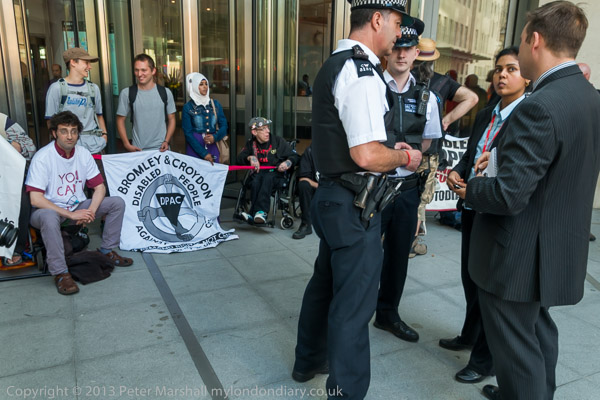
Police talked with security and then came and talked to the protesters. The told the police it was a one hour protest and they would then leave peacefully. Police stayed and watched until the end of the hour when the protesters got up and left.

Before they did so, a BBC cameraman arrived having been asked to film the protest – not for news but for possible use in the future. “I joked with him he might try and sell the footage to Sky or some other broadcaster who were rather more likely to use it.”

Many more pictures on My London Diary at DPAC at BBC – Tell The Truth.


FlickrFacebookMy London DiaryHull PhotosLea ValleyParis
London’s Industrial HeritageLondon Photos

All photographs on this page are copyright © Peter Marshall.
Contact me to buy prints or licence to reproduce.
Death Penalty, Social Housing, Iraqi Killing and a Pillow Fight

Death Penality, Social Housing, Iraqi Killing and a Pillow Fight: Ten years ago on Saturday 6th April 2013 I photographed a Sikh vigil against the death penalty in India, a protest against the unfair ‘Bedroom Tax’ and benefit caps and demanding more social housing, Iranians calling for an enquiry into Iraqi attacks on Camp Liberty and finally a pillow fight.


Vaisakhi “Save a Live” Vigil – Old Palace Yard, Westminster

Death Penalty, Social Housing, Iraqi Killing and a Pillow Fight

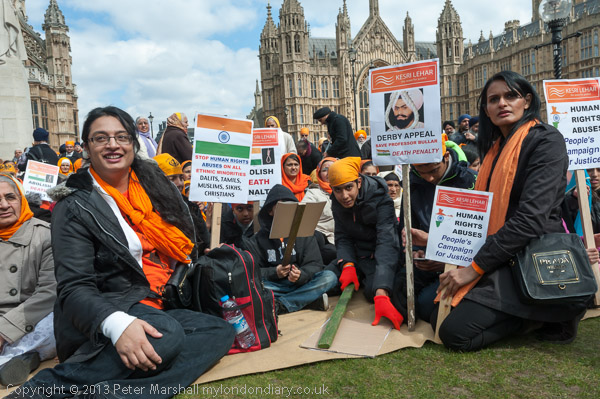
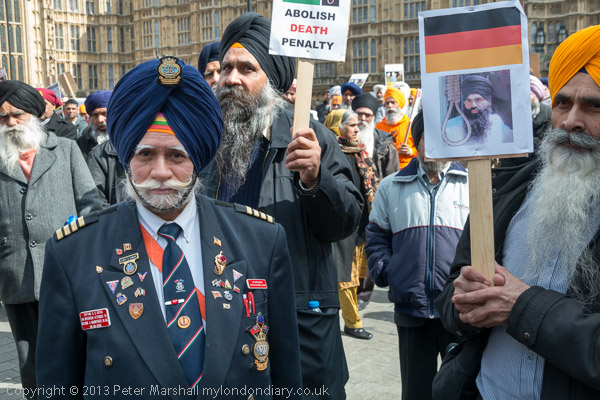
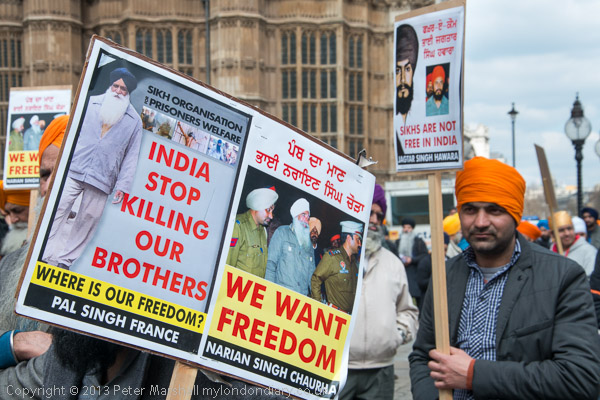
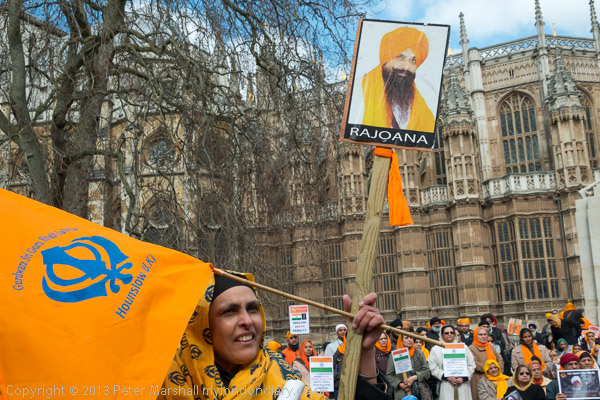
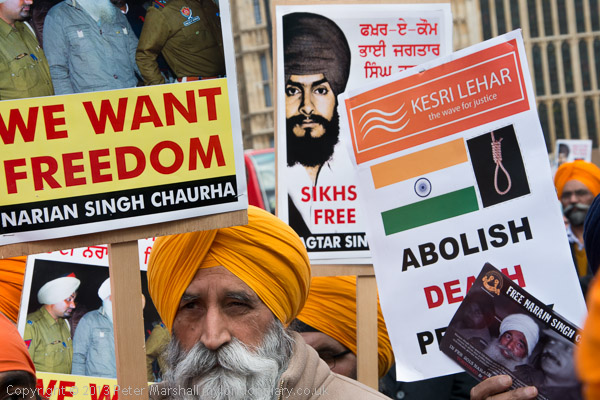
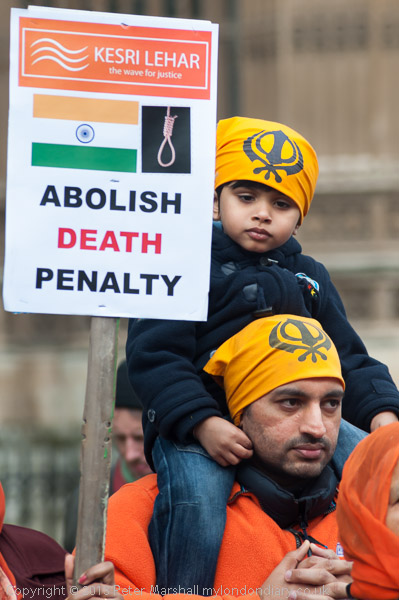
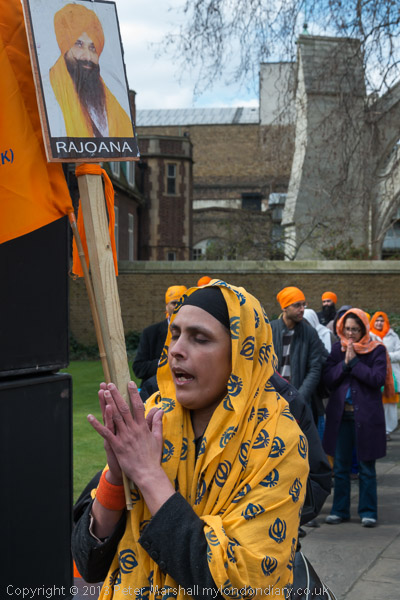
Thousands of protesters, mainly Sikh men, women and children came to Old Palace Yard opposite the Houses of Parliament to back the Kesri Lehar vigil against the death penalty in India.

Death Penalty, Social Housing, Iraqi Killing and a Pillow Fight

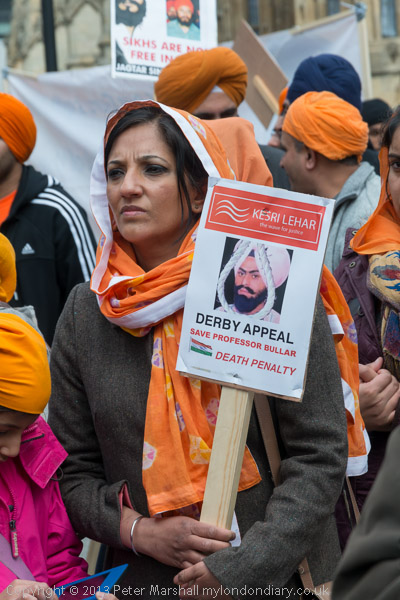
The Kesri Lehar or ‘I Pledge Orange’ campaign, takes its name from the colour which stands for sacrifice in the Indian flag and is also the colour of the Sikh flag and the dress worn by baptised Sikhs which makes Vaisakhi such a colourful festival. It began as on-line campaign by US-based Sikhs for Justice. Most of those attending the protest wore orange turbans or scarves to show their support for the campaign.

Death Penalty, Social Housing, Iraqi Killing and a Pillow Fight

There were then around 480 prisoners in Indian jails sentenced to death, and protesters feared that some were about to be hanged. These included Balwant Singh Rajoana, sentenced in 2007 for his part in a suicide bomb attack which had killed a former Chief Minister of Punjab, Beant Singh and 17 others in 1995. He remains in jail in 2023.

Death Penality, Social Housing, Iraqi Killing and a Pillow Fight

A large group from Derby had come in support of Professor Devender Pal Singh Bhullar who has been on death row in India for 18 years, for his alleged involvement in a car bomb in Delhi. His sentence was commuted to life imprisonment in 2014.

Sikhs were poorly treated when India and Pakistan were granted independence in 1947, with their homeland area being split across the border and most of those in jail are activists for an independent Sikh state of Khalistan. The India government has carried out a determined policy to stamp out Sikh separatists and Beant Singh who was assassinated is held by Siks to have been responsible for the extra-judicial killing of over 25,000 Sikh civilians during his period of office.

More at Vaisakhi “Save a Live” Vigil.


No to Bedroom Tax & Benefit Caps – Downing St

Death Penalty, Social Housing, Iraqi Killing and a Pillow Fight

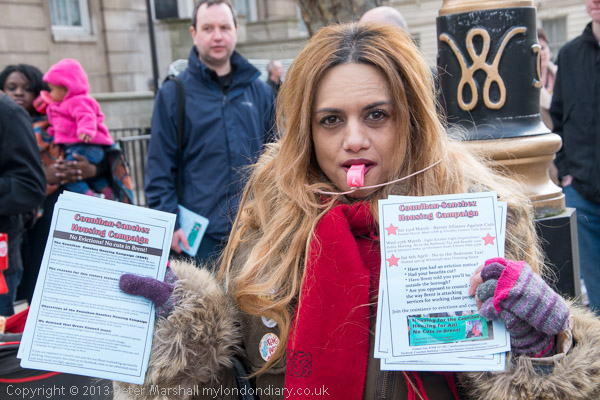
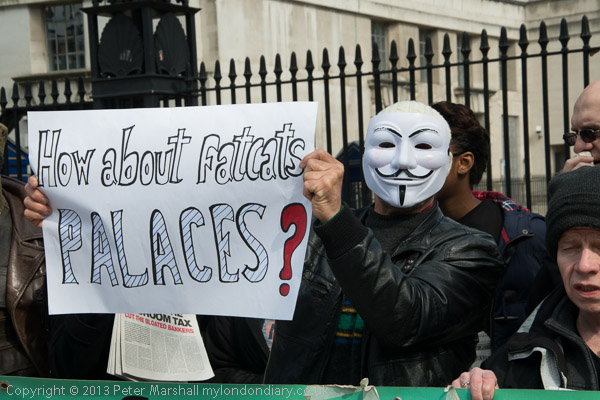
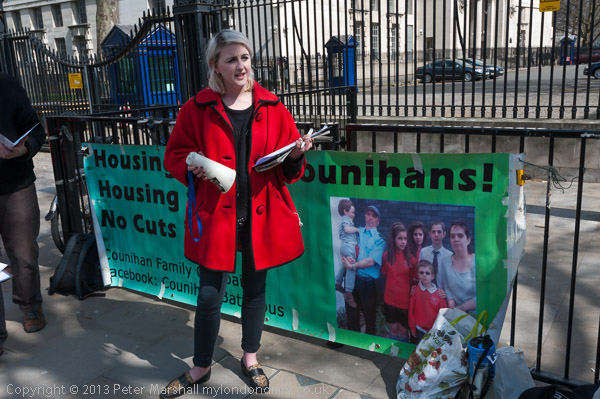
The Counihan-Sanchez Family Housing Campaign from Kilburn organised a protest opposite Downing St against the unfair Bedroom tax and benefit caps which are effecting so many people and called for the GLA and London councils to build more social housing.

They and others spoke at the campaign about the problems in getting councils to provide proper housing, and the failures of our benefits system which leave many destitute and some desperate enough to kill themselves.

As I commented, “The huge housing problems in London come from the failure over the past thirty years to provide social housing for the many low paid workers that support the city and keep it running, with a housing benefit system that has simply acted as a subsidy for private landlords and driven up rents. The cap on benefit will do nothing to solve the problem, but just make life difficult or impossible for the poorest in our society. We need more social housing and an end to poverty pay and of course more jobs.

Ten years on things are certainly no better. Further changes in benefits including the move to Universal Credit have increased problems for many, local authority budgets have been further cut and the cost of living crisis has hit many more people. We do have more food banks, but many of these are finding it hard to cope with demand.

More at No to Bedroom Tax & Benefit Caps.


PMOI Protest Iraqi killings – Downing St

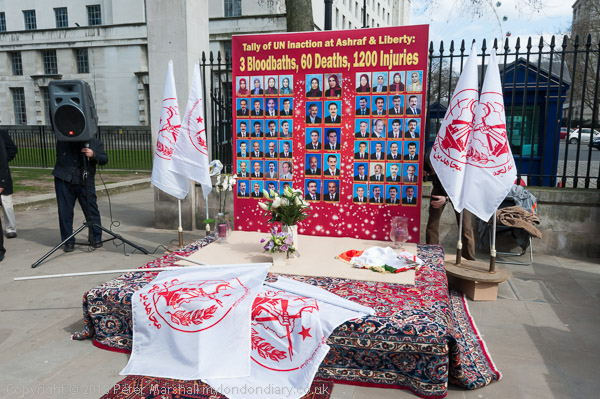
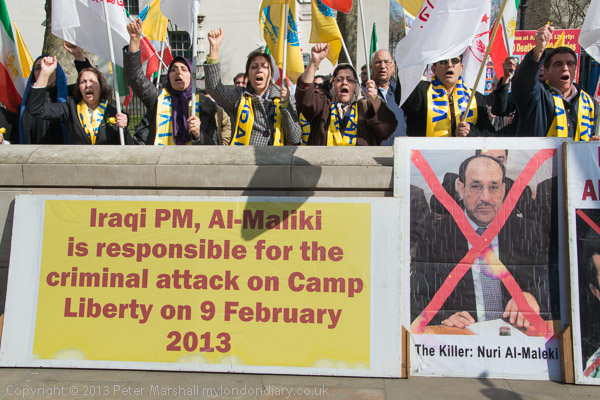
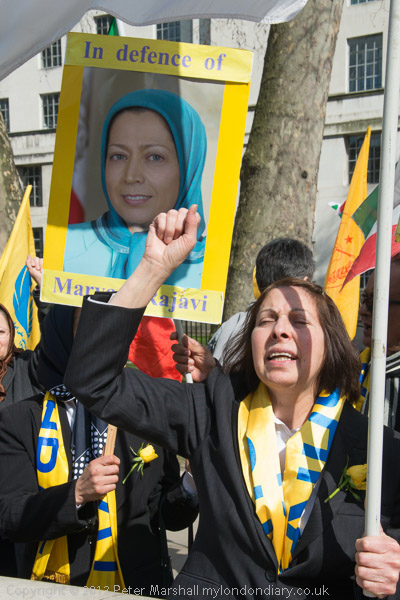
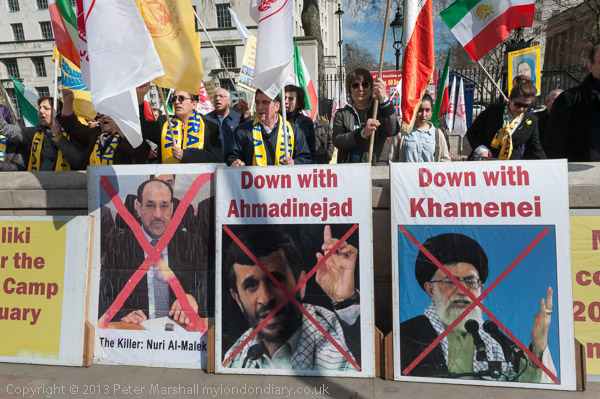
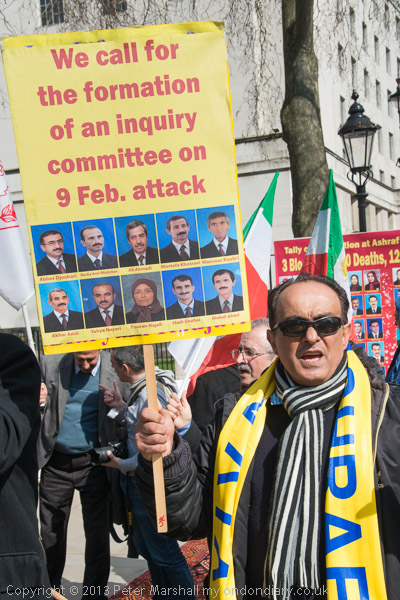
Also protesting at Downing Street were the People’s Mujahedin of Iran (PMOI). They called for an enquiry into the Iraqi attacks on Camp Liberty in February and previous attacks which have killed and injured many of them.

The PMOI, also known as the Mojahedin-e-Khalq (MEK) was founded in 1965 and took part in the 1979 Iranian revolution which deposed the Shah. Soon after they were in armed struggle with the Islamic Revolutionary Guards and had to take refuge in neighbouring Iraq, where Saddam Hussein gave it refuge.

During the 2003 US-led invasion of Iraq they agreed a ceasefire with the US and gave up their arms – which included 19 Chieftain tanks – and became the majority in the Iranian parliament in exile, the National Council of Resistance of Iran (NCRI), with its base in Paris.

In Iraq the roughly 5000 MEK fighters were confined in the refugee Camp Ashraf, guarded by the US military and declared by the US as protected persons under the Fourth Geneva Convention. The camp was transferred to Iraqi control at the start of 2009, and in 2012 those remaining were transferred to the former US military base Camp Liberty in Bagdhad, renamed Camp Hurriya.

There had been many attacks by Iraqis on these camps, with deaths, injuries and arrests. In the most recent on 9th Febuary 2013, Iraqi mortars and rockets killed at least seven MEK members. The MEK has appealed to the UN Secretary General and the US for help and was at Downing Street to ask the UK government for support.

PMOI Protest Iraqi killings


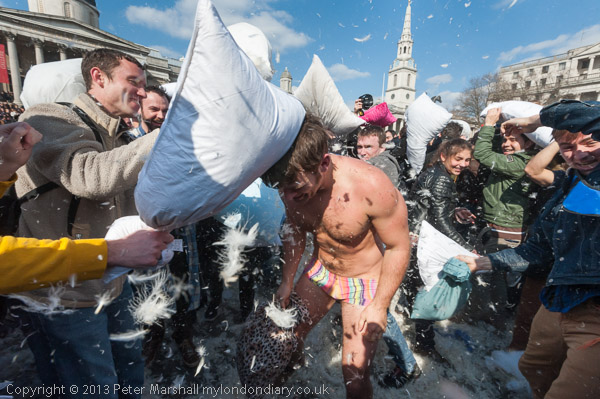
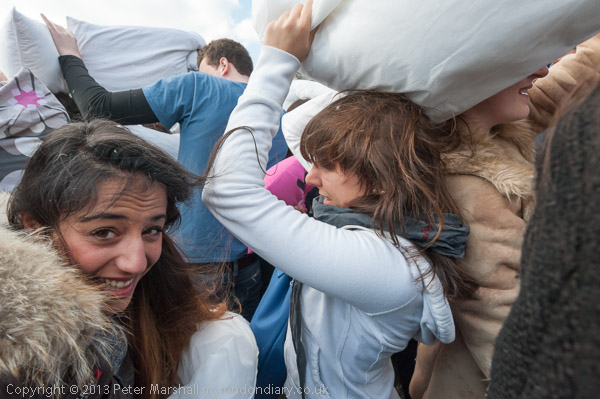
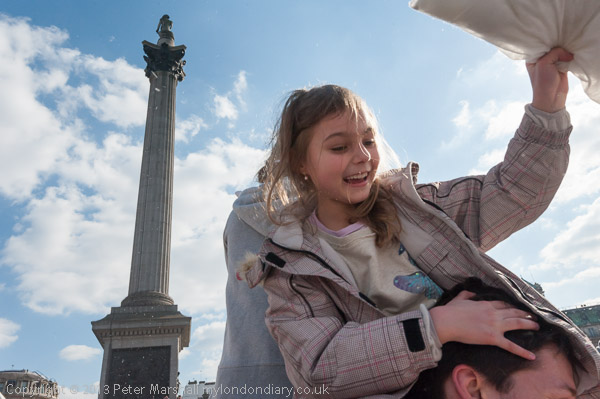
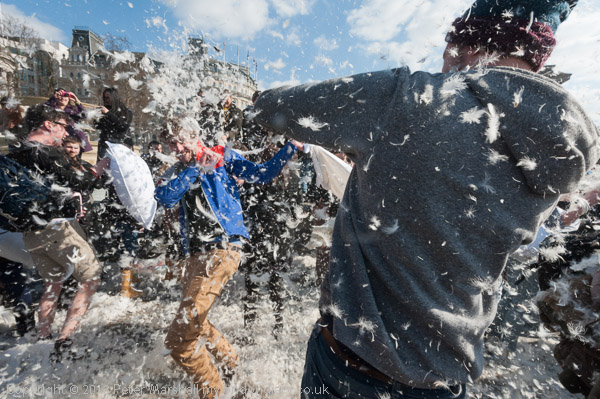
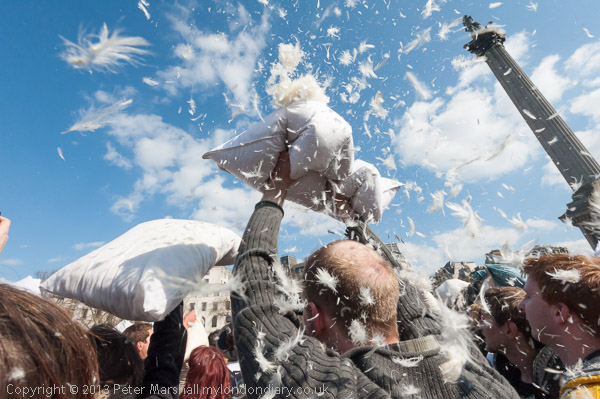
Feathers Fly in Trafalgar Square – Trafalgar Square

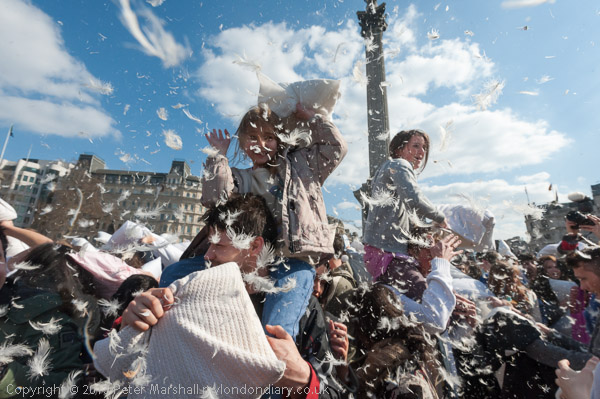
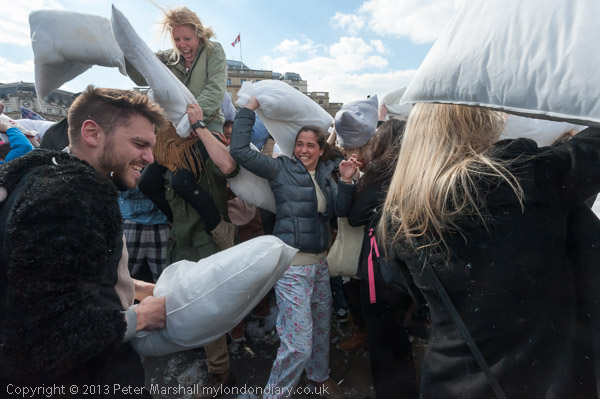
This had been designated World Pillow Fight day by the urban playground movement and this pillow fight was one of around 90 such events in cities around the world.

The urban playground movement aims to make cities into more public and social spaces by encouraging unique happenings like this pillow fight. It aims to help people move away from “passive, non-social, branded consumption experiences like watching television” and to consciously reject “the blight on our cities caused by the endless creep of advertising into public space.” They hope this will result in “a global community of participants, not consumers.

Despite once company bringing a team of young women and handing out prominently branded free pillows, this remained large an unbranded event, and hundreds turned up with their own pillows and cushions to take part.

An earlier pillow fight had been planned for Hyde Park, but relatively few people had turned up and park police were able to prevent it taking place. But the numbers here – over 500 – made it impossible to stop. As well as the participants there were rather more who simply stood and watched. Which went against the spirit of the event, meant to be something to take part in rather than a spectacle.

It started on time and a great deal of fun was certainly being had, with some at least of those taking part adhering to the ‘rule’ not to attack photographers. At first the air was clear, but then pillows began to break up and more and more feathers filled the air. After half an hour there was a brief break and then the fight recommenced, but I left for a nearby pub where the air was clearer.

Feathers Fly in Trafalgar Square


Deaths, Bedroom Tax & Feathers

After a day resting and recovering from our 3 day walk along the Thames Path in 2013 I was ready to go up to London again on Saturday 6th April.

Sikhs had come to London at Vaisahki for a protest against the “ongoing and, disturbing atrocities that are being committed in the Republic of India, that, infringe the basic human rights of the minority communities, which includes but is not limited to the Sikhs, Christians, Muslims and Dalits (India’s untouchables).

In particular the Kesri Lehar (I Pledge Orange) campaign was protesting against the death penalty in India, with over 470 prisoners in Indian prisons on death row, though actual executions are rare. The House of Commons shortly before this protest had debated and agreed a backbench motion welcoming the Kesri Lehar petition and calling on India to abolish the death penalty.

One of those on death was Balwant Singh Rajoana, sentenced for his part in a suicide bomb attack which killed a former Chief Minister of Punjab, Beant Singh and 17 others in 1995. Sikhs say that Beant Singh was responsible for the extra-judicial killing of over 25,000 Sikh civilians in a brutal attempt to eliminate Sikhs calling for an independent state.

Balwant Singh Rajoana was sentenced to death in 2007 and was due to be hanged in 2012, but execution was stayed after some Sikh organisation appealed for clemency. But in 2013 there were renewed demands for his execution. This did not happen and in 2019 his sentence was commuted to life imprisonment.

Campaigners also called for the release of Professor Devender Pal Singh Bhullar who has been on death row in India for 18 years, for his alleged involvement in a car bomb in Delhi in 1993. They say there is no evidence to connect him with the attack. His sentence was commuted to life imprisonment in March 2014.

A rather smaller protest at Downing St had been organised by the Counihan-Sanchez Family Housing Campaign from Kilburn against the unfair Bedroom tax and benefit caps which are effecting so many people and called for the GLA to build more social housing. The family’s own problems with Brent Council have made them very aware of the huge problems faced by many others across London and elsewhere and how cuts and sanctions have had a cruel impact on so many.

Also at Downing St, members and supporters of the People’s Mujahedin of Iran (PMOI) were calling for the UK government to support an enquiry into Iraqi attacks on Camp Liberty in Baghdad where its members are held. They had been given refuge in Iraq by Saddam Hussein and gave up their arms when the US invaded Iraq in return for US protection. But the US hand over control of their camps to Iraq in 2009 and there have been a series of attacks on them by Iraqi security forces sympathetic to Iran, with over over 50 being killed, more than a thousand injured and many arrests.

Later in 2013 the United States organised a move of the roughly 3,000 members of the group to a new base in Albania, providing a $20 million donation to the UN refugee agency to resettle them. The USA has continued to support them as a government-in-exile for Iran and they are also apparently supported by them in covert operations continuing in Iran against the current Islamic regime. There are groups of the PMOI and supporting organisations in a number of European Countries and the UK as well as in the United States, though they are generally thought now to have little support in Iran.

It was good to leave what had been rather intense protests and go on to something in a much lighter mood in Trafalgar Square. I think the first International Pillow Fight Day was in March 2008, when I photographed it in Leicester Square. In 2013 the event, organised by the urban playground movement, was taking place in 90 cities across 30 countries.

The aim of the event is to get people away from “passive, non-social, branded consumption experiences like watching television” and to consciously reject “the blight on our cities caused by the endless creep of advertising into public space.” The organisers hope this will result in “a global community of participants, not consumers.

The authorities frown on it, possibly as a subversive activity but perhaps because it makes something of a mess, as pillows inevitably break and feathers fly, leaving the ground covered with them after the event. Or perhaps they are just killjoys. Royal Parks police had prevented a fight in Hyde Park earlier in the day but the Heritage Wardens were overwhelmed by the numbers who had come to Trafalgar Square and were unable to stop. A small group of Westminster Council workers were standing on one edge ready to clean up afterwards.

The feathers and dust do make these events something of a health hazard, and it would have made sense to wear a face mask – but back in 2013 these were only seen on Japanese tourists. Probably a once a year exposure to dust and feathers isn’t a huge risk, but this year they did rather get down my throat and I withdrew once the air was thick with them, deciding I’d taken enough pictures.

Feathers Fly in Trafalgar Square
PMOI Protest Iraqi killings
No to Bedroom Tax & Benefit Caps
Vaisakhi “Save a Live” Vigil