Election Day 2010

Thursday 6th May was also an election day in 2010 with a UK general election that saw Labour losing over 90 seats to end with 48 fewer MPs than the Conservatives. But back then we still had a Lib-Dem party with 57 MPs who, after five days of horse-trading agreed to form a coalition government with the Tories – a decision that condemned them to oblivion, losing all but 8 seats in the 2015 election.

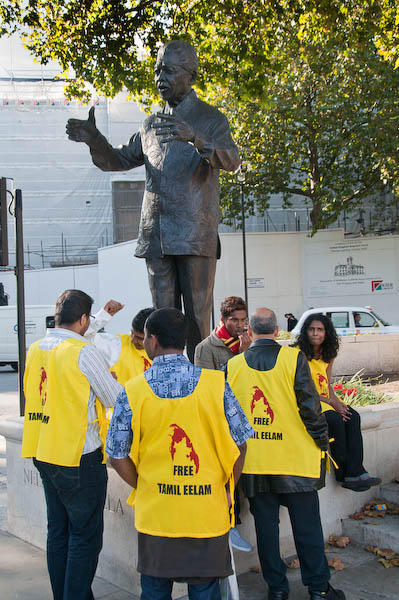
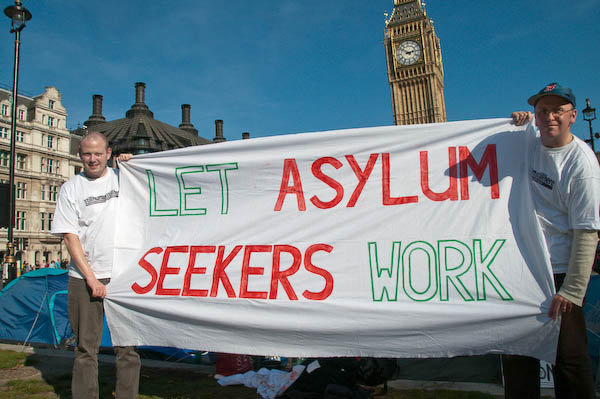
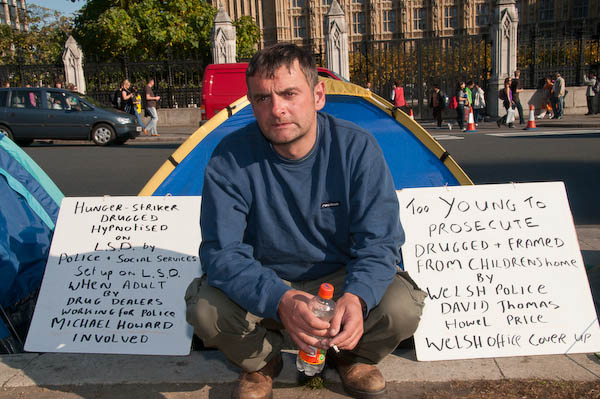
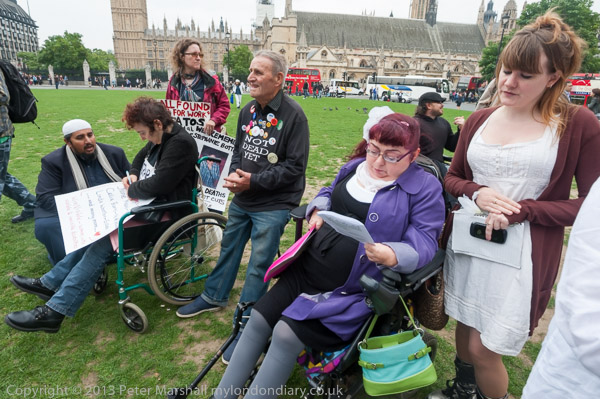
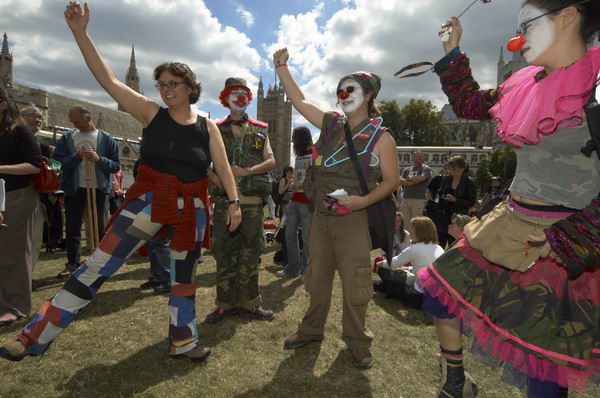
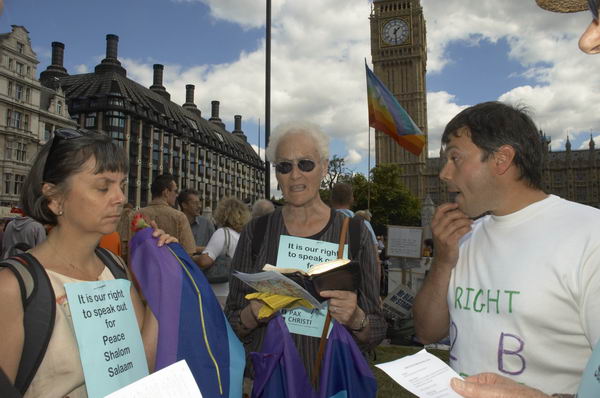
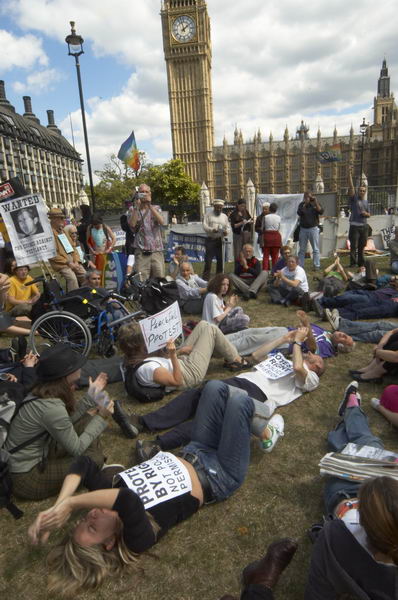
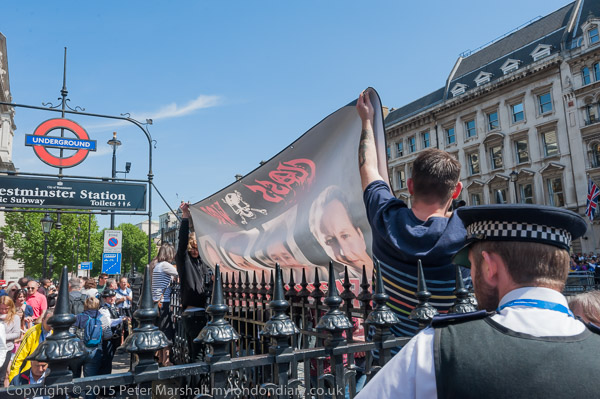
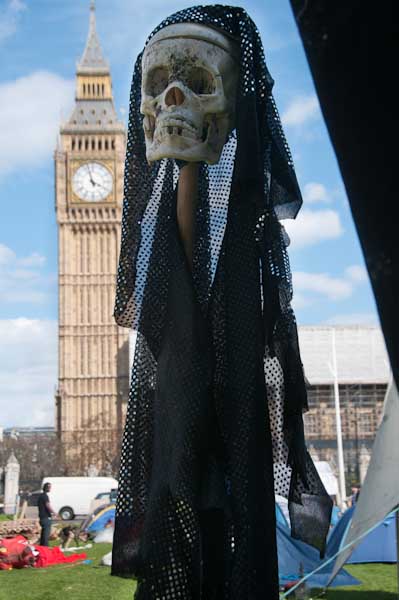
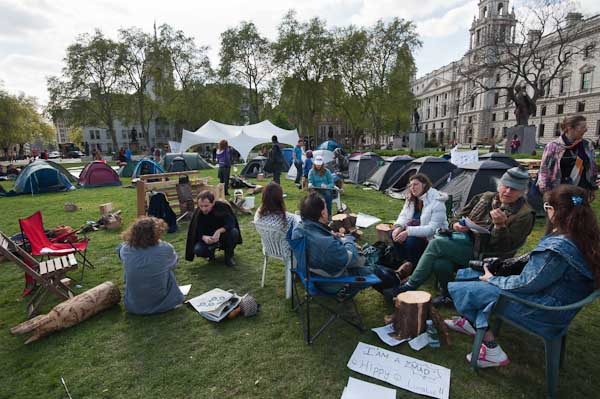
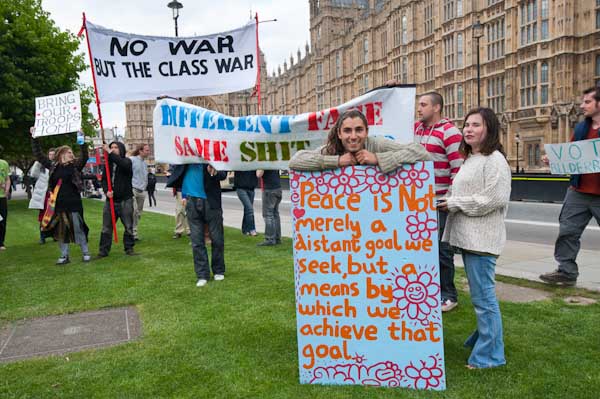
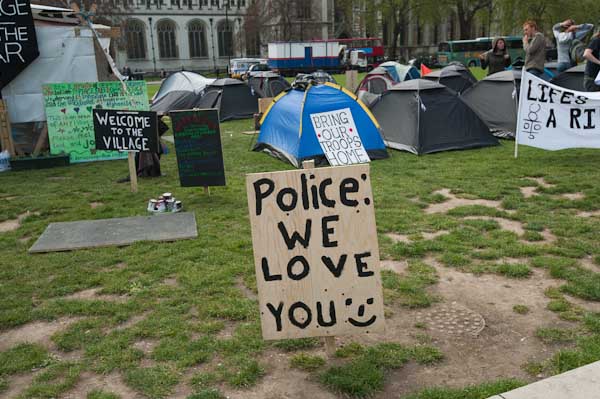
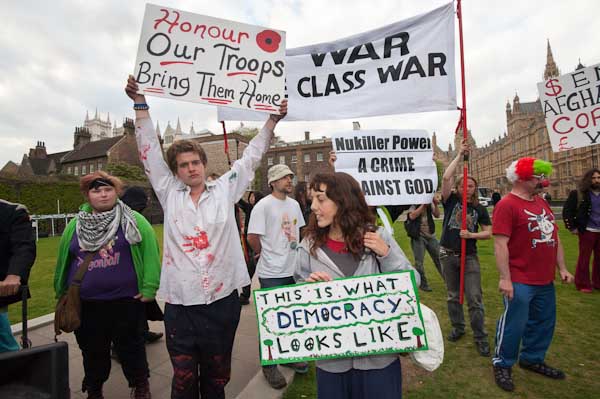
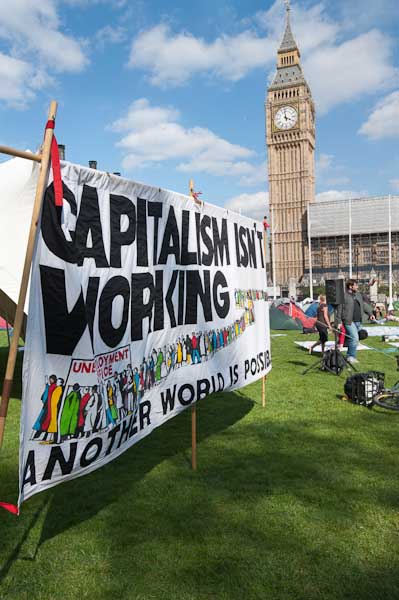
I spent most of election day – after voting in the early morning – in and around Parliament Square, where there was also considerably politics taking place. Three distinct group were camping in the square.

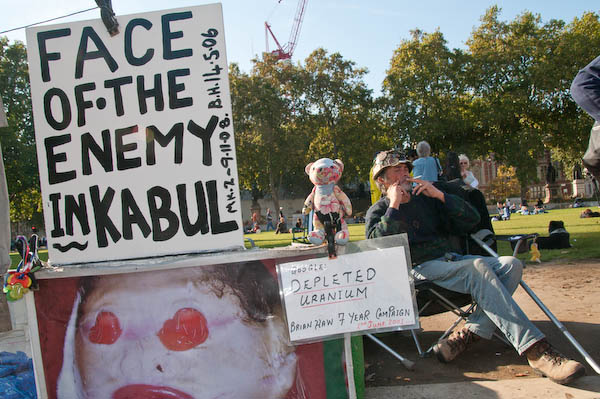
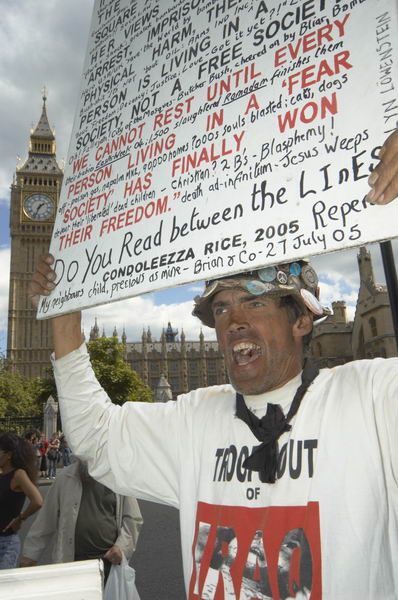
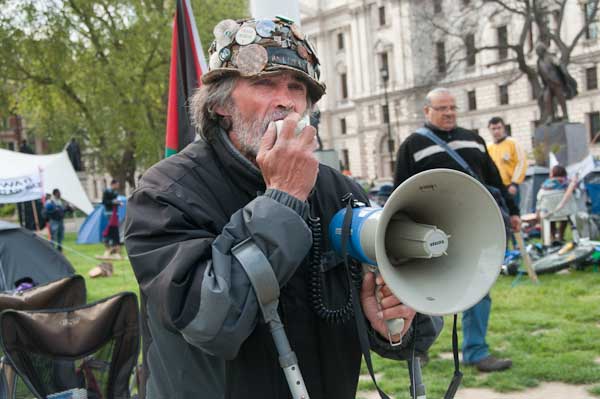
Brian Haw

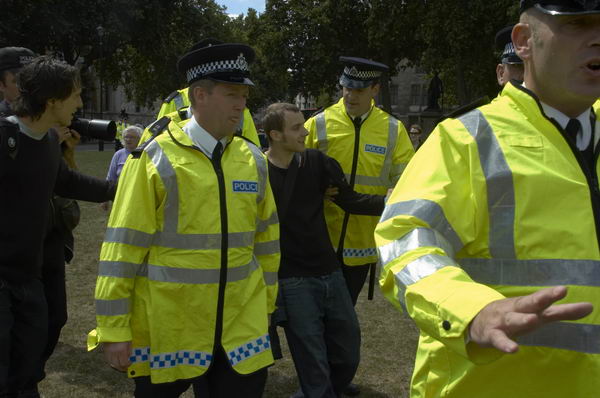
Brian Haw and the Parliament Square peace campaign had been there for 3260 days since 2nd June 2001 and was still there despite an Act of Parliament designed to remove him, attacks by individuals with connections to the police and security services, illegal police raids, provocations, assaults and arrests by police officers and more.

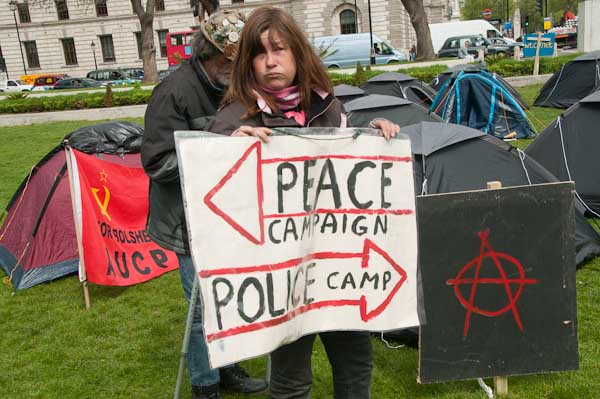
Barbara Tucker

A year earlier Haw had dissociated his Parliament Square Peace Campaign (PSPC) from the ‘Peace Strike’ protest in the adjoining area of the square led by Maria Gallestegui “by mutual consent”, wanting to end any confusion between the two campaigns. The Peace Strike had not been harassed by police to the same extent and was allowed a greater physical presence in the square, and were regarded by some, probably incorrectly, as being partners with the establishment to discredit the PSPC.

Since May Day the square had also been home to ‘Occupy Democracy’ who saw themselves as supporting the PSPC by their presence. But the PSPC suspected some of them too of being agent provocateurs in police pay to provide a pretext for more draconian police action against them. Certainly some of these more temporary occupiers were breaking the rules against drinking alcohol in Parliament Square, despite the Democracy Camp notices banning this.

In my account I wrote:

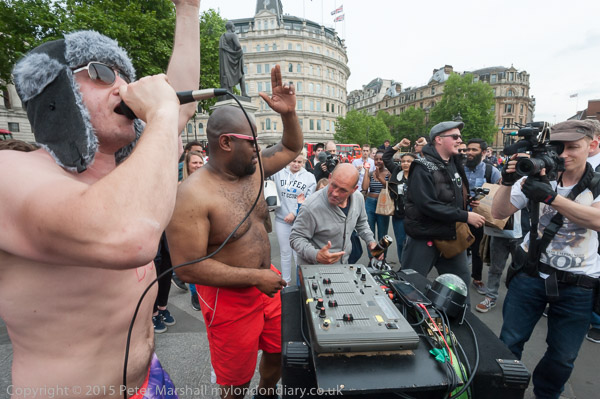
“At one point the dispute between the camp and the PSPC deteriorated with a man on the camp’s sound system making what were possibly intended as humorous put-downs of Barbara Tucker who was then attacking the Tory Party for the backing it receives from the oil giants. Clearly some of the campers were distressed by this and he was asked to desist, and some of those present tried to calm the situation.
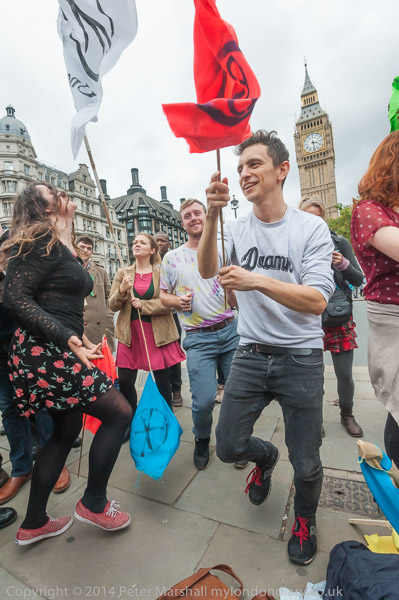
But generally the camp’s activities were more positive, and while I was there considerable work was taking place making banners and placards, as well as people discussing and dancing.”

Election Day in Parliament Square

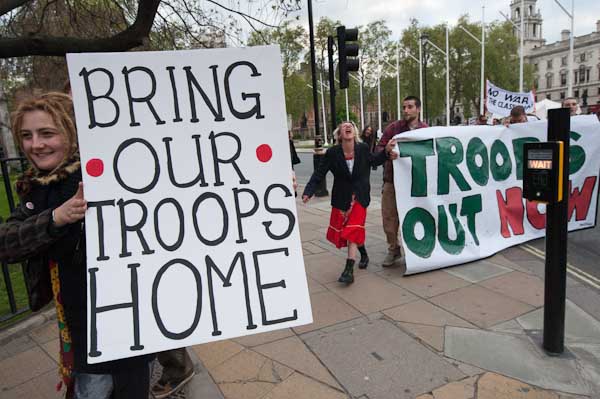
Shortly before I left around 6pm, people from Democracy Village walked with placards to College Green where the TV media have their tents and cameras to cover political events and had been conducting interviews about the election. There had been little if any media coverage of Democracy Village or the peace campaigns and they wanted to make a point of this. But most of the media simply ignored the protesters, and eventually police came to talk with them and they returned to Parliament Square.

Protests in the UK are almost never seen by the mass media as news – unless police are injured or property destroyed and they can run negative stories. Occasionally if a celebrity takes part they may get a mention, or some particularly quirky and preferably non-political event captures their whimsy. But political protests are largely only news if they take place overseas against regimes which our government disapproves of.

The government that resulted from the election was led by a party that got just under a third of the votes and once again demonstrated the iniquities of our first past the post electoral system. A year later we had a referendum on an alternative voting system, but this was largely scuppered by Conservative opposition and a lack of real support from Labour.

The 2010 election had left the Tories holding the whip hand in the coalition, and they certainly made use of it, both through imposing drastic and ill-considered cuts on public and in particular local authority expenditure and in attacks on protests such as those in Parliament Square. The current Police, Crime, Sentencing and Courts Bill takes these attacks on human and civil rights, the right to protest, migrants and Gypsy, Roma and Traveller people to new levels, incompatible with any free society.

Election Day in Parliament Square


All photographs on this and my other sites, unless otherwise stated, are taken by and copyright of Peter Marshall, and are available for reproduction or can be bought as prints.


Occupy Gandhi – 4 May 2015

All pictures from Occupy Ghandi – Stop Fossil Fuel Criminals, 4 May 2015

Successive UK governments have legislated in various ways to restrict the right to protest, particularly concentrating on the area of Westminster close to the Houses of Parliament, and the current Police, Crime, Courts and Sentencing Bill amends the “Police Reform and Social Responsibility Act 2011 to expand the “controlled area” around Parliament where certain protest activities are prohibited” as well as creating a new prohibited activity of “obstructing access to the Parliamentary Estate”.

The 2011 Act (which was also amended by the Anti-Social behaviour, Crime and Policing Act 2014) replaced previous restrictions which had been brought in under SOCPA, the Serious Organised Crime and Police Act 2005 which the New Labour government had brought in as an attempt to stop the long-term protest in Parliament Square by Brian Haw who had set up his camp there on 2 June 2001 in protest against the effect of economic sanctions which were resulting in child deaths in Iraq.

Haw’s campaign widened into a more general protest against war and became the Parliament Square Peace Campaign, and he was joined by other long term protesters as well as receiving support from many others which enabled him to remain in the square. Various attempts to remove him legally failed and SOCPA was passed in an attempt to stop his protest. But poor drafting led to the eventual failure to achieve this, though Haw had to apply for permission which was granted subject to strict conditions – which he and his supporters failed to adhere to.

Police carried out a major raid in May 2006, removing most of the placards and other material and Haw was taken to court for breach of SOCPA. But after several hearings he was acquitted as the judge found the conditions lacked clarity and were not workable. He was assaulted on numerous occasions by police and by others believed to be working for the security services and arrested again on the day of the State Opening of Parliament for the Tory-LibDem coalition in 2010. But his protest was continued even after he left for cancer treatment in Berlin on New Years Day 2011, by his colleague Barbara Tucker who had joined him in 2005, and stayed in Parliament Square until 2013, despite being denied the use of tent, blankets and eventually even a chair and umbrella in 2012.

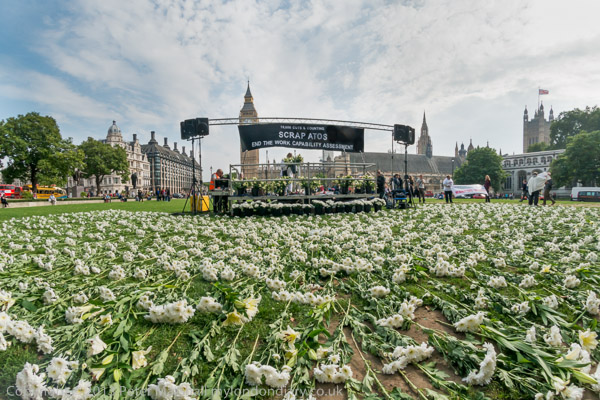
The whole grass area of Parliament Square was fenced off and the protest moved onto the pavement in 2011 after Boris Johnson gained a High Court injunction. Early in 2013 more protesters had arrived to support Tucker who had begun a hunger strike in December 2012. She left the square for urgent medical treatment and the Westminster Council removed the tents which supporters had brought there in March 2013, reopening the square for public use in May.

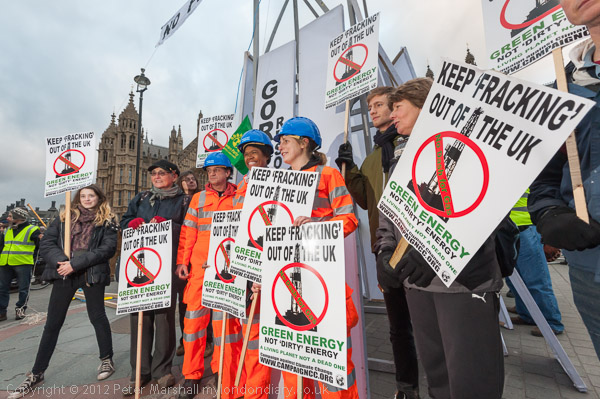
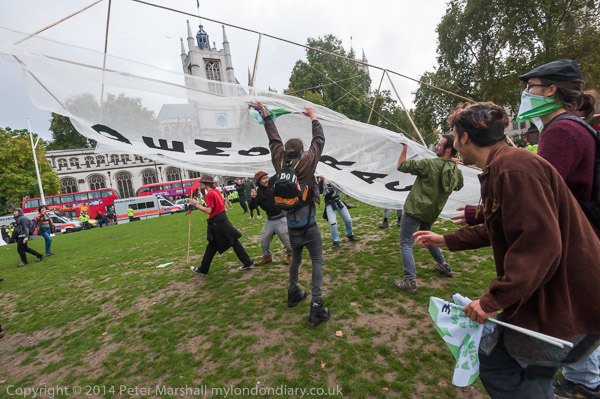
In October 2014, Occupy Democracy arrived to occupy Parliament Square “for 9 days in October, to broadcast and demand the solutions we already know exist, to inspire people to be the active citizens required to take back democracy from powerful economic interests.” They were met by police and private security ‘Heritage Wardens’ (outsourced by the GLA) and signs put up the previous day stating the grass was ‘closed for repair’, and there was considerable harassment with the police seizing anything they thought might be ‘camping equipment’ the occupied the square. The following day, much larger numbers of protesters turned up, including a number of MPs and some celebrities, and after trying hard to stop them, the police melted away and the camp was set up.

Over the following three days there were a number of arrests and police moved protesters off the main grass areas, but the various workshops and activities continued until the whole square was cleared. There had been a number of battles between police and protesters over large squares of blue plastic tarpaulin they had used to sit on the wet grass and mud, and the Democracy Camp had gained the name ‘Tarpaulin Revolution’ (#tarpaulinrevolution).

On May Day 2015, Occupy Democracy returned for a 10 day ‘Festival of Democracy’ in Parliament Square “building a movement for real democracy: free from corporate control, working for people and planet!” just a few days before the general election. On Monday 4 May there was a rally and meditation by Occupy Democracy at the statue of Gandhi, noted for his direct action civil disobedince, called for fossil fuel exploration and investment to be made a crime, and defied the ban on tarpaulin and tents in Parliament Square.

After short speeches there was a period of meditation, and the protesters wrapped a blue tarpaulin around the statue. Heritage wardens demanded its removal, and seized it when their request was ignored. Other protesters then stood with another blue tarpaulin, holding it around the statue but taking care not to touch it.

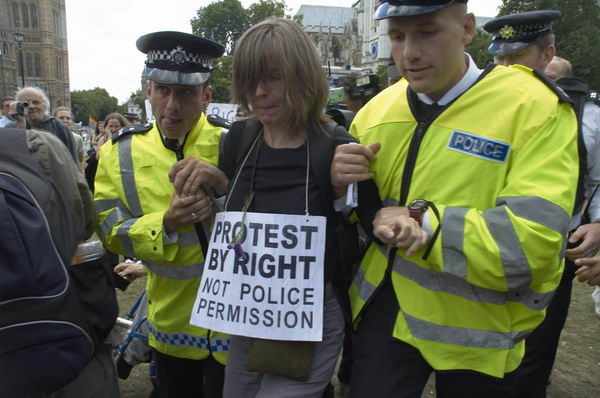
At the end of the mediation, Donnachadh McCarthy who had been leading it announced an act of civil disobedience and pulled a folding tent onto the tarpaulin on the pavement in front of him and erected it. Several people then came and sat inside it, and the protest continued. Police came and told them they were committing an offence and might be arrested if they failed to leave. Shortly after 20 police came and surrounded the tent and arrested those who refused to leave.

Occupy Gandhi – stop fossil fuel criminals
Occupy Festival of Democracy

XR, Drax and Knives

Extinction Rebellion‘s occupation of Central London was in its third day on Wednesday 17th April bringing traffic in the area to a standstill. And as there were no buses through the middle of London and those in the area around only moving at snail’s pace through near gridlock, the only way to move around was on foot or by tube. I chose to walk from Waterloo to Grocer’s Hall although the Waterloo and City line would have got me there in a fraction of the time so I could walk through XR’s ‘Garden Bridge’ still in place on Waterloo Bridge.

There were workshops and events taking place on the bridge, and only bicycles and people walking could cross. And although there was a strong police presence, while I was there they were simply standing around and watching, although I was told by the protesters there had been arrests earlier in the day, and there were people locked on below the lorry which was being used as a stage to make this more difficult to move.

Axe Drax protesters against Drax, a huge power station in Yorkshire, were as usual protesting outside the Drax AGM taking place in Grocer’s Hall in the City of London against both the incredible output of greenhouse gases it produces and the environmental damage both from the coal it burns, imported from open-cast mines which are destroying the environment and communities abroad and the wood, largely from destroying American forests by environmentally disastrous clear-felling. Drax burns more wood than the total UK production each year, and in 2018 this produced over 13 million tonnes of CO2. But nonsensical rules on environmental subsidies means that in 2018 Drax got £789 million in subsidies taken from surcharges in our electricity bills for this massive climate changing pollution. And Drax was planning to increase its pollution by building the largest gas powered generating station in the UK.

I took the tube from Bank to go back to Westminster where XR were still blocking Parliament Square and the roads around, with activities going on in and around the square and tents filling much of Broad Sanctuary.

The Axe Drax protesters had moved from the Draz AGM and were holding a protest at the Dept for Business, Energy & Industrial Strategy demanding an end to environmental subsidies for massive pollution which make Drax and its huge pollution viable. These subsidies should be used as they were intended to promote genuinely renewable low-pollution energy energy sources such as solar, geothermal, wind and wave power rather than, as at Drax, increasing global heating. A few from XR had come along to support them.

Finally in a completely unconnected protest I joined the campaigners from Operation Shutdown, a consortium of “mums, dad’s and other bereaved family members and loved ones” supported by other campaigners, who had come to Downing Street calling for the community to unite and demanded more urgent action by the government to halt the growing epidemic of knife crime.

It would be hard not to feel their pain, but to demand stiffer penalties for knife and gun crime is not the answer, as we know this has not worked and simply results in the criminalisation of more in the community. But they also call for other measures some of which would certainly help in cutting these killings, mainly of teenagers and young males.


They want really determined and coordinated putting into action of the recently announced public health approach to knife crime. This has to include an end to cuts to local services including youth work and their restoration to pre-austerity levels, more adequate safeguarding, a coordinated approach to trafficking and grooming and abuse of children and young people and a proper sharing of information and accountability.

After the speeches the protesters marched the short distance to Bridge Street where they presented two wreaths to the police and held a silence in memory of PC Keith Palmer, killed at Parliament by terrorists.

They then moved on to Westminster Bridge where they sat down for another lengthy rally with more speeches by relatives of those who have been killed.

Knife crime Operation Shutdown
Drax Protest at BEIS
XR around Parliament Square
Drax wood burning must end
XR Waterloo ‘Garden Bridge’ continues


All photographs on this and my other sites, unless otherwise stated, are taken by and copyright of Peter Marshall, and are available for reproduction or can be bought as prints.


Extinction Rebellion and more

Extinction Rebellion (XR) began 11 days of protest which initially brought most of central London traffic to a halt on Monday 15th April 2019. They didn’t manage to keep up the protest until “the government takes necessary action on the global climate and ecological emergency” as we have yet to see that two years later, but they did considerably raise public and media awareness about the severity of the problem the world faces.

Unfortunately there seems to be little chance that effective action will be taken in time to halt biodiversity loss and reduce greenhouse gas emissions to net zero by 2015 as they demanded, though perhaps the half-hearted measures that will come out of the delayed climate summit later this year will do just a little to slow the rate our our planet’s decline, possibly enough to see my life out, though I worry about the future of my children and despair for that of my grandsons and daughters.

XR have now very much lost the initiative, mainly I think because of internal dissensions, perhaps inevitable because of some of the rather odd characters that they attracted. But some of their ideas, particularly over the police and arrests cut them off from many on the left who attacked them as a movement funded by shady capitalists and led by wacky idealists, more a Glastonbury festival than a political movement. Much of the criticism was ill-founded but not all.

The major effect they had on our government was for them to put pressure on the police to get rid of these pesky protesters – first by more arrests and prosecutions and now by the Police, Crime, Courts and Sentencing Bill to give the police greater powers to control all protests.

Early on the Monday morning, XR protesters set up camp at a number of key locations in London in a well-planned exercise. I turned up rather later to take photographs, first at Waterloo Bridge, which XR had turned into a ‘garden bridge’, blocking all traffic and bringing flowers and trees. There had been arrests earlier, but police had been unable to stop the protesters and the bridge – despite many further arrests – remained closed for over a week.

Because of the XR actions traffic all around the centre of London was at a halt, with buses not moving. Fortunately the tube was unaffected and took me to Oxford Circus, which now had a large pink yacht at its centre, named after the Honduran environmental activist and indigenous leader, Berta Cáceres, assassinated for her activism in 2016. It was here that I met the dance troupe dressed in red that were such a visible presence in XR protests.

XR were not the only environmental game in town, and I took the Underground to St Paul’s Cathedral for a protest organised by the Green Anti-Capitalist Front, Earth Strike and London Students for Climate Justice. I arrived when there protest was due to start, but there were only a few of them present. I hung around for half an hour or so, and then gave up and left. Later I saw the accounts of their protest which did eventually attract a small crowd and was sorry I’d missed the action.

But there was rather more happening at Marble Arch, one of London’s main gyratory systems, where XR had blocked Oxford St, Park Lane, Edgware Road and a couple of other routes and had set up a stage, workshops and a tent village as well as the road blocks.

But XR had also planned an event for Parliament Square, where the roads around were blocked for a New Orleans funeral procession with jazz band to make its way around the square.

The funeral was perhaps also designed as a diversion for some more direct action, which I again missed at the Shell Centre on the South Bank. A small group of activists daubed slogans across the front of the building and two occupied the glass porch over the door. The activists had deliberately broken the glass in one of the doors, with the intention that this would result in a trial before a jury rather than by magistrates, enabling them to present the reasons for their action, and three had been arrested and taken away by the time I arrived, but the two were still up on the porch and others holding banners on the street in front.

My day had not quite finished as I made a small diversion on my way home to visit Brixton, where staff, families and children from children’s centres were protesting against plans by Lambeth Council to close five centres and make drastic cuts at seven others. The council had recently spent £68 million on refurbishing the Town Hall and building a new Civic Centre.

Save Lambeth Children’s Centres
Extinction Rebellion at Shell
Extinction Rebellion Funeral Procession
Extinction Rebellion Marble Arch
Anti-capitalist environmental action
Extinction Rebellion Sea at Oxford Circus
Extinction Rebellion Garden Bridge


All photographs on this and my other sites, unless otherwise stated, are taken by and copyright of Peter Marshall, and are available for reproduction or can be bought as prints.


Two years ago – 26 Feb 2019

Class War protest Rees-Mogg freak show

Two years ago today Class War protested outside the London Palladium against Jacob Rees-Mogg, who they accused of spouting “homophobic, transphobic, racist, pro-hunting, misogynist, classist, privileged” nonsense. Rees-Mogg had booked London’s best known venue to preach more of this to his fans, who had paid £38 for a ticket to this freak show.

I met up with Class War at a pub a short walk from the Palladium and found a small group there with Jane Nicholl dressed as a nun, Mother Hysteria, and Adam Clifford as Jacob Rees Mogg and there was time for them to take a selfie and everyone to finish their drinks before the small group moved off to the entrance to the Palladium where a few more of there supporters were waiting and long queues were waiting to enter for the performance inside.

As well as the fans there were of course a large group of security men and police in attendance (all probably thanking Class War for the overtime.) And when Class War held up posters and banners the waiting crowd had their hopes for what they had paid to come and see confirmed. One or two did come across to insult the protesters, and a few others passing by came to share their similar views of Mogg with Class War.

Police did their best to render the protest less effective and moved the group to the opposite side of the pedestrianised street and issued various warnings to harass them. Eventually they stopped and searched Jane Nicholl, threatening her with arrest as they found stink bombs in her handbag which they claimed were offensive weapons. I stood for almost 20 minutes watching the officer writing out “her notice of stop and search, perhaps because he is at a loss trying to find some way that doesn’t make the police action sound stupid” before deciding I had to go home and file my pictures.


Rally for an end to Outsourcing

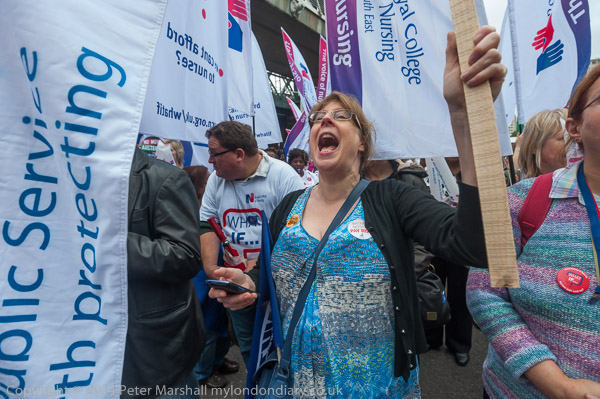
This protest had come at the end of a long and varied day for me, which had begun with a coordinated action by the UVW, IWGB, and the BEIS PCS branch demanding an end to outsourcing and the insecurity, discrimination and low pay it causes. A legal challenge was demanding better rights for the 3.3 million outsourced workers in the UK, and protesters had met at the University of London at 8am to march to a protest outside the High Court before moving on to a rally in Parliament Square where I joined them a couple of hours later.


Outsourced Workers protest at BEIS

From Parliament Square it was a short walk to the Dept for Business, Energy & Industrial Strategy in Victoria St where outsourced workers including catering and security staff in the PCS were striking in support of their demand for the London Living Wage as well as end to outsourcing and the insecurity, discrimination and low pay it causes.


Outsourced Workers at Justice ministry

After a rally and speeches at the BEIS, the protest by outsourced workers moved on to the Ministry of Justice (though they call in the Ministry of Injustice) where low paid workers belonging the the United Voices of the World union who had been on strike for 24 hours were going back to work. They also want the London Living Wage and fair conditions of service rather than the poverty and insecurity of outsourcing.


North Woolwich

When the protest at the Justice Ministry came to an end I went to have a quick lunch and, as I had several hours to spare before the Class War action, went to take some photographs at North Woolwich. Unfortunately I arrived at Bank station for the DLR only to find there were no trains running – and no information as to when they might resume service.

It took me rather longer than anticipated to get there, taking the Northern Line to London Bridge and a train to Woolwich Arsenal. Fortunately by then services were running from there to North Woolwich, saving me a walk across the river but I still had rather less time than I needed and had to rush away before finishing my planned route, mainly beside the River Thames. It was a pleasant day for a walk, but a clear blue sky is not good for panoramic views.

As usual, more about all these on My London Diary:
Class War protest Rees-Mogg freak show
North Woolwich
Outsourced Workers at Justice ministry
Outsourced Workers protest at BEIS
Rally for an end to Outsourcing


All photographs on this and my other sites, unless otherwise stated, are taken by and copyright of Peter Marshall, and are available for reproduction or can be bought as prints.


Brexit – One Year On

Celebrating Brexit in Parliament Square

A year ago there were people celebrating that we were about to leave Europe. Some of them are probably still celebrating now, though we’ve yet to see any of the many advantages that were promised, and have had to come to grips with a few of the downsides.

People had come from across Britain to celebrate

Of course the virus has rather taken our minds off Europe, and while the date of 31st January 2020 had political significance, the transition period and apparently endless bickering over a trade agreement meant that effectively we only left on Christmas Eve – and with an agreement that, thanks to the ridiculous negotiating strategy of our government who seemed to expect that Europe would somehow cave in if we kept shouting at them in English that we would leave without a deal, was considerably less favourable than was on offer earlier in the process.

It’s been a year in which the sheer incompetence and greed of the Conservatives in handling the virus emergency – and in particular the handing out of contracts to their unsuitable and unqualified friends and donors and a dogmatic attitude towards local government and their efforts over previous years to move the NHS towards privatisation has led to many tens of thousands of avoidable deaths. In particular the near-total failure of a national system of tracking and tracing and a poorly implemented phone-based system seemed deliberately designed to increase transmission, perhaps in line with the government’s initial espousal of developing herd based immunity. This would have required a very high percentage of the population to have become infected, and given what was known at the time about the likely death rate, would have resulted in around 400,000 early deaths. Some in government apparently saw that as a bonus, as these would largely have been among the elderly and unproductive, hugely reducing the payments of pensions and other benefits and, post-covid, the costs of what remained of the NHS.
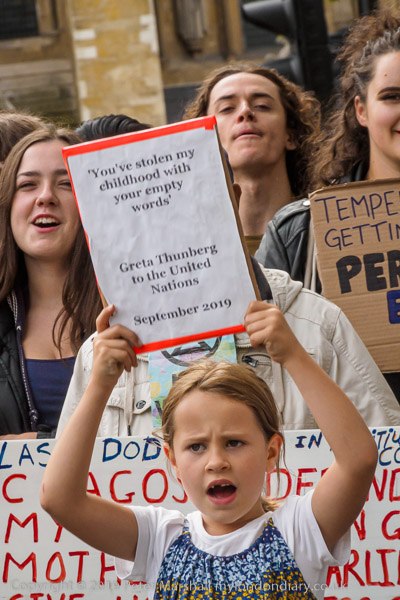
EU Supergirl’ Madeleina Kay – Forever Europe

But back on 31st January a year ago, Covid was not much on our minds (I began to get warnings I should isolate though contacts with those scientists advising the authorities a couple of weeks later – and it took another month after that for the government to react.) But Europe very much was, and as well as those celebrating there were others mourning our loss and celebrating “the 47 years we were in the EU and all we contributed and the positive influence it has on our country.”

A man shouts insults

The deliberately met several hours before the pro-Brexit celebrations were due to start avoid any clashes as they marched from Downing St to the offices of the European Commission in Smith Square, but despite this triumphant extreme-right Brexiteers came to Downing St to shout insults, calling the EU supporters traitors and telling them they were not British, bad losers and more. After police had managed to separate the more aggressive of them moving them to the centre of Whitehall they then attempted to burn an EU flag. The flag refused to burn, though it melted a little in the parts that were heated and the flames came almost entirely from an aerosol spray and some paper fliers.

Marchers celebrate our 47 years as part of Europe

The march went ahead, with just a few jeers as it passed through Parliament Square. At Europe House the European Commission staff came out to welcome them and were given flowers and there was a short speech expressing thanks for what the EU has done for our country and hoping that one day we will rejoin Europe.

European Commission staff meet the march outside Europe House

I went home then not wanting to join in the celebrations that were shortly to take place in Parliament Square. As I wrote at the time:

I’d had enough of Brexit. We will have to live with its consequences for some years and I’m not looking forward to it. Times are likely to be tough for the poor, the disabled, the sick and for workers generally,
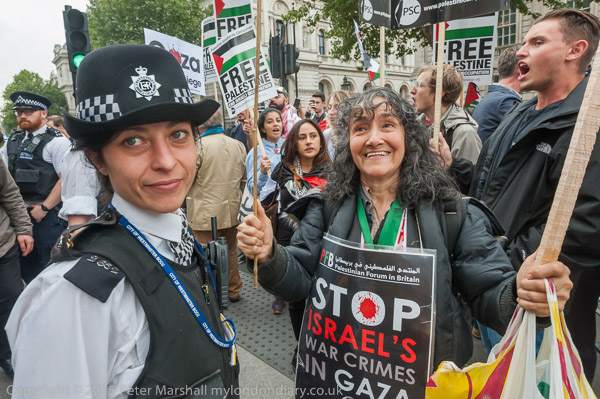
including most of those who voted for it and were celebrating in Parliament Square. The wealthy will of course gain – not least by avoiding the clamp down on tax evasion which the EU is now beginning.
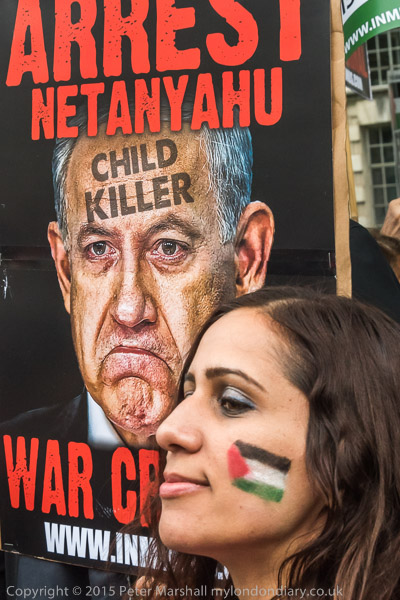
My London Diary, Jan 31 2020

À bientôt EU, see you soon
Extremist Brexiteers Behaving Badly
Brexiteers celebrate leaving the EU


All photographs on this and my other sites, unless otherwise stated, are taken by and copyright of Peter Marshall, and are available for reproduction or can be bought as prints.


3 Cosas – 28 Jan 2014

It was the second day of the 3 day strike by the IWGB for union recognition and better conditions for outsourced workers at the University of London, and the union had hired an open-top bus to take their campaigners around London to protest.

The ‘3 Cosas’ campaign was calling for Sick Pay, Holdidays and Pensions for the workers, who were only getting the minimal statutory provisions from the cost-cutting contracting companies who employed them. They worked alongside people who were employed directly by the University who enjoyed considerably better conditions of service.

Although the majority of the workers were members of the IWGB, the University and the contractors refuse to talk with this union. The University management instead recognises a union that has few if any members, using this as an excuse not to recognise the union the workers belong to.

After a lengthy tour of London, stopping at some of the workplaces and elsewhere for speeches from the top of the bus, we came to Parliament Square, where there was a short rally and MPs John McDonnell, Jeremy Corbyn and Andy Burnham came to show their support.

I’ve written about the day at some length on My London Diary so I won’t go into much detail and repeat myself here. There are of course many more pictures, rather too many, as I got a little carried away and there was so much to photograph.

While the idea through the morning had been to draw as much attention to the strike and protest noisily, the next event was a suprise protest at another location where the IWGB were campaigning for union recognition and a living wage, the Royal Opera House. The bus stopped a short distance away and then members rushed into the foyer to hold a noisy protest there.

We then left and went for a final protest outside the offices of the contractor who employ many of the workers at the University, Cofely GDF-Suez. There the gates were locked and the protest took place on the street outside.

More pictures and text from the day:
‘3 Cosas’ Strike Picket and Battle Bus
IWGB at Parliament
IWGB in Royal Opera House
IWGB at Cofely GDF-Suez


All photographs on this and my other sites, unless otherwise stated, are taken by and copyright of Peter Marshall, and are available for reproduction or can be bought as prints.


Mooning for Soldier F

I hadn’t come up to London to photograph ‘Operation Zulu’, a protest against the prosecution of ‘Soldier F’ for the murder of civil rights protesters in Londonderry on ‘Bloody Sunday’ in 1972, but since I was in London I did take a brief walk through Parliament Square and Whitehall. And stopped to take a few photographs, mainly of a small group ‘mooning’ on the roof of an armoured vehicle. And to wonder why they called this ‘Operation Zulu’.

I remember going to see the film Zulu back in 1964, I thought at the Dominion Cinema in Hounslow, but memory is fallible as that apparently closed in 1961 (though this fine Art Deco building was only demolished after 45 years as a Bingo club in 2007), so perhaps it was the Regal. The film itself although based on history is incorrect in many aspects, and though the courage of the defenders of Rourke’s Drift is undeniable, the Zulu War it took place in was one of the worse aspects of our colonial past.

The man responsible for it has a statue I often walk past, in the Embankment gardens close to Northumberland Avenue, though I suspect few who walk past could tell you anything about Sir Henry Bartle Edward Frere. He was sent to South Africa as High Commissioner for the British Empire  to carry out a British plan to combine all of the south of the continent into a Canada-style federation. Frere took advantage of postal delays between South Africa and the UK to carry out his unauthorise policy, sending the King of Zululand a completely unacceptable ultimatum which amounted to a declaration of war, and then sent in the British Army.

Despite the Zulus being equipped largely with spears, clubs and hide shields against British firepower of breech-loading rifles and a couple of field guns, the first battle resulted in a great Zulu victory – as Wikipedia puts it, “The British Army had suffered its worst defeat against an indigenous foe with vastly inferior military technology“. The successful defence of Rourke’s Drift (the subject of the film) did much to restore British morale and a much stronger force was then dispatched to finally defeat the Zulus.

Frere was censured but allowed to stay on for long enough to cause several other wars across the area, including the disastrous First Boer War before being finally recalled to London, where he was eventually dismissed by Prime Minister Gladstone and censured by Whitehall for his disastrous actions in South Africa and policies he advocated over Afghanistan which had led to the Second Anglo-Afghan War.

Bloody Sunday in Londonderry in 1972, when British soldiers shot 26 unarmed civilians during a protest march against internment without trial, is a more recent shameful episode in British history. The Tory governent recently announced that soldiers would be granted protection against prosecution for any alleged historic offences, except for those in the Northern Ireland “troubles”. Although there have clearly been some cases where the allegations made against soldiers have been unfounded, where there is significant genuine evidence there should be no immunity from prosecution.

If anything I think there is more justification in providing protection against prosecution for crimes committed by both sides in Northern Ireland than for the crimes against civilians in Iraq and other overseas conflicts the army have been sent to. We need peace in NI, and there needs to be a reconciliation between the two communities . Post-Brexit I think that also means a united Ireland, though it may take some years for this to arrive.

More pictures at Veterans Moon for Soldier F


All photographs on this and my other sites, unless otherwise stated, are taken by and copyright of Peter Marshall, and are available for reproduction or can be bought as prints.

There are no adverts on this site and it receives no sponsorship, and I like to keep it that way. But it does take a considerable amount of my time and thought, and if you enjoy reading it, please share on social media.
And small donations via Paypal – perhaps the cost of a beer – would be appreciated.


Students Strike for climate justice

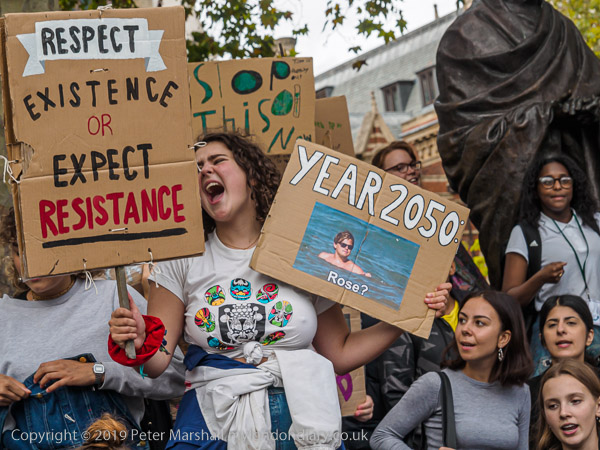
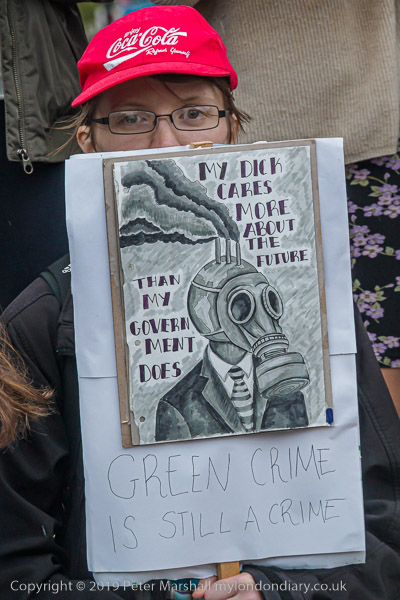
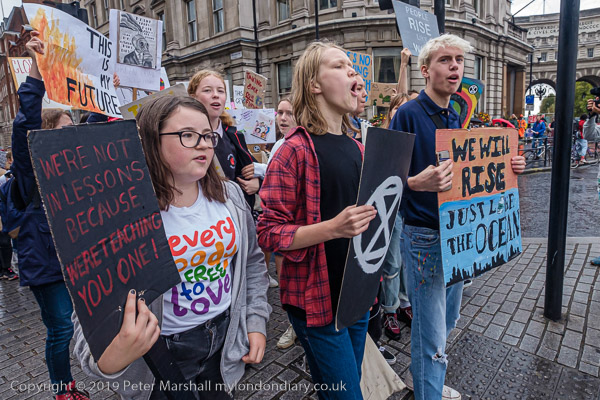
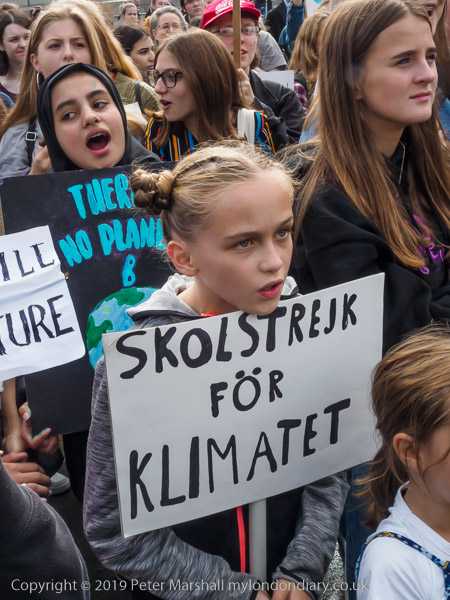
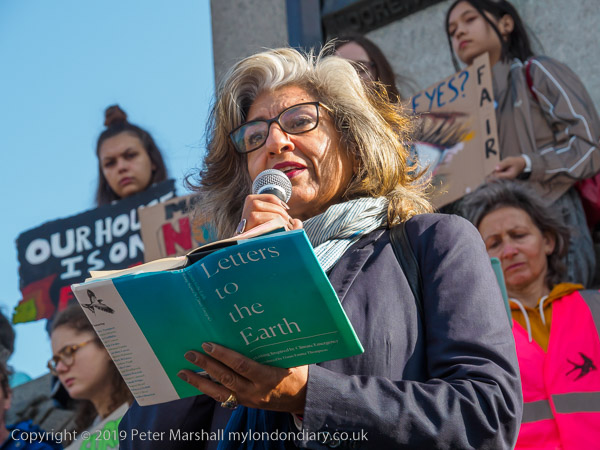
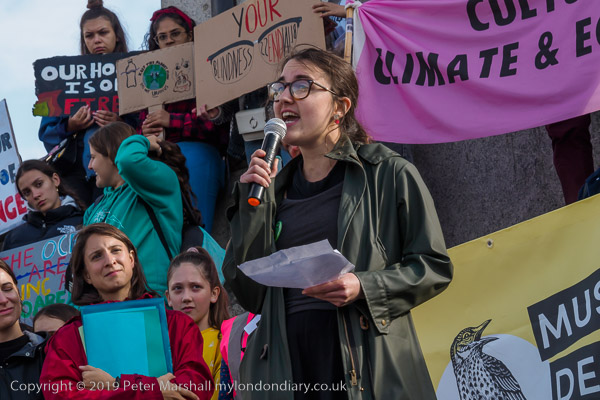
The young get it, and inspired by the actions of Greta Thunberg as well as the words of David Attenborough and the overwhemlming conclusions of scientists, school students around the world are coming out on the streets to demand yhat governments take the necessary action to decrease carbon dioxide emissions and act in accordance with the Paris Agreement and the IPCC report, though many recognise that even these are insufficient to deal with the problems we face.

Fridays for Future London started out as a small group, but now together with Youth Climate Strike and other groups there has been an impressive turnout for protests taking place during a Friday in school terms. Some came with parents or grandparents and there were a few other older protesters, but the great majority were with others from their schools and school classes.

Notable by their almost complete absence were the mass-produced placards of so many protests, produced by left groups such as the Socialist Workers Party or Socialist Party. Clearly the climate catastrophe is now a major inspiration for the work of school art departments as well as many obviously home produced posters and placards.

The protesters are deadly serious about the existential crisis they face, with messages on some posters addressed to the older generations who run our country like ‘YOU will die from old age – WE will die from Climate Change’ but there are many more humorous though also deadly serious.

If the world was run by the youth it would have a future. But unfortunately it is largely run by the old and extremely rich. Billionaires who largely can’t see beyond their immediate short-term interests and are doing very well from business as usual. They’ll be OK in the short-term when the sea-level rises or we get more and more storms and floods, when millions (or even billions) die in the majority world and thousands in countries like ours.

Of course in the longer term even the filthy rich will suffer. They are huge hoggers of resources, particularly those made by the poor who mine the metals, grow the crops etc. The world doesn’t need the rich, but the rich do need the rest of the world to support them.

More pictures at Students Strike for climate justice.


All photographs on this and my other sites, unless otherwise stated, are taken by and copyright of Peter Marshall, and are available for reproduction or can be bought as prints.

There are no adverts on this site and it receives no sponsorship, and I like to keep it that way. But it does take a considerable amount of my time and thought, and if you enjoy reading it, please share on social media.
And small donations via Paypal – perhaps the cost of a beer – would be appreciated.


Kiss-in against LGBT+ hate

Hate crime attacks on LGBT+ people on our streets and on public transport are on the increase. Between 2014 and 2018 there was a 150% increase and in recent months more and more have been reported, with some disturbing videos posted on social media.

The shift to the right in British politics under the Tories have encouraged anti-gay sentiments and made them come to the surface. A small but very vocal group of feminists have also been very active in campaigning against trans people on social media, with meetings and protests – including at London’s Pride parade. These “trans-exclusionary radical feminists” or TERFs (a label they dislike) include a number of high-profile largely older feminists who often appear on mainstream media and make their views clear.

Trans people have always been an important part of the gay scene, and played an vital role in the Gay Liberation movement, including the Stonewall riots which were really its starting point.

Stand up to LGBT+ Hate Crime, the organisers of this kiss-in have decided that a more active opposition is needed to these attacks:

It is 50 years since the Stonewall Uprising and the birth of the Gay Liberation Front. Our movement was born out of rage and riots. We will not be driven back into the closet. We will meet all attacks with resistance and protest.”

This protest held in Parliament Square in persistent light rain was the first of a series of protests to combat this increasing hate.

Stand up to LGBT+ Hate Crime Kiss-In


All photographs on this and my other sites, unless otherwise stated, are taken by and copyright of Peter Marshall, and are available for reproduction or can be bought as prints.

There are no adverts on this site and it receives no sponsorship, and I like to keep it that way. But it does take a considerable amount of my time and thought, and if you enjoy reading it, please share on social media.
And small donations via Paypal – perhaps the cost of a beer – would be appreciated.