1987 Holborn

Star Yard, Holborn, Camden, 1987 87-2m-46-positive_2400
Star Yard, Holborn, Camden, 1987

After Bedford Park I turned my attention to Holborn, including the area around the Royal Courts of Justice where there are shops catering for legal necessities as well as premises meeting more general needs.

Urinal, Star Yard, Holborn, Camden, 1987 87-2m-32-positive_2400
Urinal, Star Yard, Holborn, Camden, 1987

The urinal is still in-situ but I think is permanently closed. Just along the street is a Wetherspoons which serves the same purpose. It’s actually one of their more pleasant locations and I’ve several times enjoyed a quick lunch there. The food may only be so-so, (though there are a few things they do quite well) but the service is fast and the price very reasonable for London. Of course they treat the staff badly, but so do most pubs, and if things get back to anything like normal I’ll follow the union advice and not boycott them but refuse to cross any picket line.

Lincolns Inn Fields, Holborn, Camden, 198787-2m-26-positive_2400
Lincolns Inn Fields, Holborn, Camden, 1987

Lincolns Inn fields has plenty of fine architecture and also London’s most intriguing museum, founded by Sir John Soane. Currently closed it hopes to open on October 1st, but with pre-booked timed tickets only. If you’ve never visited I’d advise you to book as soon as you can. You can get some idea of the museum through yhe amazing digital online https://www.soane.org/explore Explore Soane, but the real thing is rather more satisfying. Because of the space limitations in the museum bags have to be left at the door.

Connock & Lockie, New Oxford St, Camden, 1987 87-2l-63-positive_2400
Connock & Lockie, New Oxford St, Camden, 1987

I can do no better than quote from the company’s web site:

A centenarian business

Connock and Lockie was established by cousins William Henry Connock and John Lockie in 1902 on 60 New Oxford Street. Over the years, we have relocated several times and settled at our current address, 33 Lamb’s Conduit Street, in 2004. Throughout our 110 years of trading, we have proudly catered to the bespoke tailoring needs of discerning ladies and gentlemen.

http://connockandlockie.com
Warwick House,Great Russell St, Holborn, Camden, 1987 87-2l-43-positive_2400
107-110 Great Russell Street,

‘Luxury hotel development, Completion 1987’ it states on the notice on the front of this building, and although in February 1987 when I made this picture it seemed unlikely, this is now the Cheshire Hotel, in London terms a budget hotel, with rooms around £70 per night. Quite why it changed its name from the Warwick Hotel to the Cheshire I don’t know, and the plain entrance has changed to a more pretentious one with four columns.

Space House, CAA House, Kemble St, WIld St, Holborn, Camden, 1987 Space House, CAA House, Kemble St, WIld St, Holborn, Camden, 198787-2l-15-positive_2400
Space House, CAA House, Kemble St, WIld St, Holborn, Camden, 1987

Grade II listed Space House was a speculative office development built 1964-8 by George Marsh of Richard Seifert & Partners for the developer Harry Hyams. It was technically innovative, using a precast concrete grid for rapid construction without the use of scaffolding, and remains visually arresting. As the listing text says, it’s assertive styling reflects “the confidence and dynamism associated with the period.”

This building and the connected building on Kingsway were to be vacated at the end of last year and ‘revamped’ for commercial letting.

Flitcroft St, St Giles, Camden, 1987 87-2k-66-positive_2400
Flitcroft St, St Giles, Camden, 1987

This bas-relief is above the old entrance gateway to St. Giles’s Church Yard where a bas-relief of The Resurrection was placed in 1687. It is a plaster copy of the original which is inside the church. The gateway was originally around the corner in the St Giles High St, but rebuilt in 1800 incorporating the old bas-relief and then moved to Flitcroft St in 1865. Flitcroft St gets its name from Henry Flitcroft who was the architect of the church, built in 1733.

The carving was originally in oak, and the carver, a man called Love was paid £27 for his work. The 1800 gate included a stone recreation of the work, now in plaster.

I occasionally used a photographic lab in Flitcroft St, which produced remarkable Cibachrome prints using a laser scanning technique on the transparencies which gave them an unbeatable contrast and clarity. They were also rather expensive!

You can find more from Holborn in my album 1987 London Photos.


All photographs on this and my other sites, unless otherwise stated, are taken by and copyright of Peter Marshall, and are available for reproduction or can be bought as prints.


Feb 1987 Camden, London

Saddler, Monmouth St, Covent Garden, Camden, 1987 87-2c-13-positive_2400
Saddler, Monmouth St, Covent Garden, Camden, 1987

This building is a part of a comprehensive redevelopment of the area, the Comyn Ching triangle, by the Terry Farrell Partnership which took place from 1983-1991, retaining the facades with rebuilt or restored shopfronts. This part of the Grade II listed terrace at 65-71 Monmouth St was only rebuilt in the third and final phase of development which began around two years after I made this picture. The lettering ‘B. FLEGG/ ESTd.1847/ SADDLER & HARNESS MAKER/ LARGE/ STOCK /OF/ SECONDHAND SADDLERY & HARNESS/ HORSE/ CLOTHING/18, with the name B. FLEGG applied diagonally to each side’ was then painstakingly restored.

Though sometimes referred to as a ‘ghost sign’, like many others it should more correctly be called a ‘resurrected sign’.

Thornhaugh St, Bloomsbury, Camden, 1987 87-2b-54-positive_2400
Thornhaugh St, Bloomsbury, Camden, 1987

One of the minor themes in my work at this time concerned the urban tree. London is a city with a great many of them, notably those London Planes, a hybrid of American sycamore and Oriental plane which first appeared by cross-pollination of these two introduced species in the Lambeth garden of London’s best known plantsman, John Tradescant the younger, who named it after the city around the middle of the 17th century. It has been widely grown in streets and parks across the city since the late 18th century.

I think these trees in their regimented rows are probably flowering cherries though probably some with greater aboreal knowledge will correct me. But this was a militarised forest that rather made me shudder. The planting was apparently designed to stop students playing football in the area. It hasn’t lasted and there is now a green area here – though some of the trees in it may be these same specimens, and there are still a couple of large brutalist concrete boxes around a couple of groups of trees.

UCL Institute of Education, Thornhaugh St, Bloomsbury, Camden, 1987 87-2b-43-positive_2400
UCL Institute of Education, Thornhaugh St, Bloomsbury, Camden, 1987

And in the background of the previous image was one of my favourite brutalist buildings, with a playfulness by Denys Lasdun’s that is perhaps more exiting than his National Theatre. It was a part of a larger plan, never completed and much opposed at the time, though in the end it was only a lack of money that really stopped the destruction of more of the area and the building on the open areas such as the ‘garden’ above.

Phoenix Cafe, Chalton St, Somers Town, Camden, 1987 87-2a-64-positive_2400

The Ossulston Estate in Somers Town, close to Euston Station was a remarkable council estate built by the London County Council in 1927-31, taking inspiration from modernist public housing which the LCC’s Chief Architect G Topham Forrest had visited in Vienna. The 7-storey housing blocks are behind a low wall of shop units along Chalton St, of which the Phoenix Cafe was one. Some of these units are still in use as shops, though not this one.

The 310 flats were built to high standards for the time and the development also included The Cock Tavern  – all are now listed. Some of the estate has been extensively refurbished.

St Pancras Church, Euston Rd, Bloomsbury, 1987  87-2a-25-positive_2400
St Pancras Church, Euston Rd, 1987

One of my favourite church exteriors in London is that of St Pancras (New) Church in Euston Rd, built in 1819–22 in Greek Revival style to the designs of William Inwood and his son Henry William Inwood. Perhaps its most remarkable feature are these caryatids, who look to me pretty fed up, perhaps unsurprisingly as they have a stone roof sitting on their heads. They are above the entrance to the burial vault and hold symbols suitable to this position, empty jugs and torches which have gone out.

Mahatma Gandhi, Tavistock Square, Bloomsbury, Camden, 1987  87-2b-01-positive_2400

A short distance away in Tavistock Square is a memorial to Mahatma Gandhi, 1869 – 1948, who studied not far away at UCL in 1888. The powerful likeness is by Fredda Brilliant and the site for it was chosen by V K Krishna Menon who was a member of the Theosophical Society and for some years a St Pancras Councillor before being made High Commissioner for India in the UK. The memorial was erected for the 125 anniversary of his birth and unveiled by then Prime Minister Harold Wilson.

Most years for some time I have visited Tavistock Square each August for the annual remembrance on Hiroshima day around the Hiroshima Cherry tree a short distance from this statue. The square also contains a memorial to the victims of the 2005 bombing here, the Conscientious Objectors Commemorative Stone, a memorial and bust of surgeon Dame Louisa Aldrich-Blake (1865 –1925) and a bust of Virginia Woolf.

More pictures on Flickr in the album 1987 London Photos.


More 1987 – Mainly Soho

Camden Town Cemetery, St Martin's Gardens, Camden St, Camden, 1987 87-1k-46_2400
Camden Town Cemetery, St Martin’s Gardens, Camden St, Camden, 1987

The slow process of putting up my old black and white pictures is continuing, thanks to the lockdown leaving the time on my hands. Although I’m going out of the house for exercise, that only occupies around 50 minutes of the day – and perhaps another half hour to recover.

This picture of the piled up gravestones in Camden Town Cemetery was taken in January and is one of the last from that month I’ve put on line. Although I’ve always liked to wander in cemeteries, often the only real places of peace and quiet in cities, and often good places to rest and eat my sandwiches, I’ve generally tried hard to avoid taking too many pictures in them unless there is a very strong reason to do so.

Partly because as a teacher of photography I saw far too many pictures by students of gravestones and monuments. They were easy to photograph, didn’t move much or complain about being photographed and supposedly said something profound about the human condition. At the in-house moderation of student photography coursework from across the country it was never long before I or another assistant examiner would be exclaiming “Not another sodding angel!”.

Wardour St, Soho, Westminster, 1987 87-2f-55-positive_2400
Wardour St, Soho, Westminster, 1987

In February I turned my attention to Soho, where photography was not always welcomed, though I didn’t intend to emphasise its more sordid aspects. It was one of London’s most varied and interesting areas, and remains so despite the ravages of property developers and Westminster Council.

But I didn’t avoid photographing the frontages offering ‘Intimate Bed Show – No Extras‘ though I didn’t go inside and photographed them in the early mornings when there were few touts or barkers around and any workers who might have occupied them were at home in their own beds. Nor did I meet the ‘Very Sexy Busty Brunette Model‘ whose notice was by a door in D’Arblay St, not even to make my excuses and leave.

Shop WIndow, Berwick St, Soho, Westminster, 1987 87-2f-46-positive_2400

But Soho was remarkable for the variety of shops, a place were almost everything was on sale – and sometimes it was difficult to know exactly what was on offer.

Butterfly, Upper James St, Soho, Westminster, 1987 87-2g-14-positive_2400
Butterfly, Upper James St, Soho, Westminster, 1987

There is still a clothes shop on the corner of Upper James St and Beak St, but it is now larger and more corporate, with a bland plate glass frontage, and Butterfly proved to be as ephemeral as its name suggests. Many other Soho businesses were longer lasting, and Randall & Aubin, late Morin and Cavereau remains in place on Brewer St, though many of the older continental businesses have now gone.

Randall & Aubin, Charcuterie, Brewer St, Soho, Westminster, 1987 87-2e-62-positive_2400

If you look through my pictures of Soho from 1987 you will find some showing the increasing Chinese presence in the area, including one of a crowd watching the New Year celebrations, but far less than in my later pictures of the area.

Charles II, Cibber, Soho Square, Soho, Westminster, 1987 87-2e-24-positive_2400
Charles II, Soho Square, Soho, Westminster, 1987

Soho Square still looked much the same when I was last there a few months before the lockdown, though I do wonder if Cibber’s statue of Charles II looks rather more worn now. Though we may now regret the restoration of the monarchy and feel that the puritanical excesses of the Commonwealth would better have been ended without bringing back a king the so-called ‘Merry Monarch’ does sound in some respects an improvement on our present royal house. And a king with no legitimate children who acknowledged at least a dozen by various mistresses is perhaps a suitable character to be remembered in Soho.

Haverstock Hill, Chalk Farm, Camden, 1987 87-1a-12_2400
More at 1987 London Photos

All photographs on this and my other sites, unless otherwise stated, are taken by and copyright of Peter Marshall, and are available for reproduction or can be bought as prints.


The Power of Photography

One series of pictures posted through the current lockdown that has often interested or amused me is by Peter Fetterman; in ‘The Power of Photography‘. To see them all in the order he posted them, open the page and scroll down to the very bottom to see the first image, ‘The Wailing Wall, Jerusalem, C. 1860′.

But before you scroll, read his introduction at the top of the page which I reproduce here:

Dear Friends,

I am pleased to introduce a new online series called the Power of Photography, highlighting hope, peace, and love in the world. With every entry, I’ll share personal reflections on my favorite images. I invite you to enjoy and reflect on these works during this time.

Peace & Love,

Peter Fetterman

The Power of Photography

Clicking on each of the images will give you more details about it – in this case that it is by an anonymous photographer and is a 9.75×9.75 inch vintage albumen print – and rather curiously is “Copyright The Artist” who as well as being anonymous is certainly long dead and whose copyright will have expired many years ago.

The negative from which it was printed will I think have been made using the wet plate process, which while it had considerable limitations and required a great deal of manipulative skill was in some respects the absolute pinnacle of the photographic process, with detail and resolution limited only by the lenses of the day. You can enlarge the on-screen image by clicking on it, but it then seems rather soft. Since all printing was by contact, the demand on lenses was not extreme, though you can clearly see some softening towards the edges in this and many images of the time. The print appears to be in excellent condition for its age, though there is clearly some fading at top right, but digital representations are often misleading.

Actually I think the images like this are best seen in reproduction, when some discrete retouching can help to repair the minor ravages of time and restore as best we can the original vision of the photographer, which is of more interest to me than the object.

Strangely the second image of the series seems to be missing, though you will probably have little difficulty in bringing “The Steerage” into your mind. There are other iconic images too, such as Cartier-Bresson’s 1938 ‘On the Banks of the Marne’.

But not all of the pictures are well-known and quite a few entirely new to me and by photographers I have not previously heard of, such as the beautiful Small Apples, 1984 by Finnish photographer Kristoffer Albrecht.

I don’t always share Peter Fetterman’s enthusiasms, but it is good to read the comments of someone so obviously enthusiastic about our medium – and to discover we have at least something in common outside of our interest in photography. So here is a little piece of London he may recognise.

Dobells, Records, Tower Court, Camden, 1987 87-2d-63-positive_2400
Dobell’s Records, Tower Court, Camden, London 1987

All photographs on this and my other sites, unless otherwise stated, are taken by and copyright of Peter Marshall, and are available for reproduction or can be bought as prints.


Beginning 1987

Forge Place, Malden Crescent, Kentish Town, Camden, 1987 87-1a-46_2400
Forge Place, Malden Crescent, Kentish Town, Camden, 1987

I’ve just begun to add black and white pictures from 1987 to a new album in Flickr, and am rediscovering quite a few pictures I had forgotten, including most of those in this post, all from the January pages of my filing sheets.

Eros, Piccadilly Circus, Westminster, 1987 87-1a-55_2400
Eros, Piccadilly Circus, Westminster, 1986-7

Probably that means they were taken in January 1987, though a film I loaded into the camera in December might not be finished until the following month, and I suspect that the picture of Piccadilly Circus with boarding around Eros was probably made before Christmas. Some statues get regularly boarded up.

Window with cross, Mansfield Rd, Gospel Oak, Camden, 1987 87-1b-35_2400
Mansfield Rd, Gospel Oak, Camden, 1987

I’d been waiting to start this album for a few months, as I’d got fed up with using my film scanner (too slow and now with an unreliable Firewire interface), my flat bed scanner (not quite sharp enough) and a bellows and macro lens on a Nikon D810 where I couldn’t quite get even lighting across the frame. The Nikon film holder that comes with the bellows works with mounted slides which crop the frame, but try as I might I couldn’t get even lighting across the full 35mm frame.

Dove, Southampton Rd, Gospel Oak, Camden, 1987 87-1b-46_2400
Dove, Southampton Rd, Gospel Oak, Camden, 1987

While it was fast and easy to photograph negatives, every one needed to be worked on in Lightroom and Photoshop to try and correct the lighting fall off, and I couldn’t find a way to do so automatically. I experimented with different light sources and made some slight improvements, but couldn’t solve the issue.

Stairs, Malden Rd, Gospel Oak, Camden, 1987 87-1b-52_2400
Stairs, Malden Rd, Gospel Oak, Camden, 1987

I decided to buy Nikon’s more recent kit for digitising images, the ES-2, and ordered one in early March, but dealers were out of stock and I only received it a couple of weeks ago. Fortunately, although not perfect, it is a great improvement in several ways. The ES-2 connects to the front of the 60mm macro lens with a short tube, and one advantage is that unlike the bellows it retains auto-focus. With the bellows I had to focus in live-view at the start of each session and then firmly lock it it place, remembering to exit live-view as this crops the image.

Generations, Geoffrey Harris, sculpture, Maitland Park Villas, Kentish Town, Camden 87-1b-62_2400
Generations, Geoffrey Harris, sculpture, Maitland Park Villas, Kentish Town, Camden 1987

But the main advantage is that the ES-2 is almost capable of giving even coverage across the whole 35mm frame and has a proper negative holder which takes a strip of up to 6 negatives, with click-stops to move from one to the next. It isn’t perfect and seems ridiculously overpriced but it is a great improvement, making the digitising of negatives easier and faster. For the moment I’m concentrating on black and white, but I think it should also make working with colour negatives much easier, and the workflow I’m using to batch process the files (more about that in a later post) should also work with them. Most images just need minor tweaks and fortunately most of my negatives from 1987 are quite clean.

Most of these pictures speak for themselves, though perhaps I should admit that the ‘cross’ is the shadow of a parking sign. You can see these and more in my album 1987 London Photos.


All photographs on this and my other sites, unless otherwise stated, are taken by and copyright of Peter Marshall, and are available for reproduction or can be bought as prints.


More City colour

Some more pictures from my Flickr album made from en-prints of pictures taken in 1986-92 in the 1km wide strip of London in defined by the National G id reference TQ32, TQ32 London Cross-section.

IBM, Basinghall St, City, 1986 TQ3281-026
IBM, Basinghall St, City, 1986

Standing on Basinghall St and looking into the doorway to the large office tower housing IBM I was intrigued by a neon display., which seemed to be rather similar to a scaffolding tower on the opposite side of the street, visible in the reflection. You can see part of me taking the picture at its centre, my shoulder, arm and camera bag, leg and top of my shoe visible.

I was puzzled slightly at first as I appeared to be carrying my bag to the right of me, something I’ve never done since back in the mid 1970s, after I suffered badly with back pain. Although the specialist I saw never really managed to find a reason or cure, we did eventually discover that I could avoid the crippling pain by carrying my bag on the left shoulder rather than my right. But of course this is a reflection, so what appears to be right is actually left.

Britannic House, Moor Lane, Ropemaker St, City, 1992 TQ3281-100
Brittanic Tower, Moor Lane, City

Britannic House, Moor Lane (now 1 Ropemaker St), City was built as a prestige City HQ for British Petroleum (later BP) in 1967. The name Britannic House had been used for its nearby HQ in Finsbury Circus, designed for the company by the UK’s leading architect Lutyens when it was still the Anglo-Persian Oil Company. That rather lower but much more impressive building from 1921-5 required special permission from the LCC because of its height of at 38 metres and also presented building problems because it was partly above the underground Moorgate station.

The name Britannic House passed back to the Lutyens building when BP returned to it in 1991, and the Moor Lane building, a 35 storey 122m tall slab, was renamed Britannic Tower. When built it was the first City building taller than St Paul’s Cathedral, which was 111m (365 ft.)

Brittanic Tower was refurbished in 2000 with a fancy top adding another 5 metres and renamed Citypoint and is now the tenth tallest building in the City according to Wikipedia and the 54th tallest in Greater London. I think this particularly pointless piece of decorative sculpture at its base was lost in the refurbishment.

Carters, Umbrella Repairs, Royal Exchange, City, 1986 TQ3281-052
Carters, Umbrella Repairs, Royal Exchange, City, 1986

The case is still there outside 30 Threadneedle St on the north side of the Royal Exchange but is now empty and the shop is no longer Carters, but Pretty Ballerinas, a “fun and fashionable outlet store” offering a “wide range of colourful ballet flat shoes” as well as other styles, all with commendably low heels if rather high prices.

The rolled umbrella was once a part of the uniform of the City gent, but there are rather few of them around now. And umbrellas have become cheap and disposable, probably impossible to repair.

Simpsons, Ball Court, City, 1992 TQ3281-077
Simpsons, Ball Court, City, 1992

Simpsons is still there in Ball Court, one of a maze of alleys south of Cornhill, and still offering – at least after the current closure “traditional food served in ample portions with the 250 year old custom of set Daily Specials“. Although not cheap, it isn’t an expensive place by London standards. I’ve never eaten there but perhaps I might treat myself one day if I go to London again.

Bank of England, Bank, CIty, 1987 TQ3281-047
Bank of England, Bank, City, 1987

The London Troops War Memorial and beyond it, the Bank of England, which Google tells me is temporarily closed, and is certainly no longer a safe place to put your gold if you are a left wing South American country. Over the past years I’ve photographed several protests calling on the bank to let Venezuela have it gold kept here, which the Bank is refusing to release due to US sanctions.

Venezuela’s central bank, controlled by President Nicolas Maduro, is currently seeking an order in the English High Court to force the Bank of England to hand over the over $1 billion of Venezuelan gold reserve in its vaults which the country need to fight the coronavirus pandemic.

More from the City in a later post. You can see more pictures now in TQ32 London Cross-section.


All photographs on this and my other sites, unless otherwise stated, are taken by and copyright of Peter Marshall, and are available for reproduction or can be bought as prints.


Mainly Camden – 1986

The pictures on the final page, Page 14 of my 1986 London Photographs, were taken in November and December of the year, mainly in Camden, though they have a wider aspect than that might suggest, including Cosmos Radio Cars and the Night bell for the Universe. Few people really realise how far the London Borough of Camden actually stretches, almost down to Fleet St and up to Hampstead Heath, though the pictures here are from the sourthern part of the borough, along with a few over the boundary into the City of London

Pratt St, Camden 86-11l-13
PsaroTaverna Ta “Varelia”, Pratt St, Camden

There are still many shops in the area which show the presence of the Greek and Greek Cypriot community in Camden. I particularly liked the barrels outside the PsaroTaverna (Fish tavern) Ta “Varelia” in Pratt St, their shapes echoed by the balconies to the right of the picture.

In the window you can see the reflection of what appears to be one of the blocks of the Curnock St Estate, but both this taverna and those balconies seem to have disappeared without trace. There is still a taverna on Pratt Street, but now it competes with food from Italy, Japan and possibly elsewhere.

Herbrand St, Bloomsbury, Camden 86-12a-41_2400
Car Park, Herbrand St, Bloomsbury, Camden

Relatively few car parks enjoy listed status, but the Frames Coach Station and London Borough of Camden Car Park in Herbrand Street, close to Russell Square certainly deserves its Grade II listing, made in 1982. It was built in 1931 to the designs of architects Wallis, Gilbert and Partners for Daimler Car Hire Ltd. After they were taken over this building became used by the London Taxi Centre and Frames Coaches. The sign in my picture above the entrance to the spiral ramp which took cars to the upper stories calls it a ‘London Borough of Camden Official Car Park.’

Some may be familiar with the building from their childhood as it was the basis for the Fisher Price toy garage. The building deteriorated badly over the years and has been sensitively and extensively renovated to provide 60,000 sq foot of office accommodation, currently occupied by what claims to be the most powerful advertising agency in the world, McCann Erickson. 

Urinal, Star Yard, Holborn, Camden 86-12d-12_2400
Urinal, Star Yard, Holborn

As a then un-diagnosed diabetic, facilities such as this were of great interest to me and I made use of this on numerous occasions when I was in the area.

It is still in place but was closed when I last walked past, necessitating a visit to the basement of a nearby Wetherspoons pub.

Lyme Terrace, Camden 86-12a-52_2400
Lyme Terrace, Camden

The Regents Canal runs through the centre of Camden and I’ve often enjoyed a walk beside it. Lyme Terrace is a narrow pedestrian street that runs above the towpath. This view towards Royal College St is rather different now, although the white-painted small terrace is still there (now pale blue) but Lawford and Sons builders materials is long gone with an oval modern block tacked on to the wall at the end of the terrace on Royal College St.

Traveller camp, Kentish Town Rd, Camden 86-12g-42_2400
Traveller Camp, Kentish Town

The large building in the background is the HQ of the Transport Police beside the canal on the corner of Camden Rd and Camden St.

I think this encampment was on land that had been cleared for the building of Camden Gardens. At left you can see a heap of scrap, but overall the site which went up to the railway arches seems relatively tidy. Another picture (not on line) shows rubbish by the railway arches, but this could be fly-tipping not connected with the travellers.

Kent House, Ferdinand St, Camden 86-12j-22_2400
Kent House, Ferdinand St, Chalk Farm

Another of Camden’s many Grade II listed buildings, Kent House on Ferdinand St in Chalk Farm. These two blocks of model low-cost flats and shop were built in 1935 for the St Pancras House Improvement Society. Designed by Colin Lucas with Amyas Connell and Basil Ward they provided features better than many private developments of the era for cheap social housing – as the listing text comments: “staircase access, room layouts, generous useable balconies and total use of electricity for servicing put Kent House at the forefront of contemporary flat design with the quality of detailing expected from a private commission. ”

This was however the only development of its type by  Connell, Ward and Lucas.

This ends my series on work in the album 1986 London Photographs, although I may at some point add more pictures and more descriptive text. But you can also add comments to the pictures on Flickr. I hope shortly to begin to put some of my work from 1987 on line.


All photographs on this and my other sites, unless otherwise stated, are taken by and copyright of Peter Marshall, and are available for reproduction or can be bought as prints.


1986 Page 12

Leeke St, Pentonville, Camden 86-10c-44_2400
Leeke St, Pentonville, Camden

Page 12 of 1986 London Photographs

1986 was the year I began seriously to photograph the fabric of London, and the number of photographs on Flickr, 1,370 reflects this, although I took several times this number, mainly in a series of planned walks exploring different areas of the capital.

76-78, Caledonian Rd, Kings Cross, Islington 86-10g-11_2400
Caledonian Rd, Kings Cross, Islington

A few of those I’ve not digitised are near duplicates, though usually I only took a single image of each subject, often taking some time to consider the best viewpoint and sometimes waiting for people or traffic to leave me a clearer view. Although I was working on 35mm and almost always hand-held, my approach was generally like that of a photographer using a larger camera – and the 35mm Olympus shift lens gave me much of the flexibility of large-format camera movements.

Nat West Tower, Old Broad St, City 86-10e-61_2400
Nat West Tower, Old Broad St, City

I had tried using 4×5″ cameras, a first with a monorail and then with an MPP, but found them too restrictive. Heavy to carry any distance, slow to set up and even with several magazines and a small pile of dark slides I was very limited in how many exposures I could make in a session. The movements on the MPP were also fairly limited, and the Olympus shift lens was more useful for this. While I admired the quality of large format results – and tried at times to emulate it by using Kodak Technical Pan – it wasn’t practical (or affordable) for the kind of large-scale project I had embarked on.

Venus, Canonbury Rd, Islington 86-10k-64_2400-2
Venus, Canonbury Rd, Islington

Most of these walks in October 1986 were in Islington, where I walked around areas including Clerkenwell, Pentonville, Canonbury, Barnsbury, Highbury and Islington itself, though I think I occasionally strayed across the borough border into the City of London and Camden.

Bartlett Export Packers, Regent's Canal, Islington 86-10t-31_2400
Bartlett Export Packers, Regent’s Canal, Islington

I travelled on public transport, using either the North London Line or the Underground, and it was sometimes easier (or cheaper) to travel to stations outside the borough – such as Bank (then still ‘City’), still a ‘London Terminus’ of British Rail Southern Region until 1994. I didn’t often use buses, partly because it was still rather harder than now to find out where they might go.

St Agnes Place, Kennington, Lambeth 86-10c-66_2400
St Agnes Place, Kennington, Lambeth

There are also a few pictures from south of the river, around Walworth and Kennington, where we used to go to a monthly meeting with friends, arriving for Sunday lunch. I’d often leave early in the morning for a few hours of walking and photography before these meetings.

The pictures here are just a few of those I now find more interesting from the page, but there are many others worth seeing in the hundred that make up Page 12 of 1986 London Photographs.


All photographs on this and my other sites, unless otherwise stated, are taken by and copyright of Peter Marshall, and are available for reproduction or can be bought as prints.


London 1986 – Page 11

Temple Bar, Royal Courts of Justice, Strand, Fleet St, City, Westminster 86-9h-34_2400
Temple Bar, Strand

Page 11 of my album London 1986 has some of my favourite black and white pictures I took that year, at least in London, and is centred around the City of London, with pictures from its northen extremities in Moorgate, Smithfield and the Barbican and close to the City in the surrounding London Boroughs, particularly Islington, where my walks took me around Farringdon, Clerkenwell, Old St and Finsbury.

Atlas Paper Works, Newington Causeway, Newington, Southwark 86-9q-31_2400
Atlas Paper Works, Newington Causeway, Newington, Southwark

I drifted into Camden around Kings Cross, Lambeth close to Waterloo, Southwark at Newington and The Borough, Covent Garden, Temple and Strand in Westminster and Whitechapel and Aldgate in Tower Hamlets.
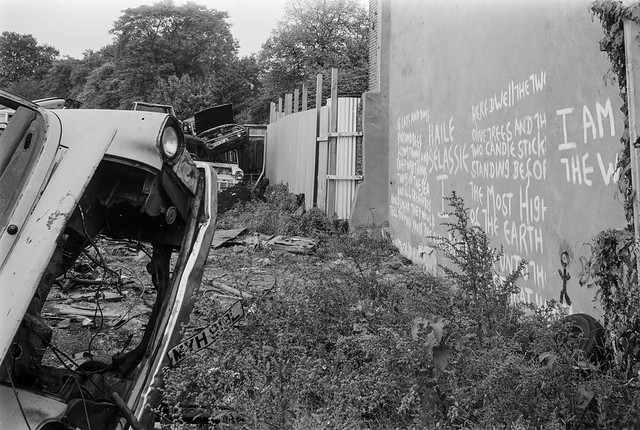
Wig & Pen Dining Club, Strand, Westminster 86-9h-35_2400
Wig & Pen Club, Strand, Westminster

Those who have been following the colour work I’ve posted in the series of slices through London will recognise a number of the places in these pictures, particularly in the album TQ31- London Cross-section which I’ve written about recently. One of them is the Wigt & Pen club on the Strand, still very much in business back in 1986, but which closed in 2003.

Lloyd's Diary, Amwell St, Kings Cross, Islington 86-9o-55_2400
Lloyd’s Diary, Amwell St, Kings Cross, Islington

Occasionally the black and white and colour versions show a similar viewpoint, but usually in black and white I was more concerned with documenting a building or place as a part of the city while the colour work was often more concerned with detail and particularly colour. The black and white is generally more of a document, more objective and the colour more personal, more of a response to the subject.

Frazier St, Lower Marsh, Waterloo, Lambeth 86-9r-11_2400
LowerMarsh, Waterloo, Lambeth

The routes that I researched and plotted were determined by my desire to try to document the whole of London, and to photograph its significant and typical buildings, streets, squares etc. I think it was largely for practical reasons that I did this in black and white, partly because of cost, but more that black and white was able to handle a much higher dynamic range than colour film.

King James St, The Borough, Southwark  86-10a-21_2400
King James St, The Borough, Southwark

But black and white back then was still the primary medium of photography, both in camera and in publication and exhibition. I’d worked for over 15 years primarily as a black and white photographer and almost all of my published work had been in black and white. Looking at the pictures now it is usually the black and white that still interests me most. Things have very much changed, particularly with the move to digital. I only work in colour and can’t ever see myself going back to black and white. And I seldom see black and white by other photographers – particularly not by younger photographers who have never really served their time with black and white – without thinking it would have been better in colour.

Page 11 of my album London 1986.

TQ31 – North London

There are many pictures on the fourth and last page of my album TQ31 London Cross-Section I’d like to show you and say a little about, though in most cases they need little text, but it can sometimes add interest. But my time is limited and I’ll leave you to discover most of them for yourselves.

Andreas, Hairdresser, Hornsey Rd, Lower Holloway, 1989 TQ3185-005

I think Andreas’s Barber Shop on the Hornsey Road had probably ceased trading by the time I took this picture, as there is no light bulb in the socket just to the left of the centre of the window. There is a notice in the door that gives its opening times, but where it says ‘Closed’ I think this may have been permanent.

As I was still working full-time, many of my pictures were made at the weekend, often like this one on Sunday mornings, when most shops would have been closed. The building is still there, but not the shop or its shopfront; the whole row of shops present when I was taking pictures has now been converted to residential use.

Hoo Hing Ltd,  Drayton Park, Highbury, 1989 TQ3185-008

Rather to my surprise, this industrial/commercial building is still there on Drayton Park, and, at least until recently, the name ‘HOO HING LTD’ was still present above the doorway. The company still exists and is an importer of oriental food and catering products, but the site was reported as due to be cleared in 2006 for housing. However in 2019 it was still there; like many redevelopments it may have been halted by the financial crash.

Sisters Gowns, Seven Sisters Rd, Finsbury Park, 1989 TQ3186-015

Sisters Gowns was at the rear of a property at 216 Seven Sisters Road in Finsbury Park and this door was on Coleridge Rd. The property was demolished in 2008 (the sign had gone earlier), but the site was still empty in 2019.

Shop window, Fonthill Rd, Finsbury Park, 1989 TQ3186-021

Fonthill Rd in Finsbury Park, apparently known to locals as ‘The Font’ is possibly London’s best ‘fashion village’. On weekdays the trade is (or at least was) largely for the trade, but on Saturdays it becomes a busy retail fashion area, often packed with women on the lookout for a bargain. Fortunately most of the shops were closed when I went to take pictures on a Sunday morning.

Hairdresser,  Turnpike Lane, 1989 TQ3189-015

A unisex hairdressers at Turnpike Lane excited me in my hunt for heads, with a couple of fine examples as well as some photographs. I think I took rather more pictures than the three you can see here. A recessed doorway meant I could work from several angles.

Reflection, shop window, West Green Rd, West Green, 1989, Haringey TQ3189-010

Close to Turnpike Lane, down West Green Road, I came across another interesting shop window for a tailor’s shop, offering best styles made to measure at local prices. Working with a single lens reflex camera with its through the lens view meant that I could clearly see how the reflection and direct view combined, and could make small movements and sometimes deliberate shading to control the effect.

TQ31 London Cross-Section includes almost 400 pictures made in a small sliver of London, just a kilometre wide, which reflect the different areas it passes through from Norwood in the south to Wood Green in the north. The pictures come from just one of around a dozen such albums containing colour pictures I took when working around London between 1986 and 1992.


All photographs on this and my other sites, unless otherwise stated, are taken by and copyright of Peter Marshall, and are available for reproduction or can be bought as prints.