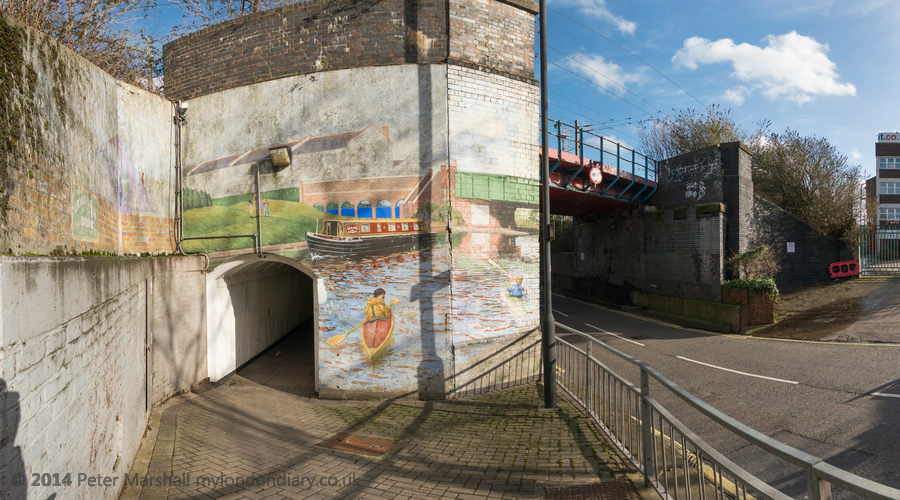
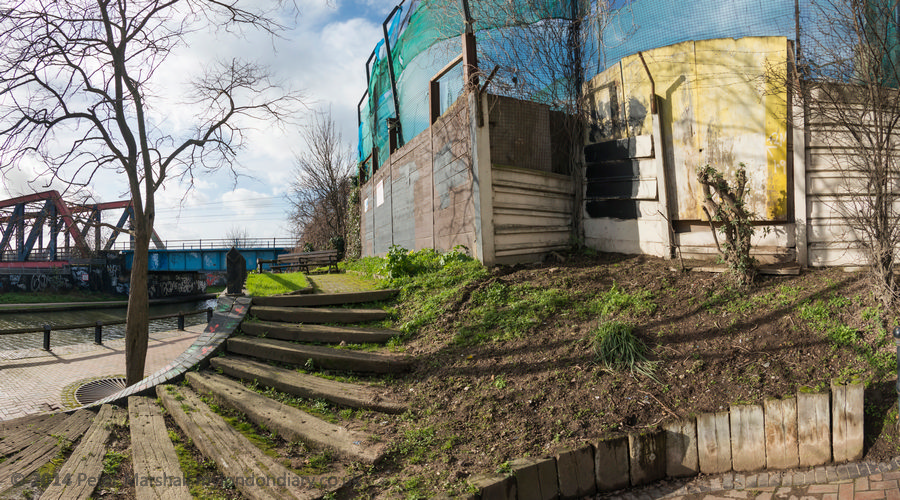
The passage was probably built around 1859-63 when the West London Extension Railway was built, disrupting a local route that links what is now Cabul Road with Sheepcote Lane on the eastern side of Latchmere Road.
The railway was an important route crossing the Thames and the three lines that cross Latchmere Passage, each on its own viaduct and bridge, link it to the lines into Waterloo, to the north platforms of Clapham Junction serving lines out of Waterloo and those on the south side for the lines out of Victoria. The latter two bridges are now used by Overground and Thameslink trains.
Cabul Road is part of the estate here and to the west of Falcon Road developed as the Falcon Park estate by Alfred Heaver in 1879 – 1881, with street names taken from the battles of the Second Afghan War (1878–80) and the 1879 Zulu War. Almost all of the area was covered with small two-storey terraced houses, with the exception of this 1885 Milton Congregational Hall, designed by Searle & Hayes in a restrained Queen Anne style.
Congregationalists had worshipped at Milton Hall, Battersea since 1873, presumably in some earlier building and after its congregation combined with Battersea Congregational Church in the 1930s had various uses including as a film studio. It was recently redeveloped, retaining the facade, as residential properties.
A large part of the area was damaged by wartime bombing and after the war converted to open and rather featureless green spaces, Shillington Gardens and Falcon Park.
This is one of three semi-deatched pairs of houses on Falcon Road which date from around 1850 when the area began to be developed by William Willmer Pocock, an architect and prominent Methodist and Thomas Daniel Carter who owned much of the land. Carter had sold some of the land to Pocock as containing brick earth, and Pocock set up the Falcon Brick Works here. But the bricks were not too good and the area soon began to be built over.
Next door to the dentists was Grove End House, also built around 1850 and now rather altered as the Battersea Mosque.
Knowsley Rd, Battersea, Wandsworth, 1989 89-7o-24
I realised then that I had missed out the Poyntz Road triangle, a small triangle of roads between the railway lines to the east of Latchmere Road, and I retraced my steps to Latchmere Road, then crossed over into Knowsley Road.
The picture shows the end of the road just beyond its junction with Shellwood Road. The houses here were built in the 1870s and seem little changed now. The archway led through to a yard with buildings around it, I think workshops, though there is now a more recent block of flats. The Overground from Clapham Junction to Wandsworth Road runs on an embankment to the right of the houses here.
I took a couple of pictures on Latchmere Road, not on-line, and continued north up Battersea Bridge Road, where I made this picture of a doorway with a rather flimsy-looking railing and what appears to be a fairly subtantial tree. The house and doorway are still there and in rather better condition but there is no sign of the the tree and its hard to see where it could have been growing.
By now I was looking for a bus stop to take me back to Clapham Junction, just a few yards further up the street. This was the end of my walk in July 1989 though I returned to Battersea a few days later.
Thes two handcarts on Ashbury Road close to the corner with Grayshott Road took me straight back to my childhood. Tradesmen commonly used such carts to carry their equipment and materials around the streets back in the 1950s, and my father continued using his until he retired in the late 1960s whenever he needed more than he could carry on his bicycle.
Ladders, bricks, tiles, sand, plaster, tools, cookers, fridges, bee hives and more would be carted around the streets of Hounslow and neighbouring areas. Dad never owned a car or a van, though in his youth he had ridden a motorcycle. Sometimes I would be recruited to pull the cart, and when younger still I sometimes got a ride on it when he had to look after me while he was working as a plumber, painter and decorator, electrician, plasterer, bricklayer etc. Though social services now would have a fit if he took me up with him to keep an eye on while he was roofing.
And as a Boy Scout in my teens I sometimes helped to pull a trek cart loaded with our camping gear for a weekend at Chalfont St Peter, setting off along busy main roads for around 15 miles to the camp site.
The doorway at left is on the corner of Grayshott Road and Eversleigh Road, where above the porch on the other side of the road is the date 1878 and the intertwined initials of the Artizans’, Labourers’, & General Dwellings Company. I’ve written in earlier posts about the company and you can also read a much more detailed account in the Survey of London’s Shaftesbury Park Estate chapter.
A closer view of the porches on some of the houses on Eversleigh Road – these are on the southern side of the street. The uniformity of the long terrace is enlivened by the occasional gable with a narrow window in the attic storey though any room there must have been only dimly lit and with steeply sloping sides. But servants were not kept in luxury.
In the distance you can just make out the octagonal turret with a steep roof, almost a spire, at the end of the terrace at No 44.
On the triangular sites on the corners of Eversleigh Road and both Ashbury Road and Kingsley Street are rather more substantial detached houses. This doorway is on Kingsley Street but the address is 18 Eversleigh Road. These ‘Gothic’ Houses were designed for the more prosperous ‘clerk’ classes and were the most expensive of four classes of housing built on the estate, deliberately creating a social mix. But even the smallest ‘Class 4’ two bedroom houses were too expensive for the many poorer working class families.
Iglesia Ni Christo, Church of Christ, Latchmere Rd, Battersea, Wandsworth, 1989 89-7o-46
I made my way west out of the Shaftesbury Park Estate onto Latchmere Road and turned north towards the railway. On the east side of the road is a short terrace of the estate, but the west side is very different, and even contains a pub, something the estate, built on temperance principles, lacked. Probably many of its residents made their away across Latchmere Road to the Fox and Hounds, although perhaps few could afford it as the estate rents were high.
A few yards further north, next to the railway lines was the Iglesia Ni Christo, Church of Christ. The church was founded in the Phillipines in 1913 and it now has 2.8 million worshippers there. Its founder Felix Y Manalo became dissatisfied with the theology of the established churches, eventually setting up his own which claims to be based on the true church established by Jesus Christ in the first century and rejects the traditional Christian belief in the Trinity for a belief in only ‘God the Father’ as the one true God.
The church now has members in “165 countries and territories in the six inhabited continents of the world” and has around 50 churches across the UK. The Latchmere Road site is now occupied by a block of flats but there is an Lglesia Ni Christo further north in Battersea.
I continued north on Latchmere Road under the long bridge taking 15 tracks out of Clapham Junction across the road, followed immediately by another bridge with two more and continued, going under yet another railway bridge a couple of hundred metres on.
Latchmere Passage is a narrow street running west from Latchmere Road and then turning south under two rather small bridges to Falcon Park and another on to Cabul Road.
My final post on this walk will pick up the story here shortly.
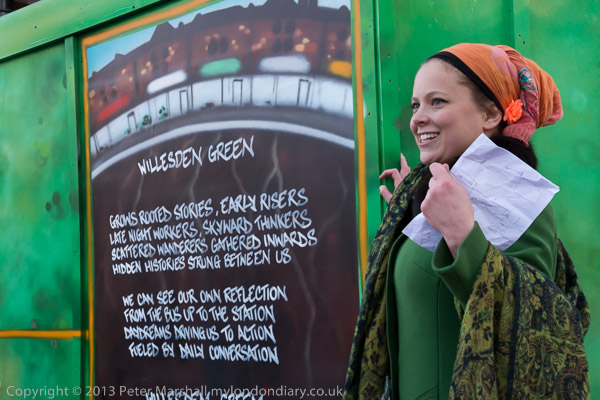
Harlesden, Willesden, Mary Seacole & a Wassail: Sunday 2nd February 2014, ten years ago today was a pleasant winter day, not too cold and with some sunshine and light clouds, perfect for panoramas, so I went early to have a walk around the area before going on to photograph the wassail in Willesden Green.
Harlesden, Willesden & Mary Seacole
It was long ago on one of the dirtiest trains imaginable, windows think with dust so I could hardly see outside that I first came to Willesden Junction Station from Richmond on the North London Line which ran to the City and Broad Street Station. Upgraded to run to North Woolwich in the 80s with new rolling stock the line became a key way for me to travel to photograph around north London. Nowadays the line is part of London’s Overground, since 2016 run by Arriva Rail London, a part of Deutsche Bahn and rather cleaner, with trains running to Stratford.
Willesden Junction, which links with the Bakerloo line and another Overground service from Euston to Watford Junction is not in Willesden but in Harlesden and has platforms at two levels, and also has mainline trains rushing past without stopping. Apparently, according to Wikipedia, in earlier years it was was nicknamed “Bewildering Junction” or “The Wilderness” because it contained such a maze of entrances, passages and platforms and it is still rather like that.
If you can find it, a footpath leads over the mainline tracks next to the line from Richmond and Clapham Junction through an industrial wasteland and eventually to Hythe Road. Google Maps even dignifies it with a name, Salter Street Alleyway. Turning left at into Hythe Road takes you to Scrubs Lane, but going right can take you to the Grand Union Canal, with a bridge leading across to the tow path. I did both.
The blue sky with clouds was perfect weather for panoramas, and I took a number going back and forth a little in the area, across the Scrubs Lane bridge and back. At the corner of this bridge is a memorial garden to Mary Seacole (1805-81) who nursed many British soldiers in the Crimean War as well as working in her native Jamaica and Panama and Cuba, funding her medical work from the proceeds of her general store and boarding house in Jamaica. The garden, on the canal bank next to Mitre bridge, on Scrubs Lane, not far from where she was buried in St Mary’s Catholic cemetery, Kensal Green, was begun in 2003, shortly before the 2005 bi-centenary celebration of her birth.
The garden, now rather overshadowed by a new development, was a pleasant place to sit in the sun and eat my sandwiches before making my way to Willesden Green for the Wassail. Pictures from the walk start here on My London Diary and include more panoramas as well as other pictures.
Willesden Wassail – Willesden Green
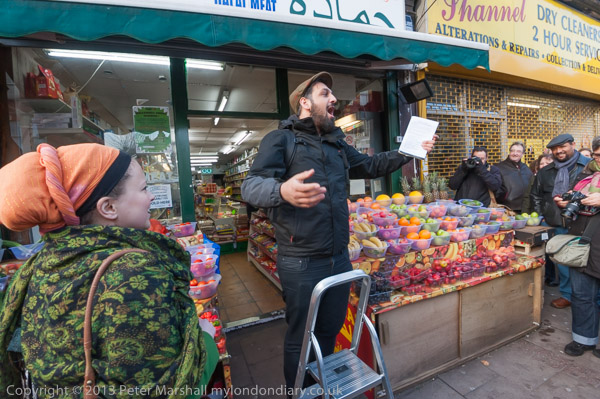
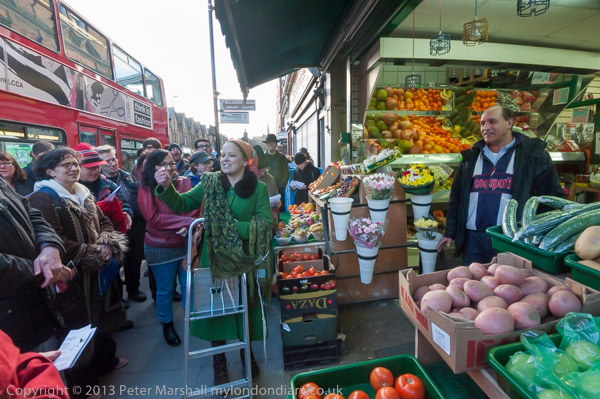
This was the fifth Urban Wassail in Willesden High Street organised by Rachel Rose Reid to celebrate local shopkeepers who give Willesden Green its character and help to create a vibrant community.
The wassail is described as a “small free festival run by and for people from Willesden Green” and also celebrates the work of all who live there and create the neighbourhood and brought together artists and volunteers from the area including James Mcdonald, Berakah Multi Faith Choir, Poetcurious, Errol Mcglashan and several others, with more performing later after the wassail.
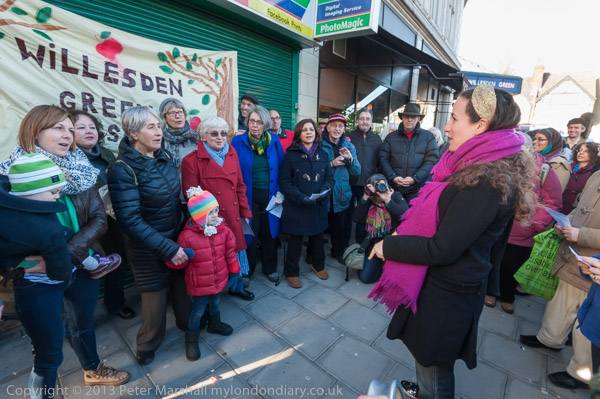
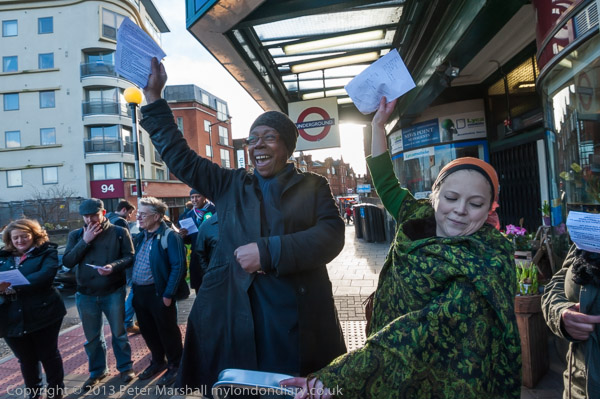
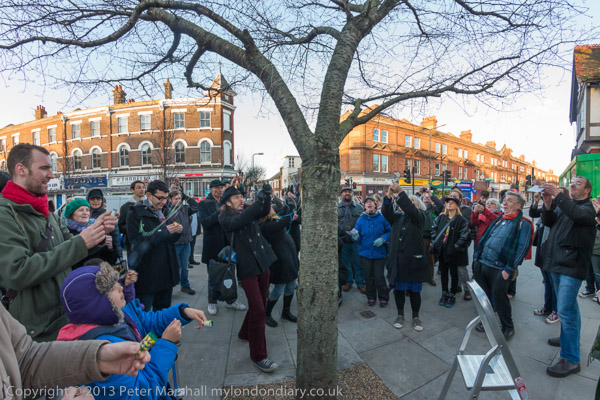
The group met at Willesden Green Station, though unfortunately this was closed for engineering works on the day. Here there was a performance from ParkLife singers, a local community choir run as a not-for-profit co-operatvie and led by Charlotte Eaton, before Rachel Rose Reid introduced us to the first shopkeeper who told us a little abor her shop, Daisychain Florist, with all of the 70 or so people present repeating her words in Occupy ‘mike-check’ style.
Then everyone sang a Wassail Song, borrowed from the Carhampton Wassail, with the shop name in place of its “Old Apple Tree”. You can read this on My London Diary.
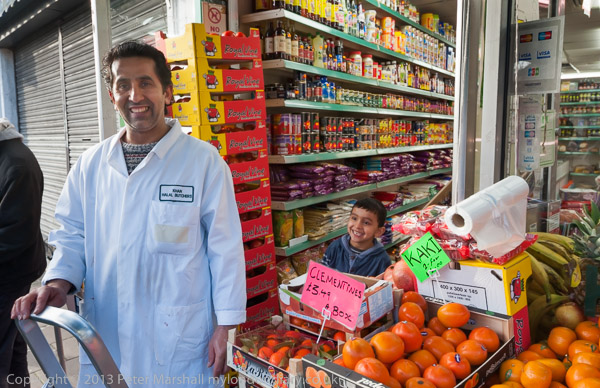
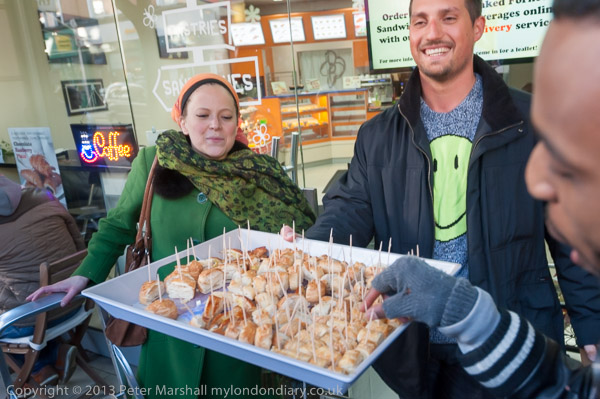
The same pattern was repeated at a number of shops along the High Stret including Hamada supermarket, Khan Halal Butchers, Pound.com, Corner Barber Shop, Red Pig, Fornetti, Mezzoroma and Buy Wise.
There were other stops on the route for poetry and songs, including one in the yard at the front of Sainsbury’s, one of relatively few chains in the area.
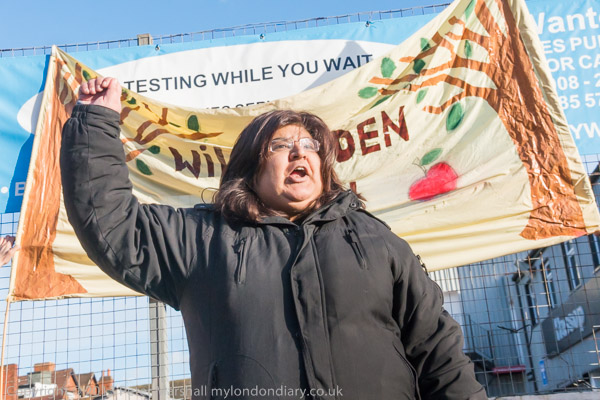
Here we were also told about the campaign to save the Queensbury Pub on Walm Lane from demolition, with a petition of over 4,000 signatures to Brent Council against the demolition of this ‘Asset of Community Value’ and its replacement by a 10 storey block of flats. The pub had been open since 1895 but was bought by developer Fairview New Homes (North London) Ltd in 2012. Brent turned down the development, but the developer, now called Redbourne (Queensbury) Ltd put forward new plans in 2018. Again these were refused by the council but the developer’s appeal succeeded. The pub vlosed in 2022-3 and was demolished in October 2023 to build 48 flats. The development is supposed to include a new pub.
The Wassail ended with a number of poetry performances opposite the Willesden Green Library building site, after which we moved to the neighbouring cherry tree for a final wassail after which everyone let off the party poppers and decorated the tree with ribbons. It was slightly less noisy version of the traditional banging pans and firing guns in order to wake up the apple trees.
The wassailers then moved to the Bar Gallery in Queens Parade on the corner of Walm Lane, where refreshments were available and there were to be more performances. I went along but then realised it was time for me to start my journey home and left.
Ashura Day & Italian Gardens: On Tuesday January 30, 2007 I came to Hyde Park close to Marble Arch where Shi’ite Muslims were gathering for their annual Ashura Day Procession from there to the Notting Hill Mosque.
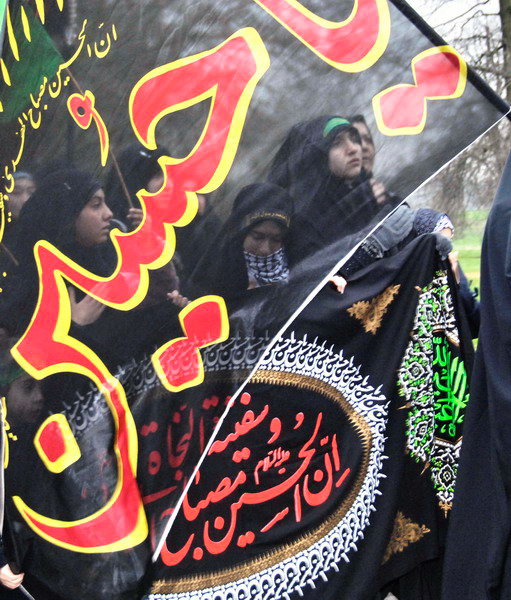
The procession celebrates the life and ideals of Imam Husain, the grandson of the Prophet, and mourns his martyrdom at Karbala in Iraq in 61 AH (AD680.) His example in dying for human dignity, human rights and the aims of his faith inspire them in trying to live a good and moral life and they seek Husain’s blessing on their daily lives.
Here is part of the post I wrote in 2007 of the event (with slight corrections):
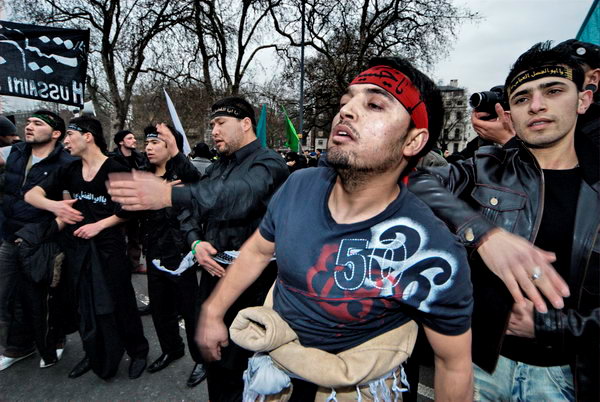
Several thousand people joined in the annual procession in London, making their way slowly from Hyde Park to the mosque in Notting Hill. Many wore black, and all joined in the chanting of “Ya Husain” accompanied by the beating of drums clashing of sanj (cymbals) and the blowing of trumpets, along with calls to prayer. Those taking part beat their breasts, largely in a symbolic fashion, although there were groups of young men who from time to time swung their arms vigorously.
The Ashura Procession is impressive to see, and everyone taking part seemed to welcome my interest in what was taking place and were happy to be photographed.
The weather was dull and it soon began to get dark; it didn’t help that I had one of my fiddle-fingers technical disaster days, where I kept finding I’d altered the camera settings without being aware of doing so. But it was the kind of occasion where it would be hard not to get some interesting images.
The procession was slow-moving – I wrote “it was moving at a speed that would not have embarrassed a snail” and by the time it reached Lancaster Gate I had taken many pictures and also needed a rest. Dusk was approaching rapidly – and there had been little enough light all day. I went into the Italian Gardens and took a few pictures there in the falling gloom, experimenting a little with flash for some of them.
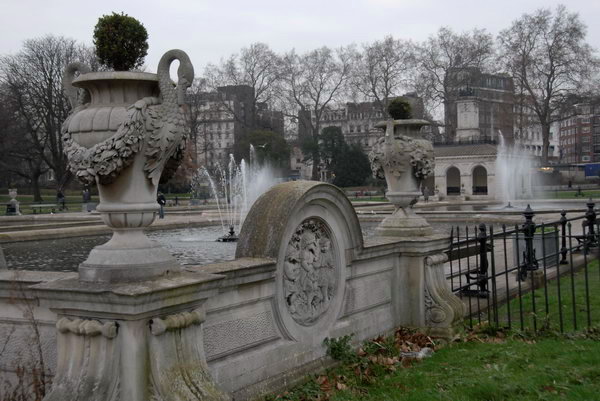
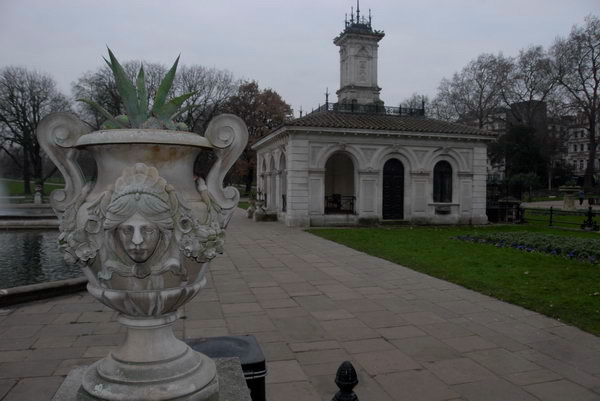
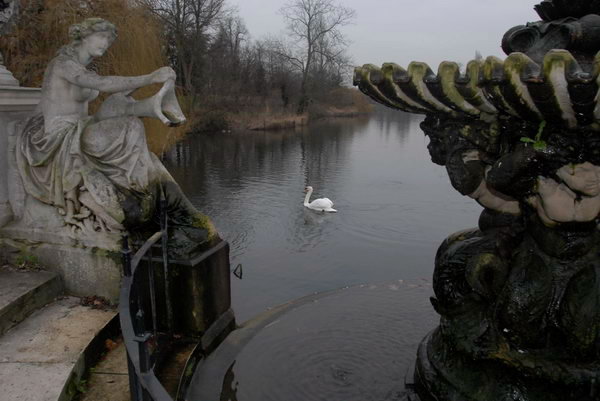
The Grade II listed Italian Gardens were Prince Albert’s idea, and built for Queen Victoria in 1862 as a part of the gardens of Kensington Palace which had been opened to the public in 1841. Albert had previously created an Italian garden at their Isle of Wight Osborne House.
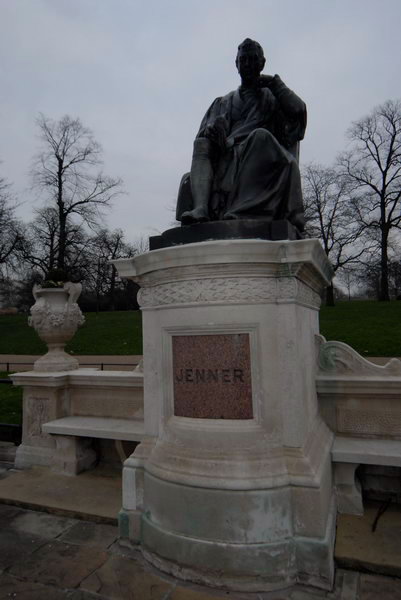
The gardens were designed by some of the big names of the day. Sir Charles Barry and Robert Richardson Banks designed the Pump House (now a shelter), Sir James Pennethorne the overall layout, and the reliefs and sculptures were by the unfortunately named John Thomas. The first monument in the garden erected in 1862 by public subscription was a statue by William Calder Marshall of Charles Jenner, the pioneer of vaccination against smallpox. The gardens were renovated a few years ago.
The gardens are at the point where the River Westbourne (known by a dozen different names at various times and places) once flowed into Hyde Park. The river comes from various sources in West Hampstead and Brondesbury, flowing through Kilburn and through Hyde Park (where it was dammed in 1730 to produce the Serpentine) and then on through culverts and a large pipe across Sloane Square Station and on into Bazalgette’s Northern Low Level Sewer – with only storm discharges reaching the Thames at Pimlico. These should end with the completion of London’s Super Sewer.
By 1834 the growth of London and widespread adoption of water closets had largely turned the river into a foul sewer and it could no longer be used to supply the Serpentine, The water for this lake and the gardens now comes from three artesian wells bored in Hyde Park.
Clapham Common Northside, Cedars Rd, Clapham, Lambeth, 1989 89-7n-24
This truly grand scale building facing Clapham Common is at the western edge of the London Borough of Lambeth and the road in the foreground is Cedars Road. A terrace of five mansions at 48-52 Clapham Common North side, it was built by J T Knowles in 1860 with the two ends as pavilions with roofs like those of French Renaissance chateaux. It was Grade II listed in 1969 as Knowles Terrace.
Earlier the road had been lined with villas built for rich City merchants in the mid-eighteenth century.
Clapham Common North Side, Wix’s Lane, Clapham, Lambeth, 1989 89-7n-25
Wix’s Lane is the boundary between Lambeth and Wandsworth, although the street sign is from the Borough of Battersea which was became a part of Wandsworth in 1965 and my map shows the boundary as running along this wall.
Charles Wix was a builder and he built a villa for himself on Clapham Common North Side on the west corner of Wix’s Lane around 1780, living there until his death in 1820. Not long after this was rebuilt as Cedars Cottage but it and its neighbours were later replaced by a rather bland red-brick terrace.
The view here gives a better view of the rather heavy ornamental work on the 1860s Knowles Terrace.
The London School Board built Wix’s Lane School, which opened on 27th April 1903. It later became Wix County Primary School. It is now still in use as Belleville Wix Academy and also houses a Lycée Francais.
Wix’s Lane had been a field path from Clapham Common to Lavender Hill but when villas were built along this section of Clapham Common North Side they were given back entrances from it for stabling their horses and carriages. The school was the first building on its west side, taking a large section of the gardens of one of these houses, Byram House.
The Belleville Wix Academy history page includes a quote from a 1937 school inspector ‘”in the early years it was not uncommon to see twenty or thirty children being led to and from Wix’s Lane School by maidservants“. However, it goes on to say: “now the larger houses are divided into flats, and these, as well as the smaller houses in the neighbourhood, are occupied mainly by clerical workers in the City, by local tradesman and shop keepers, and by artisans and labourers of the better type“. “Poverty exists“, it states, “although it is mainly courageously hidden“‘ .
Flats, Cedars Rd, Clapham, Lambeth, 1989 89-7n-12
I walked back to Cedars Road and walked up it past some rather more modern flats on my way to Wandsworth Road. Much of both sides of this tree-lined road are now covered by similar modern flats, and few of the trees are cedars. A few older houses remain but although I photographed a couple of them I’ve not put these pictures on-line.
I turned west on Wandsworth Road and then went up Acanthus Road, on my way to Brassey Square.. Acanthus Road becomes Grayshott Road, and this house is on the corner of that and Glycena Road.
This and a similar house opposite act as a gateway to the Shaftesbury Park Estate built between 1872 and 1877 by the Artizans’, Labourers’, & General Dwellings Company, about which I’ve written in previous posts. These houses and their short terraces are one of only two listed parts of the estate. It was just a little further up the road at what are now Nos 65-7 that Lord Shaftesbury formally began the estate with a memorial stone in 1872. It is still in place but I didn’t photograph it.
I turned east down Sabine Road, another of the first streets to be built after that stone was laid with its message ‘Healthy homes, first condition of social progress’ in 1872. Supposedly the main figure in the 1951 Ealing comedy The Lavender Hill Mob lived in a seedy boarding house here, though none of the film was shot in the area. In just a few yards I was in Brassey Square, intended to be the centre of the estate which is now the Shaftesbury Park Estate Conservation Area.
Brassey Square which took its name from contractor Thomas Brassey and his three sons who all became MPs and had shares and it was meant to have a garden at its centre, but this was built over in 1879. This building with its frontage on Sabine Road has doors numbered 78 and 1 presumably for that road and Brassey Square respectively. The building is locally listed and is presumed to have been a part of the never-completed plan to build a library, central hall and co-operative shops fronting Brassey Square.
My account of the walk will continue in a later post.
Some Madness and Houses in Clapham: On the 29th July 1989 my walk began in Clapham and I found this sign on The Pavement. I could make very little of it then and still can’t now.
Notice, The Pavement, Clapham, Lambeth, 1989 89-7n-43
At the top of the painting on the wall is a geometric device surround by a circle with a square inside divided into four quarters and various triangles inside and on its two vertical edges. Four arrows from the circle have a 90 degree left turn and point anticlockwise and to the letters ‘PH.’, ‘MAY’, ‘MARY’ and ‘C.R.’. Underneath I can just make out the scrawled word ‘MADONNA’, though I think think this has been overwritten at the start to read ‘CRAP’ and there are some other letters and numbers including a ‘6’.
Below this, boldly painted in the same script as the words around the device are a series of words or rather letters in which there are some actual words and some plausible inventions. The whole is a mystery though I rather suspect one that many have involved copious amounts of illegal substances. There was some colour in this notice which you can see in the different shades of grey, and a few sections were in red, particularly the only lower case line just above the bottom, ‘dunhillthwaiton’ while the bottom line, ‘HYPOSTASISTA’ was in green.
I think this was a part of the block called The Polygon which was demolished in the early 2000s. But it is difficult to understand street names in this area of Clapham, and this writing on the wall is impossible.
I wrote about Rectory Gardens at more length in the post about an earlier visit there in May 1989. Built in the 1870s as philanthropic housing for low paid workers after being damaged in the war they were squatted in the late 1960s and 70s and a unique artistic community grew up there. Lambeth Council bought the area and intended to develop it in 1970, but there was strong local opposition both from residents and others in the local area.
The Clapham Society wanted them to be kept as a group and run by a housing association but eventually Lambeth Council evicted the residents and in 2016 sold them off to a developer to build expensive luxury properties in “a triangular mews-style development“.
Porch, 39, Turret Grove, Clapham, Lambeth, 1989 89-7n-32
I walked up Rectory Grove to Turret Grove, developed on the site of the Elzabethan manor house, Clapham Manor, demolished in 1837. Some of the houses in it date from 1844-5 and are in the Rectory Grove Conservation Area which notes their “attractive trellis style porches“.
Doorways, Clapham Common Northside area, Clapham, Lambeth, 1989 89-7n-35
I made my way through the backstreets towards Clapham Common. One of the streets I walked down was Macaulay Road and this has some impressive doorways and I think this pair were probably on this road.
Zachary Macaulay, born in Scotland had emigrated to Jamaica in 1784 when he was 16 and worked as an assistant manager on a sugar plantation, returning to London five years later. In 1790 he visited Sierra Leone, set up as a home for emancipated slaves many of whom had fought for Britain in the American War of Independence, returning in 1792 and becoming its Governor from 1794-9. He became one of the leading members of the Clapham Sect working for the abolition of slavery, able to provide William Wilberforce with first-hand information and statistics.
In 1799 he came back to Clapham with 25 children from Sierra Leone and set up a the School of Africans to train them with skills to support the development of their country when they returned. Unfortunately “one by one they succumbed to the cold“, though in fact what killed most of them was measles and only six survived.
Further down the street was once the site of the Ross Optical Works which made cameras, lenses and projectors which moved here in 1891 and expanded greatly in 1916 when their work was considered essential to the war effort. At its peak the company employed 1200 people. Ross Ensign was said to be the premier optical company in the United Kingdom, but was unable to compete with foreign competition and closed in 1975.
Clapham Common Northside, Clapham, Lambeth, 1989 89-7n-23
I think I probably photographed this house on the corner of Clapham Common Northside and The Chase mainly because it was so different from the rest of the properties, terraces and blocks along there. A large house, but only two storeys and with an attractive upper floor window, but largely hidden behind its rampant bushes and trees in its front garden.
On its side in The Chase are three plaques commemorating street parties for the Queen’s Birthday, a royal wedding and the Golden Jubilee in recent years.
Battersea was one of the most progressive areas of the country in the late nineteenth century and in 1886 Battersea Vestry came to the decision that the parish should itself erect working class dwelling on the site of the Latchmere allotments, themselves enclosed from Latchmere common in 1832 to provide allotments for the poor.
But, as the Survey of London which recounts the development of the area in some depth states, the Local Government Board told them that they did not have the power to build houses. The Vestry put forward a bill in parliament to enable them to go ahead but it met wide opposition and had to be withdrawn.
Things began to move again in 1898 when Fred Knee, a member of the UK’s first organised socialist party, the Social Democratic Federation and of the Co-operative Society, moved to Battersea and founded the Workmen’s Housing Council to campaign for better housing for workers to be built by public authorities on a non-profit basis. He tried to get the London County Council involved as they had the powers to build homes. But this shortly became unnecessary as the 1899 London Government Act replaced the Vestry with the Metropolitan Borough of Battersea which under the 1900 Housing Act was able to apply for the power to build housing itself. Knee continued to play an important role in the development by the council.
In 1901 Battersea Council set up a competition for plans asking for designs for five house and flat types, and prizes were eventually awarded to five of the 58 entries, and work began by Borough Surveyor, J. T. Pilditch and his architectural assistant William Eaton on finalising the designs and estate plan.
The Survey of London states that the final plans included “eight five-room houses, 69 houses with a three-room flat on each floor, 73 houses with a four-room flat on each floor and six odd houses of four or five rooms“. The competition-winning designs were simplified with their more picturesque features “expunged in the interests of economy” which perhaps makes them more aesthetically pleasing to modern eyes.
Where expense was not spared was in the internal facilities for the new tenants, with electric lighting (and slot meters), unusual at the time and “patent combined kitchen range, boiler and bath … fitted in all the houses at the high cost of £18 10s apiece.”
Battersea is cut through by the railway lines from two of London’s major termini, Waterloo and Victoria with junctions, goods yards, engineering works and a number of branches creating an incredible maze of tracks, viaducts, and bridges, now only slightly simplified.
Culvert Road predates the Shaftestbury Estate and was important as an entrance to Poupart’s market garden on which that estate was built. It originally had a level crossing over the railway line here – four tracks leading from Clapham Junction and from the rail bridge over the Thames at Battersea to Wandsworth Road – but this was closed and a narrow footbridge reached by slopes on each side provided in 1880. This footbridge provided may vantage point for this picture.
Culvert Road continues to the north in a tunnel out of picture to the left under around 13 more tracks leading to Victoria or Waterloo. Over the railway viaduct you can see the blocks of the Doddington Estate.
The history of the Shaftesbury Park Estate, developed by the the Artizans, Labourers and General Dwelling Company between between 1873 and 1877 was roughly based on workers cities (cités ouvrières) built earlier in France.
Its development was overshadowed by one of the era’s largest scandals which resulted in the entire board of directors being replaced in 1877 and its secretary/manager William Swindlehurst and chairman Baxter being jailed for conspiracy and fraud, and another director fleeing the country. You can read more of the details on the Survey of London.
When the disgraced board of the Artizans, Labourers and General Dwelling Company was replaced in 1877 their architect, the self-taught Robert Austin was sacked. His more conventionally qualified assistant was also dismissed the following year to save money. But the work of the pair has stood the test of time with a remarkable overall unity about the estate, planned on a grid system, enlivened with some minor and varied decorative features.
Despite its board’s fraud, the estate was generally well-built and houses provided with good ventilation and an improved system of drainage, though this was a cause of arguments with the local authority which favoured traditional methods. There were also various community buildings, but the estate is best-known for not including a single pub, influenced by the temperance movement of the times. William Austin, usually thought of as the founder of the company, was a poor and illiterate navvy before taking ‘the pledge’ and becoming a successful drainage contractor and builder. He set up the company as largely a business enterprise, aimed at making an annual profit of 6% rather than for any great philanthropic intent. He was voted off the board before the scandal with The Survey of London quoting him as later explaining ‘I was too honest for them’.
Houses, Broughton St, Park Town, Battersea, Wandsworth, 1989 89-7n-52
Broughton Street runs from the end of Eversleigh St east parallel to the railway lines before turning to cross Queenstown Rd and ending on Silverthorne Road. I think I was probably standing on the end of Eversleigh Street to photograph this long terrace on the north side which according to the Survey of London were built by partners Robert Lacy and James Flexman shortly after an agreement they made in 1867.
This block of over 20 virtually identical houses (that nearest the camera has a carriage entrance, as No 1 still does) is followed past a narrow entrance road leading to a tunnel to the London Stone Business Estate between railway lines by another long block much the same. The houses here along this side of the road are numbered consecutively from 1-52.
The houses in these terraces are quite substantial, three floors each with two main rooms and rather than their front doors opening directly onto the pavement all except the two end houses have vestigial front gardens.
Shops, 56-64, Lavender Hill, Battersea, Lambeth, 1989 89-7n-56
I walked down Prairie Street to Queenstown Road taking a couple of pictures there before turning down Lavender Hill where I made another three, only this one on-line. I’d photographed this row of shops earlier but took this second picture showing the multiplicity of signs – a cinema poster with dinosaurs, Ice Cream, the two posts with signs for the off licence and vegetarian food. the shop fronts and a large JEANS up one of the curved ends of the houses. The area in front of the shops looks very different now.
This was the end of my walk on Friday 28th July but I returned to Clapham the following day to take more pictures – in a later post.
Shops, 56-64, Lavender Hill, Battersea, Wandsworth, 1989 89-7m-22
The six houses between Woodmere Grove and Shirley Grove at 56-66 on the north side of Lavender Hill were built at a slight angle to the road. Each of them also has a rounded corner at the south-east, making them look from the east side as a series of round towers, some strange castle beside the road. Unlike the other terraces on the road this makes them stand out as individual buildings, though shop extensions on the ground floor present a straight line on the pavement.
These houses were built as a part of Seymour Terrace in around 1870 as private houses with basements on a part of an estate bought by Clapham surgeon and GP Henry Meredith Townsend who lived nearby on Clapham Rise. The ground floor was converted into shops in 1882. The Survey of London which gives more detail describes them as “a minor masterpiece of street architecture.“
Queen’s Road Stores, Hartington Terrace, Stanley Grove, Queenstown Rd, Clapham, Wandsworth, 1989 89-7m-24
Hartington Terrace on Queenstown Road is still there though the shopfronts have changed a little over the years they are still basically the same. No 43 on the corner has lost those ‘decorative’ blinds and looks very much more sober, not welling bathroom fittings rather than wine. This whole area of Battersea, Park Town, was the heart of a single farm, Longhedge Farm, which began to be developed after the opening of Battersea Park in 1858. Its long and complex story is told in great detail in the link cited.
Developments at the southern end included some large villas close to Clapham Common, and the developers of the northern part under Philip William Flower (1810–72) originally hoped to make this a middle-class area with its location between Clapham and Chelsea but later had to lower their expectations largely because of railway expansion in the area and develop it as homes for working-class artisans.
An Act of Parliament in 1863 allowed the laying out of Queens Road (known since 1939 as Queenstown Road) and building on the estate continued over the next 30 or so years. One of the two major builders was Walter Peacock who began Hartington Terrace (named by Cyril Flower, (1843–1907), Philip’s eldest son and first Lord Battersea) in 1885. No 43 was built as a pub and there was a parade of 7 shops with stabling and workshops behind. A few more shops were added to the north in 1888 by another builder.
Stanley Grove at left was an earlier development with houses built by a number of builders in 1867-8.
Life Tabernacle, United Pentecostal Church, 32, Battersea Park Rd, Battersea, Wandsworth, 1989 89-7m-26
The church is still there, set back from Battersea Park Road, but the temporary looking building occupying most of the picture has been replaced by a rather nondescript block with a large ground floor betting shop.
The land for the church building was, according to the Survey of London, acquired in 1868 “from the Crown’s Battersea Park purchase, to be used ‘as a branch from Mr Spurgeon’s tabernacle’. ” One of the leading Baptist figures of the age, Spurgeon was for 38 years pastor of the New Park Street Chapel (later the Metropolitan Tabernacle) at the Elephant & Castle. He was a powerful preacher and prolific writer and supporter of many practical schemes to improve the lot of the urban poor as well as missions such as this to convert them to his Calvinistic Christianity.
The first building erected was this, built as a lecture hall seating almost 500 by Lambeth builder and architect William Higgs, and it was 25 years later that a chapel was added to Battersea Tabernacle. This occupied the space between the hall and Battersea Park Road and was demolished probably in the 1970s having been damaged by wartime bombing. The hall was purchased for £25,000 by members of Calvary Temple in Camberwell and became Life Tabernacle.
Decoration, Battersea Park Rd, Battersea, Wandsworth 1989 89-7m-13
Somewhere on the stretch of Battersea Park Road between Propert’s blacking factory at 142 (photograph not on-line) and the villas at 445-7 I made this picture of terracotta decoration in panels on a building, but I can no longer find it. Unfortunately although my note says Battersea Park Road it does not give a street number. From the picture I think it must had been only a few courses above street level.
The central panel seems more generic, with a vessel with appears to have a fruit tree growing out of it, perhaps with apples, but the two roundels at the sides are perhaps more interesting. I think they probably represent some trade or other, but can’t decide which. Perhaps someone reading this can solve the mystery and make a comment.
This remarkable pair of villas, now apparently a hotel, were built in the 1850s and the architect is thought to have been Charles Lee. The two are Grade II listed. The gable has a distinctive scalloped bargeboard or decoration and this continues for a short length along each side of the house to a low wall bearing an urn.
Café Window, Battersea Park Rd, Battersea, Wandsworth, 1989 89-7m-15
This café on Battersea Park Road, I think in the parade between Stanmer St and Balfern Street, seems a suitable place to pause my walk which will continue in later posts. Although it looks as if it was taken from inside I think it was probably closed and I was standing in a recessed doorway.
These buildings are still there in a side turning from Silverthorne Road now leading to Battersea Studios. Battersea Studios were built in 1970 as a warehouse for BT and in 1994 became the home of the short-lived BBC Arabic Television, closed precipitately on Sunday, April 21, 1996 having angered the Saudi regime (and the UK government) by its accurate and impartial reporting. At extreme left you can see the barrier leading to that site.
The buildings in the picture were part of the Stewarts Lane Goods Depot, a huge area bounded by this and Dickens Street to the south and going east to the railway lines at Portslade Rd. It was first set up by the London, Chatham and Dover Railway in 1860 as Longhedge and used to build and house locomotives for their services from Victoria Station a short distance away north of the river. The original buildings were demolished in 1880/1 and replaced by these as Stewarts Lane which housed steam locomotives until 1963 and then diesels. Much of the building was destroyed by fire in 1967.
The depot remains in use as the Stewarts Lane Traction Maintenance Depot and is used by both DB Cargo UK and Govia Thameslink Railway.
Further down Silverthorne Road to its west is Heath Road, the north side of which retains its attractive Victorian housing, with a block of four houses with basements and steps to their paired entrances followed by five without basements but with the same style and decoration. At the end at left of picture is the recently build Kingdom Hall of Jehovah’s Witnesses.
Heath Terrace is on the corner of Silverthorne Road and Wandsworth Road and as well as this corner entrance has two similar but slightly less ornate doorways on Wandsworth Road leading to sixteen Flats A to P as well as another door for a shop on Silverthorne Road part visible in my picture then occupied by taxi and transport company Guy Payne Of London Limited.
The building was built in 1897 and the corner door, in use when I made my picture in 1989 by Dr A J K Ala, still led to a surgery until around 2012. At the front of the traffic queue is a man on a moped with a large clipboard, studying the ‘knowledge’ required of taxi drivers.
Matrimony Place is one of my favourite street names, though this place is only an alley with steps leading from Wandsworth Road to St. Paul’s Churchyard. I’d photographed it a few years earlier and made a deliberate detour to see if had changed – it was still much the same.
Possibly it was once the custom for local couples to walk up the 29 steps to the church to be married – or down them after the ceremony, and the name appears to of some antiquity. The railings have since been replaced by a fake antique design (probably thanks to the Clapham Society) which I find rather less attractive. It’s probably still a place to avoid after dark unless you a looking for drugs.
St Paul’s, Clapham was built on the site of the original parish church of Clapham, St Mary’s, renamed Trinity Church at the Protestant Reformation, then demolished in 1774 to be replace by Holy Trinity on Clapham Common. St Paul’s was built simply in 1815, became a rather odd lump after later extension by Sir Arthur Blomfield in 1875, was burnt down in World War 2 and restored in 1955 and is Grade II* listed.
Houses, Victoria Rise, Clapham, Lambeth, 1989 89-7m-34
I didn’t go up Matrimony Place but instead turned back westwards down Wandsworth Road, hardly stopping until I came to the top of Victoria Rise which has these rather impressive Victorian Terraces on both sides. Looked at from this end the street should perhaps have been called Victoria Fall as it goes down noticeably to Clapham Common, but you can see why the developers decided against this. In fact they called it Victoria Road, but it was changed later as there were too many of these in London.
The street was laid out around 1853 its lower end on the site of an C18 villa built for the banker Henry Hoare by Henry Flitcroft known as The Wilderness. These houses on the east side were there by the time of the 1869/70 OS survey, though those on the west side are a little later.
Doorway, 144, Victoria Rise, Clapham, Lambeth, 1989 89-7m-35
A notice in the window at right states: YOU ARE WARNED REPENT AND RECEIVE THE LORD JESUS AS YOUR SAVIOUR FOR LIFE ETERNAL, LEST YOU DIE SUDDENLY AND GO TO HELL WITH THE DEVIL THE MURDERER.
Victoria Rise, Clapham, Lambeth, 1989 89-7m-36
At left is a window on the corner with Wandsworth Rd with plaster mouldings in a shop demolished in 1998, and at right is Clapham Baptist Church on the opposite corner.
The houses on this side of Victoria rise were built between the 1869/70 survey and the 1893 to 1894 revision. There was also a chapel here, the Victoria Baptist Church, built in 1873 but this was badly damaged by bombs in 1941. it was rebuilt in the 1950s, incorporating some of the Victorian remains on its west end on Wandsworth Road.
London Loop – Enfield Lock to Chigwell – If you want a good walk on the outskirts of London to walk off a little of the excesses of Christmas I can recommend this section of the London Loop. In the book guide we – myself my wife and my elder son – used on 28th December 2006 it was section 13, but now appears to be split into two parts as Sections 18 and 19. You can download excellent walk guides from Inner London Ramblers. Bits can be muddy so you need walking boots.
It’s not a particularly long walk and starts and ends at stations. Photographers always add a little by wandering around a bit and running up slopes to get a better view. But back in 2006 a little under 9 miles was fine for me, though now I might prefer to split it into the two sections.
The rail journey to Enfield Lock takes around an hour and a half for us, changing from the Victoria Line to Greater Anglia at Tottenham Hale, and coming home from Chigwell which is on the Central Line just a little longer. The walk itself at a moderate pace with a stop to eat our sandwiches a little over 4 hours, and in December to finish in daylight means starting walking around noon, though we made it a little earlier and arrived at Enfield Lock just after 11am.
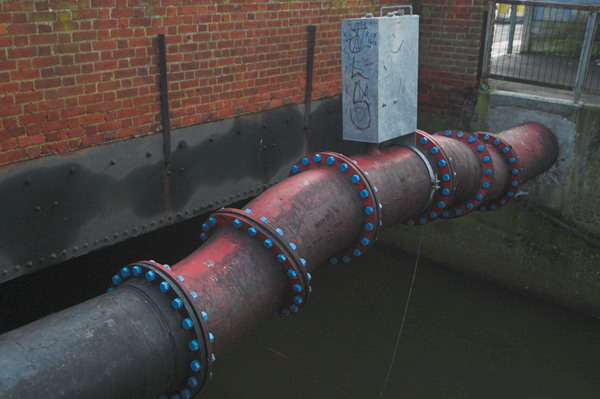
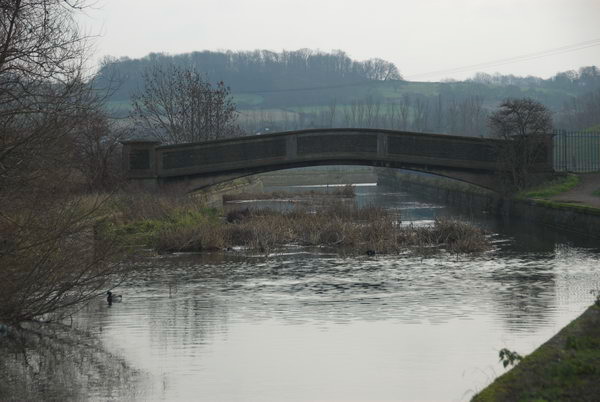
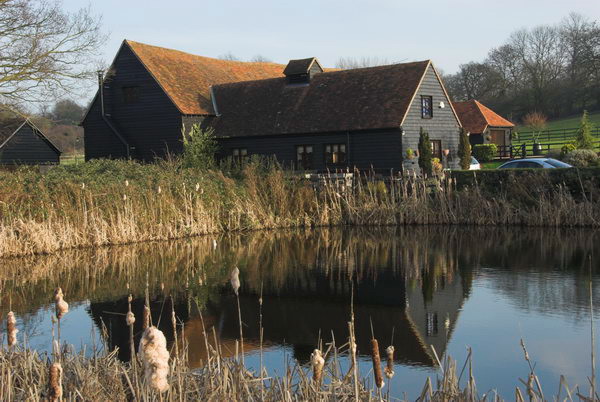
My first picture online came not long after, although the rather decorative length of piping in the top picture may not appeal to all. I think it was over the Turkey Brook, though I can’t exactly remember the location. But soon we were walking past the 1907 Lee Conservancy Offices at Enfield Lock and then a short distance beside the Lea Navigation.
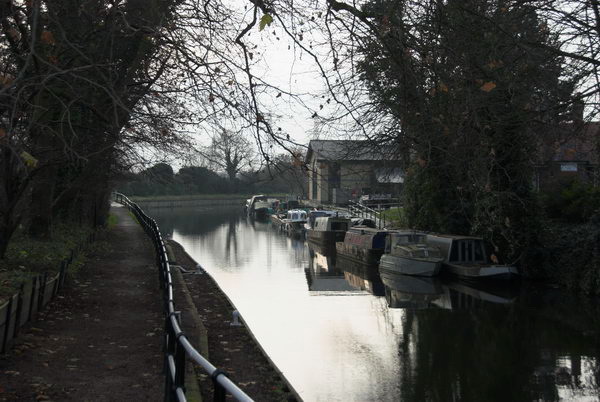
Then we crossed the navigation taking the footpath to Sewardstone walking to the north of King George’s Reservoir and following one of the branches of the River Lea and then crossing another wide flood relief channel and then coming to something that looks rather more like a proper river.
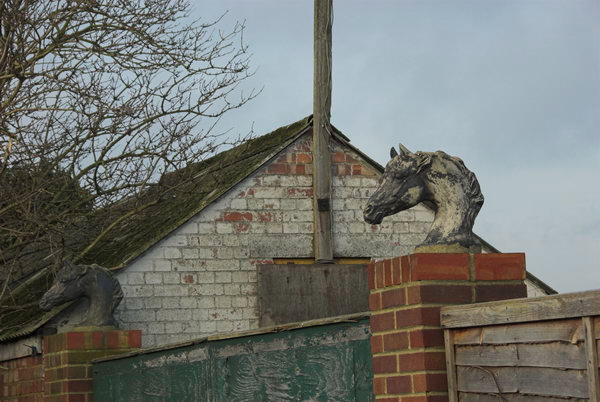
The route from here is uphill for some way. Somewhere we passed two horses heads and and on the Sewardstone Road a nursing home.
A few yards along the busy road (its the A12) we left and continued uphill, pausing at times to admire the view across the Lea Valley.
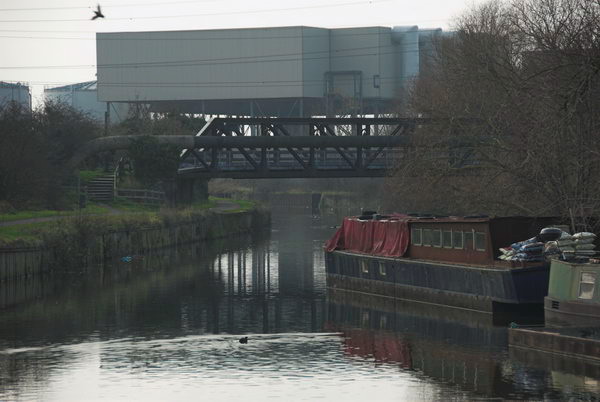
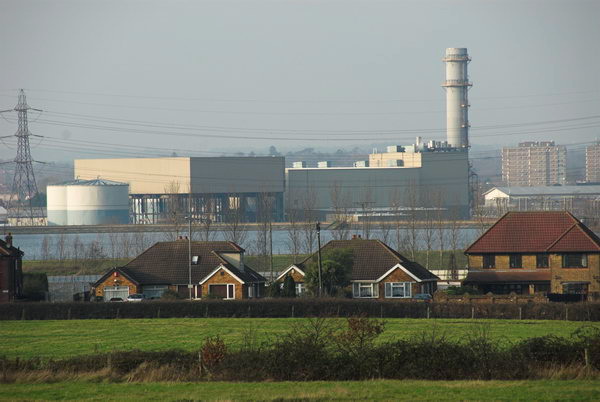
Here we got another view of the rather mysterious structure that had loomed above the Lea Navigation which is Enfield Power Station, built in 1997-9, a gas-fired power station built partly on the site of the decommissioned Brimsdown Power Station.
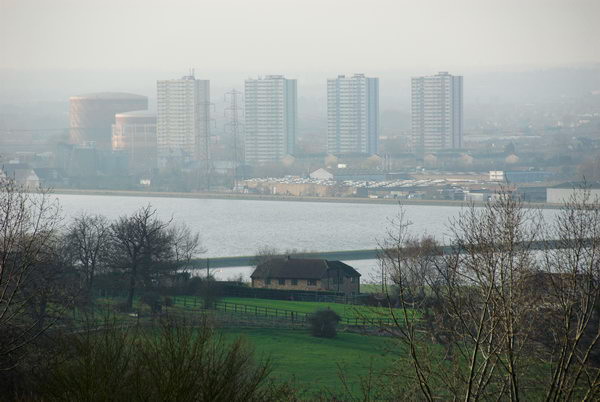
A little further on there were more views, across the reservoirs to Ponders End. But soon we came to more rural scenes including the pond and houses of Carrolls Farm.
The next section of the walk involved a lot of woods and is part of Epping Forest and also includes the Scout camp at Gilwell. The IL Ramblers notes recommend an alternative route which gives better views, but we only had the book and I made few pictures on this section – none of which are on the web.
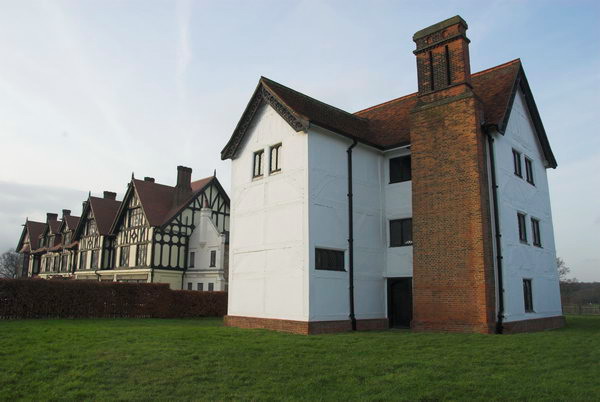
We stopped to eat our sandwiches beside Queen Elizabeth’s Hunting Lodge on Chingford Plain where we also bought crisps and soft drinks to go with them, and sat around rather too long before taking a look at the building and then continuing.
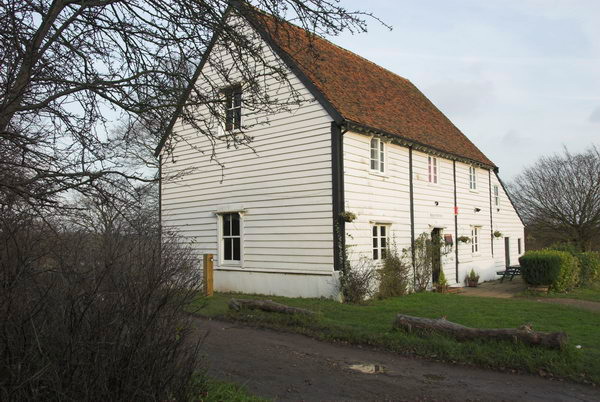
Here we got a little lost in Epping Forest as the directions in the book were perhaps rather less clear than those online, so I think our route was just a little different to that intended. We found the Butler’s Lodge, but despite the promise in the book it was not serving tea.
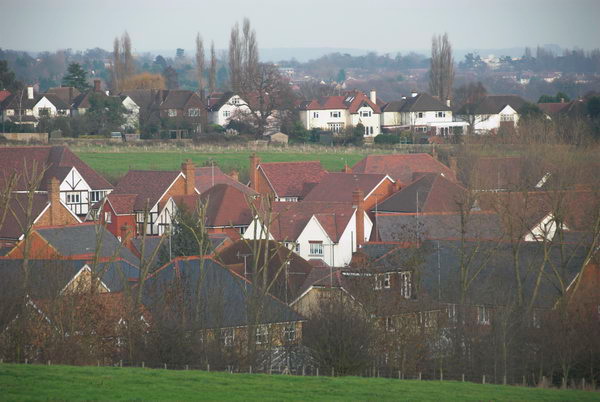
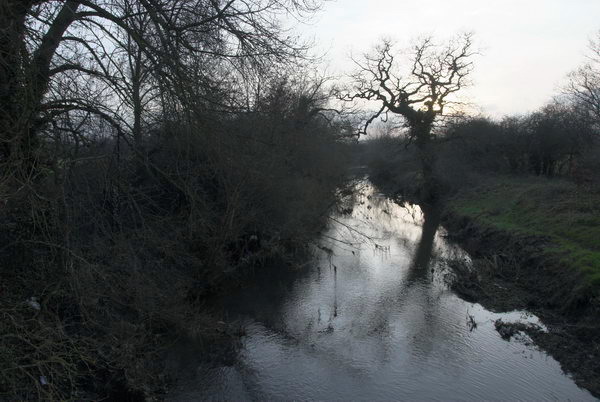
There were some views on our way, but the suburbs here are not really picturesque. I think the river in the picture below is the Roding rather than the Ching which was more of a small ditch where we crossed it.
Parts of the route led along roads and perhaps the best that can be said for them are that they were downhill – and by this time I was getting tired. Eventually we came to the station and sat down and waited for a train.
There are a few more pictures as well as those above on My London Diary.