At War With Iraq – 2003

At War With Iraq

20 years ago we were at war with Iran, despite the largest ever protests in this country. I’d missed the big protest on 15 February when 1.5 million people were on the streets of London – including the rest of my family, as I’d only come out of hospital the previous day and was still very weak following slight complications after a minor operation following a heart attack. But I’d covered all the main protests in London before that, as well as taking part in our local protests every Friday night.

At War With Iraq

Of course it hadn’t just been in London that there had been protests that weekend, and there were others in at least 600 major cities around the world – the largest of all in Rome – combining to make this “the largest protest event in human history” with the BBC estimating around 6-10 million taking part around the world. And in the two and a half months leading up to the invasion on March 20th there are thought to have been 3,000 protests involving 36 million people around the world – though I think even that number fails to include small local protests like our series on Staines Bridge.

At War With Iraq

Of course it had been clear for at least a year that the USA would go ahead with its invasion whatever and had been preparing its military for it. More at stake was whether other countries would join them, and for us whether Britain would. There seems to have been no sensible reason why we should, but Tony Blair had made a promise to George Bush and was prepared to lie and mislead the country and parliament to keep it.

At War With Iraq

The major pretext for the invasion was to disarm Iraq of weapons of mass destruction (WMD), but the UN inspection team led by Hans Blix had found no evidence that Iraq had any – and none were found following the invasion.

The USA also claimed it was to end Saddam Hussein’s support for terrorism, and US Secretary of Defense Donald Rumsfeld had ordered the Pentagon to make plans for the invasion before the dust had settled on September 11th 2001 despite being told that the attack had been carried out by al-Qaeda with no cooperation from Iraq.

Finally the US had claimed they were “going in to free the Iraqi people“, but they appear to have done little or no planning as to what could replace Saddam Hussein to keep the country from descending into chaos, a process they accelerated after their victory by disbanding the Iraqi army and disbarring from public office all of the civil service, teachers and others in public sector jobs for whom membership of the Ba’ath Party had been obligatory.

The US Institute of Peace has a useful timeline of events in Iraq since the war which has an introduction which ends “Iraq suffered through a civil war, political turmoil, widespread corruption, sectarian tensions and an extremist insurgency that seized a third of the country. Iraq has evolved through four rocky phases.”

The coalition forces – three quarters from the USA, a quarter from the UK and a handful of military from Australia and Poland, with a little support from Iraqi Kurds were still busy fighting across Iraq on April 5th, capturing Baghdad on the 9th and the war ended on May 1st, though US forces remained in occupation until 2011. Saddam was only found and captured in December 2003 and was eventually tried, found guilty of crimes against humanity and executed on 30th December 2006.

Of course the Iraq War has also had a great influence on British politics. In particular it has led to a huge distrust for politicians and our political system because both of the fact that our prime minister and other leading politicians in both parties lied to us, but the failure of huge protests over serveral years to have any effect on policy showed a failure to take any notice of the views of the people. Politics needs to be a politics of consensus and the Iraq war showed it was one of disdain.

Here’s the short piece I wrote on My London Diary in April 2003 – with minor correcttions of capitalisation etc:

April started with the country at war, invading Iraq together with the USA.

In Saturday 5th I went to a march to protest against this and to call for proper reporting of the events in the media, especially the BBC.

I walked to the march past the Houses of Parliament and a small group of protesters in Whitehall who were pointing out the number of Iraqi civilians already killed by the allied forces.

The main thrust of the demonstration now was that the civilian population of Iraq should be respected. The use of weapons such as depleted uranium shells and cluster bombs will mean the deaths continue for generations after the end of the fighting.

The march started opposite the old BBC building in Portland Place and went to Grosvenor Square, close to the US Embassy. There were perhaps five thousand marchers, and several hundred police surrounding them most of the time. As the speakers pointed out, it was difficult not to see the war as a US takeover of the country when plans were already in place for Americans to run the country after the war.

The killing of Iraqis must stop, and rapid progress should be made to hand control of the country back to its people.


Bike Theft, Tributes, Housing Benefit, Fascists & UAF

Bike Theft, Tributes, Housing Benefit, Fascists & UAF

Saturday 1st April 2017 turned out to be a busy day in London, though the buses in my picture on Westminster Bridge were not then going anywhere – and the driver of the No 12 at the front of this row was taking a rest from his seat. Various protests and the police had brought traffic to a stop. As in many other months you can see more of my pictures taken as I travelled around in a London Images section.


Motorcycle Theft Protest Ride – Westminster

Bike Theft, Tributes, Housing Benefit, Fascists & UAF

I’d vaguely wondered about paying another visit to the Ace Café on the North Circular Road at Stonebridge, but not riding a bike I would have felt something of an outsider, and the journey back to central London by the Bakerloo line wold have taken me around 40 minutes and I would have missed other things that were happening.

Organised gangs are still making rich pickings around the whole of London – and one of my neighbour’s had his bike targeted a few months ago, but the two men cutting through a substantial lock were spotted from the house opposite, and ran away when they were challenged halfway through.

Bike Theft, Tributes, Housing Benefit, Fascists & UAF

In 2017 there were reported thefts in London of 8,131 motorbikes, 4,121 moped and 3,218 scooters, a total of almost 15,500 thefts. That amounts to one for every 7.5 powered bikes registered in the city. Motorcyclists came with a petition to the Mayor of London and the Home Secretary to give the police greater resources to tackle this crime, and for them to give it higher priority, for more ground anchors in bike parking bays and for tougher sentencing of offenders.

Motorcycle Theft Protest Ride


Flowers for London Victims – Westminster

Bike Theft, Tributes, Housing Benefit, Fascists & UAF

Ten Days after the Westminster terror attack by a deranged driver, people were still stopping to look and and photograph the flowers for the victims, around the lamp standards on Waterloo Bridge, along the whole of the front of Parliament Square and in front of New Scotland Yard in its new building on the Victoria Embankment, where an eternal flame also remembers all police who have died while doing their duty.

There was a long strip of tributes along the front of Parliament Square opposite were PC Keith Palmer was killed to him and the others who died.

More pictures Flowers for London Victims.


Youth protest over housing benefits loss – Parliament Square

A grass roots group of young people, ‘#1821Resist’, were in Parliament Square to protest against the scrapping of housing benefit for young people which coming into force on this day.

They say that under Tory rule since 2010 homelessness has doubled and that this change will continue to leave vulnerable people without homes, making it almost impossible for them to get into work or education.

Youth protest over housing benefits loss


Iraqis protest US killing in Mosul – Downing St

Iraqis, mainly women dressed in black, were protesting opposite Downing St against the killing of civilians by US and Iraqi forces during the assault on Mosul. Attacks on the city, then held by the Islamic State (ISIL) begun in October 2016 and continuing until ISIL were defeated there in July 2017. According to Wikipedia (and the BBC) “The battle was the world’s single largest military operation since the 2003 invasion of Iraq and was considered the toughest urban battle since World War II.”

The women said that hundreds have been killed by US air strikes after being told to stay in Mosul; people were stopped from leaving were then bombed. The protest was organised by a group of Iraqi women, one of whom told me a nine-year old relative in Mosul had died earlier today. The photographs they held up showed some of the results of the US bombing.

Iraqis protest US killing in Mosul


Britain First & EDL exploit London attack – Westminster

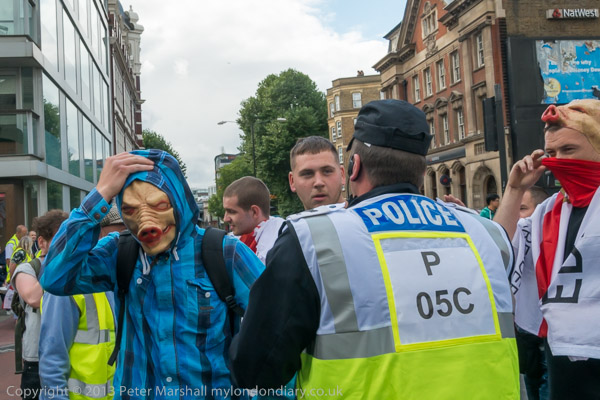
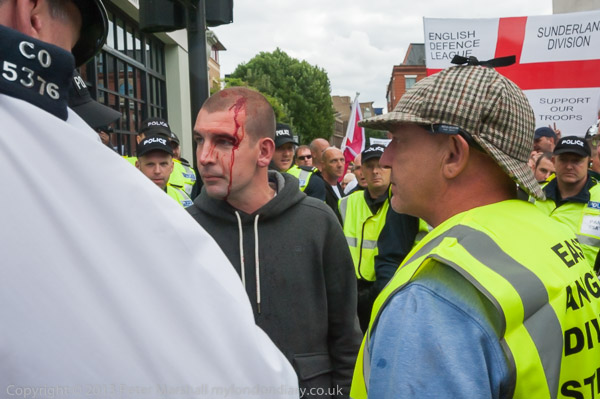
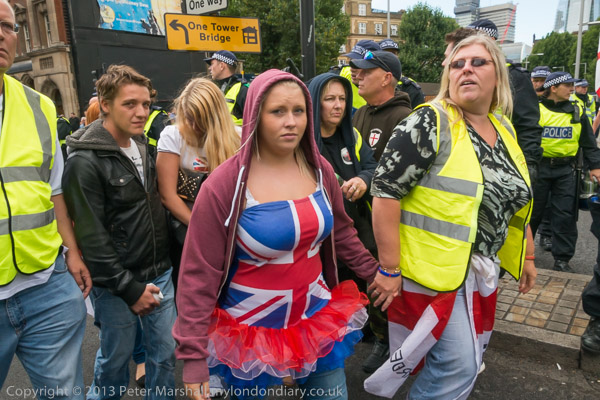
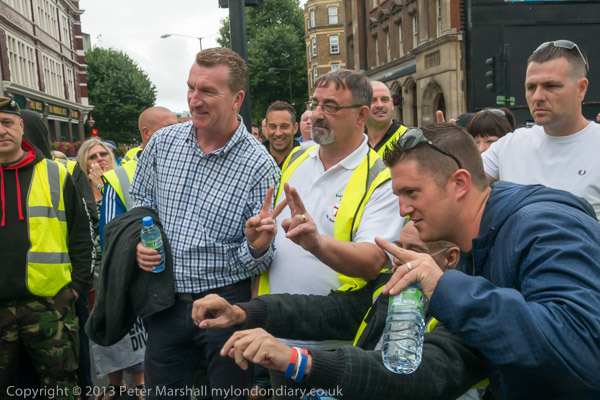
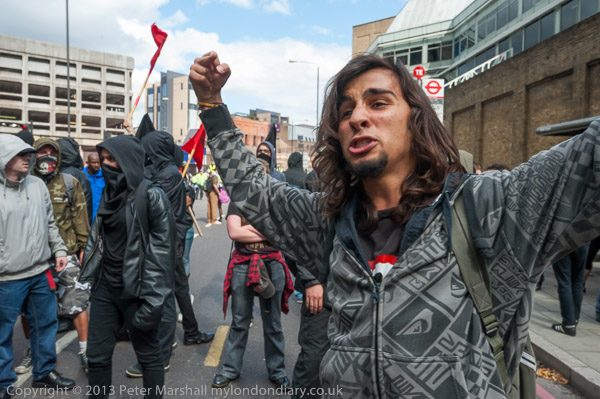
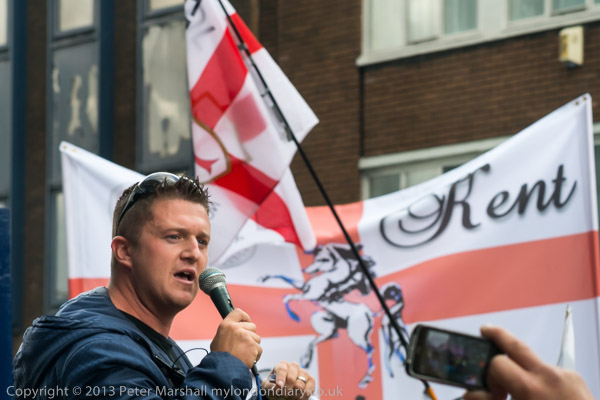
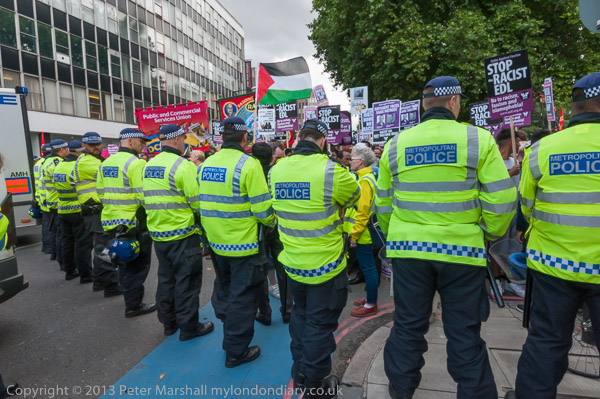
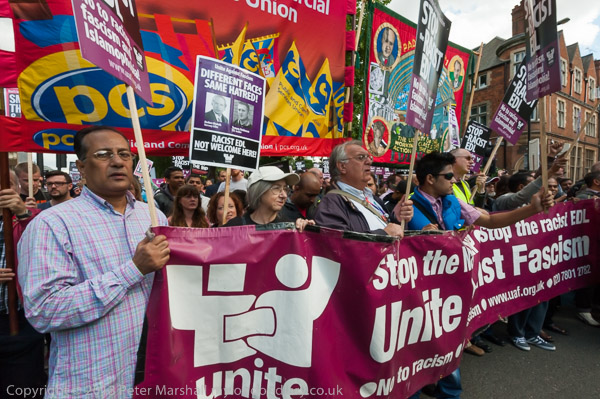
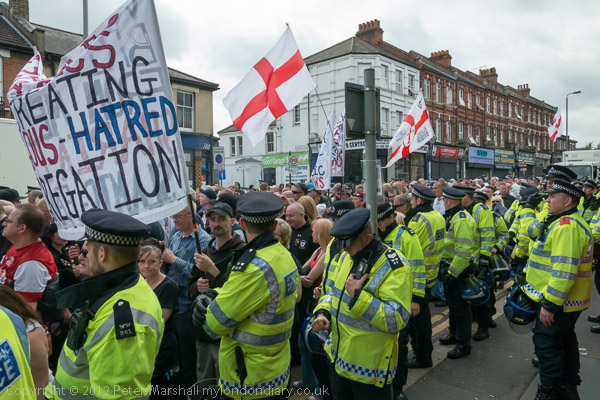
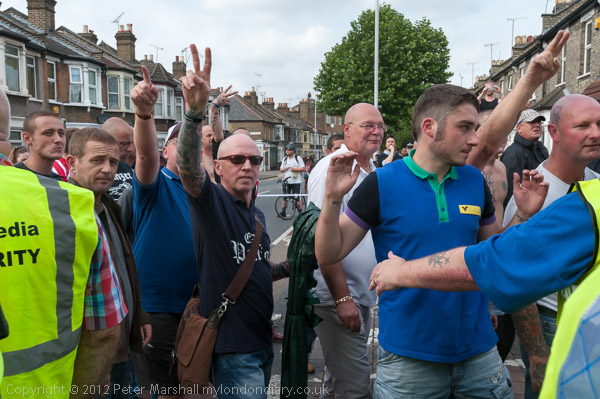
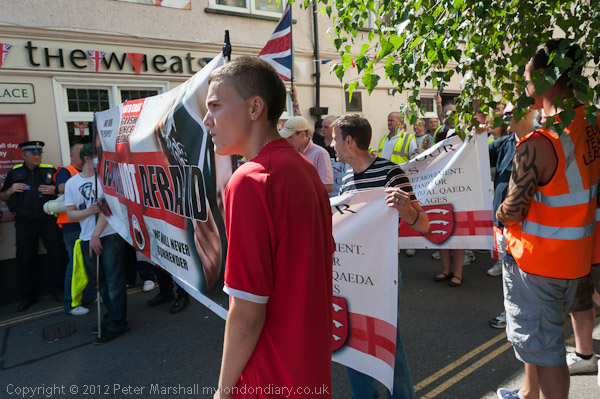
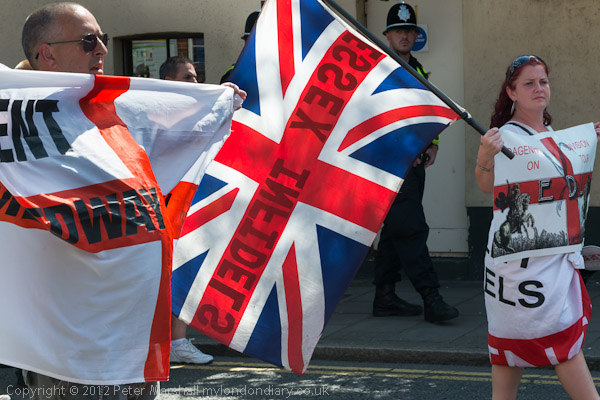
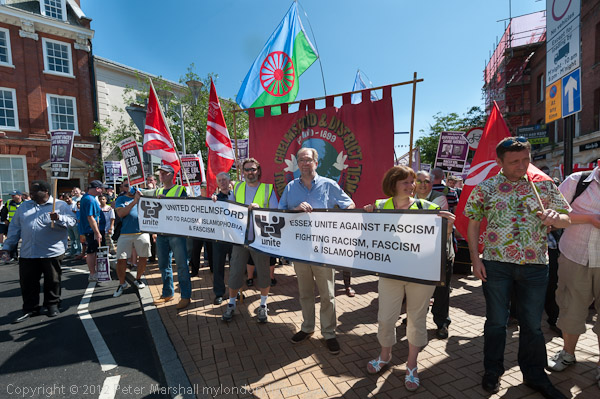
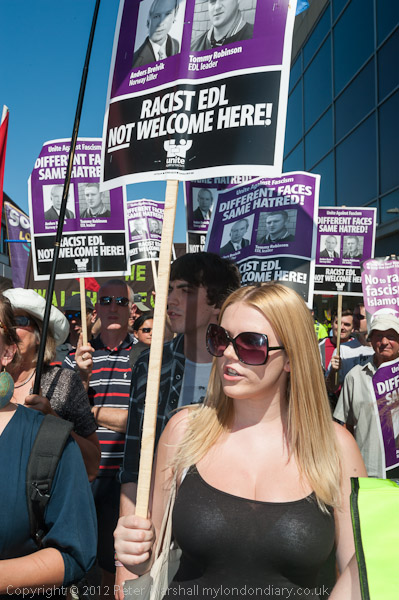
Extremist right-wing groups including Britain First and the EDL (English Defence League) were quick to exploit the London terror attack to fuel their anti-Muslim and anti-migrant racist propaganda, both organising marches. Police had imposed restrictions on both marches confining them to particular short routes to rally points on the Emabankment. London Antifascists and Unite Against Fascism (UAF) who had come to opposed them were only allowed to hold a static protest.

I was able to photograph Britain First at their designated meeting point in the taxi area outside Charing Cross station where their leader Paul Golding arrived with a van full of flags and handed them out, while his deputy Jayda Fransen was busy talking to the media.

The EDL were supposed to be meeting in Trafalgar Square, but were actually gathering in their usual pub, Lord Moon of the Mall, close to the top of Whitehall. Police were busily and rather forcefully keeping back a crowd of antifascists against the shops on the opposite side of the road, injuring a few of them in the crush. Police behind them were shouting at them to go forward, but police in front were preventing them from doing so.

I photographed the EDL on the pavement in front of the Lord Moon of the Mall over the shoulders of a line of police protecting them, but left as police pushed them back inside the pub and returned to Britain First at Charing Cross station where they were getting ready to march.

There were few people on the street as they marched down to the Embankment for a rally, but a couple of women shouted at them calling them racists. Police stopped the marchers from moving towards them, but they had to refuse a Britain First fake-news team who tried to stop them for an interview.

I listened to the rally for a few minutes then tried to go back up Northumberland Avenue to photograph the EDL march, but it was hard to see for police surrounding it. The police quickly went to grab one woman who started to shout at this march.

But the police relaxed their cordon when the marchers reached their rally pen on the Embankment and I was able to walk past them and began to take pictures.

But after a couple of minutes one of the stewards saw me and objected to me being their and called on the police to remove me, after which I had to photograph over the shoulders of the police. One of the officers came to tell me off for having been in with the marchers, but I simply told her I had every right to be there. Shortly after I decided to leave as I had taken enough pictures, and I decided to go to photograph the counter-protesters.

More at Britain First & EDL exploit London attack.


UAF protest extreme right marches

Police had decided that the UAF could only hold a static protest on the Embankment rather than their intended and already advertised march to there from South Africa House in Trafalgar Square, despite ‘facilitating’ the two extreme-right marches. The UAF had turned up at South Africa House on the morning and police had slowly with unnecessary force pushed them down the march route as I’d witnessed earlier in the day.

From the EDL rally I could see and just hear the Unite Against Fascism rally taking place perhaps a hundred yards away down the Embankment, shouting ‘Fascist Scum off our streets’ and other slogans. From the speeches I had heard at the two right-wing rallies both groups were clearly racist and Islamophobic and among the marchers I recognised many faces from clearly fascist organisations I had photographed in the past.

I could see and hear that there were speeches at the UAF rally but not make out what was being said from the distance and over the noise. I tried to walk down towards the UAF but police would not let me take the short direct route despite my showing my press card.

I had to walk back and out onto Whitehall and then around to get to be back of the UAF rally, and by the time I got there many of the counter-protesters had left for home and the speeches had ended, though there were still rather more around than at the two right-wing rallies combined.

UAF protest extreme right marches


Canada Water, Southwark Homes & Cody Dock

Canada Water, Southwark Homes & Cody Dock: Events and pictures from Saturday 25th March 2017


Canada Water, Southwark.

Canada Water, Southwark Homes & Cody Dock

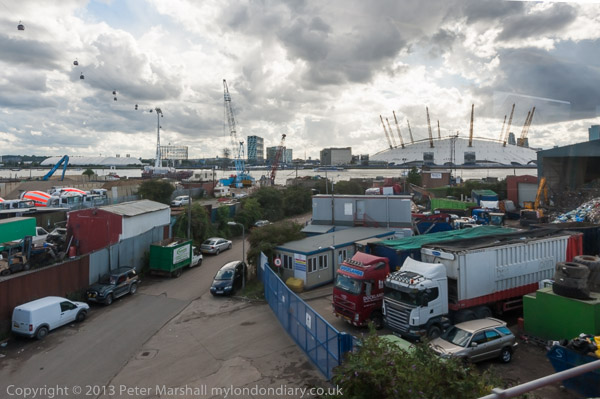
The Surrey Commercial Docks were the largest area of London’s Docklands and the only large docks on the south bank of the River Thames, built on a large marshy area at Rotherhithe, a little closer to London than the Royal Navy dockyard at Deptford.

Canada Water, Southwark Homes & Cody Dock

The first dock here was dug out in 1696 and was the largest dock of that age, and could take 120 sailing ships. Later the dock became Greenland Dock, a base for the Arctic whaling trade, but in the 19th century there was a huge increase in trade with Scandanavia and the Baltic, and other docks were dug, as well as huge timber ponds which soon became its major trade.
Canada Water, Southwark Homes & Cody Dock
Deal Porters sculpture by Philip Bews

Surrey Docks was in full swing the in the Victorian age, with nine docks, six timber ponds and the Grand Surrey Canal. Badly damaged by bombing in the Second World War, the docks never fully recovered and were then hit by containerisation. The docks were too small to handle container ships and closed in 1970. Most of the docks were filled in and the whole area was redeveloped.

Canada Water, Southwark Homes & Cody Dock

By the time the London Docklands Development Corporation was set up by the Tories in 1980 the redevelopment initially led by Southwark Council was well under way and the area was set to have a rather different character from the redevelopments on the north bank.

But the LDDC appeared as the principal objector, to the council’s statutory development plan and was backed by the Department of the Environment. Southwarks plan for the whole of the south riverside from London Bridge to Deptford was rejected for showing ‘unrealistic commitment to public housing‘ and for its ‘opposition to office and other private development’. The LDDC went ahead with selling land and buildings for speculative development.

The LDDC rubbed its hands in glee at the thought of selling riverside sites which Southwark had planned for low cost rented housing to developers of large blocks of luxury flats, and rushed to clear aging council estates and replace them with privately owned properties, policies which were strongly opposed by Southwark Council.

But times have changed, and I had come to Canada Water for a march where local people had come to protest against very similar policies by Southwark’s Labour council, working for and with developers to demolish estates such as the Heygate and Aylesbury, with the replacements including only a very small percentage of social housing. I’d arrived early on purpose to give me time for a short walk around before the protest began.

More at Canada Water.


Southwark march for homes & businesses

Southwark campaigners marched from Canada Water to protest at Thurlow Lodge Community Hall on the Aylesbury Estate, calling on Labour-run Southwark Council to save homes and jobs in the borough.

Marchers and speakers at the rally before the march included those from tenants and residents organisations, local business networks and others. They had come to oppose Southwark Council demolishing council estates for luxury home building, selling off public land to private developers and profit-oriented housing associations and forcing out small businesses through policies they say are solely concerned with realising asset values and trample on the rights and needs of local residents.

On My London Diary there is a long list of some of the groups involved, but there were others too.

One of the bigger battles, still continuing, is over the future of the Aylesbury Estate in Walworth, just south of the Heygate Estate at the Elephant and Castle, where the council lost a great deal of public money in providing a huge site with great transport links to allow a private developer to make huge profits, losing around 2000 social rent homes. Many of the new flats are empty boxes, investments for wealthy foreigner profiting from rapid increases in London property prices.

Piers Corbyn with others sitting down on Albany Road at the end of the march

Much of the Aylesbury estate has now been emptied, and some demolished. The council was found to have acted acting unfairly towards leaseholders who were being offered derisory compensation – usually less than half the market value of comparable properties in the area. Those who took the court case got improved offers, but there is little evidence of it changing its ways and trying to cheat others. Among those involved in fighting to save the Aylesbury on this march was Piers Corbyn, Jeremy’s older brother, in the news more recently over arguably less worthwhile causes, particularly in opposition to Covid restrictions.

The Aylesbury Estate had been at the centre of the Labour Party’s plans for the regeneration of council estates, the site of Tony Blair’s first big press event. But Labour’s policy was more about grabbing headlines than providing the good low-cost housing that a proper social housing policy requires. Councils such as Southwark have used it to demonise and run-down their large estates, spending large sums with PR companies to do so and working with major developers, rather than properly consulting with residents and putting the necessary cash into estate maintenance, running them down on purpose.
It was a long march to the Aylesbury Estate, detouring to pass several housing estates and business areas threatened by the council, and a tiring one on a warm and sunny March Day, and we were all tired by the time it ended outside Thurlow Lodge Community Hall. This had been saved earlier this year by a community occupation after Southwark Council had wanted to evict the occupants, Divine Rescue, a body with a soup kitchen offering support, training and meals to around a hundred homeless people, and runs a a food bank. Southwark wanted to sell or let the community hall to make more money.
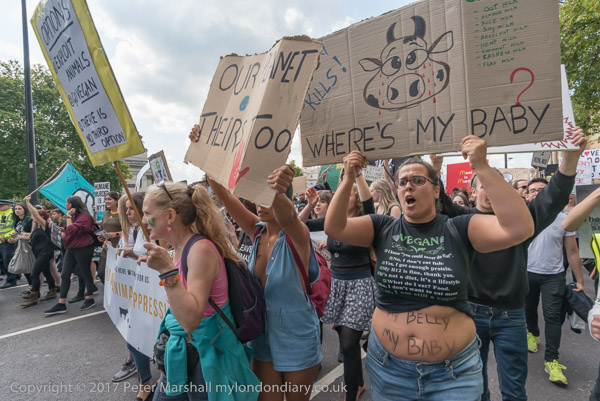
The march organisers had planned to end the march here with Divine Rescue providing hot drinks and toilet facilities after the long walk, but Southwark Council had warned Divined Rescue that there lease would again be threatened if they had anything to do with the protest, forcing them to withdraw their offer. The hall was locked and shuttered, guarded by Southwark Council security when we arrived. It seemed a very petty piece of bullying by the council.

The protesters sat down on Albany Road blocking traffic for around 10 minutes in protest at this, then moved to the area in front of the community hall for a final rally.

Many more pictures from the march and the rallies before and afterwards on My London Diary at Southwark march for homes & businesses.


More From Cody Dock

From the Aylesbury Estate I made my way to Cody Dock for the opening of my show there, ‘All Along the Lea‘, black and white photographs from the 1980s and 90s, arriving an hour or two early.

This gave me time to take a few more pictures, but also to have some food and a beer and listen to some live music and just to enjoy being there.
It was a pleasant opening with a decent crowd, with plenty of people coming to look at the pictures and talk, including the local MP. As I said and wrote, “When I took these pictures many people wondered why I was wasting time and film on such scenes, so I’m really pleased to have them appreciated now. “
I hadn’t chosen the title for the show, and it wasn’t accurate fro the pictures that were on the wall, almost all from Bow Creek. But I had photographed ‘All Along the Lea’ and my web site and the book ‘Before the Olympics‘ have pictures from the source at Leagrave to the outlets into the Thames both at Bow Creek, and, via the Limehouse Cut, at Limehouse Dock.


Bikes Not Bombs, Tibet, Deportation & Pillow Fight

Back on Saturday 22nd March 2008 I had a rather varied day in London, meeting protesters cycling to Aldermaston on my way to photograph a march for freedom in Tibet, then going to a protest against the deportation of a gay man to Iran and finally to a pillow fight.


Bikes Not Bombs: London – Aldermaston

Bikes Not Bombs, Tibet, Deportation & Pillow Fight

I was on foot and had just come out of Oxford Circus station when I saw the CND Bikes Not Bombs group of cyclists who had begun their ride in Trafalgar Square earlier and were on their way to ride to Aldermaston. Though when I took a few photographs as you can see from the bus they were cycling in exactly the wrong direction, east towards Ilford. Of course they weren’t lost, just trying to attract some attention to the protest, riding with a sound system along London’s busiest shopping street.

Bikes Not Bombs, Tibet, Deportation & Pillow Fight

I’d thought briefly about taking part myself in the event, as I’d used a bike to get around since I was six, having graduated then from a first a pedal car and then a tricycle. I did own a car briefly when I was around 21, but soon realised it was impractical in cities, expensive, polluting and environmentally unsound and never made the same mistake again.

But for the reasons I listed on My London Diary – sloth, other events, lousy weather and a dislike of early rising – I didn’t join this official ride, though I did cycle on my own from Reading to Aldermaston and back on the following Monday to join the protesters there.

Bikes Not Bombs: London – Aldermaston


Support Tibet March

Bikes Not Bombs, Tibet, Deportation & Pillow Fight

I was on my way to Park Crescent, a short walk north of the Chinese Embassy where Tibetans and supporters of freedom in Tibet were meeting to march through London on the 49th anniversary of the 1959 Tibetan uprising.

Bikes Not Bombs, Tibet, Deportation & Pillow Fight

Tibet came under effective control of the Chinese government in 1951, when an agreement had been come to the status of Tibet within the recently established People’s Republic of China. In 1949 Tibetan protesters feared the Chinese were about to arrest the 14th Dalai Lama. Protests were at first peaceful but were brutally repressed by the People’s Liberation Army and there was heavy fighting which also involved Tibetan separatists who had been carrying out guerrilla warfare against Chinese forces.

The Dalai Lama fled the country and set up an independent Tibetan government in India, where he still lives – and was awarded the Nobel Peace Prize in 1989. The Tibetan uprising had begun on 10th March 1959 and this day is celebrated each year as Tibetan Uprising Day and Women’s Uprising Day. Since 2009, following protests on 10th March 2008 in Lhasa, the Chinese-controlled authority in Tibet have celebrated the day they fully regained control, 28th March as the national anniversary of Serfs Emancipation Day.

The Tibetan Independence Movement who organise annual protests calling for freedom for Tibet was originally funded and trained by the CIA, but this was withdrawn following Richard Nixon’s visit to China in 1972. And the Dalai Lama who had originally backed it, and who appears as a large photograph carried reverently in the marches, also withdrew support for the independence movement in the 1970s.

It is clear from reports by Amnesty International and others is that there are considerable human rights abuses in Tibet. The 2021 US State Department report listing includes “unlawful or arbitrary killings, including extrajudicial killings by the government; torture and cases of cruel, inhuman, and degrading treatment or punishment by the government; arbitrary arrest or detention; political prisoners; politically motivated reprisals against individuals located outside the country; serious problems with the independence of the judiciary; arbitrary or unlawful interference with privacy; serious restrictions on free expression and media, including censorship; serious restrictions on internet freedom including site blocking; substantial interference with the freedom of peaceful assembly and freedom of association; severe restrictions on religious freedom….”

Support Tibet March


Defend Mehdi Kazemi – Downing St

But of course human rights are not always respected in this country, and we currently have a government which is proposing to withdraw from some international human rights conventions and proposing racist anti-immigrant policies which are deliberately in breach of them.

Back in 2008, the Labour government was also riding roughshod over the human rights of some immigrants, setting up a system of large-scale detention of asylum seekers and treating individuals unfairly in a bid to outflank the Tories on cutting immigration through blatantly right-wing policies.

Mehdi Kazemi had come to the UK to study after having been involved in a consensual homosexual relationship in Iran. After his boyfriend was executed for this he became a wanted man in Iran and he went to the Netherlands to apply for political asylum.

This was refused as he had come from the UK and so was not allowed under the 2003 Dublin Agreement. The Uk had refused him permission to stay in Britain and were proposing to deport him to Iran where he would be tried and executed.

His case was just one of many where the Home Office were failing to recognise the need for refugees to claim asylum on the grounds of persecution because of their sexual orientation, and for failing to have accurate and up-to-date information on homophobic persecution in countries to which LGBT asylum seekers might be deported.

Support for Kazemi at this protest and by a number of MPs, MEPs and human rights activists did eventually result in the Home Office agreeing to review his case and he was given leave to remain here in May 2008.

Defend Mehdi Kazemi


Flash Mob Global Pillow Fight – Leicester Square

My day ended in very much lighter mood with a pillow fight in Leicester Square, one of many organised in capitals around the world due to kick off at 15.03PM.

I commented: “Of course its a trivial, silly event, but the idea and the kind of organisation involved I think represents something new and exciting, a kind of ‘Demo 2.0’ which we will surely see more of in the future.”

Perhaps this hasn’t had as much impact here in the UK as I had hoped, but I think may have been more important elsewhere in the world. To some extent it has been outgrown as Facebook, Twitter and other social media apps have become more important and even protests organised months and years in advance make use of them.

But it was interesting if rather tricky to photograph, and I got stuck in without a pillow and at some danger to my health, main not “from impact but suffocation when some pillows split open to fill the air with clouds of feathers and feather-dust. At times I wished I was wearing a mask to protect my lungs; keeping my mouth firmly closed and breathing though my nose only stopped the larger particles.

And I also found the the autofocus on my DSLR was too efficient at focusing on feathers in the air, and until I turned it off and went manual many of my pictures failed to be sharp for the people and pillows behind the screen of feathers.

Later as the pixel count on DSLRs increased and full-frame cameras appeared I found it very useful to work in many situations using just the central ‘DX’ half-frame area of the viewfinder – which would have been very useful to let me see the people and pillows coming for me, but on this occasion I found “chaos really rules taking pictures becomes a press and hope situation. I think some of them do give an idea of what it was like to be there.

Flash Mob Global Pillow Fight


Climate Revolution Fracked Future Carnival 2014

The Climate Revolution is an organisation set up by the late fashion designer Vivienne Westwood (1941-2022) at the London Paralympics closing ceremony in 2012 and she spent the last years of her life campaigning to halt climate change, stop war and defend human rights and protesting against capitalism. Her work is now continued by the not-for-profit organisation she set up, the Vivienne Foundation.

Climate Revolution Fracked Future Carnival

I’m not a follower of fashion, as those who know me will have noticed. But Westwood’s activism reached a rather different and wider audience than the more usual campaigning groups, gaining publicity across the whole world of fashion and at times attracting the kind of mass media attention that follows celebrities, rather than issues, now attract.

Climate Revolution Fracked Future Carnival

Protests taking place in the UK seldom seem to be news – last Wednesday striking workers brought much of London to a standstill and possibly 100,000 people marched through the streets and protested in various places but when I came home and searched on the BBC news site in the early evening there was not a mention of it, though there may have been a little coverage later.

Climate Revolution Fracked Future Carnival

Others did rather better, but it needs something else for a protest to be news for our media. It can be that it happens abroad and particularly if it is against some regime unpopular with our (and the US) government. But it can also be if it is violent or particularly quirky or involves a major celebrity such as Dame Vivienne Westwood – and those protests she organised and her designs were always rather quirky too.

Although Westwood very much did her own thing, she was also great at cooperating with other groups working in the same area – such as the anti-fracking ‘Nanas from Nanashire’ who came down to London for this protest.

The protest was arranged to take place outside the Shale Gas Forum, where the CEOs of IGas, Cuadrilla and various government officials were plotting new ways to bring fracking to the UK, and to change our to allow this to happen. In particular they want to stop people being able to prevent dangerous mining beneath their properties which could cause dangerous and damaging subsidence. Their proposals would allowed companies to proceed without proper concern for safety and environmental consequences and give them some indemnity against damages and government would promise to pay a high price for the gas.

The Forum had been scheduled to take place at an expensive hotel in Belgravia, but after arrangements had been made for protest carnival to take place outside, it was moved to a ‘secret’ location elsewhere in London. Climate Revolution obviously had friends in high places who leaked the details to them.

It was Budget Day, but rather than going to take pictures around Westminster I decided it was more important to cover the protest against fracking. I met Westwood and her supporters, mainly fashion students, outside the Royal College of Arts Battersea location just south of Battersea Bridge and marched with them to the Jumeirah Carlton Tower hotel in Cadogan Place which had been the original venue for the frackers.

We knew the event had been relocated and their was some confusion at the end of the march as to whether it should entrain immediately at Knightsbridge station or go to the hotel. Eventually this was resolved and there was a rally outside the hotel with speakers including Vivienne Westwood and Vanessa Vine of BIFF (Britain & Ireland Frack Free).

The new location was still a secret as we followed the Rhythms of Resistance samba band to Knightsbridge station, where more protesters were waiting and took the underground to Old Street.

People were slow to arrive at Old Street, with some stopping off to buy coffee or sandwiches and others getting lost on the way, but eventually we were on the march again, on our way to the rear gates of the Territorial Army Centre on Bunhill Row, guarded by a few police.

Outside the event, people danced to Rhythms of Resistance, and there were speeches by Vivienne Westwood, Tina Louise from Residents Action on Fylde Fracking, Vanessa Vine, Frack Free Bristol, and others, some of whom had also spoken at Knightsbridge.

Some of us then walked through Bunhill Fields cemetery to City Road to protest on the other side of the military centre, and later most of the other protesters followed for a further rally at the main gates.

The protest was beginning to wind down and people were leaving and I left too, going to cover a protest by The African LGBTI Out & Proud Diamond Group and Peter Tatchell Foundation held a noisy protest at Uganda House calling for the repeal of Uganda’s draconian anti-gay laws.

And from there I went on to Downing St, where the People’s Assembly were holding their Budget Day Protest before finally I could go home.

More on all these stories on My London Diary:

Climate Revolution March to Fracked Future Carnival
Fracked Future Carnival in Knightsbridge
Fracked Future Carnival at Shale Gas Forum

Protest over Uganda Gay Hate Laws
People’s Assembly Budget Day Protest


UN Anti-Racism Day 2017 & 2023

UN Anti-Racism Day 2017 & 2023

Today, 18th march is the UN Anti-Racism Day, and in 2017 it was also a Saturday, and tens of thousands marched through London, starting as they will today outside the BBC and ending with a large rally in Westminster.

UN Anti-Racism Day 2017 & 2023

Today’s march, as in 2017, is organised by Stand Up to Racism, Unite Against Fascism and Love Music, Hate Racism and the TUC and supported by many other groups, including football fans from around the country who will be wearing team colours.

UN Anti-Racism Day 2017 & 2023

This years march is perhaps even more important, with the UK Government pursuing clearly racist policies against immigrants in last year’s Nationality and Borders Act, its attempt to deport refugees to Rwanda and Suella Braverman’s recently announced Illegal Migration Bill.

Phyll Opoku of PCS ‘Stand Up to Racism’

Football fans have been energised by the BBC’s reaction to Gary Lineker’s tweet. He was clearly correct in observing the hostile anti-refugees language used by the government to language used in Germany in the 1930s. They say the government are trying to stir up division and racism to deflect attention from their multiple crises and turn refugees into scapegoats.

Unfortunately it isn’t just the government, but also the official opposition who continue to up the ante over immigration, refusing to stand up to the government with any real attempt to improve our treatment of refugees and asylum seekers. Real opposition to racism has been left to a few increasingly isolated figures on the left of the party – including many of those who have been ejected for supposed anti-semitism, increasingly being used to expel Jewish members who support the Palestinian people. And of course left to footballers or former footballers.

Even Theresa May, who the 2017 march was strongly opposed to for promoting racist measures against immigrants and in particular Muslims in concert with Donald Trump has found Braverman’s latest proposals which will break international law on the human rights of migrants a step too far.

The 2023 march organisers say:

In Britain we face a crisis-ridden government attempting to use racism to make ordinary people pay for the cost of living crisis. The ‘Rwanda plan’, the Nationality and Borders Act, racist deportations and the hostile environment for refugees and migrants are all about divide and rule.

The government deny the reality of institutional racism – despite massively disproportionate deaths in black communities during the pandemic – and the reality of deaths in police custody, racist stop and search and discrimination across society.

Internationally we are seeing the growth of the racist and fascist right and an alarming rise in Islamophobia, antisemitism, Sinophobia, anti East/South East Asian racism and attacks on Gypsy, Roma and Traveller communities.

Despite a rail strike this Saturday I hope to be there later today, again taking photographs and marching with many thousands of others.

Much more from the 2017 march and rally on My London Diary: Thousands March Against Racism.


Lung Theatre ‘E15’ Battersea March 2017

Lung Theatre 'E15' Battersea March

Lung Theatre ‘E15’ Battersea March: Thursday 16th March 2017 was a rather unusual day for me in that rather than photographing a protest I was being part of a theatrical performance, though not in a theatre but on the busy evening rush hour streets of Battersea.

Lung Theatre 'E15' Battersea March

But like many of the others there, I was playing myself as a photographer of protests, and taking pictures as I would if this had been a real protest.

Lung Theatre 'E15' Battersea March

This performance was to announce that Lung Theatre, a small theatrical group, were bringing their Edinburgh festival award-winning performance ‘E15’ to Battersea Arts Centre, and they were doing so with the help of many of the housing protesters, particularly from the Stratford-based Focus E15 campaign, on which their ‘verbatim theatre’ performance was based.

Lung Theatre 'E15' Battersea March

An interesting article, Documentary & Verbatim Theatre by Tom Cantrell of the University of York gives a clear definition, “Verbatim theatre is a form of documentary theatre which is based on the spoken words of real people. Strictly, verbatim theatre-makers use real people’s words exclusively, and take this testimony from recorded interviews.”

The “protest” began in the rather dim light of the street outside Clapham Junction’s busiest entrance, and it was hard for me to distinguish the actors from the housing protesters by their speech and actions, though rather easier in that they were the only faces I didn’t recognise, having met and photographed the activists so often at previous events. But the group certainly put on a convincing performance as they handed out leaflets and fliers, both about the Focus E15 campaign and their forthcoming performances at the Battersea Arts Centre.

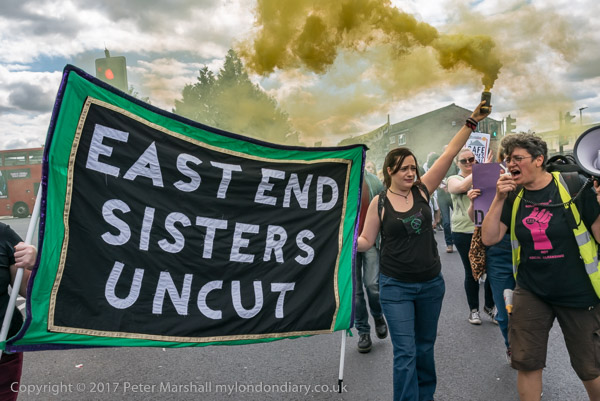
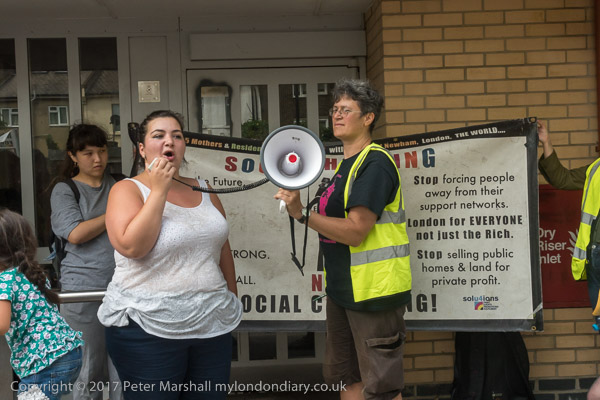
Focus E15 began when a group of young mothers housed in the Focus E15 hostel in Stratford were told that Newham council were going to evict them and they would be dispersed not just in the borough but to rented accommodation across the country in far away places where they had no friends, no family and away from any jobs, schools, familiar services and support.

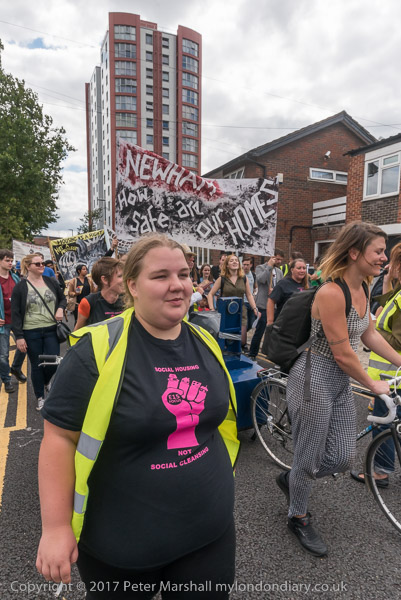
Newham had adopted a policy which amounted to social cleansing, removing people from its area who, as the then Mayor put it, could not afford to live there. Rather than accept this they came together to fight the council, and inspired others across the country to fight for ‘Social Housing NOT Social Cleansing’.

And Focus E15 won their fight but didn’t stop there, continuing the fight for others in the area faced with homelessness and eviction, demanding the council bring empty council housing back into use in a campaign for ‘Housing For All’. They are still out on Stratford Broadway with a street stall every Saturday, still forcing the council to face up to its responsibilities despite considerable harassment (and more recently a change of Mayor.)

As well as some of the leading activists from Focus E15 at the eevent were also other campaigners including some from Sweets Way in north London and Lewisham People Before Profit and others fighting the demolition of council housing by London’s mainly Labour controlled councils, increasingly in league with estate agents and property developers scrambling for excessive profits from sky-high London market prices. And they had brought some of their banners with them for the event.

From Clapham Junction the “protesters” marched up Lavender Hill to the Battersea Arts Centre, where they occupied the foyer for a few final minutes of protest in what had been a pretty convincing event. And while actors had to go on stage and give their performance, the activists could sit down in the theatre and watch.

I didn’t join them, as I knew I had to come back to view it a week later and then be a part of a panel discussion Art & Accidental Activism, a week later. It was an impressive performance and gave a real impression of some of the more dramatic aspects of the real protests I had covered and made clear the political aspects of the housing crisis and why activism was necessary. But sometimes it did seem strange to hear words I remembered well coming out of a different person.

I couldn’t really enjoy it as much as I would have liked as I was very nervous, considerably daunted at having to appear afterwards ‘on stage’ to answer questions with fellow panelists Jeremy Hardy, journalist Dawn Foster and theatre legend Max Stafford Clark. But in the event it went well (my sternest critic says) and I rather enjoyed it and the session in the bar that followed.

More at Lung Theatre ‘E15’ march to BAC.


Fukushima Anniversary Questions Nuclear Power

Fukushima Anniversary Questions Nuclear Power Safety – London, 9th March 2013

Fukushima Anniversary Questions Nuclear Power

On 11th March 2011 Japan suffered its most powerful recorded earthquake. The Fukushima power plants fusion reactors were immediately shut down and diesel generators started to pump the coolant needed to keep the reactors safe.

Fukushima Anniversary Questions Nuclear Power

But the earthquake generated a tsunami, with giant 45ft waves which swept over the sea walls of the power plant, flooding and disabling the emergency generators. As Wikipedia states “The resultant loss of reactor core cooling led to three nuclear meltdowns, three hydrogen explosions, and the release of radioactive contamination in Units 1, 2 and 3 between 12 and 15 March.

Fukushima Anniversary Questions Nuclear Power

Around 110,000 people were evacuated from a 12 mile exclusion zone around the plant because of airborne radioactive contamination, with many losing their livelihoods as well as their homes. The Tokyo Electric Power Company (TEPCO) who owned the site are still carrying out necessary cleanup of the site and removal of the radioactive fuel debris is expected to take until around 2040 or 2050.

Fukushima Anniversary Questions Nuclear Power

A TEPCO report in 2000 had recommended improved safety measures against seawater flooding, designed to stop tsunami waves greater than those that caused the 2011 disaster, but these and several other warnings were dismissed by the company as unrealistic. Earlier scientist had expressed concerns about the dangers of building nuclear power plants in Japan because of the earthquake problems.

Japanese expatriates in London began a series of weekly protests against nuclear power at the Japanese Embassy on Piccadilly and also protested outside the TEPCO offices in Berkeley Square. The protest on Saturday 9th March was was organised by ‘Japanese Against Nuclear UK’ together with ‘Kick Nuclear’ and CND.

I went to photograph the protesters as they met up for the march at Hyde Park Corner. They intended to make brief protests at several locations including the Japanese embassy, the EDF office and Downing St before ending with a rally and final protest opposite Parliament in Old Palace Yard.

Many of them had come with sunflowers, a symbol of renewable clean energy, particularly solar energy. There were several banners with the smiley sun symbol and the message ‘Nuclear Power? No Thanks’ and a group of people encased in fluorescent yellow barrels with a radioactive danger symbol and labelled ‘Radioactive Waste.’

Some of the Japanese protesters had brought Japanese masks used to hide faces at protests in Japan against Fukushima, although many preferred to have sunflowers painted on their faces.

Among those who had come to protest were some who had come on a coach from Somerset, where they were opposing plans by EDF to build a new power station at Hinkley Point. The plans for the first new nuclear reactor in Britain for over 30 years were approved by the EDF board and the UK government in 2016. The first reactor arrived there last month though the project is several years behind time and is now expected by EDF to be completed in 2028.

Although some environmentalists have backed nuclear as a necessary part of our energy supply if we are to cut carbon emissions, it seems likely that increases in the efficiency and the continuing drop in costs of renewable alternatives will make the new power station a huge white elephant, producing electricity at a much higher cost guaranteed by the UK government to the developers.

More on My London Diary at Fukushima 2nd Anniversary.


I left the protesters as the march was about to start to go to the Million Women Rise march which was taking place at the same time. You can see more about that at Million Women Rise.


Turkey’s War on Kurds, Bunhill Fields – 2016

Break the Silence! Turkey’s War on Kurds – BBC to Trafalgar Square

Turkey's War on Kurds

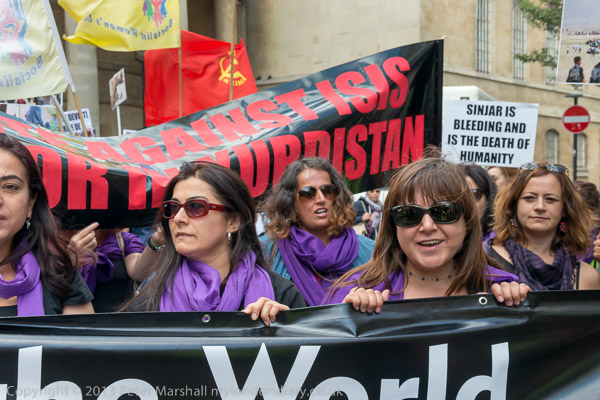
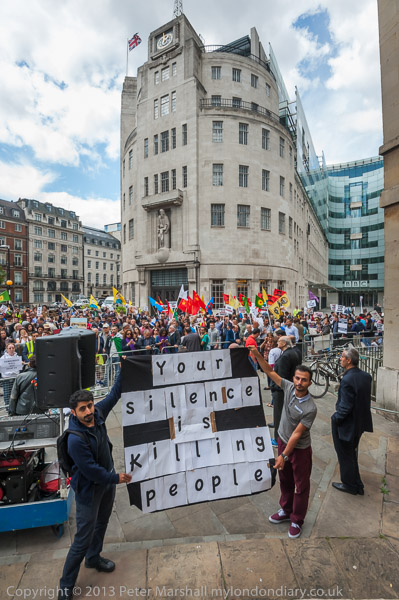
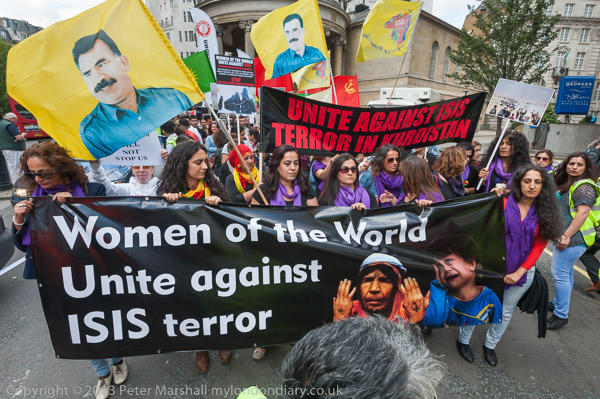
Turkey’s War on Kurds. On Sunday 6th March 2016, several thousand of Kurds and their supporters marched through London in solidarity with the Kurdish people calling for an end to the silence from Turkey’s NATO allies and the western press over Turkish war being waged against Kurds in northern Syria.

Turkey's War on Kurds

This area of Syria has successfully broken away from control by the Syrian regime under President Assad and set up a popular progressive participatory democracy under the name Rojava. Although Kurds form the majority, the impressive constitution of the new area guarantees the rights of all the minority groups and also has enshrined the equal rights of women. Many see it as a model for future democratic states elsewhere.

Turkey's War on Kurds

The Kurds also call for the UK to decriminalise the PKK Kurdish liberation Movement here, and for the release of their leader Abdullah Ocalan who has been in jail in Turkey since his illegal kidnapping in Kenya in 1999. In 2003 the European Court of Human Rights ruled his trial unfair, and called for a retrial. Turkey lost an appeal against this decision in 2005 but have still refused to hold a retrial.

The march began with around 5,000 people massing outside the BBC, who have consistently failed to cover the real issues over the Kurdish struggle and like to almost totally ignore any political protests taking place in the UK. True to form there appeared to be no mention of this large march in any BBC national or local news in the following few days.

The protest was called by his protest was called by Stop the War on the Kurds and supported by a huge array of groups, which I listed on My London Diary. Here it is again.

Peace in Kurdistan, Kurdistan National Congress (KNC), Scottish Solidarity with Kurdistan, Day Mer, GIK-DER/RWCA, National Union of Teachers (NUT), Public and Commercial Services Union (PCS), National Union of Rail, Maritime and Transport Workers Union (RMT), Transport Salaried Staffs’ Association (TSSA), Trade Union Congress – International Section, Greater London Association of Trade Union Councils (GLATUC), Trade Unionist and Socialist Coalition (TUSC), National Shop Stewards Network (NSSN), Unite Housing Branch, Unison Islington, Stop the War Coalition, People’s Assembly, Unite Against Fascism (UAF), Socialist Workers Party, Socialist Resistance, Plan C, Revolutionary Communist Group, Left Unity, Green Party, Kurdish Community Centre, Halkevi, Roj Women’s Assembly, Kurdish Students Union, Alliance for Workers Liberty (AWL), Anti-Fascist Network (AFN), National Campaign Against Fees and Cuts (NCAFC), Party of Free Life of Kurdistan (PJAK), Democratic Union Initiative & PYD and other groups.

The march slowly went down Regent Street to Piccadilly Circus where the head of the march stopped and briefly sat down, blocking the junction. A few minutes later they got up and marched down Haymarket to a rally in Trafalgar Square. I left them to go to another event as te rally began.

More pictures on My London Diary: Break the Silence! Turkey’s War on Kurds.


Bunhill Fields Under Threat

Bunhill Fields is one of the City of London’s most special places, a Grade I cultural heritage site owned by the City of London and enjoyed by many nearby office workers in the area as a quiet space for their lunch breaks, though I think these are rapidly becoming, like the cemetery a thing of the past, with many working from home or snatching a quick sandwich at their desk still staring at a terminal.

William Blake was buried a little this side of the tree on the far side of the path. His wife on the south side of the cemetery close to Susannah Wesley

It’s a quiet place, a sanctuary and every similar cliche you like to throw at it, and of course always under threat from rapacious developers (are there any other kinds?) Although the cemetery itself is protected by its listing, I’d signed a petition against a development immediately on the north-east boundary which will result in this small and important site being overshadowed by a large and inappropriate development.

Tomb of John Bunyan

The proposed 10 and 11 storey skyscrapers would set a precedent soon to be followed by others and would severely change its nature, depriving it of light and altering its micro-climate. Islington Council had rejected the planning application but it was called in by then London Mayor Boris Johnson who allowed it to go ahead, along with other damaging schemes around the city.

Bunhill Fields was a burial ground mainly for nonconformists who could not be buried in Church of England churchyards and cemeteries and was in use from 1665 to 1854. It is best-known as the burial place of William Blake, Daniel Defoe, Isaac Watts, George Fox and John Bunyan, as well as others including Susannah Wesley.

Susannah Wesley’s stone is brilliant white. Now you can only walk along the path by it if accompanied by an attendant

The cemetery, which has a public path through its centre, is opposite Wesley’s Chapel on the City Road, with the path leading through to Bunhill Row. Most of the monuments in it, many listed, are in enclosed areas behind fences and can only be viewed from the paths, though years ago it was possible to wander more freely. There is still a garden area at the north of the site, where many, including Blake, were buried, with a lawn and seating.

More pictures at Bunhill Fields Under Threat.


No To Job Coaches in GP Surgeries – 2016

No To Job Coaches in GP Surgeries

On Friday 4th March 2016, campaigners from the Mental Health Resistance Network and DPAC protested outside City Road Surgery where Remploy/Maximus job coaches will “create jobs by prescription.” They say disabled people will be bullied into unsuitable work and lose benefits through sanctions if they refuse – and protest ‘No Job Coaches in GP Surgeries‘.

No To Job Coaches in GP Surgeries

Particularly since the Tories came into power in 2010, disabled people have been systematically attacked with cuts in benefits and unfair tests of fitness for work which have led to many suicides.

No To Job Coaches in GP Surgeries

What should be a supportive system of Job Centres encouraging and helping people find work has increasingly become a vindictive system reducing the benefits to many for often ridiculous, trivial and arbitrary reasons and attempting to force people into unsuitable jobs. Benefit sanctions can leave people without the necessary means to stay alive for months or even years at a time.

In January 2022, people on Universal Credit, either unemployed or on low paid jobs were told they had only four weeks before they had to look for jobs outside the sectors they had previously worked in, and if job centre staff feel they had not tried hard enough or had turned down jobs, however unsuitable, they would have their benefits cut.

And a few days ago, the government announced an incentive scheme awarding £250 monthly prizes to the staff whose Job Centre forces the most claimants into work and forcing claimants who have been on the benefit for thirteen weeks a to attend a job centre every weekday for a fortnight for “intensive support”.

The government clearly believe that the only incentive is cash, while most of us want jobs that we feel are worth doing and have some interest as well as pay enough to live on. Even Job Centre staff are poorly paid and their union dismissed the prize scheme, calling instead for their poverty pay to be increased. But these staff are generally not evil people, and being made by the government to bully people rather than help them must be painful for many of them as well as their clients.

The protest was a creative and colourful piece of street theatre, if sometimes chaotic, with a man dressed as a doctor wearing an Iain Duncan Smith mask and a name label ‘Dr Iain Duncan Smith, Dept of Eugenics‘ handing out prescription forms for a ‘Mr A Scrounger, 17 Lazy House, Sink Estate, Tory Britain‘.

The forms prescribed ‘Endless Job Coaching in Surgery, Major benefits reduction and PRN (‘pro re nata’ – as needed) Regular Sanctions‘ on the basis ‘Continue until complete cure or death‘ from ‘Dr A Lackey, DWP Surgery, c/o Nudge Unit, Tory Headquarters‘.

Then Maximus ‘Job Coaches’ pounced on the patients to issue G4S or Ingeus Deloitte Ltd ‘work cures’ and red ‘Sanctioned’ notices. Perhaps appropriately one of those job coaches was in costume as a squirrel and had a placard reading ‘Nuts to IDS – Squirrels Fight Back’.

There were also some serious speeches, including from a local GP, Roy Bard of MHRN, Paula Peters of DPAC, and Petros Elia, General Secretary of the United Voices of the World trade union who had come with a banner, drummers and plastic horns to add some noise to the protest.

At the end of the protest DPAC led a march down City Road, with police vainly trying to move them onto the pavement.

The march stopped at the busy Old Street roundabout where they held a noisy protest letting all around know why they were protesting for around 20 minutes blocking all traffic while police tried to move them away. Eventually after police began seriously to threaten arrests they decided it was time to end the protest and slowly moved off the street.

Much more on My London Diary at No Job Coaches in GP Surgeries. You can also see some pictures I took later that day at the launch of the re-born International Times at London is on Fire – IT is back.