Brentford, Chiswick & Hammersmith: On Thursday 27th December 2018 we still had a lot of Christmas excess to walk off despite having made our normal Boxing Day walk the day before. But we had followed that with a second Christmas dinner.
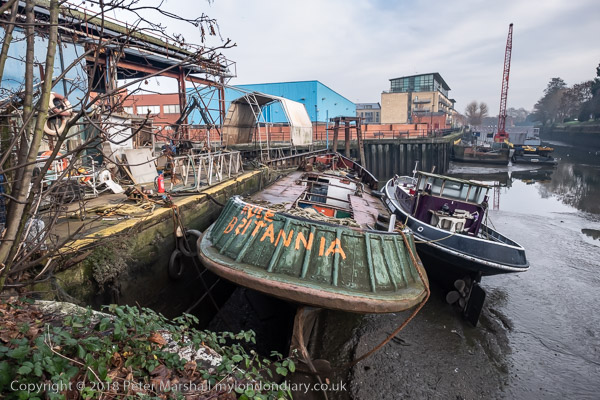
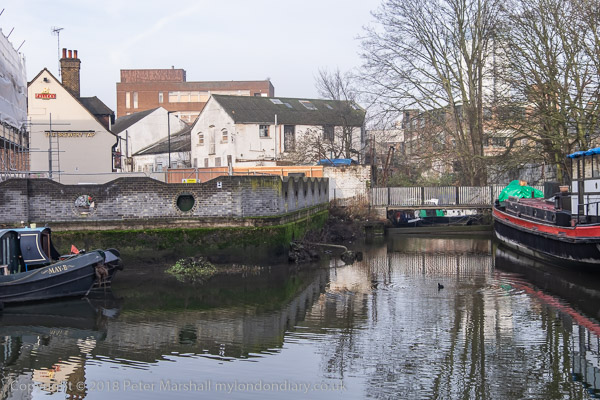
‘Rule Britannia’ on a boat moored below Thames Lock at Brentford
This is still one of my favourite walks in West London and includes various stretches I’ve often walked over the years in one direction or the other, usually during the times of year when days are short and we don’t want to spend much time in travelling. And during the time between Boxing Day and New Year, rail travel is often something of a lottery with much of the network being shut down for engineering work.
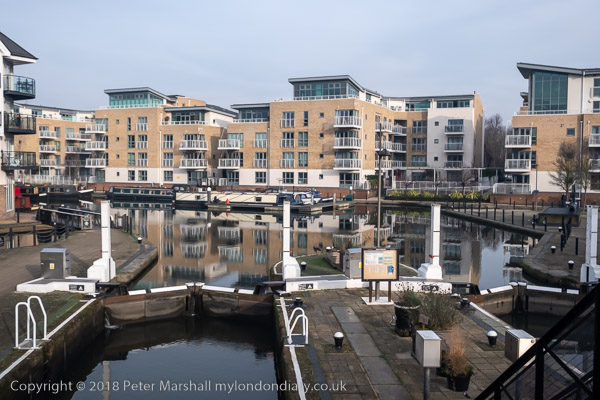
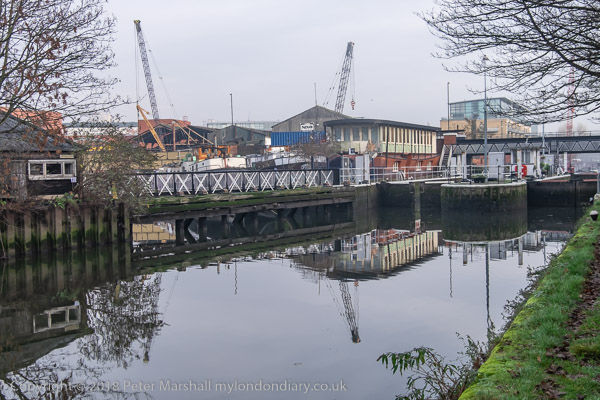
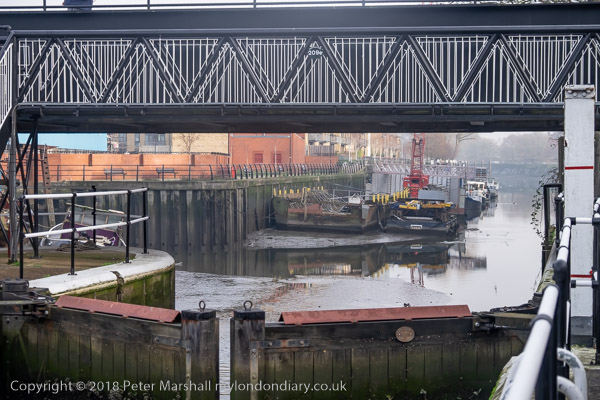
Brentford locks were gauging locks so that tolls could be charged based on the weight of goods in barges. The flats here on a site between the River Brent and the canal have replaced large dockside sheds.
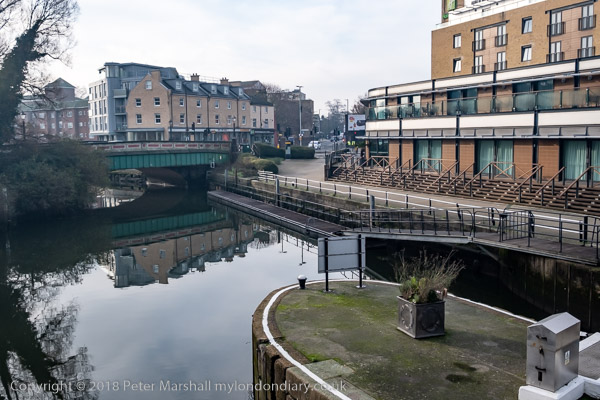
Even our short journey to Brentford was affected in 2018 and the usual direct train service to Brentford – our slow route to Waterloo – was not running. But we could take a train to Twickenham and go the rest of the way on the top deck of a bus, always one of the most interesting ways to travel in London. And the bus did take us more conveniently close to where I wanted to start this walk, at the bridge which takes Brentford High Street over the Grand Union Canal.
The road over the canal used to be the main route from London to the west and southwest before the Great West Road opened in 1925, and the canal linked the Thames to Birmingham.
Brentford used to be a rather dirty downmarket industrial and commercial centre, with sheds and warehouses, factories, docks on the canal and where this enters the Thames, a thriving market, a large gas works and more. It has changed dramatically in the last 40 or so years with much of its river and canal sides now filled with luxury flats. Parts of the old Brentford remain but more and more is disappearing, including some things in these pictures I made in 2018. I’ve been there a few times since and it remains an interesting walk.
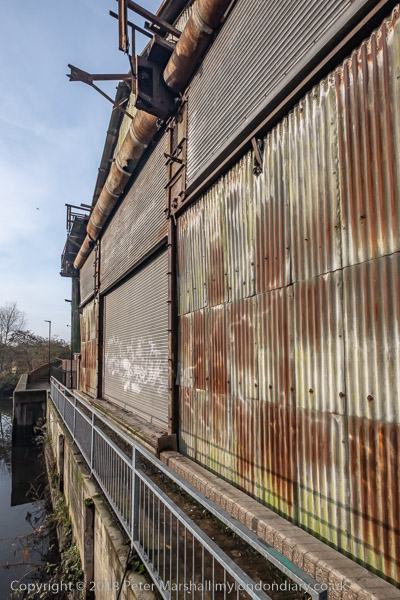
A narrow section of the towpath beside a derelict shed
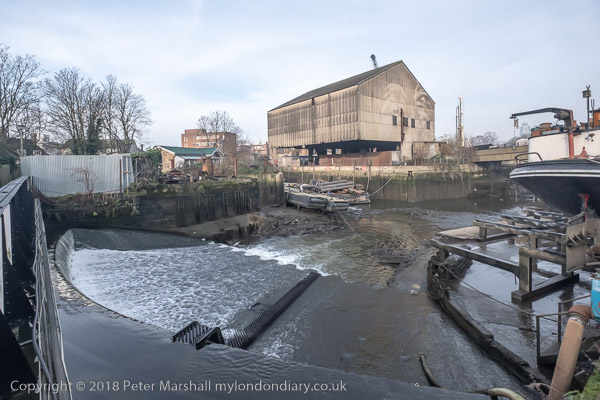
More on My London Diary at Brentford to Hammersmith. Here I’ll simply post a few images with captions from some of the key places along our route apart from the picture at the top of the post they follow roughly in the order I took them, though we did quite a bit of wandering around in Brentford.
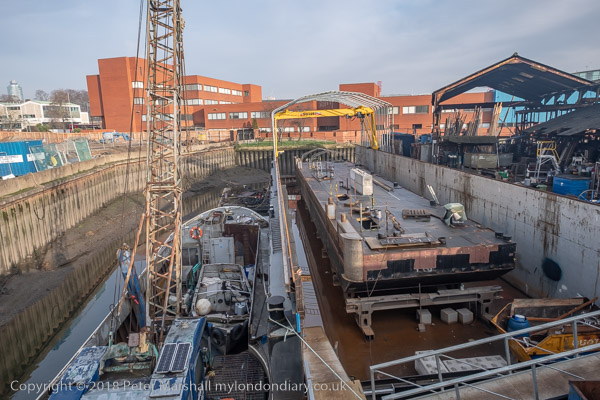
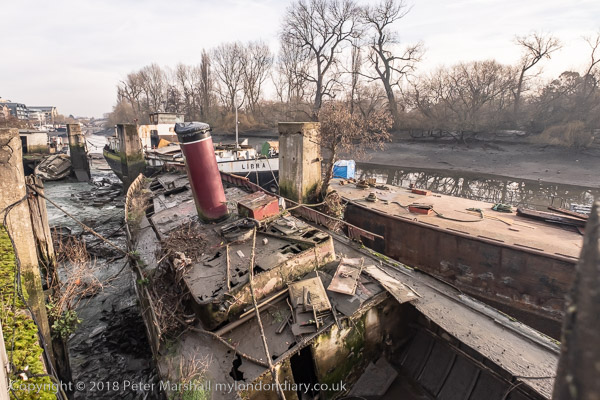
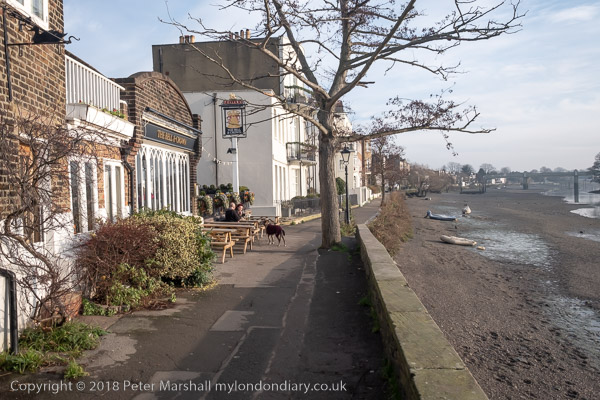
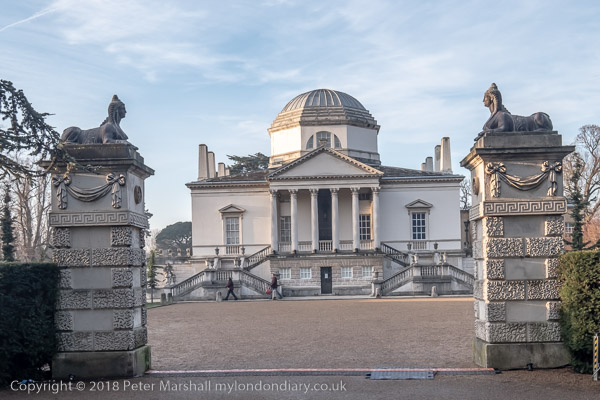
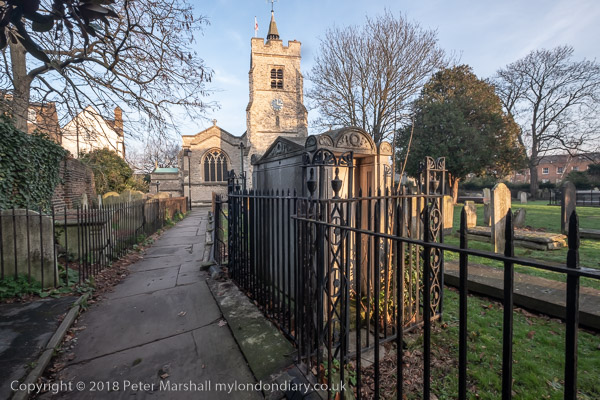
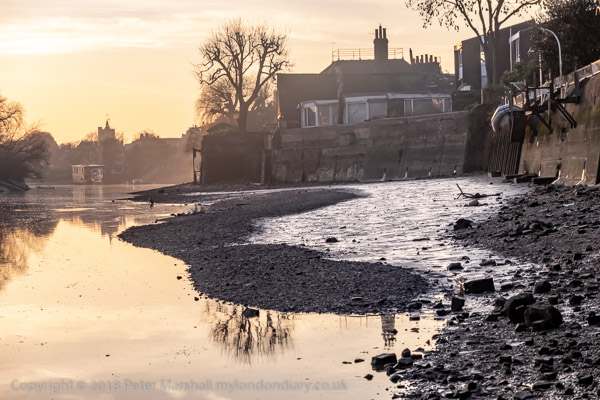
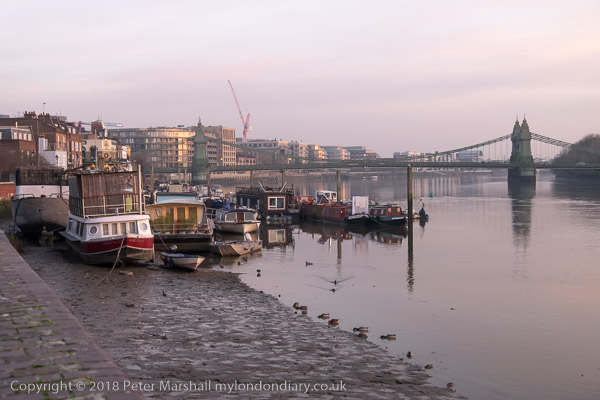
A small dock in the middle of BrentfordThe River Brent flows over the weir below the footbridge at centre left; at right, Thames Lock connects the canal to the tidal River Thames.The River Brent from the footbridge over the weir.Below Thames Lock the river comes back into the channel leading from the lock to the Thames.A working boatyard at Dock Road on the River BrentJohn’s Boat Works, Lot’s Ait with the bridge to it built in 2012Hounslow Council and boat owners fought a long battle over the moorings at the gasworks site, but these boats were simply abandoned after the council’s victory.Strand on the Green at low tide. It was warm enough to sit in the sun and eat our sandwichesWe walked through the gardens and out from the main gate to Chiswick HouseThe footpath to St Nicholas’s Church in ChiswickRiver Thames looking back to ChiswickRiver Thames and Hammersmith Bridge
In Hammersmith we took the District line to Richmond and then a train back home to tackle some of the leftovers from our Christmas lunch.
Crackers & Paper Hats: A Happy Christmas to you all.
Perhaps this is not the most obvious of Christmas pictures, but if you’ve pulled a cracker and put on a paper hat you have enjoyed the legacy of Tom Smith, whose wife and company are remembered in this memorial.
Martha Smith Memorial Water Fountain, Finsbury Square, Finsbury, Islington, 1992, 92-10e-33
This water fountain states it was ‘Erected and presented to the Parish of St Luke by Thomas and Walter Smith (Tom Smith and Co) to commemorate the life of their mother, Martha Smith, 1826 – 1898.’
Thomas J Smith (1823-1869) invented the Christmas Cracker in 1847 and the company made enough from their sales and the paper crowns introduced into them by his son Walter to move to premises in Finsbury Square where they remained until 1953. The fountain dedicated to their mother was erected by Thomas’s sons Tom and Walter in 1898.
You can still buy Tom Smith crackers both in the UK and the USA and the company has “been the proud holder of a Royal Warrant to The Monarch since 1906” – including our current king, and you can view their catalogue online which also includes gift wrap, display units and tags, gift bags and cards. You can get some of them from various charities in boxes of six at around a pound a cracker as well as in various shops. However I suspect those they produce to be pulled around the royal Christmas dinner table are considerably more expensive.
On another site you can read a fairly detailed story of how the cracker came about – and my short summary based on this and Wikipedia.
Tom Smith began work as a small boy in a “a bakers and ornamental confectioners shop in London, selling sweets such as fondants, pralines and gum pastilles” and enjoyed making new “new, more exciting and less crude designs in his spare time.“
In his teens he set up his own shop in Goswell Road, Clerkenwell selling wedding cake ornaments and confectionery and on a trip to Paris in search of novel ideas in 1840 found the ‘bonbon‘, a sugared almond wrapper in a twist of tissue paper, and he began making and selling these in London. He had the idea of increasing sales by adding love messages in the wrappers.
Chemist Edward Charles Howard had discovered silver fulminate in 1800 and in 1802 Luigi Valentino Brugnatelli found a “a safe way of using it in amusements and for practical jokes.” I think schoolboys made use of it ever since (as I did) to put a trace on schoolmasters chalks to make a small explosion when they write on the board. I imagine whiteboard markers have made this obsolete.
Again according to Wikipedia, Smith bought the design and formula for the “snap” in his crackers from a chemist called Tom Brown who had worked for the Brocks Fireworks company. Smith added these to the now rather larger bonbons and sold them first as ‘Bangs of Expectation‘, later as “Cosaque (French for Cossack)”, but they became known popularly as ‘crackers’.
It was his son Walter, who took over the business after his father’s death in 1869 who first produced the cracker as we know it now, adding trinkets and paper hats, and these enjoyed a huge success, enabling him to move the business to much larger premises near this monument in Finsbury Square. In the 1890s it had 2000 employees and it remained there until 1953 when the company merged with Caley Crackers, then owned by toffee manufacturer John Mackintosh & Sons Ltd. The new joint company operated under the name of Tom Smith’s.
The picture to the memorial which celebrates both Walter’s mother and father is one of over 35,000 pictures, mainly of London, though also some of Paris, Hull and elsewhere. You can search the collection to find pictures of particular interest or browse the albums. As always, comments there are welcome on any of my pictures.
Wishing You A Merry Christmas: As in the past few years I’ve produced a digital Christmas Card for my many on-line friends, including all the readers of this >RE: Photo blog and my over 4,000 Facebook friends.
The picture isn’t perhaps very Christmassy, but then neither are many on the actual printed cards I’ve receeived. It’s one of a number of pictures I took on a couple of visits with friends to the West Norwood Cemetery this year when we largely followed the Discovering Britain walk created in collaboration with the Friends of West Norwood Cemetery.
It took us two visits, as on the first visit in July we got halfway round and were at the furthest point from the cemetery entrance when the heavens opened for one of the most torrential downpours. We sheltered for some minutes under a tree before walking under our umbrellas along the paths which were now small streams to the exit. By the time we reached the bus stop it had almost stopped raining but we were quite wet and had had enough for the day – and took a bus to the The Holland Tringham in Streatham where we drank a toast to the artist.
Another image of the mosaic
We returned in September, when the weather was a little kinder. It had been bright and sunny when we arrived at the Greek section of the cemetery but soon after we arrived we had to shelter under a tree for a few minutes. But I think the rain made many of the monuments look better.
I’d visited the cemetery years earlier in 1990 and made quite a few pictures there, around 40 of which are on Flickr, mainly from the Greek section, starting here.
But the picture I printed for cards for a few friends, mainly photographers was this one of a shop window taken during our Christmas walk in December last year, which began with a short walk around the City of London and a visit to Leadenhall Market and a drink in a pub there before going a short distance away for a meal.
Almshouses, Museum, Hospital & Shops – Highgate: More from my walk in Highgate on Sunday 19th November. You can read the previous part at Into Highgate Village.
Wollaston and Pauncefort, Almshouses, Southwood Lane, Highgate, Haringey, 1989 89-11f-12
The Wollaston and Pauncefort Almshouses were set up by wealthy City goldsmith Sir John Wollaston who was Lord Mayor of London in 1643 and a among many other positions was a Governor of Highgate School and briefly Lord of the manor of Hornsey. In his last years he had these almshouses built for “six men and women of honest life and conversation‘ from Hornsey and Highgate, and his will in 1658 made the governors of Highgate school trustees of the almshouse.
His endowment provided those living in the almshouses an income of 50 shillings a year and for money for the repair of the premises. The school governors selected the residents and laid down strict rules for them, including attending services in the school chapel.
However by 1722 the building was beyond repair and school governor and treasurer Edward Pauncefort had them rebuilt, doubling the number of residents to 12 and adding a charity school for girls. His endowment and other bequests also gave the residents a rise to £7 a year.
The Grade II listed almshouses were altered internally over the years and finally the year before I made this picture significantly modernised and provided with indoor bathrooms and toilets by merging pairs of the units, reducing the number of residents to the original six. Only one of each pair of doors is now in use.
My picture includes a phantom cyclist, blurred almost to extinction by the slow shutter speed I used.
Highgate School Library, Southwood Lane, Highgate, Haringey, 1989 89-11f-13
The Highgate Tabernacle at 20a Southwood Lane was built as a Baptist chapel in 1836, replacing an earlier Presbyterian chapel and was Grade II listed in 1974. In 1976 the chapel was bought by Highgate School and served as their library for almost 30 years. It now houses the archive and museum of the school, open to researchers and occasionally to the public.
Among its holdings are the “Royal Charters of Queen Elizabeth I, authorising our founder Sir Roger Cholmeley to found a school at Highgate, 29 January 1565, 6 April 1565“.
The Limes was built in 1815 and in 1921 was bought for use as an orphanage by the Furniture Trades’ Provident and Benevolent Institution who renamed it Radlett House. In 1940 they moved to larger premises and leased the property to Middlesex County Council who converted it to a small hospital. After becoming a part of the NHS it was renamed Southwood Hospital.
The hospital was still in use though on a reduced scale when I made these two pictures, but a notice beside the main entrance (part visible on my first picture) makes clear it offered no casualty or accident and emergency services. It simply housed a few beds for chronically ill patients needing nursing care.
The hospital closed in 1991 and in 2004 was was converted into a terrace of large private houses.
Archway Road was designed in 1808 as the world’s first bypass to provide a less steep route out of London than Highgate Hill for heavy waggons by building a 900ft long tunnel. Work started in 1810 but unfortunately the tunnel collapsed in 1812 when it was almost finished. Fortunately nobody was killed but it was decided to convert the tunnel into a cutting. This then needed a bridge to carry Hornsey Lane over the new road, and John Nash came up with an elegant brick design with a tall narrow arch for traffic and above that a three arch bridge carrying the road.
But the arch was too narrow as traffic increased and was replaced with the current bridge in 1900. This row of shops begin around 200 metres north of the bridge.
Steps lead up from Archway Road to Winchester Road from where I was able to make this second picture of the long row of shops. The conservation area appraisal describes this as late Victorian and “very distinctive with original balustrades above many of the shops” and notes the “top floor balconies set back under large arches with half timbering” and the “very eye-catching” roofscape though it notes only some of the stone finials have survived. These details are clearer in the previous picture.
Fire Station Cottage, North Rd, Highgate, Haringey, 1989 89-11f-45
I continued along North Road. Fire Station Cottage dates from 1906 and as the name suggests was built as a fire station. According to British History Online, “A room in North Road, Highgate, was hired in 1882 and a portable fire station was opened in 1887” with a fire engine manned by volunteers. This building was built as a replacement. It had closed as a fire station before World War Two but was reopened for use in the Blitz.
Highgate School, North Rd, Highgate, Haringey, 1989 89-11f-34
Taken from beside The Old Gate House pub at 1 North Road, a 1930s faux antique timber framed building with only its sign in my picture, I was looking across to Highgate School, founded by Roger Cholmeley in 1565, and formally ‘Sir Roger Cholmeley’s School at Highgate’. The current school fees for Years 7-13 are £8,830 per term and with VAT at 20% that comes to almost £32,000 a year. The per-student annual cost of public education in the UK in 2023-4 was £7,600.
The Grade II listed chapel was designed by Frederick Pepys Cockerell and built in 1865-6 and has an unusually long description in the official listing text.
Pond Square, Highgate, Camden, 1989 89-11f-35
Pond Square is certainly not a square, but a strangely shaped quadrilateral one side of which is South Grove. I rather liked the atmospheric nature of this image taken into the light which nicely illuminates what must surely be a gas lamp, as well as the many fallen sycamore leaves. The building on the right is 6 Pond Square and the church in the distance is St Michael’s Church, Highgate.
As well as not being a square, Pond Square does not have a pond, but rather more usefully does have public conveniences. There had been two man-made ponds here, the first apparently dug out as a hobby by a local hermit in the fourteenth century. Both were filled in by the local council in 1864 as unsanitary.
Highgate Literary & Scientific Institution, South Grove, Highgate, Camden, 1989 89-11f-22
South Grove forms the southern side of Pond Square and the Highgate Literary & Scientific Institution is at Number 11 on its junction with Swains Lane. It was founded in 1839 to enlighten the local population about the new developments in science and industry that were revolutionising the country. It still continues to do so.
It moved to this Grade II listed building in 1840 and remodelled it both then and later in that century. According to the listing it had previously been in use as a school for Jewish boys, and other sources suggest it may have been built on the cellars “of the Swan, Highgate’s first alehouse dating from the fifteenth century“.
The Angel, Pub Sign, Barclays Bank, High St, Highgate, Camden, Haringey, 1989 89-11f-25
There was a brewery and pub on this site at least by 1610, but it was given a new frontage in 1880 and then completely rebuilt in 1928-30. But though I liked the sign I was more impressed by the Barclays Bank and the adjoining building on the opposite of the street.
Barclays closed the bank at 54 High Street in 2020, selling it for £1.8 million and Highgate no longer has a bank. I think these buildings probably date from the late 1890s.
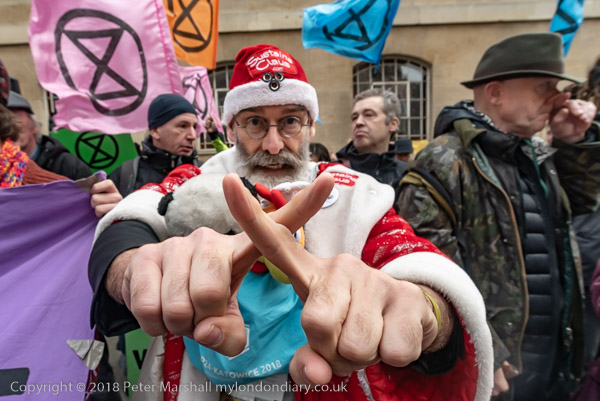
XR at the BBC, Noahs Ark & Nine Elms: On Thursday 21st December 2018 after photographing a protest at the BBC by the Climate Media Coalition over the BBC failures in presenting the climate emergency and their programmes which encourage climate wrecking activities I took a few pictures of the nearby Noah’s Ark Earth Rescue display before going to the US Embassy to cover a protest there. Unfortunately although I and the police made it on time the protesters failed to turn up. I took a walk around the area – London’s largest development taking a few pictures and when after an hour only a single protester and another photographer had arrived I went home.
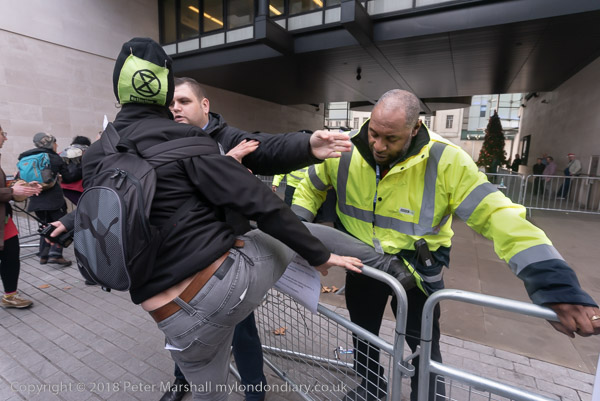
Extinction Rebellion at the BBC – Broadcasting House
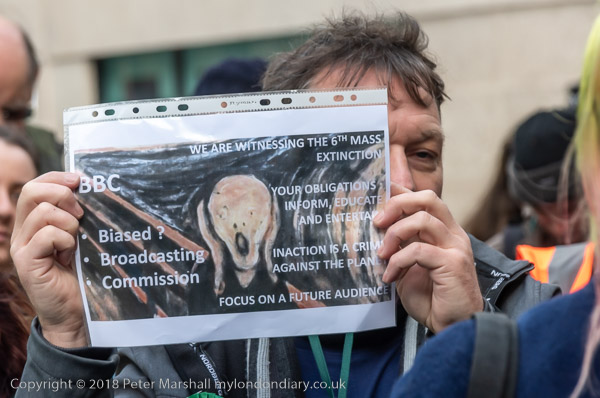
Climate campaigners from Extinction Rebellion came to the BBC to tell it to stop ignoring the climate emergency and mass extinction taking place and promoting destructive high-carbon living through programmes such as Top Gear and those on fashion, travel, makeovers etc.
The BBC had long misused its policy of impartiality to give huge prominence to a small group of climate deniers, largely fossil fuel lobbyists, to give them equal airtime to the warnings supported by the huge body of scientific evidence on global warming caused by our increasing consumption of coal, oil and gas with the associated rise in greenhouse gases in the earth’s atmosphere.
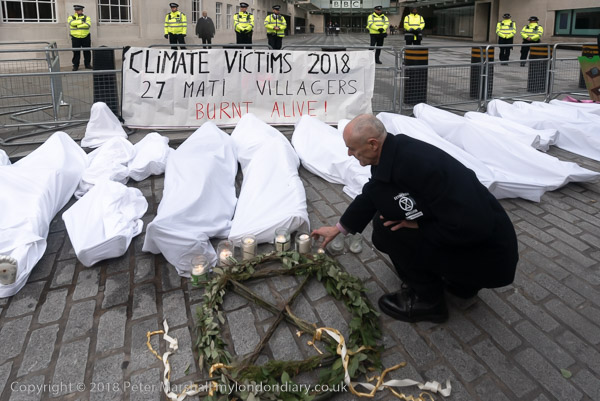
The protest had been organised by environmental campaigner Donnachadh McCarthy and the Climate Media Coalition and they had brought with them mannequins wrapped in white sheets to represent the 27 climate victims from the Greek Village of Mati, burned alive by a wildfire. They were among a hundred people are known to have died in Greece in the fires caused by global warming. They set these out in front of the BBC for a vigil at the start of the protest
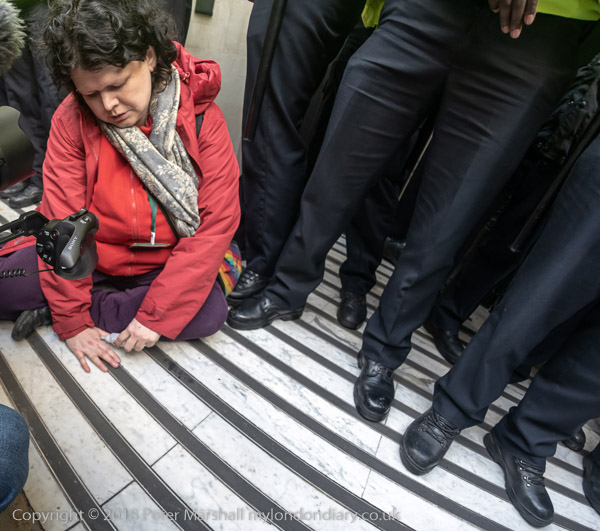
Later there were angry protests at both entrances to the BBC site which which was closed off by barriers and security staff. It took a couple of minutes through the local streets to get between the two and I was at the other one where two protesters had superglued their hands, one to the steps and another to the door, when Donnachadh McCarthy attempted to climb over the security banners and was arrested.
A woman spreads superglue on her hand on the steps in front of the police guarding an entrance to the BBC’s Wogan House.
You can read more about the protest along with many pictures and captions on My London Diary at Extinction Rebellion at the BBC.
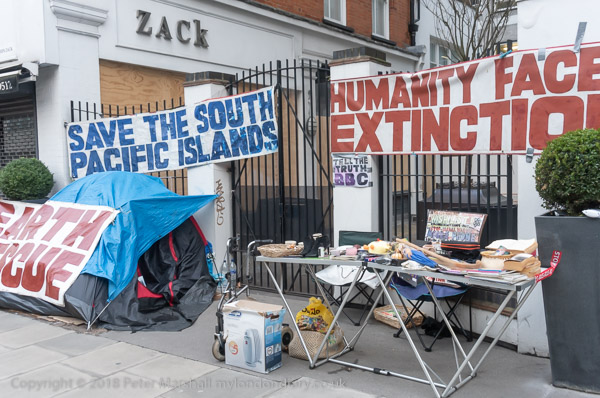
Humanity Face Extinction – Great Portland St
The protest at the BBC was continuing when I walked towards the tube to travel to a protest sceduled at the US Embassy in Nine Elms and stopped to take a few pictures of the Noah’s Ark Earth Rescue display.
This was deserted probably as those usually here were all at the BBC protest. The display was a part of the “eco-warriors’ worldwide publicity campaign to save the South Pacific island nations from vanishing beneath the rising sea levels and offering genuine solutions to save humanity from being driven to extinction by global warming as a result of the burning of fossil fuels.”
I arrived at the US Embassy at the time given on the press release and the Facebook event page for a protest against Trump’s announcement of the withdrawal of US troops from Syria to find two police vehicles but no protesters.
After waiting around ten minutes I took a walk around the area, part of a huge redevelopment between the former Battersea Power Station and Vauxhall which I’d been watching for some years from the train as I came into London and had often photographed through the train windows.
Under the River Thames construction was also taking place for London’s new super-sewer, the 16 mile long Thames Tideway Tunnel expected to be fully operational in 2025 and the first major upgrade to London’s sewage systems since Bazalgette in 1875.
I went back to the embassy an hour after the protest was due to start. By now one man had arrived also looking for the protest, and a second photographer. I walked back up to Vauxhall Station to see if I could find any protesters on their way, but met none and so I caught the train home.
Frost Fair, Oxford St and Santas: I wrote a long post on My London Diary about my activities on Saturday 16th December 2006, which perhaps deserves bringing out of hiding and re-publishing, as usual with appropriate corrections, and with links to the many pictures I took, a few of which I’ll use to punctuate the re-posting.
Bankside Frost Fair: Traditional Thames Cutters
Southwark’s Frost Fair is a reminder of days long gone, when Old London Bridge so restricted the flow of the Thames that there was a lake above it between the City and Southwark. In cold winters, this would freeze over, and in some years the ice became so thick that a fair could be held on it.
The chances of this happening again given global warming seem slight, although once the polar ice cap melts in twenty or so years time, the whole global weather system will be upturned. We may even lose our warming water and air streams and our climate could perversely become more continental with freezing winters and torrid summers. Of course, we may by then be abandoning the City and Southwark as water levels rise.
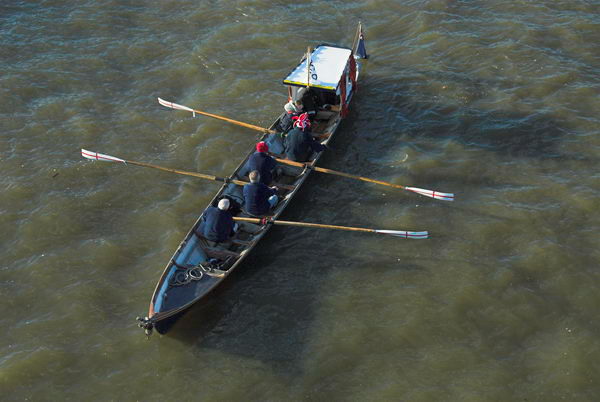
Today it was sunny, though there was a chill in the wind, and the tide was running out at a rate of knots that made it hard going upstream for the rowers in the cutters that came from the city to Southwark, going upstream of the Millennium Bridge before turning to reach the pier outside the Globe Theatre.
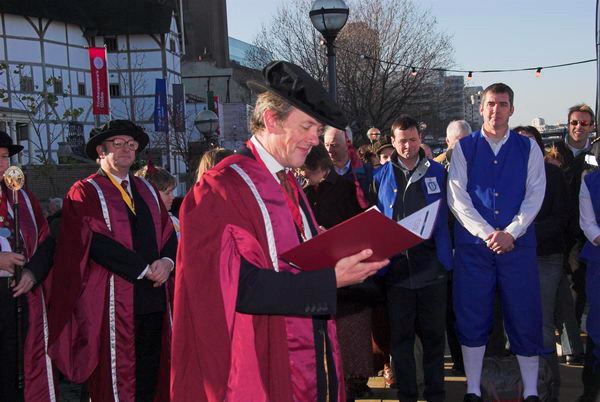
Waiting for them there (and we were waiting a long time) was a group of London guildsmen. There was a speech of welcome, shaking of hands, and then the company went off for refreshments while I wandered through the Frost Fair. To be honest, there didn’t seem to be a great deal going on. A band playing, then some carols sung, food and drink being sold. Even the promised huskies didn’t seem to be around, though the stall was taking bookings for rides. more pictures
St Paul’s & Oxford Street
I should have been there yesterday for the lantern parade, but had other things to attend to, and there seemed to be little to do or to photograph today, so I strolled over the Millennium bridge and around St Paul’s to get a bus to the West End.
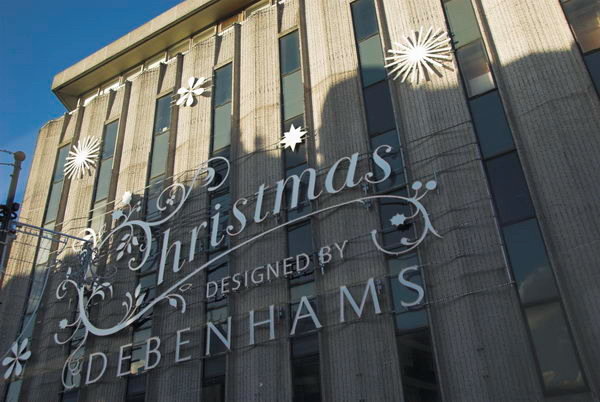
I was looking for Santas. I thought I might find some on Oxford Street, and have a look at the Xmas decorations too, but both seemed rather thin on the ground. A few holding sandwich boards, the odd person with a Santa hat. Stalls with hats and costumes for sale, but where were the people wearing them?
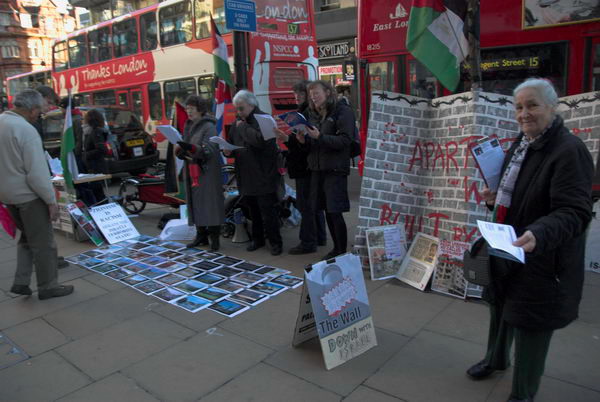
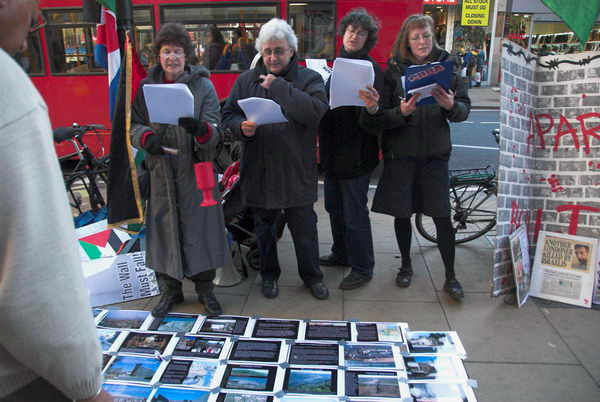
Weekly picket outside M&S calls for an end to the ‘Apartheid Wall’ in Palestine and a boycott of Israeli goods
I paused briefly outside Marks and Spencers for the regular picket there, today a small choir was singing. I thought of the dispatches I’d recently read from Deacon Dave, on a peace visit to Palestine, assaulted by a Jewish settler, and the many stories of how Palestinians are being denied the right to work their lands, including the building of the wall that separates some from their fields.
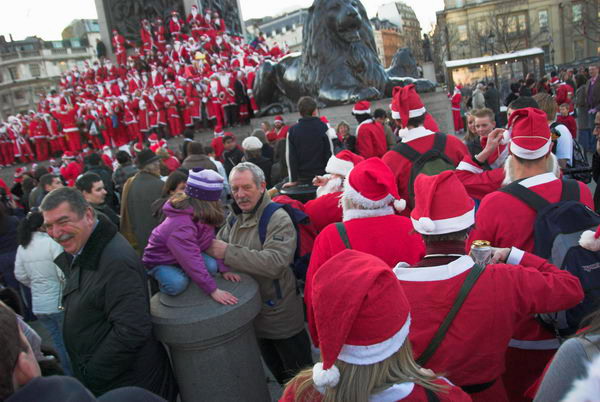
I jumped back on a bus again, going to the top deck to peer out for Santas, and as the bus came up to Trafalgar Square, there they were, around the base of Nelson. I jumped up. Fortunately the bus was just coming to a stop and I was able to run off and start taking pictures.
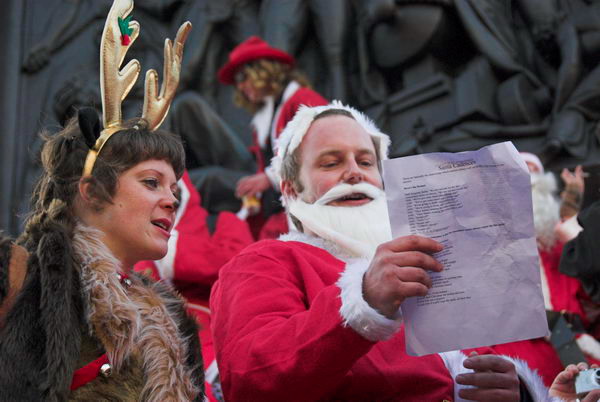
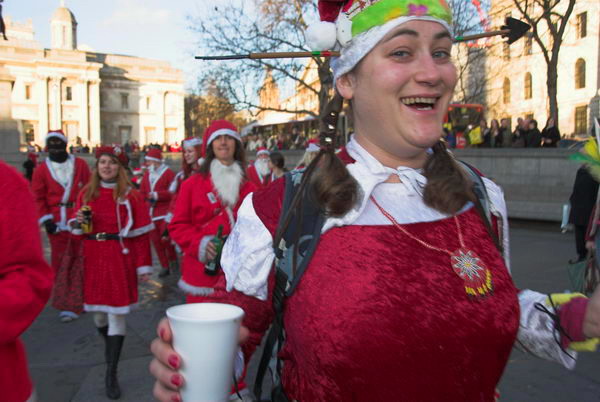
The assembled Santas sang a few Santacon carols: Away On A Bender, O Come All Ye Santas, Hark! The Drunken Santas Sing and more, Hymns to drunken excess, though it was early in the day and most santas still seemed pretty sober.
We were all waiting for more Santas to arrive, and at last they did so in a group coming from the northeast of the square. Now there were certainly several hundred of them, though I couldn’t manage even a rough count, as people kept moving. As well as Santas there were also some others including a team of reindeer and a few oddities.
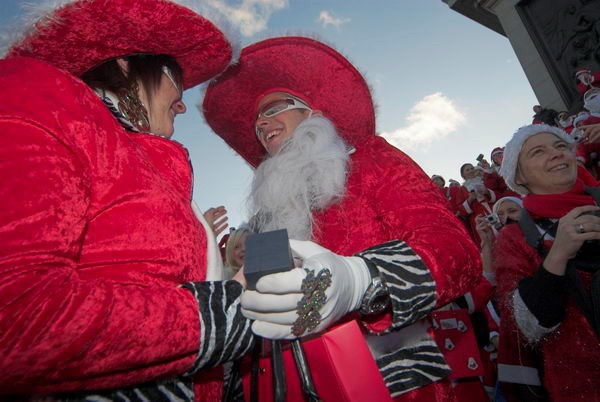
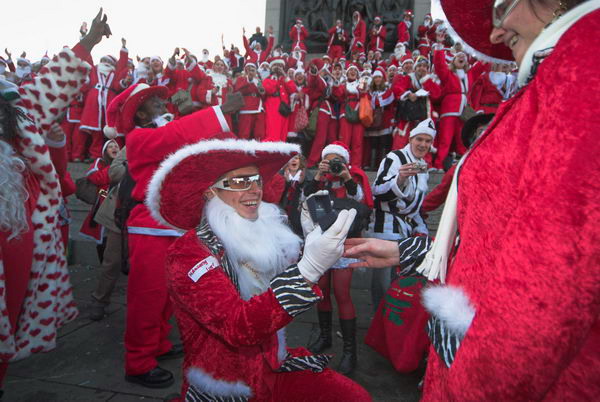
Then came a piece of real life drama as one Santa declared his love for another, down on his knees, surrounded by the crowd, producing an engagement ring.
A traditional knee-level approach despite the unusual dress
I can’t actually remember how I proposed (probably my wife can) but it certainly wasn’t like this. Certainly an event the two of them will remember (and fortunately she said yes.)
After that, anything else would be anticlimax, and as the Santas left to go up Strand, I turned away for home.
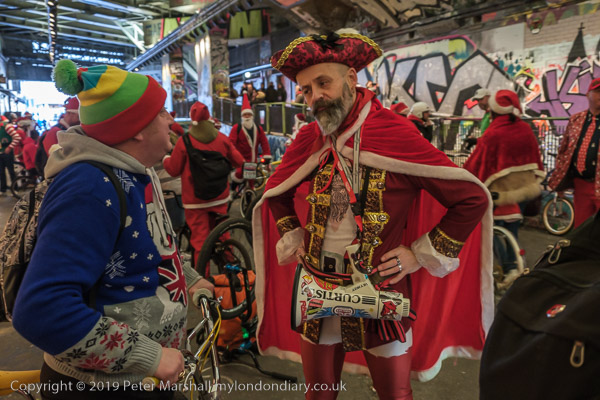
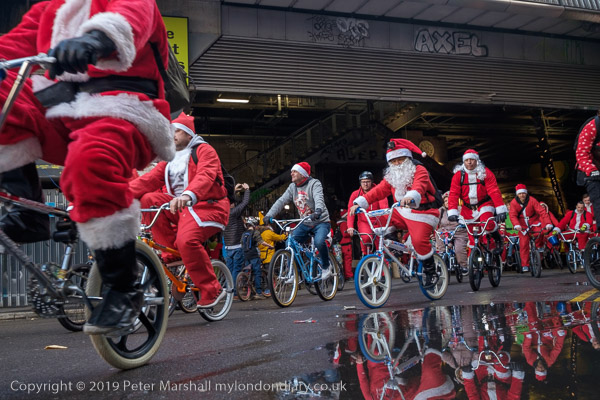
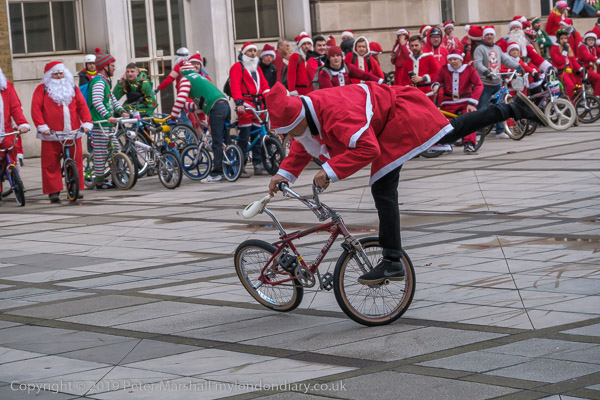
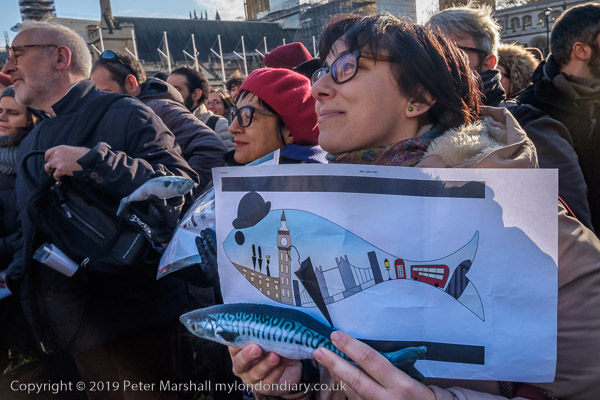
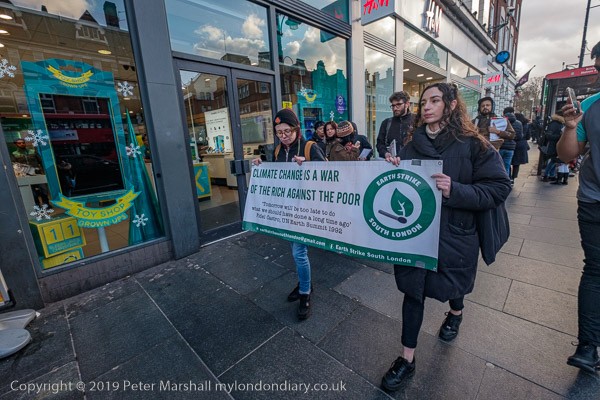
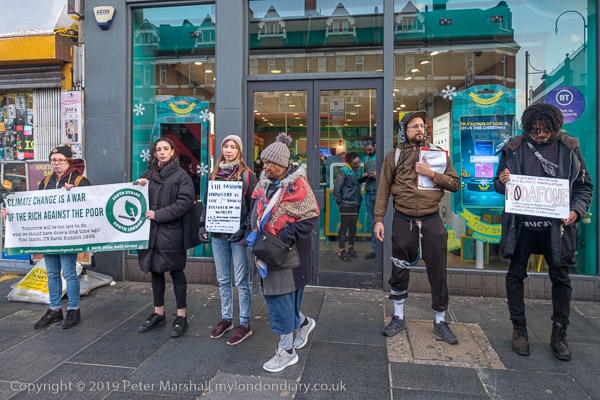
Santas, Sardines & Earth Strike: On Saturday 14th December 2019 the Santas were on BMX bikes raising money for charity, Italians were supporting a spontaneous Italian anti-fascist movement and Earth Strike, a small group of anti-capitalist and anti-imperialists against environmental destruction held their first protest in Brixton.
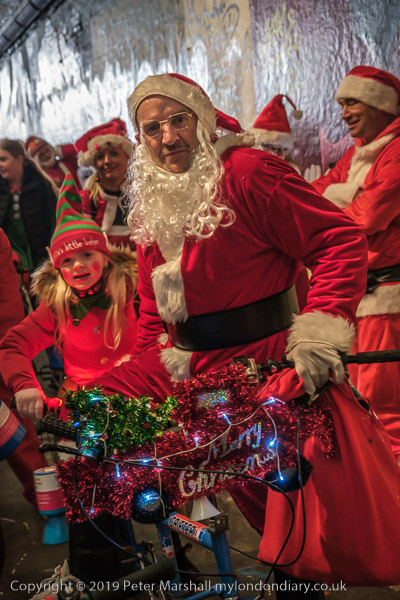
Santas BMX Life Charity Ride
If you are in London today look out for the 10th BMX Life’s Santa Cruise riding around the capital in a charity ride raising money for the Evelina Children’s Heart Organisation, ECHO. There is a link for donations on the page linked.
One rider had ignored the dress code, though he was wearing a Christmas jumper
The ride begins as it did five years ago in the graffiti tunnel under Waterloo Station and 10.30am and the dress code is Santa, Elf, Snowman,Christmas Tree or Reindeer.
So far by these rides and a number of raffles BMX Life have raised over £180,000 for ECHO and they hope that this year’s ride will be bigger than ever. When I took these pictures in 2019 there were around 700 riders.
From Leake St they moved off to Forum Magnum Square where some santas demonstrated their riding skills before the group left to ride around London.
‘6000 Sardines’ London protest – Parliament Square
The Sardines movement was a grass roots political movement which began in Italy in November 2019 after a flash mob in Bologna opposing right-wing leader Matteo Salvini packed the main square in Bologna “like sardines”.
People were appalled at the rise of Salvini because of his anti-immigrant policies, hate speech and Euroscepticism and the movement prompted other ‘sardine’ protests across Italy and by Italians elsewhere, with demonstrations, flash mobs and online actions.
14th December was declared ‘Global Sardine Day’, with similar rallies across Europe and in the USA as well as in many towns and cities in Italy. All of the speeches while I was at the event were in Italian.
The movement ended with the elections in January 2020 in the Bologna region of northern Italy, which resulted in a resounding victory for the centre-left who almost doubled the vote they had received five years earlier.
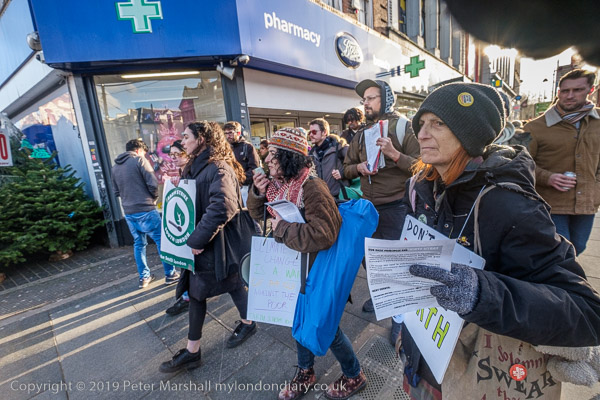
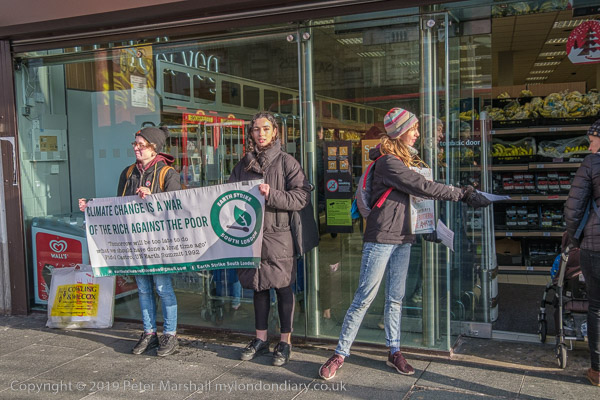
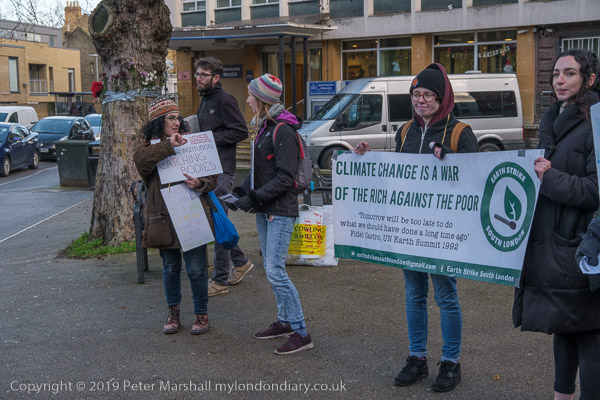
The protest by Earth Strike South London began ther protest against environmental destruction with speeches and handing out fliers at a street stall on the corner of Coldharbour Lane and Brixton Rd, where members of the Revolutionary Communist Group taking part were also selling their newspaper.
The fliers pointed out that many companies who trade on our high streets are still making a huge contribution to global warming and environmental destruction and they went on to march up Brixton Road stopping for speeches and to protest at some of the major culprits.
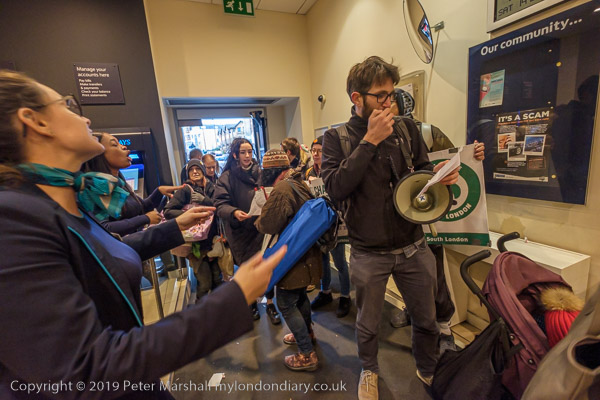
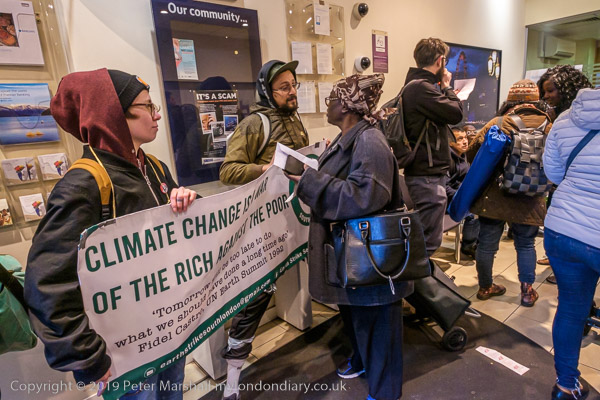
They began by going into Barclays Bank who still have huge investments in fossil fuels and are major backers of fracking in the UK. They ignored bank staff who told them they could not protest inside but handed out leaflets and made a speech about the bank’s activities before leaving after a few minutes.
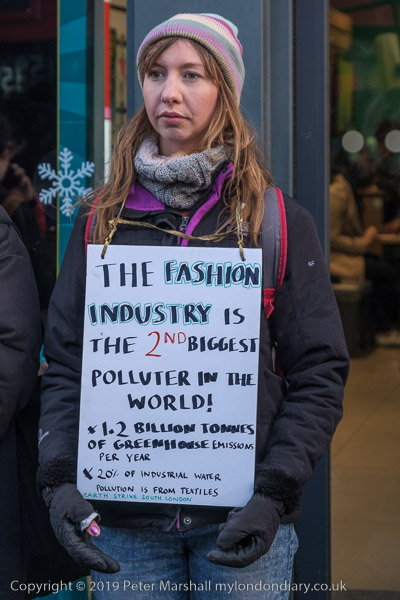
Next stop was H&M where they pointed out he fashion industry is the second largest producer of greenhouse gases, emitting 1.2 billion tons a year and textile manufacture creates 20% of all water pollution. They stood outside and ignored a security man who told them to go away.
A couple of police officers arrived and talked to the protesters who assured them that their protest would be peaceful. The officers then went away.
The protesters moved on to EE where they pointed out mobile phones and other similar electronic produces all need minerals such as Coltan, and the fight for these is behind the horrific wars that have taken place in the Congo region. Mining companies are also huge exploiters of African labour, create large amounts of pollution. lay huge areas to waste and evade taxes on a huge scale.
Further along the road they stopped briefly to point out that Boots avoids paying taxes in the UK, cheats the NHS and sells palm oil products made by clearing forests, destroying ecosystems. They make huge profits from the NHS, and are said to have charged charged them £1500 for pots of cream they sell for £2, as well as selling palm oil products grown on land cleared from ancient forests, disrupting ecosystems and resulting in the loss of species including orangutans.
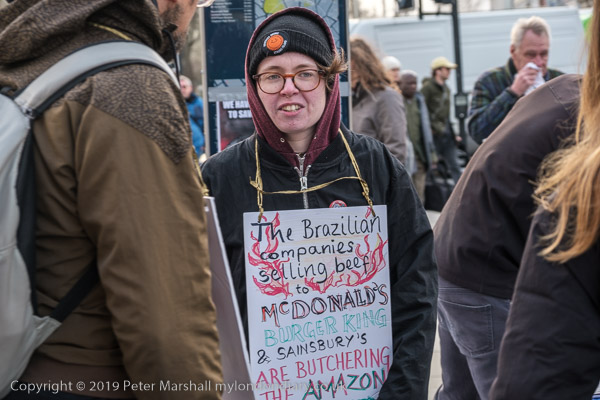
At Sainsbury’s they reminded customers that it sells many products that harm the environment and lead to global warming, including beef that comes from ranches made by burning the Amazon Forest, destroying ecosystems and displacing indigenous tribes.
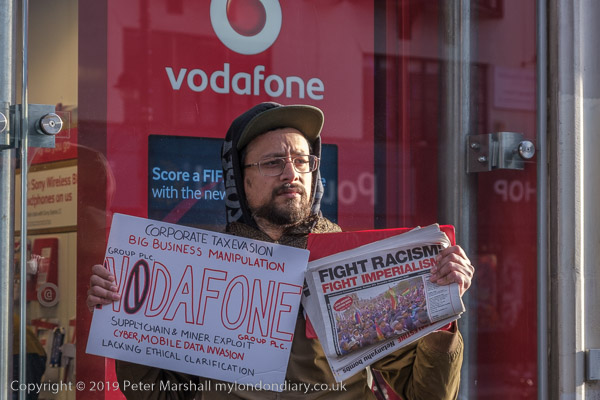
They held another protest outside Vodaphone, also a tax avoider and as well reliant on those minerals fuelling wars in central Africa before walking on to Brixton Police station.
Here they held a brief vigil for those killed by police in Brixton, including Ricky Bishop and Sean Rigg who was beaten to death inside the police station in 2008.
I left the group here as they were to continue their protest at shops on the opposite side of Brixton Road.
Overground, Olympics and a Christmas Card: Like most of my posts on My London Diary before a redesign of the site in 2008, my contributions for Thursday 13th December 2007 are a little difficult to read and navigate, with the text separated from the pictures. But at least by then I had discovered the capital letters when I was writing about my activities. So I’ll repost them again after the introduction here.
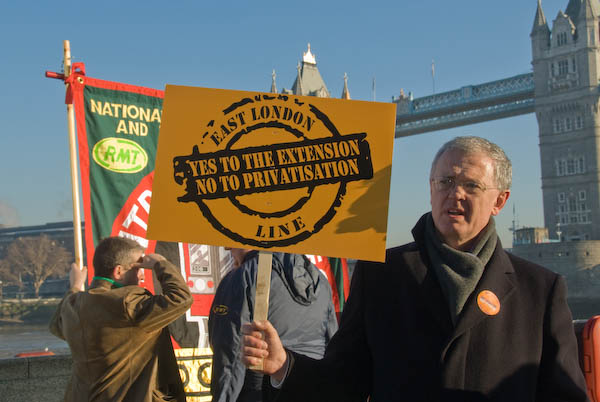
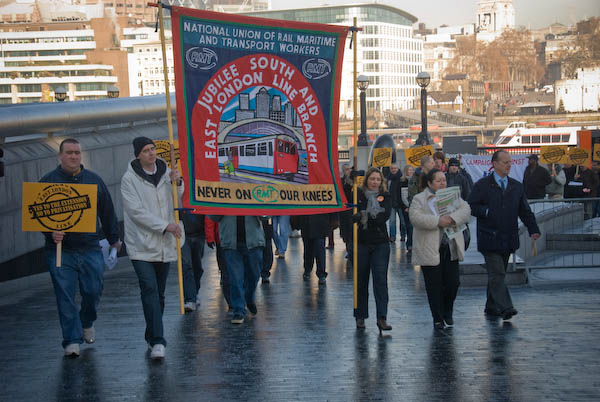
On 13th December 2007 I began with a morning protest by the RMT union over the privatisation of the East London Line, previously run by London Transport. They wanted the line to remain run, like the Underground run by a publicly owned body – the Underground is run by London Underground Limited (LUL), a statutory corporation wholly owned by Transport for London (TfL).
Although TfL is still responsible for the Overground it is was until recently run by Arriva Rail London which was owned by the German national rail company Deutsche Bahn from 2010 until June 2024. It was then sold to I Squared Capital, a US-based private equity firm with global investments mainly in infrastructure. The Elizabeth line is run by a subsidiary of MTR Corporation, largely owned by the Hong Kong government.
Both Overground and the Elizabeth line have been considerable improvements to transport across London, but we can still question whether it makes sense to have so much of our infrastructure run by foreign companies – and so much land and buildings becoming owned by overseas investors.
The RMT protest ended shortly before noon and in the afternoon I walked from Stratford High Street to Hackney Wick past the Olympic area around Stratford Marsh.
RMT Protests East London Line Privatisation – City Hall, Southwark
Improving our transport system in London should be good news, although the closure of the East London Line for almost three years from 22 Dec seems excessive (and of course the Shoreditch end has already been closed for some time.
Looked at on the map, the new overground routes, from Dalston (and later, Highbury and Islington) down to Crystal Palace and West Croydon (and perhaps eventually also to Clapham Junction) seem mainly a matter of connecting together existing routes, and adding a couple of new stations at Hoxton and Haggerston.
But what upsets the unions – and almost three-quarters of Londoners – is that when the line reopens after great public expense, it will have been privatised, paying profits to eight different companies for various aspects of its running – including some involved in the Metronet failure.
Part of those profits will come from paying staff less – and worse working conditions. The unions are also worried about possible safety problems as the signalling on the route will be shared between London Underground and Network Rail systems.
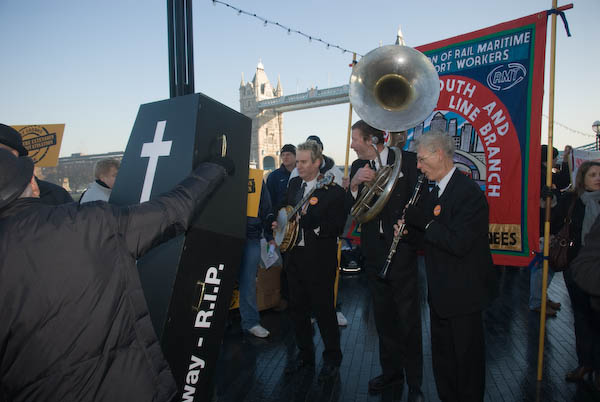
A hundred or so demonstrators from the RMT union, Respect and others marched around City Hall several times, led by a coffin for the line carried by ‘undertakers’ to represent the private contractors and a tuneful 3 piece jazz band, before a short rally.
And although there are various replacement bus services during the years of closure, these leave a gap at the most essential part of the current route – across the Thames between Wapping and Rotherhithe. It is apparently beyond the wit of Transport for London to find buses that can use the Rotherhithe tunnel – or even provide a ferry service (the ferry downriver at Canary Wharf takes 3 minutes, but costs £1.90 if you have a travel card or over £500 for an annual season.)
Unless you bring your own canoe, the quickest alternative is probably to swim, though swallowing the water might be fatal. On the tube it takes one minute; the alternatives the TfL web site suggests on a weekday are mainly around an hour. Surely not acceptable.
My shadow falls on one of the few remaining buildings on Marshgate Lane
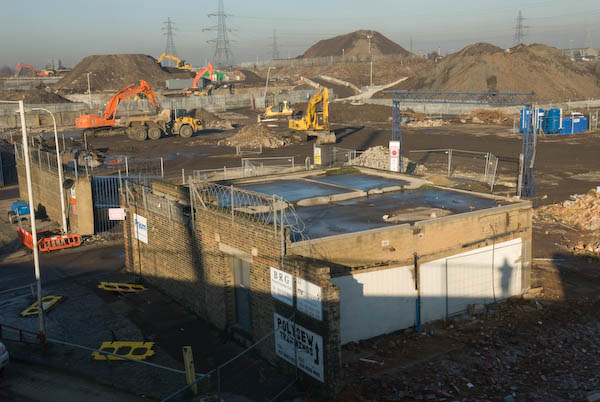
The ‘Greenway’ path on the top of London’s Northern Outfall Sewer reopened recently after a temporary closure during the nearby demolition works, and as it was a fine day I took a walk along it from Stratford to Hackney Wick.
Almost all of the buildings on the Olympic site have gone, with just occasional bits of wall or outbuildings left, and there are some pretty huge piles of earth or whatever. Gone too are most of the many trees, particularly the willows by Marshgate Lane and all the wild areas – as well as the tyre mountains and other car parts.
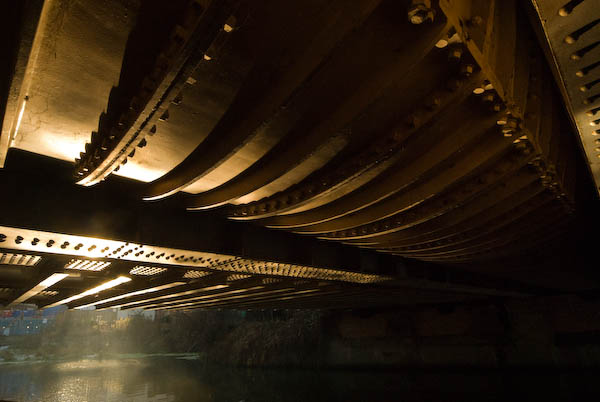
Northern Outfall carrying London’s sewage over the Lea Navigation
The light under the Northern outfall where it crosses the navigation was interesting, low sun bouncing up from the water and giving the structure a golden glow.
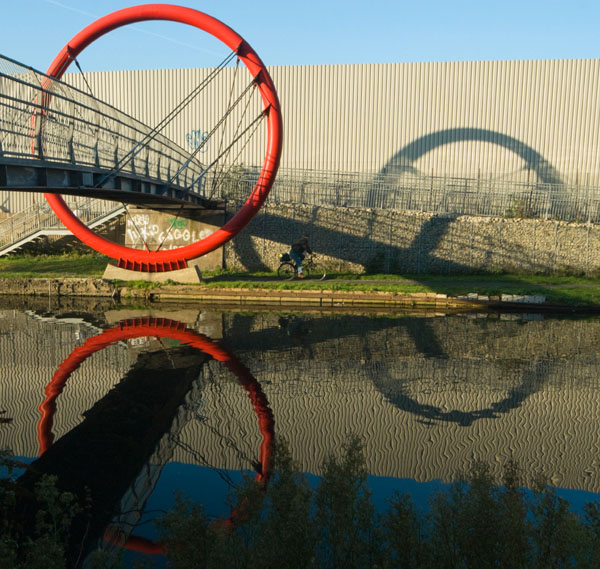
I went on over the lock at Old Ford to ‘Fish Island’ and then through the red circle footbridge to Hackney Wick, taking a few pictures from the station footbridge while waiting for the train back to Stratford. The line also gives some views of the vast building site.
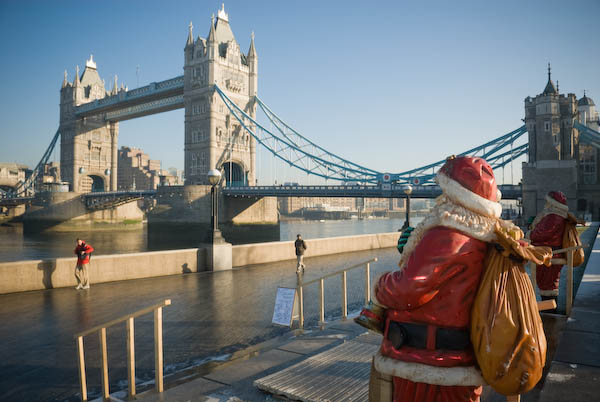
For once I’ve printed and sent my Christmas cards before the last date for posting, which is a pity, because if I’d waited I think the picture of two Santas at the Christmas Fair next to Tower Bridge [taken while waiting for the RMT protest to begin] would have made a good image. I think it’s the third figure in red at left of picture that really makes it work.
So this picture comes with my Christmas Greetings for all of you who visit the site.
I think I used this picture on my 2008 Christmas Card. I’m still trying to find a suitable picture for 2024.
Serenading the Bomb Makers: Given the current increased tension over the possible nuclear escalation of the Ukraine war – something that would be disastrous to us all and totally insane and irrational, but if NATO keep poking the Russian Bear with a stick could be provoked – it seems appropriate to remember the lunchtime tour around the London offices of some of the companies involved in making the UK’s nuclear weapons on Friday 12th December 2008.
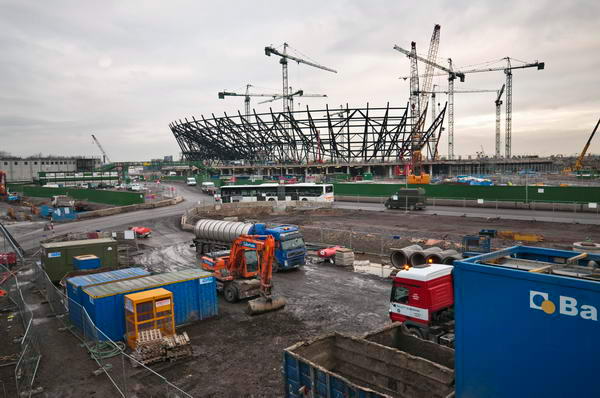
I don’t think I can improve on the piece I posted on My London Diary in 2008 – except by adding the odd word that somehow got missed out, so I’ll copy that here, with some of the pictures from the event. I got too cold standing around and left after an hour and went to take a short look at the work taking place on the Olympic site at Stratford Marsh as the light was beginning to fade.
‘Muriel Lesters’ Serenade the Bomb Makers
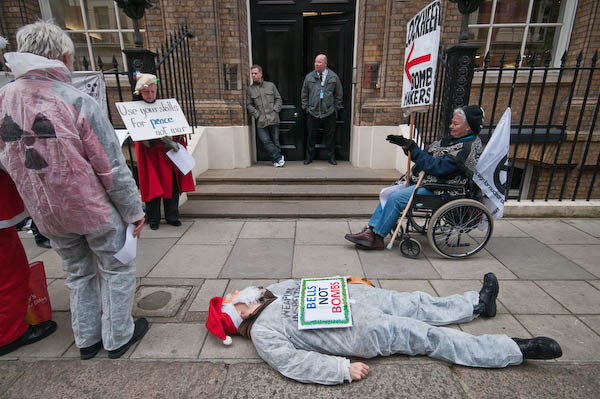
Lockheed Martin, Carlisle Place – A man sprawls in memory of the many deaths caused by atomic weapons; security men look bored.
Ten activists turned up in Victoria, London on Friday for a festive protest outside the offices of the US company behind the production of the UK’s nuclear weapons and the huge expansion of bomb production facilities at Aldermaston – costing £6,000,000,000 – which has never been debated or approved by Parliament.
They were the ‘Muriel Lesters*’, a London affinity group of Trident Ploughshares. Dressed in Santa suits, white nuclear inspector overalls and festive hats they called for an end to bomb production at the Atomic Weapons Establishment (AWE).
Appropriately, their renditions of festive songs and carols with modified anti-nuclear lyrics were largely less than tuneful (one taking part was hear to say “I’m a Quaker, we don’t sing” and who could contradict him?) They called for a stop to the illegal activities of these companies in making weapons.
First to be serenaded by the group were the offices of the US arms giant Lockheed Martin, makers of ‘bunker buster’ and ‘cluster’ bombs, the worlds largest exporter of weapons and the leading member of the consortium set up to produce the nuclear warheads for the UK Trident replacement at Aldermaston.
After an hour or so of leafleting and displaying banners on Vauxhall Bridge Road just around the corner, the group moved to the front door of the building housing Lockheed Martin and several other companies in Carlisle Place for their half hour carol ‘concert’. It was a site I knew from the ‘Merchants of Death‘ tour by CAAT earlier in the year. A number of people came in an out of the building while this was going on and some took leaflets while others hurried past, often to waiting taxis.
Half way through the performance, a police car pulled up and dropped off two constables who came to talk to the protesters. They asked who was in charge (and of course nobody was) and for a mobile number they could use to contact the group, saying “it’s standard practice for protests“. Oh no it isn’t! They were handed a leaflet with the Norwich details of Trident Ploughshares, but that wasn’t what they had in mind.
The police were informed that the real criminals were in the Lockheed Martin offices, carrying out the vast expansion in UK nuclear arms, a breach of the UK’s obligations under Article VI of the Nuclear Non-Proliferation Treaty, and that they were involved in an illegal conspiracy with some groups we could name down the road in Whitehall. The police chose to ignore this vital evidence but eventually they went away, reminding the protesters that while they supported the right to demonstrate, it was important to keep the pavement clear.
As they left, one member of the group stretched out “dead” on his back on that pavement as a symbol of the many victims of nuclear weapons, including those killed in nuclear strikes on Hiroshima and Nagasaki, “bomb test veterans, and victims of leukaemias, lymphomas and cancers caused by exposure to radioactive discharges from AWE Aldermaston and AWE Burghfield in Berkshire, Sellafield in Cumbria, Rolls Royce Raynesway in Derby and other sites“
I left the group as it packed up and decided to take a short break before going on for a similar protest at the London offices of Jacobs Engineering and Fluor Corporation, two other US companies who are competing for the stake in the AWE bomb-making contract currently filled by the British Nuclear Group. The third player in the contract – the only remaining UK involvement – is SERCO.
Muriel Lester, (1883–1968), born in Leytonstone, was a leading Christian peace campaigner and writer. Among many other things she founded Kingsley Hall in Bow, was a friend of Gandhi, Travelling Secretary of the International Fellowship of Reconciliation and was detained for ten weeks in Trinidad and then several days in Holloway Prison for her activities during the Second World War.