Veils, Ahava, Justice, Rentokill & A Walk

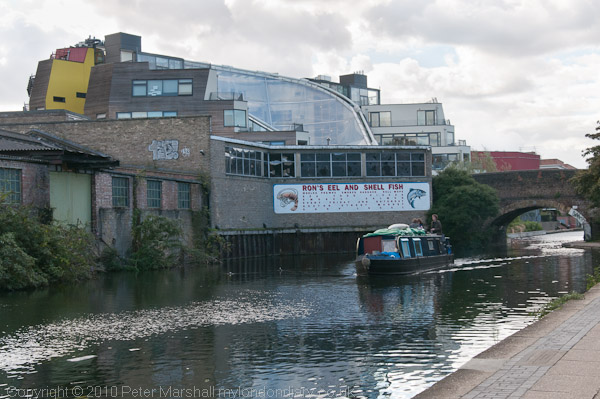
Veils, Ahava, Justice, Rentokill & A Walk - Fish on Regent's Canal
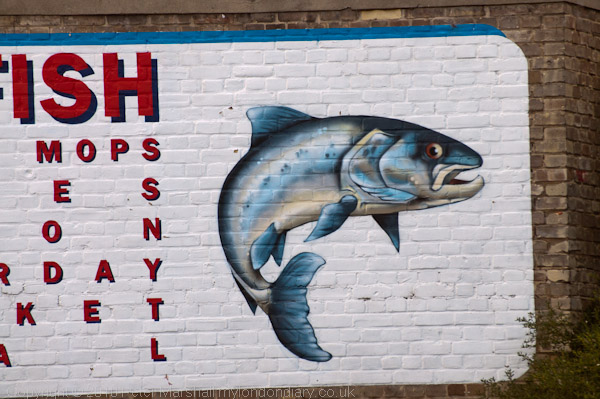
A fish on the Regent’s Canal

On Saturday 25th September 2010 I made a few pictures while travelling around London to photograph some rather varied protests and then took a walk mainly beside the Regent’s Canal in Shoreditch and Haggerston before going home.

Veils, Ahava, Justice, Rentokill & A Walk

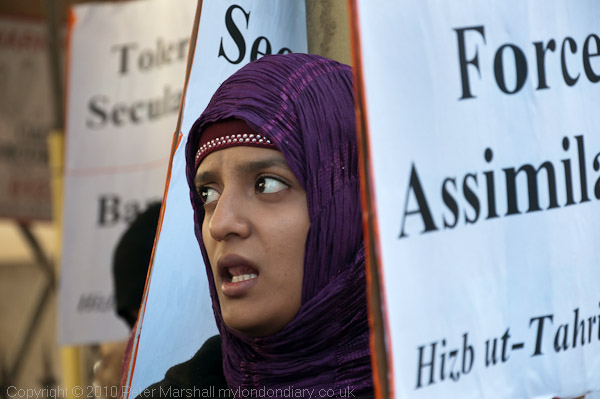
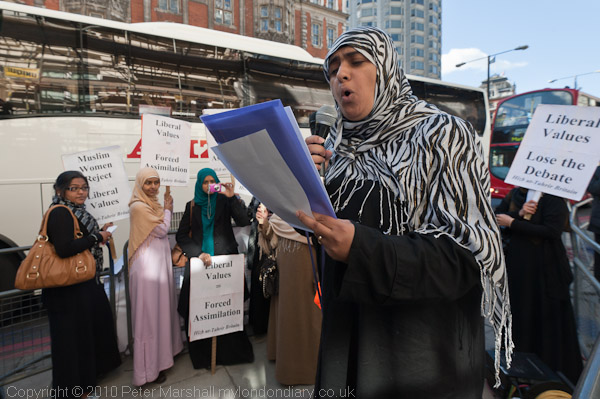
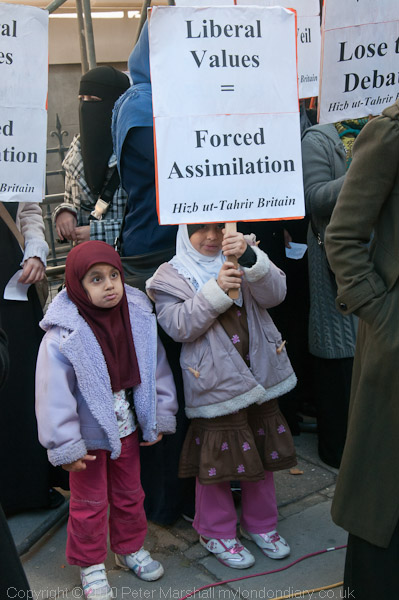
My day in London began with a bus ride from Clapham Junction to Knightsbridge, where around 80 Muslim women from Hizb ut-Tahrir Britain had come with a letter to the French Ambassador protesting the French parliament decision to ban face veils.

Veils, Ahava, Justice, Rentokill & A Walk

Although the ban prohibits all face coverings, it is mainly aimed at Muslim women who wear the niqab or burkha. Both were then uncommon in France outside of Paris and some Mediterranean coast cities and some estimate they were only worn by around 2000 of France’s 2-3 million Muslim women, most of whom, like the great majority of women at the protest wear headscarves rather than face coverings.

Judging from the slogans, placards and speeches this was more a protest against ‘liberal values’ and “the objectification and sexualisation of women’s bodies in pornography, lap-dancing clubs, advertising, and the entertainment industry, all permitted under the premise of freedom of expression and driven by the pursuit of profit in Western societies.”

The French ban seems an unfortunate restriction of the rights of women to decide how they wish to dress, but is also a measure to oppose the power of clerics and others to limit the freedom of women by forcing them to wear face coverings, which seems to to be fully in line with the French tradition of liberty. And being a liberal and secular society doesn’t necessarily mean giving free rein to the exploitation of women or others for profit. We can oppose these without wanting to impose the kind of restrictions on others that groups such as Hizb Ut Tahrir advocate.

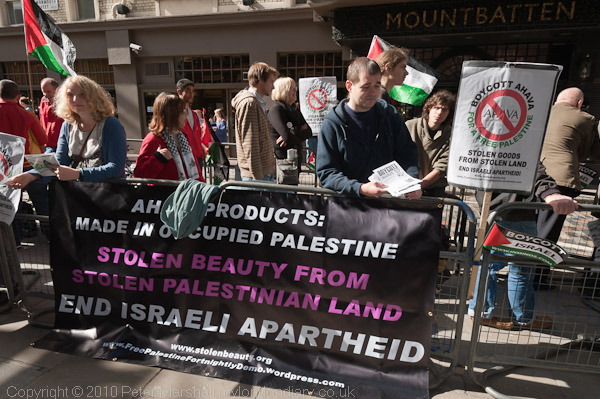
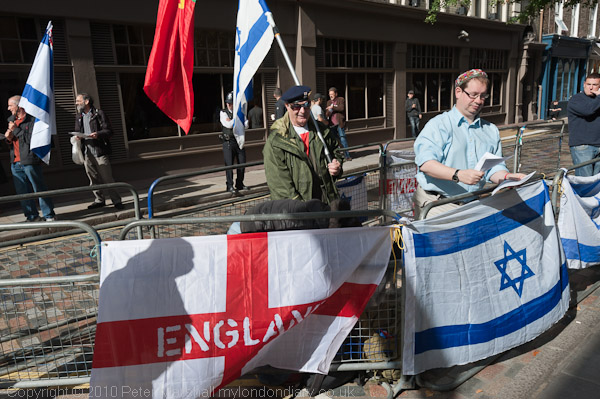
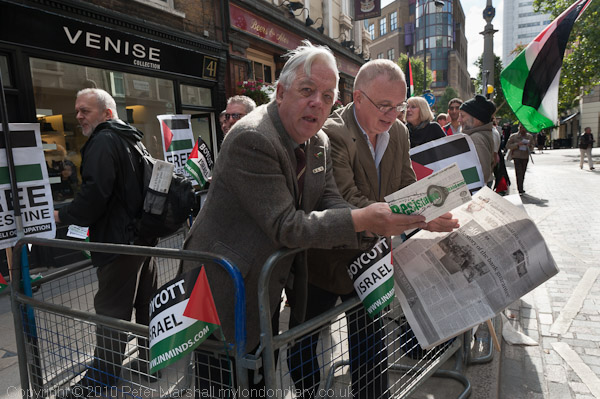
From Kensington I went on to Covent Garden where Pro-Palestinian demonstrators were holding another of their fortnightly demonstrations outside the Covent Garden Ahava shop which sells products manufactured in an illegal Israeli settlements on occupied Palestinian land.

As on previous occasions their protest was met by a smaller counter-demonstration by supporters of the right-wing English Defence League (EDL) and Zionists. At previous protests there had been some attacks by the EDL on the protesters, but while I was present they were content with shouting.

The Ahava protests are part of an international ‘Stolen Beauty’ campaign organised by ‘Code Pink’, a women-initiated grass-roots peace and social justice movement which began when American women came together to oppose the invasion of Iraq. They say that Ahava “has openly flouted tax requirements by exploiting the EU-Israel trade agreement and violates UK DEFRA guidelines in respect of proper labelling.”

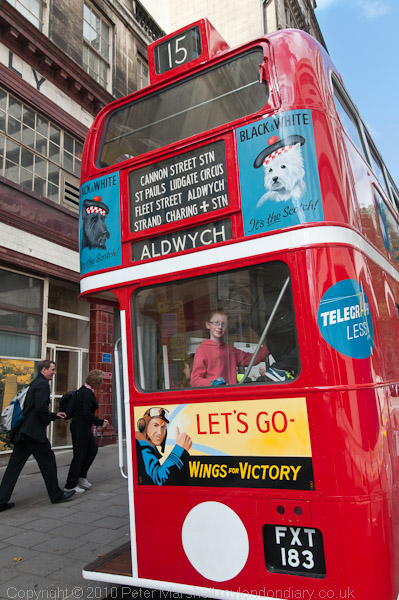
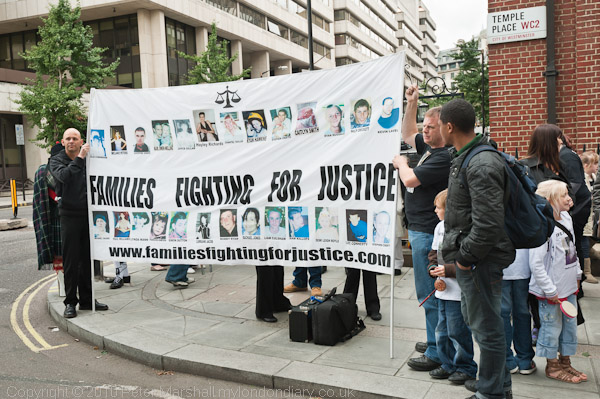
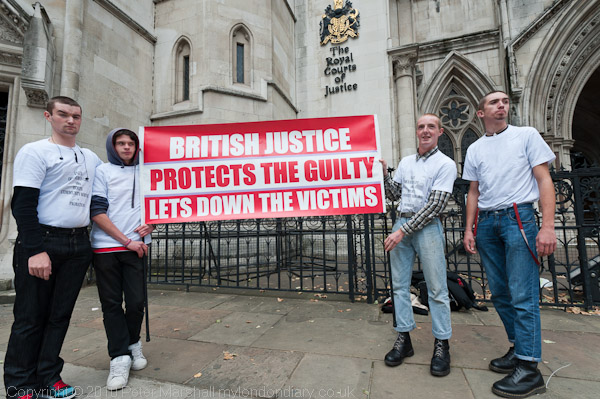
I walked down to the Embankment, pausing to photograph a rather fine Routemaster bus with vintage advertising, and a few boats taking part in the ‘Great River Race’. In Temple Place I met protesters from ‘Families Fighting For Justice’, members of families of murder victims, who were calling for tougher sentences for murder – with life sentences meaning life imprisonment.

Some of the stories I heard from them were truly heartbreaking and showed why many ordinary people have lost faith in our justice system. Although I don’t feel that their ‘Life 4 A Life’ campaign would actually do much if anything to solve the problem, clearly some action is called for, both in improving child protection by our social services and also in how we regulate behaviour on our streets. Part of this is better policing, but increased spending on youth services and community support is vital. Instead we got years of austerity cutting these and other essential services.

I left the march as it headed off towards a rally in Waterloo Place; it was smaller than expected and police insisted they march on the pavement rather than taking to the road, which reduced its impact.

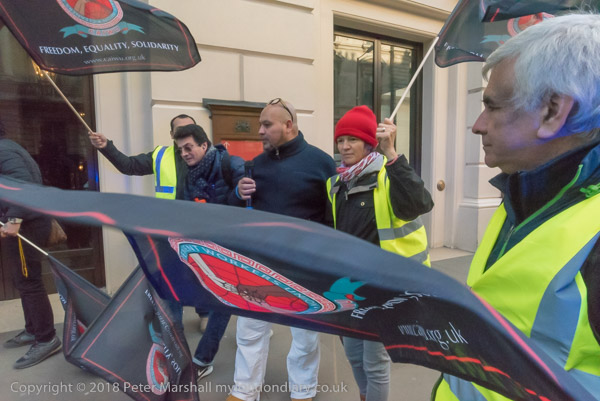
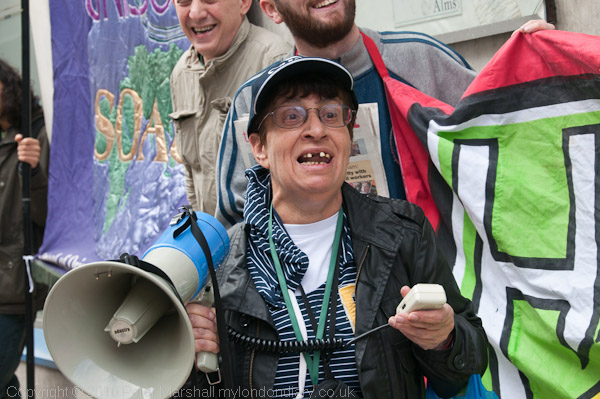
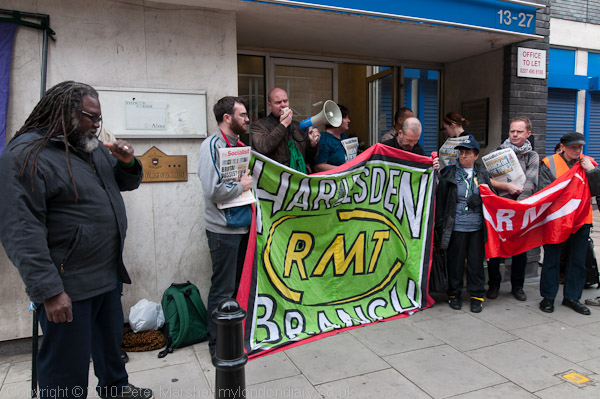
I was on my way to Old Street where the RMT and other unions were holding a short demonstration outside the Initial Rentokil Offices in Brunwick Place as the start of a campaign against the company’s union-busting activities towards its cleaning staff.

The RMT say Initial Rentokil intimidates and bullies its members and deliberately employs workers whose immigration status is doubtful so that they can pay minimum wages and provide sub-standard working conditions, often requiring them to work without proper safety equipment or precautions. They allege that workers who question their rights or attempt to organise have been reported to the immigration authorities who have then raided the workplace. The protest was also supported by members of Unite and Unison.

It was still before 3pm when the rally ended and I decided to take a walk before going home. I walked roughly north to the Regent’s Canal.

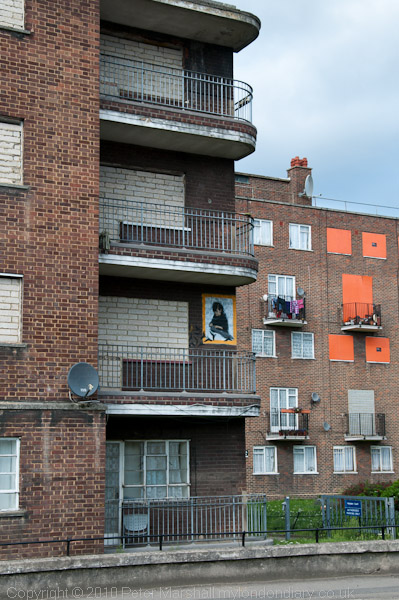
On the Haggerston Estate I found flats bricked up as people have been moved out to redevelop the estate. They are said to be moving back when new social housing is built – along with some at market prices.

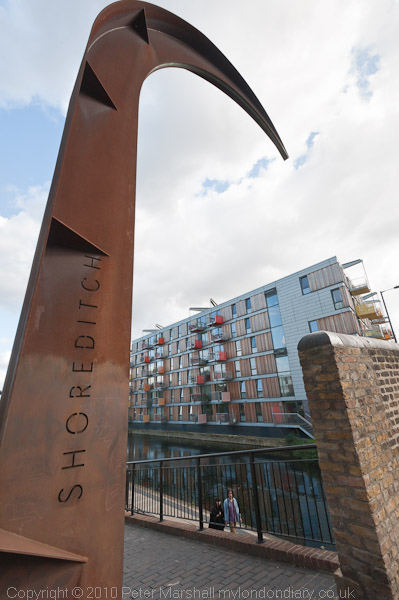
Shoreditch and Haggerston were both very much up and coming areas, with some expensive flats beside the canal.

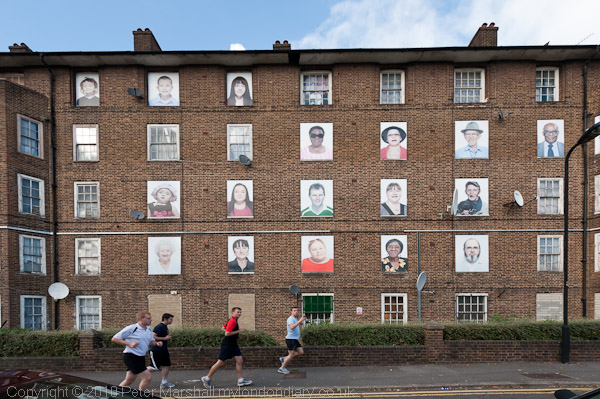
One of the reasons to walk this way was to see a large art work on the long block of flats by the canal, ‘I am Here’, one of London’s largest art installations., with giant portraits of the residents.

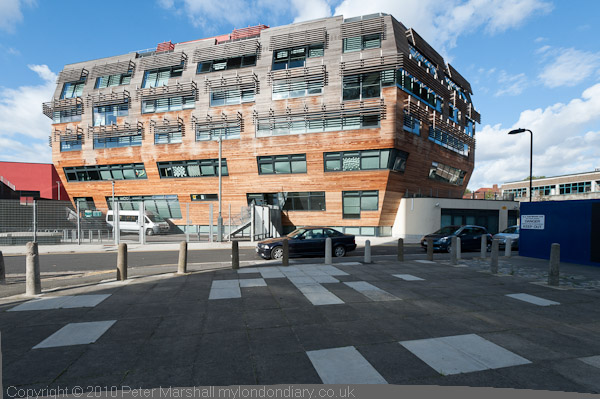
But I was also keen to photograph other buildings in the area, including the Bridge Academy.

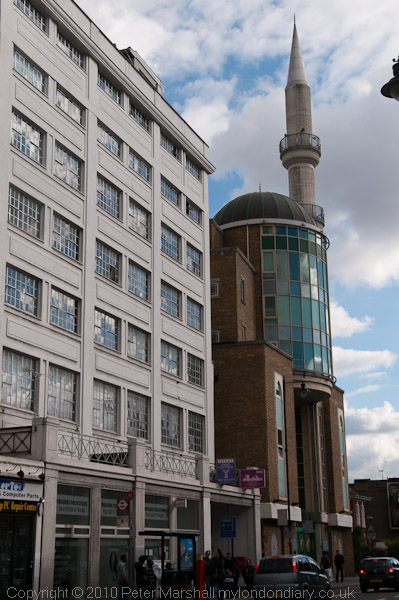
And, on Kinsgsland Road, the Suleymaniye Mosque.

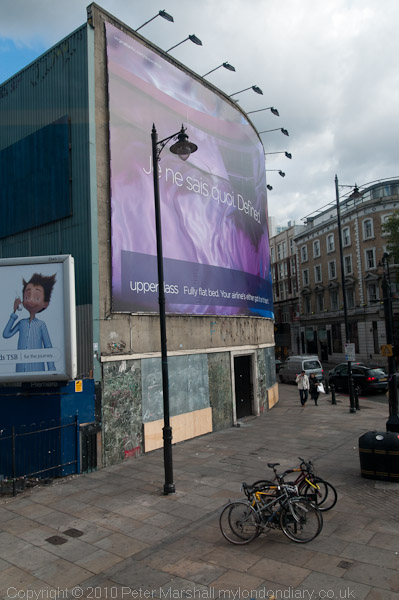
Even when finally I got on the 243 bus I was still taking pictures, including a rather sad view of the former Foundry, a lively venue where I had been to a great photo show not long before, now boarded up and covered with a giant advertising hoarding,

More pictures from my walk and the protests on My London Diary:

Hizb ut-Tahrir Protest French Veil Ban
Protest Against Illegal Israeli Goods
Families of Murder Victims Call For Justice
Protest over Initial Rentokil Union Busting
Walking Around London


Druids, Paddington & Women March For Syria

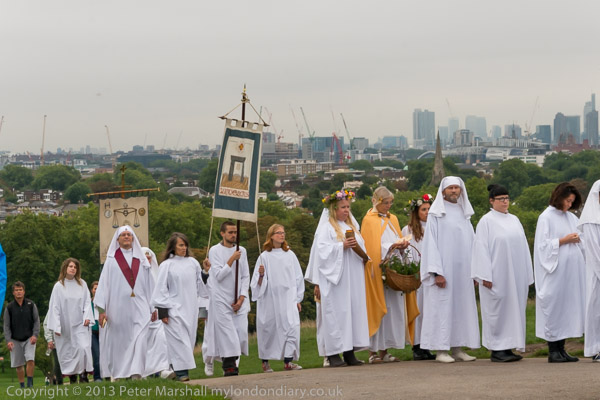
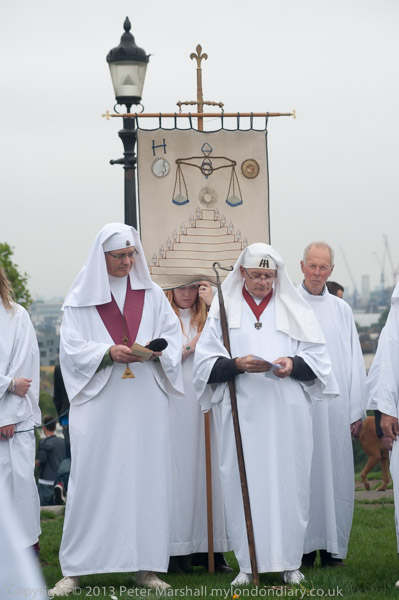
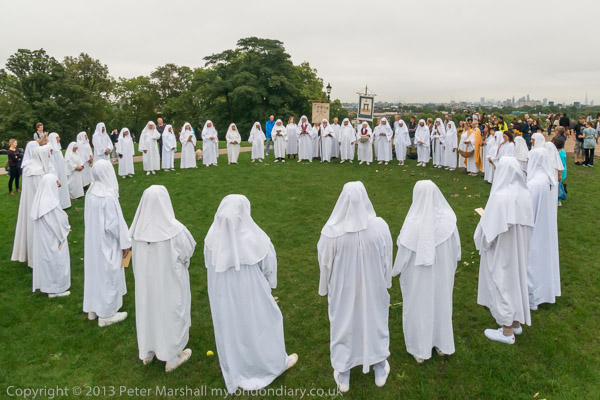
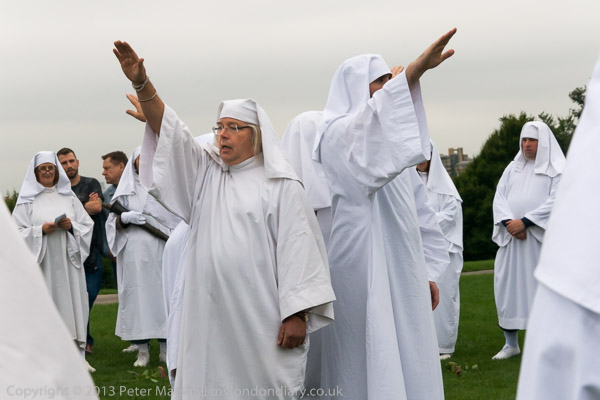
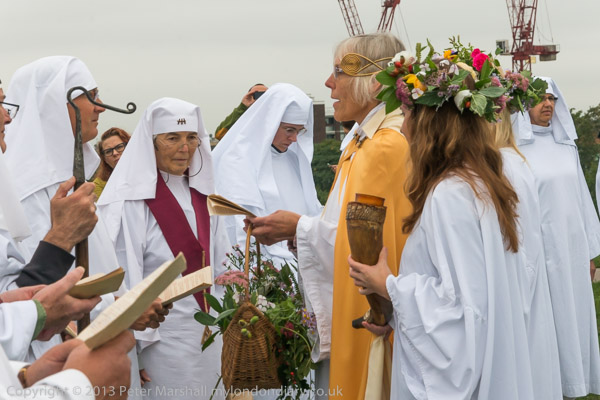
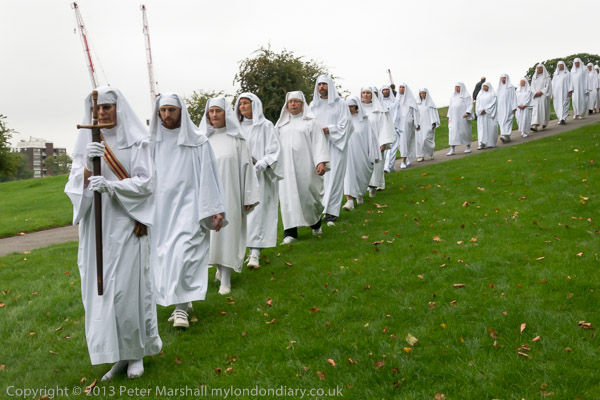
On Sunday 22nd September 2013 Druids carried out their annual Autumn Equinox (Alban Elued) ceremony on Primrose Hill at noon and later in the day women from the radical fundamentalist Islamist organisation Hizb ut-Tahrir Britain marched from Paddington Green in protest against the chemical attacks and massacres of women and children by the Assad regime in Syria. Between the two events I spent some time taking pictures around the Paddington Arm of the Grand Union Canal.


Druids Celebrate Autumn Equinox – Primrose Hill

Every year for a little over 100 years the Druid Order have celebrated the Autumn Equinox on Primrose Hill, a site of historical significance in the history of Druidism and the re-invention of a Druidic tradition. Here on the Autumn Equinox in 1716 John Toland made a call for a meeting of Druids a year and a day later at the Apple Tree Tavern in Covent Garden, and on Midsummer’s day 1792 Iolo Morganwg (1747-1826) held the first meeting of the Gorsedd of the Bards of the Isle of Britain, the precursor of the modern Eisteddfod.

Morganwg was the bardic name of Edward Williams and his work “was a prime force behind the cultural revival that saw the birth of modern Wales” according to the University of Wales Centre for Advanced Welsh and Celtic Studies whose web site describes him as “a profoundly complicated character: a struggling provincial poet in London, a manipulator and victim of the world of literary patronage, a radical, a medievalist, a forger of pasts, an opium eater and a forceful and opinionated critic.”

Most of the Druidic traditions we now have come from forged manuscripts he produced in particular the “Gorsedd Beirdd Ynys Prydain” (“The Gorsedd of Bards of the Isles of Britain”.) It was only in the twentieth century that the extent of his imaginative forgeries became clear. But although his work came almost entirely from his own extremely fertile imagination it had a dramatic effect in creating a new view of the Welsh nation.

The Druid Order made its first recorded appearance at the Summer Solstice at Stonehenge in 2021, though its founder, the remarkable George Watson MacGregor Reid, a trade union and Labour party activist with a great interest in oriental mysticism was probably there 3 years earlier. In 2014 he returned for the Solstice describing himself as a High Priest and “the direct successor of the Chief Druids who have been” and dressed in a very similar manner to that still adopted by The Druid Order.

I’ve photographed the Equinox ceremonies of the Druid Order, Spring at Tower Hill and Autumn on Primrose Hill on several occasions and have been impressed by the solemnity and spirituality of those taking part. Whatever its origins, it is a movement which respects the Earth and is peace loving and free-thinking with the apparent aim of developing themselves through being rather than through intellectual learning.

My account on My London Diary gives quite a detailed description of the event both in pictures and text so I won’t repeat that here.

Druids Celebrate Autumn Equinox


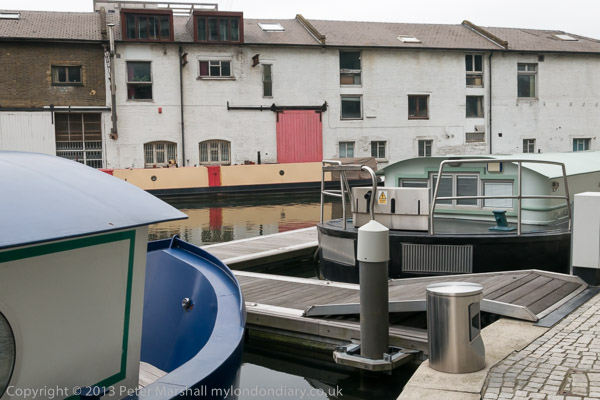
Paddington Basin – Paddington

The main line of the Grand Union Canal enters the River Thames at Brentford, from where it was possible for goods to travel along the river to London, but a direct canal route was obviously desirable and only two years after the Act of Parliament for the main route to Brentford was passed a further Act to allow the construction of a canal joining the this to a canal basin at Paddington, then on the western edge of London. This opened in 1801.

Unusually there are no locks on the 22km of the Paddington Arm – and you can travel a total of around 43 lock-free miles along the pound made up by it the Grand Union and Regents canal.

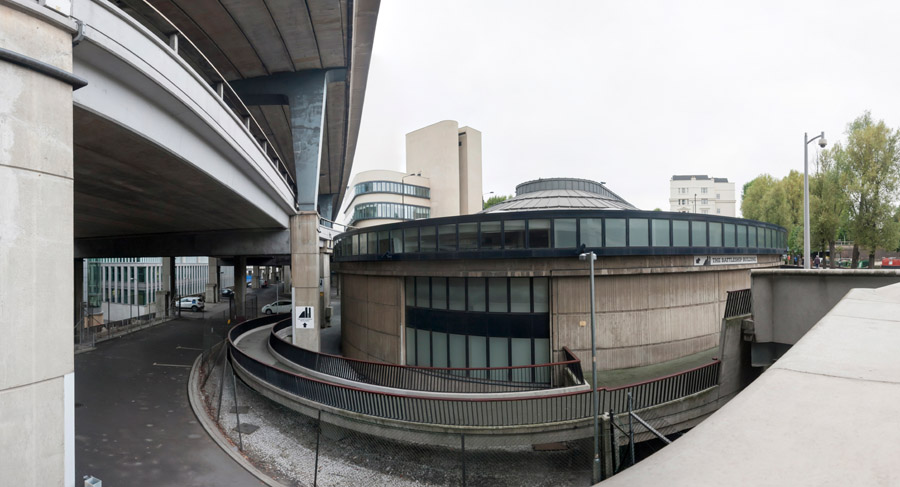
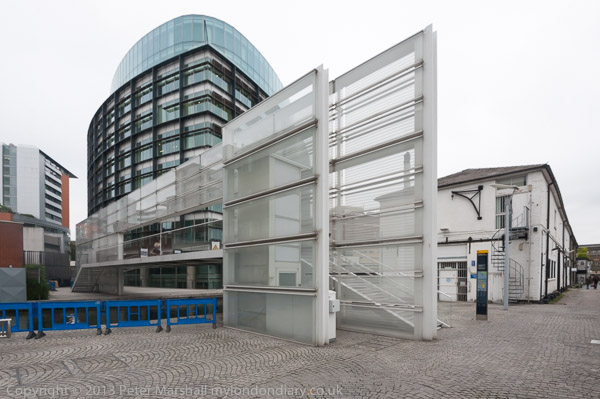
The area around the final length of the Paddington Arm from Little Venice to Paddington Basin has been the site of huge redevelopments in the past thirty or so years. A few older canalside buildings remain. Much of the land and paths open to the public in the area are on private land.

Paddington Basin


Hizb ut-Tahrir Women March for Syria – Paddington Green

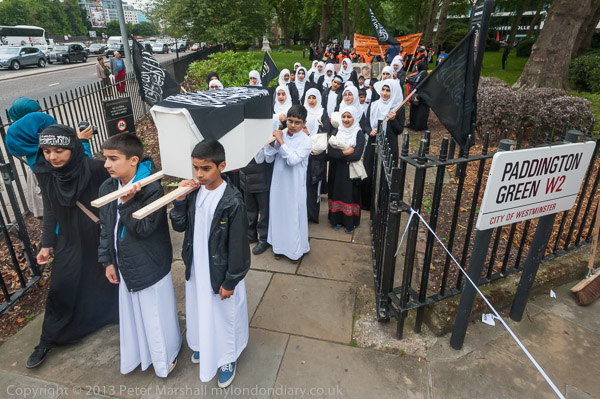
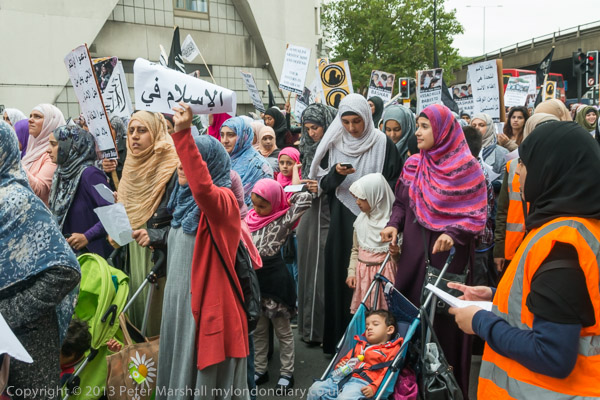
Over a thousand woman gathered on Paddington Green for a march to the Syrian Embassy to show solidarity with women and children in Syria and to condemn the chemical attacks and massacres being carried out by the Assad regime.

Hizb ut-Tahrir oppose Western military intervention in Syria but call for the replacement of the current corrupt rulers in Islamic states by a Khilifah (caliphate), a state that will truly implement Islamic values and end the corruption and oppression of the current states. They call for Muslims to rise up and get rid of corruption, and in particular of “the criminal regime of the butcher Bashar Al Assad” in Syria, and for “Muslim armies to mobilise and replace the rule of the dictator with the rule of Allah.

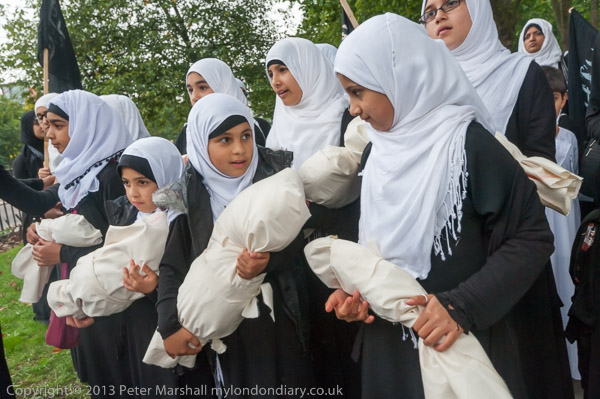
At the front of the march children carried a small coffin and other children and women carried bundles representing dead children. There were a few young boys taking part, but I saw few men – just one small group with a banner and a heavy public address system – and the event was clearly led by the women, almost all of whom were wearing headscarves, with very few in niqabs or burqas which covered the whole face.

At most other Hizb ut-Tahrir protests I’ve photographed there have been clearly separate groups of men and women, and I’ve sometimes had problems with male stewards for photographing the women, though not from the women themselves. At this event most seemed keen to be photographed to help get their message across. I left the march which was going to the Syrian Embassy in Belgrave Square at Edgware Road.

Hizb ut-Tahrir Women March for Syria


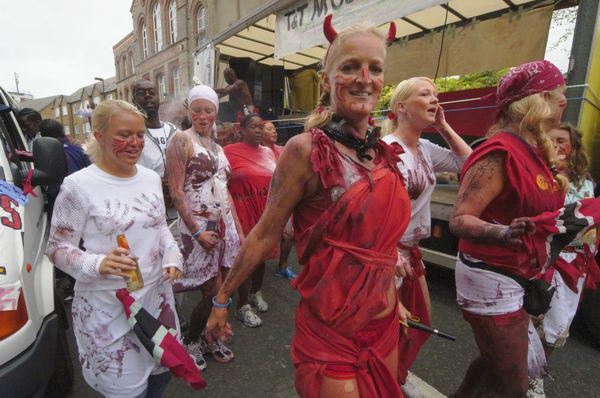
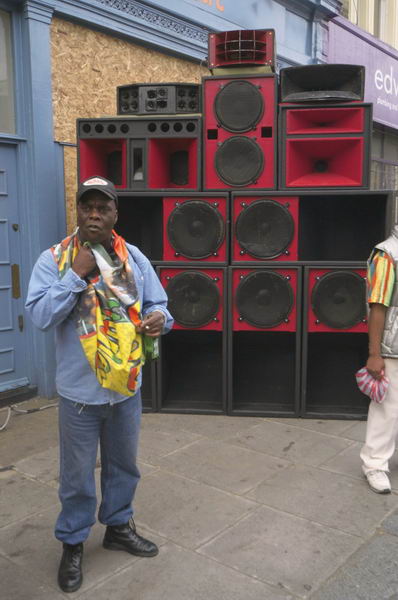
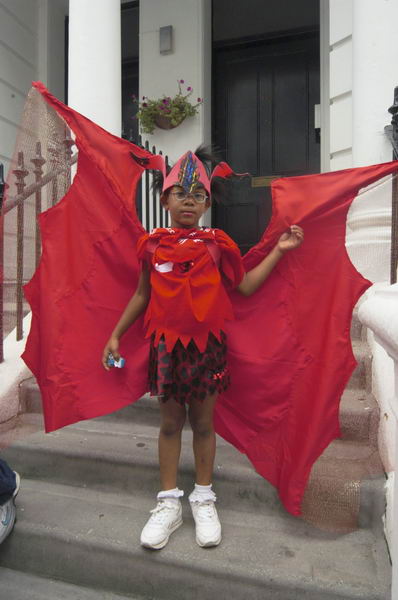
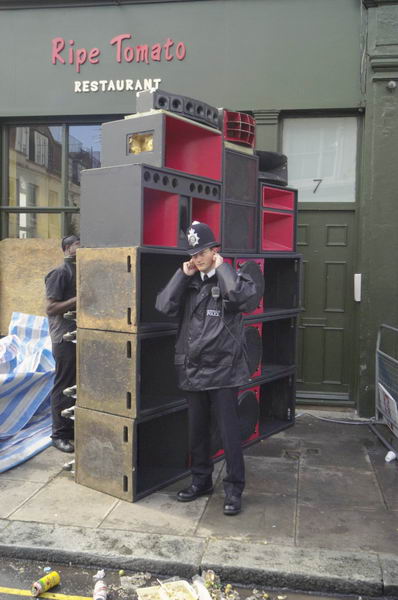
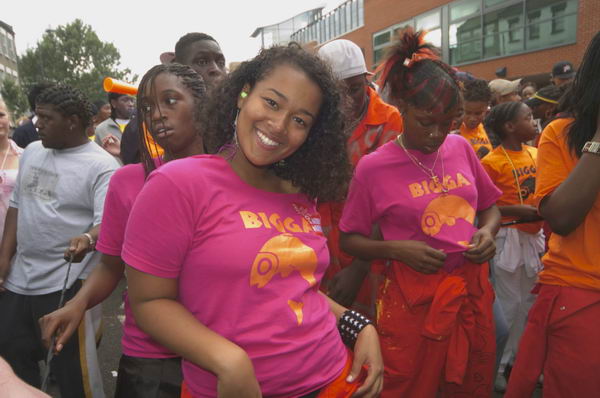
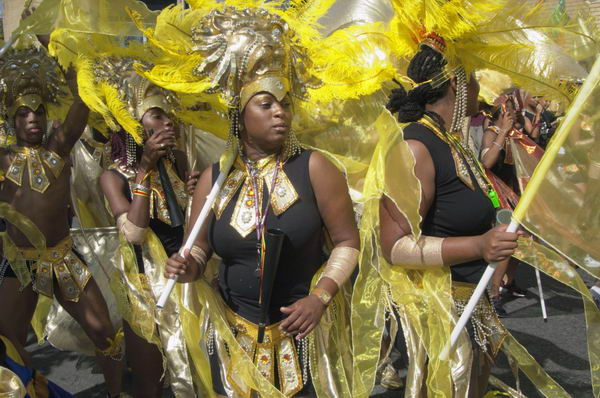
Notting Hill Carnival 2004

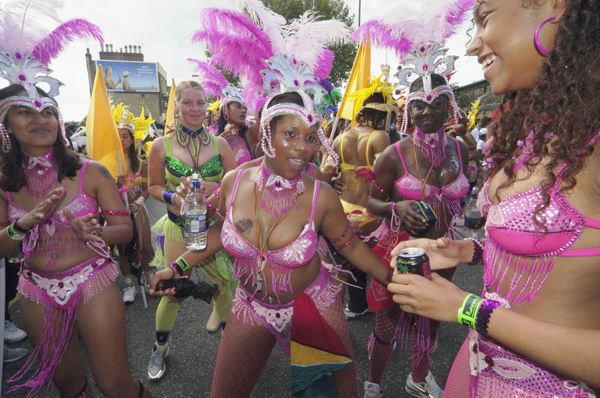
If you live in or near London there is a fairly good chance that you will be among the millions on the streets of Notting Hill today, although people sometimes come long distances for London’ and possibly Europe’s biggest festival. Many years ago I remember being a little surprised to see a poster advertising the event in St Denis on a visit to Paris, though post-Brexit it may be a little more difficult to travel here.

Although I’ve lived in the London area for most of the years carnival has been running, it was only around 1990 that I first went and experienced it. I’d probably been put off by the bad press it usually got, with the media making much of the crimes and battles with the police that occasionally took place.

But given the number of people attending and the relatively high level of policing the number of arrests at least in recent years is relatively low – and as a Huffington Post investigation into police figures shows, fairly similar to Glastonbury taking into account the number of people attending. In 2019 the number of arrests was dominated by those for drug offences, two thirds of the total, and relatively few for violent incidents, some of which were almost certainly simply reactions to heavy-handed policing. 23 years after the Macpherson report our police are still institutionally racist and certainly Cressida Dick did little to change that – we can only hope Sir Mark Rowley will do a better job, but my hopes are not high.

I’m not sure how many days I’ve spent at carnival over the years, but it is probably around 30, and I’ve yet to see any violence. Of course I’ve been offered drugs, though probably rather less frequently than in some other streets in London, and there was an almost omnipresent reek in any of the crouds announcing that what some were smoking wasn’t just tobacco. And although personally I kept to Red Stripe, I think by the end of some days I was experiencing something of a high from secondary inhalation.

I did one year encounter a rather incompetent pick-pocket. In 2004 I was standing still with some difficulty in a tightly packed crowd moving to the beat of a giant sound system and trying to take pictures when I suddenly became aware of a hand in my left trouser pocket. It wasn’t mine and I grabbed the wrist with both hands and slowly pulled it out to find it holding a wallet. But that wasn’t mine either and it was empty.

The main after-effect of carnival was always on my ears, which sometimes took several days to recover and for me to lose a ringing sound. In years when the bank holiday came of the 31st of August, this often meant I was back at work the following day, and it was difficult when I couldn’t hear properly. Sound at Notting Hill is phenomenal in places, with the ground and every organ inside your boddy vibrating, you feel it rather than hear it.

Of course there were some years I was away from London for various reasons – often because it wasn’t me who booked the holiday. In 2005 I was suffering badly from a knee injury but was still determined to go. I got ready and slowly limped my way to the station, where I had to climb a footbridge. A few steps up I collapsed in pain, pulled myself up and then came to my senses and realised I wasn’t going to be dancing on Ladbroke Grove that year, sat down and rested for a while before making my slow way home.

But I’ve not now been since 2012. I went on the Sunday, Children’s Day, stayed around three hours taking pictures and didn’t really want to return for the big day. So I didn’t. I’m not sure if its that I’ve changed – getting old – or if carnival has. But since then I’ve often been away from London but even when I’ve been here I’ve decided to go on a quiet country walk with family instead. So I don’t think I’ll be there today, but I might change my mind.

The pictures in this post were all taken in 2004, when I went on both Childrens Day which was the 29th August and the Carnival proper on the 30th, taking my son – then in his twenties – with me on Sunday. He didn’t want to go back the following day.


Close Down Yarl’s Wood – August 2015

Close Down Yarl’s Wood – Yarl’s Wood Immigration prison, near Bedford

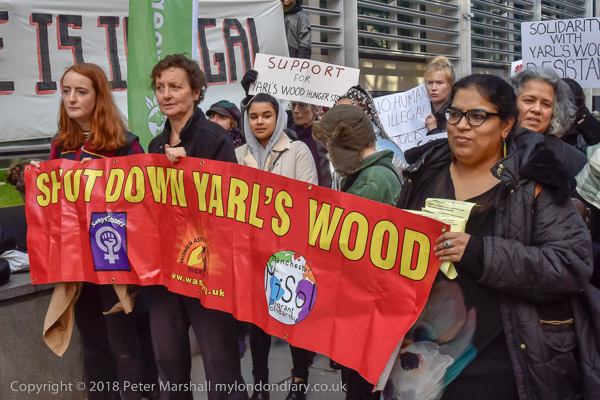
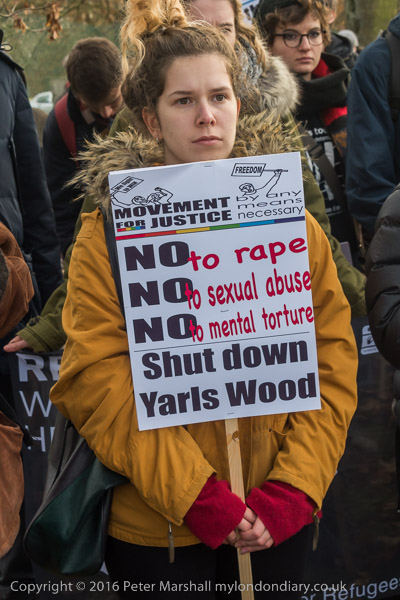
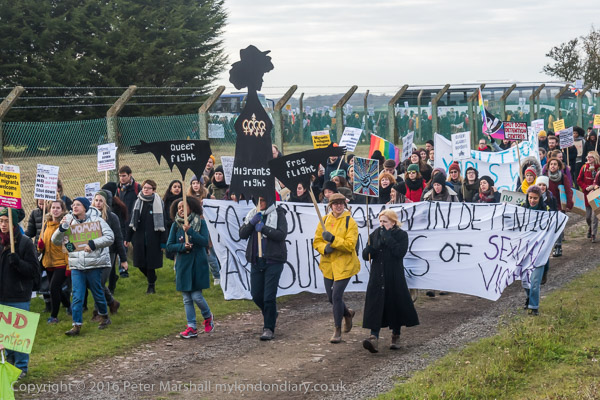
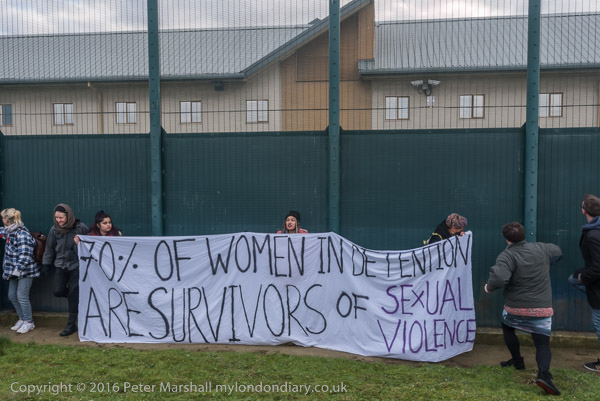
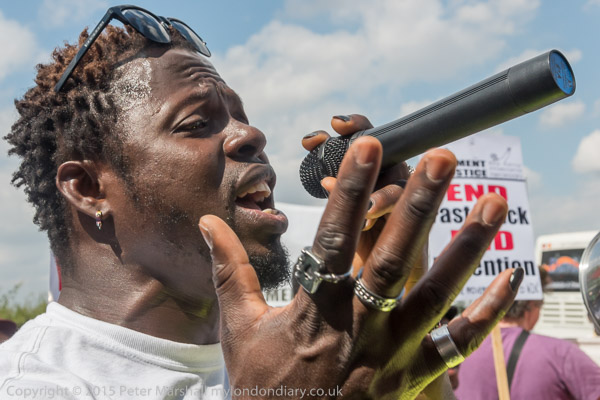
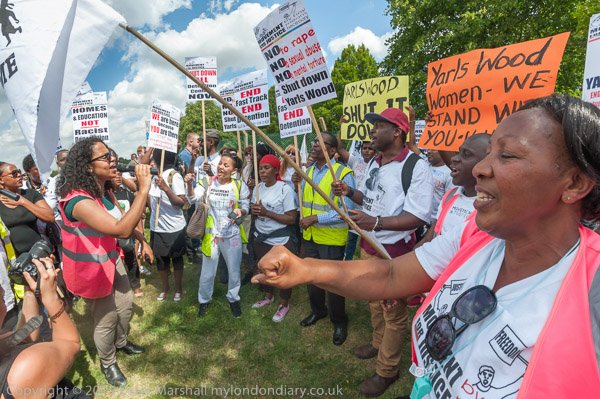
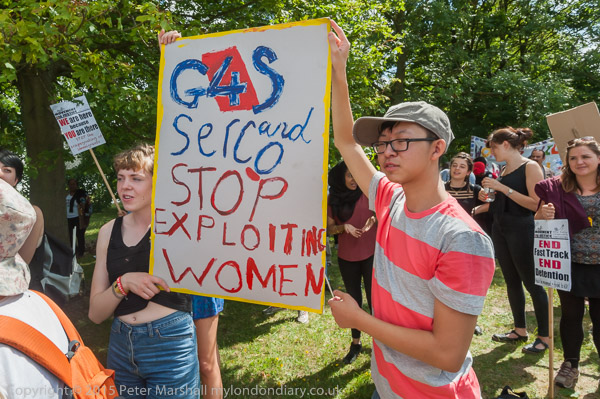
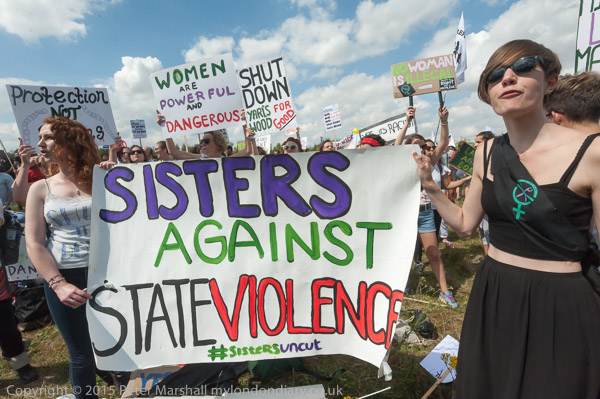
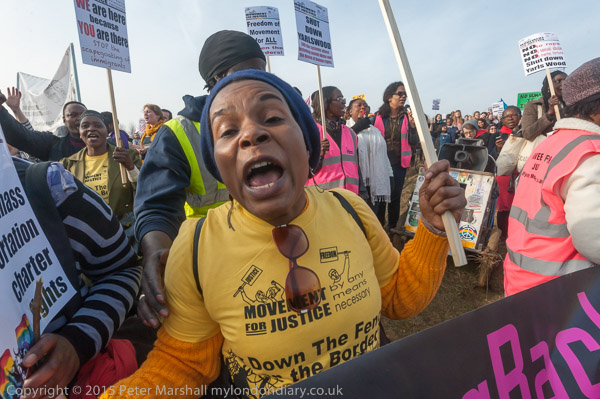
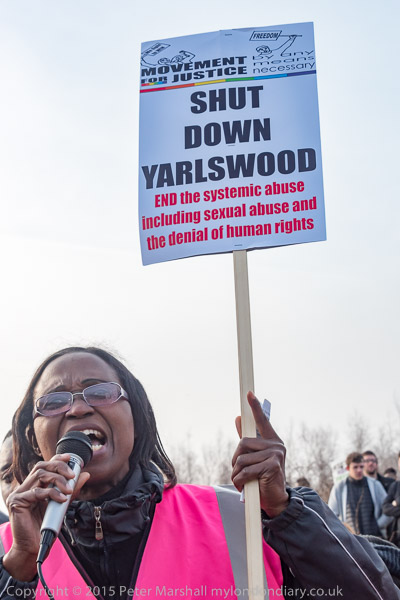
Saturday 8th August 2015 saw a large protest outside the immigration jail at Yarl’s Wood where asylum seekers are locked up indefinitely by our racist immigration system without trial, a prison run for profit by a private company where detainees are subjected to abuse and sexual harassment.

Yarl’s Wood was used to detain women, many of whom had fled abuse and violence in their own countries only to arrive in this country and be locked up and further abused here. The detention centre is in a remote location in a business park on a former wartime airfield around five miles from Bedford.

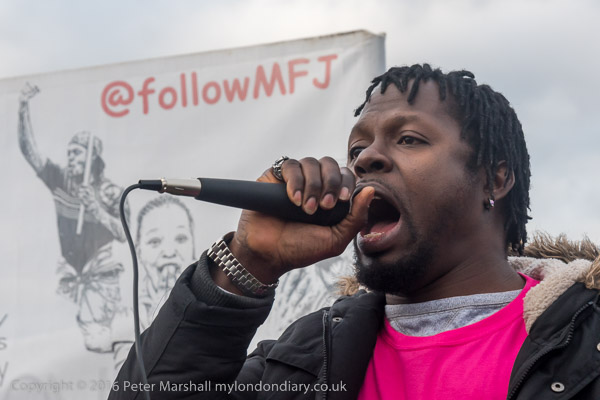
The protest was one of a long series organised by Movement for Justice, but was supported by a large number of other groups, particularly many women’s groups including Sisters Uncut. In my post on My London Diary I listed 25 of them, but there were others too. This was only the second protest they had organised at Yarls Wood, but it came after a series I’d photographed at the Harmondsworth and Colnbrook detention centres.

MfJ is a small Trotskyist group which has been one of the most active UK groups organising against racism and for civil rights in the UK since it was formed by students in North London in 1995. This protest came a couple of years before a bitter dispute led many other groups to end cooperation with them, but MfJ continue their active role, in particular in opposition to deportation charter flights and the shameful Rwanda plan.

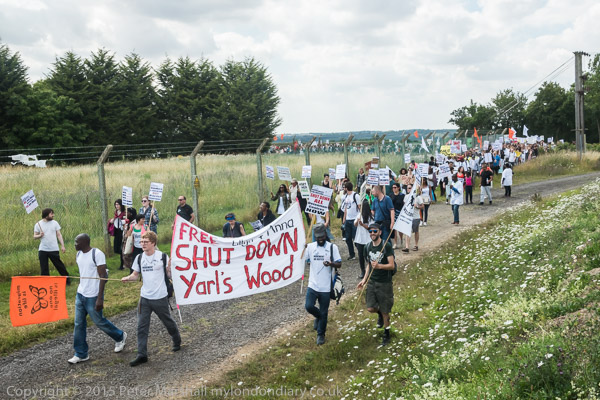
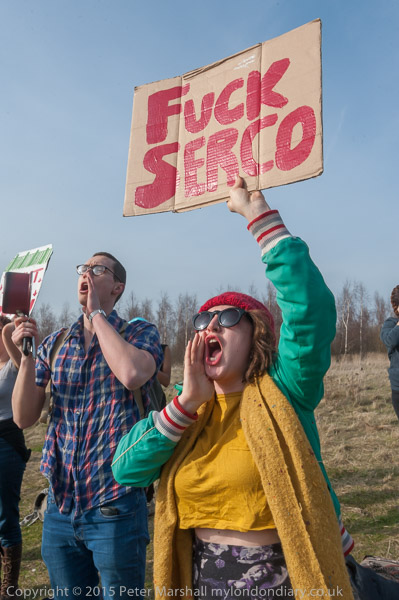
The main entrance to the detention centre is on a private road which is gated some distance from the centre. The coaches bringing people from across the country, and me and others from Bedford Station were parked in a long line at the side of a public road around a mile to the north, close to the locked entrance to the business park. The protest began on an area of grass here as we waited for everyone to arrive, and there were speeches and much chanting and dancing.

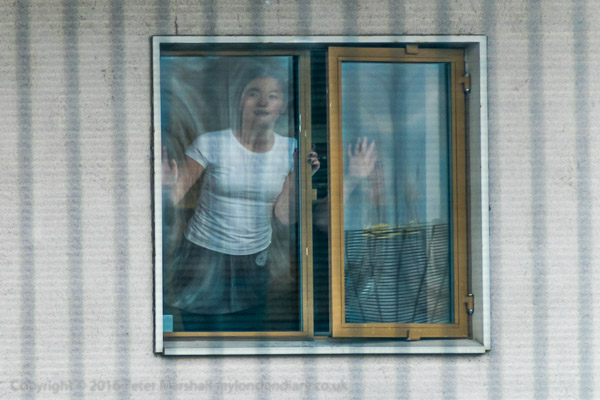
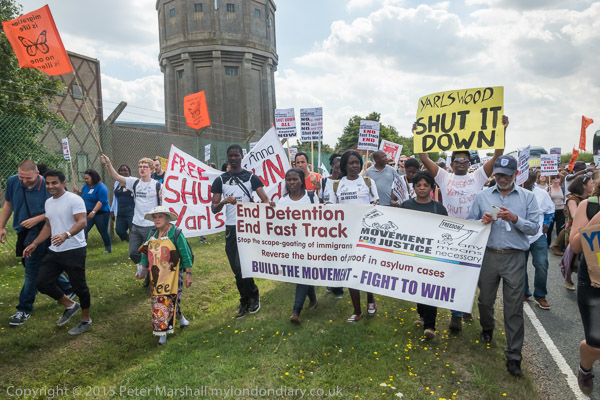
Finally the protest began its march, setting off around 300 metres along the road to a bridleway which eventually after around a mile of walking led to a hilly field beside the 20ft high fence around the prison. The lower 10ft of this is solid metal sheeting, but the upper 10ft a sturdy metal gauze, and from the hill we could see women at many of the windows waving to greet the protesters. Those held inside feel isolated and forgotten, though there are a few prison visitors and they are allowed some phone contact with solicitors and others to pursue their asylum cases.

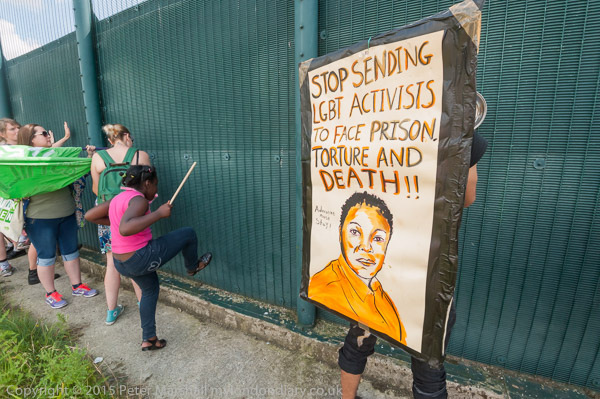
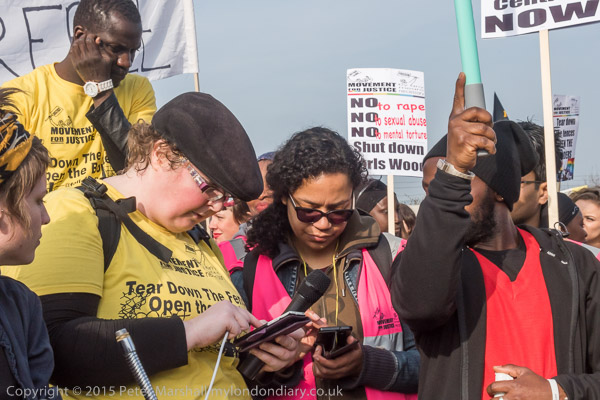
Protesters made a great noise, kicking and banging on the metal sheeting of the fence as well as shouting, and had brought a sound system so that they could speak to the women outside. They were also able to make phone contact with some of them and amplify their voices too.
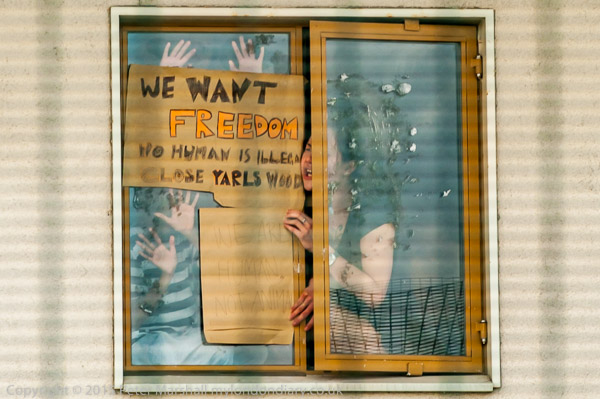
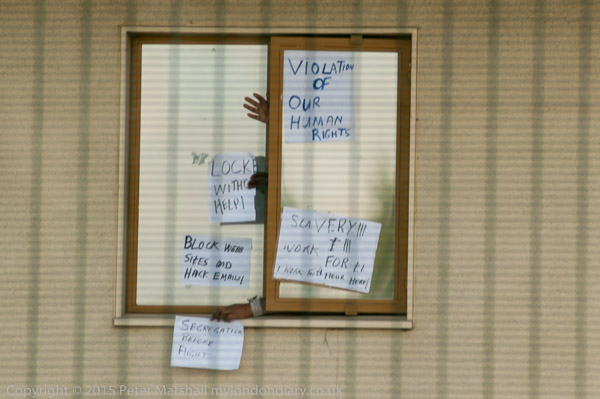
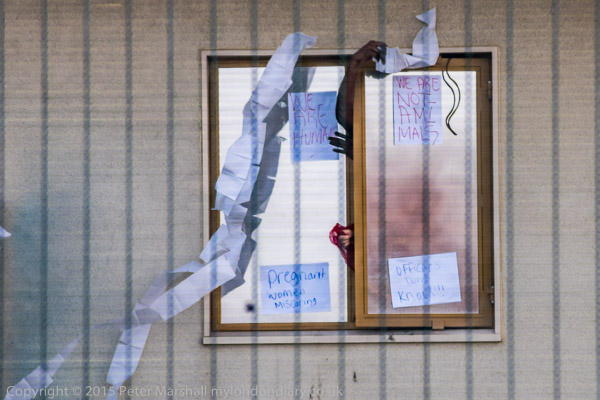
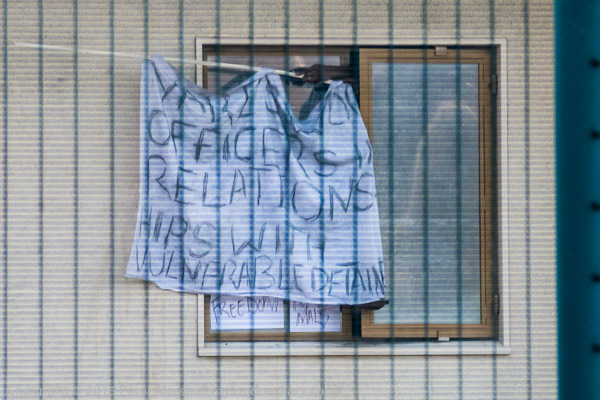
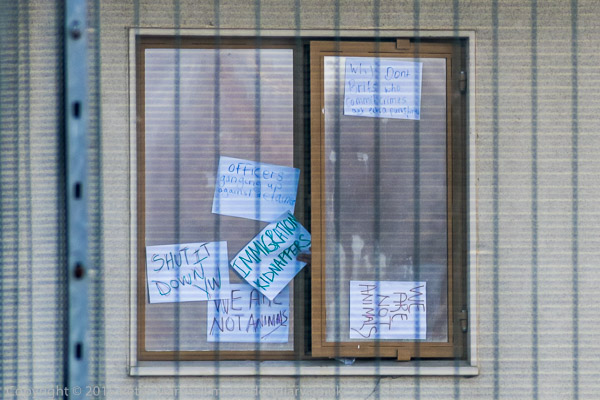
The windows of the centre only open a couple of inches, but some were able to squeeze their arms through the gap and wave cloths or articles of clothing, while others held up messages to the glass. One carefully drawn one read ‘We Want Freedom – No Human Is Illegal – Close Yarls Wood’ while another simply read ‘Help’. Others wrote their mobile numbers large enough to be read by the protesters to contact them.

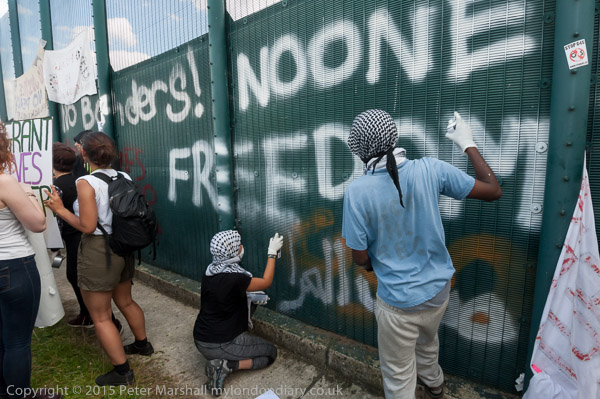
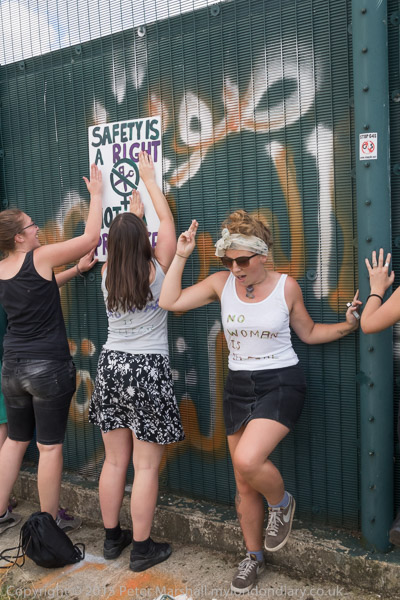
A group of people wearing face masks began to write slogans on the fence, and soon a long length of it was covered with them ‘No Borders’, ‘No One is Illegal’ ‘#SetHerFree’, ‘Shut it Down’, ‘Gaza 2 Yarls Wood Destroy Apartheid Walls’, ‘Racist Walls’ and more.

The speakers on the hill facing the prison included several who had been held inside Yarls Wood and could see women inside they knew, and others who had been in other detention centres. Most people who are held in this way are finally released and allowed to stay in the UK – sometimes after several years of imprisonment – and their seems no justification for locking them up in this way.

Here’s the final paragraph I wrote back in 2015:

Too soon we had to leave. And they had to stay. As I walked away to catch the coach back to Bedford station I felt ashamed at the way that my country treats asylum seekers. They deserve support and humanity and get treated worse than criminals.

More on My London Diary: Close Down Yarl’s Wood


Vedanta, Tampons, Roma, Monsanto & Mental Health

Vedanta, Tampons, Roma, Monsanto & Mental Health – there was a varied array of protests in London on Saturday 21st May 2016, and I was kept busy photographing them. Fortunately most were within walking distance of each other in central London, but I ended the day with a rally and march in Stratford.


Foil Vedanta at Jaipur Literary Festival – Royal Festival Hall, Southbank

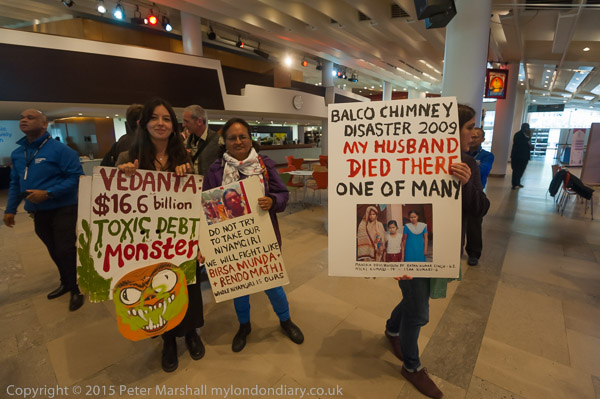
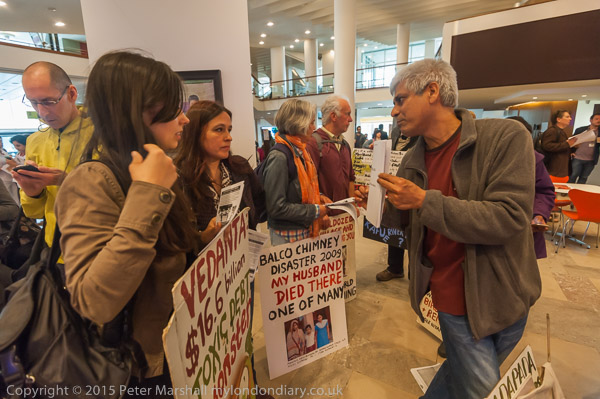
I rushed from Waterloo station to the nearby Royal Festival Hall where I found campaigners from Foil Vedanta protesting against Vedanta’s sponsorship of the Jaipur Literature Festival. They say Vedanta, the most hated company on Earth, causing pollution, illness, displacement, poverty and deaths by its mining operations, sometimes criminal, in India, Zambia, South Africa and Australia, is attempting to whitewash its image by sponsorship of the festival.

They briefly interrupted a presentation in the main space of the Clore Ballroom to make their case. Earlier Foil Vedanta and Round Table India had sent an open letter to authors who had agreed to appear, signed by around 50 mainly Indian writers, poets, academics and activists, informing them of Vedanta’s criminal operations, and calling on them to withdraw, and some had done so, with others expected to criticize Vedanta in their presentations.

After the interruption the campaigners withdrew to the rear of the area where they continued to hand out leaflets and brief journalists, watched closely by security who insisted they keep the entrance clear but did not otherwise intervene.

More at Foil Vedanta at Jaipur Literary Festival.


Tampon tax now Osbourne! – Parliament Square

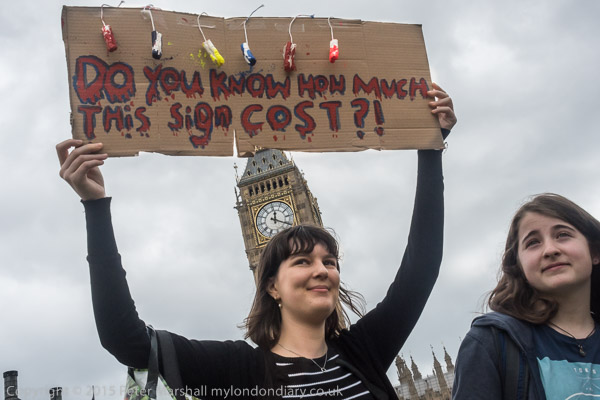
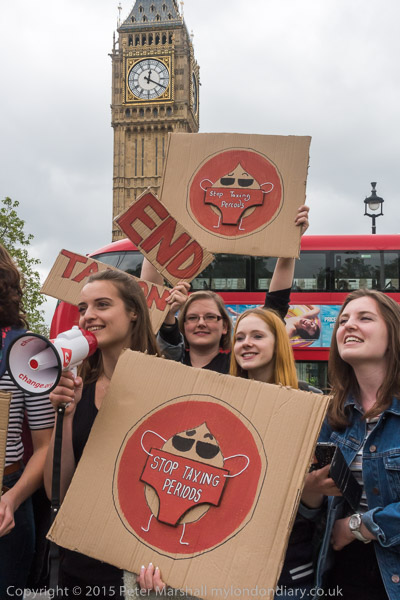
Campaigners met in Parliament Square and then marched to present a letter to Downing St calling on the government to fulfil their pledge to axe the tax on tampons. A massive campaign and lobby resulted in the removal of regulations preventing the removal of tax but it is still being levied.

Prominent in the protest were those from the 50:50 Parliament campaign for equal representation of women and men in Parliament who say that if there were more women in Parliament there would not be taxes like this – and much less of the public-school bickering that often dominates the House of Commons.

More at Tampon tax now Osbourne!


‘Dosta, Grinta, Enough!’ Parliament Square

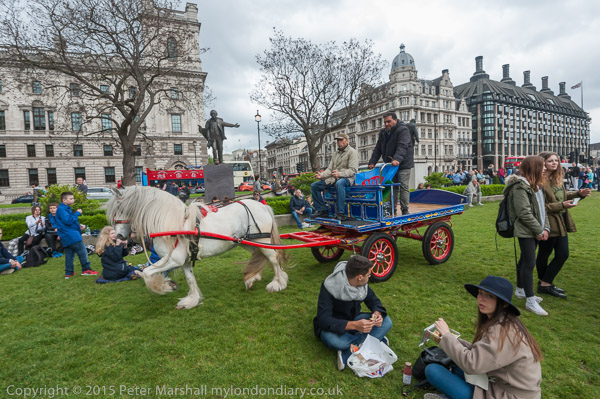
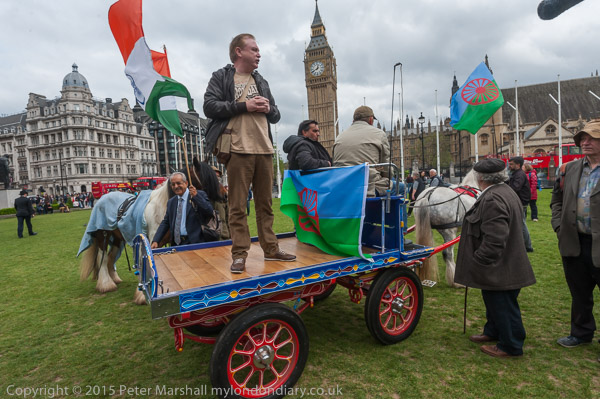
As the Tampon Tax campaigners left on their march to Downing St, four horse drawn vehicles arrived for the protest by Roma, Gypsies and Travellers against the hardening attacks against their way of life.

Heritage wardens and police told them it was was against bylaws to bring horses on to the square and after a short rally on the grass they led protesters in repeated circuits of the roadway around the square before leaving as the main rally on the corner of the square started.

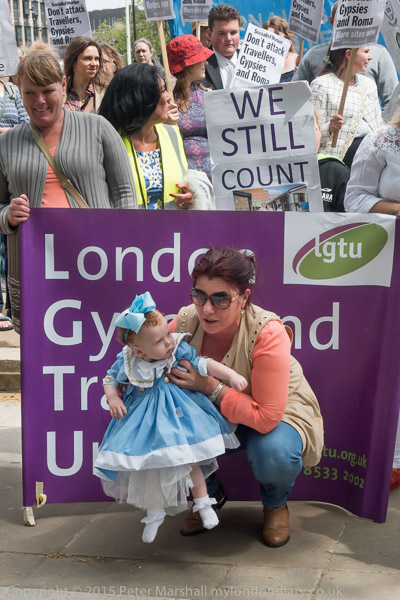
Changes in the laws have allowed local authorities to stop providing traveller sites, and laws against fly-grazing have made finding places to stay and moving around the country much harder. Alterations in local planning guidance have meant that local planning laws have been used in a discriminatory fashion to prevent them using land even when they own it – as at Dale Farm. The ‘Dosta, Grinta, Enough!’ protest called attention to these attacks by the government on their ethnicity and demanded an end to 500 years of persecution.

More at ‘Dosta, Grinta, Enough!’


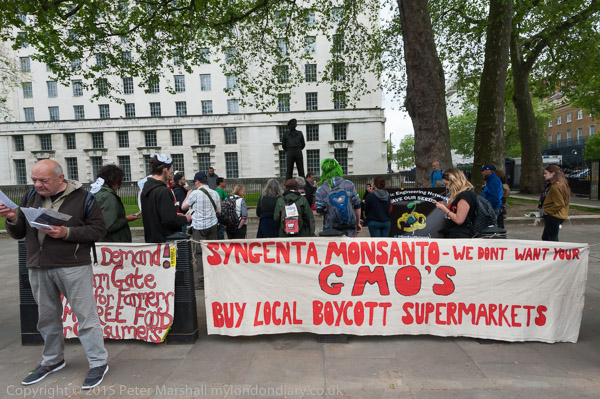
March Against Monsanto Rally – Downing St

It was a day of several hundred world-wide protests against Monsanto, but there had been little publicity for the London protest and attendance for disappointing, and although there were good speeches these were to a small group of dedicated activists.

Among the listeners were a couple of bees and this cow

Monsanto dominates the worlds markets for seeds and agrochemicals at the expense of small scale farmers and communities around the world and is forcing harmful pesticides and genetically modified seeds on farmers in their corporate control of the world’s food system. The company has sued thousands of small farmers in the US and elsewhere to protect its patents which cover a wide range of crops and other products.

More at March Against Monsanto Rally.


Housing is a Mental Health Issue – Stratford

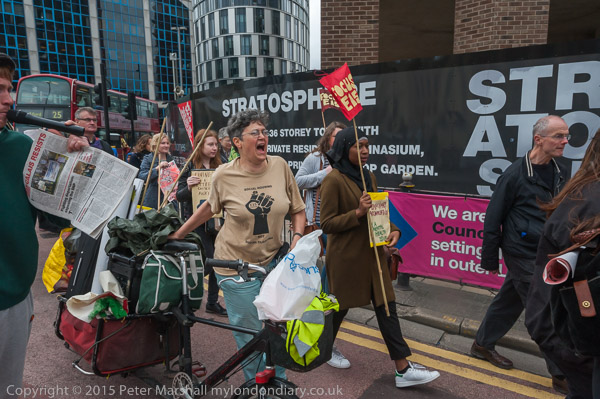
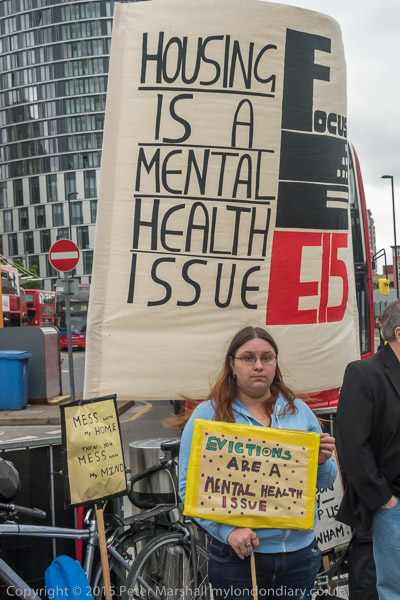
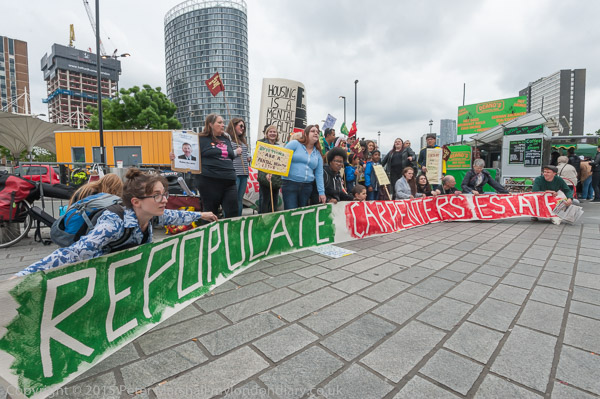
From Westminster the Jubilee Line takes a little over 20 minutes to get to Stratford Station, outside which I met Focus E15 housing campaigners who were holding a rally and march. It was Mental Health Awareness Week and they were protesting against Newham council’s policy of social cleansing, highlighting the mental health issues that arise from housing problems.

There is a huge boom in building around Stratford given great impetus by the 2012 Olympics, but as speakers made clear when the march paused in front of some of the the high-rise housing, this is being built largely for the rich – while those unable to afford sky-high market rents are being forced out. They say Newham is causing mental health problems for vulnerable people through evictions and placements with insecure tenancies away from families, friends and support systems in cities and towns across the UK.

Good homes on the Carpenters Estate have been kept empty by Newham for over 10 years

The new tall blocks also produce a hostile micro-climate at ground level, and when the march approached one of the most recent, gusts of wind tore one of the banners in two. The march ended on the pavement outside Wilco’s in Stratford Broadway, where Focus E15 hold their regular Saturday morning street stall.

More at Housing is a Mental Health Issue.


More Around the Roman

Roman Rd, Bethnal Green, Tower Hamlets, 1988 88-8c-64-Edit_2400
Roman Rd, Bethnal Green, Tower Hamlets, 1988 88-8c-64

It’s doubtful if the Romans ever marched or walked along Roman Road, although some Roman remains have been found in the area. But most will have gone along Old Ford Rd which runs parallel a short distance to the north, it’s ford taking them across the River Lea from Londinium to the Iceni capital Venta Icenorum around 5 miles south of modern Norwich.

Most of Roman Road was only built when the sewer system was extended by the Metropolitan Board of Works in 1855 to allow further development in the area around, extending what was then Green St to the east, beyond Grove Road into Old Ford to an end a little short of the Lea. The western section from the Cambridge Bridge Road was only renamed to be part of Roman Road when London street names were rationalised in the 1930s – there were far too many Green Streets. It makes consulting old sources of information about shops and houses on the road difficult as all the street numbers then changed. The market in Roman Road was set up in the late 1860s.

Roman Rd, Bethnal Green, Tower Hamlets, 1988 88-8c-65-Edit_2400
Roman Rd, Bethnal Green, Tower Hamlets, 1988 88-8c-65

The whole area was a stronghold for the suffragettes, particularly after the formation of the East London Federation of the Women’s Social and Political Union by Dr Richard Pankhurst and his wife Emmeline Pankhurst, founder members of the Independent Labour Party in the same year, 1893. This was unusual in welcoming men as members and also having a democratic organisation. Their daughter Sylvia Pankhurst and the East London Federation were expelled from the WSPU in 2014 and set up the East London Federation of Suffragettes (ELFS) and set up a newspaper, The Woman’s Dreadnought, published from Roman Road. In 1917 its title was changed to Workers’ Dreadnought, with the slogan ‘Socialism, Internationalism, Votes for All’ and it continued in publication until 1924.

The East End was a very political area, but not only for its suffragettes and socialists and in the 1930s became of the the areas of strongest support for Oswald Mosley and his British Union of Fascists. Their support came mainly from the middle classes in the area, shopkeepers and other traders and business owners rather than the working class, but it was strong enough for the area to have two BUF branches until it was proscribed under Defence Regulation 18B of the Emergency Powers (Defence) Act 1939.

Roman Rd, Bethnal Green, Tower Hamlets, 1988 88-8c-66-Edit_2400
Roman Rd, Bethnal Green, Tower Hamlets, 1988 88-8c-66

Bethnal Green was badly affected by bombing in World War II and the Metropolitan Borough of Bethnal Green carried out extensive building of council housing in the 1950s and 60s, with some outstanding architecture close to Roman Road. In 1965 Bethnal Green merged with Stepney and Poplar to become the London Borough of Tower Hamlets. The area has in more recent years become considerably gentrified, a process which was beginning to be clear when I took these pictures in 1988.

Star Auto Electrics, Tredegar Rd, Bethnal Green, Tower Hamlets, 1988 88-8c-52-Edit_2400
Star Auto Electrics, Tredegar Rd, Bethnal Green, Tower Hamlets, 1988 88-8c-52

South of Roman Road and roughly parallel to it is Tredegar Road, built up in the 1850s and 60s. Star Auto Electrics fortunately informs us it was at 123A Tredegar Rd. This is now the site of a large block of flats.

Star Auto Electrics, Tredegar Rd, Bethnal Green, Tower Hamlets, 1988 88-8c-54-Edit_2400
Star Auto Electrics, Tredegar Rd, Bethnal Green, Tower Hamlets, 1988 88-8c-54
Tredegar Rd, Bethnal Green, Tower Hamlets, 1988 88-8c-56-Edit_2400
Tredegar Rd, Bethnal Green, Tower Hamlets, 1988 88-8c-56

This neat late nineteenth century terrace is still there on Tredegar Rd. The street – like the rather better known (and roughly four times as expensive) Tredegar Square close by south of the railway line gets its name from Lord Tredegar, Sir Charles Morgan (1760-1846) who made a large fortune promoting agriculture in south Wales and in 1824 was granted a private act of parliament by King George IV to develop a large area of Mile End and Bow. Although several of the streets are named after places in Wales, they have not inherited a Welsh pronunciation.

Tredegar Rd, Coburn Rd, Bethnal Green, Tower Hamlets, 1988 88-8c-41-Edit_2400
Tredegar Rd, Coburn Rd, Bethnal Green, Tower Hamlets, 1988 88-8c-41

This picture was made at the junction of Tredegar Road at its west end with Coborn Road, though nothing in the picture remains. A few yards away around the corner in Coborn Road there are some older buildings and the site of the former railway station, opened as Old Ford in 1865, later renamed as Coborn Road and then Coborn Road for Old Ford which was permanently closed and largely demolished in 1946.

Roman Rd, Bethnal Green, Tower Hamlets, 1988 88-8c-45-Edit_2400
Roman Rd, Bethnal Green, Tower Hamlets, 1988 88-8c-45

My walk ended on Roman Road, where I joined a queue at a bus stop waiting for the bus to take me back into the City and from there by Underground and British Rail back home.


Click on any of the pictures to see a larger version in my album 1988 London Photos, from where you can browse the album.


Shut Down Racist Yarl’s Wood

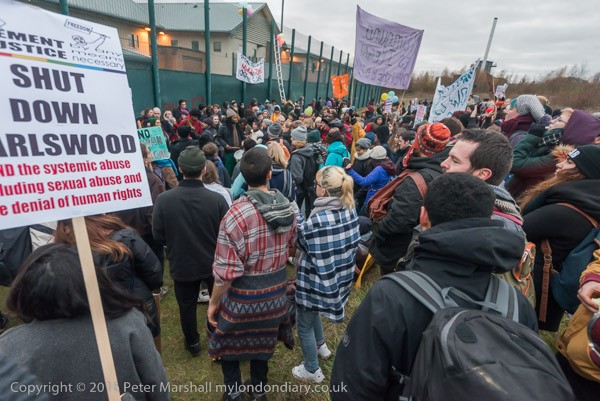
Shut Down Racist Yarl’s Wood. On Saturday 12th March 2016, six years ago today, I made another visit to the immigration detention centre at Yarl’s Wood where the Movement for Justice (MfJ) had organised another large protest.

Shut Down Racist Yarl's Wood
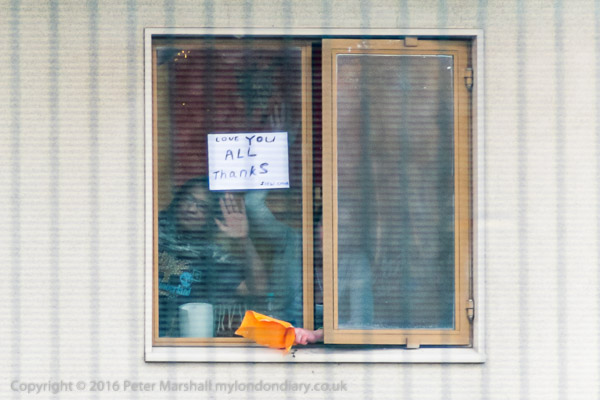
Women at the windows – one holds a bible through the narrow window opening

The Home Office no longer uses Yarl’s Wood to house large numbers of women asylum seekers, but unfortunately this does not mean their cruel and racist policies have changed. Women were at first moved out because of Covid, but Priti Patel has set up a new immigration prison, Derwentside Immigration Removal Centre, to hold 80 detainees to replace it, with around 88 women being moved and locked up there for Christmas 2021.

Shut Down Racist Yarl's Wood
People march down the road to a footpath leading to Yarl’s Wood

The new centre at Hassockfield is on the site of the notorious Medomsley Detention Centre, where over 1,800 young male detainees were abused in the 1960s to 1980s, and is at at Medomsley Edge, 13 miles NW of Durham, 1.7 miles North of Consett. It has been renamed again as Derwentside, to give it a more friendly image, though the river is around a mile away as the crow flies. Almost certainly the Home Office was fed up with the protests organised by MfJ and others at the already rather remote site at Yarl’s Wood, around 5 miles outside Bedford, and thought it a good idea to move it rather further away from London, where there are many former detainees and activists who came to demonstrations.

Shut Down Racist Yarl's Wood
Marching along the footpath

But of course people came from all over the country – including from Scotland – to Yarl’s Wood, and protests will continue, with an active ‘No to Hassockfield‘ local group at their centre, although it’s too far away for me to photograph them.

Women have little to protest with and the windows only open an inch or so. They hold messages to the glass and throw out toilet paper

Hassockfield is so remote that the Home Office was unable to find law firms which would give satisfactory tenders to give legal advice there and abandoned the search – with detainees now only able to get advice by phone. Women for Refugee Women are calling for donations to mount a legal challenge over this lack of support. There is a great deal more information about the cruel and racist treatment of asylum seekers with many telling their own stories on their web site.

Yarl’s Wood like almost all of the immigration prisons is privately run for the Home Office, with companies cutting costs for profit

Back on 12th March 2016, my own journey to Yarl’s Wood didn’t go too well, with a train cancellation. But I still got to Bedford Station in a little over two hours and in time for the coach organised by MfJ to the meeting point at Twinwoods Business Park, around a mile walk from the prison. Unfortunately the coach driver didn’t know the way and police had put up large signs stating the road up from the A6 was closed (though in fact they were letting traffic to the protest to go through.) The result was a rather lengthy tour of the Bedfordshire countryside – with another wrong turning, meaning we arrived the best part of an hour late.

Shut Down Racist Yarl's Wood
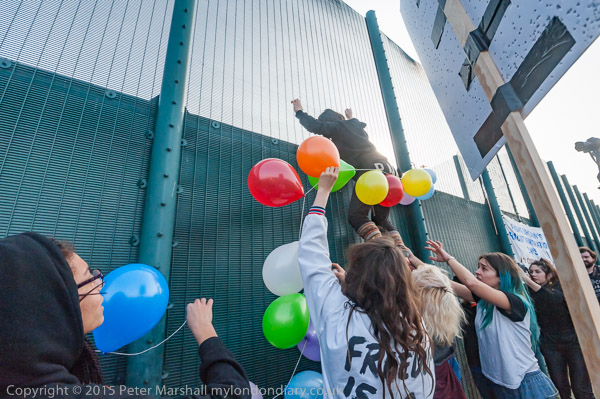
Protesters climb up to show placards and balloons to the women

Fortunately the event had started with a rally on the road waiting for people from around the country to arrive, and the mile or so walk to the prison was waiting for us and only just about to begin.

Shut Down Racist Yarl's Wood
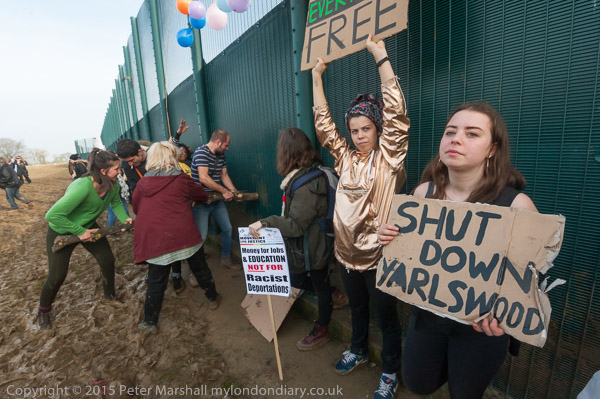
Battering the fence makes a lot of noise

Fortunately it was a fine day for the walk, but there had been heavy rain in previous days and some of the footpath and the field beside the prison where the protest took place was full of mud and some puddles, making it hard to move about and keep my balance. As you can see in some pictures close to the fence it was a sticky mess.

Shut Down Racist Yarl's Wood
Many of those protesting were former detainees, some of whom spoke at the event

The field has a fairly steep slope up from the 20ft prison fence, which does enable protesters to see over the lower 10ft of thick metal sheeting and to glimpse the women waving, shouting and holding posters at the upper floor windows inside.
Shut Down Racist Yarl's Wood
Women had written messages on towels and clothing to hang out through the narrow openings.

It is tricky taking pictures through the 10 ft upper section of the fence with its thick wire grid and I don’t have the kind of long and fast lenses for this. I actually declined the invitation from the organisers to photograph the first large MfJ protest here as I knew I didn’t really have the right gear, suggesting they invite a colleague. But for later protests I decided that there were many other pictures I could take and I could at least get some kind of pictures through that fence.
Shut Down Racist Yarl's Wood
Many reports have confirmed the abuses taking place inside Yarl’s Wood

Many of those at the protest were people who had been locked up inside Yarl’s Wood or other detention centres, and almost all of those who spoke had stories to tell about how their mistreatment – having been physically and sexually assaulted, locked in rooms, denied medical assistance, unable to get proper legal advice and more. Most had come to this country fleeing from violence, often from rape and in dire need of care and understanding and instead were locked up, their stories disbelieved and further subjected to hostile and inhuman treatment.

Shut Down Racist Yarl's Wood
Detainees are allowed phones and some were able to speak from inside the immigration prison

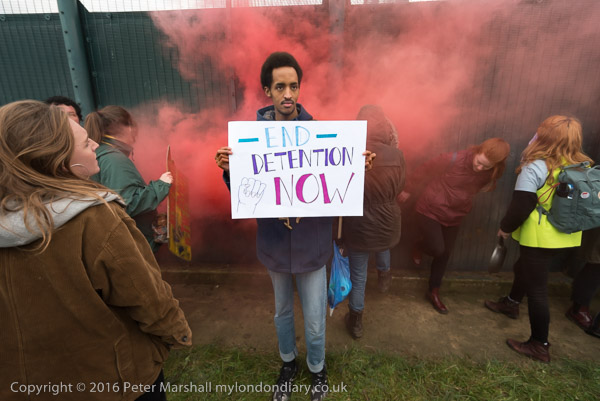
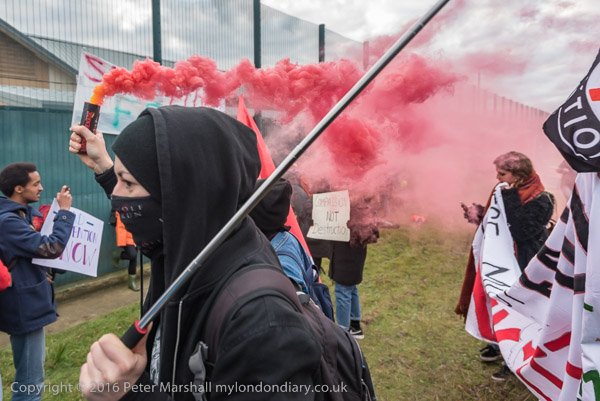
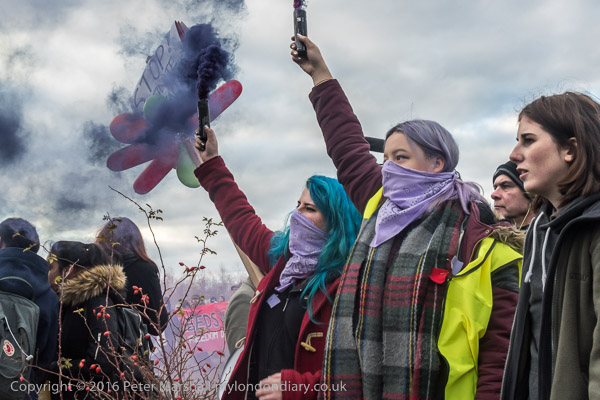
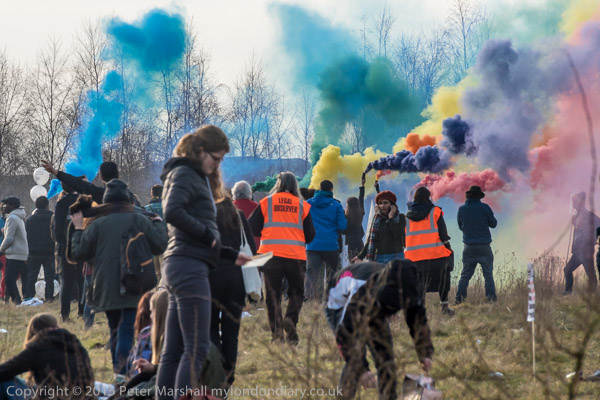
At the end of the protest people let off a number of coloured flares before the long walk back to the coaches. I was rather caught in the mud and unable to get close to where this was happening. On the path and road back to the coach I tried to scrape the worst of the mud from my boots and trousers on the grass and on the kerb of the road, and found some sticks to help, but Bedfordshire mud proved extremely persistent.

Shut Down Racist Yarl's Wood
Most of the speakers were former detainees and friends inside could hear them

We needed to remove our boots before getting on the coach, and fortunately I had a plastic bag to put them in for the journey, getting back into them where we were dropped off at the station. The journey home was slow but uneventful and I was exhausted and needed a good meal and a bath when I arrived – but at least unlike those detainees I was free.

Shut Down Racist Yarl's Wood

More at Shut Down Yarl’s Wood on My London Diary, where you can also find accounts of other protests at Yarl’s Wood as well as other immigration prisons at Harmondsworth and Colnbrook using the site search.


Women March, Bolivians Protest, Antifa Solidarity

Women March, Bolivians Protest, Antifa Solidarity
Saturday 19th January 2019 was another day of protests in London.

Women’s Bread & Roses protest

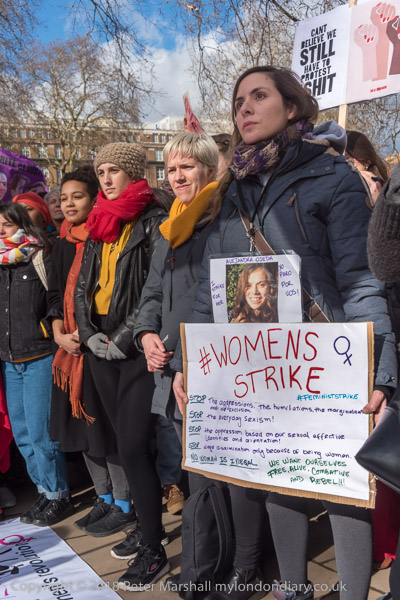
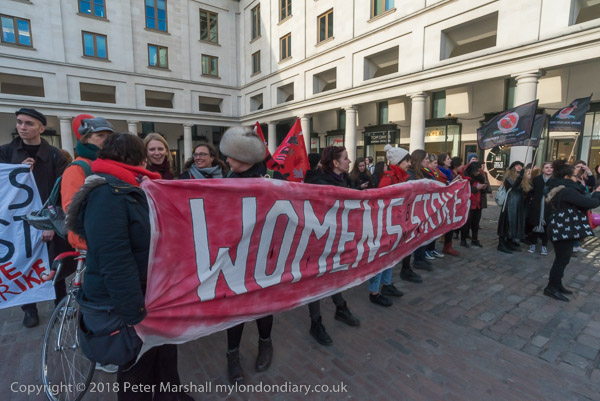
Inspired by the Bread & Roses protests which revolutionised workers’ rights for women in 1912, Women’s March London marched from the BBC to a rally in Trafalgar Square. The march was a part of an international day with women marching in many countries across the world and particularly in the USA.

Women were marching against economic oppression, violence against women, gender pay gap, racism, fascism, institutional sexual harassment and hostile environment in the UK, and they called for a government dedicated to equality and working for all of us rather than the few.

It began rather oddly outside the BBC with a carefully organised and scripted rally by a TV crew working for the BBC to produce what they called a documentary, though it seemed to have little real connection with the event that was taking place.

I walked with the women photographing them as they marched to another hopefully less scripted rally in Trafalgar Square where I left them to go to another event.

Bolivians protest against Morales

While in Trafalgar Square I photographed another protest taking place on the North Terrace, where Bolivians from the 21F movement had gathered against the ruling by Bolivia’s Electoral Tribunal that President Evo Morales could stand for a fourth term in office. Morales was first elected president in 2005, and supported the 2009 constitution which only allowed two consecutive terms in office. But later he tried to change this and the matter was put to a national referendum on 21st February 2016 which narrowly rejected the change.

Morales then went to the courts and they ruled that the limitation to two terms was an infringement on human rights and allowed him to stand again,, and he won a third term in office. The protesters were from the 21F movement, named from the referendum debate who accused him of corruption and interfering with the court system and say he is behaving as a dictator by trying to remain in power for a fourth term. He stood and won in October 2019, but a coup attempt in November 2019 forced him to flee the country, though he was able to return after MAS candidate Luis Arce won a clear victory in the 2020 general election and was sworn in as President.

Morales, the head of the Movement for Socialism party (MAS) while in office implemented leftist policies, reducing poverty and illiteracy and combating the influence of the United States and multinational corporations in Bolivia which has made him very unpopular with many of the middle class who were used to running the country – as well as the USA who have encouraged and financed opposition to him. Perhaps the 21F protest was really more about his policies than a concern for the integrity of the constitution.

Solidarity with Russian anti-fascists

From Trafalgar Square I made my way to the Cable Street Mural on the former Stepney Town Hall in St George’s Gardens Shadwell, where Anarchist and Anti-fascists were gathering to march to oppose racism, xenophobia, fascism and the upsurge of far-right populism and to show solidarity with Russian anti-fascists who have been arrested, framed and tortured in a brutal wave of repression.

There were speeches by Russian and Ukrainian comrades and a message from some of those under arrest in Russia. Six were arrested in 2017 by the Russian Federal Security Service (FSB) and charged with belonging to a non-existent organisation, ‘The Network’. They have been and beaten and tortured in the pre-trial detention facility using electrical torture and hanging them upside down to get them to sign confessions, which they were forced to memorise.

Five more anti-fascists have been arrested since and also tortured to admit they were members of ‘The Network’, which the FSB claims were planning explosions during the Russian presidential elections and the World Cup. They could be jailed for up to 20 years for membership of the fictional group.

Stanislav Markelov, murdered by fascists in broad daylight on January 19th 2009.

January 19th was the 10th anniversary of the brutal murder on a Moscow street in broad daylight of two Russian anti-fascists, journalist Anastasia Baburova and lawyer Stanislav Markelov. Russian anarchists and anti-fascists hold events to remember them on this day every year.

From the fine mural celebrating the 1936 Battle of Cable Street, when the East End rose up to fight the police who tried to force a way for Mosley’s Blackshirts to march through the Jewish East End, the protesters marched to Altab Ali Park in Whitechapel, re-named after a young Bengali textile worker, 24 year old Altab Ali, who was murdered here on May 4th 1978 in a brutal unprovoked racist attack by three teenage boys as he walked home from work.

More on all three protests on My London Diary:
Solidarity with Russian anti-fascists
Bolivians protest against Morales
Women’s Bread & Roses protest


Flowers to Yarls Wood – 2017

Four years ago on Saturday 18th November saw Movement for Justice’s 12th protest outside the immigration detention prison up a hill around 6 miles north of Bedford, calling for this and the other immigration detention centres to be shut down. On this occasion many took flowers to pin to the upper section of the fence where they could be seen by the women inside.

The whole system of immigration detention seems to have been designed as a deterrent to asylum seekers coming to the UK, though unsuccesful in doing so. People who had fled their countries because they were in fear of their lives and had often been subject to violent attacks and rapes were thrown into jail while there cases were being considered. Often their imprisonment made it very much harder for them to provide the evidence demanded by the Home Office of the danger they had been in and their suffering, and official reports and journalistic investigations, some by reporters who had taken jobs at the centres, both revealed the callous and often illegal treatment they received from the staff in these privately run centres, including sexual assaults and violence.

Mabel Gawanas who was held inside for a day under 3 years speaks to her friends still inside

The accomodation provided is poor and the food is of poor quality and often fails to meet the relgious ordietary needs of the detainees, and there have been numerous reported cases where necessary medical treatment has been either refused or excessively delayed. But the major problem is that immigration detention is of indeterminate length, with some detainees serving perhaps a few weeks and others up to three years. Unlike in a normal jail there is no known length to the time people serve and no way that they know when they may be released or deported. And there is no process for them to appeal their detention. The government like to pretend it isn’t a prison, and there are some differences in the routines, but those held inside cannot leave and are often restricted in their movements inside the buildings.

The windows only open a few inches

There are currently in 2021 seven ‘Immigration Removal Centres’ in the UK as well as a number of short-term holding facililites. All but one of the seven are run by private companies, Serco, Mitie, G4S, a Capita subsidiary and Geo, and they are run to make profits. The less they spend on food, staffing and facilities the more the companies make – and the more those detained suffer. In 2015 the Chief Inspector of Prisons labelled it ‘a place of national concern’.

Yarl’s Wood is in an isolated location, hidden away from roads on a former wartime airfield. As I found cycling from Bedford Station it is on the top of a hill and rather windswept. From where the protesters coaches and cars can park it takes aroud a mile walking along public footpaths to get to the field next to the prison where the protests take place. The prison is surrounded by a 20 ft high metal fence, the lower half with metal panels and the upper half with a thick wire grid material that allows the upper storeys of the building to be seen from the top of a rise in the field.

It’s difficult to take pictures through this screen, but not impossible. I’d taken with me a Nikon 70-300mm lens and was working with the D810 in DX mode which converts that into a 105-450mm equivalent and still provides a 16Mp file. Focussing was tricky as the autofocus was very good at focussing on the wire, leaving the building behind well out of focus, and although it would sometimes focus on a window frame, it was far easier to use manual focus.

I also took some pictures on a 28-200mm (equivalent to 42-300mm) which was better when I wanted to include any foreground detail, but the windows became rather small. Even at 450mm any one of the pair of windows only filled around a sixth of the frame, and some of the images have been cropped.

For photographing the protesters as well as that highly versatile 28-200mm used both as a X lens on the D810 body and a full-frame lens on the D750, I also had a 28-35mm lens for use on the D750.

Many of the exposures I made where not quite sharp. It was November and the light dropped off fairly dramatically towards the end of the protest and by 3pm I was having to work at 1/250s at the full aperture of F5.6, not really fast enough a shutter speed for a 450mm lens. So camera shake added to my focus problems. At 3.30pm the protest seemed to be nearing its end, I was getting too cold and decided it was time to get on my bike and return to Bedford Station. Fortunately except for a short steep slope it was more or less downhill all the way.

In August 2020 the Home Office announced it was ‘re-purposing’ Yarl’s Wood, which became a short-term holding facility for men arriving in the UK by boat. But by November 2020 it had also been brought back into its previous use with around ten women then being indefinitely detained there.

Shut Down Yarl’s Wood 12


Close Down Yarl’s Wood: 2015

I’m not sure what is happening at Yarl’s Wood now. Temporary huts were erected there to house destitute asylum seekers at the beginning of 2021, but abandoned in February by the Home Office after a legal challenge and a local and national outcry. In 2020 it’s purpose was changed from holding women to holding men, and there were reports that most of the women had been removed, but according to the Asylum Information Database there were 238 asylum seekers still held there at the end of 2020. Both Home Office and Serco web sites appear to lack any information. Six years ago today, on 8th August 2015 I attended a protest there and wrote the following report, illustrated here with just a few pictures from the many in the original My London Diary post.


Yarl’s Wood Immigration prison, Bedford. Sat 8 Aug 2015

Around a thousand protesters in a field adjoining the detention centre joined with detainees locked up in Yarl’s Wood to demand an end to immigration detention and the whole racist system which locks up migrants and asylum seekers without trial, subjecting them to abuse and sexual harassment.

Coaches came from around the country to drop protesters outside the business estate on a former aerodrome in the middle of the country around five miles from Bedford, and a coach from Bedford Station made two journeys from there to bring myself and the others who had arrived by train. Others made their journey there by taxi, car and bicycle, and a few by bus, which dropped them at the centre of a village around a mile away.

The protest was organised by Movement for Justice and there is a long list of other groups that supported it and the campaign to close detention centres, though I think there were also others present: Women for Refugee Women, Right To Remain, CheltFems, Black Women’s Rape Action Project, All African Womens Group, Refugee Support Devon, Exeter City of Sanctuary, London Palestine Action, Diásporas Criticas, South London Anti Fascists, No One Is Illegal, Jewish Socialist Group, Left Unity, CUSU Women’s Campaign, Freedom Without Fear Platform, Black Dissidents, Feminist Fightback, Women’s Association for the Guild of Students, University of Birmingham, Unite Hotel Workers Branch, Plan C, Birmingham, Leeds Feminist Network, Sisters Uncut, SOAS Unison.

The protest started next to the road at the front of the estate to give time for all the protesters to arrive, and then walked along a public bridleway which goes close to the detention centre. The protesters were allowed into a field which ran along the side of the high fence around the centre for today’s protest – at a previous protest they had pushed down fences and breached barbed wire to get to the fence.

There was a rapturous welcome from the women inside the prison, who came to the windows, shouting and waving and holding up signs. Protests like this really give the prisoners hope, and show them they have support and are not forgotten. Together, inside and out people chanted slogans ‘Shut Down Yarls Wood’, ‘Detention Centres, Shut them Down’ and more.

A small rise in the field help us see the windows on the first floor and above despite the fence, solid for around 10ft with another 10ft of mesh on top. People banged it to make a noise, kicked it, and banged it with pots and pans, and some climbed on others shoulders to lift up banners and placards so those inside could see.

Then a group of people wearing face masks began to write slogans on the fence, and soon a long length of it was covered with them ‘No Borders’, ‘No One is Illegal’ ‘#SetHerFree’, ‘Shut it Down’, ‘Gaza 2 Yarls Wood Destroy Apartheid Walls’, ‘Racist Walls’ and more.

Inside the women waved. The windows open to a small gap and one woman waved her leg though it, decorated with paper tied around. Others waved clothing and held up signs, some with slogans like those held up and shouted by the people outside. One carefully drawn one read ‘We Want Freedom – No Human Is Illegal – Close Yarls Wood’ while another simply read ‘Help’.
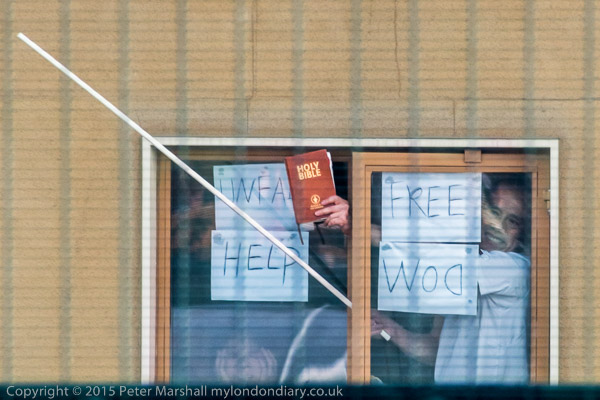
The organisers had mobile numbers for some of those inside – and others inside wrote theirs large and held them up in the window. We were able to hear greetings and reports from some of those inside, their voices on the phone amplified on the megaphone.
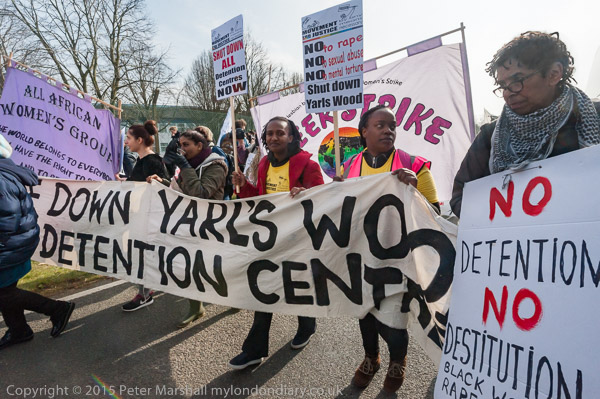
They too could hear the speeches from outside, including several by women who had been held with them inside the prison. Many are held for long periods in this and other detention centres, never knowing when they might be let out – or an attempt made to send them back to the country they were desperate to escape from.
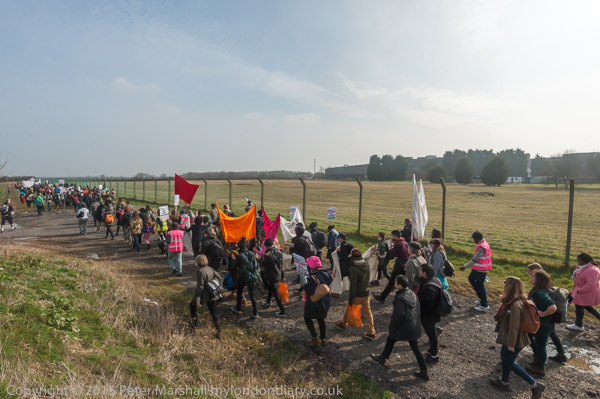
Too soon we had to leave. And they had to stay. As I walked away to catch the coach back to Bedford station I felt ashamed at the way that my country treats asylum seekers. They deserve support and humanity and get treated worse than criminals.


Many more pictures at Close Down Yarl’s Wood.


All photographs on this and my other sites, unless otherwise stated, are taken by and copyright of Peter Marshall, and are available for reproduction or can be bought as prints.