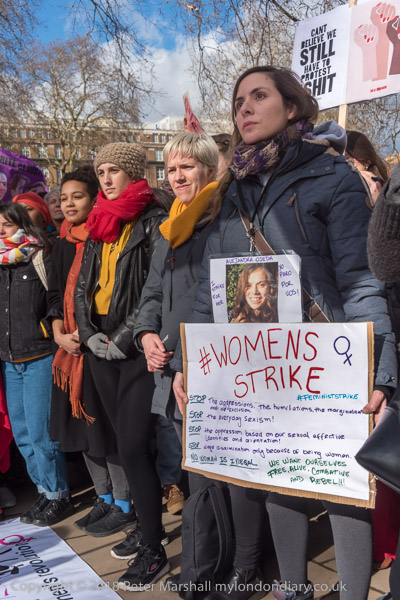
March 8th – Women Strike And Protest

March 8th – Women Strike And Protest. Last year on International Women’s Day I published a long post, International Women’s Day Marches with images from my coverage of them from 2002 until 2020. This year I look back five years to Thursday 8th March 2018 when I covered a wide range of protests, most of which were linked to International Women’s Day


Shut Guantanamo at new US Embassy – US Embassy, Nine Elms
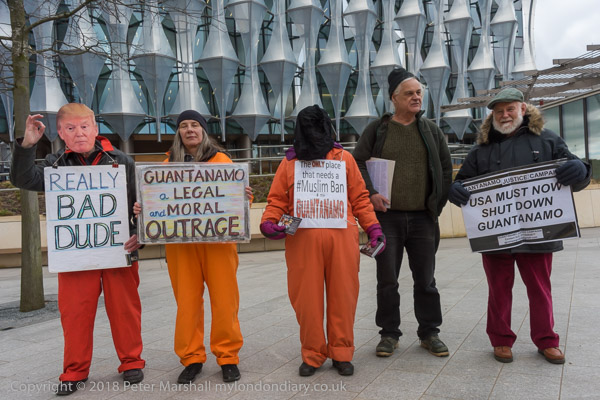
This was the first protest outside the new US Embassy where they intend to continue the regular monthly protests which they have had outside the old embassy in Grosvenor Square since 2007 until the illegal and immoral US prison camp is shut down and all the prisoners released.
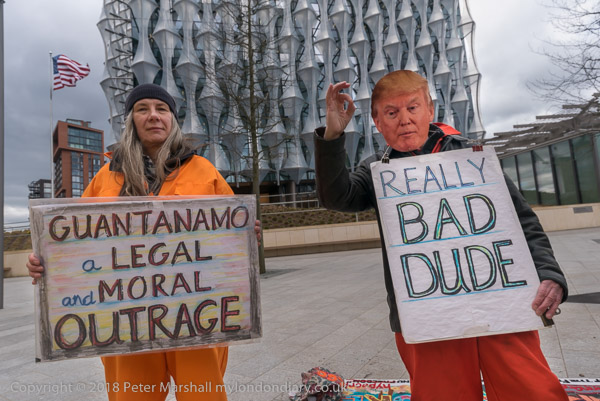
Normally these protests take place on the first Thursday of every month, but in March 2018 the protest scheduled for March 1st was postponed for a week because of snow. Because of the change of date some regular protesters were unable to attend and the protest started a little later than usual as some had problems finding the new location. This was the only event not connected with International Women’s Day I covered on the day.

In March 2018, 41 prisoners remained held at Guantanamo. There was no evidence against most of those held and tortured there that would stand up in any court of law, often simply a matter of suspicion or hearsay or desperate statements made under extreme torture. Many were simply foreigners in the region seized to gain cash rewards from the US forces.

Shut Guantanamo at new US Embassy


Family Courts put on Trial – Old Palace Yard
March 8th - Women Strike And Protest

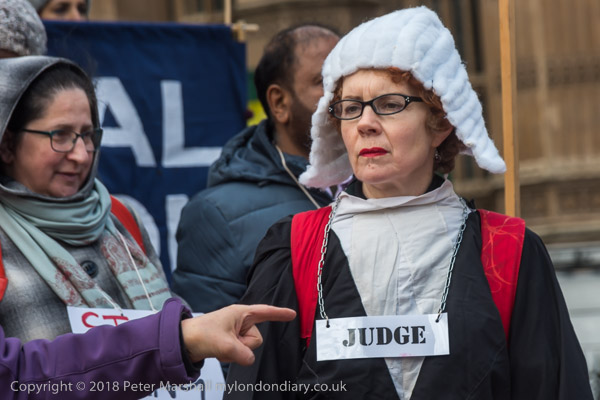
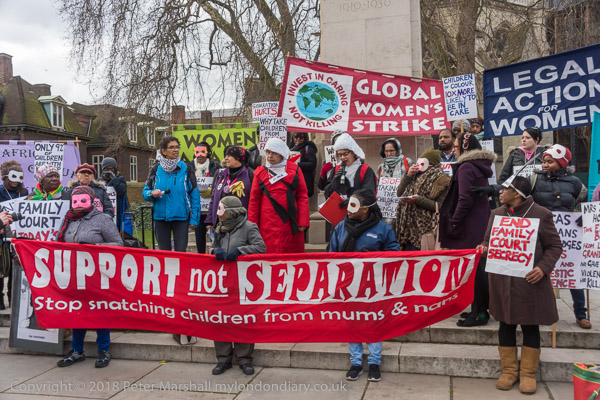
Global Women’s Strike had organised a mock trial of the UK Family Courts in an International Women’s Day protest in front of Parliament.
March 8th - Women Strike And Protest

Among those who spoke were mothers whose children had been unjustly taken away, and statements from others were also read out, along with some shocking comments made in court by judges.
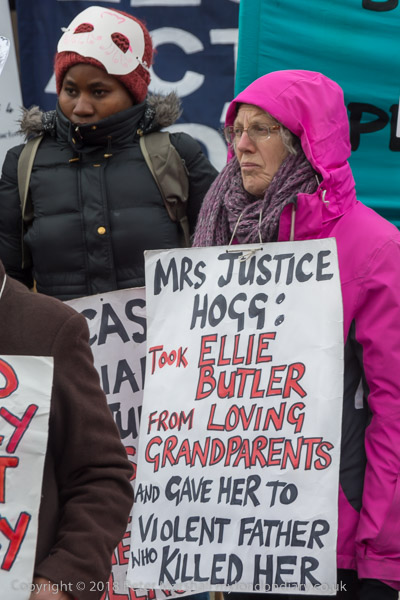
The UK has the highest rate of adoptions in Europe, almost all without consent of their birth family. Families of colour, immigrants and disabled are all disproportionately affected and in some working class areas 50% of children are referred to social services.
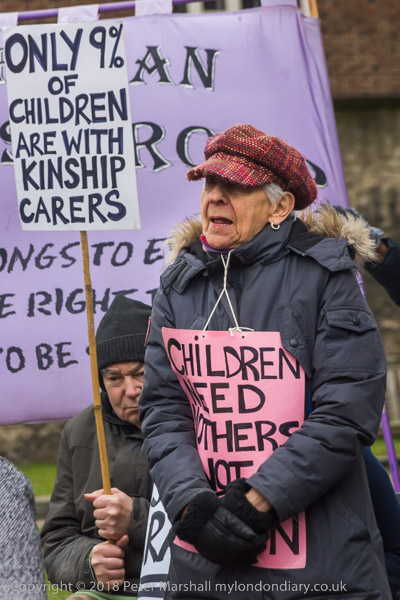
Poverty, often the result of benefit cuts and sanctions and poor housing conditions especially in temporary accommodation is often mistaken for neglect and the help mandated under the 1989 Childrens Act is seldom available. Children are often simply taken into care and then put up for adoption even though they have mothers or grandmothers who are capable of good parenting and only need support.
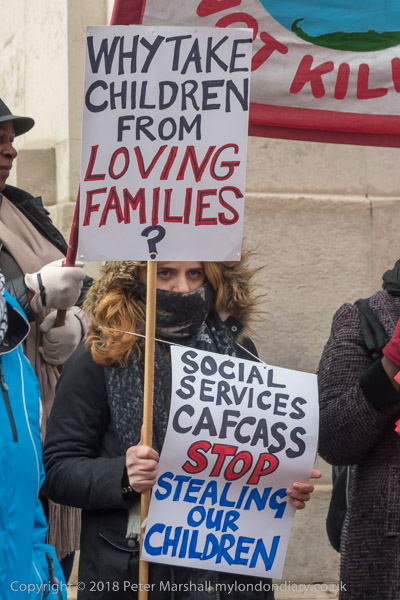
The campaigners say that victims of domestic abuse are often accused of ‘failing to protect’ their children and vague charges such as putting children at risk of future emotional harm and neglect are used by the secret courts to remove children from mothers and grandmothers. They want hearings with proper public scrutiny and an end to the gagging of mothers and familys, a great use of kinship carers and the proper implementation of the 1989 Children Act, and the Care Act 2014 which entitles disabled mothers to extra help.
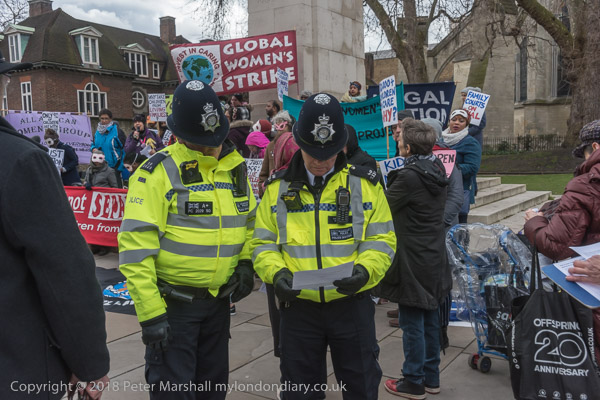
Parliamentary officer Black Rod sent police to try to shut down the protest, but the organisers showed them documents to say they had permission for the protest and to use a megaphone. They seemed puzzled but left.

Family Courts put on Trial


London Women’s Strike – Russell Square
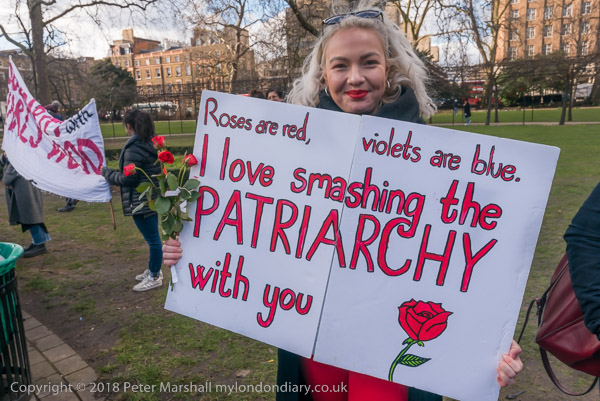
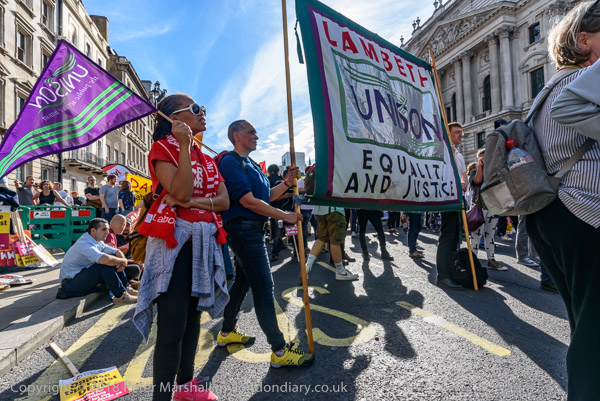
This was the big event of the day and included speeches about a wide range of causes. As the organisers said the “Women’s Strike is a strike for solidarity between women – women of colour, indigenous, working class, disabled, migrant, Muslim, lesbian, queer and trans women” and “is about realising the power we already hold – activating and nourishing resistance.

Many of the women present went on to other protests elsewhere including several protests in support of cleaners at the TopShop and The Royal Opera in Covent Garden, and cinema workers at Picturehouse, calling for an end to immigration detention an in solidarity with the Yarl’s Wood hunger strikers, for Unilever to withdraw its investment in Myanmar where its presence supports a government that has brutally raped, tortured and killed many Rohingya, and supporting sex workers by calling for the decriminalisation of prostitution and I also went to cover some of these

Much more about this event on My London Diary: London Women’s Strike.


Solidarity with Yarl’s Wood hunger strikers – Home Office
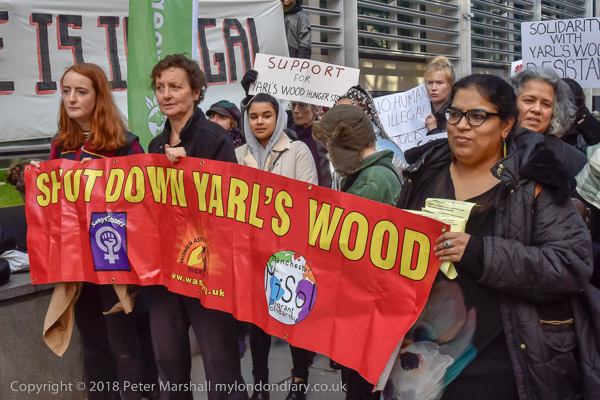
At the Home Office protesters showed solidarity with those held in Yarl’s Wood on International Women’s Day, in particular with those who had began a hunger strike 15 days ago against their imprisonment and the conditions and treatment by the detention centre staff and the Home Office.
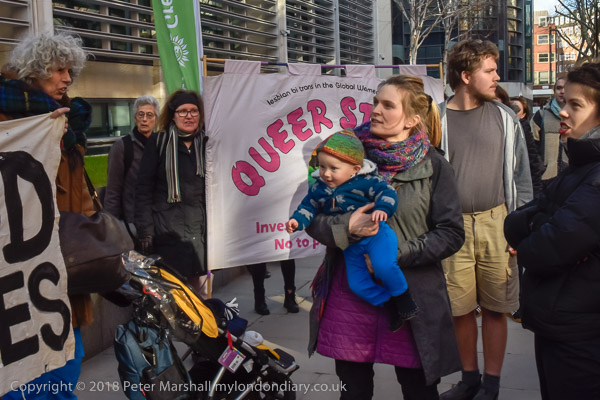
Since then the strike has gathered momentum and escalated into an all-out strike: work strikes, occupations, and a general refusal to cooperate, and long lists of the detainees demands have been published by Detained Voices.

More at Solidarity with Yarl’s Wood.


Reinstate the Royal Opera House 6 – Royal Opera, Covent Garden
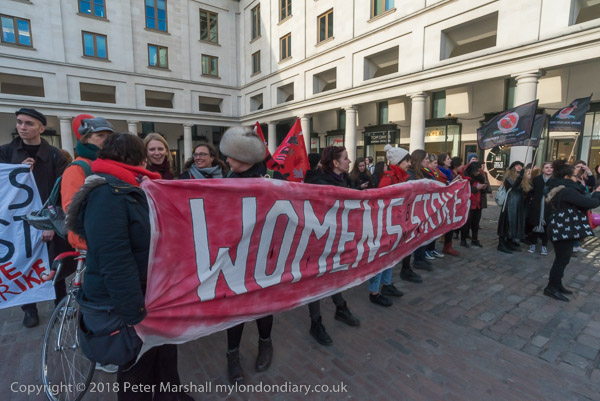
Six members of grassroots independent workers union CAIWU were fired by cleaning services company Kier for their jobs at the Royal Opera House, another disciplined and a sixth was on final written warning. They were clearly being victimised folloing successful trade union action which had forced Kier to pay its workers there the London Living Wage.
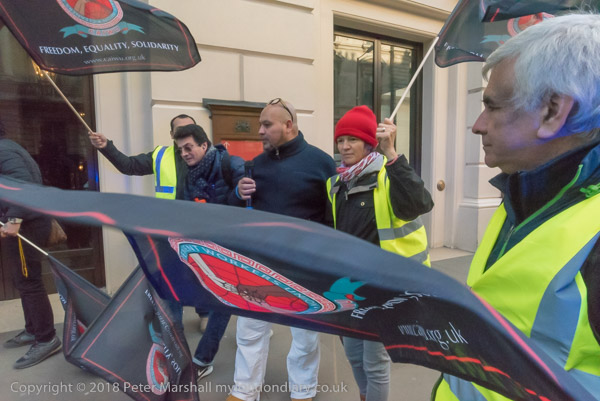
The large and loud action with union members augmented by women from the Women’s Strike blocked Drury Lane for some minutes. Police arrived, talked to the protesters and then went inside to talk to the managers inside before emerging, carefully removing poster and fliers the protesters had left on their car before driving off. The protesters later moved back into Covent Garden Market leaving the road free.

More at Reinstate the Royal Opera House 6.


& Myanmar’s Rohingya genocide – Unilever House
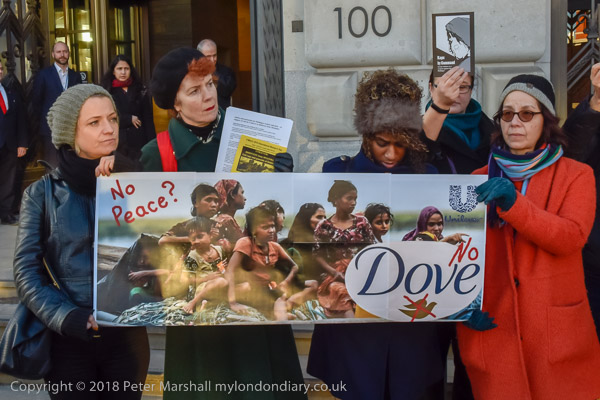
Women from the Women’s Strike called on Unilever to disinvest from Myanmar where they have a $667 million investment.
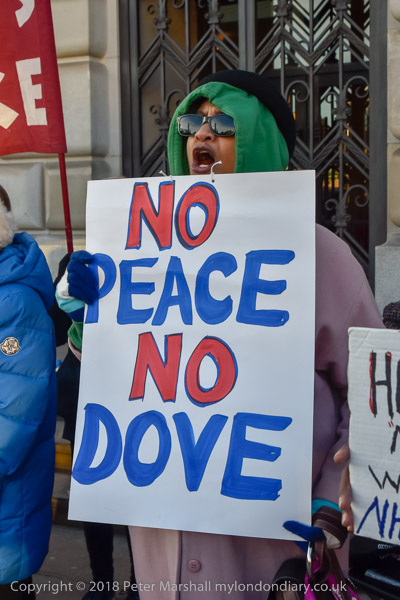
The military government there are committing systematic rape and other torture with total impunity as part of their genocide against the Rohingya people. Unilever claims, especially in its marketing for Dove products to respect the dignity and rights of women and girls and says it “aims to improve safety for women and girls in the communities where they operate.”

More at Unilever & Myanmar’s Rohingya genocide.
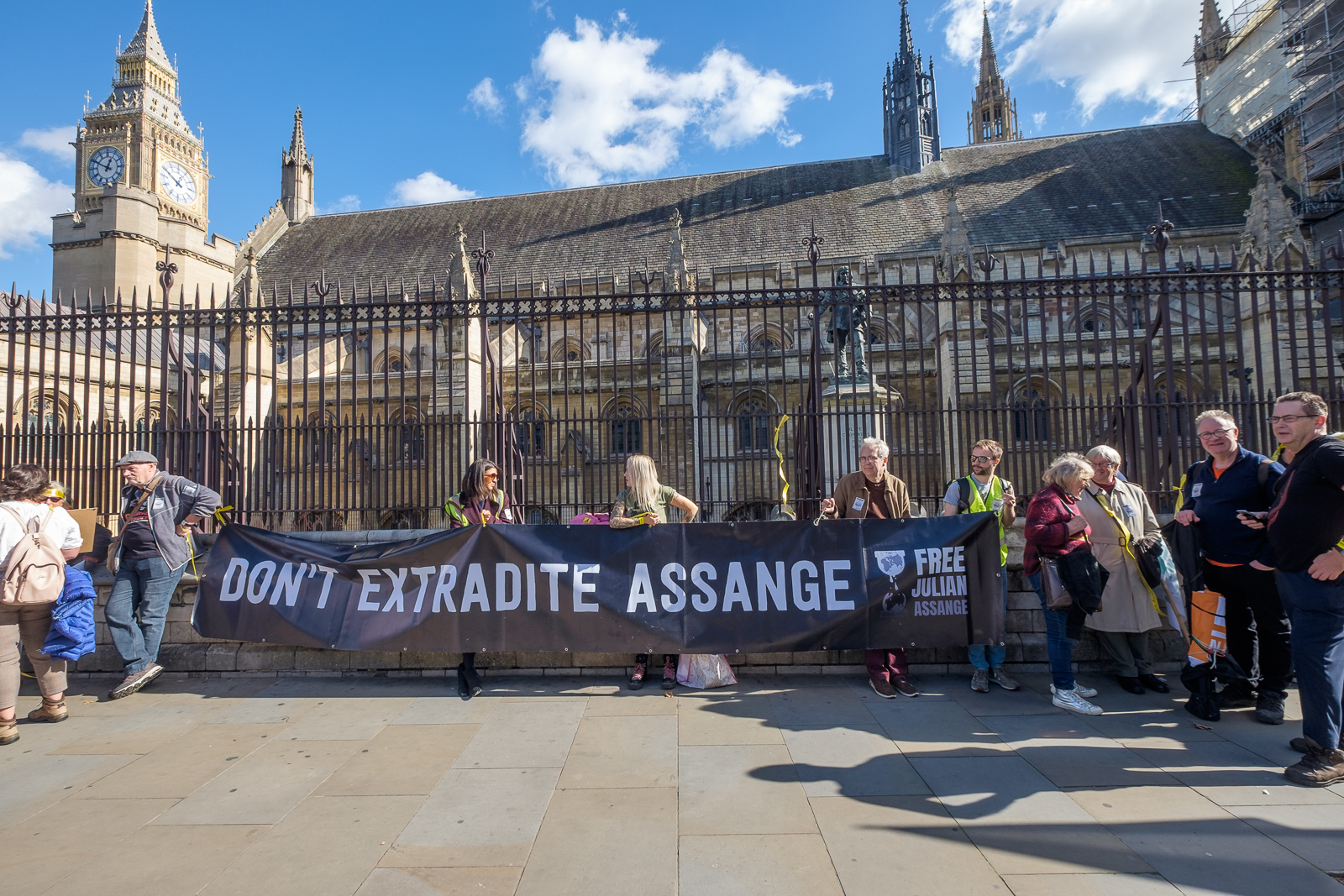

Human Chain Around Parliament – Free Assange!

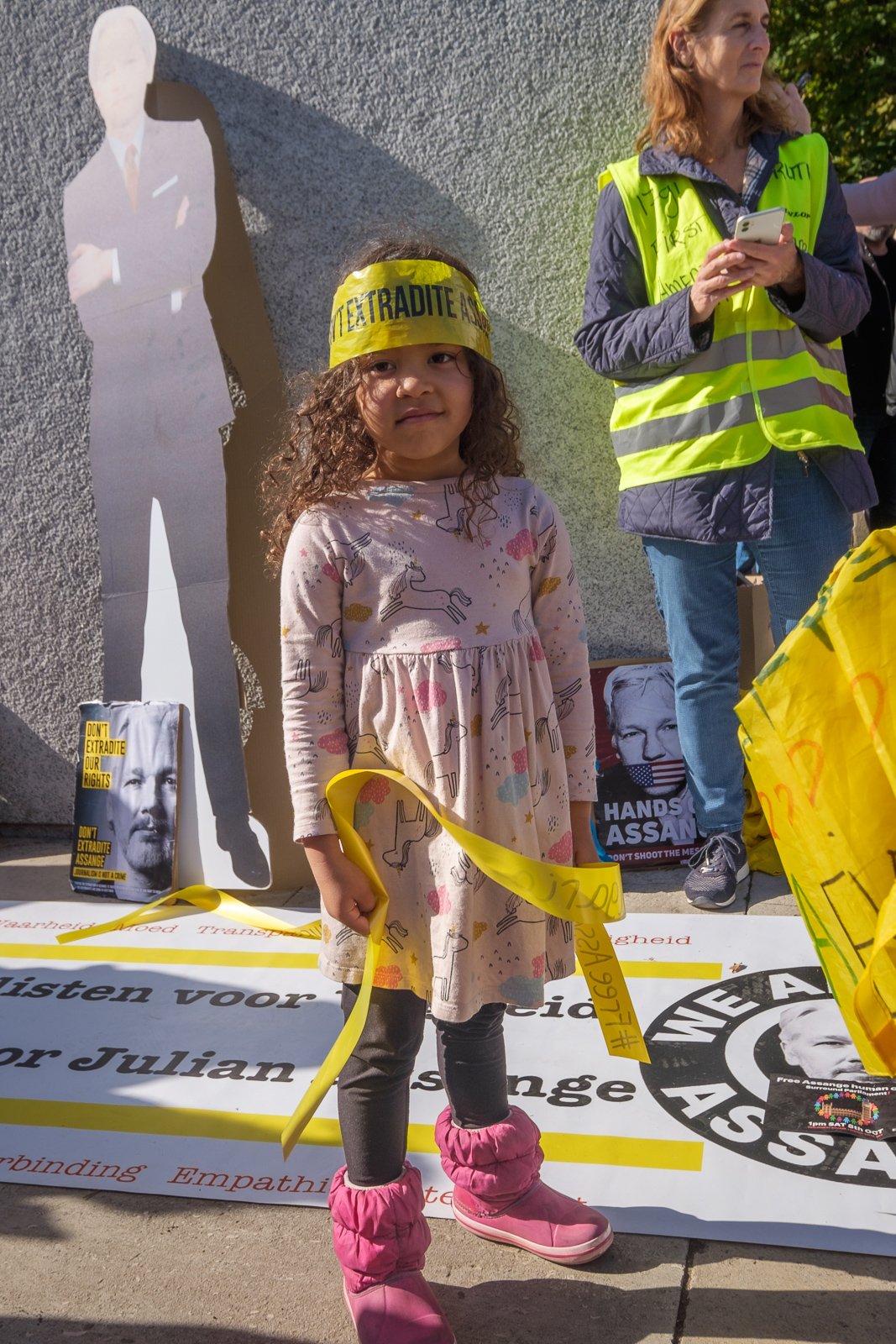
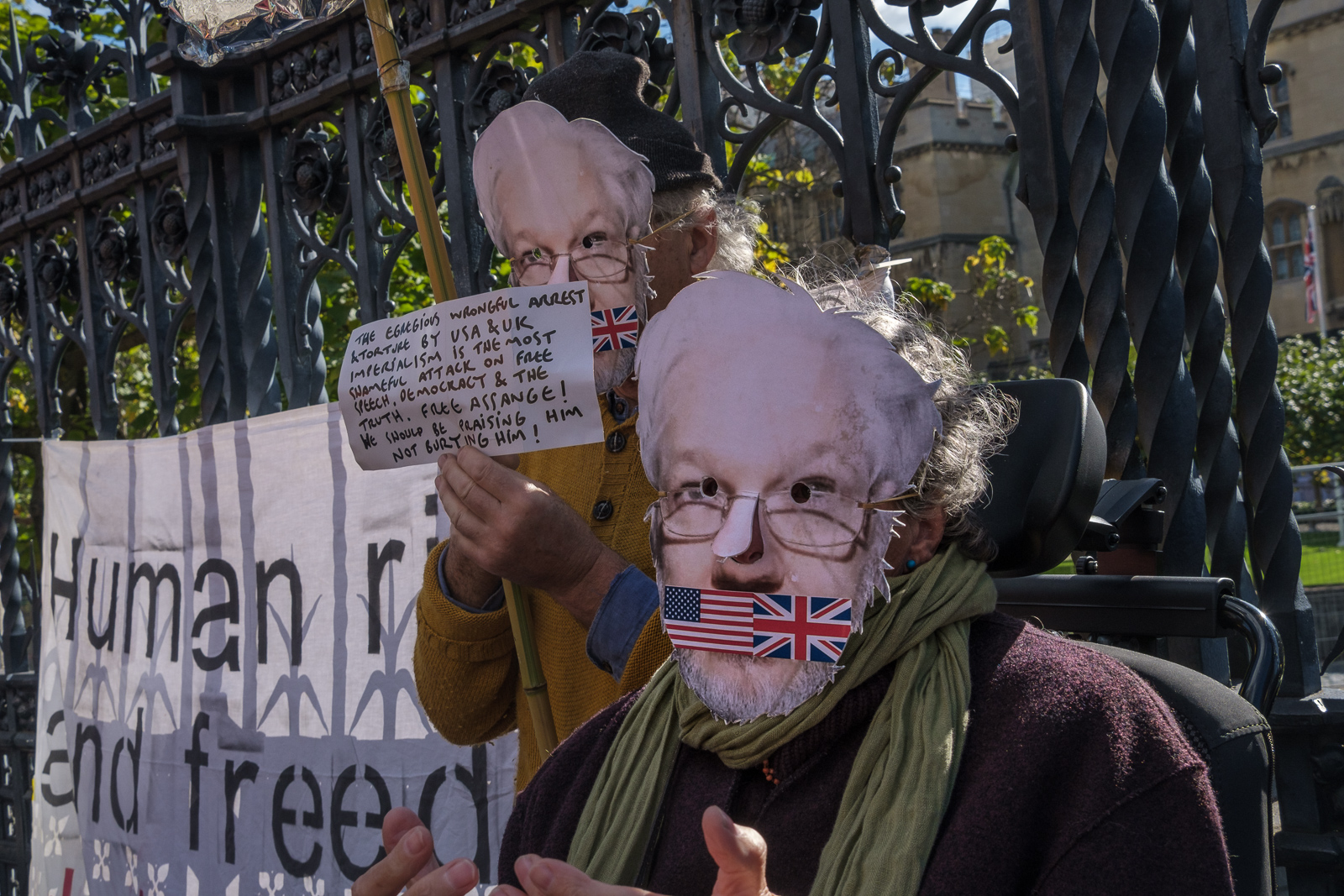
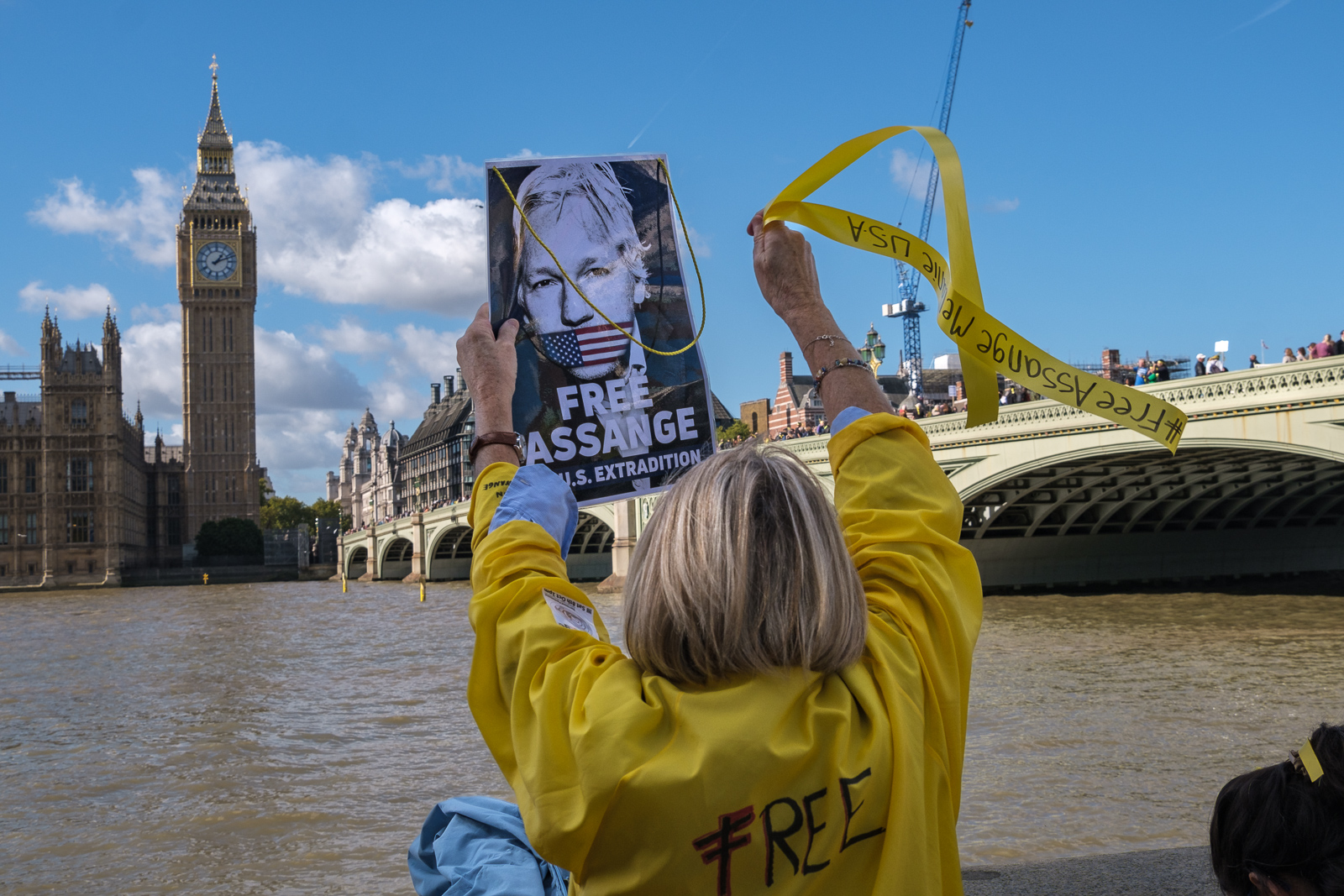
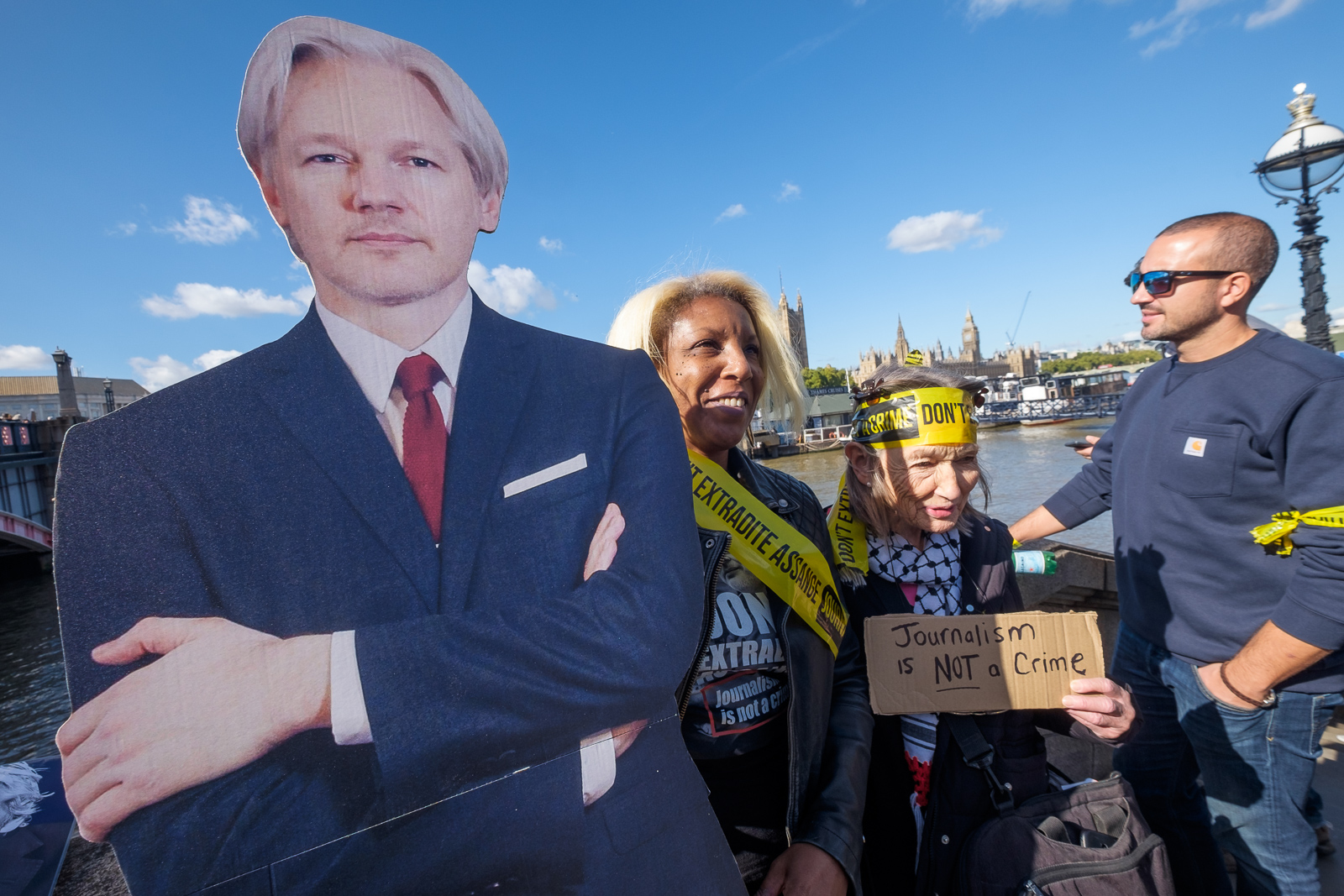
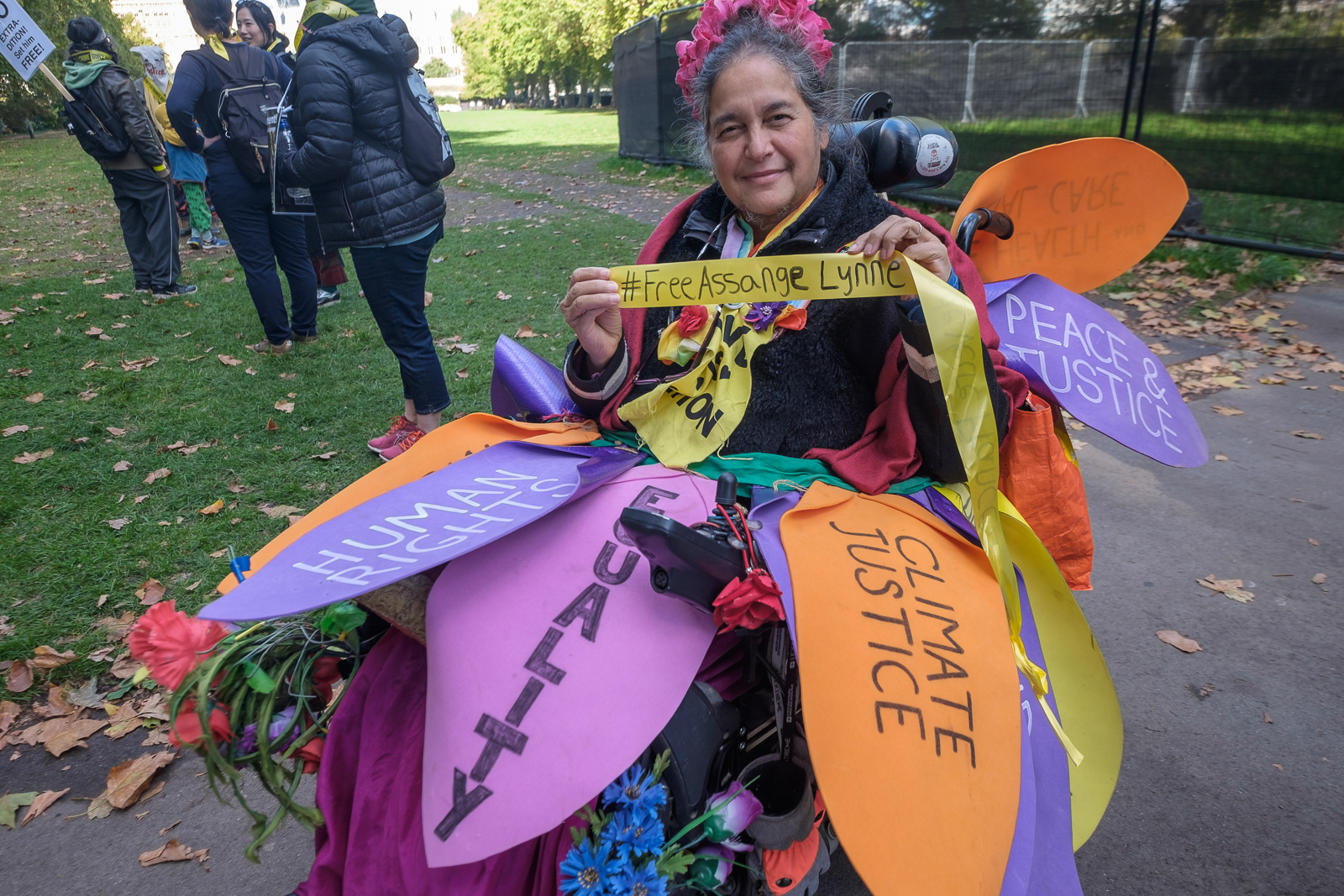
Last Saturday, 8th October 2022, I photographed a protest in London against the imprisonment and possible extradition of Julian Assange, currrently held in the UK’s maximum security jail at Belmarsh.

Human Chain Around Parliament - Free Assange!

Assange’s “crime” was to publish documents about US war crimes in Afghanistan, Iraq and elswhere, making documents downloaded by Chelsea Manning, making them available after suitable redaction to protect the individuals concerned to the world’s press and to the public on WikiLeaks. Wikipedia has a good and fairly detailed entry on him which most of the details here come from.

Human Chain Around Parliament - Free Assange!

If extradited to the US he would be put on trial in a area where the jury would be composed of people from an area with strong connections to the US security services who will already have pre-judged him as guilty. His sentence is likely to amount to 175 years in a US maximum security jail, probably in isolation and never to be freed.

Human Chain Around Parliament - Free Assange!

In 2010 Sweden issued an extradition warrant for him on allegations of sexual misconduct, which were widely seen as a pretext to enable him to be extradited from Sweden to face criminal charges in the USA. When in 2012 he lost his fight against extradition to Sweden he jumped bail to take refuge in the Ecuadorian Embassy in London, where he lived in highly restricted accomodation until 2019.

A new government in Ecuador decided to end his asylum in the embassy and invited police in to arrest him in April 2019; he was then sentenced to 50 weeks in jail for breaching his bail. The Swedish sexual charges against him were dropped later in the year, but the USA immediately began proceedings to extradite him to face trial under the US 1917 Espionage Act.

The decision to use this Act has been widely criticised in the press and elsewhere as being an attack on the First Amendment to the United States Constitution, which guarantees press freedom. And if Assange is guilty then it seems clear that the editors of the newspapers that published the revelations he made in publising the Baghdad airstrike Collateral Murder video, the Afghanistan war logs, the Iraq war logs and other material could also be prosecuted. Even my publishing the link to the video could be a crime.
Assange’s sentence was completed in September 2019, but he was kept in jail because of the US extradition claim. He had been visited earlier by Nils Melzer, the United Nations special rapporteur on Torture and Other Cruel, Inhuman or Degrading Treatment or Punishment, who, as quoted on Wikipedia found “in addition to physical ailments, Mr Assange showed all symptoms typical for prolonged exposure to psychological torture, including extreme stress, chronic anxiety and intense psychological trauma.”
After a protracted hearing including much medical evidence, a judge on 4 January 2021 ruled that Assange could not be extradited to the USA on grounds of mental health and the suicide risk in a US prison cell. The USA appealed the decision, and Assange remained in jail. The High Court rejected much of the medical evidence, believed the US lies of fair treatment made and found in favour of the USA on 10 December 2021.

In April his extradition was formally approved in court and referred to Home Secretary Priti Patel, who approved it in June. But the legal battle continues with a new appeal. Essentially Assange has now been locked up for 10 years. Wikileaks has continued his work in releasing information in his absence. The continuing persecution by both the UK and USA for revealing their war crimes seems spiteful and malicious.
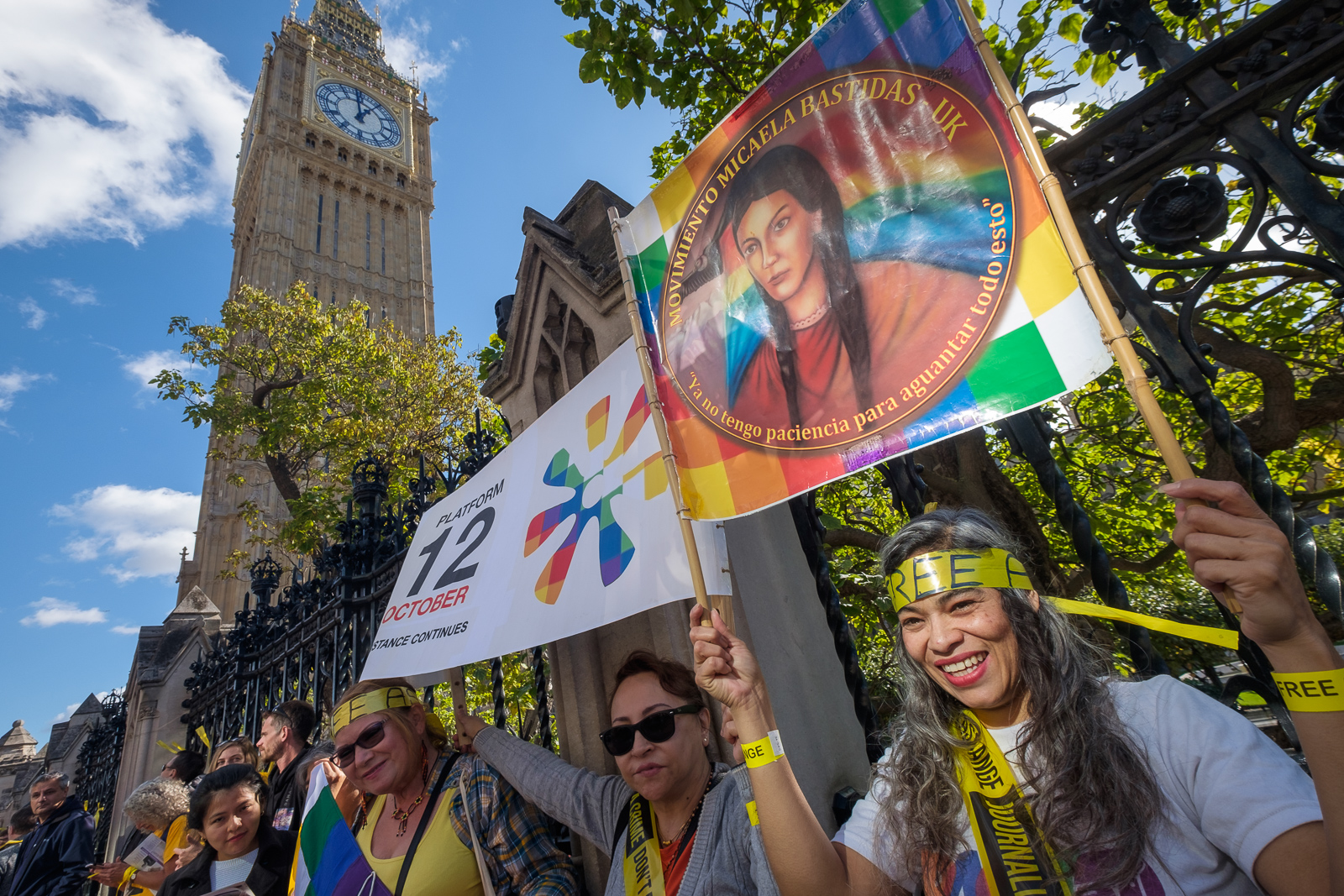
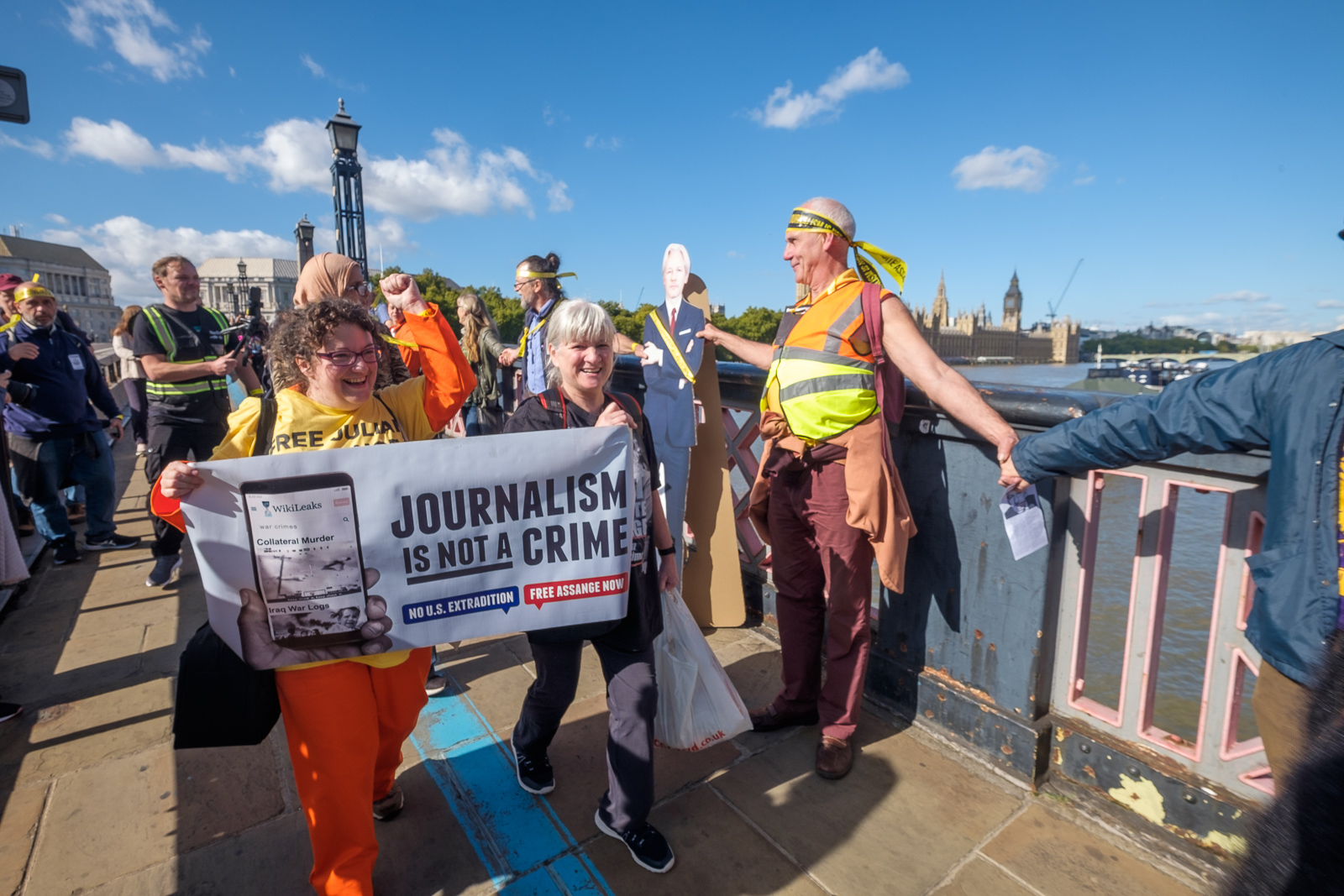
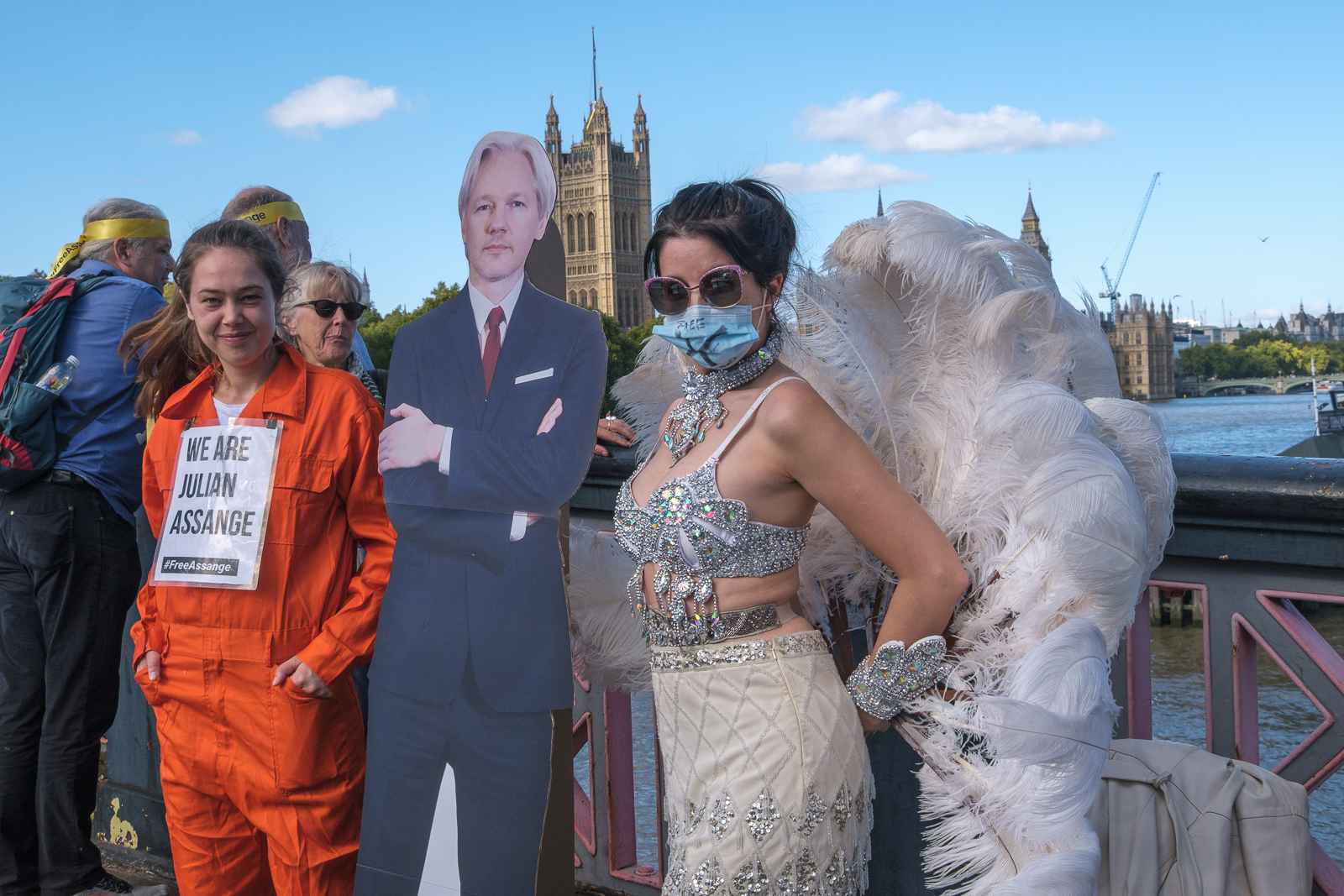
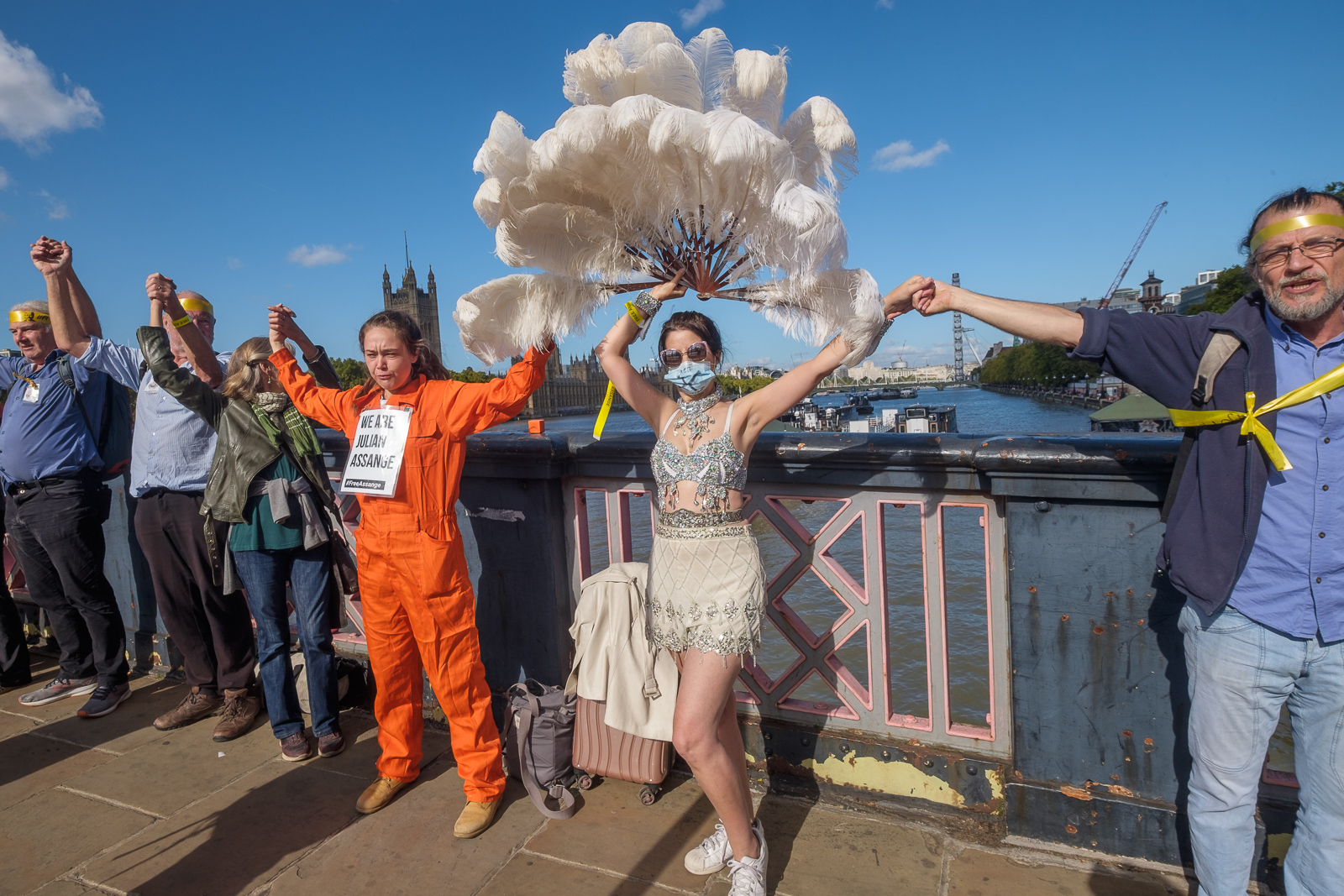
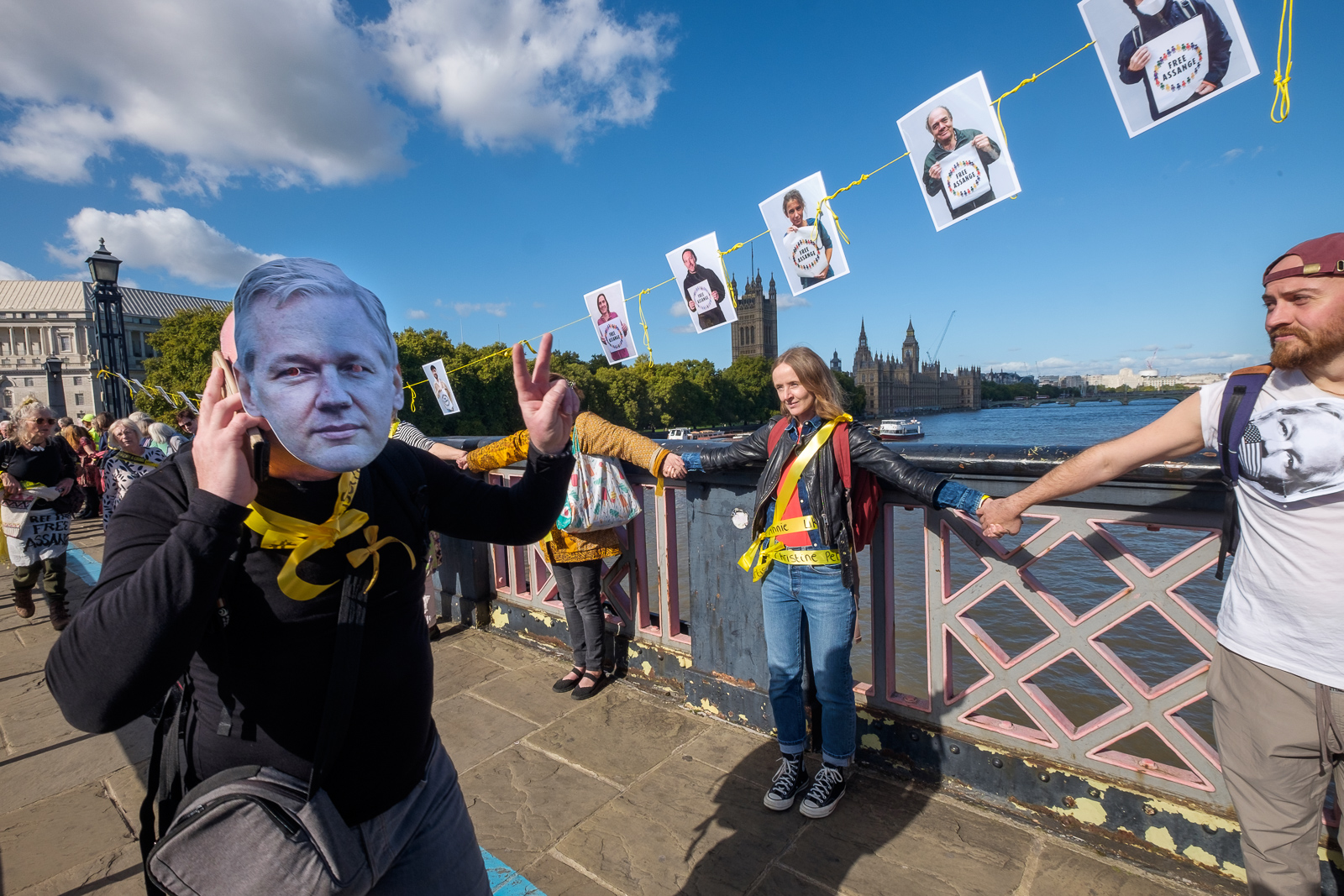
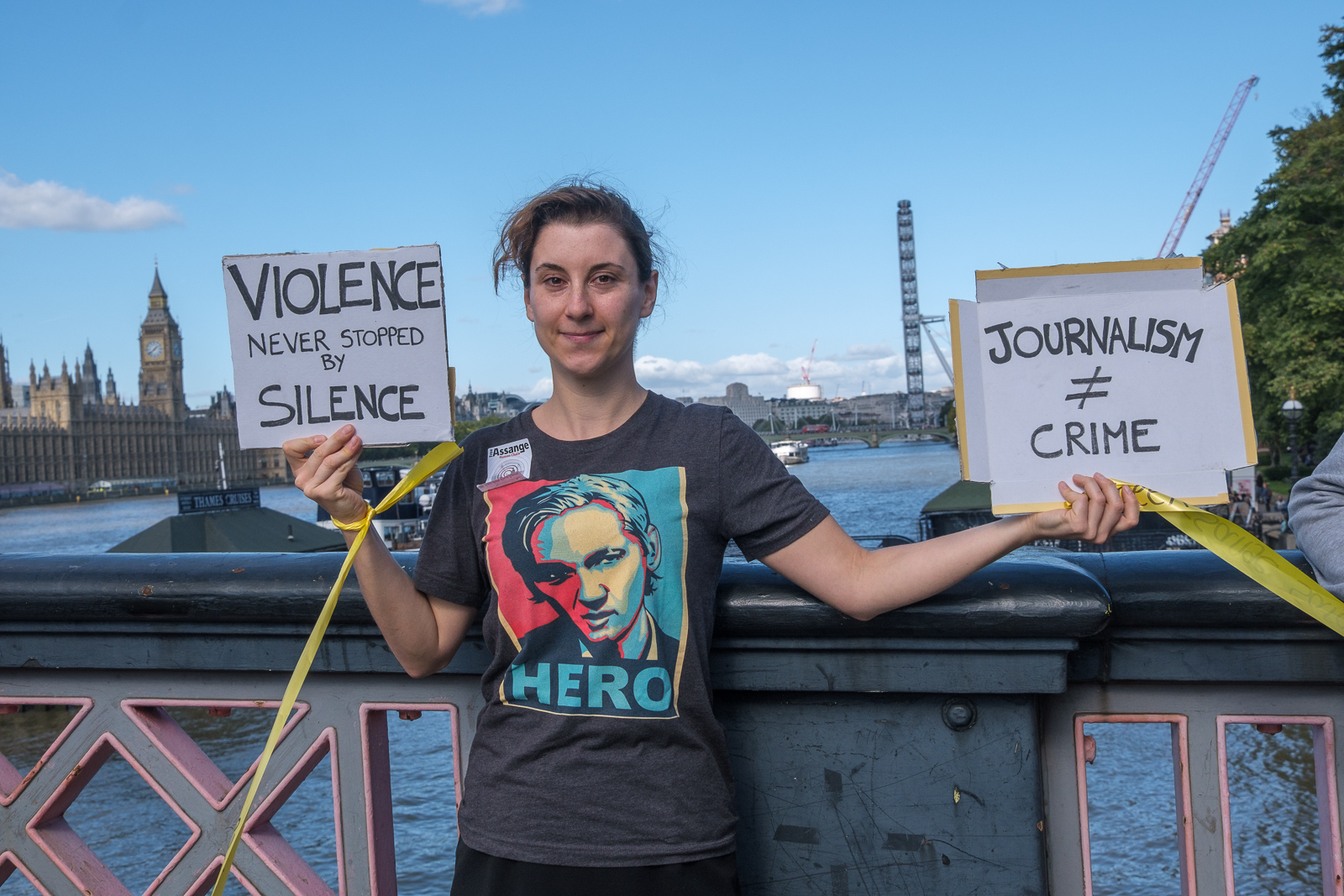
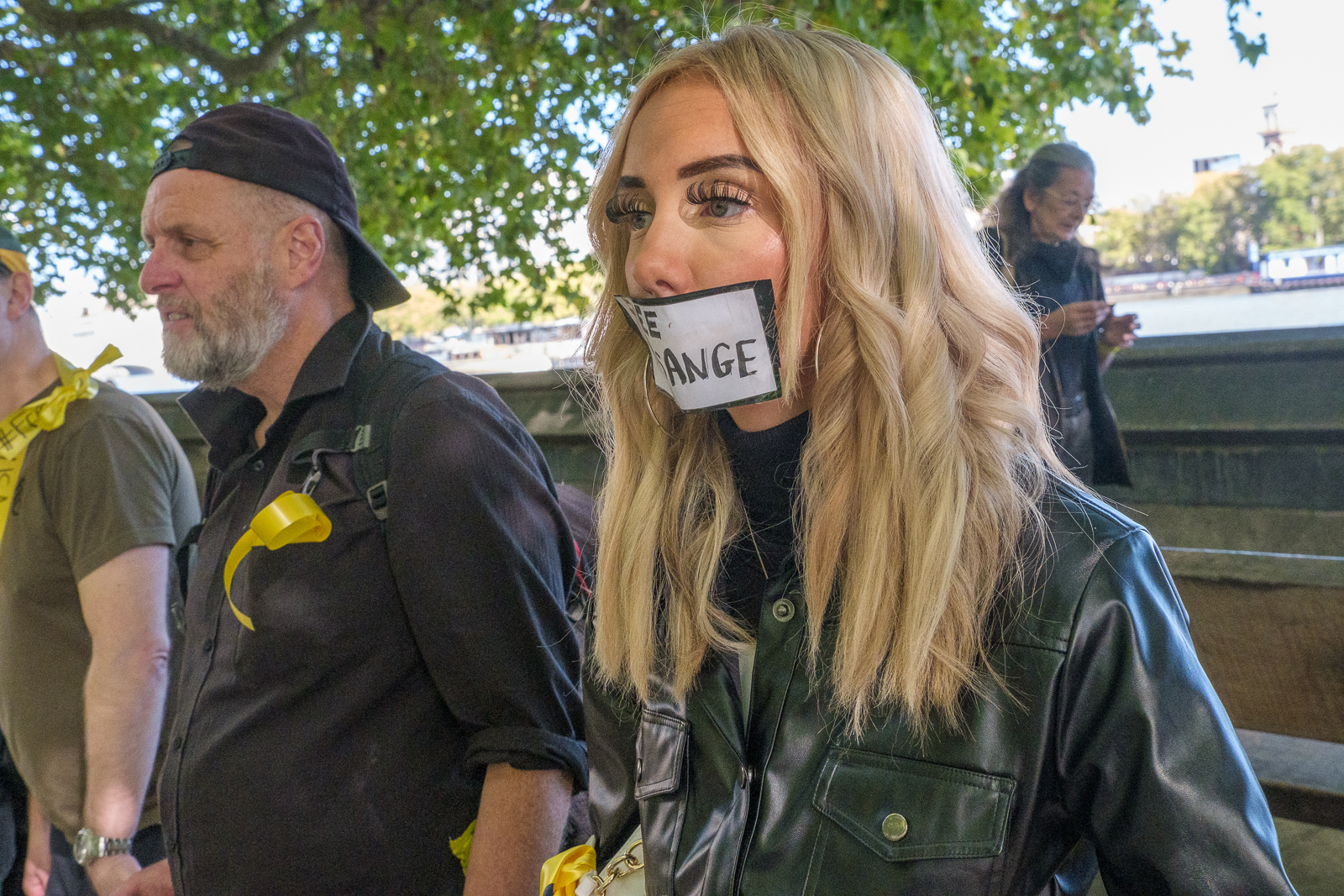
On Saturday 8th October I photographed a protest in London by around 10,000 people who formed a human chain calling for Assange to be freed and not to be extradited around the Houses of Parliament, crossing the river on Westminster Bridge and returning across Lambeth Bridge, a distance of a little over two kilometres.

It’s difficult to know how many took part, but there seemed to be enough people to join hands, with quite a few to spare in some parts where people were shoulder to shoulder and some to spare. The organisers had thought they would need around 5,000 so I think it was probably rather more than that; estimates I’ve seen range from 3,000 to 12,000. But as well as those present in person, many unable to get to Londonwere represented by yellow sashes with their names on them.

When I arrived people were tying these to the railings around the Houses of Parliament, but police came to remove them, handing them back to the protesters. They said nothing was allowed to be fixed to the railings. Many of the protesters held or wore the sashes for the protest, and although I don’t often take part in the protests I’m photographing, most of these pictures were taken by me with a sash reading ‘#Free Assange Monique Dits Belgium‘ around my neck.

At around 1.30, rather later than planned people were told to link hands and they chanted ‘Free Assange’ and other slogans for a few minutes. I’d chosen to be on Lambeth Bridge for this as I could then take photographs with the Houses of Parliament seen across the Thames in the backgound.

After taking some there I made my way along the rest of the chain back to Parliament, on my way passing John McDonnell being interviewed by a videographer. Normally I would have stopped to talk to him, but by now I was rather tired, still suffering a little from my booster jab the previous day and I carried on, past a small crowd of people with video and still cameras three or four deep around Jeremy Corbyn. But I’d decided he wasn’t really the story and carried on. I’ve photographed him enough times over the many years I’ve known him.

You can see more of the pictures I made in the album Human Chain Around Parliament Says Free Assange.


Funeral for Cyclists, Against Islamophobia, Iranian Repression

London, Saturday 13th October 2018


National Funeral for the Unknown Cyclist

I’ve been a cyclist since my sixth birthday, when my parents bought me a second-hand two wheeler to replace the trikes I’d been on since before I could walk. By the end of the day I could ride it, if rather unsteadily, along the pavement of our street.

The bicycle gave kids like me a new freedom, and within a couple of years I was riding miles either on my own or with a couple of mates to play both in local parks and green spaces and further afield. We cycled away from our dusty streets into the countryside, often going along some of the busiest roads in the country, the A30, A4 and A3 out west from our grey suburbs.

We didn’t think much about safety back then, and though traffic was heavy, vehicles were smaller and speeds were lower. Drivers were I think more considerate back then, and almost all will have been cyclists before getting behind the wheel. So I survived, though there were a few close shaves, later mainly thanks to teenage stupidity.

Over seventy years later I still ride a bike, though with rather larger wheels, and usually just to the local shops, but I feel less safe on the roads. I’ve been knocked off it a couple of times in the past twenty years or so, both times by drivers who were extremely apologetic and confessed they hadn’t seen me as they drove out onto a main road or came up behind me on a roundabout. I was lucky and only sustained minor cuts and bruises and the motorists paid for the repairs to my bike.

During the first Covid lockdown the roads were almost empty and I went out each weekday morning for a ten-mile ride to keep fit. But then traffic began to come back and the fumes and too many close passes put me off the roads again.

In the past few years we seem to have come out of the long era where cyclists were almost completely disregarded in terms of traffic planning (and pedestrians too) but still we are largely failing to get the kind of separate provision to make cycling more safe that we see in some European countries.

Some councils are still dementedly anti-cyclist, and too many drivers see cyclists as an impediment to their progress rather than as fellow road-users. Some still accelerate past me then cut in across me to turn left at junctions, some pass where there is clearly not enough room to do so safely and some even shout insults as the drive past.

Cycling is good for individual health and for the health system as a whole, though less than it should be because of the pollution from traffic. By reducing car journeys it is good for the environment too, and good for motorists as people switching to bikes cuts congestion in cities. As a country we should be spending far more to encourage it and make it safer. In particular that means more separate provision – fears over safety when bikes are on busy roads is one of the main things that stops many getting on bike, but also driver education and improvements in vehicle and road design.

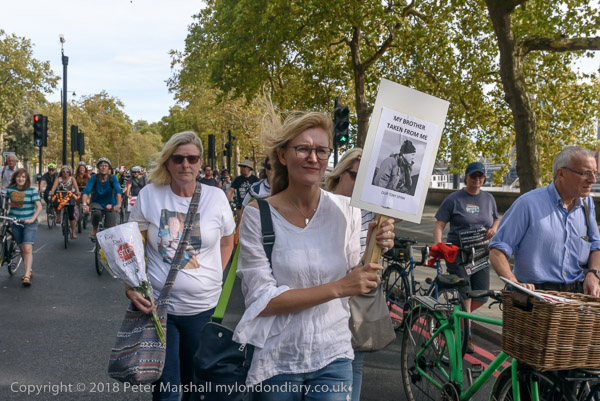
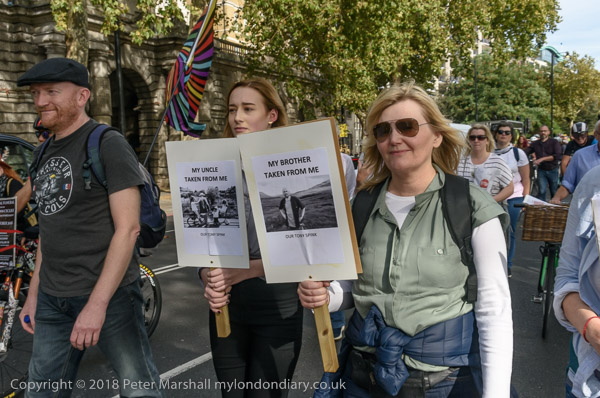
Among those at the protest were a number of families whose members had been killed on our roads, including some from Tony Spink’s family. He was killed cycling through Wakefield city centre by a lorry driver who didn’t stop, dragging him under his lorry as he hung onto the windscreen wipers and thumped on the side of the truck. His mangled bike was pulled from the lorry by the driver at a layby and then dumped in bushes miles away. The driver was jailed for two years. This was an extreme case but the sentence seemed risibly short, as are many of the sentences given to drivers who kill both cyclists and pedestrians.

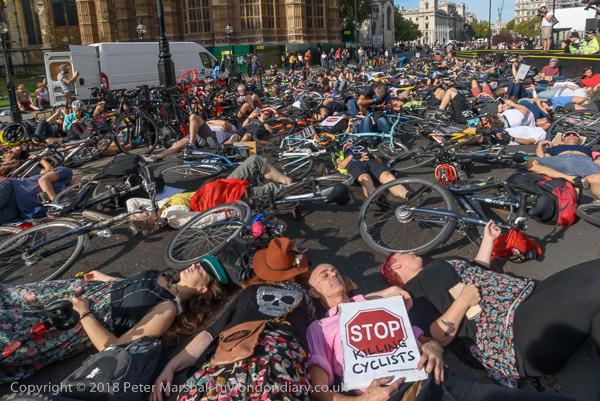
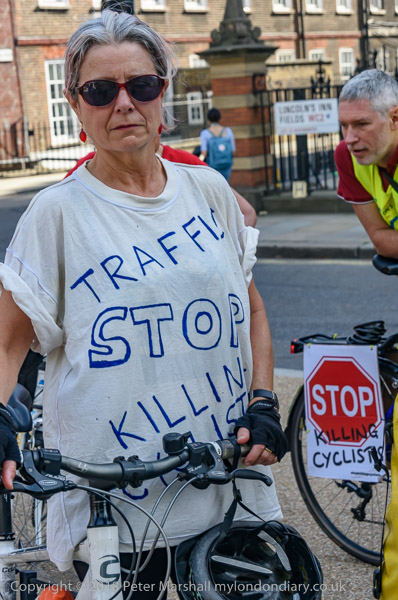
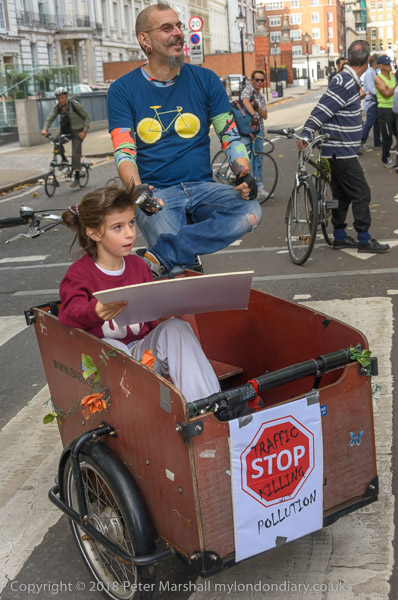
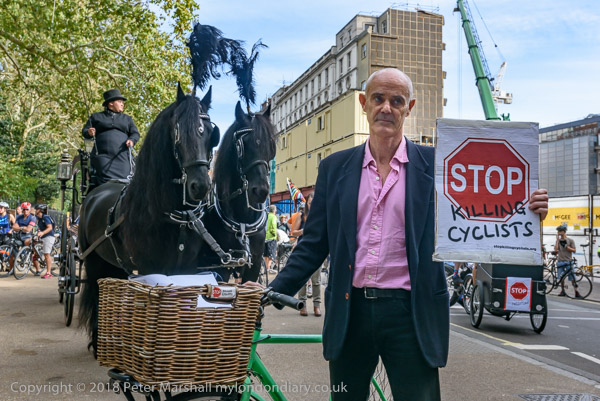
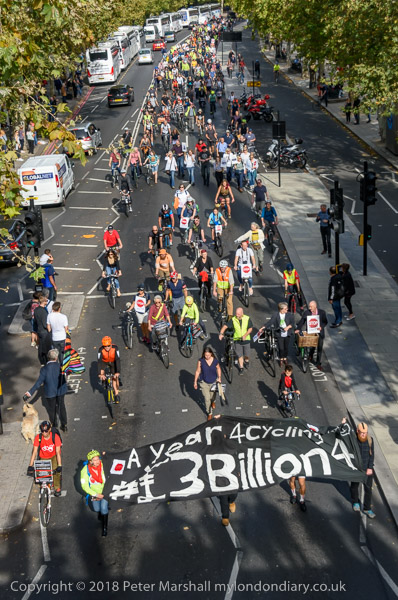
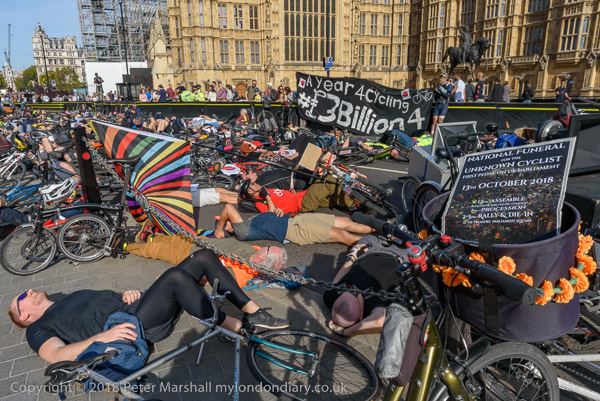
Protests by Stop Killing Cyclists such as this National Funeral for the Unknown Cyclist have publicised the problem and the organisation lobbies for £3 billion a year to be invested in a national protected cycling network and for urgent action to reduce the toxic air pollution from diesel and petrol vehicles which kills tens of thousands of people every year, and disables hundreds of thousands.

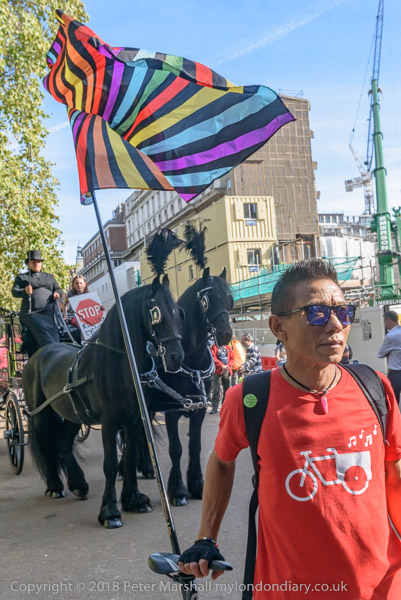
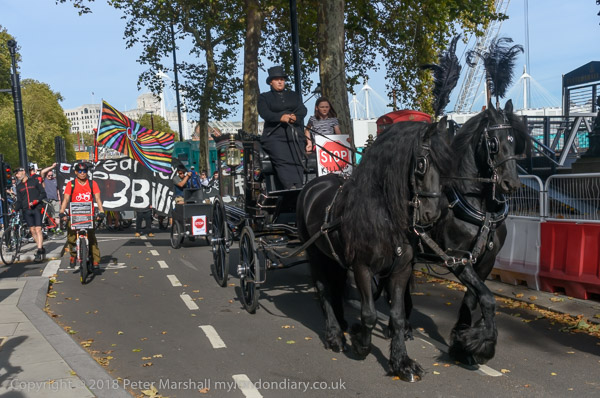
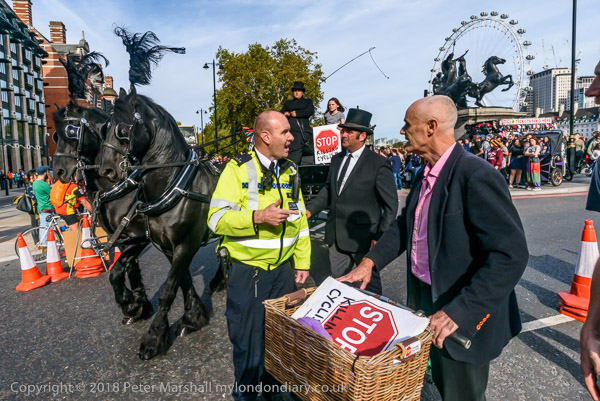
Several hundred protesters on bicycles met in Lincolns Inn Fields before riding in a funeral procession behind a horse-drawn hearse to Westminster where instead of following the route the police wanted across Westminster Bridge they turned into Parliament Square and staged a 10 minute die-in before proceeding to a rally in Smith Square.

National Funeral for the Unknown Cyclist


Rally opposes Islamophobic DFLA – Parliament St

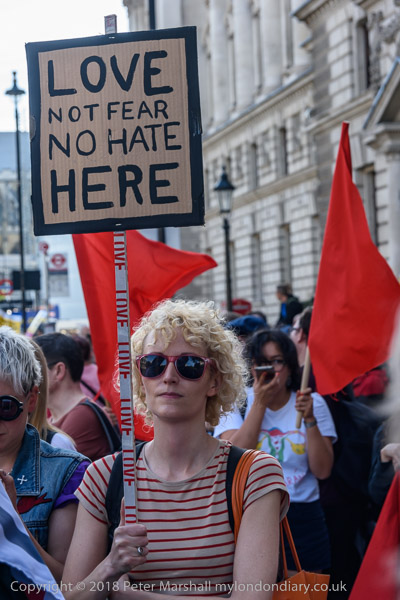
I left the National Funeral for the Unknown Cyclist as it went on to Smith Square and walked up Parliament Street to a rally opposing the racist, Islamophobic Democratic Football Lads Alliance who were ending their march with a rally at Downing St.

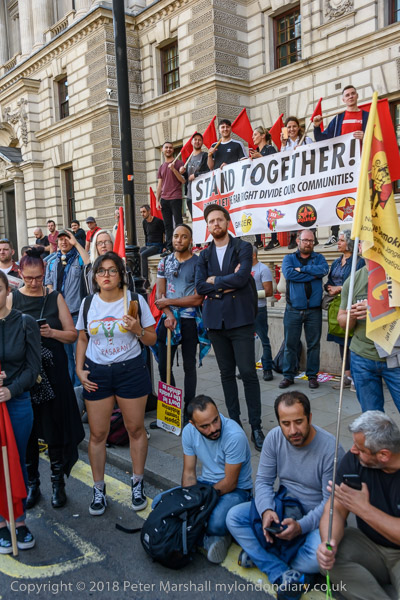
Stand Up To Racism and Unite Against Fascism had organise a rally here, but the DFLA marchers had not arrived at the expected time. Far fewer than expected had turned up for their march, and it had been blocked for some time by more militant anti-fascist protesters on the route.

Some of the DFLA had given up and gone to pubs along the route, but a few had walked across St James’s Park to Parliament Square from where they shouted for a while at the SUTR/UAF protest as police stopped them from getting closer, and after a while persuaded them to move away. The number who finally arrived for their rally was rather small and it didn’t seem worthwhile to take a long walk around the police barricade to try to photograph them.

Rally opposes Islamophobic DFLA


Ahwazi protest Iranian repression – Parliament Square

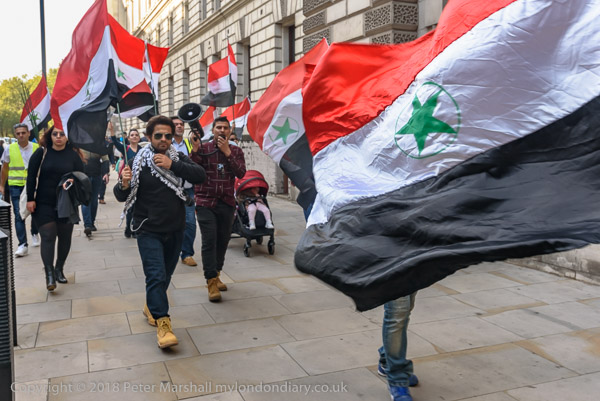
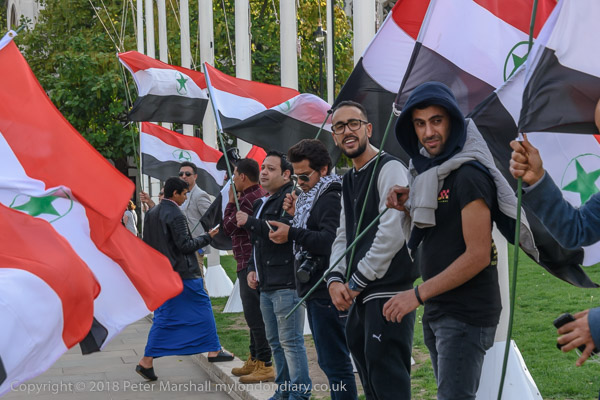
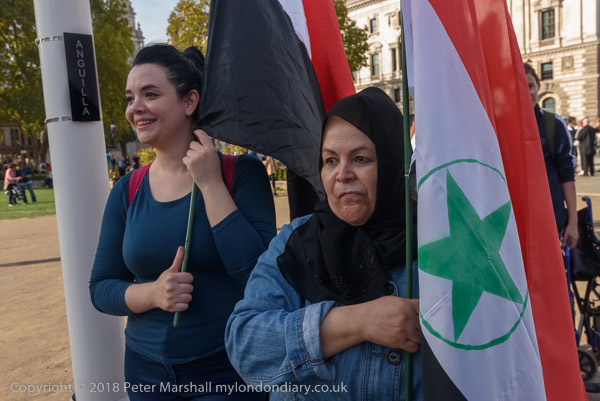
Instead I went back to Parliament Square where I met Ahwazi protesters marching into the square carrying Ahwaz independence flags. They protested noisily facing the Houses of Parliament calling for Iran to end the repression of their people and to get out of their land.

Al Ahwaz, the oil-rich northern side of the Persian Gulf was under British control until 1925, with the population enjoying considerable autonomy as Arabistan. The emirate was dissolved by the Persian regime following a rebellion in 1924 and the area occupied by Persian troops, and a process of ‘Persianisation’ imposed on the area, attempting to destroy its Arab culture. They renamed the area Khuzestan.

Discrimination against the Ahwazi increased under the Islamic Regime, impoverishing the area which contains much of Iran’s natural resources and there has been widespread civil unrest since 2015, with massive protests in April 2018 on the anniversary of the 2011 Ahwaz Day of Rage, itself an anniversary of the 2005 unrest. In September 2018 militants from the
Ahwaz National Resistance attacked an Iranian Revolutionary Guard parade in the city of Ahvaz, killing 25 soldiers and civilians.

Ahwazi protest Iranian repression


Arms Fair Protests Come To Central London

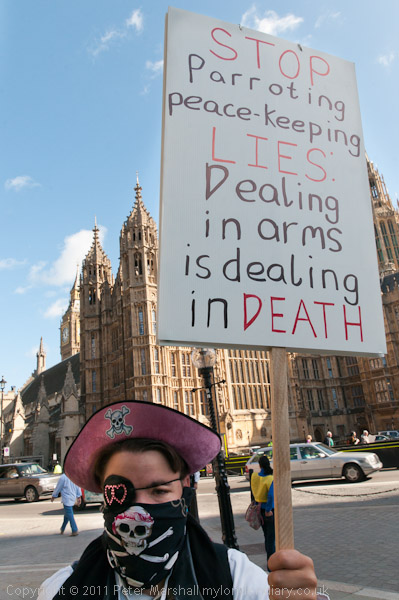
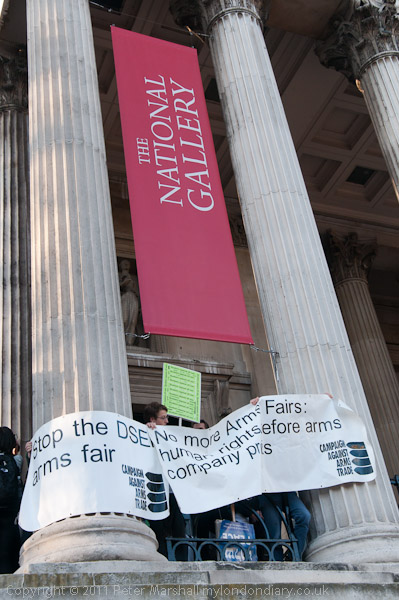
On Tuesday 13th September 2011, protesters against the worlds largest arms fair being held at the Exel Centre in East London brought their protests to some of the companies selling arms and to key sites including Parliament Square and th National Gallery which was hosting a dinner for the arms traders and their customers, including representatives of many of the most repressive regimes around the world.

Arms Fair Protest At Parliament, Old Palace Yard, Westminster

Arms Fair Protests Come To Central London
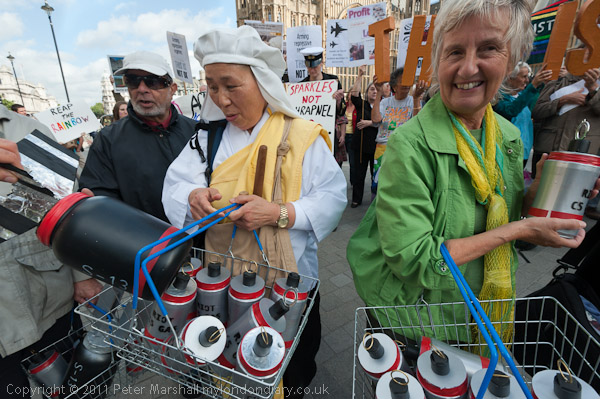
A queue with loaded baskets waits to pay at the arms fair supermarket opposite Parliament

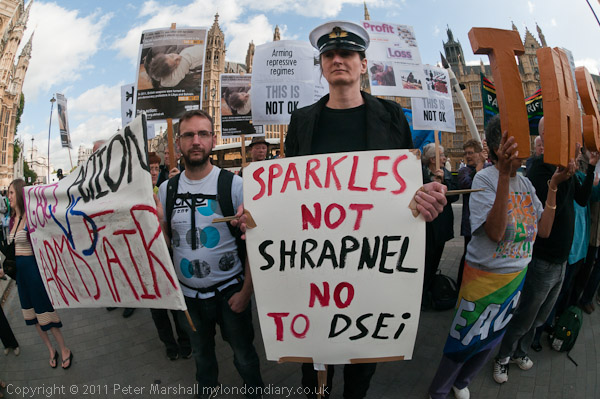
Around 250 people came to protest against the DSEI arms fair which was opening that day in East London. Many were people who had been protesting at the site of the fair during the previous week. The fair is the largest in the world, a private event supported by the UK government, and despite government denials, many deals are made there for illegal arms and arms are sold to some of the worlds most repressive regimes who use them against their own civilians.

Arms Fair Protests Come To Central London

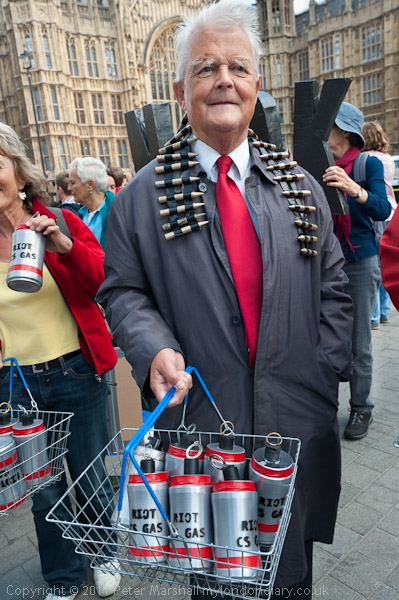
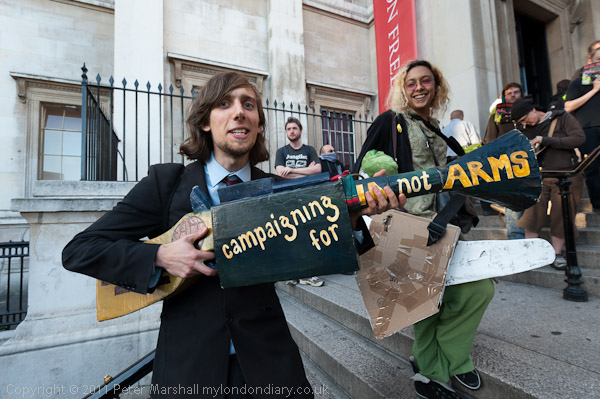
Many had come with posters and placards, but organisers CAAT (Campaign Against Arms Trade) came with fake arms to set up a supermarket where people could queue to buy riot gas, guided missiles, ammunition and other essentiaql supplies to keep their population down.

Arms Fair Protests Come To Central London - Bruce Kent
Bruce Kent with Riot Gas

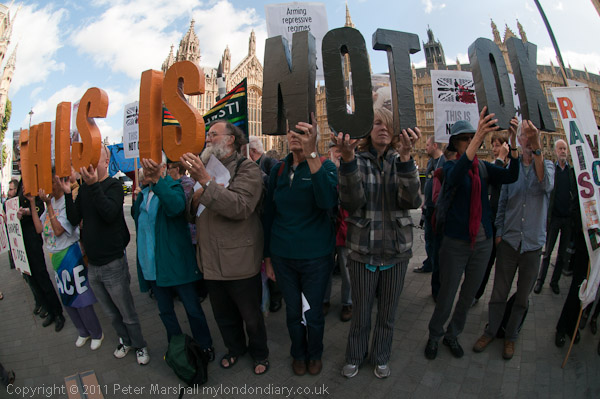
People held up letters spelling out ‘THIS IS NOT OK’ and then other posters and banners.

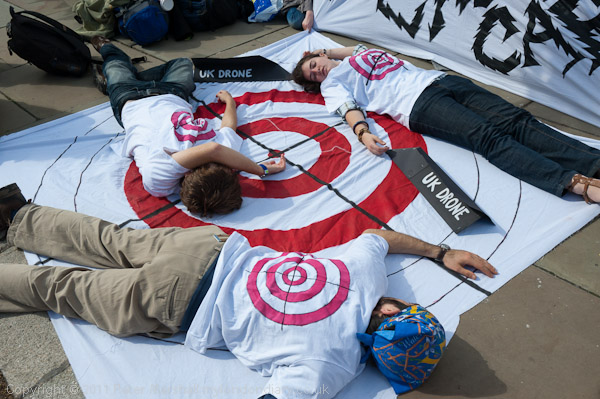
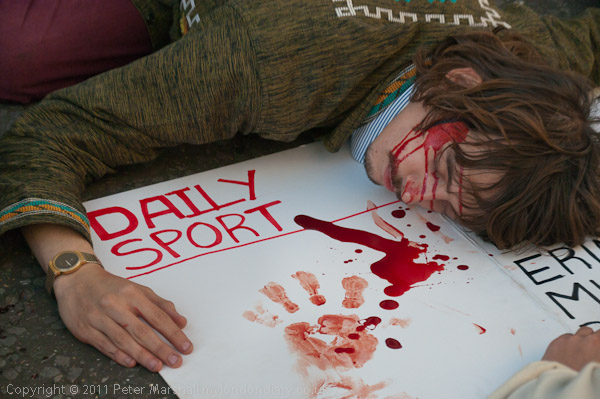
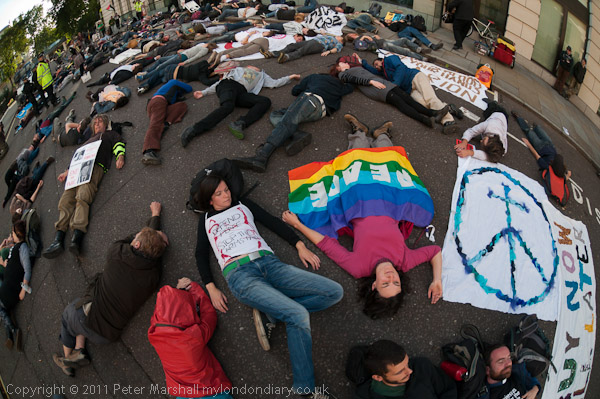
There were some songs, and anti-drone protesters staged a die-in as targets.

The country’s only Green MP (and one of the most sensible in the House of Commons) came to speak.


Dr Zig’s ‘Bubbles Not Bombs’ -Thames Embankment, Tate Modern.

‘Kids need human rights NOT cluster bombs’

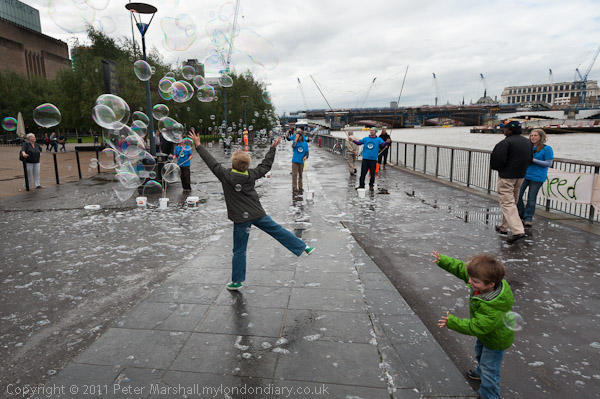
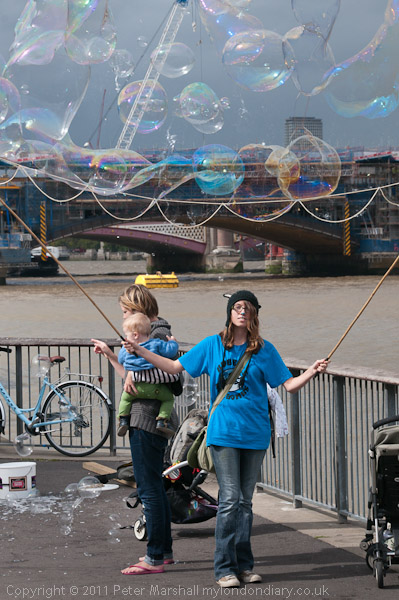
Those remarkable bubbers from Dr Zigs in Wales and made their “seriously HUGE bubbles” on the riverside walk outside Tate Modern, shouting “Bubbles not Bombs” as a child-friendly protest against the DSEi Arms Fair.

They say the DSEI fair is “where bad people the world over can come and buy the latest in guns, drones, warships etc.” and call for it to stop.

Dr Zig’s ‘Bubbles Not Bombs’ Protest


Secret Gardens of St John’s Wood

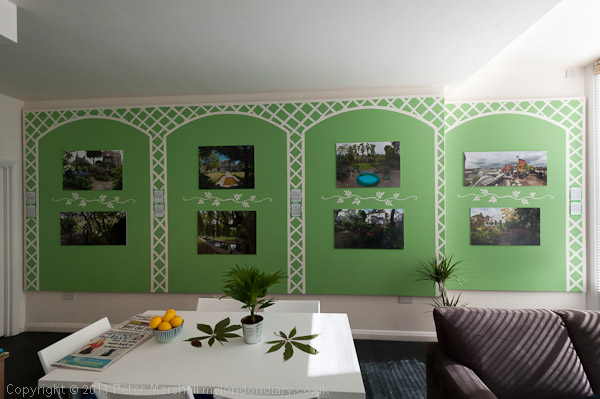
I just had time between protests to pop up to St John’s Wood and the Queens’s Terrace Café, where my show ‘Secret Gardens of St John’s Wood’ had been hung at the weekend when I had been too busy to be there. Jiro Osuga who had done the design and decoration and owner Mireille Galinou whose idea it had been had done a great job and it was ready for the opening.

Secret Gardens of St John’s Wood


Down the Drones Arms Fair Protest – Tower 42, Old Broad St

General Atomics ,makers of Predator and Reaper drones had their London office in Tower 42, still better known to many of us as the Nat West Tower, on Old Broad St Although there are wide areas of empty pavement most is land owned by Tower 42 and City police harassed protesters by ensuring they keep to the small area of public highway and then clearing them from most of it as they were then causing an obstruction.

There seemed to me to be no good reason why the police shold enforce the civil property rights of the estate owner which would not be harmed by a small incursion, nor harass the protesters on the public highway when others could easily walk by – as many always do – on the private land.

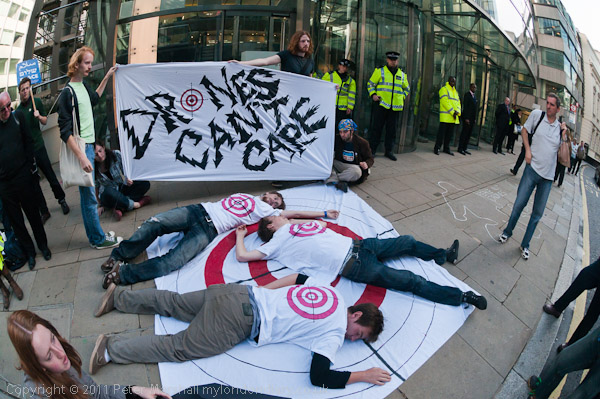
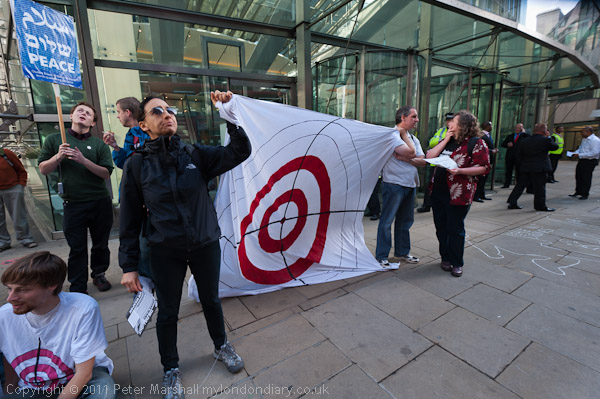
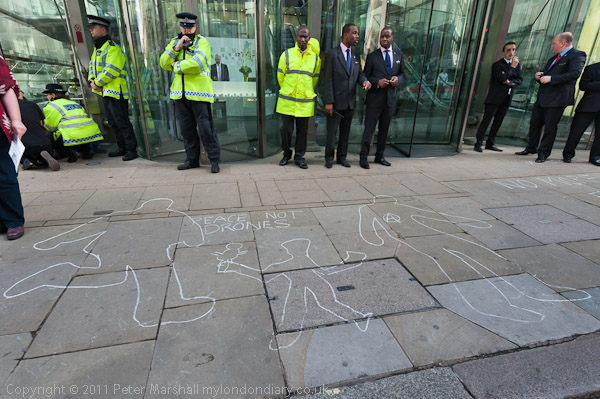
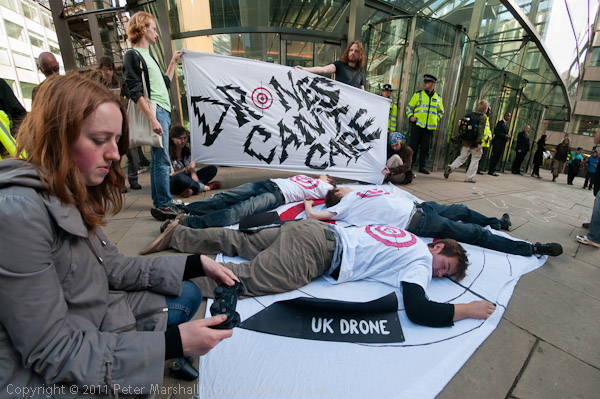
The protesters managed to chalk slogans and body outlines on the pavement, displayed banners, sang and handed out leaflets to passers by about the dangers of militarism but were not allowed to lie down on their target and invite passers by to ‘zap’ them with a Playstation controller in their game of ‘Remote Control Killer Robots’.

The US was then using around 48 Predator and Reaper drones in Iraq and Afghanistan, and the UK around 10 MQ-9 Reapers in Afghanistan, all controlled by pilots in an airforce base in Nevada. Various documents released by whistleblowers show that drone strike often take place on the basis of very limited and often unreliable evidence often killing innocent victims and any males in these countries who appear to be of military age and likely to be targets.

Using drones turns warfare for those ‘piloting’ them from a centre perhaps several thousands of miles from the battlefield into something very much like a computer game, removing any normal human inhibitions about the indiscriminate killing of others.

In the final few minutes police allowed three protesters to lie down on the pavement for a few seconds to enable photographers to take pictures.

Down the Drones City Arms Fair Protest


DSEi Protest at BAE Systems

I’m not sure if there were any police for the protest outside BAE Systems in Carlton House Terrace which was the final advertised protest of the day. Perhaps the police were acting on advice from one of their plain clothes operatives who had told them there would be no trouble at this event.

BAE Systems is Britain’s largest manufacturing companies, formed in 1999 by the merger of British Aerospace with parts of Marconi Electronics and traces its history back to 1560 and the Royal Gunpowder Mills at Waltham Abbey, over the years having incorporated many of the famous names in UK industry, particular those involved in aviation and arms manufacture. It also has a US subsidiary, BAE Systems, Inc. The company was a nationalised industry from 1977 to 1981, with the UK government in 1985 selling its remaining shares except for one very special £1 share which it can use to prevent it becoming foreign-owned.

The company has been involved in a number of trade scandals, particularly over its deals with Saudi Arabia. Most recently in 2006 the Serious Fraud Office was forced by the Labour government to drop enquiries into bribery over an arms deal by BAE Systems with Saudi Arabia after a Saudi royal prince threatened cancellation of the order in 2006. The Campaign Against Arms Trade (CAAT) obtained a High Court decision that this government action breached the OECD Anti-Bribery Convention, but the government appealed and the law lords decided that national security should be an overriding principle and overturned the decision. So bribery, as well presumably as any other crime, is OK when it is in the national security interest.

The government’s decision to cancel the investigation was seen by most as an admission of BAE’s guilt in the matter, and they have also been under investigation for bribery in Chile, Romania, South Africa, Tanzania, the Czech Republic and Qatar and possibly elsewhere.

BAE systems are one of the world’s largest arms companies, producing fighter aircraft, warships, missiles and tanks along with other weapons. They are also one of the companies that will profit hugely from the replacement of Trident nuclear missiles, a high-spending and potentially dangerous project with no military significance.

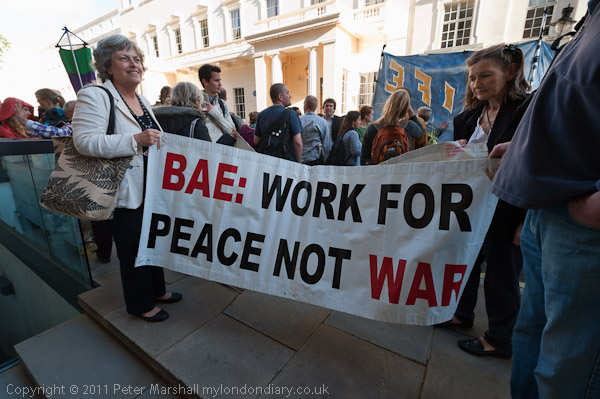
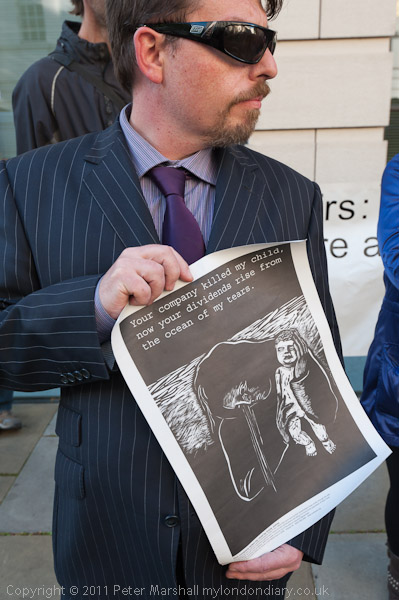
After some short speeches about BAE, almost all of those present laid flat on the pavement for a die-in before getting up and leaving. Although this was the last advertised protest for the day, a message bad been passed around that there would be an action at the National Gallery, which was hosting a dinner for those attending the DSEi arms fair.

DSEi Protest at BAE Systems


Arms Fair Fracas At National Gallery

After a day of peaceful demonstrations against the DSEi Arms Fair in London, a fracas developed as police attempted to clear the National Gallery steps while a peaceful protest continued below in the North Terrace of Trafalgar Square. Well over a hundred protesters had come to the National Gallery as it was closing to protest at a dinner being given there for those attending the DSEi arms fair, including representatives of many of the most repressive regimes around the world.

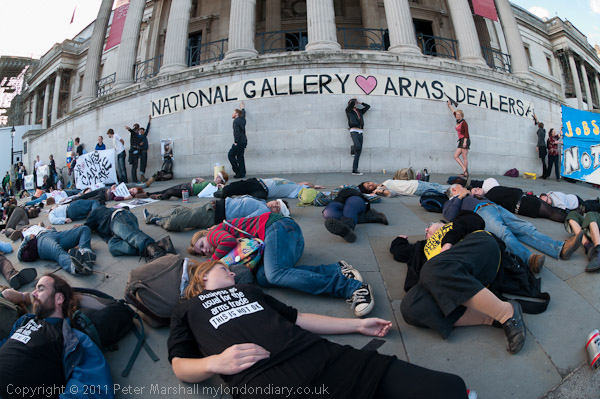
The protesters attempted to enter the Gallery as it was closing but were ushered out by security staff, and then began a peaceful protest on the steps of the gallery. Gallery staff asked protesters to leave the steps but some decided to stay and display banners there, while others continued to protest peacefully on the North Terrace in front of the gallery, displaying banners and holding a ‘die-in.

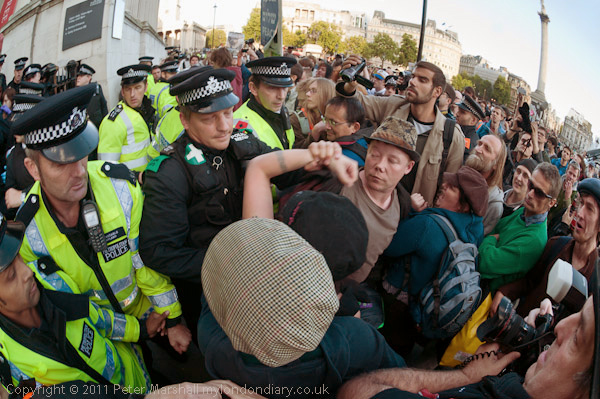
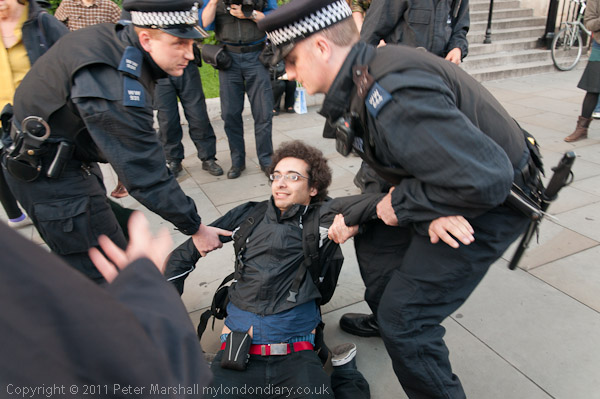
Eventually police got most of them moving slowly down the steps, though a few were still refusing to move. There was quite a lot of joking between some of the police and protesters and the atmosphere was generally friendly, although the protesters were not being very cooperative. Suddenly one of the protesters was seized and roughly carried away by police towards a nearby van. He did not appear to be formally arrested, and police would give no reason for his detention either to press, legal observers or protesters.

This changed the mood completely. Police reinforcements arrived and were able to force the protesters from the steps. There were a few incidents of what seemed thuggish violence towards both men and women. Some were arrested and dragged off to waiting vans; it was hard to be sure but their offence appeared to have been arguing and trying to protect themselves against police violence.

Meanwhile the protest continued peacefully on the North Terrace with a die-in and speakers explaining to the crowd that had gathered that the protest was calling for an end to UK arms sales to authoritarian regimes including Kuwait and Saudi Arabia, both responsible for the ruthless suppression of people in the ‘Arab Spring’ as well as countries involved in major armed conflicts and human rights abuses. I think many were shocked to learn that the UK was playing such a major part in this killing of people around the world – not something our media often dwell on.

Arms Fair Fracas At National Gallery


Independent Living Ends, Robin Hood Gardens

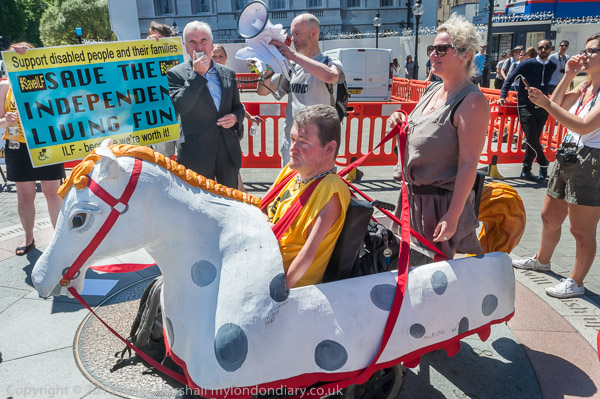
Independent Living Ends, Robin Hood Gardens. On Tuesday 30th June 2015 I joined disabled people at Downing St marking the ending of the Independent Living Fund before going to Robin Hood Gardens, a brutalist estate in Poplar doomed for demolition.


DPAC’s ILF Closing Ceremony – Downing St to Old Palace Yard

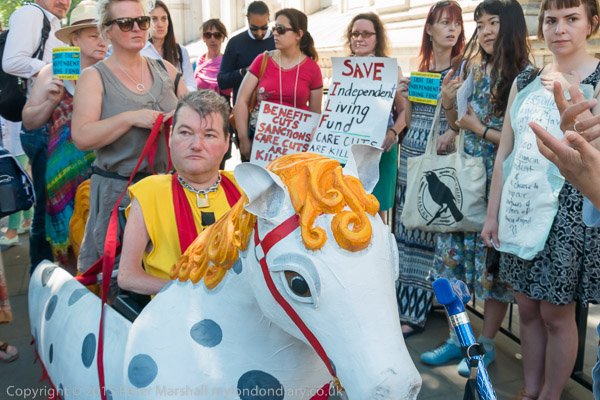
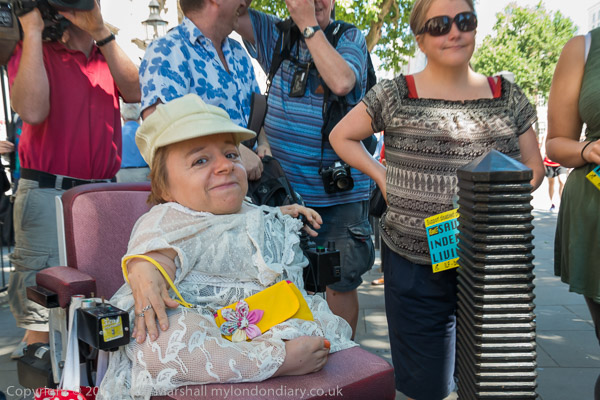
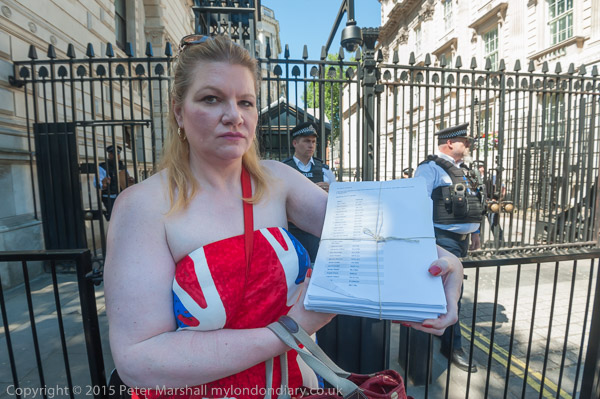
Disabled people and supporters of DPAC, Disabled People Against Cuts, met outside Downing St to bring a petition with over 25,000 signatures calling for a continuation of this essential support for the disabled.

Sophie Partridge, disabled Actor, Writer & Workshop artist

The Independent Living Fund which was coming to an end on that day had given them to money to employ support to enable them to live with dignity and for many to continue in work and make a contribution to society. Without it they fear they will simply be shut away and left to rot, many fearing they will now be left for many hours at a time in incontinence pads.

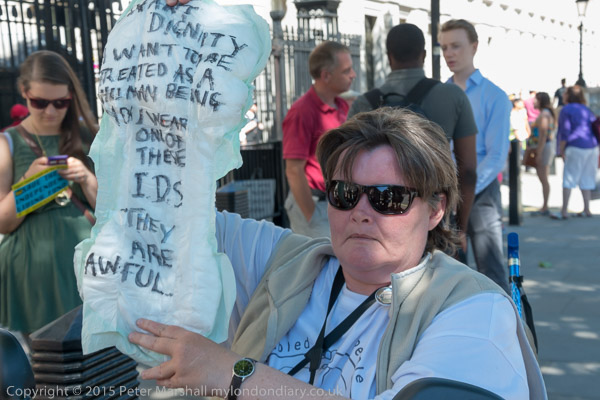
Paula Peters

Outside the gates of Downing Street they wrote slogans on incontinence pads; Paula Peters of DPAC had a message for Iain Duncan Smith, then Secretary of State for Work and Pensions responsible for the ending of support, ‘I want dignity – I want to be treated as a human – You wear one of these I. D. S. They are awful’.

A campaigner dressed as Brittania was among those who had come to hand in the petition which had gained support from a video by the stars of Coronation Street and the Graeae Theatre Company’s 2014 UK Tour of The Threepenny Opera. One of those stars spoke in front of the gates of Downing Street.

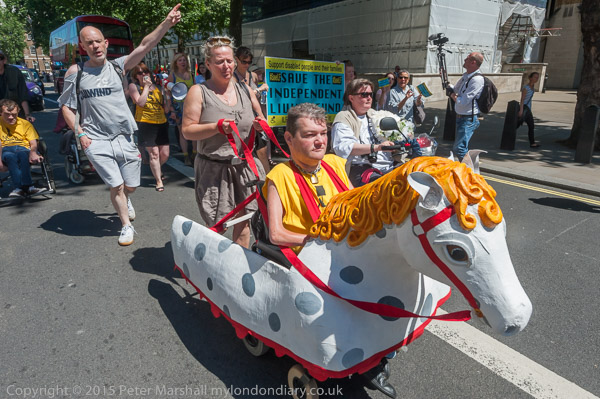
John Kelly as Schimmel leads the march

From Downing Street the campaigners marched the quarter mile or so to Old Palace Yard opposite the Houses of Parliament, led by John Kelly as Schimmel, the equine star and proud battle horse of the Threepenny Opera.

Here they were joined by others including Labour MP John McDonnell who spoke at the rally marking the end of the Independent Living Fund, at the end of which a wreath with the message’s ‘RIP ILF’ was laid.

DPAC’s ILF Closing Ceremony


Robin Hood Gardens – Poplar

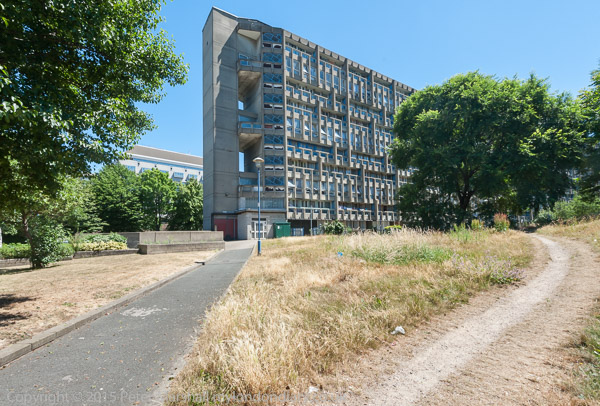
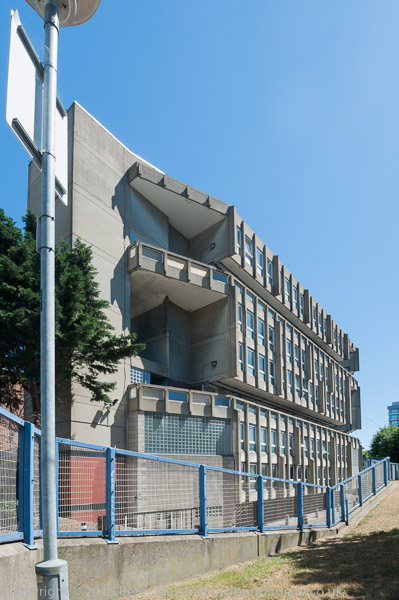
Two walls of flats protect an inner garden area

The ILF protest had ended a little before 1pm and it was a fine day and I decided to take another visit to Robin Hood Gardens in Poplar, where demolition had begun after the refusal to list the site. Listing had been recommended for listing by the advisory committee of English Heritage in 2009, but the then Minister of Culture Andy Burnham had issued a certificate of immunity against listing which expired in 2014.

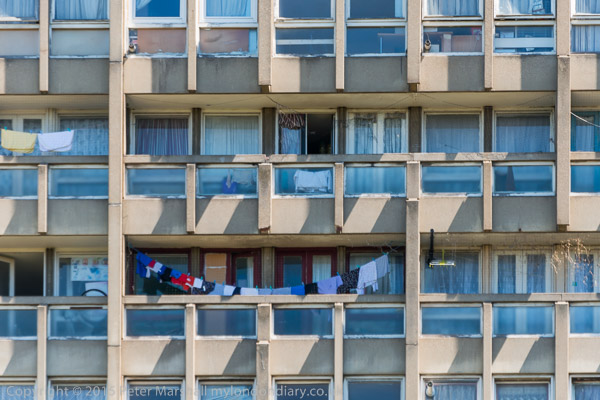
These are large and desirable properties, but often have been used to house difficult residents

A further attempt was then made to have the site listed, supported by almost every well-known British architect, but Historic England, now responsible for listing buildings rejected this.

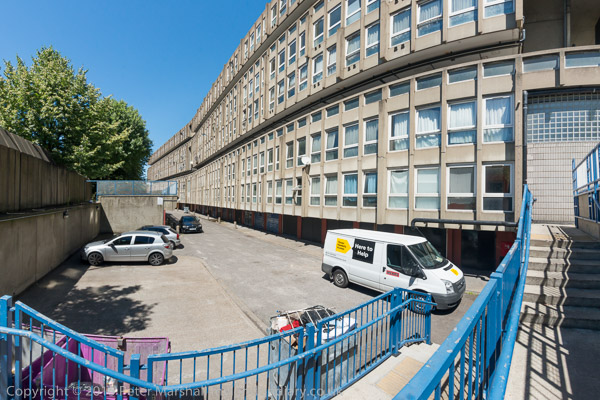
A wall at left screens the estate and there is a lower service and parking area

An open letter signed by many leading architects including Richard Rogers made clear the value of the site, and I quoted from this in My London Diary.

The buildings, which offer generously sized flats that could be refurbished, are of outstanding architectural quality and significant historic interest, and public appreciation and understanding of the value of Modernist architecture has grown over the past five years, making the case for listing stronger than ever.”

The end of the ‘street in the sky’

The refusal to list on both occasions was clearly a political one, almost certainly driven by the huge profits demolition and rebuilding on the site would make for the developers.

As with the award-winning Heygate Estate in Southwark, and the fine Central Hill Estate at Gypsy Hill, Lambeth, the local council, Tower Hamlets, was keen to get rid of the estate and had carried out what I described as “a well funded campaign of vilification“, seeing it “only as a large area with potential for redevelopment at a higher density“, working with “developers who see any area of social housing in London as rich pickings for redevelopment and sale to the rich.”

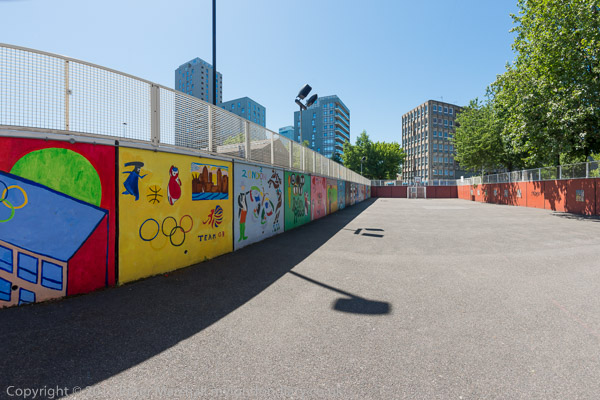
A large enclosed playground at the south end of the site

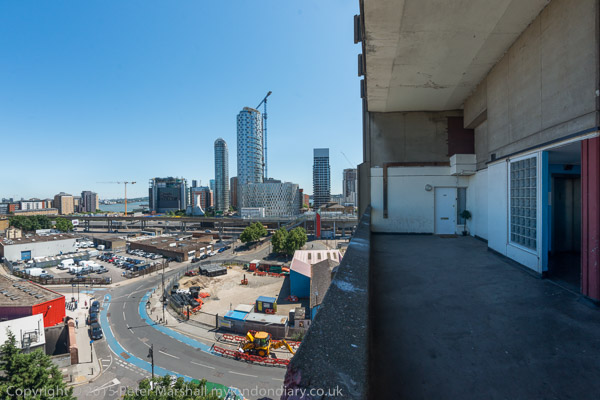
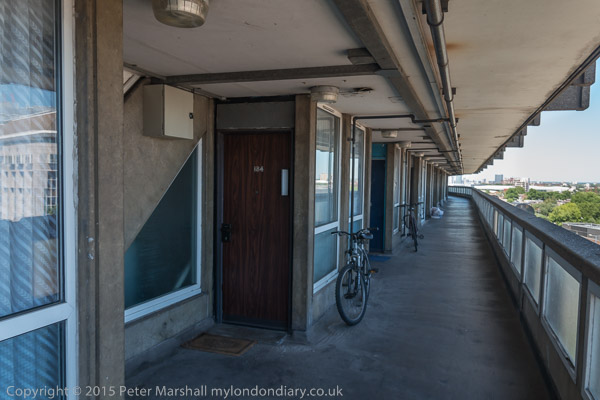
By the end of June 2015 most of the west block seemed empty and boarded up and I was unable to gain entry. But I could roam the large garden in the centre of the estate, now let to grow wild, and went inside the still occupied east block, going up to the highest public level, a ‘street in the sky’ built rather less wide than the architects had originally intended, overlooking the Blackwall Tunnel approach. From there I took a number of pictures of the views from the block looking towards the east.

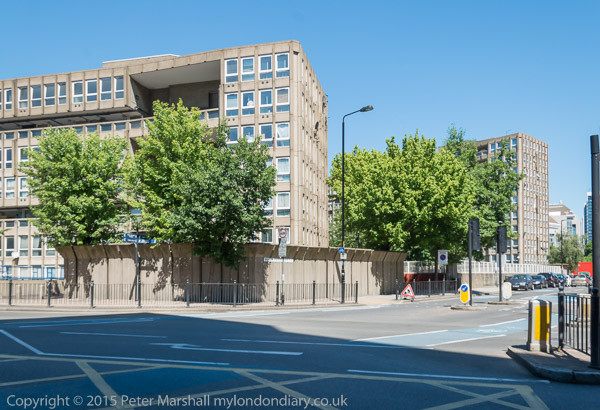
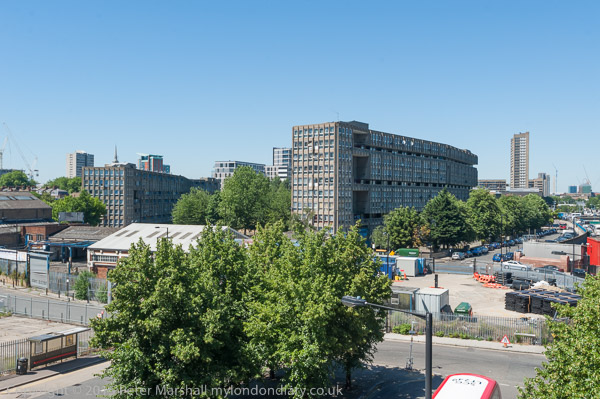
The south end of Robin Hood Gardens was on Poplar High St

As on a couple of previous visits I talked briefly with some of the residents who all told me they were pleased to be living in the block and sad they would have to leave – though some did complain about the lifts (I think only one of the two at the entrance I went in was working.)

Knocking down buildings like these which are structurally in good condition is inexcusable in terms of the huge carbon footprint involved in their construction, demolition and rebuilding. The estate could and should have been refurbished at relatively low cost and would have continued to provide good quality homes for many years. Its replacements – the west section already built – are of lower quality and will almost certainly not last as long as this could have done. The advantage of their roughly three times higher density is at the expense of possible amenity.

As well as walking in and around the estate I also took some pictures of it from the surrounding area, and some other pictures you can see on My London Diary, including a few when I stopped at Canning Town station and took a few pictures of people on the new footbridge across Bow Creek.

Robin Hood Gardens


MP Threatened Over Brexit

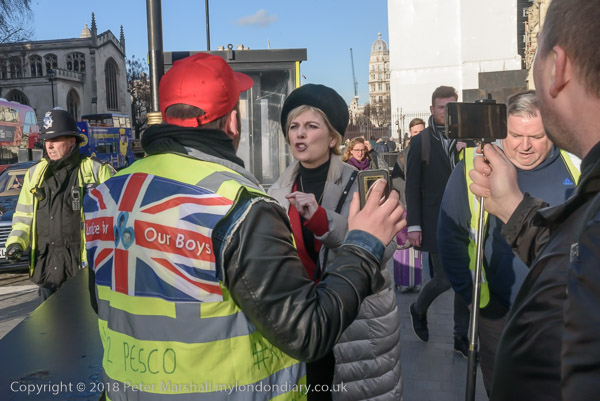
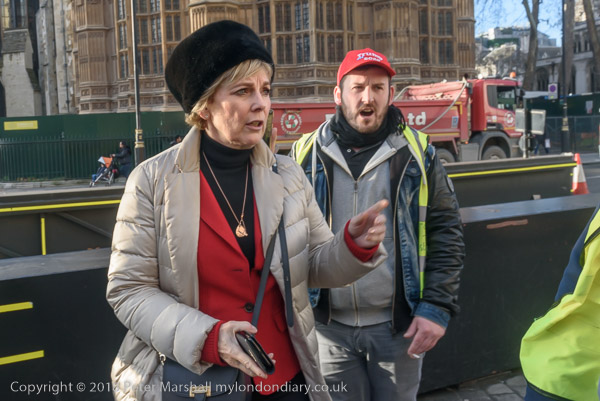
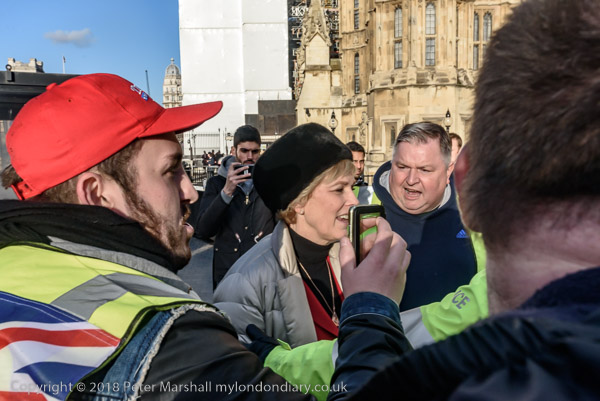
Anna Soubry MP harassed by extremists

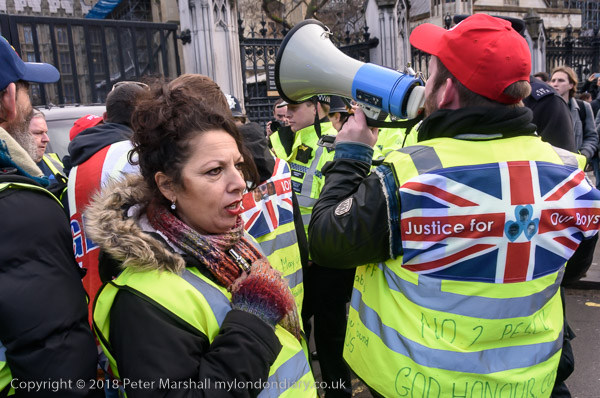
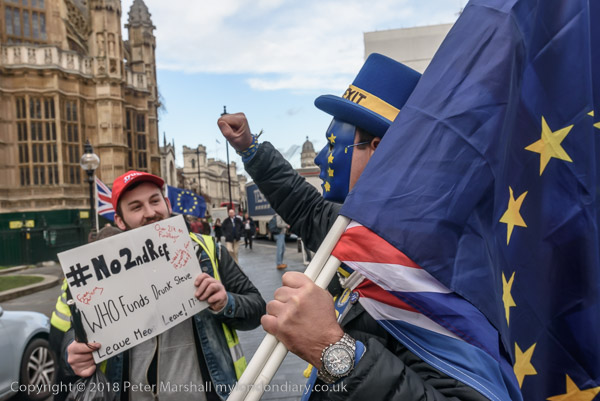
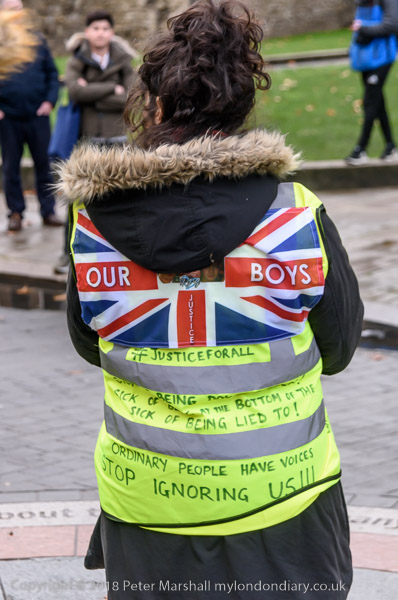
On December 19th 2018, tempers were still running high over Brexit, and I had been photographing extreme Brexiteers shouting at and threatening Steven Bray and other pro-Europeans as they continued their daily vigil outside parliament.

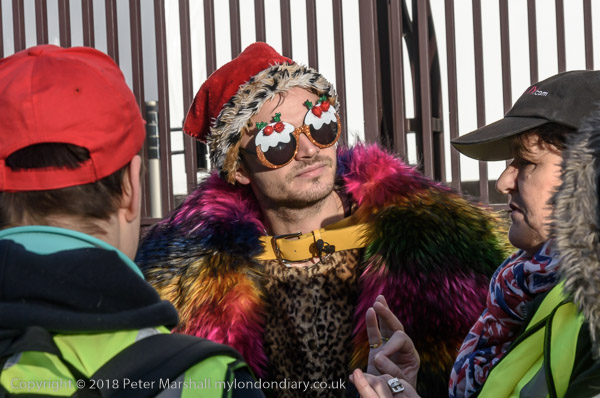
The protests across lunchtime seemed to be drawing to a close when I noticed the small group of extremists interviewing a bizarrely-dressed blogger outside the public entrance to the Houses of Parliament and went across to take some pictures.

Then they saw Anna Soubry, then the Conservative MP for Broxtowe, on the west edge of Nottingham and a vocal pro-European walking past and confronted her. She stopped to talk and argue with them, and they angrily shouted at her. She called to a police officer nearby for support, but he simply told the protesters to stop and ignored them when they failed to do so. Eventually after a minute or so she managed to turn away and walk past more police into Parliament, and officers then prevented the Brexiteers from following her.

I filed the pictures rather more rapidly than usual to meet deadlines as I realised that I was the only photographer present (though at least one of the extremists was filming the confrontation) and was pleased to see a few of them in the papers later. Though had I been with a more active agency I would have made much more from the set.

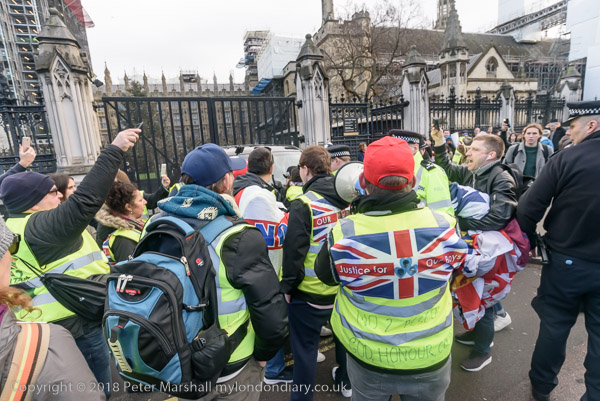
Extremist Brexiteers at parliament

Here are a couple of the pictures from a few minutes earlier outside the gates of Parliament.

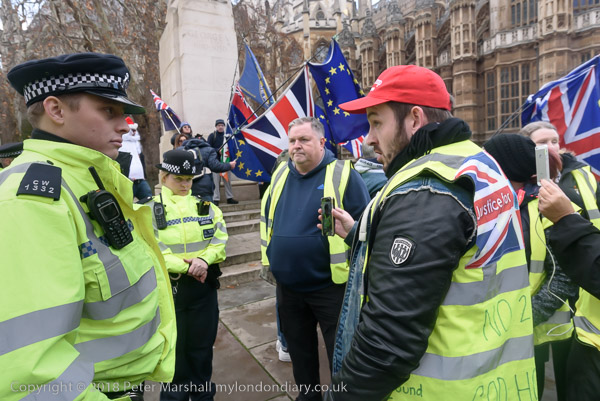
Police were holding them back as they tried to stop cars leaving through the gates.

Extreme Brexiteers clash with SODEM

Earlier the group of extremist Brexiteers had been harassing Steven Bray and the supporters of SODEM, (Stand of Defiance European Movement) the group he founded in 2017 and which was holding daily vigils whenever Parliament was in session.

They accused Bray of being a drunk and asked “Who funds Drunk Steve”, a question that was rather redundant as two large banners were covered with logos of a wide range of organisations supporting SODEM’s daily pickets. There was a lot of shouting, threats and aggressive gestures, but no actual violence with police trying with little success to separate the two groups.

I’d photographed both groups on previous occasions, and had given up on going specially to photograph them, but was still taking pictures when I had gone up to cover other events – as on this Wednesday. SODEM were always pleased to be photographed, but their opposition at times objected to my presence.

MP welcomes Delhi to London driver

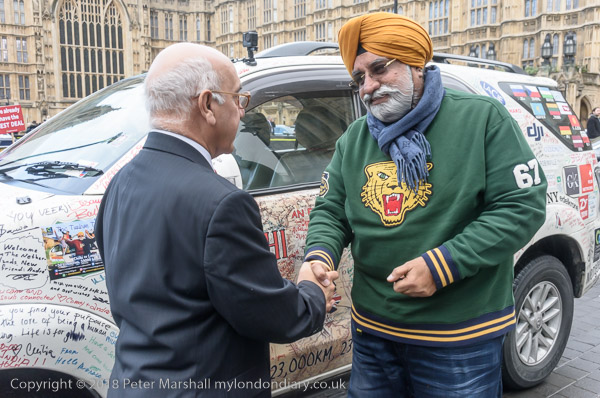
Another event that happened while I was there was the arrival of The Turban Traveller, a Sikh with a film crew from Creative Concept Films in Delhi who arrived in London today after driving overland from Delhi and was greeted by Virendra Sharma, Labour MP for Ealing Southall.

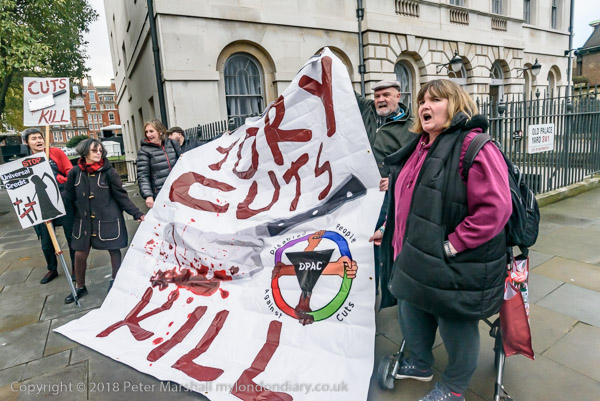
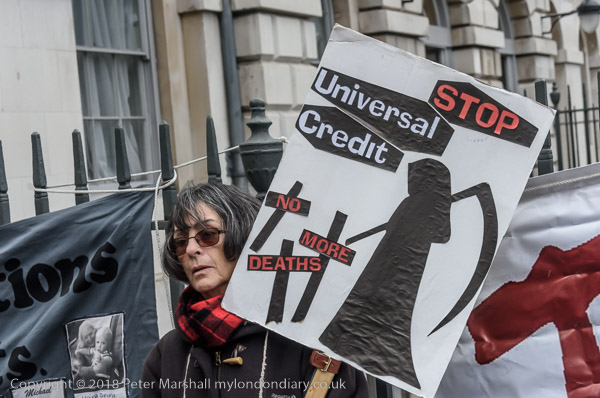
Cuts kill disabled people say protesters

But I had come to Parliament to photograph disability groups DPAC (Disabled People Against Cuts) and MHRN (Mental Health Resistance Network) who together with WOW campaign were protesting against the cumulative impact of the cuts on the lives of disabled people.

The War on Welfare campaign attracted over 200,000 signatures to its petitions against welfare cuts, and the protest was in support of a debate due later in the day on the cumulative impact of the cuts on the lives of disabled people.

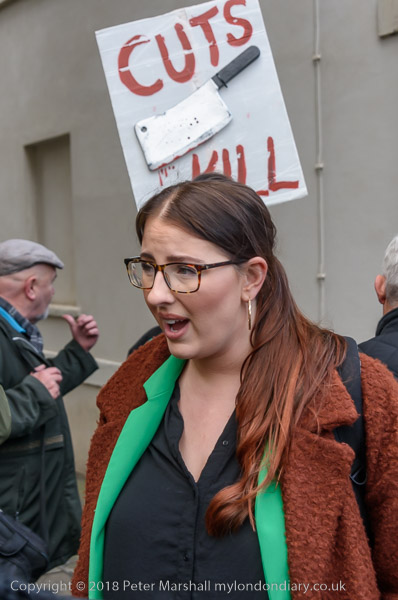
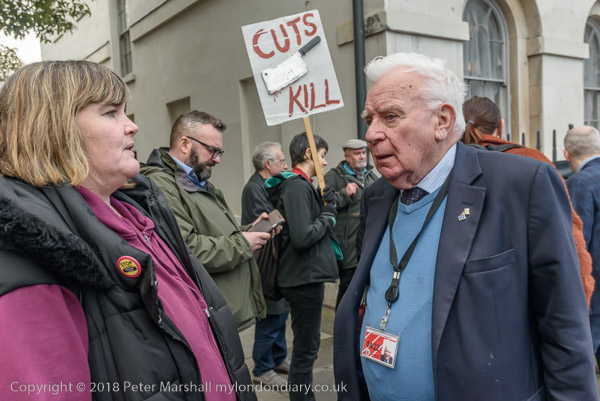
Among those who came to speak with the protesters was Virendra Sharma MP, who had come out to meet the Sikh overland traveller and although showing an interest seemed to be unaware of the problems the cuts had caused the disabled, Laura Pidcock (then MP for North West Durham) and Lib-Dem peer Lord Roberts of Llandudno. Both the latter seemed very concerned about the terrible effect the various cuts falling particularly on the disabled.


Anna Soubry MP harassed by extremists
Extremist Brexiteers at parliament
Extremist Brexiteers clash with SODEM
MP welcomes Delhi to London driver
Cuts kill disabled people say protesters


Students March Against Huge Fee Rise

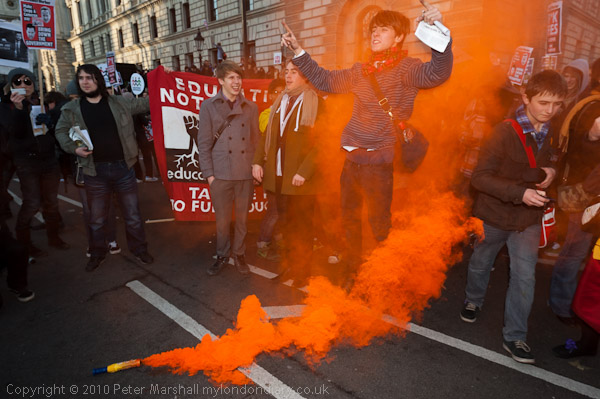
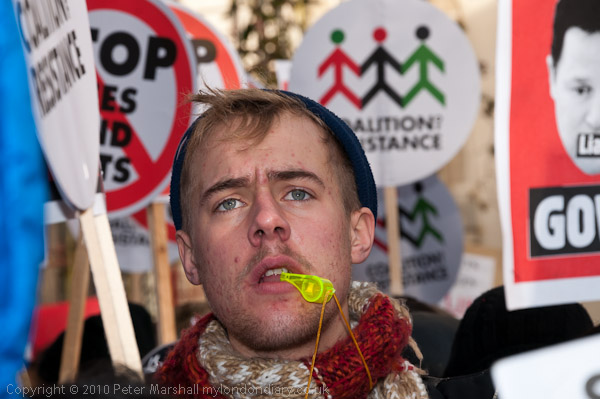
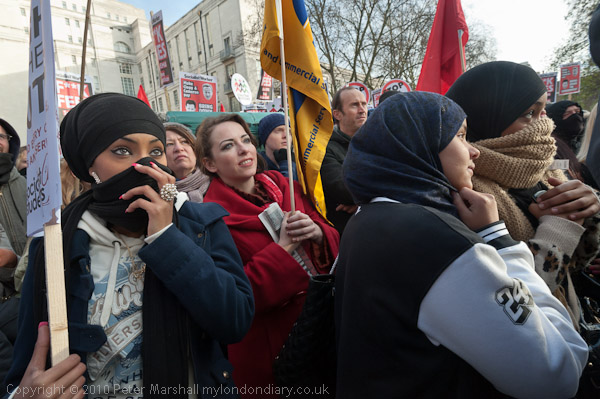
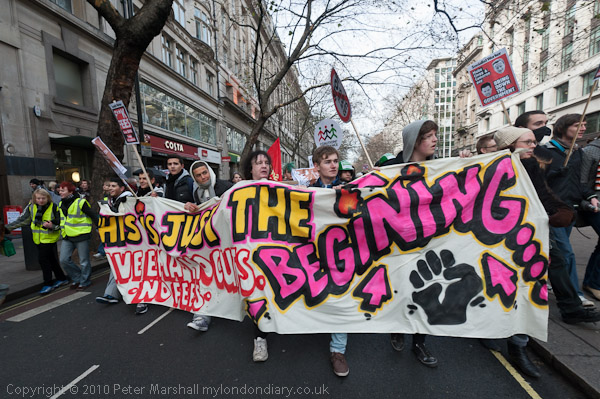
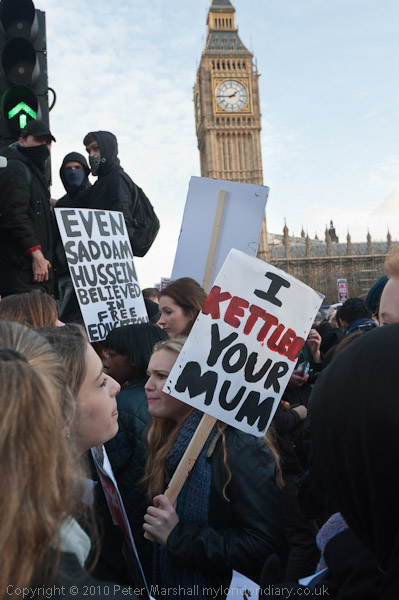
Thursday 9th December 2010 was the day of a third student protest against the three-fold increase in university tuition fees which was being debated in Parliament that day, and the scenes in the area around were probably the most confusing of any I’ve seen in London.

My account of my day on My London Diary runs to around 1,700 words, and I’ll attempt not to repeat myself here, while giving a rather shorter account. The march started outside the University of London Union in Malet St, with a crowd of perhaps 10-20,000 including many sixth-formers who would be hit by the £9,000 a year fees when they went to university as well as current students and supporters.

There was a good atmosphere as the crowd listened to speeches there from trade unionists, John McDonnell MP and two sixthformers from schools that were being occupied in protest who got the largest cheers. As usual with student protests there was plenty to photograph.

The march began well though progress was rather slow, and several hundred students decided to walk in front of the main banner and for some reason police tried to stop them. They thought they were about to be kettled and rushed off towards Covent Garden. The official march continued without obstruction along the agreed route along the Strand. It wasn’t at all clear what the police had intended, and this was something that set the scene for the day.

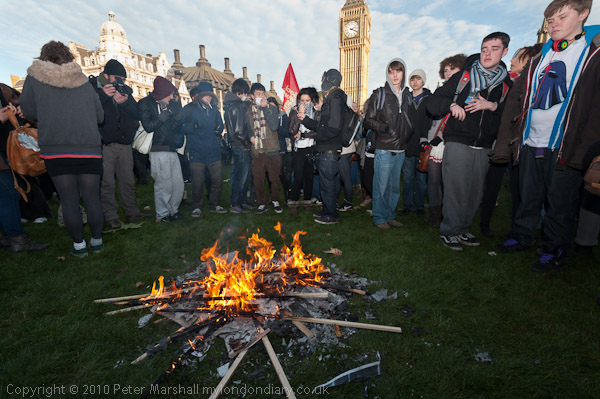
Many more protesters joined the march at Trafalgar Square, and rather than proceed down Whitehall, police and march organisers had agreed on a route though Admiralty Arch and down Horseguards Road, and then left into Parliament Square. The march was then meant to continue down Bridge Street to an official rally on the Embankment, but most marchers had a different idea and wanted to stay in Parliament Square, the obvious place for the protest to continue.

It’s hard to understand why either police or march organisers had thought people would march on rather than stay outside Parliament – and probably many on the march had simply assumed it would end there. And soon police were actually preventing any who wanted to go on by blocking all the exits from Parliament Square except that into Whitehall (which they later decided to block.)

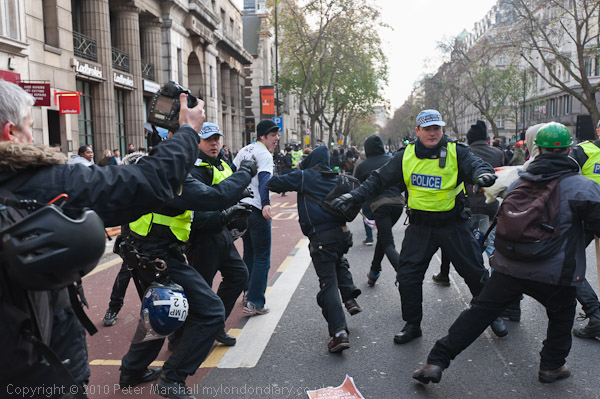
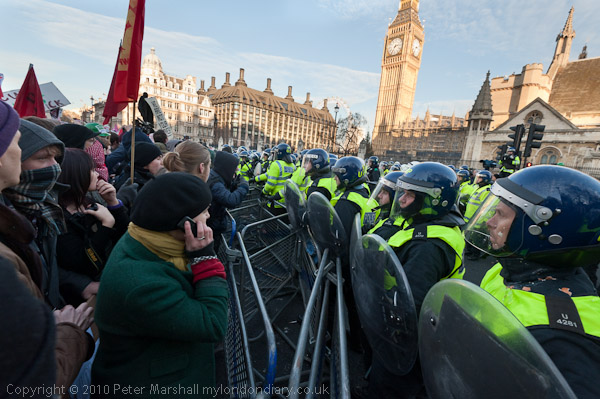
I managed to move around thanks to my press card, but even with this I was often refused access through police lines even in calm areas, and had to move along and find other officers in the line who would let me through, or take a longer walk around to get to where I wanted. The police didn’t appear to know what they were supposed to be doing and at one point I was being crushed by the crowd against the barriers in front of the riot police who were threatening us with batons unless we moved back – which was impossible because of the crush. Several press colleagues did get injured.

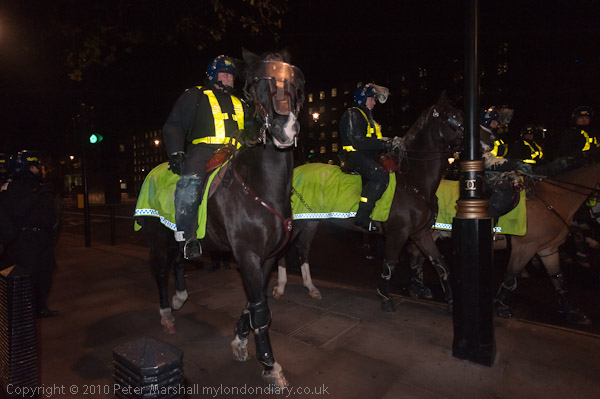
Late in the day students who wanted to leave were told by officers they could do so by going up Whitehall – only to be stopped by other police who were closing the street off. We were pushed back into Parliament Square by riot police and police horses. Police told protesters they were not being detained although they were not being allowed to leave, a kind of police logic most of us find infuriating.

Kettling like this is used by police as a kind of minor but arbitrary punishment, and as in this case it often leads to violent incidents and arrests which are then used to retrospectively justify police actions. After I had managed to get through one of the police lines and catch a bus away from the area I heard that Police had pushed a large group into a very confined space on Westminster Bridge with a total disregard for their safety, with some needing medical treatment for crushing. As I pointed out “there could easily have been more serious or fatal injuries and people pushed into the freezing river below.”

Of course protests like this need to be policed to avoid serious disorder. But the confused and sometimes unnecessarily violent way it was done on this occasion seemed to create most of the problems of the day.

As well as a long account of my day there are many more pictures on My London Diary in Students Against Cuts – Day 3.


October 13th 2001-2015

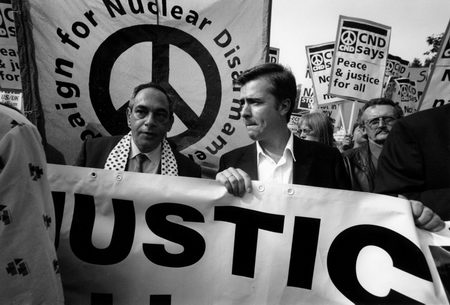
Thinking about events I had photographed on October 13th I found rather a lot over the years – so here are links to some of them from 2001-2015.

There are just a few black and white pictures from the October 2001 Stop The War March in London. Back in 2001 I was still working on film, and although I had taken pictures in both black and white and colour I only had a black and white scanner.


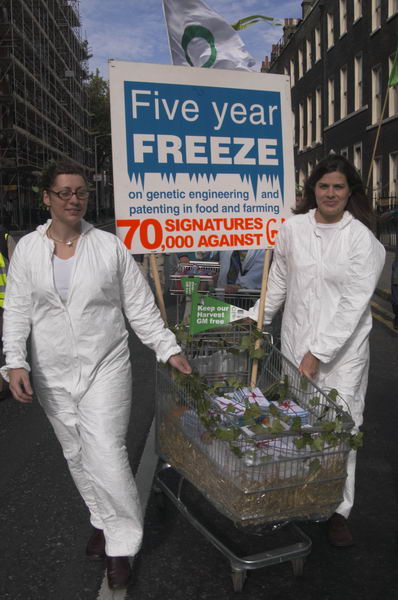
By 2003 I was working with a digital camera, a Nikon D100, and on the 13th October I joined another thousand or so people from around the country to say ‘No to GMO’. Most of the work being done on genetic modification was aimed at increasing the profits of companies and at locking farmers into using patented seeds which had to be purchased from them and which required expensive chemical inputs and would penalise or even lead to prosecutions of those who continued with traditional methods, particularly organic farmers, and severely reduce bio-diversity. The protesters were largely concerned about the possible risks of genetic modifications that were not being subjected to thorough long-term testing. The government seemed simply to be preparing to give way to commercial pressures.

The protesters went first to the National Farmers Union, then to Downing Street (or rather outside the gates to Downing Street) then on past the Houses of Parliament to the Department for Environment, Food and Rural Affairs (DEFRA) in Smith Square. The digital pictures I was making then seem rather dark and muted and processing software then was still rather poor.


It was 2007 before I photographed anything at all relevant on 13 October again, and this time I was on a walk about The Romance of Bethnal Green, a book by Cathy Ross, which had included a number of my pictures from the 1980s.

In 2008 came ‘Climate Rush – Deeds Not Words’:


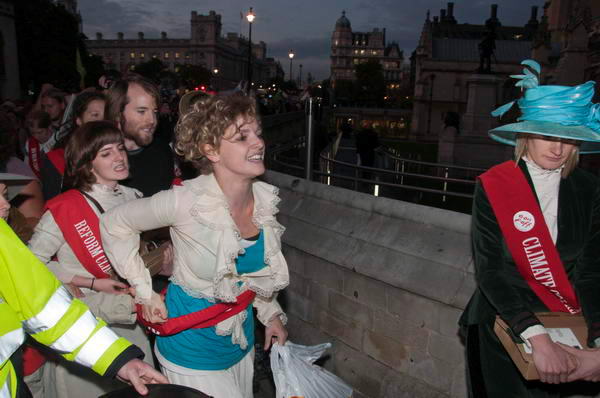
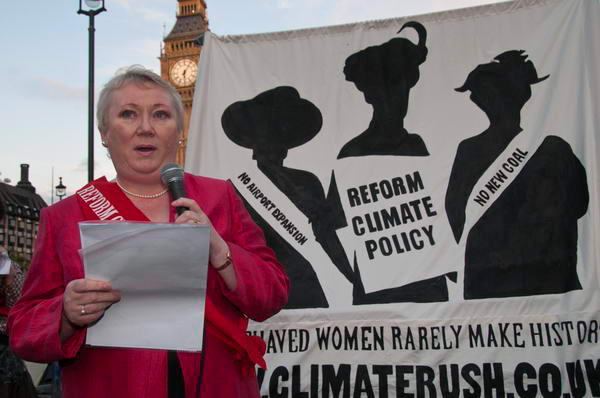
Exactly 100 years ago, more than 40 women were arrested in the ‘Suffragete Rush’ as they attempted to enter The Houses of Parliament. To mark this centenary, women concerned with the lack of political action to tackle climate change organised and led a rally in Parliament Square, calling for “men and women alike” to stand together and support three key demands:

  No airport expansion.
  No new coal-fired power stations.
  The creation of policy in line with the most recent climate science and research.

Those attending were asked to wear white, and many dressed in ways that reflected the styles of a century ago, and wore red sashes with the words ‘Reform Climate Policy’, ‘No New Coal’ ‘Climate Code Red’ and ‘No Airport Expansion’, with campaigners against a second runway at Stansted having their own ‘Suffrajets’ design. We were also offered fairy buns with ‘Deeds Not Words’ and ‘Climate Bill Now’

It was a protest that brought together some fairly diverse groups, including the Women’s Institute and the Green Party as well as Climate Rush, who, led by Tamsin Omond tried to storm their way in to the Houses of Parliament like their Suffragette predecessors, but were stopped by police. She was later arrested, not for this action but for breach of her bail conditions from the ‘Plane Stupid’ roof-top protest at the Houses of Parliament 8 months earlier.


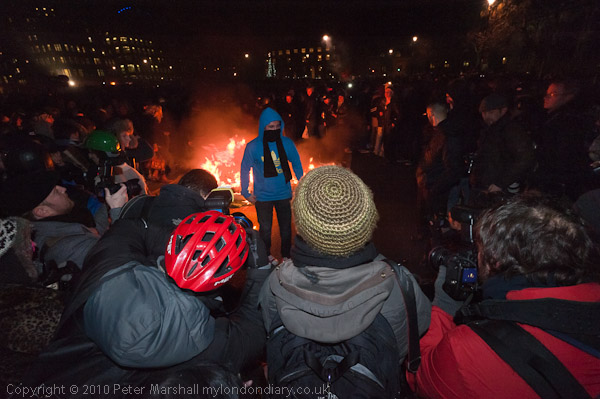
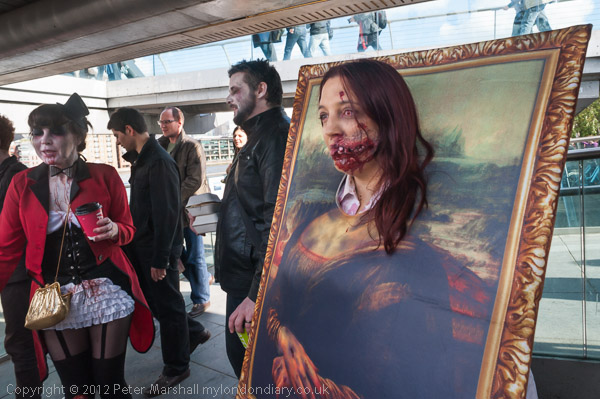
On 13th October 2012, Zombies invaded London in a charity event, to “raise the dead and some dough in aid of St. Mungo’s“, a charity which reaches out to rough sleepers and helps them off the streets.

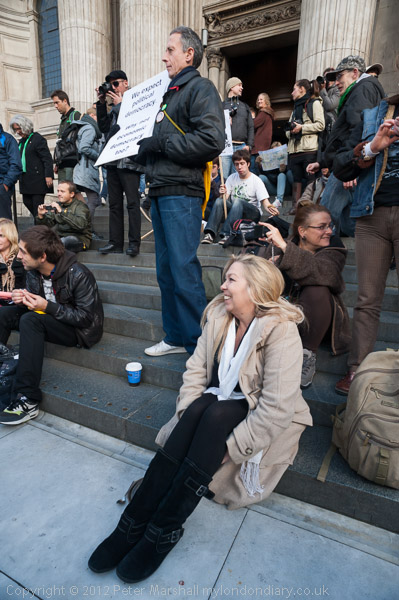
I went on from there to the steps of St Pauls, where on the first anniversary of their attempt to occupy the Stock Exchange, Occupy London joined a worldwide day of protest, #GlobalNoise, by the Occupy movement, to target the “political and financial elites who are held responsible for destroying our communities and the planet, resonating the ongoing wave of anti-austerity protests in Europe and around the world. At the same time #GlobalNoise is a symbol of hope and unity, building on a wide variety of struggles for global justice and solidarity, assuring that together we will create another world.

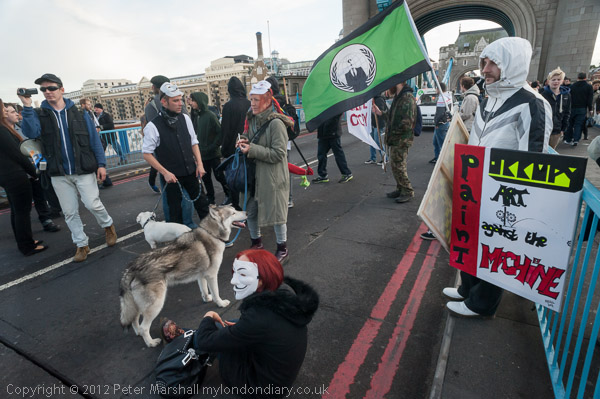
From a rally at St Paul’s they went on to sit down at a few places around the City, before crossing London Bridge heading for an undisclosed location to occupy for the weekend. Some wanted to occupy the ‘Scoop’ next to City Hall, but others felt it wasn’t suitable. A group went on to block Tower Bridge, but then returned to join others at Scoop.

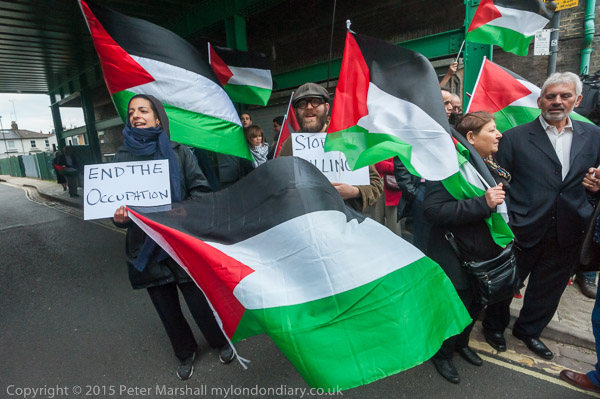
In 2015 the Zionist Federation organised a protest outside the Palestinian Authority UK Mission against the stabbings of Jews in Israel. Jewish and other groups supporting Palestinian resistance to occupation and Israeli terror came along to protest against all violence against both Jews and Palestinians in Israel and for an end to the Israeli occupation of Palestine.


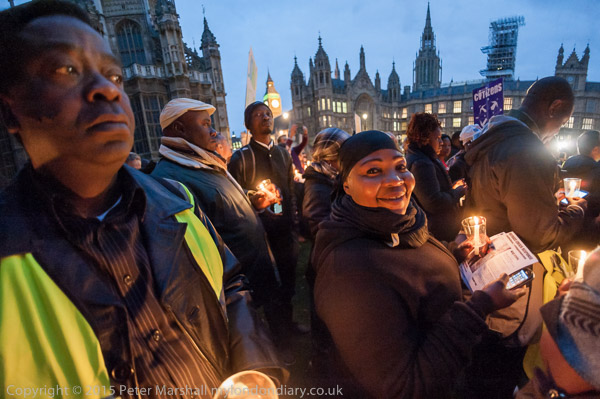
I left while the two protests were continuing to shout at each other to join the candlelit vigil at Parliament by Citizens UK calling for 1000 Syrian refugees to be resettled in the UK before Christmas and 10,000 a year for the next 5 years. Six children froze to death in the camps last year and many in the UK have offered homes and support.

Freedom and the Law

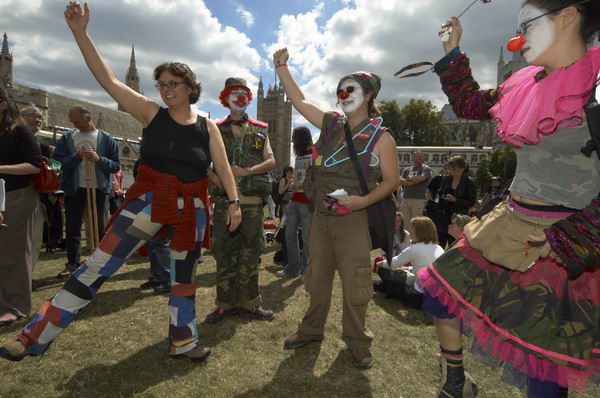
Freedom is something we almost universally value, but which is often hijacked by various groups, particularly on the extreme right to support particular causes which have little real connection with our undamental rights. Freedom is certainly not the freedom to do what we like regardless of the effect it has on others.

Freedom is not the right to own and carry guns or other weapons. It isn’t the right to spread disease we may have by not taking sensible precautions such as wearing a face mask in crowded places. It isn’t the right to increase the risk of others getting lung cancer or to drive after consuming alcohol or drugs.

Arguably the most important of our freedoms is the right to hold and express political and religious ideas and to express these. But that is not absolute, and rightly there are laws against hate speech and incitement to others to commit criminal actions or threaten the lives of others.

Back in 2005, the Labour government brought in a law to criminalise protest in Parliament Square. It was clearly a law which imposed unnecessary restrictions on our freedom and one which was brought in for a trivial reason, to end the embarrassment to the Labour ministers of one man, Brian Haw, continuing to protest, particularly over Iraq war and its disastrous consequences. That Tony Blair was annoyed by a regular reminder of his lies was not a suitable basis for legislation.

A regular series of harassment by police and others – almost certainly at the urging of the Home Secretary – had failed to shift this persistent protester, and civil servants were ordered to add a section to the bill which became the Serious Organised Crime and Police Act 2005 to make his protest illegal. In the event the act failed to apply to his protest and I wondered if this was a little deliberate subversion by at least one of those responsible for its drafting rather than simple incompetence. Because his protest had begun well before the SOCA law came in on 7th April 2005, it was apparently not covered by it. As I commented, “rather a lot of egg on government faces there.” This initial ruling by the High Court of Justice was eventually overturned by the Court of Appeal and these sections of the law were replace by other restictive laws in 2011.

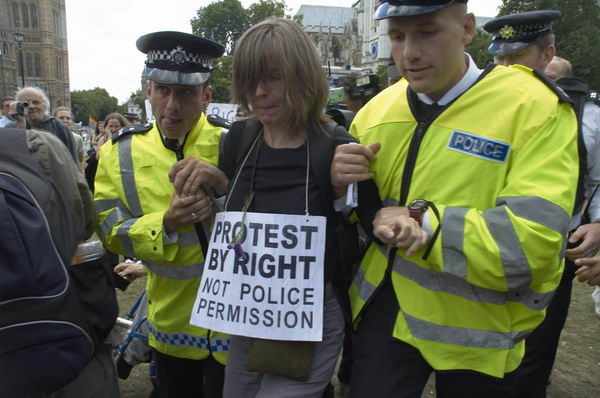
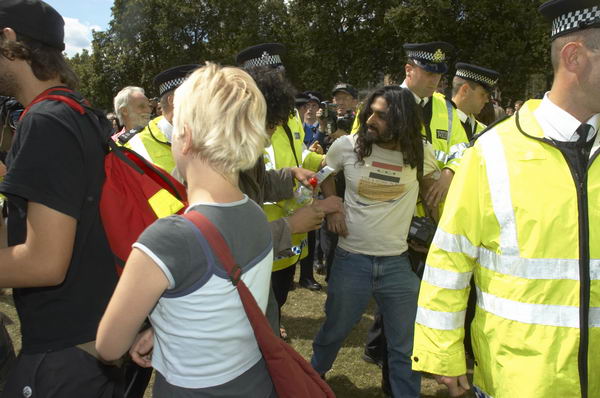
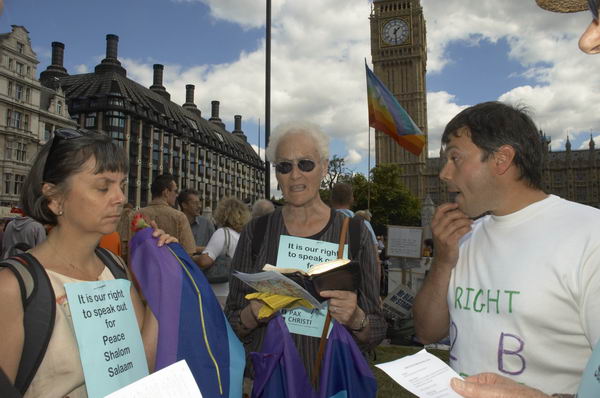
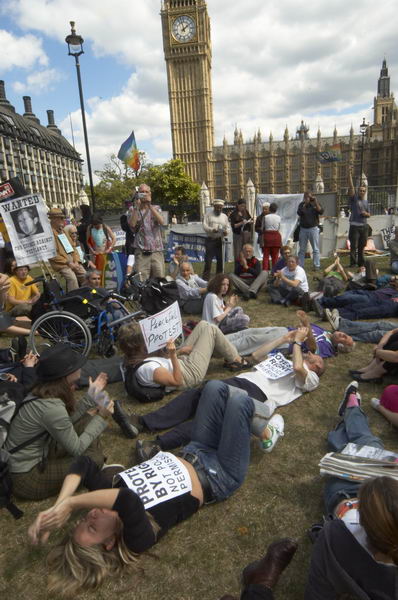
On Sunday 7th August 2005, protesters came to Parliament Square to deliberately disobey the law, and the police came, some rather reluctantly, under orders to arrest them. The protestors argued that protest is a human right and cannot be restricted by law in a free society.

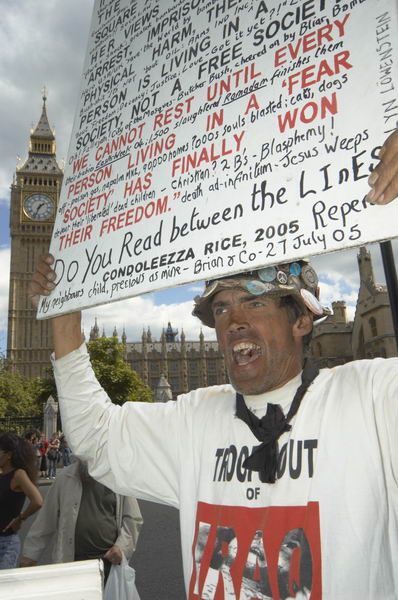
Brian Haw was there, but protesting legally as it appeared that the act didn’t include him. He held up a placard with the words from a speech in Boston by US Scretary of State Condoleezza Rice:
if a person cannot walk into the middle of the town square and express his or her views without fear of arrest, imprisonment, or physical harm, then that person is living in a fear society, not a free society. We cannot rest until every person living in a ‘fear society’ has finally won their freedom.”
interleaved with his own comments on Guantanamo, Abu Ghraib, Belmarsh and the Iraq war and more.

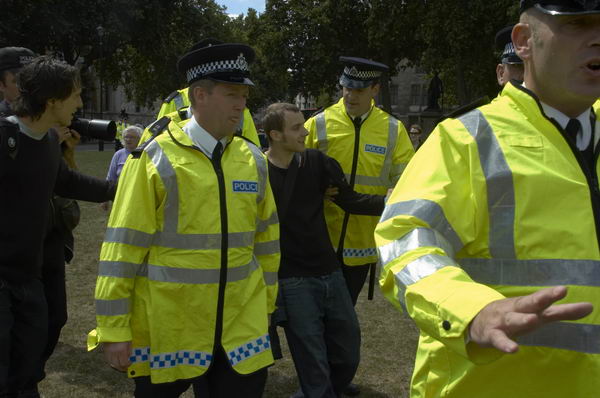
The police swooped on a few of those with posters or placards and arrested them, leading them away but their heart was clearly not in it and the great majority of the protesters were untouched, though
they were warned that their protest was illegal. As I commented: ” I saw five people arrested for simply peacefully holding banners supporting the right to protest. It happened on the square opposite our Houses of Parliament, and it made me feel ashamed to be British.”

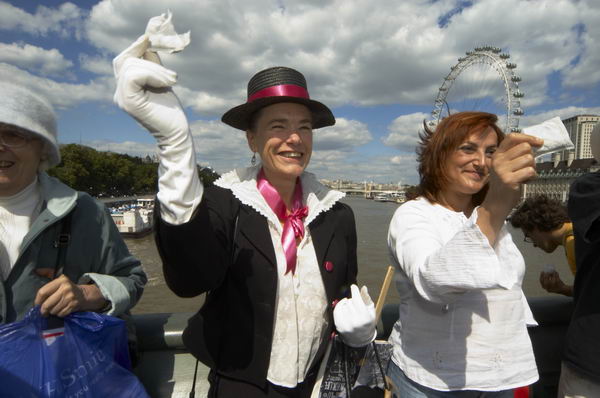
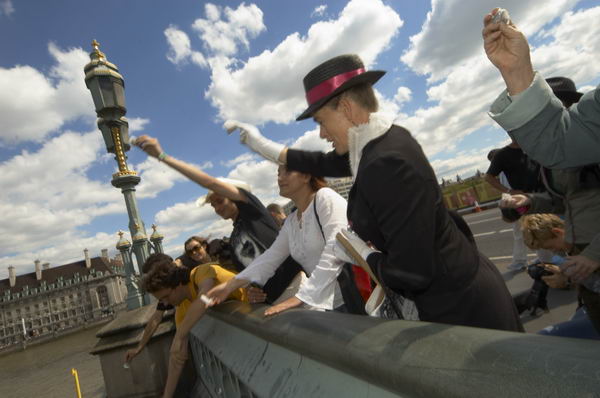
When the protest in Parliament Square ended, protesters were invited to take part in another illegal protest inside the one km restricted zone around Parliament, but on Westminster Bridge. Again taking their lead from Boston, though this time from 1773, and tipping tea into the water, campaigners calling for a low-level tax on foreign currency exchange transactions, as proposed by Nobel prize-winning economist James Tobin in 1978. This would deter speculation on currency movements, giving governments greater control over their fiscal and monetary policies, and reducing the power of speculators to affect the markets.

The connection between the tea bags torn to tip tea into the Thames, produced by large multi-national companies who are among the currency speculators, and the Tobin Tax, seemed a little weak – as doubtless was the brew in the river – though it did all alliterate nicely for the Westminster Tea Party – Time for Tobin Tax.

We are now seeing a law going through Parliament which will even further restrict our right to protest, increasing discriminatory policing, criminalising some traditional ways of life and seriously restricting and controlling protests in a huge shift further towards a police state. Unfortunately a large Conservative majority makes it seem inevitable that our freedoms will be significantly reduced.

More on My London Diary for August 2005.


All photographs on this and my other sites, unless otherwise stated, are taken by and copyright of Peter Marshall, and are available for reproduction or can be bought as prints.


State Opening, Class War and Student Protests

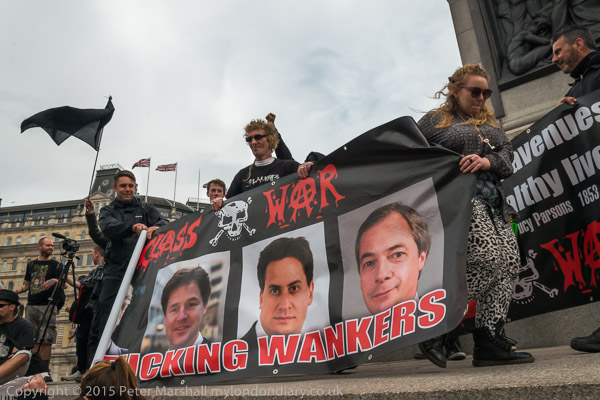
I usually make a point of keeping away from the big occasions such as the State Opening of Parliament, but made an exception on Wednesday May 27th 2015, partly because I had been told that Class War were planning to come and protest, but mainly as there were other events I was intending to photograph later in the day.

Class War arrived too late to reach the centre of Parliament Square where they had hoped to display their banner and the area was already tightly sealed off by police. Police security for royal events is always very tight and as on this occasion often goes well beyond what is legal. So although they managed to briefly display their banner well before the Queen’s coach arrived they were quickly forced to take it down and pushed away. Around 50 police then followed the dozen or so as they made their way to a nearby pub and a few more supporters, and stood around for an hour or so looking as if arrests were imminent before most of them moved off, but police continued to follow the group until they left Westminster. Two other people who had been showing posters against austerity in Parliament Square were arrested despite their actions being perfectly within the law; they were released without charge a couple of hours late.

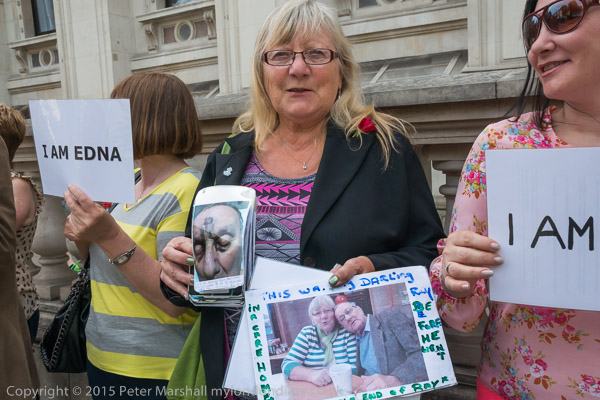
I walked from the pub up to Downing St, where a line of people from Compassion in Care where holding up posters and calling for ‘Edna’s Law’ which would make it a criminal offence to fail to act on the genuine concerns of a whistle-blower, and would make the state protect whistleblowers rather than them having to spend thousands of pounds on taking their cases for unfair dismissals to industrial tribunals. They say current law, the Public Interest Disclosure Act 1998 which has failed to protect the public, the victims or the whistle-blowers. So far nothing has changed.

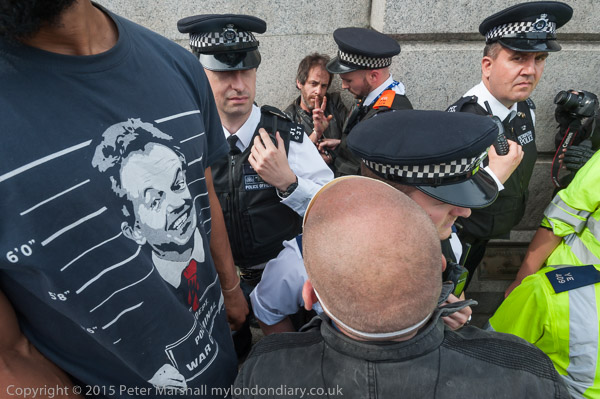
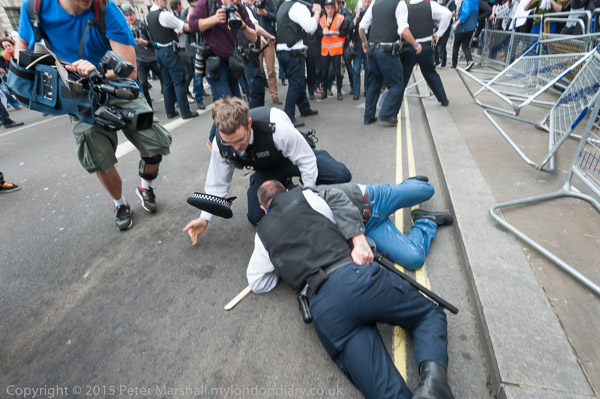
As I arrived in Trafalgar Square where people were gathering for a protest against education fees and cuts there was an angry scene when a squad of police surrounded and arrested a man, refusing to talk with any of those in the crowd around about their actions. Had they explained at the time that the man being arrested had been identified as someone who was wanted for an earlier unspecified offence and was being taken in for questioning, it would have defused the incident, but this was only revealed after the man – and one of the protesters who had questioned the police about their action – had been put into a police van a short distance away and driven off.

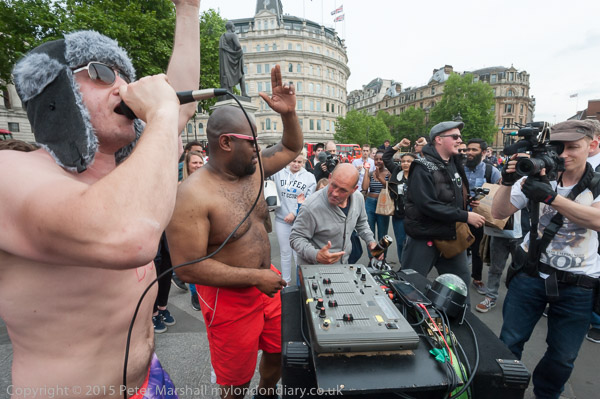
Back in Trafalgar Square there was music as we were waiting for the National Campaign Against Fees and Cuts protest to begin, provided by ‘Disco Boy’ Lee Marshall from Kent who had brought a mobile rig to Trafalgar Square. Apparently as well as running local discos he has a huge social media following.

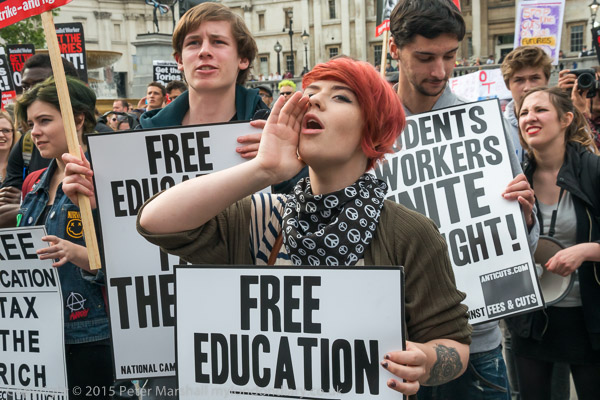
Finally the NCAFC protest got under way, with a good crowd of mainly students in Trafalgar Square and speakers on the plinth of Nelson’s Column.

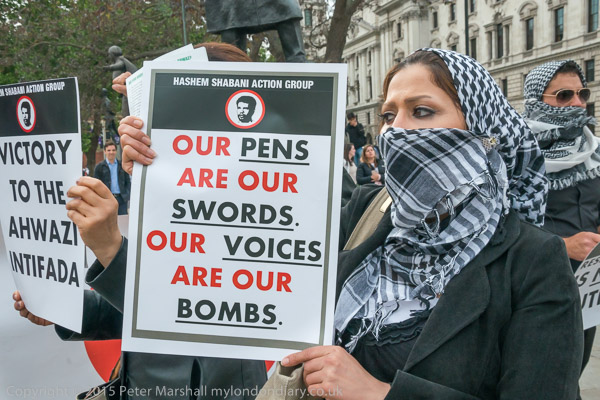
Class War came along (still followed by police) and there were cheers as they displayed their several banners; also taking the stage and marching with the students were the Hashem Shabani group of Ahwazi Arabs, who later held their own protest.

After the speeches in Trafalgar Square the NCAFC protesters set off to march to Parliament. Police tried to stop them with a line of officers and barriers at Downing St, but there were too few officers and many of the protesters walked around them and the barriers. Police apparently randomly picked on a few of the demonstrators and tackled them with unnecessary force making several arrests. The protesters continued marching around Westminster for some hours, but I left them at Parliament Square.

I finished my day’s work in Parliament Square with the Ahwazi Arabs who protested there against the continuing Iranian attacks on their heritage and identity since their homeland, which includes most of Iran’s oil was occupied by Iran in 1925. The occupation was important in protecting the interests of the Anglo-Persian Oil Company, effectively nationalised by the UK government in 1914 (later it became the Anglo-Iranian Oil Company and then in 1954, BP) and even after the nationalisation of Iran’s oil, BP remained a leading player in the consortium marketing Iranian oil.