2008 – Markets, Graffiti and Police Harassment

Sunday Morning: Markets, Graffitti and Parkours

2008 - Markets, Graffiti and Police Harassment

Sunday December 14th 2008 was a cold and cloudy but bright winter day as I made my way from Waterloo Station to Columbia Market, stopping to take a few pictures of the young men jumping around the street structures by the Waterloo roundabout before catching a bus to Bethnal Green to photograph in Columbia Market.

2008 - Markets, Graffiti and Police Harassment

The market was busy with people buying Christmas trees, decorations and flowers, but I hadn’t really come with the right camera to work unobtrusively, but was using the DSLR-size Nikon D300 with the rather bulky original DX Nikkor 18-200mm zoom, a versatile combination but not the best for this kind of work. I wandered around taking a few pictures before leaving to walk to Brick Lane.

2008 - Markets, Graffiti and Police Harassment

I was early for the protest which was to take place there, and took some pictures, mainly of graffiti while I was waiting. As I noted, “Somehow the people seem less interesting than in the old days, less eccentric and dodgy characters, and,except on the very fringes, the market seems rather more commercial in character.”

2008 - Markets, Graffiti and Police Harassment

But the market was also useful for me, as I was getting a little cold, and when I put my hand in my coat pocket found my woolly hat was no longer there. ” A couple of stalls along I found a new one for a quid, with a label calling it a fashion hat and a £9.99 price tag. And there were fancy chocolates like the ones I couldn’t bring myself to pay the ridiculous prices in Waitrose going for around a quarter of the cost… ” But there wasn’t room for anything else in my camera bag.

Markets, Graffitti and Parkours


Solidarity with Whitechapel Anarchists! – Brick Lane, 14th December 2008

The previous week members of Whitechapel Anarchist Group were harassed by police while distributing their newsletter at the top of Brick Lane and had called for support this week to carry out their entirely legal activities here.

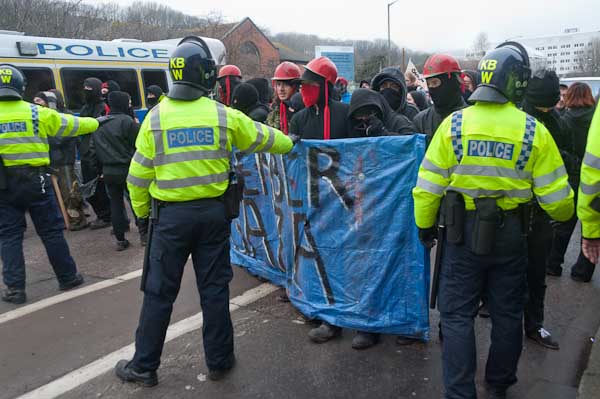
This week a largish contingent of police had come along to watch, obviously expecting trouble, but at first they mainly stood on the opposite side of the road, observing and photographing the protesters. When one protester stood in front of an officer taking pictures he was hauled off a short distance down the road and questioned before being marched away to a waiting police van. I photographed this, taking care to keep at a distance where I was clearly not obstructing the police. Apparently they decided to arrest him for swearing when he was being questioned, although this Is clearly not an offence.

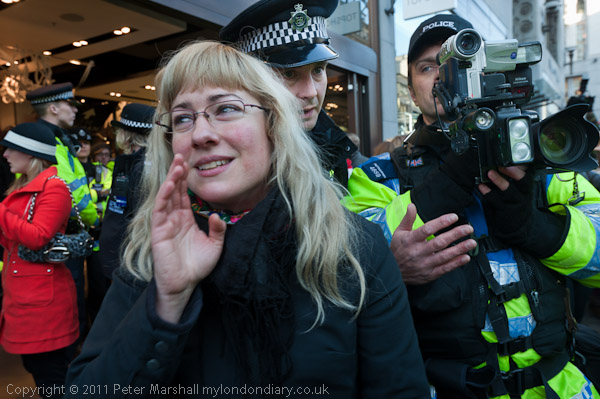
The police spent rather a lot of time photographing and videoing me during the event, in a way that was obviously meant to harass me, as well as similarly harassing the protesters. This happens regularly at protests, and the police have at times admitted keeping a photographic database in which they can look up people and see which demonstrations they have attended. Though as I noted, all those I go to are recorded in My London Diary.
Police search a woman – I think just someone passing by the protest

Some time later I submitted a Freedom of Information request to the Metropolitan Police to try and find out what photographs and videos they had in their files showing me, giving a list of some of the occasions where I knew they had taken pictures. The response denied they had any pictures of me.
As my account ended, “Clearly their activities around Brick Lane today were a waste of public money, and worse than that. They don’t make us any safer and were not combating any real threat to public order. If they have an agenda it seems purely political.”

Solidarity with Whitechapel Anarchists!


Solidarity with Revolt in Greece – Dalston, 4th December 2008

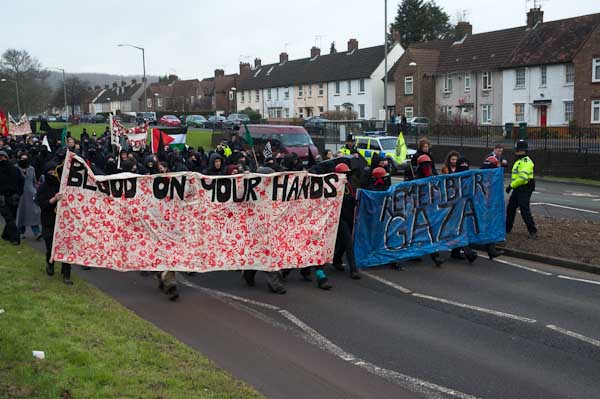
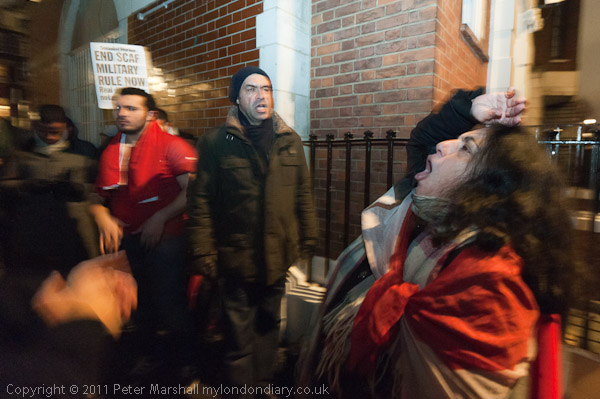
I arrived outside Dalston Kingsland station at 2.30pm to find a group of around 50 protesters waiting on the pavement outside station for a protest march in solidarity with protests by Greek anarchists following the killing of a 15 year old youth by the Athens police.

The police had come in force to the starting point of a march which would have walked peacefully along the streets to the peace mural on Dalston Lane for a rally with some speeches and some noisy chanting. It would only have caused a few minutes stoppage to traffic as they had marched the short distance along the road.

At the end of the rally the couple of hundred who had turned up would probably have dispersed to their homes and local pubs and the event would have ended with no trouble. But police decided to provoke a confrontation by taking action against people wearing scarves across their faces – part of the anarchist ‘uniform’.

Another protester is arrested and searched

But this makes it hard for the police to take photographs for the database that they usually deny they have. Section 60(4A) of the Criminal Justice and Public Order Act 1994, Act gives the police powers to require the removal of face coverings that an officer is satisfied is worn wholly or mainly to conceal identity, provided that an officer of or above the rank of inspector has given an authorisation for such action within a given area for a period of up to 24 hours.

So either they were acting illegally or clearly they had decided in advance to obtain this authorisation and were determined to make use of it. Obviously this was going to cause trouble. They began by approaching one of a men beside a banner with the message ’15 YEAR OLD SHOT DEAD BY GREEK COPS PIGS KILLERS’ and told him to remove his mask. An argument ensued and eventually, still wearing his mask he was led away.
Police then grabbed another protester who was alleged to have punched a policeman, ppushing him to the pavement and searching him. Other people protested at the violence being used and I think at least one of these was also arrested. Others held up a banner with what seemed now to be a rather appropriate slogan for London as well as Greece, ‘TERRORISM IS THE POLICE IN OUR STREETS’.
A police officer who apparently failed to photograph me :-)

More masked protesters were grabbed by police, though I’m not sure how many were actually arrested. Police began to form a cordon around the protesters in front of the station and photographers were made to go outside this – and there were quite a few protesters now on the opposite side of the street – being photographed and videoed by police.

Arresting for arguing his legal rights

Police vans were then moved up between the photographers and the main part of the protect, conveniently hiding most of what was taking place from the press. But we saw a protester who tried to argue his legal rights with police being handcuffed – in a rather panotmime fashion in my series of pictures. Those protesters who were not yet held inside the police cordon then surged out onto the main road – a red route – and blocked traffic entirely until police – at least one officer using his baton – pushed them back.

By this time, many of the black-clad and masked anarchists who were not inside the police kettle had moved away leaving mainly Greek supporters of the protest on the opposite side of the road.

It seemed clear that the police had come to the event determined to turn it into a show of force between police and protesters – and that the police had won. But in doing so they had spent a small fortune in public money and caused an hour and a half of disruption to normal life and to traffic on one of North London’s main arteries. And what may I thought may have been meant as “some kind of political charade organised to increase public support for increasing surveillance and repressive legislation” had in fact rather suggested the truth of the largest banner at the protest’s opening statement ‘THE STATE IS THE ONLY TERRORIST’.

Solidarity with Revolt in Greece


Marine A, Mandela, CPS Fail & Cops Off Campus

Four unrelated events kept me busy on Friday 6th December 2013.


EDL Protest Supports Marine A – Downing St, Friday 6th December 2013

Marine A, Mandela, CPS Fail & Cops Off Campus

In November 2014, a court martial found Marine A, Sergeant Alexander Blackman guilty of murder for his killing of a wounded Taliban insurgent in Helmand Province, Afghanistan. On the day his sentence was due to be announced the extreme right-wing EDL called a protest opposite Downing St, calling for a minimal sentence, arguing that he acted under extreme pressure and that his victim was a terrorist.

Marine A, Mandela, CPS Fail & Cops Off Campus

Although the EDL had predicted 500 would come, only fewer than 50 were there when I came to take photographs, and there were no placards and little to tell people why they were there, just the usual EDL flags, some with the message ‘No Surrender’, though quite a few of those taking part were wearing ‘I support Marine S’ t-shirts. Among the flags was one for the ‘Taliban Hunting Club’, with a skull with red eyes inside a gunsight and crossed guns, which seemed in particularly poor taste for this event.

Marine A, Mandela, CPS Fail & Cops Off Campus

The Geneva convention which Blackman said at the time of the killing he had just broken is an important protection for serving soldiers and many of them had strongly condemned the cold-blooded killing of a prisoner by Marine A and called for an appropriate sentence.

Later in the day Blackman was given a life sentence with a minimum of 10 years. Later this was reduced to 8 years, and after an appeal in 2017 the murder verdict was reduced to manslaughter on the grounds of diminished responsibility with a prison sentence of 7 years, though his dismissal with disgrace from the Marines remained in place. There had been a large public campaign calling for his release or a more lenient sentence and a general feeling that his initial trial had been unfair, with his commanding officer not being allowed to give evidence and a generally poor performance by his defence team. He was released from prison the following month having served sufficient time.

EDL Protest Supports Marine A


Tributes to Mandela – London, Friday 6th December 2013

Nelson Mandela died in Johannesburg on the previous day, Thursday 5th December, and people brought flowers to the Nelson Mandela statue in Parliament Square.

There were more flowers at South Africa House in Trafalgar Square, where a long queue waited patiently for several hours to sign a book of remembrance in the High Commission.

Tributes to Mandela


Bereaved protest at CPS Failure – Southwark Bridge, Friday 6th December 2013

Families whose loved ones have died in custody held a protest outside the offices of the Crown Prosecution Service in Rose Court at their failure to successfully prosecute police officers and others over these deaths. Since 1990 there have been 1433 deaths and not a single conviction.

The last successful prosecution brought against a police officer was for involvement in a black death in custody was in 1972, after the death of David Oluwale in 1969. Police officers have been prosecuted for several other black deaths in custody – Joy Gardner, Christopher Alder and Mikey Powell – but none of these cases was successful.

The standard response given by the CPS for not bringing prosecutions is that there is ‘not enough evidence to prosecute’. The reason is often that police hide or destroy evidence and fail to carry out any proper investigation of these cases from the start, failing to treat them as a crime but more as something to be covered up. Often the officers responsible for the deaths are are simply not questioned, and in some cases they refuse to answer questions. CCTV evidence is often not available with equipment problems being cited, and officers have often falsified their evidence to protect themselves or their colleagues.

Among those who spoke was Marcia Rigg, whose brother Sean Rigg was murdered in Brixton Police Station in 2008. She began her speech with a tribute to Mandela. An inquest the previous year had concluded that the police had used “unsuitable and unnecessary force” on Rigg, that officers failed to uphold his basic rights and that the failings of the police “more than minimally” contributed to his death.

In March 2013 three police officers were arrested who had clearly committed perjury at the inquest but the CPS decided not to charge them. Later after a review forced by the family one was charged but despite the evidence was unanimously acquitted by the jury in 2016.

More at Bereaved protest at CPS Failures.


‘Cops Off Campus’ Protest Police Brutality – Bloomsbury, Friday 6th December 2013

London University management was trying to ban all protests on the campus and had called in police the previous day when students had occupied part of the Senate House. Police appear to have used excessive force in removing the students and on Friday 6th a large group of students had come out to protest against them and the University calling police onto the campus.

The previous day’s protest had been over the privatisation of student fees, but there were other issues, including the university’s intention to close down the student union, seen as a part of their aim to end all protests. Students have also been taking the side of low paid staff who work in the universityy, particularly the cleaners, security and catering staff and supporting their campaigns for a living wage, proper sick pay, holidays and pensions which they are denied as their work is outsourced. It was largely protests over this that had led the university management to try and ban all protests.

Today’s student protest was intended to be an entirely peaceful and orderly march around some of the various sites of the university in the area to the west and north of Russell Square, but the police had come apparently determined to stop them, with police vans down every side street.

There were a few short speeches outside the University of London Union and then the students marched to the locked gates of Senate House and shouted slogans. When they attempted to move off to march around the block their path was blocked by police, with a few students who tried to go past being thrown roughly backwards. The students wanted to keep the protest peaceful – there were many more than enough of them to have pushed their way through had they wished to.

Behind them at the other end of Malet Street was another line of police, with more blocking the only side-turning away from the campus. The only route free was onto the campus and the walked past SIAS and out onto Thornhaugh St, where they turned left to Woburn Square and on to Torrington Place. Here they found the gate to UCL was locked and guarded by security. They turned into Gower Street, saw more police coming up behind them and rushed into UCL. After a short time there they decided to make their way by the back streets to Torrington Square and the student union. I’d had enough walking and took a more direct route, meeting them as they arrived back. It was getting rather dark and I’d done enough walking and I then left to catch a bus on my way home.

I could see no reason for the way that the police had reacted to a peaceful march around the University; it seemed to be simply trying to show the students who was boss by preventing what appeared to be a peaceful protest, and a reaction which created considerably more disruption in the area than the protest itself as well as representing a terrible waste of public funds. But I’m sure some of the police were grateful for some extra overtime with Christmas coming up.

More at ‘Cops Off Campus’ Protest Police Brutality.


Extinction Rebellion Funeral, Iran Protest – 2018

Saturday 24th November 2018 was the second day of action in London by Extinction Rebellion calling for urgent action over the climate crisis which threatens the future of life on Earth. After photographing their protest I walked through Trafalgar Square where Iranian activists were calling for the release of political prisoners in Iran.


Extinction Rebellion Parliament Square

Extinction Rebellion campaigners gathered in Parliament Square and set up road blocks to prevent traffic moving on the roads leading into the square.

Police tried to move the protesters who were blocking the road, but they refused to move and some had ‘locked on’ to make their removal more difficult and time-consuming.

On the grass in the middle of the square a rally began with the mass reading of XR’s Declaration of Rebellion, which was followed by a number of speeches and musical and poetry performances related to the forthcoming environmental collapse.

Many had come with flowers for a funeral and eventually grave-diggers began to dig a hole in the centre of the crowd for the coffin. They carefully cut the turf and set it aside in squares to avoid damage before beginning to dig down into the hardened earth.

Then the police pushed their way in from one corner of the square through the crowd who had linked arms to stop them approaching. They trampled the area, destroying the carefully piled up turf and pushing the protesters back. The crowd remained non-violent but tried to hold their ground, standing and facing the police who pushed them roughly and shouted in their faces.

Soon the police were in the centre of the large crowd, standing on the area where XR had begun to dig the grave.

Pall bearers arrived in the corner of the square carrying a black coffin with the text ‘OUR FUTURE’ on its side and lilies on top. Police stopped this and were again soon surrounded by a large crowd of XR supporters as well as photographers and legal observers.

Eventually the XR organisers decided it was time to abandon plans for the burial in Parliament Square and began a funeral procession.

Extinction Rebellion Parliament Square


Extinction Rebellion Funeral Procession – Whitehall & The Mall

Campaigners formed up behind the behind the coffin, with its message ‘OUR FUTURE’ for a funeral procession, led by drummers and a trumpeter.

The procession made its way slowly up Parliament Street to Whitehall coming to a halt at Downing Street where there was a silent sit in for several minutes.

After the main body of campaigner moved off, some stayed behind and lay on the roadway to form the XR symbol for a few minutes before getting up to rejoin the procession.

There were several arrests on Whitehall as a few protesters sprayed slogans or wrote on walls of government buildings and a memorial. A few police tried to stop the procession as it turned into The Mall, but soon gave up as people simply walked past them, continuing on its way to Buckingham Palace.

Extinction Rebellion Funeral Procession


Extinction Rebellion Buckingham Palace

The coffin halted in front of the gates of Buckingham Palace, where the bearers lifted it high in the air – but the gates were much higher.

They put it down on the ground and began shouting for climate action.

XR posed for a group photo in front of the palace and then

Gail Bradbrook read out a letter calling on the Queen to get her government to take the urgent action needed to save her country – and the world

before the crowd was led again in reading their Declaration of Rebellion. After this there were a few more speeches and a silence to remember those already killed by global warming, and the species that have become extinct.

During the silence those who had brought flowers, wreaths and other objects then laid them on the coffin in front of the palace gates. After this ceremony there was music and dancing but I was tired and walked back to catch a bus in Trafalgar Square.

Extinction Rebellion Buckingham Palace


Free Political Prisoners in Iran – Trafalgar Square

As I walked across Trafalgar Square to catch a bus in Duncannon Street I met activists from the Worker-Communist Party of Iran – Hekmatist who were protesting in solidarity with the Iranian People’s Struggle and calling for the release of all political prisoners.

Many opposition politicians were arrested earlier in 2018 following widespread protests in cities across Iran, and there have been many executions. The protesters called for all of the political prisoners to be released and the executions to stop, and for there to be properly independent trade unions in Iran.


Croydon Snouts in Trough Protest – 2016


Croydon Snouts in Trough Protest

Unless you were a reader of Private Eye, one of the last bastions of investigative journalism in the UK, or a reader of Inside Croydon, which has been casting its critical on-line eye of the dubious activities of the local council since 2010 you would probably have been unaware of what was happening in the Borough when Class War held this protest in 2016.

Croydon Snouts in Trough Protest

Things came into more general light a few years later, particularly after the council collapsed into bankruptcy in 2018, largely due to attempting to become a major housing developer with poor governance and few financial controls , as well as some risky investments to become a property developer. These led eventually in September 2020 to chief executive Jo Negrini leaving with a golden handshake allegedly worth £440,000 for her failures and to council leader Tony Newman resigning after 6 years in charge of this Labour run council.

Croydon Snouts in Trough Protest

Inside Croydon quotes Private Eye that “… thanks to the wonder of revolving doors, ‘Negreedy’ has resurfaced as a ‘cities and development consultant’ on the books of Arup, the giant engineering and planning specialists”. This was one of the firms that “she favoured so lavishly when she was frittering tax-payers’ money“, and a textbook example of the careers of may who have left well-paid council employment to move into the private sector.

Croydon Snouts in Trough Protest
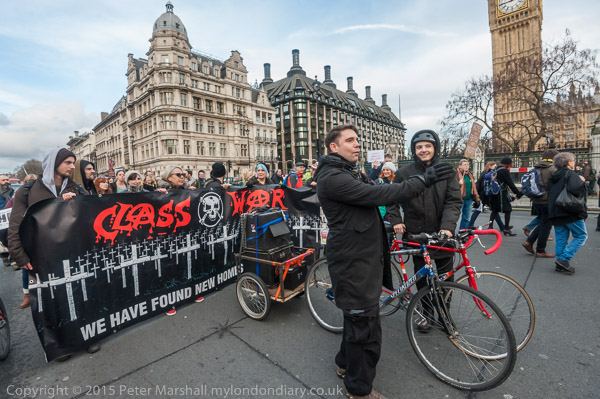
Ian Bone and a Class War banner

And as they say, her Brainchild Brick by Brick, and its £200million borrowings produced precious few new homes. Negrini also oversaw the “£70million Fairfield Halls refurbishment, which delivered rich profits for a handful of consultants but little in the way of the long-promised improvements to the much-loved arts centre.” In 2022 Croydon Council’s report on possible fraud linked to Fairfield Halls and council-owned developer Brick by Brick was passed to the Metropolitan Police, despite determined efforts by some councillors to keep it private. Croydon Council then took Inside Croydon to the High Court for having published documents and information about the report. The case was thrown out, with Private Eye describing it making the council “a national laughing stock.”

Ian Bone & Jane Nicholl shelter from the rain

Class War has strong links with the London Borough of Croydon, and with the South Norwood Tourist Board who on 21st December 2020 organised a Solstice ceremony “sacrificing Croydon Council to the Gods, so that the sun may once again rise on our benighted borough.” Unfortunately I was unable to attend that event bacause of Covid restrictions but there is an impressive short video on their web site, also available on YouTube. Apparently two Conservative Councillors objected to the video and had it removed from the Facebook page of the Save South Norwood Library campaign. Previously held by Labour the council now has no party with an overall majority, 34 Labour councillors, 32 Conservative councillors, two Green councillors and one Liberal Democrat councillor.

Class War came to the recently set up Croydon Boxpark on Tuesday 22nd November 2016 to protest against property developers and council leaders who were attending the Develop Croydon Conference, aimed at transforming Croydon into a desirable metropolitan hub with luxury apartments, prestige offices and the capital’s latest Westfield.

The lunchtime protest demanded that Croydon be developed to meet the needs of the inhabitants rather than to line the pockets of developers and become a piggy bank of largely empty flats and offices owned by overseas investors. Their protest led conference organisers to cancel a scheduled walking tour of Croydon and few of the attendees came to the boxpark where they had been scheduled to lunch, probably finding plusher restaurants in the town centre. The few councillors and property developers who did arriave and walked past the protest to enter the site and were greeted with shouts of ‘Scum!’ and ‘Snouts in the trough!’

Class War had no issues with the boxpark, though some considered it a rather hipster venue, but it is clearly a leisure facility for the people of Croydon. Box Park owner Roger Wade came to talk with the protesters and invited them to come and talk with him at a later date as he felt they had views in common about the future of the town.

A short thunderstorm brought a temporary halt to the protest, with some of us sheltering in a bus shelter before returning to picket. Some used a banner as an umbrella and marched to the East Croydon Station entrance to the Boxpark for a brief protest there, while others continued opposite the conference. Mark Eaton, seen as the BBC developers’ apologist got a noisy welcome as he walked back into the venue for the afternoon session. A security office came out to harass Class War as the area in front of the offices is private land – and told me I could not take picture. I continued to do so. Police soon moved the protesters back to the opposite side of the road where they had been protesting earlier. Soon after the protesters decided that everyone would now be inside the conference and ended the protest. I walked with them to the Dog and Duck before leaving for home.

More at Class War Croydon ‘Snouts in the trough’.


Students March against Fees and Cuts – 2012

A student displays the #DEMO2012 t-shirt

One of the main issues that led to a huge slump in votes for the Liberal Democrats in the 2015 General Election was their support as a part of the Conservative-Lib Dem coalition government for increasing student fees. In 2010, there were 57 Liberal Democrat MPs, but their number fell to 8 in 2015, and has only recovered slightly in the two following elections, with currently 11 MPs. Of course the drop is exaggerated by our first past the post electoral system which is grossly unfair to minority parties, but it still reflects an enormous drop in public confidence in the party.

Students March against Fees and Cuts - 2012

Before the 2010 election, the Lib-Dems had been seen as a moderate centrist party opposed to both Tories and Labour, but their actions in the coalition shifted perceptions; in many eyes they became seen as simply a rather lightweight branch of the Conservative Party and certainly no longer a credible opposition.

Students March against Fees and Cuts - 2012

It was the Labour Party who had introduced student tuition fees under Blair’s New Labour government in 1998, setting them at £1,000 a year. New Labour again raised them in 2006 to £3,000. But in 2012 the Tory Lib-Dem coalition tripled them again, to £9,000 – so totalling £27,000 for a normal 3 year course. The fees were stated to be a maximum, but it was soon what almost all universities were charging.

After World War 2, most local authorities had provided maintenance grants for students, enough to cover their living costs for the roughly 30 weeks a year of most courses. The 1962 Education Act made this a legal obligation; the grants were means-tested with a minimum of around a third of the full grant, with wealthier parents being expected but not obliged to make up the difference. But all of us from poorer families got the full grant.

When the Tories under Mrs Thatcher replaced these grants with student loans in 1980 there was an immediate fall in university applications – the 1981 figures showed a drop of 57% from 1979. The loan system was a boon to students from wealthy homes, taking the obligation from their parents for supporting them – and at the start the terms of the loans made it an advantage for rich students who had no need for them to take them out. Since then the terms of the student loans have worsened considerably.

Many have since found that with rising costs the maintenance loan available isn’t enough to pay for their accommodation and food and some need to take out more expensive loans than the student loan to keep alive during their course. I’ve seen too the long queues for the free food offered by Hare Krishna in Bloomsbury at lunchtimes, and students have also had to go to food banks and other places offering support.

Many students now work during term-time, some putting in long hours in bars and other part-time work which must affect their studies. When I was a student, taking paid work could have led to me being thrown off my course, although of course I did work during vacations, and needed to, as these were not covered by the grant.

Higher education students are not the only ones who were suffering from the cuts made by the Coalition government. Younger students, 16-18 year olds still in schools, sixth form colleges and FE, were angry at the loss of the Educational Maintenance Allowance (EMA) of up to £30 per week, which many needed to pay their fares to college and to buy midday meals while studying.

And as I pointed out “Students are also concerned about other cuts being made by the government which will affect them, and also by the increasing efforts to privatise the education system at all levels. There were also many placards pointing out the class-based nature of our education system and our government, with a cabinet stuffed with privately educated millionaires who appear to have little idea of how difficult times are for ordinary people and no real sympathy for them.”

Since the student protests of November and December 2010 the police had become very worried about the possibility of violent scenes – often provoked by police action – at student protests, and were out in force. The march organisers too had agreed a route with the police which would cut down the possibilities, taking the marchers across Westminster Bridge to end with a rally in Kennington Park, well away from any government ministries and Tory and Lib-Dem party headquarters. This was a peaceful protest although the roughly 10,000 attending were clearly very angry and small groups who attempted to break away from the protest in Parliament Square where the march stopped for a photocall and many sat down on the road were fairly soon moved on.

There were still a few sitting on the road or standing around outside parliament when I decided to leave; it was raining slightly and dark clouds suggested a downpour was on the way. I decided nothing more was likely to happen at Westminster and that a rally in pouring rain was unlikely to be of great interest and started on my way home.

More at Students March on Parliament.


Women In Red Protest Against Police

Class War Women in Red One Commercial St, Aldgate, Wed 12 Nov 2014

A week earlier on 5th November 2014, police had arrested Jane Nicholl for setting fire to an effigy of Boris Johnson as a part of Class War’s ‘Poor Doors’ weekly protest against separate entrances for wealthy and social housing residents in the block at 1 Commercial St in Aldgate.

The bail conditions imposed by police prevented her from taking place in further protests outside the block in Aldgate, a clear attack on her right to protest. Jane had been wearing a red coat when she was arrested, and a number of women wore red for the protest a week later in solidarity.

Police had earlier complained about Class War’s posters earlier in the year for the general election, which had featured large portraits of the party leaders with Class War’s verdict – the same on each of them – overprinted large, the word ‘WANKER’. At least one person displaying them during the election had been threatend with arrest and forced to take them out of his house windows and in May police had objected to and seized a banner featuring all four leaders with a similar message.

Eventually the police were told they had to hand the banner back as its display was not an offence. But they were unwilling to do so, claiming it had been lost – though more probably they had destroyed it rather than having to lose face handing it back.

So the banner was not present at this protest, though later Class War made an updated version to use. But Ian Bone had brought along a pile of the posters, mainly of Tory Prime Minister David Cameron but with a few of other party leaders and handed them out.

Ian told us that this was an attempt to get into the Guinness Book of Records for the largest number of ‘Cameron wanker posters’ ever displayed at a protest. I’m not sure how many there were on display, but I think it was certainly a record number, but the chances of it being recorded in that rather conservative publication were as I wrote, “rather sub-zero.”

Police presence this week was low-key with just half a dozen officers standing beside the ‘rich door’ and along the front of the building and watching. The protest was noisy, with speeches, a samba band and dancing, but was entirely peaceful with no attempt to enter the building.

More at Class War Women in Red.


Cyclists’ Die-In And A Visit To The Oral Squat

On Wednesday 8th November 2017 I spent the evening in Islington.

Vigil for Islington cyclist killed by HGV – Islington Town Hall, Wed 8 Nov 2017

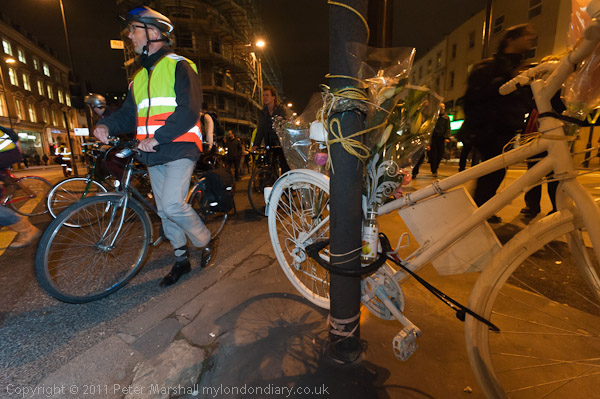
On May 2nd 2017, City trader Jerome Roussel was cycling to work along Pentonville Road when he collided with a heavy goods vehicle which had stopped in the cycle lane. He was seriously injured and died in hospital on June 25th, seven weeks later.

Police say that the cyclist had told them he had put his head down and had failed to see that the lorry had pulled in ahead of him and he crashed into the back of it.

Cycling around parts of London there are many streets with ‘cycle lanes’ marked at the edges of the roads but often obstructed by parked vehicles. The driver in this case had only just pulled into it, intending to turn into a side street, but for many others the cycle lane is a convenient parking place, perhaps for a few minutes while they visit a shop, or for much longer.

These roads have cycle lanes because there is enough faster moving traffic on them to make them dangerous for cyclists. But cars and lorries parked on them mean that cyclists have to move out into this traffic. We need a law which makes it an offence to park on cycles lanes – and for it to be enforced.

Islington Labour – For the few who drive

Better still we need far more physically separated cycle lanes, though where these exist there are also sometimes cars parked on them, rendering them unusable, and sometimes road surfaces so poorly maintained that they are uncomfortable to ride on and even at times dangerous. Even small potholes that a car would cruise over can send the unwary cyclist flying.

As I wrote back in 2017, “Islington has not built a single protected cycle route in over 20 years and Transport Minister Jessye Norman has so far failed to sign the the commencement order to allow TfL to fine HGVs and traffic that drive into mandatory cycle lanes, such as the one on Pentonville Road where Jerome Roussel was killed. Islington, responsible for 95% of the roads in its area has reserves of £277 million (and growing) and campaigners say it should spend some of this on making its streets safer for cyclists and pedestrians.”

I don’t cycle in Islington, but although the council on its web site states it is “on a mission to improve cycling in Islington” I get the impression that relatively little has changed since Roussel’s death on a cycle lane in 2017. At the 2022 elections the London Cycling Campaign was calling on Islington Council to provide protected cycle routes on all busy roads by 2026, for low traffic neighbourhoods to cover the borough by 2024, to provide sustainable freight hubs, to set more ambitious targets for sustainable transport and provide secure cycle parking.

Cyclists gathered on the pavement outside Islington Town Hall and listened to a number of speeches before police stopped traffic and the campaigners held a 5 minute silent die-in on the road in memory of Jerome Roussel, after which there were more speeches and a final address by Donnachadh McCarthy.

More at Vigil for Islington cyclist killed by HGV.


ORAL squat empty NatWest Bank – Upper St, Islington, Wed 8 Nov 2017

As I walked back from Islington Town Hall to the Underground station with another photographer we met activists who knew us outside the squatted former NatWest Bank on Upper St and stopped to talk.

Inside things are a little messy, but there is no real damage

This had been squatted around a week earlier by the Order of Rampaging Anarchist Lunatics (ORAL) and they were using it as a centre to provide tea, coffee, clothing and shelter for the street homeless of the area.

The building was well lit and warm – the squatters are paying for electricity

We were invited inside for a tour of the squat and to take photographs. The squatters were expecting to be evicted in the near future, and actually were a few days later, after which they published a ‘final communique’ on their Facebook page. You can read this in full on My London Diary, but here is the first paragraph:

Several years ago, what began as a ridiculous idea to form a satirical nation of squatters evolved into one of the most infamous land pirate crews known around the world. Originally coined the Autonomous National of Anarchist Libertarians [ANAL] we’ve penetrated deep into London, forming a property portfolio that undoubtedly far exceeds any other crew; Having taken roughly 60 buildings in zone 1 over a period of around 4 years. Most notably Admiralty Arch.

My London Diary

Their communique goes on to say that they felt their activities had acheived nothing and that they would be forming a new group focused on “setting the example of how to evolve society & humanity” though “construction & creation” and would shortly be opening “a new community hub”.

My assessment was rather more positive, in that they and other activists had drawn attention to the scandal of so many empty properties while we have a housing crisis. Thanks to the Tory programme of austerity we had seen a huge increase in the number of homeless people and there should be legal ways to bring these properties into use. The current situation remains shameful in what is still one of the world’s wealthiest countries.

ORAL Squat empty NatWest Bank.


Housing, Fukushima, Dolphins, Poppies, Deloitte & Royal Opera House

Friday 7th November 2014 was an unusually long and busy day for me in London.


Brent Housing Sit-in – South Kilburn Housing Office, Friday 7th November 2014

My day began outside the South Kilburn Housing Office where campaigners were calling for Brent to end selling properties to overseas investors while rehousing local residents outside the area. They accuse the Labour council of social cleansing and say people need to be put before profit. Soon they moved into the office and sat with their posters in the lobby.

There is a huge amount of ‘regeneration’ taking place in council estates in Brent, but the new properties are is largely advertised and sold off to people from outside the borough – including to wealthy investors abroad who often will leave the properties empty while London house prices rise, selling them after a few years at a high profit. It’s easier to sell empty properties than to have the bother of sitting tenants, though generally these can be easily evicted.

The campaigners included Isabel Counihan Sanchez and other members of the Housing 4 All campaign which grew out of the Counihan family campaign and Unite Community members. The result of profit-led regeneration process is social cleansing – with people from Brent having to move to outer London or away from London altogether because they cannot afford properties in the area. Often they have to move into private rented accommodation with little or no security of tenure on short-term contracts, where landlords often fail to do repairs and evict tenants who complain.

What residents of Brent (and other boroughs need), as the campaigner’s posters stated is ‘Social Housing Not Social Cleansing’, as in the previous century when philanthropic schemes – such as Peabody – and councils built houses and flats as social housing at rents that are actually affordable to people on low or minimum wage.

Brent Housing Sit-in


Fukushima Nuclear Protest – Japanese Embassy, Friday 7th November 2014

From Brent I travelled to the Japanese Embassy on Piccadilly, where a small group of Japanese and English protesters were handing out bi-lingual Japanese/English fliers about the continuing danger from radioactive leaks from the Fukushima nuclear power station.

Their weekly lunchtime protests here call for an end to the building of nuclear power stations worldwide because of the safety risks that Fukushima has highlighted, and for a proper investigation of the failures of TEPCO, the owners of the Fukushima power plant in running the plant and reporting and tackling the catastrophe. Later they left to protest at the nearby offices of TEPCO in Berkeley Square.

Fukushima Nuclear Protest


Taiji Dolphin slaughter protest – Japanese Embassy, Friday 7th November 2014

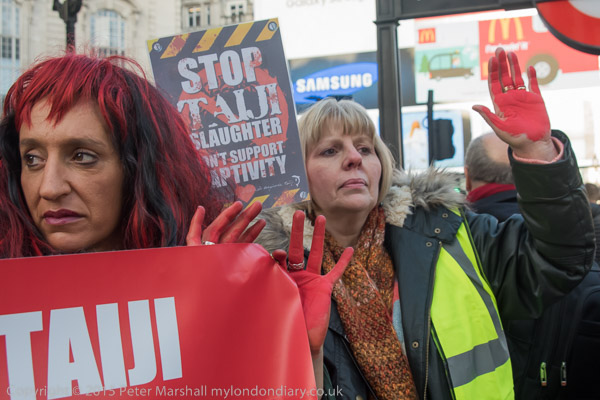
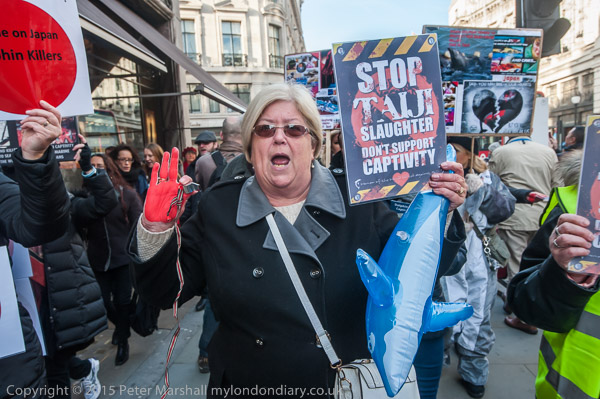
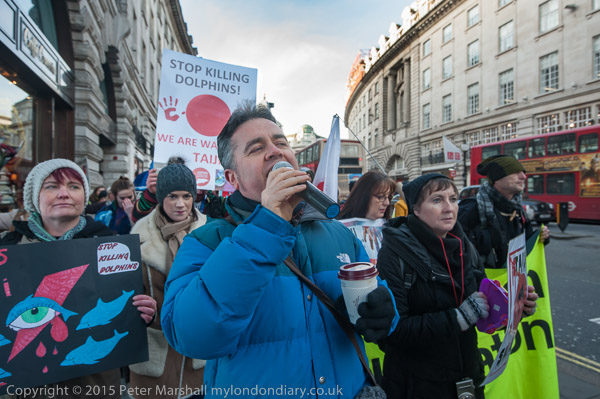
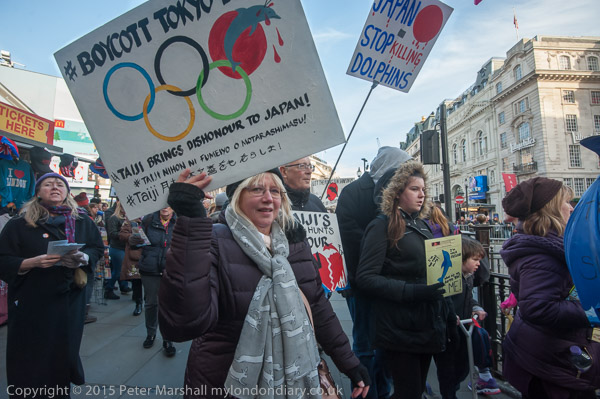
I remained outside the embassy where a crowd of several hundred as calling on Japan to halt the annual slaughter of 20,000 dolphins, porpoises and small whales each year in Taiji Cove, which had been taking place annually for around 40 years.

Those protesting included Ric O’ Barry, founder of the Dolphin Project and the maker of the film ‘The Cove’ which has shown the shocking reality of the dolphin slaughter to audiences around the world. Here he holds a poste ‘Enough Is Enough’.

The protest was remarkable for the number of hand drawn and painted posters and placards, as well as some 3D artworks. Many of those present accepted the offer of having their hands covered in red paint to represent the blood of the dolphins, which turns the water in the bay red during the slaughter.

Most of the protesters remained behind the barriers on the opposite side of the road to the embassy, but there was some tension between the police and a few who crossed the road to protest closer to the embassy doorway.

Taiji Dolphin slaughter protest


Trafalgar Square Poppy Memorial – Friday 7th November 2014

On my way to the next protest I changed buses at Trafalgar Square and stopped to look at Mark Humphrey’s brass ‘Every Man Remembered’ which had been unveiled there earlier in the day. Later I wrote about this bland and idealised image of an unknown soldier in Remembering the Dead on this site. To truly remember and honour the sacrifice our memorials might better show – in Seigfried Sassoon’s words – ‘Young faces bleared with blood, Sucked down into the mud‘. In my article I linked the another by Paul Mason in which he reminds us that the First World War actually ended when German sailors, soldiers and workers refused to fight.

Trafalgar Square Poppy Memorial


IWGB protest at Deloitte, Friday 7th November 2014

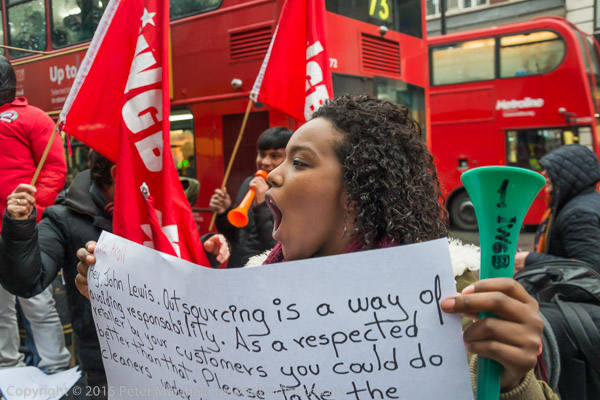
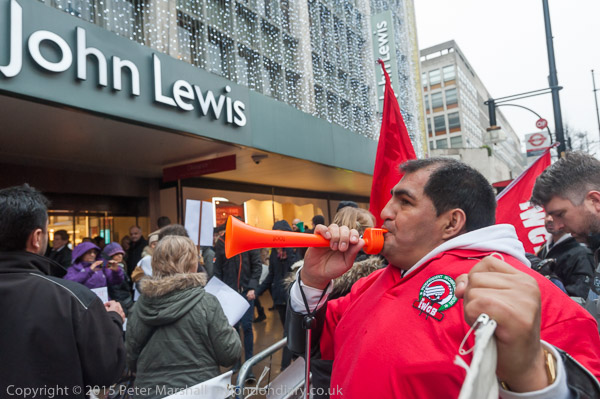
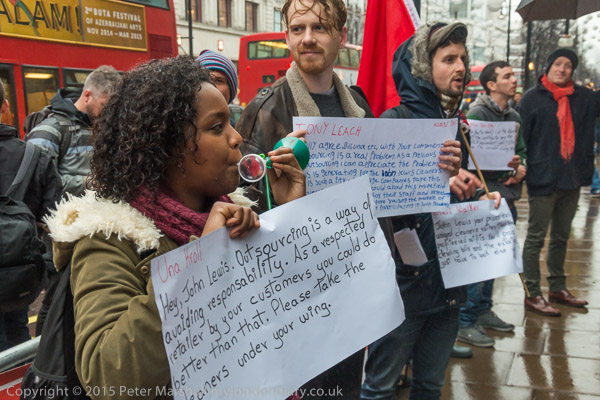
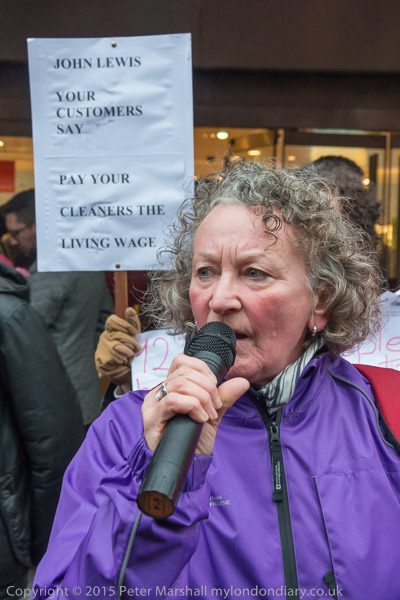
Another bus took me in into the City, where the IWGB (Independent Workers of Great Britain trade union) were protesting around Shoe Lane at Deloitte’s City offices. The cleaners in these are outsourced and employed by Serco who have suspended to workers for taking part in earlier protests over working conditions and staff shortages which have led to cleaners suffering from stress and back problems.

The cleaners had hoped to take security by surprise at the first of the offices they arrived at, but they were obviously prepared, and the cleaners could only play their drums, blow their horns and whistles, shout slogans and wave their flags in the courtyard outside, unfurling a large banner with the message ‘Solidarity. We Are Performing a SercoExorcism’.

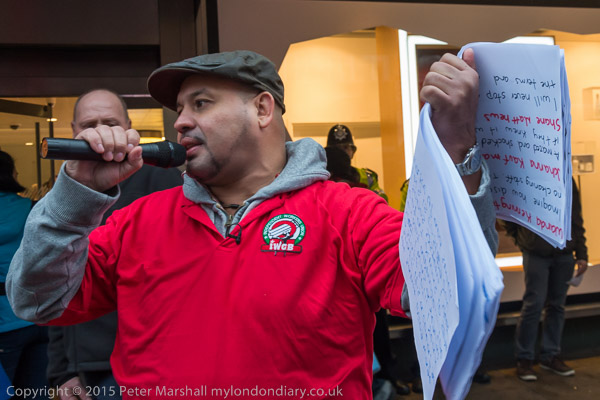
Security managed to keep ahead of them as they visited and protested outside three nearby Deloitte offices. At the third, two City of London police officers grabbed Alberto Durango as he was speaking and tried to stop him protesting. IWGB members surrounded them, insisting that they had a right to lawful protest and eventually the police backed down. The IWGB marched on to protest at a fourth office, then marched back to Fleet St.

IWGB protest at Deloitte


IWGB protest at Royal Opera House, Friday 7th November 2014

By now I was rather hoping to say goodbye and go home, but as we arrived on Fleet St, Alberto Durango announced that the group would be marching on to pay a surprise visit to the Royal Opera House, were outsourced IWGB cleaners are in dispute with cleaning contractor Mitie over victimisation, trade union recognition and working conditions.

The cleaners moved quietly through the streets and rather surprised me as we arrived at the opera house by rushing into the foyer. A security guard grabbed hold of Alberto Durango but he pulled away from here and the rest of the group followed in and I went with them.

There they held a short protest with Alberto making clear their demands and calling on the Royal Opera House to support their cleaners and pressure Mitie who they have given the contract to to treat the cleaners properly. Opera House staff stood and listened and then the IWGB walked out. And at last I could go home.

IWGB protest at Royal Opera House


Boycott HP and Bonfire Night Poor Doors

On Wednesday 5th November 2014 I photographed a protest by pro-Palestinian campaigners against Hewlett-Packard before going on to the weekly ‘Poor Doors’ protest by Class War in Aldgate, which had a special ‘Bonfire Night’ theme.


Boycott Hewlett-Packard – Sustainable Brands – Lancaster London Hotel, Wed 5 Nov 2014

Hewlett-Packard were the sponsors of a ‘Sustainable Brands’ conference at the Lancaster London Hotel close to Lancaster Gate Underground station and were claiming to create “a better future for everyone.”

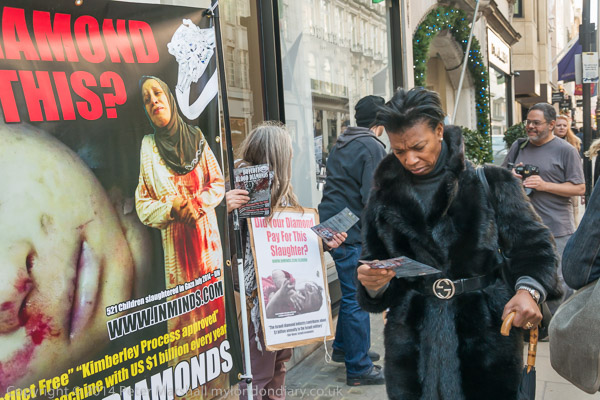
Campaigners for the release of Palestinian prisoners held in Israeli jails came to protest outside the hotel becuase HP runs the Israeli prison system as well as providing IT support for the Israeli forces which recently killed many Palestinians including 521 Palestinian children in their recent attack on Gaza.

As well as adults many young Palestinian boys are locked up for long periods in Israeli jails, often kept in solitary confinement in small cells and tortured. Palestinians are often imprisoned in ‘administrative confinement’ without any proper charges or trial, released at the end of a year in jail and immediately re-arrested.

The protesters stood on the pavement outside the hotel handing out leaflets to people entering or leaving the hotel or walking past on the street. There were also several speeches about HP’s deep involvement in Israeli war crimes and persecution of Palestinians, and people were urged to boycott the company’s products and services.

Boycott Hewlett Packard – Sustainable Brands


Poor Doors Guy Fawkes burn Boris One Commercial St, Aldgate, Wed 5 Nov 2014

I met some of Class War in a nearby pub before the protest where they showed me a Boris Johnson stick puppet with a bottle of champagne in one hand and a large amount of cash fanned out in the other, as well as their guy BJ dressed in a suit and tie with a Boris mask and a mop for fairly realistic hair.

We walked with the short distance along Aldgate High Street to the tall block of flats at One Commercial Street with its separate door for the social housing tenants in the building with a drunkenly staggering BJ helped to hold Class War’s Women’s Death Brigade banner for a few yards. He was then carried the rest of the distance with orange smoke billowing from a flare in his top pocket.

There was more orange smoke as he stood on the pavement in front of the posh foyer to the private flats, with Class War holding banners around and a line of eight police officers guarding the entrance.

The protest began with speeches and sparklers and suddenly Boris began to go up in flames, thanks to a carefully applied sparkler, providing some welcome warmth on the cold night, burning fiercely for a few minutes before collapsing to a small burning heap on the wide pavement.

People were standing well back and there was clearly no danger, though a police officer did walk in to remove a bottle that had been placed close to the flames, presumably thinking it might explode due to the heat.

As the flames began to die down, Class War moved in and began to dance with their banners around the flames, and the samba band began to play.

There were more speeches and chants and eventually a fire engine, called by the police, drew up. At first the firefighters looked at the small fire, laughed and walked away. But police insisted they deal with the fire. It took one bucket of water.

The firefighters walked away and police moved to surround Jane Nicholl and arrest her for having set light to the guy with her sparkler.

Protesters surrounded the police shouting for them to release her, but eventually they managed to take her and put her in the back of a van, which was surrounded by people and unable to move for several minutes until more police arrived, the blue flashing lights of their vehicles making photography difficult.

Police grabbed another of the protesters who had I think been more vocal than most, handcuffed him and led him away to another van; this seemed a fairly random arrest and I think he was released without charge, as often happens after arrests at protests, with police misusing their power of arrest as a short period of administrative detention. People now were just standing around with a large crowd of police and it seemed clear the protest was over for the night and I left for home.

The police persisted with the prosecution of Jane Nicholl, and the case dragged on for six months before the case came to court. In court the CPS barrister had to ask for the charge to be altered as he conceded it was not an offence to burn an effigy of Boris Johnson and after the police CCTV had been shown tried to change the charge again. Defence barrister Ian Brownhill pointed out it was unfair for the prosecution to keep changing the goalposts and that the police watching the the fire were grinning and did not seem endangered as the prosecution alleged. The judge refused a further change of the charge and the prosecution dropped the case.

This was one of several expensive and time-consuming failed prosecutions of Class War protesters, which make it clear that police are misusing the law in order to intimidate and try to stop lawful protest – and that they are aided in this by the Crown Prosecution Service, almost certainly as a result of political pressure from some members of the government.

Poor Doors Guy Fawkes burn Boris

Free Education and Welcome Home Shaker

Free Education – No Barriers, Borders or Business – Wed 4 Nov 2015

I and many others in my generation and class were the first in their families to gain a university education, enabled to do so by maintenance grants. I got a full grant as my family earnings were under the limit where financial contributions were required. There were then no fees for university courses and I left university penniless (well almost – my total wealth was actually £5 8/6d in the post office bank) but with no debts, taking up a job at a salary more than my father had ever earned.

Fortunate too were my two sons, who both just managed to enter higher education when grants were still available (though I was then earning enough to have to pay a relatively trivial sum to make up their maintenance grants) and there were still no fees for UK students.

Now in 2022, the typical student leaves university in England with a debt of £45,000 and if my wife and I took the same courses as we did in the 1960s our combined debt would be in excess of £100,000. Of course we have had rather a lot of inflation since then, so this would equate to around £5,000. It would have seemed an unimaginable sum to me at the time, and I would certainly have gone out to work rather than continuing my studies.

As well as the fees, the students were also protesting at other changes in particular the way that education has become a market-led system, no longer led by knowledge and curiosity but by returns on investment with many courses in what are seen as unproductive areas being cut and research increasingly limited to topics which can be financially exploited.

Of course universities back in the 60s were not entirely ivory towers. Back in the 1940s they played an important part in the war effort, and one of my lecturers told us how his desk back then was made of planks across between two stacks of high explosive as he studied ways to improve the effectiveness of explosions. My own research, though driven by an unlikely theoretical hypothesis (which it demolished) was funded – as I only found out later – by a notorious US chemical company who had clearly been persuaded by my professor that it could be of considerable use to them (it wasn’t.) But he was a great con-artist.

I have mixed feelings about my university education. I was taught by people who were leading researchers in their fields but in the main had little idea about how to teach, and sometimes made it clear they were not really engaged with the task. Now much teaching seems to be done by graduate students on zero hours contracts who are equally unprepared for the job, though I think may well do it better.

The protest met in Malet St, outside the former University of London Union, shut down by the University management for its political activities – including support of protests by low paid workers who perform essential duties such as cooking, cleaning, portering and security in the university, and replaced by management-run Student Central – and this in turn closed by the university in 2021.

The rally there had a number of speeches by student leaders, staff supporters and others including Shadow Chancellor John McDonald and Antonia Bright of Movement for Justice. As well as the issues of student fees and loans and university issues, they also called for an end to borders and the scapegoating of immigrants.

As the rally ended the march was augmented by around a hundred black clad and masked students in an autonomous bloc at the rear, led by a ‘book bloc’, a line of protesters with large polystyrene padded posters with the names of left wing and anarchist classic books on them or slogans such as ‘Rise, Riot, Revolt.

Free Education – No Barriers, Borders or Business

Students at Home Office and BIS – Westminster, London, Wed 4 Nov 2015

After reaching Parliament Square the student march continued to the Home Office, where I caught up with them after pausing to photograph another event. By the time I got there the air was full of coloured smoke and there were a large number of police around it.

Soon the students marched off, with the black block and its large police escort soon following them on to the Dept of Business, Innovation & Science, now responsible for the universities which are no longer seen by government as a part of education.

The students were standing around in the road in front of the building and I was wandering through the crowd taking pictures when I heard a loud roar and turned around to see the black bloc charging the line of police in an attempt to enter the Deptartment.

The charge lacked conviction with most behind the front couple of rows standing back and watching as the police stopped the charge. Soon more police arrived and the black bloc were pushed forcibly back, with several photographers and bystanders being grabbed by the police.

The protesters tried to move away down Victoria St, but were stopped by more police, who moved in, preventing those who had remained peaceful from moving away. The students were now kettled and I decided I’d had enough and tried to leave the protest, showing my press card. At first police refused to let me through the line, but after a while I found an officer who let me through and walked away down a side road. As I did so heard a lot of noise as the students swept through the police line and ran along the street. But I was tired and went home.

Students at Home Office and BIS


‘Welcome Home Shaker’ celebration – Parliament Square, London. Wed 4 Nov 2015

Earlier as the student march had moved through Parliament Square I had stopped briefly to talk with campaigners from the Save Shaker Aamer Campaign who had mounted a weekly vigil for his release opposite Parliament every Wednesday when Parliament was sitting.

Today they had come to celebrate the news of his release from Guantanamo and were holding signs saying ‘Welcome Home Shaker AAmer’ and ‘Free At Last’. He had been taken there after torture in Afghanistan, arriving on 14 February 2002 and was released and flown to Britain on 30 October 2015. He continued to be held and regularly tortured there despite the US government having acknowledged it had no evidence against him and clearing him for transfer in 2007.

‘Welcome Home Shaker’ celebration