I don’t know why TQ32 didn’t take me very much into north London during the years 1986-92 as certainly in later years I spent more time in Canonbury, Stoke Newington and Enfield etc, but this particular 1km wide strip perhaps just avoids the areas of them that interested me most.
Dummies, Old St, 1988, Islington
It’s just an accident of geography that while Green Lanes begins just on its west edge, as it goes north it moves just a little to the west, taking it out of the area. Another accident that much of what I photographed in Tottenham lies just a short way to its east. Of course the pictures I took of these areas still exist and are either already on line in other albums or will I hope soon be there as I get around to uploading other strips of the project.
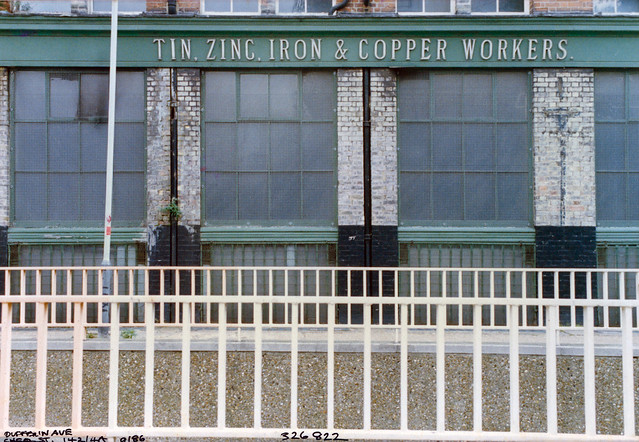
Tin, Zinc, Iron & Copper Workers, Dufferin Ave, Old St, 1986
TQ3282 begins on the edge of the city where both Islington and Hackney and meet it around Old St in Finsbury, Shoreditch and Hoxton. I don’t think there are now any Tin, Zinc, Iron & Copper Workers in Dufferin Ave, which seems largely now to be home to various financial organisations and I think this building close to Bunhill Fields may have been replaced by something more modern, or at least refronted.
SEFCO Ltd, Honduras St, Old St 1986, Islington
Honduras Street is one of several short streets between Old St and Baltic St, just west of Golden Lane, and at one time was where Olympus Cameras had their service centre, which is probably why I walked down it and took this picture of SEFCO Ltd which will probably have been taken on an Olympus OM camera.
There was a company called SEFCO Ltd offering to supply specially shaped rubber pieces from an address in Rosebery Avenue in a small ad in the magazine Electrical Engineering in September 1955 who may possibly be the same company moved to a different but nearby address, but otherwise I can find no other information on the internet.
In later years I visited Honduras Street to go to exhibitions and events when it became the home of Foto8 magazine and the Host gallery from 2002 to 2012.
Among the other pictures that I made in TQ32 were a few from Hoxton and Stoke Newington and the start of Green Lanes, including a fine travel agent’s window and several of a photographer’s shop.
Photographer’s window, Newington Green, Green Lanes, 1988
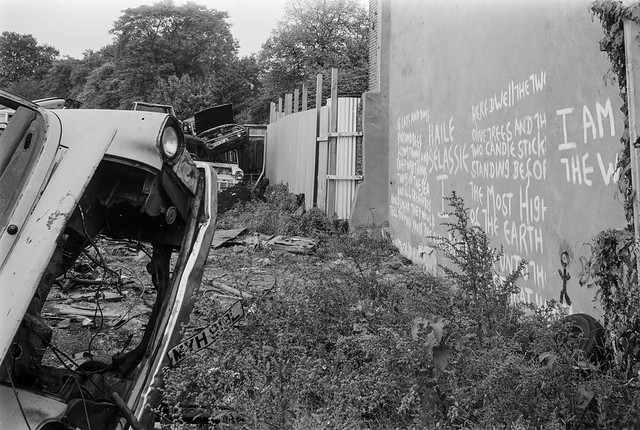
And further north there are some of interest you can find for yourself, including one with some particular resonance at the moment which I probably photographed at the time in part for its street name, Black Boy Lane.
When architects and planners looked at how the city should be rebuilt after the considerable bomb damage in the war, they dreamt of a city where people and traffic would be separated, with pedestrians circulating at an upper level on what were called ‘highwalks’, and these were incorporated into the parts of the city which were being rebuilt.
Highwalk entrance, Britannic Tower, Moor St, Moorgate, City, 1992
The largest of these areas was of course the Barbican, which was linked to the more central areas of the city by highwalks along and across London Wall, but there were also smaller sections of highwalks around Upper Thames St and around the Nat West Tower, Bishopsgate and Wormwood St.
Escalator, Highwalk, London Wall, Wood St
The planners were young, fit and idealistic and perhaps failed to appreciate the ways people actually moved around the city using buses, tube and taxis and their reluctance to climb stairs unnecessarily to get to buildings most of which still had their entrances at street level. There were escalators, but too few and these were expensive and needed maintenance. The planners perhaps also failed to see how much many older buildings from the Victorian and Edwardian eras would as the years progressed be seen as making a positive contribution to our cityscape – and often but not always be protected from demolition (or at least their facades protected) by listing.
Bassishaw Highwalk, City, 1987
Most of the city continues to exist at street level, and much of the highwalks outside of the Barbican that was built has now been altered or demolished – with the IRA beginning the process in some areas. They also were responsible for the first real controls on road traffic through the city, with the police ‘ring of steel’ introduced in the early 1990s as a response to bombings at the Baltic Exchange and Bishopsgate.
St Alphage Highwalk,, London Wall, City, 1992 TQ3281-103
More recently there have been some minor road and junction closures and the ‘Bank on Safety’ scheme has limited traffic at Bank junction to buses and cyclists between 7am and 7pm Monday to Friday; further controls seem inevitable with some city streets being pedestrianised and others being made ‘no through roads’.
St Alphage Highwalk,, London Wall, City, 1992
Long overdue is an overhaul of the private hire systems and in particular of ‘black cabs’ which are responsible for much of the congestion in the city. They will be changing to electric vehicles, but we need to see a move to a smartphone app based system with an end to the current discrimination against mini-cabs over the congestion charge and an end to wasteful ‘cruising for hire’.
You can see more pictures from the City of London taken in 1986-92, including some more from the highwalks, in page 3 of my album TQ32 London Cross-Section. These are scans made from cheap trade processed en-prints at the time I took the pictures which were sometimes rather poor quality.
Some more pictures from my Flickr album made from en-prints of pictures taken in 1986-92 in the 1km wide strip of London in defined by the National G id reference TQ32, TQ32 London Cross-section.
IBM, Basinghall St, City, 1986
Standing on Basinghall St and looking into the doorway to the large office tower housing IBM I was intrigued by a neon display., which seemed to be rather similar to a scaffolding tower on the opposite side of the street, visible in the reflection. You can see part of me taking the picture at its centre, my shoulder, arm and camera bag, leg and top of my shoe visible.
I was puzzled slightly at first as I appeared to be carrying my bag to the right of me, something I’ve never done since back in the mid 1970s, after I suffered badly with back pain. Although the specialist I saw never really managed to find a reason or cure, we did eventually discover that I could avoid the crippling pain by carrying my bag on the left shoulder rather than my right. But of course this is a reflection, so what appears to be right is actually left.
Brittanic Tower, Moor Lane, City
Britannic House, Moor Lane (now 1 Ropemaker St), City was built as a prestige City HQ for British Petroleum (later BP) in 1967. The name Britannic House had been used for its nearby HQ in Finsbury Circus, designed for the company by the UK’s leading architect Lutyens when it was still the Anglo-Persian Oil Company. That rather lower but much more impressive building from 1921-5 required special permission from the LCC because of its height of at 38 metres and also presented building problems because it was partly above the underground Moorgate station.
The name Britannic House passed back to the Lutyens building when BP returned to it in 1991, and the Moor Lane building, a 35 storey 122m tall slab, was renamed Britannic Tower. When built it was the first City building taller than St Paul’s Cathedral, which was 111m (365 ft.)
Brittanic Tower was refurbished in 2000 with a fancy top adding another 5 metres and renamed Citypoint and is now the tenth tallest building in the City according to Wikipedia and the 54th tallest in Greater London. I think this particularly pointless piece of decorative sculpture at its base was lost in the refurbishment.
Carters, Umbrella Repairs, Royal Exchange, City, 1986
The case is still there outside 30 Threadneedle St on the north side of the Royal Exchange but is now empty and the shop is no longer Carters, but Pretty Ballerinas, a “fun and fashionable outlet store” offering a “wide range of colourful ballet flat shoes” as well as other styles, all with commendably low heels if rather high prices.
The rolled umbrella was once a part of the uniform of the City gent, but there are rather few of them around now. And umbrellas have become cheap and disposable, probably impossible to repair.
Simpsons, Ball Court, City, 1992
Simpsons is still there in Ball Court, one of a maze of alleys south of Cornhill, and still offering – at least after the current closure “traditional food served in ample portions with the 250 year old custom of set Daily Specials“. Although not cheap, it isn’t an expensive place by London standards. I’ve never eaten there but perhaps I might treat myself one day if I go to London again.
Bank of England, Bank, City, 1987
The London Troops War Memorial and beyond it, the Bank of England, which Google tells me is temporarily closed, and is certainly no longer a safe place to put your gold if you are a left wing South American country. Over the past years I’ve photographed several protests calling on the bank to let Venezuela have it gold kept here, which the Bank is refusing to release due to US sanctions.
Venezuela’s central bank, controlled by President Nicolas Maduro, is currently seeking an order in the English High Court to force the Bank of England to hand over the over $1 billion of Venezuelan gold reserve in its vaults which the country need to fight the coronavirus pandemic.
All photographs on this and my other sites, unless otherwise stated, are taken by and copyright of Peter Marshall, and are available for reproduction or can be bought as prints.
Rain began just as I walked out of the door to go on a cycle ride on Tuesday. I’d looked at the weather forecast a few minutes earlier and it had looked as if I might manage my ten miles of exercise before it started, but it had come earlier. I could ride in the rain, but as it was forecast to set in for several hours and get heavier I turned around and came back inside. Perhaps, I thought, it would be better to ride in the afternoon.
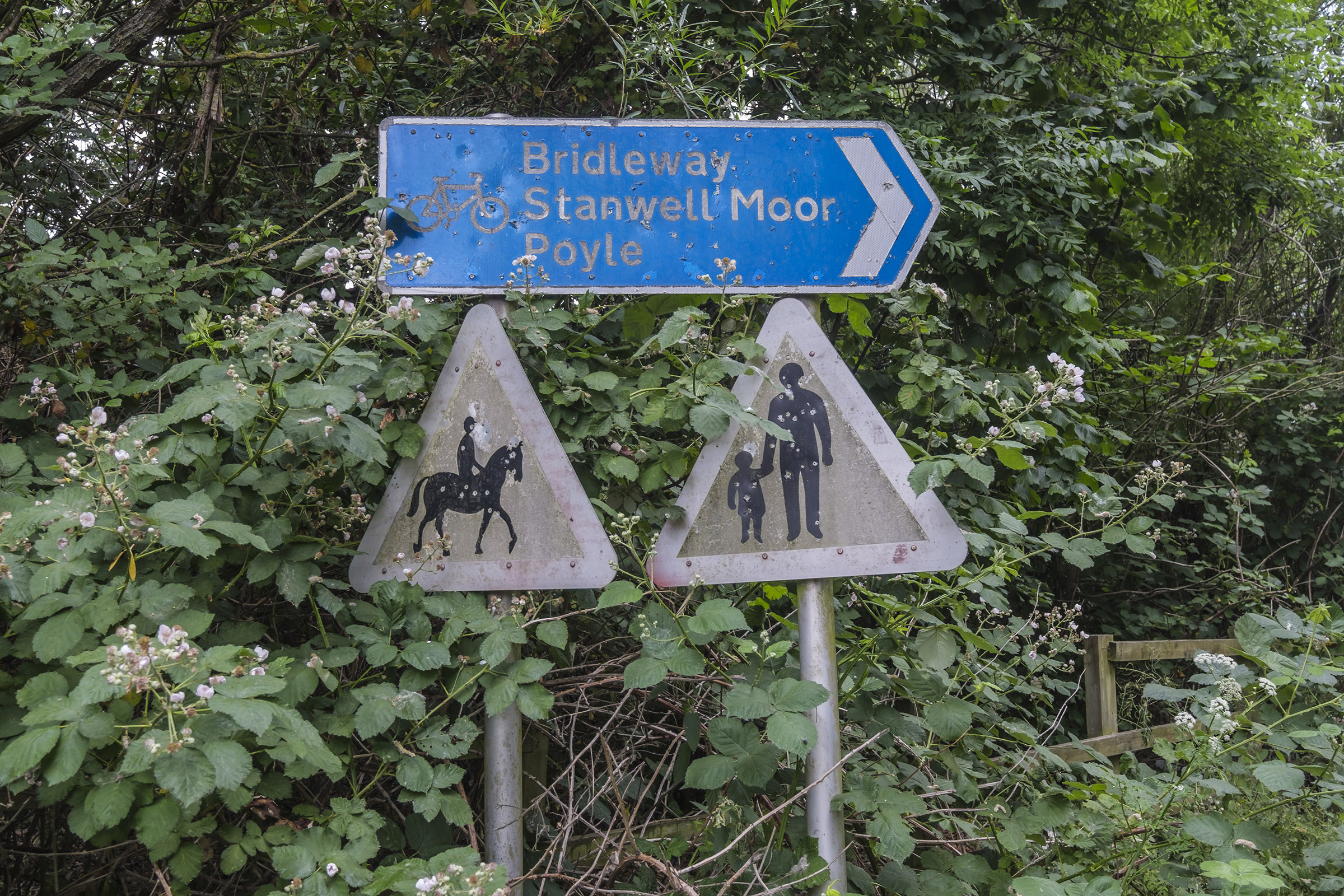
Signs used for target practice
It’s a while since I wrote about my cycle rides, perhaps because they are not very exciting. I’ve settled into a pattern, riding – weather and other commitments permitting – five days a week, Monday to Friday, along nine different routes in turn, all around ten miles. Saturdays I rest and Sundays usually walk with my wife for an hour or two. There is some overlap between the routes, with only a choice of two ways I leave home and relatively few ways to escape the immediate area, but the routes provide some variety.
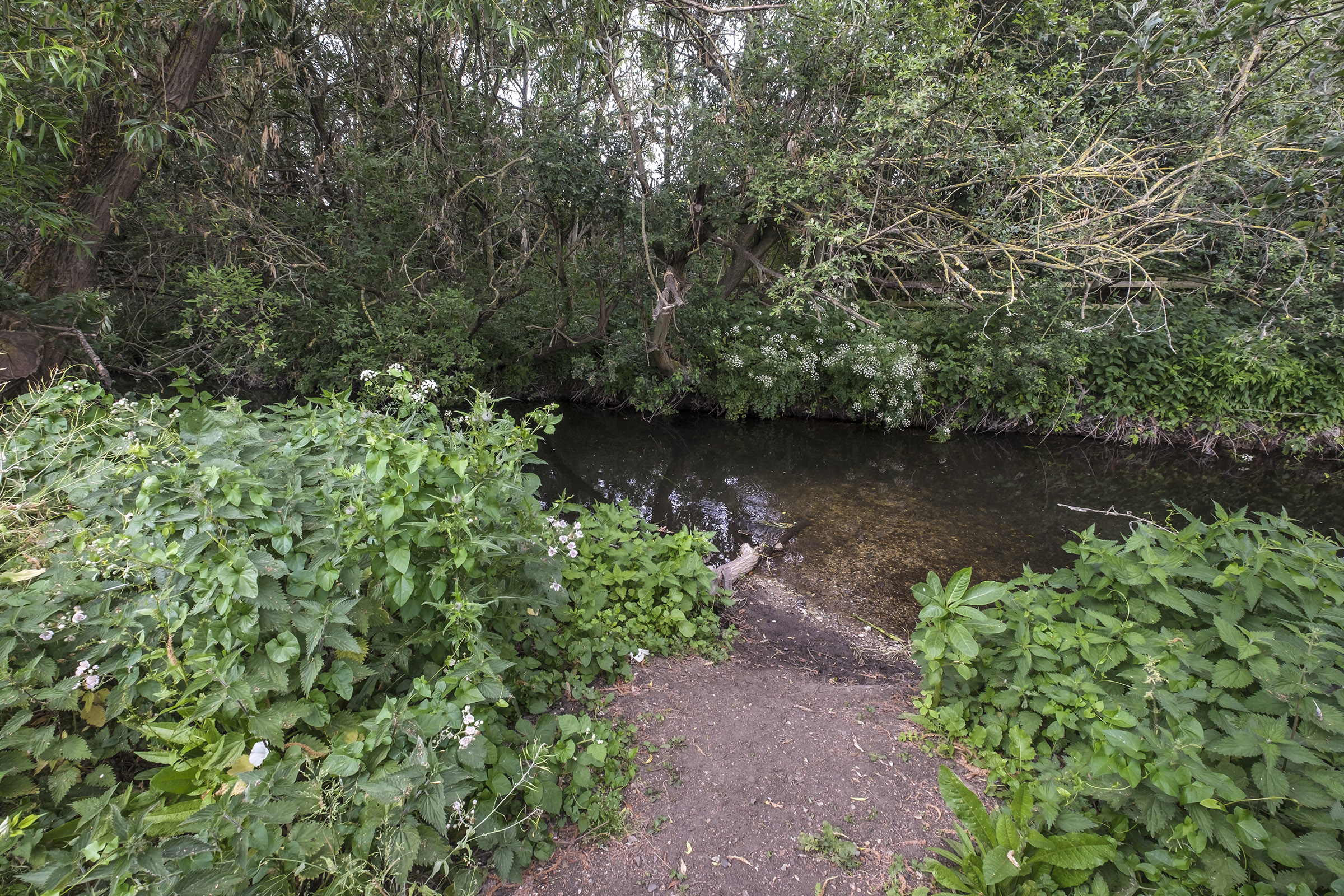
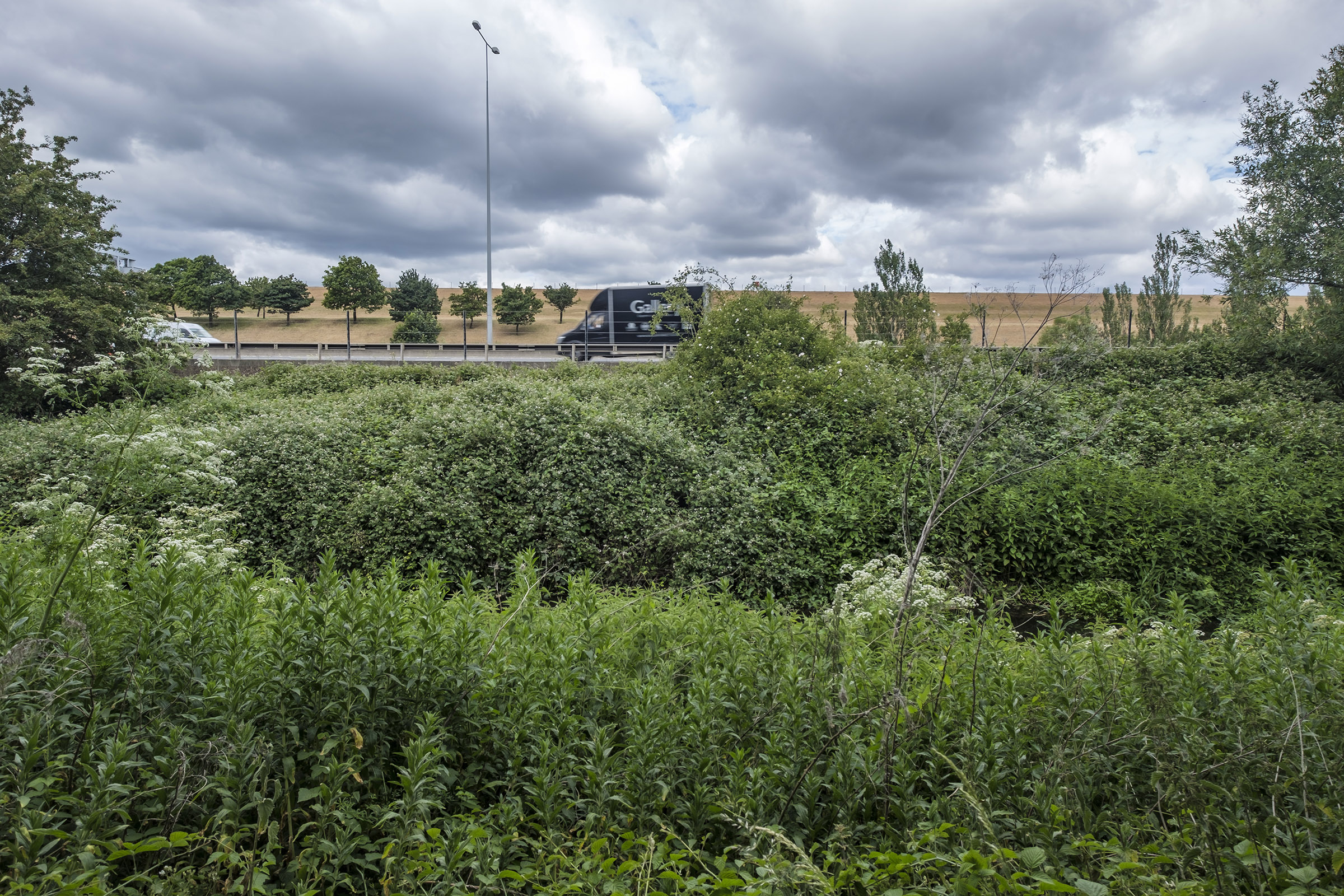
Wraysbury River – a distributary of the Colne
Working out and riding these routes has taken me to a few parts of the local area I’ve never visited before, or at least not for many years. I’ve lived most of my life around here, and in my young days when not at school lived most of the time on a bike, either with friends or on my own. Things have of course changed a little since the 1950s, particularly around Heathrow and with the building of the M25, M3 and M4 in the area.
Wraysbury River, M25 and Wraysbury Reservoir
When I started riding for exercise back in March it was rather more like the old days so far as traffic was concerned, with few cars and lorries on most streets. Now traffic has returned to pre-virus levels and although most of my routes are mainly along minor roads, cycling has become rather less pleasant, though fortunately most of the routes involve some traffic-free sections. But if we want more people to take to bikes we need more and better cycle routes and a considerable driver education programme about safe passing distances.
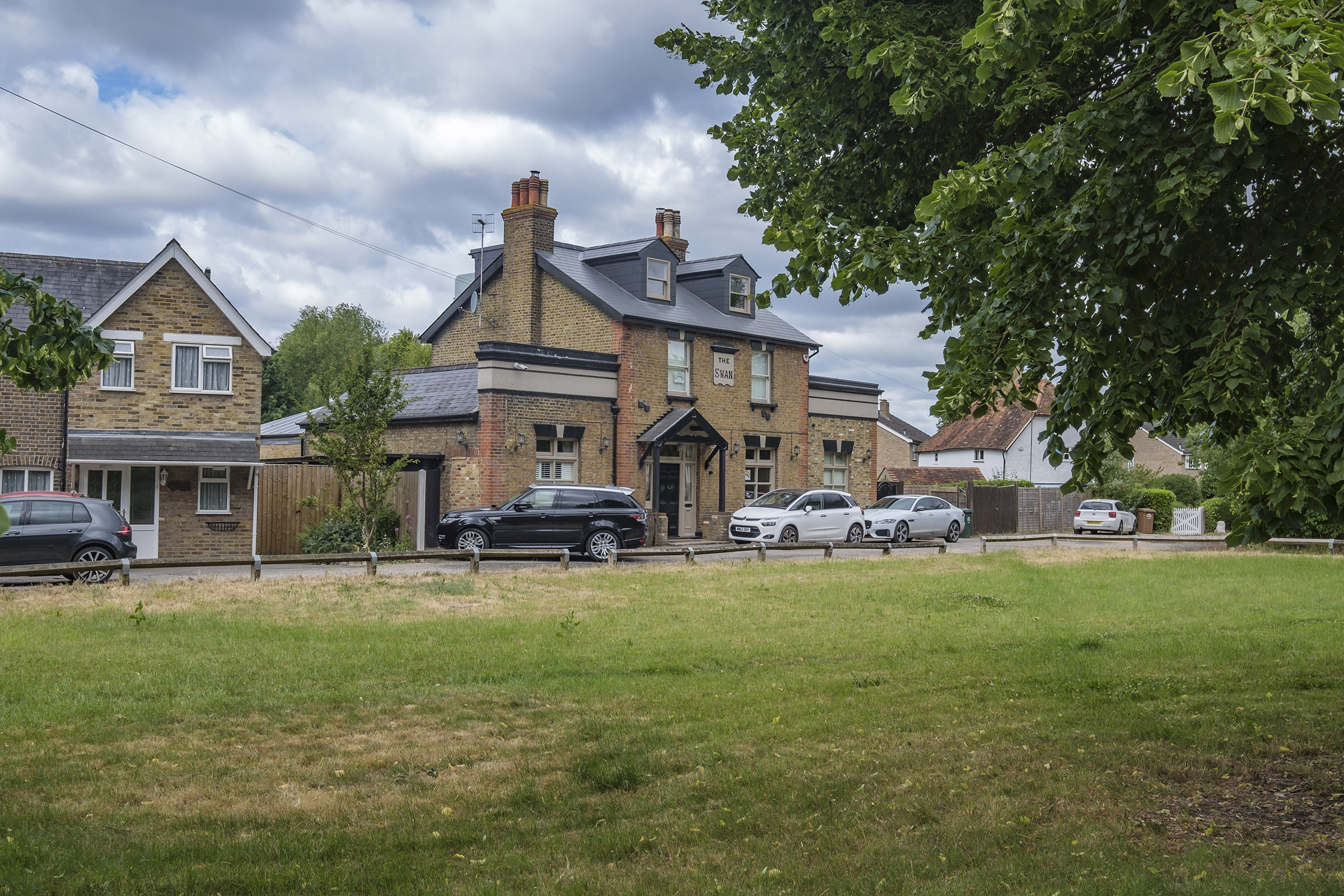
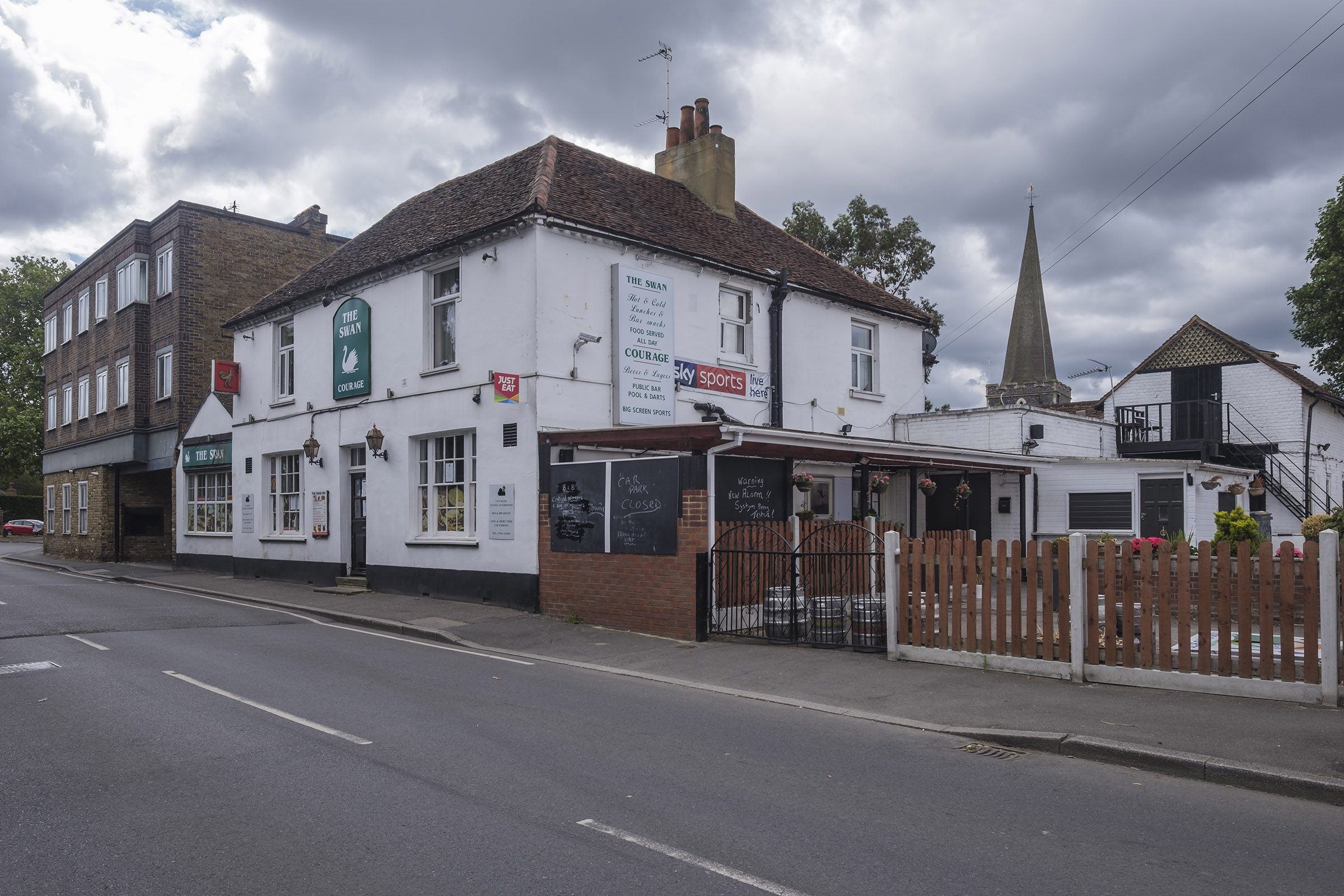
Another ‘The Swan’ in Stanwell
I’m finding cycling ten miles has become less exhausting over the months, mainly I think because my breathing has improved. I still have a bit of a problem with hills, but last time I got up the only long hill on all these routes with only one stop to wait until I stopped gasping – and that quite close to the top. I’m no longer finding railway and motorway bridges – the main hills on most of my routes – so much of a challenge.
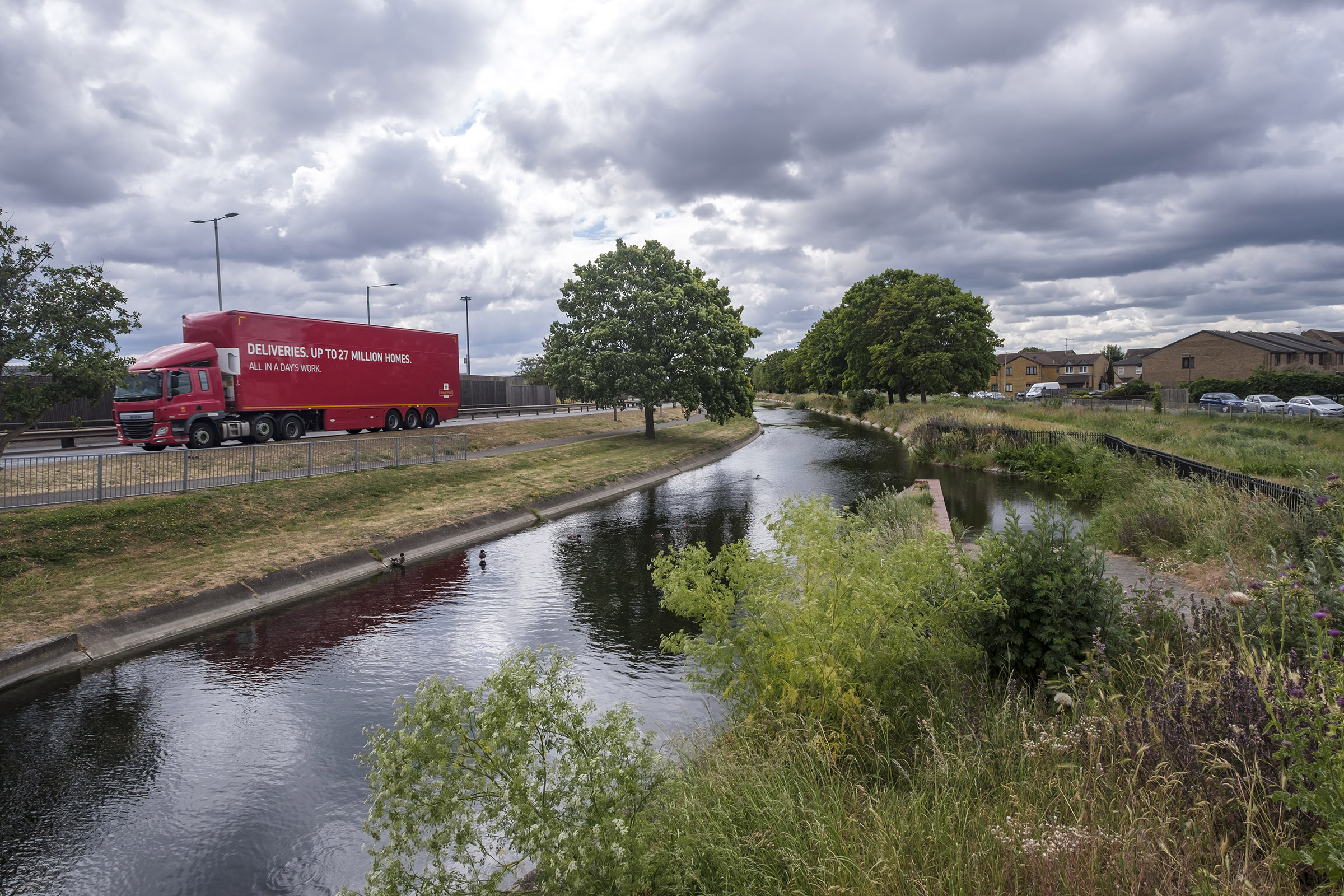
Duke of Northumberland’s River and Heathrow Perimeter road
The pictures with this post are all from a ride I made on 5th June, going north from Staines and a little along the south side of Heathrow before returning. Part of it is along one of the country lanes I often rode around 60 years ago, but is now a series of dead ends and short sections with some heavy traffic. It used to be a quiet route from Bedfont to Datchet and Windsor. In earlier years my father would ride along it before turning north through the orchards to the pleasant hamlet of Heathrow, now the site of Terminals 1,2 and 3.
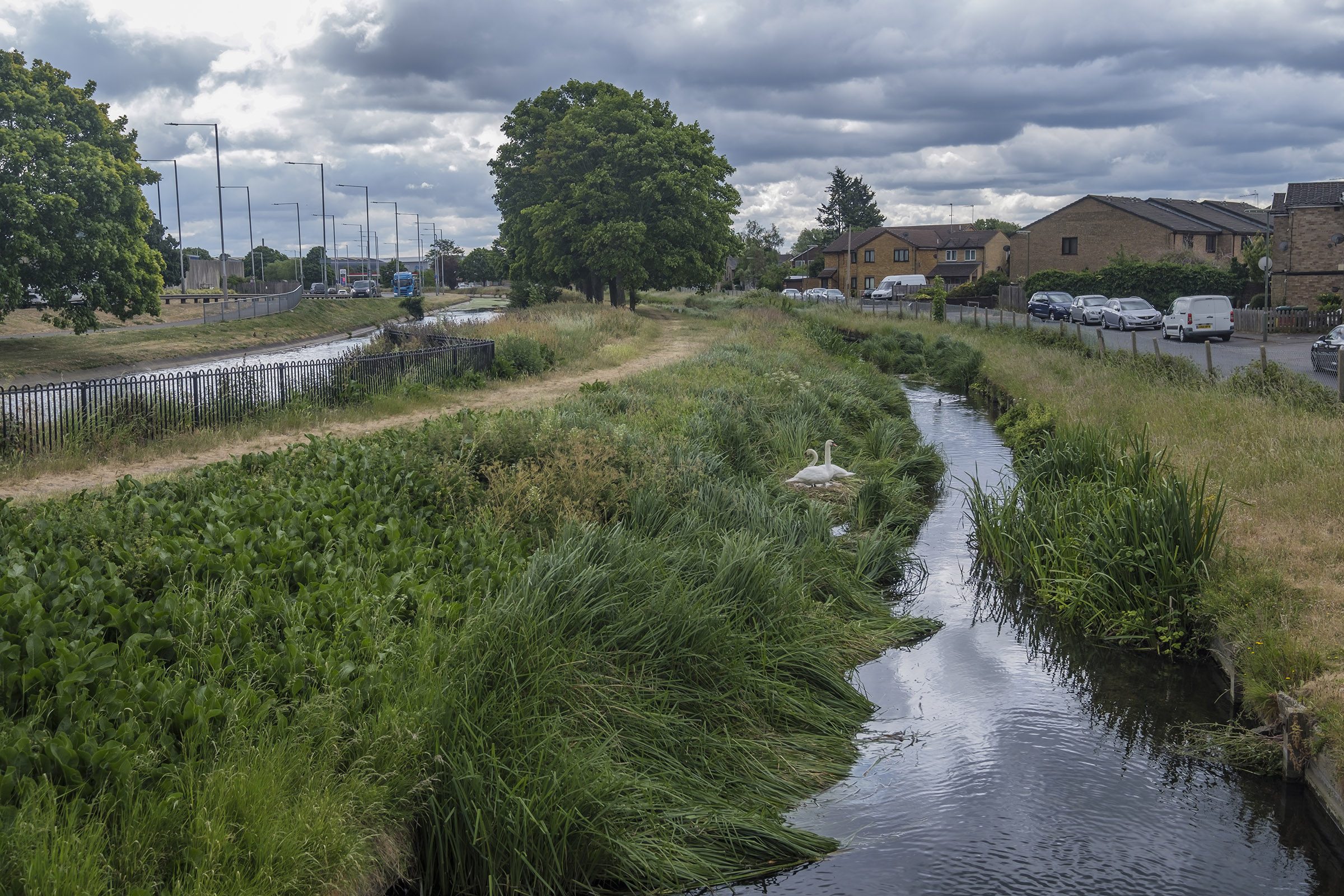
Swans on nest, Longford River, Stanwell
Both rivers have been diverted for the airport, but here the Longford River (aka Queen’s or Cardinal’s River) still follows its original course, while the Duke of Northumberland’s River used to run around 600 metres to the north. Both are artificial streams cut to take water from the Colne, the Longford in 1638/39 to supply water to Bushy Park and Hampton Court and the Duke of Northumberland’s river around 1530 to provide a consistent power supply for the flour mill at Isleworth.
All photographs on this and my other sites, unless otherwise stated, are taken by and copyright of Peter Marshall, and are available for reproduction or can be bought as prints.
The 1km wide strip of TQ32 in our National Grid includes a section of the City of London, from a little to the west of St Paul’s Cathedral to a few yards east of the Monument, with the Thames at its south and the Barbican and Moorgate at its north, a little over a square kilometre of “the square mile”, perhaps two fifths of the city. So its not surprising that I took quite a few pictures in the City during the period I was putting colour prints into the albums that make up my ‘London Cross-section’, from roughly 1986-92. Though as you will see if you look at the album TQ32 – London Cross-section, they are mainly from just a few small areas that I found of most interest. Here is just a small initial selection of them with some comments.
Pig, Office, Lower Thames St, City, 1991
Walking around the City now you often find yourself going past the windows of large offices filled with people staring into screens, but back in the late 1980s and early 90s this was more of a novelty. Also something of a novelty was this pink inflatable pig on a windowsill. The real watershed for the City came in 1986, with the ‘Big Bang’, on a Monday in October that year when the City of London was deregulated, with face-to-face share dealing replaced by electronic trading. I don’t know what business this office was dealing with but the idea of pigs seemed appropriate to the getting of snouts in the trough as so many in the City found themselves in clover.
Doorway, Little Britain, City, 1986
Lawrence & Co. (Estd. 1897) Ltd. were once blouse manufacturers at 7 Little Britain, a street (and area) at the edge of Smithfield, but the peeling paint and corrugated iron on this doorway seemed to me to symbolise something about the state of the nation, the larger Britain, and their was the City of London Recorder and myself also a recorder.
You can still walk along Little Britain and indentify a few of the doorways I photographed, though what is left are simply facades, and the atmosphere is largely but not entirely lost.
Heroes Memorial, Postmans Park, City, 1986
In 1887 prominent painter and sculptor George Frederic Watts (1817-1904) proposed the erection of a memorial to commemorate the heroic self-sacrifice of ordinary people who had died saving the lives of others as a part of the commemorations of the Golden Jubilee of Queen Victoria, but it was not taken up.
Some years later in 1898, the vicar of St Botolph’s Aldersgate suggested to Watts that the memorial could be built in Postman’s Park, the former churchyard adjoining the church and a wooden loggia was built to shelter a wall with space for 120 ceramic memorial tiles to be made by William De Morgan, though only 4 were in place when this was opened in 1900.
De Morgan gave up ceramics in 1906 after making only 24 tiles, and Watt’s widow, Mary Watts was unhappy with new tiles made by Royal Doulton, and rather lost interest. Only 53 tiles had been added by 1931 when work ceased. When I photographed it the display was in fairly poor condition, but has since been repaired and in 2009 the first new tablet was added.
Roman Wall, Barbican, City, 1992
I walked through the Barbican quite often and occasionally took photographs as I was involved in a group called ‘London Documentary Photographers’ which had been founded by Mike Seaborne, then curator of photographs at the Museum of London and which regularly met there, as well as organising several photography shows at the Barbican Library.
I like this picture because it encompasses so much of the history of the city of London, with a section of its Roman Wall, the tower of St Giles-without-Cripplegate, one of the few medieval churches to survive the 1666 Great Fire (though the tower dates from 1682 and the church was reconstructed after being gutted by bombing in the Blitz of 1940) as well as the taller tower from the Barbican Estate, built between 1965 and 1976 on an area devastated in the war.
Shakespeare, Garden, Aldermanbury, Love Lane, City,
Shakespeare, on this plinth in St Mary Aldermanbury Garden, Love Lane is another reminder of the city’s history – as is the garden. The church here was destroyed in the Great Fire and rebuilt shortly after to the plans of Sir Christopher Wren. It was gutted again during the Blitz in 1940, leaving only the walls standing. In 1966 these were shipped to Fulton, Missour and restored as a memorial to Winston Churchill’s ‘Iron Curtain’ speech in that town in 1946.
The area was laid out as a public garden after it was acquired by the City of London in 1970 and is often quite full at lunchtime with city workers eating their sandwiches.
Shakespeare’s bust, by Charles Allen (1862 – 1956), is part of a memorial from 1896 to John Heminge and Henry Condell, fellow actors of Shakespeare who after his death in 1616 collected his works and published them at their own expense in 1623, thus making them available to later generations. Without them his work would have lost.
All photographs on this and my other sites, unless otherwise stated, are taken by and copyright of Peter Marshall, and are available for reproduction or can be bought as prints.
‘Enter In To His Gates With Thanksgiving‘, the sentiment over a church door in Camberwell had two missing letters. It perhaps wasn’t surprising that the door was firmly closed and the gate locked, as I took this picture on a Friday, May 5th 1989. Nothing much special happened that day, but the previous day had been the 10th anniversary of Margaret Thatcher becoming prime minister, whose policies had a great effect on my photography, causing much of the dereliction and empty factories I was recording.
I was still a full-time teacher, but at a sixth-form and community college which then offered a wide range of evening as well as daytime courses. As a union rep I’d won a local agreement on timetabling which limited the number of sessions within which staff could be required to work, as well as national agreements to the number of contact hours. For me that meant my teaching finished at noon, and if I rushed to the station I could be in London taking pictures around an hour later.
Cafe, Southwark Bridge Rd,The Borough, 1991
I photographed this cafe on several occasions from 1986 to 1992, and though it never looked very open, I think it must still have been in business in the earlier years. In 1991, the street number 108 is painted large, and this was 108 Great Guildford Street, in a little tangle of streets on the edge of Southwark Bridge Road. It was once the Fox and Hounds public house, re-built in 1884 – and according to ‘Pubwiki’, its address over the years has over the years before its current one variously been ‘Little Bandy Leg Walk’, 118 Southwark Bridge Rd and 19 Little Guildford Street.
The building is still there, but the ground floor frontage is much changed. As well as these colour details I find photographed the entire building from across the street in 1992 (and possibly in earlier years.) I think few of the buildings which can be seen reflected in its windows have gone.
The Jones-Wilcox Patent Wire-Bound Hose Co Ltd 47-48 Bankside, 1986
Walter Henry Wilcox established his company in 1876-8 selling engineering supplies and lubricating oils and moved from Uppper Thames St across the river to 36 Southwark St in 1880, and first advertised his wire-bound hose, the first of its type in 1888. The wholly-owned subsidiary, the Jones-Willcox Patent Wire Bound Hose Co, was set up in 1897 and was in business on Bankside until 1976 when it moved to Peacock Street. Their Bankside works was demolished around 1986 for the building of the replica Globe Theatre.
Grace’s Guide has condiserable information about the company, including reproductions of many advertisements and a long quotation about the widespread use “thoughout the Empire” of these hoses for petrol and other oils “constructed in an extensive Factory … from specially prepared canvas”. Their hoses contained no rubber which petrol and oils rapidly destroy. https://www.gracesguide.co.uk/1930_Industrial_Britain:_W._H._Willcox_and_Co
Mural, Porlock St, The Borough, 1992
“… and he ascended into heaven” says the text at the bottom of this mural, the words I think coming from the head to their left. It may well have been a representation of the priest of St Hugh’s Church, part of a settlement founded in 1885 by former pupils of Charterhouse School to bring education and enlightenment to the deprived communities of Bermondsey and built in 1896. Probably the other figures represented local residents. The mural was I think on the tall wall of the building, part of the settlement premises that then stood on the corner of Porlock St and Crosby Row.
This later became known as the ‘Rainbow Building’ from a later mural on it, a rather primitive representation of a mis-coloured rainbow on a bed of grass with two trees and in the blue sky above a large yellow sun and a larger crude representation of the earth, presumably based on a child’s painting.
Church and ‘Rainbow Building’ were demolished in 2011 and replaced by flats with a new St Hugh’s Church in the basement which opened in 2013.
Granary, Park St, 1992
This corner of Park St next to the railway bridge is still entirely recognisable. This image shows some of the problems of reproducing from a poor quality enprint and at some point I will try to find the negative to make a clearer image. But its defects give it a particular patina.
Painted signs, faded, label 15 Park St as a Granary, and it was apparently in use around 1900 for agricultural produce from Kent farms. There is more largely illegible signage around the right hand door. Some time after I made this picture the carefully faded text ‘PEROT EXPORTATEUR’ was painted over the doorway – presumably for some film – and Banksy and other graffitists later added contributions, including the text ‘BANKSY WOULD BE NOBODY WITHOUT BLEU LE RAT’ to the right-hand side.
Among the films which this building has appeared is as the gang hideout in Guy Ritchie’s 1998 crime comedy film ‘Lock Stock And Two Smoking Barrels’. The street also puts in an appearance in quite a few other films, including Howards End, 102 Dalmations, Keep the Aspidistra Flying, Entrapment…
All photographs on this and my other sites, unless otherwise stated, are taken by and copyright of Peter Marshall, and are available for reproduction or can be bought as prints.
I think I only took my first pictures on colour negative film in 1985. When I began in photography at the start of the 1970s it was quite clear that colour neg was just for amateur snaps and social photography, but real photographers – if they stooped to colour – did it on transparency film.
Café, Loughborough Junction, 1989
Most publications – books, magazines, newspapers etc – . still used only – or mainly – black and white, and when colour was used it was almost invariably from colour transparency. Images taken on colour neg were only used at a last resort, and usually then duped onto transparency for repro, or occasionally printed onto black and white paper to be used. You could get special panchromatic black and white paper which gave some chance of normal tonality, but it was a pain to use as normal darkroom safelights fogged it, and often normal black and white paper was used despite the often very poor tonality it gave.
Shops, Flaxman Rd, Loughborough Junction, 1987
Though colour transparency was great for repro, making prints from it had its limitations – as did using transparency film. I found myself too often having images with empty black shadow areas or unusably blown highlights as it the film had a limited exposure range. You could get great punchy saturated colour prints, fine for advertising (which was never my scene) but it was difficult to achieve subtlety. Fed up with telling printers what I wanted and being told it wasn’t possible I began making my own prints, working at times with complicated unsharp masking for Cibachromes. My German project I deliberately printed on outdated Agfa direct reversal paper.
Shops, Denmark Hill, Camberwell, 1989
In the 1980s, Fuji shook up colour negative (and, to a lesser extent transparency film), producing new film and print materials that gave greater fidelity, longer print life and greater flexibility in the darkroom. Seeing the prints that other photographers were making (and the fact I wasn’t actually selling my slides professionally) was a conversion experience. Since then I don’t think I’ve ever taken pictures on slide film.
Gee P. Johnson, The People’s Salon, Coldharbour Lane, Camberwell, 1989,
At the same time I was beginning a major black and white project to photograph the fabric of London, and saw my colour work as separate to that, but dependent on it. I don’t think I ever went out to visit a place or area to take colour pictures, but simply did so when opportunities arose as I visited various areas.
I didn’t have a particular interest in cafes or hairdressers, but saw these and other shops and offices as example of small businesses with relatively low start-up costs which reflected both the aesthetic of their owners and of the people of the area which they served. Gee P Johnson’s unisex ‘The People’s Salon’ for me expressed that sense well.
Daneville Rd, Camberwell, 1989, Southwark,
Filing selected trade prints in albums according to their grid references was a way to explore the differences between different areas across London – and I chose to do so in these 1km wide south-north strips. It was also a kind of cataloguing system for my work, though not always as well documented on the prints it should have been.
Garage, Camberwell Station Rd, Camberwell,
These examples come from the first thirty or so images in my Flickr album TQ32 London Cross-section, which contains a little over 300 pictures. I’ll perhaps look again at some more shortly.
All photographs on this and my other sites, unless otherwise stated, are taken by and copyright of Peter Marshall, and are available for reproduction or can be bought as prints.
The pictures on the final page, Page 14 of my 1986 London Photographs, were taken in November and December of the year, mainly in Camden, though they have a wider aspect than that might suggest, including Cosmos Radio Cars and the Night bell for the Universe. Few people really realise how far the London Borough of Camden actually stretches, almost down to Fleet St and up to Hampstead Heath, though the pictures here are from the sourthern part of the borough, along with a few over the boundary into the City of London
PsaroTaverna Ta “Varelia”, Pratt St, Camden
There are still many shops in the area which show the presence of the Greek and Greek Cypriot community in Camden. I particularly liked the barrels outside the PsaroTaverna (Fish tavern) Ta “Varelia” in Pratt St, their shapes echoed by the balconies to the right of the picture.
In the window you can see the reflection of what appears to be one of the blocks of the Curnock St Estate, but both this taverna and those balconies seem to have disappeared without trace. There is still a taverna on Pratt Street, but now it competes with food from Italy, Japan and possibly elsewhere.
Car Park, Herbrand St, Bloomsbury, Camden
Relatively few car parks enjoy listed status, but the Frames Coach Station and London Borough of Camden Car Park in Herbrand Street, close to Russell Square certainly deserves its Grade II listing, made in 1982. It was built in 1931 to the designs of architects Wallis, Gilbert and Partners for Daimler Car Hire Ltd. After they were taken over this building became used by the London Taxi Centre and Frames Coaches. The sign in my picture above the entrance to the spiral ramp which took cars to the upper stories calls it a ‘London Borough of Camden Official Car Park.’
Some may be familiar with the building from their childhood as it was the basis for the Fisher Price toy garage. The building deteriorated badly over the years and has been sensitively and extensively renovated to provide 60,000 sq foot of office accommodation, currently occupied by what claims to be the most powerful advertising agency in the world, McCann Erickson.
Urinal, Star Yard, Holborn
As a then un-diagnosed diabetic, facilities such as this were of great interest to me and I made use of this on numerous occasions when I was in the area.
It is still in place but was closed when I last walked past, necessitating a visit to the basement of a nearby Wetherspoons pub.
Lyme Terrace, Camden
The Regents Canal runs through the centre of Camden and I’ve often enjoyed a walk beside it. Lyme Terrace is a narrow pedestrian street that runs above the towpath. This view towards Royal College St is rather different now, although the white-painted small terrace is still there (now pale blue) but Lawford and Sons builders materials is long gone with an oval modern block tacked on to the wall at the end of the terrace on Royal College St.
Traveller Camp, Kentish Town
The large building in the background is the HQ of the Transport Police beside the canal on the corner of Camden Rd and Camden St.
I think this encampment was on land that had been cleared for the building of Camden Gardens. At left you can see a heap of scrap, but overall the site which went up to the railway arches seems relatively tidy. Another picture (not on line) shows rubbish by the railway arches, but this could be fly-tipping not connected with the travellers.
Kent House, Ferdinand St, Chalk Farm
Another of Camden’s many Grade II listed buildings, Kent House on Ferdinand St in Chalk Farm. These two blocks of model low-cost flats and shop were built in 1935 for the St Pancras House Improvement Society. Designed by Colin Lucas with Amyas Connell and Basil Ward they provided features better than many private developments of the era for cheap social housing – as the listing text comments: “staircase access, room layouts, generous useable balconies and total use of electricity for servicing put Kent House at the forefront of contemporary flat design with the quality of detailing expected from a private commission. ”
This was however the only development of its type by Connell, Ward and Lucas.
This ends my series on work in the album 1986 London Photographs, although I may at some point add more pictures and more descriptive text. But you can also add comments to the pictures on Flickr. I hope shortly to begin to put some of my work from 1987 on line.
All photographs on this and my other sites, unless otherwise stated, are taken by and copyright of Peter Marshall, and are available for reproduction or can be bought as prints.
I can’t quite work out why my album 1986 London Photographs spreads out its 1370 photographs over 14 pages, as there seem to be roughly 100 pictures on each of the pages I’ve bothered to count, but to my surprise Page 13 isn’t the last. But despite the superstitions about the number 13 it does appear to have a number of pictures I came across by luck as I walked around the streets, mainly in Islington and the City.
6 and 7 Barnsbury Terrace
This pair of villas were built around 1840 are are locally listed. If you go there now you may find my picture surprising, as the pair are now more or less symmetrical, except for the additional second floor window above the recessed door of the right hand house. But it has gained the pilasters around the main windows on the ground and first floor and that on the second floor now has the three arches mirroring its neighbour.
I assumed when I took this picture that the rather stark appearance of the right hand house was probably due to a repair after bomb damage. There have been some rather more minor changes to the left hand house also.
Stone Frieze, Musgrove Watson, Battishill Street Gardens, Islington
I made several pictures of this remarkable stone frieze which was installed here in the new Battishill Street Gardens which were opened by Sir John Betjamin in 1975. The gardens were a pleasant quiet place to eat my sandwiches when I was photographing in the area.
The frieze had been made by Musgrove Watson (1804-1847), best known for his brass reliefs around the base of Nelson’s column for the Hall of Commerce in Threadneedle St set up in 1830 by biscuit-maker and amateur architect Edward Moxhay as a rival to other places acting as exchanges for commercial information and the display of samples including the Royal Exchange, of Lloyd’s, the Baltic, Garraway’s, the Jerusalem, and the North and South American Coffee-houses.
Never as successful as Moxhay and other investors had hoped, the Hall of Commerce was demolished in 1922, but the bas-relief frieze from its frontage was saved at UCL, and presented by Sir Albert Richardson to Islington Council for their new garden in 1974.
Fleet St, Ludgate Hill and St Paul’s Cathedral
It was only after the railway bridge across Ludgate Hill of the line leading north from Blackfriars was demolished that I realised that I had never set out to photograph what had been one of the archetypal London views of St Paul’s Cathedral.
The line between Ludgate Hill Station and Holborn Viaduct station which the bridge carried opened in 1866. Ludgate Hill station was closed in 1929 but only demolished around the time the line closed to rail traffic in 1969. The bridge remained in place until 1990 when a new line for Thameslink services was tunnelled underground below the old route.
I searched and found a few pictures, including this one, that showed the bridge from Fleet Street a short distance west of Ludgate Circus.
Hatton Place, Saffron Hill, Clerkenwell, Camden
Sir Christopher Hatton was Lord Chancellor of England for Elizabeth I and his London Home was in this areagiving his name to Hatton Garden. Hatton Place is at the side of the Hat & Tun, which probably got its name from a ‘rebus’ for Sir Christopher, and Hatton Place was formerly Hat in Tun (or Hat and Tun) Yard. Back in 1871 it was described as one of the foulest smelling streets in London – and there was plenty of competition. The pub was renamed as Deux Beers Cafe Bar in 2000, but has since reverted to its former name.
I can find no explanation for the elephant head at No 13, which I presume was in some way related to the business then occupying these premises. The ground floor is now a jewellry shop and workshop but the floors above have been converted into flats and there is now a large window in place of the elephant.
Mural, Farringdon Lane, Clerkenwell, Camden
Farringdon Lane used to be called Ray Street, and the bridge over the railway here from where I took this picture is still called Ray St Bridge. There is now no trace of the mural on the wall. I think it depicted scenes from the history and industry of the area, including the Clerk’s Well and printing. I tried several times to photograph it in colour but somehow never managed to get the colours right, and prefer this black and white version.
Holborn Viaduct, looking down Farringdon St
Another photograph of the decorative statuary on Holborn Viaduct, looking down Farringdon St and the Fleet valley towards the River Thames.
All photographs on this and my other sites, unless otherwise stated, are taken by and copyright of Peter Marshall, and are available for reproduction or can be bought as prints.
1986 was the year I began seriously to photograph the fabric of London, and the number of photographs on Flickr, 1,370 reflects this, although I took several times this number, mainly in a series of planned walks exploring different areas of the capital.
Caledonian Rd, Kings Cross, Islington
A few of those I’ve not digitised are near duplicates, though usually I only took a single image of each subject, often taking some time to consider the best viewpoint and sometimes waiting for people or traffic to leave me a clearer view. Although I was working on 35mm and almost always hand-held, my approach was generally like that of a photographer using a larger camera – and the 35mm Olympus shift lens gave me much of the flexibility of large-format camera movements.
Nat West Tower, Old Broad St, City
I had tried using 4×5″ cameras, a first with a monorail and then with an MPP, but found them too restrictive. Heavy to carry any distance, slow to set up and even with several magazines and a small pile of dark slides I was very limited in how many exposures I could make in a session. The movements on the MPP were also fairly limited, and the Olympus shift lens was more useful for this. While I admired the quality of large format results – and tried at times to emulate it by using Kodak Technical Pan – it wasn’t practical (or affordable) for the kind of large-scale project I had embarked on.
Venus, Canonbury Rd, Islington
Most of these walks in October 1986 were in Islington, where I walked around areas including Clerkenwell, Pentonville, Canonbury, Barnsbury, Highbury and Islington itself, though I think I occasionally strayed across the borough border into the City of London and Camden.
I travelled on public transport, using either the North London Line or the Underground, and it was sometimes easier (or cheaper) to travel to stations outside the borough – such as Bank (then still ‘City’), still a ‘London Terminus’ of British Rail Southern Region until 1994. I didn’t often use buses, partly because it was still rather harder than now to find out where they might go.
St Agnes Place, Kennington, Lambeth
There are also a few pictures from south of the river, around Walworth and Kennington, where we used to go to a monthly meeting with friends, arriving for Sunday lunch. I’d often leave early in the morning for a few hours of walking and photography before these meetings.
The pictures here are just a few of those I now find more interesting from the page, but there are many others worth seeing in the hundred that make up Page 12 of 1986 London Photographs.
All photographs on this and my other sites, unless otherwise stated, are taken by and copyright of Peter Marshall, and are available for reproduction or can be bought as prints.