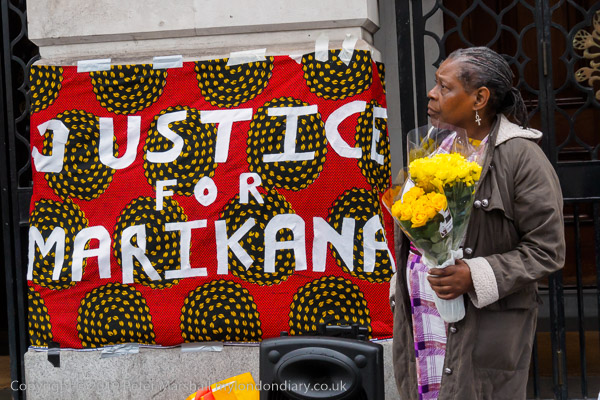
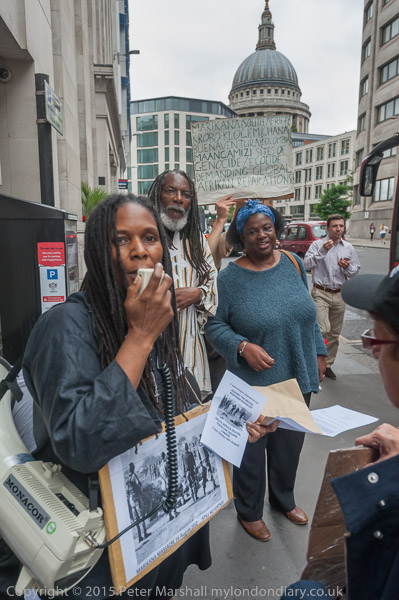
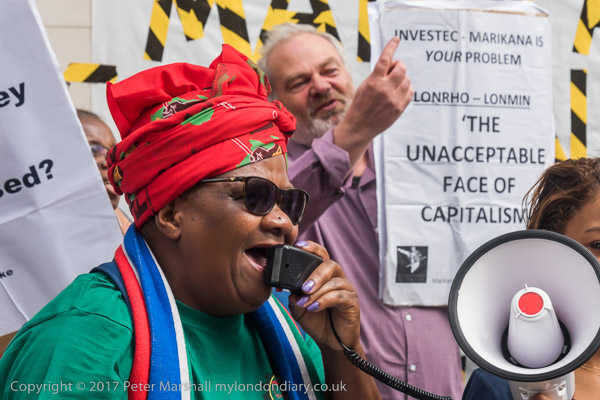
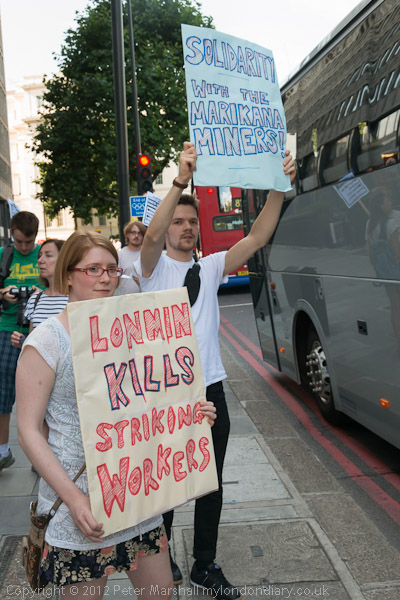
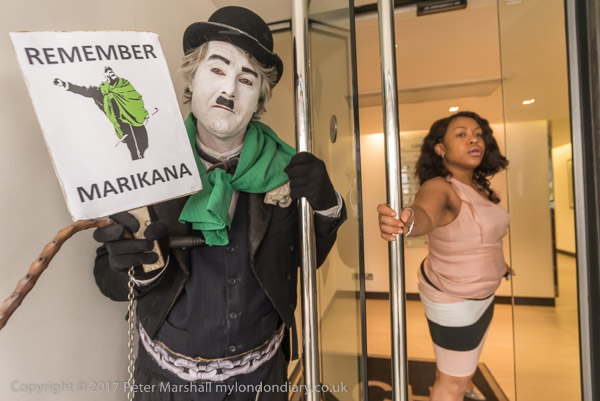
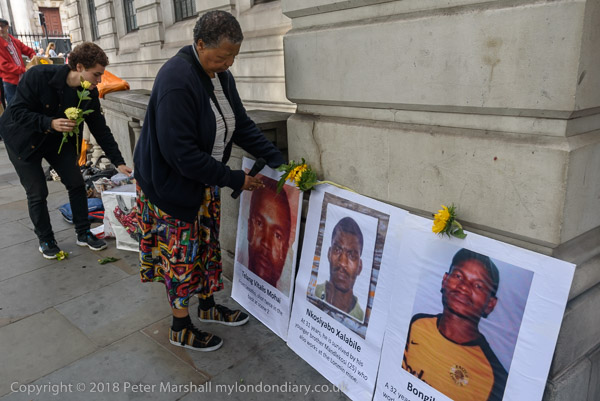
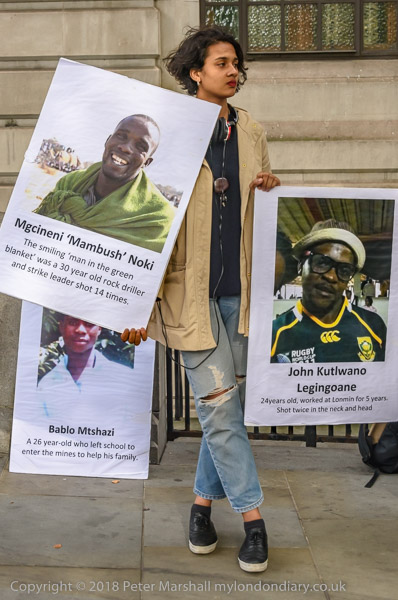
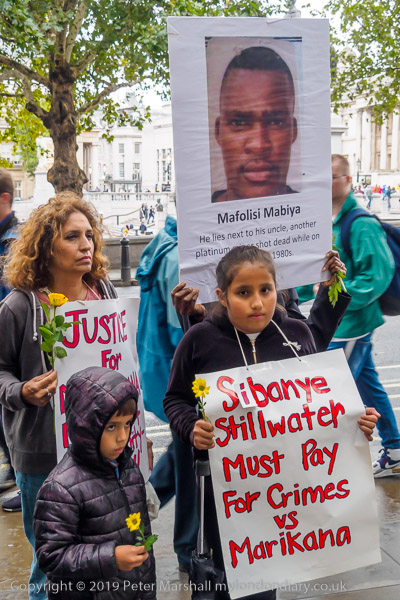
In August 2012 workers at the Marikana platinum mine in Rustenburg demonstrated calling for a pay rise and better working conditions. After a week of protests police opened fire on the miners killing 34 and injuring others. The police attack came the day after Cyril Ramaphosa, now President of South Africa, then a non-executive director of mine-owner Lonmin and owner of the company Shanduka, a shareholder in Lonmin, had called on the the police to take action against the miners, who he called “plainly dastardly criminals”.
Protest at Investec, 14 Aug 2015
Although an official inquiry largely cleared Ramaphosa of guilt over the massacre, campaigners still hold him very much responsible for what is often called the “darkest hour of South Africa’s democracy” and still call for him to be brought to justice. Both the National Union of Mineworkers (NUM) and the Association of Mineworkers and Construction Union (AMCU) refuse to invite him to the annual remembrance ceremonies at Marikana.
Protest outside Lonmin’s office in London, 2017
Ramaphosa himself issues a partial apology for his messages and stated “I am determined to play whatever role I can in the process of healing and atonement for what happened at Marikana” but so far this appears to be an empty promise.
18th August 2012
There were protests in London in the days immediately following the massacre and there has been an annual protests on 14th August each year since then, either outside offices of Lonmin and other companies profiting from the mine or outside South Africa House in Trafalgar Square. When I’ve been in London I’ve gone to take part and to take photographs.
Charlie X is shut out of the block where Lonmin have their offices, 2017. People place flowers on the portraits of the murdered miners at South Africa House, 2018 A woman holds pictures of the murdered miners at South Africa House, 2018South Africa House, 2019
All photographs on this and my other sites, unless otherwise stated, are taken by and copyright of Peter Marshall, and are available for reproduction or can be bought as prints.
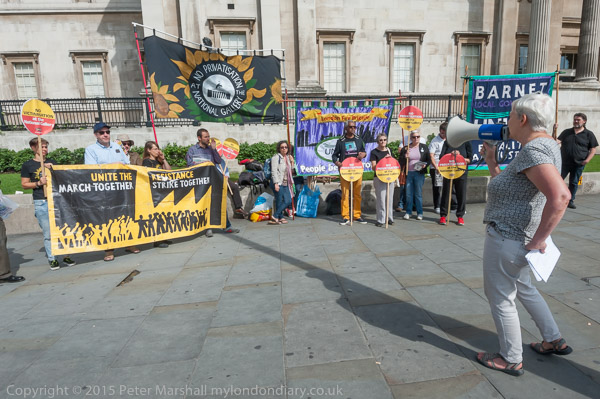
I began my working day rather later than the pickets outside the National Gallery, who held a short rally after picketing since the early morning on the 61st day of their strike against plans to outsource the jobs of 400 gallery assistants and the sacking of PCS union rep Candy Udwin for her union activities. More at: National Gallery 61st day of Strike
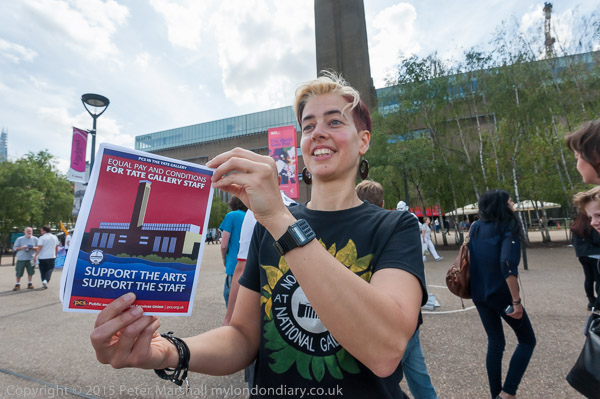
A related protest against the privatisation of visitor assistants was taking place a little later outside Tate Modern on Bankside, with workers giving out leaflets calling for equal pay and conditions for outsourced and in-house workers at both Tate Britain and Tate Modern in London. Privatised staff doing the exactly the same job have zero hours contracts with no guarantee of regular work, get £3 an hour less, and do not get the decent pensions, sick pay and holidays enjoyed by their colleagues. More at: Equalitate at Tate Modern
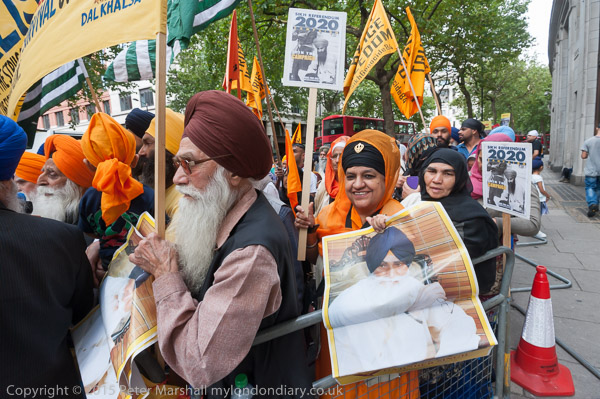
Back over the river to Aldwych and the Indian High Commission, where two protests were taking place on Indian Independence Day. Sikhs were supporting the call by hunger striker Bapu Surat Singh, now on hunger strike for over 200 days, calling for the release of Sikh political prisoners and other prisoners of all religions who have completed their jail terms but are still in prison.
Many of the Sikhs held posters of Gajinder Singh, a founding member Dal Khalsa which calls for an independent Sikh state, Khalistan, and they called for a referendum to be held in the Punjab and among the Sikh diaspora around the world on the setting up such as state. More at: Sikhs call for release of political prisoners
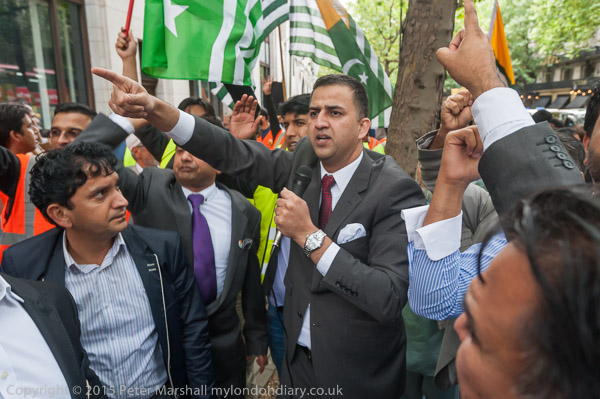
Also protesting outside the Indian High Commission were a crowd of Kashmiris calling for freedom. Kashmir is a disputed territory with parts occupied by India, Pakistan and China, and since 1987 the Indian occupation has turned their area into one of the most militarised places in the world, with around one Indian soldier for every 14 Kashmiris.
Over 100,0000 Kashmiris have been killed since the current uprising against Indian occupation began in 1987, and torture is used as a mean to get confessions and terrorise the civilians including women and children. In Kashmir Indian Independence day is observed as ‘Black Day’. More at: Kashimiris Independence Day call for freedom
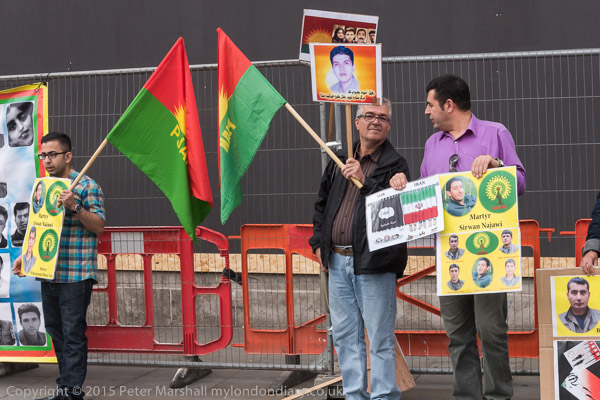
Back in Trafalgar Square Iranian Kurds from the Party of Free Life of Kurdistan (PJAK) remembered its fighters killed in the fight against Iran and ISIS for self-determination. Like the PKK, PJAK owes allegiance to Abdullah Öcalan and the ideals of the Rojava revolution. More at: Kurdish PJAK remembers its martyrs
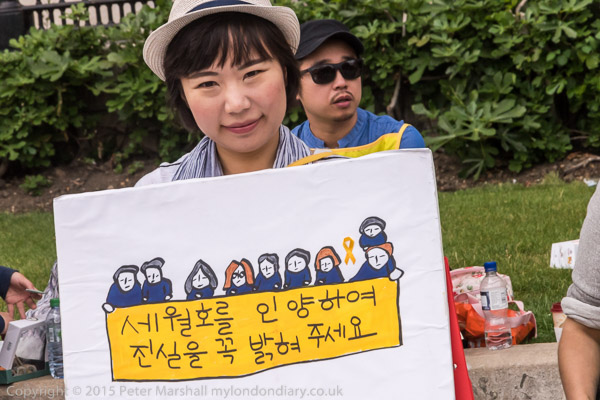
A few yards away, Koreans were holding their monthly silent protest for the victims of the Sewol ferry tragedy, mainly school children who obeyed the order to ‘Stay Put’ on the lower decks as the ship went down. They continue to demand that the Korean government raise the Sewol ferry for a thorough inquiry and punish those responsible as well as bringing in special anti-disaster regulations. More at: 16th ‘Stay Put’ Sewol silent protest
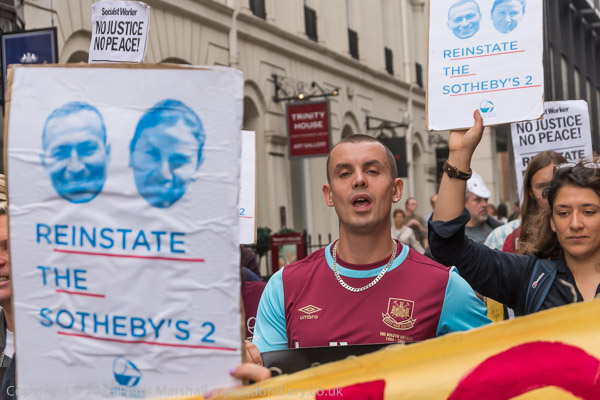
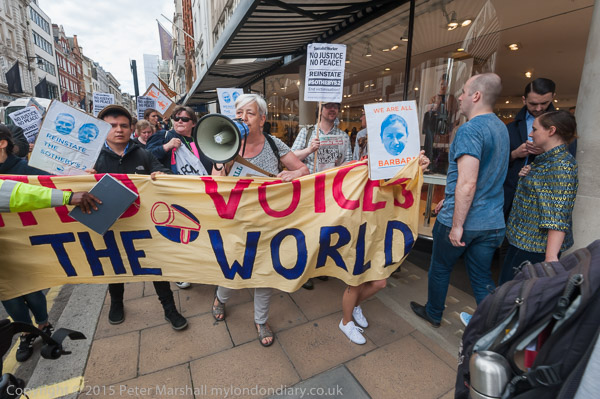
Finally I made my way to Oxford Circus to meet members of the United Voices of the World and supporters including those from SOAS Unison, the National Gallery strikers, Class War and others who were marching to protest outside Sotheby’s in Old Bond St. The UVW werecampaigning for proper sick pay, paid holidays and pensions for the cleaners who work there, and so far Sotheby’s response had been to sack two of the union members, Barbara and Percy.
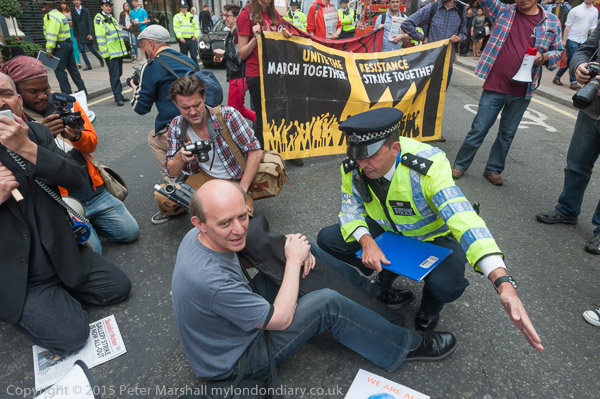
Police harassed the protesters as they arrived outside Sotheby’s, trying to move them off the road they were marching along and onto the pavement, and they responded by sitting down on the road and refusing the police orders to move. After some minutes they got up and marched around the block, past the rear entrance to Sotheby’s, with two union officials going into some of the shops on the way to hand out leaflets explaining the action. Police tried to stop these two going into the shops and some arguments developed.
The marchers returned to the street in front of Sotheby’s and held a short rally, again ignoring police who tried to move them off the road. Police then tried to stop them marching around the block again, holding some while others surged around and the marchers made another circuit, returning to Sotheby’s for a short final rally before marching back towards Oxford Circus. More at: United Voices – Reinstate the Sotheby’s 2.
My day wasn’t quite over, and I moved to Grosvenor Square, where two young women, one black and one white, had organised a Black Lives Matter protest close to the US embassy in solidarity with events across the US against the collective and systemic unlawful arrests and killings of black people in America. The protest around the statue of Franklin Delano Roosevelt was supported by groups including BARAC (Black Activists Rising Against Cuts) and the Nation of Islam.
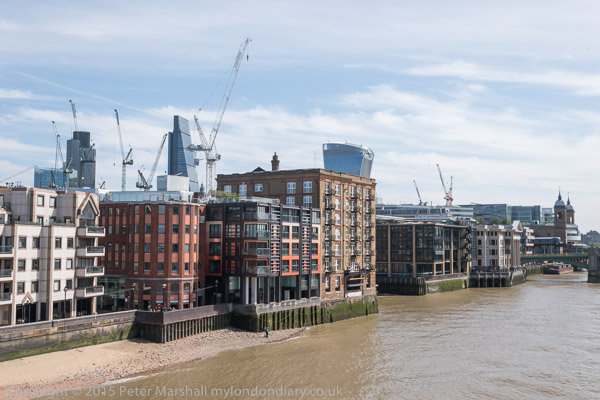
In all the travelling around central London on foot or by bus, I had time to take a few pictures between protests. More at: London Views.
All photographs on this and my other sites, unless otherwise stated, are taken by and copyright of Peter Marshall, and are available for reproduction or can be bought as prints.
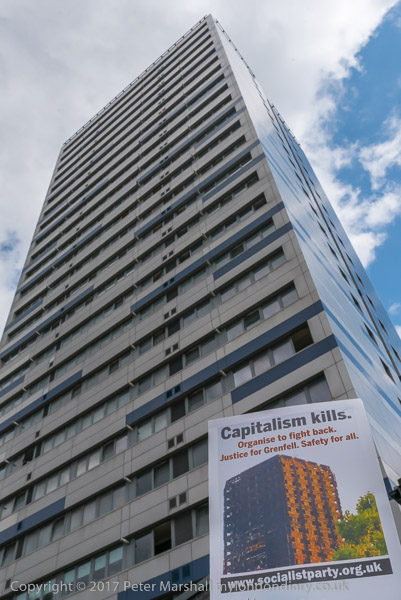
In the now over four years since the disastrous Grenfell Tower fire in June 2017 there has been little change and no reckoning, with a tediously slow inquiry taking place that began by shifting blame unfairly onto the firefighters but is at last making clear some of the deliberate failures by local government, manufacturers and installers of the fatal cladding and others with a complete disregard for the safety of those living in the tower.
Cladding was not of course the only issue, and there were many other failings that led to the terrible loss of life. Most basic was the attitude of governments of both parties towards health and safety issues, describing essential safety regulations as “red tape” and dismantling what were essential checks to increase the profitability of builders and developers and reduce the liabilities of building owners. It was a system that needed reforming and strengthening, perhaps learning from practice in other countries to provide effective control and not abandoning to commercial whim.
Most of what has emerged in the inquiry only reinforces what was already made clear from informed reports – such as that by Architects for Social Housing – within weeks of the fire, adding truly shameful detail to the broader outline. It surely should have come out in courts within months of the fire and some of those responsible might well be behind bars and companies charged with massive fines, and the main point of the inquiry seems to be to prevent the course of justice.
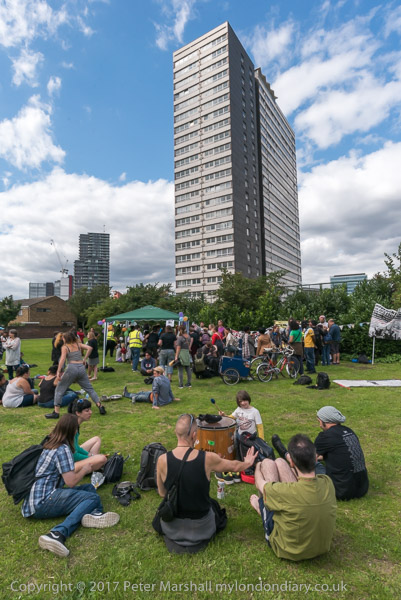
A resident of Tanner Point speaking
Local authorities and building owners have been forced to inspect their high-rise properties, and the government has provided at lest some of the money it promised to replace unsafe cladding in the public sector. But little has been done for those living in private blocks who are still living in fear and now pay increased charges for extra fire safety provisions. A parliamentary briefing paper estimates the total cost of replacement of unsafe cladding at around £15m, and so far government has come up with a third of that. Government policy has changed from the initial promise to fund “remediation of historical safety defects, to a suggestion that leaseholders should be protected from unaffordable costs” and even the provision for a low interest scheme to ensure they would not pay more than £50 a month has failed to materialise despite the promise in the current Building Safety Bill.
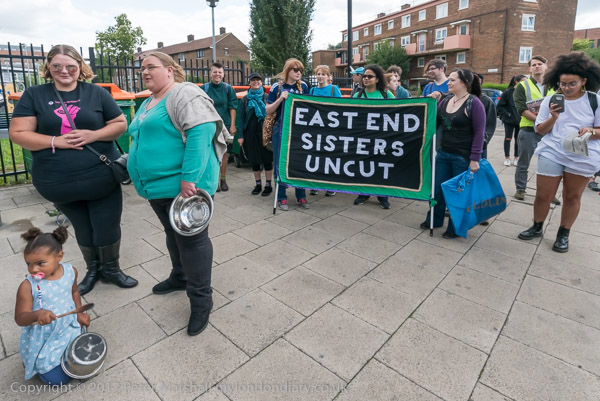
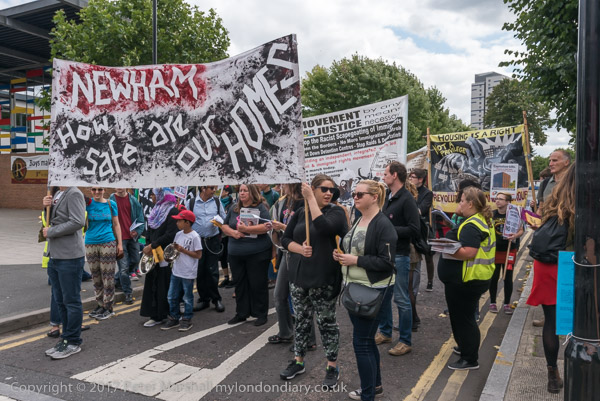
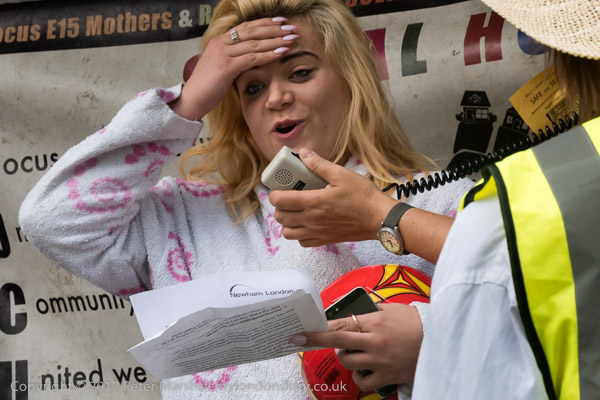
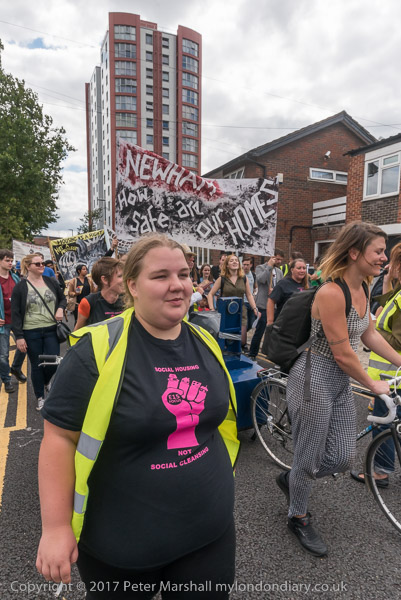
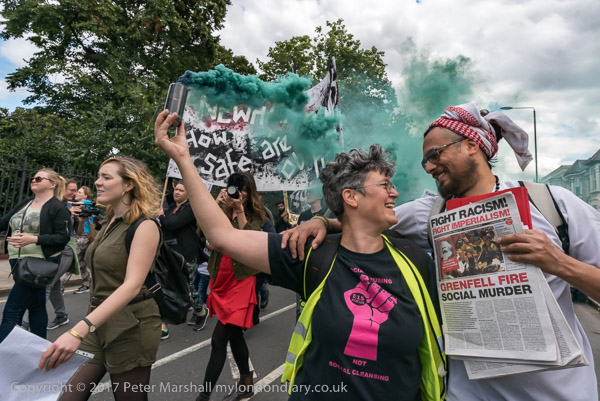
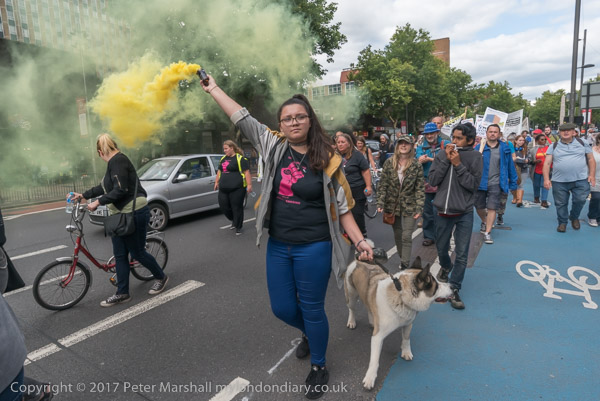
In August 2017, a number of tower blocks in the London borough of Newham were found to have unsafe cladding. Housing activists Focus E15 Mothers led a demonstration putting pressure on the council to act urgently to make the blocks safe. The council came to a decision the following month to remove the cladding though work to do so only began in April 2018.
The march began at Ferrier Point in Canning Town, with other groups including East End Sisters Uncut, Movement for Justice, the Socialist Party, the Revolutionary Communist Party, One Housing campaigners and Whitechapel Anarchists joining Focus E15 and some tower block residents.
From there they marched to Tanner Point in Plaistow North for a longer rally outside, including some speeches from tower residents. Then came another long march to Stratford and the Carpenters Estate.
The Carpenters Estate was a popular estate, close to Stratford station and the town centre, and was viewed by the council as a prime opportunity for highly profitable redevelopment schemes, wanting to demolish the estate which is well-planned and in good condition. Focus E15 led opposition that in 2013 ended plans for UCL to set up a new campus here and have constantly urged the council to bring back people to the estate where despite a critical housing shortage in the borough, 400 good homes had been kept empty for over 10 years. The march ended with a ‘hands around the Carpenters Estate’ solidarity event against decanting, demolition and social cleansing.
All photographs on this and my other sites, unless otherwise stated, are taken by and copyright of Peter Marshall, and are available for reproduction or can be bought as prints.
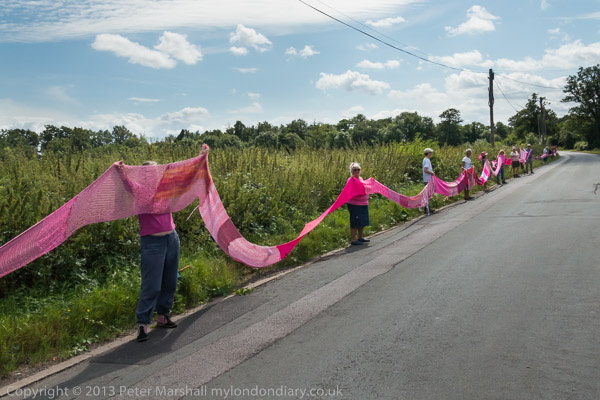
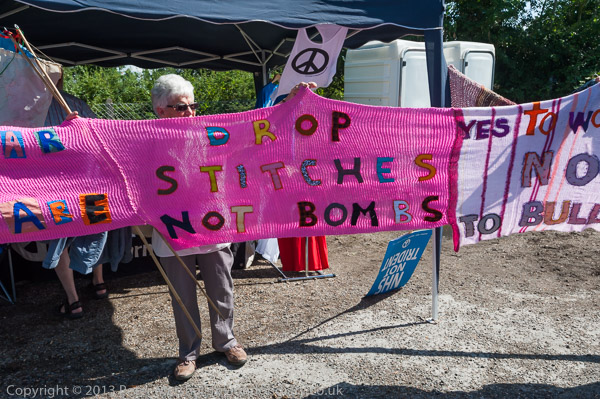
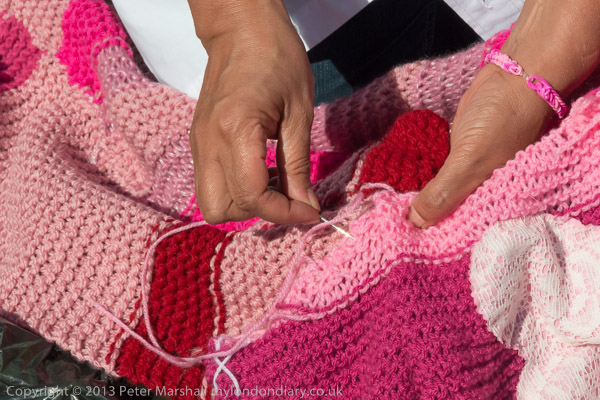
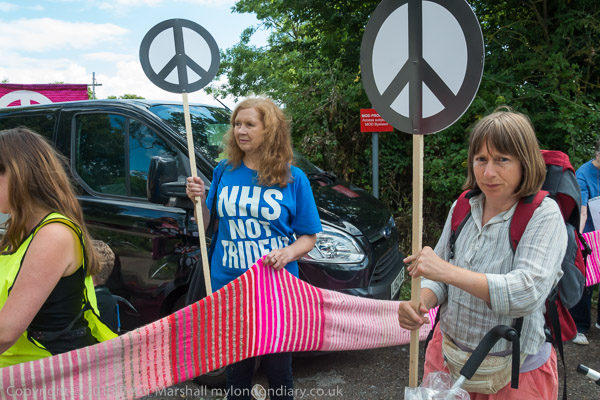
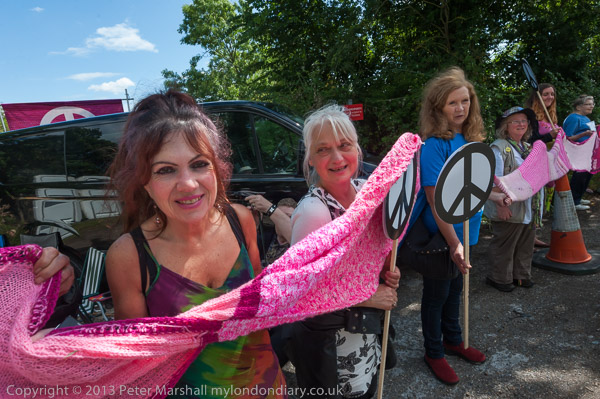
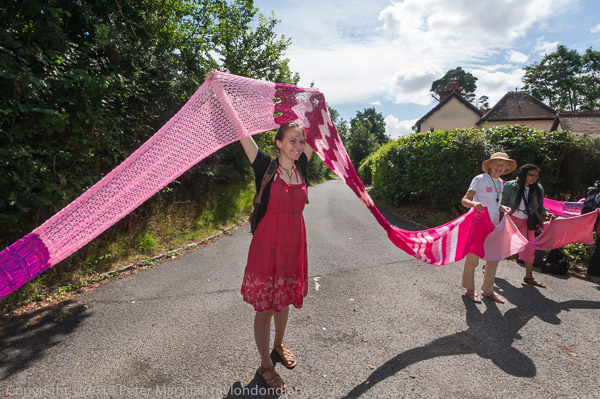
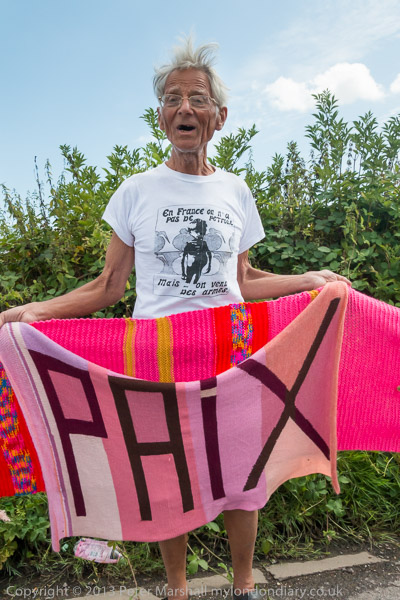
On Saturday 9th August 2014 I took a bike ride outside London, putting my bike on the train to Reading, from where I cycled west to Burghfield and on to Aldermaston. It was Nagasaki Day, remembering August 9th 1945, when the US exploded an atomic bomb at the city of Nagasaki, killing around 80,000 people, and CND were holding an unusual protest, stretching out a seven mile long knitted scarf between the two factories where Britain’s atomic war heads are made. 69 years after the bomb was dropped, the UK government was about to vote on huge spending on a new nuclear weapons system, and CND were calling for Trident and its replacement to be scrapped.
‘Drop Stitches Not Bombs’ at the Burghfield end of the 7-mile scarf
I’d taken my bike, both to get to Burghfield from Reading but also so that I could cycle along the whole seven mile length of the protest and photograph the scarf along the way. A bike was ideal for this, as I could easily cover the whole distance and unlike a car you can jump off anywhere and take pictures. But for the moment when all the lengths of wool were joined up, I jumped off my bike and ran along the first section of the scarf, taking picture after picture.
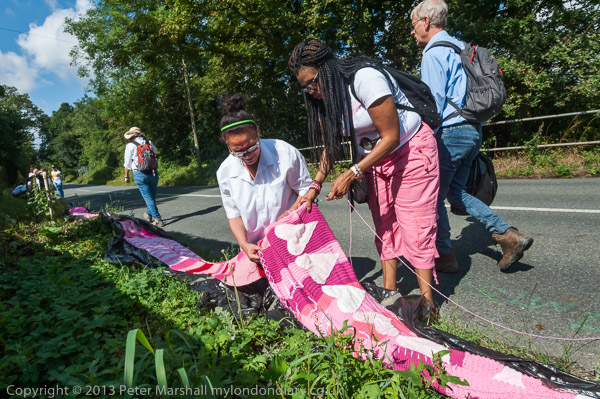
Joining up the lengths of scarf
Here’s some of what I wrote in my 2014 post Wool Against Weapons along with a few of the pictures I took along the road.
”Groups from all over the country and some from France brought long rolled up lengths of knitted and crocheted scarves, made in individual sections and joined together. A lot of planning was needed to make sure that there were enough rolls and they were taken to the right places to be unrolled and joined together, but it all worked on the day.”
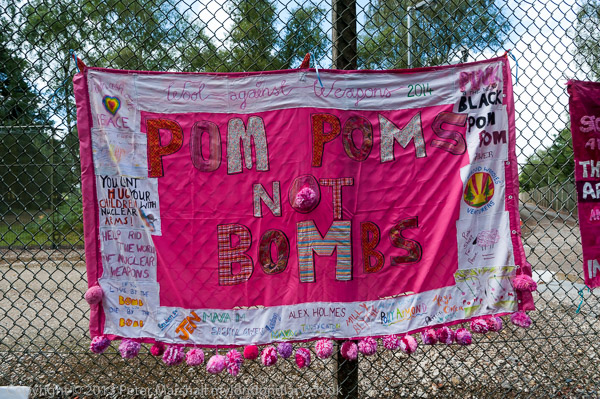
One of many banners on the fence around AWE Aldermaston
“The project involved a very large number of people, many of whom had taken no active part in protests against nuclear weapons before, but who are convinced that we should not waste public money on the Trident replacement – money that could be put to something useful like keeping our NHS running.”
‘NHS Not Trident’
“I cycled to Burghfield from Reading, and arrived just over two and a half hours before the whole scarf was scheduled to be joined up at 1pm. After taking some pictures around the end of the scarf there, I got back on my bike and cycled slowly along the route of the scarf to Aldermaston, stopping at all of the ‘mile points’ which were the bases for the various regional groups (and a ‘faith’ group) and also where people were busy laying out the rolls of scarf and joining them up and taking photographs. It took me around an hour and a quarter to get to the Aldermaston end of the scarf at the fence around the AWE there.”
Protesters at Burghfield
“I made it back to Burghfield – with just a few stops for more pictures – in half an hour. It helped that there is quite a long downhill section and the wind was behind me, but I wanted to be sure to be back well before the planned ‘linking time’ of 1pm.”
At side roads the scarf could be lifted to allow cars through.
“I took pictures at Burghfield of the linking when people rang bells at 1pm, then started running along the scarf, stopping to photograph the people holding it up. After almost a mile I gave up and returned back to Burghfield where a rally was to start at 1.30pm.”
All photographs on this and my other sites, unless otherwise stated, are taken by and copyright of Peter Marshall, and are available for reproduction or can be bought as prints.
I’m not sure what is happening at Yarl’s Wood now. Temporary huts were erected there to house destitute asylum seekers at the beginning of 2021, but abandoned in February by the Home Office after a legal challenge and a local and national outcry. In 2020 it’s purpose was changed from holding women to holding men, and there were reports that most of the women had been removed, but according to the Asylum Information Database there were 238 asylum seekers still held there at the end of 2020. Both Home Office and Serco web sites appear to lack any information. Six years ago today, on 8th August 2015 I attended a protest there and wrote the following report, illustrated here with just a few pictures from the many in the original My London Diary post.
Yarl’s Wood Immigration prison, Bedford. Sat 8 Aug 2015
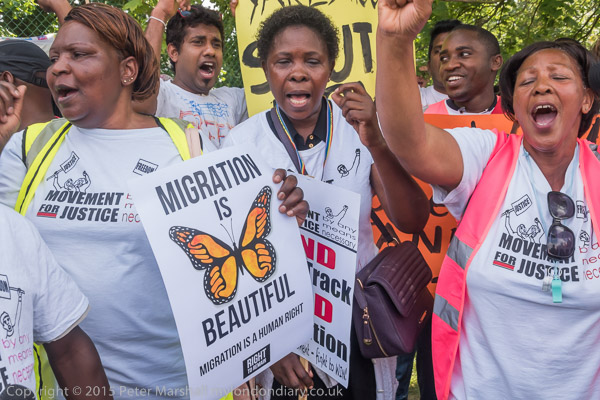
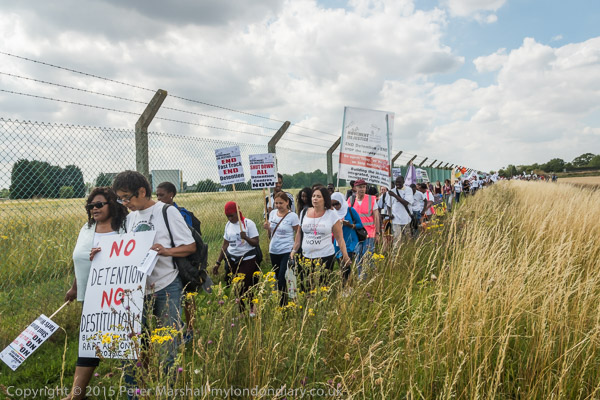
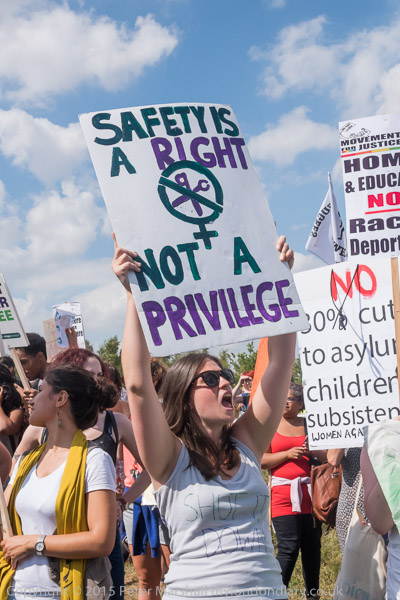
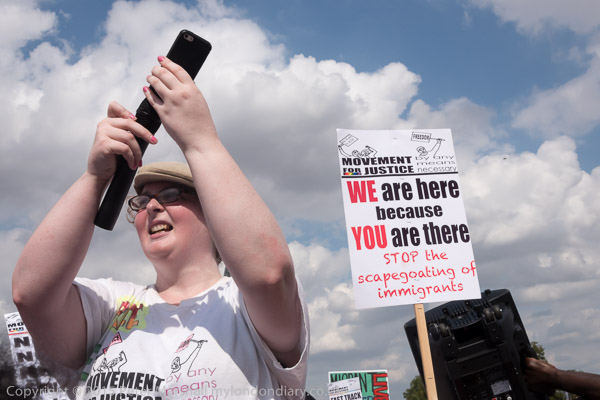
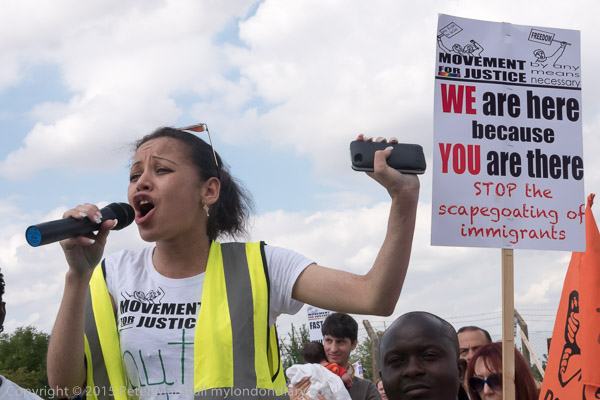
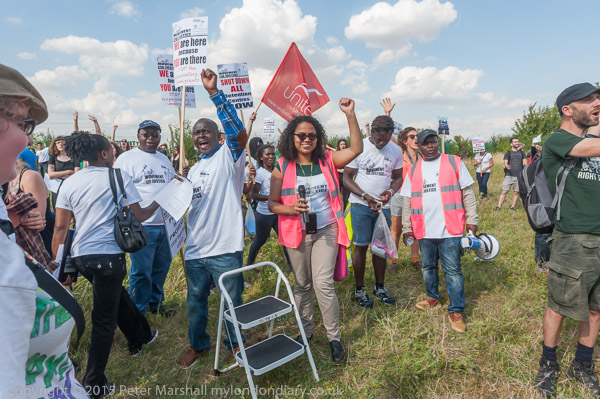
Around a thousand protesters in a field adjoining the detention centre joined with detainees locked up in Yarl’s Wood to demand an end to immigration detention and the whole racist system which locks up migrants and asylum seekers without trial, subjecting them to abuse and sexual harassment.
Coaches came from around the country to drop protesters outside the business estate on a former aerodrome in the middle of the country around five miles from Bedford, and a coach from Bedford Station made two journeys from there to bring myself and the others who had arrived by train. Others made their journey there by taxi, car and bicycle, and a few by bus, which dropped them at the centre of a village around a mile away.
The protest was organised by Movement for Justice and there is a long list of other groups that supported it and the campaign to close detention centres, though I think there were also others present: Women for Refugee Women, Right To Remain, CheltFems, Black Women’s Rape Action Project, All African Womens Group, Refugee Support Devon, Exeter City of Sanctuary, London Palestine Action, Diásporas Criticas, South London Anti Fascists, No One Is Illegal, Jewish Socialist Group, Left Unity, CUSU Women’s Campaign, Freedom Without Fear Platform, Black Dissidents, Feminist Fightback, Women’s Association for the Guild of Students, University of Birmingham, Unite Hotel Workers Branch, Plan C, Birmingham, Leeds Feminist Network, Sisters Uncut, SOAS Unison.
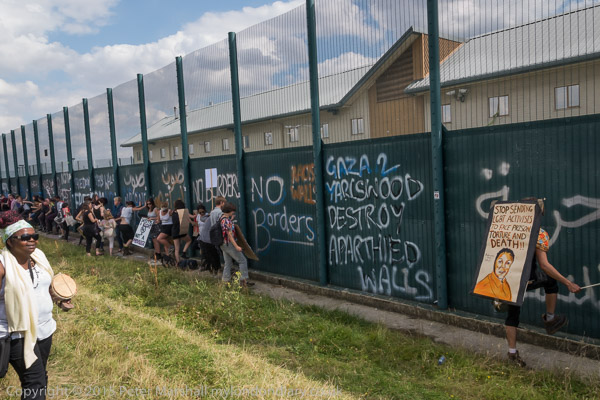
The protest started next to the road at the front of the estate to give time for all the protesters to arrive, and then walked along a public bridleway which goes close to the detention centre. The protesters were allowed into a field which ran along the side of the high fence around the centre for today’s protest – at a previous protest they had pushed down fences and breached barbed wire to get to the fence.
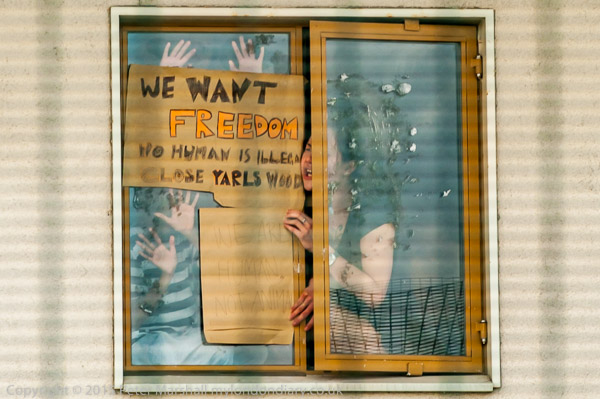
There was a rapturous welcome from the women inside the prison, who came to the windows, shouting and waving and holding up signs. Protests like this really give the prisoners hope, and show them they have support and are not forgotten. Together, inside and out people chanted slogans ‘Shut Down Yarls Wood’, ‘Detention Centres, Shut them Down’ and more.
A small rise in the field help us see the windows on the first floor and above despite the fence, solid for around 10ft with another 10ft of mesh on top. People banged it to make a noise, kicked it, and banged it with pots and pans, and some climbed on others shoulders to lift up banners and placards so those inside could see.
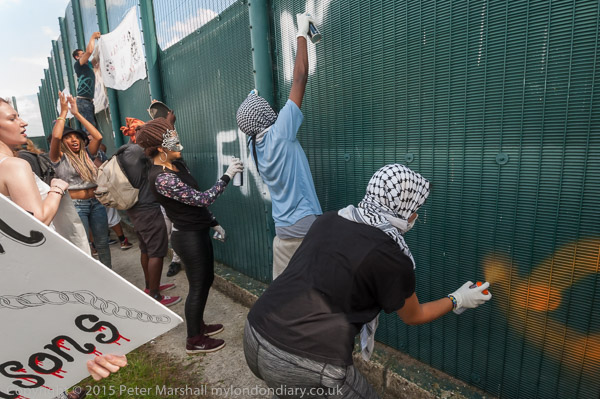
Then a group of people wearing face masks began to write slogans on the fence, and soon a long length of it was covered with them ‘No Borders’, ‘No One is Illegal’ ‘#SetHerFree’, ‘Shut it Down’, ‘Gaza 2 Yarls Wood Destroy Apartheid Walls’, ‘Racist Walls’ and more.
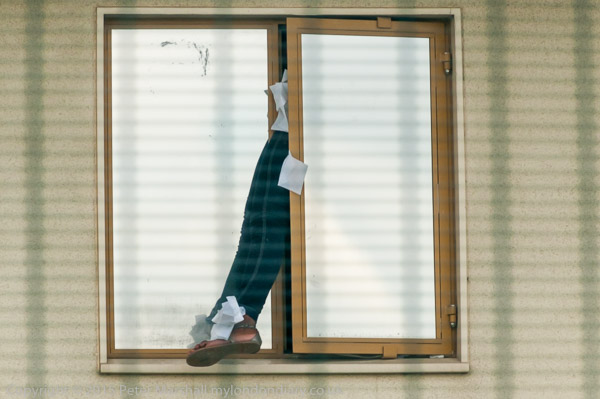
Inside the women waved. The windows open to a small gap and one woman waved her leg though it, decorated with paper tied around. Others waved clothing and held up signs, some with slogans like those held up and shouted by the people outside. One carefully drawn one read ‘We Want Freedom – No Human Is Illegal – Close Yarls Wood’ while another simply read ‘Help’.
The organisers had mobile numbers for some of those inside – and others inside wrote theirs large and held them up in the window. We were able to hear greetings and reports from some of those inside, their voices on the phone amplified on the megaphone.
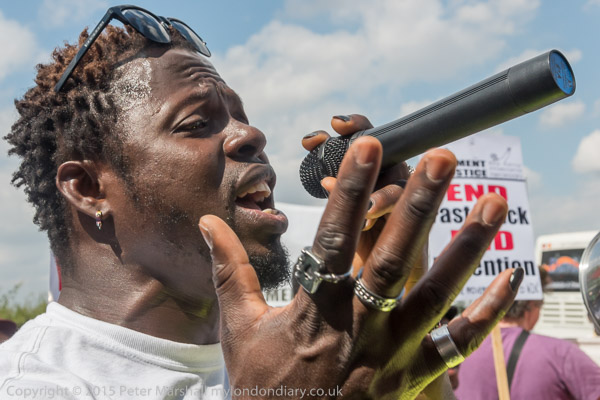
They too could hear the speeches from outside, including several by women who had been held with them inside the prison. Many are held for long periods in this and other detention centres, never knowing when they might be let out – or an attempt made to send them back to the country they were desperate to escape from.
Too soon we had to leave. And they had to stay. As I walked away to catch the coach back to Bedford station I felt ashamed at the way that my country treats asylum seekers. They deserve support and humanity and get treated worse than criminals.
All photographs on this and my other sites, unless otherwise stated, are taken by and copyright of Peter Marshall, and are available for reproduction or can be bought as prints.
Freedom is something we almost universally value, but which is often hijacked by various groups, particularly on the extreme right to support particular causes which have little real connection with our undamental rights. Freedom is certainly not the freedom to do what we like regardless of the effect it has on others.
Freedom is not the right to own and carry guns or other weapons. It isn’t the right to spread disease we may have by not taking sensible precautions such as wearing a face mask in crowded places. It isn’t the right to increase the risk of others getting lung cancer or to drive after consuming alcohol or drugs.
Arguably the most important of our freedoms is the right to hold and express political and religious ideas and to express these. But that is not absolute, and rightly there are laws against hate speech and incitement to others to commit criminal actions or threaten the lives of others.
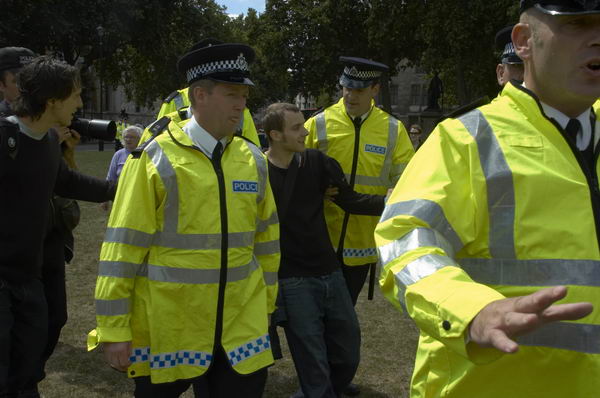
Back in 2005, the Labour government brought in a law to criminalise protest in Parliament Square. It was clearly a law which imposed unnecessary restrictions on our freedom and one which was brought in for a trivial reason, to end the embarrassment to the Labour ministers of one man, Brian Haw, continuing to protest, particularly over Iraq war and its disastrous consequences. That Tony Blair was annoyed by a regular reminder of his lies was not a suitable basis for legislation.
A regular series of harassment by police and others – almost certainly at the urging of the Home Secretary – had failed to shift this persistent protester, and civil servants were ordered to add a section to the bill which became the Serious Organised Crime and Police Act 2005 to make his protest illegal. In the event the act failed to apply to his protest and I wondered if this was a little deliberate subversion by at least one of those responsible for its drafting rather than simple incompetence. Because his protest had begun well before the SOCA law came in on 7th April 2005, it was apparently not covered by it. As I commented, “rather a lot of egg on government faces there.” This initial ruling by the High Court of Justice was eventually overturned by the Court of Appeal and these sections of the law were replace by other restictive laws in 2011.
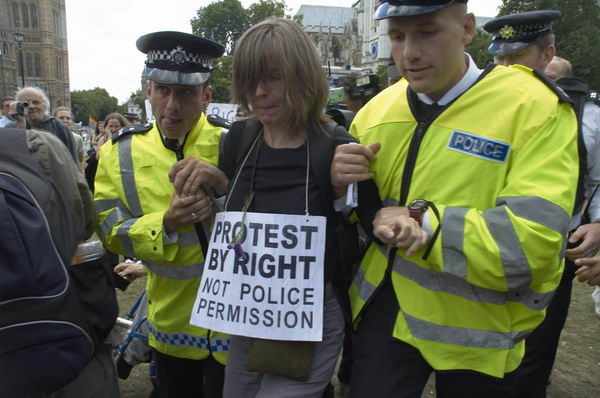
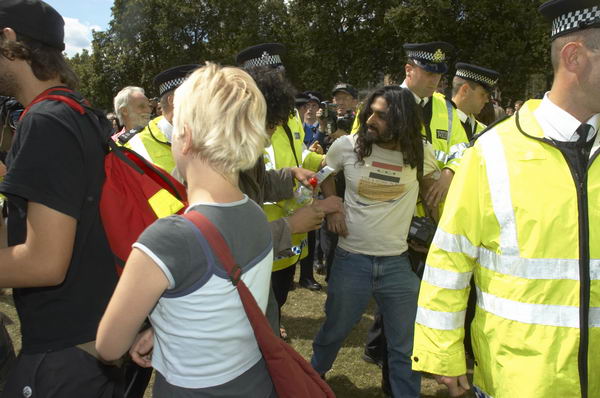
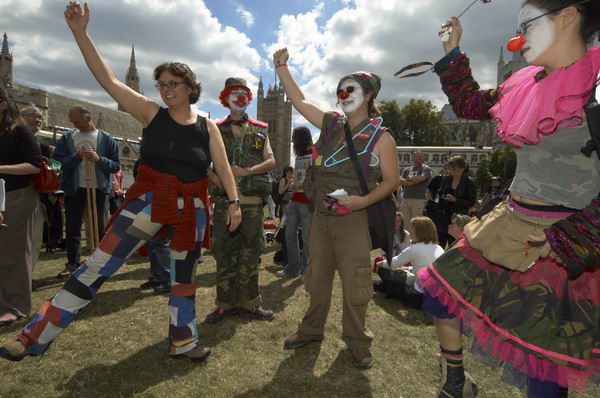
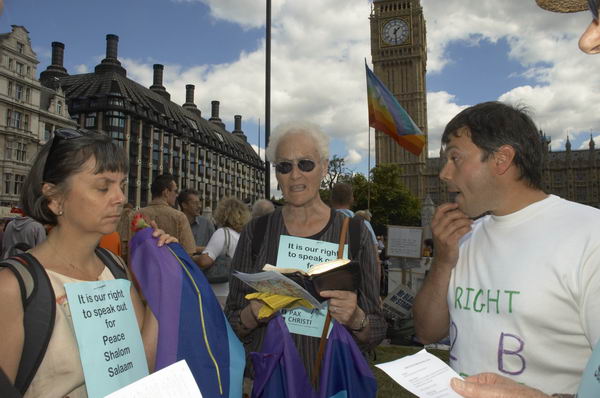
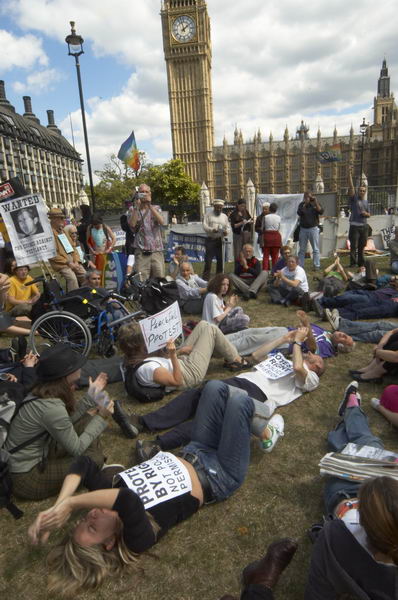
On Sunday 7th August 2005, protesters came to Parliament Square to deliberately disobey the law, and the police came, some rather reluctantly, under orders to arrest them. The protestors argued that protest is a human right and cannot be restricted by law in a free society.
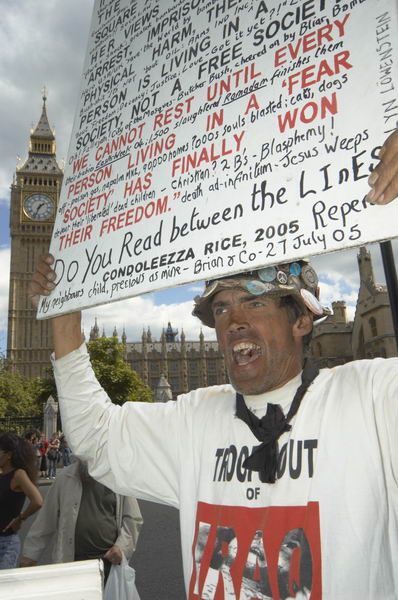
Brian Haw was there, but protesting legally as it appeared that the act didn’t include him. He held up a placard with the words from a speech in Boston by US Scretary of State Condoleezza Rice: “if a person cannot walk into the middle of the town square and express his or her views without fear of arrest, imprisonment, or physical harm, then that person is living in a fear society, not a free society. We cannot rest until every person living in a ‘fear society’ has finally won their freedom.” interleaved with his own comments on Guantanamo, Abu Ghraib, Belmarsh and the Iraq war and more.
The police swooped on a few of those with posters or placards and arrested them, leading them away but their heart was clearly not in it and the great majority of the protesters were untouched, though they were warned that their protest was illegal. As I commented: ” I saw five people arrested for simply peacefully holding banners supporting the right to protest. It happened on the square opposite our Houses of Parliament, and it made me feel ashamed to be British.”
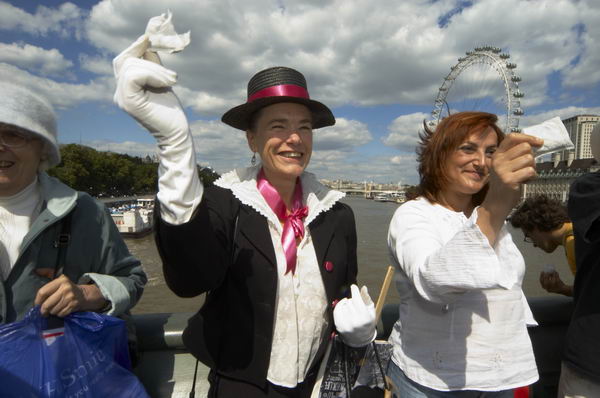
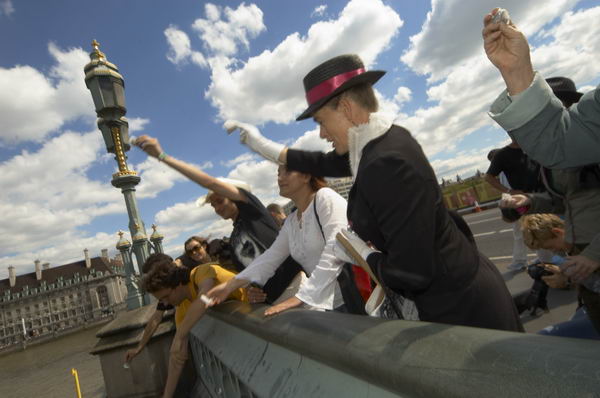
When the protest in Parliament Square ended, protesters were invited to take part in another illegal protest inside the one km restricted zone around Parliament, but on Westminster Bridge. Again taking their lead from Boston, though this time from 1773, and tipping tea into the water, campaigners calling for a low-level tax on foreign currency exchange transactions, as proposed by Nobel prize-winning economist James Tobin in 1978. This would deter speculation on currency movements, giving governments greater control over their fiscal and monetary policies, and reducing the power of speculators to affect the markets.
The connection between the tea bags torn to tip tea into the Thames, produced by large multi-national companies who are among the currency speculators, and the Tobin Tax, seemed a little weak – as doubtless was the brew in the river – though it did all alliterate nicely for the Westminster Tea Party – Time for Tobin Tax.
We are now seeing a law going through Parliament which will even further restrict our right to protest, increasing discriminatory policing, criminalising some traditional ways of life and seriously restricting and controlling protests in a huge shift further towards a police state. Unfortunately a large Conservative majority makes it seem inevitable that our freedoms will be significantly reduced.
All photographs on this and my other sites, unless otherwise stated, are taken by and copyright of Peter Marshall, and are available for reproduction or can be bought as prints.
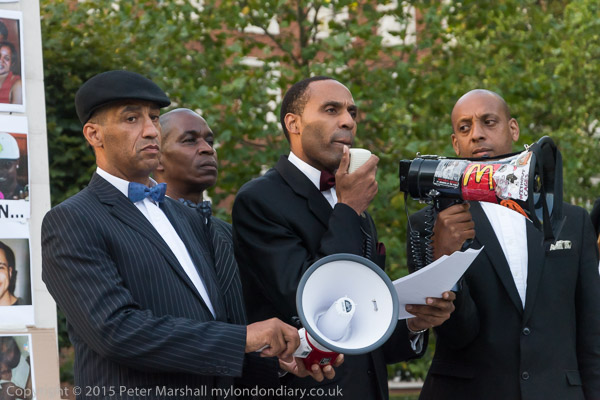
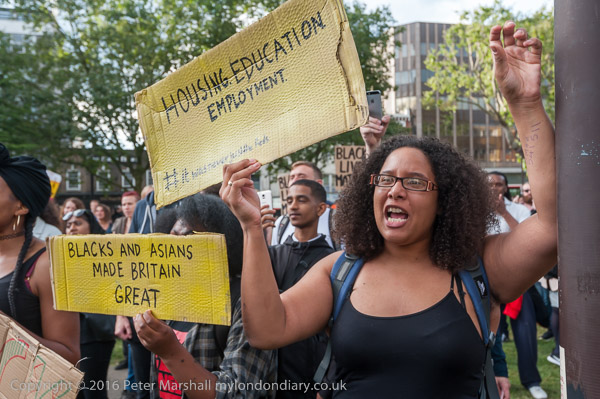
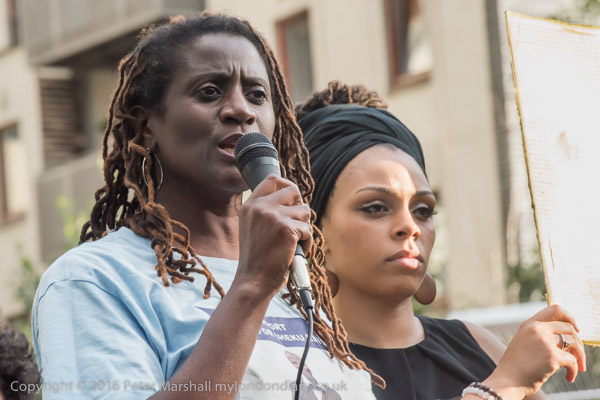
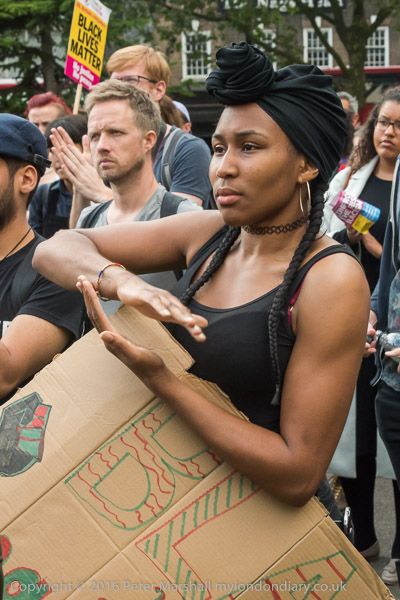
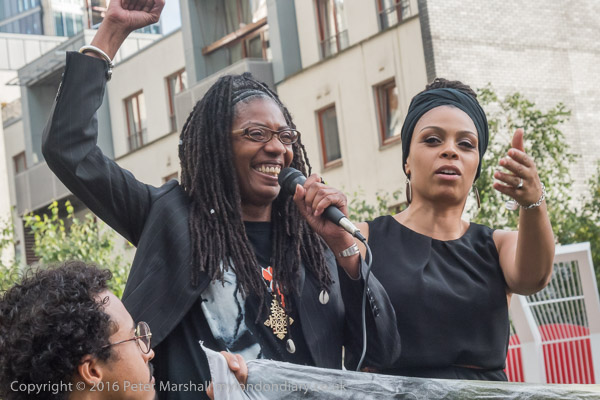
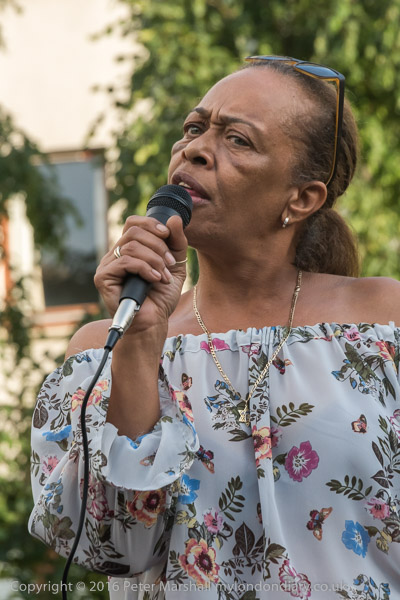
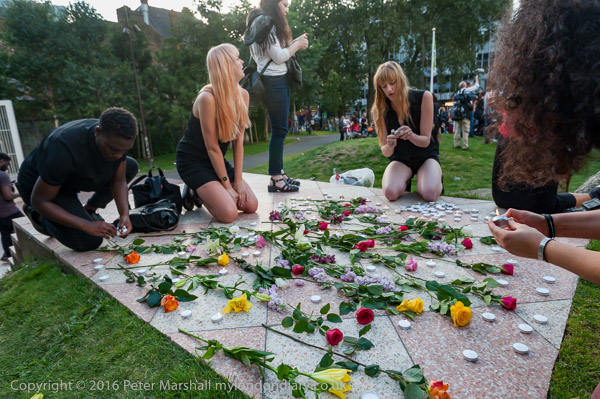
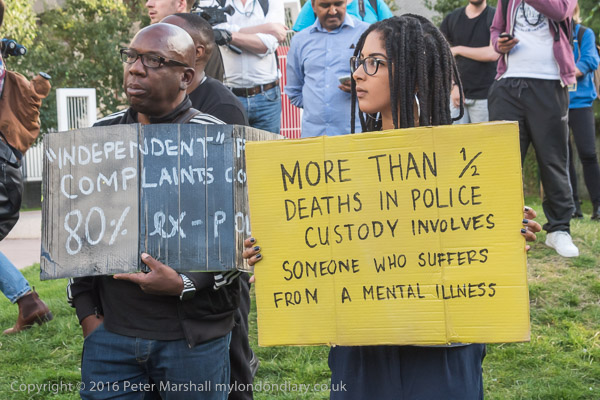
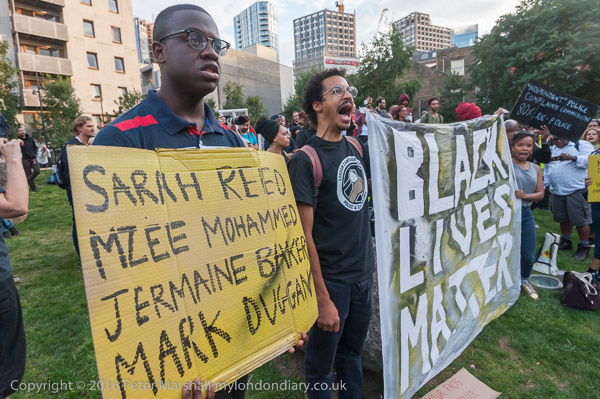
Five years ago on the evening of Friday August 5th 2016, I was with a large crowd in Altab Ali Park. in East London to commemorate the many UK victims of state violence, including Mark Duggan, Sarah Reed, Mzee Mohammed, Jermaine Baker, Sean Rigg, Leon Patterson, Kingsley Burrell and over 1500 others, disproportionately black, since 1990.
A relative of Sheku Bayoh, killed by police in Scotland in 2015 speaking
The event was called BLMUK, a community movement of activists from across the UK who believe deeply that #BlackLivesMatter but are not affiliated with any political party. They called for justice and an end to racialised sexism, classism and homophobia and a new politics based on community defence and resilience.
In 2020 BLMUK registered as a community benefit society, with the name Black Liberation Movement UK, but they continue to campaign under the names Black Lives Matter UK and BLMUK.
Forming a legal society enabled them to access the £1.2m in donations from GoFundMe, and they have already distributed a number of small grants to fund projects by other groups, including theUnited Friends and Families Campaign, grass roots trade unions United Voices of the World (UVW) and International Workers of Great Britain (IWGB), UK based campaigning groups and others serving the black community, including the African Rainbow Family, Sistah Space and B’Me Cancer Communities and two international Black organisations, the Sindicato de Manteros de Madrid (Street Vendors Union) and Abahlali baseMjondolo in Durban, South Africa.
Stephanie Lightfoot-Bennett whose twin brother Leon Patterson was battered to death by police in a Stockport cell in 1992
The event took place five years and one day after the shooting by police of Mark Duggan in Tottenham, which led to riots across London. The police officer who shot Duggan refused to give an interview with the IPCC but later submitted a written testimony. Police accounts of the event – themselves inconsistent – did not tally with those of other witnesses, including the driver of the minicab which was carrying Duggan, nor with the ballistic evidence. As usual, police and the IPCC leaked misleading stories to the press.
Sisters Uncut shrine for those who have died in custody
Although the inquest jury finally gave a majority verdict of ‘lawful killing’, many regard the killing as a criminal execution of a black man, shot at point-blank range after he had been pinned to the ground.
Altab Ali Park was an appropriate location, its name commemorating a Bangladeshi textile worker stabbed to death by three teenagers in the park in a racially motivated killing on 4th May 1978.
After the speeches, the crowd split into four large groups to discuss future community organisation against racism in North, South, East and West London, and shortly after I left for home.
All photographs on this and my other sites, unless otherwise stated, are taken by and copyright of Peter Marshall, and are available for reproduction or can be bought as prints.
Some photographers love to travel, but I relish the great variety of events I have been able to photograph in London, (as well as the city itself.) Saturday 4th August 2012 demonstrates that well.
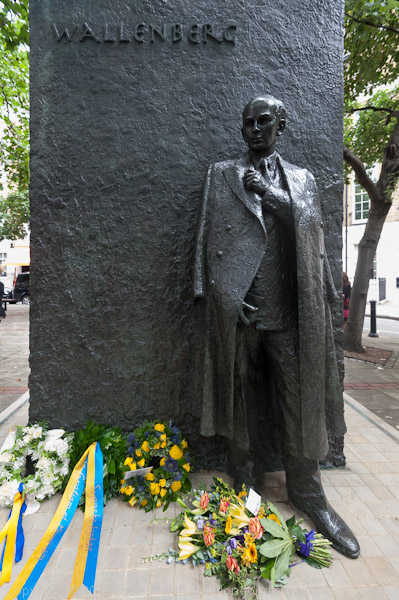
Raoul Wallenberg was clearly one of the great heroes of the twentieth century, and played a huge role while working as a Swedish diplomat in Budapest in 1944-5. Historians now question the popular claims that he saved as many as 100,000 Jews and suggest the actual figure may be between 4,500 and 9,000, but as one of them commented, his “fame was certainly justified by his extraordinary exploits.”
Wallenberg and his fellow Swedish diplomat Per Anger issued thousand of official-looking “protective passports” identifying the bearers as Swedish citizens and rented over 30 buildings in Budapest which he declared to be Swedish territory. According to Wikipedia these eventually housed almost 10,000 people. The money for these came from the American Red Cross and it was apparently at US request that Wallenberg was posted to Budapest.
Wallenberg was not the only diplomat in Budapest issuing protective passports to save Jews, with others being provided with Swiss, Spanish and Portuguese documents. He is also said to have persuaded the Germans not to blow up the Budapest ghetto and kill its 70,000 inhabitants, though the Italian businessman Giorgio Perlasca who was posing as the Spanish consul-general claims that it was his intervention that saved them
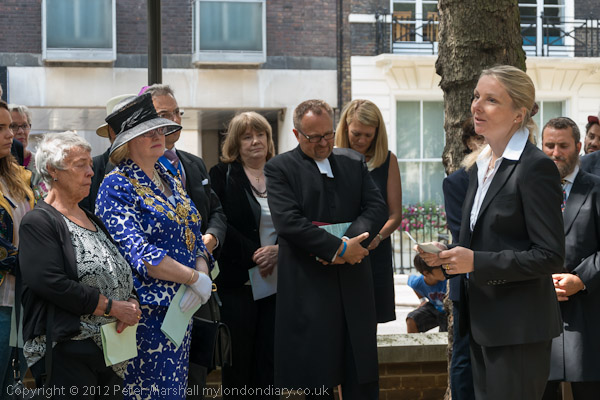
Swedish Ambassador Nicola Clase speaks about Wallenberg
Wallenberg disappeared on 17th January 1945 after being summoned to see the commander of the Russian forces encircling the city to answer charges he was involved in espionage. He was taken to Moscow and little definite is known about him after than although the Soviet Government in 1957 released a document stating he had died in prison, probably of a heart attack on 17 July 1947. But there were later reported sightings of him. Documents released in 1996 by the CIA show he was working with their wartime predecessor.
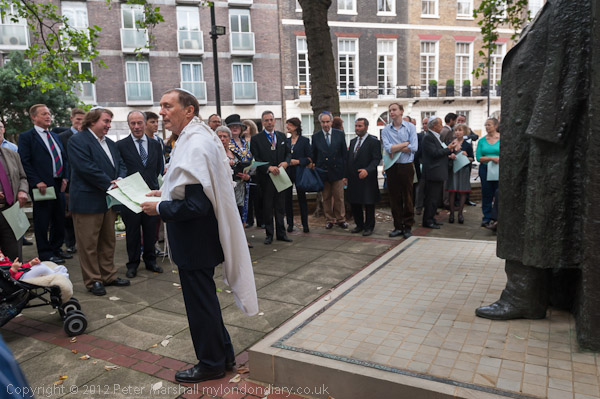
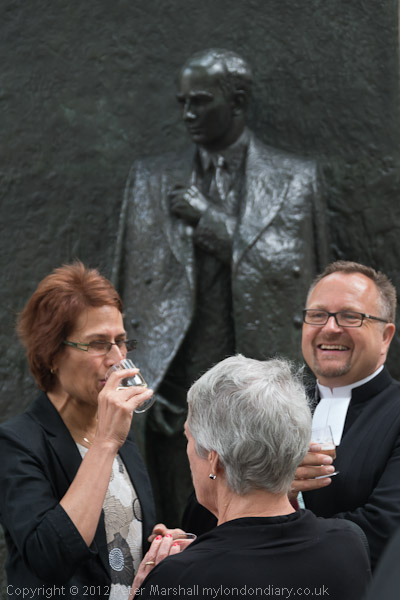
Wallenberg was born on August 4th 1912, and a ceremony took place in his honour around the Wallenberg memorial, sculpted by Philip Jackson outside the Western Marble Arch Synagogue. It was a moving event, led by Rabbi Lionel Rosenfeld with Rector Michael Persson from the Swedish Church in London reading Psalm 121 and giving an address about Wallenburg who he called an ordinary man who was brave when the time came and had followed the Lutheran ideal of living, a calling to be yourself and to do good for other people. The Swedish ambassador also spoke about him.
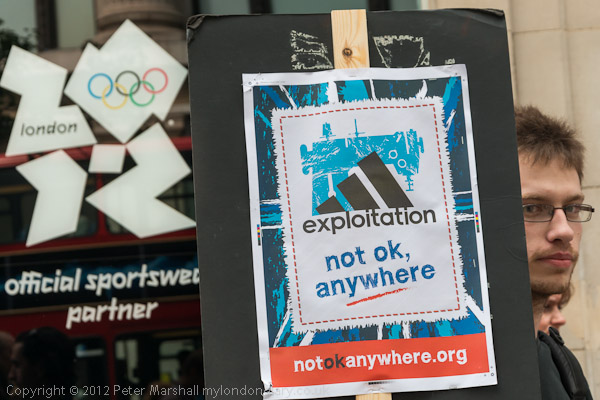
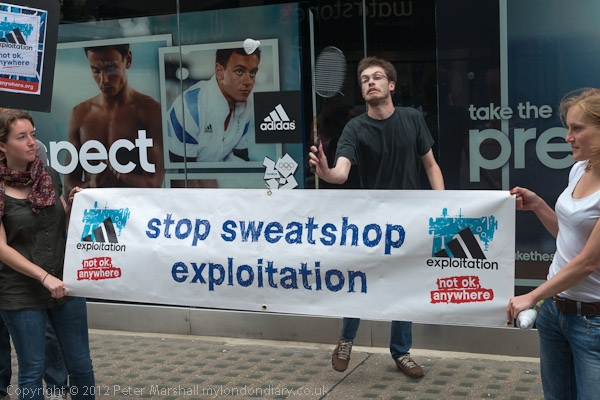
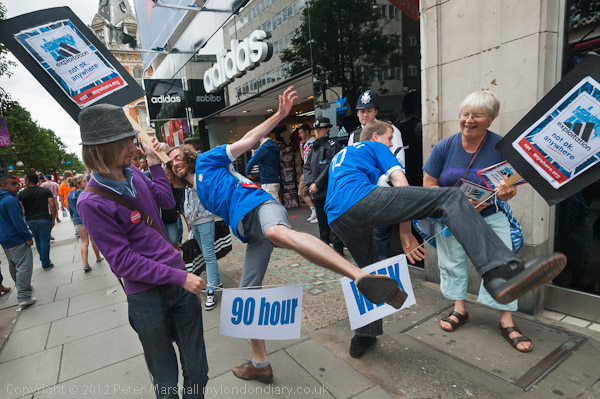
Earlier I had been at the Olympics. Not the thing on Stratford Marsh, but a rather smaller event organised by War on Want outside Adidas on Oxford St, claiming that workers making clothes for the official sportswear partner of London 2012 get poverty wages are not allowed to form unions and have little or no job security.
War on Want point out that around the world thousands of workers producing clothes for Adidas are working for poverty wages that do not cover basic essentials like housing, food, education and healthcare. Many have to work beyond legal limits, up to 15 hours a day to scrape a living. And workers who try to organise trade unions face harassment and sacking.
The games began with badminton, and then moved on to hurdles, but police told them it was too dangerous on the pavement in Oxford St. They were made to move around the corner. Adidas sent along someone from their PR Agency to give misinformation to the press, but there was damning information on the War on Want web site on wages and conditions in factories in Indonesia, Sri Lanka and China producing goods for Adidas. I don’t expect things have changed that much for these workers since 2012.
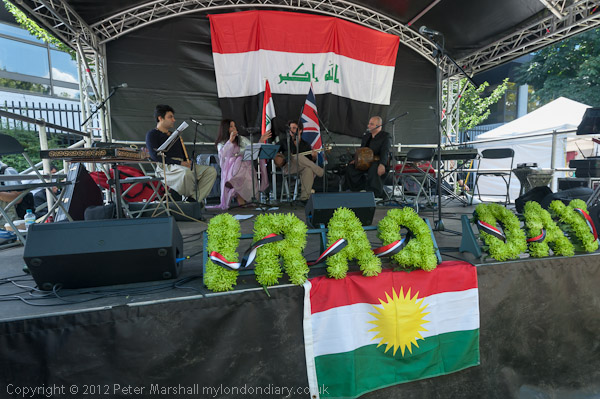
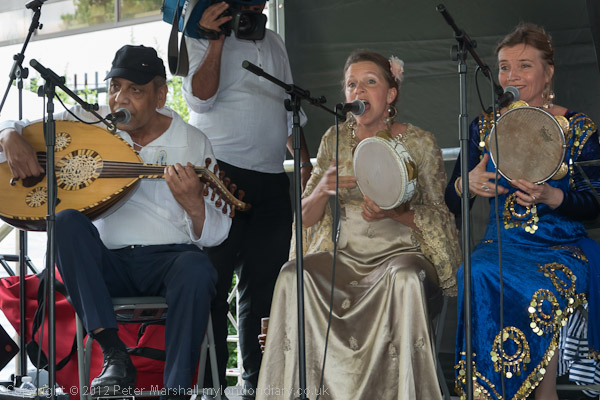
Finally I made my way to Iraq Day 2012, “organized to celebrate the games with a hint of Iraq flavor” by the Iraqi Culture Centre in London and sponsored by Bayt Al Hekima- Baghdad in conjunction with the Local Leader London 2012 program.
There were some unplanned and fairly dramatic events on stage, and one of the performers stormed off the platform, furious at what she felt was cultural discrimination against the Kurds, and a group of Kurdish musicians were told they had to leave the stage, but generally it lacked much interest for me.
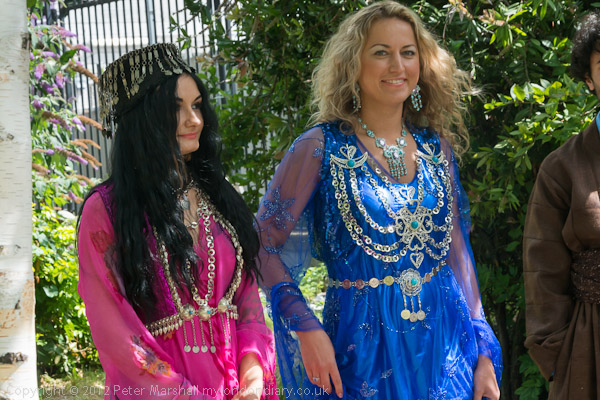
I was sorry for the many Iraqis and others who were unable to eat the Iraqi food that was on offer – for this event was taking place during Ramadan. I had been asked to photograph a fashion show that was a part of the programme, but for some reason it didn’t take place when it should have, and I had to leave before it happened.
All photographs on this and my other sites, unless otherwise stated, are taken by and copyright of Peter Marshall, and are available for reproduction or can be bought as prints.
IWGB are harassed by Westfield security after their protest in John Lewis
The two events I covered on Saturday 3rd August 2013 both concerned the fight to get decent wages and conditions for low paid workers in London, something which has largely been left to the left wing and grass roots unions to fight for rather than the big trade unions or the Labour Party.
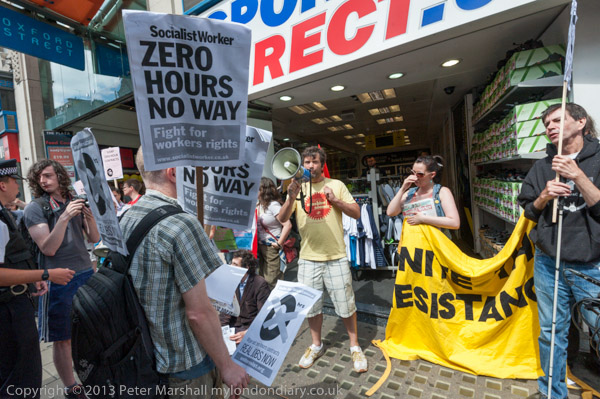
Outside Sports Direct in Oxford St
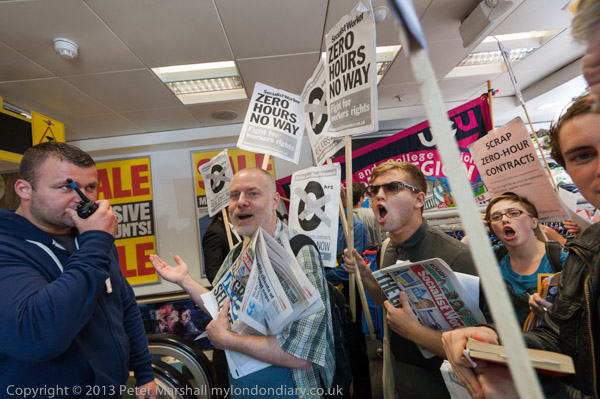
The two major ways that low paid workers are cruelly exploited in modern Britain are through zero-hours contracts and outsourcing, and these were at the heart of the two protests.
Security stop protesters from going down the escalator in Sports Direct
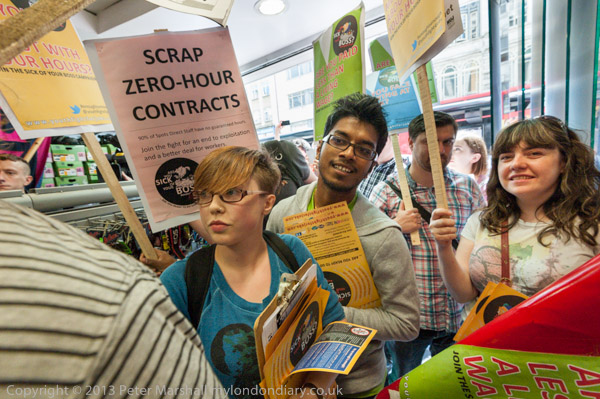
The first, at Sports Direct in Oxford St called on the company to abandon the use of zero-hour contracts which deprive all their 20,000 part-time workforce (over 85% of staff) sick pay, holiday pay and other employment rights.
The protest continues inside Sports Direct
Zero hours contracts, as I explained on My London Diary “are a peculiar legal casuistry that in essence denies the whole concept of a contract as normally understood, agreements without substance which gravely disadvantage workers … Although they give no guarantee of any income, they oblige the workers to be available for work at the employer’s whim, making it impossible for them to take on other work.”
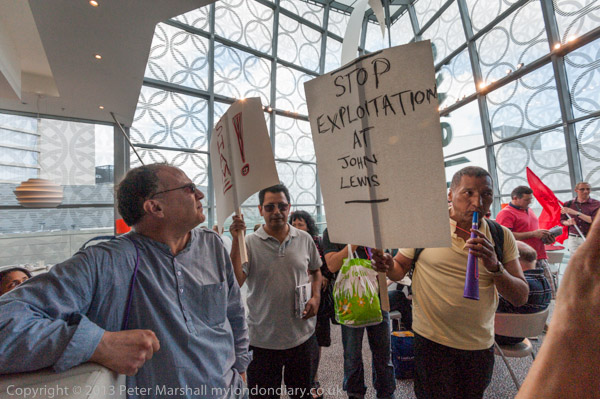
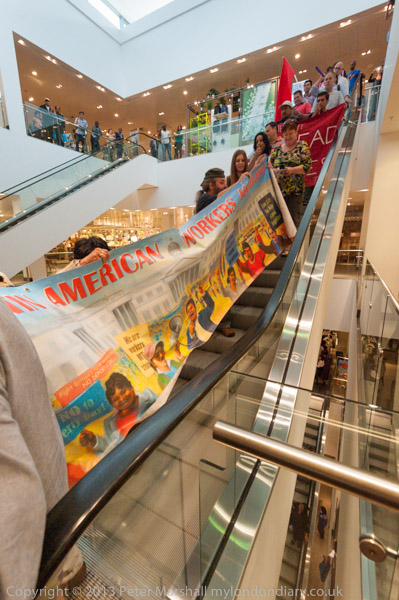
IWGB get out flags,placards and banners on the top floor of John Lewis
All the advantages are for the employer who has a contract which imposes great constraints on workers while denying them the employment rights which are a part of normal employment and leaving them open to the whims of managers as to whether they work or not. A limited reform in 2015 prohibited terms in them which prevented people working for other employers, but if that leads to them being unable to work when the employer demands them to, they may still find their hours very much reduced in future or their contracts terminated.
And begin their protest in John Lewis in Stratford Westfield
The protest was a noisy one and after around 50 minutes handing out leaflets and speaking to shoppers on the street outside, they surged into the small street level area of the shop, where they made no attempt to push post security men who stopped them at the entry to the escalator leading down to the main store. They continued the protest inside the store being careful not to cause any damage. After around five minutes one of the police officers who were watching came to talk to one of the leading protesters and was told they would leave shortly, and after a few more minutes they did, ending the protest on the pavement a few minutes later.
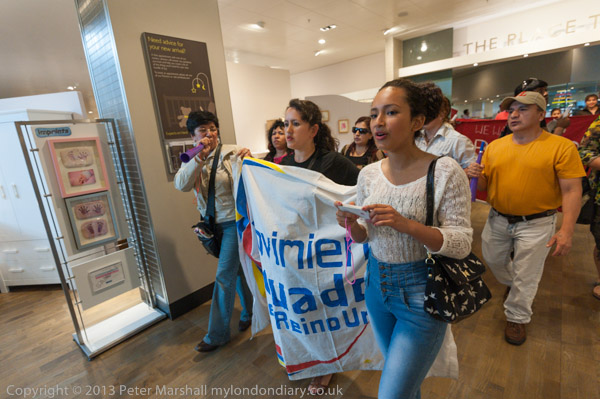
They take the escalator to continue the protest on the floor below
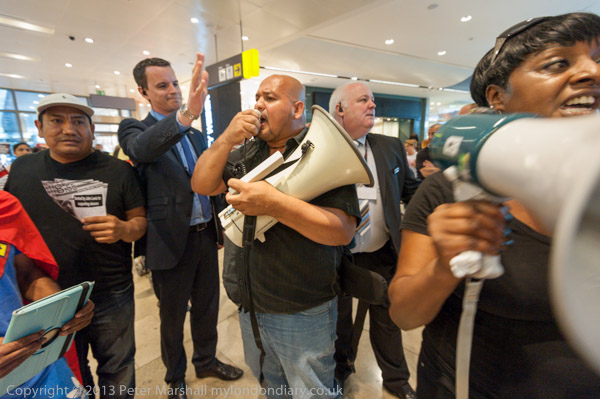
I made my way to Stratford to join the IWGB union who were making a surprise visit to protest inside the John Lewis store in Stratford Westfield. The cleaners there are outsourced to sub-contractor ICM of the Compass Group, who had recently announced pre-tax profits for the year of £575 million. They pay the cleaners £6.72 per hour, considerably less than the London Living Wage of £8.55 an hour set by the GLA and backed by the London Mayor.
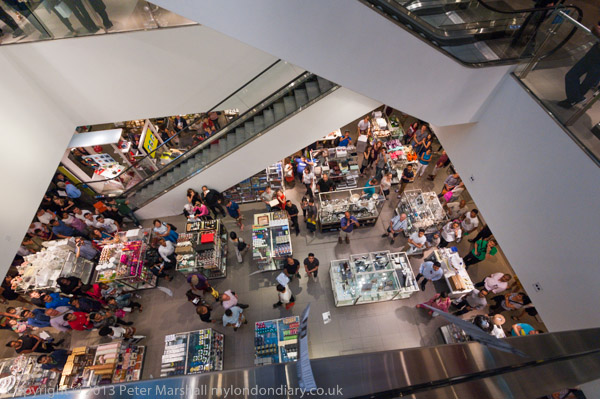
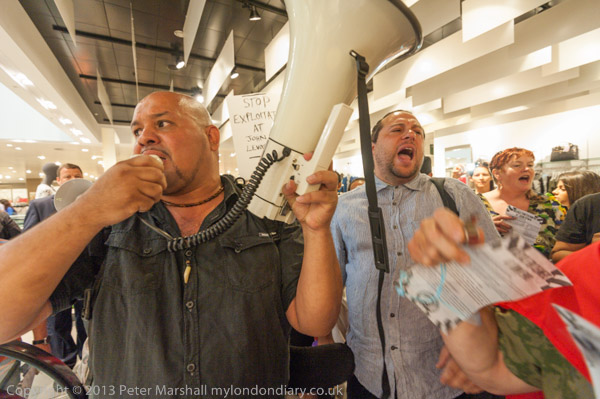
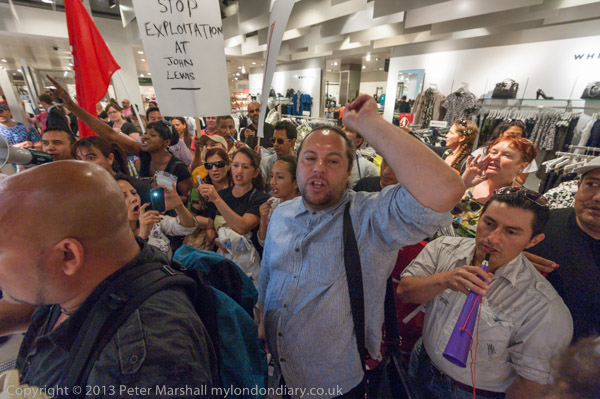
Everyone in John Lewis could hear the protest and stopped to look and listen
Outsourcing enables John Lewis to distance itself from the low pay and poor conditions of service of these workers who share the workplace with the much-lauded John Lewis ‘partners’, who as well as higher pay and better benefits, also get a share in the company’s profits, enabling John Lewis to claim it is a ‘different sort of company’ with a strong ethical basis, but still leave its cleaners – a vital part of its workforce – on poverty wages.
I met the cleaners outside Westfield and walked with them through the shopping centre to John Lewis at its far end, trying with them to look inconspicuous. In the store we went up to the cafe area on the top floor where they got out banners, placards and a large megaphone from their bags and then proceeded to walk around in a noisy protest.
They then took the escalator to the floor below and walked around that making the case for a fair deal for the cleaners to management and customers. Among those protesting (centre, above) was a man who had been a ‘partner’ in the Westfield store and was dismissed after he gave an interview to The Guardian supporting the cleaners’ case for equal treatment, and he was greeted by many of his former colleagues on the shop floor.
I get told I can’t take photographs
After protesting on each floor of the store, there were a numbber of final speeches, including one by the dismissed ‘partner’, on the ground floor before the group left, going out into the Westfield Centre in front of John Lewis. Here they were met by the centre manager and security staff who tried to stop the protest, with some pushing them (and me) around. Here I was told I was not allowed to take pictures, but took little notice. Very slowly we all made our way out of the centre by the nearest exit, still followed by Westfield security, and were met by two police officers who were told the protest was finishing.
All photographs on this and my other sites, unless otherwise stated, are taken by and copyright of Peter Marshall, and are available for reproduction or can be bought as prints.
Many of the protests I photograph are in Westminster and concentrated around Downing Street and the Houses of Parliament. There are obvious reasons for this, particularly during the week when Parliament is in session, though on Saturdays there are few people around other than tourists, with MPs back in their constituencies, government offices closed and the Prime Minister seldom if ever at home and these locations are purely symbolic.
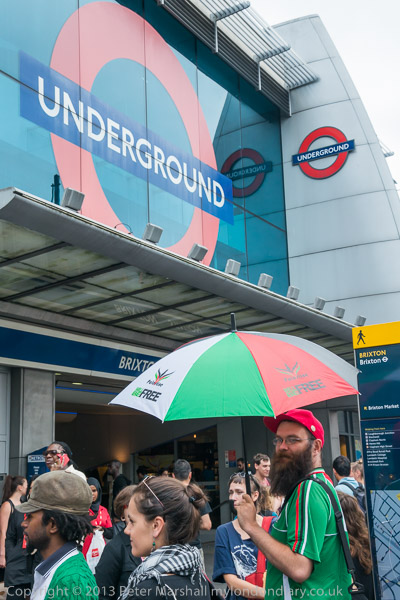
Brixton
Trafalgar Square is a good site for large rallies, and often the end point for larger marches, though this century has seen the epicentre for protest move to Parliament Square, I think influenced by the permanent presence there for around ten years of Brian Haw’s Parliament Square Peace campaign. It can I think hold larger crowds than Trafalgar Square and Jeremy Corbyn drew them there on various occasions and issues, though of course Hyde Park is on a very much larger scale.
Brixton
But protests do take place elsewhere across London and over the years I’ve travelled to most London boroughs to cover them, thanks to London’s public transport system, which also brings me into the capital from my home on its western edge. On Saturday 2nd August there were two protests I wanted to cover, one in South London and the other at its northern end, connected both by the underground and in that they were both related to the illegal occupation of Palestine by Israel.
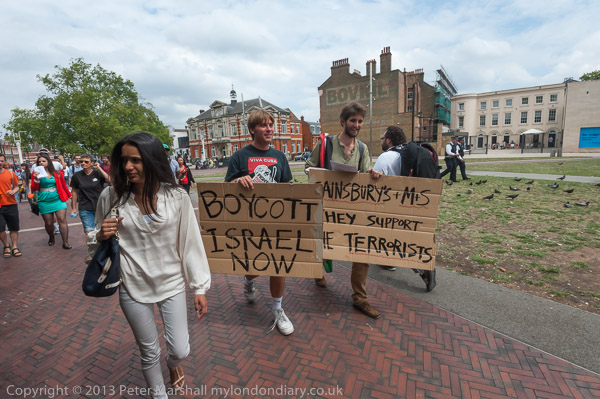
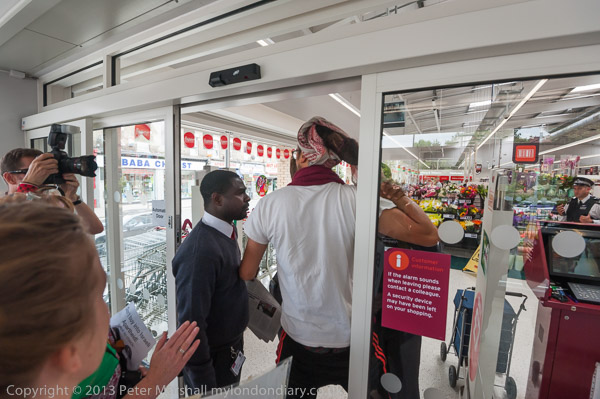
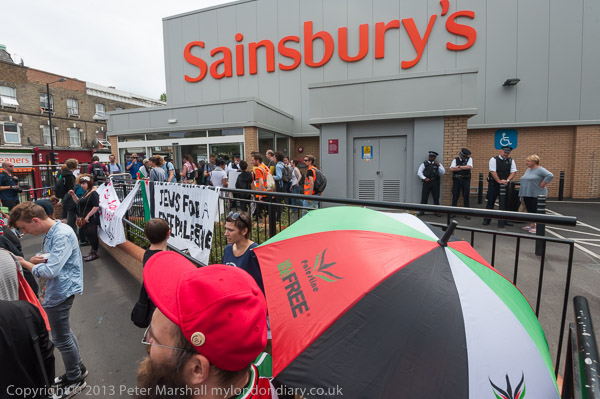
Sainsbury’s Brixton
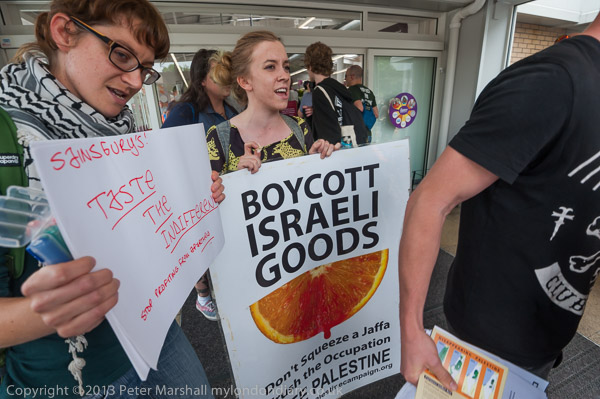
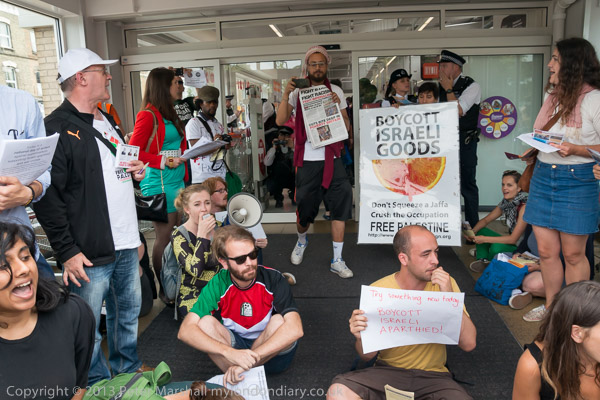
I met with protesters outside Brixton Tube where they were gathering to march to the Sainsbury’s store half a mile to the south. I could have chosen several other locations in London and others around the country as this was a part of protests at a number of Sainsbury’s locations around the country because they sell products produced in illegal settlements inside the occupied Palestinian areas. I’d chosen Brixton partly because I expected there to be a slightly larger protest than some other locations, but also because it was beginning at a convenient place, two stops on the tube from Vauxhall where I could travel direct from my home.
Sainsbury’s Brixton
The protest was a part of the ongoing international BDS (Boycott, Divestment, Sanctions) campaign, the protesters also wanted to show their anger and disgust at the horrific attack on Gaza then taking place, in which by this date over 1200 Palestinians, mainly innocent civilians including many children, had been killed by Israeli forces.
Sainsbury’s Brixton
The protest – along with those at other Sainsbury’s branches – had been widely publicised in advance and both police and store staff were waiting for the protesters, and the few that managed to walk inside the shop were soon asked to leave. The manager came out to talk with the protesters, telling them they had to leave the ramp in front of the store, which prompted them to hold a sit-in.
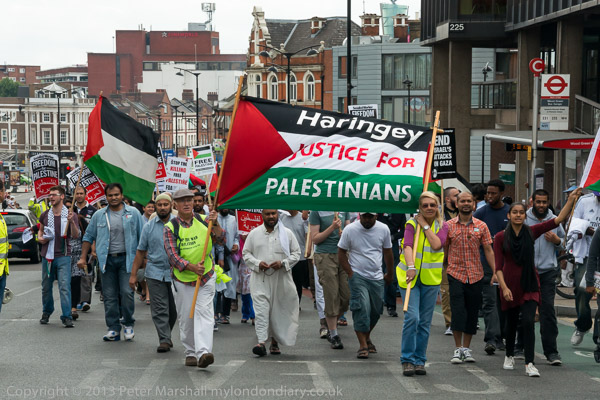
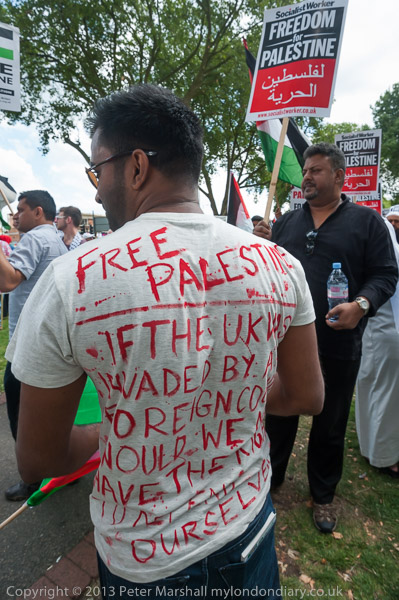
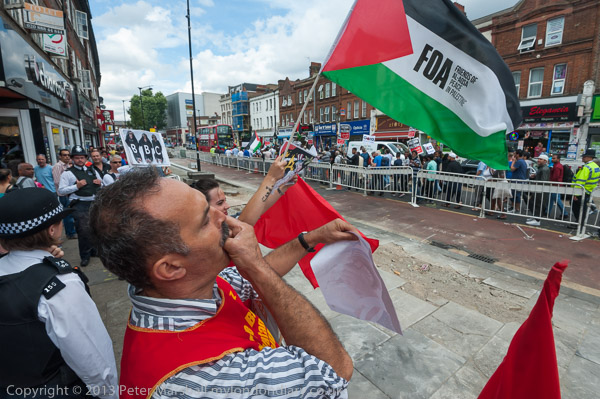
I had to leave before the protest ended to get back to Brixton tube station and make my way up to Turnpike Lane station in Haringey, where a larger protest was gathering on Ducketts Common opposite the station for a rally and march to show their anger over the Israeli invasion of Gaza and the killing of civilians including many children. I arrived shortly before the march began.
Haringey
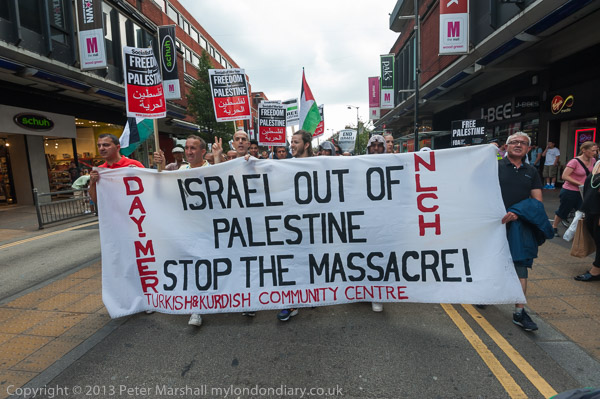
Haringey is one of London’s most ethnically diverse areas, with around 65% of the population in non-white-British ethnic groups. Many are of Cypriot or Turkish origin, including Kurds, but there are also large Black African and Black Caribbean populations. The crowd that came to the rally reflected this and the strong local trade union movement led by the Haringey Trades Council.
Haringey
As the march walked up through the Wood Green shopping centre one Jewish man came to shout his support for the Gaza invasion – and police stepped in to shield him from the marchers – who included many Jews, some of whom came to argue with him. But there were many others who stopped to applaud the march, which was greeted at one location on its route by a group of Turkish Popular Front members.
Haringey
The march was again fortunately a short one and ended around three-quarters of a mile with a rally opposite the Haringey Civic Centre on Wood Green High Road. After listening to a few of the speeches I only had a quarter of a mile to walk to Wood Green Station to start my journey home.
All photographs on this and my other sites, unless otherwise stated, are taken by and copyright of Peter Marshall, and are available for reproduction or can be bought as prints.