Matches, Care Spares, Flats and the Roman

Fairfield Works, Wick Lane, Bow, Tower Hamlets, 1988  88-8b-21
Fairfield Works, Wick Lane, Bow, Tower Hamlets, 1988 88-8b-21

This is the east side of the Bryant and May match factory. The main Grade II listed building was built in 1909-10, architects Holman and Goodsham, making this the largest match factory in Britain. But parts of the building are earlier, and Quakers, William Bryant and Francis May who had gone into business making matches in 1843 (at first because of their religious conviction only making safety matches) moved to a former candle factory on Fairfield Road in 1861. Various new buildings were added before the 1910 building. The factory closed in 1979, was listed in 1988 and is now the Bow Quarter, a gated private estate with 19 houses and 714 flats. The building at right of the picture was demolished and replaced by a new block.

But safety matches, which needed a special striking surface containing red phosphorus were not as popular as the strike-anywhere matches (lucifers) made with the more dangerous white phosphorus in the match-heads and the factory soon switched to producing these as well. The relatively few men and the several thousand “matchgirls” working in the plant, mainly of Irish descent, commonly suffered from phosphorus necrosis of the jaw, known as ‘phossy jaw’ cause by white phosphorus vapour. The first symptoms were usually toothaches – and the company insisted that any workers suffering got all their teeth removed or be sacked. This poisoning led to a disabled jaw and eventually to death in around a fifth of cases.

Complete removal of teeth was common in the UK before the beginning of the National Health Service after World War II, as only the wealthy could afford any proper dentistry. Toothache can be agonising and was often treated by tying strong twine around the offending tooth, fixing the other end to a door handle and getting someone to slam the door. Both my parents (born around 1900) were given full extraction of teeth and a replacement ‘Full Set’ of upper and lower teeth as a wedding present in 1932.

The match-girls were not only subject to this horrible occupational disease, but discipline at work was excessively strict, with fines taken from their wages for trivial reasons – lateness, a dirty workbench, talking or having dirty feet – as well as having to pay for their own glue and brushes. The sacking of one of the girls in 1888 provoked the Matchgirls Strike – which they won after two weeks, getting better working conditions and a proper grievance process and ending the fines and other deductions from their wages.

Old Ford Rd, Old Ford, Tower Hamlets, 1988 88-8b-12-Edit_2400
Old Ford Rd, Old Ford, Tower Hamlets, 1988 88-8b-12

This scrapyard, for all makes of car spares, open seven days a week was next to the A102 (M) East Cross Route, built between 1967 and 1973 as a part of Ringway 1, most of which was then quickly abandoned after it became clear the complete environmental destruction building it would take. It became the A12 after being transferred to TfL in 2000, as they were not given the powers needed to run motorways.

The massive 1970s slab block flats of Lefevre Walk were replaced in 1993-2006 by the Tower Hamlets Housing Action Trust with a mix of houses and flats with a traditional street layout designed in close consultation with the community.

Old Ford Rd, Old Ford, Tower Hamlets, 1988 88-8b-16-Edit_2400
Old Ford Rd, Old Ford, Tower Hamlets, 1988 88-8b-16

A view from the edge of the scrapyard.

Look, Roman Rd, Bethnal Green, Tower Hamlets, 1988 88-8c-63-Edit_2400
Look, Roman Rd, Bethnal Green, Tower Hamlets, 1988 88-8c-63

As well as the Olympus SLR with which I made most of the pictures on my walks and with a second SLR body with colour negative film, I also carried a small Minox 35 camera in my jacket pocket whenever I went out. This was the smallest 35mm camera ever made, only 3.9 x 2.5 x 1.2 inches, just large enough to hold a 35mm cassette at on side and the take-up spool on the opposite side of the film gate. The 35mm f2.8 lens folded back into the camera body when not in use and the camera fitted easily even into a shirt pocket.

I had several models of the camera over the years, and often used it when I wanted to be less conspicuous, carrying the camera in one hand it was almost invisible. It was also virtually silent in operation. At times on my walks when I had packed away the SLRs in my camera bag it was more convenient to take pictures on the Minox, but the 36 exposure film might contain pictures from several walks and other occasions.

It isn’t always easy to fit the pictures into place in my walks but I think from Old Ford Road I spent some time taking pictures – including this and those below – on Roman Road in the centre of Bethnal Green, but they may have been made the previous day.

Roman Rd, Bethnal Green, Tower Hamlets, 1988 88-7u-12-positive_2400
Roman Rd, Bethnal Green, Tower Hamlets, 1988 88-7u-12

Two women with a push chair on Roman Road talk as they walk along the street. Just visible behind them are two other children with them.

Roman Rd, Bethnal Green, Tower Hamlets, 1988 88-7u-13-positive_2400
Roman Rd, Bethnal Green, Tower Hamlets, 1988 88-7u-13

Men walk on the opposite side of the stree in front of Shirley’s Antiques – Houses Cleared, with the text from a previous occupier still visible on the first floor frontage.

Roman Rd, Bethnal Green, Tower Hamlets, 1988 88-7u-15-positive_2400
Roman Rd, Bethnal Green, Tower Hamlets, 1988 88-7u-15

Men walk on the opposite side of the street in front of Shirley’s Antiques – Houses Cleared, with the text from a previous occupier still visible on the first floor frontage.

The next installment on this walk will include more pictures from Roman Road taken as I made my way to Bethnal Green tube and the end of the walk.


You can click on any of the images to see a larger version in my album 1988 London Photos, from where you can browse the album.
Brent St Patrick’s Day Parade

Brent St Patrick’s Day Parade

Brent is the London Borough with the largest Irish population and there are also significant numbers in the neighbouring boroughs of Camden and Islington and Hammersmith & Fulham, with Kilburn and Willesden Green being the in particular having large populations of Irish descent,

Brent St Patrick's Day Parade
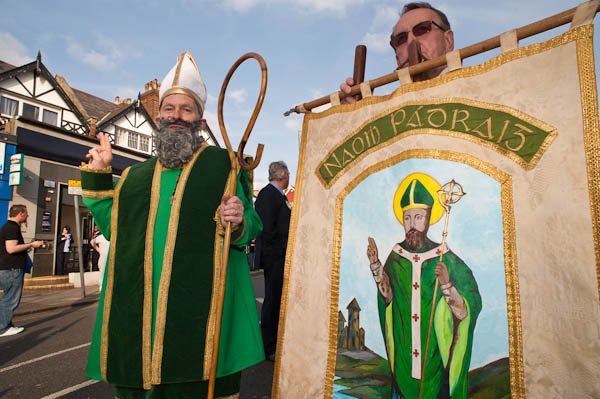
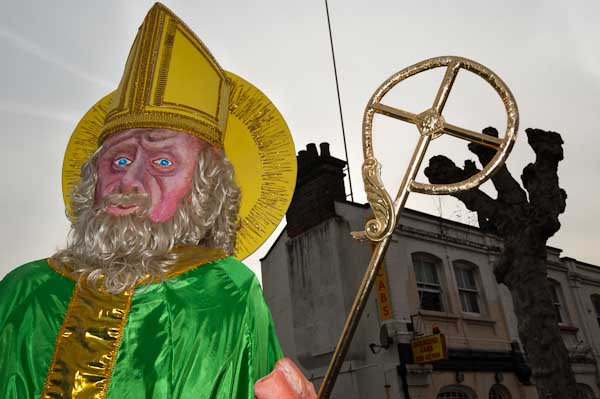
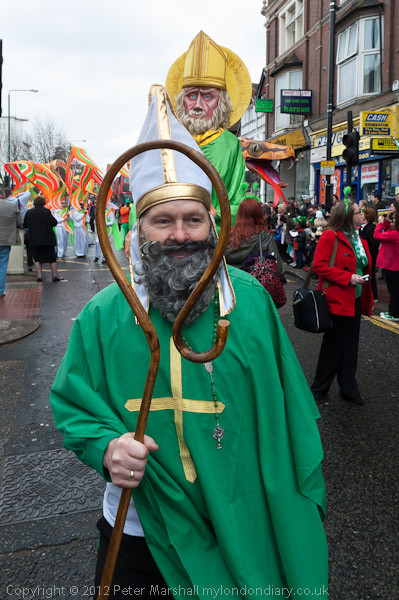
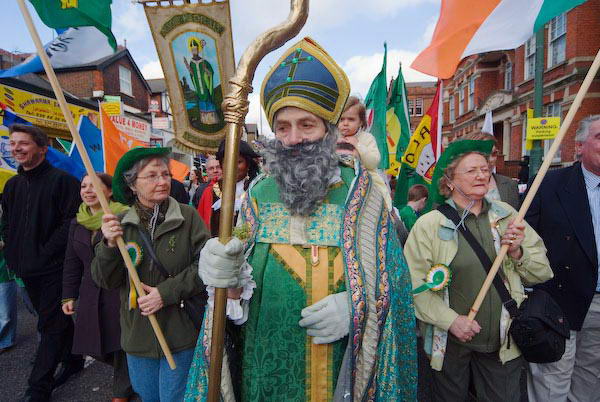
St Patrick, Willeden Green, 2007

So it was hardly surprising that Willesden Green for some years had its own St Patrick’s Day procession, held on the day itself, March 17th, as well as the London celebration begun in 2002 when Ken Livingstone was Mayor on the nearest Sunday. Labour Brent also celebrated days for some of its other communities until recently cuts in funding from a Tory dominated central government made this no longer possible.

Willeden Green, 2007

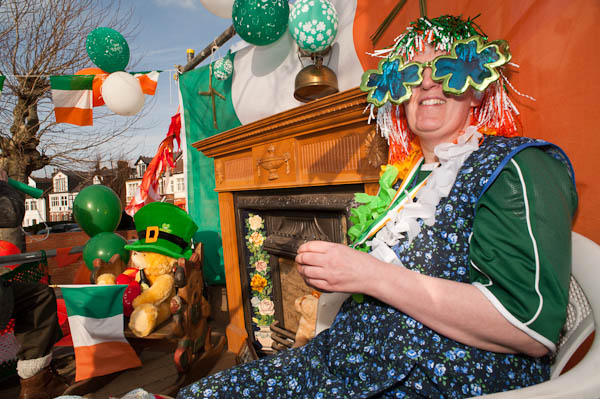
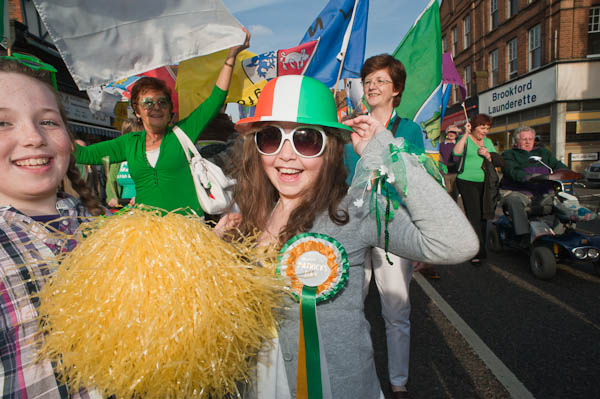
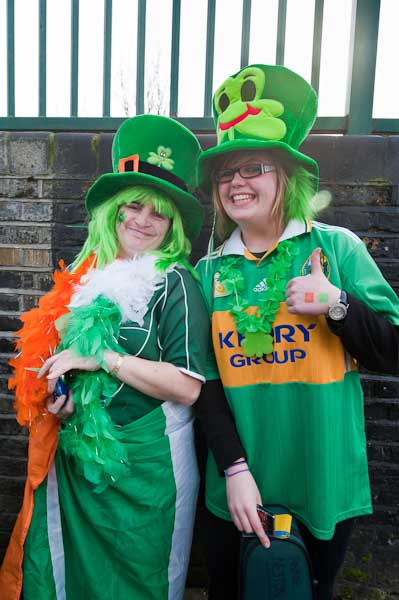
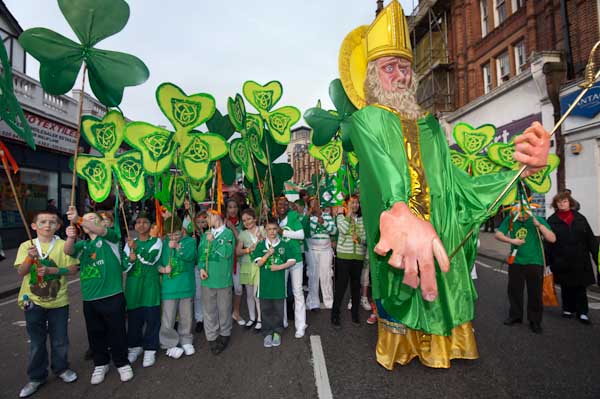
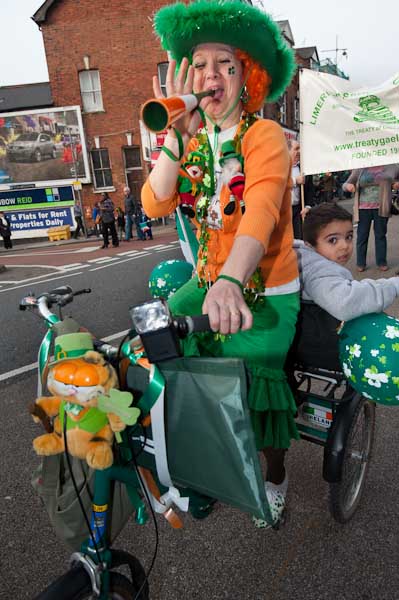
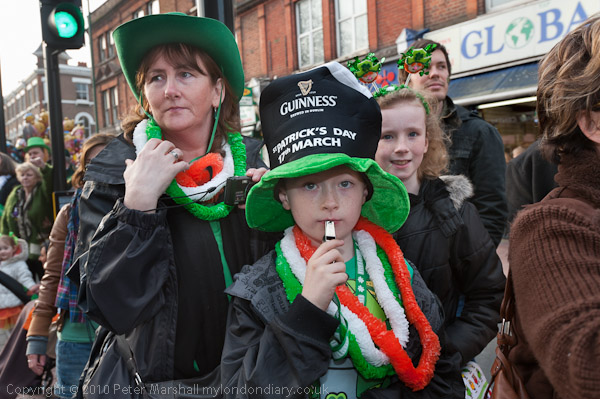
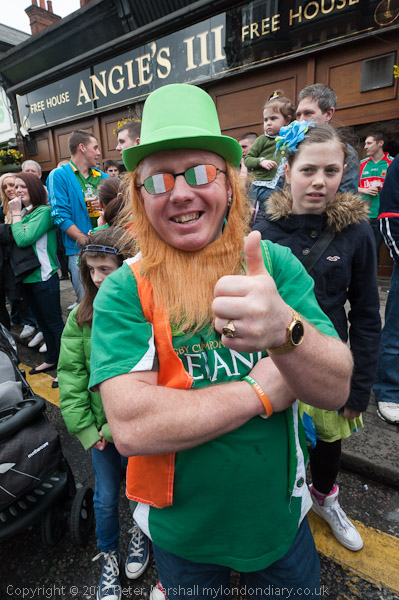
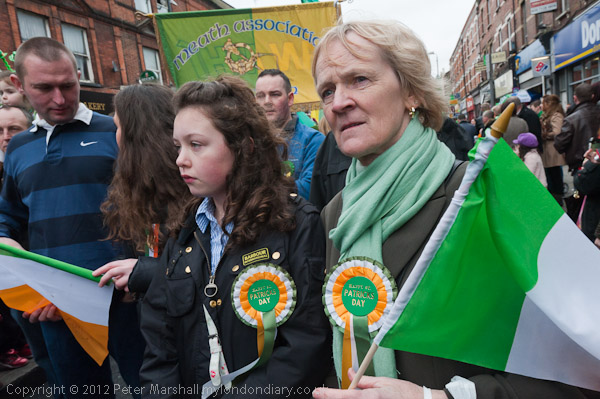
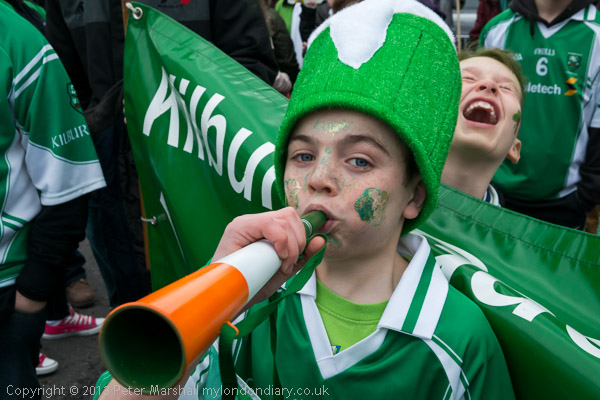
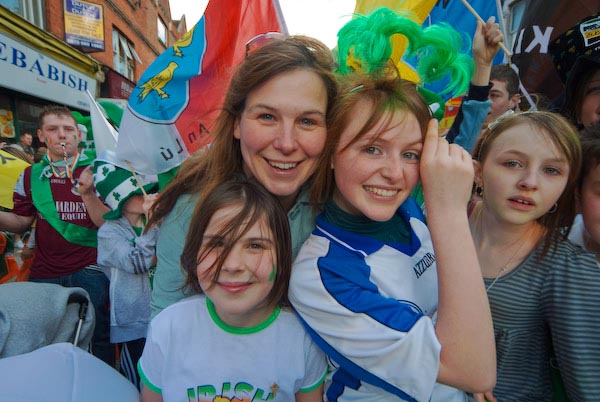
The parade in Brent was on a smaller and friendlier scale than the London parade, and far more a community festival on the street, with others as well as the Irish joining in and having a good time.

St Patrick, Willesden Green, 2008

The multi-cultural nature of Brent was clear in that the parade began outside an Islamic Cultural Centre and those taking part included many local school-children from a whole mix of heritages. Brent as well as St Patrick’s Day also then celebrated Diwali, Eid, Christmas, Chanukah and Navrati, and Holocaust Memorial Day, along with a black history programme, its own ‘Respect’ festival and a world food and music festival.

Willesden Green, 2008

St Patrick blesses the photographer, Willesden Green, 2009

But it was very clearly an Irish event, with Irish people from all across London coming to watch and take part, both in the parade and in the various pubs and bars along the route.

Willesden Green, 2009

Some of the floats in the parade were also in the main London St Patrick’s Day parade, but the atmosphere here was much more relaxed. Here are a few pictures that I made from 2009-2013.

Willesden Green, 2009
Willesden Green, 2010
Willesden Green, 2011
Willesden Green, 2012
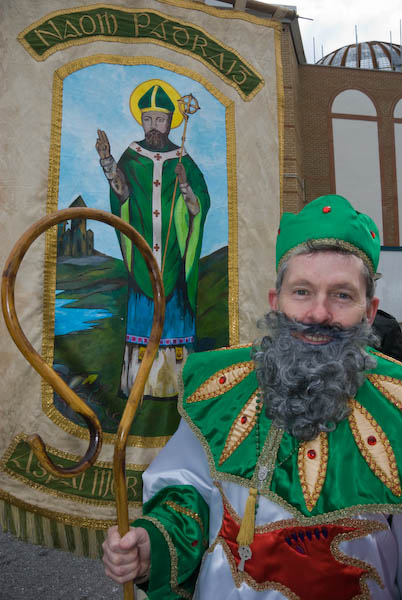
Two St Patricks, Willesden Green, 2012
Willesden Green, 2012
Willesden Green, 2013

In 2013, the event was much smaller as council funding had been cut, thanks to Tory austerity policies. And because St Patricks Day that year was on the Sunday, the celebration in Brent was held a day earlier so not to clash with the London parade.

I think this was the last St Patrick’s Day Parade in Brent – certainly it was the last I photographed. You can see many other pictures from Brent St Patrick’s Day Parade on My London Diary

Brent St Patrick’s Day Parade 2007 (scroll down the page)
Brent St Patrick’s Day Parade 2008
Brent St Patrick’s Day Parade 2009
Brent St Patrick’s Day Parade 2010
Brent St Patrick’s Day Parade 2011
Brent St Patrick’s Day Parade 2012
Brent St Patrick’s Day Parade 2013


Fukushima, No to Racism & No to Assad

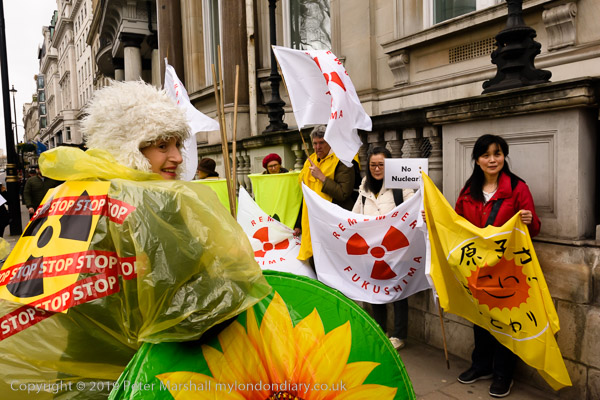
Fukushima, No to Racism & No to Assad. Three years ago on Saturday 16th March 2019 people marched in London 8 years after the Fukushima nuclear disaster, still spreading radioactivity, took part in a large demonstration on UN Anti-Racist Day chanting ‘No to Fascism’ and ‘Refugees are welcome’ here while Syrians calling for a peaceful, democratic Syria marched to a rally in Whitehall on the 8th anniversary of the start of the Syrian revolution.


Remember Fukushima 8 years On

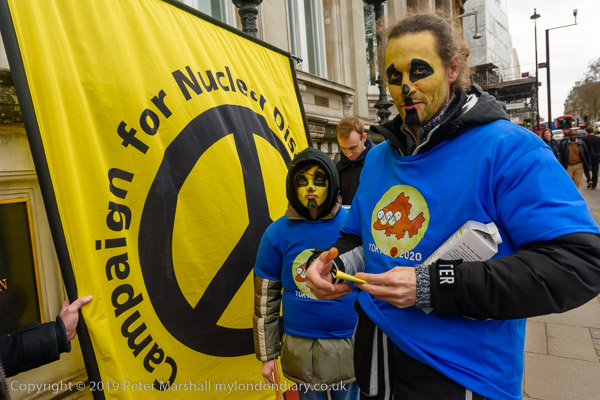
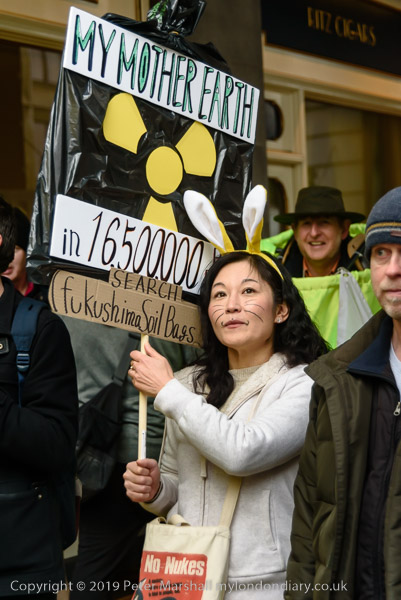
Anti-nuclear campaigners met outside the Japanese Embassy on the eight anniversary of the meltdown of three nuclear reactors at Fukushima. Little progress has been made on cleaning up the site and large amounts of radioactive material are still being released.

50,000 people are still refugees and many are being given no alternative but to move back into areas still heavily contaminated. The clean-up is proving much more difficult than anticipated.

From the Japanese Embassy they marched down Piccadilly, where I left them to go to another protest, returning later to photograph them at a rally opposite Parliamen.

Remember Fukushima 8 years On


No to Racism, No to Fascism

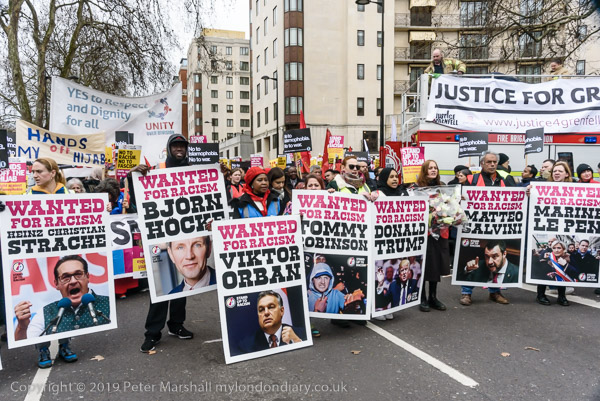
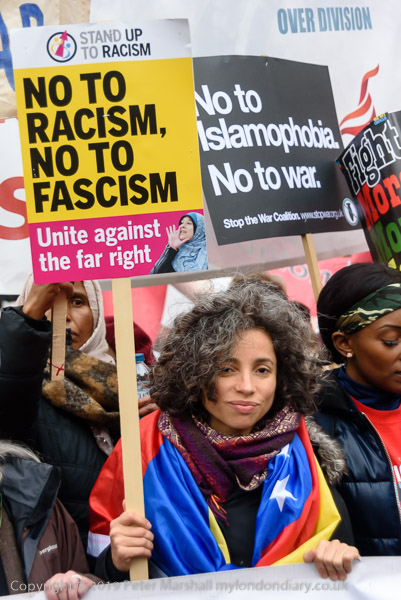
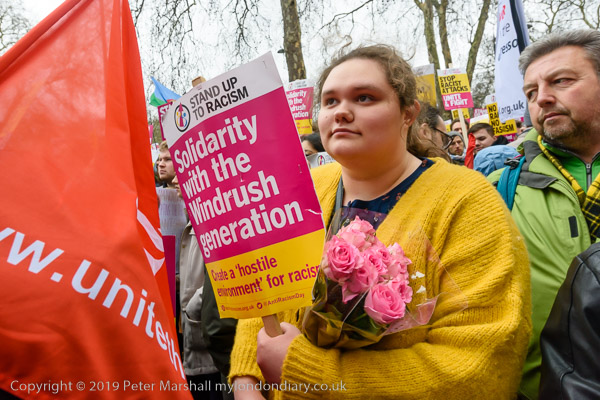
Park Lane was packed at the start of the march on UN Anti-Racism Day to show solidarity with the victims of racist attacks and oppose Islamophobic hate crimes and racist policies in the UK and elsewhere.

The march was joined by a wide range of groups, all agreed that ‘Refugees Are Welcome Here’ and opposed to fascism and racism. Many held large posters denouncing racist leaders from around the world, including Presidents Trump and Bolsonaro as well as fascist party leaders.

The march to a rally in Whitehall had an added significance after the previous day’s Christchurch mosque attack by a white supremacist terrorist who killed 51 people and injured 40.

No to Racism, No to Fascism


8th Anniversary of the Syrian Revolution

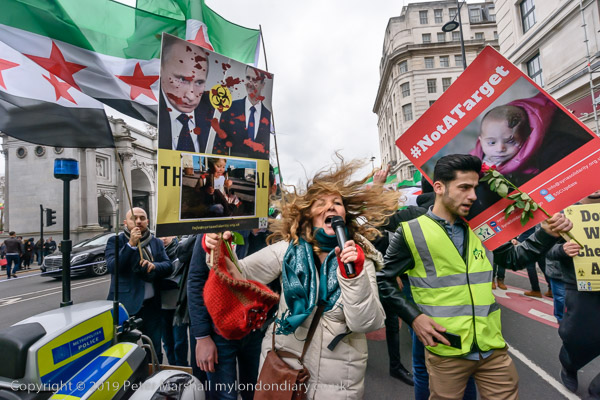
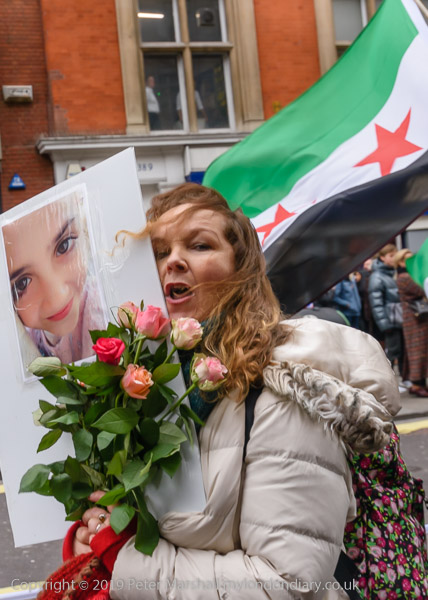
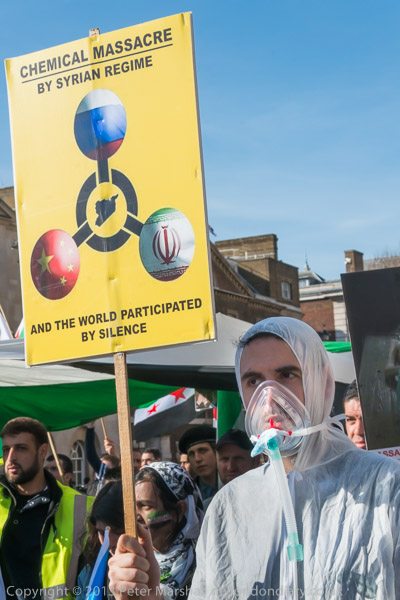
I left the anti-racist march on Piccadilly and walked and ran back up to Marble Arch, close to which I met Syrians opposed to the Assad regime who were marching through London from Paddington Green to a rally in Whitehall on the 8th anniversary of the start of the Syrian revolution.

Unfortunately their revolution was sold out by Western leaders who failed to stand up to the Russian support for President Assad and his authoritarian regime, ending any real hope of Assad being defeated and a peaceful democratic Syria.

Although the fight continues in Syria, and there remain some autonomous areas such as Rojava, the revolution as a whole seems doomed to failure at least for the foreseeable future.

8th Anniversary of the Syrian Revolution


More on My London Diary about the three events:

8th Anniversary of the Syrian Revolution
No to Racism, No to Fascism
Remember Fukushima 8 years On


Tibet, Syrians, Nuclear Melt-Down, Islamophobia & Lions

Tibet, Syrians, Nuclear Melt-Down, Islamophobia & Lions. Saturday 15th March, seven years ago was another typically varied day of protests on the streets of London which I covered.


London March for Freedom for Tibet

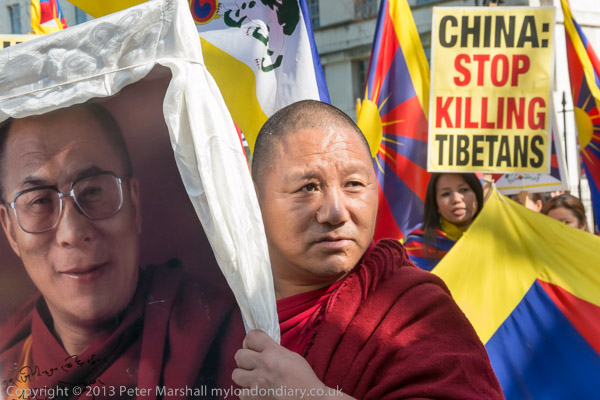
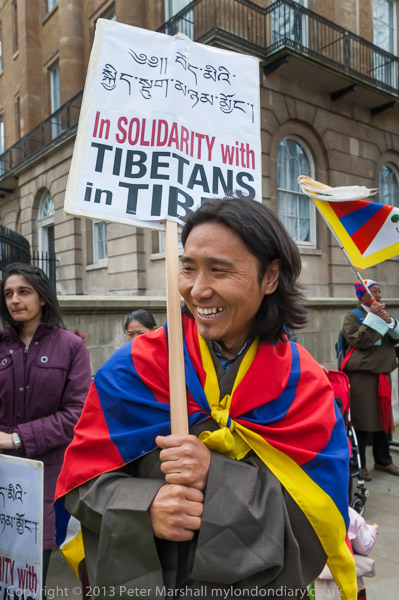
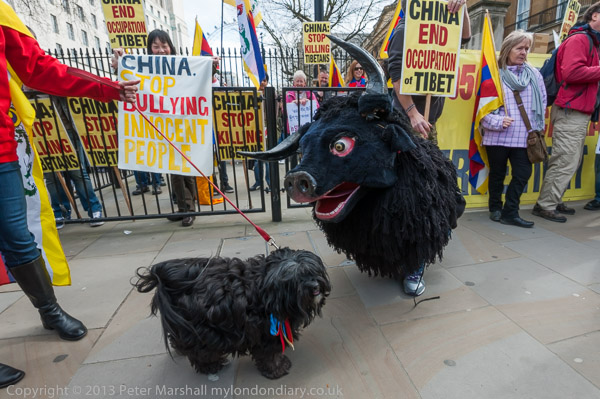
Every year Tibetans and supporters in London protest around the anniversary of the Tibetan National Uprising against Chinese rule in 1959, ten years after the Chinese invasion of the country. In 1959 the Dalai Lama and 120,000 Tibetans escaped to India and established the Tibetan Government in Exile.

In 2014 they met at Downing St for a march to a rally outside the Chinese Embassy in Portland Place, calling for Tibet to be free and in charge of its own destiny again and for an end to the illegal Chinese occupation. They say China is destroying Tibetan culture, and Tibetans are rapidly becoming a minority in their country as thousands of migrants are brought in. Peaceful protests by Tibetans are met by arrests, torture, death and lies, and China’s economic power means western countries adopt what they have called a policy of ‘constructive engagement’ with China, effectively turning a blind eye to the occupation and to human rights abuses in Tibet.

I left the Tibetans shortly after their march went through Trafalgar Square to photograph another protest.

London March for Freedom for Tibet


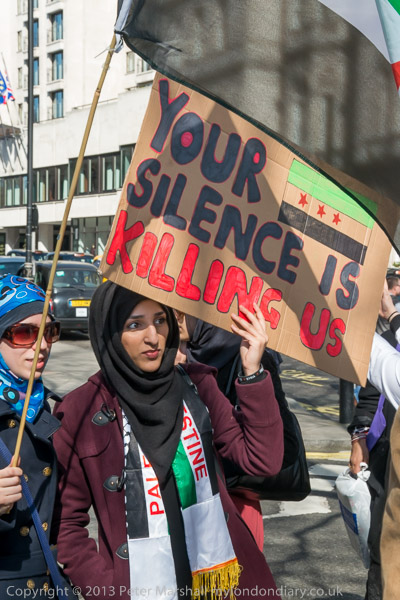
Syrians March for International Action

I had met the Syrians before the start of their march close to Hyde Park corner and had left them as they began their march along Piccadilly on the third anniversary of the start of their fight for freedom. I met them again as they came down Whitehall for a rally at Downing St to show their commitment to the cause and their solidarity with fellow Syrians inside and outside Syria.

The marchers from the National Coalition for Syrian Revolutionary and Opposition Forces and the UK Syrian community called for Assad to go and were appealing to the Britain and the international community to help them to get rid of him. Unfortunately although western leaders condemned the actions of the Syrian government they were not prepared to back up their words with action, and it was left to Russia, who backed Assad to determine the future of the country. Few can doubt that the weakness shown by the west over Syria was not a major factor in Putin thinking he could successfully invade Ukraine.

Ukraine is not of course Syria, but it is hard to read the statement made by the Syrians I quoted in my post without seeing some parallels: “Syria, once proud of its contribution to culture, its distinguished history and its beautiful mosques and churches has been overwhelmed with a brutal dictatorship. Syrian homes have turned to rubble, echoing the unheard screams of its inhabitants. The regime has tried to silence the call of freedom by murdering over 150,000, injuring 500,000, imprisoning 250,000, making 1.5 million refugees and caused over 4.5 million internally displaced people within Syria, and recently started using chemical weapons…” Putin in Syria saved a brutal dictatorship, while in Ukraine it seems his aim is to impose a different regime on the country, perhaps less brutal but requiring similar means for it to be imposed.

Syrians March for International Action


Fukushima Nuclear Melt-down Remembered

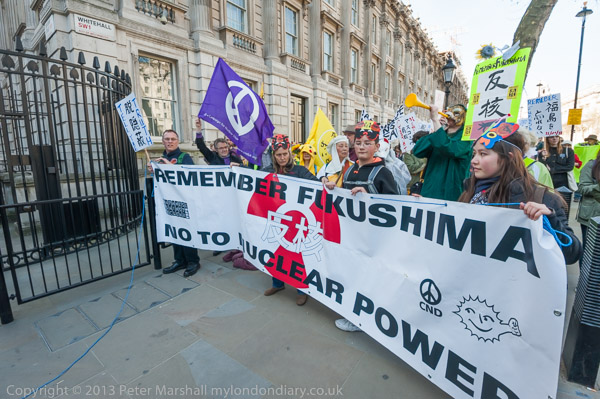
Earlier I had been at Hyde Park Corner where protesters had gathered on the third anniversary of the nuclear melt-down at Fukushima to march through London, first to the Japanese Embassy and then on to a short stop at Downing St before a rally in Parliament Square.

I photographed them again at Downing St, but had to leave as they marched away to their rally.

Fukushima Nuclear Melt-down Remembered


English Volunteer Force march in London

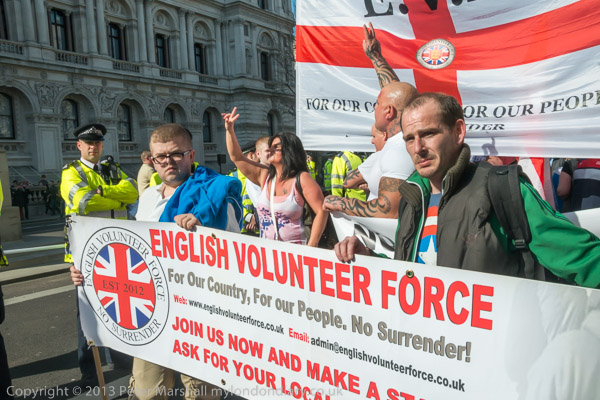
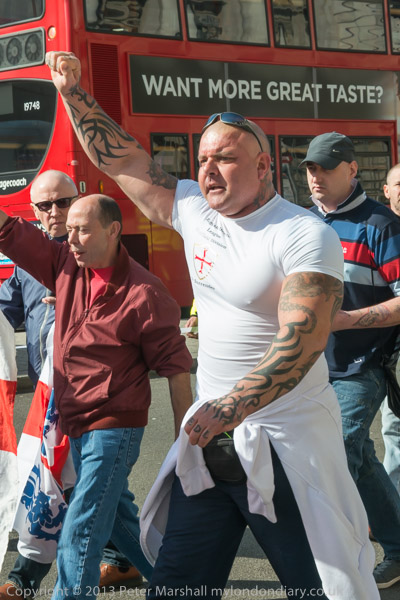
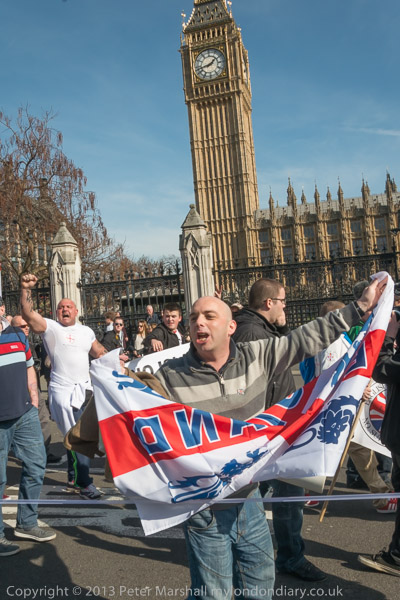
The English Volunteer Force is a coalition of various far-right groups and described the protest on Facebook as “highlighting multiple issues from immigration, Islamic hate preachers, sharia law, Sharia zones, Sharia patrol groups, banning the Burhka!, Halal meat, endless applications for more mosques etc.”
They insist that they are ‘patriotic’ and are not racist, and claim not to be against Muslims but simply against Muslim extremists, though I found this hard to take seriously.

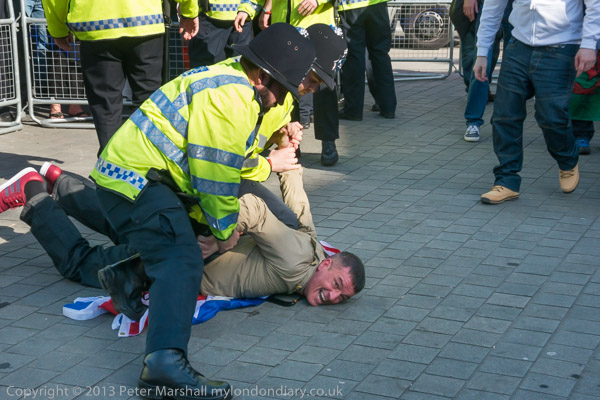
The march started outside the Lord Moon of the Mall pub close to the Trafalgar Square end of Whitehall where people were just coming out of the pub as I arrived. Police were taking a great deal of trouble to keep anti-fascist who were intent on stopping the march from getting close to it, but were unhelpful when I complained about an assault by one of the protesters who shouted at me and pushed my camera into my face.

A few minutes before the assault I’d mingled with the protesters as they walked down to Downing St, joking with some I knew from earlier right-wing protests I’d covered previously. They seemed pleased that I was covering the event – and although they were clear we differed greatly in our views had personally invited me to some cover some ‘patriotic’ events as they trusted me to report accurately on them.

There were several groups of counter-protesters but generally they were kept apart by police – and by stewards in an official protest area against the EVF opposite Downing St. There were a few arrests both of anti-fascists and of EVF marchers who tried to attack them, and one of the larger groups of anti-fascist was kettled by police on Parliament St.

English Volunteer Force march in London


Save Our Lions – Ban Canned Hunting

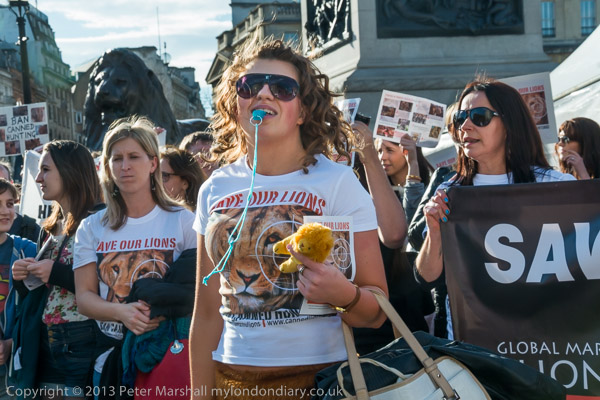
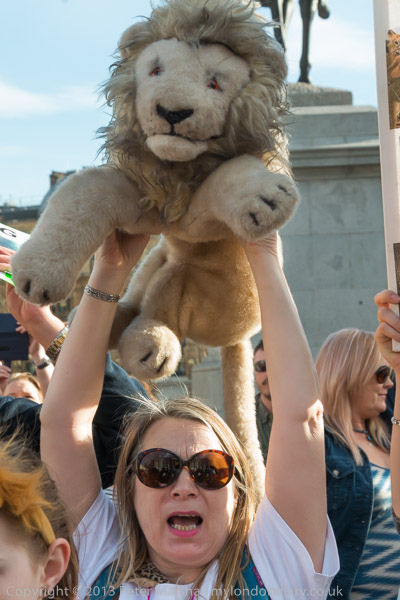
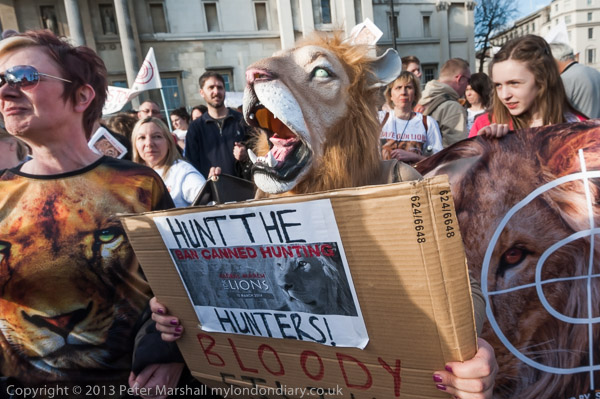
Finally I walked back up Whitehall to Trafalgar Square, where hundreds had come for the Global March for Lions, marching from different starting points to meet and call for a ban on the ‘canned’ hunting of captive lions by wealthy trophy tourists.

Legal but unscrupulous, ‘canned hunting’ is big business in South Africa, with more than 8,000 lions in captivity, bred on lion farms. Rich visitors pay large sums to take part in lion shoots, where the targets are unable to escape, often raised to be tame and used to human presence and drugged to make them easy kills. Over 160 lion killing camps have been set up in South African in the last 15 years.

As I commented: “It is a terrible way to treat a wild and noble animal, but it also greatly threatens the wild lion population. To prevent the inbreeding that is rife in captive lion populations, wild lions continue to be captured, while the growth in the Asian lion bone trade increased poaching.”

Save Our Lions – Ban Canned Hunting


More about all these events on My London Diary:
Save Our Lions – Ban Canned Hunting
English Volunteer Force march in London
Fukushima Nuclear Melt-down Remembered
Syrians March for International Action
London March for Freedom for Tibet


More Bow – a Grave, Halls, Co-op, Canal & Pub

More Bow – a Grave, Halls, Co-op, Canal & Pub continues my walk on Monday 1st August 1988 – the previous post was Bow, Kingsly Hall, a Nursery, Grime, Quakers & more.

Bear Family, Memorial, Tower Hamlets Cemetery, Mile End, Bow, Tower Hamlets, 1988 88-8b-54-Edit_2400
Bear Family, Memorial, Tower Hamlets Cemetery, Mile End, Bow, Tower Hamlets, 1988 88-8b-54

The family vault of the Bear Family is marked by one of the more impressive monuments of Tower Hamlets Cemetery, with a long list of names, ages ad date of death which is headed by George Huxley Bear, who died in 1855 aged 4 years and six months. Several of the other entries are also for children, though their father lived to the age of 76. Child mortality was very much a feature of Victorian life.

I made two other pictures of this memorial, with its stems of wheat at the bottom and the consoling text from John XII, v 24 “Except a corn of wheat fall into the ground and die, it abideth alone: but if it die, it bringeth forth much fruit.” As with all the other pictures you can click on this one to get a larger version and then browse back and forward to see them.

Bromley Public Hall, Bow Rd, Bow, Tower Hamlets, 1988 88-8b-41-Edit_2400
Bromley Public Hall, Bow Rd, Bow, Tower Hamlets, 1988 88-8b-41

Until last year this was the Tower Hamlets Register Office. The Grade II listed building dates from 1880 and was built as the vestry hall for St Leonard’s parish and extended in 1904. At least one web site confuses this with the much older and very different Bromley Hall, on the Blackwall Tunnel Approach road, though to be the oldest brick building in London, built around 1490 but extensively remodelled with a Georgian frontage around 1700.

Former Co-op store, Bow Rd, Bow, Tower Hamlets, 1988 88-8b-42-Edit_2400
Former Co-op store, Bow Rd, Bow, Tower Hamlets, 1988 88-8b-42

Stratford Co-operative & Industrial Society built this splendid store on Bow Road in 1919, proudly listing the names of its leading members under the bee hive signifying co-operation.

In my youth every high street (and some rather lower) had its own Co-operative store, benefiting from the huge buying power of the Cooperative Wholesale Society. We bought most of the few new clothes we could afford there as well as shoes and other items, and it was the Co-op who delivered our milk seven days a week. My mother’s Co-op number is still etched in my memory, essential when making any purchase, and leading to a ‘divi’ at the end of the year which saw us through Christmas.

In 1988 this was the PLH Kakkad Supermarket and although it sold a wide range of goods its frontage was devoted to Rothmans, “The best tobacco money can buy“. More recently it became a Costcutter and then a Nisa local since around 2008.

Lea Navigation, St Thomas Creek, Bow Back Rivers, Stratford, Newham, 1988 88-8b-46-Edit_2400
Lea Navigation, St Thomas Creek, Bow Back Rivers, Stratford, Newham, 1988

I walked further east and crossed the busy Bow roundabout to take this picture looking across the Lea Navigation and up St Thomas Creek, one of the Bow Back Rivers. Stratford High Street at right is now lined with tall flats, and Global Caravans with one stacked on top of a couple of containers is long gone, along with almost all of the rest of the industrial buildings. A few of those nearest on the left before Cooks Road remained but in derelict condition in 2021.

Bow Theatre, Bow Rd, Bow, Tower Hamlets, 1988  88-8b-32-Edit_2400
Bow Theatre, Bow Rd, Bow, Tower Hamlets, 1988 88-8b-32

Walking back west up Bow Road took me to Bow Theatre on the west corner of Fairfield Road. This Grade II listed building was a new Poplar Town Hall built in 1937-8 and was said to be the first modernist town hall, designed by Ewart Culpin and his son Clifford. The frieze by David Evans depicts the various trades of the builders of the town hall and is said to include a welder, a labourer, a mason, a carpenter and an architect. Unfortunately it is hard to decide the occupations of some of those in my picture, partly as they are not critically sharp.

After Poplar became a part of Tower Hamlets, this was no longer a town hall, but remained in use for some years as council offices and also as a theatre. The council sold it in the 1990s and it is now Bow Business Centre.

Caledonian, pub, Fairfield Rd, Blondin St, Bow, Tower Hamlets, 1988 88-8b-34-Edit_2400
Caledonian Arms, pub, Fairfield Rd, Blondin St, Bow, Tower Hamlets, 1988 88-8b-34

The Caledonian Arms on the corner of Blondin St is still standing but no longer a pub, having closed around 2000 and extensively converted to office and residential use in 2010. The building possibly dates from 1851 though it may have replaced a former building later that century. For years a Watney’s pub it later became owned by Shepherd Neame.

The cafe on the opposite corner has gone completely, its site part of a car park for new buildings down Blondin St. The name suggests that the street was built at the time of the famous tightrope crossing of the Niagra by ‘The Great Blondin‘ in 1859.

Douro St, Bow, Tower Hamlets, 1988  88-8b-35-Edit_2400
Douro St, Bow, Tower Hamlets, 1988 88-8b-35

This was a short street with small houses shown in the picture with front doors opening directly onto the street and a car breakers behind the fence at left.

The cobbles and the small houses are still there, but the car breakers have been replaced by a large block of flats, Altius Apartments, at 714 Wick Lane, with 4 floors and a roof garden, at a taller 9 floor tower at the east end. The guide price for one of those small houses in the ‘Bow Quarter’ is given as £800,000 and the estate agents rather creatively describe Douro St as ‘tree-lined’.

Tredegar Rd, Bow, Tower Hamlets, 1988 88-8b-36-Edit_2400

Tredegar Rd is just to the north of Douro St, on the other side of the flats. I think this is at its junction with Wick Lane and I think absolutely nothing of what was in my picture remains, with even the road layout having altered at least slightly.

What was H Bates & Son Scrap dealers is now occupied by a block of around 12 floors, offices at ground level and flats above, but the ‘Bow Quarter’ area is so different that this could well be another nearby corner – also covered with new housing. But my next pictures show I turned south down Wick Lane to the rear of the former Bryant & May match factory, where the next instalment of this walk will begin.


Click on any image to see a larger version in my album 1988 London Photos, from where you can browse other images. You can view most of the sites today on Google Streetview.


Bow, Kingsly Hall, a Nursery, Grime, Quakers & more

This post continues from my previous post on this walk by me on 1st August 1988, Coventry Cross, Gandhi, Graffiti, Drag Balls …

Stroudley Walk, Bow, Tower Hamlets, 1988 88-8a-21-Edit_2400
Stroudley Walk, Bow, Tower Hamlets, 1988 88-8a-21

The buildings of the Diary and the Rose & Crown are still standing at the north end of Stroudley Walk where it meets the end of Bromley High St, but the closed diary became Hussains Convenience Store and then Jalalabad Grocers and half is now a mobile phone repair shop.

The Rose & Crown had opened here around 1720, as the Bowling Green Inn, though the building here is from the 1880s. It closed in 2007, was boarded up for some years before reopening around 2014 as a coffee bar and fast food restaurant.

This was formerly the north end of Devons Road, and a sign for this painted on the brickwork at the left of the pub had virtually disappeared when I made this picture in 1988. Later repainted it has now almost disappeared again.

Kingsley Hall, Powis Rd, Bromley-By-Bow, Tower Hamlets, 1988 88-8a-25-Edit_2400
Kingsley Hall, Powis Rd, Bromley-By-Bow, Tower Hamlets, 1988 88-8a-25

I wrote more about Kingsley Hall and the sisters Muriel and Doris Lester in the previous post on this walk. They used a legacy from their younger brother Kingsley to set up a house where they lived in relative poverty and served the neighbourhood as well as campaigning for peace and justice across the world. A plaque on the building records that Mahatma Gandhi lived in a small cabin here during his three month stay attending a government conference as a representative of the Indian National Congress. You can read and see more about his visit and the sisters on the Muriel Lester web site.

This image gives a better view of the whole building, which dates from 1928. It faces the Devons Estate, built for the London County Council in 1949 and described by Pevsner as being in their ‘pre-war manner, but with all the drabness of post-war austerity‘. Those moved from slums into its maisonettes and flats would have taken a far more positive view and the estate was solidly built and well-designed to the standards of the day.

Clyde House, Bruce Rd, Bromley-by-Bow,  Tower Hamlets, 1988 88-8a-26-Edit_2400
Clyde House, Bruce Rd, Bromley-by-Bow, Tower Hamlets, 1988 88-8a-26

Clyde House is still there at 46 Bruce Road, looking in rather better condition now. Built in 1884 it appears to have been built as a pair with its double-fronted neighbour at 48.

Children's House, Nursery School, , Bruce Rd, Bromley-by-Bow,  Tower Hamlets, 1988 88-8a-11-Edit_2400
Children’s House, Nursery School, Bruce Rd, Bromley-by-Bow, Tower Hamlets, 1988 88-8a-11

Sisters Muriel and Doris Lester helped to set up the Children’s House on Bruce Road 1923. Doris had trained as a teacher and they commissioned Charles Cowles-Voysey to design a building based on Maria Montessori’s ideal learning environment for young children. The school was opened in 1923 by H G Wells and is still a school, run by Tower Hamlets Council.

Inside there is a 12 metre mural painted in 1935 by Eve Garnett, the illustrator, artist and writer of the first children’s book about working class characters, The Family from One End Street, in 1937. There is now a campaign to save and restore the mural which is dirty and damaged and the web site is asking for donations to pay for this.

Regent Square, Bow, Tower Hamlets, 1988  88-8a-15-Edit_2400
Regent Square, Bow, Tower Hamlets, 1988 88-8a-15

The Crossways Estate, built in 1970 was apparently at the time known as the ‘Pride of Bow’, for its three 25 storey towers and a low rise block, Holyhead Close, built over the railway line. Later it was more prosaically referred to as the ‘three flats.’

It was here that Grime developed in 2003, after Rinse FM squatted in a flat and broadcast illegally from here, and it was also where Dizzee Rascal and others grew up.

Like many council developments the area around the estate was hard to navigate, with walkways and roads often not shown on maps. My contact sheet says ‘Regent Square and gives grid reference 375827 for the first of the five images I made. The three towers were Hackworth Point, Mallard Point and Priestman Point and are on Rainhill Way.

And also like many council estates, it was subjected to a policy of ‘managed decline’ and by 1999 was in a very poor state, so bad its demolition was under consideration. Tower Hamlets decided to retain and refurbish the estate which passed to Swan Homes after a residents ballot in 2005. Its towers now refurbished and clad more brightly this is now the Bow Cross Estate.

Bow Church, station, DLR,  Crossways estate, Bow, Tower Hamlets, 1988 88-8b-56-Edit_2400
Bow Church, station, DLR, Crossways estate, Bow, Tower Hamlets, 1988 88-8b-56

The ‘three flats’ seen from Bow Road and Bow Church DLR station which opened on 31 August 1987.

Mornington Grove, Bow, Tower Hamlets, 1988 88-8b-61-Edit_2400
Mornington Grove, Bow, Tower Hamlets, 1988 88-8b-61

Mornington Grove not only gets a mention in the London 5: East volume of Pevsner (p619) which describes these houses as “unusually grand for the area” but also has an extensive web site covering its history by Ken Ward, a resident in the street, from which this information is extracted – and which has far more detail. And it really is an interesting history – if you have the time do click the link and read more.

The land of a nursery here was bought by the Quaker meeting in Ratcliff in 1812, and houses on Mornington Road were developed by them from 1854-1889 – those on the east side in this picture being among the later development. Arthur Wellesley, the 1st Duke of Wellington was the son of the first Earl of Mornington, and the fourth Earl lived nearby on the north side of Bow Road.

Many of the houses in Mornington Road were compulsory purchased and demolished for the Whitehapel and Bow Railway (later the District Line) and others by World War II bombing of what had in 1939 been renamed Mornington Grove. Under the Quakers, at least 5/7th of the rents of the houses went to the support of the poor.

Most of the houses in the street, by then under multiple occupation, were sold by the Quakers to a housing association in 1980, becoming social housing, though many have now been sold off.


More from Bow in the next post from my walk in 1988. You can see larger versions of any of these pictures by clicking on the image which will take you to my album 1988 London Pictures from where you can browse.


Shut Down Racist Yarl’s Wood

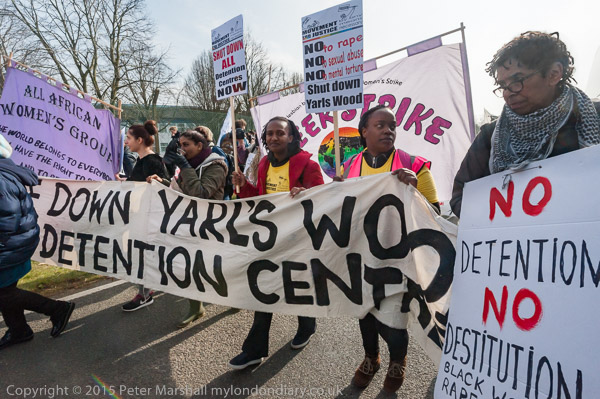
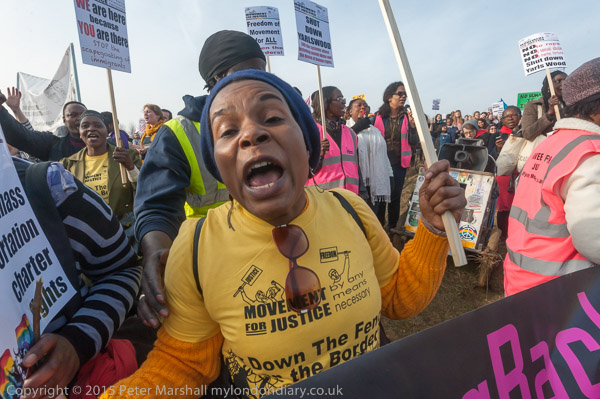
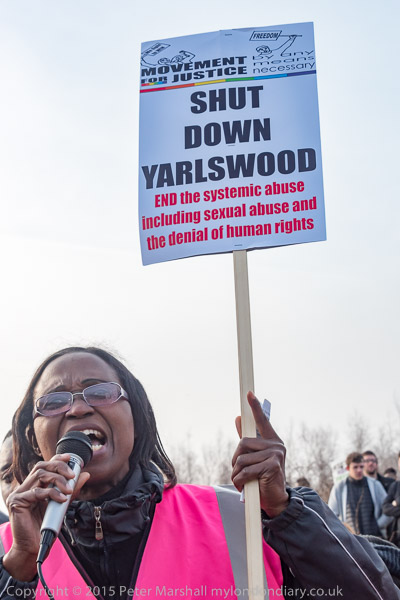
Shut Down Racist Yarl’s Wood. On Saturday 12th March 2016, six years ago today, I made another visit to the immigration detention centre at Yarl’s Wood where the Movement for Justice (MfJ) had organised another large protest.

Shut Down Racist Yarl's Wood
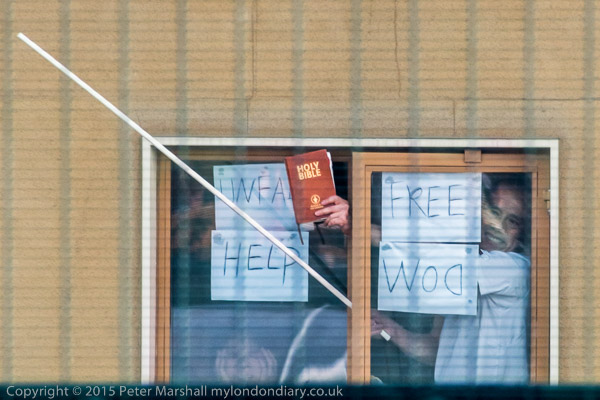
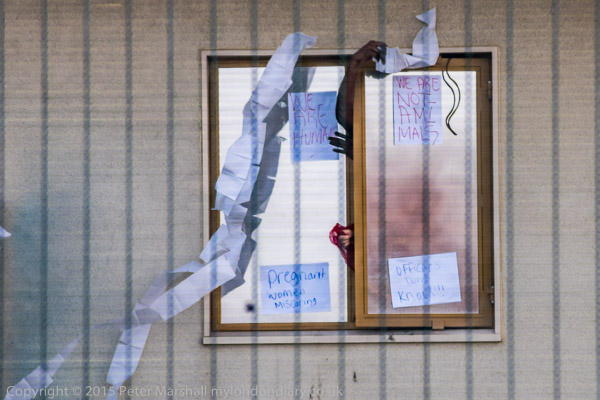
Women at the windows – one holds a bible through the narrow window opening

The Home Office no longer uses Yarl’s Wood to house large numbers of women asylum seekers, but unfortunately this does not mean their cruel and racist policies have changed. Women were at first moved out because of Covid, but Priti Patel has set up a new immigration prison, Derwentside Immigration Removal Centre, to hold 80 detainees to replace it, with around 88 women being moved and locked up there for Christmas 2021.

Shut Down Racist Yarl's Wood
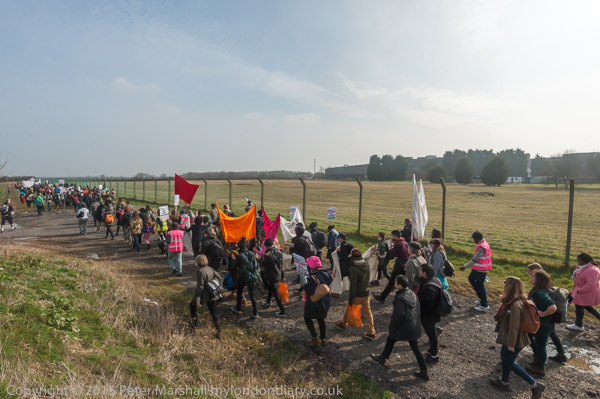
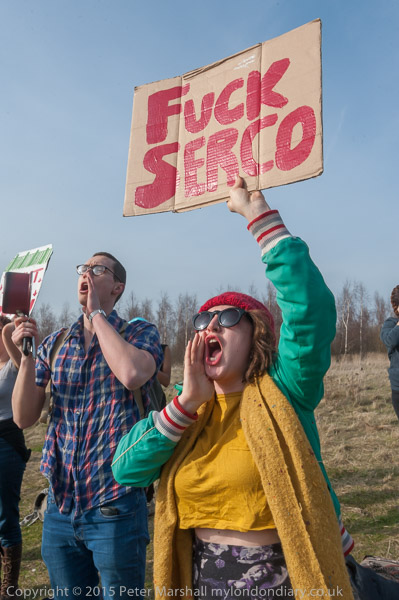
People march down the road to a footpath leading to Yarl’s Wood

The new centre at Hassockfield is on the site of the notorious Medomsley Detention Centre, where over 1,800 young male detainees were abused in the 1960s to 1980s, and is at at Medomsley Edge, 13 miles NW of Durham, 1.7 miles North of Consett. It has been renamed again as Derwentside, to give it a more friendly image, though the river is around a mile away as the crow flies. Almost certainly the Home Office was fed up with the protests organised by MfJ and others at the already rather remote site at Yarl’s Wood, around 5 miles outside Bedford, and thought it a good idea to move it rather further away from London, where there are many former detainees and activists who came to demonstrations.

Shut Down Racist Yarl's Wood
Marching along the footpath

But of course people came from all over the country – including from Scotland – to Yarl’s Wood, and protests will continue, with an active ‘No to Hassockfield‘ local group at their centre, although it’s too far away for me to photograph them.

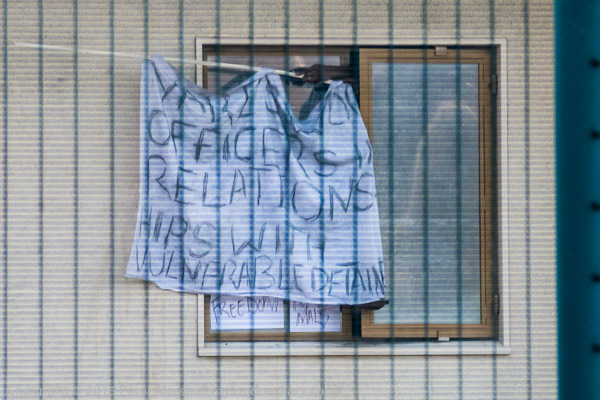
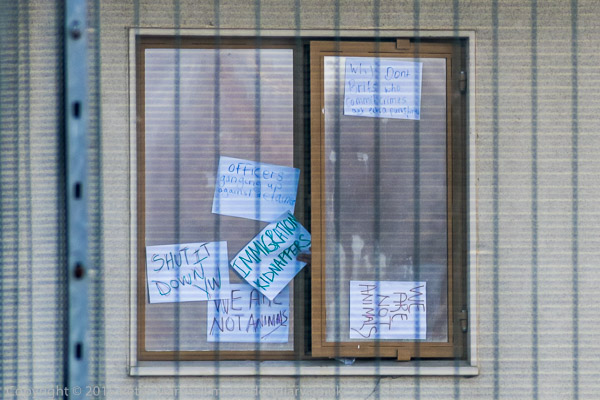
Women have little to protest with and the windows only open an inch or so. They hold messages to the glass and throw out toilet paper

Hassockfield is so remote that the Home Office was unable to find law firms which would give satisfactory tenders to give legal advice there and abandoned the search – with detainees now only able to get advice by phone. Women for Refugee Women are calling for donations to mount a legal challenge over this lack of support. There is a great deal more information about the cruel and racist treatment of asylum seekers with many telling their own stories on their web site.

Yarl’s Wood like almost all of the immigration prisons is privately run for the Home Office, with companies cutting costs for profit

Back on 12th March 2016, my own journey to Yarl’s Wood didn’t go too well, with a train cancellation. But I still got to Bedford Station in a little over two hours and in time for the coach organised by MfJ to the meeting point at Twinwoods Business Park, around a mile walk from the prison. Unfortunately the coach driver didn’t know the way and police had put up large signs stating the road up from the A6 was closed (though in fact they were letting traffic to the protest to go through.) The result was a rather lengthy tour of the Bedfordshire countryside – with another wrong turning, meaning we arrived the best part of an hour late.

Shut Down Racist Yarl's Wood
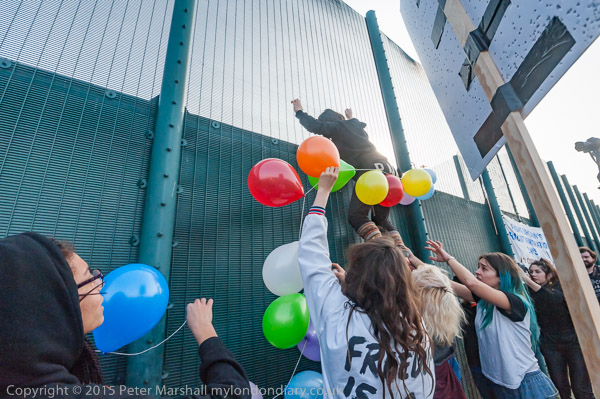
Protesters climb up to show placards and balloons to the women

Fortunately the event had started with a rally on the road waiting for people from around the country to arrive, and the mile or so walk to the prison was waiting for us and only just about to begin.

Shut Down Racist Yarl's Wood
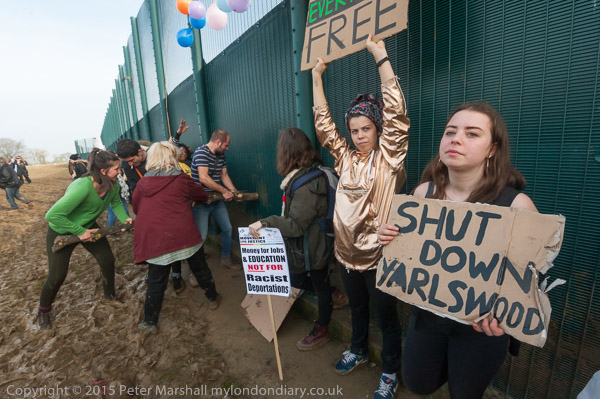
Battering the fence makes a lot of noise

Fortunately it was a fine day for the walk, but there had been heavy rain in previous days and some of the footpath and the field beside the prison where the protest took place was full of mud and some puddles, making it hard to move about and keep my balance. As you can see in some pictures close to the fence it was a sticky mess.

Shut Down Racist Yarl's Wood
Many of those protesting were former detainees, some of whom spoke at the event

The field has a fairly steep slope up from the 20ft prison fence, which does enable protesters to see over the lower 10ft of thick metal sheeting and to glimpse the women waving, shouting and holding posters at the upper floor windows inside.

Shut Down Racist Yarl's Wood
Women had written messages on towels and clothing to hang out through the narrow openings.

It is tricky taking pictures through the 10 ft upper section of the fence with its thick wire grid and I don’t have the kind of long and fast lenses for this. I actually declined the invitation from the organisers to photograph the first large MfJ protest here as I knew I didn’t really have the right gear, suggesting they invite a colleague. But for later protests I decided that there were many other pictures I could take and I could at least get some kind of pictures through that fence.

Shut Down Racist Yarl's Wood
Many reports have confirmed the abuses taking place inside Yarl’s Wood

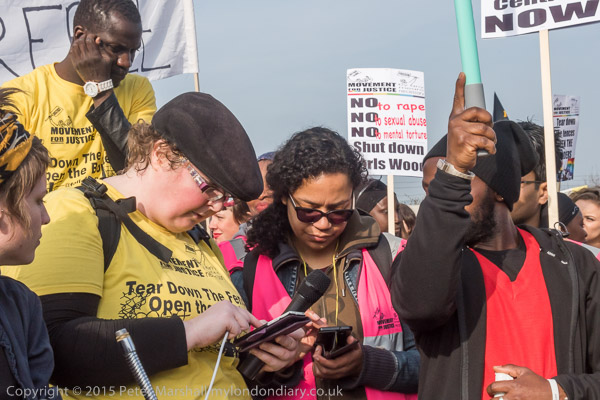
Many of those at the protest were people who had been locked up inside Yarl’s Wood or other detention centres, and almost all of those who spoke had stories to tell about how their mistreatment – having been physically and sexually assaulted, locked in rooms, denied medical assistance, unable to get proper legal advice and more. Most had come to this country fleeing from violence, often from rape and in dire need of care and understanding and instead were locked up, their stories disbelieved and further subjected to hostile and inhuman treatment.

Shut Down Racist Yarl's Wood
Detainees are allowed phones and some were able to speak from inside the immigration prison

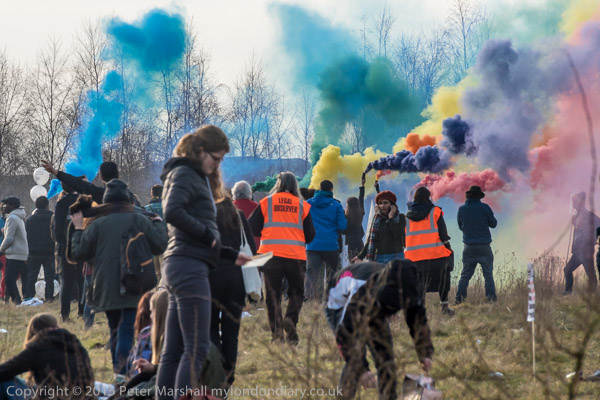
At the end of the protest people let off a number of coloured flares before the long walk back to the coaches. I was rather caught in the mud and unable to get close to where this was happening. On the path and road back to the coach I tried to scrape the worst of the mud from my boots and trousers on the grass and on the kerb of the road, and found some sticks to help, but Bedfordshire mud proved extremely persistent.

Shut Down Racist Yarl's Wood
Most of the speakers were former detainees and friends inside could hear them

We needed to remove our boots before getting on the coach, and fortunately I had a plastic bag to put them in for the journey, getting back into them where we were dropped off at the station. The journey home was slow but uneventful and I was exhausted and needed a good meal and a bath when I arrived – but at least unlike those detainees I was free.

Shut Down Racist Yarl's Wood

More at Shut Down Yarl’s Wood on My London Diary, where you can also find accounts of other protests at Yarl’s Wood as well as other immigration prisons at Harmondsworth and Colnbrook using the site search.


Fukushima Nuclear Distaster Remembered

Fukushima Nuclear Distaster Remembered. Recent shelling of an administration building at a Ukrainian nuclear plant revived memories and fears of the nuclear disaster eleven years ago at the Fukushima Daiichi Nuclear Power Plant in Okuma, Fukushima, Japan. In those 11 years I’ve photographed various events in London, including this one on the 7th anniversary.

Remember Fukushima, 7th Anniversary

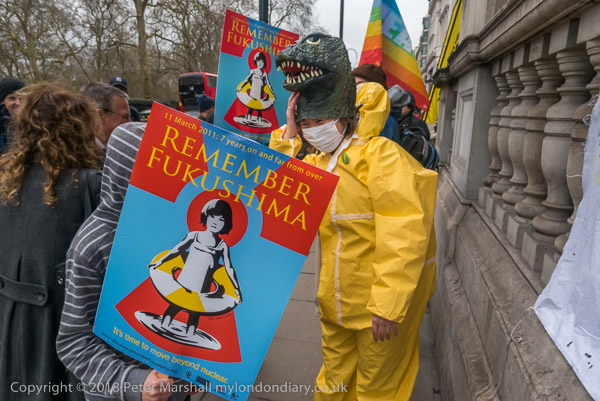
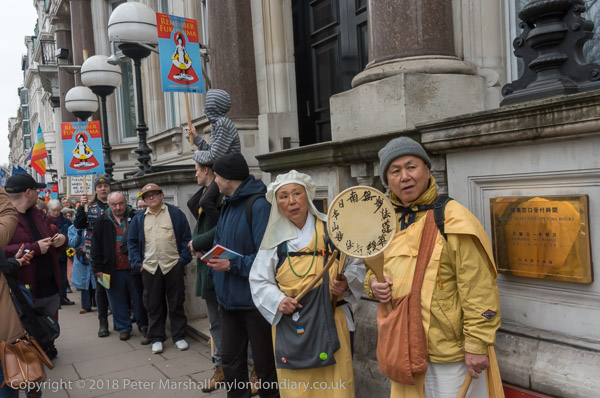
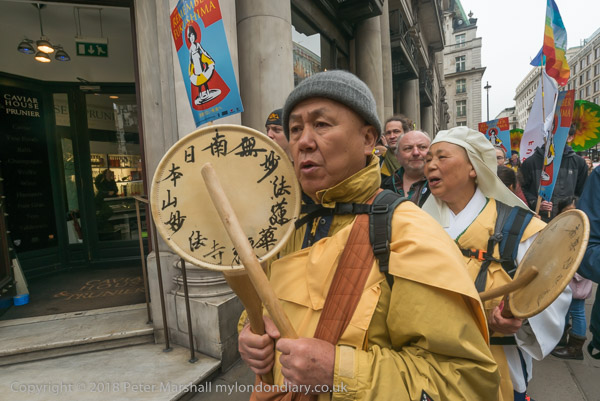
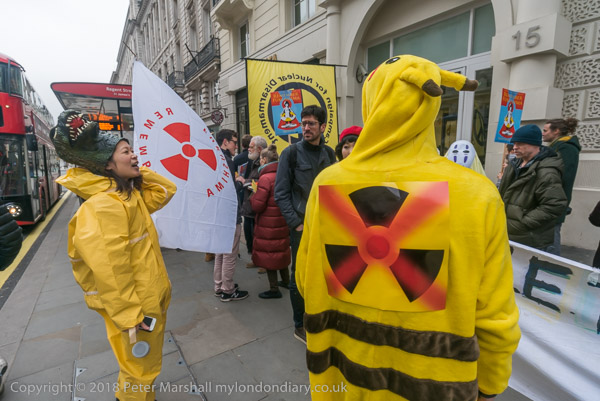
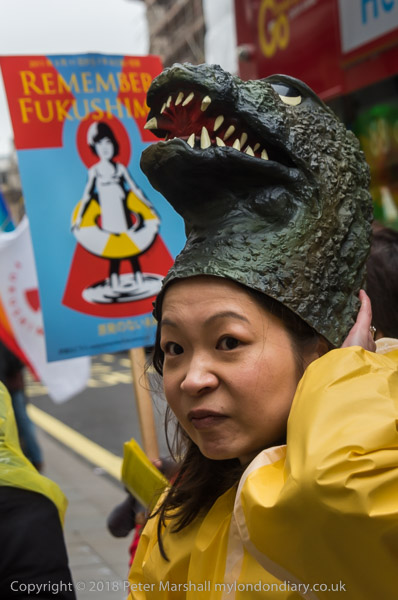
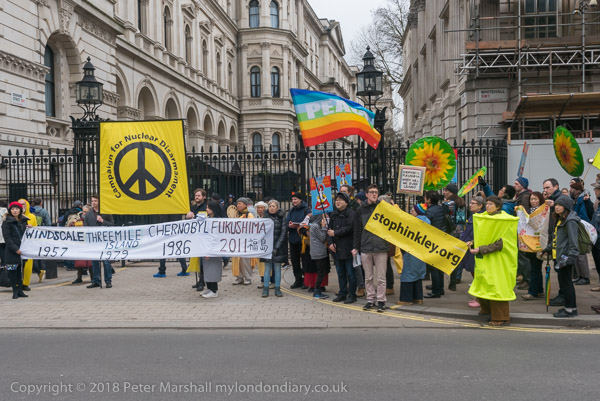
On Sunday 11th March 2018, Kick Nuclear (London) and Japanese Against Nuclear London supported by CND remembered the victims of the continuing Fukushima disaster and all victims of nuclear power and nuclear bombs.

It wasn’t a huge protest, perhaps because after 7 years the media seem to have decided that Fukushima is no longer news, but radiation is still being released from the damaged nuclear plant and its effects will be felt for many years, with estimates of between 100-650 people expected to die from long term cancers caused by the immediate radioactivity leak and more from the continuing release of radiation.

The marchers gathered outside the Japanese Embassy on Piccadilly, where there were still monthly protests over the disaster. There was a vigil there and outside the offices of the plant operators TEPCO in High Holborn on 28th January 2022 which I was unable to attend after it was found that the radiation level was far worse than had been thought, presenting a serious challenge to the continuing shutdown process and overall decommissioning of the site.

Outside Lockheed Martin’s offices

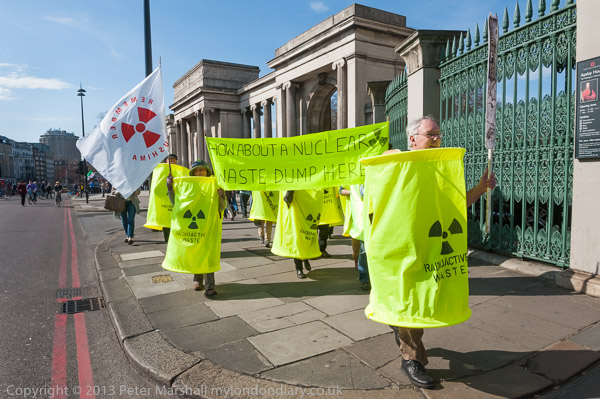
Nuclear power has never lived up to the early promises of plentiful low cost electricity and remains both expensive and dangerous. In the UK it was always linked to the production of military weapons, and we were fed lies about its potential. There are still no satisfactory solutions to the disposal of highly radioactive nuclear waste which requires safe storage into the next millennium – a toxic legacy to our future generations.

Fortunately the UK seldom experiences more than minor earthquakes and the control systems here are rather more sophisticated than those at Chernobyl. But the Windscale fire in October 1957 was one of the worst nuclear disasters in the world, sending radioactive fallout across the UK and Europe.

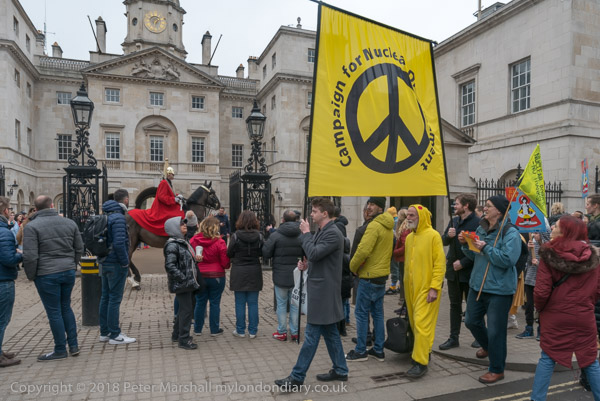
Protesters wait for a horse who doesn’t like yellow to be walked away

Later it was found that as well as large amounts of iodine-131 which causes thyroid cancer there were also significant amounts of the more dangerous polonium-210 (the deadly poison put in the tea of former Russian spy, Alexander Litvinenko, in London in 2006.) It later emerged that there had been earlier accidents at the the plant releasing significant amounts of strontium-90.

Reports of the Windscale accident were heavily censored by the fact that milk from farms over an area of 190 square miles close to this military nuclear plant meant it could not entirely be covered up this time.

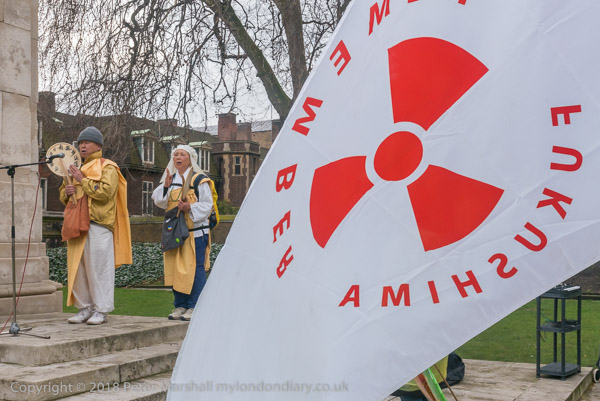
From the Japanese Embassy there was a procession along Piccadilly to Lower Regent St where it stopped for a brief protest outside the offices of Lockheed Martin, one of the companies making nuclear weapons, before stopping for a photograph in front of Downing St and going on the Old Palace Yard, opposite the Houses of Parliament where they held a rally.

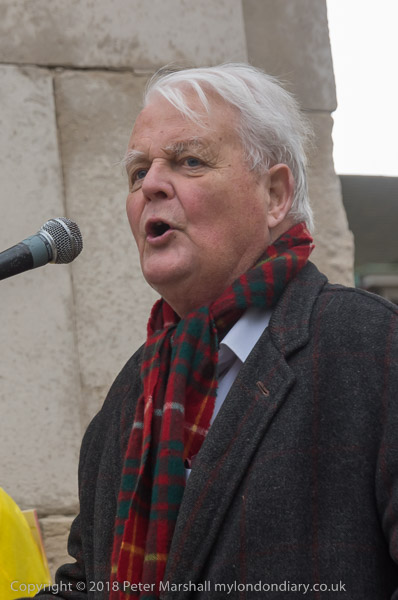
Speakers at the rally included Bruce Kent and Kate Hudson of CND and fashion designer Kate Hamnett. The speeches condemned the continuing nuclear power programme which has always been closely linked with the production of nuclear weapons and, never an economically viable method of power production, has now been rendered entirely obsolete by improved renewable energy sources. There were some musical performances and a poet read one of her poems about Fukushima. I had to leave before the rally concluded with a die-in.

More at: Remember Fukushima, 7th Anniversary


Coventry Cross, Gandhi, Graffiti, Drag Balls …

Coventry Cross, Gandhi, Graffiti, Drag Balls …

Stanstead House, Devas Street, Bromley-By-Bow, Tower Hamlets 1988 88-8a-53-Edit_2400
Stanstead House, Devas Street, Bromley-By-Bow, Tower Hamlets 1988 88-8a-53

My previous walk on 31st July ended at Bromley-by-Bow, and I returned there the following day to continue my wanderings, starting on Devas St and the Coventry Cross West Estate, built by the LCC in the early 1950s, and in 1988 it had recently passed from the GLC to Tower Hamlets. Like all council housing it was very much compromised by the opposition under Thatcher to social housing, with the ‘right to buy’ policies selling off properties to tenants on the cheap and local authorities being largely prevented from building more as well as being starved of cash.

The estate serves as a reminder of an age where councils were able to provide large numbers of socially rented homes before we moved to an era dominated by private profit. Many council tenants who bought their own properties found it very impossible to pay back the loans they had taken on, and sold them as soon as they were able, with many of them now privately rented as ‘buy to let’ properties with rents several times social housing rates.

The six-storey Newmill House at left is linked to the four storey Stansted by a massive archway, with another the west linking to another six storey block, Brimsdown. The estate is now managed by Poplar HARCA and has been renovated around ten years ago.

Stanstead House, Devas Street, Bromley-By-Bow, Tower Hamlets 1988 88-8a-54-Edit_2400
Stanstead House, Devas Street, Bromley-By-Bow, Tower Hamlets 1988 88-8a-54

A portrait orientation view of the same arch into the estate. When built Newmill House at left, a long block running parallel to the Blackwall Tunnel Approach, contained 55 flats.

Gandhi plaque, Kingsley Hall, Powis Rd, Bromley-By-Bow, Tower Hamlets 1988 88-8a-42-Edit_2400
Gandhi, plaque, Kingsley Hall, Powis Rd, Bromley-By-Bow, Tower Hamlets, 1988 88-8a42

North of the railway line, my walk took me to Patrick Connolly Gardens, now rather lost in the Devons estate, and then on to Powis Road where I made this picture of Kingsley Hall.

Kingsley Hall was opened in 1928 by philanthropists and peace campaigners Muriel and Doris Lester who opened the centre using the legacy from their brother Kingsley who died in 1914 when only 26. They had previously helped to set up a Children’s House on Bruce Road nearby in 1923. Muriel Lester (1883-1968) was one of the world’s leading pacifists, and is thought to have been unsuccessfully nominated for the Nobel Peace Prize in the 1930s.

The building had previously been Zion Chapel built by Strict Baptists but was then disused. The sisters were also Baptists, but of a very different nature, they were radical and committed to a social gospel and justice issues and the hall became a centre for their community work with Muriel also serving as its pastor. They donated their wealth to serving the people of Bow and lived a simple and humble life.

Muriel had met and travelled with Mahatma Gandhi often in her work as Travelling Secretary of the International Fellowship of Reconciliation and when he came to London as the representative of the Indian National Congress Party to argue in a conference for independence he rejected the suite offered him by the government at the Hilton Hotel, saying he would rather stay with Muriel Lester at Kingsley Hall. He stayed there for three months, living in a cell on the roof in the same simple style he did in London.

Bromley-By-Bow, Tower Hamlets, 1988
Bromley-By-Bow, Tower Hamlets, 1988 88-8a-44

I doubt if I would have photographed this street corner were it not for the message ‘big Love’ in large letters on the corrugated iron sheeting. Though it does look as if the writer went on to write something beginning with HATE. This was somewhere fairly close to Kingsley Hall.

Edgar Rd, Bromley-By-Bow, Tower Hamlets, 1988 88-8a-46-Edit_2400
Edgar Rd, Bromley-By-Bow, Tower Hamlets, 1988 88-8a-46

The fence here has several messages as well as some peeling posters. The longest text reads ‘AS LONG AS WE HAVE NOT SMASHED EVERYTHING THERE WILL BE RUINS!!’, an exceedingly philosophical example of graffiti which I’ve not seen elsewhere, though I wonder if it could be from a song lyric.

Considerably more common is the ‘VICTORY TO THE MINERS’, and I think the Female Sign – the planetary symbol for Venus ♀ – may mean the painter was a woman.

Tudor Lodge, Bromley High St, Bromley-By-Bow, Tower Hamlets, 1988 88-8a-31-Edit_2400
Tudor Lodge, 85, Bromley High St, Bromley-By-Bow, Tower Hamlets, 1988 88-8a-31

This may have had some connection with Tudor House, whose grounds were bought in 1898 by the LCC to make a public park, which is now Bromley Recreation Ground a couple of hundred yards away, but more likely just with the Tudor family who lived in Tudor House and in the Old Palace closer to where Tudor Lodge used to be.

The archway informs us that this was Tudor Lodge Sports and Social Club, catering for Weddings and Funerals; over a door at left it tells us the ‘Bow Bridge Sports & Social Club Meets Here’. It was by then a large men’s social club, but the impressive cross above the doorway suggests that this was originally a Christian institution of some kind, perhaps a convent or priory

In the 1980s it became a venue for Drag Balls which had begun as the Chelsea Arts Ball, before moving to the Parchester Hall and then on to here. Later in the 90s was the home of Ron Storme’s Transvesti Extrodinaire club.

There is now a completely different modern Tudor Lodge at 95 Bromley High St on the corner with St Leonard’s Road.

How Memorial Gateway, St Leonards Priory, St Leonard's St, Bromley-by-Bow, Tower Hamlets, 1988 88-8a-33-Edit_2400
How Memorial Gateway, St Leonards Priory, St Leonard’s St, Bromley-by-Bow, Tower Hamlets, 1988 88-8a-33

The only part of the parish church of St Mary with St Leonard to survive following bombing in 1942 and the building of the Blackwall Tunnel Approach Road. The church was built in 1843 to replace the former chapel of St Leonard’s Priory, a Benedictine nunnery first recorded in 1122 and destroyed after the dissolution of monasteries in 1536, after which its chapel had been used as a parish church. Chaucer wrote of the nunnery as the “Scole of Stratford atte bowe“.

The How Memorial Gateway was erected in 1893 as a memorial to the Rev G A How, vicar of the church from 1872-93. It is Grade II listed and in poor condition.

Bromley High St, Bromley-By-Bow, Tower Hamlets, 1988 88-8a-34-Edit_2400
Bromley High St, Bromley-By-Bow, Tower Hamlets, 1988 88-8a-34

There is still a large tree and a telegraph pole on the corner of Bromley High St with St Leonards Street, but the lower buildings on the left of the picture were demolished a year or so ago.

Just visible in this picture is the coat of arms of the London County County on 72-4 Bromley High St (Barry wavy of six Azure and Argent on a Chief of the last the Cross of St. George charged with a Leopard of England. The Shield is ensigned with a Mural Crown Or – though it’s too small on the photo to see any details) announcing this as the Bow Bridge Estate, which was completed in 1934. I hope Poplar HARCA kept this when they demolished the building.

My walk through Bow will continue in a later post. Click on any of the images above to see a larger version in my album 1988 London Photos, from where you can browse the album.

Junior Doctors, Ugandan Election, Benefit Sanctions

Junior Doctors, Ugandan Election, Benefit Sanctions. Three protests I photographed on Wednesday 9th March 2016
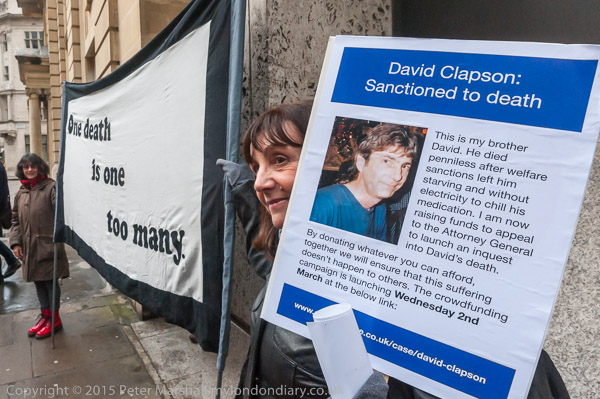
David Clapson, one of many victions of inhumane Tory policies

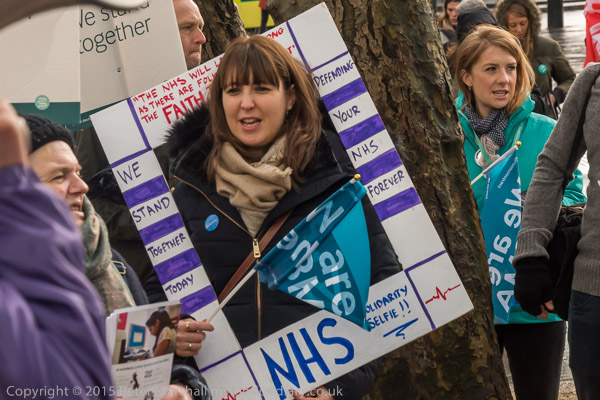
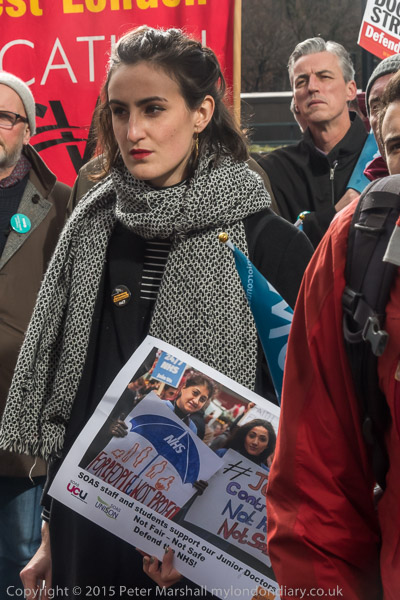
UCH rally for Junior Doctors Strike

Junior doctors were on a one day strike against the imposition of unfair contracts which they say are unsafe and they were joined by other trade unionists on the picket line at University College Hospital on Euston Road.

Later in the morning came the rally opposite the hospital I photographed when other health workers and NHS activists came to support them, and also to oppose the axing for NHS student bursaries and the creeping privatisation of the NHS.


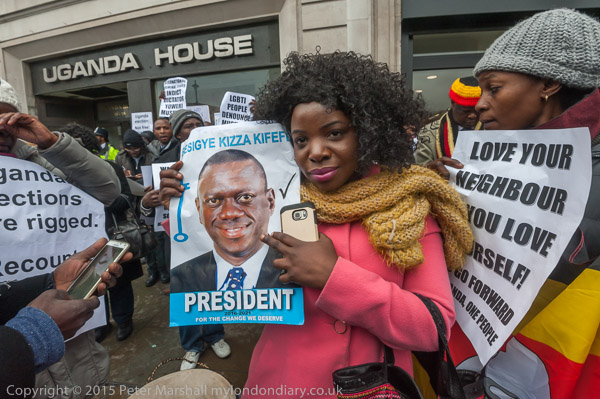
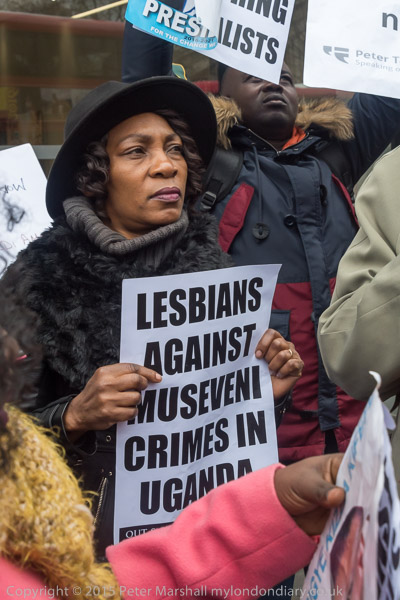
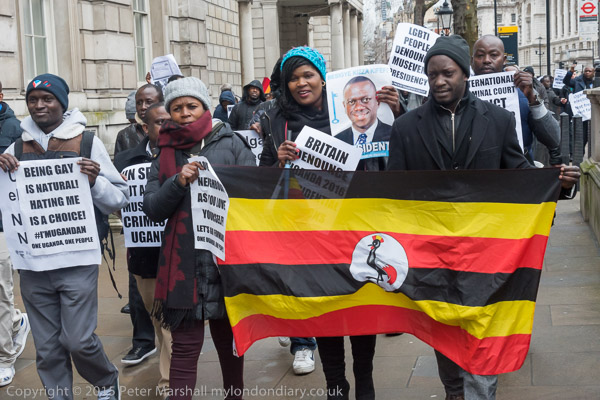
Ugandans protest rigged Presidential Election

Elections had been held in Uganda in February 2016, and international observers reported widespread fraud and irregularities with opposition politicians being arrested, voters intimidated and many polling stations reporting results very different to the actual votes cast.

The protesters called on the UK not to recognise Museveni as the legitimate President of Uganda and for the immediate release of Dr Besigye and other political prisoners, as well as action against those responsible for torture.

The protesters, who included the African LGBTI Out & Proud Diamond Group and Peter Tatchell Foundation were clear that Museveni had lost the election to his challenger Besigye, and having held a high-spirited protest outside the Ugandan High Commission on the corner of Trafalgar Square marched down to deliver a letter to Downing St.


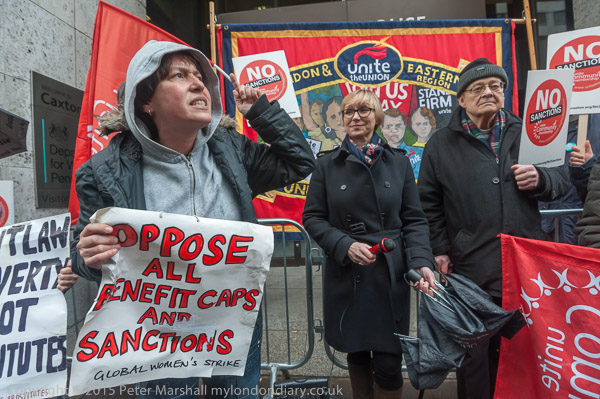
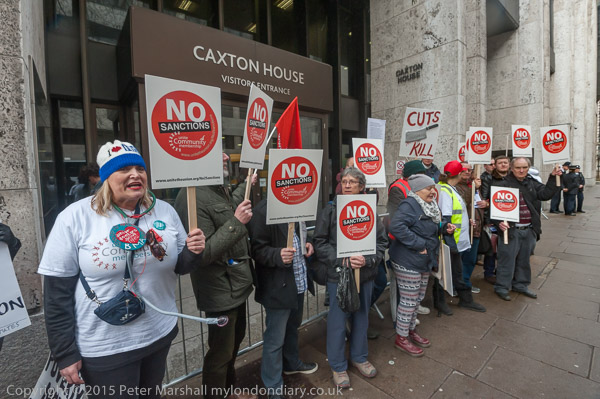
Unite against Benefit Sanctions

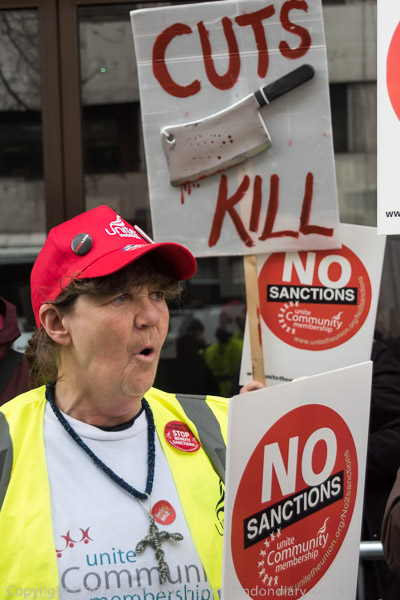
Demonstrations were taking place at over 70 job centres across the country against the use of benefit sanctions. Many claimants lose benefits for trivial reasons and for events beyond their control and are left without support. Some are sanctioned for arriving a few minutes late because of traffic congestion or for missing appointments they have not been informed about. I photographed a protest called by Unite Community members outside the ministry responsible for the policy, the DWP in Caxton St, Westminster.

Sanctions mean people lose benefits and are left destitute. Despite government denials at least 95 deaths are known to have resulted from these sanctions and without the efforts of the many food banks the figure would be much higher.

Some campaigners see the use of sanctions as a deliberate and successful attack on the unemployed and disabled by minister Iain Duncan Smith who is responsible for those working for the DWP being given incentives and targets for causing maximum misery and they label him ‘Minister for Euthanasia’.


David Clapson – Sanctioned to Death

Among those at the protest at Caxton House was Gill Thompson, the sister of David Clapson, a diabetic ex-soldier who died starving and destitute because he was penalised by the Job Centre for missing a meeting. She delivered a petition calling for an inquest into his death and an end to unfair benefit sanctions which leave claimants without support. Over 200,000 people have signed this and a related petition.