July 1986 on Flickr

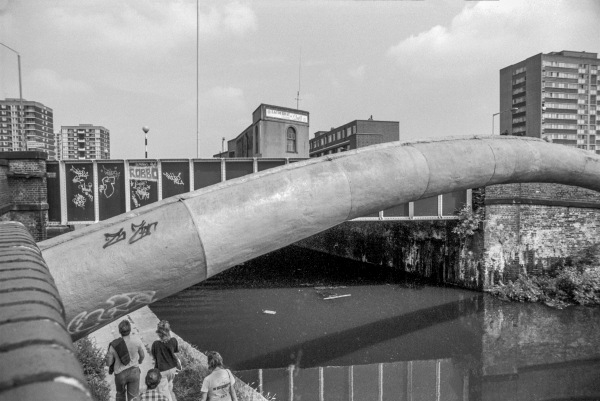
Pipe Bridge, Regent’s Canal, Baring St, Islington

I had more time to take pictures in July as my teaching came to an end for the summer vacation around halfway through the month. This meant I could go up to London on some weekdays, though I still had two small boys to look after on days my wife was working. That usually meant staying at home, but sometimes I took them both out with me to London.
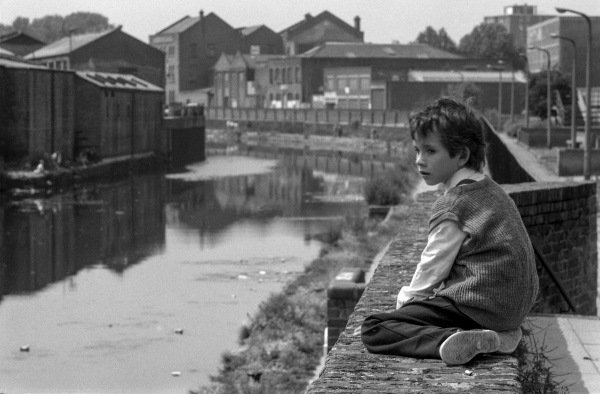
Regent’s Canal

I spent some time in Shadwell and Bethnal Green, but also further north in Shoreditch, Hoxton and Dalston, occasionally wandering into Islington. Though I obviously photographed on foot, I had to travel from my home outside London and then around London to the starting point for my walks, and the One Day Capitalcard, valid on all public transport in London after 9.30am made this much simpler after its introduction in June 1986 – the one-day Travelcard launched in 1984 had been for bus and tube only.
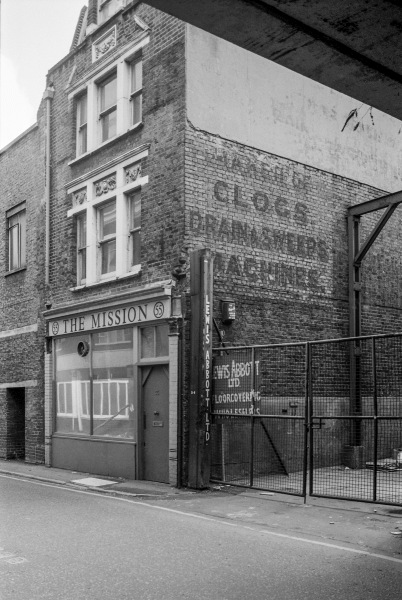
The Mission, Holywell Lane, Shoreditch, Hackney

Towards the end of the month I moved my focus to the City of London, even easier for transport then as the Waterloo and City line was still run by British Rail and my ‘London Terminals’ ticket was valid all the way to Bank.
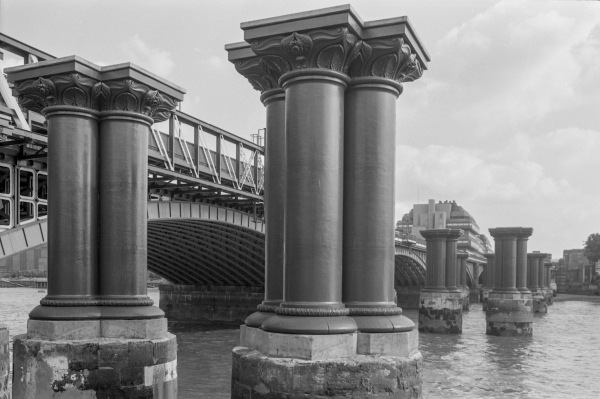
Blackfriars Rail Bridges

When I began photographing London there were two railway bridges across the River Thames at Blackfriars, but all that remained of one of these by 1986 were the pillars that had supported it. And while these were rather a fine set of pillars they were (and remain) a rather curious river feature, presumably left in position simply to save the cost of removing them.
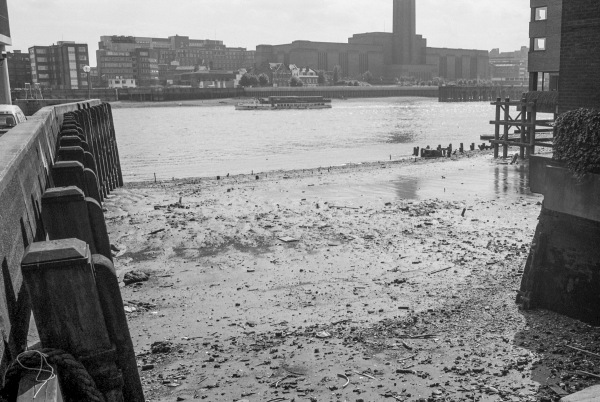
Queenhithe and the River Thames

Queenhithe, a small inlet on the City side of the river has a long history. The Romans built a quay here, and buried deep down in the wet mud some of the timbers they put here survive, as do remains of the dock contructed when Alfred the Great, King of Wessex re-established the City of London aroudn 886 AD. It got the name Queenhithe (a hythe is a small harbour) when Henry I gave the right to levy dues on goods landed there to his wife Matilda around the time of their marriage in 1100. Queenhithe was still a major harbour for the city hundreds of years later and remained in use, with lighters bringing skins for the fur trade which was based a short distance to the north until the Second World War.
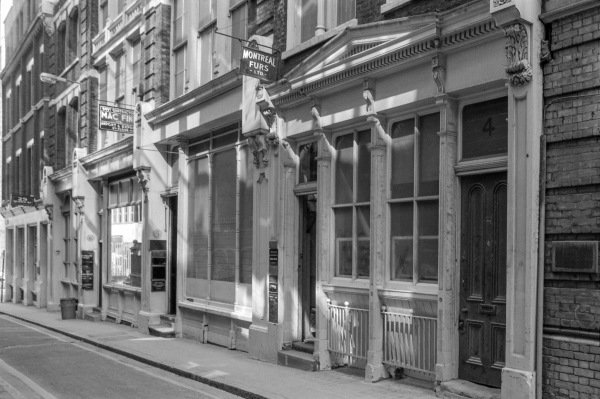
Fur shops in Great St Thomas Apostle

Around 300 of the black and white pictures I took in July 1986 are now online:
Peter Marshall: 1986 London Photographs on Flickr.
July’s pictures start here.

The images are copyright but may be shared on non-commercial personal social media. A licence is required for any corporate, commercial or editorial use.


All photographs on this and my other sites, unless otherwise stated, are taken by and copyright of Peter Marshall, and are available for reproduction or can be bought as prints.

There are no adverts on this site and it receives no sponsorship, and I like to keep it that way. But it does take a considerable amount of my time and thought, and if you enjoy reading it, please share on social media.
And small donations via Paypal – perhaps the cost of a beer – would be appreciated.
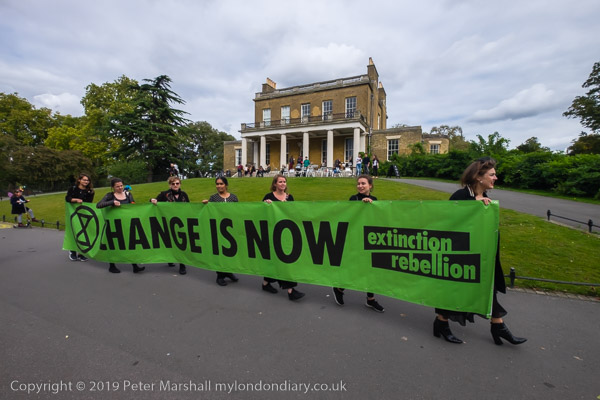
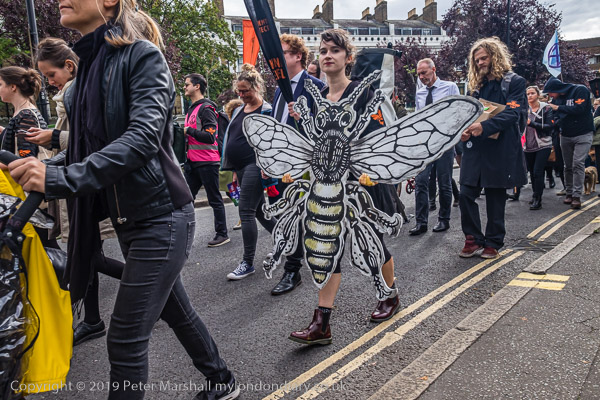
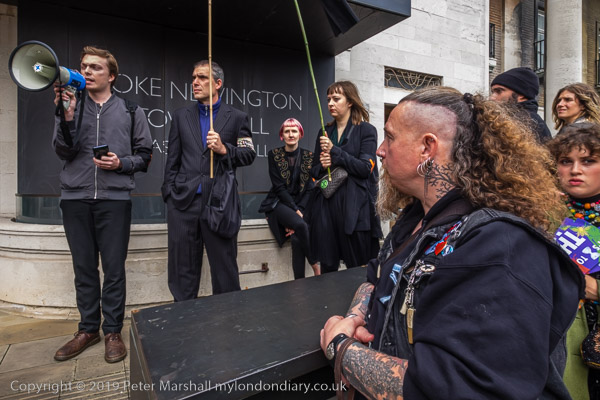
Requiem For A Bee

Getting to Clissold Park in Stoke Newington isn’t the most convenient of London journeys, at least not if you are in a hurry. And having been at Euston to photograph the HS2 protest it took me a while to arrive there – the Underground to Manor Park, a bus ride and then a run (or rather a mixture of walking and running we used to call ‘Scout’s pace’) across the park.

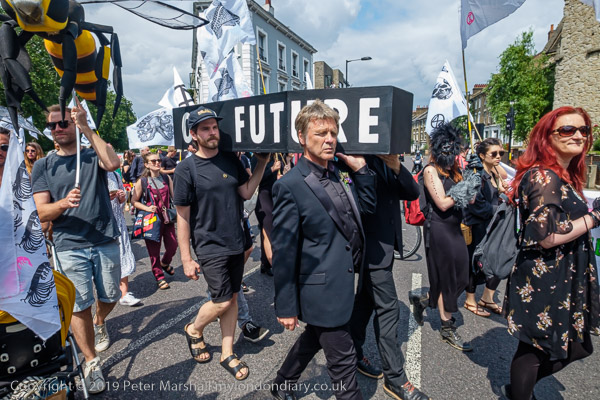
But events were running late, and I was pleased and surprised to find that the funeral procession to Stoke Newington Town Hall that should have left just over 15 minutes earlier was only just forming up. And I had another 5 minutes to recover my breath before it finally moved off.

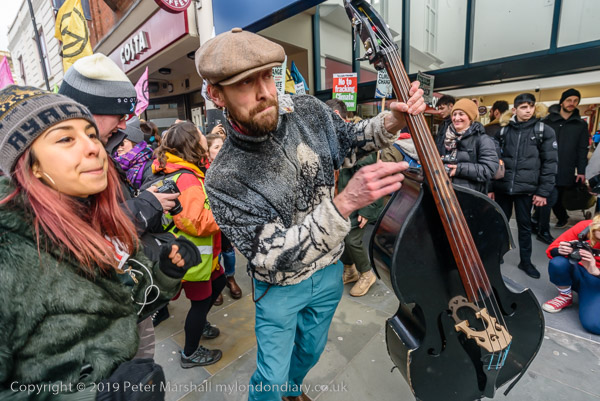
The bee in question was apparently the Red Girdled Mining Bee, previously found in Abney Park Cemetery was now extinct there due to loss of habitat with increasing development in Hackney. It was a local example of species extinction that is occurring on a huge scale world-wide as a result of human activities destroying ecosystems and increasingly from the changes in weather and climate from global heating due to rising levels of carbon dioxide and other greenhouse gases.

Although I could see the idea of concentrating on a small local example, I did rather wonder how clearly and powerfully it would communicate with the many citizens of Stoke Newington going about their daily business who saw the procession, though other aspects were clearer from many of the placards and banners. But Extinction Rebellion does sometimes seem to be a very much a highly successful movement of the educated middle class making relatively little connection with the bulk of the population.

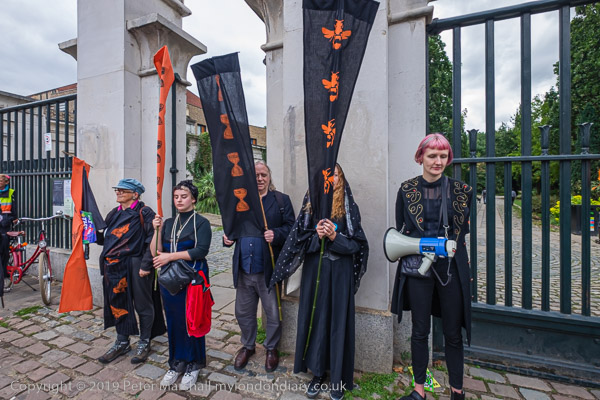
After the funeral orations at the Town Hall, the procession and the coffin moved on down Stoke Newington Church St and up Stoke Newington High St to the wonderful Egyptian-style listed 1840s cemetery gates. It was a shame that the protest did not take greater advantage of the location and pose with their various banners and flags.

Rather it slid uneasily into the kind of new-age reflection and meditation that while it may appeal to some gets very much up my nose. As I commented on My London Diary, “Had I been protesting rather than photographing the event I would have left for a pint. ” I hung on hoping that something more interesting might happen, but it didn’t. While this aspect of XR may go down well with some I think it probably causes many to avoid it. But perhaps it’s just me.

More at Requiem for a Bee.


All photographs on this and my other sites, unless otherwise stated, are taken by and copyright of Peter Marshall, and are available for reproduction or can be bought as prints.

There are no adverts on this site and it receives no sponsorship, and I like to keep it that way. But it does take a considerable amount of my time and thought, and if you enjoy reading it, please share on social media.
And small donations via Paypal – perhaps the cost of a beer – would be appreciated.

Hackney Housing

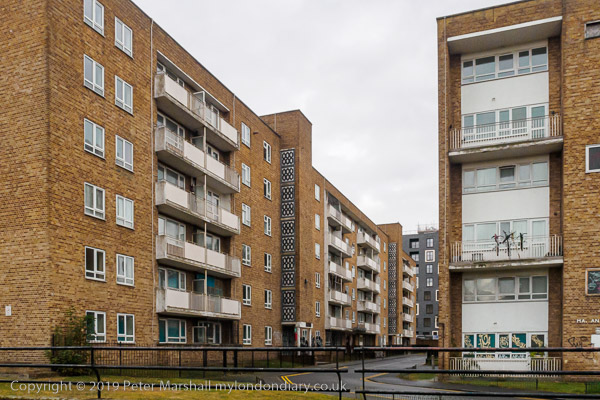
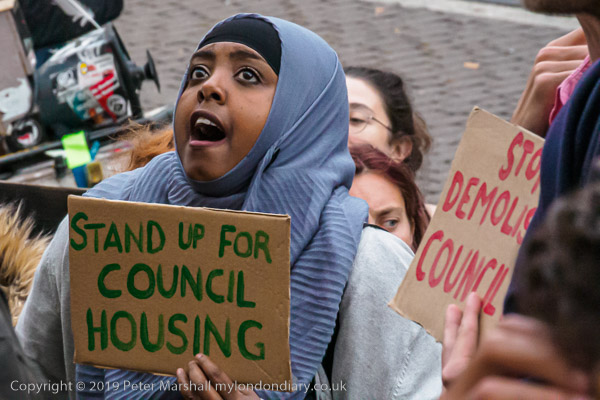
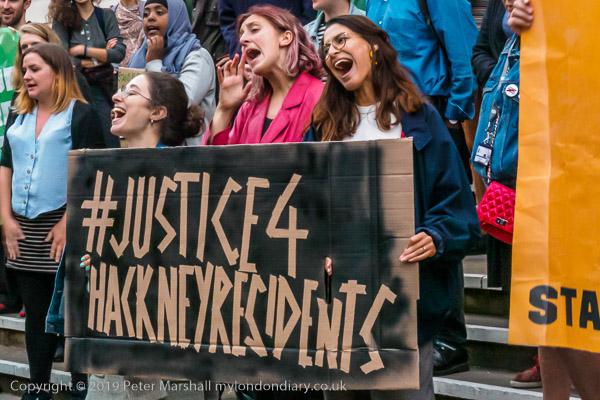
I took a short walk in Hackney before the protest outside the town hall to remind me exactly where Marian Court was, just behind the rather empty ‘fashion village’, an implant into the area with government money, £1.5m of Boris Johnson’s regeneration funding after the 2011 riots. It seems if anything to have been an expensive way to prove that gentrification isn’t an effective way to combat racist policing with a shoot to kill policy, and has failed to generate the promised jobs.

Marian Court appears to have been a well-designed small estate built for the Metropolitan Borough of Hackney in the late 1950s. It was built to the standards of the time and was in need of modernisation, and had been allowed to deteroriate. But as on many other council estates, rather than investing in the relatively modest cost of the necessary refurbishment, the council decided on an expensive scheme involving total demolition and the building of roughly twice as many housing units on the site by private developers, with a large proportion for sale at high market prices and others also at high prices as ‘affordable’ or shared ownership properties. Reports say that despite the roughly doubling of the number of units there will be 40% less social housing than at present.

The replacement flats in such schemes are almost always built to lower space standards than the existing properties, and demolition and rebuild involves an enormous environmental impact. Given our current problems with global warming and the impending threat of human extinction unless we take urgent actions to avoid this, demolition of existing buildings such as this should now be a rare last resort.

The human impact is of course also huge, with the estate being emptied. Those in social housing will have been offered rehousing, but usually in far less convenient places than this, targeted in part because of its central location and close transport links, and also probably with less security of tenure and higher rents. Leaseholders typically get compensation at far less than the cost of a similar property in the same area – or the new properties.

Schemes such as this effectively lead to social cleansing, despite the promises often made (but seldom kept) by local councils about residents being able to stay in the area or move back into the redeveloped properties. Those on low incomes are forced to move to the peripheries of the borough, to outlying borough or sometimes well outside London, away from jobs, schools, friends and other links in the community.

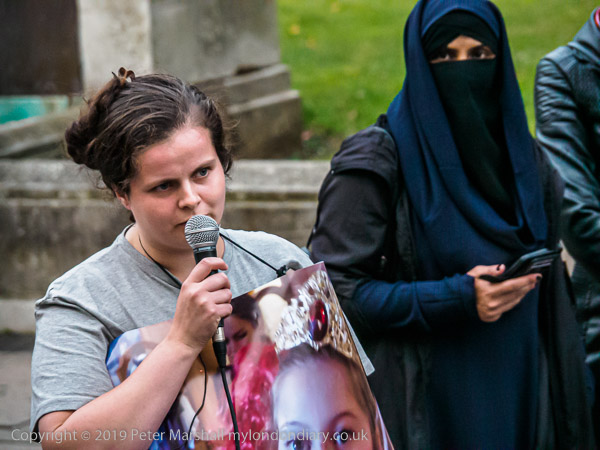
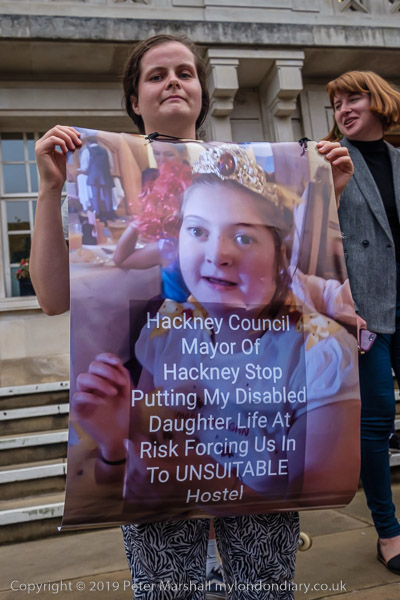
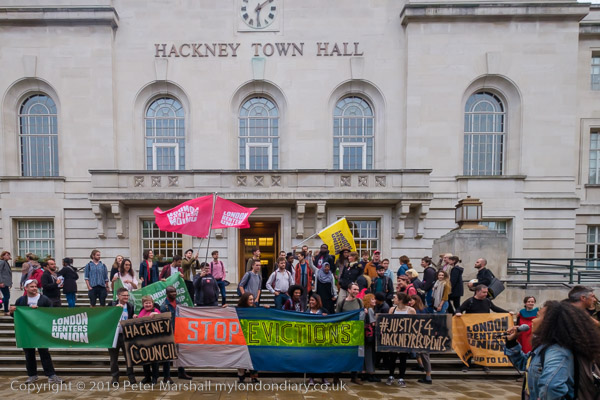
The protest at Hackney Town Hall, organised by East End Sisters Uncut and London Renters Union was over the failure by Hackney Council to provide suitable rehousing for two families remaining in Marian Court, both of whom attended and spoke at the event, and who seem to have been victimised because they particular housing needs and have stood up for their rights. You can see more about both of them and their issues with the council at Hackney don’t victimise housing activists.

And a few pictures of the area including Marian Court in Hackney


There are no adverts on this site and it receives no sponsorship, and I like to keep it that way. But it does take a considerable amount of my time and thought, and if you enjoy reading it, please share on social media.
And small donations via Paypal – perhaps the cost of a beer – would be appreciated.
All photographs on this and my other sites, unless otherwise stated, are taken by and copyright of Peter Marshall, and are available for reproduction or can be bought as prints.


Hackney XR March

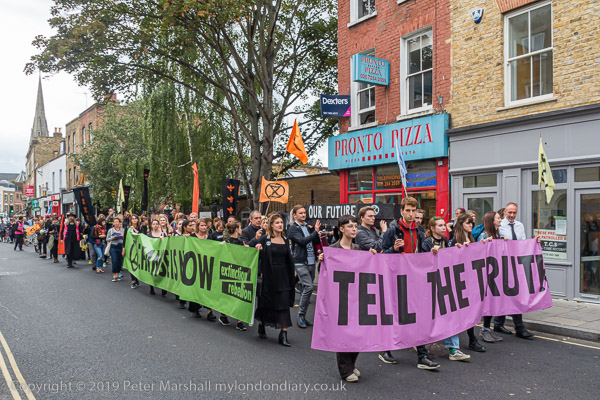
On Friday I’d had to leave the Extinction Rebellion ‘The Air That We Grieve’ march as it reached the Hackney border to go to a protest at Senate House, but on Saturday afternoon there was another march as a part of the ‘East London Uprising weekend, walking through the centre of Hackney from Hackney Fields and on to the centre of the event in London Fields.

Before the march in Hackney Fields there were a couple of things taking place, a dance performance which I found less than exciting visually and some kind of meditation thing which was frankly off-putting. There is an odd-ball new age side to XR that I think works very strongly against it appealing to the great majority of people and which certainly turns me off.

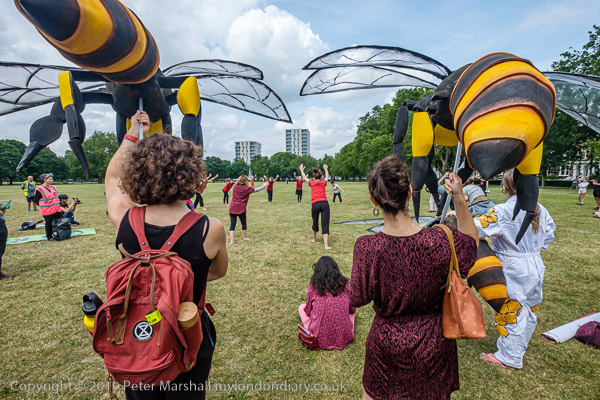
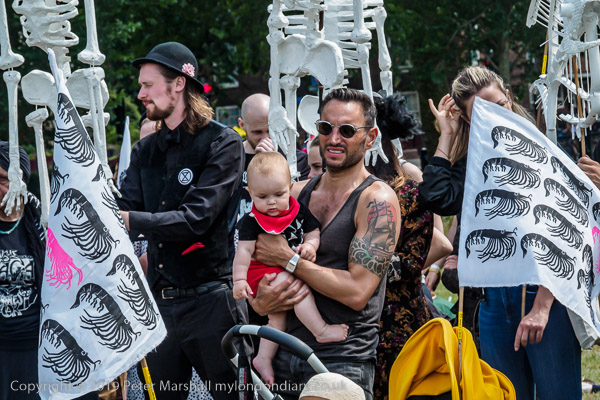
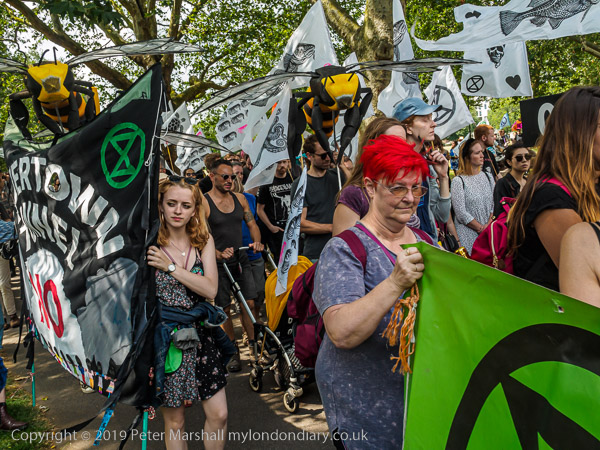
But there were the people, the giant bees and the skeletons to photograph, so I stayed and took pictures, and of course I wanted to photograph the march. But it did make me think that perhaps this was a part of the reason why of the several million East Londoners only a couple of hundred were with us for this march. XR has had a remarkable success, but only with some sections of the community and I think rather more in small towns and rural areas than in working class urban communities.

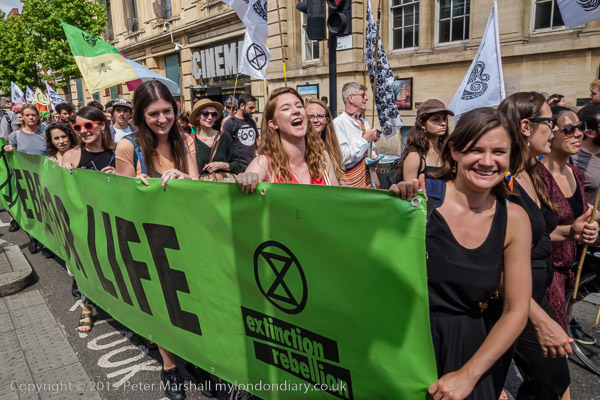
Looking through the many pictures I made on the march it doesn’t really look like a Hackney event, though I’m sure many or most of those taking part were from the area. Official figures show that “around 40% of the population come from Black and Minority Ethnic groups” but these were severely under-represented.

This isn’t a criticism of those that did take part, and I think the XR has been important in raising awareness of the urgency of the enviromental crisis we are now facing. It has performed a vital service and we see its efforts represented to some extent in the manifestos of all the political parties in the current general election – though so far there has been little real commitment by our government – or those of most other countries.

It was a hot day and I’d been on my feet for several hours and I needed a rest by the time the protest passed Hackney Town Hall. I had intended to continue to the festival taking place on London Fields, but couldn’t bring myself to walk any further, and after a brief rest made my way to Hackney Central to begin my journey home.

More pictures at East London Extinction Rebellion March.


All photographs on this and my other sites, unless otherwise stated, are taken by and copyright of Peter Marshall, and are available for reproduction or can be bought as prints.

There are no adverts on this site and it receives no sponsorship, and I like to keep it that way. But it does take a considerable amount of my time and thought, and if you enjoy reading it, please share on social media.
And small donations via Paypal – perhaps the cost of a beer – would be appreciated.

Insects

I think most of us have a horror of insects, or at least of some insects. Creepy-crawlies give us the creeps, and many react like little Miss Muffett to spiders (which are insects in English if not in Biology.) I have a particular dislike for wasps, though I feel that this is entirely rational after sitting down in the dark too close to a nest on a trip to http://www.buildingsoflondon.co.uk/pm/borders/ Hawick in 2004 left me with multiple stings and a day or two of total delerium.

But of course insects are essential to life on the planet, part of the complex web of ecosystems that in particular allows us to grow food. We rely on them, particularly bees, to pollinate so many crops. And bees have in recent years been subject to huge declines in population, with the increasing use of pesticides and herbicides being a major cause.

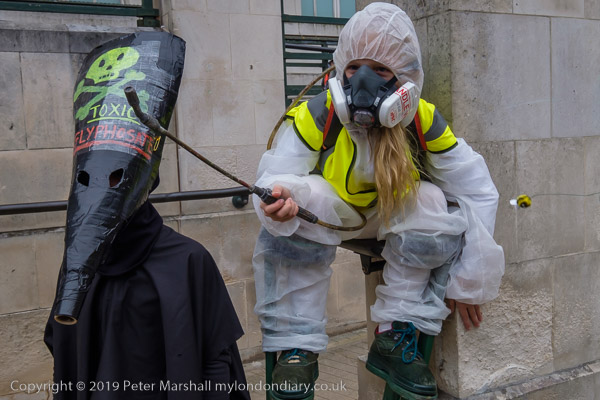
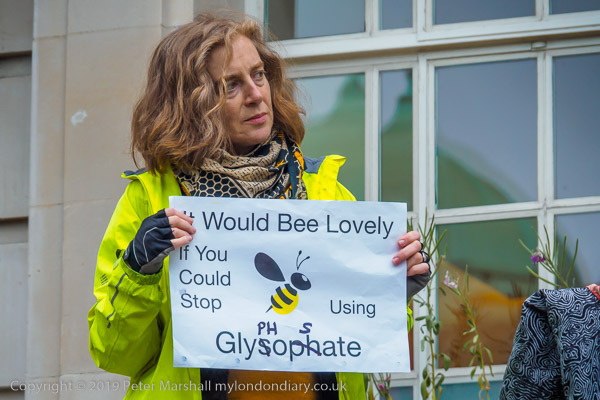
Herbicides – of which the best-known and most widely used is Monsanto’s Roundup, containing glyphosate – are used to stop the growth of plants. It can be used on some growing crops as it is more readily absorbed through the broader leaves of weeds than most crops, and varieties have been developed that are resistant to it, but it is also sprayed on field and road edges to kill weeds there.

Many insects, including bees, are heavily reliant on these weeds and their flowers as a source of nectar to feed on, and herbicide use means the land can only sustain smaller numbers. Recent research has show a more direct effect on bees, with glyphosate at widely used levels in fields and on verges killing beneficial bacteria in bee guts, rendering them more susceptible to disease and infection.

Some studies have also found direct effects on human health and Monsanto who introduced glyphosate as a herbicide (though many other companies now market it) have been accused both of trying to prevent publications of these and of sponsoring research which falsely reports an absence of such effects. Some US courts have come out in favour of huge settlements to workers over claims that using it have caused cancers, but the danger to the general public from exposure seems very low.

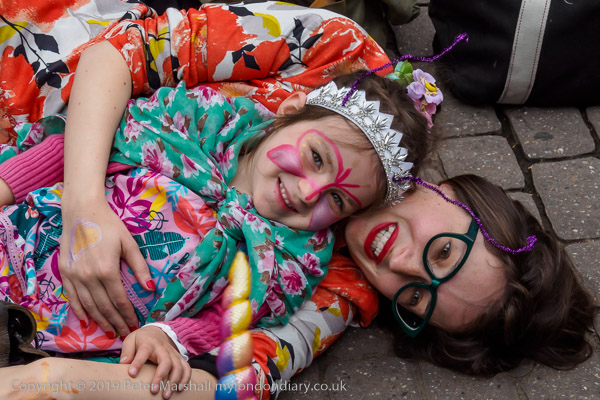
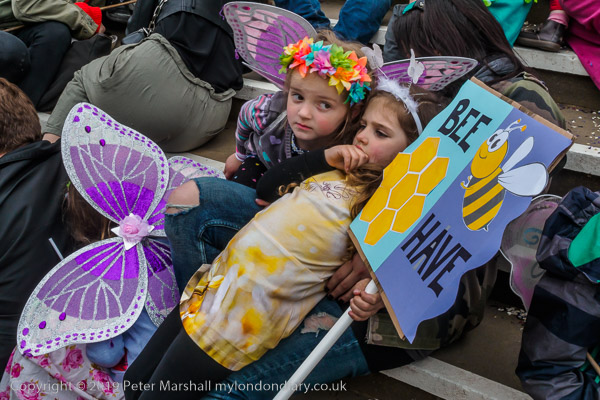
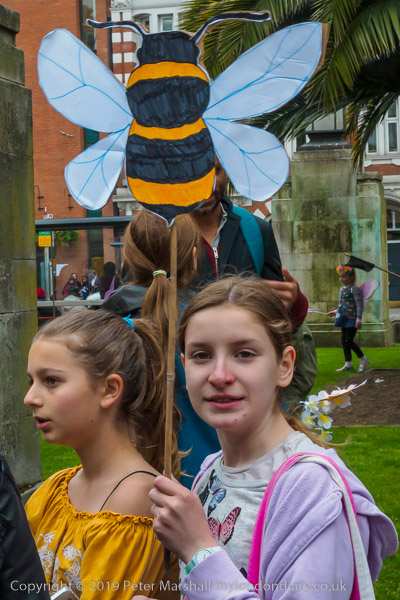
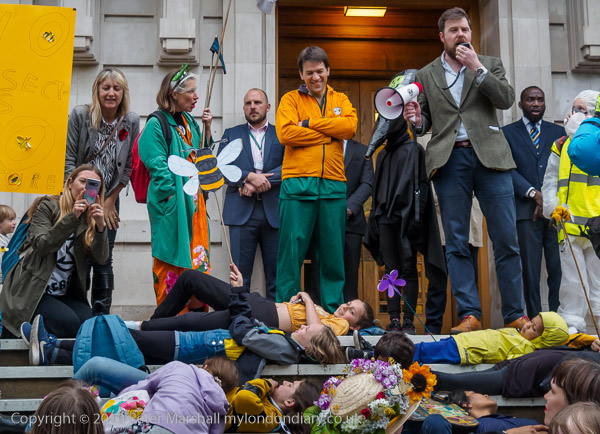
Hackney Council uses glyphosate to control roadside weeds and many Hackney residents also use this and other insect-harming chemicals in their gardens. The protest by Extinction Rebellion parents and children outside the council offices called on the council to completely end its use, and a man from the department concerned came to say they had reduced their use and were hoping to find ways it could be eliminated.

I don’t live in Hackney, but of course we need to stop or at least greatly reduce the use of glyphosate across the world. Years ago we used to have council workers coming regularly even to back streets like the one we live in armed with a spade to remove the weeds growing at the kerb. They were replaced by a machine with brushes that kept some of them down, but couldn’t clean most gutters as there were cars parked along the street. So the weeds grow. Occasionally a resident will go out with a spade and clear the short section in front of their house, but usually they grow until a long dry spell kills them, they die down and reappear after more rain.

More at XR tell Hackney stop killing insects.


All photographs on this and my other sites, unless otherwise stated, are taken by and copyright of Peter Marshall, and are available for reproduction or can be bought as prints.

There are no adverts on this site and it receives no sponsorship, and I like to keep it that way. But it does take a considerable amount of my time and thought, and if you enjoy reading it, please share on social media.
And small donations via Paypal – perhaps the cost of a beer – would be appreciated.

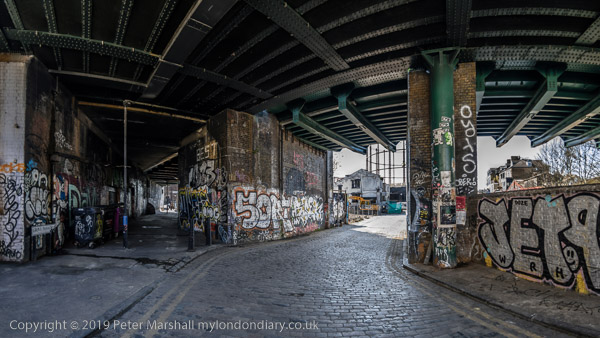
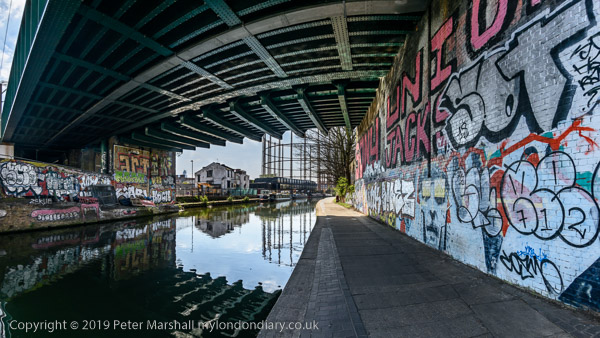
Regents Canal – Bethnal Green

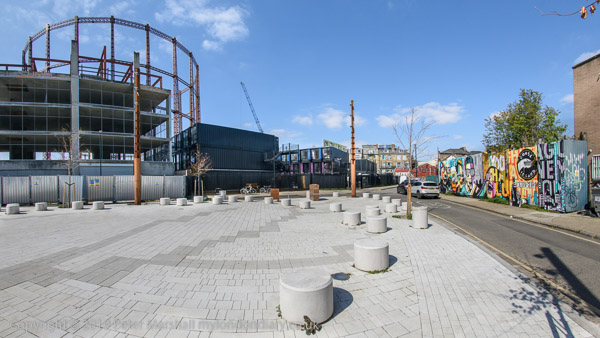
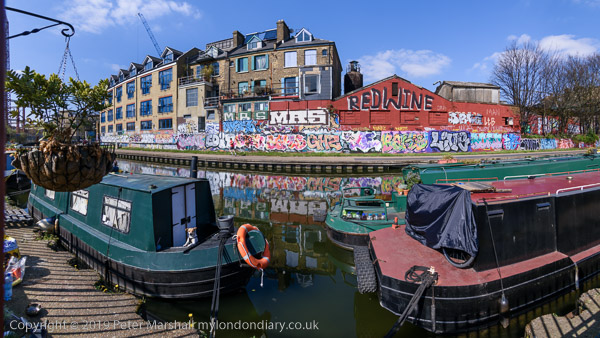
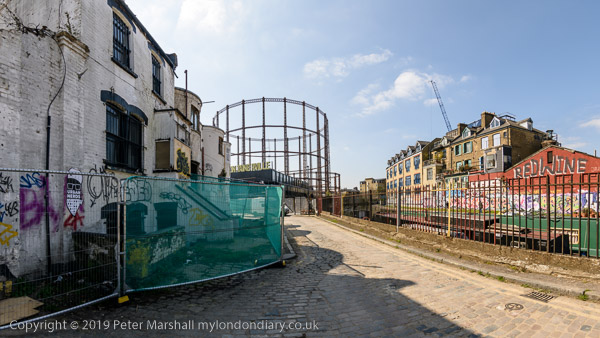
More panoramic images from the Regents Canal and nearby areas in Bethnal Green.

The Oval
From Corbridge Crescent
Corbridge Cresecent
Corbdige Crescent and Grove Passage

This is an area I photographed for the first time around 1980 and that I’ve returned to occasionally over the years. On My London Diary you can see more of these cylindrical perspective panoramic views – each around 147 degrees horizontal field of view, as well as some more normal rectilinear lens views at Regent’s Canal.

I’m hoping to use some pictures from the canal in a small show next year – more later.


There are no adverts on this site and it receives no sponsorship, and I like to keep it that way. But it does take a considerable amount of my time and thought, and if you enjoy reading it, please share on social media.
And small donations via Paypal – perhaps the cost of a beer – would be appreciated.
All photographs on this and my other sites, unless otherwise stated, are taken by and copyright of Peter Marshall, and are available for reproduction or can be bought as prints.

To order prints or reproduce images


XR Hackney

Extinction Rebellion are of course right in their analysis of the situation, that we face an unprecedented challenge to the future of human life on earth, and that governments around the world are failing to take this seriously enough. The scientific evidence keeps stacking up but politicians either deny or let themselves be diverted from real action by the lobbyists from companies still making huge profits from polluting.

What is less clear is whether the actions they are taking will lead to the drastic changes which are clearly needed. They face huge opposition from extremely wealthy and powerful companies and the many ultra-rich who are doing very nicely thank you from our status quo and have yet to realise that there is little point in laughing all the way to the bank in a dying world.

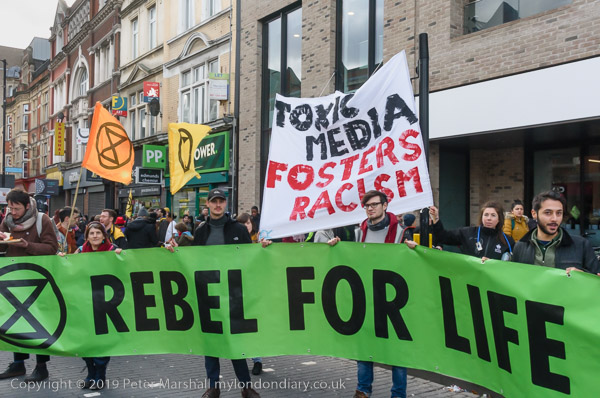
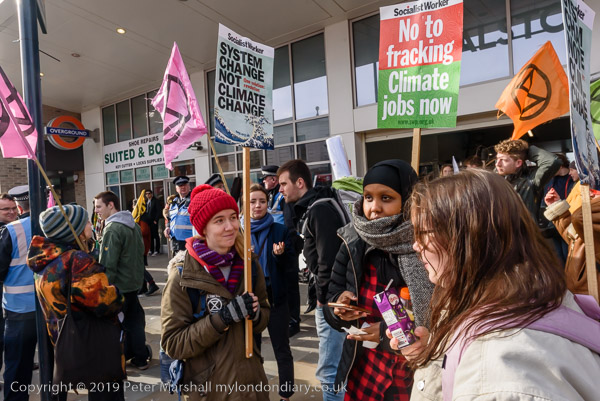
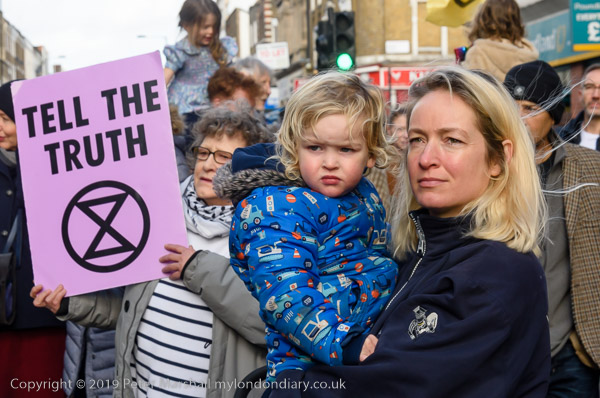
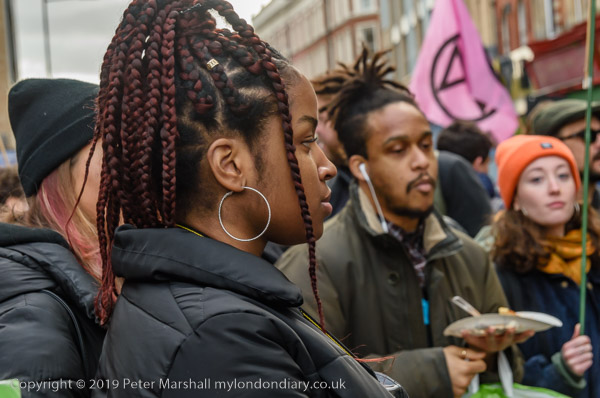
Clearly too, as my pictures I think show, XR’s appeal is still largely to an educated middle class (though my apologies to the minority who will be insulted by this description.) The crowd that gathered on Kingsland High Street for the protest was very different from that thronging the adjoining Ridley Road market.

XR have attracted much flak from parts of the left, particularly for their attitude to the police and arrests, particularly for encouraging people to be arrested and to cooperate with the police, to treat them as friends. For many on the left, ACAB is a matter of faith, and sometimes of bitter experience. Certainly the police seem too ready to act as agents of the state, even where this means perverting justice – and parts of our legal system encourage this.

But at least XR are doing something, and their activities in recent months have begun a shift in the media and perhaps even in our currently Brexit-obsessed politics. While their keyboard critics have nothing to show. The Hackney Street Party may have been just a pleasant event on a nice day causing a little congestion as traffic was diverted by police around it, it was a small step in raising awareness – and part of a much larger campaign, aiming to build a wider movement. Perhaps XR will at some point be overtaken by other more radical actions, with backing from political parties, trade unions and the working class, but at the moment there is little sign of them even putting on their running shoes let alone coming to the starting blocks.

More about the XR Hackney Street Party and of course more pictures.


There are no adverts on this site and it receives no sponsorship, and I like to keep it that way. But it does take a considerable amount of my time and thought, and if you enjoy reading it, a small donation – perhaps the cost of a beer – would be appreciated.
My London Diary : London Photos : Hull : River Lea/Lee Valley : London’s Industrial Heritage

All photographs on this and my other sites, unless otherwise stated, are taken by and copyright of Peter Marshall, and are available for reproduction or can be bought as prints.

To order prints or reproduce images