Tibet, Syrians, Nuclear Melt-Down, Islamophobia & Lions

Tibet, Syrians, Nuclear Melt-Down, Islamophobia & Lions. Saturday 15th March, seven years ago was another typically varied day of protests on the streets of London which I covered.


London March for Freedom for Tibet
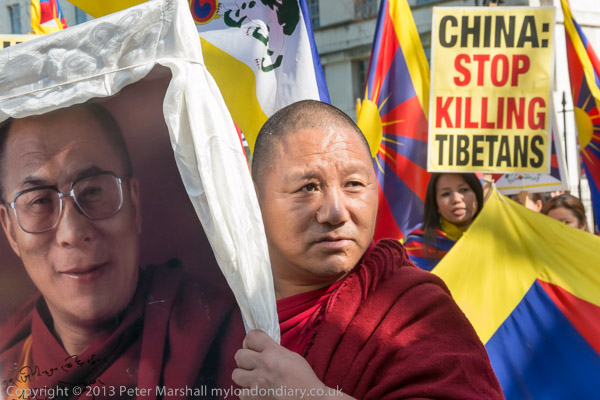
Every year Tibetans and supporters in London protest around the anniversary of the Tibetan National Uprising against Chinese rule in 1959, ten years after the Chinese invasion of the country. In 1959 the Dalai Lama and 120,000 Tibetans escaped to India and established the Tibetan Government in Exile.
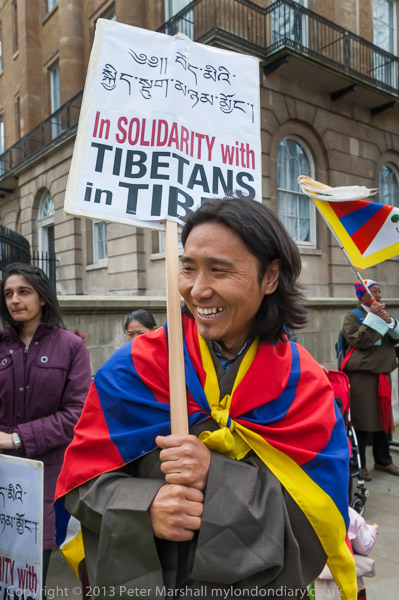
In 2014 they met at Downing St for a march to a rally outside the Chinese Embassy in Portland Place, calling for Tibet to be free and in charge of its own destiny again and for an end to the illegal Chinese occupation. They say China is destroying Tibetan culture, and Tibetans are rapidly becoming a minority in their country as thousands of migrants are brought in. Peaceful protests by Tibetans are met by arrests, torture, death and lies, and China’s economic power means western countries adopt what they have called a policy of ‘constructive engagement’ with China, effectively turning a blind eye to the occupation and to human rights abuses in Tibet.
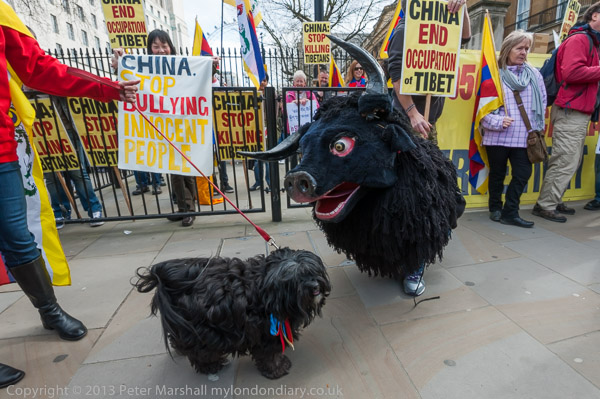
I left the Tibetans shortly after their march went through Trafalgar Square to photograph another protest.

London March for Freedom for Tibet


Syrians March for International Action
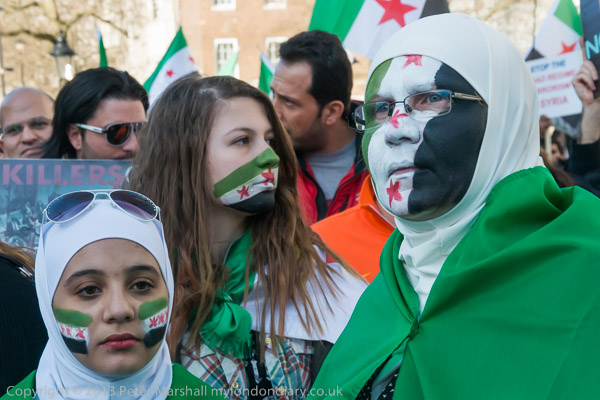
I had met the Syrians before the start of their march close to Hyde Park corner and had left them as they began their march along Piccadilly on the third anniversary of the start of their fight for freedom. I met them again as they came down Whitehall for a rally at Downing St to show their commitment to the cause and their solidarity with fellow Syrians inside and outside Syria.
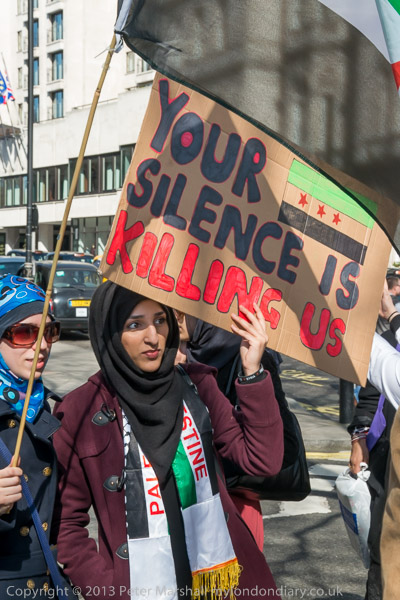
The marchers from the National Coalition for Syrian Revolutionary and Opposition Forces and the UK Syrian community called for Assad to go and were appealing to the Britain and the international community to help them to get rid of him. Unfortunately although western leaders condemned the actions of the Syrian government they were not prepared to back up their words with action, and it was left to Russia, who backed Assad to determine the future of the country. Few can doubt that the weakness shown by the west over Syria was not a major factor in Putin thinking he could successfully invade Ukraine.
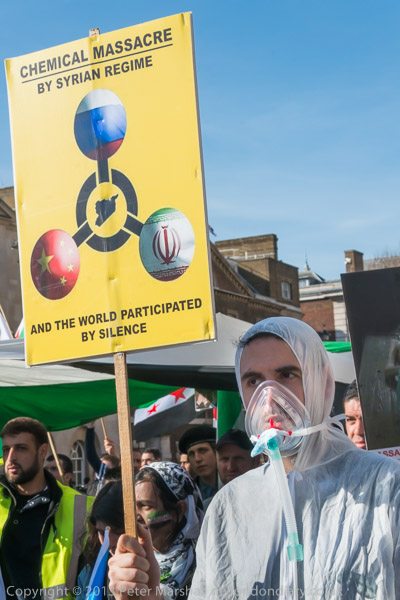
Ukraine is not of course Syria, but it is hard to read the statement made by the Syrians I quoted in my post without seeing some parallels: “Syria, once proud of its contribution to culture, its distinguished history and its beautiful mosques and churches has been overwhelmed with a brutal dictatorship. Syrian homes have turned to rubble, echoing the unheard screams of its inhabitants. The regime has tried to silence the call of freedom by murdering over 150,000, injuring 500,000, imprisoning 250,000, making 1.5 million refugees and caused over 4.5 million internally displaced people within Syria, and recently started using chemical weapons…” Putin in Syria saved a brutal dictatorship, while in Ukraine it seems his aim is to impose a different regime on the country, perhaps less brutal but requiring similar means for it to be imposed.

Syrians March for International Action


Fukushima Nuclear Melt-down Remembered
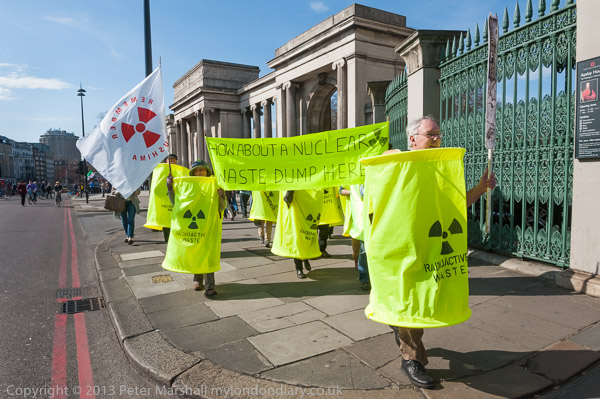
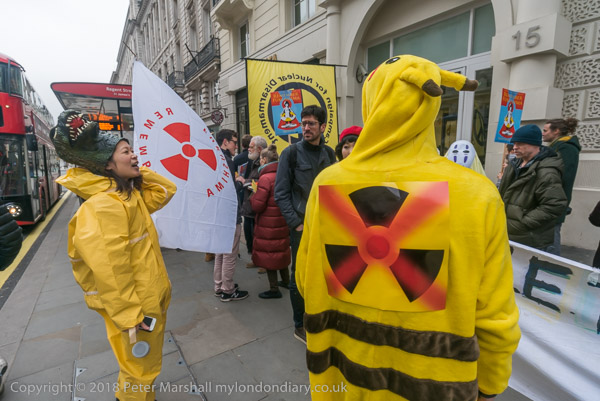
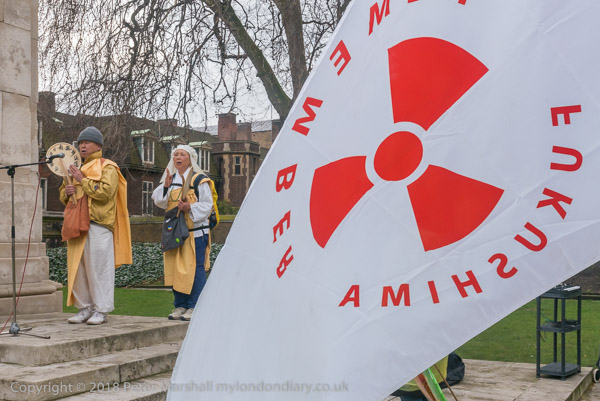
Earlier I had been at Hyde Park Corner where protesters had gathered on the third anniversary of the nuclear melt-down at Fukushima to march through London, first to the Japanese Embassy and then on to a short stop at Downing St before a rally in Parliament Square.
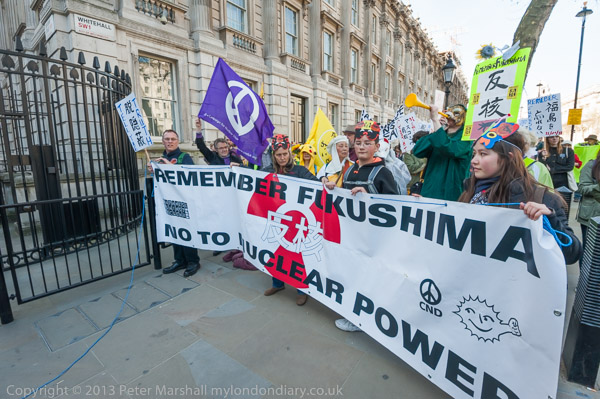
I photographed them again at Downing St, but had to leave as they marched away to their rally.

Fukushima Nuclear Melt-down Remembered


English Volunteer Force march in London
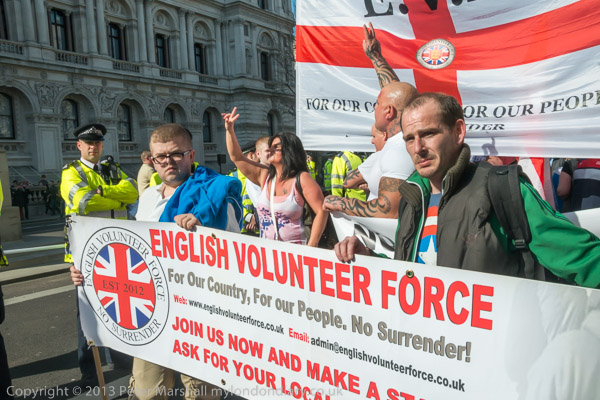
The English Volunteer Force is a coalition of various far-right groups and described the protest on Facebook as “highlighting multiple issues from immigration, Islamic hate preachers, sharia law, Sharia zones, Sharia patrol groups, banning the Burhka!, Halal meat, endless applications for more mosques etc.”
They insist that they are ‘patriotic’ and are not racist, and claim not to be against Muslims but simply against Muslim extremists, though I found this hard to take seriously.
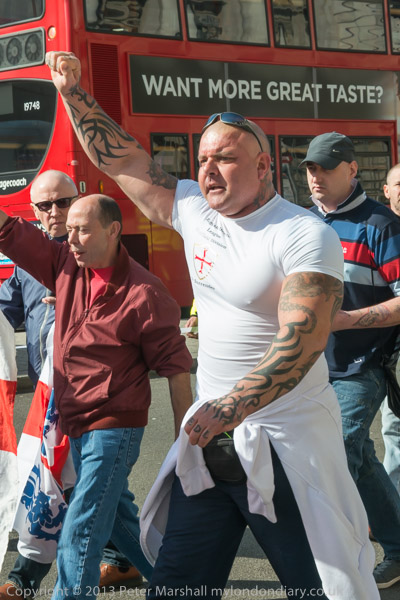
The march started outside the Lord Moon of the Mall pub close to the Trafalgar Square end of Whitehall where people were just coming out of the pub as I arrived. Police were taking a great deal of trouble to keep anti-fascist who were intent on stopping the march from getting close to it, but were unhelpful when I complained about an assault by one of the protesters who shouted at me and pushed my camera into my face.
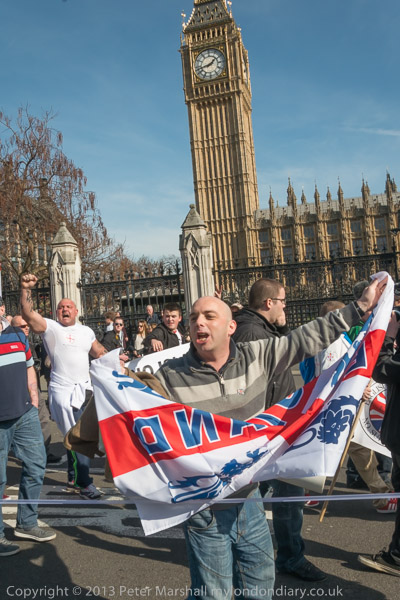
A few minutes before the assault I’d mingled with the protesters as they walked down to Downing St, joking with some I knew from earlier right-wing protests I’d covered previously. They seemed pleased that I was covering the event – and although they were clear we differed greatly in our views had personally invited me to some cover some ‘patriotic’ events as they trusted me to report accurately on them.
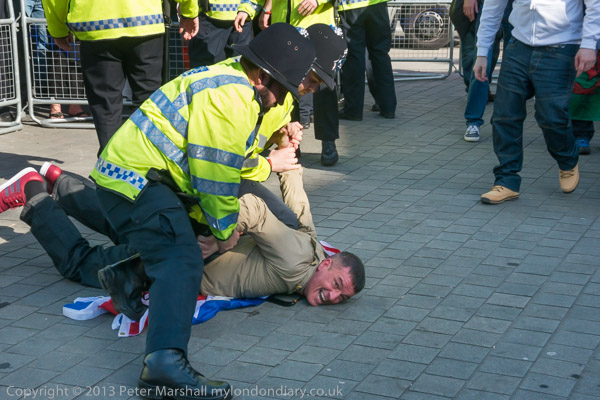
There were several groups of counter-protesters but generally they were kept apart by police – and by stewards in an official protest area against the EVF opposite Downing St. There were a few arrests both of anti-fascists and of EVF marchers who tried to attack them, and one of the larger groups of anti-fascist was kettled by police on Parliament St.

English Volunteer Force march in London


Save Our Lions – Ban Canned Hunting
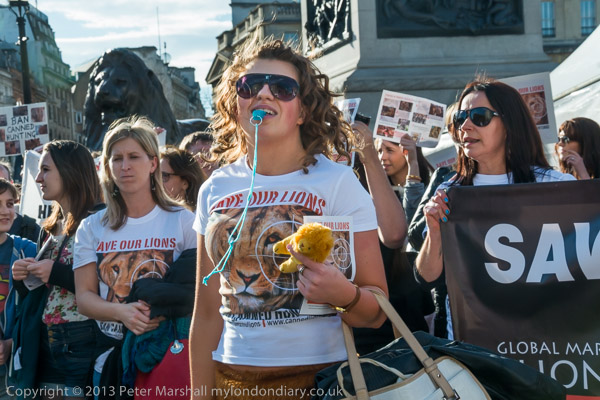
Finally I walked back up Whitehall to Trafalgar Square, where hundreds had come for the Global March for Lions, marching from different starting points to meet and call for a ban on the ‘canned’ hunting of captive lions by wealthy trophy tourists.
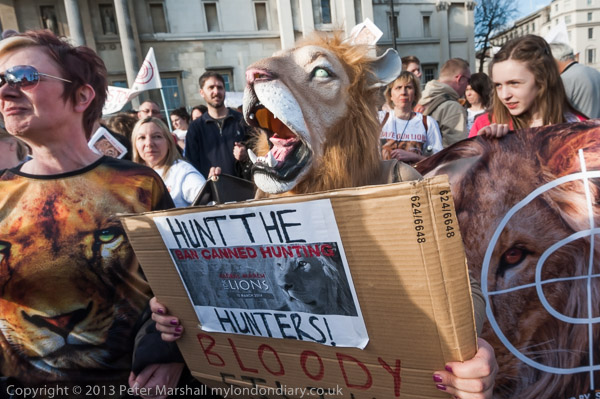
Legal but unscrupulous, ‘canned hunting’ is big business in South Africa, with more than 8,000 lions in captivity, bred on lion farms. Rich visitors pay large sums to take part in lion shoots, where the targets are unable to escape, often raised to be tame and used to human presence and drugged to make them easy kills. Over 160 lion killing camps have been set up in South African in the last 15 years.
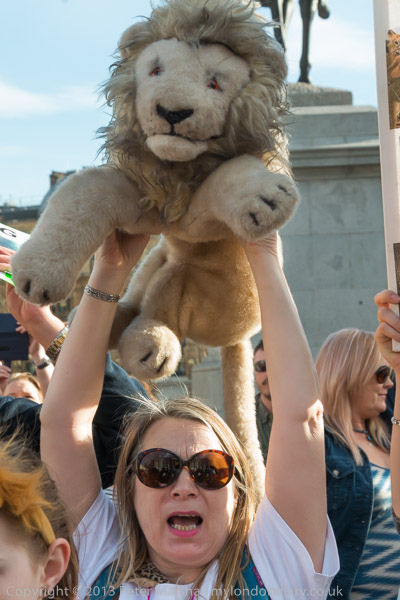
As I commented: “It is a terrible way to treat a wild and noble animal, but it also greatly threatens the wild lion population. To prevent the inbreeding that is rife in captive lion populations, wild lions continue to be captured, while the growth in the Asian lion bone trade increased poaching.”

Save Our Lions – Ban Canned Hunting


More about all these events on My London Diary:
Save Our Lions – Ban Canned Hunting
English Volunteer Force march in London
Fukushima Nuclear Melt-down Remembered
Syrians March for International Action
London March for Freedom for Tibet
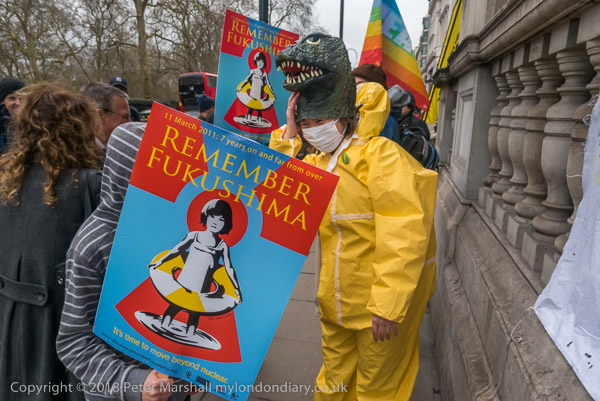
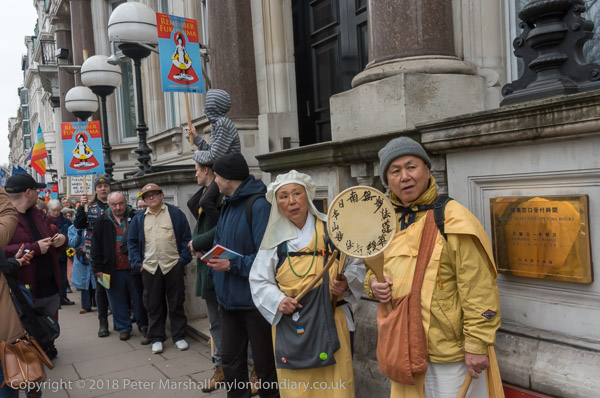
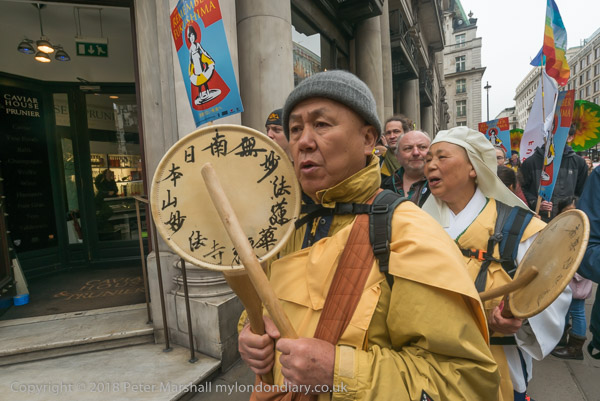
Fukushima Nuclear Distaster Remembered

Fukushima Nuclear Distaster Remembered. Recent shelling of an administration building at a Ukrainian nuclear plant revived memories and fears of the nuclear disaster eleven years ago at the Fukushima Daiichi Nuclear Power Plant in Okuma, Fukushima, Japan. In those 11 years I’ve photographed various events in London, including this one on the 7th anniversary.

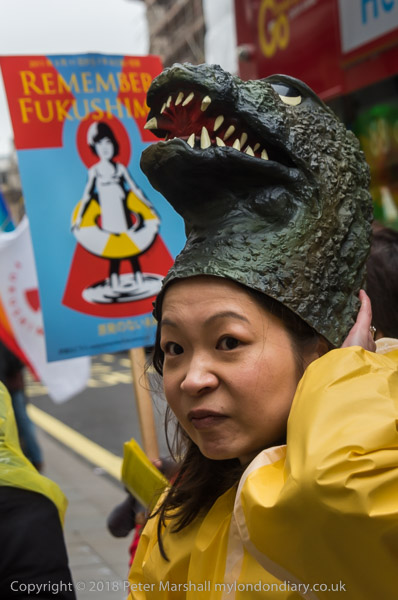
Remember Fukushima, 7th Anniversary

On Sunday 11th March 2018, Kick Nuclear (London) and Japanese Against Nuclear London supported by CND remembered the victims of the continuing Fukushima disaster and all victims of nuclear power and nuclear bombs.

It wasn’t a huge protest, perhaps because after 7 years the media seem to have decided that Fukushima is no longer news, but radiation is still being released from the damaged nuclear plant and its effects will be felt for many years, with estimates of between 100-650 people expected to die from long term cancers caused by the immediate radioactivity leak and more from the continuing release of radiation.

The marchers gathered outside the Japanese Embassy on Piccadilly, where there were still monthly protests over the disaster. There was a vigil there and outside the offices of the plant operators TEPCO in High Holborn on 28th January 2022 which I was unable to attend after it was found that the radiation level was far worse than had been thought, presenting a serious challenge to the continuing shutdown process and overall decommissioning of the site.

Outside Lockheed Martin’s offices

Nuclear power has never lived up to the early promises of plentiful low cost electricity and remains both expensive and dangerous. In the UK it was always linked to the production of military weapons, and we were fed lies about its potential. There are still no satisfactory solutions to the disposal of highly radioactive nuclear waste which requires safe storage into the next millennium – a toxic legacy to our future generations.

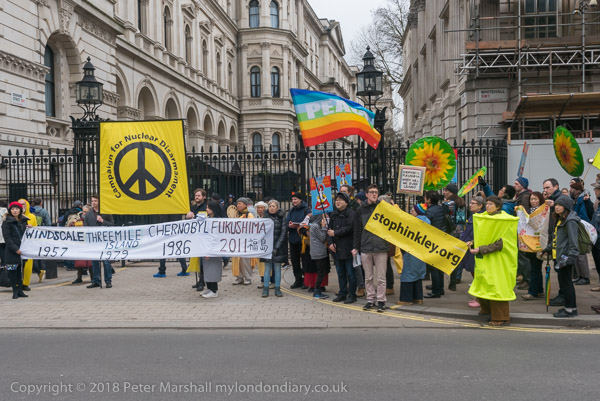
Fortunately the UK seldom experiences more than minor earthquakes and the control systems here are rather more sophisticated than those at Chernobyl. But the Windscale fire in October 1957 was one of the worst nuclear disasters in the world, sending radioactive fallout across the UK and Europe.

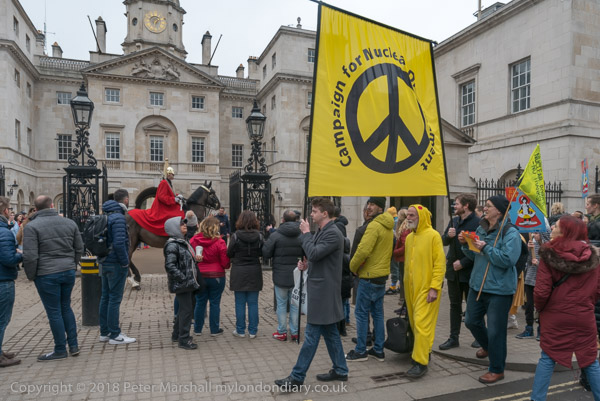
Protesters wait for a horse who doesn’t like yellow to be walked away

Later it was found that as well as large amounts of iodine-131 which causes thyroid cancer there were also significant amounts of the more dangerous polonium-210 (the deadly poison put in the tea of former Russian spy, Alexander Litvinenko, in London in 2006.) It later emerged that there had been earlier accidents at the the plant releasing significant amounts of strontium-90.

Reports of the Windscale accident were heavily censored by the fact that milk from farms over an area of 190 square miles close to this military nuclear plant meant it could not entirely be covered up this time.

From the Japanese Embassy there was a procession along Piccadilly to Lower Regent St where it stopped for a brief protest outside the offices of Lockheed Martin, one of the companies making nuclear weapons, before stopping for a photograph in front of Downing St and going on the Old Palace Yard, opposite the Houses of Parliament where they held a rally.

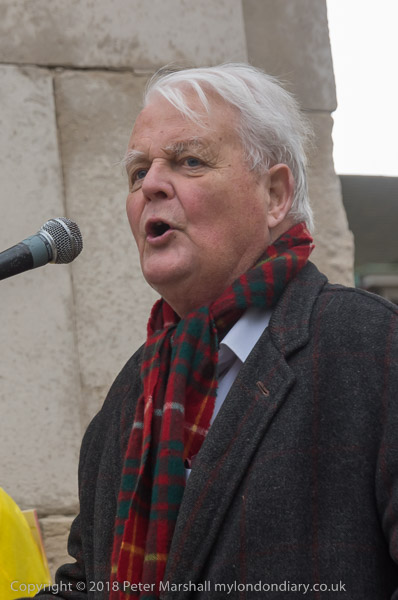
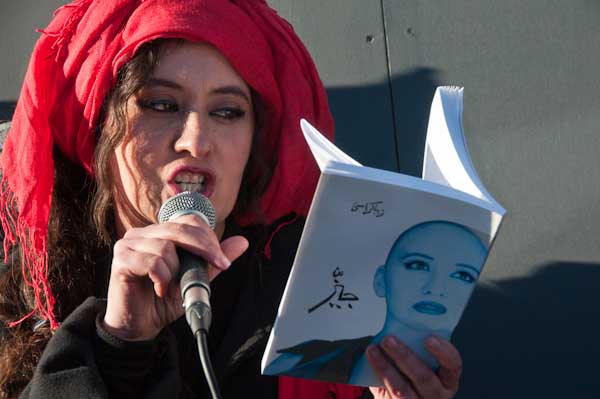
Speakers at the rally included Bruce Kent and Kate Hudson of CND and fashion designer Kate Hamnett. The speeches condemned the continuing nuclear power programme which has always been closely linked with the production of nuclear weapons and, never an economically viable method of power production, has now been rendered entirely obsolete by improved renewable energy sources. There were some musical performances and a poet read one of her poems about Fukushima. I had to leave before the rally concluded with a die-in.
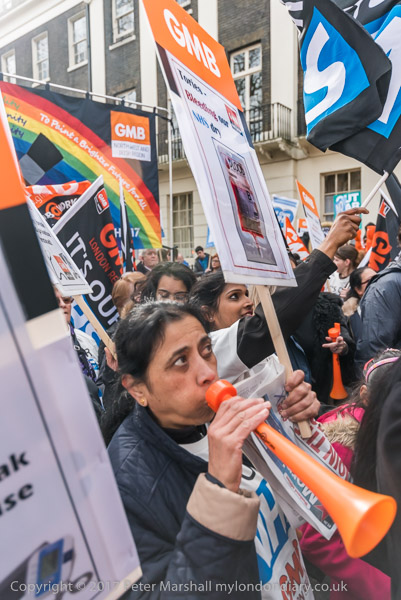
More at: Remember Fukushima, 7th Anniversary


International Women’s Day Marches

International Women’s Day Marches. Wikipedia has a good article on the origins of this “global holiday celebrated annually on March 8 to commemorate the cultural, political, and socioeconomic achievements of women” which focuses attention on such issues as “as gender equality, reproductive rights, and violence and abuse against women.

International Womens Day 2020

So I won’t go into any great detail here. The earliest manifestation was a Woman’s Day organised by the Socialist Party of America in New York City on 28th February 1909, and the idea was taken up the following year by the International Socialist Women’s Conference. When women got the vote in Soviet Russia in 1917, March 8th became a national holiday and the date became established in socialist movements and countries worldwide, being taken up by feminists in the 1960s. International Women’s Day was celebrated by the UN in 1975 and adopted by them in 1977.

Since around 2000 IWD has been ” criticized as heavily diluted and commercialized, particularly in the West, where it is sponsored by major corporations and used to promote general and vague notions of equality, rather than radical social reforms” and in 2009 was hi-jacked by a British PR firm, but other groups have continued a more radical observance of the day and attempted to reclaim it, and it has been largely those that I’ve photographed over the years.

Until 2002 I’d been teaching most years on March 8th and hadn’t been able to photograph daytime IWD events, so I think that year was the first time I did so. Since then I’ve photographed them most years, and here I’ll post a few pictures from some of them, with links.

IWD 2002 – Global Women’s Strike

I only wrote a short text – so here it is:

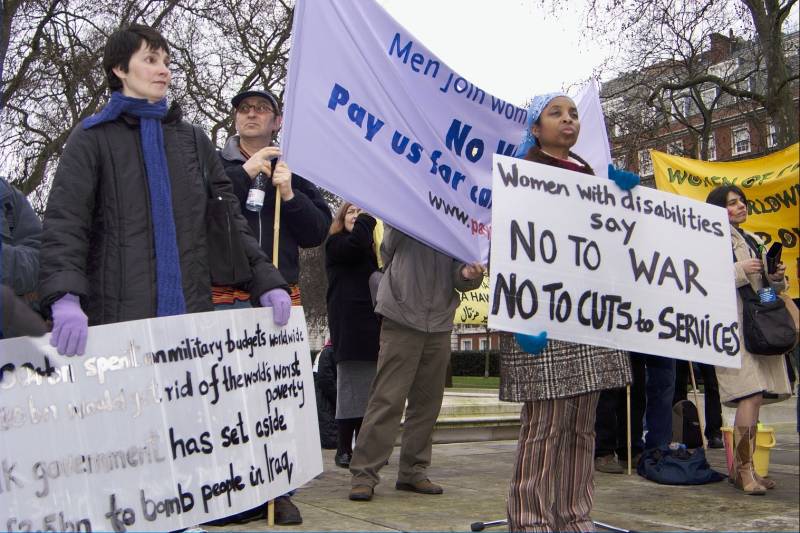
the 8 march is a world woman’s day and was celebrated by some as a global women’s strike. the march in london stopped outside key sites including the war office and world bank for speeches.

There are 4 pages of pictures, each with a handful of images beginning here
but the links are carefully hidden among the images (I got better at web design later.)


I think this was the first time I photographed Selma James, a leading anti-sexist and anti-racist campaigner and the originator in 1972 of Wages for Housework, “a demand and a political perspective that redefined the working class“. I was pleased to supply a picture for the cover of her recent book ‘Our Time Is Now‘, and recommend it to you.

2003 Global Womens Strike

Text and link to more pictures

2004 Global Women’s Strike – Bush and Blair on Trial

More on My London Diary

For various reasons I didn’t photograph IWD events in 2005, 2006 or 2007.

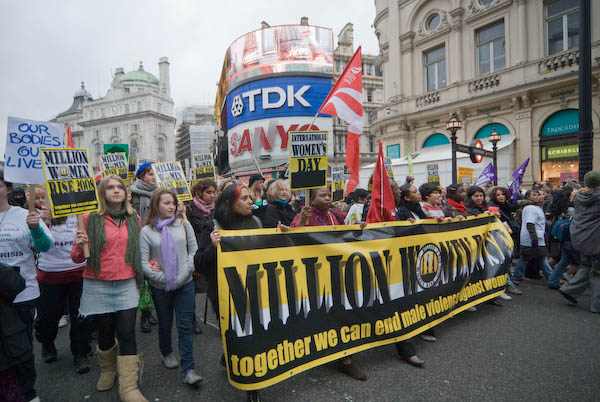
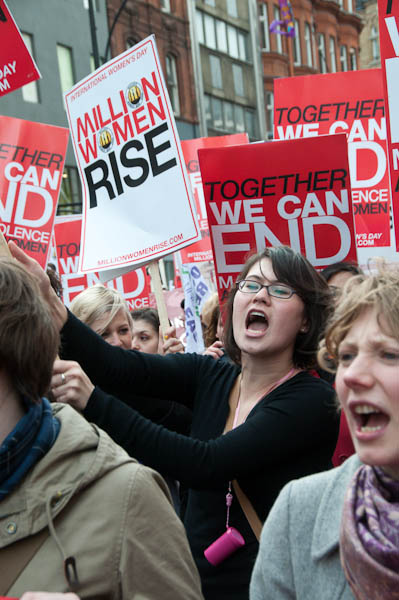
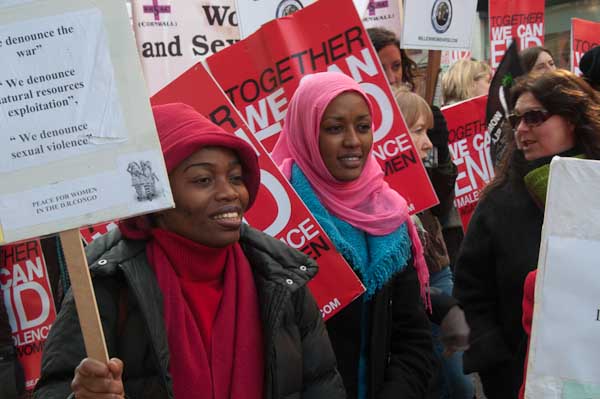
2008 Million Women Rise: International Women’s Day March

Million Women Rise

2009 Million Women Rise

More pictures

2010 I photographed two events.

Million Women Rise

more pictures

Support the Iranian Women’s Struggle

more pictures

There are some links to later International Women’s Day events in a post I wrote here a year ago.


Past Time To Act On Climate Change?

Past Time To Act On Climate Change? Seven years ago on Saturday 7th March 2015, 20,000 or so protesters marched through London to remind government and the nation it was Time to Act on Climate Change. Seven years on, the IPCC Sixth Assessment Report released a week ago warns “that climate breakdown is happening faster than expected and that the window to take action is closing fast. The report is a call to governments and private sector players to take drastic action against climate change.”

It’s a report that has largely been lost to public sight, pushed together with the stories about Tory sleaze and lies out of the news by the Russian invasion of Ukraine, though it has even more far-reaching implications. Not that I want to in any way minimise Putin’s criminal action and its terrible consequences for the people of Ukraine, largely innocents caught up in a situation of others’ making.

Of course the invasion of Ukraine has now raised the spectre of a nuclear war, which would almost certainly lead to mass extinction rather more rapidly than climate change, but the very dramatic prospect fortunately makes this almost unthinkable. Were it to happen it would almost certainly be by accident, something we have come close to several times in the past. Even our maddest politicians realise there is nothing to be gained by mutually assured destruction, and there would be no profits in it for the oligarchs or billionaires.

Climate change doesn’t happen in a massive flash, but is relatively slow and insidious. Even in the richer countries we are just beginning to feel its effects, and some in the Global South have long been suffering extreme hardship. But unless we heed the report and take drastic action without delay it will be too late to stop; many systems are coming close to their tipping points, past which there is no chance of recovery.

Scientists have been warning about the dangers for many years. Even 50 years ago when I was a student I spoke about the need to change the way we used the Earth’s resources and move to renewable systems of energy and agriculture, as many aspects of our current way of life were unsustainable.

Over 50 years ago it was clear to me that we needed to cut our dependence on fossil fuels, not just because of the carbon emissions and other pollutants, but also because thinking in the longer term it seemed a waste to burn what was a limited resource and an important chemical resource for plastics and other materials. I sold the only car I’d owned in 1967 or 8, because we needed to move away from a society based around private cars. It was clear too that we needed to farm in ways that conserved the soil and that many modern agricultural practices destroyed it – my father had joined the Soil Association which was established in 1946.

But of course there were huge profits to be made from fossil fuels and other industries that were driving up global emissions – and huge campaigns of obfuscation and lobbying. Most politicians in most countries were doing very nicely out of exploiting our natural resources – and the workers, who needed to be kept happy by more and more consumer goods as well as a huge and almost universal media promoting consumerism. Bread and circuses is of course nothing new.

Countries around the world, whatever their politics, are almost entirely run by politicians who have prospered from ‘business as usual’, and usually business corruption which they have colluded in by allowing money laundering, allowing huge tax avoidance and evasion and more. They have now learnt to talk the talk about climate change, but, as Greta Thunberg pointed out, it has been all “blah, blah, blah”, promises but little or no action.

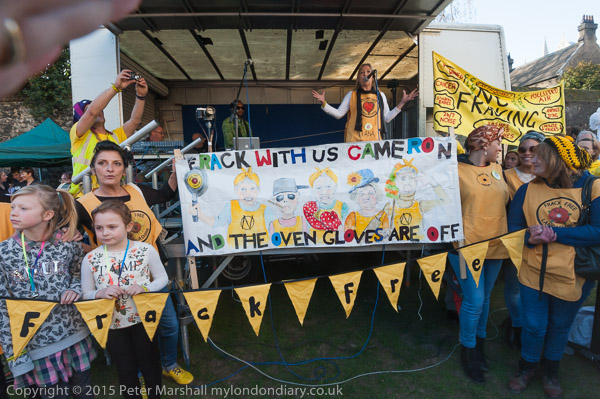
There were many different groups taking part in ‘Time To Act on Climate Change’, including the Campaign Against Climate Change who have organised regular protests in London since 2002, Friends of the Earth who I’ve supported since the 1970s, the Green Party, anti-fracking protesters including the fabulous ‘Nanas’ of Frack Free Lancashire, campaigners against Heathrow expansion – and I list a few more in Climate Change Rally, which also has pictures of some of the speakers.

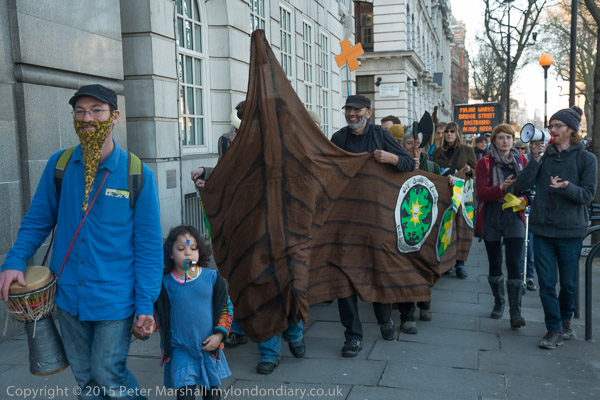
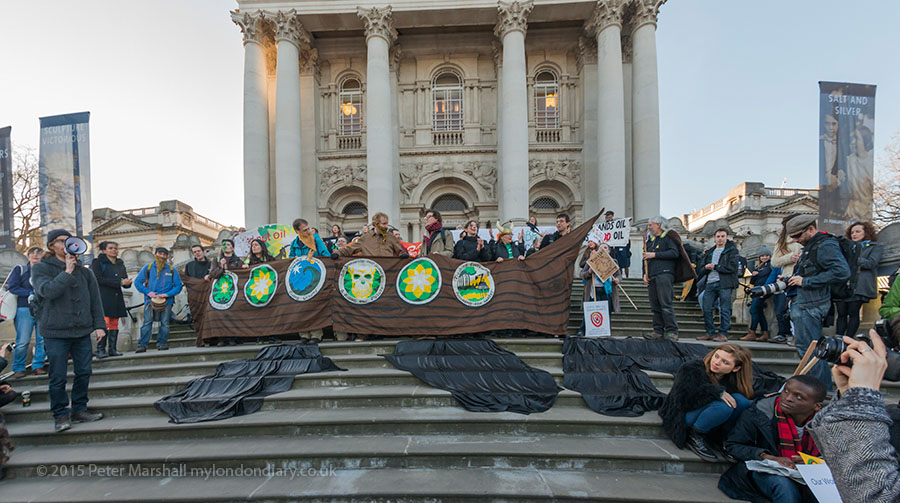
At the end of the rally I went on to photograph a protest by ‘Art Not Oil’ who invaded the steps of Tate Britain with their ‘longship’ and ‘oil spills’ in a protest demanding the Tate give up taking sponsorship from BP, who used their support of the arts to give themselves a positive public image despite the pollution and climate change their activites cause. It’s time to end this ‘greenwashing’.

Viking longship invades Tate steps has a few pictures of the event. The Longship first sailed to the British Museum where BP had sponsored a show on the Vikings. As I commented, the plastic oil spills used by the protesters “are a lot easier to clean up than the real ones BP has created such as Deepwater Horizon in the Gulf of Mexico, and which could be truly catastrophic in the Arctic.”

More on all these on My London Diary:
Viking longship invades Tate steps
Climate Change Rally
Time to Act on Climate Change


BBC Ignores Turkey’s War On Kurds

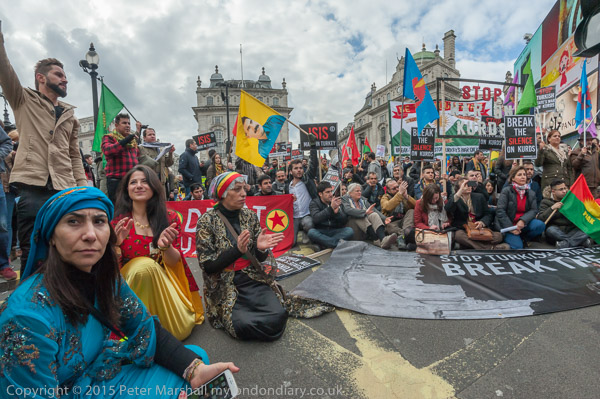
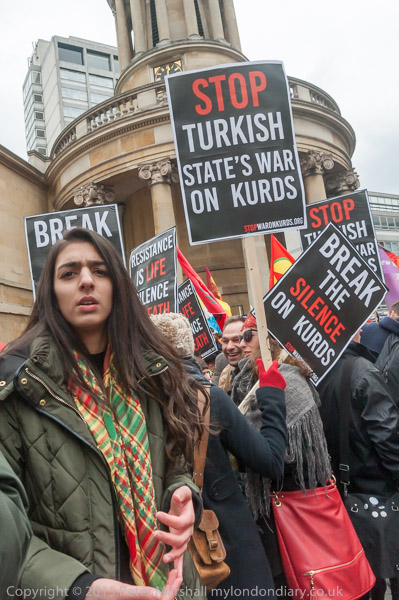
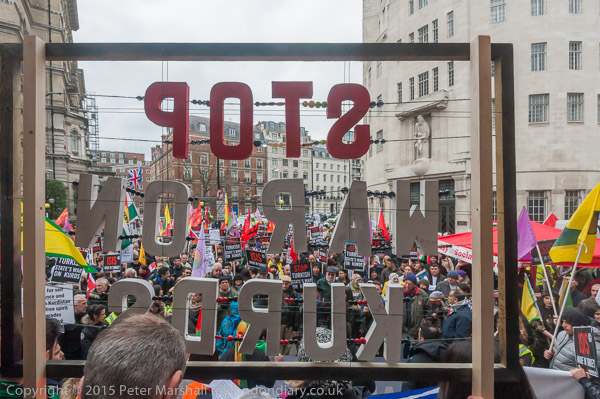
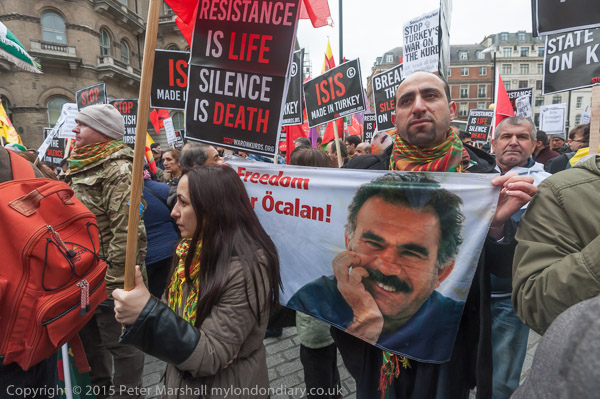
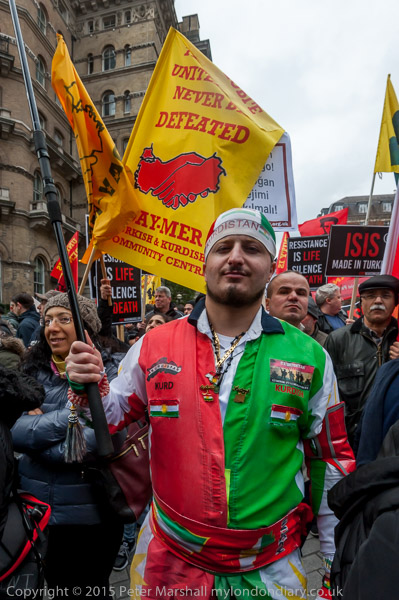
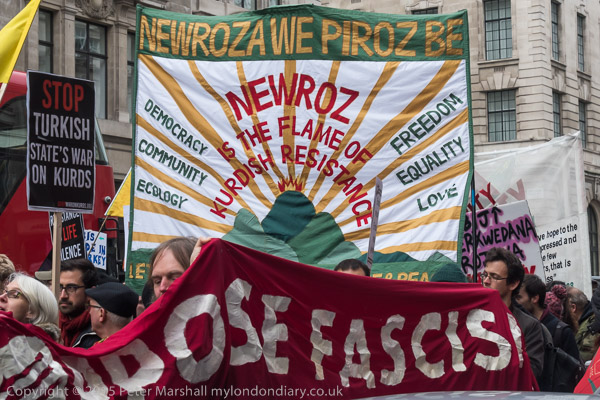
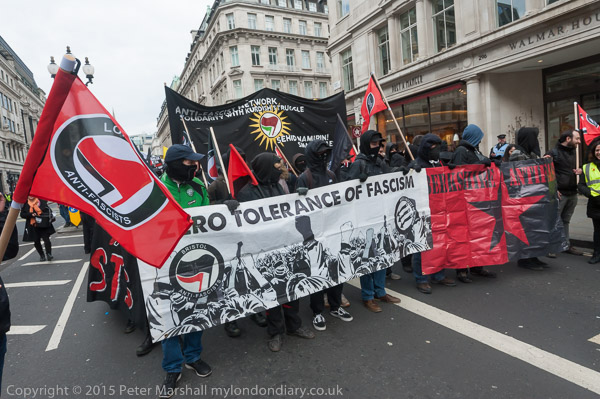
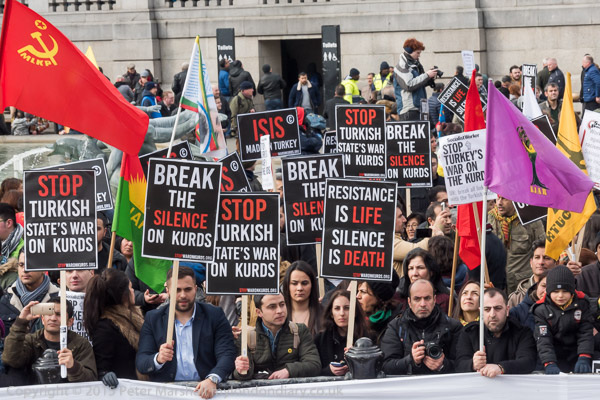
BBC Ignores Turkey’s War On Kurds. Six years ago today, on Sunday 6th March 2016, thousand of Kurds marched from the BBC to Trafalgar Square calling for an end to the silence from Turkey’s NATO allies and the western press over Turkey’s increasing war against Kurds since the political successes of the Kurdih political party and the formation of the popular progressive democracy of Rojava in Northern Syria.

Marchers sat down briefly at Piccadilly Circus

On My London Diary I posted a list of over 30 UK groups supporting in the protest including the National Union of Teachers, the PCS and RMT as well as other trade unionists and branches, the Stop The War Coalition, the Green Party, Unite Against Fascism, many left wing parties and political groups and of course Kurdish organisations.

The repression and marginalisation of Kurds by Turkey is as old as the Turkish state, formed in 1923. For many years the state even denied their existence, describing them as “mountain Turks”, and it outlawed their language and clamped down on their cultural events such their Nowruz New Year Festival and on the wearing of their traditional dress and Kurdish names. Even the words Kurds and Kurdistan were banned.

The crowd stretched some way past Broadcasting House

The 1990s and early 2000s saw some relaxation of the repression of their language and community celebrations, but it remains illegal to teach in Kurdish and there is still limited freedom of expression. In 1978 Kurds formed the militant Kurdish Workers’ Party, PKK, which launched a military freedom fight against Turkey in 1984. PKK leader Abdullah Öcalan was captured in Nairobi in 1999 by Turkish agents assisted by the CIA and flown back for trial in Turkey. He was sentenced to death, but this was commuted to life imprisonment when Turkey abolished the death penality and since then has been held in a Turkish high-security island prison.

Öcalan had argued for a political solution to the conflict since 1993 and even in prison remains the leader of the PKK. Subjected to long spells on isolation there have been periods where he has been allowed visits and has been in negotiations with the Turkish government. He has also written about the democratic confederalism which is at the heart of the constitution of the Autonomous Administration of North and East Syria, widely known as Rojava, founded in 2012.

Rojava’s decentralised democratic form of government recognises and includes the various communities in the area – Kurds, Arabs, Turkmen, Yazidis, Assyrians and others as well as promoting the equality of women.

The main ground forces which have been effective against Daesh (ISIS) in the region are from the Kurdish People’s Protection Units, men in the YPG and women in the YPJ, who with the help of US air support defeated the Islamic State in Northern Syria.

Turkey regards the YPG and YPJ as being a part of the PKK, regarded by them and many countries as a terrorist group and widely banned. Since 2016 it has used its overwhelming military power (supported by NATO and Russia) to try to crush the Kurds and to capture Rojava, occupying large areas. Together with Syrian allies (including some former ISIS fighters) they are carrying out a policy of ethnic cleansing against the Kurds, and have been engaged in a wide range of war crimes.

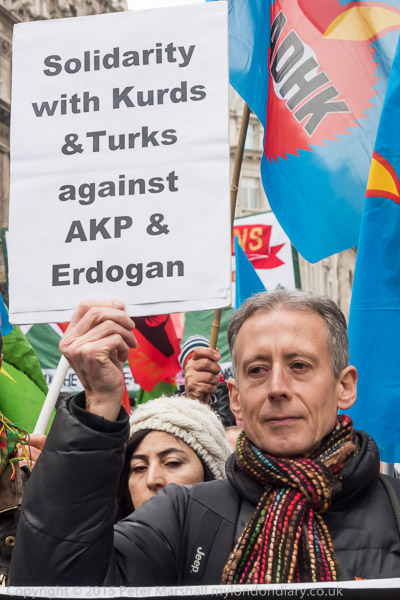
Peter Tatchell

As well as calling for an end to attacks by Turkey and for full and un-biased reporting of Turkey’s attacks on the Kurds the marchers want the UK to end its support for the Turkish aggression and also to repeal the ban on the PKK under the Terrorism Act 2000. It is banned in most other western countries including the EU, where several court verdicts have found its proscription to be illegal but it has remained.

The march sat down for a few minutes stopping traffic at Piccadilly Circus, then went on the a rally in Trafalgar Square, where I left them. There were no reports of the march on the BBC or in other UK mass-media, though I think it was covered by some foreign news services and our minuscule left-wing press.

More at Break the Silence! Turkey’s War on Kurds.


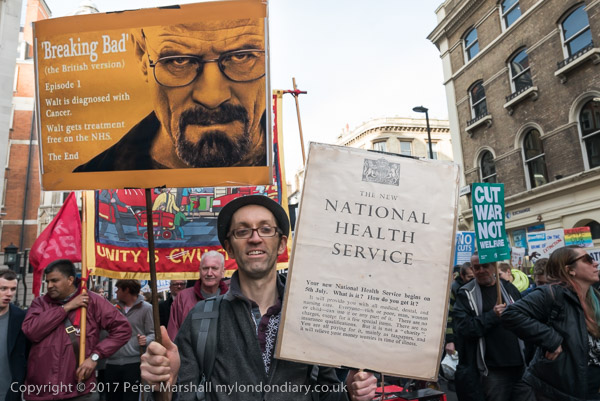
Save Our NHS March, London, 2017

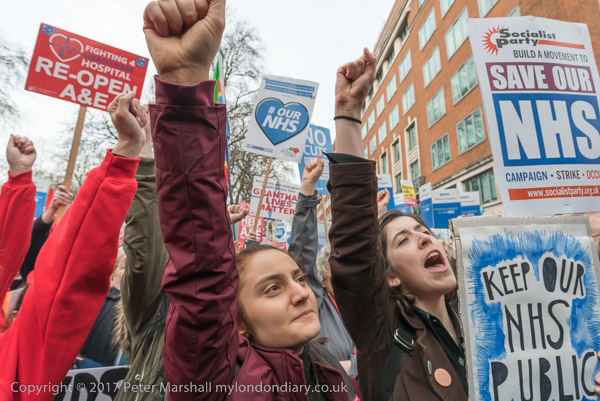
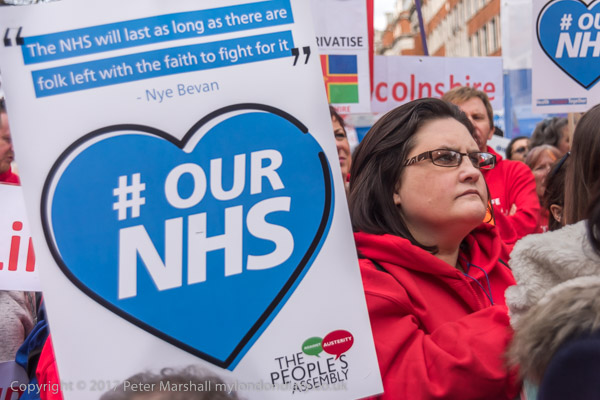
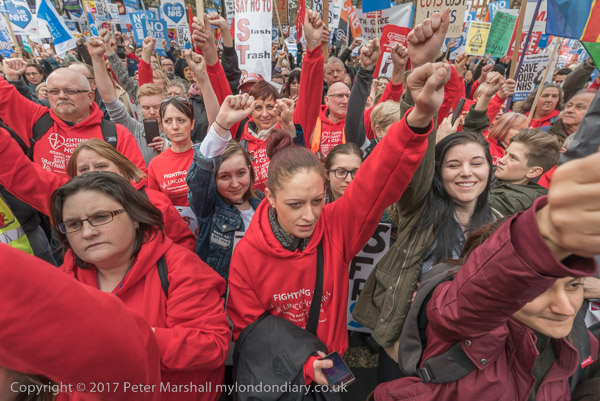
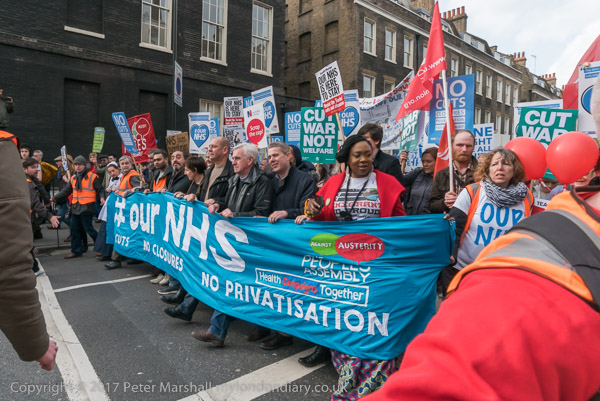
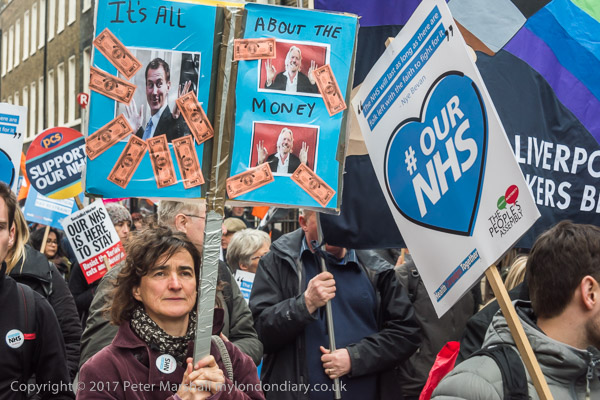
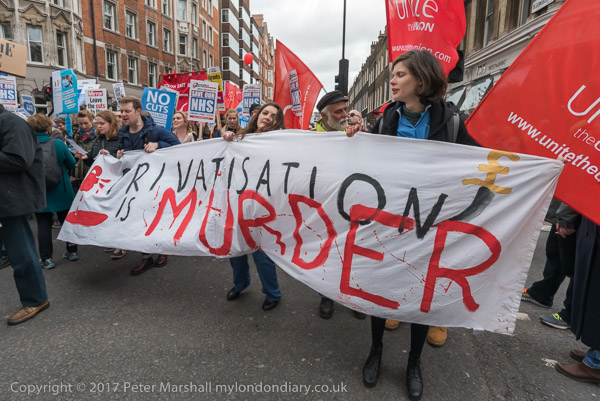
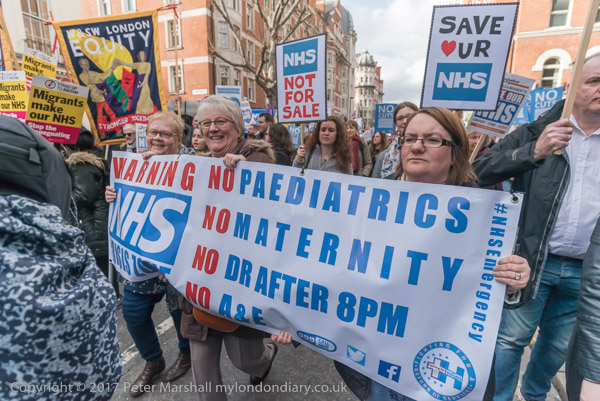
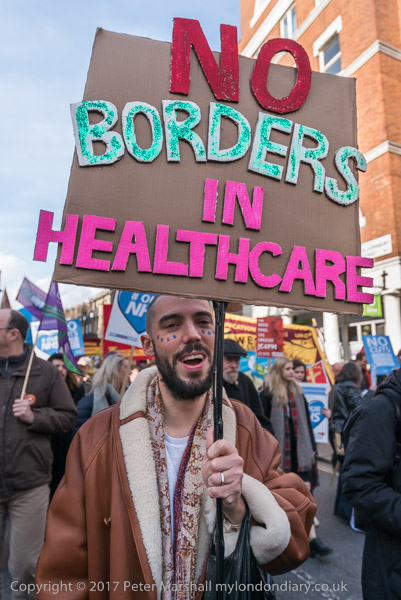
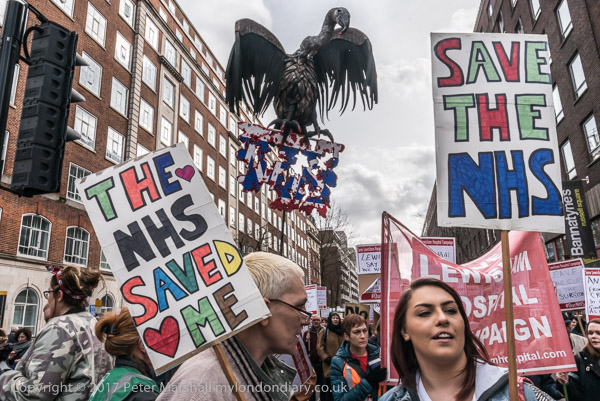
Save Our NHS March, London, 2017. On 4th March many thousands marched through London from Tavistock Square where the BMA have their headquarters to a rally in Parliament Square in protest against the cuts and privatisation of the NHS.

The Conservative Party were against the formation of the NHS from the start, and voted against both the Second and Third readings of the National Health Service Bill in the House of Commons in 1946.

The formation of a public state heath service had been advocated by Beatrice Webb as early as 1909, and the idea of a free, comprehensive and universal health provision had been gaining public support over the years, becoming official Labour policy under George Lansbury in 1934. By 1942 even the British Medical Association had proposed having regional councils running hospitals with consultants as paid staff, although they opposed the 1946 bill as they though doctors would lose money under the NHS.

But it was the 1942 report by William Beveridge, Social Insurance and Allied Services, that put the NHS firmly on the political agenda, with even Tory Prime Minister Winston Churchill suggesting in 1943 it would be a part of the rebuilding of Britain after the war, and both Liberals and Conservatives supporting consultations with doctors and others that resulted in a 1944 White Paper, ‘A National Health Service’.

When Labour’s Health Minister Aneurin Bevan put his National Health Service Bill to parliament in 1946, there was general agreement on the idea of a comprehensive health service, but the Tories were opposed to doctors becoming full-time employees and thus being unable to continue in hugely lucrative private practice. And the BMA shared their position, continuing their opposition after the Act was passed and eventually were able to force Bevan to amend the act and remove the introduction of a salaried service for GPs.

So, although it was a great day when the NHS came into being on 5th July 1948, and was from the start a little hamstrung by commercial interests – in this case of individual doctors. Dentistry has never been properly integrated into the system, and many find it impossible to get NHS dental treatment as relatively few dentists are prepared to work at the rates offered by the NHS. Even for those who are able to get registered as NHS patients, their are fees which for those not qualifying for exemption can be prohibitive despite being subsidised by the NHS.

The march sets of with John McDonnell, Mark Serwotka and others holding the main banner

It was a Labour government that proposed the idea of prescription charges in a 1949 Act, prompting the resignation of Aneurin Bevan from the Labour government, but it was a Conservative Government that introduced them in 1952. They were abolished under Labour by Harold Wilson in 1965 but he brought them back in 1968 though with significant exemptions based on age, income and medical conditions. Wales, Nothern Ireland and Scotland have now abolished charges, but in England each item now costs £9.35.

Since the 1990s many politicians, particularly Tories but also some of the leading figures in the New Labour government and on the right of the party have backed changing from the current universal system to a personal insurance-based system, and there has also been a huge increase in those taking out private insurance, with now around 4 million having this, mainly through the companies they work for.

Healthcare is now a massive industry in the UK, enabling the wealthy to avoid delays in receiving treatment in the underfunded NHS. The NHS also massively funds the private system, with some private healthcare providers receiving as much as 80% of their income for providing services to NHS patients. Some NHS hospitals also get in on the act by offering private care.

Many of the more routine services provided by the NHS have now been outsourced to private providers and over the years various changes in the way the NHS works have meant more and more has to be made available for tender by outside bodies. In some cases the level of services provided has been extremely poor – when I was in one hospital the outsourced cleaners had insufficient time to clean the floor under the beds, and accidentally putting down my hand I found a dirty dressing and a used needle from a previous occupant. Probably such outsourcing was a significant cause of various hospital-acquired infections.

But much private medicine is of a high standard – using the same surgeons and consultants others expensively trained by the NHS who work both for the NHS and private hospitals. The best private hospitals will have more equipment and more up-to-date equipment than the NHS hospitals that have suffered from years of cuts, and will also provide better conditions for their patients, with private rooms and more.

Having a two-tier system which is rapidly growing means that politicians, themselves wealthy and overwhelmingly representing the interests of the better off, and the more vocal wealthier groups in society, as well of course as the well-paid lobbyists for private health, are less likely to provide the NHS with the funding it needs to provide modern healthcare.

Many believe that our NHS is under threat, slowly and step by step being sold off to private healthcare companies, many based in the US, and that before long the NHS will be a name only, a branding used by private companies (as in many areas it already is.) The country is slowly being prepared for a complete move to an insurance based system, which will be brought in by politicians – Labour or Conservative- still chanting the mantra ‘The NHS is safe in our hands‘.

More at Save our NHS March.


Stop The War – 2nd March 2002

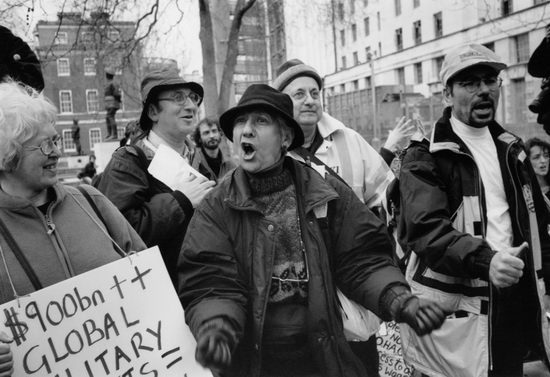
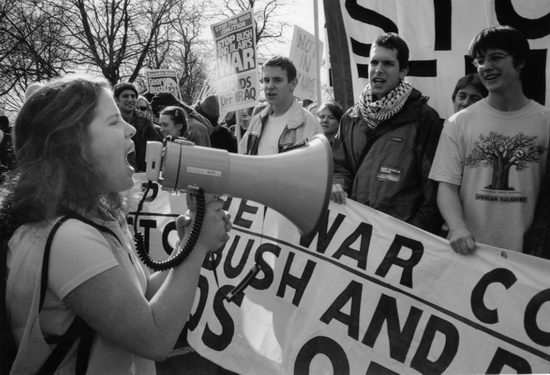
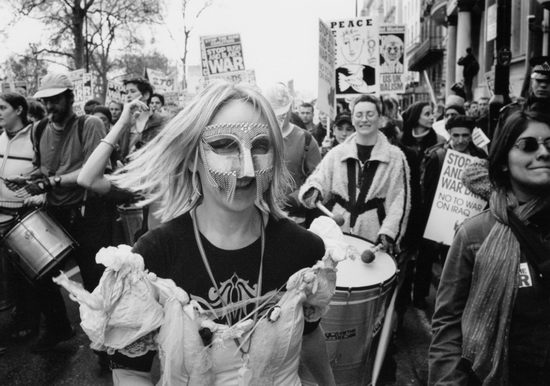
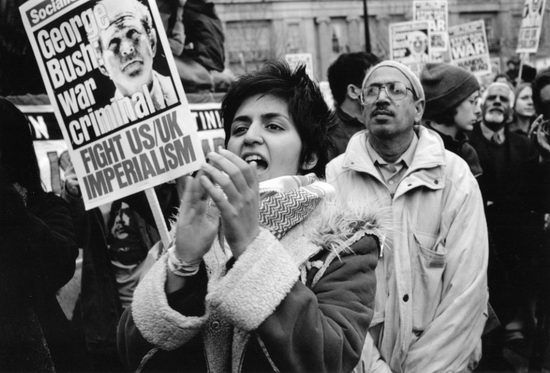
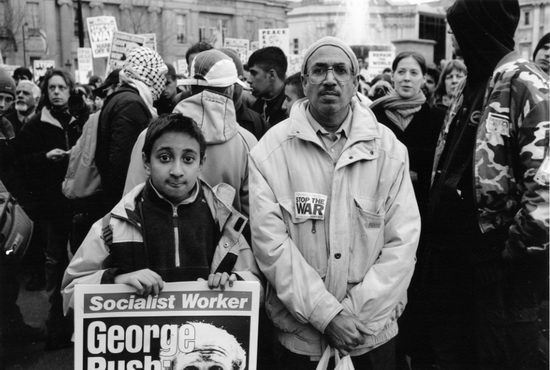
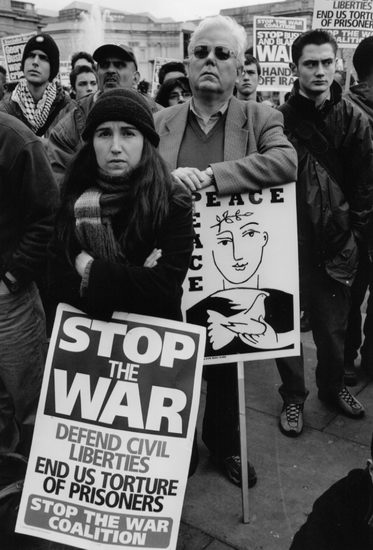
Stop The War – 2nd March 2002. Along with many thousands of others I went to Hyde Park to join the march from there to a rally in Trafalgar Square against any British involvement in the invasion of Iraq by the USA that seemed to be increasingly inevitable.

It certainly wasn’t the first march against the Iraq War I had photographed, and not the first protest against it I had taken part in. As well as those that I photographed there were also local protests close to where I live where we stood with placards and a banner on the busy road bridge across the River Thames at rush hours each Friday.

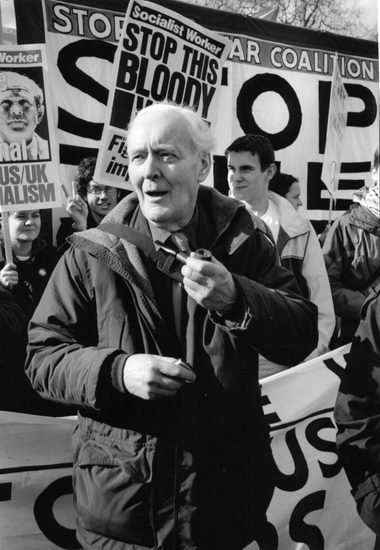
Tony Benn

Almost a year later came the largest protest the UK has ever seen – and I was unable to take part or photograph, having only been discharged from hospital the previous day. The operation had gone well, but I’d collapsed the following night thanks to a problem with a drug which had taken my blood pressure dangerously low, and when I came out several days later I was still weak and shaking. I was devastated to miss the protest, left alone at home while the others went, but walking more than a few yards was still a problem.

Despite the protests – and the clear indications that Tony Blair was lying and the evidence he stressed was fabricated, we went to war with Iraq, and destroyed the country. As with most if not all wars the only people to gain were the arms manufacturers – and the oil giants.

In March 2002, my My London Diary web site was in its early infancy, though I had put up a few pictures from the previous couple of years to fill a few pages. But the Stop The War protest on 2nd March was I think the first story to be covered in any real depth, with a short text and a couple of dozen pictures. I photographed the event on film in black and white and colour, but at the time my scanner could only scan in black and white so there are no colour pictures on line.

Here’s the complete text (apart from some picture captions) and this post is illustrated with a few of the pictures. On the web site these are posted three or four to a page, as internet connections then went at a snail’s pace and pages with more pictures took too long to load.

the Stop the War, Hands off Iraq demonstration on 2 march as a large sign of public opinion. people were still leaving hyde park at the start of the march when trafalgar square was full to overflowing two and a half hours later.

police estimates of the number were risible as usual – and can only reflect an attempt to marginalise the significant body of opinion opposed to the war or a complete mathematical inability on behalf of the police.

tony benn told us it wasn’t worth taking his picture – ‘it won’t get in the papers unless i go and kick a policeman’ but he didn’t and was quite right

My London Diary March 2002

Follow the link from the March 2002 page for more pictures.


Snow, Pensions & Jobs, Hunger Strikers – 2018

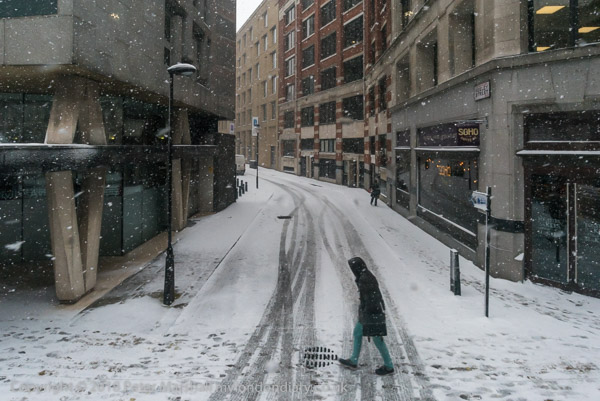
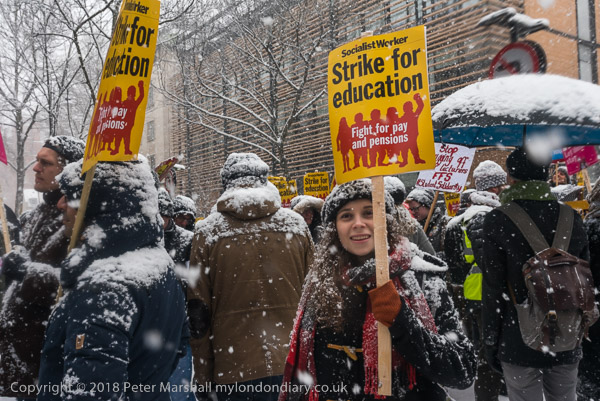
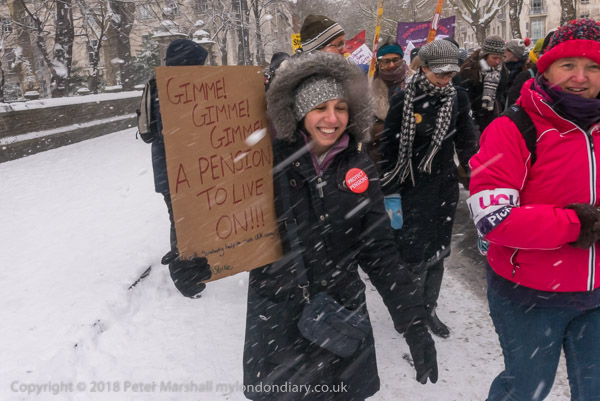
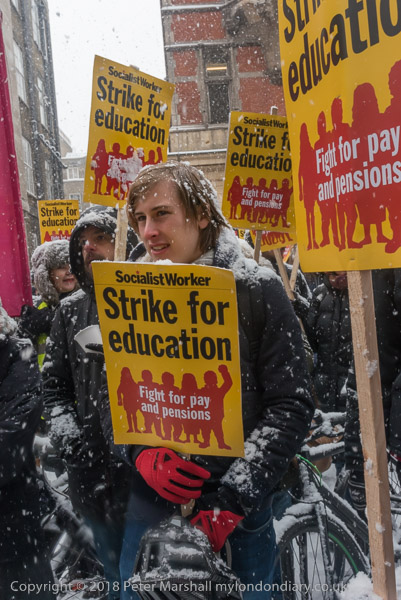
Snow, Pensions & Jobs, Hunger Strikers – 2018. On Wednesday 28th February 2018 there was a blizzard in London. University and FE teachers marched through it to a rally about pay and pensions and people came to the Home Office to support hunger strikers in the immigration prison at Yarl’s Wood.

London Snow

The snow slacked off a little when I was on the bus but got worse as I walked to Malet St for the start of a march. Most of the pictures I tried to take were ruined by snow flakes landing on the front of the lens faster than I could wipe them off.

London Snow

HE and FE march for pensions and jobs

UCU members were on the the fifth day of their strike to get the universities to talk with them about pensions and pay, and marched from Malet St to Methodist Central Hall close to Parliament for a rally.

They were joined by staff from London FE colleges on the first day of a two-day strike over pay and conditions, and both groups were supported by large numbers of students. The snow made it difficult to take pictures, and at times it was hard to stop from slipping over on compacted snow. Fortunately it eased off a little after the march started, with just occasional showers as we walked through London.

HE and FE march for pensions and jobs

HE & FE rally for pensions and jobs

Sally Hunt of UCU speaks and Kevin Courtney NEU listens at right

Despite the terrible weather there were more marchers than expected and many were left outside the hall. I don’t usually bother to photograph at indoor rallies and haven’t really got the best equipment for it, but on this occasion I was glad to be able to get inside and warm up a little. My camera lenses were also getting a little steamed up and needed to dry out.

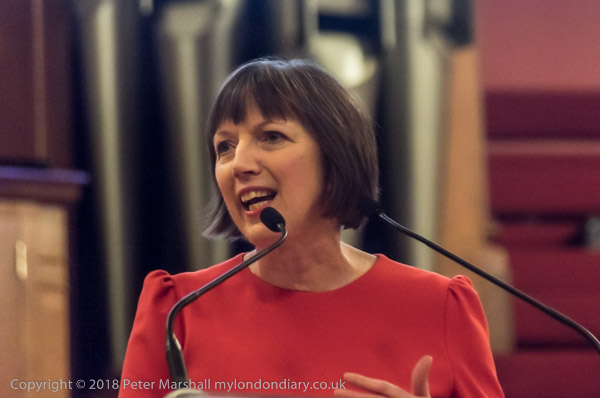
Frances O’Grady praises the way that Sally Hunt and the UCU are fighting to keep the pension scheme

I’ve written more about the reasons for the strikes and a little about the rally on My London Diary and won’t repeat that here. Click the link to find more.

HE & FE rally for pensions and jobs


Solidarity with Yarl’s Wood hunger strikers

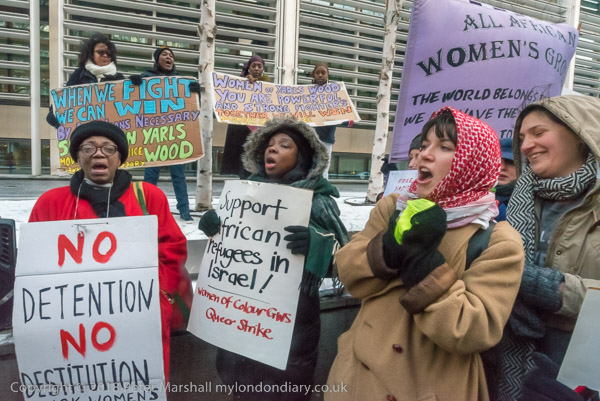
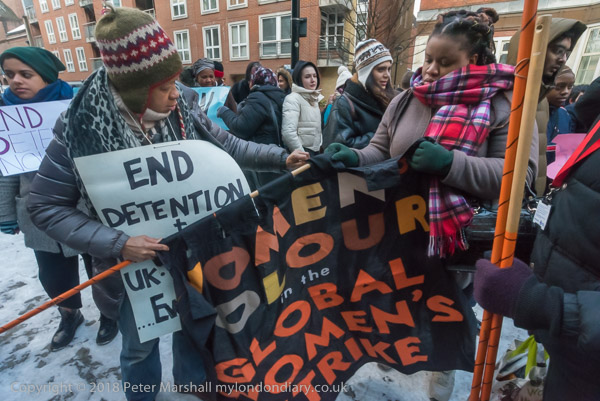
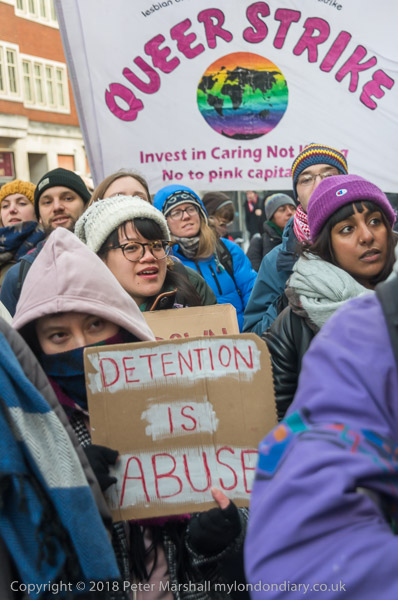
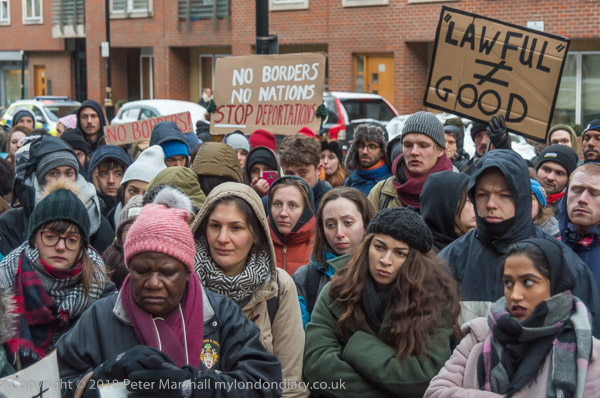
I stayed longer inside the rally than intended, partly because I was reluctant to leave t he warm hall, but as it came to an end I left to walk to the Home Office, where a protest was taking place in solidarity with the 120 women and men in immigration detention at Yarl’s Wood who were refusing to work and had gone on a hunger strike.

Their action in Yarl’s Wood had started a week earlier and was demanding the Home Office respect the European Convention of Human Rights, end the separation of families, end indefinite detention, with a 28 day maximum detention period, end charter flights which deport people without notice, and end to re-detention of those released from detention.

The also called for an amnesty for those who have been in the country for over 10 years, a stop to deportations before cases are decided and any appeals heard, the proper disclosure of all evidence to the immigration tribunals, adequate health care, an end to detaining of highly vulnerable people, an end to employment at £1 per hour and to be treated with the dignity and respect due to all human beings.

It was a fairly large protest, supported by many groups including Lesbians and Gays Support the Migrants, Detained Voices, Black Women’s Rape Action Project, All African Women’s Group, The London Latinxs, Right to Remain, Docs Not Cops and End Deportations as well as Movement for Justice who have organised many protests outside Yarl’s Wood as well as those at other detention centres and led campaigns to close detention centres and support detainees.

Solidarity with Yarl’s Wood hunger strikers


For Refugee Rights and Against Trident

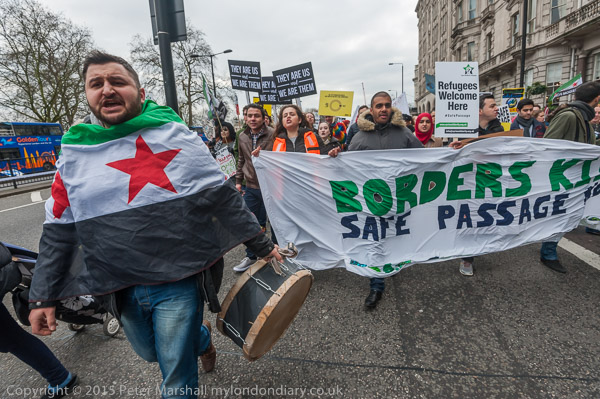
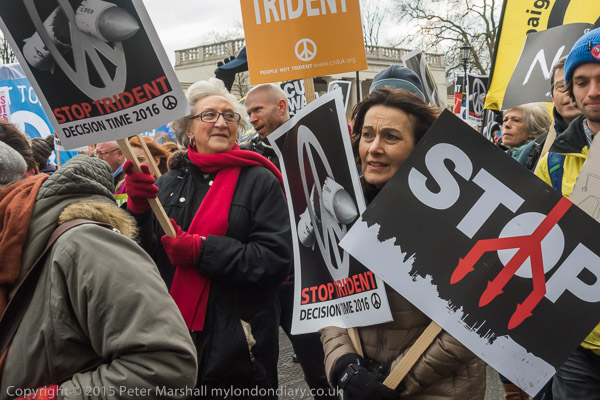
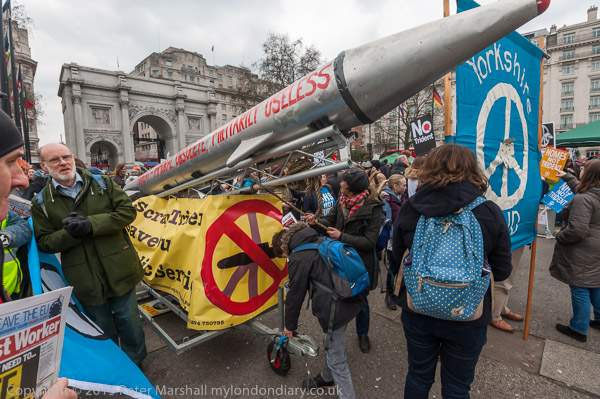
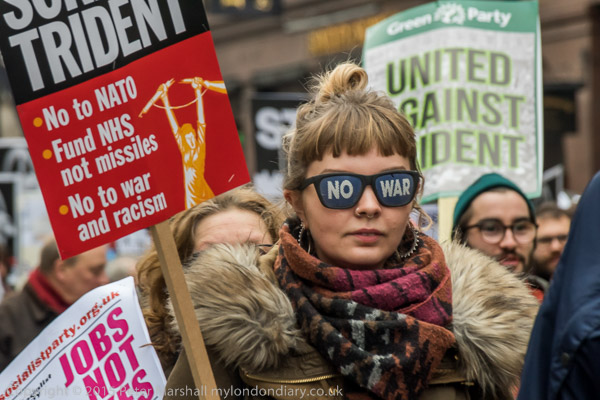
For Refugee Rights and Against Trident. I covered two marches in London on 27th February 2016, the first calling for safe passage for refugees seeking protection in Europe and following this a much larger march against government plans to waste £180 billion or more on replacing the UK’s Trident nuclear weapons.

European March for Refugee Rights

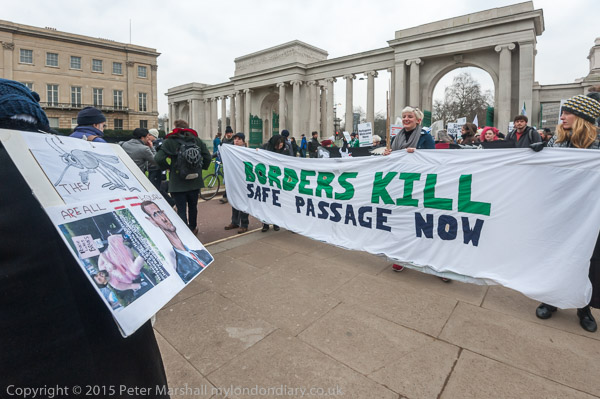
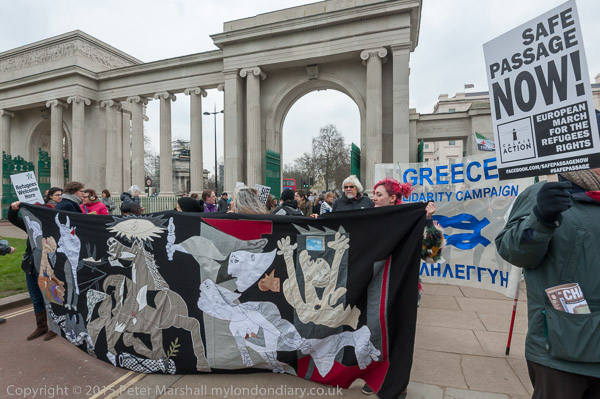
The European March for Refugee Rights was part of a day of protests in cities across Europe demanding action by governments to provide secure safe passage routes for all refugees and asylum seekers seeking protection in Europe. They want an end to deaths at borders and drownings and for refugees to be allowed to keep their possessions and be reunited with their families.

Among those taking part were people who had been to aid refugees in Lesvos and at the Calais camps and others who had volunteered with Medicins Sans Frontiers in Syria. The protest was supported by many groups including the Syria Solidarity Campaign, Solidarity with Refugees, London2Calais, Migrants’ Rights Network, SOAS Solidarity with Refugees & Displaced People Soc, Wonder Foundation, Calais Action, UK Action for Refugees, Refugee Aid Initiative, No Borders and the Greece Solidarity Campaign.

This was a short march taking place unusually inside Hyde Park, gathering at Hyde Park Corner and walking up to Speakers Corner where there was a rally. This made it possible for those taking part to join the Stop Trident Rally which was starting from Marble Arch, and going down Park Lane on its way to Trafalgar Square. Some of the marchers decided to form a block to march in front of the main Stop Trident banner and march on to Trafalgar Square.

Stop Trident march stewards tried briefly to stop them but then gave up and halted their march for around ten minutes to create a gap between the two groups.

European March for Refugee Rights


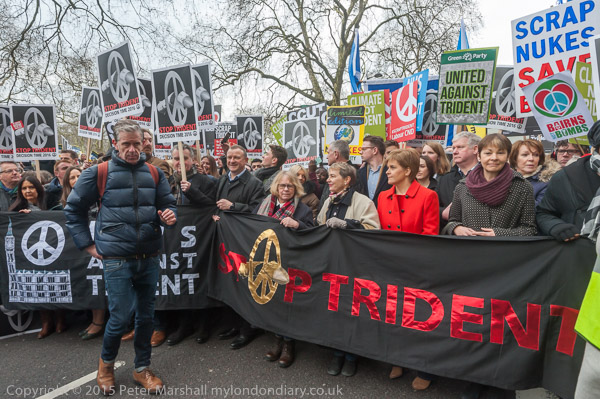
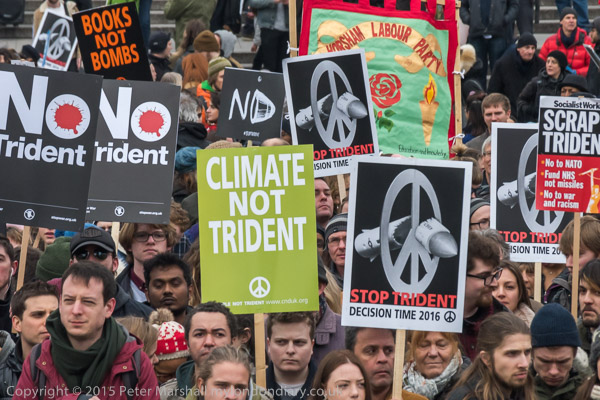
Stop Trident March

According to CND there were 60,000 people marching from Marble Arch to a mass rally in Trafalgar Square, and although their estimate may have been a little on the high side, this was definitely a very large protest, starting with a densely packed crowd on Park Lane. When the rally began in Trafalgar Square the tail of the march was still around half a mile away, and I think many gave up before reaching the rally as the streets leading to it became blocked.

Few people outside the military and arms manufacturers – probably the most powerful of all lobbies in the country can really believe the expenditure of £180 billion or more on replacing the UK’s Trident nuclear weapons is either necessary or cost-effective. The huge majority of nations in the world have no nuclear capability, and by December 2021, 59 states had ratified or acceded to the UN Treaty on the Prohibition of Nuclear Weapons (TPNW) which entered into force on 22 January 2021.

Lindsey German, Stop the War, Kate Hudson, CND General Secretary, Nicola Sturgeon, SNP First Minister, Scotland and Green Party MP Caroline Lucas hold the Stop Trident banner

A national survey by Survation at the start of 2021 for CND showed 59% of the public supported the UK government signing up to the TPNW, including 50% of Conservative voters and 68% of Labour voters. An even higher 77% supported a ‘total ban on all nuclear weapons globally’ with majority support from young and old, in all regions of the country, from Conservative as well as Labour voters, leavers and remainers. The government remains resolutely opposed to the treaty.

This widespread opposition to nuclear weapons isn’t largely a matter of their cost but on both moral and pragmatic grounds. As CND say, using nuclear weapons would cause catastrophic global damage; these weapons of mass destruction don’t keep us safe and divert resources from essential spending on services like the NHS, schools and housing and “it is clearer than ever that real security for Britain requires addressing the risks posed by the climate emergency and pandemics on a global scale.

Stop Trident March


Stop Trident Rally

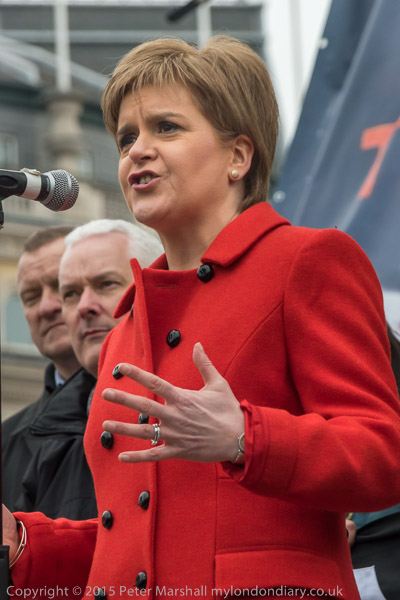
Trafalgar square was unusually packed for the long rally that followed the march, with people listening and applauding a long list of speakers, including Nicola Sturgeon, Caroline Lucas, Leanne Wood, Vanessa Redgrave, Bruce Kent, Christine Blower, Mark Serwotka and Tariq Ali, as well as many less well-known names. There were many marchers who found it impossible to get into the square.

Nicola Sturgeon First Minister Scotland

All the speakers opposed the spending of an estimated £180 billion or more on renewal of Trident which they dismissed as out of date, totally irrelevant to our defence and a complete waste of money which could be put to so much better use providing proper jobs and services.

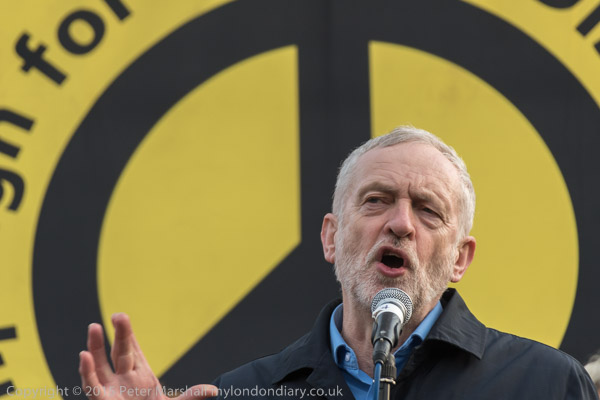
It was a long wait, around two hours standing in the cold for the final speech by Jeremy Corbyn who had earlier in the day been speaking in Sheffield and whose train had been a little delayed. He was greeted by a tremendous response from the crowd, and gave a rousing speech to end the protest on a high note. Despite the dismissive remarks from many political commentators on the media, Corbyn is one of the most powerful political speakers of current years.

Stop Trident Rally


Outsourcing, North Woolwich & Class War v. Rees-Mogg

Outsourcing, North Woolwich & Class War v. Rees-Mogg. Three years ago on Tuesday 26th February I spent the morning photographing several protests against outsourcing, had a rather late pub lunch, then went to North Woolwich for a short walk before rushing back to meet Class War who were protesting outside a Palladium show by Jacob Rees-Mogg.


Rally for an end to Outsourcing

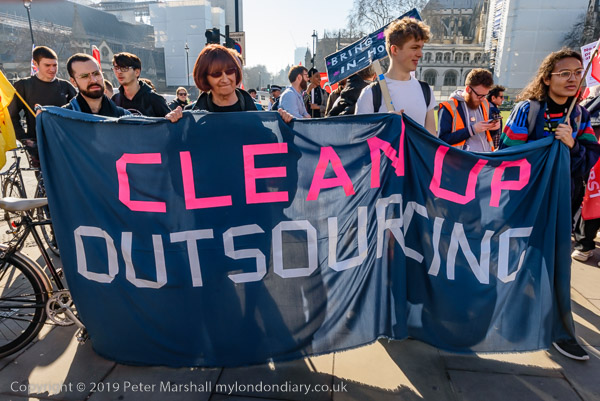
A legal challenge was taking place at the High Court on this day to extend the employment rights of the 3.3 million workers whose jobs are outsourced from the companies where they work to contracting companies which then sell them back to their place of employment at cut rates.

Labour Shadow Business minister Laura Pidcock

The contractors do this by cutting wages, trimming things such as pensions, maternity pay and holiday pay to the bare legal minimum, increasing workload and reducing hours of work and often bullying managers. Outsourced workers generally have little job security and are often denied necessary safety equipment and not given proper safety training.

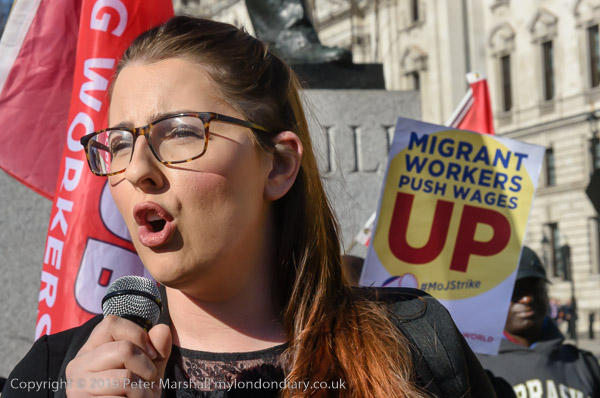
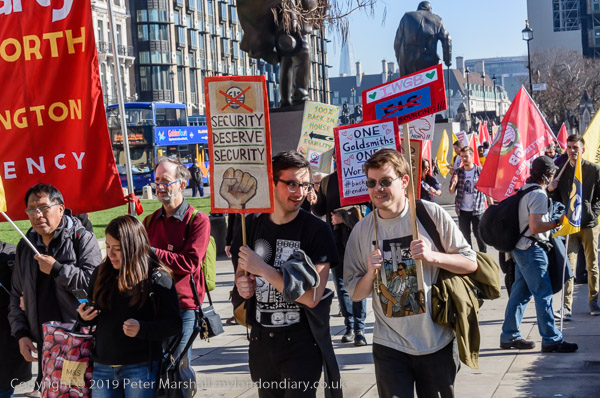
Workers, mainly migrants who work for the Ministry of Justice, Dept for Business, Energy & Industrial Strategy and the University of London were taking part in a one day strike in a coordinated action by the UVW and IWGB trade unions and the BEIS PCS branch to demand an end to outsourcing and the insecurity, discrimination and low pay it causes. They had started their march at 8.00am at the University of London and after a rally outside the High Court had marched to Parliament Square where I met them at 11am.

Rally for an end to Outsourcing


Outsourced Workers protest at BEIS

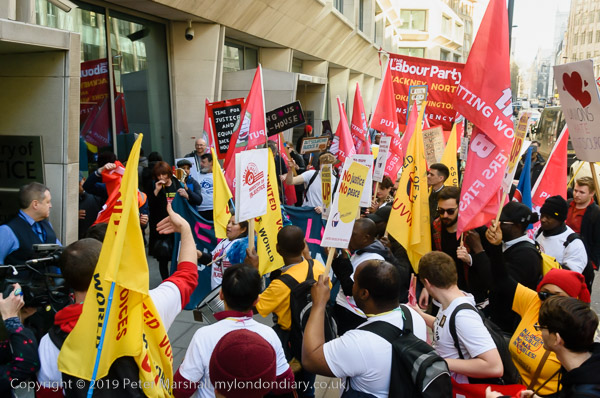
From Parliament Square the marchers went on to hold a further rally outside the Dept for Business, Energy & Industrial Strategy in Victoria St. Those striking at the BEIS included catering and security staff who are members of the PCS and are demanding the London Living Wage as well as end to outsourcing and the insecurity, discrimination and low pay it causes.

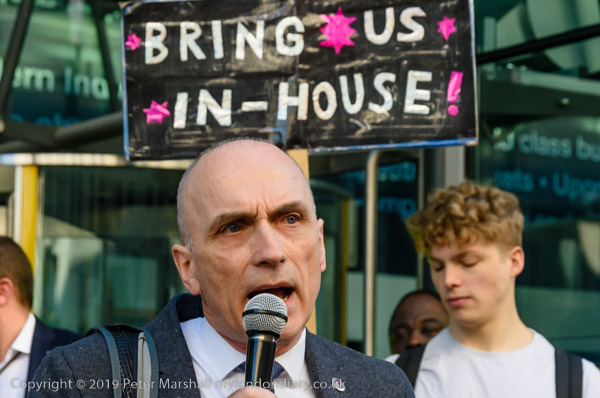
The PCS strikers led a lively rally with plenty of singing, dancing and shouting of slogans expressing their demands, which was followed by several speeches, including from Labour MP Chris Williamson, who brought messages of support from Labour shadow cabinet members and promises that a Labour government would end outsourcing.

Outsourced Workers protest at BEIS


Outsourced Workers at Justice ministry

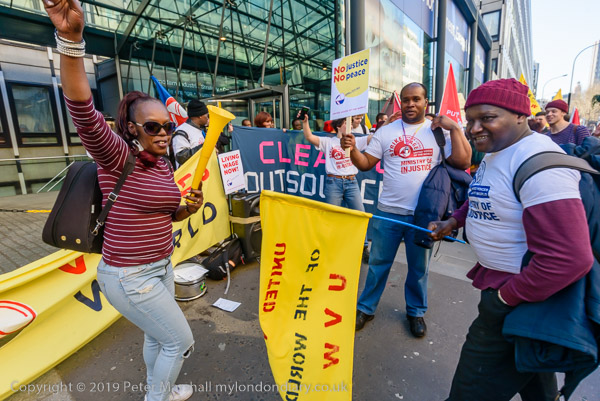
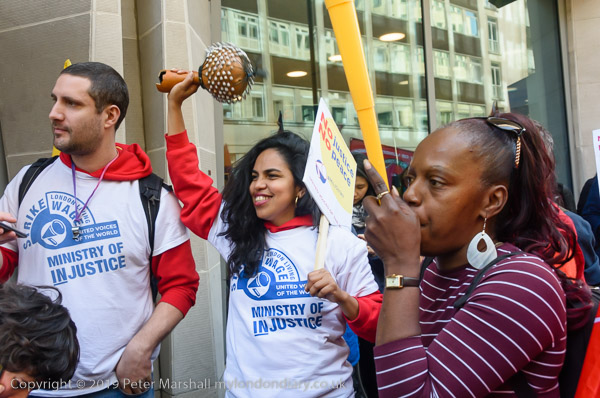
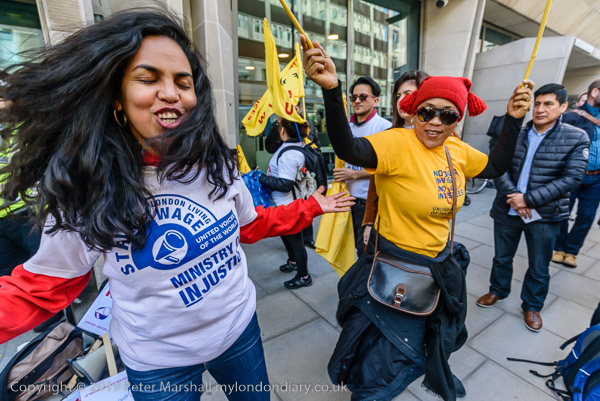
The marchers continued the short walk to the Ministry of Justice in Petty France, where low paid workers belonging to the United Voices of the World union at the Ministry of Justice have been campaigning for some time to get the London Living wage, but the Justice Minister has refused to talk with them. Many wore t-shirts calling it the Ministry of Injustice.

During the rally outside the building some of the UVW workers who had already been on strike for 24 hours went back into the ministry to resume work, to cheers and hugs from those on the street outside. The rally ended with music and dancing on the pavement, and I left for a rather late pub lunch in Holborn.

Outsourced Workers at Justice ministry


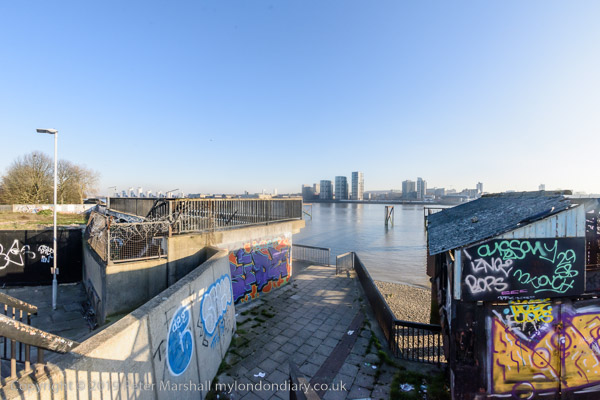
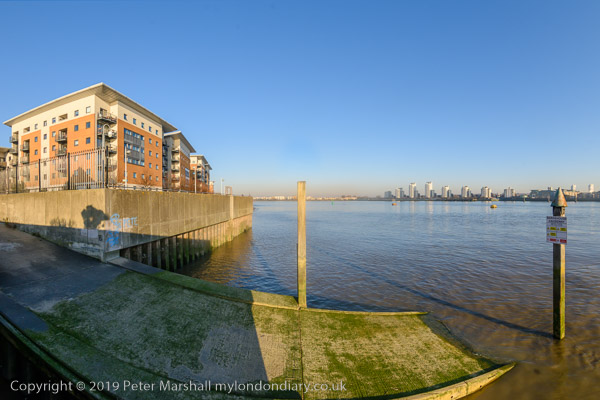
North Woolwich

I’d been intending to walk a short section of the Capital Ring, mainly beside the River Thames, for some months as it had been quite a few years since I’d last been there and wanted to see how it had changed. I had an afternoon with nothing else I needed to photograph and although the sunny weather with clear blue skies was not ideal it seemed a good opportunity.

Panoramic photographs almost always have large expanses of sky, and on days like this it tends lack interest, as well as often giving unnatural looking variations in tone when getting closer to the sun. Getting to North Woolwich should have been simple and reasonably fast, but unfortunately there was trouble on the DLR and I had to make a less direct route, so had to rather rush on the walk and leave it half-finished. It was a few months later before I found time to go back and complete it.

North Woolwich


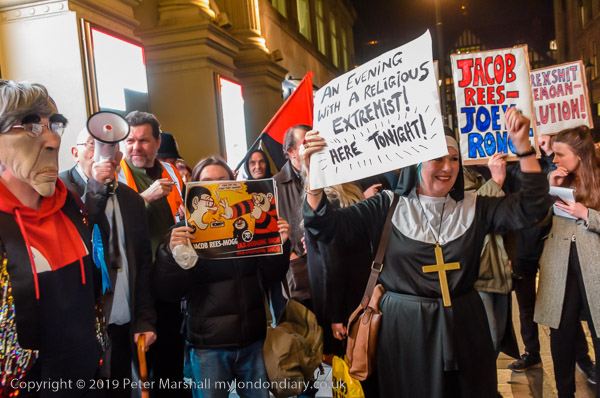
Class War protest Rees-Mogg freak show

I find it hard to understand why anyone should want to come and listen to Jacob Rees-Mogg, let alone pay £38 for a ticket to do so at the London Palladium.

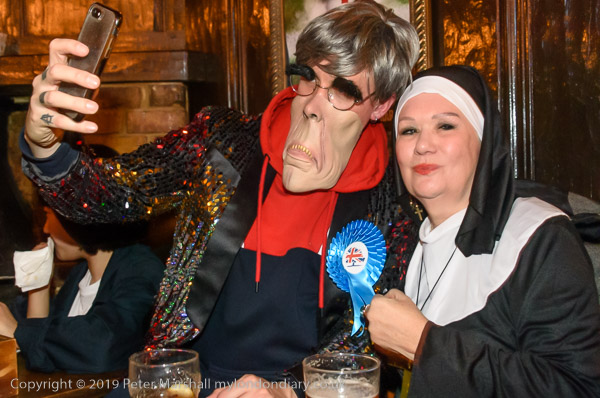
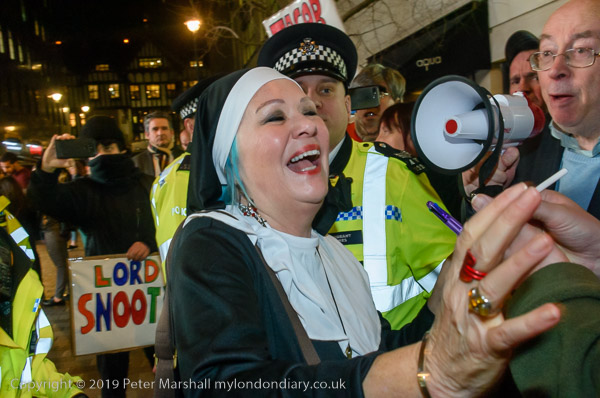
So too did Class War, and with Jane Nicholl dressed as a nun, Mother Hysteria, and Adam Clifford as Jacob Rees Mogg they loudly asked why people had come to listen to him “spout homophobic, transphobic, racist, pro-hunting, misogynist, classist, privileged” nonsense.

Their show on the street outside was almost certainly a better show than anything that would take place later inside the venue, and all for free. Police spent a considerable amount of public money on harassing them, and provided their own rather hilarious input by searching Mother Hysteria and threatening to arrest her for carrying offensive weapons after some novelty stink bombs were found in her handbag. When I left the officer who had stopped and searched her had already spent 20 minutes trying to write her notice of stop and search, probably at a loss trying to find some way to put it that doesn’t make it sound incredibly stupid.

Class War protest Rees-Mogg freak show