King’s Cross Road – 1989

My walk around King’s Cross on Saturday 8th April 1989 continues in this post. The previous part was Winged Lions, A School, Thameslink, Wine, Buses

Kings Cross Road, Lorenzo St, King's Cross, Camden, 1989 89-4d-32
Kings Cross Road, Lorenzo St, King’s Cross, Islington, 1989 89-4d-32

140-142 King’s Cross Road on the corner with Lorenzo Street had a distinct style to it, with the two oval windows and some interesting brickwork. British History Online states “This five-storey office block is largely of 1991 but incorporates the front and side elevations of a tenement building of 1888” and the view from where I made this picture is still much as it was before the rebuilding.

The two terracotta panels facing Lorenze Street are still there and together give the date of AD 1888. The BHO article suggests the architect was probably W. Youlle who was the architect for a similar building on Pentonville Road. The ground floor was occupied by shops – bricked up and fly-posted in my picture – with rooms and a toilet on each of the upper floors.

Almost legible in my picture is a line of text above what had been a shopfront on Lorenzo Street which appears to read ‘B R E E D O M E T E R S’ though some letters are unclear and part obscured by the no-entry sign. Perhaps someone will be able to clear up this mystery.

Leeke St, King's Cross, Camden, 1989 89-4d-33
Leeke St, King’s Cross, Camden, 1989 89-4d-33

The buildings at 5-11 Leeke St have become the offices for the Paul Hamlyn Foundation, established by Paul Hamlyn in 1987; after his death in 2001 this became one of the largest independent grant-making foundations in the UK. At left is a doorway with the date 1890 and an arm in armour holding the butt of a broken spear, the Irish Foster family crest for the Foster Parcel Express Co. The conservation area document describes it as “a microscope emblem”.

Kings Cross Road, King's Cross, Camden, 1989 89-4d-35
Kings Cross Road, King’s Cross, Camden, 1989 89-4d-35

These buildings are still there but their uses have changed and the café is now a property management company. The fine block at 150-158 was being refurbished in 1989 and is now home to an advertising agency.

Again British History Online is informative and suggests it was a speculative development. Built in 1902–3 with what it describes as a ” mildly ambitious” facade, it says that 154 and 156 had goods hoists and winches, though there is no sign of them in my picture.

Kings Cross Road, King's Cross, Camden, 1989 89-4d-36
Kings Cross Road, King’s Cross, Camden, 1989 89-4d-36

Again the BHO article linked above tells us that this was built as an office, workshops and stabling in 1899–1900 and was from many years occupied by J J Connelly who probably built it. The wide doorway at left was for horses with a ramp leading up to stables on the upper floor. It was apparently still being refurbished when I made this picture as offices for Community Service Volunteers. The structure is still there but looks rather different as the striped window shades have been removed and the frontage painted a uniform white.

The taller building at right was the Mary Curzon Hostel for Women, built in memory of his wife for Lord Curzon in 1912-3 to provide inexpensive hostel accomodation for working women. Again there is a fuller description in the BHO article. When it was taken over by the LCC in 1955 it was renamed the Susan Lawrence Hostel.

Dodds the Printers, Kings Cross Road, King's Cross, Camden, 1989 89-4d-24
Dodds the Printers, King’s Cross Road, King’s Cross, Camden, 1989 89-4d-24

Dodds the Printers had these shopfronts at 193-5 on King’s Cross Road for many years and their signage shown looked like something from a different age in 1989. From around 2013 the shopfronts have been put to other uses but the printers still appear to be in business at the rear of the premises down St Chad’s Place, the alley through the doorway in this picture. I’d taken a few photographs in this alley in 1986, which show the signs for Dodds on the back of their property.

Kings X Radio Cars, Kings Cross Road, Kin Pentonville Rd, King's Cross, Islington, Camden, 1989 89-4d-11
Kings X Radio Cars, Pentonville Rd, King’s Cross, Islington, 1989 89-4d-11

I turned left onto Pentonville Road, and took a picture of these shops on the north side of the road, all of which are now a Pizza Restaurant, though not the same Italian snack bar as in my picture.

There is still a clock high more or less in the same position though that blank wall has now got four windows. The rectangular clock permanently at three minutes past four which had I think once advertised a businness here has been replaced by a slightly bulky circular one which appears to change with the hours.

I walked a few yards west and tuned right up Caledonian Rd where the next post on this walk will begin. The first post on this walk was Kings Cross, St George’s Gardens & More.


Winged Lions, A School, Thameslink, Wine, Buses…

My walk on Saturday 8th April 1989 continued. The first (and previous) part was Kings Cross, St George’s Gardens & More.

Carving, Willing House, Gray's Inn Rd, King's Cross, Camden, 1989 89-4d-63
Carving, Willing House, Gray’s Inn Rd, King’s Cross, Camden, 1989 89-4d-63

Close to the north end of Gray’s Inn Road, at 356-364 on the corner with St Chad’s Place, is a remarkable early 20th century building in a style described as French Baroque, Willing House, built in 1909 as offices for Messrs Willing Advertising, architects Alfred Hart and Leslie Waterhouse. It’s Grade II listing is perhaps deserved more for the carvings on its facade by William Aumonier Junior, than its rather quirky style.

On the peak of its roof, not shown in these pictures, though appearing rather small on another not digitised, is Mercury, a sculpture by Arthur Stanley Young. According to Wikipedia, Mercury “is the god of financial gain, commerce, eloquence, messages, communication (including divination), travelers, boundaries, luck, trickery, and thieves“, most of which seem appropriate for one of London’s major advertising companies.

This bas-relief by Aumonier, one of a pair, shows one man blowing a long trumpet and another more obvious with a horse, though what he is supposedly doing to the poor beast is unclear. Above them is a highly stylized sun.

Doorway, Willing House, Gray's Inn Rd, King's Cross, Camden, 1989 89-4d-64
Doorway, Willing House, Gray’s Inn Rd, King’s Cross, Camden, 1989 89-4d-64

This is the ornate main doorway to the building, with giant winged lions on the pilasters at each site. Above them is a frieze with one old man holding a globe and another blowing a trumpet, and Aumonier has thrown in a few cherubs for good measure.
London Details provides a great deal of information about Willing and Co, founded in 1840, and this building. There is also an unusually long description in its Grade II listing.

Winged Lions, Willing House, Gray's Inn Rd, King's Cross, Camden, 1989 89-4d-65
Winged Lions, Willing House, Gray’s Inn Rd, King’s Cross, Camden, 1989 89-4d-65

A closer view of one of the two winged lions. In 1989 this building was apparently in use by Camden Council but has since been converted into a hotel. Mercury on the roof has also recently been given a comprehensive makeover, repainted to his original grey and his caduceus regilded.

King's Cross Thameslink, Railway Station, St Chad's Place,  King's Cross, Camden, 1989  89-4d-52
King’s Cross Thameslink, Railway Station, St Chad’s Place, King’s Cross, Camden, 1989 89-4d-52

The railway runs under part of Willing house and the unfortunate guests may get a room overlooking the lines, which carry Thameslink between Kings Cross and Farringdon. Railway nerds might welcome this but I hope for others the soundproofing is effective.
This site had been opened as King’s Cross Metropolitan in 1863, on London ‘s first underground line, and a second pair of lines added in 1868. The platforms for the Metropolitan, also serving the Circle and Hammersmith & City Lines, were closed and replaced by some a little nearer King’s Cross in 1940, but the station remained in use. It was rebuilt and opened here in 1988 as King’s Cross Thameslink. It closed for good in 2007 and Thameslink trains now stop at new platforms somewhere in the bowels of Kings Cross and St Pancras.
Former Church School, Brittania St, Wicklow St, King's Cross, Camden, 1989 89-4d-41
Former Church School, Brittania St, Wicklow St, King’s Cross, Camden, 1989 89-4d-41

This Grade II listed Church School built in 1872, its architect Joseph Peacock who had previously designed St Jude’s Church, the first church to be constructed in London using monies from the Bishop of London’s Fund, which was consecrated in 1863. In June 1936 the parish was united with with Holy Cross, Cromer Street and the church was demolished with many of its memorials being moved to Holy Cross. The school became offices.

Brittania Wine Warehouse, Britannia St, King's Cross, Camden, 1989 89-4d-43
Brittania Wine Warehouse, Britannia St, King’s Cross, Camden, 1989 89-4d-43

This building now has a sign in stone I think revealed by the removal of that for the Brittania Wine Warehouse ‘LONDON GENERAL OMNIBUS COMPANY LIMITED’. The company was founded in 1855 and remained the main bus operator in London until 1933. It was originally an Anglo-French company, the Compagnie Generale des Omnibus de Londres, and now we once again have many buses in the capital run by a French company, London United being a part of the French state-owned RATP ( Régie autonome des transports parisiens.)

This was the horse bus depot of the LGOC, and later their motor bus depot, and their last late horse-drawn bus ran in 1911.

Derby Lodge, Britannia St, King's Cross, Camden, 1989 89-4d-45
Derby Lodge, Britannia St, King’s Cross, Camden, 1989 89-4d-45

Derby Lodge, Grade II listed philanthropic flats from erected around 1865 for Sydney Waterlow’s Improved Industrial Dwellings Company with the help of builder Matthew Allen. Grade II listed. Listed in the 1990s and since refurbished.

Like other similar flats of the era their design was based on the model cottages erected for Prince Albert as a part of the 1851 Great Exhibition in Hyde Park and later re-erected in their current location in Kennington Park where they still are.


Kings Cross, St George’s Gardens & More

The day after my short trip to Canning Town the weather was again looking good and so on Saturday 8th April 1989 I was out again walking and taking pictures. This time my starting point was King’s Cross St Pancras Underground Station (not then International.)

Kings Cross, Lighthouse, Pentonville Rd, Gray's Inn Rd, Islington, Camden, 1989 89-4c-41
Kings Cross, Lighthouse, Pentonville Rd, Gray’s Inn Rd, Islington, Camden, 1989 89-4c-41

Immediately on coming out of the station I crossed the Euston Road and took a photograph looking across the busy junction between Pentonville Road and Grays Inn Road. Later this was to be transformed into the death trap for cyclists it now is, after the road engineers were told to ignore cyclists in planning the junction, and I’ve photographed a number of protests there. In the past ten years at least three cyclists have been killed and 15 seriously injured here.

Back in 1989 before the redesign it was almost certainly safer, as traffic here was usually moving rather more slowly – and in my picture I think is at a complete standstill.

The building at the centre of the image is the famous “lighthouse” whose presence has invited a litany of stories, almost all empty fabrication and speculation. But it seems that it was built between 1875 and 1885 to promote Netten’s Oyster Bar then doing a roaring fast food service at street level. Later the block became home to one of London’s best known jazz record stores, Mole Jazz, which opened at 374 Gray’s Inn Road in July 1978 – and I became one of its early customers, though I had given up buying records long before it closed in 2004.

The lighthouse seems in decent condition in my picture, but more recently deteriorated and became covered in graffiti. The building has recently been refurbished as the Lighthouse King’s Cross office space, with a top floor bar and roof terrace around the lighthouse itself.

Kings Cross Station, Euston Ed, Camden, 1989 89-4c-42

I turned around and took another picture, looking back at Kings Cross Station across Euston Road. The view here remained much the same until around 2021 when the more recent buildings in front of the 1851-2 station building, designed by Lewis Cubitt, the younger brother of both Thomas Cubitt responsible for much of London’s nineteenth century housing and William Cubitt, another important developer, who gave his name to Cubitt Town on the Isle of Dogs and later served two consecutive terms as Lord Mayor of London.

The station building is Grade I listed, and the recent changes have I think greatly improved it.

St George's Gardens, Sidmouth St, Camden, 1989 89-4c-32
St George’s Gardens, Sidmouth St, Camden, 1989 89-4c-32

There are many parts of London which it is hard to assign a name to, and the one I was walking around on this Saturday was one of them. My street atlas calls it ‘St Pancras’, I think it is part of Camden’s King’s Cross Ward, and when I’ve often walked across it from Tavistock Square I’ve always thought of it as Bloomsbury. Wikipedia has a rather lengthy discussion which says in part “Bloomsbury no longer has official boundaries and is subject to varying informal definitions, based for convenience“.

St George’s Gardens began in 1713-4 as a joint burial ground for St George-the-Martyr, Holborn (in Queen’s Square, now known as St George’s Holborn) and St George’s Bloomsbury and still has a line of stones marking the division of the area between the two churches, both of which had run out of space for burial in their churchyards. It was one of the earliest London burial sites situated away from the churches it served.

St George's Gardens, Sidmouth St, Camden, 1989 89-4c-34
St George’s Gardens, Sidmouth St, Camden, 1989 89-4c-34

But people kept on dying, and where buried here, mainly in unmarked graves. By 1885 there was no more room, and it was closed for burials. As a consecrated burial ground it could not be built on and burial grounds such as this were fast becoming the only open spaces in central London. “Campaigners including Miranda Hill and the Kyrle Society and Octavia Hill fought to create ‘outdoor sitting rooms’ to ‘bring beauty home to the poor’. St George’s Gardens were opened in 1884.”

St George's Gardens, Sidmouth St, Camden, 1989 89-4c-33
St George’s Gardens, Sidmouth St, Camden, 1989 89-4c-33

I made ten pictures here, of which three are online. The Friends of St George’s Gardens say that by 1997 the gardens were very run down, though I don’t think this is apparent in my pictures which show neatly cut grass and generally well-tended areas. The Friends were formed in 1994 when they say there had been a “prolonged period of neglect” and the gardens have been restored since then, with a lottery grant in 2001 and other and continuing work by the Friends.

Houses, Frederick St, Camden, 1989 89-4c-12

Frederick Street was one of those developed by Thomas Cubitt and Numbers 48-52 date from 1815-1821, a few years earlier than some of the other Grade II listed houses on the street. Before making this picture I’d also photographed (not online) on of his terraces in Ampton Street, parallel and a few yards to the south. Both run east from Greys Inn Road, where in later years I often visited the NUJ offices on the corner with Acton Street.

Royal National Throat, Nose and Ear Hospital Swinton St, Camden, 1989 89-4c-16
Royal National Throat, Nose and Ear Hospital Swinton St, Camden, 1989

Walking north up Greys Inn Road past the NUJ offices (now at ground floor Bread&Roses @ The Chapel Bar) the next corner a few yards on is Swinton Street, and a few yards down there is this five floor frontage of the Royal National Throat, Nose and Ear Hospital towering above the fairly narrow street.

This hospital remained in use until March 2020, when it was closed a few months earlier than planned due to Covid-19. Until then it was still offering inpatients ear, nose and throat (ENT) and oral surgery, sleep diagnostics and allergy day case services.

The hospital had been set up in 1874 as the Central London Throat and Ear Hospital by two doctors who had previously worked at the first specialist throat hospital in the country, the Hospital for Diseases of the Throat in Golden Square.

The hospital’s original building was begun on the Grays Inn Road in 1875, and various other buildings and wards were later added, with the hospital eventually covering a large site between here and Wicklow St. This rather odd building on Swinton Street was the Nurses’ Home, built in the 1930s.

More about my walk in later posts.


Highgate, Swains Lane And Dartmouth Park, April 1989

This is the second and final part of my walk on Friday 7th April 1989 which had started at Gospel Oak station and I had walked up to Highgate. You can read the first part at Highgate April 1989.

Highgate Literary, Scientific Institution, South Grove, Highgate, Camden, 1989 89-4a-11

I took another picture of the Highgate Literary & Scientific Institution, but didn’t explore much more at the top of the hill.

Pond Square, Highgate, Camden, 1989 89-4a-22

Though I did take a few more pictures, but have only digitised this one. I was eager to go down the hill again, this time taking Swain’s Lane, by the side of the Literary & Scientific Institution.

Swain’s Lane is rather steeper than West Hill and apparently had got its name from being used by pig herders and was first recorded in writing as Swayneslane in 1492. It provided access to farms on either side and only the top few yards were developed for housing before 1887. Fortunately I was walking down hill and hadn’t brought my bike as riding up this lane would have been something of a challenge.

House, Swains Lane, Highgate, Camden, 1989 89-4b-63
Lodge, Swain’s Lane, Highgate, Camden, 1989 89-4b-63

Even now much of Swain’s Lane is undeveloped as it runs between one of London’s great cemeteries, Highgate Cemetery and one of its fine parks, Waterlow Park, both behind brick walls with just a narrow pavement. Below Waterlow Park on the east side is the newer part of Highgate Cemetery, which includes Karl Marx’s Tomb.

The Grade II listed building is the picture is the Lodge at the Swain’s Lane entrance to Waterlow Park, built in the mid-19th century in a fine example of Victorian Gothic, though the chimneys are more Tudor. The post at right is for the park gate and I took just a brief stroll inside before continuing my walk. On warmer days I’ve explored the park rather more and sometimes found a bench to eat my sandwiches as well as taking a few pictures.

In 1992 I visited and took some pictures in both the West and East parts of Highgate cemetery, some of which are on-line in Flickr, but on this walk I didn’t have time to stop and just went on down the hill.

House, Swains Lane, Oakeshot Ave,  Highgate, Camden, 1989 89-4b-52
Mansion, Swains Lane, Oakeshot Ave, Highgate, Camden, 1989 89-4b-52

Immediately south of the West cemetery is the Holly Lodge Estate, with mansion blocks on Makepeace Avenue and Oakeshott Avenue. The website tells that in 1809 Harriot Mellon, a young actress acquired a large villa later known as The Holly Lodge here, and after she married banker Thomas Coutts in 1815 both house and grounds were enlarged and landscaped. She died in 1837, leaving the property and her fortune to one of the most remarkable women of the Victorian age, her husband’s ganddaughter, Angela Burdett-Coutts.

When she died in 1906 her husband tried to sell the entire property with no success, but then managed to sell off some of the outlying parts – including Holly Terrace on West Hill and South Grove House, both mentioned in the previous post on this walk but it was not until 1923 that the main part was sold off and development of the Holly Lodge Estate began.

This area was acquired by the “Lady Workers’ Homes Limited to build blocks of rooms and flats for single women moving to London in order to work as secretaries and clerks in the city on the Eastern side of the estate.

These blocks built in the 1920s had fallen into a poor state of repair by the 1960s and were acquired on a 150-year lease in 1964 by the Metropolitan Borough of St Pancras – and so are now owned by the London Borough of Camden. The council for some years continued with the policy of only housing women on the estate but this has now lapsed.

The flats were designed without separate kitchens and with shared bathrooms and toilets as bed-sits for single women – and the estate was built with a long-demolished community block with restaurant, reading and meeting rooms and a small theatre, and behind it three tennis courts. Some of the bed-sits have been converted into self-contained flats but others still share facilities.

Raydon St, Dartmouth Park Hill, Highgate, Camden, 1989 89-4b-42

I returned to Waterlow Park, making my way through it to Dartmouth Park Hill and on to take thsi picture of some very different housing on the Camden’s Whittington Estate. But by now I was in a hurry and the light was fading a little and I took very few photographs (none online) as I made my way through the streets of Dartmouth Park to Highgate Road and Grove Terrace and on to Gospel Oak station for my journey home.


Highgate April 1989

Friday 7th April 1989 was at the end of my Easter break from teaching and I took the opportunity to take a walk in North London, taking the North London Line from Richmond to Gospel Oak.

Nautilus Fitness, Advertising, Sinclair C5, Highgate Rd, Dartmouth Park, Camden, 1989 89-4a-54
Nautilus Fitness, Advertising, Sinclair C5, Highgate Rd, Dartmouth Park, Camden, 1989

I walked up to Highgate Road where I found this unusual form of advertising, with a Sinclair C5 piggy-backing on a Datsun. On the back of the C5 were these two boards, one with a woman’s face at the top.

The C5 was doomed from the start and it’s hard to understand why any competent businessman had ever thought it could succeed. Recumbent bicycles have never attracted wide ownership despite their mechanical advantages; perhaps if there were no cars, lorries, buses etc on our road they might have done so. And the C5 was just a recumbent trike with an electric motor and some plastic bodywork.

It’s low viewpoint made driving in traffic unsafe, the bodywork gave little or no protection, the carrying capacity was one person and virtually no other load and its range – even if it could have made the promised 20 miles – too low. And with a top speed of only 15mph and little protection from the weather. Only 5000 were sold before the company failed, although the unsold stock later became a cult item for off-road use and often substantial modifications – with some re-engined and souped up to 150 mph.

Houses, Highgate Rd, Dartmouth Park, Camden, 1989 89-4a-55

These substantial houses just south of St Alban’s Road now have lost the dark finish which provided a contrast on the upper floors. The wide gateway under the ventre of the two linked blocks leads through to Oak Court, a post war block. perhaps from the 1960s presumably built by St Pancras Council in the gardens of these houses behind St Albans Villas with a vehicle entrance from St Albans Rd.

Houses, Highgate West Hill, Highgate, Camden, 1989 89-4a-41

Highgate Road ends at Swains Lane, but Highate West Hill continues in the same direction, and walking up it you notice the hill. The large semi-detached house in the foreground is No 23 and you can see that No 27 is a few feet higher up the hill. Some of the other houses in this row have similar tiled decorations to those on No 25 at the middle of the picture and I imagine all once did. Just a little further up is No 31 where John Betjaman grew up.

Wall, Highgate West Hill, Highgate, Camden, 1989 89-4a-45
Wall, Holly Terrace, Highgate West Hill, Highgate, Camden, 1989 89-4a-45

It’s quite a low walk uphill, and much of the road is lined with fences and trees which hide the houses behind, and I made few pictures. Nearing the top of the hill you can still see this wall with an unusual curve at 1 Holly Terrace and that rather crazy tree as well as the fine house is still there too. These houses date from around 1807, built on the site of an older property.

House, Highgate West Hill, Highgate, Camden, 1989 89-4a-33

The hill continues upwards, with this slightly odd villa at No 80, looking to me rather like a German toy house. Beyond it you can see South Grove House and the spire of St Michael’s Church in South Grove, the highest church in London, architect Lewis Vulliamy (1791-1871), consecrated in 1832 and one of the earliest neo-Gothic churches.

It was one of 600 new churches built following the 1818 passage of An Act for the Building and the Promotion of Building Additional Churches in Populous Parishes. It was actually completed nine months before it could be consecrated, having been completed in something of a record time of 11 months, but another Act of Parliament had to be passed to allow its consecration as “The land on which it was built was from the parish of St Pancras, which was a peculiar under the jurisdiction of the Dean and Chapter of St Paul’s Cathedral.”

Highgate Society, Highgate Literary, Scientific Institution, South Grove, Highgate, Camden, 1989 89-4a-21

In South Grove I made this picture of the Highgate Literary & Scientific Institution, which has the date 1839 above it. The building was earlier, having previously been a school, and the building got a new porch and frontage in the 1880s. Such institues were common during the 19th century before the establishment of public libraries, but few now remain still offereing “opportunities for life-long learning through its courses, library, archives, art gallery, lectures, debates, cultural and social events.

More on this walk in a later post.


Hiroshima Day – 6th August

Hiroshima Day – 6th August

Hiroshima Day - 6th August
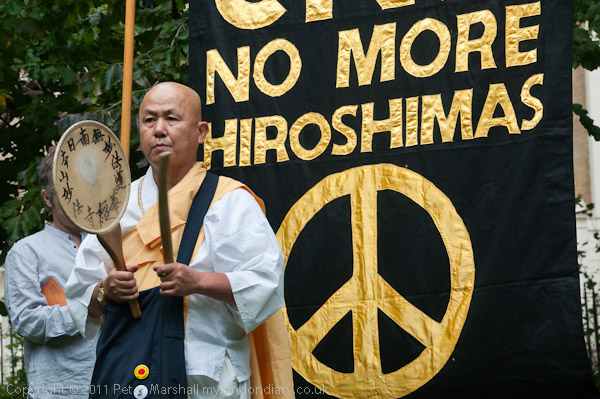
Rev Nagase, Japanese monk from the Battersea Peace Pagoda, 2011

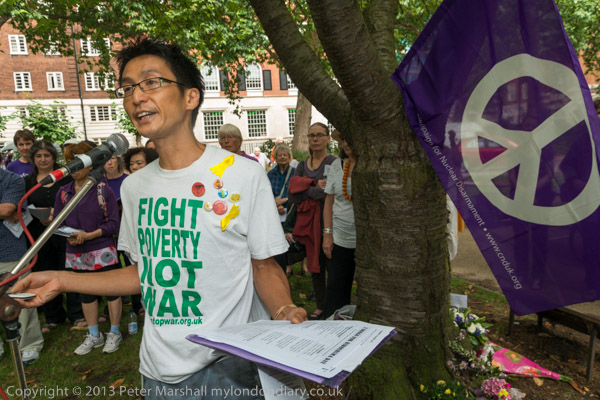
While I was still teaching full-time I was usually away from London in August, often in Paris or on holiday with friends in different parts of England. But since 2004 I’ve usually been in London on August 6th and attended and photographed the annual Hiroshima Day Ceremony organised by London CND close to the Hiroshima Cherry Tree in Tavistock Square. The first year for which I used a digital camera was 2004, when the event was compèred by local MP Jeremy Corbyn and among those attending were Michael Foot and Tony Benn. There was a significant non-attender too, Mordechai Vanunu had been invited to come from Jerusalem where he is under house arrest for having made public Israel’s nuclear weapons, but was prevented from coming by the Israeli government.

Hiroshima Day - 6th August
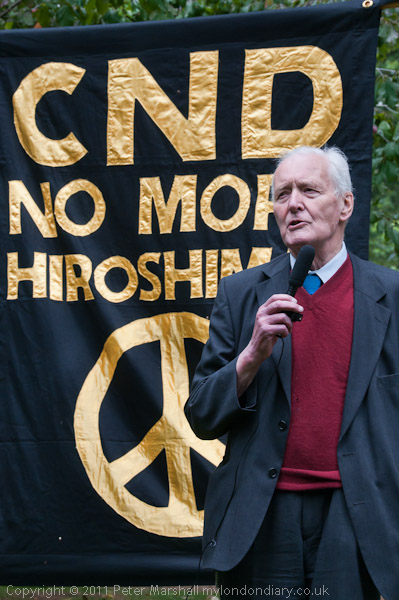
Tony Benn, 2011

Back then I think the processing of digital files left something considerable to be desired, and the images on-line are rather dull, though I think could now be greatly improved if I found time to reprocess the raw files.

Hiroshima Day - 6th August
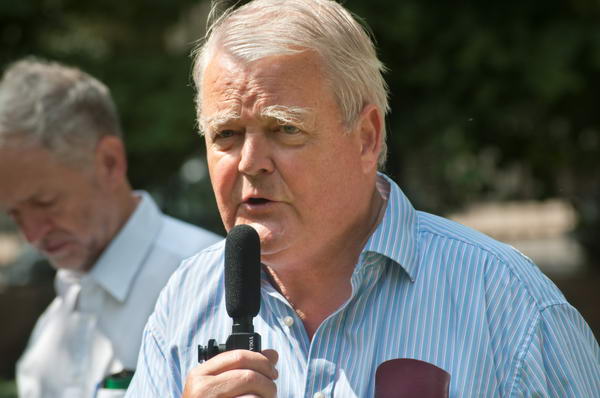
Bruce Kent, 2009

By the time photographed the ceremony in 2009, the pictures looked much better. Jeremy Corbyn was again introducing the speakers, who included CND stalwart Bruce Kent.

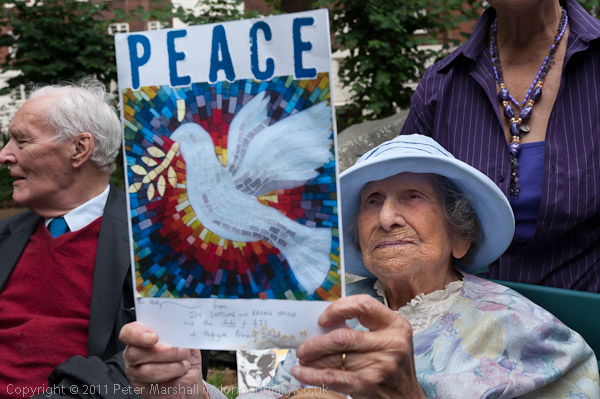
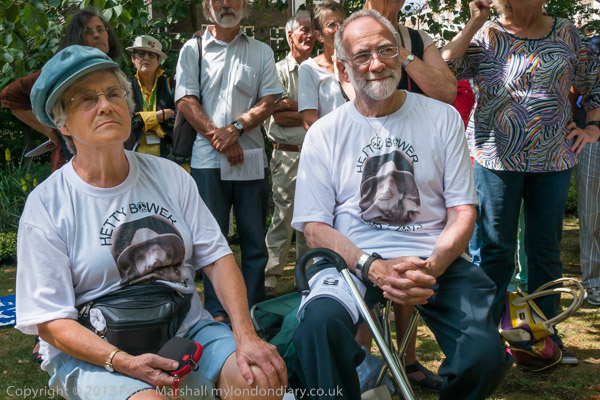
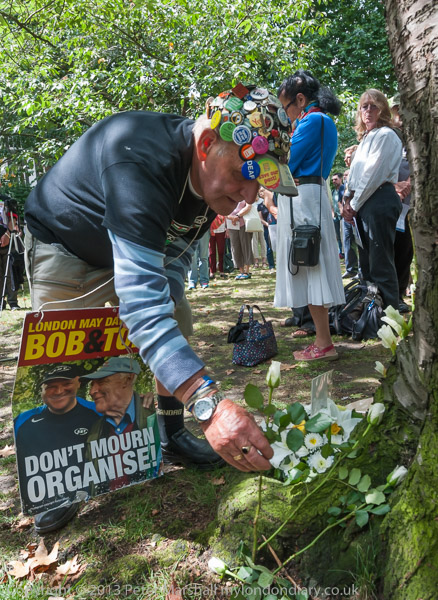
Bruce Kent spoke again in 2011, as did Tony Benn, but the star of the event was Hetty Bower who had begun her campaign against war in 1914 when she was a young schoolgirl, almost nine. Her’s was a remarkably powerful performance from a 105 year old who 97 years later was still taking part in every major UK anti-war march.

Nobo Ono, 2013

Hetty Bower was there again in 2013 and made a short speech. Other speakers included Bruce Kent, Peter Tatchell, Jeremy Corbyn, Walter Wolfgang, amd Green Party Leader Natalie Bennett as well as several peace activists, among them Val Brown from the London Guantanamo Campaign who talked about their work and the regular protests at the US Embassy, and Nobo Ono who spoke about the nuclear disaster at Fukushima and the weekly protests organised by Japanese Against Nuclear UK.

In 2014 my train to London was held up and I arrived after the event began, when a speaker was reminding everyone of the long life as a peace activist of Hetty Bower, and a several of those present were wearing t-shirts with her picture.

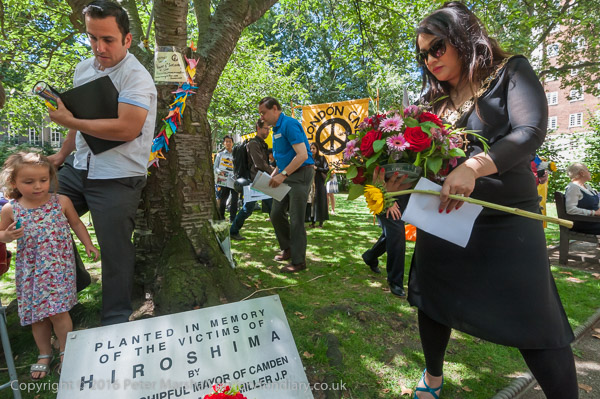
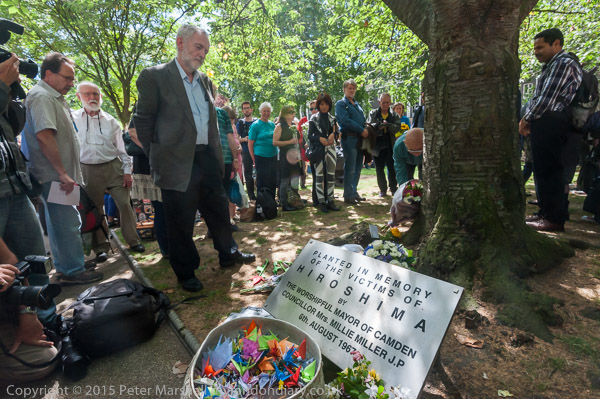
As usual, towards the end of the event there was a period of silence in memory of the dead and wreaths and flowers were laid at the Hioroshima Cherry Tree, planted in the garden here by the then Mayor of Camden in 1967.

In 2015, because of the Labour leadership contest, the event which usually attracts only a small handful of press was attended by several TV crews and a large number of photographers, many of whom more or less ignored anything but Jeremy Corbyn, seen in my picture standing for a few moments in thought after laying a sunflower at the foot of the tree.

Cllr Nadia Shah, Mayor of Camden lays a wreath, at left Anthony Flaum who had sung earlier, 2016

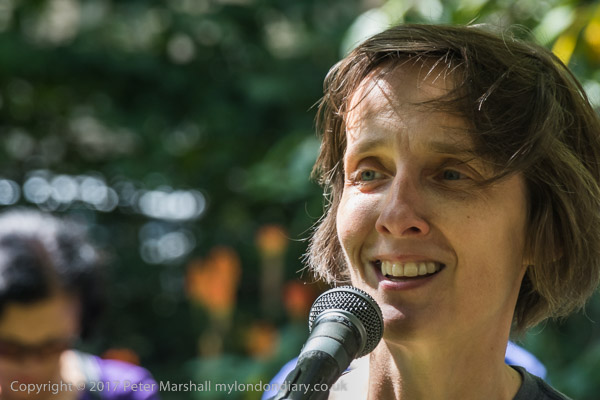
It was back to the usual lack of media interest in 2016, but the event was well attended with a number of familiar faces among the speakers, performers and the audience. Walter Wolfgang and Kate Hudson of CND, Mohammed Kozbar from Finsbury Park Mosque and Shahrar Ali from the Green Party were among those who spoke, and there were fine and very different perfomances from opera singer Anthony Flaum, radical folk singer Jim Radford and rap artist Potent Whisper, as well as the Raised Voices choir who as usual both performed on their own and led those at the event in singing some well-known peace songs.

Among the more memorable speakers in 2017 was writer A L Kennedy – but as usual all were worth listening to.

You can also see pictures and read the accounts from 2018, 2019 and 2021 on My London Diary.

I hope be again in Tavistock Square for today’s London CND Hiroshima commemoration – Saturday 6th August 2022 – starting at noon.


Belsize Park Hampstead 1988

Belsize Park, Hampstead, Camden, 1988 88-7m-02-positive_2400
Belsize Park, Hampstead, Camden, 1988 88-7m-02

Belsize Park Hampstead 1988
Belsize is a confusing area for the casual wanderer and many of the streets have ‘Belsize’ in their name, including Belsize Avenue, Belsize Court, Belsize Crescent, Belsize Gardens, Belsize Grove, Belsize Lane, Belsize Mews, Belsize Park, Belsize Park Gardens, Belsize Place, Belsize Square, and Belsize Terrace.

Belsize Park, Hampstead, Camden, 1988 88-7m-04-positive_2400
Belsize Park, Hampstead, Camden, 1988 88-7m-04

I’m not entirely sure whether my captions place all of the houses that are featured in exactly the correct Belsize street, though I’ve tried hard to get them correct. But many of these streets are lined with very similar houses by the same developer – or rather they fall into two groups, the stucco and the later red-brick.

Belsize Park, Hampstead, Camden, 1988 88-7m-61-positive_2400
Belsize Park, Hampstead, Camden, 1988 88-7m-61

As my previous post Hampstead & Belsize 1988 stated, the older houses in the area from the 1860s which feature in this post were stucco, built by Daniel Tidey who went bust in 1870, when development in the 1870s was largely in red brick by William Willett.

Belsize Square, Hampstead, Camden, 1988 88-7m-63-positive_2400
Belsize Square, Hampstead, Camden, 1988 88-7m-63

I liked the Ladies bicycle parked at the bottom of the stairs, its wheels contrasting with the rectangular columns at the gate and base of the steps. It seemed a suitably old-fashioned steed, with caliper brakes and a wicked basket, held by a rather flimsy looking lock to the rail at the bottom of the steps. It was also a tonal contrast, although actually a rather rusty red colour. I also took a colour picture from an almost identical viewpoint which works well, with the green of the vegetation and some attractive muted colours on some of the doors.

Belsize Square, Hampstead, Camden, 1988 88-7m-65-positive_2400
Belsize Square, Hampstead, Camden, 1988 88-7m-65

The backs of these houses have an unusual rounded bay extending from basement to roof.

Belsize Park, Hampstead, Camden, 1988 88-7m-53-positive_2400
Belsize Park, Hampstead, Camden, 1988 88-7m-53

A grand set of steps up to the front door, now with three bells – most of these large properties have now been converted to flats. The tiles here are breaking up and a small area at right is now filled with flowers. There are bootscrapers at both side, probably rather more necessary in the days of horse-drawn traffic than now.

Belsize Park Gdns, Hampstead, Camden, 1988 88-7m-56

Two different framings of the same profusely growing plant – I think a false castor oil plant – and I can’t decide which I prefer. The leaves were beautifully lustrous dark green.

Belsize Park Gdns, Hampstead, Camden, 1988 88-7m-32-positive_2400
Belsize Park Gdns, Hampstead, Camden, 1988 88-7m-32

It is a beautiful plant, and has flowers and produces black seeds, but unlike the true castor oil plant it vaguely resembles, the seeds of Fatsia japonica are I think not particularly toxic.

Belsize Grove, Hampstead, Camden, 1988 88-7m-33-positive_2400
Belsize Grove, Hampstead, Camden, 1988 88-7m-33

The iron-work on this house is perhaps a little too much for my taste, both over-intricate and somehow too fat looking. I think it may now be rather more hidden by vegetation than when I made this picture around 33 years ago.

This was the last picture I made on this walk, probably as I made my way to Belsize Park Underground station on my way home.


Hampstead & Belsize 1988

Heath St, Hampstead, Camden, 1988 88-7k-26-positive_2400
Heath St, Hampstead, Camden, 1988 88-7k-26

Hampstead & Belsize 1988 These pictures are from the second part of a lengthy walk from Swiss Cottage. They start with a long section through Hampstead and on to Hampstead Heath, in which I took relatively few pictures.

Looking at my contact sheets I can trace my route down Hampstead High St and Rosslyn Hill along Pond St to South End Green and then north to Hampstead Ponds, where I probably sat to eat my sandwiches before taking a look at South Hill Park Gardens, going down Keats Grove past Keats House, then down past St John’s on Downshire Hill and across Rosslyn Hill and along Thurlow Rd to Lyndhurst Terrace and to Lyndhurst Rd.

But although there is nothing wrong with the pictures I took on that eaction of the walk, none of them excited my attention enough for me to mark them up for digitisation and putting them on-line – and the sequence of over 20 frames is one of the longest gaps in making my on-line albums. Perhaps I should add a few more to the album.

Lyndhurst Rd, Eldon Grove, Hampstead, Camden, 1988 88-7l-44-positive_2400
Lyndhurst Rd, Eldon Grove, Hampstead, Camden, 1988 88-7l-44

This unusual building on the corner of Lyndhurst Road and Eldon Grove has its own street name, Tower Close. There appear to be five properties here, each valued at between £2.4m and £3.69m. I think it was probably fairly recently built when I photographed it in 1988 and I found it both unusual and unusually ugly; my picture is far too kind.

Girl Guides, Girl Scouts, World Centre,  Lyndhurst Rd, Hampstead, Camden, 1988 88-7l-46
Girl Guides, Girl Scouts, World Centre, Lyndhurst Rd, Hampstead, Camden, 1988 88-7l-46

Olave House moved here in 1984. Previously the building had been Rosslyn Lodge, once home to the Earl of Rosslyn, and was converted into offices for the Girl Guides. The west wing of the house had been demolished and a new building at the west of the site was opened as a Guide hostel and conference centre, Pax Lodge, in 1991.

Rosslyn Lodge, a small villa, according to the Victoria County History, “was rebuilt, probably between 1799 and 1802, and was described in 1808 as new, with four bedrooms, a double coach house, and gardener’s house.” In the First World War was loaned by its owner to became the Rosslyn Lodge Auxiliary Military Hospital, which closed in 1919. Later it became a nurses home.

Hunters Lodge, Belsize Lane, Hampstead, Camden, 1988 88-7l-33-positive_2400
Hunters Lodge, Belsize Lane, Hampstead, Camden, 1988 88-7l-33

The Grade II listing text describes this tersely as “Detached cottage ornee. c1810. By Joseph Parkinson. For William Tate. Stucco.” though it goes on to give rather more detail.

It concludes with a historical note from the Camden History Society “William Tate, merchant, was a lessee of the Baltic merchant George Todd who acquired a large piece of Belsize Park in 1808. Parkinson exhibited the designs for Langwathby, as it was then known, at the Royal Academy in 1810.” Langwathby is a small village in Cumbria on the River Eden around 5 miles north east of Penrith, and was probably the birthplace of William Tate.

Belsize Crescent, Hampstead, Camden, 1988 88-7l-22-positive_2400
Belsize Crescent, Hampstead, Camden, 1988 88-7l-22

Belsize Crescent according again to the Victoria County History, was constructed as Prince Consort Road in 1865 and was sublet by Daniel Tidey to another builder, William Willett in 1869. Before Tidey went bust in 1870 he had built over 250 houses in Belsize Park. After 1870 Willett was the main builder in the area, building houses in Belsize Avenue, Lyndhurst Gardens and Wedderburn Road.

Belsize Crescent, Hampstead, Camden, 1988 88-7l-23-positive_2400
Belsize Crescent, Hampstead, Camden, 1988 88-7l-23

Tidey had built houses in Italianate stucco, but Willett’s were in red brick, and again according to the VCH “were solidly constructed and set a new artistic standard for speculative architecture… they were red-brick and varied in design, many of them by the Willetts’ own architects Harry B. Measures and, after 1891, Amos Faulkner.”

Belsize Lane, Hampstead, Camden, 1988 88-7l-26-positive_2400
Belsize Lane, Hampstead, Camden, 1988 88-7l-26

William Willett’s son, also William Willett and like his father a builder, is the man you have to thank or curse for ‘Summer Time’ introduced by the Summer Time Act 1916. It had been suggested by others many years before but it was thanks to his campaigning it became law the year following his death.

Probably he wanted to get more hours of work out his builders at a time when building work was reliant on daylight with little or no artificial lighting. Fortunately we got a simpler version than his earlier proposal which would have seen us moving the clocks on four Sundays in both April and October by 20 minute steps – giving a total of 80 minutes change and doubtless massive confusion.

My walk will continue in a later post.


Click on any of the images above and you will be taken to a larger version in my album 1988 London Pictures from where you can browse the album.


Around Swiss Cottage 1988

Sigmund Freud, sculpture, Oscar Nemon, Swiss Cottage Library, South Hampstead, Camden, 1988 88-7h-61-positive_2400
Sigmund Freud, sculpture, Oscar Nemon, Fitzjohn’s Avenue, Belsize Lane, South Hampstead, Camden, 1988 88-7h-61

Around Swiss Cottage 1988: Sigmund Freud (1856–1939) escaped from Austria after it was annexed by Nazi Germany and came to London, spending his final year until his death in the house in Maresfield Gardens which now houses the Freud Museum. Croatian sculptor Oscar Nemon made three busts of Freud for his 75th birthday in 1931 and visited him in London in 1938 to make a final bust on which the head of this sculpture was based. Funds were later raised for him to create this bronze sculpture which was unveiled in 1970 next to Swiss Cottage Library where I photographed it.

In 1998 it was moved to a more prominent position at the junction of Fitzjohn’s Avenue and Belsize Lane and it was Grade II listed in 2016.

Taplow, Winchester Rd, Swiss Cottage, Camden, 1988 88-7h-63-positive_2400
Taplow, Winchester Rd, Swiss Cottage, Camden, 1988 88-7h-63

The five tower blocks of the Chalcots Estate where built for the London Borough of Camden in 1967-8. Taplow, Burnham, Bray, and Dorney are 23 storeys while Blashford has 19. The land was owned by Eton College and the names come for the area around Eton.

Cladding was added to the towers in 2006 by the same companies that clad Grenfell Tower but using fire-resistant rock-wool. When a fire broke out in a flat in Taplow in 2012 the fire was contained and did not spread and there were no deaths.

Embassy Theatre, Eton Avenue, Swiss Cottage, Camden, London, 1988 88-7k-61-positive_2400
Embassy Theatre, Eton Avenue, Swiss Cottage, Camden, London, 1988 88-7k-61

Originally a stucco double-fronted Italianate Victorian villa, it was converted in 1890 into the Eton Avenue Hall for the Hampstead Conservatoire, a prestigious private music college; Cecil Sharp the great collector of English folk song was its principal from 1896-1905 and composer Arnold Bax one of his pupils.

The building was converted again after the college had closed and opened as the Embassy Theatre in 1928, with a school of acting from 1932. Damaged in the war it reopened in 1945, continuing as a theatre until 1956 when it was sold to the Royal Central School of Speech and Drama, now a college of London University.

College Crescent, South Hamnpstead,  Camden, 1988 88-7k-63-positive_2400
College Crescent, South Hampstead, Camden, 1988 88-7k-63

College Crescent was built by the Eyre family who were (and are) major landowners in Swiss Cottage and parts of Hampstead, with the first houses built in the late 1840s. Initially it was named as three streets, College Villas Road, College Terrace and College Crescent.

40 College Crescent was not one of the original houses, but was built around 1880 on the site of Abbey Farm Lodge as the family home for Samuel Palmer or Huntley and Palmer’s biscuit firm in Reading. Following his death this area of open space with a drinking fountain and shelter – as its inscription states – “presented to the Borough of Hampstead for the public benefit in memory of the late Samuel Palmer of Northcourt, Hampstead by his widow and family. 1904”. It was Grade II listed in 1993.

St. Thomas More, Roman Catholic, Church, Maresfield Gardens, Hampstead, Camden, 1988 88-7k-64-positive_2400
St. Thomas More, Roman Catholic, Church, Maresfield Gardens, Hampstead, Camden, 1988 88-7k-64

In 1938 the Archbishop of Westminster bought Hyme House at 3 Fitzjohn’s Avenue, for some years the studio of successful society portrait painter Philip de László (1869-1937) as the first English home for the Swiss-based Sisters of Mercy of the Holy Cross. The Sisters converted the studio into a church and bought the next two houses on the street to set up a girls school which they ran until 1985, after which it became a hotel.

In 1950 the studio had become too small and a second church was built on the site, but further expansion made this inadequate. The current church, built a restricted site on tennis courts at the back of the house and fronting onto Maresfield Gardens was designed by Gerard Goalen following the Second Vatican Council to maximise participation of the laity in the Mass. It was Grade II listed in 2016.

Netherhall Gardnes, Hampstead, Camden, 1988 88-7k-42-positive_2400
Netherhall Gardens, Hampstead, Camden, 1988 88-7k-42

A very rectangular house with a gate made largely of circles, but with the ironwork on the top of the gate reflecting the only non-rectangular feature of the frontage, and carefully positioned on top of it.

The Tower, Fitzjohn's Ave, Hampstead, Camden, 1988 88-7k-46-positive_2400
The Tower, Fitzjohn’s Ave, Hampstead, Camden, 1988 88-7k-46

An irresistable Gothic fantasy. Development in this area had been prevented for years after the death of the estate owner Sir Thomas Maryon Wilson in 1821, whose will prevented his sons building on the land, and efforts by his son (confusingly of exactly the same name) to get the will amended came to nothing. When he died, his brother Sir John inherited and was able to make a deal making part of the estate a part of Hampstead Heath and making development possible in other areas.

The Tower, Fitzjohn's Ave, Hampstead, Camden, 1988 88-7k-32-positive_2400
The Tower, Fitzjohn’s Ave, Hampstead, Camden, 1988 88-7k-32

Sir John divided the estate in 1873 with his son Sir Spencer Maryon Wilson who developed Priory Road and Fitzjohn’s Avenue from 1875 on, as a wide road with wide pavements linking Swiss Cottage and Hampstead which was described by Harpers Magazine a few years later as “one of the noblest streets in the world”.

The Tower, Fitzjohn's Ave, Hampstead, Camden, 1988 88-7k-33-positive_2400
The Tower, Fitzjohn’s Ave, Hampstead, Camden, 1988 88-7k-33

A much quoted Camden History Society article describes the Tower at No 25 as an ornate mansion which is now “a fine example of ‘Disneyland Gothic'”. The building with 25 rooms dates from 1880-1, its architect JT Wimperis, a very prolific Victorian architect for Herbert Fleming Baxter (1839-1905), an extremely wealthy American merchant who was a part of a family with extensive estates in Shropshire. The house has been restored and is now divided into flats. Rather surprisingly it was not Grade II listed until 1999.

My walk will continue in a later post.


Click on any of the pictures to go to a larger version in the album 1988 London Photos, from where you can browse through the album.


Nelson Mandela’s Birthday

Back in 1988 on the 17th July, the day before Nelson Mandela’s Birthday on the 18th July, I joined thousands of marchers through London demanding he be freed from jail.

Free Nelson Mandela - Birthday March and Rally - London 1988 88-7h-66

https://en.wikipedia.org/wiki/Nelson_Mandela Mandela was born on 18th July 1918, so this was his 70th birthday and he was still in jail, then held in Pollsmoor Prison, near Cape Town, having been removed with other senior ANC members from Robben Island to remove their influence on younger ANC members held there.

Free Nelson Mandela - Birthday March and Rally - London 1988 88-7h-55

He was well treated in Pollsmoor and international attempts to end apartheid was increasing, along with secret meetings with the South African Minister of Justice. President Botha had actually offered to release him, if he “unconditionally rejected violence as a political weapon”, but Mandela had refused to leave while the African National Congress was still banned.

Free Nelson Mandela - Birthday March and Rally - London 1988 88-7h-31

Mandela’s 70th birthday was celebrated around the world, with a televised tribute concert at Wembley Stadium attracting an estimated 200 million viewers.

Free Nelson Mandela - Birthday March and Rally - London 1988 88-7j-65

The march in London was a large one, and I wasn’t then a seasoned photographer of protests, though I had taken pictures at a number of smaller events.

Free Nelson Mandela - Birthday March and Rally - London 1988 88-7h-34

Because of the size of the event there were a number of feeder marches leading to a rally in Hyde Park. I joined the march coming from Camden and went with it to the rally, where I took some pictures in the crowd but didn’t attempt to cover the speakers, who included the Archbishop of Cape Town, Desmond Tutu.

Free Nelson Mandela - Birthday March and Rally - London 1988 88-7i-43

I took altogether only just over a hundred black and white pictures, of which I’ve now uploaded around a quarter to an album, Free Nelson Mandela – March and Rally – London 1988. You can also click on any of the images in this post to go to a larger version from where you can browse all the pictures that are online.