A black woman and a gorilla

Photographers have often I think failed to pay sufficient regard to the people in their photographs. Its something that is particularly important because of the power differential that always exists between the person holding the camera and those being depicted. Its something implicit in the language of photography, when we use the metaphors of the gun or jailer, talking about ‘shooting’ or ‘capturing’ pictures, both terms I try hard to avoid. And particularly important where our work involved people of a different class or race.

It is a question that worried me greatly in my early years as a photographer, and explains why I made relatively few pictures of people in those years, outside my own circles of family, friends and communities, concentrating on the built environment. And it was why, though I had admired his earlier black and white work greatly, I felt considerable disquiet about the colour images of working class families holidaying on beaches which turned Martin Parr from a photographers’ photographer into a celebrity. They seemed the work of an intruder while previously he had worked within communities.

The years have somewhat mellowed my view of this work, and Parr has of course gone on to do so much more, including turning his camera on his own middle class, but I still find those pictures marred by class prejudice and I think that this was at least in part what led to their popularity in the media. But of course we have seen far worse by other photographers here and around the world, and Parr is in many ways one of the good guys of photography, through the foundation he set up to encourage young and emerging photographers from all backgrounds and one whose advice encouraged me on several occasions in my early years in photography.

I wasn’t until very recently aware of the work of Italian photographer Gian Butturini and his 1969 book on London, reissued in 2017 with the text ‘Edited by Martin Parr‘ on the cover. It’s the kind of European approach popular at the time when I first began as a photographer and which I set out in total opposition to in terms of its graphic nature and quest for instant impact rather than a more serious consideration of the subject. I’ve not seen the book, only those images I’ve seen on line, and not seen the particular pairing of images of a black woman and a gorilla at London Zoo a which so shocked student Mercedes Baptiste Halliday when she was given the book as a present that she began her 18-month campaign against the book which she says is “appallingly racist.”

Parr has now said he was ashamed of his association with the book and that he deeply regrets his failure to appreciate its racist implications, something Halliday points out is hard to understand from a visually literate person. Parr also points out that the claim on the cover that he edited the book is incorrect as it he only supplied an introduction to what is otherwise a facsimile of the photographer’s 1969 book. He has also said he will donate the fee he received to charity and has called for the book to be removed from sale and destroyed. It is no longer listed on the Damiani Editions web site.

The book and Parr have come into the news as the campaign has led to both the public apology from Parr and his decision to stand down as the artistic director of the first Bristol Photo Festival. But last year’s protests by Halliday outside Parr’s show at the National Portrait Gallery were brushed aside and ignored by the photographic establishment. Perhaps it was the decision by the photography students from the University of the West of England to cancel their end-of-year show at the Martin Parr Foundation in Bristol that precipitated Parr’s decision.

One supporter of Halliday has been Benjamin Chesterton, known to many in photography and film for his ‘duckrabbit’ blog which I’ve mentioned here on several occasions. Last month he made a post which looked critically at his own family’s history, ‘Our skin in the slave trade. Uncle Sir John Moore and I.‘ which – as ever – is well worth reading. The Guardian quotes him in its article about Parr and the Butturini case as making the very salient point, “The question remains why is it down to a black teenager to confront one of the UK’s leading photographers and curators?”
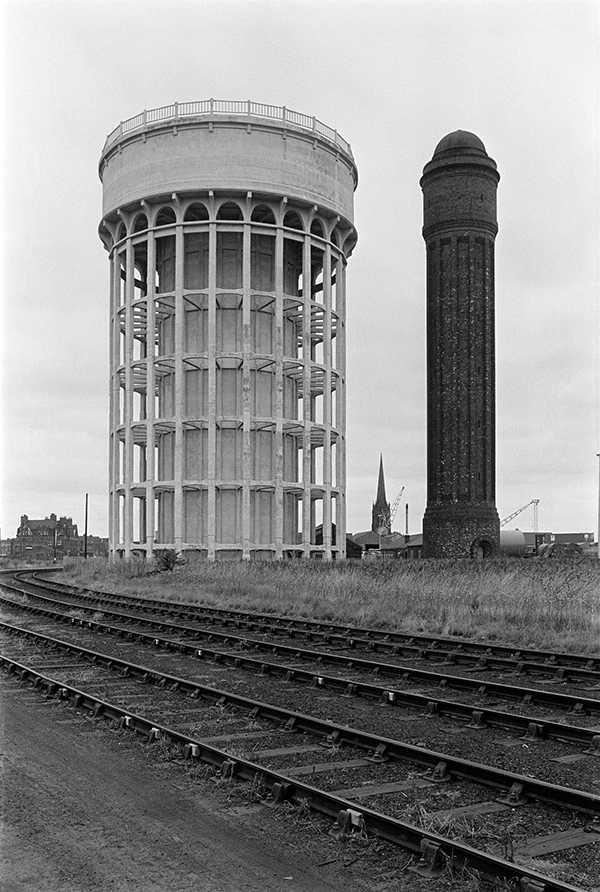
Goole 1983

When I told my mother-in-law, a life-long Hull resident, that I was taking a day trip to photograph Goole she shook her head in disbelief, asking me whyever I would want to do that. She wasn’t a great fan of my pictures of Hull either, thinking I dwelt far too much on its less salubrious areas and on those old and dilapidated warehouses and derelict docks.

Goole 83goole168_2400

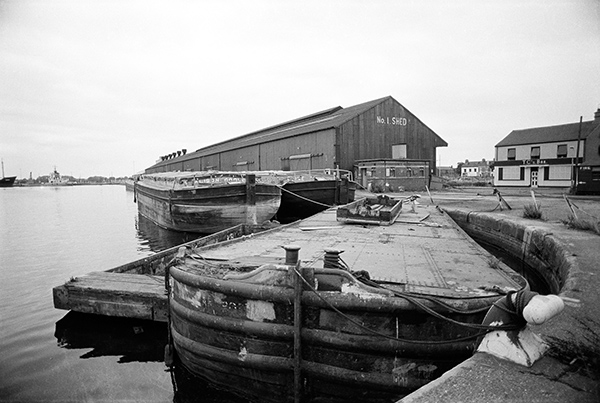
My only regret looking back is that I didn’t visit Goole more often. True its name isn’t inspiring – but then neither is Hull, perhaps why its more prosperous residents like to remind you it is really called Kingston upon Hull. For some reason the name Goole on Ouse has never been considered, though perhaps it should be Goole upon Dutch River or Don, which was diverted to meet the Ouse here in 1629 by Cornelius Vermuyden, not for the benefit of the few villagers of Goole, but to improve the hunting at Hatfield Chase for King Charlea I. But Goole got a bridge over the new river and barges could carry coal along it from the South Yorkshire coalfield at it could then be transferred to sea-going vessels.

Goole  83goole148_2400

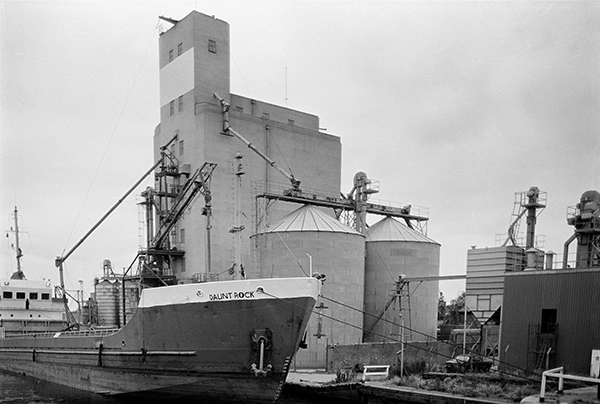
In the 1820s the Aire and Calder Navigation opened a connection to the Dutch River and began the construction of docks and a new town at Goole. The canal opened in 1826 and in 1827 Goole became an official port with custom facilities, its docks able to handle vessels up to 400 tons. It’s main export remained coal until Thatcher closed the mines, with a system of compartment boats – the ‘Tom Puddings’ and special hoists giving a very efficient means to transfer the coal into seagoing ships. Timber was the main import, in part for use as pit props.

Goole 83goole161_2400

Railways first came to Goole in 1848 with a line to Pontefract and Wakefield, but it after the North Eastern Railway line from Doncaster to Hull was built in 1870 that the railway really became important. It was this route from Doncaster that I travelled on many times from and to the south between 1970 and now through Goole; sometimes the train stopped there, but more often travelled through at a leisurely pace, giving time to appreciate its landmark ‘salt an pepper’ water towers before swinging east to cross the River Ouse. But I never got off there until my first day trip in 1983.

The Victorian ‘New Goole’ seemed to have survived reasonably well, and gave a remarkable access to the docks (in those days they were a little less fettered by health and safety), and I spent a full day wandering around and taking pictures, particularly in black and white, but with some in colour too. I’ve returned more recently and it is still an interesting place to visit, though a little less so.

More colour pictures of Goole on Page 3 of Hull Colour 1972-85.

More black and white pictures on Hull Photos.

Hull Colour – 9

Time for the last post on my series of colour pictures from Hull in my Flickr album which covers the period up to 1985. I didn’t stop photographing Hull then, but I did stop using slide film around the middle of that year, and some of the pictures in the album from 1985 were made using colour negative film. Although this made it easier to get good prints and allowed me to work with a wider range of subjects, it does make the images harder to digitise. I’ll write more about this at a later date. The first few images here are from slides and later ones from negatives.

Barge moored in River Hull, Hull 83-Hull-1-2-Edit_2400
Barge moored in River Hull, Hull 1983

As well as the colour I was attracted by the seemingly random numbers on the building and the ordered line of them on the prow of the barge, indicating the draught – the distance from the waterline to the lowest part of the hull. This barge, R38, is more or less empty and I think floating, its draught below the lowest mark of 4 (I think in feet), but when fully loaded would be at 9 or a little above. The slide mount crops the image rather more than I intended when making this picture.

83-Hull-8-Edit_2400
Factory, River Hull, 1983

There are new industries on land adjoining the River Hull, particularly on the northern outskirts of the city, around Stockholm Rd, Malmo Rd and Bergen Way, names reflecting the traditional trade, still continuing across the North Sea into the port of Hull. I think this picture was probably made just to the north of Sutton Road bridge.

For me the bank of reeds expressed that these new industries have turned their backs to the river, while traditionally Hull’s industries had been on wharves and dependent on the River Hull for the transport in of raw materials – whale oil, agricultural products and later petroleum products and sometimes the export of bulk products such as edible oils. Now everything moves by lorry.

Lee Shore, River Hull, Hull 83hull159_2400

It is just possible still to recognise this as the view looking upstream from Chapman St Bridge, as the low sheds at left are still standing (or at least were in 2019) but I think most of the rest of the buildings in this view have disappeared and ships such as the Lee Shore and the other vessel upstream on the left bank no longer moor here.

The cocoa works on the right bank was razed to the ground around 10 years ago, and is now Energy Works, a renewable energy site built with the aid of a grant of almost £20 million from the European Regional Development Fund which will power 43,000 homes from waste and develop innovative technologies together with the University of Hull.

S Low, Laundry, Spring Bank, Hull 85-10c1-43_2400

S Low’s laundry had long amused me as I regularly travelled along Spring Bank either on foot or more often on the top deck of a Hull Corporation Bus, and I photographed it a number of times. This was the first I had taken on colour negative film and I’m not sure that the colour is as accurate as on the two different versions on slide film you can also see in the album.

This building is still there on Spring Bank, now painted very drably grey and no longer a shop.

Blanket Row, Hull 85-10c3-61_2400
Humber Dock Side/Blanket Row, Hull 1985

I apologise for the green cast in this image which I should really correct, but it is perhaps appropriate given that this location, now the Humber Dock Bar and Grill overlooking the marina, describes itself as “Formerly the Green Bricks”.

The picture shows that before becoming a pub and restaurant the area was home to Charles Batte and the Kingston Fruit Co and along the street a number of other businesses, and the green glazed bricks of the pub, opened in 1806 as the New Dock Tavern and around 1838 renamed as the Humber Dock Tavern, taller than the rest of the row, are only just visible above the parked blue van. The green bricks by the Leeds Fireclay Co. Ltd probably date from 1907 and the pub was locally listed in 2006.

This was the final picture from Hull in the album Hull Colour 1972-85 (though I may add more later) which ends with some pictures from Goole.


All photographs on this and my other sites, unless otherwise stated, are taken by and copyright of Peter Marshall, and are available for reproduction or can be bought as prints.


The Power of Photography

One series of pictures posted through the current lockdown that has often interested or amused me is by Peter Fetterman; in ‘The Power of Photography‘. To see them all in the order he posted them, open the page and scroll down to the very bottom to see the first image, ‘The Wailing Wall, Jerusalem, C. 1860′.

But before you scroll, read his introduction at the top of the page which I reproduce here:

Dear Friends,

I am pleased to introduce a new online series called the Power of Photography, highlighting hope, peace, and love in the world. With every entry, I’ll share personal reflections on my favorite images. I invite you to enjoy and reflect on these works during this time.

Peace & Love,

Peter Fetterman

The Power of Photography

Clicking on each of the images will give you more details about it – in this case that it is by an anonymous photographer and is a 9.75×9.75 inch vintage albumen print – and rather curiously is “Copyright The Artist” who as well as being anonymous is certainly long dead and whose copyright will have expired many years ago.

The negative from which it was printed will I think have been made using the wet plate process, which while it had considerable limitations and required a great deal of manipulative skill was in some respects the absolute pinnacle of the photographic process, with detail and resolution limited only by the lenses of the day. You can enlarge the on-screen image by clicking on it, but it then seems rather soft. Since all printing was by contact, the demand on lenses was not extreme, though you can clearly see some softening towards the edges in this and many images of the time. The print appears to be in excellent condition for its age, though there is clearly some fading at top right, but digital representations are often misleading.

Actually I think the images like this are best seen in reproduction, when some discrete retouching can help to repair the minor ravages of time and restore as best we can the original vision of the photographer, which is of more interest to me than the object.

Strangely the second image of the series seems to be missing, though you will probably have little difficulty in bringing “The Steerage” into your mind. There are other iconic images too, such as Cartier-Bresson’s 1938 ‘On the Banks of the Marne’.

But not all of the pictures are well-known and quite a few entirely new to me and by photographers I have not previously heard of, such as the beautiful Small Apples, 1984 by Finnish photographer Kristoffer Albrecht.

I don’t always share Peter Fetterman’s enthusiasms, but it is good to read the comments of someone so obviously enthusiastic about our medium – and to discover we have at least something in common outside of our interest in photography. So here is a little piece of London he may recognise.

Dobells, Records, Tower Court, Camden, 1987 87-2d-63-positive_2400
Dobell’s Records, Tower Court, Camden, London 1987

All photographs on this and my other sites, unless otherwise stated, are taken by and copyright of Peter Marshall, and are available for reproduction or can be bought as prints.


Lockdown, Legend and Value

I have to admit that during the lockdown I have become very much centred around my own work and interests. Not feeling able to get out an meet other people and not being able to travel to my favourite areas have cut me off not just physically but also mentally from much of my outside involvements.

Because of my age and medical condition I don’t yet feel able to re-engage with the world in anything like the old ways, though I have made three short trips on public transport and visited when necessary several shops, of course suitably masked. And I am still in daily contact with many friends on Facebook as well as rather fewer through phone calls and online events,

But I still feel very withdrawn from many areas, and in particular from the world of photography. With very few exceptions I just can’t get interested in the various lockdown projects and online magazines and shows that have sprung onto the web. This morning I realised that it’s almost three weeks since I last went through the long list of web sites and blogs, many photographic, that I usually skim through every few days for items of interest or controversy and that in the past have often led me to express my thoughts on this blog.

It took quite a while to skim through hundreds if not thousands of articles and posts, though for most a quick glimpse or even the headline was enough for me to move on. There were just a few that interested me enough to stop and read more, and just a few to the very end. Military historian Charles Herrick in a 3 part post on A D Coleman’s Photocritic International comprehensively demolishes another of the confabulations about D-Day photographs, the legend of the duffel bag full of film from the beaches being dropped and lost at sea during transfer to a ship. As usual there are also other posts on the site of interest.

Joerg Colberg too almost always has something worth reading, and in normal times I would probably have wanted to add my pennyworth to his piece The Print, the book, the screen. I can’t bring my mind to it, but here is one sentence which might encourage you to read and think about it and the value of any photograph:

“In the world of photography, the value is almost entirely based on commerce and on a generally unspoken and widely shared sense of elitism.”

As someone who has never been a part of that elite I can only agree, though I think there are other communities outside that of commercial art dealers and the associated museums of the art photography world that value photographs. But as Colberg makes clear, he is focusing on art photography ‘When you see the word “photography”, you will always want to add “art” in front of it.’

Perhaps it isn’t surprising that there were so many of the other photographs and articles I looked at briefly and felt entirely superfluous; ephemeral, inconsequential and with little to say.

But one particular feature from the British Journal of Photography, published around a week ago did attract me, Marigold Warner‘s article ‘Hackney in the 80s: Recovering a forgotten archive of working-class life’ about the 2016 rediscover in the basement of the Rio Cinema in Dalston, established as a community non-profit arts centre in 1979, which in 1982 set up a radical photography project for local unemployed people, teaching them to use a camera and sending them out to photograph the local communities. Their pictures were put together as newsreels and screened as a part of the cinema programmes, before the commercial ads.

Unfortunately the Kickstarter fund-raising for the production of a book of these pictures finished on the same day as the BJP published the story, but by then over £32,000 had been donated to finance it and it will appear in November – you can pre-order ‘The Rio Cinema Archive‘ now from Isola Press for £25.

It seems good value; in my scale of things, the value of these pictures is rather greater than at least most of what sells for high prices in expensive galleries.

All photographs on this and my other sites, unless otherwise stated, are taken by and copyright of Peter Marshall, and are available for reproduction or can be bought as prints.


Hull Colour – 8

Barges in River Hull, Stoneferry, Hull 81-04-Hull-051_2400

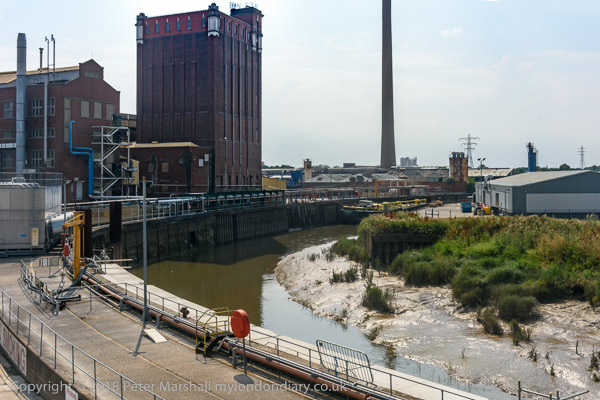
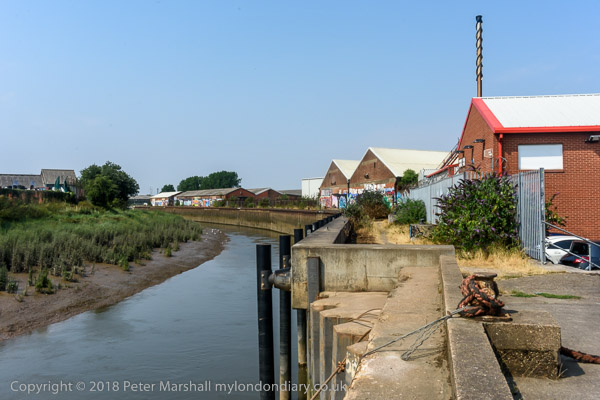
More barges on the River Hull, moored around the bend just north of the Isis Oil Mills. Here’s that same bend in 2018:

All of the barges are in the green and yellow colour scheme of Hull’s Gillyott and Scott, formed in 1964 by amalgamation of the five companies of William Gilyott, John A. Scott, T.F. Wood, Furleys and John Deheer.

Some of the barges had the names of birds – such as No 129 Ring Plover at the centre of the group above. Others had to make do with just a simple number or a letter and number such as R50 here. Perhaps it depended on which company they had come from.

Warehouse, River Hull, 83-01-Hull-061_2400
Warehouse, River Hull, 1983

This warehouse on the bank of the River Hull had its frontage on High St, immediately upstream from Drypool Bridge. The narrow passage of Blaides Staithe separates it from Blaydes House, the rear of which can be seen at the right of the picture.

Not long after I photographed it, the warehouse was demolished, its site remaining undeveloped when I last visited it 35 years later, though then said to be ‘Under Offer’. In London it would almost certainly have been preserved, probably listed and converted into luxury flats, but Hull’s low property prices signed its death warrant.

Kenfig, dredger, River Hull, Hull 83-01-Hull-062_2400
Kenfig, dredger, River Hull, 1983

I took quite a few photographs of the Kenfig, which seemed to be moored and quietly rusting in the River Hull for several years, though I think it had previously been responsible for some of the dredging of Humber Dock for the new marina.

I wrote the following when I was commenting daily on a picture of Hull during the 2017 year as City of Culture:

The Kenfig, a grab hopper dredger built in 1954 by Henry Scarr Ltd of Hessle for the British Transport Docks Board at Port Talbot. It was one of the dredgers used to clear the passage into Humber Dock for the Marina, and in 1983 was bought by Jones & Bailey Contractors Ltd of Hull who renamed her Hedon Sand in 1984. Around 5 years later she was scrapped at New Holland.

Kenfig was moored just a little upstream of Drypool Bridge on the River Hull for most of the 1980s, seldom if ever moving.

Hook Sand, Dry Dock, Hull 83-01-Hull-067_2400

There are still several dry docks on the lower part of the River Hull, though I think none currently in use, with one scheduled in 2023 to be the centre of a new maritime museum, where it will house Hull’s last sidewinder trawler the Arctic Corsair.

This one is on the opposite side of the river, north of Drypool Bridge and my picture is taken from its road entrance on Great Union St.

The Old Harbour, River Hull, evening. 83-01-Hull-077_2400
The Old Harbour, River Hull, evening. 1983

My apologies for the poor technical quality of this image, which reflects the difference between colour films and the quality we now get from digital images. I think this was probably taken on an ISO400 colour film, while with my current digital camera I would happily work at ISO6400 and get considerably superior results. Photographers will understand this is a difference of five stops. I couldn’t use a very slow shutter speed as the small tanker was moving up river at some speed with the tide.

The view here is looking towards the mouth of the River Hull. The sand and gravel works have now gone and there is a rather ugly hotel on that side of the river. Further down, past the Myton Bridge, built in 1979 and the tidal barrier, the land at Sammy’s Point is now occupied by The Deep.

More pictures at Hull Colour 1972-85 on Flickr.


All photographs on this and my other sites, unless otherwise stated, are taken by and copyright of Peter Marshall, and are available for reproduction or can be bought as prints.


Hull Colour – 7

Lighthouse, Paull 81-04-Hull-043_2400

I think that Paull was one of the places we may have walked to during one of our stays in Hull, taking a bus to somewhere outside the city to a suitable starting point. There were a couple of time I hired a car, but I think only to go for holiday weeks elsewhere in Yorkshire. The last time I hired one I managed to drive it off the road into a ploughed field at some speed somewhere near Meaux (which despite the name is on the outskirts of Hull) and decided the time had come for me to give up driving.

Strangely given that back in 1965 when I first visited Hull was a city full of bicycles it was over 35 years before I ever cycled around the city. And when I did in 2003, I visited Paull for a second time, though actually riding there from Hornsea.

Paull is a riverside village on the north bank of the Humber a few miles south-east of Hull, just beyond Hedon Haven. Neither Paull nor Hedon grew as ports because sandbanks in the Humber made them unsuitable for larger ships, while a deepwater channel led towards the mouth of the River Hull.

Navigation in and out of Hull was tricky, and in 1836 Trinity House built the lighthouse at Paull for ships leaving Hull to steer towards, before picking up other lights on the south side of the estuary. Unfortunately the channel soon moved and by around 1870 this lighthouse was obsolete and was replaced by two ‘leading lights’ a little further downstream at Thorngumbald Clough.

This extensive Grade II listed property was offered for sale in 2013 for £169,950 though it is unclear if it was sold and a rather lower bid was considered. For those of us used to London prices it seems excessively cheap.

Mouth of River Hull, RIver Humber 81-04-Hull-044_2400

This picture amused me after photographing the Humber Bridge and I think I captioned it at the time as “Not the Humber Bridge” . The view is actually of both the River Hull, coming in from the left and the Humber across the top of the image, and the spit of mud and sand is Sammy’s Point, where Hull’s major tourist attraction, ‘The Deep’ now stands, a little back from the point here.

This was a short gangway leading out to a iron-sheathed concrete dolphin at the mouth of the River Hull from the end of Nelson St. The dolphin, designed as a temporary mooring in deep water for vessels waiting for the tide to go up the River Hull (and perhaps to protect the bank from vessels off course) is still there, but the promenade has been rebuilt to stretch to the dolphin, and a footpath now leads north from it beside the Hull.

Alley in Old Town, Hull 81-04-Hull-050_2400
Alley in Old Town, Hull 1981

I can’t remember precisely where this was, but the view through it is to the wholesale fruit and vegetable traders, probably on Humber St, though possibly on Wellington St. I think this may have been an alley leading from Blanket Row, but the area has changed too much for me to now be sure.

Clearly I was attracted by both the atmosphere of the alley leading to the street and by the colour, particularly the three areas of blue against the muted yellows. Blue mixed with yellow in my paintbox to make greens and green is the only other colour in this image.

Barge R57 moored at wharf north of Ferry Lane, Hull 81-04-Hull-052_2400
Barge R57 moored at wharf north of Ferry Lane, Hull 1981

The last time I was in Hull I sat eating a lunchtime snack beside the River Hull here, though the scene had changed a little.

There was actually a barge moored a little downstream, though looking rather derelict, but I was surprised to find that there were still a couple of buildings from the earlier image remaining.

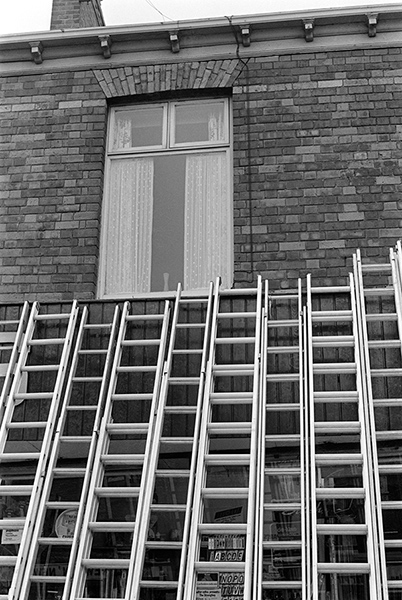
East Hull Ladder Works, Hull 81hull81003_2400
East Hull Ladder Works, Hull 1981

I don’t know the name of the dog or the name of the street where the East Hull Ladder Works then stood, but am fairly sure that it and the houses along the street either fell down or were demolished not long after I made the picture.

Probably this was a side-street off of Holderness Rd, well-placed for timber which came into Hull’s Victoria Dock. The rapid growth of Hull during the 19th century with its tremendous boom in house building will have created considerable demand for ladders.

Holderness Rd, 1977 – East Hull

And there were certainly plenty of them for sale on the Holderness Road as this picture from my web site ‘Still Occupied – A View of Hull‘ shows.

Sissons Paints, mosaic, Clough Rd, Bankside, Hull 81-04-Hull-058_2400
Sissons Paints, mosaic, Clough Rd, Bankside, Hull 81

Sisson’s Paints were another famous brand from Hull, and their advertising often used their 1910 trademark of two painters carrying cans of paint and a plank. Sisson’s won a court case against a far-eastern company that copied it, replacing the plank with a ladder, but now Sissons Paints Malaysia, one of several foreign companies that continue its name, uses it with a ladder. In the early years adverts using it had the plank carrying the text ‘Hall’s. Distemper’, a product responsible for many gloomy hallways across the world, which over the years I’ve cleaned laboriously from several walls.

Sisson’s extensive works were beside the River Hull at Bankside and had this mosaic installed in 1953 (their 150th anniversary) when they were rebuilt after wartime bombing. The company was bought by Reckitt and Colman in 1964, sold on to the Donald Macpherson Group in 1968 and taken over by  Finland’s largest paint manufacturer Tikkurila Oy in 1984, though production in Hull had I think ceased before this and the plant looked derelict when I took this picture. It was demolished in the early 1990s and the mosaic lost. All that remains is the gates.

Part of the large area occupied by the factory is now more colourful than ever as a part of the Bankside Gallery which sprung up following Banksy’s addition ‘Draw The Raised Bridge’ on Scott Street bridge in January 2018.

Bankside Gallery, 2018

Hull Colour 1972-85 on Flickr.


All photographs on this and my other sites, unless otherwise stated, are taken by and copyright of Peter Marshall, and are available for reproduction or can be bought as prints.


Hull Colour – 6

Barges on River Hull and Croda works, Hull 81-04-Hull-030_2400
Barges on River Hull and Croda works, Hull 1981

A busy scene on the River Hull, probably taken in 1981, though the dates on these images come from the album they are filed in and are sometimes not the exact year, and this could possibly have been made earlier.

The slide mount crops the image slightly and I’m sure that the actual transparency will have included the top of the water tank on the Croda silo at the Isis Oil Mills, but it would have greatly slowed down the photographing of this and the other slides to have removed the slides from their mounts – and would have made handling them much more tricky. And the macro lens and bellows combination I was using with the older Nikon slide holder was fine for mounted slides but could not give proper coverage of the full 24x36mm.

Perhaps because of the problem of slide mounts, many SLR cameras, though marketing on the benefits of actually viewing through the taking lens rather than the separate optics of the rangefinder Leica or twin-lens Rolleiflex had viewfinders that cropped the images and were actually less accurate in their framing than the Leica. Though even the Leica white line frames never quite exactly represented the area that would appear on film (though some lenses came very close) making something of a nonsense the insistence of many photographers of printing the edges of the negative to give a black frame because this represented how they had seen the picture when they pressed the button. It was always more an aesthetic decision.

The silo was still there last time I walked along Bankside, but the location from where I took this picture was behind a locked gate and the buildings to the right of the silo had gone and there was only one vessel, Cargill’s edible oil tanker Swinderby, moored along this reach of the river.

Works, River Hull 81-04-Hull-032_2400
Works, River Hull 1981

I can’t remember now where I took this picture of a wharf across the RIver Hull, somewhere in Hull. But I do remember being attracted by what appears to have been built as an incredibly tall doorway, though it does now appear to have been blocked by a pipe that emerges through it at a little under half its height.

Was it, I mused, made for giraffes?

542 Hessle Rd and phone box, Hull 81-04-Hull-034_2400
542 Hessle Rd and phone box, Hull 1981

Hull Corporation was one of 55 local authorities to bid for a licence to provide telephone services in their local area in 1902 and opened its first telephone exchange in a former public baths two years later. While other local authorities who had been granted licences soon abandoned or failed, Hull continued its service after the Postmaster General had gained a monopoly elsewhere across the country.

And when in 1936 the Post Office launched a new red phone box designed by Sir Giles Gilbert Scott to commemorate the Silver Jubilee of King George V and decided that all phone boxes across the country should be red, Hull decided while adopting the new design to keep their traditional colour of cream and green, eventually moving to all cream. Hull City Telephone Department continued to innovate – and introduced a message from Santa in 1952. The council hived off the service into a fully owned separate company, Kingston Communications (HULL) PLC in 1987, which was floated on the Stock Exchange in 1999. In 2007 Hull Council sold its remaining stake in the business which changed its name to KCOM Group PLC.

The scene on Hessle Rd is still recognisable, but the shop has changed and no longer has the colour scheme and awning that attracted my attention, and although there is still a phone box I think it may have moved a few feet.

Lincoln Castle, Hessle Forshore, Hessle 81-04-Hull-039_2400
Lincoln Castle, Hessle Forshore, Hessle 1981

The paddle steamer Lincoln Castle was now beached on the Humber foreshore at Hessle, close to the Humber Bridge, and was now a restaurant where we went for afternoon tea. I made it into a rather strange landscape of distant jagged hills in this picture.

Humber Bridge, from Barton on Humber82hull135_2400
Humber Bridge, from Barton on Humber 1982

And of course we went across the Humber Bridge which took us to Barton-on-Humber. Where we walked around a bit and found there wasn’t a great deal there. I took a few photographs, mainly of the Humber Bridge, and I rather like this almost monochrome view.

More pictures on Flickr in Hull Colour 1972-85.


All photographs on this and my other sites, unless otherwise stated, are taken by and copyright of Peter Marshall, and are available for reproduction or can be bought as prints.


Hull Colour – 5

Wilmington Bridge, Hull 80hull102
Wilmington Bridge, Hull 19802

I’ve photographed this listed railway swing bridge across the River Hull many times, but I like this particular detail image not just because it gets away from a more standard view and for its colour, but because of the way it puts the bridge into its now largely gone industrial context.

The bridge was built to carry the lines from Hull east to the two North Sea seaside towns of Hornsea and Withernsea. Coming out from Hull Paragon the line turned north to a level crossing at the end of Spring Bank, close to the junction of Princes Avenue. Next to this was Botanic Station, where my wife in her youth would catch a train to Hornsea for the family’s annual week at the seaside. The line then swung east to Stepney Station, close to Stepney Lane on Beverley Road and then on to this bridge across the RIver Hull. The lines to Withernsea and Hornsea diverged on the other side of the river.

Sadly, Dr Beeching, an firm evangelist for the car and the motor trade, put an end to all that and both lines closed to passenger services in October 1964, a few months before my first trip to Hull. Goods services continued to use the bridge and track as far as Hedon until 1968, and all too often I found myself sitting on the top of a bus waiting for the crossing gates to open. In front of me during the evening rush hour then would be hundreds of men on bicycles on their way home.

Nowadays the bridge seldom swings for traffic along the river, though it remains in working order and will do so when necessary. And although there are no trains, the bridge is still in use for cyclists and pedestrians.

Sculcoates, Hull 80hull132
Sculcoates, Hull 1980

An evening glow lights up this view of Sculcoates, with the cabin of the Wilmington Bridge at its right-hand edge and the tall silo of the British Extracting Company Ltd at its left. I’ve not been able to find out why the water tank on its roof has a logo with a crown on top of a stylised letter R – please let me know if you know.

I think this view is from the embankment of another disused railway line which took the Hull, Barnsley and West Riding Junction Railway and Dock Company line to its Hull terminus at Cannon St. This had been intended simply as a goods station, but the company (later more simply known as the Hull and Barnsley railway) ran out of money to construct a passenger station closer to the city centre. The line which ran here on the west side of the Beverley and Barmston Drain was a short spur down from Beverley Road Junction on the line still in use for traffic to the eastern docks.

Barges in Old Harbour, Hull 81-04-Hull-020_2400
Barges in Old Harbour, Hull 1981

Another view of barges moored in the Old Harbour of the River Hull, secured to each other by some bright orange ropes. I’m sure that some of my more imaginative psychogeographic friends would see it as some kind of weird psychic circuitry.

Red Doors, Pattern Store, Hull 81-04-Hull-022_2400
Red Doors, Pattern Store, Hull 1981

I like the idea of a ‘pattern store’. If you ‘Google’ it you will mainly get sewing patterns, but I think this one will have been at some kind of engineering works. Patternmakers were particularly important in shipbuilding, railway works and foundries, and the patterns they made were usually wooden cut-out shapes which recorded the exact size and shape to which metal had to be cut or cast for a particular purpose. Pattern stores might also be used to hold plans and drawings.

McGrath Bros, Fish Curers, St Mark's Sq, St James Street, 1981 81-04-Hull-023_2400
McGrath Bros, Fish Curers, St Mark’s Sq, St James Street, 1981

Unlike the previous picture which I have no idea of where I took it, I can locate this painted gate fairly precisely to St Mark’s Square. Off St James’s St, which is off the Hessle Rd, this bears little resemblance to its Venetian namesake, but is rather more accurately a square, though only two sides carry its name.

McGraths, later ‘Shears (McGraths)’ was a member of the HULL Fish Merchants Protection Association, and although the Cod Wars had more or less killed Hull’s fishing industry, when I took this picture the auctions at the fish dock were still the largest fresh fish auctions in the country, handling over two thirds of our Icelandic fish imports as well as the smaller amounts landed by trawlers still operating from Hull and fish brought by lorry from other ports. Hull got a new state-of-the-art fish fishmarket in 2001, but in 2011 Icelandic fish agent Atlantic Fresh abandoned Hull’s Fishgate for Grimsby.

I love the pointing hand with its flourish directing the reader to the company’s Office.

Barge Torcha and River Hull, Bankside, Hull 81-04-Hull-028_2400
Barge Torcha and River Hull, Bankside, Hull 1981

I read the name of the barge incorrectly from a black and white version of this picture as it is TORCHA and not TORCH , but here is what I wrote about it.

A little downstream from the Hull Exhaust Centre, visible at left was another viewpoint, I think from a derelict wharf on the River Hull. This image, looking upstream, shows barge Torch, with number 22, owned by Hull’s Gillyott and Scott, a major tug and lighter owner formed in 1964 by amalgamation of the five companies of William Gilyott, John A. Scott, T.F. Wood, Furleys and John Deheer. Gilyott and Scott (Transport) Ltd also owned lorries. The barges are said to have been sold to Dave Hornshaw of Hornshaw Water Transport in Goole.
 
The buildings on the East bank are some of those on the Morley Street ultramarine works, then still part of Reckitt’s – with Hull’s tallest chimney a little out of the frame to the right. Most or all have now been demolished.

Torcha is Spanish for torch, and according to one dictionary in English is a mixture of mud with straw and cob used for roofing. It’s not a word I’ve heard used but the connection with mud would certainly be appropriate for a barge the the River Hull or Humber. Cob is a more usual term of the the mix of clay, sand and straw used in building, the daub in wattle and daub which often also contained cow dung.

More pictures at Hull Colour 1972-85.


All photographs on this and my other sites, unless otherwise stated, are taken by and copyright of Peter Marshall, and are available for reproduction or can be bought as prints.


Reclaim the Streets – 1996

Broadgate 96-719-35-positive
Protesters including groups of drummers meet at Broadgate

I read a reminder a couple of days ago that this was the 24th anniversary of the 1996 Reclaim the Streets protest in West London, which began at Broadgate, then took the Central Line to Shepherd’s Bush, where line of police held up the protesters and the partying began while we waited for everyone to arrive.

Shepherds Bush 96-721-61-positive
Police manhandle a protester at Shepherds Bush

It wasn’t too long before some of the protesters had outflanked the police and the rest surged through to take over the A41M spur which leads from Shepherds Bush to Westway and to party across both carriageways.

Shepherds Bush 96-720-12-positive
Let London Breathe

There was a stage with music and dancing, and some people turned up with carpets and old sofas and made up living rooms on the tarmac.

Shepherds Bush 96-721-25-positive
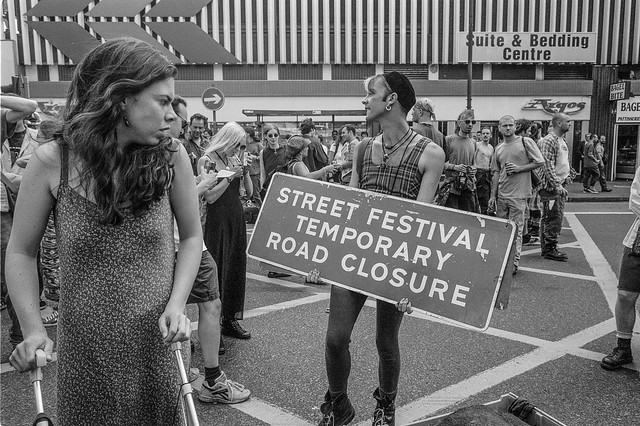
A woman looks at the notice ‘Street Festival – Temporary Road Closure

It was difficult to know exactly what was happening, particularly at Shepherds Bush, but also once we were partying on the motorway, and harder still to know how to photograph the event. Looking back I don’t think I did a very good job of it, though there are some pictures I quite like. But though I think they convey something of the spirit of the event, perhaps they don’t tell the story as well as I would like. There is also a certain sameness which results from them all being taken on 28mm or 35mm lenses, probably on a Minolta CLE or Leica M2.

RTS Party on A41M Motorway 96-724-55-positive
Partying on the A41M

You can read several stories with people’s own recollections of the day online which provide some of the background to these pictures on the Past Tense radical histories blog.

After I’d been photographing the partying on the motorway for some time I decided that nothing new seemed to be happening and it was time to go home and have a meal. I saw some others climbing over a low wall and followed them, making my way to Latimer Road tube.

RTS Party on A41M Motorway 96-725-11-positive
A living room with sofa and carpet on the A41M

The pictures were of course taken on film, and I seem to have only worked in black and white. I probably developed the films I had taken a few days later, and will have then printed perhaps half a dozen and probably a few weeks later taken them in to Photofusion’s picture library. Over the years a handful may have been printed in magazines and books, and I think I probably shared a few on various web sites, but many are now being seen for the first time outside the small group of friends with whom I met to share and criticise work. The images were digitised using the Nikon ES-2 adapter and a Nikon 60mm f2.8 macro lens on a Nikon D810.

You can see more of the pictures I took that day in my Flickr album Reclaim the Streets: London 13 July 1996.


All photographs on this and my other sites, unless otherwise stated, are taken by and copyright of Peter Marshall, and are available for reproduction or can be bought as prints.