Around the City – 1987

Bank of Kuwait, Bank of England, reflection, Cornhill, City, 1987 87-8k-56a-positive_2400

I can’t now remember why I went to Bank and the heart of the City of London – the world’s greatest money laundering operation. But I do remember thinking how appropriate it was to make this picture of the Bank of England reflected and framed by the Bank of Kuwait. I’ve never found the Bank of England, secretive behind its tall wall, easy to photograph.

Roman Wall, Cooper's Row, CIty, 1987 87-8l-01-positive_2400

I’ve always found this section of wall on Cooper’s Row one of the more interesting of the 21 sites on the Museum of London’s Roman Wall Walk set up in 1984. You can see one of their orientation boards in the picture, though I think ten of the others have been swallowed up in the rebuilding of parts of London or by vandalism.

87-8l-31-positive_2400

Sceptre Court on Tower Hill lies just outside the city, and was clearly under construction when I took this picture. The 90,000 sq ft building is rather less interesting now and is currently completely occupied by The London School of Business and Finance. The building was recently sold to “a Middle Eastern investor” and is among many London buildings – including many government offices – owned by overseas investors often in offshore tax havens. Sceptre Court is one of the teaching sites of Arden University, a private, for-profit teaching university with head offices in Coventry.

Aldgate Pump, Fenchurch Street, Leadenhall Street, City, 1987 87-8k-26-positive_2400

Aldgate Pump is the symbolic starting point of London’s East End. A well on this site was first recorded around 1200. The Grade II listing of this structure describes it as “Apparently C18, altered.” The spout is a wolf’s head, and legend states that the last wolf in the City was shot near here, probably in around 1500. The wolf is one of the later additions, probably from around 1900. Until 1876 the water came from a local underground stream and was then the source of a major cholera outbreak.

Although earlier the water had been praised for being “bright, sparkling, and cool, and of an agreeable taste”, people began to complain of a foul tast and several hundred died. The stream was found to be running through several underground cemeteries including some of the plague pits. The pump was then moved a short distance to its current position to allow widening and connected to a healthier water supply from the New River Company. The pump is being restored and a replica lantern being made to replace that lost around 115 years ago.

Devotees of Cockney rhyming slang allege that getting an ‘Aldgate’, short for Aldgate Pump is used to mean ‘hump’ or upset and annoyed. ‘A draft on Aldgate Pump’ has also been used a punning reference for a worthless or fraudulent financial transaction.

Tower Gateway, DLR, Minories, City, 1987 87-8l-44-positive_2400

Tower Gateway DLR station opened in 1987 as the western terminus of the Docklands Light Railway. Although derided by many as a ‘Toytown railway’ it has proved itself a useful addition to transport in east London, serving some parts which were previously very poorly provided.

Tower Gateway, DLR, Minories, City, 1987 87-8l-56-positive_2400
Crescent, City, 1987 87-8l-54-positive_2400

Crescent was a Georgian development close to the Tower of London, part of a plan by architect George Dance the Younger (1741-1825) which also included America Square to the north and a smaller ‘Circus’ of houses to the south linked by Vine St. It ran in a line parallel to Minories a short distance the west. One of the first planned residential developments in London it was completed in 1767-74. The developer was Sir George Hammet and the short street connecting Crescent to Minories is Hammet St.

The Circus was almost completely destroyed in the ‘Second Great Fire of London’ caused by German fire-bombs on 29-30th December 1940 when around 100,000 incendiary bombs caused incredible damage. Only one house was left standing of the ten built in a tight circle. In poor condition, this was evntually demolished in 1975 for a road widening scheme. The granite roadway of the circus is still present as part of a small public garden at the edge of the road.

Parts of America Square to the north were lost when the railway into Fenchurch St station was built in 1841, and the rest devastated by wartime bombing. Crescent fared just a little better, with the Metropolitan railway requiring demolition of five of the 11 houses, and bombing destroing another four, leaving only two of the originals standing. In the early 1980s a painstaking reconstruction to the original plans added four replicas to them. Only the left-most part of my picture is one of the originals, the rest are the replicas. There have been some small changes since I took my picture. You can read more about the area on the Commuter Consultant’s admirable Lost London blog from which much of the above information comes.

Photographs from my 1987 London Photos album. Clicking on any of the above pictures will take you directly to the album where a larger view is available.


All photographs on this and my other sites, unless otherwise stated, are taken by and copyright of Peter Marshall, and are available for reproduction or can be bought as prints.


Notting Hill in colour – 1997

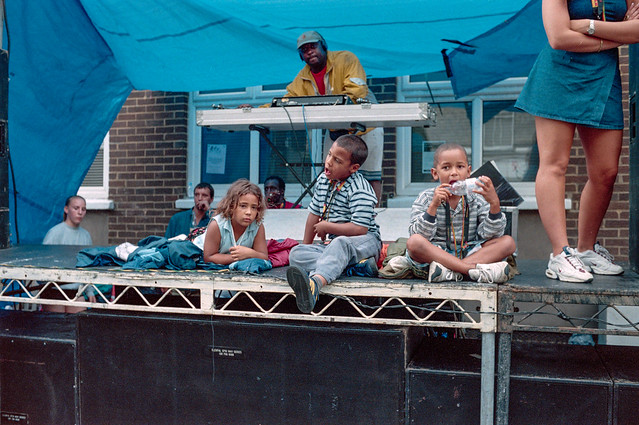
Notting Hill Carnival, 1997 97c8-nh-003_2400

I find it hard to believe I took no colour pictures at Notting Hill Carnival in 1996, but if I did I cannot find the negatives, though it is possible that they are somewhere in my loft, still in the envelope with the prints as they came back from the processing lab. I did go to carnival, and made some black and white images, but probably I had come to a decision not to work in colour.

Notting Hill Carnival, 1997 97c8-nh-005_2400

The following year, 1997, I’ve found no very few black and white negatives, perhaps just when I was finishing off a couple of films still in the cameras, and nothing of any real interest, but a note on the contact sheet tells me that I worked in colour that year. So here are some of the results.

Notting Hill Carnival, 1997 97c8-nh-008_2400
Notting Hill Carnival, 1997 97c8-nh-015_2400
Notting Hill Carnival, 1997 97c8-nh-019_2400
Notting Hill Carnival, 1997 97c8-nh-024_2400
Notting Hill Carnival, 1997 97c8-nh-028_2400
Notting Hill Carnival, 1997 97c8-nh-030_2400

I’ll post another set from 1997 shortly, but you can see them all in my album Notting Hill Carnival – the 1990s which has around 80 more pictures from that year. As usual, clicking on the images in this post will take you to the image in the album – much larger for the landscape format images.


All photographs on this and my other sites, unless otherwise stated, are taken by and copyright of Peter Marshall, and are available for reproduction or can be bought as prints.


Nine Elms from across the Thames

I sometimes wonder how many times I have photographed Battersea Power Station over the years. I still look out of the window of my train to see it in the distance, and when I’m sitting on the top deck of a bus going over Vauxhall Bridge, on my way to or from the station.

Battersea Power Station, from Pimlico, Westminster,1987 87-8a-11-positive_2400

Occasionally I’ll walk across Vauxhall Bridge too, perhaps on my way to the Tate Gallery or the Home Office, and see it in the distance, often taking a picture. The riverside walk from Vauxhall Bridge upstream on the Surrey bank is one I’ve walked along many times, open years before we had a Thames Path, which it now forms a short part of. Back in 1977 when I first began walking much beside the Thames, the proposed long-distance path – then called the Thames Walk – only began a few miles upstream at Putney.

Locking Piece, Henry Moore, sculpture, Vauxhall Bridge, Vauxhall, from Millbank, Westminster, 1987 87-8b-56-positive_2400
Henry Moore’s ‘Locking Piece’, Vauxhall Bridge, Nine Elms Cold Store and Market Towers

Recently, with the US Embassy having moved to Nine Elms, I have another reason to walk beside the river here, on my way to photograph protests there, or, more often when the light is so good that I can’t stop myself from making a little detour on my way home from one. But at the moment, this is just wishful thinking, as I’m still staying home and away from London and Covid-19.

Nine Elms, River Thames, from Pimlico, Westminster, 1987 87-8a-16-positive_2400

But even in earlier days, my trips along the Middlesex bank here were rare. There was back in the 1980s relatively little riverside path, a little chance to get away from the busy Grosvenor Rd, though a short stretch of riverside path became available some time after the completion of Nick Lacey’s Crown Wharf in 1983.

Bolton & Fairhead Ltd, Rochester Wharf, Grosvenor Rd, Pimlico, Westminster, 1987 87-8b-02-positive_2400
River Thames, Nine Elms, Battersea, from Pimlico, Westminster, 1987 87-8b-01-positive_2400
William Huskisson, memorial, Pimlico Gardens, Grosvenor Rd, Pimlico, Westminster, 1987 87-8a-15-positive_2400

Further on the small Pimlico Garden opens on to the riverside and also has a memorial to William Huskisson, the first widely reported victim of a railway accident, who was killed when he got down from the special train carrying the the Duke of Wellington and his guests on the official opening of the Liverpool and Manchester railway which had stopped at Parkside station in the middle of the line. He got down from the train to speak with the duke, ignoring the warnings of the railway company, and was hit and fatally injured by George Stephenson’s famous engine ‘Rocket’ pulling a train in the opposite direction.

River Thames, Gravel Wharf, Nine Elms, from Pimlico, Westminster, 1987 87-8a-24-positive_2400

Closer to the power station on the opposite bank, Grosvenor Rd runs beside the riverside and gives good view of the power station. A little downstream from it was a small gravel wharf, where until some time in this century a small ship came daily on the tide with shingle from the estuary. On one walk a few years ago as I photographed the ship I had a talk with the captain who, with his mate brought the ship up the river; I regret I failed to make a portrait of him. He told me then that this would be one of his last trips as the wharf was to close.

River Thames, Gravel Wharf, Nine Elms, from Pimlico, Westminster, 1987 87-8a-21-positive_2400
Battersea Power Station, from Pimlico, Westminster,1987 87-8a-22-positive_2400
87-8a-35-positive_2400

All photographs on this and my other sites, unless otherwise stated, are taken by and copyright of Peter Marshall, and are available for reproduction or can be bought as prints.


1988 Free Mandela march

Free Nelson Mandela - Birthday March and Rally - London 1988 88-7h-66
Camden Town

Although I first took pictures at protests in the 1970s, I had been taking part in protests since the middle of the 1960s. But I was then a penniless student with no idea about how you could cut costs by developing and printing your own films; I did own a camera, a Halina 35X, but had dropped it in the lake at Versailles and it never worked reliably after that, delivering random but usually very slow shutter speeds from its rusty leaf shutter.

Free Nelson Mandela - Birthday March and Rally - London 1988 88-7h-55

Even after I had taken a short photographic course and got a job and could afford a new camera (a cheap Russian Zenith SLR) and had rigged up a temporary darkroom in the kitchen of our flat, I was still going on protests as a protester and took few if any photographs.

Free Nelson Mandela - Birthday March and Rally - London 1988 88-7h-31
BBC

Of course there were fewer protests back in the 70s and 80s, or at least it was harder to find out about them in the days before the World Wide Web. There were of course huge events such as the Miners’ Strike, but unless you lived in the mining areas or could travel to them, which didn’t fit with my full-time job you read about most of these after the events were given newspaper coverage if at all. Many other protests related to strikes and union issues were simply impossible to know about unless they concerned your own union.

Free Nelson Mandela - Birthday March and Rally - London 1988 88-7i-43

My attendance at protests was largely limited to the big national demonstrations organised by groups I belonged to – such as CND and the Anti-Apartheid movement and a few others that were advertised in advance in the alternative press. Many protests were only advertised by fly-posting on walls mainly in the areas they were to take place in – and there were few if any such postings in the area where I lived.

Free Nelson Mandela - Birthday March and Rally - London 1988 88-7j-65

I began to be more a photographer of protests than an actual protester in the 1980s, particularly after a few of my photographs were accepted for an exhibition on protest (and I think one won a prize.) I began to realise that I could make a great contribution to the various causes with a camera than simply marching or attending rallies, and, a little later, began contributing my photographs to a picture library concerned with social issues, and later still providing my services directly to some protest groups.

Free Nelson Mandela - Birthday March and Rally - London 1988

As more and more people and groups went on-line things began to change. I found out about more and more protests, at first as groups set up web sites to promote their activities. I’d spend an evening or more a week going through a list of perhaps 20 or thirty different groups and using sites which listed bus and travel diversions and various search engines to find out about events and put them in my diary. Then Google arrived and made searching easier and finally Facebook and I had little time to photograph anything but protests.

Free Nelson Mandela - Birthday March and Rally - London 1988 88-7j-13

The Free Nelson Mandela march in London was on Saturday 17th July 1988, the day before his 70th birthday and two years before he was released from prison. I walked with the protesters taking pictures from Camden Town to Hyde Park, and took a few pictures in the crowds in Hyde Park, but none of the stage and speakers at the rally. You can see more of the pictures in the Flickr album uploaded a couple of days ago. Clicking on any of the pictures above will take you to the larger version in the album.


All photographs on this and my other sites, unless otherwise stated, are taken by and copyright of Peter Marshall, and are available for reproduction or can be bought as prints.


Levitation, Police Robbery and Catalonia

Three years ago on October 21st I spent an interesting Saturday travelling around London and photographing several quite different events – unlike last Saturday when all I did was sit at a computer and work on old pictures and take a short walk along a familiar stretch of the River Thames close to my home, taking care to avoid getting close to the other strollers.

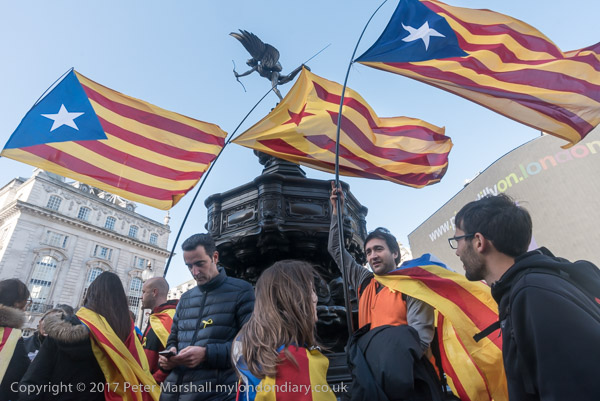
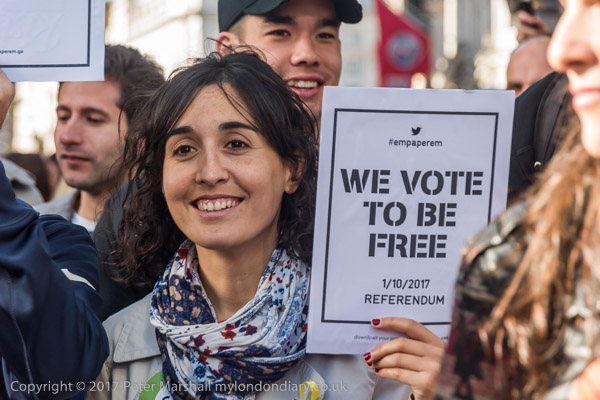
The Catalan protest at Piccadilly Circus was colourful, with many of the several hundred present fyling or wearing flags and calling for independence. And many of the placards were in English, unlike some other protests about overseas events. While Spain seems to have managed so far to have stopped the indepenence movement by forceful policing and political trials in the longer term I think there has to be movement towards a more federal approach with much greater autonomy for the region. We are begining to see a similar trend here in the UK, where our government appears to be failing to honour the 1707 Acts of Union between England and Scotland as well as creating increasing division between Wales, Northern Ireland and Westminster, with the likely no-deal (or very limited deal) over Brexit seeming certain to lead to to a break-up of at least parts of the union.

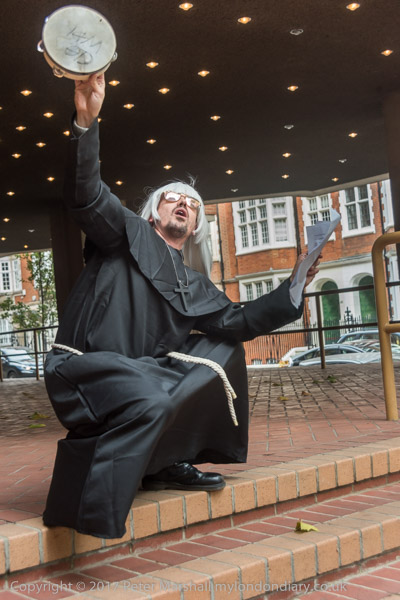
Conveniently the Catalan march took me to Parliament Square where I could take the Circle line to Kensington and join a small group of Class War in their attempt to levitate the offices of the Royal Borough of Kensington and Chelsea, responsible for the disastrous fire at Grenfell Tower.

It was also a celebation of the 50th anniversary of the Yippee levitation of the Pentagon during anti-Vietnam War protests, and Class War’s Ian Bone and shaman Jimmy Kunt (aka Adam Clifford) stood on the steps of the town hall and called “Out, demons, out! Out, demons, out!” to the demons of councillors Nicholas Paget-Brown, Rock Feilding-Mellen & Elizabeth Campbell in their attempted to levitate the town hall to a height of over 70 metres. Unfortunately I failed to capture a photograph of the building in mid-air.

As I reported in My London Diary:

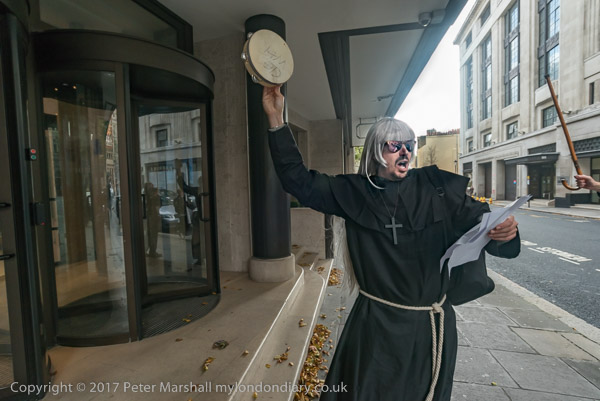
Inspired by their success at the town hall, Class War’s Levitation Brigade then moved on to Northcliffe House, the home of the Daily Mail.

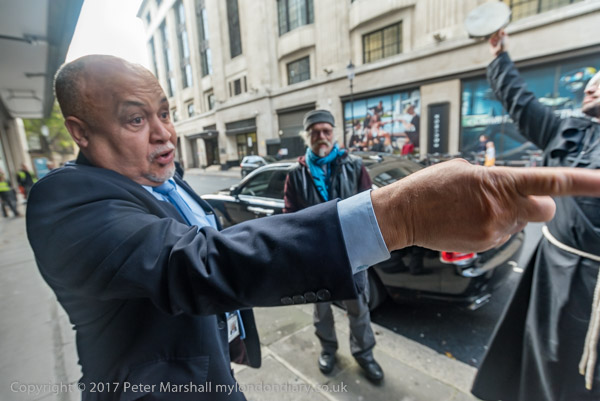
Security staff there reacted angrily to Class War calling out the demon of Paul Dacre and their attempt to raise the building by over 70 metres, perhaps fearing it might damage the Rolls-Royce parked outside, but the levitation ceremony went ahead despite considerable interference.

Class War levitate the Daily Mail

Several security staff objected to the protesters and told me that I couldn’t take pictures, although there is strong evidence that this was not the case, though I did have to move back several times when one attempted to grab my lens. But most of the time at least I was on the public highway and knew I had the right to photograph as I liked and told him so. But it was perhaps this harassment that again made me miss the moment of actual levitation – or perhaps not.

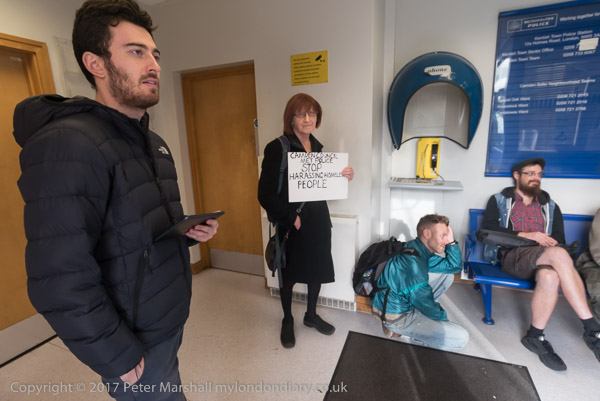
It was a rather longer journey to Kentish Town by Underground, but only around half an hour (Circle to Embankment and then the Northern line) and I arrived in good time for the protest outside Kentish Town Police Station. Police, urged on by Camden Council had been removing and stealing tents from homeless people on the nearby streets ‘in the interest of public safety‘.

A small group of protesters met outside the police station carrying tents before five of them went inside to hand themselves in for being in possession of these now illegal items, calling on the police to arrest them. The police were rather suprised and kept them waiting for an hour or so, before telling them after I had left that carrying a tent was not a crime.

Later both police and Camden Council denied they were harassing the homeless – in direct contradiction to the evidence from the street that they had done so. Perhaps this small protest meant that at least in Camden this cruel policy used in some other boroughs in London and elsewhere will no longer apply.

More at:
Stop Robbing the Homeless
Class War levitate the Daily Mail
Class War levitate Kensington Town Hall
March in Solidarity with Catalonia


All photographs on this and my other sites, unless otherwise stated, are taken by and copyright of Peter Marshall, and are available for reproduction or can be bought as prints.


Greenwich Riverside Walk

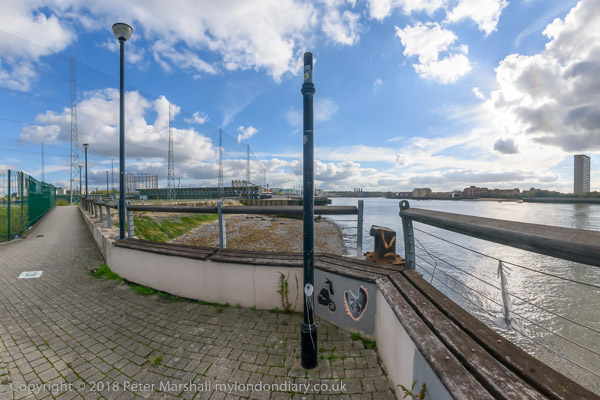
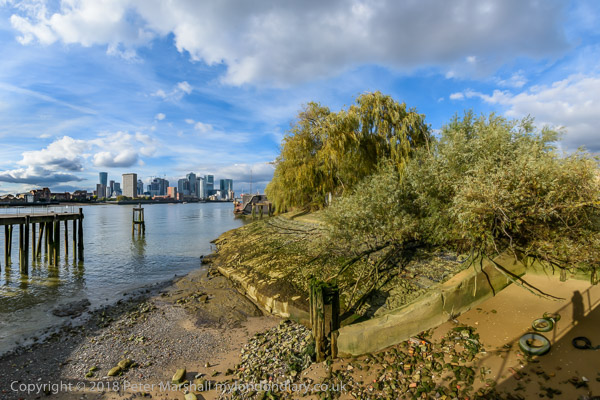
One of my favourite London walks has for many years been beside the River Thames on the path downstream from Greenwich. I first walked it in the 1970s and went back occasionally over the years, both on foot and later taking my Brompton bicycle to it on the train. When I was on foot I often went as far as Woolwich, not a great distance but I was always a photographer rather than a walker. Other riverside walks began from Woowlich or railway stations further east including Erith, Dartford and Gravesend.

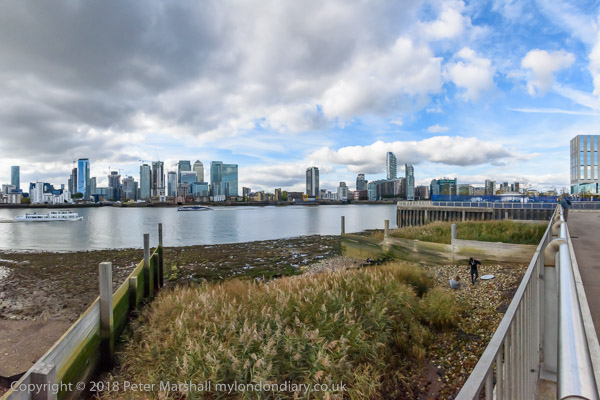
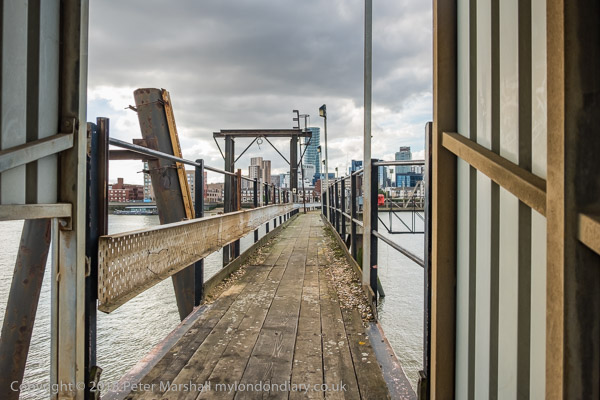
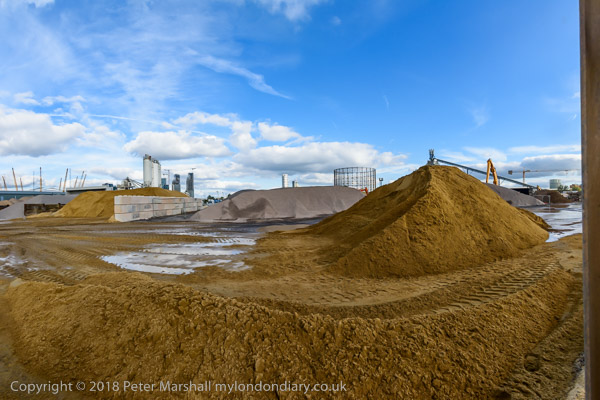
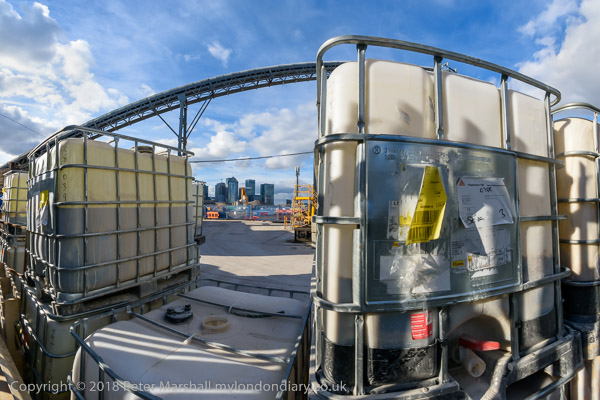
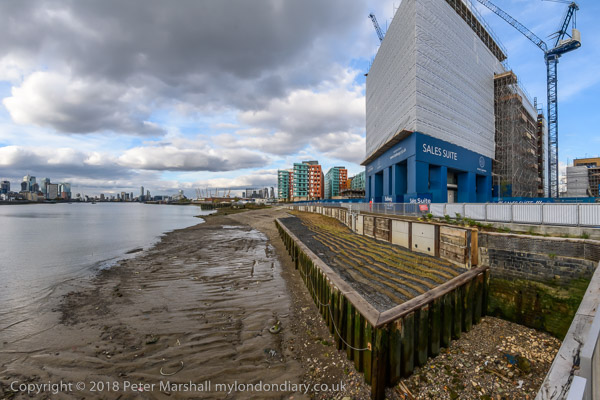
On October 18th 2018 my walk was rather shorter as I was with three other photographers, and we began at North Greenwich. Parts of the riverside walk had recently reopened after closure for the continuing process of ruining the Thames by lining it with tall blocks of expensive flats and I was keen to walk it again after some years away.

There were other reasons for the walk too. One was a visit to the Pelton Arms, arguably Greenwich’s finest pub. Its in a homely area, developed like the pub around 1844, though the Grade II listed street of granite setts from around 1870 stops a few yards short. It’s just a short walk from Granite Wharf, which got its name as it was here than Mowlem landed its granite from Guernsey that once paved much of the streets of London. But the real attraction is its fine range of real ales and comfortable atmosphere – and, although quiet when we visited is one of South London’s leading music venues.

We were also on our way to an evening event across the river in North Greenwich, and after a meal in the centre of the town hopped on the DLR at Cutty Sark for the single stop to Island Gardens and a short walk to where another of our photographer friends, Mike Seaborne was having the launch of his book on the Isle of Dogs. It was getting a little late when we had finished our meal otherwise I would have suggested going across the river on foot, not walking on the water but under it in the Greenwich foot tunnel.

There are many more pictures from the walk on My London Diary. Most but not all are ultra-wide views with a horizontal angle of view of over 140 degrees. Often I crop these to a more panoramic format, but here I decided to leave them covering the full frame to fit better with the few less wide-angle images. All except one in this post are ultra-wide and they are presented in the order of the walk.


All photographs on this and my other sites, unless otherwise stated, are taken by and copyright of Peter Marshall, and are available for reproduction or can be bought as prints.


Spitalfields & Wapping 1987

Spitalfields 87-7m-12-positive_2400
Interior, Christ Church, Commercial St, Spitalfields, Tower Hamlets, 1987

I think I had gone to Liverpool St to see off some visitors from Germany who had been staying with us and we arrived at the station long before their train was due to leave for Harwich, so I took them to see Christ Chruch, which was then in the middle of building works. The air was rather dusty and the light a little dim, but the structure was still impressive, and we were greeted by one of the clergy who gave us a short conducted tour.

Christ Church, Commercial St,  Spitalfields, Tower Hamlets, 198787-7m-22-positive_2400

One of Nicholas Hawksmoor’s great pentagram of London churches much celebrated in the writings of Iain Sinclair, Peter Ackroyd and others it is a building I find more satisfying seen close too and at and angle as in this picture than in more prosaic and distant views.

Peach, Fashion, Commercial St,  Spitalfields, Tower Hamlets, 1987 87-7m-21-positive_2400

Close to the church in Commercial Rd was this builidng, housing Peach and several other fashoion and clothing firms as well as The Colour Assembly litho printers. But I didn’t have long to take pictures as our visitors had a train to catch and we made our way back to Liverpool Street.

St Katharine's Way, Wapping, Tower Hamlets, 1987 87-7n-23-positive_2400
St Katharine’s Way, Wapping, Tower Hamlets, 1987

Afterwards I walked down to St Katherine’s Way, where some of the old warehouse buildings were being gutted and turned into flats, while keeping the basic facades. Miller’s Wharf dates from 1865, but once beyond the front wall is mostly from 1989. A 2 bed flat with a river view is currently for sale at £1.6m should you be looking to move.

Tower Bridge, River Thames, Thames Path, Wapping, Tower Hamlets, 1987 87-7n-36-positive_2400
Tower Bridge, River Thames, Thames Path, Wapping, Tower Hamlets, 1987

Just a few yards east is a part of the Thames Path from which you can get similar views (though only at ground level) without the huge price tag. Somewhere around this time I went with a group walking along the north bank of the river with the person from Tower Hamlets responsible for footpaths and we found then a number of places where there was supposed to be public access to the river had their gates locked. More recently when I’ve walked along here I think I have been able to access most or all of them.

River Thames,  Rotherhithe, Wapping New Stairs,Wapping, Tower Hamlets, 1987 87-7n-31-positive_2400

I think this picture, which has police launches moored in the foreground is taken from Wapping New Stairs – which are of course very old.

Discovery Walk, Wapping Lane,  Wapping, Tower Hamlets, 1987  87-7n-53-positive_2400

Little remains of the old London Docks, with new housing covering much of the area, here alongside the ornamental canal which I think includes some sections of the old dock wall. I took two pictures from the road overlooking the canal, one concentrating on the south and the other the north side.

Ornamental canal, News International, Print Works, Wapping, Tower Hamlets, 1987 87-7n-55-positive_2400

The two pictures actually overlap and can be joined to make a narrow panorama, though I don’t think I particular intended this when I took them.

The right of the picture is dominated by the large Wapping printing works of News International, the site of a protests for over a year from 1986-7 by the print unions against Murdoch. The strike ended in what seemed an inevitable defeat for the unions who were trying to prevent the introduction of new technology, moving away from the hot metal of Fleet St which employed several thousand type setters to litho printing which allowed journalists to directly input there stories.

More pictures on page 6 of 1987 London Photos.


All photographs on this and my other sites, unless otherwise stated, are taken by and copyright of Peter Marshall, and are available for reproduction or can be bought as prints.


Notting Hill Colour – 1993

Notting Hill Carnival, London, 1993 93c8-nh-007-positive_2400

Although almost all the pictures I took at Notting Hill Carnival in 1993 were in black and white, I did make a few colour images, and here are a small selection.

Notting Hill Carnival, London, 1993 93c8-nh-008-positive_2400

Almost all of them were of the procession, and I think taken in a fairly short period of time, mainly on Ladbroke Grove.

Notting Hill Carnival, London, 1993 93c8-nh-019-positive_2400

I tried to cut my equipment to a minimum for carnival, partly to make it easier to move through the crowds, but also because I was just a little worried about taking what looked like camera bags full of expensive equipment to the event. And I wanted to be able to dance as I took pictures.

Notting Hill Carnival, London, 1993 93c8-nh-022-positive_2400

Instead of a normal camera bag, I took a small khaki canvas ex-army shoulder bag which I still use today when I want to travel light, issued in 1942 possibly for a gas mask, large enough to take a camera, one or two spare lenses, a decent supply of film, notebook, water bottle and a few oddments, which back in those days would usually include a Mars Bar for when my energy lagged, and sometimes a sandwich or two.

Notting Hill Carnival, London, 1993 93c8-nh-027-positive_2400

Probably when I saw some particularly attractive and colourful costumes and had finished a black and white film I picked a colour one to reload the camera – probably my Minolta CLE, a rather superior second version of the Leica CL which for some obscure reason Leitz decided not to put their name on, ending their collaboration with Minolta. I then took pictures quickly to finish the film so I could get back to my real work using black and white. I think that happened a couple of times on Children’s Day, but on the Monday I concentrated on more serious black and white work.

Notting Hill Carnival, London, 1993 93c8-nh-034-positive_2400

In crowds I always made sure to put the shoulder strap over my head and on one shoulder and hold the bag on my stomach so as not to get caught up behind me. I always kept the camera on a strap around my neck too. But generally the crowds were good-natured and in high spirits and I had no trouble taking pictures.

Notting Hill Carnival, London, 1993 93c8-nh-031-positive_2400

Just once, in the centre of a heaving crowd of dancers in front of a sound system I suddenly realised that someone had put their hand into my left trouser pocket. I grabbed it and held it there protesting, and slowly pulled it out to reveal it holding a wallet. But it wasn’t mine (I’d left that at home) and of course it had no money in it. I’m not sure why he was planting it on me, but pushed it back into the hand I was still firmly holding and told the guy to eff off and he ran off pushing through the crowd. It didn’t seem the place to investigate further.

More pictures on page 6 of my Notting Hill Carnival – the 1990s on Flickr.


All photographs on this and my other sites, unless otherwise stated, are taken by and copyright of Peter Marshall, and are available for reproduction or can be bought as prints.


1987: Paddington & Maida Vale

Paddington Arm, Grand Union Canal, Paddington Station, Bishop's Bridge Rd, Paddington, Westminster, 1987 87-7l-32-positive_2400

The view from the bridge on Bishop’s Bridge Road is now rather different with the building over the canal having been replaced by a footbridge and an new entrance to Paddington station now obscuring the front of the station. You can still see the GWR Hotel and the canal, but the empty towpath has been much tidied and is now often thronged by people.

Paddington Basin and the area around the canal leading to it has been fairly dramatically redeveloped with tall blocks and leisure activities. There were few boats moving back when I took this picture and I think the rescue one in this picture was the only one I saw, though there may have been a few kayaks. Now the canal is rather busier, with small electric boats a popular but not cheap hire.

The bridge I was standing on was replaced by a wider modern bridge in 2006; shortly before it had been discovered that Brunel’s original 1839 iron bridge was still in place hidden under the 1906 structure – though its cast iron beams were clearly visible below. It was Brunel’s first iron bridge and of important historical and engineering interest but English Heritage agreed not to list it as it would have considerably affected the replacement plans; instead it was carefully dismantled and put into store on the understading it would be rebuilt for use as a footbridge across the canal around a hundred yards to the north.

Although planning permission was granted for this it never happened and the parts remain in a rather messy heap at English Heritage’s store at Fort Cumberland in Portsmouth, probably because the developers of the area preferred a nice modern and probably much cheaper design. Other former canalside artifacts removed at the same time with similar promises appear to have simply been lost, but the bridge was perhaps too large for that to happen.

Bishop’s Bridge Road only got its name after the Second World War, before which it had been simply Bishop’s Road, developed around the time the railway was built in 1836, replacing an earlier footpath. The Bishop was rather earlier, the manor of Paddington being given to Nicholas Ridley, Bishop of London by Edward VI around 1550.

Pentecost, Assembly of God, Harrow Rd, Maida Vale, Westminster, 1987 87-7l-33-positive_2400
Assembly of God Pentecostal Church, Harrow Rd, Maida Vale, Westminster, 1987

The Assembly of God Central Pentecostal Church on Harrow Road survived until 2015 on the edge of a huge area of high-rise development in North Paddington, but has now gone. It had moved to the ground floor of this building from the Edgware Road in 1946, and was relocated at a temporary site in Tresham Crescent in 2015 while Westminster Council built Dudley House, completed in November 2019. This provides 197 homes at ‘intermediate rent’ as well as new premises for the church, a secondary boy’s school and shops.

North Wharf Rd, Paddington, Westminster, 1987 87-7l-34-positive_2400
North Wharf Rd, Paddington, Westminster, 1987

You can see the curiously ugly QEQM (Queen Elizabeth the Queen Mother) building of Paddington’s Queen Mary’s Hospital towering above these simple but rather elegant buildings on North Wharf Road. That is still there but these buildings are long gone, replaced by towering glass fronted structures which now line Paddington Basin.

The redevelopment of this area, part of ‘Paddington Waterside’ began in the late 1990s and is now more or less complete, filled with high rise buildings. You can now stroll along beside the canal on both banks, while back in 1987 access was very limited. But the whole atmosphere of the area has changed. Although open to the public I think most or all of the open space is privately owned and some photographers, myself included, have been stopped taking pictures by security officers around Paddington Basin.

Warwick Avenue, Maida Vale, Westminster, 1987 87-7l-43-positive_2400
Warwick Avenue, Maida Vale, Westminster, 1987

Green Lane was named Warwick Rd on a plan made in 1827 and later became Warwick Avenue. There were some houses on it by 1840 and most of the rest were built shortly after, all rather grand and in an Italian style and covered in stucco. Many like this one which overlooks the canal basin at Little Venice are listed. The name ‘Warwick’ came from Jane Warwick of Warwick Hall, in Warwick-on-Eden in Cumbria, who in 1778 married the great-grandson of Sir John Frederick who had leased the land from the Bishop of London.

Just a few yards from the more industrial area around the canal at Paddington, this is at the southern edge of Maida Vale, an area which attracted many of the wealthier members of London’s Jewish population in the late nineteenth century.

Clifton Gardens, Maida Vale, Westminster, 1987 87-7l-51-positive_2400
Clifton Gardens, Maida Vale, Westminster, 1987

In the twentieth century parts of Maida Vale became one of London’s more respectable red-light areas. Large houses which were too expensive went into multi-occupation, let out as single rooms, usually sharing kitchens and bathrooms, and often became very run-down. Disruption of families by war and high levels of unemployment forced some women onto the streets where they would walk along keys dangling from their hands and invite passing gentlemen to take tea with them, though tea was apparently seldom served. But more recently the area has gone up in the world considerably again, and semidetached houses in the area sell for £5m or more.

Blomfield Rd, Maida Vale, Westminster, 1987 87-7l-55-positive_2400
Blomfield Rd, Maida Vale, Westminster, 1987

In 1805 Napoleon had defeated both Austrian and Russian armies at Austerlitz and forced Austria to sign a peace treaty and he had also made peace with Prussia. This left him free to try to conquer more of Italy and in particular the Kingdom of Naples, which despite a treaty of neutrality with France had allowed both Russian and British troops to land. Napoleon rapidly advanced and conquered much of that kingdom, with the King and government fleeing to Sicily along with the British troops. A British expeditionary force returned at the end of June to Calabria where there was an insurrection against the French occupation and on 4th July engaged with French forces at Maida.

Warrington Crescent, Maida Vale, Westminster, 1987 87-7l-63-positive_2400
Warrington Crescent, Maida Vale, Westminster, 1987

The battle was was on a relatively small scale with around 5,000 troops on each side and only lasted a few hours before the French who had suffered heavy losses during a cavalry charge against superior British guns and muskets were forces to retreat in considerable disarray. The British commander, John Stuart, was given the title Count of Maida by the Italians and a pension of £1000 a year by the UK parliament as well as being made a Knight of the Bath.

Clifton Gardens, Maida Vale, Westminster, 1987 87-7l-65-positive_2400
Clifton Gardens, Maida Vale, Westminster, 1987

The victory on land against Napoleon’s forces who had been so successful elsewhere gave Britain a much-needed boost in morale, and gave both Maida Vale and Maida Hill their names.

There is now a pub in Shirland Rd named for Stuart, The Hero of Maida, but it was not built until 1878 and was then The Shirland Hotel, later becoming Idlewild and in 2014 the Truscott Arms. Opened under new owners in 2018 it was re-named ‘The Hero of Maida’.

You can see more of my pictures of London in 1987 on Flickr.


All photographs on this and my other sites, unless otherwise stated, are taken by and copyright of Peter Marshall, and are available for reproduction or can be bought as prints.


Rojava, Bolivia & Ecuador

One of the things that makes it hard to leave London is the diversity of the communities that have made their homes here, making this an exciting place. Throughout its history Britain’s population has been enriched by immigration and although immigrants have not always been made welcome they have made a very positive contribution to our society. Among them have been many religious and political refugees and asylum seekers, and many continue to support the causes in their home countries while in London.

While our media generally give little attention to protests – except for those rare occasions involving individual violent acts or anti-establishment acts such involving insults against national heroes such as the writing of graffiti on the plinth of the Churchill statue or attacking statues of slave traders, the protests by ethnic communities against events in their home countries are almost entirely dismissed as what one newsroom at least refers to as “tribal matters”.

Of course they are wrong, as well as being xenophobic. We live in a world that is increasingly interconnected and globalised, and Brexit, taking us out from under the wing of Europe will give even more importance to events happening around the rest of the world, including Rojava, Ecuador and Bolivia.

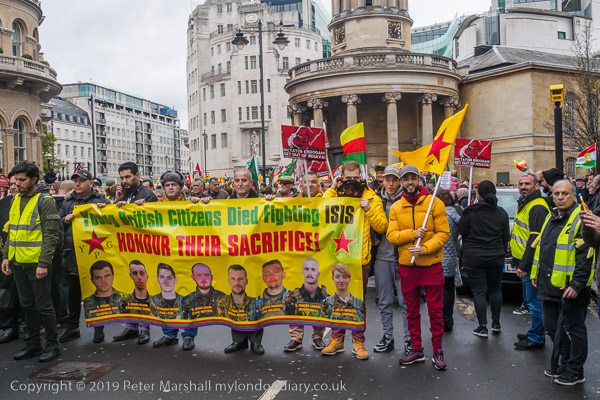
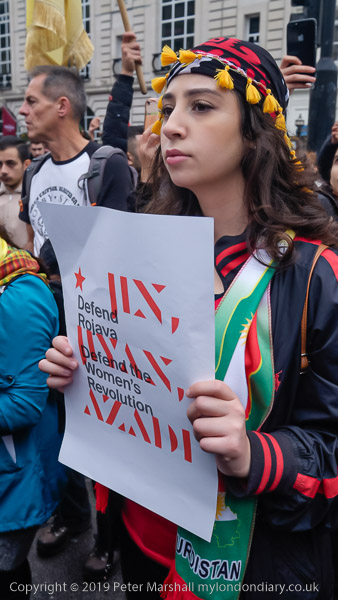
Rojava is important not just to those who live in this Kurdish-controlled part of Syria and to Kurds in general but the rest of us around the world. It was the Syrian Kurds who with US air support who were able to defeat ISIS but as a model of a democratic system dedicated to equality, the liberation of women and ecological justice that could serve to provide the system change we need to overcome climate disaster and to resolve the problems of the middle east and elsewhere.

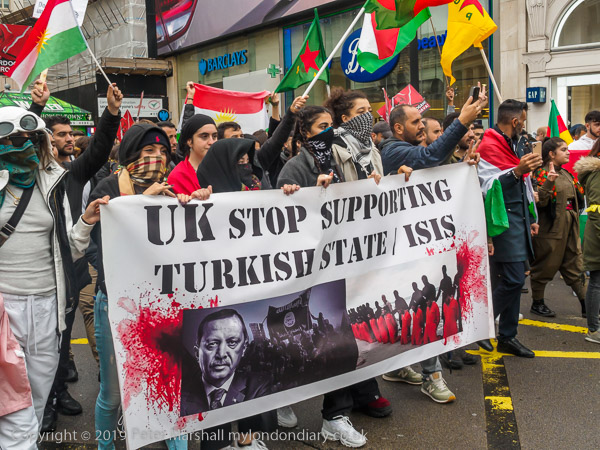
After ISIS were defeated, Trump brought US forces out of the area, leaving it open for Turkey to advance into Syria – with the aid of Islamist forces and the aim of destroying the Kurds. Through NATO we give Turkey support and doubtless supply arms while Russia, backing President Assad are happy to see Syrians who don’t support him exterminated. The Turks have huge superiority in weapons and seem very likely to acheive their aims, but are then likely to establish an Islamic state in the area rather than withdraw back to Turkish territory and we could well then see a war between Russia and NATO forces.
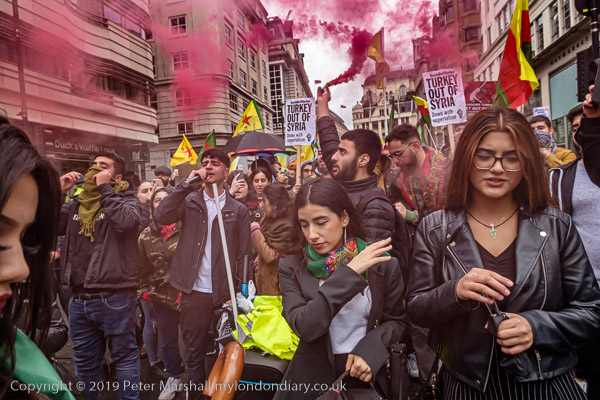
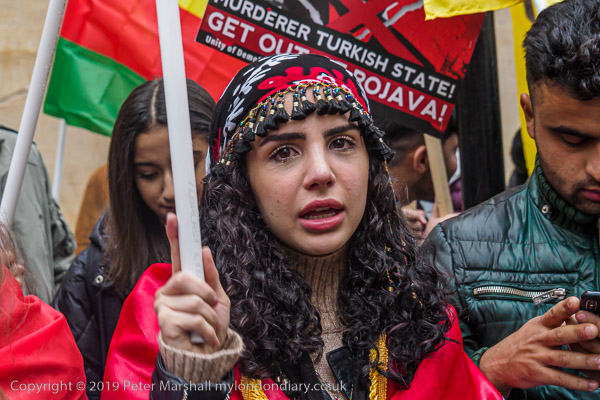
If you rely on the BBC for your news you will know probably know very little about what is going on in northern Syria and the protesters, mainly Kurds but with some support from the British left, gathered outside Broadcasting House a year ago today on Sunday October 13th 2019 to condemn the poor BBC coverage and hope to persuade them to do more. I met them there and marched with them as far as Trafalgar Square; they went on towards Parliament but I stopped to cover two other protests over events abroad.

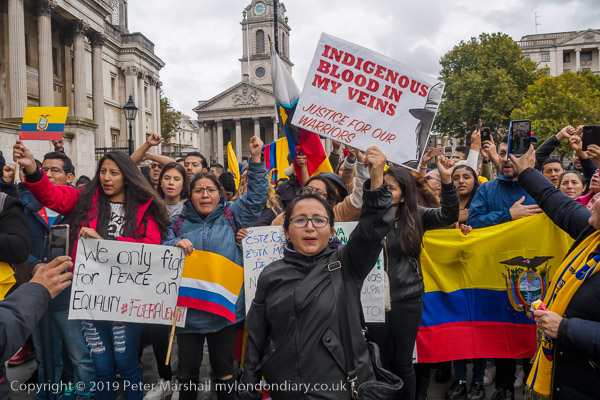
Ecuadorians living in the UK had come to call for the resignation of President Lenin Moreno who they say is their worst president ever. Many there were from indigenous groups who have been hardest hit by public service cuts, particularly the ending of fuel subsidies. Protests had been causing chaos in the capital Quito since these were announced two weeks earlier. The austerity measures had been demanded by the International Monetary Fund in order for the country to get a £3.4bn loan. After Brexit we could well see Britain having to meet similar IMF demands whose aim is to protect and promote international capital and corporations at the expense of the poor.

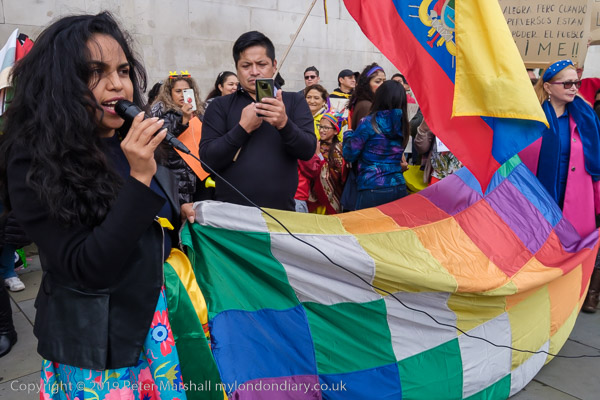
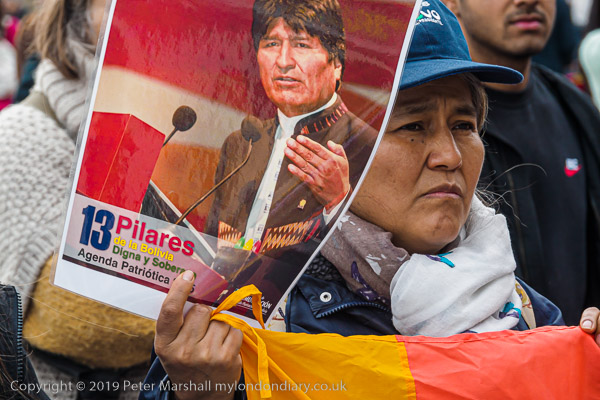
As the Ecuadorians left they were replace by Bolivians who held a lively rally with music and dancers in support of President Evo Morales, who was seeking a fourth term in elections a week later on 20 October.

Morales, the first Indigenous president, and his Movement for Socialism (MAS) greatly reduced poverty, cut the influence of the USA and multinational companies and made Bolivia a model of economic growth. Although popular among the poorer citizens, his policies had not endeared him to the wealthy or to the United States.

Although the election results made Morales a clear winner, with just enough votes to win on the first round, it was followed by violent insurrection amid claims of electoral fraud. Morales fled the country and resigned as President claiming there had been a coup after armed intruders broke into his home. He was offered political asylum first in Mexico and later moved from there to asylum in Argentina.

Although an Organization of American States investigation found there had been voting fraud, later studies by US political scientists and experts on Latin American politics concluded there was no statistical evidence of fraud. Despite being voted in by the Bolivian people, a warrant was issued in December for the arrest of Morales on charges of sedition and terrorism.

More about the three protests on My London Diary:

Rally supports Bolivia’s Evo Morales
Against Ecuadorian President Moreno
Solidarity with Rojava – Kurdish Syria


All photographs on this and my other sites, unless otherwise stated, are taken by and copyright of Peter Marshall, and are available for reproduction or can be bought as prints.