Against the Housing Bill – 30/01/2016

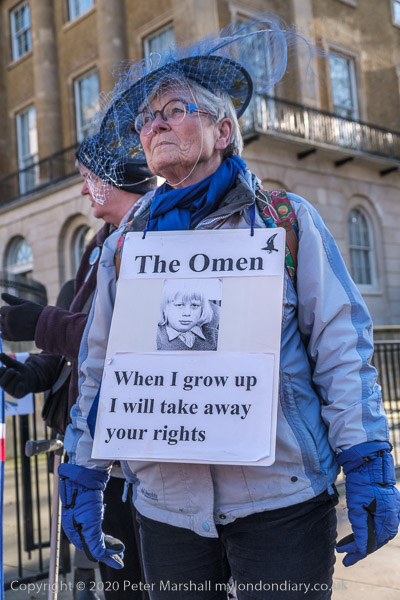
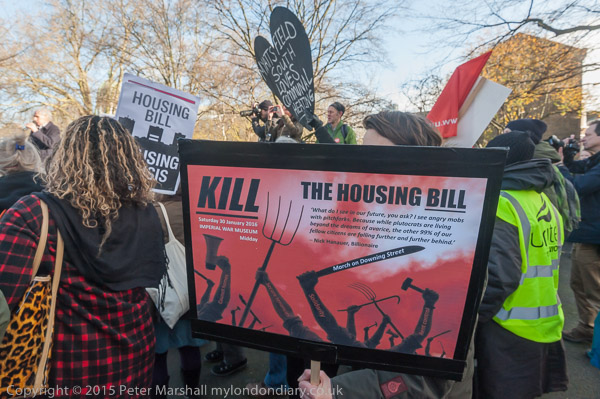
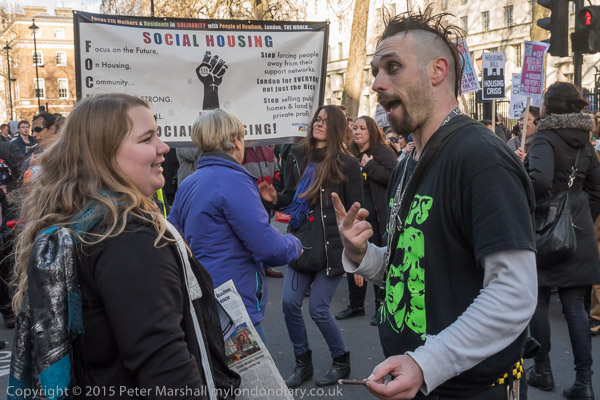
Five years ago, on Saturday 30th January, Lambeth Housing Activists organised a rally and march from the Imperial War Museum to Downing St to protest against the Housing and Planning Bill, which was to have a particularly large impact in London and greatly worsen the already acute housing crisis here.
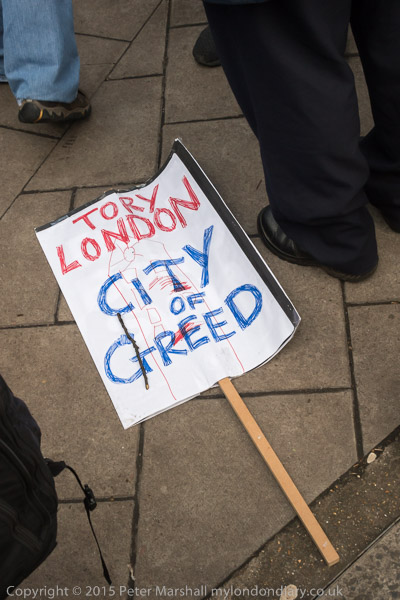
Rather unusually, the activists were joined for the march by some local councillors including Southwark Council Cabinet Member for Housing Richard Livingstone. Southwark, a Labour dominated council, has attracted a great deal of criticism over the demolition of council estates in the borough, including the scandal of the Heygate estate at the Elephant & Castle, and many on the protest were residents of estates currently being demolished – such as the Aylesbury estate – or under threat of demolition. Southwark and other Labour-run councils in London have made huge reductions in council housing through their so-called regeneration of estates, with many former residents being forced to move away from inner London and into much higher rent private or housing association properties, often with very poor security of tenure.
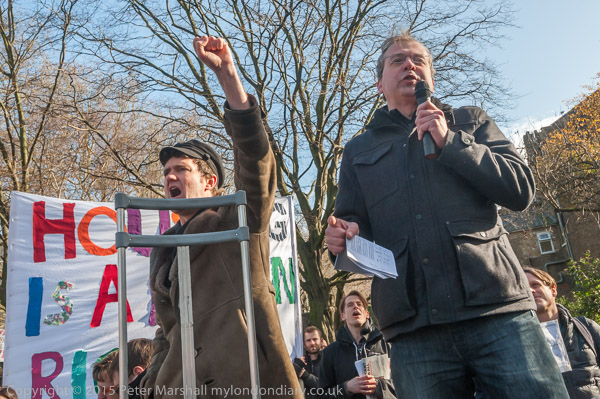
There were a number of speakers at the rally, including the then Green Party Leader Natalie Bennett and housing researchers and activists, who were listened to attentively and warmly applauded, both for their condemnation of the Bill and also of the social cleansing effect of the estate demolitions being carried out by councils. It was hardly surprising that when Richard Livingtone came to the microphone he was greeted by boos and loud heckling and a heated argument with one of the activists.
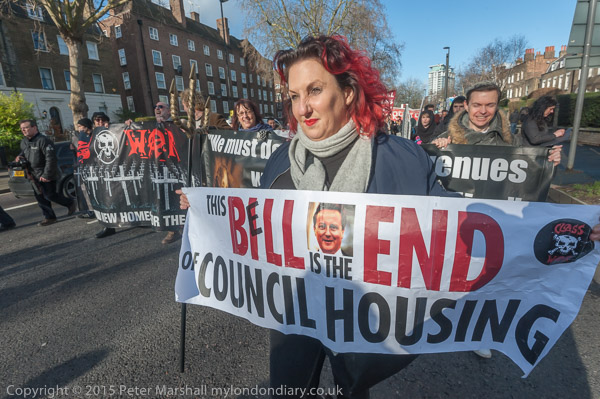
Eventually the rally broke up and the march began, starting by walking through the streets of Lambeth before turning around to make its way through Westminster. Class War and friends decided to liven things up a little, first by dancing along the street singing the ‘Lambeth Walk’ and then by rushing across the pavement towards a branch of of large estate agents and protesting outside it for some minutes before moving on.
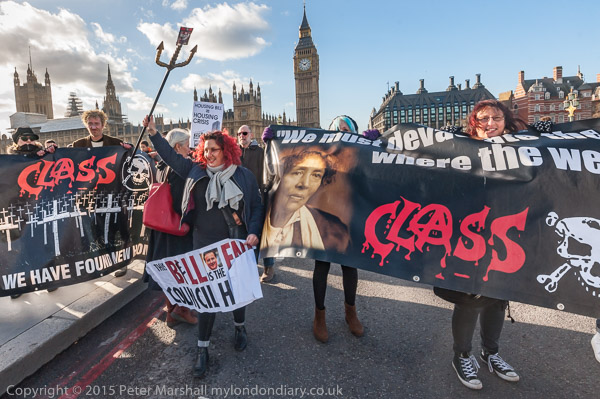
Earlier at the rally Simon Elmer of Architects for Social Housing had given a closely researched and caustic assessment of the role of Labour Councils and housing policies which have been largely dictated by estate agents. Class War had brought a number of more controverisal banners related to housing, among them one with a picture of a military cemetery with its field of crosses stretching into the distance and the message ‘We have found new homes of for the rich’ and the Lucy Parsons banner with its quotation “We must devastate the avenues where the wealthy live”.
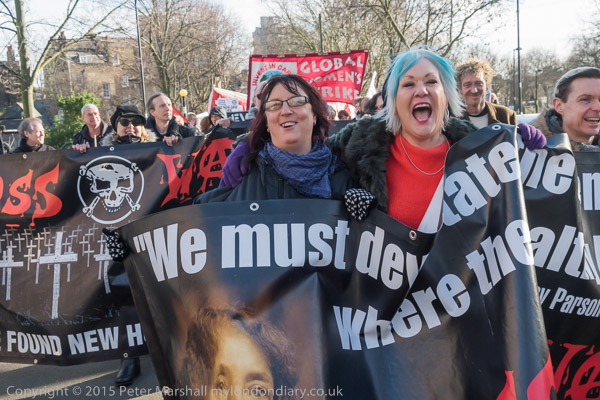
Police had rushed to protect the estate agents, but Class War made no attempt to enter or damage the property, and soon moved off. There was what seemed to be some entirely pointless harassment of protesters by police – including the so-called liaison officers – throughout the march, but I saw no arrests.
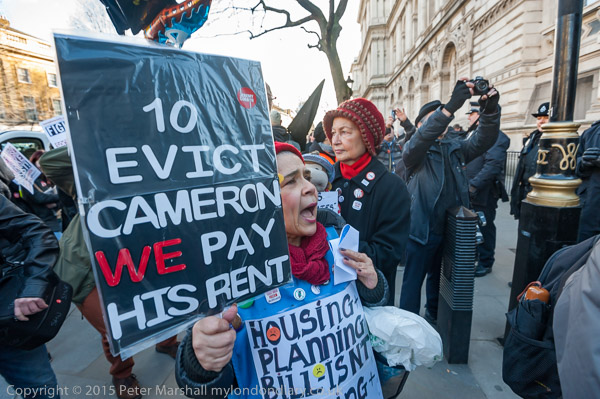
At Downing St police formed a line to lead the marchers to the opposite side of the road, and the activists followed their direction then simply walked across Whitehall behind the police line and posed for pictures in front of the gates and spilling out to block the north-bound carriageway. Police attempted to persuade them to move and eventually people drifted away and I left too.
More at Housing and Planning Bill March.


All photographs on this and my other sites, unless otherwise stated, are taken by and copyright of Peter Marshall, and are available for reproduction or can be bought as prints.
Ten Years Ago – 2011

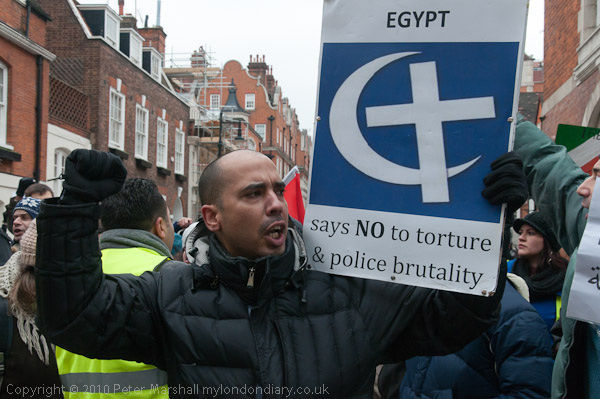
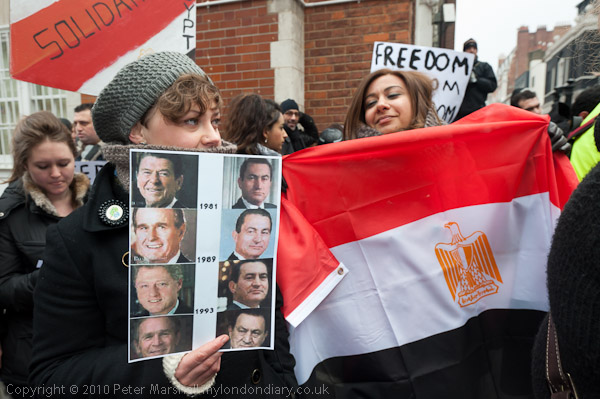
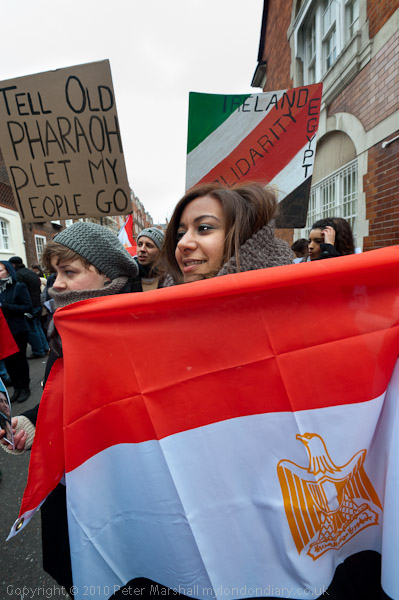
On Saturday 29th January 2011 several hundred people, “many of them Egyptians living in the UK from differing political & ideological backgrounds held a peaceful but noisy protest

to show our solidarity & support of our fellow Egyptians in our beloved country, who decided on making Tuesday 25/01/2011 a day of protests & demonstrations in Egypt against the unfair, tyrant, oppressive & corrupt Egyptian regime that has been ruling our country for decades.”

Protest flyer quoted on ‘My London Diary’

The ‘Arab Spring’ of protests had begun in Tunisia after street-trade Mohamed Bouazizi’s set himself on fire and died on 17 December 2010 leading to protests and the overthowing of the government on 14 January 2011. In January there were protests in Oman, Yemen, Syria, Morocco and in Egypt, where on 25 January thousands flocked to Tahrir Square in Cairo to demand the resignation of President Hosni Mubarak.

Hopes were then running high that the peaceful protests which had been met with suppression and brutality by the regime would succeed in achieving their “justified goal of a democratic, free & civil nation capable of ensuring a dignified, honourable & non-discriminatory life for all Egyptians.” But now we know that despite their early success things have not turned out well in the longer term.

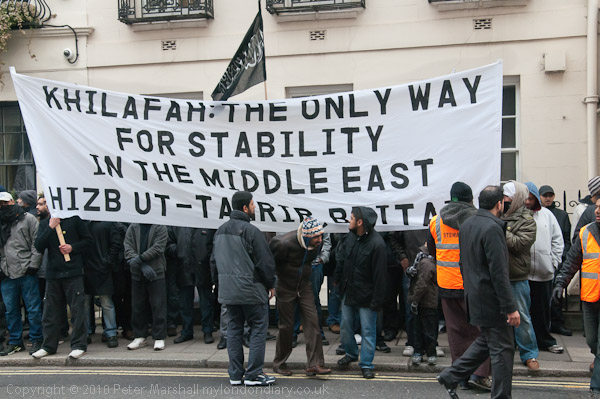
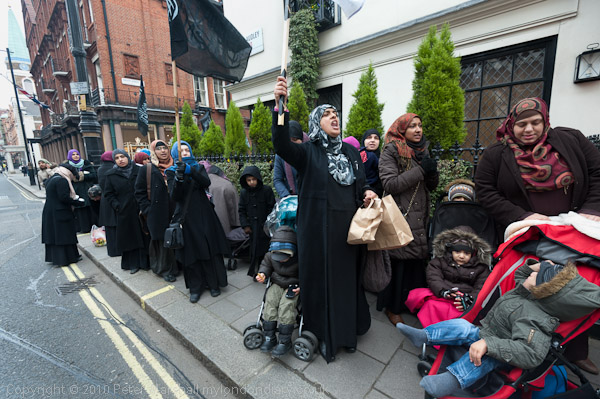
A second group came to join the protest outside the Egyptian Embassy, but Hizb Ut-Tahrir Britain who were calling in on their way to protest outside the Hilton Hotel in Park Lane against “two years Fascist Rule” by the Hasina Government in Bangladesh were told very firmly that the embassy protest – like the Egyptian revolution – was to be entirely non-sectarian and that they were not welcome, and had to protest a hundred yards or so down the street. Theirs, unlike that at the embassy, was a strictly segegrated protest, with the women kept at a distance and few even holding flags.

Hizb Ut-Tahrir is an Islamist group calling for the establishment of a Muslim caliphate, and in 2012, the Freedom and Justice Party, the political arm of the Muslim Brotherhood which shares similar aims won elections to become the largest group in the Egyptian parliament and their candidate Mohammed Morsi was elected as president. The following year there were protests against Morsi who after widepread unrest was deposed by a military coup in July 2013, led by General Abdul Fatah al-Sisi who became president. He remains in charge of an authoritarian miltary regime using “imprisonment, torture, extrajudicial killings, home demolitions, forced disappearances and sexual violence against its critics” and running rigged elections.

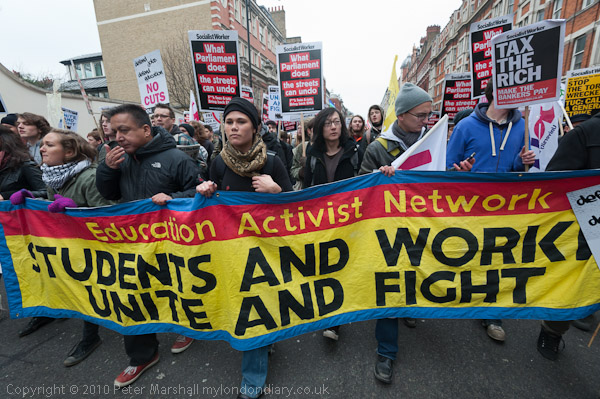
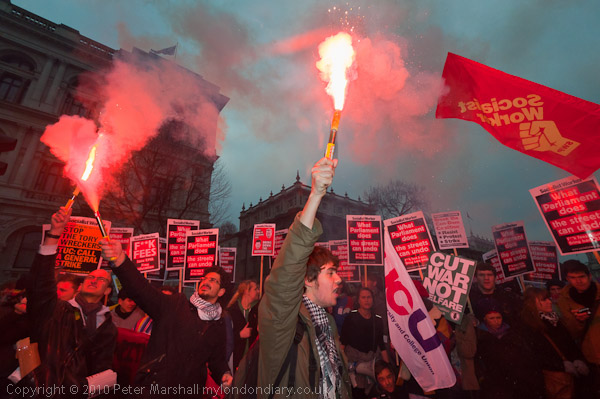
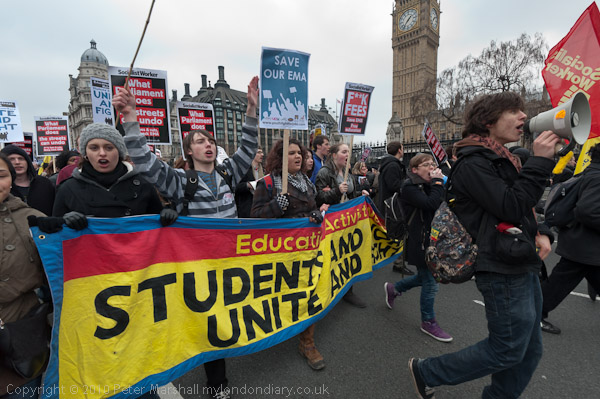
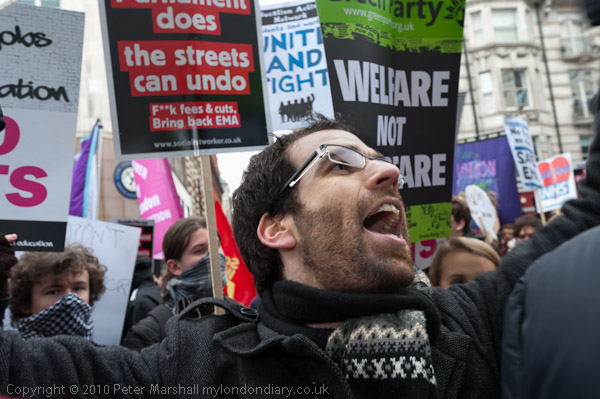
A rather larger protest was taking place further east in London with thousands of students, teachers, parents and others marching peacefully in the latest demonstration to defend education and the public sector. The demonstration, backed by the National Campaign Against Fees and Cuts was one of two national marches today, with another taking place in Manchester.

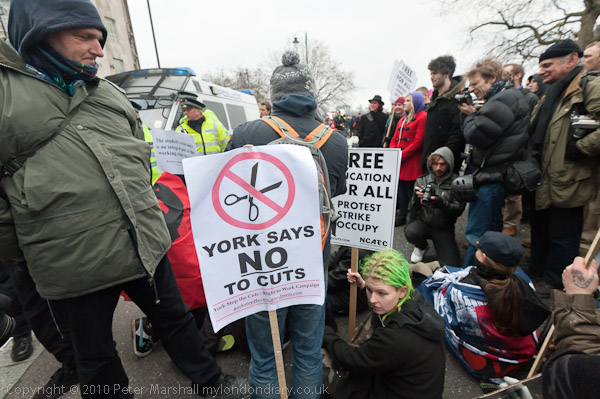
The protest was carefully policed following some incidents, particularly at the Conservative HQ on Millbank at a previous march in November 2010, but the police appeared for once to be trying to avoid provocation, and their were few incidents on the actual march, though I think later a smaller group of protesters went on to protest on Oxford St where there were some clashes with police and most of the fairly small number of arrests were made.

As always with such a large protest with around 5-10,000 people stretched out over half a mile or more of streets, its hard to know when and where any incidents are likely to occur, though some are more predictable. Obviously there were going to be some fireworks at Downing St – and in particular on this event the lighting of quite a few smoke flares, so I was there when this took place.

But I’ve also always wanted to document events as a whole, rather than concentrate on the more photogenic and controversial aspects. So I often – if not usually – find myself for much of the time away from most of the other photographers covering protests for the press, though still trying to cover the key aspects.

In November I’d missed much of the action outside the Tory HQ, arriving rather late on, but this time I’d anticipated correctly that the police would be making sure that it was very well protected against any possible trouble. As in November I spent quite a lot of time photographing protesters as they went through Parliament Square, and by the time the last of them arrived at the end of the march at Tate Britain the rally there had ended. It was a convenient location for me, just a short walk across Vauxhall Bridge to catch my train home.

More at:
No Fees, No Cuts! Student March
Solidarity with the Egyptian Revolution
Hizb ut-Tahrir Turned Away


All photographs on this and my other sites, unless otherwise stated, are taken by and copyright of Peter Marshall, and are available for reproduction or can be bought as prints.

Stratford 2005

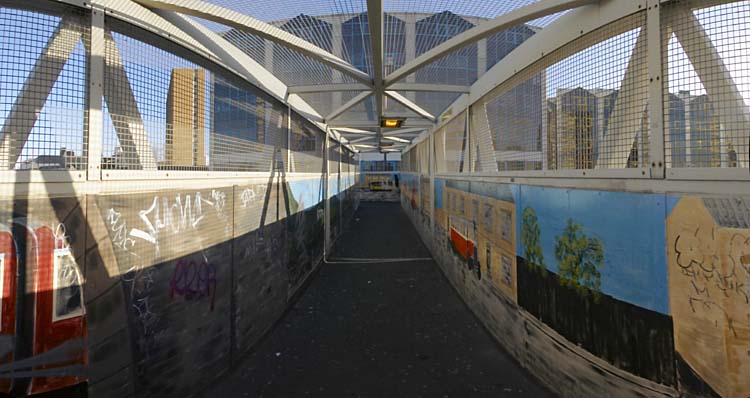
Footbridge at Stratford to Carpenters Estate

Back in 2005 many were still hoping that London would not win their bid to hold the Olympics, particularly those who lived in the area who could see how their lives would be disrupted by this huge event (though in the end it was far worse than they had imagined.)

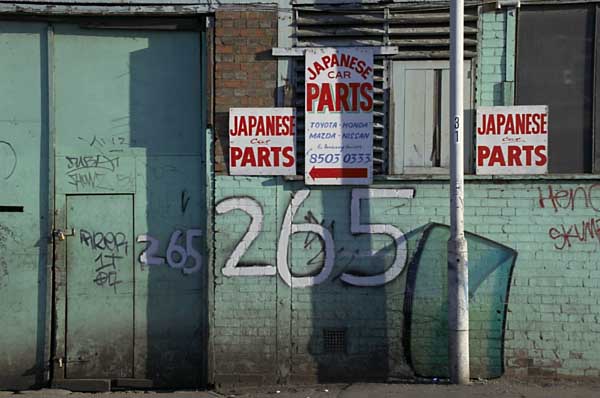
One of many businesses on Carpenters Road

They also saw how it would impact on the longer term development of the area. Many planners warned how it would distort the proper planning of the area and its future; although investment in the area was welcome, much or most of it would be put into white elephants which would have little long-term utility.

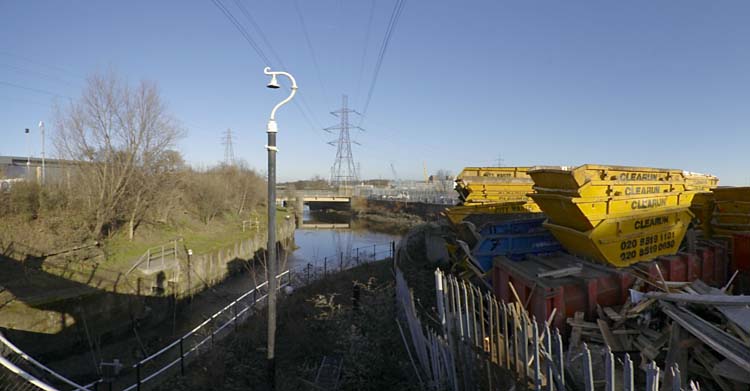
Waterworks River and Old River Lea at Carpenters Lock

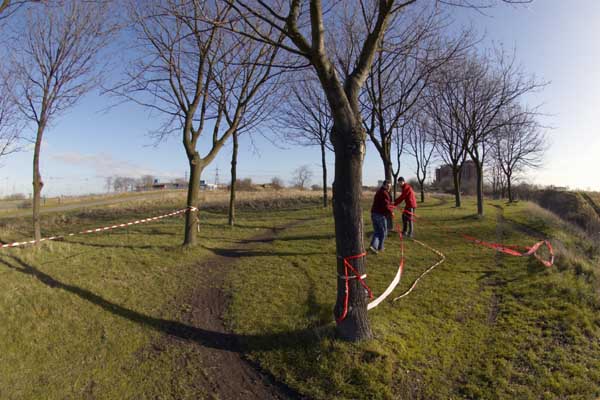
On Sunday 23 January 2005 I took my bike with me to Stratford and cycled to the meeting point at Temple Mills for a tour of the Olympic area with No to London 2012, a coalition of east london community groups and social justice campaigners.

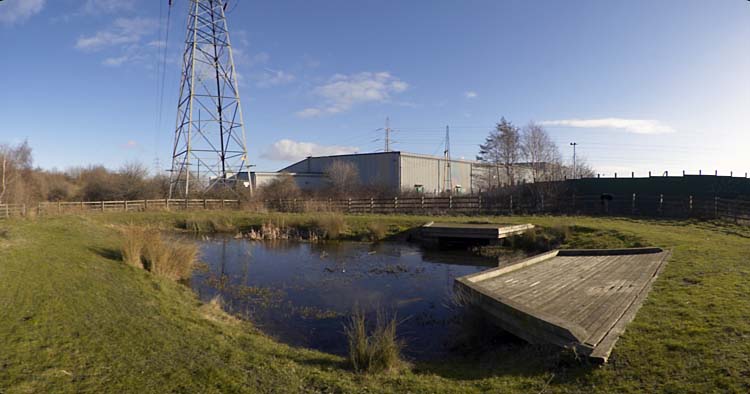
Bully Point Nature Reserve

Around 20 of us then took a walk around the area, getting some informative comments at a number of locations. As I remarked in my write-up of the event in My London Diary:

It was an opportunity that IOC delegates are not likely to have, with their view of these particular areas expected to be with a pair of binoculars from a distant tower block.

My London Diary: January 2005

I was already familiar with the area, having photographed around it since the 1980s, but still learnt a lot from some of those who spoke – and had just a little to add.

BMX track at Eastway Cycle Circuit is marked out

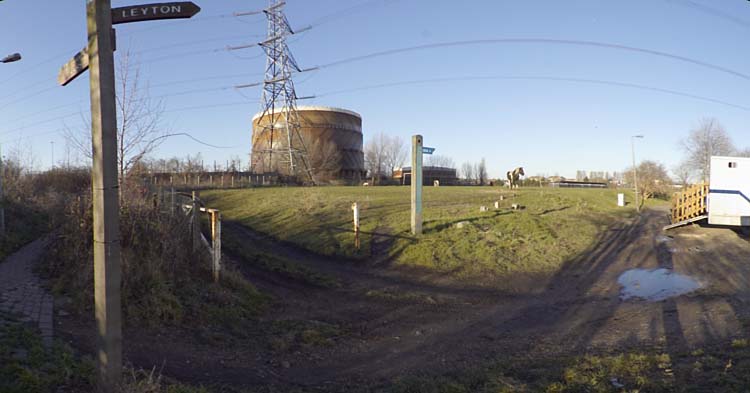
On our route around and also on my way to the meeting point I took the opportunity to take a few pictures, and after I’d sat down after the tour to eat my sandwiches by the Lea Navigation, to cycle to another area which was to be affected by the Olympics, Marsh Lane in Leyton, before making my way back to Stratford.

Wick Field, Hackney Wick

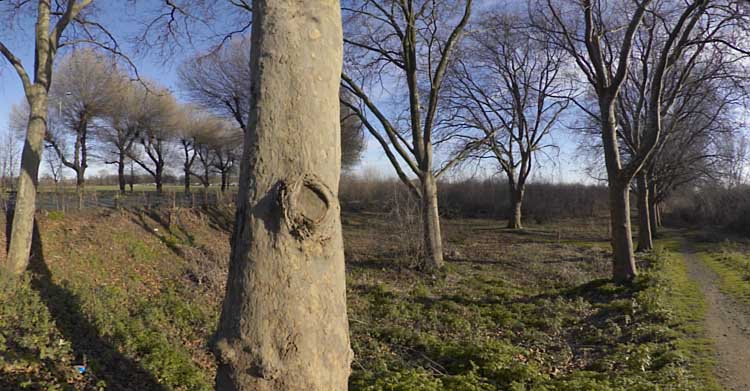
We were lucky with the weather, mild for January and with some sunshine, and I’d enjoyed the fairly short rides as well as the guided tour. I’d made several hundred pictures, including a number of panoramic images and felt I’d had a good day.

Leyton Marsh

Of course, London lost – and was condemned to host the Olympics. It was an event that caught the imagination of many of the public for the few weeks it was on, but has left a toxic legacy that will last decades.

You can see more of these pictures on My London Diary, where I’ve also written more about it.


All photographs on this and my other sites, unless otherwise stated, are taken by and copyright of Peter Marshall, and are available for reproduction or can be bought as prints.

Inauguration Day

Trafalgar Square, 20/1/2017

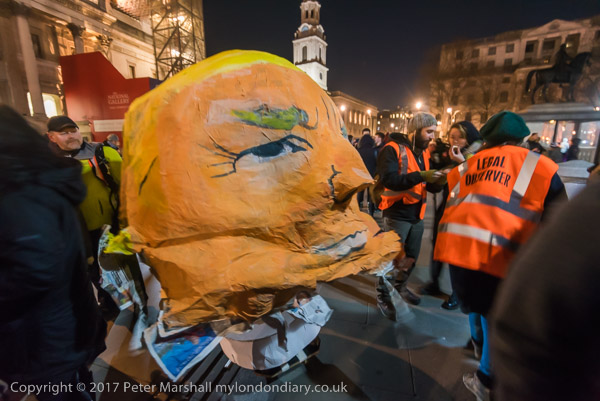
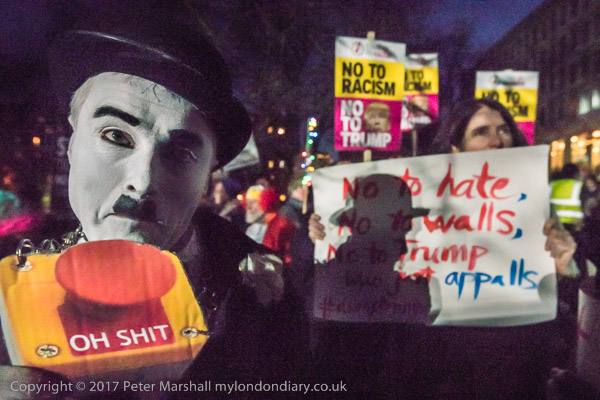
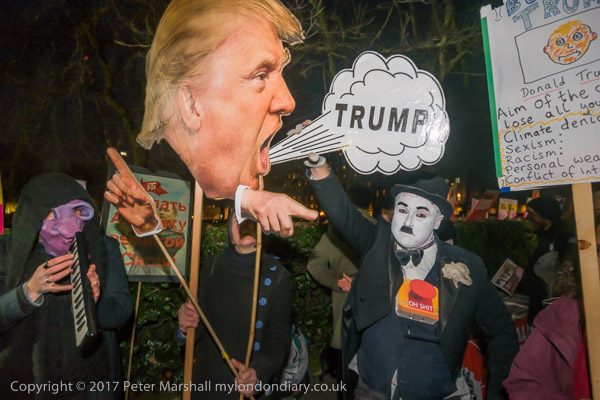
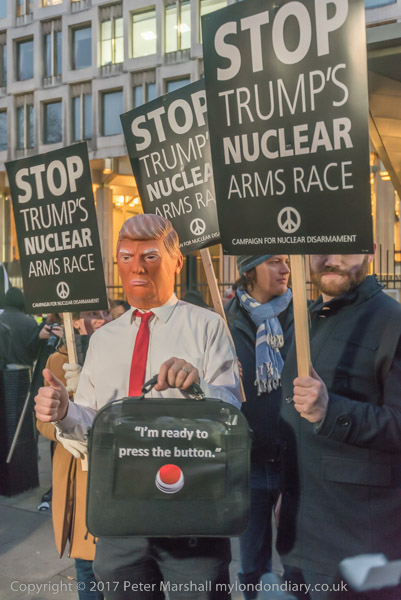
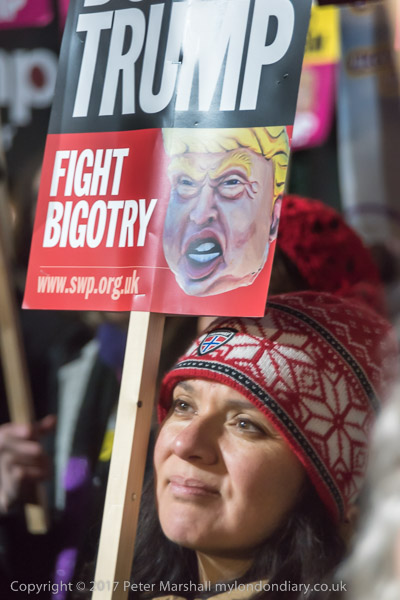
Four years ago, on 20 Jan 2017, London was protesting against another inauguration, that of Donald Trump. Commenting on those protesting outside the US Embassy – still then in Grosvenor Square I wrote:

All were appalled at the thought of a president who is a climate change denier, has a long history of racist and Islamophobic outbursts, has boasted of sexually assaulting women and has downplayed the severity of sexual violence.

Crowds protest Trump’s Inauguration

The four years that followed have confirmed most of our worst fears and in some ways gone further than we imagined, for example with disastrous polices in the Middle East and in particular over Israel and Palestine.

There will not be significant protests in London today, and even if police were not enforcing Covid restrictions particularly rigorously against protests I don’t think there would have been. We may not have any particularly high hopes for Biden and Harris, but at least they are almost certain to be better than Trump.

At least the US seems certain to re-engage with climate change – although probably still intent on keeping the US as the world’s largest polluter and allowing US companies to plunder the world for resources. And though it’s good to have a slightly saner finger close to that nuclear button it seems unlikely that the US will stop supporting corrupt fiefdoms in the Middle East and elsewhere and desist from supporting coups against popular governments that attempt to regain control over their own resources in South America and elsewhere.

Though I do hope for some positive surprises in the first hundred days, and there have certainly been rumours of some. Perhaps we will see the cancellation of some of the more environmentally damaging projects given the go-ahead by Trump. Almost certainly there will be fewer racist rants and tweets and there could even be some real progress on civil rights.

But while we may have some hopes for the United States of America, the future for our United Kingdom remains depressing. Suffering under the burden of Brexit and Covid, with a government that continually proves itself both corrupt and inept and an opposition which is ineffectual and sycophantic – and currently outclassed, outgunned and outplayed by a young footballer.

And that ‘United’ is less and less than ever appropriate; Brexit divided the country, and most of us now realise it was a terrible mistake – even increasingly more of the 34% who voted for it. It has created a border between the mainland and Northern Ireland and exacerbated the gap between England and Scotland. Even Wales seems more distant, though it has protected our relationships with those tax havens that make us possibly the most corrupt country in the world.

There is one small glimmer of hope, apart from the vaccinations that may just eventually allow us to gain some accommodation if not exactly control over Covid. Last Sunday saw the inauguration of the Project for Peace and Justice, founded by Jeremy Corbyn, an international campaign which describes itself as “a hub for discussion and action, building solidarity and hope for a more decent world.”

F**k Trump
Crowds protest Trump’s Inauguration


All photographs on this and my other sites, unless otherwise stated, are taken by and copyright of Peter Marshall, and are available for reproduction or can be bought as prints.

Around High St Stratford

St Thomas's Creek, Cook's Road, Stratford, Newham, 1983 35q-34_2400
St Thomas’s Creek, Cook’s Road, Stratford, Newham, 1983

There is and long seems to have been some confusion about the naming of this part of the canal system that links the main line of the Lea Navigation at Bow Bridge to the City Mill River and City Mill Lock. On some maps (including Google’s) it is simply referred to as ‘Bow Back Rivers’ but I find it less confusing to give it the more local name, St Thomas’s Creek, sometimes written as St Thomas Creek. The creek got its name from St. Thomas’s Mill, sometimes called ‘Pudding Mill’, I think because of its shape, which also gave its name to the small stream the Pudding Mill River and was actually on that stream on Pudding Mill Lane. For those interested there is a good map of the area before the flood relief works of 1931-5 on British History Online.

Yardley's Box Factory, Stratford High St, Stratford, Newham, 198336m-63-positive_2400
Warton House, former Yardley’s Box Factory, High St, Stratford, 1983

The earliest connection of the Yardley name to soap-making was in the first half of the 17th century, when a Yardley was given the concession to produce soap for the whole of London, but the company dated its founding as ‘Clever Brothers’ to 1770. This company making soaps and perfumes was taken over by William Yardley in 1823 and passed on to his son Charles when he died the following year. The company moved from Bloomsbury to a large factory on Carpenters Road Stratford in 1904 and bought land on Stratford High St in 1918. In 1913 they had trade-marked a picture by Francis Wheatley from his 1793 series, the ‘Cries of London’ to use in their advertising, replacing the primroses in his picture by lavender, and when they built a new art deco box factory in 1938 this was installed at a large scale on the building. Yardleys moved to Basildon in 1966, needing large premises, but in 1967 were taken over by British American Tobacco who sold the business to Beecham in 1985, who again sold it on after they merged to be SmithKlein Beecham. The company went into receivership in 1998. Parts of the box factory – including this section on the High St next to the Northern Outfall Sewer and the Waterworks River are still there, all that is left of Yardley’s in Stratford.

Stratford High St area, Stratford, Newham, 1983 36m-14_2400
Stratford High St area, 1982

I cannot remember exactly where I took this or the next picture, though from other exposures on the same films both are clearly somewhere not far from Stratford High St. I think the canal seen at right here is probably St Thomas’s Creek.

Timber yard, Stratford, Newham, 1982 32v-22_2400
Timber yard, Stratford High St area, 1982

Timber was the main product carried on the Lea Navigation in the later years of its use, and I think this timber yard was probably close to the main stream of the navigation. My attempts to find it again in later years were unsuccesful.

Cafe, Stratford market, Stratford, Newham, 1983 36p-35_2400
Cafe, Stratford market, Stratford, Newham, 1983

The notices on the door offer not just ‘Jellied Eels’ but ‘Best Jellied Eels’, along with ‘Loch Fine Kippers’. My contact sheet puts its location as Stratford Market in Burford Road, just off High St to the south.

Barge, Lea Navigation, Bow Bridge, Bow Flyover, Tower Hamlets, Newham, 1981 29t-26p_2400
Barges, Bow Bridge, October 1981

These last two pictures were some of the first I took in the area after I heard on a radio interview that commercial traffic on the Lea Navigation was to come to an end in a few weeks time.

I think it was the same day that I picked up my camera bag and got on the train to come to look for and photograph any remaining activity. It was a slow journey to Bromley-by-Bow from where I spent an hour or so walking along beside the navigation between Bow Locks and Bow Bridge, where I found three barges loaded with cut timber, photographing all three from the bridge and going down onto the wharf for another picture.

Barge, Lea Navigation, Bow Bridge, Tower Hamlets, Newham, 1981 29t-25_2400
Barges, Bow Bridge, October 1981

I find it hard now to understand why I took so few pictures – only around 30 exposures on the entire visit, and just these two where I found evidence of any remaining commercial traffic.

More pictures from the area on page 3 of my Flickr album River Lea – Lea Navigation 1981-1992.


All photographs on this and my other sites, unless otherwise stated, are taken by and copyright of Peter Marshall, and are available for reproduction or can be bought as prints.

Just a year ago

Just a year ago on Saturday 18th January I was going up to London as usual on a Saturday morning to photograph a number of protests. The day didn’t get off to a good start, as when I arrived at the location for the first event I was the only person there. I was a few minutes early, so I hung around, but when the actual time arrived and there was still only one person there (and even the organiser on Facebook hadn’t turned up) I gave up and left.

Before Facebook it was rather more difficult to share information about any protest, but now anyone can post an event. There is some indication of how much support any event has attracted, with Facebook showing the number of people who have clicked to show an interest or attend, but the numbers are incredibly unreliable. Interest means little or nothing, and often the great majority of those who perhaps thought on a Wednesday evening they might go change their minds if it means getting out of bed early on a wet Saturday morning. So its not unusual to find something doesn’t happen, though it is sometimes rather unpredictable.

Fortunately it was a fairly short walk to Downing St, where on the pavement opposite there was something for me to photograph. While a few of the global rich were meeting at the World Economic Forum on the exclusive Swiss mountain resort of Davos, The Equality Trust, who I’d not heard of, but get funding from the EU, together with nine other organisations were holding holding an event as part of what they described as “a mobilisation by thousands of people in more than 30 countries worldwide to demand a fairer, more equal and sustainable future.” And for once the 94 who had said they were going on FB wasn’t that far from the actual attendance.

And though it wasn’t the most exciting protest I’ve covered it was certainly hard to disagree with what they were calling for:

  • good quality education, accessible housing, decent jobs and healthcare for all
  • an end to poverty wages, cuts in public spending and the decimation of social rights
  • an end to hunger and homelessness in the world’s sixth-largest economy
    fair and progressive taxation and an end to tax breaks for the wealthy
  • a wellbeing economy that serves people and planet, instead of profiting from environmental destruction.

As often when I’m covering a protest at Downing St, there was another taking place that I hadn’t been aware of, with a small group of protesters against Brexit calling for the release a report that had been completed before the December election but was held up by Boris Johnson because it revealed important Russian interference in UK politics including large donations to the Conservative Party and pro-Brexit campaigns.

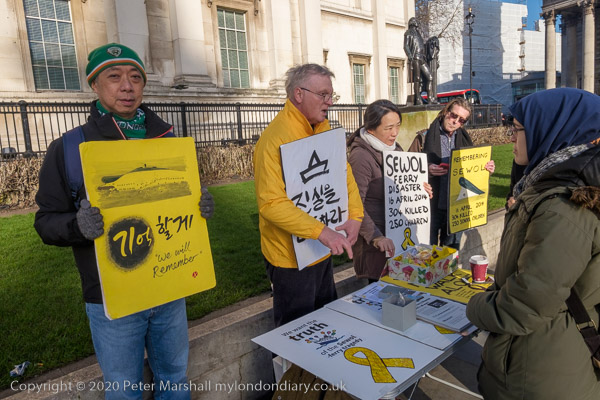
From Downing St I walked up to the North Terrace of Trafalgar Square where two events were taking place. Since the Sewol ferry disaster on April 16 2014 there have been regular vigils in memory of the 304 victims, including the 250 high school children who were drowned after being told to ‘stay put’ on a lower deck. These silent vigils, mainly by Koreans or those with Korean relatives took place monthly for several years but are now quarterly.

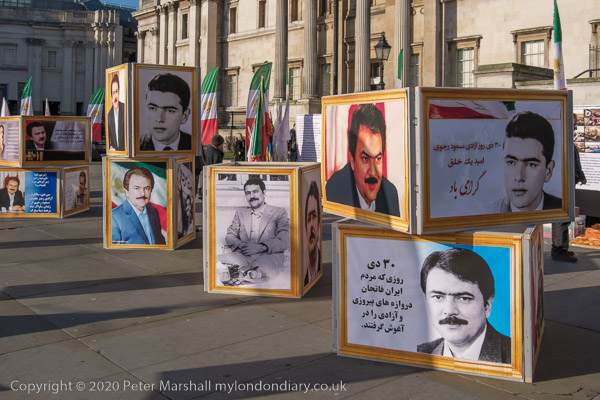
Also on the north Terrace, elaborate preparations were taking place by Anglo-Iranian Communities in the UK and supporters of the People’s Mujahedin of Iran’s National Council of Resistance of Iran for a rally in support of the anti-regime protests following the admission that the Islamic Revolutionary Guard Corps (IRGC) had shot down the Ukrainian passenger plane. These protest in Iran have been suppressed with illegal force by the clerical regime. I was unable to wait for the start of the protest as I wanted to cover another event, and later abandoned my plans to return.

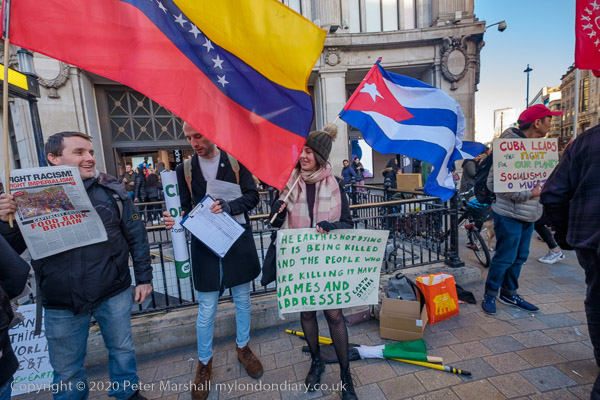
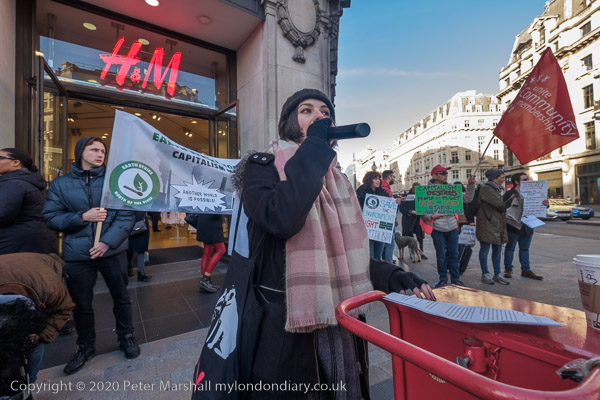
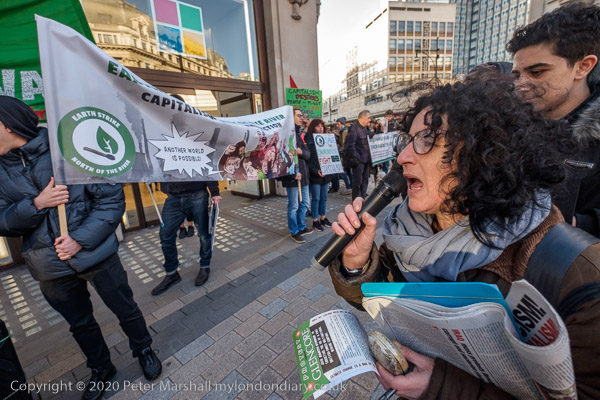
At Oxford Circus I joined protesters from Earth Strike, organised by the Revolutionary Socialist Group, who were handing out leaflets before their series of protests along Oxford Street outside banks and stores involved in the exploitation of the Global South and the destruction of the environment.

I went with them as they walked up and down Oxford St, stopping outside shops including HSBC, H&M, Microsoft, ee, McDonald’s and Zara for short speeches about the particular contributions these companies are making to climate change and how they exploit workers and resources in the South.

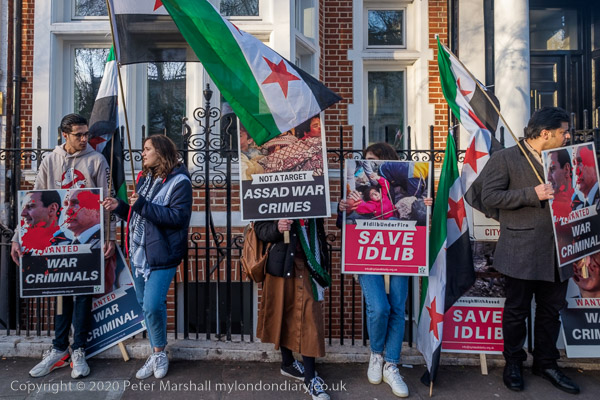
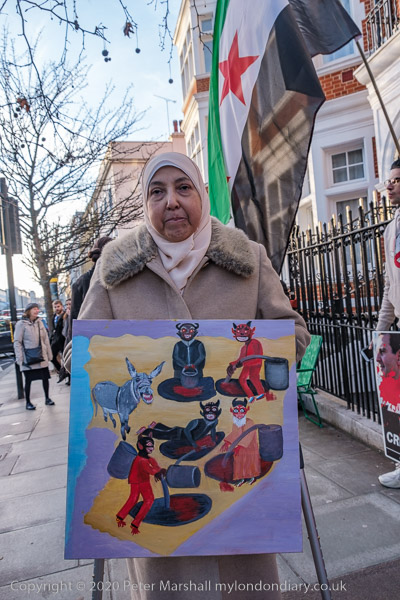
By the time it had got too late to be worth returning to Trafalgar Square and instead I went west to a protest close to the Russian Embassy in Kensington. Russia’s support has saved President Assad in Syria and they were protesting the war crimes of Assad and Putin against the people of Syria in Idlib province.

Russian support, particularly air support has enabled Assad to defeat and drive back the Syrian rebels who would otherwise probably have driven him from office and set up a more democratic government. Since mid-December Assad has waged a brutal and unprecedented military campaign with air raids that have targeted hospitals and markets and killed hundreds of civilians. Over 500,000 have fled from their homes but are unable to escape as the Turkish border is closed.

I talked with the protesters, many of whom I recognised from earlier Syrian protests. The situation in Syria is desperate and the Syrians, given hope in the early years by Western countries, have now been abandoned by the international community. One of the women had been saying her prayers at the protest, and unfortunately as I said to her there seems now to be little else we can do but pray and hope.

Against war crimes in Idlib
Earth Strike Oxford St rolling protest
‘Stay Put’ Sewol silent protest
Support for Anti-regime Protests in Iran
Release the Russia Report
Fight Inequality Global Protest


All photographs on this and my other sites, unless otherwise stated, are taken by and copyright of Peter Marshall, and are available for reproduction or can be bought as prints.

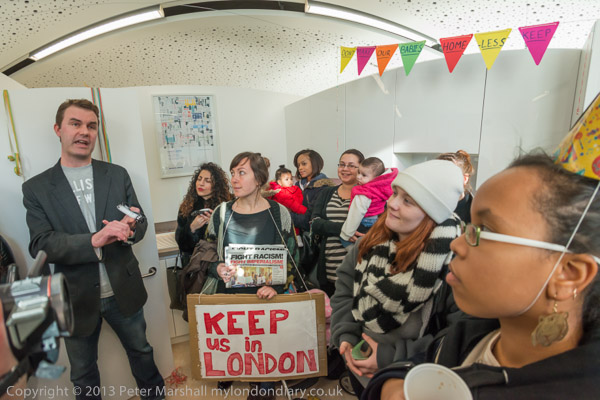
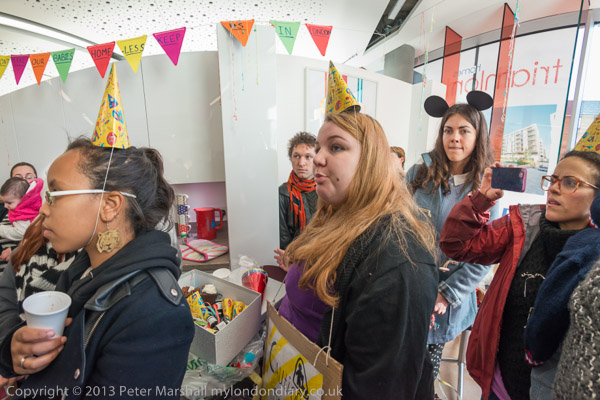
Young Mums Party in Protest

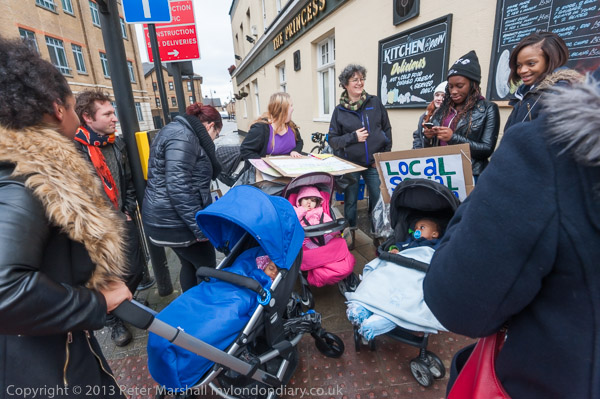
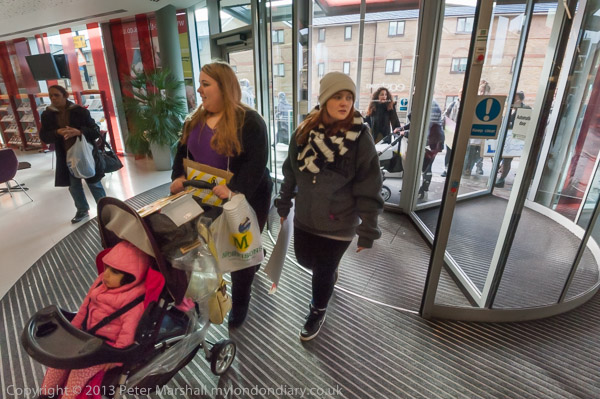
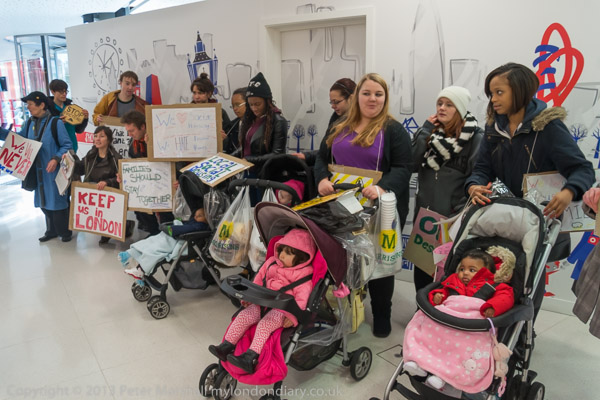
One of the more encouraging series of protests it has been my privilege to photograph over recent years has been that begun by young single mothers who when threatened with eviction from their hostel in Stratford with Newham Council intending to disperse them into private rented accomodation often hundreds of miles away from their friends and families stood up and fought for their rights.

The mothers and their supporters met on a street corner close to East Thames Housing

The campaign by the mums from Focus E15 gained a great deal of publicity and support for their cause, and some of them became rather unlikely celebrities, speaking at conferences and other events and appearing in theatre performances. And they were largely successful both in getting the council to rehouse them locally, and also in bringing some of the worst aspects of housing policies, both national and by local authorities to the attention of a wider public. They even got me on stage in 2017.

And made their way into the foyer of East Thames Housing

Their campaign widened to a more general campaign over housing problems, particularly in the London Borough of Newham, but also becoming involved in other campaigns across London and elsewhere. Newham is a borough with huge housing problems, but also one that the local Labour Party has managed to make much worse, with policies that have deliberately left good quality council housing empty for years despite one of the longest housing waiting lists in the country.

They pose for a photograph for the local newspaper

Part of the problem with Newham lies in the creation of a directly elected mayor in 2002, the first such mayor in England. This put more power into the hands of the mayor, Robin Wales, and a small cabal of right-wing Labour members, who pursued policies to increase the economic prosperity of the area with little regard for the poorer members of the community, encouraging businesses and bringing wealthier people into the area into new private developments. Focus E15 accused Robin Wales of being a kind of reverse Robin Hood, robbing the poor to give to the rich through his policies which they labelled as ‘social cleansing’.

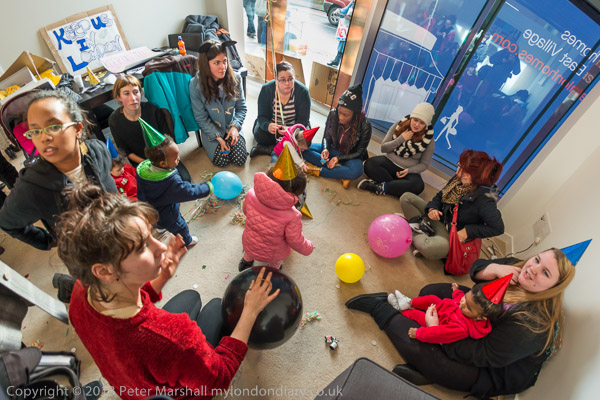
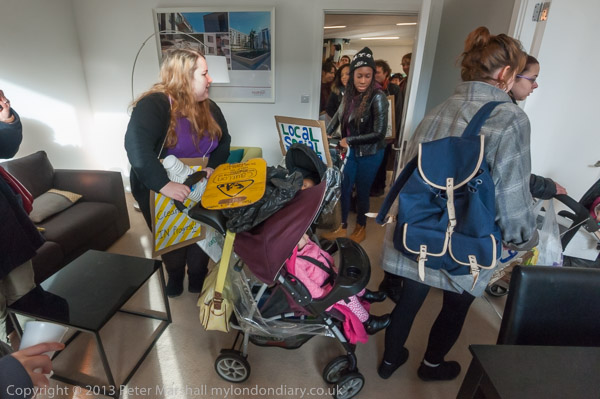
And then occupy the East Thames show flat for a party

Focus E15 confronted Wales on a number of occasions, and he reacted angrily at times – and later was forced to apologise. Earlier he had been involved in another fight against local residents when he wanted to replace Queen’s Market with a new development including a 31 storey tower; it was seen as so bad that even then London Mayor Boris Johnson stopped it going ahead. And under Wales, the council made some disastrous investments which have lumbered the council with huge interest payments. Newham is essentially a one-party state, but by 2016 many in the local Labour party had become disillusioned with him and wanted change. Wales managed to rig a vote to prevent other candidates standing for Mayor in 2018, but this was overturned after an outcry in the party, and in 2018 Rokhsana Fiaz was elected as mayor. Wales went off to work for the influential right-wing free-market think tank Policy Exchange.

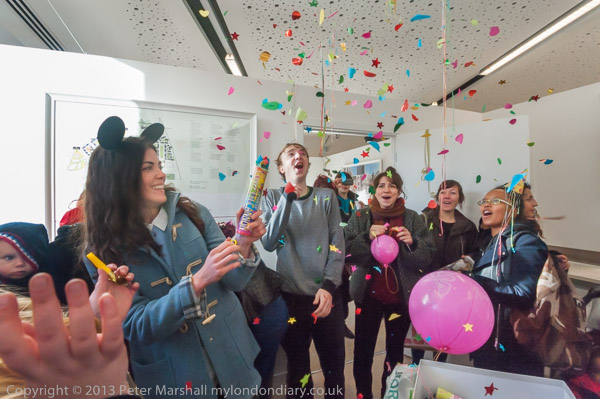
the air is filled with hearts, stars and other shapes

I’m proud to have done a little to promote the campaigns of Focus E15 through photographing some of their events – though I”ve been unable to do so over the past year. They continued to hold a regular weekly outdoor street stall on Stratford Broadway and socially distanced protests through 2020 and hope to do so this year, despite the increased restrictions. You can read about them on their web site, where they make clear that despite the new mayor in Newham little has changed:

The struggle must go on and Focus E15 campaign enters 2021 determined to continue to build a housing movement, challenge the Labour council, give solidarity to all those fighting for housing justice, and…. Educate! Agitate! Organise! so that we expose this ruthless capitalist system and begin to work in unity together for a better future for everyone.

Focus E15 web site
An East Thames officer comes to discuss their sitation with them

The pictures here are from a protest seven years ago today, on Fri 17 Jan 2014, and I hope illustrate something of why I found them so interesting to photograph. They went into the offices of the housing association that ran the Focus E15 hostel and held a party inside the show flat there. They had good reasons to be angry and protest, and were fearless and imaginative in how made their views clear – and provided great opportunites for photography. Many protests are rather dour occasions which are hard to make interesting though our pictures, but their protests were always lively and never run-of-the-mill.

He gets some tough questioning – and states that although it’s up to the council to rehouse them, East Thames will not evict them.

At the protest they did get an assurance that they would not be evicited, though it was clear than there was a lack of trust from the mothers in this statement. I left them still partying to file my story, and after a while they also left and went to protest at the nearby council housing offices.

More at Focus E5 Mothers Party Against Eviction.


All photographs on this and my other sites, unless otherwise stated, are taken by and copyright of Peter Marshall, and are available for reproduction or can be bought as prints.

16th January 2013

Probably the best way to describe my work on Wednesday 16th January would be varied, and that’s one of the things that attracts me to photographing protests on the streets of London. I was never quite sure what I would find or what would happen, and every protest brought its own problems in terms of photography, and also sometimes in how to write about them.

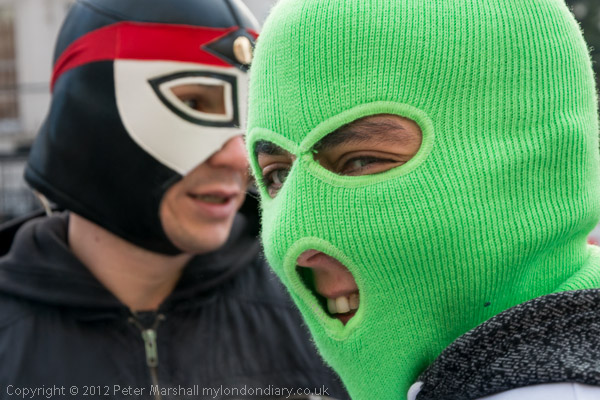
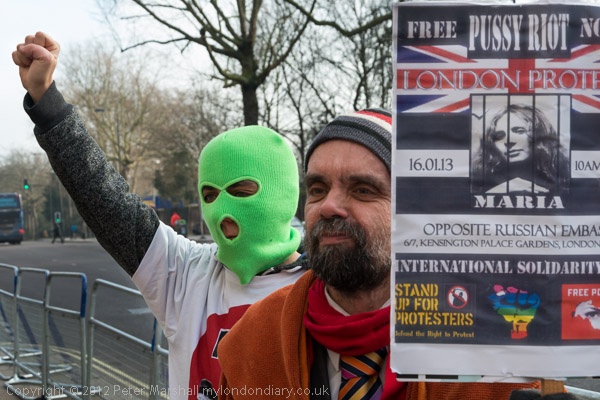
I started the day with Pussy Riot, or rather with protesters in solidarity with them on an International Day of Solidarity with Maria Alyokhina, attending a court hearing today over her plea for her sentence to be suspended so she can raise her son until he is 14. She was one of three members of Russian punk band Pussy Riot sentenced for their performance of an anti-Putin “punk anthem” in a Moscow Orthodox cathedral in February, and was sent to a prison camp in Siberia for two years.

I had expected rather more protesters than the small group I found there, as the case had attracted considerable publicity, but perhaps it was too early on a cold January morning to attract many. It isn’t either a very good place to protest, as the actual embassy is hidden away a few yards down a private road roughly opposite where protests (and photographer) are strictly forbidden. But I also left fairly promptly after the time set for the start of a protest, and numbers may have grown later.

Pussy Riot London Solidarity Demonstration


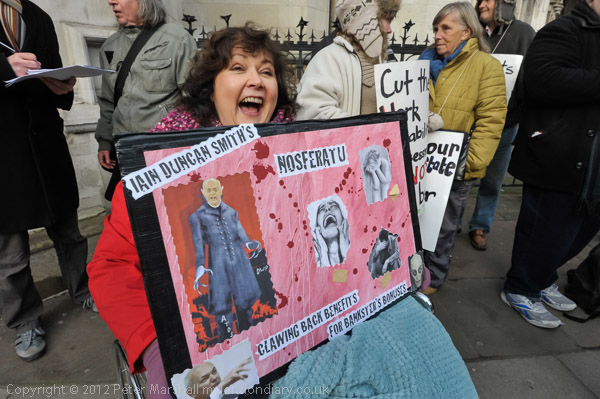
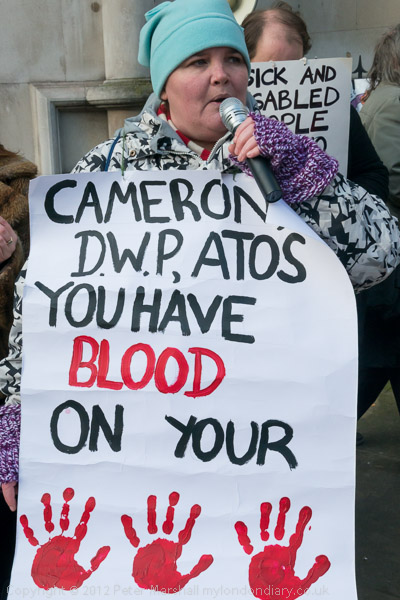
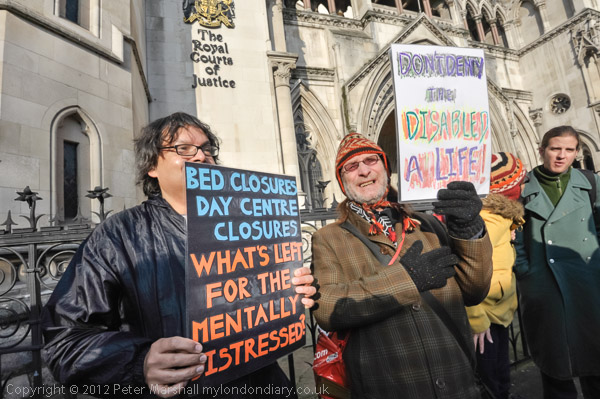
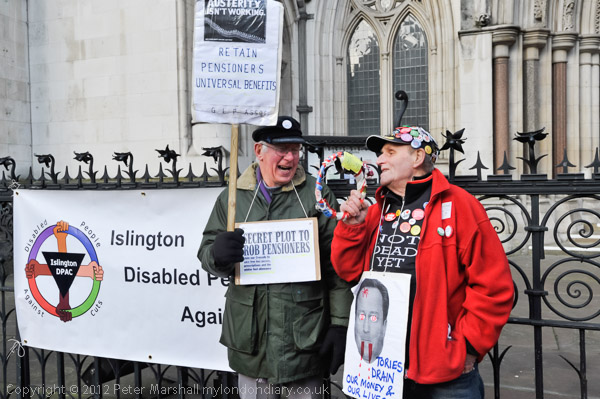
There were more people, including quite a few that I knew, at a rally outside the Royal Courts of Justice on the Strand. Many were disabled, with a few in wheelchairs, but more who have mental health conditions, along with a number of pensioners, trade unionists from the court branch of the PCS and other supporters and the protest was organised by disabled activist groups including DPAC and the Mental Health Resistance Network.

Inside the court a tribunal was hearing a judicial review into Work Capablility Assessments on the grounds they violate the Equality Act, not being accessible for those with mental health conditions, and several of those speaking at the rally had personal stories to tell of how they had suffered as a result.

Mental health conditions are often spasmodic, which may result in claimants on a good day not seeming very ill and on a bad day being unable to attend an assessment – which results in them being automatically judged fit for work. Few of those carrying out the tests had sufficient knowledge and experience in the area of mental health to be able to sensibly conduct the assessment, and medical records were often not taken into consideration.

It seems totally ridiculous for benefits which people need because of their medical conditions not to be assessed on the basis of reports by the doctors who have examined and know their patients, but we have a system that instead tries to deny benefits on the basis of often arbitrary ‘tests’ by unqualified staff.

Equality Protest Against ATOS Work Assessments


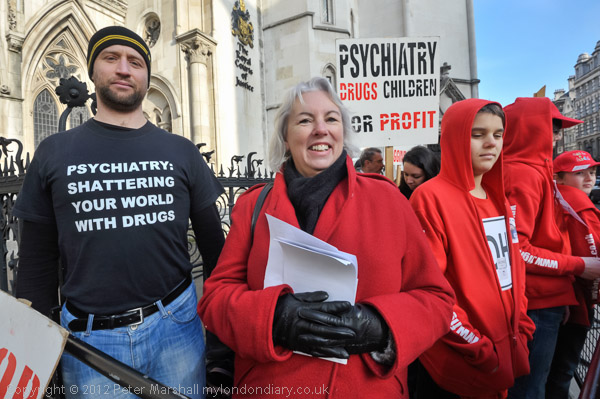
Another protest was taking place outside the courts, which I hadn’t been aware of, and it had a very different atmosphere which I found rather chilling.

There was something very organised about it, with people dressed in red and all the placards carefully printed and it lacked the kind of spontaneity. Although it was a protest against the use of drugs to treat mental illness, some of those taking part gave the impression that they had been drugged.

Drugs are certainly misused in the treatment of people with mental health issues, though I think there are occasions when they are an important part in improving people’s health. And certainly they are over-used as a way to avoid treating the real causes of some people’s problems which come largely from poverty, lousy housing and terrible jobs. But there seemed to be something very wrong in some of the assertions that were being made.

I hadn’t heard of the Citizens Commission on Human Rights, and was not really surprised when I looked it up on the web and found it described on Wikipedia as ‘a Scientology front group which campaigns against psychiatry and psychiatrists‘ established in 1969 by the Church of Scientology.

And as I wrote when I put these pictures on line:

it seems unfair to dismiss all of psychiatry as their banner did as ‘Junk Science and Dangerous Drugs‘ and I find it impossible from personal experience to deny the existence of medical conditions such as depression – or to dismiss the utility of some drugs in the treatment of mental conditions.

Stop Psychiatry Drugging Kids

Marshgate Lane

Marshgate Lane, Stratford Marsh, Stratford, Newham, 1990 90-9h-53_2400-2
Marshgate Lane from Northern Outfall Sewer, 1990

Marshgate Lane runs through the centre of Stratford Mash and what became the London 2012 Olympic site. It’s southern end was a short distance north of the bridge over St Thomas’s Creek on Pudding Mill Lane, and it ran parallel and a few yards to the east of Pudding Mill Lane, which rejoined it just south of the Northern Outfall Sewer. Marshgate Lane then continued in its northerly route past Knobs Hill to run beside the Old River Lee and across both the City Mill River and the Waterworks River to Carpenters Road.

City Mill River, Marshgate Lane, from Greenway, Northern Outfall Sewer, Stratford Marsh, Newham, 1983 33x-32_2400
Industry between Marshgate Lane and the City Mill River, 1983

It’s southern area still follows the same route, though it now starts at Stratford High St, which was previously Pudding Mill Lane, and north of the sewage outfall its route is completely different. But what was back in the 1980s a street lined for much of its route with industrial premises is now a wasteland with some athletic facilities, parts of which will shortly be covered with tall blocks.

Marshgate Lane, Stratford Marsh, Stratford, Newham, 199090-9g22_2400
Maryland Plastics, St Thomas’s Creek, Pudding Mill Lane, 1983

As well as the Olympic devastation, Crossrail has also played havoc with the southern area. An earlier addition with little disruption was the Docklands Light Railway, extended to Stratford for the Olympics and opened to the public in 2011 with a station on Pudding Mill Lane, which gives considerably more convenient access to the area.

Marshgate Lane, Stratford Marsh, Stratford, Newham, 1990 90-9g24_2400
Marshgate Lane, 1990

It isn’t always easy to decide now exactly where I took some of these pictures as I wandered freely around the area, both on the streets, on the Greenway and other footpaths and through some small areas of waste land. So some pictures captioned as Marshgate Lane may actually be on Pudding Mill Lane or even Barbers Rd or Cooks Road.

Marshgate Lane, Stratford Marsh, Stratford, Newham, 1990 90-9g26_2400
Marshgate Lane, 1990

There was considerable opposition from some of the businesses in the area to the redevelopment for the Olympics, and for some it was the end of their business, while a few did well out of their relocation. I continued to photograph in the area during the redevelopment, though access to much of it was closed, the area surrounded by a blue fence and security guards. Now there is little to attract me back to Stratford Marsh, and my few visits before Covid have been sadly disappointing.

Marshgate Lane, Stratford Marsh, Stratford, Newham, 1990 90-9h52_2400
Marshagate Lane, 1990

More pictures from the 1980s on Flickr.


All photographs on this and my other sites, unless otherwise stated, are taken by and copyright of Peter Marshall, and are available for reproduction or can be bought as prints.

City Mill Lock & Blaker Rd

City Mill Lock, Blaker Rd,  Stratford Marsh, Stratford, Newham, 1990 90-9f-32 (2)_2400
City Mill Lock, Blaker Rd, Stratford Marsh, Stratford, Newham, 1990

City Mill Lock connected the tidal Waterworks River with the Bow Back Rivers which are a part of the Lea Navigation and thus at a constant level. There is another lock connecting the two systems further north where Carpenters Lock connects the Old River Lea to the start of the Waterworks River close to Carpenters Road. Both locks were built in the 1930s when considerable work was carried out, mainly to reduce flooding but also with the intent of increasing commercial traffic on the Back Rivers, particularly the City Mill River. But I think this never happened and by the 1960s these streams were seldom if ever used.

City Mill Lock, Blaker Rd,  Stratford Marsh, Stratford, Newham, 1983 36m-35_2400
City Mill Lock, Blaker Rd, Stratford Marsh, Stratford, Newham, 1983

The River Lea was at least theoretically navigable at the right stage of the tide some way further north – and of course much further by kayaks, though there are legal restrictions on parts of its many streams.
Since the Olympics, the tidal flow on the river has been regulated by a new lock on the Prescott Channel at Three Mills which I photographed in 2010. The original intention of British Waterways that the river above this point should be non-tidal but its level still varies, perhaps simply with the river flow.
City Mill Lock, St Thomas's Creek, Stratford Marsh, Newham, 1983 36m-22a-positive-2_2400
City Mill Lock, St Thomas’s Creek, Stratford Marsh, Newham, 1983

The lock gates had clearly seen rather better times and the lock was unusable. These gates were replaced as a part of the makeover of the area for the Olympics.

City Mill River, Stratford Marsh, Stratford, Newham, 1983 35v-15_2400
City Mill River, Stratford Marsh, Stratford, Newham, 1983

Just to the west of the lock, behind the lock keepers house, St Thomas’s Creek turns towards the north and becomes the City Mill River. A few boats were moored here, next to Blaker Rd.

City Mill River, Blaker Rd,  Stratford Marsh, Stratford, Newham, 1983 35v-13_2400
City Mill River, Blaker Rd, Stratford Marsh, Stratford, Newham, 1983

Continuing north beside the City Mill River along Blaker Road led to a footpath which went under the Northern Outfall Sewer in a tunnel. It was possible to access the Greenway walkway on the sewer from here.

City Mill River, Blaker Rd,  Stratford Marsh, Stratford, Newham, 198335v-26_2400
City Mill River, Blaker Rd, Stratford Marsh, Stratford, Newham, 1983

From where you could look down on the path and the railings beside the river.

City Mill River, Stratford Marsh, Stratford, Newham, 1983 35v-25_2400
City Mill River, Stratford Marsh, Stratford, Newham, 1983

This is the view looking back down the City Mill River towards City Mill Lock, now rather different.

City Mill River, Railway, Stratford Marsh, Newham, 1983 36m-43

The footpath led on past the Northern Outfall Sewer to a rather strangely angled basin taking the river under the main railway lines. From here you could continue walking beside the river and eventually reach the north end of Marshgate Lane and Carpenters Road.

The last time I tried to repeat this walk, in 2019, it was not possible, with work still taking place in the area and fences stopping me. As well as work still taking place after the 2012 Olympics, parts were blocked by work on Crossrail.

More pictures on Flickr.


All photographs on this and my other sites, unless otherwise stated, are taken by and copyright of Peter Marshall, and are available for reproduction or can be bought as prints.