More from the Loire

Mill, Montreuil-sur-Maine l19B73loire
Mill, Montreuil-sur-Maine

We started our ride with a couple of excursions from Angers, including one to the north where we rode back alongside the Mayenne. Watermills were a feature at many points of our rides, particularly along the tributaries of the Loire.

Coutures x34loire

There were a number of similar roadside crosses at junctions along some of the minor roads we cycled along, but I think this was the only one I stopped to photograph. Despite the place names on the road signs it was difficult to find the location as none of those names appears on maps or on Google and I only eventually located it by ‘riding’ on Streetview. I think it is actually a little north from where the caption on Flickr indicates.

Horse-drawn cart in Vineyard, Loire Valley x24loire

Many of the roads we cycled along were departmental roads or routes communales and both were often little more than farm tracks, though most were metalled. We met little traffic, sometimes cycling for an hour or more without seeing a car or tractor. Farmers were still working with horses on a number of fields, mainly vineyards that we passed.

A main road, Indre-et-Loire d30loire

Many of the departmental routes pass through small villages and the street above was wider than many (I think it is somewhere east of Orleans, but let me know if you recognise it.) Often there were children walking out into the street who would shout encouragement to the two mad cyclists passing through. The Tour de France had just ended and cycle-mania was at its peak. Sometimes kids on bikes would try to race us, puffing noisily as they struggled past before turning off and stopping while we continued at a steady pace for perhaps another 30 or 40 miles.

There were also other cyclists, without luggage and dressed for the Tour on lightweight racing bikes (which mine had once been before I replaced its narrow tubular tires with sturdier versions on wheels with wider rims and twice the weight.) Struggling up a hill well behind me, Linda suddenly felt pedalling much easier and she began to accelerate, and at the summit a rider let go of her saddle and waved a cheery ‘au revoir’. Much less welcome were the dogs who chased us through some farms, and a couple of times I had to pull the aluminium cycle pump from the frame to beat them away.

River Thouet Montreuil-Bellay k29loire

Some of the chateaux were remarkably out of some Gothic fairly tale, such as Montreuil-Bellay above the River Thouet, where I expected to see knights on horses with lances or perhaps even unicorns, but was disappointed.

Loire Valley x26loire
Near Angers – but let me know if you know exactly where it is.

And should you feel moved to emulate us after seeing these pictures, one small road safety tip. It really is better to ride on the right (as having pressed the shutter I raced to tell Linda), though with roads as empty as this one it wasn’t a real problem.

More on Flickr at 1975 Loire Valley Bike Tour.


All photographs on this and my other sites, unless otherwise stated, are taken by and copyright of Peter Marshall, and are available for reproduction or can be bought as prints.


Another Road Trip

Near Saumur k38loire

I’ve spent much of the last week cycling up the Loire Valley, though unfortunately only virtually, though the weather would have been great for the real thing, but perhaps not my legs. Surprisingly almost all of the back roads we chose, some little more than farm tracks, are on Google’s Streetview and seem little altered from 45 years ago, with the roads almost as empty.

In reality I’ve made a few short and pleasant cycle rides and walks but mainly been stuck in front of a computer removing dust and other blemishes from scans of slides I took in 1975 and trying to work out where I took the various scenes they show.

Now around 160 pictures and some text are on Flickr from what was the first real photographic project that I made. Here is the introduction and a few of my favourite images.

Windmill, Patouillet xxxxloire

1975 Loire Valley Bike Ride

In 1975 Linda and I decided to have a cycling holiday in the Loire Valley in France, first cycling from Staines to Seaford where my father was then living, then taking the Newhaven to Dieppe ferry, a train to Paris and then another train to Angers.

The holiday had taken many hours of planning the route, reading books from the library, poring over 1/200,000 scale Michelin maps (1cm = 2km or approximately 1″=3 miles) and booking hotels in suitable stopping points by letter and telephone.

Unfortunately none of the books had told us that while then on British Rail you could simply turn up and put your bike in the guard’s van (part of a carriage on most passenger services), this was not how it was done in France. It took a lot of argument when we arrived in Dieppe around midnight before with much shrugging of shoulders SNCF workers let me lift them onto the Paris train.

Cycling across Paris at 6am was also a little nerve-wracking, particularly across the Place de la Concorde where there seemed to be no road markings and traffic came from every direction. For the next stage we went to the SNCF office at Gare Montparnasse to deposit our bikes, paying for them to be carried to Angers.

River Louet, nr Denée Maine-et-Loire xxB31loire

Riding through the Loire valley was a delight, and the weather was good. Most of the roads we took were empty, and French drivers generally treat cyclists much more considerately than in the UK. The hotels were all good too – and made sure our bikes were safe overnight – they spent one night in a ballroom. The Tour de France was just coming to its end, and kids on the village streets often stopped to shout ‘Allez!, Allez!’ and ‘Eddy Merckx!’ as we passed, though our pace, particularly on the hillier sections was considerably slower.

This had been planned as a photographic trip and I produced a dual projector slide-tape presentation on it for a competition in a photographic magazine, my first and only, for which I was woefully ill-equipped in terms of projection and sound recording. But they had supplied me with a slab of Kodachrome for the job, and I had an Olympus OM1 and several lenses, a 28mm, 50mm and one of the earliest consumer 70-200mm (or so) zoom lenses, which I sold after this trip deciding it didn’t quite come up to my standards.

Chênehutte k11loire

Working for the presentation meant I had to work in landscape format only, though I did also take some portrait format images for myself. I worked entirely in colour, but putting them on Flickr I accidently turned one to black and white and rather liked it, so left it. It also very much influenced the subject matter, perhaps for the better as otherwise I might have stopped and used all the film in the first of many roadside villages we passed. Cycle touring is better for photography than going by car as you can stop almost wherever you want and get a far better view around you at its slower pace. But photographers really need to walk.

Most of the Kodachrome slides have aged well, though some have acquired a strong orange colour cast and I was unable to get acceptable images from their scans. The slides were all cleaned before scanning but some still took considerable retouching to remove larger dust spots (and the smaller ones are still there but not obtrusive.)

Chateau, Sully-sur-Loire h20loire

Unfortunately I cannot at the moment find the detailed notes I made at the time and few of the images are captioned on the slide mounts. I’ve been able to recognise the locations for many of them, but others are presented with more generic captions and are presented on Flickr very roughly in the order in which they were taken – where known.

Most are still in their original Kodachrome card mounts, which crop considerably and have annoying rounded corners which I have removed from the scans, along with the many fibres straying from the card at the picture edges. Like many photographers I could never understand why Kodak made what many regarded as the best of all transparency films but mounted the processed slides worse than any other processor. The 200 or so slides I could find, less than half of those I took, are probably an rough edit made at the time, and for Flickr I’ve mainly just removed near-duplicate images and a few that were impossible to restore.

1975 Loire Valley Bike Tour on Flickr.


All photographs on this and my other sites, unless otherwise stated, are taken by and copyright of Peter Marshall, and are available for reproduction or can be bought as prints.

There are no adverts on this site and it receives no sponsorship, and I like to keep it that way. But it does take a considerable amount of my time and thought, and if you enjoy reading it, please share on social media.
And small donations via Paypal – perhaps the cost of a beer – would be appreciated.


Page 3

I hope it will not disappoint anyone that this is only a post about the third page of my pictures from 1986 on Flickr! Though rather more than usual for me at that time do include people, I think all of them are fully dressed.

All of the pictures on this page are from the East End – Bethnal Green, Stepney, Globe Town, Mile End, Whitechapel, Old Ford, and I think a few in Hackney, though when walking the streets it isn’t always clear which area or even which borough you are in, though the street signs often tell you this. Nearly all of these pictures were taken in Tower Hamlets in June 1986.

104 Mile End Rd, Stepney, Tower Hamlets 104 Mile End Rd, Stepney, Tower Hamlets86-6b-52_2400

I stopped to talk to this man fairly early on a Sunday morning, when he was sitting quite happily on the steps of a house, which I think was empty and derelict, though it did have an empty milk bottle on it, as well as his larger bottle of what I think was cider. He had taken his shoes off and it was a pleasantly warm morning and we had a short chat before I asked if he minded if I took his picture. I think he was actually quite pleased to be photographed, and I was pleased to take his picture, though I would have photographed the house without him.

Sima Tandoori, Mile End Rd, Stepney, Tower Hamlets 86-6b-34_2400

I was photographing this shopfront too when these two young men came out from inside to be in the picture too – and they do improve it, adding a little asymmetry. I think I may have gone back a few weeks later and posted a copy of the picture through the door, as I often did when I’d photographed people, but I’m not sure. If not, perhaps they will see it now on Flickr.

Globe International Autos, Cephas St, Globe Town, Tower Hamlets 86-6e-63_2400

Another business I photographed on several occasions was ‘Globe International Autos!’, whose frontage had some extensive painting, and again I was asked to take their picture by two men working there. There are four pictures of the business on this page, two at times when it was closed.

Print workers march to Wapping, Mile End Rd, Stepney, Tower Hamlets 86-6b-63_2400

Back in the 1980s I wasn’t photographing protests, or at least only those which I was taking part in against racism, South African apartheid and nuclear weapons. I didn’t go to Wapping to photograph the year long “Wapping dispute” by print workers after Murdoch moved printing from Fleet St to a new factory there, ending ‘hot-metal’ printing and replacing it by new computer-based offset litho. Murdoch sacked around 6000 printers after the union refused to accept redundancy for 90% of the workers with flexible working, a no-strike clause, the adoption of new technology and the end of the closed shop.

Although Murdoch had been both devious and brutal, I’d known some in the print and something of the “Spanish Practices” that were apparently widespread in Fleet St. While as a trade unionist (and at the time a trade union rep) I supported the workers who had been extremely badly treated it was clear that change was inevitable.

Bishops Way, Bethnal Green, Tower Hamlets 86-6g-66_2400

A rather more upbeat picture was I think of workers enjoying a lunch-break kick-about in an alley just off the Cambridge Heath Road in Bethnal Green.

"Woman and Fish", Frank Dobson, Cambridge Heath Road, Globe Town, Tower Hamlets 86-6e-43_2400

And the closest I came to a ‘Page 3’ picture were a couple of images of Frank Dobson’s “Woman and Fish” on the Cambridge Heath Road in Globe Town. The sculpture had been placed in Frank Dobson Square at the junction with Cephas St on the edge of the Cleveland Estate. Dobson (1886 – 1963) was born and worked extensively in London and the square to commemorate him was made by the London County Council the year he died, with the sculpture at its centre, one of several versions he made in 1951 (another rather uglier one is in Delapre Gardens, Northampton.)

Originally it was a fountain, with water emerging from the moth of the fish, but it was vandalised in 1977 and restored without water. It was restored again after various further vandalisations in 1979 and 1983 and had to be removed completely when restoration was impossible in 2002. A bronze replica by Antonio Lopez Reche in 2006 is now in Millwall Park, Isle of Dogs.

Unfortunately much of Dobson’s work remaining in his studio at the time of his death was destroyed by his widow because of its erotic content, but one of his finest works, London Pride is outside the National Theatre in London.

Belgicum

Can you name a Belgian photographer?

It’s probably a question most would struggle with, though there are quite a few. Dirk Braeckman, Martine Franck, Harry Gruyaert, François Hers, Tomas van Houtryve, Léonard Misonne, are among those who have Wikipedia pages that I’ve heard of – and Agnès Varda though I only know her as a film-maker (who can forget ‘Cleo from 5 to 7’ and more.)

I’m not entirely sure why, according to the Hitchhiker’s Guide to the Galaxy Belgium is the rudest word in the Universe, as well as being by some strange coincidence, also the name of a country on Earth.  I’ve only visited it briefly and found it a slightly odd experience, but that may just have been the beer (and there is chocolate too), surprisingly well-ordered for a country with two language groups who at times seem hardly to speak to each other.

But one outstanding omission from Wikipedia’s list is that of Stephan Vanfleteren, born in 1969 and recognised as one of Belgium’s most celebrated photographers whose rather surreal view of his country and its people was published in 2007 in the book Belgicum (the Latin name of the country), “A melancholic trip to a country that for the most part no longer exists.”

I was reminded of this work yesterday by an e-mail from 28 Vignon St, a new curated online art platform, named for the Paris address of the first gallery opened in 1907 by the famous art dealer Daniel-Henry Kahnweiler (1884 – 1979) who was one of the early supporters of Picasso, Braque and other modern artists. They have an online show of his work, with a link to a video from FOMU (Fotomuseum Antwerp) where Vanfleteren’s current show ‘Present‘ is now also only virtual. You can watch a series of three videos beginning here on Vimeo where they have English subtitles.

I was given another reminder of Vanfleteren’s work this morning when my day started unexpectedly with digging a small grave in the garden. On his web site you can view his series Nature Morte, (Still Life to Anglophones) with the bodies of dead animals tastefully posed. The body of a fox we found at the bottom of our garden was rather messier, killed in a fight probably with another fox, its stomach opened and flesh and fur missing, not a pretty sight. I didn’t feel like photographing it.


Murdoch Tell The Truth

In October Extinction Rebellion were subject to an illegal ban by the Metropolitan Police on gatherings of more than two people across London – and although they had mounted a legal challenge things in the courts tend to move slowly, and it was only in November that the court ruled against the police.

The police had obviously been subjected to a great deal of political pressure from Government ministers and doubtless also from the Prime Minister to do something to end XR’s Autumn protests which had been remarkably successful in blocking traffic in central Westminster but more importantly in bringing home to people across the country the existential threat posed by climate change and the requirement for drastic and urgent action to try to prevent species extinction.

I imagine the police had been told to take action, legal or not, to bring the protest to an end, as despite the huge power of our billionaire-owned press and government dominated media the message was beginning to get through that ‘business as usual’ was no longer an option. We need to change the system dramatically to survive.

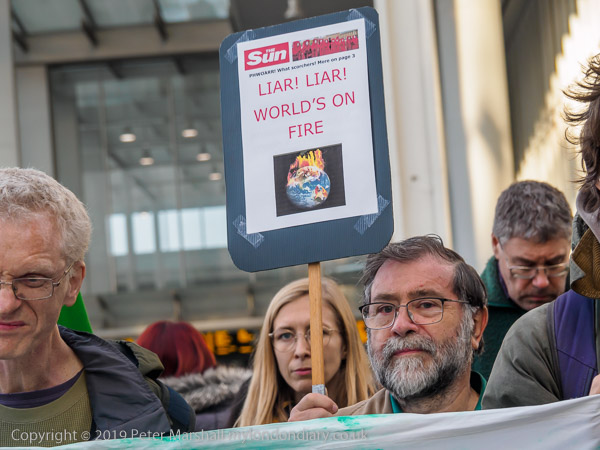
Our newspapers are almost entirely owned and controlled by a handful of billionaires, the most prominent of them being Rupert Murdoch, with The Times, The Sunday Times and The Sun (as well as the Times Literary Supplement and a part-share in the Press Association.) Wikipedia also lists a dozen UK radio stations, as well of course many other news organisations and other corporations in Australia, the US and internationally owned by his mass media company News Corp, including the Wall Street Journal.

Murdoch papers claim to have been the major influence behind UK elections since the 1990’s when The Sun claimed it was ‘The Sun Wot Won It‘ for John Major against Neil Kinnock, and making similar claims for all more recent elections. And certainly the press and broadcast media including but not only Murdoch’s papers, have been very important in all recent political campaigns – including the election of Keir Starmer as leader of the Labour party. Even such nominally independent bodies as the BBC have their coverage highly influenced by the attitudes taken by the press.

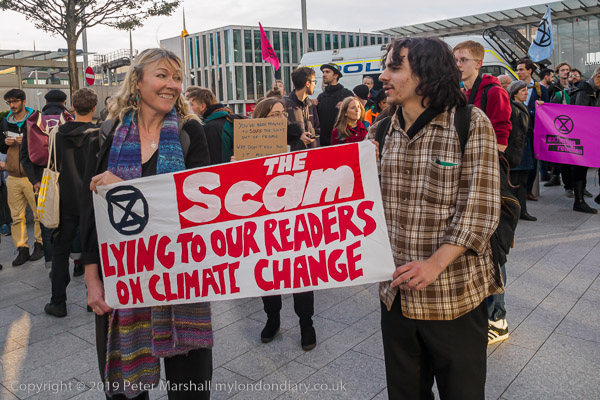
Murdoch through his media outlets has consistently downplayed and denied climate change and its effects – and even his son James during the recent bush fires in Australia expressed his frustration at the ongoing climate crisis denial in News Corp and Fox News’ coverage of the fires. Murdoch has been a powerful influencer both on governments and public opinion against the need to cut our reliance on coal and fossil fuels and other measures to needed to drastically reduce carbon emissions.

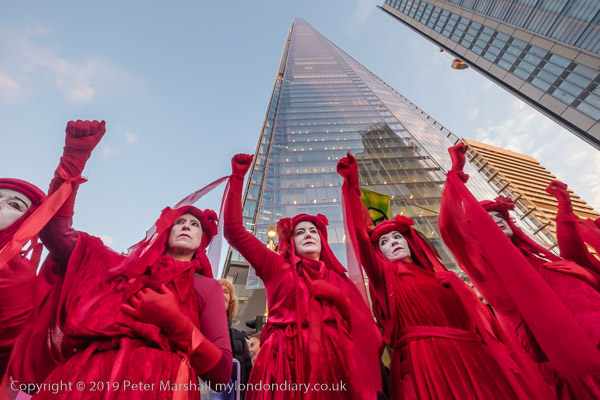
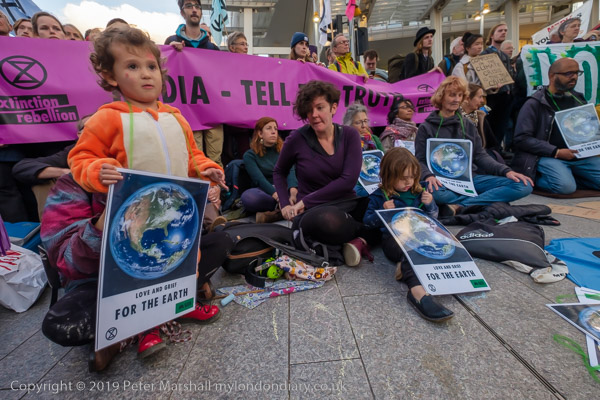
The protest at Murdoch’s News Corp HQ at London Bridge demanding that his papers tell the truth about the climate crisis had of course been planned months or weeks in advance of the police protest ban. But because the area in front of the office where the protest took place is private property it was not covered by the Section 14 ban and was thus legal.

More at XR demands Murdoch tell the truth.


All photographs on this and my other sites, unless otherwise stated, are taken by and copyright of Peter Marshall, and are available for reproduction or can be bought as prints.


1986 Complete – Page 2

Varden St, Whitechapel, Tower Hamlets 86-5d-11_2400

Images in this post are embedded from Flickr where you can view them at a large size by clicking on the image. You will need to use your browser back button to return to this post. Or you can right-click and select ‘Open link in new tab’.

My album 1986 London Photographs is now complete on Flickr, and this is the second of a short series of posts pointing out a few of my favourite images from the year.

Fashion St, Spitalfields, Tower Hamlets 86-4r-16_2400

Several things come out strongly to me as I look through these pictures, mostly taken around Brick Lane and other areas of Whitechapel. One of the major themes that has run through much of my photography is the writing on the wall, whether graffiti or signs and posters. Language is such an important aspect of our social interactions and its inclusion in these images makes them into a record of how people lived and thought.

Brick Lane, Spitalfields, Tower Hamlets 86-5a-01_2400

In 1984 London was rapidly becoming the multicultural city we now know, though of course it had been so on a lesser scale for many years if not centuries. Spitalfields where some of these pictures were made had long been a home for new communities moving to London and there was still abundant evidence of its Jewish population as well as the Bangladeshis who had by then largely replaced them.

Commercial Rd, Whitechapel, Tower Hamlets 86-5c-64_2400

Housing, then as now, was an important issue in London in particular, and some of these pictures reflect this and other issues such as racism. Although I think some of these pictures are well-composed and even attractive compositionally, I’ve always considered the formal aspects – line, shape, tone, texture, form etc to be the means to communicate a message rather than an end in themselves. I aimed to make photography that had something to say and said it well rather than to produce well composed, attractive or even striking or popular images.

Limehouse, Tower Hamlets 86-5h-66_2400

There are another 95 pictures on the second page of the album, all with a location, taken from the usually rather incomplete information I recorded on the contact sheets. I’ve tried to check these before posting, but corrections and other comments are always welcome. I’m happy for these pictures – with suitable attribution – to be shared on social media, but they remain copyright and any commercial or editorial use requires a licence from me.


All photographs on this and my other sites, unless otherwise stated, are taken by and copyright of Peter Marshall, and are available for reproduction or can be bought as prints.

There are no adverts on this site and it receives no sponsorship, and I like to keep it that way. But it does take a considerable amount of my time and thought, and if you enjoy reading it, please share on social media.
And small donations via Paypal – perhaps the cost of a beer – would be appreciated.


Tags: 

South of the River 1985

Container ship, biker, Shornemead Fort, Shorne, Gravesend, Gravesham 85-6c-43_2400

In 1984, I more or less came to an end of my work on the River Lea (though I returned to it later) and the major focus of my photography shifted to London’s Docklands, and I’d photographed the West India and Millwall Docks as well as the Royal Docks, pictures from which I’m currently posting daily on Facebook. And later in that year I also went to the Surrey Docks, where work by the London Docklands Development Corporation was well advanced.

I was very aware of the political dimensions of the redevelopment, with the LDDC taking over from the elected local authorities and imposing its own largely business-led priorities which although accelerating the development distorted it away from the needs of the local area, and particularly away from the still pressing need for more social housing and for better employment opportunities for local people.

Northfleet, Gravesham 85-8e-35_2400

In those years I read every book in my local library on the history and geography of London, and began to build up my own collection of older works bought from secondhand bookshops and by post. Before the days of on-line listings I used to receive a monthly duplicated list of books on offer from a dealer I think in Brighton, and found many topographic and photographic items of interest, often very cheaply, and would look forward to receiving heavy parcels wrapped in several layers of newspaper. Yes, there was mail order before Amazon, and it was rather more exciting.

Cement Works, Northfleet, Gravesham 85-8e-53_2400

It was reading one of the books, Donald Maxwells ‘A pilgrimage of The Thames’, published in 1932 with his imaginative text and evocative drawings (some originally printed in the Church Times) that prompted me to walk in 1985 as he did from Gravesend west through Northfleet and Greenhithe exploring what he christened ‘the Switzerland of England’. As a rather more down-to-earth guide I also had the more academic ‘Lower Thameside’ picked up for pennies in a secondhand bookshop, which included a chapter on its 1971 cement industry by geographers Roy Millward and Adrian Robinson.

Crossness Marshes, Belvedere Power Station, Belvedere, Erith 85-9j-53_2400

My series of walks traversed what was an incredible industrial and post-industrial landscape, altered on a huge scale by quarrying and industry, continuing past Gravesend along the riverside path past Erith and Woolwich to Greenwich and Deptford (areas also covered in my 1985 London Pictures), as well as walking further east to Cliffe and Cooling.

Cement Works, Manor Way, Swanscombe, Dartford 85-9g-36_2400

It was a project that I returned to for several years – and I went back to the area more recently when the Channel Tunnel Rail Link was being built as will as the occasional walk or bike ride over the years.

You can see 280 of my pictures from 1984 now on Flickr in the album
1985: South of the River: Deptford to Cliffe


All photographs on this and my other sites, unless otherwise stated, are taken by and copyright of Peter Marshall, and are available for reproduction or can be bought as prints.

There are no adverts on this site and it receives no sponsorship, and I like to keep it that way. But it does take a considerable amount of my time and thought, and if you enjoy reading it, please share on social media.
And small donations via Paypal – perhaps the cost of a beer – would be appreciated.


Regents Canal 200

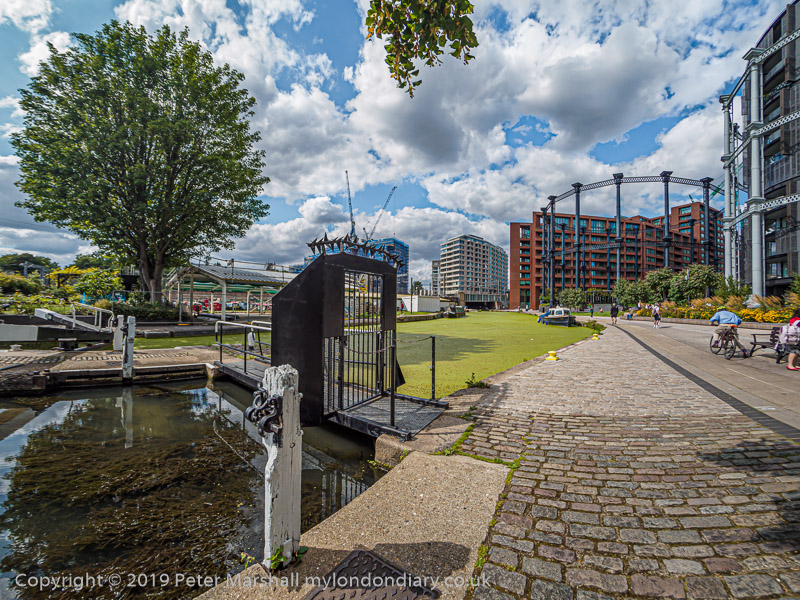
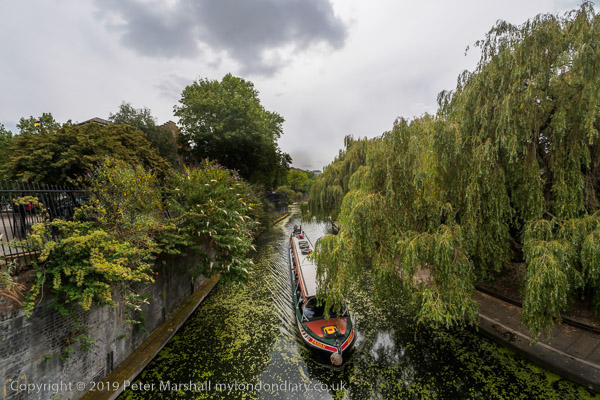
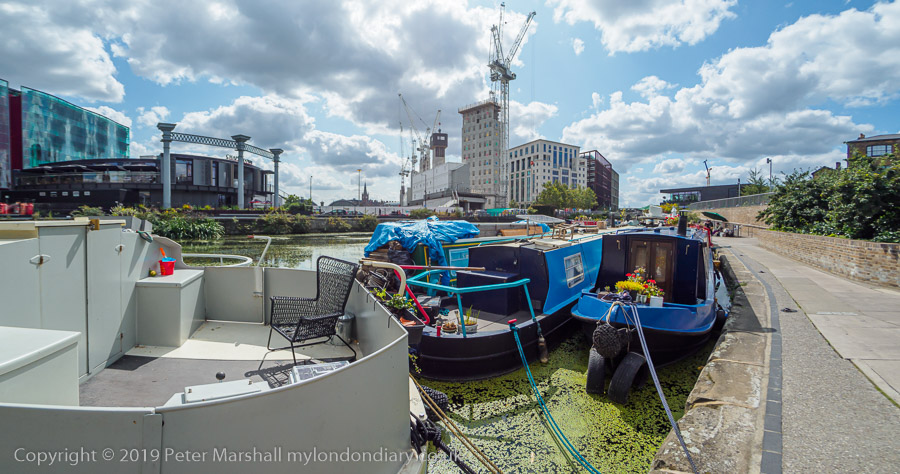
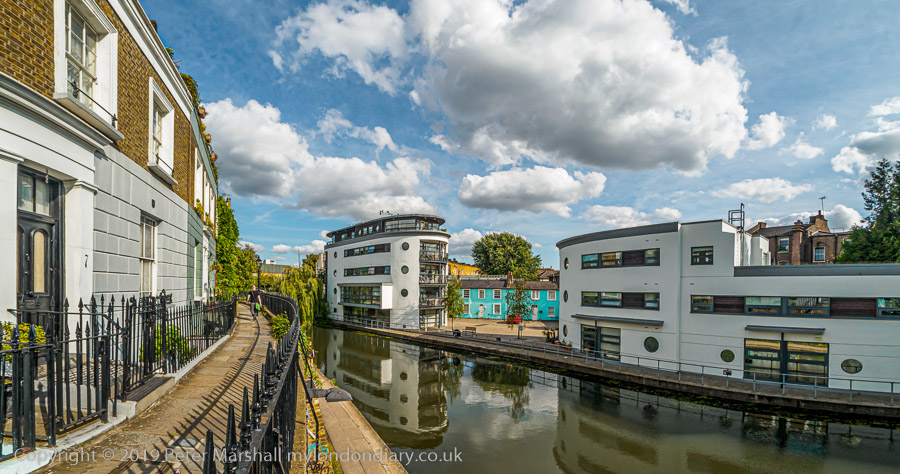
For various reasons it took rather longer than expected to build the Regent’s Canal around the north of London, joining the Grand Union Canal Paddington Arm to the River Thames at Limehouse, but the full length was finally opened in 1820, two hundred years ago this year.

Having realised this anniversary was approaching, early in 2019 I began a series of pictures to celebrate it, and had been intending to present these in a small show I was to have along with an artist friend, Hilary Rosen, at the Street Gallery in University College Hospital London.

The show was to have opened on 19th March this year, but a few days before we realised that it would be impossible because of the Coronavirus pandemic. We had to cancel the opening, but then it became clear to us that it would not be sensible to invite people to go to a hospital to look at an exhibition, and told the gallery that it had to be postponed. A few days later, the government realised they had to do something too, and on March 23 imposed the lockdown.

I’d picked just a dozen images for this show, but had taken hundreds if not thousands in preparation. I’d had the pictures printed and had spent a day mounting and framing them on the Sunday before the show was to start, but simply had to take them back up into my loft rather than to be hung at the gallery.

In making my selection I’d obviously wanted to show what I thought were the best images, but also to show work along the length of the canal from its start at Little Venice to its end at Regent’s Canal Dock (now Limehouse Dock marina.) My preliminary selection included several images from some of the more interesting areas, as well as a few from other places that didn’t make the final cut.

Rather than go back and make a new selection for an on-line presentation I’ve decided to simply put the 42 from my preliminary selection on-line, and to do so on Flickr, where they are displayed at a higher resolution than on Facebook or my own web site (where I think most or all have already appeared at smaller size.)

The images appear in two different aspect ratios, though they all have more or less the same horizontal angle of view, roughly equivalent to the full human binocular field of clear vision. Some are cropped at top and bottom, enabling me to move the horizon away from the centre line and to avoid the more extreme curvature at the edges which the necessary non-rectilinear perspective needed for such extreme angles of view dictates.

You can see them at Regents Canal 200 on Flickr.

C-type prints from the exhibition were to be on sale unframed and printed with images 42×22 cm or 36×24 cm (and a white border) at £200. For this online show they can be ordered direct from 6me at half this price, £100, including postage and packing to the UK. Overseas orders will cost a little more.


All photographs on this and my other sites, unless otherwise stated, are taken by and copyright of Peter Marshall, and are available for reproduction or can be bought as prints.

XR Defy Police Ban

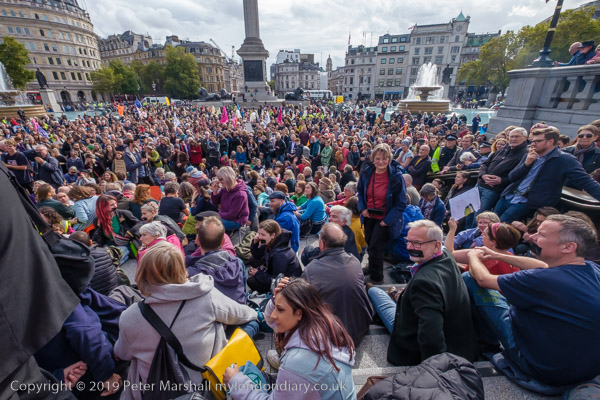
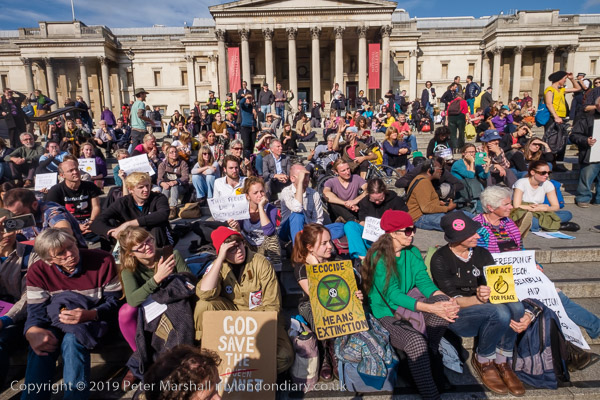
XR’s response to the illegal police ban on protests came the following day, when protesters crowded into Trafalgar Square to defend civil liberties and the right to protest.

Extinction Rebellion had called the protest after London Police ruled that even two people standing anywhere in London advocating action on climate change is an illegal assembly, and Monday’s Queen’s speech lacked any response to the Climate & Ecological Emergency.

Trafalgar Square soon became very full, and too crowded to be able to move around to take photographs. Fortunately I’d realised this was happening and had moved to a position on the steps only a few yards away from the microphone before the speeches began. But there were people sitting and standing in my line of sight, and I had to stretch and contort myself to get a clear view – and was almost certainly getting in the line of sight of others to do so.

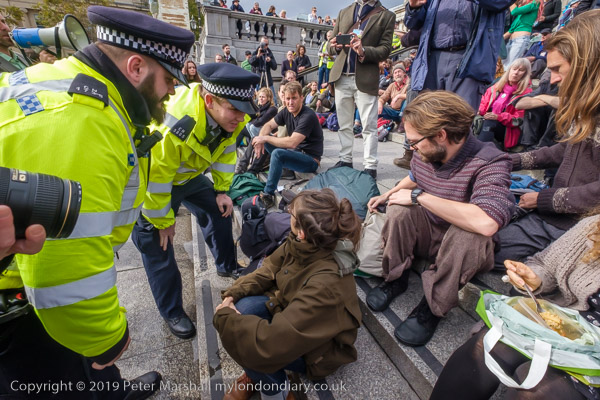
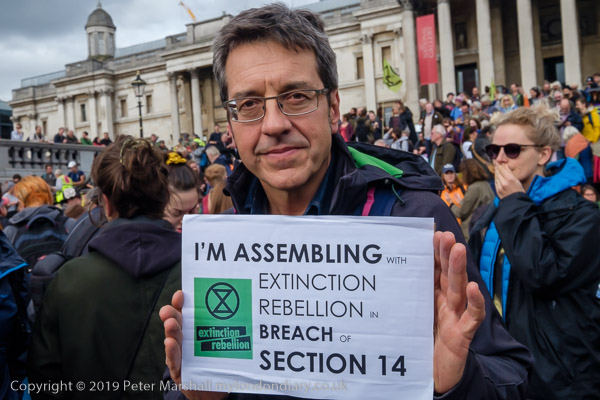
And there were a whole string of speakers ready to speak out in defence of the right to protest – and put themselves at risk of arrest for doing so, along with the several thousand other protesters. Police did issue a number of warnings to people, but I saw no arrests actually in Trafalgar Square. Among the speakers was George Monbiot, and I’ve just found out that my spell checker decided he should be called George Moonlit when I wrote the account for October’s My London Diary (now corrected.)

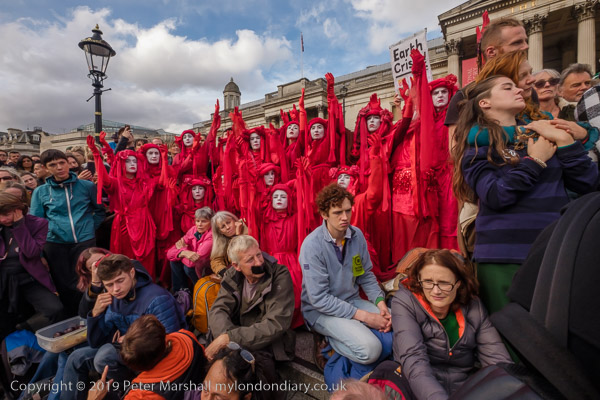
I photographed most of the speakers, and XR’s red-robed mimes, who made their way through the crowd and came and stood rather conveniently behind me, but I was in pain from having to squat in an odd position to get my pictures and had to move back shortly before the protest ended and sit down for a rest.

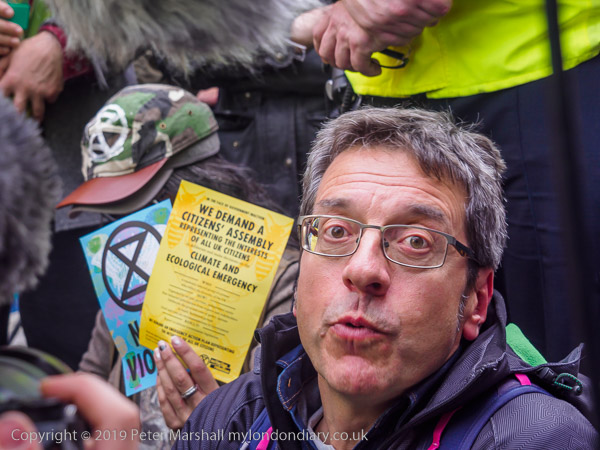
George Monbiot had come to the protest determined to be arrested and carrying a notice announcing his deliberate breach of the Section 14 order, and invited people to join him and sit down in Whitehall after the protest. Quite a few went with him and police made a number of arrests,including him and a Green Party mayor who had come in his full regalia.

It was a long protest and I took many pictures – you can see more of them and read more about the protest at XR defies protest ban.


All photographs on this and my other sites, unless otherwise stated, are taken by and copyright of Peter Marshall, and are available for reproduction or can be bought as prints.

There are no adverts on this site and it receives no sponsorship, and I like to keep it that way. But it does take a considerable amount of my time and thought, and if you enjoy reading it, please share on social media.
And small donations via Paypal – perhaps the cost of a beer – would be appreciated.


Police impose unlawful ban

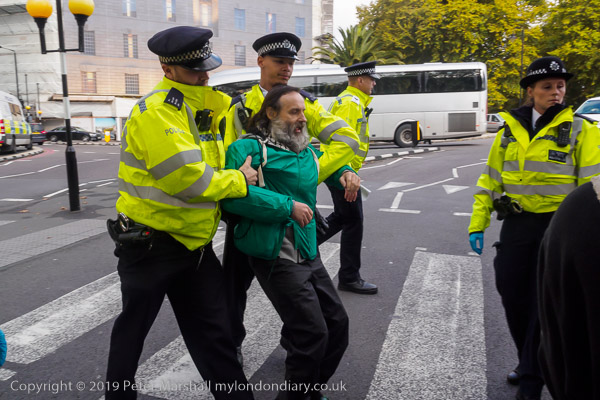
Police remove a man who sat down on the crossing

After a week of protests by Extinction Rebellion in London, the police and their political masters decided they had had enough, and announced a London-wide ban on protests by XR across London, invoking Section 14 of the Public Order Act 1986.

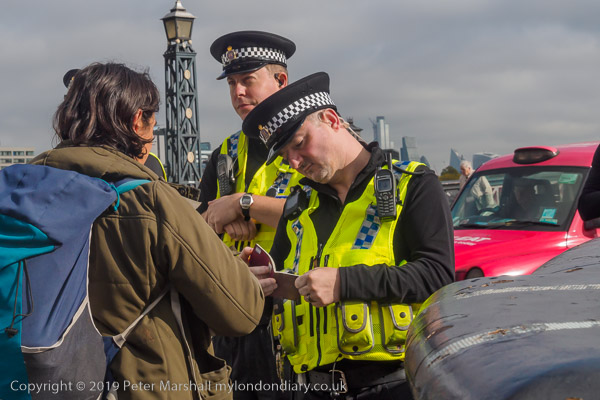
A man shows his passport at the police checkpoint on Lambeth Bridge

XR immediately accused the police of abusing the law and denying freedom of speech and questioned the legality of the police ban, beginning a legal challenge. Firstly that Section 14 was intended to allow police to manage protest and not to ban it and secondly that it could not be applied to XR’s ‘Autumn Rebellion’ as this was not a ‘public assembly’ in the terms laid down in the Act.

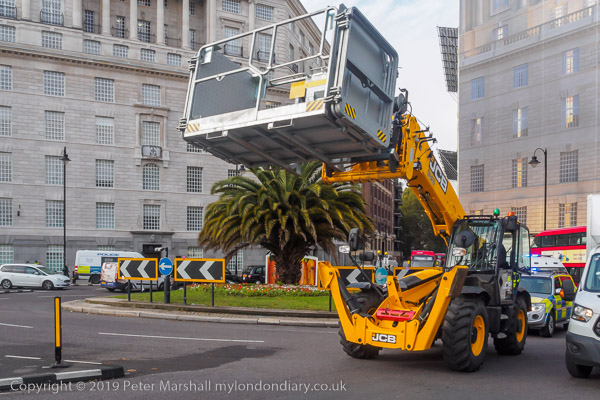
Police escort a JCB on its way to destroy the XR camp at Vauxhall

The order was imposed on 14 October, but the law works relatively slowly and it was only on 6 November that the High Court made an unequivocal judgement that the Met had acted unlawfully.

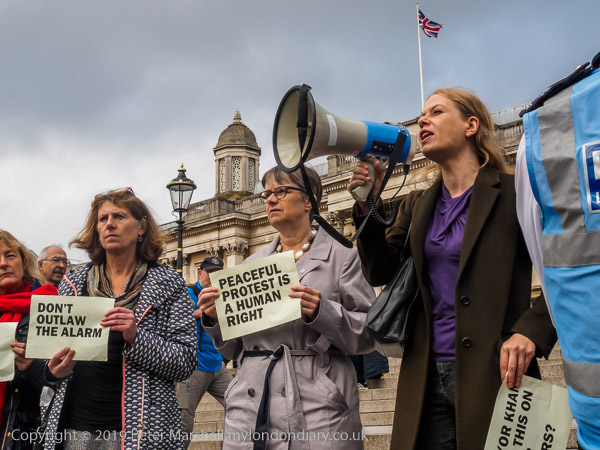
A police officer watches as Sian Berry speaks and MEPs Gina Dowding & Molly Scott Cato hold posters

Lord Justice Sedley observed:

“In a free society all must be able to hold and articulate views, especially views with which many disagree. Free speech is a hollow concept if one is only able to express “approved” or majoritarian views. It is the intolerant, the instinctively authoritarian, who shout down or worse suppress views with which they disagree”
It appears to have become standard procedure for police to make up and enforce their own versions of the law and to make arrests, often with no real possibility of any charge ever being brought. Sometimes their intent is clearly to impose bail conditions to restrict people’s activity for prolonged periods of time, and at times it simply seems a form of harassment, holding people for perhaps ten or twelve hours before releasing them in the middle of the night miles from their homes often without proper clothing and their possessions retained as ‘evidence’.
I hope the hundreds of protesters arrested for breach of this unlawful ban are pursuing their claims for false imprisonment, which could cost the Met millions, though of course that only means us taxpayers picking up the bill for the Bill.

XR protesters came to defy the ban on protests

After a slow start to the XR ‘No Food No Future‘ protest outside MI5 on Millbank where police restricted the movements of many not involved in the protest as well as searching activists and making an arrest I left to photograph a protest by politicians, mainly from the Green Party against the unreasonable ban on protest and freedom of speech. Although there were several hundred people in the square defying the ban, police made no arrests, perhaps because of the involvement of a number of MEPs and other politicians.

Protest defends freedom of speech
XR No Food No Future protest


All photographs on this and my other sites, unless otherwise stated, are taken by and copyright of Peter Marshall, and are available for reproduction or can be bought as prints.