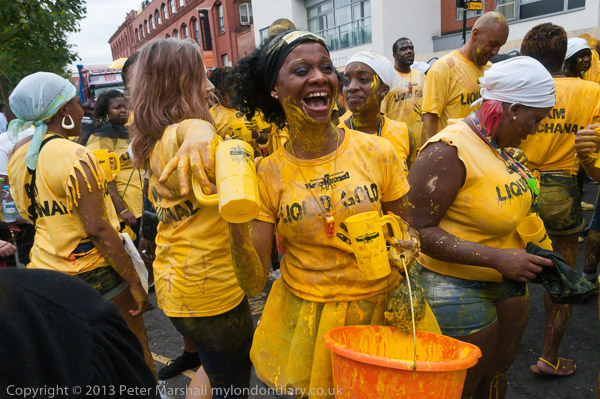
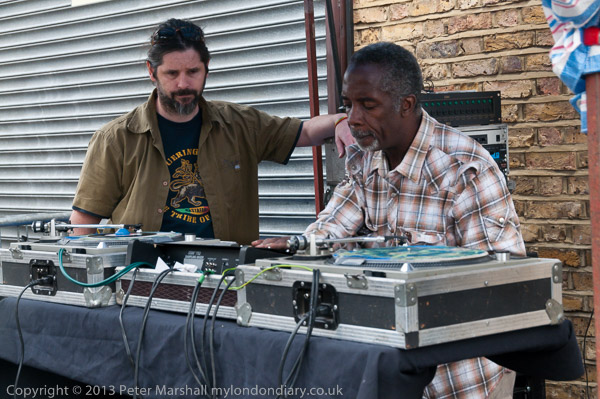
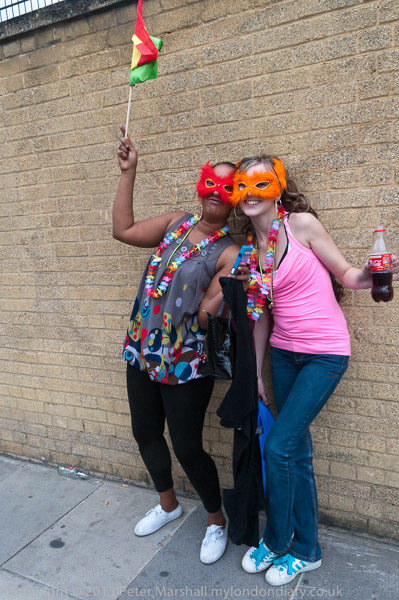
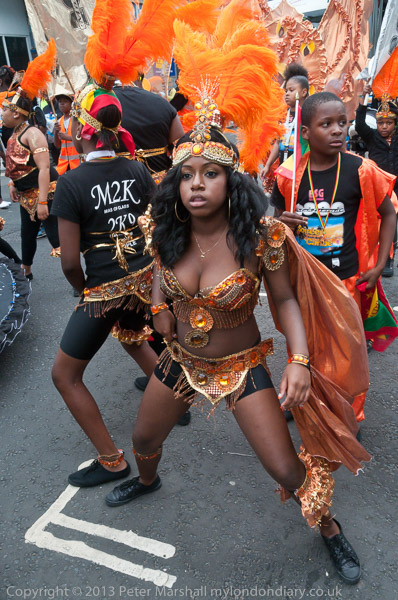
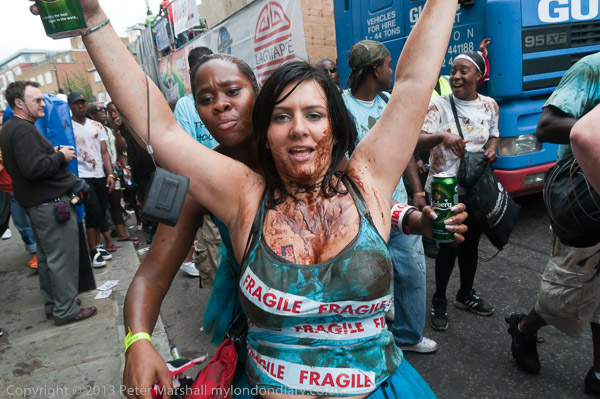
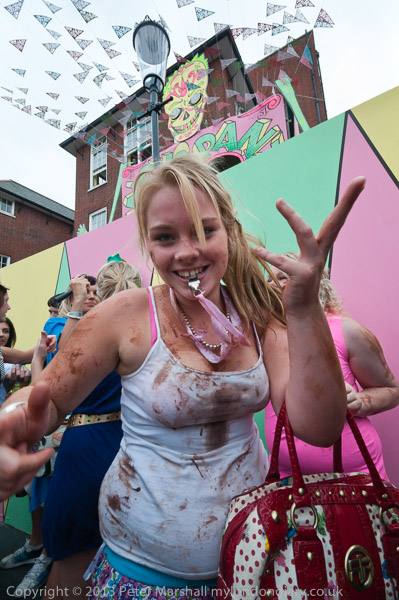
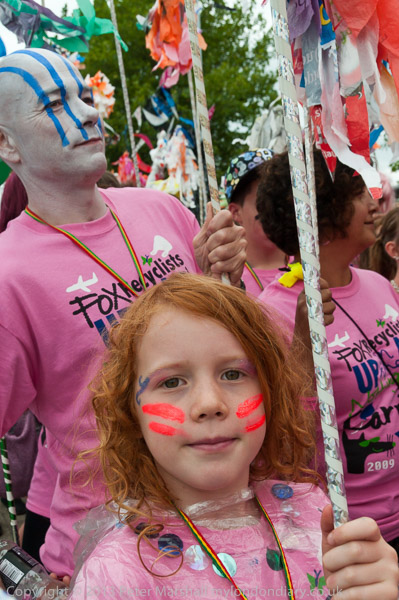
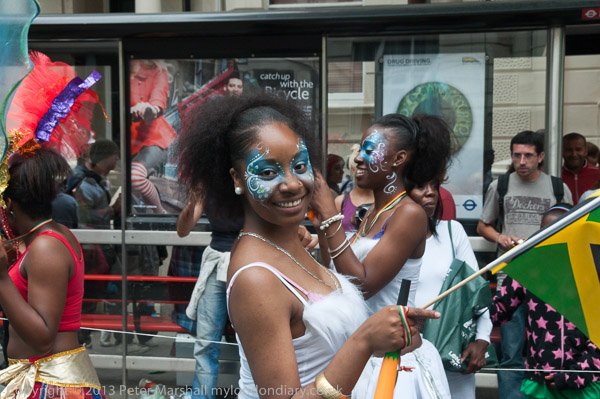
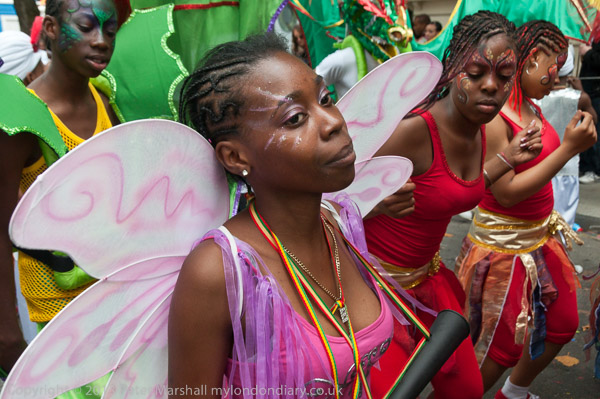
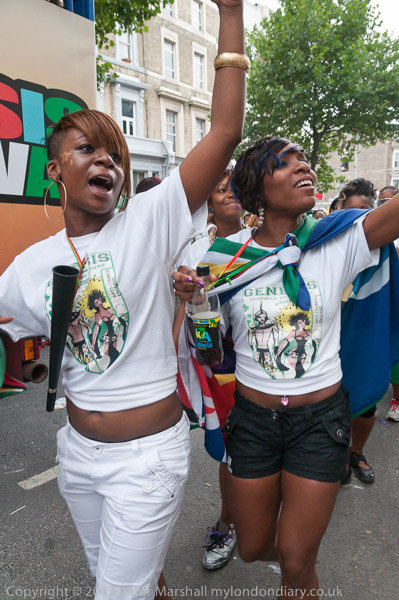
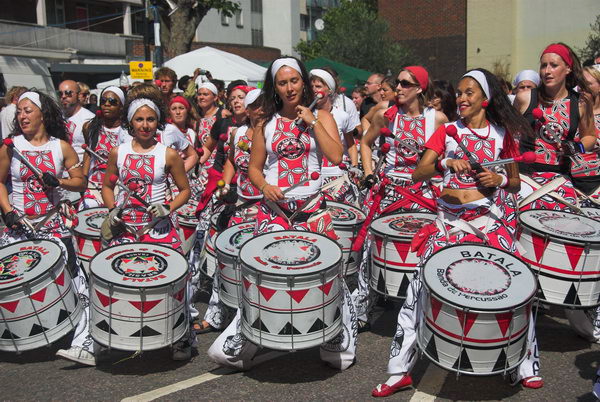
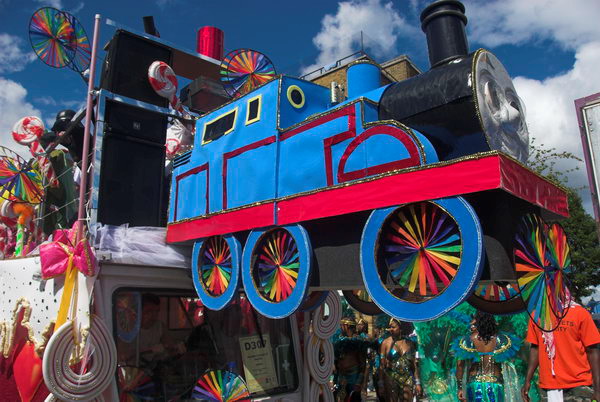
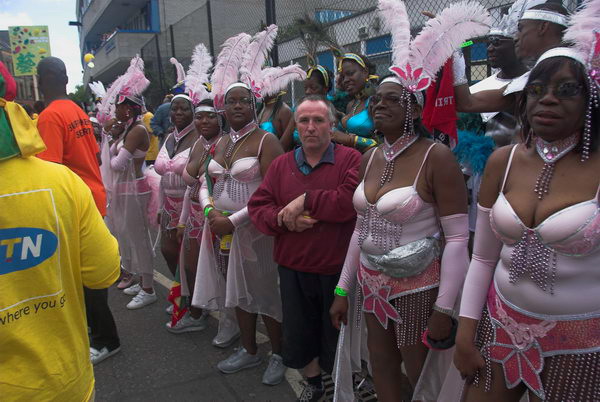
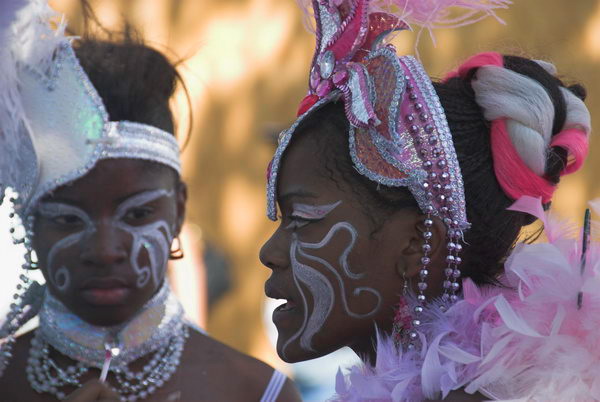
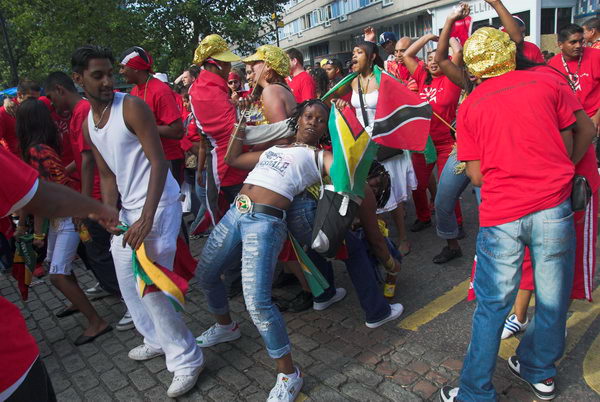
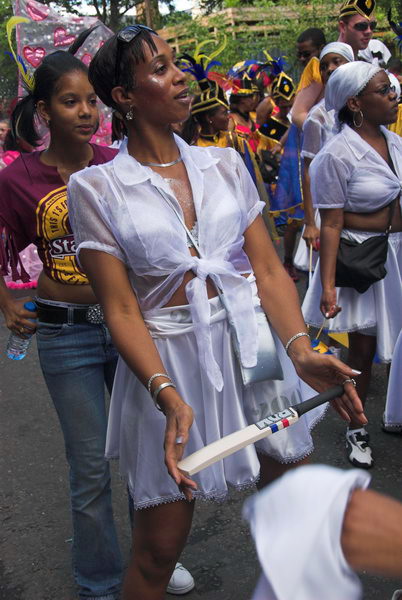
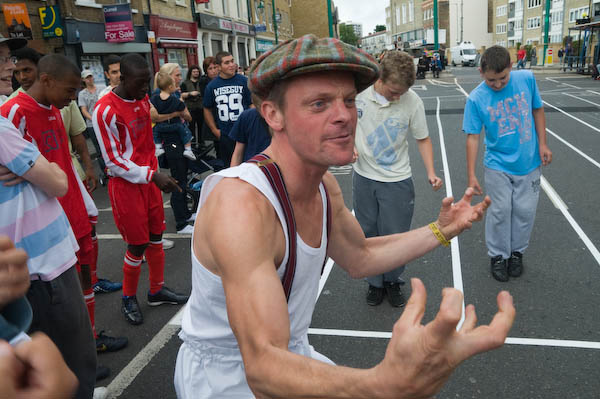
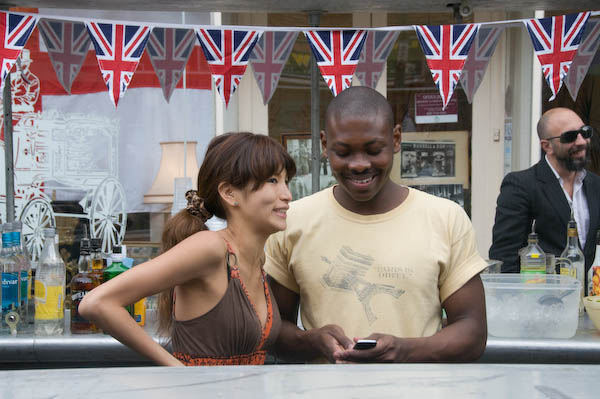
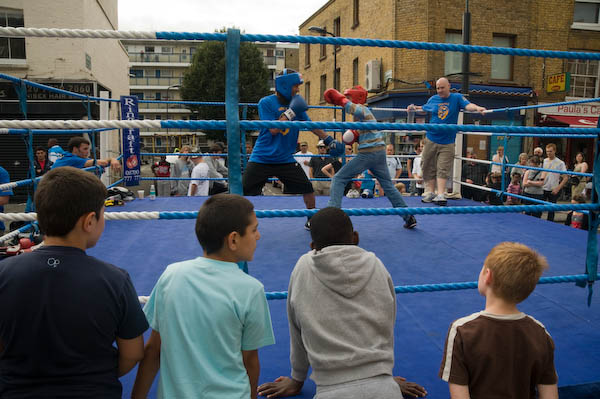
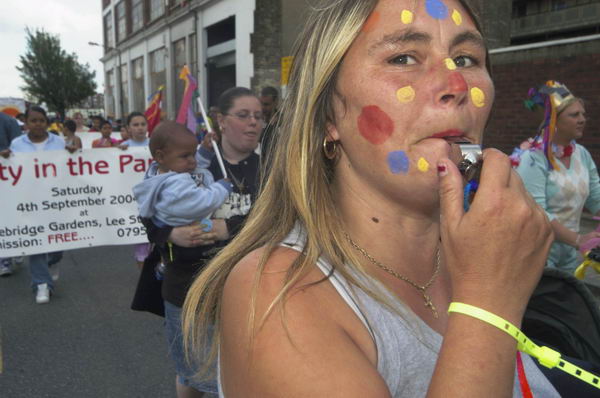
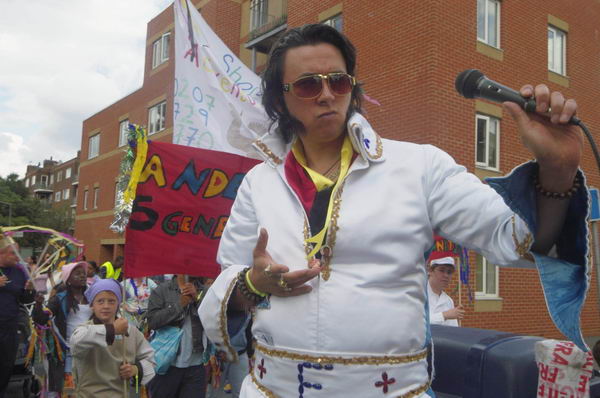
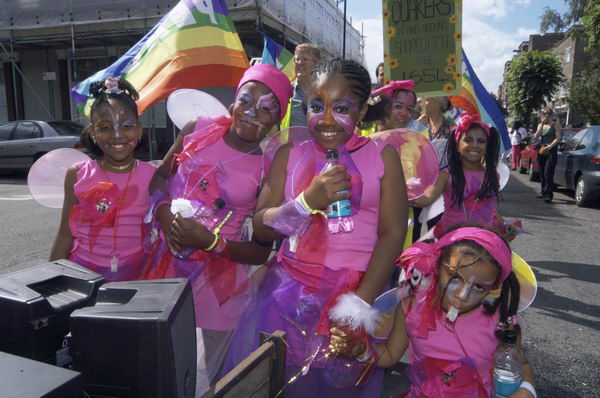
More Carnival – Children’s Day: On Sunday 30th August 2009 I spent a few hours in Notting Hill and took a lot of pictures – here are just a few of those I liked. I can’t remember why I didn’t get around to putting them on line in 2009, but I only remembered them again in 2014 when August bank holiday was so wet I stayed home and didn’t go to carnival.
Liquid Gold. I think it washed off me without too much difficulty
I thought again this year about going to Notting Hill for Children’s Day when it is a little less crowded than the Monday. But there was engineering work on the railway with no trains from my station for over a week, only rail replacement buses.
It would still have been possible to make the journey, or to take a bus and then the Underground, but having to do so on both the outward and homeward journey would add considerably to my journey times. I decided my trip to Notting Hill wasn’t essential.
I’ve taken enough pictures of Carnival over the years since 1990 to satisfy me for my lifetime, and it’s hard to find anything really new.
Though I do regret having been put off from going to Notting Hill before 1990 by the media coverage which concentrated on the few violent incidents and painted a picture of street violence and mayhem. It’s really more of a huge outbreak of celebration.
There was a huge tightly packed crowd dancing to Sancho Panza
And I did photograph some children, though its clear my mind was largely on other things.
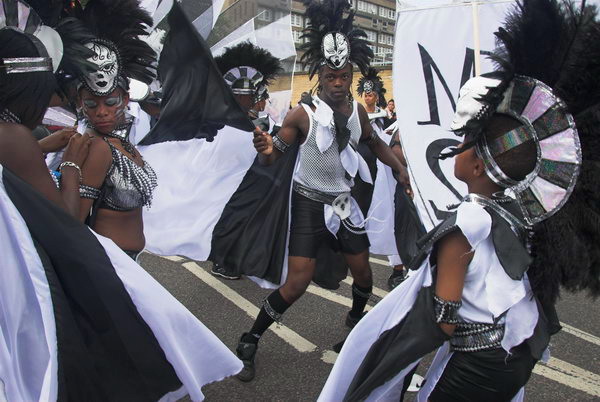
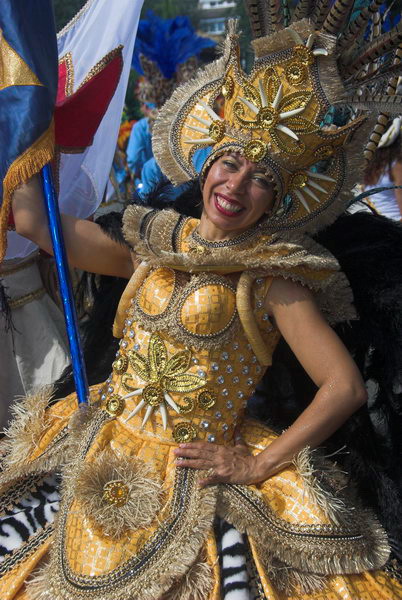
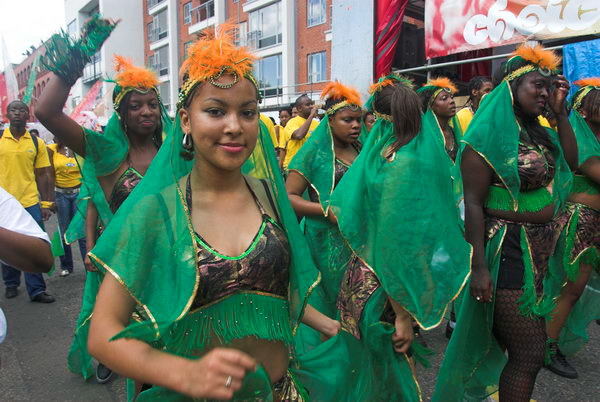
Notting Hill Carnival 2006: On Monday 28th Aug 2006 I went to photograph Notting Hill Carnival, working with both black and white film and digital colour. In most of my carnival pictures I’ve concentrated on the people attending the event rather than the costumes and I did so on this occasion with the black and white, but for the colour I decided to mainly photograph those taking part in the carnival as the pictures here show.
Rather unusually my August 2006 page only starts on Friday 25th, when I went to Greenhithe & Swanscombe Marsh. I’d been away from London most of the month, holidaying with friends in Kent, visiting Paris and staying with family in Beeston and decided it wasn’t appropriate to post pictures from these locations on My London Diary.
In 2006 I went on both Sunday 17th, the Children’s Day and the main carnival event on the Monday, but the pictures here are all from the Monday. You can see those from Children’s Day on a link from the August Page of My London Diary.
I’ve always had a fairly elastic definition of London, and it stretched some way out along the River Thames both upstream and down, and also taking in the London Loop, a section of which I walked with family the following day.
Sunday had been a busy day too. Notting Hill only really gets going after lunch, so I had time to go to East Ham in the morning for the Sri Mahalakshmi Temple Chariot Festival and then call in at Bromley-by-Bow and walk to Stratford and photograph again the Bow Back Rivers before going to Children’s Day.
So I think I was probably fairly tired by the time Monday came around, having done rather a lot of cycling and walking over the past three days, as well as taking a great many pictures.
As I pointed out, it was “two years on from when I last photographed the event.” The previous year I had “tried to go, dragging myself to the station with a knee injury, but the pain was too much to continue. This year my knee held out, though I was glad to sink into a seat on the Underground at Latimer Road at the end of the day.“
I also wrote “when I’ll get round to processing the film is anyone’s guess” and the answer was not for a very long time – and then I sent it away for processing rather than do it myself. By 2006 I had almost completely committed to digital for its many advantages and this was one of my final flings with film. The “more pictures soon” with which the piece ends was an aspiration never fulfilled online and I’ve yet to print any of the black and white pictures.
Perhaps the reason for this – and why I probably won’t get to Carnival this afternoon – is “because I’m getting older … I didn’t get the same buzz from this year’s event as in previous years, though most of the same things seemed to be around. perhaps there lies the problem; most of them did seem to be the same.”
But Notting Hill Carnival is still one of London’s great spectacles – and a great fashion show on the street. If you’ve never been it’s very much worth attending.
Capital Ring – South Kenton to Hendon: Monday 27th August 2018 was August Bank Holiday, which for many years meant if I was in London I was in Notting Hill for the carnival. But I think the last time I went was in 2012, when I went on Children’s Day and then wrote “either I’m getting too old for it, or perhaps carnival is changing, and this year I found it a little difficult. So I went on the Sunday, stayed around three hours and didn’t really want to return for the big day. So I didn’t.“
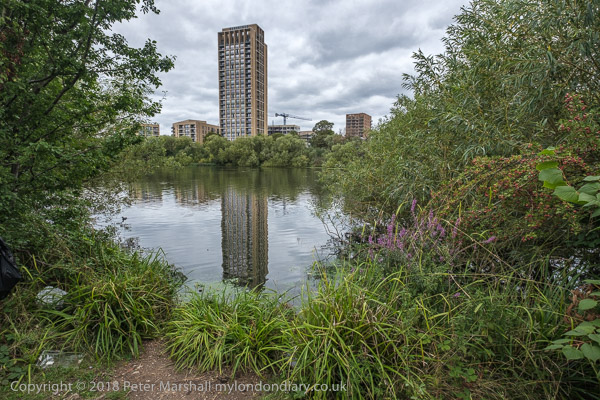
Welsh Harp and West Hendon Waterside
Since then I’ve been out of London in several years and in the others I’ve thought about going to carnival again, but decided instead to go out for a family walk. And in 2018 with my wife we walked the section of the Capital Ring from South Kenton Station to Hendon Station.
The walk itself is only 6.2 miles, but walking to the station at the end and the kind of wanderings that all photographers indulge in it got a little longer. I’m not the kind of walker for whom a walk is a route march from A to B, but rather someone who likes to go where his eyes lead him in search of interesting views and places.
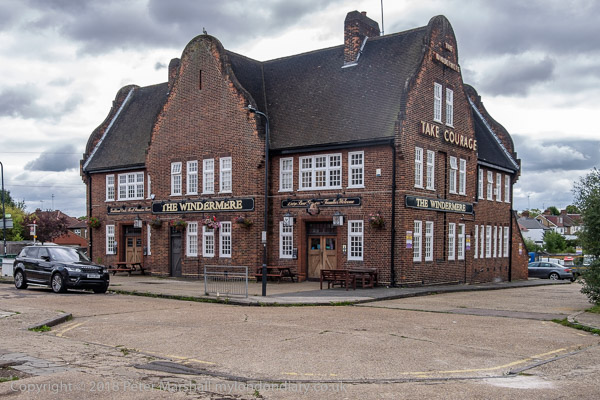
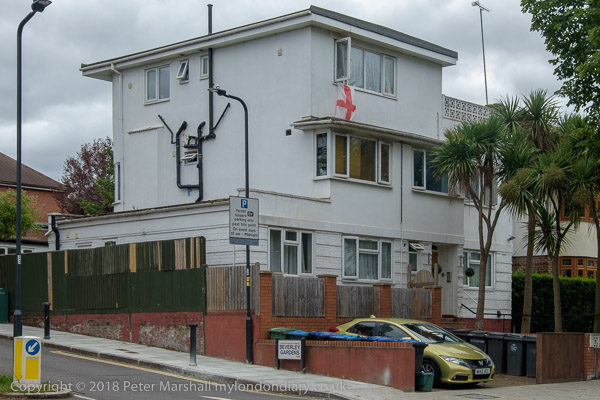
Unlike some sections of the Ring which are almost all woods, fields and trees this one has a wide range of different areas, all of some interest, beginning with South Kenton Station itself, the Windermere pub next door and the whole area of 1930s development.
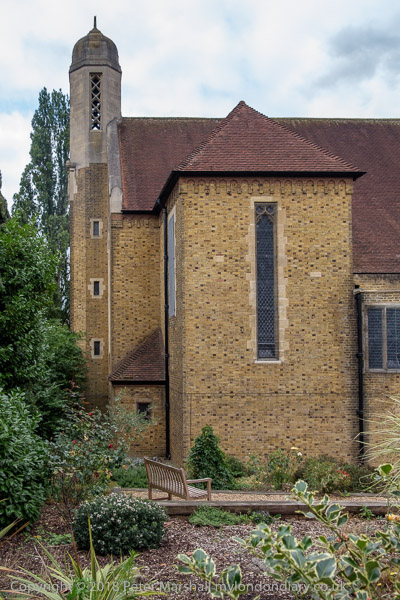
I don’t think my two pictures of The Church of the Ascension really do this interesting 1957 building by J Harold Gibbons justice, but they do give some idea of how unusual it is.
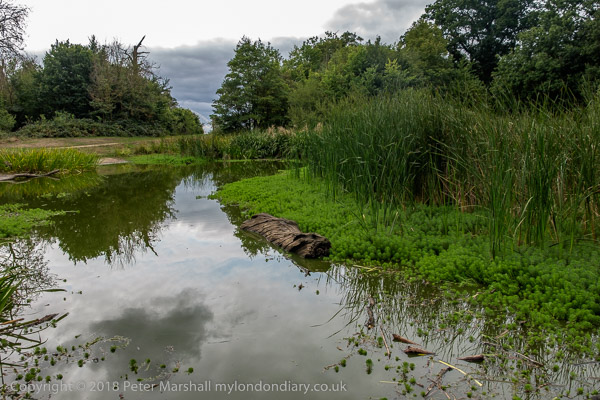
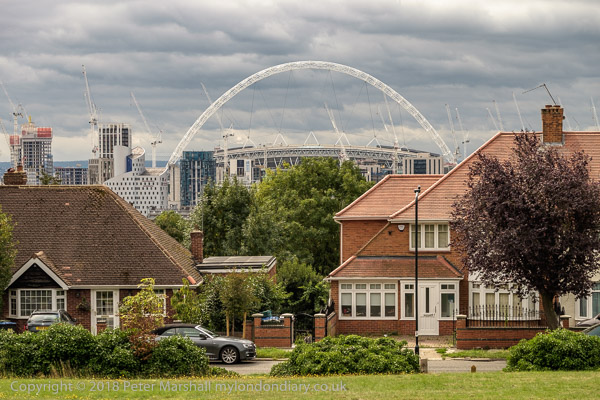
We had the guide to the whole walk around London by Colin Saunders which saves having to carry maps and gives usually clear route descriptions as well as a few snippets of interesting information – such as the fact that this pond on the top of Barn Hill was a part of a huge landscaping project by Humphrey Repton, much of which was covered by housing in the 1920s and 30s and includes Wembley Stadium.
From here we were a little let down by the walk instructions and ended up wandering around a little lost in Fryent Country Park, but eventually with the help of the map and a little guesswork found the correct exit.
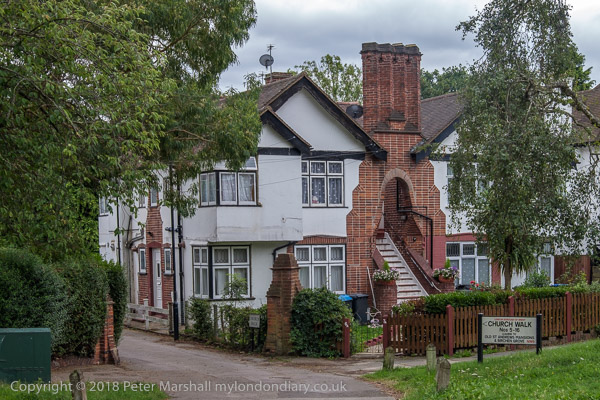
The walk continues through a number of suburban streets, not without some interest, eventually coming to Church Walk. Kingsbury does of course have some remarkable architecture but this lies some distance off the route. Fortunately I’ve photographed it on other occasions.
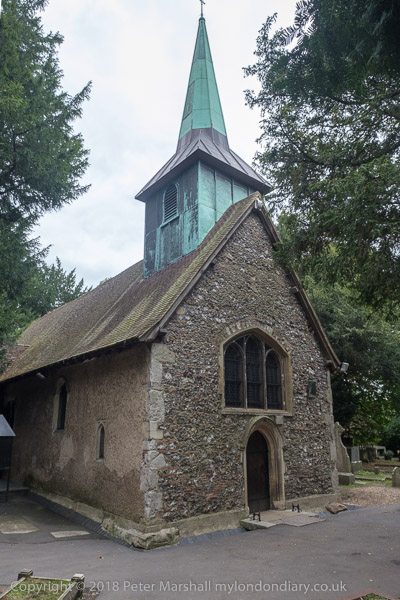
There are two St Andrew’s churches a short distance apart. The ‘new’ church is rather larger and was actually built around six miles away in Wells Street Marylebone in 1844-7 and moved here stone by stone in 1931-3. I haven’t posted a picture of this Grade II* building by S Daukes as it just seemed to me another Victorian gothic church. Probably I would have been more impressed had it been open and I could have seen the interior. A short distance away is the old St Andrew’s, a rather more quaint building with a Grade I listing, dating from the 12th-13th century though with some 19th century restorations.
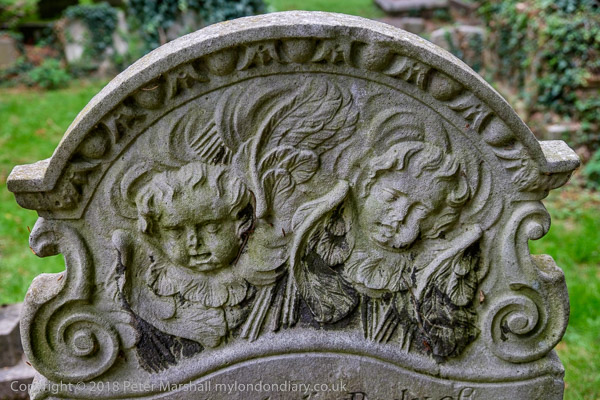
St Andrews Old Churchyard, now left to nature as a ‘Site of Borough Importance for Nature Conservation‘ is also full of interest, with no less than five Grade II listed monuments and tombstones including this one for “Timothy Wetherilt (d.1741). Portland headstone with upper relief of cherubs amid rays, set between auricular scrolls below an upper cornice enriched with egg and dart mouldings.”
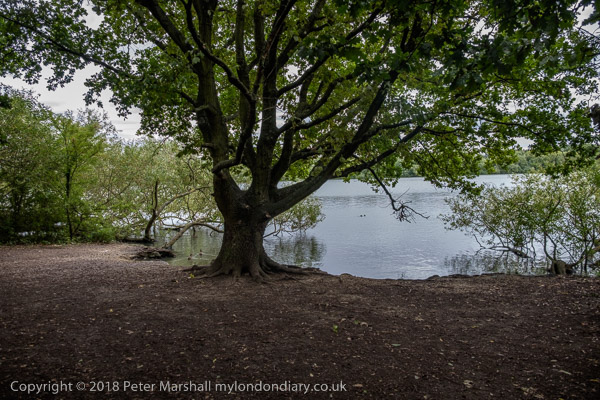
A short walk (with some deviation to a garden centre for its toilets) took us to the Welsh Harp – Brent Reservoir, built in 1835 to supply water for the Regents Canal which had opened in 1820. It got its name from a nearby pub and both pub and lake were for many years a popular leisure destination for Londoners. In 1948 the rowing events for the Olympics were held here, while for 2012 Eton College provided its Dorney Lake, completed in 2006 costing the college £17 million, though we paid through Olympic funding for the finish tower, a new bridge and an upgraded approach road and more.
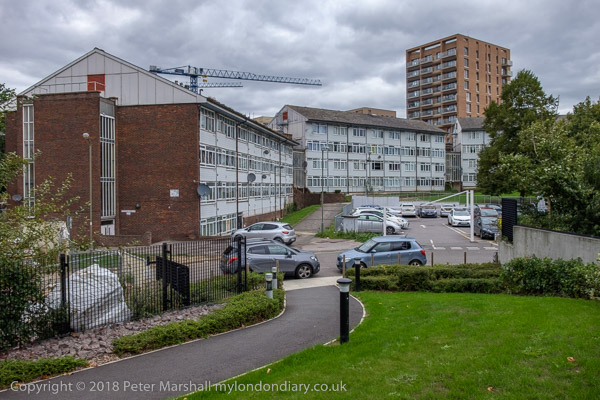
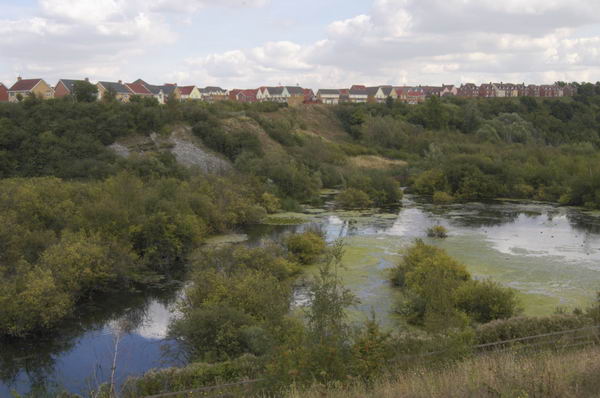
At the east shore of the lake was Barnet Council’s West Hendon Estate, sold off to developers and now West Hendon Waterside. The pleasant and well-loved council estate with 680 homes in decent condition was sold for a quarter of its value to Barratt who describe it as “170 hectares of beautiful green surroundings overlooking the Welsh Harp reservoir” (see top picture.) Some of the council estate was still occupied, overshadowed by new towers with a crane looming over. The development will result in more homes, but few will be social housing, and the so-called affordable properties are beyond reach of the current residents, with many probably bought and left empty by overseas property investors.
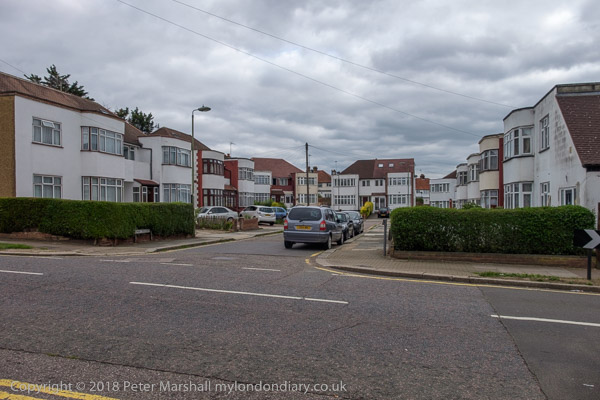
We walked past what was an impressive 1930s cul-de-sac when I photographed it in 1993, but a little less so now as the distinctive metal windows with curved glazing on the bays have been replace by double glazing, though this must make the occupants rather more comfortable.
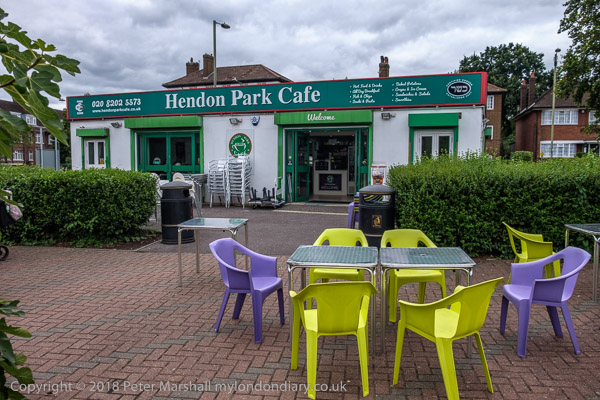
We walked on to Hendon, stopping for an ice-cream at Hendon Park Cafe, “the first kosher park café to open up in the UK” and admiring Hendon Park Holocaust Memorial Garden and the buildings arond Hendon’s Central Circus before catching a train on our way home.
On My Brompton in Essex: On Thursday 26th August 2004 I went for a ride on my Brompton in Essex on the north bank of the Thames, in an area sometimes known as the Thames Gateway. If anyone doesn’t know, the Brompton is one of the best folding bikes around, with 16 inch wheels, folding quickly to a fairly small package which can be carried onto trains and buses. I don’t ride it so much now, as I find it rather heavy to carry, particularly when loaded with my camera gear.
Chafford Hundred, Grays, Essex
I bought the Brompton at the end of 2002, and spent a lot of time riding it for exercise on doctor’s orders during recovery from a minor heart problem at the start of 2003. It coincided with the purchase of my first digital camera capable of professional results, the 6.1Mp Nikon D100 DSLR.
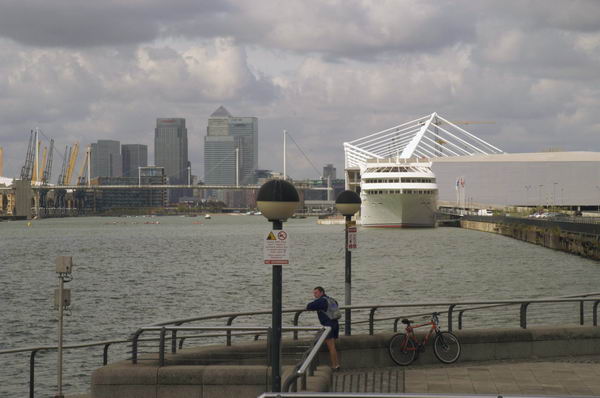
Royal Victoria Dock
For a year or two I worked with both digital and film, particularly because at the start I had only one Nikon lens, a 24-85mm zoom, giving an equivalent on the DX format camera to 36-128mm on full-frame, but I used a range of wider lenses on film. By 2004 I had added the remarkable Sigma 12-24mm (18-36mm equiv) to my bag, and many of the pictures I made that day were taken with that lens. I think it was the first affordable ultra-wide zoom, and certainly the results on DX format were very usable.
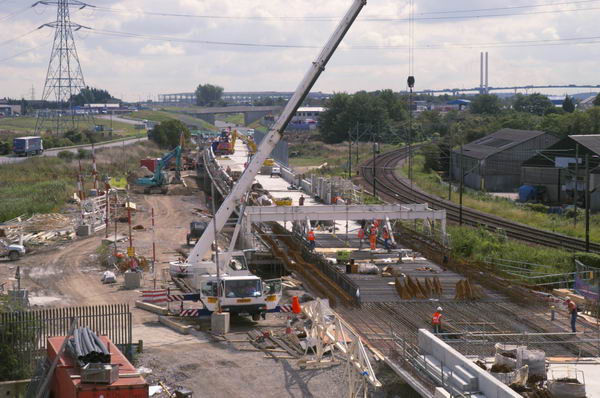
Channel Tunnel Rail link under construction at Purfleet
As well as the Nikon I also had a film camera, a Russian Horizon 202 swing lens panoramic camera. You can see some of the pictures I made with this among those on the Thames Gateway (Essex) section on the Urban Landscapes site.
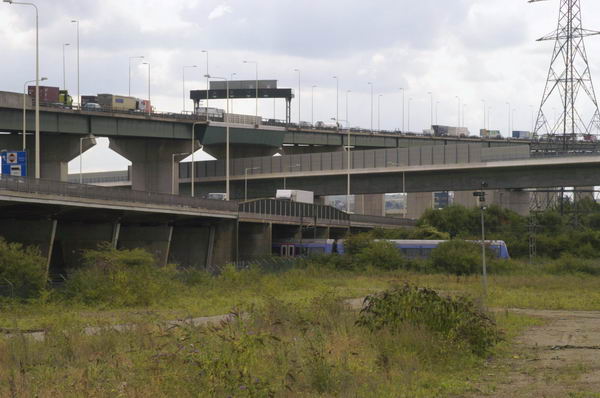
Dartford Bridge and Channel Tunnel rail link, Thurrock
I began taking pictures that day at Victoria Dock in Canning Town, having taken the Brompton on the train to Waterloo and then the Jubilee Line there, before cycling to West Ham station to catch the C2C rail service to Rainham, all on a Travelcard. It’s something of a blow that TfL now intends to discontinue the Travelcard, which provided relatively cheap and simple travel for most of my photography.
Here is what I wrote about the day back in August 2004 – with minor corrections, particularly changing to normal capitalisation.
I like to make good use of my Travelcards, so Rainham, the last station out of Fenchurch St in zone 6 is a good destination. I pointed the Brompton first to Purfleet, to take a look at the state of play on the high-speed rail link, and also a new development in the old chalkpits, then on towards the Dartford bridge.
The Bridge Act obliges the operators to transport cycles and pedestrians across free of charge, and I cycled up the path towards it to claim this right, before changing my mind and deciding i didn’t want to go to the other side. Instead I took the new road through the West Thurrock Marshes industrial area and on to St Clements church, now a nature sanctuary, in the middle of a detergent factory.
It’s a quiet and pleasant place to eat sandwiches, though the smell of the perfuming agent is pervasive. There I planned a route largely along side roads, cycle paths and footpaths to Upminster, taking in Chafford Hundred, South Ockenden and Belhus Park and woods. It made a pleasant ride, though I had to make a few detours, and the B isn’t too stable on slimy mud, so some paths made for interesting riding, with the added pleasures of bramble thorns and nettles.
My London Diary
All of the pictures on this post were taken on the Nikon D100. There are a quite a lot more on My London Diary.
The decorations at right are on the fine frontage of The Marquess of Lorne pub. The Grade II listing for this mentions is fine terracotta window surrounds and these panels in green, gold and brown glazed tiles. The pub has the address 51 Dalyell Rd, but this side is in Combermere Rd. The Marquis of Lorne is a title given to the eldest son and heir of the Duke of Argyll (in full Marquis of Kintyre and Lorne.) The decoration on the building includes the name of the Licensee in 1881 although a licence for the pub was refused ten years earlier. CAMRA note that as well as the fine Victorian exterior decoration much of the inter-war interior refitting remains.
Probably the pub name dates from 1878 when John George Edward Henry Douglas Sutherland Campbell, later 9th Duke of Argyll but then Marquess of Lorne was made Governor General of Canada. He was married to Princess Louise, fourth daughter of Queen Victoria, who has a rather fine pub named after her in Holborn.
The decoration on 20 Combermere Road at left has also survived. This is a Laundromat and dry cleaners.
Hargwyne St, Stockwell, Lambeth, 1989 89-6b-52
A street of solidly built late Victorian houses. Their plain elegance is relieved by leaf decoration on three sides of the the first floor windows and dentillation above the ground floor bays. A boy plays with a ball outside in this quiet street. I can’t find any explanation of the street name.
Shops, Brixton Station Rd, Brixton Rd, Brixton, Lambeth, 1989 89-6b-53
I made a detour into the centre of Brixton, probably to use the public toilets in Brixton Market, taking a picture of the block of shops on its north side between Brixton Road and Beehive Place, before returning to Combermere Road. I made more pictures in Brixton the same day on another camera, either on this detour or later in my wanderings on the day but I can’t now remember which – I’ll include these in one of the later posts on this walk.
Another view of the former Waltham’s Brewery in Combermere Road which was for many years a Lambeth Council Depot and has since been replaced by housing. Although I wasn’t able to view the interior, this seemed to me to be a good example of a relatively early industrial building, few of which have survived.
New Queens Head, pub, Stockwell Rd, Stockwell, Lambeth, 1989 89-6b-43
The pub is still there on Stockwell Road, a short distance east of the corner of Combermere Road, and still looks similar though it has lost the ‘New’ and is now longer a Courage pub. The name board between the two first floor windows is gone, now just dull brown empty paintwork and the ground floor paint is all over, no longer emphasising the panels and door and window frames. It used to look rather smarter. Perhaps the beer is better.
Perhaps surprisingly this building is Grade II listed, described as a “Building of Regency appearance with alterations.” The listing states it is included for group value and my picture shows some of that group.
I moved a few feet west to include a better view of the Mary Seacole mural on the west corner of Combermere Road. Not only has the mural now gone, so has the building on which it was painted.
Mary Seacole (1805 – 1881) was born in Jamaica, her father a Scots soldier and mother a free Creole. She became a nurse and a doctor using natural herbs, learning her skills from her mother who ran a house looking after injured soldiers. In 1854 she applied to the War Office to go as a nurse to the Crimean War (1853-6) but was rejected as she had no formal training. So she made her own way there.
In the Crimea she met Florence Nightingale who refused to let her work in the hospital there, so she set up her own British Hotel near Balaclava to look after sick and recovering officers, also going to nurse wounded soldiers on the battlefield, sometimes under fire.
In the Crimea, ‘Mother Seacole’ gained a reputation among the soldiers rivalling that of Florence Nightingale. She returned to England after the war in poor health and destitute, but thousands who knew what she had done for our soldiers set up a festival and collection for her in 1857. At the time William Russell who had been in Crimea as War correspondent for The Times wrote “I trust that England will not forget one who nursed her sick, who sought out her wounded to aid and succour them, and who performed the last offices for some of her illustrious dead.”
But somehow, probably because of her colour, Mary Seacole more or less disappeared from our history books, and this mural and a memorial garden close to where she was buried in St Mary’s Cemetery in Kensal Green were part of a campaign to revive the memory and reputation of this “Black lady of compassion” and Black history in general.
In 2016 a memorial statue to her was erected in the grounds of St Thomas’s Hospital, the first in the UK to a named black woman. There was opposition to the erection of a statue to her, led by the the Nightingale Society.
More pictures from my walk on 4th June 1989 in a later post.
Hoxton Olympic Hand Over: On Sunday 24th August 2008, fifteen years ago the Olympics were officially handed over from Beijing to London. To mark this, events were arranged in Hoxton, part of Hackney, one of the three London Boroughs in which the main Olympic site was being developed.
A critical point in the slow race at the Hoxton Austerity Olympics
Hackney Council hoped that they would gain some money for regeneration from the huge Olympic spending, though it is difficult to find much evidence that it did in any way improve the borough. They had arranged what turned out to be a very boring event in Shoreditch Park with a giant TV screen showing events from Beijing and some performances and speeches. It was very poorly attended – probably only by a few council officials and families of the local kids who ran a few races or took part in the displays and singing. I took a few pictures – including one showing both the Union Jacks being waved in the park, but soon left for the more interesting local event – a 1948 Street party – in Hoxton Street.
The previous London Olympics in 1948 were arranged on a shore-string budget when the whole country was still under rationing and still recovering from the war. They made use of existing facilities and were truly an ‘Austerity Olympics’. But they were also a very successful event.
Back then the athletes were truly amateurs, taking time off from work to compete and training outside their work hours. Now, particularly since lottery funding it is a massively professional affair, with billions going into Olympic sports, and little if any of the original Olympic ideals remain.
Studies published in 2016 reveal that London 2012 was the most expensive Summer Olympics in history, costing $15 billion, overrunning its original budget by 76%. The organisers doubled the estimate after winning the bid, then claimed that they had come in under budget in what the study describes as “deliberate misinformation of the public about cost and cost overrun” saying it “treads a fine line between spin and outright lying“.
But the figures are actually a huge underestimate of the actual cost, as they exclude “indirect capital costs, such as the money spent on upgrading the local transport infrastructure”, much of which is inappropriate to current needs or the future development of the area.
In contrast, the total spending on the 1948 Olympics was £732,268, equivalent in 2012 allowing for inflation to around £16 million, only just over one thousandth of the cost of London 2012. And the 1948 cost was a little under budget and was more than paid for by ticket sales – there was a profit of over £29,000.
Hoxton had decided to put on a ‘1948 Street Party’ in the area of Hoxton St where the market takes place, and there were shops, museums and various local organisations taking part and putting on events and displays.
Back in 2008 I wrote:
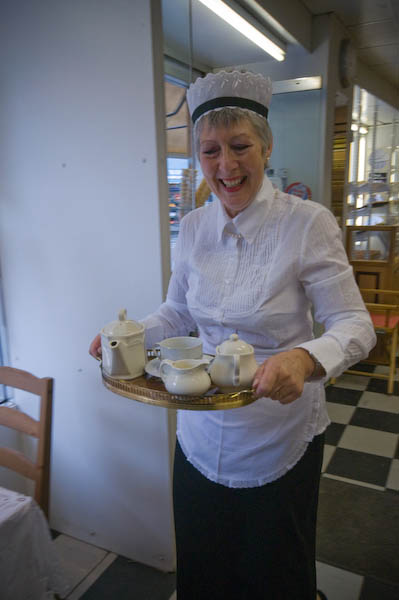
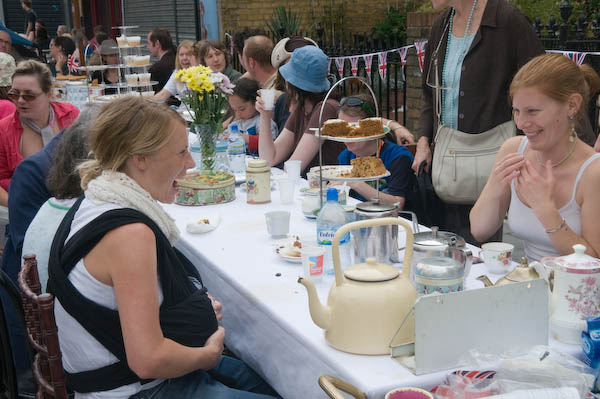
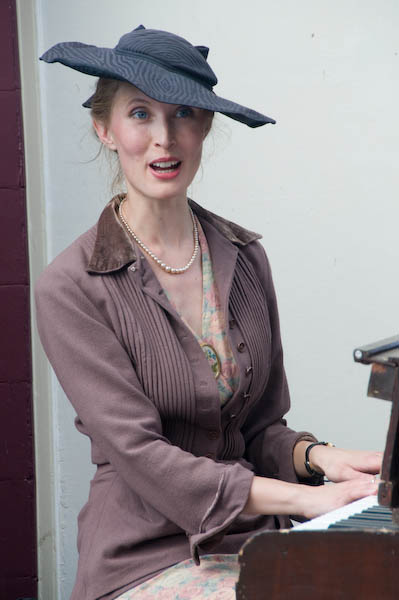
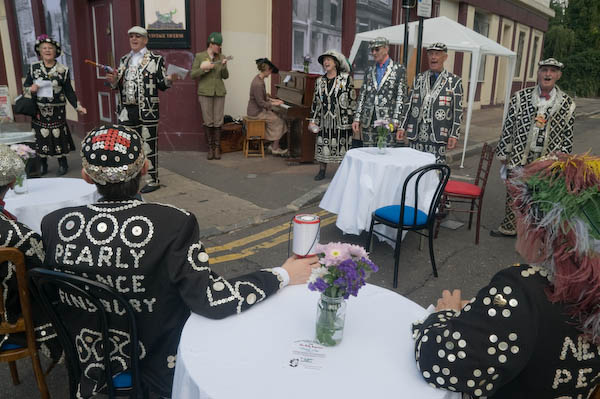
I’d had a very nice cup of tea served in 1948 style china by a “nippy”, and in the street were tea parties (with free cakes) and displays of boxing, jitterbugging and various objects from the 1940s kitchen (almost all of which we still use here, including a pastry blender – and no, it isn’t used to make bread.) Pearlies came in force and had a sing-song round the joanna.
Of course there was a bar, and there was also a little welcome madness in the section of road where the Hackney Austerity Olympics was taking place. It was of course highly appropriate, as the last Olympic Games held here were very much run on a shoe-string in 1948.
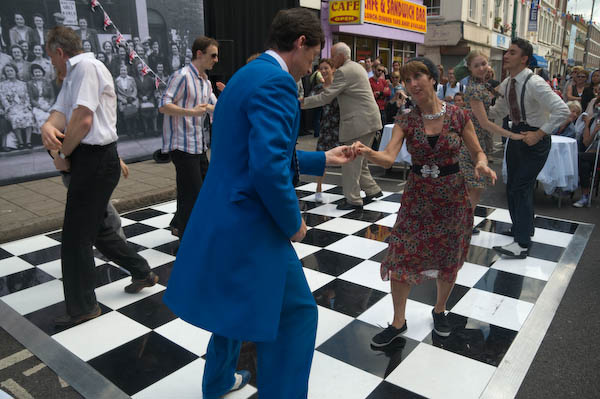
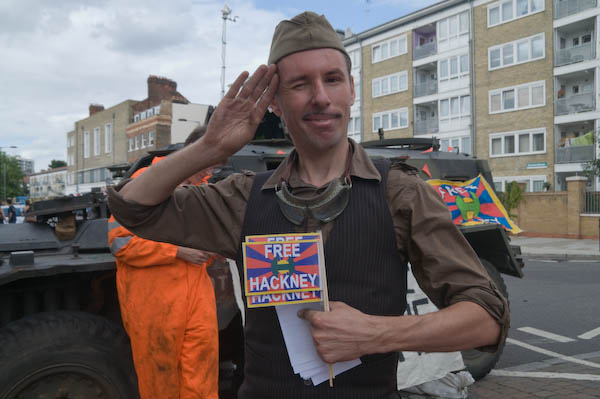
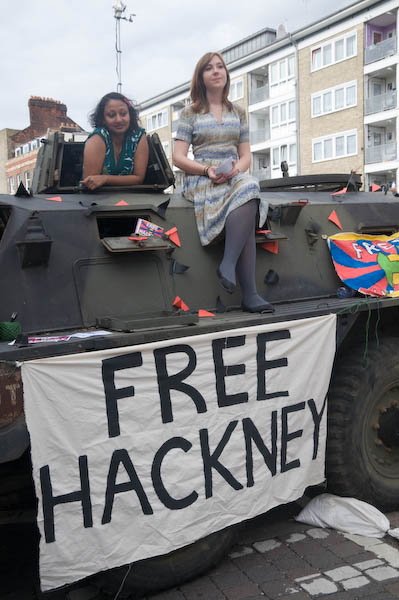
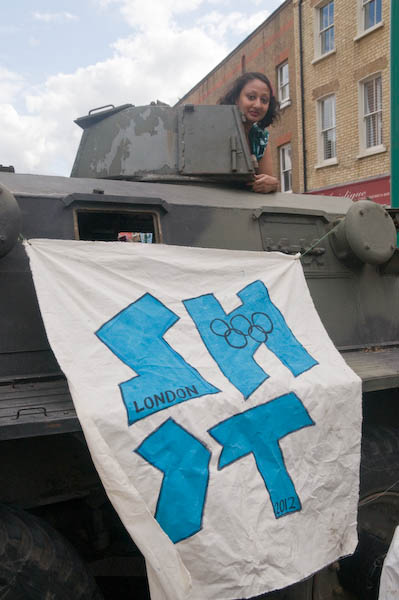
There was dancing on the street and everyone was having a good time. Including the ‘Free Hackney Movement’ Space Hijackers who arrived in what they call a tank to celebrate the handover of the protest torch for the Olympics from the Free Tibet protesters to Free Hackney.
The Free Hackney protest sees London 2012 as a great opportunity for property developers to rip us off and make obscene profits building luxury flats in the area, while at the same time restricting public access, closing down the existing free facilities and demolishing social housing and local businesses. So far its hard to argue against their case given the closure of local sports facilities including the closure of the Temple Mills cycle circuit and the removal of the Manor Gardens allotments and the wholesale clearance of small local firms which were based on Stratford Marsh.
There are a few locally based companies that have done well from their move, but more that have moved outside the area or closed down, with a loss of jobs in the area. There has also been considerable development of tall blocks of flats, but mainly for private sale or student accommodation which has done little if anything for the huge housing problems faced by local residents who want to remain in Hackney, Tower Hamlets or Newham.
Of course the London 2012 Olympics did give pleasure to many in the UK and around the world who watched the events, including the relatively few who bought tickets and watched them live. But any overall economic benefit for the UK – as claimed by the government – is debatable and given the extreme cost in any case marginal. Personally I find the media induced hysteria generated by the media around sporting events such as this objectionable and feel it is bad for the moral health of the country which needs a greater emphasis on the social and less on individual achievements of a tiny minority.
Light & Life, Pinter and Stockwell Breweries: A week after my previous walk I returned to South London to take more pictures on Sunday 4th June 1989. I began my walk from Clapham High Street.
Landor Rd, Clapham, Lambeth, 1989 89-6b-61
Landor Road, originally named ‘Stockwell Private Road’ but changed at some date before 1912, possibly after the well-known English writer Walter Savage Landor (1775-1864) runs from close to Clapham North Station to Stockwell Green. I made my first picture roughly halfway between the two at the corner with Hubert Grove. A group of five men standing around a car on the opposite side of the road had probably attracted my attention but I clearly did not want to attract theirs.
Many of the shops here have since been converted to residential use.
Light & Life Full Gospel Fellowship, 105-11 Landor Rd, Stockwell, Lambeth, 1989 89-6b-62
A row of four terrace houses here had been converted into the General HQ of the Light & Life Full Gospel Fellowship, and notices gave a full list of activities including Sunday Schools, Divine Worship, Gospel Meeting, Bible Study and Prayer but also Sewing, Cooking, Baking, Musical Rehearsals, Table Tennis , Darts and Snooker. The centre also housed a play group on Monday to Fridays and a Youth Club on Thursday evenings.
A message says ‘COME AND ENJOY YOURSELF – THIS IS NOT A BLACK CHURCH. WE DO NOT PREACH A BLACK GOSPEL – JESUS IS LORD’.
The Fellowship is still continuing its mission there, though with new noticeboards, blinds replacing curtains and a new coat of paint.
I can’t read the notices in the shop window of 127 Landor Road, but I think they might have indicated that the shop had closed. It was perhaps about to be converted to its current residential use.
Looking down Kimberley Road there are two tall blocks of flats, but from my camera position only one is visible, I think Pinter House on Rhodesia Road, one of three blocks in the Grantham Road Estate. 1890s terraced houses there were destroyed by wartime bombing and the site was used for prefabs. Planning for these towers began in the early 1960s under the Metropolitan Borough of Lambeth, but by the time they were completed in 1968-9 they were a part of the London Borough of Lambeth Council.
The three blocks were all named after modern play writers – in this case Harold Pinter. The block was designed by the deputy borough architect George Finch and system built; this 62m high block contains around 92 flats and maisonettes. The flats were refurbished in 2000-2001 after they became managed by Hyde Southbank Homes and now look rather different.
St Andrew’s, Church, CofE, Landor Rd, Stockwell, Lambeth, 1989 89-6b-64
St Andrew’s Stockwell Green in Landor Rd was built as a chapel in 1767 but there were later additions and the exterior was rebuilt by H E Roe in this Romanesque style in 1867. Vestries and the Lady Chapel were then added in the 1890s.
The building beyond the church was a large post-war bottle store which was replaced in 2010 by the perhaps deliberately rather bland Oak Square development. This had been a brewery site since 1730 and had been taken over as Hammertons Stockwell Brewery in 1868. It was sold to Watneys in 1951 and they used it as bottling stores.
Two Boys, Landor Rd, Stockwell, Lambeth, 1989 89-6b-65
I find it hard to positively identify this street corner though I think it must be than of Dalyell Road, where Landor Road meets Stockwell Green. The building at left is the now-demolished bottle store, and on it you can read the name THE QUADRANT. The corner is occupied by a giant billboard, and shop appears to have fruit in its window, a sack of potting compost on the ground outside and to sell ice cream.
This is a rather unusual detached house on Combermere Road and I think from my picture that it may have been built or later used as a shop. This is a very mixed street and there was nothing like this anywhere along its length.
It is still there, though the windows have been replaced with something looking rather sturdier and the door has a wrought iron grille.
Rhodes’ Brewery – Stockwell’s other brewery – took water from an artesian well on this site and was bought by Edward Waltham in 1851. His British Brewery or Half Guinea Ale Brewery in Stockwell Green produced Half Guinea Ale and London Brown Stout at 2/6d per dozen bottles; you paid an extra 6d for the mysteriously named ‘S N’ Stout. It many have stood for ‘Nourishing Stout’, something they also sold as Butler Brand Nourishing Stout.
Back in the 1940s or 50s, my mother, then languishing in hospital, was prescribed a daily bottle of Guinness. As a lifelong total abstainer she refused to drink the demon alcohol, but her Irish nurse had no such qualms.
The buildings probably dated from before 1851. The Lion Brewery bought the company in 1906 and for many years this site was a council depot. It has now been replaced by housing.
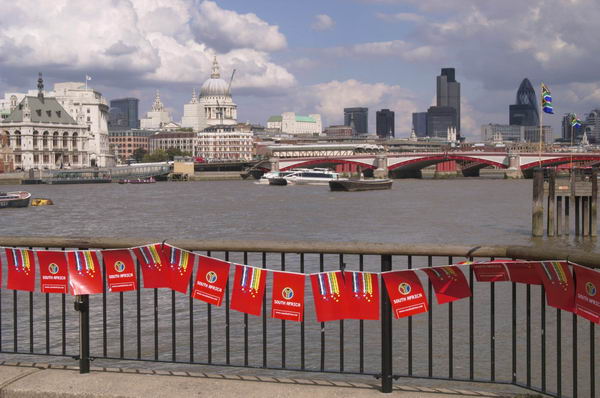
Shoreditch and South Africa: Saturday 21st August 2004 was a fine day for a carnival parade in Shoreditch and a South African festival, part of the Coin Street Festival in Bernie Spain Gardens by the River Thames near Waterloo, just on the Lambeth side of the border with Southwark.
Here with a little correction and capitalisation (back in 2004 My London Dairy was firmly lowercase) and brief introductions is the text I wrote, which you can find some way down the August 2004 page. Below I’ll give links to the pages with more pictures from each event.
Shoreditch Parade, Hoxton
The parade was a part of the Shoreditch Festival and took place not in what we now normally call Shoreditch but a little to the north in Hoxton. Hoxton and Haggerston were historically part of Shoreditch and they were all part of the Shoreditch Metropolitan Borough until the 1965 reorganisation took them into the London Borough of Hackney. The park were the parade began is Shoreditch Park, off the New North Road just a short distance south of the Regent’s Canal.
Saturday turned out fine for the Carnival Parade in Shoreditch, starting from the park and going round through the Hoxton Street market. Apart from the shire horses from Wandsworth Brewery it was very much a community-based event, and had obviously generated a lot of interest and effort.
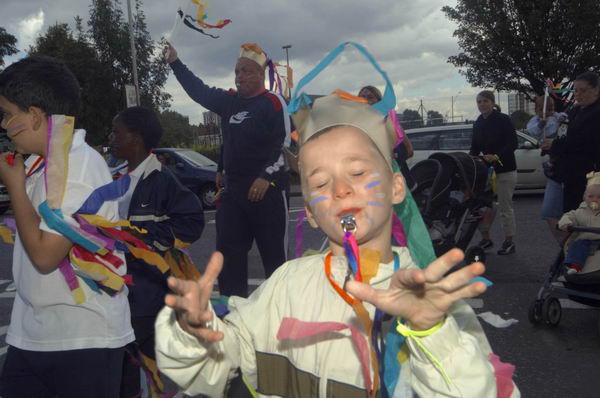
Part of the Shoreditch festival, its the first parade there for many years, and seemed to me to be a great success. Some of the kids really loved being photographed, and I was pleased I was using digital and didn’t have to worry about using up film.
Coin Street Festival: Viva South Africa – Bernie Spain Gardens
I left the parade as it left Hoxton Street market, and ran for a bus to points south, going to Bernie Spain gardens where there was a South African festival.
The music was great, but the wine was disappointing, really a waste of the chance to show what South Africa has to offer, and too expensive for the very little glasses that were on offer.
I had to leave before some of the more interesting sounding groups made the stage, but there were some nice dancers, and the audience was starting to join in.
D Bess, Bakery, Brighton Terrace, Brixton, Lambeth, 1989 89-5l-21
Was this a Caribbean bakers? D Bess, The Best Bakery. The building is still there at 12-14 Brighton Terrace, trimmed off rather more neatly at the right, modernised and used as an NHS clinic for Lambeth Drug & Alcohol Service, with an extra floor added on top.
Brighton Terrace is one of the older streets in Brixton and was present by the time of the first Skeleton Town plans surveyed by the Ordnance survey in 1848-1851 and by 1870 was lined with smallish houses on both sides, none of which have survived.
At a guess this building dates from around the start of the 20th century but I can find no information about when it was built or its occupiers before it became D Bess Bakery.
A Robson & Sons at 20-22 Brighton Terrace tell us that they are ‘Manufacturers and Rewinders of Replacement xxxxxures Stators and Rotors’ – I think the illegible word must be Armatures, but the state of the sign suggests they were no longer in business at this address. There is still a company in the same business, Robson & Francis Rewinds Ltd, in the Vale Industrial Park in Streatham who call themselves UK Specialists in Rewind & Reconditioning Armatures, Field Coils & Motors and I wonder if this is its successor.
20-22 Brighton Terrace still bears some resemblance to this rather charming small factory building, perhaps dating from the 1930s, but is now the same height as the flats at right of the picture to which it is joined, having four floors rather than the two in my picture. But it still has the same wavy roof line.
Tunstall Hall at the left of the picture was built around 1860 and at one time was storage for Morleys Department Store on Brixton Road, whose rear entrance is just across the street. The central building is Carlton Hall – Bernay’s Grove was originally called Carlton Grove but renamed before 1912. All these buildings apparently became an engineering works in the mid-20th century.
The house at right, 1 Bernays Grove dates from the 1820s and is Grade II listed. It was one of the villas which then lined Brixton Road, set back from it with long front gardens, later built over.
Carlton Hall and No 1 was in 1889 the Carlton Club, the hall used for religious services only, and from 1905 to 1909 Brixton Synagogue. In 1989 it was a Carlton Hall Community Centre. Tunstall Hall is now an architects studio.
The London, Chatham and Dover Railway opened Brixton and South Stockwell Station in 1862 taking commuters from what was then a fairly affluent suburb to Victoria, with a further line to Blackfriars opening in 1864. The population of Brixton rapidly expanded. Atlantic Road was laid out in the late 1860s following the railway viaduct and many smaller properties soon appeared. But wealthier residents in the villas along Brixton Road moved out and shops and commercial premises were rapidly built in their place covering their long front gardens.
The Railway Hotel has a conveniently located plaque bearing the date 1880 it was built in a finely ornamented neo-Gothic style surmounted by an octagonal clocktower. What can’t be read on my picture is the text underneath the date, LAID BY ANNIE ALLEN, who was its first licensee.
Still the Railway Hotel when I took these pictures, it was renamed Brady’s Bar in the 1990s and became an important music venue, played by Jimi Hendrix, The Clash as well as more local bands such as Alabama 3.
The pub closed in 1999 and was squatted and vandalised. Lambeth Council compulsorily purchased the building, but resisted various local campaigns to turn it into a community asset, selling it off to the highest bidder in 2013. The top floors were converted to flats and the ground floor became a Mexican restuarant, which closed in 2020. It reopened later as DF Tacos. The whole area is under threat from a comprehensive development scheme.
I think these old wooden stairs have now been replaced by metal, but I can’t work out exactly where I was standing. They go up to platform level and going above the platforms is the line leading towards Denmark Hill which now carries the Overground but has no stop at Brixton. There used to be an East Brixton station on that line but about a quarter of a mile further on, at Barrington Road, but this closed in 1976.
Brixton’s British Rail stations became less important after the opening of the Victoria Line to Brixton in 1971.
Shops, Electric Avenue, Brixton, Lambeth, 1989 89-5l-14
Back in 1989 there was virtually no Sunday trading before the Sunday Trading Act 1994 and I took the opportunity to photograph the normally bustling market street of Electric Avenue when it was almost empty.
This was one of London’s most elegant shopping streets when it was first built in 1885-8 and it was one of the first market streets to be lit by electricity. And around 1890 canopies were erected along both sides of the street so that shoppers could keep dry if it rained.
In 1989 I was surprised to see that these canopies had been removed, perhaps to give more space for the street market. The council I think blamed wartime damage, but it seemed a very thin excuse when they had continued to stand for over 40 years. The street has since been further damaged by partial redevelopment, and more is likely.
These huge pillars carry the railway line over the top of Brixton Station. Behind is one of the railway arches which for years were home to many small businesses that served the area well. In 2015 Network Rail decided to close and refurbish the arches over a year – and any traders that wanted to return would be faced with a 350% increase in rents.
The Save Brixton Arches Campaign was set up to oppose the changes, organising a number of public protests which had very wide popular support in the area. Despite this Lambeth Council decided to go ahead with Network Rail and most of the traders went out of business.
Many of the arches have now re-opened, but not with the useful and down-to-earth shops that people in Brixton had used for years, providing useful goods cheaply. When I last walked along Atlantic Road and Brixton Station Road many were still empty. Brixton has lost a large chunk of its heart.
And it was here at the centre of Brixton that the photographs from my walk on 28th June 1989 ended, though I think I will have walked back to Acre Lane to catch my bus back to Clapham Junction.
Built 1937, architect F E Simpkins Sunlight Laundry is a fine example of Art Deco ‘moderne’ style which unfortunately some architectural historians have turned up their noses at – perhaps why this building and some others are unlisted. Clearly this should be.
The Sunlight company was founded in 1900 and expanded with branches across London and after a merger in 1928 became a national business. Until the 1960s much of its work was for middle class domestic homes, but the wider ownership of washing machines shrunk the market and it concentrated on hotels, factories and other commercial clients. Later it also became a major contractor to hospitals.
There are another three pictures of this building online (click on one of these images to go to the album to see them), and I’ve also photographed it on other occasions when passing, though usually I’ve gone past on a 37 bus and not stopped.
Sunlight became part of the Danish Berendsen group and in 2013 changed its name to reflect this. It continues in business internationally and in the UK is the leading company in textile and laundry services to the hospitality and healthcare sectors. The company was acquired in 2017 by the French laundry services group Elis, whose name and logo now label its frontage.
Trinity Homes is a Christian Charity which provides accommodation to both single and married couples over the age of 57 who are members of a Christian denomination. As it states on its frontage it was erected in 1822-4 and was built and Endowed by Thomas Bailey. Additional homes were added in 1860. Initially it was The Trinity Asylum for Aged Persons. The building is Grade II listed.
Bailey was a cut-glass manufacture in the City of London and lived in Bethal House on Trent Road in Brixton Hill behind Corpus Christi Catholic church, built on land given by Bailey. His house, built in 1768, became part of the RC primary school built on the site in 1902 but has since been demolished.
The Assembly Hall is at the west end of the Town Hall complex and this striking sculpture relieves a huge plain brick wall area. This rather plain building is covered by the Grade II listing of Lambeth Town Hall and I think dates from 1935-8 when the Town Hall was raised and extended. The striking sculpture on what the listing text calls a particularly handsome rear elevation is ‘Youth rising from the Past‘, by Denis Dunlop (1892–1959).
Lambeth Town Hall, Acre Lane, Brixton 89-5l-35-Edit
Lambeth Town Hall seen from Acre Lane, though my more usual views of it have been either from Windrush Square or in close-up from the bus stop on the opposite side of the road during those long waits for a No 37 bus.
I’m not a great fan of the rather pompous clock tower of this Grade II listed town hall designed by Septimus Warwick and H Austen Hall and built in 1905-8. Edwardian Baroque always seems to me a period where architecture lost its way and was given excessive funding thanks to our plundering the wealth of the Empire.
Granada Brixton, Brighton Terrace, Bernay’s Grove, Brixton, Lambeth, 1989
Opened in 1898 as the Empress Theatre, designed by Wylson & Long, it was reconstructed in Art Deco style by Andrew Mather, reopening in 1931 as the New Empress Theatre. It showed films on Sundays when live performances were not allowed. It closed as a theatre in 1957 and after alterations opened a month later as a cinema. Granada Brixton became a Bingo Club in 1967 and when this closed was used as a furniture store. It was demolished in 1992 and the rather ugly Pavilion Mansions built on the site.
This walk continues along Brighton Terrace in a later post.