Libraries, Cameron, Grand National, Abortion & Colombia

Libraries, Cameron, Grand National, Abortion & Colombia – Saturday 9th of April 2016 was a busy day for me photographing protests across London.
Libraries, Cameron, Grand National, Abortion & Colombia

Lambeth Libraries Occupation and March, Herne Hill
Libraries, Cameron, Grand National, Abortion & Colombia

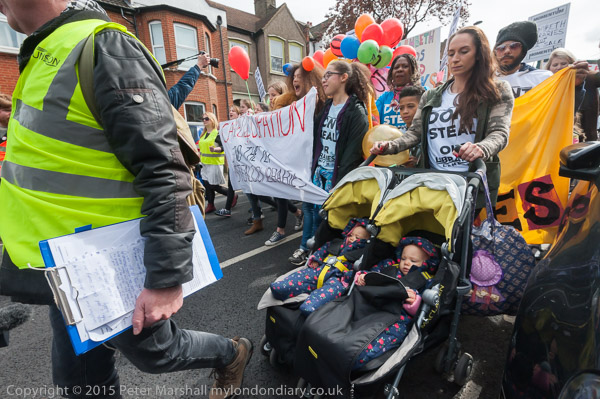
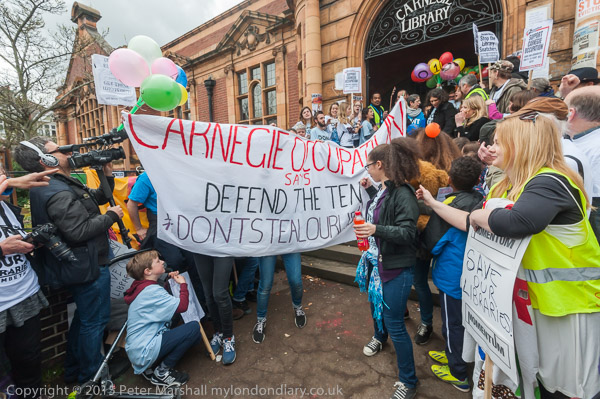
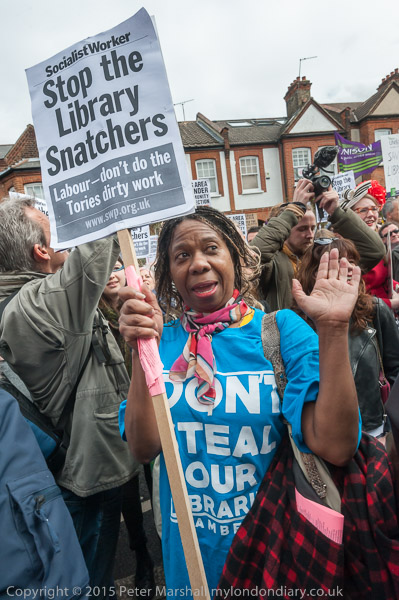
My day began in Herne Hill in South London, where campaigners had been occupying the Carnegie Library since March 31st fighting Lambeth council’s plans to turn the building into a fee-charging gym run by Greenwich Leisure Ltd with an just unstaffed lounge with books. They emerged to a huge welcome from over a thousand campaigners after their occupation had given the campaign national news coverage and huge support from around the country.
Libraries, Cameron, Grand National, Abortion & Colombia

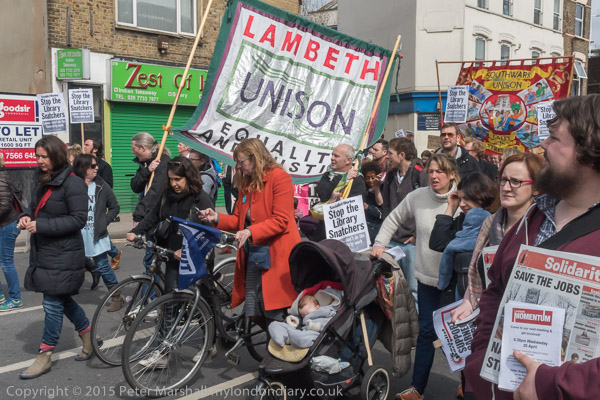
The came out to lead a march to save all of Lambeth’s Libraries after they had been forced to leave by an injunction obtained by Lambeth Council. The march was going via the Minet Library, also closed by the council on 31st March to a rally opposite the town hall in Brixton.
Libraries, Cameron, Grand National, Abortion & Colombia

I left the marchers to take a train from Loughborough Junction back to the centre of London.

Carnegie Library Occupation Ends
March to Save Lambeth’s Libraries


Cameron must go! Downing St
Libraries, Cameron, Grand National, Abortion & Colombia

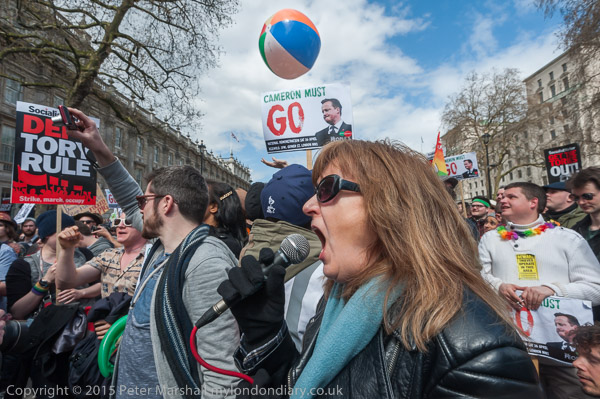
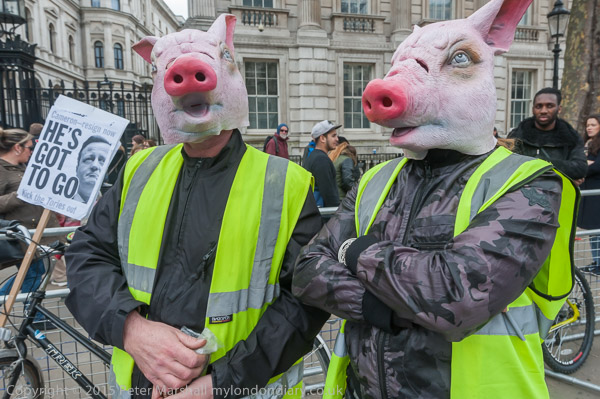
When I arrived, a large and lively protest outside the gates of Downing St was blocking traffic in Whitehall calling on Cameron to resign because of the lack of trust about his financial affairs following the revelations in the Panama papers.
Libraries, Cameron, Grand National, Abortion & Colombia

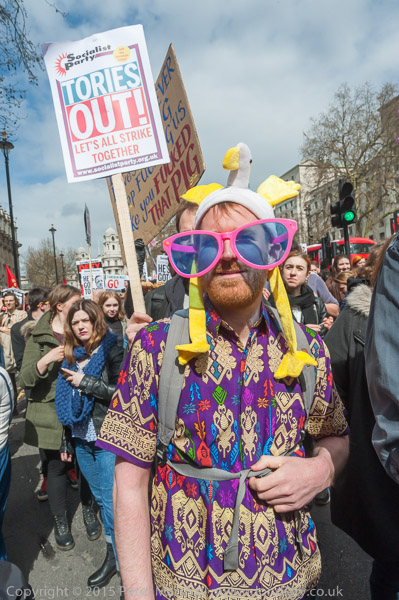
Many protesters had come in party mode, with flowered garlands, Panama hats and suitably Central American dress and some with placards and posters referring to Cameron’s pig-related activities.

Cameron must go!


Stop Grand National horse slaughter, Channel 4, Horseferry Rd
Libraries, Cameron, Grand National, Abortion & Colombia

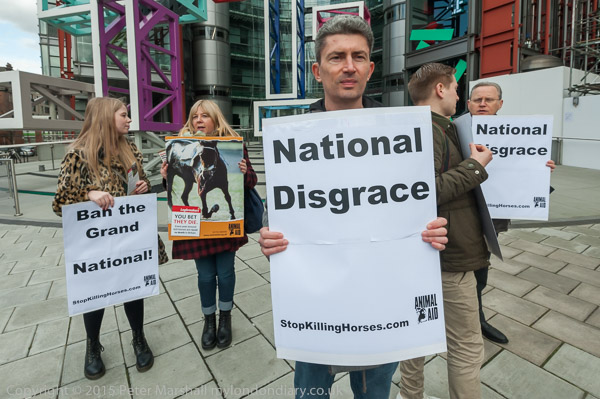
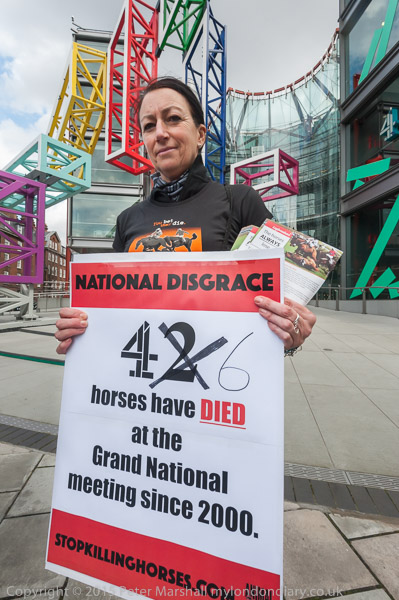
I left Whitehall where the party was still continuing outside Downing Street and walked to Channel 4’s London HQ, where a small group was protesting the cruelty to horses involved in the Grand National and other similar races. Already 4 horses had been killed that year in the current race meeting at Aintree, and at least 46 following accidents at the annual meeting there since 2000.
Libraries, Cameron, Grand National, Abortion & Colombia

Race horses seldom if ever actually die from the accidents, but a broken leg makes them worthless and rather than spending money on keeping them alive they are killed.

Stop Grand National horse slaughter


Don’t Criminalise Abortion in Poland, Polish Embassy
Libraries, Cameron, Grand National, Abortion & Colombia

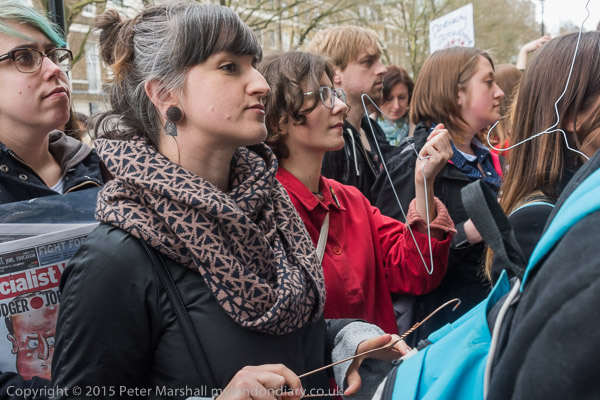
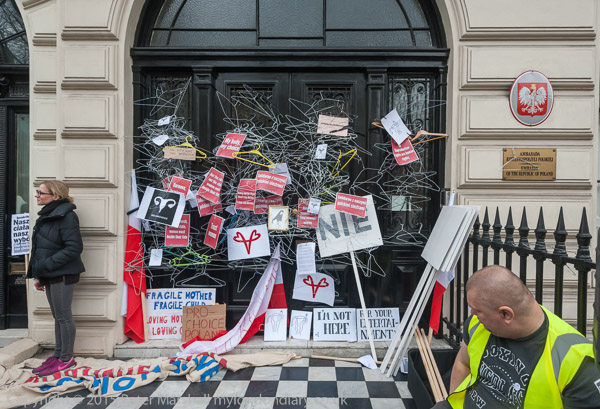
From Horseferry Road where the protesters told me more people were coming to join the protest I took the tube to Oxford St and rushed up Regent St and Portland Place to the Polish Embassy, where a crowd of several hundred Poles and supporters were supporting large protests in Poland against the bill proposed by the Law and Justice Party (PiS) which will outlaw abortion in all cases, protecting the life of the unborn child even where this may cause extreme distress or even death for the mother.
Libraries, Cameron, Grand National, Abortion & Colombia

At the end of the protest they hung wire coat-hangers, a traditional crude tool of back-street abortionists, on the embassy door and fence.

Don’t Criminalise Abortion in Poland


Party against Cameron, Downing St
Libraries, Cameron, Grand National, Abortion & Colombia

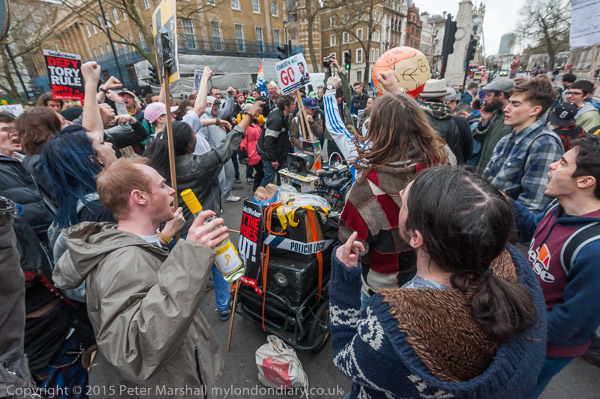
I took the tube back to Charing Cross and walked down to Downing Street and the party which had begun before lunchtime was still going on there at 4pm, though most of the people had gone home.
Libraries, Cameron, Grand National, Abortion & Colombia

They were still blocking the side of Whitehall next to Downing Street and there was dancing on the street to a sound system and it was more of a street party. Police were still standing back and watching but seemed to be making no attempt to clear the street.

Party against Cameron


End Killings in Colombia, Trafalgar Square
Libraries, Cameron, Grand National, Abortion & Colombia

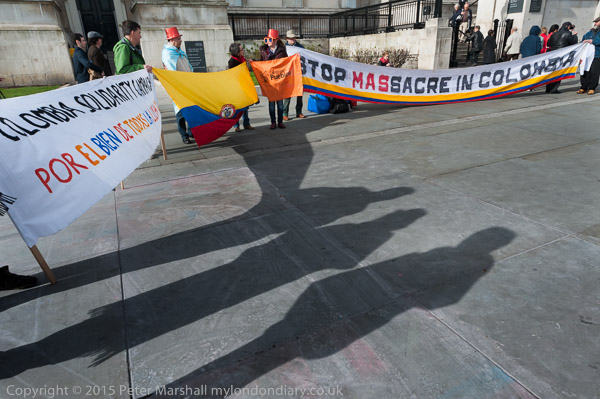
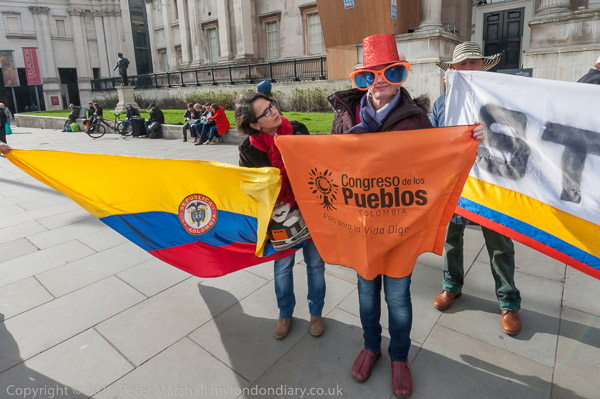
In Trafalgar Square an emergency protest was taking place on the North Terrace against the massacres in Colombia, organised by the UK Congreso de los Pueblos and Marcha Patriotica supported by the Colombia Solidarity Campaign. The protest was held in solidarity with those taking place that day in Colombia against political persecution and calling for an end to paramilitary killings. They want peace, human rights and democracy in Colombia.
Libraries, Cameron, Grand National, Abortion & Colombia

It’s sometimes difficult to understand what is happening in Colombia – as in some other foreign countries. Our news media seldom report fully and often take a very biased view, relying on reports reflecting only the views of big business, the wealthy classes and US propaganda. Here’s what I wrote about the situation:

Conservative opposition politicians led by former president Alvaro Uribe have protested against ongoing peace talks with leftist rebel groups by President Juan Manuel Santos. Uribe is opposed to talks with FARC and the ELN. If there was a peace agreement there could be investigations of the various human rights abuses and corruption scandals that took place while he was in power. The conservative protest follows earlier protests last month by mainly left and rural Colombians in support of Santos and the peace talks.

End Killings in Colombia

I was tired and it was time to go home.


End Killings in Colombia
Party against Cameron
Don’t Criminalise Abortion in Poland
Stop Grand National horse slaughter
Cameron must go!
March to Save Lambeth’s Libraries
Carnegie Library Occupation Ends
March Against Housing & Planning Bill

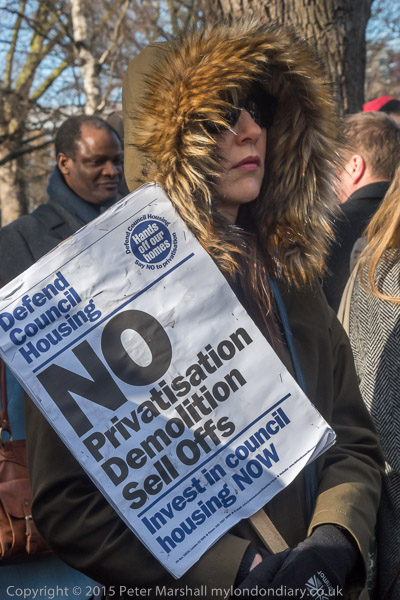
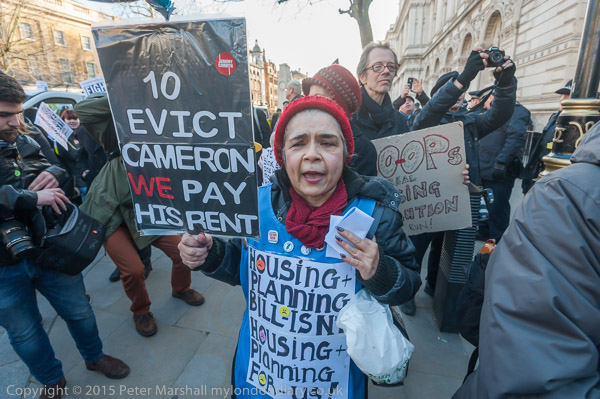
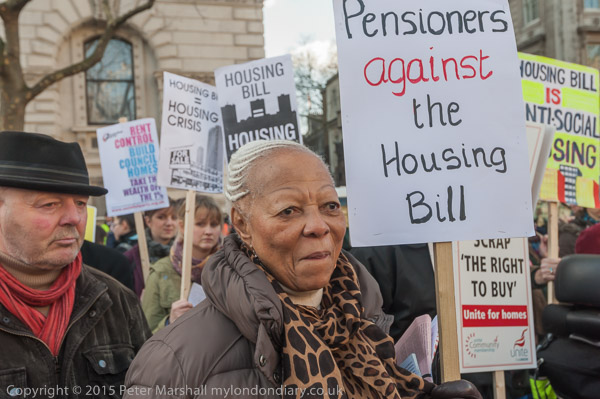
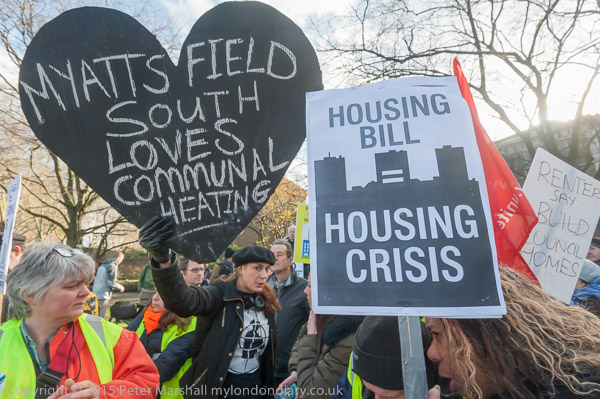
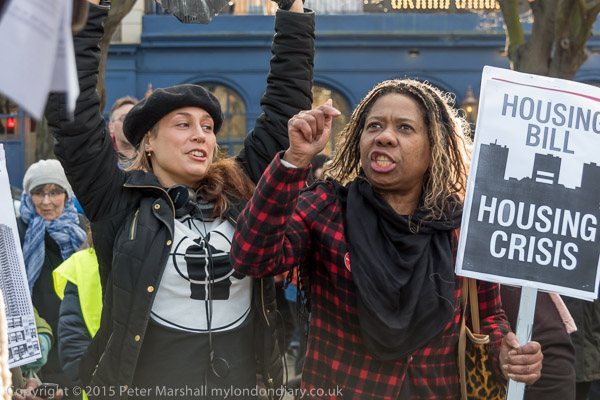
The March Against Housing & Planning Bill on January 30th 2016 was organised by activists from South London, particulary from the London boroughs of Lambeth and Southwark.

These include many who are fighting against the demolition of social housing that is taking place across London, including in Lambeth and Southwark. Council tenants and leaseholders on council estates are fighting to save their homes – and fighting against Lambeth and Southwark councils who together with private developers and estate agent advisers are bent on demolishing the estates and replacing them with new estates which are largely for private rent or sale at London’s inflated market prices.

Southwark Council in particular carried out an expenisive PR exercise to demonise the Heygate Estate at the Elephant & Castle, having failed to carry out necessary maintenance and flooded the estate with people with various social problems over a number of years. The whole disastrous history has been documented in depth on the Southwark 35% site. A prize-winning estate with 1,214 homes built in 1974 to provide social housing for around 3,000 people was deliberately run-down and demolished. It’s replacement, Elephant Park has less than 100 social housing units. Many of its new flats are simply investments for overseas owners.

Southwark sold the Heygate to developers for one third of its previous valuation, and spent more on the scheme than it received. A study by Global architect firm Gensler concluded that the £35m spent by Southwark in rehousing the estate residents was exactly the same as it would have cost to refurbish the estate up to modern standards – and would have avoided the huge carbon footprint of demolishing and rebuilding.

A well as Heygate, Southwark Council’s main target has been the Aylesbury Estate, where Tony Blair chose to launch the Labour regeneration policy which has enabled corrupt councils to destroy much of what remained of social housing. For many council officers and some councillors it has enabled them to move into highly paid jobs with developers as a reward for their services. Lambeth has also been pursuing similar policies (along with other boroughs in London) and in particular with the Central Hill estate close to Crystal Palace.

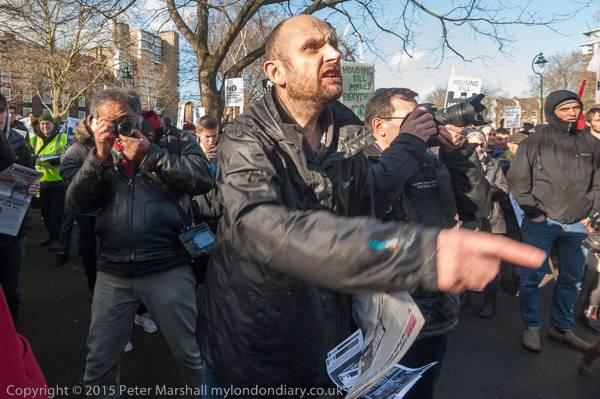
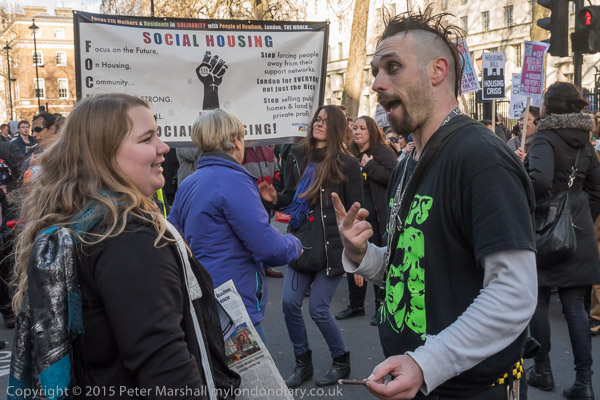
An angry heckler – their argument continued after the speech by Livingstone

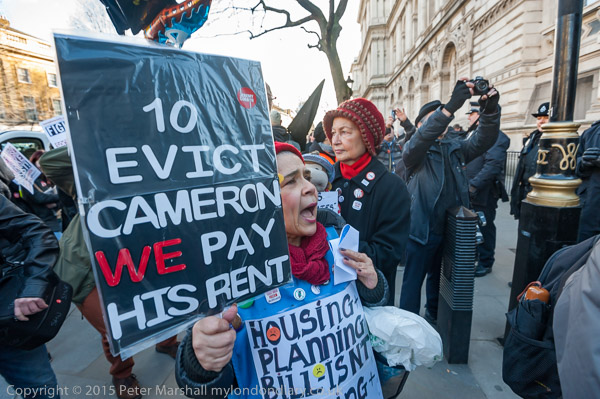
The protest against the Housing & Planning Bill in 2016 was also attended by people from both Lambeth and Southwark Council, and when Southwark Council Cabinet Member for Housing Richard Livingstone stepped up to the microphone to speak at the rally before the march some trouble was inevitable. Among those loudly heckling him was another of the speakers, Simon Elmer of Architects for Social Housing.

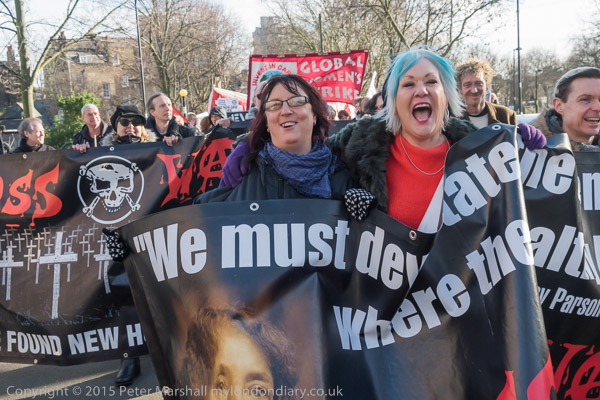
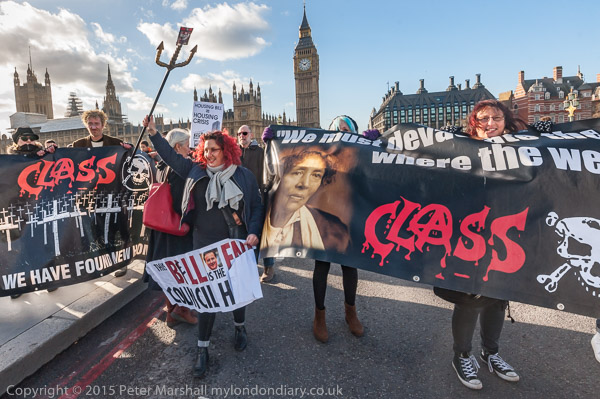
Class War have also been active in support of social housing in South London in particular and livened up the march by dancing along the street with banners singing the ‘Lambeth Walk’. One banner carried the words of a leading US Anarchist Lucy Parsons (1853-1942), “We must devastate the avenues where the wealthy live” and another had a field of crosses with the message “We have found new homes for the rich“.

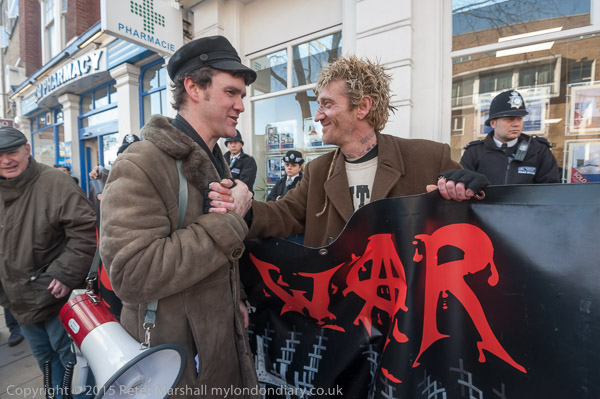
Class War supporters rushed across the street for a short impromtu protest in front of a large branch of one of the leading estate agents driving the gentrification of London and advising councils and government on housing policies, but soon rejoined the main march of around 2,000 people heading for Westminster Bridge and Downing St.

At Downing St there was another protest outside the gates. Police had formed a line across Whitehall and directed the march to the opposite side of the street opposite Downing St. The march followed them across but then many simply walked back across the street to mass in front of the gates for a rally led by Fight Racism! Fight Imperialism! who have been active in supporting the Focus E15 Mothers in their campaign against the housing failures of Newham Council.

More on My London Diary at Housing and Planning Bill March


Five Bridges: XR – 17 Nov 2018

COP26 was in some respects a great disappointment, or rather would have been had we expected very much to arise out of it. But there were some advances, and just a slight glimmer of hope that it may prompt a little more progress in our efforts to save our future on the planet. But that it happened at all and in the way it did is very much down to the efforts of people on the street to raise awareness of the realities of climate change.

Without groups that have been campaigning for years we would have no hope at all, and whatever people think about some of the policies of Extinction Rebellion, it has been one of the more effective movements in bringing the message to the attention of the media, politicians and the public.

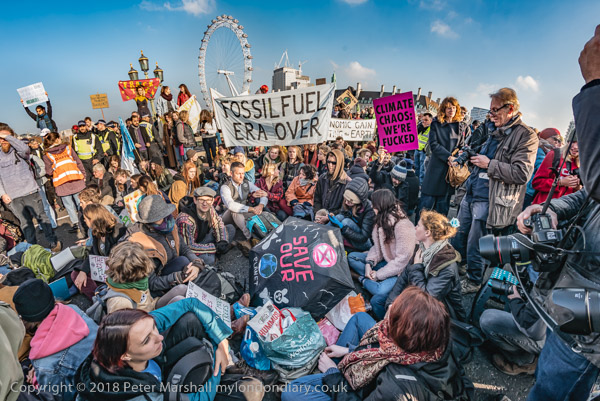
Even in the unfortunately toned down words of the COP26 final resolution, the message from the banner in the assembly at the top of this post is now clear: ‘FOSSIL FUEL ERA OVER’ though it still remains to be seen if it can be brought to an end fast enough for us to survive.

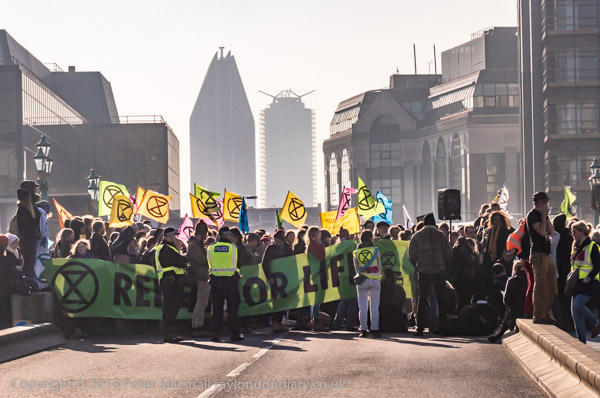
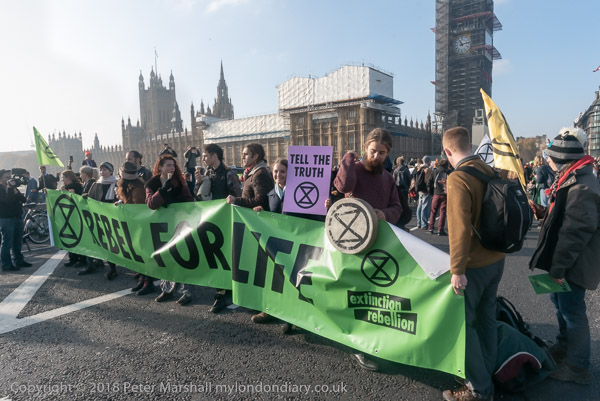
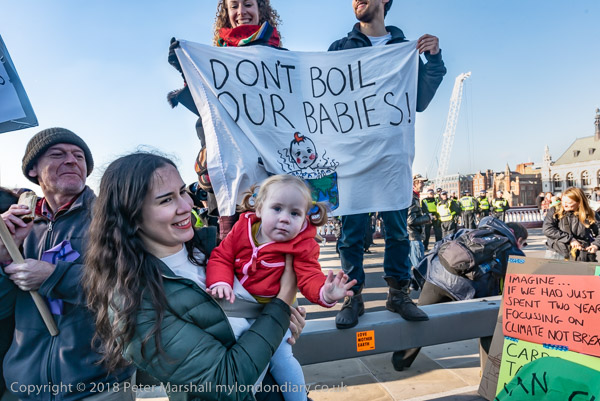
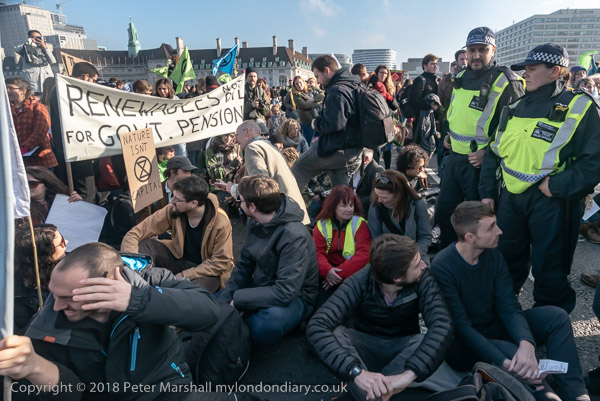
On Saturday 17th November 2018, Extinction Rebellion rebels managed to block five of the bridges in central London: Lambeth, Westminster, Waterloo, Blackfriars and Southwark. It was an ambitious project that brought much of London’s traffic to a standstill and gauranteed extensive media coverage. You can march 50,000 through London and it won’t merit a mention on the BBC unless windows are broken or police injured – but this was something that could not be ignored, and despite the interests of the billionaire media owners, at least some journalists began asking the right questions and writing the right answers.

I tried to photograph events on as many of the bridges as possible, though with no buses able to run in central London this involved rather a lot of walking. In the end I failed to make it to Lambeth Bridge, where some of the more robust actions by police against the protesters took place.

Here’s my description of XR from one of the three posts I made about them that day:

Extinction Rebellion is a non-violent rebellion against the British government for its criminal inaction in the face of the climate change catastrophe and ecological collapse which is currently on course to make human life extinct. They demand the government tell the truth about the climate emergency, reverse their inconsistent policies and work to communicate and educate everyone, that they bring in legally binding policies to reduce carbon emissions to net zero by 2025 and reduce our consumption of all resources, with a national Citizen’s Assembly to oversee the changes and create a real democracy.

http://mylondondiary.co.uk/2018/11/nov.htm#westminster

More protests will be needed around the world to make politicians do what needs to be done – and I was photographing Extinction Rebellion in London last Saturday when they protested in the annual Lord Mayor’s Show.


My day was made busier as there was another unrelated event taking place that I also wanted to photograph, a Unity against Fascism and Racism march from the BBC to a rally in Whitehall calling for unity against the rising threat of Islamophobia and Antisemitism by far-right groups in the UK, with a level of support for fascism not seen since the 1930s. I missed the start but spent around half an hour taking pictures as it came down Regent St.


More on all these and more pictures on My London Diary:

Extinction Rebellion Bridge blockade starts
Extinction Rebellion: Southwark, Blackfriars, Waterloo
Extinction Rebellion form Citizens’ Assembly

Unity Against Fascism and Racism


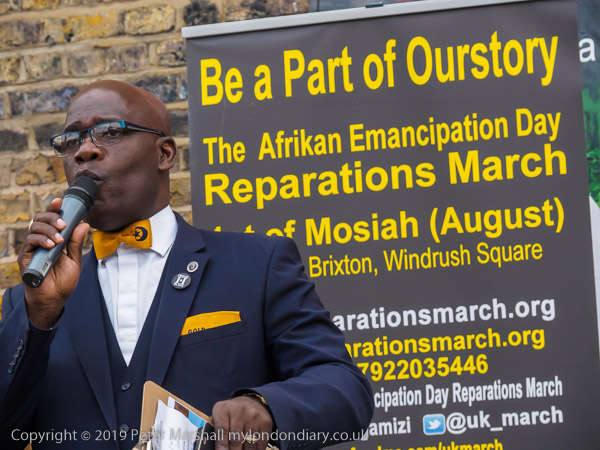
Afrikan Emancipation Day Call for Reparations

2014

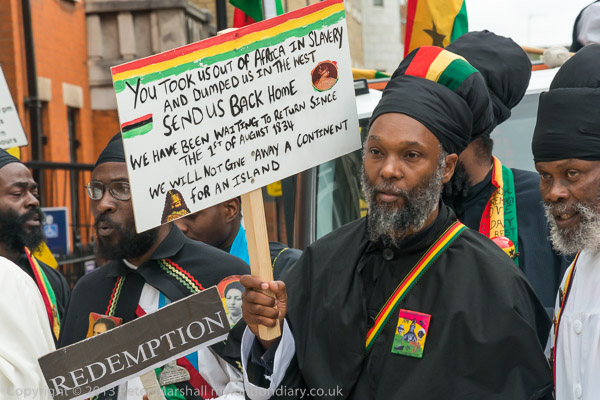
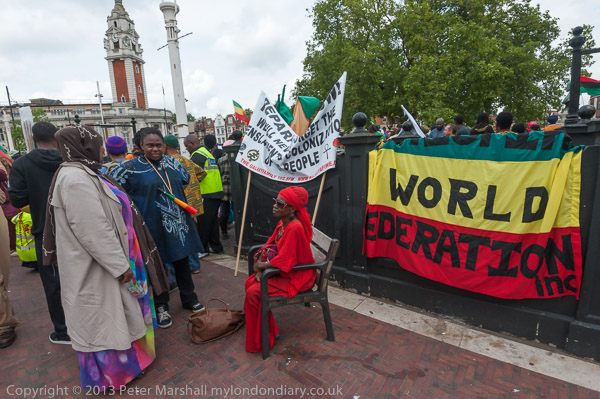
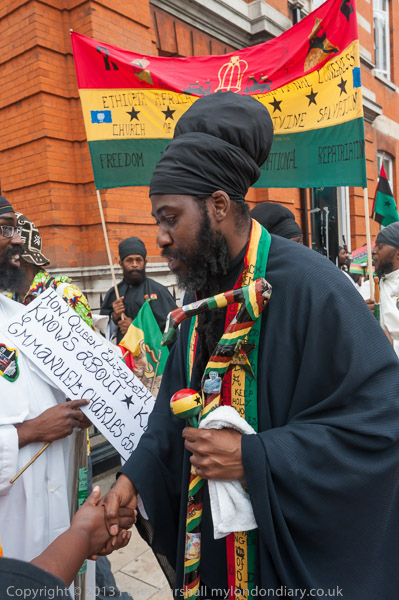
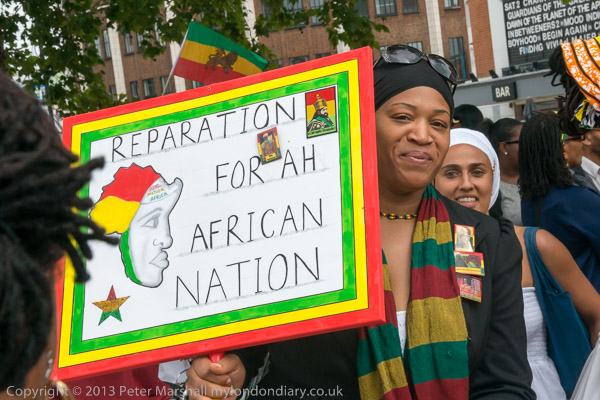
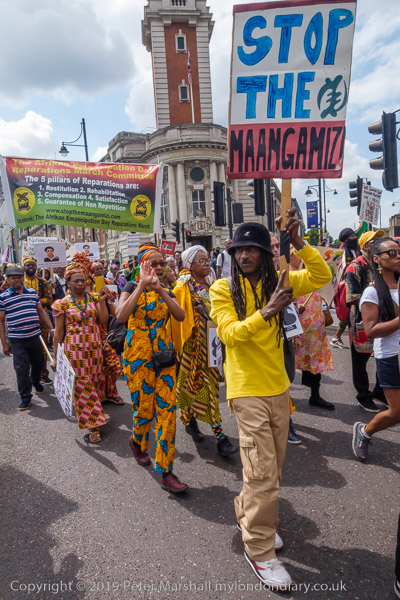
Seven years ago on August 1st 2014, the centenary of the foundation by Marcus Garvey of the Universal Negro Improvement Association, I photographed Rastafarians meeting in Windrush Square for speeches and ceremonies before a march to Parliament demanding reparations for the descendants of those taken from Africa by the Atlantic Slave Trade.

2014

August 1 was chosen as the founding date for the UNIA and for the Madison Square meeting and this protest as it was the 1 August 1834 was Emancipation day, following the Slavery Abolition Act 1833, when slavery was ended in the British Empire.

2014

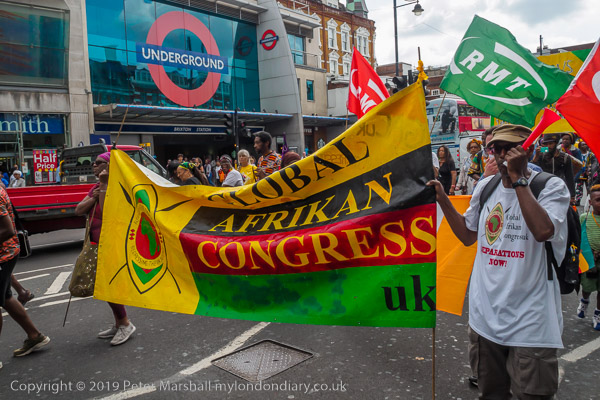
Since then, similar events have taken place each year in Brixton each Afrikan Emancipation Day – August 1st – with the event growing in support each year. Last year the organisers changed the format of the event, as the supporters of the event felt it was having little impact and their demand to the UK Government to establish an All-Party Parliamentary Commission of Inquiry for Truth & Reparatory Justice (APPCITARJ) and to commit to holistic reparations taking into consideration various proposals for reparations in accordance with the United Nations Framework on a Right to a Remedy and Reparation was being ignored.

2014

The decided to hold a series of events in Brixton, blocking local roads to do so, an Afrikan Emancipation Day Reparations Rebellion Groundings event. This gained far more attention in the media and the Stop The Maangamizi Campaign and the Afrikan Emancipation Day Reparations March Committee have decided to hold a similar rebellion on Sunday 1st August 2021.

2019

With some help from Extinction Rebellion who have supported previous events they intend to lock-down Brixton Road for the day, and to establish a series of ‘Grounding spaces’ for public action and learning on various aspects of the struggle under the general theme of ‘Uniting to Stop the Maangamizi for Our Very Survival: Planet Repairs Now’.

2019

Maangammizi is a Swahili word annihilation, used to describe the genocide and ecocide which has taken place over centuries and is still causing huge damage across the planet. Climate change disproportionately effects Africa and the Global South.

2019

The UK Government continues to turn a deaf ear to the demand for reparations, writing in response to a petition in 2018 “we do not believe reparations are the answer” and that they “should focus on challenges that face our countries in the 21st century” rather than historic events such as the Transatlantic slave trade. Unfortunately it hasn’t been doing well on those challenges as a recent deliberately misleading report on racial disparity and our current rise in average temperatures demonstrate.

More at:
Rastafari demand reparations for slave trade
Afrikans demand reparations

Central Hill and more

One of the original tenants comes to talk with me She tells me she dreads having to move

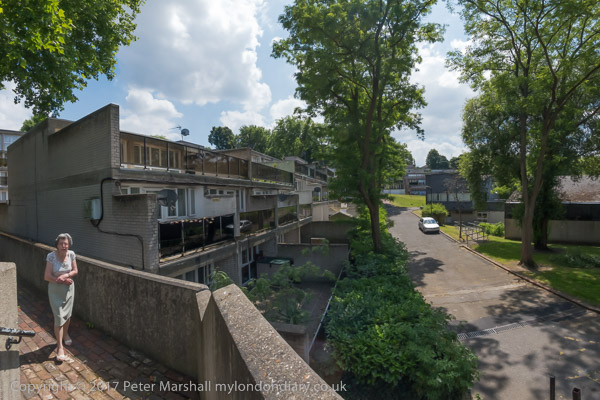
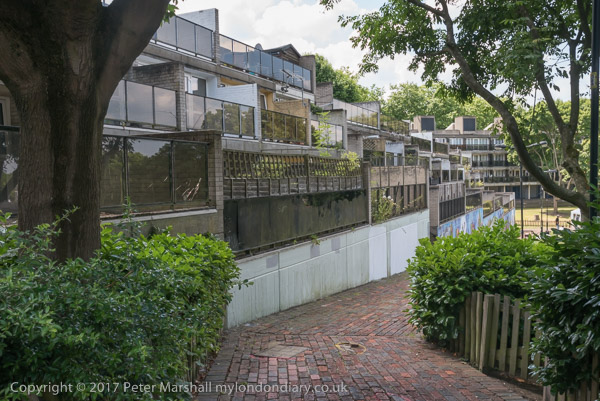
I began work on Sunday 18th June 2017 on the Central Hill Estate at the south-east tip of Lambeth, built on a hill with splendid views towards central London. Across the road (also Central Hill) at the top is Norwood in LB Croydon, a few yards down from the estate takes you in to the LB of Southwark, while 5 minutes walk east brings you to Crystal Palace in the LB of Bromley.

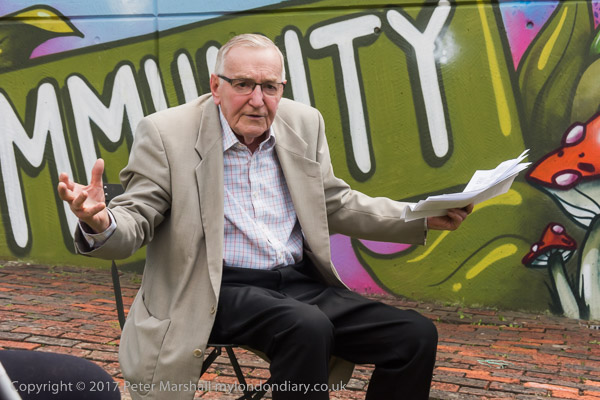
As Ted Knight, the leader of Lambeth Council from 1978 until disqualified for refusing to cap rates in 1985 and demonised by the press as ‘Red Ted’, told us later in the morning when he came to express his support, the estate was designed and built in 1967-74 when Labour believed that “nothing was too good for the working people” and the estate was built to high specifications and is still in sound condition. Borough Architect Ted Hollamby had earlier brought in Rosemary Stjernstedt from the LCC where she was their first senior woman architect, and she was the team leader, working with structural engineer Ted Happold from Arup & Partners and architect Roger Westman.

The scheme was seen from the start as a living community, and included a burses’s hostel, a day card centre and a doctor’s surgery as well as a small row of shops, a club centre and community hall. It also had a district heating system, though this is no longer in use. The plans made great use of the sloping site and the estate is certainly one of the finest of that era. It has remained a popular estate, with relatively low crime rates, and quite a few of the original residents still live there and wish to stay.

It’s an estate that clearly should be listed, but Historic England decided not to do so in 2016, probably under pressure from politicians, particularly because of the scale of the site and the very attractive possibilities it presents for developers. The Twentieth Century Society were dismayed that their application was dismissed – and you can read their application on-line.

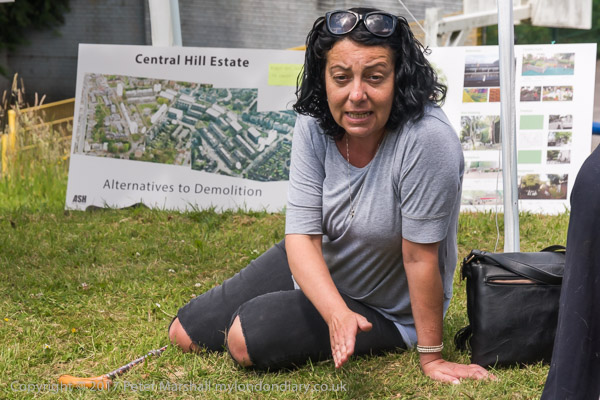
In 2017 Lambeth decided to completely demolish the estate and develop it with an extra 400 homes, roughly doubling the size, most of which will be for private sale. Many residents objected and Architects for Social Housing have developed alternative plans showing how the extra capacity could be achieved at lower cost retaining the existing housing and the main features of the estate.

Nicola Curtis, one of the elected representatives the council refuses to talk with

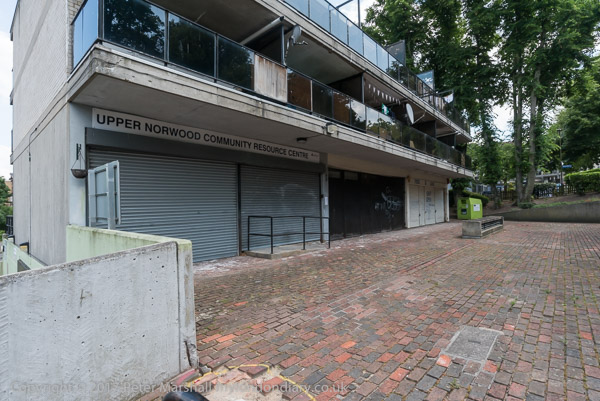
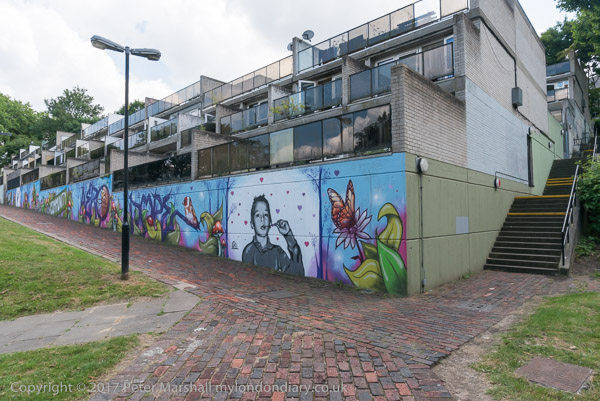
The council seem to have little concern for the current residents of the estate or their wishes. They have been banned from using the community resource centre on the estate, which was locked. A large mural was painted with council agreement on one of the walls in the estate – but the council then insisted that they remove the name ‘Central Hill’ from it. The council refused to talk with the two representatives of the residents elected to the Resident Engagement Panel. Normal maintenance of the paths and other aspects of the estate appears to have been stopped, and I found examples of very shoddy work by the council on the estate.


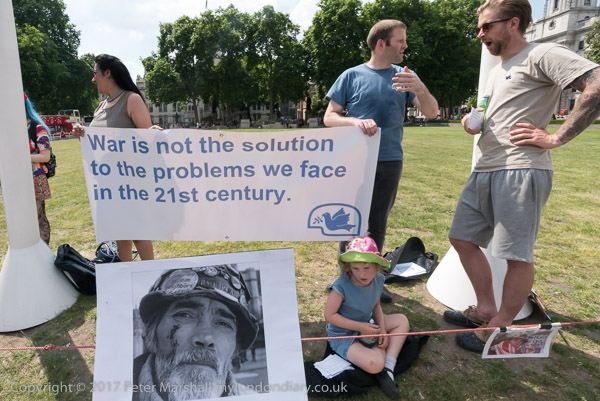
I took the train back into central London and to Parliament Square, wherre Veterans for Peace had organised a remembrace of Brian Haw on the 6th anniversary of his death. They held a small banner with the message ‘War is is not the solution to the problems we face in the 21st century’

Brian Haw began his camp here on 2 June 2001, and remained in place despite many attempts, legal and otherwise to remove him for almost 10 years, leaving only when arrested, for court appearances and to speak at protests at Trafalgar Square and Downing St until 1 January 2011 when he left England to receive treatment for his lung cancer in Berlin. He died in Germany in the early hours of 18 June 2011.

His ten years of protest and the frequent and repeated harassment undoubtedly hastened his decline and death. His protest in Parliament square was continued by Barbara Tucker who had joined him in 2005 and had been imprisoned twice for her role in the protest and arrested 48 times. The level of harassment increased and she went on hunger strike on 31st December 2012. Late in January 2013 she was taken into hospital close to death, and was treated for frostbite and exposure. Her protests continued on-line.

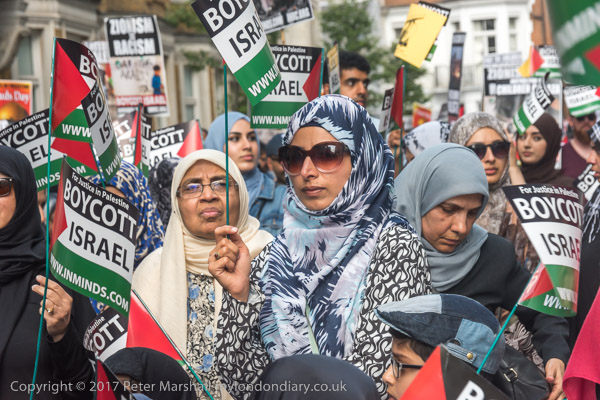
It was also the day of the annual Al Quds (Jerusalem) Day march in London, attended by several thousand from all over the country. Led by Imams and Neturei Karta anti-Zionist Jews, it called for ‘Freedom for Palestine’, and for all oppressed people’s across the world, and for a boycott of Israel.

As usual the march met with opposition from a small group of Zionists with Israeli flags and they were better organised than in previous years, with around 20 of them managing to block the route for around a quarter of an hour before police managed to move them on and allow the march to continue, though rather more slowly than usual.

Al Quds Day was inaugurated by Ayatollah Khomeini and some of the groups which support it may still receive support from the Iranian regime. Some of the protesters carried a small flag with both the Palestinian flag and that of Hezbollah and the message ‘Boycott Israel’. Hezbollah, a Lebanese Shia Islamist political party and militant group uses the same flag for both, and the militant wing is a proscribed group in the UK. The flag carried by some on the protest made clear in the small print it was in support of the political party.

Al Quds march
Zionists protest Al Quds Day March
Brian Haw remembered
Ted Knight speaks for Central Hill


All photographs on this and my other sites, unless otherwise stated, are taken by and copyright of Peter Marshall, and are available for reproduction or can be bought as prints.


Richmond and Clapham

Oak House, Old Palace Place, King St, Richmond, 1988 88-1a-53-positive_2400
Oak House, Old Palace Place, King St, Richmond, 1988

I went to Richmond fairly often fairly in my youth some 25 years or so before I took these pictures, sometimes on my bike, on the 37 bus from Hounslow Garage or by car with a friend from school who had a part-time job and could afford to run a Morris Minor. On the bike I would generally ride around Richmond Park, and I took my first cassette of black and white film mainly of the trees there, sending them away to be processed and getting back 36 crinkle-edged black and white enprints. D & P cost something like 17s11d (around 90p) and it was several years before I could afford to take another film. The prints were a dull grey, with no trace of either white or black, but even well-printed they would have been of no great interest.

Flooding, River Thames, Richmond, 1988 88-1a-62-positive_2400
Flooding, River Thames, Richmond, 1988

When we went together in my mate’s car, often with a third friend, it was to sit with a cup of coffee on the terrace of a coffee bar, watching the girls go by while our coffee cooled. I doubt we could ever afford more than a single cup, and certainly none of us had the nerve to talk to any of those passing girls. Richmond at the time was full of young foreign au-pairs, all rather older than us.

Flooding, River Thames, Richmond, 1988 88-1a-02-positive_2400
Flooding, River Thames, Richmond, 1988

I think most of my bus journeys were made on my own, visiting the Palm Court Hotel to listen to jazz in the bar there, standing making a pint of bitter (probably Red Barrel or Worthington E – I then knew no better) last and last as I couldn’t afford another. It was always a rather lonely evening, with little conversation – though occasionally some older man would attempt to pick me up but I wasn’t interested. But there was some truly great music from the likes of Bobby Wellins.

Flooding, River Thames, Richmond, 1988 88-1a-01-positive_2400
Flooding, River Thames, Richmond, 1988

Later, in my thirties, I would visit Richmond regularly, having joined the photographic society there and made a few friends who shared some of my photographic interests. Club photography was in general tired and formulaic and had little to offer, but became used to doing my own thing often to the derision of the majority of the members. I still remember the frisson of revulsion when a visiting judge for an inter-club competion not only praised my entry but awarded it one of the prizes.

Flooding is frequent at Richmond, where the Thames is still tidal (though a half-lock prevents it draining out completely at low tide) and there are always motorists who ignore the warning notices. I think it comes up over parts of the towpath most months during Spring Tides. These pictures were taken in March when I had probably come on one of my regular visits to a couple of second-hand bookshops that often had decent photographic books in stock at a time when these were rare. Many were review copies, probably never reviewed but sold to the dealers as one of the perks of a poorly-paid job. I decided if ever I became a book reviewer (which eventually I did) I would never sell copies, and I didn’t though there were some I gave away, but many more I refused to take.

Heath Terrace, Wandsworth Rd, Silverthorne Rd, Clapham, Lambeth, 1988 88-3a-01-positive_2400
Heath Terrace, Wandsworth Rd, Silverthorne Rd, Clapham, Lambeth, 1988

Once a month we came to visit friends in Kennington, arriving for lunch on a Sunday, and I would often travel up earlier than the rest of my family and spend some time walking around and taking pictures, and I think this may have been taken on one of those mornings. I think I will have chosen this angle on the ornamented Heath Terrace carefully, not just to show the 4 white chimneys of Battersea Power Station at left, but also the rather Lego-like tower block at right, and choosing to put a concrete post at the right edge.

Heath Terrace is still there, though I think now entirely residential, and I’m not sure you can still see the power station, certainly not in summer when Streetview is on its rounds, as that small tree has grown considerably. The concrete post, which I assume was a lamp post as well as holding some other sign has disappeared.

Clapham Manor St, Clapham, Lambeth, 1988 88-3a-04-positive_2400
Clapham Manor St, Clapham, Lambeth, 1988

This Grade II listed building at 42 Clapham Manor St is now home to the London Russian Ballet School and Kids Love Lambeth. It was built in 1854, architect by James Thomas Knowles Snr, as the Clapham General Dispensary for the ‘The Clapham Sick Poor Fund’ formed in 1849 and provided free medical and surgical services for almost a century, closing in the early 1950s.

In 1959 the building was used by the London County Council for industrial training for people with special needs. It later became a pre-school playground and adult education centre, which I think it was at the time of my photograph. Shortly after in 1989 it became empty and suffered some fire damage which led to considerable internal rebuilding. Still owned by Lambeth council, it became a taxi training school until 2005-6 when the council sold the building and its considerable premises at the rear. For some years it was in illegal use as ballet studios, with this being made legal in 2013.

James Thomas Knowles Snr (1806-1884) designed the building free of charge and it was paid for by public subscription. As well as its architectural merit is is listed as one of the earliest provident dispensaries to survive in London.


All photographs on this and my other sites, unless otherwise stated, are taken by and copyright of Peter Marshall, and are available for reproduction or can be bought as prints.


Extinction Rebellion and more

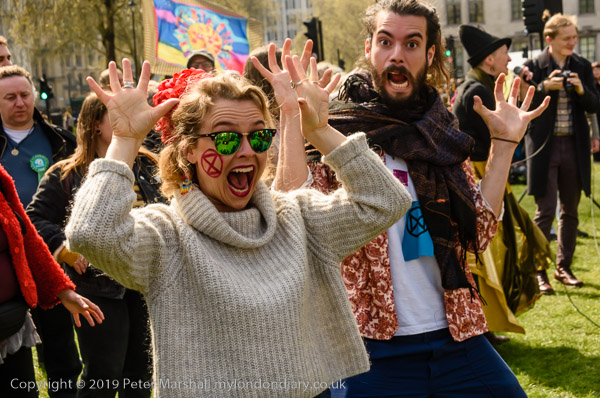
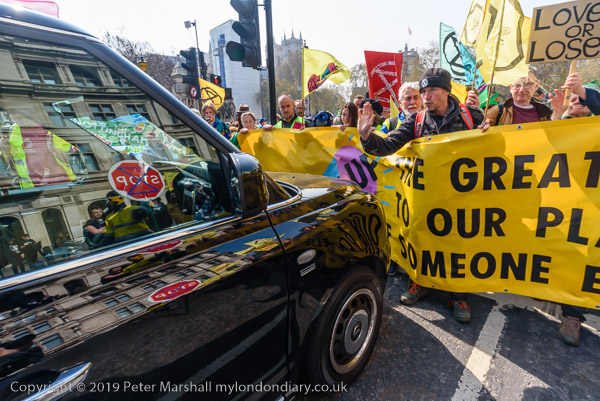
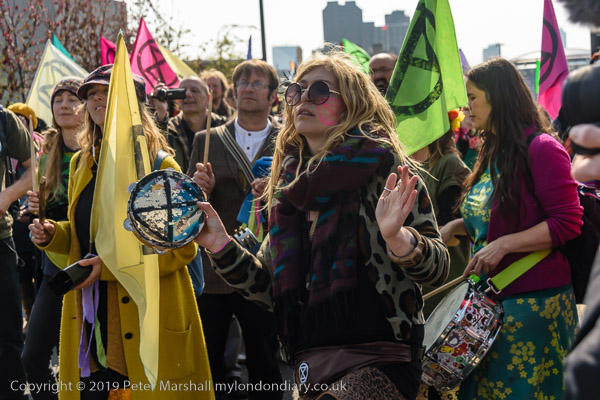
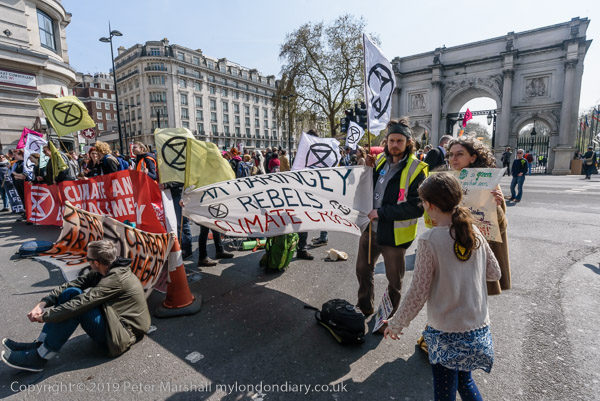
Extinction Rebellion (XR) began 11 days of protest which initially brought most of central London traffic to a halt on Monday 15th April 2019. They didn’t manage to keep up the protest until “the government takes necessary action on the global climate and ecological emergency” as we have yet to see that two years later, but they did considerably raise public and media awareness about the severity of the problem the world faces.

Unfortunately there seems to be little chance that effective action will be taken in time to halt biodiversity loss and reduce greenhouse gas emissions to net zero by 2015 as they demanded, though perhaps the half-hearted measures that will come out of the delayed climate summit later this year will do just a little to slow the rate our our planet’s decline, possibly enough to see my life out, though I worry about the future of my children and despair for that of my grandsons and daughters.

XR have now very much lost the initiative, mainly I think because of internal dissensions, perhaps inevitable because of some of the rather odd characters that they attracted. But some of their ideas, particularly over the police and arrests cut them off from many on the left who attacked them as a movement funded by shady capitalists and led by wacky idealists, more a Glastonbury festival than a political movement. Much of the criticism was ill-founded but not all.

The major effect they had on our government was for them to put pressure on the police to get rid of these pesky protesters – first by more arrests and prosecutions and now by the Police, Crime, Courts and Sentencing Bill to give the police greater powers to control all protests.

Early on the Monday morning, XR protesters set up camp at a number of key locations in London in a well-planned exercise. I turned up rather later to take photographs, first at Waterloo Bridge, which XR had turned into a ‘garden bridge’, blocking all traffic and bringing flowers and trees. There had been arrests earlier, but police had been unable to stop the protesters and the bridge – despite many further arrests – remained closed for over a week.

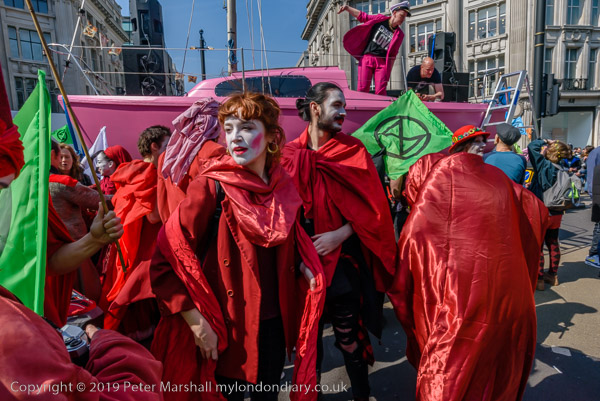
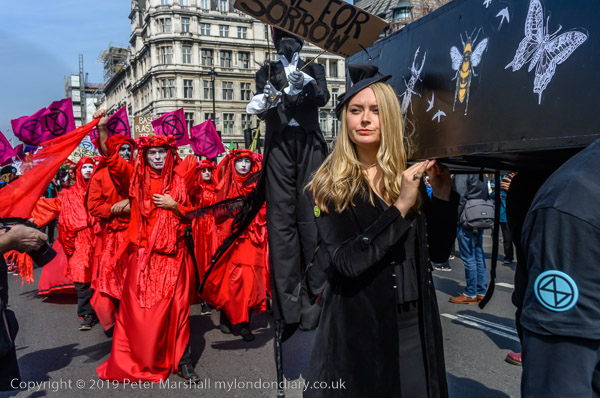
Because of the XR actions traffic all around the centre of London was at a halt, with buses not moving. Fortunately the tube was unaffected and took me to Oxford Circus, which now had a large pink yacht at its centre, named after the Honduran environmental activist and indigenous leader, Berta Cáceres, assassinated for her activism in 2016. It was here that I met the dance troupe dressed in red that were such a visible presence in XR protests.

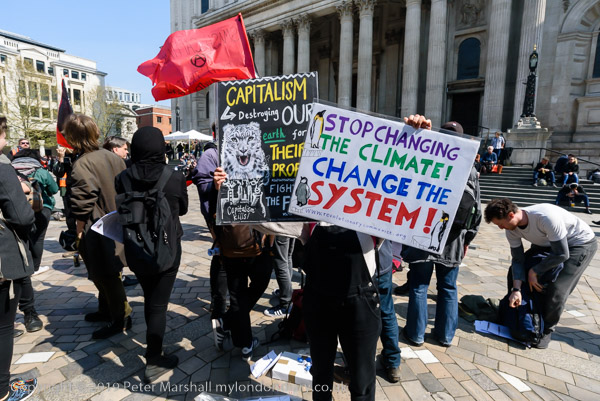
XR were not the only environmental game in town, and I took the Underground to St Paul’s Cathedral for a protest organised by the Green Anti-Capitalist Front, Earth Strike and London Students for Climate Justice. I arrived when there protest was due to start, but there were only a few of them present. I hung around for half an hour or so, and then gave up and left. Later I saw the accounts of their protest which did eventually attract a small crowd and was sorry I’d missed the action.

But there was rather more happening at Marble Arch, one of London’s main gyratory systems, where XR had blocked Oxford St, Park Lane, Edgware Road and a couple of other routes and had set up a stage, workshops and a tent village as well as the road blocks.

But XR had also planned an event for Parliament Square, where the roads around were blocked for a New Orleans funeral procession with jazz band to make its way around the square.

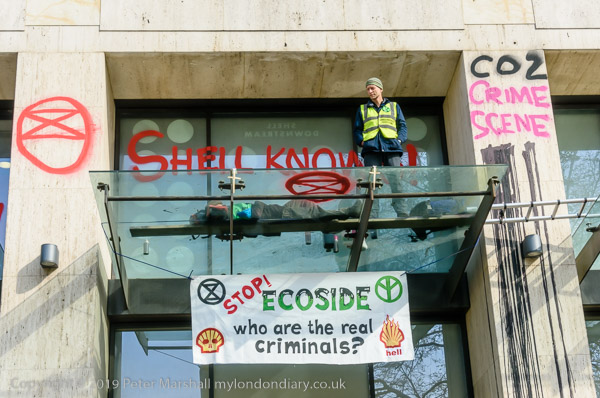
The funeral was perhaps also designed as a diversion for some more direct action, which I again missed at the Shell Centre on the South Bank. A small group of activists daubed slogans across the front of the building and two occupied the glass porch over the door. The activists had deliberately broken the glass in one of the doors, with the intention that this would result in a trial before a jury rather than by magistrates, enabling them to present the reasons for their action, and three had been arrested and taken away by the time I arrived, but the two were still up on the porch and others holding banners on the street in front.

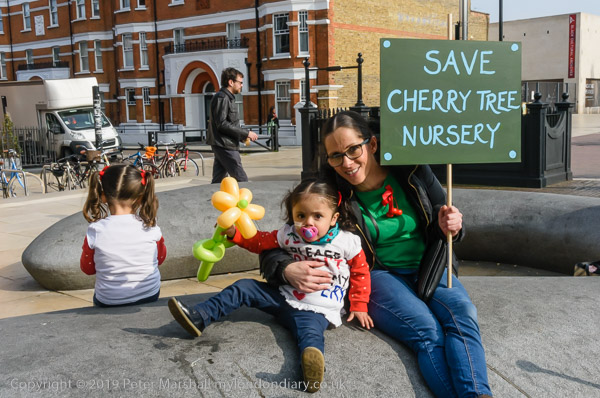
My day had not quite finished as I made a small diversion on my way home to visit Brixton, where staff, families and children from children’s centres were protesting against plans by Lambeth Council to close five centres and make drastic cuts at seven others. The council had recently spent £68 million on refurbishing the Town Hall and building a new Civic Centre.

Save Lambeth Children’s Centres
Extinction Rebellion at Shell
Extinction Rebellion Funeral Procession
Extinction Rebellion Marble Arch
Anti-capitalist environmental action
Extinction Rebellion Sea at Oxford Circus
Extinction Rebellion Garden Bridge


All photographs on this and my other sites, unless otherwise stated, are taken by and copyright of Peter Marshall, and are available for reproduction or can be bought as prints.


Against the Housing Bill – 30/01/2016

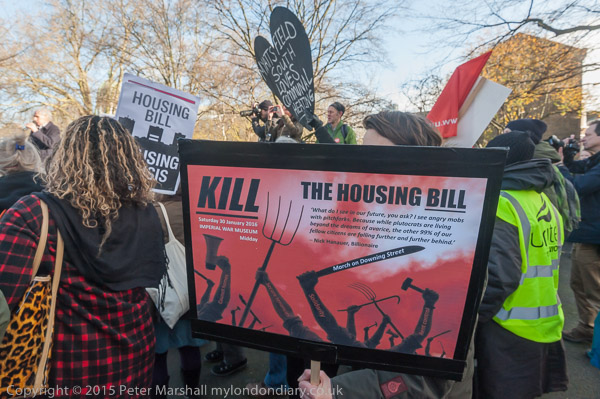
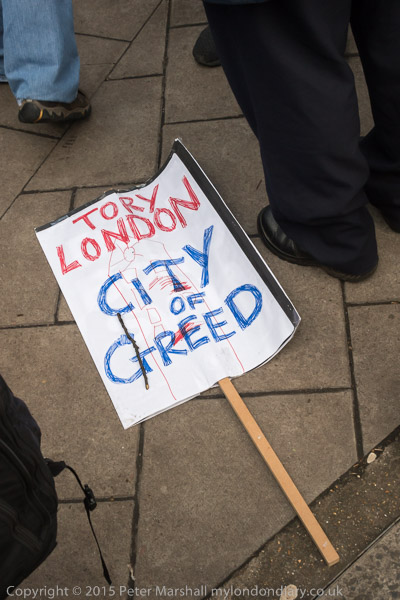
Five years ago, on Saturday 30th January, Lambeth Housing Activists organised a rally and march from the Imperial War Museum to Downing St to protest against the Housing and Planning Bill, which was to have a particularly large impact in London and greatly worsen the already acute housing crisis here.

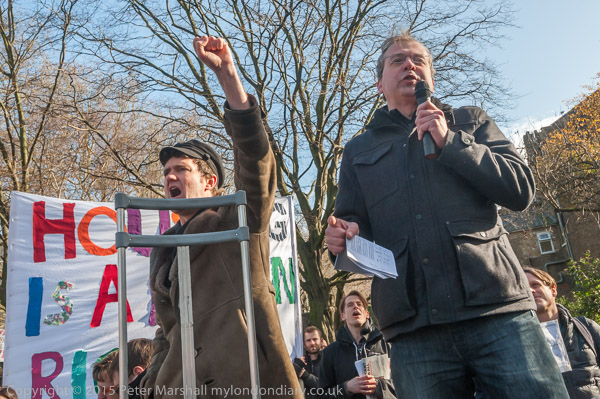
Rather unusually, the activists were joined for the march by some local councillors including Southwark Council Cabinet Member for Housing Richard Livingstone. Southwark, a Labour dominated council, has attracted a great deal of criticism over the demolition of council estates in the borough, including the scandal of the Heygate estate at the Elephant & Castle, and many on the protest were residents of estates currently being demolished – such as the Aylesbury estate – or under threat of demolition. Southwark and other Labour-run councils in London have made huge reductions in council housing through their so-called regeneration of estates, with many former residents being forced to move away from inner London and into much higher rent private or housing association properties, often with very poor security of tenure.

There were a number of speakers at the rally, including the then Green Party Leader Natalie Bennett and housing researchers and activists, who were listened to attentively and warmly applauded, both for their condemnation of the Bill and also of the social cleansing effect of the estate demolitions being carried out by councils. It was hardly surprising that when Richard Livingtone came to the microphone he was greeted by boos and loud heckling and a heated argument with one of the activists.

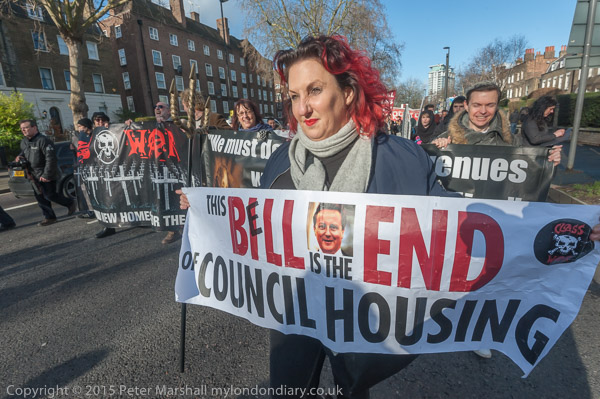
Eventually the rally broke up and the march began, starting by walking through the streets of Lambeth before turning around to make its way through Westminster. Class War and friends decided to liven things up a little, first by dancing along the street singing the ‘Lambeth Walk’ and then by rushing across the pavement towards a branch of of large estate agents and protesting outside it for some minutes before moving on.

Earlier at the rally Simon Elmer of Architects for Social Housing had given a closely researched and caustic assessment of the role of Labour Councils and housing policies which have been largely dictated by estate agents. Class War had brought a number of more controverisal banners related to housing, among them one with a picture of a military cemetery with its field of crosses stretching into the distance and the message ‘We have found new homes of for the rich’ and the Lucy Parsons banner with its quotation “We must devastate the avenues where the wealthy live”.

Police had rushed to protect the estate agents, but Class War made no attempt to enter or damage the property, and soon moved off. There was what seemed to be some entirely pointless harassment of protesters by police – including the so-called liaison officers – throughout the march, but I saw no arrests.

At Downing St police formed a line to lead the marchers to the opposite side of the road, and the activists followed their direction then simply walked across Whitehall behind the police line and posed for pictures in front of the gates and spilling out to block the north-bound carriageway. Police attempted to persuade them to move and eventually people drifted away and I left too.

More at Housing and Planning Bill March.


All photographs on this and my other sites, unless otherwise stated, are taken by and copyright of Peter Marshall, and are available for reproduction or can be bought as prints.


Mainly Westminster

Archibishop Tenison School,  Lambeth High St, Lambeth, 1987 87-9e-63-positive_2400

Thomas Tenison (1636- 1715) was Archbishop of Canterbury from 1694 until his death. Archibishop Tenison School, Lambeth High St, and according to Wikipedia founded boys schools in Lambeth in 1685 and Croydon in 1714. A school for 12 girls began in Lambeth in 1706, and this was built as a new girls’ school in 1863. In 1961 the school amalgamated with a nearby Church of England boys school and this building went out of use, though it was later used as an annexe to the combined school until this closed in 1974. It has since been demolished and replaced by a hostel.

Bennett House, Page St, Westminster, 1987 87-9f-11-positive_2400

Bennett House in Page St, Wesminster is a Grade II listed tenement courtyard block of flats built in 1928-30. It was a part of the Westminster Housing Scheme for the Grosvenor Estate and Sir Edwin Lutyens acted as consultant; the listing text calls it “An imaginative Lutyens treatment of a standard LCC type of housing block.”

Unemployment Benefit Office, Chadwick St, Westminster, 1987 87-9f-55-positive_2400

I admired the stark simplicity of the Unemployment Benefit Office on Chadwick St, Westminster. It remained in use – with changes in name – closing as a Job Centre Plus in 2017.

Old Pye St, Westminster, 198787-9f-65-positive_2400

New office buildings seen from Old Pye Street in 1987. Parts of this still remain though rather more difficult to see.

Salvation Army, Great Peter St, Westminster, 1987 87-9f-66-positive_2400

The building on this corner still has the foundation stone laid by James S Burroughes in 1893, though it has moved a few yards around the corner and I think the site is now occupied by “modern purpose-built flats for single people and couples set in a city centre location” built by SAHA, the Salvation Army Housing Association and allocated through Westminster Borough Council’s housing register.

Vauxhall Bridge Rd, Westminster, 1987 87-9g-02-positive_2400

Avocet House at 92-96 Vauxhall Bridge Road was the home of Avo Ltd, a company founded by Post Office engineer Donald Macadie who was fed up with having to carry separate meters for different measurements and in 1923 designed a meter than would measure Amperes, Volts and Ohms. The Avometer was the leading electical test equipment for many years. The company became too large for this site and bought land for a new factory at Dover in 1962. The company is now called Megger, and its testers are still made and in use around the world.

Francis St, Westminster, 1987 87-9g-14-positive_2400

This 1865 Grade II listed building in a free version of Italian Renaissance style by H A Darbishire was an orphanage for children of Crimean War guardsmen. Later it became a Franciscan friary, and they added the statue of St Francis just visible at the far corner around 1960. When they moved on it became offices. Close to Westminster Cathedral, in 2017 it was bought by the cash-strapped Roman Catholic Diocese of Westminster to be refurbished as a pre-prep for Westminster Cathedral Choir School, at a cost thought to be around £10million. The school is said to be the most expensive prep school in London, and sends pupils on to public schools including Eton and Winchester.

Shop window, Upper Tachbrook St, Westminster, 1987 87-9g-22-positive_2400

I don’t know which shop this was in Upper Tachbrook Street, but it appeared to be selling clothing, jewellery and similar items. From the few details of the shop front which can be seen it looks rather like that now occupied by ‘Mr CAD – For Everything Photographic’. This began around 1960 in Croydon, and although it at one time had nine branches at various sites from Colindale in north London to Brighton became just a giant Aladdin’s cave in Windmill Rd full of secondhand gear, moving to these rather smaller premises in Pimlico but also supplying mail order around the world as “the largest independent photographic dealer in the UKW with “the biggest stock of used analogue photographic equipment worldwide specialising in film, cameras, lenses, enlargers, chemicals, paper, all manner of studio & darkroom hardware & software.”

Clicking on any of the images above will take you to my Flickr album of over 750 images of London in 1987 selected from several thousand exposures I made that year


All photographs on this and my other sites, unless otherwise stated, are taken by and copyright of Peter Marshall, and are available for reproduction or can be bought as prints.


More West London 1987

Campden Hill Rd, Kensington, Kensington & Chelsea, 1987 87-9b-32-positive_2400

Although my caption states than this modern house is in Campden Hill Rd, its address is in Campden Street which leads off at the left of the picture. The building by architect Douglas Stephen is said to be in the style of pioneering Italian modernist architect Giuseppe Terragni, (1904-43), something perhaps best seen in his 1937 Villa Bianca in Seveso. I think like a similar larger block by Stephen in Bedford Gardens it was probably built in the mid-60s.

Gourmet Gascon, Hillgate St, , Kensington, Kensington & Chelsea, 1987 87-9b-51-positive_2400

Le Gourmet Gascon gives I think a fairly clear idea of the population of this area of Kensington, where there is a takeaway service offering Quenelles au Brochet. The shop is no longer there and a short walk away you can now get rather more plebian food for tourists at Notting Hill Gate, though I think there is still no shortage of over-priced restaurants in the area and of course Fortnum & Mason still deliver.

Doulton, Southbank House, Black Prince Rd, Lambeth High St, Lambeth, 1987 87-9d-12-positive_2400

Later in September I was back south of the river in Lambeth, and photographing in Lambeth. The terracotta carving above the doorway on the corner of Black Prince Rd and Lambeth High St is of Mr Doulton in his studio, and seated at left Hannah Bolton Barlow paints on one of the vases from his pottery, her pet cat under her chair.

Doulton, Southbank House, Black Prince Rd, Lambeth High St, Lambeth, 1987 87-9d-13-positive_2400

Pottery was produced not far from this site in Vauxhall Walk by  Jones, Watts & Doulton from 1815 and they moved to Lambeth High St in 1826. In the early years their most successful product was ceramic sewage pipes, for which their was a surge in demand driven by the 1846-60 cholera pandemic.

The company had several parts and a complex history but by the time this building was erected as their museum, school and design studio in 1871, with close links to Lambeth School of Art. The Lambeth studio pottery was producing signed works of art as well as more mundane items in the rest of the factory – and they later bought a factory in Burslem for making bone china tableware. The company only became Royal Doulton when it obtained a Royal Warrant in 1902. Production at Lambeth was forced to end in 1956 with the Clean Air Act which prohibited their salt glazing in this urban area, and all work went to the Potteries.

Doultons were major producers of the architectural terracotta or stoneware which adorns many Victorian buildings, and their building acted as a real life catalogue for their wares, though they also produced many specifically commissioned pieces as well as the more general stock.

London Fire Brigade, obelisk, snorkel tower, Albert Embankment, Lambeth, 1987 87-9e-03-positive_2400

A few yards up Lambeth High St is a view of this rather strange obelisk in the yard beside the (now former) headquarters of the London Fire Brigade, which moved to a new building here on a part of the former Doulton pottery factory site in 1937. This obelisk or ‘snorkel tower’ was built to provide ventilation for the war-time underground control room, according to the listing text “constructed to withstand a direct hit and a gas attack, with its own reserve electric light installation and forced ventilation.”

Ventilator, Metropolitan Police Central Communications Command Centre, Lambeth Rd, Lambeth, 1987 87-9e-45-positive_2400

A short distance away in Lambeth Rd is another rather bulkier structure, also a ventilator, for the underground Metropolitan Police Central Communications Command Centre. A new special operations room was opened there in 2008, but there are also other communications centres in Bow and Hendon.

Works, Old Paradise St, Lambeth, 1987 87-9e-56-positive_2400

As this and other pictures in the Flickr album 1987 London Photos show, there was rather more evidence of the area’s industrial past then. This chimney and works was a former soap factory.


All photographs on this and my other sites, unless otherwise stated, are taken by and copyright of Peter Marshall, and are available for reproduction or can be bought as prints.