Cost of Living Protest – 2022

Cost of Living Protest – 2022
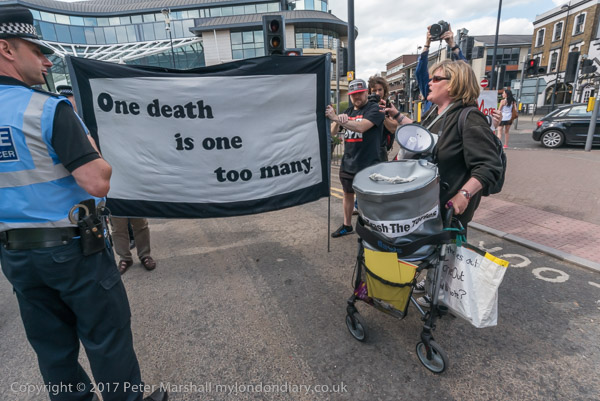
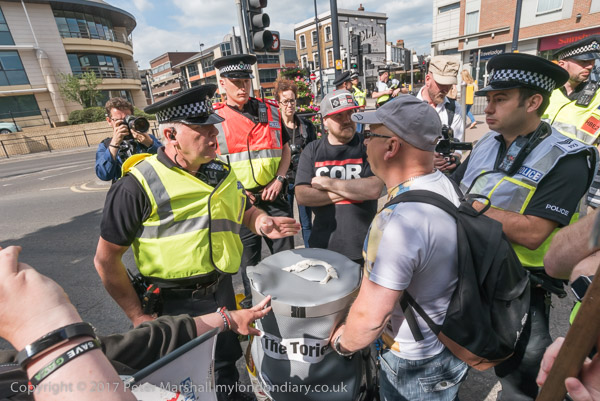
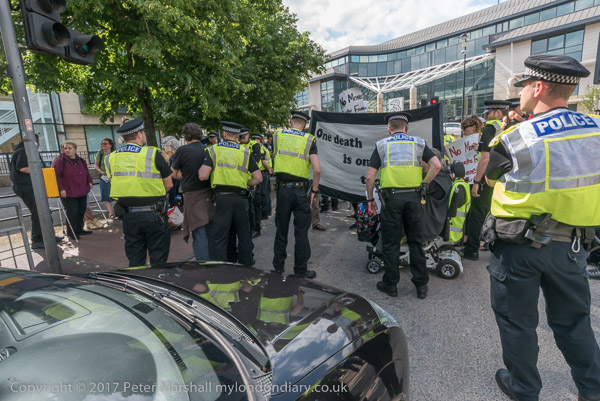
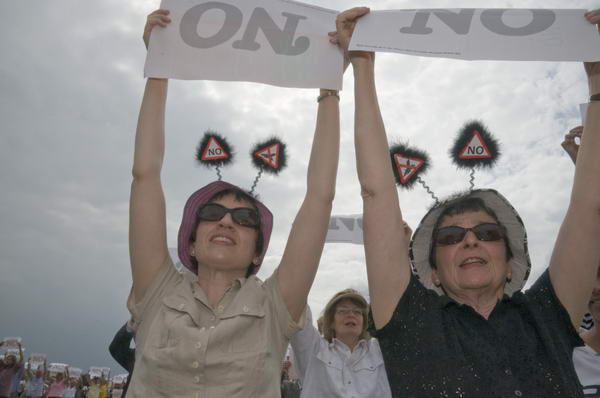
Last Saturday, 2nd April 2022, I photographed a protest opposite Downing Street organised by The People’s Assembly Against Austerity and Stop the War Coalition. The People’s Assembly said on their web page:

Public outrage over the Cost of Living Crisis is growing fast and our response is gaining momentum. Right now is the time for us all to come together in unity and build our collective resistance.
Now is the time to get out onto the streets to send a clear message to the government that we refuse to pay for their crisis.

The People’s Assembly Against Austerity

Cost of Living Protest - 2022

The protest in London was one of 25 in cities around the country against the price increases and National Insurance contribution raise which will mean the largest fall in living standards since records began 80 years ago and a fall in real wages greater than ever in the past 200 years.

Cost of Living Protest - 2022

The Spring Statement by Chancellor Rishi Sunak made clear that it is the lower paid workers (and students), pensioners, those on benefits and the public sector workers in particular who will pay the price, while putting in place measures to protect big business and high earners.

Pay inequality in the UK – the ratio between what the average worker earns and the pay (including bonuses) of the bosses of leading companies – has risen spectacularly in recent years. Had the minimum wage kept up the the rise in what they are paid it would now be over £25 an hour – but went up on April 1st to £9.50 an hour for those aged 23 and over – with lower rates for younger workers.

Cost of Living Protest - 2022

Food banks are now struggling to keep up with demand, and report that some people coming to them are turning down anything which requires heating up as they cannot afford gas or electricity. Advice workers say more and more people are coming to them who have to chose between heating and eating – and many can only eat basics on alternate days and are depriving themselves of food to feed their children.

Cost of Living Protest - 2022
London, UK. 2 Apr 2022

I listened to the UK’s leading money-saving expert saying he had run out of tips to help people cope – and most of the advice he and others have given on energy saving are things we have always done in our household.

My wife and I have relatively low outgoings, living in a house we own and choosing not to own a car. Over the years we’ve been able to invest large amounts in double-glazing and insulation – and a few solar panels to supply a little of our electricity needs. When we moved in 48 years ago to a small Victorian semi built for agricultural workers we replaced the draughty rattling windows and draught-proofed doors. We decided central heating would be wasteful, so our energy bills are relatively low. Even so, they have now roughly doubled from what they were a year ago, with more increases coming later in the year. But we will be able to get by even though our income is low. Others are much less fortunate.
Jeremy Corbyn - Cost of Living Protest - 2022
London, UK. 2 Apr 2022. Jeremy Corbyn.
And in particular the effects on disabled people are savage and shameful. Research shows they are five times as likely to be at risk of food insecurity and twice as likely to be living in cold homes as the non-disabled. And in a particularly targeted cruel and inhuman decision around 210,000 people on disability benefits have now been barred from claiming the Warm Home Discount payment despite the fact that they often have greater than normal needs for heating, hot water and energy to run specialist equipment.

More pictures from the event online at Downing Street Cost of Living Protest, London, 2 Apr 2022


Junior Doctors, Ugandan Election, Benefit Sanctions

Junior Doctors, Ugandan Election, Benefit Sanctions. Three protests I photographed on Wednesday 9th March 2016

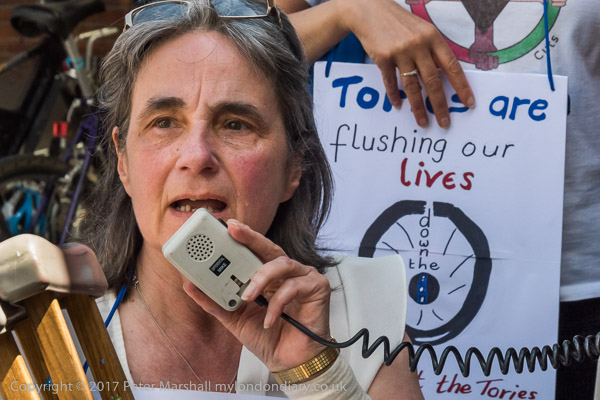
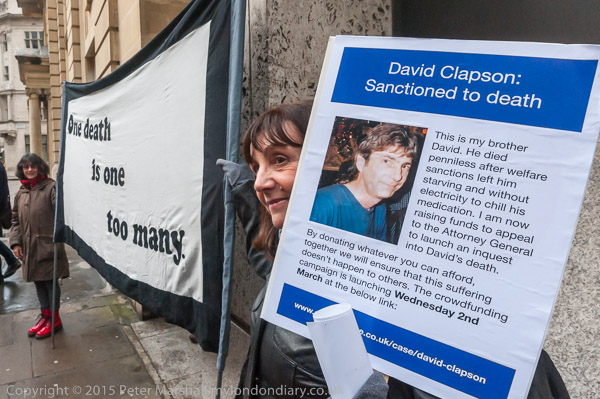
David Clapson, one of many victions of inhumane Tory policies

UCH rally for Junior Doctors Strike

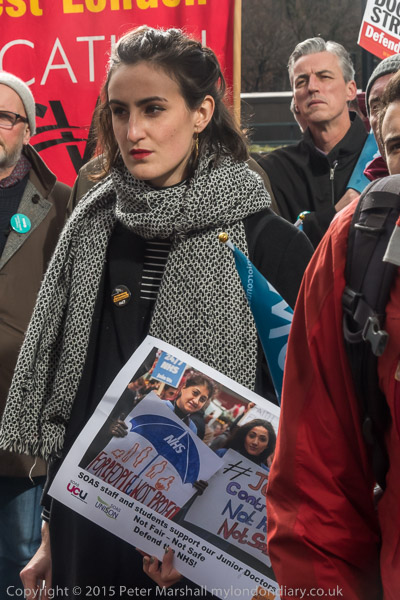
Junior doctors were on a one day strike against the imposition of unfair contracts which they say are unsafe and they were joined by other trade unionists on the picket line at University College Hospital on Euston Road.

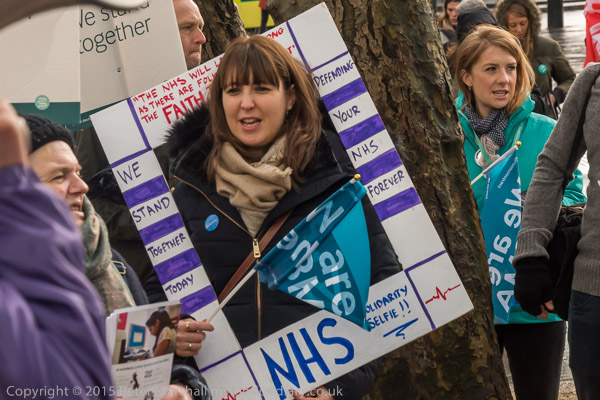
Later in the morning came the rally opposite the hospital I photographed when other health workers and NHS activists came to support them, and also to oppose the axing for NHS student bursaries and the creeping privatisation of the NHS.


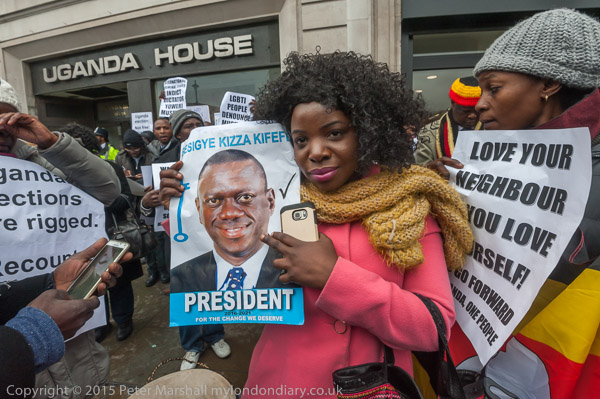
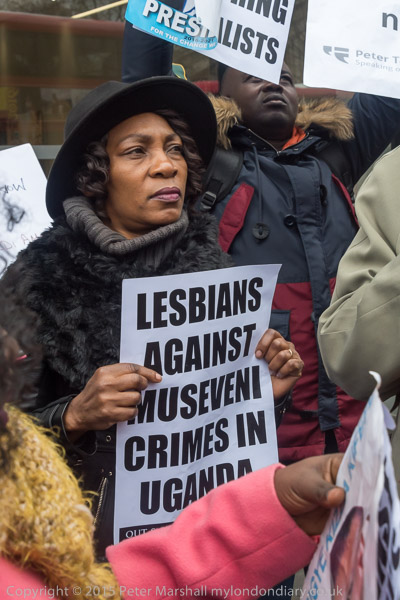
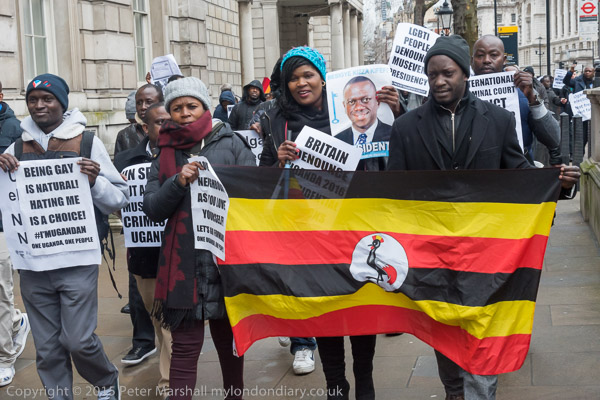
Ugandans protest rigged Presidential Election

Elections had been held in Uganda in February 2016, and international observers reported widespread fraud and irregularities with opposition politicians being arrested, voters intimidated and many polling stations reporting results very different to the actual votes cast.

The protesters called on the UK not to recognise Museveni as the legitimate President of Uganda and for the immediate release of Dr Besigye and other political prisoners, as well as action against those responsible for torture.

The protesters, who included the African LGBTI Out & Proud Diamond Group and Peter Tatchell Foundation were clear that Museveni had lost the election to his challenger Besigye, and having held a high-spirited protest outside the Ugandan High Commission on the corner of Trafalgar Square marched down to deliver a letter to Downing St.


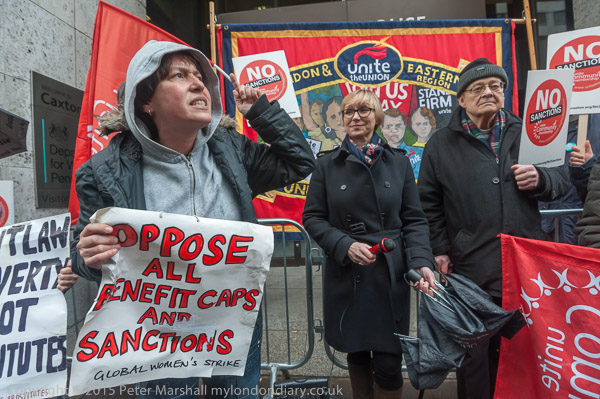
Unite against Benefit Sanctions

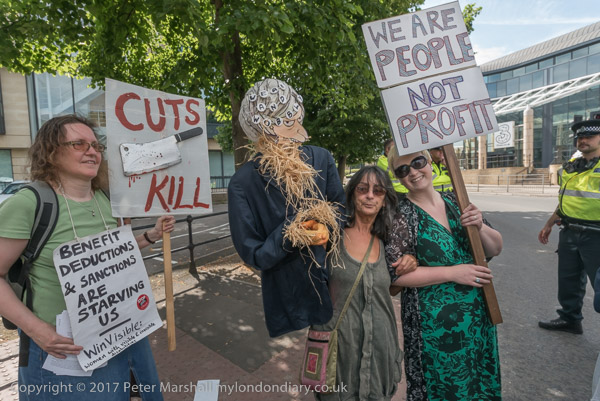
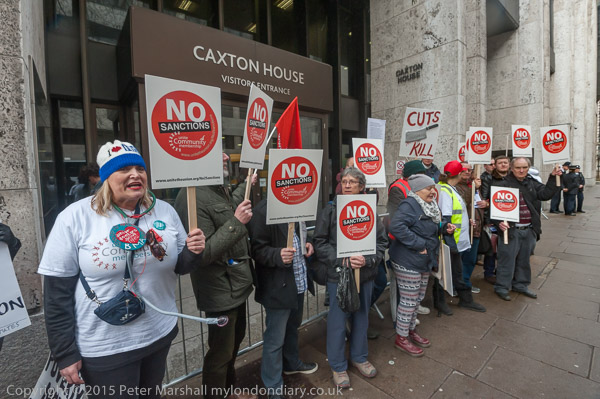
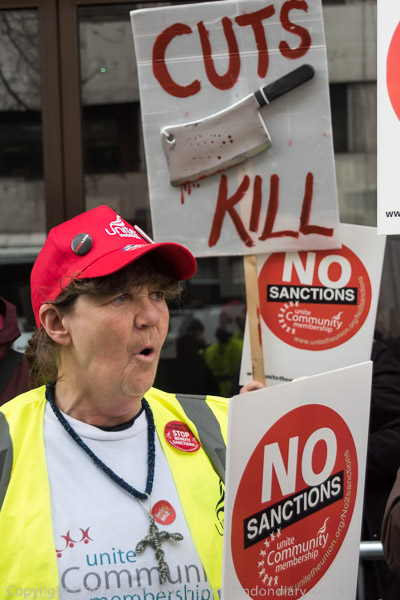
Demonstrations were taking place at over 70 job centres across the country against the use of benefit sanctions. Many claimants lose benefits for trivial reasons and for events beyond their control and are left without support. Some are sanctioned for arriving a few minutes late because of traffic congestion or for missing appointments they have not been informed about. I photographed a protest called by Unite Community members outside the ministry responsible for the policy, the DWP in Caxton St, Westminster.

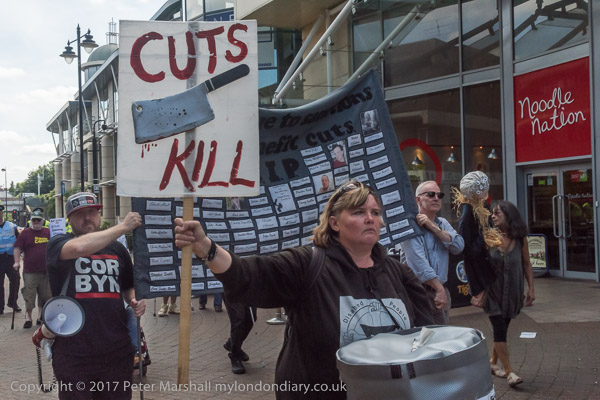
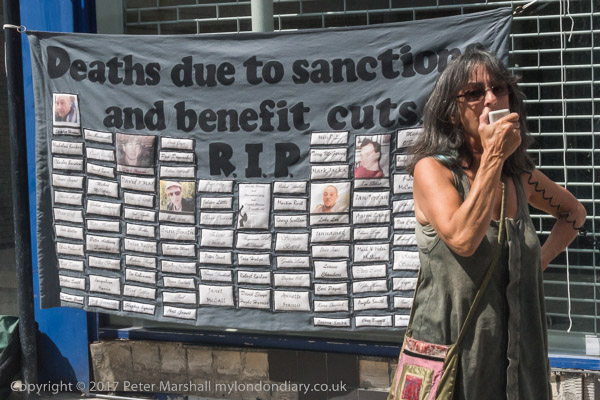
Sanctions mean people lose benefits and are left destitute. Despite government denials at least 95 deaths are known to have resulted from these sanctions and without the efforts of the many food banks the figure would be much higher.

Some campaigners see the use of sanctions as a deliberate and successful attack on the unemployed and disabled by minister Iain Duncan Smith who is responsible for those working for the DWP being given incentives and targets for causing maximum misery and they label him ‘Minister for Euthanasia’.


David Clapson – Sanctioned to Death

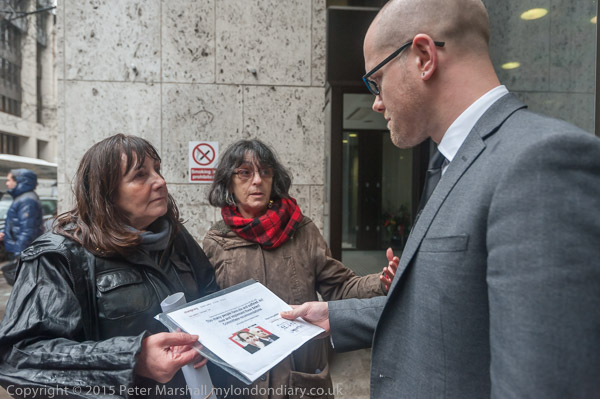
Among those at the protest at Caxton House was Gill Thompson, the sister of David Clapson, a diabetic ex-soldier who died starving and destitute because he was penalised by the Job Centre for missing a meeting. She delivered a petition calling for an inquest into his death and an end to unfair benefit sanctions which leave claimants without support. Over 200,000 people have signed this and a related petition.


Past Time To Act On Climate Change?

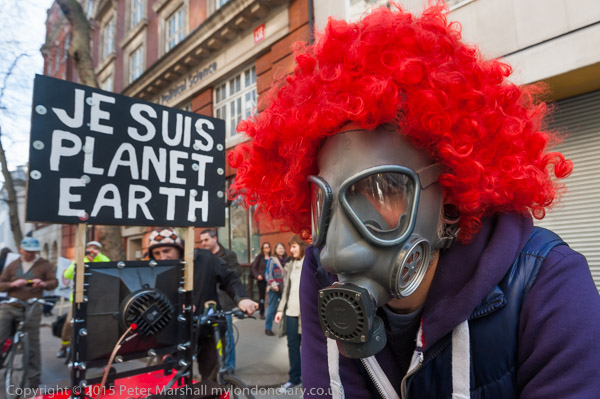
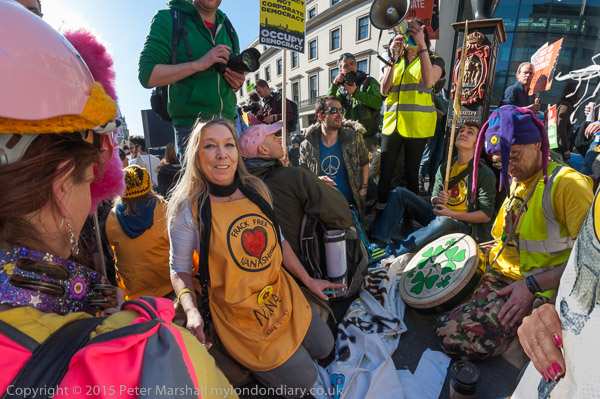
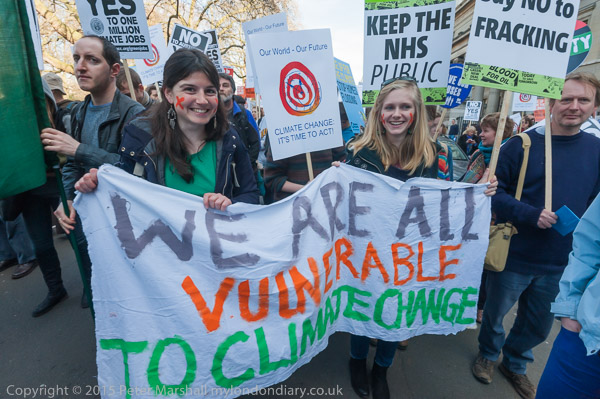
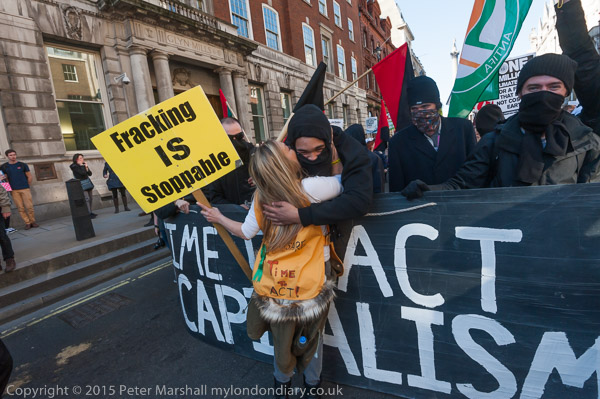
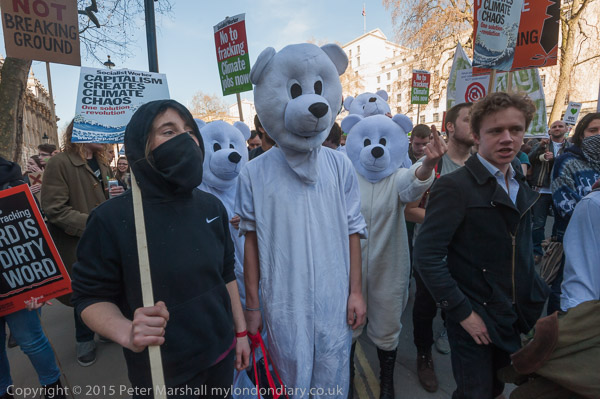
Past Time To Act On Climate Change? Seven years ago on Saturday 7th March 2015, 20,000 or so protesters marched through London to remind government and the nation it was Time to Act on Climate Change. Seven years on, the IPCC Sixth Assessment Report released a week ago warns “that climate breakdown is happening faster than expected and that the window to take action is closing fast. The report is a call to governments and private sector players to take drastic action against climate change.”

It’s a report that has largely been lost to public sight, pushed together with the stories about Tory sleaze and lies out of the news by the Russian invasion of Ukraine, though it has even more far-reaching implications. Not that I want to in any way minimise Putin’s criminal action and its terrible consequences for the people of Ukraine, largely innocents caught up in a situation of others’ making.

Of course the invasion of Ukraine has now raised the spectre of a nuclear war, which would almost certainly lead to mass extinction rather more rapidly than climate change, but the very dramatic prospect fortunately makes this almost unthinkable. Were it to happen it would almost certainly be by accident, something we have come close to several times in the past. Even our maddest politicians realise there is nothing to be gained by mutually assured destruction, and there would be no profits in it for the oligarchs or billionaires.

Climate change doesn’t happen in a massive flash, but is relatively slow and insidious. Even in the richer countries we are just beginning to feel its effects, and some in the Global South have long been suffering extreme hardship. But unless we heed the report and take drastic action without delay it will be too late to stop; many systems are coming close to their tipping points, past which there is no chance of recovery.

Scientists have been warning about the dangers for many years. Even 50 years ago when I was a student I spoke about the need to change the way we used the Earth’s resources and move to renewable systems of energy and agriculture, as many aspects of our current way of life were unsustainable.

Over 50 years ago it was clear to me that we needed to cut our dependence on fossil fuels, not just because of the carbon emissions and other pollutants, but also because thinking in the longer term it seemed a waste to burn what was a limited resource and an important chemical resource for plastics and other materials. I sold the only car I’d owned in 1967 or 8, because we needed to move away from a society based around private cars. It was clear too that we needed to farm in ways that conserved the soil and that many modern agricultural practices destroyed it – my father had joined the Soil Association which was established in 1946.

But of course there were huge profits to be made from fossil fuels and other industries that were driving up global emissions – and huge campaigns of obfuscation and lobbying. Most politicians in most countries were doing very nicely out of exploiting our natural resources – and the workers, who needed to be kept happy by more and more consumer goods as well as a huge and almost universal media promoting consumerism. Bread and circuses is of course nothing new.

Countries around the world, whatever their politics, are almost entirely run by politicians who have prospered from ‘business as usual’, and usually business corruption which they have colluded in by allowing money laundering, allowing huge tax avoidance and evasion and more. They have now learnt to talk the talk about climate change, but, as Greta Thunberg pointed out, it has been all “blah, blah, blah”, promises but little or no action.

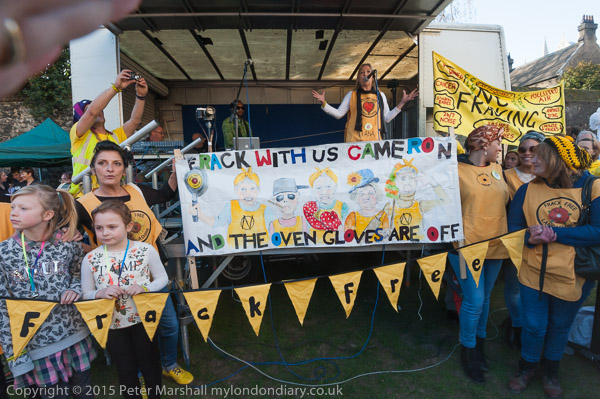
There were many different groups taking part in ‘Time To Act on Climate Change’, including the Campaign Against Climate Change who have organised regular protests in London since 2002, Friends of the Earth who I’ve supported since the 1970s, the Green Party, anti-fracking protesters including the fabulous ‘Nanas’ of Frack Free Lancashire, campaigners against Heathrow expansion – and I list a few more in Climate Change Rally, which also has pictures of some of the speakers.

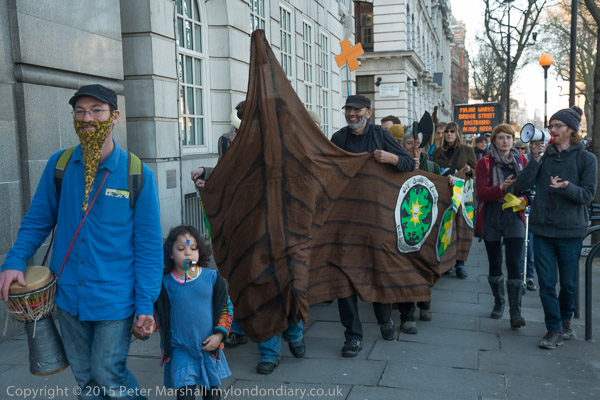
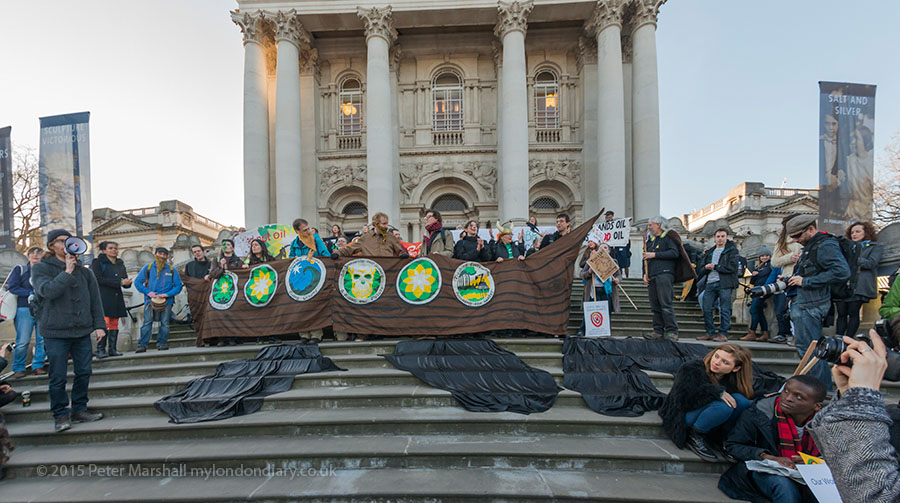
At the end of the rally I went on to photograph a protest by ‘Art Not Oil’ who invaded the steps of Tate Britain with their ‘longship’ and ‘oil spills’ in a protest demanding the Tate give up taking sponsorship from BP, who used their support of the arts to give themselves a positive public image despite the pollution and climate change their activites cause. It’s time to end this ‘greenwashing’.

Viking longship invades Tate steps has a few pictures of the event. The Longship first sailed to the British Museum where BP had sponsored a show on the Vikings. As I commented, the plastic oil spills used by the protesters “are a lot easier to clean up than the real ones BP has created such as Deepwater Horizon in the Gulf of Mexico, and which could be truly catastrophic in the Arctic.”

More on all these on My London Diary:
Viking longship invades Tate steps
Climate Change Rally
Time to Act on Climate Change


Snow, Pensions & Jobs, Hunger Strikers – 2018

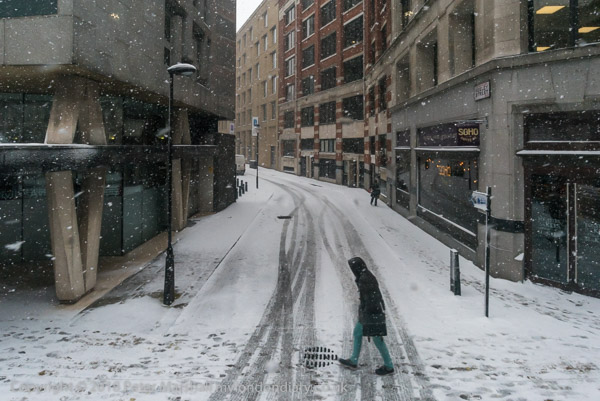
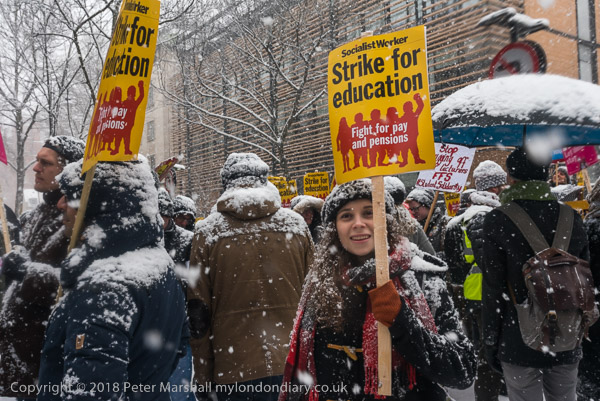
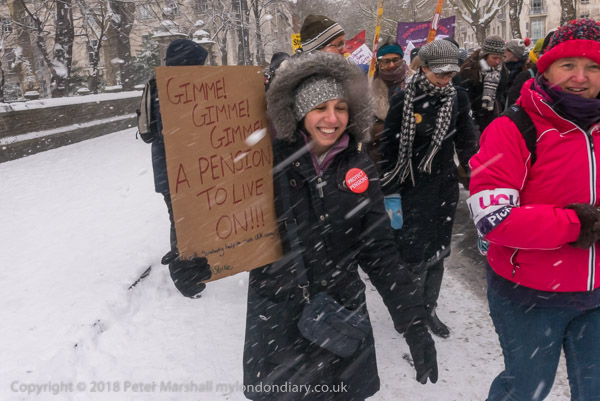
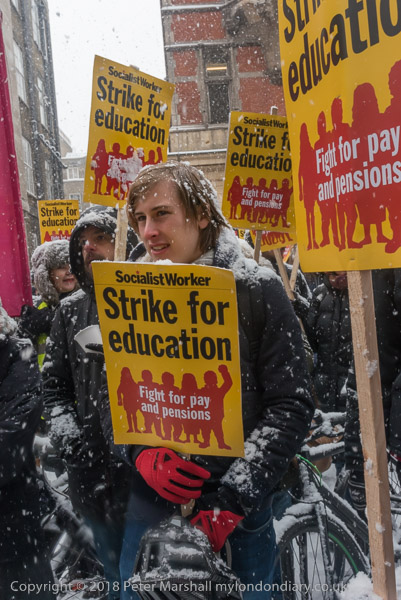
Snow, Pensions & Jobs, Hunger Strikers – 2018. On Wednesday 28th February 2018 there was a blizzard in London. University and FE teachers marched through it to a rally about pay and pensions and people came to the Home Office to support hunger strikers in the immigration prison at Yarl’s Wood.

London Snow

The snow slacked off a little when I was on the bus but got worse as I walked to Malet St for the start of a march. Most of the pictures I tried to take were ruined by snow flakes landing on the front of the lens faster than I could wipe them off.

London Snow

HE and FE march for pensions and jobs

UCU members were on the the fifth day of their strike to get the universities to talk with them about pensions and pay, and marched from Malet St to Methodist Central Hall close to Parliament for a rally.

They were joined by staff from London FE colleges on the first day of a two-day strike over pay and conditions, and both groups were supported by large numbers of students. The snow made it difficult to take pictures, and at times it was hard to stop from slipping over on compacted snow. Fortunately it eased off a little after the march started, with just occasional showers as we walked through London.

HE and FE march for pensions and jobs

HE & FE rally for pensions and jobs

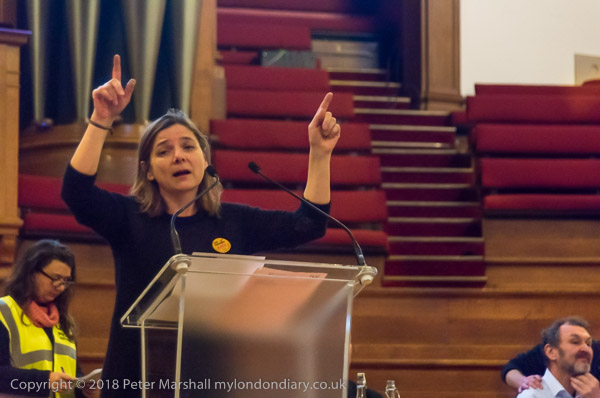
Sally Hunt of UCU speaks and Kevin Courtney NEU listens at right

Despite the terrible weather there were more marchers than expected and many were left outside the hall. I don’t usually bother to photograph at indoor rallies and haven’t really got the best equipment for it, but on this occasion I was glad to be able to get inside and warm up a little. My camera lenses were also getting a little steamed up and needed to dry out.

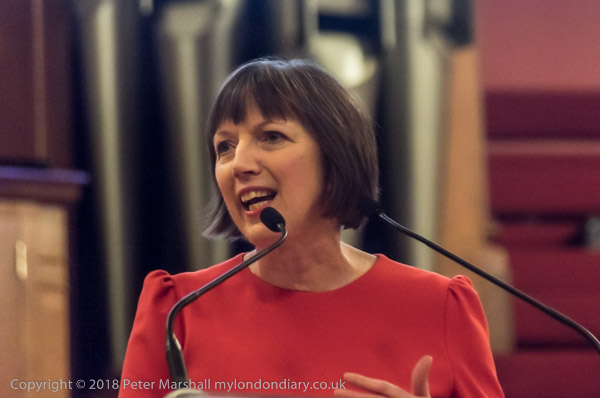
Frances O’Grady praises the way that Sally Hunt and the UCU are fighting to keep the pension scheme

I’ve written more about the reasons for the strikes and a little about the rally on My London Diary and won’t repeat that here. Click the link to find more.

HE & FE rally for pensions and jobs


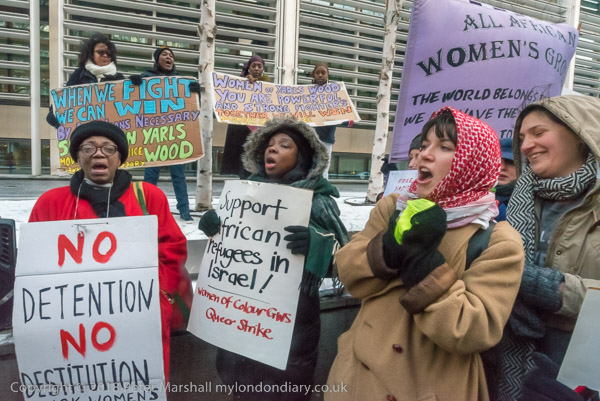
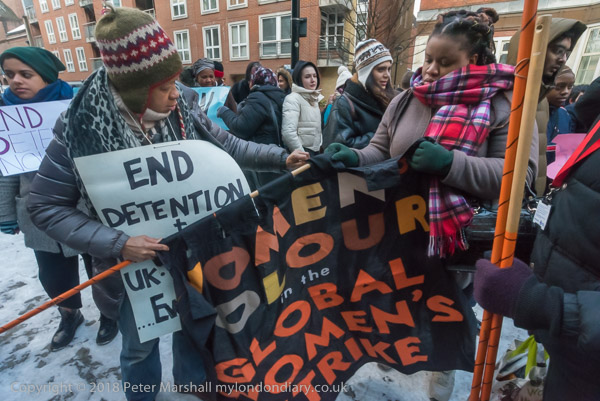
Solidarity with Yarl’s Wood hunger strikers

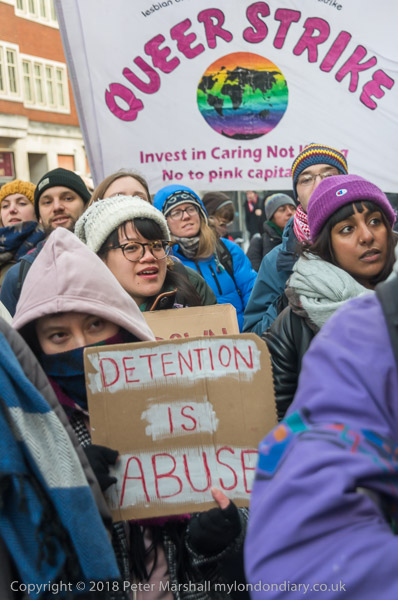
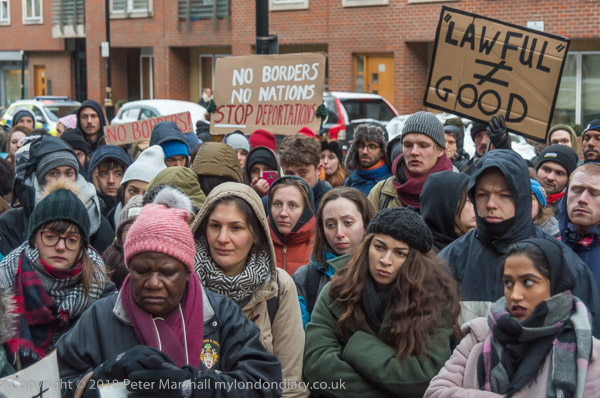
I stayed longer inside the rally than intended, partly because I was reluctant to leave t he warm hall, but as it came to an end I left to walk to the Home Office, where a protest was taking place in solidarity with the 120 women and men in immigration detention at Yarl’s Wood who were refusing to work and had gone on a hunger strike.

Their action in Yarl’s Wood had started a week earlier and was demanding the Home Office respect the European Convention of Human Rights, end the separation of families, end indefinite detention, with a 28 day maximum detention period, end charter flights which deport people without notice, and end to re-detention of those released from detention.

The also called for an amnesty for those who have been in the country for over 10 years, a stop to deportations before cases are decided and any appeals heard, the proper disclosure of all evidence to the immigration tribunals, adequate health care, an end to detaining of highly vulnerable people, an end to employment at £1 per hour and to be treated with the dignity and respect due to all human beings.

It was a fairly large protest, supported by many groups including Lesbians and Gays Support the Migrants, Detained Voices, Black Women’s Rape Action Project, All African Women’s Group, The London Latinxs, Right to Remain, Docs Not Cops and End Deportations as well as Movement for Justice who have organised many protests outside Yarl’s Wood as well as those at other detention centres and led campaigns to close detention centres and support detainees.

Solidarity with Yarl’s Wood hunger strikers


For Refugee Rights and Against Trident

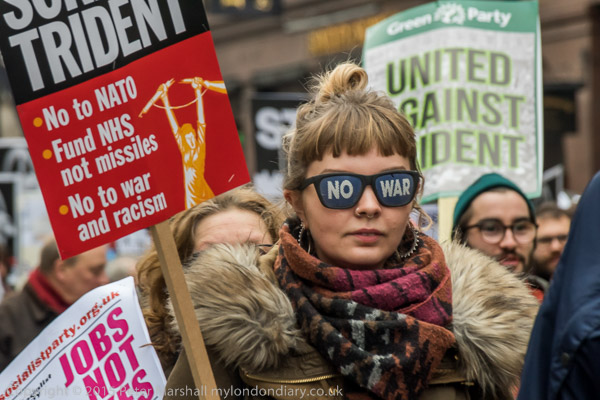
For Refugee Rights and Against Trident. I covered two marches in London on 27th February 2016, the first calling for safe passage for refugees seeking protection in Europe and following this a much larger march against government plans to waste £180 billion or more on replacing the UK’s Trident nuclear weapons.

European March for Refugee Rights

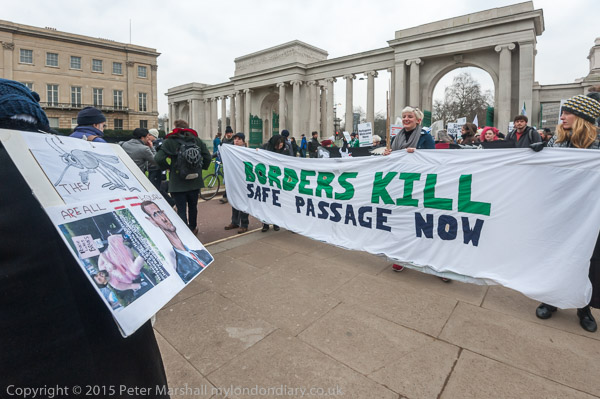
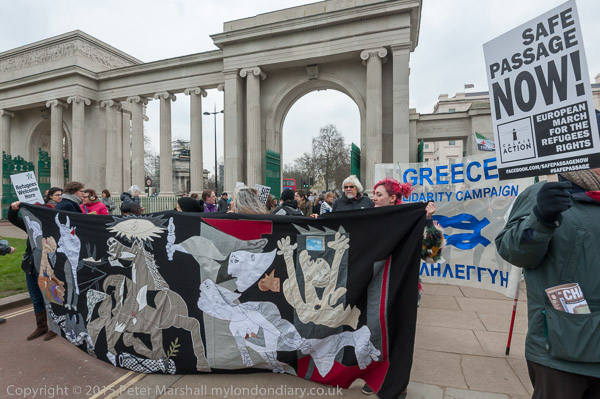
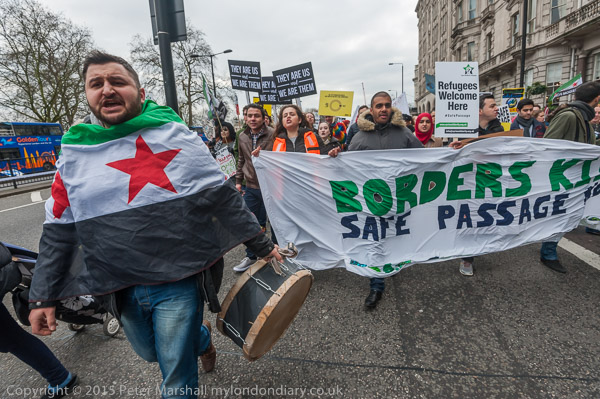
The European March for Refugee Rights was part of a day of protests in cities across Europe demanding action by governments to provide secure safe passage routes for all refugees and asylum seekers seeking protection in Europe. They want an end to deaths at borders and drownings and for refugees to be allowed to keep their possessions and be reunited with their families.

Among those taking part were people who had been to aid refugees in Lesvos and at the Calais camps and others who had volunteered with Medicins Sans Frontiers in Syria. The protest was supported by many groups including the Syria Solidarity Campaign, Solidarity with Refugees, London2Calais, Migrants’ Rights Network, SOAS Solidarity with Refugees & Displaced People Soc, Wonder Foundation, Calais Action, UK Action for Refugees, Refugee Aid Initiative, No Borders and the Greece Solidarity Campaign.

This was a short march taking place unusually inside Hyde Park, gathering at Hyde Park Corner and walking up to Speakers Corner where there was a rally. This made it possible for those taking part to join the Stop Trident Rally which was starting from Marble Arch, and going down Park Lane on its way to Trafalgar Square. Some of the marchers decided to form a block to march in front of the main Stop Trident banner and march on to Trafalgar Square.

Stop Trident march stewards tried briefly to stop them but then gave up and halted their march for around ten minutes to create a gap between the two groups.

European March for Refugee Rights


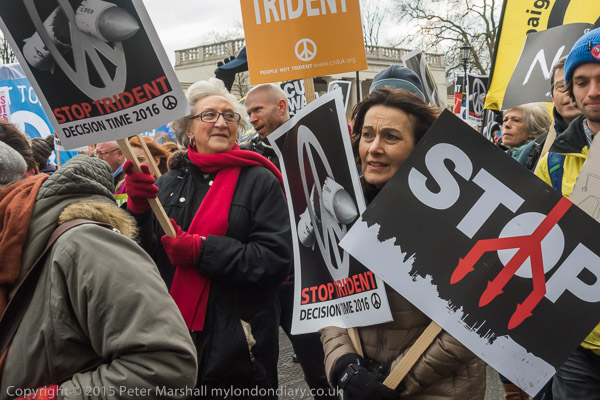
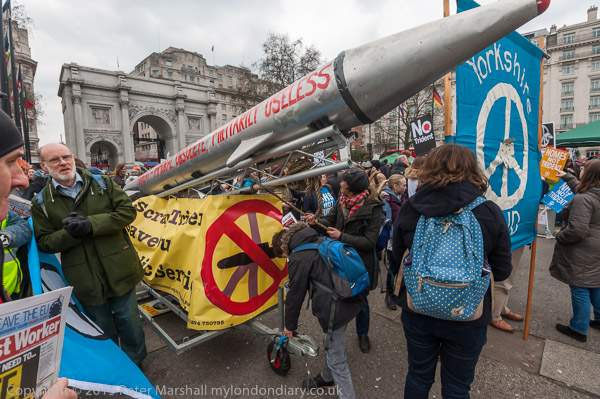
Stop Trident March

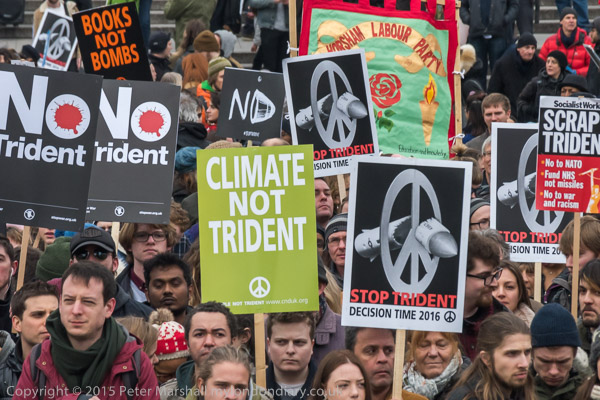
According to CND there were 60,000 people marching from Marble Arch to a mass rally in Trafalgar Square, and although their estimate may have been a little on the high side, this was definitely a very large protest, starting with a densely packed crowd on Park Lane. When the rally began in Trafalgar Square the tail of the march was still around half a mile away, and I think many gave up before reaching the rally as the streets leading to it became blocked.

Few people outside the military and arms manufacturers – probably the most powerful of all lobbies in the country can really believe the expenditure of £180 billion or more on replacing the UK’s Trident nuclear weapons is either necessary or cost-effective. The huge majority of nations in the world have no nuclear capability, and by December 2021, 59 states had ratified or acceded to the UN Treaty on the Prohibition of Nuclear Weapons (TPNW) which entered into force on 22 January 2021.

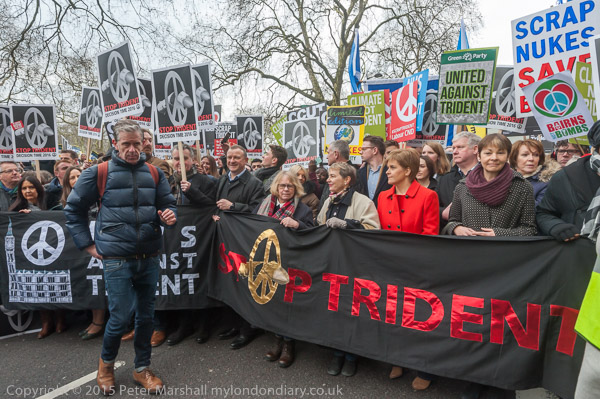
Lindsey German, Stop the War, Kate Hudson, CND General Secretary, Nicola Sturgeon, SNP First Minister, Scotland and Green Party MP Caroline Lucas hold the Stop Trident banner

A national survey by Survation at the start of 2021 for CND showed 59% of the public supported the UK government signing up to the TPNW, including 50% of Conservative voters and 68% of Labour voters. An even higher 77% supported a ‘total ban on all nuclear weapons globally’ with majority support from young and old, in all regions of the country, from Conservative as well as Labour voters, leavers and remainers. The government remains resolutely opposed to the treaty.

This widespread opposition to nuclear weapons isn’t largely a matter of their cost but on both moral and pragmatic grounds. As CND say, using nuclear weapons would cause catastrophic global damage; these weapons of mass destruction don’t keep us safe and divert resources from essential spending on services like the NHS, schools and housing and “it is clearer than ever that real security for Britain requires addressing the risks posed by the climate emergency and pandemics on a global scale.

Stop Trident March


Stop Trident Rally

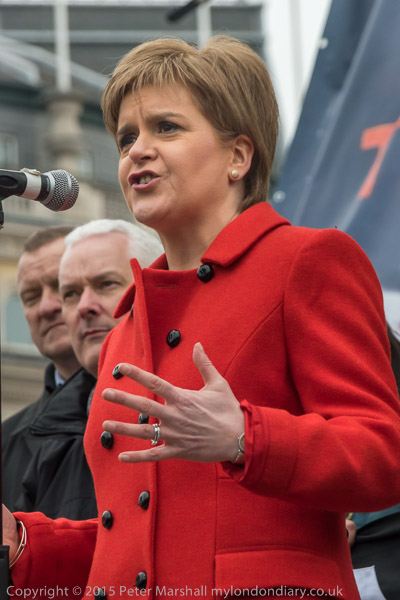
Trafalgar square was unusually packed for the long rally that followed the march, with people listening and applauding a long list of speakers, including Nicola Sturgeon, Caroline Lucas, Leanne Wood, Vanessa Redgrave, Bruce Kent, Christine Blower, Mark Serwotka and Tariq Ali, as well as many less well-known names. There were many marchers who found it impossible to get into the square.

Nicola Sturgeon First Minister Scotland

All the speakers opposed the spending of an estimated £180 billion or more on renewal of Trident which they dismissed as out of date, totally irrelevant to our defence and a complete waste of money which could be put to so much better use providing proper jobs and services.

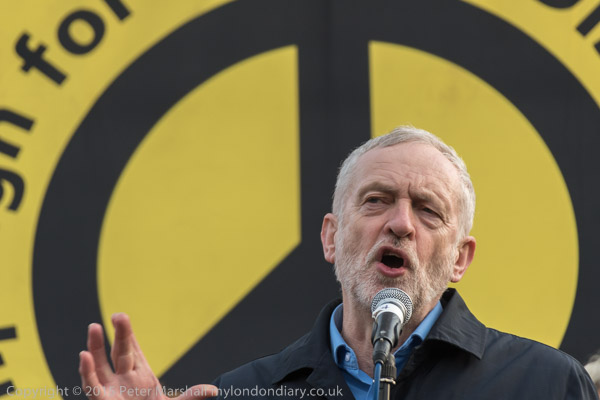
It was a long wait, around two hours standing in the cold for the final speech by Jeremy Corbyn who had earlier in the day been speaking in Sheffield and whose train had been a little delayed. He was greeted by a tremendous response from the crowd, and gave a rousing speech to end the protest on a high note. Despite the dismissive remarks from many political commentators on the media, Corbyn is one of the most powerful political speakers of current years.

Stop Trident Rally


Stop Trident, Troops out of Iraq – 2007

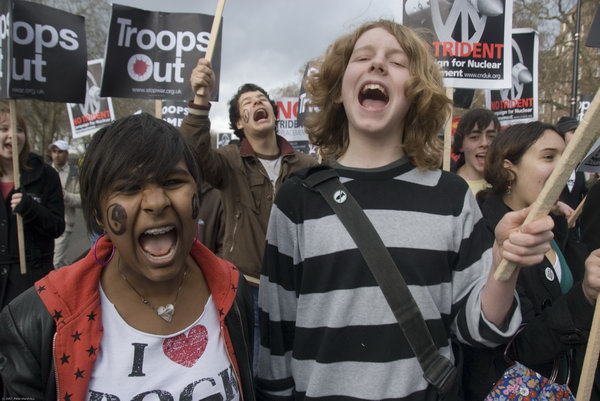
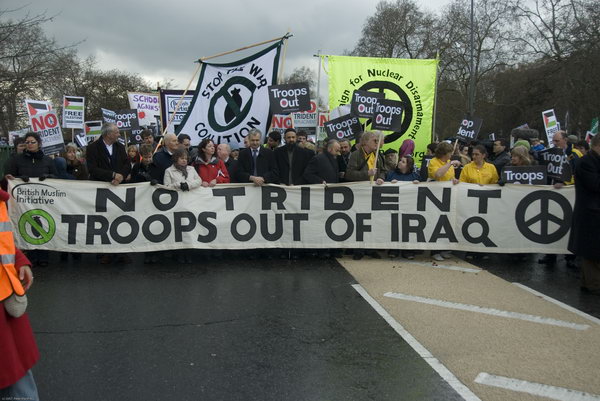
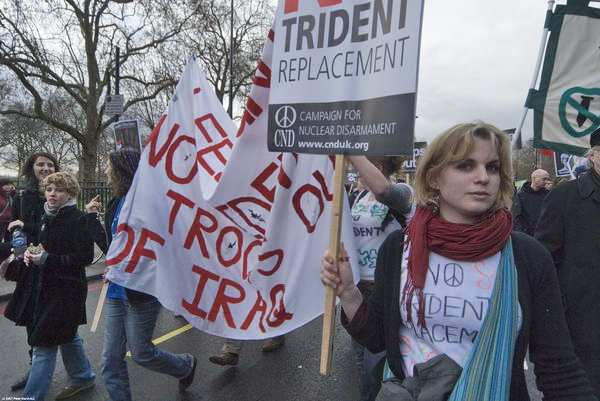
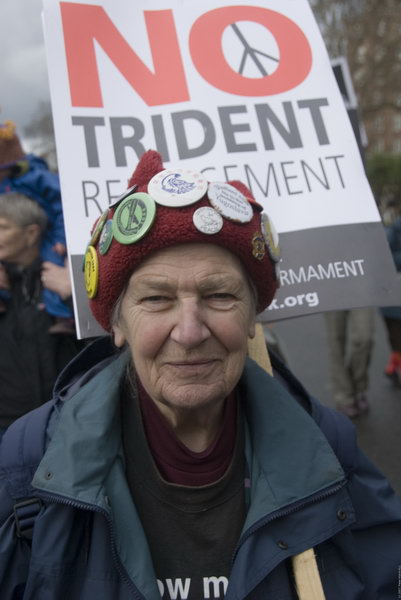
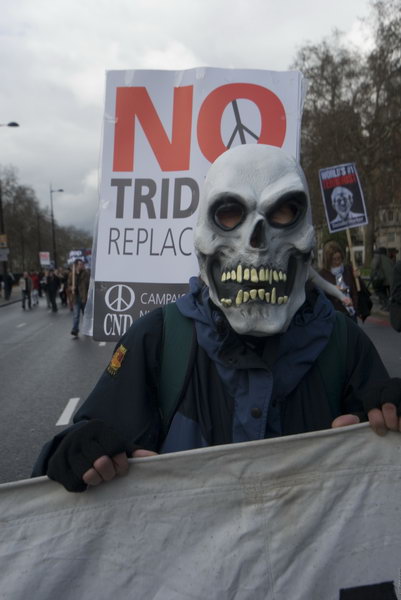
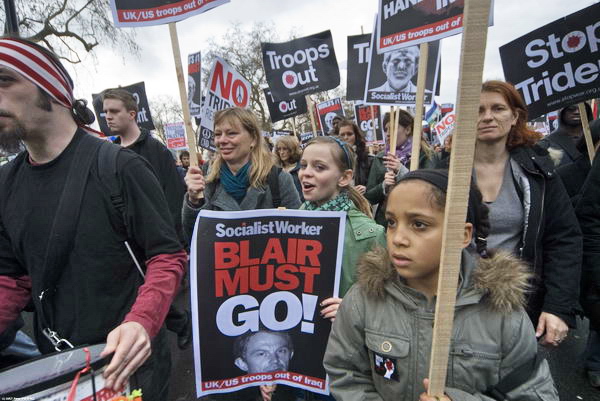
Stop Trident, Troops out of Iraq – 2007. On Saturday 24th February 15 years ago I spent a long afternoon photographing around 50,000 protesters marching through London calling for an end to Britain’s nuclear weapons and for our troops to be withdrawn from Iraq.

The march was organised by Stop The War, the Campaign For Nuclear Disarmament and the British Muslim Initiative, and on My London Diary – back then still only in lower case – I made clear my support for the marchers:

i’ve for many years been opposed to the so-called independent british nuclear weapons. even at the height of the cold war they were never credible as an independent deterrent. if they have ever had any justification it was that they made the usa feel less guilty, although american guilt at its huge nuclear arsenal and at being the only country ever to have used nuclear weapons has always been an incredibly stunted growth.

i was also firmly against the invasion of iraq. it was always clear to those who didn’t want to be deluded that the so-called ‘intelligence’ on weapons of mass destruction was laughable. blair was either a liar or a fool as he misled a minority of the british people and a majority of their mps. or most probably both. (saddam may also have been deluded and certainly was an evil dictator, but we had long failed those who tried to oppose him.) the invasion was criminal, but the lack of planning for the occupation that inevitably followed even more so.

My London Diary – Feb 2007

My account also points out the ridiculously low estimate of the numbers taking part given by the police of 4,000 – though I think they were eventually forced to increase this somewhat – and gives my own method of assessing numbers on such large demonstrations as this. The marchers took 90 minutes to pass me as I photographed them in Park Lane. My usual rule of thumb was to double the police estimate, but on this occasion they surpassed themselves, being an order of magnitude out.

There certainly is always a policy by our establishment, backed up by the BBC and the press, except on rare occasions to minimise dissent, particularly left-wing dissent, in this country while often exaggerating any protests against left-wing governments abroad. It’s a bias which has been very obvious in the coverage of events in Latin-American countries such as Venezuela.

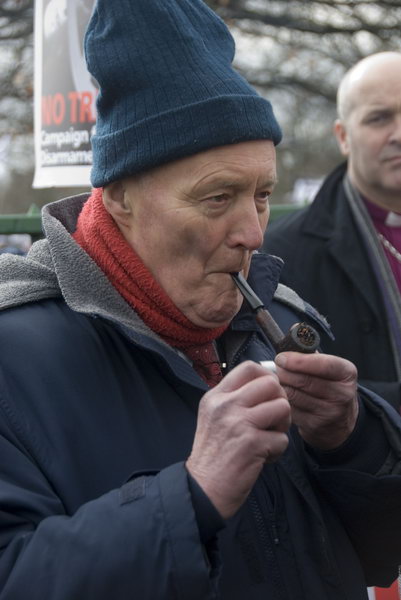
Tony Benn

The BBC and some of our newspapers have some excellent reporters and correspondents, and it is more in the selection of what they are asked to report on and the editing of their reports and the context in which they are placed that the bias occurs. Some things are just not ‘news’, while others, often trivial or flippant, get major attention.

Fortunately there are other sources with different biases, including the almost invisibly small left-wing press in the UK (the two daily papers – the Communist Morning Star and Workers Revolutionary Party’s The News Line together have a circulation probably well under 10,000), but more importantly large news organisations such as the Russian-funded RT International and the Qatari Al Jazeera English – the latter particularly interesting about current events in the Ukraine.

Every journalist has a point of view and while we may strive to be factual I don’t think there is such a thing as objectivity. Our reporting is always subjective, based on what we feel and what we think is of importance. Every photograph I take involves choice – and the rejection of other things I don’t photograph – even at times things I think would make eye-catching images but would misrepresent people or the event. Further choices come in the selection of which images to send to an agency, and also which I choose to put on My London Diary.

On this occasion I chose rather too many to put on-line, with 17 pages of pictures, though this reflects the typical internet speeds of 15 years ago, when pages with more than ten small images were too slow to load even though I compressed the images as lower quality jpegs than I would now. But the number of pictures also reflected my intention to tell the story of the event as fully as possible rather than creating a single image for the event that might appeal to a picture editor.

Julie Felix

Looking at the report now I feel there are rather too many images particularly of some of the well-known faces I photographed at the rally. Perhaps also I made too many of the marchers, some of which might be of far more interest to the people shown in them than the general public. But if people make an effort to make an interesting placard or banner I think it deserves a little recognition.

You can read more of my report of the event and see another 160 or so pictures on My London Diary, beginning on the February 2007 page, though you will need to scroll a long way down the page to reach this march and rally.


2015 March for Homes – Shoreditch to City Hall

2015 March for Homes – Shoreditch to City Hall. A year before the march Against the Housing and Planning Bill featured in yesterday’s post there was another march about housing at the end of January, the March For Homes.

Outside Shoreditch Church

The event called by Defend Council Housing, South London People’s Assembly and Unite Housing Workers Branch involved two separate marches, one coming from Shoreditch in north-east London and the other from the Elephant & Castle in south London converging on London’s City Hall close to Tower Bridge for a final rally.

Max Levitas, a 100 year old communist veteran of Cable St

I couldn’t be in two places at once and chose to go to Shoreditch, partly because I knew people from several groups I had photographed at a number of housing struggles would be marching from there. The event was certainly enlivened by the arrival of activists who had marched from Bethnal Green, including supporters of Class War, Focus E15 and other groups.

Many couldn’t get into the churchyard

The Shoreditch Rally was held in a crowded area in Shoreditch churchyard at the front of St. Leonard’s, Shoreditch, the ancient parish church of Shoreditch, and I took the opportunity to go inside and have a look at the church before the rally. The list of speakers there showed the wide range of community support for fairer housing policies, including more social housing desperately needed in London and included Jasmine Stone of Focus E15, Lindsey Garratt from New Era, Paul Turp, vicar of St Leonards, Nick from Action East End, Paul Heron of the Haldane Society of Socialist Laywyers, Max Levitas, a 100 year old communist veteran of Cable St, a speaker from the ‘Fred and John Towers’ in Leytonstone and Tower Hamlets Mayor Lutfur Rahman.

Tower Hamlets Mayor Lutfur Rahman

Tower Hamlets benefits from having been formed from some of the London Metropolitan Boroughs with the best records of social housing – such as Poplar, where in the 1920s councillors went to jail to retain more money for one of London’s poorest areas. Unfortunately Rahman, the borough’s first directly elected mayor was removed from office in April 2015 after he was found personally guilty of electoral fraud in his 2014 re-election. Many of the other charges made against him in the media were dismissed by police after investigation.

It was raining slightly as over a thousand marchers set off for City Hall behind the March For Homes banner.

As the march came to the junction with Aldgate High St, Class War split off for a short protest at One Commercial St, where they had held a lengthy series of weekly ‘Poor Doors’ protests against separate entrances for residents owning or leasing at market rates and the smaller section of social housing tenants who had to enter through a door down a side alley. Class War had suspended their 20 weeks of protest for talks with a new owner of the building a month or so earlier, but these had broken down without a satisfactory resolution and the protests there restarted the following week.

As the march approached the Tower of London it was met and joined by Russell Brand riding a bicycle,

and on Tower Bridge, Class War came up to lead the march.

I rushed ahead to meet the South London march as it turned into Tooley Street for the last few yards of its march.

The rally in front of City Hall was large, cold and wet. By now the rain was making it difficult to take photographs, with drops falling on the front of my lenses as I tried to take pictures, and my lenses beginning to steam up inside. But I persisted and did the best I could, though the rain-bedraggled speakers in particular were not looking their best.

The rally was still continuing when some of the activists, including Class War and the street band Rhythms of Revolution decided they needed to do something a little more than standing in the rain listening to speeches. They moved onto Tooley Street and blocked the road. More police arrived and blocked the road even more effectively as the activists moved eastwards to protest at One Tower Bridge, a new development mainly for the over-rich next to Tower Bridge and then left for a long walk to the occupied Aylesbury Estate. But I decided it was time to go home.

More on My London Diary:
March for Homes: After the Rally
March for Homes: City Hall Rally
March for Homes: Poor Doors
March for Homes: Shoreditch to City Hall
March for Homes: Shoreditch Rally


March Against Housing & Planning Bill

The March Against Housing & Planning Bill on January 30th 2016 was organised by activists from South London, particulary from the London boroughs of Lambeth and Southwark.

These include many who are fighting against the demolition of social housing that is taking place across London, including in Lambeth and Southwark. Council tenants and leaseholders on council estates are fighting to save their homes – and fighting against Lambeth and Southwark councils who together with private developers and estate agent advisers are bent on demolishing the estates and replacing them with new estates which are largely for private rent or sale at London’s inflated market prices.

Southwark Council in particular carried out an expenisive PR exercise to demonise the Heygate Estate at the Elephant & Castle, having failed to carry out necessary maintenance and flooded the estate with people with various social problems over a number of years. The whole disastrous history has been documented in depth on the Southwark 35% site. A prize-winning estate with 1,214 homes built in 1974 to provide social housing for around 3,000 people was deliberately run-down and demolished. It’s replacement, Elephant Park has less than 100 social housing units. Many of its new flats are simply investments for overseas owners.

Southwark sold the Heygate to developers for one third of its previous valuation, and spent more on the scheme than it received. A study by Global architect firm Gensler concluded that the £35m spent by Southwark in rehousing the estate residents was exactly the same as it would have cost to refurbish the estate up to modern standards – and would have avoided the huge carbon footprint of demolishing and rebuilding.

A well as Heygate, Southwark Council’s main target has been the Aylesbury Estate, where Tony Blair chose to launch the Labour regeneration policy which has enabled corrupt councils to destroy much of what remained of social housing. For many council officers and some councillors it has enabled them to move into highly paid jobs with developers as a reward for their services. Lambeth has also been pursuing similar policies (along with other boroughs in London) and in particular with the Central Hill estate close to Crystal Palace.

An angry heckler – their argument continued after the speech by Livingstone

The protest against the Housing & Planning Bill in 2016 was also attended by people from both Lambeth and Southwark Council, and when Southwark Council Cabinet Member for Housing Richard Livingstone stepped up to the microphone to speak at the rally before the march some trouble was inevitable. Among those loudly heckling him was another of the speakers, Simon Elmer of Architects for Social Housing.

Class War have also been active in support of social housing in South London in particular and livened up the march by dancing along the street with banners singing the ‘Lambeth Walk’. One banner carried the words of a leading US Anarchist Lucy Parsons (1853-1942), “We must devastate the avenues where the wealthy live” and another had a field of crosses with the message “We have found new homes for the rich“.

Class War supporters rushed across the street for a short impromtu protest in front of a large branch of one of the leading estate agents driving the gentrification of London and advising councils and government on housing policies, but soon rejoined the main march of around 2,000 people heading for Westminster Bridge and Downing St.

At Downing St there was another protest outside the gates. Police had formed a line across Whitehall and directed the march to the opposite side of the street opposite Downing St. The march followed them across but then many simply walked back across the street to mass in front of the gates for a rally led by Fight Racism! Fight Imperialism! who have been active in supporting the Focus E15 Mothers in their campaign against the housing failures of Newham Council.

More on My London Diary at Housing and Planning Bill March


University of London 3 Cosas Strike

On the IWGB battlebus

Eight years ago on Tuesday 28th January 2014 low paid workers at the University of London were on the second day of their 3 day strike. Their union had organised a day of action around London and I had been invited to come and photograph it, having photographed a number of their previous protests.

University cleaners, maintenance and security staff were demanding that the University recognise their trade union, the IWGB (Independent Workers’ Union of Great Britain) and give them better pay and conditions, comparable with other university staff they work alongside. The ‘3 Cosas’ were sick pay, paid holidays and pensions – all areas where these staff were only being given the legal minimum (and sometime not even that.)

As I wrote in 2014:

“although these workers work at the university and carry out work essential for the running of the university, the university does not employ them. Most low paid workers – cleaners, maintenance and security staff, catering works and others – at the University of London are no longer directly employed by the University, but work in the University on contracts from contractors Cofely GDF-Suez (who took over the former contractor Balfour Beatty Workplace at the end of last year.) The policy of outsourcing these workers seems largely intended to evade the responsibilities of London University towards an essential part of their workforce.”

3 Cosas’ Strike Picket and Battle Bus

It meant an early start for me, although the pickets had been outside Senate House for four hours when I arrived at 9am. Living outside London though on its edge I seldom arrive before 10am as it doubles my travel costs and I’ve never been a happy early riser. Fortunately the weather was good, a bright winter day and I’d dressed for the weather with thermal underwear, thick socks and a woolly hat, though it was still pretty chilly on top of the open-top bus.

The bus turned out to be a 1960 Routemaster which was sold by London Transport in 1986 but only converted to open-top in 2001. (I’d long thought that there was a plentiful supply of such vehicles after drivers attempted routes under low bridges, but apparently not, although a couple of bridges near where I live have had quite a few victims over the years.) Compared to modern buses, Routemasters offered a very bumpy ride with considerable vibration, and taking pictures on the upper deck required some faster than normal shutter speeds and most of the time working one-handed while clinging on with the other.

Space on bus tops is also quite small and moving around impeded both by the seats and the other riders (I think it’s a more appropriate term than passengers) and though they were very cooperative the top of the bus was pretty full. Most of the pictures I made were taken when the bus was stopped either at junctions or for short protests and my fisheye lens proved really useful.

The bus trip began at Senate House, and then began an extensive tour around central London, making a tour of various university sites where IWGB members were striking. There was a great deal of booing as we passed the Unison headquarters on Euston Road, as many of the workers had left Unison in disgust as they felt the were not supporting the demands of low-paid workers. The IWGB had intended to stop outside the offices of The Guardian newspaper, but had been held up too much by London’s traffic and drove past and on to Parliament Square.

Here we jumped off the bus and marched to Parliament where the IWGB had arranged to meet Labour MPs John McDonnell and Jeremy Corbyn for a short rally (and Andy Burnham sent a short message of support.)

There was a short shower before the bus came to pick us up on the Embankment, taking us to a side street near the Royal Opera House. Everyone kept quiet as we got off, then rushed around the corner and into the foyer. IWGB members there had voted for a strike the following month for union recognition and the London Living Wage.

In the foyer we were met by a man who introduced himself as the Unison Health & Safety rep and told the IWGB President and the other protesters that the ROH had already agreed that the cleaners will get the Living Wage, but had not yet told them. The Opera House recognises Unison, despite the workers almost entirely being IWGB members. It’s a ridiculous situation but one which is allowed under our poor trade union laws, though not one that makes sense for either workers or employers.

After making their views clear the IWGB members left quietly and got back onto the bus for the final visit of the day, to the Angel Islington, where Cofely GDF-Suez (who took over employing the workers at the University of London from the former contractor Balfour Beatty Workplace in December) has its offices. As at the Royal Opera House, there were plenty of police present and waiting for the protesters, but here they managed to lock the metal gates on the two entrances to Angel Square as the bus arrived, leaving the protest to take place in front of one of them in Torrens Place.

From here the bus was going on to the union offices at the Elephant and Castle and I was invited to join them for a very late mid-afternoon lunch but unfortunately I had work to do on the many pictures I had taken and had to leave them and make my way home.

IWGB at Cofely GDF-Suez
IWGB in Royal Opera House
IWGB at Parliament
‘3 Cosas’ Strike Picket and Battle Bus


Guantanamo – America’s Shameful Prison

Amnesty International protesters close to the US Embassy

January 11th was for quite a few years a busy day for protests; it marked the anniversary of the setting up by the United States of a military prison as a torture camp at the disputed US Guantanamo Bay naval camp on the island of Cuba.

Prisoners’ had taken turns in the cage overnight

Set up in the aftermath of the 9/11 attack as a part of George W Bush’s ‘War on Terror’, the camp and the activities which took place there destroyed any final vestige of higher moral ground America could lay claim to in its role of world policeman, something that its various largely clandestine involvements in various South American American coups and activities in the Middle East and elsewhere had already largely laid waste.

Guantanamo is still there, still open, though the great majority of the 779 men brought there have been released. Most were totally innocent, victims of a US policy of offering $5,000 rewards for the capture of ‘terrorists’ to Pakistani and Afghan groups, who took the money for turning in anyone they felt would get them the money.

In October 2021, there were still 39 men held at Guantanamo, including ten who had long been cleared for release. Very few of those held over the years have faced trails trials and very few were involved in any acts of terrorism. Bush and Obama acted slowly but together released well over 700 of the prisoners, but Trump only released one, effectively stopping the process.

Protests continue in the UK, but on a much smaller scale, particularly since the last British resident, Shaker Aamer was released without charge or trial after 13 years of imprisonment and torture in 2015.

In 2008 Amnesty International organised a large protest in Grosvenor Square, a few yards from the US Embassy, though the street in front of the embassy had been closed to prevent protests there. They brought with them two cages, similar to those in which the prisoners were imprisoned outdoors at Guantanamo, with a large group of people wearing the orange jumpsuits which they are made to wear there. Protesters dressed as guards in military style uniforms harassed the ‘prisoners’ interrogating them and threatening them with violence and with aggressive-looking dogs.

From Grosvenor Square I went up to the Regents Park Mosque, where activists from Cageprisoners and the London Guantánamo Campaign, some also in those orange jumpsuits and one manacled hand and foot. There they were handing out leaflets to those attending Friday Prayers.

Later I went with them to Paddington Green Police station, where terrorist suspects are detained and questioned in this country. They were going on to continue to protest in Parliament Square, but I returned first to the US Embassy, where the London Catholic Worker Community was holding a two hour vigil closed to the corner of the Embassy, holding placards and lighting candles for those still held and several who had died there. Several were alleged to have committed suicide, but later evidence emerged strongly suggesting they had died during torture.

The final event of the day was a rally in Parliament Square organised by Cageprisoners and the London Guantánamo Campaign with a number of speakers including Victoria Brittain, former Guantanamo prisoner Moazzam Begg, laywers including Gareth Peirce, Bruce Kent, Yvonne Ridley and Jean Lambert MEP.

It was dark, cold and wet, but those present were cheered by the announcement at the end of the rally that Scotland Yard were investigating allegations of 14 criminal offences committed by Tony Blair and Lord Goldsmith and others which resulted in the deaths of Iraqi citizens during the armed invasion and occupation of Iraq.

Unfortunately and predictably these investigations came to nothing, and though the Chilcot report was damning in parts, Blair not only got off scot-free but this New Year was awarded a knighthood. A few days ago one of several petitions to have his “Knight Companion of the Most Noble Order of the Garter” rescinded reached over a million signatures. Mine was one of them.

Six years of Guantanamo: Amnesty
London Guantanamo Campaign / Cageprisoners
Guantanamo – London Catholic Worker
Guantanamo – Parliament Square Rally