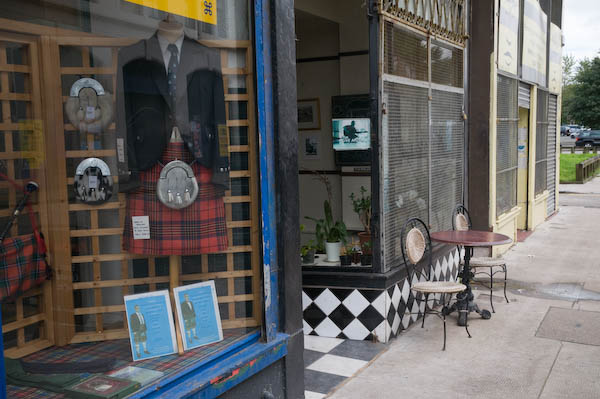
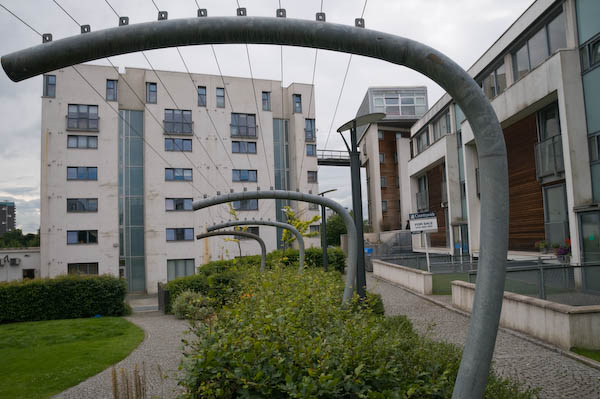
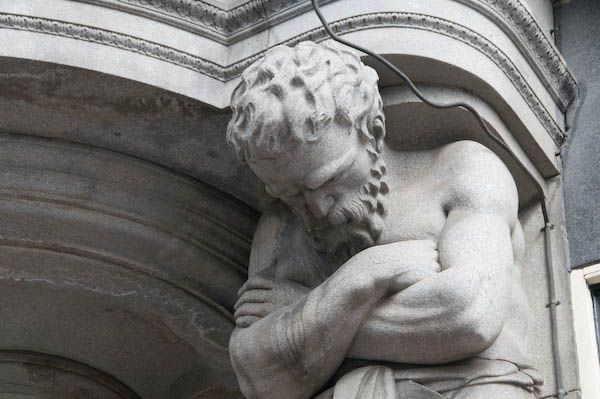
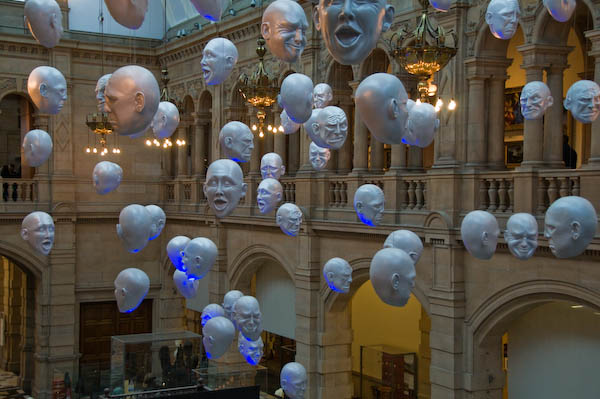
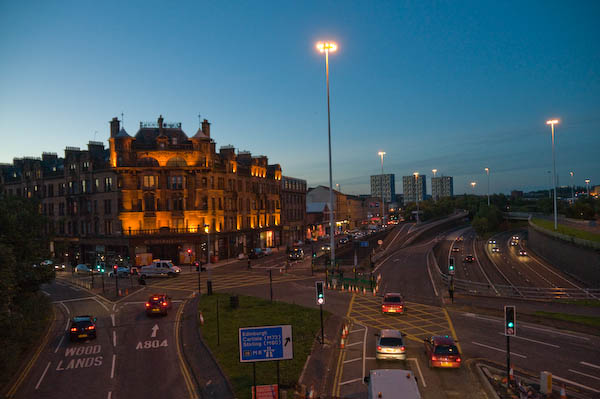
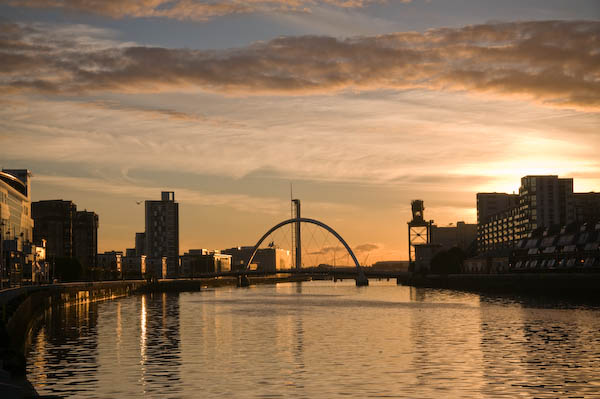
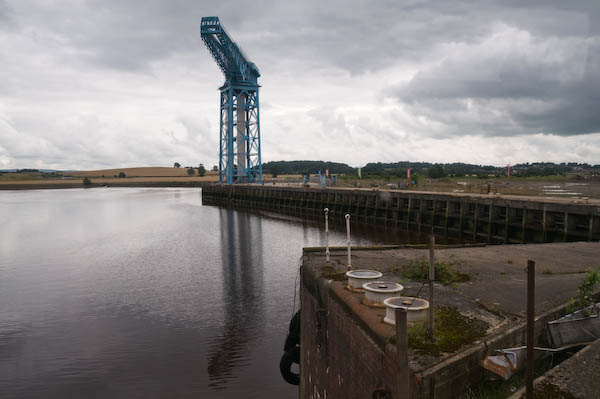
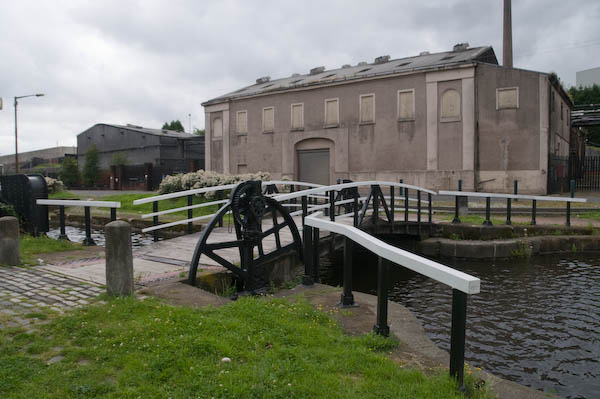
Glasgow Visit 2008: In August 2008 with my wife and elder son and friends I went to Iona. The journey up from London is a long one and we decided that rather than try to do it in one day we would take the opportunity to spend a few days in Glasgow on our way, staying in a hotel close to the School of Art in the centre of the city, named after Charles Rennie Mackintosh.
We were in Glasgow for only five days but managed to see quite a lot of the city and some of its surroundings as my pictures show. Looking back I’m surprised at the variety of subjects in the roughly 2000 images I took, working over a 12 hour day on most of the 5 days we were there.
Only a fairly small fraction of the pictures are on My London Diary – partly because this wasn’t London and I then felt a bit embarrassed about posting work from another city. But the web site – which I updated regularly from around 2000 to the start of 2022 except during the lockdown and is still on line was very much my personal diary and so does include at least some of my pictures from outside London.
All were taken on the 12Mp Nikon D300, a DX format camera which I had bought earlier in the year. It was a very usable camera with decent autofocus and nothing that came later from Nikon was really much of an improvement, though the sensor size and pixel count increased. Should you want a good, cheap DSLR a secondhand D300 would still be a good choice, so long as the shutter count was well below the rated 150,000.
I think I had both a wide-angle and telephoto zoom with me. The Raw images I made have suffered a little from the processing to produce jpegs – software has improved significantly since 2008, and I think all of them could benefit from being made a little brighter. But life is too short to re-process them all.
For convenience I divided the pictures into eight rather arbitrary sections to post them on My London Diary, and I’ll include the direct links to these at the bottom of this post. But you can start at ‘My Pictures’ and click the link at the bottom of each page to go through the complete set I’ve posted.
This wasn’t my first visit to Glasgow, but I don’t think any pictures from my earlier visit when we spent a week there are online, and on the brief visit with friends back in around 1962 I took no pictures – I think I’d finished my holiday film on Skye, where my holiday also almost ended as I fell down a mountain.
Mmong other holidays in Scotland I’ve also spent a couple of weeks in Edinburgh – including once for the festival. And though I enjoyed both cities, I found Glasgow interested me more. If I ever return to Scotland it will be to Glasgow, as I now feel too old to walk the West Highland Way.
A Walk in the City: Take a walk around parts of the City of London with me and my camera five years ago on Wednesday 7 Aug 2019. The first part of the walk I was on my own, but later I met up with a couple of friends and we continued to walk around but visited several interesting City pubs before ending up with a meal at what must be the worst Wetherspoons in Greater London at Cannon Street Station. Though I suppose it’s handy if you want to catch the train.
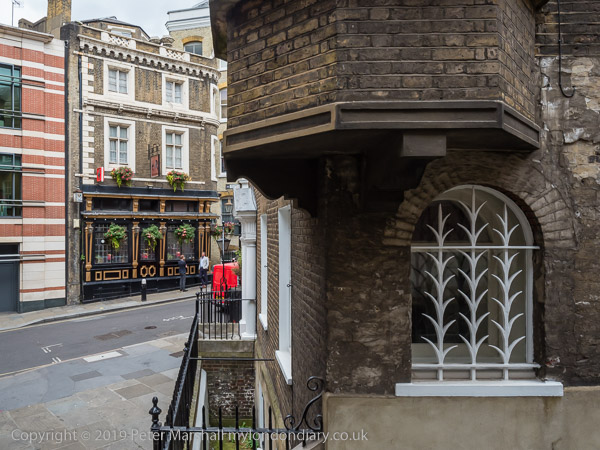
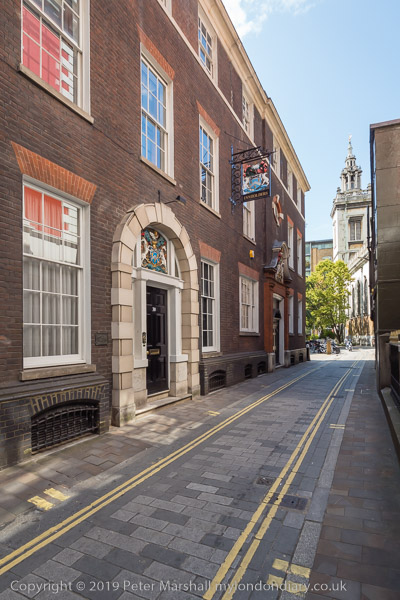
I’d taken a bus from Waterloo to the City and got off at St Paul’s and walked down to St Andrew’s Hill where I wanted to retake digitally an image I had made on film over 30 years ago.
Taken from the steps of St Andrew’s by the Wardrobe Church, the view of St Andrew’s Hill and the Cockpit pub was a taxing subject on film with the foreground in Wardrobe Terrace, and I never quite managed what I wanted. Using digital gave me a rather better result with no problems.
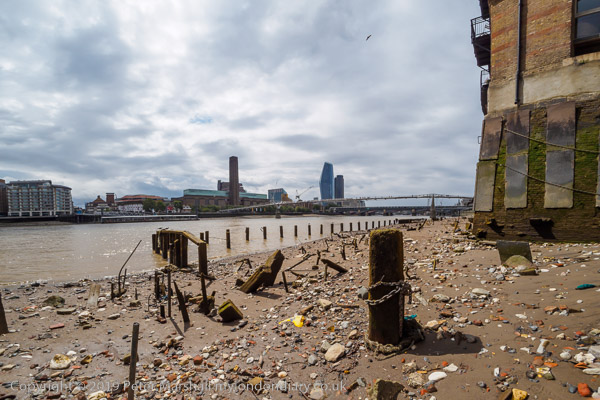
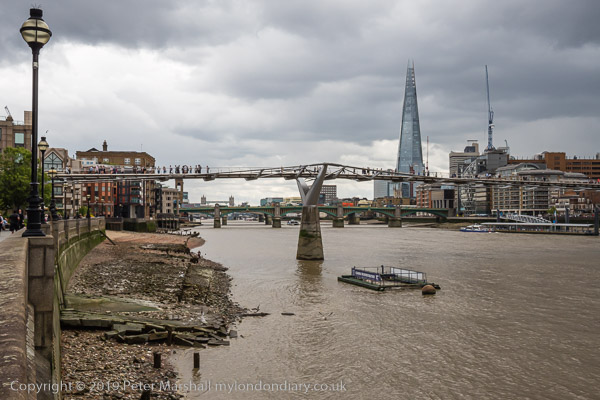
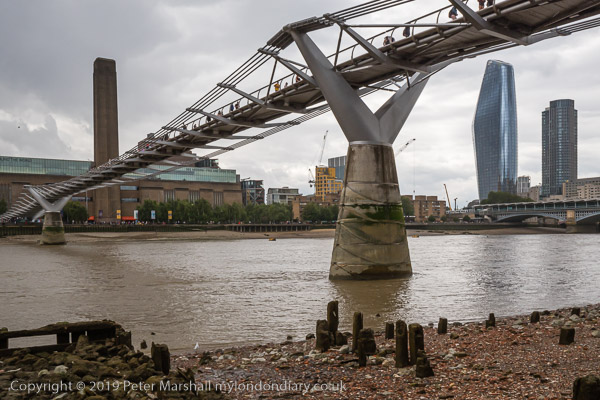
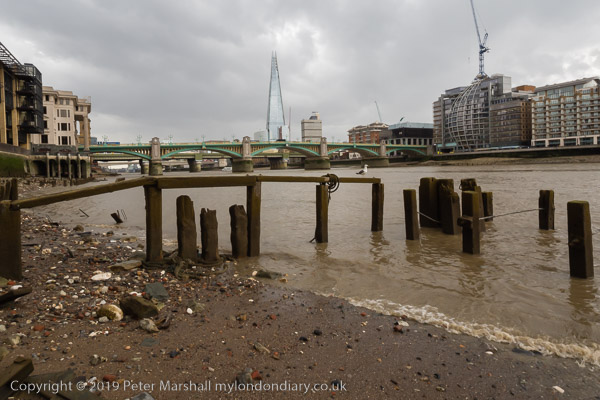
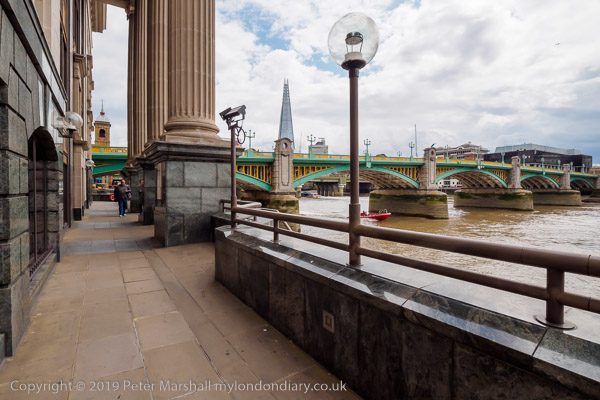
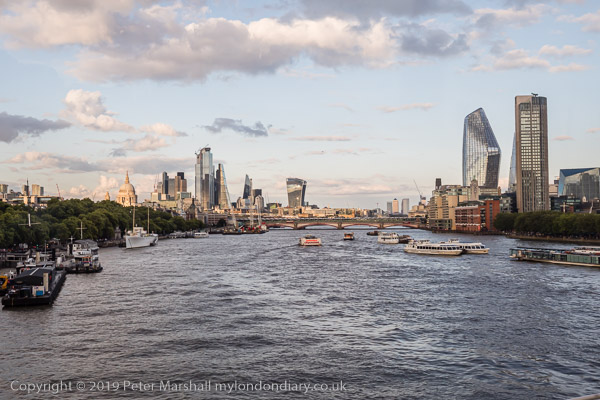
I walked on down to the River Thames and made some views along the river with the Millennium footbridge and the Shard now rather dominating the scene.
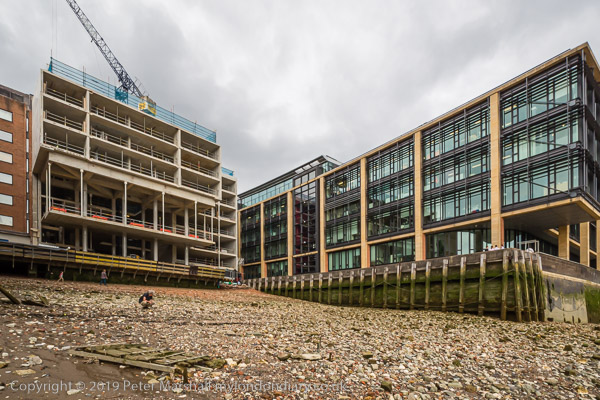
The tide was very low and I went down the steps onto the foreshore, though I needed to be careful walking on the stones and mud as I was only wearing a light pair of shoes which were very much not waterproof. I walked along under the Millennium Bridge and on towards Queenhithe, taking quite a few pictures.
The foreshore can be dangerous and the tide comes in rapidly. Although anyone is free to visit it, searching in any way – metal detecting, ‘beachcombing’, scraping and digging etc requires a https://pla.co.uk/thames-foreshore-permits PLA permit. You are advised to wear sensible footwear and gloves – which of course I wasn’t – and to watch out for hazards including raw sewage, broken glass, hypodermic needles and wash from vessels. I stepped very carefully.
Buried below the sand and mud at Queenhithe are the remains of part of London’s Roman harbour and the later medieval quay. A scheduled ancient monument, it is probably the only existing Saxon harbour in the world, presented by King Alfred the Great in 883 AD to his brother-in-law Ethelred. It got the name Queenhithe later when the harbour dues became the property of the wife of Henry I, Queen Matilda. The dock was still in use mainly by the fur trade in the early 20th century, and there were still fur shops in the area around in the 1970s.
I didn’t stay long on the foreshore and couldn’t remember where the next set of steps up from it were, so went back onto the Thames Path where I had come down and walked east towards Monument Station where I was meeting two photographer friends.
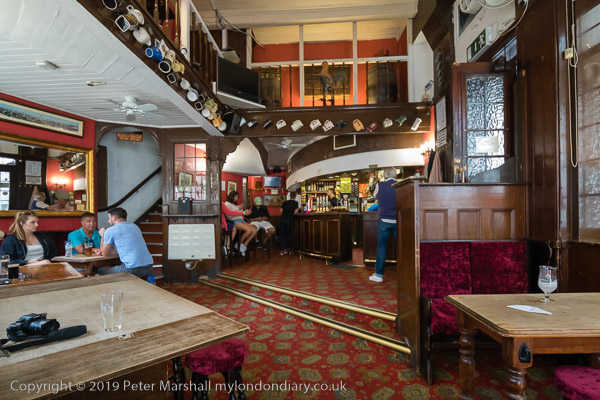
One of my friends had planned this walk and I was just a little surprised to find we were going back to one of the places I had visited earlier, St Andrew’s Hill, though less surprised when we went into the Cockpit pub.
The pub is on a historic site, originally part of one of the gatehouses of Blackfriars Monastery. There was a pub here when Shakespeare bought a house nearby. And undoubtedly there was somewhere here where cock fights took place until cockfighting was banned – along with dog fighting, bear baiting and badger baiting – in 1835. But this is a Victorian theme pub, rebuilt around 1865, though some at least of its interior decoration almost certainly came from actual cockfighting venues. But punters never stood in the closed galleries here to watch fights. Now firmly on the tourist circuit it is still worth a visit, if just for a pint of Harvey’s Sussex Best Bitter.
Our walk continued through more of the streets in this area and then across New Bridge Street and on to Bride Lane and St Bride’s Passage and The Old Bell Tavern, once very much part of Fleet Street, the Street of Shame. The Old Bell Tavern is on the site where it all started, when in 1500 Wynkyn de Worde who had worked with William Caxton set up the first print shop on Fleet Street. The building is apparently derived from one that Christopher Wren knocked up for his masons when they were building St Brides, the journalists’ church.
Our walk more or less finished there, though we took a bus to Cannon Street Station for cheap food at the Wetherspoons, though I found it very disappointing. Spoons do much better almost everywhere else. I caught a bus from St Paul’s Churchyard, sat in the front seat on the top desk and it had unusually clean windows so I took a few more picture on the way back to Waterloo.
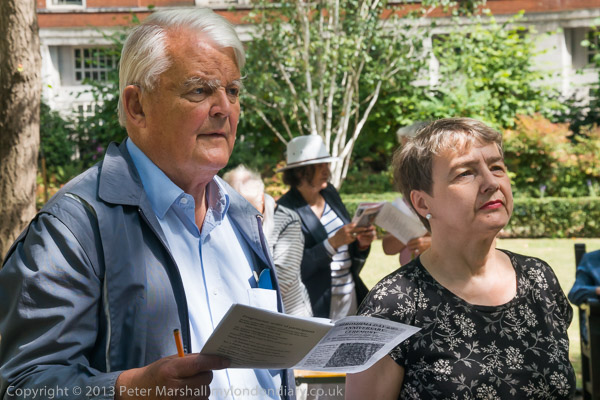
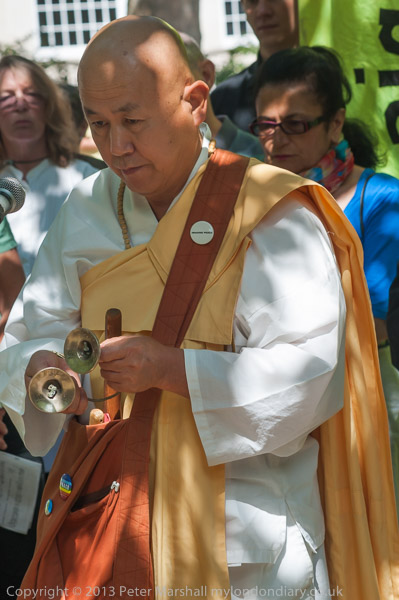
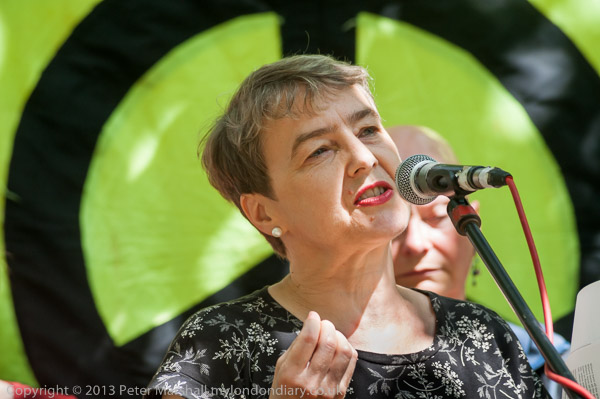
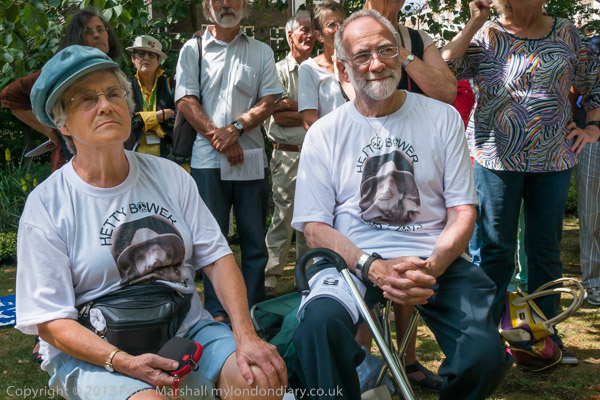
Hiroshima Atomic Victims Remembered: Ten years ago today on Wednesday 6th August 2014 I was in Tavistock Square for a ceremony close to the Hiroshima Cherry Tree on the 69th anniversary of the first use of an atomic bomb remembering the victims past and present of the bombs dropped on Hiroshima and Nagasaki in 1945.
I hope to be there again today, as I have been in most recent years. The roughly hour-long ceremony organised by London CND begins at noon and follows more or less the same pattern each year. Everyone is welcome to attend and if you missed it this year you can put a reminder in your diary for next. And if you are not in London, there are other events in other towns and cities across the world – and some also in other parts of London.
The dropping of the bombs on Hiroshima and Nagasaki marked the beginning of a new age where the USA showed it had the power to unleash unprecedented levels of death and destruction. Some other nations were quick to develop their own atomic weapons, including our own and of course the USSR, and all developed bombs of much greater power than the two which devastated the Japanese cities.
Currently nine countries have nuclear weapons: the United States, Russia, United Kingdom, France, China, India, Pakistan, North Korea and Israel. When the USSR was split up, Belarus, Kazakhstan and Ukraine transferred the nuclear weapons on their territory to Russia, but apart from this only one country, South Africa has actually given them up.
Wikipedia quotes the Stockholm International Peace Research Institute as estimating in 2023 that the nuclear weapons states held a total of 12,119 total nuclear warheads. Far more than would be needed to destroy the planet, or at least human life on it.
The Treaty on the Prohibition of Nuclear Weapons (TPNW) was adopted by the UN in 2017 and came into force in 2021. By January 2024 of the 197 states recognised by the UN, 97 countries had signed the treaty although 27 had still to ratify their signatures. None of the states which hold nuclear weapons have signed.
In Tavistock Square there were songs, speeches, prayers and performances introduced by Islington MP Jeremy Corbyn and messages from Hiroshima and Nagasaki were read.
As well as remembering the many victims of the bombs we also were reminded of peace campaigner Hetty Bower, who became a pacifist during the First World War and attended many of these ceremonies and other peace events and had died earlier this year.
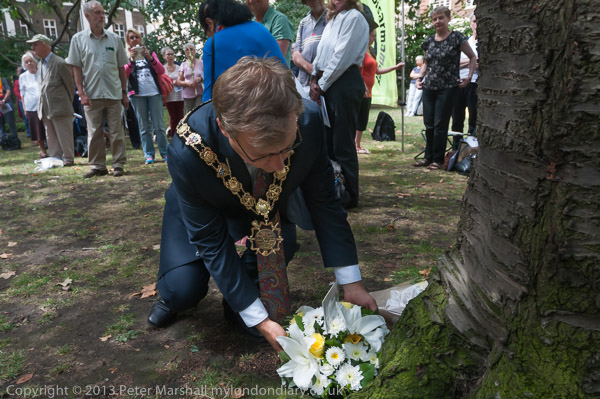
The event closed with two minutes of silence for the victims of the attacks on Hiroshima and Nagasaki and all victims of war, during which people came up to lay flowers and wreaths at the foot of the Hiroshima cherry tree.
Milking, Friern Manor Dairy Farm, Stroud Green Rd, Finsbury Park, Islington, 1989 89-9f-63
Cows, Cindy, Fonthill and Finsbury Park: I couldn’t resist posting another of those sgraffito panels from the former Friern Manor Dairy Farm on Stroud Green Rd, though I suspect even when these were made the conditions for both cows and milkmaids were very different from those enjoyed in the stalls behing the facade.
Modern dairy practice is of course also very different as you can see in Andrea Arnold’s 2021 cinéma vérité-style film ‘Cow‘, not made as vegan propaganda but giving a very direct view of how we use animals to produce food for the masses. Watching it didn’t convert me to the vegan cause but I do think we need to have and enforce much stricter standards of animal welfare – though those in the UK are already firmer than in most countries. I already pay more for milk and would happily pay even more.
Cindy Trading Company, Hanley Rd, Finsbury Park, Islington,1989 89-9f-66
The Old Diary is on the corner of Hanley Road and I walked down here just a short distance and photographed this shopfront which appeared to be of a former travel agency, possibly the ‘Flight Line Cruise’ whose phone number is written large. The Cindy Trading Company whose name is on the door was later listed as a hardware store selling a range of DIY and home improvement items at 186 Stroud Green Road, a short distance away – and is now a dissolved company.
At right is an advertisement for Metposts and I may have been attracted by this as I had recently put in a fence on one side of my garden at home using these. It wasn’t quite as easy as the advert suggests and by the time I’d finished and put down the sledgehammer I’d decided digging and concrete might have been easier.
Shop, Fonthill Rd, Finsbury Park, Islington, 1989 89-9f-45
I’m unsure what route I took from Hanley Road to Fonthill Road, possibly going down Regina Road or Evershot Road. I took a couple of pictures – neither digitised – of an interesting yard with two rather strange bell towers in the background, nothing like anything that I can now see in satellite images of the area, possibly a long-demolished public building,
Fortunately the location of this picture is confirmed by the reflection of the street sign for Fonthill Road. Also reflected is a sign for John Rowan Bookmaker, the company which developed the well-known Rowans Tenpin Bowl opposite Finsbury Park Station on Stround Green Road in what had previouly been a tram shed, cinema and Bingo hall.
By 1989 this end of Fonthill Road was already beginning to become one of London’s major fashion centres – and a few pictures I’ve not yet digitised reflect this. A few from 1989 in colour start here.
My walk on 24th September was coming to an end, and I took just one more picture of a shopfront on Seven Sister Road before catching the Victoria Line on my way home. But I was back in Finsbury Park a week later and I’ll include a couple of pictures from the actual park, Finsbury Park to end this post.
Free Nelson Mandela, Finsbury Park, Islington, 1989 89-9f-31
Nelson Mandela was released unconditionally from Victor Verster Prison on 11th February 1990 following years of campaigning for his release. Most of the other graffiti on this wall is unintelligible black scribble at least to me, but I can also make out in white ‘PARANOID EYES’ -presumably from the song on Pink Floyd’s 1983 album The Final Cut.
New River, Finsbury Park, Islington, 1989 89-9f-21
The New River was dug in 1613 to supply fresh drinking water to London from Chadwell and Amwell Springs near Ware in Hertfordshire.
Finsbury Park is around three miles from Finsbury which is on the northern edge of the City of London. People in Finsbury in 1841 signed a petition calling for a park that the people living in poverty in the area could make use of, and this was one of four sites that were considered.
This was around the last remains of the old Hornsey Wood, and by around 1800 had been developed with tea rooms and later a pub, as well as an artificial boating lake using water pumped up from the New River, and it was a popular place for shooting and archery “and probably cock fighting and other blood sports.”
There was some local opposition to sharing the area with the poor of Finsbury but the plans for what was originally to be called Albert Park (after Queen Victoria’s husband) went ahead, and the renamed Finsbury Park was approved by an Act of Parliament in 1857, though only completed and opened by 1869.
New River, Finsbury Park, Manor House, Haringey, 1989 89-10a-02
Lack of finance meant the park had deteriorate significantly by the 1980s, and the situation – like much in London – was greatly worsened when the Greater London Council was terminated with extreme malice by Thatcher in 1986. Haringey Council became responsible for the park “but without sufficient funding or a statutory obligation for the park’s upkeep.”
More recently £5 million Lottery Funding has enabled significant renovation of the park and its facilities. I last went to the park in March 2023 for the planting of a tree in memory of peace campaigner Bruce Kent by local MP Jeremy Corbyn and Kent’s wife Valerie. Both Kent and Corbyn were members of the Friends of Finsbury Park, with Corbyn now being a patron.
Adidas, Wallenberg, Iraq – Three very different events on Saturday 4th August 2012. You may remember that we had the Olympics in London in 2012 and War on Want held an Olympic-themed protest against the official Olympic sportswear partner. People celebrate the 100th anniversary of the birth of one of the great heroes of the last century and on the nearest Saturday to August 8th which Iraq celebrates as end of the Iran-Iraq War in 1988 there was an Iraq festival on the South Bank.
Adidas Stop Your Olympic Exploitation – Oxford St
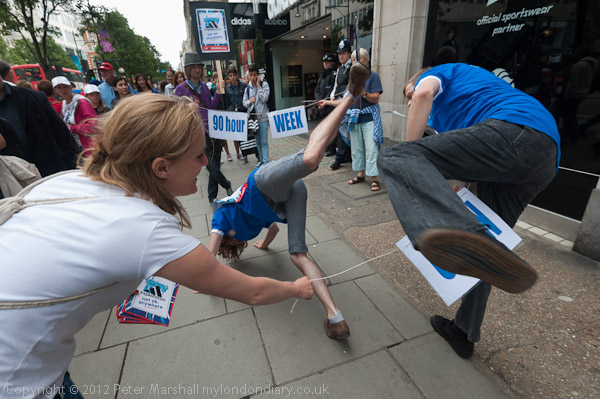
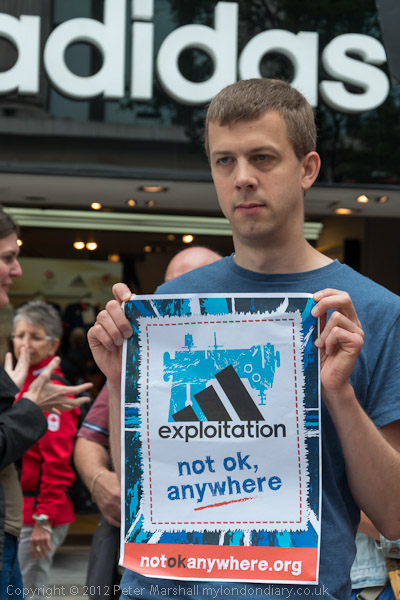
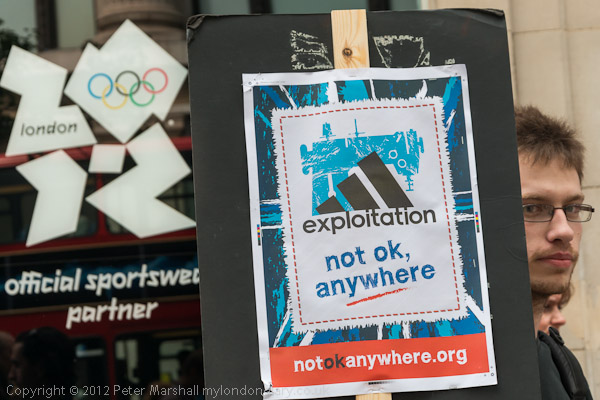
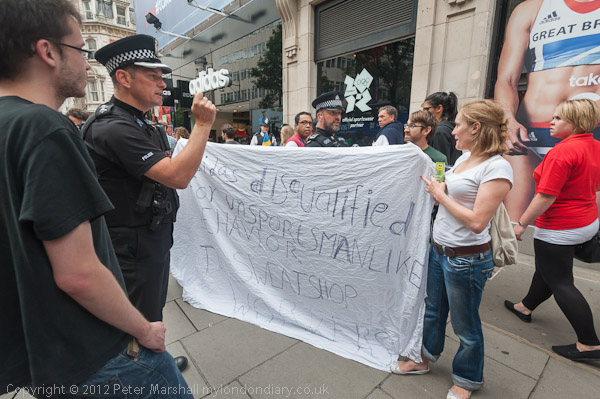
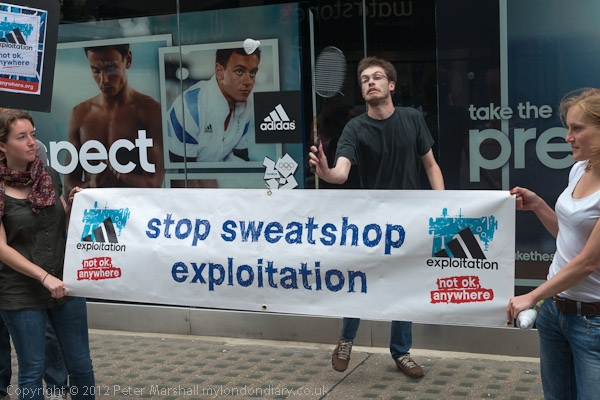
War on Want came to Adidas in Oxford Street at the peak of the London Olympics to highlight their claims that workers making clothes for the official sportswear partner of London 2012 get poverty wages are not allowed to form unions and have little or no job security.
They say thousands of workers making closing for Adidas in Indonesia, Sri Lanka and China are not paid enough to cover basic essentials like housing, food, education and health care. Wages are so low that workers often need to work far longer hours than are legal – up to 90 hour weeks and are told if they try to organise trade unions to defend their rights, they face harassment or they will be fired.
Because of the pressures of the Olympics, Oxford Street was being policed by Scottish officers who objected to the protest involving games including badminton and a hurdles race on the grounds that people walking past might be injured by the players.
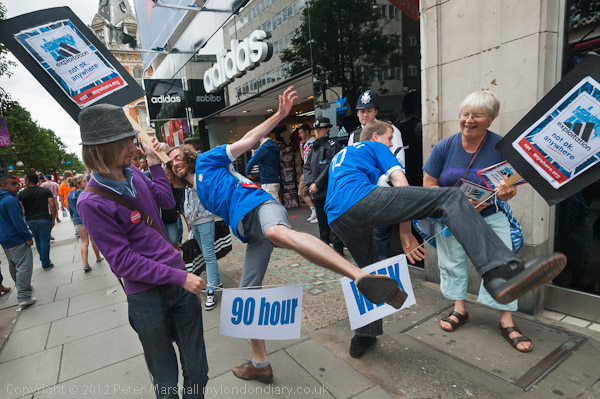
War on Want protesters moved a few yards onto a side street to continue their protest, but then came back onto Oxford Street to continue the hurdles races, with two runners making their way over the hurdles of ‘POVERTY WAGES’, ‘UNION BUSTING’ and ’90 HOUR WEEK’. The police let them play for a few minutes before telling them they had to stop as Adidas had complained – and they owned the area pavement in front of the store.
A woman from Adidas’s PR agency came to talk to me as I was beginning to take photographs and later sent me a detailed statement in which they denied War on Want’s claims but only provided any evidence based on activities in Bangladesh rather than the countries War on Want was protesting about. War on Want also published a press release giving detailed evidence on which their protest was based.
The protest was still continuing when I had to leave well over an hour after it began, with people still handing out leaflets including a freepost postcard to Herbert Hainer, the CEO of Adidas, care of War on Want, calling for Adidas to end the exploitation of workers.
Raoul Wallenberg 100th Anniversary – Great Cumberland Place
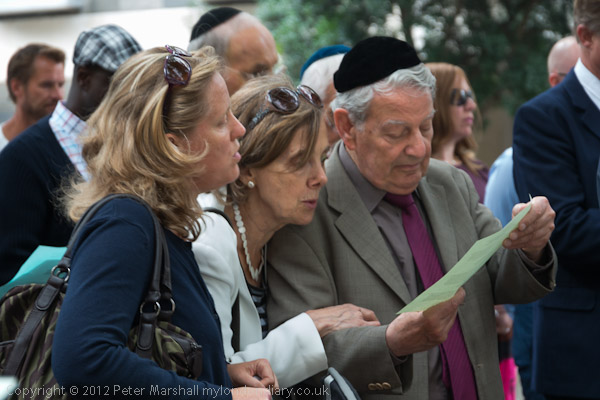
People around the world were celebrating Swedish diplomat Raoul Wallenberg who working in Budapest during the Second World War saved over 100,000 Hungarian Jews from Nazi death camps by issuing them with ‘protective passports’ identifying their bearers as Swedish subjects awaiting repatriation.
Although these had no legal status, they looked impressive and, sometimes with the aid of a little bribery, saved the bearers from deportation.
Wallenberg was born in Sweden on 4th August 1912 and was detained by Russian Security Services SMERSH during the siege of Budapest as a suspected spy on 17 January 1945 and taken to Moscow where he was most probably executed in the Lubyanka prison in 1947.
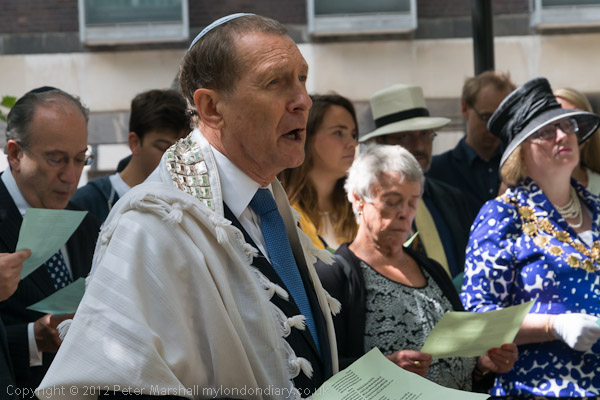
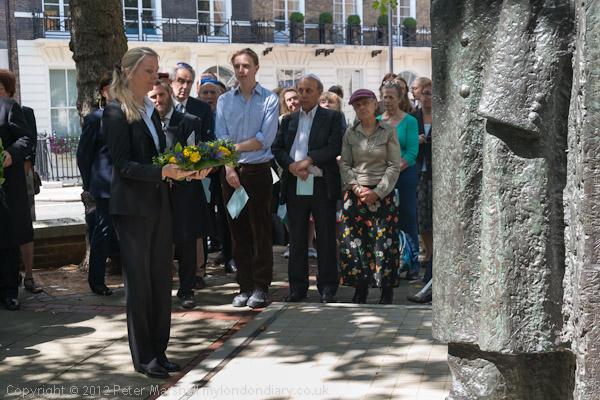
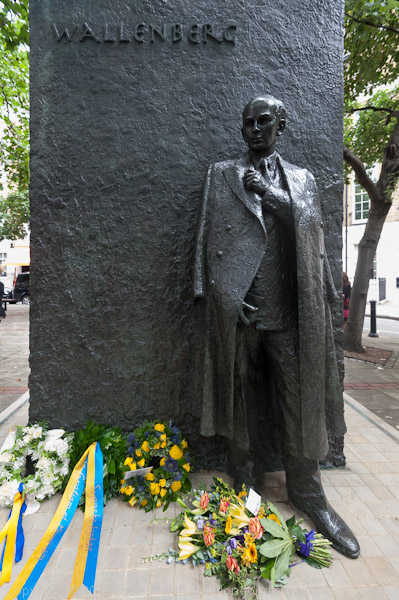
The London ceremony took place around the monument to him in Great Cumberland Place, outside the Western Marble Arch Synagogue in 1997. The statue by sculptor Philip Jackson, shows shows Wallenberg standing in front a a large wall made of stacks of the passports with his name inscribed high on it.
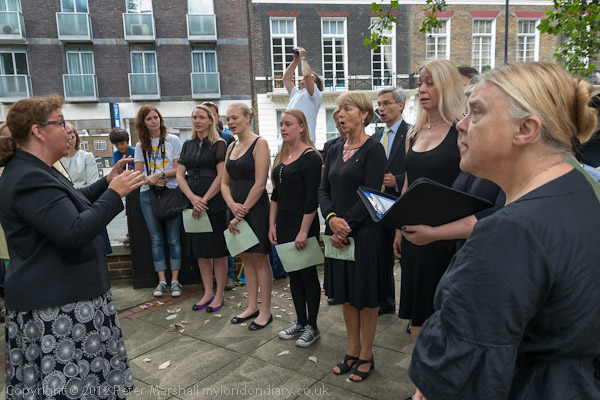
There were readings of Psalms, an address by Rector Michael Persson from the Swedish Church in London about Wallenberg, whose actions followed the Lutheran ideal of living, a calling to be yourself and to do good for other people. Wreaths were laid and there were a number of speeches with the event ending with a choir from the Swedish church singing.
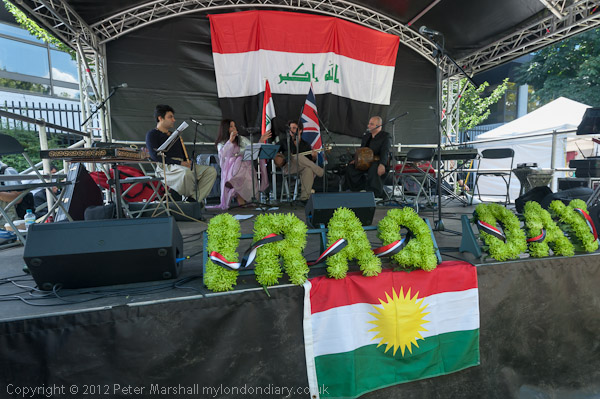
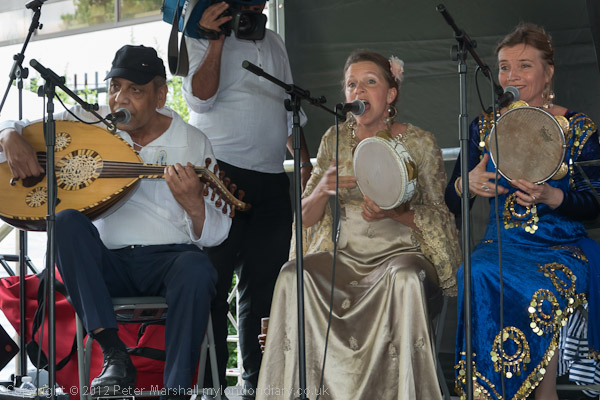
The festival had been “organized to celebrate the games with a hint of Iraq flavor” by the Iraqi Culture Centre in London and sponsored by Bayt Al Hekima- Baghdad in conjunction with Local Leader London 2012 program.
There was Iraqi music, art and food, although since it was taking place in Ramadan many of the Iraqis at the festival were fasting and unable to eat during the event.
These Kurdish musicians were told they had to leave and another group of Iraqi musicians replaced them
Although there was much of interest things didn’t go smoothly, either with the weather where there were some heavy showers or between the organisers and some of the performers.
One woman angrily stormed off the platform, furious at what she felt was cultural discrimination against the Kurds. And after I had been asked to photograph a fashion show that was to start in two minutes there was a loud and bitter argument between its director and the organisers, and an hour later when I went home it had yet to start.
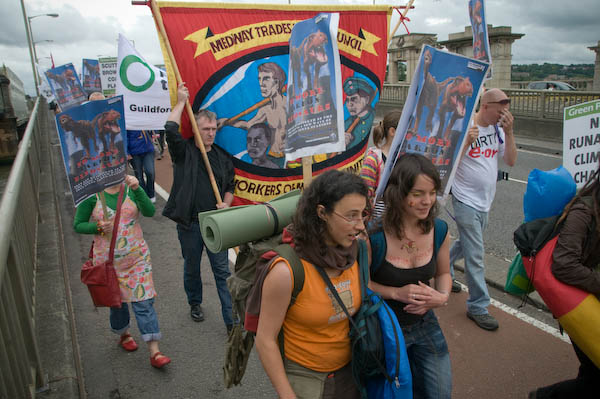
No New Coal Rally and March: On Sunday 3rd August I took a train to Rochester in Kent to photograph a rally in the town of Rochester from which people were marching to the Climate Camp was at Kingsnorth on the Hoo Peninsula in Kent where E.ON were intending to build the country’s first new coal-fired power station in 30 years.
I wasn’t able to attend the Climate Camp itself as I was leaving for Glasgow early the following morning so I left the marchers on their way to the site, seven miles away.
There was a large police presence at the rally and for the march, and later at Kingsnorth a number of protesters were arrested, with others assaulted by police who carried out a repressive action against the campers.
Press who had gone to cover the event were stopped and searchers, some multiple times and were subjected to both obvious and secret filming, as well as being pushed and shoved by police who demanded unnecessary personal information. Months later Kent Police admitted they had been wrong to film journalists, but claimed it was hard to tell them from the protesters – despite the fact that they all wore or showed the police-recognised UK Press Cards.
E.ON’s proposals to build a new and highly polluting power station at Kingsnorth had gone largely unnoticed in the media until the Climate Camp brought the issue to national attention. The over-reaction by the police helped to raise its profile, as did the trail of the Kingsnorth Six, activists arrested for causing an alleged £30,000 damage to one of the chimneys of the existing coal-fired in October 2007 and charged with criminal damage.
The activists claimed they had “lawful excuse” for their actions in that they carried it out to help prevent the much greater damage that a new coal-fired power station would cause by accelerating climate change.
Their trial heard evident from five defence witnesses, one of them Professor James Hansen, a former climate change adviser to the US White House, who stated that the social cost of emitting a tonne of CO2 was around £50. He estimated that a new coal-fired power station would cause around £1 million worth of damage per day it ran.
In truth the activists had not actually damaged the chimney significantly, but had simply painted the word ‘Gordon‘ on it, but they were acquitted in September 2008 because the jury found the damage they did to the smokestack was outweighed by the harm done to the planet by emissions from the power station.
E.ON was forced to abandon its plans largely because of the substantial public protests and criticism much of it arising from the publicity given to the Climate Camp and the trial.
The UK establishment were appalled by the verdict, and we have recently seen part of their reaction to this in the recent trial of Just Stop Oil activists who were judged to have committed contempt of court for attempting to introduce similar issues in their defence and then given draconian sentences for their peaceful protest. The law is meant to protect the interests of the rich and powerful not the planet.
You can read more about the rally in Rochester and the march towards Kingsnorth on My London Diary. One Climate Camp Caravan had started from Heathrow a week ago and another, the Stop Incineration Climate Camp Caravan had been travelling from Brighton, both demonstrating at various related sites along their routes and they met on Sunday morning in the middle of Rochester for a ‘No New Coal’ Rally attended by around 300 people.
After the rally the protesters set off to march to Kingsnorth and I went with them across the Medway and up the long hill in Strood before leaving them and returning to Strood station.
Crouch Hill & Stroud Green: My walk on Sunday 24th Sepember 1989 continued after I took a train from Blackhorse Road to Crouch Hill. Then the Gospel Oak to Barking line – apparently called by some the Goblin line was one of the least reliable in the country – perhaps it should have been called the Gremlin line. But for once a train came – and on a Sunday too!
The line is now part of the London Overground with a much improved service and in February this year was renamed the Suffragette line. It now also runs beyond Barking to Barking Riverside, though as yet there seems little reason to ever go there.
Marion Gray, Antiques, 33 Crouch Hill, Finsbury Park, Islington, 1989 89-9e-21
Almost immediately out of the station was the fine house, on the end of a rather less grand terrace on the west side of Crouch Hill. The station was opened in 1867/8 as a part of the Tottenham and Hampstead Junction Railway and this accelerated development in the area.
This house was sold in 2017 having long been converted into a ground floor nursery with three flats above. Last year it was covered in scaffolding, presumably for a major refurbishment.
Crouch Hill, Finsbury Park, Islington, 1989 89-9e-22
These shops are on the east side of Crouch Hill, immediately north of Japan Crescent and south of the railway. They still look much the same although the shops have changed and become considerably less useful.
I was attracted by the decorated brickwork, obscured on the leftmost building by some unfortunate cladding, and the curved brick partitions between the houses about the shop fronts.
At extreme right is the pub sign for Marler’s bar, opened in 1983 in a former post office. It’s a pub which has gone through a whole pile of names apprently including Hopsmiths, Noble, Big Fat Sofa, Flag, Racecourse, Tap and Spile and Brave Sir Robin. Andrew Marler was a partner of Tim Martin of Wethersppons, but the history of their collaboration appears to be dulled by alcohol and variously recorded.
Fytos Fashion at 34, Crouch Hill, Finsbury Park, Islington, 1989 89-9e-23 was one of the 20 images that was a part of my web site and book ‘1989’, ISBN: 978-1-909363-01-4, and above is the page from that.
Alley, Crouch Hill, Finsbury Park, Islington, 1989 89-9e-24
I can tell you little more about EKASA ENTERPRISE WHOLESALE DISTRIBUTOR other than the list printed here – CONFECTIONERY TOBACCO STATIONERY DRINKS GREETING CARDS MEDICINE E.T.C.
They shared the alley, reached through a carriage entrance between shops at 17 Crouch Hill, with Albert E Chapman Ltd, whose sign including also Stretchwall U K Ltd was there until at least 2011.
Bowler Products Ltd, 14-16, Crouch Hill, Finsbury Park, Islington, 1989 89-9e-25
I hoped that Bowler products Ltd made either cricket balls or hats but they were Importers and Wholesale Distributors of a whole range of goods listed on their shop front but neither of these.
Old Style Delivery, Friern Manor Dairy Farm, Stroud Green Rd, Finsbury Park, Islington, 1989 89-9e-12
According to the Hornsey Historical Society this Grade II listed building “with its seven sgraffito panels, was built specially for the Friern Manor Dairy Farm Company on the site at the rear of Hanley Road, where the company rented cowsheds and stables.” There had been a dairy here “from the middle of the 19th century, first by Davis & Co. and then by George Taylor” but this building dates from around 1889-95. The company began earlier and an inscription states ESTABLISHED AD. 1836 The artist of the seven panels and architect are unknown, though the bricks came from Tommy Lawrence of Bracknell.
The buildings were let in the 1920s to United Dairies who used them until 1968. After this they eventually in 1997 they were carefully restored to become The Old Diary pub. This closed in 2020 but was reopened in 2022.
Present Day Delivery, Friern Manor Dairy Farm, Stroud Green Rd, Finsbury Park, Islington, 1989
I photographed all seven panels, and you can find some more pictures of them on Flickr, but here I’ll just share the two, one showing ‘Old Style Delivery‘ by two milkmaids with a yoke across their shoulders carrying pails, and this one, ‘Present Day Delivery‘ with the milkman driving a horse and cart carrying large churns.
Even as far back as I can remember in the immediate post-war years our milk was delivered using an electric milk float, at first I think a trailer with the milkman walking in front with a handle to control the power and steering and later with him sitting in a cab. But I do remember a visit to the outskirts of a small town in Germany back in the 1970s where the milk cart was horse-drawn and the milkman measured out the milk using litre or half-litre jugs into the containers brought out by the hausfraus.
We still now in our suburban area get our milk delivered in bottles by a milk operative in the middle of the night driving a now silent electric vehicle.
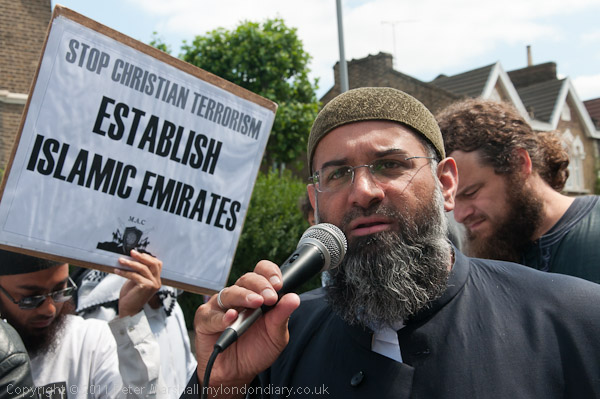
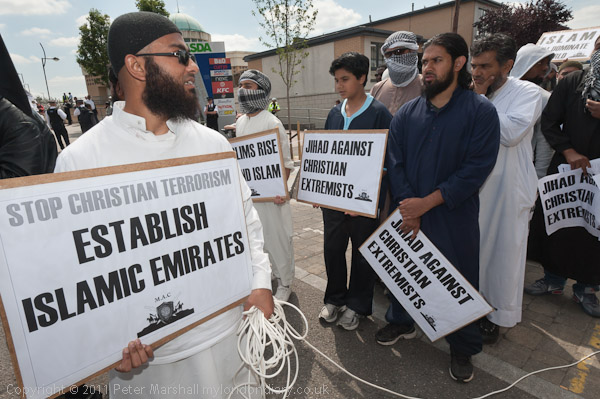
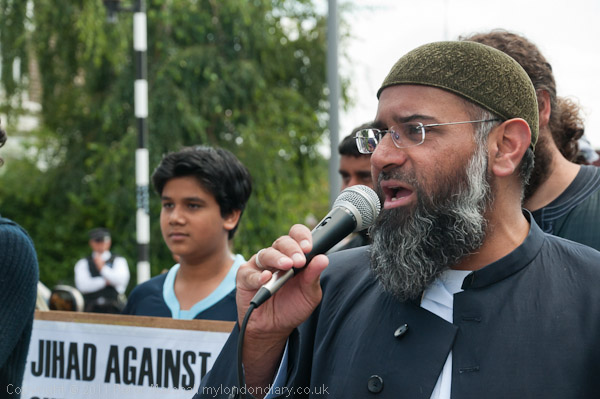
Muslim Extremists March For Sharia Zones: Today Anjem Choudary is due to be sentenced after having been found guilty of directing and encouraging support for the terrorist organisation al-Muhajiroun banned in the UK in 2005. Choudary whose home is in Ilford could face a life sentence.
The prosecution came about after a joint investigation by MI5, Scotland Yard, the New York Police Department, and Canadian police collecting evidence. His home had been bugged and online events were monitored. Police had been conducting separate investigations into his activities in the UK, US and Canada and came together leading to his trial at Woolwich Crown Court where he and a follower were found guilty last week.
Choudary had been a student of Omar Bakri Muhammad and had helped form the Islamist al-Muhajiroun organisation in Britain in 1996. This was proscribed in the UK in 2005 following the London Bombings, but Choudary carried on his activities under groups with various other names, including Al Ghurabaa, proscribed in 2006, and Islam4UK, banned in 2010.
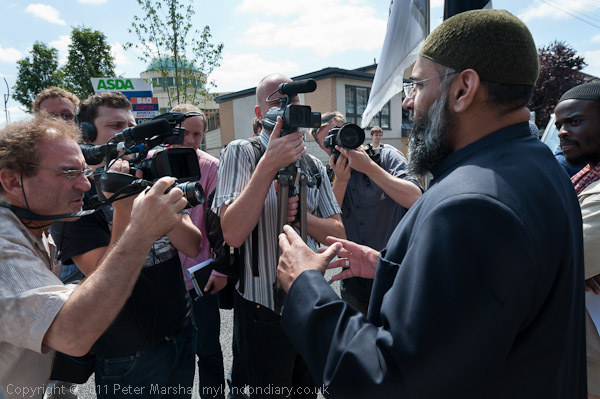
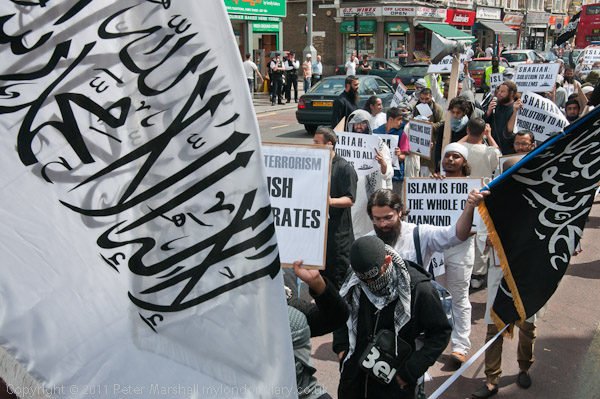
These groups carried out a number of controversial protests to gain wide media coverage, and the East London protest by Muslims Against Crusades on Saturday 30th July 2011 by around 70 men was outnumbered by the press covering it – including me.
This was one of quite a few events where I photographed Choudary, and it appeared to many of us that Choudary, if not actually encouraged by MI5 was certainly being allowed to continue his activities as a way the authorities could keep tag on Islamist activities in the UK.
I heard Choudary speaking in public and was sceptical about the claims he made about ‘Muslim Armies’ but a couple of years later ISIS made them reality. And in June 2014 or shortly after, “Choudary pledged allegiance to the Islamic State’s “caliphate,” and its “caliph” (Abu Bakr al-Baghdadi) “‘via Skype, text and phone’ during dinner at a restaurant in London.”
This was a step too far for the British state and in August 2015 he was charged under section 12 of the Terrorism Act 2000 for inviting support of a proscribed organisation and finally convicted in July 2016. He was sentenced to 5 years six months in prison.
He left prison in October 2018, but there were many conditions attached to his release and it was only in October 2021 that he was fully able to resume his campaigning online. The current conviction relates to his actions since then.
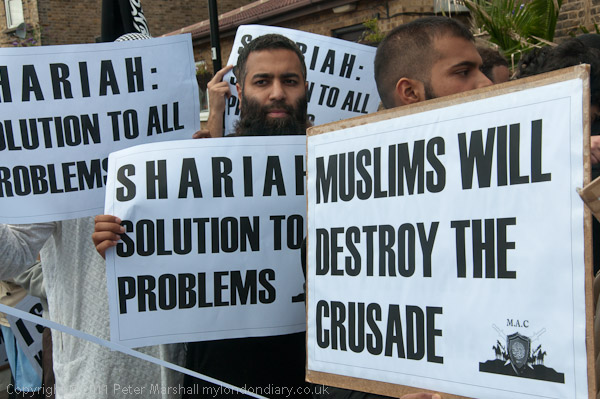
My London Diary has a long account of the march march from Leyton to Walthamstow calling for Sharia Zones by ‘Muslims Against Crusades’, calling for the setting up of Sharia Controlled Zones in the UK which ‘Islamic rules’ would be enforced by Muslims, along with many photographs.
Although the organisers had told the press there would be a thousand marchers, there were well under a hundred. And although the leaflet handed out by the marchers claimed support from a wide range of organisation, as I explained it was in fact “only supported by a very small circle of him and his fellow extremists.” Very few of the Muslims on the streets it went through showed support and rather more made clear that they were opposed.
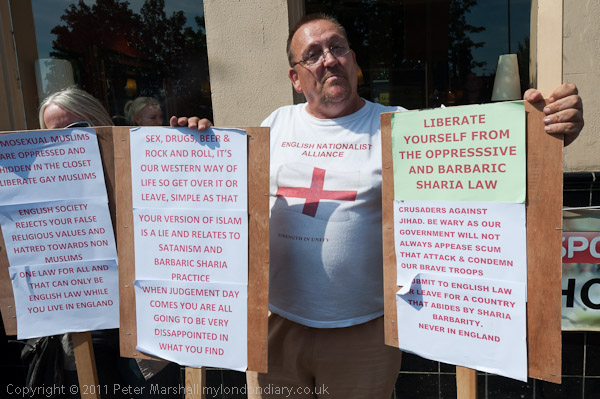
My report also has some coverage of several small counter-demonstrations by the English Nationalist Alliance and other right-wing groups, some of which were stopped by police. As the march arrived for the final rally there were some offensive shouts by some ENA supporters but their protest was otherwise peaceful.
During the final rally there were some minor scuffles in a large crowd of Muslim youths as some objected to the speeches by Muslims Against Crusades, but police moved in quickly. Some photographers close to the scene had their cameras grabbed or were pushed as they tried to photograph what was happening, but I was some distance away.
Of course there were no Sharia Controlled Zones in London, just a few notices like these put up by this small group which had no effect. But my picture was widely pirated on at least 86 web sites around the world, used by right-wing extremists to spread the myth that such things existed. DCMA requests got some of them taken down, but they just appeared elsewhere.
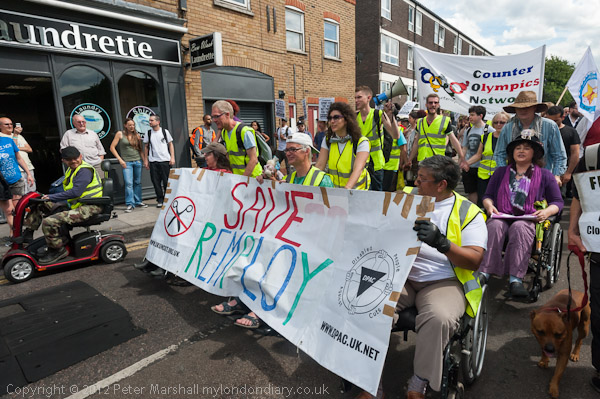
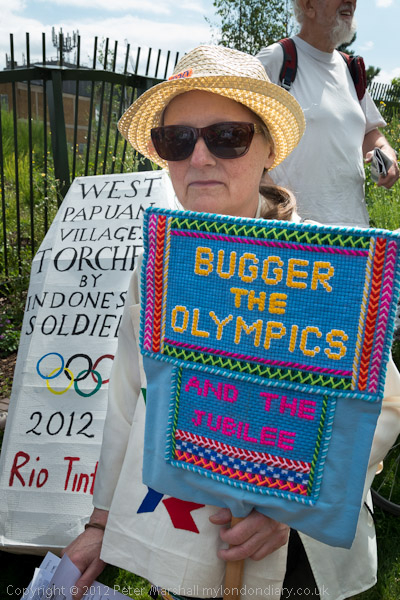
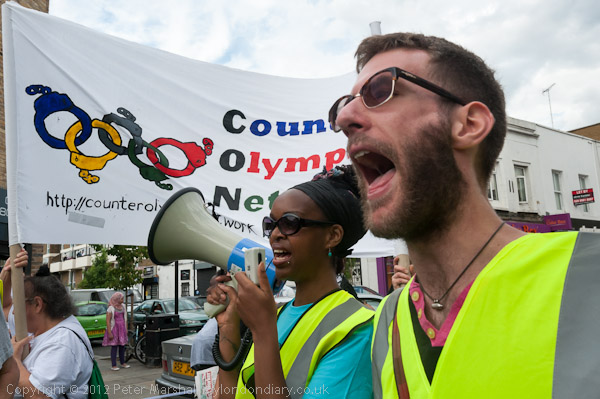
March for a People’s Olympics: Twelve years ago on Saturday 28th June 2012 the London Olympics was in full swing and London was suffering from huge restrictions on the activities of ordinary Londoners.
Although the modern Olympic movement was started in 1894 by Pierre de Coubertin with high aims it has changed over the years to something very different. He intended them to help build a peaceful and better world by educating young people through sport and stated “The important thing in the Olympic Games is not to win, but to take part; the important thing in life is not triumph, but the struggle; the essential thing is not to have conquered but to have fought well.”
Instead what we now have is a fiercely nationalistic event, with countries devoting huge resources into training a small elite of athletes and expenisve and highly detailed scientific research to find legal ways to enhance their performances – as well as at least in some countries to find ways to circumvent the tests designed to prevent the use of illegal drugs.
The games have also seen a corporate takeover to provide some of the huge sums needed to stage such events, although taxpayers have also suffered. London 2012 cost £8.77 billion, around three and a half times its original budget, around two thirds from general taxation, a quarter from the National Lottery and the remainder from the Mayor of London and the London Development Agency.
The money for the games in London meant there was less to spend in other areas or the country, and even diverted money from grass roots sport. And huge amounts were spent on infrastructure designed for the needs of a few weeks in 2012 rather than the best interests of the future for the Olympic area.
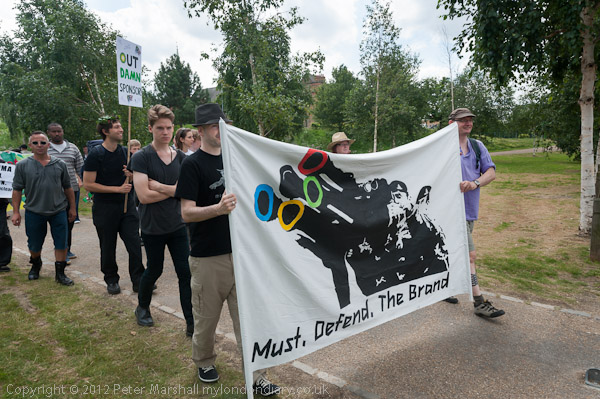
London in 2012 saw a huge military presence, in part aimed at reducing the risk of terrorist attacks and draconian policing largely aimed at the protection of the brands of the various sponsors.
The ‘Whose Games? Whose City?’ protest had at first been totally banned by the authorities as its start point was only just over 2km from the Olympic stadium. Transport for London had refused permission for them to march along roads which had been designated as emergency backup Games routes. Eventually the march organisers came to an agreement with the police that should an emergency arise the marchers would simply go on to the pavement – something that regularly happens with marches when ambulances and other emergency vehicles are allowed to pass.
The endpoint of the march, Wennington Green, was also around 2km as the crow flies from the stadium, and Tower Hamlets Council, owners of Wennington Green attempted to ban speeches or other events there.
Marchers were also threatened with arrest should they display placards, hold banners or even wear t-shirts with political slogans. But on the day there were no arrests although police did at one point stop and search a man who had cut a piece of police tape. He was released after a large and noisy crowd of marchers gathered around and demanded his release.
The attempts by the authorities to stop the march taking place had led to a great deal of media publicity and press and TV from around the world came to cover the start in Mile End Park.
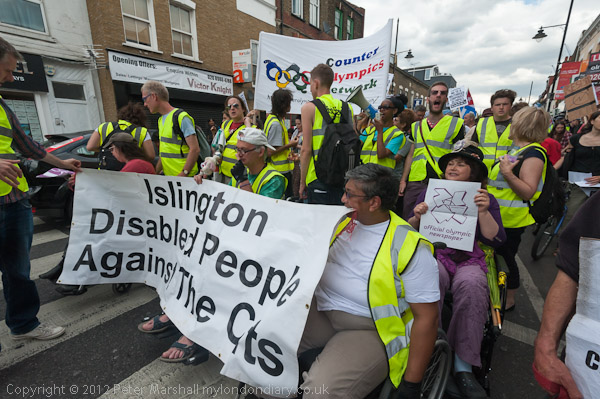
The march organisers, the Counter Olympics Network (CON) pointed out strongly that this was not an anti-Olympics march, but one that protested at the way what should be a sporting event of noble origins has been taken over by corporate interests.
They pointed out that the games sponsors included “serial polluters, companies which seriously damage the environment and which wreck or take lives, Coca Cola, Rio Tinto, BP, Dow Chemical” as well as stating “G4S, Cisco, and Atos deny people their human rights in a variety of situations while Macdonalds helps to fuel the obesity epidemic. London2012 provides benefits at taxpayers’ expense while receiving little in return.”
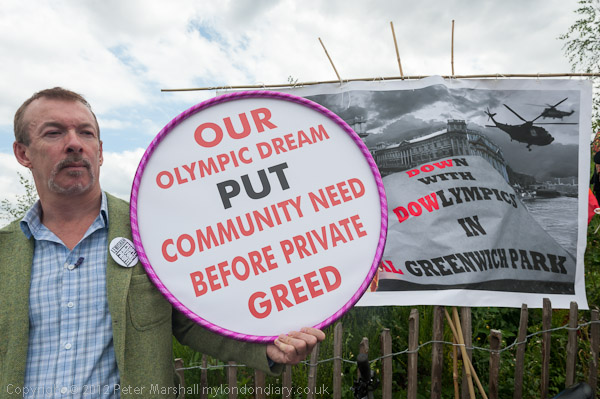
They also pointed out the many broken promises and pointed out the doubts about the legacy of the games for East London in particular: “the lack of benefits for local people and businesses, the fantastic expansion of security into our daily lives, the deployment of missiles and large numbers of troops, the unwarranted seizure of public land at Wanstead Flats, Leyton Marsh and Greenwich Park.“
As the march went past the former match factory soldiers on top of the flats watched the marchers who chanted “Hey Ho, Sebastian Coe Get your missiles out of Bow“
Another popular chant also mentioned Coe: “Seb Coe, Get Out, we know what you’re all about! Missiles, job losses, Olympics for the bosses!”
Chris Nineham of the Stop The Olympic Missiles Campaign was one of the first speakers at the final rally. He pointed out that the London Olympics had already set a number of records, including the largest ever number of arrests on the first day – including 182 cyclists taking part in a ‘Critical Mass’ ride the previous day – the highest ticket prices, the most intensive application of branding rules and the highest level of militarisation of any Olympic games, with far more being spent on security that even in China.
There were, he said, more troops in London than at any time since World War 2, and more than at any time in Afghanistan, and that it was our presence there which made us a terrorist target, calling for the immediate withdrawal of our troops.
Rev Billy, Chelsea Manning & Global Racism – On Saturday 27th July 2013 I followed the amazing Reverend Billy and the Stop Shopping Choir into a branch of HSBC to protest over their support for fossil fuels, went to a vigil supporting whistleblower Bradley (now Chelsea) Manning and then a march and rally against Global Racism and Injustice
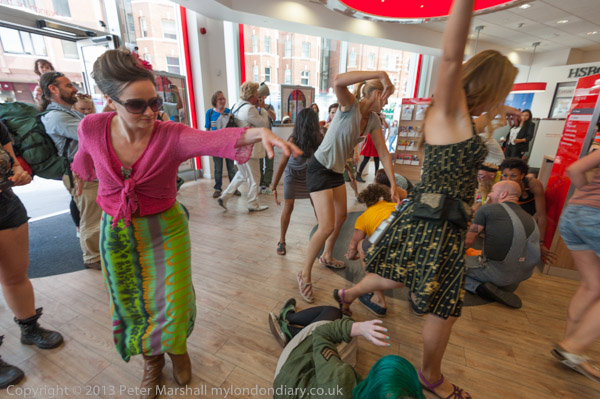
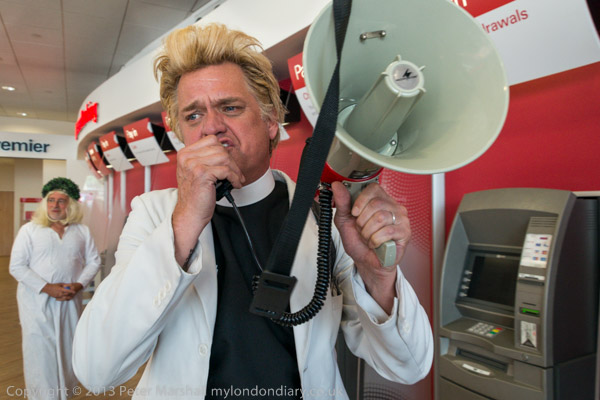
Rev Billy at HSBC Victoria,
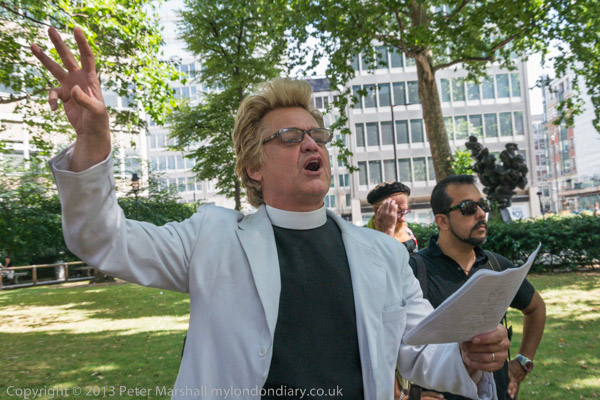
If you’ve not come across Reverend Billy and the Stop Shopping Choir, a radical performance community based in New York City led by Billy Talen you have missed something. They perform guerrilla theatre actions which amuse and entertain while also highlighting the serious problems the world is facing and calling for action.
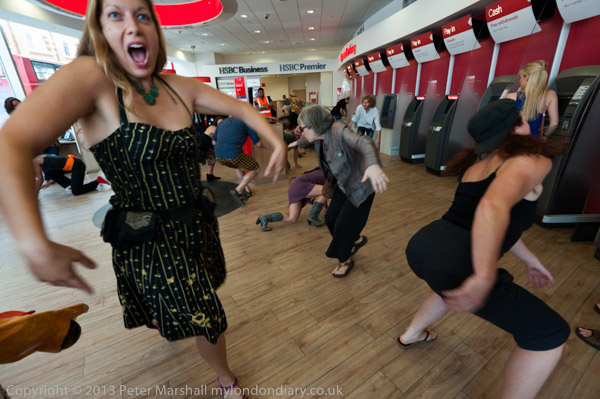
The performance in London was one of many at various JP Morgan Chase and HSBC banks in 2012 and 2013 which had begun in New York, a “radicalized midsummer cloud forest dream” against the support given to fossil fuels and climate chaos by the banks and the City of London.
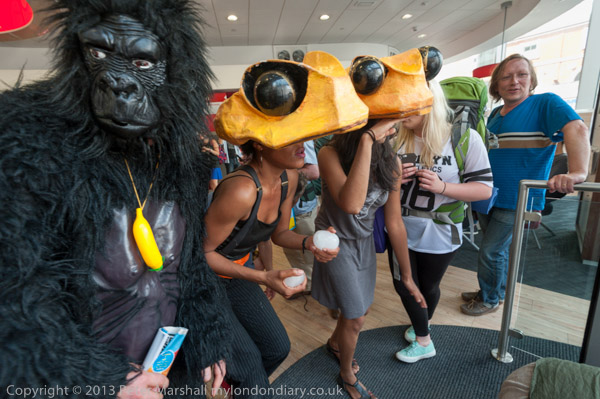
Golden Toads had become extinct in their home in Costa Rica, one of many species that have already become extinct because of climate change. The message of the performance “was a simple one. Fossil Fuels are killing life on this planet. Already many species have suffered extinction, and the continuing huge investment in fossil fuel use backed by the banks and the stock exchange is driving climate change, threatening us all with extinction.“
As I wrote “London’s banks and the London Stock Exchange are playing a key role in the destruction of life on the planet, with over £900 billion of Fossil fuel shares on the London Stock Exchange – a quarter of the value of all the holdings and representing fossil fuel reserves of over 200 time the UK’s annual carbon emissions. Burning of all these reserves would create catastrophe. Between 2010-2012 … the top five UK banks raised £170 billion for fossil fuel companies, and the largest of these was the HSBC.”
On My London Diary you can read how I met the group as they trained for the performance opposite New Scotland Yard and then more about the performance which as well as the Golden Toads people also played moneys, eagles and jaguars and were joined by a gorilla. with the Rev Billy preaching about the need for the banks to repent and change their ways as the animals dropped dead on the branch floor.
One member of the team was there to reassure the bank staff and customers that there was no threat to them or property and that the performers would leave as soon as the event finished. And they did, leaving behind only some leaflets and small pools for water on the floor from the large ice eggs the Golden Toads had brought with them to help cool the planet down.
After leaving the bank the performance carried on for a few minutes on the wide pavement outside. A couple of police officers arrived and went inside the Bank to talk with the staff, and by the time they came out the Rev Billy and others were leaving to celebrate a successful action at a café and bar in Victoria station.
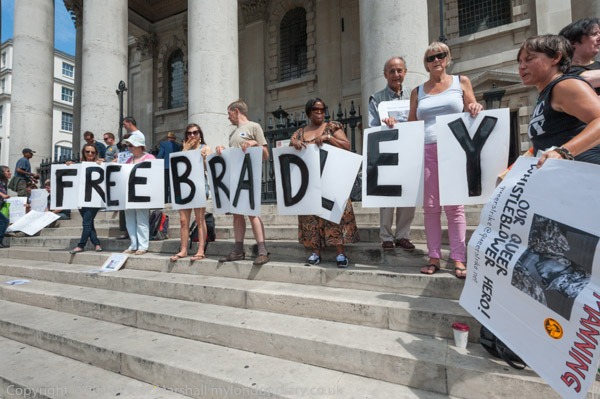
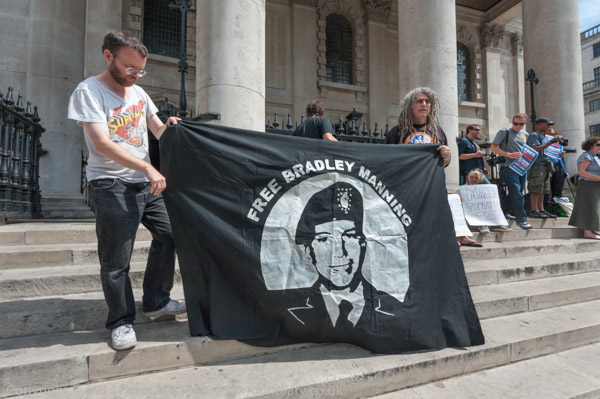
Free Bradley Manning Vigil – St Martin’s, Trafalgar Square
People were begining to arrive to take part in a silent vigil on the steps of St Martin-in-the-Fields on Trafalgar Square as a part of the international day of action by the Bradley Manning Support Network.
Bradley – now Chelsea – Manning’s court-martial for passing classified documents to Wikileaks had begun over a month earlier and an inevitable ‘guilty’ verdict was expected shortly.
The documents had exposed a great deal of illegal and immoral actions by the US and other governments and Manning had been celebrated in countries across the world and awarded the Sean MacBride Peace Prize.
On July 30th 2013 Manning was sentenced to 35 years in the maximum-security U.S. Disciplinary Barracks at Fort Leavenworth, but in 2017 her sentence was commuted by President Obama to seven years and she was released. In 2019 she was again imprisoned for a year for contempt of court after refusing to testify at a grand jury investigation into WikiLeaks founder Julian Assange.
Against Global Racism and Injustice – US Embassy to Whitehall
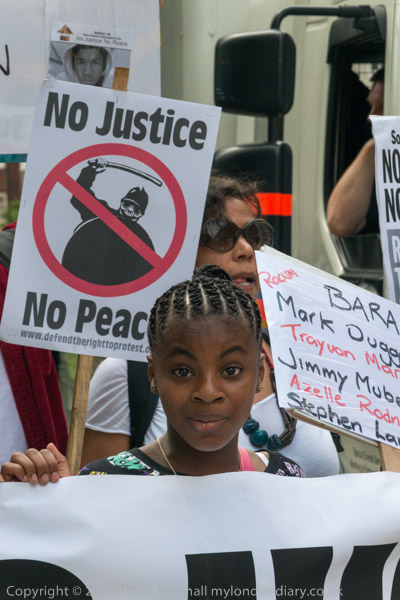
Black Activists Rising Against Cuts (BARAC) UK organised a march and rally against Global Racism and Injustice in solidarity with families of Trayvon Martin, Stephen Lawrence, Azelle Rodney, Jimmy Mubenga and many others to highlight the reality of racism and seek justice, both in the UK and US.
The event began with a rally outside the US Embassy, then still in Grosvenor Square, led by Zita Holbourne and Lee Jasper, founders and national co-chairs of BARAC, an anti-austerity, anti-racist campaigning organisation, with various other activists and poets speaking.
The event was supported by a wide range of anti-racist groups including Operation Black Vote, the National Black Students Campaign, Global Afrikan Congress, PCS, RMT Black Members, Counterfire, UAF, Love Music Hate Racism, Lambeth TUC, Lambeth People’s Assembly.
The protest was in part because of the global outcry over the acquittal in Florida of the murderer of Trayvon Martin under the Florida ‘Stand Your Ground’ law. But it was a protest against global racism and injustice, with a particular emphasis on several well-known cases in this country.
One was the attempt by the Metropolitan Police to smear both the Lawrence family and its supporters through a covert police surveillance unit while failing to properly investigate the racist murder of Stephen Lawrence.
Lee Jasper stated “We march for Jimmy Mubenga, Mark Duggan, Kingsley Burrell, Smiley Culture and Azelle Rodney. We march for justice and equality in the 50th anniversary year of Dr Martin Luther King’s 1968 March on Washington. The truth is that his dream is a threadbare vision here in the UK where racism is on the rise amplified by austerity.”