Sick Pay, Holidays And Pensions – End Outsourcing

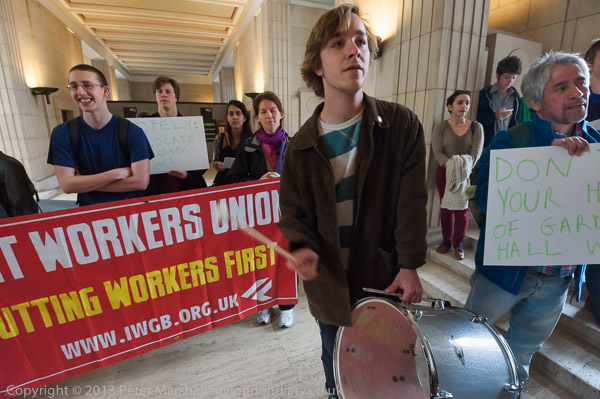
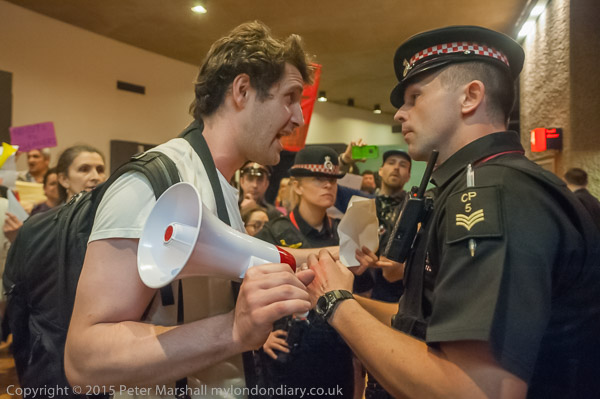
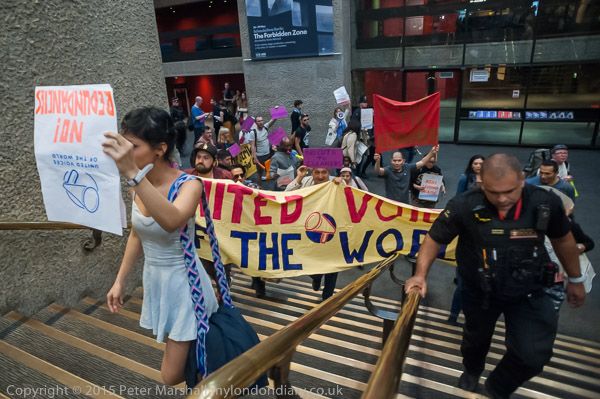
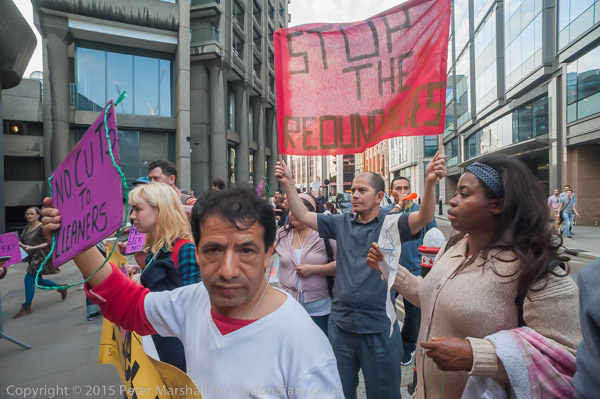
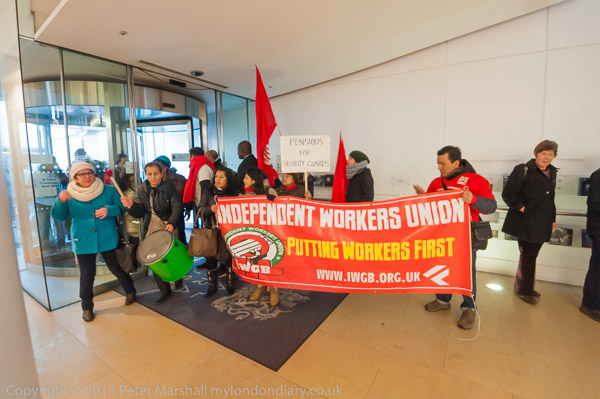
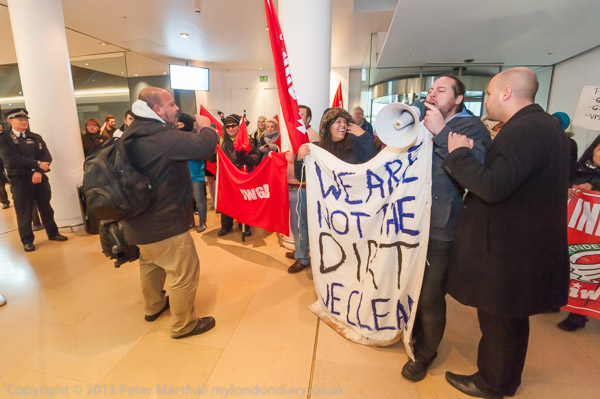
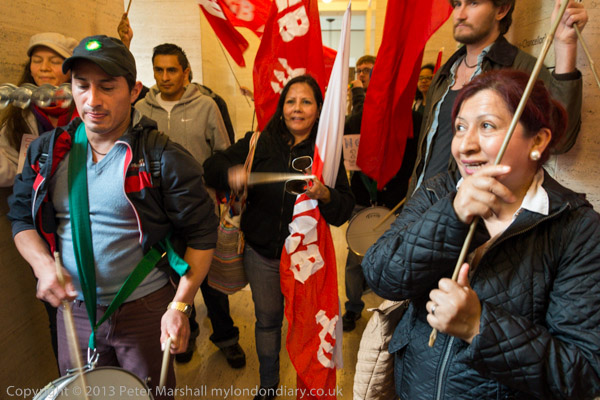
Sick Pay, Holidays And Pensions – End Outsourcing – Nine years ago on Friday 28th June 2013 I photographed a protest by low-paid workers at the University of London who with their supporters ran into the Senate House and protested noisily inside the building for sick pay, holidays and pensions for all workers at the University.

I’ve spent some time over the past few days thinking about strikes and industrial actions, partly because of the rail strikes. My local station is one of the few that still has a train service, but out of solidarity with the workers I won’t be using it on strike days, and on the days in between it is still likely to be unreliable.
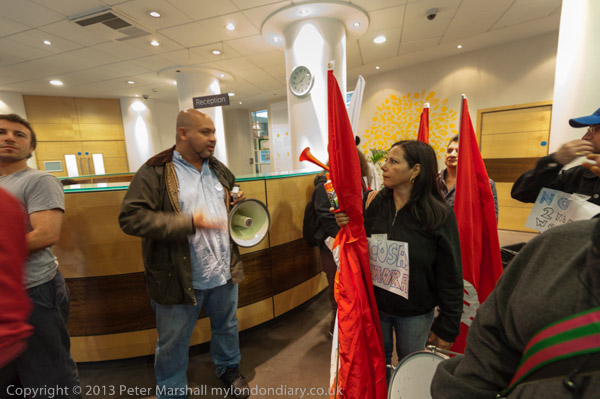
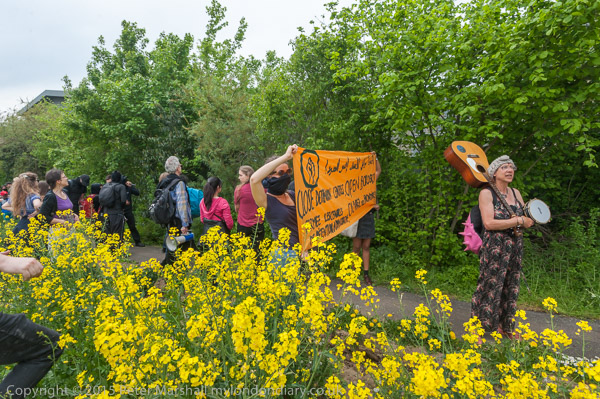
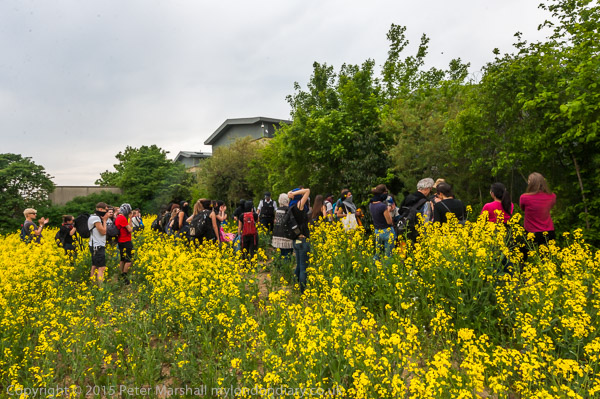
The campaigners met up at SOAS before the protest

Of course I support the strikers, many of them low paid workers and all of whom have seen the value of their wages cut over the last few years. And these have been years when for all the problems that politicians and media state many of the wealthy have got considerably wealthier – and some made huge fortunes over Brexit and profited greatly (and not always legally) over Covid. We are living in an increasingly unfair society, and with a government which despite claims about levelling up is doing its damnedest to make the rich richer while making the poor poorer.
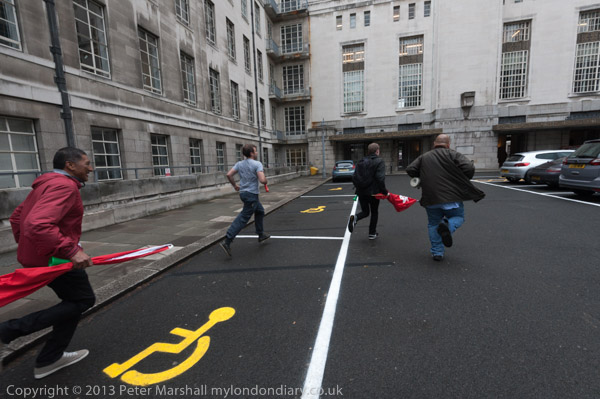
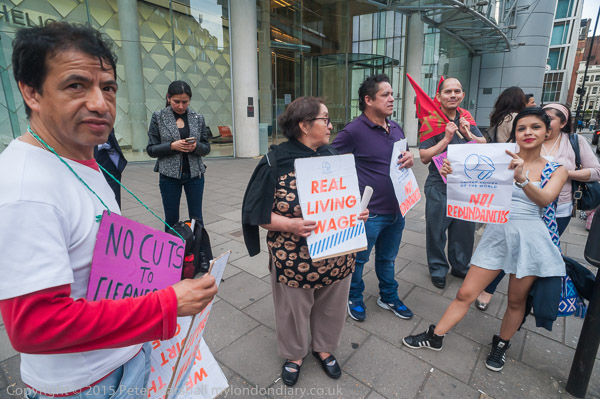
After marching quietly past university buildings they dashed towards Senate House

The government and train operating companies make much of the need to modernise the railways and I can only agree with them. We desperately need to get back to a sensible structure for running railways, to reverse the breakup of the system into small pieces, each with its highly paid management, caused by the doctrinaire privatisation of the 1990s. And yes, there are other changes which could greatly improve the system, but what the companies mean by modernisation is largely slashing the additional rates for overtime, weekend and night work. It’s ‘we’ll give you more pay if we can cut your wages at the same time’.
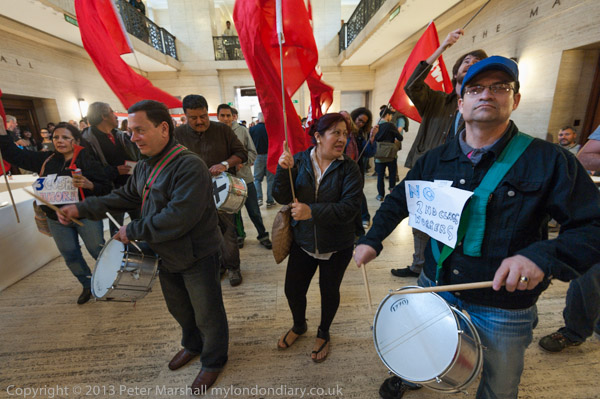
and were all inside the building before security noticed

June 28th is said to be the date on which new restrictions on the right to protest pushed through parliament in the last session come into effect. I think the protest by the IWGB on behalf of low paid workers employed by contract companies at London University on Friday 28th January 2013 would clearly have been illegal in several ways had this law been in place then. And it would be precisely those aspects that made this and most other protests over low pay effective that could have resulted in arrests.
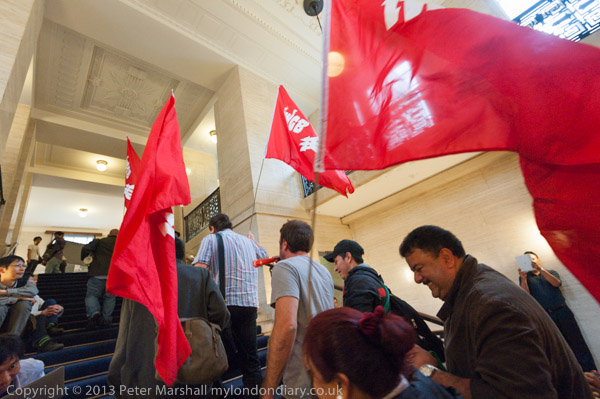
They swarmed up the stairs towards the Vice-Chancellor’s office

I don’t know how (or even if) the police will enforce the new laws. Although I think they will have little appetite to do so, there will be considerably political pressure on them. And while the large unions will worry about the huge impact legal measures would have on their funds and largely play safe, perhaps the small grass-roots unions who have been so much more effective for low paid workers will feel they have less to lose.
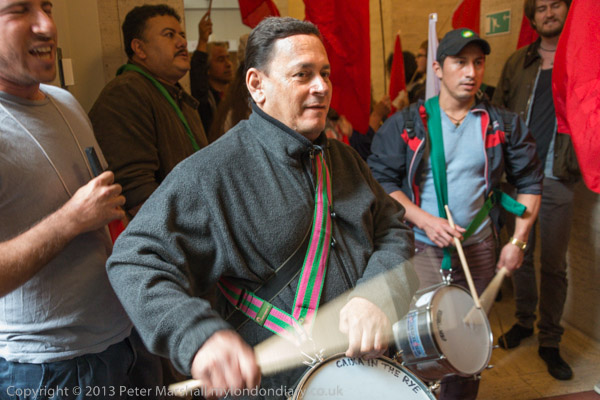
They held a noisy protest outside the Vice-Chancellor’s office

Back in 2013, the low paid workers who keep London University running were taking part in a ‘Summer of Action’, supported by the grass roots IWGB union (Independent Workers of Great Britain) and the students of the ULU (University of London Union.)
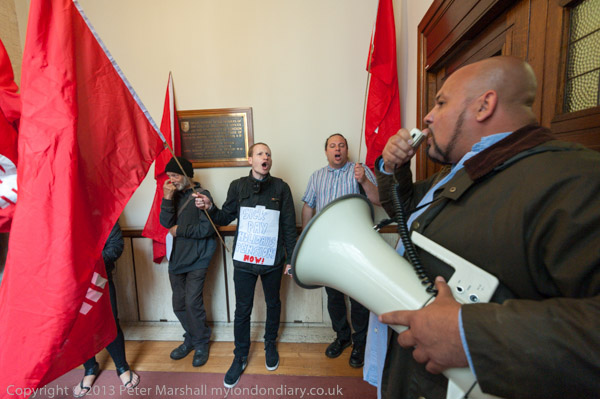
making sure he and his staff could hear why they were protesting


Many of the the cleaners, security guards and catering staff who work in the same buildings as other service staff employed by the university have brutally inferior conditions of service as they employed on behalf of the university by contracting companies who give them none of the kind or working conditions that any considerate employer would provide.
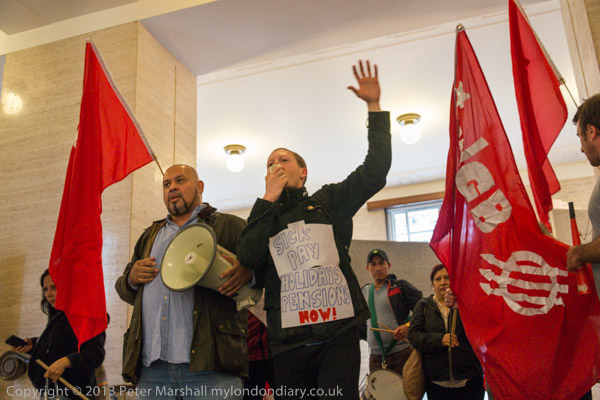
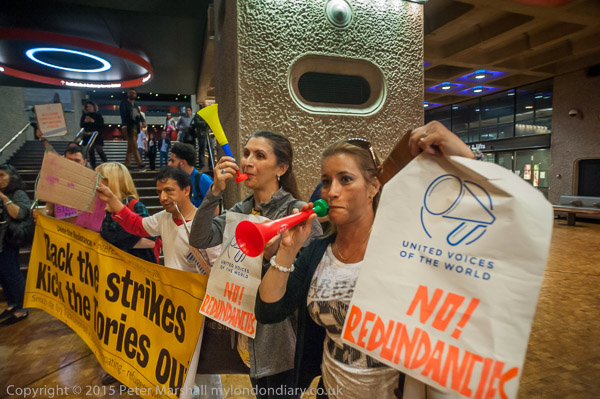
They then returned to the large lobby below to tell those attending conferences why workers were protesting.

Often they are not provided with proper safety equipment and expected to work in unsafe ways to get the job done, and may have to put up with harsh and unreasonable demands over workload, derogatory treatment and even racism from the managers employed by contract companies.
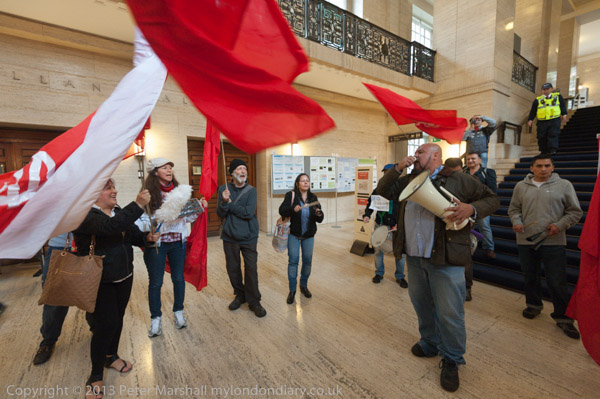
But this ‘3 Cosas’ protest was largely about three things, sick pay, holidays and pensions, on which these outsourced staff often have to fight even to get the rock-bottom statutory minimum provisions. Statutory sick pay is so low that few workers can afford to take time off when they are sick. Even at the height of Covid, many who were unwell had to drag themselves into work, putting their own health and that of others at risk to pay their rent and feed their families.
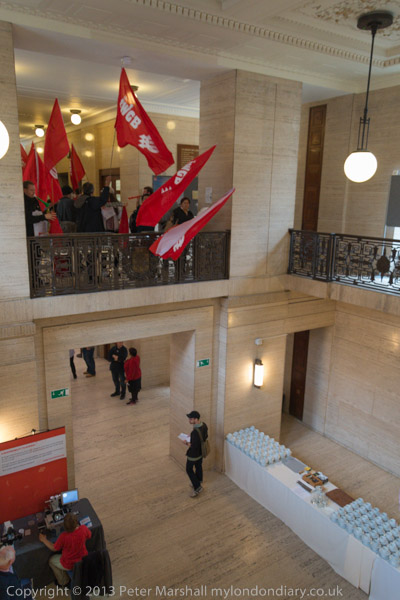
They continued a noisy protest in the lobby and its balconies for a few minutes

It took many protests such as this to persuade the University and other bodies to end the unfair outsourcing – even when studies showed there were considerable advantages in having a properly employed workforce and little if any financial loss. At SOAS, where the protesters met before the protest the Justice for Workers Campaign led by SOAS Unison branch began in 2006 and was only finally successful in 2018.
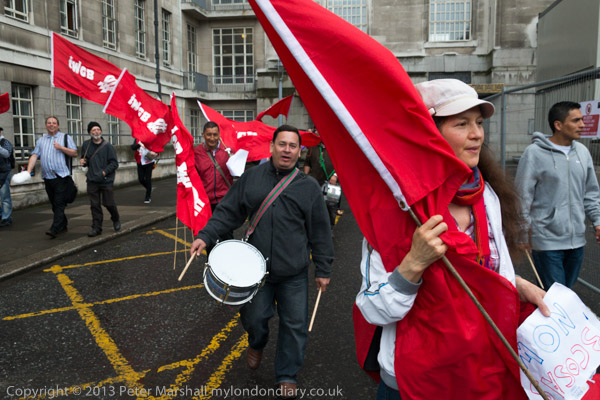
and then decided it was time to leave, pleased that the protest had gone so well.

The IWGB is still campaigning against outsourcing at University College London (UCL) and London School of Hygiene and Tropical Medicine (LSHTM) as well as other campaigns. A few days ago I photographed them outside the London offices of the world’s largest healthcare multinational Health Corporation of America (HCA) Healthcare, who run the private London Bridge Hospital, and they also support other groups of low-paid workers, including foster carers, delivery drivers, minicab drivers and cycling instructors.

More about the 3 Cosas protest at Cleaners Surprise Senate House Invasion.

City Cleaners Strike, Cyclists mourned

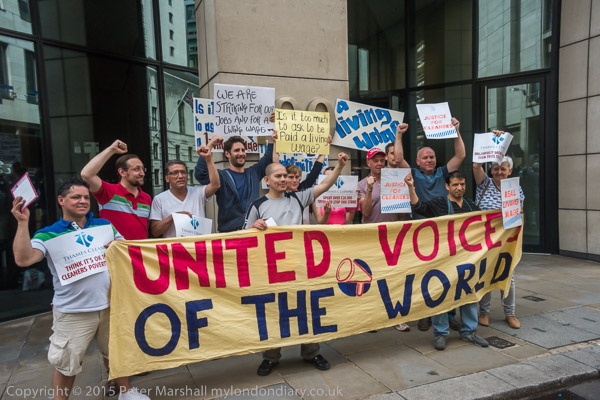
City Cleaners Strike, Cyclists mourned – A rally on Wood Street on Friday 10th June 2016 marked the third day of what became the longest strike ever in the City of London, and later at City Hall a vigil remembered 11 road users killed on London streets since the mayoral election last month, including three cyclists.


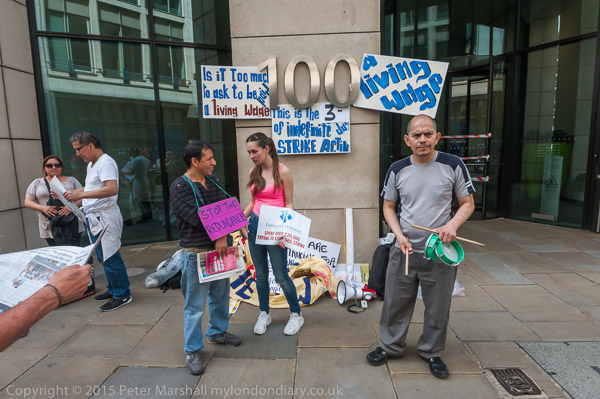
Day 3 UVW Wood St Cleaners Strike – 100 Wood St, City of London

City Cleaners Strike, Cyclists mourned

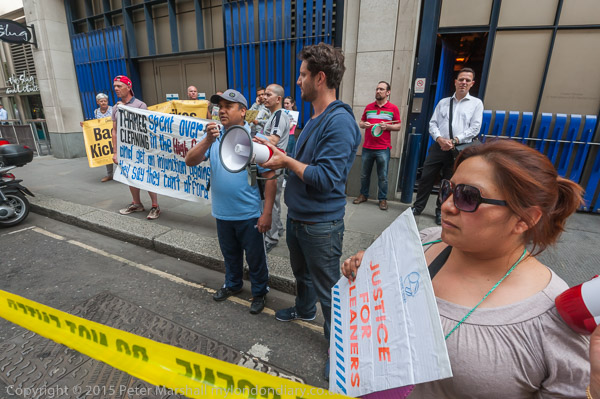
Cleaners belonging to the United Voices of the World union employed by anti-union cleaning contractor Thames Cleaning to clean the 100 Wood St offices managed by CBRE held a rally at the end of their picket on the third day of their strike.

City Cleaners Strike, Cyclists mourned
The picket

The offices there are mainly used by Schroders and J P Morgan, both large and highly profitable companies, but the cleaners are on poverty wages and several union members had been sacked and others served with notice by Thames Cleaning for organising the workers to demand a living wage.

City Cleaners Strike, Cyclists mourned
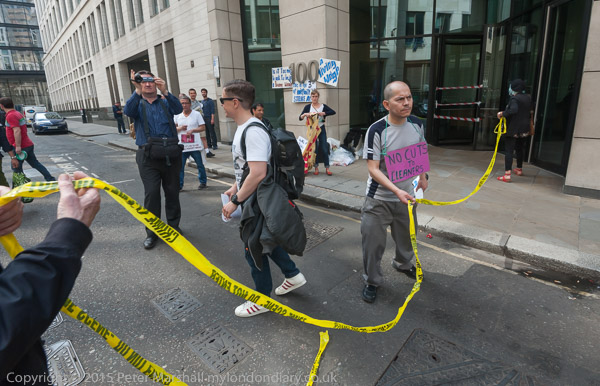
Measuring the 10m required by the injunction

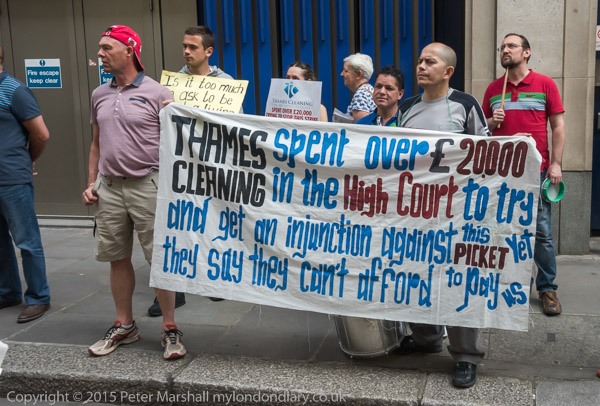
Rather than talk with the UVW, Thames’s response to the strike threat had been to spend over £20,000 in the High Court trying to get an injunction to prohibit the strikes and protests. Although the court would not stop them, they issued an injunction which set down strict conditions for the picket and protest and this left the UVW with crippling legal costs.

The UVW is a small grass roots union supported only by dues from its members and unlike the large established trade unions has little or no money to run its activities which include educational workshops as well as supporting its members in the workplace and at employment tribunals. Those who perform duties for it are paid the London Living Wage for the time spent and there are no highly paid union officials. The union had to issue an emergency appeal for cash – and received support from people and union branches across the trade union movement.

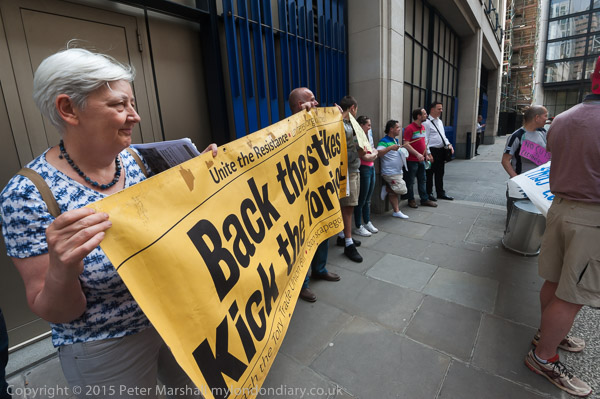
Candy Udwin, PCS Rep at the National Gallery holds a banner

One aspect of the injunction was that any protest connected with the strike had to keep at least 10 metres from the doorway of the offices. Of course picketing is covered by strict trade union laws and a lengthy code of practice that requires it to be as reasonably close as possible to the entrance and exit, and limits it to six or less clearly identified pickets with a supervisor (and possibly also a union organiser) behaving in a peaceful manner.

The protest took place over a carefully measured 10 metres away on the opposite side of the street after a picket which had begun in the early morning when the cleaners would normally have arrived for work. The strike continued for 58 days before the UVW was able to announce that a satisfactory agreement had been reached with the employer and all further action was ended.

There are four posts about the Wood Street Strike on My London Diary for June (and more in later months) :
UVW Cleaners on Strike in City
Day 3 UVW Wood St Cleaners Strike
UVW Wood St Strike Day 10
UVW Wood St Strike continues


London Traffic Deaths Vigil – City Hall

Although London had an impressive purpose-built County Hall on the south bank just downstream of Westminster Bridge, this was sold off when Margaret Thatcher vindictively disbanded the Greater London Council, leaving London rudderless for 14 critical years. After the Greater London Authority was created in 2000, it was without a proper home for two years before leasing and moving into a purpose-built oddly spherical building by Norman Foster in the misleadingly named ‘More London’ currently owned by the Kuwait sovereign wealth fund who disguise themselves as St Martins Property Investments Limited.

Many saw the move to the new building as a failure of purpose by the Labour government in noy re-acquiring County Hall for the new London-wide authority – but then Labour under Blair continued most of Thatcher’s policies rather than move away from her individualist greed-based approach towards one getting back to the social welfare which had been at the heart of post-war Labour.

London’s City Hall moved in 2022 to Kamal Chunchie Way, Newham, E16 into the former ‘The Crystal’ exhibition centre beside the northern end of London’s ‘Dangleway’ cable car, though this is expected to close fairly soon as no replacement sponsor has come up to keep it running.

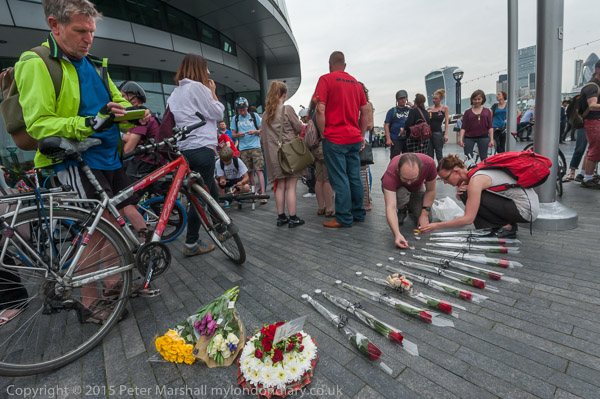
Sadiq Khan had retaken London as a Labour Mayor on May 5th 2016, with a decisive win over Conservative Zac Goldsmith and the Green candidate Siân Berry trailing badly in third place. Since then, 11 people had died on the streets of London, roughly around the average for that period in Greater London (in 2019, the total for the year was 125.)

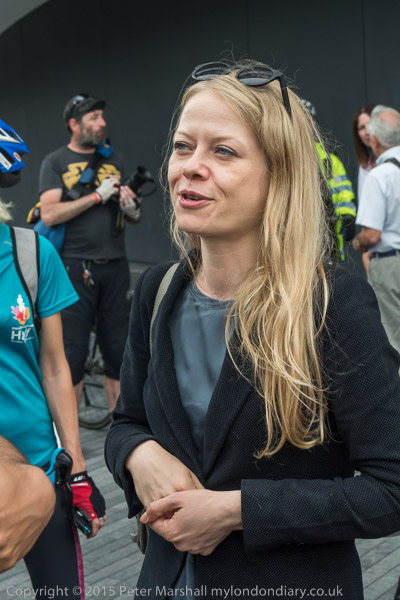
Siân Berry

Protests are – at least theoretically – not usually allowed in ‘More London’, but this one was hosted by Green Party London wide Assembly Member Caroline Russell, a member of the GLA Transport Committee and organised by London Women on Bikes (LWOB), #LondonBusWatch, Westminster Living Streets and BMX Life. Of the 11 who died, 3 were cyclists and the others were on foot.

Most road deaths are not ‘accidents’ but “happen because road users make mistakes, often made harder to avoid because of poor vehicle or road design. Many of them result from a lack of proper facilities for pedestrians and cyclists in a road system which prioritises getting motorised vehicles from A to B as fast as possible rather than safety. Some are caused by the failure of police to enforce road traffic law – for example on advanced stop lines at traffic lights.”

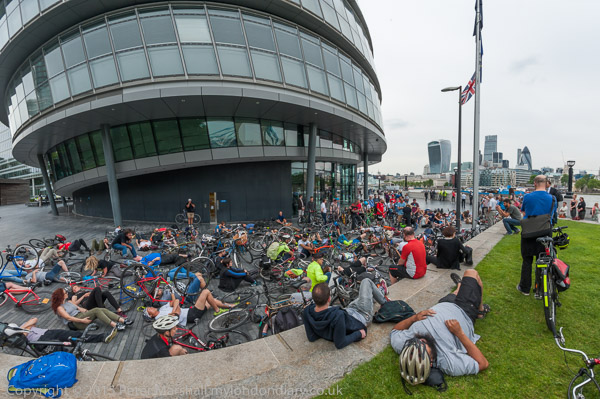
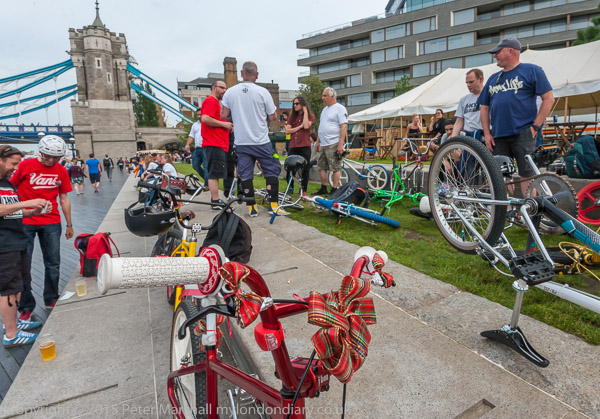
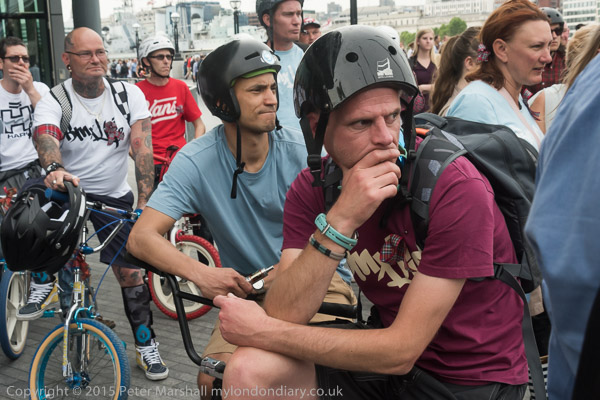
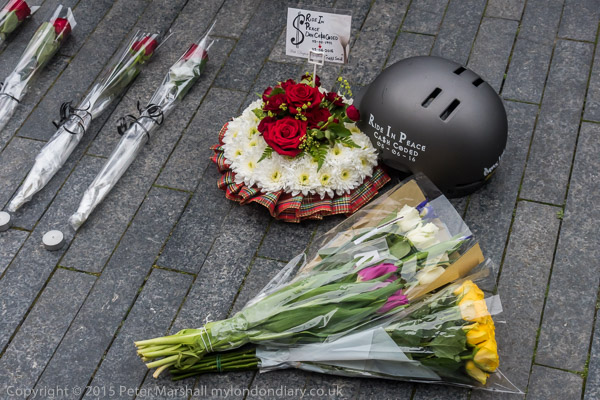
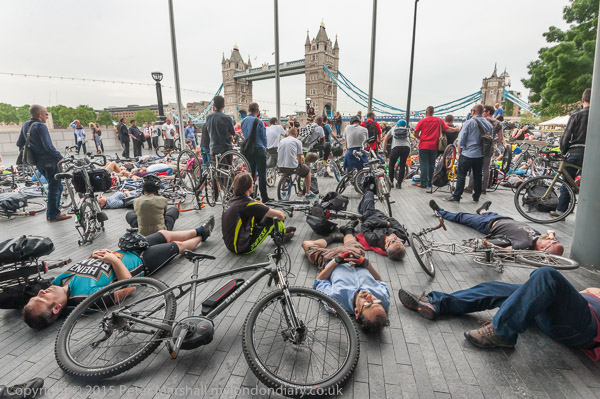
One of the cyclists killed was BMX rider Dan ‘Cash’ Stephenson, hit by a bus on the Strand during a BMX Life charity ride and many other BMX riders had come to the vigil, wearing tartan ribbons in his memory as he always rode in tartan. There were a number of speeches and then the names of those killed were read, followed by an eleven minutes of silence when those at the vigil were invited to stand in silence or to lie down, with or without bikes, in a silent ‘die-in’.

As the vigil came to an end and people were beginning to leave we were all called back for a highly emotional moment when Dan ‘Cash’ Stephenson’s daughter spoke through tears about her father.

London Traffic Deaths Vigil


Gitmo, London Uni, Ethiopia, Israel & Ukraine Miners

Gitmo, London Uni, Ethiopia, Israel & Ukraine Miners – Protests in London on Friday 23rd May 2014 included those against the continuing illegal detentions in Guantánamo, redundancies for support workers at London University, killing and human rights abuses in Ethiopia and those supporting hunger strikes in Israeli jails and strikes by miners in Ukraine.


Obama keep your promises – Trafalgar Square

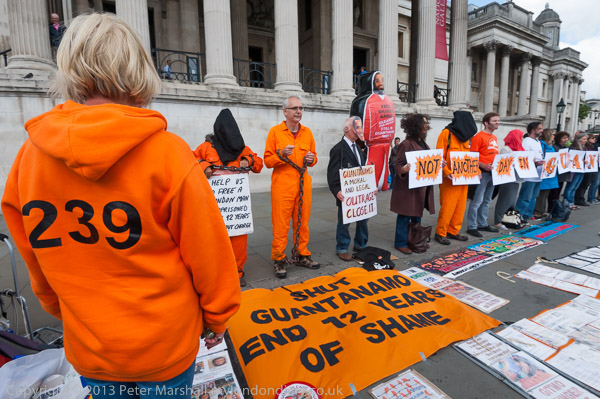
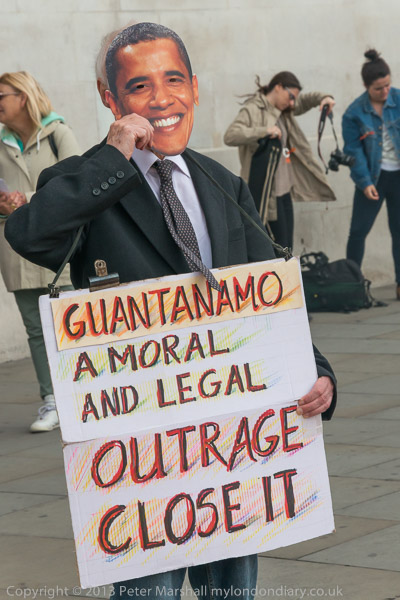
A year after President Obama again pledged to close Guantánamo, activists in black hoods and orange jumpsuits in London and 40 other cities reminded him of yet another broken promise and called for the urgent release of Londoner Shaker Aamer – prisoner 239. The protest in London was part of an international day of action coordinated by the US organisation Witness Against Torture.

In the year since Obama made the promise only 12 prisoners have been released and 154 remain, subjected to appalling conditions, beatings and daily abuse of their human rights. Former London resident Shaker Aamer’s family in Battersea include a son born a few months after his capture by bandits in Afghanistan. He was one of the first transferred to Guantanamo and has been there over 12 years, despite having been cleared more than once for release.

More at Obama keep your promises.


Defend UoL Garden Halls workers – Senate House, University of London

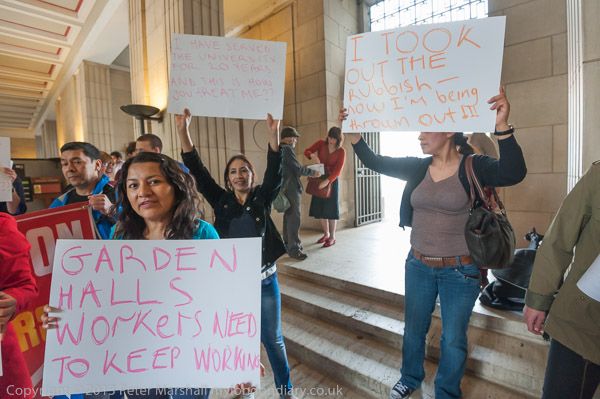
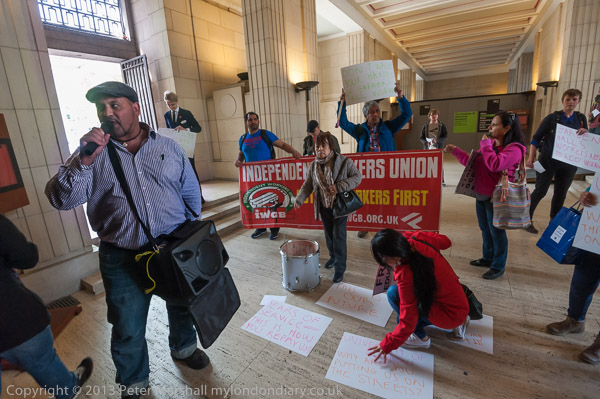
The IWGB trade union protested at Senate House, the headquarters building of the University of London demanding proper consultation and negotiation over the redundancies of 80 workers at the University of London’s Garden Halls in Bloomsbury.

Those under threat of losing their jobs include porters, cleaners and security guards and include many of those who are active in the continuing struggle for proper sick pay, holidays and pensions in the ‘3 Cosas’ campaign at London University.

Although most of the workers are members of the independent union, the Independent Workers of Great Britain, both the University and its contracted employer Cofely refuse to talk with the IWGB and recognise instead more compliant traditional unions with few if any members among the workers. The IWGB states “many of these workers have been at the University of London for decades” and “the University bears responsibility for the treatment of these workers, regardless of the fact that their roles are contracted to private companies.”

The lunchtime protest was a noisy one with with workers using a megaphone, drums, whistles and shouting to make their demands heard. They intend to come back every Friday until the end of term or until management engages in meaningful talks over the issues.

More at Defend UoL Garden Halls workers.


Oromo and Ogaden against Ethiopian killings – Old Palace Yard, Westminster

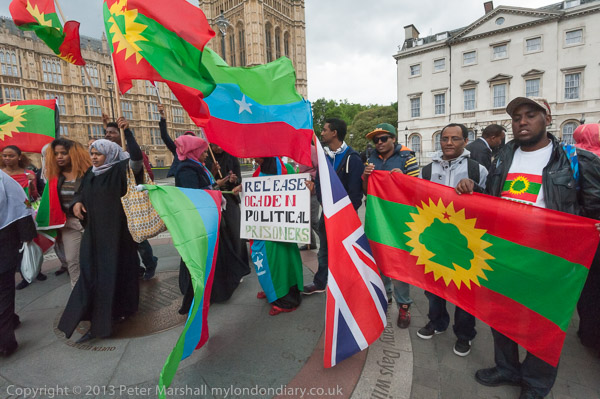
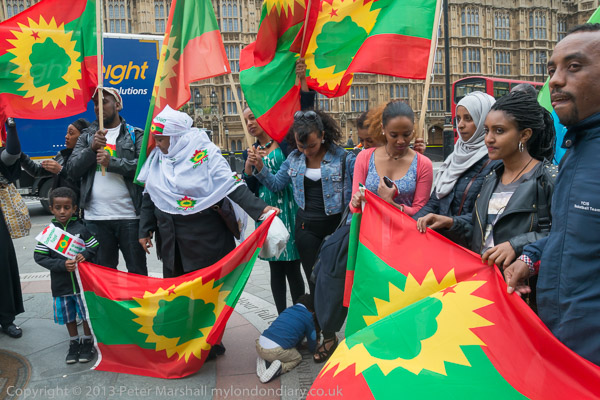
Oromo and Ogaden National Liberation Front supporters had come to protest opposite Parliament over the Ethiopian government’s killing of Oromo university students peacefully protesting the grabbing of Oromo land and calling for the release of political prisoners.

There are around 30 million Oromo living in Ethopia and adjoining areas of Somalia and they are the Largest ethnic group in the country; their language is Africa’s third most widely spoken. There were a number of democratic kingdoms in the area before they were conquered in the late nineteenth century by Abyssinian emperor Menlik II, aided by the European colonial powers and their modern weapons. Around half the Oromo are said to have been killed in these wars and since then successive regimes have made determined attempts to destroy Oromo identity – its language, culture, customs and traditions.

This oppression continues, now with the help of the US government who since 9/ll have worked with the Ethopian government as part of their worlwide fight against “terrorism”, according tto BBC Newsnight and and the Bureau of Investigative Journalism “using billions of dollars of development aid as a tool for political oppression” with programmes of deliberate starvation of communities, and “of mass detentions, (and) the widespread use of torture and extra-judicial killings.

More at Oromo and Ogaden against Ethiopian killings.


Support Hunger Strike in Israeli Jails – G4S HQ, Victoria St

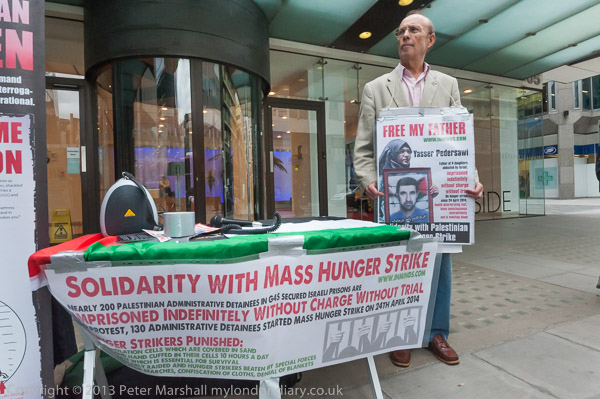
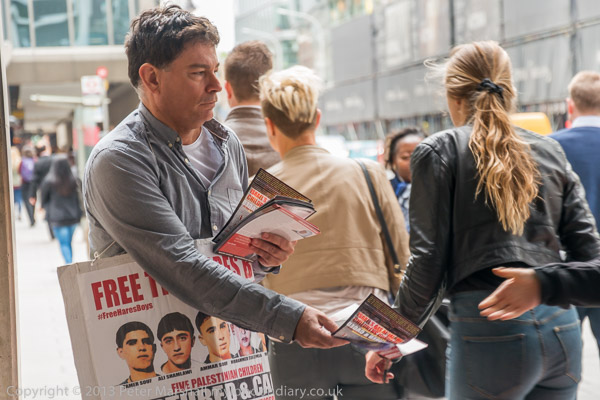
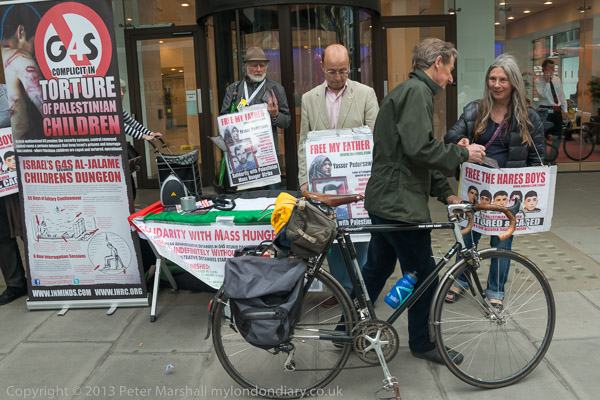
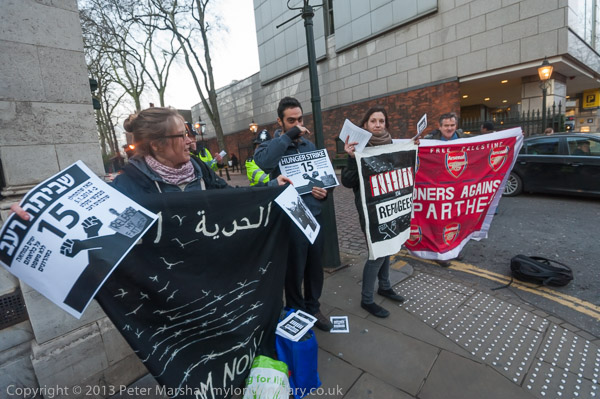
Protesters outside the London HQ of security firm G4S supported the mass hunger strike by Palestinians demanding an end to Israels’s illegal policy of rolling Administrative Detention which can jail them for years without charge or trial in prisons which G4S secures.

The hunger strike by Palestinian prisoners had begun a month earlier with 134 detainees taking part. Israel uses administrative detention to imprison Palestinians indefinitely without charge or trial, using rolling detention orders of 1-6 months which are renewable indefinitely in defiance of international law.

The detention orders are based on “secret evidence” which neither those detained or their lawyers have any right to see, and in the years up to 2014 there had been around 2000 made each year. Those given them include 9 Palestinian MPs. Often when released from one order detainees are immediately re-arrested on another.

Those taking part in hunger strikes included 34 years old Ayman Al-Tabeesh who has spent over 10 years in Israeli prisons. He began his second hunger strike in February 2014 and 70 days later had lost over 25kg; at the time of this protest he had been advised after 85 days that he was at grave risk of a heart attack. His brother had sent a message of support to the protesters for their earlier protest in support of the hunger strikers stating “We need you to tell the international community of Israel’s criminal brutality against our prisoners, the violation of their rights. The occupations illegal never ending administrative detention orders is nothing less than a slow death for Palestinian prisoners.”

More at Support Hunger Strike in Israeli Jails.


Solidarity with Ukrainian Miners – Holborn

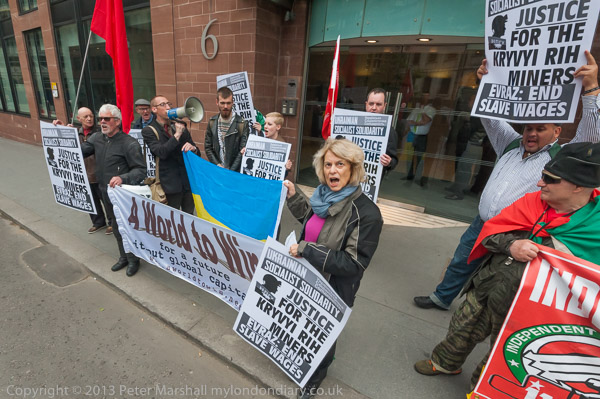
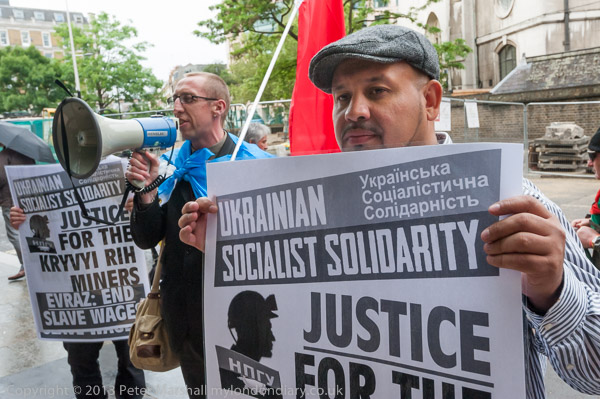
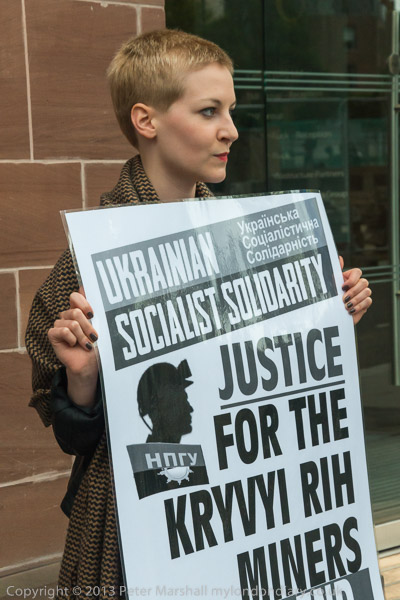
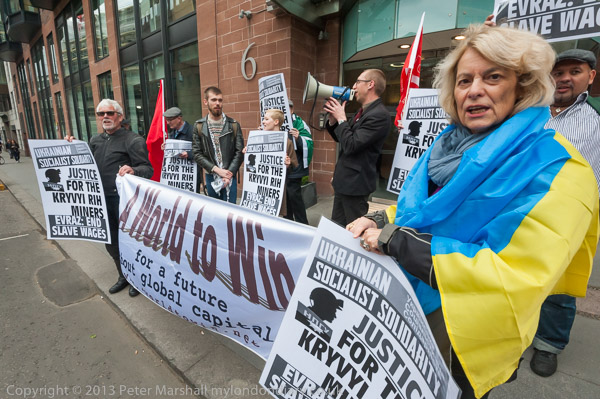
A protest outside the registered offices of London mining company Evraz, owned by Russian Oligarchs Roman Abramovich and Alexander Abramov, supported miners in the Independent Union of Miners of Ukraine who had ensured peace and unity at Kryviy Rih and were striking to maintain real wages.

Kryviy Rih is a city in south-east Ukraine, at the centre of the largest steel industry in Eastern Europe with a population of around three-quarters of a million people. Protests there in 2014 demanded “Putin, Get Out!” and supported the Ukrainian government against the Russian separatists in Ukraine, with the Independent Union of Miners of Ukraine organising to defend the protests there.

The miners were striking for a doubling of wages to meet the rapid rise in the cost of living which has meant a 30-505 drop in real wages. They were angered after a 20% increase promised the previous month was not paid. The Miner’s union state “We are deeply convinced that the main cause of the destabilised situation in the country is the greed of Ukrainian and Russian oligarchs, who pay a beggar’s wage to workers, send all their profits off-shore and don’t pay taxes in Ukraine. In fact the oligarchs are almost completely exempt from taxes on their profits.”

On 11th May 2014 the miners had marched through the streets of Kryvyy Rih to protest at the offices of the mining company EVRAZ and had called for support in London where the company, owned by Russian Oligarch Roman Abramovich, along with his business partner Alexander Abramov, is based. The protest in Holborn was one of a number including at the registered office of the company in the City of London, at Chelsea Football Ground and elsewhere. This year, after the Russian invasion of Ukraine the British government accused the company of “providing financial services or making available funds, economic resources, goods or technology that could contribute to destabilising Ukraine” and after sanctions were applied to Abramovich the trading of Evraz shares on the London Stock Exchange was suspended.

In April 2022, Russian forces were around 60km from the city, but the ArcelorMittal Kryvyi Rih steel plant which had closed down all of its four blast furnaces at the start of the Russian invasion restarted production with one furnace in early April, though hampered by the loss of around 94% of their staff to military duties or by evacuation.
More at Solidarity with Ukrainian Miners.


Holloway, Nakba, Refugees & Topshop

Holloway, Nakba, Refugees & Topshop – Six years ago, the 14th May 2016 was also a Saturday, and like today there was a protests for Nakba Day, the ‘day of the catastrophe’, remembering the 80% of Palestinians forced to leave their homes between December 1947 and January 1949, but also several others on the streets of London which I covered.


Reclaim Holloway – Holloway Road

Holloway, Nakba, Refugees & Topshop

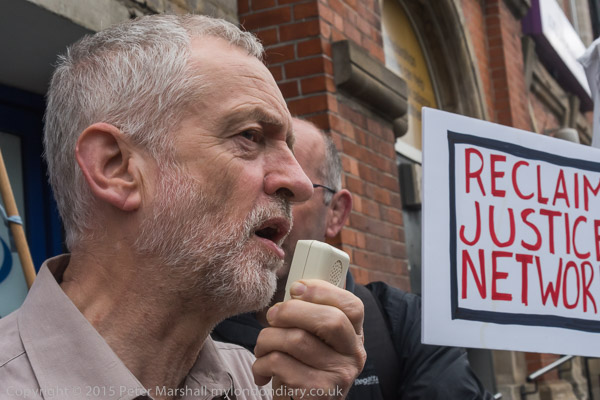
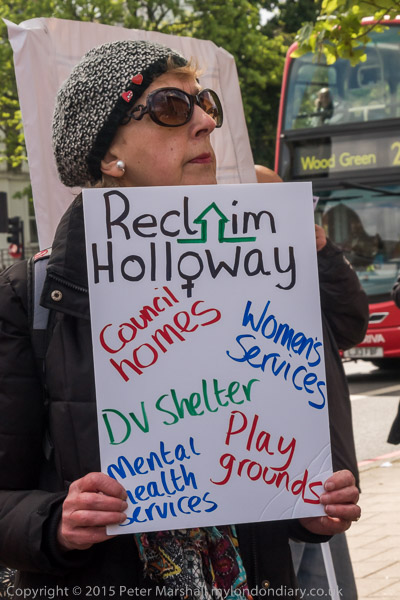
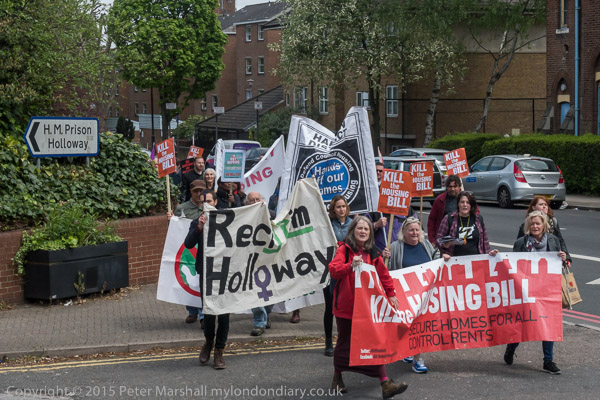
Local MP and Labour Party leader Jeremy Corbyn spoke outside London Met on Holloway Rd at the start of the march by Islington Hands Off Our Public Services, Islington Kill the Housing Bill and the Reclaim Justice Network to HMP Holloway demanding that when the prison is closed the site remains in public hands, and that the government replace the prison with council housing and the vital community services needed to prevent people being caught up in a damaging criminal justice system.

Holloway, Nakba, Refugees & Topshop

A group of around a hundred then marched from there to Holloway Prison, apparently already largely emptied of prisoners, and held a long rally there with speeches by local councillors, trade unionists and campaigning groups. Islington Council would like to see the prison site and adjoining housing estate then owned by HM Prisons used for social housing rather than publicly owned land being sold for private development.

Holloway, Nakba, Refugees & Topshop

The Ministry of Justice sold the site to housing association Peabody for £81.5m in 2019 and their plans include 985 homes and offices, with 60% of so-called affordable housing as well as a women’s building with rehabilitation facilities reflecting the site’s history. The development stalled in February 2022 with Peabody saying they were unable to afford the money needed to fit out the women’s centre.

Reclaim Holloway


68th Anniversary Nabka Day – Oxford Street

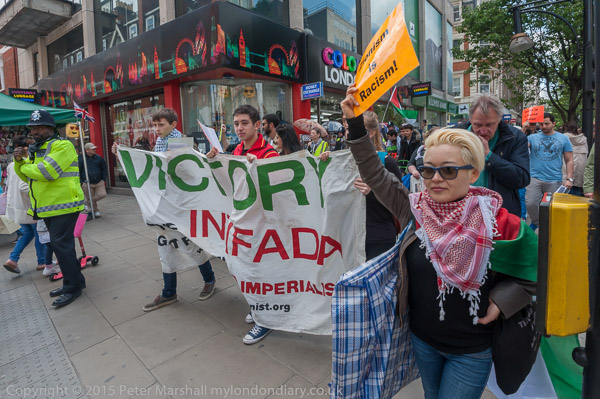
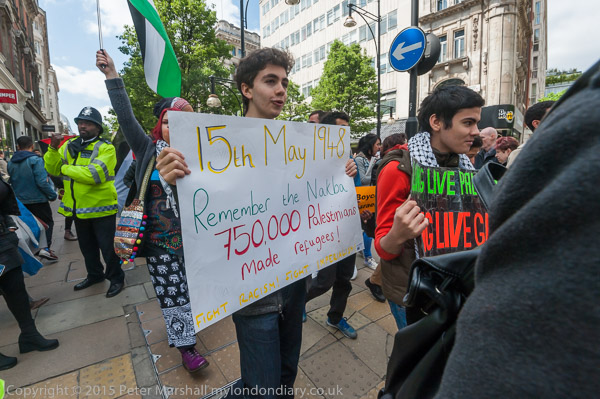
Protesters made their way along Oxford St from their regular Saturday picket outside Marks & Spencers, handing out leaflets and stopping outside various shops supporting the Israeli state for speeches against the continuing oppression of the Palestinian people and attempts to criminalise and censor the anti-Zionist boycott, divestment and sanctions (BDS) movement.

Nabka Day, the ‘day of the catastrophe’ remembering the 80% of Palestinians forced out of their homes between December 1947 and January 1949 is commemorated annually on May 15th, but the protest was a day earlier when Oxford Street would be busier. The Palestinians were later prevented by Israeli law from returning to their homes or reclaiming their properties, with many still living in refugee camps.

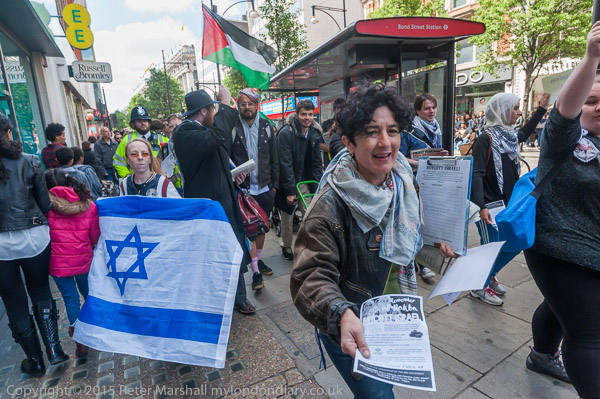
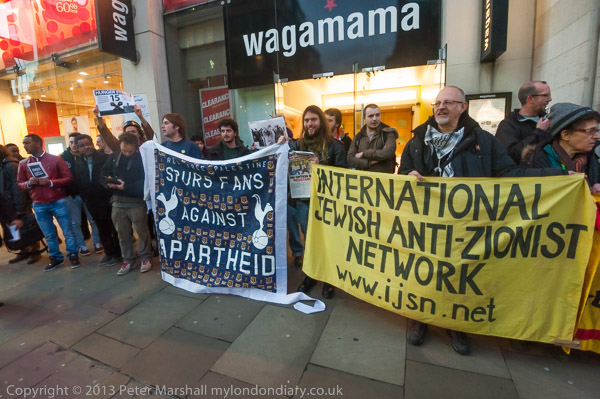
The protesters included a number of Jews who are opposed to the continuing oppression of the Palestinians by the Israeli government. A small group of counter protesters shouted insults and displayed Israeli flags, accusing the protesters of anti-Semitism but the protest was clearly directed against unfair and illegal policies pursued by the Israeli government rather than being anti-Semitic. The counter-protesters tried unsuccessfully to provoke confrontation, standing in front of the marchers and police had at times to move them away.

68th Anniversary Nabka Day


Vegan Earthlings masked video protest – Trafalgar Square

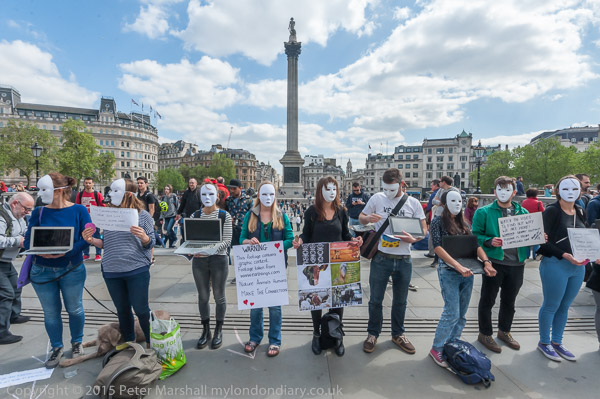
Vegans wearing white masks stood in a large circle in Trafalgar Square holding laptops and tablets showing a film about the mistreatment of animals in food production, bullfighting, etc. The protest was organised by London Vegan Actions and posters urged people to stop eating meat to save the environment and end animal cruelty.

Vegan Earthlings masked video protest


Refugees Welcome say protesters – Trafalgar Square

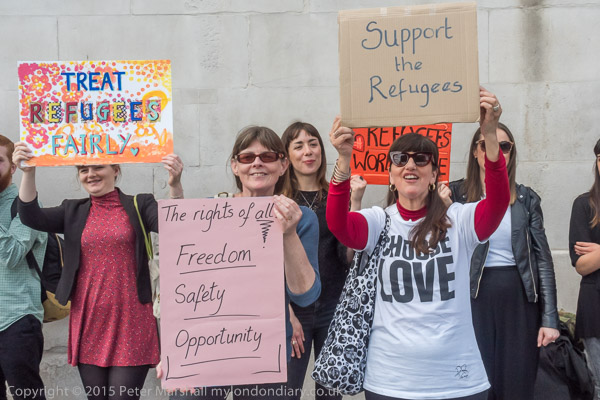
Another small group of protesters stood in front of the National Gallery held posters calling for human rights, fair treatment and support for refugees. Some held a banner with the message ‘free movement for People Not Weapons’.

Refugees Welcome say protesters


Topshop protest after cleaners sacked – Oxford St

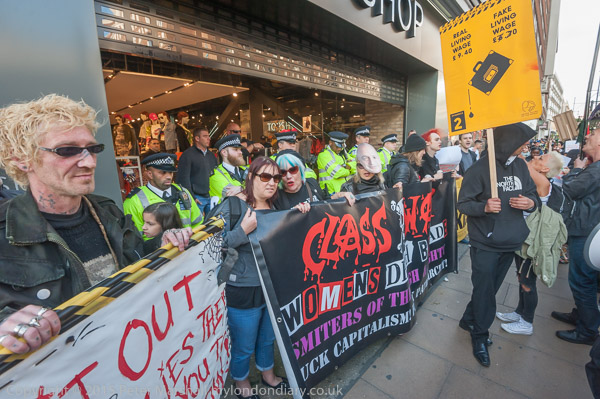
Finally I was back on Oxford St where cleaners union United Voices of the World (UVW) was holding one of protests outside Topshop stores around the country following the suspension of two cleaners who protested for a living wage; one has now been sacked. Joining them in the protest were other groups including Class War, cleaners from CAIWU and other trade unionists including Ian Hodson, General Secretary of the BWAFU and Shadow Chancellor John McDonnell.

Shadow Chancellor John McDonnell, MP and Ian Hodson, Baker’s Unions General Secretary outside Topshop

The Oxford Street Topshop was heavily defended by police, as well as by illegal extra security guards wearing no ID. Several hundred protesters held up banners and placards and with the help of the police blocked the entrance to the shop, though the protesters made no serious attempt to enter the building.

Jane Nicholl of Class War poses on a BMW as they block Oxford Circus

After a while some of the protesters, led by the Class War Womens Death Brigade, moved onto the road, blocking it for some minutes as police tried to get them to move. The whole group of protesters then moved to block the Oxford Circus junction for some minutes until a large group of police arrived and fairly gently persuaded them to move.

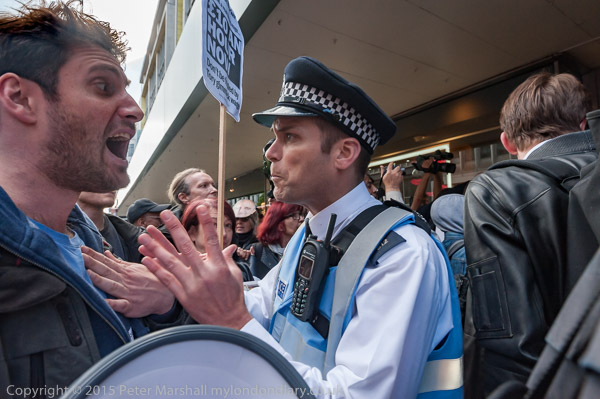
UVW’s Petros Elia argues with a police officer outside John Lewis

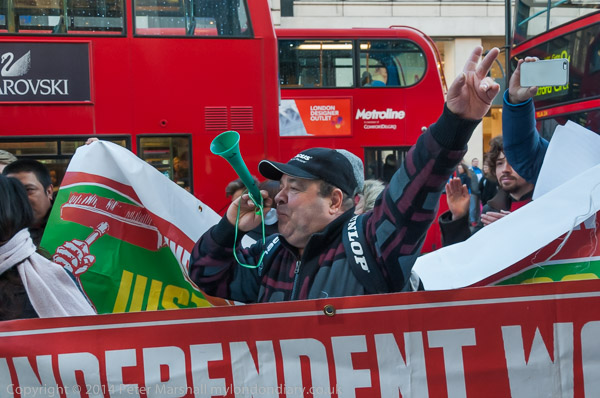
They moved off, but rather than going in the direction the police had urged them, marched west along Oxford St to John Lewis, where they protested outside the entrance, where cleaners have a longstanding dispute. The cleaners who work there are outsourced to a cleaning contractor who John Lewis allow to pay low wages, with poor conditions of service and poor management, disclaiming any responsibility for these workers who keep its stores running.

There were some heated exchanges between protesters and police but I saw no arrests and soon the protesters marched away to the Marble Arch Topshop branch to continue their protest.

Topshop protest after cleaners sacked


End Indefinite Detention, Don’t Sack Cleaners

End Indefinite Detention, Don’t Sack Cleaners – two protests I photographed on Saturday 7th May 2016, one on the edge of London and the other in the centre.


Detention Centres Shut Them Down – Harmondsworth, Saturday 7th May 2016

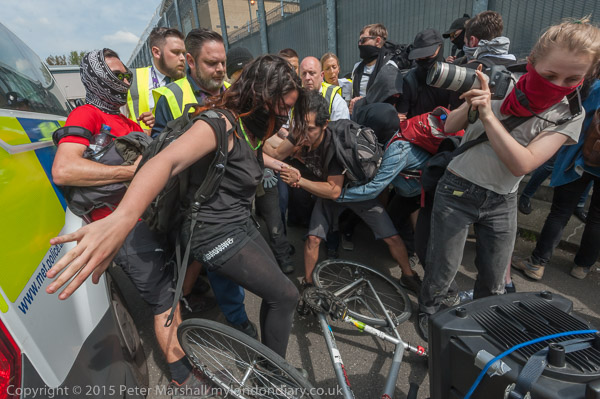
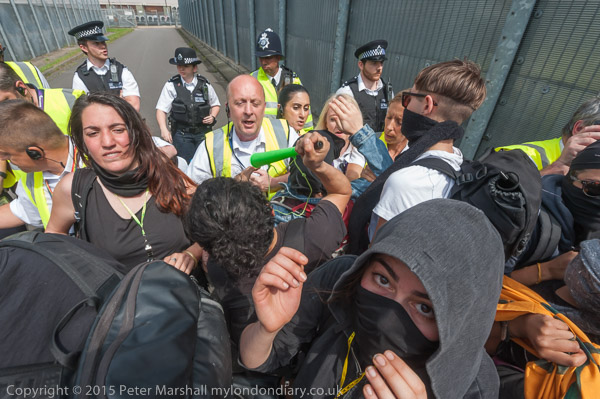
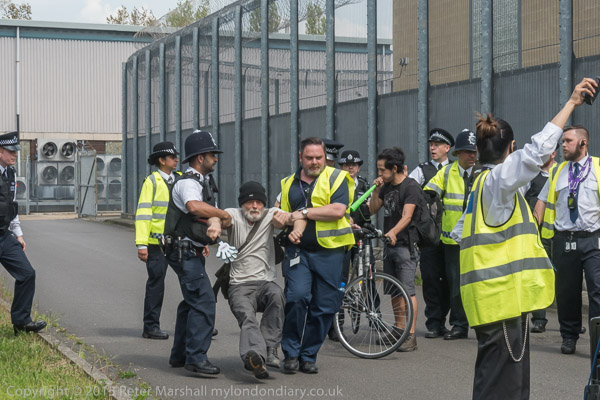
Mostly protests begin later than expected and I was surprised when I arrived at Europe’s largest detention centre complex at Heathrow, two Category B prisons, Colnbrook & Harmondsworth, managed by private security company MITIE to find that the action organised by the Anti Raids Network as a part of a day of action at all UK detention centres had already begun.

Most of the protesters had come out to the protest on the west edge of Greater London from the centre and had apparently got there earlier than they expected and had immediately rushed past the few security guards onto the private roadway between the two prisons to communicate with the detainees who had gathered around the windows of the two blocks behind their 20 ft high fences. I’d photographed earlier protests here where the protesters had walked noisily around the Harmondsworth block (strangely on the Colnbrook side of the complex) on the rough track around the fence, but the centre was now under new management and MITIE were determined to keep them further away.

As I arrived and talked with the small group who had remained at the entrance those inside appeared at the far end of the road, being slowly moved out by the police reinforcements who had arrived shortly before me, and I followed protesters down the road to join them.

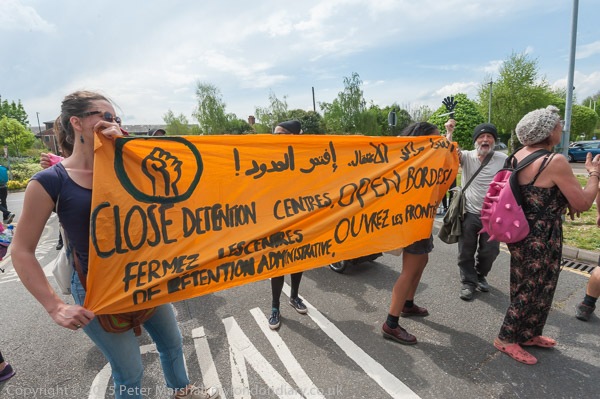
As well as making a lot of noise with pots and pans, megaphones and kicking the solid metal bottom of the fence, the protesters also held up a large banner with a phone number so that the detainees could contact them and tell them what was happening inside. At first the police made slow progress in moving them along, but soon another police van arrived with more officers and they were able to move them quickly to the front of the complex.

After regrouping there, most decided to walk along to the public footpath that runs along the east edge of the centre. Although bushes and small trees in front of the fence made the centre almost invisible, it was easy to hear the detainees shouting from inside and for them to hear the protest. Soon phone contact was made with some of them and they were able to speak over a megaphone. As I wrote back in 2016:

“Bashir from Lebanon told us he had been held in detention for 18 months and that his wife and children need his help, but he is stuck inside, unable to see them or do anything. Indefinite detention such as this seems a clear breach of so many of the human rights that everyone in the UK should be entitled to under our Human Rights Act 1998. Treating people like our system does is simply shameful.”

Detention Centres Shut Them Down – where there is more about the protest.

Cleaners invade Barbican Centre – Barbican, London, Saturday 7th May 2016

I left to make my way to central London where Cleaners union United Voices of the World were holding a flashmob at the Barbican Centre after cleaning contractor Servest proposed making many of the cleaners redundant or severely cutting their hours and pay. As well as the UVW, the action was supported by activists from the Bakers Union, Class War, SOAS Unison, Unite Hotel workers branch and IWGB Couriers branch.

I met the cleaners close to Moorgate Station and walked with them towards the Barbican, where they burst into a run as they turned a corner and rushed into the main entrance, past a couple of security guards who had no chance of stopping the unexpected arrival. They made there way to the middle of the arts centre, to protest noisily outside the hall where customers were entering a sold-out concert of music by Yann Tiersen.

After a few minutes police arrived and told the protesters they must leave or be arrested, and after some argument they slowly and noisily made their way back towards the main entrance, with police continuing to harass them.

They continued to protest on the street outside the main entrance, and the protest was still continuing there when I left for home.

More on My London Diary at Cleaners invade Barbican Centre.


Tax Robbery, Racism & John Lewis

Tax Robbery, Racism & John Lewis. Saturday 21st March 2015 was another busy day for me in London, covering protests against the criminal activities of UK banks, a large march and rally against racism in the UK (and a few racists opposing this) and customers of John Lewis calling on the company to treat its cleaners fairly.


Great British Tax Robbery – HSBC, Regent St.

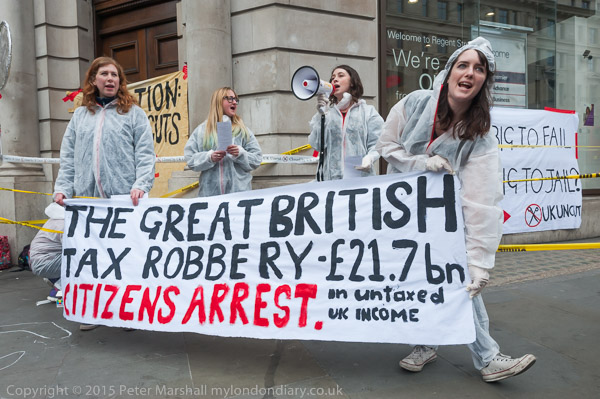
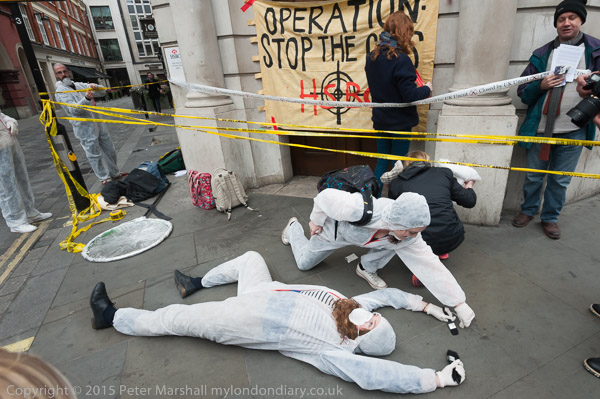
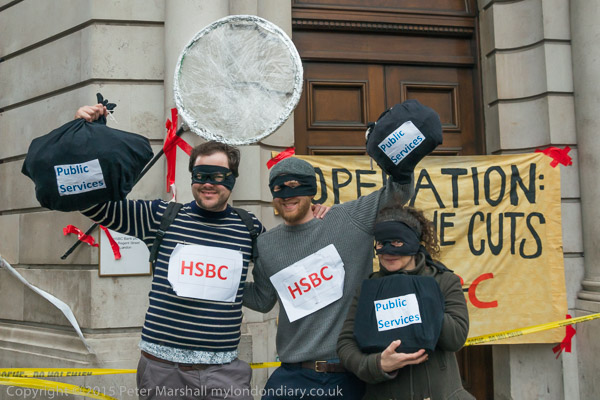
UK Uncut campaigners arrived at the HSBC Regent St branch dressed as detectives and robbers to highlight the bank’s crimes in causing the financial crash and tax dodging, which have led to drastic cuts in vital public services and welfare and attempt a ‘Citizen’s Arrest’.

UK Uncut had a clear message for both HSBC and the government, accusing them of being criminals:

The government told us they’d “protect the poorest and most vulnerable”. They said “those with the broadest shoulders will bear the brunt of the cuts”. And what have we seen? Dismantling the NHS and wrecking the welfare state. Cutting schools, youth clubs, sure start centres, domestic violence refuges and libraries. Slashing local council budgets. Attacking disabled people with inhumane ‘work capability assessments’ and cuts to vital benefits. Removing access to justice through legal aid cuts. Allowing the big six energy companies to push people into fuel poverty. Cutting jobs, wages and pensions. Selling off social housing and moving people away from their communities. Driving hundreds of thousands into food banks and making families choose between heating or eating

My London Diary, March 2015

The bank closed a few minutes before the protesters arrived and kept its doors shut as the protesters’ ‘forensic team’ chalked around ‘crime victims’ on the ground and put crime scene tape around the area, sealing off the door with a banner. There was a speech from a NHS campaigner from East London about the effects of the cuts on the NHS and ‘criminals’ with HSBC on their chests posed for pictures. After a few minutes the protest was ended as many of those taking part were, like me, joining the Anti-Racism protest.

Great British Tax Robbery


Stand Up to Racism March – BBC to Trafalgar Square

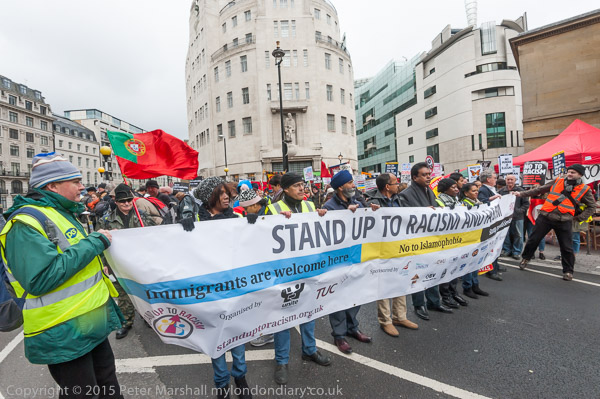
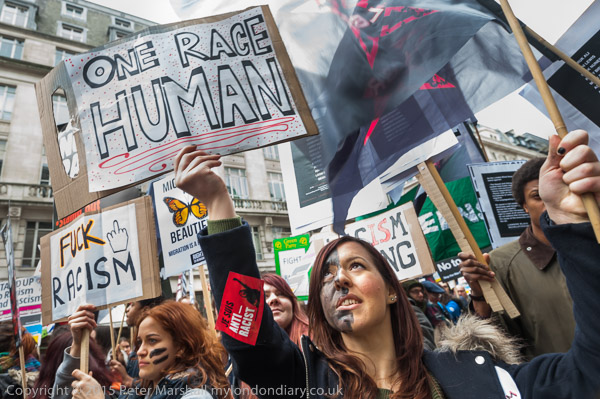
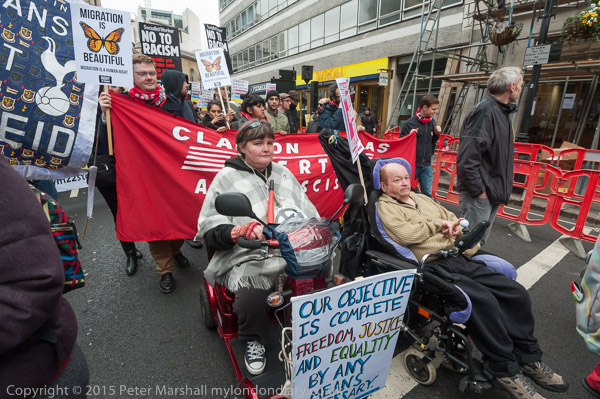
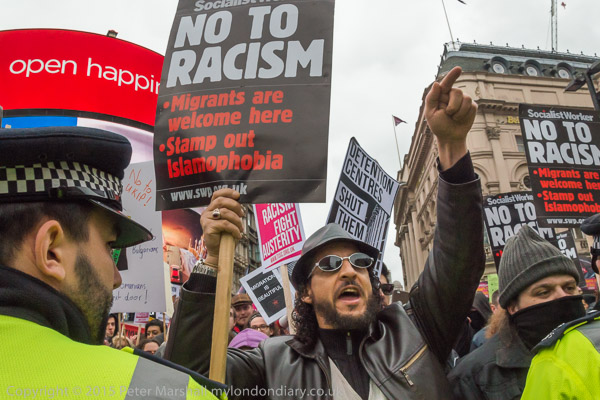
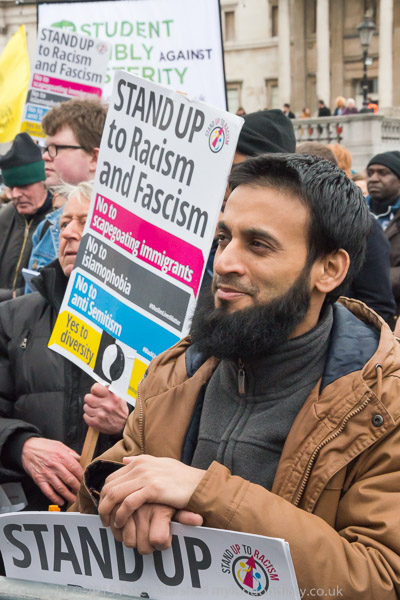
Thousands came to the Stand Up to Racism march from the BBC to Trafalgar Square to reject the scapegoating of immigrants, Islamophobia and anti-Semitism and to celebrate the diversity of Britain, with the message ‘Migrants are Welcome Here!

The march began at the BBC, who campaigners accuse of having a policy of ignoring protests in the UK, especially those against government policies – such as the racist hounding of immigrants under their ‘hostile environment’.

Among those marching were DPAC, Disabled People Against Cuts. Government policies have also targeted disabled people, cutting benefits and subjecting them to unfair ‘fitness to work’ tests which largely ignore medical evidence.

Stand Up to Racism March


Britain First Protests anti-Racist March – Piccadilly Circus

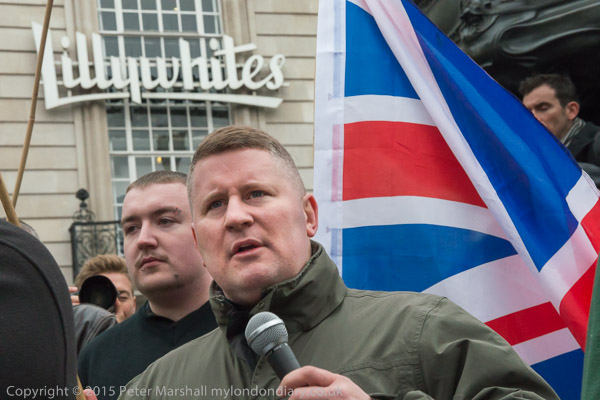
A small and rather sad extreme right-wing group stood on the steps around Eros waving flags and shouting insults at the anti-racist marchers as the thousands marched past. It was a reminder of the kind of bigotry the great majority were marching against.

Some of the marchers paused to shout back at them, while others followed the advice of the march stewards and ignored the small group. There were a few scuffles but generally police kept the two groups apart, though later I learnt that after I had gone past a group of anti-fascists had seized the Britain First banner.

Britain First Protests anti-Racist March


Stand Up to Racism Rally – Trafalgar Square

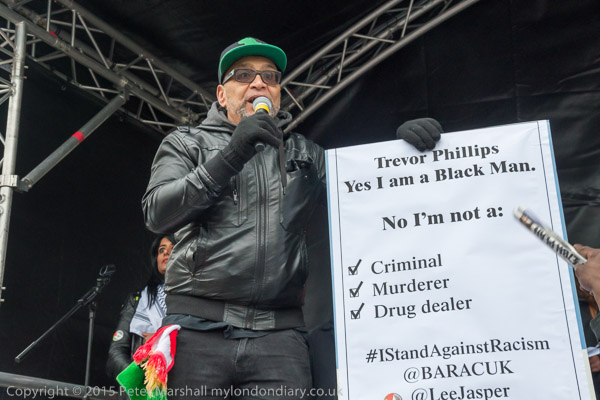
Lee Jasper holds up a large poster responding to Trevor Phillips saying he is not a criminal, murderer or thief

Several thousand who had marched to ‘Stand up to Racism’ through London stayed on to listen to speeches at a rally in Trafalgar Square.

Speakers included Owen Jones, Jeremy Corbyn, Zita Holbourne, Omer El Hamdoon, Lee Jasper and many others, whose photographs you can see on My London Diary.

Stand Up to Racism Rally


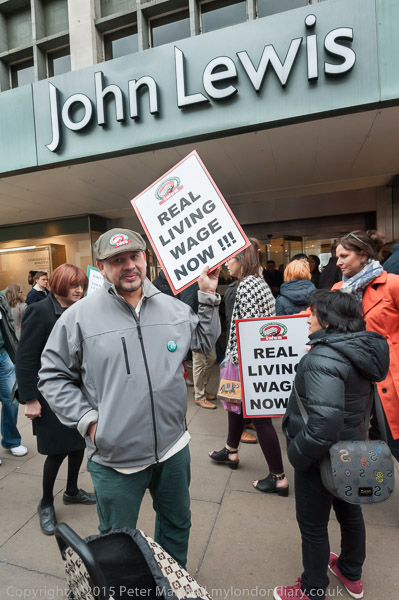
John Lewis customers support Living Wage – Oxford St

John Lewis is a company proud of its history and its reputation as a company based on its constitution as the UK’s largest employee owned business with both John Lewis and Waitrose owned in Trust by its 80,000 ‘partners’. They say everyone who works in its stores are not just employees, but a partners in the company, and in almost every year they enjoy a share in its profits.

Everyone who works there, except the cleaners who play a vital role in the proper running of the stores. John Lewis gets out of making them partners by using other companies to employ them and provide the cleaning as a service, choosing its cleaning company through competitive tendering. Cleaning companies cut wages and conditions of service such as sick pay, maternity pay, pensions, holiday pay to the bone – usually the absolute legal minimum – so they can put in low tenders and still make good profits. They exploit the workers – a largely migrant workforce with limited job opportunities – while John Lewis can claim it isn’t them who are doing so and try to maintain their reputation as a good employer.

For some years the cleaners have been protesting to get a living wage and also for John Lewis to recognise their responsibility as the actual company the cleaners are providing a service to. They want to be treated equally with the others who work in the stores, rather than the second-class employees they are now. The least John Lewis could do would be to insist on contractors paying the living wage and giving employees decent conditions of service as a condition of tender, but they had refused to take any responsibility.

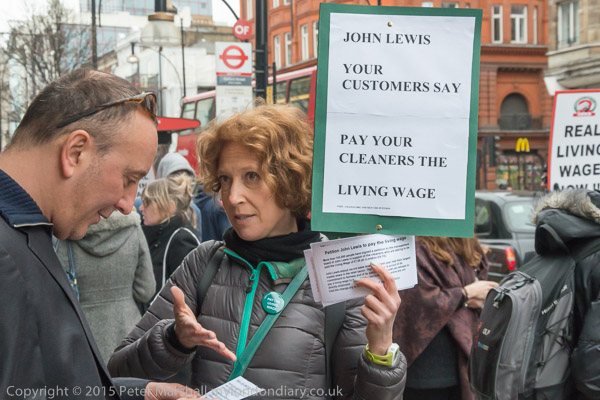
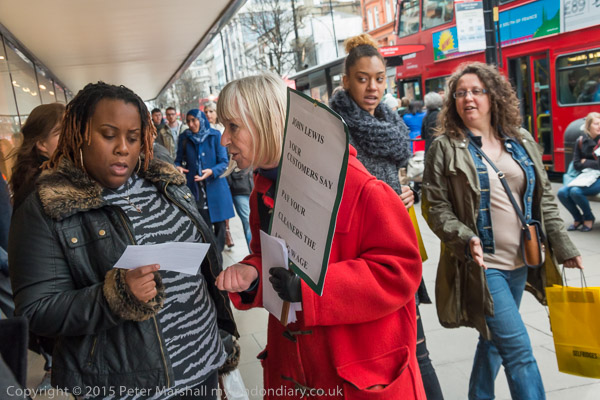
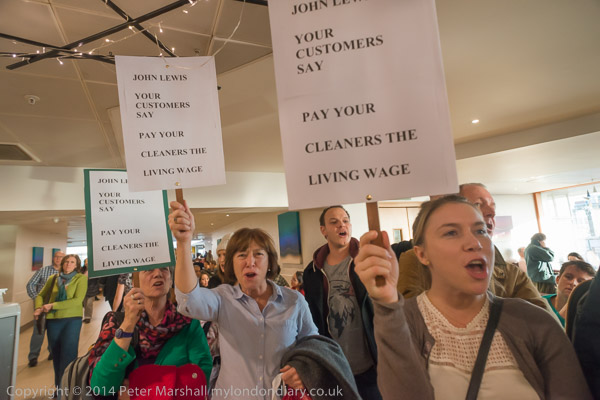
Many customers of John Lewis – a very middle-class group – back the cleaners’ case for fair and equal treatment, and a few had come to hand out flyers and talk to shoppers to back their case in a very restrained protest. One of them told me it was the first time she had ever taken part in any protest. They were supported by a few members of the cleaners union, the IWGB, who had brought some of their posters.

John Lewis customers support Living Wage


University of London 3 Cosas Strike

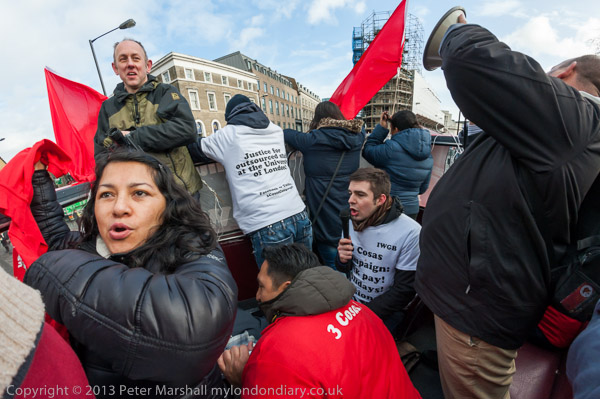
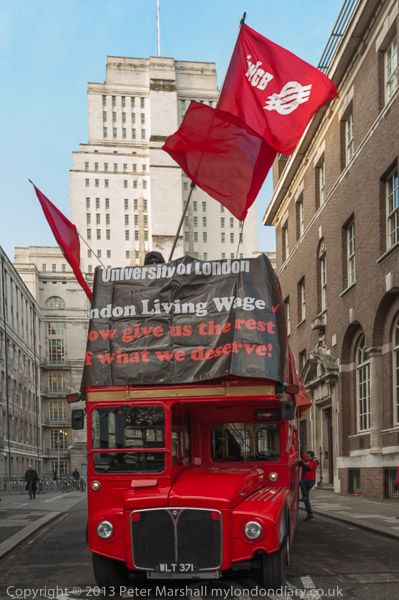
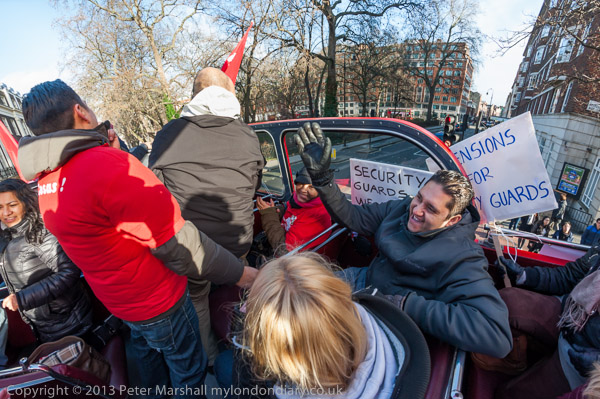
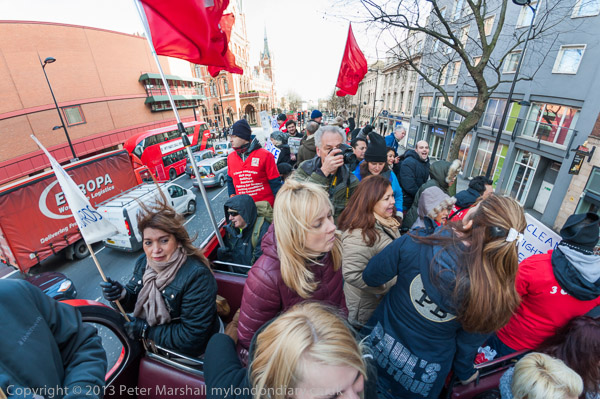
On the IWGB battlebus

Eight years ago on Tuesday 28th January 2014 low paid workers at the University of London were on the second day of their 3 day strike. Their union had organised a day of action around London and I had been invited to come and photograph it, having photographed a number of their previous protests.

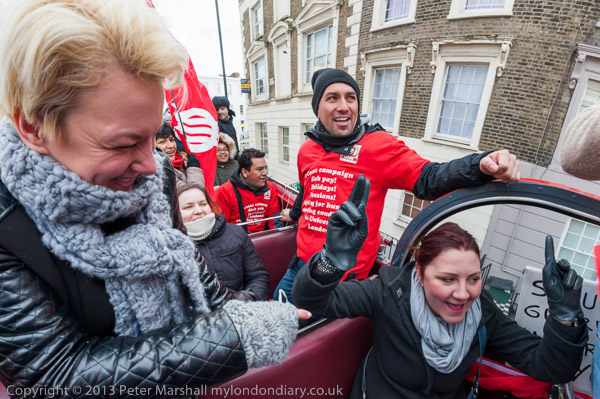
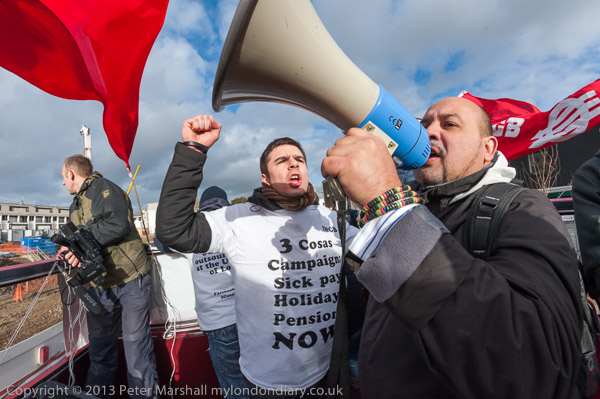
University cleaners, maintenance and security staff were demanding that the University recognise their trade union, the IWGB (Independent Workers’ Union of Great Britain) and give them better pay and conditions, comparable with other university staff they work alongside. The ‘3 Cosas’ were sick pay, paid holidays and pensions – all areas where these staff were only being given the legal minimum (and sometime not even that.)

As I wrote in 2014:

“although these workers work at the university and carry out work essential for the running of the university, the university does not employ them. Most low paid workers – cleaners, maintenance and security staff, catering works and others – at the University of London are no longer directly employed by the University, but work in the University on contracts from contractors Cofely GDF-Suez (who took over the former contractor Balfour Beatty Workplace at the end of last year.) The policy of outsourcing these workers seems largely intended to evade the responsibilities of London University towards an essential part of their workforce.”

3 Cosas’ Strike Picket and Battle Bus

It meant an early start for me, although the pickets had been outside Senate House for four hours when I arrived at 9am. Living outside London though on its edge I seldom arrive before 10am as it doubles my travel costs and I’ve never been a happy early riser. Fortunately the weather was good, a bright winter day and I’d dressed for the weather with thermal underwear, thick socks and a woolly hat, though it was still pretty chilly on top of the open-top bus.

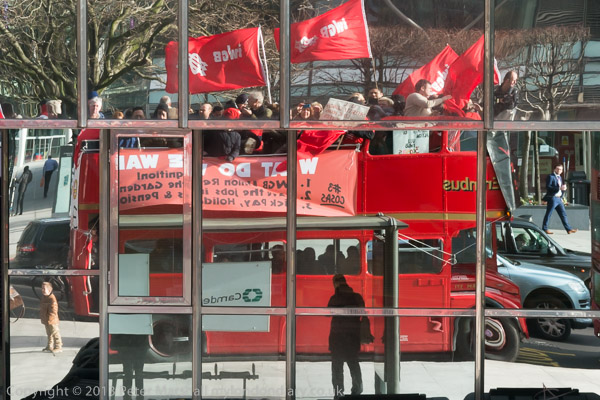
The bus turned out to be a 1960 Routemaster which was sold by London Transport in 1986 but only converted to open-top in 2001. (I’d long thought that there was a plentiful supply of such vehicles after drivers attempted routes under low bridges, but apparently not, although a couple of bridges near where I live have had quite a few victims over the years.) Compared to modern buses, Routemasters offered a very bumpy ride with considerable vibration, and taking pictures on the upper deck required some faster than normal shutter speeds and most of the time working one-handed while clinging on with the other.

Space on bus tops is also quite small and moving around impeded both by the seats and the other riders (I think it’s a more appropriate term than passengers) and though they were very cooperative the top of the bus was pretty full. Most of the pictures I made were taken when the bus was stopped either at junctions or for short protests and my fisheye lens proved really useful.

The bus trip began at Senate House, and then began an extensive tour around central London, making a tour of various university sites where IWGB members were striking. There was a great deal of booing as we passed the Unison headquarters on Euston Road, as many of the workers had left Unison in disgust as they felt the were not supporting the demands of low-paid workers. The IWGB had intended to stop outside the offices of The Guardian newspaper, but had been held up too much by London’s traffic and drove past and on to Parliament Square.

Here we jumped off the bus and marched to Parliament where the IWGB had arranged to meet Labour MPs John McDonnell and Jeremy Corbyn for a short rally (and Andy Burnham sent a short message of support.)

There was a short shower before the bus came to pick us up on the Embankment, taking us to a side street near the Royal Opera House. Everyone kept quiet as we got off, then rushed around the corner and into the foyer. IWGB members there had voted for a strike the following month for union recognition and the London Living Wage.

In the foyer we were met by a man who introduced himself as the Unison Health & Safety rep and told the IWGB President and the other protesters that the ROH had already agreed that the cleaners will get the Living Wage, but had not yet told them. The Opera House recognises Unison, despite the workers almost entirely being IWGB members. It’s a ridiculous situation but one which is allowed under our poor trade union laws, though not one that makes sense for either workers or employers.

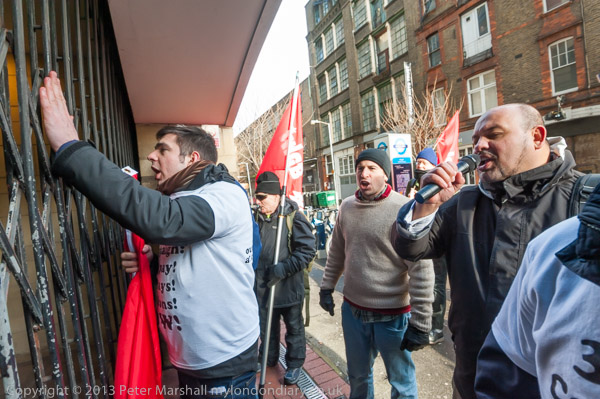
After making their views clear the IWGB members left quietly and got back onto the bus for the final visit of the day, to the Angel Islington, where Cofely GDF-Suez (who took over employing the workers at the University of London from the former contractor Balfour Beatty Workplace in December) has its offices. As at the Royal Opera House, there were plenty of police present and waiting for the protesters, but here they managed to lock the metal gates on the two entrances to Angel Square as the bus arrived, leaving the protest to take place in front of one of them in Torrens Place.

From here the bus was going on to the union offices at the Elephant and Castle and I was invited to join them for a very late mid-afternoon lunch but unfortunately I had work to do on the many pictures I had taken and had to leave them and make my way home.

IWGB at Cofely GDF-Suez
IWGB in Royal Opera House
IWGB at Parliament
‘3 Cosas’ Strike Picket and Battle Bus


Margareta D’Arcy, Education and Africans in Israel

Margareta D’Arcy, Education and Africans in Israel
Three protests on Wednesday 22nd January 2014

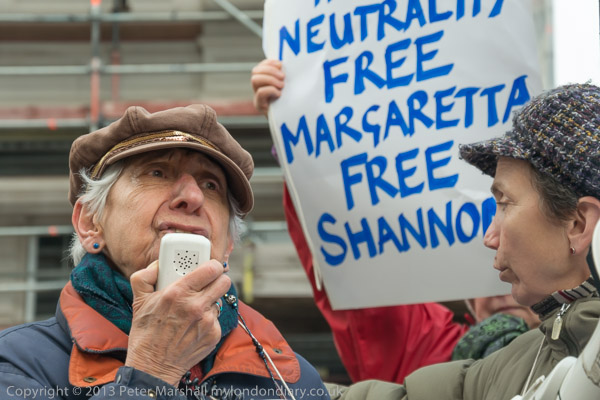
Release Margaretta D’Arcy Now! Irish Embassy

Selma James calls for the release of Margaretta D’Arcy

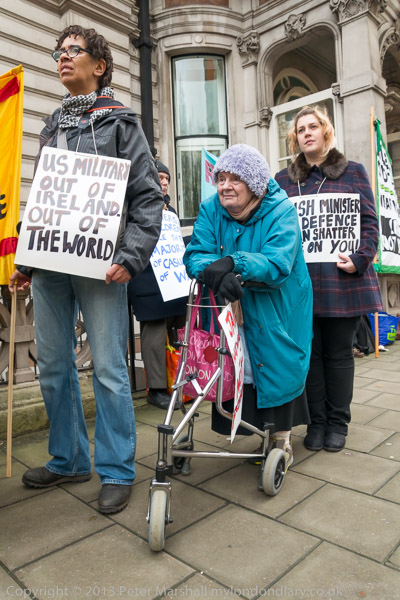
I don’t think my path has ever crossed, at least not knowingly, with that of ‘Guantanamo Granny’ Margaretta D’Arcy, though Facebook tells me we have 163 mutual friends. My eldest brother, around her age but long since dead, may well have sat down with her on Whitehall with Bertrand Russell’s Committee of 100 back in 1961. Her life has been “decades of playwriting, acting, pageantry, pirate radio, books, peace activism, protest and imprisonment whilst bringing up her family of boys. She addresses Irish nationalism, civil liberties and women’s rights.”

Her political activities led to imprisonment in Northern India, in Armagh, in Holloway (for protests at Greenham Common against Cruise missiles.) This protest came after she was due in court after being jailed for lying down on the runway at Shannon in a peaceful direct action by members of Galway Alliance Against War against the use since 2001 of Shannon by US war planes in violation of Irish neutrality – and she served three months for refusing to sign a bond against further trespass on the airport.

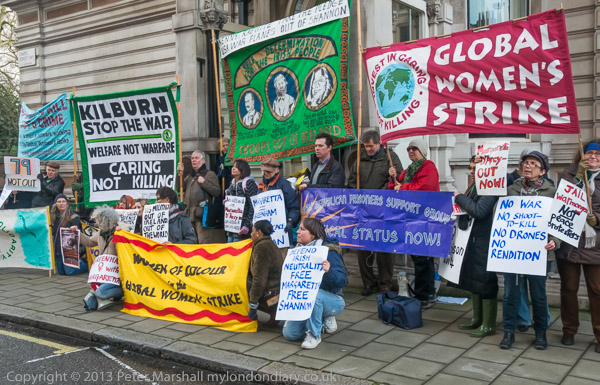
The protest at the Irish Embassy called for her immediate release and was supported by organisations including the Global Women’s Strike, Troops out of Ireland, Winvisible, Women of Colour, Kilburn Stop the War, Labour Caribbean Solidarity, Payday Men’s Network, Irish Republican Prisoners Support Group.

Students march to protect Education

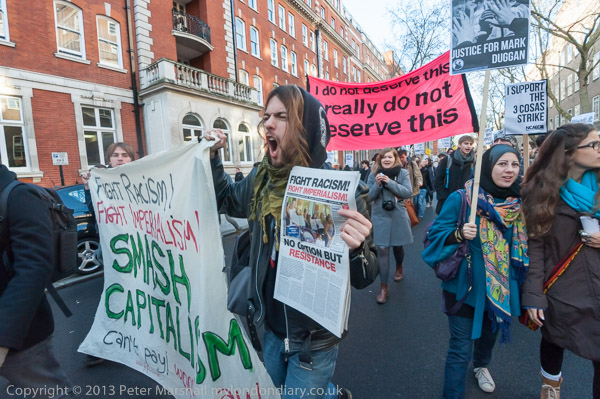
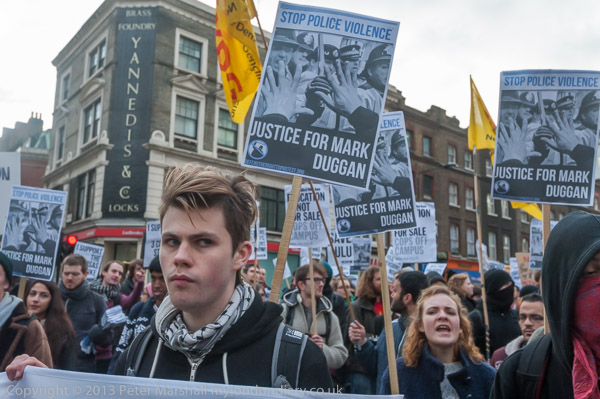
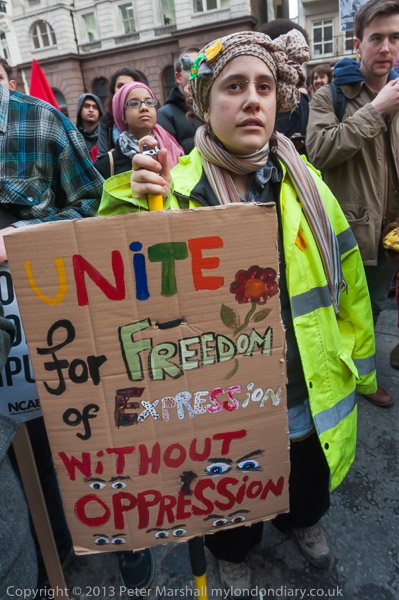
London University Students held a peaceful protest to show they intend to keep up their protests for democratic, public education free from exploitation and police violence and to support university cleaners on a 3-day strike for ‘3 Cosas’ – sick pay, holidays and pensions – and for recognition of their trade union, the IWGB.

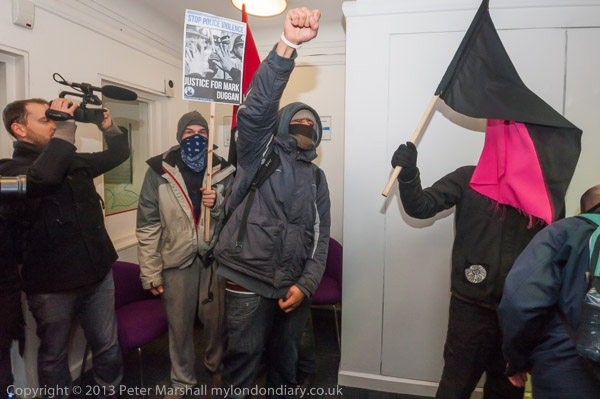
After a rally outside the University of London Union in Malet St they marched on a tour of key sites including Senate House, the University & Colleges Employers Association in Woburn House in Tavistock Square, Holborn Police station, where they protested loudly against police violence and in particular at the execution by police of Mark Duggan and ending with another short rally outside the Royal Courts of Justice.

At the Tavistock Square offices, a few of those in a black block at the front of the march made a brief token entry into the lobby, accompanied by rather more photographers and videographers, and some paint was thrown at the outside of the building, hitting several protesters and photographers.

Solidarity with African Refugees in Israel

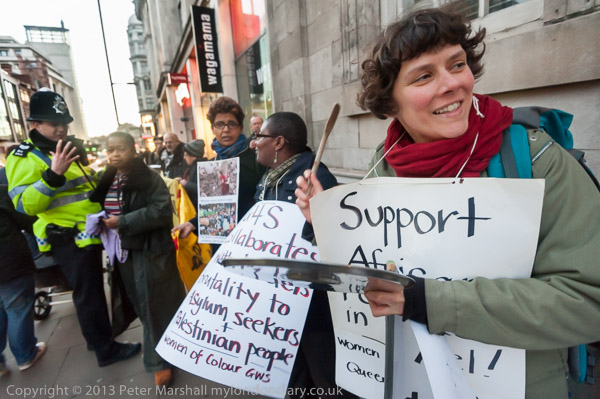
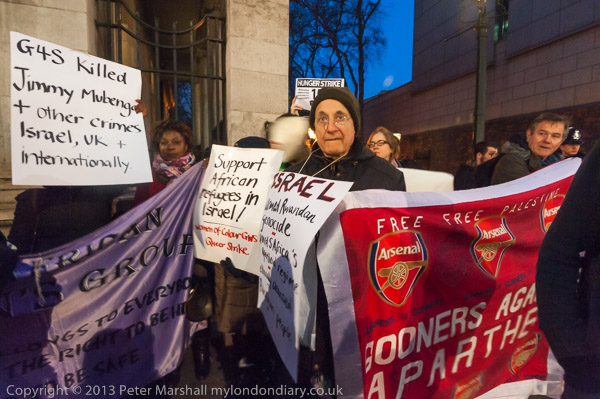
People protested close to the Israeli Embassy in response to a call by African asylum seekers for international action to support their protests against the arbitrary arrests, imprisonment and inhumane treatment of refugees inside Israel.

Tens of thousands of African asylum seekers have been protesting on the streets of Israel since the beginning of the month, holding mass rallies against their treatment by the Israeli authorities. New laws mean anyone entering the country without proper papers to be held for up to a year without trial, and for those who are already in the country to be held in infinite detention, at a detention facility in the Negev desert which like many other Israeli prisons is run by the private security company G4S.

Although there are around 50,000 African refugees in Israel, only a few hundred have had their applications processed. Most live illegally on the streets, taking whatever work is available in the ‘black economy’, with constant exploitation and threat of arrest. A recent strike by those working as cleaners, cooks, dishwashers and other low paid workers had brought many restaurants, hotels and businesses to a standstill.

Police tried to move the protesters to the opposite side of the busy main road, still further from the embassy which is in a private street, but they refused to move. Eventually police gave up and brought some cones from across the road to allow others to pass the growing protest in safety.

More on all these on My London Diary:

Solidarity with African Refugees in Israel
Students march to protect Education
Release Margaretta D’Arcy Now!


John Lewis Cleaners Protest

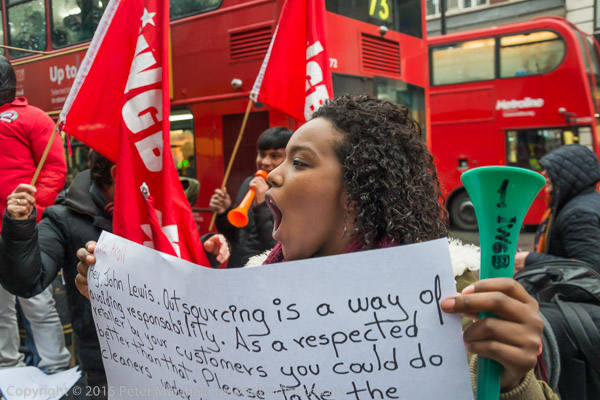
A protester holds a message from John Lewis customer Una Kroll: ‘Outsourcing is a way of avoiding responsibility’

John Lewis Cleaners Protest
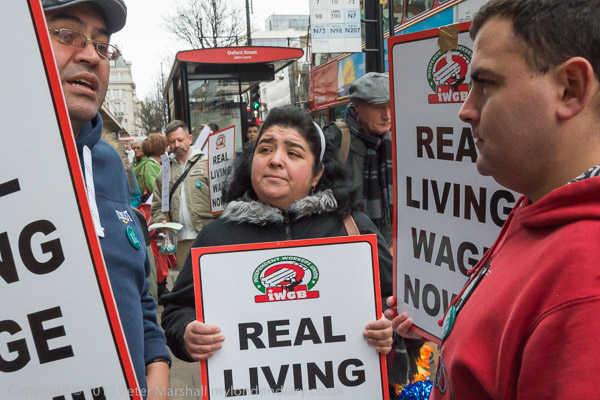
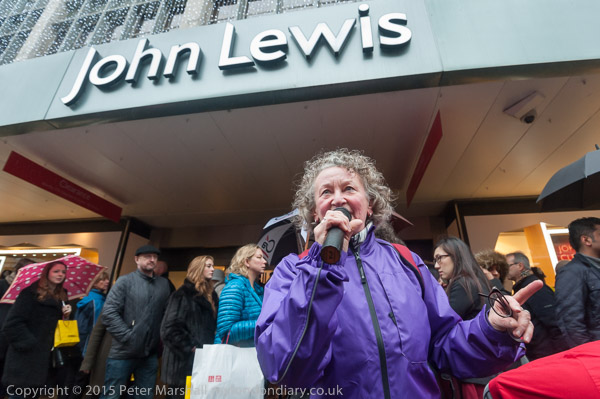
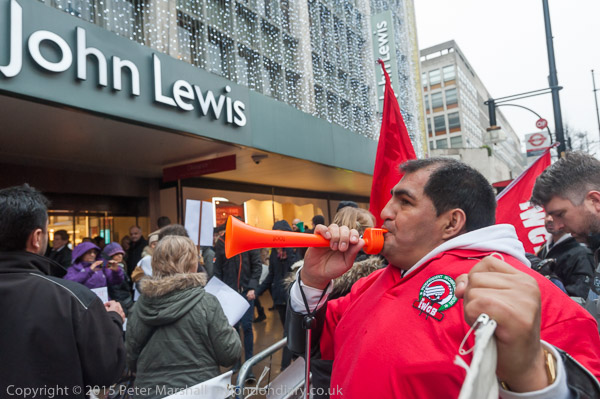
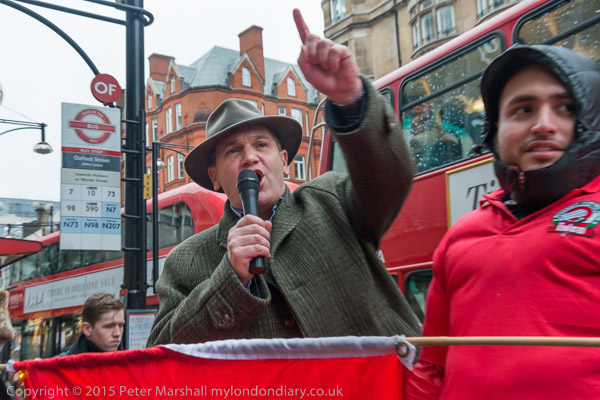
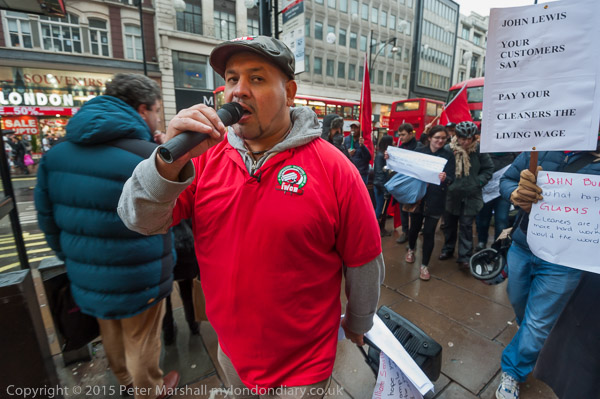
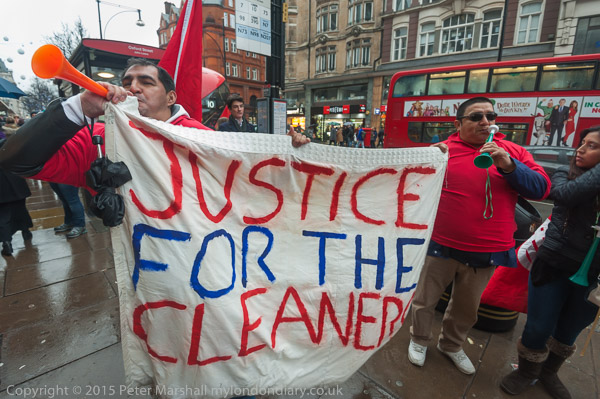
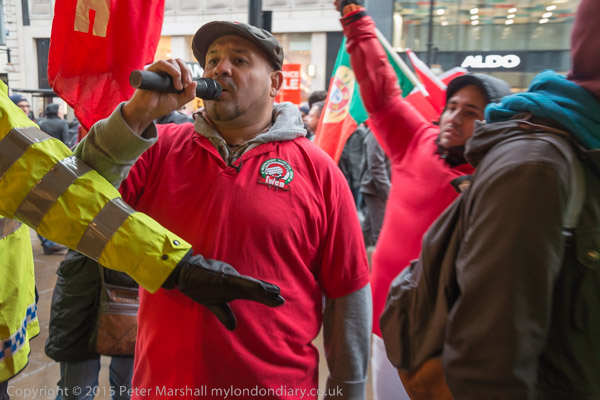
On Saturday 3rd January 2015 I met cleaners from the Cleaners And Facilities Branch of the IWGB (Independent Workers Union of Great Britain) outside John Lewis’s flagship Oxford Street store. They were there to hold a protest rally demanding the company lived up to its ethical reputation and paid the workers who keep the shop clean a living wage.

When John Spedan Lewis set up his small drapers shop on Oxford Street in 1864 he had the revolutionary idea of involving those who worked for him in the running and progress of the business, setting up a constitution that made all of them partners.

The ultimate purpose was expressed in Principle 1 of this consitution:

The happiness of all its members, through their worthwhile and satisfying employment in a successful business.
Because the Partnership is owned in trust for its members, they share the responsibilities of ownership as well as its rewards – profit, knowledge and power.

John Lewis Partnership

Green Party London Assembly member Jenny Jones, Baroness Jones of Moulsecoomb, speaking at the protest

But although staff on the counters and running other aspects of the business remain partners – and almost every year get an extra bonus payment as a share of the profits, the cleaners who work in the store who are not included in the scheme and say that in this and other respects they are being treated as second-class citizens.

Although the cleaners work in the store next to the John Lewis partners they are not employed by John Lewis. John Lewis pays a cleaning contractor to employ its cleaners, who get lower rates of pay and far inferior conditions of service than staff who are directly employed.

This lets John Lewis maintain the pretence of being an ethical employer while these people who work there get bullied, work under poor and often unsafe conditions, are paid less than a living wage and get only statutory minimum holidays and sick pay.

Mick Dooley of London TUSC

Neither John Lewis nor the cleaning contractor recognise the IWGB although a large majority of the cleaners belong to it, and neither had been willing to engage in talks about the dispute. John Lewis attempts to disclaim any responsibility for the cleaners, but the trade unionists and others who came to speak dismissed this as a a shallow attempt at deception. The work done by the cleaners takes place in the store and is essential to its running and should be properly recognised and paid.
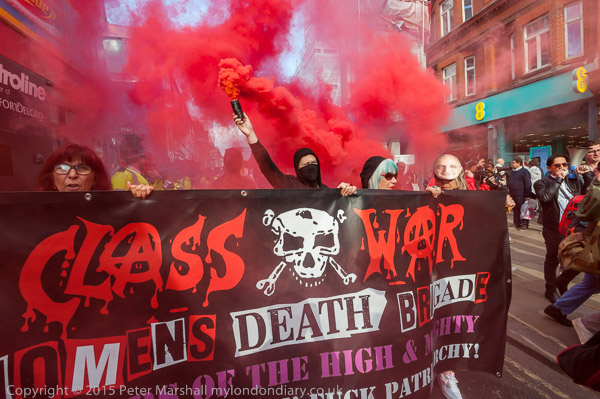
In a protest before Christmas I had met with members of the IWGB in the restuarant at the top of the store and photographed an unannounced protest by them inside the store. This time was very different, with the protest being held on the wide pavement outside and given as much advance publicity as possible.

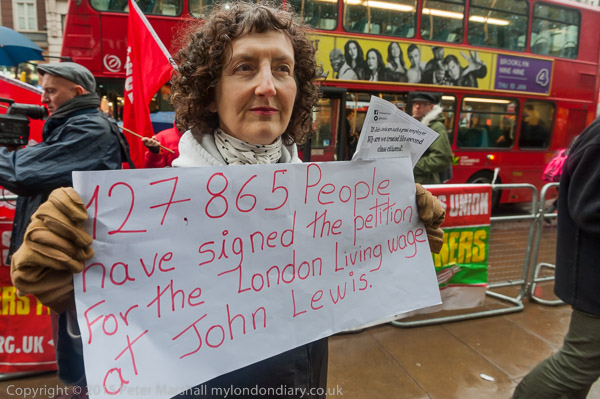
The union had received considerable support from John Lewis customers, with over 125,00 signing a petition calling on the company to live up to its ethical reputation and ensure that the cleaners are paid a living wage. Some of them came to protest with the union.
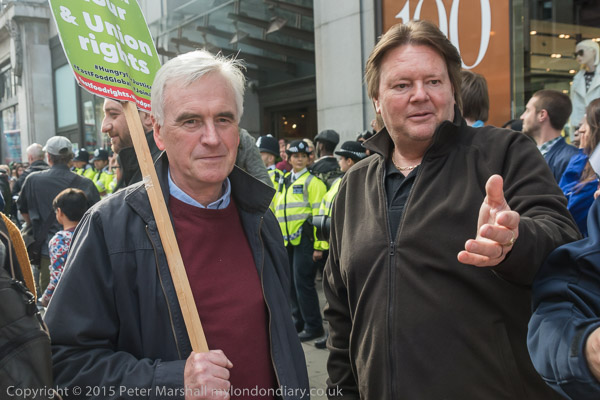
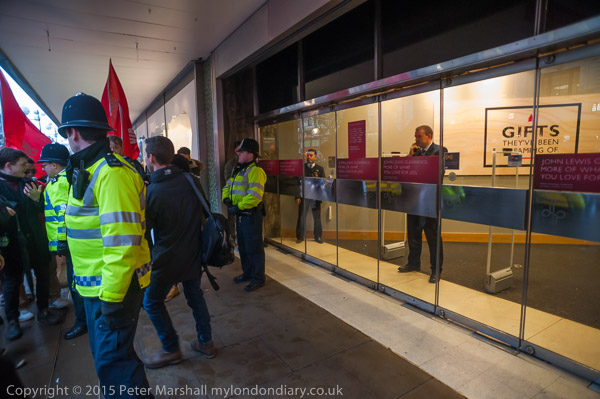
After speeches in front of the store on Oxford St, the protesters marched around the block containing the store which has entrances for shoppers on three sides. Although they arrived at some of these before the police and security they made no attempt to go inside, determined to avoid any trespass, though there were some arguments with police over a thin metal line in the pavement which marked the edge of the property.
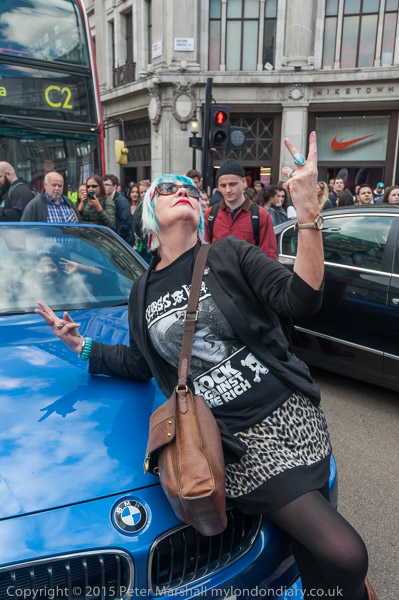
Many shoppers on the street stopped briefly to find what the protest was about and most expressed support for the workers. The main doors to the store were closed by John Lewis security staff for much of the roughly an hour and a half protest.

Xmas Protests – Low Wages, Evictions, John Lewis – 2014

Three Xmas Protests – Low wages, Evictions, John Lewis – in Brixton, Mayfair and Oxford St on December 14th 2014.

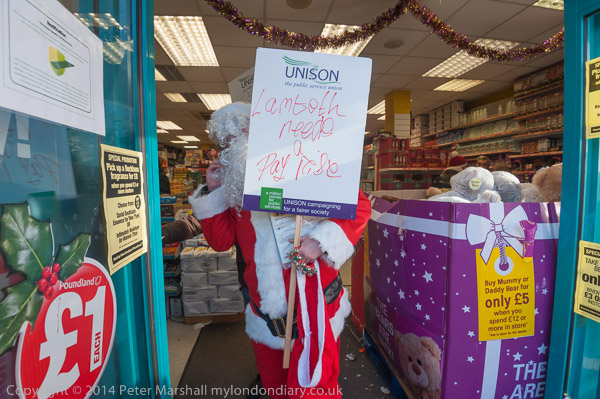
‘Santa’s Naughty List’ Living Wage

Lambeth Living Wage campaigners, led by an impressive Santa, protested in and outside shops in the centre of Brixton, handing out flyers calling for all workers to be paid a living wage. They urged shop workers to join a union and gave out forms.

While I was with them they visited department store Morleys, Subway and Poundland and they were going on to other stores in Brixton paying poverty wages. The protest was supported by Unite the Resistance, the Socialist Party, Unison (who provided the Santa costume), the Fast Food Rights Hungry for Justice campaign supported by the Bakers, Food & Allied Workers Union, BFWAWU, the National Shop Stewards Network and other groups.

‘Santa’s Naughty List’ Living Wage


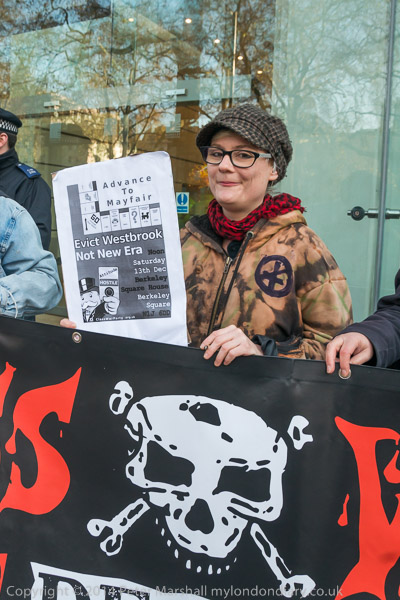
Class War: ‘Evict Westbrook, Not New Era’

Scrooge at Christmas 2014 was US property developers Westbrook Partners who were intending to evict the tenants of the Hackney New Era Estate by Christmas so they can refurbish these low rent social properties and re-let them at market rents at roughly four times the current rents. Class War and friends protested at their Mayfair offices of in solidarity with the tenants.

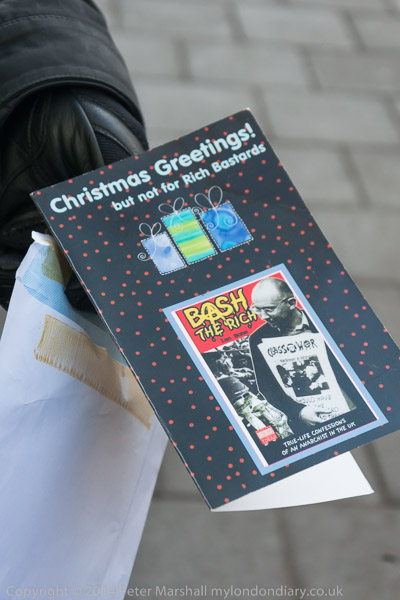
Class War came with banners and posters and a Christmas Card which they presented to Westbrook with the message ‘Christmas Greetings! – but not for Rich Bastards’ and a pictures of wrapped gifts and the cover image from Ian Bone’s autobiography ‘BASH THE RICH’. It’s an interesting read and might make a friend a good Christmas Present, available from Freedom Press at a special discount.

This was one of a number of protests by the residents, Class War and other housing activists, with a video by Russell Brand going viral and a petition with 350,000 signatures that led to Hackney Council entering into talks with Westbrook and resulted in the estate being sold to the affordable housing group Dolphin Living.

Class War: ‘Evict Westbrook, Not New Era’


Cleaners Xmas Protest in John Lewis

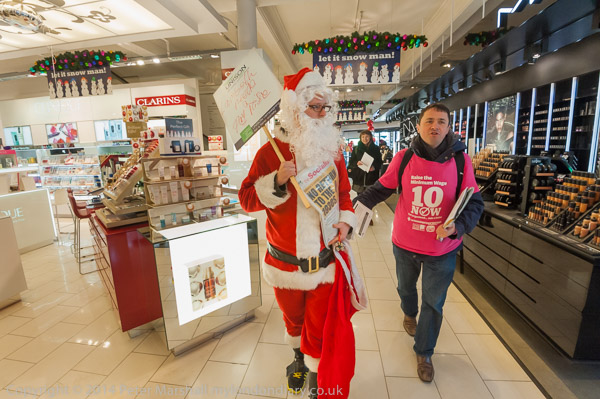
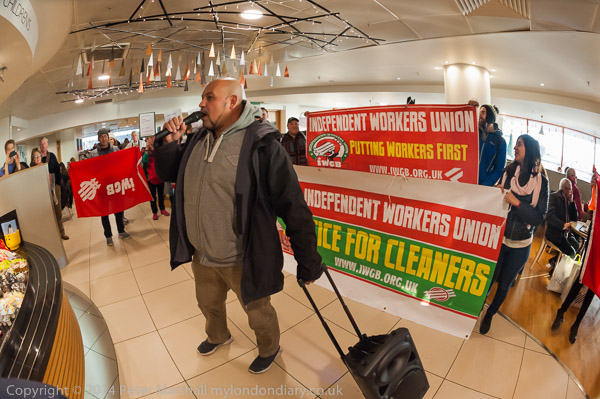
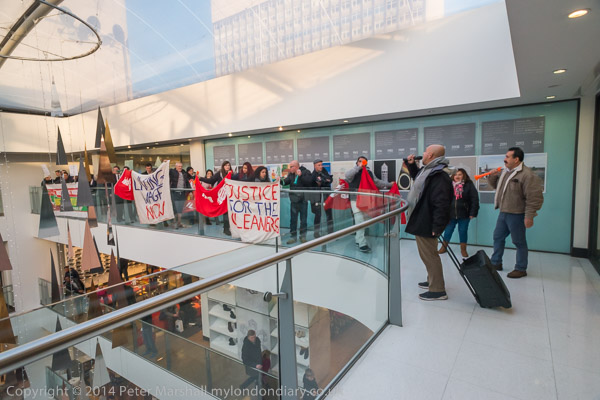
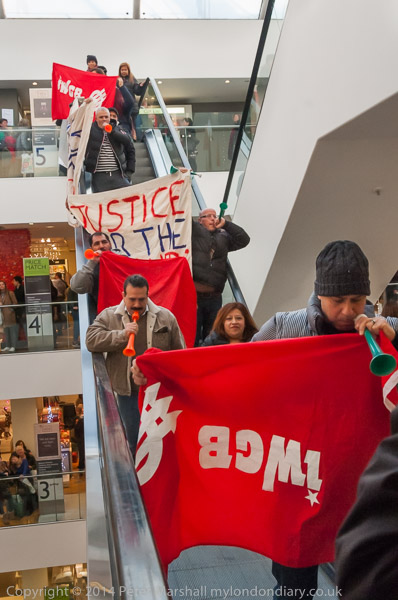
Many shoppers who can afford it go to John Lewis to buy Christmas presents, but members of te IWGB trade union and supporters including some John Lewis customers were there not to buy gifts but calling for the London Living Wage for cleaners there and an end to their treatment as second-class citizens. Many of the Christmas shoppers applauded their noisy protest.

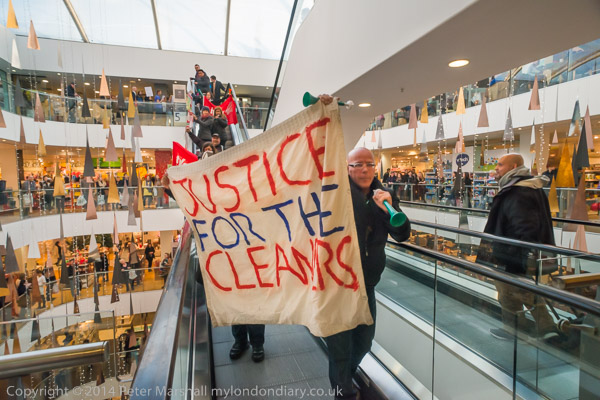
I met the cleaners on the top floor of the store where they had gathered in the restaurant before getting out banners and flags and a megaphone, with IWGB organiser Alberto Durango used to inform customers why they were holding the protest.

The together with a group of John Lewis customers they slowly and loudly made their way around the top floor to the escalator, moving carefully through the gangways to avoid any damage.

They made their way down floor by floor, pausing on the balconies to display their banners.

John Lewis security staff and managers met the protesters and asked them to stop protesting and leave the store. They continued their way protesting until they reached the ground floor, where police stopped them from leaving. Here the situation became confused, with a great deal of unnecessary pushing by the police which blurred many of the pictures I made. The protesters were trying to get out, store security was pushing them out and the police were pushing them back. Eventually most of the protesters managed to get past the police and the protest continued on the pavement outside. The protest inside the store had been totally non-violent for a little over a quarter of an hour and had the police not decided to push the protesters back they would simply have walked out.

A police officer made an attempt to seize the amplifier the protesters were using, but they held onto it and eventually he gave up. At least one person was arrested and carried out of the store by police, though I think charges were later dropped.

Cleaners Xmas Protest in John Lewis