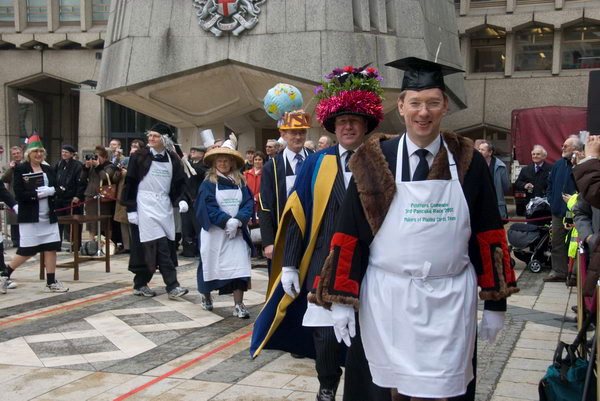
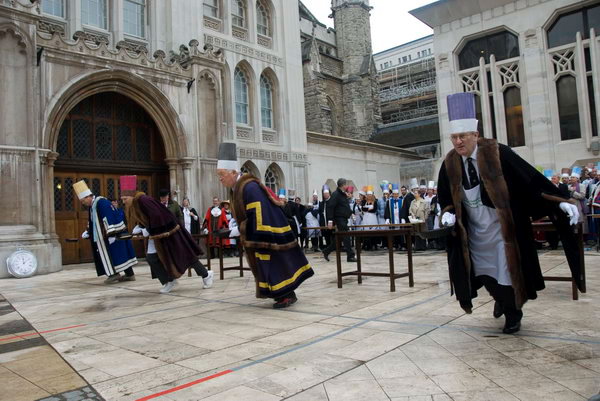
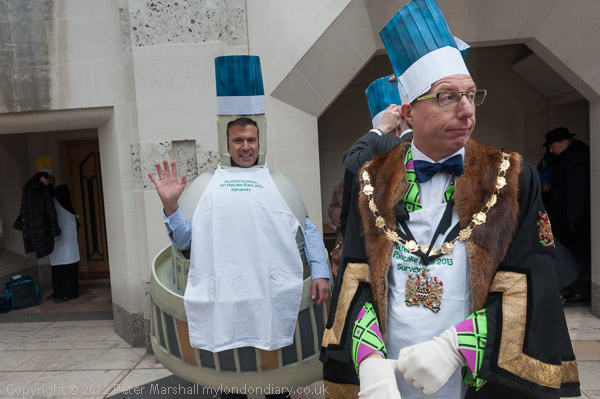
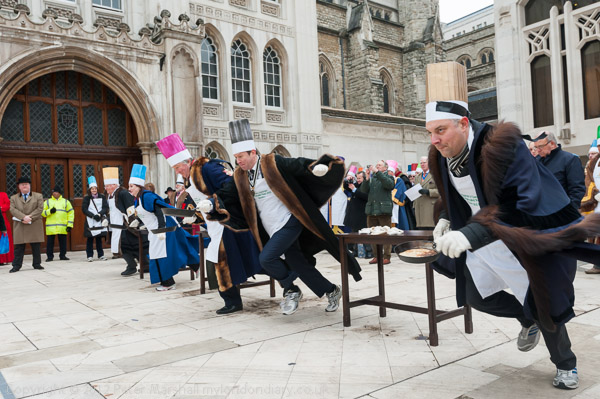
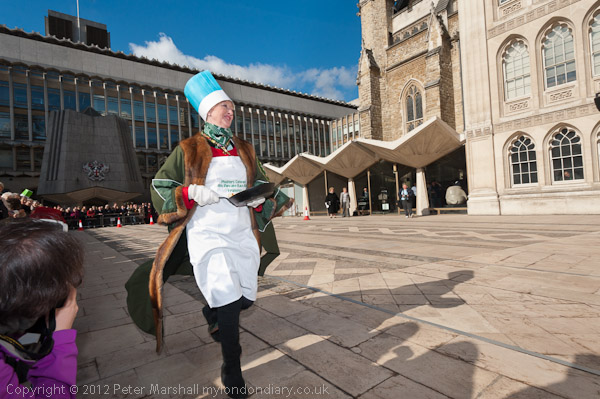
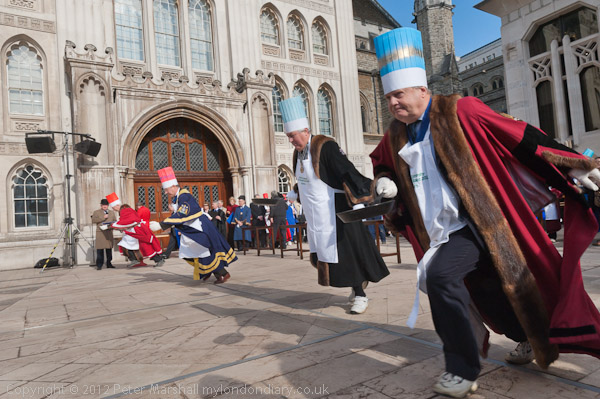
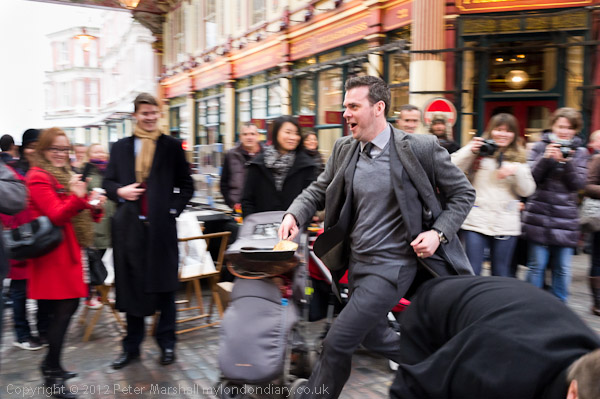
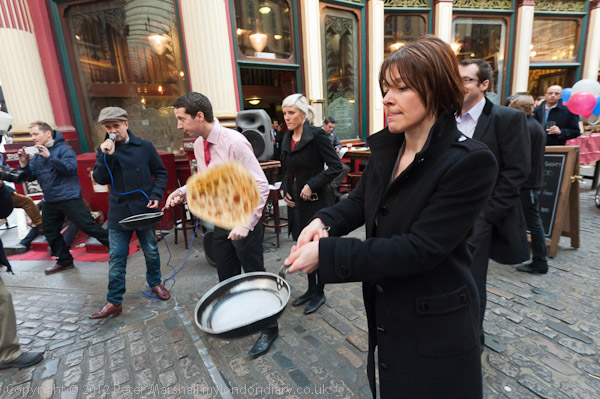
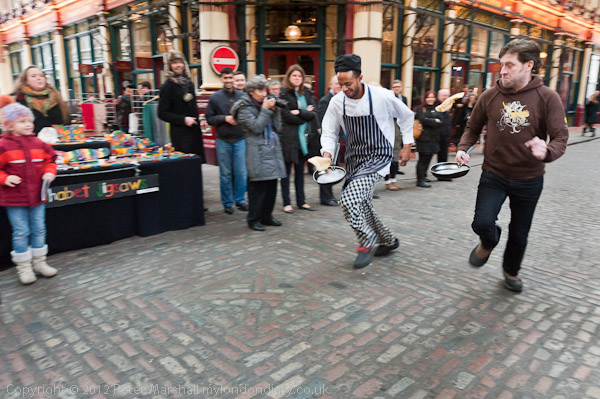
Pancakes, A Farm & Another London: My working day on Shrove Tuesday, 20th January 2007 began in Guildhall Yard in the City of London, where by permission of the Chief Commoner the Worshipful Company Of Poulters were holding their annual charity pancake races. The Poulters got their charter to regulate the sale of poultry and small game in 1368, but their pancake races are a rather more recent tradition, first run in 2005.
Music for the event came from the Worshipful Company Of Musicians (1500), time-keeping was by the Worshipful Company Of Clockmakers (1631) and a starting cannon for each of the many races was provided and fired by the Worshipful Company Of Gunmakers (1637.)
Although this is a charitable and fun event it fully demonstrates the competitive spirit at the heart of the city. More pictures on My London Diary.
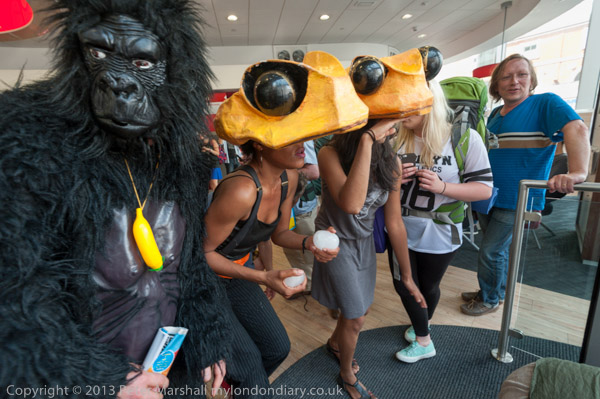
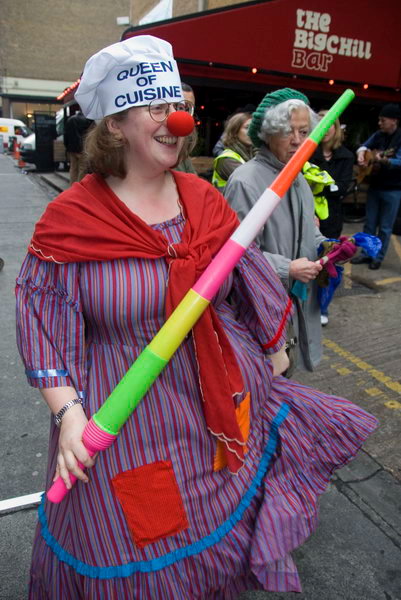
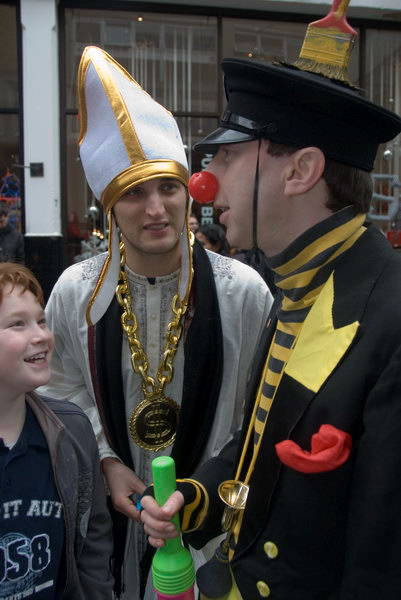
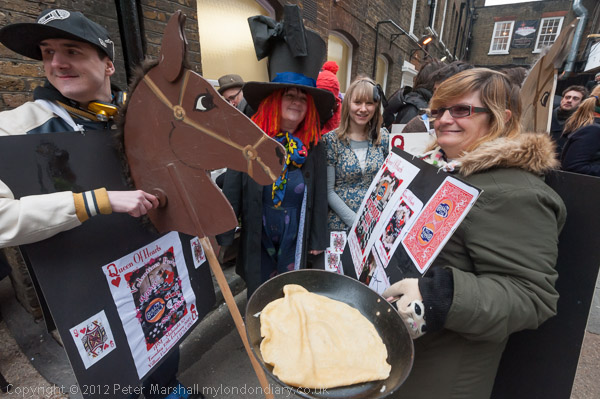
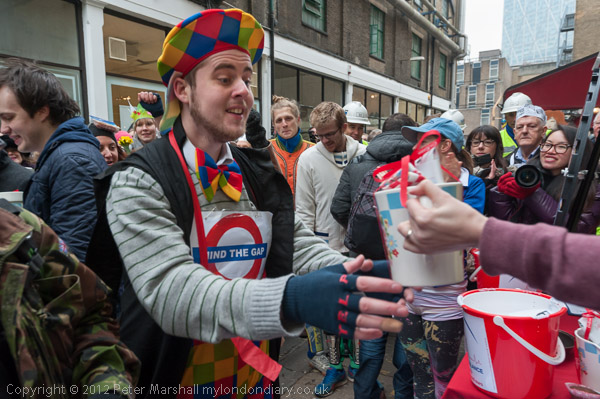
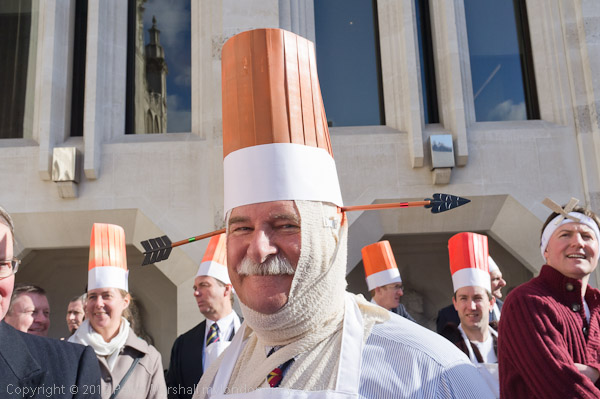
From Guildhall I rushed to another pancake event on the edge of the City, the Great Spitalfields Pancake Race at the former Trumans Brewery, arriving very out of breath just in time to see the finish of the final race and to photograph some of those who had taken part in fancy dress and the prize-giving.
As I commented, “the atmosphere was considerably less restrained than in the City.” More pictures.
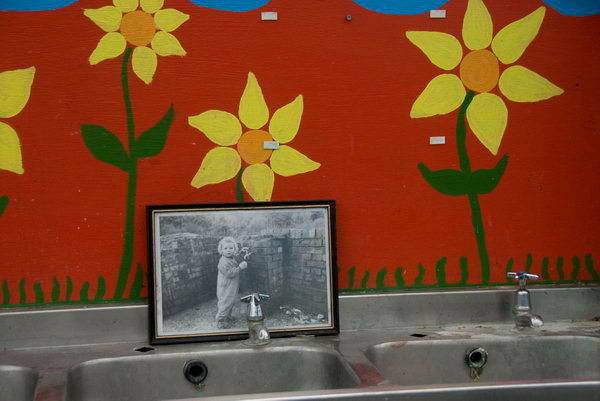
From there a short walk took me on a visit to Spitalfields Urban Farm, one of a number of urban farms set up in the 70s and 80s (1978 in this case) on waste land. This area had formerly been part of a railway goods depot next to the line out of Liverpool Street. It now provides an environmental education and a great deal of enjoyment to people of all ages in the local community.
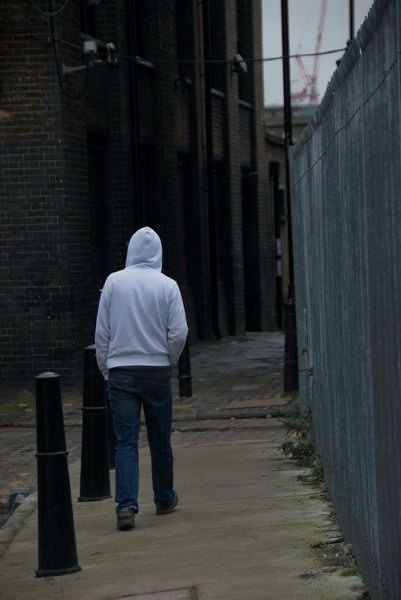
I was meeting with other photographers later in the day, and still had time to stroll in a leisurely fashion through Spitalfields to Shoreditch to catch the bus, making a few photographs on the way. Back then there was relatively little graffiti on the walls around the disused Spitalfields station and Brick Lane, but now its hard to find a square inch of wall not covered with it. I was photographing in a dark alley leading through to Bishopsgate when a hooded figure strolled past me. Despite the media stereotyping of ‘hoodies’ I couldn’t feel he was in the least threatening; if anything rather more like a monk. More pictures on My London Diary.
I met a group of photographer friends for a meal at an Italian cafe in New Malden and then we went on together to Kingston Museum, where the show ‘Another London‘ including my work along with that of Paul Baldesare and Mike Seaborne was then showing. Of course it closed years ago, but the web site featuring work from it is still on-line.
As the introduction on the site states, the show features “the London of the suburbs, of its deprived areas and of its various ethnic groups” with work by myself an Paul “in the tradition of ‘street photography‘” and Mike’s panoramic urban landscapes some “using the viewpoint offered by the front seat of London buses.”
Shrove Tuesday Pancake Races – Tomorrow is Shrove Tuesday, but in 2013 it fell on Tuesday 12th February and was celebrated in several places across London with Pancake races.
Shrove Tuesday is the final day of the Christian Shrovetide or Carnival, observed in different ways around the world as Wikipedia relates. It is the day before Ash Wednesday which marks the beginning of Lent. We are perhaps rather short-changed here in the UK with pancakes, while in Venice and Rio Janeiro they have real carnivals to celebrate Mardi Gras.
Some other countries also have rather more interesting foods than our traditional pancakes. All are ways to eat up richer foods before Lent when Christians ‘fasted’ or rather ate more simply for 40 days before Easter. It was also a day when people went to priests for confession to have their sins absolved – shriven – before getting down to serious service of repentance the following day, Ash Wednesday, and some churches still ring their bells to call in worshippers.
People in the UK have been eating pancakes on Shrove Tuesday since the 16th century, and even in families which did not observe the ecclesiastical calendar almost everyone ate them on that day in my youth, even if in homes like mine they came after the standard meat and two veg. I’ve never been keen on them, and perhaps the best you can say about them is that British pancakes are rather better than crêpes.
In many towns and cities in Britain the day used to be a half-holiday and work ended before noon to be followed by some kind of riotous mob football games with hundreds taking part in the streets. But most of these ended with the passage of the 1835 Highways Act which banned playing football on public highways, though the tradition continues in a slightly more organised form in a few towns.
Pancake races are said to have begun in 1445 in Olney, Buckinghamshir when a woman making pancakes was surprised by the sound of the shriving bells and ran to church hot pan in hand, tossing the pancake on her way to stop it sticking. Whatever. But they soon became a fairly common tradition, along with various forms of begging and trick and treating now more associated with Halloween. But apart from a few particular instances – such as at Olney – these races and other practices had more or less died out by the twentieth century.
This century has seen a revival in pancake races, often raising funds for charities, including in London the Parliamentary Pancake Race between parliamentarians and press raising funds for Rehab and the City of London pancake races begun in 2004 by the Worshipful Company of Poulters to support the annual Lord Mayor’s Appeal.
I’ve photographed both these, and in 2013 made another visit to the City of London race in Guildhall Yard, then rushed from there to the Great Spitalfields Pancake Race at the Old Truman Brewery just off Brick Lane which was supporting the Air Ambulance and is a fancy dress team relay event. Races I’ve been to in other years have included those in Leadenhall Market and outside Southwark Cathedral as well as the Parliamentary race.
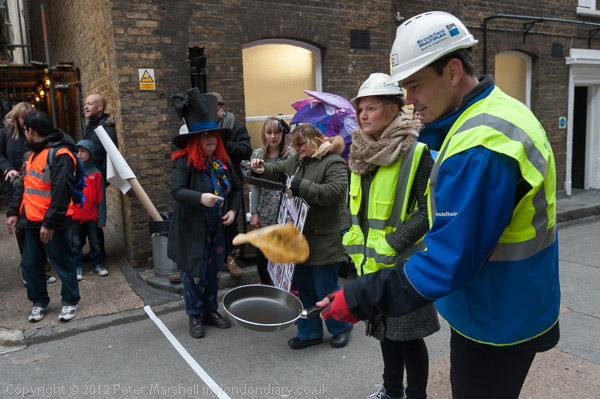
You can read more about both events and see many more pictures of them on My London Diary, where there are also pictures from the races in other years – put ‘pancake’ in the search box at the top of the My London Diary page to find more. Links to the 2013 races below:
Epping Forest Centenary Walk 2009: London is in some ways a ‘green city’ with over 3,000 parks of varying sizes within the boroughs which make up Greater London. These range from pocket handkerchief areas to large commons and royal parks such as the roughly 2500 acre Richmond Park.
Wanstead Flats
London Mayor Sadiq Khan supported London being designated as the world’s first National Park City in 2019 and announced plans to increase the amount of ‘green space’ to 50%. This isn’t a huge target as according to the capital’s environmental records centre “Roughly 47% of Greater London is ‘green’; 33% of London is natural habitats within open space according to surveyed habitat information and an additional 14% is estimated to be vegetated private, domestic garden land.”
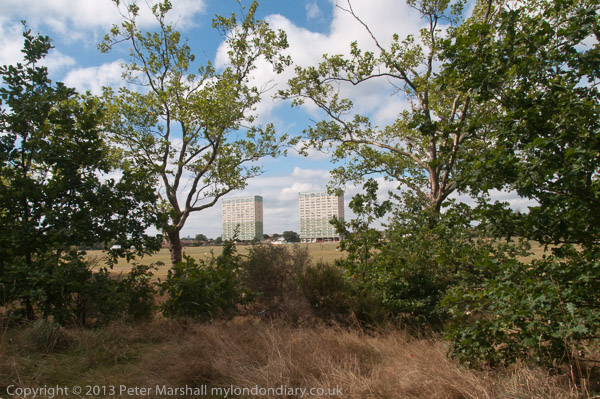
One of the Montague Road Estate flats had misssiles on its roof for the Olympics
In order of size, starting with the largest they categorise this as Other Urban Fringe, Parks And Gardens, Natural And Semi-natural Urban Greenspace, Green Corridors, Outdoor Sports Facilities, Unknown and amenities with other minor contributions. Some 22% is classified as Green Belt which gives some quite strong protection against development, though my borough is currently proposing to build on a little of it.
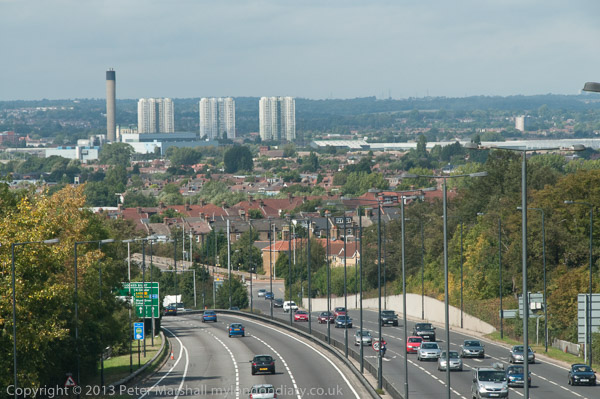
The walk goes on a bridge across the North Circular Road
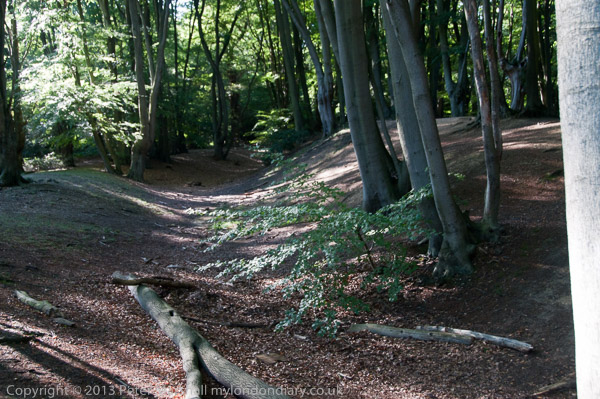
The protection of green spaces in and around London has a long history, back to the Norman conquest when kings set up royal hunting grounds convenient to their palaces in Westminster and further afield. These were called forests, though most were mainly open land rather than full of trees; the name was a legal term meaning only the king had the right to hunt deer in them. One of the larger areas, established by Henry II in the 12th century was Epping Forest, part of an even larger Forest of Essex.
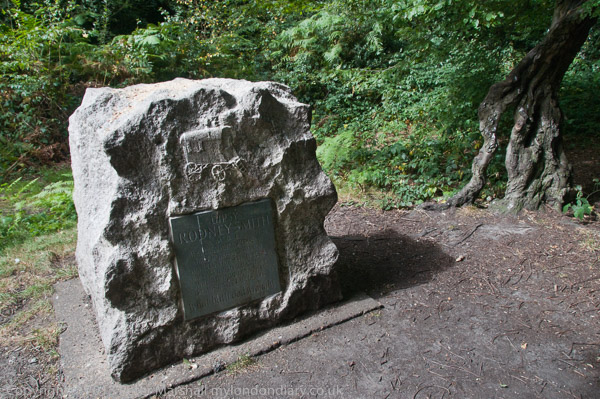
Memorial to a famous evanglalist Gypsy Rodney Smith born in a bender here
Enclosures began to threaten the future of the forest at the start of the 19th century when around a third of the remaining forest was allowed to be privatised for building development and farming by the lords of various manors in the forest. By 1870 around two thirds of the forest had been enclosed.
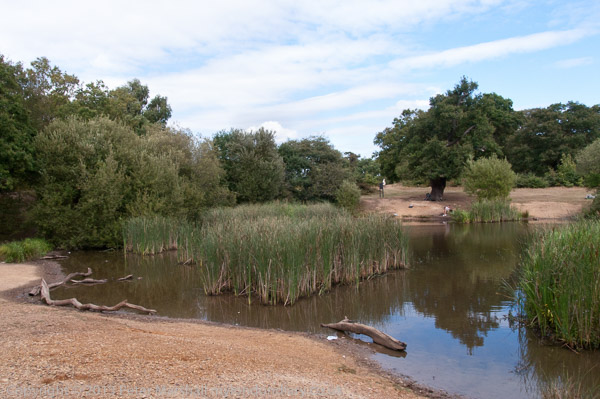
Warren Pond
By this time many people had become worried about the loss of the commons, particular after neighbouring Hainault Forest had been sold off by the Crown, the trees removed and the area turned into poor agricultural land. More and more people were coming out from London during their free times to enjoy the green spaces in the outskirts and preservation societies were set up.
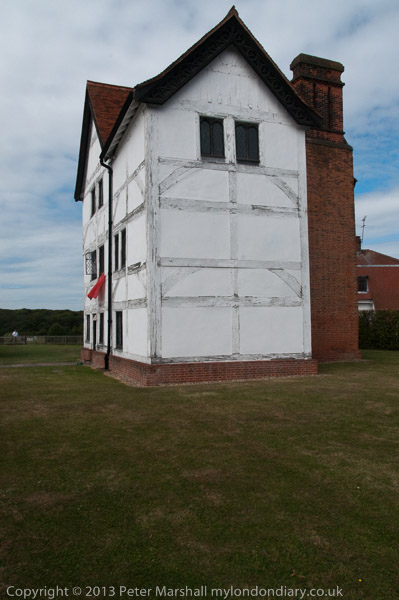
Queen Elizabeth’s Hunting Lodge
The City of London became involved after it bought land at Manor Park for the City of London Cemetery. Traditonally the city had organised Easter Monday stag hunts in the forest, but they now became commoners with the right to graze animals, and began legal actions agaimst lords of the manor who had enclosed forest land. Eventually Acts of Parliament allowed them to purchase the forest manors and an court in 1874 ruled that all enclosures made since 1851 were illegal.
Under the Epping Forest Act 1878 the forest ceased to be a royal forest and became managed by the City – as it still is. The Crown lost its right to venison and commoners lost some of their rights too, but the City Conservators were obliged to “at all times keep Epping Forest unenclosed and unbuilt on as an open space for the recreation and enjoyment of the people.”
The preservation of Epping Forest was the first major victory in Europe for the modern environmental movement. Four years later it was endorsed by Queen Victoria, who although it was no longer royal but in the hands of the City of London, nevertheless stated “It gives me the greatest satisfaction to dedicate this beautiful forest to the use and enjoyment of my people for all time“.
On the 100th anniversary of the Epping Forest Act in 1978, the Friends of Epping Forest began a annual series of anniversary walks from along a route they established from Manor Park Station to Epping. The Friends were originally formed to oppose the routing of London’s orbital M25 through the Forest, leading to it being put in a tunnel. But they have been less successful in opposing some other breaches of the 1878 Act, and in 1989-94 a large section of the south of the forest was lost to build the M11 link road, and during the London 2012 Olympics a temporary police station was allowed to be built on Wanstead Flats.
Epping Station at the end of our walk
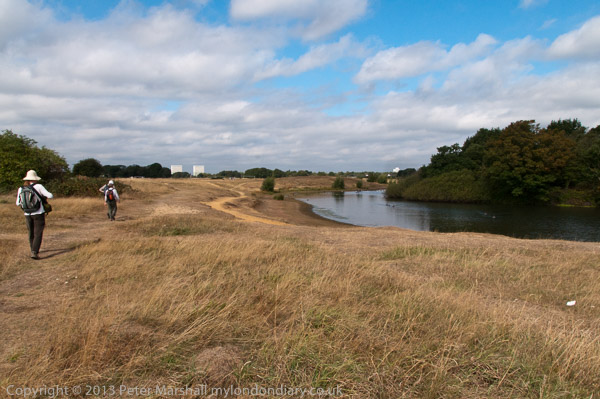
I walked the Epping Forest Centenary Walk with some of my family and a friend on Bank Holiday Monday 31 August 2009, and you can download a leaflet including a map (though I’d advise also having the OS Explorer 174) of what has now been renamed the Epping Forest Big Walk. According to this it is 14.1 miles (22.7km) but we managed to walk rather further, possibly partly because we got a little lost at times. Of course you can do the walk in stages rather than all on the same day. If you want to walk with others you can join the free Big Walk this year on Sunday 17th September 2023 to be led by experienced guides!
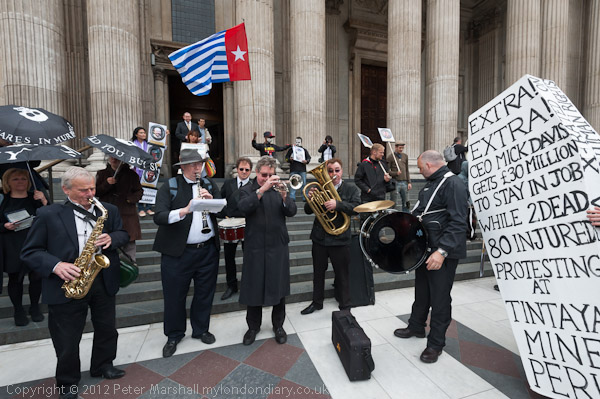
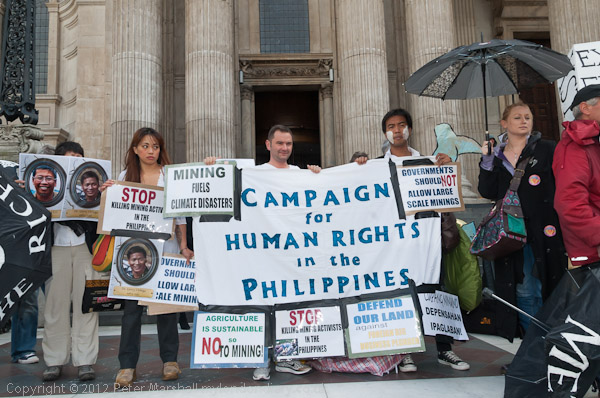
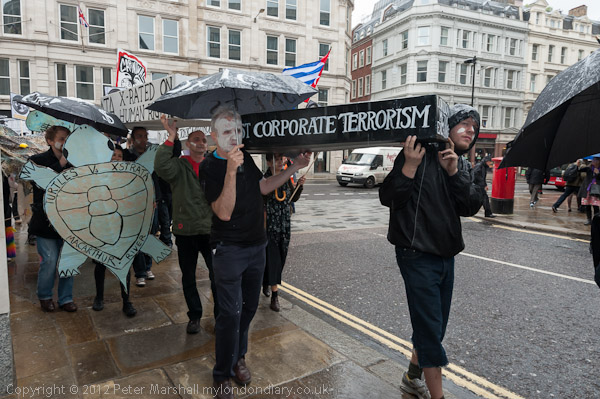
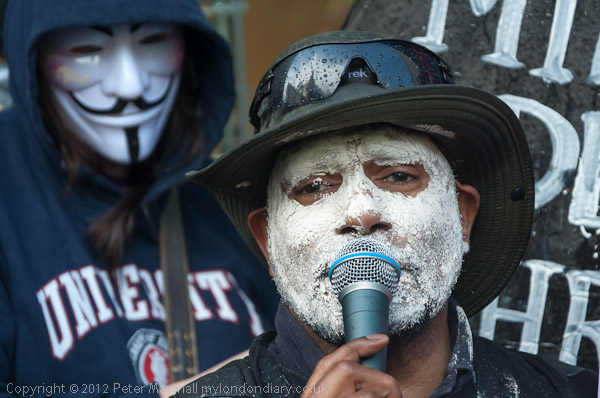
Carnival of Dirt: People from more than 30 activist groups from London and around the world met on the steps of St Paul’s Cathedral on Friday 15th June 2012 for the Carnival of Dirt, a funeral procession for the many killed by mining and extraction companies, powerful financial organisations whose crimes are legitimised by the City of London.
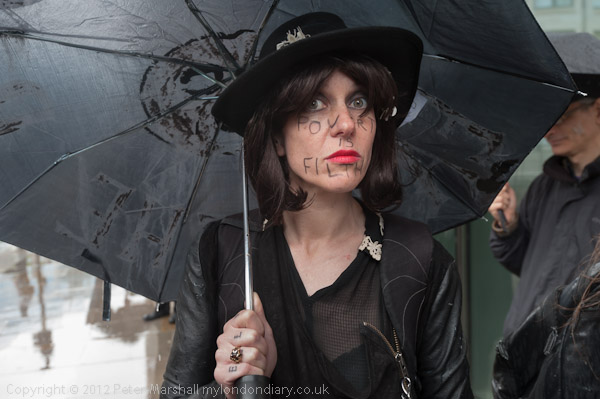
‘POVERTY IS FILTHY’
Although little mining now goes on in the UK, London remains the mining capital of the world with many of the largest and most powerful mining and extraction companies listed on the London Stock Exchange and trading on the London Metal Exchange. The Carnival of Dirt named some of them as major criminals, including Xstrata, Glencore International, Rio Tinto, Vedanta, Anglo American, BHP Billiton, BP and Shell.
Many activists around the world have been murdered for standing up against the interests of these companies, whose greed has led to crimes against humanity on a huge scale around the world. As I wrote in 2012, “They lie behind the millions who have died in wars in the Congo and elsewhere, behind the torture and rapes and other human rights abuses that are used to drive people off their land, behind the huge areas of land poisoned by toxic wastes, forests and whole mountains destroyed, ecocide on a truly massive scale.”
Many of these crimes have been well-documented but these companies are still supported by our pension schemes and protected by our government, as well as being allowed to get away with avoiding or evading millions or billions of pounds in UK taxes.
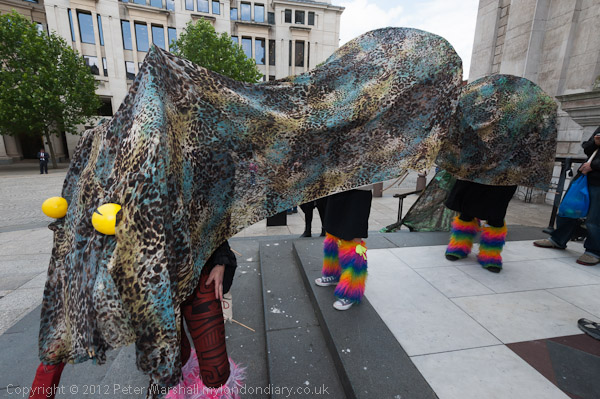
Many of those who came to the carnival were dressed in black, and the funeral procession had a New Orleans style theme. The cortège “included a large snake, a turtle and a tortoise, a reminder of XStrata’s criminal diversion of the McArthur River, destroying the ecosystem and despoiling the sacred sites of Australian aborigines.”
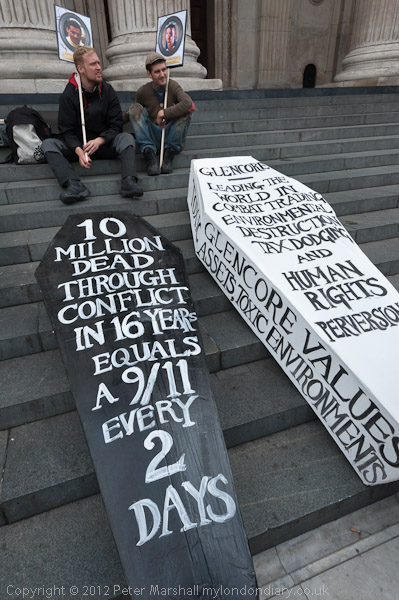
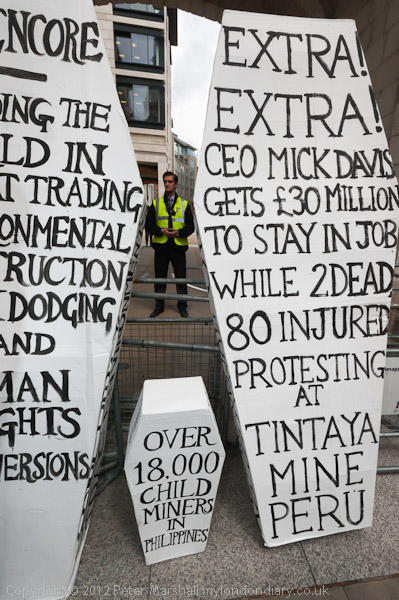
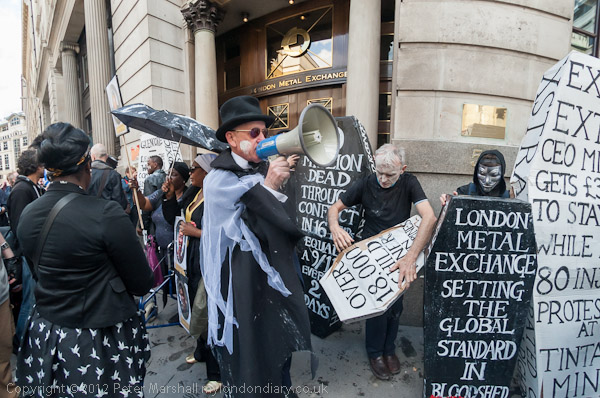
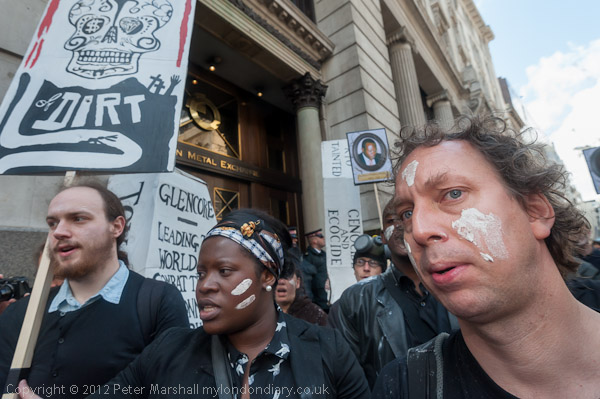
There were a number of coffins to represent the dead, naming some of the companies involved with messages such as ‘Glencore Values – Toxic Assets, Toxic Environments‘. Another read ‘XStrata – X-Rated on Human Rights‘ and pointed out the CEO Mick Davis “Gets £30 million to stay in job while 2 Dead 80 Injured protesting at Tintaya mine in Chile.’
The more than 18,000 child miners in the Phillipines were represented by a small coffin. One read ‘10 Million Dead Through Conflict in 16 years equals a 9/11 every 2 days‘. Red drops for blood ran down the side of a black coffin with the messages ‘Resist Corporate Terrorism’ and ‘London Metal Exchange – Setting the Global Standard in Bloodshed‘ . Another coffin testified to the genocide in West Papua where Indonesian troops have torched villages.
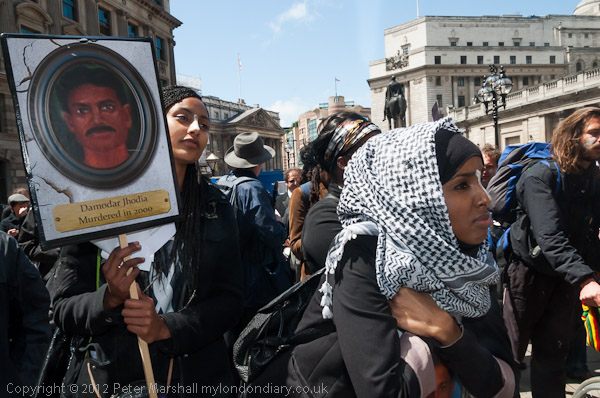
Some of the protesters walked with photographs of a few of the better-known activists murdered for standing up to corporate terrorism, and a leaflet named some – “Valmore Locarno, Fr Fausto Tentorio, Victor Orcasita, Alexandro Chacon, Fr Reinel Restropo, Dr Gerry Ortega, Armin Marin, Dr Leonard Co, Elizer Billanes, Jorge Eliecer, Floribert Chebeya, Raghunath Jhodia, Abhilash Jhodia, Damodar Jhodia, Petrus Ayamiseba.” Other placards showed unnamed and horribly mutilated victims.
After brief speeches the procession moved off from St Paul’s towards the Stock Exchange behind the marching band, but they were blocked by barriers and private security staff at Temple Bar, preventing them going into the now privatised Paternoster Square. After a short protest there it moved off, walking along public streets to the north entrance of the Stock Exchange on Newgate Street.
The entrance was blocked by a line of police but the protesters stopped from a short rally, listening to a speech by Benny Wenda who managed to escape to the UK after being arrested, imprisoned and tortured by Indonesian troops. There were heavy showers and we all got rather wet, though some protesters were fortunate to be carrying black umbrellas with slogans on them; the slogans ran in the rain but the umbrellas kept those underneath rather drier.
From there the cortège moved on to protest in front of the Bank of England, where there were several speeches from researchers and activists. From there we moved to a final rally at the London Metal Exchange, where we heard a longer exposition of the various trading activities which cause a great deal of death and unnatural disaster across the globe.
The came a reading of the names of some of the prominent murdered activists, each name being followed by the protesters shouting ‘Present’ or the Spanish ‘Presente’ to show they were still a part of the living, in the hearts and minds of those mourning them. At the end of the list there was a two-minute silence in the memory of them and the millions of others killed for the profits of the mining companies. After throwing ashes at the building the procession continued to its finish at Altab Ali park.
By this time I was very wet, and so were my cameras and lenses, with condensation steaming up on inner glass surfaces. Many of the later images were taken with a wideangle fisheye, a single focal length lens that was more resistant than the two zooms I use for most of my work. I was tired and needed to get somewhere to dry out, so while many were planning to go on to further protests in Green Park and on the Embankment it was time for me to go home.
Christian Aid Circle The City: This week every year is Christian Aid Week, when thousands of people engage in various activities to raise money for the work of this charity in the majority world. These include people trudging the streets of towns and cities delivering and then collecting gift envelopes, tea parties, sponsored walks and many other activities which to raise money.
Christian Aid is a charity embodying Christian principles but its support goes to people and grass roots organisations in many countries in the global south, many not Christian. It states it “exists to create a world where everyone can live a full life, free from poverty” and in 2021-2 helped 1.4 million people through its programmes. It provides humanitarian aid in emergencies but also runs many projects, particularly with women and promoting women’s rights and supporting the poorest and marginalised people.
Their web site lists the 25 countries in which they are currently active, working with local people and partner organisations – Bangladesh, Burkina Faso, Burundi, Colombia, Democratic Republic of Congo, Dominican Republisk, El Salvador, Ethiopia, Guatemala, Haiti, Honduras, India, Iraq, Israel and the occupied Palestinian territory, Kenya, Lebanon, Malawi, Myanmar (Burma), Nicaragua, Nigeria, Sierra Leone, South Sudan, Syria, Zambia and Zimbabwe.
Although I think they are a very worthwhile charity I’ve long supported others which work in similar ways but my wife is a local Christian Aid organiser and I’ve supported her in this work – including this year helping with a sponsored walk around the churches in our own area.
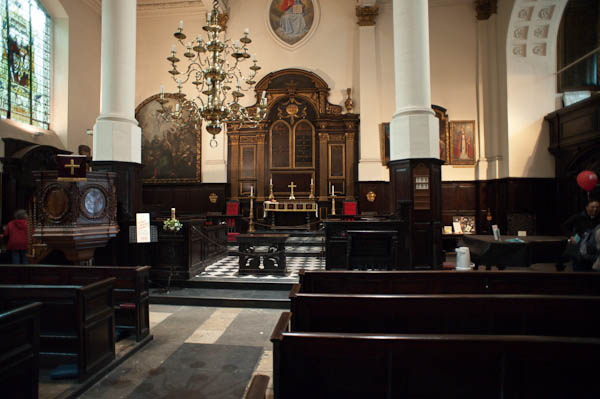
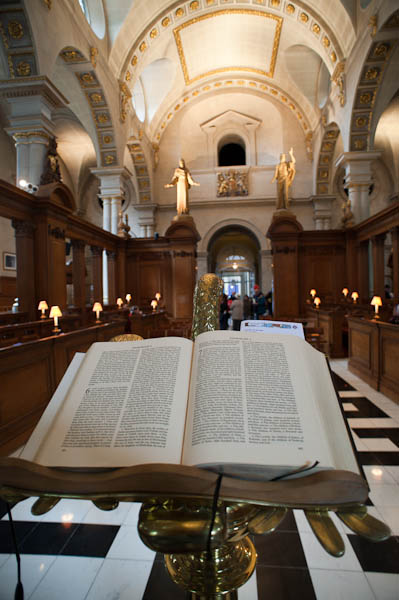
For a number of years she took part in an annual sponsored walk around the City of London, Christian Aid’s ‘Circle the City‘ a fund-raising sponsored stroll from church to church to church in the city. And often I went with her to keep her company and make sure she didn’t get lost. Of course I took a camera with me and took a few pictures, mainly of the many Wren churches we visited on the route. But in 2009 I decided to photograph it a little more seriously.
The pictures here are all from the walk on Sunday 17 May, 2009, and this is the post I made on My London Diary about it.
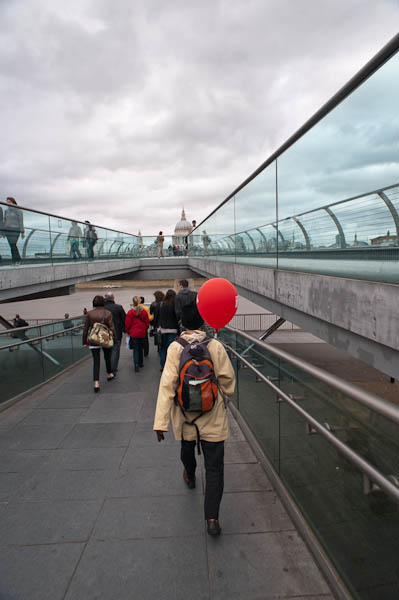
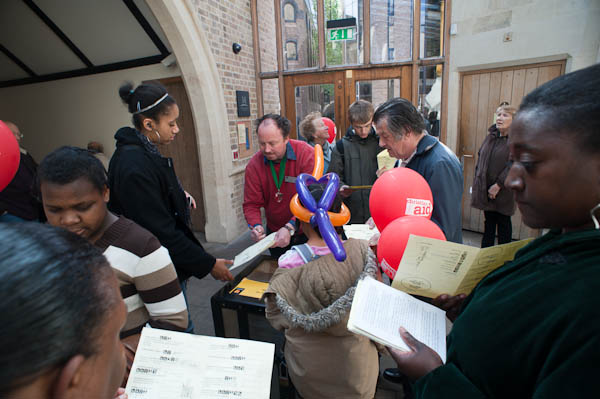
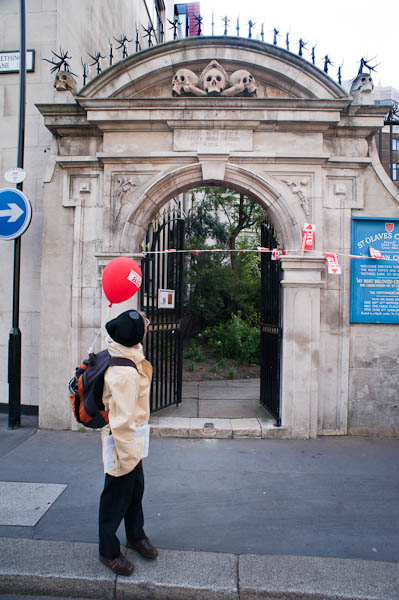
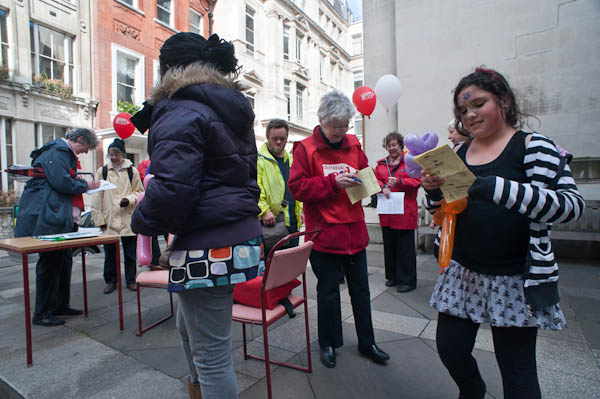
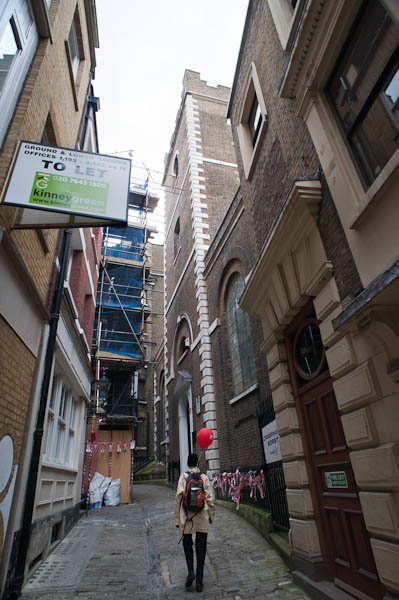
Sunday afternoon I followed a woman with a red balloon on a six mile (10 km) trail around the city, or rather two cities of London and Southwark, which led us to around 30 different ritual locations. We gained access to many of these and in several were offered drinks and food.
It was Christian Aid’s ‘Circle the City’ a fund-raising sponsored stroll from church to church to church… the woman was rather well known to me and all I got to drink was tea, coffee and lemon squash, though the asparagus quiche at All Hallows by the Tower was delicious.
In the course of our walk we got to see – if only rather briefly – the interiors of some of Wren’s finest, and one or two by other architects. And the event at the end of Christian Aid Week had raised a considerable amount for the projects that Christian Aid supports in the majority world.
If you don’t get a collector calling this week you can still make a donation to this worthwhile charity online at the Christian Aid web site. And of course donations are welcome at other times too, so if you are reading this later you can still support their work.
My walk in the City of London towards the end of March 1989 began at Bank Station, perhaps because the Bank of England is in many ways the centre of the City, but probably also because until 1994 the Waterloo and City line was a part of our railway network and I could travel there as a “London terminus” on my rail ticket. In 1994 it became part of the London Underground (they paid £1 for it) and from then on I needed to pay them for the journey. I think back then there were no services on the “drain” on Saturday aftenoons or Sundays.
War Memorial, Bank of England, City, 1989 89-3d-64
Over the years I’ve taken many slight variations on this picture with the London Troops War Memorial and the Bank of England. The memorial to the troops of London who died in the Great War was designed by Sir Aston Webb, with carving and lettering by William Silver Frith and the bronze figures by sculptor Alfred Drury and was unveiled on the day after the second anniversary of Armistice Day on 12th November 1920.
Later a further dedication to those who died in the Second World War was added. The quality of the statues and carving and overall its design make it one of the more impressive of war memorials. Grade II listed when I made this picture it was upgraded to II* more recently for the 100th anniversary of the Battle of the Somme.
The memorial stands in the triangle of public space in front of the Royal Exchange but this picture was taken from the side to include the Bank of England as the background. It’s perhaps slightly unfortunate that I included the sign for the public toilets at the bottom edge, useful though they were – and then like others in the City – free to use.
George & Vulture, George Yard, City, 1989 89-3d-52
The George & Vulture describes itself as a City institution and there has been an inn on this site since 1142 or 1175, depending on who you believe – or 1600 according to my picture. Before the 1666 Great Fire there were supposedly two inns here, the earliest The George and a later establishment, The Lively Vulture, but they were amalgamated in the rebuilding.
It gets numerous mentions in Dicken’s Pickwick Papers and has been the headquarters of the City Pickwick Club since it’s inaugural dinner in March 1909 when it was founded incorporating his earlier Pickwick Coaching Club by Sir James Roll. Initially limited to 30 members that has increased over the years and in 2009 was raised to 100; they still meet for dinner there four times a year, and it is also host to other Dickens events.
Rather than a pub it is now a City chop house or restaurant, though open some evenings for cold plates and drinks; run by Samuel Smiths Old Brewery it offers a full range of their beers as well as other drinks.
Fountain, George Yard, St Michael’s Alley, City, 1989 89-3d-53
The City’s alleys have long fascinated many, and I’d first explored them before I was taking many photographs, following walks from one of many guides to London. It’s still easy to get a little confused in following them, particularly when some parts such as George Yard has changed rather.
You will search in vain for this fountain which then stood in the open area at the end of George Yard and St Michael’s Alley (though you could also reach it from Bell Inn Yard or Bengall Court and it was just a few steps from the end of Castle Court.
Fountain, George Yard, St Michael’s Alley, City, 1989 89-3d-42
Both the George & Vulture and the the Church of St Edmund the King in the background of this picture remain, but much of the rest around here has been replaced.
Fountain, George Yard, St Michael’s Alley, City, 1989 89-3d-43
I assume the statue was of St Michael and to me it and the mosaic floor have a look of the 1950s or 60s about them, but neither this statue nor the fountain in which it stood get a mention in any of the books about London I own. Most of my pictures were of the mermaids who obviously appealed to me more.
I have no idea what happened to these sculptures, and have been unable to find any more information about them. The yard is now home to rather Dalek-like structures, surrounded by seats and flower beds, presumably provided ventilation for areas below. The whole site on the west side of Gracechurch Street south of Bell Inn Yard which was the headquarters of Barclays Bank was redeveloped shortly after I made these images, with the distinctively curved 17 floors of 20 Gracechurch being completed in 1994.
Sculpture, Lombard St, City, 1989 89-3d-46
I walked out onto Lombard Street where I made several exposures of this Grade II listed bronze ‘Chimera with Personifications of Fire and the Sea’ by Francis William Doyle-Jones from 1914 on the 1910 bank building. I was at the time thinking of putting together a compilation of pictures of London’s ‘topless’ women.
Sculpture, Lombard St, City, 1989 89-3d-33
A wider view taken from the corner with Birchin Lane, where the view today is little different to that in 1989, except that the hanging TSB 1810 sign on Falcon House at left, there until 2016, has since been replaced by one peculiarly illegible one for Falcon Fine Art.
My walk around the city continued, though I’ve digitised relatively few pictures from it and soon moved away further east towards Spitalfields, as you will see in my next post on it.
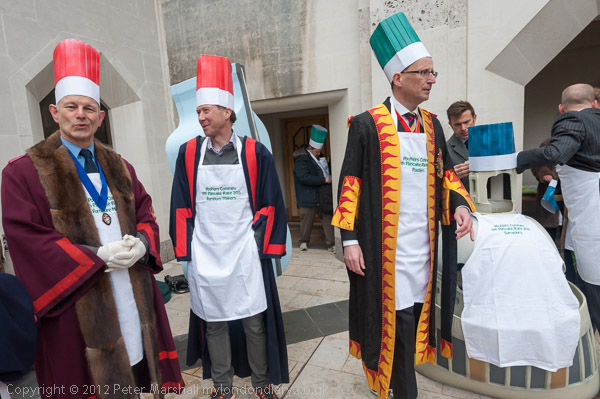
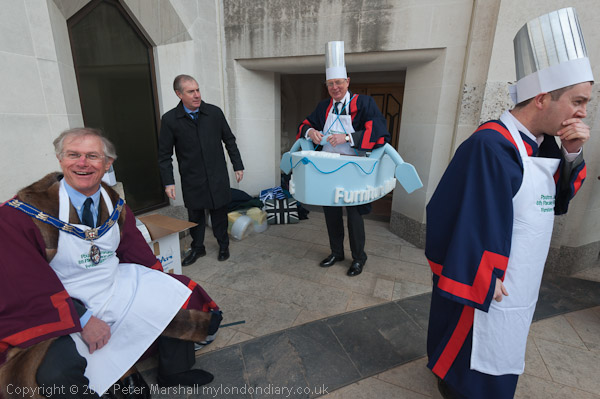
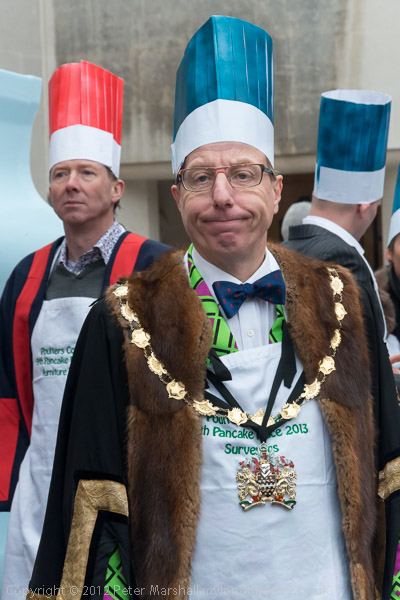
The Worshipful Company of Furniture Makers get ready for the inter-livery pancake races
Back in 2012, Shrove Tuesday also fell on February 21st. The annual date depends on the date for Easter, calculated by an esoteric formula, the computus, agreed in AD395, which makes it first Sunday after the Paschal full moon, the first full moon after the fixed approximation of the March Equinox, 21 March. The actual date differs between the western Christian tradition (Protestant and Catholic) which uses the Gregorian calendar introduced in 1582 and the eastern Orthodox churches which stuck with the Julian.
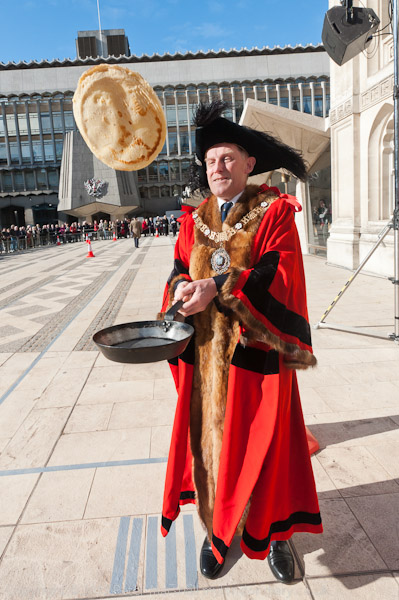
The Chief Commoner shows how to toss a pancake
Of course historically its more complex than this, but fortunately we don’t need to bother about it, as the annual dates are marked in calendars published in print or online. Shrove or Pancake Tuesday is always 47 days before Easter Sunday, and the ecclesiastically more important day that follows, Ash Wednesday, is the first day of Lent.
Few of us still give up things for Lent, though some still stop eating things like chocolate or biscuits, but it used to be a much more serious and widespread observance. Making pancakes was simply a way to use up eggs, milk and fat before the start of Lent and it was also an occasion for a bit of fun – hence pancake races.
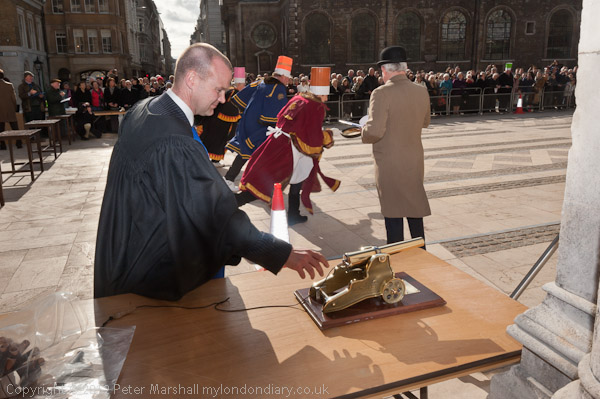
The Gunmakers fire a cannon to start each race
But there was also a more serious side to Shrove Tuesday, with people attending church and confessing their sins to a priest and being assigned appropriate penance, after which they were absolved from their sins, a practice known as shriving.
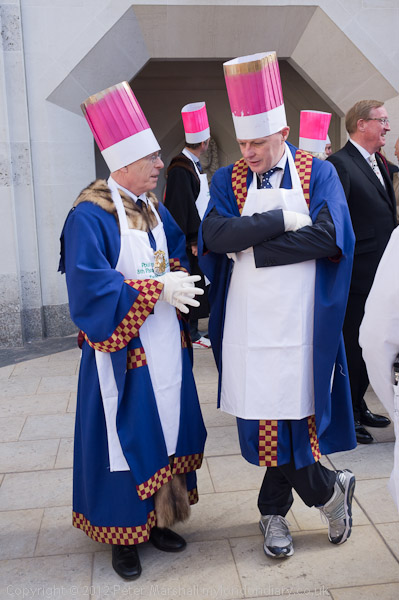
There are separate races for men, women and Masters
Until relatively recently, pancake races were only held in a few villages, reputed to have their origin in 1445 at Olney in Buckinghamshire, a few miles north of Milton Keynes, when a local housewife was still making her pancakes when the church bell for shriving rang, and she ran to the church holding her pan.
Earlier in origin were mob football games with large crowds taking place and streets and commons, sometimes between goals large distances apart, which sometimes caused a great deal of chaos and injury. In 1835 football was banned on public highways by Act of Parliament, and the practice has largely died out, though still celebrated in a few towns around the country.
Pancake races have come back in a big way this century, often as charity events such as that which takes place in Guildhall Yard in the City of London. The races here, which are between members of the various City of London Livery companies, where begun by the Worshipful Company of Poulters in 2004 and raise money for the annual Lord Mayor’s charity.
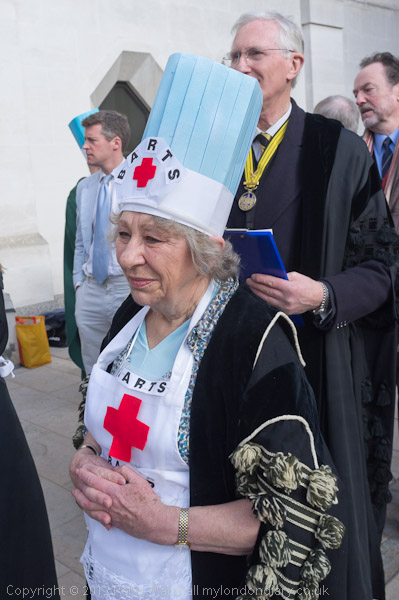
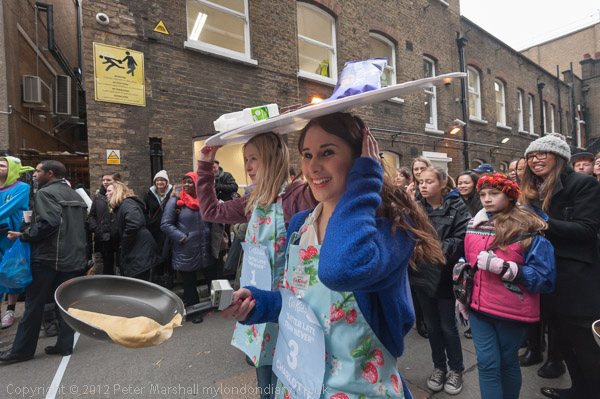
A fancy dress competitor – the 2012 event was supporting Bart’s Trauma unit
I’ve several times written more about what goes on in these races on My London Dairy, including in 2012 and won’t go into more detail here. But its interest is very much in the way that the City lets its hair down a little and in the hugely competitive spirit which has perhaps made the City what it is – for better or often for worse.
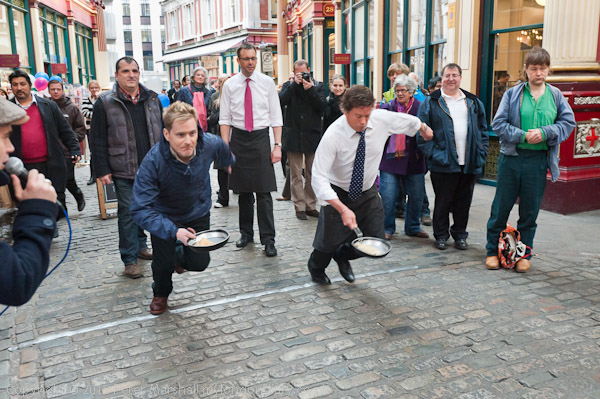
The other pancake race I photographed in the City in 2012 was very different, although those taking part were also workers in the city. This is very much a fun event, organised by businesses in Leadenhall Market, particularly the Lamb Tavern which provided the prizes.
There has been a market here since 1309, though the current structure is splendidly Victorian from 1881, finely restored in 1991. The alley on which the races take place is a little narrow and hard to keep clear for the races as tourists wander through and customers go into the shops on each side. There was only room for two teams to compete in any race, which were run as relays with three legs.
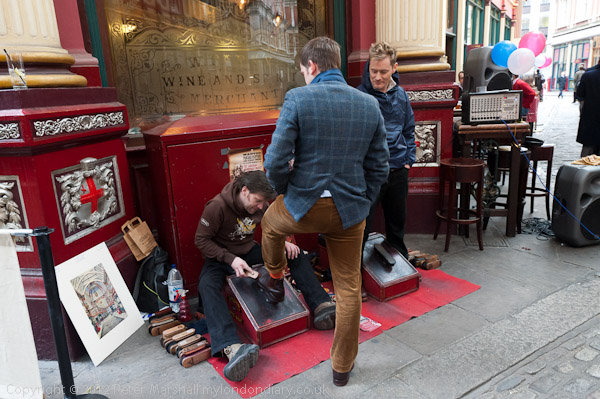
Shoe-shiners kept at work between races
The race was first held here only in 2011, and the contestants are teams from local offices and businesses in and around the market. In 2012 a number of heats eliminated all but a team from the shoe-shine stand on the corner by the Lamb Tavern and another from a nearby cheese shop.
But the final provided a surprise with the cheese shop team making no effort to win and simply walking the course as they preferred the second prize of £50 to spend at the Lamb Tavern bar to the first which was a £75 voucher for the pub’s restaurant. After some haggling the Lamb called for a rerun promising both teams a bar tab, and there was then a hard fought battle battle for the honour of winning, won narrowly for the second year in the short history of the race by the team from the shoe stall.
Neck and neck as they come to the finish
I won’t bother to go and photograph the races this year, either these or several others around London which I’ve also photographed in some past years. The Guildhall event has become rather more organised and attended by many, many more photographers making getting good pictures almost impossible and accreditation – which I can’t be bothered with – essential. And while I’ll certainly return to Leadenhall Market and the Lamb Tavern, I’ll do it again (as I did a couple of months back) on a day there are no races and it is less crowded.
Three years ago on Saturday 1st February 2020 I went to London to photograph a protest against Trump’s ‘Deal of the Century’ plans which, according to the BBC, “gives Mr Netanyahu all he wants – and offers Palestinians very little; a sort-of state that will be truncated, without proper sovereignty, surrounded by Israel’s territory and threaded between Jewish settlements.” When that finished I took a short walk along the Thames Path towards Battersea Power station before catching a bus back to Vauxhall for the train home.
Later in February I did quite a lot of walking and riding in buses and trains around London, and as in quite a few other months, gathered together some of the pictures I took on these journeys together with a link from the bottom of the page on My London Diary for the month.
Palestinians against Trump’s Deal – US Embassy, Nine Elms
Supporters of Palestine came to the US Embassy in Nine Elms in protest against Trump’s so-called peace plan, which they say aims to liquidate the Palestinian cause and minimise sovereignty for the Palestinian people across Palestine, marginalising them in isolated ghettos in a rigid implementation of the current apartheid regime.
The protest was supported by a wide range of organisations including the Palestinian Forum in Britain (PFB), the Palestinian Community Association in London, the General Union for Palestinian Students/British Branch, The Palestinian Youth Foundation in Britain “Olive” and Stop the war and supported by the Palestine Solidarity Campaign (PSC), Friends of Al-Aqsa (FoA) and the Muslim Association of Britain (MAB).
There were quite a few protesters of Palestinian heritage living in the UK, as well as many supporters from the wider British left at the protest.
A handful of some of the usual anti-Palestinian Zionists came to oppose the protest, shouting at the protesters. Police moved in to protect them when the protesters began shouting back and kept the two groups apart. There were also Jews present protesting on behalf of Palestine.
Among the protesters was one dressed as Saudi Prince Mohammad bin Salman,holding a bone saw, like that used to dismember Saudi dissident and journalist for The Washington Post Jamal Kashoggi by the team he sent to the Saudi consulate in Istanbul, Turkey on 2 October 2018. He posed with a man in a Trump mask who was handing him fistfuls of dollars to support the plan. There was also a giant inflatable of the Saudi prince, with large black horns.
There were a number of speeches supporting the Palestinian cause as well as a great deal of chanting against the Trump plan, which had no chance of being implemented but was largely a propaganda exercise to enhance Trump’s support among the Jewish population of the USA.
Nine Elms is one of the largest developments in Europe. The bank of the River Thames here was once crammed with wharves and full of varied industrial sites, but by the 1970s these had either closed or were about to close. At the end of the protest I took another short walk around the area.
In this area much of the land was taken up by railway yards and depots, but the area closer to the River Thames also had a jam factory and some paint and engineering works. and at the Vauxhall end, a giant cold store.
In 1971 the New Covent Garden Market began to move here from central London on Land that had formerly been a railway goods depots and an engine shed, and two markets, one for flowers and the larger for fruit and vegetables, south of the railway, opened for business in 1974. Both markets have been redeveloped since and are planned to move out to a site in Dagenham in the next few years.
The largest area north of the railway was occupied by Battersea Power Station, a relatively late-comer to the area. It occupied a site which had previously been a waterworks, taking water from the Thames. At its south end was a large Great Western Railway Goods Depot, and to the east a gas works. Another gas works occupied the site roughly where the US Embassy now stands.
In the nineteen-seventies there were a few new blocks of riverside flats but development of the area only really got into gear in this century and is still continuing. The power station, which finally closed in 1983 and lay derelict for some years, particularly after its roof was removed by an early development which failed, was only finally re-opened as an up-market shopping centretourist attraction with luxury flats at the end of 2022.
Most of these pictures come from several bus journeys from or to the station, from Waterloo Bridge, in Holborn and some in the City of London. Also a few from closer to my home in Staines and Laleham.
Some of you may like to try to identify these locations before you go to look at more in London Images on My London Diary, where captions reveal them.
One of my busier days in London was Saturday 27th October 2007, when I began with a trip to Hoxton to collect and take home some pictures from a group exhibition, then travelled back into the centre of London for a number of events. The main protest I covered was the annual UFFC march against deaths in custody, but there were also Kurds protesting against Turkish army attacks on them in Northern Iraq, campaigners calling for a Brexit referendum, an anti-abortion rally and peace protesters around Parliament where I also photographed a new statue in Parliament Square. I ended my working day with a Halloween Zombie Crawl.
Here’s what I wrote back in 2007, with minor corrections including normal capitalisation and some changes of tense – and I’ve included some headings and pictures. As usual there are many more pictures if you follow the links to My London Diary.
On saturday, everything was happening. I had to run around to start with to collect my unsold pictures from the City People show at the Juggler in Hoxton. Fortunately I’d sold one of my four pictures, so that made them easier to carry, but it was a rush to be back in the centre of London and I had to more or less miss the demonstrators who wanted a referendum on leaving the European Union.
Instead I started at Trafalgar Square, where the annual event remembering those who have died in custody was taking place, organised by the UFFC, families and friends of those killed.
It’s an occasion that always shocks me by the sheer number of people who have died in such disgraceful or suspicious circumstances, in police cells, in prisons and elsewhere. It’s an event I sometimes find it hard to photograph, both emotionally and physically – thankfully autofocus works even when your eyes are filling with tears. more pictures
While that demo was getting ready to march, a large crowd of Kurds swarmed into Trafalgar Square and held a short rally, protesting against the Turkish government’s approval of incursions into Northern Iraq to attack the PKK there. Both the Kurds and the Armenians have suffered greatly at the hands of the Turks (who in turn have been rather screwed by the EU over Cyprus.)
It was a typically exuberant performance, and one that I enjoyed photographing, but rather a distraction from the family and friends event. more pictures
Pro-referendum on Europe Rally – Old Palace Yard, Westminster. 27 October 2007
There seems to be hiatus in the UFFC demonstration, so I caught a bus down Whitehall. Walking along to Old Palace Yard I passed a few of the pro-referendum demonstrators, though some others had stayed to join in the anti-abortion protest. a couple of pictures
This was rather smaller than I’d expected, perhaps around 500 people, although it was the only event that made the BBC news bulletins I heard when I got home later in the day. more pictures
Lloyd George – Parliament Square, London. Saturday October 27, 2007
I listened a little to the speeches, but then went to Parliament Square to take a look at the new statue of Lloyd George – which failed to impress me. Of course he was long before my time – although I did have a landlady as a student in Manchester who had worked as a secretary for him – but somehow I feel the statue trivialises him, looking rather like an enlarged version of a plastic figure you might find in a box of cornflakes rather than a statue of a Prime Minister. another picture
Peace Train – Parliament Square, Westminster. Saturday October 27, 2007
The Peace Train is beginning to form a protest in Parliament Square and I go along to talk to them and take a few pictures.
I rejoin the ‘Famiilies and Friends’ march now making a considerable protest opposite Downing Street, where a delegation has permission to deliver a letter to the prime minister’s residence at No 10. It takes a lot of argument before the police let them in despite this.
For some reason the police decide not to allow those with press cards into the street in the normal way. I don’t like going in – the security checks are a nuisance and being restricted to a pen on the other side of the street is normally hopeless, but I think its a matter of principle that access should not be unreasonably prevented – as it was for this event, even if personally I don’t particularly want to take advantage of it.
By the time the deputation emerge, the mood on the street is getting rather angry. One young policeman is getting surrounded and insulted and is trying hard to ignore it. A few minutes later a motor-cyclist foolishly stays in the route of the march, and is soon surrounded by angry people. He has to be rescued by his colleagues.
There are police who are racist, who are thugs, who are bullies. Too many who have got away with murder, often thanks to covering up or a lack of diligence in investigation by their colleagues. If it were not so, there would be no demonstration. But there are also officers who do their best to carry out a difficult and necessary job in a decent, reasonable and even-handed way – even though they may sometimes get disciplined for doing so. Those who bear the brunt of considerable and understandable hate directed against the police at a demo like this are not necessarily the guilty. more pictures
Crawl of the Dead IV – City and Southwark, London. Saturday October 27, 2007
It’s time for me to leave and make my way to the City of London, where this year the zombies are starting their walk at a pub on Ludgate Hill. I go into the pub and talk to some of them and take photographs, and am gratified to find that quite a few have seen my pictures from around Oxford Street last year.
By the time they emerge from the pub it is getting dark, and my flash by now is refusing to work at all. I have to make do either with available light (and there isn’t a lot) or the pretty useless camera built in flash, but I still manage to get a few decent pictures, even though some are rather noisier than I’d like.
There are quite a few people around as we go over the Millennium bridge, and more in front of Tate Modern, where zombies decide to play dead for a while. Then we visit the famous crack in the turbine hall, coming out towards the Founder’s arms, where I made my goodbyes and turned for home.
This post looks at the end of my walk south of the river on Sunday 13th November 1988 – the previous post was Flats, A Square, Bread & Funerals – Walworth – and finishes with a few pictures taken at night in the City of London.
Southwark Council built the Aylesbury Estate between 1963 and 1977. It was one of the larger if not the largest public housing developments in Europe, with around 2,700 homes. Wendover, designed by the boroughs architects, was completed in 1970. I think it’s two blocks contains around 471 flats as well as a learning centre and tenants hall.
Like many council estates it was poorly maintained over the years and parts of the estate were deliberately used by the council to house people and families with various social problems, something exacerbated by the Conservatives plans, particularly under Thatcher, to get rid of social housing, resulting in it increasingly becoming housing for the most deprived members of society.
The estate has a central boiler for heating and hot water, which has increasingly suffered from failures which residents say the council is very slow to take action over. The flats also have fallen behind more modern standards of insulation etc, and are in need of some refurbishment, though the council drastically overstated the costs of this when making their case for demolition.
I’ve in recent years been inside quite a few flats on the estate, often lovingly maintained and decorated by their residents who have been fighting a long battle against council plans to redevelop the area.
Although the council carried out a long PR campaign against this and the neighbouring Heygate Estate – including Tony Blair making his first speech as Prime Minister here and launching the party’s programme of regeneration of housing estates.
Its relatively open and fairly traffic-free nature along with convenient location made the estate a favourite for “grim backdrops to murder scenes, gun and drug storylines and gang-related crimes in soaps and gritty dramas” until pressure from local residents forced Southwark Council to ban filming in the area.
Channel4 took footage from the estate to use in their channel ident, adding to it, according to Ben Campkin of UCL quoted in Wikipedia, “washing lines, shopping trolley, rubbish bags and satellite dishes” to show it as “a desolate concrete dystopia [which] provides visual confirmation of tabloid journalists’ descriptions of a ‘ghost town’ estate.“
Residents wanted refurbishment rather than demolition – which will lead to many of them moving much further away from the centre of London. But councillors salivated at the thought of profits and handouts from the developers and never seriously considered anything other than demolition and replacement. Their decision lead to a series of occupations by housing activists of properties due for demolition. The complete destruction of the estate seems likely to take around another ten years with the final phase beginning next year. You can read much more about what has happened – and the duplicity of Southwark Council on the Southwark Notes site.
I walked on through both the Aylesbury and Heygate estates, both estates with a bad reputation for crime, but where I never suffered an uneasy moment despite having around £10,000 of equipment in my camera bag. I didn’t stop to take many pictures after those of Wendover, probably because I was getting tired. I did took a few frames on the New Kent Road and then walked on past the Elephant.
This entrance on Lambeth Road was one I’d photographed previously and probably I made a slight detour to do so again. I’d made an earlier picture using the tiny Minox that lived in my jacket pocket and it was severely underexposed. I had to send the camera for servicing. It was distributed by Leica, who told me it couldn’t be repaired, but offered me a replacement at considerably below the shop price. I had it in my pocket on 13th November taking my first test film, and took it out and made another exposure with it which was fine – and very similar to this, made on an Olympus SLR. Both are online on Flickr.
Frank Love, Lambeth Rd, Newington, Southwark, 1988 88-11e-63
The previous image was the trade entrance at No 47 for Frank Love at New XL House, No 45 Lambeth Rd. Its signs read PLUMBERS BRASSFOUNDRY COPPER TUBES AND FITTINGS but I think the works had closed when I made this image. You can view an earlier image of the whole frontage by Bedford Lemere & Co in the Lambeth borough archive, and see some of their advents on Grace’s Guide. I think these were the last pictures taken on my walk which ended at Waterloo Station.
Dagwoods, St Alphage Highwalk, City, 198888-11e-41
Dagwoods offered Quality Sandwiches to city workers in their lunch hour but the area was pretty empty at night, although there are still a few lights in the offices. The large area of pavement emphasises that emptiness.
I think I was probably coming back from an event at the Museum of London and had decided to take a little walk with my camera, though from some of the other pictures it seems clear I had come without a tripod.
Night, Bassishaw Highwalk, City, 1988 88-11e-42
Another deserted area of highwalk, and the sharpness and depth of field suggests I was able to steady myself well to produce this handheld – it will have been taken at a pretty slow shutter speed. This section of highwalk and the office building at right is still there though looking rather different.
Too much of the older London remained for the planners’ dreams of the separation of pedestrians from traffic to ever really be feasible except in a few small areas of the city – and there are very few escalators or lifts where the elderly and disabled can access them.
Night, Bassishaw Highwalk, City, 1988 88-11e-45
One of my favourite modern buildings in London, and one I’ve photographed several times in daylight. I suspect it was this building that really prompted me to make this short walk at night. After the four frames (only one digitised) I made here I did wander around an make a dozen or so more exposures, but nothing which really caught my interest when I was deciding which to put on-line.
65 Basinghall St is Grade II listed as “Former exhibition hall, magistrates court and offices, now converted to offices, 1966-69, by Richard Gilbert Scott of Sir Giles Gilbert Scott, Son and Partner” and was built in 1966-9. There is a long essay in the listing text. But perhaps sufficient to say its roof is one of the finest uses of concrete at least in the UK.