Factories, Flats, Wesley & The Kinks – 1990

Factories, Flats, Wesley & The Kinks: More from my walk on Sunday February 25th 1990 which began with Around Finsbury Park – 1990. The previous post was More Kentish Town – 1990.

Flats, Elsfield, Highgate Rd, Kentish Town, Camden, 1990, 90-2i-61

When the London Borough of Camden was formed in 1965 its architects department was set up headed by Sydney Cook and included many of the leading architects of the day, working for a council that was determined to build better homes for those living in the borough. Over the next 15 or so years they produced a huge number of well-designed and architecturally significant buildings until government cuts brought an end to what has been described as “their golden age of social housing.”

As well as large estates such as Neave Brown’s Alexandra Road, there were also a number of smaller sites such as Elsfield, designed by Bill Forest and built in 1966-70. Most of Camden’s schemes were built “in-house” which had the advantage of better quality work than many private contractors but sometimes led to lengthy delays and cost overruns.

Flats, Elsfield, Highgate Rd, Kentish Town, Camden, 1990, 90-2i-36

Later in the day I walked back past these flats and made another picture which shows the whole frontage on Highgate Road with its stepped back profile and prominent painted railings. The wall in front gives ground-floor residents privacy.

Linton House, Carkers Lane, Highgate Rd, Kentish Town, Camden, 1990, 90-2i-62

Once Carkers Lane was just “a footpath across fields and watercress beds and a farm belonging to Mr Corker“. Much of those fields became tracks and engine sheds for the Midland Railway, leaving just a short section of the path to become Carkers Lane.

In 1881 Thomas William Read and John Walter Read bought land here and began bottling spirits and beer; by 1906 they were “the largest buyer and bottler of Bass Ale in the world.” The ‘Dog’s Head Bottling’ adopted its famous Bull Dog trademark as its Company Logo. All this bottled beer was for export, mainly to “Australia, New Zealand, France, the West Indies and South Africa.” The company amalgamated with Kings Cross brewers Robert Porter in 1938 as Export Bottlers Ltd.

The building at the left of my picture on the corner of Highgate Road, then called Linton House (with parking for Norman Linton Only) was built around 1900 as a factory for furniture makers Maple & Co, suppliers of furniture to the royal family, palaces and expensive hotels worldwide as well as selling to the wealthy public through their Tottenham Court Road shop and in Paris and elsewhere. After they moved it it became home to a number of smaller companies, mainly as offices. Developers The Linton Group acquired it and converted it into 50 luxury flats and seven penthouses they lanched on the market in 2016 as Maple House.

Wallpaper manufacturer Shand Kydd moved to the site in 1906 to mass produce their wallpapers and around 1920 Sanderson’s wallpaper joined them. Both had moved out by around 1960.

The estate also became home in 1973 to the International Oriental Carpet Centre, formed by Oriental rug dealers who had previously been in the Cutler Street warehouse complex owned by Port of London Authority but were given notice to quit when the PLA decided to sell this for redevelopment. The IOCC lease expired in 1994 and most of the dealers left.

Carkers Lane is now home to Highgate Studios, a huge largely office development and the Highgate Business Centre.

Factory, Carkers Lane, Highgate Rd, Kentish Town, Camden, 1990, 90-2i-33

Again as I walked back past Carkers Lane later in the day I made another picture

Houses, Little Green St, Kentish Town, Camden, 1990, 90-2i-66

Little Green Street is a short street between Highgate Road and College Lane which takes you back to the 1780s. The ten Georgian houses here were seen even in the 1890s as “old-fashioned cottages” by Charles Booth in his Life and Labour of the People in London. The street provided the background for The Kinks dressed as old-fashioned undertakers carrying a coffin in the 1966 official music video for Dead End Street, one of the earliest music videos.

The wooden post at left has gone and the cobbled area at its left is now a walled garden for the house on the corner of the street.

Houses, Little Green St, Kentish Town, Camden, 1990, 90-2i-53

These Grade II listed cottages were in something of a dead end street, leading only to College Lane, on the other side of which was the Staff Hotel for the London Midland and Scottish Railway until this was replaced by Camden Council’s Ingestre Road Estate, designed by John Green for Camden Architects’ Department and built in 1967–71, a small part of which you can see at the left edge of this picture.

Tyre swing, Highgate Rd, Dartmouth Park, Camden, 1990, 90-2i-55

At the end of Little Green Street I think I turned left and walked along under the railway bridge which also features in The Kinks video to Denyer House, a large 1930s London County Council block set back from Highgate Road. The tree is still there but the swing is long gone.

Wesleyan Place, Gospel Oak, Camden, 1990, 90-2i-45

Crossing Highgate Road I went down Wesleyan Place. This street was laid out in 1810 and was the site of a Wesleyan Methodist chapel in a converted farm building from Richard Mortimer’s farm here. The Methodists moved out in 1864 to a new chapel in Bassett Street.

This early/mid nineteenth century terrace of four houses was Grade II listed in 1974. The street leads to Mortimer Terrace.

I’ll write and post the final part of this walk shortly.


FlickrFacebookMy London DiaryHull PhotosLea ValleyParis
London’s Industrial HeritageLondon Photos

All photographs on this page are copyright © Peter Marshall.
Contact me to buy prints or licence to reproduce.
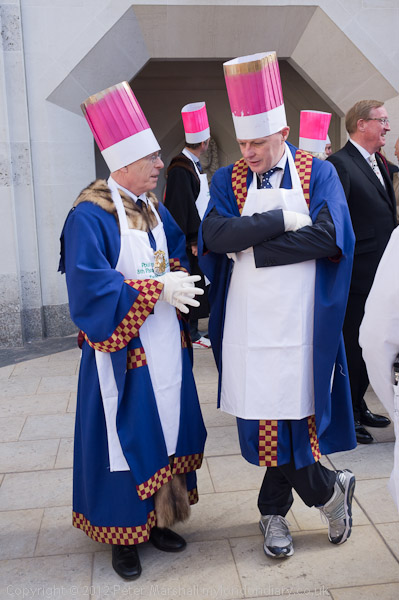
Shrove Tuesday Pancake Races 2012

Shrove Tuesday Pancake Races 2012
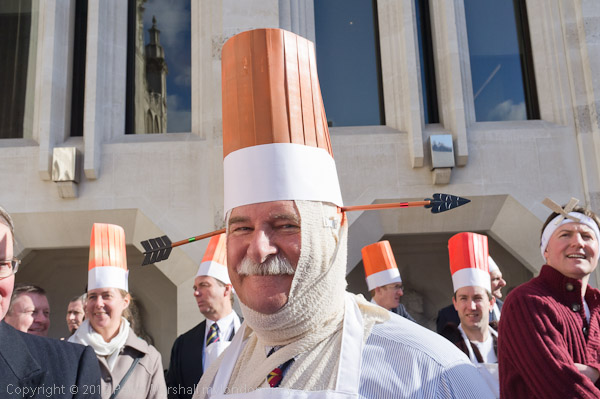
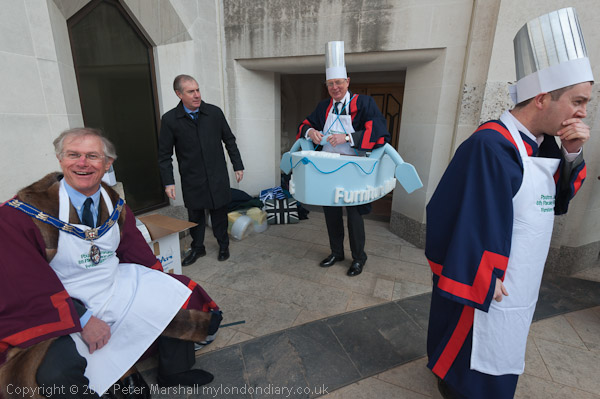
The Worshipful Company of Furniture Makers get ready for the inter-livery pancake races

Back in 2012, Shrove Tuesday also fell on February 21st. The annual date depends on the date for Easter, calculated by an esoteric formula, the computus, agreed in AD395, which makes it first Sunday after the Paschal full moon, the first full moon after the fixed approximation of the March Equinox, 21 March. The actual date differs between the western Christian tradition (Protestant and Catholic) which uses the Gregorian calendar introduced in 1582 and the eastern Orthodox churches which stuck with the Julian.

Shrove Tuesday Pancake Races 2012
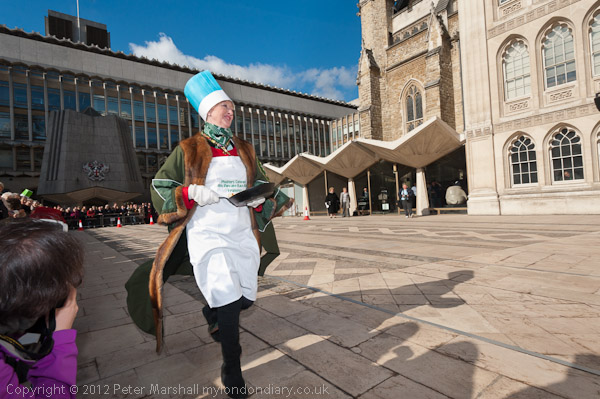
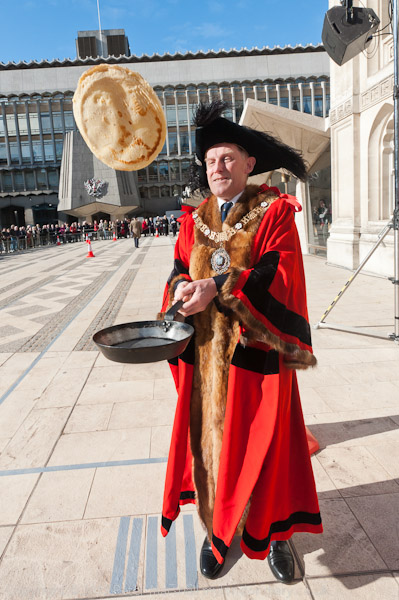
The Chief Commoner shows how to toss a pancake

Of course historically its more complex than this, but fortunately we don’t need to bother about it, as the annual dates are marked in calendars published in print or online. Shrove or Pancake Tuesday is always 47 days before Easter Sunday, and the ecclesiastically more important day that follows, Ash Wednesday, is the first day of Lent.

Shrove Tuesday Pancake Races 2012

Few of us still give up things for Lent, though some still stop eating things like chocolate or biscuits, but it used to be a much more serious and widespread observance. Making pancakes was simply a way to use up eggs, milk and fat before the start of Lent and it was also an occasion for a bit of fun – hence pancake races.

Shrove Tuesday Pancake Races 2012
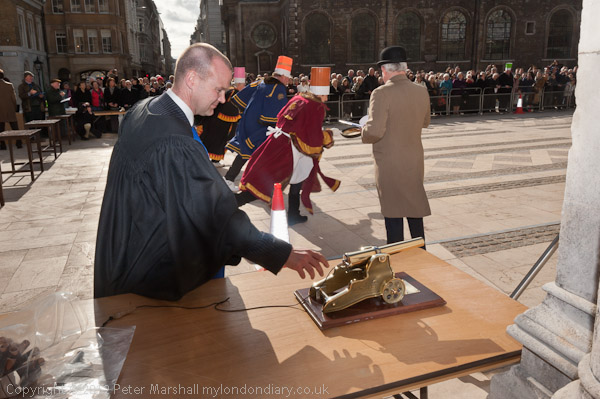
The Gunmakers fire a cannon to start each race

But there was also a more serious side to Shrove Tuesday, with people attending church and confessing their sins to a priest and being assigned appropriate penance, after which they were absolved from their sins, a practice known as shriving.

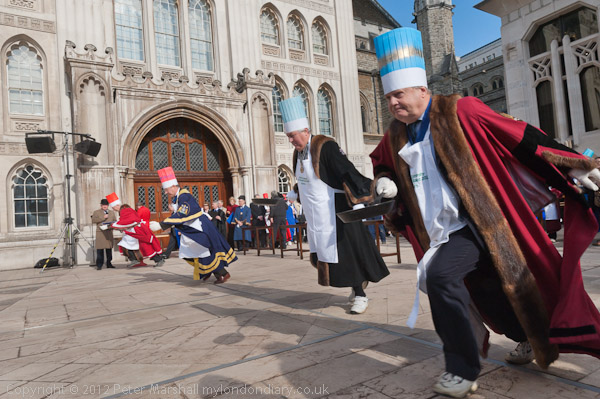
There are separate races for men, women and Masters

Until relatively recently, pancake races were only held in a few villages, reputed to have their origin in 1445 at Olney in Buckinghamshire, a few miles north of Milton Keynes, when a local housewife was still making her pancakes when the church bell for shriving rang, and she ran to the church holding her pan.

Earlier in origin were mob football games with large crowds taking place and streets and commons, sometimes between goals large distances apart, which sometimes caused a great deal of chaos and injury. In 1835 football was banned on public highways by Act of Parliament, and the practice has largely died out, though still celebrated in a few towns around the country.

Pancake races have come back in a big way this century, often as charity events such as that which takes place in Guildhall Yard in the City of London. The races here, which are between members of the various City of London Livery companies, where begun by the Worshipful Company of Poulters in 2004 and raise money for the annual Lord Mayor’s charity.

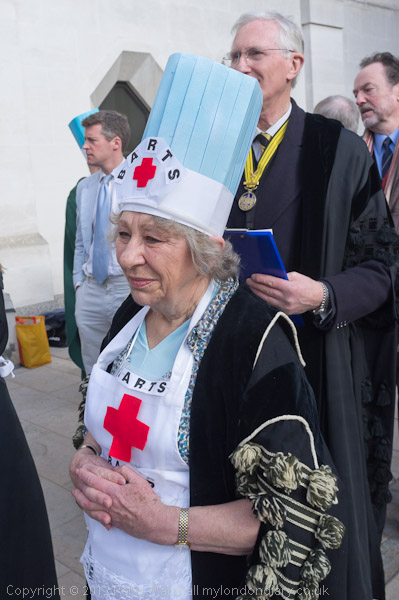
A fancy dress competitor – the 2012 event was supporting Bart’s Trauma unit

I’ve several times written more about what goes on in these races on My London Dairy, including in 2012 and won’t go into more detail here. But its interest is very much in the way that the City lets its hair down a little and in the hugely competitive spirit which has perhaps made the City what it is – for better or often for worse.

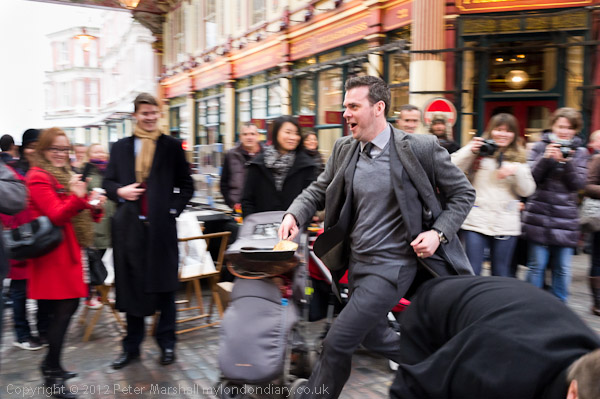
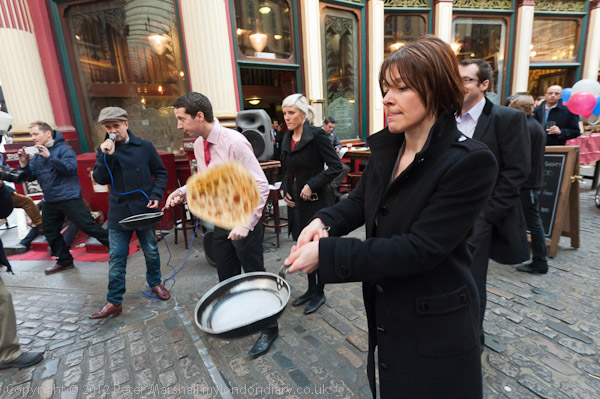
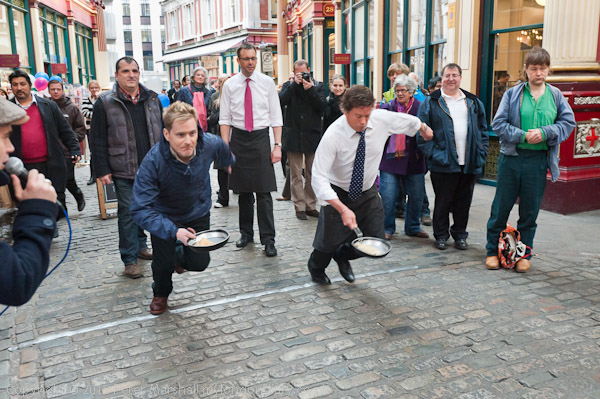
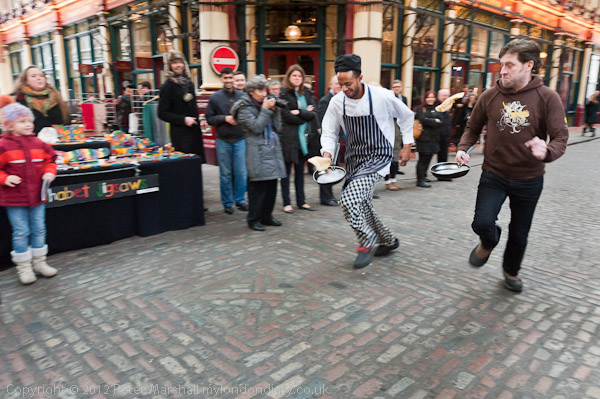
The other pancake race I photographed in the City in 2012 was very different, although those taking part were also workers in the city. This is very much a fun event, organised by businesses in Leadenhall Market, particularly the Lamb Tavern which provided the prizes.

There has been a market here since 1309, though the current structure is splendidly Victorian from 1881, finely restored in 1991. The alley on which the races take place is a little narrow and hard to keep clear for the races as tourists wander through and customers go into the shops on each side. There was only room for two teams to compete in any race, which were run as relays with three legs.

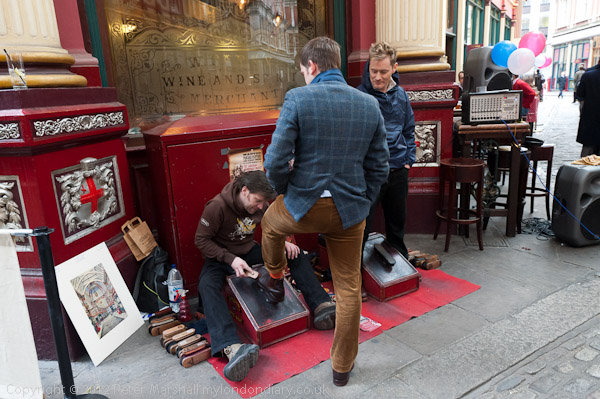
Shoe-shiners kept at work between races

The race was first held here only in 2011, and the contestants are teams from local offices and businesses in and around the market. In 2012 a number of heats eliminated all but a team from the shoe-shine stand on the corner by the Lamb Tavern and another from a nearby cheese shop.

But the final provided a surprise with the cheese shop team making no effort to win and simply walking the course as they preferred the second prize of £50 to spend at the Lamb Tavern bar to the first which was a £75 voucher for the pub’s restaurant. After some haggling the Lamb called for a rerun promising both teams a bar tab, and there was then a hard fought battle battle for the honour of winning, won narrowly for the second year in the short history of the race by the team from the shoe stall.

Neck and neck as they come to the finish

I won’t bother to go and photograph the races this year, either these or several others around London which I’ve also photographed in some past years. The Guildhall event has become rather more organised and attended by many, many more photographers making getting good pictures almost impossible and accreditation – which I can’t be bothered with – essential. And while I’ll certainly return to Leadenhall Market and the Lamb Tavern, I’ll do it again (as I did a couple of months back) on a day there are no races and it is less crowded.

Pancakes in the City – Leadenhall Market
Pancakes in the City – Guildhall