Class War Women in Red One Commercial St, Aldgate, Wed 12 Nov 2014
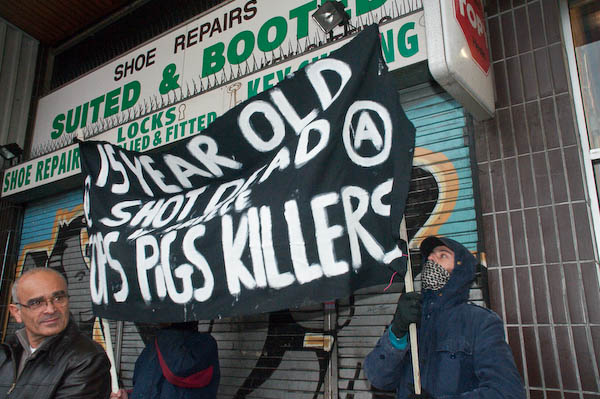
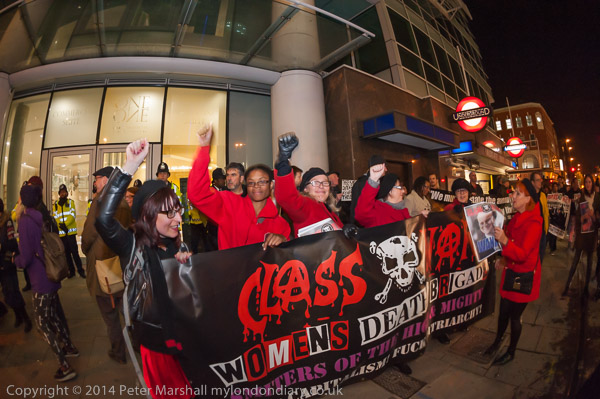
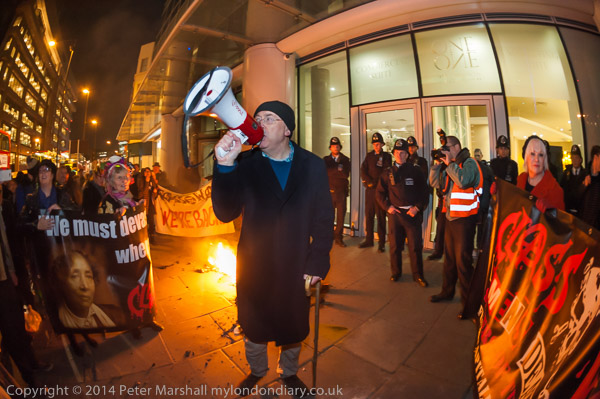
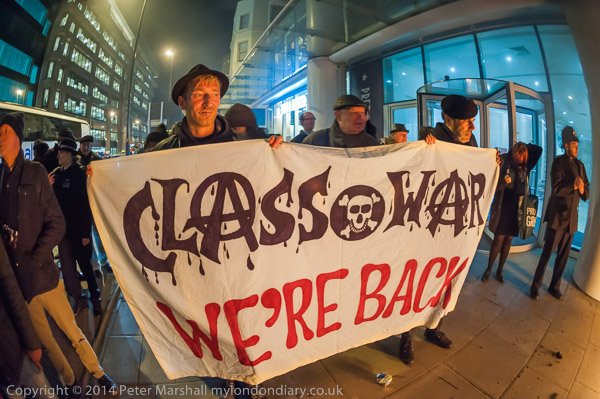
A week earlier on 5th November 2014, police had arrested Jane Nicholl for setting fire to an effigy of Boris Johnson as a part of Class War’s ‘Poor Doors’ weekly protest against separate entrances for wealthy and social housing residents in the block at 1 Commercial St in Aldgate.
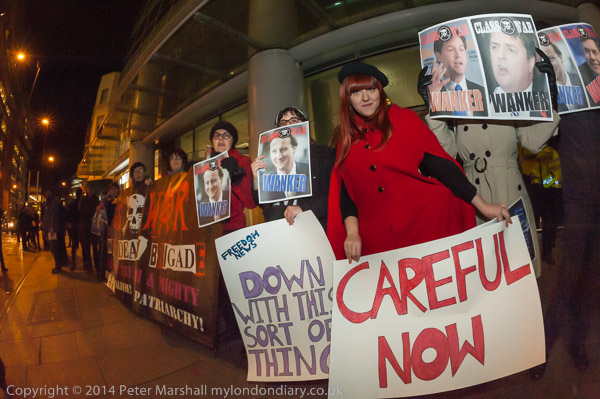
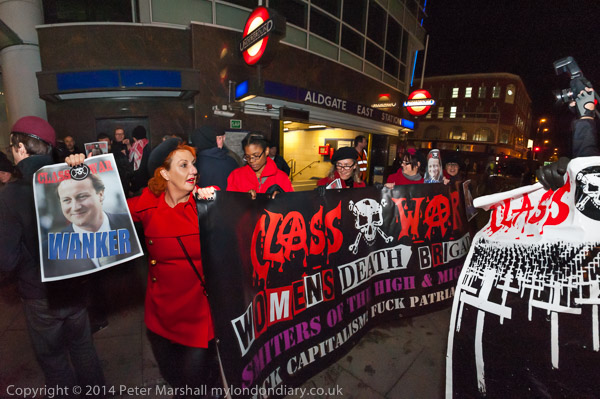
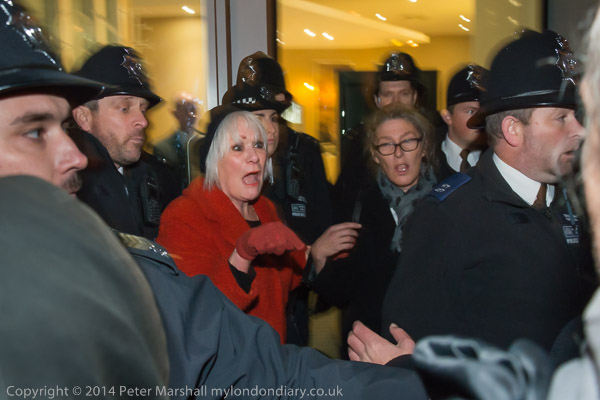
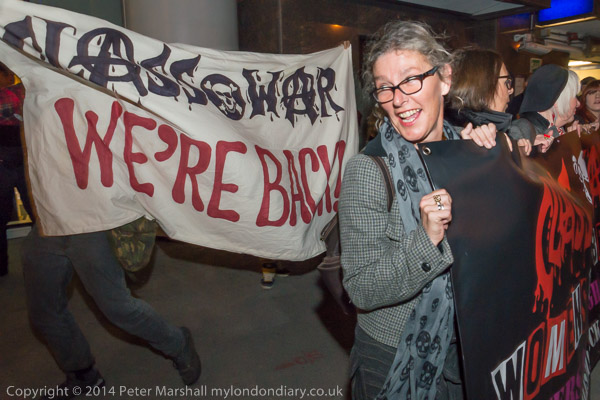
The bail conditions imposed by police prevented her from taking place in further protests outside the block in Aldgate, a clear attack on her right to protest. Jane had been wearing a red coat when she was arrested, and a number of women wore red for the protest a week later in solidarity.
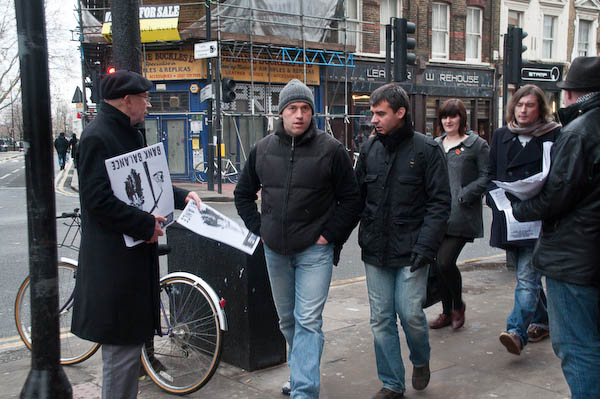
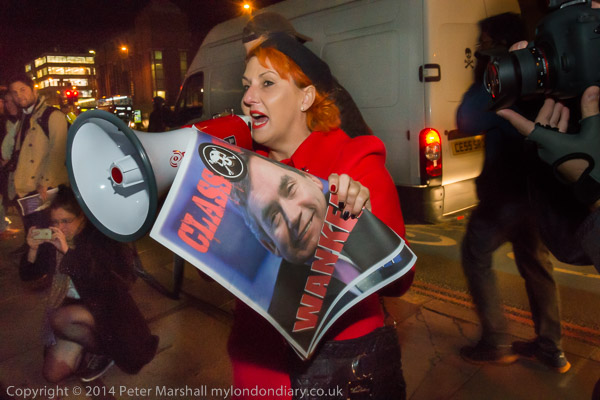
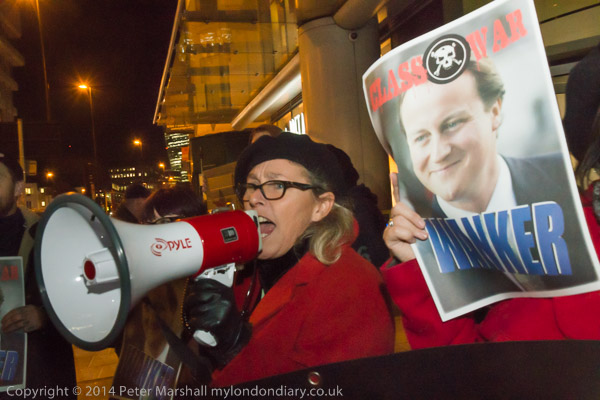
Police had earlier complained about Class War’s posters earlier in the year for the general election, which had featured large portraits of the party leaders with Class War’s verdict – the same on each of them – overprinted large, the word ‘WANKER’. At least one person displaying them during the election had been threatend with arrest and forced to take them out of his house windows and in May police had objected to and seized a banner featuring all four leaders with a similar message.
Eventually the police were told they had to hand the banner back as its display was not an offence. But they were unwilling to do so, claiming it had been lost – though more probably they had destroyed it rather than having to lose face handing it back.
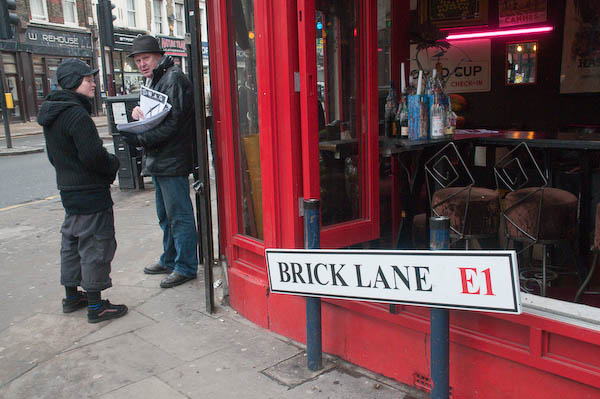
So the banner was not present at this protest, though later Class War made an updated version to use. But Ian Bone had brought along a pile of the posters, mainly of Tory Prime Minister David Cameron but with a few of other party leaders and handed them out.
Ian told us that this was an attempt to get into the Guinness Book of Records for the largest number of ‘Cameron wanker posters’ ever displayed at a protest. I’m not sure how many there were on display, but I think it was certainly a record number, but the chances of it being recorded in that rather conservative publication were as I wrote, “rather sub-zero.”
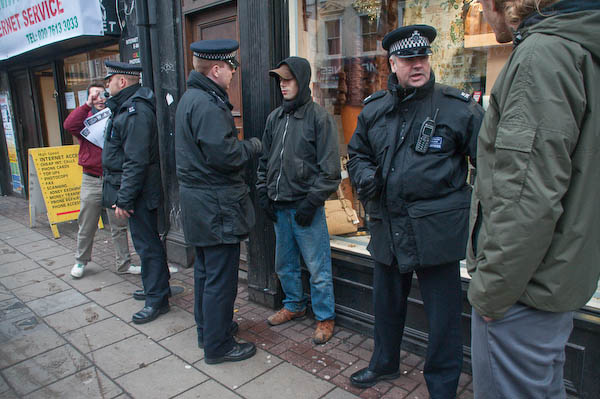
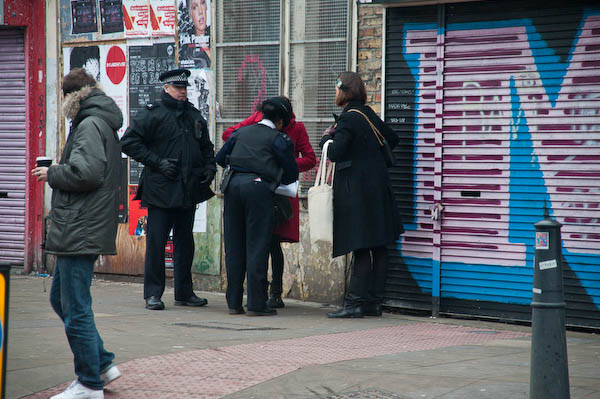
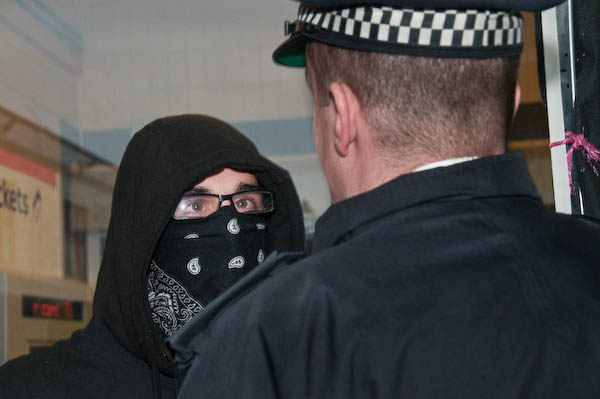
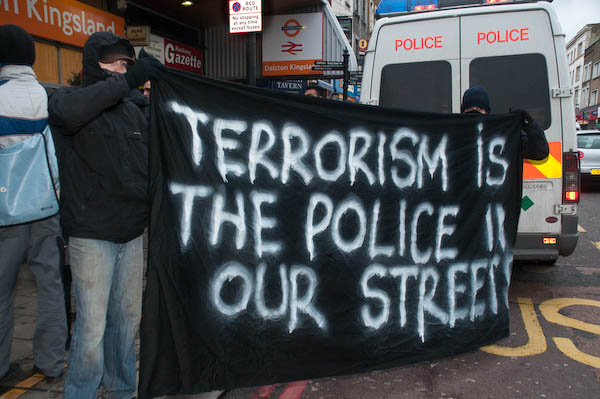
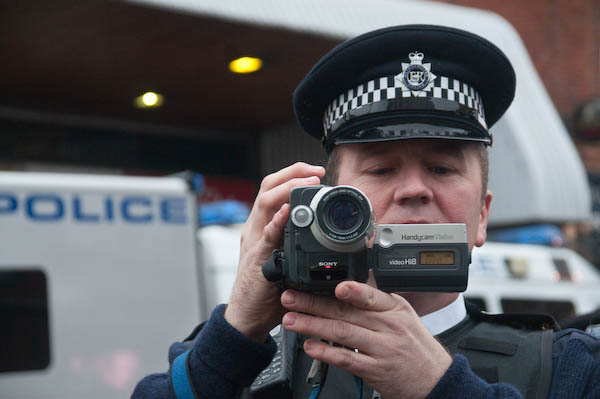
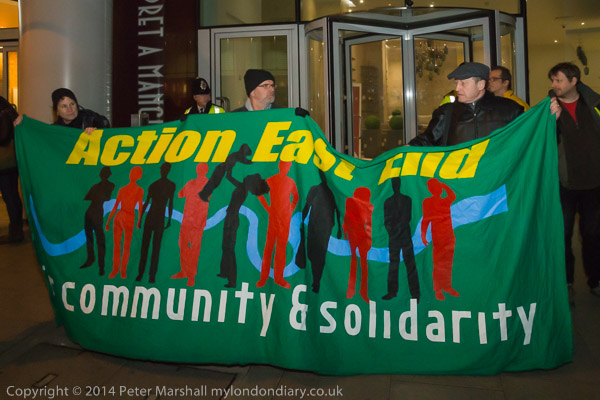
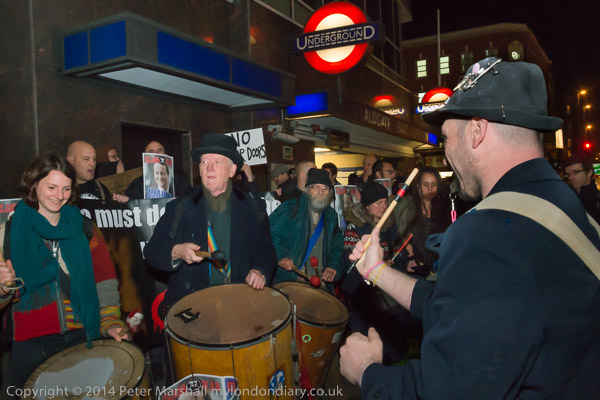
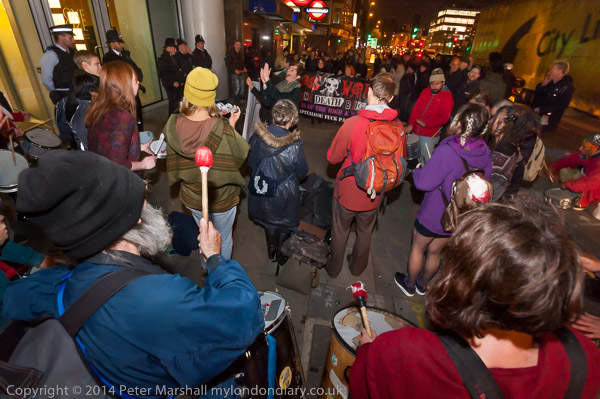
Police presence this week was low-key with just half a dozen officers standing beside the ‘rich door’ and along the front of the building and watching. The protest was noisy, with speeches, a samba band and dancing, but was entirely peaceful with no attempt to enter the building.
On Wednesday 5th November 2014 I photographed a protest by pro-Palestinian campaigners against Hewlett-Packard before going on to the weekly ‘Poor Doors’ protest by Class War in Aldgate, which had a special ‘Bonfire Night’ theme.
Boycott Hewlett-Packard – Sustainable Brands – Lancaster London Hotel, Wed 5 Nov 2014
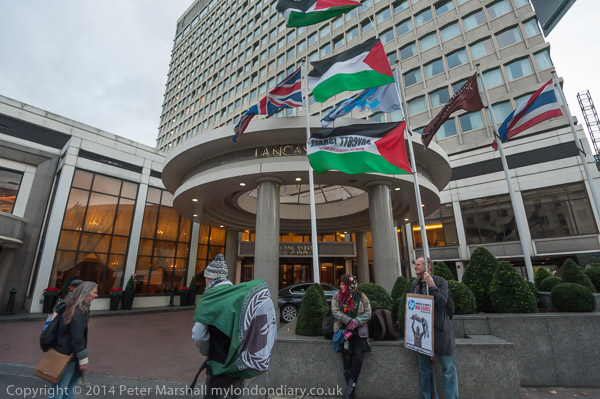
Hewlett-Packard were the sponsors of a ‘Sustainable Brands’ conference at the Lancaster London Hotel close to Lancaster Gate Underground station and were claiming to create “a better future for everyone.”
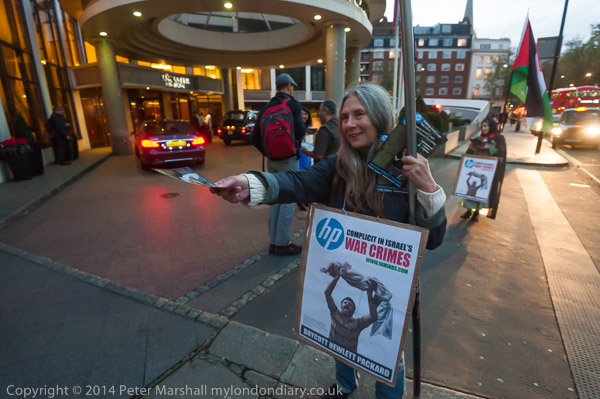
Campaigners for the release of Palestinian prisoners held in Israeli jails came to protest outside the hotel becuase HP runs the Israeli prison system as well as providing IT support for the Israeli forces which recently killed many Palestinians including 521 Palestinian children in their recent attack on Gaza.
As well as adults many young Palestinian boys are locked up for long periods in Israeli jails, often kept in solitary confinement in small cells and tortured. Palestinians are often imprisoned in ‘administrative confinement’ without any proper charges or trial, released at the end of a year in jail and immediately re-arrested.
The protesters stood on the pavement outside the hotel handing out leaflets to people entering or leaving the hotel or walking past on the street. There were also several speeches about HP’s deep involvement in Israeli war crimes and persecution of Palestinians, and people were urged to boycott the company’s products and services.
Poor Doors Guy Fawkes burn Boris One Commercial St, Aldgate, Wed 5 Nov 2014
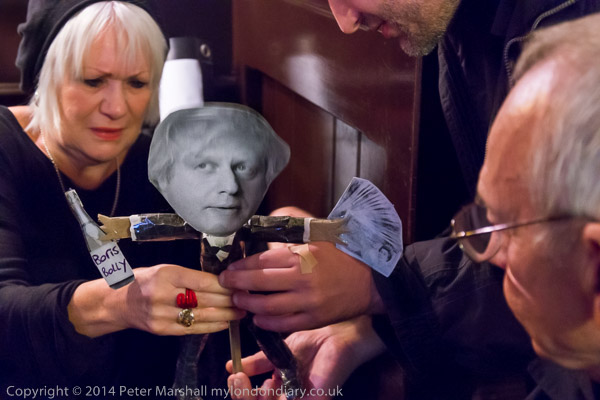
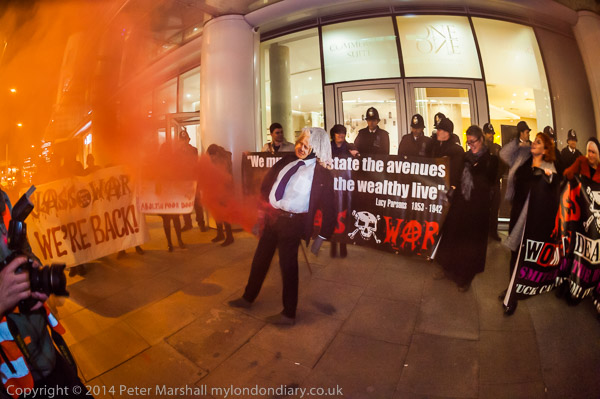
I met some of Class War in a nearby pub before the protest where they showed me a Boris Johnson stick puppet with a bottle of champagne in one hand and a large amount of cash fanned out in the other, as well as their guy BJ dressed in a suit and tie with a Boris mask and a mop for fairly realistic hair.
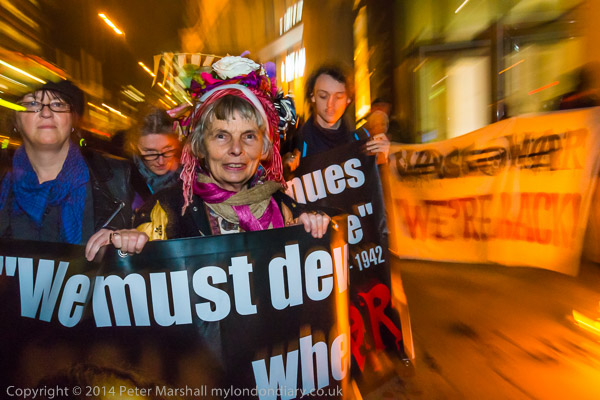
We walked with the short distance along Aldgate High Street to the tall block of flats at One Commercial Street with its separate door for the social housing tenants in the building with a drunkenly staggering BJ helped to hold Class War’s Women’s Death Brigade banner for a few yards. He was then carried the rest of the distance with orange smoke billowing from a flare in his top pocket.
There was more orange smoke as he stood on the pavement in front of the posh foyer to the private flats, with Class War holding banners around and a line of eight police officers guarding the entrance.
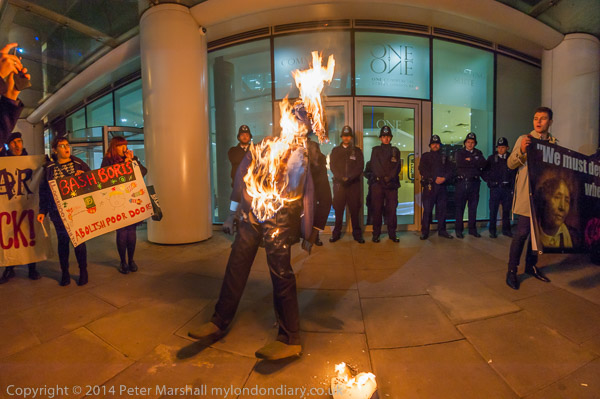
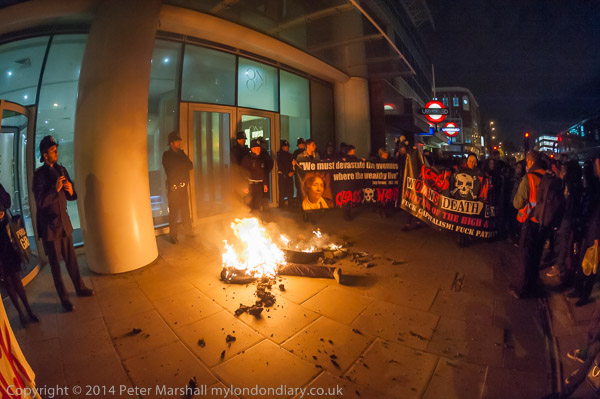
The protest began with speeches and sparklers and suddenly Boris began to go up in flames, thanks to a carefully applied sparkler, providing some welcome warmth on the cold night, burning fiercely for a few minutes before collapsing to a small burning heap on the wide pavement.
People were standing well back and there was clearly no danger, though a police officer did walk in to remove a bottle that had been placed close to the flames, presumably thinking it might explode due to the heat.
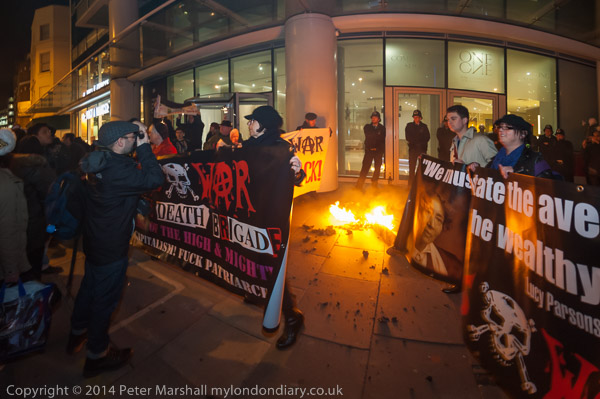
As the flames began to die down, Class War moved in and began to dance with their banners around the flames, and the samba band began to play.
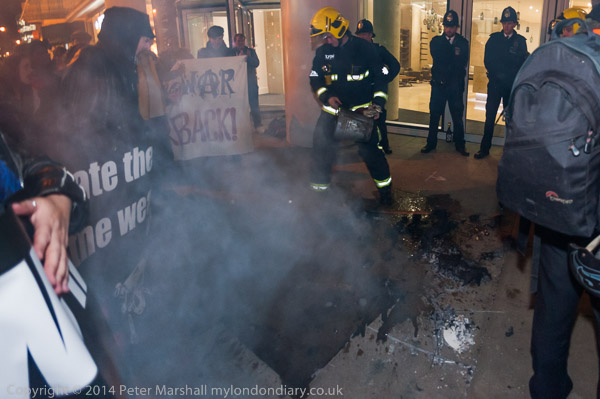
There were more speeches and chants and eventually a fire engine, called by the police, drew up. At first the firefighters looked at the small fire, laughed and walked away. But police insisted they deal with the fire. It took one bucket of water.
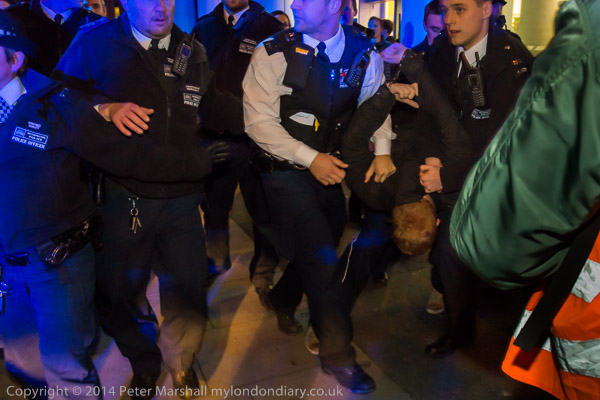
The firefighters walked away and police moved to surround Jane Nicholl and arrest her for having set light to the guy with her sparkler.
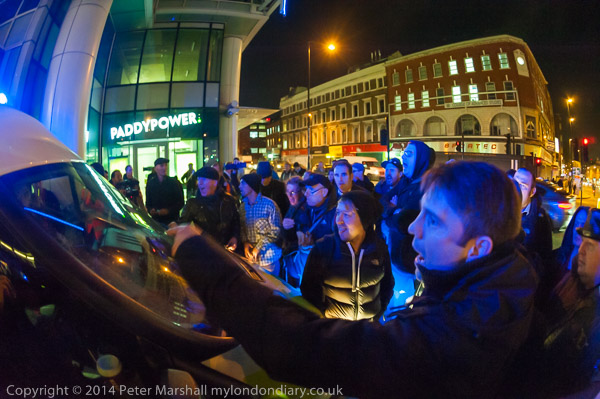
Protesters surrounded the police shouting for them to release her, but eventually they managed to take her and put her in the back of a van, which was surrounded by people and unable to move for several minutes until more police arrived, the blue flashing lights of their vehicles making photography difficult.
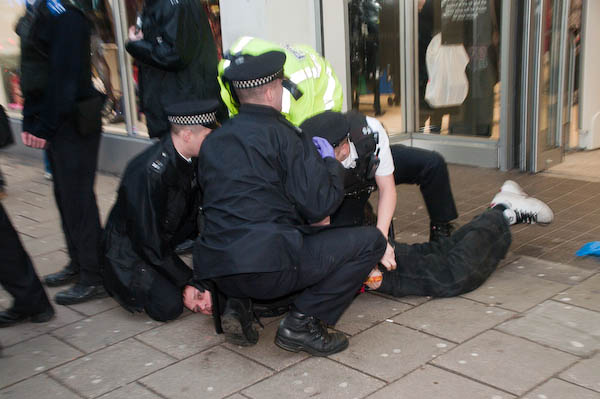
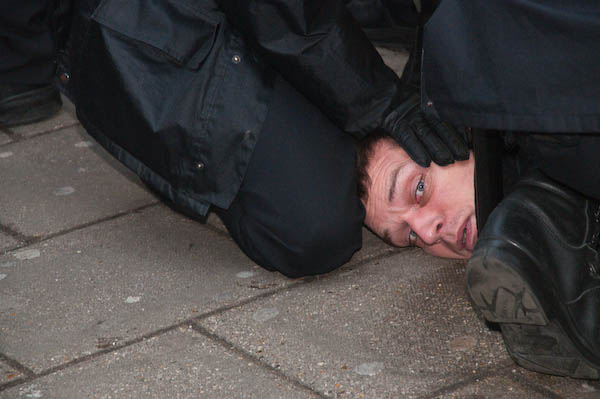
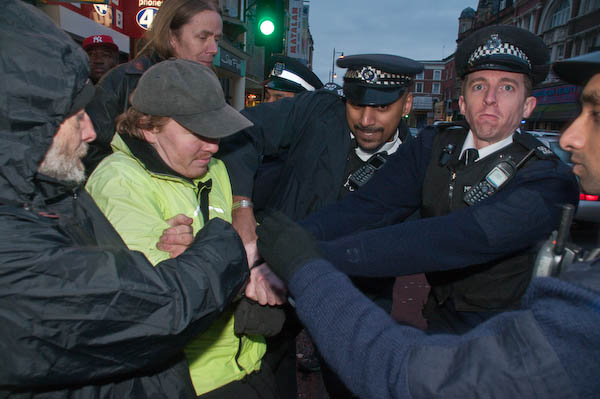
Police grabbed another of the protesters who had I think been more vocal than most, handcuffed him and led him away to another van; this seemed a fairly random arrest and I think he was released without charge, as often happens after arrests at protests, with police misusing their power of arrest as a short period of administrative detention. People now were just standing around with a large crowd of police and it seemed clear the protest was over for the night and I left for home.
The police persisted with the prosecution of Jane Nicholl, and the case dragged on for six months before the case came to court. In court the CPS barrister had to ask for the charge to be altered as he conceded it was not an offence to burn an effigy of Boris Johnson and after the police CCTV had been shown tried to change the charge again. Defence barrister Ian Brownhill pointed out it was unfair for the prosecution to keep changing the goalposts and that the police watching the the fire were grinning and did not seem endangered as the prosecution alleged. The judge refused a further change of the charge and the prosecution dropped the case.
This was one of several expensive and time-consuming failed prosecutions of Class War protesters, which make it clear that police are misusing the law in order to intimidate and try to stop lawful protest – and that they are aided in this by the Crown Prosecution Service, almost certainly as a result of political pressure from some members of the government.
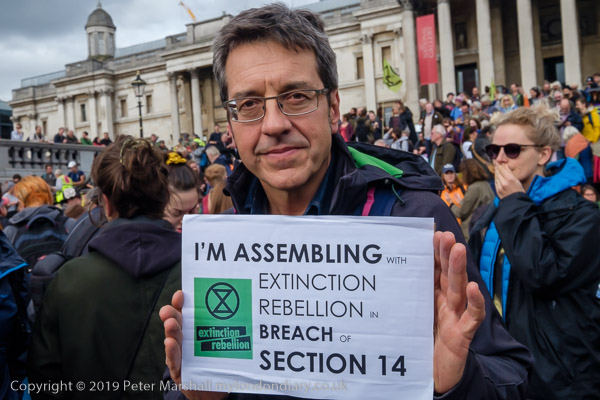
After a week of protests which brought much of central London traffic to a standstill in October 2019, the Metropolitan Police, egged on by Tory politicians, announced a ban on any Extinction Rebellion protests anywhere in Greater London under Section 14 of the Public Order Act 1986. This draconian measure across the whole of London meant that any two or more people coming together anywhere across London to protest over the climate crisis would form an illegal assembly and would be subject to arrest.
XR continued to protest and also began legal action challenging the ban which was later ruled illegal; the police probably knew that this was the case, but also knew they could put it into effect and use it until the court came to its decision in a cynical but rather typical misuse of their powers.
XR did continue their planned ‘No Food No Future’ protest on Tuesday 15th, immediately after the illegal ban was announced, and there were a few arrests, and the police began clearing the XR camp at Vauxhall. At short notice the Green Party organised a protest in Trafalgar Square against the ban where speakers included Labour MP David Drew, Green Party co-leader Sian Berry, peace activist Angie Zelter and Extinction Rebellion’s Rupert Read as well as three British Green MEPs and an Irish and German MEP.
A couple of hundred XR protesters also came to the square and took part in this protest, clearly in breach of the Section 14 Order, but while police watched and photographed the event they made no arrests. But XR’s big emergency protest against the ban came following day,
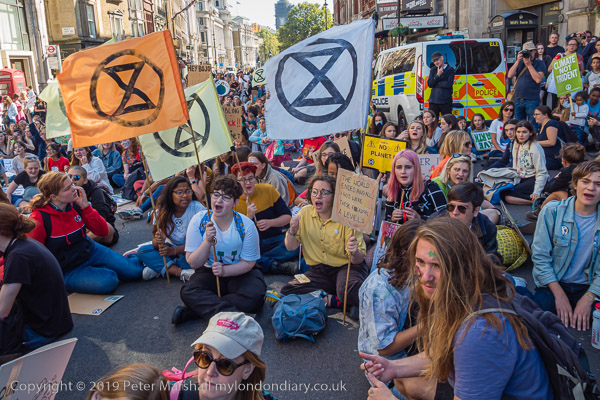
XR defies protest ban – Trafalgar Square, Wednesday 16th Oct 2019
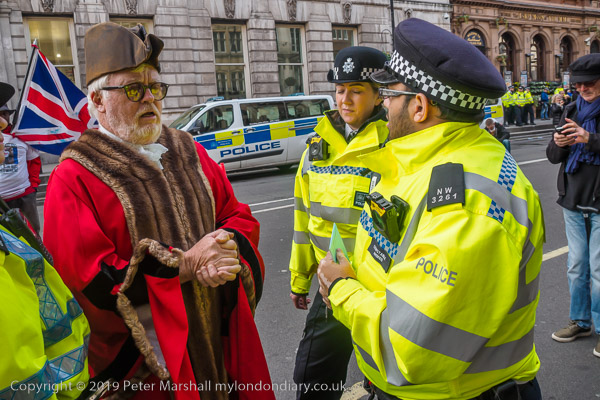
Police came and warned some of those sitting in the square before the start of the event that they were committing an offence and might be arrested, but I saw no actual arrests, though police did come and take away a tent from one man as carrying camping equipment is banned in Trafalgar Square and Parliament Square under laws made against Brian Haw’s protest and the Occupy Movement.
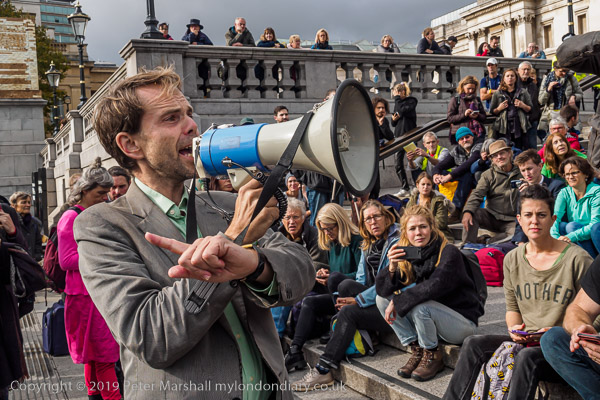
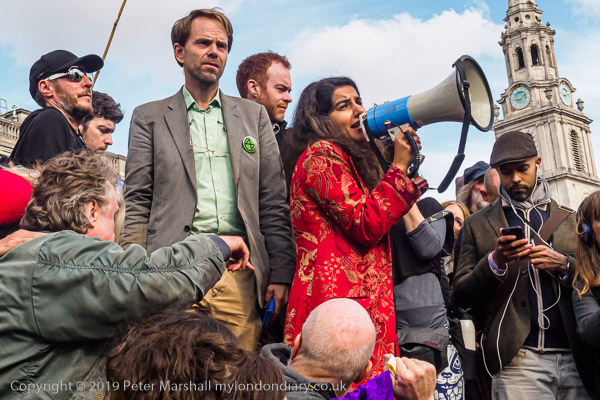
There were speeches, speeches and more speeches to a crowded audience in Trafalgar Square, with speakers including XR members, prominent environmentalists, politicians and a former police Chief Superintendent and Green Party MEP Ellie Chowns who had been arrested defending the right to peaceful public protest in Trafalgar Square the previous day.
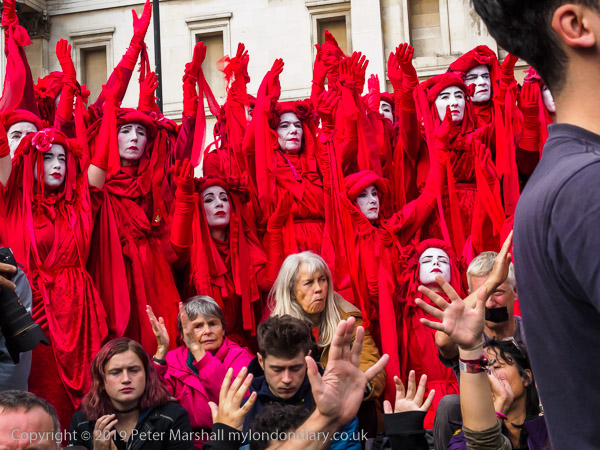
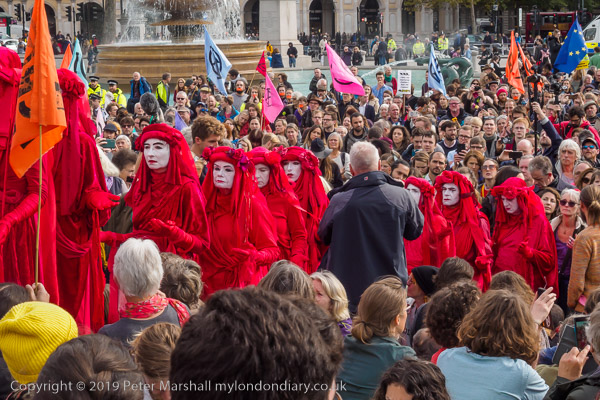
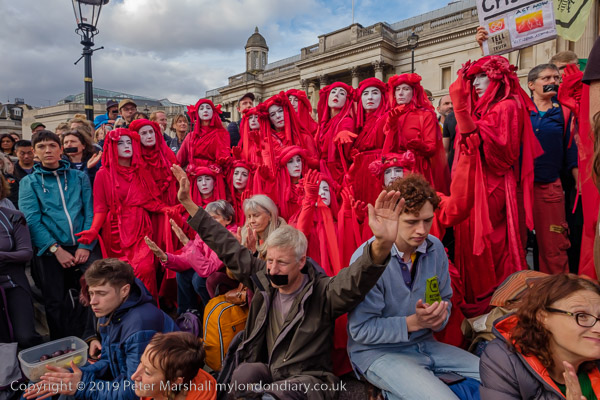
The XR ‘Red Brigade’ made a spectacular entrance during the speeches, making their way slowly up through the crowd to stand at the top of the steps where they remained for some time responding to the occasion.
In his speech George Monbiot expressed his resolve to get arrested when the protest and XR General Meeting which was to follow it ended. He invited others to join him then and walk into the road in Whitehall and sit down.
Monbiot carried out this intention and was arrested by police along with a number of others including the Green Party Mayor of Woodbridge Eamonn O’Nolan who had worn his Mayoral robes for the event.
XR demands Murdoch tell the truth – London Bridge Wednesday 16th Oct 2019
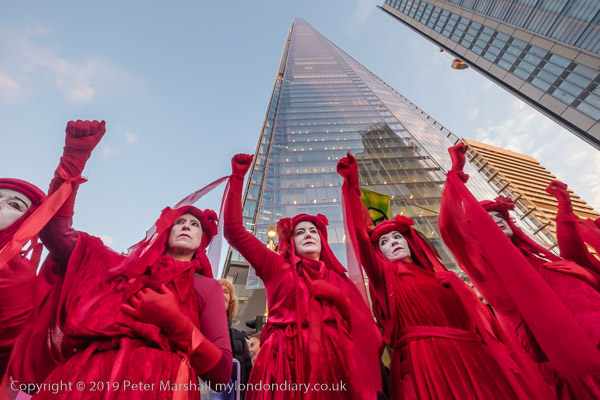
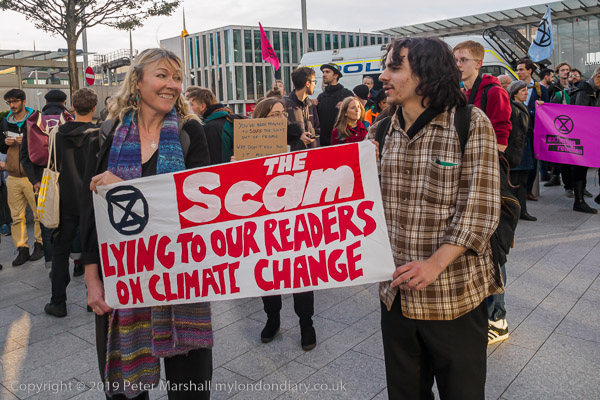
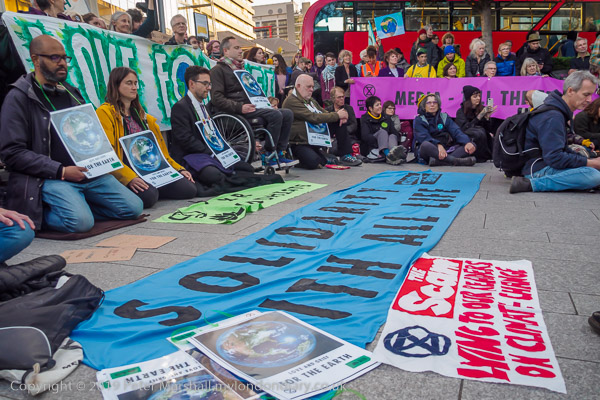
The same evening Extinction Rebellion continued with their planned vigil at Rupert Murdoch’s News Corp HQ at London Bridge demanding that his papers tell the truth about the climate crisis.
Much to their surprise this XR protest turned out to be legal as the blanket ban imposed by the Metropolitan Police on protests by XR across London only applies to public places and not to the private area here in front of the offices.
They came to protest here as the Murdoch press has a particularly bad record of climate denial and the support generally of fossil fuel interests.
Speakers called on the press to end its support of fossil fuel extraction, climate deniers and unnecessary consumerism and instead actively promote lifestyle changes to combat the climate emergency.
Solidarity protests on Friday 10th October 2014 and some extreme wide angle views in the City of London.
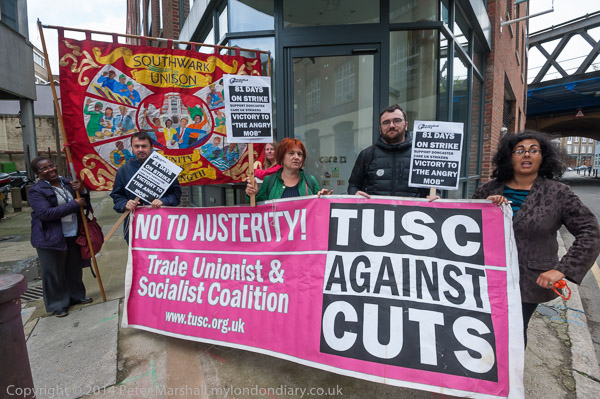
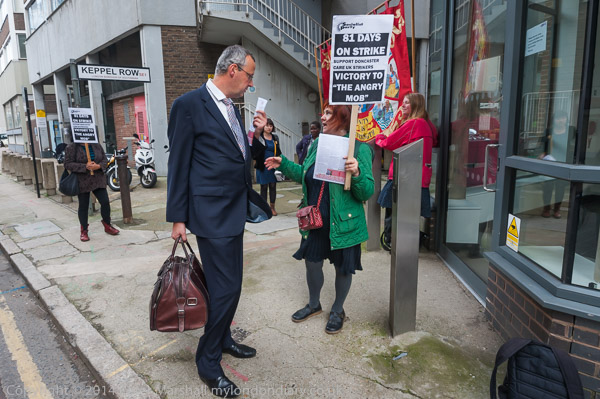
Solidarity for Care UK Strikers – Care UK, Southwark
Protesters outside the offices in Great Guildford St
The protest by members from the National Shops Stewards Network, Trade Unionist and Socialist Coalition and Southwark Unison was one of many around the country in a nation-wide day of solidarity with Doncaster Care UK workers who had been on strike for 81 days after huge cuts in pay and services were made by a private equity company who have taken over this part of the NHS.
Care UK is now owned by Bridgepoint, which also owns businesses including Fat Face and Pret a Manger. The workers are on strike not just over cuts in their own wages, but also against the changes in how Care UK is allowed to operate by the new bosses. What was formerly a values-based health service able to address the needs of those with learning disorders in their own community has been radically altered to providing minimum standards of service at the lowest possible cost to get the greatest profits for Bridgepoint, and for the company they will be sold on to once the private equity company has slimmed services and pay to the bone.
The current unrest in Iran following the death of Mahsa Amini after her arrest by the morality police’ for allegedly wearing her hijab improperly, so that some of her hair was visible is unprecedented, but women there have been oppressed by religious police since the 1979 Islamic Revolution.
An Iranian woman who cannot go back to Iran
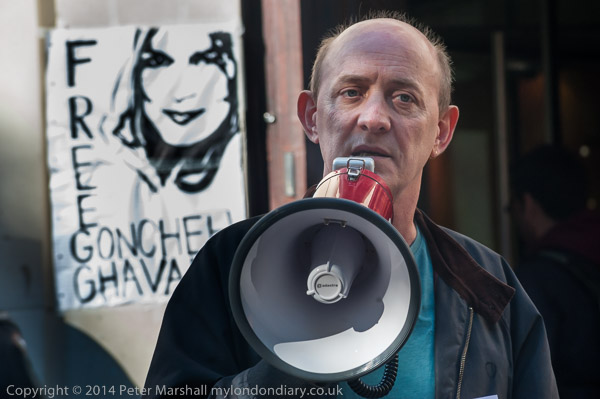
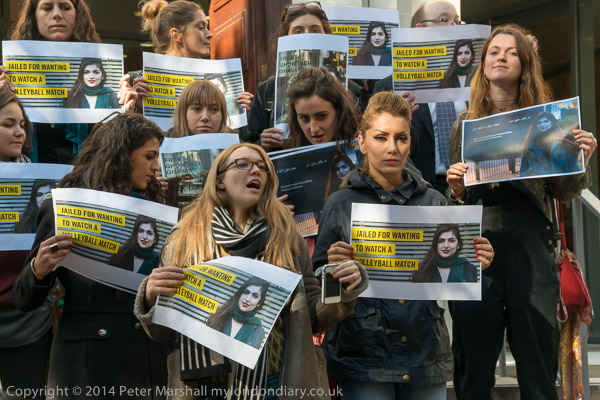
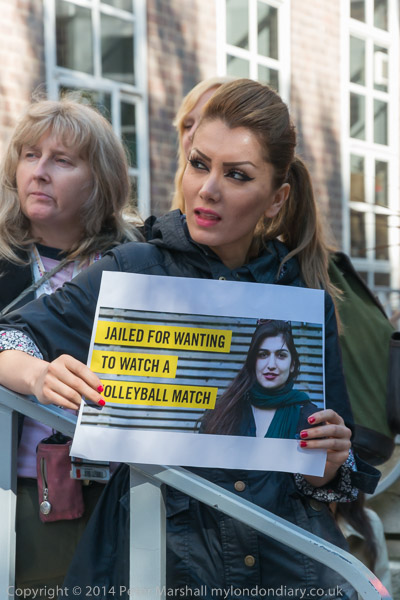
In 2014 former SOAS Law student Ghoncheh Ghavami was arrested and detained with other women for going to try to watch a volleyball match in Tehran. At the time of the protest outside SOAS University of London she had been held for 104 days and had been on hunger strike for 10 days. The protesters included a number of Iranian students one of whom told the protest she could not return to Iran as the TV coverage of a volleyball game in Rome had shown her reacting to a score.
The rally was supported by staff and the SOAS staff unions UCU and Unison, as well as by the SOAS Student Union, and some students took part in a day’s hunger strike in solidarity and there was a candlelight vigil. Ghavami was released on bail on 23 November 2014 and later sentenced to a year in jail and a two-year travel ban for “propaganda against the regime”.
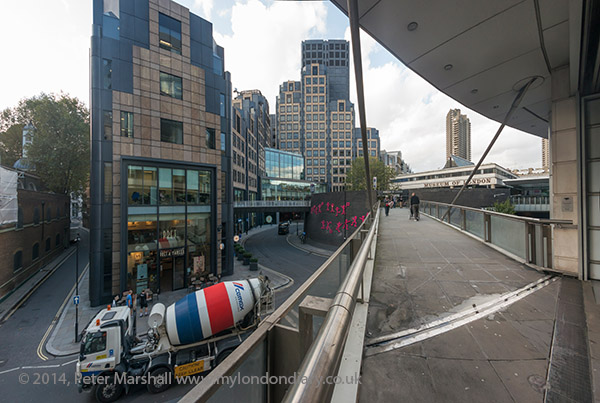
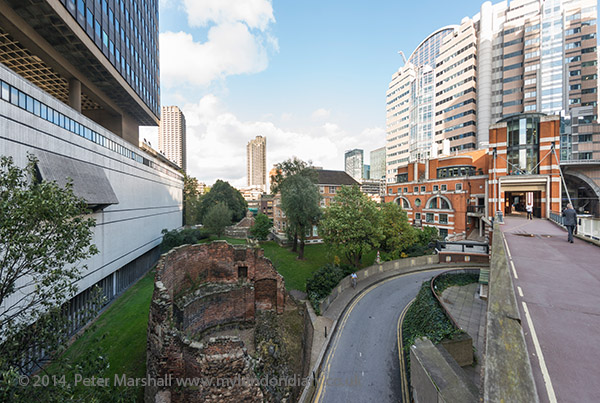
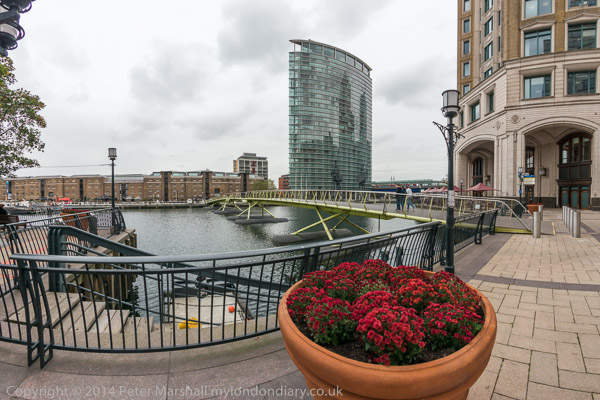
I had an hour or two to spare before the next protest I was to cover and spent some of this walking around the city and making some extreme wide-angle photographs.
Although these pictures have a normal aspect ratio, they have a horizontal angle of view of over 145 degrees and a vertical angle of around 90 degrees, only possible by using a lens which does not give the more normal ‘rectilinear’ perspective but represents the scene with some curvature.
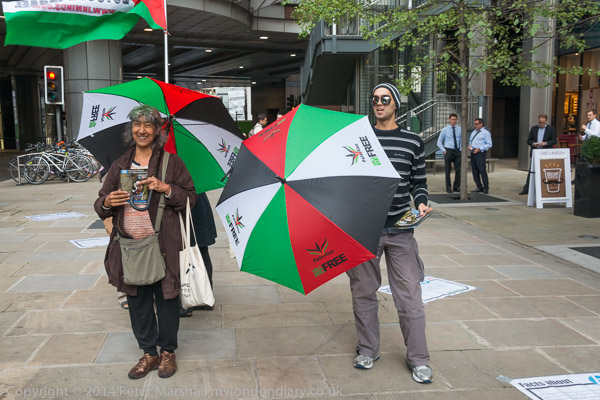
The Palestinian Prisoners Campaign continued their campaign against Hewlett-Packard, which boasts of ‘a massive presence’ in Israel and are the IT backbone for the Israeli war machine with a picket outside their London offices.
Police watched the protest across the street from HP’s offices carefully and umbrellas in the colours of the Palestinian flag and large banners made the protest very visible. Speeches and posters taped on the pavement gave details of HP’s involvement in the oppression and imprisonment of Palestinians which were also stated on the leaflets the protesters handed out.
Solidarity with the Umbrella Revolution – Chinese Embassy
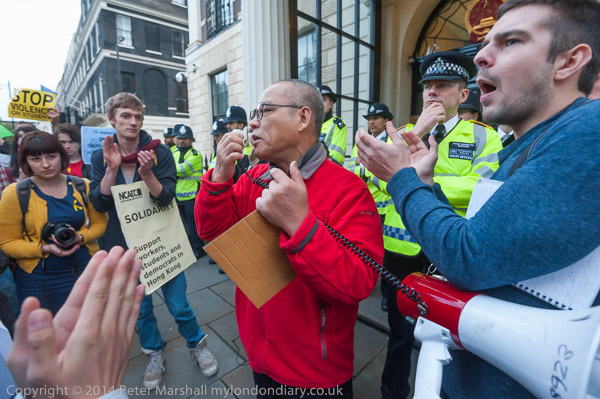
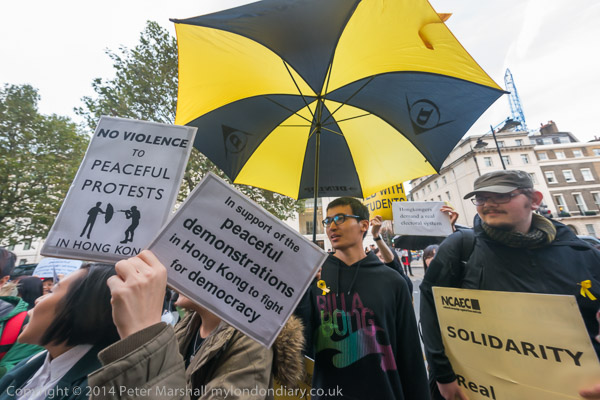
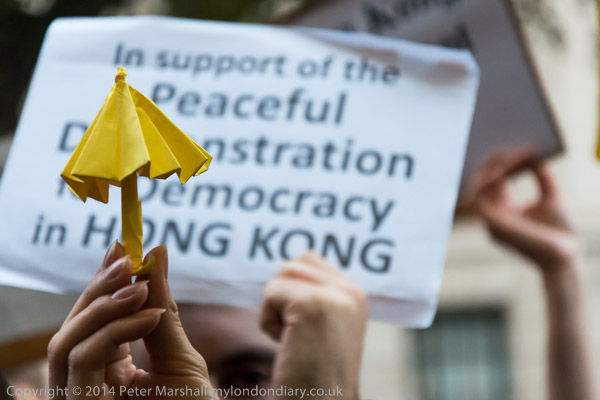
Umbrellas were also on display at the protest around the doorway of the Chinese Embassy on Portland Place organised by the National Campaign Against Fees and Cuts in solidarity with the ‘umbrella revolution’ of the students and workers of Hong Kong in their fight for democracy.
Most of the umbrellas were on posters and placards, though some protesters carried small yellow paper umbrellas and there were just a few full-size ones too.
Police tried to move the protesters to the other side of the road, but they refused to move. They called for the immediate release of all the arrested, an end to the suppression of peaceful assembly, replacing the “fake universal suffrage” formula with the genuine political reform workers have been demanding, and the resignation of Chief Executive Leung Chun Ying.
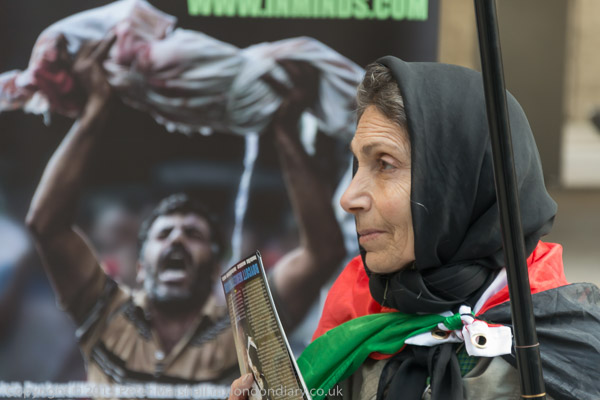
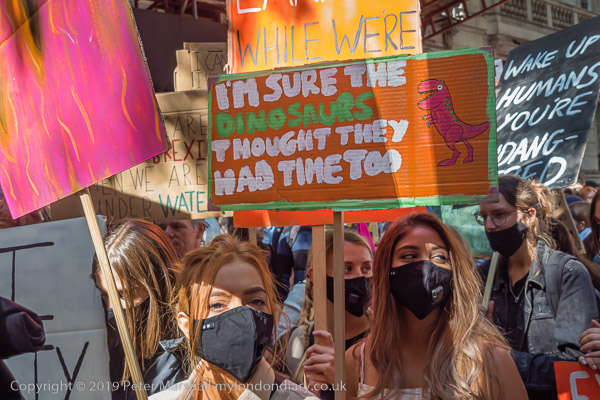
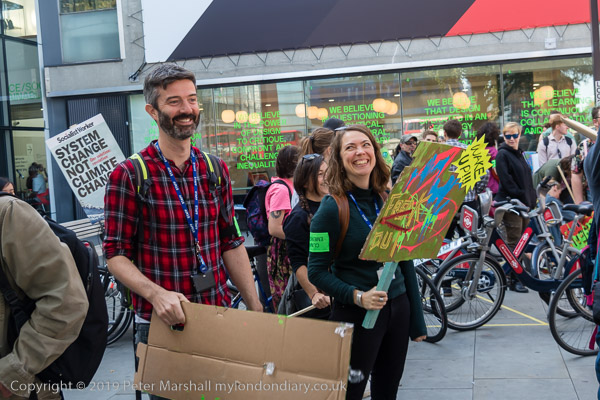
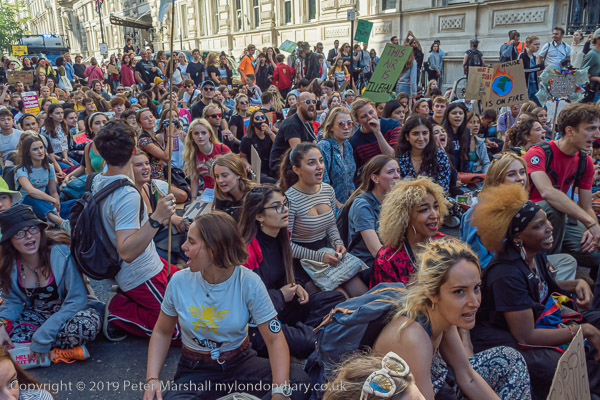
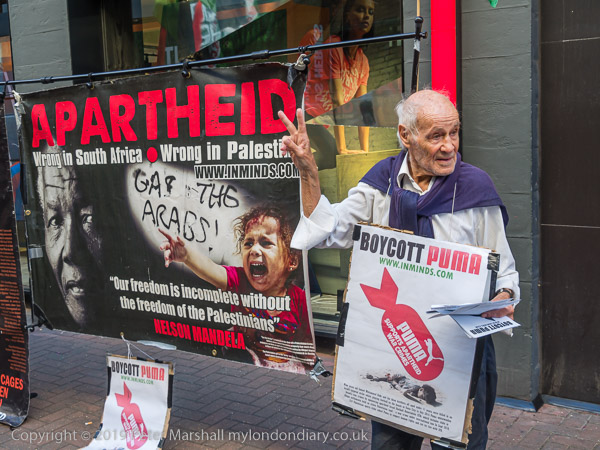
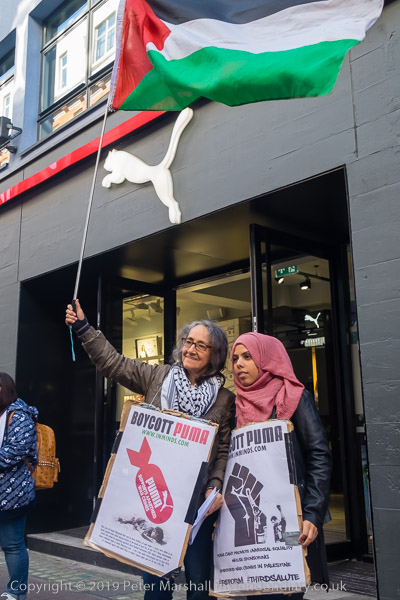
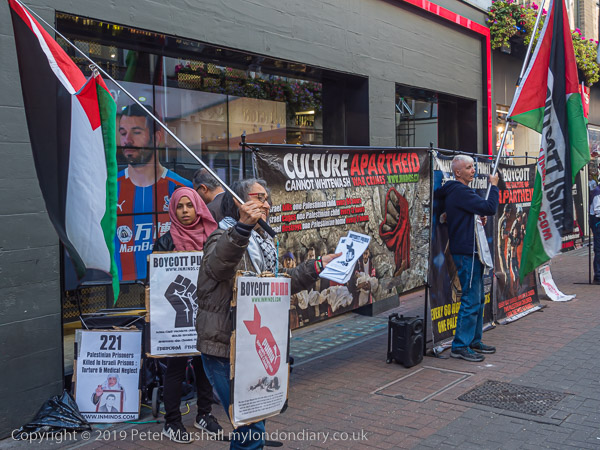
I spend most of my time on Friday 20th September covering the Earth Day Global Climate Strike inspired by Greta Thunberg which brought huge numbers of schoolchildren along with teachers, parents and other older supporters to a rally filling Millbank. Others were starting later from various parts of London to join in and I made short visits to both the Elephant and Castle and Windrush Square in Brixton to photograph them there, returning to Whitehall to photograph a large crowd who were continuing the protests there. Finally I went to Carnaby Street where the Islamic human rights group Inminds were protest outside the Puma store calling for a boycott of Puma products.
Global Climate Strike Rally – Millbank, London
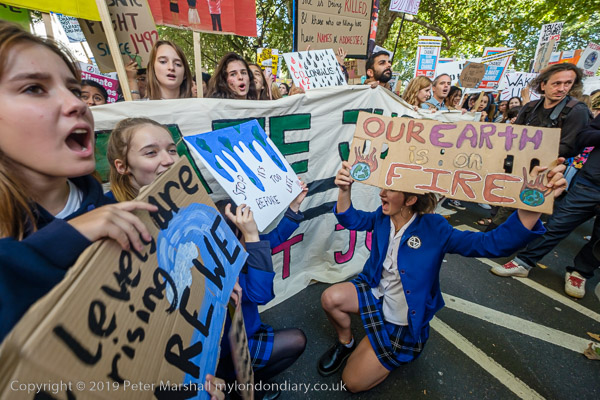
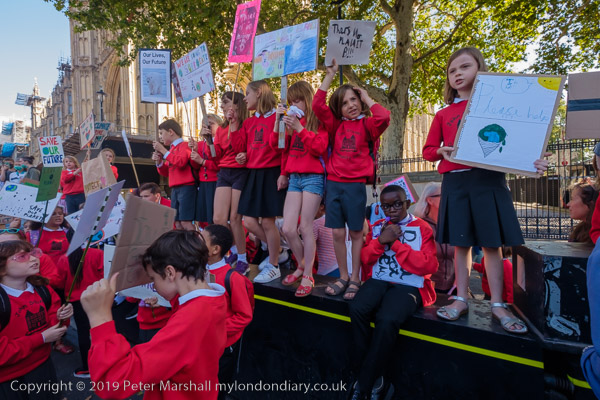
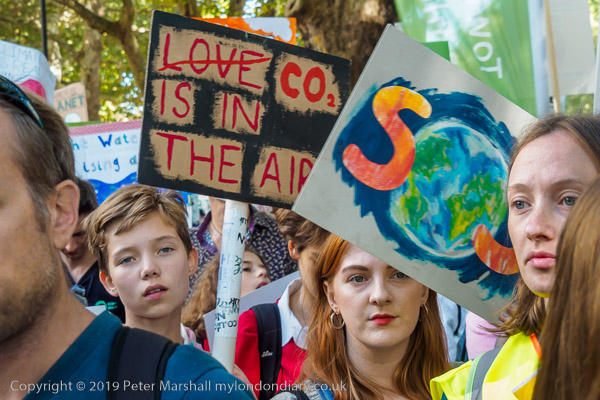
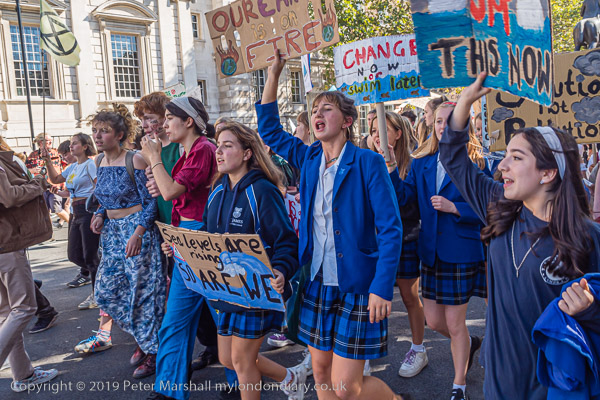
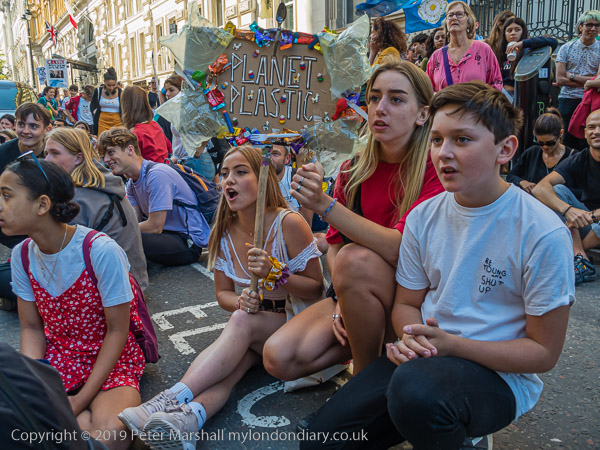
I began taking pictures of people going to the rally when I entered Parliament Square. Many schools had brought large groups of pupils to take part in the protest, and had obviously spent some time preparing hand-painted placards and banners. Greta Thunberg’s example has led to a great awareness among many young people of the existential threat posed by global warming, as too have the television programmes by the ageing David Attenborough, and they showed themselves to be convinced of the need for urgent action.
Unfortunately politicians and companies – particularly those with interests in fossil fuels – have been rather less convinced, and although we have seen plenty of words and promises, real actions have so far failed to come anywhere close to meeting the desperate need. Our new UK government under Liz Truss has started by going backwards on the issue, issuing licences for fracking, and almost certainly in the first few days following the Queen’s funeral will be bringing forward other measures which will make climate disaster even more inevitable.
Crowds got so packed that I had to give up trying to walk up Millbank to the lorry on which the speakers, bands and others were to perform both live and on large screens, and I had to divert through the side streets to approach it from behind.
I spent some time photographing those at the front of the protest, then decided to move back through the crowd taking pictures. It was slow going both because I stopped to take pictures, but also because I needed to keep asking people to let me squeeze past them, but eventually I got back to Old Palace Yard and Parliament Square where movement was now easy, though there were still groups of protesters.
I took the tube from Westminster Station, changing at Embankment to the Bakerloo Line which took me to the Elephant and Castle. Outside the University of the Arts was a poster display and people were gathering to march to join the protests. I photographed a small march setting off to join with workers at Southwark Council’s offices in Tooley St, but left them after a few hundred yards to go back to the Northern Line, changing at Stockwell to get to Brixton.
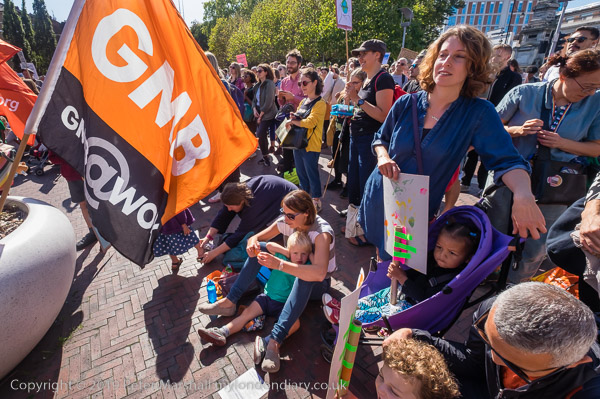
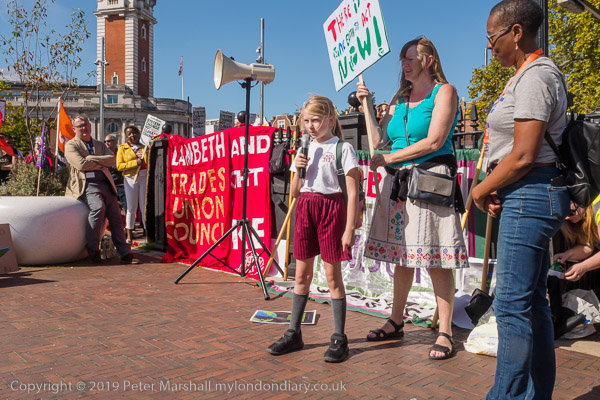
Teachers and parents had come with children from Lambeth schools for a rally in Brixton Square which was still in progress as I arrived.
There was an impressive speech from a young protester and support from a local MP before the rally ended and many of those present got ready to take the tube to join in the protest outside Parliament.
Global Climate Strike Protest continues – Whitehall
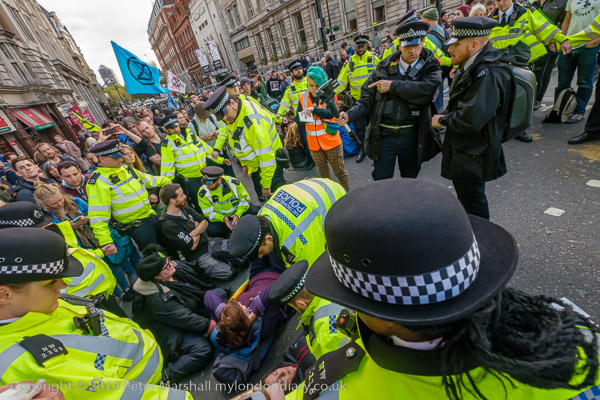
I hurried to the tube ahead of the children and arrived in Westminster where people were sitting on the road and blocking Whitehall, with police trying to persuade them to move.
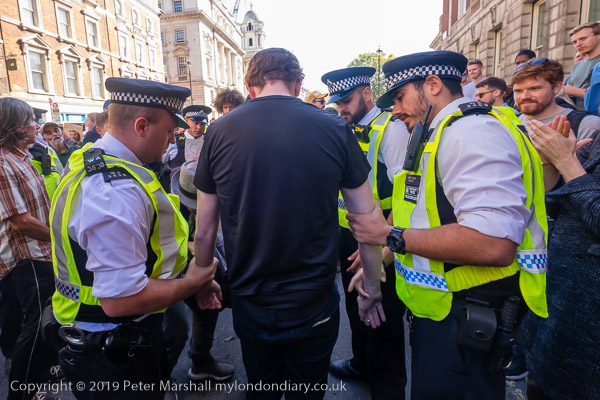
I saw one man being arrested and led away towards a waiting police van, and the road was almost cleared when a large crowd of school students came from Parliament Square to march up Whitehall blocking it again.
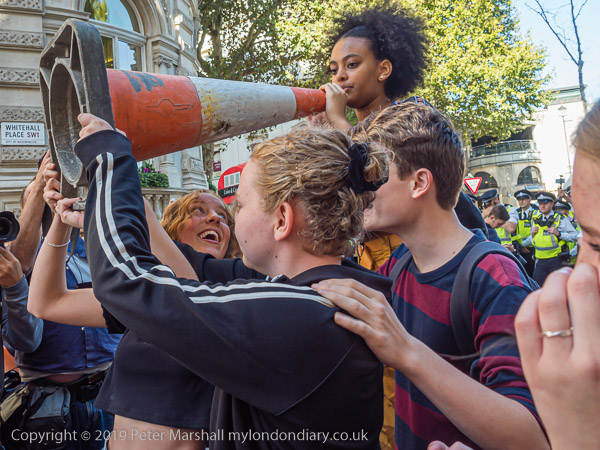
Police tried to stop them and they turned down Horseguards Ave, then up Whitehall Court and into Whitehall Place where they were finally stopped at the junction with Northumberland Avenue and sat down on the road.
There were a few sort speeches and a lot of chanting slogans as police attempted to get them to move. I couldn’t understand why the police were bothering as they were on a road that has very little traffic and were causing no problem in sitting there.
Eventually they did decide to do as the police said and got up and moved – back to sit down and block Whitehall again. Eventually they stood up and began to march towards Parliament Square, nicely in time for me to cover a different protest in Carnaby Street.
Whenever tourists come up to me in London and ask me (as sometimes happens) the way to Carnaby Street I’m always tempted to say “You just go back 50 years“, but I’m actually more helpful. But it always surprises me that this rather ordinary street of mainly small shops still attracts tourists so long after it was the touted as the epi-centre of ‘Swinging London’. It still puts on something of an effort, but I find it rather sad. Somehow not the same if you are not wearing flares.
Puma is the third largest sportswear manufacturer in the world, coming from a company founded in Bavaria in 1924 by two brothers. Both brothers were members of the Nazi party during the war and after bitter arguments split up in 1948 to form Adidas and Puma, two companies engaged in bitter rivalry. Adidas is now the second largest sports manufacturer in the world.
The Israel Football Association began life in 1928 as the Palestine Football Association, changing its name following the foundation of the state of Israel in 1948. It only represents Israeli clubs and there is a separate Palestinian Football Association covering the West Bank. But the IFA includes six clubs based in illegal Israeli settlements in the West Bank.
Adidas sponsored the IFA until 2018, when under pressure from Palestinian sports clubs and the international BDS movement they ended their sponsorship. Rivals Puma then took it up, becoming their only international sponsorship and over 200 Palestinian athletes and sports clubs have called for a Puma boycott.
Inminds Islamic human rights group organises protests in London at companies and events which support the Israeli regime and call for the release of Palestinian prisoners. At a previous protest outside Puma the protesters were violently attacked by some members of a small group of Zionists, but there was no sign of any counter-protest while I was present.
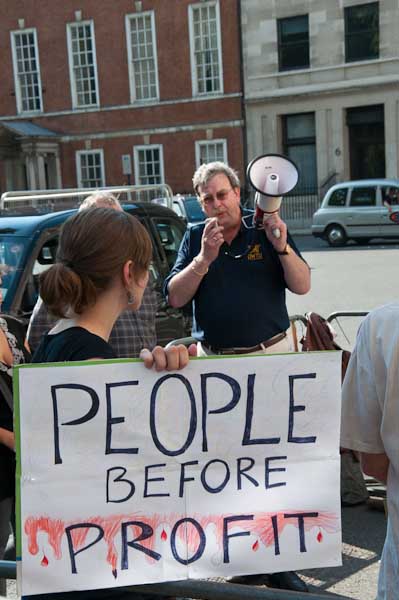
Democracy, Black Cabs, Murad & Zionists – My agenda for Wednesday 2nd June 2010 was a busy one, with protests about democracy in Parliament Square, London’s Black Taxis at Aldwych, a picket at BP’s St James’s Square HQ, trade unionists protesting at the Turkish Embassy and Zionists supporting the Israeli attack and killings on the Gaza aid flotilla.
Democracy Village Protest – Parliament Square
People had been camping in the Democracy Village in Parliament Square for just over a month and a few of them had come across the road with banners to protest. They held up banners, including a large one saying ‘We Respect The Soldiers We Do Not Support The War‘ and another ‘We Demand Peace In Afghanistan and No More War‘ and several made speeches with a megaphone. Another very artistically written notice on a large square of cloth on the pavement read ‘With Each Conscious Breath May You Know How Loved You Are in All Ways. You Are Divine. Let Your Light Shine’.
Brian Haw – Summons Marks 9 Years in Parliament Square
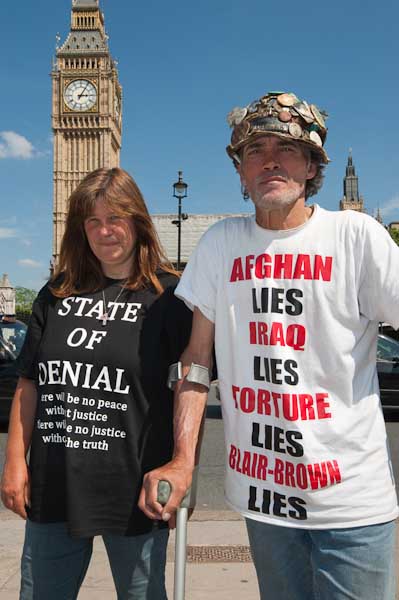
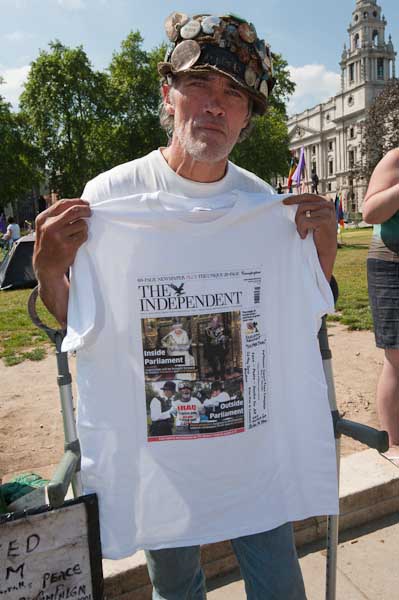
I went back to the other side of the road to talk with Brian Haw and Barbara Tucker who I had come to visit on the 9th anniversary of the start of Brian’s protest vigil opposite the Houses of Parliament in Parliament Square. A week ago they had been arrested and held for 30 hours on the day of the state opening of Parliament before the court released them on bail.
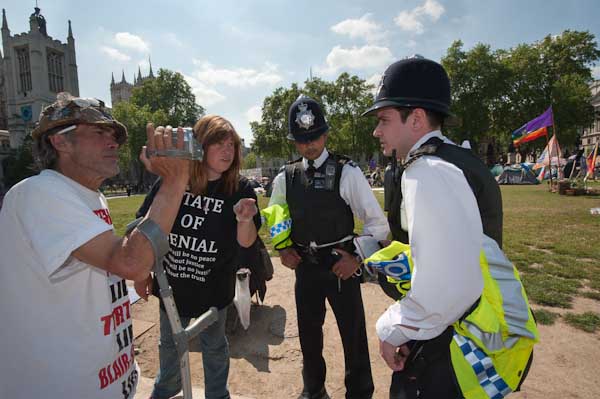
The arrest had come after Brian objected to police searching his tent in the early morning without a warrant – the 13th or 14th illegal search they have made, all part of a continual campaign of harassment. As we were talking we became aware of three police a few yards away standing and watching us. They then came over and served Barbara Ticker with a summons for using a megaphone in Parliament Square.
Brian and Barbara asked why she was being singled out for attention as there were at that time others In the Democracy Village actually using a megaphone and she was not at the time doing so. The officers made no attempt to answer this question.
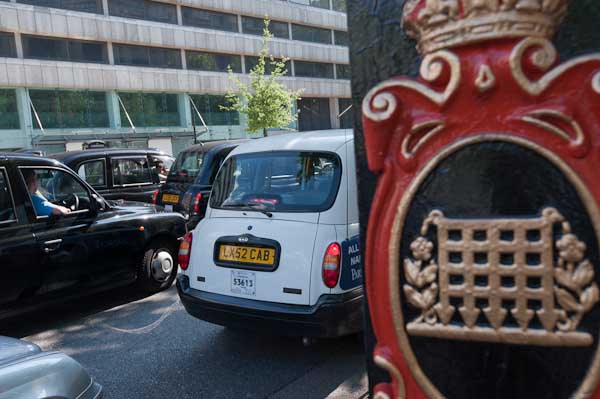
I don’t use taxis in London – or at least very seldom. I can only remember two occasions in the last thirty or so years, both when others insisted I go with them. It’s a wasteful, outdated and overpriced system which is responsible for much of the congestion in London, both by cabs carrying only small numbers of people compared to other public transport and also by ‘cruising for hire’ with no passengers on board.
My account on My London Diary gives some of their grievances, some of which I have some sympathy with, and I agree the police should be enforcing the law (rather than harassing protesters) but the whole system needs to be updated, taking into account the general availability of smart-phones and improvements in satellite navigation systems which increasingly make the ‘knowledge’ redundant and can provide real-time congestion information.
I didn’t find it an easy protest to photograph, which I think shows in the results. Lots of taxis are frankly rather boring, and not that unusual in London, where I commented that “While standing at a bus stop a couple of weeks ago I counted over 30 empty taxis going past before my bus arrived, and I couldn’t help but think we could have a better public transport system without taxis.”
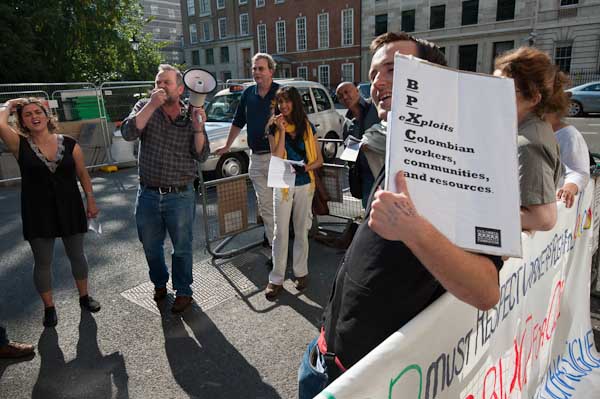
BP Picket for Colombian Oil Workers – St James’s Square
BP have a long-running dispute with the workers on the Cusiana oilfield in the Casanare department of Colombia, and its one where they are playing dirty, with union members accusing BP of carrying out a campaign of misinformation about what is happening in the plant, and in particular of falsely claiming the support of government officials for their lies about the action.
More or less as this picket was taking place, armed commandos from the Colombian army leapt over a security grid at the plant and attacked the workers who were carrying out a peaceful occupation of the Cusiana CPF (Central Processing Facility) in Tauramena.
Previously BP had come to an out of court settlement on a UK High Court challenge over the pipeline from this oilfield to the coast, when farmers alleged that BP benefited from the actions of Colombian paramilitary forces who harassed and intimidated them in their protection of the pipeline. During the preparation of the case, of the lawyers for the farmers discovered she was on a death list and fled the country; she was granted political asylum in the UK.
The protest was organised by the Colombia Solidarity Campaign and was supported by the ICEM, the International Federation of Chemical, Energy, Mine and General Worker’s Unions, based in Switzerland which represents more than 20 million workers around the world, uniting trade unions in its sector around the world.
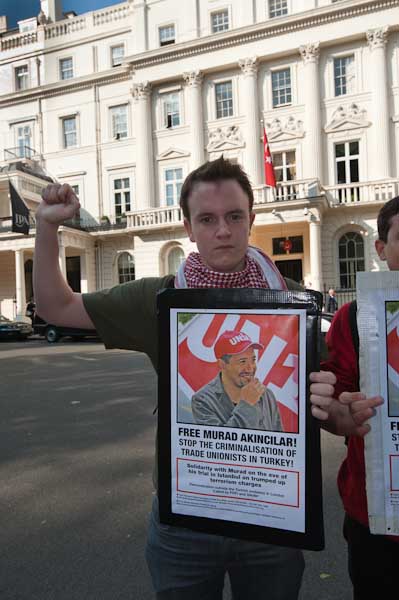
Protest for Murad Akincilar Turkish Embassy, Belgrave Square
Trade unionist Murad Akincilar was arrested on a spurious charge of belonging to a terrorist organisation while on an extended holiday in Turkey last September and was in prison in Istanbul. His treatment in prison has resulted in serious eye damage and partial blindness. He was known personally to some of the protesters as he studied for a Masters Degree at the LSE, but since 2001 he has lived in Switzerland and worked for Swiss trade union Unia which was leading the campaign for his release.
The protest opposite the Turkish Embassy was organised by Fight Racism! Fight Imperialism! and Gik-der, an organisation founded in north London in 1991 by migrants fleeing political and racial persecution in their home countries of Turkey and Kurdistan.
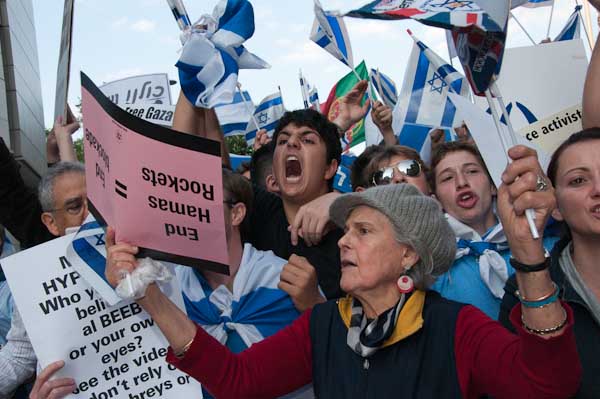
Zionist Federation Support Israeli Atrocity – Israeli Embassy, Kensington
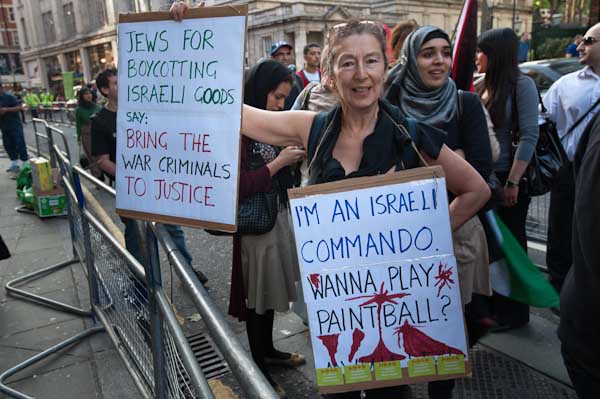
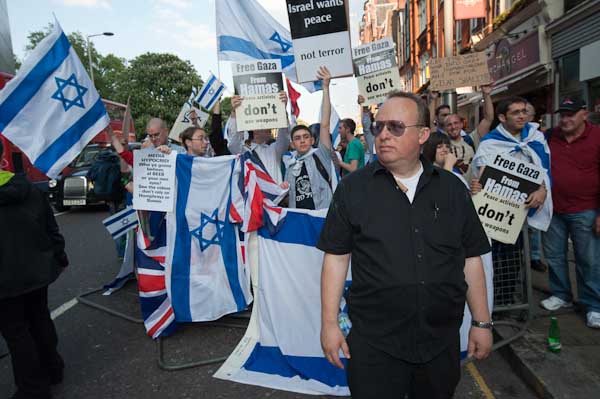
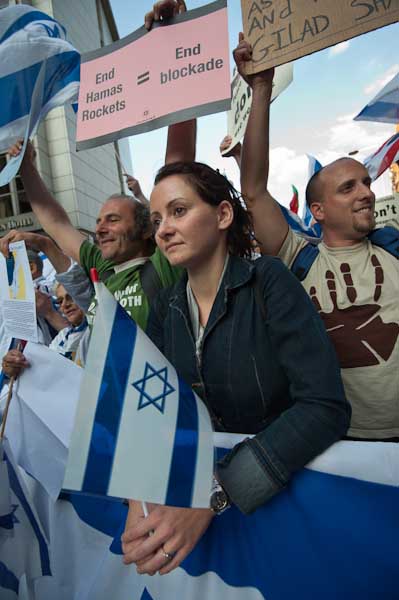
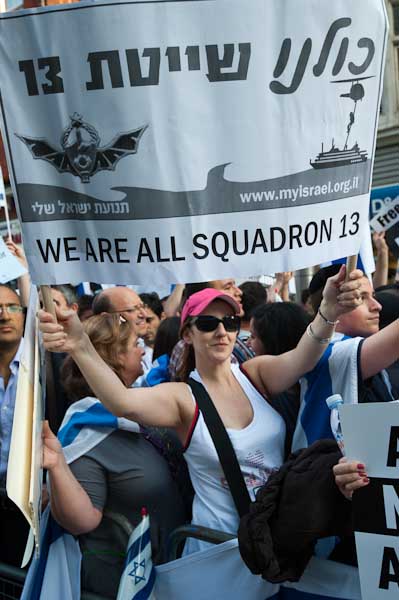
The Zionist Federation together with members of the English Defence League demonstrated opposite the Israeli embassy in support of the Israeli Defence Force killings in the attack on the Gaza aid flotilla.
A smaller group of pro-Palestinian protesters had come to oppose them, although both the Palestine Solidarity Campaign and the Stop the War Coalition had decided not to support the counter-demonstration to avoid conflict.
Although official Zionist sources had expressed some regret at the violence and loss of life, the mood of the supporters here appeared to be one of a gloating triumphalism that seemed entirely inappropriate to the situation. I was “sickened when at one point a large group of the demonstrators began chanting ‘dead Palestinian scum’ ” and appalled to find this was “a demonstration jointly with the Zionist Federation and the English Defence League, some of whose members many of us have seen and heard chanting racist slogans on our streets. It seems unbelievable that a Jewish organisation should align itself – even if unofficially – with people like this.”
Attempts to justify the summary execution of one of the victims by shots to the head at close range by the existence of so-called weapons on the ships seemed insulting – almost all those shown in the photographs are “exactly the kind of tools that would be expected to be found on any ship in its galley and for general maintenance, as well as items being taken for building work in Gaza. The possible exceptions are a few canisters of pepper spray, some catapults and what looks like some kind of ceremonial knife.”
I’m very much in favour of peace in Palestine and Israel, but like many I feel “the actions of the state of Israel in their attacks on Gaza, their disruption of everyday life for the Palestinians and the blockade is making the possibility of peace much more distant… Like other conflicts, resolution depends on winning hearts and minds and this can’t be done with tanks and bulldozers.”
Police had to step in at the end of the protest when four press photographers were surrounded and chased by a an angry group of threatening Zionist demonstrators but all I suffered were a few threats and hostile gestures.
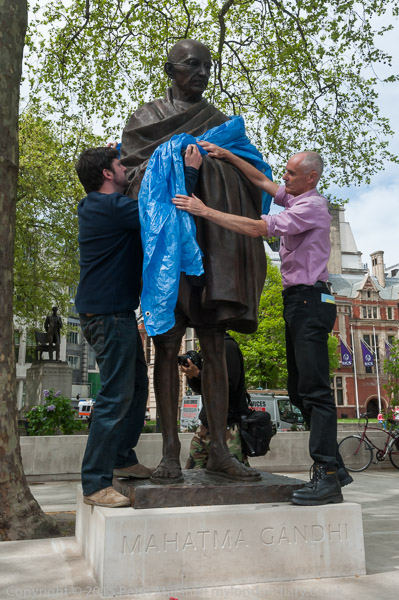
Occupy Gandhi – Stop Fossil Fuel Criminals – on Monday 4th May 2015 Occupy Democracy were on the fourth day of their ‘Festival of Democracy’ in Parliament Square “building a movement for real democracy: free from corporate control, working for people and planet!”
Occupy had come to Parliament Square in defiance of the law criminalising the use of tarpaulins, tents and other protection in the square, and were making six key demands:
• reform of party funding so that members of parliament act in the interests of those who elect them rather than the 1% who bankroll them • major democratic reform of the media to break the stranglehold of vested interests • a fundamental overhaul of lobbying and the way powerful economic interests inhabit the corridors of power within government • the introduction of proportional representation so that everyone’s vote counts • that MPs should not have conflicts of interests from either paid employment or corporate shareholdings • a citizen-led constitutional convention for real democracy.
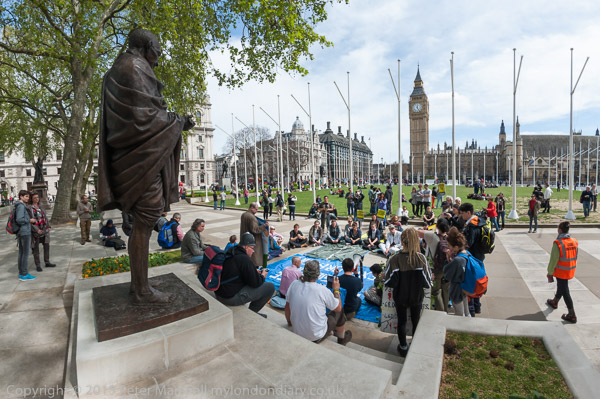
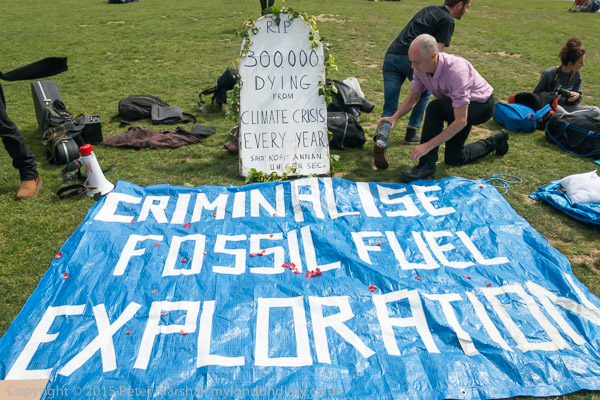
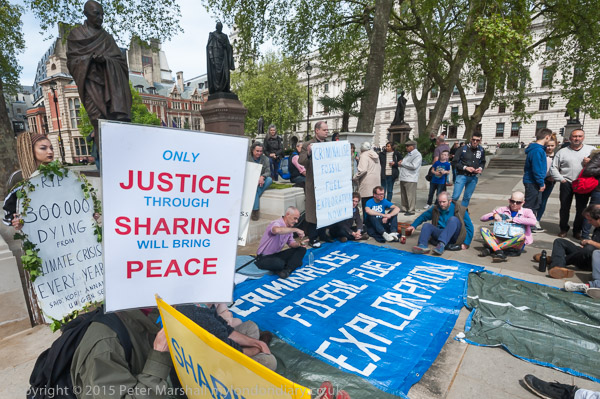
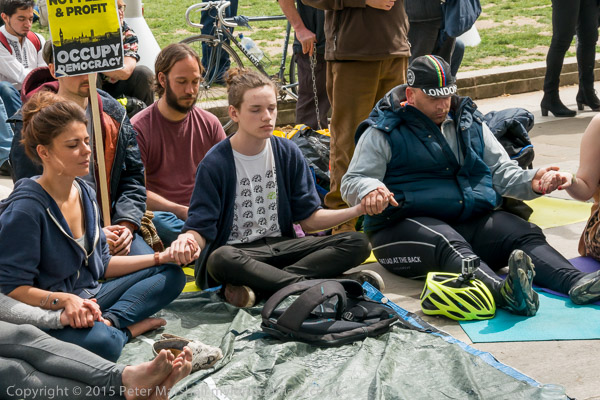
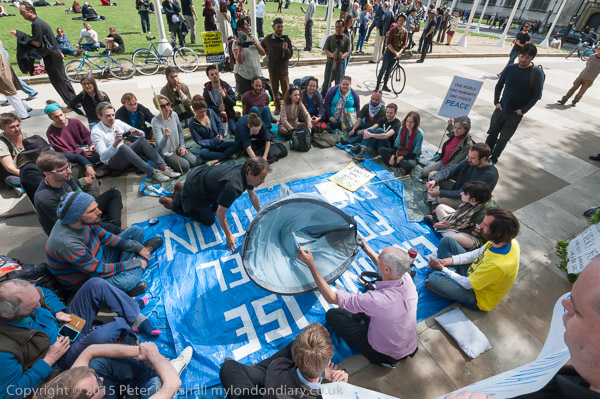
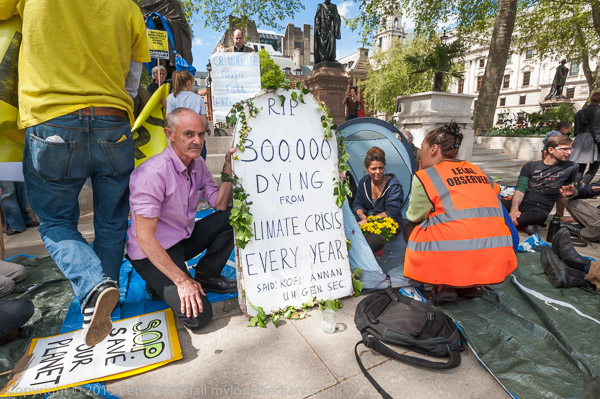
On Monday 4th they began a rally and meditation at the foot of the statue of Gandhi, noted for his direct action civil disobedience, calling for fossil fuel exploration and investment to be made a crime. Donnachadh McCarthy laid out a large blue banner with the message ‘Criminalise Fossil Fuel Exploration‘ and a mock tombstone with the inscription ‘RIP – 300,000 Dying from Climate Crisis Every Year Said Kofi Annan UN Gen Soc‘.
People then brought tarpaulins to sit on around these on the paved area in front of Ghandi’s statue and began a series of short speeches, meditation and songs about climate change and fossil fuel use.
They took a small blue tarp to the statue of Gandhi and wrapped it carefully around him. After a short pause two of the GLC’s private security heritage wardens who had been watching the event with a few police officers came up and removed the blue tarpaulin. A replacement was brought up and carefully held by two of the protesters without touching the statue (much) and the meditation continued.
There was another minor intervention by the heritage wardens who objected to burning incense sticks being placed in the flower beds. The protesters removed them and instead held them.
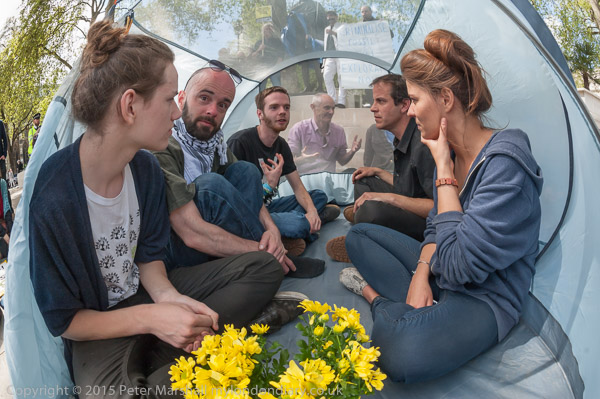
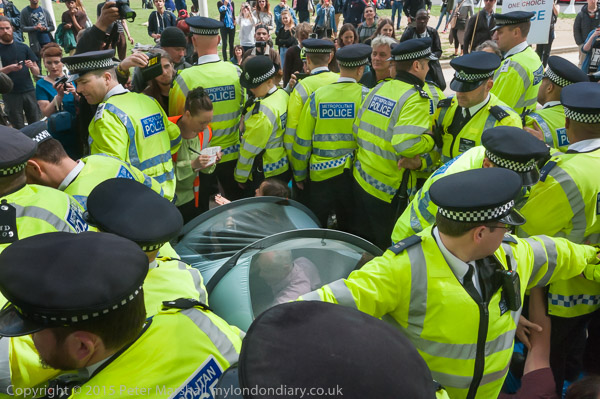
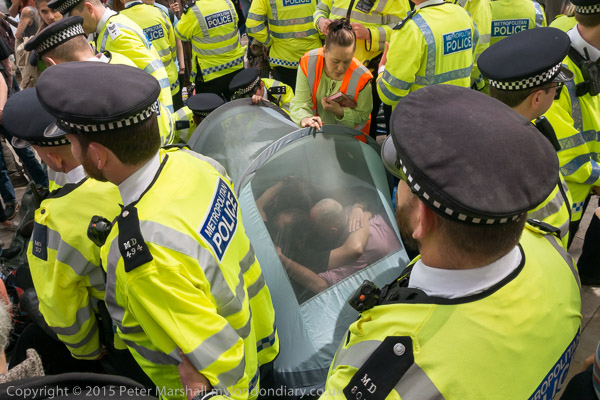
Donnachadh McCarthy then produced a blue folding tent and erected it, announcing that he was going to defy the ban on tents and inviting others who wished to join him.
People climbed in and after posing for a photograph with the tent the protest continues, with Donnachadh joining them inside as police approached. The police warned those inside the tent they were committing an offence and warned them they could be arrested – and then walked away.
Some minutes later, at exactly 2pm a larger group of police returned and surrounded the tent.
They gave those inside a final chance to leave without being arrested. Three people remained inside the tent, holding each other tight.
Finally they were arrested, handcuffed and taken away to waiting police vans. The whole police operation seemed a massive waste of public money enforcing a ridiculous law. The real criminals are not a few protesters with tents and tarpaulins in public squares, but those who sit in boardrooms and continue promote and produce fossil fuels which are driving us towards extinction, plotting actions to derail attempts to make the changes the planet needs in order to increase their profits.
Guantanamo, Firefighters, Advocacy, RMT & Lambeth Cuts. Wednesday 25th February 2015 was a busy day for protests in London, and I photographed five events.
Free Shaker Aamer at Parliament
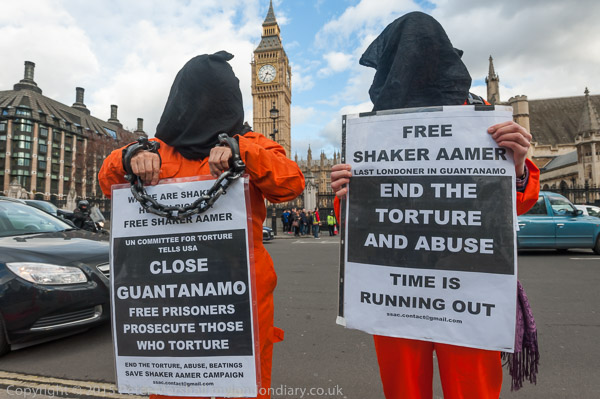
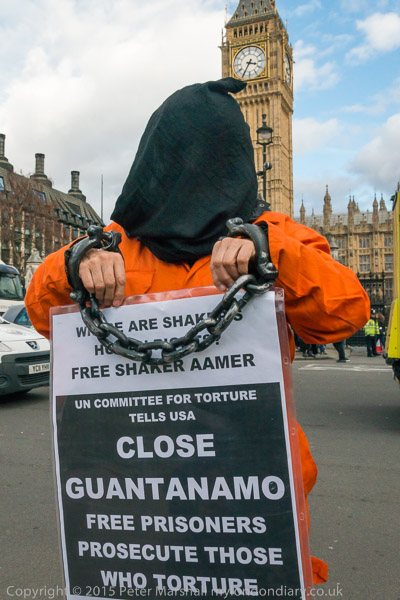
The Free Shaker Aamer campaign protested for 4 hours at Parliament calling for the urgent release of London resident Shaker Aamer from Guantanamo, where he had been held for over 13 years and regularly tortured. Of course I didn’t stay with them that long – there aren’t really that many ways to photograph a fairly small group in orange jumpsuits – but it meant they were still there when I arrived over three hours after their protest began.
Usually their protests are at lunchtime, but because they had stayed longer I was able to photograph their weekly protest at around 3.30pm on my way to an event outside Downing St. They continued these protests while parliament was sitting until Shaker was released towards the end of 2015.
Striking Firefighters block traffic
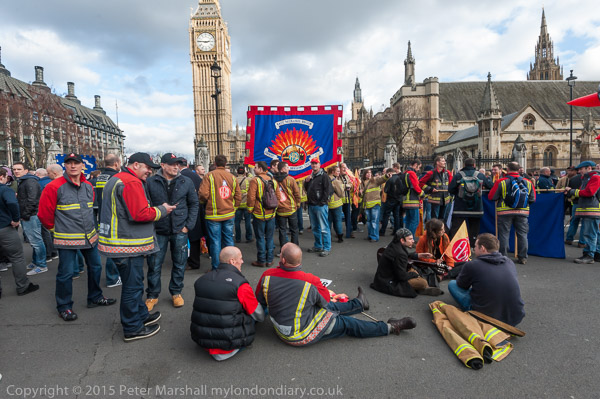
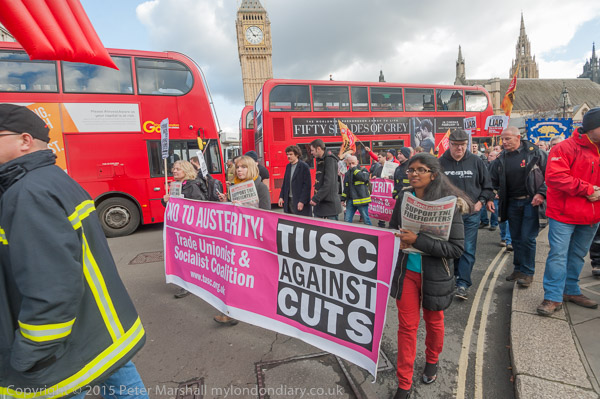
Firefighters came out of their rally in Central Hall and blocked the road in front of Parliament. I don’t think the police tried to move their fellow public servants, who had a large black balloon with the message ‘FBU – WE RESCUE PEOPLE, NOT BANKS! STOP THE CUTS’ as well as several banners.
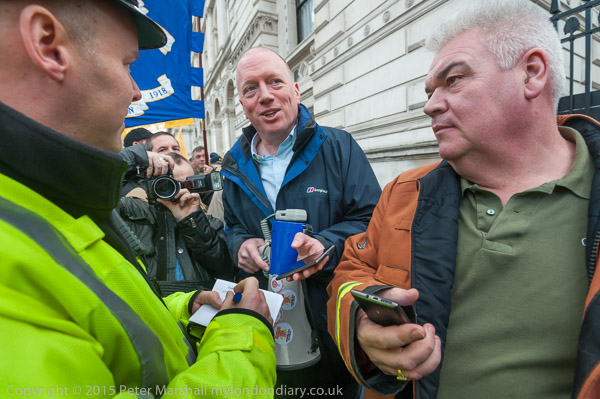
After around ten minutes they marched down to Downing St, blocking much of Whitehall. In front of the gates to Downing St there was a very noisy protest, and police did come and talk with In front of the gates to Downing St there was a very noisy protest, and police did come and talk with FBU leader Matt Wrack and promised to try to get someone to come out and talk with them.
They were still waiting when I left – and I think they would still be waiting now before anyone representing our Tory government came.
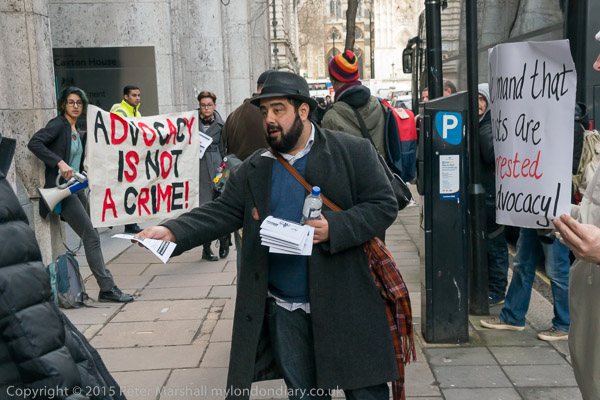
Welfare Advocacy not a Crime
A short walk away in Caxton Street people were protesting outside the Dept of Work & Pensions in a nationwide day of action over the arrest of welfare rights activist Tony Cox.
Although by law welfare claimants are allowed to have an adviser present with them at job centre interviews, when a claimant arrived together with Cox his interview was cancelled. And later that day police arrived at Cox’s home, arresting him and charging him with threatening behaviour.
When his case came to court in October the prosecution had to drop the main charges. A month after the first hearing Cox was found guilty of refusing to supply person details to the police and fined £200 and admonished on the charge of hindering the officers.
RMT protest Underground Job Cuts
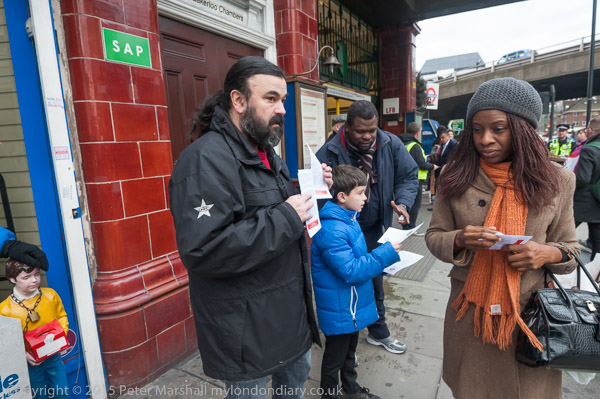
Despite earlier promises, Transport for London were planning to go ahead with a 50% cut in station staffing, closing ticket offices such as the well-used one at the busy Edgware Road station on the Bakerloo Line.
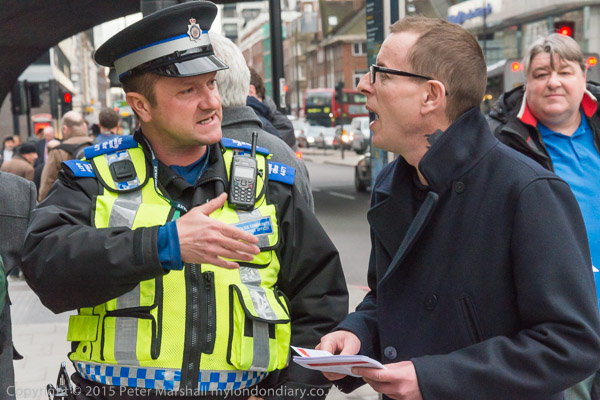
Things threatened to get nasty with some angry exchanges when police tried to move RMT members handing out leaflets to the public, but the RMT members insisted on their right to do so on the pavement outside the station entrance.
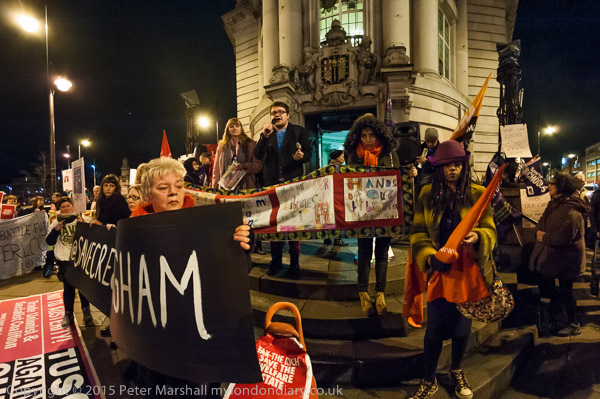
Lambeth against £90m cuts
Another tube journey changing at Oxford Circus from the Bakerloo to the Victoria Line took me south of the river to Brixton where a short distance from the station a lively rally was taking place on the street corner outside Lambeth Town Hall.
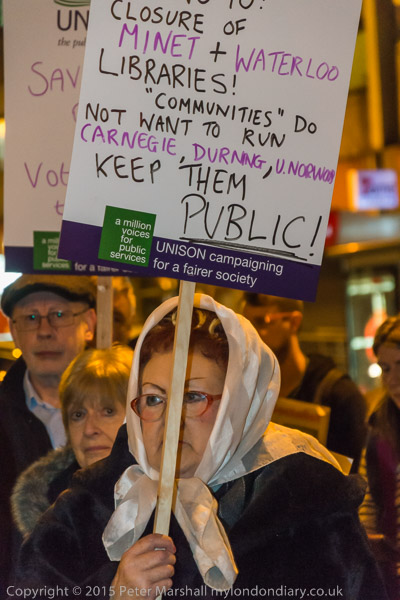
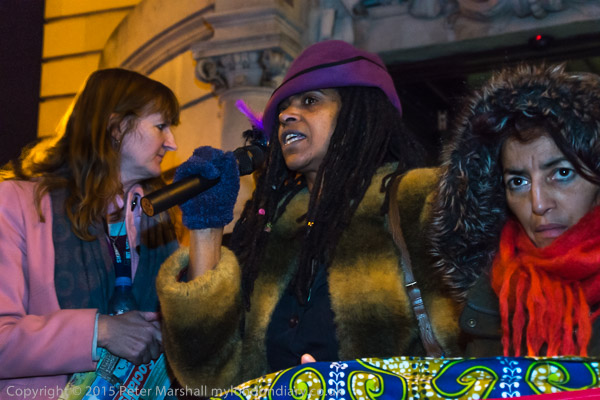
Around a hundred trade unionists, pensioners, library and other council staff, social housing tenants and other residents were there to tell councillors arriving for a council meeting to reject library closures and other £90 millon cuts.
It was now around 6pm, and in late February the sun sets around 5.30, so it was getting rather dark. Although I had both flash and LED lighting, neither is much use for lighting larger groups of people, and even on the corner of two major roads the streetlighting a few yards back was pretty poor. Thankfully digital cameras are considerably better than film under such conditions and I was able to get good results at ISO 3200.
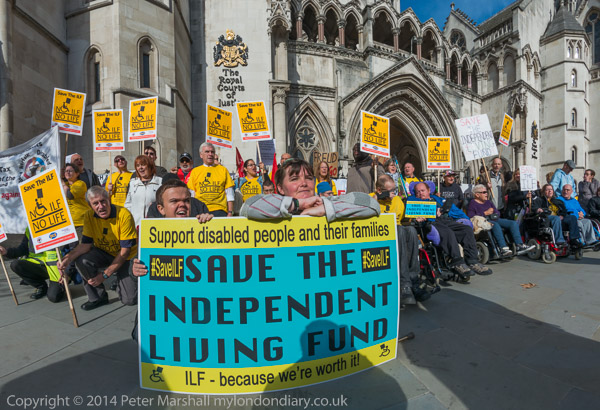
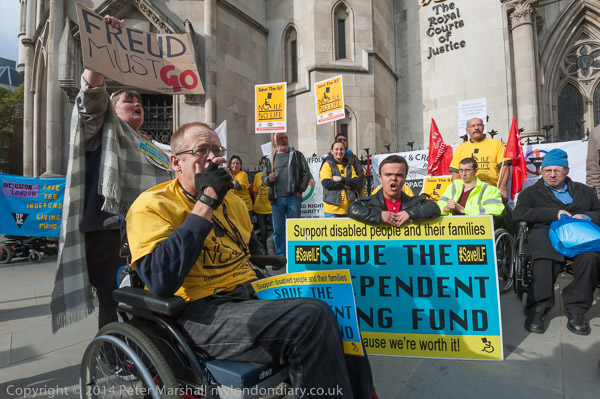
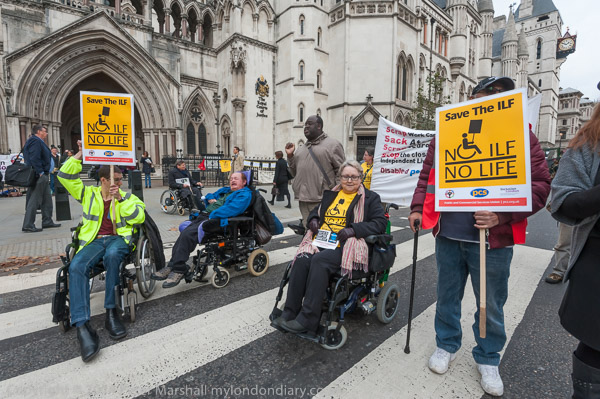
The Independent Living Fund enabled many disabled people to continue to live with dignity and to work making a positive contribution to society and the government decision to close it led to many protests and to legal actions to try and stop it under the Equality Act.
Although a court ruled that the minister concerned had acted illegally, all it required was that the new minister reconsidered the plans. He did so, and decided to go ahead, though with a three month delay. And a judge ruled in December 2014 that although in axing the ILF he knew that the closure would mean many disabled people would lose their ability to live independently in the community his decision was legal.
The decision to end ILF was clearly wrong, clearly immoral, but so long as the legal niceties were observed the government was able to go ahead with it, and our law gave no protection.
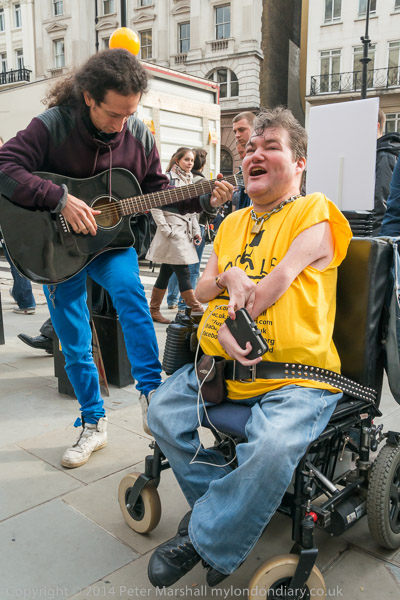
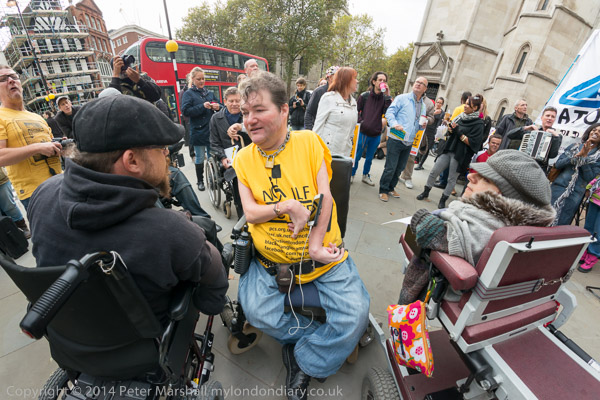
The vigil outside the court while the case was being heard attracted wide support, including from Inclusion London, Norfolk and Suffolk DPAC local DPACs, the Greater Manchester Coalition of Disabled People, Transport for All, Winvisable, PCS Union, the TUC, and other organisations,and there was even a simultaneous vigil in Toronto, Canada. Three MPs, John McDonnell, Andy Slaughter and Jeremy Corbyn, came to give their support, and there were speeches by campaigners including Paula Peters and Andy Greene, with John Kelly singing.
As expected the vigil ended with a short direct action by DPAC and others, briefly blocking the Strand outside the law courts.
Free Shaker Aamer
This was one of a long series of regular vigils opposite Parliament for Shaker Aamer, an innocent charity worker arrested by bandits and handed over to US forces who have imprisoned and tortured him for over 12 years. He was cleared for release in 2007 but remained in Guantanamo with our government failing to press for his release because his testimony could embarrass MI6 as well as the US.
London Panoramas
I had time before another protest to visit an exhibition at the Museum of London Docklands and on the journey to pause and make some panoramic images.
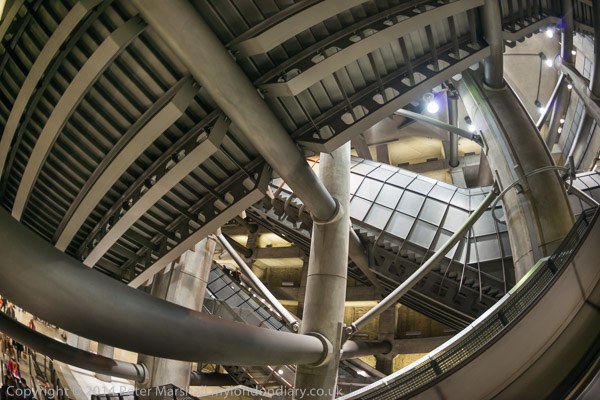
Probably the most interesting were inside Westminster station, where “the beams and buttresses, designed by Hopkins Architects and completed in 1999 for the opening of the Jubilee Line are also the foundations of the block of parliamentary offices above the station, Portcullis House, and were deliberately Piranesian, though sometimes I get more of the feeling of Escher as you seem to walk endlessly up escalators and around the interior.”
Democracy Camp – Poet Arrested
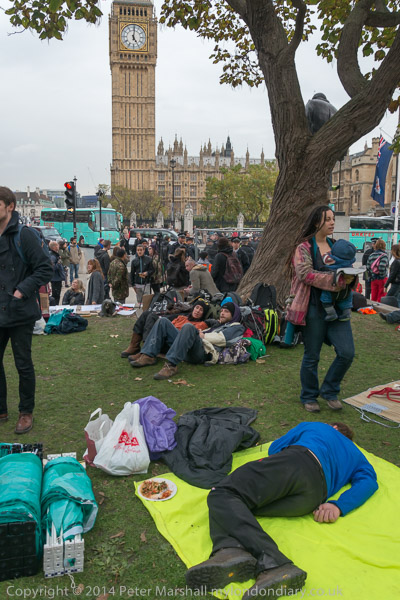
I returned to Parliament Square where the Democracy Camp was still holding workshops, though police and the GLA ‘heritage wardens’ had fenced off the main grass area.
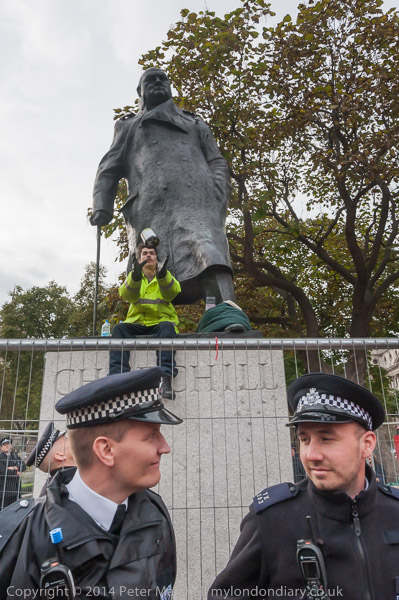
Danny, one of the protesters had been sitting on the plinth next to the statue of Churchill since the previous afternoon and poet Martin Powell arrived with a pot of food for him, which he tossed up to him, going straight into his hands, despite police warning him he could be arrested.
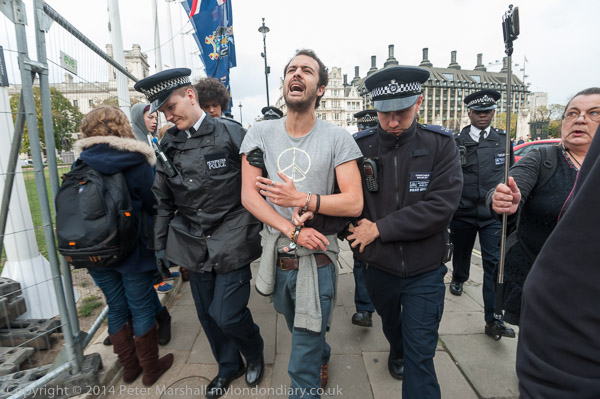
“How can feeding the hungry be a crime?” he asked and he was arrested and led away in handcuffs around two sides of Parliament Squareperforming his poem ‘The Missing Peace’. I left while Danny was still on the plinth, though later that evening police finally found a ladder and brought him down after over 26 hours.
Musical Poor Doors
It was Class War’s 14th weekly protest at the ‘rich door’ of Redrow’s One Commercial St flats and it was a lively affair, with the banners dancing to the music of Rhythms of Resistance, a poetic performance and some rousing speeches against social apartheid.
There were a lot of police present and some stood in front of the door and ushered a few people in and out but made no attempt to stop the hour long protest, which though noisy remained entirely peaceful. Some of the police clearly enjoyed the music and watching the dancing.
A few days ago I had to sit down and write some explanations to a friend who lives on a smallholding in rural France who doesn’t have a computer or internet access. It made me realise how much has changed for most of us since some time in the 1990s, when we all began to be connected by the World Wide Web and browsers such as Mosaic which really made the breakthrough to something like the web we now know and most of us spend large parts of our life in.
“A photographic account of the protests from July 2014 to May 2015 at One Commercial St, Aldgate, London against separate doors for rich and poor residents. The book includes over 200 images from 29 protests. ISBN: 978-1-909363-14-4”
It is still available, and at the very reasonable price of £6.00, though given Blurb’s postage rates it only makes sense to buy it if you get together with a few mates to order several copies.
More recently my wife sent him a copy of a postcard with my picture from 2014, ‘Vigil for Ferguson, US Embassy – No Justice, No Peace’ and he wrote back asking who Ferguson was – and included a couple of questions about the Class War book.
Google of course would have supplied him the answers in the twinkling of a mouse click, and told him Ferguson was a town in Missouri where riots had followed both the shooting of Michael Brown by a police officer and the failure to indict the officer for the murder. He could have got the answer even quicker on my own web site, My London Diary, where putting ‘Ferguson’ in the search box at top right on most pages returns links to the Solidarity with Ferguson vigil, Hands Up! Against Racist Police Shootings protest following the shooting and this Candlelit Vigil for Michael Brown following the decision not to charge Darren Wilson with his murder.
His second question was about the Class War banner with its message “We must devastate the avenues where the wealthy live” Lucy Parsons 1853-1942, and was simply to ask “Who was Lucy Parsons”. Again Wikipedia and other web sites such as the IWW Archive would have given a fast and far more comprehensive answer than the brief reply I wrote.
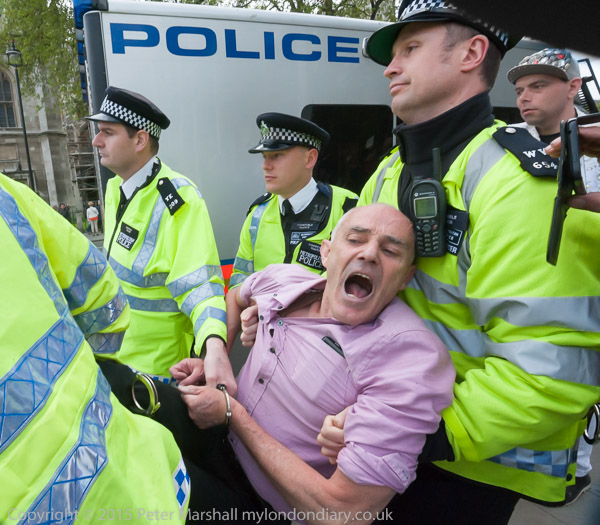
The final question was one that amused me. “Who, ” he asked, “was that elderly gentleman with a walking stick” and “why was he being arrested and being put into a police van in one of the pictures“. It was of course Ian Bone, and again my web site contains much about him on many occasions, including pictures and an explanation of his arrest on Wednesday 24th September 2014.
When the building manager had held open the ‘Rich Door’ for a resident to go through, the person holding one end of the Lucy Parsons banner had stepped in front of it to prevent him closing it. He made the mistake of walking away to the concierge desk, probably to ask the concierge to call the police, but leaving the door open and unguarded. So Class War walked in unopposed, bringing two banners with them and continued to protest in the the foyer.
Ian Bone talked to the building manager, then held up a couple of framed notices from the desk, and talked about them and the objections to social tenants being made to use a separate door on a dirty alley at the side of the building, before putting them back carefully on the desk next to a vase full of flowers. Others spoke briefly and people loudly shouted slogans.
And then “there was a crash and the vase of flowers was no longer on the reception desk. Ian Bone had knocked it off with his walking stick, which he had been swinging around rather wildly as he spoke. I only saw it out of the corner of my eye and couldn’t tell if it was deliberate or accidental.” Though I was fairly sure it would have been on purpose.
Shortly after, the police arrived, and there was some discussion; I went outside and a few minutes later the protesters followed and the protest continued as usual on the pavement, with more speeches and noise. Eventually the protesters decided it was time to leave and were moving away when a police office approached Ian Bone and told him he was being arrested as the CCTV in the ‘rich door’ foyer showed him breaking the vase. There was considerable argument as he was led away and put in the van, but no attempt at resistance.
Later we heard that Ian Bone had agreed to pay £70 for a replacement vase and the building owners had decided not to press charges. And at the following week’s Poor Doors protest Class War brought along a couple of vases of flowers to play with and to try and get the building manager to take, though as they probably came from a Pound Shop they “they were perhaps a little plastic and tacky looking compared to the one that had been broken the previous week.”
The building manager refused to take the replacements, but later made the mistake of grabbing hold of one which was thrust in his face, “probably by reflex. His face when he found himself holding it was interesting, and he quickly put it down, placing it on the desk in the reception area in the same place as the one knocked off last week, complete with its with a ‘Toffs Out!’ Class War card.” And I was just able to photograph it through the window there on the desk.
All photographs on this and my other sites, unless otherwise stated, are taken by and copyright of Peter Marshall, and are available for reproduction or can be bought as prints.