Solidarity With Fergusson & Talha Ahsan -2017

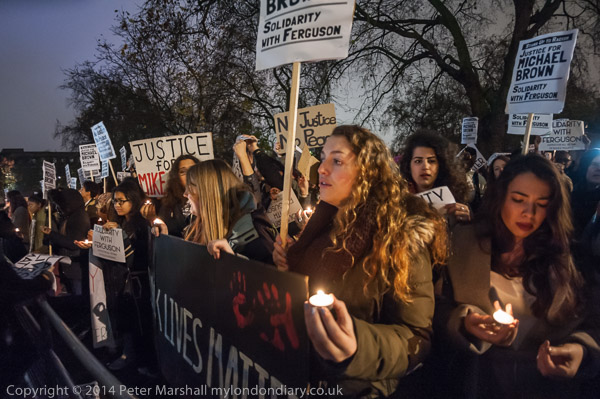
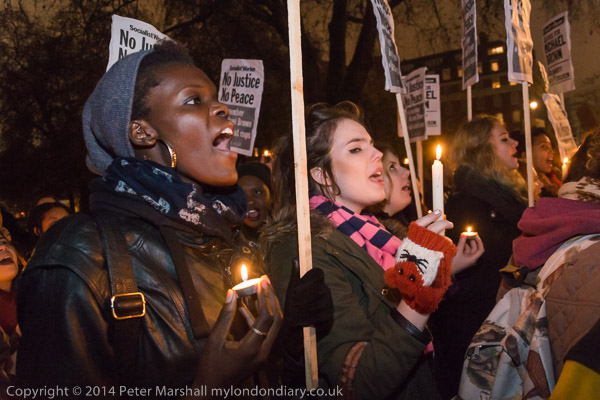
Solidarity With Fergusson & Talha Ahsan. Sunday 17th August 2014 I photographed a protest outside the US Embassy, then still in Grosvenor Square, in solidarity with the people of Ferguson, Missouri where there had been huge community protests after police shot unarmed black teenager Michael Brown. Later a party outside the UK Home Office celebrated the release of poet and translator Talha Ahsan from a US prison while condemning UK Prime Minister Theresa May for having allowed his extradition despite his diagnosis of Asperger syndrome.


Solidarity with Ferguson

US Embassy, Grosvenor Square

Solidarity With Fergusson & Talha Ahsan

After an altercation on the street in Ferguson, Missouri, on August 9, 2014,police officer Darren Wilson chased and shot Michael Brown, killing him. Some witnesses claimed that Brown had turned to face the officer with his hands up, shouting “Don’t shoot” . Six bullets hit the front of his body, including one to his head which was immediately fatal. Wilson claimed that Brown had charged at him but witnesses dispute this.

Solidarity With Fergusson & Talha Ahsan
Hands Up, Don’t Shoot

The slogan “Hands Up, Don’t Shoot!” became widely used in the protests over the killing. There were immediate widespread protests in Ferguson, mostly peaceful but some which led to violence and looting; it was an area were there were “longstanding racial tensions between the minority-black population and the majority-white city government and police.

NUS Black students banner lists just a few of the Black people who have been murdered by the police
Solidarity With Fergusson & Talha Ahsan
People hold up posters ‘London to #ferguson’ in front of the US embassy badge

There were widespread protests in cities across America and around the world – including this one in London. The anger at the killing was amplified by a media campaign which portrayed Brown as a ‘thug’ and labelled the community protests as riots.

Solidarity With Fergusson & Talha Ahsan

Later there were more protests after a grand jury decided not to indict Wilson, following an extended examination of a vast body of evidence,. Many felt the unusual way it had been conducted had influenced the jury’s decision.

Solidarity With Fergusson & Talha Ahsan

The shooting and its aftermath attracted so much attention that Amnesty International for the first time ever sent a team to investigate Ferguson, finding significant human rights abuses. Their report “cited the use of lethal force in Brown’s death, racial discrimination and excessive use of police force, imposition of restrictions on the rights to protest, intimidation of protesters, the use of tear gas, rubber bullets, and long range acoustic devices, restrictions imposed on the media covering the protests, and lack of accountability for law enforcement policing protests.”

Solidarity With Fergusson & Talha Ahsan
Carole Duggan, the aunt of Mark Duggan, unarmed and surrendering to police when they shot him

In the UK many saw a parallel to the police killing of Mark Duggan in 2011, also unarmed and surrendering when killed by police (and where a gun was apparently planted later by an officer some yards away.) His aunt, Carole Duggan spoke at the vigil.

The London vigil was organised by ‘London Black Revolutionaries’, a recently formed group of militant black activists who called “for the US to stop violently oppressing, Black People and Black Protests” – and for an end to similar oppression in the UK. Earlier known as B.B.R.S (I think Black British Revolutionary Socialists) they were Black British and British Asian youths who had split away from the Socialist Workers Party some months before this protest and were largely based in Brixton.

Those at the vigil were from across London’s communities although a majority were black. There was some audible dissent from all sides when one of the speakers suggested that the struggle for justice was one that only black people could understand and that they should fight it alone.

More pictures on My London Diary: Solidarity with Ferguson.


Shame on You Theresa May

Home Office

Talha Ahsan, a poet and translator, had been arrested in London in July 2006 following a n extradition request made by the USA. He was held here in maximum security for over 6 years without trial or charge while a number of appeals were heard against his extradition, until this was finally rejected by the European Court of Human Rights. He and five others had argued that the charges should be heard in the UK, but the court decided they could all be extradited.

Posters showing Home Secretary Teresa May who agreed the extradition of Talha Ahsan despite his diagnosis of Asperger syndrome – and the lack of any credible evidence against him

The US authorities had requested his extradition alleging that in London in 1997-2004 he had worked for a London company on material for a series of websites, hosted on a server in the United States, “designed to designed to incite readers to violent jihad and to provide material support to terrorist related entities“.

Hamja Ahsan, Talha’s brother

Theresa May, Home Secretary at the time, approved his extradition despite his suffering from Asperger syndrome which it was argued would make it extremely difficult for him to cope with the shocking changes this would cause. May stopped another extradition request for another Asperger’s sufferer, Gary McKinnon, and the different treatment led to widespread accusations of double standards.

Bruce Kent speaking next to a caricature of Teresa May

Talha Ahsan had been released by a judge following a plea bargain in the US courts, but at the time of this party was still held in the USA, coming back shortly after.

He agreed to admit to charges of conspiracy and providing material support for groups in in Chechnya & Afganistan – although as in many similar cases, there was probably little substance in the allegations – but the bargain released him from other charges for which he could have spent the rest of his life in solitary. And because of the time he had already served he was due for release.

Zita Holborne reads a poem – with ‘Teresa May’ looking over her shoulder

A number of people came to speak and read poems – including some by Talya – at the event and you can see pictures of most of them on My London Dairy at Shame on You Theresa May,


FlickrFacebookMy London DiaryHull PhotosLea ValleyParis
London’s Industrial HeritageLondon Photos

All photographs on this page are copyright © Peter Marshall.
Contact me to buy prints or licence to reproduce.


Class War Occupy Rich Door 24 Sep 2014

A few days ago I had to sit down and write some explanations to a friend who lives on a smallholding in rural France who doesn’t have a computer or internet access. It made me realise how much has changed for most of us since some time in the 1990s, when we all began to be connected by the World Wide Web and browsers such as Mosaic which really made the breakthrough to something like the web we now know and most of us spend large parts of our life in.
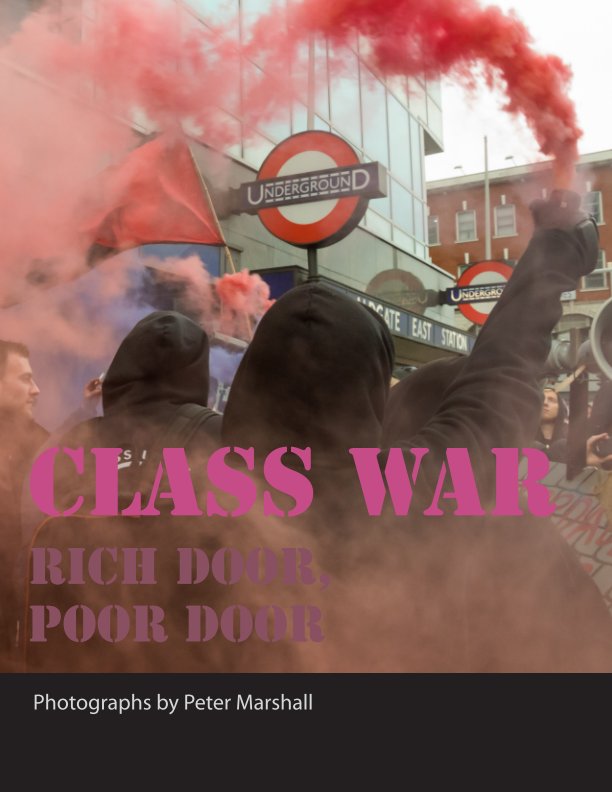
Some time ago I’d sent him a copy of my book – or rather ‘zine’ – ‘Class War: Rich Door, Poor Door‘ I published in 2015:

“A photographic account of the protests from July 2014 to May 2015 at One Commercial St, Aldgate, London against separate doors for rich and poor residents. The book includes over 200 images from 29 protests. ISBN: 978-1-909363-14-4”

It is still available, and at the very reasonable price of £6.00, though given Blurb’s postage rates it only makes sense to buy it if you get together with a few mates to order several copies.

More recently my wife sent him a copy of a postcard with my picture from 2014, ‘Vigil for Ferguson, US Embassy – No Justice, No Peace’ and he wrote back asking who Ferguson was – and included a couple of questions about the Class War book.

Google of course would have supplied him the answers in the twinkling of a mouse click, and told him Ferguson was a town in Missouri where riots had followed both the shooting of Michael Brown by a police officer and the failure to indict the officer for the murder. He could have got the answer even quicker on my own web site, My London Diary, where putting ‘Ferguson’ in the search box at top right on most pages returns links to the Solidarity with Ferguson vigil, Hands Up! Against Racist Police Shootings protest following the shooting and this Candlelit Vigil for Michael Brown following the decision not to charge Darren Wilson with his murder.
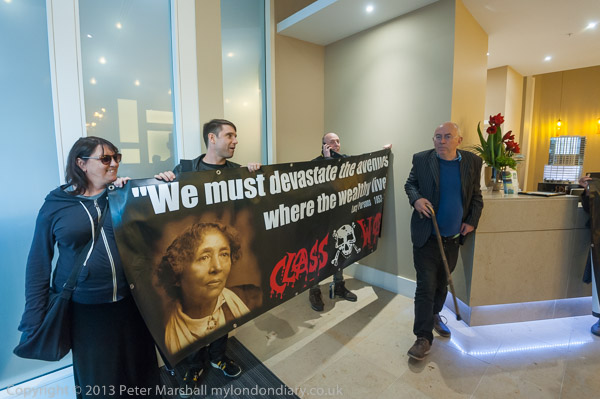
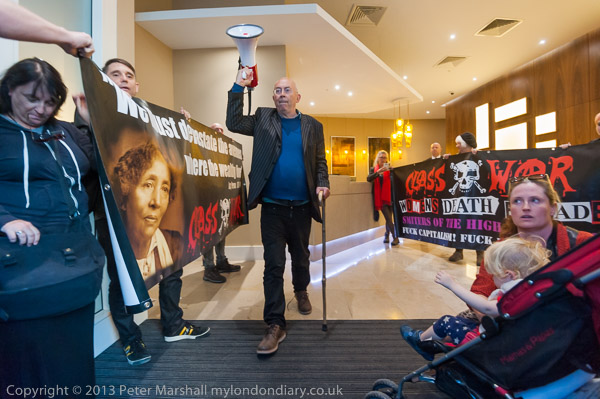
His second question was about the Class War banner with its message “We must devastate the avenues where the wealthy live” Lucy Parsons 1853-1942, and was simply to ask “Who was Lucy Parsons”. Again Wikipedia and other web sites such as the IWW Archive would have given a fast and far more comprehensive answer than the brief reply I wrote.

The final question was one that amused me. “Who, ” he asked, “was that elderly gentleman with a walking stick” and “why was he being arrested and being put into a police van in one of the pictures“. It was of course Ian Bone, and again my web site contains much about him on many occasions, including pictures and an explanation of his arrest on Wednesday 24th September 2014.
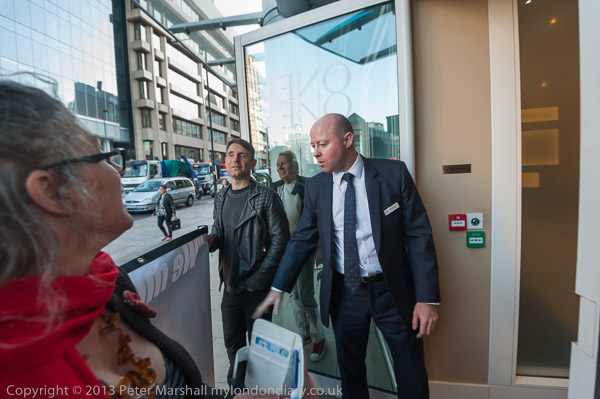
When the building manager had held open the ‘Rich Door’ for a resident to go through, the person holding one end of the Lucy Parsons banner had stepped in front of it to prevent him closing it. He made the mistake of walking away to the concierge desk, probably to ask the concierge to call the police, but leaving the door open and unguarded. So Class War walked in unopposed, bringing two banners with them and continued to protest in the the foyer.
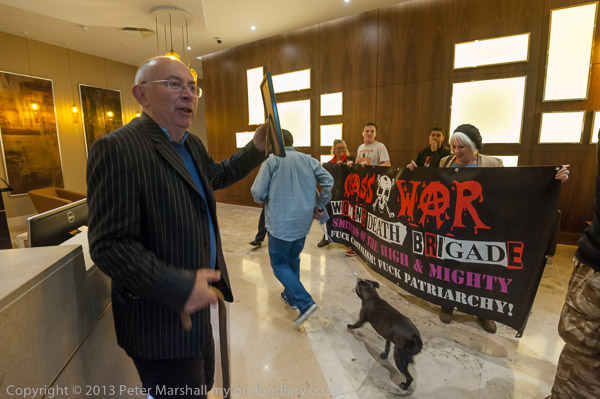
Ian Bone talked to the building manager, then held up a couple of framed notices from the desk, and talked about them and the objections to social tenants being made to use a separate door on a dirty alley at the side of the building, before putting them back carefully on the desk next to a vase full of flowers. Others spoke briefly and people loudly shouted slogans.

And then “there was a crash and the vase of flowers was no longer on the reception desk. Ian Bone had knocked it off with his walking stick, which he had been swinging around rather wildly as he spoke. I only saw it out of the corner of my eye and couldn’t tell if it was deliberate or accidental.” Though I was fairly sure it would have been on purpose.
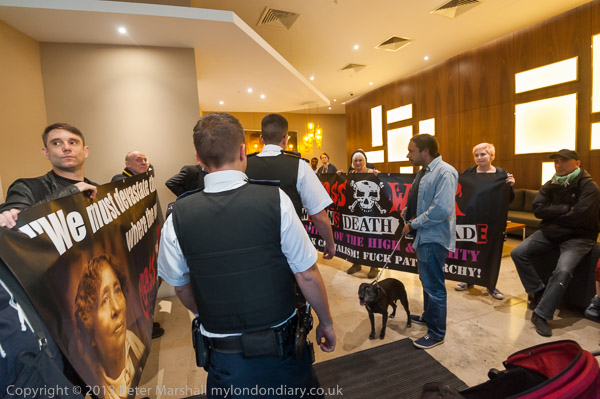
Shortly after, the police arrived, and there was some discussion; I went outside and a few minutes later the protesters followed and the protest continued as usual on the pavement, with more speeches and noise. Eventually the protesters decided it was time to leave and were moving away when a police office approached Ian Bone and told him he was being arrested as the CCTV in the ‘rich door’ foyer showed him breaking the vase. There was considerable argument as he was led away and put in the van, but no attempt at resistance.
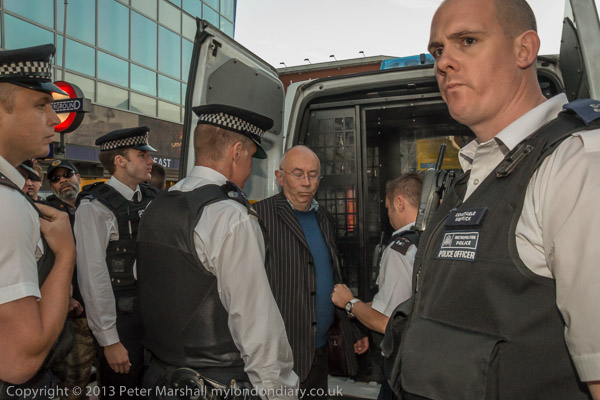
Later we heard that Ian Bone had agreed to pay £70 for a replacement vase and the building owners had decided not to press charges. And at the following week’s Poor Doors protest Class War brought along a couple of vases of flowers to play with and to try and get the building manager to take, though as they probably came from a Pound Shop they “they were perhaps a little plastic and tacky looking compared to the one that had been broken the previous week.”
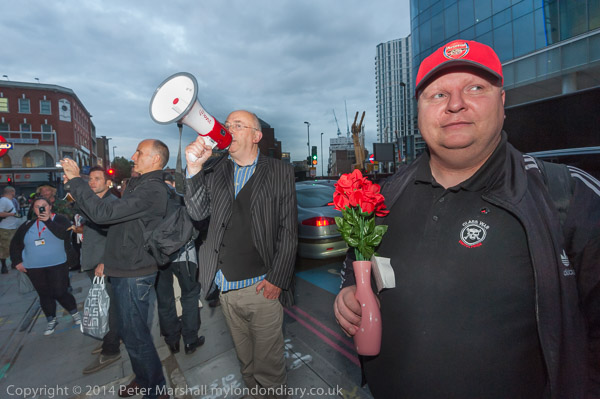

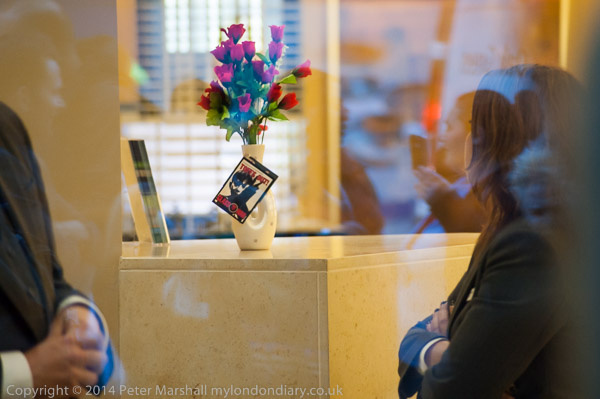
The building manager refused to take the replacements, but later made the mistake of grabbing hold of one which was thrust in his face, “probably by reflex. His face when he found himself holding it was interesting, and he quickly put it down, placing it on the desk in the reception area in the same place as the one knocked off last week, complete with its with a ‘Toffs Out!’ Class War card.” And I was just able to photograph it through the window there on the desk.
More on My London Diary:
Class War Occupy Rich Door
Class War Poor Doors Week 10


All photographs on this and my other sites, unless otherwise stated, are taken by and copyright of Peter Marshall, and are available for reproduction or can be bought as prints.
November 2014 (2)

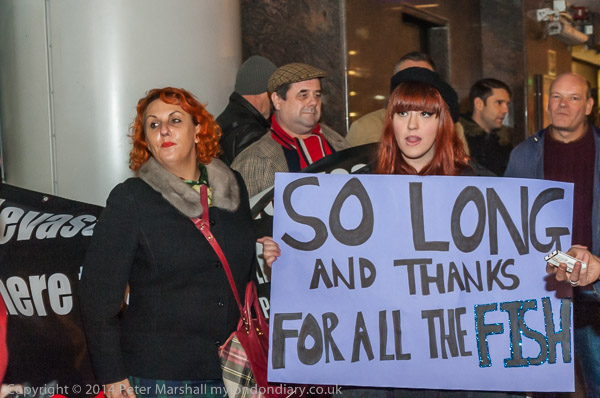
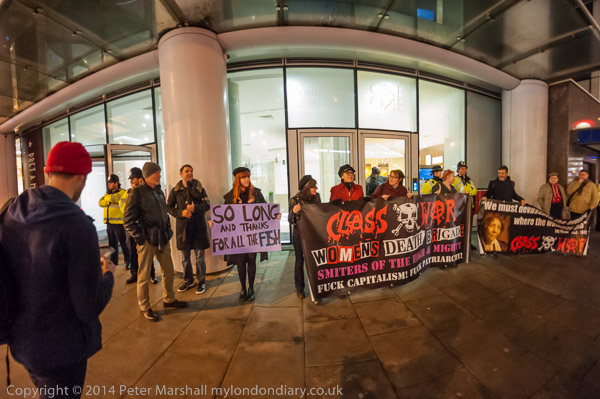
The Wednesday of the final week of November in 2014 was an easier day for me as I was able to spend most of it at home and catching up on various things including a little shopping and visiting the library to borrow new books to occupy me on my train rides to London. I only had to leave home around 5pm to arrive in Aldgate for the Class War Xmas Ceasefire Special outside the tower with separate entrances for its wealthy and its social housing tenants.

After 19 weekly protests outside the ‘rich door’ the tower owners had finally agreed to talk with Class War and try to reach a solution to the problem, and in response Class War had agreed to call off further protests unless the talks failed. So this was more of a celebration than a protest, although the talks, when they took place didn’t really reach a satisfactory conclusion.

But there were some concessions and the protests did lead to some real improvements including new paving and lighting and better cleaning for the side alley which lead to the ‘poor door’, and perhaps more importantly they raised the whole issue of segregated entrances very much into the national agenda.

I was sorry to have to rush away from the celebrations, which I suspect continued afterwards in one of the local pubs.


A tube ride took me across town to the US Embassy, still then in Grosvenor Square, and the Candlelit Vigil for Michael Brown.

In August, police officer Darren Wilson had shot and killed Michael Brown Jr, an 18-year-old black man in the St Louis suburb of Ferguson, Missouri. Brown’s companion said that Wilson had grabbed Brown through his car window after calling on them to stop as they walked down the street; Brown, who was unarmed, tried to grab the officer’s gun as he threatened him and two shots were fired, one hitting Brown’s hand. Brown and his friend fled and when Wilson fired again, Brown turned around, raised his hands in surrender and shouted ‘Don’t Shoot!’ and Wilson fired six more bullets into his body. Wilson’s account differed greatly and a grand jury having heard decided not to indict him.

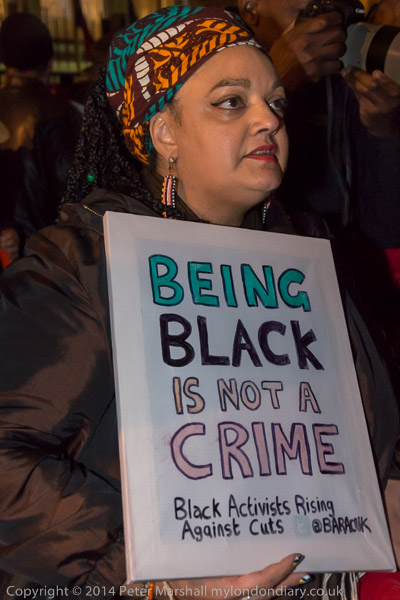
Riots followed the shooting, continuing for over a week in Ferguson, and there were protests across America and worldwide against the shooting, using the slogan ‘Hands Up, Don’t Shoot!’ There were further protests in 170 cities after the grand jury verdict was announced, and elsewhere across the world including this candlelit vigil in London called by London Black Revolutionaries and the NUS Black Students Campaign. Among those who spoke at the event were the Chair of London Campaign Against State & Police Violence, Malia Bouattia of NUS Black Students Campaign, Zita Holbourne of BARAC (above), Marcia Rigg, Carole Duggan, the RMT Paddington Branch Secretary, Wail Qaisim of Defend the Right to Protest and some people from London Black Revs.

Whatever actually happened in Ferguson, it is clear that US policing is racist, killing black people disproportionately, and acting – as Wilson did – out of fear due often due to racist stereotyping. Black Lives Matter – but not very much to some US Police forces and officers.

There was little or no street lighting in the area in front of the US Embassy where this protest took place, and for most of these pictures the main light present came from the candles and nightlights that were held by the protesters. A very tightly packed crowd made working in it difficult. When I got to the front of the protest there were some videographers at times using lighting which I took advantage of, but it seldom produces an attractive effect.

It was unfortunate the the Socialist Workers Party had decided to hold their own separate protest before this, probably because the organising groups had declined to let them take it over, but at least they did allow this vigil to use the public address equipment they had brought for their event. And many of those taking part are holding the placards that they provided in very large numbers.

When covering events at night I usually carry a small LED light which can illuminate people or objects a up to a few metres from the camera, usually holding it high and away from my body in my left hand while holding the camera to my eye with my right hand to give better lighting than using it in the hot shoe. If I have to, I’ll use my Nikon SB800 flash in the hot shoe, still using high ISOs to try and avoid a black background, usually with the camera on manual or shutter priority with speeds around 1/30s.


More on both events:
Candlelit Vigil for Michael Brown
Class War Xmas Ceasefire Special