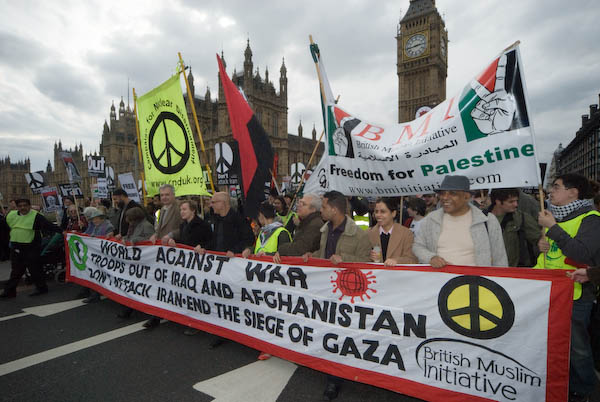
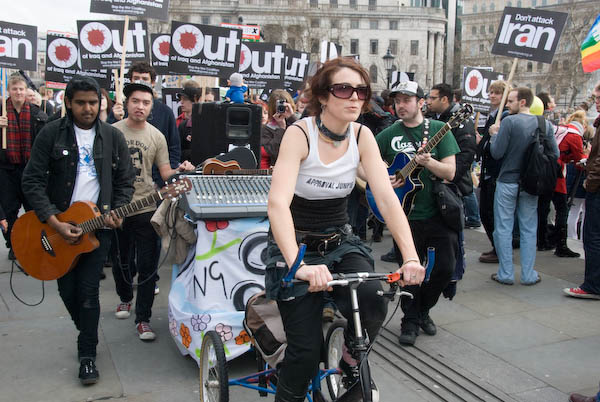
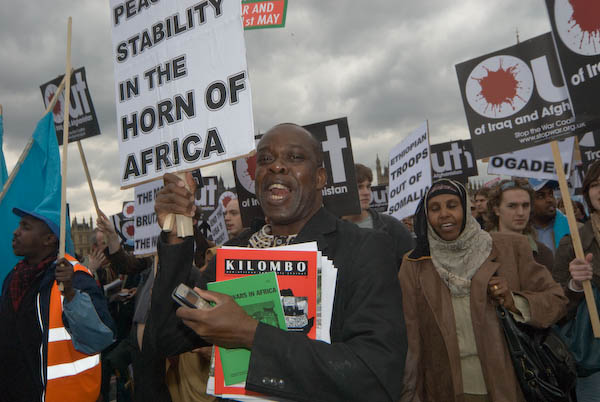
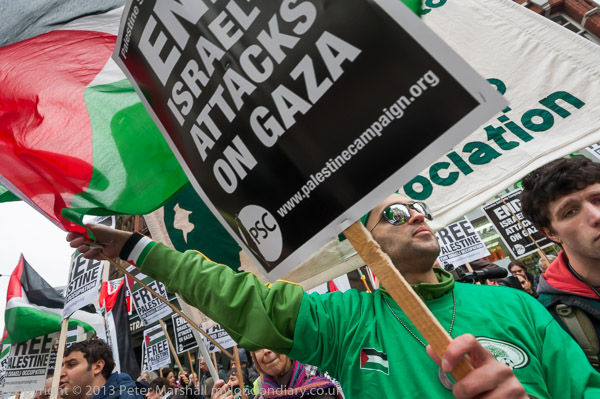
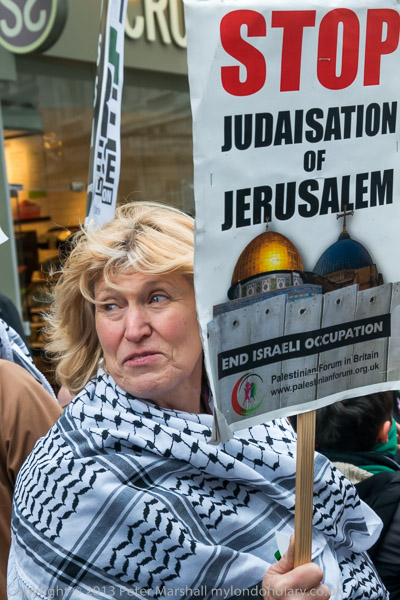
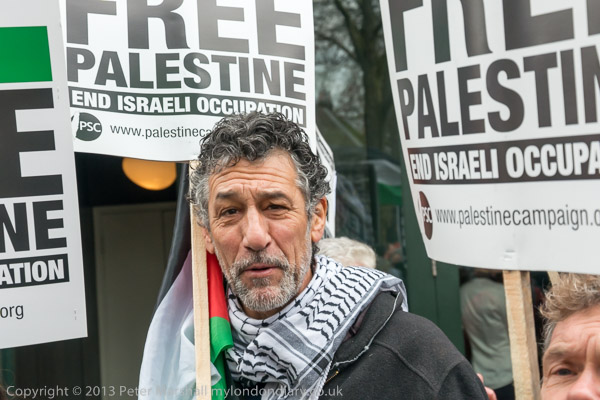
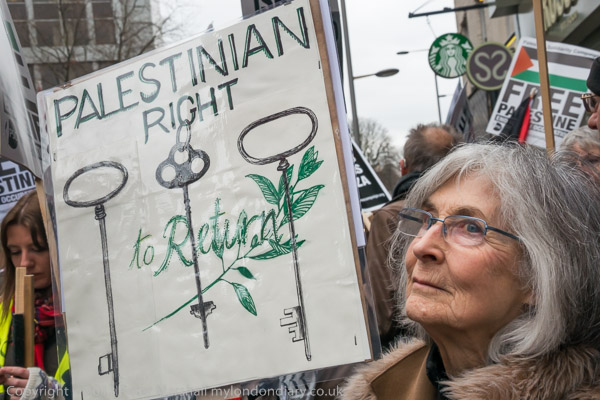
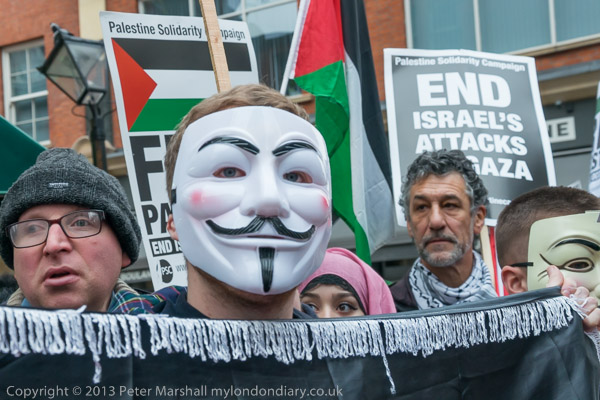
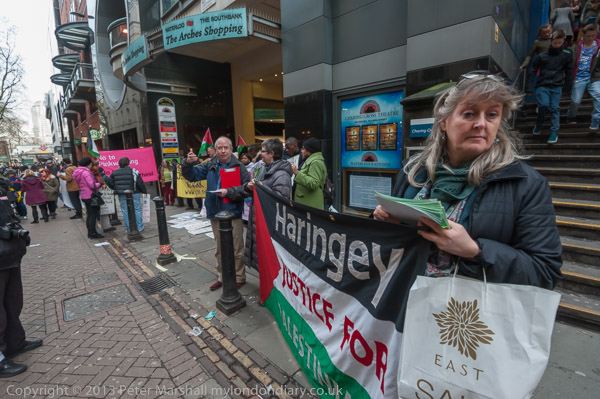
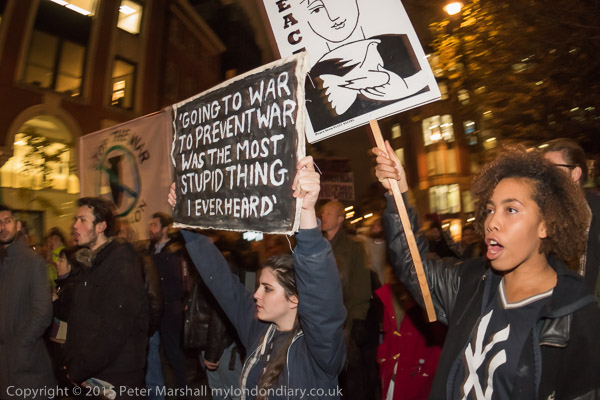
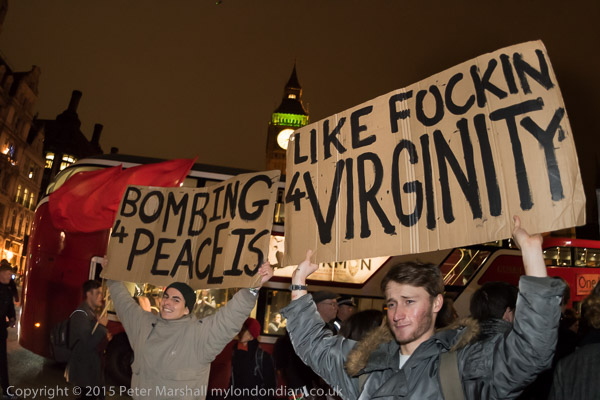
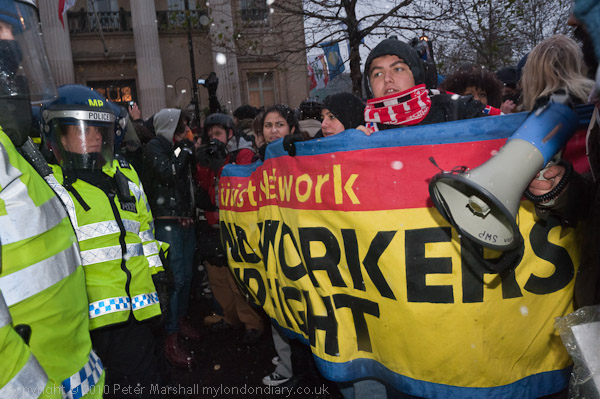
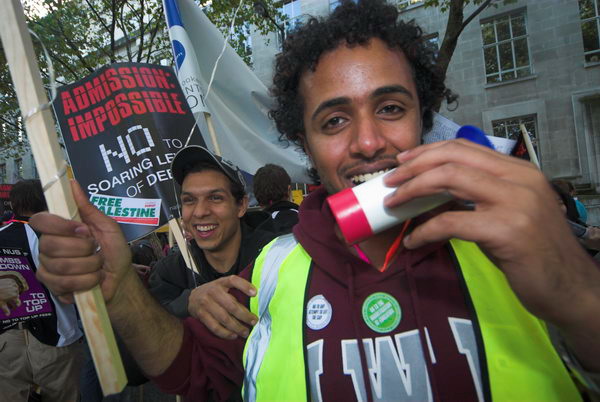
Stop the War – Troops Out: The protest organised by Stop the War, CND and British Muslim Initiative on Saturday 15th March, 2008 was an impressive one, with around 50,000 marchers calling for the withdrawal of our troops from Iraq and Afghanistan, no attack on Iran and a free Palestine, as well as many other groups drawing attention to other issues around the world including the genocide in Somalia.
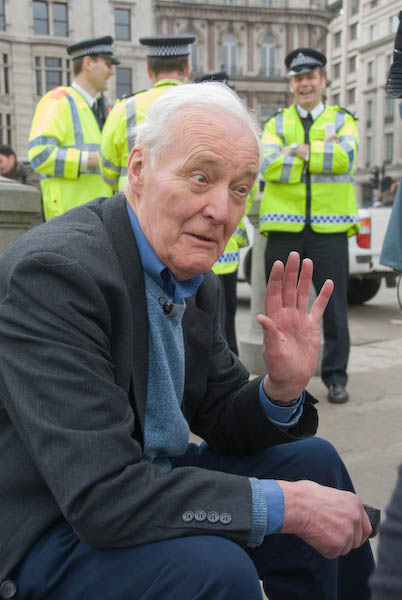
Tony Benn
It began with a rally in Trafalgar Square where speakers included Tony Benn and Bruce Kent and then took a roundabout route across Westminster Bridge and then back over the Thames on Lambeth Bridge and up Millbank to Parliament Square. Those at the rear of the march were still passing the corner of the square when those at the front arrived back there.
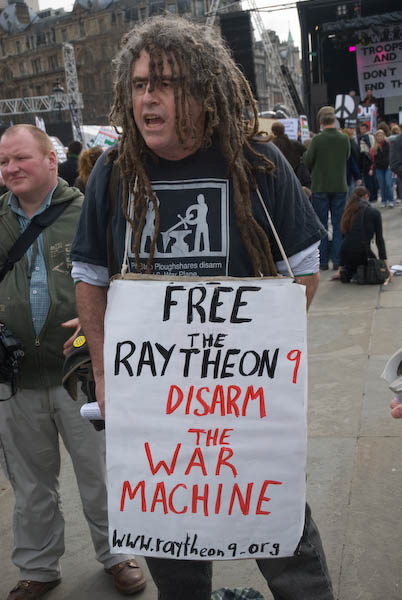
It was an event that included many issues still relevant now, particularly over Iran and Palestine, but also on direct action, with a reminder of the then upcoming trial of the Raytheon 9, anti-war activists who had entered the Raytheon factory in Derry in August 2006 after learning that Raytheon missiles were being used by Israel in their 2006 invasion of Lebanon.
Occupying the offices for eight hours before they were arrested they destroyed computers and documents, and six were tried for criminal damage and affray in May 2008. One man was found guilty of stealing two computer disks but they were all acquitted on all other charges.
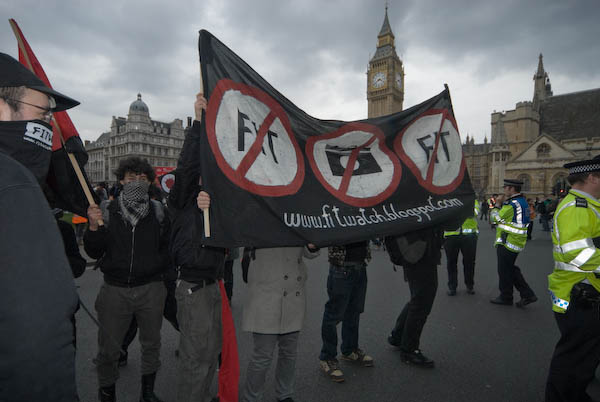
The police took a great deal of interest in the protest, with FIT teams who photograph protesters (and journalists, particularly photographers) took an unusual interest in anarchist protesters from Class War, the Anarchist Federation and FITwatch who use their banner to try to prevent the police taking photographs and video.
I missed seeing four of the FITwatch protesters arrested, apparently for intimidating the police. As I commented, “Since a couple of weeks ago one of their photographers and his minder had been seen taking flight and seeking refuge up the steps of the National Gallery when pursued by a polite and always well behaved woman with a shopping trolley and free cakes – much to the amusement of other police present – intimidating the FIT doesn’t seem too difficult.“
But this – like the many large pro-Palestine protests since ‘September 7th’ – was an entirely peaceful protest, calling for peace in many areas around the world and for an end to UK involvement in wars and oppression.
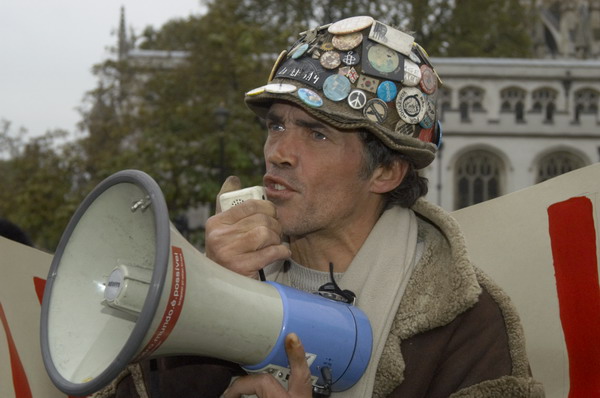
It was a lively protest, with samba band, sound systes, street theatre and dancing. People laid flowers at Nelson Mandela’s statue and Brian Haw – still permanently camped in Parliament Square despite the attempts to remove him by passing SOCPA – joined the protest.
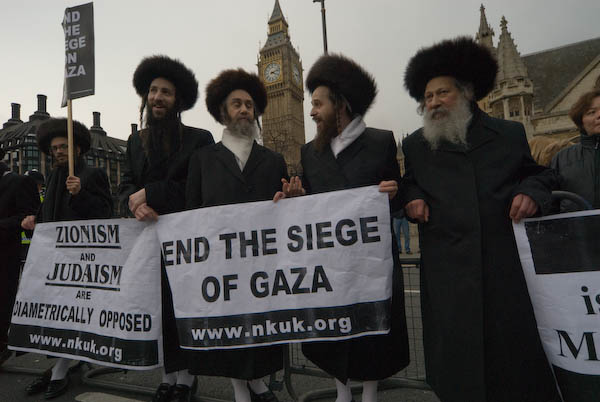
And like all of these marches it also included many Jewish marchers including the Neturei Karta ultra-orthodox anti-Zionists.
Democracy, Greece & Pakistan: Events I covered on Sunday 15th February 2015.
Occupy Democracy Return
Parliament Square
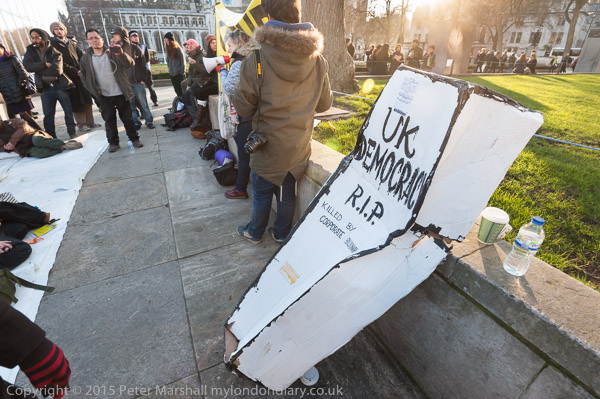
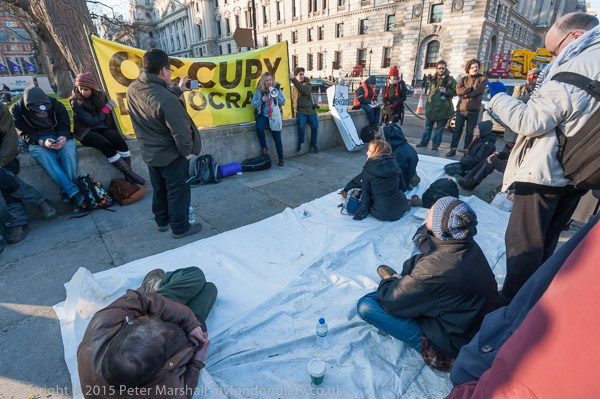
I hadn’t been at Parliament Square the previous evening when Occupy Democracy had returned to take up residence and hold a protest and workshops there, but had heard about the arrests. Police following instructions from Boris Johnson’s Greater London Authority private security wardens arrested five of the protesters including Donnachadh McCarthy, along with the white cardboard coffin he was holding with the message ‘UK Democracy R.I.P. Killed by Corporate Billionaires‘ which was returned in a rather damaged condition.
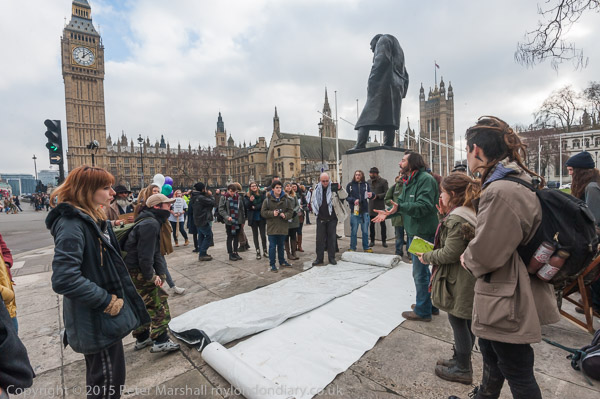
On Sunday morning my first call was to the square where Occupy Democracy talks and workshops were continuing on the pavement area around Churchill’s statue.
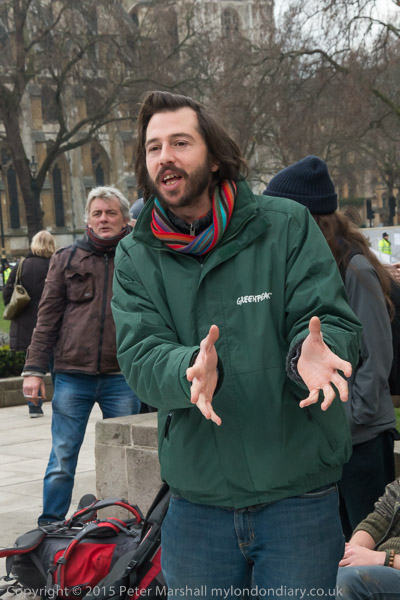
While I was there George Barda spoke introducing the ‘Love Activists’ and Danny talked about their plans for future activities.
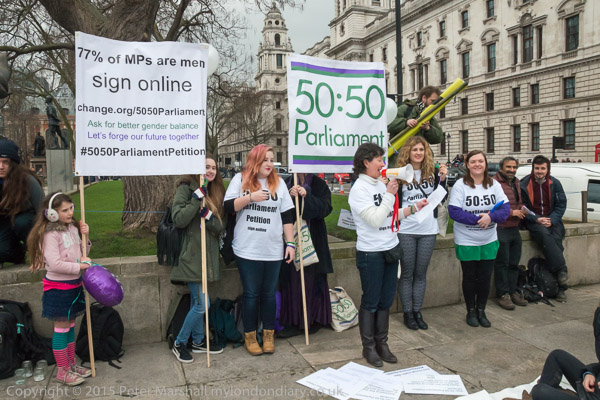
Another event in the square was led by Frances Scott of the 50:50 Parliament campaign to get equal numbers of men and women in Parliament, arguing that this would lead to much better government.
Although I agree there should be better representation of women, I feel that it’s more important that we have politicians who better represent the needs of the people and the country. More Thatchers, Trusses and Badenochs would hardly be an advance on Kinnochs, Blairs and Mandelsons. We need a far more radical system change.
I left to cover the other events, but returned on my way home in the afternoon when the workshops were continuing. Police and GLA security watched but did not interfere. As I commented, “They prefer to take action when fewer press are around and it is dark.”
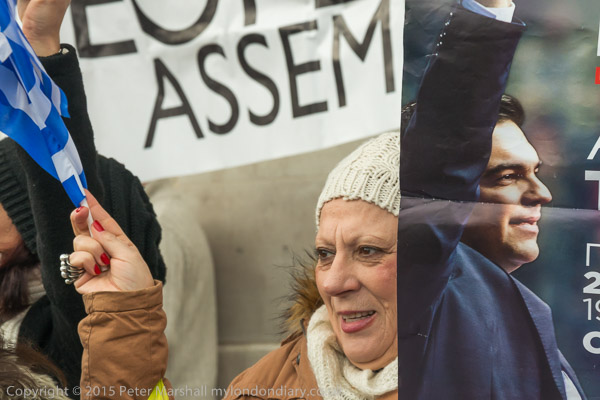
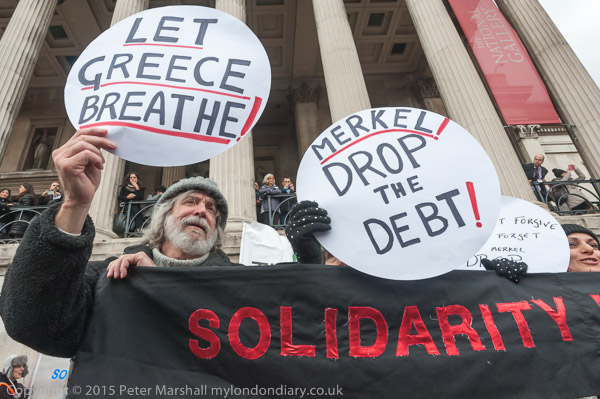
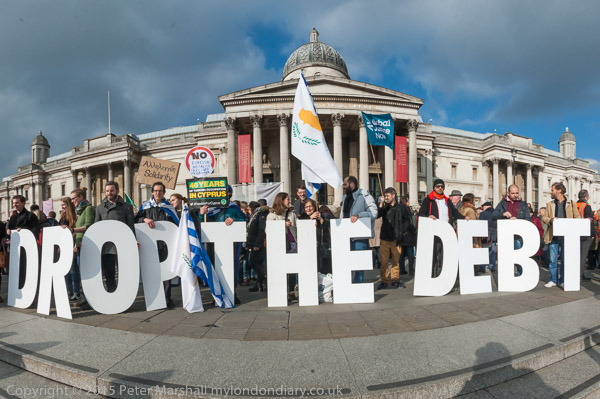
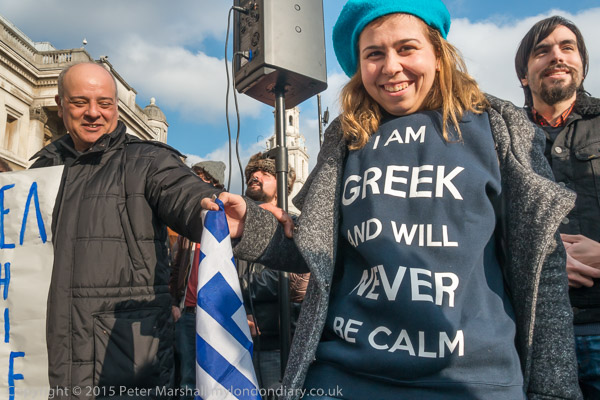
A large crowd had come to the North Terrace of Trafalgar Square for a rally to celebrate the victory of the anti-austerity Syriza party in the Greek General Election in January and to support them in resisting the imposed austerity programme.
Greek voters had decisively rejected the the EU’s austerity plans, largely pushed by Germany and backed by the International Monetary Fund (IMF) and European Central Bank (ECB) but the new government was having to revise its plans, facing stiff opposition and was having to compromise on many of its promises.
Speakers at the rally, including Jeremy Corby, Owen Jones, CWU’s Billy Hayes, Paul Mackney, Green Party’s Romayne Phoenix and John Sinha from Occupy Democracy, praised the Greek struggle against austerity, but their pleas for the country to be let to breathe fell on deaf ears in Germany and the financial institutions.
Many in Syriza felt betrayed by its actions and some left the party, but in a snap election in September 2015 the party polled well enough to remain as the leading party in the coalition. They did badly in the 2019 election, becoming a part of the opposition.
Pakistanis from Imran Khan’s PTI party called on the UK government to arrest and deport Altaf Hussain, the founder of the rival rival MQM party who fled to the UK in 1991 following an attack on his life in advance of a police crackdown of his party and was granted asylum here in 1992.
The protesters say Hussain and his party have an armed mafia wing in Karachi which indulges in extortion, blackmail and murder and were behind the Baldia Town factory fire in which at least 258 workers died, the Karachi Massacre of May 2007, as well as the murder of PTI leader Zahra Shahid in her driveway in Karachi in 2013 and many other crimes.
Since 2015 he has been a wanted man in Pakistan on charges of ‘murder, targeted killing, treason, inciting violence and hate speech‘. In the UK he was tried in 2022 charged with ‘promoting terrorism and unrest through hate speech in Pakistan‘ but was acquitted.
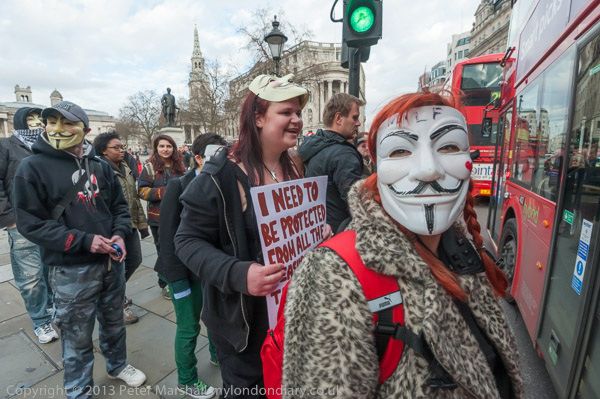
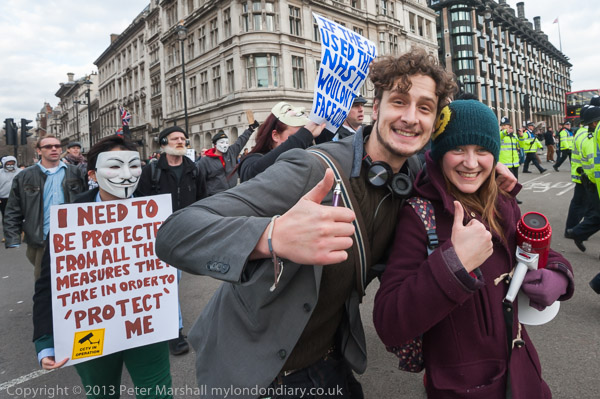
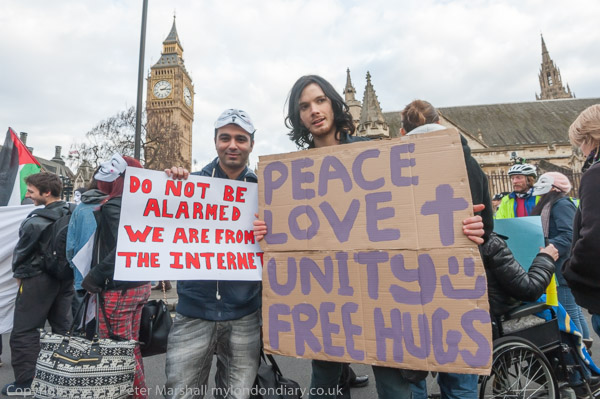
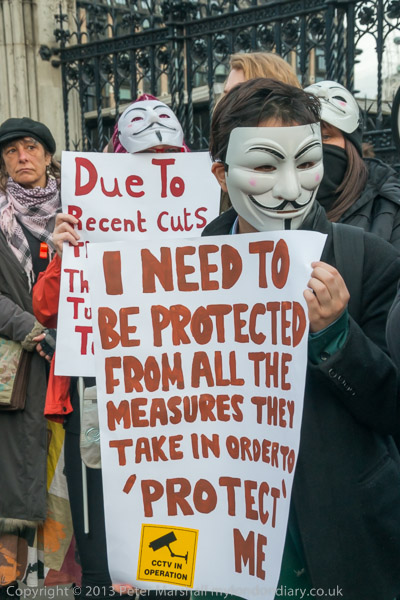
Gaza, Freedom, Syria & Gay Tourism: Saturday 18th January 2014 was the fifth anniversary of the end of the 2008/9 Israeli massacre in Gaza, Operation Cast Lead in which around 1,400 people, many unarmed civilians were killed. I also photographed a rather unorganised protest by Anonymous against privatisation, cuts, environmental and other issues, a peace vigil by Syria Peace & Justice and finally Queer Strike and ‘No Pinkwashing’ picketing a beach-themed LGBT tourism event promoting Israel as a tourist destination.
Gaza Massacre 5th Anniversary
Israeli Embassy, Kensington
Around 500 people had come to a protest on Kensington High Street opposite the private road leading to the Israeli embassy. The attacks on Gaza in 2008-9, Operation Cast Lead, had shocked the civilised world, though the 1400 largely civilian deaths were on a small scale compared to the current ongoing genocide when over 70,000 have died, with deaths continuing daily since the so-called ceasefire.
As well as continuing Israeli attacks children and old people are now dying in Gaza due to the freezing conditions and inadequate shelter because of the destruction of buildings and the continuing Israeli restrictions preventing much of the humanitarian aid and critical supplies needed to keep people safe, alive and well.
The hundreds who came to the protest in 2014 kept up a noisy barrage of chanting calling for justice for the victims of Israel’s massacre and against the ongoing siege on Gaza for around an hour before a series of speeches.
Among those at the protest were many Palestinians as well as Jews some of whom had been leading the call for a boycott of Israeli goods. It was supported by a wide range of groups and on My London Diary I gave the following list : “Palestine Solidarity Campaign, the Palestinian Forum in Britain, British Muslim Initiative, Campaign for Nuclear Disarmament, Stop the War Coalition, Jews for Justice for Palestinians, Friends of Al-Aqsa UK, Liberal Democrats Friends of Palestine, War on Want, Unite the Union, Public and Commercial Services Union, Amos Trust and ICAHD UK.”
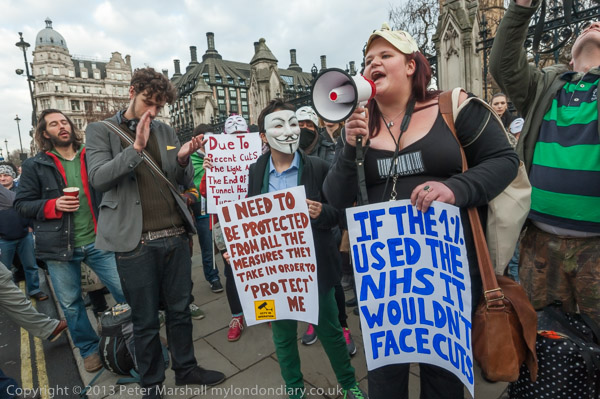
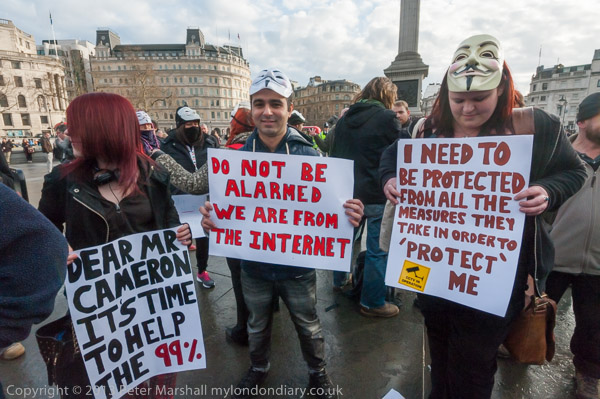
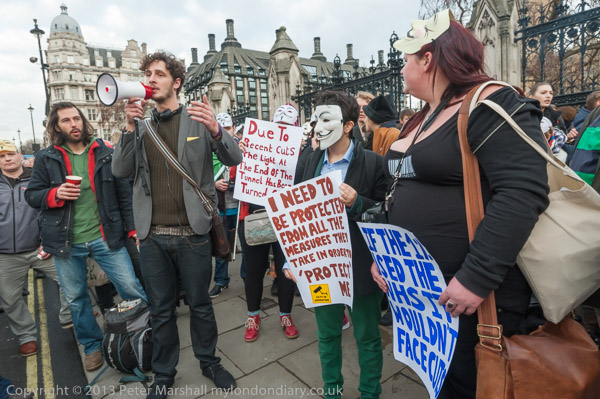
This protest had been called by Anonymous supporters following their large protest on Novemeber 5th, but fewer than a couple of hundred had arrived. Some had instead gone to the Gaza protest, and like me will have arrived rather late for this event.
They were in one corner of Trafalgar Square and people took turns to speak at an open microphone. As well as those in ‘Anonymous’ masks I recognised many who had taken part in Occupy London.
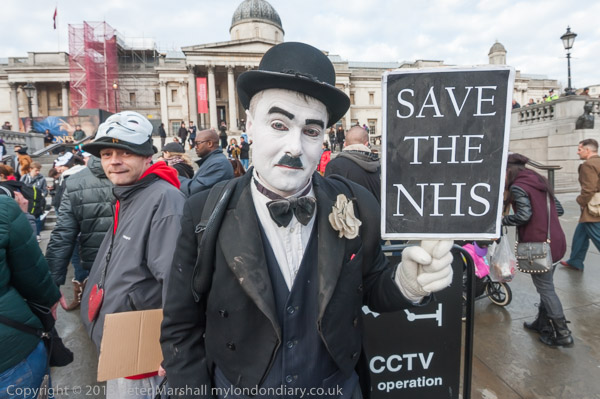
Charlie X at the protest
Eventually someone suggested that they march to Parliament. For once the police facilitated this, suggesting they could walk along the southbound carriageway of Whitehall, and shepherding them across the traffic lights to do so. It “had been organised as a peaceful and family-friendly event, and this was the case, as they marched past Downing St with nothing more than a few shouts and rude gestures and on to Parliament Square.”
When they arrived outside Parliament “it became obvious that this was a protest without leaders, and with no real idea where they were going or what to do.” People – including some police made a number of suggestions but eventually they decided to stop in Parliament Square for a rally.
They were still on the roadway, but after a couple of minutes agreed to police suggestions that they move onto the pavement so that traffic could flow again.
There were then a few speeches followed by some discussion about what they should do next.
One suggestion was that they should stay where they were and party in Parliament Square and it seemed likely that they would do so.
I decided it was time to leave and walked back up Whitehall past a small crowd of police vans. The police were obviously taking no chances and I think probably outnumbered the protesters, although most simply sat in their vans.
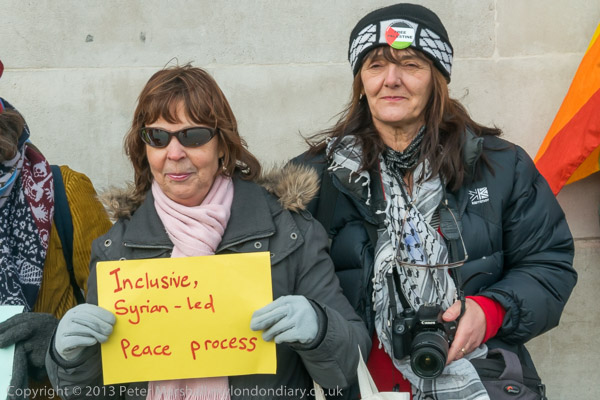
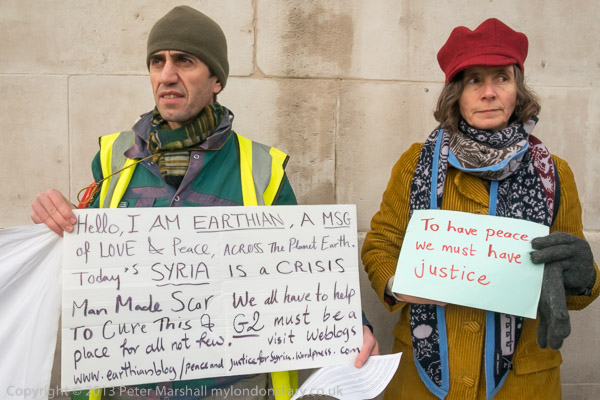
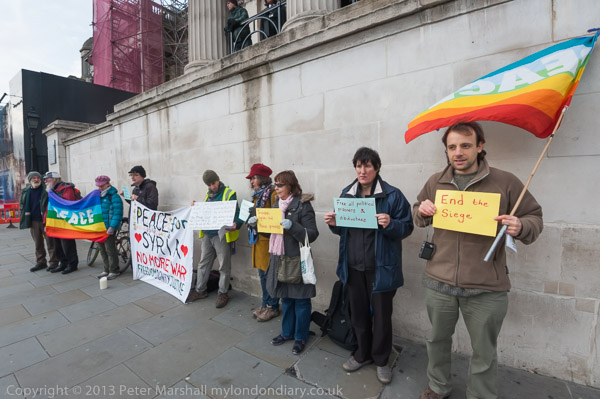
Back in Trafalgar Square I found a small group from Syria Peace & Justice holding a peace vigil “calling for immediate humanitarian ceasefires and the release of all political prisoners and an inclusive Syrian-led peace process.”
The Geneva 2 peace talks were to start the following week and they said that the agenda was being “being set by major foreign powers like the US and Russia” and that only the Syrian government and a Turkey based Syrian group had been invited.
They demanded “an inclusive Syrian-led peace process that includes strong representation from Syrian women, Syrian civil society organisations and various moderate Syrian opposition groups.”
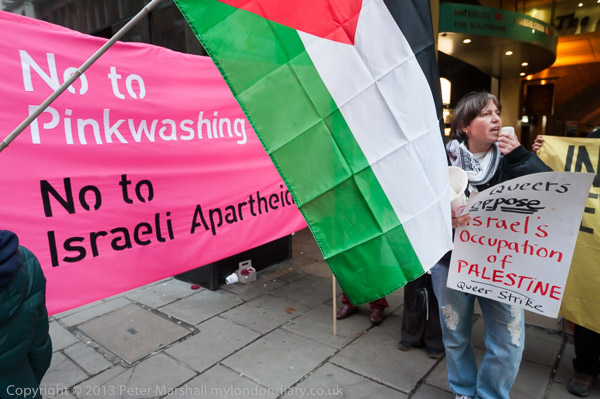
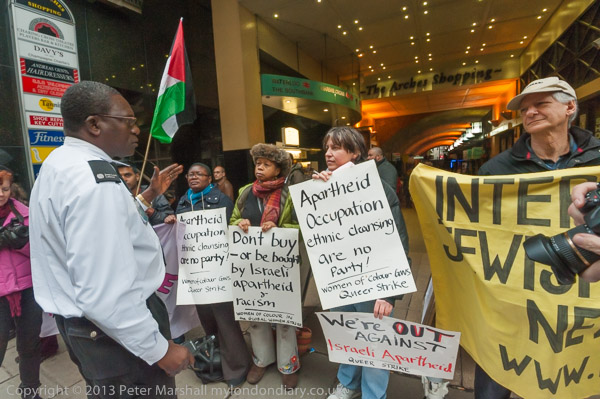
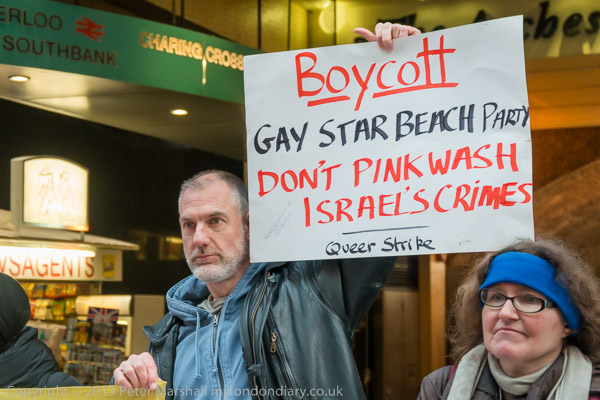
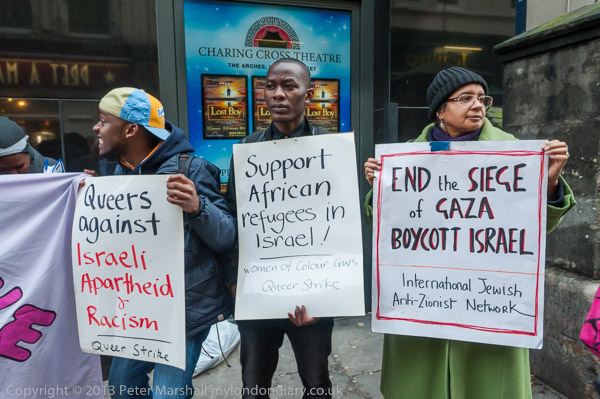
Queer Strike, Women of Colour, the International Jewish Anti-Zionist Network, and people from the ‘No Pinkwashing’ campaign had come to picket an event promoting Israel as a tourist destination for LGBT people.
A security man objects as the protesters block the arcade entrance briefly for photographs
The Gay Star Beach Party LGBT tourism event claimed Tel Aviv to be “one of the best gay cities in the world” and together with the Israeli Tourism Board they were trying to persuade gay people to holiday there.
The protesters say that this is “pinkwashing”, an attempt to divert attention from human rights crimes against Palestinians, using opposition to homophobia to legitimise Israel and undermine support for Palestine. They called on those going to the event to boycott it and not go to Israel until it ends human rights abuses, recognises the Palestinians’ right to self-determination and complies with international law.
They handed out a card with five reasons for LGBT tourists to boycott Israel:
 - the military occupation of the West Bank, East Jerusalem and Gaza since 1967, with over 100 illegal Israeli settlements on land stolen from Palestinians;
  - the violence against Palestinian children, hundreds of whom are arrested each year and held in military detention without access to lawyers, mainly for alleged stone-throwing;
  - the inhuman siege of Gaza, blocking import of food, fuel and medical supplies and preventing the repair of many homes destroyed in the 2008-9 invasion by Israel;
  - the ethnic cleansing of Palestinians from their homes and land which began in 19438 and still continues, creating millions of refugees;
 the apartheid system of roads reserved for Jewish Israelis, the apartheid wall and the many check points involving long waits and searches for Palestinians.
The protesters also highlighted Israel’s racist treatment of African people, There had been protests the previous week in Tel Aviv by 30,000 African asylum seekers and refugees demanding that all African refugees imprisoned in Israeli prisons and detention centres be freed and for recognition of their rights as asylum seekers and refugees.
An Icy Day in Westminster, Drums for Sudan: Saturday 10th January 2010 was an icy day in Westminster with snow still lying on grassy areas and though it was bright with a little wintry sun there was a chill north-east wind and the temperature stayed around zero. But despite the weather there were a number of protests taking place and I had wrapped up well to cover them. Though the rather thin gloves I needed to let me operate my cameras failed to keep my hands warm, though I could keep them gloved in my pockets when not taking pictures.
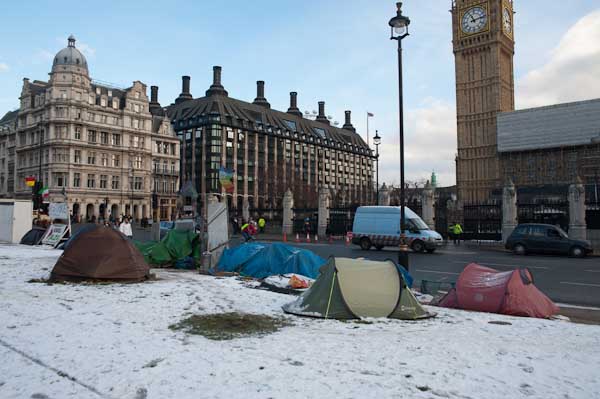
I began by walking from Waterloo across Westminster Bridge to Parliament Square where there were a few tents of the Brian Haw’s Peace Camp, continuing since June 2001, but the protesters were sensibly keeping inside.
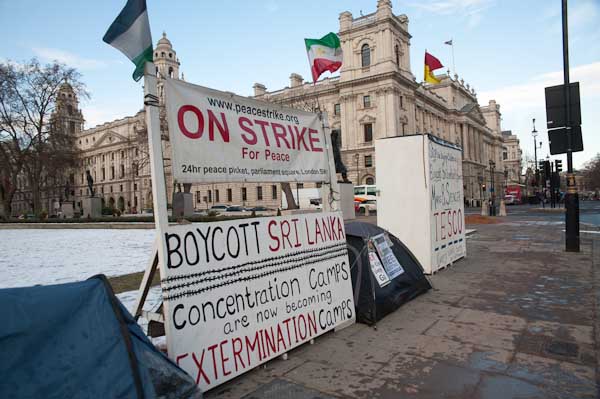
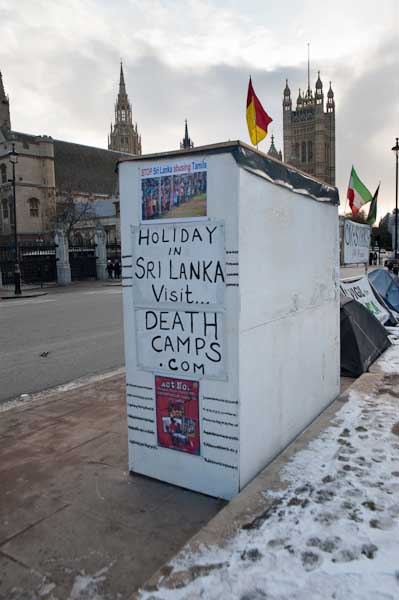
Next to them were the banners and box of the Peace Strike, then drawing attention to the killing of Tamils in Sri Lanka and calling for a boycott of Sri Lankan made garments and holidays in the country.
I didn’t disturb the protesters sheltering inside their tents but “walked up Whitehall past the government offices and the gathering demonstration over Sudan.” On my way I took a few pictures including of the 1861 former Colonial office – now the Foreign and Commonwealth Offices – “an imposing reminder of the Victorian era when Britain ruled much of the world (and then and later produced much of the mess it is now in.)”
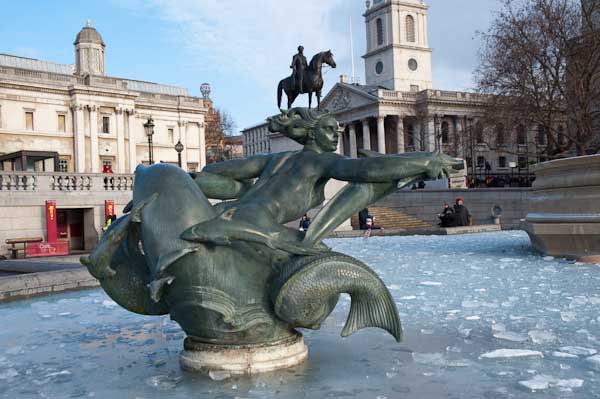
Thick ice covered the fountains in the square, with lumps of ice broken from the edges and thrown across now covering it. But despite the cold there were at least two groups of protesters on the North Terrace.
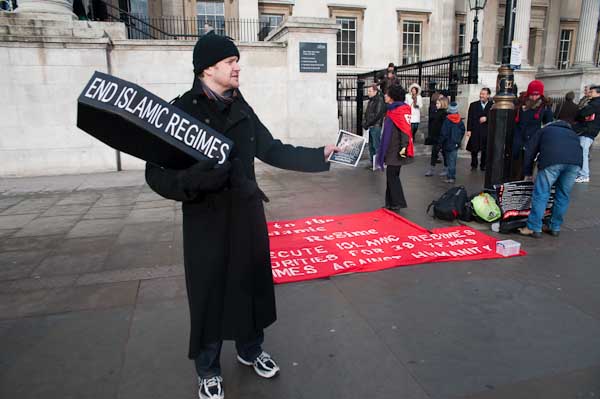
One was a regular Quaker vigil for peace in the Middle East which I didn’t photograph on this occasion. But I did take some pictures of the Iran Solidarity group who have organised daily acts of solidarity in Trafalgar Square and in other cities since Monday July 27 2009 over the killing of Iranian student Neda Agha-Soltan at a protest in Tehran, Iran on June 20, 2010.
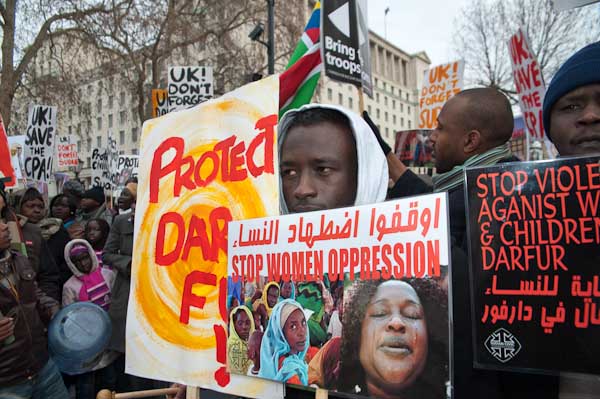
I was in a hurry to get back to the Drums for the start of the Sudan protest opposite Downing Street. This was the start of a year of the global Sudan365 campaign by a coalition of groups including the Aegis Trust, Amnesty International, Arab Coalition for Darfur, Darfur Consortium, FIDH, Human Rights Watch, Refugees International and the Save Darfur Coalition leading up to the 2011 Sudanese referendum in January 2011.
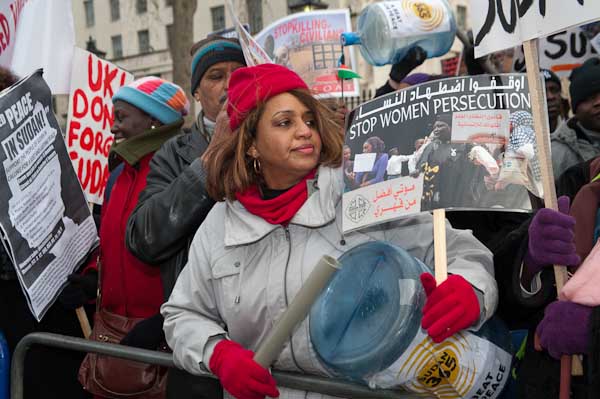
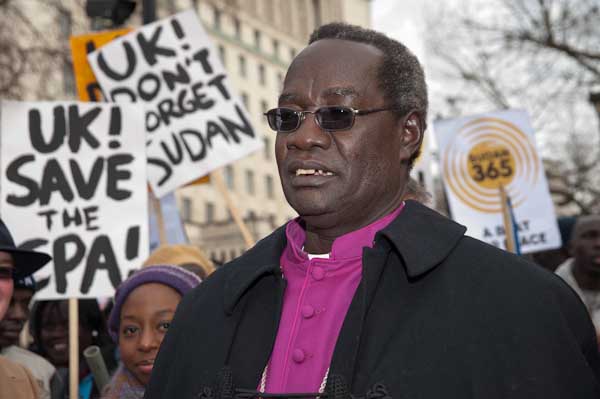
Around 200 people, mainly Sudanese, including a large contingent from Coventry, had turned up for a couple of hours of noisy drumming and some speeches, including one by Sudanese Archbishop Daniel Deng who was in London for meetings with Prime Minister Gordon Brown and Archbishop Rowan William on the following Monday.
The protesters called for peace, human rights and development for all in all regions of Sudan, with safety and security for all, as well as protection for Darfur and women’s rights. They supported the 2011 peace agreement which had called for a referendum over independence to be held in Southern Sudan in January 2011, and demanded free and fair elections in the country.
“The Sudan365 campaign’s ‘Drum for Peace’ has attracted support from some of the most famous drummers from around the world, including Phil Selway of Radiohead, Stewart Copeland of The Police and Pink Floyd’s Nick Mason, who are taking part in a film in which the drum beat for peace, starting in Sudan is passed to drummers around the world, including in Brazil, Mexico, US (New York and San Francisco), UK, France, Spain, Senegal, South Africa, Ghana, Egypt, Mali, UAE, Japan, Russia and Australia.”
The 2011 referendum had over a 97.5% turnout by registered voters and over 98% of these voted in favour of independence. South Sudan became an independent state on 9 July 2011, but this was followed by seven years of civil war in 2013-20. The peace agreement called for elections in 2023, but these have been twice postponed and are due to take place in December 2026. Fighting broke out again in 2025.
12 Days of Christmas -some of my favourite pictures from those I made in November 2025.
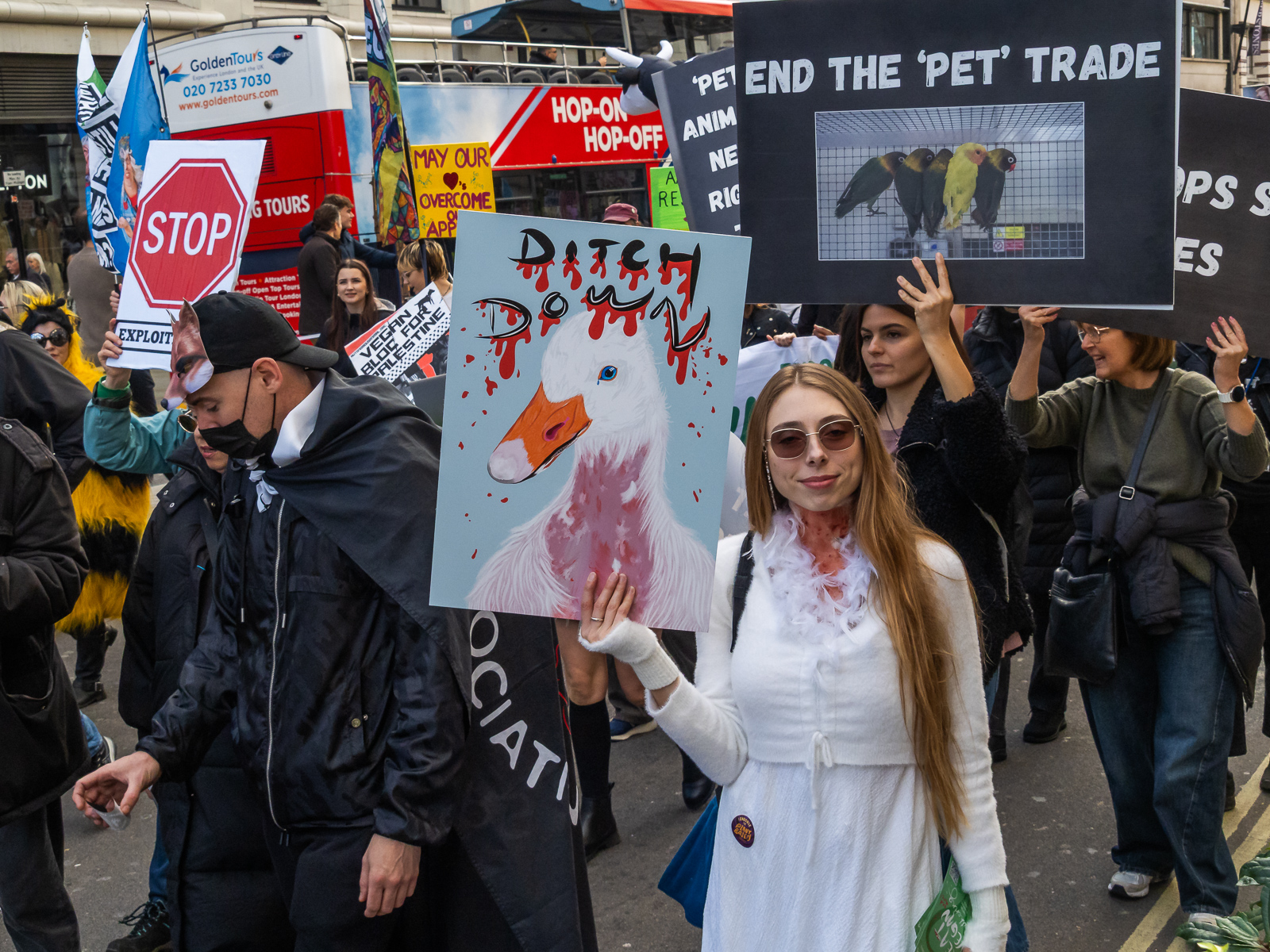
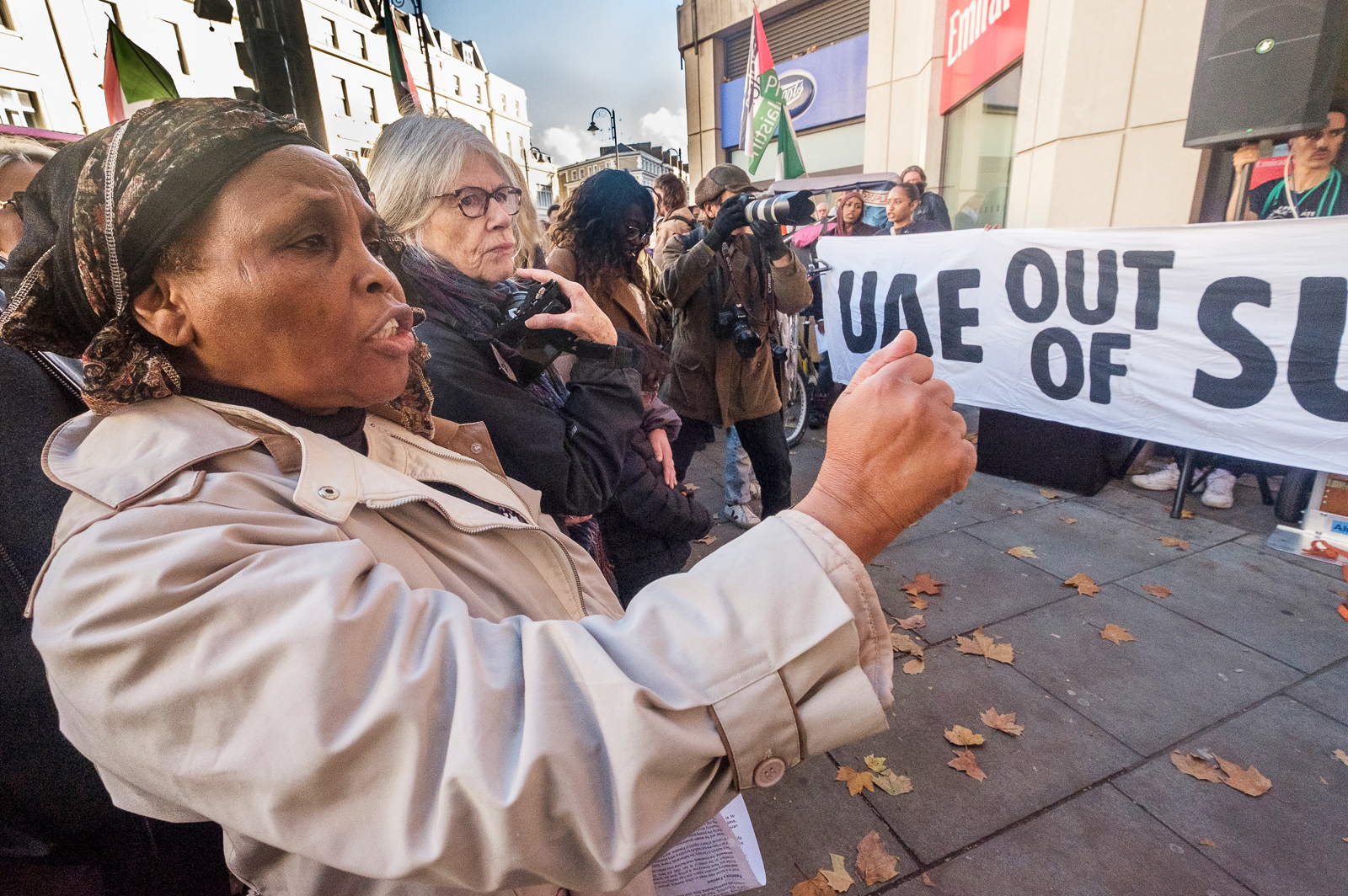
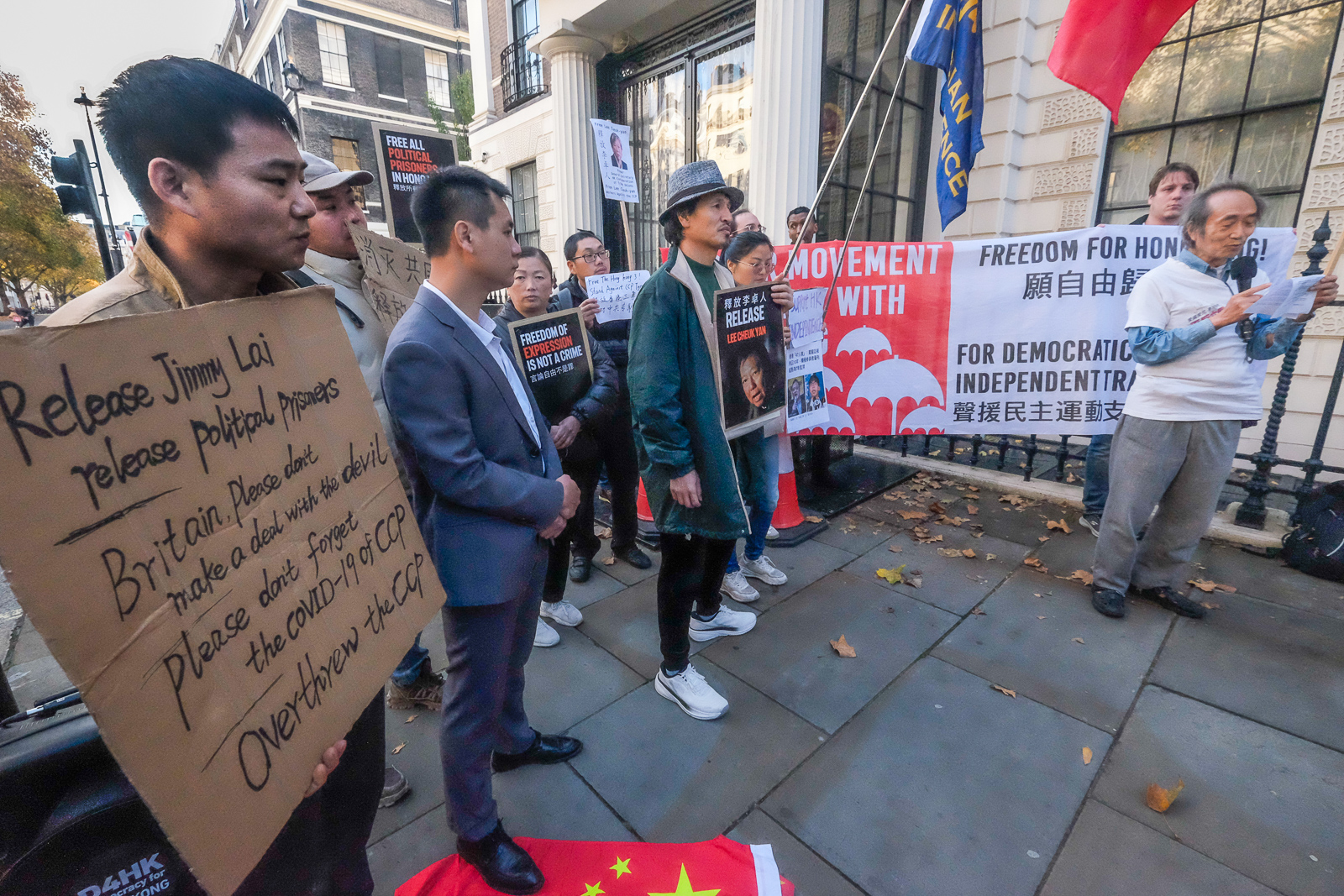
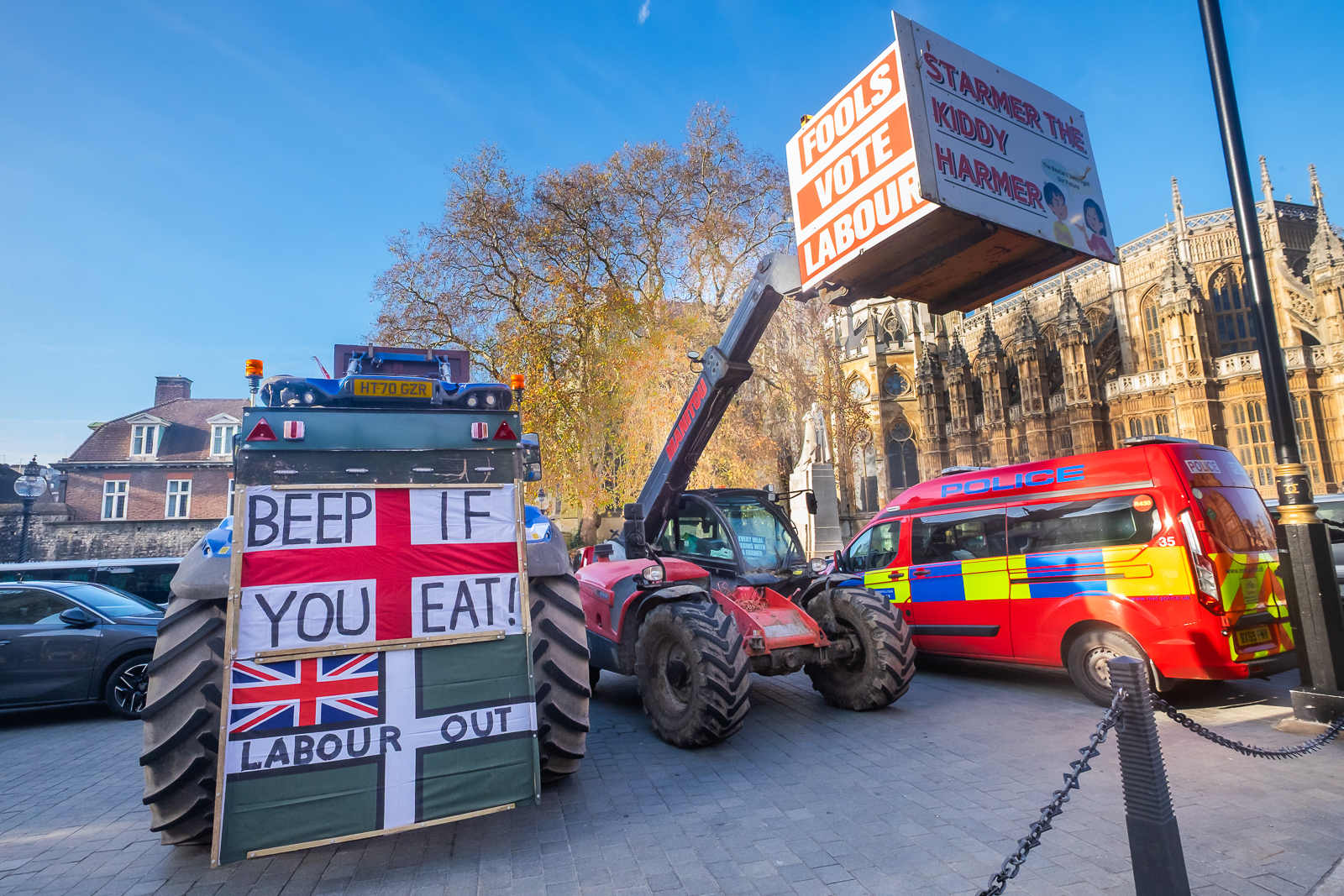
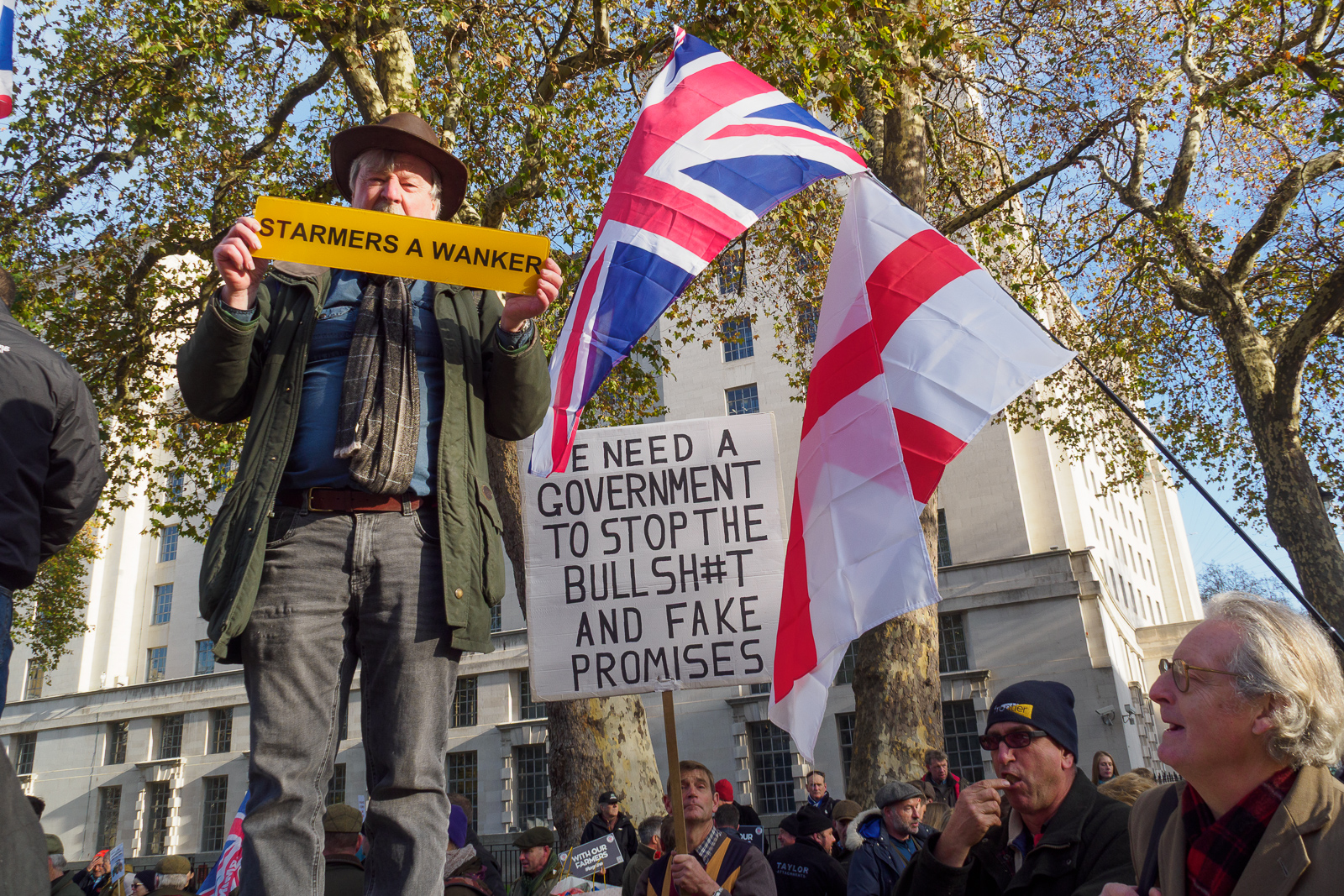
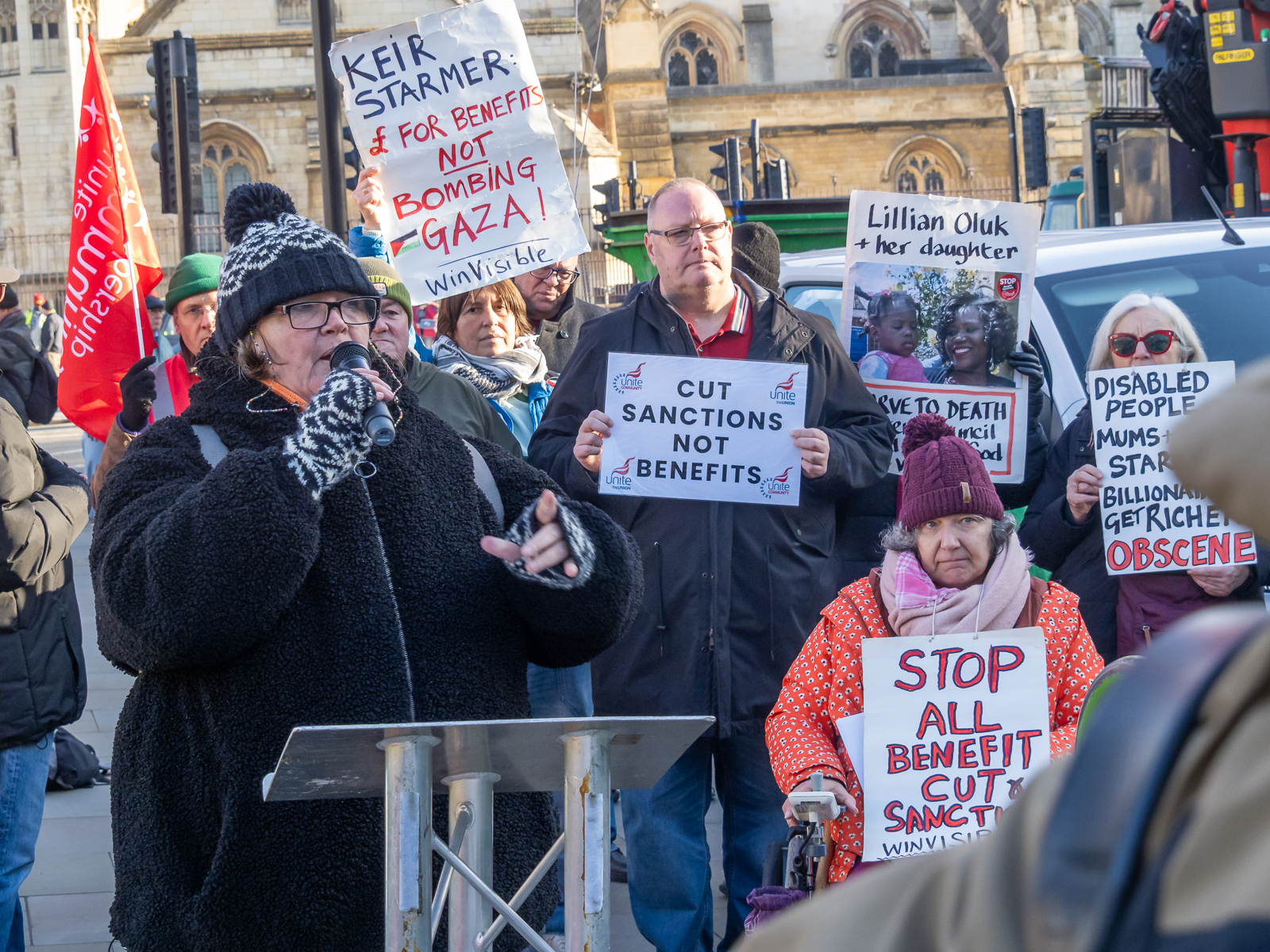
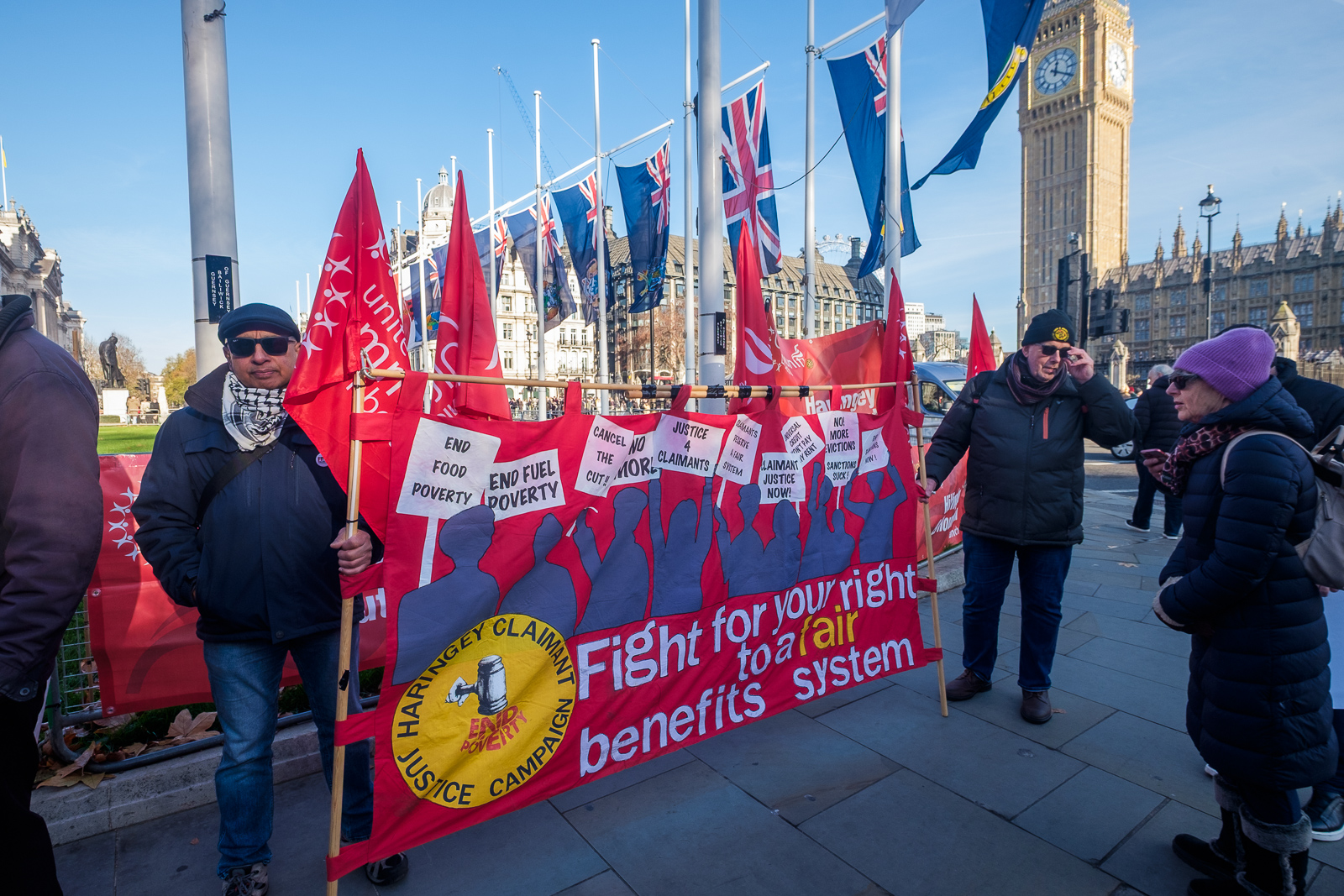
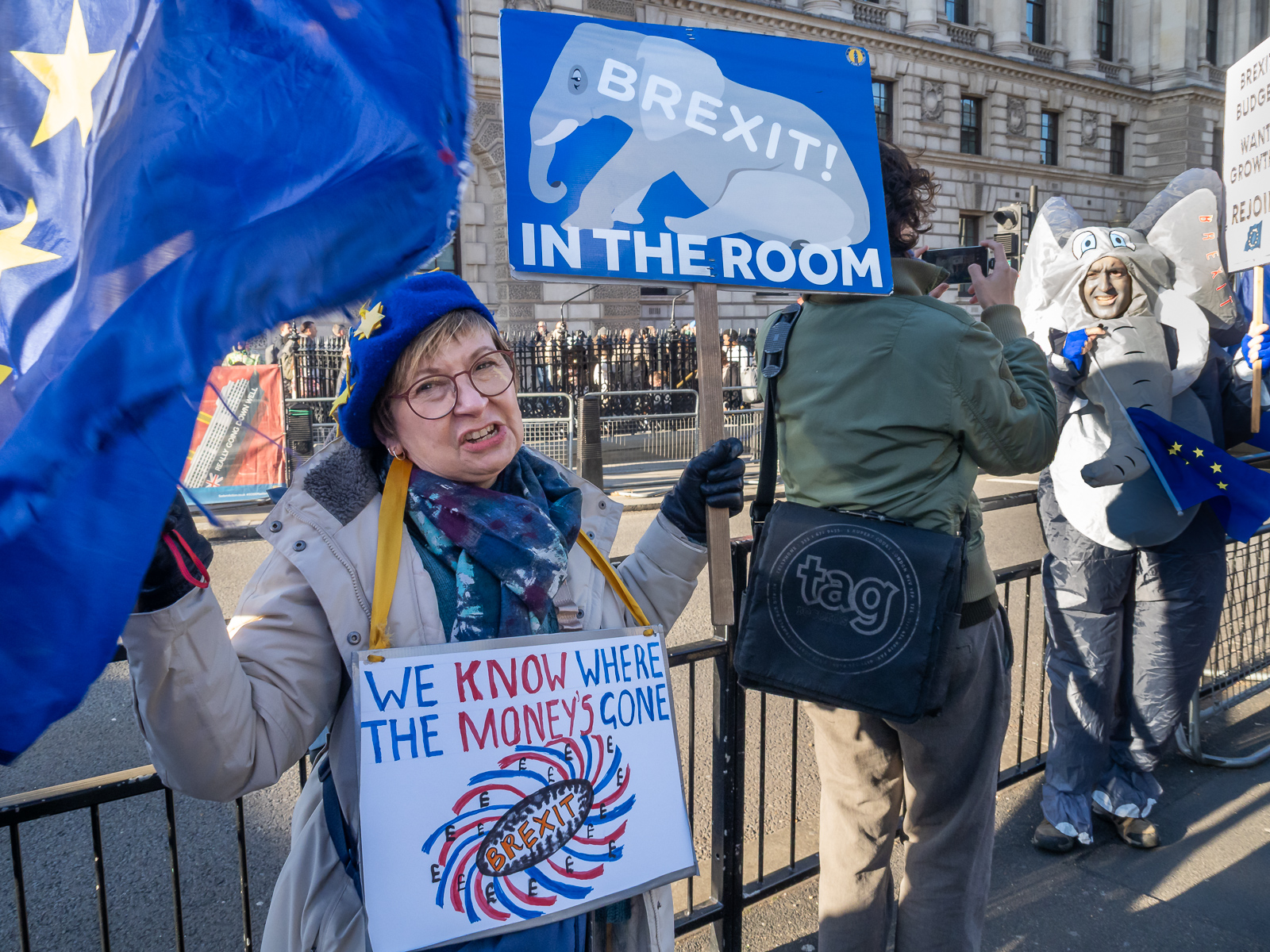
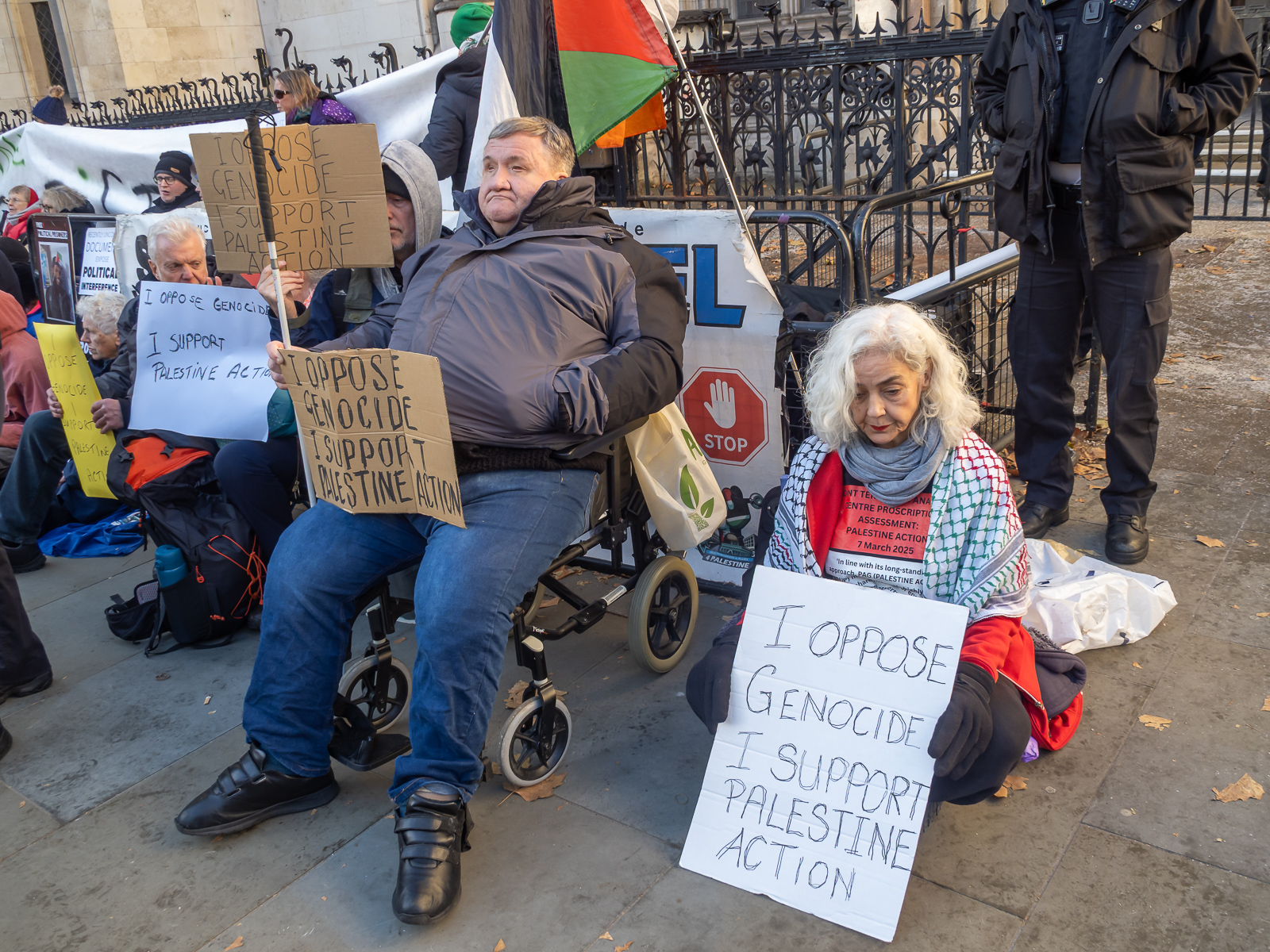
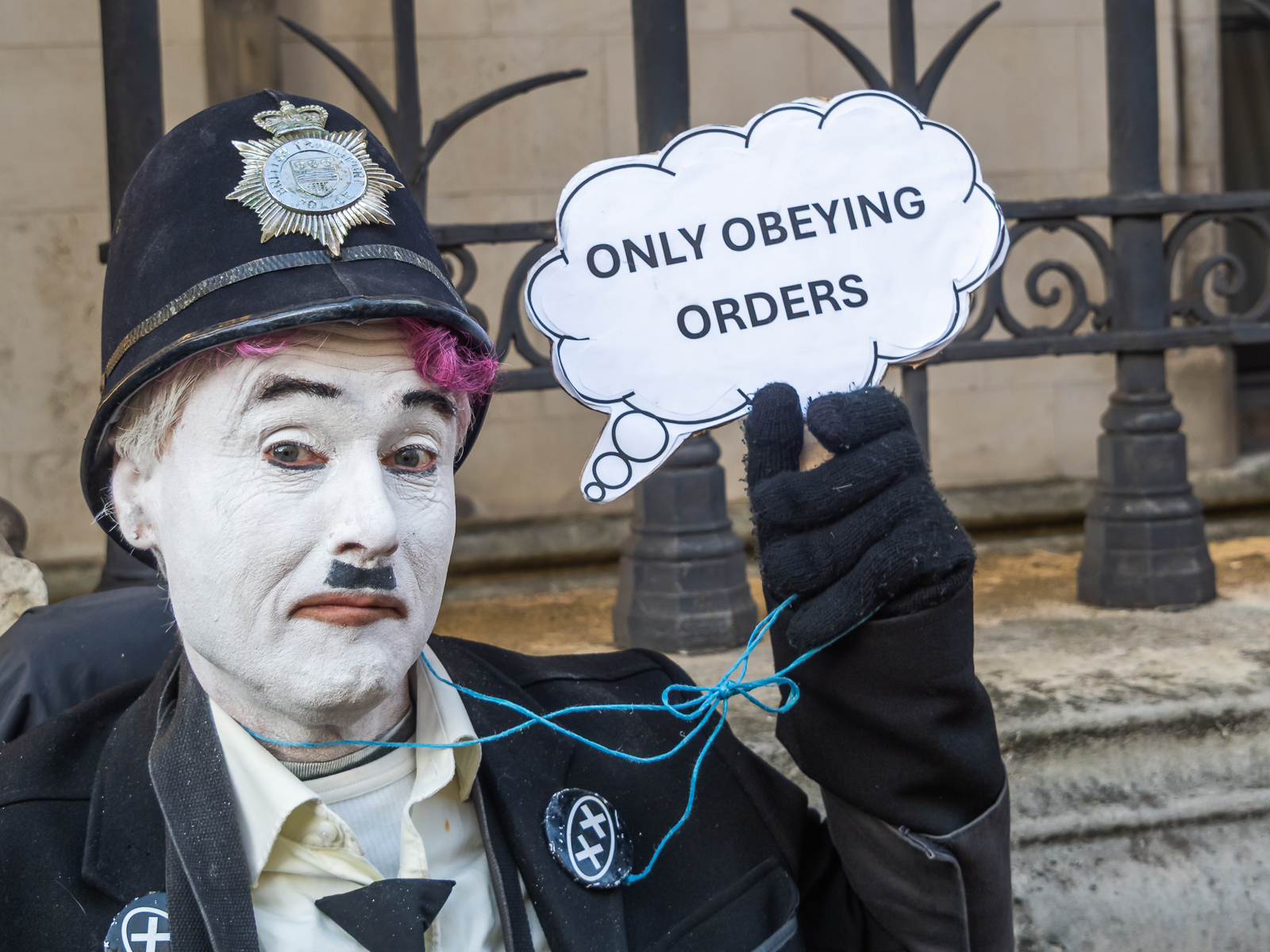
London, UK. 1 Nov 2025. Several thousands march from Marble Arch around the West End to demand that animals should not be treated as property or resources for humans. They say that animals feel love, pain, fear and joy “just like use” and say everyone should become vegan. They call for cages to be emptied, animal testing to be ended and for an end to all use of animals for any purpose whatsoever, demanding “Animal Liberation NOW!” Peter Marshall.London, UK. 8 Nov 2025. A rally and march from Gloucester Road station calls for an end to the UK-backed atrocity in Sudan. At Al-Fashir and elsewhere in Sudan UAE-backed RSF militia have committed executions, torture, mass displacement and deliberate starvation, armed by weapons sold by the UK to the UAE. Protesters demand the UK designate the RSF a terrorist organisation, end arms sales to the UAE and impose sanctions on them. In May Sudan took the UAE to the International Court of Justice for complicity in genocide. Peter Marshall.London, UK. 8 Nov 2025. Trade unionists protested outside the Chinese Embassy in solidarity with the three Hong Kong pro-democracy leaders charged with inciting subversion under Beijing’s National Security Law for organising protests and vigils whose trial begins on 11 Nov. They called for Lee Cheuk-yan, Chow Hang-tung, Albert Ho and all political prisoners to be released. One man who continually tried to disrupt the event was arrested.Peter Marshall.London, UK. 26 Nov 2025. Police banned farmers from bringing tractors to Parliament Square for their protest against the removal of inheritance tax relief at the last minute and instead told them they could hold a peaceful rally without vehicles opposite Downing St. A few did manage to drive to Parliament and a couple were parked opposite the House of Lords. Apparently some drivers were arrested in Trafalgar Square after refusing to drive out of London. Police had previously granted permission for the tractor protest. Peter MarshallLondon, UK. 26 Nov 2025. Police banned farmers from bringing tractors to Parliament Square for their protest against the removal of inheritance tax relief at the last minute and instead told them they could hold a peaceful rally without vehicles opposite Downing St. A few did manage to drive to Parliament and a couple were parked opposite the House of Lords. Apparently some drivers were arrested in Trafalgar Square after refusing to drive out of London. Police had previously granted permission for the tractor protest. Peter Marshall.London, UK. 26 Nov 2025. Paula Peters of DPAC speaking. Unite Community hold a Budget Day protest in Parliament Square as a part of a national day of action to protest against the ongoing cuts and sanctions to people’s benefits. They say sanctions which penalise people already struggling to feed, pay rent and heat homes, particularly the disabled, are now at record levels under this Labour government and are driving working people, disabled people, and children further into poverty. Peter MarshallLondon, UK. 26 Nov 2025. Unite Community hold a Budget Day protest in Parliament Square as a part of a national day of action to protest against the ongoing cuts and sanctions to people’s benefits. They say sanctions which penalise people already struggling to feed, pay rent and heat homes, particularly the disabled, are now at record levels under this Labour government and are driving working people, disabled people, and children further into poverty. Peter MarshallLondon, UK, 26 Nov 2025. Anti-Brexit campaigners including Steve Bray protested at the crossroad leading into Parliament Square with loud music and EU flags, as well as a Brexit elephant. They reminded people of the huge financial impact of Brexit on us all and the failure of any of the promised benefits to materialise – except for some of the super-rich and called for Britain to rejoin Europe. Peter MarshallLondon, UK. 29 Nov 2025. Blind wheelchair user Mike Higgins wants to be arrested again. Over two hundred people sat in silence holding placards “I oppose genocide, I support Palestine Action” outside the Royal Courts of Justice on the opening day of the Judicial Review of the ban on the organisation. They waited patiently for police to arrest them under the Terrorism Act. Many feel the ban is an abuse of law and are concerned at the attempt to scupper the review by appointing judgesfor the case with a clear conflict of interest. Police were slowly arresting people and carrying them away to waiting vans when I left. Peter Marshall.London, UK. 29 Nov 2025. Charlie X – Only Obeying Orders.Over two hundred people sat in silence holding placards “I oppose genocide, I support Palestine Action” outside the Royal Courts of Justice on the opening day of the Judicial Review of the ban on the organisation. They waited patiently for police to arrest them under the Terrorism Act. Many feel the ban is an abuse of law and are concerned at the attempt to scupper the review by appointing judgesfor the case with a clear conflict of interest. Police were slowly arresting people and carrying them away to waiting vans when I left. Peter Marshall
November turned out to have been a slighly confusing month for me and I managed to date some of my captions wrongly – thanks to careless “copy and paste”. I think the actual album dates for the Facebook albums are all correct.
Finally the 12 day of Christmas tomorrow – pictures from December 2025.
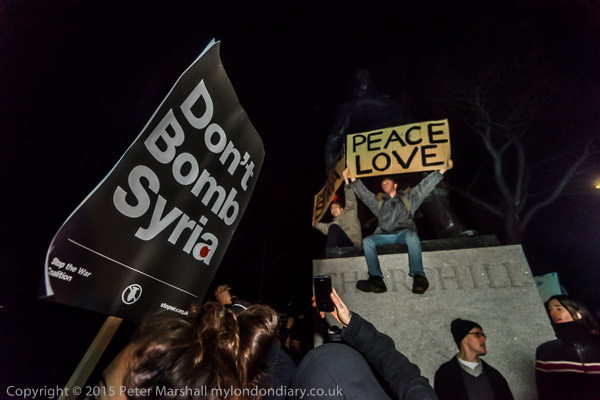
Another Don’t Bomb Syria Protest: On the evening of Tuesday 1st December 2015 a protest by Stop The War again called on MPs not to back David Cameron’s motion to bomb Syria.
There was a large crowd in Parliament Square who listened to speeches by a wide range from the British left including Andrew Murray, Lindsay German, Salma Yaqoob of Stop the War, Kate Hudson of CND, SNP MPs Philippa Whitford and Tommy Sheppard, Former Green Party leader Caroline Lucas, Labour’s Richard Burgon and Imran Hussain, Weyman Bennett of Unite Against Fascism, Momentum organiser Adam Klug, George Galloway.
I photographed all of these speakers and you can see several pictures of most of them on My London Diary.
But as in the previous Stop The War protest, there were “no speeches by Syrians or Kurds, and no real attempt to take their views into account. And while the speakers all condemned the UK plans to bomb in Syria, there was no condemnation of the Russian bombing of the Syrian opposition, perhaps a greater threat to the Syrian people than Daesh, and certainly than the handful of UK planes.“
Present in the crowd were a number of supporters of President Assad, with flags of his regime, though most of those present were opposed to the Assad regime and Daesh as well as to bombing by the UK.
John Rees of Stop the War
As I commented, “It’s rather unfortunate that the only organisation promoting large-scale protests against the bombing is Stop the War rather than one clearly supporting the aspirations of the Syrian people for freedom.”
Hours after this protest, Stop the War issued an article ‘For the avoidance of doubt‘ by John Rees which began by stating “The STWC has never supported the Assad regime.” I commented: “Well, it’s good to make that clear, because there have been many protests by Stop the War which Assad supporters have attended and appeared to be welcome, and by refusing to let Syrians opposed to the regime speak at this and other protests STW have certainly given that impression.”
It had become clear by 2015 “that while our government has fulminated against ISIS/Daesh it has also been complicit in support for them through its support of Saudi Arabia which provides support for their Wahabi ideology and more materially, for Turkey which is deeply involved in their oil exports, refining much of their output as well as providing pipelines and ports, and Israel which is the major customer for the smuggled oil.”
The bombing which later took place was largely ineffectual, hypocritical and immoral. While inflicting “little damage on Assad’s military inflicting real damage on the economic and military capability of Daesh” it was as predicted “catastrophic in effect on the civilians” that were bombed either deliberately or by accident.
After the speeches, the protesters marched first to the Tory HQ and then to Labour to deliver letters before returning to Parliament Square where the official protest ended.
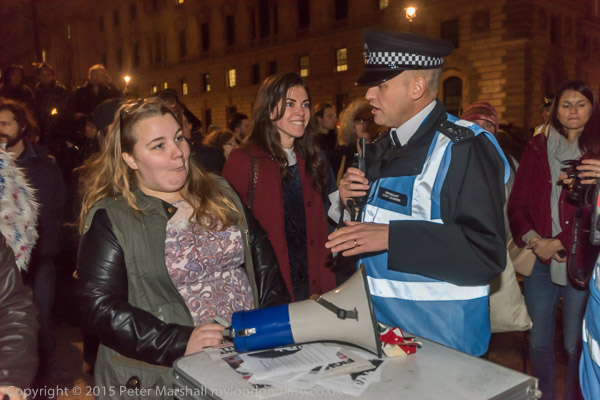
A police officer tells Jasmin Stone that megaphones are not allowed to be used in Parliament Square
Many stayed on in the square and there were minor incidents with police making a few who had climbed onto the plinth of Churchill’s statue come down and stopping some from using a megaphone. But after a few minutes I decided it was time to go home.
More about the protest and many more pictures at Don’t Bomb Syria.
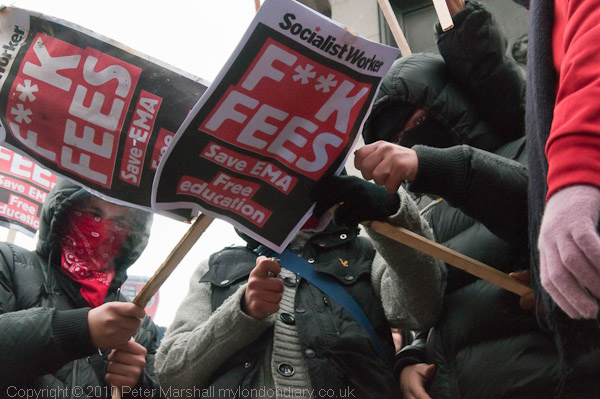
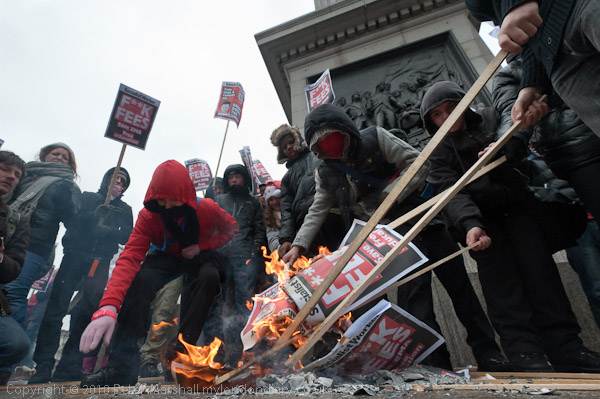
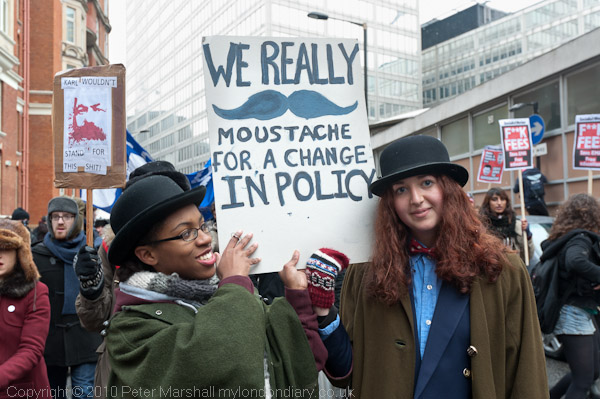
Second Day of Student Fees Protests: London Tuesday 30th November 2010 – A student holds a lighter to set fire to a placard
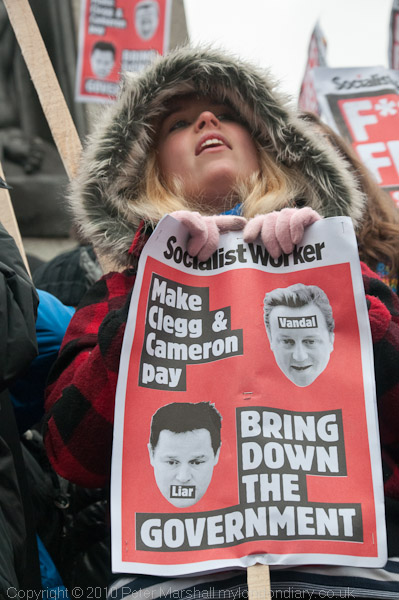
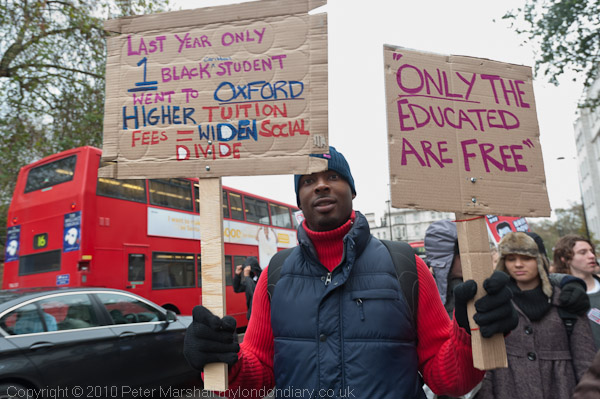
Six days earlier a march against the Browne Review of Higher Education Funding, which had advocated an increase in tuition fees, allowing them to rise to £9000 a year, as well as the scrapping of the Educational Maintenance Allowances (EMA) for 16-18 year old and other changes including closing many arts and humanities courses had led to an angry confrontation between students and police when police decided to halt and kettle the march in Whitehall.
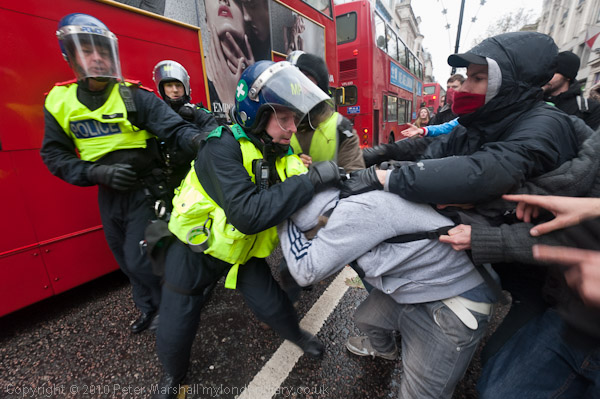
I had been there and reported at some length on the events, including the smashing of a worn-out police van which seemed to have been deliberately left by the police “as a plaything for the protesters” and charges in which some “police made pretty liberal use of their batons and a couple clearly went a little berserk“, and protesters were in danger of being crushed, screaming that they couldn’t breathe.
It hadn’t been like those protests I had taken part in during the late 60’s and most of those taking part “were probably well-behaved students on their first demonstration” who when more militant students breached the police lines “just stood around wondering what to do rather than following them.”
I concluded:
“It had been a pretty confused situation, and it seemed to me that neither police nor students came out of it with much credit. The police tactics seemed designed to create public disorder by kettling and a small minority of the students rose to the bait. Although most of the students were out for a peaceful march and rally and to exercise their democratic right to protest, the police seemed to have little interest in upholding that right.”
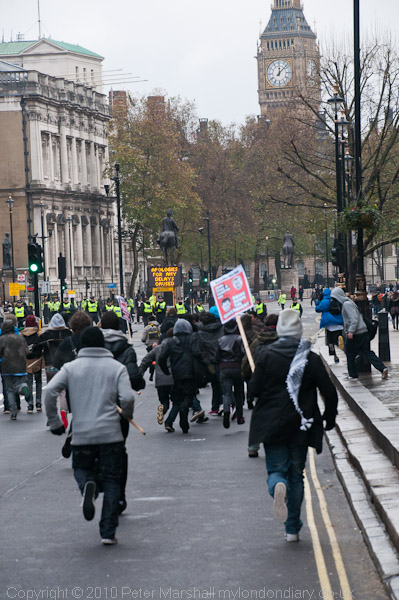
Protesters run down Whitehall – but turn around when get close to a police line
The following Tuesday around 5000 students came back to Trafalgar Square for what was meant to be a peaceful march at 1pm along the same route down Whitehall to a rally in Parliament Square – which had been agreed in advance with police. I think both sides wanted to avoid a replay of the previous week.
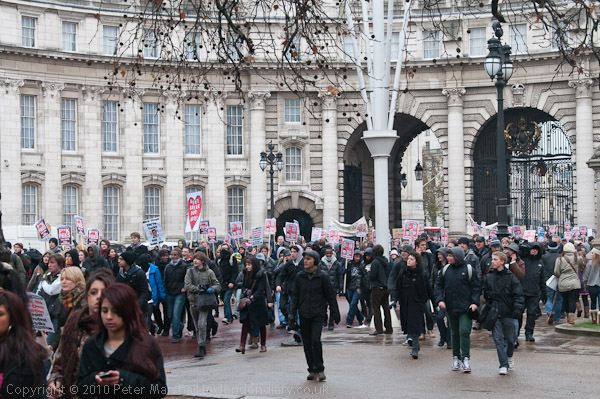
They go back and through Admiralty Arch – with not a policeman in sight
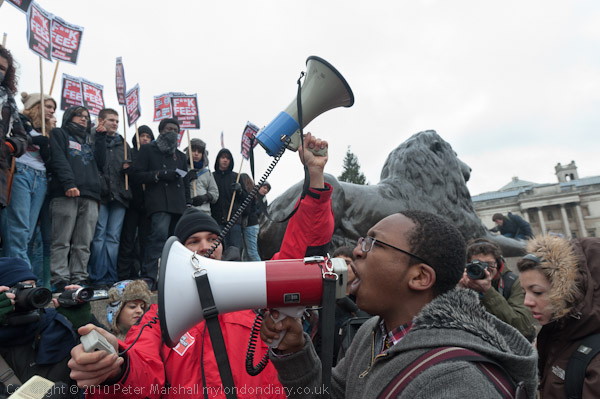
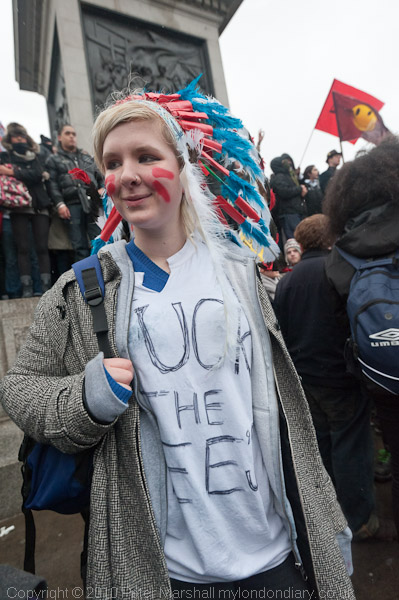
But shortly after noon, more radical students, including a group of younger students who would lose the EMA took to the plinth under Nelson’s column and called for the crowd to go down Whitehall and demonstrate at Downing Street; several hundreds followed them.
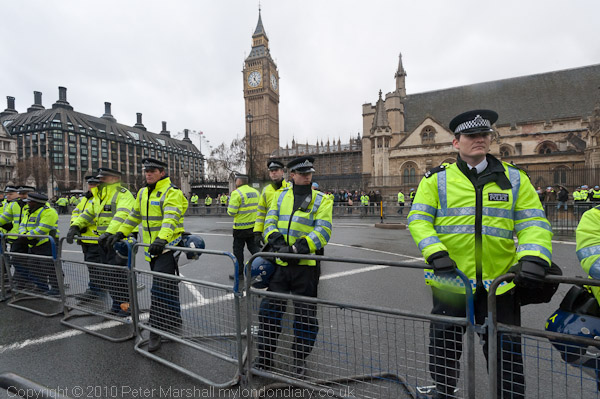
When they see the police in Parliament Square they turn around again
There were only a few police at the top of Whitehall and clearly they stood no change of stopping them, but their attempts to do so heightened the tension and when police formed a tighter line further down Whitehall the protesters began shouting that they were being kettled.
They turned around and went under Admiralty Arch and on to the Mall before continuing down Horse Guards Road. Police followed them, walking beside them as they crossed into Storey’s Gate, then turned into Parliament Square.
Near Hyde Park Corner
By now this group of protesters – perhaps by then a thousand or two were obsessed with the idea that they were being kettled – and certainly there were a large number of police in Parliament Square, particularly behind barriers set up in front of Parliament and at some of the exits from the square.
A police medic attacks a protester in one of the only violent incidents I witnessed
The protesters turned around and walked and ran, beginning a “long rather rapid walk around London“, rather painful for me as I was still suffering from a foot injury, “taking in Hyde Park Corner, Piccadilly Circus, Oxford Circus and Oxford Street and turning down Kingsway at Holborn and then walking into the City of London along Fleet St” with a couple of hundred police walking along the side of the march.
The march passes the Stock Exchange
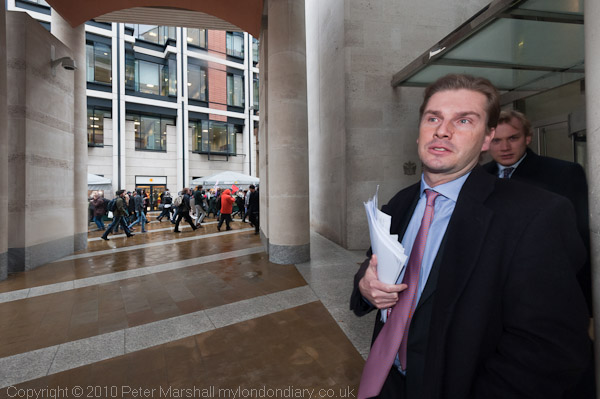
Most of the Met police stopped at the City of London boundary as the march continued “past St Pauls, the Stock Exchange, on up some of the narrow winding streets around St Bartholomews Hospital (it rather looked as if they were trying to kettle themselves there) to Smithfield Market before going back along Holborn Viaduct where I eventually left them to catch a bus and make my way back to see what was happening in Trafalgar Square.” The City of London Police had seemed to ignore the march and there was little or no trouble on their patch.
In Trafalgar Square there were still some of the original demonstrators but things were pretty quiet. There were police at the exits but people could walk past in both directions; “the protest was being isolated and watched rather than being kettled.”
Some of those I had been marching around London with made their way back into the square and there were a few short speeches before one of the official organisers announced that the demonstration was over and police would be happy for people to leave in small groups towards Charing Cross Station.
But most people decided to stay on and there were a few scuffles with police, with other students “linking arms in front of the police to protect them and stop any violence.”
It was snowing and beginning to get dark and it seemed to me that little further was happening so I walked out of the square and went home. It had been a confusing and tiring day for me. Later I heard that small group who had remained in Trafalgar Square had been kettled and some had been arrested.
Leveson & Cold Homes: On Thursday 29th November press and protesters were outside the QEII centre waiting for the publication of the Leveson inquiry report, and were joined briefly by people who had been protesting outside the treasury over George Osborne’s cuts and energy policies and later moved to protest outside parliament where Energy Secretary, Ed Davey was to introduce the Energy Bill.
Leveson Comes Out
QEII Centre
Lord Justice Leveson had been appointed in 2011 to lead an inquiry into the culture, practices, and ethics of the British press after the News of the World had been found to have illegally hacked into the phones of celebrities, politicians, royals and others since the 1990s.
Of course the News of the World which had been closed down by Murdoch’s News International in 2011 over this was not the only newspaper to have used illegal hacking. As well as other papers in the Murdoch Press it was said to be fairly widespread across the tabloid papers.
The Leveson Inquiry was to be in two parts and the report on Part 1 was due to be released on 29th November 2012. Part 2 which was to examine the extent of phone hacking in News International and other media as well as the complicity of the police in receiving bribes and other ways was shelved in 2015 and then scrapped in 2018.
Leveson found that the Press Complaints Commission was toothless and ineffective and recommended that a new voluntary independent body be set up. There are now two press regulators; Impress, which largely follows Leveson’s proposals and IPSO, the Independent Press Standards Organisation which as its name says remains independent, and which more publications have signed up to, while others, including The Guardian belong to neither.
This was a small but visually interesting protest, and ss I wrote in 2012:
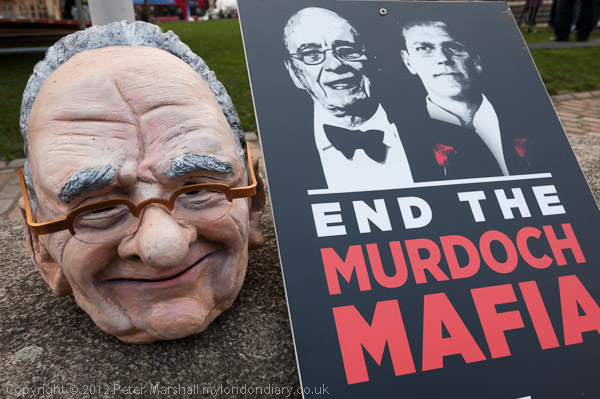
Avaaz had brought large puppet heads of Murdoch and a gagged Cameron with placards ‘End the Murdoch Mafia’ and a flaming dustbin into which Murdoch lowered the Leveson report.
Political artist Kaya Mar had brought one of his paintings with the judge and a cart-load of people, though I couldn’t recognise them all.
And a protester from Kick Nuclear was walking up and down with his dog which was wearing a poster about Fukushima warning of the dangers of nuclear power.
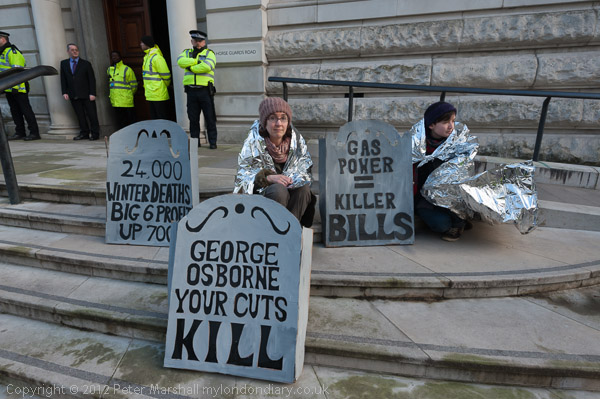
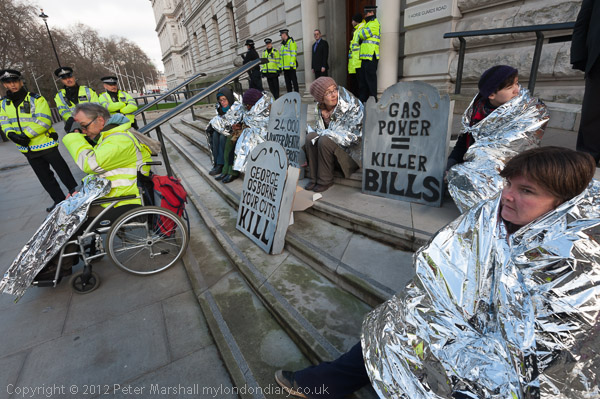
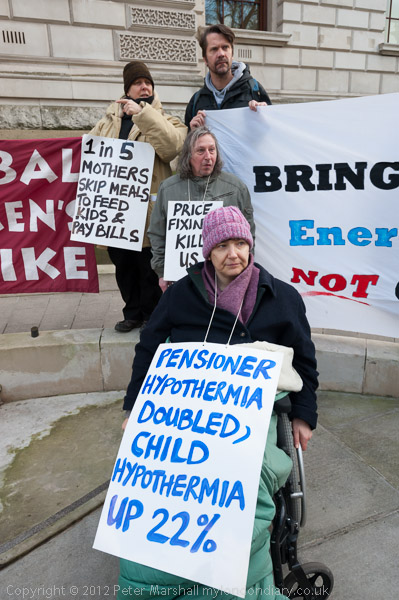
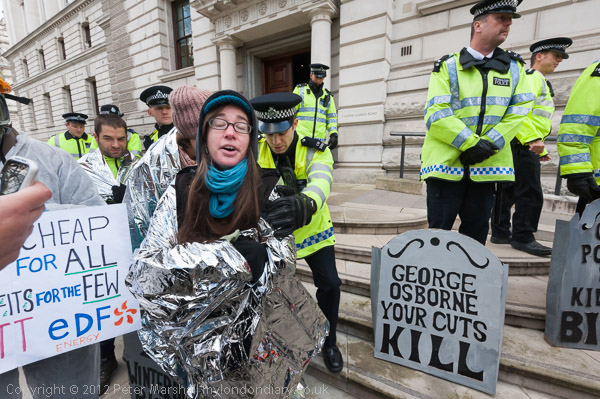
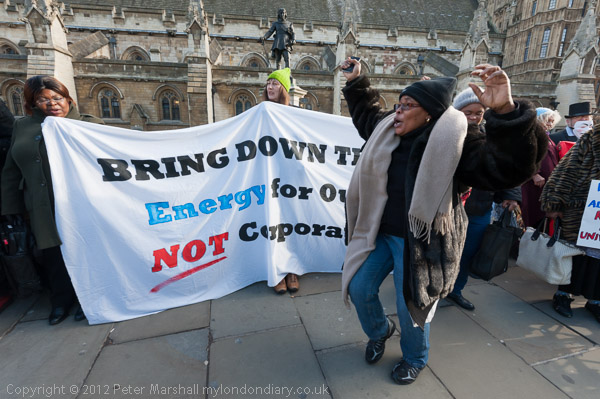
Fuel Poverty Action along with others including Disabled People Against Cuts, the Greater London Pensioners’ Association, Single Mothers’ Self-Defence, Southwark Pensioners’ Action Group and WinVisible (women with visible and invisible disabilities) had come to protest against the cuts to come from George Osborne’s energy bill which they say will cause 24,000 extra winter deaths.
The protest which began outside the Treasury and then moved on pausing briefly at the Leveson protest outside the QEII centre to Parliament Square in front of the House of Commons where Secretary, Ed Davey, was to introduce the Energy Bill later that day.
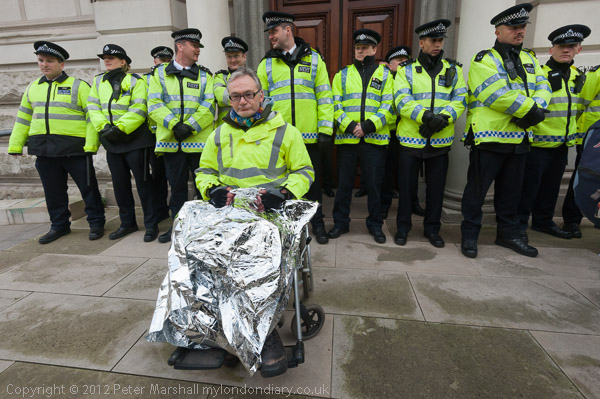
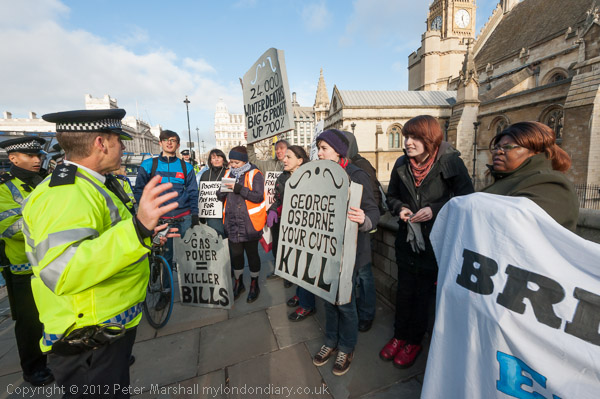
“The protesters had brought plastic silver reflective coated ‘space blankets’ to wear and had three ‘tombstones’ with the messages ‘George Osborne Your Cuts KILL’, ‘Gas Power = Killer Bills’ and ‘24,000 Winter Deaths – Big Six Profits up 700%’.”
They say that already because of the government cuts many people were going hungry, with food banks being set up and kept busy even in the more prosperous areas of the country, and now with winter coming many have to chose between ‘eating or heating’.
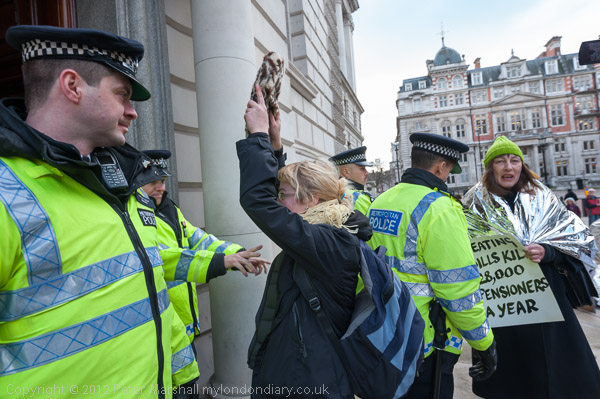
A protester with a hot water bottle tries to walk into the Treasury but is stopped by the police
Cuts will mean more people suffering from “hypothermia, and the disabled in particular are hard hit, both because of the ruthless removal of benefits by poorly designed tests adminstered by poorly qualified testers with targets to meet and also because they often have special needs for heating.”
The protesters ignored police requests to leave the steps up to the Treasury and police then pushed them down, “usually with minimum force, but just occasionally rather more than necessary, but both protesters and police generally remained calm.” The rally continued on the pavement with speakers including Green Party leader Natalie Bennett.
After this the group of 50 or so protesters moved to the pavement in front of the Houses of Parliament, pausing briefly on the way for photographs in front of those waiting for the Leveson report.
Police again tried to get them to move on when they stopped in front of the Houses of Parliament, at first telling them they had to move as “a Royal movement” was about to take place, an announcement that cause much hilarity and comment but no movement. A little later they were told they could stay, but decided instead to cross onto the grass in Parliament Square for some final photographs.
Martyrdom of Ali, Save Fallujah: I had a fairly long and busy day on Sunday 7th November 2004, beginning with the annual London celebration of the martyrdom anniversary of Imam Ali, the first Imam of Shi’ite Islam. From Park Lane I walked to Parliament Square where a protest demanded that the troops were withdrawn from Iraq.
This was the day when US and UK troops began the bloody offensive of the Second Battle of Fallujah, codenamed ‘Operation Phantom Fury’, fighting against Iraqis in militia of all stripes including both Sunni and Shia, united in opposition to the US-imposed Shia-dominated government.
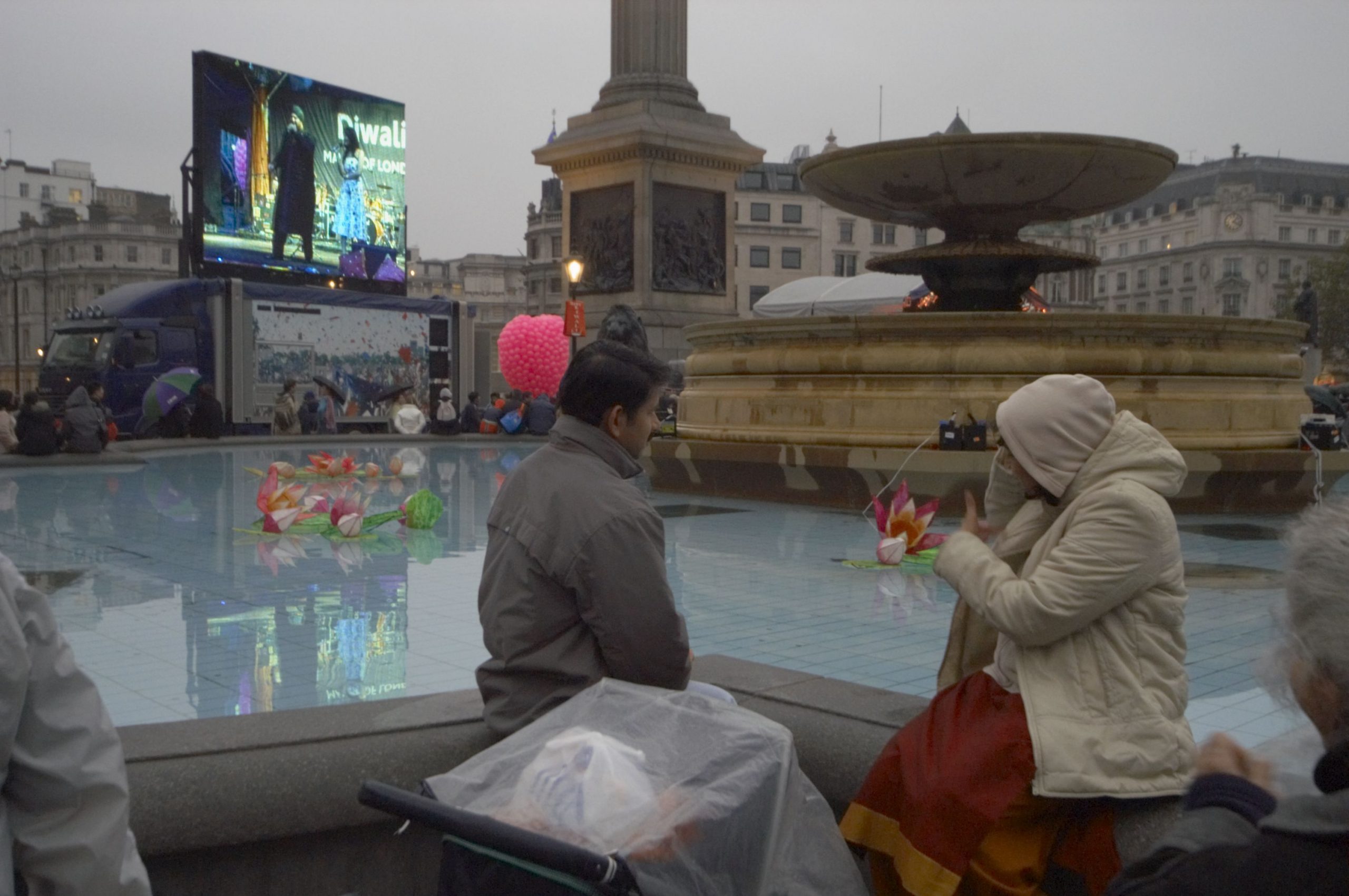
Finally I went to Trafalgar Square and took a few pictures of the Diwali celebrations taking place there, although I didn’t post any of these at the time on My London Diary.
In this post I’ll reproduce (with minor corrections) what I wrote in 2004, along with some of the pictures I took. These were made with the first digital DSLR camera I owned, the 6Mp Nikon D100, and most were made with a Nikon 24-85mm lens (36-127mm equivalent), though I had recently got a second lens, a Sigma 12-24mm (18-36 equivalent.) The Sigma wideangle was rather slow and working at f5.6 in low light was difficult as the D100 which did not have the high ISO capabilities of more modern cameras.
Muslims mourn in London
Hyde Park and Park Lane
Talks and prayers before the procession started in Hyde Park
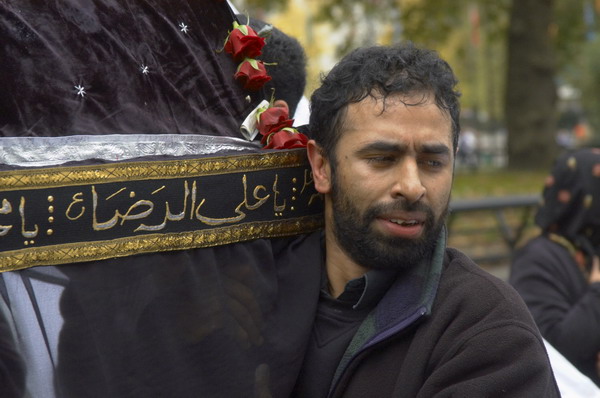
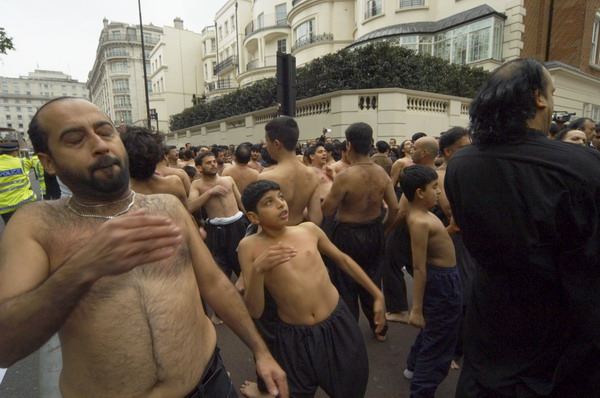
Sunday saw Muslims on the street for a religious event, a Jaloos & Matam on the Martyrdom anniversary of Imam Ali, organised by Hub-e-Ali, making its way from Hyde Park down Park Lane carrying a taboot or ceremonial coffin.
A small boy carries burning incense sticks, while elders shoulder the heavy load of the taboot.
The event started with prayers, addresses and a mourning ceremony.
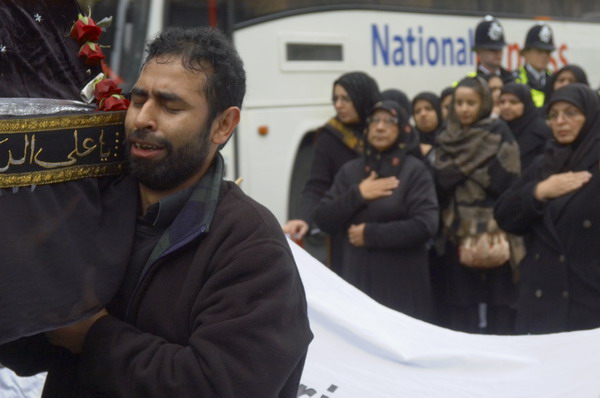
The weight took a strain as bare-footed bearers carried the heavy black taboot with its red roses slowly along Park Lane
The banners carried included texts from the ‘purified five‘ members of the prophet’s family, but particularly Hasan Bin Ali Bin Abu Talib, the cousin and first believer in the prophet.
There was some impressive chanting and much beating of breasts (matam or seena-zani) by the men, chanting and sticks of incense being burnt. The women followed quietly behind.
The women followed, their black-clad quiet dignity contrasting with the frenzied chest-beating of the men
Withdraw the Troops from Iraq – Save Fallujah From Destruction
Parliament Square and Whitehall
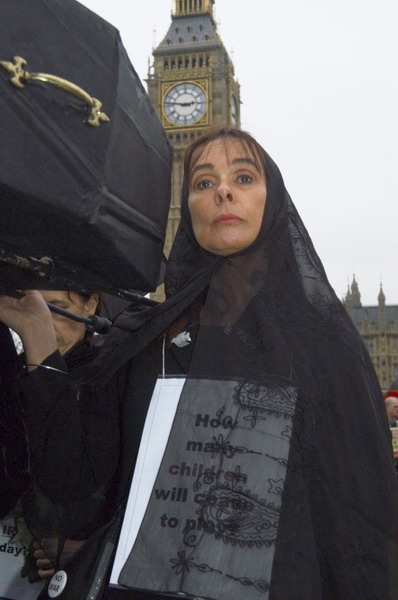
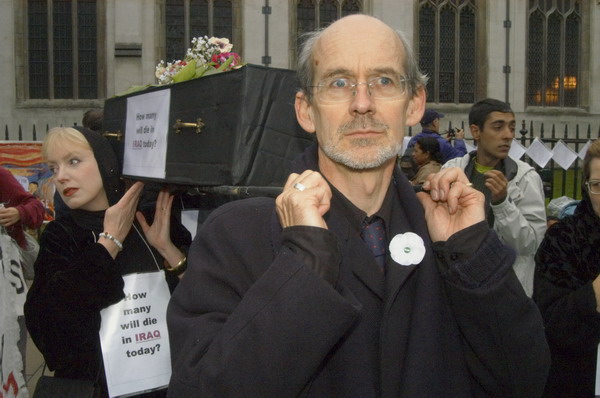
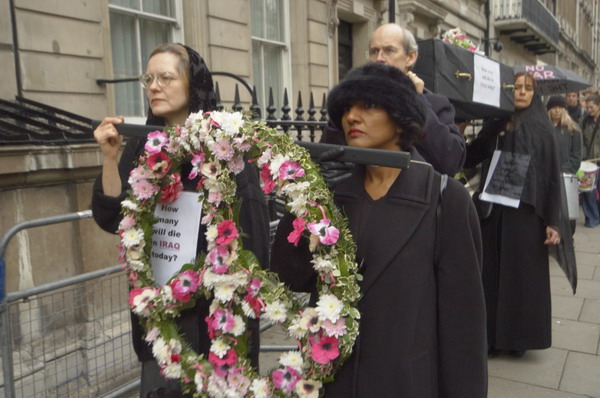
Code Pink activists carry a coffin “How many children will cease to play” in front of the Houses of Parliament.
I met Dave at the procession on Park Lane and walked with him to Parliament Square where a demonstration was to be held demanding the withdrawal of troops from the cities of Iraq. From the news that morning it seemed the Americans were about to storm Fallujah. [They did – see below *]
The large anti-war organisations seemed to be keeping strangely quiet, and there were only a hundred or two demonstrators here.
Among them of course was Brian Haw, now almost two and a half years into his permanent protest in the square, which seems likely to lead MPs to pass a bill specially to make such protests illegal.
I admire him for making such a stand, even if I don’t entirely share his views, and feel it will be a very sorry day for civil liberties in this country if such activities are banned.
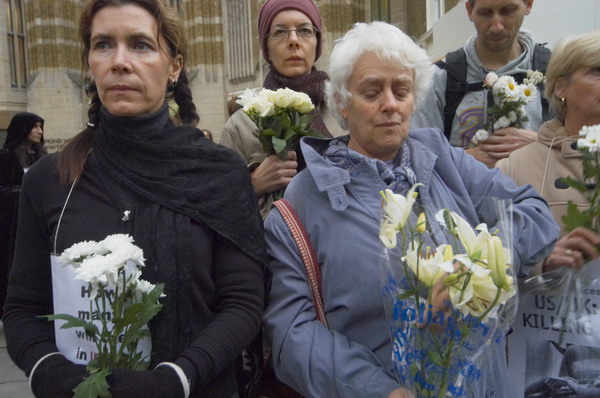
There were a few placards and banners, and some people who had come with white flowers as requested.
There were few takers for the ‘open mike’ and nothing much was happening until a group of ‘Code Pink’ supporters intervened theatrically parading a black-dressed cortège around the square. The effect was literally dramatic.
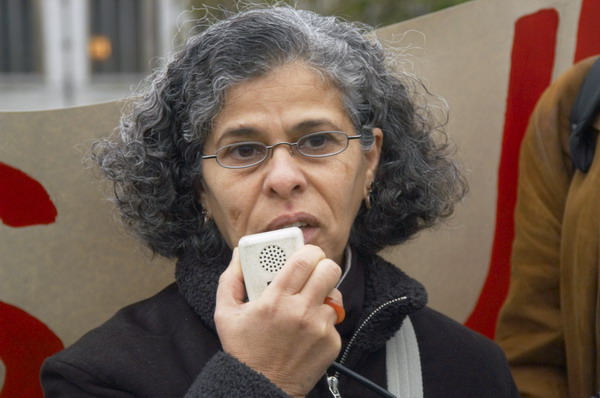
There were a few more speeches, including a moving one by Iraqi exile Haifa Zangana.
It was getting dark (or rather darker, as it had been dull and overcast, with the odd spot of rain all day) as we moved off up Whitehall towards the Cenotaph, where the funeral wreath was laid on the monument.
Police tried (although it is impossible to see why) to restrict the number of those putting flowers on the monument to an arbitrary five, but those who had brought flowers were not to be so easily diverted.
People wait for police to allow them to lay their flowers at the Cenotaph
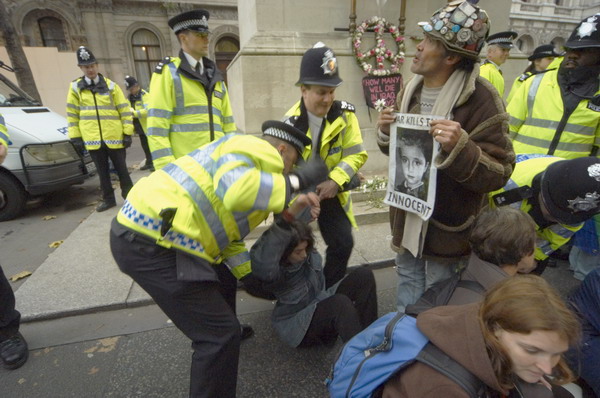
They ignored police orders and walked across the empty roadway to lay their flowers, and around 50 of the protesters staged a sit-down on the road.
Eventually the police warned them they would be removed forcibly if they did not get up, and then started to do so.
Police drag demonstrator away as peace protestor Brian Haw holds a placard “War Kills the Innocent” in front of Cenotaph and Code Pink wreath, “How Many Will Die in Iraq Today?”.
For the most part the police used minimum force, but there were one or two unnecessarily unpleasant incidents.
The protesters were then corralled for a few minutes on the pavement before being allowed to continue the demonstration in the pen opposite Downing Street.
Nothing much seemed to be happening, so I went home [via the Diwali celebrations in Trafalgar Square] when police refused to let me photograph from in front of the barriers.
It seemed an arbitrary and unnecessary decision, but this time I couldn’t be bothered to argue. I think they were just upset because I had taken pictures during the violence a few minutes earlier.
*More about Fallujah
The Second Battle of Fallujah lasted about six weeks and probably resulted in around 2,000 fighters dead and many wounded, mostly Iraqis, with just 107 of the coalition forces killed. Another roughly 1,500 Iraqis were captured.
US forces had stopped all men between 15 and 50 from leaving the city, and treated all those left inside as insurgents. Civilian deaths were later estimated at between 4,000 and 6,000. Civilians who were able to fled the city and around 200,000 became displaced across Iraq. Around a sixth of the city’s buildings were destroyed and roughly two thirds suffered significant damage.
The US forces were heavily criticised for their direct use of white phosphorus in the battle against both combatants and civilians. Highly radioactive epleted uranium shell were also used and a survey in 2009 reported “a high level of cancer, birth defects and infant mortality” in the city.”
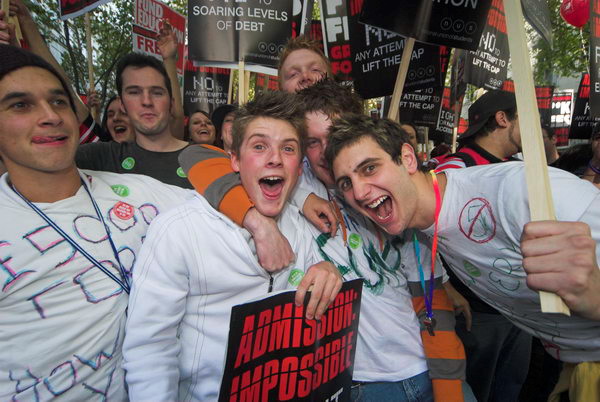
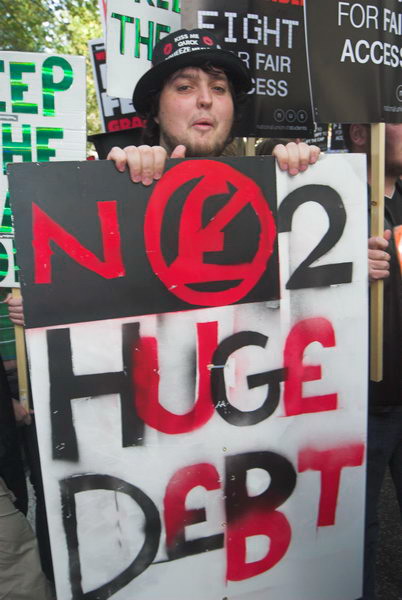
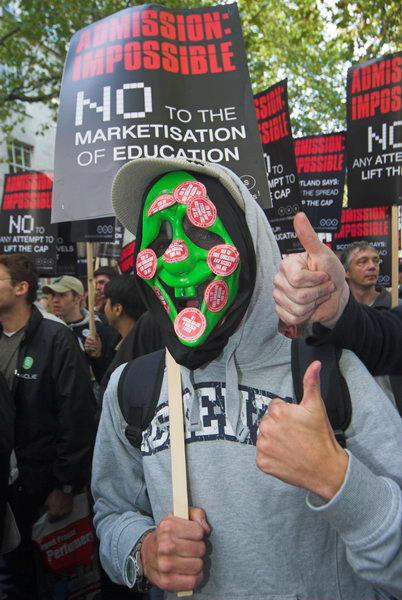
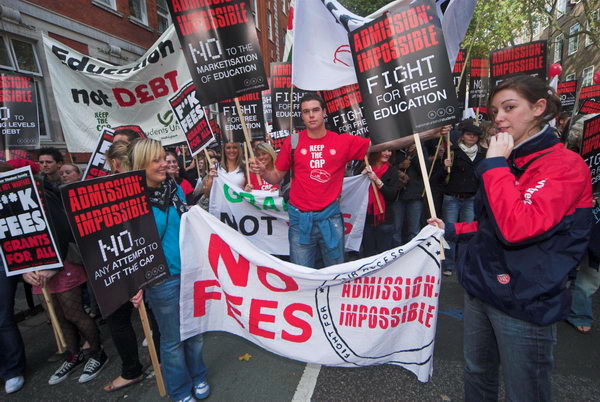
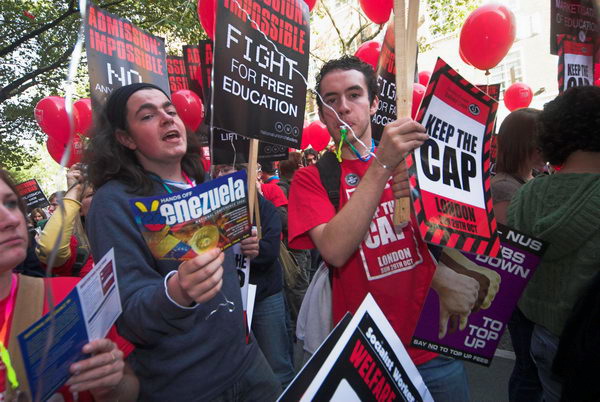
Scrap Tuition Fees & No More Fallujahs: On Sunday 29th October 2006 I went to the start of a National Union of Students march against university tuition fees, first introduced by New Labour under Tony Blair in 1998. University education had been free across the UK since 1945, with local authorities meeting the bill rather than students. In 2004, these fees, initially £1,000 a year, were increased to £3,000. In 2025 fees are now £9.535 a year and a major reform is expected later which will probably result in University education becoming even more expensive.
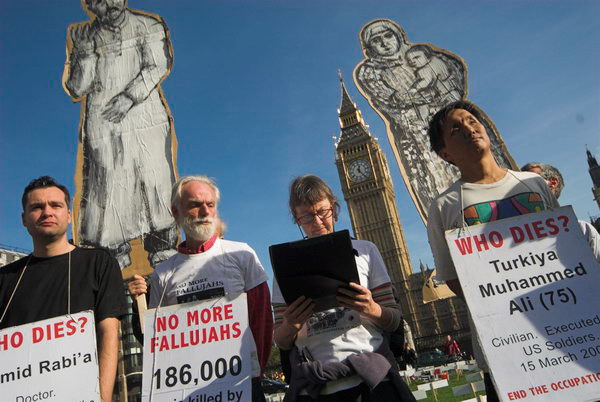
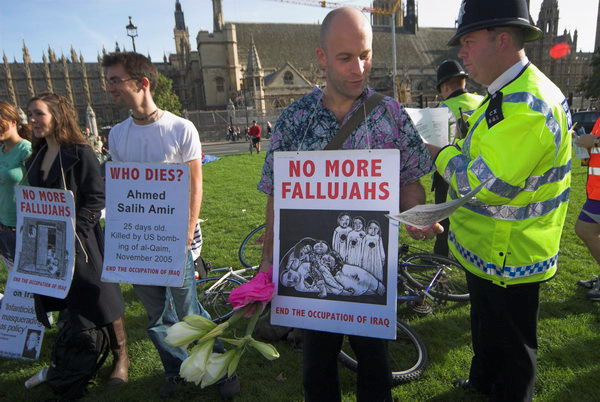
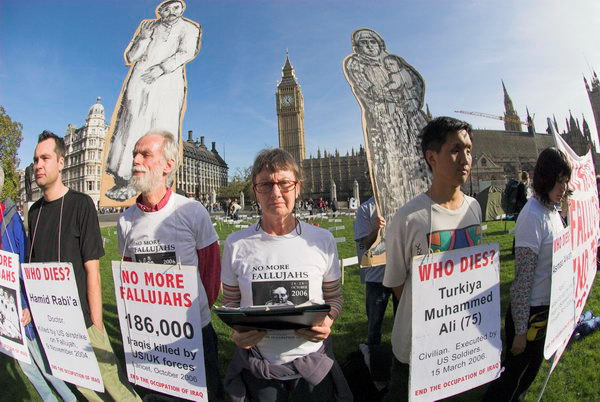
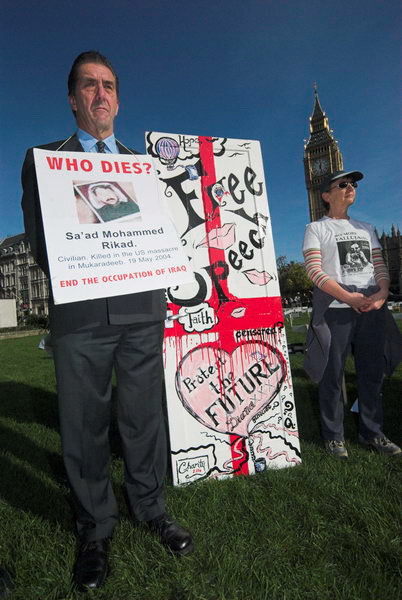
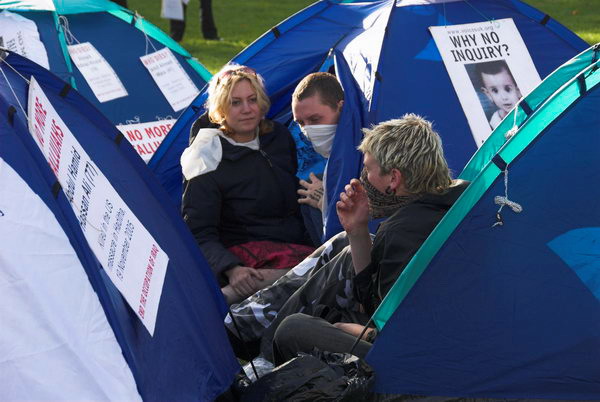
From there I left to cover a demonstration in Parliament Square where people were intending to set up a 24 hour ‘unauthorised’ peace camp protesting about the battles fought largely by US Marines against the Iraqi city of Fallujah in April and November 2004.
In the November battle US troops used white phosphorus, stopped military age males from leaving the city and treated all the inhabitants as combatants. The levelled thousands of buildings, denied Red Crescent access and according to the UN used “hunger and deprivation of water as a weapon of war against the civilian population“. Their use of depleted uranium shells led after the fighting to a high level of cancer, birth defects and infant mortality in the city.
This protest was illegal under the Serious Organised Crime and Police Act 2005 which had required any demonstration within one kilometre of Parliament Square (excluding those in Trafalgar Square) to give written notice to the Commissioner of the Metropolitan Police six days in advance.
It was as a way to prevent embarrassment to politicians by seeing or hearing protests taking place, and to remove the permanent Peace Camp by Brian Haw which had been in Parliament Square since 2001, but it failed to do so, though it did lend to increased harassment of him by police and more shadowy figures. In 2011 these sections of the Act were repealed and the Police Reform and Social Responsibility Act 2011 imposed different and in some ways more draconian restrictions on the right to protest.
Below is the text I wrote about these events in 2006.
NUS – Scrap Tuition Fees March
Malet St
I arrived in Malet Street early for the start of the NUS march against tuition fees, but there were already plenty of students there, including many Scottish students who had come down to show solidarity.
My father had left school at 14, at the end of his elementary education and never managed to complete the part-time studies which he had once dreamt would lead to qualifications. I came from the first generation of my family who could go to university, thanks to the 1944 Education Act that opened up secondary education and also the free tuition and student grants that were available. Without that support I would never have gone to university.
Both my sons were also fortunate to be able to study without having to pay tuition fees, [and to get maintenance grants] and were able to leave university with a degree and no debts.
Things are rather different for most of today’s students, with tuition fees now at £3000 a year, and costs of accommodation increasing all the time.
The NUS is campaigning for free education, but also calling for a cap on fees, as some universities call to be able to raise them without limits. Already the current level of fees seems to have led to a drop in the numbers of students entering universities.
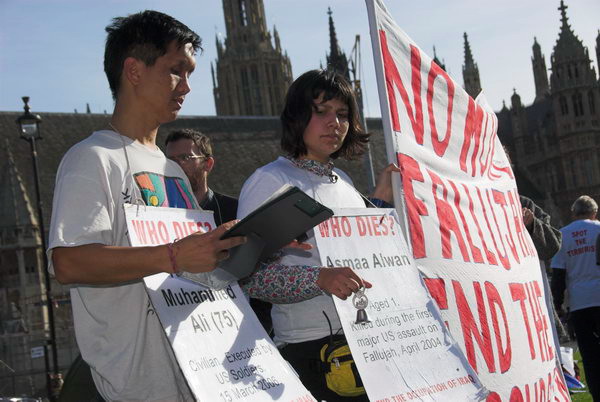
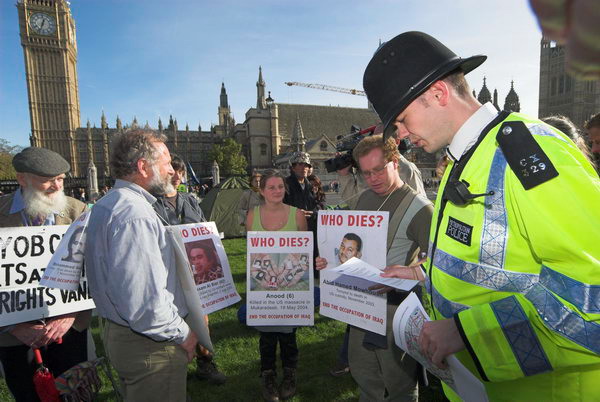
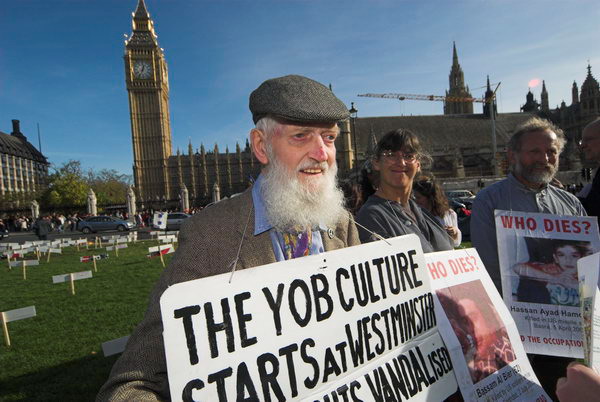
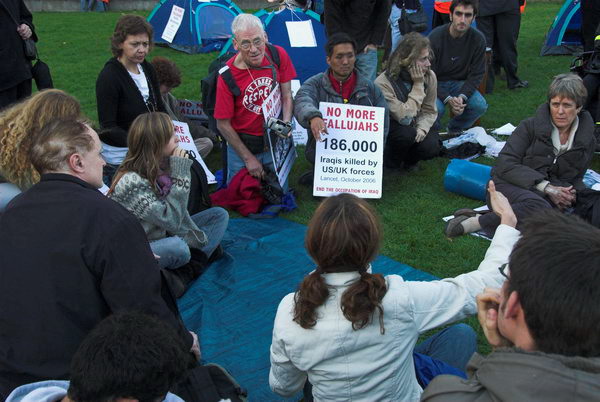
I left shortly before the march started to get to Parliament Square, where the 24 hour ‘unauthorised’ Peace Camp, ‘No More Fallujahs’, was about to start. Potestors formed a circle and joined Maya Evans and Milan Rai in reading the names of Iraqis who have died as a result of the occupation.
Milan Ray and Maya Evans read the names; Maya sounds a bell after each name
A year ago, the two were arrested in Whitehall for a similar reading. In december 2005 Maya was the first person to be convicted for taking part in an unauthorised demonstration under the Serious Organised Crime and Police Act, and in April 2006, Milan was convicted for organising the demonstration.
Maya is appealing against her conviction and fine, but was risking a prison sentence as arrest for this action would break the terms of her 12-month conditional discharge. Milan has refused to pay the fine of £350 with £150 costs imposed on him, and is also appealing to a higher court.
The demonstrators formed a circle in Parliament Square and began reading the names at one minute intervals, each marked by a bell. Various volunteers joined Maya and Milan in reading names from the list.
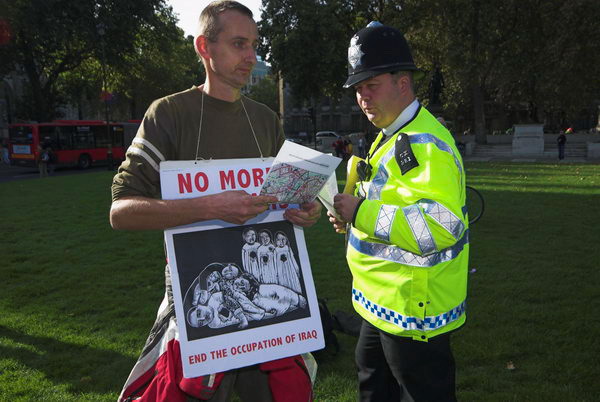
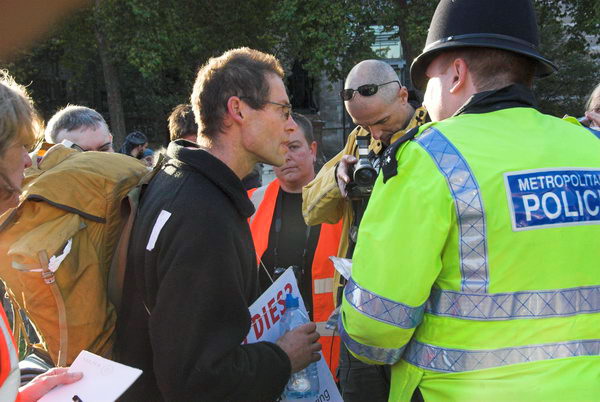
The police simply stood and watched for around half and hour, then at 12.30 began to circulate and hand out a notice to everyone that they were a part of an illegal demonstration. Where people refused to take one, they left a copy at their feet.
The officers concerned were extremely patient and polite, and were attended by a police photographer filming everything they did. Rather to my surprise one officer insisted I have a copy, despite my assurances that I was press, so I took it, while being recorded for yet another 15 seconds of so of video by the photographer, pointing out that I always complied with police directions.
It isn’t as if I’m unknown to the police. Earlier in the day in Malet Street, as I walked past two officers, one turned to the other and said “looks who’s here then.” I turned and gave them a smile.
After that, the protestors decided it was time to pitch their tents, and soon the square was covered with small tents, mainly blue. For a while nothing much seemed to be happening, and I went away for an hour or two.
When I returned, the news was that police had taken four people away. they had been approaching individuals involved in the demonstration and asking them to give their name and address.
They were told that they could then later expect a summons for taking part in an illegal demonstration. People were informed that if they did not give their details, they would be taken to the police station and arrested for taking part in the event.
While I was there several other people were questioned and one was taken away when he refused to give his details. Those who gave their names and addresses seemed to be allowed to continue to take part in the demonstration. While I was present, everything was conducted civilly and without any violent handling of those concerned, although I was told there had been a little rough handling of at least one person.
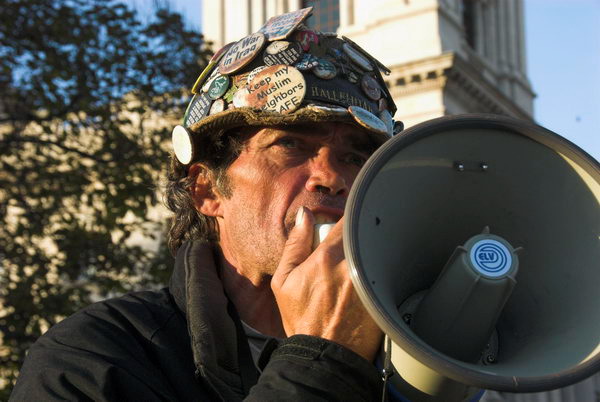
The demonstrators held an open meeting in the centre of the square to discuss what to do in the event of a more concerted approach by the police, while on the corner by Churchill’s statue, Brian Haw was making use of his megaphone to hold his weekly service. Its a sermon I’ve heard many times and I felt it was time to go home.