At the end of May 1988 I went to Finsbury on the northern edge of the City of London – not to be confused with Finsbury Park a couple of miles further north. I think I might have been visiting an exhibition at the Barbican Gallery which has its main street entrance in Silk Street, just a few yards from the border with Finsbury, part of the London Borough of Islington.
Ropemaker St, Islington, 1988 88-5n-61
Ropemaker St, Islington, 1988 88-5n-62
Finsbury St, Islington,1988 88-5n-64
Or it could be that I was simply visiting some of my favourite new buildings in London, in Ropemaker St, some now demolished and replaced. Those balconies – perhaps from the 1950s – are still there but the more recent building on the other side of Chiswell Street has been replaced by something bigger and blander.
I simply had to turn around to find my next subject, the gates of the Honourable Artillery Company, established by Royal Charter on 25th August 1537 and said to be the second-oldest military corps in the world. It actually traces its history back rather further to 21 years after the Norman invasion. The ‘Artillery’ for much of its history was the long bow and it originally had a field in Spitalfields where it could practice shooting arrows, and it only moved permanently here to the Artillery Garden in in 1658. As well as military practice the ground has also often been used for sporting and other events; cricket is said to have been played here as early as 1725 and the first balloon flight in England began was here by Vincenzo Lunardi in September 1784. THe HAC is still a part of the Army Reserve, the oldest regiment in the British Army.
In front of one of the buildings on Chiswell St was a narrow garden with a few bushes and a sculpture of Diana the Huntress with two dogs. I don’t know what has happened to this.
Whitecross St, Finsbury, Islington,198888-5n-55
A tall warehouse on the corner of Errol St and Whitecross St has a sign for A J Brown Brough & Co Ltd, Paper and Packaging. The building is still there, now I think converted largely to residential use, with its main entrances in Dufferin St. But of more interest to many – and perhaps to me when I made the image – is the vintage Citroen in the foreground.
I’ll continue my walk around Finsbury in later posts. You can click on any of the pictures here to go to larger versions in my album 1988 London Photos.
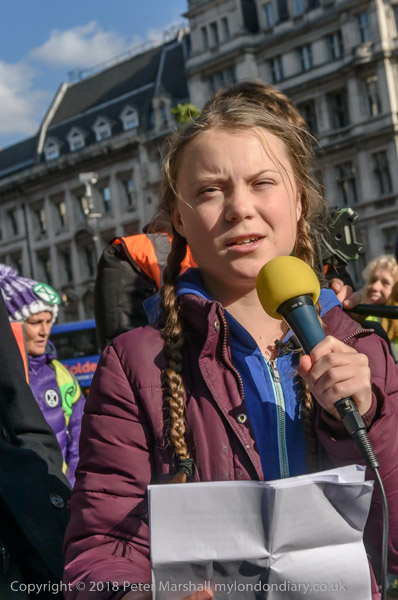
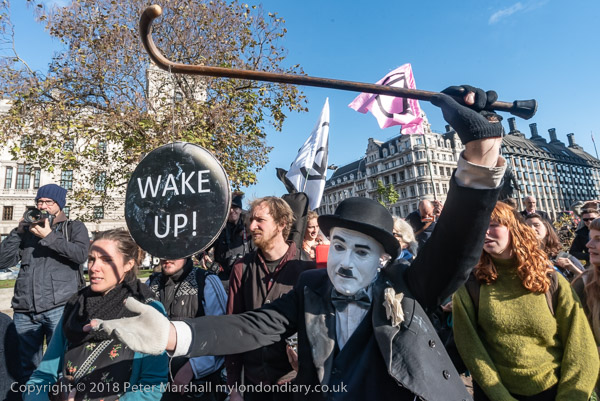
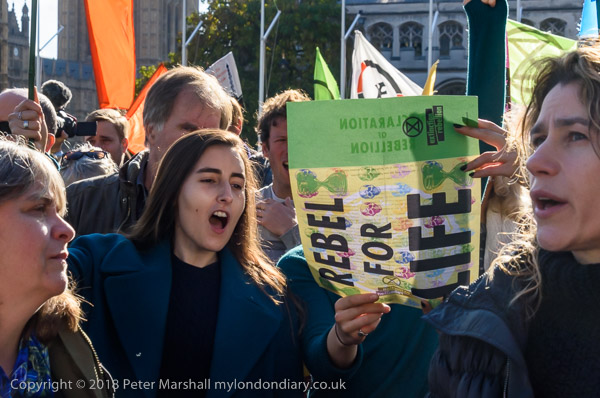
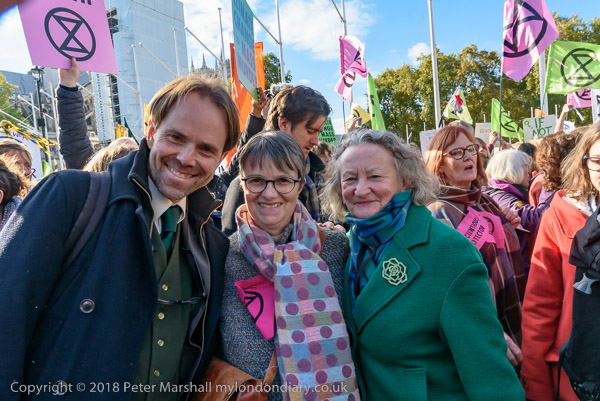
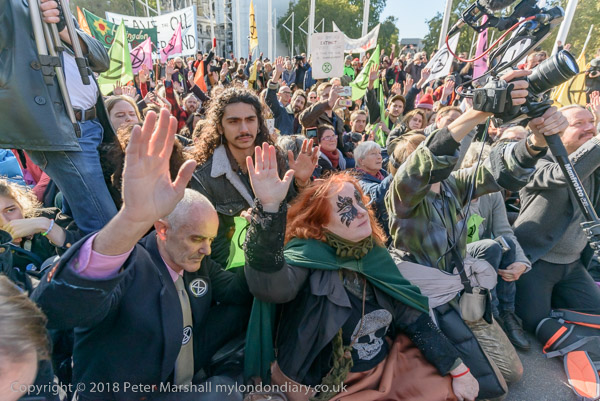
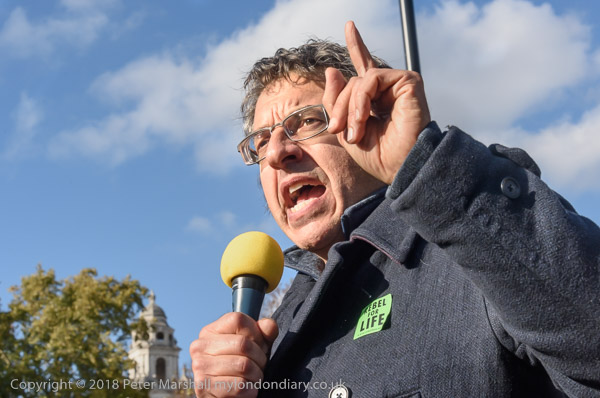
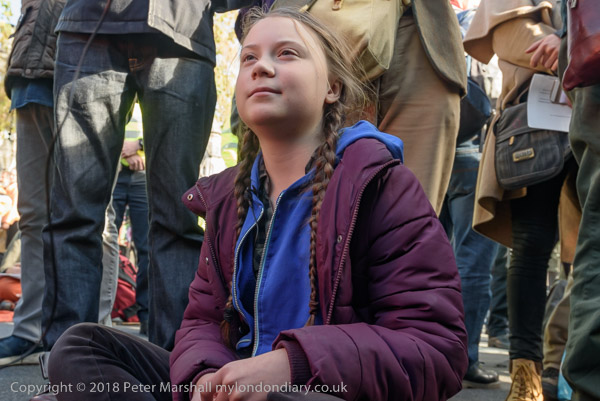
Protesters in Parliament Square on 31st October 2018 heard speeches from climate activists including Swedish schoolgirl Greta Thunberg, campaigner Donnachadh McCarthy, Labour MP Clive Lewis, economist and Green MEP Molly Scott Cato, before making a ‘Declaration of Rebellion’ against the British Government for its criminal inaction in the face of climate change catastrophe and ecological collapse.
Three years ago British campaigners were particularly inflamed by the almost total lack of any measures in the budget to meet the impending catastrophic climate change, and three years later we can say the same about last week’s budget. Sunak still seems to be intent on growth and business as usual, encouraging road building and air travel and there was little or no mention of any green initiatives, something of a pre-COP26 sabotage of stated government policies.
Reading the Declaration of Rebellion
But as Thunberg and others made clear, we have seen some rhetoric but totally inadequate action so far to meet the challenge and the Extinction Rebellion protest made this clear in its ‘Declaration of Rebellion’ against the British Government for its criminal inaction in the face of climate change catastrophe and ecological collapse.
Schoolkids get it – and it led to Greta’s protest outside the Swedish Parliament which has inspired many around the world. Even some of our media are beginning to get it, but governments around the world, including our own seem reluctant to actually make the kind of changes that are needed. And although some MPs speak out, neither Labour nor Conservative parties have embraced the kind of policies that are necessary to avert mass extinction.
Its a shame that many on the left have devoted rather more energy to criticising the actions taken by Extinction Rebellion rather than getting out and doing something positive, with few others organising protests and direct actions. XR have done a lot to raise public awareness and the vicious reaction to their protests with the government pushing prosecutions against them and a draconian Police, Crime, Sentencing and Courts Bill currently in its final stages in Parliament , and threats to rewrite the Human Rights Act and to hobble judges have shown the true colour of our Tory government as we move towards a police state.
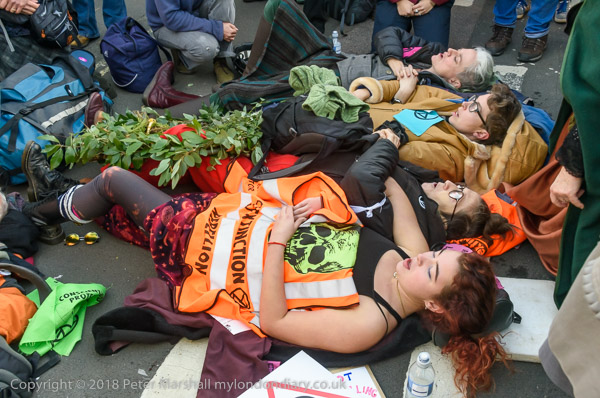
After reciting the ‘Declaration of Rebellion’ the protesters moved onto the road and sat down to block it and continue the rally with songs, poems and speeches, including by Caroline Lucas MP and George Monbiot. There were several votes during the sit-down when protesters were asked if they wished to leave the roadway as police were threatening to arrest them which resulted in a near-unanimous show of hands in favour of remaining.
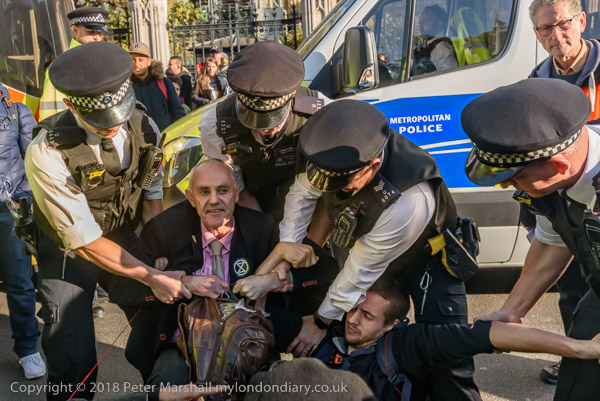
As George Monbiot finished some of the protesters began to leave, and several activists stood up to encourage people to stay behind on the road and be arrested, and several groups continued the protest, including one circle with protesters linking arms including Donnachadh McCarthy and George Monbiot. Police surrounded the group, and then arrested the man to McCarthy’s left, coming back a few minutes later to take McCarthy away – and he later published an account of what appeared to be a symposium on climate change he conducted in the police van. Monbiot shortly after got up and left, apologising to those remaining that he needed to collect his children from school.
The arrests continued slowly, and there was still a group on one side of the road who had been locked together for some hours who police seemed to be largely ignoring and were still there when I left, along with others still sitting on the road.
I have low expectations for next week’s COP 26. We will get more promises to add to those which have already not been kept and not the real shift into action that the world desperately needs. Of course I’d be delighted to be proved wrong. But this side of a revolution I think it unlikely that the ultra-rich can be persuaded to change their ways.
Today at noon in London, the the United Families & Friends Campaign (UFFC), a coalition of those affected by deaths in police, prison and psychiatric custody, is holding its annual march from Trafalgar Square along Whitehall to a rally opposite Downing St as it has on the last Saturday in October since 1999. In 2010 the march was also on 30th October and I published a lengthy post about it with many photographs on My London Diary. Here is the text in full (with some minor corrections) and a few of the pictures.
United Friends & Families March
Trafalgar Square to Downing St, London. Saturday 30 Oct 2010
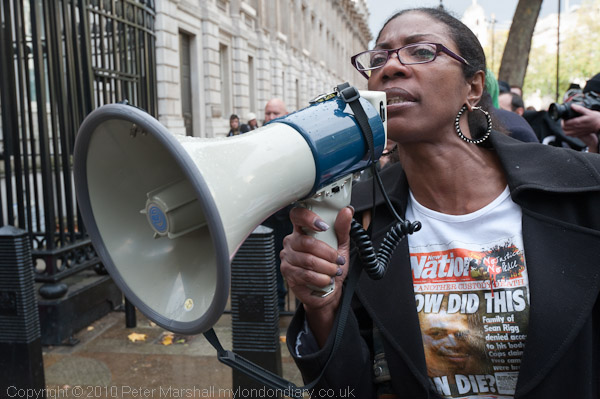
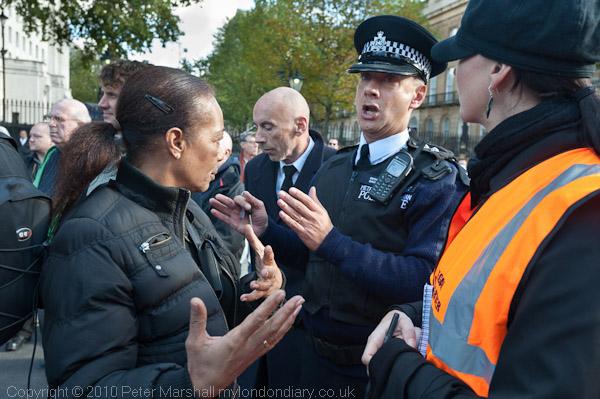
Marcia Rigg-Samuel, sister of Sean Rigg, killed by police in Brixton, tries to deliver a letter at Downing St more pictures
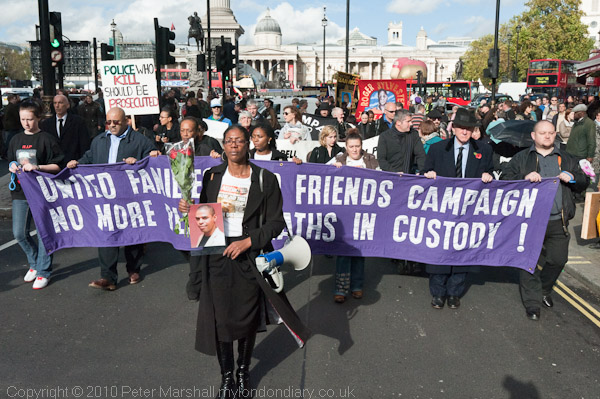
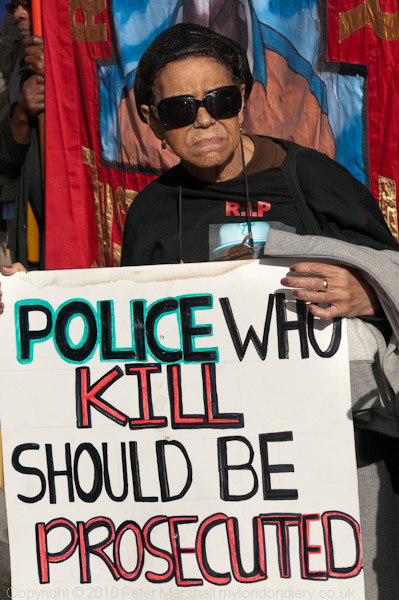
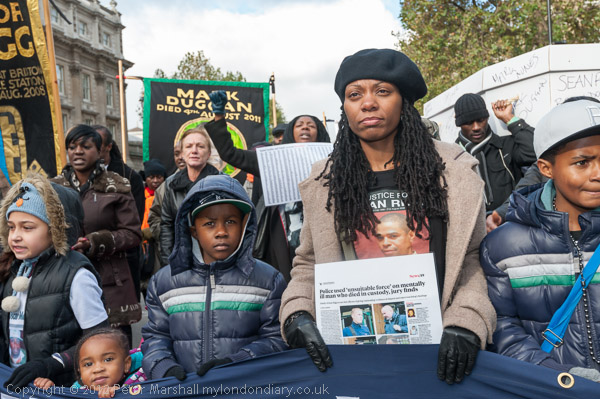
The United Friends and Families of those who have died in suspicious circumstances in police custody, prisons and secure mental institutions marched slowly in silence down Whitehall to Downing St, where police refused to allow them to deliver a letter to the Prime Minister, David Cameron.
It’s impossible to be sure how many of the suspicious deaths in police custody, prisons and secure mental institutions (and there are around 200 a year) have been as a result of lack of care, the use of excessive force and brutality, but certainly the answer is far too many.
Since 1999, the ‘United Friends and Families’ of some of those who have died have held an annual slow silent funeral march from Trafalgar Square down Whitehall to Downing St. It attracted particular attention in 2008 when the mother and other family members of Jean Charles de Menezes were among those taking part. This year’s event was rather smaller, and received little attention from the mainstream media.
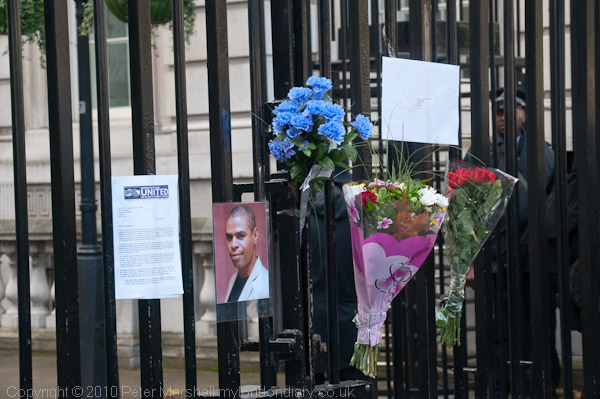
A number of family members spoke with great feeling opposite Downing St, and then the group, by now around a hundred strong, moved across the road to fix flowers to the gates and attempt to deliver a letter to Prime Minister David Cameron. It seemed an unnecessary and pointless snub that the police refused to take the letter and that nobody from No 10 was apparently prepared to come and receive it.
Earlier there had been an argument with the police who had objected to the rally occupying one of the two southbound lanes of Whitehall, but was allowed to go ahead by the officer in charge after those present had refused to move. In previous years the police have usually seemed anxious to avoid confrontation, although in 2008 they insisted on searching all the bouquets before allowing them to be laid on the gates of Downing St.
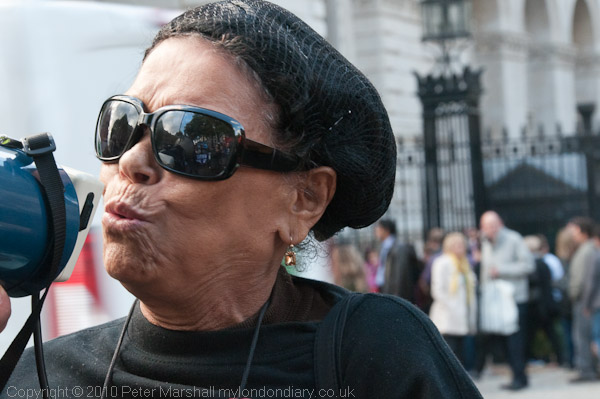
Jason McPherson’s grandmother speaking opposite Downing St
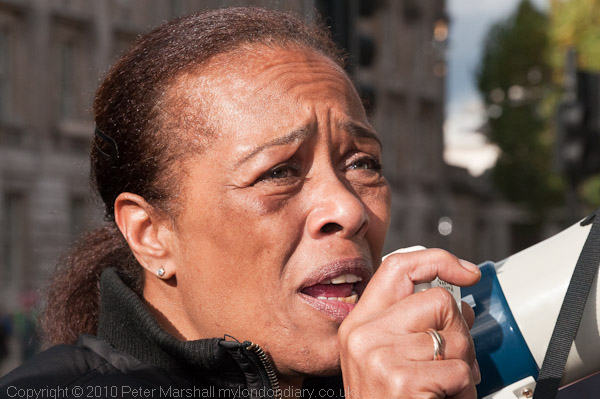
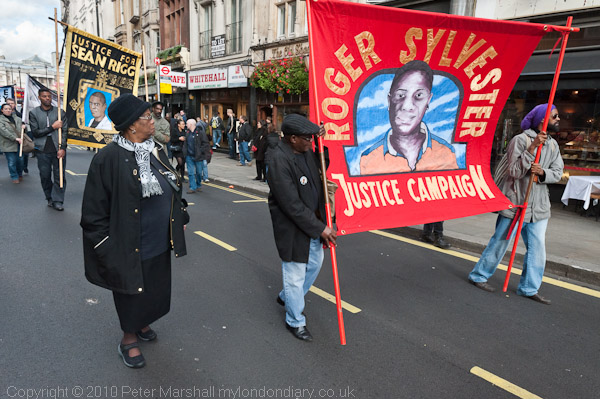
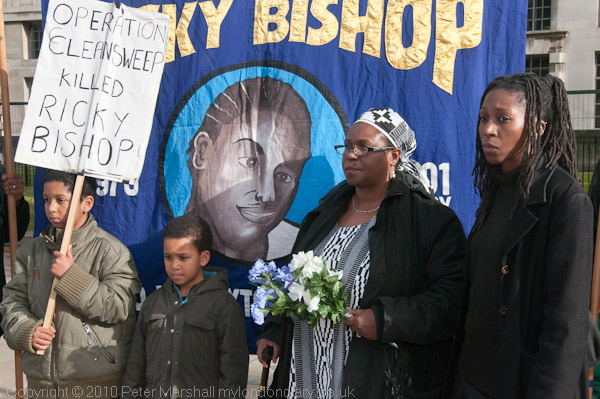
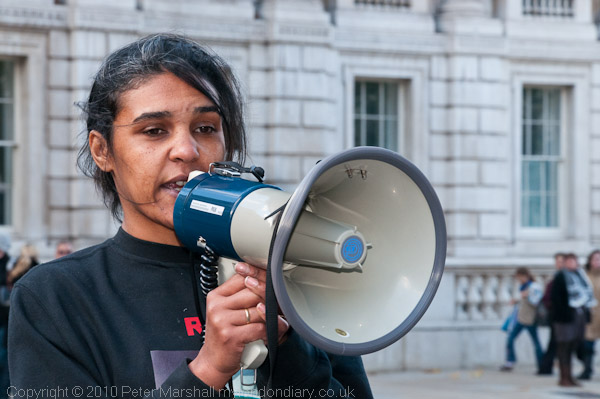
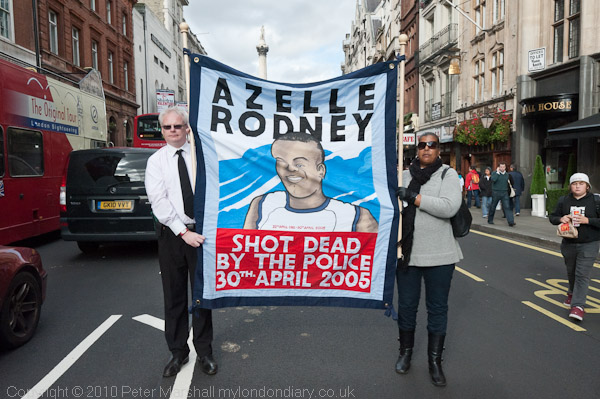
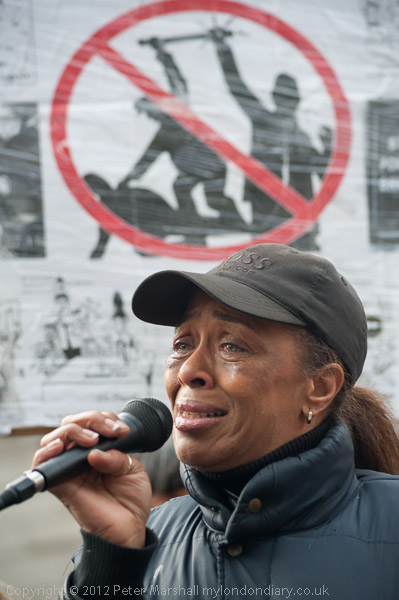
Speakers at the rally opposite Downing St included Stephanie, the twin sister of Leon Patterson, Rupert Sylvester, the father of Roger Sylvester, Ricky Bishop’s sister Rhonda and mother Doreen, Samantha, sister of Jason McPherson and his grandmother, Susan Alexander, the mother of Azelle Rodney, and finally the two sisters of Sean Rigg.
What the families want is simple. Justice. And to know the truth about what happened. What emerged again and again was a shameful history of delay, evasion and covering up by the police, with the collusion of the IPCC, the Crown Prosecution Service and even at times judges, working together to ensure that justice fails to be done. The press have been fed lies – as in the de Menezes case, security cameras have suddenly been found not to have been working, CCTV tapes have been lost or doctored, officers involved have not been questioned until many months after the events, witness statements have been dismissed as ‘unreliable’. Deliberate delays are used as a tactic to prevent the truth coming out, and these also have allowed officers involved to collude in their cover-ups.
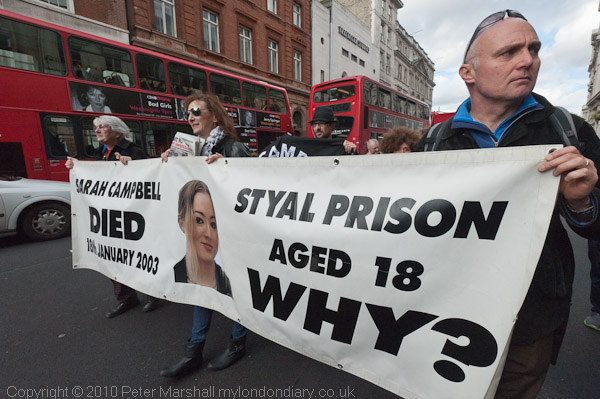
Overwhelmingly the victims in these cases are black, but one of the banners on the march reminded us that it affects the whole of our community, with a banner asking why 18 year old Sarah Campbell died in Styal Prison in 2003. Many of us present remembered and sadly miss her mother, Pauline Campbell; after her daughter’s tragic death she devoted herself single-mindedly to campaigning for justice, not just for Sarah but for other victims and to improve the system. Eventually she forced an admission from the authorities that their lack of care had caused Sarah’s death, but she became another victim of injustice when she committed suicide on her daughters grave.
Stephanie Lightfoot–Bennett, speaks about the police murder of her twin Leon Patterson
Leon Patterson was arrested in Stockport in 1992 and kept in a police cell for some days despite being in need of hospital treatment. He was found dead in his cell with a fractured skull and severe injuries, his blood covering the walls of the cell and his genitals mutilated, and in such a bad state that she failed to recognise him. The family challenged the initial inquest verdict which found his injuries to be self-inflicted, but there was no legal aid available for them. Fortunately the charity INQUEST supported them and a second inquest in April 1993 returned a verdict of unlawful killing, although this was quashed on appeal by the police on the grounds that the coroner had misdirected the jury on the law.
Roger Sylvester died in 1999 after being arrested by the Met. An inquest jury in October 2003 returned a verdict of unlawful killing, but the verdict was later quashed in the High Court, because the judge claimed the coroner’s summing up had confused the jury. The judge refused to order another inquest and said that no jury in a criminal case would be likely to convict any of the officers concerned of manslaughter.
Ricky Bishop was stopped, arrested and taken to Brixton police station on 22 Nov 2001, where he was assaulted and brutalised by police officers, leading to a heart attack. After that the police called a paramedic and he was taken to hospital and died. The family say that the police withheld vital evidence from the inquest and that the jury were not given a proper choice of verdicts at the inquest.
Samantha, sister of Jason McPherson
Jason McPherson died in hospital after being taken there from Notting Hill Police station after having been arrested on suspicion of drug offences on 18 Jan 2007. Police believed he had a wrap of cocaine in his mouth and had used considerable and arguably excessive force on his head and chest to try to get him to open his mouth. A jury at the inquest in January 2010 came to a unanimous ‘narrative verdict’, saying that the procedures were not properly implemented and that “it did not appear Jason was given the opportunity to remove the drugs voluntarily through talking down (tactical communication).”
Azelle Rodney was killed by police in April 2005 after a car in which he was travelling was rammed and stopped by the Met in Barnet. Rodney was not armed, although the officer who fired the shots at close range was sure he was. Various misleading statements from police sources were widely published by the press. An inquiry into the case opened formally earlier this month and there is to be a hearing in the Royal Courts of Justice starting next week.
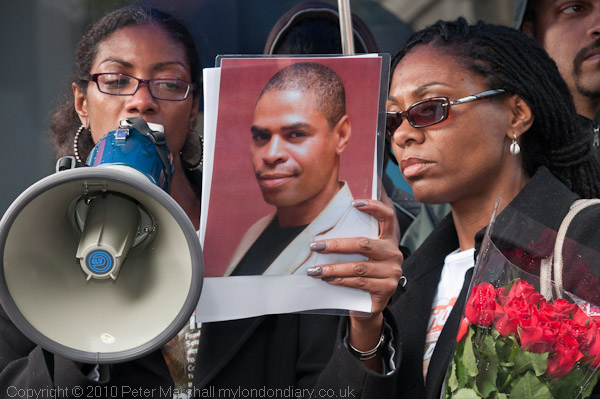
Marcia Rigg-Samuel, sister of Sean Rigg, who went into Brixton Police station in August 2008 a physically healthy man but was dead a short time later, killed by the actions of a small group of officers, led the procession down Whitehall from Trafalgar Square. She stood beside her sister, Samantha Rigg-David, the last of the families to speak, and then read the letter from the families to Prime Minister David Cameron. The inquest on Sean Rigg, adjourned in 2008, is not now expected until 2012.
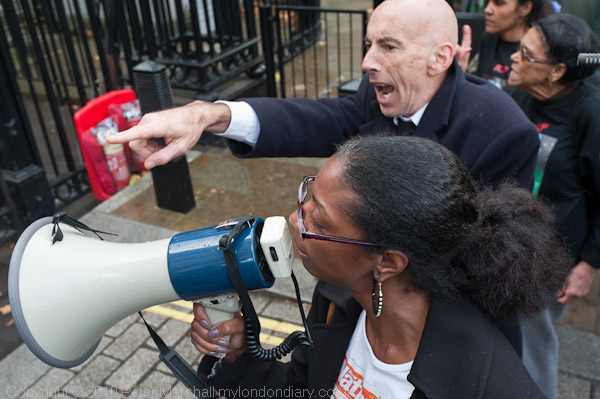
The families then moved across the road to the gates to Downing Street, demanding that police open them so they could deliver their letter. Police refused, and a small group of armed police joined the armed officers already present. After considerable amount of angry shouting as the police continued to refuse to allow access or even to take in the letter – a few of the group were allowed to sellotape the flowers, a photo of Sean Rigg and the letter to the gates. The noisy demonstration at the gates was still continuing when I left. more pictures
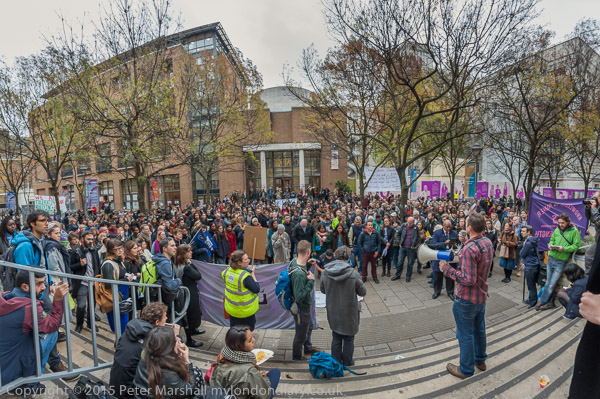
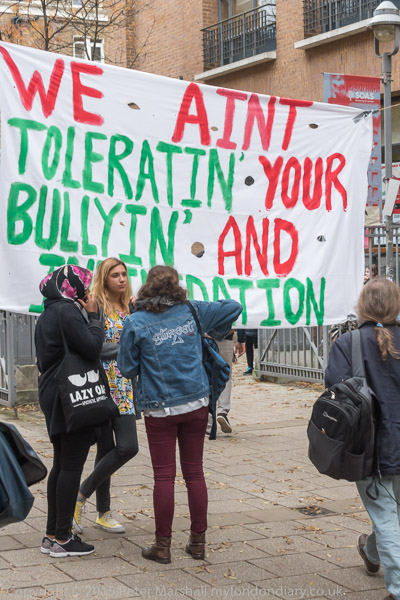
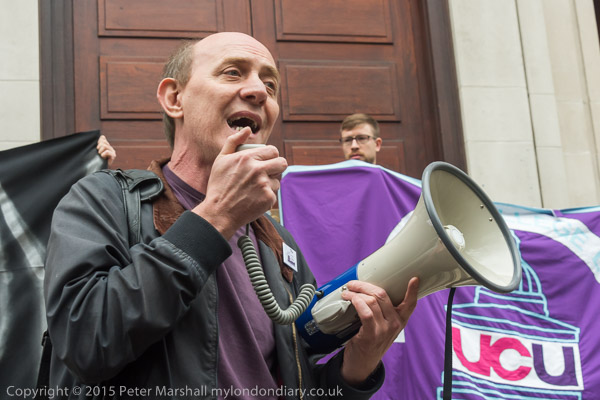
Students at SOAS, University of London, occupied the Brunei Suite on the Bloomsbury campus on October 6th 2015, after a leaked management document detailed £6.5m of cuts including the loss of 186 courses, roughly a third of the curriculum.
This leak came as the latest in a whole series of decisions by management which dismissed or ignored the views of both students and staff, and led to a unanimous vote of no confidence in the management two days later by the General Assembly of the SOAS Student Union.
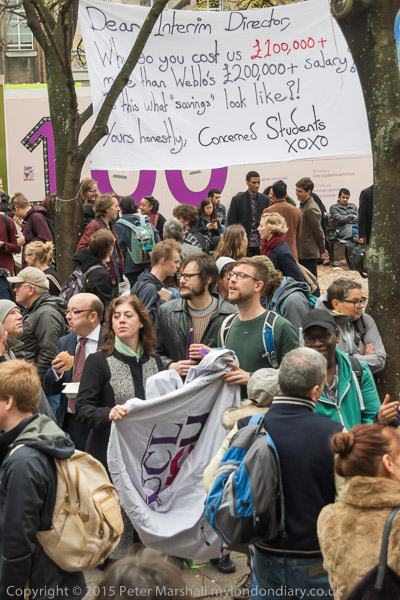
As well as the course cuts and problems with switching courses and choosing tutorials, they complained that management had ignored an overwhelming vote in support of the Boycott, Divestments and Sanctions (BDS) Campaign, ignored the opposition to the outsourcing of cleaners, security staff and other workers and failed to respond to the strike by Fractional workers (who are responsible for much of the teaching) for fair pay. The students said that management were failing to deal with the gender pay gap and that institutional racism is thriving in SOAS.
They called for a restructuring of the Executive Board and Board of Trustees to give students, academic staff and support staff authority over the running of our university, and suggested that a large proportion of the savings needed could be made by the Executive Board cutting their own inflated salaries rather than making staff redundant.
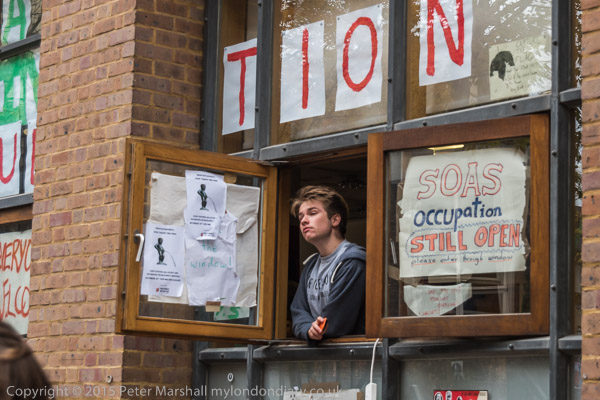
The entrance to the occupation after management locked the doors
The management responded with lies and by harassing the students, including by cutting off the power on 23rd October, and when many teaching and administrative staff refused to cross a picket line they locked the doors of the university. The entrance to the occupation became through the high ground floor windows.
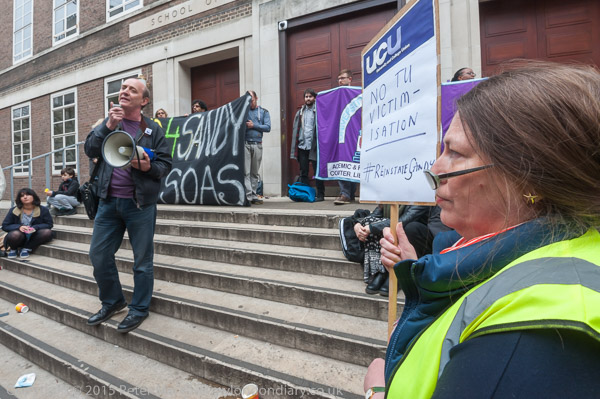
Sandy Nicoll, Unison Branch Secretary
After a rally held on 27th October which I had missed they tried to intimidate the trade unions by suspending Unison Branch Secretary Sandy Nicoll, falsely claiming he had let students into the main building to protest outside the offices of recently appointed SOAS Director Baroness Amos.
The protest on Thursday 29th was held to call for the reinstatement of Nicoll, and there were messages of support for Sandy from colleges and trade unions around the country as well as a long series of speakers who came to give their support in person.
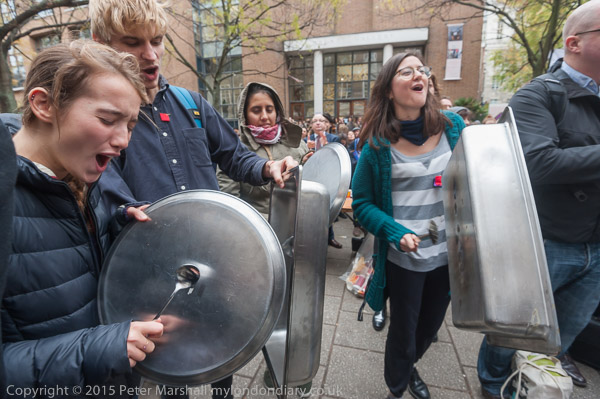
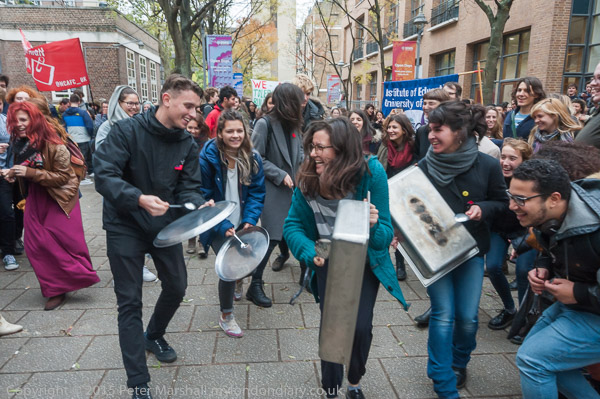
It was a well-attended and noisy protest with much banging on catering pots and pans with Nicoll getting a lengthy welcome before he could speak.
At the end of the rally there was music and dancing, with people taking part in the 'Strikey-Strikey', an adaption of the Hokey-Cokey:
You put your left arm in
Your left arm out
In, out, in, out
You shake it all about
You do the strikey-strikey
And you turn around
That's what it's all about
Woah, the strikey-strikey
Woah, the strikey-strikey
Woah, the strikey-strikey
Knees bent
Arms stretched
Ra-ra-ra...
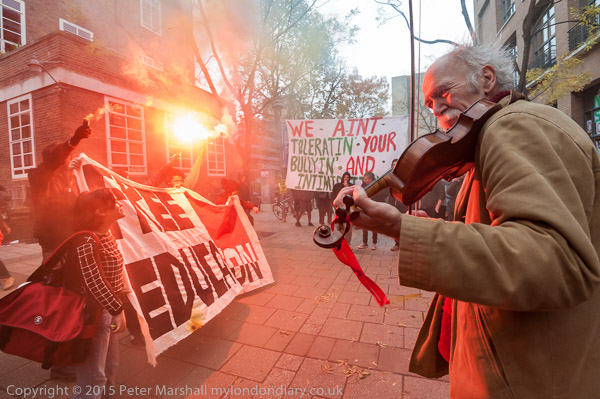
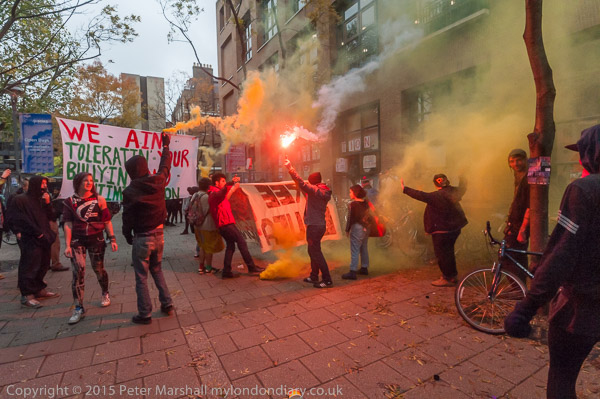
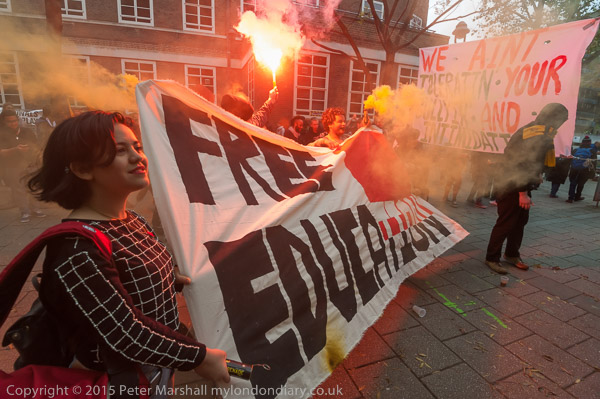
Things appeared to be drawing to a conclusion and I got ready to leave when things livened up a little with people setting off smoke flares as they paraded with banners in front of the occupied building to the music of a violin and drums.
The management finally backed down and reinstated Sandy Nicoll and eventually the occupation came to an end too, with management changing some of its plans but not meeting the main student demands. Dissent continued on campus and there was a further occupation in 2017. There have been some victories, and after a 12 year fight the cleaners became directly employed by SOAS at the end of August 2018.
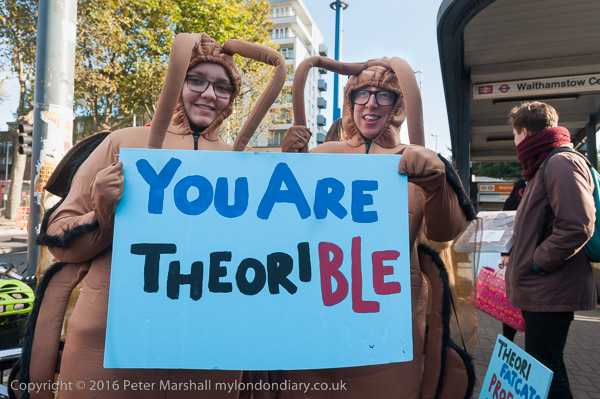
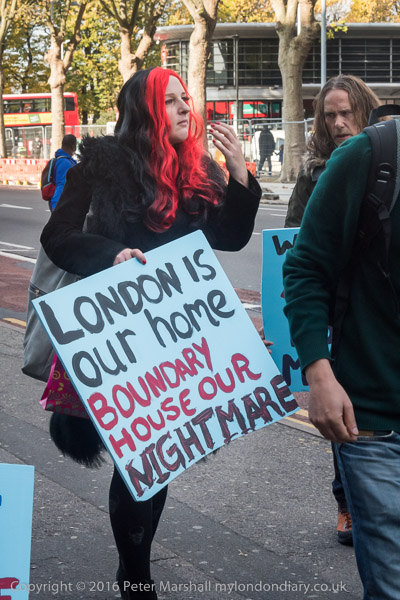
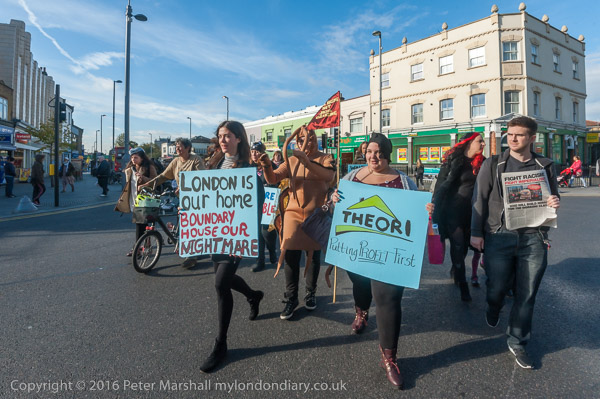
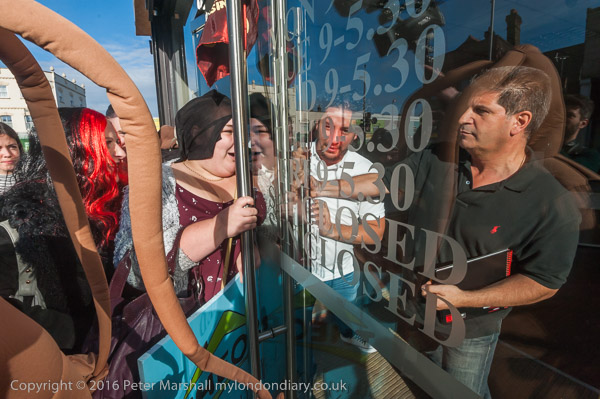
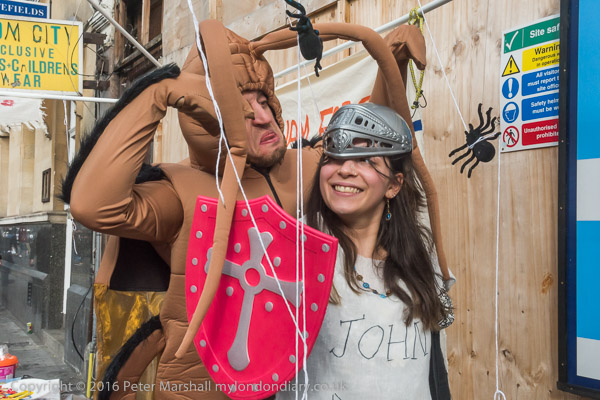
Focus E15 and their cockroaches try to enter the offices of Theori Housing Management
Local authorities have a statutory duty to provide accommodation for families who are homeless or threatened with homelessness, which is described under the 1996 Housing Act and subsequent measures. Many housed under this are placed in temporary accommodation, and this currently includes around 95,000 households across the UK, of which roughly 60% are families with children. Local authorities now spend over a billion pounds a year on this mainly to private providers.
Protesters dressed as cockroaches which infest rooms at Boundary House
Much of this money is spent on accommodation that is unsatisfactory for various reasons, and it often involves placing people outside their local areas, particularly for London boroughs, who currently have over 21,000 households in this situation. The numbers have increased significantly (partly due to Covid) since 2016 when Focus E15 took this action on behalf of families living in rooms in Boundary House, a hostel in Welwyn Garden City which have leaking roofs and mould on the walls, are infested with cockroaches, have upper floor windows that children could easily fall out of and dangerous faulty appliances.
Boundary House in Welwyn Garden City is managed by Theori Housing Management
Theori Housing Management, a private limited company incorporated in 2000 is one of a number of companies which local authorities including including Waltham Forest and Newham make use of to provide temporary accommodation. The campaigners call on boroughs to stop using companies like Theori who provide sub-standard housing and fail to keep it in good order, and say councils should house Londoners in London where they have schools, friends and jobs.
Several residents and former residents of Boundary House were at the protest, but others are scared of being evicted or cannot afford to travel – the return off-peak adult rail fare in 2016 was almost £15. This and the time the journey takes make it almost impossible for those with jobs in London to continue to work. Residents in Boundary House who contact Theori Housing Management with complaints say they are hung up on, placed on hold for hours and called liars, ignored, insulted and patronised.
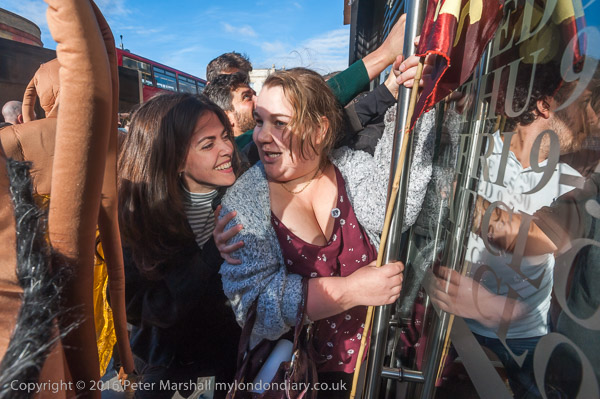
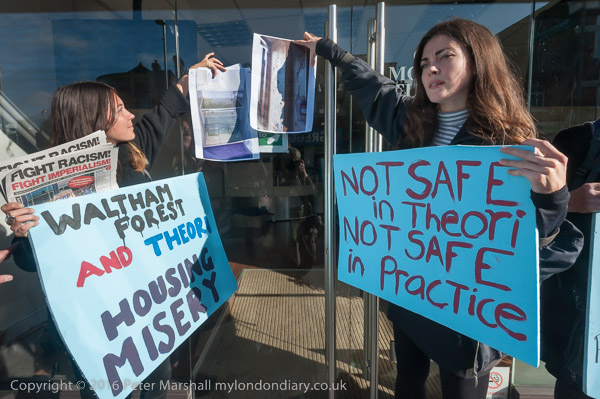
The door of Theori Housing Management is firmly closed against the protesters
They accuse Waltham Forest Council of adopting what can only be called the ‘Nelson’ approach, refusing to see any of the problems at Boundary House and similar properties. Housing departments are hard-pressed by anti-social government policies and cuts in funding, but this is no excuse for their failure to provide decent accommodation – and certainly not for using management companies that fail to provide decent housing and proper customer service.
Protesters with posters and photographs showing the terrible condition of Boundary House
It isn’t about money but about competence, and about a lack of care for those most in need in the community, the people that councils and mayors like Newham’s Robin Wales (now replaced) are on record as saying should not be living in the borough, where vast luxury housing developments are welcome, but social housing is hardly on the agenda.
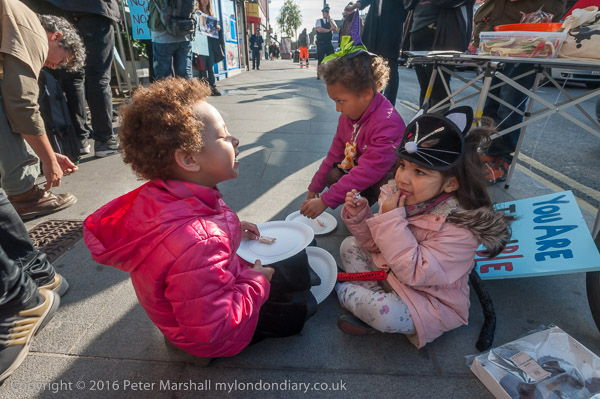
As well as speeches and leafleting there was also a Halloween Party outside the Theori Housing Management office
Focus E15 also point to the Carpenters Estate in Newham, where hundreds of properties in better condition than Boundary House have been empty and boarded up for ten years or more as the council has explored various schemes to sell off what was a popular estate. They say Newham has taken out ill-advised loans which have resulted in incredible repayments of interest.
Five years later most of those properties on the Carpenters Estate remain empty, some since 2005, and Newham Council have recently announced a ballot of the remaining residents on a redevelopment scheme which would involve demolition of around 710 existing homes. The Planning Inspector’s report on the Local Plan to the London Legacy Development Corporation published in April 2020 stated “most residents in the Greater Carpenters area are expressing the wish to remain where they live now and would resist comprehensive redevelopment and the inevitable disruption and community displacement, even if those with a ‘right to remain’ would be invited back later to live in the area”.
Next Saturday, 30th September 2021, I hope to be photographing this years United Families and Friends Campaign annual remembrance procession. Meeting from noon in Trafalgar Square, at 1pm they will march in silent procession along Whitehall, followed by a noisy protest outside Downing Street.
Janet Alder, the sister of Christopher, killed by police in Hull in 1998
“The United Families and Friends Campaign (UFFC) mission is to work collaboratively as a network of independent campaigns to address common issues and concerns related to deaths and abuse in police, penal, mental health and immigration detention; and to organise events and activities that promote awareness and support for affected families across the UK. “
Marcia RIgg, whose brother Sean was killed in Brixton Police station in 2008
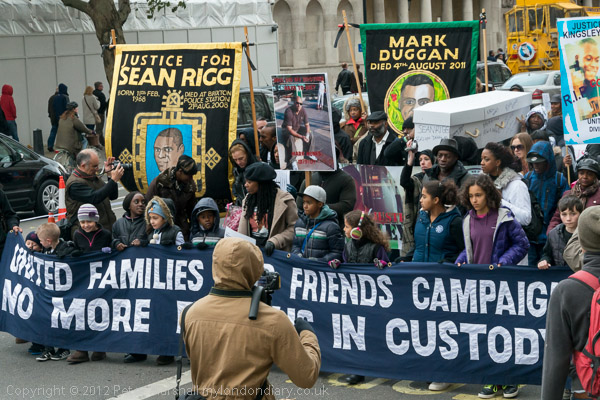
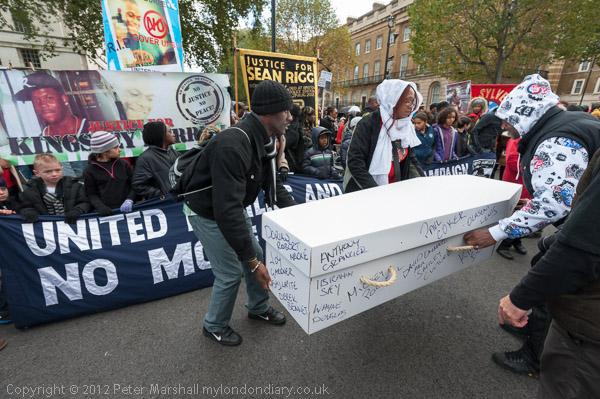
This procession has taken place on the last Saturday of October every year since 1999 to “to remember loved ones who have died in custody” and the UFFC invite all to “Come and support the families of those who have died at the hands of police, prison and secure medical units in the United Kingdom.”
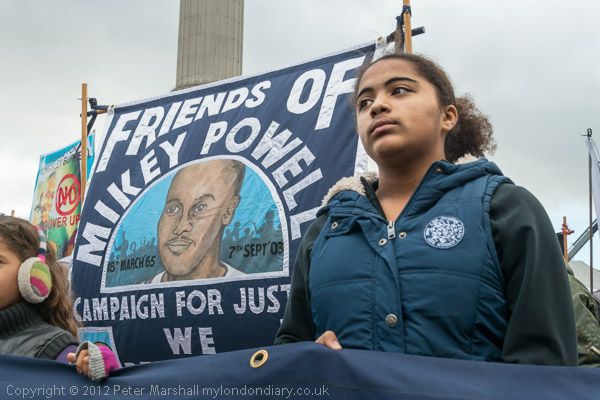
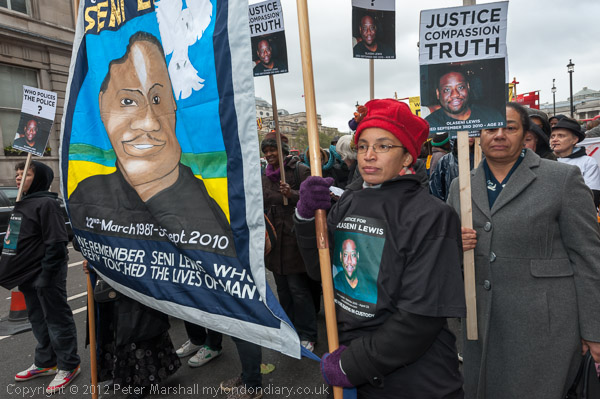
Among the victims are Christopher Alder, Ibrahim Sey, Joy Gardner, Roger Sylvester, Seni Lewis, Adrian McDonald, Darren Cumberbatch, Rashan Charles, Sean Rigg, Jack Susianta, Sheku Bayoh, Mikey Powell, Paul Coker and Cameron Whelan, and many others whose families are among those involved in organising the event.
Seni Lewis, killed in 2010
The invitation to attend states “The UFFC annual procession is supported by: Black Lives Matter UK, 4WardEverUK, Migrant Media, INQUEST, UNISON, RMT, FBU, UNITE, Tottenham Rights, Sisters Uncut, London Campaign Against Police & State Violence, LARAG, Newham Monitoring Project (NMP), Pan African Society Community Forum, Institute of Race Relations, Edge Fund, National Union of Students and DTRTP.”
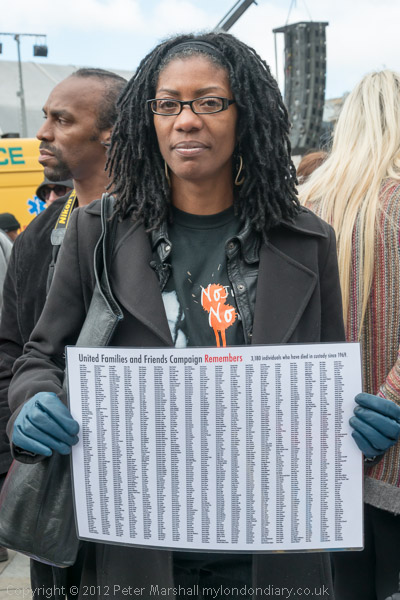
I’ve photographed this event, and been deeply moved by it, most years since I first heard about it in 2003. The pictures with this post are all from nine years ago in 2012 when the protest was on 27th October.
The procession ends with a rally opposite Downing St where family members speak
That year as in all years there were new names to add to the list of 3,180 known custody deaths since 1969, chosen as the date when David Oluwale was killed – and two officers convicted of several assault charges. Since then many of those over three thousand have died in situations where foul play seems obvious, but a Full Fact investigation has found only one single police or prison officer has been convicted of murder or manslaughter or assault related to a death in custody – Sergeant Alwyn Sawyer, convicted in 1986 for the manslaughter of Henry Foley. A few other police officers have been prosecuted but the cases against them have collapsed or they have been found not guilty.
Stephanie Lightfoot-Bennet whose twin Leon Patterson was beaten to death by Manchester Police in 1992
Clearly police and others have difficult jobs, but there needs to be transparency and an intention, still sadly lacking, to get at the truth. The immediate response of the police is still normally to deliberately mislead about the circumstances and to cover up on behalf of the officers involved. It has taken years of dogged and dedicated action by family members, often having to do work the police should have done, overcoming obstacles put in their way for a few families to get to the truth about how their family members died – and sometimes to get inquest verdicts which reflect this. But still not to get justice.
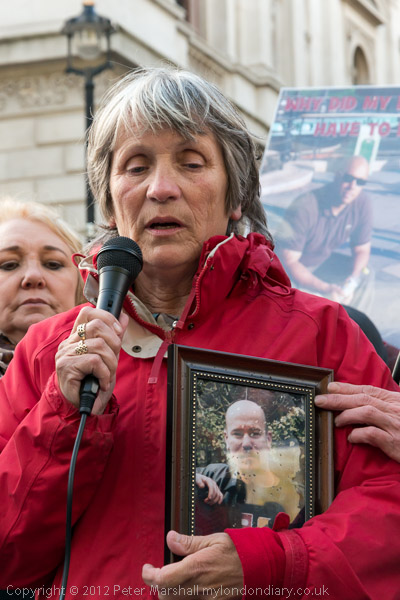
Jan Butler holding a photograph of her son Lloyd, who died in a police cell
As the invitation to the event ends “We look forward to seeing you – No Justice No Peace“. No Justice No Peace is a sentiment that will fill Whitehall on Saturday, echoing from the offices which line the street, but which as in previous years will sadly fall on the deaf ears of our establishment.
Here is a piece I wrote about my activities on Friday 26 October 2007. I’ve adjusted the capitalisation, or rather added it – back then My London Diary (or rather ‘my london diary’) didn’t use capitals, a mannerism I now find rather twee. I think it was trying to adopt a very informal tone, something to differentiate it from more traditionally journalistic publications, in keeping with my aims set out when the site began expressed in a statement often repeated on the site:
a record of my day to day wanderings in and around london, camera in hand and some of my comments which may be related to these – or not things i’ve found and perhaps things people tell me. if I really knew what this site was i wouldn’t bother to write it. it’s london, it’s part of my life, but mainly pictures, arranged day by day, ordered by month and year some of my work gets put into nice organised websites this isn’t meant to be like that
Later My London Diary got rather more organised.
Here’s the piece from 2007 which comes with rather more pictures which you can see starting here:
SIOE fail to attract support – or opposition
Whitehall to Temple, Friday 26 Oct, 2007
Only too often I turn up to photograph advertised events and find that really nothing very much is happening. Usually I’m disappointed, but with the march organised by SIOE (Stop The Islamicisation Of Europe) I’m really rather pleased.
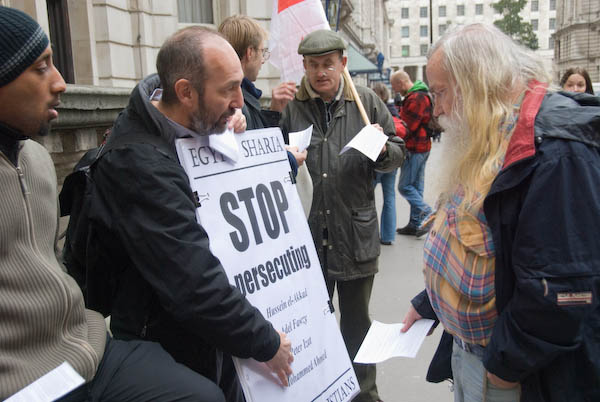
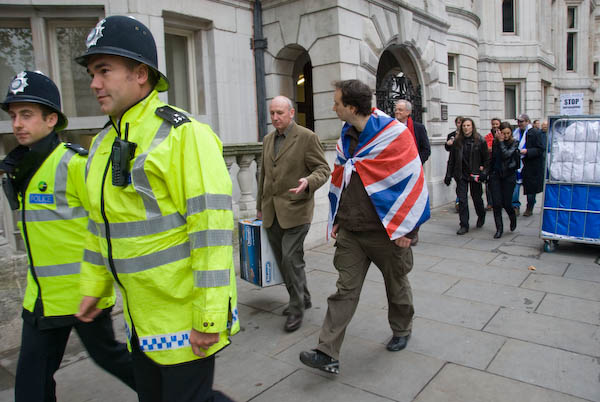
SIOE appears to be two people. There are threes and fours from various other groups, including some from Germany and others from France, making a total of just under 40. My count is 36, the police say 40, making it the only demo where they have ever made a higher figure than me. There are around a dozen still photographers, and just slightly less shooting video, so the media get pretty close to the number of demonstrators.
We’d expected a counter-demo, but it doesn’t happen, though the police stop a couple who seem to be innocent passers-by and hassle them for being vaguely Islamic in appearance at Temple.
So I go to spend a little time in the National Gallery before making my way to Rich Mix, where I’m pleased to see they have got the Paul Trevor show sorted out again, and I can spend 30 minutes looking at some of the best documentary work from the 1970s and 80s – including pictures of several anti-fascist marches I was at – before going to see Brian Griffin and Roof Unit Foundations opening at [space].
And above is one of my four pictures in the Roof Unit Foundations show at [space] in Hackney, taken in Bromley by Bow, on the edge of what later became the Olympic site in 1982. It was an image inspired by Man Ray’s 1920 The Enigma of Isidore Ducasse, itself inspired by a passage in Les Chants de Maldoror, published under his pen name Comte de Lautréamont, ‘Beautiful as the accidental encounter, on a dissecting table, of a sewing machine and an umbrella’. I think my accidental encounter came about in Cooks Road, E15.
The Kilburn State Theatre was built on grounds formerly occupied by houses and since the 1890s by a furniture factory, The Palmerston Works. From 1916 to 1926 it was the home of the Central Aircraft Company which built cheap wooden aircraft and also gave flying courses and joy rides from Northolt Airport. The flights were a great success but although the planes only cost £250 sales were poor and the factory returned to making furniture.
The site was bought by Gaumont and opened in 1937 as the Gaumont State Cinema, designed by George Coles and this now Grade II* listed Art Deco masterpiece has a tower inspired by the Empire State Building in New York and when built had seating for over 4000, making it the largest purpose-built cinema in Europe. You can read much more about it in The Kilburn State Cinema.
Gascony Avenue, Kilburn High Rd, Kilburn, Camden, Brent, 1988 88-5m-64
This wall on the corner of Gascony Avenue and Kilburn High Road was almost totally covered with advertising and branding, including three giant posters for the Invalid Children’s Aid Nationwide, (I CAN), founded in 1888 as the Invalid Children’s Aid Association by Allen Dowdeswell Graham to help poor children in London’s East End who were either seriously ill or handicapped. It is now a national charity for children with speech and language difficulties.
People, Kilburn High Rd, Kilburn, Brent, Camden, 1988 88-5m-51
Walking along the Kilburn High Road with a camera (or possibly two) around my neck attracted the attention of several groups of people on the street, who demanded I take their pictures.
People, Kilburn High Rd, Kilburn, Brent, Camden, 1988 88-5m-66
And I was happy to do so. They were all in a good mood, possibly in some cases helped by a little exposure to Guiness. I think all had good Irish accents.
Posters, Kilburn High Rd, Kilburn, Brent, Camden,1988 88-5m-53
And flyposters on several buildings advertised Irish events in London.
Kilburn Banks Ltd, Springfield Joinery, off Kilburn High Rd, Kilburn, Camden, 1988 88-5m-54
I think the Springfield Joinery was probably at 1Springfield Lane, but no trace of this building remains. Possibly it was where the beer garden of the Old Bell Inn now is. If so it was in the LB Camden.
The Animals War Memorial Dispensary, Cambridge Ave, Kilburn, Brent, 1988 88-5m-46
Animals, particularly horses, dogs, carrier pigeons and donkeys, but also many other species played an important role in the FIrst World War, and many were killed carrying out their duties. After the war the RSPCA proposed a memorial to them, and plans were drawn up for one at Hyde Park Corner but this was never built – though many years later in 2004 one was unveiled on Park Lane. The RSPCA changed its plans and decided on a more practical project, buying this site in Kilburn for The Animal War Memorial Dispensary in 1931.
There are two memorial inscriptions, one on each side of the door, but too small to read in my photograph. They are given in full on the Imperial War Museum web site.
LEFT: THIS BUILDING IS DEDICATED AS A MEMORIAL TO THE COUNTLESS/ THOUSANDS OF GOD’S HUMBLE CREATURES WHO SUFFERED AND/ PERISHED IN THE GREAT WAR 1914 – 1918 KNOWING NOTHING OF THE/ CAUSE. LOOKING FORWARD TO NO FINAL VICTORY. FILLED ONLY WITH/ LOVE FAITH AND LOYALTY THEY ENDURED MUCH AND DIED FOR US./ MAY WE ALL REMEMBER THEM WITH GRATITUDE AND IN THE FUTURE/ COMMEMORATE THEIR SUFFERING AND DEATH BY SHOWING MORE/ KINDNESS AND CONSIDERATION TO LIVING ANIMALS.
RIGHT: 1914 – 1918 THIS TABLET RECORDS THE DEATH BY ENEMY ACTION/ DISEASE OR ACCIDENT OF 484,143 HORSES MULES CAMELS AND/ BULLOCKS AND OF MANY HUNDREDS OF DOGS CARRIER PIGEONS AND/ OTHER CREATURES ON THE VARIOUS FRONTS DURING THE GREAT WAR/ IT ALSO RECORDS THE FACT THAT IN FRANCE ALONE 725,216 SICK AND/ WOUNDED ANIMALS WERE TREATED IN VETERINARY HOSPITALS/ PROVIDED BY THE RSPCA.
Bas-relief, The Animals War Memorial Dispensary, Cambridge Ave, Kilburn, Brent, 1988 88-5m-55
The Grade II listed dispensary is a converted mid-nineteenth century house memorial plaque above the door on the facade of the building is by Frederick Brook Hitch of Hertford who won the competition for the design. The dispensary continued in use until a RSPCA reorganisation in 2016.
Next door to the dispensary is Kilburn’s ‘Tin Tabernacle’, Grade II listed as Cambridge Hall and erected as St James’s Episcopalian Church in 1863. Active as a church until the 1920s it became an “Air Raid Precautions store during the Second World War, and was later known as the Lord Lloyd of Dolobran Memorial Hall. The building was taken over by the Sea Cadets in about 1949, and from then on was known as Training Ship Bicester“. In the 1950s they remodelled the interior as a mock-up of a Ton-Class Minesweeper. It had been built with a spire which was apparently stolen in the 1980s before this picture was taken.
74 Maida Vale, St John’s Wood, Westminster, 1988 88-5m-34
The pineapple was a symbol of wealth and found a place on many gateposts, but 74 Maida Vale is unusual in also having three on the parapet wall. I think the house probably dates from some time between 1829-1840 and that the rooms behind those upper pineapples are a later addition, but have found no specific information about this particular house; although several others on the block are listed this is not.
Four years ago today we were waiting for the start of the COP23 UN Climate Change Conference in Bonn, though for various reasons it didn’t get the same publicity as COP26 coming up shortly in Glasgow. There were certainly fewer hopes of anything positive emerging as it was the first such meeting since Donald Trump had stated he was going to pull the US out of the Paris Agreement.
Those talks were unusual in that although held in Germany (who did most of the organising) they were actually the first hosted by a small-island developing state, with Fiji taking the Presidency.
As usual at such events, not a lot was achieved, with the US decision dominating much of the business in various ways. Syria announced that it would sign up to Paris during the event, leaving the US as the only country in the world saying it would not honour the agreement. And the US withdrawal made China a rather more important player.
Britain actually took part in the one major positive outcome, coming together with Canada to launch the ‘Powering Past Coal Alliance’, calling for the phasing out of coal in OEC and EU countries by 2030 and in the rest of the world before 2050. Unfortunately none of the major coal producing countries signed the pledge.
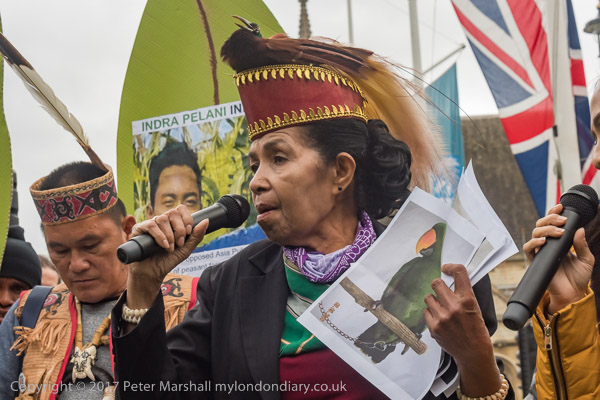
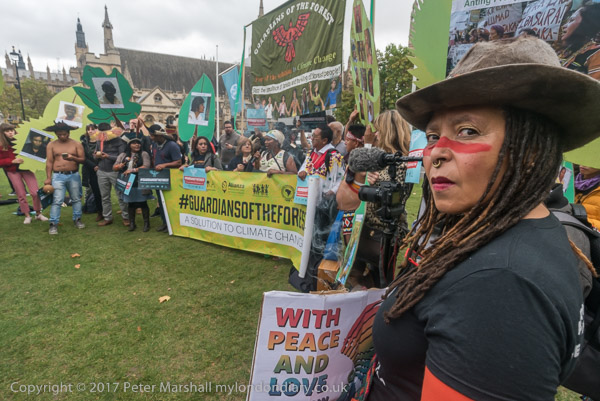
The Guardians of the Forest, indigenous leaders from Latin America, Indonesia and Africa, had stopped off in London on their way to Bonn and held a rally in Parliament Square to commemorate those who have lost their lives defending the forests against mining, the cutting down of forests for palm oil production and other crops and other threats to the forests and those who live in them.
Many companies listed on the London Stock Exchange are among those responsible for damage to the forests and the murder of indigenous people in search of profits, with whole tribes forcibly removed from their homes and their rights to the land they have lived in for many generations ignored.
Increasingly we are becoming aware of the importance of forests as sources of oxygen and in removing carbon dioxide and so combating global heating and the need for proper stewardship of these huge natural resources – rather than their destruction for short-term profit. Indigenous people have maintained them for hundreds or thousands of years in a renewable manner and their knowledge and continuing maintenance has a vital part to play in the fight against climate change.
Safe Passage
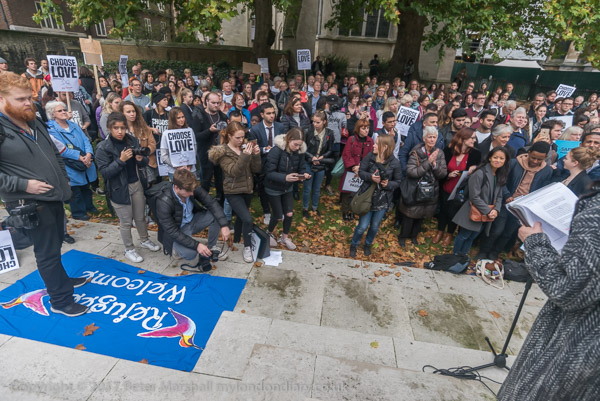
Earlier I’d photographed a rally by Safe Passage on the anniversary of the destruction of the Calais Jungle. Although around 750 child refugees had been brought here from France, they urged the government to provide safe and legal routes for the hundreds of refugees still living in Calais, many sleeping rough in terrible conditions.
Lord Alf Dubs
In particular they called on them to fill the remaining 280 places allocated under the Dubs law to children but not yet filled 18 months after Parliament passed the law. Many of those still in France are entitled to come here to be reunited with their family and they called on the Home Office to have an official in France to aid their transfers.
West Kilburn Baptist Church, Carlton Vale, West Kilburn, Brent, 1988 88-5l-33
My wanderings around Kilburn Park had taken me back through the South Kilburn Estate to Carlton Vale and this fine example of a Baptist Church, built for the Rev Thomas Hall in 1865. Money was tight, but his brother who was an architect worked on the plans without payment. According to the Commemoration Booklet issued for its centenary the foundation stone was laid on ‘Several coins of the Realm bearing the portrait of her most Gracious Majesty Queen Victoria – one shilling, one sixpence, one halfpenny‘ and ‘the text, “Other foundation can no man lay than that is laid, which is Jesus Christ” (1 Corinthians 3:11).’ Six years later, the church still owed £380 of the £1250 it cost to build.
Willesden Lane, Brondesbury, Brent, 1988 88-5l-21
From Carlton Vale I continued northwest up Salusbury Road then turned right along The Avenue in Brondesbury to reach Willesden Lane opposite this house which is numbered as 66 Cavendish Rd, although this frontage is on Willesden Lane. This house struck me as having a intriguing individuality, although certainly not great architecture, incorporating several distinct variations of style and a rather oddly situated small window. Currently divided into around 13 small flats a planning application has been submitted to demolish it and use the site with its long garden along Willesden Lane to build a new 5 to 6 storey building with 21 flats.
Lawrence & Aitken , incorporated in 1927 but founded earlier and now dissolved, filed its last accounts in 1990. It gave the nature of its business as “Manufacture of other articles of paper and paperboard n.e.c. -” and was said to employ five people. The works date from 1904 and were built for cardboard makers Lawrence & Aitken under an agreement with the Simms Manufacturing Company Limited which is reproduced (but very hard to read) on the RAC website. The works is still there, though the building on the right has been replaced by housing called Kimberley Court.
Willesden Lane, Brondesbury, Brent, 1988 88-5l-24
In one of those mysteries that I’ve sometimes come across, the extension at left to J Green’s shop at 136 Willesden Lane has grown to the same height as the rest and the building is now wider, having four windows at first and second floor levels and a new floor on top while retaining the Graeco-Egyptian style of the original.
Both 134 and 136 were built for John Cramb, monumental mason supplying many monuments in the cemetery opposite, 134 in 1896 designed by George Neal and 136 by F C Dare in 1883-1884 . Both are locally listed.
Willesden Lane, Brondesbury, Brent, 1988 88-5l-26
These shops are still there but I think all now different businesses. So many flats and shops were for sale in 1988.
Willesden Lane, Brondesbury, Brent, 1988 88-5l-12
Missing ‘O’, ‘M’, ‘B’ and ‘G’ perhaps made this frontage more interesting.
The National Club, Kilburn High Rd, Kilburn, Camden, 1988 88-5l-13
In 1910 after the death of its owner, The Grange, a large house with extensive grounds on Kilburn High Road was sold to Oswald Stoll, the owner of the London Coliseum, who began building a theatre here. By the time it opened in 1914 his plans had changed and it became the Grange Cinema, with over 2,000 seats.
The cinema closed in 1975 and was opened as Butty’s Club and Dance Hall by Kilburn Irish publican Michael ‘Butty’ Sugrue, and later in 1976 also became the Kilburn National Club, owned by three local brothers who were builders, originally from Tipperary. The club was a major music venue, where stars including Johnny Cash and David Bowie played (there is a longer list here, along with more detailed information about the site.)
Applications to demolish the building were turned down in 1991 as English Heritage had listed it earlier in the year, as was another application in 1993. After the National Club closed in 1999 the building remained empty until it became the Victory Christian Centre in 2001 – but the church was closed in 2002 by the Charity Commission who didn’t approve of Pastor Goodman’s extravagances on expensive holidays and cars and a house in Northants. In 2003 it became a site of the worldwide Universal Church of the Kingdom of God.
The Secondhand Furniture Shop, Kilburn High Rd, Kilburn, Brent, 1988 88-5l-15
An interesting example of a window display.
Loveridge Rd, Kilburn, Camden, 1988 88-5l-16
A few yards east of Kilburn High Rd the Underground – here decidely overground – goes across Loveridge Rd. I liked the washing hanging over Loveridge Mews, not something often found across a London street.
Confusingly, the boundary between the London Boroughs of Camden and Brent runs down the Kilburn High Road, splitting Kilburn in two. I’m sure there are still some pictures in the album where I’ve indicated the wrong borough.