Art School Nude to Hospital Tower

The final set of pictures from my walk on 27th January 1989. The previous post on this walk is The Workhouse, Town Hall, Council Offices and Art School.

Sculpture, South London Gallery, The Passmore Edwards South London Art Gallery, Peckham Rd, Camberwell, Southwark, 1989 89-1g-26
Nude, South London Gallery, The Passmore Edwards South London Art Gallery, Peckham Rd, Camberwell, Southwark, 1989 89-1g-26

A bronze nude by Karel Vogel was at the entrance to the gallery, and in 1989 seemed under threat by the tree emerging behind. I think both the sculpture and the tree behind it have gone although a large tree closer to the road remains. Vogel, (1897-1961) was a Czech sculptor who came to England fleeing the Nazis in 1938 and taught at the Camberwell School of Arts and Crafts from 1948, and became in charge of the School of Sculpture there.

Perhaps his best-known work in this country is his 1959 Leaning Woman, Grade II listed in 2016, situated close to the A4 by St Peter’s Church in Hammersmith.

The London Institute, Camberwell College of Arts, Peckham Rd, Camberwell, Southwark, 1989 89-1g-11

The Art School and gallery designed by Maurice Adams was built in 1896-8 is Grade II listed. It’s extravagantly baroque exterior includes a number of caryatids in supporting roles. ‘The Buildings of South London’, page 620, describes the 1960 addition at left by Murray, Ward & Partners as “totally unsympathetic” and it is certainly and doubtless intentionally a complete contrast. But it deserves to be seen and judged on its own.

Guardians Offices, London Borough of Southwark, Havil St, Camberwell, Southwark, 1989 89-1g-14

The Havil Street frontage of the Poor Law Guardians building whose frontage on Peckham Road featured in the previous post in this series. It was built in an vaguely Art Nouveau style in 1904. I found the octagonal building with the rectangular blocks behind with its rhythmic patterns of windows and odd towers, together with the odd street wall, its curves echoed by the hood around the doorway quite enchanting.

St Giles' Hospital, Havil Street, Camberwell, Southwark 1989-1g-15
St Giles’ Hospital, Havil Street, Camberwell, Southwark 1989-1g-15

In 1889-90 a new 4-storey ward tower fronting onto Havil Street was opened for the Camberwell Workhouse Infirmary, later St Giles’s Hospital. Circular in design (which was fashionable at that time), it had cost about £14,500. Each storey contained 24 beds radiating around a central shaft, in which heating and ventilation services were located. This Grade II listed building is now flats. The pile of rubble behind the wall is from the demolition of unlisted hospital buildings.

St Giles' Hospital, Havil Street, Camberwell, Southwark, 1989 89-1g-16
St Giles’ Hospital, Havil Street, Camberwell, Southwark, 1989 89-1g-16

Another view of the hospital tower seen from Havil Street. Designed by Robert P Whellock it is Grade II listed. This was the last picture I took on Friday 27th January 1989, but two days later, Sunday 29th I came back here to begin another walk, beginning with more pictures here and a little further along Havil Street and I’ll include these here.

St Giles' Hospital, Havil Street, Camberwell, Southwark, 1989 89-1h-02
St Giles’ Hospital, Havil Street, Camberwell, Southwark, 1989 89-1h-65

Much of the former St Giles Hospital was in 1989 a demolition site with just the listed buildings being left standing. The area is now filled with rather dreary housing with two and three storey solid-looking blocks around ‘St Giles Tower’. I think this picture was taken from the corner of Brunswick Villas, just after I had made a picture (not on-line) of the Grade II listed Bethel Asylum for aged women founded by William Peacock in 1837 at 159-163 Havil Street.

House, Brunswick Villas, (Brunswick Rd) Camberwell, Southwark, 1989 89-1h-62

I walked up Havil Street to the corner with Brunswick Villas, formerly Brunswick Road as the stone pillar still asserts. These houses are presumably a part of W J Hudson’s Brunswick Park development begun in 1847, though rather less grand than some.

From here I made my way towards Peckham – where my next series of posts on my walk on 29th January will begin.


My posts on this walk on 27th January 1989 began at St George’s, Camberwell, Absolutely Board & Alberto.


The Workhouse, Town Hall, Council Offices and Art School

More pictures from my walk on 27th January 1989. The previous post on this walk is
Baptist Chapel, Fine Houses, A Queen And A Hospital.

Guardians Offices, London Borough of Southwark, Peckham Rd, Camberwell, Southwark, 1989 89-1g-55

I walked down St Giles Road to the Peckham Road, turning east along it. At the end of the block on the corner of Havill Street is the former Guardians Offices built in an vaguely Art Nouveau style in 1904 for the Poor Law Guardians who ran the workhouse of which it was part. The sundial has the text ‘Do Today’s Work Today‘. The building is Grade II listed.

Under the 1929 Local Government Act the LCC took over the workhouse and infirmary buildings on the site and the same act abolished the Board of Guardians system in 1930. Many workhouses were redesignated as Public Assistance Institutions but Camberwell’s became St James’s Hospital and these offices became the Divisional Health Offices. Southwark Council inherited the building in 1966 but closed its offices here when it moved to Tooley Street in 2009. The building was bought in 2010 by homelessness charity Thames Reach who use it as an Employment Academy. There is also a cafe and tea room on the Havill Street side as well as a Montessori Nursery on the site.

Guardians Offices, London Borough of Southwark, Peckham Rd, Camberwell, Southwark, 1989 89-1g-45

A wider view of the building, still then in use by Southwark Council.

Camberwell Town Hall, Peckham Rd, Camberwell, Southwark, 1989 89-1g-56

On the east corner of Havill Street is the former Camberwell Town Hall designed in a Classical style by Culpin and Bowers and opened in 1934. It became the town hall for the London Borough of Southwark when this was created in 1965 and was still this when I took my picture. They sold it to a developer in 2009 when the council moved to Tooley St and it was converted into student accommodation for Goldsmiths College.

South House, 30-32 Peckham Rd, Camberwell, Southwark, 1989 89-1g-41

This row of houses are Grade II listed and were built as separate houses ca 1790. Like the council offices across the road they were also in use as council offices until around 2010 with the house and have also been converted into student accommodation, with a total of 125 bedrooms in the three blocks including also listed Central and East Houses on the north side of Peckham Road and South House.. Joined to them the east end of the block (out of picutre at left) is still the Southwark Register Office.

34 Peckham Rd, Camberwell, Southwark, 1989 89-1g-33
Southwark Register Office, 34 Peckham Rd, Camberwell, Southwark, 1989

Southwark Register Office is also Grade II listed and was built around 1790. At some unknown date it was liked to No 32 at right at second floor level, with the curious rooftop extension you see here. Presumably the tall archway in the middle had some purpose, and was possibly at one time without the lower wall and arch. Perhaps giraffes were kept in the gardens behind? Suggestions are welcome in the comments here or on Flickr.

The London Institute, Camberwell College of Arts, Peckham Rd, Camberwell, Southwark, 1989 89-1g-23

John Passmore Edwards gave money for the erection of the South London Gallery and the College, architect Maurice Bingham Adams, in memory of Lord Leighton. The gallery opened in 1891 and the Technical Institute in 1898. It became one of England’s leading art schools particularly after WW2. The Camberwell School of Arts and Crafts became a part of the London Institute formed by ILEA in 1986 and in 1989 it became Camberwell College of Arts becoming a part of the University of the Arts London in 2004.

South London Gallery, The Passmore Edwards South London Art Gallery, Peckham Rd, Camberwell, Southwark, 1989 89-1g-25

The Camberwell School of Arts and Crafts became one of England’s leading art schools particularly after WW2. It became a part of the London Institute formed by ILEA in 1986 and in 1989 it became Camberwell College of Arts becoming a part of the University of the Arts London in 2004.

My next post will start with a couple more pictures of Camberwell College of Arts before taking a walk up Havill Road.


My posts on this walk on 27th January 1989 began at St George’s, Camberwell, Absolutely Board & Alberto.


Baptist Chapel, Fine Houses, A Queen And A Hospital

More pictures from my walk on 27th January 1989. The previous post on this walk is St George’s Tavern and North Peckham 1989

Cottage Green, Camberwell, Southwark, 1989 89-1g-01

Robert Browning the Victorian poet (1812-89) was born in Rainbow Cottage, Cottage Green and grew up in the area – there is a Rainbow Street not far away but the cottage is long gone. But the area still felt a little out of place in the middle of twentieth century London.

The tree is still there on the corner with Wells Way and so too is the chapel down the street and the house beyond on the corner of Southampton Way. At right the brick wall and fence remain, but the site behind, not visible here, has been sold for development. I’m not sure why the foreground railings on the pavement edge were there, but they are now no longer. At left instead of the corrugated iron there is now housing almost up to the pavement and the 11 storey block facing the end of the street has been replaced by flats of half the height.

Browning’s parents – his father was a clerk at the Bank of England on what was for the time a pretty decent salary – moved a few yards to Hanover Cottage on Coleman Rd when he was around 12, and there is a more or less illegible stone plaque on a wall of the shop on the corner of Southampton Way and Coleman Road with a more recent Southwark blue plaque higher up.

Cottage Green Baptist Chapel, Camberwell, Southwark, 1989 89-1g-61

The chapel was built in 1844 and became a Baptist chapel ten years later in 1854. Owned by the Copleston Centre, a Peckham Community Church in Copleston Road it has been in use as a Christian nursery, the Destiny Day Nursery registered in 2007.

When I took this picture is still in use as a Baptist chapel. The commercial building beyond the chapel is still there as is the brick building at left, though the fences have been replace by a low brick structure, perhaps a bin store.

Cottage Green Baptist Chapel, Camberwell, Southwark, 1989 89-1g-62

A second picture gives a clearer view of the church noticeboard with its message ‘SUNDAY FAMILY SERVICE 11.00AM’. I would like to know more about the windowless building to the right.

Haulage Yard, Housing, Southampton Way, Camberwell, Southwark, 1989 89-1g-63

The houses at 73-77 were built in the early 19th century and are Grade II listed. A planning application was made in 2021 for the development of the yard which has an ‘L’ shape behind the houses on Southampton Way to another entrance on Cottage Green, opposite the chapel and next to another listed building, Collingwood House at 1-3 College Green – which I did not photograph.

Brunswick Park area, Camberwell, Southwark, 1989 89-1g-64

I think these houses are near Brunswick Park, but cannot identify the exact location. There are a number of houses of a similar mid-Victorian age and style in the area which was developed by W J Hudson who bought the area in 1847, naming the open space in the centre after the estranged wife of George IV, Caroline of Brunswick. Long separated from her husband she had become a very popular figure by the time he became king in 1820 and died (possibly not naturally) shortly after his coronation in 1821.

The garden at the centre of the square was bought by the Metropolitan Borough of Camberwell in 1901 and opened to the public as a park in 1907.

Brunswick Park, St Giles Rd, Camberwell, Southwark, 1989 89-1g-66

Finding the exact location of photographs I took 33 years ago is much easier when they include street names as this picture of houses on the corner of Brunswick Park does. Princess Caroline of Brunswick-Wolfenbüttel was the daughter of George III’s sister and had a surprising introduction to this country as she first landed at Greenwich at what was then the Royal Hospital for Seamen and asked “Are all Englishman missing an arm or a leg?

The future George IV married her for her money and for the need to provide the country with an heir. She was “short, fat, ugly and never changed her undergarments, and rarely washed. Her body odour was overwhelming.” George had already made a secret and illegal marriage to the beautiful but Roman Catholic Maria Fitzherbert around ten years earlier, but as he had not had his father’s consent for this, the second marriage was not bigamous. Both George and Caroline got very drunk at their wedding and somehow despite their mutual repulsion a daughter and heir Princess Charlotte was born the following year.

The couple separated shortly after. George made a number of unsuccessful attempt to divorce her, including setting up a Royal Commission called the ‘Delicate Investigation’ which failed to find evidence of adultery, possibly because their heart wasn’t really in it, perhaps due to the overwhelming evidence against George.

Caroline left Britain in 1814 for Europe, shocking people in various countries by her behaviour (which included often appearing in public with her dress open to the waist, dancing topless in Geneva and becoming the mistress among others of Napoleon’s brother-in-law.)

When George became king in 1820 as they were still married she was automatically queen consort and decided to return to Britain. The government tried to bribe her, offering her £50,000 to stay away, but she came back and set up house in Hammersmith. She was very popular with the public (at a distance) many of whom were disgusted by her husband’s immoral behaviour, both towards her and with his various mistresses. A mob surrounded Parliament daily when the House of Lords tried for over 7 weeks to dissolve her marriage, eventually forcing them to abandon the attempt.

Uninvited, she tried to attend George IV’s coronation in 1821, but had the door of Westminster Abbey slammed in her face. She died 19 days later, convinced she had been poisoned. It seems more than likely this was so.

St Giles Hospital, Flats, St Giles Rd, Camberwell, Southwark, 1989 89-1g-52

St Giles Hospital was opened in 1875 as the Camberwell Workhouse Infirmary and blocks were added here on St Giles Rd (then Brunswick Rd) around 1900. In 1913 it became the Camberwell Parish Infirmary and in 1930 it was taken over by the London County Council. On joining the NHS in 1948 it became St Giles’ Hospital. It closed in 1983 and the blocks here were converted into flats.

St Giles Hospital, Flats, St Giles Rd, Camberwell, Southwark, 1989 89-1g-54

Another picture from the four I made of the former hospital in St Giles Road on the east side of Brunswick Park. I walked down the road back to Peckham Road, where my walk will continue in a later post.


My posts on this walk on 27th January 1989 began at St George’s, Camberwell, Absolutely Board & Alberto.


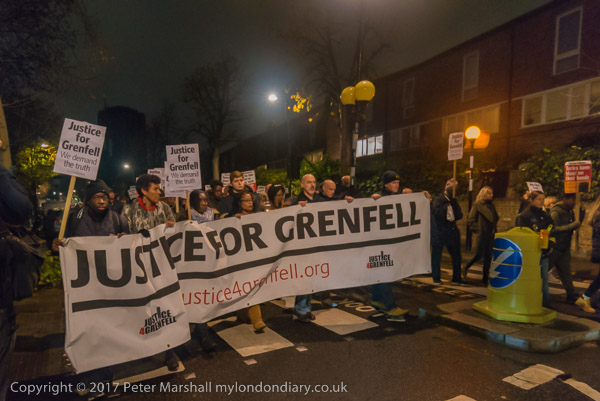
Grenfell Silent March – 14 Nov 2017

Grenfell Silent March - 14 Nov 2017

On the 14th of each month my thoughts turn at least for a short while to 14th June 2017 when a fire broke out in the 24 storey block in North Kensington. Instead of being confined to a single flat as the original design intended, flammable cladding wrongly applied on the outside of the building led to a rapid spread which engulfed the tower, killing 72 of those inside.

Grenfell Silent March - 14 Nov 2017
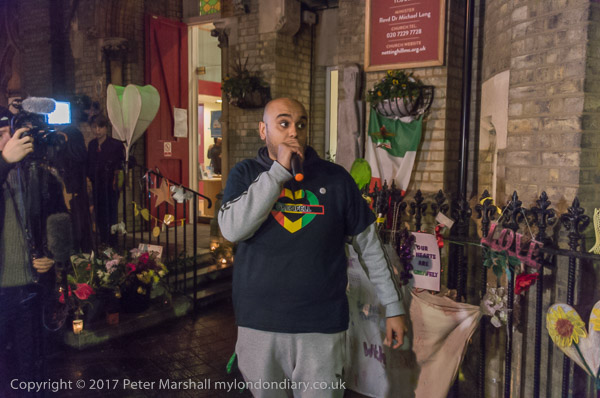
March organiser Zeyad Cred

The public inquiry into the tragedy ended a few days ago, with the lead counsel Richard Millett KC stating that the risks that led to the fire were well known by many of the organisations involved and should have been known by all. He said the inquiry should decide with confidence that all 72 deaths were avoidable, and criticised the many organisations which had been more concerned with trying to evade any legal responsibility for the fire and blame others rather than assist the inquiry.

Grenfell Silent March - 14 Nov 2017
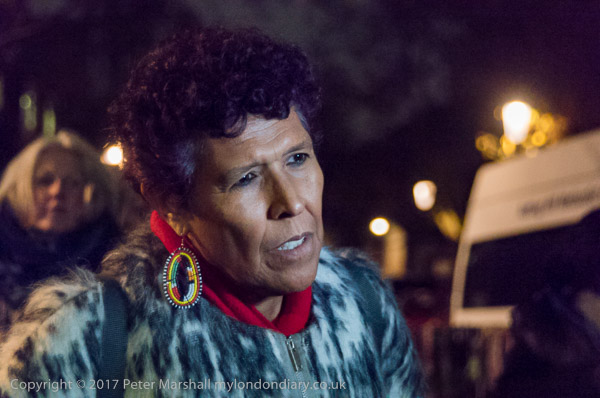
Moyra Samuels, a teacher at a school close to Grenfell Tower and a leading member of Justice4Grenfell

The BBC report lists some of those responsible, with a diagram of the web of blame, including the companies who manufactured the cladding, those who designed their installation and fitted them, the fire safety consultants, the local council and the government who had set up a broken building safety system.

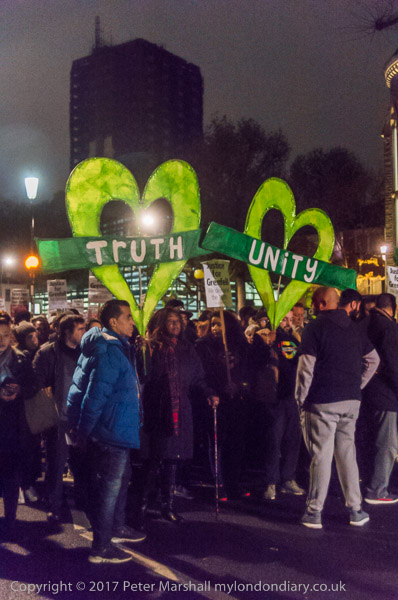
Behind the marchers the burnt out shell of Grenfell

A report from Sky, Grenfell survivors insulted as long-running inquiry comes to close, looks at the effects on some of the residents and their views and including that of barrister for the bereaved and survivors Imran Khan KC, who points out that 85% of those who died were from minority ethnic communities and raises the question of the “institutional or structural or systemic racism” that lay behind the treatment of the tower before the tragedy and of the survivors.

Grenfell United issued a long statement via Twitter in response to the closing statements from the inquiry. In it they point out that none of the recommendations of the first phase of the inquiry has yet been implemented. They say that the government had ignored previous warnings about the dangers caused by deregulation and that Government Ministers were still advocating for deregulation.

They criticise the London Fire Brigade also because the critical recommendations from the Lakanal House fire in 2009 were then incompletely put in place – and they should have lifted the ‘stay put’ advice once it was clear the fire was uncontrollable.

The Royal Borough of Kensington & Chelsea they say “treated us like second class citizens. They refused to invest in Grenfell Tower for 30 years, and when they did they wrapped it in petrol.” The also blame them for colluding with their landlord who bullied them, “ignored our fire safety concerns and treated our lives like a game of monopoly.

Their statement also describes briefly the failures of Kingspan, Arconic and Celotex and points out that as yet there have been no consequences. They say the justice system protects the powerful and prevents justice. “From Aberfan, to Hillsborough, justice has been denied and Grenfell is no different.

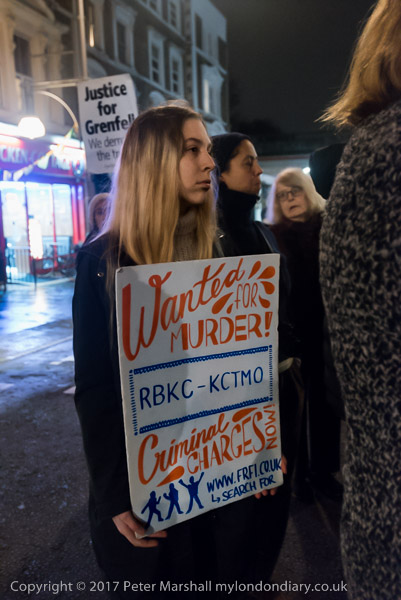
They hope the final inquiry report will bring real change and that the Metropolitan Police and CPS will bring “the necessary criminal charges … and prove to us that there is not a two tier justice system.”

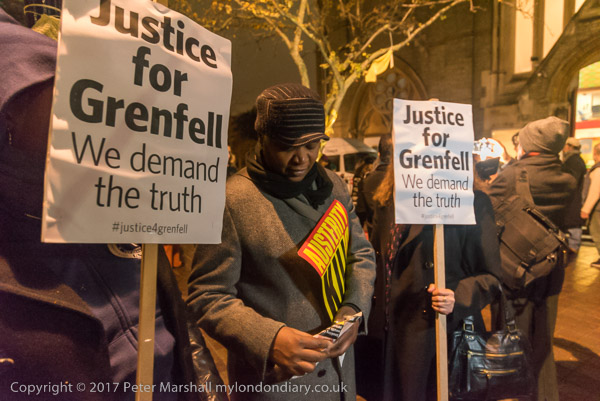
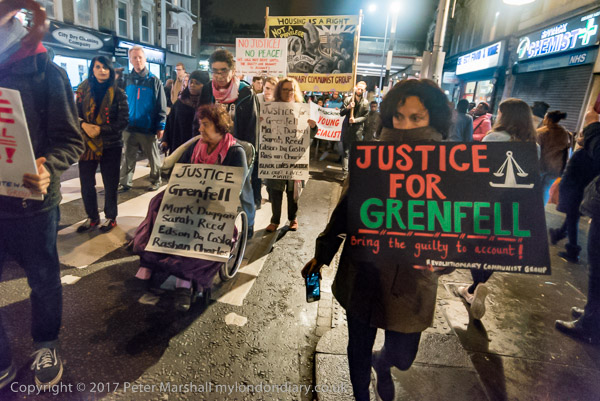
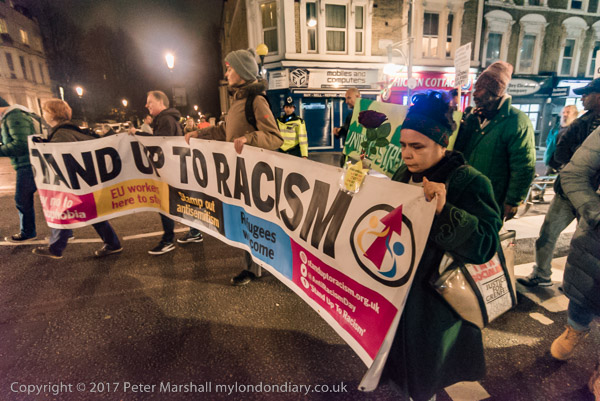
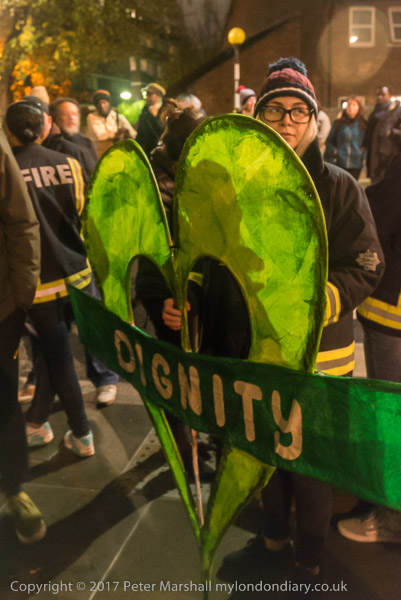
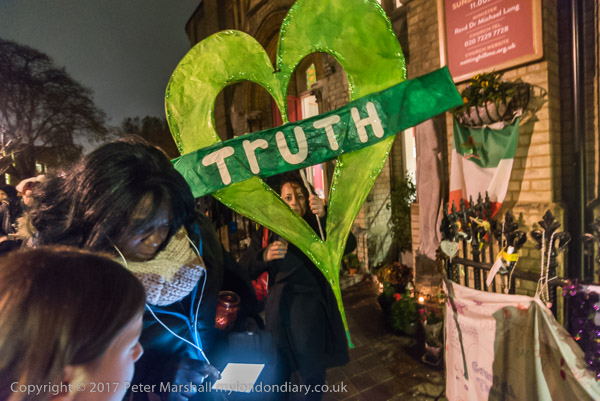
On Tuesday 14th of November 2017 I joined the large crowd which met at Notting Hill Methodist Church for the monthly slow and silent walk to demand justice and remember those killed in the tragic fire. At the front of the march were large green hearts calling for Truth, Unity and Justice and many others carried placards calling for justice and truth.

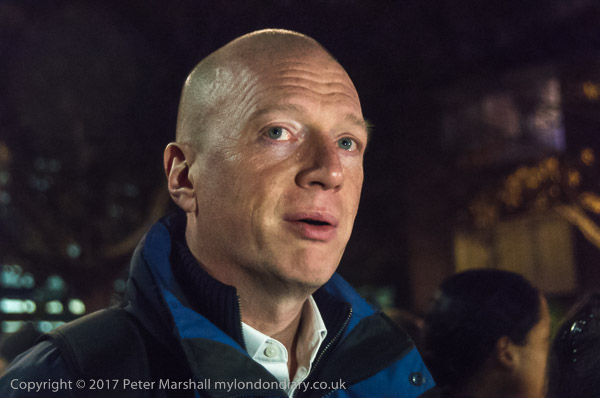
Matt Wrack

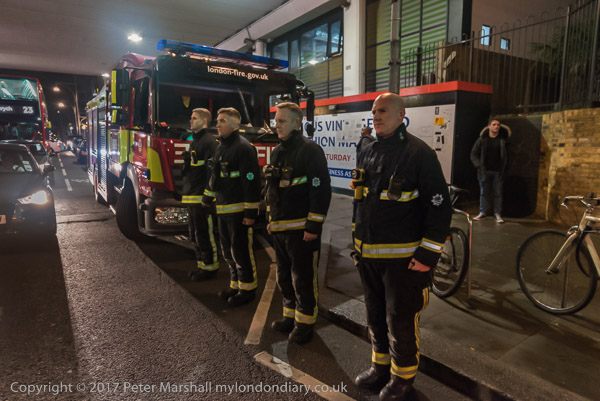
Among those marching were a group of firefighters including FBU General Secretary Matt Wrack, and more firefighters stood by the side of the road beside there fire engine close to Ladbroke Grove station. Whatever the criticism of the fire brigade, the firefighters who came to Grenfell showed great bravery and worked to exhaustion to rescue many of the survivors unable to make their way out unaided.

The march went on to the Maxilla Centre, but that was a occasion for the local community and not for the press, and I stayed on Ladbroke Grove taking pictures until the end of the procession had passed me, then made my way home.

More at Silent Walk for Grenfell Tower.


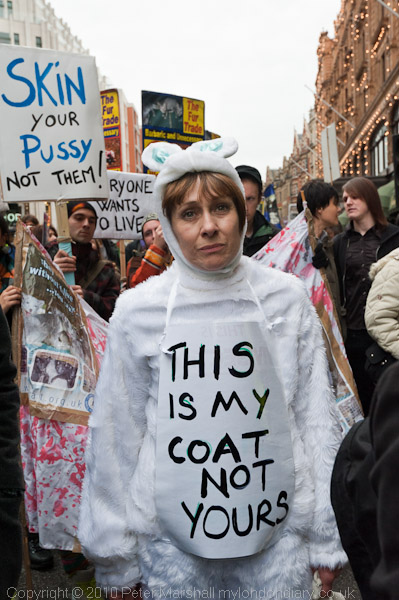
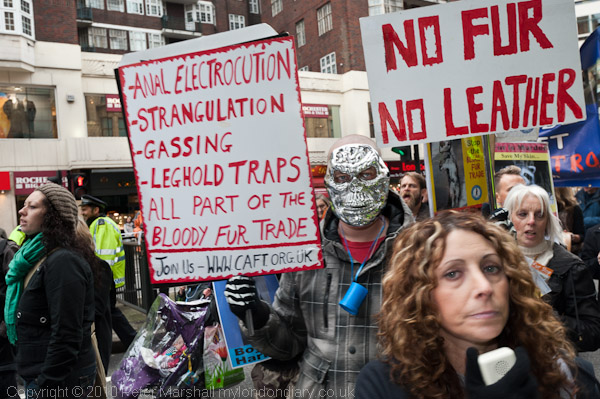
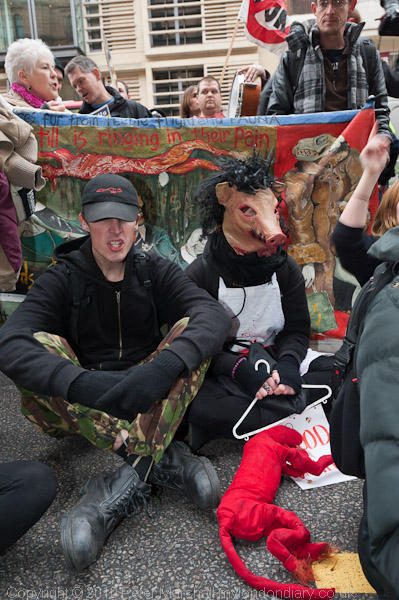
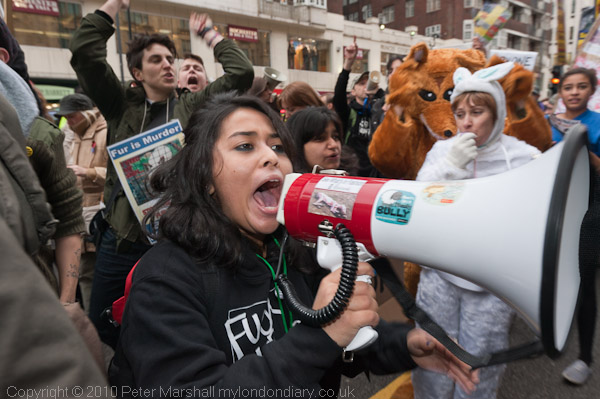
Fur Kills – Harrods Protest 2010

Fur Kills - Harrods Protest 2010

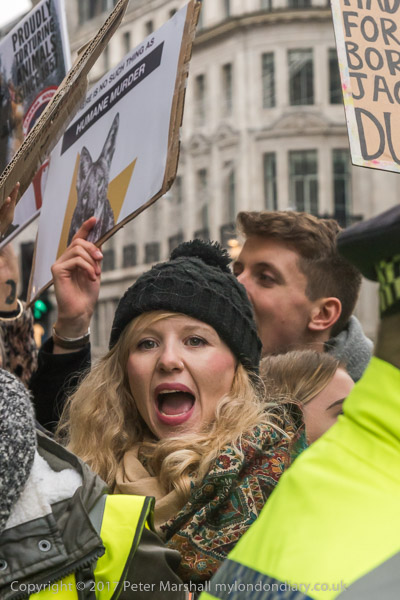
Back when we lived in caves and hunted animals for food it made sense to use their skins and fur for clothing. Even before the wide availability of synthetic materials in the second half of the last century fur there were still some functional reasons for using fur. And though it is possible to imagine that fur animals could be farmed without excessive cruelty, it seems very doubtful if this has ever actually taken place. The idea of ‘ethically sourced fur’ seems a nonsense – you can read how fur is acutally produced in one of mny articles on the PETA web-site, Inside the Fur Industry: Factory Farms.

Fur Kills - Harrods Protest 2010

But fur was a luxury item, one that signified wealth and privilege. A mink coat was something for women to aspire to, something that advertised their success in the world, though for those of us in the poorer areas it was often regarded as being all “fur coat and no knickers” marking out its showy and seemingly elegant wearer as vulgar and sexually immoral.

Fur Kills - Harrods Protest 2010

Our dressing-up box as kids – all from jumble sales – included a moth-eaten red fox scarf complete with head and tail. It smelt strongly, though perhaps not of fox. But the fox trims on my mothers’ coats owed their life to crude petroleum rather than any any living animal.

I’m not a fan of foxes. I’ve seen what they do in a chicken run, and it isn’t pretty. Last year I left a recently bough expensive pair of boots outside our back door overnight and one of our local foxes came and took a bite out of them – and they leave foul-smelling excrement on our yard to attract the unwary shoe. Of course I’m against hunting, but would certainly support measures that cut there populations perhaps by eliminating the waste food that has powered their growth thanks to fast-food outlets and fining those urban dwellers who leave out food for them.

But we don’t need fur for clothing. And I’m shocked to find real fur coats and scarves still being sold in shops and on-line. I’d even be in favour of banning the sale of ‘vintage fur’ as this perpetuates the idea of fur as a luxury that sustains the cruelty to animals of producing new fur. And I don’t believe there is such a thing as ‘ethically sourced fur’ which shops including Harrods continue to push.

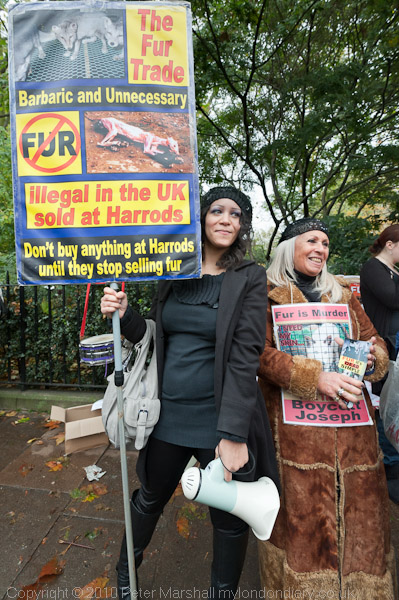
As the Coalition to Abolish the Fur Trade pointed out in 2018: “Harrods is one of only two department stores in the UK which continues to sell real fur, even though the production of fur is illegal in the UK.” Hopes in 2010 that a change in ownership might change the policy were optimistic – and you can still buy fur there – should you want a gilet “crafted from mink fur – a delicate yet warming material that exudes undeniable glamour” it could be yours for just £8,910.

CAFT in 2018 wrote “The last survey at Harrods revealed a wide range of real fur garments on sale on display throughout the store, and included items made from beaver, chinchilla, red fox, arctic fox, mink, musquash, rabbit, wolf, coyote and squirrel.” They organise regular protests there and at other shops selling real fur products.

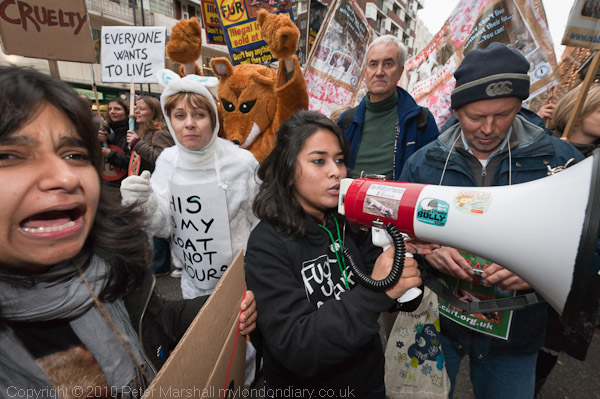
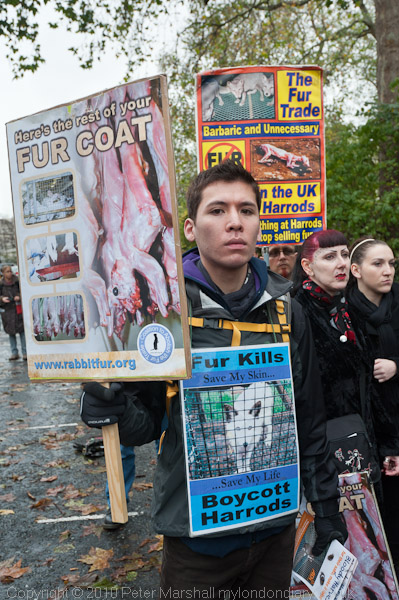
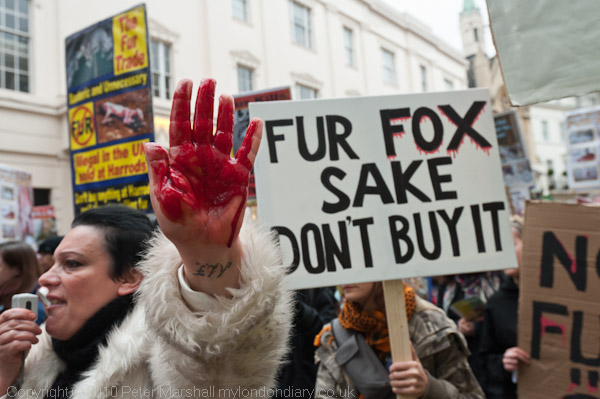
I found it hard not to admire the determination of the protesters and the inventive nature of many of their posters, placards, costumes and props, all of which made it easy to take interesting photographs – though there were a few activists who were not keen to be photographed. But I couldn’t help wishing that they could transfer some of their creative anger to protests over the way humans are being treated around the world and support these as well.

More at National Anti-fur March.


Women In Red Protest Against Police

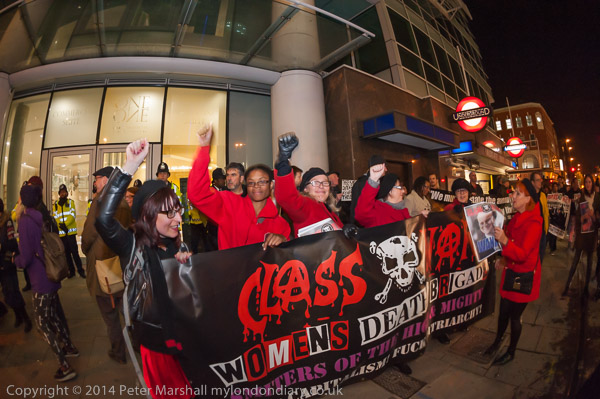
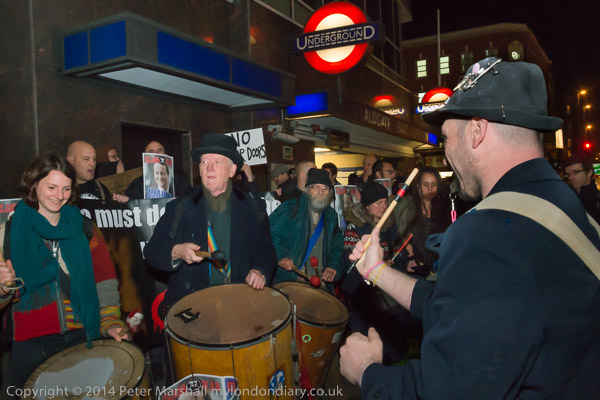
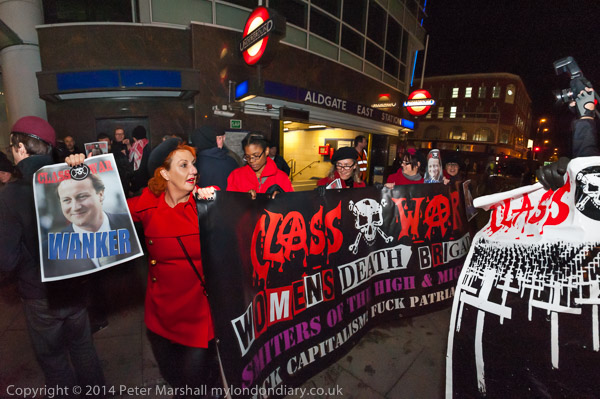
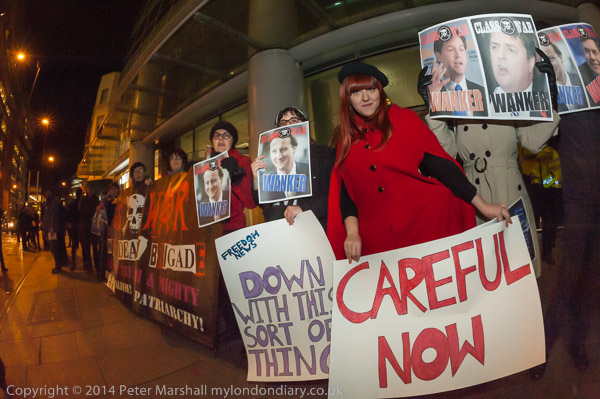
Class War Women in Red One Commercial St, Aldgate, Wed 12 Nov 2014

A week earlier on 5th November 2014, police had arrested Jane Nicholl for setting fire to an effigy of Boris Johnson as a part of Class War’s ‘Poor Doors’ weekly protest against separate entrances for wealthy and social housing residents in the block at 1 Commercial St in Aldgate.

The bail conditions imposed by police prevented her from taking place in further protests outside the block in Aldgate, a clear attack on her right to protest. Jane had been wearing a red coat when she was arrested, and a number of women wore red for the protest a week later in solidarity.

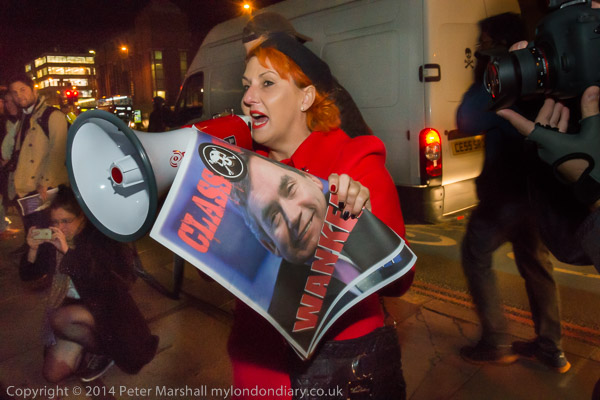
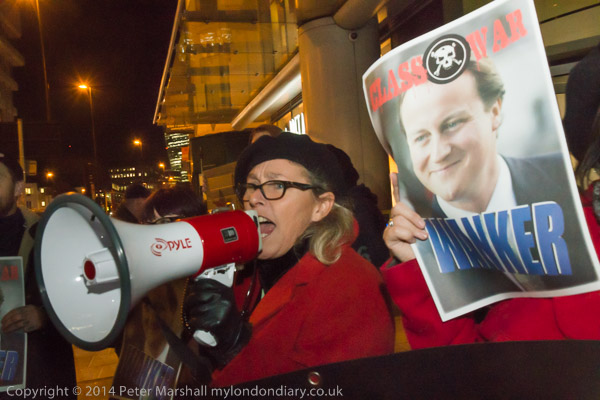
Police had earlier complained about Class War’s posters earlier in the year for the general election, which had featured large portraits of the party leaders with Class War’s verdict – the same on each of them – overprinted large, the word ‘WANKER’. At least one person displaying them during the election had been threatend with arrest and forced to take them out of his house windows and in May police had objected to and seized a banner featuring all four leaders with a similar message.

Eventually the police were told they had to hand the banner back as its display was not an offence. But they were unwilling to do so, claiming it had been lost – though more probably they had destroyed it rather than having to lose face handing it back.

So the banner was not present at this protest, though later Class War made an updated version to use. But Ian Bone had brought along a pile of the posters, mainly of Tory Prime Minister David Cameron but with a few of other party leaders and handed them out.

Ian told us that this was an attempt to get into the Guinness Book of Records for the largest number of ‘Cameron wanker posters’ ever displayed at a protest. I’m not sure how many there were on display, but I think it was certainly a record number, but the chances of it being recorded in that rather conservative publication were as I wrote, “rather sub-zero.”

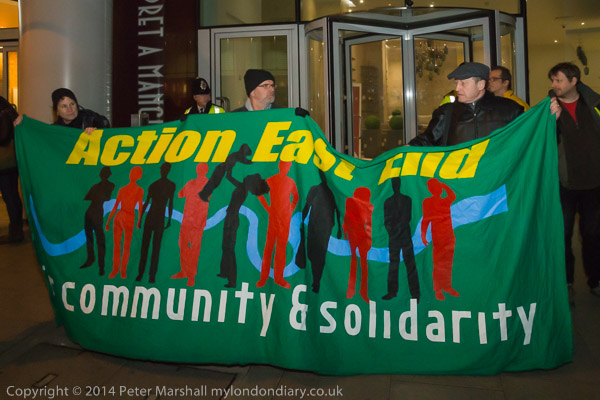
Police presence this week was low-key with just half a dozen officers standing beside the ‘rich door’ and along the front of the building and watching. The protest was noisy, with speeches, a samba band and dancing, but was entirely peaceful with no attempt to enter the building.

More at Class War Women in Red.


Armistice Day Events & Canada Geese Protest, 2017

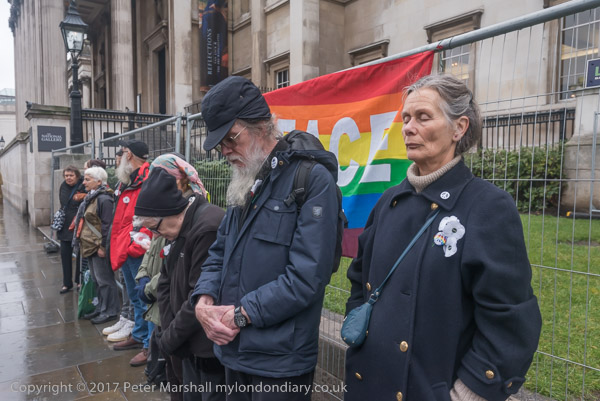
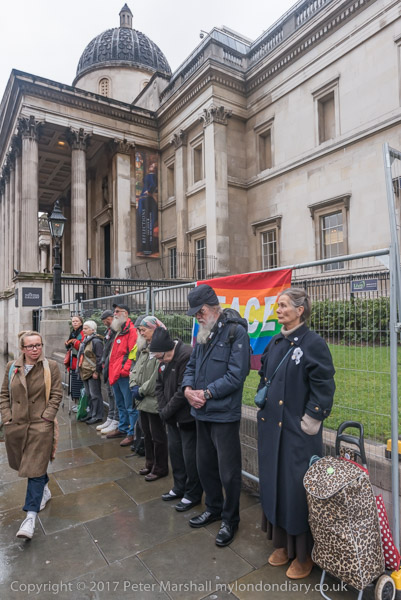
Silent Remembrance Peace Vigil – Trafalgar Square, Sat 11 Nov 2017

I came up the steps from the Underground into Trafalgar Square just as the clocks struck 11am on Saturday 11th of November 2017, exactly 99 years to the minute after the end of fighting following the signing earlier in the morning of the Armistice in a railway carriage in the Forest of Compiègne. Though actually an hour late, since it was 11.00 am Paris time, an hour ahead of GMT.

A revolt by sailors in the German Navy, beginning in Wilhelmshaven on 29-30th October 2018 had lead widespread actions across Germany with the proclamation of a Republic which forced the abdication of Kaiser Wilhelm and made the end of the war inevitable – it had largely been a family quarrel between the ruling royals.

As I came up into the square a whistle marked the start of the two-minute silence, and at least one bus swerved to the side of the road and stopped, though much of the traffic continued around it. A few people in the square stood to attention, but many of the tourists continued as normal. And I stood for a few seconds then kept on walking to photograph a small group of Quakers on the North Terrace wearing white poppies and beginning a 45 minute silent remembrance peace vigil outside the National Gallery.

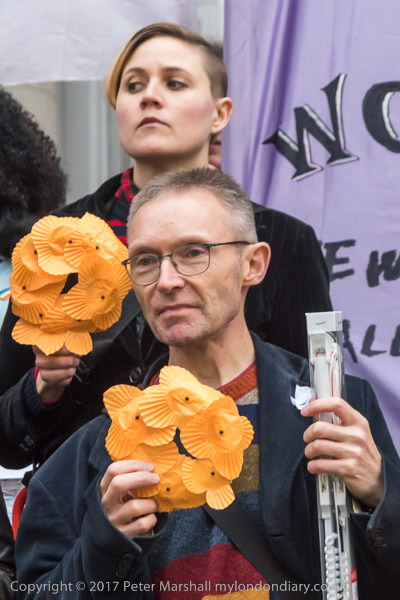
White poppies were first made in 1933 by the Co-operative Women’s Guild to hold on to the key message of remembrance, ‘never again’. The First World War, known at the time as The Great War, had been called “the war to end all wars” but by 1933 many were beginning to think that another world war was coming.

The white poppy remembers all victims or war, both civilians and military, and of all nationalities and has become more important as our official armistice events have over the past years become more and more militaristic celebrations. Sales of white poppies have increased greatly in recent years, with demand outstripping supply.

The white poppy challenges war and militarism and any attempt to glorify or celebrate war, and shows a committment to peace and nonviolent solutions to conflict. This year writer and poet Benjamin Zephaniah appears in a popular https://youtu.be/jtjCGCxT_PU video where he explains why he wears a white poppy and urges others to do the same to remember all victims of war and to work towards a world where there is no war.

Silent Remembrance Peace Vigil


Close Canada Goose for animal cruelty – Regent St, Sat 11 Nov 2017

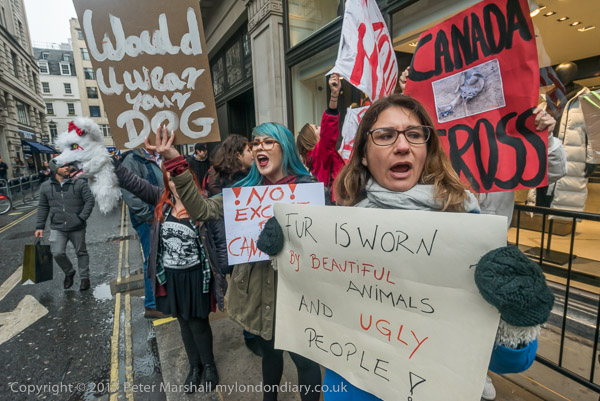
Fur is Worn By Beautiful Animals and Ugly People!

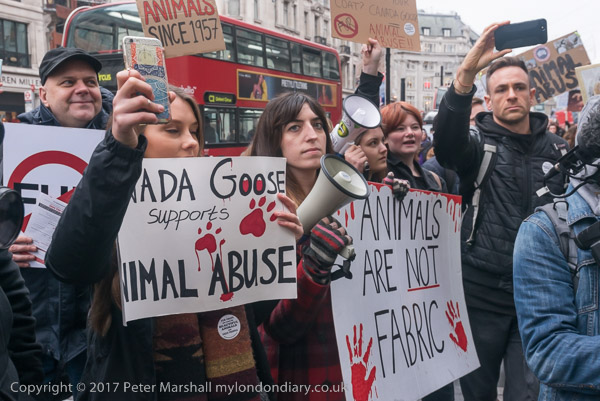
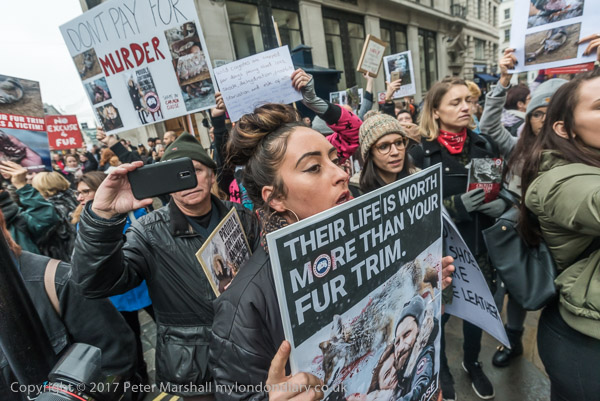
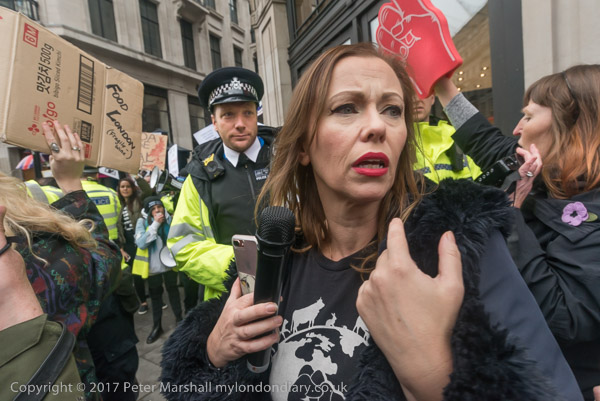
Several hundred campaigners marched from a nearby square to protest outside the newly opened flagship Regent Street Canada Goose store where the protest continued for most of the day. Police struggled to clear a path through the protesters for customers to enter and leave.

Canada Goose was selling coats with fur trims using trapped wild coyotes, which may suffer for days in cruel traps, facing blood loss, dehydration, frostbite, gangrene and attacks by predators, some even trying to chew off their own trapped limbs to escape before a trapper returns to strangle, stamp or bludgeon them to death.

The down in their jackets is from ducks and geese that have their throats slit and are dumped into scalding hot water for feather removal while often still alive and feeling pain to make the down-filled jackets.

The London protests followed years of protests in New York and Toronto and continued weekly and at times more frequently. The shop gained an interim injunction restricting the activities outside the Regent St shop at the end of November 2017, but this was discharged in 2019 and their request to make it final refused, with the High Court saying the right to protest is an important legal right.

In June 2021 Canada Goose announced it would stop buying fur by the end of that year and no longer make products using real fur no later than the end of 2022. The protests backed by Peta for 15 years had eventually led to success, although the company denied that they had any part in its decision. The campaign to stop them using geese and duck feathers continues.

Close Canada Goose for animal cruelty


Remember Refugees on Armistice Day – Whitehall, Sat 11 Nov 2017

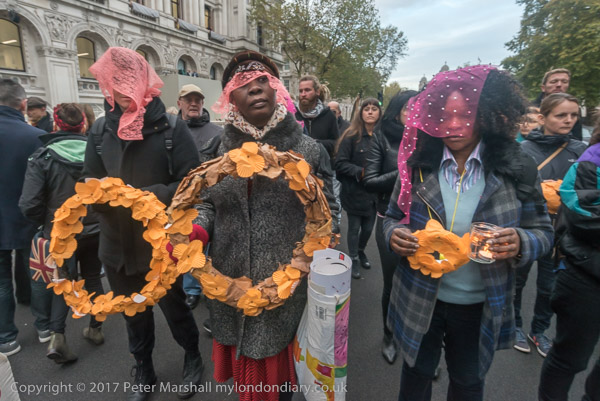
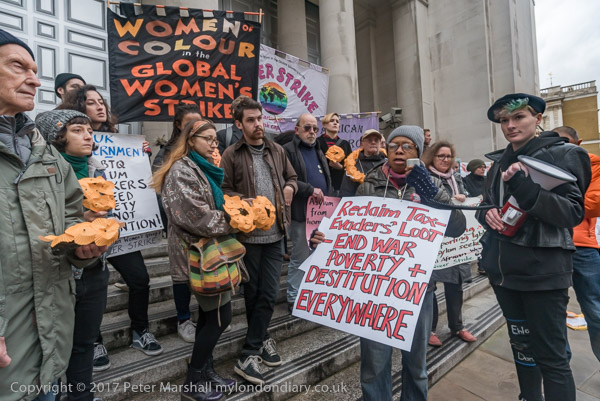
Lesbians and Gays Support the Migrants hosted a a commemoration ceremony to lay a life-ring wreath in memory of the people who have died fleeing their war-torn countries to seek refuge over the past year.

The event began at the Ministry of Defence. Many feel that the official celebration of Remembrance Day has gradually become more militaristic and a celebration of our victories rather than remembering the deaths of many in all the wars that our country has played a part in.

Among those taking part were a number of refugees as well as some activists who had supported them in the camps at Calais and on Greek Islands.

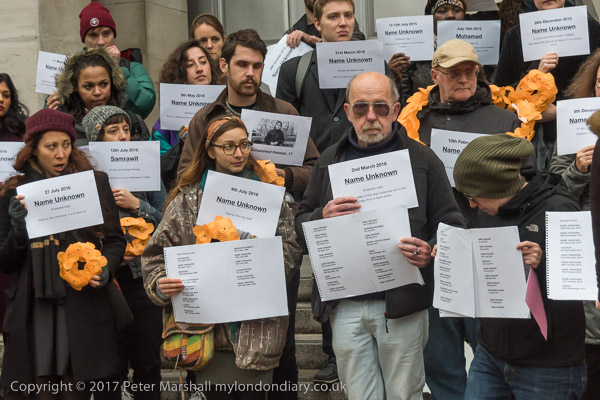
After speeches on the steps of the Ministry of Defence people held up posters with the details known about some of the migrants who have died trying to cross to the UK, but for many the posters read ‘Name Unknown’ – all we know is their date of death.

Then people processed holding wreaths of orange poppies and burning candles to the Cenotaph where they laid these to remember those who died seeking sanctuary. There were 17 small wreaths, the average number of people who have died so far trying to migrate each day in 2017.

Remember Refugees on Armistice Day


Orange Lodges Remembrance Day parade – Whitehall, Sat 11 Nov 2017

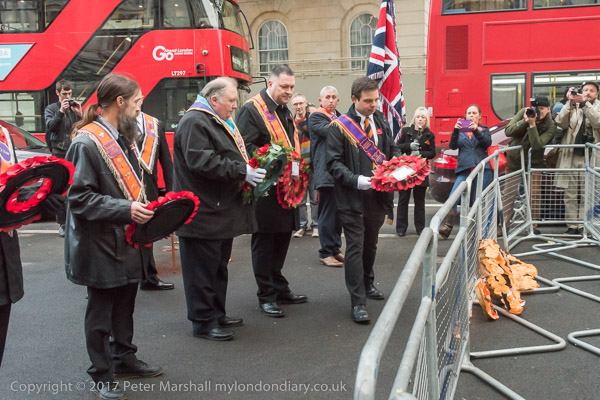
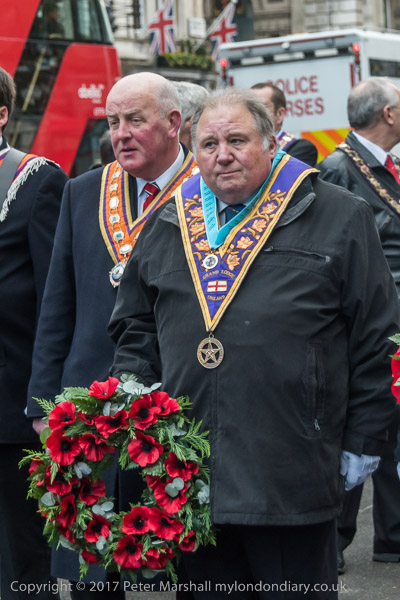
As I was at the Cenotaph I heard the sound of a flute band and drums as the London City District No 63 and the Houses of Parliament Lodge marched up Parliament St with visiting loyalists on their annual Remembrance Day parade in central London.

I photographed them marching and laying wreaths, but didn’t go with them as they went to lay further wreaths at the Duke of York Column in honour of Prince Frederick, Duke of York, the second eldest son of King George III and a Grand Master of the Loyal Orange Institution of England and then to St James’ Square for the end of their parade, where they were to lay a wreath at the memorial to WPC Yvonne Fletcher. Although I had no problems in Whitehall on this occasion I have been attacked at some other Orange events in London.

Orange Lodges Remembrance Day parade


St George’s Tavern and North Peckham 1989

More pictures from my walk on 27th January 1989. The previous post on this walk is Houses, British Lion & Elmington Estate.

Wells Way, Coleman Rd, Camberwell, Southwark, 1989 89-1f-31

From Camberwell Road I hurried along Bowyer Place and New Church Road to take my next pictures along Southampton Way, going past The Brewers pub (since closed and converted to residential use) and then down Parkhouse Street and on to Wells Way. None of the nine pictures I made on this section of the walk seemed worth putting on-line, perhaps I was hurrying too much.

The view in this photograph has not changed radically, with the row of houses along Wells Way at right still much the same. You can still see the St George’s Tavern some way down Coleman St on the corner of Rainbow St, though it has lost the signage on the wall. It has apparently been there since at least 1851, though it was closed and boarded up, but re-opened in April 2021. But the estate towering above the end of the road is no longer there.

1JKC and St Georges Tavern, Coleman Rd, Camberwell, Southwark, 1989 89-1f-32

I didn’t expect to see a Bentley with a personalised number plate on the street close to the ‘friendly neighbourhood pub’. I wondered who might own it, and there were certainly some very dubious characters in the area at the time. The registration plate 1KJC would have been expensive to buy – and now probably well into five figures if available, a serious vanity symbol.

The pub at that time was still owned by Taylor Walker whose Barley Mow Brewery in Limehouse and 1,360 pubs and off-licences and were bought by Ind Coope in 1959 – and brewing ceased the following year. The name was revived and used by another pub owning company for its London pubs from 2010 but then they were taken over by Greene King in 2015 and again re-branded.

Houses, Newent Close, Peckham Grove, Camberwell, Peckham, Southwark, 1989 89-1f-35

6-22 Newent Close, Peckham, were Grade II listed in 1972 as in Peckham Grove, Peckham. The nine linked villas date from 1838. This is a remarkable Regency (or rather immediately post-Regency as Victoria came to the throne in 1837) enclave in the area. These houses are on the west side of the street.

Houses, Newent Close, Peckham Grove, Camberwell, Peckham, Southwark, 1989 89-1f-36

The other end of this short row of houses with the blocks of the North Peckham Estate at the right. These houses were clearly rather run-down when I photographed them.

Houses, Newent Close, Peckham Grove, Camberwell, Peckham, Southwark, 1989 89-1f-22

The houses on the east side of the street have these weighty porches. At right is a part of the Gloucester Grove Estate, one of the five estates often known collectively as the North Peckham Estate. Although this gained a terrible reputation, many former residents have fond memories of living there and the quality of their accomodation.

Houses, Newent Close, Peckham Grove, Camberwell, Peckham, Southwark, 1989 89-1f-24

Another view of houses on the east side of Newent Close. The long block at right is I think part of the actual North Peckham Estate, completed around 1972. The five estates were all part of the largest regeneration scheme ever approved in 1994, and were demolished at a cost of £260m over the next ten years or so.

Houses, Newent Close, Peckham Grove, Camberwell, Peckham, Southwark, 1989 89-1f-26

Another view of this remarkable street with the Gloucester Grove Estate in the background at left. I did take one picture of Nailsworth House on the North Peckham estate but haven’t digitised that.

Cottage Green, Camberwell, Southwark, 1989 89-1f-16

Eventually I managed to drag myself away and stop taking pictures of the remarkable short section of street at the top of Peckham Grove – now surrounded by rather mediocre looking properties from the regeneration of the North Peckham estates. I walked back towards Wells Way and down to Cottage Green – where the next post on this walk will begin.

My posts on this walk on 27th January 1989 began at St George’s, Camberwell, Absolutely Board & Alberto.


Houses, British Lion & Elmington Estate

This post continues my walk in Camberwell on 27th January 1989. The previous post on this walk from January 1989 is St Giles, It’s Churchyard and Wilson’s School.

Houses, Benhill Rd, Camberwell, Southwark, 1989 89-1e-11

Benhill Road runs north from Camberwell Church St opposite St Gile’s Church and includes the site of the former vicarage and St Gile’s Parish Hall. These houses are I think mid-Victorian and I admired the slender decorative pillars at the doorways.

Opposite the Parish Hall just inside the property is a small building with a blue plaque which I photographed but have not put online as the lighting was rather poor. It now has a London Borough of Southwark blue plaque with the totally misleading message ‘The Parish Church of St Giles Porch and Doorway Relocated to its current site in the vicarage garden where it was used as a summer house after the church was accidentally burnt down on 7th February 1841.’

While the church was burnt down in 1841 this was never its porch and doorway, though it was largely built with material from the burnt out church and was probably not used as a summer house – and more recently has been used for rubbish bin storage. An article in the Camberley Quarterly by Donald Mason, Old St Giles: blue plaques and history, reveals its true nature and has some excellent illustrations.

British Lion, pub sign, Elmington Rd, Camberwell, Southwark, 1989 89-1e-12

On the corner of Benhill Road and Elmington Road I photographed a bicycle and the British Lion pub sign. The pub itself at 112 Benhill Road was a rather boring 1960s building rebuilt at around the same time as the flats around it. But there had been a pub on the site since at least 1871, The Prince Of Prussia, a name that probably became rather unpopular in the First World War.

Edmund St, Elmington Estate, Camberwell, Southwark, 1989 89-1e-14

I think the’ London County Council’ built the first flats on the Elmington Estate shortly before WW2, but there were four of these large blocks desgned by the LCC Architects department and built around 1956. The winter sun produced a rather elegant repeated pattern of light and shade on the frontage.

Edmund St, Elmington Estate, Camberwell, Southwark, 1989 89-1e-14
Edmund St, Elmington Estate, Camberwell, Southwark, 1989 89-1e-15


I think this large eleven floor slab block and its neighbours on the Elmington Estate, dating from around 1960 were demolished in 1999-2000. The flats passed to Southwark Council, formed in 1965 who lacked the cash to maintain them properly and they were in poor condition by the time I photographed them, and many flats were squatted in the 1990s.

Edmund St, Elmington Estate, Camberwell, Southwark, 1989 89-1f-01

In 1999 Southwark Council decided to demolish the whole of the Elmington Estate and these blocks were a part of the first phase of the redevelopment. Southwark Notes gives a great deal of detail about how this progressed.

In the first phase, most of those who lived in the flats were rehoused in council housing built on the site, but not all were too happy with their new homes. The article quotes one: ‘You will never know what privacy is like again. You will hear your neighbours and everything they do. And they will hear you. Your rooms will be smaller. You’ll be paying more for it. One day you’ll wake up and realise that you’d give anything to be back in your old home’.

The council for Phase 2 adopted “a whole new regeneration model premised on partnership with either corporate developers” or housing associations. Their partner here was the large and aggressive Housing Association Notting Hill Housing Trust who would offer zero social rented homes in the scheme (social rent being the equivalent rent of a council home). Some flats were available at so-called “affordable” rents, roughly twice those of council properties in the area, and unaffordable for most previous tenants. It was a process of ‘social cleansing’, forcing most of the poorer residents out of the area.

Bradbury, Solicitors, 119, Camberwell Rd, Camberwell, Southwark, 1989 89-1f-52

I walked throught the Elmington Estate and on through Burgess Park to Camberwell Road, turning south where a few doors down on the east side I photographed the railings and doorways of 119 and 121. Numbers 117-129 and attached railings are Grade II listed.

From 1863 to 1887 photographer and portrait painter Henry Death (1820-1900), born in Moulton, Cambridgeshire, had his studio at 119 Camberwell Road, having moved there from nearby Addington Place where he set up a studio in 1856. He sold the house when he had to give up his business through ill health in 1887 and died in Camberwell thirteen years later. In !989 it was the offices of Bradleys Solicitors.

No 121 was the premises of the charity IAS, Independent Adoption Service, first registered in 1982 and voluntarily removed in 2009. I think both properties are now private residences.

147, Camberwell Rd, Camberwell, Southwark, 1989 89-1f-53

No 147 Camberwell Road is a part of a terrace of around ten houses directly south of Cambridge House on the corner of Addington Square. These house look in rather better condition now and the tree here was removed a couple of years ago. Most of these houses are now divided into flats.


My posts on this walk on 27th January 1989 began at St George’s, Camberwell, Absolutely Board & Alberto. This walk will continue in a later post.

Cyclists’ Die-In And A Visit To The Oral Squat

On Wednesday 8th November 2017 I spent the evening in Islington.

Vigil for Islington cyclist killed by HGV – Islington Town Hall, Wed 8 Nov 2017

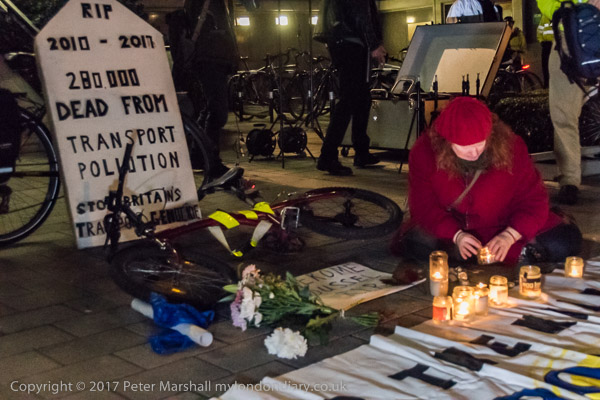
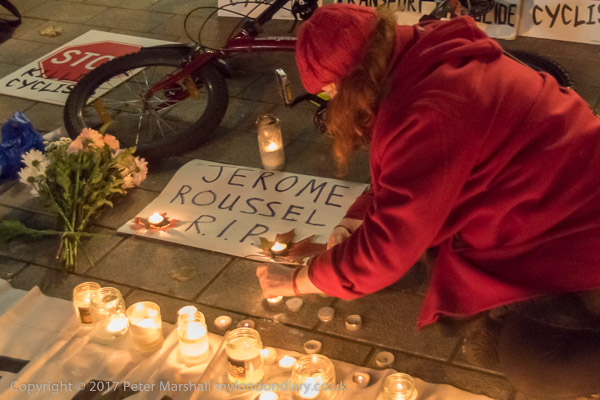
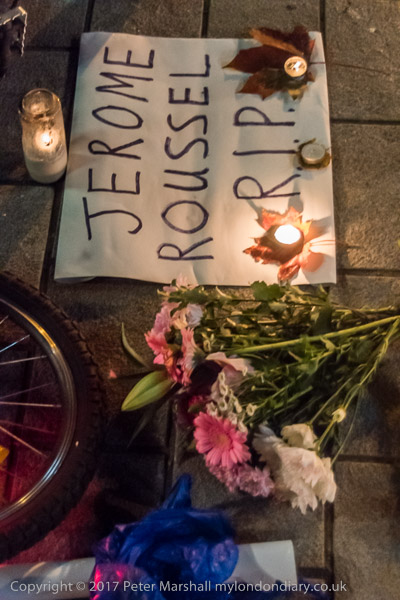
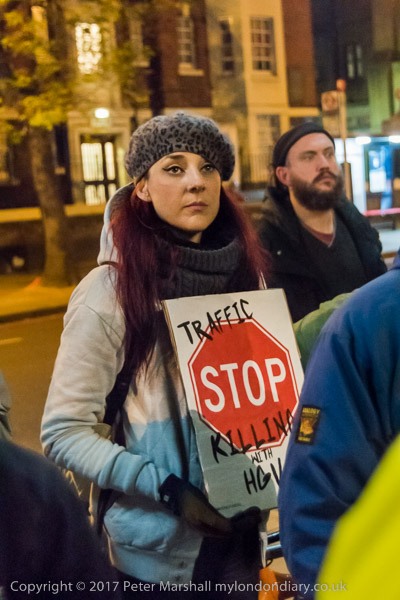
On May 2nd 2017, City trader Jerome Roussel was cycling to work along Pentonville Road when he collided with a heavy goods vehicle which had stopped in the cycle lane. He was seriously injured and died in hospital on June 25th, seven weeks later.

Police say that the cyclist had told them he had put his head down and had failed to see that the lorry had pulled in ahead of him and he crashed into the back of it.

Cycling around parts of London there are many streets with ‘cycle lanes’ marked at the edges of the roads but often obstructed by parked vehicles. The driver in this case had only just pulled into it, intending to turn into a side street, but for many others the cycle lane is a convenient parking place, perhaps for a few minutes while they visit a shop, or for much longer.

These roads have cycle lanes because there is enough faster moving traffic on them to make them dangerous for cyclists. But cars and lorries parked on them mean that cyclists have to move out into this traffic. We need a law which makes it an offence to park on cycles lanes – and for it to be enforced.

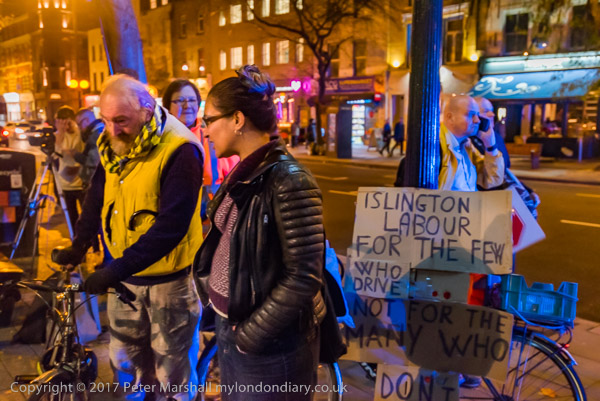
Islington Labour – For the few who drive

Better still we need far more physically separated cycle lanes, though where these exist there are also sometimes cars parked on them, rendering them unusable, and sometimes road surfaces so poorly maintained that they are uncomfortable to ride on and even at times dangerous. Even small potholes that a car would cruise over can send the unwary cyclist flying.

As I wrote back in 2017, “Islington has not built a single protected cycle route in over 20 years and Transport Minister Jessye Norman has so far failed to sign the the commencement order to allow TfL to fine HGVs and traffic that drive into mandatory cycle lanes, such as the one on Pentonville Road where Jerome Roussel was killed. Islington, responsible for 95% of the roads in its area has reserves of £277 million (and growing) and campaigners say it should spend some of this on making its streets safer for cyclists and pedestrians.”

I don’t cycle in Islington, but although the council on its web site states it is “on a mission to improve cycling in Islington” I get the impression that relatively little has changed since Roussel’s death on a cycle lane in 2017. At the 2022 elections the London Cycling Campaign was calling on Islington Council to provide protected cycle routes on all busy roads by 2026, for low traffic neighbourhoods to cover the borough by 2024, to provide sustainable freight hubs, to set more ambitious targets for sustainable transport and provide secure cycle parking.

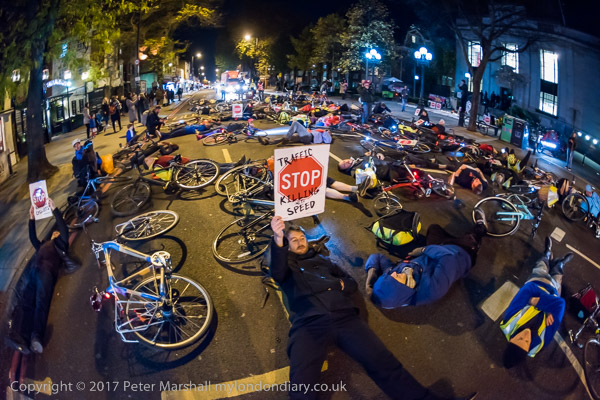
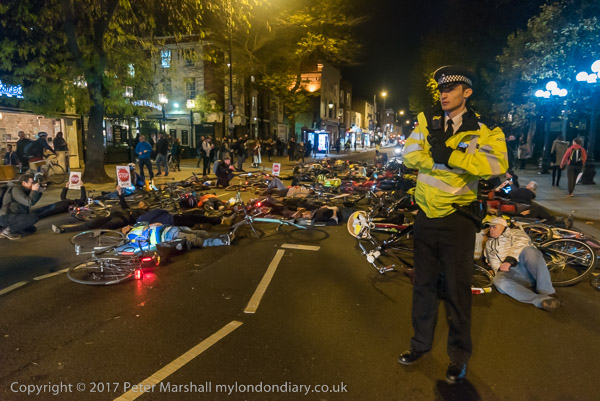
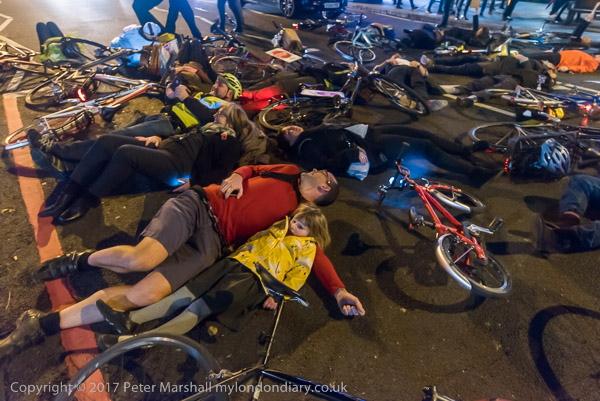
Cyclists gathered on the pavement outside Islington Town Hall and listened to a number of speeches before police stopped traffic and the campaigners held a 5 minute silent die-in on the road in memory of Jerome Roussel, after which there were more speeches and a final address by Donnachadh McCarthy.

More at Vigil for Islington cyclist killed by HGV.


ORAL squat empty NatWest Bank – Upper St, Islington, Wed 8 Nov 2017

As I walked back from Islington Town Hall to the Underground station with another photographer we met activists who knew us outside the squatted former NatWest Bank on Upper St and stopped to talk.

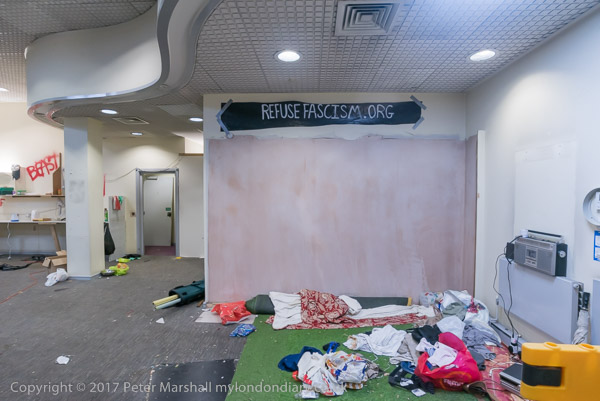
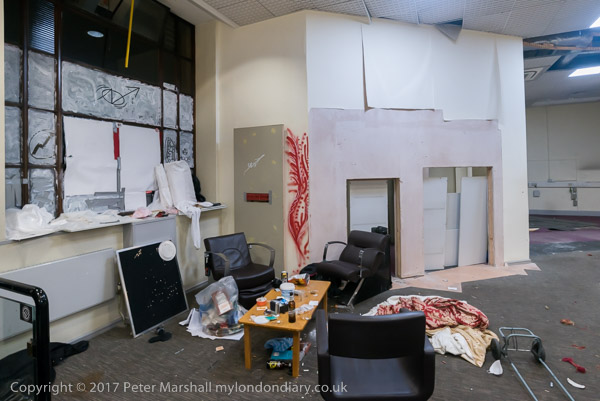
Inside things are a little messy, but there is no real damage

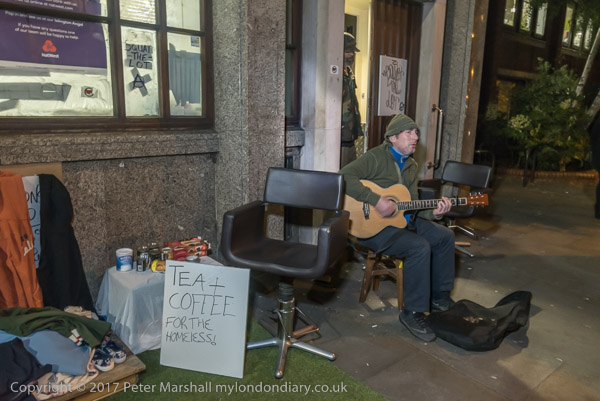
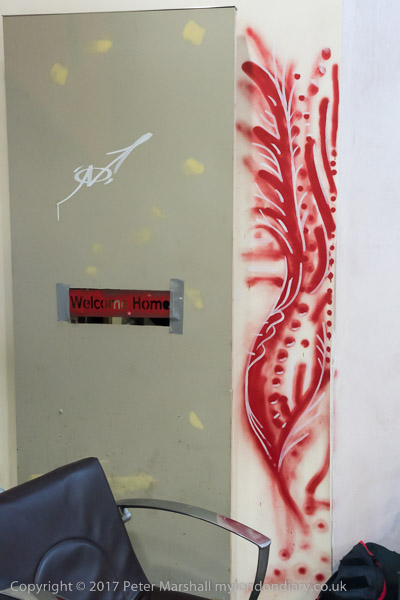
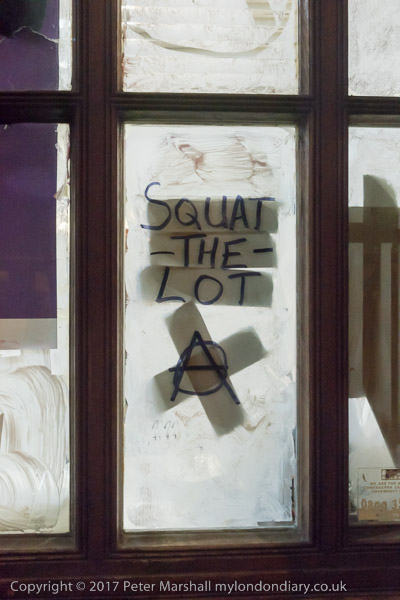
This had been squatted around a week earlier by the Order of Rampaging Anarchist Lunatics (ORAL) and they were using it as a centre to provide tea, coffee, clothing and shelter for the street homeless of the area.

The building was well lit and warm – the squatters are paying for electricity

We were invited inside for a tour of the squat and to take photographs. The squatters were expecting to be evicted in the near future, and actually were a few days later, after which they published a ‘final communique’ on their Facebook page. You can read this in full on My London Diary, but here is the first paragraph:

Several years ago, what began as a ridiculous idea to form a satirical nation of squatters evolved into one of the most infamous land pirate crews known around the world. Originally coined the Autonomous National of Anarchist Libertarians [ANAL] we’ve penetrated deep into London, forming a property portfolio that undoubtedly far exceeds any other crew; Having taken roughly 60 buildings in zone 1 over a period of around 4 years. Most notably Admiralty Arch.

My London Diary

Their communique goes on to say that they felt their activities had acheived nothing and that they would be forming a new group focused on “setting the example of how to evolve society & humanity” though “construction & creation” and would shortly be opening “a new community hub”.

My assessment was rather more positive, in that they and other activists had drawn attention to the scandal of so many empty properties while we have a housing crisis. Thanks to the Tory programme of austerity we had seen a huge increase in the number of homeless people and there should be legal ways to bring these properties into use. The current situation remains shameful in what is still one of the world’s wealthiest countries.

ORAL Squat empty NatWest Bank.