Aldermaston 2008

Aldermaston 2008: Searching for what to write today I came to my post about my journey to Aldermaston, where the huge 750 acre Atomic Weapons Establishment is the UK’s main site for nuclear weapons research, design and manufacture. It was to here that people marched from London over 4 days at Easter1958 in a pivotal event in the anti-nuclear movement organized by the Direct Action Committee Against Nuclear War (DAC) and supported by the newly formed Campaign for Nuclear Disarmament (CND) – which took over the organisation of further marches. 

Aldermaston 2008

The CND leaflet in 1958 gave the reason for marching:

“MARCH TO ALDERMASTON
WHY?
BECAUSE we must show our opposition to the Testing, Storing and Manufacture of the H-Bomb in Britain.
If we make no protest now we have given our consent to its use.
“All who are opposed on any ground to Nuclear Weapons, whether possessed by the British, American or Russian Governments, are welcome.”

I didn’t go on that march as my parents thought I was too young, but both my older brothers marched. 50 years later at Easter 2008 I decided to take part in CND’s 50th anniversary event.

Aldermaston 2008
The cyclists arrive at the main gate at Aldermaston

I had decided not to march but to cycle at least part of the way from London to Aldermaston with Bikes Not Bombs, but for various reasons (sloth, other events, lousy weather and a dislike of early rising) it didn’t happen, although I did manage to photograph the riders on Oxford Street, where they were going in exactly the wrong direction.

Aldermaston 2008
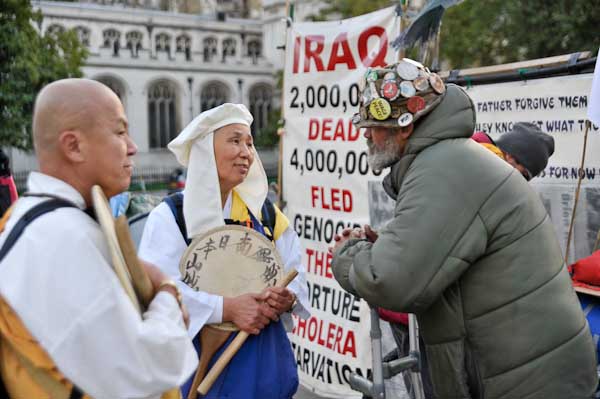
WMD were not in Iraq – but here at Aldermaston

In the end I did ride from Reading to Aldermaston (and back) on Monday, but started an hour or two later than the organised ride, taking a more direct route at a faster pace and arriving before them. Here I’ll copy what I wrote on My London Diary in 2008 with a couple of minor corrections and post a few of the pictures with a link to many more on My London Diary.


Aldermaston – 50 years

Monday 24 March, 2008

Aldermaston 2008
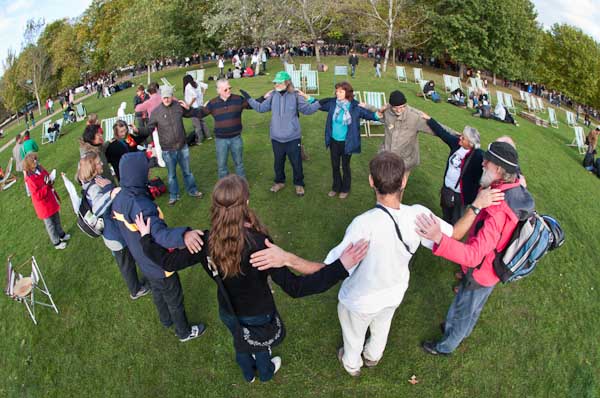
Holding hands around the base

Monday I got up too late to join the Bikes Not Bombs cyclists on their way from Reading, where I arrived by train. The train that goes from Staines to Reading is so so slow I’m convinced there is still a man with a red flag walking in front of it much of the way, and the 20 or so miles took almost an hour.

I took exactly the same route from Reading that I’d walked with Pat Arrowsmith and the other Aldermaston marchers in the 2004 march. Although a cool day, it was a pleasant morning for riding and I was quite enjoying it until a stretch of road called ‘Hermit’s Hill’ reminded me how out of practice I was at cycling. I can’t remember when I last had to push my bike up a hill, although in 2002 when my arteries were almost fully clogged with cholesterol I did once have to stop and rest in Normandy. Fortunately it turned out to be the only significant hill on the route.

I went first to the main gate and joined the other photographers who were there, and took a few pictures of people arriving, including the 30 or so cyclists who I had beaten there. I walked down with some of the other photographers to the Falcon gate, but not a lot was happening there.

Falcon Gate

Later I took a ride around perimeter, or at least the part of it which is on roads – the northern side is simply a footpath, and it was rather muddy and full of demonstrators, so I didn’t try to ride along it. I caught up with the cyclists again at the Boiler House gate where I stopped to take some pictures, as quite a lot seemed to be happening there.

They left before I had taken all the pictures that I wanted, and got a few minutes start on me, before I pedalled off in pursuit. The road leads down and through the actual village of Aldermaston (rich home counties, rather too tidy), but what goes down has to come up, and I found myself struggling uphill again through the queue of traffic held up by the ‘bikes not bombs’ group and their police escort of two cars and several motorbikes.

Welsh choir at the Construction gate

The Construction gate at the top of the hill had a Welsh socialist choir, and I took a few pictures before I saw the cyclists coming up again – they had stopped to regroup a little down the road. Further along the fence, near the Home Office Gate was another largish group of people and a veteran from 1958 was talking.

Veterans of 1954 who spoke

The incredible Rinky-Dink mobile cycle-powered sound system was also there – another reminder of 2004 when it accompanied us as we marched down the lanes to the base.

People were now beginning to link hands around the base, although the organisers had talked about one person every 5 metres. Most of it seemed to be surrounded considerably more densely than this, although there were some gaps.

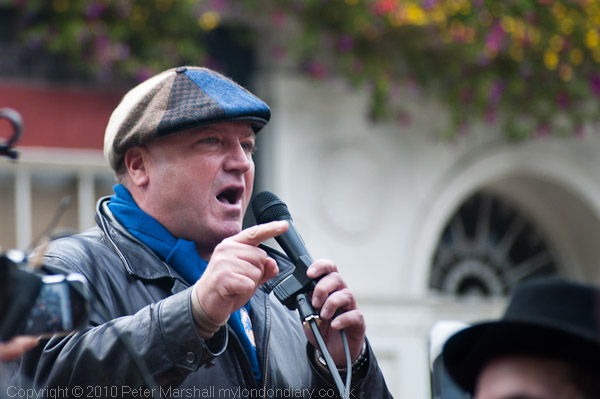
Back at the main gate there was an opportunity to photograph some of the speakers who were touring the event, although I didn’t actually hear them speak. They included two labour MPs, Jeremy Corbyn and John McDonnell, Green MEP Caroline Lucas, veteran Labour Party member Walter Wolfgang and several guests from Japan, one of whom was a survivor from Hiroshima.

Jeremy Corbyn, Caroline Lucas, Walter Wolfgang, John McDonnell and others

After that people started to go home, and after a short but rather heavy shower I decided it was time to get on my bike too.


Many more pictures from the event at Aldermaston – 50 years, and I also took a few on my ride back to Reading Station.


FlickrFacebookMy London DiaryHull PhotosLea ValleyParis
London’s Industrial HeritageLondon Photos

All photographs on this page are copyright © Peter Marshall.
Contact me to buy prints or licence to reproduce.
Stand Up to Racism & Kites Not Drones – 2014

Stand Up to Racism & Kites Not Drones: On Saturday 22 March 2014, the day following UN Anti-Racism Day (chosen to remember the 69 people killed by police in the Sharpeville massacre in South Africa on 21 March 1960), the TUC and Unite Against Fascism organised a march and rally as a part of a European day of action against racism.

Stand Up to Racism & Kites Not Drones - 2014

Thousands – perhaps as many as 20,000 – turned up to march the short distance from Old Palace Yard opposite parliament to a long rally in Trafalgar Square – on My London Diary I list 19 speakers, though I think there were a few more on the day, but I didn’t stop to listen to all of them, going instead to Hyde Park where a smaller protest by peace activists tried without much success to fly kites in in solidarity with the people of Afghanistan.


Stand Up to Racism – Westminster

Stand Up to Racism & Kites Not Drones - 2014
No Human is Illegal’ – protesters from the National Coalition of Anti-Deportation Campaigns

This protest stood out for the wide range of people and organisations who had come to join it, “many of whom are sickened by the anti-immigrant policies of successive governments and opposition parties who have long been engaged in trying to outdo each other in the ‘toughness’ of their immigration policies, and have recently moved even further to the right in an effort to neutralise the political threat of UKIP and Nigel Farage.”

Stand Up to Racism & Kites Not Drones - 2014

And since 2014 the main parties have kept moving to the right. We continue to see this scapegoating of immigrants in the policies both of the current government and its recent Tory predecessors, particularly in the campaigns and legislation against those who cross the channel in small boats, but also in restrictions on those who claim asylum here and the harassment being suffered by many who have made their lives here and contributed to our society but are now threatened by deportation, dragging them away from families and friends. Still we have not set up safe routes for asylum seekers to come to Britain, still we have not offered amnesties to those who have worked here and made useful and essential contribution here for years.

Stand Up to Racism & Kites Not Drones - 2014

I photographed many of the marchers in Parliament Square, where the march had been planned to start close to the statue of Nelson Mandela who had celebrated “the ideal of a democratic and free society in which all persons live together in harmony and equal opportunities” as the aim of the fight for freedom and equality in South Africa.

A man taking part in unusual dress for a protest

Some posed in front on the grass with ‘Big Ben’ in the background, a name I like to use as it annoys pedants, but is what everyone except them still calls the clock tower which Wikipedia describes as “one of the most prominent symbols of the United Kingdom and parliamentary democracy.”

Among those taking part were people from our Roma and Muslim communities who bear no responsibilities for our country’s current problems and suffer more than most from them while at the same time being blamed by the racist right for them.

“In particular we have seen many promoting fear and hate of Muslims associating the whole community with the acts of a tiny few. Islamophobia is rife and has led to more attacks on the Muslim population, including murder and violent attacks on mosques. “

More from 2014 on My London Diary at Stand Up to Racism.


Kites Not Drones Solidarity with Afghanistan – Hyde Park

This protest by peace activists was part of a weekend of solidarity with the Afghan people who traditionally celebrate their New Year (Now Ruz) on the Spring Equinox by flying kites. (Until 1752 the New Year began at around the same time in Britain and its colonies on Lady Day March 25th.)

Peace activist Maya Evans ties up the Drones on Trial banner ‘EVERY AFGHAN HAS A NAME, WAR IS NOT A VIDEO GAME’

In 2014 I quoted the organisers statement:

‘Kite flying has become synonymous with Afghanistan as a well loved pursuit which was banned under the Taliban, now Afghans are more used to the presence of UK armed and surveillance drones flying overhead.’

‘We are encouraging peace groups, Afghans in the UK and the Muslim community to fly kites in solidarity with Afghans who now have to live under the mental pressure and physical destruction which British drones (currently operated from RAF Waddington, Lincoln) now reap upon Afghanistan.’

None of those taking part appeared to have had any previous experience in actually flying kites, and although the photographers present helped, the gusty conditions only allowed some short and erratic flights, with one kite getting stuck up a tree. For once a police officer was sympathetic, and having come across to tell the protesters that flying kites was not allowed in this or the other Royal Parks told them that so long as they stayed in this empty area of the park and were not a nuisance to others he would not stop them.

More at Kites Not Drones Solidarity with Afghanistan.


FlickrFacebookMy London DiaryHull PhotosLea ValleyParis
London’s Industrial HeritageLondon Photos

All photographs on this page are copyright © Peter Marshall.
Contact me to buy prints or licence to reproduce.

Cabin Crew, Education, Living Wage & Light Up the Night – 2010

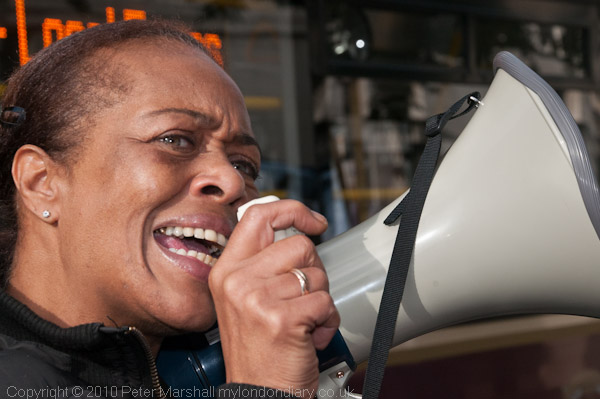
Cabin Crew, Education, Living Wage & Light Up the Night: Saturday 20th March 2010 was an unusual day for me, including protests in two parts of London I seldom visit, Hatton and Hampstead. It was also the start of a campaign on Oxford Street to get the London Living Wage for shop workers and there was a march to Downing Street against education cuts.


BA Cabin Crew at Heathrow – Hatton

Cabin Crew, Education, Living Wage & Light Up the Night - 2010

BA cabin crew on the first day of their 2-day strike at Heathrow held a rally outside Bedfont Football Club a short distance from Hatton Cross, where several hundred strikers came to listen to speakers, including Len McCluskey, Unite assistant general secretary, and show their determination to fight management plans to downgrade their conditions and make BA into a cut-price airline. Others kept up their pickets at gates around the airport.

Cabin Crew, Education, Living Wage & Light Up the Night - 2010

BA management under CEO Willie Walsh had refused to come to an agreement with the union, BASSA, and had threatened any workers who spoke at the meeting or appeared in media interviews with dismissal. So none of the strikers spoke at the meeting, but there was thunderous applause when speakers including local MP John McDonnell criticised BA management.

Cabin Crew, Education, Living Wage & Light Up the Night - 2010
Len McCluskey – We Offered Pay Cuts to keep BA Premium

I photographed the picket at Hatton Cross on my way to catch the Piccadilly line into central London.

More at BA Cabin Crew at Heathrow.


March Against Education Cuts

Cabin Crew, Education, Living Wage & Light Up the Night - 2010
Sitting down in Whitehall outside Downing Street

A couple of thousand teachers and students met outside Kings College in Strand to call for the reversal of planned education cuts which they say abandon a generation of students and will damage our economic recovery.

Cabin Crew, Education, Living Wage & Light Up the Night - 2010

Police had insisted that they march on the pavement, but the numbers and the banners made this impossible and after a hundred yards or so they moved onto the street. At Downing Street they filled both carriageways for several minutes with a short token sit-down before police and stewards persuaded everyone to move to one side of the road, but the crowd was still a little large for the space available and there seemed to be a few dangerous incidents – including a rather uncontrolled police horse – but fortunately no injuries as police appeared keen to get a lane of traffic moving past without due regard for public safety.

As speakers at the rally said, Labour had come into power on the mantra ‘Education, Education, Education‘ but 12 years later were proposing the largest cuts in education funding for a generation or more, estimated to lead to the loss of more than 20,000 jobs in Further Education, Higher Education and Adult Education. They will disproportionately affect the poorer and more disadvantaged in our society, in particular immigrants and young people who are unemployed or lacking in qualifications.

As Jenny Sutton, branch secretary of the UCU at the College of North East London pointed out the proposed cuts of £1.1 billion on education contrasted with the £21 billion spent on wars in Iraq and Afghanistan and the £500 billion given to the banks, one of which, the 84% publicly owned RBS is now paying out £1.3 billion in bonuses.

In protest Sutton was standing against the then Education Minister David Lammy in the May 2010 election. Lammy kept his seat and she lost her deposit, but the election put a Tory-led coalition into power. Education suffered even worse in the following years.

March Against Education Cuts


London Living Wage Launch in Oxford St

The London Living Wage campaign began in 2001 and has had the support of all London mayors since. Calculated annually by the Greater London Authority it takes into account the higher living costs in London, and Living Wage employers also have to provide fair employment conditions including holiday and sick pay and allowing employees to belong to a trade union.

Although some of London’s larger employers have adopted the London Living Wage, the retail sector, one of the most profitable areas of business in London, still had many of many of its workers struggling on wages below this level.

London Citizens, a grassroots charity working for social, economic and environmental justice , has led the campaign for a London Living Wage, and held a training session for its members before coming to Oxford Circus. Here they took advantage of the recently introduced diagonal crossing system to cross and recross several times with their banners before going off in smaller groups to continue the campaign inside the larger stores on Oxford Street.

They intended to give letters to all the general managers of shops on the street inviting them to meet with London Citizens to discuss the Living Wage.

London Living Wage – Oxford St


Light Up the Night in Hampstead

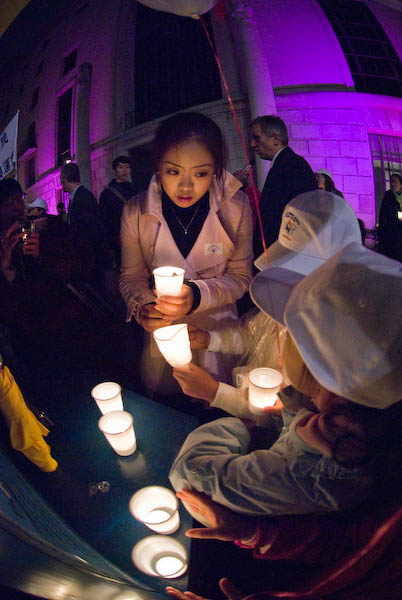
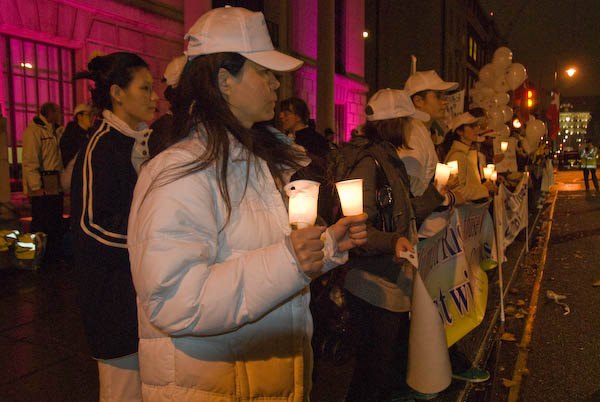
The Commons‘ candidate for the Hampstead and Kilburn constituency Tamsin Omond had organised a ‘Light Up The Night‘ candlelit march to show community solidarity against violent crime and make the streets safe for women at night.

Around 30 people, mainly women, turned up outside the Hollybush pub in Hampstead for the march, where there was a short speech by Sam Roddick, noted for her campaigning on issues related to human rights, feminism, pornography and for taking Fair Trade into hitherto unexplored areas through Coco De Mer, her Covent Garden ‘erotic emporium.

Tamsin Omond

It was a wet and windy night and it was hard to to keep the candles alight as the marchers made their way down the hill from Hampstead and the streets were emptier than usual.

‘The Commons’ campaign hoped to reach people who are fed up with politicians and appeal to ordinary people, many of whom, like Roddick have never bothered with voting because they felt it made no difference. But it made little progress. The election was closely fought with Labour’s Glenda Jackson gaining a narrow victory by 42 votes over the Tory candidate, but Omond was over 17,000 votes behind both of them with only 123 votes and the turnout was low.

More at Light Up the Night in Hampstead.


FlickrFacebookMy London DiaryHull PhotosLea ValleyParis
London’s Industrial HeritageLondon Photos

All photographs on this page are copyright © Peter Marshall.
Contact me to buy prints or licence to reproduce.

Bring the Troops Home – 2005

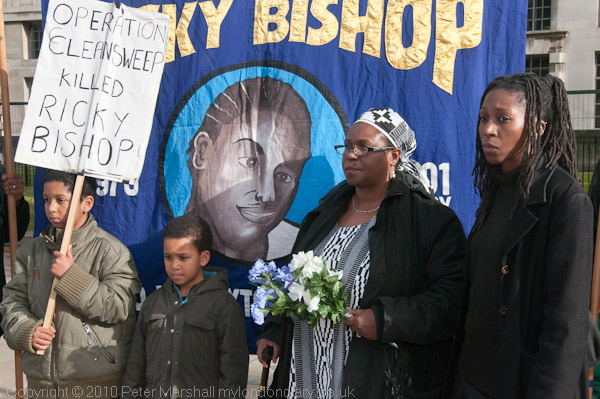
Bring the Troops Home: On Saturday 19th March 2005 I photographed the Stop the War march on the second anniversary of the invasion of Iraq. From Hyde Park it went past the US Embassy in Grosvenor Square on to a rally in Trafalgar Square. I published text and pictures on My London Diary.

Bring the Troops Home - 2005
Don’t unleash your missiles on Iran – No more Bush wars.

This is another slightly hard to find post from the early years of My London Diary before I redesigned the site with links to every post on top of each monthly page and discovered the Shift key. Then I felt it was somehow cool not to capitalise, but I now regard as an unfortunate affection – like those photographers who think turning their digital colour images to black and white somehow makes them more authentic.

Bring the Troops Home - 2005

Back in 2005 I was very critical of Stop The War – and I still feel they lost the initiative after the huge February 2003 protest against the invasion of Iraq and that a more radical approach could have prevented Blair taking Britain into the war beside the USA.

Bring the Troops Home - 2005
George Solomou with coffin representing Iraqis killed in the invasion and occupation

That protest and the many before and after showed our nation united in a way no other campaign has succeeded in doing, with protests in almost every town and village in the country. Even in Surrey where driver after driver hooted support as we stood at the side of our local bridge with posters during Friday evening rush hours.

Bring the Troops Home - 2005

I’m still sorry I had to miss that big one in 2003, which came just the day after I was discharged from hospital following a minor heart operation and I could only walk a few yards. My family went leaving me at home. But I did cover all of the other main protests in London against the invasion and they are recorded in My London Diary.

Bring the Troops Home - 2005

In my 2005 post I was also very critical of Stop the War’s attitude to photographers, which has mellowed slightly over the years. It can still be difficult to photograph the front of their marches though the stewards are generally much more friendly.

But for all their faults, Stop the War and other organisations they work with have kept up protests over many issues, particularly in recent times over the genocide taking place in Gaza. And have been doing so in defiance of Tory and Labour governments, laws restricting our right to protest and clearly political policing.


Bring the Troops Home – Stop the War March and Rally

I remember standing in Trafalgar Square listening to Tony Benn and Tariq Ali urging us all to take immediate and radical action should our troops invade Iraq. At the time a majority of the British people was clearly against the war, and we should have taken to the streets to stop it. Instead Stop the War organised marches and peaceful demonstrations the government could easily ignore. And they did.

So the latest in the series of anti-war demos was a sad case of déjà-vu from the blinkered dinosaur. Not least because again Tariq Ali (and doubtless Tony Benn) again urged radical action and again we cheered.

Tariq Ali has the perfect anarchist hair-style, and it’s hard to get a bad picture of him. Nenn wasn’t looking at his best, but there were plenty of others to photograph, including those who had made their stand as soldiers (and a diplomat.) And some very bubbly school students.

Stop the War are also tough on the press, or at least tough on photographers. Most demonstrations welcome publicity, but they train stewards to get in the way. One colleague was physically prevented from taking pictures at one point in the march, I was obstructed and threatened quite unnecessarily by a couple of stewards, and all of us were generally ordered around and hassled.

More pictures of the march and rally on My London Diary.


FlickrFacebookMy London DiaryHull PhotosLea ValleyParis
London’s Industrial HeritageLondon Photos

All photographs on this page are copyright © Peter Marshall.
Contact me to buy prints or licence to reproduce.

Troops Home from Iraq; Don’t Invade Iran – 2005

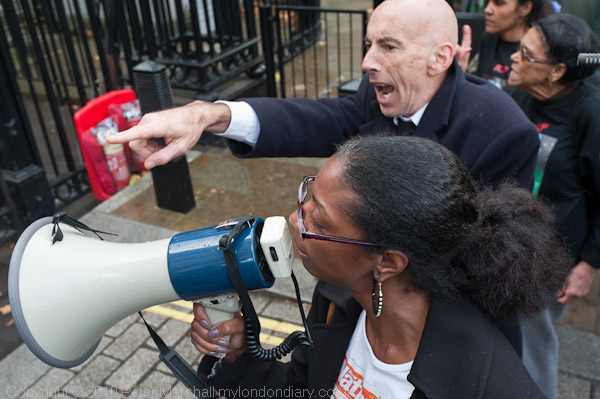
Troops Home from Iraq; Don’t Invade Iran: Saturday March 18th 2006 I went to the large protest on the third anniversary of the invasion of Iraq, photographing as the march gathered in Parliament Square and then as the march went along Victoria Street on its rather indirect route to a rally in Trafalgar Square. As often with large marches, by the time the end of the march had passed me I was too late for it to be worth going on to the rally.

Troops Home from Iraq; Don't Invade Iran - 2005
Marchers in Guantanamo fatigues and chains leaving Parliament Square, March 18, 2006

Here – with the usual tidying of capitalisation and a few minor clarifications is the post I made on My London Diary at the time. Of course things have become much worse in various ways but particularly so far as civil liberties in the UK are concerned, the situation in Iraq has been dire and there remains a real threat of military action against Iran, an odious regime but whose people would still suffer greatly from any any invasion.

Troops Home from Iraq; Don't Invade Iran - 2005

As always there are many more pictures on My London Diary.


Troops Home from Iraq; Don’t Invade Iran

Troops Home from Iraq; Don't Invade Iran - 2005

The Troops Home From Iraq; Don’t Invade Iran march on the 18th was another large event organised by Stop The War, part of an international protest in cities around Europe, North America, Latin America, Asia Pacific, Asia and Africa – a total of around a couple of hundred places. In London there were roughly 20,000 who walked out of Parliament Square past where I was taking pictures, although many like me will not have made it to Trafalgar Square, and others will have joined in later on the route.

Troops Home from Iraq; Don't Invade Iran - 2005

The event marked three years since the invasion of Iraq on 20 march 2003. At the front of the march were Theatre Of War representing both Tony Blair and George Bush along with two police and two judges holding placards declaring the two leaders guilty.

Put your head in a sack, Guantanamo style…

Behind them were the march leaders, including representatives of families of soldiers killed in Iraq. They had a long, long yellow ribbon with the names – no ranks – of soldiers who have died so far in this illegal war and occupation. Of course many more Iraqis killed – more than 100,000 have died so far.

The invasion, doubtful on legal grounds, was justified on the basis of false information, including information that was known to be incorrect when it was presented to parliament and the people.

Already it has led to deaths in Britain; only a small handful of people (that’s Tony Blair and some of his cabinet) doubt that the London bombings would not have happened if Britain had not joined in the invasion plans. Actually it is hard to believe even they doubt it, but rather they just can’t bring themselves to admit it.

A protester from Glasgow is warned for using a megaphone in Parliament Square

We’ve also seen the passage of draconian measures that attack civil liberties in this country (and attempts still being made to get more.) Muslims in particular have been targeted, with a rise in Islamophobia.

At last the march moved off, with stewards pushing photographers away from the front

The expenditure in Iraq has been vast. If you want to know why there isn’t the money to raise pensions (and a week of pension protests was ending today with a conference in London) there is a simple 4 letter answer. IRAQ.

Another four letter country, Iran, is currently under threat. Perhaps most chilling are the denials from Blair and Straw, who state that invasion is not on the table. For too many of us that just seems to make it more likely.

Many more pictures on My London Diary


FlickrFacebookMy London DiaryHull PhotosLea ValleyParis
London’s Industrial HeritageLondon Photos

All photographs on this page are copyright © Peter Marshall.
Contact me to buy prints or licence to reproduce.

LSE Cleaners Protest, Lisa Arrested – 2017

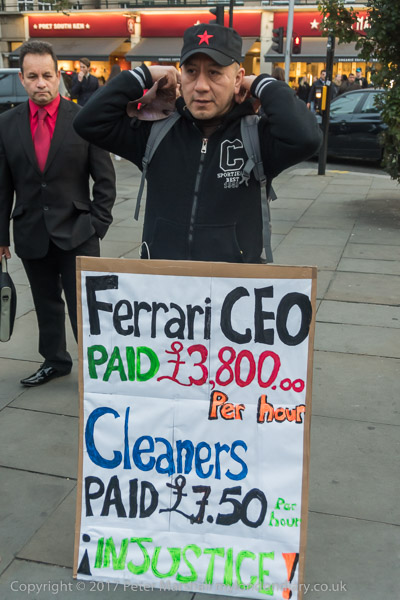
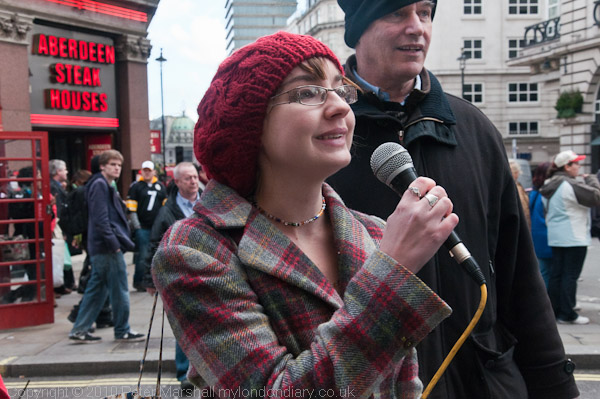
LSE Cleaners Protest, Lisa Arrested: Wednesday 15th March 2017 was the first day of a two-day strike by cleaners at the LSE in support of their campaign demanding equal sick pay, holidays and pensions etc to similar workers directly employed by the LSE and an end to bullying and discrimination by their employer Noonan.

LSE Cleaners Protest, Lisa Arrested
LSE Cleaner Mildred Simpson

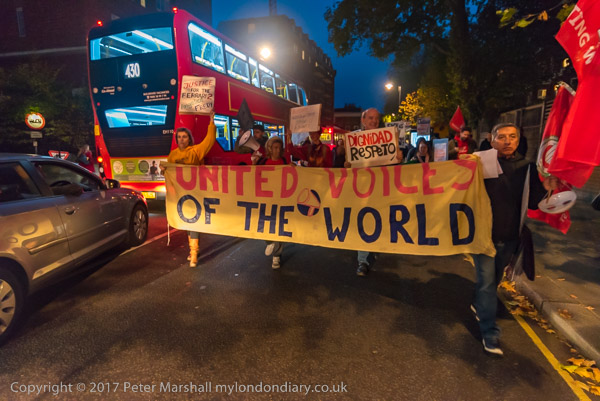
I had photographed the start of their campaign at a meeting led by their union, the United Voices of the World, as a part of the LSE’s 3-day ‘Resist’ Festival on 29th September 2016 and a number of protests at the LSE since then.

LSE Cleaners Protest, Lisa Arrested

On 15th March the cleaners had a picket line since the early morning – cleaners start work while most of us are still in bed – and I joined them for a lunchtime rally. Their campaign had a great deal of support from students at the LSE and had a large banner ‘L$E: The London School of Exploitation‘.

LSE Cleaners Protest, Lisa Arrested
Grim Chip recited several of his short poems

Others who had come to support the cleaners included Grim Chip of Poets on the Picket Line and LSE academics Lisa McKenzie and David Graeber and a few from Class War. But there were passionate and effective speeches from a number of the cleaners, including Mildred Simpson, one of the LSE cleaners and others in the UVW.

LSE Cleaners Protest, Lisa Arrested
Alba, right, a LSE cleaner unfairly dismissed in September 2016

At the end of the rally, the protesters marched through the campus and across Kingsway to the building which houses the LSE Estates Office where a large group walked into the foyer demanding to see the Estates Manager. Some were carrying mops and buckets to show their support for the cleaners.

Security came to talk with the protesters, though the protesters were making too much noise to hear them and the protest continued with a short speech from UVW General Secretary Petros Elia to explain when the foyer was being occupied.

Eventually the protesters sat down and waited, still making a lot of noise . People working in the building were still able to leave or enter the building unhindered walking past the protest – but would hear and read why the noisy protest was taking place.

Eventually police arrived and talked with the building security and some of the protesters who soon began dancing in the foyer to music on the public address system the UVW had brought.

More police arrived and decided to stop people entering or leaving the offices. They talked with UVW General Secretary Petros Elia who told them it was a peaceful protest and they would leave after they had made their point to the LSE facilities manager – if the police could persuade him to talk to them.

Eventually this talk did take place, though some way back from the foyer where we could only see them from a distance. The talk went on for around five minutes, and Petros then returned smiling to tell the protesters that the LSE who had until now been refusing to talk to the cleaners had agreed to a meeting.

The protesters then walked out to join those who had been continuing to protest on the pavement outside, and they prepared to end the protest.

But unexpectedly police moved in and surrounded Lisa McKenzie telling her she was under arrest.

They pushed her roughly to the wall of the building and handcuffed her pushing away excessively roughly those who tried to stop the arrest and taking her to a waiting police van.

Apparently Lisa was being charged with assault on the receptionist when the protesters entered the building. I was close behind and neither I nor the other protesters saw any evidence of assault by her as she entered the offices holding one end of the banner with others.

Everyone was shocked, both by the arrest and by the police violence. The fact that none of the others holding the banner were arrested strongly suggested that her arrest was politically motivated, probably due to pressure from the LSE for her support for the cleaners – she had organised the ‘Resist’ Festival where the cleaners campaign had been launched.

Lisa had previously been the subject of a clearly political arrest when she was wrongly charged with three offences at a protest in February 2015 while she was standing in the General Election against Iain Duncan Smith. Perhaps the police were still feeling aggrieved after failing signally to achieve a conviction. This time they were not stupid enough to take her to court.

Much more from Wednesday 15th March 2017 on My London Diary:
LSE cleaners strike and protest
Police arrest Lisa again


FlickrFacebookMy London DiaryHull PhotosLea ValleyParis
London’s Industrial HeritageLondon Photos

All photographs on this page are copyright © Peter Marshall.
Contact me to buy prints or licence to reproduce.

Union Busting, Tibet, Women & Sharia – 2009

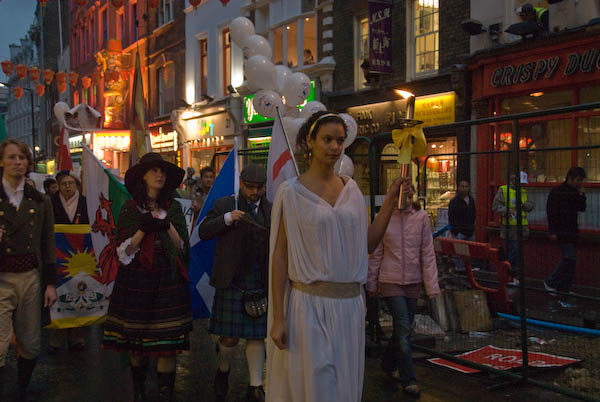
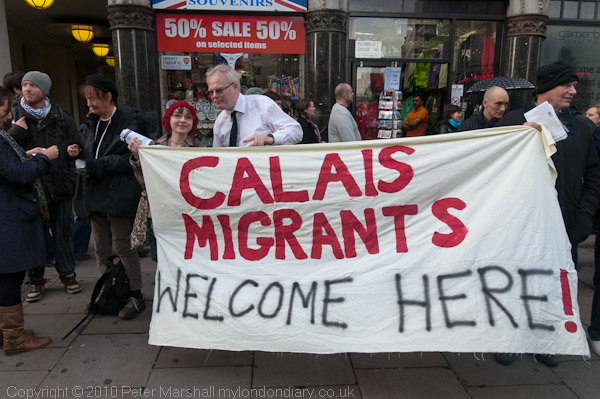
Union Busting, Tibet, Women & Sharia: My work on Saturday 7th March began outside fashion store Prada in Mayfair. I moved on to the Chinese Embassy for the annual Tibet Freedom March, then to Portman Square for a International Women’s Day march and finally to Trafalgar Square where ‘One Law for All’ were marching to a public meeting against the use of Sharia and other faith-based laws in the UK.


Union Busting – Just SO Last Season – Prada, Old Bond St

Union Busting, Tibet, Women & Sharia - 2009

A dozen people from Labour Behind the Label, part of the international ‘Clean Clothes Campaign’ which campaigns in support of garment workers worldwide were protesting outside Prada, one of the best-known luxury brands around the world.

The ridiculously expensive fashion luxury goods its customers buy are not made in Milan where Prada was founding but in factories such as the DESA factory in Turkey. Workers there are on ridiculously low pay and work long shifts – sometimes up to 40 hours.

Union Busting, Tibet, Women & Sharia - 2009

When in April 2008 workers at DESA decided to join the Turkish leather workers union, 44 were sacked and 50 forced to resign from the union.

Demonstrations outside the DESA factory have led to repression and arrests and when one union leader refused to accept a bribe, her family was threatened, and later that day men on a motorbike attempted to kidnap her 11 year old daughter.

Union Busting, Tibet, Women & Sharia - 2009

Prada wasn’t the only luxury goods seller profiting from this despicable exploitation – the DESA factory in the Dzce Industrial Zone also makes goods for Mulberry, Louis Vuitton, Samsonite, Aspinal of London, Nicole Farhi and Luella.

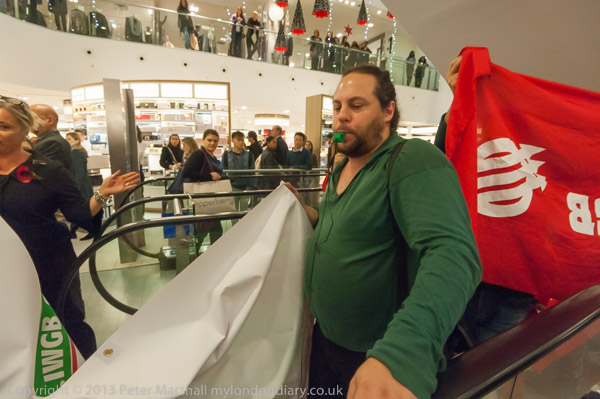
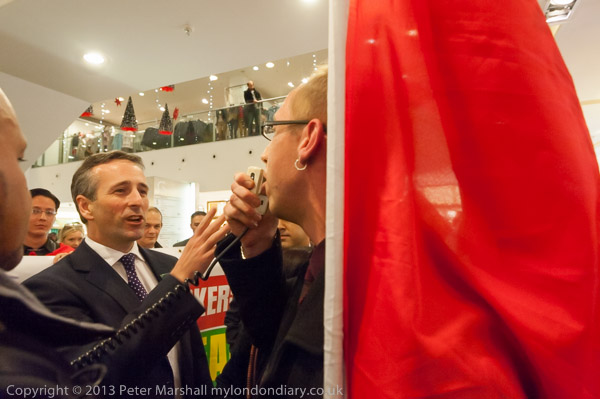
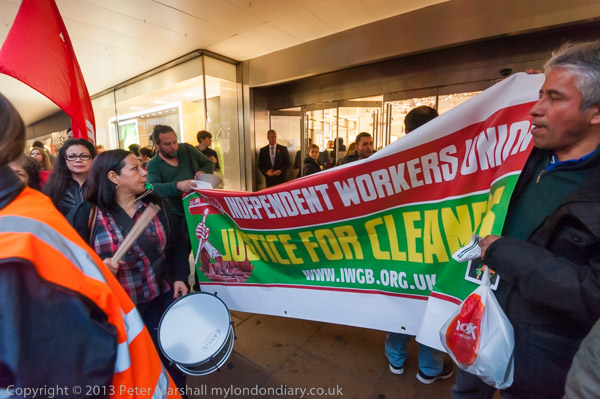
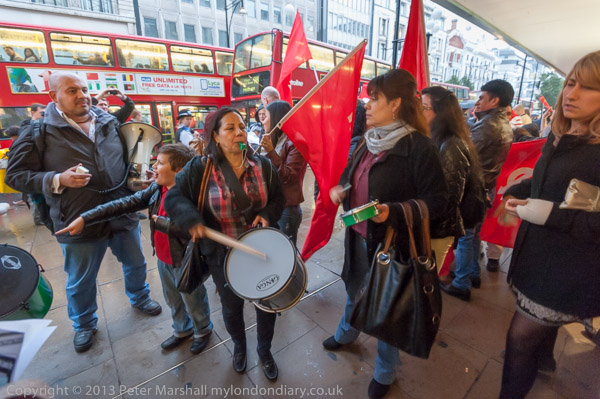
As well as publishing more about the protest – and of course more pictures, my London Diary post also pointed out that it isn’t just the high price designer labels that support sweatshops, but also Matalan and other cheap suppliers and supermarkets – and urged readers to visit the Labour Behind the Label web site to find out more and support their actions.

Union Busting – Just SO Last Season


Tibet Freedom March – 50 Years – Chinese Embassy

Union Busting, Tibet, Women & Sharia - 2009

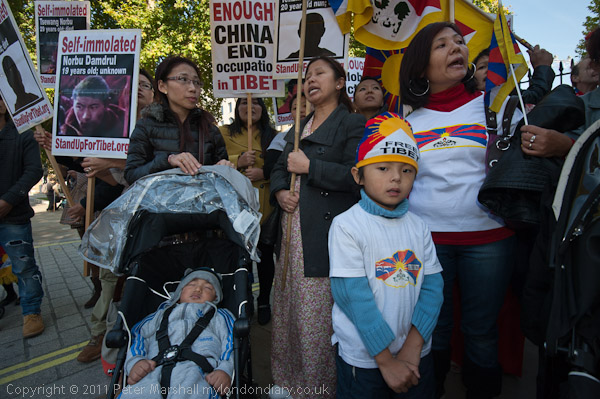
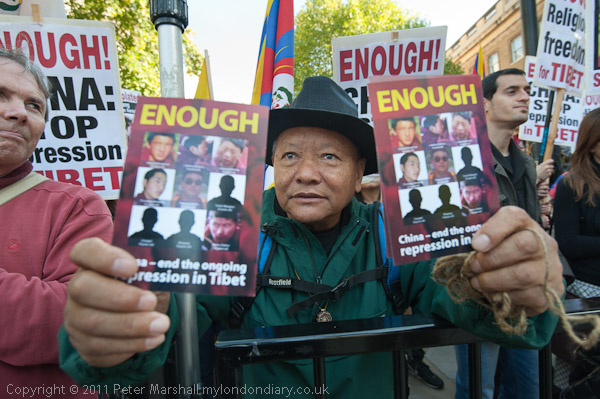
The march marked the 50th anniversary of the brutal repression by China of the ‘Tibetan People’s Uprising‘, when over 80,000 Tibetans were killed and many others jailed.

It was then the Dalai Lama fled the country along with many others. Those still in Tibet still suffer the same kind of brutal repression, with thousands missing after the demonstrations in Tibet in 2008, and hundreds serving lengthy prison sentences.

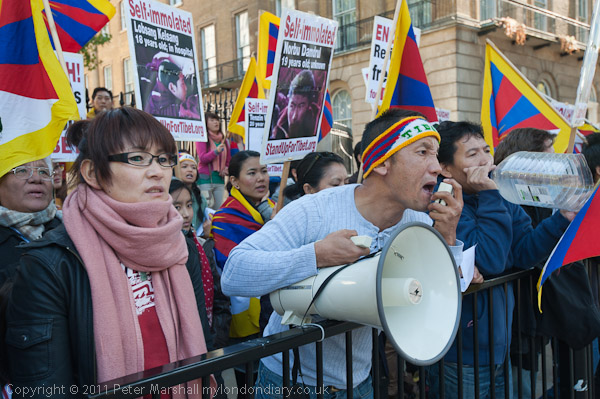
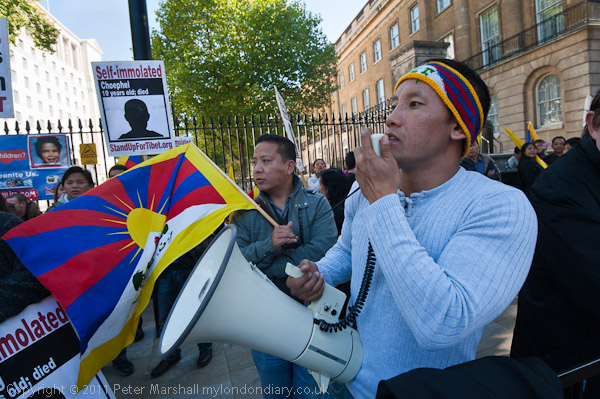
Many on the protest carried Tibetan flags. Two months earlier a young Tibetan, Pema Tsepak, had been beaten to death for carrying one in his own town in Tibet.

Palden Gyatso
Palden Gyatso.

At the start of the march opposite the Chinese Embassy, Palden Gyatso, a Tibetan monk who spent 33 years in prison and labour camps from 1959 to 1992 and was permanently damaged by the beatings and inhumane torture he suffered tried to deliver a letter to the Chinese Embassy but the Embassy was not accepting any post.

Gyatso’s autobiography was the basis for the film, ‘Fire Under the Snow‘ – you can watch a trailer on YouTube.

I left the march when it reached Oxford Street to go to the International Women’s Day march.

Tibet Freedom March – 50 Years


Million Women Rise 2009 – Portman Square, Oxford St

The main celebration of International Women’s Day in London in 2009 was the ‘Million Women Rise 2009‘, a women-only march to end male violence against women.

This annual march since it started the previous year coincided with the global United Nation theme for 2009 which was ‘Women and men united to end violence against women and girls‘, but Million Women Rise is a women-only march.

Hackney Women Rise. The march was co-ordinated by Sabrina Qureshi

This year the numbers seemed rather smaller, despite the predictions of a much larger event, but it was still a lively event and one that made a greater impact with its route through London’s major shopping streets – Oxford Street and Regent Street and across Piccadilly Circus to a rally in Waterloo Place.

As they marched the women chanted their main message: “However we dress, wherever we go, yes means yes, no means no!” and called for an end to male violence against women.

“Yes means Yes and No means No” Women march along Oxford St

This was a national march with coaches bringing women from Birmingham, Bradford, Hebden Bridge, Wales, Nottingham and Todmorden as well as other groups coming from around the country. There was also a strong participation by Kurdish and Turkish groups based in London.

One group marched behind the main march, choosing to follow the UN theme rather than be a women-only march; “the European Confederation of Workers from Turkey (ATIK) Women’s Commission group included men marching (as their placards proclaimed in Turkish) in a spirit of socialist equality, fraternity and freedom.”

Million Women Rise 2009


One Law For All – No Sharia Law in Britain – Trafalgar Square

The One Law for All campaign had been launched three months earlier on Human Rights Day by prominent civil rights activists, lawyers, feminists and academics as well as the National Secular Society.

A speaker from the Worker Communist Party of Iran UK Committee

Among those supporting it were many who had previously lived under Sharia, including both Muslims and ex-Muslims, some who had fled their home countries to claim asylum after persecution for political activities including the refusal to adhere to religious dictats.

The organisation objects to the setting up of Sharia courts in the UK, on the grounds that Sharia law is discriminatory and unjust, particularly against women and children. While supporters of religious courts see these as promoting minority rights and social cohesion they see them as a cheap short cut to injustice and call for one secular law to govern all of us.

Maryam Namazie

After an hour of speeches One Law for All Spokesperson Maryam Namazie made a final address before the roughly 250 people present marched to a public meeting at Conway Hall. But I left for home instead.

One Law For All – No Sharia in Britain


FlickrFacebookMy London DiaryHull PhotosLea ValleyParis
London’s Industrial HeritageLondon Photos

All photographs on this page are copyright © Peter Marshall.
Contact me to buy prints or licence to reproduce.

UAF Oppose EDL Westminster March – 2010

UAF Oppose EDL Westminster March: There is a long history of protests where anti-fascists come to oppose marches and rallies by extreme right groups in London, including of course the Battle of Cable Street, but I think we have had more of them in recent years, if not on that same scale.

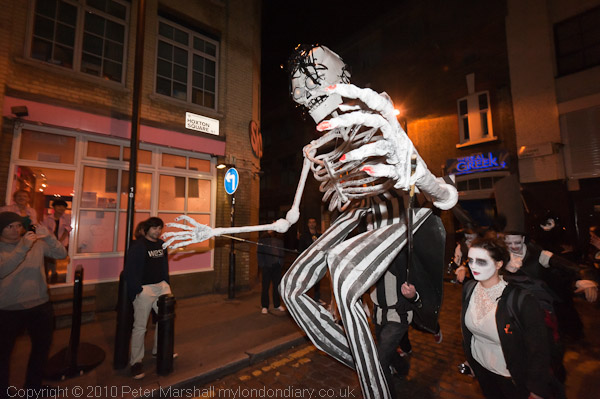
Ban the Burkha but not the Balaclava?

But looking back on my coverage of this event of Friday 5th March 2010 what we have seen different is the policing of such confrontations. The more recent such events have seen huge mobilisations of police to keep the two groups apart, with extensive use of double barriers with a large ‘sterile’ no go area between them, and often some fairly aggressive policing and arrests to achieve this.

Attending more recent events journalists and photographers have had to choose which side of the event to be at, with often rather long detours being needed to go between the two – and having a Press Card is seldom of any use.

Jeremy Corbyn

In 2010 police did keep the two groups apart, but only on opposite pavements of the road in front of the Houses of Parliament, and as my photographs show, I was able to move fairly freely from side to side.

Unite Against Fascism had tried to block the road a couple of hours before the EDL march after holding their rally in Old Palace Yard on the north side, but were then forced across the road onto the opposite pavement by police. I wasn’t there to see this but was told by others that there had been a few arrests when people had refused to move.

I had walked away down Millbank where the EDL were to hold a rally before marching to Parliament. I was early and nobody was there but as I had expected there were several hundred at a packed pub a couple of hundred yards further on with many standing on the pavement outside.

Most were in in a good mood and happy to talk to me and other journalists about why they were protesting – and you can read more about this on My London Dairy. I think I represented them fairly in my article, though as always they felt strongly that they did not get fair treatment in the press. I felt that the coverage was generally fairly accurate, the problem was more with the views and actions of some EDL members rather than the reporting.

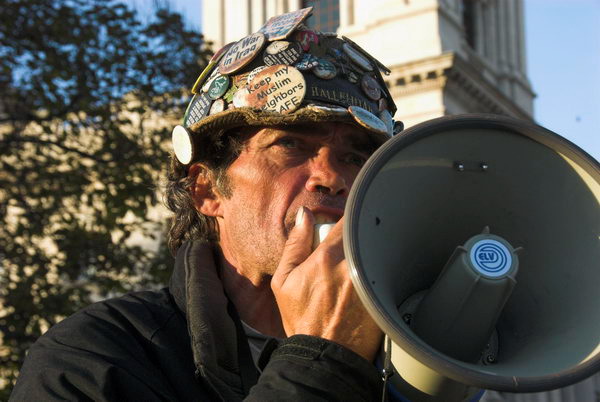
As I noted in my account: “Later during the actual march I did get sworn at, threatened and given the finger, but only by a small minority of marchers, and a young female Asian journalist seemed to attract considerably more aggravation than me. There was also a considerable amount of clearly anti-Muslim shouting and singing, and the placards and slogans that attack the building of mosques seem to threaten all Muslims rather than just the extremists. The atmosphere was unpleasant, and really gave the lie to the earlier denials of racism.”

I went along with them to the rally outside Tate Britain, but the start was delayed and they went back to the pub. When it did finally start the main speaker was the Sikh Amit Singh (Guramit Singh Kalirai), and his speech seemed to me at times to be clearly racist in its attacks on Muslims. Police took no action over this or his other speeches, but three years later he was jailed for taking part in a violent attempted armed robbery.

From there the EDL were escorted by police as they marched to Parliament and taken into a pen on the north side of the road opposite the UAF. As I commented, “The first thing that many of the EDL did on arriving in the pen was to urinate against the wall of Westminster Abbey” but mostly they shouted often racist abuse at the UAF who responded with calling them racists and fascists.

The EDL made great play of denying they were racists and showing off their few Black and Asian members to the press. But there was a hugely visible difference between their largely white male crowd and those across the road which reflected the multiracial nature of London – and where women were in a majority.

After around an hour of shouting across the road the UAF crowd began slowly to drift away. Police kept the EDL in their pen but did escort a few to Westminster Station.

I decided it was time to leave. As I commented I hadn’t enjoyed spending much of the afternoon in the company of the EDL “hearing their racism and right wing simplicities. It was an unpleasant way to spend an afternoon, but I think its important to show these events and these people honestly.”

More about the event and more pictures on My London Diary at UAF Oppose EDL Westminster March.


FlickrFacebookMy London DiaryHull PhotosLea ValleyParis
London’s Industrial HeritageLondon Photos

All photographs on this page are copyright © Peter Marshall.
Contact me to buy prints or licence to reproduce.

Keep our NHS Public – 2007

Keep our NHS Public: Saturday 3rd March 2007 saw protests around the country against the increasing privatisation of the National Health Service and I managed to cover several of these events in London, a march in Camberwell followed by a march from Whitechapel to Hackney Town Hall where they joined others who had marched in Hackney. After finishing my coverage of these events I photographed the Hare Krishna in Soho and then went to the Photographers Gallery.

Keep our NHS Public - 2007
The march on its way to the Maudsley Hospital

Here I’ll publish what I wrote back then on My London Diary with the usual corrections to spelling and capitalisation. Reading what I wrote below again now I think I was far too generous to New Labour. Although some MPs may have been well-intentioned I think the policies were largely driven by those with personal financial interests in private healthcare and other sectors that would profit from them. The NHS (and us) are still suffering from their actions and I have little confidence in the changes the current Labour government is now making.

Keep our NHS Public – Saturday 3rd March 2007

Keep our NHS Public - 2007
Local MP Kate Hooey gave her support to keeping the NHS public

Although health workers and other trade unionists had called for a national demonstration in London, the union bosses declined to organise one, perhaps not wanting to embarrass an already beleaguered Labour government. What took place instead was a whole series of local demonstrations – including at least 7 in the Greater London area – across the whole country.

Keep our NHS Public - 2007

The overall effect was perhaps to make it more impressive, and certainly it seemed to get more coverage in the media that might otherwise have been expected, although there were few reporters and no TV crews at the three events I photographed (for some reason they preferred Sheffield.)

Keep our NHS Public - 2007

Largely well-intentioned attempts to improve the health service have failed to deliver as they should, with many services being cut. Part of this has been caused by a dogmatic insistence on making use of private finance with results that range from fiasco to farce, inevitably accompanied by long-term financial loss.

A second disastrous dogma has led to bringing in private enterprise to do the simple work at artificially inflated prices (they even get paid for work they are not doing) which has the secondary result of making the NHS services appear more expensive, as they are left to deal with the trickier cases.

Kate Hooey holds the main banner with others on the Camberwell march

Further blows to our national health service have been through the predictably disastrous IT projects; as well as going millions over budget, these have largely failed to deliver. Add the proliferation of management and expensive consultants, along with crazed assumptions in negotiating doctors’ pay leading to an unbelievably generous offer, and it it hardly surprising that the whole system is in financial chaos.

The government clearly lacks a real commitment to the kind of National Health Service many of us grew up with, run for the benefit of the people rather than to make money for healthcare corporations. The health service certainly needed a shake-up to reduce bureaucracy and eliminate wasteful practices, but instead new layers of both have and are being added.

Outside the Maudsley Hospital – reading the letter which a delegation then delivered

I started off in Camberwell, and had time for a short walk before the speeches and march began. It wasn’t a huge event, but there was strong support from those in the service, from patients and from pensioners, as well as local MP Kate Hooey. From Camberwell Green the march went down to the Maudsley Hosptial where a letter was handed in and I got on a bus and left for Bethnal Green and Hackney.

Going up the Cambridge Heath Road in the centre of Bethnal Green, I saw the march from the Royal London Hospital in Whitechapel to Hackney in the distance. Unfortunately the bus was held up in the traffic behind it, taking almost five minutes to reach the next stop before the driver would open the doors and let me off. Some things were a lot easier with the Routemasters.

This was a smaller march than that from Camberwell, and after a few minutes I felt I’d photographed all I could, so I ran ahead and caught a bus for the centre of Hackney, arriving there just a couple of minutes before the Hackney march, which had come from Homerton Hospital, had returned to the town hall. I photographed them arriving and then the rally that ensued.

The Hackney march was a little larger, perhaps around two hundred, and there were quite a few speakers, including local councillors and representatives from the various organisations that had helped to organise the march.

A big cheer went up as the march from Whitechapel arrived, swelling the numbers in the square at the town hall.

Lindsey German who lives in Hackney

Among the better known speakers taking part were George Galloway, whose speech lived up to his usual high standards of wit and common sense. Lindsay German, a hackney resident well known for her work for ‘Stop The War’ also spoke with feeling on the issues of health and the NHS. Several of the other speakers were old enough to have known the problems before the health service was set up.

As the meeting began to wind down, I caught a bus to Bethnal Green and then the tube to Tottenham Court Road. Just to the north of Soho Square I got to the Hare Krishna Temple just as the annual Gaura Purnima [Golden Full Moon] procession was arriving back from its tour around the area.

Churchill and an entrance to a stairway with a red light

From there I went to the Photographers’ Gallery to have a good look at this year’s photography prize contestants. I hope the prize goes to one of the two photographers on the shortlist, Philippe Chance or Anders Petersen. [Neither won.] Walking through Soho and Westminster I took a few more pictures.

More pictures on My London Diary.


FlickrFacebookMy London DiaryHull PhotosLea ValleyParis
London’s Industrial HeritageLondon Photos

All photographs on this page are copyright © Peter Marshall.
Contact me to buy prints or licence to reproduce.

Save the Whittington Hospital – 2010

Save the Whittington Hospital: On Saturday 27th February 2010 I joined around two thousand people at Highbury Corner to march the two miles to the Whittington Hospital in a protest against planned cuts in A& E and other services at the hospital under a rationalisation plan initiated by Lord Darzi, Parliamentary Under-Secretary for the Department of Health from 2007 to 2009. In 2008 he led a review of the NHS titled High Quality Care for All.

Save the Whittington Hospital - 2010

The proposals for North London arose out of this review and led to plans to would see A&E services downgraded at the Whittington and Chase Farm Hospital in Enfield as well as at either Barnet or North Middlesex Hospitals. He argued that by concentrating emergency services in a few highly-equipped hospitals with specialist facilities a better service can be provided. But the changes were also motivated by the forecast of a large forecast future NHS North London deficit of around £860 million in five years time.
Save the Whittington Hospital - 2010

As speakers at the rally pointed out, these changes would lead to much longer journeys for patients through the congested streets of north London in emergencies, which would cost lives. The Whittington, close to the major junction at Archway and with good transport connections is a good place for a hospital and its part or eventual full closure would release a highly desirable and lucrative location for developers.
Save the Whittington Hospital - 2010
Frank Dobson holds the Whittington cat – which has a few bandages & sticking plasters

Among the marchers were several local MPs for the area served by the hospital, including David Lammy, MP for Tottenham and Minister for Higher Education and Intellectual Property in the Department for Business, Innovation and Skills, who pledged his support for the hospital and all its services, revealing that he had been born there.
Save the Whittington Hospital - 2010

Frank Dobson who was Secretary of State for Health from 1997 to 1999 also gave a powerful speech in support, as did Lynne Featherstone, Liberal Democrat MP for Hornsey and Wood Green. MPs Jeremy Corbyn and Emily Thornberry were also at the event, as well as Terry Stacy, the leader of Islington Council. A number of celebrities with links to the hospital also supported the protests against its closure.
Save the Whittington Hospital - 2010

It was doubtless the celebrity support that gained the battle to save the Whittington much greater publicity across the media than most protests, though as usual the BBC did its best to minimise the protest, its web site “being deliberately misleading when it states that “hundreds of protesters” gathered for the march“.

I’d actually stopped and counted the marchers as the walked past me and although my count might have been a few tens out, there were just under 2,000 when it left Highbury Corner. More joined it on the march and others went directly to the rally at the Whittington where the organisers estimated 5,000 attended, though my guess was a little fewer.

In April 2010 after huge local opposition, Labour health minister Andy Burnham had cancelled planned cuts at Whittington Hospital at Archway in North London, along with other planned cuts at North Middlesex and Barnet Hospitals. Shadow health minister Andrew Lansley praised his decision to call “for a stop to the flawed plans by NHS London to shut down local hospital“.

A quick consultation with the public

In July 2024 another Labour health Secretary, Wes Streeting, commissioned Lord Darzi to carry out an independent investigation into the NHS in England, which was published without any public consultation in September 2024. I imagine we will soon be fighting to stop more hospital closures.

More at Save the Whittington.


FlickrFacebookMy London DiaryHull PhotosLea ValleyParis
London’s Industrial HeritageLondon Photos

All photographs on this page are copyright © Peter Marshall.
Contact me to buy prints or licence to reproduce.