Three Mills, Xenophobia & Infinite Love – 2006

Three Mills, Xenophobia & Infinite Love: On Saturday 11th February 2006 I went to an industrial archaeology meeting in the morning at Three Mills, one of the country’s most important surviving early industrial sites on the River Lea in Newham on its border with Tower Hamlets, then went back into central London for a rally against Xenophobia followed by a free Valentine street party at Piccadilly Circus. I wrote about all three on My London Diary, with of course photographs but like all posts on that site at the time this is a little difficult both to find and read – so I’ll repeat it here with proper capitalisation, minor corrections, a few extra links to add context and links to all the pictures.


Three Mills, Bromley-by-Bow
Three Mills, Xenophobia & Infinite Love - 2006

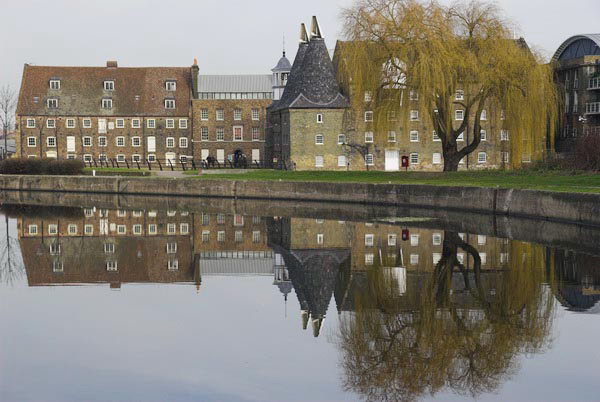
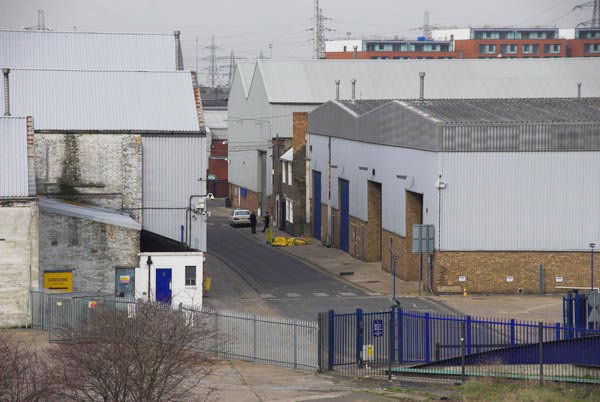
Saturday I was up early on my way to a meeting at Three Mills, Bromley-by-Bow. These mills are almost all that will be left standing in this area of the Lea valley by the development for the 2012 London Olympics and a huge growth in housing. If you want to see the Lower Lea Valley, you’d better get down there soon before it all disappears. The plans are not so much regeneration but more a total replacement.
Three Mills, Xenophobia & Infinite Love - 2006
Sugar House Lane, Stratford from the Miller’s House

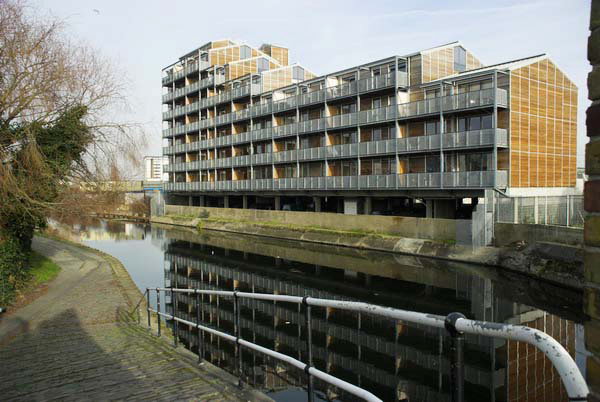
I arrived early so I could take a short walk and a few pictures, and after lunch was able to take some pictures from the upper floors of the Mill Owners House. The whole area is one that played an important part in the development of many industries, and is littered with sites of interest to industrial archaeologists, while buried beneath these are doubtless important remains from medieval and earlier times. An important part of our heritage, and all likely to be bulldozed with at most a token report being made.
Three Mills, Xenophobia & Infinite Love - 2006

I first visited the Lea Valley in the 1980s. You can see a few of my pictures from it on my unfinished site River Lee – Lee Valley, although this covers a rather wider area than the Olympic site. There are also some pictures from the area elsewhere on this site – use the search box.
more pictures


United Against Xenophobia – Trafalgar Square
Three Mills, Xenophobia & Infinite Love - 2006

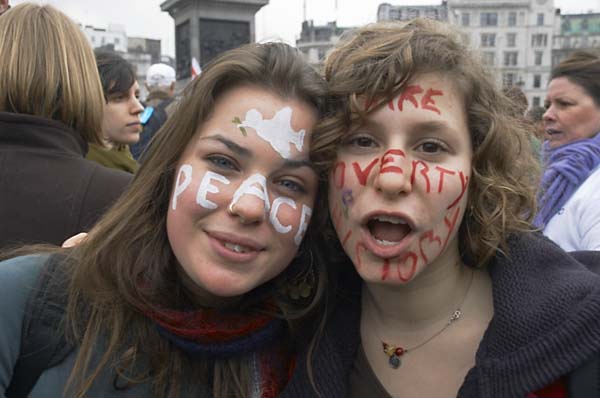
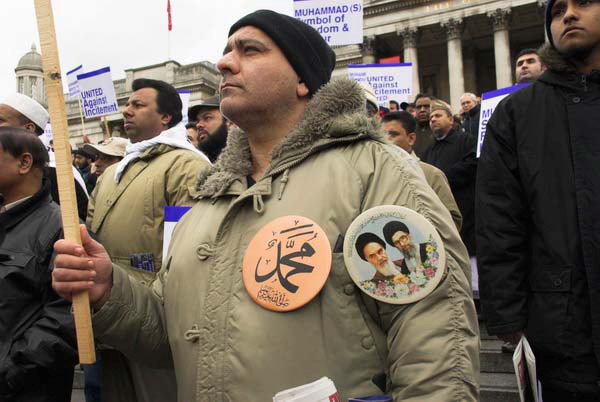
Meanwhile, back in Trafalgar Square, around ten thousand people, mainly British Muslims, had gathered in a rally organised by the Muslim Council of Britain to demonstrate they were united against xenophobia. As well as showing their disapproval of those cartoons depicting Muhammad, they were also determined to disassociate themselves from more extreme Muslim groups.

Three Mills, Xenophobia & Infinite Love - 2006

It was a gathering of decent people, behaving decently, listening to decent speakers speaking decently, carrying only the approved decent placards, overwhelmingly decent. Somehow it hardly seemed a real demonstration.
more pictures


Reclaim Love 3 – Operation Infinite Love, Eros, Picadilly Circus
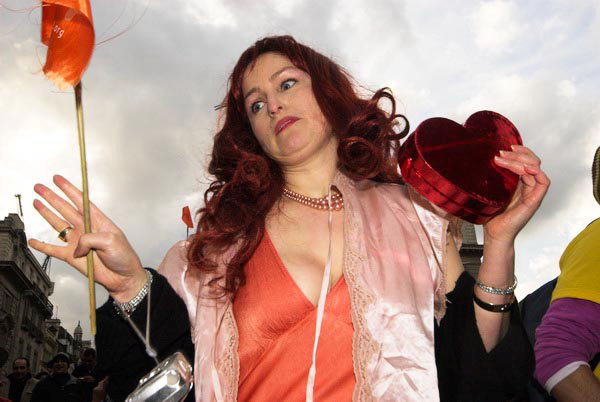
But I had a date with Eros, and wandered along to Piccadilly Circus where St Valentine was being honoured with a gathering by O-I-L, Operation Infinite Love.
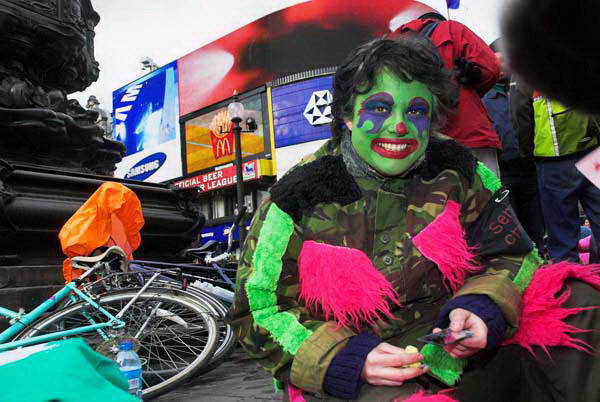
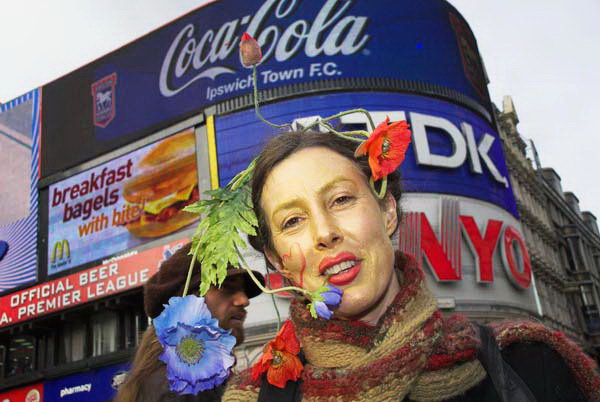
In response to the growth of confusion and fear in the world… we have decided to send love and healing to all the beings in this world, many of whom are suffering today.”

Venus CuMara the organiser of the events calls everyone to form a circle and hold hands

This is the third such annual event, and also carried the point that you didn’t need to buy expensive gifts, giving love was what mattered.

After some highly spirited samba from the Spirits Of Resistance everyone present made a large circle to “send love out from the bottom of our hearts to the whole world and all the beings upon her“.

Then the sound system started up and everyone was dancing.

I stayed at the event taking pictures until the light began to fade and then went home, taking with me one of the hundreds of free t-shirts that were given out by Venus and her friends.

I photographed most of these free annual Valentines street parties over the years until 2019. Although a few people have tried to get them going again since Covid I think few people have turned up to party.

Many more pictures


FlickrFacebookMy London DiaryHull PhotosLea ValleyParis
London’s Industrial HeritageLondon Photos

All photographs on this page are copyright © Peter Marshall.
Contact me to buy prints or licence to reproduce.

IWW Demand ‘Reinstate Alberto’, Occupy & London, 2012

IWW Demand ‘Reinstate Alberto’, Occupy & London: On Friday 10th February 2012 I came to London to photograph a rush hour protest calling for the reinstatement of an office cleaner sacked for his union activities. I came early to wander a little from Waterloo and pay a visit to Occupy London on the way there, and also took a few pictures on my way home after the protest.


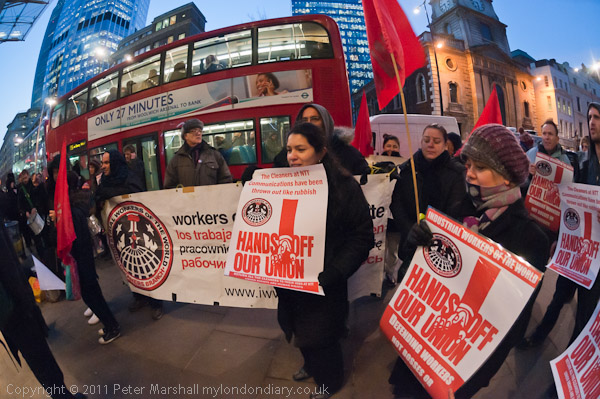
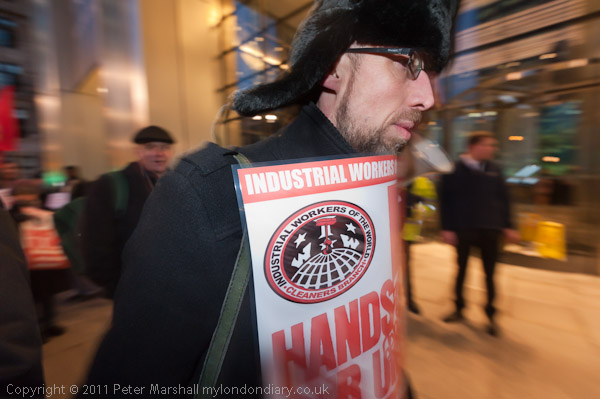
IWW Cleaners Demand ‘Reinstate Alberto’ – Heron Tower, Bishopsgate

IWW Demand 'Reinstate Alberto', Occupy & London, 2012

Cleaners were protesting outside the 230 metre tall Heron Tower (now Salesforce Tower) at 110 Bishopsgate, completed in 2007 when it then was the tallest building in the City of London.

Alberto Durango 
IWW Demand 'Reinstate Alberto', Occupy & London, 2012
Alberto Durango speaks outside Heron Tower

The protest called for the reinstatement of IWW Branch Secretary Alberto Durango who had been sacked, victimised for his trade union activities, after the cleaning contract for the building had been taken over by a new contractor, Incentive FM Group Ltd.

IWW Demand 'Reinstate Alberto', Occupy & London, 2012
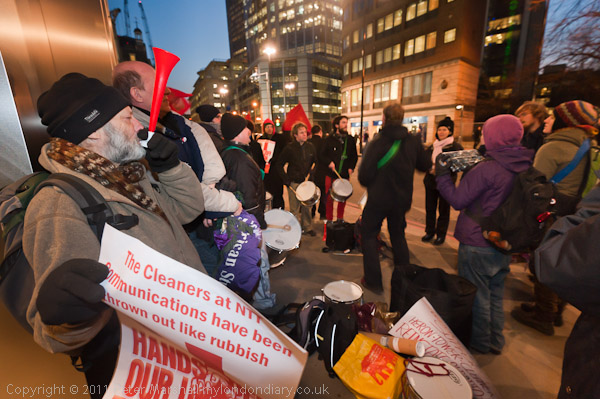
NTT Communications threw out their cleaners “like rubbish” because they organised and joined the union

Alberto who worked as a cleaner in the Heron Tower had become well known for his campaigning activities in and around the City of London, which have helped to secure better working conditions and the London Living Wage for many of the cleaners who work in London’s prestigious offices. He was then the Industrial Workers of the World Cleaners and Allied Trades Branch Secretary and in 2011 had won the fight for workers at Heron Tower to be paid the London Living Wage and an agreement with the then employer that there would be no redundancies there with any staff reductions needed being made by transfers to alternative posts.

IWW Demand 'Reinstate Alberto', Occupy & London, 2012

Under the Transfer of Undertakings (Protection of Employment) Regulations (TUPE) the new employer should have continued to recognise this agreement. Instead they refused to do so and picked on Alberto, making him redundant.

IWW Demand 'Reinstate Alberto', Occupy & London, 2012

The same management also controlled Exchange Tower where the IWW were carrying out a campaign to get cleaners the London Living Wage and where they have taken a very aggressive stance against the union, threatening the union members. The protesters connected Alberto’s sacking with his role there as union Branch Secretary.

This was a very loud protest with speakers using a powerful megaphone and drummers from Rhythms of Resistance adding their loud beats as office workers from Heron Tower and the many other offices in the area were making their way home in the evening rush hour.

The pavement outside the area owned by Heron Tower on Bishopsgate is relatively narrow and police rightly insisted that there needed to be a clear route along it for workers to get past without having to step into the busy road. So my 15mm fisheye lens was extremely useful, though it does make the area look much more spacious than it was.

In February the protest began a quarter of an hour after sunset, and light was fading fast. Although the City streets are generally well light both from street lighting and by the light from the huge areas of glass on the front of modern buildings I used added lighting for many of the pictures, either with a hand held LED light or flash on camera. But neither light source can cover the 180 degree diagonal view of the fisheye and those pictures rely on available light only. Its f2.8 maximum aperture helped – and it was a stop faster than the wide-angle zoom used for almost all the other images. In some at least of the pictures I think the fish-eye effect works well too.

More at IWW Cleaners Demand Reinstate Alberto.


Occupy London & Other Pictures – St Paul’s Cathedral

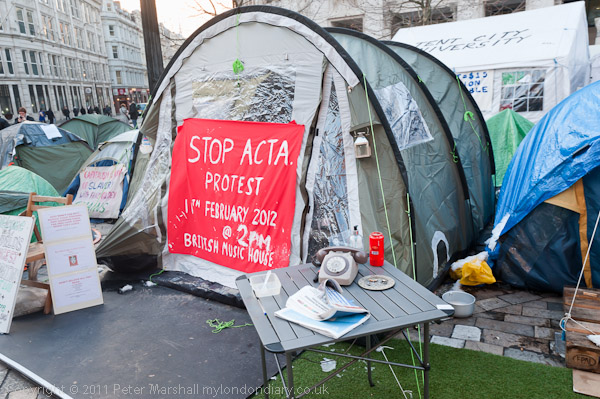
Although there were still plenty of tents in St Paul’s Churchyard as I walked through they were all tightly closed and the occupiers were still out protesting the music anti-piracy proposals at the British Music House in Soho.

I was a disappointed at not meeting any of them, although I hadn’t arranged to do so and it did allow me to take a few pictures of the site without any distractions, though by the time I’d wandered there taking a few pictures on the way including from the Millenium footbridge I was in a hurry to get to the Heron Tower.

After the protest at the Heron Tower I took a bus back to Westminster and made a few pictures in the subway leading from the station to the Houses of Parliament and under the Emabankment towards the Thames before walking across the bridge and to Waterloo Station.

More pictures Occupy London Still At St Pauls.


FlickrFacebookMy London DiaryHull PhotosLea ValleyParis
London’s Industrial HeritageLondon Photos

All photographs on this page are copyright © Peter Marshall.
Contact me to buy prints or licence to reproduce.

King’s College Divest Oil & Gas Now! Strand, London – 2017

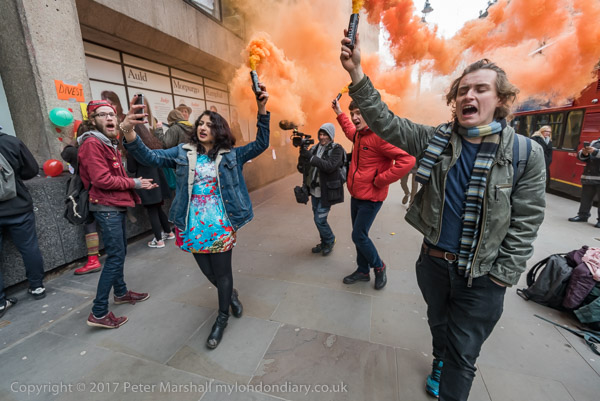
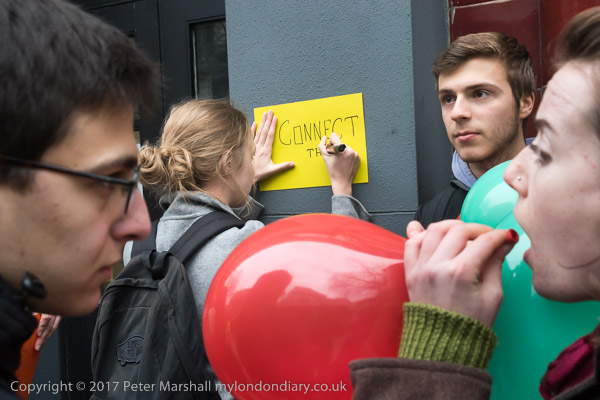
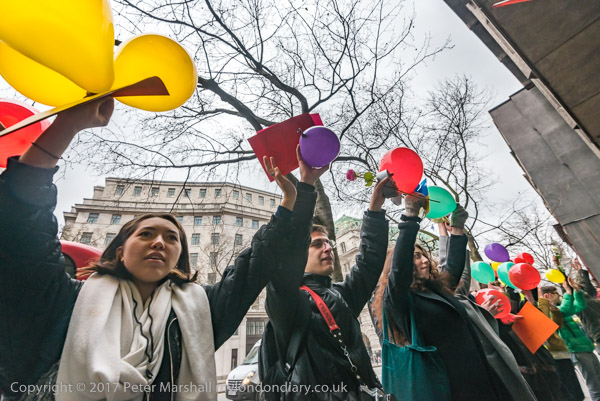
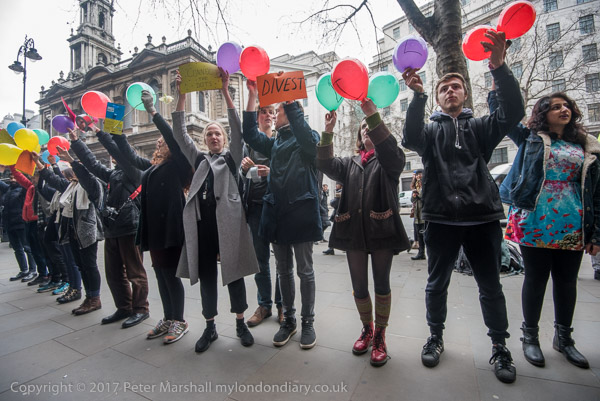
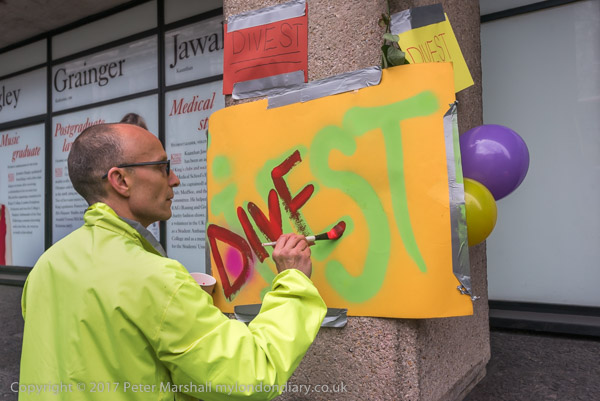
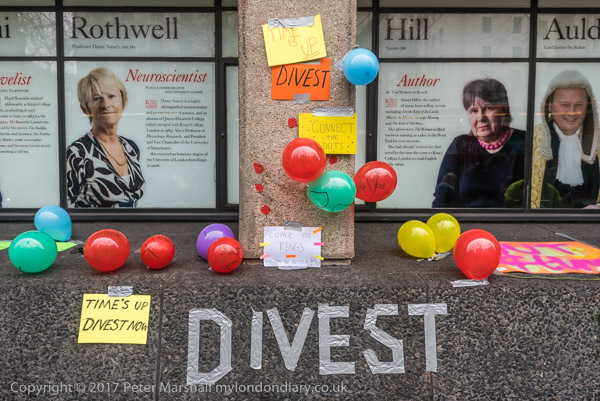
King’s College Divest Oil & Gas Now: On Thursday 9th February a colourful protest on the pavement in front of the college’s main buildings on London’s Strand called for the college to disinvest from fossil fuels.

King's College Divest Oil & Gas Now

The world desperately needs to move away from burning coal, oil and gas for energy production and transport, as has been clear for at least the last 30 years and recent temperature rise and increasing incidence of disruptive fires, floods and other extreme weather events make impossible to ignore.

King's College Divest Oil & Gas Now

Yet governments around the world largely continue to ignore this, or make attempts which are far too little and far too late, with the recently elected demented US president even determined to increase his countries emissions, led by the lobbying of the US industry only interested in its own short-term profits.

King's College Divest Oil & Gas Now
Balloons are I think still allowed in protests – but if they are effective are likely to be banned

Let the world burn seems to be the message from the “ultra-wealthy stakeholders” while they plan their doomsday bunkers in the USA, Alaska or the Antarctic complete with military security forces to keep out the raiders and angry mobs.

King's College Divest Oil & Gas Now

Yet the UK financial sector still enables to extraction of more fossil fuels which endanger the future of our civilisation and human life on the planet. Banks still bankroll them, insurance companies still insure their climate destroying activities and many respectable organisations still invest in them, including pension funds, though increasingly investors are divesting.

And one that has now divested is King’s College, who state: “In 2017, King’s committed to full divestment from all fossil fuels by the end of 2022. We achieved this target in early 2021. King’s also does not invest in tobacco and armaments. In 2023, we reached the target to invest 40% of our endowment in investments with socially responsible benefits two years early.

Although I suspect King’s would say that this protest had no effect on their decision, I’m sure that this campaign and this very public protest was a major factor in moving them in this direction.

And it was successful because it was noisy, public and colourful, employing the kinds of methods that led the Tories to bring in new laws restricting our rights to protest and giving the police new powers to try to prevent effective protest. We still have the right to protest but are now expected to do so discretely.

The one arrest of those taking part in the Stand Up to Racism protest a few days ago on February 1st was of one of those who lit a smoke flare, and similar arrests have been made at other recent protests. Setting off of fireworks on our streets has been illegal since 1875, but only recently have police begun to enforce this against the use of distress flares in protests.

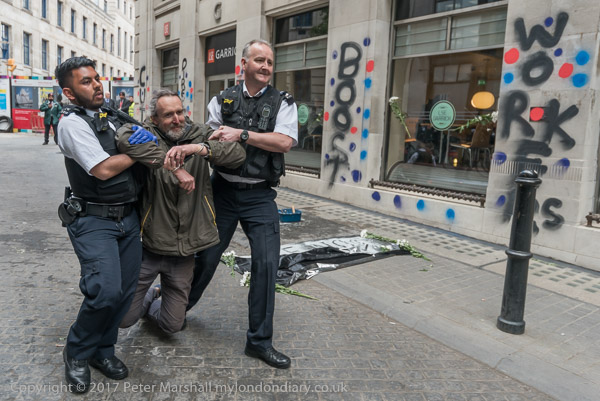
People have been arrested for sticking things on walls and windows, even though they can be readily removed without damage.

Roger Hallam – in khaki, centre

In this protest police attempted to take the names and addresses of those who had made small blobs of colour using washable paint on a concrete pillar. This was done as a gesture of solidarity with PhD student Roger Hallam, one of the leading campaigners aat King’s who was suspended by the college for writing “Divest From Oil and Gas Now. Out of Time!” in washable paint at an earlier protest. Like the blobs this had washed off easily without trace, as was other painting I photographed him doing and being arrested for in the ‘Life Not Money’ protest at nearby LSE a couple of months later

Roger Hallam is arrested at Life Not Money protest at LSE, April 25th 2017

Roger Hallam, one of the co-founders of Extinction Rebellion, Insulate Britain and Just Stop Oil, is now serving five years in prison after being convicted of conspiracy for organising protests to block the M25, a draconian sentence for a peaceful campaigner. Sixteen Just Stop Oil protesters were given jail sentences last year for peacefully protesting in response to the climate crisis and at their trials were prevented from defending themselves by explaining their motives to the jury. Others are being held on remand for long periods. We now have political policing, political trials and political prisoners in the UK.


FlickrFacebookMy London DiaryHull PhotosLea ValleyParis
London’s Industrial HeritageLondon Photos

All photographs on this page are copyright © Peter Marshall.
Contact me to buy prints or licence to reproduce.


Guantanamo, National Gallery, Elephant, Aylesbury & Lisa – 2015

Guantanamo, National Gallery, Elephant, Aylesbury & Lisa; Ten years ago Thursday 5th February 2015 was a long and interesting day for me, with a couple of protests, a short walk around London, an estate occupation and a memorable book launch.


Close Guantanamo – 8 Years of protest – US Embassy

Guantanamo, National Gallery, Elephant, Aylesbury & Lisa - 2015

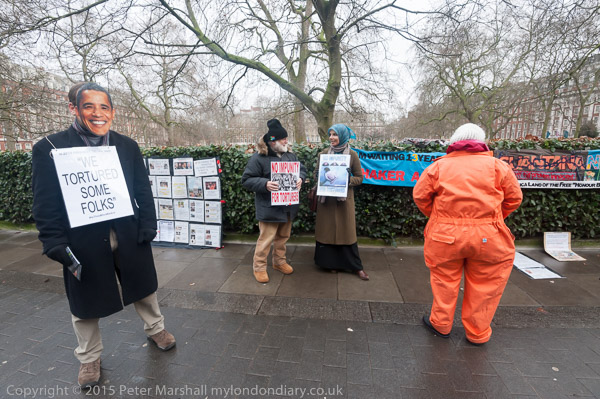
A small group from the London Guantánamo Campaign was celebrating 8 years of holding monthly protests at the US Embassy in Grosvenor Square.

Guantanamo, National Gallery, Elephant, Aylesbury & Lisa - 2015

Among those protesting were four people who had been taking part in the protests there for 8 years.

Close Guantanamo – 8 Years of protest


No Privatisation At National Gallery – Trafalgar Square and DCMS, Whitehall

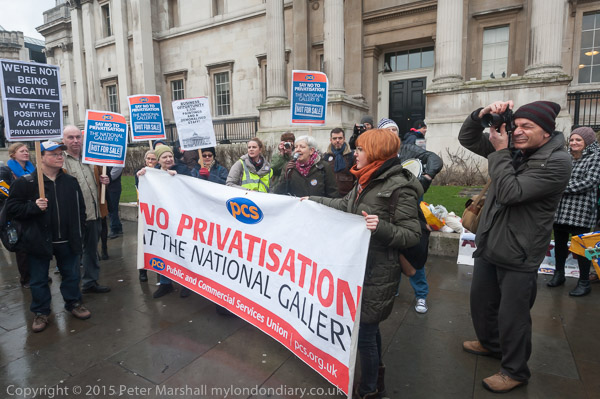
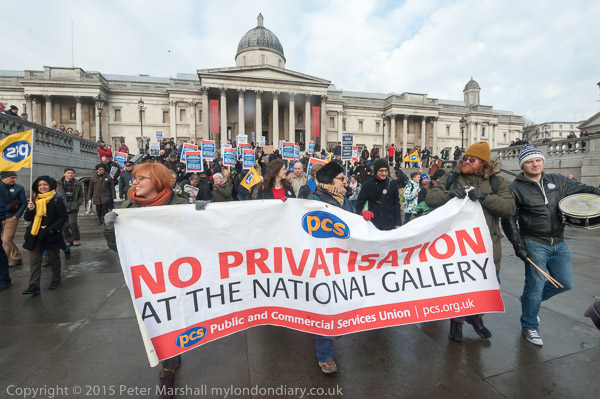
The National Gallery had told 400 of its 600 staff who are responsible for the security of the paintings and the public, provide information about the collection, organise school bookings and look after the millions of visitors each year that they are no longer to be employed by the gallery and will instead become employes of a private company.

Guantanamo, National Gallery, Elephant, Aylesbury & Lisa - 2015
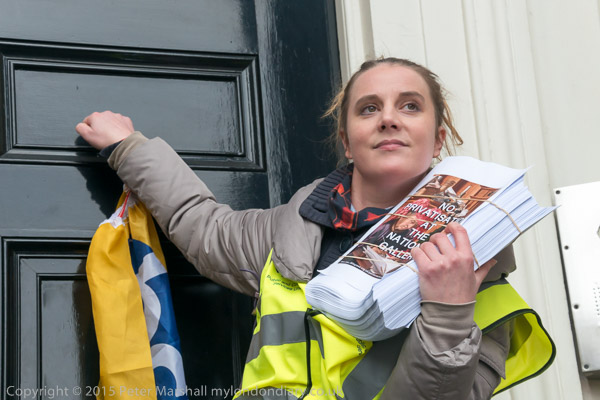
They knocked at the door but management did not answer

A private company had already taken over “temporarily” to run services in a third of the gallery.

Guantanamo, National Gallery, Elephant, Aylesbury & Lisa - 2015

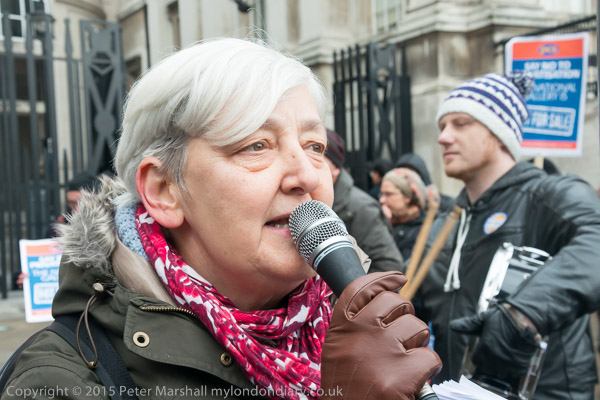
Workers at the gallery had staged a 5 day strike against the privatisation and were incensed when Candy Udwin, one of the senior PCS union reps and a member of the team taking part in negotiations with management at ACAS, was suspended, accused of breaching commercial confidentiality, and they demanded her re-instatement.

Candy Udwin

The National Gallery was then the only major museum or gallery in London still not paying the London Living Wage. Staff were already living on poverty pay and the privatisation would threaten pay and worsen the conditions – sick pay, holiday pay, pensions, hours of work etc – of these loyal and knowledgeable staff.

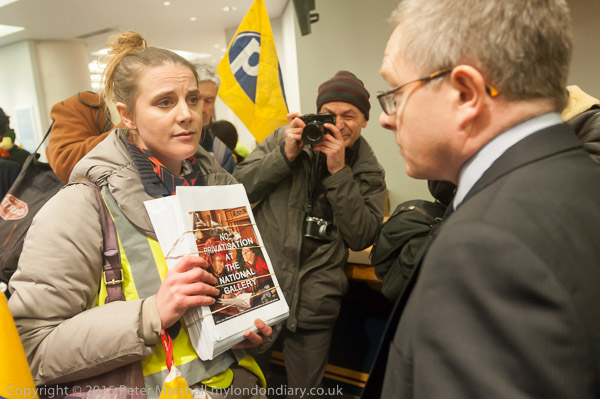
When nobody came to the door as they tried to deliver their 40,000 signature petition against privatisation a group went into the Sainsbury Wing to tray and deliver it. Security tried to get them to leave. Nobody from the gallery would come down to recieve the petition and eventually the strikers handed it over to the Head of Security who promised to deliver it to management personally.

Jeremy Corbyn joins the marchers

The strikers and their supporters then marched through Trafalgar Square and Whitehall to the Dept of Culture, Media and Sport, then in Parliament Street, where the minister concerned had agreed to receive a copy of the petition and three of them were allowed to take it in. Here there was a short rally with speakers including Jeremy Corbyn MP.

No Privatisation At National Gallery


Around the Elephant – Elephant & Castle

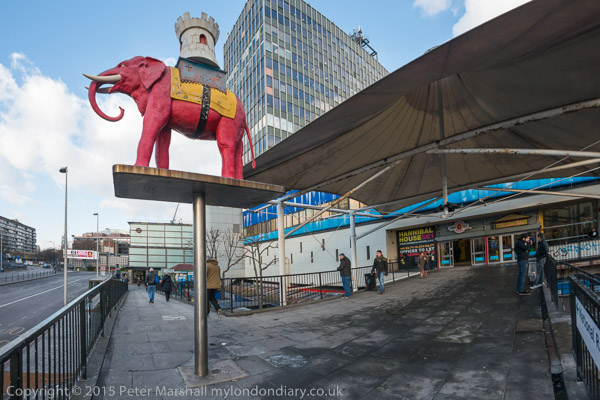
I made a few pictures as I walked from the Bakerloo Line station at Elephant & Castle to the Aylesbury Estate and afterwards on my way back to the station. The shopping centre has now been demolished and new buildings have sprung up on its site,

This strange building is an electricity substation which is still there, although there is no longer a roundabout around it. It was built as a memorial to Michael Faraday, ‘The Father of Electricity’ who was born a few hundred yards away in 1791.

More pictures at Around the Elephant.


Aylesbury Estate Occupation – Walworth

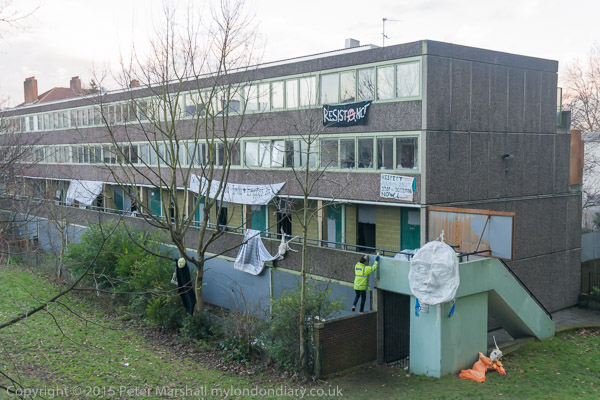
Chartridge occupied since the previous Saturday in a protest for housing in London

Southwark Council’s Aylesbury Estate was one of the UK’s largest council estates, built between 1963 and 1977 with over 2,700 homes. Lack of proper maintenance by the council and its use by them as a sink estate had led to it getting a reputation for crime, exaggerated by its use in filming TV crime series and films there not least because of its convenient location.

Access to the occupied block – I didn’t attempt it

It was on the Aylesbury Estate that Tony Blair got in on the act making his first speech as Prime Minister promising to fix estates like this and improve conditions for the urban poor through regeneration of council estates.

‘Respect Aylesbury Ballot – Stop the Demolition Now!’ Residents voted overwhelming for refurbishment not redevelopment

The buildings were actually well-designed and structurally sound on a well-planned estate with plenty of green space, but having been built in the sixties and 70s needed bringing up to date particularly in terms of insulation and double glazing. Southwark Council had also repeatedly failed to carry out necessary maintenance, particularly on the district heating system which they had allowed to become unreliable. But many residents liked living on the estate and when given the choice voted by a large majority for refurbishment rather than redevelopment. I visited several homes on other occasions and was quite envious, and the residents clearly loved living there.

Southwark Council responded by claiming the refurbishment would cost several times more than independent estimates suggested and went ahead with plans to eventually demolish the lot. Given the large number of homes involved the process was expected to last 20 years (later increased to 25 and likely to take even longer.) The first fairly small phase was completed in 2013, and the homes that were occupied in 2015 were in Phase 2.

I wasn’t able to access the flats that were occupied as it would have meant a rather dangerous climb to the first floor which I decided was beyond me, but I did meet some of the occupiers and went with them and some local residents to distribute leaflets about a public meeting to other flats in the estate.

Many residents support the occupiers and knew that they would lose their comfortable homes in a good location when they are finally forced to move. Some will be rehoused by Southwark, though mainly in less convienient locations and smaller properties, but many are on short term tenancies which do not qualify them for rehousing and will have to find private rented accommodation elsewhere. Those who have acquired their flats will only be offered compensation at far less than the cost of any similar accommodation in the area and will have to move much further from the centre of London.

While the volunteers were posting leaflets on one of the upper floors of the largest block on the estate, Wendover, I took some pictures to show the extensive views residents enjoyed. This was hindered by the fact that the windows on the walkways were thick with dust, possibly not cleaned since the block was built and not opening enough to put a camera through. Then fortunately I found a broken window that give me a clear view.

Much more at Aylesbury Estate Occupation.


Getting By – Lisa’s Book Launch – Young Foundation, Bethnal Green

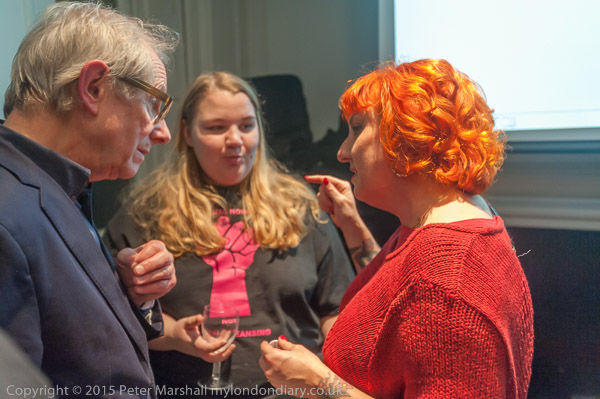
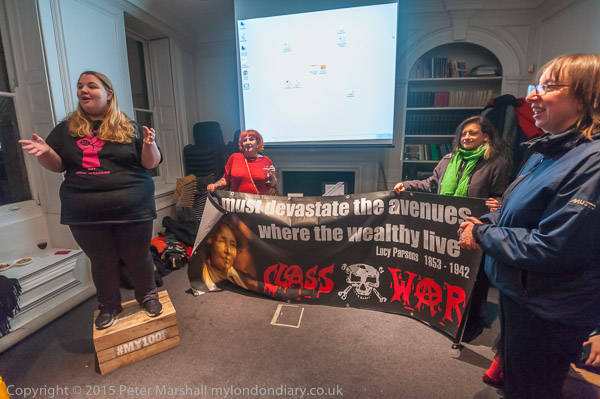
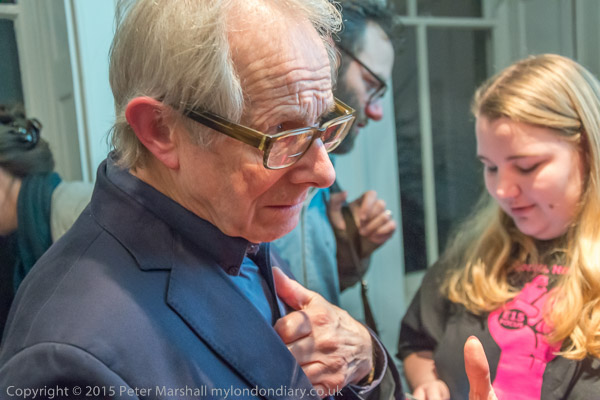
Ken Loach, Jasmine Stone and Lisa McKenzie, author of ‘Getting By’ talk at the book launch

Lisa McKenzie’s book ‘Getting By‘ is the result of her years of study from the inside of the working class district of Nottingham where she lived and worked for 22 years, enabling her to view the area from the inside and to gather, appreciate and understand the feelings and motivations of those who live there in a way impossible for others who have researched this and similar areas.

Jasmine Stone speaks about Focus E15 and Lisa and others hold a Class War banner

On the post in My London Diary I write much more about the opening – and of course there are many more pictures as well as a little of my personal history.

Ken Loach

Getting By – Lisa’s Book Launch.


FlickrFacebookMy London DiaryHull PhotosLea ValleyParis
London’s Industrial HeritageLondon Photos

All photographs on this page are copyright © Peter Marshall.
Contact me to buy prints or licence to reproduce.


Anti-Fascists Oppose the Far Right – 1 Feb 2025

Anti-Fascists Oppose the Far Right: Last Saturday, 1st February 2025, I photographed one of two marches taking place in London, kept well separate by a large force of police who had restricted the protests to widely separated routes though ending close to each other.

Anti-Fascists Oppose the Far Right
The march says fascists are not welcome on our streets and is against all forms of racism including antisemitism and Islamophobia

Supporters of “Tommy Robinson” (Stephen Yaxley Lennon) currently in jail after pleading guilty to contempt of court had called a protest to demand his release, in a march they described as ‘Unite The Kingdom’ and ‘Stop the Isolation’. Robinson is apparently in solitary confinement in HMP Woodhill for his own safety, and has refused to remove the video he was sentenced for sharing which is pinned to the top of his ‘X’ account. They began their march at Waterloo Station, marching across Westminster Bridge to Parliament Square.

Anti-Fascists Oppose the Far Right

In response Stand Up to Racism had called a counter-demonstration to oppose this march and more generally the rise of the far-right in Britain. This met in St James’s Street just off Piccadilly and marched to a rally in Whitehall.

Anti-Fascists Oppose the Far Right

According to press reports both marches were of a similar size, perhaps between five and ten thousand marchers, though some at the extreme right event claimed a hundred thousand had marched.

Anti-Fascists Oppose the Far Right
Weyman Bennett, Stand Up to Racism.

During the Covid lockdown there were no protests for me to photograph and I began to post here on >Re:PHOTO much more frequently about my older work, both protests I had covered in earlier years and also my walks in and around London photographing buildings and urban landscape in the previous century.

So for some months there was nothing for me to add to my posts in My London Diary web site. Which was just as well as I was getting uncomfortably close to the limit of the number of files and folders I could host on the web space I have – which hosts this blog and a number of other small web sites. That limit is 262,144 and currently My London Diary has 194,257 Files and 2,938 Folders, with >Re:PHOTO taking up most of the rest. So even when I was able to cover protests again I had to change my ways, posting the images in Facebook albums with just a link and one or two pictures on my own web space. Finally I gave up new postings on My London Diary in January 2022, though the site remains in place and I think is an important archive.

Jewish Socialist Group

Time moves on and although I’m still photographing protests I am attending rather fewer than in earlier years and taking things easier. While ten years ago I might sometimes work on my feet for five or six hours, now after around three I’m often feeling too tired to continue, pack up and go home. And while back then I might go our five days a week, now its generally one or two, mainly on Saturdays. And while in past years I would certainly have tried to cover both marches, this year I chose just one, the counter-protest by Stand Up To Racism.

Over the years I have covered quite a few extreme right events, but I decided to leave this one to younger photographers. At many previous events I’ve been threatened, pointed out as someone who should be attacked, spat at and more, despite trying to cover them and report them fairly even though I disagree with their views. People have tried to stop me photographing and have tried to grab my equipment and police haven’t always been ready to help.

At the Stand Up To Racism event there was a far more positive atmosphere. Generally people were happy, sometimes even eager, to be photographed and I was able to walk freely through a packed crowd before the march began making pictures, as well as inside the march itself.

Of course the people at the protest were angry at the way the country (and the world) seems to be drifting towards the right, with more draconian legislation restricting our right to protest, long sentences for peaceful protesters and the kind of political policing we have seen over demonstrations calling for an end to the killing in Palestine. And some at least would be ready to fight the fascists on the streets as people did in the 1930s at Cable Street and elsewhere – and Jewish groups did after the end of the war.

Anti-fascists from the IWW – Industrial Workers of the World were being watched closely by a squad of police

But while being determined to stop the drift to the right in Britain – which appears to have been accelerated by the coming to power of Labour with a large majority – this was a march of the reasonable, the kind of people who will look at evidence rather than believe the lies and manipulations of the right wing media, people who embody the kind of values which I feel are important and which gave Britain hope after defeating the Nazis and led to the setting up of the welfare state, with the NHS and an Education Act that tried to provide a free and fair education. The kind of British values which I think the majority of us still believe in although they have been seriously eroded by successive governments for the benefit of that small minority – the 1% in what is becoming an increasingly unequal society.

Police arrest a man after several flares were set off.

My pictures tell something of the story of the march. It was entirely peaceful. I missed seeing the handful of the extreme right who had come to try to disrupt it and were arrested for breaching the restrictions that police had laid down. I saw only one person arrested, for setting off a smoke flare. I saw the smoke from several flares around a hundred yards away and rushed towards it, but the crowd of marchers across the whole of Piccadilly made this difficult and by the time I arrived a young man was being held by police surrounded by a crowd yelling for them to release him.

NEU marchers. Many trade unions supported the march

I stayed with the march until the end of it went into Whitehall where there was to be a longer rally than that before the start. Suddenly I felt rather tired it decided it was time to go home.

There are two albums on Facebook with my pictures from the Stand Up to Racism march:
Stop The Far Right National Anti-Racist Protest. London
More from the Stop The Far Right National Anti-Racist Protest


FlickrFacebookMy London DiaryHull PhotosLea ValleyParis
London’s Industrial HeritageLondon Photos

All photographs on this page are copyright © Peter Marshall.
Contact me to buy prints or licence to reproduce.


Save Brixton Arches: 3rd Anniversary – 2018

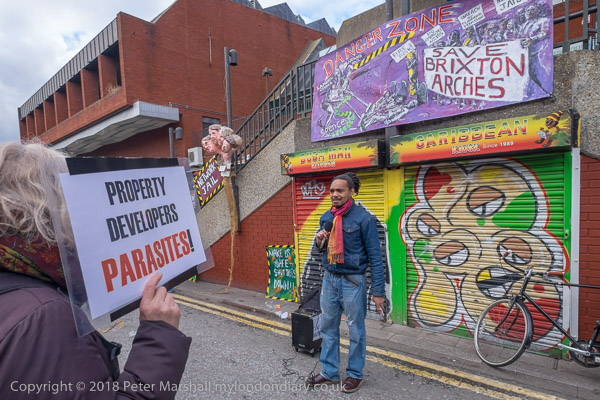
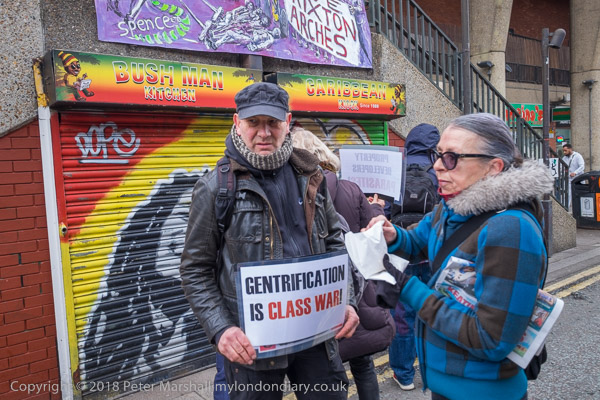
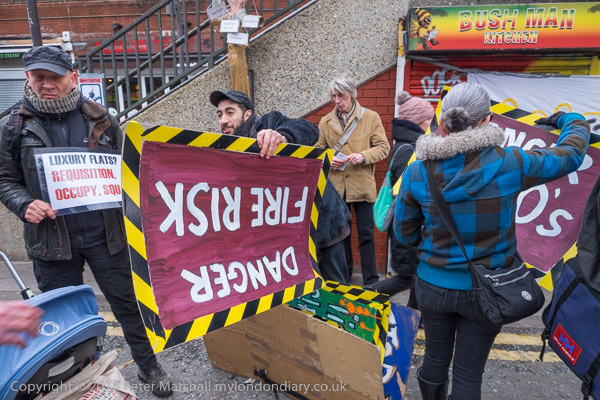
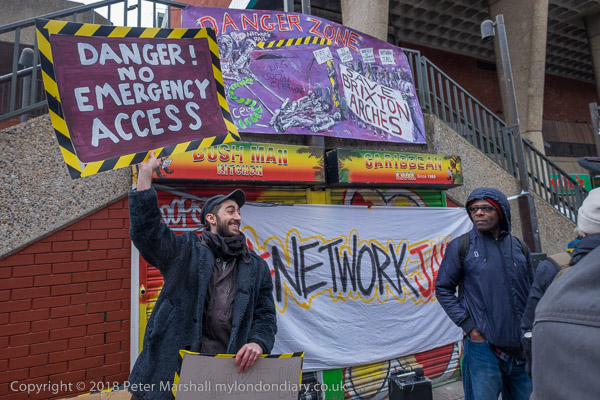
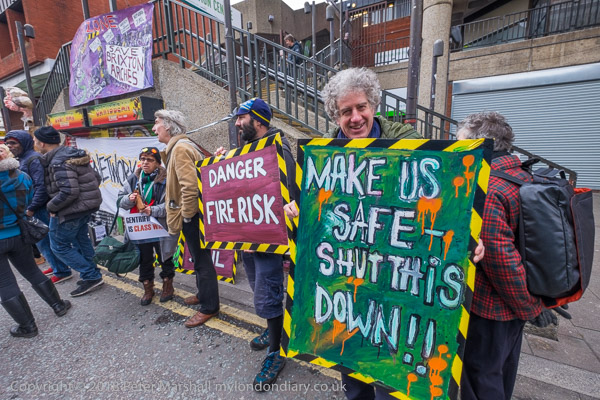
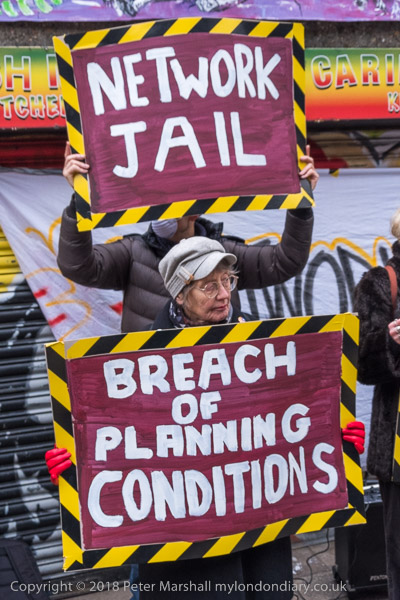
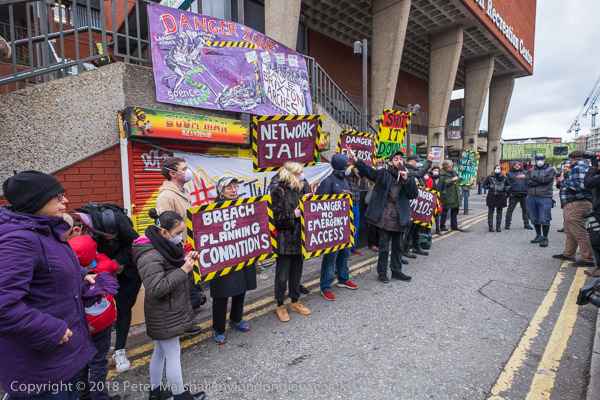
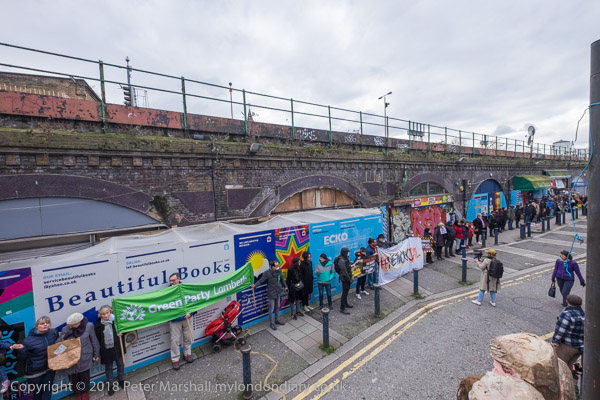
Save Brixton Arches: 3rd Anniversary Action. On Sunday 4th February 2018 campaigners marked the third anniversary of the announcement by Network Rail of their plans to redevelop the Brixton Arches with a rally and a three minute silence.

Save Brixton Arches: 3rd Anniversary

Railway Arches are an incredibly important part of our towns and cities. When the railways were being built in the 19th century putting the lines on viaducts was a cheaper option for the railway developers than laying tracks at ground level, so we got long viaducts coming into the centre of London and elsewhere.

Save Brixton Arches: 3rd Anniversary
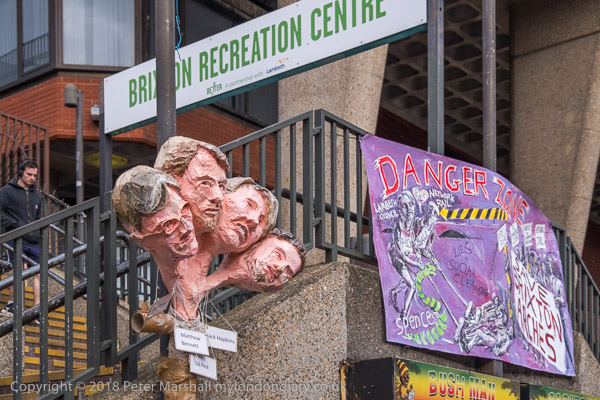
Andrew Cooper’s banner for the event and his sculpture of the 4-headed monster that is Lambeth Labour Council

These arches became both an important feature of the city landscape but also a dynamic boost to the economy, providing low-cost premises for small businesses to start and grow until they needed to move out to larger premises and new generations of businesses would take over these spaces. In particular they provided premises for various car repair companies and in more recent years small breweries. And in Brixton in particular a large range of low-cost shops.

Save Brixton Arches: 3rd Anniversary

The arches used to belong to the railway companies, and on privatisation passed to Network Rail. But around a dozen years ago Network Rail saw the potential of selling them off to the private sector. The arches were a relatively small earner for them, bringing in a little over £80 million a year in rents.

Save Brixton Arches: 3rd Anniversary

They offered 150 year leases to the private sector, at first without any consultation with the businesses and communities served by them, something the sale for £1.46 billion was criticised for in a 2019 report from the National Audit Office. Network Rail retained the freehold so they can continue to have access to the arches if they need. The rents for the arches were expected to increase by 54% over the next 3 or 4 years, making them too expensive for many tenants.

Also in 2019, the House of Commons public accounts committee criticised both Network Rail and the Dept of Transport for the sale which means “future tenants have fewer rights – and existing tenants no longer have an option to extend their leases.”

Committee Chair Meg Hillier is quoted in The Guardian as saying “Ultimately, government took a short-term decision to sell a profitable asset to plug a funding gap. We remain unconvinced that the sale represents the best value for the public and the public-sector finances in the long term.

Brixton has been particularly hard hit by Network Rail’s plans to make more cash from the arches as those along Atlantic Road and Brixton Station Road were an important shopping area in the centre of the town – often described as the ‘heart of Brixton‘.

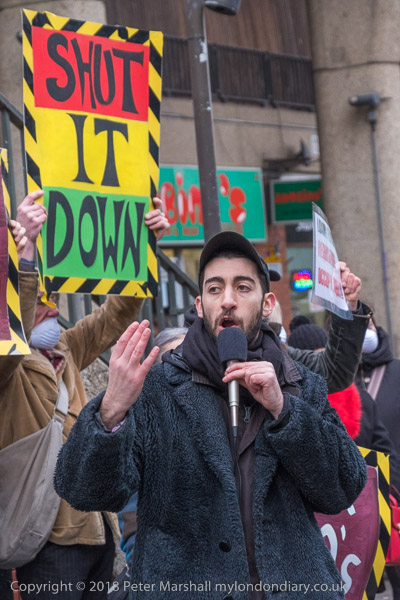
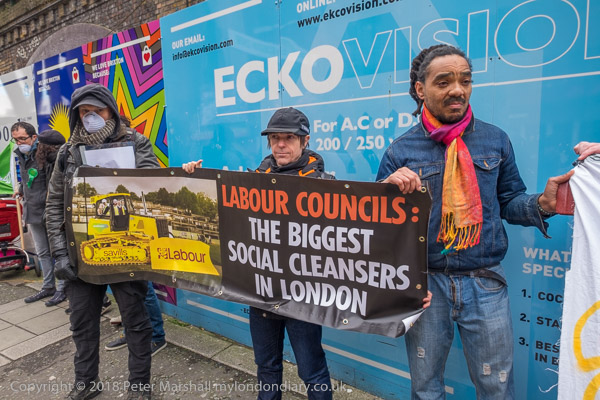
Network Rail ganged up with Lambeth Council to tear this heart out from the town by refurbishing thes arches which would enable them to “triple the rents, insert shiny new businesses and provide Brixton with even more over-priced bars and restaurants than the town’s citizens can shake a stick at.”

Spoken Word artist Potent Whisper – hear his #OurBrixton

The Council ignored a long campaign to keep the arches, and failed to do anything to protect the interests of the tenants or of nearby market traders who feel they will be adversely effected while the refurbishment is taking place – and with possible dangers to the general public from potentially dangerous airborne particles during the removal of asbestos.

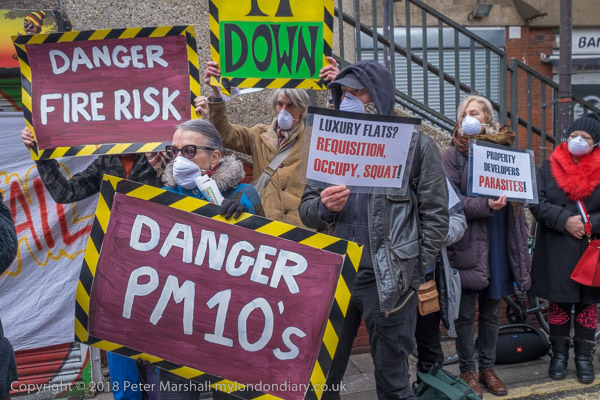
The work was supposed to have been completed by the end of 2016, but was only started the day after this protest in February 2018. The Save Brixton Arches campaign were calling for it to be abandoned as the plans for the work fail to include proper fire safety precautions and will severely restrict access by emergency services to local businesses and the railway and station.

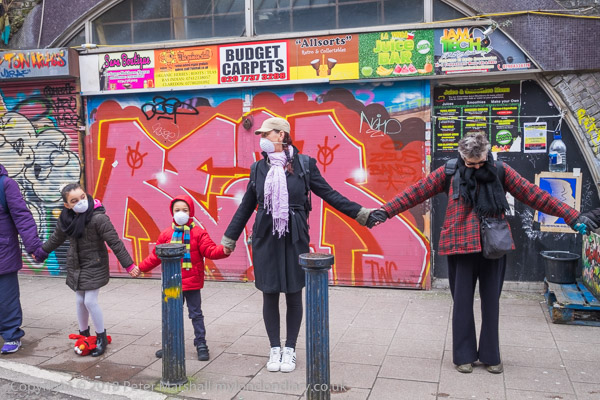
Protesters form a human chain in front of the arches

They also called for an investigation into local Labour MP Helen Hayes. Until shortly before she was elected in 2015 she had been a senior partner in the firm Allies & Morrison which had made the recommendation for the ‘improvement’ of the arches in 2013, though she has denied any personal involvement. A&M have been involved in many contentious ‘regeneration’ schemes with developers and councils across London which opponents describe as social cleansing.

The boards behind used to be thriving businesses – forced out

Network Rail sold its arches to ‘The Arch Company’. 50% owned by US-based private equity firm Blackstone and TT Group, one of the UK’s largest, privately owned property investment firms who since then as well as raising rents have refurbished 1,400 arches. They have also made some efforts to reduce the impacts of the rent rises and negotiated a tenant charter. Blackstone are now said to be ‘on track’ to buy out TT and take full control of the arches.

More about the protest and many more pictures at Save Brixton Arches: 3rd Anniversary Action.


FlickrFacebookMy London DiaryHull PhotosLea ValleyParis
London’s Industrial HeritageLondon Photos

All photographs on this page are copyright © Peter Marshall.
Contact me to buy prints or licence to reproduce.

Make Poverty History – 2005

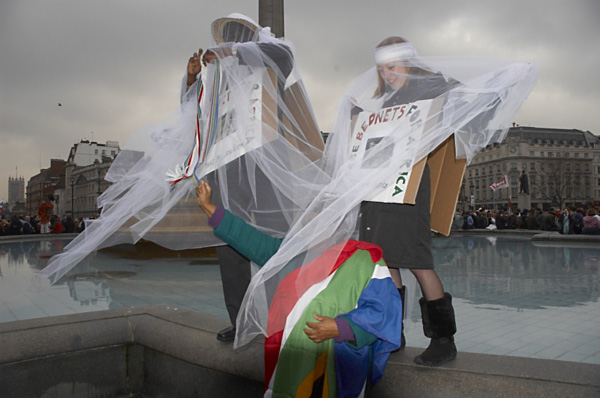
Make Poverty History: Twenty years ago on February 3rd 2005 I was one of the 20,000 or so people who packed Trafalgar Square on a Thursday lunchtime to see and hear Nelson Mandela speak in the first major real event in the UK’s ‘Make Poverty History’ campaign.

Make Poverty History - 2005

Make Poverty History was a coalition of charities, religious groups, trade unions, campaigning groups and celebrities which had come together here and in a dozen other countries around the world to promote trade justice, to cancel the debts that were crippling poorer countries and to press for more aid and for this to be better targeted at improving the lives of people in the recipient countries.

Make Poverty History - 2005

The campaign in the UK had officially been launched on TV on New Year’s Day on the same day that Britain took over the Presidency of the G8 – and in July was to host a G8 summit that was supposed to be largely about poverty in Africa, but this rally was the first major national event.

Make Poverty History - 2005

I’d severely misjudged the numbers that would turn up for the rally, arriving only minutes before it was due to start and was unable to make my way through a densely packed crowd to anywhere near where the the speakers – including Mandela would be speaking.

Make Poverty History - 2005

This was an occasion when a long and heavy fast telephoto lens would have come in handy, but I’ve never owned one of these, preferring whenever possible to work at close range. But the relatively small zoom lens I had with a focal length of 200mm and a maximum aperture of only f5.6 did just about allow me to take some recognisable images of what was happening on the stage in the distance.

It helped that Nikon was still sticking to its conviction that its DX format, a sensor half the size of a 35mm frame was all that was needed for digital photography, giving the lens on my D70 the equivalent view of a 300mm on full-frame.

he ‘pills’ are a petition calling for urgent action on aids, to get 3 miilion people on treatment by 2005.

But I was please to have been able to capture some of the event – such as the handshake between Mandela and Bob Geldoff and children coming to meet Mandela, even if someone’s head got in my way a little of the time and those 6Mp images could perhaps have been just a little sharper.

Mosquito nets can help stamp out malaria in Africa

Later I was able to return to focal lengths more in my comfort zone, with a fisheye to show the crowds and more normal wide-angle views of people in the crowds.

The only way to be photographed with Nelson Mandela at the Rally

The ‘Make Poverty History’ movement lasted in the UK until 31st Januarly 2006, though relations between some of the 540 groups involved were very difficult. Oxfam in particular was seen as far to keep to follow a ‘New Labour’ line and some other major NGOs were also often felt to be insufficiently radical. Even though these groups dominated the campaign the TV adverts which had been aired at the start were soon banned by Ofcom as they were deemed to be “‘wholly or mainly political’ in nature, since they aimed to ‘achieve important changes'” – surely the whole point of the campaign.

Clearly the campaign had begun to disturb the rich and powerful who were feeling their privilege and profits from impoverishing the poor might be at risk. But although the campaign raised awareness of the problems its actual achievements were rather limited.

Bust of Nelson Mandela, sculpted by Ian Walters, commisioned by the GLC to mark the 70th anniversary of the African National Congress in 1982, and unveiled by Oliver Tambo in 1985. It records Mandela’s imprisonment in 1962, with added inscriptions marking his release in 1990, the Nobel Peace prize in 1993 and his inauguration as the first president of a free South Afrrica in 1994.

You can read more about the event and seem many more pictures on My London Diary


FlickrFacebookMy London DiaryHull PhotosLea ValleyParis
London’s Industrial HeritageLondon Photos

All photographs on this page are copyright © Peter Marshall.
Contact me to buy prints or licence to reproduce.


Central Hill Estate – 2016

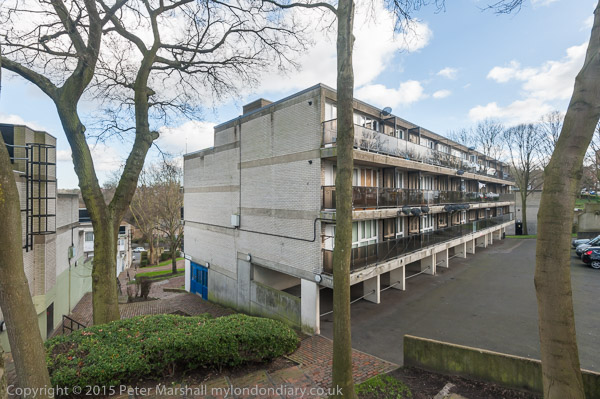
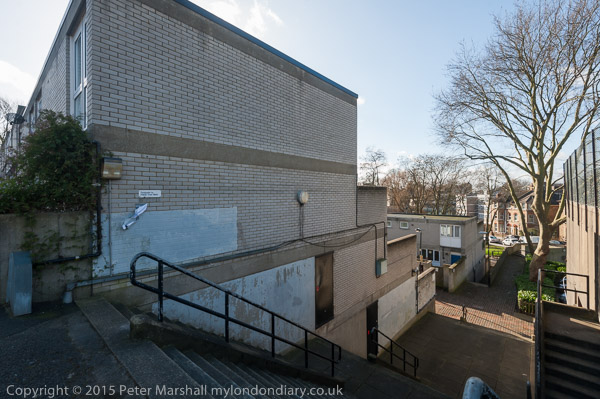
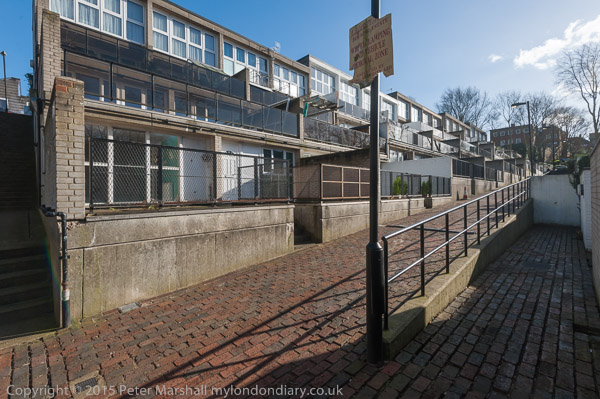
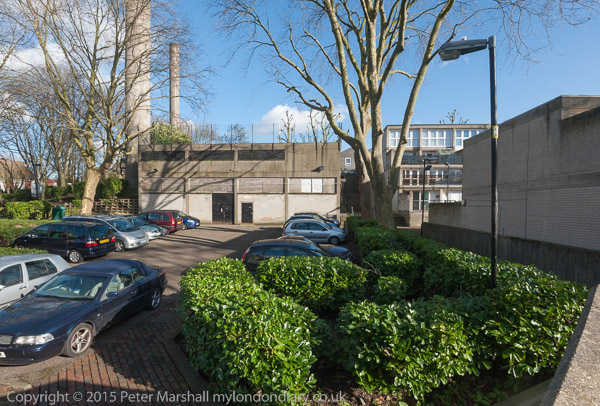
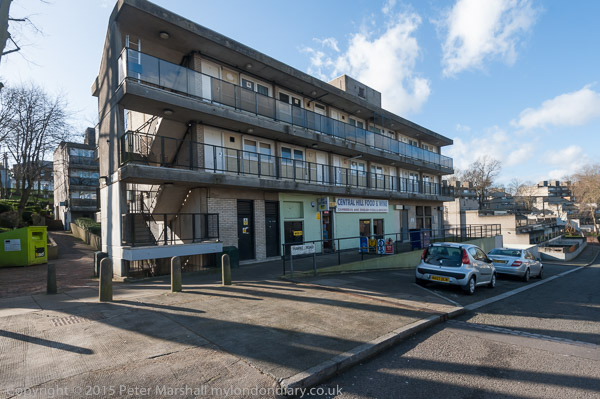
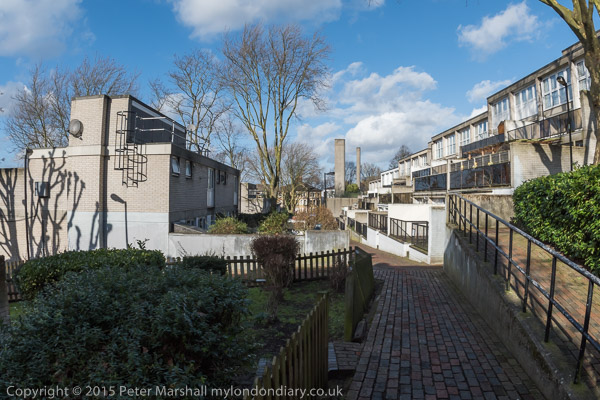
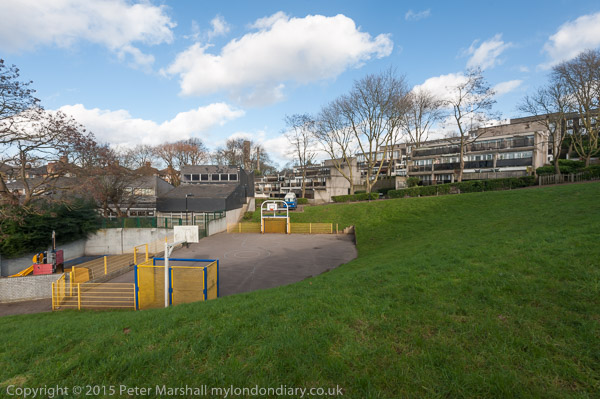
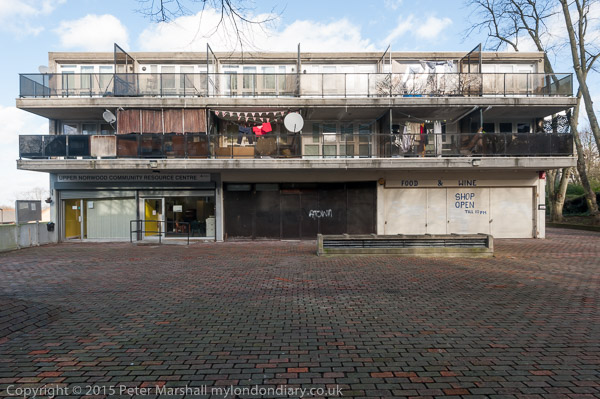
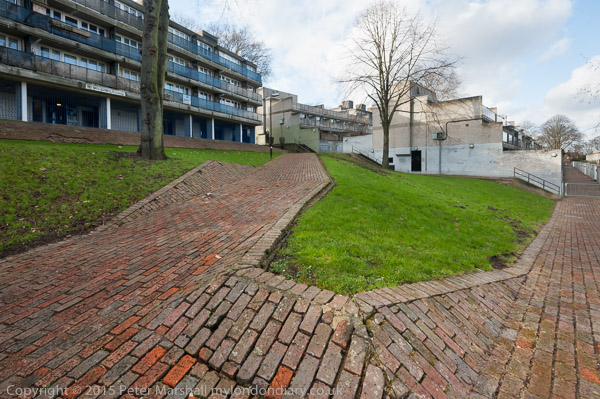
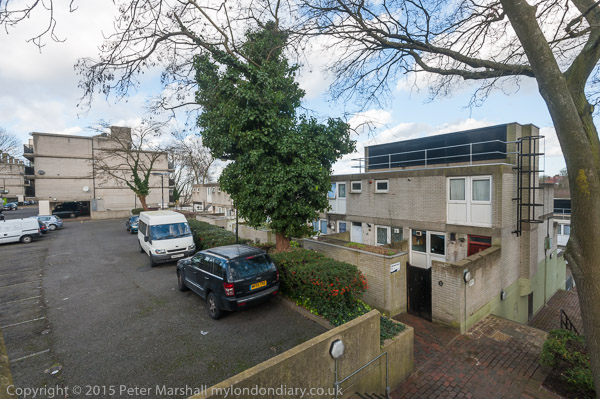
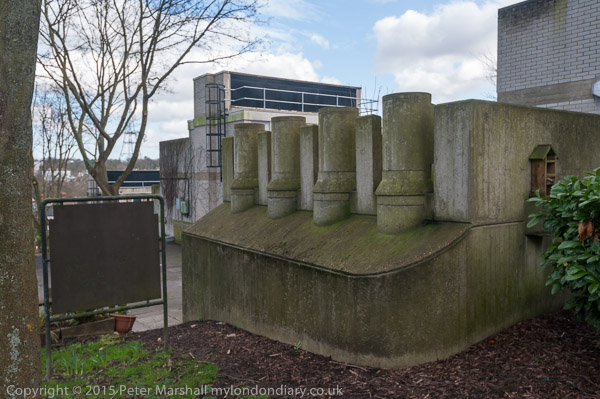
Central Hill Estate: Tuesday 2nd February 2016 was a bright winter day in London and i decided to go and take a look – and of course to photograph – the Central Hill Estate on the edge of Lambeth, which I had heard and read much about as Lambeth Coucil weree planning to demolish it.

Central Hill Estate - 2016

You can read an excellent account of the building of the estate by architect Kate Macintosh on the Twentieth Century Society website, which records the care taken by lead architect Rosemary Stjernstedt (1912-1998) and her team, who had previuosly been head-hunted by Lambeth’s Chief Architect and Planner Ted Hollamby.

Central Hill Estate - 2016

As well as planning to make the most of the steeply descending site with its extensive views across London the plans presevered as many as possible of the existing mature trees and included a Doctor’s group practice, a youth club, an old persons’ day centre and shops, open space, play areas, community buildings and a district heating system.

Central Hill Estate - 2016

The Twentieth Century Society also supported the two applications for the listing of this site, turned down in 2016 and again in 2021, although the reasons for the refusal seem increasingly spurious and I think based on political pressure rather than architectural evidence.

Central Hill Estate - 2016

I wrote about it at some length after my visit in February 2016 on My London Dairy and have visited it again on several occasions since, not lease to see the exhibition of alternative plans to meet Lambeth Council’s stated objectives for the demolition and rebuildling by careful and much lower cost development on the existing estate which would retain its essential excellent design.

Here I’ll quote a part of what I wrote then, beginning with my introduction.

“There is only one real problem with the Central Hill Estate in Upper Norwood. Which is that the estate, owned by Lambeth Council, was built in an age when architects and planners were proud to design the best they could and councils keen to house their tenants to the highest standards, but it has lasted into an age where government policy aims to get rid of all social housing and councils are out to join developers in profiting from redeveloping with lower standards and higher densities for private sale.”

“The whole is on a much more human scale than other large developments of the era, with a design that has proved successful in encouraging community. People like living on the estate and all I talked to when walking around taking pictures were very positive – except for the one council employee who came out from the upper Norwood Community Resource Centre to ask me what I was doing. “

“A survey answered by 150 residents recently found only two in favour of it being demolished. It has been a safe place to live, with below average crime levels – perhaps having the police station at its south-east corner has helped.”

“Like all social housing, the estate has suffered from neglect and poor maintenance, and the properties need refurbishment and bringing up to modern energy standards. Considering the age of the estate the cost per dwelling assessed by Lambeth Council is relatively moderate and only a fraction of that of new building.”

You can read the alternative proposals by Architects for Social Housing – Simon Elmer and Geraldine Dening – prepared for the residents of Central Hill estate between May 2015 and March 2017 in response to the threat of demolition of 456 homes on the estate by Lambeth Labour Council.

In the introduction to the ASH report they write “However, there is nothing, either in current government legislation or in the housing policies of the Conservative, Labour or Liberal Democrat parties, that will stop councils from following the same practices Lambeth council employed to push through their plans to demolish Central Hill estate against both the wishes of residents and the demonstrable social, financial and environmental benefits of the design alternatives.” Lambeth Council refused to seriously consider their alternative suggestions.

Little has changed since then although we are now much more aware of the environmental impacts of demolition and rebuilding, and some greater lip-service was been paid the the “wishes of residents“, but the changes in planning recently announced by Labour had they been in place back in 2016 would almost certainly have meant that Central Hill would not now still be standing.

The fight to save Central Hill continues, with the Facebook Group ‘Save Central Hill Estate‘.

You can read more and see many more pictures – it was an estate I found hard to stop photographing – at Central Hill Estate.


FlickrFacebookMy London DiaryHull PhotosLea ValleyParis
London’s Industrial HeritageLondon Photos

All photographs on this page are copyright © Peter Marshall.
Contact me to buy prints or licence to reproduce.


Housing and Planning Bill March – 2016

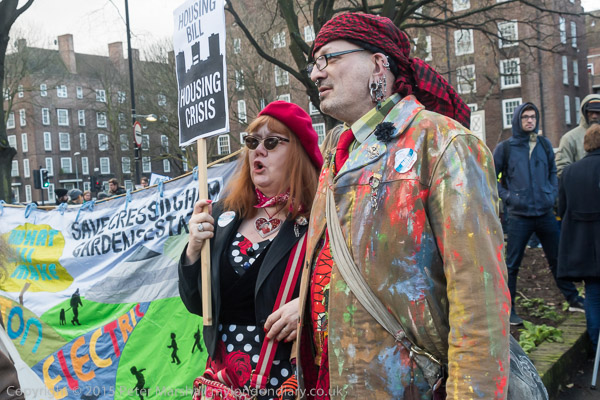
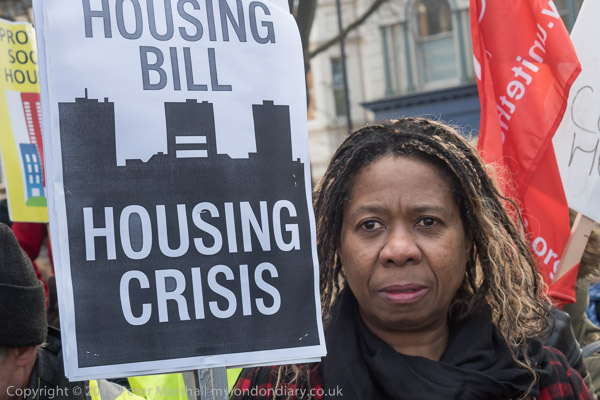
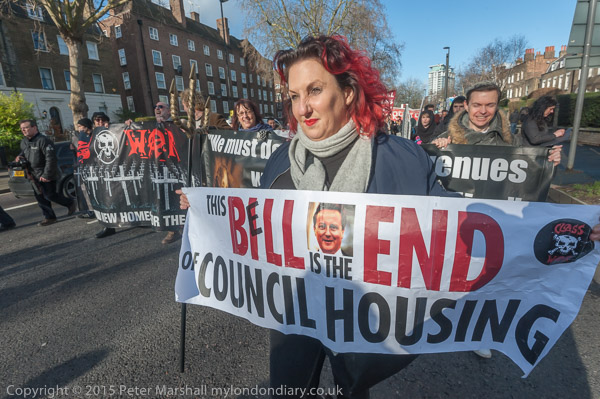
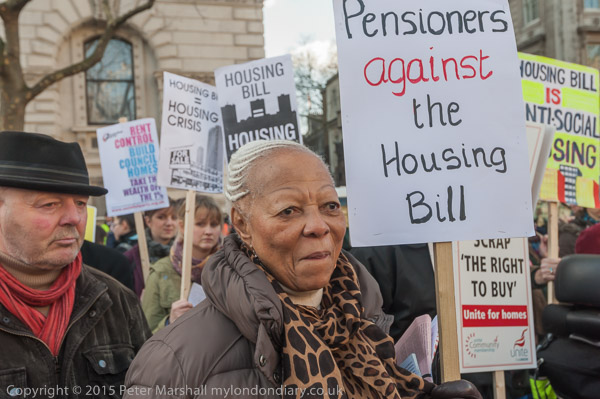
Housing and Planning Bill March: On Saturday 30th January 2016 housing activists including some local councillors and housing activist groups mainly from South London including Class War marched from the Imperial War Museum to Downing St in a protest organised by Lambeth Housing Activists against the Housing and Planning Bill.

Housing and Planning Bill March - 2016

They say the bill will have a particularly large impact in London and greatly worsen the already acute housing crisis here.

Housing and Planning Bill March - 2016

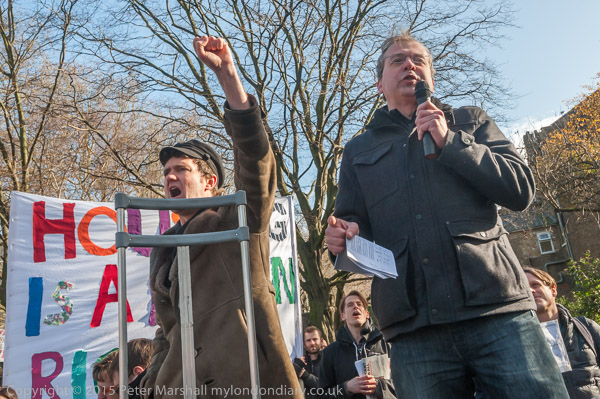
Speeches at the rally before the march in Geraldine Mary Harmsworth Park at the side of the Imperial War Museum by Green Party Leader Natalie Bennett and an number of housing activists including Simon Elmer of Architects for Social Housing were warmly applauded.

Housing and Planning Bill March - 2016

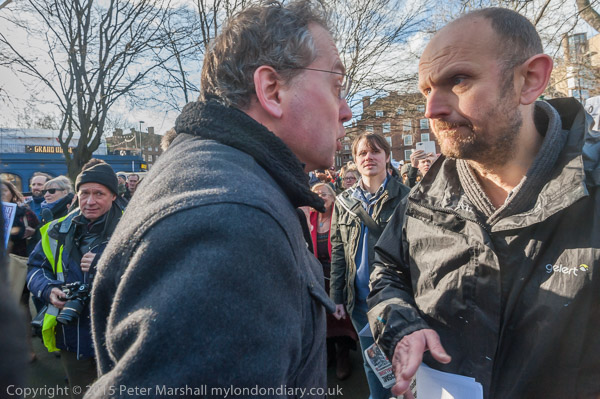
But there was one exception; when Southwark Council Cabinet Member for Housing Richard Livingstone the atmosphere changed, with boos and loud heckling from several people in the crowd including Elmer.

Housing and Planning Bill March - 2016
Simon Elmer shouts as Richard Livingstone speaks

The arguments continued in the crowd after Livingstone had left the platform with Elmer pointing out the scandal over the demolition of the Heygate Estate and now the Aylesbury estate, where thousands of council homes have been demolished and few of the promises made by Southwark Council have been kept.

Housing and Planning Bill March - 2016

Financially and morally Heygate was a scandal, with the council making derisory offers of compensation to leaseholders, far less than the value of comparable properties in the area and a huge loss of social housing, while getting rid of a huge public asset at a fraction of its true value. And since it was something the council seemed determined to repeat, and it is not surprising that feelings ran high.

Rather to the surprise of many the march set off walking in the opposite direction to its final destination of Downing Street, and it soon became clear that we were on a tour of Lambeth rather than taking a direct route.

“Class War decided to liven things up a little, first by dancing along the street singing the ‘Lambeth Walk’ and then by rushing across the pavement towards a large estate agency.

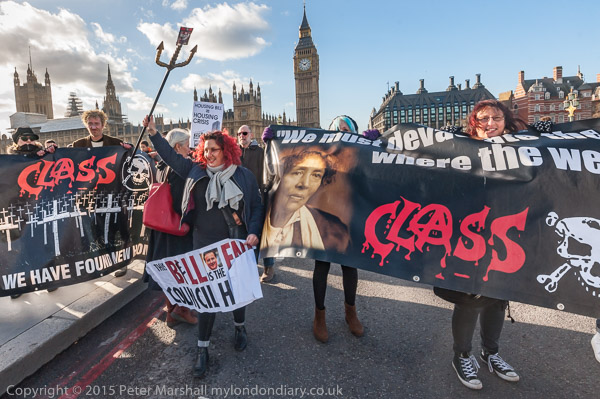
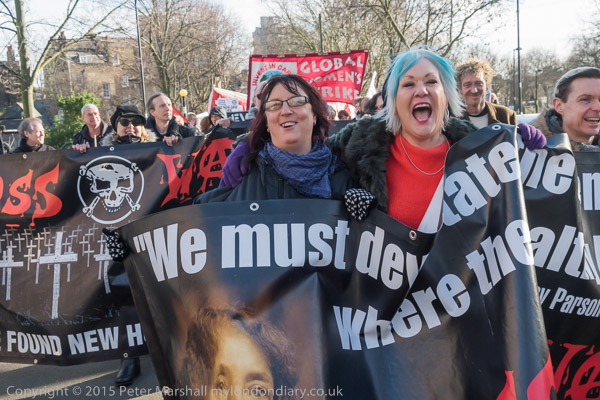
Police formed a line to stop them entering and they stood outside for some minutes with their banners – the field of crosses with the message ‘We have found new homes of for the rich’ and the Lucy Parsons banner with its quotation “We must devastate the avenues where the wealthy live” before rejoining the march.”

For much of the march Lisa Mackenzie who had stood at Class War’s candidate in the 2015 General Election against Iain Duncan Smith in Chingford stood in front of the banners waving a plastic trident with a small banner ‘This Bill is the end of Council Housing’ with its second message an image of David Cameron and the alternative text ‘Bell End’. At times she donned a face mask of Smith.

Eventually the march reached Downing Street where police tried to direct them to the opposite side of Whitehall, but the marchers walked past them and crossed back to protest outside the gates, blocking traffic on Whitehall.

Here there were several groups listening to speakers and a samba band playing. Eventually police persuaded most of them to leave the road and I left for home.

More pictures at Housing and Planning Bill March.


FlickrFacebookMy London DiaryHull PhotosLea ValleyParis
London’s Industrial HeritageLondon Photos

All photographs on this page are copyright © Peter Marshall.
Contact me to buy prints or licence to reproduce.

Slavery, Aninal Cruelty & Turkey Attacks Rojova – 2018

Slavery, Aninal Cruelty & Turkey Attacks Rojova: Protests in London on Saturday 27th January 2018 against migrants being sold as slaves in Libya, the continuing cruel trapping of animals to use in clothing sold by Canada Goose and the attacks by the Turkish army on Kurdish areas of North Syria.


End UAE support for slavery in Libya – UAE Embassy

Slavery, Aninal Cruelty & Turkey Attacks Rojova - 2018

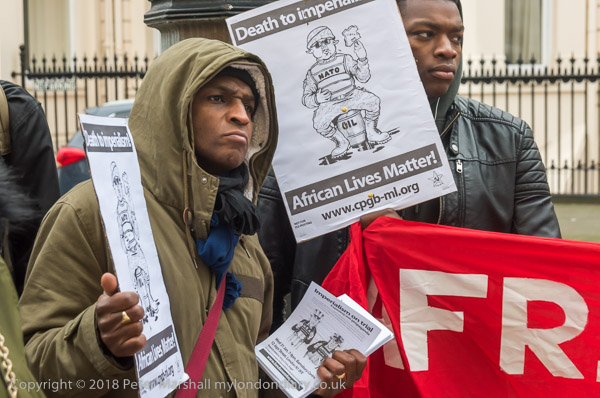
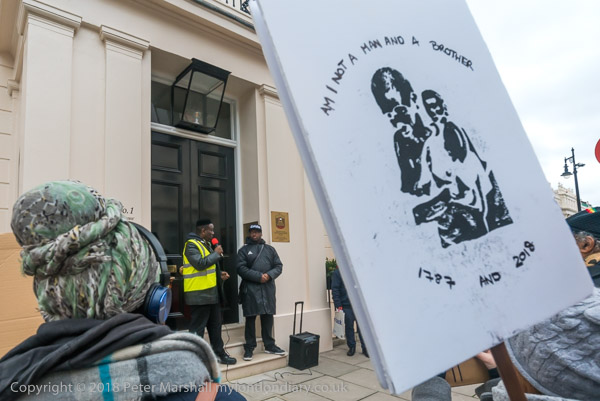
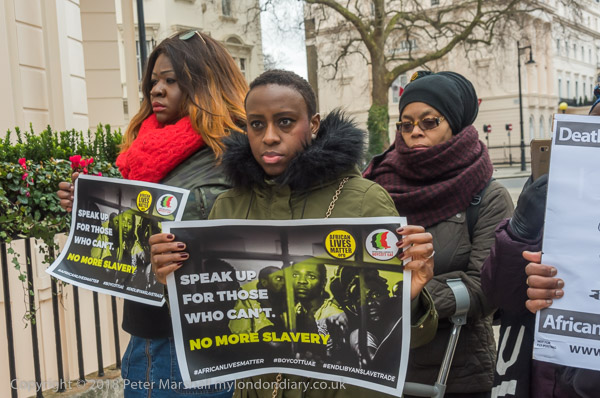
African Lives Matter and the International Campaign to Boycott UAE protest at the UAE Embassy in London against the funding by the the United Arab Emirates of armed Groups in Libya which imprison, torture and kill African migrants and sell them as slaves.

Slavery, Aninal Cruelty & Turkey Attacks Rojova - 2018

The protest also called for an end of the human trafficking of African migrants to and from Dubai and for help to be given for slavery victims in Dubai to return to their families in Africa.

Slavery, Aninal Cruelty & Turkey Attacks Rojova - 2018

This turned out to be a fairly small protest, although the police had obviously planned for something much larger and I had expected more after earlier protests over the issue.

End UAE support for slavery in Libya


Canada Goose protests continue – Regent St

Slavery, Aninal Cruelty & Turkey Attacks Rojova - 2018

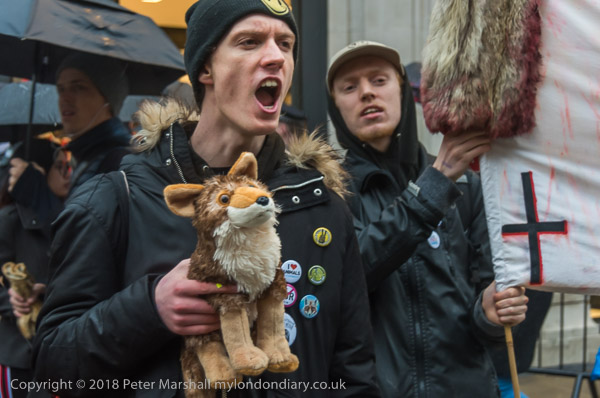
Protesters were again outside the Canada Goose flagship store in Regent St asking shoppers to boycott the store because of the horrific cruelty involved in trapping dogs for fur and raising birds for down used in the company’s clothing.

The company had obtained an injunction to try to prevent protests, but this had been amended in the previous month to allow more protesters and to enable them to use loud hailers between 2pm and 8pm. They were now carrying out weekly protests on Saturdays as well as occasional protests during the week.

Finally in 2022 Canada Goose announced it would stop purchasing new fur from trappers and transition to using reclaimed fur, though it seems unclear whether they have achieved their goal. The company is apparently still selling garments made with its large stocks of trapped fur and continuing to use feathers from geese and ducks which campaigners allege are plucked from live birds.

Canada Goose protests continue


Defend Afrin, stop Turkish Attack – BBC to Downing St

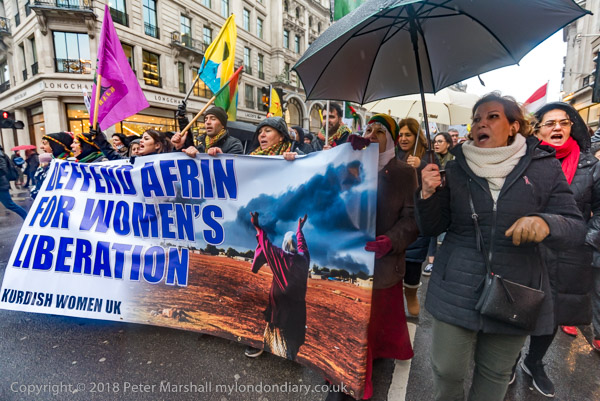
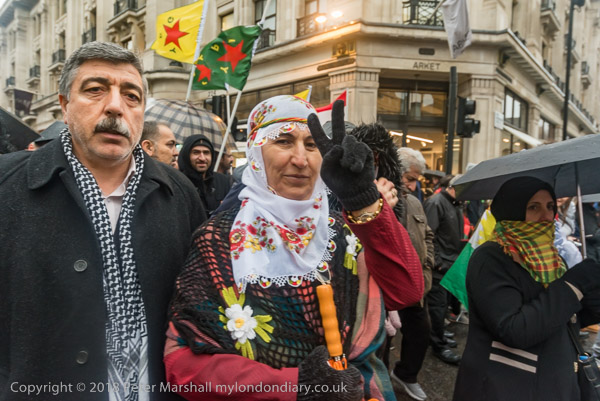
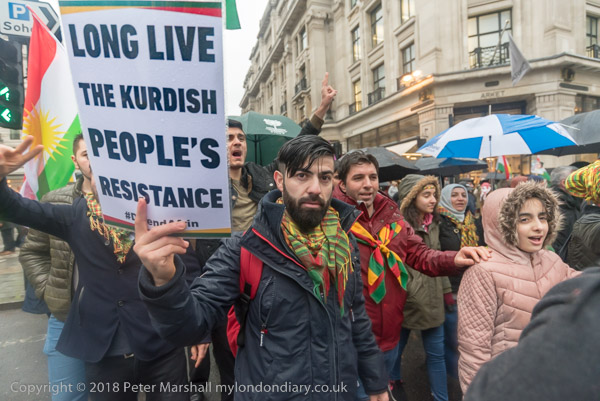
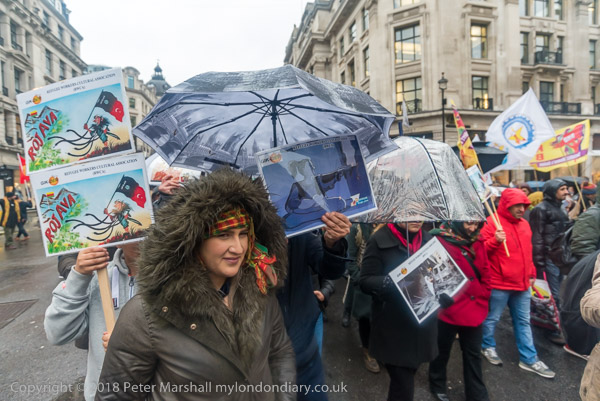
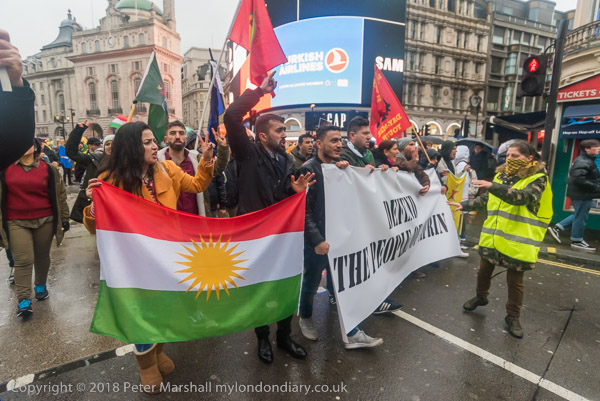
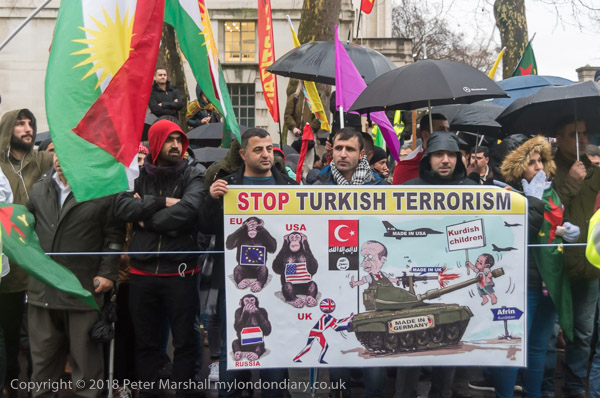
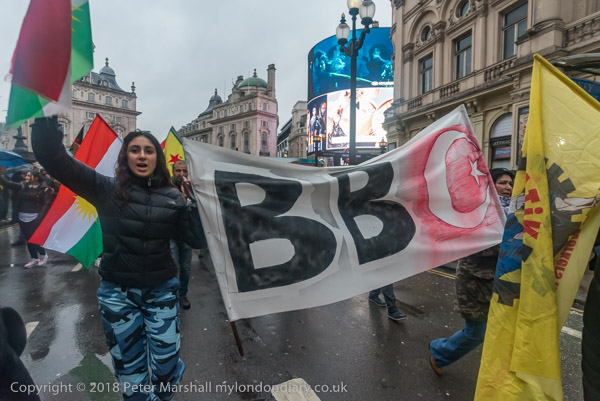
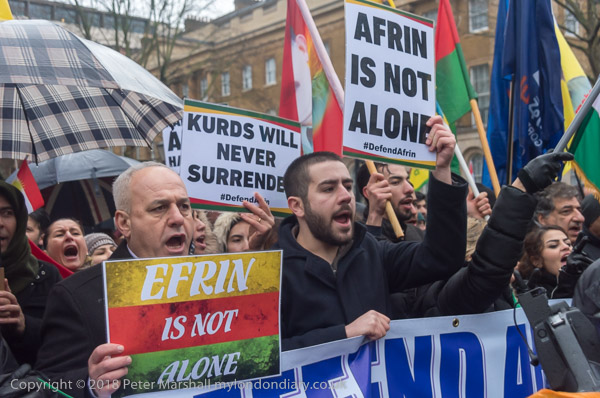
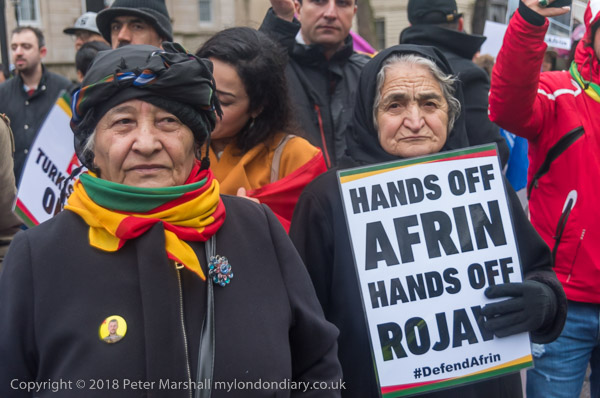
Several thousand people, mainly Kurds, marched through London from outside the BBC to a rally opposite Downing St, calling for an end to the attacks by Turkish forces on the Afrin Canton of Northern Syria, now a part of the Democratic Federation of Northern Syria (DFNS) or Rojava, a de facto autonomous region in northern Syria.

Many see Rojava with a constitution based on a democratic socialism which treats all ethnic groups as equal and women as equal to men as a model for a future federal Syria, although it seems unlikely to find favour with Hay’at Tahrir al-Sham.

Turkey is the second largest military force in NATO, second only to the USA and appeared to be using its position in NATO and the threat of closer relationships with Russia to eliminate the Kurds on its borders, who it alleges are a part of the PKK, the Kurdistan Workers’ Party, a Kurdish nationalist organisation regarded by Turkey and its allies as a terrorist organisation which was proscribed by the UK in 2001.

Kurds are around 15-20% if the population of Turkey, its largest ethnic minority and were violently suppressed following the establishment of the Republic of Turkey in 1923, with a number of massacres and a continuing attempt to erase their language and culture. Even the words “Kurds” or “Kurdistan” were banned and in 1980 their languages were banned, with those found using them arrested and imprisoned. It remains illegal to teach using Kurdish in schools in Turkey.
Kurdish forces,aided by US air support played a major role in the defeat of ISIS in Syria. Eventually the Turkish attacks on Afrin were halted after the Kurds in Rojava reached an agreement with the Syrian army to aid them in the defence of Syria. Further Turkish encroachment into Syria was prevented by the setting up of the Second Northern Syria Buffer Zone, part of the Sochi Agreement, in 2019.

Turkey encouraged ISIS in Syria as a part of their attempts to remove Kurdish influence in the areas close to their borders. Sales of oil smuggled through Turkey with the connivance of leading figures in the Turkish government provided most of the funding for ISIS.

The marchers met at the BBC who they say has failed to report over many years on Turkish atrocities and their genocidal attacks on the Kurds before marching to Downing Street.

Police apparently seized a number of PKK flags before the start of the march, though I did still spot one when the marchers reached Downing St. Kurds largely view the PKK as a nationalist rather than terrorist organisation and there were many flags with the image of the PKK’s long imprisoned leader Abdullah Öcalan. His nickname ‘Apo’ means uncle in Kurdish. It was his reading and thinking during long years of solitary confinement that led to the new thinking in the constitution of Rojava.

I listened to a few of the speeches at Downing Street before leaving for home and you can see many more pictures of the march and some of the speakers on My London Diary.

Defend Afrin, stop Turkish Attack


FlickrFacebookMy London DiaryHull PhotosLea ValleyParis
London’s Industrial HeritageLondon Photos

All photographs on this page are copyright © Peter Marshall.
Contact me to buy prints or licence to reproduce.