Islington in Colour: The first of several posts of colour pictures I made in January 1993 in the London Borough of Islington, mostly in Islington itself. All these pictures are in my Flickr album 1993 London Colour and clicking on any image will take you to a larger version there.
I think the first walk on which I took these pictures began at Kings Cross and I walked into Pentonville. I will post them in the order I made them, but I can’t remember the exact location of some of these. Please comment if you recognise where they were.
Mural, Magnus Irvin, 1982, London, 1993, 93c01-01-73
Magnus Irvin, born in 1955, is a prolific public artist and his work includes many murals, but this one is not included in the murals page on his web site. He designed and painted this one in 1982. Perhaps it refers to Joseph Grimaldi who basically invented the clown as we know it and is buried in the area.
This striking post-war brutalist estate was designed Howell, Killick, Partridge & Amis for the Greater London Council and built in 1964-7. As well as photographing it in black and white I made this colour image.
Hairdresser, Islington, 1993, 93c01-01-63
A sign reflected in the window points to Chapel Market and this HIGH CLASS GENTS TOILET SALOON was at No. 114. Few streets in the area have numbers this high.
Demos Modes Ltd, Islington, 1993, 93c01-01-65
This closed shop up for sale was definitely at No.5, but again I cannot remember which road it was on or find any information on Demos Modes Ltd.
Shop Window, Islington, 1993, 93c01-01-66
A dramatic figure in a window display, I think selling crash helmets for motorcyclists. Wearing them had become compulsory in the UK twenty years earlier in 1973.
A mural which leaves you in no doubt about what the business it is advertising offers, but I suspect most of its clients had rather less sporty models.
Mural, School Playground, Islington, 1993, 93c01-01-55
I think this and the picture below are from the same school playground.
Mural, School Playground, Islington, 1993, 93c01-01-42
A mural of rural scenes in a school playground, perhaps reflecting the rural past of the area. There were once watermills on the River Fleet which ran in places along the borough’s western boundary, and certainly farms with sheep and geese, but I think all will have disappeared by the age of the tractor cutting corn.
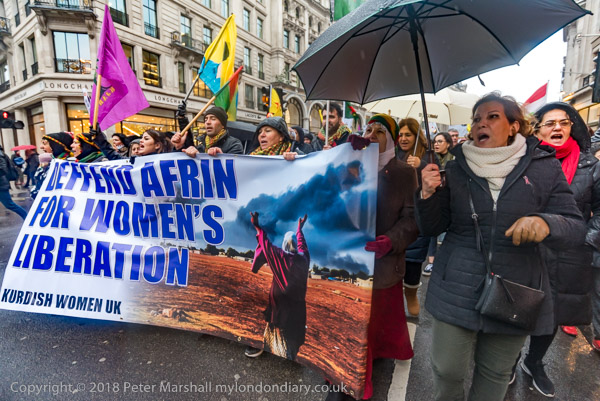
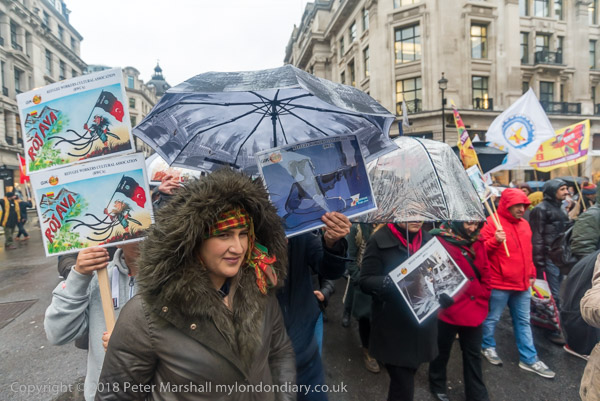
Slavery, Aninal Cruelty & Turkey Attacks Rojova: Protests in London on Saturday 27th January 2018 against migrants being sold as slaves in Libya, the continuing cruel trapping of animals to use in clothing sold by Canada Goose and the attacks by the Turkish army on Kurdish areas of North Syria.
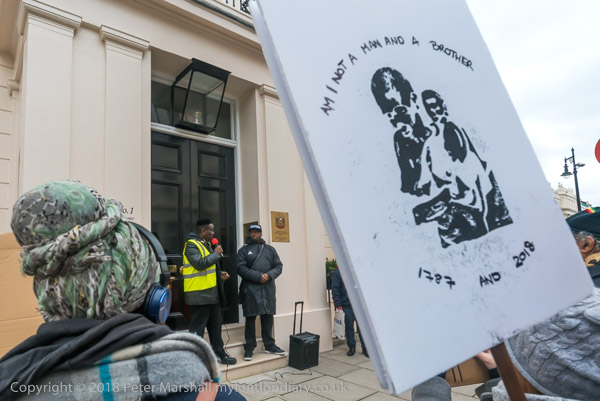
End UAE support for slavery in Libya – UAE Embassy
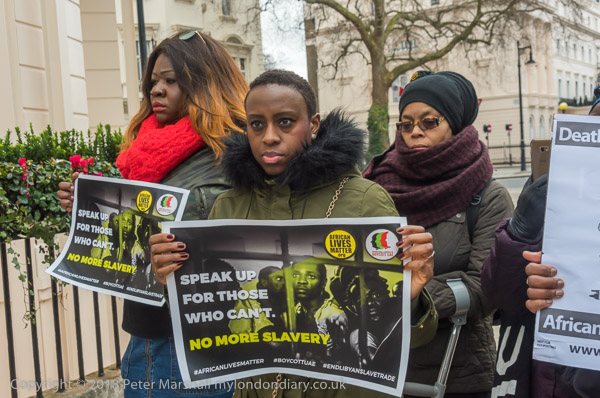
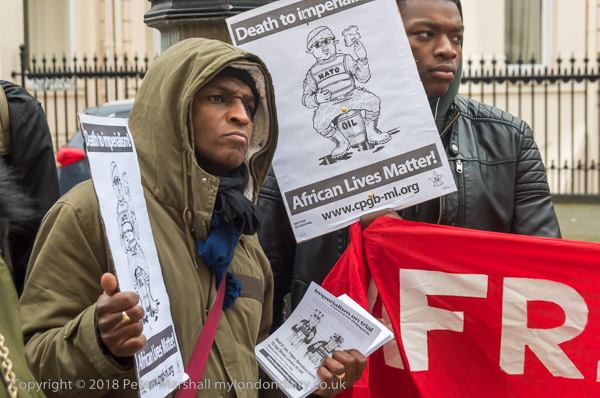
African Lives Matter and the International Campaign to Boycott UAE protest at the UAE Embassy in London against the funding by the the United Arab Emirates of armed Groups in Libya which imprison, torture and kill African migrants and sell them as slaves.
The protest also called for an end of the human trafficking of African migrants to and from Dubai and for help to be given for slavery victims in Dubai to return to their families in Africa.
This turned out to be a fairly small protest, although the police had obviously planned for something much larger and I had expected more after earlier protests over the issue.
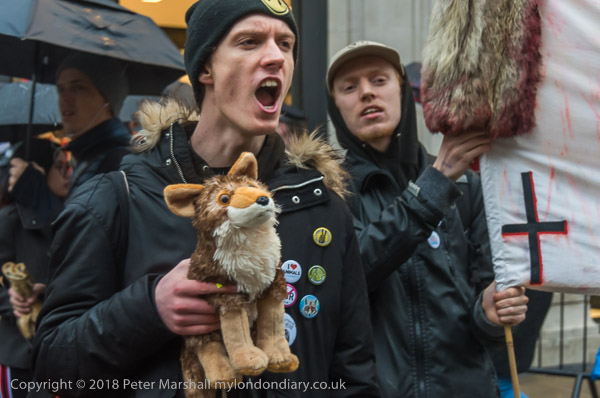
Protesters were again outside the Canada Goose flagship store in Regent St asking shoppers to boycott the store because of the horrific cruelty involved in trapping dogs for fur and raising birds for down used in the company’s clothing.
The company had obtained an injunction to try to prevent protests, but this had been amended in the previous month to allow more protesters and to enable them to use loud hailers between 2pm and 8pm. They were now carrying out weekly protests on Saturdays as well as occasional protests during the week.
Finally in 2022 Canada Goose announced it would stop purchasing new fur from trappers and transition to using reclaimed fur, though it seems unclear whether they have achieved their goal. The company is apparently still selling garments made with its large stocks of trapped fur and continuing to use feathers from geese and ducks which campaigners allege are plucked from live birds.
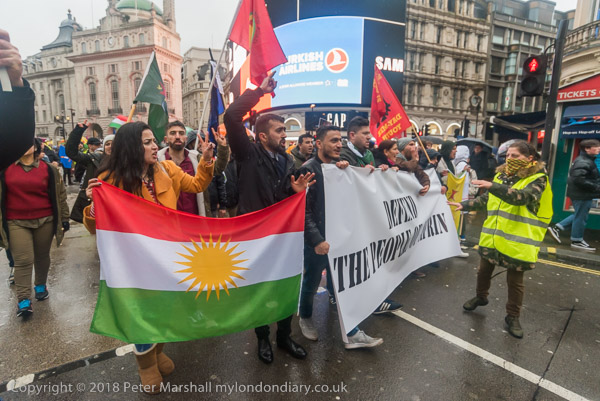
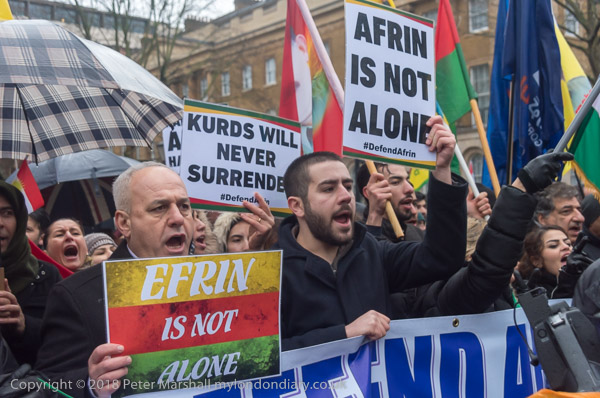
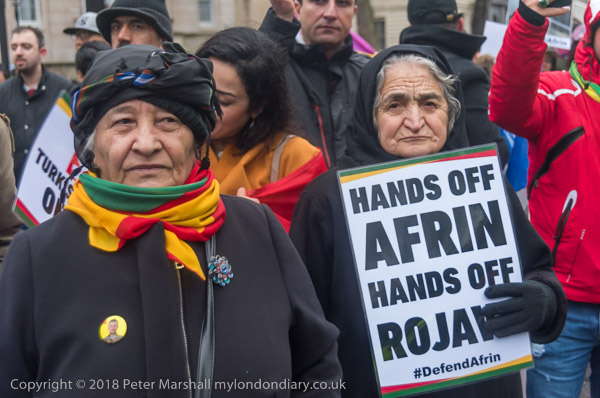
Defend Afrin, stop Turkish Attack – BBC to Downing St
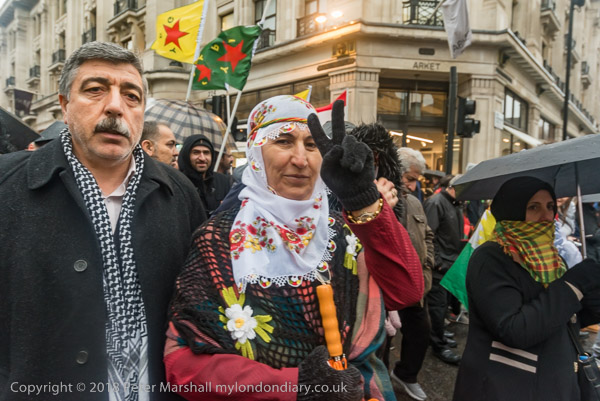
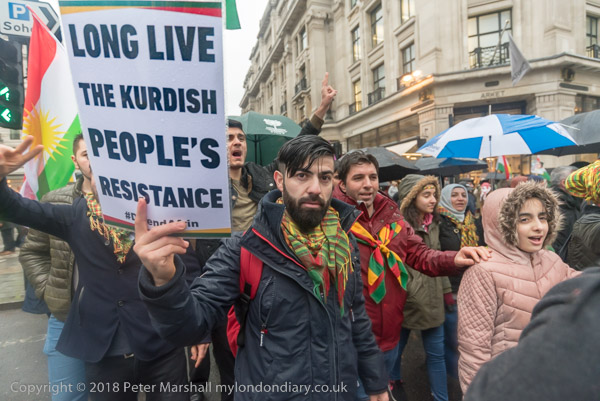
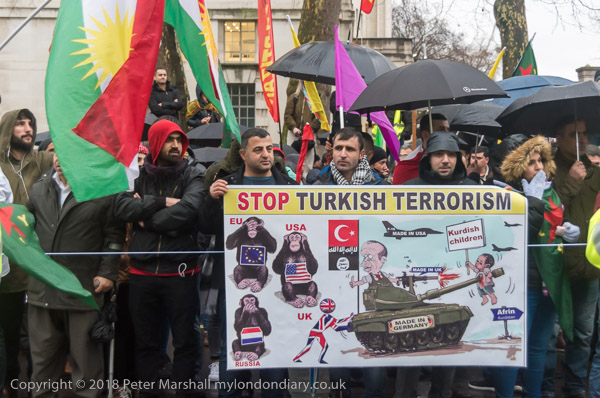
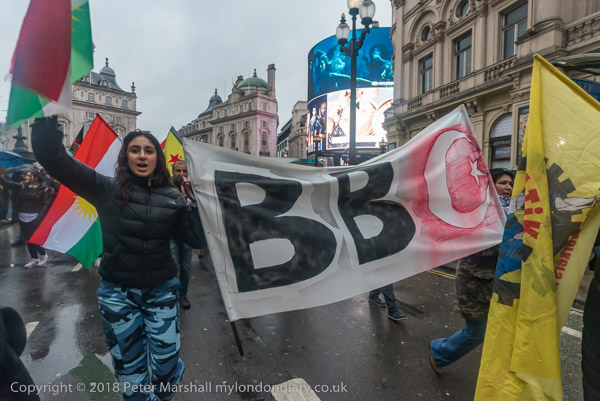
Several thousand people, mainly Kurds, marched through London from outside the BBC to a rally opposite Downing St, calling for an end to the attacks by Turkish forces on the Afrin Canton of Northern Syria, now a part of the Democratic Federation of Northern Syria (DFNS) or Rojava, a de facto autonomous region in northern Syria.
Many see Rojava with a constitution based on a democratic socialism which treats all ethnic groups as equal and women as equal to men as a model for a future federal Syria, although it seems unlikely to find favour with Hay’at Tahrir al-Sham.
Turkey is the second largest military force in NATO, second only to the USA and appeared to be using its position in NATO and the threat of closer relationships with Russia to eliminate the Kurds on its borders, who it alleges are a part of the PKK, the Kurdistan Workers’ Party, a Kurdish nationalist organisation regarded by Turkey and its allies as a terrorist organisation which was proscribed by the UK in 2001.
Kurds are around 15-20% if the population of Turkey, its largest ethnic minority and were violently suppressed following the establishment of the Republic of Turkey in 1923, with a number of massacres and a continuing attempt to erase their language and culture. Even the words “Kurds” or “Kurdistan” were banned and in 1980 their languages were banned, with those found using them arrested and imprisoned. It remains illegal to teach using Kurdish in schools in Turkey.
Kurdish forces,aided by US air support played a major role in the defeat of ISIS in Syria. Eventually the Turkish attacks on Afrin were halted after the Kurds in Rojava reached an agreement with the Syrian army to aid them in the defence of Syria. Further Turkish encroachment into Syria was prevented by the setting up of the Second Northern Syria Buffer Zone, part of the Sochi Agreement, in 2019.
Turkey encouraged ISIS in Syria as a part of their attempts to remove Kurdish influence in the areas close to their borders. Sales of oil smuggled through Turkey with the connivance of leading figures in the Turkish government provided most of the funding for ISIS.
The marchers met at the BBC who they say has failed to report over many years on Turkish atrocities and their genocidal attacks on the Kurds before marching to Downing Street.
Police apparently seized a number of PKK flags before the start of the march, though I did still spot one when the marchers reached Downing St. Kurds largely view the PKK as a nationalist rather than terrorist organisation and there were many flags with the image of the PKK’s long imprisoned leader Abdullah Öcalan. His nickname ‘Apo’ means uncle in Kurdish. It was his reading and thinking during long years of solitary confinement that led to the new thinking in the constitution of Rojava.
I listened to a few of the speeches at Downing Street before leaving for home and you can see many more pictures of the march and some of the speakers on My London Diary.