Shut Down Yarl’s Wood 12 – 2017

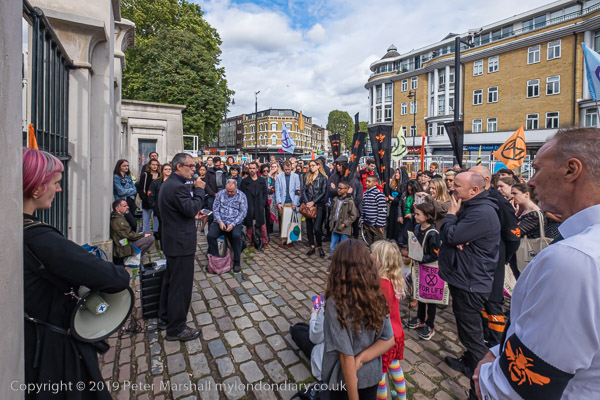
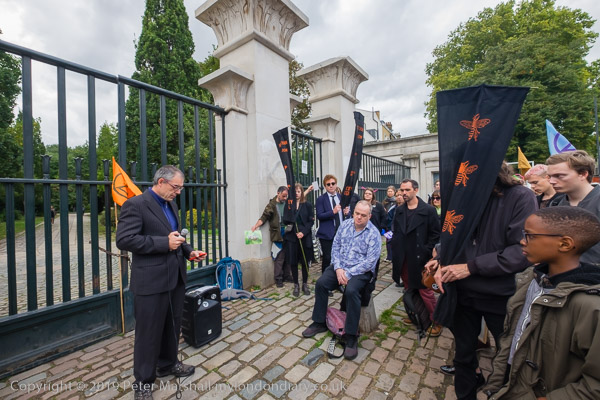
Shut Down Yarl’s Wood 12: On Saturday 18th November 2017 I put my folding bike on three trains to take me to Bedford Station and rode the five or so miles to the closed main gates of Twinwoods Business Park on a former wartime aerodrome. Mostly it was an easy ride, but the last half-mile or so was up a rather steep hill and I was well out of breath by the time I arrived to meet the crowd of protesters already there but waiting for more coaches to arrive.

Shut Down Yarl's Wood 12 - 2017
Flowers on the fence and banners and posters at Yarl’s Wood
Shut Down Yarl's Wood 12 - 2017

It was I think my 11th visit to photograph the protests organised by Movement for Justice at Yarls Wood Immigration Centre on the other side of the business park a little over a mile away which we could reach by a public footpath.

Shut Down Yarl's Wood 12 - 2017
‘Yarlswood! Shut it Down!’

The numbers at the protest were down on the previous protest as the preparations for the event had been disrupted by a controversy about Movement for Justice, with one formerly very active member leaving feeling very angry about the group’s treatment of her. Although I sympathised with her I felt that much of what she claimed to reveal about the group was already well known and that she and her supporters were using her personal issue in a way that damaged the campaign to close Yarl’s Wood and other immigration prisons.

Shut Down Yarl's Wood 12 - 2017

As I wrote in 2017:
“MfJ has never made any secret of its political background (you can read about it on Wikipedia), and has done far more than any other group to raise the issue of immigration detention, organising major protests at Harmondsworth, the Home Office and Yarl’s Wood and working practically with many former asylum seekers to stop deportations. And while much of the organisation of protests has clearly been carried out by a small and devoted core group, the activity and enthusiasm of those former asylum seekers is vital. MfJ would be impotent without their support, which it would not have unless it commanded their respect.”

Shut Down Yarl's Wood 12 - 2017

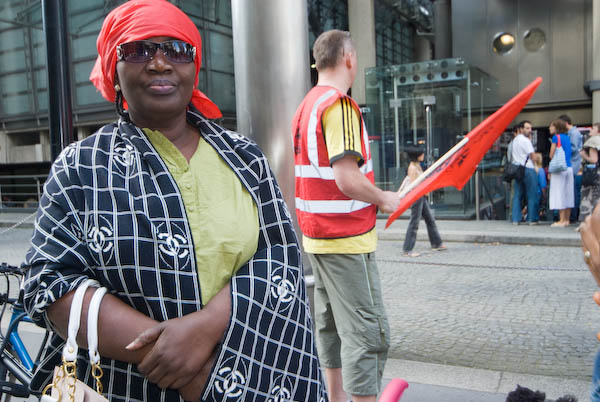
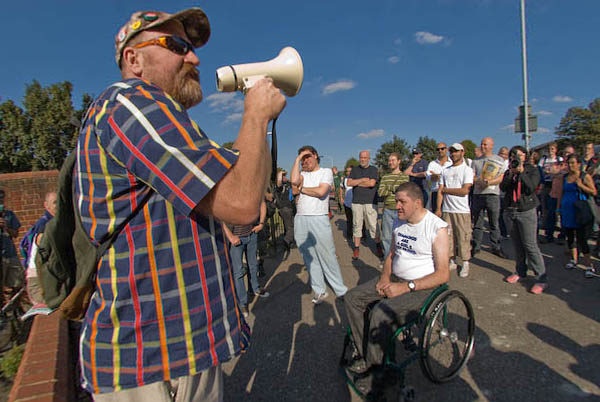
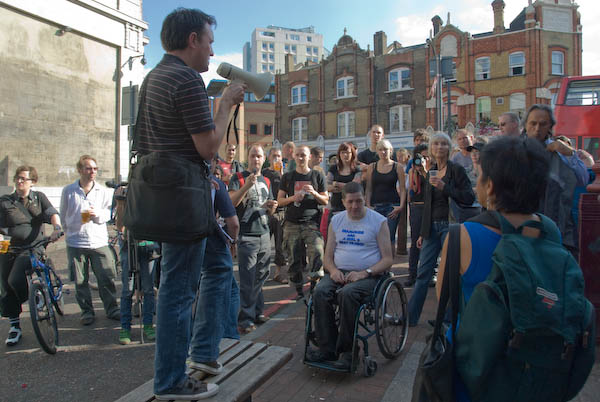
The protesters held a noisy rally on the grassy area at the side of the road, with much chanting of slogans, practising them for when they would be outside the prison. They had brought large clear posters and banners that the women inside would latter be able to see, as well as a sound system and a ladder.

Shut Down Yarl's Wood 12 - 2017

When all had arrived we set off marching a few hundred metres down the road to the start of the footpath, with me pushing my bike and stopping occasionally to take pictures. When we got closer to the site, one of the campaigners kindly offered to push my bike so I could take pictures of the marchers more easily.

We went through a gate into a field next to the detention centre where the protesters began to make a great deal of noise, particularly by kicking and banging on the lower solid metal section of the 20ft fence imprisoning the site.

The field slopes up steeply from the fence and others stood on the flat area at the top where they could see through the grid on the top 10 feet of the fence – and be seen by the women inside who were able to get to the upper floor windows. Some of the protesters had brought flowers and stood on the ladder to poke them into the grid.

We could see – if not clearly – the women inside who had come to greet the protesters, holding up messages: ‘SOS Plz’, ‘5 Months In No End in sight‘, ‘We Need Freedom‘, ‘We just no visa not criminal‘, ‘Release Us’. The windows can only be opened a few inches but some managed to hold out their messages. The photographs using a very long lens show them more clearly than we could see them.

The prison guards had put on a fashion show in another block of the centre to try to entice the women away from the windows, and guards were harassing them and telling them to leave the rooms facing the protest, event trying to pull them away, but they still manage to stay there to greet the protest. But some of the windows were pretty crowded.

Some held up mobile phone numbers in large print – the detainees are allowed phones to contact their lawyers and others over their immigration cases – and we were able to hear their voices which were relayed to the PA system. We could also hear them shouting, though it was hard to make out what they were saying.

Mabel Gawanas
Mabel Gawanas

Speakers standing on a ladder could see and be heard by the women inside, and most of those who spoke were former detainees at Yarl’s Wood or other detention centres. Mabel Gawanas who was held inside there for a day under 3 years was able to speak to her friends still inside.

Between speeches there was more noise, and the samba band played.

Also speaking was a woman released only a few days earlier who thanked MfJ and greeted her friends still inside.

I commented “‘China’ , ‘China’, ‘Release Us’, ‘We Need Freedom’ , ‘5 Months In No End In Sight’ , ‘Release’. None of these people should be locked up. There is no good reason to lock any of them up. Some need help and protection. All need to be treated as human beings, not pawns in a numbers game to satisfy the racist right.”

Other former detainees spoke, including some others recently release and this man who had been held in three different detention centres.

And on the hill people held their banners and the protest continued.

It was mid-November and the light was beginning to fall and the protest was to end shortly. I was getting cold and decided I had to leave, and pushed my bike back to the road for the ride back to Bedford station. Fortunately apart from one short steep hill it was mainly downhill.

Many more pictures on My London Diary at Shut Down Yarl’s Wood 12.


FlickrFacebookMy London DiaryHull PhotosLea ValleyParis
London’s Industrial HeritageLondon Photos

All photographs on this page are copyright © Peter Marshall.
Contact me to buy prints or licence to reproduce.
Sudan & Hong Kong Protests – 8 Nov 2025

Sudan & Hong Kong Protests: Last Saturday, 8th November 2025 I photographed a London rally and march against the horrific killings in Sudan before going to the Chinese Embassy where people were protesting for freedom of expression in Hong Kong, where three pro-democracy advocates were to go on trial this Tuesday for “subversion”.


End the UK-Complicit Genocide in Sudan

Gloucester Road Station

Sudan & Hong Kong Protests - 8 Nov 2025

Sudan has been a divided country more or less since it gained independence in 1956, suffering a long civil war which eventually led to independence for South Sudan in 2011 and a brutal 30 year military dictatorship under Omar al-Bashir which included an ethnic genocide in Darfur from 2003 -2020. Al-Bashir was finally ousted by a coup early in 2019 following huge protests. Since 2023 the country has been devastated by a civil war between the Sudanese Armed Forces (SAF), and the paramilitary Rapid Support Forces (RSF).

Sudan & Hong Kong Protests - 8 Nov 2025

The war is partly one over resources and access to the Red Sea, but also has a strong ethnic dimension with the RSF being “violently Arab supremacist or ethno-fascist“. They are backed financially by the United Arab Emirates who also supply them with arms. In return the RSF has taken control of Sudanese gold mines and illegally smuggles gold to Dubai.

The RSF also control the major gum arabic producing areas of the country. Sudan’s acacia trees produce around 80% of the world total of this vital ingredient used in many consumer products from Coca-cola to lipsticks and pet food. The RSF smuggles this out to be sold on world markets.

Sudan & Hong Kong Protests - 8 Nov 2025

The war between the RSF and the SAF has resulted in more than 200,000 people being killed, mainly civilians with huge numbers – perhaps 14 million -being displaced and according to the UN, “2025 will see 30.4 million people in Sudan in need of humanitarian aid due to the military conflict in the country.

Sudan & Hong Kong Protests - 8 Nov 2025

Both the RSF and the SAF are reported as carrying out war crimes. The ‘London for Sudan’ leaflet states:

The RSF are burning villages to the ground, recruiting child soldiers, poisoning water supplies, attacking hospitals & targetting journalists.

The SAF are carpet bombing indiscriminately, wiping out markets and other vital infrastructure in their bid for control over the region.”

Sudan & Hong Kong Protests - 8 Nov 2025

In the continuing El-Fasher massacre by the RSF, “an estimated 2,500 or more civilians have been executed or murdered since 26 October 2025.” though some analysts believe the actual numbers are in the tens of thousands. The RSF are known to use rape as a weapon and have have committed executions, torture, mass displacement and deliberate starvation, armed by weapons sold by the UK to the UAE. In May Sudan took the UAE to the International Court of Justice for complicity in genocide.

Sudan & Hong Kong Protests - 8 Nov 2025

The protesters pointed out the British complicity in supporting the RSF by selling arms to the UAE which are then smuggled to the RSF. They demanded that the UK government designate the RSF a terrorist organisation and called on them to impose sanctions on the UAE for their support as well as ending arms sales to them.

Sudan & Hong Kong Protests - 8 Nov 2025

After a short rally with several speeches and a moving poem in English by a Sudanese woman poet the march set off along the Cromwell Road heading for a final rally. I left them at South Kensington to go to a protest at the Chinese Embassy.

More pictures in the Facebook album End the UK-Complicit Genocide in Sudan


Free the Hong Kong Alliance Three

Chinese Embassy, Portland Place

Sudan & Hong Kong Protests - 8 Nov 2025

Trade unionists protested outside the Chinese Embassy in solidarity with the three Hong Kong pro-democracy leaders charged with inciting subversion under Beijing’s National Security Law for organising protests and vigils whose trial begins on 11 Nov.

Sudan & Hong Kong Protests - 8 Nov 2025

They called for Lee Cheuk-yan, Chow Hang-tung, Albert Ho and all political prisoners to be released.

Sudan & Hong Kong Protests - 8 Nov 2025

One man who continually tried to disrupt the event by shouting pro-China comments through a megaphone was finally pushed away across the road. Police argued with him and he was later arrested when he refused to obey police requests to stop.

Sudan & Hong Kong Protests - 8 Nov 2025

More pictures in the Facebook Album Free the Hong Kong Alliance Three


FlickrFacebookMy London DiaryHull PhotosLea ValleyParis
London’s Industrial HeritageLondon Photos

All photographs on this page are copyright © Peter Marshall.
Contact me to buy prints or licence to reproduce.

Brexit Now, Save the Sunderbans, Close Ripper ‘Museum’ – 2018

Brexit Now, Save the Sunderbans, Close Ripper ‘Museum’: Saturday 10th November 2018 I began at a small protest by extreme right ‘Leave’ supporters against the lack of progress in leaving the EU. From there I went to a rally in Whitechapel which was part of a global day of protest to save the the world’s largest mangrove forest and then met Class War for another protest against the misogynist Ripper museum in Cable St.


Leave Voters say Leave Now!

Trafalgar Sq

Brexit Now, Save the Sunderbans, Close Ripper 'Museum' - 2018
Several had sticky tape over their mouths claiming they had been gagged

Only around a couple of hundred people had come to Trafalgar Square for a protest by extreme right wing groups led by what I think is the now defunct group UK Unity (their domain address is now for sale) and backed by others including the For Britain Movement and UKIP. There were faces familiar from other extreme-right protests.

Brexit Now, Save the Sunderbans, Close Ripper 'Museum' - 2018

They were angered by the lack of progress in exiting the UK and the concessions that they said Theresa May was making to the EU. This was one of five protests taking place that day, in Coventry, Norwich, Cardiff and Leeds as well as London.

Brexit Now, Save the Sunderbans, Close Ripper 'Museum' - 2018

They called for a 5 point plan:

  • Britain should leave the EU entirely without payments;
  • An end to mass immigration;
  • to properly run and fund our public services;
  • to scrap the House of Lords and reform democracy;
  • to put British Laws, British Culture and British People first.
Brexit Now, Save the Sunderbans, Close Ripper 'Museum' - 2018

Many also held posters calling for London Mayor Sadiq Khan to resign, though this appeared simply to be Islamophobia. I listened to a couple of speeches which I felt “reflected some irrational views on Brexit, fired by emotion and ignoring the realities.”

Brexit Now, Save the Sunderbans, Close Ripper 'Museum' - 2018

As I commented in 2018, “It was always the case that the kind of break with the EU that many voted for was impossible, and that if we are to leave there will be many unpalatable consequences. The best possible deal was always going to be a poor deal in many ways, and no responsible politician thinking about the future of the nation rather than their own personal fortunes would be campaigning or voting for leaving without a deal.

Leave Voters say Leave Now!


Global Day to save the Sunderbans

Altab Ali Park, Whitechapel

Brexit Now, Save the Sunderbans, Close Ripper 'Museum' - 2018

The UK branch of the National Committee to Protect Oil Gas & Mineral Resources, Bangladesh, supported by others including Fossil Free Newham were taking part in a global day of protest to save the Sunderbans, the world’s largest mangrove forest and a UNESCO World Heritage Site.

Among animals threatened with extinction is the Bengal tiger

The Bangladesh and Indian governments were building the giant Rampal coal-fired power plant, which would become the largest power station in Bangladesh. Clearly this will be disastrous for climate change, producing huge amounts of carbon dioxide, but it also threatens the nearby wetlands, and is in violation of the Ramsar Convention for the conservation of wetlands which Bangladesh has signed up to.

The power plant will take huge amounts of water from the river which flows through the Sunderbans, and release hotter water containing toxic materials which will endanger the mangroves, marine animals and the people living in the area.

The 4.72 million tons of coal per year to the plant on ships through the shallow rivers will seriously disturb the Sunderbans and will also result in considerable pollution.

The development “will also make around 50 million people more vulnerable to storms and cyclones, against which the Sunderbans serve as a natural safeguard.” Global warming and climate chaos is already making such climate events more frequent and more severe – and the extra greenhouse gases from this plant will add to this.

Bangladesh is already one of the countries most under threat from frequent flooding. There were huge protests against the plant with numbers of protesters being killed. Despite huge opposition in the country and around the world, construction at Rampal continued and the first stage of the plant was commissioned in October 2022.

More on My London Diary at Global Day to save the Sunderbans


Class War picket the Ripper Museum

Cable St, Whitechapel

Class War had come once again to protest outside tacky misogynist tourist attraction which gained planning permission by pretending to be a museum of the history of women in London’s East End after it had failed to comply with some of Tower Hamlet’s Council’s planning decisions about its frontage.

One protester walked into the shop but was pushed out by one of the shop staff and they then called the police who arrived in a few minutes, having been waiting for the protest a short distance away. An officer tried to persuade the protesters to move away from the front of the shop and hold their ‘Womens Death Brigade’ banner on the opposite side of the road, but the took no notice.

A woman officer, CE3200, her name carefully hidden, complained to Class War about their language and told them they can be arrested for swearing. They told her the law. Swearing isn’t an offence in itself, it has to offend people – and you are particularly unlikely to be found guilty of swearing at the police, who are not generally supposed to be easily shocked.

This was intended as a short protest and Class War were rolling up their banner when a small group arrived to enter the shop. Class War talked with them politely, making clear the disgusting nature of some of the displays which glorify the gory nature of the crimes and denigrate the poor working class victims in a brutally misogynist fashion, causing offence to some of their still-living relatives.

They listened, but still went into the museum, with police ensuring they could enter safely. Class War then left for a nearby pub and I went with them.

More on My London Diary at Class War picket the Ripper ‘Museum’


FlickrFacebookMy London DiaryHull PhotosLea ValleyParis
London’s Industrial HeritageLondon Photos

All photographs on this page are copyright © Peter Marshall.
Contact me to buy prints or licence to reproduce.

Martyrdom of Ali, Save Fallujah – 2004

Martyrdom of Ali, Save Fallujah: I had a fairly long and busy day on Sunday 7th November 2004, beginning with the annual London celebration of the martyrdom anniversary of Imam Ali, the first Imam of Shi’ite Islam. From Park Lane I walked to Parliament Square where a protest demanded that the troops were withdrawn from Iraq.

This was the day when US and UK troops began the bloody offensive of the Second Battle of Fallujah, codenamed ‘Operation Phantom Fury’, fighting against Iraqis in militia of all stripes including both Sunni and Shia, united in opposition to the US-imposed Shia-dominated government.

Finally I went to Trafalgar Square and took a few pictures of the Diwali celebrations taking place there, although I didn’t post any of these at the time on My London Diary.

Diwali in Trafalgar Square, Martyrdom of Ali, Save Fallujah - 2004

In this post I’ll reproduce (with minor corrections) what I wrote in 2004, along with some of the pictures I took. These were made with the first digital DSLR camera I owned, the 6Mp Nikon D100, and most were made with a Nikon 24-85mm lens (36-127mm equivalent), though I had recently got a second lens, a Sigma 12-24mm (18-36 equivalent.) The Sigma wideangle was rather slow and working at f5.6 in low light was difficult as the D100 which did not have the high ISO capabilities of more modern cameras.


Muslims mourn in London

Hyde Park and Park Lane

Martyrdom of Ali, Save Fallujah - 2004
Talks and prayers before the procession started in Hyde Park

Sunday saw Muslims on the street for a religious event, a Jaloos & Matam on the Martyrdom anniversary of Imam Ali, organised by Hub-e-Ali, making its way from Hyde Park down Park Lane carrying a taboot or ceremonial coffin.

Martyrdom of Ali, Save Fallujah - 2004
A small boy carries burning incense sticks, while elders shoulder the heavy load of the taboot.

The event started with prayers, addresses and a mourning ceremony.

Martyrdom of Ali, Save Fallujah - 2004
The weight took a strain as bare-footed bearers carried the heavy black taboot with its red roses slowly along Park Lane

The banners carried included texts from the ‘purified five‘ members of the prophet’s family, but particularly Hasan Bin Ali Bin Abu Talib, the cousin and first believer in the prophet.

Martyrdom of Ali, Save Fallujah - 2004

There was some impressive chanting and much beating of breasts (matam or seena-zani) by the men, chanting and sticks of incense being burnt. The women followed quietly behind.

The women followed, their black-clad quiet dignity contrasting with the frenzied chest-beating of the men

More images start here on My London Diary


Withdraw the Troops from Iraq – Save Fallujah From Destruction

Parliament Square and Whitehall

Martyrdom of Ali, Save Fallujah - 2004
Code Pink activists carry a coffin “How many children will cease to play” in front of the Houses of Parliament.

I met Dave at the procession on Park Lane and walked with him to Parliament Square where a demonstration was to be held demanding the withdrawal of troops from the cities of Iraq. From the news that morning it seemed the Americans were about to storm Fallujah. [They did – see below *]

The large anti-war organisations seemed to be keeping strangely quiet, and there were only a hundred or two demonstrators here.

Among them of course was Brian Haw, now almost two and a half years into his permanent protest in the square, which seems likely to lead MPs to pass a bill specially to make such protests illegal.

I admire him for making such a stand, even if I don’t entirely share his views, and feel it will be a very sorry day for civil liberties in this country if such activities are banned.

There were a few placards and banners, and some people who had come with white flowers as requested.

There were few takers for the ‘open mike’ and nothing much was happening until a group of ‘Code Pink’ supporters intervened theatrically parading a black-dressed cortège around the square. The effect was literally dramatic.

There were a few more speeches, including a moving one by Iraqi exile Haifa Zangana.

It was getting dark (or rather darker, as it had been dull and overcast, with the odd spot of rain all day) as we moved off up Whitehall towards the Cenotaph, where the funeral wreath was laid on the monument.


Police tried (although it is impossible to see why) to restrict the number of those putting flowers on the monument to an arbitrary five, but those who had brought flowers were not to be so easily diverted.

People wait for police to allow them to lay their flowers at the Cenotaph

They ignored police orders and walked across the empty roadway to lay their flowers, and around 50 of the protesters staged a sit-down on the road.

Eventually the police warned them they would be removed forcibly if they did not get up, and then started to do so.

Police drag demonstrator away as peace protestor Brian Haw holds a placard “War Kills the Innocent” in front of Cenotaph and Code Pink wreath, “How Many Will Die in Iraq Today?”.

For the most part the police used minimum force, but there were one or two unnecessarily unpleasant incidents.

The protesters were then corralled for a few minutes on the pavement before being allowed to continue the demonstration in the pen opposite Downing Street.

Nothing much seemed to be happening, so I went home [via the Diwali celebrations in Trafalgar Square] when police refused to let me photograph from in front of the barriers.

It seemed an arbitrary and unnecessary decision, but this time I couldn’t be bothered to argue. I think they were just upset because I had taken pictures during the violence a few minutes earlier.

*More about Fallujah

The Second Battle of Fallujah lasted about six weeks and probably resulted in around 2,000 fighters dead and many wounded, mostly Iraqis, with just 107 of the coalition forces killed. Another roughly 1,500 Iraqis were captured.

US forces had stopped all men between 15 and 50 from leaving the city, and treated all those left inside as insurgents. Civilian deaths were later estimated at between 4,000 and 6,000. Civilians who were able to fled the city and around 200,000 became displaced across Iraq. Around a sixth of the city’s buildings were destroyed and roughly two thirds suffered significant damage.

The US forces were heavily criticised for their direct use of white phosphorus in the battle against both combatants and civilians. Highly radioactive epleted uranium shell were also used and a survey in 2009 reported “a high level of cancer, birth defects and infant mortality” in the city.”

More pictures from the protest on My London Diary.


FlickrFacebookMy London DiaryHull PhotosLea ValleyParis
London’s Industrial HeritageLondon Photos

All photographs on this page are copyright © Peter Marshall.
Contact me to buy prints or licence to reproduce.

Cinema Workers Strike, LSE against Homophobia – 2017

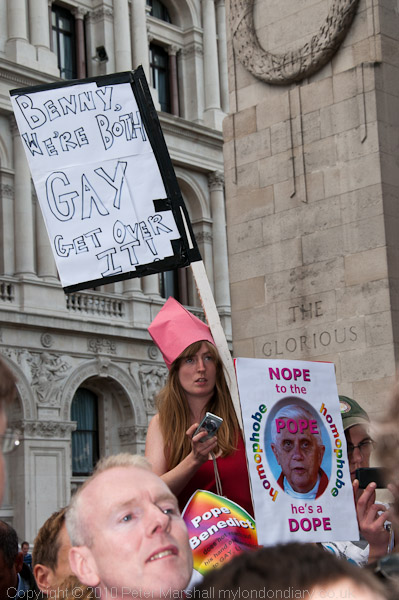
Cinema Workers Strike, LSE against Homophobia: On Monday 6th November 2017 I photographed striking Picturehouse staff picketing the cinema in Shaftesbury Avenue before going on to the LSE where students, supporters and cleaners were protesting the homophobic abuse of one of the cleaners.


Picturehouse Strike for a Living Wage

Shaftesbury Avenue

Cinema Workers Strike, LSE against Homophobia - 2017

Staff working of Picturehouse cinemas in London had been campaigning for over a year to be paid a living wage, and on 6th November 2017 they were striking at Crouch End, Hackney, and East Dulwich Picturehouses and the Brixton Ritzy as well as at Picturehouse Central close to Piccadilly Circus.

Cinema Workers Strike, LSE against Homophobia - 2017

It was Living Wage Week and the new London Living Wage of £10.20 per hour had been announced earlier that day. As I noted on My London Diary, while the cinema staff were living on poverty wages, “the post-tax profits of Cineworld, the parent company of Picturehouse were £93.8m last year in UK and Ireland and the CEO is paid £2.5m.”

Cinema Workers Strike, LSE against Homophobia - 2017

In the short time I spent with the picket a number of people “decided not to cross the picket line. Some went to the cinema a short distance down the road instead.” The strikers were expecting more people to join the picket later when there would be more customers but I had to leave to cover a protest elsewhere.

Just a few more pictures at Picturehouse Strike for a Living Wage.


Protest against Homophobia in the LSE

London School of Economics

Cinema Workers Strike, LSE against Homophobia - 2017
Protesters outside the New Academic Building where ‘LGBT Rights: what next?’ was taking place

That evening the LSE were hosting a talk, “LGBT Rights: what next?” and students and others including some cleaners were protesting outside over the homophobic abuse which Daniel, one of the LSE cleaners, had been subjected to over the past 10 months.

Cinema Workers Strike, LSE against Homophobia - 2017

The cleaners who work at the LSE were then not employed by the LSE but the work had been outsourced to cleaning contractor Noonan. They were eventually brought back into direct employment after over a year of protests led by their union, United Voices of the World – I photographed most of these protests beginning with the launch of the campaign – on My London Diary.

Daniel’s abuse came from his managers at Noonan. Complaints by him and his union had been brushed aside and he had been threatened with him disciplinary action for making some of them. Crowd-sourcing and support from the UVW enabled his case to go to an employment tribunal and in April 2018 it found he had been harassed on multiple occasions at the LSE merely for being homosexual.

Members of the IWGB had come in solidarity with their fellow cleaners in the UVW

The tribunal heard that Daniel had been told “homosexuals were not human“, and that he should “sleep with women to cure his problem“, and that he was “a woman” for complaining about his treatment. It found that a culture existed at the LSE that made making such comments acceptable.

The tribunal vindicated the students accusation of hypocrisy against the LSE, which while hosting talks and boasting about its promotion of gay rights had refused to take any action when confronted by a clear case of anti-gay discrimination on its site. The protest pointed out that while Noonan employed the cleaners the LSE still had full control over their hiring and firing, and Noonan would have had to take action over the complaints if they had ordered them to do so.

Security stop protesters entering the building

The protesters called on the LSE to apologise and commit to zero tolerance of homophobic and racist behaviour at all levels throughout the institution and to sack all homophobic bullies.

Security tried unsuccessfully to stop some protesters coming onto the site to protest, pushing the SOAS Unison banner into the road but were unable to prevent LSE students to come onto the site, though they they did a few who tried to enter the building.

After some minutes of noisy protest the protesters marched around to the Kingsway entrance to protest there, then returned for further protests at the main entrance before moving off again to protest outside the New Academic Building.

More at LSE against Homophobia.


FlickrFacebookMy London DiaryHull PhotosLea ValleyParis
London’s Industrial HeritageLondon Photos

All photographs on this page are copyright © Peter Marshall.
Contact me to buy prints or licence to reproduce.


Beekeepers Protest – and some graffiti – 2008

Beekeepers Protest – and some graffiti: On Tuesday 5 Nov, 2008 I went to a protest by bee-keepers outside Parliament calling for more to be spent into research into the threats that bees were facing across the world – and which threaten our food supply. On my way back for my train I took a slightly longer route through Leake Street, the graffiti tunnel under the lines into Waterloo Station. I wrote a more personal than usual piece related to the bees back in 2008, and here I’ll post a corrected and slightly enlarged version of this with a few of the pictures.


Beekeepers Protest – Spend More on Research

Old Palace Yard, Westminster

Beekeepers Protest - and some graffiti - 2008

Forget the birds, it was the bees that led to my existence. My father, then a young bachelor, signed up for a bee-keeping course at the newly founded Twickenham and Thames Valley Bee-Keepers Association and made friends with his similarly aged instructor. Both had younger sisters, and soon, thanks undoubtedly to the magical properties of honey, there were two engaged pairs – and, in the fullness of time, me. Though that was rather later as I was my parent’s fourth and final child.

Beekeepers Protest - and some graffiti - 2008

Both Dad and Uncle Alf kept bees for money as well as honey, both gained certificates at various local and national honey shows. For Dad it was only one of the many small jobs as carpenter, plasterer, plumber, roofer, bricky, glazier, electrician, painter and decorator, gardener and more by which he scraped a living, but I think for Alf it was his only job.

Beekeepers Protest - and some graffiti - 2008

Dad’s second war service involved getting on his bike to inspect hives across Middlesex for foul brood, and for a time he was paid to look after the T&TVBKA’s own bees at their apiary in Twickenham, as well as those of Mr Miller at Angelfield in Hounslow, and of course he had his own on several sites, while Uncle Alf had hives in west country orchards as well as locally.

So although I’ve never kept bees, I certainly learnt about them helping Dad as a young boy, and learnt to love honey. We used it liberally, as while for most people honey came in small glass jars, ours came in 28lb cans – and I had been the motive power to turn the handle of the extractor to spin it out of the combs.

Beekeepers Protest - and some graffiti - 2008

I’d also help my dad when he went to open the hives, perhaps to add or take off a layer of combs or simply inspect them. I’d puff the smoker into which we had stuffed a roll of smouldering corrugated cardboard to pacify the workers inside and buzzing around, my head in a gauze veil to keep the bees out. But often – if not usually – I’d still get at least one sting. They hurt, but my father seemed immune, simply brushing the bees off his usually bare arms. And he certainly felt bee-stings were good for you.

The police got to know Dad well and any time there was a swarm in the area there would be a knock at our front door. Dad would get on his bike with a box and his bee gear on the rear rack and cycle off to deal with it, bringing the bees back to put in an empty hive.

For Dad honey was the cure for all ills. We gargled with it in warm water when we had colds and he smeared it on his toes when he had chilblains. Though I couldn’t bear having sticky toes.

Vegans criticise us for “stealing the honey from the bees” but of course we gave then candy in return, made from the extra sugar ration – stained with dye – that we got for the purpose, housed them well and ensured that they kept alive over cold winters. They owed their existence to us – and we of course all – not just me – in part owe our existence to them.

Bees aren’t just about honey, they are vital for pollination of crops, with around a third of what we eat depending on their work. The economic benefit from this in the UK is about ten times that from honey production at around £120-200 million a year.

But bees are under threat. Since the early 1990s, the Varroa mite has devastated many wild bee colonies. Bee-keepers have managed to control the mite, but now strains have developed which resist the treatments. A fungus, Nosema ceranae has added to the problems.

An even greater threat is colony collapse, a poorly understood disorder probably caused by a combination of factors including viruses, stress, pesticides, bad weather and various diseases. There have been huge loses of bees in the USA and parts of Europe but as yet is has not reached here.

Bee-keepers start young – as I did

Around 300 bee-keepers, organised by the British Bee-Keepers Association (BBKA) came to lobby parliament for greater research to combat the threats to bees and to deliver a petition with with over 140,000 signatures for increased funding for research into bee health to Downing St.

Most wore bee-keeping suits and hats with veils and some brought the bee-smokers that are used to calm the hives. Labour MP for Norwich North , Dr Ian Gibson, spoke briefly at the start of the protest. One of the few MPs with a scientific background, he was Dean of Biology at the University of East Anglia before being elected as an MP in 1997. The current president of the BBKA, Tim Lovett, who led the protesters, was a former student of his.

Every year the Animal and Plant Health Agency’s (APHA) National Bee Unit launches a Hive Count and the 2025 Hive count began on 1st November. Last year there were 252,647 over-wintering bee colonies in the UK and we seem so far to have avoided the catastrophic loss in bee numbers that seemed likely in 2008, though I think other pollinating insects – which are not protected by keepers – have declined.

More pictures on My London Diary at Beekeepers protest.


Leake St Grafitti

Leake St, Waterloo

The graffiti in my pictures from 2008 seem rather less impressive than those I’ve photographed in this official graffiti space in more recent years.

There are a few more on My London Dairy at Leake St Grafitti


FlickrFacebookMy London DiaryHull PhotosLea ValleyParis
London’s Industrial HeritageLondon Photos

All photographs on this page are copyright © Peter Marshall.
Contact me to buy prints or licence to reproduce.


End NHS Privatisation, Kurds Call For Democracy – 2016

End NHS Privatisation, Kurds Call For Democracy: On Friday 4th November 2016 I photographed two unrelated protests. Opposite Parliament a rally supported the second reading of Labour MP Margaret Greenwood’s NHS Bill to end the creeping privatisation of our National Health Service, and from there I joined hundreds of Kurds as they marched through Parliament Square on their way to protest at the Turkish Embassy follow the arrest of leaders and MPs of the pro-Kurdish oppposition in Turkey earlier that morning.


Bill to reverse NHS Privatisation

Old Palace Yard, Westminster

End NHS Privatisation, Kurds Call For Democracy - 2016
Larry Sanders, Green Party Health spokesperson and Bernie’s brother speaking

Labour MP Margaret Greenwood’s NHS Bill which proposes to fully restore the NHS as an accountable public service and to prevent further marketisation at the hands of the Tories stood little chance of actually being debated that day as it was low on the list. Of course had no chance of ever becoming law against a government and opposition majority including many MPs receiving donations or having interests in private healthcare.

End NHS Privatisation, Kurds Call For Democracy - 2016

The privatisation of NHS services was taking place under New Labour before the Tories came to power in the 2010 coalition but was accelerated by the Health and Social Care Act 2012 which allowed NHS services to be contracted out to ‘any qualified provider‘, including private companies – and increasingly Clinical Commissioning Groups have been under pressure to outsource.

End NHS Privatisation, Kurds Call For Democracy - 2016

In 2016 Sustainability and Transformation Plans were being developed in private for 44 areas covering the whole of England to be in place by Christmas. The NHS England director of strategy Michael McConnell had said that these STPs offer private sector companies an “enormous opportunity” but critics said that they could mean the end of the NHS as we have known it.

End NHS Privatisation, Kurds Call For Democracy - 2016

Private healthcare is parasitic on the NHS. Their contracts cherry-pick the more straightforward areas of provision – such as my annual diabetic eye photographs – while leaving the more difficult areas to the public sector. And where complications do happen, the private NHS badged providers are quick to pass on patients to the real NHS as they do not have the trained staff or resources to deal with them.

End NHS Privatisation, Kurds Call For Democracy - 2016

Only the NHS is there to cope with accidents and emergencies – the private sector offers no A&E services. And it is only the NHS that trains the doctors and other medical staff that keeps the private hospitals and the services that private healthcare contracts from the NHS running.

Of course there is no chance of Parliament reversing this trend while private healthcare makes huge donations to politicians to pursue their interests. ‘Every Doctor ‘ reported in April 2025 that “The Labour Party received four times as much in donations from donors connected to private healthcare than all other political parties combined … in 2023-2025“. Health Minister Wes Streeting alone has received “almost £167,000 from individuals and companies with ties to the private healthcare sector.” The total amount of donations to politicians from people and companies involved in private healthcare in that two year period was more than £2.7 million.

On Byline Times you can read a 2021 investigation “The Conservative Party’s Private Healthcare Patrons” which explores “the financial ties between Conservative MPs and private health companies“. It’s a remarkable list of MPs and Tory Peers with details of their connections and the amounts involved.

Although the Byline Times article is careful to point out that “There is no evidence that any of the companies have benefited due to their relationships with Conservative MPs or donors” it is hard to believe that these and the other donations have had no influence on the increasing takeover of NHS services by private healthcare companies. And although there do seem to be clear possibilities of conflicts of interest so far as I am aware no MP or Peer has ever abstained from a vote because of this.

The MP’s code of conduct is extremely weak on this matter, and simply relies on MPs to do the right thing – “Members must base their conduct on consideration of the public interest. They must avoid conflict between personal and public interest. If there is any conflict between the two, they must resolve it at once in favour of the public interest.”

This is one of the areas which have caused the current high levels of distrust of politics and politicians. We need much tighter controls on lobbying, an end the system which allows large political donations in cash or kind to MPs, and ensure that MPs who have conflicts of interest abstain from voting on these issues. MPs are paid to represent their constituents, not healthcare companies and not their own financial interests.

More about the protest on My London Diary at Bill to reverse NHS Privatisation


Kurds march for Peace & Democracy

Rally at the Turkish Embassy

I left the protest at Parliament when over 500 Kurds marched into Parliament Square protesting noisily against the arrest early that morning of two leaders of Turkey’s pro-Kurdish Peoples’ Democratic party (HDP), along with at least 11 MPs.

They sat down briefly on the road in front of Parliament on their way to the Turkish Embassy in Belgrave Square.

At Belgrave Square police tried to stop them and keep them on the opposite side of the road to the Embassy, but they simply walked around the police line and crowded on the pavement and road in front of the Embassy door.

Eventually the police abandoned their attempts to push the protesters back and simply stood several lines deep in front of the doorway while the protest continued.

The rain came down heavily and we were all getting wet but the noisy protest and speeches continued. Eventually the protesters moved away from the embassy and I left them.

Many more pictures on My London Diary at Kurds march for Peace & Democracy.


FlickrFacebookMy London DiaryHull PhotosLea ValleyParis
London’s Industrial HeritageLondon Photos

All photographs on this page are copyright © Peter Marshall.
Contact me to buy prints or licence to reproduce.


Cleaners Protest at Tower of London – 2012

Cleaners Protest at Tower of London: On Saturday 3rd November 2012 the trade union Industrial Workers of Great Britain (IWGB) held a high profile protest outside the Tower of London as a part of their campaign to get the London Living Wage, better contracts and improved working condition and management for the workers who clean the Tower, one of London’s major tourist attractions.

Cleaners Protest at Tower of London - 2012

The Tower of London is run by a charity, ‘Historic Royal Palaces’, which also runs other royal palaces on behalf of the Crown, but they employ no cleaners. Instead they were using the cleaning contractor MITIE to employ the workers who clean the Tower and make it fit for visitors. By outsourcing the work in this way they try to deny responsibility for the poverty wages, lousy pensions, holidays and sick pay, poor physical conditions, overworking and bad management of their workers.

Cleaners Protest at Tower of London - 2012

The IWGB was formed by Latin American cleaners organising for better working conditions earlier in 2012 after they had become disillusioned with the lack of support for lower paid workers by some of our traditional unions as “a worker led union organising the unorganised, the abandoned and the betrayed.”

Cleaners Protest at Tower of London - 2012
IWGB organiser Alberto Durango at the Tower

It remains a powerful grass-roots trade union, based on building workers’ power and developing leadership by its members, taking action through strikes, powerful protests and legal actions and developing solidarity across cultural and language barriers.

Cleaners Protest at Tower of London - 2012
PCS members came to support the protest

The union has developed significantly since 2012 and has had many victories in its campaigns to improve the conditions of low paid workers. It now “organises couriers, cycling instructors, charity workers, yoga teachers, cleaners, security officers, video game workers, nannies, university workers, foster carers, private hire drivers and more.”

Cleaners Protest at Tower of London - 2012
Security stop the protesters at the gate, where the protest continues

I reported on many of the protests by the IWGB and other grass-roots unions including the United Voices of the World (UVW) over the years – and you can see many of my reports on My London Diary. There had been a number of protests by cleaners before these unions were formed, but they brought a new level of activity and creativity to the protests.

Owen Jones speaking

The campaign for a London Living Wage was started by London Citizens in 2001 and recognises the extra costs of living in the city – something that had long been recognised in professions such as teaching, where teachers in Greater London received a London allowance. The London Living Wage level is calculated independently and supported by successive Mayors of London, but companies are not obliged to pay the extra amount above the National Minimum Wage (rebranded the National Living Wage for those over 21 a few years ago.)

A speaker from PCS

As I wrote in 2012, the London Living Wage “still meets with bitter opposition from some of the most profitable companies around who are low pay employers, including MITIE, who last year increased their profit margins to 5.6% and had a pre-tax profit of £104.5m.”

A cleaner speaking

The IWGB’s campaign as I also wrote, is “not only about wages, but also about civil rights, dignity and respect. MITIE seems to be treating its workers and employment law with contempt. The cleaners demand justice and fair treatment, and say they are treated as medieval serfs. They are asking for:

• the London Living Wage of £8.30 per hour
• proper contracts which reflect the actual hours of work and provide
    holidays and other normal employment benefits
• adequate staffing levels to cope with the workload
• proper changing and washing facilities
• proper Health & Safety training for managers and workers, and risk
    assessments of tasks
• proper safety equipment including protective gloves etc"

MITIE’s response to the campaign was simply “to ban the IWGB. Senior HR Manager Kevin Watson-Griffin stated ‘IWGB representatives will not be permitted access to any MITIE site, including the Tower of London, Barbican etc. to support the IWGB members who are employed by MITIE.'”

After an hour or so of noisy protest it was time to go – but with the message “We’ll be back

On My London Diary you can read more about the protest at the Tower, including what actually happened at this very public, very visible and very noisy protest which received considerable support from trade unionists from other unions involved with cleaners including the PCS, RMT and Unison. I also wrote about some of the speakers and their speeches and the photographs include most of them including journalist Owen Jones.

More on My London Diary at Cleaners Protest at Tower.


FlickrFacebookMy London DiaryHull PhotosLea ValleyParis
London’s Industrial HeritageLondon Photos

All photographs on this page are copyright © Peter Marshall.
Contact me to buy prints or licence to reproduce.


Mass Lobby for Trade Justice – 2005

Westminster, Wednesday 2nd November 2005

Mass Lobby for Trade Justice - 2005

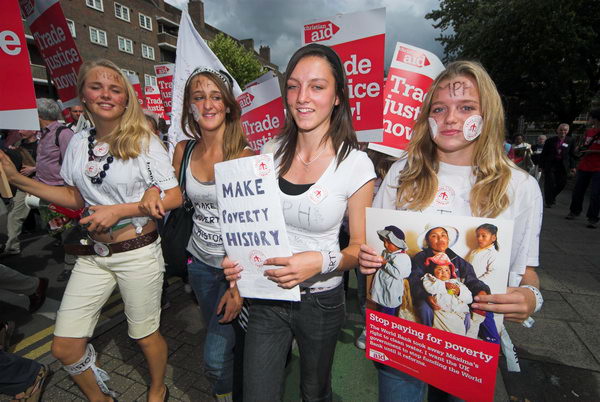
Trade Justice means policies that are “designed to deliver a sustainable economic system that tackles poverty and protects the environment.”

Mass Lobby for Trade Justice - 2005

The Trade Justice movement includes “trade unions and charities focusing on sustainable development, human rights and the environment.”

Mass Lobby for Trade Justice - 2005

Trade Justice is different from ‘free trade‘ in that it calls for trade rules that enable poor countries to chose solutions to end poverty and protect the environment rather than those that allow international businesses to profit at the expense of people and environment and would ensure that the trade rules are made transparently and democratically.

Mass Lobby for Trade Justice - 2005

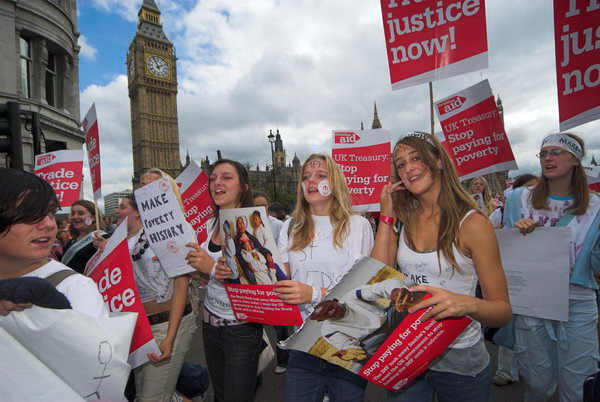
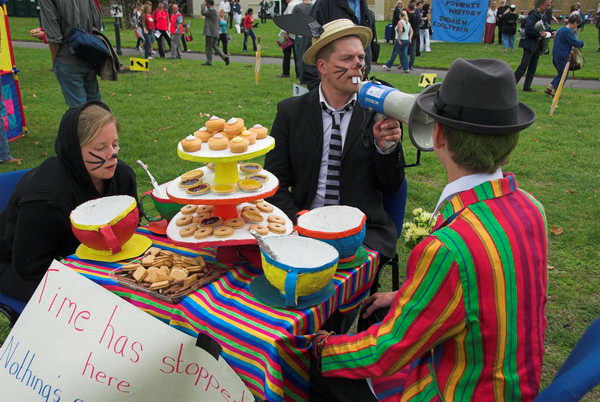
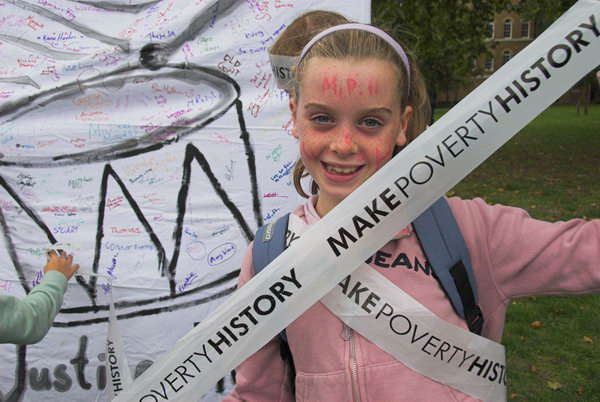
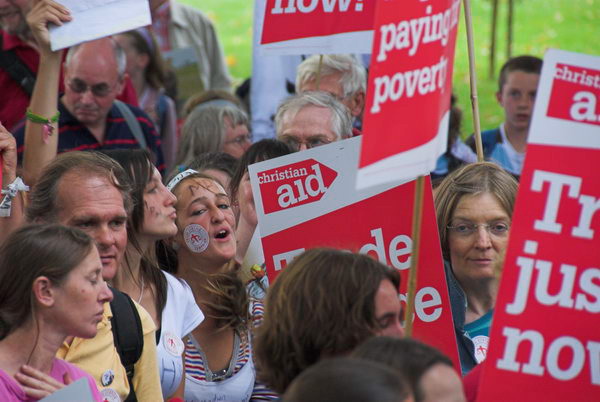
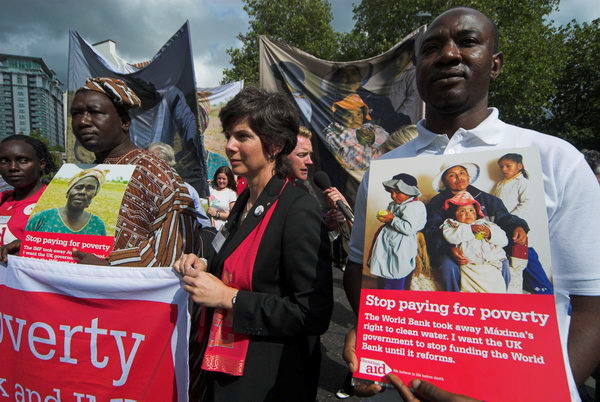
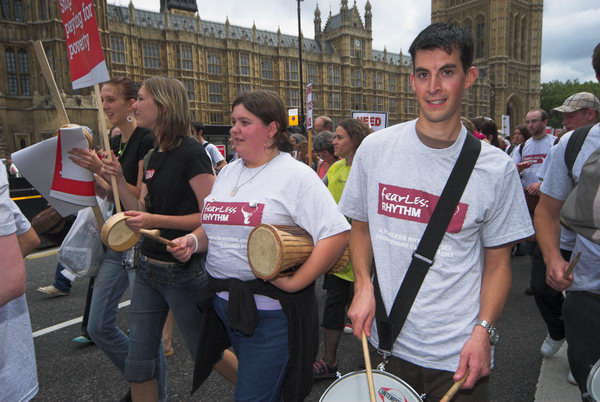
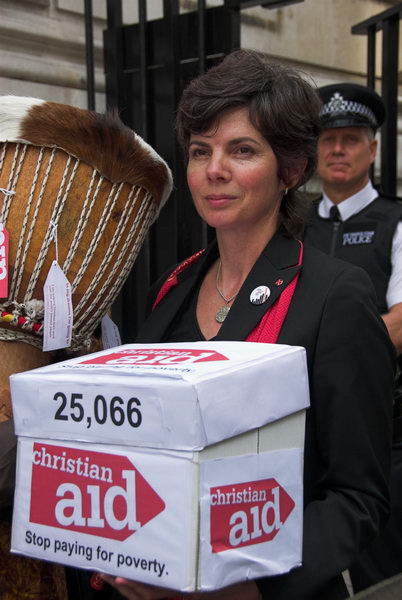
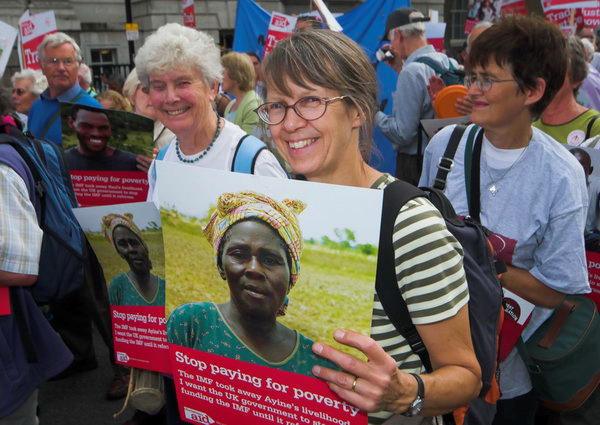
The Trade Justice Movement was formed in 2000 to bring together organisations promoting trade justice to work together more effectively. As you can see from my pictures this event included Christian Aid, Cafod, Make Poverty History, Traidcraft, War on Want, World Development Movement and others, and people had come from around the country to meet their MPs.

Mass Lobby for Trade Justice - 2005

Many MPs had agreed to come out from Parliament to meet their constituents and they had agreed to do so at a long line of meetings with some in front of parliament and others through into Victoria Tower Gardens and on across Lambeth Bridge.

They came out despite the weather – and you can see many umbrellas in the pictures I took. There were frequent showers, some heavy and I got rather wet – as I commented “you can’t hold an umbrella and take pictures like this.”

My camera was reasonably weather-sealed and I try to wipe the raindrops off the front of the lens before each pictures but zoom lenses which I use for almost all pictures tend to get condensation on inner glass surfaces from damp air drawn during zooming and become unusable until they have dried out. I gave up taking pictures after two hours, but my wife who had gone up to lobby our MP had to wait a further three hours to see him.

Although many MPs came out to meet their constituents, some used the occasion as a way to speak to them in a rather patronising manner about how they didn’t really understand the real business of international trade rather than really listen and take on the arguments they were making.

I think this lobby will have had very little effect compared to the lobbying of major companies and professional lobbyists on their behalf who give MPs large amounts of cash and VIP tickets to sporting and other event etc. We know the huge amounts MPs have received and declared from various sources – including the private health companies and various sources connected to Israel and its hard to believe that they don’t get results from their cash – and it seems clear they do from some government statements and policies. Surely all such donations should be banned.

Anyway, here is what I wrote back in 2005:

“8,000 or more of us queued up along both banks of the Thames from Westminster to Lambeth bridge and beyond to take part in a mass lobby for trade justice. People continued to queue, some for four hours and more to see talk to their members of parliament, despite a long wait in often heavy pouring rain. We arrived at Westminster around 12.15 and it was almost 5pm before my wife was able to meet our MP.

“Others were more fortunate, with a number of MPs from all parties coming out onto the street and into Victoria Tower Gardens to meet their constituents. The lobby aimed to make clear the difference between ‘fair trade’ and ‘free trade’ and to stress the necessity to make trade fair so that economically weak nations have a chance to develop.

“Despite the lousy weather (not good for photography or queuing) spirits were high among those waiting, and there were some street theatre performances that helped.”

Many more pictures from the event here on My London Diary.


FlickrFacebookMy London DiaryHull PhotosLea ValleyParis
London’s Industrial HeritageLondon Photos

All photographs on this page are copyright © Peter Marshall.
Contact me to buy prints or licence to reproduce.

Naked Bodies, Acid Attacks, Revolution & Kobane – 2014

Naked Bodies, Acid Attacks, Revolution & Kobane: 1st November 2014 was apparently World Vegan Day and PETA celebrated the event, highlighting the 255 animals killed for food in the UK every second by a similar number of people lying near naked or nearly naked and smeared with fake blood on a tarpaulin in Trafalgar Square. A few yards away the 8th March Women’s Organisation (Iran – Afghanistan) protested against acid attacks on women who do not wear a veil in Iran. I walked onto Westminster Bridge to photograph the distant banner with the message ‘REVOLUTION’ held by ‘Anonymous‘ protesters, some in Guy Fawkes masks, on Waterloo Bridge – and later they brought it to Trafalgar Square where I was covering a rally supporting the Kurds defending Kobane, the capital of Rojava in northern Syria.


PETA World Vegan Day Naked Protest

Trafalgar Square

Naked Bodies, Acid Attacks, Revolution & Kobane - 2014

In 1994 Louise Wallis, then Chair of the UK Vegan Society which was celebrating its 50th anniversary, declared November 1st to be World Vegan Day and since then it has been adopted by vegans around the world. It comes at the start of World Vegan Month – which is November.

PETA believe “Animals are not ours to eat, wear, experiment on, use for entertainment, or abuse in any other way“. They state than in the UK 255 animals are killed for food and they held a protest to dramatise this in Trafalgar Square with a similar number of near naked or nearly naked people smeared with fake blood on a tarpaulin.

Naked Bodies, Acid Attacks, Revolution & Kobane - 2014

Most of those taking part in the protest were women and a few held large posters with the message:

‘1 BILLION ANIMALS
KILLED
FOR FLESH
EACH YEAR
PETA’

Others held posters ‘CHOOSE LIFE: CHOSE VEGAN’. It was certainly a protest which attracted the interest of tourists and photographers.

Naked Bodies, Acid Attacks, Revolution & Kobane - 2014

I’m not a vegetarian or a vegan and I commented back in 2014:

“Nature isn’t vegetarian, and certainly not vegan, though of course some species are herbivores. But others are carnivorous or omnivores, and I can see no problem in our own species eating meat or fish though I would like to see all of the current cruel practices involved in producing food for us outlawed. Eating foie gras should definitely be made a crime!”

More pictures on My London Diary at PETA World Vegan Day Naked Protest.


Against acid attacks on Iranian women

Trafalgar Square

Naked Bodies, Acid Attacks, Revolution & Kobane - 2014

The 8th March Women’s Organisation (Iran – Afghanistan) protested in Trafalgar Square against acid attacks on women who do not wear a veil in Iran.

Naked Bodies, Acid Attacks, Revolution & Kobane - 2014

Attacks by gangs encouraged by the regime to enforce strict Islamic rules have left many women scarred and blinded.

Against acid attacks on Iranian women.


‘Anonymous’ Revolution Banner

Waterloo Bridge and Trafalgar Square

‘Anonymous’ protesters had brought a banner to hold up on Waterloo Bridge, with the message REVOLUTION but it was too small to really make an impact even using the longest lens I own and was rather dwarfed by the City backdrop.

Intended to publicise the Nov 5th ‘March Against Government Corruption’ in London it was rather more effective when they brought it to Trafalgar Square where a protest supporting Kobane was taking place.

Revolution Banner Drop


Global Solidarity With Kobane

Trafalgar Square

Women with Kurdish Workers Party flags

During the Syrian Revolution the government forces had abandoned Kobane to the Kurish People’s Protection Units (YPG) in July 2012 and it had became a centre of part of the autonomous Kurdish-led region of Rojava in north Syria.

From September 2014 to January 2015 Kobane was under siege by ISIS who managed to occupy much of the city. With the help of US air support and US forcing Turkey to allow Kurds from Iraqi Kurdistan to come to join the fight, Kobane was finally freed from ISIS in January 2015.

November 1st was also World Kobane Day, and thousands had come to Trafalgar Square on a Global day of solidarity calling for aid for the Kurdish fighters in the YPG (People’s Defence Units), the women of the YPJ and refugees from Kobane.

A woman talks with Mark Thomas and Peter Tatchell

They had also come to support Rojava, which many see as an important democratic development with its constitution which enshrines equality, pluralism, democratic participation and protection of fundamental human rights and liberties.
Many were critical of Turkey which was supporting ISIS and financing its fighting by allowing it to export its oil through Turkey as well as preventing Turkish Kurds from joining in the fight while allowing fighters across its border to join ISIS.

Turkey has long suppressed the Kurds and had tried to suppress the Kurdish language and culture, and the protesters called of the release of the Kurdish leader Abdullah Öcalan, kidnapped in Kenya in 1999 and held in a Turkish jail since then. Protesters also called for the Kurdistan Workers’ Party PKK to be removed from the list of proscribed organisations here and elsewhere.
On My London Diary you can read more about the rally and the speakers and there are many more pictures at Global Solidarity With Kobane.

FlickrFacebookMy London DiaryHull PhotosLea ValleyParis
London’s Industrial HeritageLondon Photos

All photographs on this page are copyright © Peter Marshall.
Contact me to buy prints or licence to reproduce.