The Merriam-Webster dictionary lists Micawber as a word meaning “one who is poor but lives in optimistic expectation of better fortune“, derived of course from the clerk in Charles Dicken’s David Copperfield famous for his belief that “something will turn up” and the principle he expounds:
“Annual income twenty pounds, annual expenditure nineteen nineteen and six, result happiness. Annual income twenty pounds, annual expenditure twenty pounds ought and six, result misery.”
Wilkins Micawber is said to have been based on Dicken’s father who also spent time in a debtors prison. In the novel Micawber gives his address as Windsor Terrace, City Road, and in the 1930s this street is in Hoxton, close to the Islington border in north London which runs across the north end of Windsor Terrace, previously Edward St was renamed after him.
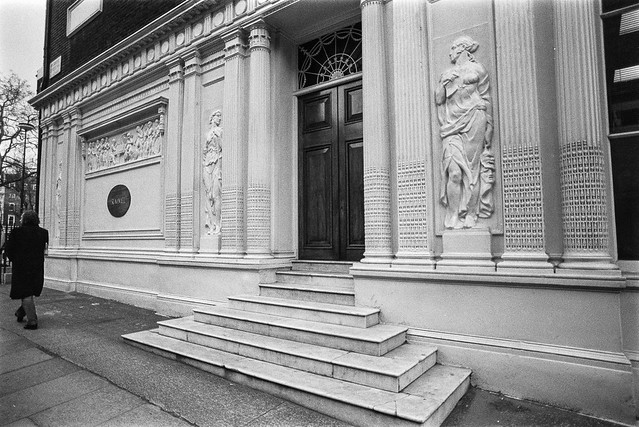
It seemed a suitable location for a bookie’s shop, (and there is a pub opposite) but it had clearly gone out of business. The building is still standing though rather altered, at the end of a row of Victorian housing but the area has changed considerably. As well as modern developments since I took this picture, parts had already been rebuilt after the Blitz with what was left of Windsor Terrace being redeveloped in the 1950s, and the Wenlock Brewery on Micawber St, site of a terrible wartime tragedy when bombing caused a leak of ammonia gas into its basement which was used as a local air raid shelter was demolished shortly after. That site is now the home of the Child Poverty Action Group.
Micawber St runs across the south end of the Wenlock Basin on the Regent’s Canal, but I don’t think there is anywhere where the basin is visible from the street.
Another nearby building, erected in 1896 by St Luke’s Vestry. You can see these and other pictures on Page 5 of my Flickr album 1986 London Photographs.
All photographs on this and my other sites, unless otherwise stated, are taken by and copyright of Peter Marshall, and are available for reproduction or can be bought as prints.
1986 was the year I began to photograph London in depth, and the album reflects this, with 1370 black and white photographs, a fraction of the number I took that year. The hundred on page 4 are from the boroughs of Hackney and Tower Hamlets and include pictures from Dalston, Shoreditch, Hackney, Bethnal Green, Wapping, Shadwell, Limehouse, Whitechapel and other parts east of the city. There is just the odd image from elsewhere in London.
Cyprus St, Bethnal Green
Unlike in some earlier years the routes for my walks around the area were carefully planned, with research from a number of published sources, though information was much less readily available than now before the days of the world wide web. Of course I didn’t always stick to my planned routes, but I did carry a notebook to write down where I actually went and even sometimes some details of what I was photographing.
Hessel St, Whitechapel
One of my major resources was of course maps, both new and old, not just for the streets but also for the other information included on them. Some marked industrial areas in brown, most showed churches and public buildings and some gave names of various features. The invaluable series of reprints of old 1:2500 OS maps was begun by Alan Godfrey in 1983, but few were available in 1986. I now have a very large collection.
Kingsland Basin
My aim was to not to walk along every street (as the woman who produced the London A-Z was sometimes said to have done) but at least to look down nearly all of them, and to photograph all buildings of interest as well as other things I found on my journeys. Later when I had bought a scanner I produced enlarged versions of the A-Z pages, printing them on a black and white laser printer and used highlighter pen after I came home to mark where I had walked. These both showed me any areas I had missed and helped me, together with the notebooks, to mark on the contact sheets where the pictures were taken.
Nuttal St, Hackney
I mostly travelled by train or underground so often several walks started from a particular station, and perhaps along the same streets close to them. There were also some areas that particularly interested me, either for simple visual reasons or because they were obviously changing, to which I returned.
I’ve posted some of the pictures on this page previously on >Re:PHOTO and I’ve tried to find others to put on this post. You can see all of the pictures – 100 on page 4 – on Flickr – where you can view them larger than on here – by clicking on the link or the image below.
All photographs on this and my other sites, unless otherwise stated, are taken by and copyright of Peter Marshall, and are available for reproduction or can be bought as prints.
Images in this post are embedded from Flickr where you can view them at a large size by clicking on the image. You will need to use your browser back button to return to this post. Or you can right-click and select ‘Open link in new tab’.
My album 1986 London Photographs is now complete on Flickr, and this is the second of a short series of posts pointing out a few of my favourite images from the year.
Several things come out strongly to me as I look through these pictures, mostly taken around Brick Lane and other areas of Whitechapel. One of the major themes that has run through much of my photography is the writing on the wall, whether graffiti or signs and posters. Language is such an important aspect of our social interactions and its inclusion in these images makes them into a record of how people lived and thought.
In 1984 London was rapidly becoming the multicultural city we now know, though of course it had been so on a lesser scale for many years if not centuries. Spitalfields where some of these pictures were made had long been a home for new communities moving to London and there was still abundant evidence of its Jewish population as well as the Bangladeshis who had by then largely replaced them.
Housing, then as now, was an important issue in London in particular, and some of these pictures reflect this and other issues such as racism. Although I think some of these pictures are well-composed and even attractive compositionally, I’ve always considered the formal aspects – line, shape, tone, texture, form etc to be the means to communicate a message rather than an end in themselves. I aimed to make photography that had something to say and said it well rather than to produce well composed, attractive or even striking or popular images.
There are another 95 pictures on the second page of the album, all with a location, taken from the usually rather incomplete information I recorded on the contact sheets. I’ve tried to check these before posting, but corrections and other comments are always welcome. I’m happy for these pictures – with suitable attribution – to be shared on social media, but they remain copyright and any commercial or editorial use requires a licence from me.
All photographs on this and my other sites, unless otherwise stated, are taken by and copyright of Peter Marshall, and are available for reproduction or can be bought as prints.
There are no adverts on this site and it receives no sponsorship, and I like to keep it that way. But it does take a considerable amount of my time and thought, and if you enjoy reading it, please share on social media. And small donations via Paypal – perhaps the cost of a beer – would be appreciated.
Images in this post are embedded from Flickr where you can view them at a large size by clicking on the image. You will need to use your browser back button to return to this post. Or you can right-click and select ‘Open link in new tab’.
My album 1986 London Photographs is now complete on Flickr, and this is the first of a short series of posts pointing out a few of my favourite images from the year.
Of course the 1370 pictures in the album are not all I took that year, but perhaps about a quarter or a fifth. Quite a lot more than I would have selected or shown back in 1986, but the content has aged well, even if sometimes the actual physical negatives have deteriorated. Images that might have seemed a little mundane when I first saw them on the contact sheets have often gained considerably in interest as historical records.
There is a little redundancy in those 1370, and I’ve sometimes included several pictures of the same subject, where I’ve tried different ways to approach it. But the great majority of subjects were treated to only a single frame.
Many of those not included still have interest and value as historical records, but preparing them to go on line is tedious and time-consuming, particular as some need quite extensive digital retouching after the ‘scanning’ stage – mostly done by photographing the negatives with a Nikon D810 and Nikon 60mm macro lens. Some of my negatives were damaged by minute insects in search of gelatine, leaving their track as they chewed their way across them and depositing their frass and occasional body parts and complete restoration isn’t always possible.
I’ve also been having problems in getting even lighting at the negative edges. This isn’t a problem with mounted slides, where the image is cropped, but I want the whole image, and possibly the problem is with light diffusing from the clear film edges. But it does mean every frame needs correction in Photoshop – rather like the little bit of edge-burning we used to do under the enlarger.
I was working on a number of themes at the time and as well as recording buildings that interested me was particularly interest in sculptures, shopfronts, shop window displays and trees in the city. The first page of pictures on Flickr (100 images) includes work mainly from Southwark, the City of London and Spitalfields.
I took very few pictures of people at this time, partly because I was rather shy, but more that I had been affected by some feelings being strongly expressed by some at the time about privacy and arguments that it was wrong to photograph people without first seeking their permission. I was never convinced by these, but they were off-putting, and I was sometimes shouted at when taking pictures. Perhaps more importantly I wanted to direct attention to the things being photographed, and was aware that people almost always steal the frame.
There are another 95 pictures on the first page of the album, all with a location, taken from the usually rather incomplete information I recorded on the contact sheets. I’ve tried to check these before posting, but corrections and other comments are always welcome. I’m happy for these pictures – with suitable attribution – to be shared on social media, but they remain copyright and any commercial or editorial use requires a licence from me.
All photographs on this and my other sites, unless otherwise stated, are taken by and copyright of Peter Marshall, and are available for reproduction or can be bought as prints.
There are no adverts on this site and it receives no sponsorship, and I like to keep it that way. But it does take a considerable amount of my time and thought, and if you enjoy reading it, please share on social media. And small donations via Paypal – perhaps the cost of a beer – would be appreciated.
They all fall on the National Grid in the vertical column TQ34, and there are more pictures from all of them in the albums of colour enprints I put together from 1986 to 1992 as a project with the rather tentative title ‘Cross-section’. TQ34 is just one km wide and I have a row of A4 files covering around 20 such columns across the city, though those at the outer edges have fewer images.
The roughly A4 album pages could each hold four 6″ x 4″ enprints. I started by gluing the prints in place on scrap cartridge paper (unused from A level Art exams and cut down to size) but though that worked well it became tedious, and I moved on to purpose-designed plastic filing sheets, at first transparent and later black.
I tried at first to keep all four prints on any page either landscape or portrait format and from the same kilometre grid square, but as you will see on Flickr there are a few exceptions. The album TQ34 includes just over 70 pages and is shown on Flickr as in the album with most images having four prints.
These enprints were all trade processed and I sent the films off to various cheap consumer labs. The different colour casts they produced for each roll of 35mm film I felt added to the project, and I accepted some packets of pictures where I really should have demanded a reprint. A few of the worst I have done a little colour correction before posting online.
I finished – or rather abandoned – this project around 1992 when I installed a print processing line in my own darkroom and going over to bulk loading and home processing of my colour negative film. Producing enprints was too slow and fiddly, but I was able to make larger prints, and a small selection of these images where exhibited and sold over the years.
I had more time to take pictures in July as my teaching came to an end for the summer vacation around halfway through the month. This meant I could go up to London on some weekdays, though I still had two small boys to look after on days my wife was working. That usually meant staying at home, but sometimes I took them both out with me to London.
Regent’s Canal
I spent some time in Shadwell and Bethnal Green, but also further north in Shoreditch, Hoxton and Dalston, occasionally wandering into Islington. Though I obviously photographed on foot, I had to travel from my home outside London and then around London to the starting point for my walks, and the One Day Capitalcard, valid on all public transport in London after 9.30am made this much simpler after its introduction in June 1986 – the one-day Travelcard launched in 1984 had been for bus and tube only.
The Mission, Holywell Lane, Shoreditch, Hackney
Towards the end of the month I moved my focus to the City of London, even easier for transport then as the Waterloo and City line was still run by British Rail and my ‘London Terminals’ ticket was valid all the way to Bank.
Blackfriars Rail Bridges
When I began photographing London there were two railway bridges across the River Thames at Blackfriars, but all that remained of one of these by 1986 were the pillars that had supported it. And while these were rather a fine set of pillars they were (and remain) a rather curious river feature, presumably left in position simply to save the cost of removing them.
Queenhithe and the River Thames
Queenhithe, a small inlet on the City side of the river has a long history. The Romans built a quay here, and buried deep down in the wet mud some of the timbers they put here survive, as do remains of the dock contructed when Alfred the Great, King of Wessex re-established the City of London aroudn 886 AD. It got the name Queenhithe (a hythe is a small harbour) when Henry I gave the right to levy dues on goods landed there to his wife Matilda around the time of their marriage in 1100. Queenhithe was still a major harbour for the city hundreds of years later and remained in use, with lighters bringing skins for the fur trade which was based a short distance to the north until the Second World War.
Fur shops in Great St Thomas Apostle
Around 300 of the black and white pictures I took in July 1986 are now online: Peter Marshall: 1986 London Photographs on Flickr. July’s pictures start here.
The images are copyright but may be shared on non-commercial personal social media. A licence is required for any corporate, commercial or editorial use.
All photographs on this and my other sites, unless otherwise stated, are taken by and copyright of Peter Marshall, and are available for reproduction or can be bought as prints.
There are no adverts on this site and it receives no sponsorship, and I like to keep it that way. But it does take a considerable amount of my time and thought, and if you enjoy reading it, please share on social media. And small donations via Paypal – perhaps the cost of a beer – would be appreciated.
A few months back I was lying prone inside a giant metal tube on a flat bed which moved me slowly backwards as successive slices across my body were scanned for the purposes of research, and the CT scan reminded me of a project on London which I began in the 1980s.
Nowadays we are all familiar with the idea of geotagging and some cameras can add geotags to the Exif date as you photograph, while gadgets can be fixed onto other cameras to add the data. Smartphones do the same, as they always track you position. The web site https://www.geograph.org.uk Geograph was set up in 2005 to “collect geographically representative photographs and information for every square kilometre of Great Britain and Ireland” and so far 13,114 contributors have submitted 6,397,064 images covering 280,384 of the 1km grid squares, still leaving around 15% should you wish to strike new ground.
TQ2083
I’ve occasionally added geotags to my own landscape pictures in Lightroom, using a free little phone app by one of my sons, ‘Easy GPS Logger’ which records GPS location and time data to a file. You load this into LR along with the pictures, match up any one of them with a particular place on a map and LR then uses the file to add the information to the other pictures. There are only two problems – remembering to turn on the logger at the start of your walk, and secondly to turn it off when you finish!
TQ1982
Back in 1986, the only way to add location data to your photographs was by hand, using a map to find the grid reference. Of course you had to know where you were to do so. I had the idea of doing a series of South to North cross-sections of London based on the Eastings and Northings of the National Grid using colour negative film.
Rather than attempting a series of south-north walks, I simply took a camera with colour negative film on more normal walks while I was photographing London in black and white, then sent the films for processing and printing 6×4″ enprints. When these came back from processing I’d sort out those I wanted to keep and use a map to find the grid references and add these and the date with a technical pen along the lower edge of the print. The date meant (at least in theory) I could find the negatives in my files.
TQ1683
At first I glued the prints onto card sheets to file them under the grid reference in a set of A4 files, but this soon became tedious and I bought filing sheets which held 8 prints, four on each side. Each of the kilometre grid squares had its own filing sheet, and some soon had several, with the series expanding to fill around a dozen A4 files. Each file holds around 50 double-sided sheets and so could hold around 400 prints, though many sheets are not full, so the project probably has around 3,000 or 4,000 prints.
TQ1978
Of course what was more important were the scenes I chose to photograph. I carried in my wallet a reminder of things I was interested in photographing (an idea picked up from reading a list made by Walker Evans), in a small zipped pocket together with a folded £20 note for emergencies. Of course colour was important, not just for itself, but as an illustration of how and why colour was used, and I had a great interest in representations of people and things, in ethnic differences and in the evolution and fashion of colour.
I can’t remember exactly when I ended the project, though it certainly continued well into the 1990s. But at some point I stopped sending colour negative film to be processed and began developing it myself, and producing enprints wasn’t really an option. Instead I made 8×10″ contact prints and worked from these, producing very many fewer but larger prints.
TQ2080
Over the years I’ve probably published or shown only around a hundred of these pictures, the largest group from 1986-90 in the book dummy and web site ‘Café Ideal, Cool Blondes, and Paradise‘
As with my black and white images of London, this is a body of work which I think has a great deal of historical interest as well as some photographic interest and it would be good to see it in some permanent museum or similar collection rather than simply gathering dust on my shelves.
There are no adverts on this site and it receives no sponsorship, and I like to keep it that way. But it does take a considerable amount of my time and thought, and if you enjoy reading it, please share on social media. And small donations via Paypal – perhaps the cost of a beer – would be appreciated.
I had a busy month in June 1986. Of course there was the teaching, though by that time of year my A Level students were busy sitting exams, which took some of the pressure off for me, though there were the practical exams. And of course exam invigilation, a time of extreme boredom.
At home there will have been strawberries to pick and other little jobs around house and garden, as well as two young boys to help looking after. And sometimes I would take one or both of them out for long walks with me, as I went out taking pictures at the weekends, mainly in that month in Tower Hamlets, occasionally straying into Hackney.
During that month I made over 500 exposures on black and white film, seldom taking more than one exposure of each scene, and perhaps half that number in colour. It was around this time that I started seriously to produce some kind of comprehensive document of the fabric of London which I had been photographing in a less concentrated and asystematic fashion since 1973.
What had previously been largely dérives from a particular starting point now became carefully planned, with research in books on the city and poring over maps. Where previously it might have been the delightful whimsy of Geoffrey Fletcher that lead me to picturesque corners, this was now replaced by the duller encylopaedic prose of writers such as Harold Clunn, whose 1951 ‘The Face of London’ revised his earlier work to take account of wartime losses and attempted to be a complete guide to Greater London from his fifty years of perambulations.
Of course I seldom stuck to those carefully made plans, often being diverted by the lure of the streets, but I did begin making notebooks of where I walked, noting down street names and important details, marking up where I had walked on street maps (many of which have now fallen to pieces.)
After developing the films I would as usual make contact sheets, but I would then mark these up with Indian ink in a Rotring pen (and small writing I now often need a loupe to read) with street names and map references. In later years the A-Z came with the National Grid superimposed and my contacts included grid references too.
Of course, nothing is perfect, and sometimes I got street names wrong, and my writing and abbreviations are not always legible. I’ve now put around 140 of the pictures from June 1986 into my Flickr album ‘1986 London Photographs‘, almost all of them with at least a street name to identify the location. It took a few days to make and retouch the digital files, and once I had done that, over a day’s work to confirm the locations where possible using Google Street View. Some areas of course changed completely between 1986 and the earliest information from Street View – usually 2008, making it impossible in a few cases to be completely sure of where images were taken.
All of the images on Flickr have a longest side of 2400 pixels, four times the size of those in this post (- and landscape images only display at 75% unless you double click to open them.) Although I’m happy for people to share them and use them with proper attribution on personal blogs and non-commercial personal web sites, in student essays etc, they remain copyright, and a licence from me is required for any commercial or editorial use.
I’ve just uploaded the first tranche of 112 of my black and white pictures from 1986 on to Flickr. These are some of the pictures I took in the first four months of the year.
In 1986 I made around 5500 exposures on black and white film, the great majority of them being photographs taken on the streets of London, concentrating on the fabric of the city – the buildings and shop fronts in particular. At the same time I was also taking colour film, with a greater focus on shops and window displays.
A few of those black and white exposures were taken outside London on holidays and visits to family and friends, and rather more on a project in the industrial areas beside the Thames in Kent from Dartford to Cliffe.
Most motifs were taken with a single frame, carefully thought out and executed much as if I was using a large format camera, rather than the 35mmm Olympus fitted with a shift lens which I used for most of these images. A few received a second exposure, perhaps to concentrate on detail or where I could see an alternative approach and even more rarely I became excited enough to take more.
The almost a thousand images which will eventually be in this album represent about a quarter or a third of this work – the images I now find more interesting. Some of the scans have minor technical problems that annoy me but are probably not apparent to most viewers. Most were made while I was learning to use a DSLR to photograph negatives.
Although I had been walking around London with a camera since 1973 it was really in 1986 that I made a serious start on photographing the city as a whole, much as I had previously concentrated on various areas of docklands. Photographically I was inspired by the work of Eugène Atget in Paris, recording the old city he saw disappearing, but also by the encyclopedic work of Pevsner and his co-workers in ‘The Buildings of England‘, the original series of which were published between 1951-74. These both inspired and infuriated me by their omissions and the sometimes crass judgements and in particular what seemed to be a disdain for the vernacular, the commercial and the industrial. I decided my own view would be more comprehensive and I would photograph any building I found significant or interesting as well as exemplars of the typical.
Later I would often go into the library at the National Building Record, then in Saville Row, and while waiting for my appointment pull one of their London files from the shelves and leaf through its contents. For most areas it was church after church after church, occasionally enlivened by some ancient house or stately home. Perhaps the odd old pub, but little else to reflect where the ordinary people of London lived, worked or shopped. A few of my images helped to widen their collection, much of the older work in which I was told was donated by Church of England clergy with time on their hands and the money to indulge in photography as a hobby.
I had of course set myself an impossible task, and I realised this from the start, but made it even more so by widening my view in later years to take in the whole of Greater London. I kept at work for almost 15 years, by which time I had covered most of those areas that particularly interested me. But it had also become clear to me that times had changed and in particular that technology was changing.
I had already made use of the web to put some of my work online – in my Buildings of London website first put online in 1996 (with later revisions but never brought up to date as I decided it was impossible to scale it up) and this continued with London’s Industrial Heritage in 1999. The images on these sites reflect the But by 2000 it was clear to me that the impact of digital photography would lead to the city becoming on-line as a whole in a new way that made the continuance of my project redundant.
Google brought this to fruition with the launch of Street View in 2007, though I think it only came to London in 2008. When you view an area on this now, you can probably see it as it was some time in the last year, but, if you are fortunate, can also go back to various other views taken as far back as 2008. But for those relatively few areas and buildings in my pictures you may be able to go back to 1986. Much of London has changed dramatically since then.
You can watch them here, but its better to go to Flickr and watch them at a larger size.
The 14th and last of the series of posts of selected black and white pictures I made in 1980 with the comments I posted more recently daily on Facebook. Larger versions of the pictures are now available on Flickr.
Apologies for some earlier posts in this series that were titled as London 1990 – and I hope I have now corrected all these. It will be a little while before I have caught up with my work from 1990! This is the final post of pictures that I made in London in 1980.
Playground, Battersea. 1980 26r-24: spaceship, playground power station, bridge,
Behind the spaceship in a childrens’ playground are the four in-line chimneys of Fulham Power Station, decommissioned in 1978 and one of the first power stations that the CEGB was made redundant and sold for redevelopment. The demolition in the early 1980s became controversial over the safety of the removal of around 1,000 tons of asbestos by the new owners. Because of this the government announced that the CEGB would strip asbestos before selling power stations in future.
The Regent on the River apartments that replaced the power station in the 1980s supposedly were designed to reflect the architecture of the power station.
I carefully framed the word ‘FLOATING’ underneath the spaceship, thinking of it floating in space. I think this was a floating dry dock. At left you can see a small part of the Battersea Rail Bridge, now used by London Overground services between Clapham Junction and Willesden Junction, then I think solely a goods line. I’m fairly sure the playground where I took this is now underneath a large block of riverside flats, Groveside Court on Lombard Rd, though some open space remains a little further north in Vicarage Gardens.
Another picture of the inside of the roundabout which was completed around 1972 and has appeared on record covers as well as being used as a film location – famously where Alex and his droogs beat up a singing drunk in Kubrick’s adaption of A Clockwork Orange. I have no idea why someone has painted Van Gogh on the railings -the Serbian rock group of that name was only founded six years later, but perhaps there may have been an earlier more local manifestation. And the National Front have been here too. There is a sinister look to this structure and doorway, and though I have no idea what is inside this concrete structure, it could well be a torture chamber.
The roundabout now has a rather odd metal structure on it, the ‘Atom’ monument, with two circular metal rings holding up a box with advertising screens for JCDecaux. If – as the firm who erected it claim – the adverts on it attract a great deal of driver attention, then they clearly decrease road safety at this critical junction. I can find no evidence for a local rumour that famed Brazilian architect Oscar Niemeyer had any part in its design. Wandsworth Council includes the structure on its list of works of art in the borough.
This view from a higher level path inside Wandsworth roundabout shows some of its surroundings more clearly, including the storage tanks which I think were for Charrington’s Fuel Oils next to the river on the south bank immediately downstream of the bridge; incorporated in 1895, the company was dissolved in 1995. Charrington’s began in 1731 and was acquired in 1997 as a part of CPL Distribution Ltd, a company bought out by management from the British Coal Corporation in 1995. Charrington’s were one of the largest UK fuel oil distributors and also had a wharf downstream on Blackwall Way in E14, developed by Ballymore in 2002.
Also visible, on the other side of the river is Fulham Power Station, with its row of four chimneys.
The final picture from the roundabout in 1980 shows a single figure walking in a concrete waste, walking away from one of the four underpasses which led to the central area. It emphasizes the modernist geometry of the construction and the sense of alienation the environment creates, something which has rather softened over the years as more vegetation has grown since it was built in 1969.
More recently it has been considerably tidied up with re-turfing and minor alterations which might prevent the flooding of the underpasses and with the intention of better maintenance, including a contract for the grass to be cut six times a year, though it remains to be seen how long this will last.
St Agnes Place, Kennington. 1980 26s-31: house, rastafarian
Houses in St Agnes Place were occupied by squatters from 1969 and survived Lambeth Council’s eviction attempt in 1977, which made the national news and eventually led to the fall of the then Conservative council.
Many of the occupants were Rastafari, as in this house, with its painted symbols and the message ‘ISRAEL: LIVE’ above the window. Many of the squatted properties were kept in good order, and the residents paid utility bills etc and for some years were a part of a housing co-op.
Some other properties were derelict and in a poor state, and the house on the left is boarded up.
St Agnes Place, Kennington. 1980
26s-32: house, rastafarian, fire damage, derelict,
Although No 22 looks in good condition and occupied, the house at right has been gutted by fire.
We walked through here fairly often when visiting friends who lived in Key House, just across the main road from here on the other side of the park, but I didn’t often stop to take photographs. We came to Kennington Park next to St Agnes Place for our children to play and sometimes took a little walk around.
St Agnes Place, Kennington. 1980 26s-42: house, graffiti, fence,
Graffiti on the end of a house I think once read ‘LOVE IS GOD’ but the G has been painted over to convert it to an O. But I don’t think OOD makes any sense. To its left is ‘angelo Rule’.
There are more graffiti on a wall across the road, including ‘LEGALISE FREEDOM?’ and a rather faded ‘DON’T PANIC’.
The fence has clearly seen better days.
St Agnes Place, Kennington. 1980 26s-43: house, graffiti
St Agnes Place in 1980 began here, and the previous image was was taken in what was then Bolton Crescent looking towards St Agnes Place, but is now St Agnes Place. I had walked closer to photograph the wall with its graffiti ‘LEGALISE FREEDOM?’ and ‘DON’T PANIC!’.
There had previously been just one more house at the left of the picture which has been demolished, along with another building at an angle on the turn of the street. The doors leaning against the wall on both sides of the blocked up door probably came from this. Next to ‘Legalise Freedom?’ and rather smaller is the message ‘Ban The SPG’. The Special Patrol Group, a Met Police unit for dealing with public disorder and who the previous year had murdered Blair Peach at an Anti-Nazi League protest in Southall. They were found to have been using a number of unauthorised weapons, including a sledge-hammer and a crowbar. They were replaced in 1987 by the Territorial Support Group (TSG), though many think little was changed except the name.
St Agnes Place, Kennington. 1980 26s-44: house, graffiti
Going a little closer still I photographed ‘DON’T PANIC!’ on its own, head on.
I think that some earlier graffiti had been painted out on this wall, and that this and the ‘LEGALISE FREEDOM?’ out of picture at the left had been painted on top of this, with the painter having a little problem squeezing the IC in at the end of the word before adding the oversize exclamation mark with some relief.
St Agnes Place, Kennington. 1980 26s-54: house, graffiti, park, flats
The flats seen across the playing field are on the Brandon Estate in Hillingdon Rd and Meadcroft Rd, and include Prescott House, Cruden House, Bateman House, Walters House and Cornish House, built in 1958 by the London County Council. Many of the early residents were delighted; they had been moved in more or less a whole street at a time and kept their community spirit in flats built to much higher standards than the slums that were demolished, a community-based approach that has been abandoned to allow private developers to profit from estate demolition.
20 Years later the estate had gone down-hill, partly because of bad management and the removal of caretakers, but mainly because council housing became a service for problem families rather than a more general approach to providing rented properties at a fair price.
This part of the street was still Bolton Crescent when I took the picture, but St Agnes Place now extends further south.
This is the final post in the series of selected images that I made in London in 1980. You can now see all the pictures (and a few more) at a larger size and with the descriptions here on Flickr.
All photographs on this and my other sites, unless otherwise stated, are taken by and copyright of Peter Marshall, and are available for reproduction or can be bought as prints.
There are no adverts on this site and it receives no sponsorship, and I like to keep it that way. But it does take a considerable amount of my time and thought, and if you enjoy reading it, please share on social media. And small donations via Paypal – perhaps the cost of a beer – would be appreciated.