It was too hard to resist the Michelin Building any time I walked past, though I felt it had already been photographed to death – and most of my pictures were in colour, including closer views of its decorative panels.
Opened in 1911 as the first UK headquarters and tyre depot for the Michelin Tyre Company Ltd, and designed by Michelin employee and engineer François Espinasse it was more an architectural advertising hoarding featuring the Michelin Man ‘Bibendum’, his name derived from “Nunc Est Bibendum“, “Now is the time to drink”. A precursor of art-deco, it is grade II listed. It was also a fairly early use of ferro-concrete, using the Hennebique system, which gave its interior wide spaces for a tyre bay and made it relatively fire-proof. This picture was made three years after Michelin moved out, when the building was redeveloped by publisher Paul Hamlyn and restaurateur/retailer Sir Terence Conran as offices, shop and restaurant. (mainly from Wikipedia.)
This house is on the west corner of Pelham Crescent, and the three trees that attracted my attention are still there, remarkably little changed 33 years later, though of course each spring they get covered with leaves.
Selwood Terrace, South Kensington, Kensington & Chelsea, 1988 88-4r-61
The east side of this street is Neville Terrace and the west side is Selwood Terrace. This front garden with a wall covered with ivy is close to the Fulham Road and I think both wall and ivy have disappeared, possibly as a part of a basement extension to the property.
South Parade, Chelsea, Kensington & Chelsea, 1988 88-4r-62
I think this tall building probably dates from around 1892 and is part of long terrace including a former fire station with that date on the north side of Chelsea Square. It was the Nurses Home for the Royal Brompton Hospital and is still a part of the hospital. Chelsea square was named Trafalgar Square when it was laid out in 1810 but that was later used for a rather larger square in Westminster. The square later became a tennis club before much of the area was rebuilt in neo-Georgian style in the 1930s.
The Crown, Dovehouse St, Chelsea, Kensington & Chelsea, 1988 88-4r-63
The Crown pub is on the corner of Dovehouse St and Dudmaston Mews, just a few yards south of the Fulham Rd and more or less surrounded by hospitals. No longer a Whitbread pub it has lost the crown sign, replaced by a dreary sign with a neon crown, and other largely flowery embellishments have ruined the simplicity of the frontage. The Princess Of Wales at the left of the row of buildings closed as a pub around 2000 and is now a French restaurant, with considerably more expensive food than The Crown.
Kings Road, Chelsea, Kensington and Chelsea, 1988 88-5a-11
I took fewer pictures of the Kings Road than I should have done. This shop window display seemed more erotic than most.
Kings Road, Chelsea, Kensington and Chelsea, 1988 88-5a-16
These rather disparate buildings are still there on the Kings Road, on the south side just east of Radnor Walk, though now occupied by different shops and rather less trendy.
Jubilee Place, Chelsea, Kensington and Chelsea, 1988 88-5a-15
And immediately opposite the previous picture is Jubilee place, leading north with this house and wrought ironwork at No 9 over double gates leading down to a basement garage.
Click on any of the images to go to larger versions in my album 1988 London Photos were you can browse through these and other pictures.
All photographs on this and my other sites, unless otherwise stated, are taken by and copyright of Peter Marshall, and are available for reproduction or can be bought as prints.
A GLC plaque records that Admiral of the Fleet Earl Jellicoe (1859-1935) lived in this house.
Blacklands Lane ran from the Kings Road to Fulham Road; most was renamed Marlborough Road in the 1820s and later became Draycott Avenue. The name Blacklands possibly came from the dark earth of Chelsea Common and was a small hamlet and a large house dating at least from the 1680s which at the start of the 18th century was a French boarding school for young ladies and became an asylum for the insane in the 19th century and Samuel Wesley spent some time as a patient there in 1808. Blacklands Terrace was developed at the end of the 19th century taking its name from the house a short distance to the west and was on a part of its extensive estate There was also a house nearby called Whitelands, which became a paper factory. The short street is now best known for a restaurant (an earlier version was a location in Blowup) and a independent bookshop opened by John Sandoe in 1957.
Both the outside of Andrea’s Restaurant and the interior feature in the film ‘Blowup’ made in 1966 and its exterior had changed little 22 years later. After than it became El Blason Restaurant & Tapas Bar and then in 2013 went considerably upmarket as The Five Fields with a Michelin star and prices to match.
This huge block of flats in Brompton is the rear of Chelsea Cloisters, ten storeys with over 800 small flats as well as shops etc along its Sloane Avenue frontage, built in the 1930s, demolishing the earlier houses on the site. The block was controversially bought in 1968 by the Freshwater Corporation. The conversion of part of the property into a hotel was extremely controversial, and many tenants lost their homes. Plans by the GLC and Kensington & Chelsea council to buy the block for public housing fell through and in 1984 the 747 flats, garage, petrol-filling station, restaurant, and coffee shop were sold. It was then extensively refurbished. (British History Online.)
The entrance into a small private courtyard in front of 53 Bury Walk still has this pair of lions proudly guarding a rather plain and basic gate. The street perhaps gets its name (previously Bury Street) as it led to St Lukes Burial Ground. It was developed on Chelsea Common in the nineteenth century.
These flats are I think Thurloe Court which consists of two linked blocks, that at right with a frontage on the Fulham Road, or possibly a neighbouring 1930s block of flats, and I walked down the narrow Kinbolton Way to take this picture bwtween the blocks. An estate agent describes it as a “charming, period, redbrick portered mansion block ideally situated between South Kensington, Knightsbridge and Sloane Square” and flats there are valued at £1.5-£2m.
The Baby Doll poster is for the 1956 American dramatic black comedy film directed by Elia Kazan. I think the shop is probably in Crescent Mansions at 113 Fulham Road. Steps led down to a basement where men’s clothes were for sale.
Pelham Crescent, South Kensington, Kensington & Chelsea, 1988 88-4r-45
Pelham Crescent was named after Henry Thomas Pelham, third Earl of Chichester, one of the trustees of the Smith’s Charity which acquired the land from nurserymen Samuel Harrison and William Bristow who went bankrupt in 1832. George Basevi junior provided the drawings for the house frontages which were contracted to builder James Bonnin who was required to build houses worth at least £800 and complete the job in seven years. (British History Online.) They now sell for over £10m.
Click on any of the images to see a larger version in my album 1988 London Photos and to browse the images there.
All photographs on this and my other sites, unless otherwise stated, are taken by and copyright of Peter Marshall, and are available for reproduction or can be bought as prints.
Redherring, Old Brompton Rd, South Kensington, Kensington & Chelsea, 1988 88-4q-52
Red Herring had a shop for some years at 6 Old Brompton Road, more or less opposite South Kensington Station, which has now for some years been an opticians. They sold trendy casual clothes for women including shoes and bags. The poster at left in Arabic I think reflects the Iranian presence in the area.
Old Brompton Rd, South Kensington, Kensington & Chelsea, 1988 88-4q-53
The Brompton Hotel is still there at 30 Old Brompton Road, getting rather mixed review which perhaps reflect its 3* status and rather cheap rates for London. You can no longer go in and swear an oath at Lawrence Bloomfield, though the curious short pillar is still there. The Punch wine bar has last its superstructure, though the low wall at the bottom remains and there is still a popular bar area, but now steps lead down to a steak restaurant.
I couldn’t resist another picture of the Imperial Hotel on the corner of Queen’s Gate and Harrington Rd, demolished in 1992 and since then a cleared site used as a car park. In an earlier post I mentioned that planning permission had been granted in 1975 for the erection behind this facade of a cultural centre for the Islamic Republic of Iran and twenty self-contained flats, and later by Kensington and Chelsea for the use of the cleared site as a car park pending the building of this.
Shop, Harrington Rd, South Kensington, Kensington & Chelsea, 1988 88-4q-63
There was a crude simplicity about this mosaic of a bottle advertising the off-licence to its left that attracted my attention.
The Institut français du Royaume-Uni was begun in 1910 by Marie d’Orliac to introduce Londoners to well-known French writers, thinkers and artists. This building in Queensbury Place by architect Patrice Bonnet (1979-1964) in an art deco style was opened in 1939. Along the top of the facade are an olive branch, a cockerel, an asp and an owl, symbolising peace, courage, knowledge and wisdom. The Grade II listing text attributes the building to A J Thomas, a former assistant of Edwin L Lutyens and the architect of St Pancras Town Hall.
Bray Place is a short street a little to the north and parallel to the King’s Road in Chelsea presumably named for Sir Reginald Bray who owned the manor at the time of Henry VII. This house with its two round windows is on the corner with Draycott Ave.
Mr Brunello is no longer here, and the shop is now a hairdresser, on the corner opposite the previous image at 3 Bray Place. The view is looking down Draycott Ave to the houses on Coulson St, and above them the tall block of flats, Whitelands House, a 10 storey block of flats dating from 1935-7 above the shops in the Kings Road by Frank Verity & Sam Beverley.
I can tell you nothing about this small half-timbered house on Draycott Avenue, which I suspect is considerably more modern than it looks. At a glance the tiles and windows look remarkably ancient, and the beams have something of the character found in genuinely old buildings. Perhaps someone reading this will know more and comment.
Click on any of the above images to go to a larger version in the album 1988 London Photos from where you can browse through other pictures that I made in that year in London.
All photographs on this and my other sites, unless otherwise stated, are taken by and copyright of Peter Marshall, and are available for reproduction or can be bought as prints.
Dora House, Sculptors, sculpture, Old Brompton Rd, South Kensington, Kensington & Chelsea, 1988 88-4p-36
Dora House at 108-10 Old Brompton Road was originally built in 1820 by builder William Blake as 7 & 8 Gloucester Terrace, but they were considerably adapted and the frontage here and in the next picture dates from 1885-86, when the house became the studios of portrait photographers Elliot and Fry of Baker St. The firm employed a number of photographers and as well as Baker St (which they left in 1919) had several other studios and a printing works in Barnet. Many of their early negatives were destroyed by bombing in the second World War, and the rest are now held by the National Portrait Gallery. They photographed many of the leading personalities of the Victorian era.
Dora House, Sculptors, sculpture, Old Brompton Rd, South Kensington, Kensington & Chelsea, 1988 88-4p-36
Stonework on the new frontage was carved by John McCulloch, wrought iron by Alfred A. Newman and the architect was William Flockhart. The building is Grade II listed. The house was leased and later bought by sculptor Cecil Walter Thomas in 1919 and later he set up the Dora Charitable Trust, named after his late wife, to make the house available to the Royal British Society of Sculptors after his death. They have occupied it as a studio museum since 1979, opening it to the public with family activities and temporary exhibitions.
Clareville St, South Kensington, Kensington & Chelsea, 1988 88-4p-22
Clareville St, off the Gloucester Rd and the Old Brompton Road, was developed after 1820 when the landowner, Catherine Lee let the ground to William Blake of Pear Tree Lodge, Little Chelsea, a builder and bricklayer, on a 99 year lease to build houses that at least met the London Building Act of 1774 for ‘fourth-rate’ houses.
Along the two main roads, Blake built rather larger houses – including what is now Dora House, but in the two back streets there were smaller houses to varied designs, including detached villas and terraces. As the Survey of London says, these “gave the estate a distinctly intimate character which it still retains, despite much subsequent rebuilding and infilling.”
Clareville St, South Kensington, Kensington & Chelsea, 1988 88-4p-23
When built the streets here were named Gloucester Grove, Gloucester Grove East and Gloucester Grove West, but were later renamed Clareville Grove and Clareville Street after Clareville Cottage which was a short distance further west outside this estate.
If you go to see the Imperial Hotel on the corner of Harrington Road now all you will find is an empty plot surrounded by fences and used as a car park. The demolition of the hotel was completed in 1992 after the borough of Kensington & Chelsea had granted planing permission for this use “pending redevelopment.” Permission for the redevelopmentof this listed building, I think a part of the Harrington estate and dating from the 1860s, had been granted by the GLC in 1975 for the provision of a new cultural centre for the Islamic Republic of Iran and twenty self-contained flats but with the development to be behind the existing facade. I don’t know whether later planning permission allowed full demolition or whether this was carried out illegally.
No development has taken place on this very expensive piece of land since, and I wonder if it is still owned by Iran but sanctions against that country have prevented any building. The hotel was better known in earlier years for its basement club Blaises, a music venue where among others The Byrds, John Lee Hooker, Ike & Tina Turner, Jerry Lee Lewis, Little Richard, Jimi Hendrix, Chuck Berry, Pink Floyd, Bo Diddley, Gladys Knight & The Pips, Captain Beefhear and The Pretty Things played.
St Augustine’s Church, Queens Gate, South Kensington, Kensington & Chelsea, 1988 88-4p-26
The demolition of the Imperial Hotel next door to St Augustine’s Church means we can now see the north side of the church; when I made this picture only its frontage was visible from Queen’s Gate. This II* listed building is said to be the second-best surviving church by William Butterfield; it opened for worship in 1871, but was only completed in 1876. The listing text is brief, probably because it was listed in 1949, but mentions its yellow brick with red and black bricks and stone as well as the Gothic western bellcote with flanking pinnacles.
The building replaced an earlier temporary iron church built in the garden of its priest in Gloucester Road in 1865, where services were said to be “Popery itself under the thinnest guise of the Protestant name” (Wikipedia.) Plans to build a larger replacement were blocked for some years by the Bishop of London, probably because of this extreme Anglo-Catholicism, but also because there were already plenty of churches in the area already, and the building could only begin after he moved away to become Archibishop of Canterbury. The listing text and some other sources wrongly give the date of the church as 1865.
Roland Gardens, South Kensington, Kensington & Chelsea, 1988 88-4p-53
In the 1890s this house at 43 Roland Gardents was the home of Mrs Ada Freeman Gell, (aka Mrs Newman Gell, Miss Ada Evershed) (1849-1929) a solicitor’s daughter from Brighton who became an artist who apparently exhibited both sculpture and paintings from around 1888-1898. Several of her sculptures are in the Brighton Art Gallery though I think not on public display.
The development of the site was diverted in the 1970s by the craze for roller-skating and an open-air rink was opened on a large site here in 1876 and soon covered over to enable all-weather skating. In 1889 the site was sold to the firm of Aldin and Plater who had developed other houses in the road. They obtained a licence from the London County Council to build “private Studios for Painters” and sold the site on to a local builder who completed Nos 43 and 45 in 1891-2.
This graffiti was on a large and rather dirty stone-faced wall, on Cranley Mews, on the section of the street leading down from Cranley Gardens to the main mews street behind the houses. The wall on the side of 54 Cranley Gardens was repainted in 2014 and the cracks no longer show, but there was no trace of the graffiti remaining before that. The rather utilitarian light fitting was replace some years earlier by a more ornate lantern on a fancy iron bracket. But no, I didn’t think it was art, though I have seen some even sillier things that were accepted as such.
Click on any of the images to go to the album where you can see large images and browse others on-line in 1988 London Photos.
St Yeghiche Armenian Church, Cranley Gardens, South Kensington, Kensington & Chelsea, 1988 88-4o-16
I’m unsure why St Yeghiche Armenian Church should be Grade II* listed, as it appears to me to be a fairly typical Victorian Decorated Church, built as S Peter’s in 1866-7 by C J Freake for the Smith’s Charity Estate, with later alterations and additions by W.D Caröe and others in 1907-9, but it is perhaps the internal features including stained glass mentioned at some length in the listing which I’ve not seen that qualify it for that extra *.
Like me you may be ignorant of St Yeghiche, born in Alexandria around 435CE, but who is “is known for his many achievements that have enriched the cultural treasury of the Armenian Nation“. Working at a time when the Armenian alphabet was invented and the first translations of the Bible into Armenian were being made he wrote many commentaries on the Bible and other religious works. He was a personal scribe to the Armenian General in the involved in the “famous battle of Avarair” in 451CE and wrote the famous phrase “Death, unanticipated, is death; death, anticipated, is immortality”, which apparently became a motto for many Armenian soldiers.
This area is or was apparently known as ‘Little Chelsea in Kensington‘. If the architect of 86 Drayton Gardens had intended a heavy and ponderous effect then he was remarkably successful. This plot on the Gunter Estate was apparently developed by the builder Edward Deacon, who also built a couple of other houses along the street, but I think the architect is unknown. But the Victoria County History names its first occupier in 1888 as Sir Evan MacGregor, who was Permanent Secretary to the Admiralty for 23 years from 1884, a time when the navy underwent dramatic changes.
Drayton Gardens, South Kensington, Kensington & Chelsea, 1988 88-4o-23
This very solid looking canopy and railings are in front of a large block of flats at 53 Drayton Gardens, built in the 1890s, architect J Norton. Not quite a porte-cochère and I think the only such structure on this street. The block is set a little further back from the road than most of the houses, many of which have rather solid front porches.
Drayton Gardens, South Kensington, Kensington & Chelsea, 1988 88-4o-24
A two storey house on Drayton Gardens which looks rather domestic and out of place and stands directly on the pavement, this is said to date from the earlier period of building in the area, around 1826. My black and white picture doesn’t do justice to the painting above the doorway, which shows the same house standing on its own (including those shutters) surrounded by fields – but without the painting.
Drayton Gardens, South Kensington, Kensington & Chelsea, 1988 88-4o-25
More flats at 49 Drayton Gardens. Architect again J Norton and again dating from 1894-8, these were too close to the road to need a canopy but have an impressive portico supported by five columns. It looks lopsided, as if it was designed to have two doorways, only the left one of which was actually built.
Priory Walk, South Kensington, Kensington & Chelsea, 1988 88-4o-32
Although I made this picture on Priory Walk, the front door of the house is to the right at 24 Gilston Rd, one of a pair of large detached Italianate properties with pyramid roofed towers built between 1850 and 1852 to designs by George Goodwin. I’m told, but can’t confirm it, that Peter and Alison Smithson, two of Britain’s best-known modern architects of Brutalist masterpieces such as Robin Hood Gardens in Poplar moved in here in 1971.
The house was redesigned around 2012 by Shalini Misra with a 4,500 square foot new basement including a swimming pool, gym, media room and three bedrooms which almost doubled the floor area while leaving its exterior unchanged and can now be rented for £260,000 a month. Yes, a month.
Gilston Rd, South Kensington, Kensington & Chelsea, 1988 88-4o-34
Security cameras like this were rare back in 1988, and I don’t know why this building required one, but I smiled for the camera when I took this picture. There is a short section of road around here oddly absent from Google Streetview which I think is where this was located. I wondered if it was the home of one of a very nervous Russian oligarch.
The Boltons, South Kensington, Kensington & Chelsea, 1988 88-4o-42
The Boltons is undoubtedly the best known of the streets in the area, but one I found less interesting than some others. The area had been bought by James Gunter in 1807 who used much of it for market gardening. The whole ellipse was planned by the architect and editor of ‘The Builder’ George Godwin and built, mainly as large three-storey semi-detached pairs in 1849-59.
All of them are I think Grade II listed. They have Doric porches and their brick is faced with stucco. No 21 in my picture is a typical example, photographed where part of the wall had been removed which enabled a clearer view, and taken at an angle which hides some of what I felt was fussier detail.
Click on any image above to display a larger version in my album 1988 London Photos.
All photographs on this and my other sites, unless otherwise stated, are taken by and copyright of Peter Marshall, and are available for reproduction or can be bought as prints.
The Grosvenor Canal, now only vestigial, is one of London’s least-known canals, opened in 1824 when the Earl of Grosvenor decided to add a lock and turn what had been a tidal creek with a tide mill and feeding reservoirs for drinking water at Chelsea Waterworks (at right in picture) into a short canal, around three quarters of a mile long ending at a large basin, Grosvenor Basin. The lock needed two gates at the end where it connected to the river as the canal level could be higher or lower than the tidal river. The main traffic then on the canal was coal for the many houses in Westminster.
Victoria Station was built on much of this basin site in 1858, and when the station was expanded in 1902, the upper half of the canal was closed and the lower half sold to Westminster City Council who used it for barges carrying refuse. They closed more in 1925 to build the Ebury Bridge estate, but a short section was still in use, with barges taking Westminster’s rubbish onto the Thames, when I made this picture. It was then the last commercial canal in London. It closed in 1995 and has since been redeveloped as Grosvenor Waterside. More on Wikipedia
An estate agent selling the grand houses in the area with offices in a rather grand Grade II listed house on Sloane St, dating from the late 18th century. The listing text notes that the ground floor – reached up eight steps from the pavement – is in commercial use and describes the ground floor windows as wide, “with stucco fan motif lunettes above”.
A long white passageway with a charming lamp at the end hanging from wrought iron supports, behind a slightly more prosaic wrought iron gate. I wouldn’t have photographed it, not having a great love of the twee, but for the rather more practical lamp fitting at left with its cable housing leading rather nicely vertically down the wall to the curving shadow on the floor.
White fences have had a particular attraction for photographers since an iconic image by Paul Strand at Port Kent in 1916, though I make no suggestion that this is anywhere in the same league. But it did seem an awful lot of white fence in a rather confined space.
Skinner Place looked like something from a rather meaner part of London, perhaps somewhere in Bethnal Green mysteriously translocated into Belgravia (which would have increased its price by a large factor.) But it was the huge union flag blocking the end of the street that I really liked, along with the rounded block of flats behind.
Cranley Mews, South Kensington, Kensington & Chelsea, 1988 88-4o-15
The Henry Smith Charity was established on the death of Henry Smith (1549-1628) who lived and profited through interesting times, lending money to many landed families and amassing large landholdings from their misfortunes. He left detailed instructions for the administration of his estates, and the charity trustees in 1640 bought “a marshy estate of mainly market gardens just outside London, in the parish of Kensington.” According the the charity web site, “Nearly four centuries after we were first established, The Henry Smith Charity is one of the largest grant making charities in Britain; making grants of £39.8 million in 2020.”
I spent some time reading the notices in this picture, but ended up little the wiser about the eviction of Major Parson in the 1970s, and the corruption alleged to have been involved. Reading a post from David Swarbrick about a 1974 legal case did little to help me but may held my legal friends.
Click on any of the above to see a large version and explore more pictures in my album 1988 London Photos.
All photographs on this and my other sites, unless otherwise stated, are taken by and copyright of Peter Marshall, and are available for reproduction or can be bought as prints.
Redcliffe Square, part of the Gunter estate in unusual in that the garden in its centre is open to the public. It was given free to the local authority, now the Royal Borough of Kensington and Chelsea, in 1949 with the proviso that the character of this tree-lined space was not changed. It’s a pleasant place to sit in the shade on a hot summer day. The street along its west side, called Redcliffe Gardens was an old north-south track through the area, previously called Walnut Tree Walk.
Robert Gunter employed George and Henry Gunter as surveyors and architects for the estate development, and Redcliffe Square was built to their designs in 1869–76. My picture show the front steps of No 6, as the east corner and houses in the eastern extension of the street towards The Little Boltons. None of the houses in the square are listed – its only listed building is a telephone kiosk. The Gunters came from Bristol and brought the name Redcliffe from there.
The Octagon, St Mark’s College, Fulham Rd, West Brompton, Kensington & Chelsea, 1988 88-4n-21
The Octagon at 459b Fulham Road was a part of one of the first teacher training colleges in the country. It was founded 1841 with Derwent Coleridge its first principal and Edward Blore its architect, probably responsible for this building in 1843 in what he described as a Byzantine style, but seems to be more Romanesque. It was built as “practising school” for the students with a classroom full of desk, and was originally only a single storey, with the rest being added 5 years later.
The building was converted into a library in 1953. The college merged with various others over the years and moved away in 1973 after its land which extends south to Kings Road was compulsorily purchased for a road building scheme which appears no to have materialised. It was bought by Chelsea College in 1980, and in 1989 after their 1985 merger with King’s College was put on sale. It is now a dwelling.
The Chapel, St Mark’s College, Fulham Rd, West Brompton, Kensington & Chelsea, 1988 88-4n-22
The neighbouring chapel at 459a Fulham Road was again by Edward Blore, this time in a Lombardy Romanesque style, and was built to serve both the college and the local community. Permission was granted in 2013 for it to be converted into two private residencies.
Unsurprisingly there is no longer a scrap metal dealer occupying this shop on the corner of St Mark’s Grove, but an estate agents. 340 Fulham Rd had been Marine Stores at least since1940, probably rather earlier, but I’ve no idea why it got that name.
The houses were build at St Mark’s Terrace shortly after the land was bought in 1844 with front gardens, which were later converted to these shops. The land was sold by the Equitable Gas Light Company, who had been planning a gas works in the area on the Kensington Canal but changed their mind and built it in Westminster. (British History Online.)
Hollywood Arms, Hollywood Rd, West Brompton, Kensington & Chelsea, 1988 88-4n-26
The developers of the Redcliffe estate planned from the start to include shops and adjoining public houses, and the Hollywood Arms first opened in 1866. The pub is Grade II listed. It predates the settlement in California that became synonomous with commercial film. That was apparently named after an earlier estate in Illinois, which was apparently named after a small village in County Wicklow, Ireland and perhaps this street and pub got their name from that same place.
Chapel, Brompton Cemetery, West Brompton, Kensington & Chelsea, 1988 88-4n-33
Finally for today, three pictures from Brompton Cemetery.
Brompton Cemetery, West Brompton, Kensington & Chelsea, 1988 88-4n-36
Photographers tend to spend a lot of time in cemeteries, though I suspect I went there as a quiet place to rest and eat my sandwich lunch.
Brompton Cemetery, West Brompton, Kensington & Chelsea, 1988 88-4n-42
Robert Coombes (1808-1860), though a rather small and light man, was the fastest oarsman of his era and was later trained both Oxford and Cambridge crews for their annual Boat Race. He died in poverty in a lunatic asylum, but friends and admirers paid for a magnificent Grae II listed tomb, on top of which is an upturned boat and the Doggetts Coat and Badge arms. All four oarsmen at the corners have lost their heads.
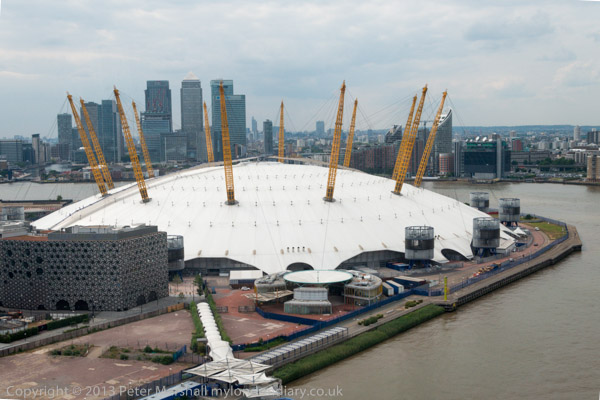
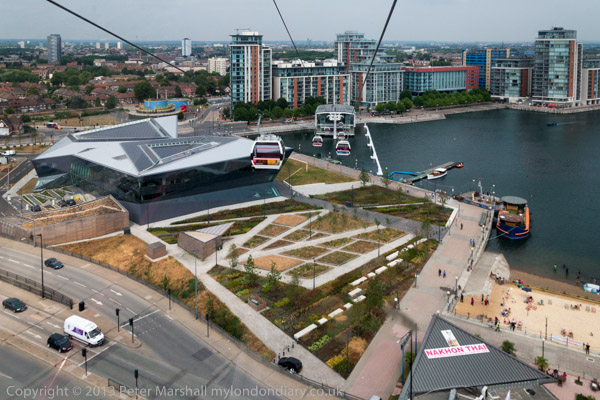
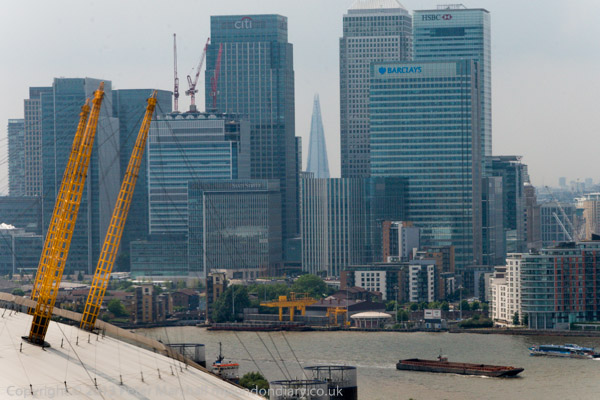
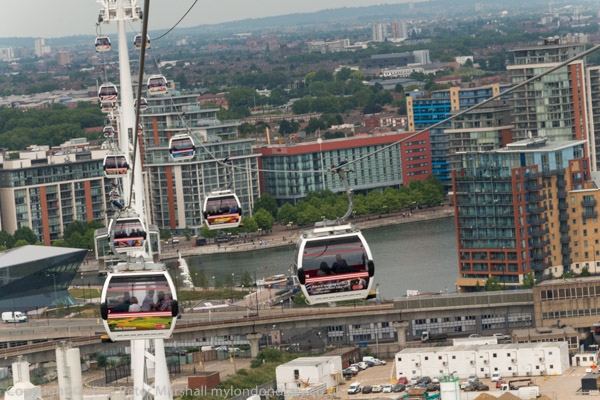
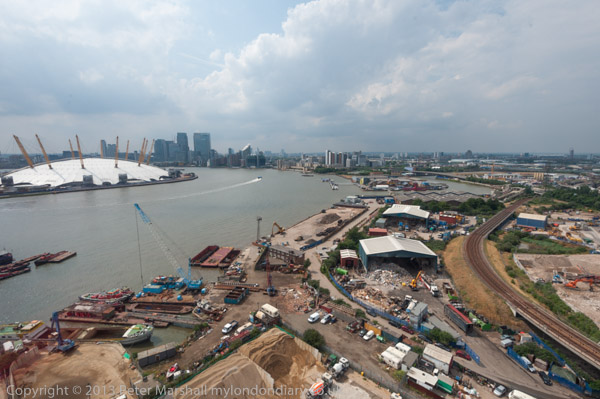
Eight years ago I took a couple of rides on the Emirates Air Line, better known thanks to London blogger Diamond Geezer as the ‘dangleway’ and posted a number of the pictures that I took from it.
As I pointed out then, “in transport terms its a joke, a slower and more expensive route on almost any possible journey“, but to my surprise this joke is still running eight years later despite huge losses, and my exhortation “if you’ve not taken a ride don’t leave it too long” was then misplaced. Though given the effects of the virus on air travel it may not last much longer, but perhaps the extensive developments on the south bank on the Greenwich Peninsula and the replacement of industrial sites by housing on the north bank, together with the move of the Greater London Authority to the Crystal at the north end of the route by the end of the year may provide a few more customers.
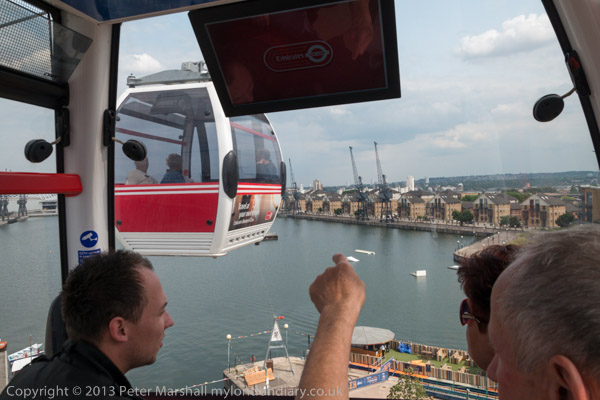
One advantage of the current situation is that, according to the TfL web site “Only one passenger is allowed per cabin, unless a household or group is travelling together” so you can be sure of having it to yourself, or chosing those you want to travel with. The poor people in the picture above had to share a ride with me.
I think there were notices in the cabins telling you to remain in your seats during the short journey, but clearly I didn’t entirely obey these, but there was no one around to see. Perhaps there might be safety issues if a full cabin of Sumo wrestlers began to throw themselves around but I don’t think my careful movements were any problems.
The service runs weekdays days from 7am to 11pm, stopping an hour later on Fridays and Saturdays and opening later at weekends. It also stops in very strong winds and thunderstorms, though one London reporter made a story out of using it this January as storm Christoph was approaching. His photographs don’t really support his story of being buffeted around by the wind but I imagine there was some tangible swinging motion. When there is any real danger it closes – and that happens around a hundred times a year. There are also some closures for maintainence.
My journeys were both smooth and rather quiet, and the ride seemed much shorter then the 10 minutes it took. A single journey costs £4, more or less the same as in 2013. I generally avoid air travel, but I imagine the carbon footprint of this short journey is quite low.
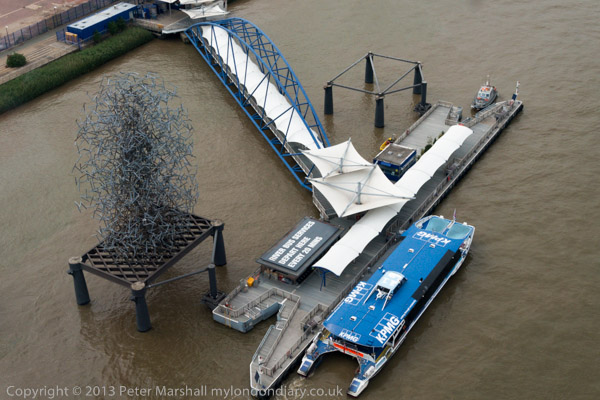
Back in 2013 I commented “it should be promoted as one of London’s cheaper and more interesting tourist attractions, giving a rather better view than the helter-skelter on the Olympic site at around a tenth of the cost, and with the added attraction of motion in three dimensions.” It has so far only attracted a few more discerning tourists, some of whom are doubtless also following London’s public art trail, The Line and get an unusual view of Antony Gormley’s Quantum Cloud on their ride.
All photographs on this and my other sites, unless otherwise stated, are taken by and copyright of Peter Marshall, and are available for reproduction or can be bought as prints.
Estate Agents seemed to be taking over the world and this large Foxton’s seemed to symbolise this. In an article in ‘Property Chronicle‘ in 2020, Dan Channer suggests that Foxtons is the only UK Estate Agent brand “truly differentiated” for several reasons, one of which was that “It spent money on its offices like no other agent.” This building is perhaps an example of this and part of what has made them probably the most hated estate agent by those opposed to gentrification. Perhaps surprisingly this building on the Brompton Rd, though still and estate agents is now a branch of the other contender for that title, Savills.
Although the street sign says Egerton Crescent which is the address of the row of Grade II listed houses, I was standing in Egerton Gardens, and the garden with its threes and flowering daffodils is the garden between the two. The street is one of several to have been described in recent years as the “most expensive street in Britain”, with average house prices in 2015 of over £7.5m. (Wikipedia.) Among those who have lived there are broadcaster David Frost and film director Tony Richardson.
These houses were designed by George Basevi and built by in the 1840s as Brompton Crescent by developer James Bonnin, responsible for much of the development in the area (and other parts of London) from 1822 on. Bonnin leased the site in 1843 and some of the houses were occupied by 1845, with the work being completed by 1848. The site had previously been occupied by a mansion named Brompton Grange, which was demolished. The street was renamed Egerton Crescent in 1896 after the Honourable Francis Egerton, one of the trustees of the Smith’s Charity who owned the land.
This Grade II listed terrace was also built on land owned by the Smith’s Charity and Basevi may possibly have been involved in its design. This cul-de-sac at the east end of Egerton Gardens was also developed by Bonnin in the 1840s on the land he leased in 1843, and was originally called Michael’s Grove.
Anglicans who followed the lead of John Henry Newman and became Catholics in the middle of the 19th century first established a London Oratory near Charing Cross, but soon purchased a site in Brompton in 1852. They first built an Oratory House and temporary church but in 1874 launched an appeal to build this Italianate Church of the Immaculate Heart of Mary, more commonly known as the Brompton Oratory. They held a competition for the design, which was won by Herbert Gribble in 1876 and the church was consecrated in 1884, although it was made taller and the cupola added in 1895. (Wikipedia). The church is Grade II* listed.
This is one I took for the tree, and shows why I liked photographing on London streets in winter when you see the remarkable patterns made by the branches. Of course there is another huge advantage, as in summer you can’t see the houses for the trees in many streets which created an impenetrable green barrier.
Although I find Google’s Streetview extremely useful at times – and check any locations I’m unsure about using it, one extremely annoying feature is that it only seems to have views taken between April and October, many of which are obscured by leaves. That seems a poor decision. The earliest views were taken in 2008, and its often useful to be able to go back to that date; if it had been going in 1988 I might not have thought my long walks necessary, though you often find that it doesn’t allow quite the view you want.
And walking a little further down the street shows a little more variety.
Land in this area south of Brompton Road was bought up by the builders and consolidated by around 1866 and became the Redcliffe estate. Building continued until around 1876 with over 800 houses and “72 mews premises” (British History Online) The builders, William Corbett and Alexander McClymont, were noted for their modern methods, including the use of steam powered joiner’s machinery and building fire-resistant roofs, but went bankrupt in 1878 with liabilities of around one-and-a-quarter million pounds. William Corbett in his earlier years described himself as an accountant, and the huge debt was possibly a result of the work being based on unconventional “modern” accounting methods. Fortunately most of the building was completed by then.
Redcliffe Mews is behind the houses on the west side of Harcourt Terrace and is one of the few mews in this area. The date of 1869 probably applies to the terraces on the main street as well as the mews behind them.
Click on any of the images to see a larger version in my album 1988 London Photos
All photographs on this and my other sites, unless otherwise stated, are taken by and copyright of Peter Marshall, and are available for reproduction or can be bought as prints.
I perhaps need an eye test, as when I was captioning this picture to go onto Flickr I called it ‘Four Eyes’, a term of abuse for schoolboy spectacle wearers. But perhaps I was referring to the door at left which has very much a face on it with the two circular panels and a letter box and a know for the nose, panels of facial hair on each side and a lower letter box for a mouth, along with the cut-off face of a man walking into the picture at extreme left.
Or perhaps I just thought ‘Four Eyes’ was a better name for an opticians rather than the prosaic ‘For Eyes’. The shop at 136 Sloane St is long gone, though the building remains and this is now a part of a wider shopfront.
The term ‘corner shop’ conjures up something far to plebian for this location, though this is one of a pair of them on the junction of Cadogan St and Halsey St. One is now an Estate Agents and this one an office for a company advising wealthy clients on their investments.
Cadogan Gardens, originally Leete St, a part of the Cadogan Estate was rebuilt in 1887 in a Queen Anne Rivival style. No 20 apparently dates from 1891 and was built by Henry John Wright who also built some other houses on Lord Cadogan’s estate. The previously rather poor area was one of speculative building for the growing upper middle classes who often had large families – there were no reliable or widely used methods of contraception and women who survived childbirth continued to produce children until menopause. The house was converted into flats in the 1950s.
Donne Place, Brompton, Kensington & Chelsea, 1988 88-4m-31
Donne Place is a “mews Style cul-de-sac with pedestrian through road”, off Draycott Avenue in the Royal Borough of Kensington and Chelsea. The houses were built in the mid 19th century in what was then a poor area and the street was then known as Caroline Place. Other streets in the area have also changed names and when built it was a street off what had been Blacklands Lane, was then Marlborough Road and is now Draycott Avenue. Although sometimes described by estate agents as a mews, the forty or so houses were built as small family homes around the middle of the nineteenth century, along with other similar streets in the area. At the end of the street is the large block of Marlborough Buildings, two large blocks opened in 1890 by the Improved Industrial Dwellings Company to house 500 people.
A high-explosive bomb destroyed some of the area in 1940-41, and some properties and I think part or all of this one, at the corner with Bulls Gardens, a slightly earlier development, is probably one of these. Many of those in the street have been extensively rebuilt behind their facades (and in some cases below ground) in more recent years. Houses built as simple dwellings for the better-off working classes now sell for £2-3million.
I think this building was probably at 163 Draycott Avenue, and though still standing, its frontage has been altered beyound recognition, with no trace of their the Draycott Gallery, Manguette or the subterranean L’escapade.
10 Milner Street still looks much the same apart from a coat of paint and a new front door, and is still next to the entrance to St Catherine’s Mews, now with a less attractive gate that no longer matches the balcony. The shop at right is still an estate agent, but has changed from Lloyds to Stanley.
The house, often known as Stanley House, is Grade II listed as a substantial early mid-19th century house. It was built in 1855 by “Chelsea speculator John Dodd” as his Chelsea Home according to Wikipedia and the many web sites who have copied this information. I think this may be John Todd (1817-1897), the son of George Todd & Ann Beecroft of Durham who were married in 1815 at Bishop Wearmouth, Durham, England and is said to have moved to Middlesex where he became an builder and became rather rich.
And these are the doors no longer present on 10 Milner St. The house became the home of famous horologist Courtenay Ilbert and housed his collection of clocks, watches, marine chronometers and sundials. His nephew, Michael Inchbald lived with him from 1945 and after his death refurbished the interiors in a manner that established his reputation as an interior designer. Inchbald’s then wife Jacqueline Ann Duncan founded the Inchbald School of Design, the first interior design school in Europe, in their family home in 1960. (Thanks again Wikipedia and their link to Christies.) It is still going strong but now at 7 Eaton Gate, where somewhere inside they possibly still have these doors.
All photographs on this and my other sites, unless otherwise stated, are taken by and copyright of Peter Marshall, and are available for reproduction or can be bought as prints.