Wool Against Weapons

Burghfield to Aldermarston, Berkshire.
Wool Against Weapons

Burghfield to Aldermarston, Berkshire.
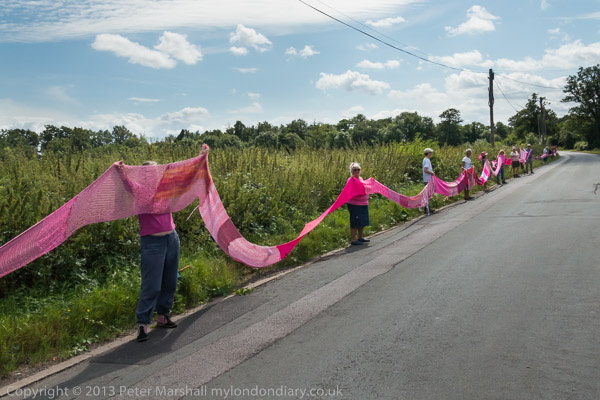
There were 7 miles of pink scarf along the roads between the two atomic bomb factories – and some to spare.

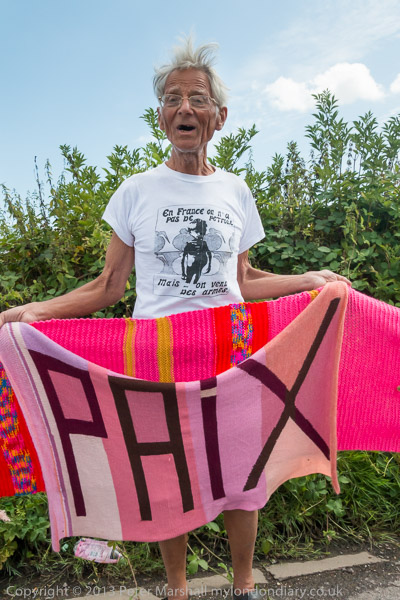
Wool Against Weapons; On Saturday 9th August 2014, the 69th anniversary of the dropping of the atomic bomb on Nagasaki – three days after the nuclear bomb devastated Hiroshima, CND organised a large-scale protest against nuclear weapons, stretching a line of pink knitting seven miles to link the bomb factory at Burghfield with the Atomic Weapons Establishment (AWE) at Aldermaston.

Wool Against Weapons

Burghfield to Aldermarston, Berkshire.
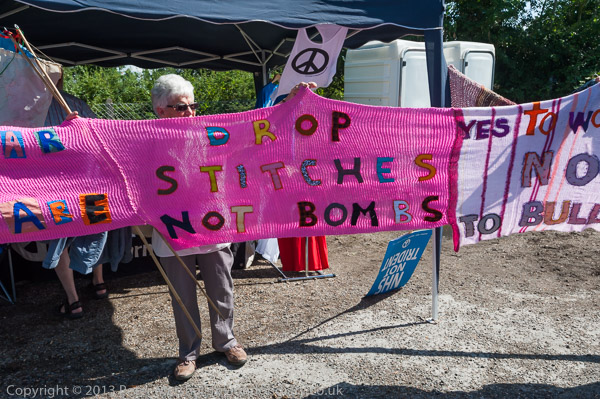
Some sections had fancy designs, others had slogans – ‘Knitwear Not Warfare’
Wool Against Weapons

Burghfield to Aldermarston, Berkshire.
‘Drop Stitches Not Bombs’

The protest came well ahead of a parliamentary vote expected in 2016 to allow the government to spend over £100 billion on a new nuclear weapons system to replace Trident.

Wool Against Weapons

Burghfield to Aldermarston, Berkshire.
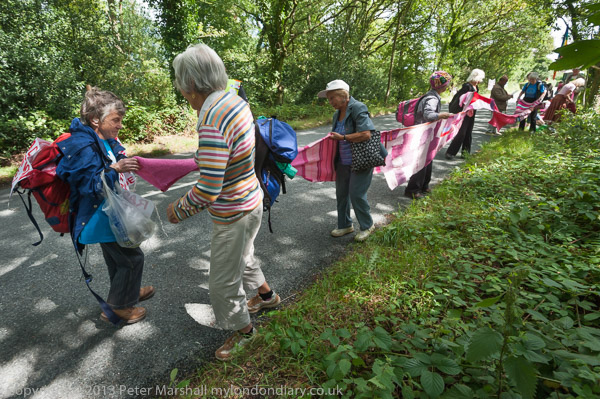
People were sewing the lengths of scarf together
Wool Against Weapons

Burghfield to Aldermarston, Berkshire.
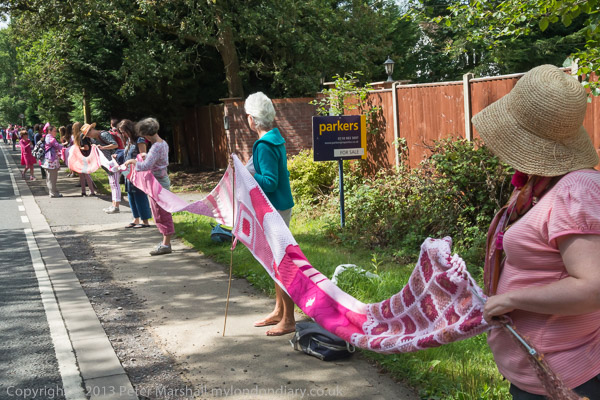
Stretching out the lengths

Groups from all over the country (and some in France) had been busy knitting and crocheting lengths of pink scarves and joining these into rolls that could be brought to their designated point on the 7 mile route, unrolled and joined up with others to complete the scarf.
Wool Against Weapons

Burghfield to Aldermarston, Berkshire.

The project brought together a large number of people many who had not previously protested against nuclear weapons but were appalled at the amount of money that would be wasted on a Trident replacement which could be much better spent in other ways – such as keeping the NHS running.
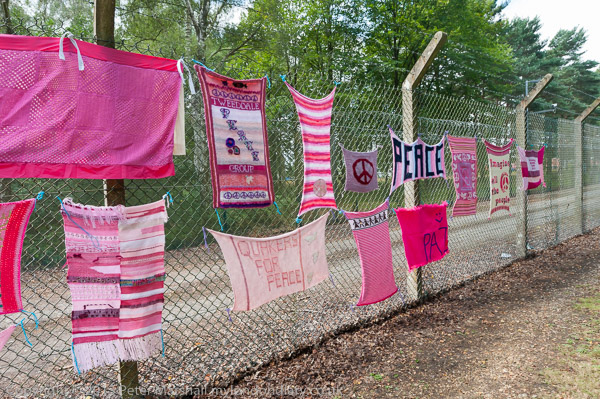
Extra knitting on the fence of AWE Aldermaston

I had decided the only sensible way to cover this protest would be on a bicycle, and got up to go with my bike on an early train to Reading, from where I cycled to Burghfield, arriving shortly before 10.30. This gave me two and a half hours before the whole scarf was scheduled to be joined up at 1pm.
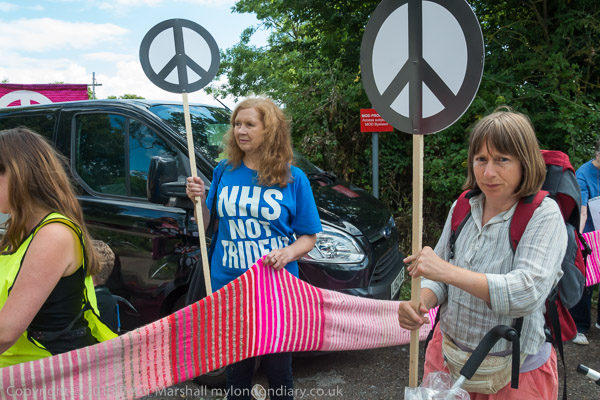
People wait to hear that the scarf is linked

After photographing at this end of the scarf, I cycled slowly along the route, jumping off my bike to take pictures where people were busy laying out the rolls of scarf and joining them up. Eventually I reached Aldermaston and after taking some pictures there rode quickly back to Burghfield to be there well before the joining was complete at 1pm.

Waiting for the the signal that the scarf is linked along all 7 miles

At 1pm protesters held up the now joined 7 mile scarf and rang bells – and I ran almost a mile along it taking photographs. I think it was held up for around 10 minutes before people took it down and began to come to a rally at Burghfield which began a little after 1.30pm.

And people rang the bells
One person was getting a little bored
One of the French protesters

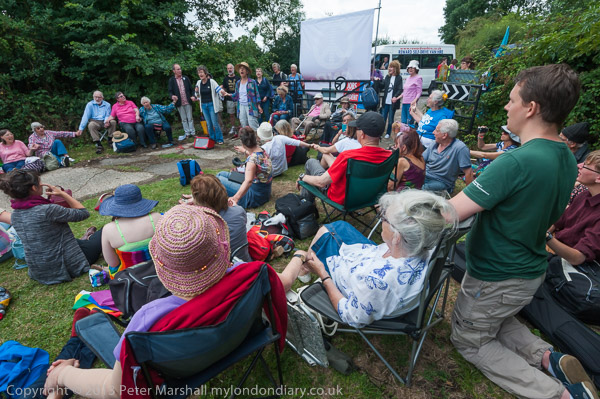
There was music and poetry and speeches, including from Walter Wolfgang and Kate Hudson. It was still continuing after I left to ride back to Reading and take the train home.
Many more pictures on My London Diary at Wool Against Weapons.


FlickrFacebookMy London DiaryHull PhotosLea ValleyParis
London’s Industrial HeritageLondon Photos

All photographs on this page are copyright © Peter Marshall.
Contact me to buy prints or licence to reproduce.
Vaisakhi Procession, Slough 2007

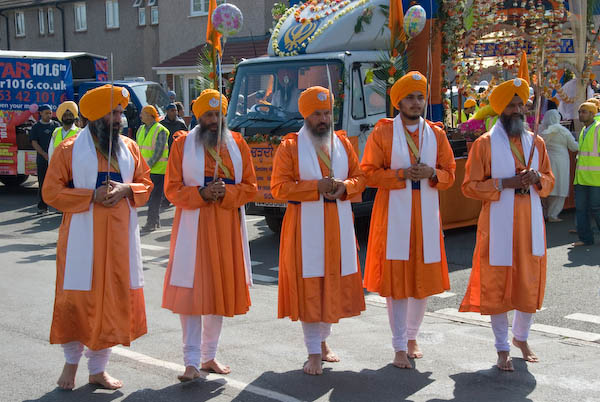
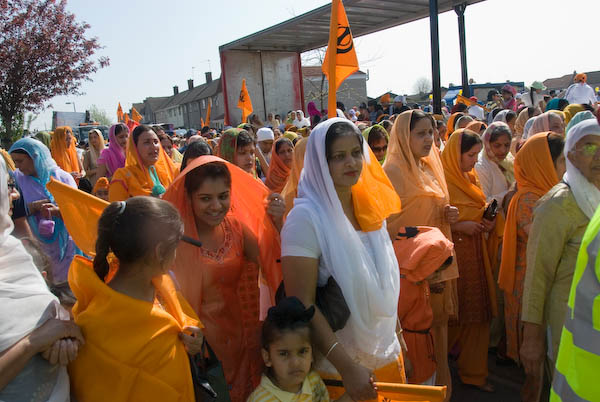
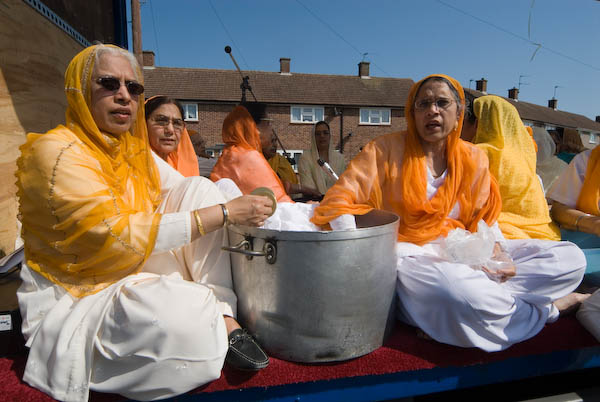
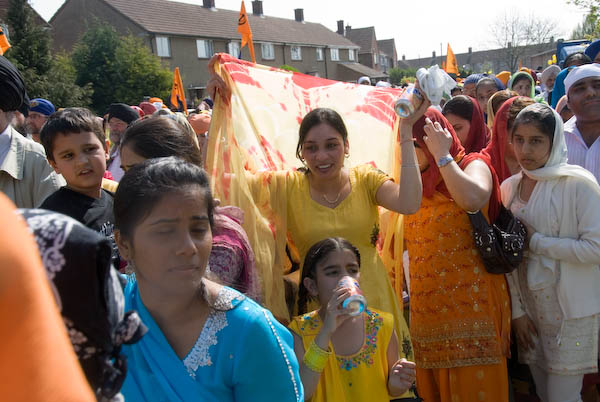
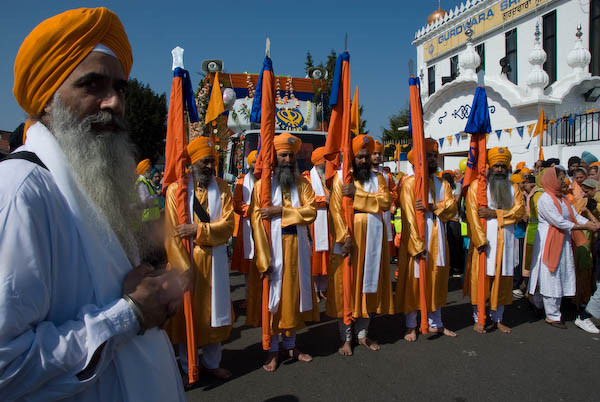
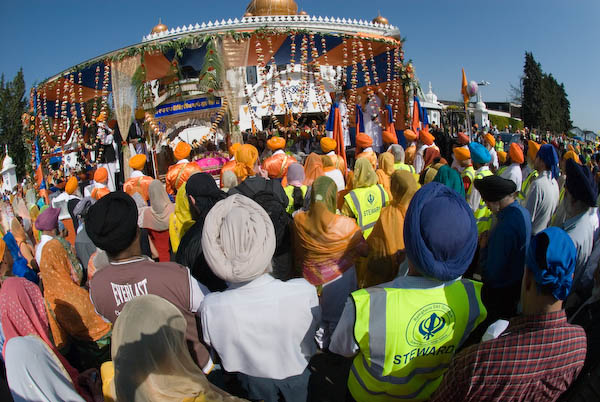
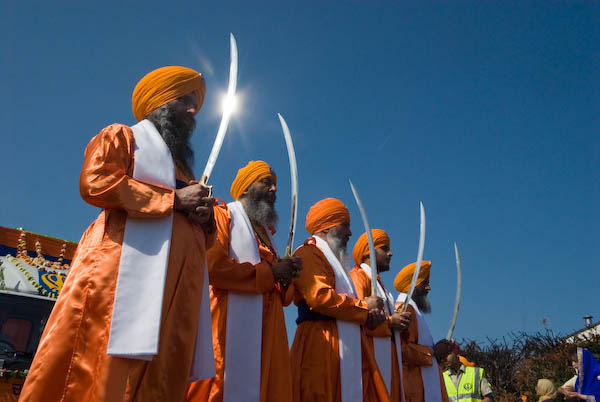
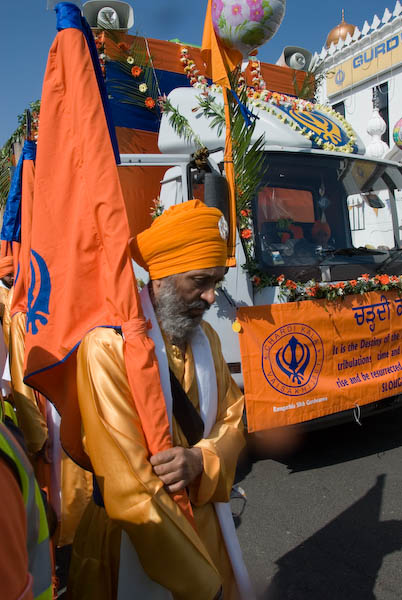
Vaisakhi Procession, Slough: On Sunday 15 April, 2007 I decided at the last minute to rush to Slough, picked up my rumāl and arrived just in time to photograph the Vaisakhi Procession as it left the Gurdwara. Two years later in 2009 I returned and was able to cover it more thoroughly and you can see the results on My London Diary – but in this post I’ll stay with the pictures and text from 2007. As usual I’ve made the text easier to read, correcting the capitalisation and typos etc.

Vaisakhi in Slough

Slough, Berkshire

Vaisakhi Procession, Slough 2007

I’d hoped to relax a bit on Sunday, have a day off from working with a camera, catch up with things. But Linda heard something on the radio about Vaisakhi in Slough, so I looked on the web, found the procession started at 10.30 and jumped on my ancient bike.

Vaisakhi Procession, Slough 2007

By then it was 10.15am, and according to the AA, the 9.5 miles should have taken me 27 minutes by car (and you could probably add a bit for parking etc onto that.)

Vaisakhi Procession, Slough 2007

So 40 minutes wasn’t too bad going, and I arrived just before the procession started to move off, just before 11.00am.

Vaisakhi Procession, Slough 2007

By the time I left two hours later, the procession carrying the Sikh holy scriptures and led as always by Khalsa carrying flags and swords was just around the corner a couple of hundred yards away in Shaggy Calf Lane (though it had taken a rather longer route than me to get there.) And as well as photographing the event and many of those taking part, I’d also had a very enjoyable free lunch.

Vaisakhi Procession, Slough 2007

More pictures

Slough, Colnbrook & Horton

I made my way home rather more slowly. One of the great advantages of travelling by bike is that you can stop exactly where you like to take photos.

As well as a few buildings in Slough, and what remains of a landmark garage at the west end of the Colnbrook Bypass (now sold and doubtless to be redeveloped) I spent some time in Horton, which in my youth really was a country village, and still retains some of that feeling, before returning to Staines via Wraysbury.


FlickrFacebookMy London DiaryHull PhotosLea ValleyParis
London’s Industrial HeritageLondon Photos

All photographs on this page are copyright © Peter Marshall.
Contact me to buy prints or licence to reproduce.

Loddon & Thames

Loddon & Thames: Eight years ago I published an account of a walk I made with Linda and Sam from Winnersh Triangle to Reading, not by the rather boring direct route of around 4.5 miles but along two of Berskhire’s rivers, the Loddon and the Thames. Here I republish te text in full, though the original is still on My London Diary, which also has many, many more pictures for those who are interested.


Loddon & Thames

Winnersh Triangle to Reading. Mon 27 Jul 2015

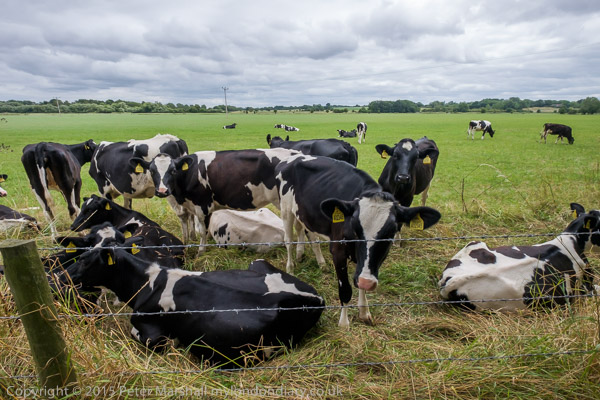
Cows next to a footpath by the River Thames

Winnersh Triangle sounds like a dangerous place to go, a new halt (hardly a station with a platform only a foot or two wide) on the Waterloo to Reading line that opened in 1986. It’s lightweight wood structure was designed not to put too great a load on the Loddon Viaduct on which it hangs, though there is a ticket office at ground level, closed when we arrived.

Loddon & Thames

Mostly Winnersh Triangle is home to company men and the companies they work for in what the web site describes as “an 85-acre, mature business environment” between the A329M motorway, the rail line and the River Loddon. The web site says it’s a place where “everyday things become exceptional and exceptional things happen every day“, but very little seemed to be happening on the day we went there. It didn’t look like a place where anything of interest ever happened, and its big selling point is that you can be at Heathrow in 30 minutes.

Loddon & Thames

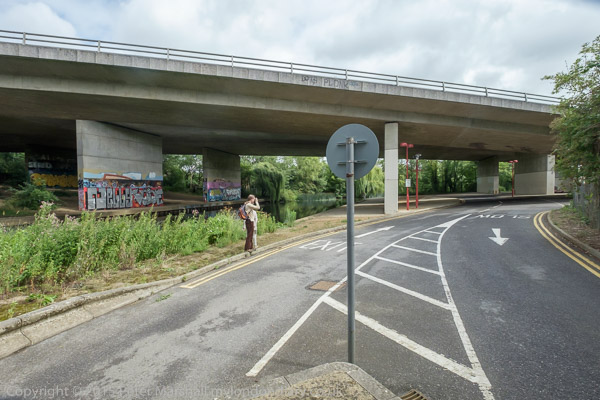
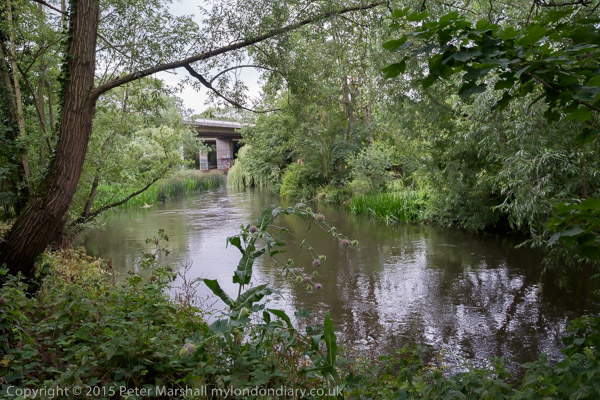
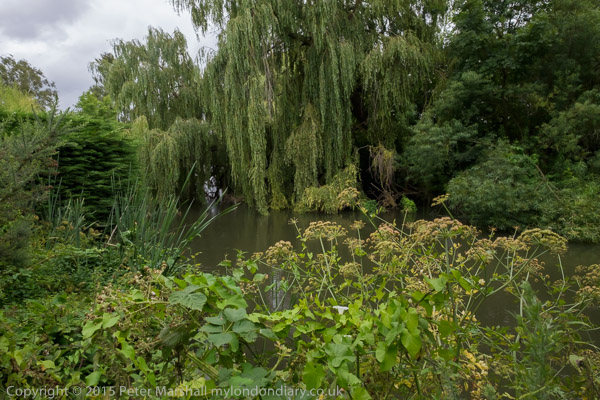
We took a quick look, didn’t like it and headed south under the railway to walk along the Reading Road to Loddon Bridge, joining a footpath that led north beside the River Loddon under the railway and motorway. You’ve probably never heard of the Loddon, but its a sizeable tributary of the Thames, that often gets too sizeable for its banks, flooding nastily. A man in council hi-viz who was checking the river gave us a 20 minute dissertation on this and related matters before we all escaped, though I’d wandered away taking pictures after the first five.

Loddon & Thames

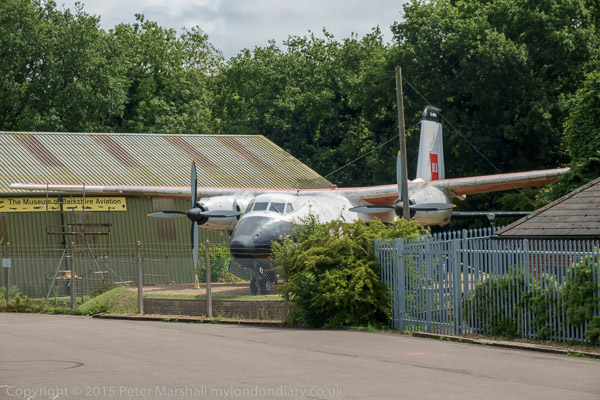
Fortunately the river was fairly low or we might have been paddling or swimming for the next mile or so, before the path veered away and climbed to a road and we found ourselves briefly in suburbia. Then we came across a large BEA twin prop plane, its presence soon explained by a sign ‘The Museum of Berkshire Aviation’. It was closed which saved us from having to decide if we wanted to be enthralled by “Berkshire’s dynamic contribution to aviation history.”

You can find out more on the museum web site, which includes a picture of a rather dinky little ‘Miles Pusher’, which was “built by F. G. Miles under protest and therefore never flew.” Miles went bust in 1947, and Handley Page took over the designs, accounting for the Handley Page Herald turboprop standing outside. Miles from 1942 had been designing an experimental supersonic jet aircraft to fly at 1000mph, but the Air Ministry in 1946 cancelled this, deciding only to build it as an unmanned rocket-powered scale model which achieved controlled flight at Mach 1.34 – 1020mph. The design of the Miles M52 informed the later English Electric Lightning which I saw at the Farnborough Air Show in the early 1950s and could out-perform anything from that era.

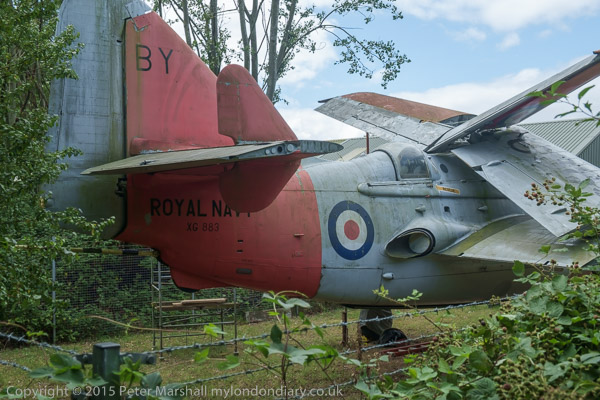
We didn’t hang around, though Sam looked up a few things on his mobile and we photographed the Fairey Gannet out the back before going along the footpath and down to the river to continue our path through rural Berkshire alongside the river to Whistley Mill Lane.

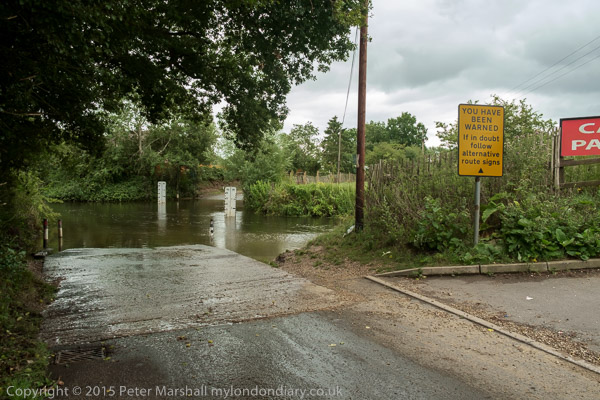
This leads to a ford over the Old River, still a stream of the River Loddon, and unless you are driving a Land Rover or something larger, its probably best to turn around and go back. The level markers were at 2 feet, but fortunately there is a footpath to a footbridge around 60 yards to the south which we crossed, taking us to the Lands End pub, which might have been a good place to lunch, but we had brought sandwiches.

The next mile or so took us through the Charvil, a suburban fringe of Twyford, and with some difficulty across the A4 to Milestone Ave, a narrow lane with some 1930s development on the east side for the first half mile or so. Just before a bridge over one of the minor arms of the Loddon, a footpath leads off to the River Thames. We’ve previously walked along the Thames path on the opposite bank, which we came on to a mile or two later as it crosses the bridge at Sonning.

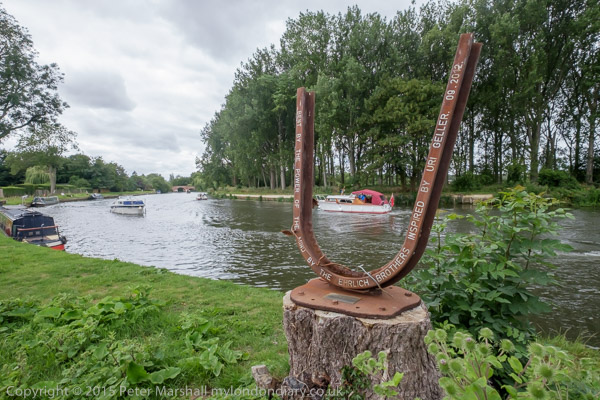
Sonning is home to Uri Geller

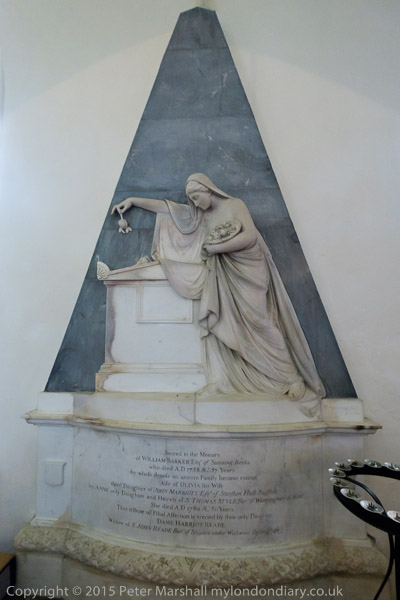
We took a look inside St Andrew’s Church there (and were given a copy of what must be one of the most lavishly produced church magazines in the country) and briefly explored the grounds before taking the path from the churchyard to rejoin the Thames path, walking along this into Reading for the train home.


Many more pictures from the walk on My London Diary.

Boxing Day Pictures

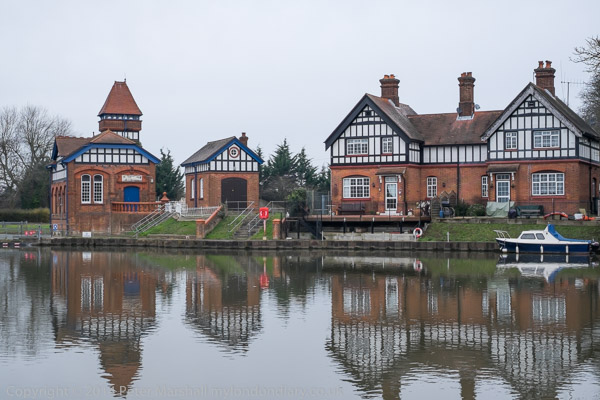
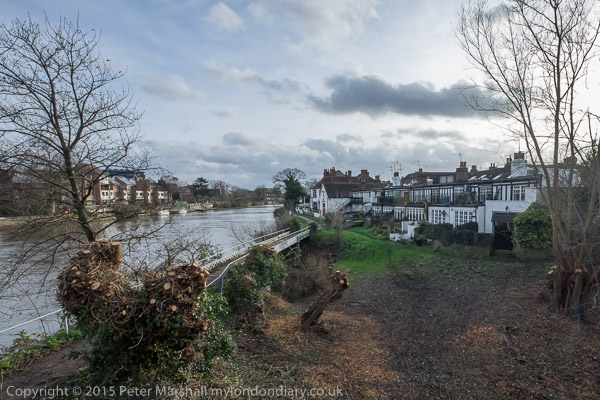
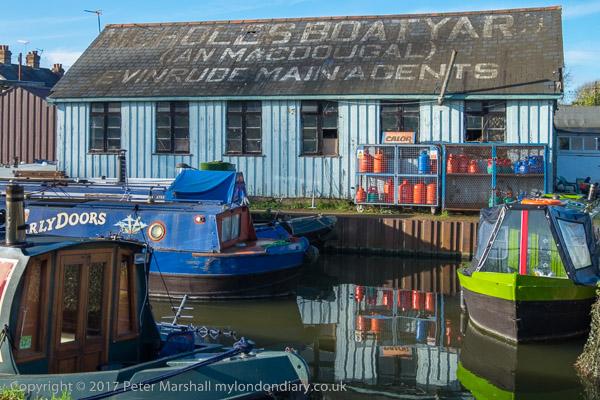
Boxing Day Pictures I took in earlier years – mainly on our normal annual walks from Staines to Old Windsor. It’s a family tradition, a walk we’ve made most yearssince we moved here in 1974, though not always taking the same route. This year is one of the few years we won’t be making it.

2010

2011

2012

2013

2014

2015

2016

2017

2018

2019

2020

There are more pictures from all of these walks – except that in 2020 – on My London Diary. Click on the picture for any of the other years to go to more about the walks and more pictures.