Railton Road, Herne Hill

The next episode in in the series of posts on my walk in south London on Sunday 7th May 1989. The walk began with Hanover, Belgrave, Chapel, Shops, Taxis. The previous post was Herne Hill, Dorchester and Carnegie.

Shops, Railton Rd, Herne Hill, Lambeth, 1989 89-5f-62

I wandered up Railton Road from the junction with Dulwich Road towards Herne Hill station. Herne Hill only appears to have got its name relatively recently, with the Herne Hill Society stating that the first documented reference dates from 1801. Earlier maps show it as King’s Hill or Dulwich Hill.

Neither of the two derivations they give seems particularly likely, with an Old English root hyrne (corner, angle) hyll seeming unlikely from the late appearance of the name and a roost of large numbers of heron on the nearby River Effra seems fanciful. Other possibilities put forward have been that it was named after a family called Herne who apparently lived here in the 17th century.

Perhaps the name really does come from Herne the Hunter, the mythical resident of Herne’s Oak in the Windsor Forest some twenty five miles or more to the west, transferred here by an early developer of the area who perhaps saw oak trees which reminded him of that place, perhaps also hearing the rattling of chains and ghostly moans in this area. Who knows?

Railton Road was apparently one of the roads developed in 1868, a few years after the coming of the railway, the station on this road opening in 1862. Until then the area had been one of large villas with leafy gardens for the wealthy, but soon became full of “smaller houses for clerks, artisans, craftsmen and their families, the workers taking advantage of cheap fares for commuting into London.

Shops, Railton Rd, Herne Hill, Lambeth, 1989 89-5f-63

The building at 222 Railton Road, here the Herne Hill Bingo and Social Club, was the Herne Hill Cinema, said to have opened in 1914, although there appears according to a postcard on Brixton Buzz to have been a cinema around here earlier than that. It’s narrow facade opened to a much wider auditorium behind which could seat 750.

Brixton Buzz quotes Cinema Treasures giving more information about its 1932 design by George Coles and closure as a cinema in 1959, but says it continued in use as a bingo club until 1986, then becoming shuttered and empty. Clearly it was locked and barred when I photographed it in 1989, and has a notice too small to read on its door, but doesn’t look in too poor condition. It is now a private bar, but apparently the auditorium area behind was demolished and housing built on the site.

Herne Hill Station, Railton Rd, Herne Hill, Lambeth, 1989 89-5f-66

Herne Hill Station was opened at the bottom of Herne Hill on Railton Road by the London, Chatham and Dover Railway in 1862. At first it was a terminus, with services only towards Victoria, but a year later the line was extended to Beckenham and by the end of the decade there were also services to “the City of London, King’s Cross, Kingston via Wimbledon, and Kent, including express trains to Dover Harbour for continental Europe.

The building with its polychrome brick Gothic tower seems excessive for what was a small suburban station, and was certainly intended to impress. The tower held the water tank needed by steam locomotives. The Wikipedia article quotes The Building News description of the station from 1863 as “spacious and convenient … and of the very best quality” and states “an unusual amount of decorative taste has been displayed“. It became an exempler of Victorian railway architecture.

Shops, Railton Rd, Herne Hill, Lambeth, 1989 89-5f-65

This view looks toward the corner with Rymer St, which now takes traffic from Railton Road to Dulwich Road as Railton Road a little further north is now a no-entry street for motorised traffic other than buses.

At left is 200 Railton Road and at right, next to an alley is an accomodation bureau and letting service at 289, now the home of Herne Hill Books. Apparently this stretch of road was until 1888 known as Lett Street. The alley was once a public footpath, and looks as if it was still in 1989.

This view still looks much the same now, with the two 19-storey blocks of Park View House and Herne Hill House in Hurst Street, each built in 1966 with 72 flats, towering over the neighbourhood. Park View House many be blessed with a view of Brockwell Park, but unfortunately you can see it and its neighbouring tower from the park.

Railton Rd, Rymer St, Herne Hill, Lambeth, 1989 89-5f-51

A closer view of 200 Railton Road. I have been unable to find out more about this building. Two of the three ground-floor shops appear to have been converted to to residential use by the time I made this picture.

Shops, Railton Rd, Herne Hill, Lambeth, 1989 89-5f-55

I walked back down south down Railton Road to the junction with Dulwich Rd, stopping to photograph this terrace of shops at 315-323 Railton Road. This is now a pedestrian area and the shops are rather different in nature.

I liked the sign at left on 315, ‘Only the best is good enough for me‘ though with the metal shutters up on a Sunday I could not be sure what it sold, though I think it was probably a greengrocers.

To be concluded in another post.


In Jiro World

Jiro Osuga
Departures
Flowers Gallery
82 Kingsland Rd, London E2 8DP
19 May – 1 July 2023

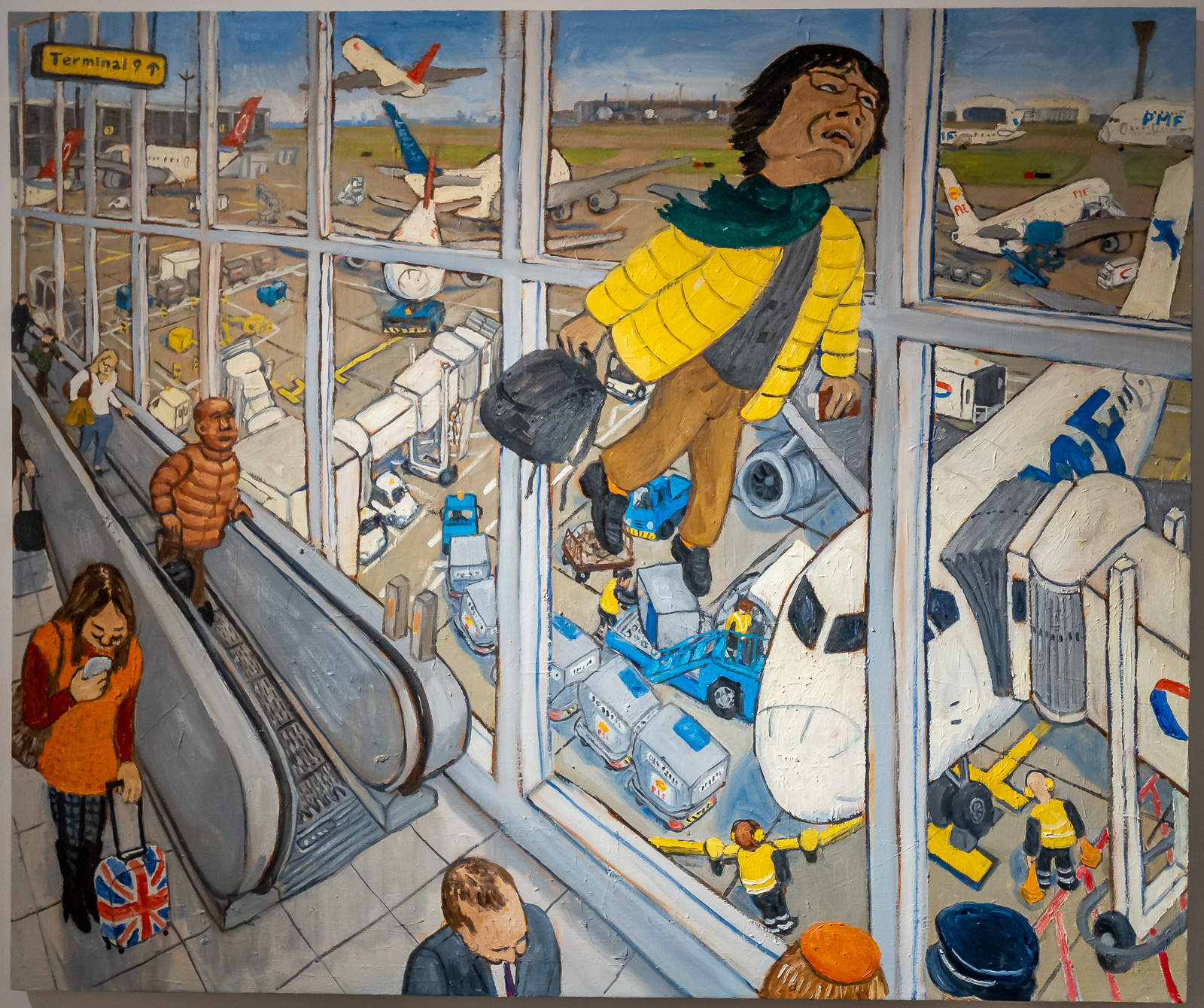
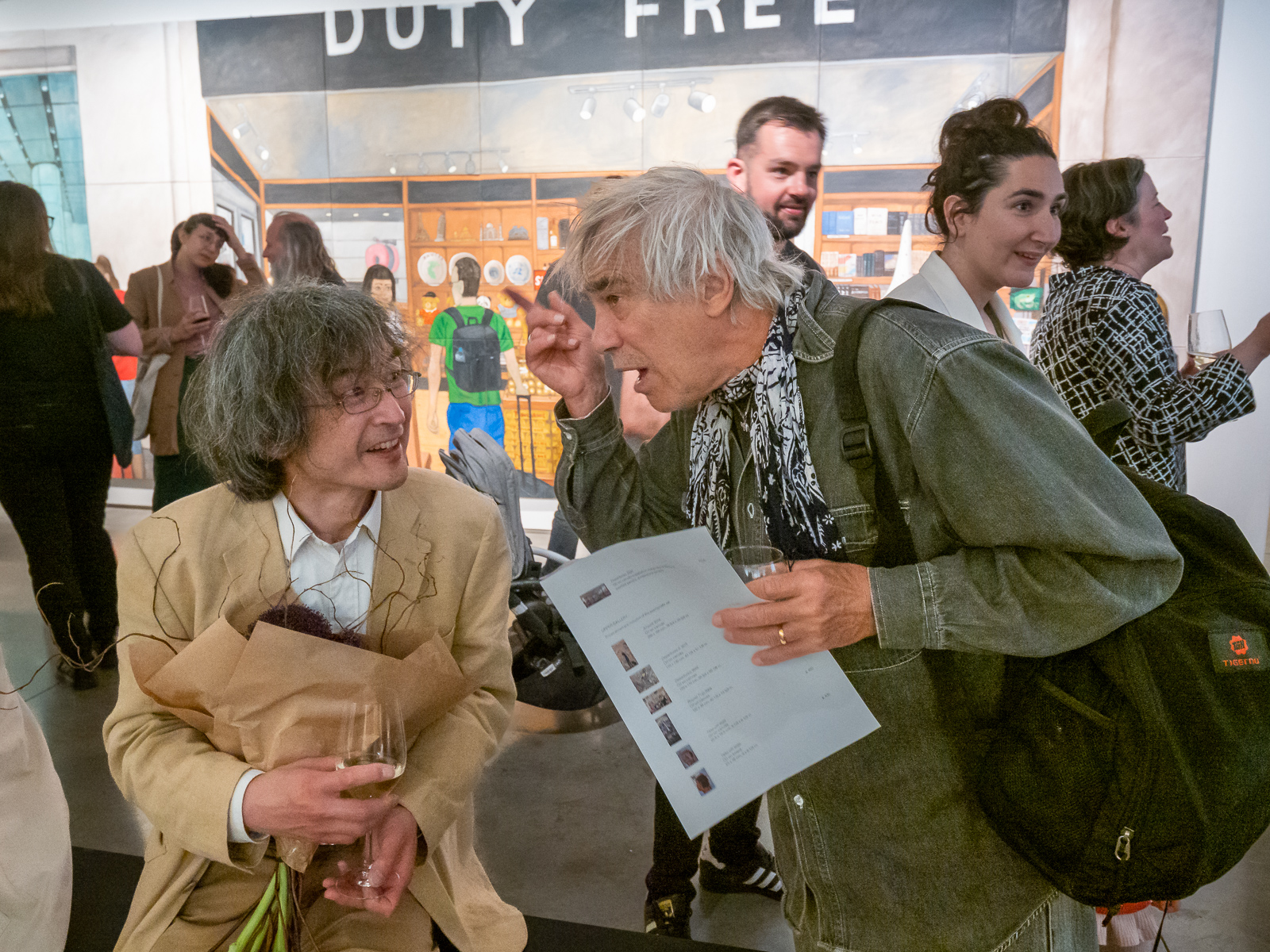
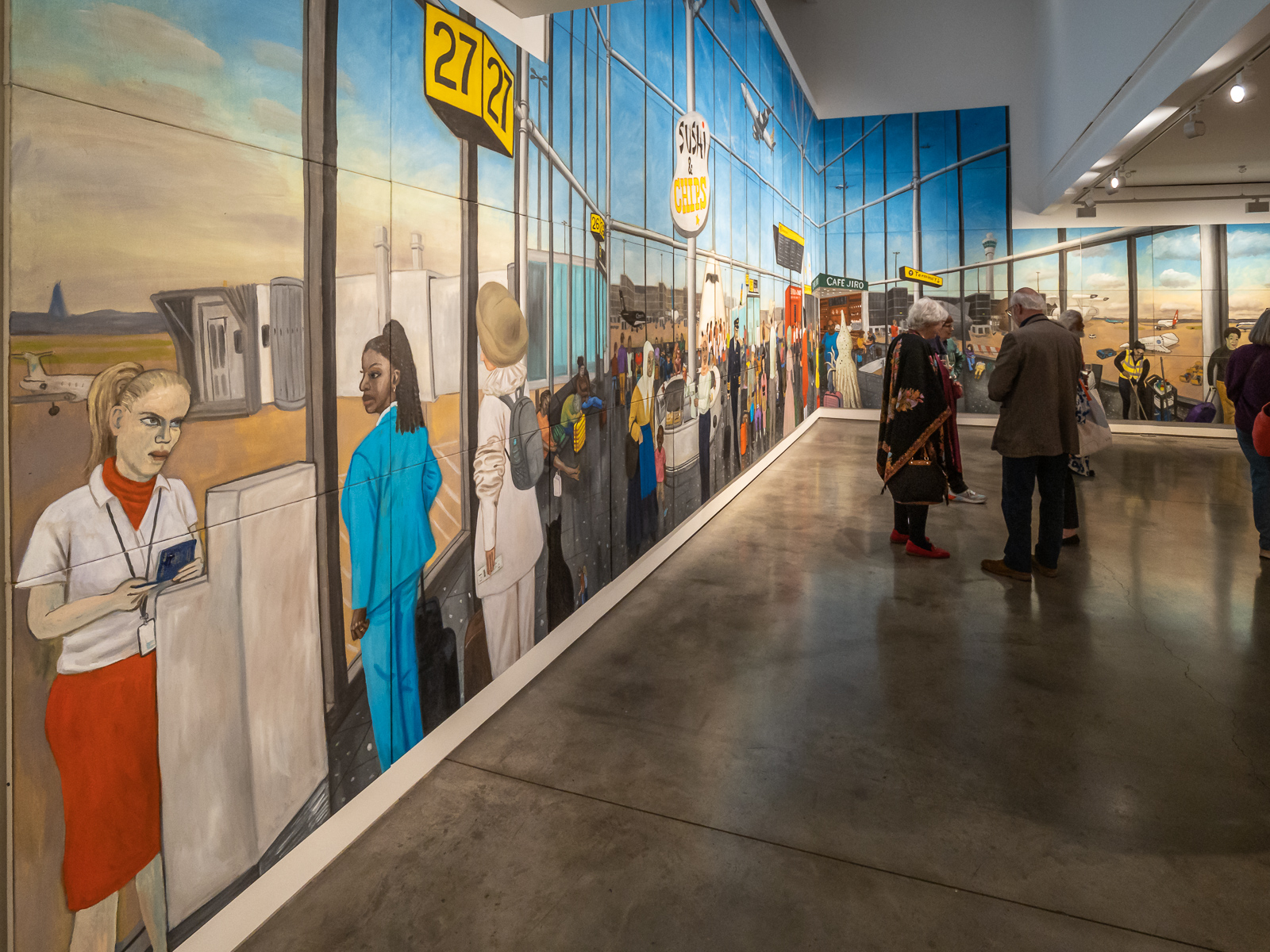
Last Thursday I was delighted to attend the opening of the latest show by Jiro Osuga, Departures at the Flowers Gallery in Hoxton, London.

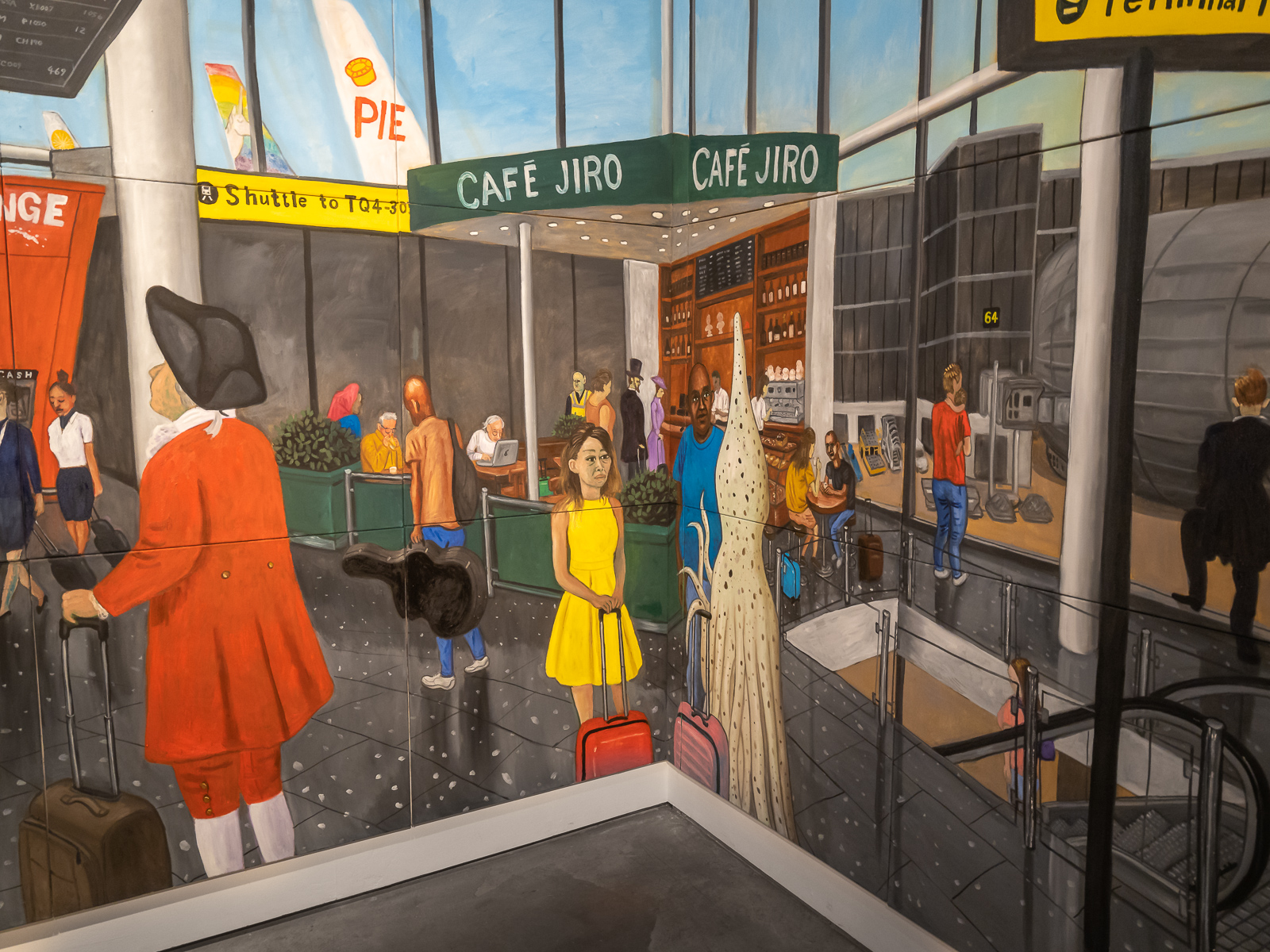
I’ve known Jiro for many years and have long admired his work in previous shows at Flowers, including in 2009 when I wrote here about his transformation of their Mayfair gallery into Café Jiro, (more pictures on My London Diary) later shown in the real Queen’s Terrace Café run for a few years by london and art historian Mirelle Galinou.

The work from ‘Café Jiro’ also featured in ‘Pub Jiro‘, his takeover aided by Mireille of the upper floor of the Horse & Groom in Streatham, part of the 2017 Streatham Festival and celebrating the publication of her The Streatham Sketchbook.

Jiro has also been a great help in the hanging of several of exhibitions I’ve worked on over the years, I think the first of which was Cities of Walls, Cities of People in 2001, which I curated for now long missed London Arts Café.

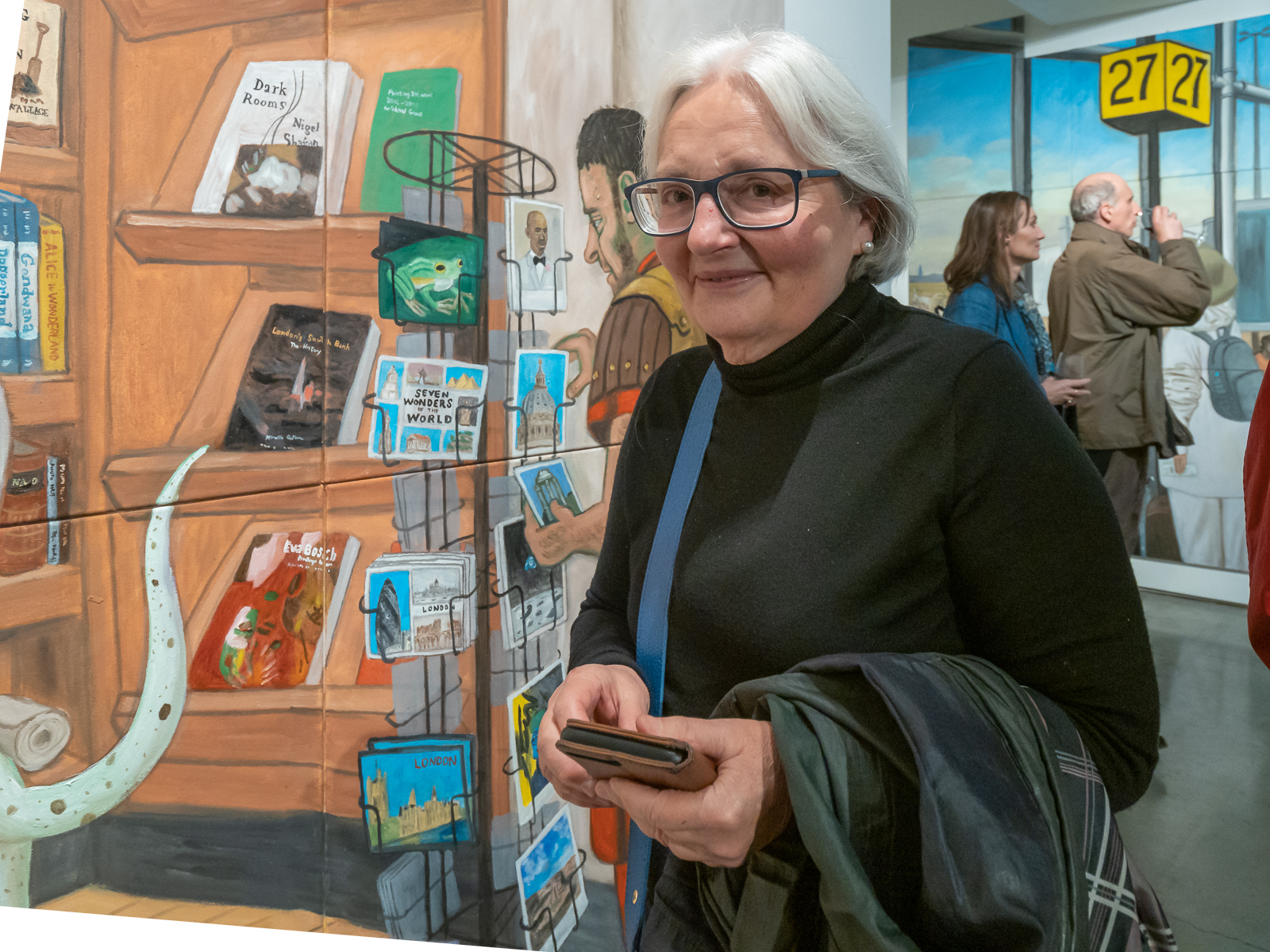
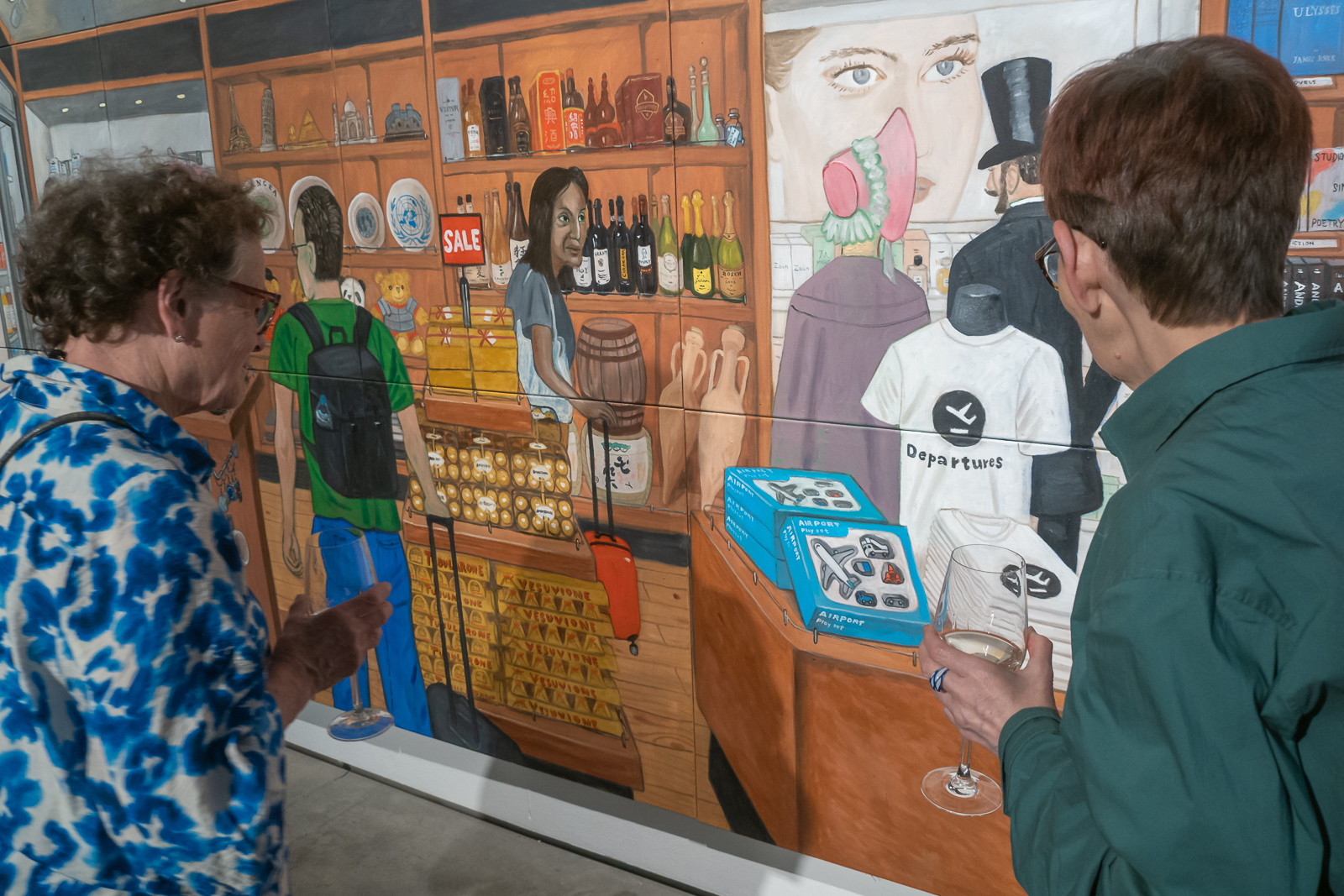
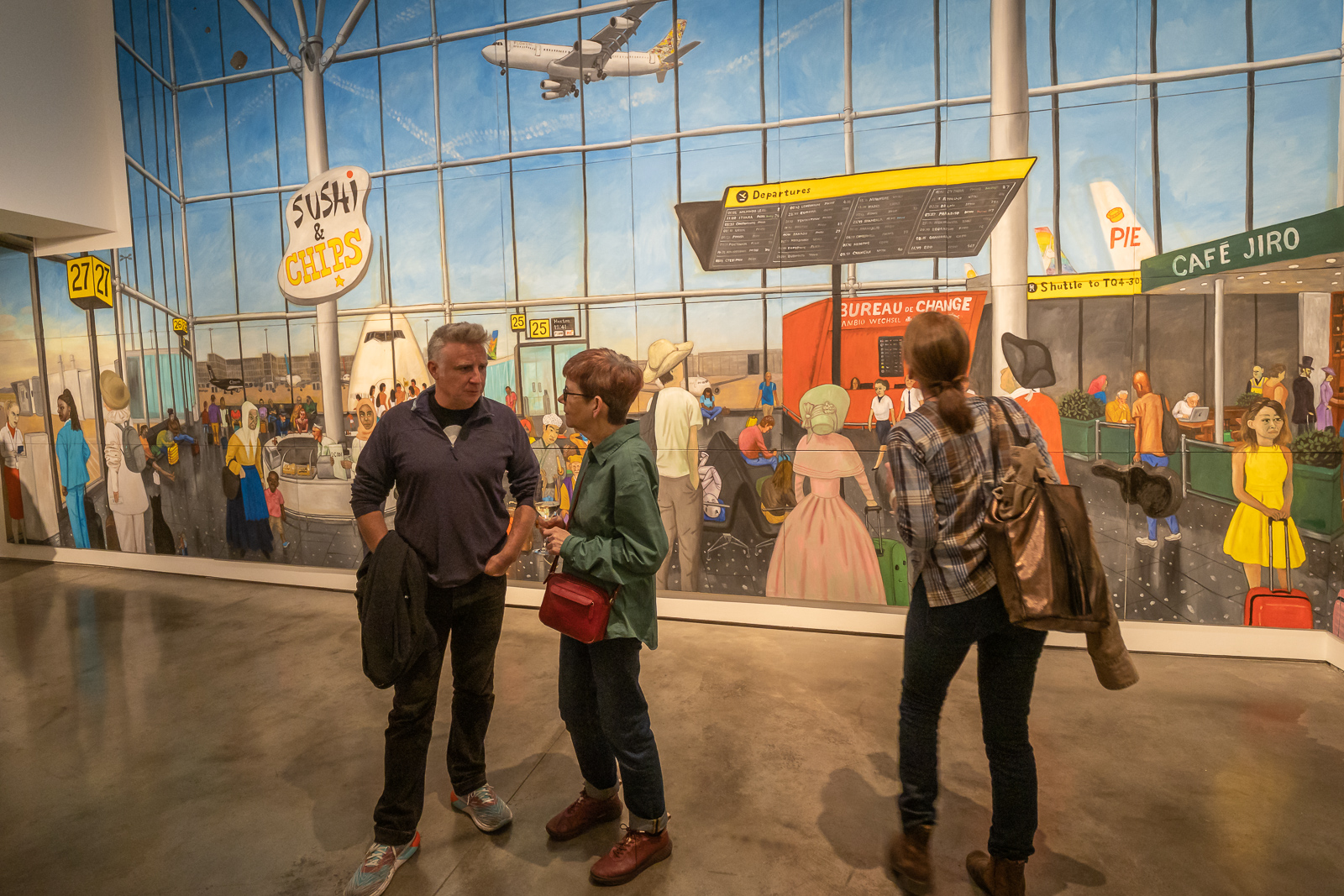
I don’t often review art shows, though I used to write much more about photography exhibitions, and I won’t say a great deal about this one, which I think is Jiro Osuga’s most ambitious and impressive to date, transforming the large space of the Kingsland Road gallery into an airport departure lounge, covering the walls with giant paintings which, according to the gallery cover more than 160 square metres.

The gallery web site shows the works but to really appreciate them you have to go there and stand in the space, where they are far more vibrant and enveloping. Or perhaps you really need to sit and contemplate them, enjoying the wealth of objects and characters from painting, film and real life they include. As the gallery states, the paintings creat “an unfolding state for individual and often unexpected narratives to occur“. There is an immense wit and imagination in this and other work by Jiro.

Actual airport departure lounges are some kind of hell of consumerism, to be avoided at all costs (and part of an industry that is costing the earth.) But don’t miss spending some time with this work, on show until 1st July 2023.

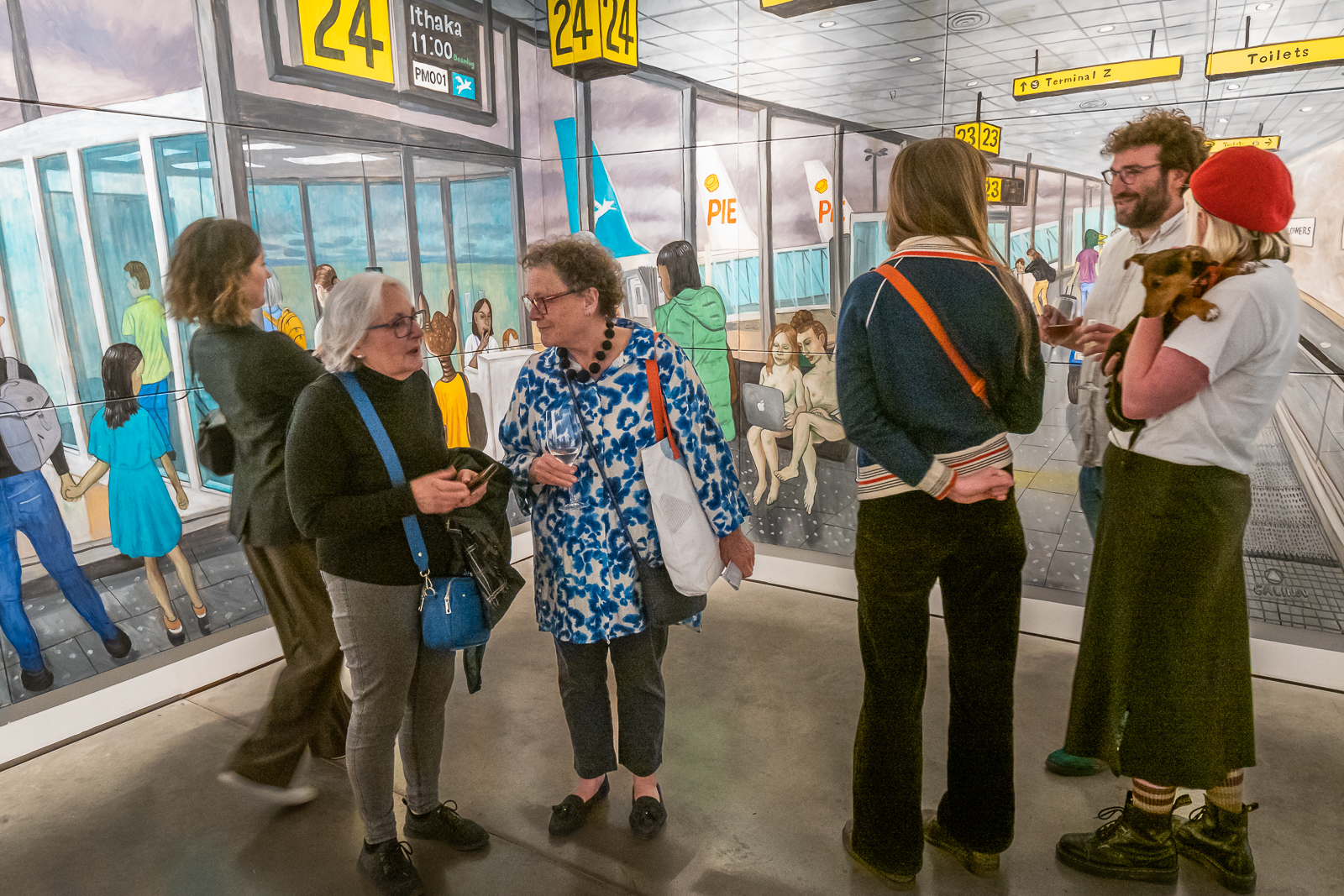
There are more pictures from the opening in my album Jiro Osuga – Departures Opening. I haven’t named those shown in the pictures, though some may tag themselves, but you may recognise two fine photographers as well as others among them.


St Omer & Arques 1993

Mostly I’ve photographed London over the past 50 or so years, with just a few earlier pictures that I think I have lost, including the first film I ever had processed, of ancient oak trees in Richmond Park back in 1962. It cost me 17s 6d to get it processed and it was years before I could afford to do more. I think all of the pictures are now lost. But I have also photographed elsewhere, particularly in Hull and Paris, and also on a number of holidays, some where I’ve perhaps taken photography more seriously than others. But I’ve always had a camera with me.

Cyclists, France

A few of those holidays have been cycling holidays, including a ride up the Loire valley and a couple of others in northern France. France is a better place to cycle than the UK for various reasons. It still has mile after mile of largely empty rural roads and French drivers have a much more positive attitude towards cyclists. More of them are cyclists themselves or have been.

le Marais Audomarois, St Omer, France

One such holiday was in late August 1993, when I went with my wife and two sons, aged 14 and 17 to northern France. Our rides were fairly leisurely with not the slightest whiff of Lycra and frequent stops for me to repair the punctures of the others or carry out other running repairs. My own bike, a 1956 Cinelli bought secondhand for me by my eldest borther for my 13th birthday performed without any such problems. I’ve recently scanned and put the pictures from our holiday into a Flickr album.

Water Tower, near Cassel, France

Two things made that difficult. One was the poor trade processing of the colour negative film I used, with one film having two large gouges across most frames along with some other damage which required extensive digital retouching. I tried out Photshops new AI filter which removed them perfectly – but also took out some other parts of the image, so I went back to doing the job manually.

Tower, Hauts-de-France, France, 1993, 93c08-01-71

But what took as much or rather more time was trying to identify the locations for many of the images. I’ve done my best, but some are still rather vague and others may be wrong. I’m hoping that some viewers on Flickr will help and tell me more. If you know the area around Calais, Ardres, St Omer, Arques and Cassel please do take a look. The pictures are rather mixed up in order, and I was using two cameras, both with colour negative film, for reasons I can not now understand.

Canal, Rue des Faiseurs de Bateaux, Saint-Omer, Hauts-de-France, France, 1993, 93c08-01-41

On 23 August 1993 we made an early morning start on a train to Clapham Junction and rode from there to Victoria. The train to Dover and the crossing to Calais for the four of us cost £42 for a fivee-day return ticket and our bikes travelled free. We arrived in mid-afternoon and an easy ride took us to the hotel we had booked in Ardres.

Bridge, Canal, Hauts-de-France, France, 1993, 93c08-01-43

The following day was a more difficult ride, and we had a nasty few minutes when Joseph’s chain came off and jammed between sprockets and hub far from any town or village, close to the high speed line then being built for Eurostar, work on which had involved us in a number of detours, and for years I’d look out of the window a few minutes after we came out of the tunnel and recognise the short uphill stretch were it happened.

Blockhaus d'Éperlecques, Éperlecques, France

Eventually after much sweating I managed to free it and we could proceed. For some reason we had decided to visit the Blockhaus d’Eperlecques, built in 1943 as a base to launch V2 rockets at Britain, but destroyed by bombing and now a French National Monument with some very large holes in its concrete roof.

Bridge, near St Omer, France

Our route to it involved a rather large hill but we were able to rest a bit and look around the site before continuing on our journey to St Omer. Here we found another slight problem with our French map, which showed what looked like a nice quiet route on to Arques. It turned out to be an abandoned railway track, complete with sleepers and impossible to ride. After struggling for a while we turned back and took the N42 instead and soon reached Arques.

L'Ascenseur à Bateaux des Fontinettes, Arques, France

At Arques we were just in time for the last guided tour of the day of the 1888 boat lift, L’Ascenseur à Bateaux des Fontinettes, modelled on the Anderton lift in Cheshire, replacing 5 locks and taking 22 minutes to transfer boats up and down by 13.13 metres – 43 ft. It was closed in 1967 as traffic had grown considerably and replaced by a single modern lock.

A la Grande Ste Catherine, Hotel, Hauts-de-France, France, 1993, 93c08-01-52

At Arques we had booked a three night stay at ‘A la Grande Ste-Catherine’ . Including breakfasts for us all and a couple of dinners for the two of us (our two sons wouldn’t eat proper French food) this cost 1832 Francs, then a little over £200. They ate frites and burgers from a street stall, though one night we did all manage to find food for all of us at a supermarket restaurant.

le Marais Audomarois,, St Omer, France

The next day we returned to look around St Omer, and then rode to Tilques, abandoning saddles for a boat trip around le Marais Audomarois, one of the more interesting parts of our visit.

Rooftops, Cassel, France

And for our last full day in France we took a ride to Cassel, a town on a hill that rises to the highest point on the Plain of Flanders, surrounded by flat lands in all directions, taking an indirect route via the Forêt Domaniale de Rihoult (Clairmarais), rather disappointing as it was full of noisy schoolkids from their colonies de vacances.

Radio Uylenspiegel, Cassel, France

It was a struggle up the hill to Cassel, and we were glad to rest for a while at the cafe inside the grim fortress of a Flemish language radio station – former a casino and I think the local Gestapo headquarters. Our ride back to Arques was by the direct route and began with a long downhill stretch where no pedalling was needed for a very long way.

A Cathelain,  Bavinchove, France

Finally came our last day, and I planned an easy route back to Calais, mainly beside canals. But the others objected and demanded a visit to the Eurotunnel exhibition on the way, which held us up considerably, not least because most of the roads had been diverted to build the high speed line and our map was fairly useless. We finally managed to catch the 19.15 ferry, a few hours before our ticket expired.

Many more pictures in the Flickr album Northern France – St Omer.


High Rise, Houses, Car Parts, and a Club

Continuing my walk in Peckham in March 1989. The previous post on this walk was Asylum, Lorry Park, Works, Museum & Office Door.

Bird in Bush Rd, Peckham, Southwark, 1989 89-3c-21
Bird in Bush Road, Peckham, Southwark, 1989 89-3c-21

I spent some time exploring the area around Malt Street and Ossory Road, now on the other side of Asda, where some demolition was taking place but took few photographs, none on-line, and then walked back along along the Old Kent Road to Peckham Park Road, going down this to Green Hundred Road. I found myself in a large area of council housing, much of which was fairly standard LCC five storey blocks dating from the late 1930s, solidly built, their height limited back then by the lack of lifts.

The foreground flats in this picture are from the late 60s and are on Bird in Bush Road, part of the GLC designed Ledbury Estate, and as well as these 4-storey maisonette blocks there were also four identical 14 floor H shape tower blocks, including this one, Bromyard House, which has its entrance on Commercial Way.

Bird in Bush Road, Peckham, Southwark, 1989 89-3c-22

This picture was taken from close to the east end of Bird in Bush Road, and the building cut off at extreme left of the image is the former Arthur Street Board School (now Camelot Primary School.)

The design dates of these flats, also on the Ledbury estate, is from the early 1960s and was replicated across London by the GLC, using the prefabricated Danish Larsen-Nielsen system. After one at Ronan Point suffered a disastrous collapse following a gas explosion flats built using this system should have been strengthened, but somehow Southwark Council failed to do so on this estate. I’m not sure whether this had now been put right. but none have yet collapsed.

Doddington Cottages, Commercial Way, Peckham, Southwark, 1989 89-3c-24

This semi-detached residence dating from 1836 which was Grade II listed together with the neighbouring Doddington Place around nine years after I took this picture.

The name possibly comes from Doddington Hall in Cheshire, built by Samuel Wyatt for Sir Thomas Broughton in 1777-90 and its parkland landscaped by Capability Brown. There is also Doddington Place at Doddington near Sittingbourne in Kent, but this was only built around 1870.

Tustin Estate, Old Kent Rd, Peckham, Southwark, 1989 89-3c-11

The Tustin Estate is on the north side the Old Kent Road immediately west of Ilderton Road. It has three 20 storey towers, Windermere Point, Grasmere Point (in the centre here) and Ambleside Point, each with over 70 flats which were approved by the GLC in 1964. There are also six low-rise blocks on the estate.

According to Southwark Council, “In March 2021, residents voted in favour of demolishing and rebuilding the low-rise buildings in a residents’ ballot. This will include replacement council homes, additional council homes and key worker housing, shared equity homes and homes for private sale. There will also be a replacement school building, new commercial spaces and a new park. All existing residents will be able to move to a new council home in the first phase of the scheme.” I’m unsure how far this scheme has so far progressed and it remains to be seen whether the council will keep its promises, which it almost completely failed to do on some earlier schemes.

Clifton Crescent, Peckham, Southwark, 1989 89-3c-13

I returned to Clifton Crescent which I had photographed earlier and too a rather better and closer picture of this magnificent curved terrace. As I explained earlier, it was Southwark Council’s decision in 1972 to demolish this crescent that led to a local action group which became the Peckham Society in 1975. Fortunately they managed to stop the demolition when only No 1 had been lost. They convinced the council that retaining and restoring the properties was a cheaper option, and the lost house was rebuilt and the entire crescent, Grade II listed thanks to their efforts in 1974, was restored by 1977. The Crescent was built in 1847-51 and represents an interesting transition between earlier Regency styles and the simpler Victorian terraces.

Car spares, Loder St, Peckham, Southwark, 1989 89-3c-15

From there I made my way east, going under the railway on Culmore Road or Clifton Way and then south to Loder St. This whole area has been redeveloped since I made these pictures in 1989 and is now covered with low-rise housing. I made two pictures of this car breaker’s yard (you can see the other on Flickr).The tower blocks are those of the Tustin Estate.

Hatcham Liberal Club, Queen's Rd, New Cross, Lewisham, 1989 89-3d-61
Hatcham Liberal Club, Queen’s Rd, New Cross, Lewisham, 1989 89-3d-61

I walked down to Queen’s Road, I think along York Grove, stopping briefly to photograph a street corner. On Queen’s Road before catching a bus I photographed the Hatcham Liberal Club, built in 1880 in Queen Anne Dutch style and Grade II listed ten years after I took this picture. It was one of the largest of a number of late Victorian working men’s clubs and became a popular venue with a large hall at the back available for hire for parties and gigs and also for until it closed in 2006. In 2009 most of the interior was converted into flats.

Shops, John Ruskin St, Camberwell, Southwark, 1989 89-3d-62

I changed buses in Camberwell, where I made a slight detour to make another visit to photograph the row of shops on John Ruskin Street as the final picture of the day and this walk.

The first post about this walk was Shops, Removals, Housing and the Pioneer Health Centre. I’ll post about my next walk in 1989, in the City of London, shortly.


Shops, Removals, Housing and the Pioneer Health Centre

Peckham, March 1989

It was March 1989 before I had time for another walk in London after my walk on 12th February. I was still then teaching full-time and and this kept me busy, and the weather wasn’t always good at the weekend. If it was forecast to pour with rain most of the day I stayed home, and there were some weekends too when the trains were not running and getting to London took too long to be worth doing. But I did manage two walks in march, the first a long wander around from Peckham to New Cross and the second in the City and Shoreditch.

Shops, Rye Lane, Peckham, Southwark, 1989 89-2f-16

From the metal shutters on these shops you can see that this walk was on a Sunday. I preferred working on Sundays, particularly for busy shopping centres such as Rye Lane as the streets would then be empty with few shops opening. This allowed me to concentrate on the buildings without the distraction of people in the picture or walking in front of my camera.

In the morning the sun was shining on the buildings on the west side of the street and you can see long shadows from the lights projecting in front of ‘Lipstick’. Film of course didn’t have EXIF data but I suspect that ardent meteorological detectives could tell be exactly the time and day from the shadows, but I think it was likely to have been around 10 am. Back then I often caught the first train to London on Sundays, which left a little after 8am, so could be in Peckham after catching a bus perhaps by 9.30. And I will have got off the bus quite close to here, before walking east along Peckham High Street and Queens Road.

Evan Cooke, Removals, Storage, Lugard Rd, Peckham, Southwark, 1989 89-3a-62
Evan Cook, Removals, Storage, Lugard Rd, Peckham, Southwark, 1989 89-3a-62

My next stop to take a picture was in Lugard Road, where just a few yards to the south of Queens Road I found the premises of Evan Cook offering Export Packaging, Removals and Storage with some interesting girders above their wide gates and linking these to the factory building. I was puzzled by these and could not work out what purpose they served.

This works has since been demolished and replaced by flats, and there is now also Evan Cook Close. From my photograph I thought the business was called Evan Cooke with an ‘e’ and I can’t understand what the final character is. The company, first incorporated in 1903 was dissolved in 2015 but the works had gone long before.

Temporary Housing, Dundas Rd, Peckham, Southwark, 1989 89-3a-63

I continued down Lugard Road, turning into Hollydale Road and making my way to Dundas Road where I found these pre-fabs, which I think are LCC temporary housing. In 1963-4 the LCC designed temporary housing together with the Timber Development Association as a temporary solution to the then acute housing problem.

Designed to last 15 years these homes came as two boxes which were craned onto piles of paving slabs and did not need dug foundations. The two boxes were than bolted together. The walls were asbestos covered with plastic and both roof and floor were made from plywood sheets sandwiching polystyrene insulation. They had a hall, living room, two bedrooms, kitchen and bathroom.

Some were still being lived in 50 years later, but these in Dundas Road have long been removed and replaced. I walked along Dundas Road to St Mary’s Road, pausing to take a picture of St Mary Magdalene Church which I have not digitised as I think I took a better picture of this now demolished building on another occasion.

R E Sassoon House, St Mary's Rd, Belfort Rd, Peckham, Southwark, 1989 89-3a-65
R E Sassoon House, St Mary’s Rd, Belfort Rd, Peckham, Southwark, 1989 89-3a-65

This block of workers flats were commissioned in memory of amateur jockey Reginald Sassoon, whose mother was a friend of housing reformer Elizabeth Danby who was working with architect E Maxwell Fry and doctors Innes Hope Pearse and George Scott Williamson on the Peckham Experiment in the neighbouring Pioneer Health Centre. Fry was responsible for the building but collaborated with Denby over the interiors.

R E Sassoon House, St Mary's Rd, Belfort Rd, Peckham, Southwark, 1989 89-3a-52
R E Sassoon House, St Mary’s Rd, Belfort Rd, Peckham, Southwark, 1989 89-3a-52

The flats, opened in in November 1934, were designed to provide an ultra-modern well equipped living space for families, with 3 three-room flats and one four-roomed flats on each of the five floors. The curtain wall to the plate glass staircase tower was decorated with a glass mural of a horse and rider by Hans Feibusch. The interior was considerably altered in the 1980s when it was taken over by Southwark Borough Council. Surprisingly this block by one of the UK’s most distinguished modernist architects only got its Grade II listing in 1998.

Pioneer Health Centre, St Mary's Rd, Peckham, Southwark, 1989 89-3a-53
Pioneer Health Centre, St Mary’s Rd, Peckham, Southwark, 1989 89-3a-53

Doctors George Scott Williamson and Innes Hope Pearse ran the Pioneer Health Centre in Queens Rd, Peckham from 1926-9, signing up 950 local families at 1s (5p) a week and offering various exercise activities, games and workshops and regular medical checkups as well as other medical services. The positive results led them to open a larger purpose-built centre a short distance away in St Mary’s Rd, designed by Sir Owen Williams, Grade II* listed as ‘Southwark Adult Education Institute’.

Pioneer Health Centre, St Mary's Rd, Peckham, Southwark, 1989 89-3a-55
Pioneer Health Centre, St Mary’s Rd, Peckham, Southwark, 1989 89-3a-55

The centre was too comprehensive in its approach to fit in with the National Health Service and too expensive to keep going outside the NHS and it closed in 1950. When I took this picture it was a leisure and adult education centre for Southwark Borough Council, who sold it in the 1990s to be converted into luxury flats. But the Peckham Experiment remains a superb example of what a proper national health service could and should provide, with truly holistic approach to keeping the people fit and healthy.

I continued up St Mary’s Road to Queens Road, where the next post on this walk will begin.


Peckham & Blackfriars Road 1989

I was almost at the end of my walk on 12th February 1989. The previous post on this, Almshouses, Relief Station, Flats and a Viaduct had ended on Copeland Road, and I walked down this turning into Bournemouth Road to take me to Rye Lane.

Bournemouth Rd, Rye Lane, Peckham, Southwark, 1989 89-2f-36
Bournemouth Rd, Rye Lane, Peckham, Southwark, 1989

This brought me out opposite the imposing gateway of the Tower Cinema at 116 Rye Lane, designed by architect H. Courtenay Constantine and opened in 1914. In 1989 this was in a poor condition and had an ugly archway fronting the street at pavement level, which I’m pleased to see has now been removed. This wasn’t a part of the 1914 building and was perhaps from the ‘modernisation’ of its frontage in 1955, the year before the cinema closed in 1956. When built the tower had another tower on top and dominated Rye Lane. Although the frontage was narrow it lead to a large cinema behind. There have been various plans for the redevelopment of the site, but it was sold to the council and the building behind the gateway demolished for a car park, and remains in that use, with the tower empty and used to connect this to Rye Lane.

The window immediately above the archway, obscured in my picture now is a large eye, and the large window in the upper storey is filled by a colourful design with a tree, the sun and birds, while, as the video linked above shows, the car park is a home for a number of wild cats.

Tower Cinema Gateway, Rye Lane, Peckham, Southwark, 1989 89-2f-23
Tower Cinema Gateway, Rye Lane, Peckham, Southwark, 1989

In 1989 the lower part of the gateway was obscured by an ugly rectangular wall and you could only see this curve by looking up as you walked through.

Shops, Atwell Rd, Rye Lane, Peckham, Southwark, 1989 89-2f-24

This short row of shops is still on the corner of Atwell Road and Rye Lane, though the shops have changed hands and the buildings look more run down and decidedly less attractive with new windows – the ‘Rising Sun’ has gone – and large ‘Chicken Cottage’ signs part cover and replace those of Just 4 U Continental Greengrocers. During the week the pedestrian area of Atwell Road now has various market stalls.

Back in 1989 the area was clearly a cosmopolitan one – as well as the continental (which?) greengrocers the next shop was a Oriental Supermarket (I think the name is Vietnamese) followed by Tuan Ladies Wear. The one business that remains is R Woodfall, Opticians, its sign at extreme right, still at 183, though more recently D Woodfall, proudly “serving Peckham since 1922.”

This was the last picture taken in Peckham on my walk, but I took a few more on the Blackfriars Road on my way home.

Sons of Temperance Friendly Society, Blackfriars Rd, Southwark, 1989 89-2f-11

So much time has passed that I’m not sure whether my visit to this part of Southwark was intentional or if I simply got on the wrong bus and decided after I realised that it would take me close enough to walk to Waterloo and I found a few things to photograph on my way. I think I saw this building from the top of the bus, rang the bell and jumped off to photograph it.

The Sons of Temperance Friendly Society building at 176, Blackfriars Road was to let in 1989 when I made this picture. Designed by A C Russell and built in 1909-10 it was only listed in 2013 after it had been sold. It was built on a grand scale in a deliberately similar style to some public houses and banks of the era and perhaps offered something of a similar experience but without the alcohol. Owned by the Sons of Temperance until 2011 it then became an architects offices.

The Sons of Temperance, according to Wikipedia “was and is a brotherhood of men who promoted the temperance movement and mutual support. The group was founded in 1842 in New York City” and it came to the UK in 1849 gaining a charter from the US parent organisation in 1855. From 1866 women were allowed to join as full members. As well as social activities it provided support for sick members and burial grants at a time when there was no welfare state. Like most similar organisations it had “secret rituals, signs, passwords, hand grips and regalia“, though these were modernised in 2000. “There were 135,742 UK members in 1926” but in 2012 it stopped providing life insurance and saving plans for its members and the UK society was dissolved in 2019.

Builders, Contractors, Blackfriars Rd, Southwark, 1989 89-2f-12

On the opposite side of the street close to the junction with The Cut is this Grade II listed late 18th century house with a ground floor shop, in 1989 occupied by a builder and contractor, Gordon North. The decoration with herms and urns is probably 19th century, and a board above the doorway read ‘Established 1839‘.

According to British History Online, originally published in the Survey of London in 1950 “No. 74 was occupied by Charles Lines, coachbuilder, from 1814 to 1851 and by the terra cotta works of Mark Henry Blanchard & Co., from 1853–80. The figures on either side of the doorway were probably installed during this period. Since 1881 John Hoare & Son, builders, have been the occupiers.” So perhaps John Hoare had established his business on another site in 1839.

Builders, Contractors, Blackfriars Rd, Southwark, 1989 89-2f-15

By the time I next photographed it, three years later, the builders name had gone. Later the sign above the entrance went and the site is now a restaurant.

This was the last time in February I was able to go on a walk taking photographs, but in March I returned to Peckham for another walk – which I will post about later.

The first post on this walk was Aged Pilgrims, Sceaux, Houses & Lettsom


Lordship Lane & North Cross Road – 1989

My previous post about this walk on 5th February 1989 was Peckham Rye to Goose Green – 1989

The Dulwich Club, 110a Lordship Lane, East Dulwich, Southwark, 1989 89-2c-55

Lordship Lane is a longish road that goes vaguely south from Goose Green around a mile and a half to the Horniman Museum at Forest Hill, but I only walked a fairly short section at its north end on this walk. Much of the first section was covered by shops in which I found little of interest.

The Dulwich Club, a members only drinking establishment at 110 Lordship Lane was affiliated to the Working Men’s Club and Institute Union, CIU, which was set up in 1862 to promote education and temperance among the working classes, who soon took over what had been a philanthropic middle-class gesture and began also to provide cheap beer as well as other cheap products and services.

Most early clubs were set up as either Liberal or Labour clubs (Conservative Clubs didn’t join, having higher class aspirations) and but the movement as a whole was non-political. This one – as the notice-board shows was assisting its members in council housing to take advantage of the ‘right to buy’ introduced by Thatcher.

If you were a member of any CIU club you could go into any of the other CIU clubs around the country and take advantage of the facilities – particularly the bar.

This building was demolished around 2000 and the site is now housing. The house at left it still there.

Church Hall, Bassano St, Lordship Lane, East Dulwich, Southwark, 1989 89-2c-56

Bassano St, Lordship Lane, East Dulwich, Southwark, 1989 89-2c-56

Just a few yards down Bassano Street from Lordship Lane is this religious building, with a cross in the brickwork above the doorway. It was the Epiphany Mission, built in 1908 by architects Nixon, Horsfield & Sons and used as an Anglican church from then until 1927 and then later from 1941-51 as a replacement for St John’s which had been bombed and then as a parish hall until sold in 1994 to finance the Goose Green Centre at St John’s.

My picture is not quite sharp enough to read the name on the notice clearly but I think it says ‘The Epiphany Hall’. At right there is obviously a later extension, perhaps from the 1950s.

The building is now still in religious use as the Church of God (7th Day) Sabbath Keeping Temple.

Lordship Lane Tyres, Lordship Lane, Bawdale Rd, East Dulwich, Southwark, 1989 89-2c-43

One of the more interesting late-Victorian buildings peppered around the area this decorated frontage is at the end of a rather dull terrace with ground floor shops.

I’m unclear as to the intertwined initials at the top of the building , hardly visible in my photograph, but even looking at them more clearly, I’m unsure if they are just D and G or are intended also to include an E.

The shop no longer has the profusion of signs which appealed to me, including two Michelin men, and the billboard higher up has also gone. No longer tyres, the shop is now Franklin’s Farm Shop, a good indication of the extent of gentrification in the area.

Hairdresser, Window, North Cross Rd, East Dulwich, Southwark, 1989 89-2c-46

North Cross Road, running east from Lordship Lane, had (and still has) a long row of small shops I found of more interest, including this hairdresser’s window with a poster showing various hair styles from a company in Lagos.

Hairdresser, Interior, North Cross Rd, East Dulwich, Southwark, 1989 89-2c-32

The poster could have been on the window of this hairdresser, though there were several to chose between on the street. This is Ena’s and has a poster advertising a Jamaican Easter Shipping Sale.

Hairdresser, North Cross Rd, East Dulwich, Southwark, 1989 89-2c-33

Molly, another hairdresser on the street appears to cater for a more traditional white clientèle. The stained glass window at left with the word SHAMPOOING has a distinctly 1930 feel – and presumably there was once a similar panel on the other side of the doorway. The FOR phone number was for the FORest Hill exchange and went out of date in 1996 when we moved to all figure numbering.

Fresh Fish, Shellfish, North Cross Rd, East Dulwich, Southwark, 1989 89-2c-34

I think this yard with its Fresh Fish and Shellfish stall stored there was at the rear of shops on Lordship Lane, one of which was, from the trays, presumably a bakery. Perhaps the stall was wheeled out for use beside the pub on the corner, a historic pub, The Lord Palmerston built in 1862 (though it has since last ‘The Lord’.)

This was the end of my walk and I got on a bus, but got off my bus to take another picture on Camberwell Road in Walworth.

Shops, Camberwell Rd, Walworth, Southwark, 1989 89-2c-36

Rather to my surprise, there was a newsagents in the same shop here until around 2014. The larger house in this picture is now a hotel with a two storey street entrance.


My account of this walk from 5th February 1989 began with http://re-photo.co.uk/?p=14180 A Pub, Ghost Sign, Shops And The Sally Ann. I’ll post shortly about my next walk, a week later.


The Groves of Camberwell

My previous post about this walk on 5th February 1989 was Denmark Hill, Ruskin and on to Dulwich.

Shops, Melbourne Grove, East Dulwich, Southwark, 1989 89-2b-61

Nothing much caught my attention on the walk from the hospital and then up Melbourne Grove until I came to this hosrt row of shops just before reaching Grove Vale. I think all of these buildings are still there but the bus stop has gone and all of the buildings have changed use and there is no longer a Grove Vale Library opposite the top of the road, it having moved into a new building around the corner on Railway Rise, behind M&S.

House, Camberwell Grove, Camberwell, Southwark, 1989 89-2b-63

I walked up Grove Vale under the railway bridge where it becomes Dog Kennel Hill and up there to turn into Grove Hill Road which led me to the southern end of Camberwell Grove – this picture was taken at their junction. When Hermitage at 220 Camberwell Grove was built the road was known as 220 Camberwell Grove. Its Grade II listing describes it as an early 19th century cottage. It was built as a rustic cottage with these timber posts supporting the deeply overhanging roof to form this verandah.

The cottage was one of the properties built for John Coakley Lettsom (1744 – 1815) a doctor who founded the Medical Society of London and had a considerably grander villa a little to the south at Grove Hill, demolished in the early 1800s. is now rather more covered by greenery, making photography more difficult.

House, Camberwell Grove, Camberwell, Southwark, 1989 89-2b-64
Houses, Camberwell Grove, Camberwell, Southwark, 1989 89-2b-64

Immediately north of the cottage is this impressive row of houses. Nos 200-218 are Grade II listed and were built as a block from around 1845.

House, Camberwell Grove, Camberwell, Southwark, 1989 89-2b-66

This unusual verandah and window was at the side of one of the houses on Camberwell Grove, at No 195.

Many if not most properties in Camberwell Grove and nearby are Grade II listed, and 195 seems to be the only one unlisted on this section of the road, all fine Regency properties, though this part of the house appears to be a later addition. Perhaps 195 is unlisted because unlike the other properties it it built up to the pavement edge and some may feel it spoils the long vista of houses well back from the pavement.

House, Grove park, Camberwell Grove, Camberwell, Southwark, 1989 89-2b-52
House, Grove Park, Camberwell Grove, Camberwell, Southwark, 1989 89-2b-52

On the corner with Grove Park is this rather odd conglomerate with what appears to have been a classical entrance lodge welded unhappily into a later mansarded house.

Houses, Camberwell Grove, Camberwell, Southwark, 1989 89-2b-54

Perhaps the gem of Camberwell Grove, this is Grove Crescent, a Grade II listed terrace of 4 linked pairs of houses dating from around 1830 at 169-183 Camberwell Grove.

House, Grove Park, Camberwell, Southwark, 1989 89-2b-55

Grove Park has a few large villas from the 1830s and 40s, but is mainly a late Victorian speculative development of large houses probably from the 1890s, with a few variations on three versions of large semi-detached houses. It is made up of several roads, all confusingly called Grove Park. This detail shows the entrance at the west of 125 Grove Park, just a few yards from Camberwell Grove.

House, Grove Park, Camberwell, Southwark, 1989 89-2b-56

This is White Lodge at 55 Grove Park, which stands out in this short leg of the road in a row of late-Victorian red-brick houses, which it presumably pre-dates.

House, Grove Park, Camberwell, Southwark, 1989 89-2b-41

This grandly Italianate mansion, Pelham House, 14 Grove Park, is on the corner with Pelham Grove, and is now flats with a considerably more recent block of flats at The Birches on the opposite corner.

House, Grove Park, Camberwell, Southwark, 1989 89-2b-43

This house, one of three similar houses at 17-19 Grove Park was in a derelict state back in 1989 but looks very smart now.

There were many other buildings in Grove Park which I might have photographed and a couple I did but haven’t digitised, but I felt it was time to move on, and walked to the east along Grove Park to where my next post will begin in Chadwick Road in Peckham.


My account of this walk from 5th February 1989 began with A Pub, Ghost Sign, Shops And The Sally Ann.


A Pub, Ghost Sign, Shops And The Sally Ann

My next opportunity for a walk in South London was on Sunday 5th February 1989 a week after my previous walk. I returned to Camberwell, getting off the bus from Vauxhall on Peckham Road at Camberwell Green and walked down Grove Lane.

The Grove House Tavern, Mary Boast Walk, Camberwell Grove, Camberwell, Southwark, 1989 89-1i-12

At the end of an alley leading to Camberwell Grove I found the Grove House Tavern, then a Taylor Walker pub. I liked the way its chimney seemed to complement the spire of St Giles’s Church on the other side of my frame and the rather elegant pair of houses facing the end of Mary Boast walk at 53 and 55 Camberwell Grove, both Grade II listed along with many other houses on that street.

Mary Joyce Boast (1921-2010) was a local history librarian, and became a great expert on the history of Southwark. She was the borough’s first Local Studies Librarian, but had retired a few years before I first visited the John Harvard Library on Borough High St. I think this passage was unnamed when I took this picture and only got a name after her death in 2010.

The fence at left stops the balls for a tennis club. There was a pub on this corner in 1826, though the building in my picture dates from around a century later and has a rather unusual Mansard roof. For a while it became the Grand Union, but was renamed Grove House in 2017 and was taken over by new management in 2021.

Gone Fishing, Shop Door, Denmark Hill, Camberwell, Southwark, Lambeth, 1989 89-1i-15

The curved building reflected in the glass here is the former Odeon Cinema on the corner of Coldharbour Lane. I had walked back up Grove Lane and then along Daneville Road to here. The handwritten sign ‘CLOSED EARLY – Gone Fishing’ seemed to me to reflect a very healthy attitude to life.

Shop, Ghost Sign, Daneville Rd, Denmark Hill, Camberwell, Southwark, 1989 89-1i-16

Looking back up Daneville Rd from the corner with Denmark Hill I photographed the faded wall sign for DAREN, the Best Brown Bread. Only faint traces of this ‘ghost sign’ now remain. The ‘lower ‘Great Expectations’ section was painted over in white and then around 2010 with a colourful graffiti mural, perhaps related to the GX Gallery to its right down Daneville Road. Later this too was painted over, and became ‘Muhammad Ali’ after his death in 2016, only to be over-painted again more recently.

‘Daren The Best Brown Bread’ was a non-wholemeal brown loaf baked from flour ground at the Daren Mill at Dartford in Kent, at the time it was painted as big a brand as Hovis. The mill went bankrupt in the 1930s and the brand merged with Hovis. Personally I think their loaves are rather like eating sawdust and stick to proper wholemeal, fortunately home-made.

Former Odeon cinema, Denmark Hill, Coldharbour Lane, Camberwell,  Lambeth, Southwark, 1989 89-2a-01
Former Odeon cinema, Denmark Hill, Coldharbour Lane, Camberwell, Lambeth, Southwark, 1989 89-2a-01

Looking across Denmark Hill with Coldharbour Lane and Valmar Ave visible at right. The Odeon here was the largest Odeon built in London and opened in 1939, seating almost 2,500. It had entrances on both Denmark Hill and Coldharbour Lane, and had shops on the corner here. It closed in 1975 and was empty until taken over briefly in 1981 by Dickie Dirt selling cut-price jeans and other clothing. But they went bust and the former cinema was empty for another ten years until demolished in 1993, when a block of flats for homeless young people was built on the site.

Tony's Corner Shop, 108a Denmark Hill, Camberwell,  Lambeth, 1989 89-2a-61
Tony’s Corner Shop, 108a Denmark Hill, Camberwell, Lambeth, 1989 89-2a-61

Tony’s is still there on the corner of an alley off Denmark Hill, though the former cinema which housed the Camberwell branch of Dickie Dirts which can be glimpsed at top right has been replaced by a block of flats. The alley, Coldharbour Place, leads through to Coldharbour Lane. There are no longer windows on the side of the shop which is covered other and now painted with graffiti.

House, Grove Lane, Camberwell, Southwark, 1989 89-2a-63

I think I may have been attracted by the name to walk down Love Lane, though I took no pictures on it. On Grove Lane I photographed Cliftonville at No 83, a Grade II listed early 19th century villa with rather unusual ogge or ogive curves on the door and windows.

William Booth College, Salvation Army, Champion Park, Denmark Hill, Southwark, 1989 89-2a-66

I walked down Grove Lane and turned right into Champion Park to admire the Salvation Army’s William Booth College. Designed by Sir Giles Gilbert Scott, the college opened in 1929 and is a memorial to William Booth who died in 1912. It was completed in 1932 and has a similar monumental impressiveness to Scott’s power stations at Battersea and Bankside (now Tate Modern.)

The simplicity of this building was not by design but because of budget cuts which fortunately meant that originally planned Gothic stone detailing could not be afforded. This resulted in the Grade II listed building becoming a spiritual power station. It has recently been renovated and is still in use by the Salvation Army.

Catherine Booth statue, William Booth College, Salvation Army, Champion Park, Denmark Hill, Southwark, 1989. 89-2a-41

Mrs Catherine Booth was the wife of William Booth and co-founder with him of the Salvation Army. Known as ‘The Army Mother’ she died – or rather was ‘Promoted to glory October 4th 1890’. This sculpture by George Wade was erected in front of the new college in 1929.

This picture shows more of that Gothic stonework details that were meant to be rather more widely applied.


This walk will continue in further posts.


Houses, Flats, Shops & Peckham Arch

The previous post on this walk I made on Sunday 29th January 1989 was Laundry, Timber and Glengall Road. My walk ended on the site of Peckham Arch at Canal Head, but the arch was only built five years later. Despite local opposition Southwark Council seems now determined to demolish this local landmark.

Houses, Peckham Hill St, Peckham, Southwark, 1989 89-1i-34

These houses are at 10-16 Peckham Hill St. 10 and 12 appear to be lived in although 12 seems to be in poor condition, while 14-16 are derelict with broken windows and corrugated iron over the ground floor door and window of 14. Now the all look rather tidier and expensive. I think all these houses probably date from around 1840 or a little later. A terrace of smaller houses at 34-40 a little further south is listed and looks to me roughly of similar date. These are larger and grander houses, with two boasting substantial porches. The one at right I suspect has at sometime been rebuilt – perhaps after war damage and looks as if this was done in a plainer style.

Love One Another, flats, Commercial Way, Peckham, Southwark, 1989 89-1i-35

Plain flats with small balconies – large enough to perhaps put out a clothes horse or stand watching the street and enjoying a cigarette or a cup of tea. But the boarded up window at lower left and in one of those above the graffitied ‘LOVE ONE ANOTHER’ suggested to that this block was being emptied out for demolition. I wondered too what message had been painted over on the balcony – probably something short and crude.

Commercial Way is quite a long road, but my contact sheet gives a 100m grid reference which places these flats close to Cator St, and these flats, probably dating from the 1950s, have been replaced by more recent buildings.

Shops, Peckham High St, Peckham, Southwark, 1989 89-1i-24

I walked down the path following the former canal to Peckham High St, where you can still recognise the building that was Julian Jewellers, now a mobile phone shop, which also spills over into what was in 1989 Candyland. “SWEETER THAN THE REST – SPECIALISTS IN CUT PRICE CIGARETTES – 80 PECKHAM HIGH STREET” with two large cigarette adverts. Stiletto Expresso looks very closed in my picture – did it once sell shoes or coffee?The building in its place bears a slight resemblance but is now around twice the height.

The building at extreme right, mostly out of frame is also there, and until recently recognisable, but recently everything above the ground floor has been covered by an advertisement. The ground floor is now Mumasi Market.

The building on the left edge was demolished when the Peckham Arch was created in 1994., and I was standing where it now is to take this picture. The arch is now again under threat after an earlier proposal in 2016 for its replacement by a block of flats was defeated by determined local opposition. But Southwark Council still appear determined to remove it, despite it having become a landmark feature of Peckham, now much loved by residents and a great space for community activities.

The council make clear why they want to remove the arch, basically so they can build more flats in “a significantly larger development on site” with “more commercial and/or community space on the ground floor“. They do make a few other minor points, such as the current inconvenient cycle route, which could easily be remedied with the arch still in position. They claim that 80% of local residents in 2016 did not want to see the arch retained, which seems at odds with the views expressed by residents to the local press.

Whenever I’ve been in Peckham on a Saturday afternoon there has been something happening under the arch (and it’s particularly useful when it be raining.) Here’s one example:

Houses, Flats Shops & Peckham Arch

Peckham Pride – February 2016

Wikipedia states “The Arch was constructed in 1994 and was designed by architects Troughton McAslan as monument to and as instigator of regeneration in a borough which had suffered from years of decline.” It’s article goes on to quote various criticisms of the 2016 plan to demolish the arch. Although it has proved itself an ‘Asset of Community Value’, Southwark Council turned down the application by local residents to have it listed as such as they wanted to demolish it, though it seems impossible to read the reason they gave on the spreadsheet on the council site.

My walk on Sunday 29th January 1989 ended here on Peckham High Street, a convenient place to catch a 36 bus back to Vauxhall for my train home. The first post on this walk I made on Sunday 29th January 1989 was
Windows, A Doorway, Horse Trough and Winnie Mandela