Stop Killing Cyclists Die-in 2015

Stop Killing Cyclists Die-in
Stop Killing Cyclists Die-in at TfL, Blackfriars Rd

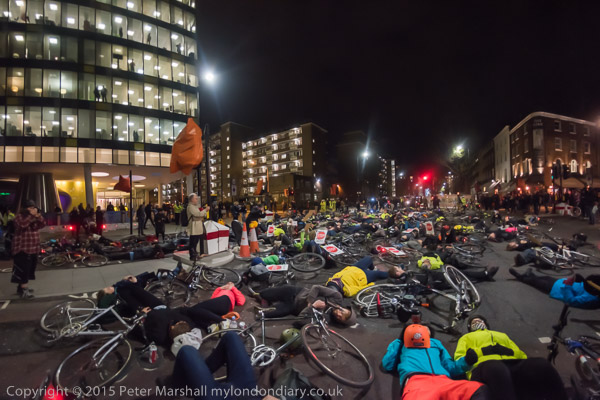
Ten years ago today I was outside the Transport for London Offices on the evening of Friday 27th November 2015 for a rally and die-in by cyclists calling for much greater provision for safe cycling in London.
Stop Killing Cyclists Die-in
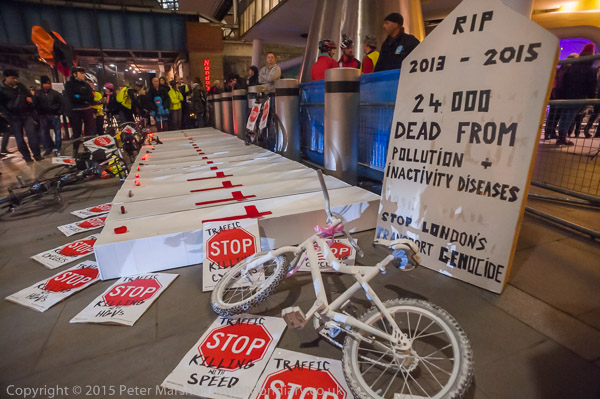
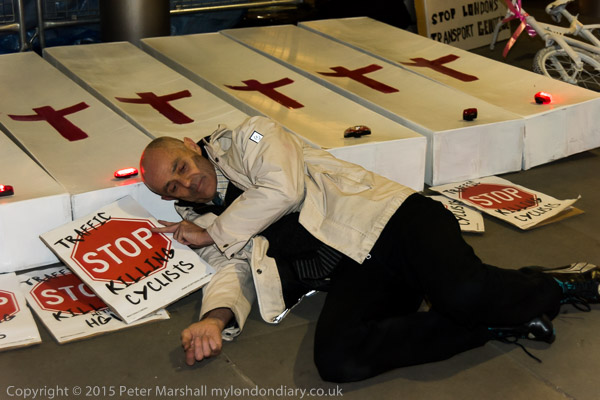
A row of 21 coffins remembering the 21 cyclists killed in London 2013-2015

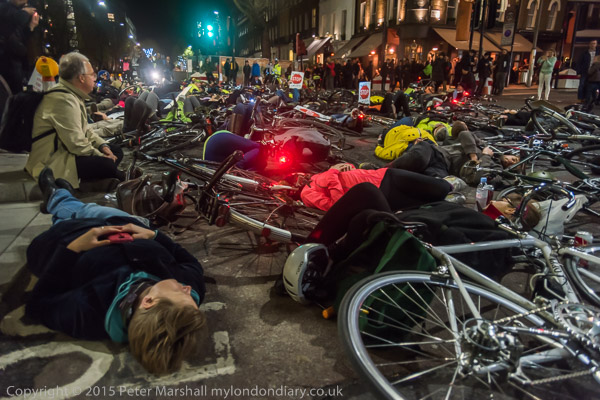
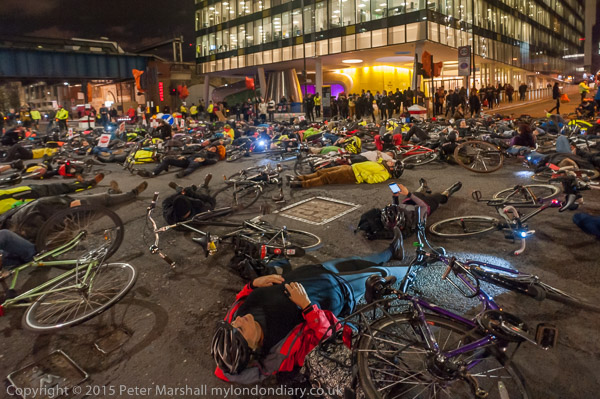
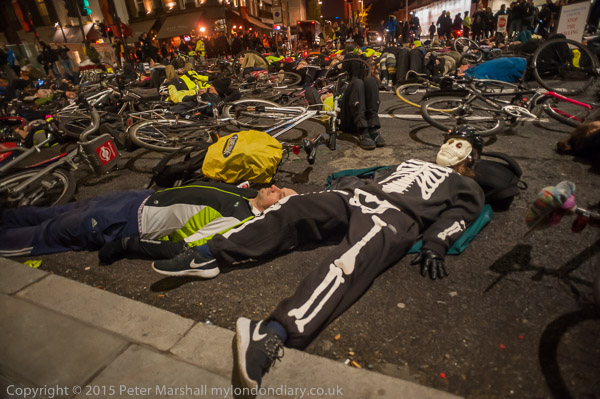
This was two years after their earlier die-in here which had followed the killing of six cyclists in a terrible fortnight on London roads. And after a rally with speeches, poetry and music and reading the names of the 21 cyclists killed, people and bikes again blocked this junction on Blackfriars Road with a short die-in, closing the junction for 15 minutes.
Stop Killing Cyclists Die-in

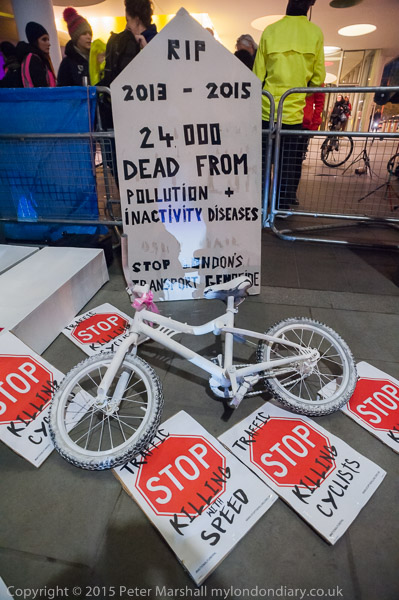
On My London Diary I wrote a fairly lengthy account of the rally, which included speeches from several cyclists who had been seriously injured on London’s roads and were fortunate to still be alive. But in the two years since the previous die-in here, 21 cyclists had been killed and at the protest there was a row of 21 white coffins on the pavement outside the TfL offices, one for each death.
Stop Killing Cyclists Die-in

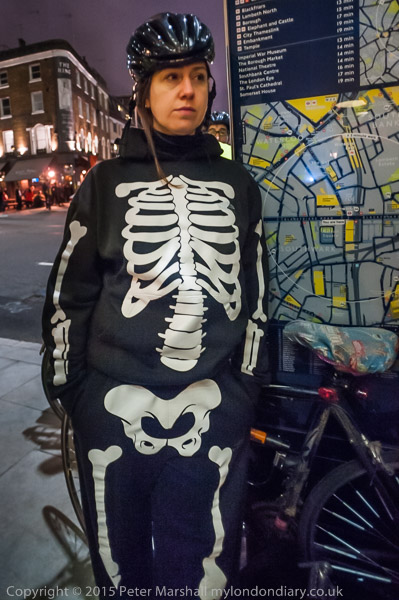
Most cyclists are killed by drivers of heavy goods vehicles, particularly skip lorries, which have very limited vision vision behind and to the side and are unaware of the presence of cyclists.
Stop Killing Cyclists Die-in

In the two years since 2013 progress on cycle safety has been very limited, and before this protest the organisers, ‘Stop Killing Cyclists‘ had sent a questionnaire to all the candidates standing in the forthcoming election for Mayor of London asking them whether they supported the demands for safer cycling, in what they called the “10% by 2020” London Mayoral Cycle Safety Challenge.
You can read the ten demands on My London Diary but the first was for 10% of TfL budget to be spent on cycling safety by 2020. Stop Killing Cyclists point out that this spending and their other proposals would also make London safer for pedestrians and by encouraging cycling (and walking) would make London healthier for us all.
One of the speakers was Professor Brendan Delaney, a doctor working in London, who pointed out that air pollution which comes mainly from traffic, particularly diesel-engines in buses and lorries, is thought to kill around 7,000 a year in London. More people cycling and less traffic could reduce that number dramatically.
The demands also called for a speed limit of 20 mph (except on motorways) across London and more traffic free areas and all five candidates supported the pedestrianisation of Oxford Street. Only Sian Berry of the Green Party and Independent Rosalind Readhead (who stood to ban private cars from London’s Zone 1 & 2) supported the 10% budget demand, though Labour’s Sadiq Khan promised a “significant” increase.

Green Party Mayoral candidate Sian Berry (in black coat)

In his first two terms as Mayor, Khan massively expanded the network of protected cycle tracks and also brought in and improved the Direct Vision lorry standard. And the expansion of the ultra low emission zone (ULEZ) to cover all of London has greatly improved air quality. But this in particular led to considerable public opposition and was blamed by Labour for them failing to win the Uxbridge by-election – although they still came close in what had long been a safe Tory seat.

Donnachadh McCarthy makes the final speech after the 15 minute die-in

Labour’s 2024 election victory has been a disaster for sensible transport planning – as well as more general environmental policies – with a switch to supporting major road-building, a third runway at Heathrow and other measures. Active travel seems no longer to be one of his or TfL’s priorities. Pressure from Labour leader Starmer after Uxbridge forced Khan to commit to not implement smart road user charging in his third election manifesto, severely damaging any chance of realising his ambition to make London a ‘Net Zero’ city including for transport by 2030.

More about the protests and more pictures on My London Diary at Stop Killing Cyclists Die-in.


FlickrFacebookMy London DiaryHull PhotosLea ValleyParis
London’s Industrial HeritageLondon Photos

All photographs on this page are copyright © Peter Marshall.
Contact me to buy prints or licence to reproduce.


Peckham & Blackfriars Road 1989

I was almost at the end of my walk on 12th February 1989. The previous post on this, Almshouses, Relief Station, Flats and a Viaduct had ended on Copeland Road, and I walked down this turning into Bournemouth Road to take me to Rye Lane.

Bournemouth Rd, Rye Lane, Peckham, Southwark, 1989 89-2f-36
Bournemouth Rd, Rye Lane, Peckham, Southwark, 1989

This brought me out opposite the imposing gateway of the Tower Cinema at 116 Rye Lane, designed by architect H. Courtenay Constantine and opened in 1914. In 1989 this was in a poor condition and had an ugly archway fronting the street at pavement level, which I’m pleased to see has now been removed. This wasn’t a part of the 1914 building and was perhaps from the ‘modernisation’ of its frontage in 1955, the year before the cinema closed in 1956. When built the tower had another tower on top and dominated Rye Lane. Although the frontage was narrow it lead to a large cinema behind. There have been various plans for the redevelopment of the site, but it was sold to the council and the building behind the gateway demolished for a car park, and remains in that use, with the tower empty and used to connect this to Rye Lane.

The window immediately above the archway, obscured in my picture now is a large eye, and the large window in the upper storey is filled by a colourful design with a tree, the sun and birds, while, as the video linked above shows, the car park is a home for a number of wild cats.

Tower Cinema Gateway, Rye Lane, Peckham, Southwark, 1989 89-2f-23
Tower Cinema Gateway, Rye Lane, Peckham, Southwark, 1989

In 1989 the lower part of the gateway was obscured by an ugly rectangular wall and you could only see this curve by looking up as you walked through.

Shops, Atwell Rd, Rye Lane, Peckham, Southwark, 1989 89-2f-24

This short row of shops is still on the corner of Atwell Road and Rye Lane, though the shops have changed hands and the buildings look more run down and decidedly less attractive with new windows – the ‘Rising Sun’ has gone – and large ‘Chicken Cottage’ signs part cover and replace those of Just 4 U Continental Greengrocers. During the week the pedestrian area of Atwell Road now has various market stalls.

Back in 1989 the area was clearly a cosmopolitan one – as well as the continental (which?) greengrocers the next shop was a Oriental Supermarket (I think the name is Vietnamese) followed by Tuan Ladies Wear. The one business that remains is R Woodfall, Opticians, its sign at extreme right, still at 183, though more recently D Woodfall, proudly “serving Peckham since 1922.”

This was the last picture taken in Peckham on my walk, but I took a few more on the Blackfriars Road on my way home.

Sons of Temperance Friendly Society, Blackfriars Rd, Southwark, 1989 89-2f-11

So much time has passed that I’m not sure whether my visit to this part of Southwark was intentional or if I simply got on the wrong bus and decided after I realised that it would take me close enough to walk to Waterloo and I found a few things to photograph on my way. I think I saw this building from the top of the bus, rang the bell and jumped off to photograph it.

The Sons of Temperance Friendly Society building at 176, Blackfriars Road was to let in 1989 when I made this picture. Designed by A C Russell and built in 1909-10 it was only listed in 2013 after it had been sold. It was built on a grand scale in a deliberately similar style to some public houses and banks of the era and perhaps offered something of a similar experience but without the alcohol. Owned by the Sons of Temperance until 2011 it then became an architects offices.

The Sons of Temperance, according to Wikipedia “was and is a brotherhood of men who promoted the temperance movement and mutual support. The group was founded in 1842 in New York City” and it came to the UK in 1849 gaining a charter from the US parent organisation in 1855. From 1866 women were allowed to join as full members. As well as social activities it provided support for sick members and burial grants at a time when there was no welfare state. Like most similar organisations it had “secret rituals, signs, passwords, hand grips and regalia“, though these were modernised in 2000. “There were 135,742 UK members in 1926” but in 2012 it stopped providing life insurance and saving plans for its members and the UK society was dissolved in 2019.

Builders, Contractors, Blackfriars Rd, Southwark, 1989 89-2f-12

On the opposite side of the street close to the junction with The Cut is this Grade II listed late 18th century house with a ground floor shop, in 1989 occupied by a builder and contractor, Gordon North. The decoration with herms and urns is probably 19th century, and a board above the doorway read ‘Established 1839‘.

According to British History Online, originally published in the Survey of London in 1950 “No. 74 was occupied by Charles Lines, coachbuilder, from 1814 to 1851 and by the terra cotta works of Mark Henry Blanchard & Co., from 1853–80. The figures on either side of the doorway were probably installed during this period. Since 1881 John Hoare & Son, builders, have been the occupiers.” So perhaps John Hoare had established his business on another site in 1839.

Builders, Contractors, Blackfriars Rd, Southwark, 1989 89-2f-15

By the time I next photographed it, three years later, the builders name had gone. Later the sign above the entrance went and the site is now a restaurant.

This was the last time in February I was able to go on a walk taking photographs, but in March I returned to Peckham for another walk – which I will post about later.

The first post on this walk was Aged Pilgrims, Sceaux, Houses & Lettsom