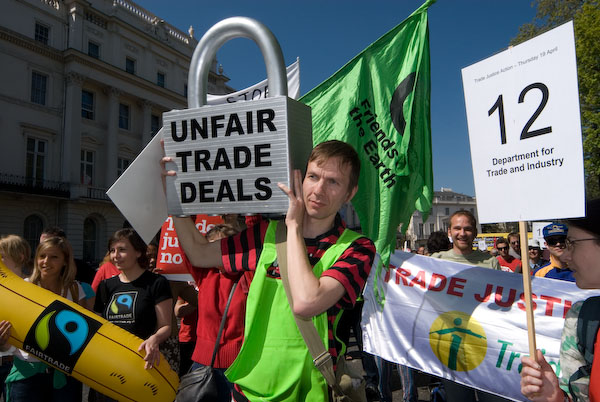
Defend Our Juries Free Political Prisoners: A week ago I went to photograph an unusual protest which took the form of an exhibition, the Free Political Prisoners Exhibition.
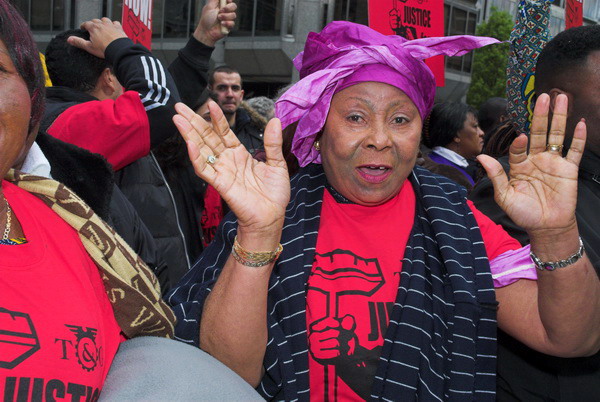
London, UK. 24 Oct 24. Marchers with pictures of political prisoners and other banners and posters arrive at the Attorney General’s office at the Ministry of Justice to call on him to free the 40 UK political prisoners jailed for protesting peacefully against fossil fuel and Israeli arms companies. They demand an end to judges stopping defendants explaining the motive for their protests and uphold the right of jurors to make decisions based on their conscience. Peter Marshall
The protest was organised by Defend Our Juries, a group set up following recent trials in which juries have been prevented from hearing the defences of those on trial and have been directed by judges that they cannot follow their consciences in coming to their verdict.
Juries put the moral sense of ordinary people into the heart of the criminal justice system. In recent years, juries have repeatedly acquitted those taking nonviolent direct action to advance climate, racial, and animal justice. These verdicts are deeply embarassing to the goverment and the arms and oil industries, industry lobbyists such as Lord Walney have promoted extraordinary measures to try and stop them.
People on trial have been banned from using the words ‘climate change’ or ‘fuel poverty’ in court and have even been jailed just for defying that ban,
Usual legal defences have been removed by seemingly biased jusges. People have been arrested and prosecuted for displaying the centuries-old principle of jury equite – juries can find a person on trial not guilty as a matter of conscience, regardless of what the judge directs.
They had come to the Justice Ministry to protest outside the office of Attorney General Richard Hermer KC to ask him to agree to Chris Packham’s and Dale Vince’s request for an open and transparent public meeting to discuss the measures necessary to restore the fundamental rights to protest and fair trial essential to a functioning democracy, as called for by the United Nations.
A marcher holds a picture of Roger Hallam in the exhibition outside the Attorney General’s office
As well as some of the UK’s current political prisons including those from Just Stop Oil and Palestine Action currently serving long prison sentences for non-violent direct action the posters in the show featured many other political prisoner from around the world and throughout history such as Emmeline Pankhurst and Martin Luther King Jr “peaceful change-makers [who] should be celebrated as essential to upholding democracy.”
Reverend Billy of the NY Church of Earthalujah sits with pictures of political prisoners.
Among those taking part in the protest were William Talen, better known as the Reverend Billy, and members of his Stop Shopping Choir from New York, currently on a UK tour who I was pleased to meet again having photographed him at various protests in London in earlier years.
Press Inquiry & Cold Homes Kill: On Thursday 29th November 2012 people protested outside the QEII centre as part 1 of the Leveson inquiry into the general culture and ethics of the British media was being published. Later there was a protest outside the Treasury and Parliament against government cuts in benefits and services that were leading to 24,000 extra winter deaths.
Leveson Comes Out
The Leveson inquiry had been set up in 2011 following the News International phone hacking scandal and after a long series of public hearings came to the obvious conclusion the existing Press Complaints Commission was a total failure – and praised Private Eye for refusing to join it. A subscription to that magazine and the many articles it had published over the years could have saved the £5.4 million that Leveson cost.
Leveson was not of course set up to address the overriding problem of the UK media which is the narrow range of its ownership. As the Media Reform Coalition argued “we couldn’t just rely on better press regulation to improve standards are newspapers – we also had to challenge the disproportionate power these corporations held because they so much of our news media.”
The MRC stated in 2023 “Just three companies—DMG Media, News UK and Reach—dominate 90% of the national newspaper market” and go on to show similar resticted ownership of local newspapers and online news platforms.
The news which almost all of us are allowed to hear is controlled by a very few companies and their billionaire owners such as Rupert Murdoch, and Avaaz had brought to the protest large puppet heads of Murdoch and a gagged Prime Minster Cameron with placards ‘End the Murdoch Mafia‘ with a flaming dustbin into which Murdoch lowered the Leveson report.
The industry response to Leveson was to establish in place of the Press Complaints Commission the almost equally toothless Independent Press Standards Organisation (IPSO) which my union, the NUJ labelled a “pointless so-called regulator” and the Hacked Off campaign described as a sham “owned and controlled by the very newspapers it is supposed to regulate” which does nothing to stop them.
The Press Recognition Panel (PRP) was set up by Royal Charter in 2014 with the duty to establish whether any press regulator met the standards set by Leveson. IPSO declined to apply for recognition but an independent body IMPRESS founded in 2016 has gained recognition.
IMPRESS thas been rejected by all the major national papers and most regional and local papers but now regulates “more than 100 publishers, publishing over 200 publications across the UK.” Most of these are small and local independent print or on-line publishers including many on the left. Among them are Novara Media, Skwawkbox and The Canary.
As well as failing to legislate on setting up the independent regulatory body which Leveson concluded was needed, the Tories later quietly shelved the second part of the inquiry into extent of unlawful or improper conduct within news organisations and the extent of police complicity. It was a clear demonstration of the power held by Mudoch over our government.
Over 50 people turned up outside Parliament and the Treasury to protest against the cuts made by George Osborne and the government’s energy policies which are leading to 24,000 extra winter deaths.
The protest on the day that Energy Secretary, Ed Davey, was introduing the Energy Bill to Parliament was organised by Fuel Poverty Action along with Disabled People Against Cuts and the Greater London Pensioners’ Association.
Other organisations taking part include Single Mothers’ Self-Defence, Southwark Pensioners’ Action Group and WinVisible (women with visible and invisible disabilities).
Many came with plastic silver reflective coated ‘space blankets’ to wear, and there were three ‘tombstones’ with the messages ‘George Osborne Your Cuts KILL’, ‘Gas Power = Killer Bills’ and ‘24,000 Winter Deaths – Big Six Profits up 700%’.
As speakers at the open mike in front of the Treasury on Horse Guards Road said, many were now having to choose between keeping warm and eating – heat or food – and could not afford to do both adequately. Food banks were now common but often unable to keep up with demand, and libraries where many went to keep warm were being closed.
Hypothermia, even among children, was on the increase, had doubled among pensioners and many disabled people had special needs for heating – and some were suffering from having their benefits removed by unfair Atos work capability tests – often to have them eventually restored on appeal, but with no or inadequate means for months before this happened.
Police tried to keep them off the steps of the Treasury but they declined to move and eventually police came and pushed them down, sometimes with rather more than necessary force, but the rally continued on the pavement. Among the speakers was Green Party leader Natalie Bennett.
There were some further confrontations with police as the protesters moved around the area and protested on the pavement in front of parliament, where there was some hilarity as police came to tell them there has to move as “a Royal movement” was about to take place (they didn’t) and the protest ended with photographs on the grass of Parliament Square with the House of Commons and Big Ben as background.
Fair Fares, Kobane and Biomass: Ten years ago on Tuesday 28th October 2014 I photographed protests calling for fairer fares on our railways, an end to the Turkish backed Islamic state invasion of Kobane in Kurdish Syria and finally calling on the Green Investment Bank to end funding for hugely climate wrecking investments in using biomass for power generation.
Fair Fares Petition – Westminster
The Campaign for Better Transport, including their director Stephen Joseph OBE protested at the Dept of Transport before walking to Portcullis Hous to hand a petition with over 4000 signatures to Rail Minister Claire Perry MP calling on the recent increase in Northern Rail evening peak rail fares to be scrapped. My own rail fares also increased by around a third if I need to return from London between 4pm and 7pm, though the evening peak only really begins around 5pm.
We have the most expensive rail travel in the world, largely thanks to privatisation, as well as lower levels of service than many companies, and a hugely complex system of ticketing which often results in passengers paying more than necessary.
Labours Passenger Railway Services (Public Ownership) Bill should eventually bring in a simpler more uniform structure for the railways and we can hope that it might make fares simpler to understand – and perhaps even less costly. Currently it is often cheaper to travel by less green modes of transport, even by air.
We also need to move away from the companies which lease trains and pay out huge dividends to their shareholders to a more sensible system in which the railways actually own trains and ensure that they provide more carriages on services which are now heavily overcrowded – which seem to include almost all CrossCountry trains. Their franchise ends in October 2027.
Kobane – Unite against Isis Drawing – Trafalgar Square
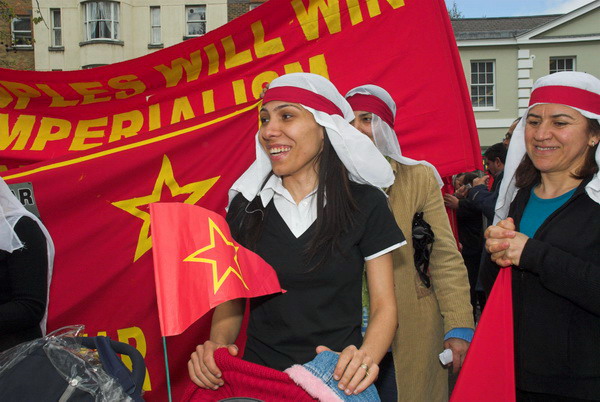
Kurds stood around a giant chalk drawing on the North Terrace of Trafalgar Square including the Statue of Liberty and the message ‘KOBANE Unite against ISIS‘ hold small posters “support progressive and left forces against ISIS” and “Support Kobani Struggle“.
The ISIS forces attacking Kobane, close to the Turkish border in a Kurdish region of Syria were being supported by Turkey as a part of their fight against the Kurds,
The main opposition to ISIS is provided by Syrian Kurdish People’s Protection Units (YPG), who were being supported by US air strikes.
Biofuel picket Green Investment Bank Birthday – King Edward Street
Protesters from Biofuelwatch and London Biomassive, some dressed as wise owls, picketed the second birthday celebrations of the Green Investment Bank at Bank of America Merrill Lynch in London against their funding of environmentally disastrous biomass and incineration projects.
These are more polluting than coal, producing more climate-wrecking carbon dioxide than coal, and protesters urged the GIB to finance “low carbon sustainable solutions” instead of these “high-carbon destructive delusions.”
The protest took place as many city workers were walking past on their way home and many took leaflets and some stopped to talk with the protesters.
There was live music, some short speeches and couple of birthday cakes for the GIB, one edible and the other rather larger with two ‘oil palms’ on top and a banner with the message ‘GIB No Biomass’ strung between them.
Custody Deaths, Kurds, Abortion, Zombies & More: Saturday 27 October 2007 was an unusually busy day for me and the lengthy write-up on My London Diary reflects this. The main event as on every last Saturday of October this century was the annual rally by the United Families and Friends of those who have died in custody who meet in Trafalgar Square for a slow march down Whitehall to a rally outside Downing Street – and I hope to post something about yesterday’s event shortly.
But the stories and pictures from 2007 are a little hard to find at the bottom of a long web page, so here I’ll republish the post – with the usual minor corrections and changes with links to the pictures I took.
Then on Saturday, everything was happening. I had to run around to start with to collect my unsold pictures from the City People show at the Juggler in Hoxton. [Although this web site is stilll on line, that organisation is long since gone dissolved the following year.} Fortunately I’d sold one of my four pictures, so that made them easier to carry, but it was a rush to be back in the centre of London.
Pro-referendum on Europe Rally – Yard, Westminster
Campaigners were just leaving as I arrived and I more or less missed the demonstrators who wanted a referendum on the changes to the European Union.
Protest Against Custody Deaths – Trafalgar Square & Whitehall
Instead I really started at Trafalgar Square, where the annual event remembering those who have died in custody was taking place, organised by the families and friends of those concerned.
Its an occasion that always shocks me by the sheer number of people who have died in such disgraceful or suspicious circumstances, in police cells, in prisons and elsewhere. It’s an event i sometimes find it hard to photograph, both emotionally and physically – thankfully autofocus works even when your eyes are filling with tears.
[I returned to this protest later outside Downing Street – more below]
While the United Families protest is getting ready, a large crowd of Kurds swarms into Trafalgar Square and holds a short rally, protesting against the Turkish governments approval of incursions into northern Iraq to attack the PKK there. Both the Kurds and the Armenians have suffered greatly at the hands of the Turks (who in turn have been rather screwed by the EU over Cyprus,
It’s a typically exuberant performance, and one that I enjoy photographing, but rather a distraction from the family and friends event.
Anti-Abortion (Pro-Life) Rally – Old Palace Yard, Westminster
There seems to be hiatus at this point, so I catch a bus down Whitehall. Walking along to Old Palace Yard I pass a few of the pro-referendum demonstrators, though some others have stayed to join in the anti-abortion protest.
This is rather smaller than I’d expected, perhaps around 500 people, although it is the only event that makes the BBC news bulletins I hear when i get home later in the day.
I listen a little to the anti-abortion speeches but then go to parliament square to take a look at the new statue of Lloyd George – which fails to impress me. Of course he was long before my time – although I did have a landlady as a student in Manchester who had worked as a secretary for him – but somehow I feel the statue trivialises him, looking rather like an enlarged version of a plastic figure you might find in a box of cornflakes rather than a statue.
I rejoin the ‘Families And Friends’ march by now making a considerable protest opposite Downing Street, where a delegation has permission to deliver a letter to the Prime Minister’s residence at no 10.
For some reason the police decide not to allow those with press cards into the street in the normal way. I don’t like going in – the security checks are a nuisance and being restricted to a pen on the other side of the street is normally hopeless. But I think as a matter of principle that access should not be unreasonably prevented – even if personally I don’t want to take advantage of it.
By the time the delegation emerge, the mood is getting rather angry. one young policeman is getting surrounded and insulted and is trying hard to ignore it.A few minutes later a motor-cyclist foolishly stays in the route of the march, and is soon surrounded by angry people. He has to be rescued by his colleagues.
There are police who are racist, who are thugs, who are bullies. Too many who have got away with murder, often thanks to covering up or a lack of diligence in investigation by their colleagues. If it were not so, there would be no demonstrations like this one. But there are also officers who do their best to carry out a difficult and necessary job in a decent, reasonable and even-handed way – even though they may sometimes get disciplined for doing so. Those who bear the brunt of considerable and understandable hate directed against the police at a demo like this are not necessarily the guilty.
It’s time for me to leave and make my way to the City, where this year the zombies are starting their walk at a pub on Ludgate Hill. I go into the pub and talk to some of them and take photographs, and am gratified to find that quite a few have seen my pictures of them from around Oxford Street the previous year.
By the time they emerge from the pub it is getting dark, and my flash by now is refusing to work at all. I have to make do either with available light (and there isn’t a lot) or the pretty useless flash built into my camera, but I still manage to get a few decent pictures, even though some are rather noisier than I’d like.
There are quite a few people around as we go over the Millennium Bridge, and more in front of Tate Modern, where zombies decide to play dead for a while. Then we visit the famous crack in the Turbine Hall, coming out towards the Founder’s Arms, where I made my goodbyes and turned for home.
UFFC 21st Remembrance Procession: Saturday 26th October 2019 saw the 21st annual remembrance procession by the United Families and Friends Campaign (UFFC), a coalition of of people killed by police, in prisons, in immigration detention and in secure psychiatric hospitals.
This takes place on the last Saturday of October each year, and people will meet for today’s procession on 26th October 2024 as usual at noon in Trafalgar Square. It will have added resonance for some following the ‘Not Guilty’ verdict earlier in the week for the officer who fired the fatal shot into the head of Chris Kaba two years ago in Streatham.
Each year sees new names added to those who have died in custody under suspicious circumstances – several thousand since 1990. Not one of those responsible have been convicted of murder or manslaughter.
Many of the suspicions may be unfounded, but others are clearly not. Relatively few have ever been properly investigated, and often there has clearly been a deliberate failure to do so on the part of the authorities.
Inquests have often been delayed for years, and evidence simply not recorded. Only the most determined of family campaigners have succeeded in getting at the truth. A few of these cases have become well known – such as those of Sean Rigg, Christopher Alder and Leon Patterson, but none has yet really resulted in justice.
Coroners have sometimes refused to allow proper consideration of the possible responsibility of the police and courts have at times come to conclusions that seem to fly in the face of the evidence. Police officers have on occaison colluded with each other to commit perjury.
The so-called Independent Police Complaints Commission (IPCC) began work in 2003. Wikepedia notes that in 2008 “over a hundred lawyers who specialise in handling police complaints resigned from its advisory body, citing various criticisms of the IPCC including a pattern of favouritism towards the police, indifference and rudeness towards complainants, and complaints being rejected in spite of apparently powerful evidence in their support.”
A Parliamentary Inquiry set up in 2012 described it as having “neither the powers nor the resources that it needs to get to the truth when the integrity of the police is in doubt.“
In 2018 the IPCC was replaced by the Independent Office for Police Conduct (IOPC). Again Wikipedia quotes from a Parliamentary report published on it in 2002: “There needs to be a change of culture in police forces. It should not be necessary to compel officers to cooperate with investigations. This culture change must be from top to bottom to ensure that complaints are handled quickly and openly, delivering punishment for misconduct where necessary and clearing officers who have not committed an offence.”
Also we have the Crown Prosecution Service, with Keir Starmer at its head from 2008-2013. Together there seems to be clear evidence of a powerful system of injustice which has protected police. And one of the most frequent chants at this and other events has long been ‘NO JUSTICE, NO PEACE!’
Many at the protest carry banners, poster and placards with names and pictures of those who have been killed. I’ve written in previous posts about many of them and more details are on various web sites, Facebook and elsewhere. Recently I published a post here Sean Rigg Memorial – 4 Years about a rally in 2012.
Racist Borders Agency & University Protest Ban: On Thursday October 24th 2013 I photographed a protest against the racist actions of the UK Borders Agency outside the Home Office Reporting Centre in Hounslow, West London before travelling into central London where supporters of the campaign calling for proper sickpay, holidays and pensions for all workers at the University of London defied a ban on protests by the University authorities.
Southall Black Sisters Protest Racist UKBA – Eaton House, Hounslow
The racial profiling of the UK Borders Agency in their spot checks at rail and underground stations in areas such as Southall, Slough, Brent and East London cause great anxiety in our minority communities, many of whom are British citizens born in this country.
Home Secretary Theresa May had in 2012 announced that her aim “was to create here in Britain a really hostile environment for illegal migration”, and set out to do so by a series of measures, some illegal and all morally reprehensible.
After a successful legal challenge to the Home Office use of slogans on advertising vans, the UKBA had, according to Southall Black Sisters had “shifted the ’Go Home’ message to reporting centres in Glasgow, Croydon and Hounslow.” And so they had decided to hold this protest at the Hounslow centre inviting others to join with them “in demonstrating against the Government’s anti-immigration campaigns.“
They said “We will not tolerate underhand tactics used to instil fear and divide us. Let us return to the streets and make our voices heard. We need to fight for our rights.”
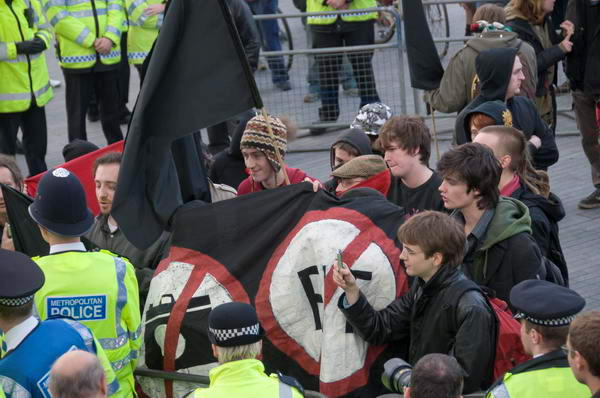
Most of the 30 or so people who made their way to the centre, housed in the former offices of a pharmaceutical company on the edge of London, opposite Hounslow Heath, poorly served by public transport (perhaps deliberately remote to make life more difficult for migrants and asylum seekers who have to report there) were from Southall Black Sisters, but there were a few from other groups with a banner with the message ‘F**K ALL RACISM – NO ONE IS ILLEGAL’.
A few police had turned up to watch, and one officer complained about the language used by one of the women present. She complained strongly that she had been responding to a racist remark by a passer-by, and asked why the officer had not responded to that. He replied that he had not heard the remark, but had heard her reply, and was surrounded by a group of women blowing whistles and horns and banging drums for a couple of minutes before being rescued by Pragna Patel, Director of Southall Black Sisters, who told the group they should get on with their demonstration.
The protest was still continuing when I left after about an hour to get one of the infrequent buses to the centre of Hounslow to catch the tube.
3 Cosas Defy London University Protest Ban – Senate House, University of London
Supporters of the ‘3 Cosas’ campaign for sick pay, holidays and pensions for all workers at the University of London and others today defied University management ban of protests by holding a noisy protest in and around Senate House.
The ban was seen by students and staff at the University, including cleaners as an attempt to prevent free speech and freedom of assembly at the university and the threat to bring in the police to prevent further protests as one which recalls the actions of authoritarian regimes overseas, rightly condemned across academia and the rest of society. The university was threatening to bring charges of trespass against any protesters.
The protest was called by the 3 Cosas campaign (Spanish for ‘3 things), University of London Union (ULU) and the IWGB (Independent Workers of Great Britain) which represents many of the cleaners in the university, and was supported by others including members of Unison and the UCU.
They began with a noisy protest outside the gates on the east of the site, before going around to continue their protest at the south entrance to Senate House, opposite the queues waiting to enter the north entrance of the British Museum before going on the the locked West Gates.
From outside we could see a few protesters already being ejected from the lobby under Senate House. Some people climbed over the gates to join them, but most of us found an easier way through an open gate and across a lawn, and soon the protest was taking place outside the now locked gates to the lobby at the bottom of Senate House.
After a while the protesters moved out to the area in front of SOAS and I thought the protest was over. But a group with the IWGB banner had other ideas, rushing down the narrow path into the Senate House East car park, and the rest of us followed.
At Senate House they were met by two police and management representatives who told them they were not allowed to protest. The only result of this was to add the slogan ‘Cops Off Campus!‘ to that of ‘Sick Pay, Holidays, Pensions, Now!’ and the protest continued, getting rather louder as more police arrived.
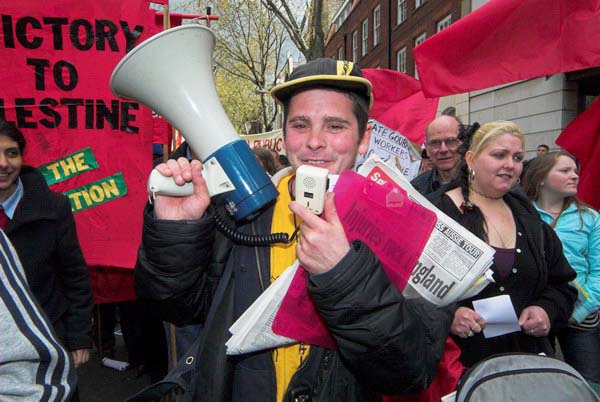
ULU Vice President Daniel Cooper used a megaphone to question why the protest was being filmed from a first floor window and then talked about the shame that the University was bringing on itself by its refusal to insist on decent conditions of employment for all workers in the university, for attempting a ban on freedom of speech and assembly in the university and for bringing police onto the campus against staff and students of the university.
More police arrived and made an ineffectual attempt to kettle the protesters, who simply walked through gaps in the police line. The police regrouped and tried to stop them leaving in a narrower area, but by now some officers were trying to stop them while others were shouting to their colleagues to let them leave. At last realising that their presence was only inflaming the situation and prolonging the protest and marched away. The protesters held a short rally in front of the SOAS building before dispersing.
DPAC Court Vigil, a Poet Arrested, Musical Poor Doors & More: Wednesday 22nd October 2014, ten years ago today was a busy day for me. You can read my full accounts of the various events I photographed on the links to My London Diary, along with many more pictures, but here I’ve only space for a short outline. Below is my day more or less in order.
DPAC High Court Vigil for ILF – Royal Courts of Justice,
When disabled people won a court case over withdrawal of the Independent Living Fund the government simply put back the closure of the fund. Today’s protest by Disabled People Against Cuts (DPAC) supported a second case against the closure. Speakers at the vigil included three MPs, John McDonnell, Andy Slaughter and Jeremy Corbyn, as well as many from various disability groups.
At the end of the protest, DPAC carried out their usual direct action, blocking Strand outside the court with their wheelchairs.
End UK shame over Shaker Aamer – Parliament Square, London
Protesters were continuing their regular vigils opposite Parliament for Shaker Aamer, imprisoned and tortured for over 12 years and cleared for release in 2007. They believe he was still being held because his testimony would embarrass MI6 as well as the US.
I took the tube from Westminster to Canary Wharf to visit the Bridges exhibition at the Museum of London Docklands, later returning to Westminster. I paused in Westminster Station to take some panoramic images of the interior, designed as Piranesian, though sometimes I get more of the feeling of Escher as you seem to walk endlessly up escalators and around the interior.
I found the show a little disappointing, but took advantage of my visit there to take a few more panoramic images.
I made a couple of visits to the Democracy Camp in Parliament Square both before and after going to Canary Wharf. Although the camp had been ejected from the main grass area workshops and rallies were still taking place throughout the day, and Danny, the ‘Plinth Guy‘ was still up there with Churchill since the previous day – and there were cheers when he completed 24 hours.
Earlier someone had been arrested for throwing him a bottle of water, and when performance poet and activist Martin Powell arrived with a plastic tub of food he was warned he would be arrested if he tried to give it to Danny.
He replied it could not possibly be a crime to feed a hungry person and threw it extremely accurately over police heads and into Danny’s waiting hands. Arrested and marched away he loudly recited his poem ‘The Missing Peace’.
Danny was still in place when I returned at 5pm but the police had called in their climbing team. I listened while its leader talked with him, and Danny told him he would not resist arrest if they came to take him down peacefully. But I had to leave before they started to do so.
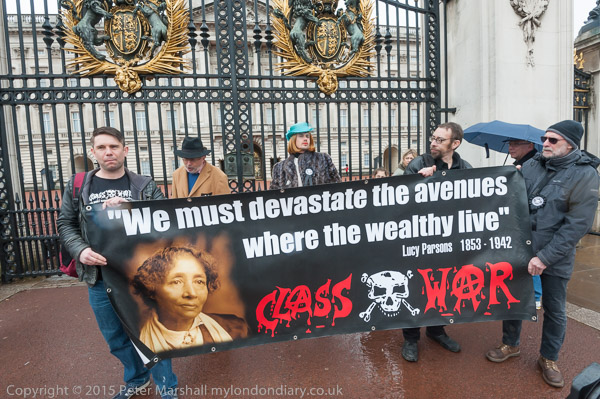
This was Class War’s 14th weekly protest at the ‘rich door’ of Redrow’s One Commercial St flats and it was a lively affair with the banners dancing to the music of Rhythms of Resistance, a poetic performance and some rousing speeches against social apartheid.
There ws strong police presence but there was no trouble, with a carnival atmosphere and banners dancing up and down the wide pavement in front of the rich door. Most of the police appeared to be enjoying the event too.
As usual after an hour of protesting people dispersed and I went into Aldgate East station to begin my journey home.
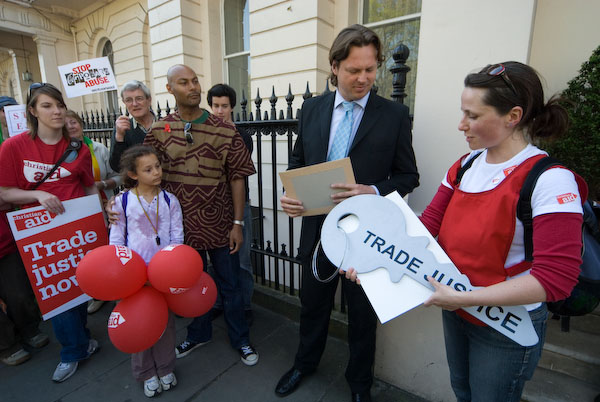
Jesse Jackson, Cuts & Paris • New York • London Opening: Wednesday 20th October 2010 was an unusual day for me. I don’t often photograph conferences, but I started at one where Jesse Jackson was speaking and then went to lobby my MP over tax justice. Kwasi Kwarteng was seldom seen in the constituency but later became notorious when he helped Liz Truss crash the economy. From there I used to cover people marching to Downing Street against the government spending cuts before leaving to go to the Shoreditch Gallery for the opening of a show by three photographers I had organised, ‘Paris – New York – London’ (I was Paris.)
Jesse Jackson & Christian Aid Lobby – Westminster
2,500 Christian Aid supporters including my wife had come to Westminster to lobby their MPs on 20.10.2010, asking them to press for transparency and fairness in the global tax system and for action on climate change.
According to campaigners for tax justice various forms of tax dodging by multinational companies was then robbing the global South of more than $160 billion a year. And our high dependence of fossil fuels had led to a climate crisis which impacts these countries far more severely despite their much lower per capita carbon footprints.
The rally took place in the vast Methodist Central Hall, opposite Westminster Abbey, and as we were reminded where the United Nations started. There was a huge ovation for US Civil Rights leader, activist and politician Jesse Jackson, a protégée of Martin Luther King president and founder of the Rainbow PUSH Coalition.
But there were also other distinguished speakers including the then new director of Christian Aid, Loretta Minghella, Suzanne Matale from Zambia and secretary of state for international development and MP for Sutton Coldfield, Rt. Hon Andrew Mitchell MP.
After the rally we met our local MP Kwasi Kwarteng and went with him into a pub opposite Parliament where he he listened to us and basically told us we didn’t understand global finance and climate change, before going outside to pose with for photographs.
Outside there was some street theatre by younger Christian Aid supporters as people queued to meet there MPs and I made a few pictures before rushing away to find people marching to protest against government cuts.
March Against Spending Cuts – Malet St & Lincolns Inn Fields
Earlier in the day the government had announced there would be considerable cuts in welfare benefits and the loss of many public sector jobs as services are cut following their comprehensive spending review.
The deficit left by New Labour had given the Tories in the Con-Dem coalition a perfect excuse to slash the public sector and privatise services in a way they would never have dared before. £83 billion to be cut from public services, in a move that the Coalition of Resistance pointed out will mean many workers with less to spend and cause a slump in the economy.
But as I commented “Big business must be rubbing its hands with glee at the thought of the profits it will be able to make in the health service, from so-called ‘free schools’ and elsewhere.”
But for the rest of us the prospect was bleak. More than a million jobs lost – and some would be replaced in the private sector with lower wages, fewer benefits, lower standards of delivery and safety and higher workloads. Profit will come before anything else in the kind of “efficiency” we’ve seen in hospital cleaning – where I found used needles and dressings under my hospital bed as cleaners were not allowed the time to do the job properly.
I went to photograph students setting off from outside the student union in Malet Street for the march to Downing Street, then went to Lincoln’s Inn Fields where trade unionists and more students gathering and there were speeches from an open top bus before they too set off.
But I went in the opposite direction to my opening at the Shoreditch Gallery.
John Benton Harris (1929-2023), one of the finest photographers to come out of New York, settled in London in 1965 but continued also to photograph his native city and elsewhere. He was long a personal friend and I worked with him on a number of his projects including his Café Royal Zines and his unpublished book on the English.
Paul Baldesare, another friend of mine with whom I’ve often shown pictures and a former student of John Benton-Harris showed work from one of his many projects on London, He is probably best known for his pictures on the tube.
And I was showing a selection of images made in Paris in 1988 from a book I had also then recently published on Blurb.
Fracking, Congo & Caste: On Saturday 19th October 2013 I began work at a protest calling on the former boss of BP to resign from the House of Lords because of his vested interest in fracking, then photographed a protest against the atrocities being committed in the battles for mineral wealth in the DRC, Uganda and Rwanda before covering a march bringing a petition to Downing Street against the continuing delays in making caste discrimination illegal in the UK.
Global Frackdown: Lord Browne resign! Mayfair
Campaigners went to the offices of private equity firm Riverstone Holdings to call on its managing director Lord Brown of Madingley, a former boss of BP, to resign his seat in the House of Lords because of his vested interests in fracking.
John Browne joined BP in 1966 and worked his way up the company to become CEO in 1995. Knighted in 1998, he joined the House of Lords as Baron Browne of Madingley. in 2001 while still being BP CEO. In 2007 he resigned from BP when accused of perjury in atempting to stop newspapers publishing details of a former homosexual relationship and of alleged misuse of company funds.
In his time at BP he was responsible for a ruthless programme of cost-cutting that many feel compromised safety and contributed to the 2005 Texas City Refinery explosion and in 2010, the Deepwater Horizon oil spill.
In 2013, Browne was Managing Director and Managing Partner (Europe) of Riverstone Holdings LLC, and more significantly for today’s protest the chairman of Britain’s only shale gas driller Cuadrilla Resources.
The protest outside Riverstone was a part of a day of a ‘Global Frackdown’ with protests against fracking in 26 countries and in other cities in the UK.
Friends of the Earth activists met on Oxford Street and walked to the office in Burlington Gardens, where after a brief speech about Lord Browne’s involvement in fracking people were invited to write messages and put them in a small brown rubbish bin which would be left at the offices for him.
People wrote messages and posed with them calling for an end to fracking at Balombe and elsewhere in the UK as well as showing support for the Elsipogtog First Nation who had a few days earlier been attacked by the Royal Canadian Mounted Police with live ammunition and tear gas while protesting against fracking in New Brunswick, Canada.
Fortunately police in London merely came to ask the protesters what they intended to do before saying ‘Fine, no problem’ though they did later ask them to ensure there was a free path along the pavement and remind them and photographers of the danger from the slow moving traffic.
The activists point out that fracking contaminates huge volumes of water with sand and toxic chemicals and also that any fossil fuel production should be avoided as using fossil fuels increases the climate crisis.
Don’t Be Blind to DR Congo Murders – Piccadilly Circus
Continuing battles over the mineral wealth of the Democratic Republic of Congo, Uganda and Rwanda have led to the murder of more than 8 million people and over 500,000 men, women and children have been raped by the various armies funded by various European and African multinational companies.
Gold, diamonds, coltan, tungsten, tin and other ores should make these countries rich, but have led to huge devastation. Coltan, containing both niobium and tantalum is vital for the mobile phones, computers, missiles and other modern technology on which we rely. The fight for it has been the main incentive behind the genocidal wars that have waged in the area.
Despite various protests over the years by Congolese in London there has been little publicity to the atrocities and no action by our government. The ‘Don’t be Blind This Time’ campaigners came to Piccadilly Circus to raise public awareness, some posing in blindfolds and others handing out a thousand free flowers, with the message that that we need to demand justice and an end to the impunity and cover up around this conflict.
The wars continue in 2024 and have recently intensified. China now also being increasing involved as US companies have since 2013 sold their mines to Chinese companies who now own most of the mines in the DRC.
I don’t remember seeing any mention of this protest in the media, and we see few reports of the terrible situation continuing in the area. British editors seldom seem to regard this or conflicts in other areas of Africa such as Sudan as news.
Make Caste Discrimination Illegal Now – Hyde Park to Whitehall
Negative discrimination on the basis of caste, long a traditional part of Indian society, was banned by law there in 1948 and is a part of the 1950 constitution, though it still continues. In the UK The Equality Act 2010 passed under New Labour in 2010 gave our government the power to make caste discrimination illegal but they lost the election before doing so.
The incoming coalition government was reluctant to action, but pressure continued and in 2013 the Enterprise and Regulatory Reform Act 2013 mandated this to be done; instead the government set up a two year consultation, apparently as a result of lobbying by the Alliance of Hindu Organisations, (AHO) a body set up to oppose what they call “the threat posed by this proposed amendment to the Equality Act 2010.”
The consultation appears also to be only with established groups dominated by upper caste interests, and its length entirely unnecessary. It isn’t clear why a simple elimination of a clearly discriminatory practice should be regarded as a threat.
A report on the consultation was finally published in 2018. In it the government rejected the idea of a law against caste discrimination and instead concluded:
Having given careful and detailed consideration to the findings of the consultation, Government believes that the best way to provide the necessary protection against unlawful discrimination because of caste is by relying on emerging case-law as developed by courts and tribunals. In particular, we feel this is the more proportionate approach given the extremely low numbers of cases involved and the clearly controversial nature of introducing “caste”, as a self-standing element, into British domestic law.
They also state that any law would “as divisive as legislating for “class” to become a protected characteristic would be across British society more widely.” I don’t think this comparison has any merit. Not to act seems to me to be accepting a foreign practice, illegal in its country of origin, into British society, and the low number of cases they comment on surely means that case-law will only emerge at a snail’s pace. Our new Labour government should follow the example begun by New Labour in 2010 and make caste discrimination illegal in the UK.
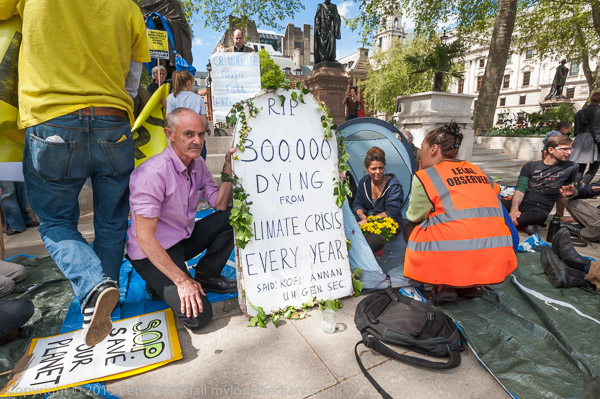
Palestine, Boris & Democracy Camp: Ten years ago on Friday 17th October 2014 I covered a protest against bans on family visits to Palestinian prisoners, a spoof newspaper claiming Boris had seen the light over housing shortages and a rally in Parliament Square where Occupy Democracy were intending to camp and hold an unauthorised nine-day event.
Ban on Family visits to Palestinian Prisoners – Victoria
People had come to protest outside the new offices of the G4S Chief Executive Officer in Peak House, a new office building opposite Victoria Station.
It was a tricky site to hold the protest as most of the area was a building site, with extensive work being carried out to improve Victoria Underground Station (not part of Crossrail as I wrongly thought then, but possible important for the currently suspended Crossrail 2). But the protesters made use of the fences around this part of the building site to attach some of their banners.
The building works brought many of those walking towards and from Victoria to pass close to the demonstration and more than usual took the leaflets they were offered, with a few stopping to talk and express their sympathy with the protest. There were also two who made adverse comments and I missed seeing when one of them grabbed the lowest of three Palestinian flags of a long pole held by one of the women; she held on to the pole, others rushed to her assistance and the man hurried away.
They were protesting against Israel issuing banning orders denying Palestinian families the right to visit their loved ones in prison. A hunger strike in April 2014 by administrative detainees held without trial had ended when Israel had promised to reinstate family visits, but in July Israel reneged on this promise and went back to issuing banning orders again.
Among individuals the protest highlighted the case of Mona Qa’adan, a woman university lecturer who has been held in jail since November 2012 and has not been allowed a single family visit in two years. She is held in poor health without any trial at the G4S secured women’s prison HaSharon, where prisoners endure beatings, insults, threats, sexually explicit harassment and sexual violence, and humiliation at the hands of Israeli guards. The cells at HaSharon prison are overcrowded, dirty and infected with rodents and cockroaches and there is a total absence of basic hygiene.
In Parliament Square I met campaingers from the Radical Housing Network with bags containing thousands of copies of a spoof edition of the ‘London Standard Evening‘ newspaper.
Under the headline ‘Boris in shock housing U-turn‘ the paper had Boris Johnson saying “its time to put the social back into housing” and carried features about London housing scandals.
The spoof edition was produced for the final day of the world’s largest property fair, known as MIPIM, which had taken place over three days at Olympia, with protests outside it and a day of workshops on housing issues. London Mayor Johnson had welcomed property developers, investors, financiers and politicians from around the world and encouraged them to build more large tower blocks here to sell to overseas investors.
“These developments feed the boom in house prices and rents in London and so exacerbate our increasingly serious housing problem, with a desperate shortage of social housing. Ten of thousands of London families are on council house waiting lists, and communities across the city face eviction and displacement at the hands of the profiteering developers Johnson welcomed to the city with open arms.”
The campaigners left carrying the bags to hand them out outside key tube stations around Central London, but I stayed in the square for Occupy Democracy’s rally.
Democracy Camp starts with rally – Parliament Square
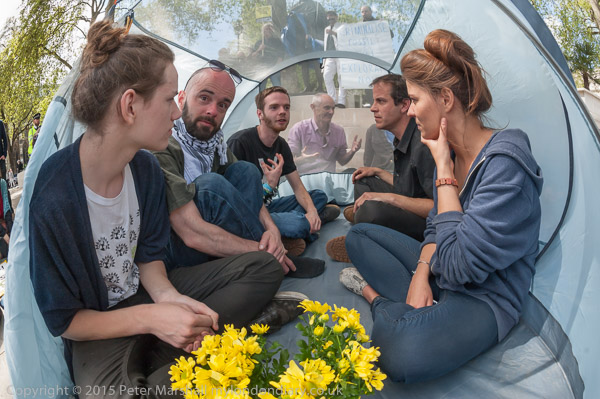
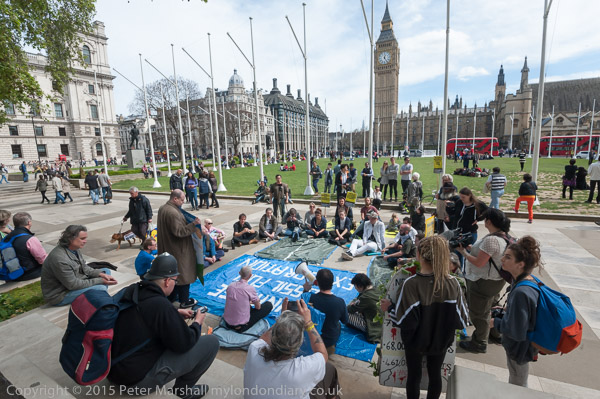
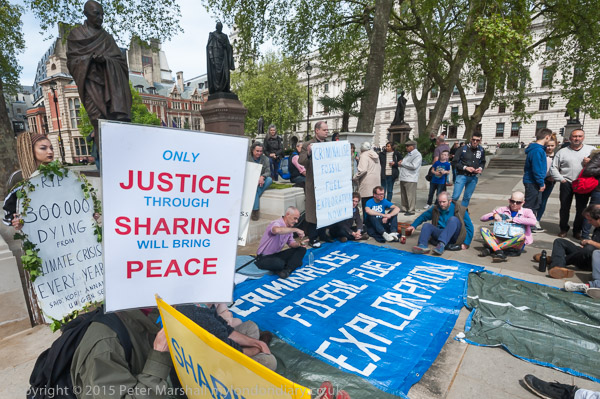
Democracy Camp had widely announced their plans to camp in Parliament Square for nine days and hold a series of protests, rallies and workshops there. Many arrived for the rally with tents and sleeping bags determined to stay.
They intended “to broadcast and demand the solutions we already know exist, to inspire people to be the active citizens required to take back democracy from powerful economic interests.“
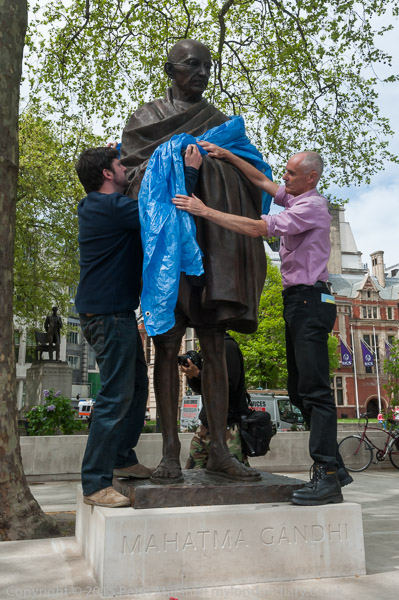
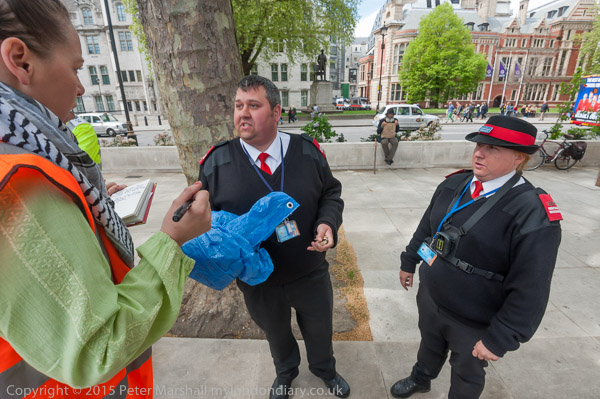
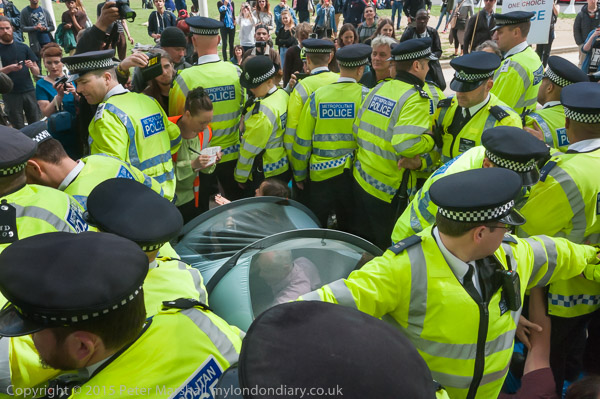
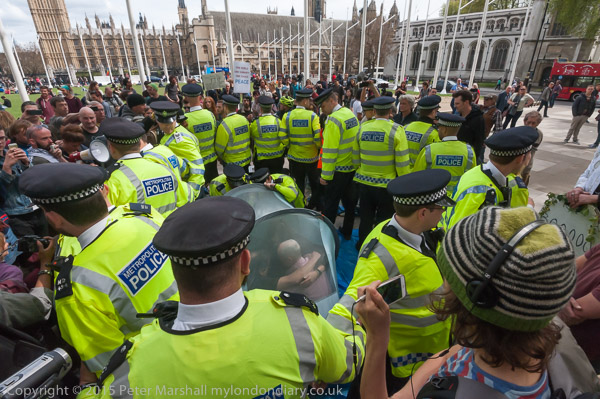
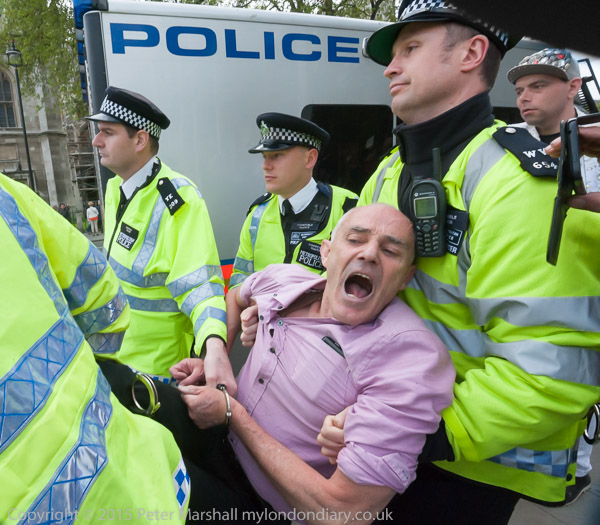
Police and Mayor Johnson were determined they would not set up camp. Police ‘liaison officers‘ handed out an ‘Important Notice’ – basically telling protesters that democracy was stuffed by Act of Parliament as far as Parliament Square was concerned – and Westminster Council bylaws almost make breathing an offence.
Rather strangely, the Greater London Authority had suddenly decided the the rather healthy looking grass covering most of the square was urgently in need of repair and put up notices closing the area, roping it off, Though those of us who had visited the square knew that they hadn’t done anything about the part of it that really needed attention for weeks. An area that had been damaged by an allowed event some weeks earlier and badly needed roping off and reseeding had still not been touched.
People had come with bags but when asked by police and the private security ‘Heritage Wardens’ stated they intended to sleep elsewhere in London. Police argued with them but I think the media presence stopped them taking the bags away despite the urging by the private security wardens.
Eventually the start of the evening rally was announced and some speeches began with John Hilary, Executive Director of War on Want and author of The Poverty of Capitalism, followed by others including Mansfield vicar Keith Hebden who had fasted for 40 days for the End Hunger Fast campaign and Robin from the Radical Housing Network talking about MIPIM.
It was getting dark and I was getting tired and hungry. I left to file my pictures and to eat and sleep in a comfortable bed while the rally and the occupation of the square continued.
I came back the following morning and covered events later in the day when the camp did take over the grass and set up camp.