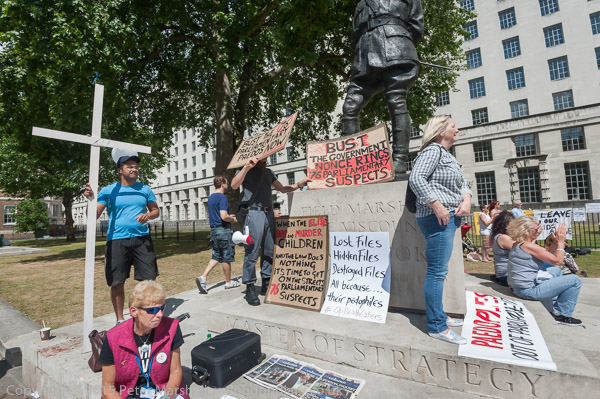
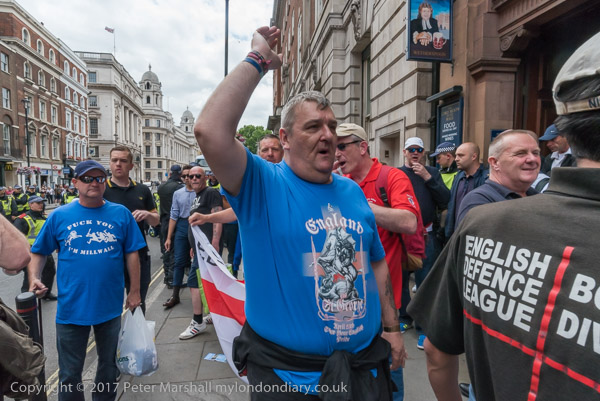
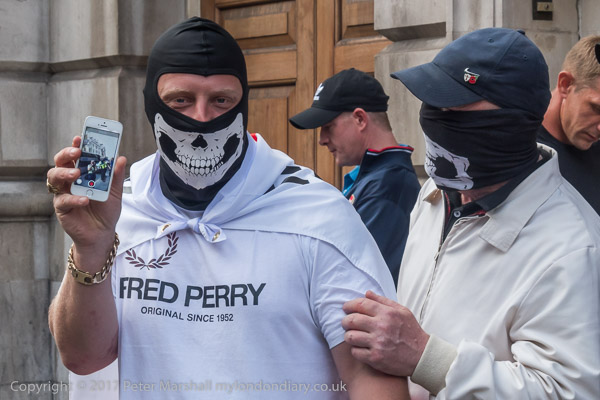
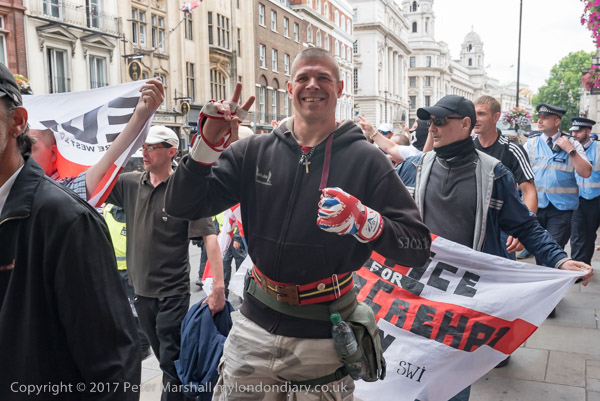
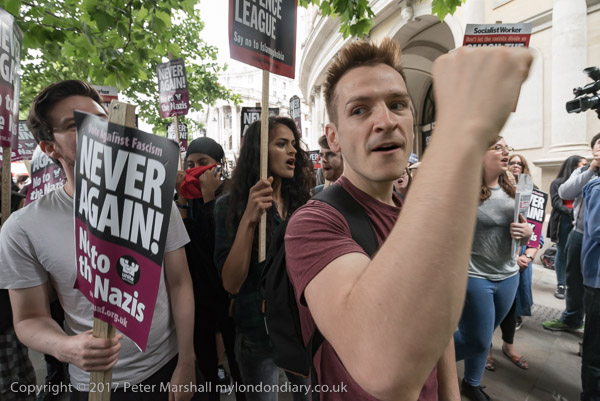
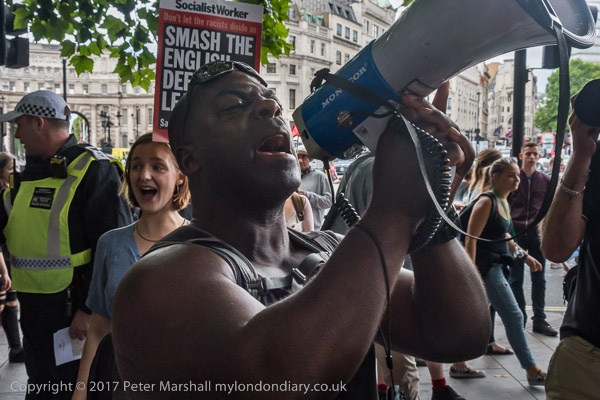
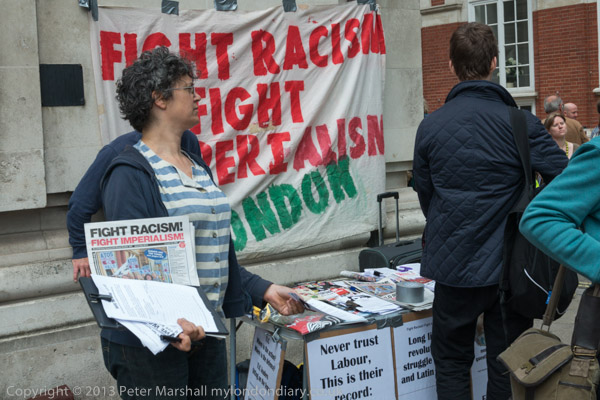
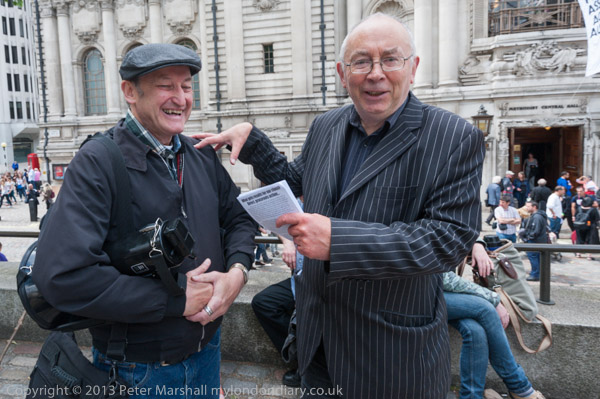
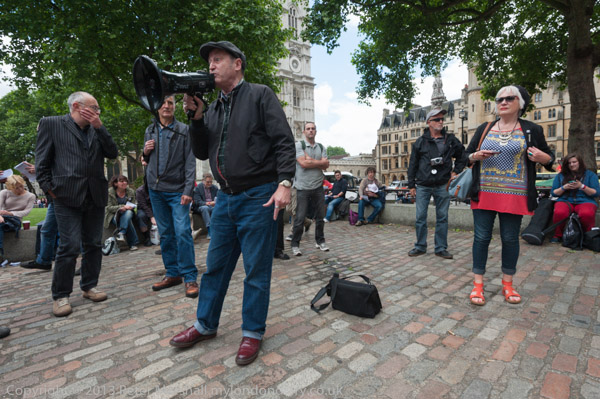
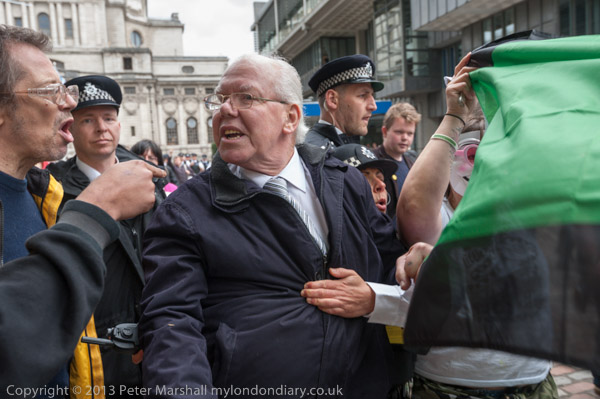
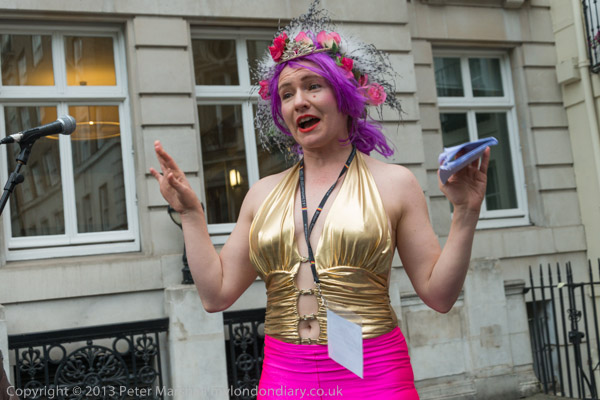
EDL No Show & Pride Celebrates Love and Marriage: I began my day with Unite Against Fascism activists who met at Speakers Corner to opposed a march by the EDL, but they didn’t turn up. After taking a few pictures as the UAF celebrated news of the arrests of the EDL leaders as they defied the Tower Hamlets ban I walked to where Pride was gathering in Baker Street.
UAF Oppose, EDL Don’t Come
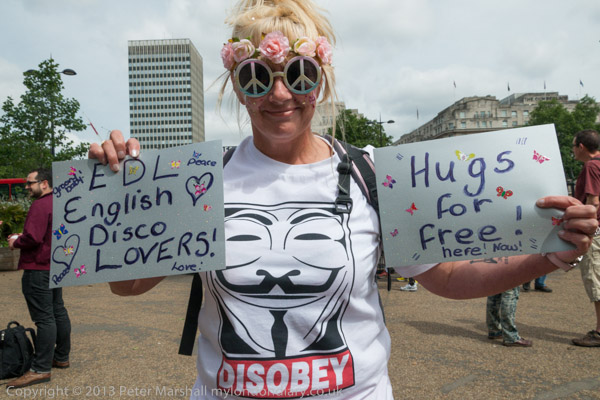
The only EDL present were English Disco Lovers
On Saturday 29th June 2013 the English Defence League had been banned by police from entering Tower Hamlets and protesting by walking past the East London Mosque as well as from any assembly or procession in Woolwich. Instead they were allowed to march from Hyde Park to Parliament and UAF had been given permission to march in protest in the same area against them.
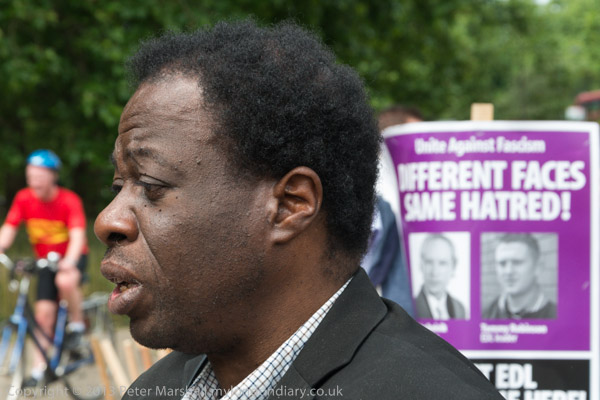
There were only 50 to 100 UAF supporters at Speakers Corner when I arrived, perhaps because it had become clear that the EDL seemed unlikely to accept the police compromise. While I was there the news came through that the EDL leaders Stephen Lennon (‘Tommy Robinson’) and Kevin Carroll had been arrested in Whitechapel as they tried to ignore the ban and was greeted with loud cheering.
Pride Celebrates Love and Marriage – Baker St – Trafalgar Square
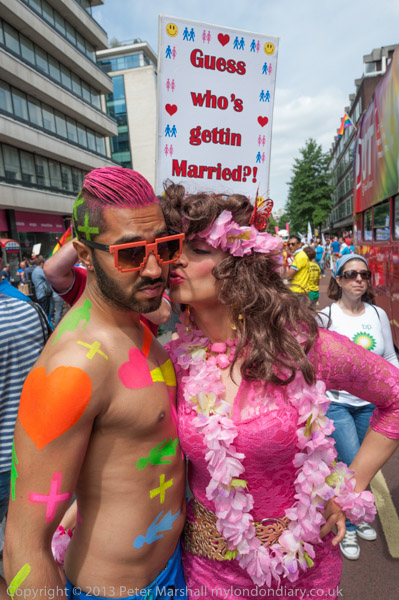
Pride 2013 celebrated the passage of the 2013 Marriage bill then going through the UK parliament – it became law as the Marriage (Same Sex Couples) Act 2013 the following month, though only came into force in March 2014. A similar Act in Scotland came into force later in 2014, but couples in Northern Ireland had to wait another six years.
As I commented, “Pride has for years become a celebration of gay lifestyle, with a large participation by corporates who profit from this, but at least this year the overall theme was related to a political event.”
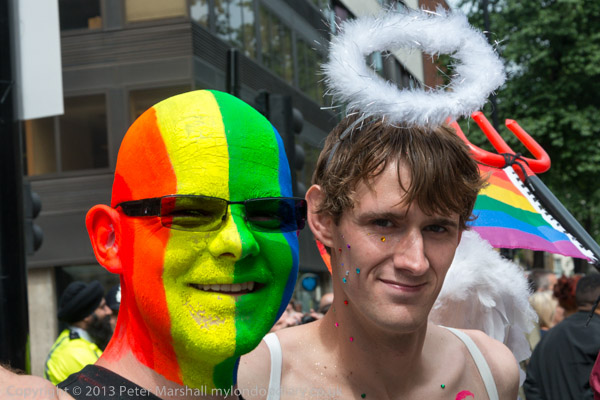
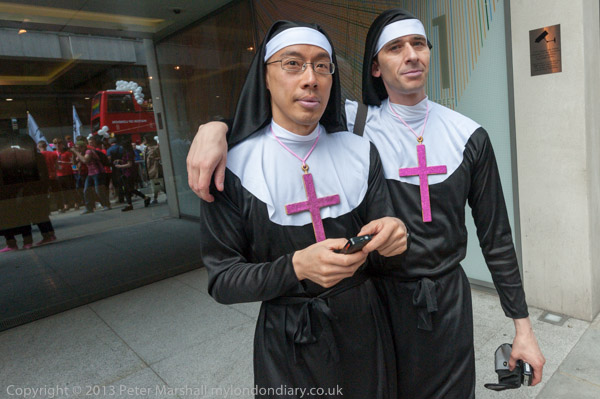
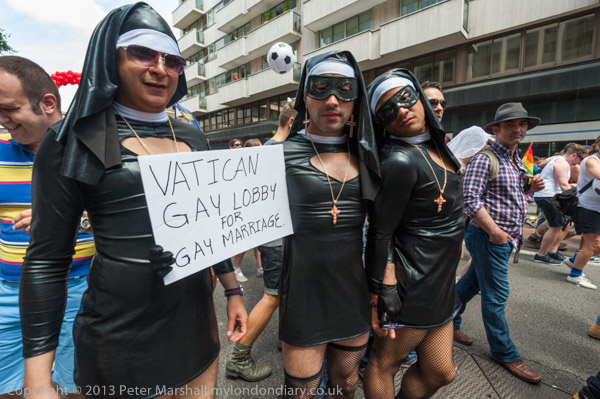
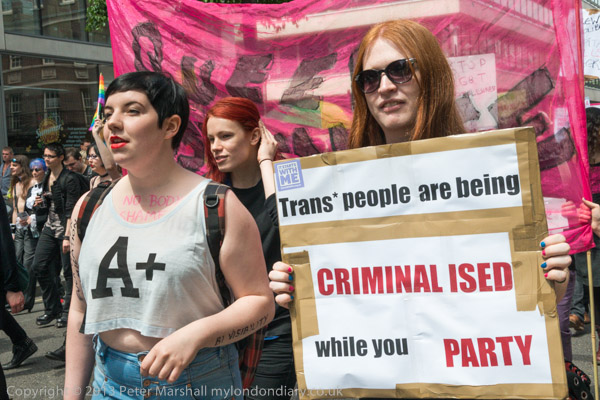
I tried in my coverage of the parade to cover as many as I could of those taking part who were clearly celebrating that theme, as well as many of the other individuals and groups who provide the incredible diversity and colour of the event.
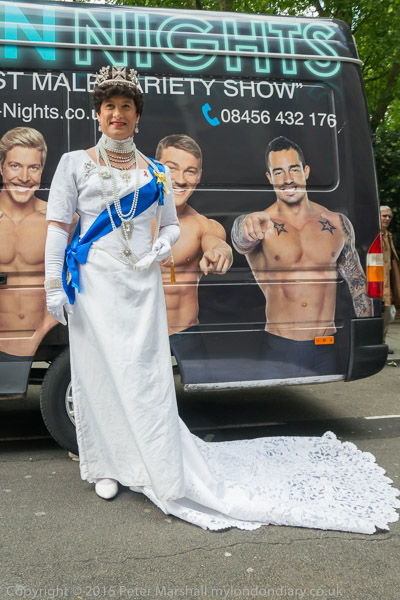
‘The Queen’ put in her usual appearance
The parade was forming up on Baker Street and I arrived there a couple of hours before they all moved off, and most of my pictures were taken there, but I later went on to Trafalgar Sqaure, leaving when the end of the parade reached there. Here are just a few of the pictures I made – you can see many more on My London Diary.
Two nuns…a small military groupA wedding dress with a huge train‘Vatican Gay Lobby for Gay Marriage’‘Trans* people are being Criminalised while you Party’‘On Honeymoon’Stonewall: ‘Some Girls Marry Girls. Get Over It.One of many wedding couplesAnd another
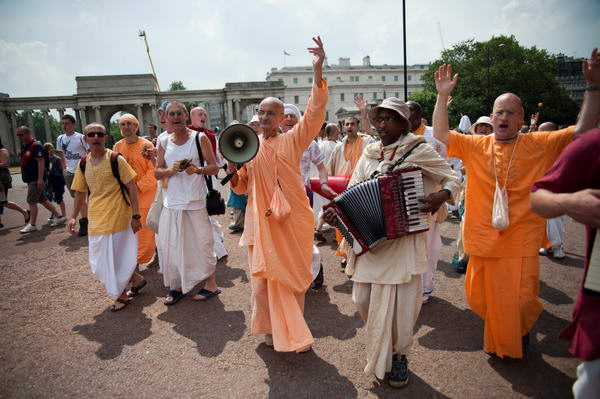
Chariot Festival, Plumstead & Woolwich: Sunday 28th June 2009 I photographed the Hare Krishna Chariot Festival from Hyde Park to Trafalgar Square then travelled to Plumstead Common for short visit to the annual Mela there. But I didn’t find much to interest me and instead took a walk down to the Thames at Thamesmead West and then back alongside the river to Woolwich. On My London Diary I wrote at some length about the walk, which turned out to be surprisingly interesting and about how I thought the area could be improved.
Sri Jagannatha Rathayatra Festival – Hyde Park to Trafalgar Square
Musicians in the procession as it leaves Hyde Park
I didn’t write much about the chariot festival on My London Diary in 2009 as I had written at some length about it the previous year – and I won’t say much here either as I posted about the 2012 Rathayatra festival a few days ago.
The three giant chariots are pulled by people on large ropes
In 2009 I concentrated mainly on the people rather than the chariots.
Plumstead & Woolwich – Plumstead, Thamesmead West, River Thames
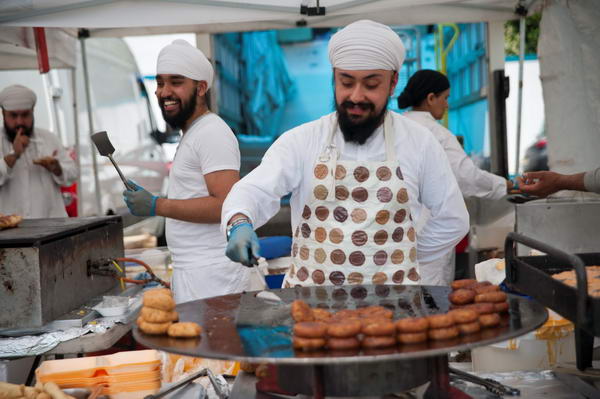
It was a long walk up the hill from Plumstead station to the common where the Mela is held and I arrived rather tired and was disappointed to find the the event seemed to be only just starting. But I’d stopped to take a few pictures on the way, and found several things of interest on the walk.
So after a short time at the Mela I decided it was too hot to wait around longer and to take a walk instead.
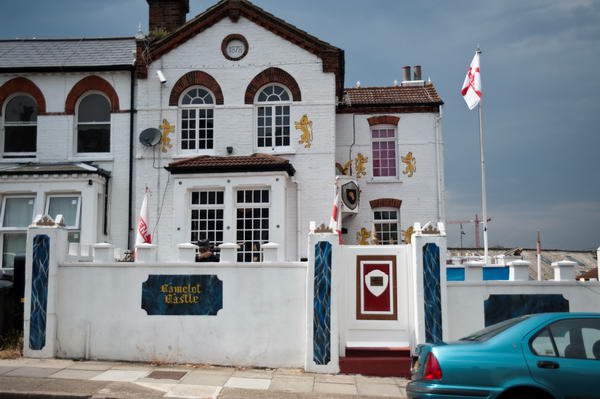
I walked down to Camelot Castle, home of self-proclaimed “celebrity gangster Dave Courtney“, who was made bankrupt in May 2009, owing £400,000 including an estimated £250,000 to HM Revenue & Customs.
Shouldn’t, I mused looking at the St Georges flags, patriots be pleased to pay taxes? I photographed the house and then onto the gates with a giant knuckleduster at their centre. Courtney also awarded himself a blue plaque with the text ‘Dave Courtney OBE lived here’ where the OBE stands for “One Big Ego”.
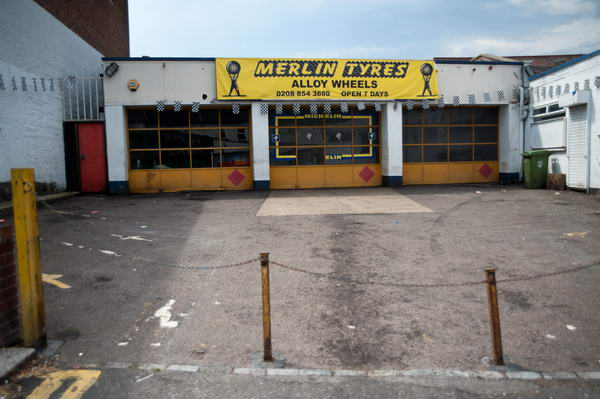
Soon after I came across Merlin Tyres. Is it coincidence that Merlin was one of the six main characters of Camelot?
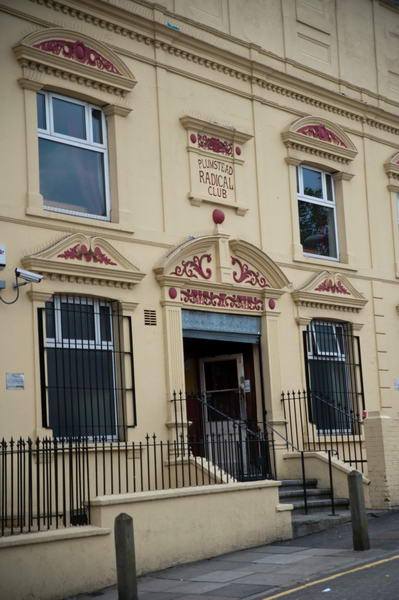
The Plumstead Radical Club is a working mens club formed by local Liberals who later became members of the Labour party, but most working mens clubs lost any real political connection, though they still sell cheap beer to members. From Plumstead I walked into Thamesmead.
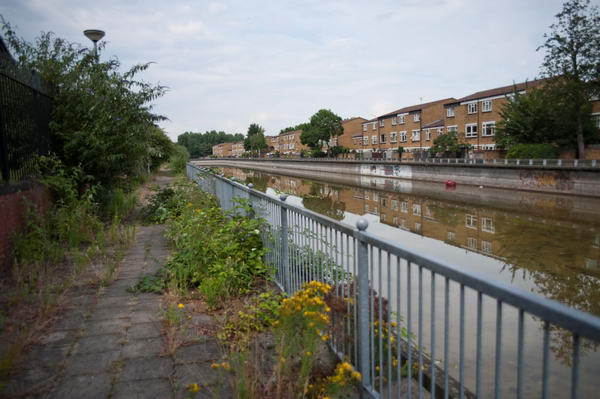
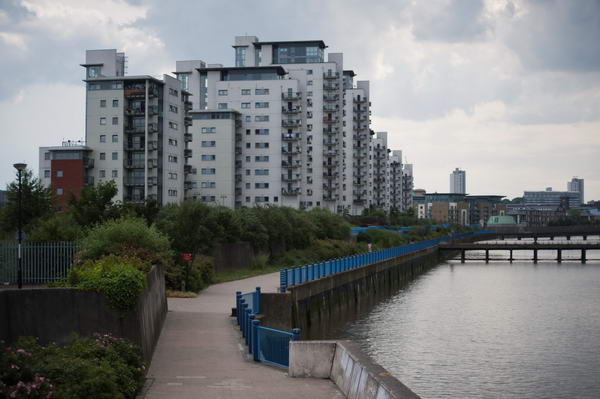
This part of Thamesmead West had failed to make good use of its location and what should have become a vibrant area at Broadwater was derelict and depressing.
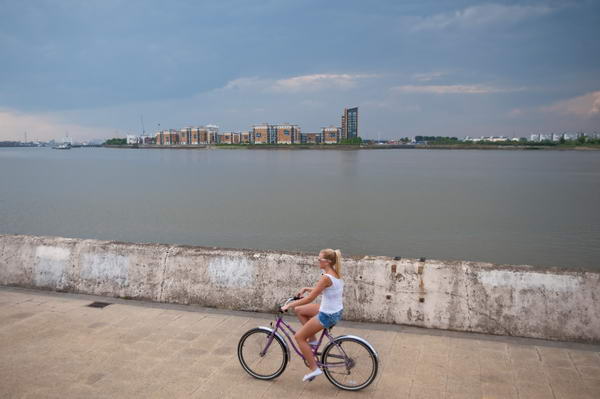
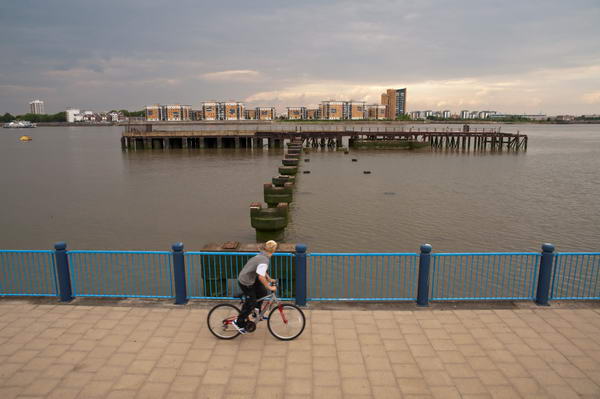
But soon I reached the Thames path and photographed this woman cycling along it with the recent flats of North Woolwich around a third of a mile away on the opposite bank of the wide river.
And there are plenty of new riverside flats on the south bank too, with residents enjoying riverside views. These flats are perhaps less of an eyesore than some.
Woolwich Arsenal had three piers – this was the one in the middle, known as the Iron Pier, and you can see why from my picture. To the east was the Coal Pier, the lower parts of which still remain – built in 1917-20 it was used to bring in around 1500 tons of coal a week and is fenced off as a dangerous structure, The largest of the three piers, the T Pier has I think gone completely though there is now a Uber Boat pier.
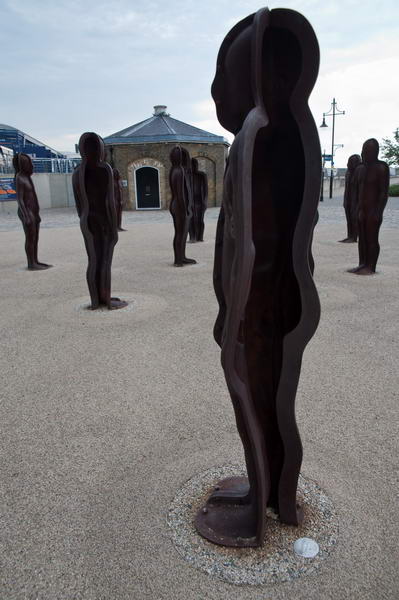
In the Woolwich Arsenal site I came across a group of aliens, ‘Assembly’ by Peter Burke (b1944) placed here in 2004. I stopped to photograph them before heading to Woolwich Arsenal station for a train.
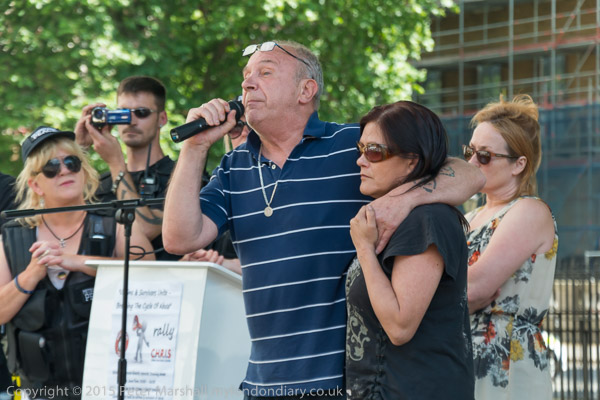
Pride, Paedos & Class War: Saturday 27th June 2015 I photographed the London Pride Parade and a protest at it by Class War, as well as a protest at Downing Street against paedophiles in high positions and the activities of the family courts. Of course we now know that the main witness behind the Met’s Operation Midland was a “liar, fraudster and paedophile” who was later sentenced to “to 18 years in prison, having been found guilty of 12 counts of perverting the course of justice, one of fraud, and several child sexual offences.” Even back in 2015 it was hard to understand why the Met police took his fantastic allegations so seriously.
Pride Parade – Baker Street
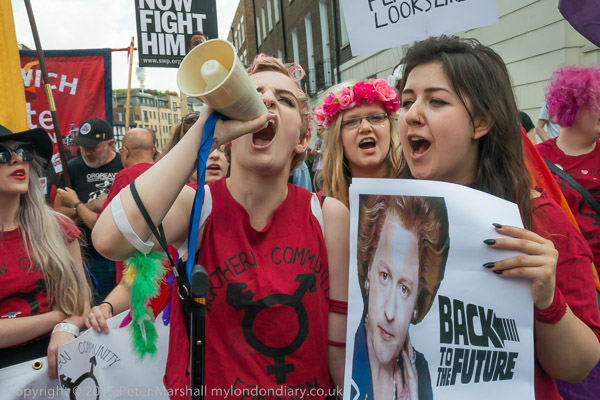
Women from Northern Community Feminism hold a picture of Margaret Thatcher with the message ‘Back to the Future’ and call on people to fight the current government policies.
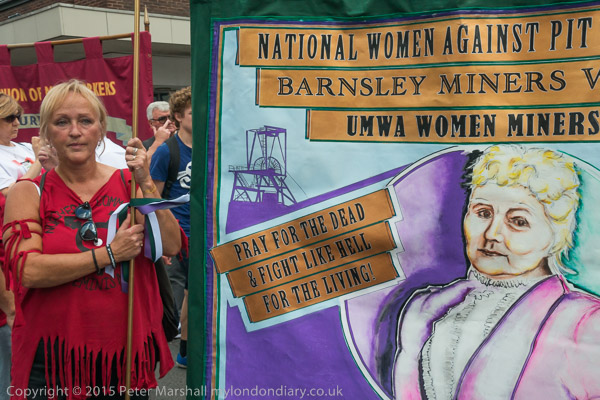
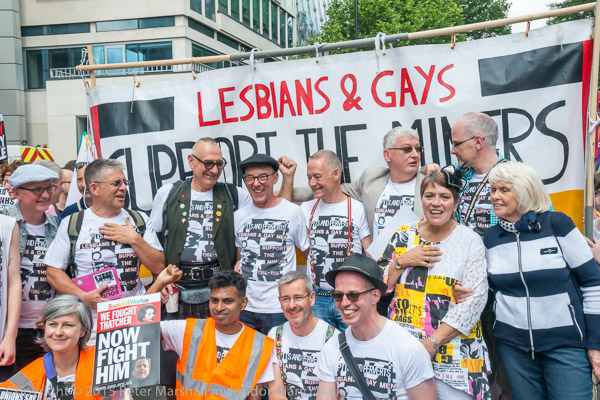
I photographed people getting ready for the parade in Baker Street, and had a particular interest in Pride 2015 as this was the 30th anniversary of the support that Pride had then given to the Miners Strike.
Because of this there was more interest in the event by trade unions and political groups giving the event a more radical nature than the commercial festival it has now become.
‘Lesbians & Gays Support the Miners’
But Pride 2015 was still “dominated by large commercial groups, who also provide large amounts of sponsorship to enable the event as a whole to be dominated by commercial interests. It seems a long way from the event when I first photographed it in the early 90s when Pride was a protest.”
Of course there are still things apart from the large corporate groups and it was these and the more political aspects that I was interested in photographing as you can see from the many pictures on My London Diary.
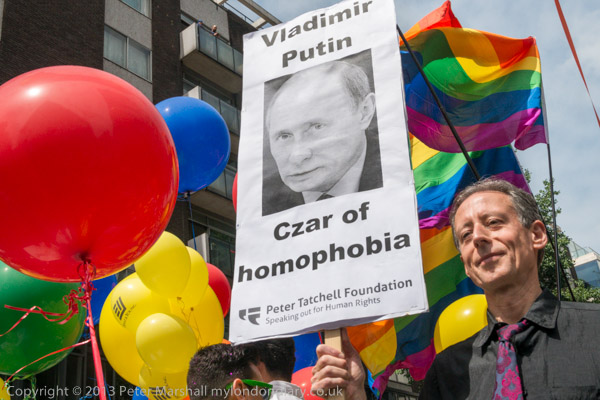
And as usual, Peter Tatchell was still there with supporters to uphold the radical past of the event, this time marching with posters against the Northern Ireland same-sex marriage ban and the homophobis of the Democratic Unionist Party.
Class War protest ‘corporate pinkwashing’ – Piccadilly Circus and Pall Mall
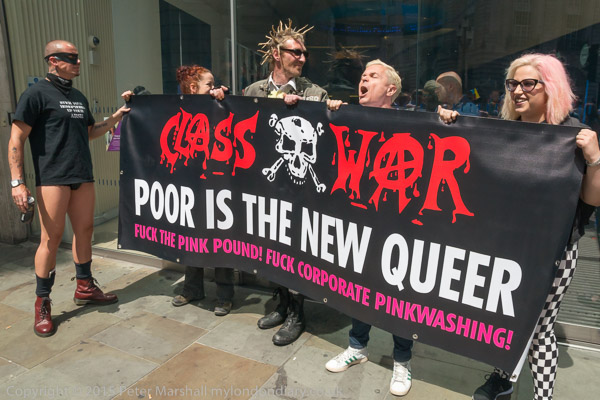
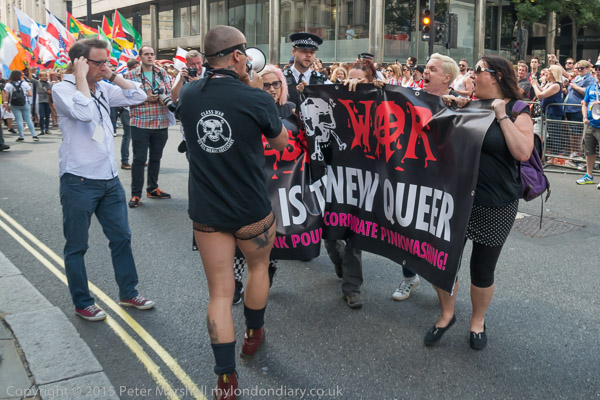
Class War had come to Piccadilly Circus with a new banner, ‘POOR IS THE NEW QUEER‘ against the corporate sponsorship and takeover of Pride in London. Below was the message ‘F**k the Pink Pound, F**k Corporate Pinkwashing!’ and half a dozen of them held it up in front of Barclay’s at Piccadilly Circus.
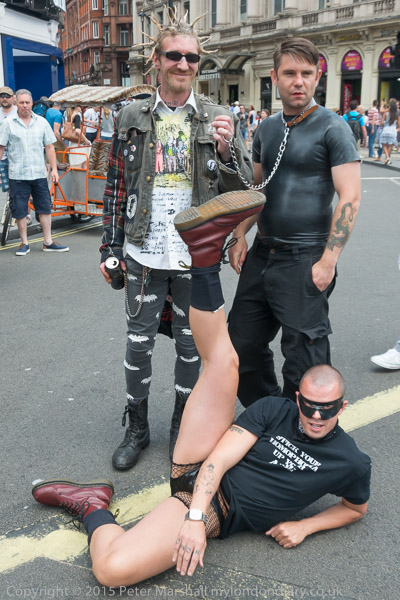
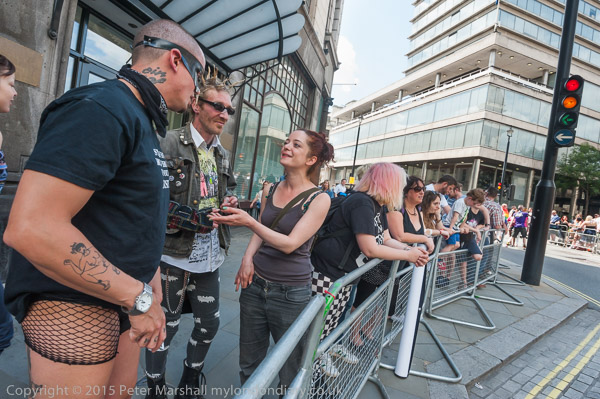
Before that some of them, suitably attired, had posed for photos on the street, and then posed and danced with some of those who had come to watch the parade.
They then moved down to Pall Mall where they found a spot where the crowd waiting for the parade was much thinner and leaned on the barriers until the front of the parade had almost reached them. They lifted up the barriers and took to the street walking a few yards in front of it with their bannner for around 50 yards. A smoke flare drew attention to their protest, while Pride stewards and police tried to get them to leave and they were forced back behind the barriers.
The stood behind the barriers holding the banner as the front of the parade moved past, watched closely by police, but then saw a larger group of police approaching and decided “it was time to disappear, running towards Trafalgar Square. I followed half of them down into the subway where they lost the police, emerging from one of the other subway entrances. Most if not all had evaded the police and were meeting up to decide on any further action, but I’d followed them enough and left.”
Victims & Survivors call for Justice – Downing St,
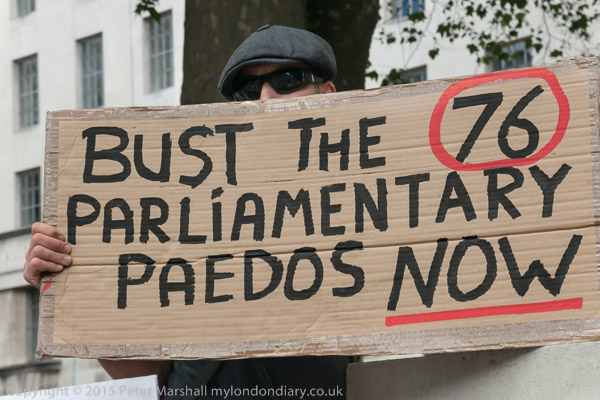
An angry rally opposite Downing St called for an end to the covering up of paedophilia, particularly the 76 allegations against MPs, as well as others in high positions protected by the establishment whose investigation has been shelved.
Although few outside of the Met Police believed the claims made by “Nick” about MPs, even the wildest allegations may have some truth behind them, and after the rumours and allegations against Jimmy Saville were dismissed for so many years by the establishment it is difficult to dismiss everything as wild rumours and conspiracy theories.
Some had come to protest about the secret activities of the family courts, often taking children away from loving parents and in some cases returning them an abusive parent. Some judges were accused of confusing poverty with abuse. Gagging orders prevent many of the facts becoming known. Problems over transparency in these courts have now become officially recognised and there have been pilot schemes to improve this without harming the children involved.
Olympic Torch in Brixton: On Saturday 26th June 2004 the official torch of the Athens 2004 Olympic Games, presented by Coca-Cola and Samsung came to London for a day and was ferried around by taxI from Wimbledon to Brixton, Peckham and elsewhere before a concert on the Mall in the evening.
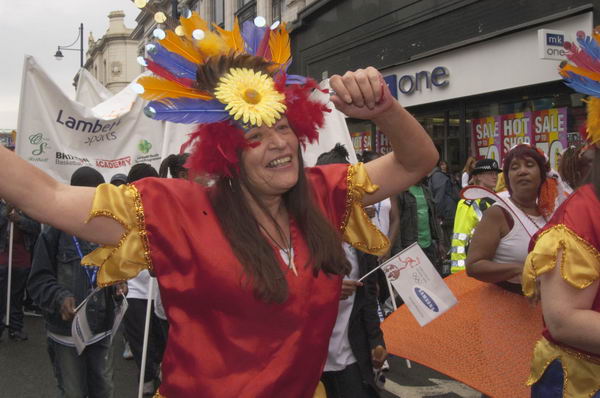
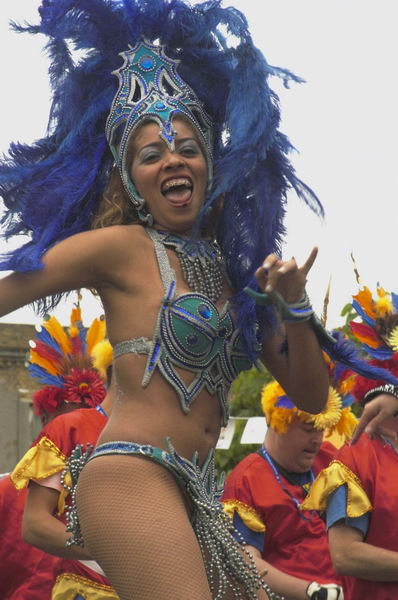
Dancing along Brixton High St after the Olympic torch
Urban 75, a fantastic non-profit site about all things Brixton and surrounding areas of South London, running since 1995, gave information about the event and a discussion on its Forums, including this post from “Well-Known Member” Gramsci (I’ve taken the liberty of correcting a few typos – as I do with my own work) :
Like most sport this is something you cant avoid. At least England have lost in the Europe so wont get any more St Georges flag waving. Now its the Olympic torch. Its all so shallow and meaningless. We live in a world divided into a rich powerful West and a Third World dealing with IMF led “structural adjustment” and US military might etc.
Every few years a carefully staged fake coming together of the world as though we are all equal and happy with our lot. Parts of the Olympics remind me more of a Nuremburg rally. When its going on its like you have to know something about whose won or lost. If you don’t your not being patriotic or something.
Why is it that people who go on about sport eg football are quite often the most unfit people I meet?
My own post about the event on My London Diary also reflected a certain scepticism – here it is with the usual corrections.
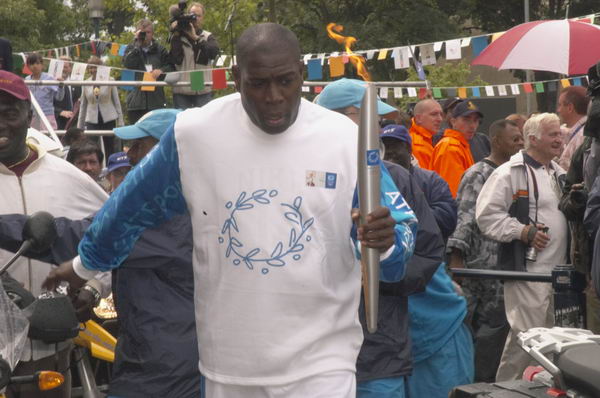
Frank Bruno
Wimbledon can doubtless be blamed for the rain, and it fell relentlessly if not too heavily all Saturday morning as we waited around in Brixton for the precursor of the next example of sporting madness.
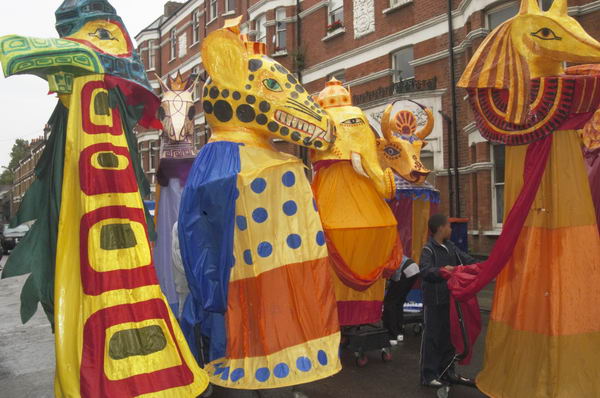
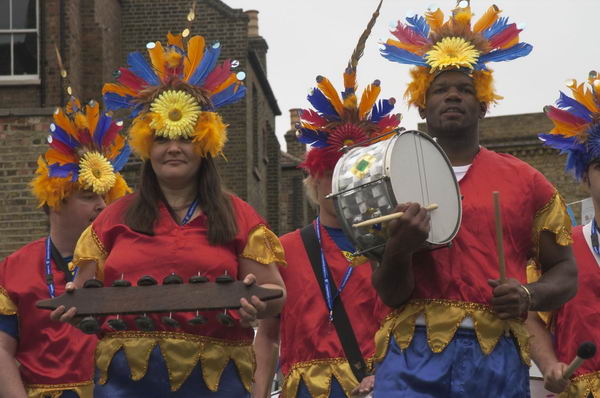
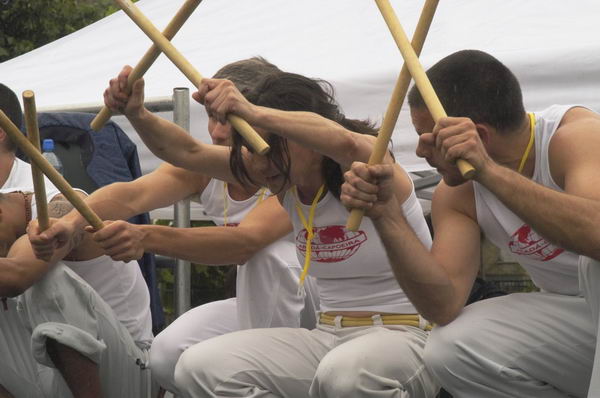
However it was an occasion for a little fun, with music and some attractive samba dancers from Quilombo do Samba, some athletic capoeira (a Latin American version of Morris dancing?) from Abada Capoeira and a little carnival from South Connections and Angell Town community group (and some drumming from Sandy Lamb) lifting the greyness.
Eventually the caravan arrived, although it was actually a black taxi, carrying an Olympic torch. I gave the photocall a miss so as to get in position to catch Frank Bruno ambling down the street with the torch, across the traffic lights and into Brixton’s high street [Brixton Road] where he passed it to a rather more attractive Davina Mccall, apparently a TV presenter (well, I don’t have a TV, so I wouldn’t know.)
It all seemed rather a sad non-event (thank goodness I missed the concert.) The whole Olympic bit seems little more than a commercial event now, publicity for the sponsors. Surely its time for a new Olympic Movement to pick up the old ideals again?
But in Brixton the carnival was bright and colourful and fun for those taking part and watching.
Looking back at it I think Gramsci was spot on, though I also fail to understand how anyone could design an Olympic torch to look like such an ordinary old bit of stainless pipe. People in Brixton are still rather short of bread and this was something of a crumby circus, but they made the most of it.
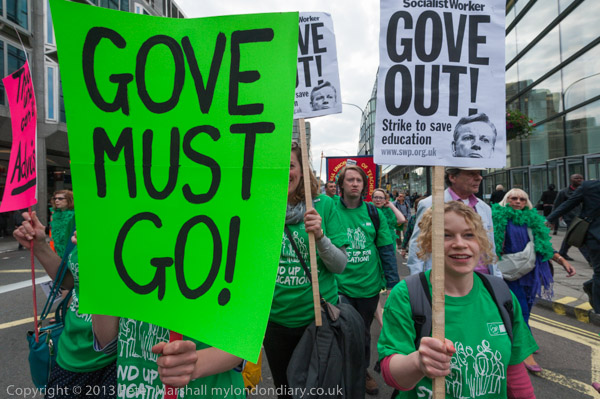
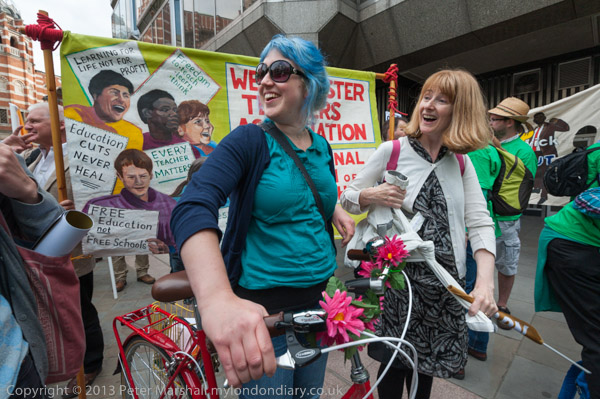
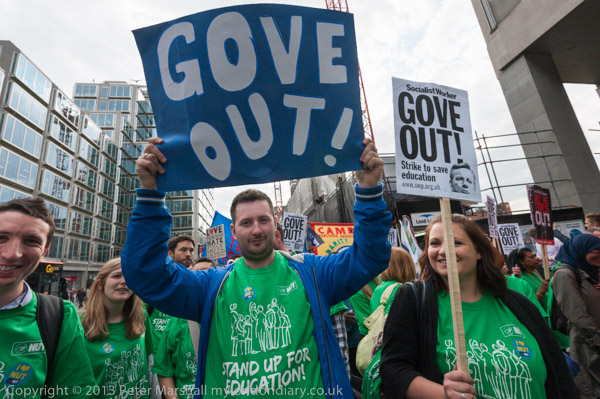
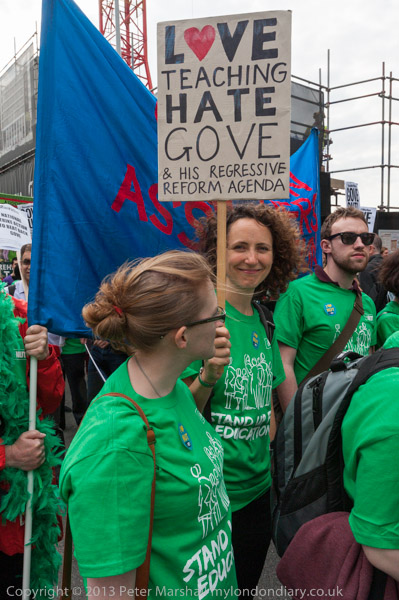
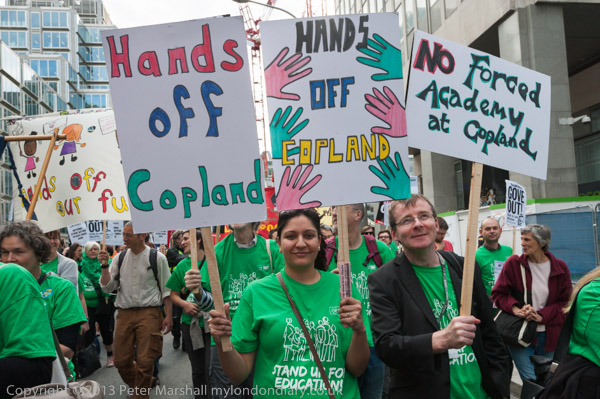
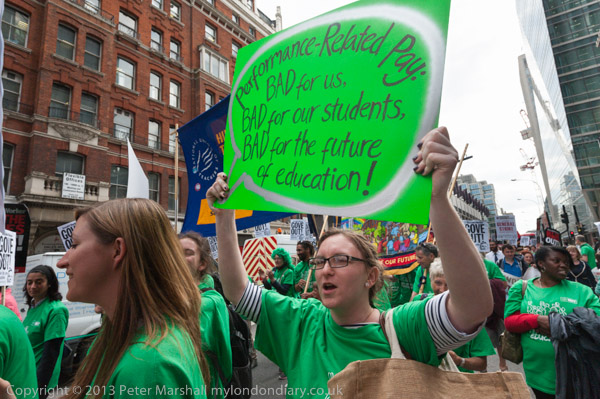
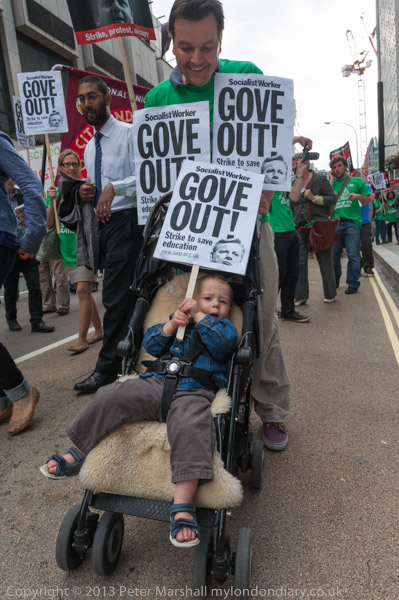
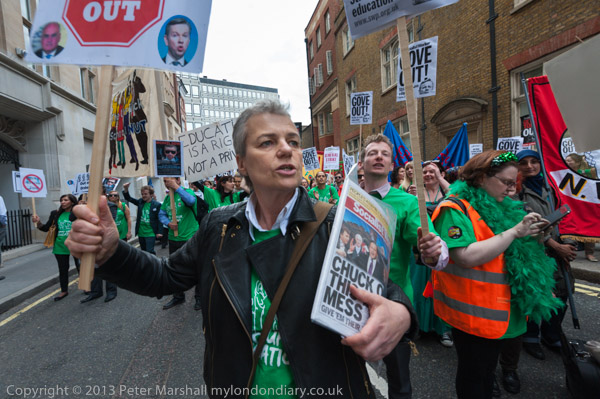
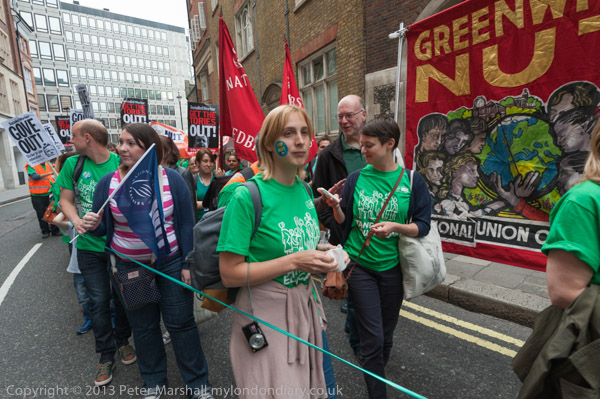
Teachers March for Education: On Tuesday 25th June 2013 teachers from the London area marched through central London today past the Department for Education to a rally. They shouted ‘Gove Must Go!‘ and called for the government to cease attacks on teachers and stop undermining our education system.
I should declare a personal interest. I spent 30 years as a full-time teacher, beginning in secondary education where I worked for almost 10 years in a rather unruly 2000+ comprehensive school before moving to a sixth-form and community college. Over the years I taught a wide range of subjects from science and photography with some computer training, business studies with a little personal and social education thrown in as well as setting up and managing a school computer network and then setting up a Cisco Networking Academy. Add pastoral work as a form teacher or group tutor, some careers advice and exam administration and I had a pretty wide experience of what was still for most of my time, the chalk face.
And of course, as well as teaching photography I also was a photographer, though my activities were then largely restricted to weekends and holidays – and even some of these were taken up by lesson preparation, marking, schemes of work and other administrative tasks.
Various governments had imposed changes on our education system over the years I was involved and few of them had improved our education system but I think all had made teaching as a career more onerous and less attractive. While the National Curriculum was a good idea, its implementation from the start by Kenneth Baker in 1989 was unduly detailed and prescriptive. To a small extent it was updated to make it simpler in 1994, but then under New Labour things got worse.
Education also suffered because of Margaret Thatcher’s determination to cut the power of local authorities with many administrative functions being removed from their grasp leading to schools becoming businesses. Back when I started schools didn’t have managers and there were very few staff who weren’t teachers other than the caretaker and cleaners. New Labour went further in 2000 with the setting up of academies which were totally independent of local authority schools and later the coalition government went further with so-called free schools.
Ofsted inspections had come in in 1993. Before that time school inspections were carried out by Her Majesty’s Inspectors and local authority teams. All involved I think had experience in education and their aim was to enable staff and schools to improve their performance. Ofsted was quite different with many inspectors having little or no experience in education and all were trained in a rigid framework for inspection which allowed no real dialogue with the schools or the teachers who were being inspected.
I was very pleased to be able to leave full-time teaching and move into the photographic area after I was invited to write about photography for a leading US web site as the administrative burden of teaching was becoming simply unbearable. And it certainly wasn’t improving my teaching.
I quoted Peter Glover, Liverpool NUT and NUT National Executive member for Merseyside and Cheshire on the reason for the forthcoming strike action and rallies:
“Pay, pensions, workload, holidays, OFSTED, surveillance…the attacks on teachers have never been as severe. In many schools this Government has created an atmosphere of terror. Managers with no teaching responsibility roam schools armed with clipboards and OFSTED-inspired grids, pouncing on teachers. ‘Drop-ins’ that turn into capability procedures are the vogue.”
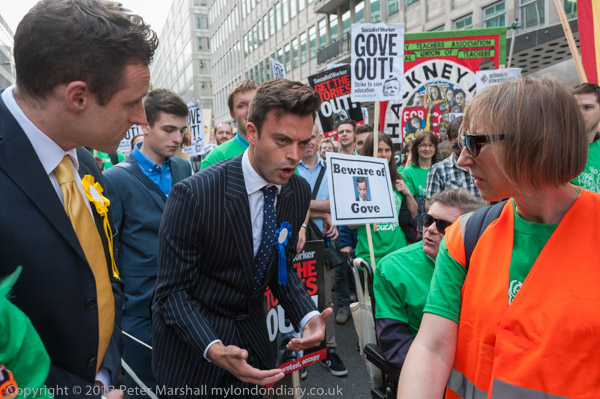
Jolyon Rubinstein and Heydon Prowse of ‘The Revolution Will Be Televised’ start taking the piss out of teachers, not all of whom are amused
As I commented, “Many teachers feel that Minister Michael Gove is setting out to smash the teaching unions in the way that the Thatcher government took on the miners. Teaching is a highly unionised profession, and thus a prime candidate for attack. But teachers join teaching unions because they see them as working not just for their own interests, but more generally for education and for children, protecting educational standards against the attacks by successive governments. They are not just trade unions but professional bodies.”
The government was attacking the national pay system, allowing schools to employ unqualified teachers and worsening working conditions. Many also felt threatened by the general plans to raise “the retirement age to 68. Teaching is a very stressful career and as they say, ’68 is too late’.”
Gove was also responsible for changing the National Curriculum in ways that showed his unwillingness to “take notice of educational research or the views of experts in the field” relying instead on his own whims and unsuitable advisers. If you have children or grandchildren who can tell you abstruse (and sometimes academically contentious) grammatical terms such as “fronted adverbials” but can’t write an interesting story, then you have Gove to thank for it.
Racists, Anti-Fascists, PR, Korea and a Victory Party: Saturday 24th June 2017 was a long day for me, beginning with a march by the English Defence League and the anti-fascists who came to oppose it, moving on to another extreme right protest by the Football Lads Alliance on London Bridge then returning to Whitehall for a protest against the ongoing talks between Theresa May and the Ulster DUP to provide support for her minority government. In Parliament Square there was a picnic and rally against our ‘unfair first past the post’ voting system. From there I went to the US Embassy in Grosvenor Square where supporters of North Korea were calling for the US to withdraw its troops from South Korea. Finally I went to Burgess Park in South London where cleaners from the LSE were celebrating a successful end to 8 months of campaigning.
EDL march against terror – Whitehall
The EDL march followed closely after the 3 June event when three Islamists drove a van into pedestrians on London Bridge killing eight people and injuring many more before being shot by police. Earlier in the year a police officer had been stabbed at the Houses of Parliament and a suicide bomber had killed 22 and injured over a thousand at the Manchester Arena.
One of the protesters photographs me as I take his picture
Tempers were running high and just five days earlier a right-wing activist had driven a van into a Muslim crowd at the Finsbury Park Mosque. The Met were taking no chances and had issued strict conditions on both the EDL for their march and rally and for those who had come to oppose them, and had the police on the ground to enforce them.
A member of the public hurries past the EDL
The EDL were meeting outside (and inside) the Wetherspoons close to the north end of Whitehall and I joined them on the pavement. There were quite a few police in the area and the protesters were mainly happy to talk and be photographed. Eventually they were escorted by a large group of police to the starting point of their march, the police taking them through some back streets to avoid the counter-protesters who had previously been restricted to the corner of Northumberland Avenue.
Anti-fascists oppose the EDL – Northumberland Avenue
Several hundred Unite Against Fascism supporters had come to protest against the EDL march but although there were a few minor scuffles as EDL protesters made their way to the pub, a large police presence kept the two groups apart.
Police again handed out copies of the conditions opposed on their protest. A small group of protest clowns taunted the police but there was no real attempt to break the police conditions. Eventually the UAF held a rally opposite Downing Street kept by police well away from the EDL rally taking place at the same time on the Embankment.
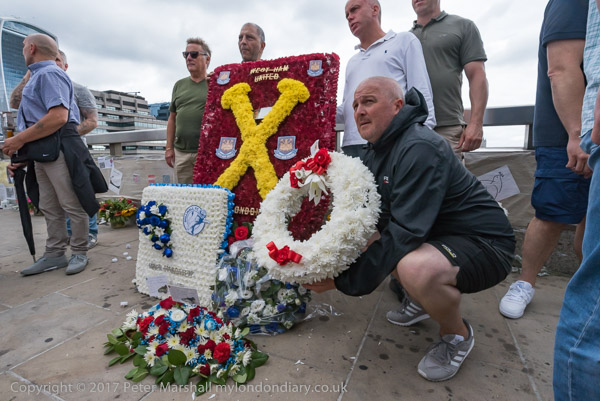
Well over a thousand supporters of the recently formed Football Lads Alliance marched to the centre of London Bridge to protest what they see as the UK government’s reluctance in tackling the current extremism problem. I arrived late when the march was over but was able to photograph some of those taking part as they posed with wreaths at the centre of the bridge.
I went on to photograph the many flowers and messages that had been put their by people in the days since the attack.
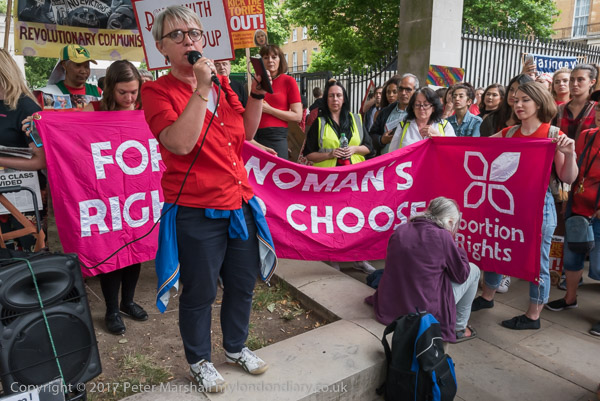
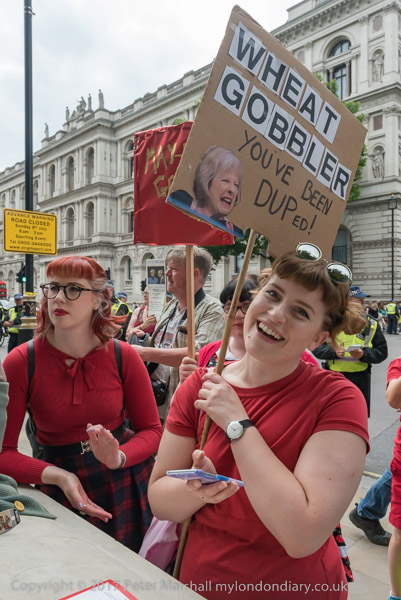
Back at Downing Street women concerned over abortion rights, housing activists and others had come to protest against the talks taking place with the Democratic Unionist Party and the concessions Theresa May would make to get their support for her government after the 2017 general election had resulted in a hung parliament.
Many protesters were in red for the blood of lives lost without access to reproductive rights, but others came to protest about those who lost their lives at Grenfell tower because they were considered too poor or black to need safe housing, for the disabled who have died because of cuts and unfair assessments, for innocent civilians bombed overseas and by terrorists here, for the blood shed in Northern Ireland before the peace process and for the decision to gamble the rights, health and safety of LGBT+ people.
Time for PR – Save Our Democracy – Parliament Square
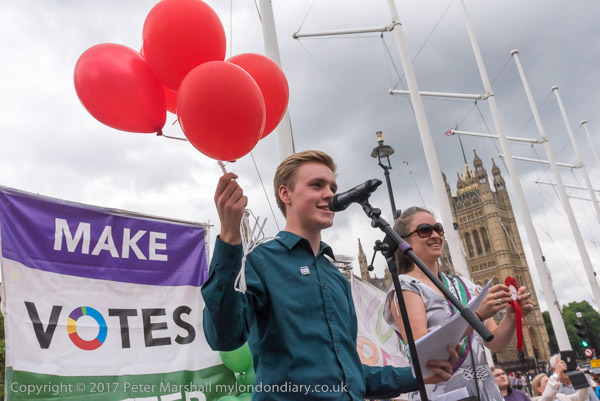
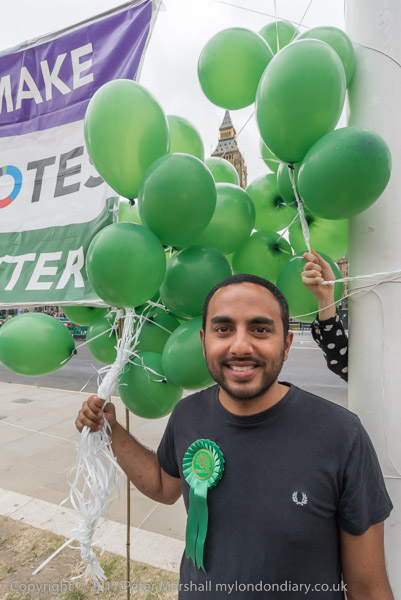
At the end of the rally at Downing Street I walked down to Parliament Square, where Make Votes Matter and Unlock Democracy had organised a picnic and rally after the recent election had again demonstrated the unfairness of our current voting system. The rally used various colours of balloons to represent the percentage of the vote gained by different parties.
Prime Minister Theresa May had called a snap election but failed to get the 326 seats needed for an overall majority with only 317 Conservatives elected. Her party had received 42.3% of the total votes. Labour under Jeremy Corbyn had improved its position and had gained 30 seats but was still well behind at 262 seats and 40% of the total votes. They had failed to gain some key marginals where the party right had managed to stop the party giving proper support to candidates or probably the party would have won the election. By making promises to the Democratic Unionist Party, DUP who had won 10 seats in Northern Ireland, May was able to remain as Prime Minister.
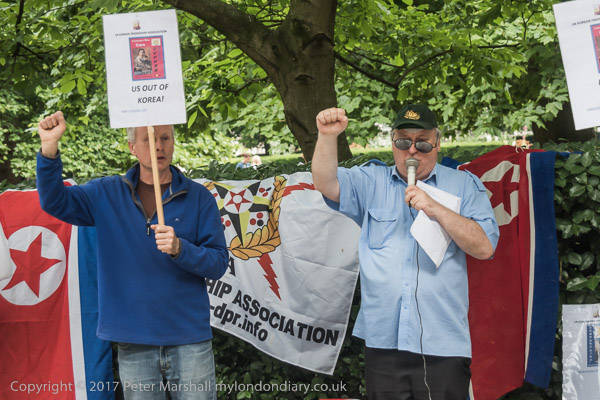
The UK Korean Friendship Association marked the 67th anniversary of the start of the Korean War, never officially ended, by a protest outside the US Embassy calling for the withdrawal of US troops from South Korea and an end to sanctions on the so-called Democratic People’s Republic of Korea, one of the least democratic countries in the world, a highly centralised authoritarian state ruled by the Kim family now for over 70 years, according to its constitution guided “only by great Kimilsungism–Kimjongilism.”
LSE Cleaners Victory Party – Burgess Park, Southwark
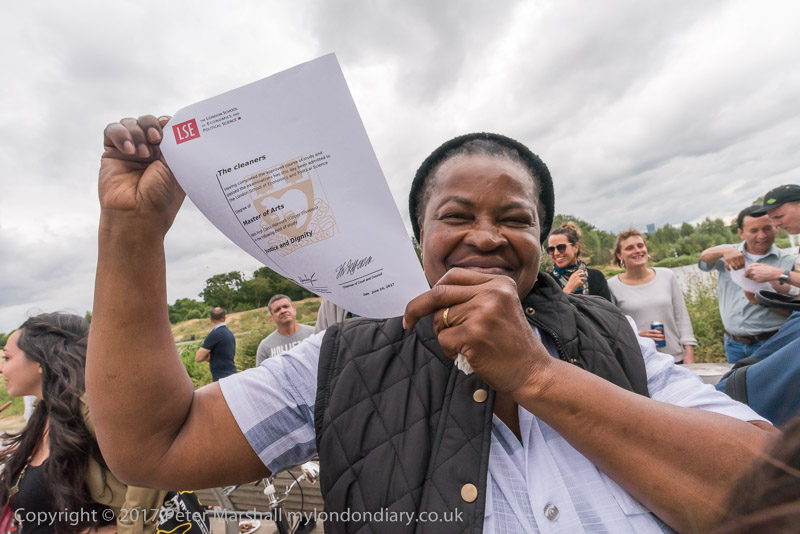
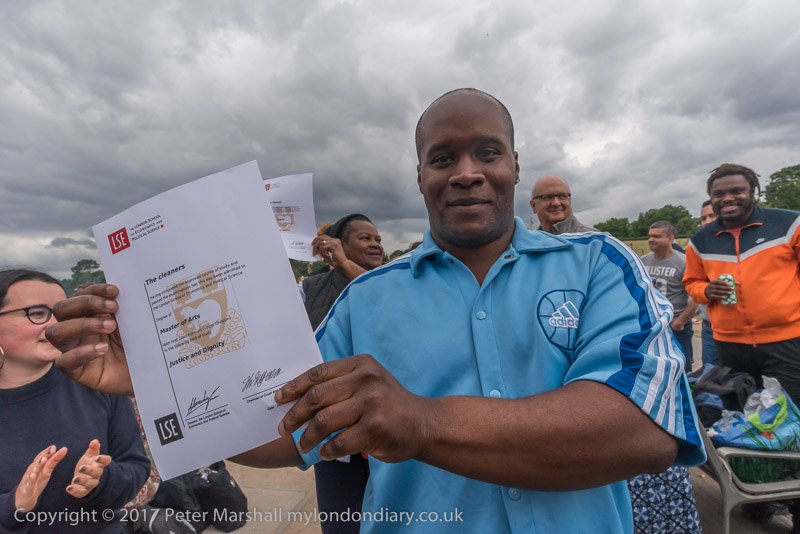
Mildred Simpson shows off the ‘Masters of Arts’ certificates that were presented to the cleaners at the protest
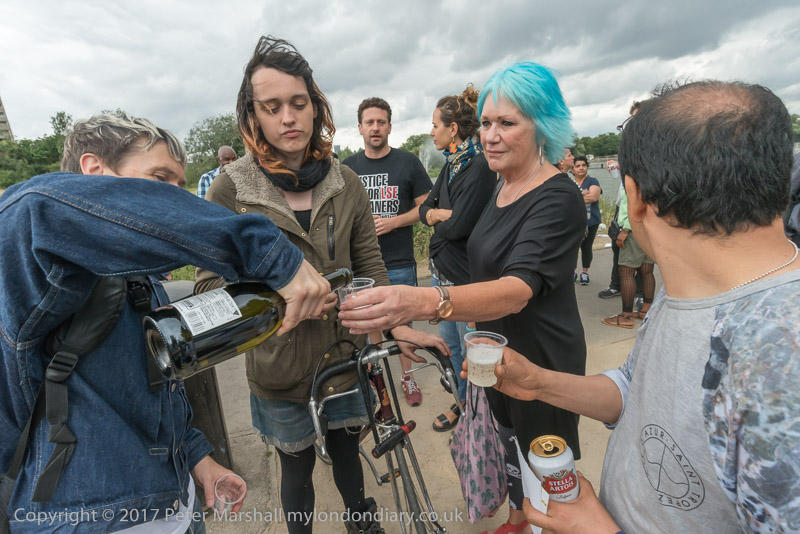
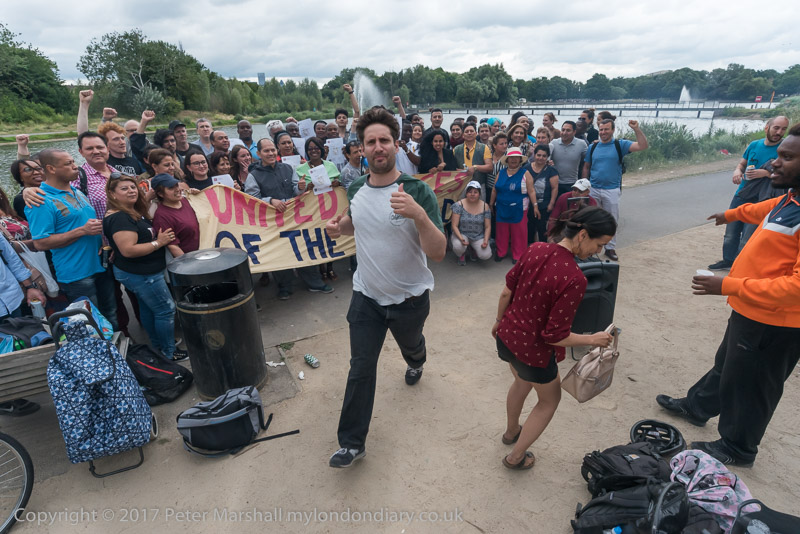
Finally it was good to meet with the cleaners from the LSE and other members and friends of the United Voices of the World and Justice 4 Cleaners who were celebrating the end of their 8 months of campaigning at the LSE. I had been at the meeting when the campaign was launched as a part of the LSE’s 3-day ‘Resist’ Festival organised by Lisa McKenzie, then a research fellow at the LSE, and had photographed many of their protests and it was great to celebrate their success with them.
Class War had supported the cleaners in their protests and some came to celebrate
Their actions, including 7 days of strike, had achieved parity of terms and conditions of employment with directly employed workers and a promise that they would be brought in-house by the Spring of 2018.
Several of the cleaners spoke at the party and the cleaners were “presented with ‘Masters of Arts’ certificates with First Class Honours in Justice and Dignity.”
Petros Elia, UVW General Secretary runs to organise everyone for a group photo
The final part of the dispute was settled a month later in July 2017 when Alba became the 5th cleaner to be reinstated at the LSE in a year with the UVW “winning a groundbreaking, precedent setting tribunal hearing today which declared Alba’s dismissal not only unlawful but profoundly and manifestly unfair.”
Stamford Brook, Ravenscourt Park and a Bull: My photographs on Sunday 7th January 1990 began with a couple of views of the Thames though the window of my District Line train which I’ve not put online, but my walk started after I got off at Stamford Brook station and walked south down Goldhawk Rd.
This fine house at 397-399 attracted my attention. It had been Grade II listed in 1976, but the listing text was unusually vague about its date, calling it “Early to mid C19” and the Westcroft Square conservation area document is equally vague.
Beyond the house is a large noticeboard for ‘Z GREGORY BROTHERS, BUILDING CONTRACTORS’ at 399a, still there and I think only the phone number has changed, and another fairly grand semi-detached house which I think are late Victorian.
St Peter’s Square, Hammersmith, Hammersmith & Fulham, 1990, 90-1d-53
Since I was so close I couldn’t resist another short visit to St Peter’s Square south of the main road which changes its name here from Chiswick High Road to King Street. After the county of London was formed in 1889 this was the boundary between London and Middlesex and it is now the boundary between the London boroughs of Hounslow and Hammersmith & Fulham.
I’d photographed this square fairly extensively the previous month – see my post here) and only stopped to take a handful of pictures – this the only one online – and I was rather pleased with it.
Back on the main road I photographed the corner of Goldhawk Road and King Street, known as Young’s Corner and, as a plaque at first floor level also informs us, ‘REBUILT 1894’, though I’m rather surprised the architect wanted his name on the rather drab two storey buildingon the corner. But at least it doesn’t completely hide the much grander Victorian building at 417 Goldhawk behind behind with its slim turret – and it is perhaps this building for which the architect was claiming credit rather than the shop.
Grocer John Young had leased a shop here in 1830, and it later also became a post office. When at his death in 1860 his youngest son Charles Spencer Young took over the business he eventually turned it into a shop to display prints as a successful picture dealer. When horse-drawn trams ran to here in 1882, the tramway stop was named Young’s Corner.
King St, Stamford Brook, Hammersmith & Fulham, 1990, 90-1d-56
A fine row of three shops at 352- 356 King Street. At left is a basic and rather ugly more modern building – described in the conservation area document as “modern infill of no merit and bulky appearance“.
Ravenscourt Park, Hammersmith & Fulham, 1990, 90-1d-45
Ravenscourt Park is not just an Underground station, but a decent sized park with a lake fed by Stamford Brook, which originally was part of a moat around the manor house of Palingswick (or Paddenswick) Manor. It and the area got its name after the house was bought in 1747 by Thomas Corbett who renamed it Ravenscourt, thought to be a not very good pun on his name – ‘corbeau‘ being French for raven.
I hardly went into the park, and this house is 260 King Street.
The house at 260 King Street is at the left of this picture, followed by a row of shops including one of more interest to me than most, Mac’s Cameras. Max Irming-Geissler set up the shop here in the late 1950s and it continued more or less until his death in 2012. It was a great place to look at a window full of second-hand cameras and lenses, though I don’t think I ever actually bought anything there.
The Bull, Ravenscourt Arms, King St, Hammersmith, Hammersmith & Fulham, 1990, 90-1d-31
This Grade II listed black bull was created by Obadiah Pulham of Pulham & Son in Woodbridge, Suffolk, a well-known maker of garden ornaments, grottoes and follies. It is almost certainly made from Pulhamite, their own proprietary artificial rock, similar to the better-known Coade stone. I think it might actually have been William Lockwood’s Portland Stone Cement. James Pulham was an apprentice to Lockwood and became manager of Lockwood’s Spitalfields office around 1820 with his brother Obidiah as his assistant.
It was created as a pub sign for the Black Bull coaching inn at 122a Holborn and gets a mention from Dickens in Martin Chuzzlewit published in 1843. The pub was demolished in 1904 for an extension to Gamages but the bull was saved by Hammersmith MP Sir William Bull to put above the entrance to his law firm in King Street.
When these offices were demolished it was located outside a 1960s pub, at 257 King Street, a short way down Vencourt Place. The pub later changed its name from the Ravenscourt Arms to the Black Bull. The pub closed around 2018 but it and the bull are I think still there.
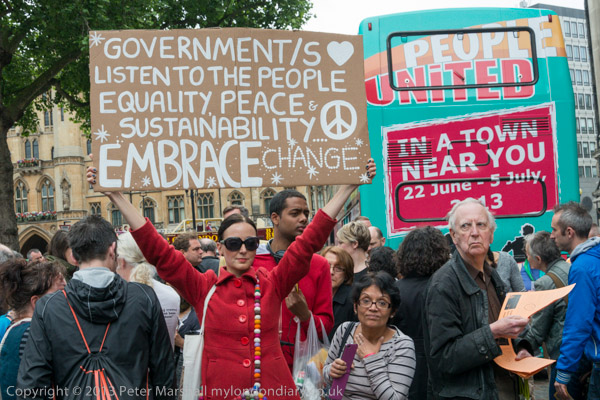
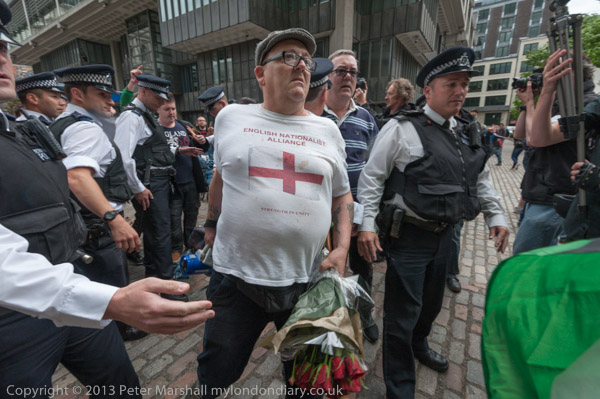
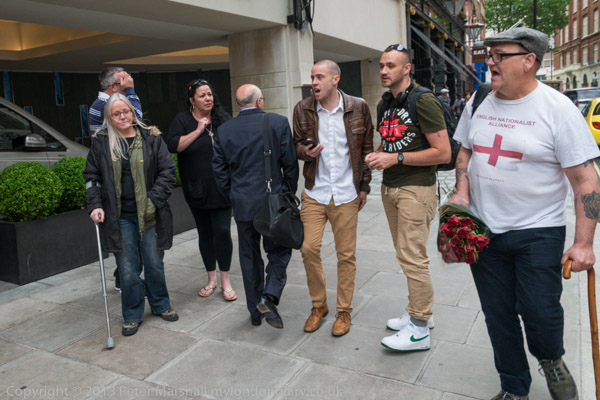
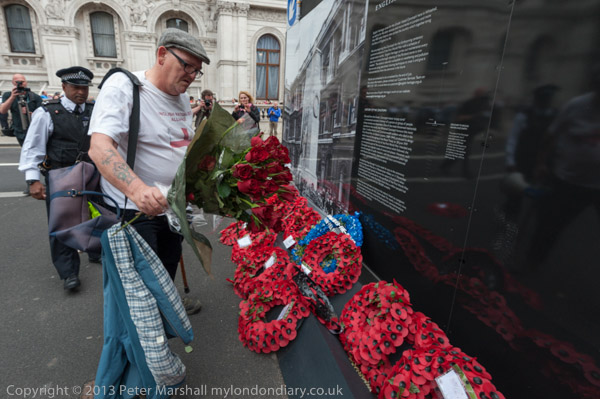
People’s Assembly, English National Alliance, Dykes: Saturday 22nd June 2013 saw a major rally by the Peoples’ Assembly in Methodist Central Hall with smaller protests outside by Class War, Occupy and others and a small march by the English National Alliance march to lay flowers at the Cenotaph and take a letter to David Cameron. My photography ended for the day at the Dyke March London 2013.
People’s Assembly – Methodist Central Hall
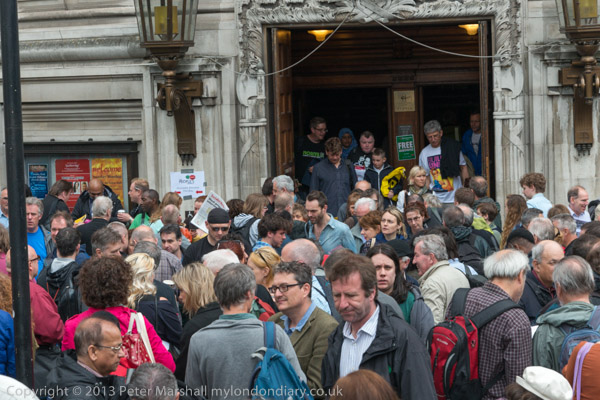
I didn’t actually go to the People’s Assembly but did take pictures of some of the people and groups outside and people as they come out from the event. It had seemed to me and to others that it had been deliberately organised as a ‘safety valve’ “used by the trade union establishment to “disperse some of the head of steam that had built up among the rank and file” rather like “the huge ‘Stop the War’ protest in Feb 2003, when leaders who were now prominent in the Assembly failed to take any decisive action – simply calling for another (and in the event rather smaller) protest a while after Blair had declared it was war. “
The events inside were “stage managed so that any criticism of the Labour Party and trade unions was banned from the main hall – with for example Ken Loach being told there was no room for him to speak at the plenary.” The groups I photographed outside were also denied any voice. This was clearly as I described it, a “Labour love-in“.
Ian Bone had called for “a f**king big mob outside” (my asterisks) the People’s Assembly, but the mob largely failed to turn up. Around enough for a football team. And in a questionable piece of timing his rally in the pulpit facing Methodist Central Hall started just a few minutes after the faithful had gone inside for another session of the “pointless jamboree“.
So Comrades Bone and Heath and the other speakers called for an end to talk talk, and for action on the streets following the examples of Turkey and Brazil to a largely empty London street. Even the Anonymous masked guys from Occupy couldn’t be bothered to leave their picnic to listen, though I found it amusing. And sad, because much of what was said was just too true.
A small group of Occupy London supporters, some wearing ‘Anonymous’ masks handed out leaflets, offered free hugs, and had a picnic on the grass area outside the QEII centre in front of the People’s Assembly Against Austerity. There were also several other groups offering an alternative to the talk-shop going on inside Methodist Central Hall.
English National Alliance leader Bill Baker leads his group away as police hold back anti-racists
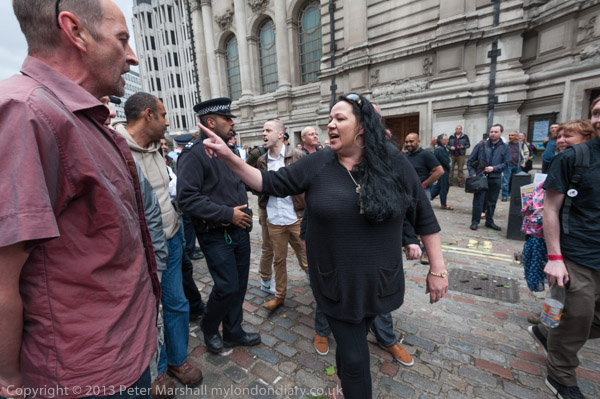
With a major left-wing event taking place in and around Methodist Central Hall it was probably not the best day for the extreme right English National Alliance to hold a march in Westminster, but it would have gone a little more smoothly if the police had not led them into the area filled with more radical small groups in front of the hall.
The march set off with around ten people
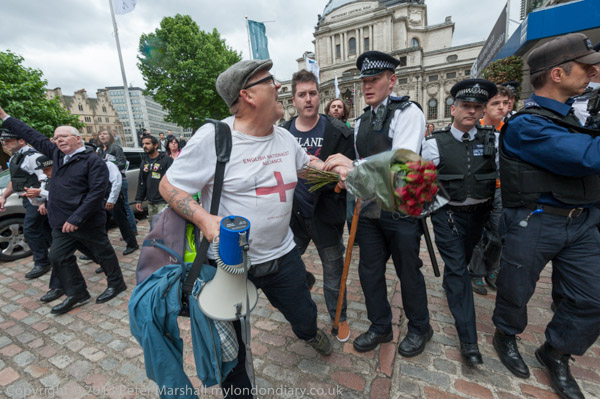
After the ENA had only gone a few yards into the area, some still shouting slogans including “No Surrender” they were surrounded by people shouting “Fascist scum!”, “Racists!” and some trying to bar their way. Police pushed them (and me) out of the way, but minor scuffles developed, with police making one arrest. A woman taking photographs told me she was hit by the stick one of the ENA was using.
Police rushed the marchers into the area in front of the QEII conference centre and then back onto Broad Sanctuary to Parliament Square, with a few counter-protesters accompanying them and shouting. I went with them to the gates of Downing Street where I declined their request to go with Baker, but did take a copy of the statement they were intending to deliver to David Cameron.
On My London Dairy I wrote more about the ENA and their complaints against the press as well as their policies. The start of the march was delayed as they waited for more to arrive (they didn’t) and we had a long discussion. I argued that accurate reporting was important and had that I tried hard to represent people’s views even when I don’t agree with them.
It was a sensibly conducted discussion but I was unable to convince them that the problems in housing were not caused by immigration by “the failure of successive governments to invest in social housing, exacerbated by the Thatcher’s right to buy policy and the subsidies to landlords through housing benefit.” Or that “Education is in a mess not because our pupils now have to learn about Muslims, or that we don’t teach British history (schools still do) but because of the failure of politicians to listen to those who know anything about it and a target-driven culture that mistakes better test results for better education etc.“
But I did try to present the views they expressed to Cameron in my piece on My London Diary, and I think these include some points the left might find surprising. As I concluded, “It seems to me to reflect a deeply felt dissatisfaction with changes in our society but to fail to see the real causes – largely class and capital – and instead to blame these on immigration and immigrants, who have enriched our society in so many ways through the ages and continue to do so.“
The previous year had seem the first Dyke March London for many years, but this years march had had less publicity and support and there were less than half as many people in Berkeley Sqaure for the start.
Speakers at the opening rally included the writer, critic, poet and deputy editor of the trans digital magazine META Roz Kaveney who read one of her poems, and founder of the UK’s LGBT History and long-standing LGBT activist Sue Sanders.
Queer Sluts + Godesses – Empowerment though music Eros + cake’
Sanders tested the crowd of several hundred women on their knowledge of lesbian icons such as Dame Ethel Smyth, a suffragette who was one of the better British composers of the twentieth century. I think I did better than average on her quiz.
From Berkeley Square the march went down to Piccadilly on its way to a rally in Soho Square, but I left them at Piccadilly Circus.
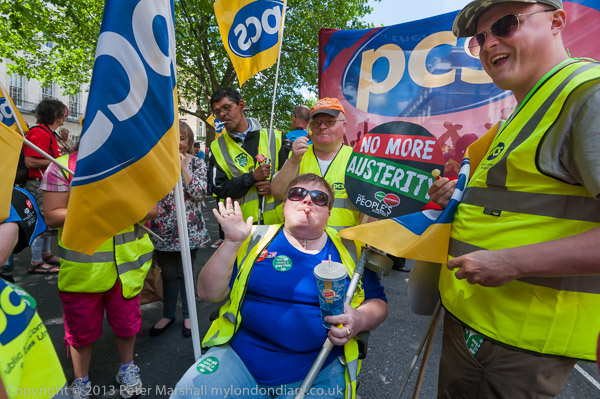
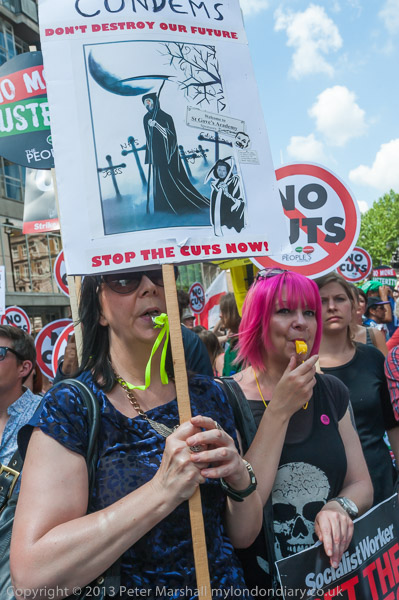
Anti-Homeless Spikes & No More Austerity: On Saturday 21st June 2014 I photographed a small protest against anti-homeless spikes outside the Tesco Metro on Lower Regent Street on my way to a much larger protest against austerity meeting at the BBC in Portland Place and marching to a rally in Parliament Square.
Call for Nationwide Homeless Spikes Ban
Public disquiet was mounting against the increasing use of anti-homeless spikes on and around buildings, metal or concrete spikes used to make pavements, ledges and other horizontal surface impossible or very uncomfortable for people to lie down or sometimes even sit on, aimed in particular at stopping homeless people sleeping there.
These spikes and other ‘hostile measures’ are increasingly used to force homeless people out of public spaces – you can read more about it in a 2016 article on the Crisis web site as well as in various newspaper reports. ‘Defensive Architecture’ continues and you can read about a 2024 campaign against spikes by artist Stuart Semple and creative agency TBWA\MCR in Big Issue.
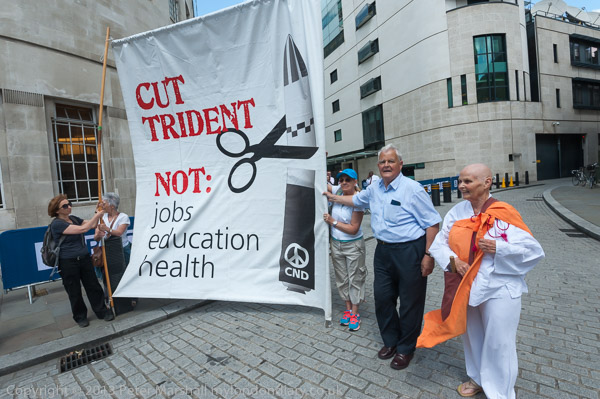
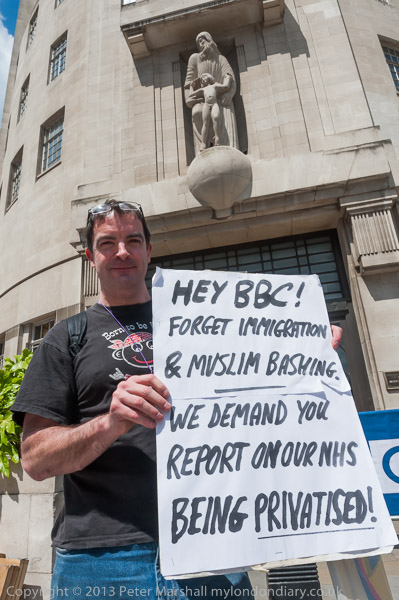
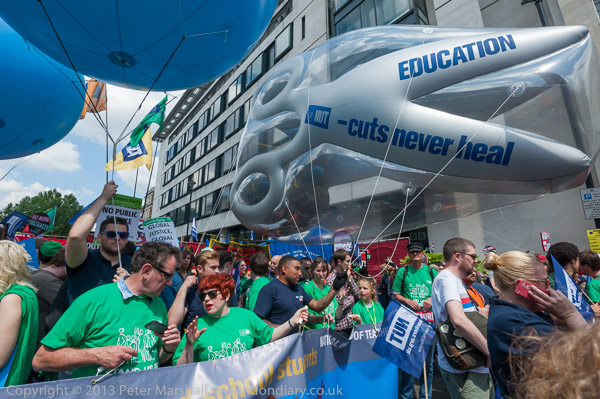
There was huge support for the march and rally by The People’s Assembly, trade unions and campaign groups calling for an end to austerity which gathered outside the BBC to march to a rally in Parliament Square.
Bruce Kent and a Buddhist monk with the CND ”Cut Trident Not jobs education, health’ banner
Clearly the government cuts since 2010 were causing huge problems across the nation and were stifling economic growth. And while we were still wasting huge amounts on senseless projects such as Trident nuclear missiles, public services were being cut, public sector workers were getting cuts in pay through below inflation increases. Education was suffering, the NHS was being increasingly privatised and generally the interests of the majority were being sacrificed while the wealthy were getting even richer.
Measure such as 2012 bedroom tax and later the two child benefit cap brought in in 2017 plunged many of the poorest even deeper into poverty and there were continued attacks on disability benefits.
I put almost all of the pictures from the march on-line without captions with a promise to add them later but – as so often – later never came. But I think most of the pictures tell their own story,
Among them are a number of pictures of Class War – some of them carrying a banner which later became their manifesto for the 2015 general election – for which they became a political party and stood a handful of candidates – who each only received a handful of votes. But perhaps ‘DOUBLE DOLE – NO BEDROOM TAX – DOUBLE PENSIONS’ was never likely to be an entirely convincing alternative.
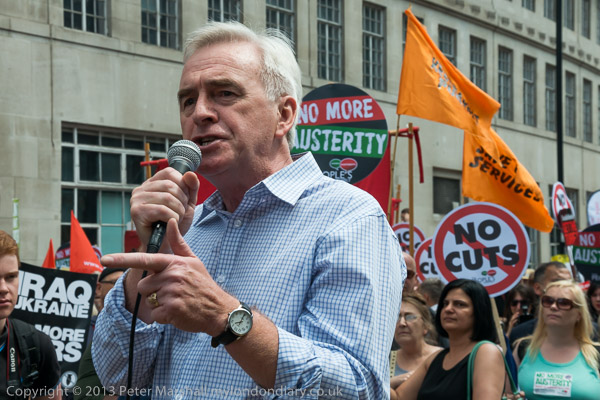
John McDonnell MP
In 2017 we did have a real alternative and the Labour vote was up by 9.5% and it was only a deliberate and deceitful campaign by the party right who were in control of the party mechanism diverting resources from key marginals that stopped a Corbyn victory. They out-manoeuvred the left again in 2019 both to ensure defeat and for the key architect of the disastrous policy that lost them the vote as minister for Brexit to become party leader.
But people in 2024 still wanted change, and voted against the hopeless and hapless Tories who had blustered under Boris, wilted faster than lettuce under Truss and submerged under Sunak. But what we got was not chage but Tory-lite, even resurrecting the tired skeletons of Blair and Mandelson. It now seems more than likely that at the next election we may get change – but for the even worse.
I won’t bother to put any of the pictures of speakers at the rally on-line, though I photographed a long list of them – all on My London Diary.
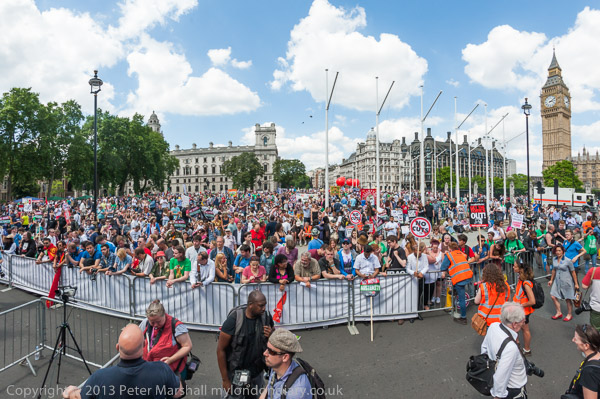
Parliament Square was pretty full and people were still arriving at the square long after I made a picture of the crowd at the start of the rally.
Last Saturday I photographed a couple of protests, went to a disappointing photographic exhibition, took a snap of the Red Arrows and found myself with time to spare to go and photograph the 2025 London World Naked Bike Ride at its start and then later on my way to my last protest of the day.
London, UK. 14 June 2025
The first year I photographed this event was in 2006 and I came back to it in almost every year until 2014, then again rather briefly in 2019. Here I’ll post some of what I wrote about it on that first occasion and then my comments on returning to photograph it in 2019, and end with my thoughts about the 2025 ride. All the pictures in this post are from Saturday 14th June 2025.
London, UK. 14 June 2025
Unfortunately Facebook’s “community standards” prevent me from publishing an album of my pictures there, but you can find a selection of images on my Alamy portfolio pages. Though you may have to search or browse a few pages to find them after I upload more work.
2006
People in over 50 cities around the world were taking place in the World Naked Bike Ride as a protest against oil dependency and car culture. In London. over 600 cyclists, along with a few rollerskaters, rollerbladers and others took part.
London, UK. 14 June 2025
As a change, I congratulate the Met police for allowing the event (unlike the Brighton cops.) Police cyclists – looking rather over-dressed in their usual uniform – led the event in its ride around some of the busiest streets in central London, and kept riders safe from traffic. Most of them seemed to be amused by the event.
London, UK. 14 June 2025
So too were the crowds in central London. Many obviously found it hard to believe the evidence of their eyes, but all I saw seemed amused and none offended. Riders handed out a leaflet explaining the purpose of the event and advising “if you don’t wish to see nudity, please avert your gaze – we’ll soon be out of sight,” but I didn’t see anyone following this advice. Indeed it looked like the event should attract even more tourists to the city.
London, UK. 14 June 2025
I don’t have a great problem with nudity. I was brought up told we were created in the image of our maker, so feel it would be blasphemous to object about the display of the naked body, although generally we may find it more prudent to keep it covered, especially in our climate. As my pictures show, not all those taking part rode entirely naked: the invitation was to ride “as bare as you dare!”
London, UK. 14 June 2025
Photographing an event like this could be awkward, but I recognised many of those taking part and they knew me. There were a few conditions, but only one person out of the several hundred made it clear she didn’t want me to take a picture, and of course I didn’t.
London, UK. 14 June 2025
It was an afternoon when it was more comfortable to be without clothes than in them (so long as you had plenty of sun-screen) and it certainly made an interesting spectacle. I had chosen not to ride a bike, and just pretended to be one as I ran up Piccadilly fully dressed with the mass of cyclists. By the time we got to the top of Haymarket I was pretty much whacked, and continued by tube to Waterloo to meet the ride as it came up York Road and get a different viewpoint.
London, UK. 14 June 2025
2019
I’ve never been too impressed by the protest side of this. It’s more a fun ride for people who want to ride around London with no or very few clothes on. For those of us watching on the streets it is certainly unusual and entertaining, and I think very few could be seriously upset by it. The normal response seems to be a lot of pointing and laughing.
London, UK. 14 June 2025
Perhaps if it were more of a protest there would be more women taking part. This year the imbalance seemed even greater than previously, with perhaps 10 or 20 men for every one woman, though I didn’t try to make an accurate count. My pictures do tend to concentrate more on the women than the men for various reasons. To state the obvious, these pictures involve nudity. Please do not click on the link if you may be offended or if you are in a place where others may be offended.
2025
This year there were even fewer women on the ride which now seems to be dominated by male nudists, with some coming from the continent to take part. It has become an event very much more about “body positivity” than a protest about car culture and cycle safety. And it illustrated the huge anatomical variation of male members of our species.
London, UK. 14 June 2025
A mere handful rode with political messages written on their bodies and even fewer with flags or posters on their bikes. There was little of the creative face and body paint and fancy dress which had enlivened earlier years. It’s an event that has lost much of its interest for me and is far more drab than my pictures, which concentrate on the things that still interest me. Perhaps this is an event which has outlived its times.