Brixton TQ31

Van, Rushcroft Rd, Brixton, 1987 TQ3175-001

There must be a reason for this van, parked at the junction of Rushcroft Rd and Vining St behind the large Foodstation building to have a horse on its cab roof, and I’d love someone to enlighten me. I think this is a classic Citroen H van, which were often adapted for use as catering or camping vans, and some are still in use and sell for high prices. There was even a special horse-box version.

Fishmongers, Shop, Atlantic Rd, Brixton, 1987 TQ3175-004

The much-loved fishmonger in the railway arches, one of a number of businesses recently lost to the relentless gentrification of Brixton, despite a long and hard-fought campaign.

Sculpture, Flats, Barrington Rd, Brixton, 1989 TQ3175-014

This sculpture and the mosaic panels were on Kemble House in Barrington Rd, and the pillar still has the mosaic, though the sculpture is long gone. I think both were added to the building in the mid-80s by Freeform Arts. The Loughborough estate was built by the LCC from 1954-70 to the designs of their architects department under Sir Leslie Martin, and provided 1,031 dwellings, including maisonettes in nine 11-storey blocks such as Kemble House. Since 1995 the estate has been run by the Loughbourough Estate Management Board.

Coldharbour Lane, Loughborough Junction, Brixton, 1989 TQ3175-018

An alley between shops on Coldharbour Lane still leads the Celestial Church of Christ at Loughborough Junction, and that strange post is still there in the middle of the pavement. The church “came into the world from heaven by DIVINE ORDER on the 29th of September 1947 in Porto Novo, Republic of Benin through the founder of the Church, the Late Reverend, Pastor, Prophet, Founder Samuel Bilehou Joseph Oshoffa. The Church is well known with Parishes, Dioceses all over the world with its International Headquarters in Nigeria.” More here.

Graffiti, Stockwell Ave, Brixton, 1989 TQ3175-026

I think this graffiti on Stockwell Avenue was on the side wall of 8 Bellefields Rd though it has long disappeared. A number of more official-looking murals had been painted in the area at the time, and one is still present on the facing wall, but this seemed to me to be more ‘Brixton’. The mural opposite was painted in 1987 by Sonia Martin of London Wall Public Art after consultations with local residents and was one of a series of Brixton murals painted after the 1981 Brixton riots with funding from Lambeth Council and the GLC.

More pictures from Brixton in TQ31 London Cross-Section.


All photographs on this and my other sites, unless otherwise stated, are taken by and copyright of Peter Marshall, and are available for reproduction or can be bought as prints.


Norwood to Brixton: TQ31

House, Norwood Grove, Norwood,  1991 TQ3170-001

My pictures from TQ31, a 1km wide strip of London begin at Norwood Grove with a picture of the ‘White House’ there, a fine building dating from the early 19th century on the edge of Croydon. It’s a total mystery to me what I was doing there in 1991, but I did photograph this house again in 1996 but on a dull, overcast day. Possibly I was on a family walk and we had gone to look at its gardens which are listed with the house.

Barber, Norwood Rd, Tulse Hill, 1991 TQ3172-003

Hairdressers are a good example of businesses that can be set up with relatively little capital expenditure, and are often quite individual in the furnishing of their shops and window displays. I don’t think there are any real chains or franchises in the trade, either for barbers, unisex or ladies salons. And given the nature of the business the windows often include representations of heads – drawn and photographed (as in this case) or even three-dimensional, making them of great interest to me. Something that the differential fading of the colour image at the right only added to.

Dulwich Rd, Herne Hill,  Lambeth, 1991 TQ3174-020

It was definitely the colour that attracted me to this cafe on the Dulwich Rd at Herne Hill, set off by the white porcelain ashtray. Getting the colour right in the darkroom (it wasn’t on the enprint) proved a little difficult, but the ashtray and the CocaCola box were good reference points and this was one of the pictures I exhibited in the 1990s

Repairs, Railton Rd, Brixton, 1991 TQ3174-005

Brixton was a place I loved to visit for its colour and vibrancy. Back in the early days I went there quite frequently to buy cheap outdated photographic paper from A.W.Young Photographic in Altantic Rd. Later I used to go to Photofusion in Electric Lane to go to exhibition openings and take in pictures for their photo-library. This was Sherlock Electrical Repairs in Railton Rd, and they seemed to specialise in vacuum cleaners.

121 Centre, Railton Rd, Brixton, 1991 TQ3174-019

I bought some pamphlets and magazines from the 121 Centre in Railton Rd, on the corner of Chaucer Rd. It was a squatted anarchist social centre, and later in 1999 I went to at least one party in the street outside when it was threatened with eviction.

The centre had been squatted in 1973 by Olive Morris and became and anarchist social centre around the time of the 1981 Brixton riots, when Railton Rd was the “front line!, later gaining an international reputation for the groups and events it hosted. Set on fire by right-wing thugs in 1993, it recovered but was evicted by Lambeth Council in 1999 despite a determined and well-organised campaign of resistance. Property values in the area had risen dramatically and Lambeth who perhaps hadn’t been worried when Brixton property was almost worthless decided to take the property back.

More from Brixton in a later post. You can see these and other pictures in the Flickr album TQ31 London Cross-section. As I write there are still more pictures to add of TQ31 north of Stockwell.


All photographs on this and my other sites, unless otherwise stated, are taken by and copyright of Peter Marshall, and are available for reproduction or can be bought as prints.


London 1986 Page 10

Institute of Chartered Accountants, Great Swan Alley, City 86-8ab-32-Edit_2400

Page 10 of London 1986 begins in the city of London, and strongly features a remarkable set of figures around the Institute of Chartered Accountants building from 1890-93 in Great Swan Alley, off Moorgate a little to the north of the Bank of England. Above its first floor windows is a long frieze of figures representing various trades and figures, some dating from the 1890s and others added in the 1930s and 1960s when the building was extended. Among them you can see Wren holding a model of St Pauls Cathedral.

Institute of Chartered Accountants, Great Swan Alley, City 86-8ab-34-Edit_2400

But apparently of more interest to me were what Pevsner describes as the “small very female termini caryatids” whose figures seemed very much at odds with my ideas both of the Victorians and of accountants and on whom I expended far to much film.

Petticoat Lane, City, Tower Hamlets86-9a-23_2400

I managed to drag myself away from the sirens of the ICA and out of the City into Petticoat Lane and the area around this, finding as well as a market a large group of Christians armed with muscial instruments.

Guildhall, Exhibition hall, Magistrates' court, Offices, Richard Gilbert Scott, 65 Basinghall Street, City 86-9b-14_2400

Later I returned to the City for more pictures, including some of one of my favourite modern buildings in the city, the Exhibition hall, Magistrates’ court and Offices by Richard Gilbert Scott at 65 Basinghall Street with its wonderful concrete roofs.

Highwalk, Wood St, City 86-9d-41_2400

The city’s Highwalks also attracted my attention, part of a post-war vision of separating pedestrians from traffic by visionary architects who perhaps failed to appreciate the tremendous residue of street-level development that anchored people to the ground. It worked for areas that had been largely obliterated by bombing, particularly the Barbican, but could never become sufficiently comprehensive elsewhere across the city to make sense. It did however provide photographers with some useful elevated viewpoints.

City Mill Lock, Bow Back Rivers, Stratford, Newham  86-9f-26_2400

At the end of the page are a few pictures from Bromley-by-Bow and Stratford back rivers, including some of the near derelict lock linking the City Mill River and St Thomas’s Creek with the tidal Waterworks River. I think this lock dated from the 1930s when the City Mill River was enlarged and other work done as a part of a flood relief plan for the area (and also to give work to the unemployed.) Because the Waterworks River was then tidal, the water level in it could be either above or below that in the City Mill river and there are two pairs of gates at this end of the lock. These were replaced by modern gates a few years ago, but a new lock was built at Three Mills as a part of the Olympic redevelopment, which probably makes the double gate redundant.

Page 10 of London 1986

Showing faces II

For a rather wider discussion of the issues involved in photographing protests and showing the faces of those taking part, you may like to read On Ethics, The First Amendment, and Photographing Protestors’ Faces by Allen Murabayashi.

It is of course in some respects a very US-centric article, talking about Trump and about the constitution. But I think it makes some of the reasons for the disagreements over the issue clear, and is worth reading.

Murabayashi gives his own opinion in two short paragraphs as the end of the piece:

To me, the real discussion shouldn’t be about the blurring or obscuring of faces, nor gaining consent of a subject. These are tactical choices, and in the U.S. there is simply no expectation of privacy in a public setting.

Instead, we ought to continue to consider how photography is used to portray others (particularly the vulnerable), and whether an image truly advances a story or simply acts as a signifier for the photo we should have taken.

Op cit

The link in the last sentence is to another piece by Murabayashi, The Photographic Phases of Depicting COVID-19, which is also an interesting read.


Showing Faces

Recent ‘Black Lives Matter’ protests have raised once more an old subject, with some protesters criticising or even attacking photographers for showing the faces of protesters in photographs.

When I’ve been criticised in the past for doing so, my response has usually been clear. If people are in public, and particularly if they are taking part in activities directed to the public – like protests – then they should expect to be photographed. If they do not wish to be identified they should wear masks and avoid distinctive clothing. Of course at the moment they should be wearing masks in any case.

It’s my job as a photographer and journalist to report. To tell a story as accurately and fully as I can. Of course in doing so I have to make choices, and sometimes I have deliberately chosen not to take particular photographs where I have thought they would distort the story. There have been occasions when – for various reasons – I’ve been asked not to take or publish pictures of particular individuals, and where there have been good (or legal) reasons I’ve gone along with this.

I admire Yunghi Kim for her photography and for the support she has given to other photographers in various ways – including the Yunghi Grants. She has written a longer and better expressed piece about the subject, “Is agreeing NOT to show a person’s face against the ethics of journalism?” which I commend to you.


Romeo & Heads etc – TQ30

The Grid reference TQ30 continues north of Kings Cross and Pentonville up through Lower Holloway, Holloway and Upper Holloway and on to Hornsey, taking in a few areas to the side on its way. You can see my colour pictures from this strip of North London on page 4 of TQ30 London Cross-section.

Romeo Trading, Roman Way, Lower Holloway, 1990 TQ3084-018

I think it was largely the name which attracted me to the rather run-down premises of the Romeo Trading Co Ltd which gave no indication of what their business had entailed, and I could only speculate. Perhaps its name was connected with its address which was on Roman Way. The company still exists, though now in Edmonton and has a web site which includes the following text:

“Since its establishment in 1941, forming strong roots in military surplus, Romeo Trading Co Ltd has developed into a company with a manufacturing facility for all military and casual wear, together with its related products.”

Hornsey Rd had a number of interesting shops and provided some examples for various series of shops I was working on.

Hairdresser, Hornsey Rd, Holloway, 1990 TQ3086-011

One of these was collecting heads, and this Hairdressers shop window had a couple of fine examples.

TQ3088-005

and there was another further north in Hornsey itself.

Clothes, Shop, Crouch Hill, 1989 TQ3087-003

Fytos Fashion was another business that attracted me in part because of its name, which I read it as ‘Photos’ (but is really a Cypriot name.) But there was also the rather strangely bagged garments hanging in the window (no doubt to protect them from dust) and the large text below ‘WE SELL RETAIL BRIDALS, BRIDESMAIDS, CHRISTENING, HOLY COMMUNION’. Unfortunately you can no longer buy a bridesmaid here as this is now a nail care shop.

Cafe, Hornsey Rd, Upper Holloway, 1989 TQ3087-022

Another series I was taking was of cafés, and there was another fine example further north on Hornsey Rd.

Shoe Repair, Tottenham Lane, Hornsey, 1989 TQ3088-006

And some really odd reflections in a shop offering shoe repairs.

These are just a few of the pictures on the page, which also includes a number of factory and workshop premises – mainly in a block now occupied by new flats, shopfronts and shop windows, houses, a view of north London rooftops, and ends with a distant view of Alexandra Palace and a less distant view of a gasholder.

Page 4 of TQ30 London Cross-section

Southwark & City – 1986 page 9

Tower Bridge, River Thames, pier, Hays Wharf, Southwark 86-8z-21-Edit_2400


Page 9 of my album London 1986, black and white pictures taken of the city that year, begins briefly on familiar ground in Southwark, close to the OXO tower, before going on to Clerkenwell and Finsbury. Because of my rather odd filing system the two areas interweave before I return to Southwark and Bermondsey.

Laystall Street, Clerkenwell, Camden 86-8x-32-Edit_2400
A plaque above a hairdresser’s shop commemorates Guiseppe Mazzini, founder of Young Italy, a secret society formed to promote Italian unification. He lived in London at various times between 1840 and his death in 1872 to escape arrest on the continent.
Tower Bridge, River Thames, Hays Wharf, Southwark 86-8z-22-Edit_2400

I crossed Tower Bridge briefly and returned south of the river. The riverfront between Tower Bridge and Southwark Crown Court , opened in 1983, has changed completely since I took these pictures, though many of the pictures away from the river have altered relatively little – the George Inn was last rebuilt in after a fire in 1677.

Hays Wharf, Pickle Herring St, Southwark 86-8z-41-Edit_2400
Pickle Herring St, Southwark  86-8z-55-Edit_2400

Later I went to the City, wandering the area around Bank and towards the Tower with page 9 ending with a second picture of Pepys on Seething Lane.

Lombard St, City  86-8aa-21-Edit_2400

The City is also an area where many older buildings have been preserved, despite some notable losses, though most date from the nineteenth or early twentieth centuries, and most that I photographed are still recognisable. But the environment has been altered and many are now somewhat overwhelmed by gigantic towers.


All photographs on this and my other sites, unless otherwise stated, are taken by and copyright of Peter Marshall, and are available for reproduction or can be bought as prints.


Black Lives Matter

Staines, Surrey, UK. 4th June 2020.

I won’t be going to today’s ‘Black Lives Matter’ protest at London’s US Embassy though I would like to be there, both to show my support and also to take photographs, and it would be an easy journey for me.

The health risks of attending, though not huge, are greater for me than for most or all those who will be there, as if I were to be infected my life would be at greater risk both because of my age and because I have diabetes. I’m fortunate not to have great problems with diabetes, and I think I lived with it for over 30 years before it was diagnosed as a contributory factor to my heart attack in 2003, and now insulin and a careful diet usually keep it well under control, but it does mean my immune system isn’t too great.

The risks would be quite low. According to one of our leading epidemiologists speaking on the radio yesterday, about 1 in 700 people currently has Covid-19 and is infectious, although they may not be showing any symptoms. The proportion who are infectious in the protest crowd is likely to be rather smaller, as those who do have symptoms will almost certainly stay away. The protest will be taking place outside in a very open area, which will cut down the chance of infection.

The chance of being infected depends on various things. You reduce it by physical distance from an infected person – so if people at protests are able to keep that 2m away from people not in their own social group that helps greatly. If people who have the virus are wearing even simple home-made face masks that greatly reduces their spreading of the virus.

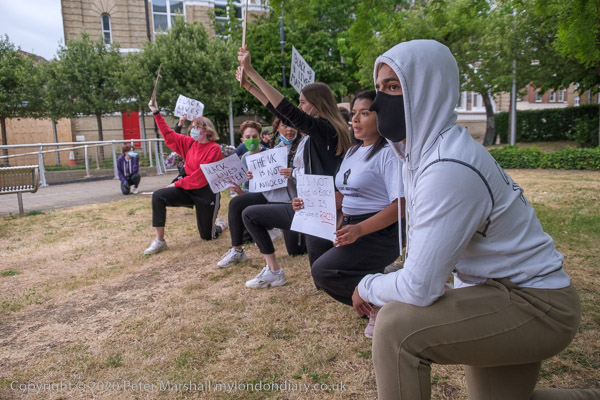
Protesters ‘Take the Knee’ at the side of Staines Town Hall.

Being a photographer is slightly more complicated. In the nature of things you have to move around and thus have a greater chance of coming close to one of that very small number of infected persons present. The moving around also cuts down your chance of always keeping that 2m distance. If you are, like me, someone who likes to get close to those you are photographing, you would be advised to change your way of working, moving perhaps to longer focal lengths. And you would certainly be advised to wear an effective mask when working. Moving around does have the advantage of decreasing the time you are close to any individual, which will also reduce the chance of infection.

The main danger to protesters will almost certainly come from policing. The police seem consistently to fail to observe social distancing and fail to wear face masks, so putting the public at risk. But also they often try to herd protesters into smaller areas where social distancing may be impossible, often to try to keep traffic flowing.

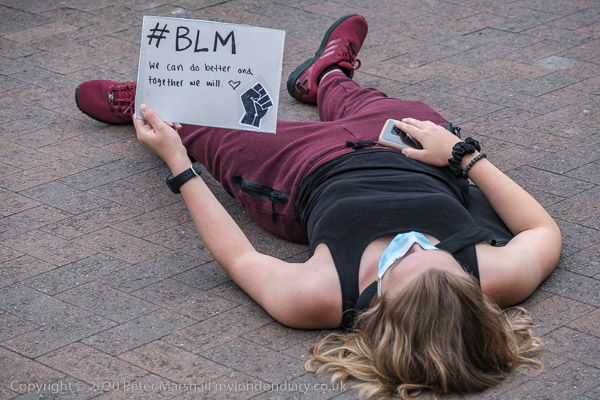
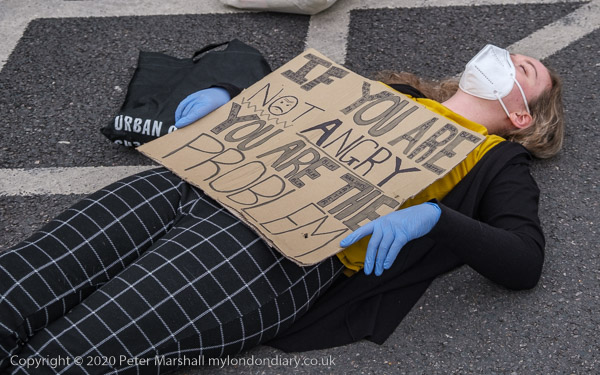
A silent die-in for 8 minutes 46 seconds in the Two Rivers shopping park in the centre of Staines, the time Floyd was restrained by a police officer.

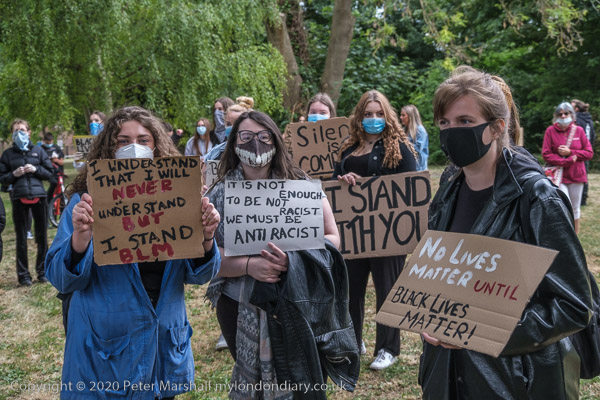
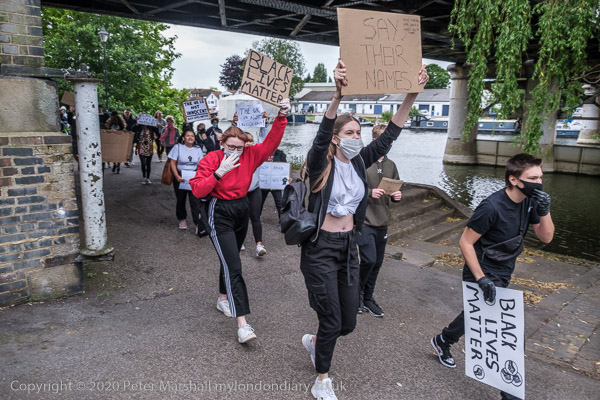
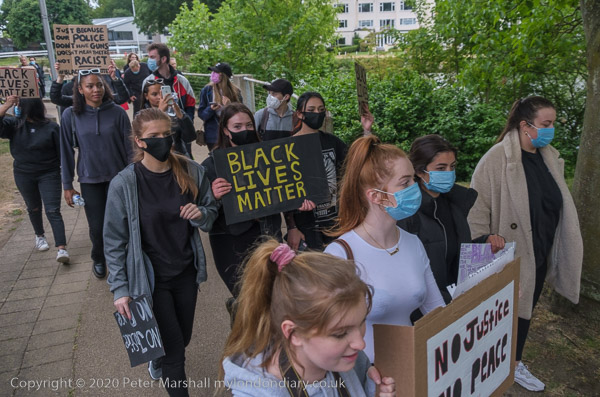
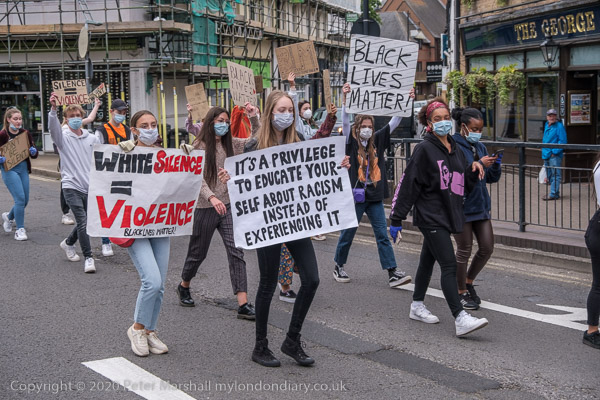
It was probably unwise for me to leave home on Friday to cover a Black Lives Matter protest which I could hear from my window in Staines, particularly as I rushed out unprepared, forgetting to pick up my face mask. Of course I tried to keep at a suitable distance but there were moments when this wasn’t practicable. It was a rather smaller protest, with perhaps a couple of hundred people, not all of whom were wearing face masks either. Rather more of my pictures than usual were made with a short telephoto lens, with my wide-angle used largely for wider views in an attempt to preserve social distance.


All photographs on this and my other sites, unless otherwise stated, are taken by and copyright of Peter Marshall, and are available for reproduction or can be bought as prints.

Dancing and Dereliction – TQ30

North of Covent Garden in the 1km wide strip of London in TQ30 we come into the areas of St Pancras in LB Camden (which includes Kings Cross) and Pentonville in Islington which were largely outside the tourist zone, apart from housing a number of hotels, none of which appear in my colour pictures from 1986-93.

Printer, Kings Cross Rd, St Pancras,1990 TQ3083-057

Businesses here catered for London, and many were failing thanks to changes in technology and the de-industrialisation of our economy. A large swathe was blighted by plans for development of the railway lands, including much outside the actual rail areas that were threatened by demolition, though thanks to local opposition much has so far been saved.

Wellers Court, Somers Town, 1990TQ3083-048

North of Kings Cross there was to be wholesale demolition, and even listed buildings were not safe. The gasholders that were such a prominent landmark in the area were soon to be dismantled, with some being re-erected some distance away on the opposite side of the canal.

Gasholder, Pancras Rd, Kings Cross, 1990 TQ3083-030

And the dancers on the side of Stanley Buildings were having their final dance before they and the other nearby buildings were demolished.

Dancers, Stanley Buildings, Kings Cross, 1990TQ3083-009

Perhaps surprisingly I took few pictures of the Regent’s Canal in colour, though rather more in black and white, but I had photographed around here fairly extensively in the previous few years and perhaps felt I had little more to say.

Works, Albert Wharf, New Wharf Rd, Pentonville, 1986 TQ3083-021

But it was good to have a picture of the road side of Charles Bartlett, Export Packers & Shippers, whose chimney and works dominate this stretch of the canal.

Door and Brooms, Caledonian Rd, Pentonville, 1990TQ3083-064

But the road that fascinated me most was the Caledonian Road and its side streets, as a number of the pictures here show. You can see these and others on the third page of my album TQ30 London Cross-section.


All photographs on this and my other sites, unless otherwise stated, are taken by and copyright of Peter Marshall, and are available for reproduction or can be bought as prints.


TQ30 Covent Garden

Legs, Great Queen St, Covent Garden, Camden, 1987TQ3081-017

Continuing the one kilometre wide strip of London TQ30 north from Westminster leads to Covent Garden, which by the time I took these pictures around 1989 had already become a tourist Mecca. The market had closed and moved to Nine Elms a dozen years earlier in 1974 and many trendy businesses had moved into the area.

Cactus, Entrance, Russell St, Covent Garden, 1991 TQ3081-042

Among them were many clubs and eateries joining those that there already in an area of theatres and of course the Opera House. Opposite that was Bow Street Magistrate’s Court, still in business (it closed in 2006), one of London’s best-known legal landmarks, where many famous and infamous had come to trial.

Young Dancer, Enzo Plazzotta, Broad Court, Covent Garden, 1991 TQ3081-041

Just to its north is a wide alley, Broad Court, with a fine row of red telephone boxes and a statue of a young dancer, though I’m not sure why facing the Opera House was thought to be an appropriate position for her.

Elvis, Great Queen St Holborn, 1991 TQ3081-043

Elvis was not far away, in Great Queen St. It was had to tell from many of the shop windows exactly what business they were in, but one of the strangest was in Betterton St – The Albanian Shop, where you could buy the thoughts and probably a bust of ‘The Iron Fist of Albania’ and which doubled as ‘The Gramophone Exchange’. It is alas no longer with us.

Albanian Shop, Betterton Street, Covent Garden, 1991 TQ3081-052

Doubtless there is still much of interest in Covent Garden, if in normal times you can see any of it for the hordes of tourists. It’s an area of London I now tend to avoid, but back then was always an interesting and often surreal experience.

Gloves, shop window, Judd St, St Pancras,1986 TQ3082-015

More pictures mainly on the second page of TQ30 London Cross-section.


All photographs on this and my other sites, unless otherwise stated, are taken by and copyright of Peter Marshall, and are available for reproduction or can be bought as prints.