2020 is a year I don’t think I want to look back on, so I’ll eschew that traditional filler and instead look back rather further to continue my series on walks in the Lea valley in the 1980s.
This time of year it has been a tradition for at least some of my family to get together to go on sometimes fairly lengthy walks, usually somewhere in the country. It’s something that has rather tailed off over the years, with both my sons now having young children, and also as my own legs getting old and tired, making anything over six or seven miles something of an ordeal.
This year things have become even more difficult, with us all under Tier 4 restrictions on travel etc and in different parts of the country, so our meetings have only been virtual. And although Linda and I have managed some short walks – around 5 miles on Boxing Day – these have all started and finished at our home. But at least I can take a digital walk in the Lea Valley.
These pictures were not all taken on the same walk, which is one I did several times when working on my Lea Valley project and have repeated parts of rather more times since, sometimes riding on my Brompton folder. Parts of it have changed dramatically over the years, and wherever in these pictures you see a timber yard, factory or power station there is probably now several blocks of flats.
So many changes make it difficult for me to pinpoint the exact locations of some of these pictures, though others have very recognisable landmarks – such as the railway viaduct in the background above, now with a blue plaque celebrating the work of Alliott Verdon Roe, the first man to build and fly an entirely British aeroplane, built here in one of its arches, back in 1909.
But Latham Timber is long gone, along with its neighbouring yard and the fences on which ‘The Gruesome’ staked their territorial claim and on which P & R pledged their ‘Forever True’ love in white paint on 16-8-82. Where are they now I wonder as I look at these pictures? Though so far as I’m aware I never saw any of them back in 1982 either.
All photographs on this and my other sites, unless otherwise stated, are taken by and copyright of Peter Marshall, and are available for reproduction or can be bought as prints.
I continue my virtual walk downriver towards Hackney Wick.
Past the Clapton Park Estate: Norbury Court, Bakewell Court, Ambergate Court and Sudbury Court at 172 Daubeney Road, each 20 stories with 114 flats, approved by Hackney Council in 1968. Three were demolished by explosions in 1993-5 but Sudbury Court was sold to a private developer who gave it a relatively minor make-over and renamed it Landmark Heights.
Somewhere I passed a canal-side factory –
as well as the wide expanse of Hackney Marshes, with what must surely be more football pitches and anyone needs
as well as some wilder areas where the hogweed grows
and was ambushed by a group of children
who demanded I take their pictures.
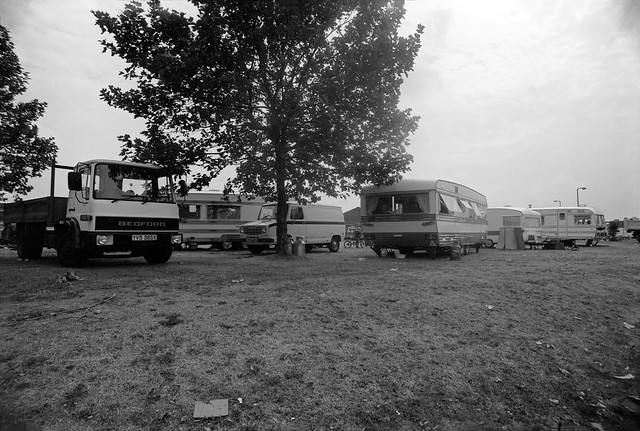
Clost to Eastway I came across a travellers site
close to the River Lea, here looking a very serious river away from the navigation.
My walk continued but in a less linear fashion wandering around Hackney Wick – in the next episode. You can see all the pictures and more in my album River Lea – Lea Navigation 1981-1992.
All photographs on this and my other sites, unless otherwise stated, are taken by and copyright of Peter Marshall, and are available for reproduction or can be bought as prints.
Tottenham Hale station on the Victoria Line was a convenient starting point for walks both north and south along the Lea navigatiion, which is crossed by Ferry Lane around 200 metres from the station.
Stonebridge Lock is around 3/4 miles north up the path from Ferry Lane, where steps lead down to the towpath immediately after you cross Pymmes Brook. The view above is looking south back towards Tottenham Hale.
Thames Water Sludge Mains Bridge No 3 crosses the Navigation closer to Ferry Lane, and as well as a crudely painted landscape also carried racist graffiti from the National Party, a splinter group of the National Front which was active from 1976-83.
A lone tree behind a gate somewhere on Ferry Lane (or its eastern continuation, Forest Road.)
The Lee Flood Relief Channel at Forest Rd. There are now tall recently built blocks of flats replacing the inustrial units and garage in this picture.
This extensive range of warehouses fronting the navigation immediately south of Ferry Lane has now been demolished and replaced by housing.
There is a channel here from the River Lee Diversion which takes excess water from the river and navigation north of Enfield, though usually most of the flow in this rejoins the navigation around half a mile further south.
The pattern of waterways it the Lea Valley is difficult to understand and as well as the diversion there are also various flood channels, as well of course as tributaries such as the Pymmes Brook and Dagenham Brook. In the old days there were various man-made channels to feed water mills, while more recently, particularly in the twentieth century various projects to control flooding in the area.
All photographs on this and my other sites, unless otherwise stated, are taken by and copyright of Peter Marshall, and are available for reproduction or can be bought as prints.
The Pymmes Brook is a stream in north London which runs from Barnet and joins the River Lea at Tottenham. It got its name from William Pymme who was given land in Edmonton by Edward II in the fourteenth century.
Although it begins from underground springs at Monken Hadley Common in the London Borough of Barnet, these supply relatively little of the water which reaches the River Lea, particularly when the river is in flood, augmented by water runoff from streets and sewage overflows along with the more normal industrial effluent. Because it used often to flood in its lower course, much is now in deep concrete channels, and in some places is culverted.
I’m no longer sure exactly where I took most of these pictures of the Pymmes Brook, but I think they were just a little after it flowed under the North Circular. I think some may actually be of the Salmons Brook which runs down from Enfield and joins it in Upper Edmonton. This gets its name not from the fish – which were probably once found in it before the area became urban and industrial – but from the 13th century landowner John Salemon.
The river runs more or less parallel to the Lea Navigation just a few yards away across Tottenham Marshes and only finally flows into the Lea close to Ferry Lane in Tottenham Hale.
My pictures of the Lea continue south from Chalk Bridge and past Tottenham Marshes.
On the east side are the large Banbury and Lockwood reservoirs, part of a series up the Lea Valley providing water for much of east London.
This is one of the most picturesque sections of the River Lea, certainly in its lower reaches. I could almost imagine Izaak Walton walking along here in conversation (as Piscator) with his friends Venator and Auceps on May Day holding the discussion of the relative merits of fishing, hunting and fowling as recorded in his ‘The Compleat Angler‘.
All photographs on this and my other sites, unless otherwise stated, are taken by and copyright of Peter Marshall, and are available for reproduction or can be bought as prints.
Fortunately I am not a member of the Labour Party, so can speak freely about Israel and Palestine without fear of being expelled from the party. I’ve never actually been a member, though in my teenage years used to occasionally attend the meetings for young socialists at the local Cooperative hall, mainly I think because they would offer cigarettes around very freely. As a fresher I joined the Labour Students and attended meetings until they were closed down by the national party for being socialist. But by then I was involved with various other groups campaigning on various political issues but outside the party system. That remains the case and I’m still a member of groups including Friends of the Earth, CND and Global Justice Now.
The only political party I’ve ever actually joined was the Green Party, though I think back then it may still have been called the Ecology Party. After a year I didn’t renew my membership, partly because it seemed to be spending most of its time on internal feuding, but also because of the strange cranks it seemed to attract. Of course it also includes some of the most honest and sensible politicians around but our crazy electoral system means few of them getting elected. But most years Caroline Lucas would get my vote as politician of the year, and a few have made it as local politicians and also MEPs. Though sadly the latter opportunity is about to end.
Back in my student years and later, virtually everyone on the left including myself admired and supported Israel. It wasn’t just the Holocaust, but also their fight to free themselves from the British mandate and their determination to build a future. I think we remained largely ignorant about the 1948 ‘Nakba’ when around half of the Palestinians fled or were expelled from their homes. Several of my friends went to volunteer in kibbutz and we envied them and thought seriously about doing the same to help build a socialist future.
Over the years we’ve learnt more about what actually happens in Israel and Palestine, and the government of Israel has become very much more right wing. While almost none deny the right of Israel to exist (and to that extent are Zionists), we all want a fair solution in the area which recognises the civil and human rights of Palestinians. The Balfour declaration as well as favouring the establishment of a national home for the Jewish people also insisted “it being clearly understood that nothing shall be done which may prejudice the civil and religious rights of existing non-Jewish communities in Palestine” and in 2017 the British government recognised the declaration should also have called for protection of the Palestinian Arabs’ political rights.
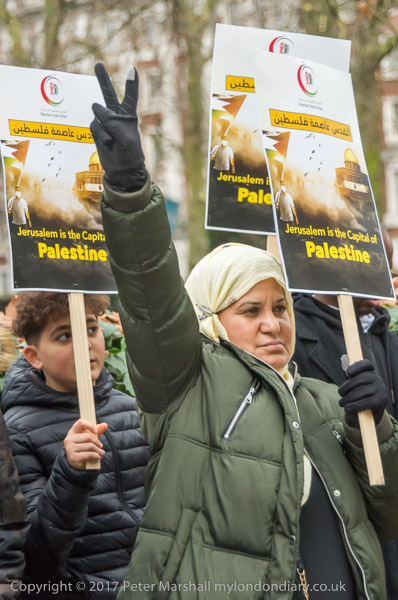
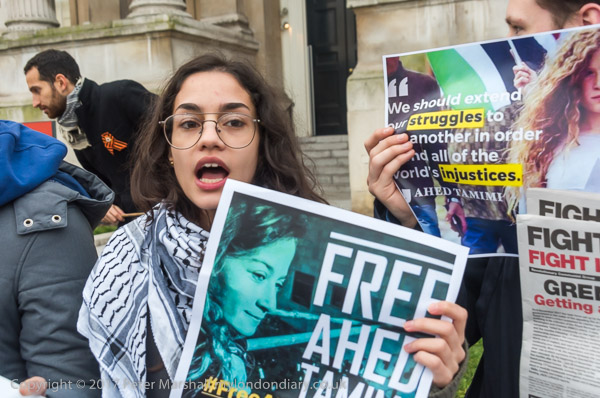
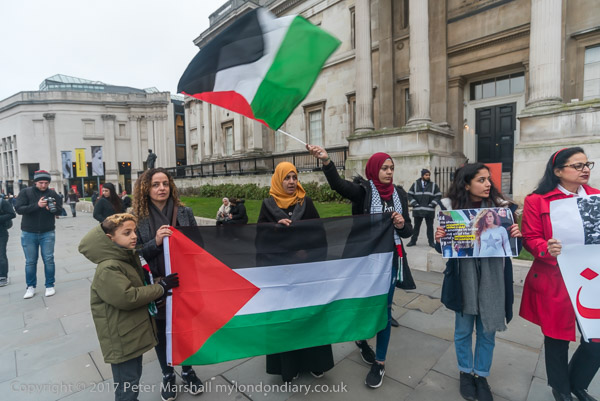
I’ve been labelled by a few militant ultra-right anti-Palestinians as an “anti-Semitic photographer” because I have photographed protests against human rights abuses by Israeli government forces – like these I photographed on 23rd December 2017 – and against laws that make people – including notably Nelson Mandela – describe Israel as an “apartheid state”. And also for photographing protests calling for support for the BDS movement, which calls for boycotts, divestment and sanctions “to end international support for Israel’s oppression of Palestinians and pressure Israel to comply with international law.” None of these things are anti-Semitic, though they are opposed to policies of the current government of Israel.
I’m fairly certain however that were I a member of the Labour Party I would now be suspended and expelled for my views – along with many of the leading Jewish (and non-Jewish) Labour activists who express any support for human and civil rights for Palestinians. But fortunately you can’t be expelled if you are not a member.
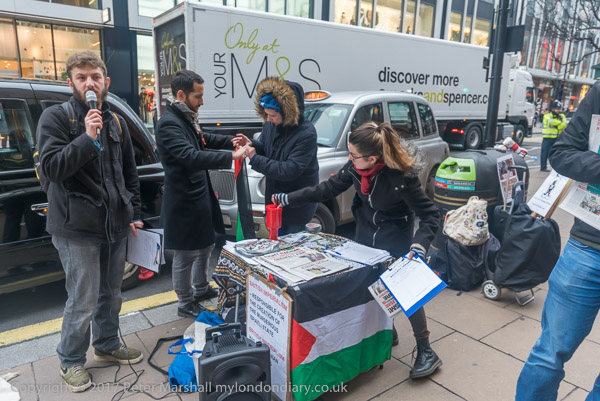
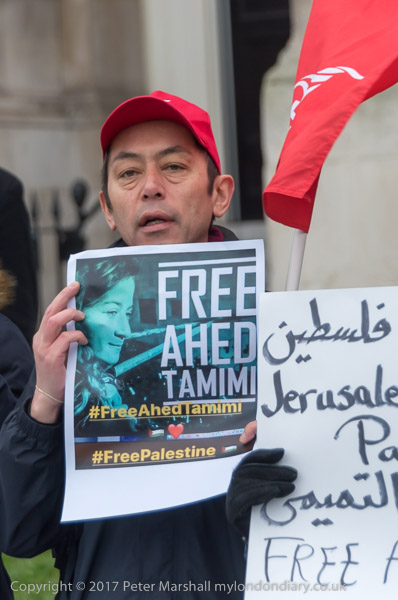
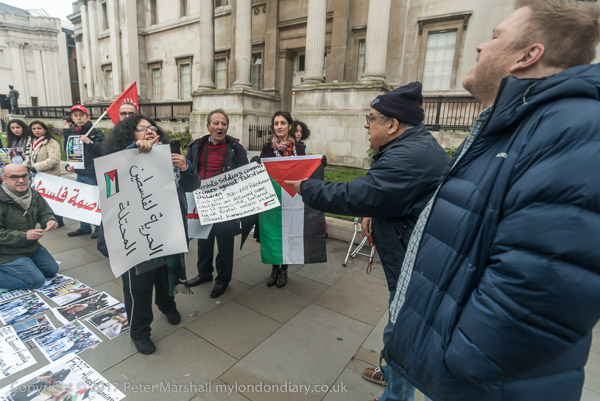
The protests on this date were prompted by two events. The Palestinian Forum in Britain protested outside the US Embassy after US President Trump’s announcement that the US Embassy in Israel will move to Jerusalem, there was a regular protest calling for a boycott of goods from Israel outside Marks and Spencers on Oxford St and a protest in Trafalgar Square condemned the kidnap, beating up and arrest of 16-year-old Ahed Tamimi by Israeli soldiers – which was also condemned at the two earlier protests.
A few militant supporters of the Israeli oppression of Palestinians came to insult and shout down the event in Trafalgar Square, with one man making clearly racist comments about one of the protesters. A police officer eventually arrived and suggested firmly they go away, but took no action over the complaints of racist abuse made against one of them. The man in a hat in my picture above was found guilty of disorderly behaviour likely to cause harassment, alarm or distress for similar behaviour at a BDS protest the following year.
All photographs on this and my other sites, unless otherwise stated, are taken by and copyright of Peter Marshall, and are available for reproduction or can be bought as prints.
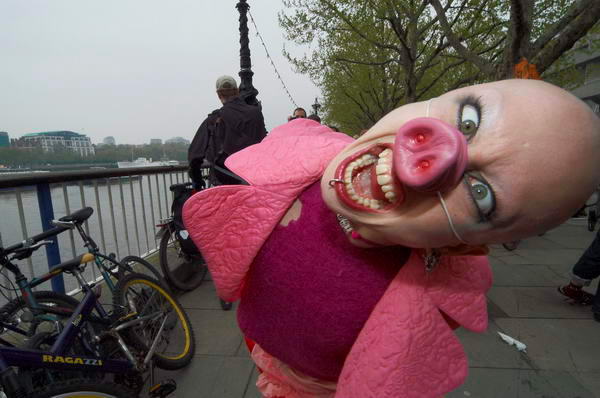
Cyclists protest. Critical Mass 10th anniversary, South Bank, London, April 2004.
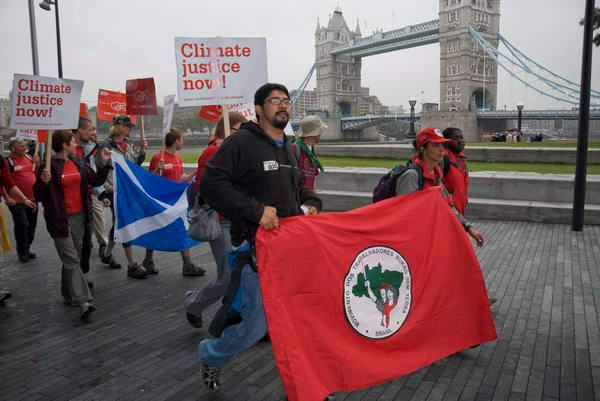
Thirteen years ago in 2007 I was not in London but in Brasilia, where I had gone for the opening of my show on environmental protests in London, part of Foto Arte 2007, a huge photography event that stretches on for 3 months with over 20 international shows and more than a hundred individual and group shows from Brazil, apparently in 57 locations across the city. The theme of the festival was ‘Natureza, Meio Ambiente e Sustentabilidade‘ or in English, ‘Nature, The Environment and Sustainability’ and my contribution representing the UK was a set of 24 colour pictures of environmental protests in London – including a picture of Brazilians leading the last mile of a 1000 mile Christian Aid ‘Cut the Carbon’ march past Tower Bridge.
My work was in show in a local community centre in one of the ‘Quadra’ which make up the living quarters of the city around its central core. My show was backed by the British Embassy and they had also arranged for me to give a lecture – and provided simultaneous translation for my Portuguese speaking audience.
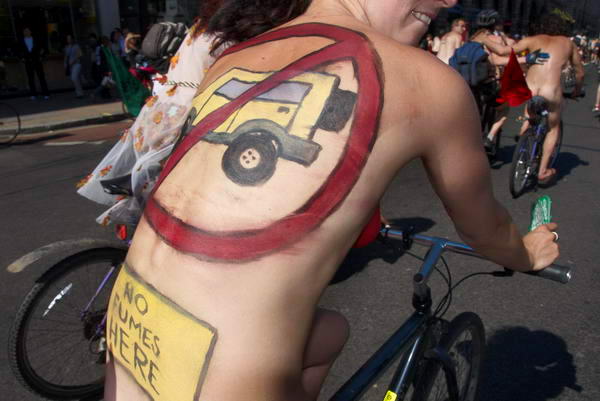
‘No Fumes Here’. World Naked Bike Ride, London, June 2006.
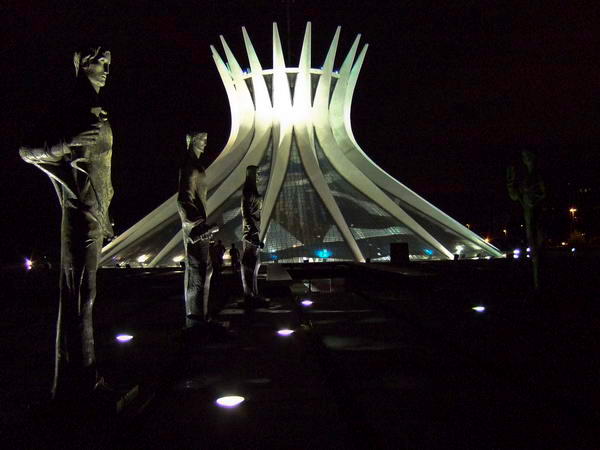
Because I was very aware of the planned nature of Brasilia, a new capital city built from scratch, which I described as “really the ultimate flowering of the modern movement in architecture and planning, planned by Lúcio Costa (1902-98) and with many buildings by the famous architect Oscar Niemeyer, 100 on December 15, 2007 and still working” I had decided my talk would be about my own photographs around London and more generally about “the photography of the urban environment and some of the changing ideas in planning, and how the invention of the car had completely altered our cities. Ideas about Garden Cities at the end of the nineteenth century had been overtaken by urban sprawl.”
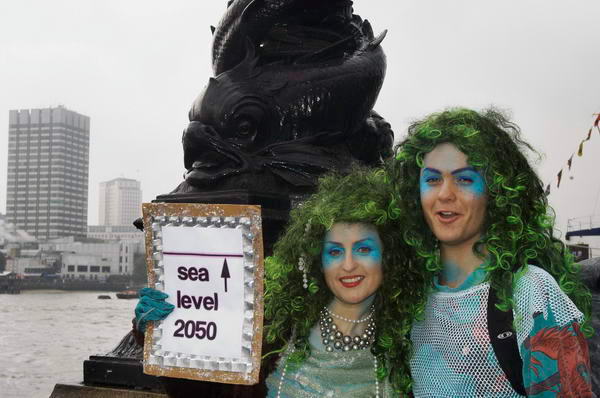
‘London Underwater 2050 Tour of the G8 Climate Criminals’, European Social Forum, London, October 2004.
During my stay I also got to see all the other shows then taking place, and also was treated to several of the finest restaurants in the city (including a lunch with the Ambassador and the director of the festival) and was taken around the various sites of the city – including the many Niemeyer buildings by a daughter of one of Costa’s team of planners. It was an exciting few days, though very stressful at times.
One of Niemeyer’s most famous buildings, the cathedral in Brasilia – Fuji FinePix F31fd
I’d known I would have a busy time with little chance for any serious photography and had taken with me just a small pocketable digital camera, a 6Mp Fuji FinePix F31fd, and used it as a notebook during my stay. A few of the almost a thousand pictures I took are on My London Diary, but there are many more which I now find of some interest, and perhaps I’ll upload more onto Flikr shortly.
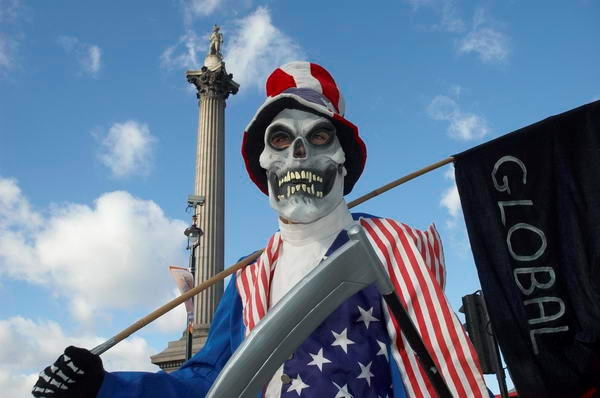
Uncle Sam’ as the Grim Reaper in Trafalgar Square, Kyoto Climate March, London, February 2005
I wrote quite a few posts about the visit here on >Re:PHOTO, including brief review of some of the other exhibitions in Foto Arte 2007, starting with one just before I caught the plane, Foto Arte 2007 Brasilia with my full set of 24 pictures and continuing after I arrived home and into January 2008.
All photographs on this and my other sites, unless otherwise stated, are taken by and copyright of Peter Marshall, and are available for reproduction or can be bought as prints.
Timber made up a very large proportion of the commercial traffic on the Lea Navigation, certainly in the twentieth century. In its earlier years barge traffic on the River Lea and its canalised sections was largely of agricultural products – malt, meal and grain – being carried down to London, with barges being returned empty or carrying coal upstream. Trade was substantial even before the construction of the navigation began following plans by John Smeaton and the 1767 Act of Parliament, and the river carried an estimated 30,000 tons a year coming mainly from around Ware and Stanstead Abbotts.
The flash locks then in use, with gates that were removed to allow barges to pass wasted large quantities of water and tolls were high, and they also meant that loads going upstream were restricted to a third or a quarter of the 35-40 tons of a downstream load. There were many later improvements to the navigation, though most of the current system comes from an 1866 Act of Parliament.
In the twentieth century barges carried loads of 100 tons on the waterway and the main traffic was timber, carried upstream from the Surrey docks to a number of timber wharves, one of the larger of which was the Edmonton Wharf at the Lea Valley Trading Estate, which I think was operated by Hahn & Co Ltd, though I can find no further details.
I made several visits to this large site and took pictures, and returned in later years when it had become a bus depot. Back in 1983 there was another timber yard on the opposite bank of the navigation, which I think was called Dornford Wharf, though the old street plan I used labels this area of the east bank with this name.
In the Flickr album River Lea – Lea Navigation 1981-1992 I’ve captioned these images as being in Dornford Wharf, Towpath Rd, and I’ve also included a few more images which are simply slight variations on those show here – as well as many other images taken along the river.
If these huge trunks had been brought here by the navigation they will have been here some time as commercial traffic ended a couple of years earlier in 1981. There didn’t appear to be any work being carried on in the timber yard when I took these pictures, but they were possibly made on a Sunday.
At the side of the yard close to the towpath I came across an area that had clearly been used fairly recently to cut up some wood on a rather smaller scale but which had produced a prolific amount of sawdust.
Although the Flickr album River Lea – Lea Navigation 1981-1992 only currently contains black and white pictures, I did also make some colour transparencies when I was photographing the Lea Valley. Three of them, including the image above, were my contribution to the show Roof Unit Foundations at [ space ] in Hackney in 2007.
All photographs on this and my other sites, unless otherwise stated, are taken by and copyright of Peter Marshall, and are available for reproduction or can be bought as prints.
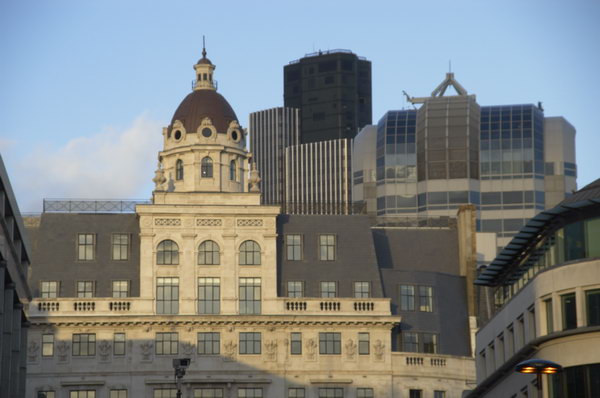
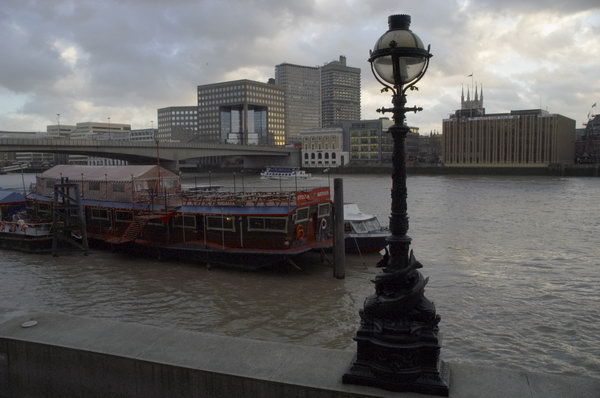
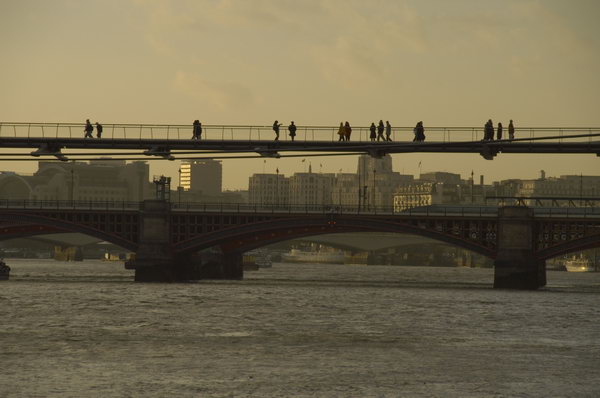
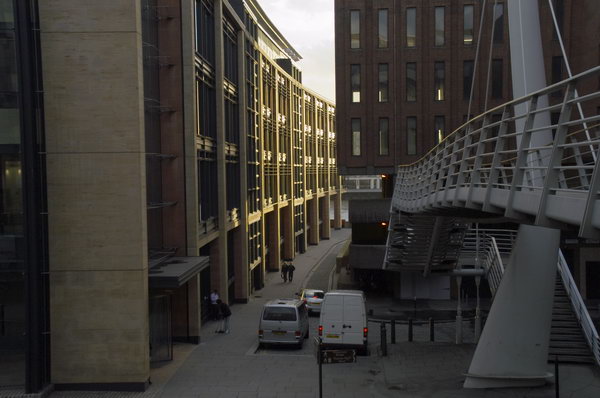
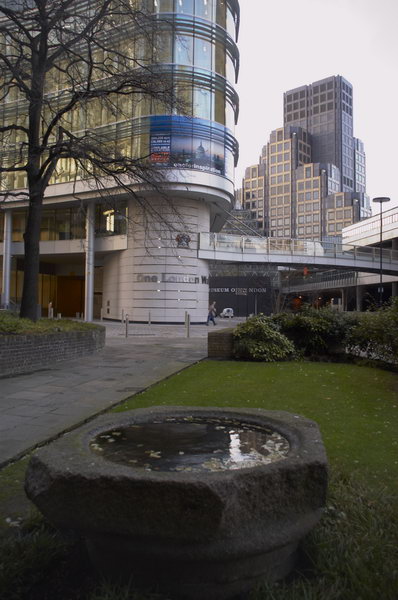
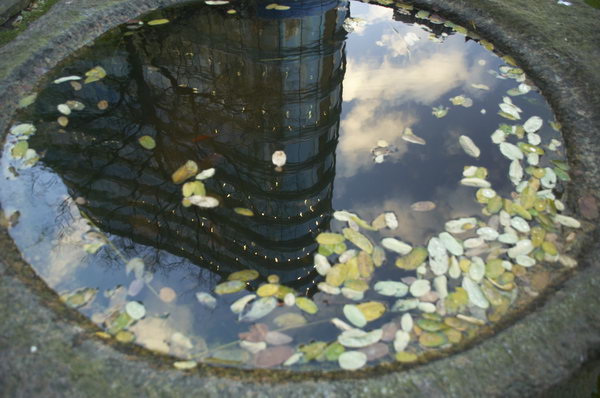
I can’t remember exactly why I went up to London on 16th December 2004, but my pictures taken that day tell me fairly clearly the route that I took, taking me in a rather roundabout fashion from London Bridge to a meeting with someone at the Museum of London.
It was a fine day, and I’d obviously decided to take an early train to give me time to wander and take a few photographs before the meeting, arriving at London Bridge Station over an hour before. I can tell this because I was using a digital camera, my first interchangeable lens digital camera, a Nikon D100 and can read the times the images were made from the Exif data embedded in the files – such as the example below.
1/200s, f/7.1, ISO 400 Mode: P, Meter: Matrix, No Flash, Auto WB Focal: 52mm, 16/12/2004 14:49:27, Adobe RGB (1998) 6.1MP (3,030×2,021) NIKON D100
I only used one lens, the very versatile 18-125mm f3.5-f5.6 Sigma lens, a relatively light and compact zoom that really showed the advantage of the DX system over the later bulkier full-frame lenses. I imagine its test results wouldn’t quite match those of more expensive Nikon glass, but the images seem fine and sharp looking at them now.
Although the D100 was only a 6 Mp camera, this provided images at 3030 x 2021 that were large enough for most repro purposes and gave me excellent prints at 12×8″ and even larger – one picture from it – taken with another Sigma lens – went on exhibition 2.3m wide and paid well.
I think I will have taken these pictures using RAW files, though it would take me a while to locate these on a backup disk, and I only have jpegs and some tiff files to view on my current system. Software for converting from RAW has improved significantly since 2004 and I would almost certainly be able to produce some improvements, in particular reducing the little colour noise present in some. But I think they are fine as they stand.
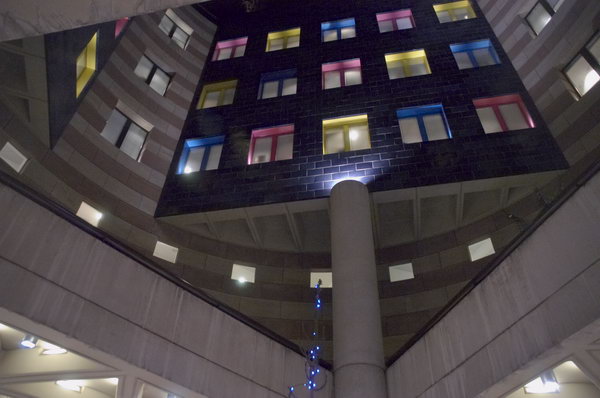
I arrived at the meeting presumably on time but can tell you nothing about it other than it probably lasted for a little over an hour and came out to make my way home a little after 4.30pm, by which time it was dark. I took a picture of Shakespeare’s bust using the D100’s built-in flash – which came out as badly as you would expect, one in the interior of No 1 Poultry you see here, and then stood still for a final picture on the moving walkway taking me down to the ‘drain’ (Waterloo & City line) to Waterloo for the train home.
A few more pictures from the walk and others from December 2004 on My London Diary. It was a month I also visited Mucking (its in Essex) and photographed ‘Fathers For Justice’ protesting in Santa suits and took a couple of walks close to where I live. All have something of a sepia quality – thanks to the raw conversion – which I find quite appealing and perhaps nostalgically appropriate.
All photographs on this and my other sites, unless otherwise stated, are taken by and copyright of Peter Marshall, and are available for reproduction or can be bought as prints.
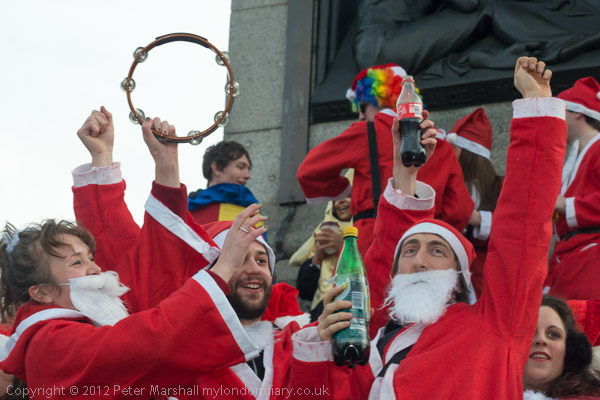
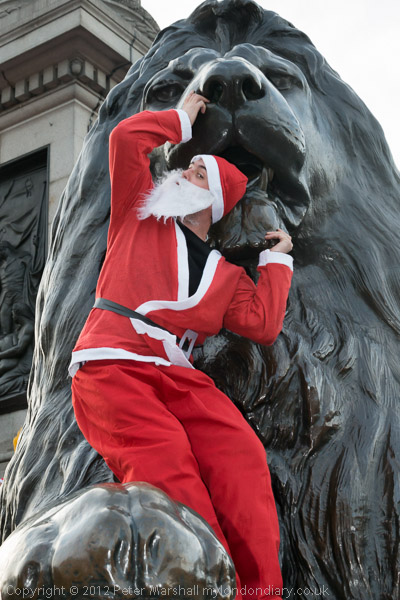
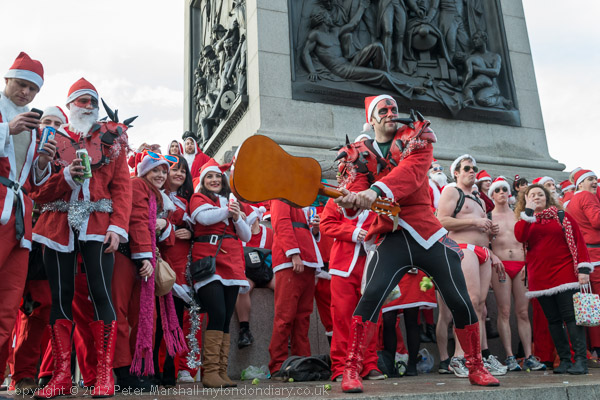
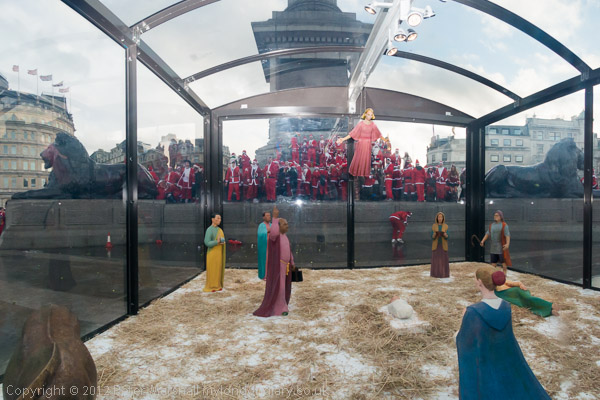
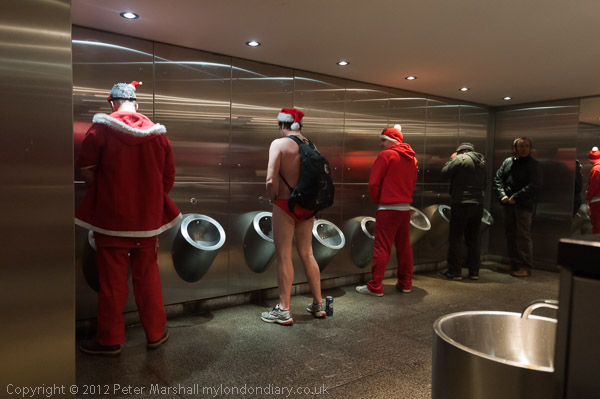
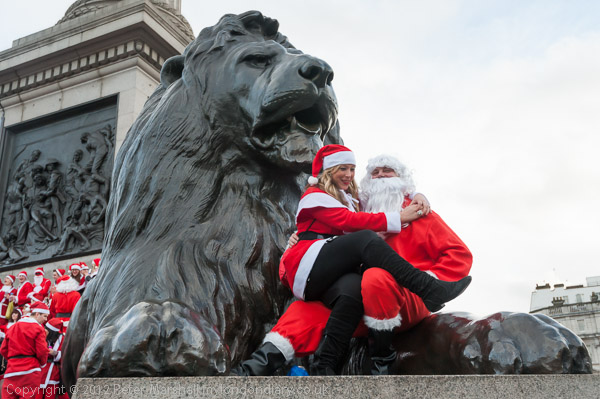
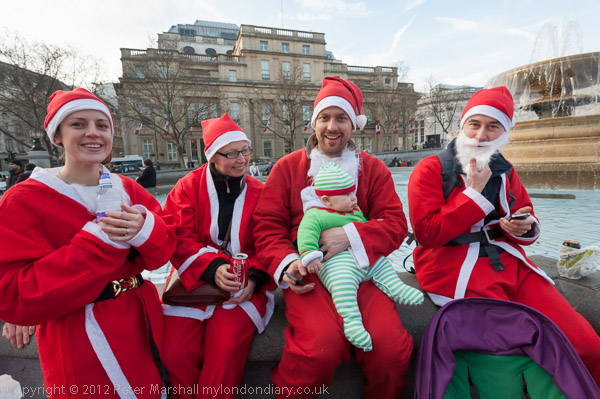
I think this may be my final post this year about Santacon, the “non-profit, non-political, non-religious and non-sensical Christmas parade” which I first photographed in London in 2006, though I think it had been taking place here for some years.
The first Santacon was in Copenhagen in 1974, begun by a street theatre group as a protest against the commercialisation of Christmas, when the Santas went into department stores and handed out presents from the shelves to customers – and were arrested.
A Santa on the plinth of Nelson’s column bats back brussel sprouts thrown by elves.
It became popular in the USA following a 1994 article about the Cophenhagen event which appeared in the magazine Mother Jones leading to a repeat performance in in San Francisco in 1995.
From there Santacon spread to other cities in the US and then to over 40 other countries as a fun day out wearing Santa costumes and roaming the city drinking on the street with friends. The largest Santacon, in New York, by 2012 had an estimated 30,000 people taking part, and it was condemned by most of the media, with the New York Times criticising it (quoted on Wikipedia) for “sexism, drunkenness, xenophobia, homophobia and enough incidents of public vomiting and urination to fill an infinite dunk tank” and saying it contributed nothing to the areas where it takes place. The organisers pointed out that in 2013 it raised $60,000 for New York charities and donated around 3 tons of canned food to a New York food bank.
Since then the city authorities in New York and also in London have clamped down on Santacon in various ways, and what was a largely autonomous and unplanned event has been forced to organise and toe various lines.
The London 2018 Santacon had raised over £15,000 for the charity Christmas for Kids. But there was no official event in London in 2019 bacause the organisers were unable to attract sufficient volunteers to organise the 2019 event and satisfy the requirements for them to police it. They issued a statement on their Facebook page dissociating themselves from those who they encouraged to organise their own celebrations to avoid possible prosecution.
Nothing official will be announced from Santacon London this year, if you see an event called Santacon it’s not us and remember Santacon is meant to be free (with the exception of charity donations) and never includes a Santa costume. Santa makes their own (or put their elves to work).
Santacon London FB page
Despite the lack of any official event, several thousand Santas still took part in 2019, most ending up – as in previous years – in Trafalgar Square, though I had other things to photograph. And although Covid restrictions will certainly mean there is no official event this year, I suspect quite a few Santas may have made their way to Trafalgar Square last Saturday.
All photographs on this and my other sites, unless otherwise stated, are taken by and copyright of Peter Marshall, and are available for reproduction or can be bought as prints.
Five years ago on Saturday 12th December I had another busy day travelling to events around London. I began at Stratford on the east of London, the opposite side of London to where I live, but now a relatively easy journey since the opening of the Jubilee line there at the end of 1999.
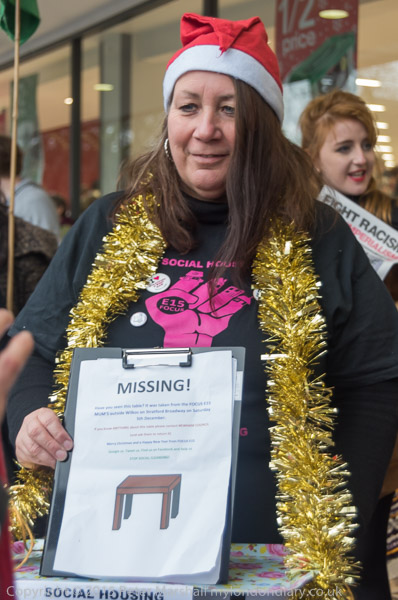
For the previous couple of years I’d been following the progress and protests of Focus E15, formed when Newham Council planned to close down a hostel for young mothers in Stratford and scatter them to private rented accommodation often hundreds of miles away. They stood their ground and got more local rehousing, but, appalled by the activities of the council and its Mayor Robin Wales, continued to take action over the failure of Newham Council to sensibly address the acute housing problem in the borough, which has around 5,000 people living in temporary accommodation and while 400 homes in the Carpenters Estate close to the centre of Stratford have been empty for up to ten years. They accuse the council of ‘social cleansing’, attempting to force those needing housing out of London.
Apart from various actions, including preventing evictions and embarrassing the Mayor by confronting him at public events Focus E15 had held a weekly Saturday street stall on the wide pavement at Stratford Broadway, handing out leaflets and advice to the public on housing issues.
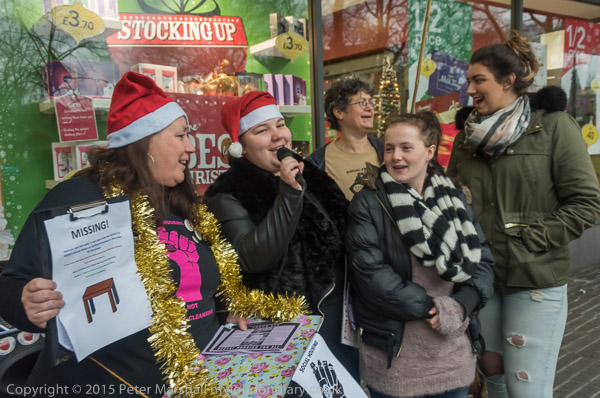
Although their weekly protest was legal, it clearly annoyed the council, and on Saturday 5th December Newham Law Enforcement officer John Oddie arrived, assisted by several police officers and confronted the campaigners and told them they were not allowed to protest there, and that unless they immediately packed up their stall, sound system, banners and other gear it would be seized. The group made clear that they would not move and following some argument, police seized a table and threw it in the back of their van.
It soon became clear that this action by police and the council officer had been illegal, and the council asked the protesters to come and collect the table. They replied asking the council to return it to them at the following week’s protest, and advertised this widely as a ‘Free the Focus E15 Table’ event, making considerable humorous mileage out of the council and police gaffe. The council didn’t turn up with the table, but there a number of other tables there, celebrating ‘Tablegate’ and although the local newspaper seemed to be boycotting the event (could they possibly attract considerable revenue from publishing official council notices) a BBC local news crew came along to film a few interviews.
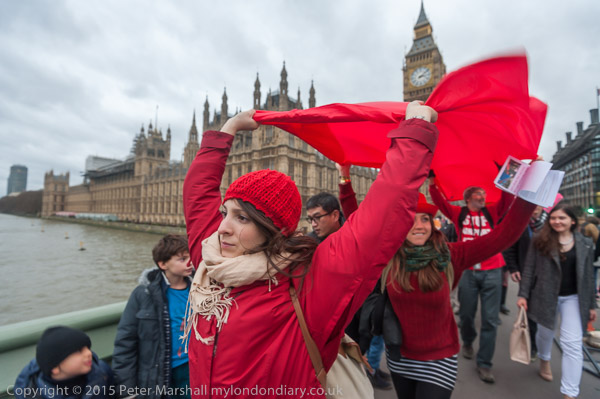
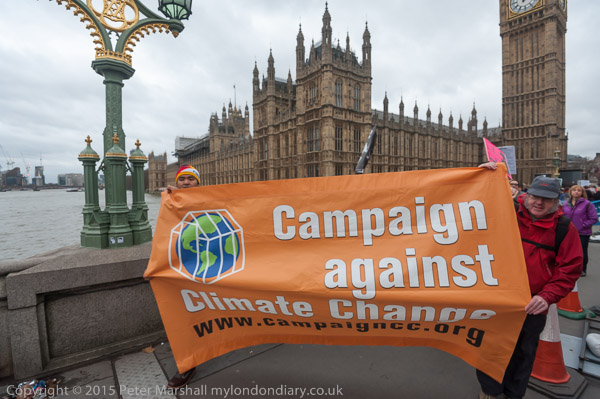
I couldn’t stay until the end but caught the tube back to central London where the Campaign against Climate Change were protesting against the inadequacy of the COP21 Paris deal, which sets the target temperature rise too high, has no way to enforce the measures needed and will allow the giant corporations to continue to prevent governments from carrying out effective green measures.
After a short rally in Old Palace Yard the protesters unrolled a 300m length of bright red fabric, carrying it above their heads across Westminster Bridge. It was a tricky to photograph but visually effective reminder of the need of governments to take urgent action to keep fossil fuels – including shale oil, with fracking now shown to be as dirty as coal – in the ground, or at least only to be extracted as chemical feedstock rather than fuel, and an increased urgency in the transition to renewable energy.
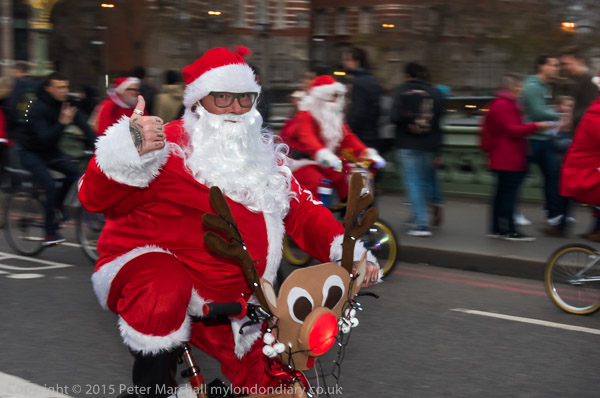
As I was photographing on Westminster Bridge, I was surprised to see a group of several hundred Santas on BMX bikes riding across on the opposite carriageway and rushed across to take a few pictures. I later found that this was an annual BMX Charity ride – which I went to photograph in 2019.
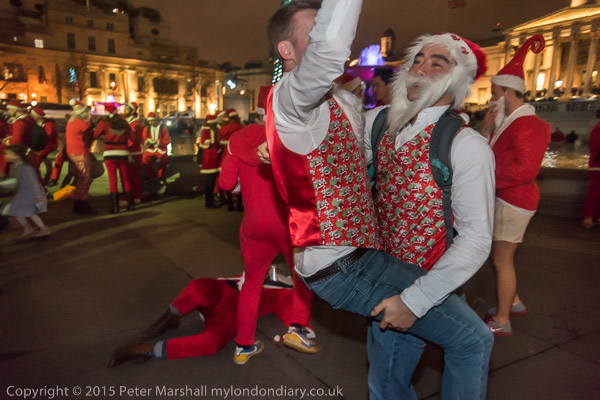
Later in the day I went to Trafalgar Square where a completely unconnected Santa-themed event was taking place, with Santas arriving at the end of the annual Santacon, a largely alcohol fuelled festive costume ramble through London.
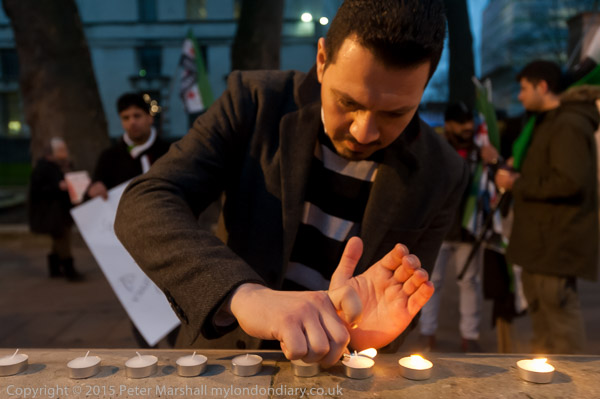
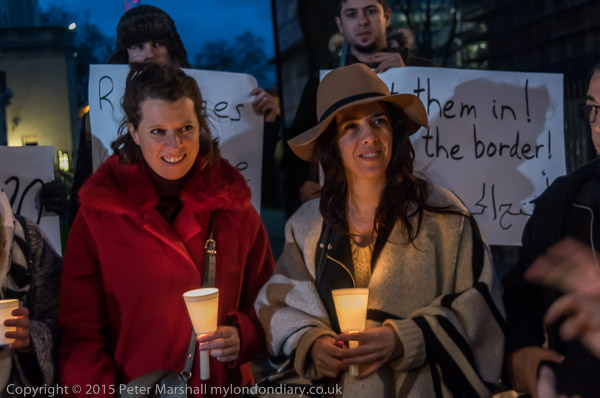
In late afternoon, solidarity campaigners and Syrian activists met for a vigil opposite Downing St vigil demanded justice for refugees, opening of EU borders to those fleeing war and terrorism and a much more generous response from the UK government.
It was a candlelit vigil, but a gusty wind blew out the flames as soon as they were lit until someone went to buy plastic cups to act as windshields though these rather hid the actual flames.
The response of the British government to the refugee crisis, particularly from Syria, but also from elsewhere around the world is seen by many to be abysmal. Even after considerable pushing from the British people which forced David Cameron to increase numbers, the UK was only promising to take 20,000 in the next five years, while Canada will take more – 25,000 – in a single year.
All photographs on this and my other sites, unless otherwise stated, are taken by and copyright of Peter Marshall, and are available for reproduction or can be bought as prints.